Ancient civilizations mark the earliest phase of complex human development, when societies transitioned from simple agrarian communities to organized urban cultures. Most historians identify the earliest cradles of civilization in present-day Iraq, Egypt, India, China, Peru and Mexico, emerging between 4000 BCE and 3000 BCE.
These Ancient Civilizations of the World introduced fundamental innovations such as agriculture, writing systems, urban planning, governance and scientific knowledge, many of which continue to shape modern societies. Their legacy forms the foundation of contemporary life from legal systems to technological advancements highlighting the continuity of human progress.
Major Ancient Civilizations of the World
Here we have discussed all the Major Ancient Civilizations of the World below.
Mesopotamian Civilization (c. 3500 BCE - 539 BCE)
Mesopotamian civilization, often regarded as the “cradle of civilization,” emerged in the fertile region between the Tigris and Euphrates rivers in present-day Iraq and parts of Syria and Kuwait. The name Mesopotamia itself means “land between two rivers.” Its strategic location and fertile alluvial soil enabled the rise of the world’s earliest urban societies, making it one of the first centres of complex human development.
Geographical Foundations:
- Located in the Fertile Crescent, Mesopotamia benefited from rich soil deposited by river floods.
- However, unlike the Nile, flooding was irregular and unpredictable, requiring advanced water management.
- The absence of natural barriers made the region vulnerable to frequent invasions, leading to political instability.
Political Organization:
- Mesopotamia was not a unified state but consisted of independent city-states such as Ur, Uruk, Akkad and Babylon.
- Each city-state was governed by a king (lugal) who exercised both political and military authority.
- Over time, powerful empires emerged, including the Akkadian, Babylonian and Assyrian empires.
- Administration relied heavily on scribes and officials, marking the beginning of organized bureaucracy.
Economic Life:
- The economy was primarily agriculture-based, supported by extensive irrigation systems such as canals and dikes.
- Major crops included barley, wheat and dates.
- Trade networks extended to regions like the Indus Valley and Anatolia, involving metals, textiles and agricultural goods.
- Temples and palaces played a central role in controlling production and redistribution of resources.
Social Structure:
Society was hierarchical:
- Kings and priests at the top
- Followed by merchants, artisans and scribes
- Farmers and labourers formed the majority
- Slaves occupied the lowest position
- Social roles were well-defined, and inequality was institutionalized.
Cultural and Scientific Contributions:
- Writing System: Developed cuneiform script, one of the earliest known writing systems. Initially used for economic records, later expanded to literature, law and administration. Famous literary works include the Epic of Gilgamesh, one of the oldest epics.
- Law and Governance: The Code of Hammurabi was one of the earliest written legal codes. It introduced the principle of “an eye for an eye”, emphasizing justice and accountability. Laws covered aspects such as trade, property, family and crime.
- Mathematics and Astronomy: Introduced the base-60 (sexagesimal) system, which forms the basis of modern time measurement (60 seconds, 60 minutes). Divided the circle into 360 degrees. Made early observations of celestial bodies, contributing to the development of astronomy and calendars.
- Architecture: Constructed monumental structures called ziggurats, which served as religious temples. Used mud bricks due to lack of stone, developing durable construction techniques. Urban planning included walls, temples and public buildings.
Religion and Beliefs:
- Mesopotamians practiced polytheism, worshipping gods associated with natural forces such as water, sky and fertility.
- Each city-state had its patron deity.
- Religious institutions, especially temples, were central to economic and social life.
- People believed in a harsh afterlife, which influenced their rituals and practices.
Military and Conflicts:
- Due to lack of natural defenses, Mesopotamia witnessed frequent wars and invasions.
- City-states often fought for control over fertile land and water resources.
- Military innovations included the use of chariots and organized armies.
Decline:
- Mesopotamia experienced repeated cycles of rise and fall of empires.
- External invasions, internal conflicts and environmental challenges weakened the region.
- The civilization came under Persian control when Cyrus the Great conquered Babylon in 539 BCE.
Ancient Egyptian Civilization (c. 3100 BCE - 332 BCE)
Ancient Egyptian civilization developed along the fertile banks of the Nile River.
Geographical Foundations:
- The Nile River was the lifeline of Egyptian civilization, providing water, fertile land, and a natural transportation route.
- Egypt was geographically protected by deserts on both sides, the Mediterranean Sea to the north, and cataracts (rapids) to the south, which minimized external invasions.
- The region was broadly divided into Upper Egypt (south) and Lower Egypt (north), unified around 3100 BCE under King Narmer.
Political System and Administration:
- Egypt was a centralized monarchy, ruled by the Pharaoh, who was considered a divine representative of gods on Earth.
- The Pharaoh exercised absolute authority over administration, military, religion, and economy.
- A well-organized bureaucracy, including viziers, scribes, and officials, managed taxation, agriculture, and public works.
- Stability was maintained through efficient governance and control over resources.
Economic Life:
- The economy was primarily agriculture-based, relying on crops such as wheat and barley.
- The Nile’s flooding cycle enabled predictable agricultural production, ensuring food security.
- Trade flourished with regions such as Nubia, Mesopotamia, and the Levant, involving gold, papyrus, linen, and grains.
- The state controlled surplus production and redistribution, forming a command economy.
Social Structure: Egyptian society was hierarchical:
- Pharaoh at the top
- Followed by nobles, priests, and officials
- Scribes and artisans formed the middle class
- Farmers and labourers constituted the majority
- Slaves were at the bottom
Social mobility was limited but possible, especially through administrative roles like scribes.
Religion and Beliefs:
- Egyptian religion was polytheistic, with gods associated with natural forces and cosmic order (e.g., Ra, Osiris, Isis).
- Belief in life after death was central, leading to elaborate burial practices.
- The concept of Ma’at (truth, order, and justice) guided moral and political life.
- Mummification was practiced to preserve the body for the afterlife, along with burial goods.
Cultural and Scientific Achievements:
-
- Writing System: Developed hieroglyphics, a pictorial script used for religious texts and inscriptions. Later, simplified scripts like hieratic and demotic were used for administrative purposes. Writing materials included papyrus, one of the earliest forms of paper.
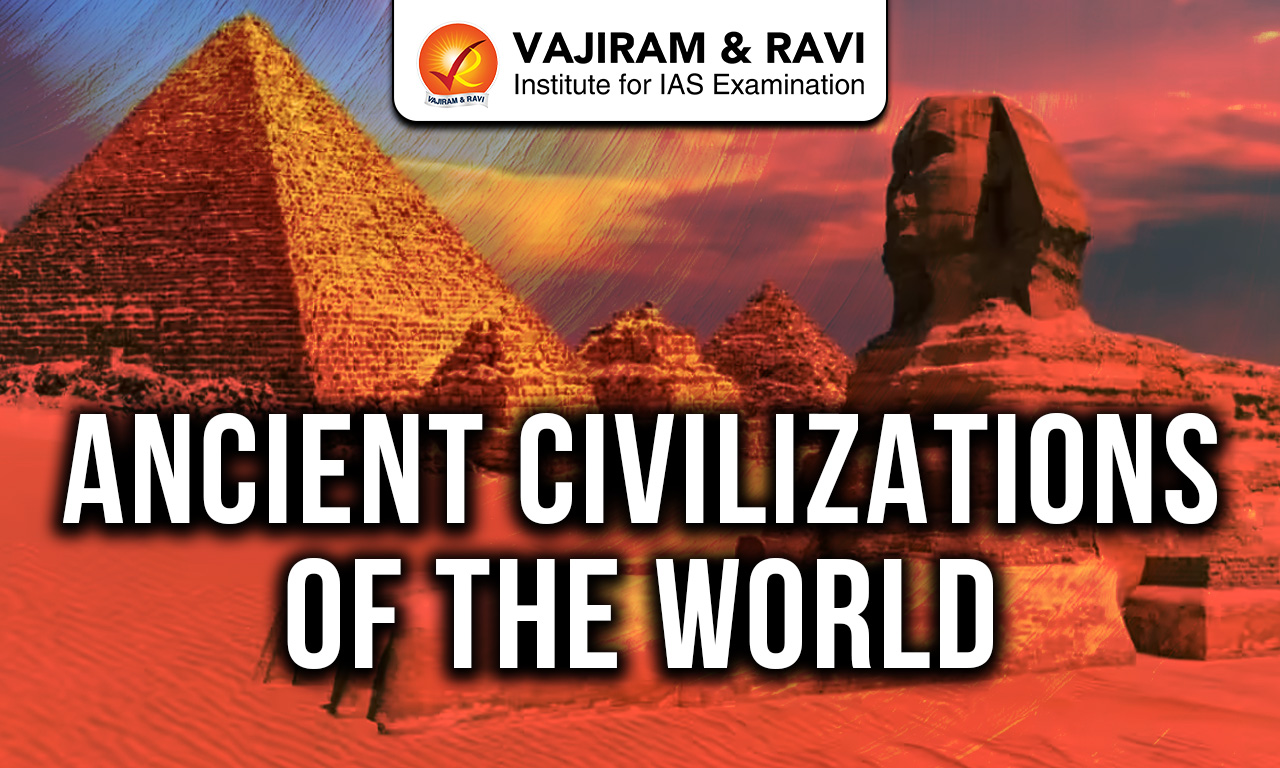
- Architecture and Engineering: Known for monumental structures such as the pyramids of Giza, temples at Karnak and Luxor, and elaborate tombs in the Valley of the Kings. Mastery in stone construction, geometry, and labour organization enabled large-scale projects.
- Mathematics and Astronomy: Developed practical mathematics for construction and land measurement. Introduced a 365-day solar calendar, divided into 12 months. Divided the day into 24 hours, influencing modern timekeeping.
- Medicine: Advanced knowledge of human anatomy, partly derived from mummification practices.Practiced surgeries and used herbal remedies; medical texts like the Ebers Papyrus provide evidence.
- Art and Culture: Egyptian art was symbolic and highly stylized, often depicting gods, pharaohs, and daily life. Sculpture, painting, and decorative arts reflected religious beliefs and social hierarchy.
Military and Expansion:
- Egypt maintained a strong military to defend its territory and expand influence.
- At its peak, it extended into parts of Syria and Nubia.
- Military strength also supported trade routes and political dominance.
Decline:
- Over time, Egypt faced internal instability, weak rulers, and external invasions (Hyksos, Assyrians, Persians).
- Ultimately, the civilization ended with the conquest by Alexander the Great in 332 BCE, integrating Egypt into the Hellenistic world.
Indus Valley Civilization (c. 3300–1900 BCE)
The Indus Valley Civilization (IVC), also known as the Harappan Civilization, developed in the northwestern regions of the Indian subcontinent, covering present-day Pakistan and northwest India. It is one of the earliest urban civilizations in the world, known for its well-planned cities, standardized systems and extensive trade networks.
Geographical Foundations:
- Located along the Indus River and its tributaries, with major sites in regions of Punjab, Sindh and Gujarat.
- Settlements also extended to areas near the Ghaggar-Hakra river system.
- Fertile alluvial plains supported agriculture and settlement growth.
Political Organization:
- No conclusive evidence of kings, monarchy or centralized empire.
- Uniformity in urban planning suggests the presence of an organized administrative system.
- Authority may have been exercised by local elites or governing bodies.
Economic Life:
- Agriculture formed the economic base, with crops such as wheat, barley and evidence of early cotton cultivation.
- Animal domestication included cattle, sheep and goats.
- Trade networks extended to regions such as Mesopotamia (referred to as “Meluhha” in Mesopotamian records).
- Craft specialization included bead-making, pottery, metallurgy and seal production.
Social Structure:
- Society shows signs of organization but without clear evidence of rigid hierarchy.
- Variation in house sizes indicates some level of social differentiation.
- Lack of monumental palaces or royal tombs suggests absence of highly centralized elite dominance.
Cultural and Scientific Contributions:
- Writing System: Use of a script found on seals and pottery, which remains undeciphered. Likely used for administrative or commercial purposes.
- Standardization: Uniform system of weights and measures across sites. Standardized brick sizes used in construction.
Science and Technology:
- Knowledge of metallurgy, particularly copper and bronze. Advanced techniques in bead-making and craft production. Evidence of measurement precision in urban construction.
Architecture and Urban Planning:
- Cities such as Harappa, Mohenjo-daro and Dholavira show grid-pattern planning.
- Sophisticated drainage systems with covered drains and soak pits.
- Use of baked bricks for durable structures.
- Public structures include granaries and the Great Bath at Mohenjo-daro.
Religion and Beliefs:
- Archaeological evidence suggests practices related to fertility and nature worship.
- Seals depict animal motifs and possible proto-Shiva (Pashupati) figure.
- The absence of large temples indicates a different religious organization compared to Mesopotamia or Egypt.
Military and Conflicts:
- Limited evidence of weapons or fortifications designed for large-scale warfare.
- Suggests that warfare was not a dominant feature of civilization.
Decline:
- The decline began around 1900 BCE.
- Factors likely include environmental changes, shifting river systems and decline in long-distance trade.
- No conclusive evidence of sudden invasion or catastrophic destruction.
Ancient Chinese Civilization (c. 2000 BCE onward)
Ancient Chinese civilization developed along the fertile valleys of the Yellow River (Huang He) and the Yangtze River. It is regarded as one of the world’s oldest continuous civilizations, characterized by strong cultural continuity, dynastic rule and significant contributions to science, philosophy and governance.
Geographical Foundations:
- Located in the Yellow River basin, known for its fertile loess soil suitable for agriculture.
- The Yellow River is often called “China’s Sorrow” due to its unpredictable and destructive floods.
- Natural barriers such as the Himalayas, deserts and seas provided relative isolation and protection.
Political Organization:
- Governed under a dynastic system beginning with the Xia, followed by Shang and Zhou dynasties.
- The concept of the Mandate of Heaven legitimized the ruler’s authority and justified the rise and fall of dynasties.
- Development of centralized administration and an early bureaucratic system.
Economic Life:
- Agriculture formed the economic base, with millet cultivated in the north and rice in the south.
- Domestication of animals like pigs and cattle supported agrarian life.
- Growth of internal trade and early market systems.
- Silk production became an important economic activity, leading to long-distance trade networks.
Social Structure: Society was hierarchical:
- Emperor at the top, considered the “Son of Heaven”
- Nobles and officials
- Farmers (respected as food producers)
- Artisans and craftsmen
- Merchants (often ranked lower despite wealth)
Cultural and Scientific Contributions:
- Writing System: Development of Chinese script, one of the oldest continuous writing systems still in use.
- Philosophy and Thought: Emergence of major philosophical traditions such as Confucianism and Taoism, shaping ethics, governance and social relations.
Science and Technology:
- Major inventions include paper, printing, the compass and gunpowder.
- Advances in metallurgy, especially bronze casting during the Shang period.
- Development of irrigation techniques and agricultural tools.
Architecture and Engineering:
- Construction of palaces, city walls and fortifications.
- Early forms of the Great Wall were built for defense against invasions.
- Development of large-scale public works such as canals.
Religion and Beliefs:
- Practice of ancestor worship and belief in harmony between humans and nature.
- Influence of philosophical traditions like Confucianism and Taoism on social and moral life.
Military and Conflicts:
- Frequent conflicts between rival states, especially during the Warring States period.
- Development of organized armies and use of advanced weapons like crossbows.
Continuity and Legacy:
- Despite dynastic changes, Chinese civilization maintained strong cultural continuity.
- Its contributions in governance, philosophy, science and technology have had a lasting global impact.
Maya Civilization (c. 2600 BCE – 900 CE)
The Maya Civilization developed in Mesoamerica, covering present-day southern Mexico, Guatemala, Belize and parts of Honduras and El Salvador. It is recognized for its independently evolved writing system, advanced calendrical knowledge and monumental architecture.
Geographical Foundations:
- Located in diverse ecological zones, including tropical lowland forests and highland regions.
- Absence of major perennial rivers in some areas led to reliance on rainwater storage systems such as reservoirs and cenotes.
- Agricultural adaptations included shifting cultivation and terracing.
Political Organization:
- Not a unified empire; it consisted of independent city-states such as Tikal, Calakmul, Palenque and Copan.
- Each city-state was ruled by a hereditary king (k’uhul ajaw) with religious and political authority.
- Political history marked by alliances, rivalries and warfare.
Economic Life:
- Agriculture formed the base, with maize (corn) as the staple crop, along with beans and squash.
- Trade networks exchanged goods such as obsidian, jade, cacao and shells.
- No use of metal currency; trade was largely barter-based.
Social Structure: Society was hierarchical:
- Rulers and elite nobles at the top
- Priests and officials
- Artisans and traders
- Farmers and labourers formed the majority
Cultural and Scientific Contributions:
- Writing System: Developed a fully functional logosyllabic script, one of the most advanced in the ancient world. Used for recording historical events, rituals and dynastic records on monuments and codices.
- Mathematics and Astronomy: Used a vigesimal (base-20) system and independently developed the concept of zero. Made precise astronomical observations, particularly of the sun, moon and Venus.
- Calendar System: Developed multiple interrelated calendars, including the Tzolk’in (260-day ritual calendar), Haab (365-day solar calendar) and Long Count calendar for historical dating.
Architecture:
- Constructed monumental cities with pyramidal temples, palaces, plazas and ball courts.
- Notable structures include stepped pyramids used for religious ceremonies.
- Urban centres were often aligned with astronomical features.
Religion and Beliefs:
- Polytheistic belief system with gods linked to nature and celestial bodies.
- Ritual practices included offerings and, in some cases, human sacrifice.
- Priests played a key role in maintaining calendars and conducting rituals.
Military and Conflicts:
- Frequent warfare among city-states for political dominance and control of resources.
- Captives were sometimes used in ritual practices.
Decline:
- Around 800-900 CE, many major southern lowland cities were abandoned.
- Causes are debated but include prolonged droughts, environmental degradation, warfare and political instability.
- Northern centres like Chichén Itzá continued for some time after the southern decline.
Persian Civilization (Achaemenid Empire, c. 550 BCE – 330 BCE)
The Persian Civilization, under the Achaemenid Empire, emerged as one of the largest and most powerful empires of the ancient world. At its height, it extended from the Indus Valley in the east to the Balkans (Thrace and Macedonia) in the west, and from the Caucasus Mountains in the north to Egypt in the south. Geographical Foundations:
- The empire originated in the Iranian Plateau.
- The empire's central location allowed it to connect three continents: Asia, Africa and Europe, facilitating trade and cultural exchange.
Foundation and Expansion:
- The empire was founded by Cyrus the Great, who successfully unified the Persian and Median tribes.
- He adopted a policy of tolerance toward conquered peoples, allowing them to retain their customs and religions, most famously permitting the Jewish exiles in Babylon to return to Jerusalem.
- The empire reached its greatest territorial extent under Darius I (522–486 BCE), who consolidated conquests, suppressed rebellions, and brought administrative stability.
Political Organization:
- The Persian Empire was divided into approximately 20 administrative provinces known as satrapies, each governed by a satrap (governor) responsible for maintaining law and order, collecting taxes, and ensuring loyalty to the king.
- The king exercised strong central authority, supported by a well-organized bureaucracy.
- A system of royal inspectors, often called the "Eyes and Ears of the King," traveled unannounced to supervise provincial administration and prevent misuse of power.
Economic Life:
- The economy was primarily based on agriculture, supported by qanat irrigation techniques that enabled farming in arid regions.
- A standardized system of taxation was implemented across the empire, ensuring regular revenue collection from different provinces.
- The introduction of a uniform coinage system, especially the gold Daric and silver Siglos, facilitated official trade and tax payments.
- Extensive trade networks connected different regions of Asia, Africa and Europe, promoting economic integration.
Social Structure:
- Persian society was hierarchical.
- The king and royal family occupied the highest position, followed by nobles, administrative officials, priests, and military elites.
- The majority of the population consisted of farmers, artisans, and traders who contributed to the economic life of the empire.
- Slaves existed but were not as central to the economy as in Greece or Rome.
Administration and Governance:
The Persian Empire developed an efficient administrative system that successfully combined strong central control with a degree of local autonomy.
- Conquered peoples were generally allowed to retain their own customs, languages, and religious practices, which helped maintain stability and loyalty. This policy of cultural and religious tolerance was a hallmark of Achaemenid rule and contributed to the empire's longevity.
Architecture:
- The Persians constructed monumental cities such as Persepolis (the ceremonial capital), Susa, and Pasargadae.
- Their architecture was characterized by grand palaces, massive stone columns, elaborate stairways, and intricate relief sculptures depicting delegates from across the empire bringing tribute. This artistic style reflected imperial authority and cultural diversity.
Religion and Beliefs:
- Zoroastrianism, associated with the teachings of the prophet Zoroaster (or Zarathustra), was the dominant religion. It emphasized concepts of truth (asha), righteousness, moral responsibility, and a dualistic struggle between good and evil forces.
- Despite this, the empire followed a consistent policy of religious tolerance, allowing diverse beliefs and practices to coexist peacefully.
Military System:
- The Persian Empire maintained a large and well-organized army composed of soldiers from different regions, including elite units such as the Immortals (a 10,000-strong heavy infantry corps).
- The military played a crucial role in the expansion and defense of the empire. However, reliance on diverse contingents with varying loyalties could sometimes be a weakness against a unified enemy.
Decline:
- The empire gradually weakened due to internal administrative challenges, overextension, and external pressures. A series of weak rulers, court intrigues, and costly wars with Greek city-states drained resources. The empire was ultimately conquered by Alexander the Great, who defeated the last Achaemenid king, Darius III, at the Battle of Gaugamela (331 BCE) and burned Persepolis in 330 BCE, marking the end of Achaemenid rule.
Ancient Greek Civilization (c. 800 BCE – 146 BCE)
Ancient Greek civilization emerged around the Aegean basin, including mainland Greece, the islands and parts of Anatolia.
Geographical Foundations:
- Located in a mountainous region with limited fertile land.
- Mountainous terrain led to the rise of independent city-states (poleis) such as Athens, Sparta and Corinth.
- Limited arable land encouraged maritime trade, colonization and cultural exchange across the Mediterranean.
- Natural fragmentation prevented political unity but fostered diversity in political systems.
Political Organization:
- Greece was not a unified empire but a collection of autonomous city-states.
- Athens developed direct democracy, where citizens participated in assemblies and decision-making.
- Sparta followed a militaristic oligarchic system, prioritizing discipline and military training.
- Political experimentation in Greece laid the groundwork for modern democratic institutions.
Economic Life:
- Economy based on agriculture (olive, wheat, grapes) and maritime trade.
- Colonies across the Mediterranean ensured access to raw materials and markets.
- Trade networks facilitated cultural diffusion and economic prosperity.
Social Structure: Society was hierarchical:
- Citizens (adult males with political rights)
- Non-citizens (metics), often traders and artisans
- Slaves forming a significant part of the labour force
Cultural and Intellectual Contributions:
- Philosophy: Thinkers like Socrates, Plato and Aristotle developed systematic approaches to ethics, politics and knowledge.Emphasis on rational inquiry and logic became central to Western thought.
- Science and Mathematics: Contributions in geometry, medicine and natural sciences laid early scientific foundations.
- Literature and Drama: Development of epic poetry (Homer) and dramatic traditions such as tragedy and comedy.
Architecture:
- Development of Doric, Ionic and Corinthian architectural styles.
- Construction of temples and public buildings, notably the Parthenon in Athens.
- Emphasis on proportion, symmetry and aesthetic balance.
Religion and Beliefs:
- Polytheistic religion with gods like Zeus, Athena and Apollo.
- Religious festivals, oracles and rituals played a key role in social life.
Military and Conflicts:
- Frequent inter-city conflicts, especially the Peloponnesian War between Athens and Sparta.
- Collective resistance against Persian invasions strengthened Greek identity.
Decline:
- Internal conflicts weakened the city-states.
- Eventually brought under the control of Alexander the Great, followed by Roman conquest (146 BCE).
Roman Civilization (c. 753 BCE – 476 CE)
Roman civilization began as a small settlement on the Italian Peninsula and evolved into a vast empire encompassing Europe, North Africa and parts of Asia. It is especially significant for its contributions to law, governance, engineering and administration.
Geographical Foundations:
- Located in the Italian Peninsula with access to the Mediterranean Sea, facilitating trade and expansion.
- Fertile plains and river systems supported agriculture and population growth.
Political Organization:
- Transitioned from monarchy to republic (509 BCE) and later to empire (27 BCE).
- The Roman Republic developed institutions such as the Senate, assemblies and magistrates.
- Under the Empire, power became centralized in the emperor, supported by a vast bureaucracy.
Economic Life:
- Agriculture formed the base, supplemented by trade across the Mediterranean.
- Use of coinage enabled a monetized economy.
- Extensive trade networks connected diverse regions of the empire.
Social Structure: Society was hierarchical:
- Patricians (aristocratic elite)
- Plebeians (common citizens)
- Freedmen
- Slaves forming a major part of the workforce
Cultural and Institutional Contributions:
- Law and Governance: Development of Roman law, including the Twelve Tables and later legal principles. Concepts such as rule of law, legal rights and citizenship continue to influence modern legal systems.
- Language and Literature: Latin became the administrative language and influenced many modern European languages.
Engineering and Architecture:
- Advanced engineering techniques enabled construction of roads, aqueducts, bridges and urban infrastructure.
- Use of concrete allowed large-scale structures like the Colosseum and public baths.
- Urban planning included well-organized cities with forums, drainage and public spaces.
Religion and Beliefs:
- Initially polytheistic, influenced by Greek deities and traditions.
- Later, Christianity emerged and was institutionalized, particularly under Constantine the Great.
Military and Expansion:
- Highly disciplined and organized Roman legions enabled territorial expansion and control.
- Military strength was central to maintaining the empire’s unity.
Decline:
- Internal political instability, economic challenges and external invasions weakened the empire.
- The Western Roman Empire fell in 476 CE, marking the end of ancient Roman political dominance in the West.
Ancient Civilizations of the World FAQs
Q1: Which civilization is known as the cradle of civilization?
Ans: Mesopotamian Civilization.
Q2: Which river is associated with Egyptian civilization?
Ans: The Nile River is associated with Egyptian civilization.
Q3: Which civilization is known for planned cities and drainage systems?
Ans: Indus Valley Civilization is known for planned cities and drainage systems.
Q4: Which civilization developed the Twelve Tables?
Ans: Roman Civilization developed the Twelve Tables, an early codification of laws.
Q5: Which civilization is associated with the Great Wall?
Ans: Chinese Civilization is associated with the construction of the Great Wall for defense against invasions.