Alluvial Soil, Distribution, Formation, Composition, Importance

Alluvial Soil

Alluvial soil is the most widespread and agriculturally important soil type in India. It covers nearly 45.6% of the country’s total land area and forms the foundation of agriculture in many regions. 

Alluvial Soil Distribution

  • Alluvial soils are mainly found in the northern plains of India. 
  • Alluvial soils also extend into Rajasthan and Gujarat through a narrow corridor. 
  • In addition, they are found in the eastern coastal plains, particularly in the delta regions of rivers such as the Mahanadi River, Godavari River, Krishna River and Kaveri River.

Alluvial Soil Formation and Composition

  • Alluvial soils are formed by the deposition of sediments such as sand, silt and clay carried by rivers.
  • These have been deposited by three important Himalayan river systems -  the Indus, the Ganga and the Brahmaputra. 
  • Composition: Contains sand, silt and clay in different proportions.
  • The composition of the soil varies across regions depending on river flow and deposition patterns.
    • In the upper parts of river valleys, particularly near the foothills, the soil is relatively coarse and sandy. Such soils are common in the piedmont plains such as the Duars, Chos and Terai regions.
    •  As rivers move toward the plains, the soil particles become finer and richer in nutrients.

Alluvial Soil Types

Based on age and formation, alluvial soils are broadly classified into two types:

  • Bhangar (Old Alluvial Soil): Bhangar refers to the older alluvial deposits found in slightly elevated areas away from river floodplains. These soils often contain kankar (calcareous nodules) and are relatively less fertile compared to the newer deposits.
  • Khadar (New Alluvial Soil): Khadar is the newer alluvial soil deposited by rivers during floods. It is finer in texture, richer in nutrients and therefore more fertile. Khadar soils are mainly found in the active floodplains of rivers.

Alluvial Soil Characteristics

Alluvial soils have several distinctive features:

  • Alluvial soils are very fertile and suitable for agriculture.
  • They are rich in potash and lime but relatively poor in nitrogen and phosphorus.
  • They are generally immature soils with thin profiles.
  • The colour varies from light grey to ash grey.
  • In some regions, kankar beds are found, particularly in older alluvial soils.
  • The soil texture ranges from loamy to clayey, especially in the middle and lower Ganga plains and the Brahmaputra valley.
  • The sand content decreases from west to east, making soils in eastern regions finer and more fertile.

Alluvial Soil Economic Importance

  • Alluvial soils play a crucial role in India’s agricultural economy. Their natural fertility and favourable texture make them ideal for growing a wide variety of crops. 
  • Major crops grown in these soils include Rice, Wheat, Sugarcane, Pulses, Oilseeds, Vegetables and fruits
  • Because of their productivity, regions with alluvial soils are intensively cultivated and densely populated. Even in drier areas, these soils can become productive with proper irrigation and soil management.
Related Post
Soil Pollution Black Soil
Soil Degradation Alluvial Soil
Soil Conservation Red Soil
Soil Erosion Mountain Soil
Laterite Soil Soil Fertility
Soils of India Western Disturbances
Geomorphology Coastal States of India
Soil Profile Loamy Soil
Khadar Soil Bhangar Soil

Alluvial Soil FAQs

Q1: What is Alluvial Soil?

Ans: Alluvial soil is a fertile soil formed by the deposition of sediments such as sand, silt and clay carried by rivers, and it is the most widespread soil type in India.

Q2: Where is alluvial soil mainly found in India?

Ans: It is mainly found in the northern plains and also in the coastal plains and river deltas of rivers such as the Mahanadi River, Godavari River, Krishna River and Kaveri River.

Q3: Which rivers are mainly responsible for the formation of alluvial soil?

Ans: Alluvial soil is mainly formed by the deposition of sediments from the Indus River, Ganga River and Brahmaputra River river systems.

Q4: What are the main types of alluvial soil?

Ans: Alluvial soil is classified into Bhangar (old alluvium) and Khadar (new alluvium) based on their age and formation.

Q5: Why is alluvial soil important for agriculture?

Ans: Alluvial soil is highly fertile and suitable for crops like rice, wheat, sugarcane and pulses, making it crucial for India’s agricultural production.

Addressing Adolescent Malnutrition in India, Current Status, Causes

Addressing Adolescent Malnutrition in India

Why in news: The recently released NFHS-6 (2023-24) highlights a worrying rise in obesity and lifestyle-related diseases in India. 

Current Status of Adolescent Malnutrition in India 

Adolescence is a critical stage for physical and cognitive development, making nutrition interventions during this period essential for achieving the goals of Viksit Bharat, SDG-2 (Zero Hunger) and SDG-3 (Good Health and Well-being). India is facing a double burden of malnutrition, where undernutrition coexists with rising overweight and obesity.

  • According to NFHS-6 (2023-24), obesity among women (15-49 years) increased from 24% to 30.7%, while among men it rose from 22.9% to 27.3%.
  • High blood sugar among men (15+ years) increased from 15.6% to 20.9%, and among women from 13.5% to 17.8%, indicating growing metabolic disorders.
  • According to the Comprehensive National Nutrition Survey (CNNS), 2019, 27.4% of Indian adolescents are stunted, reflecting persistent nutritional deficiencies.
  • India is witnessing the ‘thin-fat’ phenotype, where many children appear lean but carry excess body fat and face a higher risk of diabetes and cardiovascular diseases.
  • Around 35% of stunted children under five already exhibit adult-level triglycerides, highlighting early metabolic risk.
  • A 2025 Lancet study projects that by 2050, India will have 21.8 crore overweight men and 23.1 crore overweight women, with the fastest rise expected among the 15-24 years age group.

Causes of Adolescent Malnutrition in India 

India’s growing burden of adolescent malnutrition is driven by changing dietary patterns, unhealthy lifestyles and inadequate nutrition awareness.

  • Poor Dietary Diversity: Studies among Delhi school adolescents show inadequate intake of milk, dairy products, green leafy vegetables and fruits, while cereal-dominated diets remain common.
  • Rising Consumption of Ultra-Processed Foods (UPFs): According to the World Health Organization (WHO), consumption of Ultra-Processed Foods (UPFs) in India is increasing by over 13.7% annually, replacing healthier traditional diets.
  • Excess Sugar Intake: High consumption of free sugar during adolescence increases the long-term risk of obesity, diabetes and cardiovascular diseases.
  • Physical Inactivity: Sedentary lifestyles, excessive screen time and declining participation in sports contribute to obesity and metabolic disorders.
  • Urban Lifestyle Changes: Processed diets, stress and reduced physical activity, once confined to cities, are now rapidly spreading to rural India.
  • Nutrition Transition: Shift from traditional balanced diets to calorie-dense, nutrient-poor foods has increased the burden of both undernutrition and obesity.
  • Lack of Nutrition Literacy: Limited awareness about balanced diets, food labels, portion sizes and hidden sugar content encourages unhealthy food choices.
  • Inadequate Healthy Food Environment: Easy availability of HFSS foods and sugary beverages in and around schools promotes unhealthy eating habits.

Role of Schools in Addressing Adolescent Malnutrition in India 

Schools are the most effective platform for preventing malnutrition by promoting healthy eating habits and active lifestyles during adolescence.

  • Improve Mid-Day Meals: Provide balanced meals with adequate proteins, fruits, vegetables and micronutrients instead of cereal-heavy diets.
  • Promote Healthy School Canteens: Replace HFSS foods and sugary beverages with nutritious, locally available food options.
  • Develop Nutrition Literacy: Teach students to prepare balanced plates, read food labels, understand portion sizes and identify hidden sugars.
  • Organise Food Demonstrations: Conduct practical sessions to encourage healthy cooking and informed food choices.
  • Promote Fruits and Vegetables: Introduce fruit breaks, school gardens and seasonal local produce in line with the Dietary Guidelines for Indians, 2024, which recommend half the plate should consist of fruits and vegetables.
  • Discourage Sugary Foods: Display “sugar boards” showing hidden sugar content in popular beverages and processed foods while discouraging their consumption.
  • Create UPF-Free School Zones: Restrict the sale and promotion of Ultra-Processed Foods (UPFs) and HFSS foods within and around schools.
  • Ensure Daily Physical Activity: Make sports and structured physical activity compulsory rather than optional to tackle sedentary lifestyles.
  • Adopt Skill-Based Nutrition Education: Move beyond textbook learning by teaching food label reading, healthy cooking, recognising food marketing tactics and making informed dietary choices.
  • Promote Continuous Behavioural Change: Reinforce healthy habits through regular awareness activities rather than one-time campaigns.
  • Transform Schools into Health-Promoting Institutions: Integrate nutrition, physical activity and healthy food environments to reduce future burden of obesity and non-communicable diseases.

Government Initiatives

The Government of India has launched several policy, nutrition and awareness initiatives to improve adolescent nutrition and create healthier food environments.

  • POSHAN Abhiyaan: Promotes a life-cycle approach to improve nutritional outcomes through convergence, behavioural change and technology-driven monitoring.
  • PM POSHAN (Mid-Day Meal) Scheme: Provides nutritious cooked meals in schools to improve nutritional status, reduce classroom hunger and encourage school attendance.
  • Saksham Anganwadi and POSHAN 2.0: Focuses on improving nutrition among children, adolescent girls and women through supplementary nutrition and health services.
  • Anaemia Mukt Bharat (AMB): Aims to reduce anaemia among children, adolescents and women through iron-folic acid supplementation, deworming and behaviour change.
  • Rashtriya Kishor Swasthya Karyakram (RKSK): Addresses adolescent health through nutrition counselling, mental health support, reproductive health education and healthy lifestyle promotion.
  • Eat Right India Campaign (FSSAI): Encourages healthy eating habits, safe food practices and consumer awareness through schools and communities.
  • Dietary Guidelines for Indians, 2024 (ICMR-NIN): Recommend balanced diets, including making fruits and vegetables occupy nearly half of the plate by volume while reducing sugar, salt and unhealthy fats.
  • Let’s Fix Our Food (LFOF) Initiative: Led by ICMR-NIN, it promotes healthier food environments through nutrition literacy, policy recommendations, food-label reading kits, regulation of HFSS food advertising and taxation of unhealthy beverages.
  • School Health and Wellness Programme (Ayushman Bharat): Integrates nutrition education, physical activity, mental health and healthy lifestyle promotion within schools.

Challenges

Despite increasing awareness, several institutional and systemic challenges continue to hinder efforts to improve adolescent nutrition in India.

  • Effective Policy Implementation: Nutrition and school health programmes often suffer from uneven implementation, weak monitoring and poor convergence among health, education and nutrition departments.
  • Double Burden of Malnutrition: Simultaneous prevalence of undernutrition among children and rising obesity among adolescents complicates policy design and programme delivery.
  • School Food Environment: Many schools continue to have unhealthy canteens and easy availability of HFSS foods and sugary beverages, weakening healthy eating habits.
  • Weak Nutrition Education: Nutrition education remains largely theoretical, with limited focus on practical life skills such as reading food labels, understanding portion sizes and making healthy food choices.
  • Inadequate Physical Activity: Sports and structured physical activity are often treated as optional rather than essential components of school education.
  • Limited Behavioural Change: One-time awareness campaigns have limited impact, whereas sustained reinforcement is needed to convert nutrition knowledge into lifelong healthy practices.
  • Rapid Commercialisation of Food: Aggressive marketing and advertising of HFSS foods and Ultra-Processed Foods (UPFs), particularly among children and adolescents, encourage unhealthy consumption patterns.
  • Rising Burden of Non-Communicable Diseases (NCDs): Increasing adolescent obesity is leading to early-onset Type-2 diabetes, hypertension and cardiovascular diseases, imposing a growing healthcare burden.
  • Rural Spread of Lifestyle Diseases: Sedentary behaviour, processed diets and obesity are no longer confined to urban areas but are increasingly affecting rural populations as well.
  • Future Public Health Burden: Without timely interventions during adolescence, India faces rising healthcare expenditure and reduced human capital due to increasing nutrition-related diseases.

Way Forward

  • Adopt a Life-Cycle Approach: Integrate nutrition interventions from adolescence into reproductive health and adult wellness to break the intergenerational cycle of malnutrition.
  • Target High-Risk Groups: Focus on vulnerable adolescents, especially girls, rural populations and economically weaker sections through targeted nutrition support.
  • Strengthen Growth Monitoring: Conduct regular BMI screening, nutrition assessment and early detection of obesity, anaemia and other deficiencies in schools.
  • Build Health-Promoting Schools: Institutionalise comprehensive school health policies that integrate nutrition, mental health, hygiene and physical fitness.
  • Improve Food Regulation: Strengthen front-of-pack food labelling and enforce stricter standards on the sale and marketing of unhealthy foods to children.
  • Promote Local and Nutritious Foods: Encourage the consumption of traditional, locally available and diverse foods to improve dietary diversity and reduce dependence on processed foods.
  • Enhance Research and Data Systems: Strengthen nutrition surveillance and periodic assessments to enable evidence-based policymaking and timely interventions.
  • Increase Community Participation: Engage parents, teachers, local bodies and civil society to create supportive environments for healthy dietary and lifestyle practices.
  • Invest in Preventive Healthcare: Shift policy focus from treating lifestyle diseases to preventing them through early nutrition interventions during adolescence.
  • Build a Healthy Demographic Dividend: Prioritise adolescent nutrition as an investment in India’s future workforce, productivity and long-term human capital development.

Addressing Adolescent Malnutrition in India FAQs

Q1: What is the current status of adolescent nutrition in India?

Ans: India faces a double burden of malnutrition, where undernutrition coexists with rising overweight and obesity. NFHS-6 (2023–24) shows increasing obesity and high blood sugar levels, indicating a growing burden of lifestyle-related diseases among adolescents.

Q2: Why is adolescence considered a critical stage for nutrition?

Ans: Adolescence is a period of rapid physical, mental and emotional development. Poor nutrition during this stage affects growth, learning ability, immunity and increases the risk of non-communicable diseases (NCDs) such as diabetes and heart disease in adulthood.

Q3: What is meant by the “double burden of malnutrition” in India?

Ans: The double burden refers to the coexistence of undernutrition (stunting, micronutrient deficiencies) and rising overweight/obesity in the same population. India is witnessing both persistent undernutrition among children and increasing obesity and metabolic disorders among adolescents and adults.

Q4: What role can schools play in addressing adolescent malnutrition?

Ans: Schools can promote balanced diets through nutritious meals, healthy canteens, nutrition education, school gardens, regular physical activity and by restricting HFSS foods and sugary drinks to build lifelong healthy habits.

Q5: What are the major government initiatives to improve adolescent nutrition?

Ans: Key initiatives include POSHAN Abhiyaan, PM POSHAN Scheme, Saksham Anganwadi and POSHAN 2.0, Anaemia Mukt Bharat, Rashtriya Kishor Swasthya Karyakram (RKSK), Eat Right India, and the Let’s Fix Our Food (LFOF) initiative.

Indo-Gangetic Plains, Feature, Location, Formation, States

Indo-Gangetic Plains

The Indo-Gangetic Plain, spanning India, Bangladesh, and Nepal, faces recurrent floods due to heavy monsoon rains, glacial melt, deforestation, and urbanization. These floods damage lives, agriculture, and infrastructure. Effective management demands an integrated approach combining sustainable land use, afforestation, advanced forecasting technologies, and active community participation. Building resilience through coordinated planning and environmental conservation is essential to reduce flood impacts and safeguard livelihoods in this densely populated region. 

The Indo-Gangetic Plains are known by several other names such as North Indian Plain, the North Indian River Plain, the Indus-Ganga Plain, Indo-Gangetic-Brahmaputra Plain, Great Plains of Northern India, Northern Plains of India, etc.

What is the Indo-Gangetic Plain?

The Indo-Gangetic Plains are vast aggradational plains formed by alluvial deposits from the Indus, Ganga, Brahmaputra, and their tributaries. The Northern Plains of India are one of the five physiographic divisions of India and represent its youngest landform. Spanning a massive area, they hold the title of the world’s largest alluvial plain, supporting dense populations, fertile agriculture, and a rich cultural history shaped by these mighty river systems. 

Indo-Gangetic Plains Features

The Indo-Gangetic Plains has some unique geographical, climatic, and socio-economic characteristics. The table below includes the Indo-Gangetic Plains Features for better understanding:

Indo-Gangetic Plains Features

Aspect

Description

North-South Extension

They extend from the south of the Himalayas upto the edge of the Peninsular Plateau.

East-West Extension

They extend from the mouth of the Indus in the west to the mouth of the Ganga in the east.

Boundaries

They are bounded by the Shiwalik range to the north, the Desert to the west, the Peninsular Plateau to the south, and the Puruvachal Hills to the east.

Length

The total length of this tract is 3200 km, of which around 2400 km lies in India and the rest lies in Bangladesh.

Width

The average width of the Great Northern Plains is 150-300 km. They are widest in the west where their width goes up to 500 km, and narrow down towards the east where their width shrinks down to 60-100 km.

Area

They occupy an area of around 7.8 lakh sq. km, making it the largest alluvial plain in the world.

States Covered

The Great Northern Plains of India spread over the states- Punjab, Haryana, Delhi, Uttar Pradesh, Bihar, parts of Jharkhand and West Bengal, and Assam.

Extreme Horizontality

Extreme horizontality is an important feature of this plain. With an average elevation of around 200 m and the highest elevation of about 291 m above the mean sea level, its average gradient range is just 15-20 cm.

Soil Cover

The rivers coming from the northern mountain carry a huge load of sediments which get deposited over these plains. Thus, these plains have a rich and fertile soil cover.

Indo-Gangetic Plains Formation

The Indo-Gangetic Plains were formed by the deposition of sediments from the Indus, Ganga, and Brahmaputra river systems, which filled a vast depression between the Peninsular Plateau and the Himalayas. During the Tertiary Period, the collision of the Indo-Australian and Eurasian plates created the Himalayas and a large syncline to the south. Over time, rivers from the Himalayas deposited immense alluvial material into this depression, giving rise to the Northern Plains of India.

Indo-Gangetic Plains Regional Division

Regionally, the Indo-Gangetic Plains are divided into four major sections:

  1. Rajasthan Plain - Occupies the arid western part, largely desert with some fertile tracts along river channels.
  2. Punjab-Haryana Plain - Known for extensive alluvial deposits and intensive agriculture, supported by canal irrigation.
  3. Ganga Plain - The largest and most fertile stretch, spanning several states from Uttarakhand to West Bengal.
  4. Brahmaputra Plain - A flood-prone yet highly fertile region in Assam, shaped by the Brahmaputra River and its tributaries.

Rajasthan Plain

Forming the western edge of the Indo-Gangetic Plains, this region includes the Thar or Great Indian Desert, extending across western Rajasthan and into Pakistan. It has two main parts:

Marusthali 

The true desert area in the east covers much of the Marwar plain. While it appears as an aggradational plain, geologically it belongs to the Peninsular Plateau, evident from scattered outcrops of gneiss, schist, and granite. Its eastern side is rocky; the west is dominated by shifting sand dunes called Dhrian.

Rajasthan Bagar

A semi-arid tract between the Thar desert and the Aravalli Range. Seasonal streams from the Aravallis create fertile patches called Rohi. The Luni River, flowing southwest into the Rann of Kutch, is the main watercourse. North of the Luni lies the sandy plain called Thali. The region also has saline lakes such as Sambhar, Didwana, and Khatu.

Punjab-Haryana Plain

Located east and northeast of the Rajasthan Plain, this region stretches about 640 km from northwest to southeast, with an average width of 300 km. It slopes gently southwest, so rivers follow the same direction. The soil is mainly silty and porous.

Key subdivisions and features:

  • Bet - Floodplain areas near riverbanks formed by new alluvium.
  • Bhabar Plain - Foothill zone with boulders, gravel, sand, and clay that cannot retain water.
  • Punjab Plain - Formed by the alluvium of the Satluj, Beas, Ravi, Chenab, and Jhelum; hence called the Land of Five Rivers. Divided into five Doabs:
    1. Bist-Jalandhar Doab - Between Beas and Satluj
    2. Bari Doab - Between Beas and Ravi
    3. Rachna Doab - Between Ravi and Chenab
    4. Chaj Doab - Between Chenab and Jhelum
    5. Sind Sagar Doab - Between Jhelum-Chenab and the Indus

Other notable features:

  • Bet Lands - Khadar-rich fertile floodplains replenished annually.
  • Dhayas - Broad Khadar floodplains bordered by bluffs.
  • Chos - Eroded tracts in the north near the Shiwalik Hills caused by seasonal streams.

Ganga Plain

The largest unit of the Indo-Gangetic Plains, covering about 3.75 lakh sq. km, formed by the alluvium of the Ganga and its Himalayan and Peninsular tributaries. It stretches from Delhi to Kolkata across Uttar Pradesh, Bihar, and West Bengal, sloping east and southeast.

Upper Ganga Plain

  • Location: Westernmost part, bounded by the Shiwaliks (north), Peninsular boundary (south), Yamuna River (west). Eastern limit unclear.
  • Gradient: ~25 cm/km; sluggish rivers.
  • Features: River bluffs, meanders, oxbow lakes, levees, abandoned channels, sandy bhurs.
  • Major Units: Ganga-Yamuna Doab, Rohilkhand Plains, Avadh Plains.

Middle Ganga Plain

  • Location: East of the Upper Ganga Plain; covers eastern Uttar Pradesh and Bihar.
  • Boundaries: Himalayas (north), Peninsular edge (south).
  • Features: Levees, bluffs, oxbow lakes, marshes, tals, ravines; highly flood-prone due to shifting river courses—Kosi, the “Sorrow of Bihar,” is most notorious.
  • Major Units: Ganga-Ghaghara Doab, Ghaghara-Gandak Doab, Gandak-Kosi Doab (Mithila Plain).

Lower Ganga Plain

  • Location: Eastern Bihar, West Bengal, most of Bangladesh.
  • Boundaries: Darjeeling Himalaya (north), Bay of Bengal (south), Chotanagpur Highlands (west), Bangladesh (east).
  • Features: Dominated by deltaic landforms. The Ganga-Brahmaputra Delta, the world’s largest is rich in mangroves and home to the Royal Bengal Tiger.

Brahmaputra Plain

  • Location & Names: Northeastern India; also called Brahmaputra Valley or Assam Valley.
  • Boundaries: Eastern Himalayas of Arunachal Pradesh (north), Patkai Bum & Naga Hills (east), Garo-Khasi-Jaintia & Mikir Hills (south), Indo-Bangladesh border and lower Ganga Plain (west).
  • Formation: An aggradational plain formed by the depositional work of the Brahmaputra and its tributaries.
  • Riverine Features: Alluvial fans, sandbars, meanders, oxbow lakes formed as northern tributaries enter the valley abruptly.
  • Notable Facts: Majuli Island, the world’s largest riverine island, lies here. The valley is also famous for its tea plantations.

Indo-Gangetic Plains Geomorphology

The table of the distinctive geomorphological features of the Indo-Gangetic Plains is shared below:

Indo-Gangetic Plains Geomorphology
Feature Location & Extent Composition Key Characteristics Fertility / Use

Bhabar

8–16 km belt along Shiwalik foothills (Indus to Tista)

Unassorted gravel and pebbles

Streams disappear underground due to porous sediments

Poor for cultivation

Tarai

South of Bhabar; 15-30 km wide

Finer alluvium

Marshy, waterlogged; streams re-emerge

Fertile; much converted to farmland

Khadar

Along river floodplains

New alluvium

Renewed annually; no calcareous deposits

Very fertile; intensively cultivated

Bhangar

Terraces above floodplains

Older alluvium with kankar

Not renewed frequently; higher than Khadar

Less fertile

Reh / Kallar

Dry tracts of UP and Haryana

Saline/alkaline efflorescence

Generally barren

Unfit for cultivation

Bhur

Elevated sandy ridges along Ganga

Wind-blown sand

Formed in hot, dry months

Limited agricultural use

Indo-Gangetic Plains Significance

The major highlighting features and importance of the Indo-Gangetic Plains has been discussed below:

  • Although the Northern Plains of India cover less than one-third of India’s total area, they support over 40% of the country’s population.
  • Fertile alluvial soils, flat terrain, slow-moving perennial rivers, and a favorable climate enable intensive agriculture, earning the northern plains the title of Granary of India.
  • The flat relief supports a dense network of roads and railways, promoting rapid urbanization and industrial growth.
  • The banks of rivers like the Ganga and Yamuna host numerous pilgrimage sites, adding deep cultural and spiritual significance to the region.

Indo-Gangetic Plains FAQs

Q1: What are the Indo-Gangetic Plains?

Ans: The Indo-Gangetic Plains are a vast, fertile lowland region stretching across northern India, Pakistan, and Bangladesh, formed by the Indus, Ganga, and Brahmaputra rivers.

Q2: Where are the Indo-Gangetic Plains located?

Ans: They extend from Punjab in the west to Assam in the east, covering major states like Punjab, Haryana, Uttar Pradesh, Bihar, and West Bengal.

Q3: How were the Indo-Gangetic Plains formed?

Ans: They were formed by alluvial deposits brought by rivers from the Himalayas over millions of years, creating fertile soil ideal for agriculture.

Q4: Why are the Indo-Gangetic Plains important?

Ans: They are India’s agricultural heartland, supporting dense populations, rich biodiversity, and major cultural and historical centers.

Q5: What type of soil is found in the Indo-Gangetic Plains?

Ans: Primarily alluvial soil, which is highly fertile and suitable for crops like wheat, rice, sugarcane, and pulses.

Prominent Rulers of India, List, Period of Rule, Territory

Prominent Rulers of India

Prominent Rulers of India includes a list of rulers who have ruled this country since ancient times. India has witnessed a number of brave rulers who have fought for this country as well as established their own independent kingdoms. Having knowledge about these rulers is important to help you understand the history of the Indian subcontinent. In this article, we are going to cover all the important rulers who have ruled the Indian subcontinent starting from ancient times. 

List of Important Rulers of India 

Here is a list of all the List of Important Rulers of India who ruled the Indian Subcontinent in a unique manner and left their mark through some way or another: .

List of Important Rulers of India
Name of Rulers Period of Rule Territory

Chandragupta Maurya

300-324 BC

Magadha

Akbar

1542-1605

Kalanaur

Ashoka

232-263 BCE

Pataliputra

Porus

315-340 BC

Between Jhelum & Chenab

Shivaji Bhosale

1627-1680

Maharashtra

Prithviraj Chauhan

1178-1192 CE

Sapadalaksha

Maharaja Ranjit Singh

1801-1839

Northwest Indian

Samudragupta

336-380 CE

West Bengal

Maharana Pratap

1326-1884

Mewar

Raja Raja Chola

985-1014 ECE

Southern India

Alauddin Khilji

1296-1316

Delhi Sultanate

Rana Sanga

1508-1528

Mewar

Rajendra Chola 1

947-1014

Lamuri

Harshvardhana

606-647 CE

Thanesar

Bimbisara

492-544 BCE

Magadha

Pulakeshin

610-642

Deccan

Bindusara

273-297 BCE

Deccan upto Mysore

Tipu Sultan

1782-1799

Mysore

Krishnadevaraya

1471-1529

Vijayanagar

Muhammad bin Tughluq

1324-1351

Delhi

Sher Shah Suri

1540-1545

North India & Delhi

Hemachandra Vikramaditya

1556

Delhi

Prominent Rulers of India

India is known as a country that not only has a royal heritage but also some of the most prominent rulers of ancient times. These rulers are not only remembered for their courage and the wars they fought, but also for their way of ruling, unique methods of running the economy and introduction of currencies and administration methods. Some of these important rulers are: 

  • Chandragupta Maurya

    • First historical emperor of India and founder of the Maurya Dynasty.

    • With Chanakya’s guidance, seized control of Magadha.

    • Ruled for 24 years.

    • Famous Monument: Palace at Pataliputra.

  • Jalal-ud-Din Muhammad Akbar

    • The third Mughal emperor, son of Humayun, ascended the throne at a young age.

    • Widely regarded as the greatest Mughal ruler; promoted religious tolerance.

    • Abolished tax on Hindu pilgrims; founded Din-i Ilahi blending Hindu, Islamic, and Parsi principles.

    • Defeated Hemu in the Second Battle of Panipat.

    • Famous Monuments: Agra Fort, Fatehpur Sikri 

  • Ashoka

    • Son of Mauryan Emperor Bindusara; known as Samraat Chakravartin.

    • Key figure in the spread of Buddhism worldwide.

    • Modern Indian emblem derived from his Lion Capital at Sarnath.

    • Advocated protection of minorities; renounced war after the Kalinga conflict.

    • Famous Monuments: Sanchi Stupa, Nalanda Mahavihara.

  • Porus

    • King of Pauravas (region in present-day Pakistan).

    • Famed for bravery against Alexander in the Battle of the Jhelum.

    • Reinstated by Alexander and granted territories up to the River Beas.

  • Shivaji Bhosale

    • Founder and greatest ruler of the Maratha Empire.

    • Expert in guerrilla warfare; resisted Mughal advances.

    • Established Raigad as the capital and was crowned Chhatrapati.

    • Known as the "Father of the Indian Navy."

    • Famous Monuments: Sindhudurg and Pratapgad Forts.

  • Prithviraj Chauhan

    • King of the Chauhan dynasty; one of the few Hindu rulers of Delhi.

    • Defeated Muhammad Ghori in the First Battle of Tarain (1191).

    • Legendary tale of elopement with Sanyogita.

    • Famous Monuments: Hansi Fort, Rai Pithora’s Fort.

  • Maharaja Ranjit Singh

    • Founder of the Sikh Empire in Punjab; first Sikh Emperor.

    • United Sikhs and others despite losing one eye.

    • Acquired the Koh-i-Noor Diamond after rescuing Shah Shuja.

    • Famous Monuments: Ram Bagh Palace, prominent Gurudwaras.

  • Samudragupta

    • Successor of Chandragupta I; greatest ruler of the Gupta dynasty.

    • Patron of art, culture, and religious tolerance.

    • Issued seven distinct types of coins.

  • Raja Raja Chola I

    • Initiated the Second Golden Age of Tamil Nadu.

    • Expanded the Chola Empire across South Asia.

    • Famous Monument: Brihadeeswarar Temple (Thanjai Big Temple).

  • Alauddin Khilji

    • Second ruler of the Khilji dynasty; known for military conquests and strong administration.

    • Governed Kara before ascending to the throne.

    • Conquered Gujarat in 1297 CE.

    • Famous Monuments: Alai Darwaza, Siri Fort, Jamait Khana Mosque.

  • Rana Sanga

    • Maharana Sangram Singh of Mewar; last major Rajput ruler before Mughal dominance.

    • Known for bravery and defending Rajputana against Babur.

  • Rajendra Chola I

    • Son of Raja Raja Chola I; expanded the empire beyond India.

    • Known for naval power and building a vast artificial lake.

  • Harshavardhana

    • Celebrated ruler of North India; patron of art and religion.

    • Supported Nalanda University; praised by Chinese traveler Xuanzang.

  • Bimbisara

    • Haryanka dynasty ruler of Magadha.

    • Used marriage alliances to expand territory; disciple of Buddha.

    • Founded the city of Rajgir.

  • Pulakeshin II

    • The great Chalukya ruler defended his kingdom from Harshavardhana.

    • Built several Shiva temples.

  • Bindusara

    • Son of Chandragupta Maurya; expanded the empire except Kalinga.

    • Had 16 wives and 8 sons.

  • Tipu Sultan

    • Known as the "Tiger of Mysore"; pioneer in rocket technology.

    • Wrote Fathul Mujahidin, a military manual.

    • Famous Monuments: Nandi Hills Fort, Manjarabad Fort.

  • Krishnadevaraya

    • Vijayanagara ruler led the empire to its peak.

    • Encouraged foreign trade.

    •  Tenali Rama served in his court.

  • Hemachandra Vikramaditya (Hemu)

    • Prime Minister of Adil Shah Suri; undefeated in 22 battles.
    • Crowned himself Emperor of Delhi after his 22nd victory.

Prominent Rulers of India FAQs

Q1: Who are the 5 famous rulers of India?

Ans: Chandragupta Maurya, Ashoka the Great, Akbar, Raja Raja Chola I, and Shivaji Maharaj.

Q2: What are the 10 major dynasties of India?

Ans: Maurya, Gupta, Chola, Mughal, Chalukya, Rashtrakuta, Vijayanagara, Delhi Sultanate, Kushan, and Pala dynasties.

Q3: Which dynasty was prominent in India's history?

Ans: The Maurya Dynasty, known for unifying most of the Indian subcontinent under Ashoka.

Q4: Who was the first known ruler of India?

Ans: Chandragupta Maurya was the founder of the Maurya Empire, 321 BCE.

Q5: Who was the last great ruler of India?

Ans: Aurangzeb was the last powerful Mughal emperor.

Anemia Mukt Bharat (AMB) Abhiyaan, Revised Operational Guidelines (2026)

Anemia Mukt Bharat (AMB) Abhiyaan

Why in the News? : The Union Ministry of Health and Family Welfare has released the Revised Operational Guidelines for the Anaemia Mukt Bharat (AMB) Abhiyaan. 

About Anaemia Mukt Bharat (AMB)

Anaemia Mukt Bharat (AMB) Abhiyaan is the Government of India’s flagship programme to reduce the burden of anaemia through a life-cycle approach. Launched in 2018 by the Ministry of Health and Family Welfare under the National Health Mission (NHM) as part of POSHAN Abhiyaan, the programme aims to prevent, detect, treat, and monitor anaemia among vulnerable population groups.

Anaemia Mukt Bharat (AMB) Abhiyaan Objectives

Objectives of Anaemia Mukt Bharat (AMB) Abhiyaan are as follows: 

  • Reduce anaemia prevalence: Lower the burden of anaemia among children, adolescents, women of reproductive age, pregnant women, and lactating mothers.
  • Ensure early diagnosis and treatment: Promote timely screening, testing, and appropriate management of anaemia.
  • Improve nutritional status: Encourage iron supplementation, healthy dietary practices, and consumption of iron-rich foods.
  • Break the intergenerational cycle: Prevent anaemia from being passed from anaemic mothers to their children through early interventions.
  • Improve health outcomes: Enhance maternal health, child growth, cognitive development, and overall productivity.

Anaemia Mukt Bharat (AMB) Abhiyaan Original 6×6×6 Strategy

The Anaemia Mukt Bharat (AMB) Abhiyaan was based on a 6×6×6 framework, comprising:

  • Six beneficiary groups: Children (6-59 months), children (5-9 years), adolescents (10-19 years), women of reproductive age (15-49 years), pregnant women, and lactating mothers.
  • Six interventions: Iron-Folic Acid (IFA) supplementation, deworming, behaviour change communication, testing and treatment of anaemia, iron-fortified foods, and management of non-nutritional causes of anaemia.
  • Six institutional mechanisms: Coordination and monitoring from the national to the grassroots level for effective implementation.

Why was the Programme Revised?

Despite several years of implementation, anaemia continues to remain one of India’s most serious public health challenges.

  • According to NFHS-5, 67.1% of children (6-59 months), 59.1% of adolescent girls, 57% of women (15-49 years), and 52.2% of pregnant women are anaemic.
  • The Government has recognised that anaemia is caused not only by iron deficiency, but also by deficiencies of folate and Vitamin B12, poor dietary diversity, infections, worm infestations, and inherited blood disorders.

The revised guidelines therefore shift the programme from mainly distributing iron tablets to ensuring prevention, early diagnosis, effective treatment, nutrition improvement, and continuous follow-up.

Key Changes in the Revised AMB Abhiyaan (2026)

The revised guidelines strengthen the programme by making it more comprehensive, technology-driven, and outcome-oriented.

  • Expanded 7×7×7 Strategy: The earlier 6×6×6 framework has been expanded into a 7×7×7 strategy by adding one new beneficiary group, one new intervention, and one new institutional mechanism.
  • New Beneficiary Group: Low birth weight babies (0-6 months) have been included because they are born with lower iron stores and are more vulnerable to developing anaemia during infancy.
  • Greater Focus on Nutrition: A new “Eat Right” intervention promotes the regular consumption of iron-rich and diversified diets, recognising that anaemia cannot be controlled through iron supplementation alone.
  • T4 Strategy: The earlier Test, Treat and Talk (T3) approach has been upgraded to Test, Treat, Talk and Track (T4). Along with testing, treatment, and counselling, beneficiaries will now be digitally tracked to ensure treatment adherence, timely referral, follow-up, and complete recovery.
  • Improved Treatment Protocols: Pregnant and lactating women with severe anaemia or those who do not respond to oral iron therapy will receive intravenous iron therapy using Ferric Carboxymaltose and Iron Sucrose, as per national treatment guidelines.
  • Digital Monitoring: Haemoglobin records of pregnant women will be captured through the JANANI Portal, while data on children will be recorded through the RBSK and U-WIN portals. These platforms will eventually be integrated into a single AMB Abhiyaan Portal for real-time monitoring, analysis, and programme planning.
  • Greater Community Participation: The revised guidelines promote Jan Chetna (public awareness) campaigns to encourage healthy diets, early screening, timely treatment, and better awareness about anaemia prevention.

Significance of the Revised Guidelines

The revised Anaemia Mukt Bharat Abhiyaan marks a shift from an input-based approach to an outcome-based approach.

  • It focuses on ensuring that beneficiaries are screened, treated, tracked, and fully recovered, rather than only distributing iron supplements.
  • It adopts a life-cycle approach, helping prevent anaemia before pregnancy and breaking its intergenerational cycle.
  • It addresses the multiple causes of anaemia by combining nutrition, medical treatment, and behaviour change.
  • It strengthens programme implementation through digital monitoring and evidence-based decision-making.
  • It contributes to improving maternal health, child development, learning outcomes, workforce productivity, and the achievement of SDG 2 (Zero Hunger) and SDG 3 (Good Health and Well-being).

Way Forward

The success of the revised AMB Abhiyaan will depend on uninterrupted supply of iron supplements, promotion of diversified diets, wider access to haemoglobin testing, timely referral of severe cases, effective digital monitoring, and strong coordination among the Centre, States, and communities to ensure comprehensive anaemia prevention and management across all stages of life.

Anemia Mukt Bharat (AMB) Abhiyaan FAQs

Q1: What is Anemia Mukt Bharat Abhiyaan?

Ans: Anemia Mukt Bharat Abhiyaan is the Government of India’s flagship programme, launched in 2018 under the National Health Mission as part of POSHAN Abhiyaan, to prevent, detect, treat, and monitor Anemia through a life-cycle approach.

Q2: Why were the Operational Guidelines of Anemia Mukt Bharat Abhiyaan revised in 2026?

Ans: The guidelines were revised to make the programme more comprehensive by expanding beneficiary coverage, promoting healthy diets, strengthening treatment protocols, introducing digital tracking, and improving health outcomes.

Q3: What is the 7×7×7 strategy under the revised Anemia Mukt Bharat Abhiyaan?

Ans: The revised framework expands the earlier 6×6×6 strategy by adding a seventh beneficiary group (low birth weight babies), a seventh intervention (Eat Right), and a seventh institutional mechanism for digital monitoring and evaluation.

Q4: What is the T4 strategy introduced under the revised Anemia Mukt Bharat Abhiyaan?

Ans: The T4 strategy stands for Test, Treat, Talk, and Track. It focuses on early diagnosis, appropriate treatment, nutrition counselling, and digital follow-up to ensure treatment adherence and complete recovery.

Q5: Why is the revised Anemia Mukt Bharat Abhiyaan significant?

Ans: The revised programme shifts the focus from merely distributing iron supplements to ensuring prevention, early diagnosis, effective treatment, nutrition improvement, and continuous follow-up, thereby helping reduce Anemia and improve maternal and child health outcomes.

Aravalli Range, Map, Location, Highest Peak, Map, Drainage

Aravalli Range

The Aravalli Range is one of the oldest mountain systems in the world and stretches about 670 km from Delhi to Gujarat. It plays an important role in climate, rivers, groundwater, biodiversity, and mineral resources. The range also acts as a natural barrier against the eastward spread of the Thar Desert and supports many ecologically important landscapes.

Aravalli Range

The Aravalli Range, also called the Aravali Hills, is among the oldest surviving mountain systems on Earth and forms a major physiographic division of north-western India. Although heavily eroded over geological time, the range continues to exert a strong influence on climate, drainage, mineral resources, ecology, and human settlement patterns across Rajasthan, Haryana, Gujarat, and adjoining regions.

The Map of the Aravalli Range has been provided below:

[my_image src="https://vajiramias.sgp1.cdn.digitaloceanspaces.com/wp/current-affairs/2025/12/Aravalli-Range-Map.webp?v=2" size="full" align="none" width="auto" height="659px" alt="Aravalli Range Map" title="Aravalli Range Map"]

Aravalli Range Supreme Court Guidelines

The Guidelines and Definition of Aravalli Hills and Range has been laid down by the Supreme Court of India in November 2025 after the Aravalli Range Controversy as discussed below:

  • Aravalli Hills Definition: Any landform rising 100 metres or more above the surrounding local terrain. Local relief is measured using the lowest contour line encircling the hill. Protection applies to the entire hill system, including supporting slopes and associated landforms, regardless of height.
  • Aravalli Ranges Definition: Clusters of two or more such hills located within 500 metres of each other. The entire intervening area, including slopes and smaller hillocks, is considered part of the range.
  • SC Directions on Mining:
    • Temporary ban on issuing new mining leases in areas falling under the Aravalli definition.
    • Existing legal mining allowed but under strict regulation.
    • The ban remains until a Management Plan for Sustainable Mining (MPSM) is prepared by the Indian Council of Forestry Research and Education (ICFRE).
  • Requirements for the Management Plan (MPSM):
    • Identify no-mining zones and strictly regulated mining areas.
    • Map sensitive habitats and wildlife corridors.
    • Assess cumulative ecological impacts and carrying capacity.
    • Prescribe restoration and rehabilitation measures for mined areas.
  • SC Observations:
    • Recognized that blanket bans can fuel illegal mining.
    • Adopted a calibrated approach combining temporary pause on new mining, regulated continuation of existing legal mining, and permanent protection of ecologically sensitive areas.

Aravalli Range Location

The Location and extent of the Aravalli Range and Hills has been discussed below:

  • The Aravalli Range is located in north-western India, forming one of the most prominent physiographic features of the region.
  • The range extends in a south-west to north-east orientation, which is distinct from most other Indian mountain ranges.
  • Its northernmost extension begins near Delhi, where the hills appear as discontinuous ridges.
  • From Delhi, the range passes through southern Haryana, influencing the drainage and ecological conditions of the region.
  • It then traverses through central and southern Rajasthan, where it is most extensive and prominent in height and width.
  • The Aravalli Range finally terminates near Ahmedabad in Gujarat, gradually merging with the surrounding plains.

Drainage System of the Aravalli Range

The key rivers originating or crossing through the Aravalli Range has been discussed below:

  • The Aravalli Range is a major watershed, with rivers from western slopes draining into inland basins/Arabian Sea and eastern slopes feeding the Yamuna system.
  • Western-slope rivers like Luni, Sakhi, and Sabarmati flow through arid regions, ending in marshes such as the Rann of Kutch, and host historical Indus Valley sites.
  • The Sahibi River and tributaries (Dohan, Sota, Krishnavati) flow northwest into Yamuna, with paleochannels containing key wetlands like Bhindawas and Sultanpur.
  • Eastern-slope rivers like Chambal, Banas, and Berach drain northeast into the Yamuna, with tributaries such as Ahar River forming lakes like Pichola.
  • The drainage system features seasonal flows, wide sandy channels, and paleochannels, supporting biodiversity, wetlands, and human settlements.

[youtube url="https://www.youtube.com/watch?v=pXLfgAR6D6I" width="560" height="315"]

Aravalli Range Characteristics

The key highlighting features of the Aravalli Hills has been listed below:

  • Composed of discontinuous ridges, hills, and residual mountains, forming a rugged terrain rather than a continuous chain.
  • Width varies between 6 to 60 miles, with average elevations of 1,000–3,000 feet, and the highest peak Guru Shikhar at 5,650 feet.
  • The range stretches 670 km in a south-west to north-east orientation, from Delhi to Ahmedabad (Gujarat).
  • Divides Rajasthan into two distinct regions:
    • North-western arid zone dominated by sand dunes and sparse vegetation.
    • South-eastern fertile zone with better drainage and denser population.
  • Terrain features steep slopes, ridges, hillocks, and low plateaus, with local variations in relief contributing to diverse microclimates.
  • Acts as a climatic and hydrological barrier, influencing rainfall patterns and river courses.

Aravalli Range Formation

The Geological Formation and Evolution of the Aravalli Range has been discussed here:

  • Formed during the Proterozoic Era, making it one of the oldest fold mountain systems globally.
  • Part of the Aravalli–Delhi Orogenic Belt and integral to the Indian Shield, showcasing ancient cratonic collisions.
  • Initially consisted of very high fold mountains, which have been extensively worn down by weathering, denudation, and erosion over millions of years.
  • Displays gneiss, schist, quartzite, and marble formations, reflecting complex geological history.
  • Provides crucial evidence of ancient tectonic activity, plate movements, and early Earth processes.
  • The landscape contains paleochannels and river valleys, indicating former extensive drainage systems.

Mineral Resources of the Aravalli Range

The key highlighting mineral resources found in the Aravalli Range has been discussed below:

  • Recognized as one of India’s oldest mineral belts with continuous mining since ancient times.
  • Rich in economically important minerals:
    • Copper, zinc, and lead – mined historically and in modern times.
    • Marble and other building stones – extensively used in construction and handicrafts.
  • Mining has contributed to historical metallurgy, trade, and settlement development.
  • Current regulations emphasize sustainable mining, especially in ecologically sensitive areas.
  • Mineral-rich zones influence regional industrial growth, employment, and economic planning.

Aravalli Range Significance

The major economic and historical importance of the Aravalli Range has been listed below:

  • Serves as a natural barrier preventing the spread of the Thar Desert eastward, mitigating desertification.
  • Supports critical wetlands, lakes, and wildlife habitats, including bird sanctuaries and protected forests.
  • Influences river origin, groundwater recharge, and soil fertility, crucial for agriculture and settlements.
  • Holds archaeological and historical importance:
    • Sites along Luni, Sahibi, and Krishnavati rivers linked to Indus Valley Civilisation.
    • Ochre Coloured Pottery (OCP) culture sites indicate Late Harappan phase settlements.
  • The Aravalli ecosystem guides land use, conservation, and sustainable development policies.
  • Provides scenic and tourism value, with Mount Abu and Guru Shikhar being key hill-station and pilgrimage destinations.

Aravalli Range Challenges

The Aravalli Range faces increasing pressure from mining, urbanisation, deforestation, and ecological degradation, threatening its environmental stability.

  • Illegal and Excessive Mining: Large-scale extraction of marble, stone, copper, zinc, and other minerals damages hills, weakens ecosystems, and increases land degradation across Rajasthan, Haryana, and Gujarat.
  • Deforestation and Habitat Loss: Continuous removal of forest cover reduces biodiversity, destroys wildlife habitats, and weakens the Aravallis' role in preventing desertification and maintaining ecological balance.
  • Urbanisation and Encroachment: Rapid expansion of cities, roads, industries, and settlements has fragmented the hill system, reducing natural green cover and disrupting wildlife corridors.
  • Groundwater Depletion: Degradation of the Aravallis affects groundwater recharge capacity, leading to declining water tables and increasing water stress in surrounding regions.
  • Desertification Risk: Weakening of the natural mountain barrier can accelerate the eastward spread of the Thar Desert, affecting agriculture, soil quality, and local climate conditions.
  • Loss of Biodiversity: Wetlands, forests, river systems, and protected habitats linked to the Aravallis face increasing pressure from human activities, threatening several plant and animal species.
  • Sustainable Mining Challenges: Balancing economic benefits from mineral resources with conservation needs remains difficult, requiring strict implementation of sustainable mining and ecological restoration measures.

Aravalli Hills Conservation Government Measures

Government Conservation Measures for the Aravalli Range focus on scientific protection, sustainable mining, biodiversity conservation and preventing ecological degradation.

  • Ban on New Mining Leases: No new mining leases can be granted in Aravalli areas until a Management Plan for Sustainable Mining (MPSM) is prepared.
  • Scientific Mapping of Aravallis: Aravalli Hills and Ranges must be identified and marked using Survey of India maps to ensure transparent protection and enforcement.
  • Protection of Core Ecological Areas: Mining is prohibited in protected areas, tiger reserves, eco sensitive zones, wetlands, wildlife corridors and CAMPA plantation sites.
  • Sustainable Mining Framework: Existing legal mines can operate only under strict environmental conditions, regular inspections and continuous monitoring by authorities.
  • Preparation of MPSM: The Indian Council of Forestry Research and Education (ICFRE) has been directed to prepare a landscape wide sustainable mining plan.
  • Illegal Mining Control: Drones, CCTV cameras, weighbridges, district task forces and monitoring systems are being used to prevent illegal mining activities.
  • Restoration of Mined Areas: The government has directed post mining restoration, rehabilitation, afforestation and ecological recovery measures in affected regions.
  • Biodiversity and Water Conservation: Measures focus on protecting wildlife habitats, groundwater recharge zones, forests and ecological corridors across the Aravalli landscape.
  • Landscape Level Conservation: The entire Aravalli ridge from Gujarat to Delhi is being treated as one ecological unit to prevent fragmentation and desertification.

Aravalli Range FAQs

Q1: Where is the Aravalli Range located?

Ans: It stretches 670 km across Delhi, Haryana, Rajasthan, and Gujarat in north-western India.

Q2: What are the major characteristics of Aravalli Hills?

Ans: The range runs south-west to north-east, with widths from 6 to 60 miles and elevations of 1,000–3,000 feet.

Q3: What is the highest peak of Aravalli Range?

Ans: Guru Shikhar (5,650 feet) on Mount Abu is the highest peak.

Q4: How does Aravalli Range affect Rajasthan’s geography?

Ans: It divides Rajasthan into arid north-west and fertile south-east and acts as a barrier against desertification.

Q5: What is the geological significance of Aravalli Range?

Ans: Formed in the Proterozoic Era, it is one of the oldest fold mountain systems in the world.

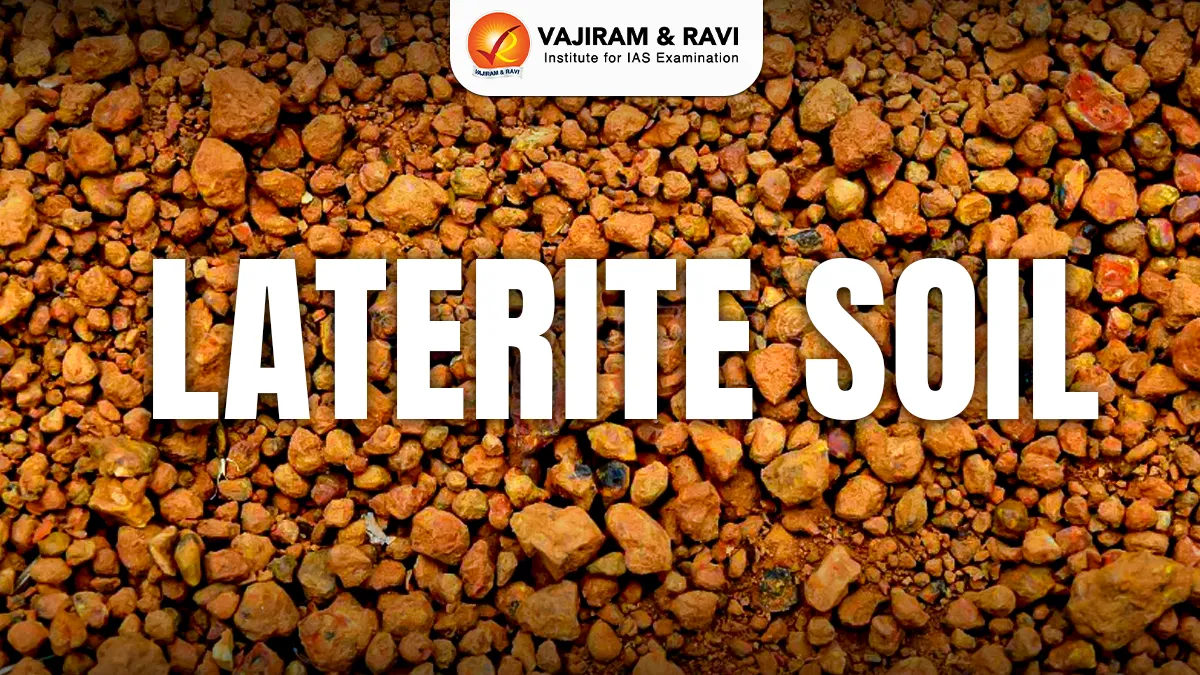
Laterite Soil, Formation, Characteristics, Distribution, Crops

Laterite Soil

Laterite Soil is a reddish-brown tropical soil formed through intense chemical weathering and leaching under hot and humid climates. It is rich in iron and aluminium oxides but poor in essential plant nutrients. The term originates from the Latin word “Later,” meaning brick, because the soil becomes extremely hard and brick like after drying in air.

Laterite Soil Formation

The process and factors affecting the formation of Laterite Soil has been listed below:

  • Laterite Soil forms through the Laterization Process. It is a process of strong chemical weathering where soluble minerals are removed from the parent rock by rainfall, leaving behind concentrated iron and aluminium oxides in the upper soil layers.
  • Laterite Soils originate from various rock types including granite, basalt, sandstone, limestone, gneiss and schists. Over thousands of years, intense weathering converts these rocks into a thick lateritic soil profile.

Laterite Soil Characteristics

Laterite Soil possesses distinct chemical and physical properties. The key highlighting features of the Laterite Soil has been listed below:

  • Appearance: Laterite Soil usually appears red, reddish-brown, or rusty-brown. The coloration occurs due to the presence of high quantities of iron oxide compounds such as hematite and goethite.
  • Chemical Composition: The soil contains high levels of iron oxide (Fe₂O₃) and aluminium oxide (Al₂O₃) but very low concentrations of lime, silica, magnesia, potash and nitrogen because these elements are removed through leaching.
  • Acidic Nature: Laterite Soils are usually acidic. This acidity restricts the growth of many staple crops unless soil treatment and fertilizers are applied.
  • Humus Content: High temperatures accelerate decomposition of organic matter by bacteria. Combined with heavy rainfall washing away nutrients, this results in relatively low humus levels.
  • Porosity and Drainage: Laterite Soil is highly porous and allows rapid water drainage. Because of this characteristic, it cannot retain moisture for long periods, creating challenges for water intensive crops.
  • Hardening Property: When moist, laterite is soft and can be cut easily with simple tools. However, exposure to air causes it to harden significantly, forming durable brick like blocks.

Laterite Soil Crops

Laterite Soil is generally low in fertility but can support several plantation and commercial crops when fertilizers and irrigation are properly applied.

  • Tea Cultivation: Tea plantations thrive in well drained Laterite Soils found in high rainfall regions.
  • Coffee Production: Coffee cultivation is successful in laterite regions of Karnataka and other plateau areas.
  • Cashew Nut Farming: Cashew plantations grow effectively in the Laterite Soils of Kerala, Tamil Nadu and coastal peninsular regions.
  • Rubber Cultivation: With proper manure and fertilizers, soil provides suitable conditions for rubber plantations in tropical regions.
  • Spice Crops: Spices such as pepper and arecanut are cultivated in lateritic soils, particularly in southern India.
  • Root Crops: Crops like tapioca (cassava) and certain varieties of yam can grow in Laterite Soils.
  • Fruit and Plantation Trees: Coconut, banana, pineapple and various tropical fruit trees are cultivated in improved Laterite Soils.

Laterite Soil Global Distribution

Laterite Soils are widely distributed across tropical and subtropical regions where climatic conditions favor intense weathering and leaching.

  • Global Coverage: Lateritic Soils cover nearly one-third of the Earth’s continental land area, particularly in equatorial forests and tropical savanna regions.
  • Tropical Belt Distribution: Laterite Soils occur mainly between the Tropic of Cancer and Tropic of Capricorn. These regions experience high temperatures and heavy rainfall necessary for laterization.
  • Africa: Extensive laterite formations occur across parts of West Africa and central Africa where humid tropical climates support deep weathering of rocks.
  • South America: Lateritic soil profiles are widely found across Brazil and other parts of tropical South America on stable continental shields.
  • Australia: Australia contains large laterite deposits on its ancient shield regions where prolonged weathering under tropical climates has occurred for millions of years.
  • Southeast Asia: Countries such as Indonesia, Philippines, Cambodia and Vietnam contain widespread Laterite Soils and laterite stone deposits used historically in construction.

Laterite Soil in India

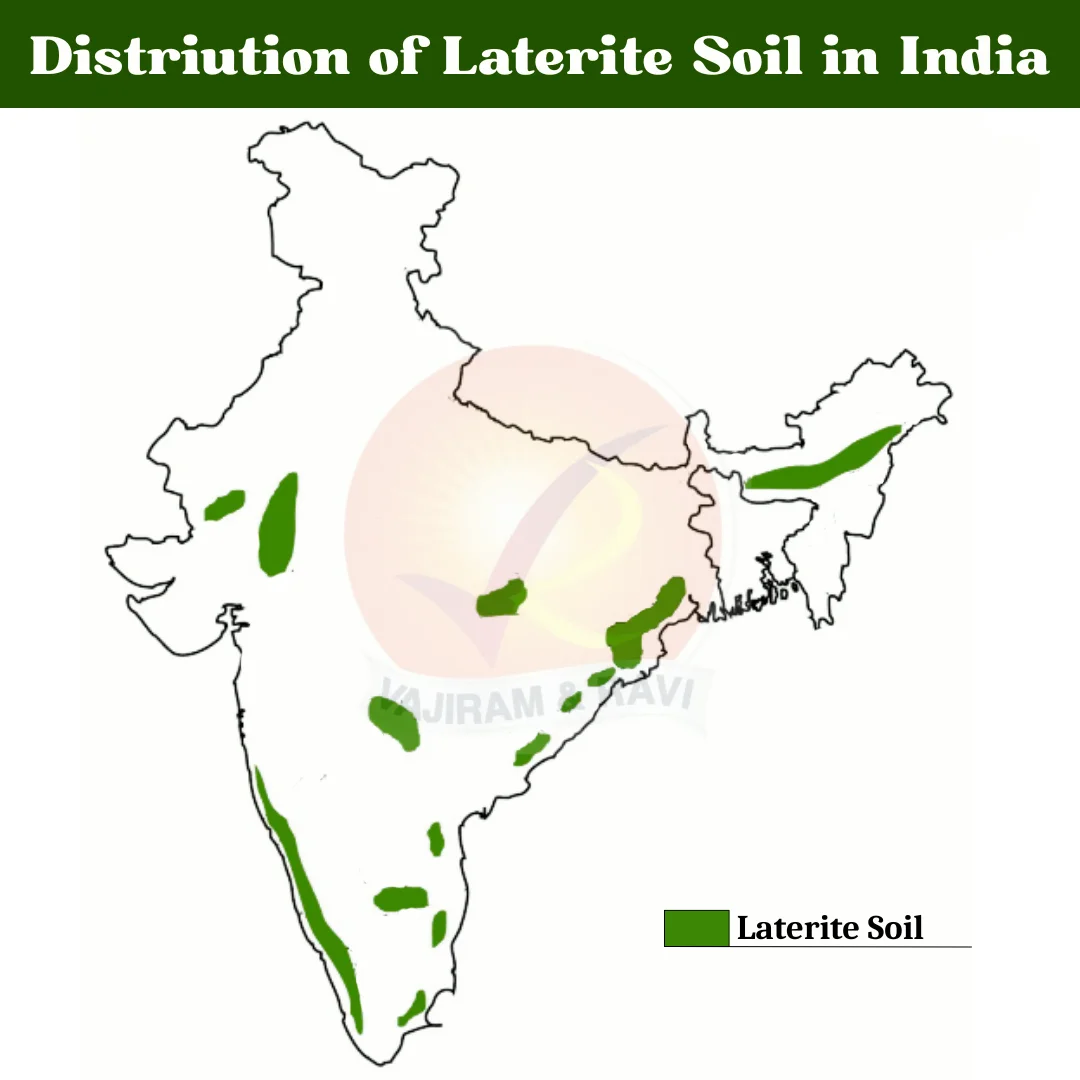
Laterite Soils occur mainly in regions with heavy rainfall and elevated plateau surfaces across several parts of the Indian subcontinent. The map for the Distribution of Laterite Soil in India has been given below:

Laterite Soil in India

  • Laterite Soils occupy approximately 2.48 lakh square kilometres in India, representing about 4.30% of the country’s total geographical area.
  • Continuous stretches of Laterite Soil occur on the summits of the Western Ghats between 1000 and 1500 metres above sea level across Maharashtra, Karnataka and Kerala.
  • Lateritic soils are present in the Eastern Ghats and surrounding regions of Odisha, particularly on elevated hill slopes and plateau surfaces.
  • Parts of Tamil Nadu, Andhra Pradesh and Madhya Pradesh contain Laterite Soils formed through prolonged weathering of plateau rocks.
  • Lateritic deposits are found in the Rajmahal Hills, Vindhyan ranges, Satpura ranges and Malwa plateau due to long term tropical weathering.
  • The laterite plateau of Kerala is one of the most well developed laterite regions where the soil supports plantation crops and coconut cultivation.
  • Smaller patches of Laterite Soil occur in Gujarat’s Panchmahal district and Jharkhand’s Santhal Pargana region as isolated lateritic formations.

Laterite Soil Significance

Laterite Soil holds significant agricultural, geological and economic importance due to its mineral composition and physical characteristics.

  • Source of Ores: Laterite deposits contain bauxite minerals, Iron-rich laterites which contain minerals like hematite and goethite and approximately 70% of the world’s land based nickel resources occur in lateritic deposits.
  • Architecture: Laterite stones were used in the construction of large monuments such as the temple complexes of Angkor between the 9th and 13th centuries in Southeast Asia.
  • Road Construction: Crushed laterite has been used in road construction projects in countries such as Cambodia, Kenya and Malawi because it can serve as a durable base layer.
  • Water Storage Capacity: Thick laterite layers are porous and slightly permeable, allowing them to function as natural aquifers that store groundwater in tropical rural regions.
  • Environmental Applications: Laterite materials have been used in wastewater treatment systems to remove phosphorus and heavy metals due to their high iron and aluminium content.
Related Post
Soil Pollution Black Soil
Soil Degradation Alluvial Soil
Soil Conservation Red Soil
Soil Erosion Mountain Soil
Laterite Soil Soil Fertility
Soils of India Western Disturbances
Geomorphology Coastal States of India
Soil Profile Loamy Soil
Khadar Soil Bhangar Soil

Laterite Soil FAQs

Q1: What is Laterite Soil?

Ans: Laterite Soil is a reddish-brown tropical soil rich in iron and aluminium oxides. It forms under conditions of heavy rainfall, high temperature and intense leaching, which removes soluble nutrients and leaves behind iron-rich material.

Q2: In which climate does Laterite Soil form?

Ans: Laterite Soil develops mainly in hot and humid tropical climates with heavy rainfall and alternating wet and dry seasons, which promote strong chemical weathering and leaching processes.

Q3: Which crops grow well in Laterite Soil?

Ans: Plantation crops such as tea, coffee, rubber and cashew grow well in Laterite Soils. With proper irrigation and fertilizers, crops like coconut, arecanut, pepper and tapioca are also cultivated.

Q4: What is the distribution of Laterite Soil in India?

Ans: Laterite Soils are mainly found in the Western Ghats, Eastern Ghats, Kerala plateau, parts of Maharashtra, Karnataka, Tamil Nadu, Odisha, Madhya Pradesh, Gujarat and Jharkhand.

Q5: Which minerals are mainly found in Laterite Soil?

Ans: Laterite Soil mainly contains iron oxides and aluminium oxides which remain after soluble minerals are washed away during laterization.

The Rajputs, History, Dynasties, Empire, Kings, Society & Governance

The Rajputs

The Rajputs were a powerful group of warrior clans who dominated large parts of northern, western, and central India during the early medieval period. The word Rajput is derived from Rajaputra, meaning “son of a king”, which reflects their claim to royal and warrior ancestry. Rajputs considered warfare as their primary occupation and followed a strict code of honor, bravery, and loyalty.

From the 6th century CE onwards, Rajput rulers established numerous kingdoms across Rajasthan, Gujarat, Madhya Pradesh, Uttar Pradesh, Delhi, Punjab, Himachal Pradesh, Uttarakhand, and parts of present-day Pakistan and Afghanistan. Even until the 20th century, many princely states of India were ruled by Rajput dynasties.

The Rajputs Historical Origin

The history and origin of the Rajputs is one of the most debated issues in early medieval Indian history because it combines legendary traditions, literary references, and historical processes. Rajputs did not emerge suddenly; they evolved over time as a distinct warrior aristocracy between the 6th and 9th centuries CE.

  • Kshatriya Lineage Theory
    • Many Rajputs claimed descent from the ancient Kshatriyas of Vedic age, emphasizing purity of blood and royal ancestry.
    • They associated themselves with the Solar (Suryavanshi) and Lunar (Chandravanshi) dynasties mentioned in the epics and Puranas.
    • The word Rajput comes from Rajaputra, meaning “son of a king”, a term used by Sanskrit writers like Bana for elite warriors.
    • The idea of thirty-six royal Rajput clans is found in Puranic and epic traditions, giving legitimacy to their ruling status.
    • Rajputs also recognized a third lineage, the Agnivanshi, which symbolized divine and ritual origin.
  • Agnikula (Fire-Origin) Theory
    • According to Chand Bardai’s Prithviraj Raso, four major Rajput clans, Parmar, Chauhan, Pratihara, and Chalukya, were born from a sacrificial fire pit (Agnikunda) at Mount Abu.
    • Sage Vashistha is said to have performed the ritual to create warriors to defend Hindu society.
    • This theory strengthened clan identity, social prestige, and political legitimacy among Rajputs.
    • Historians regard this theory as mythical and symbolic, rather than factual history.
  • Aryan-Kshatriya Cultural Continuity Theory
    • Ethnological and cultural practices of the Rajputs indicate strong roots in Aryan-Kshatriya traditions.
    • Rituals such as the Ashvamedha sacrifice, sun worship, and strict adherence to Kshatriya codes were central to Rajput life.
    • The practice of Sati reflected orthodox Hindu social values prevalent among upper castes.
    • Due to cultural continuity, this theory is widely accepted by modern historians.
  • Foreign Origin and Assimilation Theory
    • Some historians argue that certain Rajput clans descended from foreign tribes like the Sakas, Kushanas, Huns, and Gurjaras.
    • These groups entered India between the 2nd and 6th centuries CE and gradually settled in northern India.
    • Over time, they adopted Hindu religion, Sanskrit language, and local customs.
    • Through Brahmanical rituals and political power, they were absorbed into the Kshatriya fold and later identified as Rajputs.
  • Caste Reorganization Theory
    • The invasions of the Huns and allied tribes in the 5th–6th centuries CE caused major political and social disruption in northern India.
    • Old ruling families collapsed, leading to a rearrangement of castes and power structures.
    • Diverse warrior groups were merged into a single ruling class known as the Rajputs.

The Rajput Empire and Dynasties

List of major dynasties of the Rajput Empire has been provided below along with the detailed discussion of the kingdom, king and rulers:

1. Hindushahi Dynasty

  • The Hindushahi dynasty ruled over parts of Afghanistan and the Punjab region, serving as a major Hindu power on India’s north-western frontier.
  • Jayapala was the first Rajput ruler of the dynasty, succeeding the last Brahmin king Bhimdev, marking a shift from Brahmin to Rajput rule.
  • Jayapala strongly resisted the invasions of Mahmud of Ghazni but was defeated in 1001 AD.
  • Following his defeat, Jayapala immolated himself, reflecting the Rajput code of honor and sacrifice.
  • His successor Anandapala continued resistance but was defeated by Mahmud in the Battle of Waihind (1008 AD).
  • The dynasty declined thereafter, and its last ruler Bhimpala died in 1024 AD, ending Hindushahi rule by 1026 AD.

2. Chauhan (Chahamana) Dynasty

  • The Chauhan dynasty ruled from 956 to 1192 AD, mainly over eastern Rajasthan, with Ajmer as their capital.
  • The dynasty was founded by Simharaj, who is also credited with establishing the city of Ajmer.
  • Over time, Chauhan rulers expanded their territory to include Delhi, Haryana, Punjab, parts of Uttar Pradesh, and Bundelkhand.
  • Prithviraj Chauhan, the most prominent ruler, brought the dynasty to its greatest extent and military strength.
  • He defeated Muhammad of Ghori in the First Battle of Tarain (1191 AD), showcasing Rajput military power.
  • However, his defeat in the Second Battle of Tarain (1192 AD) marked the decline of Chauhan rule and opened the way for Turkish dominance in northern India.

3. Solanki Dynasty (Chalukya Dynasty of Gujarat)

  • The Solanki dynasty ruled Gujarat from 945 to 1297 AD, with their capital at Anhilwara (Patan).
  • The dynasty rose to prominence under Mulraj I, who consolidated Solanki power and laid a strong administrative foundation.
  • Solanki rulers strengthened trade and commerce, making Gujarat an important economic region.
  • They were great patrons of Hinduism and Jainism, encouraging religious harmony.
  • The period witnessed remarkable temple architecture, reflecting artistic and cultural prosperity.
  • Solanki rule declined towards the end of the 13th century due to internal weakness and external invasions.

4. Paramara Dynasty

  • The Paramara dynasty was founded by Upendra (Krishnaraja) and ruled the Malwa region with capitals at Dhar and Ujjain.
  • The greatest ruler of the dynasty was Raja Bhoja, under whom Malwa reached its peak of political and cultural glory.
  • Raja Bhoja founded the city of Bhojpur and established the Bhojshala, a renowned centre of Sanskrit learning.
  • The Paramaras were major patrons of Sanskrit scholars, poets, and scientists, and Bhoja himself was a celebrated scholar.
  • Most Paramara rulers followed Shaivism and built numerous Shiva temples, while also supporting Jain scholars and institutions.
  • Under Paramara rule, Malwa emerged as a leading centre of art, culture, and intellectual activity in early medieval India.

5. Chandela Dynasty

  • The Chandela dynasty was founded by Jayasakthi and ruled the Bundelkhand region of central India.
  • Their capital was Mahoba, which served as an important political and military center.
  • The Chandelas are best known for their outstanding contributions to art and architecture.
  • They constructed the famous Khajuraho temples, renowned for their intricate carvings and architectural excellence.
  • These temples reflect religious tolerance, as both Shaiva and Vaishnava themes are prominently represented.
  • The dynasty declined after repeated invasions and finally ended when Alauddin Khalji conquered Bundelkhand.

6. Gahadavala Dynasty

  • The Gahadavala dynasty ruled the kingdom of Kannauj for nearly a century, beginning in the late 11th century AD.
  • Kannauj emerged once again as an important political centre under Gahadavala rule.
  • Jayachandra was the most powerful and last significant ruler of the dynasty.
  • He faced invasions from the Ghurids, led by Qutb al-Din Aibak.
  • Jayachandra was defeated and killed in the Battle of Chandawar (1194 AD).
  • This defeat marked the end of Gahadavala rule and weakened Rajput dominance in the Gangetic plains.

7. Bundela Dynasty

  • The Bundela dynasty ruled the Bundelkhand region from the 16th century AD onwards, emerging as a major regional power.
  • Orchha, located in present-day Madhya Pradesh, served as their principal centre of administration and culture.
  • The dynasty was founded by the Rajput ruler Hemkaran around 1048 AD.
  • Bundela rulers frequently resisted Mughal authority but also formed alliances when politically necessary.
  • The dynasty played an important role in shaping the political history of central India.
  • Bundela rule declined after Orchha was captured by the Mughals under Aurangzeb, bringing their independence to an end.

8. Tomara Dynasty

  • The Tomara dynasty was one of the early medieval Rajput ruling houses of northern India, known mainly from limited literary and numismatic sources.
  • Puranic evidence suggests that their early settlements were located in the Himalayan region.
  • Bardic traditions identify the Tomaras as one of the thirty-six Rajput clans.
  • Anangapala, the most notable Tomara ruler, founded the city of Delhi (Dhillika) in the 11th century AD.
  • In 1164 AD, Delhi was incorporated into the Chauhan (Chahamana) kingdom, though Tomara rulers continued as feudatories.
  • Tomara authority finally ended with the Muslim conquest of Delhi in 1192–93 AD.

The Rajputs Society and Religion

The key highlights of the society and religion under the Rajputs has been discussed below:

  • The Rajputs were staunch followers of Hinduism, upholding traditional Vedic and Kshatriya religious practices.
  • They also patronized other religions like Buddhism and Jainism, supporting religious tolerance and cultural diversity.
  • The period saw the rise of the Bhakti movement, emphasizing devotion to deities such as Vishnu (Vaishnavism) and Shiva (Shaivism), which influenced both the common people and the elite.
  • Temples were not only centers of worship but also hubs for social, cultural, and educational activities.

The Rajputs Administration and Governance

The administration and governance under The Rajputs has been discussed below:

  • Rajput kingdoms had a feudal structure, with power decentralized across multiple estates and territories.
  • Each kingdom was divided into Jagirs, which were land grants held by Jagirdars (local feudal lords) responsible for administration, revenue collection, and military service.
  • The feudal setup created loyalty networks among clans, but also led to frequent inter-clan conflicts and limited central authority.
  • Governance was largely based on customs and traditions, with no codified laws for the entire kingdom.

The Rajputs Literary Contributions

The Rajput period was a golden age for literature, with contributions in poetry, prose, and scholarly works:

  • Kalhana’s Rajatarangini – Chronicles the history of Kashmir in Sanskrit verse, providing political, social, and cultural insights of rulers and battles.
  • Jayadeva’s Gita Govindam – Devotional Sanskrit poem celebrating Krishna and Radha, influencing the Bhakti movement, temple music, and dance.
  • Somadeva’s Kathasaritsagara – Extensive collection of folktales and legends reflecting society, customs, and moral values of the period.
  • Chand Bardai’s Prithviraj Raso – Epic poem depicting the life, bravery, and military exploits of Prithviraj Chauhan, highlighting Rajput ideals.
  • Bhaskara Charya’s Siddhanta Shiromani – Comprehensive work on mathematics and astronomy, including arithmetic, algebra, and planetary motion.
  • Rajasekhara’s Literary Works – Sanskrit texts like Karpuramanjari, Kavyamimamsa, and Balaramayana combining poetry, devotion, and literary theory.
Also Read
Prominent Rulers of India Chola Dynasty
Mughal Empire Slave Dynasty
Rulers of Maratha Empire Later Mughals


The Rajputs FAQs

Q1: Who were the Rajputs?

Ans: Rajputs were a warrior clan in India who claimed descent from ancient Kshatriya dynasties and ruled many regions of northern and western India.

Q2: What is the origin of Rajputs?

Ans: Rajputs trace their origin to the Kshatriya lineages, Agnikula legend, or assimilation of foreign tribes like Sakas, Huns, and Gurjaras.

Q3: Which were the major Rajput dynasties?

Ans: Major Rajput dynasties include Hindushahi, Chauhan, Solanki, Paramara, Chandela, Gahadavala, Bundela, and Tomara.

Q4: What was the social structure under the Rajputs?

Ans: Rajput society was feudal and clan-based with a rigid caste hierarchy dominated by Brahmins and Kshatriyas.

Q5: What religions did the Rajputs follow?

Ans: Rajputs primarily followed Hinduism while also patronizing Buddhism, Jainism, and the Bhakti movement.

Eastern Ghats, Geography, Mountains, Rivers, Environment

Eastern Ghats

The Eastern Ghats is situated along the eastern coast of India stretching about 1750 km. It covers five states under the area roughly measuring to 160,000 km². It is a discontinuous chain of hills. The average elevation is around 600 m with the highest peak being Arma Konda (1,680 m). The geological uniqueness, ecological importance, and role as watershed for major rivers make it a crucial feature of peninsular India.

Eastern Ghats

The Eastern Ghats extend from north of the Mahanadi River in Odisha to the Vaigai River in Tamil Nadu in the south. It covers the states including Odisha, Andhra Pradesh, Telangana, Karnataka, and Tamil Nadu. Its width varies between 100-200 km. The eastern region slopes toward the Bay of Bengal, while the western region connects to the Deccan Plateau. The Ghats are characterised by a discontinuous, fragmented structure, with multiple hill blocks separated by major river valleys.

Eastern Ghats Geography

The Eastern Ghats are among India’s oldest mountain formations, with complex geological history.

  • The range lies roughly between latitudes 18° 13′ 41” N, and longitudes about 82° 43′ 23” E. 
  • They are Precambrian (Archeozoic era) fold mountains, originally part of ancient continental assemblies.
  • The primary rock types are charnockite, khondalite, granite, quartzite, calcium silicate and metamorphic rocks.
  • The terrain shows many faults, thrusts and strike-slip movements, indicating tectonic reworking over geological time.
  • Mineral deposits such as iron ore, bauxite, limestone and other minerals occur in various hill ranges.
  • The soils found in the eastern ghats region are majorly Red, Black, Laterite and Alluvial.

Eastern Ghats Divisions

The Eastern Ghats can be broadly divided into northern, central, and southern segments:

  • Northern section (Odisha): from Mahanadi basin to Andhra border; includes Similipal, Garhjat, Niyamgiri, with heights 900-1400 m and significant mineral wealth.
  • Central section (Andhra Pradesh & Telangana): two parallel ranges separated by a 160 km gorge through which Godavari and Krishna flow; average height ~ 520 m.
  • Southern section (Karnataka & Tamil Nadu): appears as fragmented hills (Nallamala, Javadi, Shevaroy etc.), with lower elevation and gentle slopes, merging into Nilgiri Hills where they meet Western Ghats.

Eastern Ghats Mountain Ranges

The discontinuous hills and plateaus form the notable ranges and peaks of Eastern Ghats including several important hill clusters. 

  • Major ranges of the Northern region of the Ghats include Similipal, Garhjat, Gandhamardan, Niyamgiri and Deomali (Odisha). 
  • Important ranges covering the Central to Southern region of the Ghats are: Nallamala, Veligonda, Palakonda, Javadi, Melagiri, Kambakkam, etc. (Andhra Pradesh/ Tamil Nadu/ Karnataka). 
  • The discontinuous nature is especially visible between the Godavari and Krishna rivers, where the hills nearly vanish, giving way to plateaus and Gondwana basins. 
  • Major Peaks of Eastern Ghats: Arma Konda (1,680 m) highest in Andhra Pradesh’s Araku Valley sector of Eastern Ghats; Mahendragiri (≈1,501 m) in Odisha’s northern section.

Eastern Ghats Rivers

Eastern Ghats have several important east-flowing rivers and tributaries as mentioned below:

  • Major peninsular rivers: Godavari, Krishna, Mahanadi, and Kaveri cross the Ghats and drain into the Bay of Bengal. 
  • Numerous smaller rivers and streams originating in or passing through Eastern Ghats include Nagavali, Vamsadhara, Sabari, Champavathi, Penna, Gundlakamma, Swarnamukhi, etc.
  • Many rivers have carved deep gorges and valleys through the Ghats, e.g. Godavari gorge (~ 65 km wide) between hills, facilitating river flow and creating unique topography. 
  • These rivers contribute significantly to irrigation, hydropower, and water supply for eastern coastal plains and Deccan region.
  • The region also consists of numerous wetlands and large coastal lagoons eg: Chilika, Kolleru and Pulicat Lake.

Eastern Ghats Environment

The climate, rainfall and vegetation across Eastern Ghats reflect its fragmented terrain:

  • The climate is generally tropical to subtropical, with hot, humid summers (up to 44 °C) and moderate winters (~20 to 25 °C).
  • Rainfall distribution varies: northern hills receive 120-150 cm, southern sections 60-110 cm, largely from monsoon and occasional cyclones.
  • Vegetation types include nine major forest categories: tropical evergreen, semi-evergreen, moist deciduous, northern dry deciduous, southern dry deciduous, thorn scrub, dry savannah, riverine forests and dry evergreen forests depending on altitude and rainfall.
  • Evergreen patches occur in limited pockets (e.g. Shevaroy hills, parts of northern Andhra), while dry deciduous and scrub dominate in low rainfall or degraded zones.

Eastern Ghats Biodiversity

Eastern Ghats is ecologically rich with many endemic species and important protected areas.

  • The Ghats harbour about 4500 flowering plant species, representing ~13% of India’s flowering plants.
  • Commercial Tree species found are: Indian Rosewood, Teak, Mahogany and Red Sandalwood.
  • Fauna includes Bengal tiger, Indian elephant, Indian wild dog, leopard, nilgai, Indian vulture, Indian bustards, Indian golden gecko, along with other species nearly 100 mammals, 425 birds, 99 reptiles,100  amphibians, 155 fishes and several diverse insects.
  • Critically endangered and endemic species such as the Jerdon's courser and several rare reptiles and amphibians are unique to Eastern Ghats. 
  • Protected areas include national parks, wildlife and bird sanctuaries, tiger & elephant reserves, spread across states, supporting conservation of Ghats biodiversity.

Eastern Ghats Significance

The Eastern Ghats play multiple roles including ecological, hydrological, cultural and economic as given below:

  • They serve as a watershed for major east-flowing rivers which irrigate coastal plains and support agriculture.
  • It provides minerals (iron ore, bauxite) supporting mining and industry sectors.
  • It supports forest-based livelihoods of tribal and rural communities; forest produce, non-timber forest produce, traditional medicine sources.
  • It acts as a biodiversity hotspot, preserving endemic species and ecological balance.
  • It offers potential for ecotourism, trekking and sustainable development, linking culture, environment and economy.

Eastern Ghats Challenges

Human pressures and ecological changes pose serious threats to Eastern Ghats. The major challenges faced by the Eastern Ghats are:

  • Deforestation and habitat loss due to logging, mining, shifting cultivation, monoculture plantations and illegal encroachments have degraded forests and biodiversity.
  • Loss of biodiversity: endemic species under threat from habitat fragmentation and unsustainable exploitation.
  • Decline in traditional livelihoods for tribal communities as forest produce collection reduces and forest-based income sources shrink.
  • Mining and quarrying impacts: extraction of bauxite, iron ore and other minerals leading to soil degradation, deforestation, water pollution and ecological imbalance.
  • Poor enforcement of protection laws and lack of community involvement, weakening conservation efforts.

Eastern Ghats Conservation

Effective conservation of Eastern Ghats requires integrated ecological, social and policy measures. The major steps that can be taken and have been carried out for the conservation of the biodiversity and environment of ghats are:

  • Protected Area Expansion: Declare and expand protected areas: national parks, wildlife sanctuaries, biosphere reserves, including corridor conservation to support wildlife movement. Eg: Inclusion of Koundinya WLS, Sri Venkateswara NP, Gundla Brahmeswaram WLS to conserve elephants and endemic flora; supports the Asian Elephant Conservation Project. 
  • Community-Based Conservation (JFM Model): Promote community-led forest management and sustainable livelihoods for tribal and local communities to reduce pressure on natural resources. Eg: Joint Forest Management committees in Odisha and Andhra Pradesh manage buffer zones showing improvement in canopy density.
  • Enforce mining, logging, and land-use regulations strictly, with rehabilitation and ecological restoration plans for degraded areas.
  • Encourage sustainable ecotourism and environmental education, balancing development with conservation.
  • Eco-Restoration (MoEFCC): Uses assisted natural regeneration, gap planting, and soil–moisture conservation. Applied in Seshachalam Hills to restore degraded Red Sanders forests after the surveys identified rapid decline.
  • Special Species-Focused Measures: Formulating a unique measure to protect species, eg: The Andhra Pradesh ‘Red Sanders Anti-Smuggling Task Force’ (RSASTF, 2015) established to curb illegal smuggling and promote restoration with  stricter patrol routes and GIS mapping.
  • Monitoring: Biodiversity Monitoring (ZSI-BSI Surveys) for long-term species assessment across Similipal, Satkosia, Papikonda; Geospatial Monitoring (NRSC Hyderabad) for satellite-based tracking of forest fragmentation.

Eastern Ghats FAQs

Q1: What is the major threat to the Eastern Ghats?

Ans: The major threats include mining, shifting cultivation, encroachment, and habitat fragmentation. FSI and ZSI surveys identify mining as the fastest-growing threat.

Q2: Which species are a conservation priority in the Eastern Ghats?

Ans: Red Sanders, Indian Giant Squirrel, and Asian Elephant are priority species due to habitat loss and illegal trade pressures.

Q3: Which is the highest peak of Eastern Ghats?

Ans: The highest peak of the Eastern Ghats is Arma Konda which is 1680 m in height. It is also known as Jindhagada Peak, located in Araku Valley, Andhra Pradesh.

Q4: Which rivers flow through the Eastern Ghats?

Ans: Many east-flowing rivers pass through eastern ghats and drains into the Bay of Bengal. Examples: Godavari, Krishna, Mahanadi, Kaveri, etc.

Q5: What are the protected areas in the Eastern Ghats?

Ans: Yes, major protected areas include Papikonda National Park, Similipal Biosphere Reserve, Satkosia Tiger Reserve, and Sri Venkateswara National Park.

Solar System, Planets, Satellites, Components, Characteristics

Solar System

The universe consists of numerous planetary systems, each with planets rotating/revolving around a central star. Our planetary system is called the Solar System because the Sun is named "Sol," derived from the Latin word “sols.” As a result, anything related to the Sun is referred to as "solar." The Solar System comprises our star, the Sun, along with all celestial bodies bound to it by gravity. The Solar System includes eight planets, multiple asteroids, comets, meteoroids, dwarf planets like Pluto, and various moons. Located in one of the outer spiral arms of the Milky Way galaxy, the Solar System is a fascinating and dynamic system that continues to be a subject of extensive scientific exploration.

The Solar System

The Solar System consists of the Sun, eight planets (Mercury, Venus, Earth, Mars, Jupiter, Saturn, Uranus and Neptune), their satellites, asteroids, comets, meteoroids, and interplanetary dust. Pluto, once a part of the Solar System, is now classified as a dwarf planet.

The Sun makes up 99.85% of the Solar System’s mass and is primarily composed of hydrogen and helium. The Photosphere is the Sun’s visible surface, surrounded by the Chromosphere and the Corona (visible during eclipses). The Sun's surface is dynamic, with bright plages and dark sunspots that frequently form and disappear.

Sun

The Sun is a 4.5 billion-year-old star which is the center of the Solar System, located 93 million miles from Earth. It is composed mainly of hydrogen and helium, making life on Earth possible. Being the largest object in the solar system, it could fit 1.3 million Earths inside it. The Sun's gravitational pull keeps all celestial bodies in orbit, while its eruptions and charged particles influence the solar system. The core is the hottest part, reaching 15 million degrees Celsius. Space agencies like NASA study the Sun using spacecraft like Solar Orbiter, Parker Solar Probe, and STEREO.

Solar System Planets

The Solar System contains more planets than stars. The solar system has eight planets after Pluto's exclusion. Mercury, Venus, Earth, and Mars are rocky inner planets, while Jupiter and Saturn are gas giants. Uranus and Neptune are ice giants. Beyond Neptune, dwarf planets like Pluto exist. The list of Solar System Planets in Order has been provided below:

Mercury

Mercury is the closest planet to the Sun, and is also the smallest in the solar system. Its close proximity makes it hard to see due to the Sun’s glare. It completes one revolution in 88 days and has no satellites or atmosphere. One day on Mercury equals 90 Earth days, and its mass is 1/18 of Earth's mass. Mariner-10 was the only artificial satellite to survey its surface.

Venus

Venus is the closest planet to Earth, and is often called its twin planet due to their similar sizes. It is the brightest planet in the sky and is known as the "morning star" and "evening star" because it is visible just before sunrise and after sunset. Venus completes one revolution in 225 days and rotates in 243 days, making it the only planet with a rotation period longer than its revolution. It has no moons and, like Uranus, rotates from east to west, opposite to Earth's rotation. Venus is also the hottest planet in the solar system.

Earth

Earth is the only known planet that supports life due to its optimal distance from the Sun, moderate temperature, presence of water, life-supporting atmosphere, and ozone layer. About 71% of Earth’s surface is covered in water, giving it a blue-green appearance from space. The Moon is Earth's only satellite.

Earth’s 23.5° axial tilt causes seasonal changes. It is the 5th largest planet in the solar system. Its equatorial radius is 6,378 km, polar radius is 6,356 km, and its perimeter is approximately 40,000 km. The exoplanet Kepler-452b is considered Earth's closest cousin.

Mars

Mars, the first planet discovered outside Earth’s orbit, is known as the “Red Planet” due to its reddish appearance, caused by iron oxide (rust). It takes 687 days to complete one revolution around the Sun.

Mars has two small natural satellites, Phobos and Deimos, with Deimos being the smallest satellite in the universe. The highest point on Mars is Olympus Mons, the tallest volcano in the solar system.

India's ISRO launched Mangalyaan (Mars Orbiter Mission) on November 5, 2013, and it successfully entered Mars' orbit on September 24, 2014. India became the first nation to reach Mars on its first attempt.

Jupiter

Jupiter is the largest planet in the solar system, 1300 Earths could fit inside it. It rotates rapidly on its axis and is surrounded by faint rings. Jupiter takes 11.9 years to complete one revolution around the Sun and has 92 known satellites. Ganymede, the largest of them, is also the biggest satellite in the solar system. The planet's atmospheric pressure is 10 million times higher than Earth's. Jupiter's Great Red Spot is a continuous high-pressure storm, creating asymmetric storms on the planet.

Saturn

Saturn is considered the most beautiful planet in the Solar System and is the second-largest after Jupiter. It takes 29.5 years to complete one revolution around the Sun and has a yellowish appearance. Saturn is famous for its four stunning rings, which are not visible to the naked eye. It has 147 natural satellites, with Titan being the largest, nearly the size of Mercury. Saturn is the least dense planet in the solar system, with a density lower than water, meaning it would float if placed in a large enough water body.

Uranus

Uranus was discovered in 1791 by William Herschel. It is the third-largest planet in the solar system and is named after the Greek god of the sky.

Uranus takes 84 years to complete one revolution around the Sun and, like Venus, it rotates from East to West. Its bluish-green color is due to the presence of methane in its atmosphere. Through a telescope, it appears greenish. Uranus has five rings named Alpha, Beta, Gamma, Delta, and Epsilon and 27 known satellites.

Neptune

Neptune is named after the Roman God of the Sea and was discovered by German astronomer Johann Galle. It takes 165 years to complete one revolution around the Sun, making it the planet with the longest year in the solar system. Neptune is the 8th and farthest planet from the Sun and the 4th largest planet in the solar system. It has 14 known natural satellites, with Triton being the largest.

Moons

Moons are also known as natural satellites, are celestial bodies that orbit planets and asteroids. Our Solar System hosts over 200 moons, each varying in size, shape, and composition. While Mercury and Venus lack moons, other planets, including Earth, have one or more. Some moons, like Jupiter’s Ganymede and Saturn’s Titan, are larger than Mercury, while others are tiny, irregularly shaped bodies. 

Moons of Each Planets

Planets

Moons

Mercury

0

Venus

0

Earth

1

Mars

2

Jupiter

79 (53 confirmed, 26 provisional)

Saturn

82 (53 confirmed, 29 provisional)

Uranus

27

Neptune

14

Solar System Components

The Solar System in addition to the Sun, Planets, Moons also consist of the other components of celestial bodies. These leftover celestial bodies, including asteroids, comets, and meteors, are remains of the early solar system. While planets formed through accretion, billions of smaller fragments never merged into large planetary bodies. 

Asteroids, primarily found in the asteroid belt between Mars and Jupiter, are rocky objects that vary in size. Comets, composed of ice, dust, and rock, originate from the Kuiper Belt and Oort Cloud, developing bright tails when approaching the Sun. 

As of now, there are 1,113,527 known asteroids and 3,743 identified comets in our solar system, continuously providing insights into its formation and evolution.

Solar System Characteristics

The major highlighting features of the Solar System of the Earth has been tabulated below:

Facts related to Solar System
Aspect Name Description

Biggest Planet

Jupiter

Jupiter is the largest planet in the Solar System by size and mass.

Biggest Satellite

Ganymede

Ganymede, a moon of Jupiter, is the largest natural satellite in the Solar System.

Blue Planet

Earth

Earth is called the Blue Planet because about 71% of its surface is covered with water.

Green Planet

Uranus

Uranus is popularly known as the Green Planet due to the presence of methane in its atmosphere, which gives it a greenish-blue appearance.

Brightest Planet

Venus

Venus is the brightest planet visible from Earth because its thick clouds reflect most sunlight.

Brightest Star Outside the Solar System

Sirius

Sirius is the brightest star in the night sky outside our Solar System.

Closest Star to the Solar System

Proxima Centauri

Proxima Centauri is the nearest known star to the Solar System after the Sun.

Coldest Planet

Neptune

Neptune has some of the lowest atmospheric temperatures among the planets.

Evening Star

Venus

Venus is called the Evening Star when it appears in the western sky after sunset.

Farthest Planet from the Sun

Neptune

Neptune is the eighth and most distant recognised planet from the Sun.

Planet with Maximum Satellites

Saturn

Saturn currently has the highest number of confirmed natural satellites among all planets.

Fastest Revolution in the Solar System

Mercury

Mercury completes one orbit around the Sun in about 88 Earth days.

Hottest Planet

Venus

Venus is the hottest planet because its dense carbon dioxide atmosphere creates an extreme greenhouse effect.

Densest Planet

Earth

Earth has the highest average density among all planets in the Solar System.

Fastest Rotation in the Solar System

Jupiter

Jupiter rotates on its axis in about 10 hours, making it the fastest-spinning planet.

Morning Star

Venus

Venus is known as the Morning Star when visible in the eastern sky before sunrise.

Nearest Planet to Earth

Venus

Venus is generally regarded as Earth's nearest neighbouring planet.

Nearest Planet to the Sun

Mercury

Mercury is the closest planet to the Sun.

Red Planet

Mars

Mars is called the Red Planet because of iron oxide (rust) on its surface.

Slowest Revolution in the Solar System

Neptune

Neptune takes about 165 Earth years to complete one orbit around the Sun.

Slowest Rotation in the Solar System

Venus

Venus rotates very slowly, taking about 243 Earth days to complete one rotation.

Smallest Planet

Mercury

Mercury is the smallest planet in the Solar System.

Smallest Satellite

Deimos

Deimos, one of Mars' moons, is among the smallest known natural satellites in the Solar System.

Earth's Twin

Venus

Venus is often called Earth's Twin because of its similar size and mass.

Only Moon with a Dense Atmosphere Similar to Earth

Titan

Titan, Saturn's largest moon, is the only moon with a thick atmosphere similar in many ways to Earth's.


Solar System FAQs

Q1: What are 9 planets in order?

Ans: Mercury, Venus, Earth, Mars, Jupiter, Saturn, Uranus, and Neptune.

Q2: Are there 8 or 9 planets in the solar system?

Ans: The solar system has eight planets.

Q3: Why is Pluto no longer a planet?

Ans: Pluto is now classified as a dwarf planet because, while it is large enough to have become spherical, it is not big enough to exert its orbital dominance and clear the neighborhood surrounding its orbit.

Q4: Which is the hottest planet?

Ans: Venus is the hottest planet.

Q5: Which planet is the biggest?

Ans: Jupiter is the largest planet in the solar system.

Dutch East India Company (1602-1799), Timeline, Settlement, Decline

Dutch East India Company

The Dutch East India Company was one of the most powerful trading corporations in world history and a defining force of early modern globalisation. It combined private capital with state authority, creating a corporate entity that could trade, wage wars, govern territories, mint coins and administer justice. It operated across Asia, Africa and the Asia-Pacific region as a result it dominated the spice trade and pioneered institutional innovations such as joint stock ownership, permanent capital and secondary share markets.

Dutch East India Company

The Dutch East India Company was founded on 20 March 1602 through a government directed merger of competing Dutch trading firms called voorcompagnieën. It was initiated by Johan van Oldenbarnevelt and authorised by the States General of the Dutch Republic (Netherlands). It was formally named the “Vereenigde Nederlandsche Geoctroyeerde Oostindische Compagnie”, popularly known as the “VOC”. Its Global Headquarter was at Amsterdam and Batavia was its Asian administrative centre. The company was granted a 21 year Trade Monopoly over Asia. It began administration with its own Flag from 1630, which bore a distinctive ‘V-O-C’ monogram that became one of the world’s earliest corporate symbols.

Dutch East India Company Timeline

The historical evolution and origin of the Dutch East India Company can be seen through the timeline given below:

  • Formation in 1602: The States General consolidated pre-companies into one chartered entity to end internal rivalry and strengthen Dutch overseas trade.
  • Asian expansion from 1605: The VOC established its first Asian factories and trading posts, beginning systematic penetration into Indian Ocean commerce.
  • Batavia founded in 1619: Jayakarta was seized and renamed Batavia, becoming the central headquarters of Dutch operations in Asia.
  • 17th Century Peak: During the 1600s, the VOC dominated spice monopolies and paid average annual dividends of around 18%.
  • Late 18th Century Crisis: Rising corruption, administrative costs and declining trade competitiveness weakened the company.
  • Dissolution in 1799: The VOC was formally dissolved on 31 December 1799 and its assets were nationalised as the Dutch East Indies.

Read about: British East India Company

Dutch East India Company Settlement

The settlements of Dutch East India Company functioned as fortified trading, administrative and military centres across multiple continents. Along with Amsterdam and Batavia, it had established various settlements across Java, Mauritius and various regions for trade ports in Japan,Taiwan, etc.
Dutch Settlements in India were primarily commercial in nature, designed to secure textiles, spices and strategic ports rather than territorial rule. The major Indian Settlements are listed below:

  • Masulipatnam Settlement: Established in 1605, it was the first Dutch factory in India and became a key centre for textile and spice procurement on the Coromandel Coast.
  • Pulicat Headquarters: Pulicat emerged as the capital of Dutch Coromandel, coordinating regional trade, warehouses, shipping and diplomatic relations with local rulers.
  • Surat Settlement: Founded in 1616, Surat connected the VOC to western Indian textile markets and Indo-Persian trade routes.
  • Bengal Settlements: Factories at Hugli, Chinsura, Patna, Dacca and Kasimbazar supported large scale trade in silk, saltpetre, rice and indigo.
  • Malabar Coast Bases: Nagapattinam, Cochin and other ports enabled Dutch control over black pepper exports after displacing the Portuguese.

Rise of Dutch East India Company in India

The rise of Dutch East India Company in India was driven by textile demand, spice trade routes and rivalry with other European powers.

  • Entry in 1605: The first Dutch factory was established at Masulipatnam, marking the start of sustained Dutch commercial presence.
  • Textile driven expansion: Indian cotton, silk and indigo became crucial for VOC re-export trade across Southeast Asia.
  • Bengal operations from 1627: Bengal emerged as a key centre for silk, saltpetre and textile procurement.
  • Malabar dominance: The Dutch displaced Portuguese control to monopolise black pepper and spice exports.
  • Defeat of Portuguese power: Strategic victories allowed the VOC to replace Portuguese trade networks in southern India.
  • Gradual retreat: Anglo Dutch Agreements and British military victories reduced Dutch influence after the mid-eighteenth century.

Dutch East India Company Administration

The Dutch East India Company operated as a corporate-state with extensive political, military and economic authority.

  • Heeren XVII leadership: The company was governed by the Lords Seventeen, representing six Dutch chambers.
  • Quasi Sovereign powers: The VOC could wage war, sign treaties, administer justice and establish colonies.
  • Governor General system: Batavia based Governors General supervised regional officials and enforced company policies.
  • Joint Stock structure: Permanent capital and limited liability applied to both investors and managing directors.
  • Diverse workforce: At its peak, over 25,000 employees worked in Asia and 11,000 were en route.
  • Slavery practices: The Company institutionalised slavery across its colonies, relying on forced labour in agriculture, trade and logistics.

Read about: British Rule in India

Dutch East India Company Factories

Factories were commercial and logistical centres that enabled regional trade coordination.

  • Masulipatnam factory: Established in 1605, it was the VOC’s first Indian trading post.
  • Pulicat centre: Pulicat became the capital of Dutch Coromandel and a major textile hub.
  • Surat factory: Opened in 1616, Surat facilitated cotton and silk trade from western India.
  • Bengal factories: Centres at Hugli, Chinsura, Patna and Dacca supported textile and saltpetre exports.
  • Malacca factory: Captured in 1641, Malacca controlled crucial Southeast Asian maritime routes.
  • Dejima post: The Japanese factory ensured exclusive European access to Japanese trade under strict regulation.

Dutch East India Company Economy

The Dutch East India Company built a complex global economy integrating trade, agriculture, shipping and finance.

  • Capitalisation scale: Initial capital worth reached over 6.4 million guilders, dwarfing European competitors.
  • Trade volume: Nearly one million Europeans were transported on 4785 Ships between 1602 and 1796.
  • Commodity diversity: Spices, silk, porcelain, tea, coffee, sugar, rice and metals formed core trade goods.
  • Spice monopoly profits: Control of nutmeg, cloves and pepper generated extraordinary 17th century revenues.
  • Dividend policy: Average annual dividends of about 18% attracted broad public investment.
  • Slave trade role: The Dutch East India Company enslaved labour supported plantations, shipping and colonial economies across VOC territories.

Anglo Dutch Rivalry

The rivalry between the Dutch East India Company and British East India Company reshaped global trade and colonial power balances.

  • Economic competition: Both powers competed intensely for spice, textile and maritime trade dominance.
  • Amboyna incident: In 1623, Dutch officials executed English traders in Ambon, permanently damaging trust and escalating hostility between the two companies.
  • First Anglo Dutch War: Fought between 1652 and 1654 over naval supremacy and commerce.
  • Second Anglo Dutch War: The 1665 to 1667 conflict ended with the Treaty of Breda.
  • Third Anglo Dutch War: From 1672 to 1674, conflicts extended to colonial possessions worldwide.
  • Battle of Colachel: In 1741, Travancore’s victory over the Dutch weakened VOC power in India.
  • Shift of priorities: After 1667, the Dutch gradually withdrew from India to focus on their more profitable Indonesian spice trade.
  • Final confrontations: British victories, including the Battle of Hooghly in 1759, effectively ended Dutch commercial ambitions in India.

Dutch East India Company Decline

Multiple internal and external pressures led to the gradual collapse of the Dutch East India Company. The reasons behind the decline of the company has been listed below:

  • Administrative corruption: Widespread graft reduced profitability and undermined central control.
  • Smuggling losses: Illegal private trade eroded official revenues and monopolies.
  • Rising costs: Military campaigns and colonial administration became increasingly expensive.
  • Competitive pressure: British and French companies outperformed the VOC in key markets.
  • Military defeats: Losses in India and Asia reduced strategic credibility.
  • Bankruptcy: By 1799, insolvency forced state takeover and dissolution.

Dutch East India Company Criticism

The legacy of Dutch East India Company is deeply controversial due to exploitation, violence and environmental damage.

  • Monopoly abuse: Enforced trade monopolies suppressed local economies and competitors.
  • Colonial violence: Mass killings occurred in Banda Islands, Ambon, Batavia and Taiwan.
  • Slave exploitation: Enslaved populations formed the backbone of VOC colonial labour systems.
  • High mortality: Disease, shipwrecks and conflict caused extreme employee death rates.
  • Environmental harm: Forced crop destruction and deforestation disrupted ecological systems.
  • Governance failures: Bureaucratic rigidity and secrecy undermined accountability and social responsibility.

Dutch East India Company FAQs

Q1: When was the Dutch East India Company established?

Ans: It was established in 1602 by the States General of the Dutch Republic to expand Asian maritime trade.

Q2: What was the main objective of the Dutch East India Company?

Ans: Its main objective was to control Asian trade, especially spices, through monopoly rights and overseas settlements.

Q3: Which was the headquarters of the Dutch East India Company in Asia?

Ans: The Global Headquarter of the Dutch East India Company was situated in Amsterdam while Batavia (present day Jakarta) served as the administrative and political headquarters of the VOC in Asia.

Q4: What were the major battles fought between the Dutch East India Company and British East India Company?

Ans: Major conflicts include the Battle of Colachel (1741), Battle of Hooghly (1759) and engagements during Anglo Dutch Wars affecting Indian settlements.

Q5: When and why did the Dutch East India Company decline?

Ans: It declined in the late eighteenth century due to corruption, rising costs, competition and was dissolved in 1799.

BRICS 2026, Theme, Objectives, Host Country, Schedule, Logo

BRICS 2026

India has formally launched the official logo and website for its BRICS 2026 Presidency. This marks the start of India’s leadership year, highlighting its role in guiding the agenda and initiatives of the BRICS grouping. The BRICS Summit 2026 is scheduled to be hosted in New Delhi, India on September 12 and 13, 2026.  

BRICS 2026 Host Country

India will host the BRICS Summit 2026, taking the leadership of the group for the year. This is an important opportunity for India to guide discussions on economic growth, global cooperation, and development priorities for BRICS 2026 member countries. As the host, India will set the agenda, organize meetings, and strengthen ties among the BRICS Nations.

BRICS 2026 Theme

The BRICS 2026 Theme is “Building for Resilience, Innovation, Cooperation, and Sustainability” as countries work together to tackle global challenges. It aims to strengthen shared growth, support green development, and promote new technologies that benefit all members. The theme highlights the importance of unity, mutual respect, and people‑centric progress among BRICS nations. This approach reflects India’s priority to make BRICS a platform that improves global welfare and addresses real‑world issues in an inclusive way.

BRICS Countries 2026

BRICS Countries 2026 is a group of major emerging economies that work together for economic cooperation, development, and global governance reforms. In 2026, BRICS consists of 11 member countries, including its founding nations and newly inducted members. The expanded BRICS aims to strengthen South-South cooperation and increase the voice of developing countries at the global level. The group plays an important role in shaping a multipolar world order. BRICS Member Countries 2026 include Brazil, Russia, India, China, South Africa, Saudi Arabia, United Arab Emirates, Iran, Egypt, Ethiopia, and Indonesia.

BRICS Summit 2026 India's Role

India, as the host of BRICS 2026, will lead the group in promoting inclusive growth, sustainability, and global cooperation. Its role focuses on strengthening partnerships, guiding discussions, and representing the interests of developing countries.

  • Chairing the BRICS Summit and setting the agenda for 2026.
  • Promoting inclusive economic growth and sustainable development.
  • Strengthening trade, investment, and technological cooperation among members.
  • Representing the interests of developing nations in global decision-making.
  • Encouraging practical solutions for shared global challenges.

BRICS 2026 Challenges

Challenges and Criticisms associated with the BRICS 2026 has been discussed below:

  • BRICS lacks a permanent secretariat or strong institutional structure, making decision‑making slower and implementation of initiatives weak.
  • Different political and economic interests among members slow cooperation, especially with expanded membership bringing diverse priorities.
  • Economic imbalances within the group, especially China’s dominant share of GDP, create influence gaps and perceptions of unequal power.
  • The New Development Bank and other BRICS financial mechanisms are still small compared to major global institutions, limiting impact.
  • Intra‑BRICS trade remains low despite overall global trade share, showing limited economic integration.
  • BRICS has faced external political and economic pressure, including warnings related to de‑dollarization and tariffs, affecting cohesion.
  • Some critics call BRICS a “talk shop” with many discussions but fewer concrete global outcomes.

Way Forward:

  • Establish a permanent secretariat to strengthen institutional structure and coordination.
  • Enhance trade, investment, and economic cooperation among member countries.
  • Focus on sustainable development, including clean energy, climate action, and green initiatives.
  • Promote digital innovation, technology exchange, and health cooperation.
  • Engage with other countries and international organizations to increase global influence.
  • Encourage practical solutions for shared global challenges and inclusive growth.

BRICS Schedule 2026

The BRICS Schedule 2026 includes important energy meetings, ministerial discussions, and youth engagement programmes under India’s BRICS Chairship.

  • Senior Energy Officials Meeting: The Fourth Meeting of the BRICS Committee of Senior Energy Officials will be held in Gurugram from 22 to 24 June 2026 to discuss energy cooperation priorities.
  • BRICS Energy Ministers Meeting: India will host the 11th BRICS Energy Ministers’ Meeting in Gurugram on 25-26 June 2026, focusing on energy security, sustainability, innovation, and affordable energy access.
  • Side Events and Technical Discussions: Special sessions on clean coal technologies and higher electrical appliance standards will support knowledge sharing and practical cooperation among BRICS member countries.
  • BRICS Youth Energy Summit: A virtual BRICS Youth Energy Summit will take place on 17-18 August 2026, encouraging youth participation in discussions on future energy challenges and solutions.

BRICS 2026 FAQs

Q1: What is BRICS?

Ans: BRICS is a group of eleven emerging economies Brazil, Russia, India, China, South Africa, Egypt, Ethiopia, Iran, Indonesia, Saudi Arabia, and the UAE that work together on economic, political, and developmental issues.

Q2: Who is hosting BRICS in 2026?

Ans: India is hosting the BRICS Summit in 2026 and will lead the group’s activities throughout the year.

Q3: What is the theme of BRICS 2026?

Ans: The BRICS 2026 Theme is “Building for Resilience, Innovation, Cooperation, and Sustainability”.

Q4: Why is BRICS important?

Ans: BRICS represents a large part of the world’s population and economy, giving developing countries a stronger voice in global cooperation and decision‑making.

Q5: What are the main goals of BRICS 2026?

Ans: The main goals include strengthening economic cooperation, supporting sustainable development, encouraging innovation, and promoting fair global governance.

UPSC Daily Quiz 1 July 2026

UPSC Daily Quiz

[WpProQuiz 199]

UPSC Daily Quiz FAQs

Q1: What is the Daily UPSC Quiz?

Ans: The Daily UPSC Quiz is a set of practice questions based on current affairs, static subjects, and PYQs that help aspirants enhance retention and test conceptual clarity regularly.

Q2: How is the Daily Quiz useful for UPSC preparation?

Ans: Daily quizzes support learning, help in revision, improve time management, and boost accuracy for both UPSC Prelims and Mains through consistent practice.

Q3: Are the quiz questions based on the UPSC syllabus?

Ans: Yes, all questions are aligned with the UPSC Syllabus 2025, covering key areas like Polity, Economy, Environment, History, Geography, and Current Affairs.

Q4: Are solutions and explanations provided with the quiz?

Ans: Yes, each quiz includes detailed explanations and source references to enhance conceptual understanding and enable self-assessment.

Q5: Is the Daily UPSC Quiz suitable for both Prelims and Mains?

Ans: Primarily focused on Prelims (MCQ format), but it also indirectly helps in Mains by strengthening subject knowledge and factual clarity.

Difference between MLA and MP, Roles, Functions & Key Differences

Difference between MLA and MP

In India, MLAs and MPs are elected representatives who play an important role in the country’s governance. They represent people and take part in law-making, but they work at different levels, state and national. Understanding their difference helps in knowing how the government functions at various levels. The Difference between MLA and MP is discussed in detail in this article.

Difference between MLA and MP

MLAs and MPs are important elected representatives in India who function at different levels of government. The key differences between them in terms of roles, powers, and responsibilities are discussed below in the table.

Aspect

MLA (Member of Legislative Assembly)

MP (Member of Parliament)

Definition

An MLA is an elected representative of a state who is part of the State Legislative Assembly (Vidhan Sabha).

An MP is an elected representative at the national level who is part of Parliament (Lok Sabha or Rajya Sabha).

Level of Government

Works at the state level and deals with governance within a state.

Works at the national level and deals with governance of the entire country.

House

Member of Vidhan Sabha (State Legislature).

Member of Lok Sabha (Lower House) or Rajya Sabha (Upper House).

Representation

Represents a specific constituency within a state.

Represents a constituency at national level (Lok Sabha) or a state (Rajya Sabha).

Legislative Powers

Makes laws on subjects in the State List and Concurrent List.

Makes laws on subjects in the Union List and Concurrent List.

Election Process

Directly elected by the people of a state constituency.

Lok Sabha MPs are directly elected; Rajya Sabha MPs are elected indirectly by state legislatures.

Role in Executive

Can become Chief Minister or a State Minister and take part in state administration.

Can become Prime Minister or Union Minister and take part in central administration.

Term

Usually 5 years, unless the assembly is dissolved earlier.

Lok Sabha: 5 years; Rajya Sabha: 6 years with one-third members retiring every 2 years.

Focus Area

Focuses on state issues like law and order, agriculture, health, and local development.

Focuses on national issues like defence, foreign policy, economy, and national security.

Financial Powers

Participates in the state budget, taxation, and allocation of state funds.

Participates in the Union Budget, national taxation, and financial policies.

Accountability

Accountable to the people of their state constituency.

Accountable to the people of their constituency and the nation.

Importance (Value Addition)

Plays a key role in implementing policies and schemes at the state level.

Plays a major role in framing national laws and policies, ensuring unity and development of the country.

About MP (Member of Parliament)

  • Definition: A Member of Parliament (MP) is an elected representative who represents the people at the national level and participates in the functioning of the Parliament of India.
  • Types of MPs:
    • Lok Sabha MPs: Directly elected by the people from constituencies across the country.
    • Rajya Sabha MPs: Indirectly elected by elected members of State Legislative Assemblies; some are nominated by the President for their expertise.
  • Constitutional Basis: MPs are part of the Union Legislature under Articles 79-122 of the Constitution of India, which deals with the structure and functioning of Parliament.
  • Functions and Powers:
    • Legislative Role: Make laws on subjects in the Union List and Concurrent List.
    • Executive Control: Hold the government accountable through questions, debates, and motions.
    • Financial Powers: Approve the Union Budget and control public expenditure.
    • Deliberative Role: Participate in discussions on national issues and policies.
  • Term of Office:
    • Lok Sabha MPs serve for 5 years (unless dissolved earlier).
    • Rajya Sabha MPs serve for 6 years, with one-third retiring every two years.
  • Qualifications:
    • Must be a citizen of India.
    • Minimum age: 25 years (Lok Sabha) and 30 years (Rajya Sabha).
    • Other qualifications as prescribed by law.
  • Role in Executive: MPs can become Prime Minister or Union Ministers, forming part of the executive branch of the government.
  • Committee System: MPs are part of parliamentary committees (like Public Accounts Committee, Estimates Committee), which help in detailed examination of policies and functioning of the government.
  • Representation Role: MPs represent the interests, issues, and concerns of their constituency or state at the national level.
  • Significance: MPs play a crucial role in law-making, policy formulation, maintaining checks and balances, and strengthening democratic governance in India.

About MLA (Member of Legislative Assembly)

  • Definition: A Member of Legislative Assembly (MLA) is an elected representative who represents people of a constituency at the state level and is part of the State Legislature.
  • Type of Legislature: MLAs are members of the Vidhan Sabha (Legislative Assembly), which is the lower house of the state legislature (in states with a bicameral system).
  • Constitutional Basis: MLAs are part of the State Legislature under Articles 168-212 of the Constitution of India, which deal with the structure and functioning of state legislatures.
  • Functions and Powers:
    • Legislative Role: Make laws on subjects in the State List and Concurrent List.
    • Executive Control: Question the state government and hold it accountable through debates and motions.
    • Financial Powers: Approve the state budget and control state expenditure.
    • Deliberative Role: Participate in discussions on state issues and policies.
  • Term of Office: MLAs usually serve for 5 years, unless the assembly is dissolved earlier.
  • Qualifications:
    • Must be a citizen of India.
    • Minimum age: 25 years.
    • Other qualifications as prescribed by law.
  • Role in Executive: MLAs can become Chief Minister or State Ministers, forming part of the state executive.
  • Committee System: MLAs are part of state-level committees that examine bills, budgets, and government functioning in detail.
  • Representation Role: MLAs represent the interests and issues of people in their state constituency and work on local development.
  • Significance: MLAs play a key role in state governance, policy implementation, and addressing regional issues, which is essential for strengthening India’s federal structure.

Difference between MLA and MP FAQs

Q1: What is the main difference between an MLA and an MP?

Ans: An MLA works at the state level and makes laws for a state, while an MP works at the national level and makes laws for the whole country.

Q2: What are the different types of MPs in India?

Ans: There are two types: Lok Sabha MPs (directly elected by people) and Rajya Sabha MPs (indirectly elected by state legislatures, some nominated).

Q3: What are the legislative powers of MLAs and MPs?

Ans: MLAs make laws on State List and Concurrent List, while MPs make laws on Union List and Concurrent List.

Q4: What is the term of MLAs and MPs?

Ans: MLAs serve for 5 years. MPs: Lok Sabha members serve for 5 years, while Rajya Sabha members serve for 6 years with gradual retirement.

Q5: What role do MLAs and MPs play in the executive?

Ans: MLAs can become Chief Minister or State Ministers, while MPs can become Prime Minister or Union Ministers.

Green Revolution in India, Father, Started, Impact

Green Revolution in india

The Green Revolution brought a major shift in the agriculture sector during the 1960s and 70s, especially in countries like India. It introduced high-yielding crop varieties, chemical fertilizers, improved irrigation, and machines like tractors. This helped in increasing the food production and reduced dependence on imports. Regions like Punjab and Haryana saw huge gains in production. Poorer farmers who weren’t financially stable were deprived of the benefits and over time, the heavy use of chemicals damaged soil and water though the Green Revolution helped prevent famines and made India self-sufficient in grains.

Green Revolution In India

The Green Revolution was a turning point for agriculture in many developing countries, especially during the 1960s and 70s. It focused on increasing food production using high-yielding seeds, chemical fertilizers, pesticides, and modern irrigation techniques. Tractors and other machines also replaced traditional farming tools in several regions. 

The Green Revolution Objectives were to avoid food shortages and make countries less dependent on imports. This initiative helped to increase the food production and reduce hunger crisis, it also created gaps, small farmers couldn’t always afford the new methods, and the overuse of chemicals harmed the environment and the soil.

Green Revolution In India History

The Green Revolution in India was introduced during the 1960s when food scarcity had become a serious national concern. To tackle this, scientists introduced high-yielding seeds for crops like wheat and rice, which were first developed in places like Mexico and the Philippines.

Dr. M.S. Swaminathan, the Father of Green Revolution played a key role in bringing these changes to India, with support from Norman Borlaug. Farmers in regions like Punjab, Haryana, and western Uttar Pradesh quickly adopted the new methods using chemical fertilizers, pesticides, and better irrigation. It helped India achieve food security, but over time, problems like soil damage and water overuse also came to light.

Green Revolution in India Components

Several key factors laid the foundation for the Green Revolution in India which includes:

  • High-Yielding Varieties (HYVs): The revolution focused on the use of HYV seeds mainly for wheat and rice. These were dwarf, high-output varieties that produced 2 to 3 times more than traditional crops. But they weren’t low-maintenance. These seeds needed more water, more fertiliser, and more protection from pests.
  • Irrigation Facilities: In 1960, only about 30 million hectares of land in India were irrigated. Expanding irrigation was essential to support the water-intensive HYVs. 
  • Credit and Financing: Farmers couldn’t afford modern seeds, fertilisers, or machinery on their own. A strong rural credit system, including co-operative banks and microfinance institutions, became important to fund the shift.
  • Commercialisation of Agriculture: For the first time, farming became market-driven. With the government introducing Minimum Support Prices (MSP), farmers now had guaranteed returns. This changed their approach from growing just enough for survival to growing for profit.
  • Farm Mechanisation: New technology like tractors, threshers, and harvesters became part of the farming landscape. Mechanisation saved time, reduced labour costs, and made large-scale farming feasible.
  • Command Area Development Programme (CADP) - 1974: The CADP pushed for infrastructure development in irrigated areas. It had two parts:
  • On-farm development like levelling land, building water channels, and preparing the soil.
  • Off-farm development, by improving the infrastructure such as roads, markets, and rural transport to move produce efficiently.
  • Chemical Fertilisers and Pesticides: Indian soils, especially in intensively farmed regions, lacked sufficient nitrogen. To address this, NPK (Nitrogen-Phosphorus-Potassium) fertilisers were recommended in a 4:2:1 ratio. Alongside, insecticides and herbicides were used to protect crops.

Also Read: Colour Revolution

Green Revolution in India Phases

The Green Revolution evolved in phases, each responding to the needs and challenges of the time. It started as a response to food shortages and gradually expanded to tackle regional differences, ecological concerns, and the diversification of agriculture.

Phase I (1965-66 to 1980)

India's first phase of the Green Revolution was driven by an urgent need for food security. The country was heavily dependent on food imports, and the threat of famine was high. This phase focused on wheat production and was largely limited to regions like Punjab, Haryana, and Western Uttar Pradesh, where irrigation and infrastructure were already in place, and natural hazards were minimal.

Programs like the Intensive Agriculture Development Program (IADP) and Intensive Agriculture Area Programme (IAAP) were launched. But the real game-changer was the High-Yielding Varieties (HYV) program introduced in 1965-66. By 1980, food grain production had around 100 million tonnes, up from just 33 MT in 1965 and 25 MT in 1950.

Phase II (1980-1991)

With wheat production stable, attention turned to rice production during the 6th and 7th Five-Year Plans. This phase aimed to replicate the success of Phase I in wetter regions like West Bengal, Bihar, Eastern UP, Assam, and coastal areas with over 100 cm of rainfall.

While areas like the Krishna-Godavari delta, Cauvery basin, and parts of West Bengal saw progress, the impact was uneven. In Bihar, only a few regions like Bhojpur benefitted.

Phase III (1991-2003)

By the 1990s, the revolution aimed to reach India's semi-arid and dryland regions. Crops like cotton, oilseeds, pulses, and millets were targeted under the 8th and 9th Five-Year Plans.

Efforts like the Integrated Watershed Management Programme tried to improve water usage in dry areas. A few regions like the Narmada-Tapi doab, Tungabhadra basin, and Bhima-Krishna basin showed success but overall, the results were limited.

Also Read: Blue Revolution

Green Revolution in India Impact

The Green Revolution may have solved India’s immediate food crisis, but it came with long-term impact. It mostly benefited a few regions like Punjab, Haryana, and western UP, leaving other parts of the country behind. Rich farmers grew richer; small ones lost land and became labourers. Heavy use of chemicals damaged soil and water, and mechanisation reduced rural jobs.

Economic Impact

The Green Revolution increased social and economic differences. As some regions like Punjab and western UP prospered, others like eastern UP and Bihar were left behind. This growth created interpersonal, inter-regional, and interstate disparities. People in high-yield areas earned more, invested more, and pulled further ahead. Meanwhile, farmers in left-out zones struggled to compete.

In regions including Punjab and Bihar during 1960, both had similar crop output. By 1990, Punjab was miles ahead by utilising early access to HYVs, irrigation, and capital. On the other hand, many small farmers took informal credit to keep up, falling into debt cycles.

Social Impact

Rural landlessness increased as small and marginal farmers, unable to purchase new technology instruments, sold their land. Many ended up working as agricultural labourers in wealthy owner’s fields. That shift increased poverty, worsened health conditions, and made rural communities more vulnerable.

Machines including tractors, harvesters, and threshers contributed to utilise less human capital needed in the field, so the lands became efficient yet the employment level declined Rural unemployment increased especially among the unskilled.

Ecological Impact

Initially soil degradation was a serious problem, the push for higher yields led to farming practices that ignored the land’s natural limits. Over-irrigation, poor drainage, and heavy chemical use resulted in salinisation, alkalisation, and the formation of unproductive soils like reh and kallar especially in regions like Punjab and Haryana.

Waterlogging became another side-effect. Excessive canal irrigation, without proper drainage systems which damaged soil structure over time. The chemical overload by the utilisation of synthetic fertilisers, pesticides, and weedicides poisoned the soil. Over time, soil microbes died off, fertility declined, and the land became dependent on chemical inputs to stay productive.

Rivers, ponds, tanks, and reservoirs in the Green Revolution started showing signs of pollution. There was large-scale deforestation. Forests in the Punjab, Tarai, and Bhabhar zones were cleared to make way for farmland. This wiped out biodiversity and weakened ecological balance in those regions.

Also Read: Pink Revolution

Green Revolution in India Advantages

The major advantages of the Green Revolution has been listed below:

  • The Green Revolution helped in tackling the chronic food shortage during a time of rapid population growth in India.
  • Eliminated recurring famines and brought food security to millions allowing farmers to generate surplus production, which led to agricultural commercialisation.
  • The government improved rural infrastructure including roads, irrigation, storage which became essential support systems for the producers.
  • The Green Revolution made India self-sufficient in food grain production which reduced the import dependence, freeing up funds for poverty alleviation schemes like IRDP and Tribal Area Development.
  • Rising farm wages increased rural cash flow which helped in promoting the agro and food-processing industries. It also enabled land reforms like land consolidation and ceiling implementation.

Also Read: Yellow Revolution

Green Revolution in India Challenges

The key highlighting challenges associated with the Green Revolution has been listed below:

  • Overuse of chemical fertilisers and pesticides degraded soil health and polluted water bodies like rivers and canals through disposals of the chemicals.
  • Intensive irrigation practices led to groundwater depletion and even the surface water sources such as wells.
  • Majorly wealthy farmers with the benefits of the initiatives introduced by the government with land and capital, leaving small and marginal farmers behind.
  • Economic inequality in rural areas increased, with resource-rich regions advancing while others stagnated.
  • Crop diversity declined due to the focus on a few high-yield varieties, increasing vulnerability to pests and diseases.

Also Read: White Revolution

Green Revolution in India FAQs

Q1: Who is the Father of the Green Revolution in India?

Ans: Dr. M. S. Swaminathan, supported by Norman Borlaug’s work on wheat HYVs, led the efforts.

Q2: What crops were central to the Green Revolution?

Ans: Primarily wheat and rice; later phases included jowar, bajra, maize, and dryland crops like pulses and oilseeds.

Q3: Why did the Green Revolution succeed only in parts of India?

Ans: Failure to implement irrigation, credit and land reforms limited adoption in rain‑fed and eastern regions.

Q4: What is meant by monoculture in this context?

Ans: Growing the same crop (wheat or rice) repeatedly over large areas leading to biodiversity loss and increased vulnerability to pests.

Q5: Can India feed itself indefinitely with Green Revolution methods?

Ans: Not sustainably. Groundwater depletion, soil degradation, and climate stress mean that India needs a new, eco‑sensitive model often called Green Revolution 2.0 or Evergreen Revolution.

Major Committees of the Indian Constituent Assembly, List, Objectives

The Constituent Assembly of India was a landmark body responsible for framing the Constitution of independent India. It represented diverse regions, social groups, and political perspectives, ensuring that the Constitution was inclusive, coherent, and forward-looking. The Major Committees of the Indian Constituent Assembly has been discussed in detail in this article.

Constituent Assembly

The Constituent Assembly of India was established to draft the Constitution and prepare for independent governance. Initially guided by the Cabinet Mission Plan of 1946, it later gained full legislative powers through the Indian Independence Act of 1947. The Assembly represented provinces, princely states, and diverse communities, ensuring an inclusive constitution. Its first session was held on 9 December 1946, with Dr. Rajendra Prasad elected as President.

  • Initial Strength: 389 members (292 from provinces, 93 from princely states, 4 from Chief Commissioner provinces)
  • Post-Partition Strength: 299 members
  • First Meeting: 9 December 1946 (Interim President: Dr. Sachchidananda Sinha)
  • President: Dr. Rajendra Prasad (elected 11 December 1946)
  • Functioning Period: December 1946 - November 1949
  • Adoption of Constitution: 26 November 1949

Cabinet Mission Plan of 1946

The Cabinet Mission Plan was the blueprint for the Constituent Assembly’s formation. It outlined the composition, election procedure, and federal structure for India, ensuring fair representation of all provinces and communities. The plan also recommended committees to streamline constitution drafting. It emphasized consensus-building and a federal framework with Union and provincial autonomy.

  • Provided framework for formation and composition of the Assembly.
  • Determined method of election of members from provinces and princely states.
  • Recommended committees for specific constitutional tasks.
  • Emphasized federal structure and provincial autonomy.
  • Ensured representation of minorities and diverse communities.

Indian Independence Act of 1947

The Indian Independence Act legally empowered the Constituent Assembly as a sovereign legislative body. Passed by the British Parliament, it confirmed the Assembly’s authority to draft the Constitution and enact laws. The Act also made the Assembly the successor to British legislative powers in India. 

  • Confirmed Constituent Assembly’s sovereign status.
  • Granted full legislative authority to draft laws and Constitution.
  • Recognized Assembly as successor to British legislative powers.
  • Enabled Assembly to act independently during transition.
  • Provided legal legitimacy for constitution-making and governance.

Committees of the Indian Constituent Assembly Objectives

The Constituent Assembly formed 22 committees to ensure systematic drafting and inclusive deliberation. Their objectives were:

  • Structured Drafting: Divide the complex task into manageable parts
  • Expert Consultation: Involve specialists in law, administration, and governance
  • Inclusivity: Represent different social groups, regions, and minorities
  • Deliberation & Review: Examine, debate, and refine proposals before Assembly approval
  • Efficiency: Reduce the workload on the main Assembly by pre-processing issues

Major Committees of the Indian Constituent Assembly List

Major Committees of the Indian Constituent Assembly handled the core aspects of the Constitution, including Union-State relations, fundamental rights, and governance structures.

Major Committees of the Indian Constituent Assembly List
Name of Major Committee Chairperson Function / Focus

Union Powers Committee

Pandit Jawaharlal Nehru

Examined the distribution of powers between Union and States; recommended legislative and executive powers for the Union government.

Union Constitution Committee

Pandit Jawaharlal Nehru

Drafted provisions for the structure and functioning of the Union government, including Parliament and executive authorities.

States Committee

Pandit Jawaharlal Nehru

Focused on relations between Centre and States, integration of princely states, and state autonomy.

Provincial Constitution Committee

Sardar Vallabhbhai Patel

Drafted a constitutional framework for provinces, including legislative and administrative powers at the provincial level.

Drafting Committee

B.R. Ambedkar

Drafted the Constitution of India, prepared and finalised clauses, and incorporated recommendations from other committees.

Advisory Committee

Sardar Vallabhbhai Patel

Provided advice on policy matters, governance issues, and constitutional proposals from other committees.

Fundamental Rights Sub-Committee

J.B. Kripalani

Formulated provisions on Fundamental Rights to safeguard civil liberties and individual freedoms.

Minorities Sub-Committee

H.C. Mukherjee

Examined safeguards for religious and cultural minorities and recommended protective measures.

North East Frontier Tribal Areas & Assam Excluded & Partially Excluded Areas Sub-Committee

A.V. Thakkar

Addressed administration and special constitutional provisions for tribal areas in North East India.

Excluded & Partially Excluded Areas Sub-Committee

A.V. Thakkar

Examined governance and legal provisions for areas excluded or partially excluded from regular provincial administration.

Rules and Procedure Committee

Dr. Rajendra Prasad

Determined rules and procedures for the Constituent Assembly’s functioning and legislative processes.

Steering Committee

Dr. Rajendra Prasad

Coordinated the work of all committees, prioritised the agenda, and ensured smooth workflow and reporting.

Minor Committees of the Indian Constituent Assembly List

The Minor Committees of the Indian Constituent Assembly assisted the major committees by handling administrative, procedural, and technical tasks. They ensured the smooth functioning of the Assembly and provided expert input for specialised areas such as finance, national symbols, citizenship, and media coverage.

Minor Committees of the Indian Constituent Assembly List
Name of Minor Committee Chairperson Function / Focus

Finance and Staff Committee

Dr. Rajendra Prasad

Managed administrative and financial arrangements of the Assembly, including salaries, staff appointments, and budgetary provisions.

Credentials Committee

Alladi Krishnaswami Ayyar

Verified the credentials of Assembly members to ensure proper representation and legitimacy of membership.

House Committee

Pattabhi Sitaramayya

Oversaw accommodation, facilities, and logistical arrangements for members within the Assembly premises.

Order of Business Committee

Dr. K.M. Munshi

Scheduled the Assembly’s agenda, organized debates, and managed the flow of legislative business.

Ad Hoc Committee on National Flag

Dr. Rajendra Prasad

Recommended the design and adoption of the Indian national flag and its symbolic elements.

Committee on Functions of Constituent Assembly

G.V. Malvankar

Defined the operational functions, responsibilities, and procedural framework of the Assembly.

Ad Hoc Committee on Supreme Court

S. Varadachari

Drafted provisions and guidelines for the formation, powers, and functioning of the Supreme Court of India.

Committee on Chief Commissioners’ Provinces

Pattabhi Sitaramayya

Examined governance and administrative arrangements for Chief Commissioner provinces.

Expert Committee on Financial Provisions of the Union Constitution

Nalini Ranjan Sarkar

Drafted detailed financial provisions for the Union government, including revenue distribution and budgetary rules.

Linguistic Provinces Commission

S.K. Dhar

Proposed recommendations for the formation of language-based provinces and administrative divisions.

Special Committee to Examine Draft Constitution

Jawaharlal Nehru

Reviewed the draft Constitution, suggested revisions, and coordinated inputs from other committees.

Press Gallery Committee

Usha Nath Sen

Managed media access, press coverage, and reporting of Assembly proceedings.

Ad Hoc Committee on Citizenship

S. Varadachari

Drafted provisions related to citizenship, rights, and eligibility criteria for Indian citizens.

Women in the Indian Constituent Assembly

Women played a significant role in shaping India’s Constitution by participating actively in debates and committees. They contributed to issues related to fundamental rights, social justice, minority protection, and governance. Out of 299 members, 15 were women, representing various regions, communities, and professional backgrounds.

Women in the Indian Constituent Assembly
Name of Member Committee(s) Contribution / Focus

Ammu Swaminathan

Steering Committee, Fundamental Rights discussions

Contributed to policy and procedural deliberations on rights and governance

Annie Mascarene

Minor Committees

Assisted in administrative and procedural tasks of Assembly

Begum Aizaz Rasul

Advisory and Minor Committees

Advocated for minority rights and social justice provisions

Sarojini Naidu

Various Debates

Provided inputs on social reform, civil liberties, and governance

Sucheta Kripalani

Drafting Committee member

Worked on drafting provisions related to rights and governance

Vijaya Lakshmi Pandit

Advisory roles

Contributed to discussions on foreign policy and administrative issues

Hansa Mehta

Fundamental Rights Sub-Committee

Played a key role in drafting gender equality and civil rights provisions

Renuka Ray

Minor Committees

Focused on procedural and legislative matters

Purnima Banerji

Steering and Procedural Committees

Assisted in operational coordination of Assembly and debates

Drafting Committee

The Drafting Committee was the most important Major Committees of the Indian Constituent Assembly, tasked with preparing the final draft of the Constitution. Formed on 29 August 1947, it was chaired by Dr. B.R. Ambedkar and included six other members with expertise in law, administration, and governance.

  • Chairman: Dr. B.R. Ambedkar, considered the chief architect of the Constitution.
  • Members: K.M. Munshi, N. Gopalaswami Ayyangar, Alladi Krishnaswamy Ayyar, Syed Mohammed Sadulla, B.L. Mitter (replaced by N. Madhava Rau), D.P. Khaitan (replaced by T.T. Ramakrishna Chari).
  • Formation Date: 29 August 1947.
  • Responsibilities: Drafted, reviewed, and finalized the Constitution, incorporating inputs from all other committees.
  • Key Milestones: First draft - Feb 1948, Second draft - Oct 1948, Final draft introduced - 4 Nov 1948, Adopted - 26 Nov 1949.

Major Committees of the Indian Constituent Assembly FAQs

Q1: How many Major Committees were there?

Ans: There were 12 Major Committees, including the Drafting Committee, Union Powers Committee, Advisory Committee, Fundamental Rights Sub-Committee, and committees for minorities and excluded areas.

Q2: Who chaired the Drafting Committee?

Ans: Dr. B.R. Ambedkar chaired the Drafting Committee, which was responsible for preparing the final draft of the Constitution.

Q3: What was the role of the Union Powers Committee?

Ans: The Union Powers Committee, chaired by Jawaharlal Nehru, examined the distribution of powers between the Union and the States and recommended legislative and executive powers for the Union government.

Q4: Which committee dealt with Fundamental Rights?

Ans: The Fundamental Rights Sub-Committee, chaired by J.B. Kripalani, was responsible for formulating provisions on fundamental rights to protect civil liberties and individual freedoms.

Q5: What was the function of the Advisory Committee?

Ans: Chaired by Sardar Vallabhbhai Patel, the Advisory Committee provided guidance on policy matters, governance issues, and constitutional proposals from other committees.

Union Territories of India, Capitals, Establishment, Map, Largest & Smallest UT

Union Territories of India

India, as a union of states, is a sovereign, socialist, secular, and democratic republic governed under a Parliamentary system. A Union Territory (UT) is a distinct administrative unit directly governed by the Central Government. The President of India serves as the constitutional head of the Executive at the Union level. These territories hold a unique status due to their historical formation and governance structure.

Union Territories of India

During the 18th century, Chief Commissioners' Provinces were established, and these regions were directly governed by a Chief Commissioner, who reported to the Governor-General or Viceroy of India, depending on the period. The formation of Union Territories took place following the implementation of the States Reorganisation Act, 1956. It was the Constitution (Seventh Amendment) Act of 1956 that introduced the concept of Union Territories as a distinct administrative framework within India.

List of Union Territories of India

India, as a union of states, is a Sovereign, Secular, and Democratic Republic governed under a Parliamentary system. The President serves as the constitutional head of the Union's Executive, while Union Territories are administered on their behalf through appointed representatives. The table below provides an overview of these Union Territories, including the capitals and date of creation:

List of Union Territories of India
S.no Union Territory Capital Date of Creation

1

Puducherry

Puducherry

1st November 1954

2

Andaman and Nicobar Islands

Port Blair

1st November 1956

3

Chandigarh

Chandigarh

1st November 1956

4

Lakshadweep

Kavaratti

1st November 1956

5

Delhi

Delhi

1st November 1956

6

Jammu and Kashmir

Srinagar (Summer)

Jammu (Winter)

31st October 2019

7

Ladakh

Leh

31st October 2019

8

Dadra and Nagar Haveli and Daman and Diu 

Silvassa and Daman

26th January 2020

Constitutional Provision of Union Territories of India

The Constitutional Provision of Union Territories of India are outlined in Part VIII of the Indian Constitution, specifically in Articles 239 to 241. These provisions establish the framework for governing Union Territories:

  • Article 239 given under the Part 8 of the Constitution of India gives powers to the President to administer Union Territories through appointed administrators.
  • Article 239A, introduced in 1962, grants Parliament the authority to establish legislatures and governance structures for certain Union Territories.
  • Article 239AA, was added in the constitution after the 69th Constitutional Amendment Act of 1991 which provides special provisions for the administration of the National Capital Territory of Delhi.

Special Provisions for Delhi

The 69th Constitutional Amendment Act of 1991 granted special status to the Union Territory of Delhi, renaming it the National Capital Territory (NCT) of Delhi. The Lieutenant Governor serves as its administrator.

Key provisions under this amendment include:

  • Legislative Assembly & Council of Ministers: The amendment established a 70-member legislative assembly, with all members directly elected, replacing the previous Executive Council and Metropolitan Council. Elections are conducted by the Election Commission of India.
  • Legislative Powers: The assembly can legislate on matters in the State List and Concurrent List, except for public order, police, and land, which remain under central government control.
  • Council of Ministers: The council’s strength is 10% of the assembly’s total members, meaning seven ministers, including the Chief Minister.

Appointment of Ministers

  • The Chief Minister is appointed by the President (not the Lieutenant Governor).
  • Other ministers are appointed by the President on the advice of the Chief Minister.
  • Ministers serve at the pleasure of the President.

Andaman and Nicobar Islands

The Andaman and Nicobar Islands have a humid tropical climate, indigenous tribes, and distinct island groups. The Andaman hosts Negrito tribes, while the Nicobar is home to Mongoloid tribes, preserving unique traditions.

Andaman and Nicobar Islands
Particulars Description

Area

8,249 sq. km

Population

4 lakh (approx)

Capital

Port Blair

Languages

Hindi, Nicobarese, Bengali, Tamil, Malayalam, Telugu

Dadra and Nagar Haveli and Daman and Diu

Recently, Daman and Diu merged with Dadra and Nagar Haveli to form a single Union Territory, Dadra and Nagar Haveli and Daman and Diu.

From 1954 to 1961, the region operated independently under the "Free Dadra and Nagar Haveli Administration." However, on 11 August 1961, it was officially integrated into the Indian Union and has since been governed as a Union Territory under the administration of the Government of India.

Dadra and Nagar Haveli and Daman and Diu
Particulars Description

Area

491 sq km

Population

4 Lakhs (Approx)

Capital

Silvassa

Languages

Gujarati, Hindi

Lakshadweep

Lakshadweep, India's smallest Union Territory, consists of 12 atolls, three reefs, and 27 coral islands, with only 11 of them inhabited. Initially Hindu, islanders converted to Islam under Arab traders in the 14th century. Renamed in 1973, it has been directly governed by the Union Government since 1956.

Lakshadweep
Particulars Description

Area

32 sq. km

Population

64,429 ( Approx )

Capital

Kavaratti

Principal Languages

Malayalam, Jeseri (Dweep Bhasha) and Mahal

Puducherry

Puducherry, a former French colony, includes Puducherry, Karaikal, Mahe, and Yanam, merging with India on 1st November 1954 after 138 years of French rule. Scattered across South India, these regions are bordered by Tamil Nadu, Kerala, Andhra Pradesh, and the Bay of Bengal, each with distinct geographical locations.

Puducherry
Particulars Description

Area

479 sq km

Population

12,44,464 (Approx)

Capital

Puducherry

Principal Languages

Tamil, Telugu, Malayalam, English and French

Chandigarh

Chandigarh, known as the "City Beautiful," is a well-planned city nestled in the Shivalik foothills. Designed by French architect Le Corbusier, it represents modern architecture and urban planning. Declared a Union Territory on 1st November 1966, it serves as the joint capital of Punjab and Haryana, bordered by both states.

Chandigarh

Particulars

Description

Area

114 sq km

Population

10,54,686 (Approx)

Capital

Chandigarh

Principal Languages

Hindi, Punjabi, English

Ladakh

Ladakh became a Union Territory on 31st October 2019, comprising Leh and Kargil districts. Known for its stunning mountain landscapes and unique culture, Ladakh remains a region of natural beauty and strategic significance.

Jammu and Kashmir

Jammu and Kashmir

Union Territories

India

Capital

Jammu ( winter ), Srinagar ( summer )

Area

222,236 sq.km

Languages

Urdu, Dogri, Kashmiri, Pahari, Ladakhi, Balti, Gojri and Dari


Union Territories of India FAQs

Q1: Which are 8 union territories in India?

Ans: Ladakh, Jammu & Kashmir, Puducherry, Lakshadweep, Delhi, Chandigarh, Dadra and Nagar Haveli and Daman & Diu, Andaman and Nicobar Islands.

Q2: Which state is removed from 29?

Ans: In June 2014, Telangana was separated from Andhra Pradesh as the 29th state of the union, following the Telangana movement.

Q3: Is India a 28 or 29 state?

Ans: India has 28 states, and not 29 states.

Q4: Are there 9 union territories in India?

Ans: There are 28 states and 8 Union territories in the country.

Q5: Was Goa a Union Territory?

Ans: Goa and two other former Portuguese enclaves became the union territory of Goa, Daman and Diu.

106th Constitutional Amendment Act 2023, Provisions, Concerns

106th Constitutional Amendment Act

The 106th Amendment Act, 2023 provided for one-third reservation of seats in the Lok Sabha and State assemblies. The goal was to increase women participation in politics and work on overcoming the challenges associated with the patriarchal political landscape. In this article, we are going to cover the 106th Constitutional Amendment Act 2023. 

106th Constitutional Amendment Act 2023

The key highlights of the 106th Constitutional Amendment Act has been listed below:

  • The Women’s reservation bill has faced many challenges since its introduction. 
  • The bill was introduced multiple times in both the parliament as well as the state assembly in 1996, 1998, 1999 and 2008. 
  • The bill lapsed the first three times due to dissolution of assemblies in the Lok Sabha
  • The bill finally got passed in 2008 in the Rajya Sabha but again got lapsed in the Lok Sabha due to dissolution. 
  • In 2023, the Women Reservation Bill, also known as the Nari Shakti Vandan Adhiniyam bill got strong support from both the Lok Sabha as well as the Rajya Sabha.
  • The bill makes sure that women receive one-third reservation in the Lok Sabha, state assemblies and the Legislative Assembly of Delhi. 
  • However, the bill will only be implemented after the completion of the decennial census and delimitation of seats.

Women Reservation Act 2023

The Women Reservation Act was introduced for the first time in 1996 in the Lok Sabha. The Bill can be traced on the following timeline: 

  • The bill has passed by the Parliament in India to provide one-third reservation for women in the Lok Sabha, State Assemblies and the Legislative Assembly of Delhi. 
  • The bill will be implemented after the delimitation has been conducted.  

106th Amendment Act Provisions

The 106th Constitutional Amendment Act has the following key provisions: 

  • Article 239AA – One-third reservation for women in Delhi Legislative Assembly.
  • Article 330A – One-third reservation for women in Lok Sabha, including SC/ST seats.
  • Article 332A – One-third reservation for women in State Assemblies, including SC/ST seats.
  • Article 334A – Implementation post-delimitation, 15-year sunset clause, with provisions for extension and rotation.

106th Constitutional Amendment Act Concerns

There have been a few concerns related to 106th Constitutional Amendment Act 2023: 

  • Equality vs. Reservation: Some critics argue that reserving seats for women may conflict with the principle of merit-based competition and equality, as enshrined in the Constitution.
  • Restriction on Voter Choice: By mandating the reservation of certain seats for women, the Act may limit the voters’ ability to choose candidates freely from the entire pool of eligible contestants.
  • Lack of Homogeneity: Women, unlike caste groups, do not form a homogeneous category. Therefore, a uniform reservation policy may not address the diverse challenges faced by women from different socio-economic backgrounds.
  • Risk of Proxy Representation: Without deeper political reforms, there is a possibility that women representatives might act as nominal heads, with real political power being exercised by male relatives, as seen in the Sarpanch Pati phenomenon at the Panchayat level.
  • Uneven State Impact: The rotation of reserved seats and differences in state-wise implementation could lead to uneven representation and unpredictable political outcomes.
  • Exclusion of Upper Houses: The Act does not provide for any reservation in the Rajya Sabha (Upper House of Parliament) or in State Legislative Councils, which means women’s representation will remain limited to directly elected lower houses.

106th Constitutional Amendment Act FAQs

Q1: What is the 106th amendment of the Indian Constitution?

Ans: It is the Constitutional (106th Amendment) Act, 2023, providing one-third reservation for women in the Lok Sabha, State Assemblies, and the Delhi Legislative Assembly.

Q2: What is the 107th Constitutional Amendment?

Ans: The 107th Amendment to the Constitution of India pertains to reorganization of the northeastern states, specifically Arunachal Pradesh, Nagaland, and Mizoram (enacted in 2003).

Q3: What is the 106th amendment Nari Shakti?

Ans: It refers to the Nari Shakti Vandan Adhiniyam, 2023, which reserves one-third of seats for women in Parliament and State Assemblies.

Q4: When was the 106th Constitutional Amendment Act implemented?

Ans: It was passed in September 2023, but will be implemented after the next delimitation exercise following a census.

Q5: What is the Women’s Reservation Bill 2023?

Ans: It is the bill that became the 106th Constitutional Amendment, ensuring one-third reservation for women in Parliament and State Assemblies.

Important Days in April 2025, National and International Days

Important Days in April 2025

Important Days in April 2025 hold various significance from the perspective of national as well as international importance as they represent various important historical events, social and environmental causes. The main idea behind celebrating these days is to create an impact and awareness in the society along with encouraging people to take a step towards a better society. The article below discusses the Important Days in April 2025 and their importance.

Important Days in April 2025

The month of April marks a range of significant national and international days which holds importance for various causes and cultural observance. Check out the List of Important Days in April 2025:

Important Days in April 2025

Date

Event

April 1

Fossil Fools Day

April 1

Odisha Day (Utkala Dibasa)

April 1

Autism Awareness Month

April 2

World Autism Awareness Day

April 4

World Rat Day

April 5

International Day for Mine Awareness

April 5

National Maritime Day 

April 6

International Day of Sport for Development and Peace

April 6

Ram Navami

April 7

World Health Day

April 10

World Homeopathy Day

April 11 

National Safe Motherhood Day (India) 

April 12

American Civil War Day

April 12 

International Day of Human Space Flight 

April 13

Baisakhi

April 14

Ambedkar Jayanti

April 14

Bohag Bihu (also known as Rongali Bihu)

April 15

Himachal Day

April 17

World Hemophilia Day

April 18

World Heritage Day

April 21

National Civil Service Day

April 22

International Mother Earth Day

April 24

National Panchayati Raj Day

April 25

World Penguin Day

April 25

National DNA Day

April 25

National Telephone Day

April 25

World Malaria Day

April 26

World Intellectual Property Day

April 26

World Veterinary Day

April 28 

World Day for Safety and Health at Work

Important National Days in April 2025 Importance

April 1 - Odisha Foundation Day (Utkal Divas)

Odisha Foundation Day celebrated the formation of Odisha as a separate state in 1936, recognizing its rich cultural heritage.

April 2 - World Autism Awareness Day

World Autism Awareness Day promotes awareness and encourages acceptance and inclusion of individuals with autism spectrum disorders worldwide.

April 5 - National Maritime Day

Marks the historic journey of SS Loyalty, the first Indian-owned ship, in 1919, highlighting the maritime sector's role in economic growth.

April 7 - World Health Day

World Health Day Established by the World Health Organization (WHO) which draws attention to global health challenges and advocates for universal healthcare.

April 12 - International Day of Human Space Flight

International Day of Human Space Flight marks the historic first human space flight by Yuri Gagarin in 1961 and celebrates advancements in space exploration.

April 14 - Ambedkar Jayanti

Ambedkar Jayanti is celebrated honoring Dr. B.R. Ambedkar for his contribution to the Indian Constitution and his efforts in social reform.

April 14 - Baisakhi

Baisakhi Celebrated in Punjab as a harvest festival and the Sikh New Year which also marks the formation of the Khalsa.

April 15 - Himachal Day

Himachal Day celebrated the formation of Himachal Pradesh as a full-fledged state in 1948.

April 17 - World Haemophilia Day

Raises awareness about haemophilia and other bleeding disorders while supporting better healthcare facilities.

April 18 - World Heritage Day (India Observance)

World Heritage Day promotes awareness of the importance of preserving India’s cultural and historical heritage.

April 21 - Civil Services Day

Civil Services Day is celebrated to recognize the contributions of Indian civil servants in governance and public service.

April 22 - Earth Day

Emphasizes the importance of environmental protection and calls for action on climate change and sustainable living.

April 24 - National Panchayati Raj Day

National Panchayati Raj Day celebrates the establishment of the Panchayati Raj System in India, encouraging local self-governance.

April 25 - World Malaria Day

Spreads awareness about malaria prevention and control and acknowledges global efforts to eliminate the disease.

April 26 - World Intellectual Property Day

World Intellectual Property Day highlights the significance of intellectual property rights in driving innovation and fostering creativity.

April 28 - World Day for Safety and Health at Work

World Day for Safety and Health at Work is celebrated to promote safer work environments by addressing occupational hazards and promoting workplace safety measures globally

April 30 - Ayushman Bharat Diwas

Ayushman Bharat Diwas celebrates the launch of the Ayushman Bharat Yojana in 2018, a milestone in providing healthcare to millions across India.

Also Read
Important Days in January 2026 Important Days in February 2026
Important Days in March 2026 Important Days in April 2026
Important Days in May 2026 Important Days in June 2026
Important Days in 2026 Important Days in 2025

Important Days in April 2025 FAQs

Q1: What are the special days in April 2025?

Ans: Special days in April 2025 include World Autism Awareness Day (Apr 2), World Health Day (Apr 7), Baisakhi (Apr 14), Earth Day (Apr 22), and World Book Day (Apr 23).

Q2: What are the important days of year 2025?

Ans: Important days in 2025 include Republic Day (Jan 26), Independence Day (Aug 15), Earth Day (Apr 22), Gandhi Jayanti (Oct 2), and Christmas (Dec 25).

Q3: What special day is April 22 2025?

Ans: April 22, 2025, is Earth Day, dedicated to raising awareness about environmental protection, promoting sustainability, and encouraging global actions to combat climate change.

Q4: What is on in April 2025?

Ans: April 2025 features significant days like World Autism Awareness Day, World Health Day, Earth Day, Baisakhi, and Ambedkar Jayanti, celebrating health, environment, culture, and awareness.

Q5: What special day is April 23 2025?

Ans: April 23, 2025, marks World Book and Copyright Day, celebrating the joy of reading, promoting literacy, and honoring authors, books, and copyright protection globally.

Laws of Demand and Supply, Determinants, Diagram, Impact

Laws of Demand and Supply

The Laws of Demand and Supply form the cornerstone of market economics, providing a fundamental framework for understanding how prices are determined in the marketplace. These laws explain the interaction between consumers and sellers, the availability of goods and services, and how scarce resources are allocated in an economy. Beyond theoretical importance, these principles are essential for policymakers, businesses, and individuals to make informed economic decisions. This article covers on demand and supply, their determinants, elasticity, types of goods, market equilibrium, shifts in curves, and related concepts.

Laws of Demand and Supply

The laws of demand and supply are fundamental to economic theory, providing essential insights into market behavior. They explain the relationship between prices, quantities demanded, and quantities supplied, influencing both micro and macroeconomic decision-making. Understanding these principles allows consumers, producers, and policymakers to make informed choices, anticipate market responses, and implement effective interventions. By analyzing demand and supply dynamics, elasticity, market equilibrium, and policy effects, we gain a comprehensive view of how markets operate in practice, both in India and globally. The laws of demand and supply were formalized by economists like Adam Smith, Alfred Marshall, and Léon Walras. They provide the foundation for microeconomics, illustrating how rational agents respond to price signals to allocate scarce resources efficiently.

What is Demand?

In economics, demand refers to the quantity of goods and services that a consumer is willing and able to purchase at different price levels over a specified period. Demand is not just the desire for a product but also the ability to pay for it. For instance, many people may want luxury cars, but only those who can afford them contribute to actual demand. 

Demand Determinants

The demand for a commodity depends on several factors:

  • Price of the Commodity: Generally, higher prices lead to lower demand and vice versa.
  • Price of Related Goods: Substitute goods (like tea and coffee) and complementary goods (like printers and ink cartridges) influence demand.
  • Consumer Income: Increased income usually raises demand for normal goods and decreases demand for inferior goods.
  • Tastes and Preferences: Changes in consumer preferences, influenced by trends or advertising, can affect demand.
  • Size and Composition of Population: A growing population increases demand, while demographic changes can alter consumption patterns.
  • Expectations of Future Prices: If consumers anticipate price increases, they may buy more now, raising current demand.

Demand Curve

The demand curve is a graphical representation of the relationship between the price of a commodity (Y-axis) and the quantity demanded (X-axis). Typically, it slopes downward from left to right, reflecting the inverse relationship between price and quantity demanded. 

[my_image src="https://vajiramias.sgp1.cdn.digitaloceanspaces.com/wp/current-affairs/2025/10/Demand-Curve.gif" size="full" align="none" alt="Demand Curve" title="Demand Curve" width="auto" height="auto"]

Income Effect and Substitution Effect

  • Income Effect: Represents changes in the quantity demanded resulting from a change in consumers’ real income. For example, if the price of rice falls, a consumer’s purchasing power rises, allowing them to buy more rice.
  • Substitution Effect: Occurs when a consumer switches to a cheaper substitute when the price of a good rises. For instance, if the price of coffee rises, consumers may buy more tea instead.
  • Differences: Income effect reflects changes due to purchasing power, while substitution effect reflects changes due to relative prices. The prominence of these effects depends on market conditions, availability of substitutes, and necessity of goods.

Law of Demand

The Law of Demand states that, other factors remaining constant, the price and quantity demanded of a good are inversely related. A rise in price leads to a decrease in quantity demanded, and a fall in price increases quantity demanded.

Assumptions of the Law of Demand:

  1. Consumer income remains constant.
  2. Tastes and preferences remain unchanged.
  3. Population size and composition are constant.
  4. No change in the prices of related goods.

Exceptions to the Law of Demand

  • Giffen Goods: Inferior goods for which demand increases as prices rise because the income effect outweighs the substitution effect. Example: Staple foods like rice or potatoes among low-income groups.
  • Veblen Goods: High-quality goods whose demand increases as price rises due to their status symbol appeal. Example: Luxury watches or designer handbags. 

[my_image src="https://vajiramias.sgp1.cdn.digitaloceanspaces.com/wp/current-affairs/2025/10/Exceptions-to-the-Law-of-Demand.jpg?v=2" size="full" align="none" alt="Exceptions to the Law of Demand" title="Exceptions to the Law of Demand" width="auto" height="auto"]

Elasticity of Demand

Elasticity of Demand (ED) measures how responsive the quantity demanded is to changes in price, income, or prices of related goods. It helps businesses and policymakers understand consumer behavior.

  • Price Elasticity of Demand (PED): Responsiveness of quantity demanded to a change in price.

    • PED = 0 → Perfectly inelastic (demand unchanged, e.g., insulin).
    • PED < 1 → Inelastic (demand less responsive, e.g., petrol).
    • PED = 1 → Unit elastic (proportional change, e.g., clothing).
    • PED > 1 → Elastic (demand highly responsive, e.g., fast-moving consumer goods).
    • PED = ∞ → Perfectly elastic (any price change affects demand, e.g., commodity with many substitutes).
  • Income Elasticity of Demand (IED): Measures responsiveness of demand to changes in income.

    • IED > 0 → Demand rises with income (normal goods).
    • IED < 0 → Demand falls with income (inferior goods).
    • IED = 0 → Demand unaffected by income (necessities like salt).
  • Cross-Price Elasticity of Demand: Measures responsiveness of demand for one good to the price change of a related good. 
    • Substitute Goods: Substitute goods are pairs of products for which the cross elasticity of demand is positive. This means that if the price of one good rises, the demand for the other good also increases, as consumers switch to the cheaper alternative. For example, tea and coffee: if the price of coffee rises, more consumers will buy tea instead.
    • Complementary Goods: Complementary goods are pairs of products with a negative cross elasticity of demand. In this case, an increase in the price of one good leads to a decrease in the demand for the other, since these goods are typically used together. For example, pen and ink: if the price of pens rises, the demand for ink will decline. 

Types of Goods Based on Elasticity

  • Normal Goods: Positive income elasticity; demand rises with income.
  • Inferior Goods: Negative income elasticity; demand falls with income.
  • Necessities: Low elasticity; consumed regardless of income changes.
  • Luxury Goods: High elasticity; demand highly sensitive to income changes.

What is Supply?

Supply refers to the total quantity of a specific good or service that producers are willing and able to sell at different prices over a period. Supply is influenced by production capacity, costs, and market conditions. 

Determinants of Supply

  • Price of the commodity.
  • Prices of related goods.
  • Number of sellers in the market.
  • Producers’ expectations of future prices.
  • Production technology.
  • Government policies (taxes, subsidies).

Supply Curve

The supply curve shows the relationship between price (Y-axis) and quantity supplied (X-axis). It typically slopes upward from left to right, reflecting that higher prices incentivize greater supply. 

Law of Supply

The Law of Supply states that, other factors remaining constant, price and quantity supplied are directly related. Higher prices lead to increased supply, while lower prices reduce supply.

Assumptions of the Law of Supply:

  • Production cost remains constant.
  • Technology remains unchanged.
  • Transportation costs are constant.
  • Prices of related goods remain constant.

Price Elasticity of Supply (PES): Measures responsiveness of quantity supplied to a change in price.

  • PES > 1 → Elastic supply (producers can increase output easily).
  • PES < 1 → Inelastic supply (difficult to increase output).
  • PES = 1 → Unit elasticity (proportional change).

Market Equilibrium

Market Equilibrium occurs where quantity demanded equals quantity supplied. The equilibrium price, or market-clearing price, balances buyers’ and sellers’ interests.

Shifts in Demand and Supply:

  • Excess Demand: When demand exceeds supply, prices rise until equilibrium is restored.
  • Excess Supply: When supply exceeds demand, prices fall until equilibrium is restored.

Consumer and Producer Surplus

  • Consumer Surplus: The difference between what a consumer is willing to pay and the market price.
  • Producer Surplus: The difference between the market price and the minimum price a producer is willing to accept. These concepts illustrate the welfare impact of price changes in a market.

Price Controls

  • Price Ceiling: Maximum price set by the government; can lead to shortages. Example: Rent control.
  • Price Floor: Minimum price set by the government; can lead to surpluses. Example: Minimum Support Price (MSP) for crops.

Laws of Demand and Supply Government Interventions

Governments use taxes, subsidies, and regulations to influence supply and demand. For example:

  • Subsidies reduce production costs, increasing supply.
  • Taxes increase costs, reducing supply.
  • Regulations can restrict production or sale of harmful goods.

Laws of Demand and Supply Examples

Market Applications and Examples of the Laws of Demand and Supply has been discussed below:

  • India’s MSP Policy: Ensures farmers receive a minimum price for crops, affecting supply and equilibrium in agricultural markets.
  • Petrol Pricing: Global crude oil prices influence domestic supply, and taxation affects consumer demand.
  • Digital Goods: Elastic demand is evident as minor price changes in software subscriptions lead to significant changes in adoption.

Microeconomics vs. Macroeconomic Relevance

The Microeconomics vs. Macroeconomic Relevance of Laws of Demand and Supply has been provided below:

  • Microeconomics: Focuses on individual markets, price determination, and resource allocation at the firm or household level.
  • Macroeconomics: Aggregates demand and supply to study national income, inflation, unemployment, and policy impacts.

International Trade Implications

  • Export Markets: High global demand increases domestic supply prices.
  • Import Dependence: Fluctuations in foreign prices affect domestic supply and equilibrium.
  • Trade Policy: Tariffs and quotas influence supply and demand dynamics.

Laws of Demand and Supply Advanced Concepts

  • Elasticity in Taxation: The incidence of tax depends on relative elasticities of demand and supply.
  • Subsidy Impacts: Can create market distortions if misapplied.
  • Price Signals: Prices coordinate production and consumption, guiding resource allocation.
Also Check Other Posts
Care Economy Mutual Funds
Alternative Investment Funds GDP Deflator


Laws of Demand and Supply FAQs

Q1: What are the three laws of demand and supply?

Ans: The three laws are: Law of Demand (price and quantity demanded are inversely related), Law of Supply (price and quantity supplied are directly related), and Market Equilibrium (supply equals demand at equilibrium price).

Q2: What is the law of supply and demand?

Ans: It states that the price of a good adjusts to bring the quantity supplied and quantity demanded into balance.

Q3: What are the four types of supply and demand?

Ans: Individual demand, market demand, individual supply, and market supply.

Q4: What are the three main types of demand?

Ans: Price demand, income demand, and cross demand.

Q5: Why is the law of demand important?

Ans: It helps explain consumer behavior, guides pricing decisions, and forms the basis for market analysis.

Minimum Support Price (MSP), Meaning, Crops List 2025-26

Minimum Support Price (MSP)

The Minimum Support Price (MSP) is a market intervention scheme where the government sets a predetermined price for 22 crops. If market prices drop below the MSP, the government steps in to purchase the crops. This ensures that farmers receive a guaranteed price, protecting them from market fluctuations and ensuring financial stability. Keep reading the article to know the details of MSP, the List of Crops Covered Under MSP and many more.

What is Minimum Support Price (MSP)?

The Minimum Support Price (MSP) is the minimum price set by the government to ensure farmers receive fair value for their crops, even when market prices fall. This concept was introduced in 1966-67 during the Green Revolution as part of agricultural reforms, MSP serves as a safety measure taken by the union government to protect farmers from financial losses and maintain food security.

The Indian government announces MSP twice a year, before the Kharif (monsoon) and Rabi (winter) sowing seasons. The Commission for Agricultural Costs and Prices (CACP) recommends the MSP, which is then approved by the Cabinet Committee on Economic Affairs (CCEA). This system encourages farmers to grow essential crops while ensuring financial stability.

Minimum Support Price Crops List

The government sets the Minimum Support Price (MSP) for 22 crops to provide financial support to farmers. This includes 14 Kharif crops, Rabi crops 6, and 2 commercial crops. MSP is also determined for Toria and de-husked coconut, based on the MSPs of rapeseed & mustard and copra. The MSP is revised annually by the government, considering the existing economic and agricultural conditions to ensure fair price for the crop to the farmers.

Kharif Crops

  1. Paddy
  2. Jowar
  3. Bajra
  4. Ragi
  5. Maize
  6. Tur (Arhar)
  7. Moong
  8. Urad
  9. Groundnut
  10. Sunflower Seed
  11. Soyabean (Yellow)
  12. Sesamum
  13. Nigerseed
  14. Cotton

Rabi Crops

  1. Wheat
  2. Barley
  3. Gram
  4. Masur (Lentil)
  5. Rapeseed & Mustard
  6. Safflower

Commercial Crops

  1. Copra
  2. Jute

How to Determine Minimum Support Price?

The Commission for Agricultural Costs and Prices (CACP) recommends the Minimum Support Price (MSP) based on various factors, ensuring fair prices for crops to farmers. Before announcing the MSP, the government considers:

  • Cost of Production: The primary factor includes expenses on seeds, fertilizers, irrigation, and labour. Farmers are assured a minimum margin of 50% over the production cost.
  • Demand and Supply: The government analyzes market trends and consumer demand to determine appropriate pricing.
  • Market Price Trends: Domestic and international price comparisons ensure that the MSP remains competitive.
  • Inter-Crop Price Parity: A balanced pricing structure across different crops encourages diversified farming.
  • Terms of Trade: The government assesses the relationship between agricultural and non-agricultural sectors to maintain fair trade conditions.

Also Read: Fertilizer Security

Other Considerations

  • Changes in Input Prices
  • Input-Output Price Parity
  • Industrial Cost Structure
  • Cost of Living
  • Impact on Subsidies
  • Farmer’s Income Parity

The government uses the A2+FL formula to calculate MSP, which includes:

  • A2: Actual paid-out costs incurred by the farmer.
  • FL: The imputed value of family labour.

Minimum Support Price Needs

The Minimum Support Price (MSP) is a minimum price set by the government of India for Indian agriculture, offering stability, security, and motivation for farmers to sustain crop production. The below mentioned are the needs for the Minimum Support Price:

  • It guarantees a minimum income for farmers, protecting them from financial losses.
  • By providing assured prices, it motivates farmers to grow more staple crops, contributing to food security.
  • MSP acts as a buffer against price fluctuations, especially during harvest season.
  • A strong agricultural sector, backed by MSP, uplifts rural livelihoods and strengthens the economy.
  • Farmers are protected from being forced to sell their produce at unfair prices by traders.

Latest Minimum Support Price 2025-26

According to the Directorate of Economics and Statistics, Ministry of Agriculture and Farmers Welfare, according to the latest Minimum Support Price (MSP) applicable for the 2025-26 is as follows (as of 22 January 2025):

Latest Minimum Support Price 2025-26

Commodity

Variety

2023-24

2024-25

Increase in MSP (2024-25 over 2023-24)

Kharif Crops

Paddy

Common

2183

2300

117 (5.4%)


Grade 'A'

2203

2320

117 (5.3%)

Jowar

Hybrid

3180

3371

191 (6.0%)


Maldandi

3225

3421

196 (6.1%)

Bajra


2500

2625

125 (5.0%)

Ragi


3846

4290

444 (11.5%)

Maize


2090

2225

135 (6.5%)

Tur (Arhar)


7000

7550

550 (7.9%)

Moong


8558

8682

124 (1.4%)

Urad


6950

7400

450 (6.5%)

Groundnut


6377

6783

406 (6.4%)

Sunflower Seed


6760

7280

520 (7.7%)

Soyabeen (Yellow)


4600

4892

292 (6.3%)

Sesamum


8635

9267

632 (7.3%)

Nigerseed


7734

8717

983 (12.7%)

Cotton

Medium Staple

6620

7121

501 (7.6%)


Long Staple

7020

7521

501 (7.1%)

Rabi Crops

Wheat


2275

2425

150 (6.6%)

Barley


1850

1980

130 (7.0%)

Gram


5440

5650

210 (3.9%)

Masur (Lentil)


6425

6700

275 (4.3%)

Rapeseed & Mustard


5650

5950

300 (5.3%)

Safflower


5800

5940

140 (2.4%)

Toria


5650

5950

300 (5.3%)

Commercial Crops

Copra 

Milling

10860

11160

300 (2.8%)


Ball

11750

12000

250 (2.1%)

De-Husked Coconut


2930

3013

83 (2.8%)

Jute


5050

5335

285 (5.6%)


Minimum Support Price FAQs

Q1: What is the meaning of Minimum Support Price?

Ans: The Minimum Support Price (MSP) is the price set by the government to ensure farmers receive a guaranteed price for their crops, protecting them from market fluctuations.

Q2: What is the Minimum Support Price for 2025-2026?

Ans: Economics, the minimum price refers to the Minimum Support Price (MSP) set by the government to ensure farmers get fair compensation for their crops.

Q3: What is state minimum support price?

Ans: The State Minimum Support Price (State MSP) is a price set by individual state governments for certain crops, often higher than the central MSP, to support local farmers.

Q4: Who introduced Minimum Support Price in India?

Ans: The Minimum Support Price (MSP) was introduced in 1966-67 by the Government of India during the Green Revolution to support farmers and ensure food security.

Q5: What is the purpose of Minimum Support Price?

Ans: The Minimum Support Price (MSP) ensures farmers receive a fair price for their crops, protecting them from market fluctuations and ensuring agricultural sustainability.

Wildlife Protection Act 1972, Schedule, Amendment, Punishment

Wildlife Protection Act 1972

The Wildlife Protection Act 1972 is India's primary law for protecting wild animals, birds, plants and their natural habitats. It regulates hunting, wildlife trade, protected areas and conservation institutions across the country. The law has been strengthened through several amendments over years. It also supports India's commitments under the Convention on International Trade in Endangered Species of Wild Fauna and Flora (CITES).

Wildlife Protection Act 1972

The Wildlife Protection Act 1972 provides the legal foundation for wildlife conservation, habitat protection, regulation of wildlife trade and scientific management of biodiversity in India.

  • Legal framework: Enacted as the Wild Life (Protection) Act 1972 (Act 53 of 1972), it protects wild animals, specified plants, habitats, trophies, animal articles and regulates trade in wildlife products throughout India.
  • Constitutional basis: The 42nd Constitutional Amendment 1976 shifted Forests and Protection of Wild Animals and Birds from the State List to the Concurrent List, enabling both Parliament and States to legislate.
  • Directive Principles: Article 48A directs the State to protect and improve the environment while safeguarding forests and wildlife, making conservation a constitutional responsibility of governments.
  • Fundamental Duty: Article 51A(g) makes it the duty of every citizen to protect forests, wildlife, lakes, rivers and the natural environment while showing compassion towards living creatures.
  • International commitment: The Act strengthened India's implementation of CITES by regulating international trade in endangered wildlife species and products derived from them.
  • National applicability: Earlier, Jammu and Kashmir had a separate wildlife law. Following the Jammu and Kashmir Reorganisation Act 2019, the Wildlife Protection Act 1972 became applicable throughout India.
  • Latest implementation: The Wildlife (Protection) Amendment Act 2022 came into force from 1 April 2023. Section 49M introduced registration of living CITES listed scheduled species through notified rules issued on 28 February 2024.
  • Digital compliance: Owners of scheduled living specimens listed under Schedule IV must register possession, transfers, births and deaths before the concerned Chief Wildlife Warden through the PARIVESH 2.0 portal.

Wildlife Protection Act 1972 Provisions

The Wildlife Protection Act contains detailed provisions covering wildlife administration, hunting restrictions, protected areas, wildlife trade, enforcement powers and penalties.

  • Sections 1 and 2: Section 1 extends the Act across India, while Section 2 provides detailed definitions of animals, habitat, hunting, sanctuary, national park, zoo, trophy, vermin, wildlife, specified plants and government property.
  • Sections 3 to 5: Section 3 empowers the Central Government to appoint the Director of Wildlife Preservation, Section 4 provides for Chief Wildlife Wardens, while Section 5 permits delegation of official powers.
  • Sections 5A to 8: These sections establish the National Board for Wildlife headed by the Prime Minister and State Boards headed by Chief Ministers to advise on conservation policies and protected areas.
  • Section 9: Hunting of animals listed under Schedules I, II, III and IV is prohibited, including species such as Tiger, Indian Elephant, Snow Leopard, Lion and Great Indian Bustard.
  • Sections 11 and 12: Hunting may be permitted only under exceptional situations such as self defence, dangerous or incurably diseased animals, scientific research, education, scientific management or venom collection with official approval.
  • Sections 18 to 35: These sections provide procedures for declaring Wildlife Sanctuaries and National Parks, settlement of rights, boundary protection, land acquisition and restrictions on human activities.
  • Sections 36A and 36C: Added later, these sections introduced Conservation Reserves and Community Reserves to protect migration routes and ecologically important buffer landscapes.
  • Sections 38A to 38J: These sections establish the Central Zoo Authority, responsible for zoo recognition, animal welfare standards, veterinary care, breeding programmes and regulation of animal transfers.
  • Sections 38K to 38X: These provisions establish the National Tiger Conservation Authority (NTCA), Tiger Conservation Plans, Steering Committees and Tiger Conservation Foundations for effective reserve management.
  • Section 39: Wild animals, trophies, animal articles, meat, ivory and wildlife products covered under the Act generally become Government property, except notified vermin.
  • Sections 40 to 49B: These sections regulate ownership certificates, declarations, possession, transfer, manufacture and trade of scheduled animals, trophies and wildlife derived products through strict licensing.
  • Section 49M: Introduced after the 2022 amendment, it mandates registration of possession, transfer, birth and death of living scheduled CITES species through prescribed procedures.
  • Section 50: Wildlife authorities, forest officers and police officers not below Sub Inspector rank can conduct search, seizure, arrest, inspection and detention for wildlife offences.
  • Section 51: Wildlife offences attract imprisonment up to three years and fines. Offences involving Schedule I and Part II of Schedule II animals carry minimum three years' imprisonment and prescribed minimum fines.
  • Section 55: Courts can take cognizance of wildlife offences only upon complaints filed by authorised wildlife authorities or persons following the statutory notice procedure.

Wildlife Protection Act 1972 Schedules

The original Wildlife Protection Act classified protected species into six schedules, each providing different levels of legal protection and regulation.

  • Schedule I: Provides the highest level of protection with the toughest penalties. Hunting is prohibited except under exceptional legal circumstances. Species include Black Buck, Snow Leopard, Himalayan Bear, Asiatic Cheetah, Indian Elephant, Gharial and Great Indian Bustard.
  • Schedule II: Grants high protection with strict restrictions on hunting and trade. Important species include Assamese Macaque, Himalayan Black Bear, Indian Cobra, King Cobra, Sloth Bear and Wild Dog.
  • Schedules III and IV: Cover protected but comparatively less threatened species. Examples include Chital, Sambhar, Bharal, Hyena, Flamingo, Falcons, Kingfishers, Hares and Horseshoe Crabs, with comparatively lower penalties.
  • Schedule V: Lists vermin species that may be hunted after notification. It includes Common Crow, Fruit Bat, Rats and Mice under the original framework.
  • Schedule VI: Protects specified plant species by regulating cultivation, possession, sale and transport. Protected plants include Beddomes' Cycad, Blue Vanda, Red Vanda, Kuth, Slipper Orchids and Pitcher Plant.
  • 2022 schedule restructuring: The Wildlife (Protection) Amendment Act 2022 reduced six schedules to four, covering highly protected animals (Schedule I), other protected animals (Schedule II), protected plants (Schedule III) and CITES listed scheduled specimens (Schedule IV).

Wildlife Protection Act 1972 Amendments

The Wildlife Protection Act has evolved through important amendments to address emerging conservation challenges and international obligations.

  • Wildlife (Protection) Amendment Act 1991: Strengthened punishments for wildlife offences, enhanced protection for endangered species and improved enforcement against illegal hunting and wildlife trade.
  • Wildlife (Protection) Amendment Act 2002: Established the National Board for Wildlife, introduced Conservation Reserves and Community Reserves and added provisions for forfeiture of property derived from illegal wildlife trade.
  • Wildlife Protection Act 2003 reforms: Expanded protection beyond sanctuaries and national parks by operationalising Conservation Reserves under Section 36A and Community Reserves under Section 36C.
  • Wildlife (Protection) Amendment Act 2006: Created the National Tiger Conservation Authority, Tiger Conservation Plans, Wildlife Crime Control Bureau and strengthened legal measures against human wildlife conflict and organised wildlife crime.
  • Wildlife (Protection) Amendment Act 2022: Implemented CITES provisions, reduced schedules from six to four, increased penalties, strengthened regulation of scheduled species and permitted use of elephants for religious or other notified purposes.
  • Wildlife Protection Act 2024 Rules: Rules notified on 28 February 2024 operationalised Section 49M by prescribing online registration and reporting procedures for living CITES listed scheduled species.

Wildlife Protection Act 1972 Projects

The Wildlife Protection Act 1972 supports several national conservation programmes aimed at protecting flagship species, habitats and wildlife connectivity.

  • Project Tiger: Launched in 1973 under the Ministry of Environment, Forest and Climate Change, it operates through Tiger Conservation Plans under Section 38V and scientific management of Tiger Reserves.
  • National Tiger Conservation Authority: Constituted in 2005, NTCA approves Tiger Reserves, prepares conservation standards, regulates tourism and safeguards ecological connectivity between protected landscapes.
  • Tiger corridors: NTCA and the Wildlife Institute of India identified 32 tiger corridors to facilitate safe movement, minimise infrastructure impacts and maintain long term genetic connectivity among tiger populations.
  • Project Elephant: Started in 1992 to conserve elephants through habitat protection, financial assistance to states and identification of 88 elephant corridors across the country.
  • Wildlife corridors: Corridors connect protected areas, reduce human-animal conflict and support seasonal migration. India's first planned urban wildlife corridor links the Asola Bhatti landscape with Haryana for species including leopards.
  • Conservation and Community Reserves: These protected landscapes function as ecological buffers and migration corridors. India presently has numerous notified Conservation Reserves and Community Reserves supporting biodiversity outside core protected areas.
  • Wildlife Crime Control Bureau: Constituted under the Act to combat organised wildlife crime, illegal trade, poaching networks and cross border trafficking of endangered species.
  • Protected Area Network: The Act recognises five categories of protected areas- Wildlife Sanctuaries, National Parks, Conservation Reserves, Community Reserves and Tiger Reserves.

Wildlife Protection Act 1972 Case Laws

Indian courts have consistently strengthened wildlife conservation by interpreting the Wildlife Protection Act 1972 as highlighted below.

  • State of Bihar v. Murad Ali Khan (1988): The Supreme Court condemned commercial elephant poaching for ivory and observed that excessive commercial hunting has been a major reason for wildlife depletion.
  • Balram Kumawat v. Union of India (2003): The Court upheld the complete prohibition on African elephant ivory trade, holding that reasonable restrictions on trade are constitutionally valid for conservation.
  • Sansar Chand v. State of Rajasthan (2010): The Court recognised organised wildlife trafficking as a transnational crime and highlighted illegal tiger poaching driven by international demand.
  • Mahaveer Nath v. Union of India (2019): The Court upheld Sections 9 and 11, ruling that restrictions on snake handling and wildlife use are reasonable limitations on the right to trade for public welfare.
  • A. Rangarajan v. Union of India (2018): The Court ordered closure of illegal resorts located in the Nilgiri elephant corridor to ensure uninterrupted movement of elephants through critical habitats.

Wildlife Protection Act 1972 Punishments

The Wildlife Protection Act 1972 prescribes strict punishments to prevent hunting, illegal trade, poaching and other wildlife related offences across India.

  • Section 51 penalties: Violation of the Act may lead to imprisonment for up to three years, a fine up to ₹25,000, or both, depending on the nature and seriousness of the offence.
  • Schedule I offences: Crimes involving Schedule I animals or Part II of Schedule II species attract a minimum imprisonment of three years along with a minimum fine of ₹10,000.
  • National Park and Sanctuary offences: Hunting or committing wildlife offences inside National Parks or Wildlife Sanctuaries attracts the same stringent punishment prescribed for offences involving highly protected scheduled species.
  • Repeat offences: A person convicted again under the Act faces enhanced punishment, including a minimum fine of ₹25,000 along with the prescribed term of imprisonment.
  • Forfeiture and licence cancellation: The court may order confiscation of wildlife articles, trophies, weapons and related materials used in the offence, while the offender's licence may also be suspended or cancelled under the Act.

Wildlife Protection Act 1972 Challenges

The Wildlife Protection Act has strengthened conservation, but several implementation challenges continue to affect wildlife protection across India.

  • Human-wildlife conflict: Habitat fragmentation, expanding settlements and agricultural activities increase encounters between humans and wildlife, leading to crop damage, livestock loss and retaliatory killings.
  • Illegal wildlife trade: Organised poaching and cross border trafficking continue despite strict legal provisions, threatening endangered species including tigers, elephants, pangolins and reptiles.
  • Weak coordination: Better coordination among forest departments, police, customs, revenue authorities and intelligence agencies remains essential for effective enforcement against organised wildlife crime.
  • Limited public awareness: Many communities remain unaware of wildlife laws, conservation responsibilities and legal consequences, reducing public participation in biodiversity protection.
  • Climate change: Rising temperatures, changing rainfall patterns and habitat degradation increasingly threaten wildlife distribution, breeding patterns and ecosystem stability across protected landscapes.
  • Community participation: Sustainable conservation requires stronger involvement of local communities, tribal groups and forest dependent populations in habitat protection and wildlife management.

Way Forward

  • Strengthen enforcement: Improve intelligence sharing, digital surveillance, wildlife forensics and coordinated operations among enforcement agencies to effectively dismantle organised wildlife trafficking networks.
  • Protect habitats: Expand wildlife corridors, restore degraded habitats and integrate ecological connectivity into infrastructure planning to minimise habitat fragmentation and animal mortality.
  • Increase community involvement: Promote eco-development, compensation mechanisms, community conservation models and livelihood support to encourage local participation in wildlife protection.
  • Use technology: Expand camera trapping, satellite monitoring, drones, GIS mapping and digital databases for scientific wildlife monitoring and evidence based conservation planning.

Wildlife Protection Act 1972 FAQs

Q1: What is the Wildlife Protection Act 1972?

Ans: The Wildlife Protection Act 1972 is India's main law for protecting wild animals, plants and habitats, while regulating hunting, trade and conservation activities.

Q2: Which constitutional provisions support wildlife conservation in India?

Ans: Article 48A directs the State to protect wildlife, while Article 51A(g) makes wildlife conservation a Fundamental Duty of every citizen.

Q3: What are the major protected areas under the Wildlife Protection Act 1972?

Ans: The Act recognizes Wildlife Sanctuaries, National Parks, Conservation Reserves, Community Reserves and Tiger Reserves as protected areas.

Q4: Which amendment created the National Tiger Conservation Authority (NTCA)?

Ans: The Wildlife (Protection) Amendment Act 2006 established the National Tiger Conservation Authority to strengthen tiger conservation and reserve management.

Q5: What was the major change introduced by the Wildlife (Protection) Amendment Act 2022?

Ans: The 2022 amendment implemented CITES provisions, reduced the number of schedules from six to four, increased penalties and strengthened protection for listed species.

Longest Highway in India, Top 10 List, Map, Name, Route

Longest Highway in India

Highways in India form the backbone of the country's road network, connecting various regions and facilitating trade and transportation. The Longest Highway in India is NH 44, spanning 3,745 km from Srinagar (Jammu & Kashmir) to Kanyakumari (Tamil Nadu). Other major highways include NH 6 (1,873 km), NH 53 (1,781 km), NH 16 (1,711 km), NH 66 (1,622 km), and NH 19 (1,435 km). These highways play an important role in economic growth, infrastructure development, and seamless transportation across the country, enhancing connectivity between states and regions.

Longest Highway In India

National Highway 44 (NH 44) is the Longest National Highway In India, connecting Srinagar (Jammu & Kashmir) to Kanyakumari (Tamil Nadu). It was previously known as National Highway 7. NH 44 is an important part of the North-South Corridor of the National Highways Development Project (NHDP). This highway was formed by merging seven major national highways from the old numbering system, including NH 1A, NH 1, NH 2, NH 3, NH 75, NH 26, and NH 7. NH 44 plays an important role in connecting the northernmost and southernmost parts of India, facilitating trade, travel, and economic growth across multiple states.

Route of Longest Highway of India

NH 44 serves as a crucial transportation corridor, linking Srinagar in Jammu & Kashmir to Kanyakumari in Tamil Nadu. Spanning the entire length of India, it provides a direct north-south route, enhancing connectivity across multiple states. The highway travels through Punjab, Haryana, Maharashtra, Telangana, Andhra Pradesh, and Karnataka, making it the best route for trade, travel, and economic activities. Its extensive reach ensures smooth movement of goods and people, significantly contributing to national integration and infrastructure development.

Also Read: Highest Peak in India

List of Longest Highway in India

India has an extensive network of national highways that connect various cities and states, facilitating smooth transportation and trade. These highways play a major role in India's infrastructure, ensuring efficient movement of goods and people. The National Highways Authority of India (NHAI) is responsible for their construction and maintenance, contributing significantly to economic growth and regional connectivity.

The list of the Top 10 Longest Highway in India has been tabulated below:

Longest Highway in India List
S. No National Highway Distance (in km) Route

1

NH 44 (old NH 7)

3,745

Srinagar to Kanyakumari

2

NH 27

3,507

Porbandar in Gujarat to Silchar in Assam

3

NH 48 (old NH 8)

2,807

Delhi to Chennai

4

NH 52

2,317

Sangrur, Punjab to Ankola, Karnataka

5

NH 30 (Old NH 221)

2,040

Sitarganj in Uttarakhand to Ibrahimpatnam in Andhra Pradesh.

6

NH 6

1,873

Jorabat in Meghalaya and terminates at Selling in Mizoram

7

NH 53

1,781

Hajira in Gujarat and Pradip port in Odisha.

8

NH 16 (Old NH 5)

1,711

East coast of West Bengal to Chennai in Tamil Nadu.

9

NH 66 (Old NH 17)

1,622

Panvel and terminates at Kanyakumari

10

NH 19 (Old NH 20)

1,435

Delhi to Kolkata

Also Read: Smallest State in India

Longest Highway in India Interesting Facts

India has an extensive road network, making it the second-largest in the world. With over 200 national highways covering 1,31,899 km, these roads play a crucial role in transportation. The development of national highways has significantly reduced traffic congestion by 40%. While NH 44 is the longest highway, the shortest ones include NH 118 and NH 548. NH 30 is considered one of the safest highways due to its simple connectivity. Highways are numbered systematically; two-digit numbers represent main highways, while three-digit numbers indicate branches of major routes.

Longest Highway In India FAQs

Q1: Which is longest, NH 7 or NH 44?

Ans: National Highway 44 (NH 44), formerly known as National Highway 7, is the longest national highway in India.

Q2: Why is NH 44 famous?

Ans: NH44 covers a total of 11 Indian states, making it famous according to the country's vastness and diversity.

Q3: What is the length of NH 27?

Ans: The overall length of the national highway 27 is 3507 kilometres.

Q4: What is the new name of NH 44?

Ans: NH44, also known as the Old NH 7, is the longest national highway in India.

Q5: What is NH 7 also known as?

Ans: The longest National highway in India is NH-7 which is now called NH 44.

Important Days in June 2026, National and International Days

Important Days in June 2026

June is an important month that highlights major global issues related to the environment, health, oceans, refugees, sustainable development and human welfare. Important Days in June 2026 include several national and international observances that spread awareness about climate change, food safety, yoga, child rights, blood donation and social justice. 

Important Days in June 2026

Important Days in June 2026 include many awareness campaigns, international observances and national events connected with health, ecology, social equality, science and economic development. The month is also significant because it includes globally recognized events led by the United Nations and international organizations.

List of Important Days in June 2026

The complete list tabulated below covers all major June 2026 observances with their significance.

List of Important Days in June 2026

Date

Event / Occasion

Significance

1 June

World Milk Day

Established by UN and FAO in 2001. Highlights the importance of milk, dairy farming and nutrition worldwide.

1 June

Global Day of Parents

The United Nations General Assembly established this day in 2012 to honour parents for their lifelong care, sacrifices and contribution to families.

2 June

International Sex Workers Day

Also known as International Whores' Day. Raises awareness about the rights and safety of sex workers.

3 June

World Bicycle Day

The United Nations General Assembly established this day in 2018. Promotes cycling as an eco-friendly and healthy mode of transport.

4 June

International Day of Innocent Children Victims of Aggression

Supports children affected by violence and conflict. Established in August 1982 by the United Nations.

5 June

World Environment Day

Declared by the United Nations General Assembly in 1973. Encourages environmental protection and action against pollution and climate change.

5 June

International Day for the Fight against Illegal, Unreported and Unregulated Fishing

Focuses on protecting marine resources and sustainable fishing practices. Declared by UN General Assembly in 2017.

5 June

World Day Against Speciesism

Promotes ethical treatment and protection of animals.

6 June

UN Russian Language Day

Celebrates multilingualism and the Russian language at the United Nations. Established by UNESCO in 2010.

6 June

World Pest Day

Raises awareness about pest control and public health protection.

7 June

World Food Safety Day

Declared by the UN in 2018. Promotes safe food practices to prevent food-related diseases.

8 June

World Oceans Day

Recognised by the UN General Assembly in 2018. Highlights the importance of oceans and marine conservation.

8 June

World Brain Tumour Day

Spreads awareness about brain tumours and treatment support.

9 June

World Accreditation Day

Promotes accreditation standards for quality and safety systems.

9 June

International Archives Day

Recognizes the importance of preserving historical records and documents. The day commemorates the formation of International Council on Archives (ICA) by UNESCO in 1948.

11 June

International Day of Play

Encourages the importance of play for children’s growth and learning.

12 June

World Day Against Child Labour

Initiated by International Labour Organization (ILO) in 2002 to raise awareness about ending child labour and protecting children’s rights.

13 June

International Albinism Awareness Day

Promotes inclusion and protection of people with albinism. Recognised by the UN General Assembly in 2014.

14 June

World Blood Donor Day

Encourages voluntary blood donation to save lives. It marks the birth anniversary of Karl Landsteiner (discovered ABO Blood Group System).

15 June

World Elder Abuse Awareness Day

Highlights violence and abuse faced by older people. Recognised by the United Nations in 2011.

15 June

Global Wind Day

Established by European Wind Energy Association in 2007. Promotes awareness about wind energy and renewable power.

15 June

ASEAN Dengue Day

Focuses on preventing dengue fever and improving public health awareness.

16 June

International Day of Family Remittances

Recognizes migrant workers sending money to support families.

16 June

World Sea Turtle Day

Promotes conservation of sea turtles and marine ecosystems.

17 June

World Day to Combat Desertification and Drought

Established by the UN General Assembly in 1994. Encourages sustainable land management and climate action.

17 June

World Crocodile Day

Raises awareness about crocodile conservation.

18 June

Sustainable Gastronomy Day

Promotes sustainable cooking and food traditions.

18 June

International Picnic Day

Celebrates social bonding and outdoor recreation.

18 June

Autistic Pride Day

Supports acceptance and inclusion of autistic individuals.

18 June

International Day for Countering Hate Speech

Promotes tolerance and peaceful communication. Established by the UN General Assembly in 2021.

19 June

National Reading Day

Encourages reading habits and literacy awareness in India. It honors P.N. Panicker (father of Indian Library Movement).

19 June

World Sickle Cell Day

Raises awareness about sickle cell disease and healthcare support.

19 June

International Day for the Elimination of Sexual Violence in Conflict

Highlights the need to end violence during conflicts and wars.

20 June

World Refugee Day

Honors refugees and spreads awareness about displacement crises.

21 June

International Day of Yoga

Promotes physical fitness, mental wellness and healthy living through yoga. Established  by the United Nation after the proposal of Prime Minister Narendra Modi in 2014.

21 June

World Music Day

Celebrates music and cultural expression worldwide.

21 June

International Day of the Celebration of the Solstice

Recognizes cultural traditions linked to the solstice.

21 June

World Hydrography Day

Highlights hydrography and safe navigation in oceans and waterways.

23 June

International Olympic Day

Promotes sports participation and Olympic values. Established by IOC in 1948.

23 June

United Nations Public Service Day

Recognizes the contribution of public services to society. Declared by the UN General Assembly in 2002.

23 June

International Widows’ Day

Established by the United Nations in 2011 to raise awareness about the challenges faced by widows globally.

24 June

International Day of Women in Diplomacy

Declared by the UN General Assembly in 2022. Promotes women’s participation in diplomacy and international relations.

25 June

Day of the Seafarer

Honors the contribution of seafarers to global trade and transport.

25 June

World Vitiligo Day

Raises awareness about vitiligo and skin health.

26 June

International Day in Support of Victims of Torture

Supports victims of torture and promotes human rights.

26 June

World Drug Day

Recognised by the UN General Assembly in 1987. Raises awareness against drug abuse and illegal trafficking.

26 June

World Refrigeration Day

Highlights the importance of refrigeration in food and healthcare systems. Observed to honor Lord Kelvin (invented Absolute Temperature Scale)

27 June

World MSME Day

Recognizes the contribution of micro, small and medium enterprises to the economy. Declared by the United Nations in 2017.

28 June

National Insurance Awareness Day

Promotes awareness about financial security and insurance.

29 June

National Statistics Day (India)

Honors P. C. Mahalanobis and promotes the role of statistics in planning and policy.

29 June

International Day of the Tropics

Highlights the importance of tropical regions and their challenges.

30 June

International Asteroid Day

Spreads awareness about asteroids and planetary science.

30 June

International Day of Parliamentarism

Recognizes the role of parliaments in democracy and governance. Established by the UN General Assembly and marks the anniversary of foundation of Inter-Parliamentary Union (IPU) in 1889.

Major Important Days in June 2026

The major important days in the month of June 2026 has been explained below:

June 5: World Environment Day

World Environment Day is one of the most important global environmental observances. It was started by the United Nations in 1972 after the Stockholm Conference on the Human Environment. The day encourages people to protect forests, reduce pollution, conserve biodiversity and fight climate change.

June 12: World Day Against Child Labour

This day was launched by the International Labour Organization to spread awareness about child labour across the world. It promotes education, child protection and the rights of children to live and study in a safe environment instead of working in harmful conditions.

June 14: World Blood Donor Day

World Blood Donor Day is observed on the birth anniversary of Karl Landsteiner, the scientist who discovered the ABO blood group system. The day thanks voluntary blood donors and highlights the importance of safe blood donation in saving lives.

June 17: World Day to Combat Desertification and Drought

This observance focuses on land degradation, drought management and sustainable use of natural resources. It reminds countries about the importance of protecting soil, water resources and agricultural land.

June 21: International Day of Yoga

International Yoga Day celebrates yoga as India’s ancient gift to the world. The United Nations officially recognized this observance in 2014. June 21 was selected because it is the longest day in the Northern Hemisphere. The day promotes physical fitness, mental peace and healthy living.

June 20: World Refugee Day

World Refugee Day recognizes the courage and resilience of refugees who are forced to leave their homes due to war, violence, or disasters. It highlights the need for humanitarian support and international cooperation.

June 27: World MSME Day

MSME Day recognizes the role of micro, small and medium enterprises in employment generation, industrial growth, exports and economic development. Small businesses are considered the backbone of many economies.

June 29: National Statistics Day

National Statistics Day in India marks the birth anniversary of Professor P. C. Mahalanobis, a noted statistician and economist. The day highlights the role of statistics in planning, governance, economic policy and development programs.

Important Days in June 2026 FAQs

Q1: Why is World Environment Day celebrated on June 5?

Ans: World Environment Day is observed to spread awareness about environmental protection and climate action worldwide.

Q2: When is the International Yoga Day celebrated?

Ans: International Yoga Day is observed each year on June 21st, and promotes physical health, mental wellness and the global practice of yoga.

Q3: Why is National Statistics Day celebrated in India?

Ans: It marks the birth anniversary of statistician P. C. Mahalanobis and highlights the importance of statistics in national planning.

Q4: What is World Refugee Day?

Ans: World Refugee Day honors refugees and spreads awareness about displacement caused by conflict and disasters.

Q5: What is the purpose of World Blood Donor Day?

Ans: The day encourages voluntary blood donation and recognizes donors who help save lives.

Portuguese in India, Rise, Decline, Timeline, First Factory

Portuguese in India

The Portuguese were the first Europeans to arrive in India at the end of the 15th century, establishing control over key maritime trade routes. Their arrival reshaped global trade patterns and opened the door for other European colonial powers to enter the Indian subcontinent.

Portuguese in India

Vasco da Gama reached Calicut in 1498, where he was welcomed by the Zamorin, the ruler of Calicut. On his return, the cargo he carried fetched profits almost sixty times the cost of his expedition. This marked the beginning of direct trade between India and Portugal, though the growth was gradual.

Francisco de Almeida arrived in 1505 as the first Portuguese viceroy in India. He is remembered for the ‘Blue Water Policy,’ which emphasized Portuguese naval supremacy in the Arabian Sea and the Indian Ocean. In 1510, Albuquerque captured Goa from the Sultan of Bijapur, making it the political and military base of the Portuguese. Over time, they also established trading centers at Cochin, Daman, and Diu.

The Portuguese extended their influence across the Asian coastline, stretching from Hormuz in the Persian Gulf to Malacca in Southeast Asia. For almost a century, they maintained a near monopoly over the higher Eastern trade.

Rise of Portuguese in India

  • As the first Europeans to arrive in India, the Portuguese quickly established dominance on the Malabar Coast. Within fifteen years, they dismantled Arab supremacy in Indian Ocean trade, securing Goa, Daman, Diu, and Cochin.
  • Spanish king Charles V gave up ambitions in the Indian Ocean, leaving Portugal a free hand to build its Eastern maritime empire.
  • During their formative years, the Mughals posed no threat to Portuguese expansion. Even later, Mughal rulers showed little interest in naval development since their core territories were landlocked and less engaged with southern maritime affairs.
  • The Portuguese navy enjoyed a decisive edge due to advanced navigational skills, superior shipbuilding, and the use of gunpowder weaponry.
  • Albuquerque’s conquest of Goa in 1510 gave the Portuguese a stronghold on India’s west coast, enabling them to dominate Malabar trade and keep watch over Deccan politics.
  • The introduction of the Cartaz (pass system) forced Asian and Arab traders to seek Portuguese permission to sail. This consolidated their control over sea-borne commerce.

First Factory of Portuguese in India

The First Factory of Portuguese in India was set up at Calicut (Kozhikode) on the Malabar Coast in 1500. It was established under the leadership of Pedro Álvares Cabral, who obtained permission from the Zamorin of Calicut to build a trading post. This factory became the starting point of direct European trade in India, mainly dealing in valuable spices such as pepper and ginger, which were in great demand in Europe.

Decline of Portuguese in India

  • In 1954, the United Front of Goans captured Daman, while Nagar Haveli was taken by the Azad Gomantak Dal. These actions challenged Portuguese control, and the International Court of Justice ruling granting access to Portuguese territories had little effect.
  • Local protests in Goa against Portuguese rule were met with violent suppression by the government of Dictator António de Oliveira Salazar. Repeated requests to hand over the territories were refused, as Portugal considered them integral parts of its domain.
  • Between 1951 and 1961, India adopted a “wait and watch” strategy, raising the decolonization issue internationally while also enforcing an economic prohibition against Portuguese territories.
  • Portugal, under Salazar, did not recognize India’s sovereignty until the 1970s. After his regime ended, diplomatic relations improved, leading to a more friendly relationship between India and Portugal.

Portuguese in India Timeline

To better understand the Portuguese in India Timeline, the following table highlights key events, locations, and rulers associated with the establishment of their trading factories.

Portuguese in India Timeline
Year Event

1498

Vasco-da-Gama lands at Calicut and is received by the Zamorins

1503

The first Portuguese fort was established at Cochin (now Kochi)

1505

The second Portuguese fort was built at Cannanore

1509

Portuguese defeated combined fleet at the Battle of Diu

1510

The capture of Goa from the Bijapur Sultanate by Alfonso Albuquerque

1530

Goa declared as the capital of Portuguese India

1535

Diu completely subjugated by the Portuguese

1539

Portuguese successfully defend Diu against the Ottoman-Mamluk fleet

1559

Daman was captured by the Portuguese

1596

Dutch establish a monopoly in the spice trade, displacing Portuguese

1612

Surat lost to the English

1661

Bombay handed over to the English

1663

Portuguese lose all their forts on the Malabar Coast to the Dutch

1779

Acquisition of Dadra and Nagar Haveli

1843

Panjim becomes the capital of Portuguese India

1961

The Portuguese lose Goa to the Indian army during the liberation operation

Portuguese in India FAQs

Q1: Did the Portuguese colonize India?

Ans: Yes. The Portuguese established colonies in Goa, Daman, Diu, Dadra and Nagar Haveli, controlling trade routes and coastal territories from 1510 until 1961.

Q2: Why did Portuguese leave Goa?

Ans: The Portuguese left Goa in 1961 after India launched Operation Vijay, a military action that ended 450 years of Portuguese colonial rule in the region.

Q3: Where do Portuguese live in India?

Ans: Today, Portuguese descendants mainly live in Goa, Daman, and Diu, where cultural influences like architecture, religion, and cuisine still reflect their colonial presence.

Q4: Who defeated the Portuguese in India?

Ans: The Marathas, Dutch, and later the British weakened Portuguese power. Finally, in 1961, the Indian Army decisively ended Portuguese rule in Goa and nearby areas.

Q5: Who stopped Portuguese in India?

Ans: Portuguese expansion was checked by local rulers like the Zamorin of Calicut, the Marathas, and later by British dominance, which marginalized their colonial influence.

Part 9 of Indian Constitution, Article 243 to 243 O, Amendment

Part 9 of Indian Constitution

The Constitution of India is divided into several Parts which collectively define the structure of government, powers of institutions and rights of citizens. Part 9 of Indian Constitution focuses on rural local self government. It gives constitutional status to Panchayati Raj Institutions (PRI) and strengthens democracy at the grassroots level. Through this Part, rural governance was formally structured under clear constitutional provisions.

Part 9 of Indian Constitution

Part IX of the Indian Constitution deals with The Panchayatsand provides a constitutional framework for rural local self government. It was inserted by the Constitution (Seventy-third Amendment) Act, 1992. The earlier it had been removed by the Constitution (Seventh Amendment) Act, 1956. The present Part 9 of Indian Constitution covers Articles 243 to 243 O. It represents a major step toward democratic decentralization and participatory governance.

Articles under Part 9 of Indian Constitution

Part 9 of Indian Constitution contains Articles 243 to 243 O, defining structure, powers, finance, elections and safeguards of Panchayats as highlighted below:

  • Article 243- Definitions: This Article explains important terms such as District, Gram Sabha, Intermediate Level, Panchayat, Panchayat Area, Population and Village. These definitions provide clarity for uniform interpretation across all States.
  • Article 243 A- Gram Sabha: It empowers the Gram Sabha to perform functions at the village level as provided by State law. The Gram Sabha consists of registered voters within the Panchayat area.
  • Article 243 B- Constitution of Panchayats: This Article mandates the establishment of Panchayats at village, intermediate and district levels. The structure is determined by the State Legislature.
  • Article 243 C- Composition of Panchayats: It describes the composition at different levels. Village members are directly elected, while intermediate and district bodies may include directly elected, indirectly elected, or nominated members.
  • Article 243 D- Reservation of Seats: It provides reservation for Scheduled Castes and Scheduled Tribes in proportion to their population. At least one-third of total seats, including reserved seats, are for women.
  • Article 243 E- Duration of Panchayats: Panchayats have a five year term from their first meeting. They can be dissolved earlier, but fresh elections must follow constitutional requirements.
  • Article 243 F- Disqualifications: This Article sets minimum age at 21 years and allows State Legislatures to prescribe additional disqualifications for Panchayat membership.
  • Article 243 G- Powers and Responsibilities: Panchayats are empowered to prepare plans for economic development and social justice. They function in matters listed in the Eleventh Schedule.
  • Article 243 H- Financial Powers: Panchayats may levy taxes, duties, tolls and fees as authorized by State law. They can also receive grants-in-aid from the State’s Consolidated Fund.
  • Article 243 I- Finance Commission: A State Finance Commission must be constituted every five years to review Panchayat finances and recommend distribution of revenue.
  • Article 243 J- Audit of Accounts: State Legislatures may provide for maintenance and audit of Panchayat accounts to ensure financial transparency and accountability.
  • Article 243 K- Elections: It establishes a State Election Commission to supervise, direct and control Panchayat elections, ensuring free and fair democratic processes.
  • Article 243 L- Application to Union Territories: The President may apply Part IX provisions to Union Territories with necessary modifications.
  • Article 243 M- Exclusion of Certain Areas: Certain areas such as Fifth Schedule and Sixth Schedule tribal regions may be excluded from the application of this Part.
  • Article 243 N- Continuance of Existing Laws: Laws and Panchayats existing before the 73rd Amendment continue until amended, repealed, or until their term expires.
  • Article 243 O- Bar to Court Interference: Courts cannot question delimitation or seat allotment. Panchayat elections can only be challenged through election petitions under State law.

Amendments related to Part 9 of Indian Constitution

Part 9 of Indian Constitution was shaped mainly through the 73rd Amendment. The major features of the Constitution (Seventy-third Amendment) Act, 1992 are:

  • This amendment inserted Part IX and Articles 243 to 243 O. It gave constitutional recognition to Panchayati Raj Institutions and added the Eleventh Schedule listing 29 subjects.
  • The amendment required a Gram Panchayat at village level, Panchayat Samiti at intermediate level and Zila Parishad at district level, strengthening grassroots participation.
  • It ensured representation of Scheduled Castes, Scheduled Tribes and women, including one-third seats reserved for women in all Panchayats.
  • It mandated State Finance Commissions every five years to review financial positions and recommend revenue sharing for effective decentralization.
  • The amendment created independent State Election Commissions responsible for timely and fair Panchayat elections within the five year constitutional term.

Case Laws related to Part 9 of Indian Constitution

Courts have clarified democratic functioning and limits under the provisions of Part 9 of Indian Constitution:

  • Sudhakar v. State Election Commission, Maharashtra (2015): The Bombay High Court upheld minimum educational qualifications for Panchayat candidates as constitutionally valid.
  • Kishansing Tomar v. Municipal Corporation of Ahmedabad (2006): The Supreme Court held that State Election Commissions must conduct elections before the expiry of the five year term without delay.
  • Rajendra Singh Rana v. Swami Prasad Maurya (2007): The judgment clarified that the Tenth Schedule does not automatically apply to Panchayats unless State laws provide anti defection measures.
  • Bhanumati v. State of Uttar Pradesh (2010): It upheld the State’s power to restructure or abolish Panchayats in public interest, provided such action follows democratic principles.
  • Javed v. State of Haryana (2003): The Supreme Court upheld disqualification of candidates having more than two children, stating such provisions promote public welfare.
  • State of U.P. v. Pradhan Sangh Kshettra Samiti (1995): The Court ruled that courts cannot interfere in ongoing Panchayat elections and disputes must be resolved only through election petitions.
  • K.K. Krishnan v. State of Tamil Nadu (2005): The Madras High Court emphasized transfer of 29 subjects listed in the Eleventh Schedule to Panchayats for true decentralization.
Part of Indian Constitution
Part 1 of Indian Constitution Part 12 of Indian Constitution
Part 2 of Indian Constitution Part 13 of Indian Constitution
Part 3 of Indian Constitution Part 14 of Indian Constitution
Part 4 of Indian Constitution Part 14A of Indian Constitution
Part 5 of Indian Constitution Part 4A of Indian Constitution
Part 6 of Indian Constitution Part 15 of Indian Constitution
Part 7 of Indian Constitution Part 16 of Indian Constitution
Part 8 of Indian Constitution Part 17 of Indian Constitution
Part 9 of Indian Constitution Part 18 of Indian Constitution
Part 10 of Indian Constitution Part 19 of Indian Constitution
Part 11 of Indian Constitution
Part 20 of Indian Constitution
Part 21 of Indian Constitution
Part 22 of Indian Constitution
Part 9A of Indian Constitution
Part 9B of Indian Constitution

Part 9 of Indian Constitution FAQs

Q1: What is Part 9 of the Indian Constitution about?

Ans: Part 9 deals with Panchayats and rural local self government. It provides a constitutional framework for the establishment, powers and functioning of Panchayati Raj Institutions.

Q2: Which amendment introduced Part 9 into the Constitution?

Ans: Part 9 was inserted by the Constitution (73rd Amendment) Act, 1992, which gave constitutional status to Panchayats.

Q3: Which Articles are included under Part 9?

Ans: Part 9 includes Articles 243 to 243 O, covering definitions, composition, elections, powers, finance and other provisions related to Panchayats.

Q4: What is the duration of a Panchayat under Part 9?

Ans: A Panchayat has a five year term from the date of its first meeting, as provided under Article 243E.

Q5: Who conducts Panchayat elections in India?

Ans: The State Election Commission supervises, directs and controls Panchayat elections to ensure free and fair elections.

Important Days in April 2026, National & International Days

Important Days in April 2026

The month of April is known for a mix of cultural festivals, religious observances and important national as well as international days. Important Days in April 2026 highlight themes such as heritage, social reform, harvest celebrations and spiritual traditions. April is a vibrant month that marks the peak time of the spring season in India. Understanding these important days helps in staying informed about major significant events.

Important Days in April 2026

Important Days in April 2026 include a variety of gazetted, restricted and regional holidays observed across different parts of India. These days are associated with festivals, historical personalities and seasonal celebrations. They reflect India’s cultural diversity and traditional values. The complete list below includes all major holidays and observances in April 2026 along with their significance.

List of Important Days in April 2026

The list for the Important Days in April 2026 has been tabulated below:

List of Important Days in April 2026 in India

Date

Event / Occasion

Significance

1 April

Odisha Day, Guru Ravidas Jayanti, Union Budget Context

Marks the formation of Odisha state and honors Guru Ravidas; also associated with annual financial planning in India.

1 April - 7 April

Prevention of Blindness Week

Observed in India to raise awareness related to preventive blindness and eye health.

2 April

World Autism Awareness Day

It raises awareness along people for combating Autism.

2 April

Hanuman Jayanti

Celebrated to mark the birth anniversary of Hindu Deity Lord Hanuman.

3 April

Good Friday

Observed by Christians to remember the crucifixion of Jesus Christ.

5 April

Easter

Celebrates the resurrection of Jesus Christ and symbolizes hope and renewal.

5 April

National Maritime Day

Commemorates the voyage of first Indian Owned Ship- SS Loyalty from India to London 1919

5 April

International Day of Conscience

Established by United Nations in 2019 to promote peace, love, conscience and human rights.

6 April

International Day of Sport for Development and Peace

Observed to promote global peace and mindfulness through sport and activities

7 April

World Health Day

Established in 1950 and raises awareness for Healthy Lifestyle as well as disease eradications

10 April

World Homoeopathy Day (WHD)

Commemorate the birth anniversary of the founder of homeopathy Dr. Christian Friedrich Samuel Hahnemann

11 April

National Safe Motherhood Day (NSMD)

Raise Awareness regarding the health of Lactating and Pregnant woman 

11 April

World Parkinson's Day

Raising awareness about Parkinson’s disease worldwide

13 April

Jallianwala Bagh Massacre

Marks 1919 massacre where British troop under General Dyer killed unarmed Indians

14 April

Vaisakhi

Harvest festival in Punjab

14 April

Vishu

New Year festival in Kerala.

14 April

Meshadi

Marks the solar new year as the Sun enters Aries (Mesha).

14 April

Dr. B.R. Ambedkar Jayanti

Honors the birth anniversary of the architect of the Indian Constitution.

15 April

Bohag Bihu

Assamese New Year and harvest festival celebrated with joy and cultural events.

15 April

Himachal Day

Celebrates the formation of Himachal Pradesh as a separate province.

17 April

World Haemophilia Day

Raises awareness about haemophilia and inherited bleeding disorders; started in 1989 by World Federation of Haemophilia

18 April

World Heritage Day

Observed to preserve human heritage; started by ICOMOS in 1982, approved by UNESCO in 1983

19 April

World Liver Day

Observed to raise awareness about liver diseases and its vital body functions

21 April

Civil Services Day

Observed each year to honour the Civil Servants of India for their contributions

22 April

World Earth Day

Started in 1970 to raise environmental awareness and promote sustainable growth on the earth

23 April

World Book and Copyright Day

Celebrated to promote reading and books and recognizes their role linking generations and cultures

23 April

English Language Day

Celebrated as UN observance to promote global use and significance of English language

24 April

National Panchayati Raj Day

Observed to mark 73rd Amendment 1993 establishing Panchayats; first celebrated in 2010

24 April

World Day For Animals in Laboratories

Observed to raise awareness about suffering and killing of laboratory animals worldwide

25 April

World Malaria Day

Observed to raise awareness about malaria; started in 2008 replacing Africa Malaria Day

25 April

World Penguin Day

Celebrated to raise awareness about penguin conservation and protect their natural habitats

26 April

World Intellectual Property Day

Celebrated to raise awareness on intellectual property; started in 2000 by World Intellectual Property Organization

27 April

World Tapir Day

Observed to raise awareness about endangered tapirs and promote their protection worldwide

27 April

World Design Day

Celebrated to promote design awareness and highlight its role in communication and innovation

28 April

World Day for Safety and Health at Work

Observed to promote workplace safety and health; started in 2003 by International Labour Organization

29 April

International Dance Day

Observed to promote importance of dance and encourage recognition by governments and institutions

29 April

International Sculpture Day

Celebrated to honor sculpture art and recognize works created by sculptors worldwide

30 April

World Veterinary Day

Observed to raise awareness about veterinarians’ role in animal health worldwide

30 April

International Jazz Day

Observed to honour jazz music’s global impact; started in 2011 by United Nations and Herbie Hancock (Jazz Musician)

Major Important Days in April 2026 Explained

Significant Days of April 2026 has been explained here:

April 1: Odisha Day

Odisha Day is also known as Utkala Divas (Dibasa). It is celebrated to mark the formation of the state of Odisha in 1936. The day reflects the cultural identity and heritage of the region. People celebrate it with parades, cultural programs and traditional performances.

April 3: Good Friday

Good Friday is a significant day for Christians. It marks the crucifixion of Jesus Christ and is observed with prayers, fasting and church services. The day teaches values of sacrifice, faith and forgiveness.

April 5: Easter

Easter celebrates the resurrection of Jesus Christ. It symbolizes hope, renewal and new beginnings. People attend church services, share festive meals and exchange gifts such as Easter eggs.

April 14: Vaisakhi / Vishu / Meshadi / Ambedkar Jayanti

April 14 is one of the most important days in April as multiple festivals and observances fall on this date.

  • Vaisakhi marks the harvest season in Punjab and the formation of the Khalsa Panth.
  • Vishu is celebrated in Kerala as the Malayalam New Year with rituals and feasting.
  • Meshadi represents the solar new year in many regions of India.
  • Ambedkar Jayanti honors Dr. B.R. Ambedkar, who played a key role in drafting the Indian Constitution and promoting social equality.

April 15: Bohag Bihu and Himachal Day

Bohag Bihu is celebrated in Assam as the Assamese New Year and marks the beginning of the harvest season. It includes music, dance and community celebrations. On the same day, Himachal Day is observed to mark the creation of Himachal Pradesh as a separate province in 1948.

April 19: Akshaya Tritiya

Akshaya Tritiya is considered one of the most auspicious days in the Hindu calendar. It is believed that any activity started on this day brings long lasting success. People invest in gold, begin new ventures and perform religious rituals for prosperity.

Also Check
Important Days in June 2026 Important Days in May 2026
Important Days in April 2026 Important Days in March 2026
Important Days in February 2026 Important Days in January 2026
Important Days in 2026 Important Days in 2025

Important Days in April 2026 FAQs

Q1: Why is April important in India?

Ans: April includes major festivals, cultural events and national observances that reflect India’s diversity and traditions.

Q2: What are the major Important Days in April 2026 in India?

Ans: April 14 is very important as it includes Ambedkar Jayanti and major festivals like Vaisakhi and Vishu.

Q3: What is the significance of Good Friday?

Ans: Good Friday marks the crucifixion of Jesus Christ and is observed with prayers and fasting.

Q4: Why is Akshaya Tritiya considered auspicious?

Ans: It is believed that any work started on this day brings success and prosperity.

Q5: What festivals are celebrated on April 15?

Ans: Bohag Bihu in Assam and Himachal Day are celebrated on April 15.

How are Rajya Sabha Members Elected? Detailed Process Explained

How are Rajya Sabha Members Elected

India follows the British parliamentary system, so the Rajya Sabha, or the Upper House of Parliament, is equivalent to the House of Lords in the United Kingdom. The Rajya Sabha currently has 245 members, including 233 elected members and 12 nominated. As per the constitutional limit, the Upper House strength cannot exceed 250. While 233 members are elected from states and Union Territories (UTs), President of India nominates the remaining 12 from from the fields of art, literature, science and social services. Every Rajya Sabha MP has a tenure of six years and elections to one-third seats are held every two years. According to Section 154 of the Representation of the People Act 1951, a member chosen to fill a casual vacancy will serve for the remainder of his predecessor's term of office. The Indian vice-president is chairperson of the Upper House, while it also has a deputy chair.

How are Rajya Sabha Members Elected?

Check How are Rajya Sabha Members Elected in the points provided below:

  • While Lok Sabha members are elected directly by the voters, Rajya Sabha members are elected indirectly by the people, that is, by the elected Members of a state's Legislative Assembly (MLAs).
  • How many Rajya Sabha members a state can send depends on its population.
  • MLAs vote in the Rajya Sabha elections in what is called proportional representation with the single transferable vote (STV) system. Each MLA’s vote is counted only once.
  • In this system, MLAs don’t vote for each seat.
  • Instead, the MLAs are given a paper with the names of all candidates. They have to give their order of preference for each candidate, marking 1,2,3… against their names.
  • The ballot is open but MLAs have to show their ballots to an authorised agent from their party to prevent practices such as cross-voting. A vote cannot be counted if the ballot is not shown to the agent. Independent MLAs cannot show their ballot to anyone.
  • If a qualifying number of voters choose a candidate as their first choice, he or she is elected. 
  • The remaining votes go to the next candidates, but with a lesser value. So, MLAs also vote for candidates from other parties. 
  • The candidate that gets rank 1 from an MLA secures a first preference vote. In order to win, a candidate needs a specific number of such first preference votes. This number depends on the strength of the state Assembly and the number of MPs it sends to Rajya Sabha.
  • To win, a candidate should get a required number of votes which is known as quota or preference vote. The formula is = [Total number of votes/(Number of Rajya Sabha seats + 1)] + 1.
  • However, the formula is changed in case more than one seat needs to be filled. The total number of votes required for a candidate in the case is = [(Number of votes x 100) / (Vacancies + 1)] + 1.

How are Rajya Sabha Members Elected? FAQs

Q1: How are Rajya Sabha members Elected in India?

Ans: Rajya Sabha members are elected indirectly by elected MLAs through the proportional representation and single transferable vote system.

Q2: How many members are there in the Rajya Sabha?

Ans: The Rajya Sabha has 245 members, including 233 elected members and 12 nominated members.

Q3: What is the tenure of a Rajya Sabha MP?

Ans: A Rajya Sabha Member of Parliament serves a term of six years, with one-third members retiring every two years.

Q4: Who nominates members to the Rajya Sabha?

Ans: The President of India nominates 12 Rajya Sabha members from fields like art, literature, science, and social service.

Q5: What is the minimum vote quota required to win a Rajya Sabha election?

Ans: A candidate must secure the required quota of first preference votes, calculated using the prescribed election formula.

National Party in India 2026, Symbol, Criteria, Latest List

National Party in India

India follows a vibrant multi-party democratic system where political parties act as the primary link between citizens and governance. To ensure fairness and uniformity in elections, the Election Commission of India regulates the registration and recognition of political parties. Based on electoral performance and geographical presence, parties are recognised as national parties or state parties. National Party in India play a decisive role in shaping national policies, forming governments, influencing federal relations, and representing India’s diverse political ideologies at the central level.

National Party in India

A National Party in India is a political party recognised by the Election Commission of India due to its significant electoral presence across multiple states or at the national level. Such recognition provides exclusive privileges, including a reserved election symbol throughout the country, free airtime on public broadcasters, and consultation rights on electoral reforms. As of March 2024, India has six recognised national parties, reflecting the competitive and plural nature of Indian democracy across regions and ideologies. Although in 1952, India had 14 National Political Parties, which later lost their status for several reasons.

National Political Party in India Criteria

A National Party in India is recognised by fulfilling at least one of the officially prescribed electoral conditions. The conditions for a party to be recognised as National Political Party include:

  • Securing at least 6% valid votes in Lok Sabha or Assembly elections in four states and winning four Lok Sabha seats
  • Winning a minimum of 2% Lok Sabha seats from at least three different states
  • Being recognised as a state party in four or more states
  • Recognition is reviewed periodically after two consecutive elections, not after every election

National Party in India List 2026

Currently there are six recognised National Party in India as per Election Commission notifications. Together, these parties represent diverse ideological positions ranging from left-wing socialism to right-wing nationalism. The total recognised National Political Parties in India are:

  1. Aam Aadmi Party
  2. Bahujan Samaj Party
  3. Bharatiya Janata Party
  4. Communist Party of India (Marxist)
  5. Indian National Congress
  6. National People’s Party

Aam Aadmi Party

Aam Aadmi Party emerged as a reform-oriented political force focused on governance, transparency, and welfare delivery. The election symbol of the party is “broom”:

[my_image src="https://vajiramias.sgp1.cdn.digitaloceanspaces.com/wp/current-affairs/2025/12/Aam.webp?v=2" size="full" align="none" width="auto" height="246px" alt="Aam Aadmi Party" title="Aam Aadmi Party"]

  • Founded on 26 November 2012 under the leadership of Arvind Kejriwal
  • Originated from the anti-corruption movement advocating institutional accountability
  • Recognised as a national party after electoral success in multiple states
  • The party currently governs the state of Punjab
  • Ideology combines welfare governance, Indian nationalism, populism, and secularism

Bahujan Samaj Party

Bahujan Samaj Party represents political mobilisation of historically marginalised communities. The election symbol of the party is “elephant”:

[my_image src="https://vajiramias.sgp1.cdn.digitaloceanspaces.com/wp/current-affairs/2025/12/Bahujan.webp?v=2" size="full" align="none" width="auto" height="204px" alt="Bahujan Samaj Party" title="Bahujan Samaj Party"]

  • Founded on 14 April 1984 by Kanshi Ram, currently led by Mayawati
  • Ideology rooted in Ambedkarism, social justice, and self-respect movements
  • Played a major role in Uttar Pradesh politics, including forming state governments
  • Retains national party status despite limited recent electoral presence
  • Holds representation mainly in state legislatures with minimal parliamentary seats
  • Focuses on political empowerment of Scheduled Castes and backward communities

Bharatiya Janata Party

Bharatiya Janata Party is India’s largest political party in terms of representation and governance. The election symbol of the party is “Lotus”:

[my_image src="https://vajiramias.sgp1.cdn.digitaloceanspaces.com/wp/current-affairs/2025/12/Bharatiya.webp?v=2" size="full" align="none" width="auto" height="233px" alt="Bharatiya Janata Party" title="Bharatiya Janata Party"]

  • Established on 6 April 1980, led by J. P. Nadda
  • Ideology includes Hindutva, conservatism, nationalism, and economic reforms
  • Currently leads the Union government and governs a majority of Indian states
  • Dominant force in coalition politics and policy formulation
  • Strong organisational structure with nationwide presence and cadre-based mobilization

Communist Party of India (Marxist)

Communist Party of India (Marxist) represents left-wing ideology within India’s parliamentary democracy. The election symbol of the party is “Hammer, Sickle and Star”: 

[my_image src="https://vajiramias.sgp1.cdn.digitaloceanspaces.com/wp/current-affairs/2025/12/Communist.webp?v=2" size="full" align="none" width="auto" height="233px" alt="Communist Party of India" title="Communist Party of India"]

  • Formed on 7 November 1964 after a split in the Communist movement
  • Ideology based on Marxism-Leninism, socialism, and secularism
  • Strong historical presence in West Bengal and Tripura
  • Currently governs Kerala and Tamil Nadu, maintaining relevance through social welfare policies
  • Holds limited parliamentary representation
  • Focuses on labour rights, land reforms, and public sector expansion

Indian National Congress

Indian National Congress is the oldest political party in India and a foundational force in nation-building. The election symbol of the party is “Palm”:

[my_image src="https://vajiramias.sgp1.cdn.digitaloceanspaces.com/wp/current-affairs/2025/12/Indian.webp?v=2" size="full" align="none" width="auto" height="230px" alt="Indian National Congress" title="Indian National Congress"]

  • Founded on 28 December 1885, currently led by Mallikarjun Kharge
  • Played a central role in India’s freedom struggle and constitutional development
  • Ideology includes secularism, social democracy, liberalism, and inclusive growth
  • Has governed India for several decades after independence
  • Continues to be a principal opposition party at the national level

National People's Party

National People’s Party is a regional-origin party with national recognition. The election symbol of the party is “Book”:

[my_image src="https://vajiramias.sgp1.cdn.digitaloceanspaces.com/wp/current-affairs/2025/12/National.webp?v=2" size="full" align="none" width="auto" height="287px" alt="National People's Party" title="National People's Party"]

  • Founded on 6 January 2013 by P. A. Sangma, currently under Conrad Sangma
  • Ideology blends conservatism, regional aspirations, and decentralisation
  • Recognised as a national party due to state-level presence in multiple regions
  • Governs Meghalaya and participates in coalition governments
  • Holds representation in Rajya Sabha and several state assemblies
  • Reflects growing political assertion of the North-East in national politics

National Party in India Significance

National Party in India recognition gives political parties uniform symbols, wider visibility, official privileges, and stronger participation in election processes across India. The benefits and significance of the recognition of National Political Party Status are:

  • National parties get one permanently reserved election symbol usable across all states, even where they do not contest elections.
  • Recognised parties receive free broadcast time on state-run television and radio, helping them reach voters equally.
  • National parties can appoint up to 40 star campaigners, double the limit given to unrecognised political parties.
  • They get access to electoral rolls and are consulted while fixing election dates and framing electoral rules.

National Party in India FAQs

Q1: What is a National Party in India?

Ans: A National Party in India is a political party recognised by the Election Commission for significant electoral performance across multiple states.

Q2: How many National Parties are there in India currently?

Ans: As of 2025, India has six recognised National Parties as notified by the Election Commission of India.

Q3: Who grants the status of National Party in India?

Ans: The Election Commission of India grants, reviews, and withdraws National Party status based on prescribed electoral criteria.

Q4: What are the main benefits of being a National Party in India?

Ans: National Parties get a reserved symbol nationwide, free media time, and consultation rights on election-related decisions.

Q5: Can a National Party in India lose its status?

Ans: Yes, a National Party can lose its status if it fails to meet recognition criteria in two consecutive elections.

Ganga River System, Tributaries, Origin, Map, Length

Ganga River System

The Ganga River System is also known as the Ganges River System, an extensive and intricate network of rivers, tributaries, distributaries, and wetlands covering multiple states in northern India and parts of Bangladesh. The Ganga River is already considered sacred in Hinduism and holds immense religious importance. It is one of the most significant river systems in the world, supporting a vast population and influencing the cultural, religious, and economic landscape of the region. The Ganga originates in the Himalayas and flows through the fertile Indo-Gangetic Plain. It eventually drains into the Bay of Bengal, forming the Ganges-Brahmaputra Delta, one of the largest river deltas in the world.

Ganga River System

The Ganga River is one of the major rivers of the Himalayan drainage system and the most sacred river in India. Flowing through northern and eastern India, it forms the largest river basin of the country, supporting diverse flora, fauna, and human settlements. Key features of the Ganga River System has been listed below:

  • It stretches over 2,500 km, making it one of Asia’s longest rivers.
  • It forms a complex network of Himalayan and Peninsular tributaries.
  • It sustains numerous cities, farmlands, and industries across its basin.
  • It holds immense spiritual significance in Hindu traditions, rituals, and pilgrimages.

Ganga River System Origin

The Ganga originates as the Bhagirathi River from the Gangotri Glacier at Gaumukh in Uttarakhand at an elevation of 3,892 m. After merging with the Alaknanda River at Devprayag, the stream is officially named Ganga.

Flowing for nearly 2,525 km, the Ganga passes through the states of Uttarakhand, Uttar Pradesh, Bihar, Jharkhand, and West Bengal, touching the lives of millions. It forms one of the world's most densely populated basins, accounting for 26.4% of India’s geographical area and supporting nearly 50% of India’s population.

  • Origin: Gaumukh (Gangotri Glacier), Uttarakhand
  • Source Stream: Bhagirathi
  • Total Length: ~2,525 km
  • Ganga River System Flow Chart of Major States: Uttarakhand → UP → Bihar → Jharkhand → West Bengal
  • Final Drainage: Bay of Bengal

Ganga River System Map

The Ganga River System is the largest and most sacred river network in India, playing a central role in the country's cultural, spiritual, and ecological landscape. A Ganga River System Map illustrates the origin, major tributaries, and extensive drainage basin of the Ganga River, which spans multiple states across northern and eastern India before emptying into the Bay of Bengal.

Ganga River System Course

The course of Ganga can be divided into three major sections: Upper Course, Middle Course, and Lower Course, shaped by Himalayan terrain, alluvial plains, and deltaic regions.

Upper Course (Himalayan Region)

This part features steep gradients, rapids, and narrow gorges.

  • Bhagirathi meets Alaknanda at Devprayag → River named Ganga
  • Enters plains at Haridwar
  • Barrages at Haridwar, Bijnor, and Narora divert water to Upper, Madhya, and Lower Ganga Canals

Middle Course (Indo-Gangetic Plains)

From Haridwar to Bihar, the river becomes wider and supports dense agricultural activity.

  • Joined by major tributaries: Ramganga, Yamuna, Gomti, Ghaghara, Gandak, Kosi
  • Plains provide extremely fertile alluvial soil
  • River meanders widely due to low gradient

Lower Course (Bengal Region)

The river slows down and splits into distributaries forming the world's largest delta.

  • Farakka Barrage regulates flow
  • Ganga splits into Bhagirathi-Hooghly (right) and Padma (left)
  • Padma enters Bangladesh and joins Brahmaputra & Meghna
  • Dense mangrove forests (Sundarbans) formed by tidal influence

Ganga River System Tributaries

The Ganga River System is fed by various tributaries and sub-tributaries, which are categorized into right-bank and left-bank tributaries depending on their position relative to the main source (the Ganga). The Tributaries of Ganga River include:

  • Yamuna River
  • Tons (Tamsa) River
  • Son (Sone) River
  • Punpun River
  • Chandan River
  • Phalgu (Niranjana) River
  • Kiul River
  • Karamnasa River
  • Ramganga River
  • Gomti River
  • Ghaghara (Karnali) River
  • Gandak River
  • Kosi River
  • Mahananda River

Ganga River System Right Bank Tributaries

The Ganga River System is one of the most extensive and sacred river systems in India. It originates from the Gangotri Glacier in Uttarakhand and flows through the northern plains, nourishing millions of lives. The river receives several right bank tributaries, mainly from the southern side of its flow. The major right-bank tributaries joining the Ganga River include:

1. Yamuna River

The Yamuna is the largest and most important right-bank tributary of the Ganga. It originates from the Yamunotri Glacier in Uttarakhand and flows through major urban and agricultural centers.

  • Originates at 6,387 meters in the Himalayas.
  • Passes through Haryana, Delhi, and Uttar Pradesh.
  • Major tributaries: Chambal, Betwa, Ken, Hindon.
  • Joins the Ganga at Allahabad (Prayagraj) at the Triveni Sangam.

Importance

  • Essential for irrigation in the Yamuna–Ganga Doab.
  • Provides water to Delhi and surrounding regions.
  • Associated with ancient Indian civilization and heritage.

2. Tons (Tamsa) River

The Tons River is an important right-bank tributary flowing through central India.

  • Originates in the Kaimur Range, Madhya Pradesh.
  • Known for waterfalls like the Chachai Falls.
  • Flows through Madhya Pradesh and Uttar Pradesh.

Importance

  • Supports local irrigation and agriculture.
  • Carries seasonal monsoon flows essential for eastern UP plains.

3. Son (Sone) River

The Son River is a major right-bank tributary with a large basin area.

  • Originates from the Amarkantak Plateau, Madhya Pradesh.
  • Longest right-bank tributary after the Yamuna.
  • Flows through MP, UP, Jharkhand, Bihar.
  • Known for the Indrapuri Barrage in Bihar.

Importance

  • Major irrigation projects for Bihar and UP.
  • Alluvial plains formed by the river are agriculturally fertile.

4. Punpun River

The Punpun River flows parallel to the Ganga and drains eastern Bihar.

  • Originates in Palamu Hills of Jharkhand.
  • Flows through Gaya, Patna.
  • Joins the Ganga near Fatuha in Bihar.

Importance

  • Crucial for local farming in Bihar’s plains.
  • Religious mention in the Puranas as a sacred river.

5. Chandan River

A small right-bank tributary located in Bihar and Jharkhand.

  • Originates in Jharkhand’s hills.
  • Flows into Bihar’s plains and merges with the Ganga.

Importance

  • Supports agriculture and groundwater recharge.
  • Plays a role in small-scale irrigation.

6. Phalgu (Niranjana) River

The Phalgu River is historically significant due to its association with Bodh Gaya.

  • Formed by the merging of Niranjana and Mohana rivers.
  • Flows through Gaya in Bihar.
  • Eventually drains into the Punpun River.

Importance

  • Considered sacred by Hindus and Buddhists.
  • Important for religious rituals in Gaya (Pind Daan).

Ganga River System Left Bank Tributaries

The Ganga River System, one of the largest in the world, receives numerous tributaries that join it from the northern Himalayan side. These are known as the left-bank tributaries. They originate mainly in the Himalayas, making them perennial rivers with high discharge, rich sediments, and strong ecological influence. The major left-bank tributaries of the Ganga include:

1. Ramganga River

The Ramganga River originates in the Doodhatoli Range of Uttarakhand and flows through the Jim Corbett National Park before entering the plains. It contributes significantly to irrigation and water supply in western Uttar Pradesh. The river joins the Ganga near Kannauj, increasing its discharge.

  • Origin: Doodhatoli Hills, Uttarakhand
  • Passes through Corbett National Park
  • Joins Ganga near Kannauj

2. Gomti River

The Gomti River originates from Gomat Taal in Pilibhit and flows entirely through the plains of Uttar Pradesh. It passes through major cities like Lucknow and Sultanpur, serving as an important water source. The river meets the Ganga at Ghazipur.

  • Origin: Gomat Taal, Pilibhit (UP)
  • Major cities: Lucknow, Sultanpur, Jaunpur
  • Joins Ganga at Ghazipur

3. Ghaghara (Karnali) River

The Ghaghara River rises in the Tibetan Plateau near Lake Mansarovar and flows through Nepal before entering India. It is one of the largest and most powerful tributaries, bringing heavy sediments and causing floods. The river joins the Ganga at Chhapra in Bihar.

  • Origin: Mapchachungo Glacier, Tibet
  • Known as Karnali in Nepal
  • Joins Ganga at Chhapra (Bihar)

4. Gandak River

The Gandak River originates in the Himalayas of Nepal from the Nhubine Himal Glacier. It flows southward through deep valleys and brings nutrient-rich alluvium to Bihar. The river meets the Ganga near Patna.

  • Origin: Nhubine Himal Glacier (Nepal)
  • Known as Kali Gandaki/Narayani in Nepal
  • Joins Ganga near Patna

5. Kosi River

The Kosi River originates in Tibet and enters India after flowing through eastern Nepal. Known as the “Sorrow of Bihar,” it frequently shifts its course due to heavy sediment load. The river merges with the Ganga at Kursela in Bihar.

  • Origin: Tibet (Saptakoshi system)
  • Causes widespread floods in Bihar
  • Joins Ganga at Kursela

6. Mahananda River

The Mahananda River rises in the Darjeeling Hills and flows through Bihar and West Bengal before entering Bangladesh. It is the easternmost major tributary of the Ganga and influences the hydrology of North Bengal. The river finally joins the Ganga near Godagari.

  • Origin: Darjeeling Hills (WB)
  • Flows through Bihar & North Bengal
  • Joins Ganga near Godagari (Bangladesh)

Ganga River System Cities

The Ganga River flows through several historically, culturally, and economically significant cities in India. These cities have flourished along the river due to fertile lands, trade routes, and religious importance. Many of them, like Haridwar, Varanasi, and Kolkata, serve as major pilgrimage destinations and urban centers. Here is the list of Major Cities located on the bank of Ganga River.

  • Srinagar (Uttarakhand) – Known for its ancient temples and scenic Himalayan surroundings.
  • Rishikesh (Uttarakhand) – Global hub of yoga and spirituality; gateway to the Himalayas.
  • Haridwar (Uttarakhand) – One of the holiest Hindu cities; site of Kumbh Mela and ritual bathing ghats.
  • Roorkee (Uttarakhand) – Known for IIT Roorkee and colonial-era canal systems.
  • Bijnor (Uttar Pradesh) – A significant agricultural and sugarcane belt along the Ganga.
  • Narora (Uttar Pradesh) – Home to Narora Atomic Power Station and Ganga barrage.
  • Kannauj (Uttar Pradesh) – Famous for attar (perfume), ancient trade center on Ganga bank.
  • Kanpur (Uttar Pradesh) – Major industrial city known for leather, textiles, and IIT Kanpur.
  • Prayagraj (Uttar Pradesh) – Site of the Triveni Sangam; hosts the world-famous Kumbh Mela.
  • Varanasi (Uttar Pradesh) – One of the world’s oldest cities; a major cultural, spiritual, and educational hub.
  • Mirzapur (Uttar Pradesh) – Known for carpets, handicrafts, and its scenic ghats.
  • Patna (Bihar) – One of India’s oldest continuously inhabited cities; political and cultural hub.
  • Bhagalpur (Bihar) – Known for silk production and Vikramshila ruins.
  • Behrampore (West Bengal) – Important town in Murshidabad district along the river.
  • Serampore (West Bengal) – Known for colonial heritage and educational institutions.
  • Howrah (West Bengal) – Industrial hub; connected to Kolkata by the iconic Howrah Bridge.
  • Kolkata (West Bengal) – Major metropolitan city; cultural capital of India and major port city on the Hooghly (Ganga distributary).

Dams on the Ganga River System

The Ganga River System contains several major dams and barrages that play a vital role in hydropower generation, irrigation, flood control, and water management across northern India. These structures support agriculture, drinking water supply, and regional development in Uttarakhand, Uttar Pradesh, Bihar, West Bengal, and adjoining states.

Ganga River System Dams
Dam / Project River Location State Purpose / Key Features

Tehri Dam

Bhagirathi (Ganga headstream)

Tehri

Uttarakhand

2,400 MW hydropower; irrigation, drinking water; one of the world’s tallest dams

Koteshwar Dam

Bhagirathi

Koteshwar

Uttarakhand

Acts as balancing reservoir for Tehri Dam; hydropower

Maneri Bhali I & II

Bhagirathi

Uttarkashi

Uttarakhand

Hydroelectric generation: 90 MW (Stage I) + 304 MW (Stage II)

Ramganga Dam (Kalagarh Dam)

Ramganga

Kalagarh

Uttarakhand

Multipurpose: irrigation, hydropower, flood control; located near Corbett NP

Narora Barrage

Ganga

Bulandshahr

Uttar Pradesh

Supplies water for irrigation; regulates flow near Narora Atomic Power Station

Kanpur Barrage

Ganga

Kanpur

Uttar Pradesh

Ensures urban water supply & irrigation regulation

Farakka Barrage

Ganga

Murshidabad

West Bengal

2304 m long; diverts water into Hooghly River to maintain Kolkata Port

Gandak Barrage / Project

Gandak

Valmikinagar

Bihar

Indo–Nepal project for irrigation, flood control & hydropower

Kosi Project (Kosi Barrage)

Kosi

Birpur

Bihar

Major flood control & irrigation system; Indo–Nepal collaboration

Rihand Dam

Rihand (tributary of Son)

Pipri, Sonebhadra

Uttar Pradesh

India’s largest reservoir (Govind Ballabh Pant Sagar); hydropower + irrigation

Bansagar Dam

Son

Shahdol

Madhya Pradesh

Joint MP–UP–Bihar irrigation project; hydropower generation

Matatila Dam

Betwa (Yamuna tributary)

Lalitpur

Uttar Pradesh

Hydropower, irrigation, regional water supply

Chambal Project (Gandhi Sagar, Rana Pratap Sagar & Jawahar Sagar Dams)

Chambal (Yamuna tributary)

MP–Rajasthan

Multipurpose hydropower & irrigation system across three major dams


Damodar Valley Project

Damodar

Jharkhand & West Bengal

Flood control, hydropower, irrigation; India’s first multipurpose river valley project


Durgawati Dam

Durgawati (Karmanasa tributary)

Kaimur

Bihar

Under construction; drinking water + irrigation supply

Ganga-Brahmaputra Delta

Before merging into the Bay of Bengal, the Ganga and Brahmaputra together form the world's largest delta, situated between the Bhagirathi-Hooghly and the Padma-Meghna rivers. The coastline of this delta features a highly indented and complex landscape. Comprising a network of distributaries and islands, the region is covered by dense mangrove forests. A significant portion of the Ganga-Brahmaputra Delta consists of low-lying swamps that frequently cause flooding by seawater during high tides.

Ganga River System Government Initiatives

The Ganga River is not only vital for India’s ecology and economy but also holds immense cultural and spiritual significance. Over the years, pollution from industrial, domestic, and agricultural sources has severely impacted its water quality. To restore and maintain the health of the river, the Government of India has launched several initiatives aimed at cleaning, conserving, and rejuvenating the Ganga River and its tributaries.

1. Namami Gange Programme (2014)

  • Launched in 2014 by the Ministry of Jal Shakti.
  • Objectives: Sewage treatment, riverfront development, industrial effluent control, afforestation along riverbanks.
  • Integrated mission with a budget of over ₹20,000 crore for cleaning the Ganga and its tributaries.

2. Ganga Action Plan (GAP I & II)

  • GAP-I (1986–2000): First major effort to control pollution in major cities along the Ganga.
  • GAP-II (1993–2000): Focused on additional towns and river stretches.
  • Key measures included sewage treatment plants (STPs), public awareness campaigns, and industrial waste control.

3. National Ganga River Basin Authority (NGRBA)

  • Established in 2009 under the Ministry of Environment & Forests.
  • Objective: Coordinated management and pollution control of the Ganga basin.
  • Responsible for implementing policies and monitoring water quality across multiple states.

4. River Surface Cleaning Initiatives

  • Deployment of floating trash skimmers and manual cleaning drives.
  • Focus on plastic, industrial debris, and solid waste removal from riverbanks and ghats.

5. Afforestation and Biodiversity Programs

  • Plantation of trees along riverbanks to reduce soil erosion.
  • Protection of aquatic species like the Ganges river dolphin and Gharial.

Ganga River System Economy

The Ganga River is one of India’s most economically significant rivers, supporting agriculture, industry, fisheries, tourism, and inland navigation. Its fertile plains, abundant water supply, and navigable stretches make it a backbone for regional livelihoods and contribute substantially to the national economy.

  • The Ganga River supports irrigation across Uttar Pradesh, Bihar, Jharkhand, and West Bengal, enabling cultivation of rice, wheat, sugarcane, and other crops.
  • Its fertile alluvial plains contribute to high agricultural productivity and food security in northern India.
  • The river provides habitat for freshwater fish and supports livelihoods of fishermen along its banks.
  • It supplies water for industries in cities like Kanpur, Varanasi, and Kolkata, including textiles, leather, paper, and chemical sectors.
  • Navigable stretches of the Ganga form part of National Waterway-1, facilitating transport of goods like coal, cement, and food grains.
  • Pilgrimage and tourism along the river, including sites like Haridwar, Varanasi, and Prayagraj, contribute significantly to local and regional economies.
  • Hydropower projects like Tehri Dam and Maneri Bhali generate electricity, support irrigation, and control floods in multiple states.
  • Sand, silt, and gravel extracted from the Ganga are used in construction, supporting local economies.
Also Check Other River System
Godavari River System Tapti River System
Kaveri River System Mahanadi River System
Ganga River System Narmada River System
Yamuna River System Krishna River System
Indus River System
Brahmaputra River System


Ganga River System FAQs

Q1: What is the Ganga River System?

Ans: The Ganga drainage system, also known as the Ganga river basin, is a large river system that includes the Ganga river and its tributaries.

Q2: What are the 7 streams of Ganga River System?

Ans: The seven streams of Ganga are Bhagirathi, Janhvi, Bhilangana, Mandakini, Rishiganga, Saraswati and Alaknanda which merge into Ganga at Devprayag.

Q3: What is the flow direction of the Ganga River System?

Ans: The Ganga River System flows from northwest to southeast.

Q4: What are the 3 parts of Ganga River System?

Ans: The important among these are Alaknanda, Dhauliganga, Pindar, Mandakini and Bhilangana.

Q5: Ganga River System flows through which cities?

Ans: The Ganga River flows through major cities including Rishikesh, Haridwar, Kanpur, Prayagraj, Varanasi, Patna, Bhagalpur, Howrah, and Kolkata, supporting culture, trade and pilgrimage.

Ozone Layer Depletion, Definition, Causes, Effects, Solutions

Ozone Layer Depletion

Ozone Layer Depletion has become one of the prevailing environmental challenges which refers as the thinning of this protective shield has raised serious concerns about rising ultraviolet (UV) radiation and its impact on human health, ecosystems, and climate. Understanding the causes and consequences of Ozone Depletion is crucial for addressing its long-term risks. This article discusses it in detail, covering its major causes, harmful effects, and the measures adopted both in India and at the global level through agreements such as the Vienna Convention, the Montreal Protocol, and the Kigali Agreement.

What is Ozone Layer?

The Ozone Layer is a protective shield of naturally occurring gas located about 10-50 km above the Earth’s surface. Its primary function is to absorb harmful ultraviolet (UV) radiation, preventing it from reaching the ground. Nearly 90% of the atmosphere’s ozone lies in the stratosphere, while the remaining 10% is found in the troposphere. The stratospheric ozone is what we commonly refer to as the “ozone layer.”

The concentration of ozone is not constant; it varies by location and over different time scales, ranging from daily to seasonal. These fluctuations are influenced by stratospheric winds, chemical processes of ozone production and destruction, and natural atmospheric circulation. Due to seasonal wind patterns in the stratosphere, total ozone levels are generally lowest near the equator and highest toward the poles.

Ozone Layer Depletion

Ozone Layer Depletion refers to the gradual thinning of the ozone layer present in the Earth’s stratosphere. Ozone, being a thermodynamically unstable gas, readily decomposes into molecular oxygen. Under normal conditions, an equilibrium is maintained between the production and decomposition of ozone molecules. Depletion occurs when this balance is disturbed, leading to a higher rate of ozone destruction than its formation.

Ozone Layer Depletion Mechanism

  • The Ozone Layer is destroyed when it reacts with nitrogen, hydrogen, chlorine, or bromine molecules. Some of these Ozone Layer Depletion substances occur naturally, while others are of anthropogenic origin. 
  • Although natural phenomena may cause temporary ozone loss, the release of chlorine and bromine from synthetic compounds is widely recognized as the principal cause of the long-term depletion of stratospheric ozone across the globe. 
  • These gases tend to accumulate in the lower atmosphere, as they are chemically inert and resistant to dissolution in rain or snow. Over time, they are transported to the stratosphere, where they break down into more reactive forms and trigger a series of reactions that accelerate Ozone Layer Depletion.

Ozone Layer Depletion Causes

Ozone Layer Depletion occurs due to both natural and human-made factors:

  • Natural Causes: Some naturally occurring substances contribute to ozone depletion. These include hydrogen oxides (HOx), methane (CH4), hydrogen gas (H2), nitrogen oxides (NOx), chlorine monoxide (ClO), stratospheric aerosols, and gases released during volcanic eruptions.
  • Man-made Causes: Industrial activities and consumer products release halogen-based gases (such as CFCs, halons, and carbon tetrachloride) into the atmosphere. These synthetic compounds break down in the stratosphere, releasing chlorine and bromine that accelerate ozone destruction.

Also Read: Ozone Depleting Substances (Regulation and Control) Rules 2000

Ozone Depleting Substances

Ozone Depleting Substances (ODSs) are chemical compounds that break down ozone molecules in the stratosphere, leading to thinning of the ozone layer. These substances are either naturally occurring or synthetically produced, but human-made compounds, especially those containing chlorine and bromine, are the primary contributors to ozone depletion. Below is a table listing some of the most common ODSs, their sources, and uses:

Ozone Depleting Substances
ODS Chemical Composition Primary Sources/Uses

Chlorofluorocarbons (CFCs)

Compounds of chlorine, fluorine, and carbon

Refrigerants, aerosol propellants, foam-blowing agents

Halons

Compounds containing bromine, fluorine, and carbon

Fire extinguishers, especially for aircraft and computer systems

Carbon Tetrachloride (CCl₄)

Carbon and chlorine compound

Solvent, cleaning agent, feedstock for CFC production

Methyl Chloroform (CH₃CCl₃)

Carbon, hydrogen, and chlorine compound

Industrial cleaning, degreasing solvents

Hydrochlorofluorocarbons (HCFCs)

Compounds of hydrogen, chlorine, fluorine, and carbon

Transitional substitutes for CFCs in refrigeration and air-conditioning

Methyl Bromide (CH₃Br)

Compound of carbon, hydrogen, and bromine

Soil fumigant, pesticide, and pest control in agriculture

Ozone Layer Depletion Effects

While a small dose of UV-B radiation is beneficial for vitamin D synthesis and also serves as a natural germicide, excessive exposure caused by Ozone Layer Depletion has serious consequences for life on Earth. The weakening of the ozone shield allows harmful ultraviolet rays to penetrate the atmosphere, leading to multiple adverse effects:

Ozone Layer Depletion Effects
Domain Effects of Ozone Layer Depletion

Humans

Increased risk of skin cancer, eye cataracts, weakened immune system, and premature aging due to higher UV exposure.

Plants

Reduced crop yield, damage to plant tissues, stunted growth, and disruption of photosynthesis.

Aquatic Life

Phytoplankton decline, affecting the base of the marine food chain; UV damage to fish eggs and larvae.

Animals

Skin diseases, eye damage, weakened immunity, and disrupted ecosystems due to loss of food sources.

Environment

Disruption of ecological balance, reduced biodiversity, and degradation of natural habitats.

Ozone Layer Depletion Solutions

To safeguard the Ozone Layer and minimize its depletion, several international agreements, technological shifts, and lifestyle changes have been adopted. These measures focus on phasing out harmful chemicals, encouraging sustainable practices, and promoting global cooperation to restore and protect the ozone shield.

Measures to Reduce Ozone Layer Depletion
Agreement / Protocol Year Key Features Impact / Significance

Vienna Convention for the Protection of the Ozone Layer

1985 (effective 1988)

First global framework to protect the ozone layer. Did not set binding targets but allowed adoption of future protocols.

Created international consensus and laid the groundwork for the Montreal Protocol.

Montreal Protocol on Substances that Deplete the Ozone Layer

1987 (effective 1989)

Legally binding treaty to phase out ozone-depleting substances (ODSs). Includes schedules for reduction/elimination.

Considered one of the most successful environmental treaties. Universally ratified.

London Amendment

1990

Strengthened phase-out schedule and added financial mechanisms for developing countries.

Accelerated control of CFCs and halons.

Copenhagen Amendment

1992

Expanded list of controlled substances, stricter phase-out timelines.

Brought forward deadlines for ODS elimination.

Montreal Amendment

1997

Introduced new controls on trade and licensing of ODSs.

Improved compliance and monitoring.

Beijing Amendment

1999

Added bromochloromethane to controlled substances, tightened controls.

Closed loopholes in earlier agreements.

Kigali Amendment

2016 (effective 2019)

Phases down Hydrofluorocarbons (HFCs), which are ozone-safe but potent greenhouse gases. Targets >80% reduction in HFCs by 2047.

Extends the protocol’s role to climate change mitigation, making it a key global warming treaty.

India’s Efforts to Control Ozone Layer Depletion

India has actively participated in global initiatives to protect the ozone layer and has taken several measures to control harmful substances. Some of the key efforts include:

  • International Commitments: India signed the Vienna Convention in 1991 and the Montreal Protocol in 1992, marking its commitment to the global fight against ozone depletion.
  • Phase-Out of ODSs: The country has successfully phased out the production and consumption of chlorofluorocarbons (CFCs), carbon tetrachloride, and halons.
  • Kigali Amendment: In 2021, India ratified the Kigali Amendment to the Montreal Protocol. As per the agreement, India will begin phasing down hydrofluorocarbons (HFCs) by 2028 and aims to cut emissions by 15% of the 2024-26 baseline levels by 2047.
  • Industrial Shifts: Earlier, some large steel manufacturers relied on carbon tetrachloride, a harmful chemical. Today, many have shifted to using tetrachloroethane, which is considered less damaging to the ozone layer.
  • Institutional Support: A dedicated Ozone Cell under the Ministry of Environment, Forest and Climate Change coordinates national efforts in collaboration with the United Nations Development Programme (UNDP).

Ozone Layer Significance

The major significance of the Ozone Layer has been listed below:

  • The Ozone Layer plays a key role in maintaining the Earth’s temperature balance by influencing atmospheric circulation patterns.
  • It helps in preserving biodiversity by protecting both terrestrial and marine ecosystems from UV-induced disruptions.
  • The ozone layer reduces UV-related degradation of materials such as plastics and paints, thereby prolonging their lifespan.
  • It supports agricultural productivity by shielding crops from harmful UV radiation, which ensures better yields and food security.
  • The ozone layer safeguards human health by preventing overexposure to UV rays that can cause skin cancer, cataracts, and other health issues.
  • In this way, the Ozone Layer plays a crucial role in sustaining life and the environment on Earth
Related Articles
Environmental Pollution Greenhouse Effect
Air Pollution Mercury Pollution


Ozone Layer Depletion FAQs

Q1: What is ozone layer depletion?

Ans: Ozone layer depletion is the thinning of the stratospheric ozone layer due to harmful chemicals like CFCs, halons, and other ozone-depleting substances.

Q2: Why is the ozone layer important?

Ans: It protects Earth from harmful ultraviolet (UV) radiation, preventing skin cancer, cataracts, and ecosystem damage.

Q3: What causes ozone layer depletion?

Ans: Chlorofluorocarbons (CFCs), halons, carbon tetrachloride, and methyl chloroform break down ozone molecules in the stratosphere.

Q4: What is the ozone hole?

Ans: It refers to a severe seasonal thinning of the ozone layer, especially over Antarctica, observed since the 1980s.

Q5: What are the effects of ozone depletion?

Ans: Increased UV radiation, skin diseases, eye disorders, reduced crop yields, harm to marine life, and global climate imbalance.

List of Countries With the Most Time Zones, Country Wise Time zone

List of Countries With the Most Time Zones

Time Zones play a crucial role in maintaining global synchronisation, affecting everything from international trade to travel and communication. While most countries operate within one or two time zones, some nations span vast geographic areas or possess overseas territories, necessitating the management of multiple time zones. 

France leads the world with 12 Time Zones, primarily due to its numerous overseas departments and territories. Russia and the United States follow closely, each encompassing 11 Time Zones owing to their expansive mainland regions and distant holdings.

Why Time Zones Matter

A Time Zone is a geographic region that observes a uniform standard time for legal, commercial, and social purposes. Most time zones are defined by their offset from Coordinated Universal Time (UTC), such as UTC+5:30 for India. The global system of time zones ensures synchronisation across countries and continents, especially in sectors like aviation, international trade, and broadcasting.

Several factors contribute to a country having multiple time zones:

  • Large east-west landmass (e.g., Russia, USA)
  • Overseas territories scattered across the globe (e.g., France, UK)
  • Seasonal changes due to Daylight Saving Time (DST)
  • Administrative and political divisions

List of Countries With Most Time Zones 2026

Time Zones are established based on one or more deviations from Coordinated Universal Time (UTC). In certain regions, these deviations vary according to specific dates due to the implementation of daylight saving time (DST). As a result, such regions may alternate between time offsets throughout the year. The range of UTC offsets extends from UTC−12:00 to UTC+14:00, commonly measured in full-hour increments. However, a few regions, such as India (UTC+5:30), South Australia (UTC+9:30), and Nepal (UTC+5:45), follow non-standard offsets of 30 or 45 minutes.

The table below includes the List of Countries With Most Time Zones 2026:

List of Countries With Most Time Zones 2026
S. No. Countries No. of time zones Time zone

1

France

12

UTC−10:00 — Society Islands, Tuamotus, Austral Islands

UTC−09:30 — Marquesas Islands

UTC−09:00 — Gambier Islands

UTC−08:00 — Clipperton Island

UTC−04:00 (AST) — Guadeloupe, Martinique, Saint Barthélemy, Saint Martin

UTC−03:00 (PMST)— French Guiana, Saint Pierre and Miquelon

UTC+01:00 (CET) — metropolitan France

UTC+03:00 — Mayotte, Scattered Islands in the Indian Ocean

UTC+04:00 — Réunion, Crozet Islands

UTC+05:00 — Kerguelen Islands, Saint Paul and Amsterdam Islands

UTC+11:00 — New Caledonia

UTC+12:00 — Wallis and Futuna

2

Russia

11

UTC+02:00 (Kaliningrad Time) — Kaliningrad Oblast

UTC+03:00 (Moscow Time) — Most of European Russia

UTC+04:00 (Samara Time) — Astrakhan Oblast, Samara Oblast, Saratov Oblast, Udmurtia, and Ulyanovsk Oblast

UTC+05:00 (Yekaterinburg Time) — Bashkortostan, Chelyabinsk Oblast, Khanty–Mansia, Kurgan Oblast, Orenburg Oblast, Perm Krai, Sverdlovsk Oblast, Tyumen Oblast, and Yamalia

UTC+06:00 (Omsk Time) — Omsk Oblast

UTC+07:00 (Krasnoyarsk Time) — Altai Krai, Altai Republic, Kemerovo Oblast, Khakassia, Krasnoyarsk Krai, Novosibirsk Oblast, Tomsk Oblast, and Tuva

UTC+08:00 (Irkutsk Time) — Buryatia and Irkutsk Oblast

UTC+09:00 (Yakutsk Time) — Amur Oblast, western Sakha Republic, and Zabaykalsky Krai

UTC+10:00 (Vladivostok Time) — Jewish Autonomous Oblast, Khabarovsk Krai, Primorsky Krai, and central Sakha Republic

UTC+11:00 (Magadan Time) — Magadan Oblast, eastern Sakha, and Sakhalin Oblast

UTC+12:00 (Kamchatka Time) — Chukotka and Kamchatka Krai

3

United States

11

UTC−12:00 (AoE) — Baker Island and Howland Island

UTC−11:00 (ST) — American Samoa, Jarvis Island, Kingman Reef, Midway Atoll and Palmyra Atoll

UTC−10:00 (HT) — Hawaii, most of the Aleutian Islands, and Johnston Atoll

UTC−09:00 (AKT) — most of the state of Alaska

UTC−08:00 (PT) — Pacific Time zone: the Pacific coast states, the Idaho Panhandle and most of Nevada and Oregon

UTC−07:00 (MT) — Mountain Time zone: most of Idaho, part of Oregon, and the Mountain states plus western parts of some adjacent states

UTC−06:00 (CT) — Central Time zone: a large area spanning from the Gulf Coast to the Great Lakes

UTC−05:00 (ET) — Eastern Time zone: roughly a triangle covering all the states from the Great Lakes down to Florida and east to the Atlantic coast

UTC−04:00 (AST) — Puerto Rico, the U.S. Virgin Islands

UTC+10:00 (ChT) — Guam and the Northern Mariana Islands

UTC+12:00 (WAKT) — Wake Island

4

Antarctica

9

UTC−03:00 (ART) — Palmer Station, Rothera Station

UTC±00:00 (GMT) — Troll Station

UTC+03:00 — Syowa Station

UTC+05:00 — Mawson Station

UTC+06:00 — Vostok Station

UTC+07:00 — Davis Station

UTC+10:00 — Dumont-d'Urville Station

UTC+11:00 — Casey Station

UTC+12:00 — McMurdo Station, Amundsen–Scott South Pole Station

5

Australia

9

UTC+05:00 — Heard and McDonald Islands

UTC+06:30 — Cocos (Keeling) Islands

UTC+07:00 (CXT) — Christmas Island

UTC+08:00 (AWST) — Western Australia, Indian Pacific railway when travelling between Port Augusta, South Australia and Kalgoorlie, Western Australia)

UTC+08:45 (CWT) – South Australia (Border Village), Western Australia (Caiguna, Cocklebiddy, Eucla, Madura, Mundrabilla)

UTC+09:30 (ACST) — South Australia, Northern Territory, New South Wales (Yancowinna County)

UTC+10:00 (AEST) — Queensland, New South Wales, Australian Capital Territory, Victoria, Tasmania

UTC+10:30 — Lord Howe Island

UTC+11:00 (NFT) — Norfolk Island

6

United Kingdom

9

UTC−08:00 — Pitcairn Islands

UTC−05:00 — Cayman Islands, Turks and Caicos Islands

UTC−04:00 (AST) — Anguilla, Bermuda, British Virgin Islands, Montserrat

UTC−03:00 (FKST) — Falkland Islands

UTC−02:00 — South Georgia and the South Sandwich Islands

UTC±00:00 (GMT in winter/BST in summer) — main territory of the United Kingdom, Saint Helena, Ascension and Tristan da Cunha, Guernsey, Isle of Man, Jersey

UTC+01:00 (CET) — Gibraltar

UTC+02:00 (EET) — Akrotiri and Dhekelia

UTC+06:00 — British Indian Ocean Territory

7

Canada

6

UTC−08:00 (PT) — larger western part of British Columbia, Tungsten and the associated Cantung Mine in Northwest Territories, Yukon

UTC−07:00 (MT) — Alberta, some eastern parts of British Columbia, most of Northwest Territories, Nunavut (west of 102°W and all communities in the Kitikmeot Region), Lloydminster and the surrounding area in Saskatchewan

UTC−06:00 (CT)— Manitoba, Nunavut (between 85° West and 102°W except for western Southampton Island), Ontario (Northwestern Ontario west of 90°W with some exceptions and Big Trout Lake area east of 90°W), Saskatchewan except Lloydminster

UTC−05:00 (ET) — Nunavut east of 85°W and entire Southampton Island, Ontario east of 90°W (except Big Trout Lake area) plus several more western areas, Quebec (most of the province)

UTC−04:00 (AT) — Labrador (all but southeastern tip), New Brunswick, Nova Scotia, Prince Edward Island, eastern part of Quebec

UTC−03:30 (NT) — Labrador (southeastern), Newfoundland

8

Denmark

5

UTC−04:00 — Pituffik Space Base in Greenland

UTC−03:00 — most of Greenland, including inhabited south coast and west coast

UTC−01:00 — Ittoqqortoormiit and the surrounding area in Greenland's Tunu county

UTC±00:00 — Danmarkshavn weather station and surrounding area in Greenland's Tunu county, Faroe Islands

UTC+01:00 (CET) — main territory of Denmark

9

New Zealand

5

UTC−11:00 — Niue

UTC−10:00 — Cook Islands

UTC+12:00 — main territory of New Zealand

UTC+12:45 — Chatham Islands

UTC+13:00 — Tokelau

10

Brazil

4

UTC−05:00 (Brasília time −2) — Acre and Southwestern Amazonas

UTC−04:00 (Brasília time −1) — Most part of the Amazonas State, Mato Grosso, Mato Grosso do Sul, Rondônia, Roraima

UTC−03:00 (Brasília time) — the Southeast Region, the South Region, the Northeast Region (except some islands), Goiás, Distrito Federal, Tocantins, Pará, Amapá

UTC−02:00 (Brasília time +1) — A few islands on the east coast of Brazil (Fernando de Noronha, Trindade and Martim Vaz, Rocas Atoll, Saint Peter and Saint Paul Archipelago)

11

Mexico

4

UTC−08:00 (Zone 4 or Northwest Zone) — the state of Baja California

UTC−07:00 (Zone 3 or Pacific Zone) — the states of Baja California Sur, Chihuahua, Nayarit, Sinaloa and Sonora

UTC−06:00 (Zone 2 or Central Zone) — most of Mexico

UTC−05:00 (Zone 1 or Southeast Zone) — the state of Quintana Roo

12

Chile

3

UTC−06:00 — Easter Island

UTC−04:00 — main territory of Chile

UTC−03:00 — Magallanes and Chilean Antarctica

13

Indonesia

3

UTC+07:00 (Western Indonesian Standard Time) — islands of Sumatra, Java, Madura, provinces of Bangka Belitung Islands, Riau Islands, West Kalimantan and Central Kalimantan

UTC+08:00 (Central Indonesian Standard Time) — islands of Sulawesi, Bali, provinces of East Nusa Tenggara, West Nusa Tenggara, East Kalimantan, North Kalimantan and South Kalimantan

UTC+09:00 (Eastern Indonesian Standard Time) — islands of the Maluku Islands and Western New Guinea

14

Kiribati

3

UTC+12:00 — Gilbert Islands

UTC+13:00 — Phoenix Islands

UTC+14:00 — Line Islands

15

Democratic Republic of the Congo

2

UTC+01:00 (WAT) — provinces of Équateur, Kinshasa, Kongo Central, Kwango, Kwilu, Mai-Ndombe, Mongala, Nord-Ubangi, Sud-Ubangi and Tshuapa

UTC+02:00 (CAT) — provinces of Bas-Uele, Haut-Katanga, Haut-Lomami, Haut-Uele, Kasaï, Kasaï-Central, Kasaï Oriental, Lomami, Lualaba, Maniema, Nord-Kivu, Sankuru, Sud-Kivu, Tanganyika, Tshopo and Ituri Interim Administration

16

Ecuador

2

UTC−06:00 (GALT) — Galápagos Province

UTC−05:00 (Ecuador Time) — main territory of Ecuador

17

Federated States of Micronesia

2

UTC+10:00 — the states of Chuuk and Yap

UTC+11:00 — the states of Kosrae and Pohnpei

18

Kazakhstan

2

UTC+05:00 — western Kazakhstan (Aktobe, Atyrau, Kyzylorda, Mangystau and West Kazakhstan)

UTC+06:00 — eastern Kazakhstan

19

Kingdom of the Netherlands

2

UTC−04:00 (AST) — Caribbean municipalities and constituent countries

UTC+01:00 (CET) — main territory of the Netherlands

20

Mongolia

2

UTC+07:00 — the provinces of Khovd, Uvs and Bayan-Ölgii

UTC+08:00 — most of the country

21

Papua New Guinea

2

UTC+10:00 — most of the country

UTC+11:00 — Autonomous Region of Bougainville (Bougainville Standard Time)

22

Portugal

2

UTC−01:00 — Azores

UTC±00:00 (WET) — Madeira and the main territory of Portugal

23

South Africa

2

UTC+02:00 (South African Standard Time) — main territory of South Africa

UTC+03:00 — Prince Edward Islands

24

Spain

2

UTC±00:00 (WET) — Canary Islands

UTC+01:00 (CET) — main territory of Spain

Top Countries With the Most Time Zones (2026)

  • France - 12 Time Zones: France surprisingly tops the list, not due to the size of its mainland, but because of its numerous overseas departments and territories spread across the globe. These include territories in the Caribbean, Indian Ocean, Pacific Ocean, and even Antarctica.
  • Time zones: UTC−10:00 to UTC+12:00
  • Russia - 11 Time Zones: As the largest country in the world by area, Russia spans 11 time zones from its western exclave of Kaliningrad to the eastern edge of Kamchatka. Unlike France, all of Russia’s time zones exist within its mainland territory.
  • Time zones: UTC+02:00 to UTC+12:00
  • United States - 11 Time Zones: The United States covers a significant expanse and includes several unincorporated territories, which contribute to its 11 time zones.
  • Time zones: UTC−12:00 to UTC+12:00
  • Antarctica - 9 Time Zones: Antarctica is unique because it doesn't have a permanent population, yet hosts various research stations operated by different countries. Each station uses the time zone of the country that runs it or the supply base it connects with.
  • Time zones: UTC−03:00 to UTC+12:00
  • United Kingdom - 9 Time Zones: Despite being relatively small in size, the UK has numerous overseas territories that contribute to its broad time zone coverage.
  • Time zones: UTC−08:00 to UTC+06:00
  • Australia - 9 Time Zones: Australia itself covers three official time zones, but when its external territories are considered, the count rises to nine.
  • Time zones: UTC+05:00 to UTC+11:00
  • Canada - 6 Time Zones: Canada spans from the Atlantic Ocean to the Pacific, resulting in six different time zones. Unlike France or the UK, Canada does not have overseas territories, so all time zones are domestic.
  • Time zones: UTC−08:00 to UTC−03:30
  • Denmark - 5 Time Zones: Denmark's mainland may follow just one time zone, but its autonomous territories, including Greenland and the Faroe Islands, span several others.
  • Time zones: UTC−04:00 to UTC+01:00
  • New Zealand - 5 Time Zones: New Zealand includes several island dependencies, which extend its time zone reach.
  • Time zones: UTC−11:00 to UTC+13:00
  • Brazil - 4 Time Zones: Brazil spans four time zones across its continental mass and distant islands. It’s the largest country in South America and follows Brasília Time as the standard.
  • Time zones: UTC−05:00 to UTC−02:00

List of Countries With the Most Time Zones FAQs

Q1: Which country has the highest number of time zones in 2026?

Ans: France has the most with 12 official time zones, due to its widespread overseas territories.

Q2: How many time zones does India have?

Ans: India has only one official time zone (IST - UTC+5:30) despite spanning over 29 degrees longitude.

Q3: Why does Russia have so many time zones?

Ans: Due to its east-west expanse, Russia requires 11 time zones to align local time with the solar position.

Q4: Does the US observe all its time zones equally?

Ans: No, most mainland operations follow four time zones, while others apply to territories like Guam and Samoa.

Q5: Is there a country with UTC+14:00?

Ans: Yes, Kiribati’s Line Islands use UTC+14:00, making them among the first places to see each new day.

Environmental Pollution, Causes, Effects, Types, Control Measures

Environmental Pollution

Environmental Pollution is one of the biggest problems facing the world today. It occurs when harmful substances or pollutants enter our air, water, and soil, affecting the health of humans, animals, and plants. Pollution not only damages our environment but also disrupts ecosystems and contributes to climate change. With increasing industrialization, urban growth, and unsustainable practices, the problem of environmental pollution has become more urgent than ever.

What is Environmental Pollution?

Environmental pollution occurs when harmful substances, known as pollutants, enter natural resources such as air, water, and soil, leading to negative impacts on ecosystems, human health, and wildlife. It is mostly caused by human activities like industrial processes, vehicle emissions, and farming practices, but also includes other forms of pollution such as noise, heat, and radiation.

What are Pollutants?

A Pollutant is any substance, form of energy (such as heat, noise, or radiation), or material that enters the environment through human actions or natural events. and causes harm. Pollutants contaminate air, water, or soil, disrupt ecosystems, and can accumulate to dangerous levels.

Types of Pollutants

Pollutants can be classified in several ways depending on their nature, persistence, and source. Understanding these types helps us know how they affect the environment and how to control them.

1. Based on Nature of Disposal

This classification looks at how pollutants break down in nature:

a) Non-Biodegradable Pollutants

  • These pollutants cannot be broken down naturally into harmless substances.
  • They accumulate in the environment and can enter the food chain, becoming more concentrated at higher levels (bioaccumulation and biomagnification).
  • Examples: Plastics, polythene bags, DDT, insecticides, pesticides, mercury, lead, arsenic, aluminium cans, synthetic fibres, glass, iron products, silver foils.

b) Biodegradable Pollutants

  • These can decompose naturally over time with the help of bacteria or other organisms.
  • They are usually less harmful because they get recycled into the ecosystem.
  • Examples: Domestic waste, sewage, urine, faecal matter, agricultural residues, paper, wood, cloth, animal dung, leather, wool, vegetable waste.

2. Based on Form of Persistence

This classification depends on how pollutants remain in the environment after being released:

a) Primary Pollutants

  • These are released directly from the source and remain in the environment in their original form.
  • Examples: Smoke, ash, dust, fumes, nitric oxide, sulphur dioxide, hydrocarbons.

b) Secondary Pollutants

  • These are formed when primary pollutants react chemically with other substances in the environment.
  • Examples: Ozone (O₃), sulphur trioxide, nitrogen dioxide, aldehydes, ketones, smog.

3. Based on Nature of Pollutants

This classification considers whether pollutants naturally exist in the environment or are artificially added:

a) Quantitative Pollutants

  • Substances that normally exist in the environment but become harmful when their concentration increases beyond safe limits.
  • Examples: Carbon dioxide (CO₂), water, nitrogen compounds.

b) Qualitative Pollutants

  • Substances that do not naturally occur in the environment and are introduced by human activity.
  • Examples: Synthetic insecticides, industrial chemicals, certain plastics, heavy metals.

Environmental Pollution Causes

Environmental Pollution is mainly caused by human activities that release harmful substances into the air, water, and soil. Natural events also contribute, but human actions are the primary drivers of pollution today.

  • Rapid Industrialization: Factories emit smoke, chemicals, and hazardous waste that pollute air, water, and soil.
  • Urbanization: Expanding cities increase traffic, construction, and waste generation, worsening pollution levels.
  • Deforestation: Cutting down trees reduces nature’s ability to absorb pollutants and carbon dioxide.
  • Agricultural Practices: Excessive use of fertilizers, pesticides, and herbicides contaminates soil and water.
  • Fossil Fuel Combustion: Burning coal, petrol, and diesel releases harmful gases like CO₂ and sulfur dioxide.
  • Improper Waste Disposal: Open dumping, untreated sewage, and plastic accumulation pollute land and water bodies.
  • Forest Fires: Wildfires release smoke and gases that contribute to air pollution.
  • Industrial Accidents and Radioactive Leaks: Accidental chemical spills or nuclear leaks release dangerous pollutants into the environment.

Environmental Pollution Effects

Environmental Pollution has serious Consequences for humans, animals, plants, and the planet. Its impacts are widespread, affecting health, ecosystems, climate, and the economy.

Impact on Human Health

  • Air pollution causes respiratory diseases like asthma, bronchitis, and lung cancer.
  • Contaminated water spreads cholera, typhoid, and other gastrointestinal diseases.
  • Soil pollution and chemical exposure can lead to organ damage and developmental problems.
  • Example: Exposure to lead or mercury can cause neurological issues in children.

Damage to Ecosystems and Biodiversity

  • Pollutants destroy habitats and reduce biodiversity.
  • Aquatic life suffers due to water pollution, leading to fish deaths and ecosystem imbalance.
  • Airborne toxins and soil contamination harm plants and wildlife.
  • Example: Oil spills in oceans kill marine life and disrupt coral reefs.

Climate Change Acceleration

  • Greenhouse gases like carbon dioxide and methane trap heat in the atmosphere, causing global warming.
  • Rising temperatures lead to melting glaciers, sea-level rise, and extreme weather events.
  • Example: Increased frequency of heatwaves, floods, and droughts worldwide.

Economic Consequences

  • Pollution reduces agricultural productivity and fishery yields.
  • Increased healthcare costs due to pollution-related diseases.
  • Tourism and industries dependent on natural resources also suffer.
  • Example: Crop damage from acid rain reduces farmer income.

Degradation of Quality of Life

  • Noise, air, and light pollution affect mental well-being and life satisfaction.
  • Polluted cities experience poor visibility, foul odours, and unhealthy living conditions.
  • Example: Chronic noise from traffic leads to stress and sleep disorders.

Long-Term Environmental Damage

  • Persistent pollutants like plastics and heavy metals remain in the environment for decades.
  • Bioaccumulation and biomagnification lead to higher concentrations of toxins in the food chain.
  • Example: Mercury accumulation in fish can harm predators, including humans.

What are the Types of Environmental Pollution?

Environmental pollution can be classified based on the part of the environment it affects: air, water, soil, or energy. Each type has unique causes and impacts.

1. Air Pollution

  • Air Pollution is caused by the release of harmful gases, smoke, and particulate matter into the atmosphere.
  • Major sources include vehicles, industries, and burning of fossil fuels.
  • Leads to respiratory diseases, heart problems, and asthma in humans.
  • Contributes to global warming, acid rain, and damage to plants and ecosystems.

2. Water Pollution

  • Water Pollution occurs when rivers, lakes, oceans, and groundwater are contaminated by harmful substances.
  • Caused by industrial effluents, domestic sewage, agricultural runoff, and oil spills.
  • Harms aquatic life and disrupts ecosystems.
  • Makes water unsafe for drinking and irrigation, leading to health problems.

3. Soil Pollution

  • Soil Pollution is caused by contamination of land by chemicals, pesticides, heavy metals, and industrial waste.
  • Results from improper waste disposal, excessive use of fertilizers, and industrial dumping.
  • Reduces soil fertility and affects crop production.
  • Contaminated soil can harm humans and animals through the food chain.

4. Noise Pollution

  • Noise Pollution is caused by excessive or harmful sound that negatively affects humans and wildlife.
  • Caused by traffic, construction activities, industries, and urban development.
  • Leads to stress, hearing loss, sleep disorders, and reduced concentration.
  • Affects animals by disturbing their communication and natural behaviors.

5. Thermal Pollution

  • Thermal Pollution means sudden increase or decrease in water temperature due to human activities.
  • Mainly caused by discharge of heated water from power plants and factories.
  • Reduces dissolved oxygen in water, harming aquatic organisms.
  • Promotes excessive algae growth, disrupting aquatic ecosystems.

6. Nuclear/ Radiation Pollution

  • Radioactive Pollution is the contamination of air, water, or land by radioactive substances.
  • Caused by nuclear plant accidents, radioactive waste, and laboratory mishandling.
  • Leads to genetic mutations, cancer, and damage to human and animal cells.
  • Can persist in the environment for decades, making long-term hazards.

7. Marine Pollution

  • Marine Pollution is introduction of harmful substances into oceans and seas.
  • Caused by industrial waste, sewage, oil spills, and plastic debris.
  • Kills marine species and disrupts food chains.
  • Reduces quality of seawater and affects human livelihoods dependent on the sea.

8. Plastic Pollution

  • Plastic Pollution is accumulation of non-biodegradable plastic in landfills, rivers, and oceans.
  • Caused by improper disposal of plastic products and industrial plastic waste.
  • Harms wildlife and marine animals through ingestion or entanglement.
  • Pollutes soil and water, affecting ecosystems and human health.

9. Light Pollution

  • Light Pollution refers to excessive artificial light that disrupts natural darkness.
  • Caused by streetlights, billboards, stadiums, and urban illumination.
  • Interferes with human sleep cycles and overall well-being.
  • Disturbs wildlife behavior and natural ecosystems.

Environmental Pollution Control Measures

Various Government Programmes and initiatives has been launched to prevent and control the Environmental Pollution as highlighted below:

  • Implementation of National Clean Air Programme (NCAP) to reduce air pollution in major cities.
  • Swachh Bharat Abhiyan promotes cleanliness, proper waste management, and sanitation nationwide.
  • Namami Gange Programme focuses on cleaning and rejuvenating the River Ganga.
  • Central Pollution Control Board (CPCB) & National Green Tribunal (NGT) monitor pollution levels and enforce environmental regulations.
  • National Green Tribunal (NGT) addresses environmental disputes and ensures strict compliance with environmental laws.
  • Promotion of Renewable Energy & Clean Technologies encourages solar, wind, and sustainable energy to reduce pollution from fossil fuels.

Environmental Pollution Laws

Several Laws and Legal measures to prevent and control Environmental Pollution are highlighted here:

  • Environment Protection Act, 1986 provides a framework for protecting air, water, and land from harmful pollutants.
  • Air (Prevention and Control of Pollution) Act, 1981 regulates emissions from industries and vehicles to control air pollution.
  • Water (Prevention and Control of Pollution) Act, 1974 prevents contamination of rivers, lakes, and groundwater.
  • Wildlife Protection Act, 1972 safeguards endangered species, natural habitats, and biodiversity.
  • Noise Pollution (Regulation and Control) Rules, 2000 limits noise levels from vehicles, industries, and public events.
  • Plastic Waste Management Rules, 2016 regulate the production, use, and disposal of plastic to reduce plastic pollution.

Environmental Pollution FAQs

Q1: What is Environmental Pollution?

Ans: Environmental pollution is the contamination of air, water, soil, or other natural resources with harmful substances that adversely affect living organisms and ecosystems.

Q2: What are the Types of Environmental Pollution?

Ans: The main types are air, water, soil, noise, thermal, radiation, marine, plastic, and light pollution

Q3: What are the Effects of Environmental Pollution?

Ans: It harms human health, degrades ecosystems, accelerates climate change, causes economic losses, and leads to social issues.

Q4: What are the Causes of Environmental Pollution?

Ans: Causes of environmental pollution include industrialisation, urbanisation, deforestation, improper agriculture, fossil fuel use, and poor waste management.

Q5: What are Pollutants?

Ans: Pollutants are substances that, when introduced into the environment, cause harm to living beings and disrupt natural processes.

Chief Justice of India, List from 1950 to 2026, Tenure

The Chief Justice of India (CJI) is the head of the Indian judiciary and is responsible for upholding constitutional values and ensuring justice for every citizen. Each CJI brings a distinct vision and approach to strengthening the legal system during their tenure. Since the Supreme Court’s establishment on 26 January 1950, a total of 53 judges have served as Chief Justice of India.

Justice Surya Kant is the 53rd Chief Justice of India 2026. He assumed office on 24 November 2025, with a tenure marked by his focus on constitutional rights and judicial reforms.

Chief Justice of India

The Chief Justice of India (CJI) stands at the apex of the judicial system and ensures that the Constitution is upheld in both spirit and practice. The CJI oversees the Supreme Court’s functioning, allocation of cases, and judicial appointments while guiding the overall direction of India’s legal framework. Justice Surya Kant, serving as the 53rd CJI of India 2026, is known for his balanced and rights-oriented judicial approach. He is set to lead the judiciary through a 15-month tenure, which will conclude on 9 February 2027, upon reaching the age of retirement.

List of Chief Justice of India from 1950-2026

Since its establishment in 1950, the Supreme Court of India has been led by 53 Chief Justices, each playing a vital role in shaping the country’s judicial system. Below is the complete List of Chief Justice of India from 1950-2026:

List of Chief Justice of India from 1950-2026
S. No. Name Date of Appointment Date of Retirement Term
53 Justice Surya Kant 24/11/2025 09/02/2027 15-month
52 Justice Bhushan Ramkrishna Gavai 14/05/2025 23/11/2025 6 months 10 days
51 Justice Sanjiv Khanna 11/11/2024 13/05/2025 6 months 2 days
50 Justice DY Chandrachud 09/11/2022 10/11/2024 2 years 1 day
49 Justice UU Lalit 27/08/2022 08/11/2022 2 months 12 days
48 Justice Nuthalapati Venkata Ramana 24/04/2021 26/08/2022 1 year 4 months 2 days
47 Justice Sharad Arvind Bobde 18/11/2019 23/04/2021 1 year 5 months 5 days
46 Justice Ranjan Gogoi 03/10/2018 17/11/2019 1 year 1 month 14 days
45 Justice Dipak Misra 28/08/2017 02/10/2018 1 year 1 month 5 days
44 Justice Jagdish Singh Khehar 04/01/2017 27/08/2017 7 months 23 days
43 Justice T. S. Thakur 03/12/2015 03/01/2017 1 year 1 month
42 Justice H.L. Dattu 28/09/2014 02/12/2015 1 year 2 months 5 days
41 Justice R. M. Lodha 27/04/2014 27/09/2014 5 months
40 Justice P. Sathasivam 19/07/2013 26/04/2014 9 months 7 days
39 Justice Altamas Kabir 29/09/2012 18/07/2013 9 months 19 days
38 Justice S.H. Kapadia 12/05/2010 28/09/2012 2 years 4 months 16 days
37 Justice K.G. Balakrishnan 14/01/2007 12/05/2010 3 years 3 months
36 Justice Y.K. Sabharwal 01/11/2005 13/01/2007 1 year 2 months 13 days
35 Justice R.C. Lahoti 01/06/2004 31/10/2005 1 year 5 months
34 Justice S. Rajendra Babu 02/05/2004 31/05/2004 29 days
33 Justice V.N. Khare 19/12/2002 01/05/2004 1 year 4 months 13 days
32 Justice G.B. Pattanaik 08/11/2002 18/12/2002 1 month 10 days
31 Justice B.N. Kirpal 06/05/2002 07/11/2002 6 months 1 day
30 Justice S.P. Bharucha 01/11/2001 05/05/2002 6 months 4 days
29 Dr. Justice A.S. Anand 10/10/1998 31/10/2001 3 years 21 days
28 Justice M.M. Punchhi 18/01/1998 09/10/1998 8 months 22 days
27 Justice J.S. Verma 25/03/1997 17/01/1998 9 months 23 days
26 Justice A.M. Ahmadi 25/10/1994 24/03/1997 2 years 5 months
25 Justice M.N. Venkatachaliah 12/02/1993 24/10/1994 1 year 8 months 12 days
24 Justice L.M. Sharma 18/11/1992 11/02/1993 2 months 24 days
23 Justice M.H. Kania 13/12/1991 17/11/1992 11 months 4 days
22 Justice K.N. Singh 25/11/1991 12/12/1991 17 days
21 Justice Ranganath Misra 25/09/1990 24/11/1991 1 year 2 months
20 Justice Sabyasachi Mukherjee 18/12/1989 25/09/1990 9 months 7 days
19 Justice E.S. Venkataramiah 19/06/1989 17/12/1989 6 months 29 days
18 Justice R.S. Pathak 21/12/1986 18/06/1989 2 years 5 months 28 days
17 Justice P.N. Bhagwati 12/07/1985 20/12/1986 1 year 5 months 8 days
16 Justice Y.V. Chandrachud 22/02/1978 11/07/1985 7 years 4 months 19 days
15 Justice M. Hameedullah Beg 29/01/1977 21/02/1978 1 year 23 days
14 Justice A.N. Ray 26/04/1973 28/01/1977 3 years 9 months 2 days
13 Justice S.M. Sikri 22/01/1971 25/04/1973 2 years 3 months 3 days
12 Justice J.C. Shah 17/12/1970 21/01/1971 1 month 4 days
11 Justice M. Hidayatullah 25/02/1968 16/12/1970 2 years 9 months 21 days
10 Justice K.N. Wanchoo 12/04/1967 24/02/1968 10 months 12 days
9 Justice K. Subba Rao 30/06/1966 11/04/1967 9 months 12 days
8 Justice A.K. Sarkar 16/03/1966 29/06/1966 3 months 13 days
7 Justice P.B. Gajendragadkar 01/02/1964 15/03/1966 2 years 1 month 14 days
6 Justice Bhuvneshwar Prasad Sinha 01/10/1959 31/01/1964 4 years 3 months
5 Justice Sudhi Ranjan Das 01/02/1956 30/09/1959 3 years 7 months 29 days
4 Justice Bijan Kumar Mukherjea 23/12/1954 31/01/1956 1 year 1 month 8 days
3 Justice Mehr Chand Mahajan 04/01/1954 22/12/1954 11 months 18 days
2 Justice M. Patanjali Sastri 07/11/1951 03/01/1954 2 years 1 month 27 days
1 Justice Harilal Jekisundas Kania 26/01/1950 06/11/1951 1 year 9 months 11 days

Chief Justice of India Appointment Process

The Constitution does not specifically outline the Chief Justice of India Appointment Process (CJI), but over time, conventions and seniority have guided the selection.

  1. Seniority Principle: The senior-most Supreme Court judge is usually recommended for the position.
  2. Recommendation Process: The outgoing CJI suggests their successor based on seniority.
  3. Executive Approval: The Union Law Minister forwards the recommendation to the Prime Minister, who advises the President for final approval.
  4. Exceptions: In 1973 and 1977, seniority was bypassed, but a 1993 ruling reinforced the convention of appointing the senior-most judge.

Chief Justice of India Term & Oath

The Chief Justice of India (CJI) is the head of the Supreme Court of India and is appointed by the President of India. The Constitution prescribes the tenure and oath of the CJI to ensure judicial independence and uphold constitutional values.

Term of the Chief Justice of India

  • The Chief Justice of India holds office until attaining the age of 65 years.
  • There is no fixed tenure for the CJI; the term depends on the age at which the judge assumes office.
  • The CJI can resign before retirement by submitting a resignation letter to the President of India.
  • The CJI may also be removed through the process of impeachment on grounds of proved misbehavior or incapacity.
  • The senior-most judge of the Supreme Court is generally appointed as the next Chief Justice of India.

Oath of the Chief Justice of India

Before entering office, the Chief Justice of India takes an oath administered by the President of India under Article 124(6) of the Constitution.

The CJI swears to:

  • Bear true faith and allegiance to the Constitution of India.
  • Uphold the sovereignty and integrity of India.
  • Perform duties faithfully and conscientiously.
  • Act without fear, favour, affection, or ill will.
  • Uphold the Constitution and the laws of the country.

Role & Responsibilities of Chief Justice of India

As the guardian of the Constitution and the leader of the judicial system, the CJI performs several administrative, judicial, and constitutional functions to ensure the effective functioning of the judiciary.

  • Head of the Supreme Court: Leads the Supreme Court and oversees its overall functioning, administration, and judicial work.
  • Master of the Roster: Decides the allocation of cases to different benches and determines which judges will hear specific matters.
  • Constitutes Benches: Forms constitutional benches and special benches to hear important cases involving constitutional interpretation or matters of national importance.
  • Judicial Decision-Making: Participates in hearing and deciding significant constitutional, civil, criminal, and public interest cases.
  • Guardian of the Constitution: Ensures that laws and executive actions conform to the provisions of the Constitution and protects fundamental rights.
  • Administrative Head of the Judiciary: Supervises the administration of the Supreme Court, including staffing, case management, and judicial procedures.
  • Appointment and Transfer Consultation: Plays a crucial role in the appointment and transfer of judges through the Collegium System, in consultation with senior Supreme Court judges.
  • Advisory Role to the President: May participate in proceedings when the President seeks the Supreme Court's advisory opinion under Article 143 of the Constitution.
  • Representation of the Judiciary: Acts as the principal representative of the Indian judiciary in interactions with the executive, legislature, and international judicial forums.
  • Appointment to Constitutional Bodies: Recommends or nominates members to various commissions, committees, and statutory bodies where judicial participation is required.
  • Protection of Judicial Independence: Safeguards the autonomy and impartiality of the judiciary from external influence or interference.
  • Public Interest and Constitutional Governance: Ensures timely adjudication of cases affecting governance, public welfare, constitutional values, and the rule of law.

First Chief Justice of India 

Justice Harilal Jekisundas Kania became First Chief Justice of India on January 26, 1950, and served until his passing on November 6, 1951. As the first head of the Supreme Court, which replaced the Federal Court of India, Justice Kania played a key role in shaping the country’s judicial system after independence. His tenure was crucial in establishing judicial independence and interpreting the newly adopted Constitution. The decisions made under his leadership set important legal precedents, laying the foundation for the Supreme Court’s functioning in the years to come.

Current Chief Justice of India

As the 53rd Chief Justice of India, Justice Surya Kant leads the functioning of the judiciary, oversees the allocation of cases, and constitutes benches for significant matters. His tenure reflects a strong focus on protecting constitutional rights, improving judicial efficiency, and strengthening transparency in the justice system. Known for his balanced and citizen-centric approach, he has contributed to key constitutional discussions and major judicial reforms. Justice Surya Kant’s leadership continues to shape the Supreme Court’s role in upholding justice and constitutional integrity.

Notable Judgments by Chief Justice Surya Kant:

  • Article 370 Abrogation: He was part of the bench that upheld the abrogation of Article 370, supporting the reorganization of Jammu & Kashmir.
  • Pegasus Spyware Surveillance: In a high-profile case, he co-authored a judgment ordering a technical committee to investigate alleged use of Pegasus, holding that “national security” cannot be a blanket shield.
  • Sedition Law (Section 124A IPC): He was on the bench that put the colonial-era sedition law in abeyance, suspending new FIRs till a review is done, a major win for free speech.
  • One Rank One Pension (OROP): He upheld the OROP scheme for ex-servicemen, calling it constitutionally valid.
  • Gender Justice & Local Governance: He reinstated a woman sarpanch who had been removed unfairly and decried gender bias, showing his commitment to grassroots democracy.
  • Women in Bar Associations: He directed that one-third of seats in bar associations (including SC Bar) be reserved for women.
  • Environmental Protection: In Jitendra Singh v. Ministry of Environment, he held that village ponds are “public utilities,” and their destruction can violate the right to life (Article 21).
  • Victim’s Right to be Heard: In Jagjeet Singh v. Ashish Mishra, he ruled that victims have the right to be heard right from the investigation stage, not just during trial.

Next Chief Justice of India

Justice Vikram Nath is set to become the next Chief Justice of India after Justice Surya Kant, serving from 7 February 2027 to 23 September 2027, a tenure of nearly eight months. Elevated to the Supreme Court in August 2021, he previously served in the Allahabad High Court and has developed strong expertise in labour law, service law, and civil law. During his time in the Supreme Court, he has been part of 180 benches and has authored 40 judgments, reflecting his consistent contribution to the judiciary.

Succeeding Chief Justices of India (2026-2033)

If the seniority principle continues to guide appointments, the following eight judges will successively serve as Chief Justices of India (CJI) from 2026 to 2033. Each of these judges has made significant contributions to the Indian judiciary through landmark judgments and constitutional interpretation. The list below highlights their expected tenures, judicial achievements, and key constitutional moments, including the historic appointment of the first female CJI.

Succeeding Chief Justices of India (2026-2033)
S. No. Name Expected Tenure Date of Retirement Significance
1 Justice Surya Kant 1.2 years 9 Feb 2027 From Punjab & Haryana HC; part of Constitution Bench on Abrogation of Article 370 and Citizenship Act validity; authored 291 SC judgments; upheld minority status of AMU (dissent).
2 Justice Vikram Nath 7 months 23 Sept 2027 From Allahabad HC; Chief Justice of Gujarat HC; sat on Bench deciding Bhopal Gas Tragedy compensation and SC/ST sub-classification; authored 260 judgments.
3 Justice B.V. Nagarathna 36 days 30 Oct 2027 First Woman Chief Justice of India; known for dissent in Demonetisation case; emphasized constitutional procedure and federal balance; authored 326 judgments.
4 Justice P.S. Narasimha 6+ months 4 May 2028 Third Bar-elevated CJI; argued landmark cases: Ayodhya dispute, NJAC case, Euthanasia verdict; authored 218 judgments; dissent on arbitration clause violating Article 14.
5 Justice J.B. Pardiwala 2+ years 11 Aug 2030 From Gujarat HC; EWS Reservation judgment; dissent in Citizenship Act Section 6A; rulings on Governor assent timelines and stray dog relocation; 307 authored judgments.
6 Justice K.V. Viswanathan 10 months 25 May 2031 Fourth CJI from the Bar; represented Internet Freedom Foundation in WhatsApp privacy case; involved in marriage equality plea; 78 authored judgments; promoted judicial reforms.
7 Justice Joymalya Bagchi 4 months 2 Oct 2031 From Calcutta HC; first judge from Calcutta to reach CJI post since 2013; part of Electoral Rolls Review case; 17 judgments; emphasized judicial inclusion in appointments.
8 Justice Vipul Pancholi 1.5 years May 2033 From Gujarat HC; later Chief Justice of Patna HC; appointment debated within Collegium; will be 60th CJI; key judgments expected in judicial accountability and reform.

Chief Justice of India FAQs

Q1: Who is the present Chief Justice of India?

Ans: Hon'ble Mr. Justice B R Gavai is serving as the Current Chief Justice of India.

Q2: Who was the first woman Chief Justice in India?

Ans: India has never had a woman Chief Justice of India (CJI). However, Justice B.V. Nagarathna is set to become the first Woman CJI in September 2027.

Q3: Who is the 44 Chief Justice of India?

Ans: Justice Jagdish Singh Khehar served as the 44th Chief Justice of India from January 4, 2017, to August 27, 2017. He was the first Sikh CJI.

Q4: Who is the current Chief Supreme Justice?

Ans: The current Chief Justice of India is Justice B.R. Gavai, serving since 14 May 2025 and retiring 23 November 2025

Q5: What is the salary of CJI in India?

Ans: The Chief Justice of India (CJI) earns a monthly salary of ₹2,80,000.

Top 10 Most Populated Country in the World, Rank Wise List

Top 10 Most Populated Country in the World

In 2026, the world's population is estimated to be around 8.16 billion people. A significant share of this population is concentrated in a few countries, with more than half of the global population living in just ten nations. The most populous countries are India, China, the United States, Indonesia, Pakistan, Nigeria, Brazil, Bangladesh, Russia, and Ethiopia. These ten countries together represent nearly 46% of the world's total population, making them key drivers of global demographic trends.

Top 10 Most Populated Countries in the World

As per the latest data from the World Population Review, India holds the top position in the term of population size, with over 1.46 billion people. China is at the second position with 1.42 billion. The projections suggest that India will not only maintain its lead but is also expected to witness continued population growth, reaching an estimated peak of 1.65 billion by around 2060.

While the global population continues to rise, the annual growth rate is gradually slowing. In 2026, the global population growth rate stands at approximately 0.85%, down from 0.97% in 2020 and 1.25% in 2015. Currently, the world population is about 8.2 billion, increasing by roughly 70 million people each year. If trends continue, the global population is projected to reach 9 billion by the year 2037.

Top 10 Most Populated Country in the World
Rank Country Population (2026) Yearly Change Net Change World Share

1

India

1,463,865,525

0.89%

12,929,734

17.78%

2

China

1,416,096,094

-0.23%

-3,225,184

17.20%

3

United States

347,275,807

0.54%

1,849,236

4.22%

4

Indonesia

285,721,236

0.79%

2,233,305

3.47%

5

Pakistan

255,219,554

1.57%

3,950,390

3.10%

6

Nigeria

237,527,782

2.08%

4,848,304

2.89%

7

Brazil

212,812,405

0.38%

813,832

2.59%

8

Bangladesh

175,686,899

1.22%

2,124,535

2.13%

9

Russia

143,997,393

-0.57%

-823,030

1.75%

10

Ethiopia

135,472,051

2.58%

3,412,284

1.65%

India

  1. Population (2026): ~1.464 billion; share ~17.8%.
  2. Growth Rate: ~0.89% annually, adding ~13 million people .
  3. Median Age: ~28.8 years; ~37% urban.
  4. Positioned to become the world’s most populous nation by 2030, according to UN projections.
  5. Expected to peak at ~1.68 billion by 2050 and around 1.65 billion by 2060 .
  6. The demographic dividend is strong, yet urbanisation, food security, and ageing pose multifaceted challenges ahead.

China

  1. Population (2026): ~1.416 billion; ~17.2% global share.
  2. Growth Rate: Slight decline of -0.23%, losing ~3 million people .
  3. Median Age: ~40.1 years; ~67.5% urban.
  4. Faces demographic ageing and low fertility, with the UN projecting a peak by 2035, followed by a sustained decline.
  5. Key global issues include ageing population, workforce constraints, and regional economic impact due to population decline.

United States

  1. Population (2026): ~347.3 million; ~4.22% of world total.
  2. Growth Rate: ~0.54%, fueled by migration and natural growth.
  3. Median Age: ~38.5 years; ~82.8% urban.
  4. Recognised as a migration-driven society with diverse demographics; projected to remain steadily populous (~380 million by 2050).
  5. Demographic stability will support continuous economic strength, but ageing and healthcare strain remain major concerns.

Indonesia

  1. Population (2026): ~285.7 million; ~3.5% share.
  2. Growth Rate: ~0.79% annually .
  3. Median Age: ~30.4 years; ~59.6% urban .
  4. Fertility rate around 2.1; population projected at ~320 million by 2050 .
  5. As the world’s largest archipelagic country, Indonesia’s challenges include urban planning, climate resilience, and youth employment.

Pakistan

  • Population (2026): ~255.2 million; ~3.10% share.
  • Growth Rate: ~1.57%; ~3.95 million annual increase.
  • Median Age: ~20.6 years; ~34.4% urban .
  • Fertility rate ~3.5; projected population ~372 million by 2050 .
  • Pakistan sees both potential demographic dividend and challenges including education and healthcare delivery.

Nigeria

  1. Population (2026): ~237.5 million; ~2.89% share .
  2. Growth Rate: ~2.08%; ~4.85 million rise annually .
  3. Median Age: ~18.1 years; ~54.9% urban.
  4. Fertility rate ~4.3; forecasted ~359 million by 2050, overtaking Indonesia by growth terms.
  5. Nigeria leads Africa in demographic growth, facing infrastructure, unemployment, and educational expansion challenges.

Brazil

  1. Population (2026): ~212.8 million; ~2.59% share.
  2. Growth Rate: ~0.38% annually .
  3. Median Age: ~34.8 years; ~91.4% urban.
  4. Population projected ~217 million by 2050 .
  5. While relatively stable, Brazil grapples with urban inequality, environmental sustainability in the Amazon region, and demographic ageing.

Bangladesh

  1. Population (2026): ~175.7 million; ~2.13% share.
  2. Growth Rate: ~1.22% annually .
  3. Median Age: ~26 years; ~42.6% urban .
  4. Fertility ~2.11; population to reach ~214 million by 2050 .
  5. Governance, cyclone resilience, urbanisation, rural poverty, and Rohingya refugee issues are critical policy areas.

Russia

  1. Population (2026): ~144.0 million; ~1.75% share .
  2. Growth Rate: -0.57%, shrinking by ~823,000 people .
  3. Median Age: ~40.3 years; ~75% urban .
  4. Projected at ~136 million by 2050 .
  5. Confronts serious demographic decline, ageing, health challenges, and low fertility with migration offsetting some decline.

Ethiopia

  1. Population (2026): ~135.5 million; ~1.65% share .
  2. Growth Rate: ~2.58% annually .
  3. Median Age: ~19.1 years; ~22.5% urban .
  4. Fertility ~3.81; estimated ~225 million by 2050 .
  5. Rapid demographic expansion brings challenges in food security, infrastructure, and governance, but also a potential for future workforce gains.

Most Populous Countries in 2050

By 2050, the global population landscape is expected to shift significantly. Projections indicate that India and China will continue to lead as the most populous countries, together comprising more than 30% of the world’s total population. 

Much of the population growth is anticipated to occur in developing nations across Asia and Africa, driven by higher fertility rates and younger demographics. Meanwhile, notable changes in the rankings of the top 20 most populous countries are expected, reflecting broader demographic trends such as urbanization, aging populations, and migration patterns.

Most Populous Countries in 2050 (Projections)
Rank Country Population (2050) World Share 2050 Rank

1

India

1,679,589,259

17.38%

(1)

2

China

1,260,289,093

13.04%

(2)

3

United States

380,846,910

3.94%

(3)

4

Pakistan

371,863,793

3.85%

(5)

5

Nigeria

359,185,556

3.72%

(6)

6

Indonesia

320,712,949

3.32%

(4)

7

Ethiopia

225,021,875

2.33%

(10)

8

DR Congo

218,246,072

2.26%

(15)

9

Brazil

217,489,299

2.25%

(7)

10

Bangladesh

214,709,097

2.22%

(8)

11

Egypt

161,630,192

1.67%

(13)

12

Mexico

148,946,274

1.54%

(11)

13

Russia

136,132,775

1.41%

(9)

14

Philippines

134,373,439

1.39%

(14)

15

Tanzania

129,621,102

1.34%

(21)

16

Vietnam

110,008,908

1.14%

(16)

17

Japan

105,123,167

1.09%

(12)

18

Iran

101,861,993

1.05%

(17)

19

Turkey

91,258,061

0.94%

(18)

20

Uganda

85,431,202

0.88%

(31)

Top 10 Most Populated Country in the World FAQs

Q1: Which country has the largest population in 2026?

Ans: India: ~1.464 billion, leading the world in population share (~17.8%).

Q2: Is China’s population still growing?

Ans: No, China’s population is declining slightly, with a negative growth rate (~-0.23%) and projected future decrease after peaking around 2035.

Q3: Which African country is most populous?

Ans: Nigeria, with nearly 237.5 million people, is the most populous in Africa and sixth globally.

Q4: How does the US population growth compare?

Ans: The US grows at a modest 0.54% annually, primarily driven by immigration; projected to reach ~381 million by 2050.

Q5: Which countries are rising in rankings by 2050?

Ans: Pakistan (4th), Nigeria (5th), Ethiopia (7th), and DR Congo (8th) are expected to climb, driven by high fertility and youthful populations.

Top 10 Smallest Countries in the World by Area & Population

Smallest Countries in the World

Smallest Countries in the World: While size is often seen as a measure of importance, Vatican City is an exception. Located at the heart of Rome, this independent city-state holds the title of the Smallest Country in the World. Despite its modest dimensions, Vatican City’s influence, rich history, and cultural significance extend far beyond its borders.

The smallest Countries in the World, often referred to as ministates, are defined by their limited land area and population. Till today the List of Smallest Countries in the World include Vatican City, Monaco, Nauru, Tuvalu, and San Marino. At the top of this list, Vatican City remains the smallest of them all.

List of Top 10 Smallest Countries in the World By Area

The world is home to several tiny nations that may be small in size but are rich in history, culture, and global influence. These microstates are often located on islands or within larger nations and are famous for tourism, wealth, or unique governance systems. Below is the list of the Top 10 Smallest Countries in the World by Area along with their approximate land sizes.

Rank Country Name Area (in sq. km) Continent Capital
1 Vatican City 0.44 Europe Vatican City
2 Monaco 2.02 Europe Monaco
3 Nauru 21 Oceania Yaren District
4 Tuvalu 26 Oceania Funafuti
5 San Marino 61 Europe San Marino
6 Liechtenstein 160 Europe Vaduz
7 Marshall Islands 181 Oceania Majuro
8 Saint Kitts and Nevis 261 North America (Caribbean) Basseterre
9 Maldives 300 Asia (Indian Ocean) Malé
10 Malta 316 Europe Valletta

Also Read: Top 10 Most Populated Countries in the World

List of Top 10 Smallest Countries in the World By Population

When considering the List of Top 10 Smallest Countries in the World, another criteria apart from land area is population size. By this measure, Vatican City also ranks as the smallest country, with an estimated population of just 825 residents. Following closely are Tuvalu, Nauru, Palau, San Marino, Liechtenstein, Monaco, Saint Kitts and Nevis, Marshall Islands, and Dominica. Below is a table including the List of Top 10 Smallest Countries in the World by population.

List of Top 10 Smallest Countries in the World By Population
Rank Country Name Population (2025) Continent Capital
1 Vatican City 825 Europe Vatican City
2 Tuvalu 11,508 Oceania Funafuti
3 Nauru 12,704 Oceania Yaren District
4 Palau 17,907 Oceania Ngerulmud
5 San Marino 33,785 Europe San Marino
6 Liechtenstein 38,557 Europe Vaduz
7 Monaco 38,682 Europe Monaco
8 Saint Kitts and Nevis 52,441 North America (Caribbean) Basseterre
9 Marshall Islands 58,413 Oceania Majuro
10 Dominica 71,625 North America (Caribbean) Roseau

Also Read: Top 10 Economies in the World

Smallest Country in the World

The smallest country in the world is Vatican City, an independent city-state surrounded by Italy. It serves as the spiritual and administrative headquarters of the Roman Catholic Church and is the residence of the Pope Leo XIV. It houses the famous Vatican Museums and the Sistine Chapel, known for the artworks of Michelangelo.

Second Smallest Country in the World

Monaco is the second smallest country in the world, covering just 2.02 square kilometers. Located on the French Riviera in Western Europe, it is renowned for its luxury lifestyle, casinos, and the annual Formula One Grand Prix. Despite its small size, Monaco boasts one of the highest GDPs per capita in the world and is famous as a global hub for wealth, tourism, and glamour.

Smallest Countries in the World FAQs

Q1: Which is the smallest country in the world?

Ans: The Vatican City is the smallest country in the world.

Q2: Which is the smallest country in the world by population?

Ans: The Vatican City is the smallest country in the world by population.

Q3: Which is the second smallest country in the world?

Ans: Monaco is the second smallest country in the world.

Q4: Which is the smallest island country in the world?

Ans: Nauru is the smallest island country in the world.

Q5: What is the population of Vatican City?

Ans: 825 is the population of Vatican City.

Difference between Creamy Layer and Non-Creamy Layer of OBC

Difference between Creamy Layer and Non-Creamy Layer of OBC

The Indian Constitution provides special provisions for the upliftment of the Other Backward Classes (OBCs). However, not all OBCs are eligible for reservations and benefits under government schemes. This distinction is made through the classification of Creamy Layer and Non-Creamy Layer within the OBC category.

Creamy Layer of OBC

The Creamy Layer refers to the wealthier and better-educated segment within the OBC category. These individuals are considered socially advanced and thus not eligible for reservation benefits in jobs, education, or government schemes meant for socially and educationally backward classes.

Eligibility Criteria for Creamy Layer (As of 2026)

  • Annual family income exceeds ₹8 lakh.
  • Categories Included in the Creamy Layer - The guidelines identified several categories as creamy layer, including individuals holding constitutional posts, Group A/Class I and Group B/Class II government officers, PSU employees, Armed Forces officers, professionals, businesspersons, and property owners, along with those meeting the income/wealth criteria.
  • Service-Based Criteria for Government Employees – Under these rules, children of Group A officers or those promoted to Group A before the age of 40 are excluded from OBC reservation benefits. Similarly, if both parents are Group B direct recruits, their children fall under the creamy layer.
  • Criteria for Armed Forces Personnel – For the Armed Forces, officers up to the rank of Lieutenant Colonel remain eligible for OBC reservation benefits, while those holding higher ranks are classified under the creamy layer.

These individuals are excluded from reservation quotas under the OBC category.

Non-Creamy Layer of OBC

The Non-Creamy Layer refers to the economically and socially backward segment of OBCs. This group qualifies for reservation benefits in education, employment, and other government welfare schemes.

Eligibility Criteria for Non-Creamy Layer:

  • Annual family income is less than ₹8 lakh.
  • Parents are not in senior government posts or high-earning private positions.
  • Considered economically weaker and socially disadvantaged within the OBC category.

This classification enables the government to target affirmative action more effectively.

Difference Between Creamy Layer and Non-Creamy Layer of OBC

The classification of OBCs into Creamy Layer and Non-Creamy Layer is essential for equitable distribution of reservation benefits. It ensures that only the genuinely disadvantaged sections receive affirmative action support. The table below includes the Difference Between Creamy Layer and Non-Creamy Layer of OBC:

Difference between Creamy Layer and Non-Creamy Layer of OBC
Aspect Creamy Layer of OBC Non-Creamy Layer of OBC

Eligibility for Reservation

Not eligible

Eligible

Annual Income Limit

Above ₹8 lakh (as per current criteria)

Below ₹8 lakh

Social Status

Economically and socially advanced

Economically and socially backward

Government Job Criteria

Parents in Group A/Group B jobs

Parents in lower categories or unemployed

Purpose of Classification

To exclude affluent OBCs from reservation benefits

To provide benefits to the truly backward

Proof Required

No Non-Creamy Layer certificate needed

Must obtain a Non-Creamy Layer Certificate

Example

Doctor earning ₹15 lakh annually

Farmer with annual income of ₹4 lakh

Difference Between Creamy Layer and Non-Creamy Layer Key Points

  • The concept of the ‘creamy layer’ among OBCs was introduced by the Supreme Court in the 1992 Indra Sawhney vs Union of India (Mandal) judgment to ensure that the benefits of reservation reach the needy among OBCs.
  • Income and social status both play a role in determining whether an individual falls into the creamy or non-creamy category.
  • The Non-Creamy Layer Certificate is mandatory to avail of reservation in government jobs and educational institutions.
  • While SC/ST categories do not have a creamy layer criterion for reservation benefits, OBCs are divided into creamy and non-creamy layers.
Also Check Related Articles
Difference between NITI Aayog and Inter-State Council Difference Between Economic Survey and Union Budget
Difference Between Tropical Evergreen and Tropical Deciduous Forests Difference Between Ordinary Bill and Money Bill
Difference Between Legislative and Executive Difference between Himalayan and Peninsular Plateau
Difference Between Vedas and Upanishads Difference Between Scheduled and Non-Scheduled Banks
Difference Between Written and Unwritten Constitution Difference between NITI Aayog and Planning Commission
Difference between Colonialism and Imperialism Difference between Fundamental Rights and Directive Principles of State Policy
Difference between Procedure Established by Law and Due Process of Law Difference Between Democracy and Republic
Difference between Creamy Layer and Non-Creamy Layer of OBC Difference between Rajya Sabha and Vidhan Sabha
Difference Between Western Ghats and Eastern Ghats

Difference between Creamy Layer and Non-Creamy Layer of OBC FAQs

Q1: What is the income limit for determining the creamy layer of OBC?

Ans: As per current rules, the annual family income limit is ₹8 lakh. Above this, OBC individuals fall under the creamy layer and are not eligible for reservations.

Q2: Who issues the Non-Creamy Layer Certificate?

Ans: The Tahsildar or Revenue Officer of the concerned district issues the certificate after verifying the family’s income and occupational status.

Q3: Is the creamy layer concept applicable to SC/ST candidates?

Ans: No. The creamy layer criterion is only applicable to OBCs, not to Scheduled Castes (SC) or Scheduled Tribes (ST).

Q4: Is the income of siblings and spouses considered in determining the creamy layer?

Ans: No. Only the income of parents (mother and father) is considered, not of the individual, spouse, or siblings.

Q5: Can someone from the creamy layer apply under the general category?

Ans: Yes. Individuals belonging to the creamy layer of OBCs can apply under the general (unreserved) category in competitive exams or job recruitment.

Ayushman Sarathi

Ayushman Sarathi

Ayushman Sarathi Latest News

The Government of India recently launched Ayushman Sarathi, the official Pradhan Mantri Jan Arogya Yojana (PM-JAY) WhatsApp chatbot.

About Ayushman Sarathi

  • It is a WhatsApp chatbot that will enable beneficiaries to access key services under the Ayushman Bharat Pradhan Mantri Jan Arogya Yojana (AB PM-JAY).
  • The Chatbot is developed by the National Health Authority (NHA)
  • The chatbot is built on secure API-based integration with existing PM-JAY systems and is more than just an information bot. 
  • It is a functional tool that will deliver real-time information and perform services directly within the chat window.  
  • It provides users with quick and convenient access to essential PM-JAY services anytime and anywhere, reducing the need for physical visits to healthcare facilities. 
  • This gives beneficiaries 24/7 access to Ayushman Bharat scheme services.
  • Services Offered:
    • It lets users check their eligibility under PM-JAY, apply for and download their Ayushman Card, complete eKYC, link Aadhaar, lock or unlock their PM-JAY card, among other services.
    • As the Ayushman Bharat scheme offers Rs 5 lakh insurance to all elderly aged 70 and above, they can access their Ayushman Vaya Vandana Card, which is issued specifically to seniors, enabling them to avail of the scheme’s benefits. 
    • Users can also view their wallet balance and treatment history, locate nearby empanelled hospitals, register, track or withdraw grievances, request a callback, and submit feedback after hospital discharge.
  • To access this digital assistance, beneficiaries need to start a conversation with the official PM-JAY WhatsApp Chatbot by sending the message ‘Hi’ to the number +91 72908 23838 or by scanning the designated QR code. 

News: IT

Ayushman Sarathi FAQs

Q1: What is Ayushman Sarathi?

Ans: It is a WhatsApp chatbot that enables beneficiaries to access key services under the Ayushman Bharat Pradhan Mantri Jan Arogya Yojana (AB PM-JAY).

Q2: Which organisation has developed Ayushman Sarathi?

Ans: The National Health Authority (NHA).

Q3: What is the primary objective of Ayushman Sarathi?

Ans: To provide beneficiaries with quick and convenient access to PM-JAY services anytime and anywhere.

Q4: How is Ayushman Sarathi different from a regular information chatbot?

Ans: It provides real-time information and performs services directly within the chat window.

Malaprabha River

Malaprabha River

Malaprabha River Latest News

The Malaprabha River, which flows through parts of the Guledgudda taluk in Karnataka, has dried up recently, causing severe hardship for people living along its banks.

About Malaprabha River

  • It is one of the important tributaries of the Krishna River and flows through the state of Karnataka
  • Course
    • The river originates in the Western Ghats, specifically at an elevation of 792 meters in the Sahyadri hill range, at Kanakumbi village in the Belgaum district. 
    • The Shri Mauli Devi temple marks the birthplace of Malaprabha at Kanakumbi; the place has a long history going back to prehistoric times, and it's a pilgrimage center. 
    • From there, it flows eastward and then northeast, finally merging with the Krishna River at the confluence point known as Kudala Sangama in the Bagalkot district. 
  • Total Length: 304 km 
  • Malaprabha's main tributaries are Bennihalla, Hirehalla, and Tuprihalla.
  • There is a dam known as Renukasagar built on this river. 
  • It is home to several ancient temples and heritage sites, including the renowned Aihole, Pattadakal, and Badami temple complexes.

News: DH

Malaprabha River FAQs

Q1: The Malaprabha River is a tributary of which river?

Ans: The Krishna River.

Q2: Through which Indian state does the Malaprabha River flow?

Ans: Karnataka.

Q3: Where does the Malaprabha River originate?

Ans: In the Western Ghats at Kanakumbi village in Belagavi (Belgaum) district, Karnataka.

Q4: What is the total length of the Malaprabha River?

Ans: 304 kilometres

Q5: Which important heritage temple complexes are located along the Malaprabha River?

Ans: Aihole, Pattadakal, and Badami.

Peninsular Plateau of India, Map, Divisions, Rivers, States

Peninsular Plateau

The Peninsular Plateau of India, also known as the Indian Shield, is one of the oldest and most stable landmasses on Earth. It forms the core of the Indian subcontinent and dominates the geographical landscape of central and southern India. Its geological antiquity, mineral wealth, diverse physiographic divisions, and ecological significance make it an essential part of India. The plateau has shaped India’s river systems, agriculture, settlement patterns, industrial development, and biodiversity over millions of years.

Peninsular Plateau of India Features

The Peninsular Plateau stands out due to its unique terrain, geological stability, and mineral-rich composition.

  • The plateau covers nearly 16 lakh sq km, representing almost 50% of India’s total landmass.
  • It is composed primarily of crystalline, igneous, and metamorphic rocks, dating back to the Archean and Proterozoic ages (over 2.5 billion years old).
  • The plateau is roughly triangular in shape, drained by both east-flowing and west-flowing rivers, creating deep valleys, escarpments, and basins.
  • The Peninsular Plateau is bounded by the Aravalli Range, Vindhya, Satpura, Barmer, and Rajmahal Hills in the north; the Western Ghats in the west; and the Eastern Ghats in the east.
  • It consists of numerous plateaus, uplands, hill ranges, forest belts, and fertile valleys formed by tectonic movements and prolonged erosion.
  • The region is rich in minerals resources such as iron ore, coal, manganese, bauxite, gold, mica, making it India’s “mineral heartland.”

Peninsular Plateau of India Geological Formation

The geological evolution of the Peninsular Plateau is linked to tectonic activity, volcanic events, and the breakup of ancient continents.

  • Part of the Gondwana supercontinent, the plateau separated due to continental drift about 135 million years ago.
  • The foundation of the plateau is formed by some of the world’s oldest rocks, comparable to those found in Western Australia and South Africa.
  • Large igneous eruptions known as Deccan Trap volcanic events (around 60-68 million years ago) formed extensive basaltic layers, especially in Maharashtra.
  • Lineaments, faults, and rift valleys such as the Narmada-Son Lineament and Narmada-Tapti Rift Valley are prominent tectonic features.
  • Weathering, denudation, and fluvial erosion have shaped its current topography over millions of years.

Peninsular Plateau of India Divisions

The Peninsular Plateau is divided into several physiographic units, each with distinct geological structure, river systems, soil types, ecology, and agricultural patterns. Below are the Major Divisions of the Peninsular Plateau of India

Peninsular Plateau of India Map

Marwar Upland

The Marwar Upland lies in the northwestern part of the Peninsular Plateau and forms a transitional zone between the Thar Desert and the Aravalli Range. It is characterized by semi-arid climate, rocky terrain, and ancient residual hills.

  • Location: Western Rajasthan, mainly Jodhpur, Pali, Nagaur, Barmer regions.
  • Topography:
    • Rocky uplands, pediments, and residual hills.
    • Elevation ranges between 250-500 m.
  • Rivers: Seasonal rivers such as Luni, Sukri, and Bandi.
  • Geological Composition: Predominantly Aravalli schists, gneisses, quartzite, and granite.
  • Flora & Fauna:
    • Xerophytic vegetation - Khejri, Acacia, Ber, thorn scrub.
    • Wildlife: Chinkara, Desert fox, Blackbuck.
  • Major Crops: Bajra, Jowar, Pulses, Mustard, and limited wheat in irrigated areas.
  • States Covered: Rajasthan.

Central Highlands

The Central Highlands form the northern segment of the Peninsular Plateau, extending from the Aravallis to the eastern part of Madhya Pradesh. They include important plateaus and river basins.

  • Location: Rajasthan, Madhya Pradesh, parts of Uttar Pradesh.
  • Topography:
    • Elevation 300-600 m, dissected plateaus.
    • Slopes eastward towards the Gangetic plains.
  • Rivers: Chambal, Banas, Sind, Betwa, Ken.
  • Geological Composition: Granite-gneiss, Vindhyan sedimentary rocks (sandstone, shale, limestone).
  • Flora & Fauna: Dry deciduous forest - Teak, Salai, Palash.
  • Fauna: Leopard, Nilgai, Sloth bear.
  • Major Crops: Wheat, Soybean, Mustard, Pulses, Cotton (western part).
  • States Covered: Rajasthan, Madhya Pradesh, Uttar Pradesh.

Bundelkhand Upland

Bundelkhand Upland is a rugged region between the Yamuna and Narmada river systems known for granite outcrops, uneven terrain, and low water availability.

  • Location: Southern Uttar Pradesh & Northern Madhya Pradesh (Jhansi, Banda, Chhatarpur).
  • Topography:
    • Highly eroded upland, rocky plateau, inselbergs.
    • Average elevation 300-400 m.
  • Rivers: Betwa, Dhasan, Ken, Sonar.
  • Geological Composition: Ancient Bundelkhand granites, gneisses, quartzite.
  • Flora & Fauna:
    • Thorn & dry deciduous vegetation.
    • Wildlife includes Nilgai, Wild Boar, Indian Wolf.
  • Major Crops: Gram, Wheat, Bajra, Urad, limited paddy.
  • States Covered: Madhya Pradesh, Uttar Pradesh.

Malwa Plateau

The Malwa Plateau is a fertile volcanic region with black soil, forming an important agricultural zone in central India.

  • Location: Western Madhya Pradesh & southeastern Rajasthan.
  • Topography:
    • Flat to gently undulating plateau, elevation 500-600 m.
    • Northern boundary marked by Chambal ravines.
  • Rivers:
    • Western Drainage (towards the Arabian Sea): Includes Narmada, Tapi, and Mahi, which flow westward and drain into the Arabian Sea.
    • Eastern Drainage (towards the Bay of Bengal): Includes Chambal and Betwa, which flow northeast and join the Yamuna, ultimately draining into the Bay of Bengal.
  • Geological Composition: Basaltic lava flows from Deccan volcanism, which formed Black cotton soil.
  • Flora & Fauna:
    • Dry deciduous forest - Teak, Butea, Neem.
    • Fauna: Chital, Indian fox, Hyena.
  • Major Crops: Soybean (largest producer), Wheat, Cotton, Sugarcane, Maize.
  • States Covered: Madhya Pradesh, Rajasthan and some parts of Gujarat

Baghelkhand Plateau

The Baghelkhand Plateau lies in eastern Madhya Pradesh and is known for rugged topography, dense forest cover, and important mineral reserves.

  • Location: Eastern Madhya Pradesh, Uttar Pradesh & northern Chhattisgarh.
  • Topography: Dissected plateau, steep escarpments, elevation 300-600 m.
  • Rivers: Son, and Mahanadi
  • Geological Composition: Vindhyan & Gondwana sediments, sandstone, limestone, shales.
  • Flora & Fauna:
    • Moist deciduous forests - Sal, Bamboo.
    • Animals: Tiger, Leopard, Sambar, Indian Bison.
  • Major Crops: Paddy, Wheat, Pulses, minor millets.
  • States Covered: Madhya Pradesh, Uttar Praedesh, Chhattisgarh.

Chotanagpur Plateau

The Chotanagpur Plateau is India's mineral heartland, rich in coal, iron ore, mica, bauxite, and copper. It supports major industrial belts.

  • Location: Jharkhand, northern Odisha, eastern Chhattisgarh, West Bengal border.
  • Topography:
    • Uplands, valleys, and highest peak Parasnath (1365 m).
    • Ranchi, Hazaribagh, Palamu uplands.
  • Rivers: Damodar, Subarnarekha, Koel, Sankh.
  • Geological Composition: Archaean granites and Gondwana coalfields.
  • Flora & Fauna:
    • Tropical dry & moist deciduous - Sal, Bamboo, Mahua.
    • Fauna: Elephant, Leopard, Sloth Bear.
  • Major Crops: Paddy, Maize, Oilseeds, Pulses.
  • States Covered: Jharkhand, Odisha, Chhattisgarh, West Bengal.

Meghalaya Plateau

The Meghalaya Plateau is a detached fragment of the Peninsular block, famous for heavy rainfall, limestone caves, and biodiversity.

  • Location: Meghalaya (Khasi, Garo, Jaintia Hills).
  • Topography:
    • High hills (avg. 1200-1500 m), deep valleys.
    • Receives highest rainfall at Mawsynram & Cherrapunji.
  • Rivers: Umngot, Myntdu, Simsang, seasonal streams.
  • Geological Composition: Gneiss, schist, sandstone, limestone, rich cave systems.
  • Flora & Fauna:
    • Evergreen forests - Orchids, Pine, Bamboo.
    • Fauna: Hoolock gibbon, Clouded leopard, Elephants.
  • Major Crops: Jhum crops, Potatoes, Turmeric, Oranges, spices.
  • States Covered: Meghalaya.

Deccan Plateau

The Deccan Plateau is the largest and most prominent part of the Peninsular Plateau, covering almost the entire southern part of India. It is a volcanic plateau formed primarily during the Cretaceous period due to massive basaltic lava flows, commonly known as the Deccan Traps.

  • Location: Bounded by the Western Ghats on the west, Eastern Ghats on the east, and the Satpura and Vindhya ranges in the north.
  • Topography
    • Average elevation ranges from 500 to 1000 meters above sea level.
    • Broad, gently sloping plateau surface, mostly towards the east.
    • Western Ghats form a steep escarpment with narrow coastal plains; Eastern Ghats are discontinuous and eroded.
    • Contains hill ranges like Balaghat, Nilgiri, Anaimalai, and Cardamom Hills.
  • Geological Composition
    • Dominated by basaltic lava flows of the Deccan Traps.
    • Some areas with granite, gneiss, schist, and laterite formations.
    • Rich in minerals: iron ore, manganese, bauxite, and limestone.
  • Rivers and Drainage
    • East-flowing rivers: Godavari, Krishna, Kaveri, Tungabhadra, Bhima, Pennar (drain into Bay of Bengal).
    • West-flowing rivers: Some short rivers along Western Ghats, e.g., Mandovi, Sharavathi (drain into Arabian Sea).
    • Provides hydropower potential at dams like Srisailam, Nagarjuna Sagar, and Tungabhadra.
  • Soil and Agriculture
    • Black soil (Regur): Ideal for cotton cultivation.
    • Red and laterite soils: Support millets, pulses, oilseeds.
    • Alluvial soils along river valleys: Rice and sugarcane.
    • Major crops: Cotton, Jowar, Ragi, Groundnut, Sugarcane, Paddy, Millets.
    • Horticulture: Coffee, Rubber, Spices (especially in Karnataka, Kerala, and Tamil Nadu).
  • Flora and Fauna
    • Dry and moist deciduous forests in plateau areas.
    • Western Ghats: Biodiversity hotspot with tropical evergreen forests.
    • Wildlife includes Tiger, Leopard, Gaur, Elephant, Nilgiri Tahr, Sloth Bear.
  • Economic Significance
    • Agriculture: Major cotton, sugarcane, and food grain-producing region.
    • Minerals: Iron ore (Karnataka, Goa), Manganese (Maharashtra, Karnataka), Bauxite (Karnataka, Odisha).
  • States Covered: Maharashtra, Karnataka, Telangana, Andhra Pradesh, Tamil Nadu, Kerala, Chhattisgarh

Major Hillls of Peninsular Plateau of India

[my_image src="https://vajiramias.sgp1.cdn.digitaloceanspaces.com/wp/current-affairs/2025/12/Artboard-1.webp?v=2" size="full" align="center" width="auto" height="442px" alt="Major Hillls of Peninsular Plateau of India" title="Major Hillls of Peninsular Plateau of India"]

The Peninsular Plateau of India consists of several ancient hill ranges that influence river systems, climate, and biodiversity. These hills include both continuous ranges like the Western Ghats and discontinuous ranges like the Eastern Ghats, along with isolated highlands across central and southern India.

Major Hillls of Peninsular Plateau of India
Hill Range Location / States Highest Peak Significance

Aravalli Hills

Rajasthan, Delhi

Guru Shikhar (1,722 m)

Oldest fold mountains; influence desert ecology

Vindhya Range

Madhya Pradesh, Uttar Pradesh, Rajasthan

1,100 m

Natural divide between north & south India

Satpura Range

Madhya Pradesh, Maharashtra, Chhattisgarh

Dhupgarh (1,350 m)

Source of Narmada river; rich forests

Western Ghats

Maharashtra, Goa, Karnataka, Kerala, Tamil Nadu

Anamudi (2,695 m)

UNESCO Heritage Site; biodiversity hotspot

Eastern Ghats

Odisha, Andhra Pradesh, Tamil Nadu, Karnataka

Jindhagada or Arma Konda (1,690 m, Araku Valley)

Discontinuous hills; many rivers originate

Nilgiri Hills

Tamil Nadu, Kerala, Karnataka

Doddabetta (2,637 m)

Hill station & tourism; rich flora & fauna

Anaimalai Hills

Tamil Nadu, Kerala

Anamudi (2,695 m)

Coffee plantations; wildlife habitats

Cardamom Hills

Kerala

South Cardamom (1,670 m)

Spices cultivation; tropical forests

Meghalaya Hills

Meghalaya (Khasi, Garo, Jaintia Hills)

Shillong Peak (1,965 m)

Wettest region; unique biodiversity

Peninsular Plateau of India Mineral Resources

The Peninsular Plateau of India is rich in metallic, non-metallic, and fuel minerals due to its ancient geological formations like Archaean rocks, Deccan Traps, and Gondwana sediments. These minerals are crucial for India’s industrial growth, energy production, and infrastructure development.

  • Chotanagpur Plateau: Coal, iron, mica, copper.
  • Malwa & Bundelkhand Plateaus: Limestone, bauxite, some iron ore.
  • Karnataka Plateau: Gold, manganese, bauxite, granite.
Mineral Resources of the Peninsular Plateau
Mineral Major Producing States

Iron Ore

Odisha, Jharkhand, Chhattisgarh, Karnataka, Goa

Manganese

Madhya Pradesh, Maharashtra, Karnataka

Copper

Jharkhand (Singhbhum), Rajasthan (Khetri)

Bauxite

Maharashtra, Odisha, Jharkhand, Gujarat

Limestone

Madhya Pradesh, Rajasthan, Chhattisgarh, Andhra Pradesh

Coal

Jharkhand, Chhattisgarh, Odisha, Madhya Pradesh

Gold

Karnataka (Kolar, Hutti)

Mica

Jharkhand, Bihar, Andhra Pradesh

Graphite

Jharkhand, Tamil Nadu

Granite & Marble

Rajasthan, Karnataka

Diamond

Madhya Pradesh (Panna)

Gemstones

Andhra Pradesh, Rajasthan, Karnataka

Peninsular Plateau of India Economic Significance

The economic significance of the Peninsular Plateau of India has been listed below:

  • Fertile soils like black soil and alluvial soils support cotton, wheat, rice, sugarcane, millets, and oilseeds.
  • Rivers of the plateau provide irrigation through dams and canals, supporting agriculture.
  • Rich in iron, manganese, bauxite, copper, coal, mica, limestone, and gold, making it a mineral hub.
  • Mineral resources have led to the growth of steel plants, cement factories, and mining-based industries.
  • Plateau forests provide timber, medicinal plants, and other forest products.
  • Western and Eastern Ghats host biodiversity hotspots, contributing to eco-tourism and research.
  • Rivers are suitable for hydroelectric power projects, e.g., Srisailam, Nagarjuna Sagar.
  • Coal deposits in Jharkhand, Chhattisgarh, and Odisha support thermal power plants.
  • Hill stations, rivers, waterfalls, and scenic plateaus attract tourism.

Peninsular Plateau of India Challenges

Several environmental and ecological challenges faced by the Peninsular Plateau of India has been discussed below:

  • Deforestation - India’s forest cover on the plateau is around 21-23%, lower than the national average in some states. Western Ghats and Chotanagpur forests have lost 10-15% of original forest cover in the past two decades due to logging, mining, and urban expansion.
  • Soil Erosion - Over 35% of Bundelkhand and Malwa plateau areas are prone to soil erosion due to overgrazing, deforestation, and unsustainable farming.
  • Water Scarcity - Western plateau regions like Marwar and parts of Telangana receive less than 500-800 mm annual rainfall, leading to recurrent droughts and low groundwater levels.
  • Mining Impacts - Jharkhand and Chhattisgarh account for over 40% of India’s coal production, causing land degradation, deforestation, and siltation in rivers like Damodar.
  • Biodiversity Loss - Western Ghats are a UNESCO World Heritage site, yet nearly 150 species are critically endangered, including the lion-tailed macaque and Malabar civet.
  • Air Pollution and Water Pollution - Industrial regions in Odisha, Jharkhand, and Chhattisgarh contribute to high levels of suspended particulate matter, and heavy metal contamination in rivers like Brahmani and Mahanadi.
  • Climate Change Effects - Plateau areas have recorded temperature rise of 0.6-0.8°C over the last 50 years, impacting agriculture (e.g., reduced yields of millets, pulses) and increasing drought frequency.
  • Invasive Species - Plants like Lantana camara have invaded over 20% of degraded forest areas in Chhattisgarh and Madhya Pradesh, affecting local flora.
  • Landslides and Flooding - Western Ghats and Meghalaya Hills receive annual rainfall exceeding 2,500-11,000 mm, causing frequent landslides and flash floods during monsoon season.

Way Forward

  • Afforestation and Forest Management: Increase forest cover in degraded areas; India’s forest cover is 21.7%, lower than the ideal 33%, e.g., Western Ghats restoration projects.
  • Soil and Water Conservation: Adopt watershed management and rainwater harvesting; Bundelkhand has implemented Jaiv Krishi practices to reduce erosion.
  • Sustainable Mining Practices: Enforce eco-friendly mining and land reclamation, e.g., coal mining in Jharkhand and Odisha is being regulated under the Mine Environment & Safety Act.
  • Biodiversity Protection: Strengthen protected areas; the Nilgiri Biosphere Reserve conserves endemic species like lion-tailed macaque and Malabar civet.
  • Climate Change Adaptation: Promote drought-resistant crops and water-efficient irrigation, e.g., Telangana’s micro-irrigation schemes reduce water stress during erratic monsoons.
  • Pollution Control Measures: Implement industrial emission and effluent regulations; e.g., Odisha’s steel belt now follows stricter CPCB standards.

Peninsular Plateau FAQs

Q1: Why is the Peninsular Plateau important for the UPSC exam?

Ans: It forms a major part of India’s physical geography and is crucial for topics like physiography, minerals, environment, and river systems.

Q2: Which is the largest division of the Peninsular Plateau?

Ans: The Deccan Plateau, covering most of southern India.

Q3: Which region of the plateau is richest in minerals?

Ans: The Chotanagpur Plateau, known as India’s mineral heartland.

Q4: What type of rocks dominate the Peninsular Plateau?

Ans: Igneous and metamorphic rocks formed in the Precambrian era.

Q5: Why does the plateau have east-flowing rivers?

Ans: Because the plateau slopes gently toward the east, making rivers like Godavari and Krishna flow into the Bay of Bengal.

Smallest State in India by Population and Area Wise, List, Map

Smallest State in India

India is a diverse country, consisting of states and union territories that each offer something unique. Among them, Goa stands out as the Smallest State in India in terms of area. It’s split into North Goa, with Panaji (or Panjim) as its capital, and South Goa, where Margao serves as the commercial hub. When it comes to union territories, Lakshadweep holds the title of the Smallest State in India in terms of area. Sikkim is located in the eastern Himalayas, is the Smallest State in India in terms of population.

Smallest State in India 2026

India has 28 states and 8 Union Territories with different sizes and populations. Goa is the smallest state in India by area, while Sikkim is the smallest by population. Lakshadweep is the smallest Union Territory by area. These regions may be small in size, but they hold important cultural, geographical, and administrative significance in the country.

Smallest Union Territory in India 2026

Lakshadweep, constituted with 36 islands, is known as the Smallest Union Territory in India 2026 with an area of 32 square kilometers. The islands include 12 atolls, 3 reefs,5 submerged banks and 10 inhabited islands. Lakshadweep was known as the Laccadive Islands which means “a hundred thousand islands” in various languages such as Malayalam and Sanskrit.

Which is the Smallest State in India by Area?

Goa is the Smallest State in India by Area spanning just 3,702 square kilometers. Situated along the western coastline, it is renowned for its beaches, nightlife, and deep-rooted Portuguese influence. Though compact in size, Goa offers a rich blend of cultural heritage, natural beauty, and recreational activities, making it a popular destination for both domestic and international travelers.

Which is the Smallest State in India by Population?

Smallest State in India by Population is Sikkim among all Indian states, with population just over 6 lakh as per the Census 2011. Located in the northeastern Himalayas, it’s home to mountain landscapes, including the Kanchenjunga. Despite its size, Sikkim stands out for its vibrant culture, dense forests, and strong emphasis on eco-friendly living making it a unique destination.

Smallest State in India Area Wise List

India is known for its varied culture, spread across states and union territories. While the bigger states usually get all the attention as compared to the smaller ones. The table below includes the List of Smallest State in India by Area:

List of Smallest State in India by Area
S. No. State Area (sq. km) Population (Census 2011) Capital Official Language Formation Date

1

Goa

3,702

1,458,545

Panaji

Konkani

30 May 1987

2

Sikkim

7,096

610,577

Gangtok

Nepali

16 May 1975

3

Tripura

10,486

3,673,917

Agartala

Bengali, Kokborok

21 Jan 1972

4

Nagaland

16,579

1,978,502

Kohima

English

1 Dec 1963

5

Mizoram

21,081

1,091,014

Aizawl

Mizo

20 Feb 1987

6

Manipur

22,327

2,721,756

Imphal

Manipuri

21 Jan 1972

7

Meghalaya

22,429

2,966,889

Shillong

Khasi, Garo

21 Jan 1972

8

Kerala

38,963

33,406,061

Thiruvananthapuram

Malayalam

1 Nov 1956

9

Haryana

44,212

25,353,081

Chandigarh

Hindi, Punjabi

1 Nov 1966

10

Punjab

50,362

27,743,338

Chandigarh

Punjabi

1 Nov 1966

11

Uttarakhand

53,483

10,116,752

Dehradun

Hindi, Sanskrit

9 Nov 2000

12

Himachal Pradesh

55,673

6,856,509

Shimla

Hindi

25 Jan 1971

13

Assam

78,438

31,205,576

Dispur

Assamese

26 Jan 1950

14

Jharkhand

79,714

32,988,134

Ranchi

Hindi, Santali

15 Nov 2000

15

Arunachal Pradesh

83,743

1,382,611

Itanagar

English

20 Feb 1987

16

West Bengal

88,752

91,347,736

Kolkata

Bengali

1 Nov 1956

17

Bihar

94,163

104,099,452

Patna

Hindi

26 Jan 1950

18

Telangana

112,077

35,286,757

Hyderabad

Telugu

2 Jun 2014

19

Tamil Nadu

130,058

72,147,030

Chennai

Tamil

26 Jan 1950

20

Chhattisgarh

135,191

25,545,198

Raipur

Hindi, Chhattisgarhi

1 Nov 2000

21

Odisha

155,707

41,974,218

Bhubaneswar

Odia

1 Apr 1936

22

Andhra Pradesh

162,968

49,386,799

Amaravati

Telugu

1 Nov 1956

23

Karnataka

191,791

61,130,704

Bengaluru

Kannada

1 Nov 1956

24

Gujarat

196,024

60,439,692

Gandhinagar

Gujarati

1 May 1960

25

Uttar Pradesh

240,928

199,812,341

Lucknow

Hindi

26 Jan 1950

26

Maharashtra

307,713

112,372,972

Mumbai

Marathi

1 May 1960

27

Madhya Pradesh

308,245

72,626,809

Bhopal

Hindi

1 Nov 1956

28

Rajasthan

342,239

68,548,437

Jaipur

Hindi

26 Jan 1950

Smallest State in India Population Wise List

List of Smallest State in India by Population is discussed in the table below along with the key facts including Population, Area, Capital and Official Languages:

List of Smallest State in India by Population
S. No. State Population Area (sq. km) Capital Official Language

1

Sikkim

610,577

7,096

Gangtok

Nepali

2

Mizoram

1,097,206

21,081

Aizawl

Mizo

3

Arunachal Pradesh

1,458,545

83,743

Itanagar

English

4

Goa

1,458,502

3,702

Panaji

Konkani

5

Nagaland

1,978,502

16,579

Kohima

English

6

Manipur

2,855,794

22,327

Imphal

Manipuri

7

Meghalaya

2,966,889

22,429

Shillong

Khasi, Garo

8

Tripura

3,673,917

10,486

Agartala

Bengali, Kokborok

9

Himachal Pradesh

6,864,602

55,673

Shimla

Hindi

10

Uttarakhand

10,086,292

53,483

Dehradun

Hindi, Sanskrit

11

Chhattisgarh

25,351,462

135,191

Raipur

Hindi, Chhattisgarhi

12

Haryana

25,545,198

44,212

Chandigarh

Hindi, Punjabi

13

Punjab

27,743,338

50,362

Chandigarh

Punjabi

14

Assam

31,205,576

78,438

Dispur

Assamese

15

Jharkhand

32,988,134

79,714

Ranchi

Hindi, Santali

16

Kerala

33,406,061

38,963

Thiruvananthapuram

Malayalam

17

Telangana

35,198,978

112,077

Hyderabad

Telugu

18

Odisha

41,974,218

155,707

Bhubaneswar

Odia

19

Gujarat

60,439,692

196,024

Gandhinagar

Gujarati

20

Karnataka

61,095,297

191,791

Bengaluru

Kannada

21

Rajasthan

68,548,437

342,239

Jaipur

Hindi

22

Tamil Nadu

72,147,030

130,058

Chennai

Tamil

23

Madhya Pradesh

72,626,809

308,245

Bhopal

Hindi

24

Andhra Pradesh

84,580,777

162,968

Amaravati

Telugu

25

West Bengal

91,276,115

88,752

Kolkata

Bengali

26

Bihar

104,099,452

94,163

Patna

Hindi

27

Maharashtra

112,372,333

307,713

Mumbai

Marathi

28

Uttar Pradesh

199,812,341

240,928

Lucknow

Hindi


Smallest State in India FAQs

Q1: Which is the Smallest State in India by Area?

Ans: Goa is the Smallest State in India by Area, covering approximately 3,702 square kilometers.

Q2: Which is the Smallest State in India by Population?

Ans: Sikkim is the Smallest State by Population, with around 6.5 lakh residents according to the 2011 Census.

Q3: What is the Capital of Goa?

Ans: Panaji (also called Panjim) is the capital city of Goa.

Q4: What are the Top 10 Smallest State in India Area Wise?

Ans: The top 10 smallest states in India by area are Goa, Sikkim, Tripura, Nagaland, Mizoram, Manipur, Meghalaya, Kerala, Haryana and Punjab. Goa is the smallest by area at 3,702 sq. km, while Punjab is the tenth smallest with 50,362 sq. km.

Q5: Which is the Smallest State of India Goa or Sikkim?

Ans: Goa is the Smallest State in India by Area with 3,702 sq. km, while Sikkim is the Smallest State by Population with about 6.1 lakh people. Thus, Goa is smaller in size, but Sikkim has fewer residents.

Project BRAHMANK

Project BRAHMANK

Project BRAHMANK Latest News

Recently, the Border Roads Organisation (BRO) celebrated its 16th Raising day of Project BRAHMANK at Ranaghat, Arunachal Pradesh. 

About Project BRAHMANK

  • It is an initiative of the Border Roads Organisation (BRO).
  • Historical Background: It was raised on 29 June 2011 at Ranaghat, East Siang District, Arunachal Pradesh and became fully functional on 03 December 2011.
  • It is responsible for development and maintenance of strategic road infrastructure across the Siang, East Siang, West Siang, Upper Siang and Shi-Yomi districts of Arunachal Pradesh, as well as parts of Dhemaji district in Assam.
  • It has been instrumental in providing strategic and operational connectivity to the Armed Forces while bringing remote villages into the national mainstream.

Key Facts about Border Roads Organisation

  • It is a road construction executive force in India that provides support to the Indian Armed Forces.
  • BRO was entirely brought under the Ministry of Defence in 2015.
  • Establishment: It was formed on 7 May 1960 to secure India’s borders and develop infrastructure in remote areas of the north and northeastern states of the country.
  • It develops and maintains road networks in India’s border areas and friendly neighboring countries.
  • Motto: Shramena Sarvam Sadhyam (everything is achievable through hard work).

Source: PIB

Project BRAHMANK FAQs

Q1: What is Project BRAHMANK?

Ans: Strategic infrastructure project of Border Roads Organisation (BRO) for Arunachal Pradesh border areas

Q2: How many BRO projects operate in Arunachal Pradesh?

Ans: Vartak, Arunank, Brahmank, Udayak

Interplanetary Coronal Mass Ejections

Interplanetary Coronal Mass Ejections

Interplanetary Coronal Mass Ejections Latest News

Indian astrophysicists have uncovered new insights into how large solar eruptions called Interplanetary Coronal Mass Ejections (ICMEs) evolve thermally during their journey from the Sun to the Earth. 

About Interplanetary Coronal Mass Ejections

  • These are massive blasts of magnetized plasma released from the Sun’s outer atmosphere, which then travel through interplanetary space.
  • When those ICMEs are directed towards us and encounter Earth’s magnetic field, they can disturb it and cause geomagnetic storms.
  • They produce colorful, dazzling auroras in Earth’s upper atmosphere.
  • The level of activity of the Sun has an 11-year cycle, and more ICMEs are created during the maxima of these cycles.
  • ICMEs are responsible for the severest of geomagnetic storms when they impinge upon Earth’s magnetosphere.
  • ICMEs also provide an enormous plasma laboratory to study physical processes in space.
  • Impacts of Interplanetary Coronal Mass Ejections: These storms have adverse effects on satellite operations, GPS and radio communications, aviation routes, and power grids.

Source: PIB

Interplanetary Coronal Mass Ejections FAQs

Q1: What is the main impact of ICMEs on Earth?

Ans: Geomagnetic storms disrupt GPS, radio, satellites, aviation, power grids + cause auroras

Q2: What is an Interplanetary Coronal Mass Ejection (ICME)?

Ans: These are massive blasts of magnetized plasma released from the Sun’s outer atmosphere, which then travel through interplanetary space.

Academic Bank of Credit

Academic Bank of Credit

Academic Bank of Credit Latest News

The Academic Bank of Credits (ABC) and the Automated Permanent Academic Account Registry (APAAR) are building a trusted digital ecosystem for academic records, making education more flexible, transparent, and accessible for every learner. 

About Academic Bank of Credit

  • It is a revolutionary digital platform by the Ministry of Education, Government of India.
  • It is regulated by the University Grants Commission (UGC).
  • It is built to support every learner’s journey by providing a digital platform for storing, managing, transferring, and redeeming academic credits earned by students from recognised educational institutions.
  • Objectives: The main objective of ABC is to create a flexible, learner-friendly education system in which learning achievements can be recognised, stored, and used throughout a person's life.
  • It supports the vision of the National Education Policy (NEP) 2020 and the National Credit Framework (NCrF).

How Does Academic Bank of Credit Work?

  • Students register on the ABC portal and receive a unique ABC ID or APAAR ID linked to their Aadhaar and DigiLocker account.
  • Students belonging to eligible Higher Education Institutions (HEIs) can use the ABC facility.
  • Academic institutions upload credit data directly to the ABC portal against each student's account.
  • Students can accumulate, transfer, and redeem credits across HEIs without losing academic progress.
  • Credits are valid for a maximum of 7 years or the duration prescribed by the relevant academic discipline. Once redeemed, credits cannot be reused.
  • Credit redemption and certificate issuance are handled by academic institutions via the National Academic Depository (NAD) platform.
  • The NAD serves as the backbone of ABC, securely storing all academic awards and records.

Key Features of Academic Bank of Credit

  • Academic Mobility: Students can study across multiple HEIs and transfer their credits seamlessly between programmes and institutions.
  • ABC provides students with a seamless, consent-based document exchange system that streamlines verification and significantly reduces processing time.
  • Multiple Entry and Exit (MEE): ABC enables the MEE framework under NEP 2020.
  • SWAYAM Integration: Students may avail up to 40% of credits from the SWAYAM online platform.
  • National Credit Framework (NCrF): ABC is aligned with the NCrF, covering academic, vocational, and experiential learning.

Source: PIB

Academic Bank of Credit FAQs

Q1: What is Academic Bank of Credit (ABC)?

Ans: Virtual digital repository storing academic credits earned by students from UGC-recognised HEIs

Q2: What is the shelf life of credits in ABC?

Ans: Minimum 7 years unless course-specific validity is different

Bengal Fox

Bengal Fox

Bengal Fox Latest News

Researchers and conservationists from many districts in the state of Tamil Nadu, where the Bengal fox used to thrive, have reported no sightings of the species in the last few years. 

About Bengal Fox

  • It is also known as Indian Fox or the Indian desert fox, is a small-sized carnivorous mammal. 
  • Habitat: It generally prefers foothills and non-forested regions such as open grassland, thorny scrub, semi-desert and arid environments. 
  • Distribution: It is native to the Indian subcontinent, including India, Nepal and Pakistan and is widespread throughout its range.
    • These foxes are found in the Himalayan foothills to the tip of the Indian peninsula.
  • Behaviour: It is known for their monogamous behaviour, forming lifetime bonds.
  • Bengal fox populations alter their active periods from daytime to crepuscular and nocturnal habits.
    • These foxes are ‘edge species’, inhabiting habitats between forests and agricultural areas.
  • Breeding: Its breeding season typically occurs from December to January and gestation period is 50-60 days.
  • Conservation Status
  • Threats: Habitat loss, the fragmentation of open scrubland, direct persecution during traditional festivals, and the encroachment of feral dogs bringing disease into fox territories.

Source: TH

Bengal Fox FAQs

Q1: What is the scientific name of Bengal Fox?

Ans: Vulpes bengalensis

Q2: What is IUCN status of Bengal Fox?

Ans: Least Concern

Good Governance, Definition, Index, Principles, Indian Example

Good Governance

Governance refers to the systems, processes, and structures through which decisions are made, implemented, and monitored in the management of public affairs. Effective governance provides accountability, transparency, and inclusiveness, while Good Governance provides citizen-centric administration, equitable outcomes, and efficiency in addressing societal needs. Understanding these concepts is important for evaluating public administration, policy-making, and sustainable development. In this article, we are going to cover Good governance, its features, and stakeholders. 

Good Governance

Governance is fundamentally about steering societies toward equity, growth, and sustainability. Good governance makes sure this by embedding ethical values, inclusivity, and efficiency into decision-making processes. It empowers citizens, ensures justice, manages resources effectively, and promotes holistic development. As Kautilya observed, “In the happiness of the subjects lies the happiness of the king,” reflecting that governance must prioritize the well-being of the people.

In the contemporary context, good governance is not just an administrative ideal but a practical necessity for sustainable development, social justice, and citizen empowerment. By integrating participatory processes, technological solutions, and ethical principles, societies can make sure that governance translates into tangible benefits for all citizens, laying the foundation for inclusive and resilient nations.

What is Governance?

The term “governance” originates from the Greek word gubernare, meaning “to steer.” Plato initially used it to describe guiding a ship toward its destination. By analogy, governance involves guiding society toward its goals and potential. It includes the institutions, processes, and norms that enable citizens and stakeholders to interact with and participate in public affairs.

Governance is not limited to the management of state machinery; it is a participatory system in which decisions are made and implemented with accountability, transparency, and responsiveness at its core. The definition of Good Governance has been discussed here:

  • OECD: Governance is the exercise of political, economic, and administrative authority to manage a nation’s affairs.
  • World Bank: Governance refers to how power is exercised in the management of a country’s resources for development.
  • General Understanding: Governance is a collective, participatory mechanism to address societal challenges, emphasizing inclusivity, equity, and fairness.

Prime Minister Narendra Modi succinctly highlighted the distinction, stating, “Government is a file, and Governance is life,” underlining governance as the dynamic process that affects citizens’ lives.

Good Governance Features

The United Nations and India’s Second Administrative Reforms Commission (ARC) have identified eight essential features of good governance:

  • Participation: Ensuring inclusive engagement of citizens in decision-making.
  • Rule of Law: Enforcement of laws impartially while protecting fundamental rights.
  • Transparency: Open decision-making that fosters trust and reduces corruption.
  • Accountability: Institutions must answer to stakeholders for their actions.
  • Consensus-Oriented: Balancing diverse interests to achieve societal well-being.
  • Equity and Inclusiveness: Guaranteeing that all members have a stake in society.
  • Effectiveness and Efficiency: Meeting societal needs using optimal resources.
  • Responsiveness: Promptly addressing the concerns of citizens.

Good Governance Index (GGI)

The Good Governance Index (GGI) measures the governance performance of States and Union Territories using citizen focused indicators across important sectors of development and public services.

  • Purpose: The Good Governance Index (GGI) was launched by the Department of Administrative Reforms and Public Grievances (DARPG) on 25 December 2019 to measure governance quality and encourage better public service delivery.
  • How It Measures Governance: The index evaluates governance across 10 sectors using 58 indicators, including education, health, agriculture, economy, infrastructure, environment, judiciary, social welfare and citizen centric governance.
  • State and UT Comparison: To ensure fair assessment, States and Union Territories are grouped into four categories based on geography and development levels, helping governments compare performance and identify areas for improvement.
  • Importance: The GGI promotes transparency, accountability, evidence based policymaking, and better governance while helping governments improve public services and support the goal of Viksit Bharat 2047.

From Governance to Good Governance

While governance focuses on the structures and processes of decision-making, good governance emphasizes values such as transparency, equity, and efficiency. Historical inefficiencies, such as only a small fraction of welfare funds reaching intended beneficiaries, underscored the necessity of good governance. It ensures that goods and services are delivered effectively and equitably through accountable mechanisms. The differences include: 

Governance Good Governance

May be inefficient and bureaucratic

Always efficient and outcome-oriented

Often lacks transparency

Emphasizes transparency and accountability

Authoritative, top-down approach

Citizen-centric and participatory

Target-based

Outcome-based

Value-neutral

Value-driven

Good governance is inherently democratic, adhering to the rule of law, enabling active civil society participation, and fostering enlightened policy-making.

India’s Initiatives Toward Good Governance

India has undertaken multiple measures to strengthen governance and promote transparency:

  • Public Participation in Policy: Encouraging citizens and communities to contribute to policy-making.
  • Minimum Government, Maximum Governance: Streamlining bureaucratic processes to ensure efficient administration.
  • Digital Governance: Initiatives such as e-tendering, digitized land records, and the PRAGATI platform enhance efficiency.
  • Right to Information (RTI) Act: Promotes transparency and accountability in governance.
  • Agam India Initiative: Strengthens grassroots governance mechanisms to ensure citizen involvement.

Good Governance Stakeholders

Governance involves multiple actors beyond government institutions:

  • Government Entities: Central, state, and local authorities responsible for policy-making and implementation.
  • Non-State Actors: NGOs, corporations, research institutions, and advocacy groups influencing governance and policy.
  • Civil Society: Media, citizen organizations, and religious groups that hold the government accountable.
  • International Stakeholders: Global organizations, donors, and transnational entities shaping governance practices.

Role of Non-State Actors in Governance

Non-state actors play a transformative role in modern governance. From local initiatives to global policymaking, they promote sustainability, human rights, and equitable development. By fostering innovation, amplifying marginalized voices, and holding governments accountable, they help create transparent, participatory, and inclusive governance frameworks.

Also Check Other Posts
Civil Society FCRA
India's Ranking in Different Indexes 1st ARC Report


Good Governance FAQs

Q1: What is meant by good governance?

Ans: Good governance is the process of making and implementing decisions in a transparent, accountable, inclusive, and effective manner to ensure societal well-being.

Q2: What are the 4 pillars of good governance?

Ans: The four pillars of good governance are Transparency, Accountability, Rule of Law, and Participation.

Q3: What are the 8 principles of good governance?

Ans: The eight principles are Participation, Rule of Law, Transparency, Accountability, Consensus-Oriented, Equity & Inclusiveness, Effectiveness & Efficiency, and Responsiveness.

Q4: Who are the stakeholders in governance?

Ans: Stakeholders include government entities, non-state actors (NGOs, corporations), civil society, and international organizations.

Q5: What is the difference between morality and integrity?

Ans: Morality refers to principles of right and wrong, while integrity is the consistent adherence to moral and ethical values in actions.

Arul Mihu Navasakthi Vinayagar Temple

Arul Mihu Navasakthi Vinayagar Temple

Arul Mihu Navasakthi Vinayagar Temple Latest News

The Prime Minister recently visited the Arul Mihu Navasakthi Vinayagar Temple during his three-day State visit to Seychelles.

About Arul Mihu Navasakthi Vinayagar Temple

  • It is a Hindu temple located in Victoria, the capital of Seychelles.
  • It is the only Hindu temple in Seychelles. 
  • The temple was built in 1992 by the Hindu community living in Seychelles, which constitutes around 2% of the population.  
  • The temple is dedicated to Lord Vinayagar (or Lord Ganesha), and is located in the heart of Victoria on Mahé Island.  

Arul Mihu Navasakthi Vinayagar Temple Architecture

  • It looks very similar to the famous temples of Tamil Nadu and other parts of South India, with its vibrant and intricate Dravidian architecture.
  • Its most striking feature is the colourful gopuram, or entrance tower, which rises nearly 100 feet into the sky. 
  • The tower is covered with beautifully carved statues of Hindu gods, goddesses, and mythological figures. 
  • Every statue is painted in bright colours, making the temple stand out against the green hills. 
  • At its centre is the garbha griha, or “womb chamber,” where a statue of the god Vinayagar is in a small bare room. 
  • The temple also has a mandapam, an open hall used for religious ceremonies, prayers, and celebrations.

News: NDTV

Arul Mihu Navasakthi Vinayagar Temple FAQs

Q1: Where is the Arul Mihu Navasakthi Vinayagar Temple located?

Ans: Victoria, the capital of Seychelles.

Q2: When was the Arul Mihu Navasakthi Vinayagar Temple built?

Ans: In 1992.

Q3: To which deity is the Arul Mihu Navasakthi Vinayagar Temple dedicated?

Ans: Lord Vinayagar (Lord Ganesha).

Q4: Which style of architecture is followed by the Arul Mihu Navasakthi Vinayagar Temple?

Ans: Dravidian architecture.

CA Day 2026, Theme, Celebrations, Chartered Accountants, ICAI

CA Day 2026

Chartered Accountants (CA) Day was observed across India on 1 July 2026 to commemorate the 78th Foundation Day of the Institute of Chartered Accountants of India (ICAI). 

CA Day 2026

CA Day is celebrated every year on 1 July to mark the establishment of the Institute of Chartered Accountants of India (ICAI) under the Chartered Accountants Act, 1949. It honours Chartered Accountants for their role in strengthening India’s financial system, promoting ethical business practices, and safeguarding public trust.

Why is CA Day celebrated on 1 July?

CA Day is observed on 1 July because it was on this day in 1949 that the Chartered Accountants Act, 1949 came into force, leading to the establishment of the Institute of Chartered Accountants of India (ICAI) through an Act of Parliament.

CA Day 2026 Theme

The theme for CA Day 2026 has not been announced yet by ICAI. The day is aligned with the motive as seen in the past years to honour the Chartered Accountants of India and the World for their roles and contributions. 

CA Day Celebrations 2026

The CA Day Celebrations 2026 marked the 78th Foundation Day of ICAI and highlighted the contributions of Chartered Accountants to India's economy, transparency and good governance.

  • The 78th Chartered Accountants Day 2026 was celebrated on 1 July 2026 at Vigyan Bhawan, New Delhi, in the presence of the Vice President of India and ICAI leadership.
  • The ICAI Jan Utsav Portal, developed with MyGov, was launched to increase public participation and spread awareness about the role of Chartered Accountants in nation building.
  • ICAI released the 75th edition of The Chartered Accountant Journal and launched a digital Peer Review Portal to improve transparency, efficiency and compliance.
  • Nationwide programmes such as knowledge sessions, blood donation camps, tree plantation drives, and social outreach activities were organised to mark the occasion.

Who are Chartered Accountants (CAs)?

Chartered Accountants (CAs) play a crucial role in managing finances, ensuring legal compliance, and promoting transparency in businesses and public institutions.

  • Maintain Financial Records: Prepare accurate financial statements and balance sheets.
    • Example: Preparing the annual financial statements of a company.
  • Conduct Audits: Verify whether a company’s accounts are correct and free from fraud. 
  • Tax Planning and Compliance: Help individuals and businesses pay taxes correctly and file GST and Income Tax returns.
    • Example: Advising a business on GST compliance.
  • Business Advisory: Guide companies on investment, budgeting, cost control, and expansion.
    • Example: Helping a startup prepare a business plan to attract investors.
  • Ensure Legal Compliance: Ensure compliance with laws such as the Companies Act, Income Tax Act, and GST laws.
    • Example: Filing statutory returns on time.
  • Support Mergers and Acquisitions: Assist companies in mergers, acquisitions, and valuation.
    • Example: Valuing a company before it is acquired.
  • Risk Management: Identify financial risks and strengthen internal controls. 
    • Example: Detecting accounting irregularities to prevent fraud.
  • Support Start-ups and MSMEs: Help new businesses with registration, accounting, funding, and compliance.
    • Example: Advising a startup on maintaining books of accounts. 
  • Build Investor Confidence: Ensure transparent financial reporting, helping investors make informed decisions.Audited financial statements increase trust among shareholders.
  • Promote Good Governance: Encourage ethical business practices, accountability, and financial discipline.

Chartered Accountancy (CA) Profession in India History

The Chartered Accountancy profession in India has its roots in the British colonial period, much before the establishment of ICAI.

  • 1913: The Companies Act, 1913 required registered companies to maintain proper books of accounts and have them audited. This created the demand for professionally trained accountants in India.
  • 1918: To meet this demand, the Government introduced the Government Diploma in Accountancy (GDA) in Bombay (now Mumbai).
  • 1930: The Government of India started maintaining an official Register of Accountants. Professionals whose names appeared in this register were known as Registered Accountants (RAs).
  • 1948: Recognising the need for an autonomous professional regulator, the Government constituted an Expert Committee, which recommended establishing an independent body to regulate accounting standards and professional conduct.
  • 1949: The Chartered Accountants Act established ICAI, giving statutory recognition to the profession.

Institute of Chartered Accountants of India (ICAI)

The Institute of Chartered Accountants of India (ICAI) is India’s statutory professional body responsible for regulating the Chartered Accountancy profession and promoting high standards of accounting, auditing, and professional ethics.

  • Established: 1 July 1949.
  • Statutory Basis: Constituted under the Chartered Accountants Act, 1949.
  • Administrative Ministry: Ministry of Corporate Affairs.
  • Headquarters: New Delhi.
  • ICAI’s Motto: “Ya Esha Supteshu Jagriti”. Meaning - “The one who remains awake when others sleep.” The motto, derived from the Upanishads, symbolises: Vigilance, Integrity, Ethical conduct, Accountability and Commitment to public interest. 
  • Regulatory Role: Sole authority to regulate the Chartered Accountancy profession in India.
  • Objective: To uphold financial transparency, accountability, and excellence in the accounting profession while protecting the public interest.

The affairs of the ICAI are managed by a Council in accordance with the provisions of the Chartered Accountants Act, 1949 and the Chartered Accountants Regulations, 1988. The Council constitutes of 40 members of whom 32 are elected by the Chartered Accountants and remaining 8 are nominated by the Central Government generally representing the Comptroller and Auditor General of India, Securities and Exchange Board of India, Ministry of Corporate Affairs, Ministry of Finance and other stakeholders.

Also Read: Important Days in July 2026

CA Day 2026 FAQs

Q1: When is Chartered Accountants (CA) Day celebrated?

Ans: CA Day is celebrated every year on 1 July to commemorate the establishment of the Institute of Chartered Accountants of India (ICAI) under the Chartered Accountants Act, 1949.

Q2: Why is CA Day celebrated?

Ans: CA Day honours the contribution of Chartered Accountants in ensuring financial transparency, auditing, taxation, corporate governance, and strengthening India’s financial system.

Q3: What is the Institute of Chartered Accountants of India (ICAI)?

Ans: ICAI is the statutory body that regulates the Chartered Accountancy profession in India. It conducts CA examinations, prescribes accounting and auditing standards, and ensures professional ethics.

Q4: How did the Chartered Accountancy profession evolve in India?

Ans: The profession evolved from the Companies Act, 1913, which made auditing compulsory. This was followed by the Government Diploma in Accountancy (1918), the creation of a Register of Accountants (1930), and an Expert Committee (1948) recommending an independent regulator. Finally, the Chartered Accountants Act, 1949 established ICAI as the statutory body regulating the profession.

Q5: What is the role of Chartered Accountants (CAs)?

Ans: Chartered Accountants prepare financial statements, conduct audits, ensure tax compliance, advise businesses on financial matters, and help promote transparency and accountability in the economy.

Constitutional Amendments in India, List, Procedure, Latest Acts & Bills

Constitutional Amendments in India

The Constitution of India, adopted on 26th January 1950, is a dynamic document that has continuously evolved to meet the changing needs of society, politics, and governance. To adapt to shifting social, political, and economic conditions, Constitutional Amendments have been introduced periodically. These amendments reflect the growth of Indian democracy, highlight policy priorities, and mark shifts in power structures. Some amendments have made minor procedural changes, while others like the 42nd and 44th Amendments have fundamentally reshaped the Constitution's spirit and framework.

What are Constitutional Amendments in India?

The Constitutional Amendments in India are formal changes to the text of the Constitution. These changes may modify, add, or remove provisions to adapt to new circumstances. Article 368 of the Indian Constitution grants Parliament the power to amend the Constitution while safeguarding the basic structure. The Total Amendments in Indian Constitution till date are 106 along with several pending bills left for approval.

According to Dr. B.R. Ambedkar:

“The Constitution is a dynamic document. It must be capable of growth and change.”

Constitutional Amendments in India Types

According to Article 368, there are three types of constitutional amendments which are discussed in the table below:

Constitutional Amendments in India Types
Type of Amendment Majority Required Examples

By Simple Majority of Parliament

More than 50% of members present and voting (Not under Article 368)

  • Admission or establishment of new states (Article 2)
  • Alteration of state boundaries or names

By Special Majority of Parliament

Majority of total membership + 2/3 of members present and voting in each House

  • Amendment to Fundamental Rights
  • Directive Principles
  • Election of President

By Special Majority + State Ratification

Special majority + Approval by half of the state legislatures

Major Constitutional Amendments in India

The Constitution of India, as a living document, has evolved over the decades through a series of significant amendments. These constitutional amendments reflect the dynamic needs of governance, societal transformation, and legal reform in a developing democracy. The following table includes all major Constitutional Amendments in India:

List of Constitutional Amendments in India
Constitution Amendment Changes Introduced

1st Amendment Act, 1951

  • Provided for the saving of laws, providing for the acquisition of estates, etc. 
  • Addition of the Ninth Schedule to protect the land reform and other laws included in it from judicial review. 
  • Empowerment of the state to make special provisions for the advancement of socially and economically backward classes. 
  • Added three more grounds of restrictions on freedom of speech and expression, public order, friendly relations with foreign states, and incitement to an offence. Also, it made the restrictions “reasonable” and thus justiciable in nature.
  • The act also provided that state trading and nationalisation of any trade or business by the state is not invalid on the grounds such as violation of the right to trade or business. 
  • Insertion of 31A and 31 B.

2nd Amendment Act, 1952

  • Readjustment of the scale of representation in the Lok Sabha by providing that one member could represent even more than 7,50,000 persons. 

7th Amendment Act, 1956

  • Abolition of the existing classification of states into four categories, i.e., Part A, Part B, Part C, and Part D state, and reorganised them into 14 states and 6 union territories. 
  • Extension of the jurisdiction of high courts to union territories and establishment of a common high court for two or more states. 
  • Provided for the appointment of additional and acting judges of the high court. 
  • Amendment of Second Schedule.
  • Modifications to the lists relating to the acquisition and requisition of property in the seventh schedule of the Constitution.

10th Amendment Act, 1961

  • Incorporation of Dadra and Nagar Haveli in the Indian Union in order to enable the President to make regulations for the peace, progress, and good government of the territory.

15th Amendment Act, 1963 

  • The High Courts were enabled to issue writs to any person or authority, even outside its territorial jurisdiction, if the cause of action arose within its territorial limits. Increase in the retirement age of high court judges from 60 to 62 years. 
  • Amendment in articles 297, 311, and 316.
  • Provision for appointment of retired judges of the high courts as acting judges of the same court.
  • Provided compensatory allowance to judges who are transferred from one high court to another. 
  • Enabling the retired judge of a high court to act as an ad-hoc judge of the Supreme Court. 

24th Amendment Act, 1971

  • Affirmation of the power of Parliament to amend any part of the Constitution, including fundamental rights.
  • It was made compulsory for the president to give his assent to a Constitutional Amendment Bill.
  • The act seeks to amend article 13 of the Constitution to make it inapplicable to any amendment of the Constitution under article 368.

25th Amendment Act, 1971

  • Introduction of new Article 31C.
  • The amendment act aims to overcome the obstacles that stand in the way of putting the Directive Principles of State Policy into action.
  • The act limited the fundamental right to property. 

26th Amendment Act, 1971

  • Omission of Articles 291 and 362 and insertion of new article 363A that states recognition granted to Rulers of Indian States to cease and privy purses to be abolished.

34th Amendment Act, 1974

  • This amendment act proposed to amend the Ninth Schedule to the Constitution to include the revised ceiling laws. 
  • The act also included twenty more land tenure and land reform acts of various states in the Ninth Schedule.

38th Amendment Act, 1975

  • The 38th amendment act of the Constitution seeks to amend articles 123, 213, 239B, 352, 356, 359, and 360 of the Constitution.
  • The emergency was declared as non-justiciable by the president of India. 
  • The promulgation of ordinances by the president, governors, and administrators of union territories was made non-justiciable. 
  • Empowerment of the president to declare different proclamations of national emergency on different grounds simultaneously.

42nd Amendment Act, 1976 (Mini Constitution)

  • Three new words were added in the 42nd Amendment Act, i.e., socialist, secular, and integrity, which were added in the Preamble. 
  • Fundamental Duties were added by the citizens (new Part IV A). 
  • President shall act in accordance with the advice of the Council of Ministers in the discharge of his functions under Article 74.
  • Provided provision for administrative tribunals and tribunals for other matters (Added Part XIV A). 
  • Maintenance of seats in the Lok Sabha and state legislative assemblies on the basis of the 1971 census till 2001. 
  • Constitutional amendments were made beyond judicial scrutiny. 
  • The tenure of Lok Sabha and state legislative assemblies was raised from 5 to 6 years. 
  • As long as certain Fundamental Rights are not violated, laws enacted to implement Directive Principles cannot be deemed invalid by the courts.
  • Added three new Directive Principles of state policy, viz., equal justice and free legal aid, participation of workers in the management of industries, and protection of the environment, forests, and wildlife. 
  • Facilitating the proclamation of national emergency in a part of the territory of India.
  • Extension of the one-time duration of the President’s rule in a state from 6 months to one year. 
  • Five subjects, including education, forests, wild animal and bird protection, weights and measures and administration of justice, Constitution, and organisation of all courts aside from the Supreme Court and the high courts, were moved from the state list to the concurrent list.
  • Establishment of All-India Judicial Service. 

44th Amendment Act, 1978

  • In the 44th Amendment Act, some of the powers of the Supreme Court and high courts were restored.
  • Replacement of the term “internal disturbance” with “armed rebellion” in respect of national emergency. 
  • Made the President declare a national emergency only on the written recommendation of the cabinet.
  • Deletion of the right to property from the list of Fundamental Rights, making it a legal right.
  • Provided that the fundamental rights guaranteed by Articles 20 and 21 cannot be suspended during a national emergency. 

51st Amendment Act, 1984

  • Provision of the reservation of seats in the Lok Sabha for Scheduled Tribes in Meghalaya, Arunachal Pradesh, Nagaland, and Mizoram, as well as in the Legislative Assemblies of Meghalaya and Nagaland.

52nd Amendment Act, 1985

  • This amendment act is also known as Anti Defection Law
  • The act provided for the disqualification of members of Parliament and state legislatures on the grounds of defection
  • Addition of a new Tenth Schedule containing the details in this regard.
61st Amendment Act, 1989
  • Reduced the voting age from 21 years to 18 years for the Lok Sabha and Assembly elections.
65th Amendment Act, 1990
  • Provision for the establishment of a National Commission for Scheduled Castes and Scheduled Tribes in the place of a Special Officer or SCs and STs.

69th Amendment Act, 1991

  • Made Delhi the ‘National Capital Territory of Delhi’ along with the provision of a 70-member assembly and a 7-member Council of Ministers for Delhi.

73rd Amendment Act, 1992

  • Panchayati Raj Institutions were included under the Eleventh Schedule that enumerated the powers and functions of Panchayati Raj Institutions.
  • Provisions for a three-tier model of Panchayati Raj, reservation of seats for SCs and STs in proportion to their population, and one-third reservation of seats for women were granted.

74th Amendment Act, 1992

  • This act granted Constitutional status and protection to the urban local bodies. 
  • For this purpose, the Amendment has added a new Part IX-A entitled “the municipalities.” 
  • A new Twelfth Schedule was added containing 18 functional items of the municipalities.

76th Amendment Act, 1994

  • The act included the Tamil Nadu Reservation Act of 1994, which provides for 69 percent reservation of seats in educational institutions and posts in state services in the Ninth Schedule in order to protect it from judicial review. 
  • In 1992, the Supreme Court ruled that the total reservation should not exceed 50 percent.

77th Amendment Act, 1995

  • The Scheduled Castes and the Scheduled Tribes have been enjoying the reservation in the promotion since 1955.
  • This act provided for reservation in promotions in government jobs for SCs and STs. 
  • Nullification of the Supreme Court ruling with regard to reservation in promotions.

80th Amendment Act, 2000

  • An alternative scheme of devolution of revenue for sharing taxes between the Union and the State was enacted. 

85th Amendment Act, 2001

  • Provided provision for “consequential seniority” in the case of promotion by virtue of the rule of reservation for the government servants belonging to the Scheduled Castes and Scheduled Tribes.

86th Amendment Act, 2002

  • Elementary education was made a fundamental right
  • The newly-added Article 21-A declares that “the State shall provide free and compulsory education to all children of the age of six to fourteen years in such manner as the State may determine.”
  • Changed the subject matter of Article 45 in Directive Principles.
  • Addition of a new fundamental duty under Article 51-A, which reads – It shall be the duty of every citizen of India who is a parent or guardian to provide opportunities for education to his child or ward between the age of six and fourteen years.

91st Amendment Act, 2003

  • Limited the size of the Council of Ministers at the Center and in the States to debar defectors from holding public offices and to strengthen the anti-defection law.

93rd Amendment Act, 2005

  • Reservation for the socially and educationally backward classes in private unaided educational institutions except for the minority educational institutions

97th Amendment Act, 2012

  • This act gave Constitutional status and protection to co-operative societies.

99th Amendment Act, 2014

  • Replacement of the collegium system of appointing judges to the Supreme Court and High Courts with a new body called the National Judicial Appointments Commission (NJAC). 
  • However, in 2015, the Supreme Court declared this amendment act unconstitutional and void. Consequently, the earlier collegium system became operational.

100th Amendment Act, 2015

  • This act amended the Constitution of India to give effect to the acquiring of territories by India and the transfer of certain territories to Bangladesh in pursuance of the agreement and its protocol entered into between the Governments of India and Bangladesh.

101st  Amendment Act, 2016

  • It introduced the Goods and Services Tax (GST) in India.
  • This amendment was passed by the Parliament and the states, and came into effect on July 1, 2017. 

102nd Amendment Act, 2018

  • Provided Constitutional status to the National Commission for Backward Classes.
  • This act relieved the National Commission for Scheduled Castes from its functions with regard to the backward classes. 
  • It also empowered the President to specify the socially and educationally backward classes in relation to a state or union territory. 

103rd Amendment Act, 2019

  • Empowered the state to make any special provision for the advancement of any economically weaker sections (EWS) of citizens. 
  • An EWS Certificate is needed in order to avail benefits of the EWS category. 
  • The state was permitted to set aside up to 10% of seats for certain sections when it came to admission to educational institutions, including private educational institutions that were either assisted or unassisted by the state, with the exception of minority educational institutions. This additional reservation of up to 10% would be made in addition to the ones already made.

104th Amendment Act, 2020

  • Extension of deadline for the cessation of seats for SCs and STs in the Lok Sabha and state assemblies from 70 to 80 years.
  • Removal of the reserved seats for the Anglo-Indian community in the Lok Sabha and state assemblies.

105th Amendment Act, 2020

  • It restored the power of state governments and union territories to identify and recognize Socially and Educationally Backward Classes (SEBCs).
  • The amendment came into effect on August 15, 2021. 

106th Amendment Act, 2020

  • Also known as the Women's Reservation Act.
  • It reserves one-third of seats in the Lok Sabha and state assemblies for women.
  • The amendment was passed in September 2023 and received the President's assent on September 28, 2023. 

Constitutional Amendments in India Scope

The Indian Constitution is designed with enough flexibility to adapt to changing needs while ensuring the preservation of its foundational principles. The scope of Parliament's power to amend the Constitution is broad, yet it is subject to important limitations to safeguard the democratic ethos and integrity of the Constitution.

  • One of the most significant limitations arises from the doctrine of the “Basic Structure,” which was propounded by the Supreme Court in the landmark Kesavananda Bharati case (1973). According to this doctrine, Parliament cannot amend those elements of the Constitution that form its basic structure.
  • Key Features of the Basic Structure Include:
    • Sovereignty of the people
    • Rule of law
    • Separation of powers
    • Judicial review
    • Federalism
    • Republican form of government
    • Secularism
    • Equality
    • Liberty
    • Justice
  • Additional Restrictions on Parliamentary Amendments:
    • Parliament cannot pass an amendment that seeks to extend or curtail its own term of office.
    • The Constitution cannot be amended to abolish key democratic institutions such as the office of the President or the Supreme Court.
    • Amendments that affect federal provisions such as the representation of states in Parliament or the powers of the states, require ratification by at least half of the state legislatures.

Constitutional Amendments in India Procedure

The Procedure for Making Constitutional Reforms in India is provided under Article 368. It ensures that amendments reflect a balance between flexibility and rigidity, preserving the core framework of the Constitution while allowing necessary changes.

The process of carrying out All Constitutional Amendments in India involves the following steps:

  • Initiation of the Bill: An amendment bill can be introduced in either House of Parliament Lok Sabha or Rajya Sabha. It can be proposed by a minister or any private member. However, it cannot be introduced in any of the state legislatures.
  • Parliamentary Approval: The bill must be passed in each House of Parliament by a special majority. This means:
  • A majority of the total membership of the House, and
  • A majority of not less than two-thirds of the members present and voting.
  • State Ratification (if required): In the case of amendments affecting federal provisions such as the distribution of powers between the Centre and the states, or representation of states in Parliament, the bill must be ratified by at least half of the state legislatures through a simple majority.
  • Presidential Assent: Once passed by Parliament and ratified by states (if required), the bill is sent to the President. The President is constitutionally obligated to give assent and cannot withhold or return the bill.
  • Enactment: Upon receiving the President’s assent, the bill becomes a Constitutional Amendment Act. It is then formally incorporated into the Constitution.

Recent Constitutional Amendments in India

One of the Latest Constitutional Amendments in India is 106th Constitutional Amendment Act 2023. It is also known as the Nari Shakti Vandan Adhiniyam. It brought 33% (1/3rd) reservation of women in Lok Sabha, state legislative assemblies and the Legislative Assembly of the NCT of Delhi along with sub-reservations of reserved classes. Several Recent Constitutional Amendment Bills introduced include:

125th Amendment of Indian Constitution Bill 2019

  • Proposed changes to Article 280 and the 6th Schedule to strengthen the functioning of Autonomous District Councils (ADCs) in Assam, Meghalaya, Tripura and Mizoram.
  • Sought greater financial and administrative autonomy for ADCs to improve local governance in tribal areas.
  • Recommended compulsory State Finance Commissions and the creation of Village and Municipal Councils for stronger grassroots democracy.
  • Proposed direct transfer of funds to local bodies for better development outcomes.
  • The Bill was introduced in the Rajya Sabha, examined by the Standing Committee on Home Affairs and remains pending.

126th Amendment of Indian Constitution Bill 2019

  • Extended reservation of seats for Scheduled Castes (SCs) and Scheduled Tribes (STs) in the Lok Sabha and State Legislative Assemblies for ten more years, up to 25 January 2030.
  • Discontinued the constitutional provision for nominated Anglo-Indian members in legislatures.
  • Ensured continued political representation of SC and ST communities through constitutional safeguards.
  • Passed by Parliament, ratified by the required State Assemblies and enacted as the 104th Amendment of Indian Constitution Act 2019.

127th Amendment of Indian Constitution Bill 2021

  • Restored the authority of States and Union Territories to identify and maintain their own lists of Socially and Educationally Backward Classes (SEBCs) or OBCs.
  • Amended Articles 338B, 342A and 366 to clarify the powers of States regarding backward class identification.
  • Removed the requirement for States to rely on the National Commission for Backward Classes (NCBC) for state specific lists.
  • Approved by both Houses of Parliament and became the 105th Amendment of Indian Constitution Act 2021 after receiving Presidential assent in August 2021.

128th Amendment of Indian Constitution Bill 2023

  • Popularly known as the Nari Shakti Vandan Adhiniyam.
  • Provided 33% reservation for women in the Lok Sabha, State Legislative Assemblies and the Legislative Assembly of the National Capital Territory of Delhi.
  • Extended the reservation benefit to seats already reserved for SC and ST communities.
  • Passed by Parliament in September 2023 and came into force as the 106th Amendment of Indian Constitution Act 2023.

129th Amendment of Indian Constitution Bill 2024

  • Introduced the constitutional framework for the "One Nation, One Election" (ONOE) initiative.
  • Aims to synchronize elections to the Lok Sabha and all State Legislative Assemblies.
  • Based on the recommendations of the Kovind Committee and seeks alignment of Assembly terms with the Lok Sabha tenure.
  • Introduced in the Lok Sabha in December 2024 and is currently pending as a proposed constitutional reform measure.

130th Amendment of Indian Constitution Bill 2025

  • Seeks to strengthen political accountability and ethical governance standards.
  • Proposes mandatory resignation or removal of the Prime Minister, Chief Ministers and Ministers if they remain in custody or detention for more than 30 consecutive days.
  • Applies to serious criminal offences carrying a punishment of five years or more of imprisonment.
  • Introduced in the Lok Sabha by Union Home Minister Amit Shah in August 2025 and is under parliamentary committee review.

131st Amendment of Indian Constitution Bill 2026

  • Proposes increasing the maximum strength of the Lok Sabha from 550 to 850 members.
  • Allocates up to 815 seats for States and 35 seats for Union Territories to reflect present population realities.
  • Reintroduces the principle of proportional representation among States and facilitates a post 2026 delimitation process.
  • Introduced by the Union Government in April 2026 and is currently under discussion and review regarding delimitation criteria and implementation.

Constitutional Amendments in India FAQs

Q1: How many constitutional amendments have been made in India till 2026?

Ans: A total of 106 amendments have been enacted as of 2026.

Q2: What is the most significant constitutional amendment?

Ans: The 42nd Amendment Act (1976) is considered the most comprehensive, often called the Mini Constitution.

Q3: Which amendment introduced Fundamental Duties?

Ans: The 42nd Amendment Act inserted Article 51A, introducing Fundamental Duties.

Q4: Which amendment granted constitutional status to Panchayati Raj?

Ans: The 73rd Amendment Act, 1992.

Q5: What is the 103rd Amendment Act?

Ans: It provides 10% reservation to Economically Weaker Sections (EWS) in educational institutions and government jobs.

Economic Survey 2025-26, Key Highlights, Features, PDF Download

Economic Survey 2026

The Economic Survey 2026 is one of the most important official documents released by the Government of India every year. It acts as a comprehensive report card of the Indian economy and provides a clear picture of economic performance, challenges, opportunities, and future policy directions. It is released just before the Union Budget, the Economic Survey plays a crucial role in shaping fiscal decisions and long-term economic planning.

What is the Economic Survey?

The Economic Survey is an annual document prepared by the Department of Economic Affairs, Ministry of Finance, under the supervision of the Chief Economic Adviser (CEA) of India. It presents a detailed analysis of the Indian economy’s performance during the previous financial year.

Features of the Economic Survey

  • Economic Survey 2026 provides a comprehensive analysis of India’s economic performance, including growth, inflation, employment, and fiscal trends.
  • It evaluates sector-wise performance such as agriculture, industry, services, and infrastructure.
  • It is released every year before the Union Budget to provide an economic background for policy formulation.
  • The document is data-driven and analytical in nature, based on official statistics and economic indicators.
  • It reviews government policies and reforms while suggesting future economic strategies.
  • The Economic Survey serves as an important reference for policymakers and researchers.

Economic Survey 2026 History

The Economic Survey was first presented in 1950–51 as a part of the Union Budget documents to provide an overview of India’s economic performance. However, in 1964, it was separated from the Budget and began to be presented as an independent document. This change was introduced to ensure a more detailed and objective review of economic developments before the presentation of the Union Budget. The separation allowed policymakers and Parliament to analyze economic trends, challenges, and opportunities in advance, thereby enabling better-informed fiscal decisions. 

In line with this tradition, the Economic Survey 2026 has been released on 29th January 2026, before the Union Budget 2026-27, which will be presented on 1st February 2026.

Economic Survey 2025-26 PDF Download

The Economic Survey 2025-26 PDF is officially released by the Government of India for public access. It provides a detailed review of the country’s economic performance, sector-wise analysis, and policy recommendations. This year, the Economic Survey 2026 has been released on 29th January 2026, ahead of the Union Budget. The PDF can be downloaded from the official government portals for reference by students, researchers, and policymakers.

Download Economic Survey 2025-26 PDF

Economic Survey 2026 Key Highlights

The Economic Survey 2026 highlights India’s continued macroeconomic resilience, with FY26 real GDP growth estimated at 7.4%, low inflation, improved fiscal consolidation, and a strong banking and external sector despite global uncertainties. It underscores structural transformation driven by robust services growth, manufacturing revival, infrastructure expansion, digital and financial inclusion, poverty reduction, and a long-term vision of strategic resilience and strategic indispensability under the Viksit Bharat 2047 framework.

1. Overall State of the Economy

  • India remained the fastest-growing major economy for the fourth consecutive year, despite global headwinds such as geopolitical tensions, trade fragmentation and financial instability.
  • As per First Advance Estimates, real GDP growth for FY26 is projected at 7.4%, while GVA growth is estimated at 7.3%, indicating broad-based economic expansion.
  • Potential growth rate of the Indian economy is assessed at around 7%, with FY27 real GDP growth projected between 6.8–7.2%.

2. Consumption and Investment

  • Private Final Consumption Expenditure (PFCE) grew by 7% in FY26, reaching 61.5% of GDP, the highest level since 2012, reflecting strong domestic demand.
  • Rural consumption improved due to a good agricultural performance, while urban demand was supported by stable employment and tax rationalisation.
  • Gross Fixed Capital Formation (GFCF) rose by 7.8%, remaining steady at 30% of GDP, driven by sustained public capital expenditure and revival of private investment.

3. Fiscal Developments

  • Centre’s revenue receipts increased to 9.2% of GDP in FY25, up from the pre-pandemic average of about 8.5%, reflecting improved tax buoyancy.
  • The direct tax base expanded, with income tax return filers increasing from 6.9 crore in FY22 to 9.2 crore in FY25, indicating better compliance and formalisation.
  • Gross GST collections during April–December 2025 stood at ₹17.4 lakh crore, registering a 6.7% year-on-year growth.
  • Effective capital expenditure of the Centre rose to about 4% of GDP in FY25, reinforcing growth through infrastructure creation.
  • India reduced its general government debt-to-GDP ratio by 7.1 percentage points since 2020, while maintaining high public investment.

4. Monetary Management and Banking Sector

  • The banking system showed strong resilience, with Gross NPAs declining to 2.2% in September 2025, a multi-decadal low.
  • Net NPAs declined further to 0.5%, reflecting improved asset quality and stronger balance sheets.
  • Credit growth of scheduled commercial banks accelerated to 14.5% (YoY) by December 2025, supporting economic activity.

5. Financial Inclusion and Capital Markets

  • Under PM Jan Dhan Yojana, 55.02 crore bank accounts were opened by March 2025, with 36.63 crore accounts in rural and semi-urban areas.
  • The number of unique investors crossed 12 crore in September 2025, with nearly 25% being women, highlighting widening financial participation.
  • Mutual fund penetration expanded beyond metros, with a growing share of investors from non-tier I and II cities.
  • GIFT City is emerging as an international financial hub, helping channel global capital into India.

6. External Sector Performance

  • India’s share in global merchandise exports nearly doubled from 1% in 2005 to 1.8% in 2024, while services export share rose from 2% to 4.3%.
  • Total exports reached a record USD 825.3 billion in FY25, driven mainly by services exports.
  • Services exports touched an all-time high of USD 387.6 billion, growing by 13.6%.
  • India remained the largest recipient of remittances globally, with inflows of USD 135.4 billion in FY25, approximately 3.5% of GDP.
  • Foreign exchange reserves rose to USD 701.4 billion (January 2026), providing import cover of about 11 months and covering 94% of external debt.

7. Inflation Trends

  • India recorded the lowest average CPI inflation (1.7%) for April–December 2025 since the beginning of the CPI series.
  • The sharp decline in inflation was mainly due to moderation in food and fuel prices, strengthening household purchasing power.

8. Agriculture and Allied Sectors

  • Foodgrain production reached 3,577.3 LMT in AY 2024–25, an increase of 254.3 LMT over the previous year.
  • Horticulture, contributing about one-third of agricultural GVA, produced 362.08 MT, surpassing foodgrain outp ut.
  • Livestock and fisheries sectors showed strong long-term growth with fish production increasing by more than 140 per cent during 2014-2024, compared to the increase from 2004-14, reflecting diversification of rural incomes.
  • Under PM-KISAN, more than ₹4.09 lakh crore has been transferred to farmers, strengthening income support.
  • e-NAM enhanced price discovery by integrating farmers, traders and FPOs across States.

9. Services Sector

  • Services accounted for 53.6% of GDP and 56.4% of GVA, the highest ever, reflecting India’s shift towards a service-led economy.
  • India emerged as the 7th largest services exporter globally, driven by IT, business services and digitally delivered services.
  • The services sector attracted over 80% of total FDI inflows during FY23–FY25.

10. Industry and Manufacturing

  • Industry GVA (in real terms) grew by 7% in H1 FY26, despite global slowdown pressures.
  • Manufacturing GVA accelerated to 7.72% in Q1 and 9.13% in Q2 FY26, indicating structural recovery.
  • PLI schemes across 14 sectors attracted over ₹2 lakh crore in investment, generated ₹18.7 lakh crore in output, and created 12.6 lakh jobs.
  • The India Semiconductor Mission advanced domestic manufacturing with ₹1.6 lakh crore investment across 10 projects.

11. Infrastructure and Connectivity

  • Central government capital expenditure increased over four times since FY18, reaching ₹11.21 lakh crore in FY26 (BE).
  • High-speed highway corridors expanded nearly ten-fold to 5,364 km.
  • Railway network expanded with near-total electrification (99.1%).
  • India became the 3rd largest domestic aviation market, with airports increasing from 74 (2014) to 164 (2025).
  • Power sector reforms led to DISCOMs recording a positive PAT of ₹2,701 crore in FY25 for the first time.

12. Social Sector: Education, Health and Employment

  • School enrolment improved with GERs exceeding 90% at primary and upper primary levels.
  • Expansion of premier institutions: 23 IITs, 21 IIMs and 20 AIIMS, including overseas IIT campuses.
  • India achieved faster reduction in maternal and child mortality than global averages since 1990.
  • Employment (15 years & above) stood at 56.2 crore persons in Q2 FY26, with new job creation supported by manufacturing and services.
  • e-Shram portal registered over 31 crore unorganised workers, with women forming 54%.

13. Poverty Reduction and Rural Development

  • Multidimensional Poverty Index (MPI) declined sharply from 55.3% (2005–06) to 11.28% (2022–23) as per NITI Aayog.
  • Social Services Expenditure increased to 7.9% of GDP in FY26 (BE).
  • SVAMITVA scheme improved rural asset ownership through drone-based property mapping.

14. Strategic Vision: From Swadeshi to Strategic Indispensability

  • The Survey advocates “Disciplined Swadeshi” through a three-tier framework focusing on strategic urgency, feasibility and cost-effectiveness.
  • Emphasises reducing input costs, strengthening advanced manufacturing, and integrating India into global value chains.
  • The long-term goal is to make India strategically indispensable in the global economic system.

Why is the Economic Survey 2026 Released Before the Union Budget?

The Economic Survey 2026 is released before the Union Budget to provide a detailed review of India’s economic performance and trends. It helps policymakers and Parliament understand the current economic situation and challenges. The Survey acts as a guide for budget formulation and prioritizing government spending. Releasing it beforehand ensures informed decision-making and transparency in fiscal planning.

Difference Between Union Budget and Economic Survey

The Economic Survey is an analytical document that reviews India’s economic performance and provides policy insights, while the Union Budget is a financial statement outlining government revenue, expenditure, and fiscal priorities. The Survey is presented before the Budget to guide policy decisions. Together, they provide a complete picture of India’s economic strategy and planning

Difference Between Union Budget and Economic Survey
Aspect Economic Survey Union Budget

Nature

Analytical document assessing the economy

Financial and legal statement of government’s revenue and expenditure

Purpose

Review past economic performance and provide policy recommendations

Allocate resources, announce taxes, and set fiscal priorities

Content

GDP trends, inflation, employment, sector-wise performance, and policy suggestions

Tax proposals, government spending, fiscal deficit, and schemes

Timing

Released before the Budget

Released after the Economic Survey

Binding Nature

Non-binding, advisory in nature

Legally binding financial plan for the fiscal year

Prepared by

Chief Economic Adviser and Ministry of Finance

Finance Minister with Ministry of Finance support

Focus

Economic trends, challenges, and future outlook

Financial planning, allocation of resources, and fiscal management

Usefulness

Helps policymakers, researchers, and analysts understand economic conditions

Directly affects citizens, businesses, and government programs

Political Nature

Objective and neutral

Policy-oriented and may include government priorities

Frequency

Annually

Annually

Economic Survey 2026 FAQs

Q1: What is the Economic Survey 2026?

Ans: The Economic Survey 2026 is an annual report that reviews India’s economic performance over the past year, highlights trends and challenges, and offers analytical insights before the Union Budget.

Q2: Who prepares the Economic Survey?

Ans: It is prepared by the Ministry of Finance under the guidance of the Chief Economic Adviser (CEA).

Q3: When is the Economic Survey 2026 released?

Ans: The Economic Survey 2026 has been released on 29th January 2026, ahead of the Union Budget.

Q4: Why is the Economic Survey released before the Union Budget?

Ans: It is released because it provides a detailed economic review and context that helps policymakers and Parliament make informed budgetary decisions.

Q5: What does the Economic Survey include?

Ans: It includes economic data, macroeconomic trends, sector‑wise analysis, policy insights, projections, and recommendations for future growth.

List of Wars Between India and Pakistan, Year, Cause, Outcome

List of Wars Between India and Pakistan

The partition of British India in 1947 gave birth to two nations, India and Pakistan. The division, grounded in religious and political differences, led to widespread violence, displacement, and a bitter legacy. Since independence, India and Pakistan have fought four major wars, engaged in numerous military standoffs, and have experienced countless border conflicts and terrorist attacks. The article below includes the List of Wars Between India and Pakistan from the First Kashmir War of 1947 to the recent Operation Sindoor of 2025 including key facts, triggers, outcomes, and their broader implications.

List of Wars Between India and Pakistan

Since 1947, India and Pakistan have experienced several military confrontations, most of them rooted in the long-standing Kashmir dispute and cross-border tensions. These clashes have ranged from full-scale wars to limited strikes and standoffs, each with its own background, trigger, and outcome. The table below offers a List of Wars Between India and Pakistan over the years.

List of Wars Between India and Pakistan
Conflict / War Year Cause / Trigger Outcome

First Kashmir War

1947-1948

Accession of J&K, tribal invasion

LoC established, Kashmir dispute unresolved

Second Indo-Pak War

1965

Pakistan’s Operation Gibraltar

Tashkent Agreement, status quo restored

Indo-Pak War / Bangladesh

1971

Bengali independence movement

Creation of Bangladesh

Kargil War

1999

Pakistani intrusion in Kargil

Indian victory, global condemnation of Pak

Siachen Conflict

1984-2003

Control of Siachen Glacier

India holds key positions

Military Standoff

2001-2002

Indian Parliament attack

De-escalated via diplomacy

Surgical Strikes

2016

Uri attack

Terror camps destroyed

Balakot Airstrike

2019

Pulwama attack

First IAF strike on Pak territory since 1971

Operation Sindoor

2025

Pahalgam terror attack

Massive punitive retaliation, ceasefire

Major Wars Between India and Pakistan

First Indo-Pak War (1947–1948): First Kashmir War

  • Duration: October 22, 1947 – January 1, 1949
  • Cause: Accession of Jammu & Kashmir
  • Outcome: Ceasefire brokered by UN, establishment of the Line of Control (LoC)

Background:
Following independence, princely states were given three choices: accede to India, join Pakistan, or remain independent. Maharaja Hari Singh, the ruler of Jammu and Kashmir, initially chose to remain independent. However, when Pakistani tribal militias invaded in October 1947, he sought help from India and signed the Instrument of Accession, making Jammu & Kashmir a part of India.

Course of War:
The Indian Army was airlifted into Srinagar and successfully pushed back the infiltrators. Key battles were fought in Uri, Baramulla, and Jammu. However, Pakistan retained control over a portion of the territory now known as Pakistan-occupied Kashmir (PoK).

Result:
A UN-mediated ceasefire came into effect on January 1, 1949. It led to the establishment of the LoC, dividing Jammu and Kashmir between the two nations. The Kashmir issue, however, remained unresolved and a perpetual flashpoint.

Second Indo-Pak War (1965)

  • Duration: August-September 1965
  • Cause: Dispute over Kashmir, Pakistani Operation Gibraltar
  • Outcome: Tashkent Agreement (January 1966) - Status quo ante bellum

Background:
Pakistan initiated Operation Gibraltar, sending soldiers disguised as locals into Jammu and Kashmir to incite rebellion. The plan backfired as locals did not support the intruders, and the Indian Army responded with full-scale retaliation.

Course of War:
The conflict spread across the International Border. Major battles were fought in Lahore, Sialkot, and the Rann of Kutch. The Indian Army made significant gains, and both sides suffered heavy casualties.

Result:
After intense fighting lasting 17 days, a UN-mandated ceasefire was declared. The Tashkent Agreement, brokered by the USSR, restored pre-war positions. However, the war did not resolve the Kashmir dispute, and both nations claimed victory.

Indo-Pak War of 1971: Bangladesh Liberation War

  • Duration: December 3-16, 1971
  • Cause: Political crisis in East Pakistan; support for Bengali independence movement
  • Outcome: Creation of Bangladesh, Decisive Indian victory

Background:
East Pakistan (present-day Bangladesh) had been agitating for autonomy. Following the denial of electoral victory to Sheikh Mujibur Rahman’s Awami League and subsequent military crackdown by West Pakistan, a refugee crisis emerged with over 10 million people fleeing to India.

Course of War:
India supported the Mukhti Bahini (freedom fighters) and launched military operations on both the eastern and western fronts. The Battle of Longewala in Rajasthan and naval blockade of Karachi were strategic successes.

Result:
On December 16, 1971, Pakistan’s Eastern Command surrendered in Dhaka with over 90,000 troops taken as prisoners of war. The war led to the birth of Bangladesh. The Shimla Agreement (1972) was signed, where India returned captured territory in the west in exchange for peace commitments from Pakistan.

Kargil War (1999)

  • Duration: May-July 1999
  • Cause: Pakistani infiltration into Kargil sector
  • Outcome: India regained all lost territory, diplomatic victory

Background:
Pakistani troops and militants infiltrated into Indian positions along the LoC in the Kargil region. Their aim was to cut off National Highway 1A, thereby disrupting Indian logistics in Siachen and Kashmir.

Course of War:
India launched Operation Vijay, combining infantry assaults, artillery bombardments, and air strikes. Major battles took place at Tololing, Tiger Hill, and Batalik.

Result:
Indian forces successfully recaptured all the occupied positions. International pressure, especially from the United States, forced Pakistan to withdraw. The war exposed Pakistan Army's duplicity, as then-Prime Minister Nawaz Sharif was kept unaware of the operation by the military leadership.

Other Major Conflicts and Military Engagements

India and Pakistan have experienced a series of high-stakes military confrontations since their independence in 1947, with several conflicts emerging even in the post-Kargil era. While full-scale wars have been largely avoided since 1999, tensions have remained high due to terrorism, border conflicts, and strategic rivalries. The table below summarizes key India-Pakistan military engagements and operations from 1984 onwards, highlighting their causes, actions taken by India, and their outcomes.

Other Major Conflicts and Military Engagements
Event Period/Date Trigger/Cause Action Taken Outcome

Siachen Conflict

1984-2003

Strategic control over Siachen Glacier

India launched Operation Meghdoot

India gained and maintained control over key heights on the glacier

2001-2002 Military Standoff

Dec 2001 - Oct 2002

Indian Parliament attack (Dec 13, 2001)

India initiated Operation Parakram (massive troop mobilization)

Full-scale war was averted; high tension persisted for months

Surgical Strikes

Sept 29, 2016

Uri attack (19 Indian soldiers killed by Pakistani terrorists)

Cross-LoC surgical strikes on terror launch pads

Marked a proactive shift in India’s counter-terror strategy; received wide domestic support

Balakot Airstrikes

Feb 26, 2019

Pulwama attack (40 CRPF personnel martyred)

IAF conducted airstrikes on terror camps in Balakot, Pakistan

Escalated into air combat; Wing Commander Abhinandan captured and returned by Pakistan

Operation Sindoor (2025)

Operation Sindoor 2025 was launched in direct response to the tragic Pahalgam terror attack on April 22, 2025, which claimed the lives of 26 innocent civilians. India initiated a swift and coordinated military offensive on May 7, 2025. The operation spanned approximately four days and concluded on May 10, 2025. The primary objectives of this mission were to dismantle terror infrastructure across the border, and deliver a strong message of deterrence to hostile elements.

Operation Sindoor (2025)
Phase Details

Phase 1: Precision Strikes

Targets: Terrorist camps of LeT, JeM, Hizbul in PoJK and across Pakistan Weapons Used: SCALP missiles, BrahMos, HAMMER bombs, loitering munitions Notable Platforms: Rafale, Su-30 MKI, drones

Phase 2: Pakistani Retaliation

Pakistan launched drones and missiles at Indian military bases India’s air defense systems intercepted many threats India responded with deep strikes targeting airbases and radars inside Pakistan

Phase 3: Escalation & Ceasefire

India struck major Pakistani airbases like Sargodha, Rahim Yar Khan, Bholari Destruction of 6+ fighter jets, 2 surveillance aircraft, 10+ drones, and missile systems Pakistan requested a ceasefire within 88 hours

List of Wars Between India and Pakistan FAQs

Q1: How many wars have India and Pakistan fought since independence?

Ans: India and Pakistan have fought four major wars in 1947, 1965, 1971, and 1999 along with several military standoffs and counter-terror operations.

Q2: What was the main reason for the First Indo-Pak War in 1947–48?

Ans: The first war was triggered by Pakistan-backed tribal invasion in Jammu and Kashmir after the Maharaja signed the Instrument of Accession to join India.

Q3: What was the outcome of the 1971 Indo-Pak War?

Ans: The 1971 war led to the creation of Bangladesh, with India securing a decisive victory and capturing over 90,000 Pakistani soldiers.

Q4: What was the significance of the Kargil War in 1999?

Ans: The Kargil War was fought in high-altitude terrain where India successfully pushed back infiltrators and reclaimed lost territory. It was seen as a diplomatic and military win for India.

Q5: What is the Line of Control (LoC)?

Ans: The LoC is the de facto border between India and Pakistan in the region of Jammu and Kashmir, established after the 1948 ceasefire.

Dobra Chanti Bridge, Location, Length, History & Importance

Dobra Chanti Bridge

Dobra Chanti Bridge is one of the most remarkable engineering achievements in Uttarakhand. Built across the beautiful Tehri Lake, this suspension bridge connects remote villages with major towns, making travel faster and safer. Apart from improving connectivity, the bridge has also become a popular tourist attraction because of its stunning Himalayan views and unique design. It is an excellent example of how modern infrastructure can transform the lives of people living in hilly regions.

About Dobra Chanti Bridge

Dobra Chanti Bridge is a modern suspension bridge in Uttarakhand that has significantly improved connectivity across Tehri Lake while emerging as a symbol of engineering excellence and regional development.

  • Location: The bridge is situated in the Tehri Garhwal district of Uttarakhand and spans the scenic Tehri Lake, a reservoir created by the Tehri Dam on the Bhagirathi River.
  • Connectivity: It connects the Dobra and Chanti villages, providing direct road access to the Pratapnagar region, which was previously difficult to reach.
  • Bridge Type: It is a motorable suspension bridge, where the roadway is supported by strong steel cables suspended from tall towers.
  • Length: With a 725-metre-long main span, it is recognized as India's longest motorable single-lane suspension bridge.
  • Inauguration: The bridge was inaugurated in November 2020 after several years of construction and engineering work.
  • Purpose: It was built to restore road connectivity that was disrupted after the creation of the Tehri Reservoir, replacing long and inconvenient travel routes.
  • Travel Benefits: The bridge has reduced travel distance by around 80 km and cut travel time by nearly two hours, making daily commuting much easier.
  • Engineering Features: It is designed to withstand strong winds, heavy rainfall, and seismic activity, ensuring safe transportation in the Himalayan region.
  • Economic Importance: Improved connectivity has boosted agriculture, local trade, tourism, and employment opportunities by providing easier access to markets and services.
  • Social Significance: Residents now have quicker access to schools, colleges, hospitals, government offices, and emergency services, improving their overall quality of life.
  • Tourism Value: The bridge has become a popular destination for visitors due to its panoramic views of Tehri Lake, surrounding hills, and the Himalayan landscape.
  • Strategic Importance: It strengthens road infrastructure in a remote mountainous region and supports the balanced socio-economic development of nearby villages.

Also Read : Himalayan Drainage System

Dobra Chanti Bridge FAQs

Q1: Where is Dobra Chanti Bridge located?

Ans: Dobra Chanti Bridge is located in the Tehri Garhwal district of Uttarakhand. It spans Tehri Lake, connecting the villages of Dobra and Chanti.

Q2: Why is Dobra Chanti Bridge famous?

Ans: The bridge is famous for being India's longest motorable single-lane suspension bridge and for significantly improving connectivity in the remote Pratapnagar region.

Q3: Across which river is Dobra Chanti Bridge built?

Ans: The bridge is built across Tehri Lake, a reservoir formed on the Bhagirathi River after the construction of the Tehri Dam.

Q4: What is the length of Dobra Chanti Bridge?

Ans: The bridge has a main span of 725 metres, making it one of the longest motorable suspension bridges in India.

Q5: What type of bridge is Dobra Chanti Bridge?

Ans: It is a motorable single-lane suspension bridge, supported by high-strength steel cables and towers.

Iron Ore, Types, Name, Formula, Mines in India, Distribution

Iron Ore

Iron ore is a naturally occurring mineral from which iron metal is extracted. It forms the backbone of modern industrial civilization, as iron is the primary raw material used in steel production. The availability, quality, and distribution of iron ore directly influence a country’s industrial growth, infrastructure development, and economic strength.

Types of Iron Ore

Iron ore is mainly classified into hematite, magnetite, limonite, and siderite based on iron content and composition. Among these, hematite and magnetite are the most important due to their high iron content and wide use in steel production.

1. Hematite

  • Hematite is the most important and widely used iron ore.
  • It contains about 60–70% iron, making it highly suitable for steel production.
  • Its color ranges from reddish-brown to black, and it is relatively easy to process.
  • It is the main source of iron in many parts of the world.

2. Magnetite

  • Magnetite has the highest iron content (around 70%) among all iron ores.
  • It is black in color and has magnetic properties.
  • Although rich in iron, it requires more processing, which increases production costs.

3. Limonite

  • Limonite is a hydrated iron oxide with iron content ranging from 40–60%.
  • It is yellowish-brown in color and is considered a low-grade ore.
  • It is often used when high-grade ores are scarce.

4. Siderite

  • Siderite is an iron carbonate ore with 30–40% iron content.
  • It is brownish in color and less commonly used due to low iron concentration.
  • It requires advanced processing before use.

Iron Ore Distribution in India

India is one of the leading producers of iron ore globally, with vast reserves distributed across several geological regions. Most deposits are found in the Peninsular Plateau, rich in ancient crystalline rocks.

Major Iron Ore Belts in India:

Odisha–Jharkhand Belt

  • Largest and richest iron ore belt in India
  • Major mining areas include Keonjhar, Mayurbhanj, and Singhbhum
  • Produces high-quality hematite and magnetite

Durg–Bastar–Chandrapur Belt

  • Extends across Chhattisgarh and Maharashtra
  • Known for Bailadila range, which has high-grade hematite
  • Important source for domestic use and exports

Bellary–Chitradurga–Chikkamagaluru–Tumakuru Belt

  • Located in Karnataka
  • Contains both hematite and magnetite ores
  • Supplies raw material to major steel plants in southern India

Maharashtra–Goa Belt

  • Includes deposits in Goa and parts of Maharashtra
  • Mostly low-grade ore, historically important for exports

Also Read: Coffee Plantation in India

Iron Ore Mines in India

India is among the leading iron ore producing countries of the world. Most iron ore deposits are located in the Peninsular Plateau, where ancient crystalline rocks contain rich reserves of hematite and magnetite.

Odisha

  • Odisha is the largest iron ore producing state in India, contributing over 50% of the country’s total production.
  • The state has the highest iron ore reserves, estimated at more than 30% of India’s total reserves.
  • Major iron ore–bearing districts include Keonjhar, Sundargarh, Mayurbhanj, and Jajpur.
  • The ore is mainly high-grade hematite (60–65% iron content), ideal for steel manufacturing.
  • Odisha supplies raw material to major steel plants like Rourkela Steel Plant and also supports exports through Paradip port.

Chhattisgarh

  • Chhattisgarh is the second-largest iron ore producer in India.
  • The famous Bailadila iron ore range in Dantewada district is known for very high-quality hematite, with iron content often exceeding 65%.
  • The state contributes around 15–18% of India’s iron ore production.
  • Iron ore from this region is crucial for plants such as Bhilai Steel Plant and is also exported.
  • The deposits are among the oldest and most economically viable in the country.

Karnataka

  • Karnataka is a major iron ore producer in southern India, contributing around 10–12% of total production.
  • Important mining belts include Bellary–Chitradurga–Tumakuru and Chikkamagaluru regions.
  • The state has deposits of both hematite and magnetite, with magnetite being used increasingly due to beneficiation technologies.
  • Bellary district alone once accounted for a large share of the state’s production.
  • Karnataka’s iron ore supports steel industries in southern and western India.

Jharkhand

  • Jharkhand has significant iron ore reserves concentrated in the Singhbhum belt, especially around Noamundi, Gua, and Chaibasa.
  • The state contributes about 8–10% of India’s iron ore output.
  • The ore is mainly hematite, suitable for blast furnace operations.
  • Jharkhand’s iron ore resources played a key role in the establishment of early steel plants like Jamshedpur.
  • Mining in the state continues to support regional industrial development.

Maharashtra

  • Maharashtra produces iron ore mainly from the Chandrapur, Gadchiroli, and Bhandara districts.
  • The state contributes around 3–4% of national iron ore production.
  • The iron ore is generally of medium grade, requiring beneficiation before use.
  • Maharashtra’s deposits are closely linked to the Durg–Bastar–Chandrapur belt, extending from Chhattisgarh.
  • Production is largely used for domestic industrial consumption.

Goa

  • Goa has smaller but historically important iron ore deposits.
  • The state contributes around 2–3% of India’s total production.
  • Iron ore is mainly of low-grade hematite, found in the western coastal belt.
  • Goa was once a major iron ore exporter, especially to East Asian countries.
  • Mining activity has had significant economic and employment impact, despite environmental concerns.

Also Read: Sugarcane Production in India

Iron Ore Distribution in the World

Iron ore resources are unevenly distributed across the world and are concentrated in a few mineral-rich regions. These regions play a decisive role in global steel production, international trade, and industrial development.

Australia

  • Australia is the largest producer and exporter of iron ore in the world, contributing about 35–40% of global production.
  • The Pilbara region of Western Australia holds vast reserves of high-grade hematite.
  • Australian iron ore has high iron content and low impurities, making it highly demanded globally.
  • It is the biggest supplier of iron ore to Asian countries, especially China.

Brazil

  • Brazil is the second-largest iron ore producer globally.
  • The Carajás mine in the Amazon basin is one of the richest iron ore deposits in the world, with iron content often above 65%.
  • Brazil accounts for around 20% of global iron ore exports.
  • The country is a major supplier to Europe and Asia.

China

  • China has large iron ore reserves but most of them are low-grade.
  • Despite being one of the top producers, China is the largest importer of iron ore due to massive domestic demand.
  • Major deposits are found in Liaoning, Hebei, and Sichuan provinces.
  • Dependence on imports has strategic importance for China’s industrial sector.

Russia

  • Russia possesses significant iron ore reserves, mainly in the Ural Mountains and Kursk Magnetic Anomaly.
  • The Kursk region is one of the largest iron ore basins in the world.
  • Russia plays an important role in supplying iron ore to European industries.

Ukraine

  • Ukraine has rich iron ore deposits in the Kryvyi Rih (Krivoy Rog) basin.
  • The ore is mainly hematite and magnetite.
  • Iron ore mining is a key component of Ukraine’s industrial economy.

South Africa

  • South Africa is a major producer in Africa, with deposits in the Northern Cape region.
  • The iron ore here is of high quality and supports both domestic steel plants and exports.
  • The country contributes steadily to global supply.

Canada

  • Canada’s iron ore deposits are located mainly in Labrador and Quebec.
  • The ore is largely exported to the United States and Europe.
  • Canada is known for technologically advanced and sustainable mining practices.

Sweden

  • Sweden has high-grade magnetite deposits in Kiruna and Gällivare.
  • Swedish iron ore is known for its very high iron content and purity.
  • It plays an important role in Europe’s steel industry.

Africa (Other Regions)

  • Countries like Liberia, Guinea, and Mauritania possess large untapped iron ore reserves.
  • The Simandou range in Guinea is considered one of the world’s largest undeveloped iron ore reserves.
  • These regions are gaining importance in future global supply.

Iron Ore Uses

  • Steel Production: Nearly 98% of the iron ore mined globally is used for making iron and steel. Steel production depends directly on the availability of iron ore, making it the most critical raw material for the steel industry.
  • Construction and Infrastructure: Around 50% of total steel consumption worldwide is used in construction activities such as buildings, bridges, highways, dams, and metro projects. Iron ore thus indirectly supports urbanization and infrastructure expansion.
  • Transportation Sector: Iron and steel produced from iron ore account for about 15–20% of global steel use in railways, automobiles, ships, and aircraft manufacturing. Rail tracks, wagons, and vehicle bodies are largely steel-based.
  • Machinery and Industrial Equipment: Approximately 10–15% of steel output is used in making heavy machinery, industrial tools, engines, and equipment for mining, agriculture, and manufacturing industries.
  • Energy and Power Sector: Steel made from iron ore is essential for power plants, oil and gas pipelines, transmission towers, and wind energy structures.
  • Defense and Strategic Uses: Iron and steel are critical for producing defense equipment such as tanks, naval ships, military vehicles, and weapons systems, making iron ore strategically important for national security.
  • Consumer Goods and Manufacturing: Iron-based alloys are used in household appliances, packaging materials, and consumer durables. This sector accounts for roughly 10% of steel consumption worldwide.
  • Chemical and Allied Industries: Iron ore derivatives are used in cement manufacturing, pigments, paints, and fertilizers. Iron oxide is widely used as a coloring and binding agent in industrial processes.

Iron Ore Significance

  • Foundation of Industrial Development: Iron ore is the basic raw material for iron and steel, which are essential for industrial growth, infrastructure development, and manufacturing activities.
  • Infrastructure and Urbanization: Roads, bridges, railways, ports, dams, and urban housing rely heavily on steel produced from iron ore, directly supporting large-scale infrastructure expansion.
  • Economic Growth and GDP Contribution: Iron ore mining and steel industries contribute significantly to national income, industrial output, and value addition in mineral-rich economies.
  • Employment Generation: The iron ore sector creates large-scale direct and indirect employment in mining, transportation, steel plants, and allied industries.
  • Export Earnings and Trade Balance: Iron ore is a major export commodity for several countries, earning substantial foreign exchange and strengthening trade balances.
  • Strategic and National Security Importance: Availability of iron ore ensures self-reliance in steel production, which is crucial for defense manufacturing and strategic infrastructure.
Also Read
Mineral Resources Mining Sector in India
Critical Minerals Aluminum Ores

Iron Ore FAQs

Q1: What is iron ore?

Ans: Iron ore is a naturally occurring mineral rock from which metallic iron is extracted. It is mainly used as a raw material in the production of iron and steel.

Q2: Which are the main types of iron ore found in nature?

Ans: The main types of iron ore are hematite, magnetite, limonite, and siderite, classified on the basis of iron content and chemical composition.

Q3: Which type of iron ore has the highest iron content?

Ans: Magnetite has the highest iron content, usually around 70%, making it the richest form of iron ore.

Q4: Why is hematite the most widely used iron ore?

Ans: Hematite is widely used because it has high iron content (60–65%), is easy to process, and is available in large quantities.

Q5: Which country is the largest producer of iron ore in the world?

Ans: Australia is the largest producer and exporter of iron ore globally.

Prithvi Missile, Range, Variants, Features & Role in India’s Defense

Prithvi Missile

Prithvi missile was one of India’s earliest indigenously developed ballistic missiles, created to strengthen the country’s defence and security system. It was part of India’s efforts to build a strong missile development program and reduce dependence on foreign technology. Designed for short-range use, it focused on delivering payloads with accuracy and reliability. Overall, the Prithvi missile played a crucial role in laying the foundation for India’s modern missile and strategic defence capabilities

Prithvi Missile

  • Prithvi missile is a family of indigenously developed short-range surface-to-surface ballistic missiles (SRBMs) built by Defence Research and Development Organisation (DRDO) under the Integrated Guided Missile Development Programme (IGMDP) started in 1983.
  • It was India’s first indigenous ballistic missile, successfully test-fired in 1988 from Sriharikota, marking a major step in India’s defence self-reliance.
  • The missile can carry both conventional and nuclear warheads, making it an important part of India’s tactical deterrence system.
  • It has a strike range of around 150 to 350 km, and is deployed under the Strategic Forces Command (SFC).

Also Read : Missiles of India

Variants of Prithvi Missile

  • The Prithvi missile series includes three main variants, each designed for use by a specific branch of the Indian Armed Forces, ensuring flexibility across land, air, and sea operations.
  • Prithvi-I (Surface-to-Surface-150) is used by the Indian Army and has a range of about 150 km. It can carry a payload of up to 1,000 kg and uses a single-stage liquid fuel system. It has been in service since 1994, although newer systems like Prahar are gradually replacing it.
  • Prithvi-II (Surface-to-Surface-250) is mainly used by the Indian Air Force and Army. It has a longer range of around 250-350 km and can carry 500-1,000 kg warheads. It also uses liquid fuel propulsion and has been operational since 1996.
  • Prithvi-III (Surface-to-Surface-350), also known as Dhanush, is the naval version used by the Indian Navy. It has a range of up to 350 km and uses a two-stage propulsion system (solid fuel in the first stage and liquid fuel in the second). It was successfully tested in 2004.

Prithvi Missile Key Features and Technology 

  • One of the most important aspects of the Prithvi missile is its advanced inertial navigation and guidance system, which helps it achieve high accuracy and precision while hitting targets. In some tests, accuracy has been reported to be within 10 meters, which is highly reliable for a ballistic missile.
  • The missile uses maneuvering trajectories, allowing it to change its path during flight, making it harder for enemy defense systems to intercept it.
  • The propulsion technology used in Prithvi is believed to be influenced by the Soviet SA-2 surface-to-air missile, which was one of the earliest effective missile systems developed in the 1950s.
  • Prithvi missiles are deployed under India’s Strategic Forces Command (SFC), ensuring centralized control and readiness for strategic operations.

Prithvi Missile Role in India’s Defense System

  • The Prithvi missile plays a crucial role in strengthening India’s tactical strike capabilities, especially in short-range combat scenarios. It allows India to respond quickly to threats by targeting key enemy positions.
  • Its ability to carry nuclear warheads makes it an important part of India’s deterrence doctrine, helping maintain strategic balance in the region.
  • Over time, while newer missile systems are being introduced, the Prithvi series still represents a foundation of India’s missile development journey and continues to hold historical and strategic importance.

Prithvi missile FAQs

Q1: What is the Prithvi missile?

Ans: The Prithvi missile is a family of short-range surface-to-surface ballistic missiles (SRBMs) developed by DRDO as part of India’s missile development program.

Q2: Who developed the Prithvi missile?

Ans: The missile was developed by the Defence Research and Development Organisation (DRDO) under the Integrated Guided Missile Development Programme (IGMDP).

Q3: When was the Prithvi missile first tested?

Ans: It was first successfully test-fired in 1988 from Sriharikota, marking India’s entry into indigenous missile development.

Q4: What is the range of the Prithvi missile?

Ans: The Prithvi missile has a strike range of approximately 150 km to 350 km, depending on the variant.

Q5: How many variants of the Prithvi missile are there?

Ans: There are three main variants: Prithvi-I (Army), Prithvi-II (Air Force/Army), and Prithvi-III (Navy, also called Dhanush).

Delimitation Commission, Chairman, Members, Act, Appointed By

Delimitation Commission

The Delimitation Commission is a statutory body constituted by the Union Government to redraw the boundaries of Lok Sabha and State Assembly constituencies based on Census data, ensuring equal representation. Its formation is guided by Articles 82 and 170, with Articles 330 and 332 covering SC/ST seat reservations. The Commission is chaired by a retired Supreme Court judge, with the Chief Election Commissioner and State Election Commissioners as members.

What is Delimitation Commission?

The Delimitation Commission is a statutory and quasi-judicial body established by the Government of India to redraw the boundaries of Lok Sabha and State Assembly constituencies based on the latest Census. This process ensures that each constituency represents roughly equal population size, maintaining the principle of democratic equality. The Commission’s decisions are final, have the force of law, and cannot be challenged in any court, ensuring independence and integrity in the process.

Delimitation Commission Constitutional Provisions

India’s Constitution contains detailed provisions to ensure population-based representation. These provisions guide how Parliament and the Commission undertake delimitation.

Delimitation Commission Constitutional Provisions
Article Provision

Article 82

Parliament to enact a Delimitation Act after every Census.

Article 170

Readjustment of State Legislative Assembly seats after every Census.

Articles 330 & 332

Reservation of seats for Schedule Castes and Schedule Tribes based on population proportion.

Article 327

Parliament’s power to make laws regarding elections.

Article 329(a)

Delimitation orders cannot be challenged in any court.

Delimitation Commission Members

The Delimitation Commission consists of a retired Supreme Court judge as the Chairperson (Chairman), along with the Chief Election Commissioner and State Election Commissioners as members. This structure ensures neutrality and legal oversight in redrawing constituency boundaries. Associate Members (MPs/MLAs) may participate, but the final authority rests solely with the Commission.

  • Chairman: Retired Judge of the Supreme Court
  • Member: Chief Election Commissioner (CEC) of India
  • Members: State Election Commissioners of concerned states
  • Associate Members: Selected MPs/MLAs (consultative only, no voting power)
  • Decisions: Final and legally binding; cannot be challenged in court

Delimitation Commission Objectives

The primary objective of the Delimitation Commission is to ensure fair and equal representation by redrawing constituency boundaries based on the latest population data. It aims to correct population imbalances, allocate seats proportionately for SC/ST communities, and improve the administrative coherence of electoral divisions.

  • Ensure equal population representation across constituencies.
  • Allocate SC/ST reserved seats as per their population proportion.
  • Maintain electoral fairness by preventing over- or under-representation.
  • Promote balanced federal representation among states.

Delimitation Commission Functions

  • Redraw boundaries of Lok Sabha and State Assembly constituencies.
  • Fix the total number of seats allocated to each state.
  • Determine SC/ST seat reservation based on Census data.
  • Ensure compact, contiguous, and administratively coherent constituencies.
  • Publish draft proposals, invite public objections, and finalise orders.
  • Implement seat rotation for reserved constituencies where applicable.

Delimitation Acts in India

The Delimitation Acts provide the legal framework for periodically redrawing Lok Sabha and State Assembly constituencies based on Census data. These Acts ensure equal population representation, update SC/ST reserved seats, and maintain electoral fairness across states. India has enacted four major Delimitation Acts in 1952, 1962, 1972, and 2002, each corresponding to a national Census and leading to the formation of a Delimitation Commission

Delimitation Acts in India
Delimitation Act Year of Commission Census Used Key Features

Delimitation Act 1952

1952

1951 Census

First Delimitation Commission; created initial LS & Assembly constituencies; set SC/ST reserved seats.

Delimitation Act 1962

1963

1961 Census

Redefined constituencies based on population changes; ensured updated SC/ST reservation.

Delimitation Act 1972

1973

1971 Census

Third Commission; boundaries readjusted; total seats later frozen by 42nd Amendment (1976).

Delimitation Act 2002

2002

2001 Census

Fourth Commission; updated boundaries & reserved seats; total seats unchanged due to freeze until 2026.

Delimitation Commission Amendments

Delimitation in India has been influenced by key constitutional amendments aimed at ensuring fair representation while encouraging population control. These amendments froze or adjusted the number of seats and guided the process of redrawing constituency boundaries. Major changes were brought by the 42nd, 84th, and 87th Amendments, which continue to shape delimitation today.

  • 42nd Amendment (1976): Froze total Lok Sabha and Assembly seats until 2001 to promote population control.
  • 84th Amendment (2002): Extended the freeze until 2026 and allowed internal readjustments using the 1991 Census.
  • 87th Amendment (2003): Mandated use of the 2001 Census for SC/ST seat allocation and constituency rationalisation.
  • Impact: Ensures stability in seat allocation but delays adjustment to reflect population changes.

Criteria Used for Delimitation of Constituencies

Delimitation of constituencies is guided by clear criteria to ensure fair representation, administrative efficiency, and electoral equity. The process considers population distribution, geographic contiguity, natural and administrative boundaries, and the proportion of SC/ST population for reserved seats.

  • Population Equality: Each constituency should represent roughly the same number of people.
  • Geographical Compactness: Constituencies must be contiguous and not fragmented.
  • Natural Boundaries: Rivers, hills, and other natural features are considered while drawing boundaries.
  • Administrative Convenience: Districts, blocks, and tehsils should not be unnecessarily split.
  • SC/ST Representation: Reserved seats are allocated in proportion to the SC/ST population in the area.
  • Public Feedback: Draft proposals are published for objections before finalisation.

International Practices Related to Delimitation

Delimitation, or the redrawing of electoral boundaries, is practiced worldwide to ensure fair and equal representation. Different countries adopt various methods, including independent commissions, proportional representation, and legal safeguards to prevent gerrymandering.

International Practices Related to Delimitation
Country Delimitation/Redistricting Authority Key Features

USA

State legislatures, some with independent commissions

Boundaries redrawn every 10 years after Census; gerrymandering is a major concern.

UK

Boundary Commissions

Independent commissions review and propose boundaries; public consultations are mandatory.

Canada

Independent Electoral Boundaries Commissions

Boundaries reviewed every 10 years; transparency and population equality emphasized.

Australia

Australian Electoral Commission (Independent)

Uses strict population quotas; public objections invited; legal challenges allowed.

South Africa

Independent Electoral Commission

Reviews boundaries before general elections; ensures minority and regional representation.

Lessons for India

  • Use independent commissions to reduce political bias.
  • Ensure public consultation and transparency in the delimitation process.
  • Maintain strict population equality with flexibility for geography and administrative convenience.
  • Consider minority representation to protect marginalised communities.

Impact of Delimitation on Political Representation

Delimitation significantly influences political representation by adjusting constituency boundaries to reflect population changes. It ensures that each vote has roughly equal value, enhances fair representation for SC/ST communities, and can alter the political strength of parties across regions.

  • Equal Representation: Balances voter population across constituencies, upholding the principle of “one person, one vote.”
  • SC/ST Reservation Adjustment: Ensures reserved seats reflect current demographic proportions.
  • Shift in Political Power: States or regions may gain or lose influence based on population changes.
  • Effect on Party Strongholds: Traditional strongholds may be altered, influencing election outcomes.
  • Administrative Efficiency: Constituencies become more manageable, improving governance and electoral management.
  • Federal Balance: Adjusts representation among states, preserving equity in Parliament and Assemblies.

Impact of Delimitation on Southern & North-Eastern States

Delimitation has had a significant impact on Southern and North-Eastern states due to differences in population growth compared to the national average. Southern states, which successfully implemented population control measures, retained fewer parliamentary seats relative to their population, while North-Eastern states often maintained smaller constituencies due to geographic and administrative considerations.

Southern States (e.g., Kerala, Tamil Nadu, Karnataka, Andhra Pradesh)

  • Population control led to smaller seat share relative to Northern states despite stable population growth.
  • Political influence in Lok Sabha remains limited due to fixed seat allocation under the freeze (until 2026).
  • Encouraged efficient constituency management with relatively smaller populations per seat.

North-Eastern States (e.g., Nagaland, Manipur, Mizoram, Meghalaya)

  • Constituencies are smaller in population due to difficult terrain and scattered settlements.
  • Seat allocation ensures regional representation despite low population density.
  • Helps preserve minority and tribal representation, maintaining political and cultural inclusivity.

Delimitation Commission Issues

Delimitation faces challenges such as population imbalances, unequal constituency sizes, and political resistance from states fearing loss of seats. Delays and outdated boundaries also affect fair representation and SC/ST seat allocation.

  • Population Imbalance Across States: Southern states successfully controlled population growth, while Northern states have higher growth, creating disparities in representation. The freeze on seats until 2026 prevents proportional adjustment based on current population.
  • Political Sensitivity and Resistance: States fearing loss of seats or political influence often resist delimitation. Redistribution of constituencies may alter party strongholds, causing political friction.
  • Unequal Constituency Sizes: Northern states like Uttar Pradesh have overpopulated constituencies, while North-Eastern states have very small populations per seat. This affects voter equality, with some votes carrying more weight than others.
  • Delayed Delimitation: Lack of regular delimitation results in stale constituency boundaries that no longer reflect demographic realities.
  • SC/ST Reservation Issues: Reserved constituencies for Scheduled Castes and Tribes may not reflect current population distribution, leading to under- or over-representation.
  • Geographical and Administrative Challenges: North-Eastern states and hill regions pose terrain and accessibility challenges, complicating boundary rationalization.

Delimitation Commission Way Forward

To ensure fair and equitable representation, delimitation should be conducted after 2026 using the latest Census data. Greater use of technology, periodic reviews, public consultation, and special attention to Southern and North-Eastern states can enhance transparency, accuracy, and political equity.

  • Conduct delimitation using the latest Census post-2026.
  • Implement periodic delimitation every 10 years.
  • Use GIS and digital mapping for precise boundaries.
  • Ensure public participation and transparency.
  • Protect representation for states with population control.
  • Consider terrain, accessibility, and tribal representation in the North-Eastern and hill regions.

Delimitation Commission UPSC Prelims PYQs

Que. How many Delimitation Commissions have been constituted by the Government of India till December 2023? [UPSC Prelims 2024]

a). One

b). Two

c). Three

d). Four

Ans d Four

Explanation: Delimitation Commissions have been established under the Delimitation Acts of 1952, 1962, 1972, and 2002, leading to commissions being set up in 1952, 1963, 1973, and 2002. Notably, no commissions were created following the 1981 and 1991 Censuses due to political considerations and a nationwide freeze on seat allocation aimed at encouraging population control, which was first introduced by the 42nd Amendment (1976).

The process also considers the reservation of seats for Scheduled Castes (SCs) and Scheduled Tribes (STs) as mandated by Articles 330 and 332 of the Constitution, ensuring proportional representation based on population. Delimitation has a direct impact on political representation, electoral competitiveness, and federal balance among states, making it a crucial mechanism in India’s democratic framework. The next major delimitation is expected after 2026, once the freeze on seat allocation ends, potentially reshaping political dynamics across the country.

Delimitation Commission FAQs

Q1: What is the Delimitation Commission?

Ans: A statutory body constituted by the Union Government to redraw Lok Sabha and State Assembly constituency boundaries based on Census data.

Q2: Under which constitutional provisions does Delimitation Commission function?

Ans: Articles 82 and 170 (delimitation) and Articles 330 and 332 (SC/ST reservations).

Q3: Who are the members of the Delimitation Commission?

Ans: Chairperson (retired Supreme Court judge), Chief Election Commissioner, State Election Commissioners, and Associate MPs/MLAs (consultative role).

Q4: Are the orders of Delimitation Commission legally binding?

Ans: Yes. Under Article 329(a), its decisions cannot be challenged in any court.

Q5: When was the last delimitation conducted?

Ans: The last Delimitation was conducted between 2002 and 2008, based on the 2001 Census.

Southern Birdwing

Southern Birdwing

Southern Birdwing Latest News

The rare Southern Birdwing, one of India’s largest butterflies, has been recorded in the Kollapur Range of the  Amrabad Tiger Reserve, marking its first documented sighting in Telangana.

About Southern Birdwing

  • The Southern Birdwing, also called the 'Sahyadri Birdwing', is a large and striking butterfly endemic to South India, majorly in the Western Ghats
  • Scientific Name: Troides minos
  • It is India’s second largest butterfly species.
  • It is the state butterfly of Karnataka.

Southern Birdwing Habitat and Distribution

  • Found up to 3,000 feet (910 m) in the Western Ghats. 
  • Found in diverse habitats from lowland evergreen forests near the coast to mixed deciduous forests, dry scrub, and agricultural fields. 

Southern Birdwing Features

  • It has a wingspan of 140–190 mm. 
  • In adult butterflies, the upper side of the forewing is glossy black with white-bordered veins. 
  • The hind wings have a golden yellow colour, with black borders, spots, and veins. 
  • In females, the forewings have prominent grey-white vein stripes. On the hind wings, there are rows of large triangular black spots. 
  • They are active in the early morning hours. They have a slow flight and usually prefer to fly above the trees. 

Southern Birdwing Conservation Status

It is classified as 'Least Concern' under the IUCN Red List

News: TOI

Southern Birdwing FAQs

Q1: What is the Southern Birdwing?

Ans: It is a large and striking butterfly endemic to South India, mainly in the Western Ghats.

Q2: Which butterfly is the state butterfly of Karnataka?

Ans: The Southern Birdwing.

Q3: What is another name for the Southern Birdwing?

Ans: Sahyadri Birdwing.

Q4: What is the colour of the upper side of the forewing in an adult Southern Birdwing?

Ans: Glossy black with white-bordered veins.

Q5: What is the IUCN Red List status of the Southern Birdwing?

Ans: Least Concern.

42nd Constitutional Amendment Act 1976, Provisions, Case Law

42nd Constitutional Amendment Act

The 42nd Constitutional Amendment Act 1976 is the most important constitutional amendment and also known as the ‘Mini Constitution’ of India. Indira Gandhi was heading the Indian Congress when these changes were implemented. In this article, we are going to cover the 42nd Constitutional Amendment Act 1976 and its importance and major changes that were implemented. 

42nd Constitutional Amendment Act 1976

The 42nd Constitutional Amendment Act 1976 introduced some major changes in the Constitution of India. Also known as the Constitution Act of 1976, this act made the following changes in the constitution: 

  • Reduce the power of the supreme court and the high court
  • Laid down fundamental duties for citizens
  • Terms- socialist, secular and integrity were added to the Preamble 

42nd Constitutional Amendment Act Provisions

The 42nd Constitutional Amendment Act 1976 altered the basic structure of the Constitution of India. The changes include: 

42nd Constitutional Amendment Act Provisions
Changes introduced Details of the Amendment

Preamble

  • For the words “Sovereign Democratic Republic”, the words “Sovereign
    Socialist Secular Democratic Republic” was substituted
  • For the words “unity of the Nation”, the words “unity and
    integrity of the Nation” was substituted.

7th Schedule

Transferred five subjects from the state list to the concurrent list:

  1. Education
  2. Forests
  3. Weights & Measures
  4. Protection of Wild Animals and Birds
  5. Administration of Justice

Article 51A

10 Fundamental Duties added for the citizens. (The Fundamental Duties of citizens were added upon the recommendations of the Swaran Singh Committee that was constituted by the government in 1976)

Parliament

  1. Made President bound to the advice of the cabinet
  2. Allowed Centre to deploy central forces in State to deal with the conflicting situations of law and order (Article 257A)
  3. Gave special discretionary powers to the speaker of  the Lok Sabha and Prime Minister (Article 329A)
  4. Directive Principles were given precedence over Fundamental Rights and any law made to this effect by the Parliament was kept beyond the scope of judicial review by the Court

Judicial Powers of HC

Curtailed the judicial review power of the High Courts

Articles 323A and 323B, Part XIV-A 

Part XIV-A added entitled as ‘Tribunals dealing with Administrative matters’ and ‘Tribunals for other matters’

DPSPs 

Three new DPSPs (Directive Principles of State Policy) were added to the existing list of DPSPs and one was amended:

  1. To secure opportunities for the healthy development of children (Article 39)
  2. To promote equal justice and to provide free legal aid to the poor (Article 39 A)
  3. To take steps to secure the participation of workers in the management of industries (Article 43 A)
  4. To protect and improve the environment and to safeguard forests and wildlife (Article 48 A)

42nd Constitutional Amendment Act Case Law

The 42nd Constitutional Amendment Act faced major judicial review, leading to landmark rulings that restored constitutional balance and judicial powers.

  • In the Minerva Mills v. Union of India Case (1980), the Supreme Court became the most important judicial check on the 42nd Amendment and protected the Constitution's basic structure. 
  • The Court struck down Section 4 of the 42nd Amendment, which gave Directive Principles priority over Fundamental Rights in many cases. 
  • The Court invalidated Section 55, which attempted to give Parliament unlimited power to amend the Constitution under Article 368.
  • The judgment reaffirmed that judicial review is a basic feature of the Constitution and cannot be removed by constitutional amendments.
  • The Court relied on the Kesavananda Bharati judgment and held that Parliament cannot alter the Constitution’s basic structure.
  • The Janata Government reversed several Emergency-era changes, restored powers of the Supreme Court and High Courts, and replaced "Internal Disturbance" with "Armed Rebellion" for National Emergency through 43rd and 44th Amendments.

42nd Constitutional Amendment Act FAQs

Q1: What is the 42nd amendment of India?

Ans: It is the Constitutional (42nd Amendment) Act 1976, which made extensive changes to the Indian Constitution during the Emergency.

Q2: Which words are added in the Preamble by the 42nd amendment?

Ans: The words "Socialist", "Secular", and "Integrity" were added to the Preamble.

Q3: When was the 42nd amendment Act implemented?

Ans: It came into effect on 3 January 1977.

Q4: What were the major changes of the 42nd Constitutional Amendment?

Ans: It added Fundamental Duties, strengthened Directive Principles, curtailed judicial review, extended legislatures’ terms, and altered the Preamble.

Q5: Why is the 42nd amendment act also called a mini constitution?

Ans: The 42nd Constitutional amendment brought the most comprehensive and wide-ranging changes to the Constitution since its adoption.

Money Supply, Types, Components, Role of RBI, Impact

Money Supply

Money Supply refers to the total amount of money available in an economy at a given time. It includes currency held by the public and deposits in banks. The money supply is regulated by the Reserve Bank of India to maintain economic stability. Changes in money supply influence inflation, interest rates, investment, and overall economic growth.

Characteristics and Functions of Money

  • Medium of Exchange: Money eliminates the inefficiencies of barter trade by providing a common standard accepted by all for buying and selling goods and services.
  • Unit of Account: Money provides a consistent measure to value goods and services, enabling price comparison and economic calculation.
  • Store of Value: Money retains its value over time, allowing individuals and businesses to save and plan for the future.
  • Standard of Deferred Payment: Money is used to settle debts and contractual obligations, facilitating credit and lending.
  • Liquidity: Money is the most liquid asset, easily convertible into goods, services, or other forms of wealth.
  • Acceptability: Money is widely accepted within an economy for transactions and payments.

Types of Money

Money exists in different forms depending on its nature, acceptability, and the way it is used in the economy. Understanding the different types of money is essential to study money supply, monetary policy, and banking.

1. Commodity Money

Commodity money is a form of money that has intrinsic value, meaning it is valuable in itself and can be used for purposes other than trade. Historically, people used metals or goods as a medium of exchange. Examples: Gold coins, silver coins, copper coins, salt, or cattle in ancient economies.

2. Fiat Money

Fiat money is money issued by a government and accepted as legal tender, even though it has no value in itself. Its value comes entirely from the trust people place in the issuing authority and its legal acceptance for payments. Examples: Indian rupee notes and coins, US dollar bills.

3. Representative Money

Representative money consists of paper or tokens that represent a claim on a physical commodity, which can be exchanged on demand. It allows people to trade easily without carrying heavy commodities. Examples: Gold certificates, silver certificates, old currency notes backed by gold reserves.

4. Bank Money

Bank money exists as deposits in banks that can be transferred electronically or through instruments like cheques. This type of money is created when banks lend money, effectively increasing the money available in the economy. Examples: Savings account deposits, current account balances, demand deposits.

5. Digital Money

Digital money is money that exists only in electronic form. It is used for online transactions, mobile payments, and cashless banking. This form of money has become increasingly important in modern economies. Examples: UPI transfers, Paytm balances, Google Pay, cryptocurrencies like Bitcoin.

Components of Money Supply

Money supply refers to the total amount of money circulating in an economy at a particular time. Economists classify money into different categories, called aggregates, to measure liquidity and help the Reserve Bank of India (RBI) regulate the economy effectively.

  • M0 (Reserve Money/Base Money):
    • Includes all currency notes and coins in circulation with the public.
    • Includes deposits of commercial banks held with the RBI.
    • Forms the foundation for all other money supply measures.
  • M1 (Narrow Money):
    • Consists of currency held by the public, demand deposits in banks, and other liquid deposits.
    • Used for day-to-day transactions and payments.
  • M2:
    • Includes all of M1 plus savings deposits with post offices.
    • Represents slightly less liquid money than M1 but still readily accessible.
  • M3 (Broad Money):
    • Includes M1 plus time deposits with commercial banks.
    • Widely used to measure total money available in the economy.
  • M4:
    • Includes M3 plus total deposits with post office savings institutions (excluding National Savings Certificates).
    • Represents the broadest measure of money supply in the economy.

Here’s the money supply hierarchy arranged from most liquid to least liquid: M0 > M1 > M2 > M3 > M4

Factors Affecting Money Supply

The total money circulating in an economy depends on several key factors that influence liquidity, inflation, and economic growth:

  1. Banks create money by giving loans and advances, which increases deposits and circulation in the economy.
  2. The Reserve Bank of India controls money supply through tools like Cash Reserve Ratio (CRR), Statutory Liquidity Ratio (SLR), and repo/reverse repo rates.
  3. Government borrowing absorbs money from the economy, while government spending injects money into circulation.
  4. Foreign inflows like exports, foreign investment, and remittances increase money supply, while imports and capital outflows reduce it.
  5. Public preference for cash or bank deposits affects liquidity; more cash holdings reduce deposits, while more deposits increase money supply.
  6. Economic activity and business confidence affect circulation; during growth, borrowing and spending increase money supply, while in slowdown, saving increases and circulation decreases.

Role of Reserve Bank of India in Controlling Money Supply

The Reserve Bank of India (RBI) plays a key role in managing the money supply to ensure economic stability, control inflation, and support growth.

  1. RBI uses the Cash Reserve Ratio (CRR) to control the amount of money banks can lend, affecting liquidity in the economy.
  2. The Statutory Liquidity Ratio (SLR) requires banks to maintain a certain percentage of deposits in approved government securities, regulating credit availability.
  3. Through repo and reverse repo rates, RBI controls borrowing and lending rates, influencing money supply and interest rates.
  4. Open Market Operations (OMO) involve buying or selling government securities to inject or absorb money from the economy.
  5. RBI monitors and regulates credit creation by banks to prevent excessive or inadequate money supply.
  6. By maintaining price stability and controlling inflation, RBI ensures that money supply supports sustainable economic growth without destabilizing the economy.

Money Supply Impact on Inflation and Economic Growth

  • Excessive money supply increases aggregate demand for goods and services, leading to higher prices and inflation, which reduces the real purchasing power of money.
  • A low or shrinking money supply decreases spending and demand, slowing down production, reducing employment, and potentially causing deflation.
  • Adequate money supply encourages borrowing and lending by businesses and individuals, promoting investment, industrial growth, and capital formation.
  • Increased money circulation stimulates consumption, trade, and entrepreneurship, contributing to higher GDP and overall economic development.
  • Changes in money supply influence interest rates; higher liquidity lowers borrowing costs, while lower liquidity increases interest rates, affecting investment and consumption.
  • Maintaining a balanced money supply ensures price stability, prevents financial crises, supports smooth functioning of markets, and promotes long-term sustainable economic growth.

Money Supply FAQs

Q1: What is money supply?

Ans: Money supply is the total amount of money available in an economy at a given time, including currency, deposits, and other liquid forms.

Q2: What are the main components of money supply?

Ans: The main components are M0 (currency in circulation + bank reserves), M1 (narrow money), M2 (M1 + savings deposits), M3 (M1 + time deposits), and M4 (M3 + post office deposits).

Q3: How does RBI control money supply?

Ans: RBI controls money supply using tools like Cash Reserve Ratio (CRR), Statutory Liquidity Ratio (SLR), repo and reverse repo rates, and open market operations.

Q4: How does money supply affect inflation?

Ans: An excessive money supply can increase demand, causing prices to rise (inflation), while low money supply can reduce demand, potentially causing deflation.

Q5: Can digital money impact money supply?

Ans: Yes, digital money in bank accounts and electronic payments contributes to M1 and M3, affecting overall liquidity.

Dr. Bidhan Chandra Roy, Biography, Education, Awards, Legacy

Dr. Bidhan Chandra Roy

Dr. Bidhan Chandra Roy was one of India's greatest physicians, educationists, freedom fighters, and political leaders. He is remembered for his outstanding contribution to medicine, public healthcare, medical education, and the development of West Bengal. His dedication to serving people earned him immense respect across the country.

Dr. Roy's birth anniversary on 1 July is celebrated every year as National Doctors' Day in India to honor doctors and their invaluable service to society.

Who Was Dr. Bidhan Chandra Roy?

Dr. Bidhan Chandra Roy was an eminent doctor who later became the second Chief Minister of West Bengal. He combined medical excellence with public service and played a key role in improving healthcare facilities and modernizing urban infrastructure after India's independence. 

Dr. Bidhan Chandra Roy Early Life

Dr. Bidhan Chandra Roy was born on 1 July 1882 in Patna. His father, Prakash Chandra Roy, worked as an Excise Inspector, while his mother, Aghorkamini Devi, was known for her values of discipline and compassion.

From a young age, Dr. Roy displayed intelligence, honesty, and a strong desire to help others. His parents encouraged education, hard work, and public service, which greatly influenced his future career.

Dr. Bidhan Chandra Roy Education

Dr. Bidhan Chandra Roy received an excellent medical education in India and the United Kingdom, earning prestigious qualifications that established him as one of the finest physicians of his time.

  • Completed his early schooling in Patna, Bihar.
  • Graduated from Patna College, where he developed a strong academic foundation.
  • Studied medicine at Calcutta Medical College, one of India's oldest and most prestigious medical institutions.
  • Traveled to England for higher medical education.
  • Earned the MRCP (Member of the Royal College of Physicians) from London.
  • Earned the FRCS (Fellow of the Royal College of Surgeons) from England.
  • Successfully obtained both MRCP and FRCS qualifications, a rare achievement for an Indian doctor during the British era.
  • Returned to India and dedicated his career to medical practice, healthcare reforms, and medical education.

Dr. Bidhan Chandra Roy’s Role in India's Freedom Movement

Dr. Bidhan Chandra Roy actively participated in India's freedom movement by supporting the Indian National Congress and using his medical expertise to serve the nation during the struggle for independence.

  • Joined the Indian National Congress and supported the national freedom movement.
  • Worked closely with Mahatma Gandhi and other national leaders on public welfare initiatives.
  • Provided medical care to freedom fighters and political leaders whenever needed.
  • Promoted the ideals of self-reliance, social justice, and national unity.
  • Participated in campaigns aimed at improving public health and social welfare.
  • Encouraged people to contribute to the Indian independence movement through peaceful means.
  • Used his influence as a respected physician to spread awareness about national service and public responsibility.
  • Continued serving the nation through healthcare and public administration after India gained independence.

Dr. Bidhan Chandra Roy’s Role in India’s Healthcare

Dr. Bidhan Chandra Roy played a transformative role in strengthening India's healthcare system by improving medical education, expanding healthcare facilities, and promoting ethical medical practice.

  • Strengthened the public healthcare system by improving hospitals and medical services.
  • Promoted quality medical education and supported the establishment of medical institutions.
  • Encouraged ethical medical practice and patient-centered care among doctors.
  • Worked to make healthcare more accessible and affordable for people.
  • Improved the administration and management of hospitals.
  • Supported the development of modern healthcare infrastructure across West Bengal.
  • Promoted preventive healthcare and public health awareness.
  • Mentored and inspired young doctors and medical professionals.
  • Contributed to the growth of medical research and healthcare training.
  • Left a lasting legacy that continues to influence India's healthcare system today.

Dr. Bidhan Chandra Roy Awards and Honors

Dr. Bidhan Chandra Roy received several prestigious awards and honors in recognition of his exceptional contributions to medicine, public service, and nation-building.

  • Awarded the Bharat Ratna, India's highest civilian award, in 1961.
  • Honored nationwide for his outstanding contributions to medicine and public healthcare.
  • National Doctors' Day is celebrated every year on 1 July in his memory.
  • The Dr. B. C. Roy National Award was instituted by the Medical Council of India (now administered by the National Medical Commission) to recognize excellence in the medical profession.
  • Several hospitals, medical colleges, educational institutions, and roads across India have been named after him.
  • Remembered as one of India's greatest physicians, educationists, and public leaders for his lifelong service to the nation.

Legacy of Dr. Bidhan Chandra Roy

Dr. Bidhan Chandra Roy left behind a remarkable legacy as a physician, educationist, and visionary leader who dedicated his life to public service. His efforts to strengthen healthcare, improve medical education, and develop modern cities continue to benefit millions of people. Celebrating National Doctors' Day on his birth anniversary is a tribute to his lifelong commitment to the medical profession. His values of compassion, integrity, and selfless service continue to inspire doctors, students, and leaders across India.

Dr. Bidhan Chandra Roy FAQs

Q1: Who was Dr. Bidhan Chandra Roy?

Ans: Dr. Bidhan Chandra Roy was a renowned physician, freedom fighter, educationist, and the second Chief Minister of West Bengal. He is remembered for his significant contributions to healthcare, medical education, and public service.

Q2: Why is Dr. Bidhan Chandra Roy famous?

Ans: He is famous for his outstanding work in the field of medicine, his role in developing West Bengal, and for being the inspiration behind National Doctors' Day in India.

Q3: When was Dr. Bidhan Chandra Roy born?

Ans: Dr. Bidhan Chandra Roy was born on 1 July 1882 in Patna, Bihar (then part of the Bengal Presidency, British India).

Q4: When did Dr. Bidhan Chandra Roy die?

Ans: He passed away on 1 July 1962, exactly on his 80th birthday.

Q5: Why is National Doctors' Day celebrated on 1 July?

Ans: India celebrates National Doctors' Day on 1 July to honor Dr. Bidhan Chandra Roy's birth and death anniversary and to recognize the invaluable contributions of doctors to society.

7 Wonders of the World 2026, Names, Location, Old & New List

7 Wonders of the World

7 Wonders of the World: The world is home to countless architectural and cultural masterpieces that showcase human creativity, engineering excellence, and artistic brilliance. Among these remarkable landmarks, seven monuments have been recognized as the New Seven Wonders of the World for their historical significance, unique design, and enduring legacy. These iconic structures attract millions of visitors every year and stand as symbols of human achievement across different civilizations. The Great Wall of China, Petra, the Colosseum, Chichen Itza, Machu Picchu, the Taj Mahal, and Christ the Redeemer are celebrated worldwide for their extraordinary beauty, craftsmanship, and cultural importance.

7 Wonders of the World

In 2000, the Swiss Foundation started a campaign to select the 7 Wonders of the World from the existing collection of 200 monuments. Out of the 200 monuments and landmarks under consideration, seven were chosen to be recognized as the New 7 Wonders of the World. These include the Giza Pyramid, the Great Wall of China, Petra, the Colosseum, Chichen Itza, Machu Picchu, the Taj Mahal, and Christ the Redeemer. Although the Great Pyramid of Giza is an iconic monument, it was not included in the official list of the Seven Wonders of the World, being recognized more as a historic landmark. Below, we provide a table showcasing the New Seven Wonders of the World.

7 Wonders of the World

So.

Name

Location

Year

1

The Great Wall of China

China

700 BC

2

The Petra

ma’an, Jordan

312 BC

3

The Colosseum

Rome, Italy

AD 80

4

The Chichen Itza

Yucatan, Mexico

AD 600

5

The Machu Picchu

Cusco Region, Peru

AD 1450

6

The Taj Mahal

Agra, India

AD 1643

7

Christ the Redeemer

Rio de Janeiro

AD 1931

List of 7 Wonders of the World

Below we have shared some facts related to each of the 7 Wonders of the World, for a better understanding and to stay updated with the unknown facts.

The Great Wall of China

The Great Wall of China

The Great Wall of China stands as one of the most massive construction projects in history. It is often referred to as a "wall" due to its dual structure, consisting of parallel walls spanning vast distances. This extensive network of fortifications was designed to safeguard the Chinese empires and their borders. Throughout history, various sections of the wall were built, starting as early as the 7th century BC, but the most iconic parts were constructed during the Ming dynasty (1368–1644). The entire system, including its branches, stretches over 21,196 kilometres. In 1987, it earned a UNESCO World Heritage status, drawing tourists from across the globe.

Petra, Jordan

Petra

Located in a secluded valley in between sandstone mountains, Petra is a historical and archaeological wonder in southern Jordan. Originally known as Raqmu, Petra became the capital of the Nabataean Kingdom, an Arab tribe that made remarkable advancements in trade, architecture, and water management. The city flourished as a trade hub, particularly for spices. The rock-cut structures, which change hues under different sunlight, earned it the nickname "Rose City." Petra's complex water system and stunning architecture continue to captivate tourists.

The Colosseum, Italy

The Colosseum

Located in Rome, the Colosseum (also called the Flavian Amphitheater) is an architectural marvel from the first century AD. Commissioned by Emperor Vespasian in AD 72 and completed by his son Titus in AD 80, this oval-shaped arena was designed for large-scale public spectacles. Made primarily from concrete and sand, the Colosseum features a series of intricate vaults and remains the largest amphitheater ever built. Today, it stands as an enduring symbol of Imperial Rome, attracting millions of visitors annually.

Chichen Itza, Mexico

Chichen Itza

Chichen Itza, located in Mexico's Yucatan Peninsula, was once a thriving city of the Maya civilization. At its peak in the 9th and 10th centuries CE, the city served as a center for trade and culture. The city’s most famous structure, the El Castillo pyramid, is a testament to the Mayans' astronomical knowledge, with 365 steps representing the days of the year. Chichen Itza, a UNESCO World Heritage site since 1988, attracts tourists from around the world to explore its ancient temples and ball courts.

Machu Picchu, Peru

Machu Picchu

Machu Picchu is a 15th-century Inca citadel built 7,970 feet above sea level in the Andes Mountains of Peru. Believed to have been built for the Inca emperor Pachacuti, the site was abandoned by the 16th century but remained hidden from the outside world until American explorer Hiram Bingham rediscovered it in 1911. Known for its sophisticated dry-stone construction, agricultural terraces, and sacred temples, Machu Picchu remains one of the most well-preserved pre-Columbian sites in the world. It became a UNESCO World Heritage site in 1983 and continues to draw explorers and history enthusiasts.

The Taj Mahal, India

The Taj Mahal, India

The Taj Mahal, located in Agra, India, is an architectural masterpiece and symbol of eternal love. Built by Mughal Emperor Shah Jahan in memory of his wife Mumtaz Mahal, the Taj Mahal is renowned for its stunning white marble dome and intricate design. The Taj Mahal took 22 years to complete and employed 20,000 workers, also features a vast garden and reflecting pool. It houses the tombs of both Mumtaz and Shah Jahan. Designated a UNESCO World Heritage site in 1983, the Taj Mahal remains one of the most popular tourist destinations in the world, attracting millions each year.

Christ the Redeemer, Brazil

Christ the Redeemer

Christ the Redeemer, a monument statue of Jesus Christ, stands at the top of Mount Corcovado in Rio de Janeiro, Brazil. This Art Deco statue, designed by Brazilian engineer Heitor da Silva Costa and sculpted by French artist Paul Landowski, was completed in 1931. The 30-meter (98-foot) tall statue, with outstretched arms measuring 28 meters (92 feet), is made of reinforced concrete and covered in mosaic tiles. It overlooks the city of Rio and is the largest Art Deco sculpture in the world. In 2007, Christ the Redeemer was named one of the New 7 Wonders of the World.

Original 7 Wonders of the World

Of the Original 7 Wonders of the World, only the Great Pyramid of Giza remains intact today. The others were lost to history, destroyed over time by natural disasters such as earthquakes and fires. Among them, the famed Hanging Gardens of Babylon are believed to have been built near the Euphrates River, in present-day Iraq, by King Nebuchadnezzar II around 600 B.C. Ancient Greek poets described the gardens as a marvel, reportedly rising to a height of 75 feet atop a large, square, brick structure. The complete list of the Original 7 Wonders of the World includes:

  1. Great Pyramid of Giza - Egypt
  2. Hanging Gardens of Babylon - Ancient Mesopotamia (modern-day Iraq)
  3. Statue of Zeus at Olympia - Greece
  4. Temple of Artemis at Ephesus - Turkey
  5. Mausoleum at Halicarnassus - Turkey
  6. Colossus of Rhodes - Greece
  7. Lighthouse of Alexandria - Egypt

7 Wonders of the World Selection Process

The concept of the 7 Wonders of the World dates back to the 5th century BCE, when Greek historian Herodotus first made a list of the most remarkable man-made structures he encountered during his travels. These wonders reflected the inspiring achievements of ancient civilizations in architecture and engineering.

In contrast, a modern list, known as the New 7 Wonders of the World was finalized in 2007 through a global public voting campaign initiated by the New7Wonders Foundation. Millions of people from around the world participated, selecting monuments they believed best represented human creativity and heritage.

While there were no rigid criteria for selection, the chosen wonders typically stood out for their historical significance, architectural brilliance, cultural impact, and visual amazement.

About UNESCO World Heritage Sites

UNESCO World Heritage Sites are places of outstanding cultural, historical, scientific, or natural importance that are recognized and protected for their universal value to humanity.

  • Designated by the United Nations Educational, Scientific and Cultural Organization (UNESCO).
  • Include sites with exceptional cultural, natural, or mixed heritage value.
  • Aim to preserve important landmarks and ecosystems for future generations.
  • Selected based on specific criteria related to historical, cultural, scientific, or environmental significance.
  • Receive international recognition and support for conservation efforts.
  • Help promote sustainable tourism and cultural awareness.
  • Encourage countries to protect and manage their heritage assets effectively.
  • Include monuments, archaeological sites, forests, mountains, deserts, and national parks.
  • The World Heritage Convention was adopted in 1972 to safeguard global heritage.
  • India is home to several UNESCO World Heritage Sites, including the Taj Mahal, Qutub Minar, and Kaziranga National Park.
  • World Heritage Sites represent the shared heritage of humanity and contribute to global cultural and environmental conservation.

7 Wonders of the World FAQs

Q1: Which are the official 7 Wonders of the World?

Ans: The 7 wonders of the world are The Great wall of China, Petra, Colosseum, Chichen Itza, Machu Picchu, Taj Mahal, Christ the Redeemer.

Q2: What is the Speciality of 7 wonders of the world?

Ans: All these Sculptures represent the man made architectural works of the modern era representing the diversity and history of each landmark where these seven wonders exist.

Q3: When was Taj Mahal constructed?

Ans: Taj Mahal was constructed in AD 1643.

Q4: Where is The Great Wall of China situated?

Ans: The Great Wall of China is situated in China.

Q5: Is the Giza pyramid counted among 7 wonders of the world?

Ans: No, the Giza pyramid is just considered as an honorary.

State Government Finances: Understanding the Fiscal Tightrope for Indian States

State Government Finances

State Government Finances Latest News

  • White Papers recently released by Kerala and Tamil Nadu — two of India's most socially and economically advanced States — described their outstanding debt as alarming
  • This has revived a debate about State finances. State debt is often unfairly dismissed as fiscal mismanagement, when it may instead reflect a mismatch between development aspirations and the limited fiscal capacity of States.

The Core Fiscal Dilemma

  • The heart of the problem lies in a structural imbalance in Indian federalism. Debt builds up over years through deficits — when a government's spending exceeds its tax and other receipts. 
  • The key mismatch is this: the power to raise taxes rests largely with the Union government, but a larger share of overall public spending is borne by the States.
  • Most State expenditure goes to areas that directly touch people's lives:
    • Social sectors — health and education
    • Economic sectors — agriculture and irrigation
  • In Kerala, high social-sector spending since the 1960s has been central to its social progress. Comparative per-capita social expenditure (2020–23) shows the divide clearly:

How States Fund Themselves — and Fall Short

  • States meet expenditure through two main channels:
    • Own revenues — mainly State GST (SGST) and sales tax.
    • Union transfers — devolution, grants, and loans.
  • Kerala's case illustrates the squeeze. It has a good record of raising own-tax revenue — 1.5 times the all-India per-capita average. 
  • Yet its share in Union tax devolution was just 1.92%, lower than its 2.6% share of India's population in 2023–24. 
  • In effect, a State that taxes itself well still receives proportionally less from the centre. The gap between expenditure and receipts is bridged through market borrowings, on which States pay interest.

Kerala's Spending: Locked Into Day-to-Day Costs

  • A closer look at Kerala's budget reveals why fiscal space is so tight. Of its limited resources, only about 10% goes to capital expenditure (which builds future productive capacity). 
  • The rest is revenue (day-to-day) expenditure:
    • ~20% on salaries (mainly teachers, nurses, doctors, police)
    • 15.3% on pensions
    • 16.5% on interest on market borrowings
  • With such a large share pre-committed to salaries, pensions, and interest, very little is left to invest in the future.

The Investment Trap

  • This traps Kerala in a genuine dilemma:
    • If it cuts revenue expenditure (pensions, employees) to free up money, it risks eroding its hard-won social-sector strengths.
    • But it urgently needs large investments in infrastructure, higher education and research, and public transport to compete in modern, knowledge-intensive sectors.
  • The human cost is visible: educated young people are leaving Kerala in large numbers because the State cannot create opportunities matching their aspirations.
  • There is also a striking paradox — the government's weak fiscal capacity contrasts with visible private affluence (large houses, expensive cars, dense gold shops), threatening to widen inequality.

The China Comparison: A Different Model

  • Analysts contrast India's constraints with China's model of decentralised investment-led growth:
    • In China, provinces and local governments undertake the bulk of growth-boosting investment, borrowing heavily against the country's large domestic savings pool.
    • Their efforts are coordinated through central government planning.
    • They raise resources via local government bonds (LGBs), land sales, and off-budget borrowing through local government financing vehicles (LGFVs), on top of central transfers.
  • The cost difference is stark. Chinese local governments borrow from their banking system at roughly 2%, whereas Indian States pay far more. 
    • State Development Loans (SDLs) — the securities States issue to borrow from the market — carry interest of about 6.5% to 7.5%. 
    • This is 0.25 to 0.75 percentage points higher than the rate at which the Union government itself borrows, and significantly more expensive than the cost Chinese local governments face. 
  • In other words, Indian States are squeezed twice over: they face both limits on how much they can borrow and a markedly higher cost of debt, which further tightens the noose around their finances.

Rethinking State Debt

  • In India, government bonds are mostly bought by domestic institutions like banks and insurance companies. These institutions use the savings that ordinary people deposit with them. So when the government borrows, it is really borrowing from its own citizens.
  • Hence, a government that borrows to expand welfare and create opportunities is doing something far more useful than one that refuses to spend at all.
  • Against this backdrop, India needs a system that allows State governments to use the country's own savings more easily and at a lower cost, so they can fund well-planned development projects.

Source: TH | TH

State Government Finances FAQs

Q1: Why are State Government Finances under increasing fiscal pressure?

Ans: State Government Finances are strained because states shoulder major welfare and development responsibilities despite having relatively limited taxation powers and rising debt obligations.

Q2: How does India's federal structure affect State Government Finances?

Ans: State Government Finances are affected by a fiscal imbalance where revenue-raising powers are concentrated with the Union while expenditure responsibilities largely rest with states.

Q3: Why do State Government Finances leave limited room for capital investment?

Ans: State Government Finances are dominated by salaries, pensions and interest payments, leaving relatively little fiscal space for infrastructure and productive capital expenditure.

Q4: How does China's model differ from India's approach to State Government Finances?

Ans: China supports local governments through lower borrowing costs and decentralised investment, whereas State Government Finances in India face tighter borrowing limits and higher interest rates.

Q5: What reforms can strengthen State Government Finances?

Ans: State Government Finances can improve through greater fiscal autonomy, lower borrowing costs, better tax devolution and increased investment in productive public infrastructure.

India-Japan Partnership: Key Outcomes of the 16th Annual Summit

India-Japan Partnership

India-Japan Partnership Latest News

  • Japanese Prime Minister Sanae Takaichi is on her maiden visit to India for the 16th India-Japan Annual Summit. 
  • The two countries are set to strengthen bilateral cooperation and review progress across their Special Strategic and Global Partnership. The visit follows PM Modi's trip to Tokyo in August 2025 for the 15th summit.

The Summit and Its Agenda

  • The India-Japan Annual Summit is a mechanism established in 2006, under which the two prime ministers meet every year, alternating as host. 
  • During her three-day visit, PM Takaichi is accompanied by a large business delegation, and both leaders will attend business events.
  • The summit will let both sides review the full spectrum of bilateral cooperation and exchange views on regional and global issues. 
  • Japan's foreign ministry framed the visit as focused on trade, investment, and strategic cooperation.

The Economic Relationship

  • The economic ties are substantial and growing:
    • Around 1,400 Japanese companies operate in India, nearly half in manufacturing.
    • Bilateral trade reached $27.5 billion in 2025-26.
    • Japanese investment in India rose to $3.2 billion between April and December 2025.
    • Japan is among India's largest investors, backing major projects like the Mumbai-Ahmedabad high-speed rail corridor.
    • Recent deals include a $1.6 billion investment for a 20% stake in Yes Bank.

The Strategic Logic: A Counterweight to China

  • At its core, the partnership provides a strategic and economic counterweight to China's growing dominance in the region. 
  • The two countries will discuss:
    • Security cooperation and advancing a free and open Indo-Pacific.
    • Their shared membership of the Quad (with the US and Australia), within which they have steadily expanded defence and strategic collaboration.
  • Modi and Takaichi had also met earlier at the 52nd G7 Summit in France to discuss economic cooperation.

A Unique Feature: Regional and State-Prefecture Ties

  • The relationship rests on eight key pillars: economy, economic security, mobility, environment, technology and innovation, healthcare, people-to-people exchanges, and state-prefecture engagement.
  • The state-prefecture cooperation is a distinctive strength:
    • In 2025-26, the Chief Ministers of Haryana, Punjab and Uttar Pradesh visited Japan; several Japanese prefecture governors visited India.
    • This led to the launch of the India-Japan Governors Network in February 2026.
  • The North-East focus: Japan is the only country with which India has a dedicated institutional mechanism for developing the North-East — the India-Japan Act East Forum. The two partner on infrastructure, urban renewal, energy, agriculture, tourism, and skills across the region.
  • The strategic idea, as articulated by Japan, is that the North-East is where India's "Act East" policy and Japan's "Free and Open Indo-Pacific" vision meet — a bridge connecting South Asia with Southeast Asia. 
  • Recent engagements include prefecture delegations visiting Manipur, and an MoU with Meghalaya to skill and employ 5,000 youth.

The Evolution of the Partnership

  • India-Japan friendship is rooted in centuries of cultural and civilisational exchange, but has gained sharp focus over the last decade. Its formal evolution:
    • 2000 - Global Partnership; 
    • 2006 - Strategic and Global Partnership
    • 2014 - Special Strategic and Global Partnership (Modi–Abe Summit)
  • The two countries approach the 75th anniversary of diplomatic relations in 2027. The bilateral framework now includes over 70 dialogue mechanisms, with regular high-level engagement at the level of Foreign Minister, Defence Minister, NSA, and others. 
  • Key mechanisms include the 2+2 Foreign and Defence Ministers' Meeting, the Foreign Ministers' Strategic Dialogue, the Economic Security Dialogue, and the Act East Forum.

Critical Areas of Collaboration

  • Economic security and technology have emerged as central pillars. At the 1st Economic Security Dialogue (Tokyo, November 2024), the two sides identified five priority sectors: semiconductors, critical minerals, pharmaceuticals, clean energy, and ICT.
  • Key recent agreements:
    • MoC on Mineral Resources (August 2025); first joint working group held virtually in 2026.
    • MoC on Semiconductor Supply Chains (July 2023).
    • Japan-India AI Cooperation Initiative (2025), with the 1st Strategic AI Dialogue held this year.
  • Defence cooperation is robust:
    • Joint Declaration on Security Cooperation signed at the August 2025 summit.
    • Bilateral exercises: JAIMEX, Dharma Guardian, Veer Guardian, and Coast Guard drills.
    • Multilateral exercises: MALABAR and MILAN.
    • Defence technology transfer, including the UNICORN Mast (Memorandum of Implementation, November 2024).

Conclusion

  • The 16th Annual Summit reflects a partnership that has matured well beyond trade into a broad strategic alignment. 
  • Its distinctive strengths — the North-East development focus, state-prefecture diplomacy, and cooperation on economic-security frontiers like semiconductors, critical minerals, and AI — set it apart from India's other bilateral ties. 
  • Underpinning it all is a shared strategic purpose: a stable, multipolar Indo-Pacific that balances China's rise. As the two nations near 75 years of diplomatic relations in 2027, the relationship stands as one of India's most reliable and forward-looking partnerships.

Source: IE

India-Japan Partnership FAQs

Q1: Why is the India-Japan Partnership strategically important?

Ans: The India-Japan Partnership promotes a free and open Indo-Pacific, strengthens regional stability and serves as a strategic counterbalance to China's growing influence.

Q2: What are the major pillars of the India-Japan Partnership?

Ans: The India-Japan Partnership is built on economic cooperation, defence, technology, semiconductors, critical minerals, AI, healthcare and people-to-people exchanges.

Q3: How does the India-Japan Partnership contribute to India's North-East development?

Ans: The India-Japan Partnership supports infrastructure, connectivity, urban development, skills and investment in the North-East through the India-Japan Act East Forum.

Q4: What role does technology play in the India-Japan Partnership?

Ans: The India-Japan Partnership increasingly focuses on semiconductors, critical minerals, artificial intelligence, clean energy and economic security to build resilient supply chains.

Q5: How has the India-Japan Partnership evolved over time?

Ans: The India-Japan Partnership has progressed from a Global Partnership to a Special Strategic and Global Partnership with expanding cooperation across diplomacy, defence and trade.

Prithviraj Chauhan, Biography, History, Battles, Death

Prithviraj Chauhan

Prithviraj Chauhan, one of the most prominent rulers of medieval India, reigned from 1178 to 1192 CE. He is remembered as a heroic figure in Rajput history for his courage, military prowess, and chivalry. His most notable adversary was Muhammad of Ghor, with whom he fought a series of decisive battles. The First Battle of Tarain in 1191 CE marked a major victory for Prithviraj, showcasing his strength and leadership. However, in the Second Battle of Tarain in 1192 CE, he was defeated, captured, and taken prisoner. Despite this tragic end, his bravery, pride, and spirit turned him into a legendary symbol of resistance in Indian history. Prithviraj Chauhan Jayanti is observed each year on May 16th to commemorate his contributions and valor.

Prithviraj Chauhan Biography

Prithviraj Chauhan was born on 16th May 1168 CE in Ajmer, Rajasthan. He was the son of Someshvara Chauhan and belonged to the Chauhan or Chahamana dynasty, which emerged after the decline of the Pratihara Empire.

  • Following the death of his father, he ascended the throne around 1177-1178 CE at a young age. Despite his age, he soon established himself as a capable ruler and military commander.
  • His capital was Ajmer, though Delhi also became an important centre of his rule. His kingdom stretched from Thanesar in the north to parts of Mewar in the south, covering regions of present day Rajasthan, Delhi, and Haryana.
  • From childhood, Prithviraj received education in warfare, archery, horsemanship, poetry, and music. Historical traditions describe him as an exceptional archer and a fearless cavalry commander.
  • He strengthened the Chauhan kingdom by defeating several neighbouring rulers and smaller Rajput states. His campaigns increased his political influence across northern India during the late twelfth century.
  • According to literary traditions, especially the Prithviraj Raso, his wife was Samyukta (Sanyogita), daughter of Jayachandra of Kannauj (Gahadavala Dynasty). Their story became one of the most famous narratives in medieval Indian literature.
  • Historical records about his son remain limited and debated among historians. Some later traditions mention Govindaraja in connection with the Chauhan lineage after Prithviraj's fall.
  • Prithviraj Chauhan is remembered as the last great Hindu ruler of Delhi before the establishment of Muslim rule in northern India. His courage, tragic fall, and legendary tales have secured him a lasting place in Indian history as a symbol of bravery and resistance.

Prithviraj Chauhan History

Prithviraj Chauhan, also known as Rai Pithora, was a prominent king of the Chauhan (Chahamana) Dynasty who ruled Sapadalaksha with his capital at Ajmer in present-day Rajasthan. He ascended the throne in 1177 CE as a minor, inheriting a kingdom stretching from Thanesar in the north to Jahazpur (Mewar) in the south. Prithviraj sought to expand his territory through military campaigns, most notably defeating the Chandelas.

  • Early in his reign, he faced a challenge from his cousin Nagarjuna, who claimed the throne. The rebellion was crushed, strengthening Prithviraj's authority over the kingdom.
  • Before 1182 CE, he defeated the Bhadanakas, who had long threatened Chauhan territories around Delhi. Their defeat removed a significant regional challenge.
  • Prithviraj defeated Parmardin Deva Chandela of Jejakabhukti, including regions around Mahoba and Khajuraho. This victory enhanced his prestige but increased hostility from neighbouring powers.
  • He launched campaigns against the Chalukyas of Gujarat. Although he demonstrated military ambition, he faced setbacks that limited his western expansion.
  • Political competition with Jayachandra of Kannauj became one of the major rivalries of the period. Literary traditions connect this conflict with the story of Samyukta.
  • In 1191 CE, during the first Battle of Tarain, Prithviraj led a Rajput coalition against Muhammad of Ghor near Tarain in present day Haryana. The Ghurid ruler was injured and forced to retreat after a decisive defeat.
  • In 1192 CE during the second Battle of Tarain, Muhammad of Ghor returned with a larger and strategically stronger force. The Rajput army was defeated, and Prithviraj was captured, marking a major turning point in Indian history.

Prithviraj Chauhan Battles and Conflicts

Military campaigns defined Prithviraj Chauhan's reign and shaped the political future of northern India during the twelfth century.

  • Campaign Against Nagarjuna: The suppression of Nagarjuna's rebellion secured internal stability and allowed Prithviraj to focus on territorial expansion and external military campaigns.
  • War Against Bhadanakas: His victory over the Bhadanakas eliminated a long-standing threat around Delhi and strengthened Chauhan control over strategic northern territories.
  • Chandela Campaign of 1182 CE: Defeating Parmardin Deva Chandela increased Prithviraj's influence in central India and demonstrated the military strength of the Chauhan kingdom.
  • Conflict with Chalukyas: Military engagements with the Chalukyas of Gujarat revealed the competitive nature of regional politics and highlighted the limits of Chauhan expansion toward western India.
  • Battle of Tarain: The battles were fought between Prithviraj Chauhan and Muhammad Ghori in two phases:
    • First Battle of Tarain (12 March 1191): Fought near present day Taraori, around 110 kilometres north of Delhi, this battle ended in a major Rajput victory. Muhammad of Ghor suffered defeat and retreated towards Afghanistan.
    • Second Battle of Tarain (17 November 1192): Muhammad of Ghor returned with Persians, Afghans, and Turks supported by mounted archers and heavy cavalry. Strategic mobility and Rajput disunity contributed to Prithviraj's defeat.
  • Historical Consequences: The wars between Prithviraj Chauhan and Muhammad of Ghor represented a watershed moment. They accelerated the decline of major Rajput dominance in northern India and facilitated subsequent Ghurid expansion.

Prithviraj Chauhan Sources of History

Knowledge about Prithviraj Chauhan comes from literary works, court chronicles, and later historical writings of different periods.

  • Prithviraja Vijaya: Written by Jayanaka, a Kashmiri poet associated with Prithviraj's court around 1191 CE, this Sanskrit mahakavya is considered the earliest and most valuable contemporary source.
  • Prithviraj Raso: Traditionally attributed to Chand Bardai and compiled in later centuries, this famous epic combines historical events with folklore, heroic narratives, and the popular story of Samyukta.
  • Ghurid Records: Persian chronicles related to Muhammad of Ghor provide important information about the Battles of Tarain, military campaigns, and the political situation of northern India.
  • Inscriptions and Epigraphy: Stone inscriptions issued by the Chauhans and neighbouring dynasties help historians reconstruct territorial boundaries, royal titles, and administrative developments during his reign.
  • British Historical Works: James Mill's The History of British India (1817) and James Tod's Annals and Antiquities of Rajasthan (1829) popularised the image of Prithviraj as the last great Hindu ruler before Muslim political dominance.
  • Folk Traditions: Ballads, poems, regional legends, and oral traditions preserved memories of his bravery, transforming him into a heroic cultural figure beyond documented history.

Prithviraj Chauhan Death

After the Second Battle of Tarain in 1192 CE, Prithviraj attempted to retreat but was captured shortly after the battlefield by the victorious Ghurid forces. Most historical sources state that Muhammad of Ghor ordered his execution after the battle. His death ended Chauhan resistance at the highest political level. 

The Prithviraj Raso presents a different narrative, claiming that he was taken to Ghazni, blinded, and later killed Muhammad of Ghor through archery before dying himself. Historians generally regard this as a literary legend. The death of Prithviraj Chauhan weakened organised resistance in northern India and contributed to the rise of new political structures under Ghurid authority.

Other Related Posts
Paramara Dynasty Ashtadiggajas 
Western Chalukyas Battle of Talikota
Hoysala Dynasty Bahmani Kingdom
Kakatiya Dynasty Deccan Sultanates
Vijayanagara Empire Muhammad Ghori
Krishnadevaraya Mahmud of Ghazni

Prithviraj Chauhan FAQs

Q1: What was the cause of death of Prithviraj Chauhan?

Ans: Prithviraj Chauhan was captured and executed by Muhammad Ghori after the Second Battle of Tarain in 1192 CE, though exact historical details are debated.

Q2: Who defeated Prithviraj Chauhan 17 times?

Ans: There is no historical evidence that Prithviraj Chauhan was defeated 17 times; his notable defeat was by Muhammad Ghori in the Second Battle of Tarain.

Q3: Why is Prithviraj Chauhan so famous?

Ans: He is famous as a valiant Rajput king and warrior, known for resisting invasions and his legendary battles against Muhammad Ghori.

Q4: Why did Prithviraj lose to Ghori?

Ans: Prithviraj lost due to strategic mistakes, Ghori’s superior tactics, and possible betrayal, which allowed the Ghurid forces to capture Delhi and Ajmer.

Q5: Did Prithviraj Chauhan marry his cousin?

Ans: Yes, according to historical accounts, Prithviraj married Sanyogita (or Samyukta), his cousin, daughter of Jaichand of Kannauj.

Criminal Justice System Digital Push – ICJS Rollout Targeted by 2027

Criminal Justice System

Criminal Justice System Latest News

  • The Union Home Ministry has said that from January 1, 2027, procedures related to investigations and trials under the new criminal laws will be recorded digitally through the Interoperable Criminal Justice System.

Interoperable Criminal Justice System

  • The Interoperable Criminal Justice System (ICJS) is a national digital platform designed to connect the key pillars of the criminal justice system on a single network. It seeks to integrate:
    • Police
    • Courts
    • Prisons
    • Forensic laboratories
    • Prosecution
  • The objective is to create an end-to-end digital workflow so that criminal cases can move more efficiently from FIR registration to investigation, chargesheet filing, trial, and final disposal.
  • The data under this system is being stored on MeghRaj, the Government of India’s cloud platform.
  • This digital push has gained importance after the implementation of the three new criminal laws on July 1, 2024:
    • Bharatiya Nyaya Sanhita (BNS) replacing the Indian Penal Code
    • Bharatiya Nagarik Suraksha Sanhita (BNSS) replacing the Code of Criminal Procedure
    • Bharatiya Sakshya Sanhita (BSS) replacing the Indian Evidence Act
  • These new laws require stronger digital systems, better forensic support, and smoother coordination among institutions.

News Summary

  • The Union Home Ministry has indicated that India’s criminal justice system is moving toward a full digital rollout by January 1, 2027, when procedures related to all investigations and trials under the new criminal laws are expected to be recorded digitally.
  • A senior official said the nationwide implementation of ICJS is nearing completion, but the available data also reveal major gaps in actual performance.

FIR Transmission Still Weak

  • Data maintained by the National Crime Records Bureau (NCRB) show that only 46% of FIRs were digitally transmitted to courts. 
  • This process, called FIR consumption by courts, reflects whether cases are electronically shared and received by the judicial system. 
  • Since this is less than half of all registered cases, it shows that the digital chain remains incomplete.

Large Number of Cases Under New Laws

  • Since the new laws came into effect:
    • 74.66 lakh FIRs have been filed under the Bharatiya Nyaya Sanhita (BNS)
    • 63,572 zero-FIRs have been registered under the BNSS
  • Zero-FIRs are complaints that can be filed regardless of jurisdiction, and later transferred to the police station concerned. 
  • Of these, around 13,000 were filed in different districts of the same state and classified as intra-state transfers.
  • The Home Ministry official clarified that police cannot refuse to register a zero-FIR. 
  • Once registered, the concerned police station can decide whether to close the case after inquiry or continue with the investigation.

Crime and Criminal Tracking and Network Systems

  • FIRs are being filed through the Crime and Criminal Tracking and Network Systems (CCTNS) platform, which operates across 16,000 police stations. 
  • The platform allows case registration in 23 languages, and the Bhashini App can translate zero-FIRs into the language used in the jurisdiction where the case is transferred.
  • State-Level Progress
    • Of the 36 States and Union Territories Haryana, Goa, Assam, Punjab and Chandigarh have implemented all parameters of the criminal justice digitisation system.
    • In addition, 23 States and UTs, including Delhi, are above the national average.
    • The official noted that some northeastern States are lagging mainly because of connectivity issues.

Forensic Expansion

  • The new criminal laws make forensic examination of crime scenes mandatory in offences punishable with seven years or more. To support this:
    • The number of forensic laboratories increased from 129 in 2023 to 154 in 2025
    • 25 new forensic laboratories were added in two years
    • More than 700 mobile forensic units have been deployed
  • The numbers also show rising forensic demand:
    • In 2023, forensic labs received 8,44,589 cases, with 4,64,879 pending
    • In 2025, cases received rose to 11,11,798, with 3,90,786 pending
    • This means capacity has improved, but demand on forensic systems is also growing rapidly.

Improvement in National Implementation Score

  • The national implementation score under the new laws increased from:
    • 46.47% in January 2025
    • To 70.06% in June 2026
  • Other improvements include:
    • 60-day chargesheet compliance rising from about 51% to 67%
    • 90-day chargesheet compliance rising from about 40% to 61%
    • 46.5 lakh digital evidence (Sakshya) IDs generated
    • 56.74 lakh e-summons served

Size of the National Police Database

  • As of May 31, 2026, the national police database held 37.68 crore police records, including 9.9 crore FIRs & 7.64 crore chargesheets.
  • These records can be accessed by police and investigating agencies, making the system a major national repository of criminal justice data.

Key Challenges Ahead

  • Improving internet connectivity, especially in remote and north-eastern regions
  • Standardising processes across states and UTs
  • Ensuring full interoperability among police, court, prison, prosecution, and forensic systems
  • Training personnel to work with digital platforms effectively

Significance

  • This digital transition is significant because it aims to replace fragmented, paper-based procedures with an integrated, real-time criminal justice process. If implemented properly, it could:
    • Speed up investigations
    • Reduce delays in chargesheets and trials
    • Improve evidence handling
    • Strengthen coordination among justice institutions
    • Make the system more transparent and traceable
  • At the same time, the low FIR transmission rate and uneven implementation across states show that the digital transition is still incomplete. 
  • The real test will be whether the system becomes genuinely interoperable and reliable in everyday practice, not just in design.

Source: TH

Criminal Justice System FAQs

Q1: What is the Interoperable Criminal Justice System (ICJS)?

Ans: It is a national digital platform that integrates police, courts, prisons, forensics, and prosecution on a single network.

Q2: From when will all procedures under the new criminal laws be recorded digitally?

Ans: The Home Ministry has said this is expected from January 1, 2027.

Q3: What is the current digital FIR transmission rate to courts?

Ans: Only 46% of FIRs are currently being digitally transmitted to courts.

Q4: Which states and UTs have implemented all parameters of the digital justice system?

Ans: Haryana, Goa, Assam, Punjab, and Chandigarh have implemented all parameters.

Q5: Why has forensic infrastructure become more important under the new laws?

Ans: Because the new criminal laws make forensic examination mandatory in offences punishable with seven years or more.

RBI’s Financial Stability Report (FSR) 2026

Global Financial Stability Report

Financial Stability Report (FSR) Latest News

  • The RBI released its latest Financial Stability Report (FSR), highlighting that geopolitical fragmentation and rapid advances in AI are emerging as the two most significant forces reshaping the global economy and financial system. 
  • The report also underscores the resilience of India's banking sector despite an uncertain global environment.

Financial Stability Report (FSR)

  • It is a comprehensive biannual publication released by the RBI since 2010. 
  • It evaluates the overall health, resilience, and potential risks within the Indian financial system, by compiling insights from the Financial Stability and Development Council (FSDC) subcommittee. 
    • Founded in 2010 to improve financial stability mechanisms, FSDC is the Ministry of Finance's apex non-statutory body, chaired by the Union Finance Minister. 
    • The RBI Governor chairs the FSDC Subcommittee, which discusses systemic risks and provides inputs to FSR.
  • It acts as an early-warning system to identify systemic issues before they escalate into crises. 
  • It provides a trusted baseline metric to gauge the stability of India’s banking, insurance, and non-banking (NBFC) sectors.

Key Global Risks Identified by Reserve Bank of India (RBI)

  • Geopolitical fragmentation:
    • Rising geopolitical conflicts and fragmentation have increased the risk of adverse external shocks.
    • These developments pose significant challenges for policymakers by affecting the global trade and investment flows, supply chains, and financial market stability.
  • Technological disruption through AI:
    • Rapid advancements in Artificial Intelligence (AI) are transforming economic activity and financial systems.
    • While AI promises productivity gains and long-term growth, it also introduces uncertainties regarding employment, financial markets and regulatory oversight.
  • Global financial stability concerns: The RBI identified several vulnerabilities that could amplify future crises:
    • Persistently high public debt across major economies.
    • Fragile global bond markets.
    • Elevated asset valuations.
    • Expanding role of leveraged non-bank financial intermediaries (NBFIs).
    • Possibility of advanced economy central banks maintaining a hawkish monetary policy due to inflation, leading to tighter global financial conditions.

India’s Macro-Financial Resilience

  • The RBI observed that the Indian economy has remained resilient despite significant external shocks because of:
    • Strong economic growth.
    • Moderating inflation.
      • Healthy balance sheets of financial and non-financial firms.
      • Adequate capital and liquidity buffers.
    • The central bank reaffirmed its commitment to strengthening institutional safeguards to protect the economy from future domestic and external risks.

Health of India’s Banking and Financial Sector

  • Improvement in asset quality:
    • The Gross Non-Performing Asset (GNPA) ratio of banks declined to a multi-decadal low of 1.8% in March 2026.
    • Improvement was broad-based across the Public Sector Banks (PSBs), private sector banks, and other banking groups.
  • Future stress assessment: Stress tests suggest -
    • Baseline scenario: GNPA may rise marginally from 1.8% (March 2026) to 1.9% (March 2028).
    • Adverse scenarios: GNPA could increase to 3.8%–4.1%, indicating resilience even under severe stress.
  • Strong financial institutions:
    • According to the RBI, banks and non-banking financial companies (NBFCs) maintain strong capital adequacy, comfortable liquidity, healthy profitability, low NPAs, and robust credit growth.
    • Stress tests indicate that the financial sector is well-equipped to absorb adverse shocks.

Trends in Asset Quality

  • Declining loan defaults: The annual slippage ratio declined steadily over the last four financial years to 1.2% in FY 2025-26, reflecting reduced fresh NPAs, especially among public and private sector banks.
  • Sector-wise performance: Credit quality improved across all major sectors. However, agriculture continued to remain the weakest segment despite improvement -
    • GNPA ratio: 5.1% (highest among sectors).
    • Accounted for 37.2% of Scheduled Commercial Banks' total GNPAs.
  • Large borrowers:
    • The share of large borrowers in total bank credit increased marginally to 44.5%.
    • However, their asset quality improved significantly, for example, aggregate GNPA ratio declined from 2.4% (September 2024) to 1.2% (March 2026).
    • This indicates better credit management and recovery among large corporate borrowers.

Growth Outlook and Broader Vision

  • Despite global uncertainties and market volatility, the Indian financial markets have functioned in an orderly manner.
  • The financial system continues to support investment, credit expansion, and economic growth.
  • Globally, despite ongoing geopolitical conflicts and supply-chain disruptions, economic resilience has been aided partly by expectations of AI-driven productivity improvements.
  • The RBI emphasized that financial stability extends beyond prudential regulation. Sustained public confidence requires:
    • Fair business conduct.
    • Improved customer experience.
    • Efficient financial services.
  • Greater financial inclusion.
    • A dynamic and resilient financial ecosystem that supports households, businesses and long-term economic growth.

Conclusion

  • The Financial Stability Report (FSR) 2026 portrays India's financial system as fundamentally strong. However, the RBI cautions that the vulnerabilities in international financial markets remain key risks. 
  • Going forward, strengthening financial resilience while ensuring efficiency, inclusion and consumer confidence will be critical for sustaining India's macro-financial stability.

Source: IE

Financial Stability Report (FSR)

Q1: What structural forces identified by the RBI are reshaping the global economy and financial system?

Ans: Geopolitical fragmentation and rapid advances in Artificial Intelligence (AI).

Q2: What factors have enabled India to maintain macro-financial stability?

Ans: Strong economic growth, low inflation, healthy balance sheets, and adequate capital and liquidity buffers.

Q3: Why does the RBI consider global financial stability risks to remain elevated?

Ans: Due to geopolitical conflicts, high public debt, bond market fragilities, stretched asset valuations, etc.

Q4: Which sector continues to exhibit the highest Gross Non-Performing Asset (GNPA) ratio?

Ans: The agriculture sector, with a GNPA ratio of 5.1%.

Q5: What is essential for sustaining public confidence in the financial system beyond prudential regulation?

Ans: Fair business conduct, improved customer experience, financial inclusion, and an efficient, resilient financial ecosystem.

BIMSTEC Countries 2026, Area of Cooperation, Significance, Challenges

Bimstec Countries

The Bay of Bengal Initiative for Multi-Sectoral Technical and Economic Cooperation (BIMSTEC) is a regional organisation that brings together countries from South Asia and Southeast Asia, united by the Bay of Bengal. Formed in 1997, it was envisioned as an alternative to SAARC, with a focus on promoting collaboration across key sectors such as trade, transport, energy, and security.

BIMSTEC has gained strategic importance, especially in the context of shifting global alliances and rising tensions in the Indo-Pacific. In this evolving landscape, BIMSTEC is positioning itself as an important forum for enhancing regional connectivity, promoting economic integration, and maintaining geopolitical balance.

The headquarters for the Bay of Bengal Initiative for Multi-Sectoral Technical and Economic Cooperation (BIMSTEC) is located in Dhaka, Bangladesh.

BIMSTEC Countries 2026

BIMSTEC is a multilateral regional organisation that brings together countries located along the coastlines and surrounding regions of the Bay of Bengal. It serves as a bridge between South and Southeast Asia, while also being surrounded by the ecological diversity of both the Himalayan region and the Bay of Bengal basin. 

BIMSTEC Countries 2026

Full Form

Bay of Bengal Initiative for Multi-Sectoral Technical and Economic Cooperation

Established

1997 (as BIST-EC); Renamed BIMSTEC in 2004

Headquarters

Dhaka, Bangladesh

Total Members

7

Member Countries

Bangladesh, Bhutan, India, Nepal, Myanmar, Sri Lanka, Thailand

Regions Covered

South Asia & Southeast Asia

Population (2026)

Over 1.7 billion (~22% of the global population)

Combined GDP (2026)

Approx. $4 trillion

Key Waterbody

Bay of Bengal (connects the Indian Ocean to Southeast Asia)

Official Language

English

BIMSTEC Charter Signed

March 2022 (at the 5th Summit in Sri Lanka)

BIMSTEC History

The table below includes the BIMSTEC History from its establishment till the present day scenario.

BIMSTEC History

Year

Milestone

1997

Formation as BIST-EC (Bangladesh, India, Sri Lanka, Thailand Economic Cooperation).

1998

Renamed to BIMST-EC with the addition of Myanmar.

2004

Fully transformed into BIMSTEC (Bay of Bengal Initiative for Multi-Sectoral Technical and Economic Cooperation).

2022

BIMSTEC Charter signed at the 5th Summit in Sri Lanka, formally institutionalizing the organization.

2025

BIMSTEC enhances sectoral cooperation, with each member state leading specific areas of collaboration.

BIMSTEC Objectives

The BIMSTEC Objectives are to strengthen technical and economic cooperation among its seven member nations situated around the Bay of Bengal. By leveraging shared resources and regional strengths, the organisation aims to deepen integration across key sectors. Its broader mission is to advance peace, prosperity, and sustainable development throughout South and Southeast Asia, promoting collaboration in areas such as trade, connectivity, energy, environment, and security.

BIMSTEC Objectives

Objective

Explanation

Accelerated Economic Growth

Promote regional prosperity by enhancing trade, investment, and technology-sharing to uplift socio-economic conditions.

Regional Connectivity

Strengthen links via roads, railways, ports, and energy grids to enable smoother trade and people-to-people movement.

Multisectoral Cooperation

Deepen collaboration across 14 sectors such as trade, transport, energy, agriculture, health, and security.

Poverty Alleviation

Reduce poverty through inclusive growth strategies, joint projects, and economic reforms.

Bridge Between South & Southeast Asia

Serve as a strategic connector between SAARC and ASEAN, fostering deeper regional integration.

Sustainable Development

Work together on climate action, disaster resilience, environmental protection, and marine sustainability.

Peace and Security

Address terrorism, cross-border crimes, and cyber threats via intelligence-sharing and joint capacity-building efforts.

People-to-People Contact

Promote cultural ties, tourism, academic exchange, and local diplomacy to foster mutual trust and understanding.

BIMSTEC Countries Origin

BIMSTEC was originally established as BIST-EC (Bangladesh, India, Sri Lanka, and Thailand Economic Cooperation) through the Bangkok Declaration in June 1997. Later that year, with the inclusion of Myanmar, the group was renamed BIMST-EC. In 2004, the entry of Nepal and Bhutan expanded the organisation further, and it officially became the Bay of Bengal Initiative for Multi-Sectoral Technical and Economic Cooperation (BIMSTEC). BIMSTEC consists of the following seven member countries:

  • Bangladesh
  • India
  • Bhutan
  • Nepal
  • Myanmar
  • Sri Lanka
  • Thailand

BIMSTEC Full Form

BIMSTEC stands for the Bay of Bengal Initiative for Multi-Sectoral Technical and Economic Cooperation. The organisation was initially formed as BIST-EC in 1997. It was officially renamed to BIMSTEC during the First BIMSTEC Summit held in Bangkok on 31 July 2004, marking the formal inclusion of all seven member countries and expanding the group's vision to cover a broader multi-sectoral agenda.

BIMSTEC Countries List with Capital City

BIMSTEC comprises a total of seven member countries, strategically located around the Bay of Bengal. Among them, five nations belong to South Asia, The remaining two countries are from Southeast Asia:

BIMSTEC Countries List with Capital City

S. No.

Name of BIMSTEC Countries

Capital City

1.

Bangladesh

Dhaka/Dacca

2.

Bhutan

Thimphu

3.

India

New Delhi

4.

Nepal

Kathmandu

5.

Sri Lanka

Colombo (Executive and Judicial);

Sri Jayewardenepura Kotte (Legislative)

6.

Myanmar

Naypyidaw

7.

Thailand

Bangkok

BIMSTEC Countries Map

BIMSTEC Countries Map highlights the seven member nations across South and Southeast Asia, all linked through the Bay of Bengal region. This map helps illustrate BIMSTEC’s strategic position as a bridge between the two subregions.


Area of Cooperation in BIMSTEC

BIMSTEC operates as a sector-driven organisation, with each member country taking the lead in specific areas of cooperation. Initially, in 1997, collaboration focused on six core sectors: trade, technology, energy, transport, tourism, and fisheries. As the organisation evolved, its scope broadened. In 2008, new sectors were added, including agriculture, public health, poverty alleviation, counterterrorism, environment, culture, people-to-people contact, and climate change.

Area of Cooperation in BIMSTEC

Member Country

Sectors

Bangladesh

Trade, Investment and Development

Bhutan

Environment & Climate Change

India

Security: Counter-Terrorism and Transnational Crime, Energy and Disaster Management

Nepal

People-to-People Contact: Tourism, Culture, (forums of think tanks, media etc.)

Sri Lanka

Science, Technology & Innovation (Human Resource Development, Health, Technology)

Myanmar

Agriculture and Food Security (Agriculture, Livestock, Fisheries)

Thailand

Connectivity

BIMSTEC Working Mechanism

Policy-Making in BIMSTEC is structured through a tiered system of regular meetings that ensure coordination, decision-making, and implementation across all sectors:

  • Summit Meetings: These are held every two years at the level of Heads of State or Government. They provide overall direction and make key strategic decisions for the grouping.
  • Ministerial Meetings: Foreign Ministers and Commerce Ministers convene annually to review progress, set priorities, and address major policy and economic matters.
  • Senior Official’s Meetings: These are held twice a year, bringing together high-level bureaucrats from each member country to monitor, evaluate, and coordinate the implementation of BIMSTEC’s initiatives.

Institutional Mechanisms of BIMSTEC

  • BIMSTEC Summit
  • Ministerial Meeting
  • Senior Officials’ Meeting
  • BIMSTEC Working Group
  • Business Forum & Economic Forum

BIMSTEC for India Significance

  • Facilitates Key Foreign Policy Objectives: BIMSTEC supports India in advancing three major foreign policy strategies-
    • Act East Policy: Strengthens economic and strategic ties with Southeast Asia.
    • Neighborhood First Policy: Reinforces cooperation with India’s immediate neighbours.
    • Development of the Northeast Region: Enhances connectivity of northeastern states to the Bay of Bengal through Bangladesh and Myanmar.
  • Alternative to SAARC: With SAARC’s functionality weakening due to political friction, particularly the India-Pakistan divide-BIMSTEC serves as a more practical and cooperation-oriented regional platform.
  • Counterbalancing China: The grouping allows India to counter China’s growing influence in the Bay of Bengal littoral states, especially in light of the Belt and Road Initiative’s expanding footprint in the region.

Challenges in India - BIMSTEC Relations

India have faced various challenges while being a part of BIMSTEC which are discussed in the table below:

Challenges in India - BIMSTEC Relations

Challenge

Description

Example

Economic Disparities

Wide gap between member economies makes equitable implementation of projects difficult.

India has far more economic resources than Bhutan or Nepal, leading to funding and implementation issues.

Infrastructure & Connectivity

Poor roads, ports, and communication systems limit regional trade and collaboration.

Kaladan project between India and Myanmar delayed due to weak infrastructure and coordination problems.

Institutional Weaknesses

BIMSTEC’s Secretariat lacks adequate staff and resources, reducing efficiency.

Dhaka-based Secretariat struggles to coordinate initiatives due to capacity constraints.

Political Instability

Frequent regime changes and internal conflicts disrupt cooperation.

Political unrest in Myanmar hinders regional projects and policy alignment.

Security Concerns

Maritime threats like piracy, trafficking, and illegal fishing affect trade and stability.

Piracy and unregulated fishing in Bay of Bengal require better joint maritime security efforts.

Environmental Issues

Climate risks like cyclones and sea-level rise demand regional disaster response.

Coastal nations like Bangladesh and Sri Lanka frequently suffer cyclone damage, affecting regional planning.

Geopolitical Challenges

China's growing influence undercuts India’s regional position and leadership ambitions.

China’s investments in Myanmar and Bangladesh challenge India’s strategic leverage.

Uneven Member Engagement

Some countries show more interest in ASEAN or SAARC, weakening BIMSTEC’s unity.

Inconsistent participation affects policy follow-through and trust in BIMSTEC’s effectiveness.

BIMSTEC Countries 2026 FAQs

Q1: What is BIMSTEC?

Ans: BIMSTEC is the Bay of Bengal Initiative for Multi-Sectoral Technical and Economic Cooperation, a regional organization for cooperation among South and Southeast Asian countries.

Q2: How many countries are in BIMSTEC?

Ans: There are 7 member countries in BIMSTEC.

Q3: Which countries are members of BIMSTEC?

Ans: Bangladesh, Bhutan, India, Myanmar, Nepal, Sri Lanka, and Thailand are BIMSTEC members.

Q4: When was BIMSTEC established?

Ans: BIMSTEC was established on June 6, 1997.

Q5: Where is the BIMSTEC headquarters?

Ans: BIMSTEC headquarters is located in Dhaka, Bangladesh.

National Doctors Day 2026, Theme, History, Importance

National Doctors Day 2026

National Doctors' Day 2026 is celebrated across India on 1 July 2026 to recognize the dedication, hard work, and selfless service of doctors. These healthcare professionals work tirelessly to save lives, treat illnesses, and improve the well-being of society. The day is also an opportunity to express gratitude to doctors who serve patients with compassion and commitment.

Why is National Doctors' Day Celebrated?

National Doctors' Day is celebrated to honor the dedication, compassion, and hard work of doctors who work tirelessly to save lives and improve public health. The day recognizes their invaluable contribution to society and expresses gratitude for the care they provide to patients every day. It also highlights the importance of quality healthcare and encourages people to appreciate the medical profession. In India, the occasion is observed in memory of Dr. Bidhan Chandra Roy, whose contributions to medicine continue to inspire generations.

National Doctors' Day 2026 Theme

The National Doctors' Day theme is "Behind the Mask: Who Heals the Healers?" It emphasizes the need to support the mental, emotional, and physical well-being of doctors, who work tirelessly to care for patients every day. The theme reminds us that while doctors dedicate their lives to healing others, they also need care, compassion, and support to maintain their own health and well-being.

National Doctors Day 2026 History

National Doctors' Day in India has a rich history that honors the remarkable contributions of doctors, especially the legacy of Dr. Bidhan Chandra Roy.

  • National Doctors' Day is observed every year on 1 July across India.
  • The Government of India introduced the observance in 1991 to recognize the dedication and service of doctors.
  • The date was chosen to commemorate the birth anniversary (1 July 1882) and death anniversary (1 July 1962) of Dr. Bidhan Chandra Roy, one of India's most respected physicians and former Chief Minister of West Bengal.
  • Dr. B. C. Roy made significant contributions to medicine, medical education, and public healthcare in India.
  • He was awarded the Bharat Ratna, India's highest civilian honor, in 1961 for his exceptional service to the nation.
  • Since 1991, the day has been celebrated through health camps, medical conferences, awareness programs, award ceremonies, and public appreciation events.
  • National Doctors' Day serves as an opportunity to thank doctors for their dedication, compassion, and life-saving contributions to society.
  • The observance also promotes awareness about quality healthcare, preventive medicine, and the importance of the medical profession.

About Dr. Bidhan Chandra Roy

Dr. Bidhan Chandra Roy was one of India's most respected physicians, educationists, and statesmen, whose contributions to healthcare and public service continue to inspire generations.

  • Born on 1 July 1882 in Patna (present-day Bihar), Dr. B. C. Roy was an outstanding student with a deep interest in medicine and public welfare.
  • He completed his medical education at Calcutta Medical College and later earned the prestigious MRCP (Member of the Royal College of Physicians) and FRCS (Fellow of the Royal College of Surgeons) qualifications from England.
  • After returning to India, he became a renowned physician known for his exceptional medical skills, ethical practice, and compassionate care for patients.
  • Dr. Roy strongly believed that quality healthcare should be accessible to everyone, regardless of their social or economic background.
  • He played a key role in improving medical education and helped establish several hospitals and healthcare institutions to strengthen India's healthcare system.
  • Apart from being a doctor, he was also an active freedom fighter and worked alongside national leaders during India's struggle for independence.
  • He served as the Chief Minister of West Bengal from 1948 to 1962, leading the state's development in healthcare, education, housing, and infrastructure.
  • Under his leadership, several planned townships and important institutions were developed, contributing to the modernization of West Bengal.
  • In recognition of his exceptional service to the nation, he was awarded the Bharat Ratna, India's highest civilian award, in 1961.
  • Dr. B. C. Roy passed away on 1 July 1962, the same date as his birthday, making 1 July a significant day in Indian medical history.
  • To honor his extraordinary contributions, the Government of India declared 1 July as National Doctors' Day in 1991, ensuring that his legacy continues to inspire doctors across the country.
  • Today, Dr. Bidhan Chandra Roy is remembered as a symbol of medical excellence, selfless service, leadership, and dedication to public health.

Also Read: Important Days in July 2026

National Doctors' Day 2026 Importance

National Doctors' Day highlights the invaluable contribution of doctors in protecting lives, improving public health, and building a healthier society.

  • Honors the dedication and hard work of doctors who serve patients with compassion and commitment.
  • Recognizes the life-saving role doctors play in diagnosing, treating, and preventing diseases.
  • Expresses gratitude for the selfless service and sacrifices made by healthcare professionals.
  • Promotes awareness about the importance of quality healthcare and timely medical treatment.
  • Encourages trust and respect between doctors, patients, and the community.
  • Highlights the importance of preventive healthcare, regular check-ups, and healthy lifestyles.
  • Acknowledges doctors' efforts during medical emergencies, epidemics, pandemics, and natural disasters.
  • Inspires young people to pursue careers in medicine and healthcare.
  • Supports the well-being of doctors by recognizing the physical, mental, and emotional challenges they face.
  • Honors the legacy of Dr. Bidhan Chandra Roy, whose contributions continue to inspire the medical profession in India.

National Doctors Day 2026 FAQs

Q1: When is National Doctors' Day 2026 celebrated in India?

Ans: National Doctors' Day 2026 is celebrated on 1 July 2026 across India to honor the dedication and service of doctors.

Q2: Why is National Doctors' Day celebrated on 1 July?

Ans: The day is observed on 1 July to commemorate the birth and death anniversary of Dr. Bidhan Chandra Roy, one of India's most respected physicians and former Chief Minister of West Bengal.

Q3: What is the theme of National Doctors' Day 2026?

Ans: The theme for National Doctors' Day 2026 is "Behind the Mask: Who Heals the Healers?" It highlights the importance of supporting the mental, emotional, and physical well-being of doctors.

Q4: Who was Dr. Bidhan Chandra Roy?

Ans: Dr. Bidhan Chandra Roy was a renowned physician, educator, freedom fighter, and statesman. He received the Bharat Ratna in 1961 for his outstanding contributions to medicine and public service.

Q5: When was National Doctors' Day first celebrated in India?

Ans: The Government of India introduced National Doctors' Day in 1991 to recognize the invaluable contributions of doctors and to honor Dr. B. C. Roy.

United Nations Economic and Social Commission for Asia and the Pacific

United Nations Economic and Social Commission for Asia and the Pacific

United Nations Economic and Social Commission for Asia and the Pacific Latest News

A new United Nations Economic and Social Commission for Asia and the Pacific (ESCAP) report has warned that developing economies in the Asia-Pacific face an annual climate finance gap of nearly USD 800 billion.

About United Nations Economic and Social Commission for Asia and the Pacific

  • It is the most inclusive intergovernmental platform in the Asia-Pacific region.
  • It was established in 1947.
  • Mandate: To promote economic and social development in the Asian and Pacific region by fostering cooperation between its members and associate members.
  • Members: The Commission promotes cooperation among its 53 member States and 9 associate members in pursuit of solutions to sustainable development challenges.
  • It is one of the five regional commissions of the United Nations.
  • Functions: One of the main functions of UNESCAP is to promote economic and social development through regional and subregional cooperation and integration.
  • It carries out work in the areas like 
    • Macroeconomic Policy, Poverty Reduction and Financing for Development, Trade, Investment and Innovation, Transport, Environment and Development, Information and Communications Technology and Disaster Risk Reduction and Social Development etc.
  • Headquarters: Bangkok, Thailand.

Source: TH

United Nations Economic and Social Commission for Asia and the Pacific FAQs

Q1: Where is UNESCAP headquartered?

Ans: Bangkok, Thailand

Q2: How many members does UNESCAP have?

Ans: 53 member States and 9 associate members

Mount Erebus

Mount Erebus

Mount Erebus Latest News

The world's southernmost active volcano, Mount Erebus, not only has a permanent lava lake, but it is also the only known volcano that releases tiny crystals of pure gold into the atmosphere.

About Mount Erebus

  • It is a stratovolcano located on the western half of Ross Island, off the coast of Antarctica in the Ross Sea. 
  • It is the world’s southernmost active volcano.
  • It is an intraplate volcano and belongs to the McMurdo Volcanic Group, located in the so-called Terror Rift, which is part of the West Antarctic Rift System. 
  • It is part of the Ring of Fire that encircles the Pacific Ocean basin.  
  • Its summit is 12,448 feet (3,794 meters) above sea level, making it the second tallest volcano in Antarctica, after Mount Sidley.  
  • It is one of only two volcanoes on the continent that are considered to be active; Deception Island is the other. 
  • It is also one of only a few volcanoes in the world that contain an active lava lake. 
  • The lava lake in the summit crater has been active since at least 1972. Most eruptions are small and Strombolian in character, tossing bombs onto the crater rim. 
  • It is also the only known volcano that releases tiny crystals of pure gold into the atmosphere. 

News: NDTV

Mount Erebus FAQs

Q1: What is Mount Erebus?

Ans: It is a stratovolcano.

Q2: Where is Mount Erebus located?

Ans: On the western half of Ross Island, off the coast of Antarctica in the Ross Sea.

Q3: Which is the world's southernmost active volcano?

Ans: Mount Erebus.

Q4: Why is Mount Erebus unique among the world's volcanoes?

Ans: It is one of the few volcanoes in the world with a persistent active lava lake.

Q5: What type of eruptions are most commonly associated with Mount Erebus?

Ans: Strombolian eruptions.

Plate Tectonics Theory, Types, Diagram, Significance, Divisions

Plate Tectonics Theory

Plate Tectonics is a geographical theory that covers the lithosphere, the outer layer of Earth and its division into large pieces that are known as tectonic plates. Tectonic plates move slowly beneath the Earth’s surface and are responsible for the formation of mountains, volcanoes and other geographical features that form and change over time. In this article, we are going to cover all about Plate Tectonic Theory. 

The Plate Tectonics Theory evolved from Alfred Wegener’s early concept of continental drift theory, proposed in 1912. The modern, comprehensive version of Plate Tectonics Theory was given by several contributions during the 1950s and 1960s from scientists like Harry Hess, who introduced seafloor spreading, W.J. Morgan, and Vine & Matthews, among others, ultimately formalizing the movement of Earth’s rigid plates.

Plate Tectonics Theory

A tectonic plate is a slab of solid rock that keeps shifting and causes changes in the lithosphere, that is the outermost layer of Earth. Tectonic plates are not static and move slowly over the asthenosphere, a semi-molten, ductile layer below the lithosphere that allows movement. 

Tectonic Plates Types

Tectonic Plates are of the following types: 

  • Continental Plates: Consists of granitic rocks, light but thicker
  • Oceanic Plates: Consists of basaltic rocks, dense but thin
  • Mixed Pates: Include both continental and oceanic crust 

A tectonic plate can be categorised as continental or oceanic depending on the dominant type of crust that it contains. Example- 

  • Pacific Plate- Oceanic Plate
  • Eurasian Plate- Continental Plate

Plate Tectonics Theory Significance

The Plate Tectonics Theory was given by Alfred Weneger in the mid 20th century. Plate- Tectonics is accepted as the most reasonable theory for large-scale Earth processes. The theory explains- 

  • The origin and breakup of oceans and continents 
  • Formation of mountains due to collision of plates 
  • Occurrence of earthquakes due to fault lines 
  • Eruption of volcanoes at subduction zones and mid-ocean ridges 
  • This helps in understanding the dynamic surface of Earth

Plate Tectonics Major and Minor Divisions

The lithosphere layer of Earth is divided into seven major and minor plates: 

Major Tectonic Plates:  

  1. Pacific Plate
  2. Eurasian Plate
  3. North American Plate
  4. South American Plate
  5. African Plate
  6. Indo-Australian Plate
  7. Antarctic Plate

Minor Tectonic Plates:

  • Cocos Plate – Between Central America & Pacific Plate
  • Nazca Plate – Between South America & Pacific Plate
  • Arabian Plate – Covers much of the Middle East
  • Philippine Plate – Between Asia & Pacific
  • Caroline Plate – North of New Guinea
  • Fuji Plate – Northeast of Australia 

Plate Tectonics Diagram 

The following diagram below explains the Theory of Plate Tectonics:

Forces Driving Plate Tectonics Movement 

Plate Tectonics movement is caused by the energy of heat in the Earth’s interior. These forces include: 

  • Asthenosphere Flow: Movement of tectonic plates due to convection currents in the semi-fluid asthenosphere. 
  • Heat sources include radioactive decay of elements (uranium, thorium, potassium) and heat residual from Earth’s formation. 
  • Convection Cells: Hot mantle material rises, spreads, cools and sinks leading to circular flow that pushes and pulls plates. 
  • This idea, proposed by Arthur Holmes (1930s), laid the foundation for Harry Hess’ theory of seafloor spreading in the 1960s. 

Plate Tectonics Boundaries

Plate Tectonics boundaries can be classified into three types: 

  • Divergent Boundaries (Constructive)
    • Plates move apart, and new crust forms from rising magma.
    • Example: Mid-Atlantic Ridge (North American Plate separating from Eurasian Plate).
  • Convergent Boundaries (Destructive)
    • Plates collide, leading to subduction or mountain-building.
      • Oceanic–Oceanic Convergence: One oceanic plate subducts beneath the other Volcanic island arcs (e.g., Philippines, Indonesia).
      • Oceanic–Continental Convergence: Denser oceanic plate subducts beneath continental plate Volcanic mountains (e.g., Andes).
      • Continental–Continental Convergence: Both plates collide Fold mountains (e.g., Himalayas, Alps).
  • Transform Boundaries (Conservative)
    • Plates slide past each other horizontally → causes earthquakes.
    • Example: San Andreas Fault in California.

Plate Tectonics and Continental Evolution 

  • Alfred Wegener’s Theory of Continental Drift (1912) says that all continents were once a part of a supercontinent that is Pangaea. 
  • Over the years, through the studying of seafloor spreading and paleomagnetism, it was confirmed that continents were separated by tectonic plates. 
  • Continents move constantly, collide, break apart and reshape the globe.
  • Example: The Indian subcontinent drifted from near Antarctica and collided with Asia, forming the Himalayas.

Plate Tectonics Theory FAQs

Q1: What is plate tectonic theory?

Ans: The plate tectonic theory explains the movement of Earth’s lithospheric plates over the asthenosphere, shaping continents, oceans, mountains, earthquakes, and volcanoes.

Q2: Who proposed the plate tectonic theory?

Ans: The plate tectonic theory was developed in the 1960s by contribution of various scientist including- building on Alfred Wegener’s continental drift hypothesis and Harry Hess’s seafloor spreading concept.

Q3: What is the 3 plate tectonic theory?

Ans: The three types of plate boundaries in plate tectonic theory are divergent (plates move apart), convergent (plates collide), and transform (plates slide past each other).

Q4: How many types of plate tectonics are there?

Ans: There are three main types of plate tectonic boundaries—divergent, convergent, and transform.

Q5: What are the transform boundaries of Plate tectonics?

Ans: Transform boundaries are places where two plates slide past each other horizontally, neither creating nor destroying crust, e.g., San Andreas Fault in California.

Padma Awards 2026 Winners List, Name, Field, State

Padma Awards 2026 Winners List

The Padma Awards are among the highest civilian honours in India and are awarded in three categories: Padma Vibhushan, Padma Bhushan, and Padma Shri. These prestigious awards recognize individuals for their exceptional achievements and distinguished contributions in various fields such as art, literature, education, science, engineering, medicine, sports, social work, public affairs, civil service, and trade and industry. The Padma Vibhushan is awarded for exceptional and distinguished service, the Padma Bhushan for distinguished service of a high order, and the Padma Shri for notable service in any field. The recipients of these awards are announced annually on the occasion of India's Republic Day.

Padma Awards 2026 Winners List

The Padma Awards 2026 recognise 131 individuals for their exceptional contributions across various fields such as art, public affairs, medicine, literature, science, social work, sports, and trade. The awards include Padma Vibhushan, Padma Bhushan, and Padma Shri, with some honours given posthumously. Notable recipients include Dharmendra Singh Deol, Mammootty, Alka Yagnik, Rohit Sharma, and Uday Kotak. These awards are announced every year on Republic Day to honour distinguished service to the nation.

Padma Vibhushan Winners 2026 List

The Padma Vibhushan 2026 was awarded to five individuals for their exceptional and distinguished service in fields like art and public affairs. The Padma Vibhushan Winners 2026 List has been tabulated below.

Padma Vibhushan Winners 2026
SN Name Field State

1

Shri Dharmendra Singh Deol (Posthumous)

Art

Maharashtra

2

Shri K T Thomas

Public Affairs

Kerala

3

Ms. N. Rajam

Art

Uttar Pradesh

4

Shri P. Narayanan

Literature & Education

Kerala

5

Shri V. S. Achuthanandhan (Posthumous)

Public Affairs

Kerala

Padma Bhushan Winners 2026

The Padma Bhushan 2026 was conferred on 13 individuals for distinguished service of a high order in fields such as art, public affairs, medicine, social work, sports, and trade & industry. The Padma Bhushan Winners 2026 List has been shared below.

Padma Bhushan Winners 2026
SN Name Field State / Country

1

Ms. Alka Yagnik

Art

Maharashtra

2

Shri Bhagat Singh Koshyari

Public Affairs

Uttarakhand

3

Shri K. R. Palaniswamy

Medicine

Tamil Nadu

4

Shri Mammootty

Art

Kerala

5

Dr. Nori Dattatreyudu

Medicine

United States of America

6

Shri Piyush Pandey (Posthumous)

Art

Maharashtra

7

Shri S. K. M. Maeilanandhan

Social Work

Tamil Nadu

8

Shri Shatavadhani R. Ganesh

Art

Karnataka

9

Shri Shibu Soren (Posthumous)

Public Affairs

Jharkhand

10

Shri Uday Kotak

Trade & Industry

Maharashtra

11

Shri V. K. Malhotra (Posthumous)

Public Affairs

Delhi

12

Shri Vellappally Natesan

Public Affairs

Kerala

13

Shri Vijay Amritraj

Sports

United States of America

Padma Shri Winners 2026

The Padma Shri 2026 was awarded to 113 individuals for their distinguished contributions in diverse fields including art, literature and education, medicine, science and engineering, social work, sports, and others. Padma Shri Winners 2026 List is given below.

Padma Shri Winners 2026
SN Name Field State / Country

1

Shri A E Muthunayagam

Science and Engineering

Kerala

2

Shri Anil Kumar Rastogi

Art

Uttar Pradesh

3

Shri Anke Gowda M.

Social Work

Karnataka

4

Ms. Armida Fernandez

Medicine

Maharashtra

5

Shri Arvind Vaidya

Art

Gujarat

6

Shri Ashok Khade

Trade and Industry

Maharashtra

7

Shri Ashok Kumar Singh

Science and Engineering

Uttar Pradesh

8

Shri Asok Kumar Haldar

Literature and Education

West Bengal

9

Shri Baldev Singh

Sports

Punjab

10

Shri Bhagwandas Raikwar

Sports

Madhya Pradesh

11

Shri Bharat Singh Bharti

Art

Bihar

12

Shri Bhiklya Ladakya Dhinda

Art

Maharashtra

13

Shri Bishwa Bandhu (Posthumous)

Art

Bihar

14

Shri Brij Lal Bhat

Social Work

Jammu and Kashmir

15

Shri Buddha Rashmi Mani

Others – Archaeology

Uttar Pradesh

16

Dr. Budhri Tati

Social Work

Chhattisgarh

17

Shri Chandramouli Gaddamanugu

Science and Engineering

Telangana

18

Shri Charan Hembram

Literature and Education

Odisha

19

Shri Chiranji Lal Yadav

Art

Uttar Pradesh

20

Ms. Deepika Reddy

Art

Telangana

21

Shri Dharmiklal Chunilal Pandya

Art

Gujarat

22

Shri Gadde Babu Rajendra Prasad

Art

Andhra Pradesh

23

Shri Gafruddin Mewati Jogi

Art

Rajasthan

24

Shri Gambir Singh Yonzone

Literature and Education

West Bengal

25

Shri Garimella Balakrishna Prasad (Posthumous)

Art

Andhra Pradesh

26

Ms. Gayatri Balasubramanian & Ms. Ranjani Balasubramanian (Duo)

Art

Tamil Nadu

27

Shri Gopal Ji Trivedi

Science and Engineering

Bihar

28

Shri Guduru Venkat Rao

Medicine

Telangana

29

Shri H V Hande

Medicine

Tamil Nadu

30

Shri Hally War

Social Work

Meghalaya

31

Shri Hari Madhab Mukhopadhyay (Posthumous)

Art

West Bengal

32

Shri Haricharan Saikia

Art

Assam

33

Ms. Harmanpreet Kaur Bhullar

Sports

Punjab

34

Shri Inderjit Singh Sidhu

Social Work

Chandigarh

35

Shri Janardan Bapurao Bothe

Social Work

Maharashtra

36

Shri Jogesh Deuri

Others – Agriculture

Assam

37

Shri Juzer Vasi

Science and Engineering

Maharashtra

38

Shri Jyotish Debnath

Art

West Bengal

39

Shri K Pajanivel

Sports

Puducherry

40

Shri K Ramasamy

Science and Engineering

Tamil Nadu

41

Shri K Vijay Kumar

Civil Service

Tamil Nadu

42

Shri Kabindra Purkayastha (Posthumous)

Public Affairs

Assam

43

Shri Kailash Chandra Pant

Literature and Education

Madhya Pradesh

44

Ms. Kalamandalam Vimala Menon

Art

Kerala

45

Shri Kewal Krishan Thakral

Medicine

Uttar Pradesh

46

Shri Khem Raj Sundriyal

Art

Haryana

47

Ms. Kollakal Devaki Amma G

Social Work

Kerala

48

Shri Krishnamurty Balasubramanian

Science and Engineering

Telangana

49

Shri Kumar Bose

Art

West Bengal

50

Shri Kumarasamy Thangaraj

Science and Engineering

Telangana

51

Prof. (Dr.) Lars-Christian Koch

Art

Germany

52

Ms. Liudmila Viktorovna Khokhlova

Literature and Education

Russia

53

Shri Madhavan Ranganathan

Art

Maharashtra

54

Shri Maganti Murali Mohan

Art

Andhra Pradesh

55

Shri Mahendra Kumar Mishra

Literature and Education

Odisha

56

Shri Mahendra Nath Roy

Literature and Education

West Bengal

57

Shri Mamidala Jagadesh Kumar

Literature and Education

Delhi

58

Ms. Mangala Kapoor

Literature and Education

Uttar Pradesh

59

Shri Mir Hajibhai Kasambhai

Art

Gujarat

60

Shri Mohan Nagar

Social Work

Madhya Pradesh

61

Shri Narayan Vyas

Others – Archaeology

Madhya Pradesh

62

Shri Naresh Chandra Dev Varma

Literature and Education

Tripura

63

Shri Nilesh Vinodchandra Mandlewala

Social Work

Gujarat

64

Shri Nuruddin Ahmed

Art

Assam

65

Shri Othuvaar Thiruthani Swaminathan

Art

Tamil Nadu

66

Dr. Padma Gurmet

Medicine

Ladakh

67

Shri Palkonda Vijay Anand Reddy

Medicine

Telangana

68

Ms. Pokhila Lekthepi

Art

Assam

69

Dr. Prabhakar Basavprabhu Kore

Literature and Education

Karnataka

70

Shri Prateek Sharma

Medicine

USA

71

Shri Praveen Kumar

Sports

Uttar Pradesh

72

Shri Prem Lal Gautam

Science and Engineering

Himachal Pradesh

73

Shri Prosenjit Chatterjee

Art

West Bengal

74

Dr. Punniamurthy Natesan

Medicine

Tamil Nadu

75

Shri R Krishnan (Posthumous)

Art

Tamil Nadu

76

Shri R V S Mani

Civil Service

Delhi

77

Shri Rabilal Tudu

Literature and Education

West Bengal

78

Shri Raghupat Singh (Posthumous)

Others – Agriculture

Uttar Pradesh

79

Shri Raghuveer Tukaram Khedkar

Art

Maharashtra

80

Shri Rajastapathi Kaliappa Goundar

Art

Tamil Nadu

81

Shri Rajendra Prasad

Medicine

Uttar Pradesh

82

Shri Rama Reddy Mamidi (Posthumous)

Others – Animal Husbandry

Telangana

83

Shri Ramamurthy Sreedher

Others – Radio Broadcasting

Delhi

84

Shri Ramchandra Godbole & Ms. Suneeta Godbole (Duo)

Medicine

Chhattisgarh

85

Shri Ratilal Borisagar

Literature and Education

Gujarat

86

Shri Rohit Sharma

Sports

Maharashtra

87

Ms. S G Susheelamma

Social Work

Karnataka

88

Shri Sangyusang S Pongener

Art

Nagaland

89

Sant Niranjan Dass

Others – Spiritualism

Punjab

90

Shri Sarat Kumar Patra

Art

Odisha

91

Shri Saroj Mandal

Medicine

West Bengal

92

Shri Satish Shah (Posthumous)

Art

Maharashtra

93

Shri Satyanarayan Nuwal

Trade and Industry

Maharashtra

94

Ms. Savita Punia

Sports

Haryana

95

Prof. Shafi Shauq

Literature and Education

Jammu and Kashmir

96

Shri Shashi Shekhar Vempati

Literature and Education

Karnataka

97

Shri Shrirang Devaba Lad

Others – Agriculture

Maharashtra

98

Ms. Shubha Venkatesha Iyengar

Science and Engineering

Karnataka

99

Shri Shyam Sundar

Medicine

Uttar Pradesh

100

Shri Simanchal Patro

Art

Odisha

101

Ms. Sivasankari

Literature and Education

Tamil Nadu

102

Dr. Suresh Hanagavadi

Medicine

Karnataka

103

Swami Brahmdev Ji Maharaj

Social Work

Rajasthan

104

Shri T T Jagannathan (Posthumous)

Trade and Industry

Karnataka

105

Shri Taga Ram Bheel

Art

Rajasthan

106

Shri Tarun Bhattacharya

Art

West Bengal

107

Shri Techi Gubin

Social Work

Arunachal Pradesh

108

Shri Thiruvaarur Bakthavathsalam

Art

Tamil Nadu

109

Ms. Tripti Mukherjee

Art

West Bengal

110

Shri Veezhinathan Kamakoti

Science and Engineering

Tamil Nadu

111

Shri Vempaty Kutumba Sastry

Literature and Education

Andhra Pradesh

112

Shri Vladimer Mestvirishvili (Posthumous)

Sports

Georgia

113

Shri Yumnam Jatra Singh (Posthumous)

Art

Manipur

[youtube url="https://www.youtube.com/watch?v=fbMRY-9iRHA" width="560" height="315"]

Padma Awards 2026 Winners List FAQs

Q1: What are the Padma Awards?

Ans: The Padma Awards are among India’s highest civilian honours, bestowed annually to individuals for distinguished service in various fields such as art, public affairs, science, social work, medicine, sports, and literature.

Q2: When were the Padma Awards 2026 announced?

Ans: The Padma Awards 2026 were announced by the Government of India in January ahead of Republic Day, recognising achievements across diverse fields.

Q3: How many categories are there in the Padma Awards?

Ans: There are three main categories: Padma Vibhushan (second highest civilian award), Padma Bhushan (third highest civilian award) and Padma Shri (fourth highest civilian award)

Q4: How many recipients were named in the Padma Awards 2026?

Ans: A total of 131 recipients were conferred with Padma honours in 2026 across the three categories.

Q5: Which category includes the largest number of recipients?

Ans: The Padma Shri category has the most recipients, honouring individuals from a wide range of professions and regions.

South Asian Association for Regional Cooperation (SAARC), Headquarter

South Asian Association for Regional Cooperation

The South Asian Association for Regional Cooperation (SAARC) is a regional organisation established on 8th December 1985 in Dhaka, Bangladesh, to promote economic, social, cultural, and technical cooperation among South Asian countries. It comprises 8 member states: India, Pakistan, Bangladesh, Sri Lanka, Nepal, Bhutan, the Maldives, and Afghanistan, with its headquarters in Kathmandu, Nepal. SAARC has launched initiatives like the SAARC Development Fund, South Asian University, and SAARC Satellite to strengthen regional collaboration. Despite achievements in trade, education, and disaster management, the organisation faces challenges due to political tensions and low intra-regional trade.

South Asian Association for Regional Cooperation (SAARC)

The South Asian Association for Regional Cooperation (SAARC), established on 8th December 1985 in Dhaka, is a regional organisation. The table gives an overview of the SAARC organisation.

South Asian Association for Regional Cooperation (SAARC) Overview
Information Details

SAARC Established

1985 (December 8), Dhaka, Bangladesh

Number of Member Countries

8 - India, Bangladesh, Nepal, Sri Lanka, Maldives, Bhutan, Afghanistan, Pakistan

Number of Observers

9 - Australia, European Union (E.U), Iran, Japan, Mauritius, South Korea, USA, China, Myanmar

SAARC Headquarters

Kathmandu, Nepal

Launch of SAARC Satellite for South Asia

2017

SAARC Specialised Bodies

  1. South Asian University (SAU) - India
  2. South Asian Regional Standards Organization (SARSO) - Dhaka
  3. SAARC Development Fund (SDF) - Bhutan
  4. SAARC Arbitration Council (SARCO) - Pakistan

1st Secretary General of SAARC

Abul Ahsan (Bangladesh)

Current Secretary-General of SAARC

Golam Sarwar (Bangladesh) - Took office on 4th March 2023

Last Member to Join SAARC

Afghanistan (April 2007)

Last SAARC Summit

19th SAARC Summit in Pakistan (Cancelled)

Also Read: United Nations Environment Programme

SAARC Historical background

The historical evolution of the South Asian Association for Regional Cooperation (SAARC) has been highlighted below:

  • Formation Idea (1980s): The idea of a South Asian regional organisation was first proposed by Ziaur Rahman (Bangladesh), Indira Gandhi (India), and other leaders to promote regional cooperation.
  • Treaty Signed (1985): The SAARC Charter was signed on 8 December 1985 in Dhaka, Bangladesh, officially establishing the organisation.
  • Founding Members: The original members were Bangladesh, Bhutan, India, the Maldives, Nepal, Pakistan, and Sri Lanka. Afghanistan joined later in 2007.
  • Objectives: The main aim was to promote economic, social, cultural, and technical cooperation among South Asian countries and to strengthen regional integration.
  • Headquarters and Secretariat: The SAARC Secretariat was established in Kathmandu, Nepal, in 1987 to coordinate activities and implement programs.
  • Early Initiatives: Initially, SAARC focused on health, population, agriculture, rural development, and education, laying the groundwork for later economic and trade cooperation.

SAARC Principles

The major principles of the South Asian Association for Regional Cooperation (SAARC) has been listed below:

  • All member countries are equal in status, regardless of their size or power.
  • Cooperation is aimed at economic, social, and cultural development for all members.
  • Decisions are taken jointly by all members to ensure a collective agreement.
  • The main focus is on strengthening regional resources and reducing dependence on external powers.
  • Encouragement of collaboration in trade, technology, education, and culture.
  • Respect for each country’s internal affairs, and there is no interference in domestic matters.

Also Read: International Labour Organisation

SAARC Objectives

The key objectives of the South Asian Association for Regional Cooperation (SAARC) has been highlighted below:

  • To promote cooperation in economic, social, cultural, technical, and scientific fields among member countries.
  • To enhance economic growth and trade within the region.
  • To strengthen social development in areas like health, education, and poverty alleviation.
  • To ensure regional peace and stability through dialogue and cooperation.
  • To encourage cultural exchange and knowledge-sharing among member states.
  • To promote regional self-reliance by efficiently utilising shared resources.

South Asian Association for Regional Cooperation (SAARC) Countries List

There are 8 member nations in the South Asian Association for Regional Cooperation (SAARC) organisation. Here is the list of all the SAARC member countries along with their capital, population and area.

South Asian Association for Regional Cooperation (SAARC) Countries List
S.No Country Capital Population Area (sq km)

1

Afghanistan

Kabul

42 million

652,230

2

Bangladesh

Dhaka

170 million

147,570

3

Bhutan

Thimphu

0.8 million

38,394

4

India

New Delhi

1.42 billion

3,287,263

5

Maldives

Malé

0.5 million

298

6

Nepal

Kathmandu

31 million

147,516

7

Pakistan

Islamabad

240 million

881,913

8

Sri Lanka

Colombo / Sri Jayawardenepura Kotte

22 million

65,610

Structure and Composition of SAARC

SAARC’s structure consists of the Secretariat in Kathmandu, the Council of Ministers, and various Technical Committees, and its composition includes eight member states: Afghanistan, Bangladesh, Bhutan, India, Maldives, Nepal, Pakistan, and Sri Lanka.

  • SAARC Summit - The highest decision-making body, comprising the Heads of State or Government of member countries, which meets biennially to set policies and priorities.
  • Council of Ministers (COM) - Composed of Foreign Ministers of member states, responsible for implementing Summit decisions and reviewing progress of SAARC programs.
  • Standing Committee - Consists of Foreign Secretaries of member countries; monitors and coordinates activities of various SAARC bodies.
  • SAARC Secretariat - Headquartered in Kathmandu, Nepal, led by the Secretary-General, it coordinates and implements programs and maintains records of decisions.
  • Observers: SAARC has nine observers: Australia, China, the European Union, Iran, Japan, Mauritius, Myanmar, South Korea, and the United States.

SAARC’s Specialised Bodies

The specialised bodies of South Asian Association for Regional Cooperation (SAARC) are given below:

  1. SAARC Arbitration Council (SARCO) - Pakistan: The SAARC Arbitration Council (SARCO), based in Pakistan, was established to resolve commercial and investment disputes among member countries. It aims to promote regional trade and economic cooperation by providing a fair and efficient arbitration mechanism.
  2. SAARC Development Fund (SDF) - Bhutan: The SAARC Development Fund (SDF), headquartered in Bhutan, finances social, economic, and infrastructure projects across member states. Its goal is to reduce regional disparities and promote sustainable development in South Asia.
  3. South Asian University (SAU) - India: The South Asian University (SAU), located in India, was set up to provide postgraduate education and research for students from SAARC countries. It fosters regional integration and knowledge exchange in higher education and research.
  4. South Asian Regional Standards Organisation (SARSO) - Dhaka: The South Asian Regional Standards Organisation (SARSO) in Dhaka develops regional standards and quality assurance for products and services. It helps facilitate trade and technical cooperation among SAARC member countries.

Also Read: United Nations Development Programme

SAARC Significance

The major significance and importance of the South Asian Association for Regional Cooperation (SAARC) has been provided below:

  • South Asian Association for Regional Cooperation (SAARC) comprises of 21% of world’s population, 3% of the world’s area and 3.8% (US$2.9 trillion) of the world economy.
  • Neighbourhood First Policy: India gives primacy to its immediate South Asian neighbours through initiatives in trade, connectivity, and development projects, strengthening regional ties.
  • Act East Policy Integration: Linking South Asian economies with Southeast Asia through SAARC-driven projects promotes economic integration, especially in the services sector, IT, tourism, and trade.
  • Global Leadership Role: Active participation in SAARC allows India to assert regional leadership, take on development and humanitarian responsibilities, and influence policy-making in South Asia.
  • Regional Stability: SAARC provides a platform for political dialogue and conflict resolution, helping to build mutual trust, peace, and cooperation among South Asian nations historically affected by disputes.

SAARC Achievements

Key achievements of the  South Asian Association for Regional Cooperation (SAARC) has been provided below:

  • SAFTA (South Asian Free Trade Area) came into effect in 2006, which aims to reduce tariffs and promote intra-regional trade.
  • Intra-SAARC trade, low compared to global trade, increased from $1 billion in 1995 to around $23 billion in 2020.
  • SAARC also launched the SAARC Development Fund (SDF) in 2010, with a total capital of $300 million, to finance social, economic, and infrastructure projects.
  • Initiatives like the SAARC Motor Vehicles Agreement (2010) and SAARC Railway Cooperation aim to improve transport links.
  • SAARC established several specialised bodies, e.g., SAARC Tuberculosis and HIV/AIDS Centre (Bangladesh) and SAARC Agriculture Centre (Bhutan).
  • Launched programs like the SAARC Food Bank (2013) to help member countries in times of food shortages.
  • The SAARC Disaster Management Centre (SDMC), based in India, coordinates disaster preparedness and emergency response.
  • Established the SAARC Cultural Centre (Sri Lanka) and SAARC Documentation Centre (India) to promote regional culture and knowledge sharing.

SAARC Challenge

Challenges associated with the South Asian Association for Regional Cooperation (SAARC) has been highlighted below:

  • The relation between India and Pakistan has escalated tensions and conflicts which hamper the prospects of SAARC.
  • Geopolitical factors and the influence of external powers like China create additional complications for regional dynamics.
  • SAARC operates on the consensus of all members which means that a single member's opposition can block reforms and policies.
  • SAARC has often struggled to effectively implement agreements and regional projects due to limited authority and coordination.
  • Trade among SAARC countries remains limited due to similar export products, high tariffs, and investment barriers, restricting regional economic integration.
  • Addressing environmental issues is a common challenge for member nations.

Way Forward

  • Boost Intra-Regional Trade: Intra-SAARC trade is only 5% of the total trade of member countries; reducing tariffs, removing non-tariff barriers, and diversifying exports can significantly increase regional economic integration.
  • Enhance Connectivity: Only 50% of South Asian countries are well-connected via transport and digital networks; improving roads, railways, energy grids, and internet infrastructure will facilitate trade and mobility.
  • Strengthen Institutions: SAARC Secretariat and specialised bodies like SDF ($300 million fund) need greater authority and efficiency to implement regional projects effectively.
  • Support Less-Developed Members: Countries like Afghanistan, Bhutan, and the Maldives lag in development; targeted programs can reduce regional disparities and ensure inclusive growth.
  • Promote Peace and Political Dialogue: Regular SAARC summits and councils can help build trust among India, Pakistan, and other members, ensuring regional stability.
  • Collaborate on Emerging Challenges: Focus on climate change, health, technology, disaster management, and sustainable development, areas where joint action can yield significant regional benefits.

South Asian Association for Regional Cooperation (SAARC) FAQs

Q1: What is SAARC?

Ans: The South Asian Association for Regional Cooperation (SAARC) is a regional organization established in 1985 to promote economic, social, cultural, technical, and scientific cooperation among South Asian countries.

Q2: When and where was SAARC established?

Ans: SAARC was established on 8th December 1985 in Dhaka, Bangladesh.

Q3: How many member countries are in SAARC?

Ans: SAARC has 8 member countries: Afghanistan, Bangladesh, Bhutan, India, Maldives, Nepal, Pakistan, and Sri Lanka.

Q4: How many observer countries does SAARC have?

Ans: There are 9 observer countries: Australia, European Union (EU), Iran, Japan, Mauritius, South Korea, USA, China, and Myanmar.

Q5: Where is the SAARC Secretariat located?

Ans: The SAARC Secretariat is located in Kathmandu, Nepal.

Justice P. S. Narasimha Joins Supreme Court Collegium as New Member

Justice P. S. Narasimha Joins Supreme Court Collegium as New Member

A significant change has taken place in the Supreme Court Collegium, the body responsible for recommending the appointment and transfer of judges in India's higher judiciary. Following the retirement of Justice J.K. Maheshwari, Justice P. S. Narasimha has become the newest and fifth member of the Collegium.

As the fifth senior-most judge of the Supreme Court, Justice P. S. Narasimha will remain a member of the Collegium until his retirement, playing a key role in decisions related to judicial appointments and transfers.

Why Has the Supreme Court Collegium Changed?

The change in the Collegium became effective after Justice J.K. Maheshwari retired from the Supreme Court upon completing nearly five years of service.

According to the seniority convention followed in the Supreme Court, the fifth senior-most judge becomes a member of the Collegium whenever a vacancy arises. As a result, Justice P. S. Narasimha has now joined the Collegium.

Who Is Justice P. S. Narasimha?

Justice P. S. Narasimha is a senior judge of the Supreme Court of India and a distinguished jurist who has served as both a renowned Senior Advocate and a judge, contributing significantly to the country's legal and constitutional system. 

  • New Role: Member of the Supreme Court Collegium.
  • Joined the Supreme Court: Appointed as a Supreme Court judge in 2021.
  • Former Role: Served as the Additional Solicitor General of India before his elevation to the Supreme Court.
  • Legal Career: Practised as a Senior Advocate and argued several important constitutional and commercial cases.
  • Expertise: Known for his expertise in constitutional law, administrative law, and commercial litigation.
  • Collegium Membership: Became the fifth member of the Supreme Court Collegium after the retirement of Justice J.K. Maheshwari.
  • Key Responsibility: Participates in recommending the appointment, elevation, and transfer of judges in the higher judiciary.
  • Significance: Plays an important role in strengthening the independence and effectiveness of India's judicial system.

Current Members of the Supreme Court Collegium

Following the latest change, the Supreme Court Collegium now consists of the following five members:

  • Chief Justice of India Surya Kant (Chairperson)
  • Justice Vikram Nath
  • Justice B. V. Nagarathna
  • Justice M. M. Sundresh
  • Justice P. S. Narasimha

Together, these judges are responsible for making recommendations on appointments and transfers in the higher judiciary.

Role of the Supreme Court Collegium

The Supreme Court Collegium plays a vital role in maintaining the independence and efficiency of India's judiciary by recommending appointments, transfers, and elevations of judges in the higher courts.

  • Recommends the appointment of judges to the Supreme Court.
  • Recommends the appointment of judges to the High Courts.
  • Suggests the transfer of High Court judges from one High Court to another.
  • Recommends the appointment of Chief Justices of High Courts.
  • Evaluates the merit, seniority, and suitability of judges before making recommendations.
  • Ensures judicial independence by keeping the appointment process free from external influence.
  • Maintains transparency and consistency in the selection of judges through established conventions.
  • Advises the Central Government on judicial appointments, which are formally made by the President of India.
  • Helps fill judicial vacancies to ensure the smooth functioning of courts.
  • Strengthens the higher judiciary by recommending qualified and experienced judges.

Justice P. S. Narasimha Joins Supreme Court Collegium FAQs

Q1: Who is the new member of the Supreme Court Collegium?

Ans: Justice P. S. Narasimha has become the newest member of the Supreme Court Collegium.

Q2: Why did Justice P. S. Narasimha join the Collegium?

Ans: He joined the Collegium after the retirement of Justice J.K. Maheshwari, as he is now the fifth senior-most judge of the Supreme Court.

Q3: Who heads the Supreme Court Collegium?

Ans: The Collegium is headed by Chief Justice of India Surya Kant.

Q4: Who are the current members of the Supreme Court Collegium?

Ans: The current members are Chief Justice of India Surya Kant, Justice Vikram Nath, Justice B. V. Nagarathna, Justice M. M. Sundresh, and Justice P. S. Narasimha.

Q5: What is the role of the Supreme Court Collegium?

Ans: The Collegium recommends the appointment and transfer of judges of the Supreme Court and High Courts and plays a crucial role in the administration of India's higher judiciary.

Top 10 Intercontinental Ballistic Missiles, List, Range, Speed

Top 10 Intercontinental Ballistic Missiles

The Top 10 Intercontinental Ballistic Missiles represent the most advanced nuclear deterrence systems globally, combining extreme range, payload capacity, accuracy, survivability, and penetration capabilities. These missiles form the backbone of nuclear triads maintained by major powers such as Russia, the United States, China, France, and India. Technological advancements like MIRVs, hypersonic glide vehicles, canisterised launches, and satellite-aided navigation have significantly enhanced their effectiveness. Deployed on land, sea, and mobile platforms, these missiles ensure credible deterrence and strategic stability in an era of evolving missile defence systems.

Intercontinental Ballistic Missiles (ICBMs)

Intercontinental Ballistic Missiles (ICBMs) are the most powerful long-range nuclear delivery systems in modern warfare. These missiles can strike targets beyond 5,500 kilometres, travelling through space before re-entering Earth’s atmosphere at hypersonic speeds exceeding Mach 20. ICBMs can be launched from underground silos, mobile road launchers, or submarines, ensuring survivability and second-strike capability. Equipped with Multiple Independently Targetable Re-entry Vehicles (MIRVs), a single missile can hit multiple targets simultaneously. As of 2025, Russia possesses the world’s largest ICBM force, with around 306 strategic missiles capable of carrying nearly 1,185 nuclear warheads.

Top 10 Intercontinental Ballistic Missiles List

The list of Top 10 Intercontinental Ballistic Missiles has been given below: 

  1. RS-28 Sarmat (Russia)
  2. DF-41 (China)
  3. LGM-35 Sentinel (United States)
  4. Trident II D5 (United States / United Kingdom)
  5. RS-24 Yars (Russia)
  6. M51 (France)
  7. R-29RMU2.1 Layner (Russia)
  8. LGM-30G Minuteman III (United States)
  9. JL-2 (China)
  10. Agni-V (India)

1. RS-28 Sarmat (Russia)

RS-28 Sarmat, also called Satan II, is Russia’s heaviest and longest-range ICBM, designed to defeat all existing missile defence systems globally. Features:

  • Launch weight: ~208 tonnes; length: 35.3 metres
  • Maximum range: up to 18,000 kilometres
  • Liquid-fuelled, silo-based missile
  • Carries 10-15 MIRVs or 3 Avangard hypersonic glide vehicles
  • Individual warhead yield: up to 750 kilotons
  • Uses Fractional Orbital Bombardment System (FOBS)
  • Can approach targets via South Pole trajectory
  • Central pillar of Russia’s strategic deterrence

2. DF-41 (China)

DF-41 is China’s most advanced road-mobile ICBM, enhancing survivability and long-range nuclear strike capability. Features:

  • Range: 12,000-15,000 kilometres
  • Solid-fuel, three-stage missile
  • Speed: approximately Mach 25
  • Capable of carrying up to 10 MIRVs
  • Uses BeiDou satellite-aided guidance
  • Accuracy: ~100 metres CEP
  • Operated by PLA Rocket Force
  • Entered service around 2017

3. LGM-35 Sentinel (United States)

LGM-35 Sentinel is a next-generation silo-based ICBM replacing Minuteman III for long-term land deterrence.

  • Range: approximately 13,000 kilometres
  • Three-stage, solid-fuel missile
  • Warheads: W87 Mod 0 or Mod 1 (300-475 kt)
  • Managed by Northrop Grumman
  • Program cost: about USD 140.9 billion
  • Deployment planned around 2030
  • Designed to remain operational until 2075

4. Trident II D5 (United States)

Trident II D5 is a highly accurate submarine-launched missile forming the sea-based nuclear deterrent of NATO powers. It was developed by the United States, although used by both the United States as well as the United Kingdom. Features:

  • Range: about 12,000 kilometres
  • Speed: Mach 24
  • Carries up to 8 MIRVs
  • Accuracy: ~90 metres CEP
  • Deployed on Ohio-class and Vanguard submarines
  • Over 190 successful test launches
  • Operational since the 1990s

5. RS-24 Yars (Russia)

RS-24 Yars is a modern Russian solid-fuel ICBM designed for both silo and mobile deployment. Features:

  • Range: ~10,500 kilometres
  • Launch weight: ~49,000 kg
  • Carries up to 10 MIRVs
  • Warhead yield: 150-300 kilotons
  • Uses inertial plus GLONASS guidance
  • Accuracy: ~250 metres CEP
  • Equipped with advanced decoys and penetration aids

Also Read: Missiles of India

6. M51 (France)

M51 is France’s primary submarine-launched ballistic missile ensuring independent nuclear deterrence capability at sea.

  • Range: ~8,000 kilometres
  • Three-stage solid-fuel missile
  • Launch weight: ~53,000 kg
  • Carries 4-6 MIRVs
  • Warheads: TN-75 or TNO (up to 150 kt)
  • Deployed on Triomphant-class submarines
  • Operational since 2010

7. R-29RMU2.1 Layner (Russia)

R-29RMU2.1 Layner strengthens Russia’s naval nuclear forces with flexible warhead configurations and extended strike range.

  • Range: up to 12,000 kilometres
  • Submarine-launched from Delta IV class
  • Carries up to 12 low-yield MIRVs
  • Designed to overwhelm missile defences
  • Uses advanced countermeasures and decoys
  • Ensures credible second-strike capability

8. LGM-30G Minuteman III (United States)

Minuteman III remains the backbone of America’s land-based nuclear deterrent despite gradual replacement plans. Features:

  • Range: ~13,000 kilometres
  • In service since 1970
  • Three-stage solid-fuel missile
  • Current load: single W78 or W87 warhead
  • Yield: 300-475 kilotons
  • Accuracy: ~120 metres CEP
  • Deployed in hardened underground silos

9. JL-2 (China)

JL-2 provides China with its first credible sea-based nuclear deterrence capability through submarine deployment.Features:

  • Range: ~7,000-8,000 kilometres
  • Deployed on Type-094 Jin-class submarines
  • Solid-fuel propulsion
  • Carries 3-4 MIRVs
  • Warhead yield: ~90 kilotons each
  • Uses inertial and satellite-assisted guidance

10. Agni-V (India)

Agni-V is India’s longest-range missile, enabling credible minimum deterrence and strengthening strategic reach beyond Asia. Features:

  • Range: 7,000-8,000 kilometres
  • Three-stage solid-fuel missile
  • Road-mobile and canisterised launch system
  • Speed: up to Mach 24
  • Carries 3-6 MIRVs (future capability- 10-12)
  • Accuracy: less than 10 metres CEP
  • Uses inertial navigation with NavIC/ GPS support
  • Core component of India’s nuclear triad

Top 10 Intercontinental Ballistic Missiles FAQs

Q1: What are the Top 10 Intercontinental Ballistic Missiles?

Ans: The Top 10 Intercontinental Ballistic Missiles include RS-28 Sarmat, DF-41, LGM-35 Sentinel, Trident II D5, RS-24 Yars, M51, Layner, Minuteman III, JL-2, and Agni-V.

Q2: Which country has the most missiles in the Top 10 Intercontinental Ballistic Missiles list?

Ans: Russia leads the Top 10 Intercontinental Ballistic Missiles list with Sarmat, Yars, and Layner systems forming its strategic core.

Q3: Which is the most powerful among the Top 10 Intercontinental Ballistic Missiles?

Ans: RS-28 Sarmat (Russia) is the most powerful among the Top 10 Intercontinental Ballistic Missiles, with up to 18,000 km range and heavy MIRV payload.

Q4: Why are MIRVs important in the Top 10 Intercontinental Ballistic Missiles?

Ans: MIRVs allow Top 10 Intercontinental Ballistic Missiles to strike multiple targets simultaneously, overwhelming missile defence systems effectively.

Q5: Which missile represents India in the Top 10 Intercontinental Ballistic Missiles?

Ans: Agni-V represents India in the Top 10 Intercontinental Ballistic Missiles, with a 7,000-8,000 km range and canisterised road-mobile launch.

NATO Countries List 2026, Members, Objectives, Capital City

NATO Countries List 2026

The North Atlantic Treaty Organization (NATO) is a political and military alliance that brings together countries from North America and Europe to ensure collective security, defense cooperation, and regional stability. Established on 4 April 1949 through the North Atlantic Treaty (Washington Treaty), NATO has evolved into one of the world's most influential security organizations. The NATO Countries List 2026 consists of 32 member nations, with Finland joining as the 31st member in 2023 and Sweden becoming the 32nd member in 2024. NATO continues to adapt to emerging global security challenges through collective defense, crisis management, and cooperative security initiatives.

North Atlantic Treaty Organization (NATO)

The North Atlantic Treaty Organization (NATO) is an intergovernmental military alliance dedicated to promoting peace and security among its member states. It operates under the principle of collective defense, as discussed in Article 5 of the NATO Treaty, which states that an attack on one member is considered an attack on all.

NATO Full Form

The full form of NATO is North Atlantic Treaty Organization. It is a military alliance established on April 4, 1949, with the signing of the North Atlantic Treaty (also known as the Washington Treaty). NATO’s main purpose is to ensure the collective defense and security of its member countries, meaning an attack against one member is considered an attack against all. The organization’s headquarters is located in Brussels, Belgium.

NATO Countries Objectives

  1. The major objective of NATO Countries is to provide safety to the members against external threats.
  2. NATO Countries focus on crisis Management using diplomatic and military strategies.
  3. The member strengthens partnerships with non-member countries for global stability.
  4. Ensures military readiness through modernization and strategic planning.

NATO Members 2026

As of 2026, the North Atlantic Treaty Organization (NATO) has expanded to 32 member countries, growing from the original 12 founding nations that signed the North Atlantic Treaty on April 4, 1949. The founding members of NATO are Belgium, Canada, Denmark, France, Iceland, Italy, Luxembourg, Netherlands, Norway, Portugal, the United Kingdom, and the United States.

NATO Countries List 2026

NATO Countries List 2026 comprises 32 member countries, expanding from its original 12 founding nations. Below is a table listing the 32 NATO Countries along with their capitals:

NATO Countries List 2026
Country Year Joined NATO
Belgium 1949 (Founding Member)
Canada 1949 (Founding Member)
Denmark 1949 (Founding Member)
France 1949 (Founding Member)
Iceland 1949 (Founding Member)
Italy 1949 (Founding Member)
Luxembourg 1949 (Founding Member)
Netherlands 1949 (Founding Member)
Norway 1949 (Founding Member)
Portugal 1949 (Founding Member)
United Kingdom 1949 (Founding Member)
United States 1949 (Founding Member)
Greece 1952
Turkey 1952
Germany (West Germany at accession) 1955
Spain 1982
Czechia (Czech Republic) 1999
Hungary 1999
Poland 1999
Bulgaria 2004
Estonia 2004
Latvia 2004
Lithuania 2004
Romania 2004
Slovakia 2004
Slovenia 2004
Albania 2009
Croatia 2009
Montenegro 2017
North Macedonia 2020
Finland 2023
Sweden 2024

NATO Countries Population

NATO Countries have diverse regions and demographics, strengthening the alliance’s cooperative efforts under the North Atlantic Treaty Organization. With a shared commitment to mutual defense and security, NATO Members work together to tackle global challenges, promote stability, and enhance international collaboration. The vast population showcases the diverse cultures, backgrounds, and contributions of its member nations, strengthening the role of NATO as a unified and interconnected security community.

NATO Countries Bordering Russia

The border between NATO Countries and Russia spans approximately 2,300 miles (3,700 kilometers). The Norway-Russia border is the longest, exceeding 1,200 miles (1,900 kilometers), while the Azerbaijan-Russia border is the shortest, at just over 20 miles (30 kilometers). 6 NATO countries share a border with Russia.

  1. Norway
  2. Finland
  3. Estonia
  4. Latvia
  5. Lithuania
  6. Poland

NATO Countries Bordering Ukraine

NATO Countries bordering Ukraine play a crucial role in the ongoing conflict, providing help  in defense efforts and supporting diplomatic solutions. These nations help counter Russian aggression while working toward peace.

  1. Poland
  2. Romania
  3. Slovakia

NATO Founder Countries

The North Atlantic Treaty, NATO's founding agreement, was signed in Washington, D.C., on April 4, 1949. These nations formed NATO to promote collective defense and security in response to post-World War II geopolitical challenges. The alliance initially comprised 12 founding members:

Belgium, Canada, Denmark, France, Iceland, Italy, Luxembourg, the Netherlands, Norway, Portugal, the United Kingdom, and the United States.

Finland Joined NATO

Finland Joined NATO as 31st member marks a significant shift in the security landscape of northeastern Europe. With an 832-mile border with Russia, Finland’s membership not only strengthens its own security but also extends NATO’s direct frontier with Russia, altering regional dynamics.

This expansion challenges Russia’s influence, potentially escalating tensions between Moscow and the West. Finland’s inclusion supports NATO’s strategic presence in the Baltic Sea region, reshaping the balance of power. Beyond Europe, it also impacts Arctic geopolitics, as Finland's military capabilities strengthen Western influence in the Nordic region. Given India’s observer role in the Arctic Council, this development could have implications for global governance in the polar north.

Sweden Joined NATO

Sweden officially joined NATO on March 7, 2024, becoming the 32nd member of the alliance. This marked a historic shift in Sweden’s long-standing policy of military neutrality, which it had maintained for over 200 years. The decision to join NATO was largely influenced by the changing security landscape in Europe following Russia’s invasion of Ukraine in 2022. Sweden’s membership aims to strengthen regional security in Northern Europe and enhance cooperation with other NATO countries, especially neighboring Finland, which joined the alliance in 2023.

NATO Expansion

In response to NATO, the Soviet Union formed the Warsaw Pact in 1955, a military alliance with seven other Eastern European communist states. After the Soviet Union collapsed in 1991, several former Warsaw Pact members, including Hungary, Poland, Bulgaria, Estonia, and Latvia, later joined NATO. The alliance has continued to expand, with North Macedonia joining in 2020, Finland in 2023, and Sweden in 2025, bringing the total number of NATO member states to 32.

NATO Countries Partnerships

NATO Countries work closely with 40 non-member countries on political and security-related issues, promoting cooperation through joint operations and missions. These partner nations engage in dialogue and practical collaboration with the alliance but do not have decision-making authority like full NATO members. The members also maintain partnerships with various international organizations to enhance global security and stability.

NATO Membership Requirements

As discussed in Article 10 of the North Atlantic Treaty, a country seeking NATO Membership must meet the following criteria:

  1. The nation be democratic nation which promotes tolerance and diversity.
  2. It should be moving toward a market-based economy.
  3. Armed forces must operate under the authority of a civilian government.
  4. The country must maintain good relations with neighbors and respect national borders.
  5. It should work toward integrating its forces with NATO’s defense systems.

Is India Part of NATO?

No, India is not a NATO Member; it maintains a close partnership with the alliance. India has contributed to NATO-led missions, including the International Security Assistance Force (ISAF) in Afghanistan. In recent years, there have been growing assumptions about India potentially joining NATO, but the Indian government has not expressed any intent to seek membership but remains open to strengthening cooperation.

In 2021, India and NATO signed a “Framework for Enhanced Cooperation”, which was a collaboration on various security issues. While the future of India’s NATO relationship remains uncertain, both sides are expected to continue working together on global security challenges. 

NATO Countries UPSC

  1. NATO Countries collectively have a population of over 960 million, making it the largest military alliance in terms of population. 
  2. With a combined GDP exceeding $38 trillion, NATO is also the most economically powerful military coalition globally. 
  3. The alliance promotes a military force of over 3 million troops, strengthening its position as the strongest military alliance in the world.
  4. The United States is NATO’s largest and most influential member, possessing the biggest defense budget and the most advanced military technology, solidifying its leadership within the alliance.

NATO Countries List 2026 FAQs

Q1: How many countries are in the NATO Treaty?

Ans: 32 countries are in the NATO Treaty.

Q2: What is the full meaning of NATO?

Ans: North Atlantic Treaty Organization is the full form of NATO.

Q3: What countries are in NATO in 2024?

Ans: Sweden joined NATO in 2024.

Q4: Is India a member of NATO?

Ans: India is not a member of NATO.

Q5: How many countries are in BRICS?

Ans: BRICS is an intergovernmental organization consisting of ten countries.

Peter Pan Syndrome, Symptoms, Causes & Wendy Syndrome Connection

Peter Pan Syndrome

Peter Pan Syndrome is a term used to describe adults who show difficulty adapting to adulthood and display immature or child-like behavior. It is not an official medical condition but is commonly used to explain emotional immaturity and avoidance of adult responsibilities

Peter Pan Syndrome

  • Peter Pan Syndrome (PPS) refers to a behavioral pattern where an adult shows social and emotional immaturity and avoids acting according to their age.
  • People with this tendency prefer a carefree lifestyle and often find it difficult to accept adult responsibilities and commitments.
  • The term was introduced in 1983 by psychologist Dr. Dan Kiley in his book “Peter Pan Syndrome: Men Who Have Never Grown Up.”
  • He described it as a “social-psychological phenomenon”, meaning it relates to behavior shaped by both individual psychology and society.
  • Origin of the Name
    • The syndrome is named after Peter Pan, a fictional character created by J.M. Barrie in the early 1900s.
    • Peter Pan is portrayed as a carefree boy who never grows up, living in the magical land of Neverland.
    • His adventures with fairies, pirates, and mermaids symbolize a life free from rules, responsibilities, and adulthood.
    • This character became a symbol of people who resist growing up and continue behaving like children.
  • Recognition and Status
    • Peter Pan Syndrome is not officially recognized as a mental disorder by the World Health Organization (WHO).
    • Despite this, many experts believe it can still impact a person’s mental well-being and overall quality of life.
    • It is generally understood as a behavioral or social condition, rather than a clinical diagnosis.

Peter Pan Syndrome Key Symptoms

  • Since PPS is not a formally diagnosed disorder, there are no fixed or universally accepted symptoms.
  • However, individuals may show patterns such as:
    • Difficulty in taking responsibility in personal, social, or professional life.
    • Preference for comfort, fun, and freedom over duties and long-term commitments.
    • Lack of career focus, discipline, or future planning.
    • Struggles in maintaining stable relationships and daily routines.
    • Display of immature emotional reactions and attitudes.
  • These behaviors can negatively affect work ethic, decision-making, and interpersonal relationships.

Who Can Be Affected by Peter Pan Syndrome?

  • Peter Pan Syndrome can affect anyone, regardless of gender, culture, or social background.
  • However, studies and observations suggest it is more commonly seen among men.
  • It usually affects individuals who:
    • Do not want to grow up or feel unable to handle adult responsibilities.
    • Have the physical age of an adult but the mindset of a child.
    • Avoid roles such as becoming responsible partners or parents.

Concerns and Impact regarding Peter Pan Syndrome

  • PPS is considered a social-psychological issue that can significantly affect a person’s daily functioning.
  • It may lead to problems in:
    • Personal life and relationships due to lack of maturity.
    • Professional growth and work discipline due to avoidance of responsibility.
    • Attitude and behavior, resulting in poor decision-making.
  • Experts have noted a growing trend of emotional immaturity among adults, especially in modern Western societies.
  • Although not classified as a psychopathology, it may still indicate underlying emotional or psychological challenges.

Wendy Syndrome (WS)

  • Wendy Syndrome (WS) is a behavioral pattern linked to Peter Pan Syndrome (PPS), where one person takes on excessive responsibility in relationships.
  • The term was also introduced by Dr. Dan Kiley, who used it to describe individuals, often women, who behave like “caretakers” or “mother figures” toward their partners or close ones.
  • It is inspired by Wendy Darling, a character from Peter Pan, who is shown as mature, responsible, and nurturing, often acting like a motherly figure despite being young.
  • Wendy’s role is seen as opposite to Peter Pan, as she represents adulthood, care, and emotional responsibility, while Peter represents carefreeness and immaturity.
  • People with Wendy Syndrome often feel the need to take control of situations and manage responsibilities for others, even when it is not required.
  • According to Healthline, such individuals are commonly seen making decisions for others, cleaning up their mistakes, and constantly fixing problems in relationships.
  • They also tend to provide one-sided emotional support, prioritizing others’ needs while neglecting their own well-being.
  • This behavior can lead to imbalanced relationships, where one person becomes overly dependent and the other becomes emotionally burdened and exhausted.

Peter Pan Syndrome FAQs

Q1: What is Peter Pan Syndrome?

Ans: Peter Pan Syndrome (PPS) is a behavioral pattern where adults show emotional immaturity and avoid responsibilities, preferring a carefree and child-like lifestyle.

Q2: Who coined the term Peter Pan Syndrome?

Ans: The term was introduced by Dr. Dan Kiley in 1983 in his book “Peter Pan Syndrome: Men Who Have Never Grown Up.”

Q3: What are the main symptoms of Peter Pan Syndrome?

Ans: Common signs include avoidance of responsibility, lack of career focus, immature behavior, and difficulty in maintaining relationships and routines.

Q4: Why is it called Peter Pan Syndrome?

Ans: It is named after Peter Pan, a fictional character who never grows up, symbolizing people who resist adulthood and responsibility.

Q5: Who is most affected by Peter Pan Syndrome?

Ans: It can affect anyone, but it is more commonly observed in men who struggle with adult roles and commitments.

Important Days in May 2026, National and International Days

Important Days in May 2026

May is an important month that includes a wide range of national and international observances related to labour, health, environment, culture, science and global awareness. Important Days in May 2026 help people understand key global issues such as biodiversity, press freedom, tobacco control and sustainable development. In India, this month also includes important festivals, public holidays and historical commemorations.

Important Days in May 2026

Important Days in May 2026 include global awareness days, national observances, cultural festivals and international campaigns. These days focus on themes like environmental protection, public health, communication, agriculture and peace. The list below provides a complete and structured view of all major days in May 2026 that are important for knowledge and awareness.

List of Important Days in May 2026

The List of Important Days in May 2026 has been tabulated below:

Important Days in May 2026

Date

Event / Occasion

Significance

May 1

Labour Day, Maharashtra Day, Gujarat Day, Buddha Purnima (Vesak)

Honors workers’ contributions, marks state formation and celebrates Buddha’s life and teachings.

May 2

World Tuna Day

Promotes sustainable fishing and conservation of tuna species.

May 3

World Laughter Day

Observed on the first Sunday of May to promote health wellness and positivity

May 3

World Press Freedom Day

Highlights the importance of free and independent media.

May 5

World Asthma Day

Organized by the Global Initiative for Asthma to raise awareness for Asthma

May 5

World Portuguese Language Day

Promotes the Portuguese language and cultural diversity.

May 7

World Athletics Day

Raises awareness for Sports, fitness and heath among youth globally

May 8

World Red Cross Day

Observed as celebration of the principles of the International Red Cross and Red Crescent Movement on H. Dunant’s birthday.

May 8-9

Time of Remembrance and Reconciliation (WWII)

Honors victims of the Second World War.

May 9

World Migratory Bird Day

Observed on Second Saturday of May, Raises awareness about protection of migratory birds.

May 9

Maharana Pratap Jayanti

The birth anniversary of Maharana Pratap, also celebrated on May 22 in some regions

May 10

Mother’s Day

Celebrated on the 2nd Sunday of May to honor mothers worldwide.

May 10

International Day of Argania

Promotes sustainable use of argan trees and their products.

May 11

National Technology Day

Commemorates the Operation Shakti conducted under Pokhran Nuclear Test 1988.

May 12

International Nurses Day

Celebrated on the birth anniversary of Florence Nightingale.

May 12

International Day of Plant Health

Focuses on protecting plants and agriculture from pests and diseases.

May 15

International Day of Families

Highlights the importance of family values and social support.

May 16

International Day of Living Together in Peace

Encourages unity, tolerance and peaceful coexistence.

May 16

International Day of Light

Celebrates the role of light in science and development.

May 16

Statehood Day of Sikkim

Commemorates the integration of Sikkim as 22nd state of India

May 17

World Hypertension Day

Initiated by World Hypertension League (WHL) to promote awareness of High BP screening, prevention and control.

May 17

World Telecommunication and Information Society Day

Promotes digital communication and technology development.

May 18

International Museum Day

Initiated by International Council of Museums (ICOM) to promote Museum as part of cultural exchange, education and development.

May 19

World Fair Play Day

Encourages honesty and fairness in sports and life.

May 20

World Bee Day

Highlights the importance of bees in pollination and ecosystem balance.

May 21

International Tea Day

Recognizes tea as an important agricultural and cultural product.

May 21

World Day for Cultural Diversity

Promotes cultural understanding and dialogue.

May 22

International Day for Biological Diversity

Focuses on protecting biodiversity and ecosystems.

May 23

International Day to End Obstetric Fistula

Raises awareness about maternal health issues.

May 24

International Day of the Markhor

Promotes conservation of the endangered markhor species.

May 25

World Football Day

Celebrates football as a global sport.

May 25

Ganga Dussehra

The day is also called Gangavataran and marks the day when Goddess Ganga descended on the Earth.

May 25-31

Week of Solidarity with Non Self Governing Territories

Supports people living in non self governing regions.

May 26

Eid al Adha

It is the festival of sacrifice among Muslims and observed based on the sighting of the moon.

May 28

Menstrual Hygiene Day

Initiated by WASH United in 2013 to promote awareness for Menstrual Health and Hygiene.

May 29

International Day of UN Peacekeepers

Honors peacekeepers working in conflict zones.

May 30

International Day of Potato

Highlights the importance of potato in food security.

May 31

World No Tobacco Day

Spreads awareness about harmful effects of tobacco.

Major Important Days in May 2026 Explained

The significant days that fall in the month of May 2026 has been explained below:

May 1 - Labour Day, Maharashtra Day and Buddha Purnima

May 1 is widely recognized as Labour Day, which honors workers and their contribution to society. In India, it is also celebrated as Maharashtra Day, marking the formation of the state in 1960. Buddha Purnima, observed on the same day, commemorates the birth, enlightenment and teachings of Lord Buddha, making it a spiritually significant day.

May 3 - World Press Freedom Day

World Press Freedom Day highlights the importance of a free and independent media in a democratic society. It reminds governments to respect freedom of expression and ensures the safety of journalists.

May 10 - World Migratory Bird Day

This day focuses on protecting migratory birds and their habitats. It spreads awareness about environmental conservation and the need to maintain ecological balance.

May 12 - International Day of Plant Health

This day emphasizes the importance of protecting plants from pests and diseases. Healthy plants are essential for food security, agriculture and environmental sustainability.

May 15 - International Day of Families

International Day of Families highlights the role of families in building strong societies. It encourages awareness about issues affecting families and promotes social development.

May 16 - International Day of Light

This day celebrates the importance of light in science, technology and daily life. It recognizes contributions in fields like physics, medicine and communication.

May 17 - World Telecommunication Day

World Telecommunication and Information Society Day focuses on the importance of communication technologies. It highlights how digital connectivity helps in development and global communication.

May 20 - World Bee Day

World Bee Day raises awareness about the role of bees in pollination and agriculture. It encourages efforts to protect bees, which are essential for food production and biodiversity.

May 21 - International Tea Day

Tea is one of the most consumed beverages in the world. This day recognizes the importance of tea production and supports workers involved in the tea industry.

May 22 - International Day for Biological Diversity

This day focuses on protecting plants, animals and ecosystems. It highlights the importance of biodiversity for maintaining ecological balance and sustainable development.

May 29 - International Day of UN Peacekeepers

This day honors the contribution of peacekeepers who work in conflict areas to maintain peace and security. It recognizes their dedication and sacrifices.

May 31 - World No Tobacco Day

World No Tobacco Day spreads awareness about the harmful effects of tobacco use. It encourages people to quit smoking and promotes healthier lifestyles.

Important Days in May 2026 FAQs

Q1: Why are Important Days in May 2026 significant?

Ans: They spread awareness about global issues like health, environment and social development.

Q2: Which is the most Important Day in May 2026 in India?

Ans: Labour Day on May 1 is one of the most important observances in India.

Q3: What is the purpose of World No Tobacco Day 2026?

Ans: It raises awareness about the harmful effects of tobacco and promotes quitting.

Q4: Why is International Tea Day 2026 celebrated?

Ans: It highlights the importance of tea production and supports workers in the tea industry.

Q5: What does World Bee Day 2026 represent?

Ans: It focuses on protecting bees and their role in pollination and food production.

Madhav Gadgil, Biography, Western Ghats Report, Gadgil Committee

Madhav Gadgil

Madhav Gadgil was a noted Indian environmentalist and ecologist known for his contributions to biodiversity conservation and sustainable development. He played an important role in shaping India’s environmental policies and raising awareness about protecting natural resources. Gadgil strongly advocates for a balance between development and environmental protection. His work highlights the importance of preserving ecosystems while ensuring human well-being.

Madhav Gadgil (1942-2026)

  • Madhav Gadgil was a leading Indian ecologist and environmentalist, widely respected for his lifelong work in protecting nature and promoting sustainable development in India.
  • He came from an intellectual background, his father Dhananjay Gadgil was a noted economist, which influenced his academic and research-oriented approach.
  • Over a career spanning more than six decades, Gadgil became known as a “people’s scientist”, focusing on protecting marginalized communities and promoting community-based conservation of forests, wetlands, and biodiversity. 
  • He was an important institution builder, having founded the Centre for Ecological Sciences (CES) at Indian Institute of Science in 1982, which became a major center for ecological research.
  • His work also showed how local knowledge and participation can solve real problems, for example, villages working together to reduce pollution and restore biodiversity in rivers and forests. 
  • His work played a key role in the creation of the Nilgiri Biosphere Reserve (1986) and also contributed to important laws like the Biological Diversity Act (2002) and the Forest Rights Act (2006).
  • He gained national attention as the chairman of the Western Ghats Ecology Expert Panel (WGEEP), also known as the Gadgil Committee, where he recommended protecting the Western Ghats through graded ecological zones.
  • Apart from research, he also made strong literary contributions, co-authoring books like This Fissured Land and Ecology and Equity with Ramachandra Guha, explaining the link between environment and society.
  • For his contributions, he received several prestigious awards including the Padma Shri, Padma Bhushan, Shanti Swarup Bhatnagar Award, Tyler Prize, and the UNEP Champions of the Earth Award, recognizing his impact on environmental conservation.

Western Ghats Ecology Expert Panel (WGEEP) / Gadgil Committee

  • The Western Ghats Ecology Expert Panel (WGEEP), also known as the Gadgil Committee, was set up in 2010 by the Ministry of Environment Forest and Climate Change under the chairmanship of Madhav Gadgil to study and protect the Western Ghats, a UNESCO World Heritage Site and major biodiversity hotspot.
  • Its main aim was to assess the ecological condition of the region, identify ecologically sensitive areas (ESAs), and suggest ways for conservation along with sustainable development.
  • Key Recommendations of WGEEP
    • The panel declared the entire Western Ghats (about 1.29 lakh sq km) as an Ecologically Sensitive Area (ESA) due to its fragile ecosystem.
    • It divided the region into three zones based on sensitivity: ESZ-1 (highly sensitive), ESZ-2 (moderately sensitive), and ESZ-3 (less sensitive), with different levels of restrictions.
    • It suggested strict controls on development, including:
      • No new mining activities and phasing out existing mines in highly sensitive zones.
      • Ban on genetically modified crops, new hill stations, and Special Economic Zones (SEZs).
      • Restrictions on large infrastructure projects like major roads, railways, and dams in sensitive areas unless absolutely necessary.
    • The report also proposed creating a special body called the Western Ghats Ecology Authority (WGEA) under the Environment Protection Act, 1986 to manage and regulate activities across the six states (Gujarat, Goa, Maharashtra, Karnataka, Kerala, Tamil Nadu).
    • A key feature was its focus on inclusive and decentralized governance, recommending that Gram Sabhas and local communities should play a major role in decision-making.

Issues and Controversy related to Gadgil Committee

  • The report faced strong opposition, especially from states like Kerala and Maharashtra, due to fears that strict rules would harm agriculture, mining, and development projects.
  • Many critics argued that the recommendations were too environment-focused and could negatively impact livelihoods.
  • Due to these concerns, the report was not accepted by the central government.

Kasturirangan Committee (Follow-up Panel)

  • After the rejection of the Gadgil report, a new panel led by K Kasturirangan was formed in 2013 to review it.
  • The Kasturirangan committee suggested a smaller Ecologically Sensitive Area (about 56,825 sq km) instead of covering the entire Western Ghats.
  • It took a more balanced approach, allowing some development while still restricting polluting industries, mining, and large projects.
  • Unlike Gadgil’s approach, it identified specific villages to be included in ESAs rather than the whole region.

Madhav Gadgil FAQs

Q1: Who was Madhav Gadgil?

Ans: Madhav Gadgil was a renowned Indian ecologist and environmentalist known for his contributions to biodiversity conservation, sustainable development, and environmental policy in India.

Q2: Why was Madhav Gadgil called a “people’s scientist”?

Ans: Madhav Gadgil was called a “people’s scientist” because he focused on community participation and worked closely with local people to conserve natural resources.

Q3: What was the Western Ghats Ecology Expert Panel (WGEEP)?

Ans: The WGEEP, also known as the Gadgil Committee, was a panel set up in 2010 to study and protect the ecologically sensitive Western Ghats region.

Q4: What were the key recommendations of the Gadgil Committee?

Ans: It recommended declaring the entire Western Ghats as an Ecologically Sensitive Area (ESA) and dividing it into three zones with different levels of environmental protection.

Q5: What was the difference between the Gadgil Committee and Kasturirangan Committee?

Ans: The Gadgil Committee suggested protecting the entire Western Ghats, while the Kasturirangan Committee recommended a smaller protected area with a more balanced approach.

Mother’s Day 2026, Date, History, Quotes, Theme, Significance

Mother's Day 2026

Mother’s Day 2026 is a global observance dedicated to honouring motherhood, maternal care, sacrifice and family values. The occasion is celebrated across many countries through family gatherings, flowers, greeting cards, gifts and social appreciation. Historical roots of mother worship can also be traced to ancient Greek, Roman and Christian traditions connected with motherhood and maternal respect.

When is Mother's Day 2026?

Mother's Day 2026 will be observed on Sunday, 10 May 2026, in India and several other countries including the United States. It is an Important Day in May 2026 and the celebration takes place annually on the second Sunday of May. Different nations observe the occasion on varying dates according to local traditions, historical customs and religious practices connected with motherhood.

Mother’s Day 2026 Theme

The theme of Mother’s Day 2026, “The Great Unburdening,” highlights reducing emotional, social and household pressures carried by mothers. It promotes shared responsibilities, mental well being, gender equality and greater appreciation for mothers’ unpaid contributions toward families and society.

Mother's Day 2026 Historical Background

Mother’s Day evolved through ancient traditions, social reform movements and global campaigns honouring motherhood and women’s contributions to society.

  • Ancient Civilisations: Ancient Greeks honoured goddess Rhea, considered the mother of gods, while Romans celebrated Cybele through festivals dedicated to motherhood, fertility and family traditions in classical civilisations.
  • Mothering Sunday: In medieval Britain, Christians celebrated Mothering Sunday on the fourth Sunday of Lent, when people returned to their “mother church” and visited their mothers and families.
  • Julia Ward Howe Initiative: Julia Ward Howe issued the “Mother’s Day Proclamation” in 1870 urging mothers worldwide to unite and promote peace, social harmony and anti war efforts.
  • Anna Jarvis Campaign: After her mother’s death in 1905, Anna Jarvis launched nationwide letter writing campaigns demanding official recognition of a day dedicated to mothers and maternal sacrifices.
  • First Official Celebration: The first recognised Mother’s Day church service was held on 10 May 1908 at a Methodist church in Grafton, West Virginia, United States.
  • National Holiday Recognition: In 1914, President Woodrow Wilson officially declared Mother’s Day a national observance in the United States, celebrated annually on the second Sunday of May.

Mother's Day 2026 in India

Mother's Day 2026 in India will be celebrated with cultural programmes, social campaigns, school activities and family gatherings across the country. Although not a national holiday, the day has gained major popularity in urban and rural India through media, educational institutions and digital platforms.

Mother's Day 2026 Significance

Mother’s Day 2026 represents gratitude, emotional bonding, social values and recognition of mothers’ contributions toward family, society, education and national development.

  • Recognition of Maternal Sacrifice: The celebration acknowledges mothers’ lifelong sacrifices in nurturing children, maintaining families and contributing to emotional stability and social development across generations.
  • Promotion of Family Values: Mother’s Day strengthens family relationships by encouraging appreciation, care, respect and emotional connection among family members through collective celebrations and shared experiences.
  • Social Awareness: Educational institutions and organisations use the occasion to spread awareness regarding maternal health, women’s welfare, childcare and gender equality in society.
  • Cultural Importance: Different countries celebrate motherhood through unique customs, reflecting diverse cultural traditions, religious beliefs and historical practices connected with family and motherhood.
  • Symbol of Women’s Contribution: The observance highlights the broader role of women in education, governance, social reform, healthcare, literature and national progress beyond traditional family responsibilities.
  • Religious and Ethical Values: Many religious traditions regard mothers with special respect, considering motherhood a sacred responsibility associated with compassion, care, sacrifice and moral upbringing.
  • Global Observance: Mother’s Day is celebrated in numerous countries including India, the United States, Thailand, Ethiopia and the United Kingdom, though dates and customs differ regionally.

Mother's Day 2026 Quotes

Famous personalities across history have expressed deep admiration for motherhood through memorable quotations reflecting love, sacrifice, care and emotional strength.

  • Mahatma Gandhi: “It may be possible to gild pure gold, but who can make his mother more beautiful?”
  • Oscar Wilde: “All women become like their mothers. That is their tragedy. No man does. That's his.”
  • Rudyard Kipling: “God could not be everywhere and therefore he made mothers.”
  • Abraham Lincoln: “I remember my mother's prayers and they have always followed me. They have clung to me all my life.”
  • Victor Hugo: “A mother's arms are made of tenderness and children sleep soundly in them.”
  • Jacqueline Kennedy Onassis: “If you bungle raising your children, I don't think whatever else you do well matters very much.”
  • William Makepeace Thackeray: “Mother is the name for God in the lips and hearts of little children.”
  • Robert Browning: “Motherhood: All love begins and ends there.”
  • Barbara Kingsolver: “Sometimes the strength of motherhood is greater than natural laws.”
  • Theodore Hesburgh: “The most important thing a father can do for his children is to love their mother.”

Iconic Mothers of India

India has witnessed several influential mothers whose leadership, sacrifice, social reform and national contributions transformed Indian society and inspired future generations.

  • Ahilyabai Holkar: Ruled Malwa during the 18th century and promoted welfare administration, temple construction, infrastructure development and social justice through efficient governance and public service.
  • Rani Lakshmibai: Led armed resistance during the Revolt of 1857 against British rule and became a lasting symbol of bravery, patriotism and women’s leadership in India.
  • Sarojini Naidu: Known as the “Nightingale of India,” she became the first Indian woman President of the Indian National Congress in 1925 and promoted women’s rights.
  • Indira Gandhi: India’s first woman Prime Minister implemented the Green Revolution, strengthened agricultural productivity and played a major role in shaping modern Indian politics.
  • Kiran Bedi: Became the first woman officer in the Indian Police Service (IPS) and introduced reforms in policing, prison administration and public accountability systems.
  • Savitribai Phule: Along with Jyotirao Phule, established the first girls’ school in Pune in 1848 and pioneered women’s education in India.
  • Mother Teresa: Founded the Missionaries of Charity in Kolkata in 1950 and received the Nobel Peace Prize in 1979 for humanitarian service to the poor and sick.
  • Kasturba Gandhi: Supported Mahatma Gandhi in India’s freedom movement and worked extensively for women’s education, sanitation and social reform programmes across communities.
  • Kamala Nehru: Participated actively in Indian National Movements and supported initiatives connected with women’s education, social awareness and political mobilisation during British rule.
  • Tessy Thomas: Popularly called the “Missile Woman of India,” she played an important role in India’s missile development and defence research programmes.

Status of Mothers in India

India has improved maternal healthcare through major government initiatives, better institutional deliveries and reduced maternal mortality. However, challenges like healthcare access, nutrition and high risk pregnancies still affect mothers, especially in rural and vulnerable regions.

Government Initiatives for Mothers in India

  • Anganwadi Services provide six essential services including supplementary nutrition, immunization, health check ups, referral services and preschool education for pregnant and lactating mothers.
  • RMNCH+A Framework (2013) focuses on reproductive, maternal, newborn, child and adolescent healthcare through a continuum of care approach.
  • SUMAN Scheme (2019) ensures free, dignified, respectful and quality maternity healthcare with zero tolerance for denial of services.
  • Janani Suraksha Yojana (JSY) promotes institutional deliveries through conditional cash assistance to pregnant women.
  • Janani Shishu Suraksha Karyakram (JSSK) provides free delivery, medicines, diagnostics, blood, diet and transport facilities for mothers and newborns.
  • Pradhan Mantri Surakshit Matritva Abhiyan (PMSMA) offers comprehensive antenatal care on the 9th of every month for pregnant women.
  • LaQshya Programme improves labour room and maternity operation theatre quality in public hospitals.
  • Midwifery Initiative promotes respectful and women centered maternity care through trained Nurse Practitioners in Midwifery.
  • Optimizing Postnatal Care Initiative (2023) strengthens post delivery care and home visits for mothers and newborns.

Major Achievements in Maternal Development

  • India’s Maternal Mortality Ratio (MMR) declined from 130 (2014-16) to 88 per lakh live births (2020-22).
  • India achieved the National Health Policy 2017 target of MMR below 100.
  • Eight states including Kerala, Maharashtra, Tamil Nadu and Telangana achieved the Sustainable Development Goal target of MMR below 70.
  • Institutional births increased from 78.9% (NFHS-4) to 88.6% (NFHS-5).
  • Antenatal check ups during the first trimester improved from 58.6% to 70%.
  • Mothers receiving postnatal care within two days of delivery increased from 62.4% to 78%.

Mother's Day 2026 FAQs

Q1: When is Mother's Day 2026 in India?

Ans: Mother's Day 2026 will be celebrated on Sunday, 10 May 2026.

Q2: Which country first officially recognised Mother’s Day?

Ans: The United States officially recognised Mother’s Day as a national holiday in 1914.

Q3: What is the theme of Mother’s Day 2026?

Ans: The theme of Mother’s Day 2026 is “The Great Unburdening,” focusing on reducing the responsibilities and pressures faced by mothers in daily life.

Q4: Which famous Mother’s Day quote was given by Mahatma Gandhi?

Ans: Mahatma Gandhi said, “It may be possible to gild pure gold, but who can make his mother more beautiful?”

Q5: Who are some iconic Mothers of India?

Ans: Rani Lakshmibai, Savitribai Phule and Indira Gandhi are among the iconic mothers of India.

Daily Editorial Analysis 1 July 2026

Daily-Editorial-Analysis

Reimagining Sovereign AI for India’s Strategic Future

Context

  • Artificial Intelligence (AI) has become a strategic driver of economic growth, national security, and geopolitical influence.
  • Countries are increasingly treating frontier AI as a national asset, using industrial and strategic policies to strengthen their global position.
  • Although India possesses a globally competitive IT services industry, it lacks indigenous frontier AI models.
  • Therefore, its long-term strategy must combine access to global AI technologies with the steady development of domestic capabilities, ensuring both competitiveness and strategic autonomy.

Global Shift Towards AI Nationalism and India’s Strategic Dilemma

  • Global Shift Towards AI Nationalism
    • The United States has restricted foreign access to advanced AI models and is considering greater government involvement in leading AI firms to safeguard technological leadership.
    • Europe has shifted from strict regulation to investing in AI compute and encouraging Buy European procurement, while Argentina is promoting AI investment through a regulatory safe harbour.
    • These developments demonstrate that industrial policy, technological leadership, and national security have become closely interconnected.
  • India's Strategic Dilemma
    • India's digital economy depends heavily on foreign frontier AI systems.
    • Indian businesses require access to the best AI models to improve productivity, innovation, and global competitiveness.
    • However, excessive reliance on foreign technologies exposes the country to geopolitical risks, changing international policies, and technological dependence.
    • The solution lies in balancing global integration with domestic capability building rather than viewing globalisation and industrial policy as opposing approaches.
    • The pharmaceutical sector illustrates this reality. Despite the Production-Linked Incentive (PLI) scheme, India still imports nearly 65% of its critical pharmaceutical ingredients from China.
    • This highlights that resilience is achieved gradually through sustained investment rather than immediate self-reliance.

Building Strategic AI Linkages

  • India cannot match the enormous financial resources invested by global AI leaders.
  • National research and development (R&D) expenditure remains only 6% of GDP, while companies such as OpenAI spend tens of billions of dollars annually on AI infrastructure.
  • Instead of attempting to outspend these firms, India should strengthen its backward linkages by securing reliable access to frontier AI technologies while expanding forward linkages through globally competitive AI-enabled products and services.
  • A whole-of-government approach is essential. Ministries responsible for external affairs, commerce, information technology, defence, energy, and telecommunications should coordinate policies to align technological development with trade, diplomacy, and national security objectives.

Government and Industry Roles

  • Role of Government
    • The government must also reduce risks that private firms cannot manage independently.
    • Models such as export credit guarantees and hybrid-annuity models demonstrate how the state can share geopolitical and long-term investment risks.
    • Similar mechanisms can encourage private investment in AI infrastructure, innovation, and research while protecting firms from disruptions beyond their control.
  • Role of Industry
    • Government support alone cannot create global competitiveness. Indian technology companies must prioritise innovation, quality, and the creation of globally successful digital products.
    • Although India remains a leader in IT services, countries such as the Philippines are rapidly increasing technology exports.
    • Furthermore, Indian app developers have yet to establish a significant presence among the world's leading digital platforms.
    • The technology ecosystem also requires a unified strategic vision. Established IT companies often focus on market access, while startups emphasize regulation and fundraising.
    • Despite these different priorities, both share a common interest in maintaining access to global AI ecosystems while strengthening India's domestic technological capabilities.

The Way Forward

  • India should pursue a balanced AI strategy based on international partnerships, sustained investment in digital infrastructure, stronger R&D, coordinated policymaking, and greater collaboration between government and industry.
  • Building domestic capabilities while remaining deeply integrated with global AI ecosystems will reduce strategic vulnerabilities and improve long-term competitiveness.

Conclusion

  • The future of AI competition extends beyond developing the most advanced models; it depends on capturing the economic value and strategic advantages created by AI.
  • India's success will require a pragmatic approach that combines global integration, industrial policy, innovation, and resilience.
  • By strengthening domestic capabilities while maintaining international cooperation, India can transform AI into a source of sustainable economic resilience, technological leadership, and long-term national development.

Reimagining Sovereign AI for India’s Strategic Future FAQs

Q1. Why has Artificial Intelligence become a geopolitical issue?

Ans. Artificial Intelligence has become a geopolitical issue because it influences national security, economic growth, and technological leadership.

Q2. What is India's main challenge in the AI sector?

Ans. India's main challenge is its dependence on foreign frontier AI models despite having a strong IT services industry.

Q3. Why should India strengthen strategic AI linkages?

Ans. India should strengthen strategic AI linkages to access advanced technologies while gradually building domestic AI capabilities.

Q4. What role should the government play in AI development?

Ans. The government should reduce strategic risks, coordinate AI policies, and support long-term investment in AI infrastructure and research.

Q5. How can Indian technology companies remain globally competitive?

Ans. Indian technology companies can remain globally competitive by focusing on innovation, quality, and the development of globally successful AI-enabled products and services.

Source: The Hindu

Daily Editorial Analysis 2026 FAQs

Q1: What is editorial analysis?

Ans: Editorial analysis is the critical examination and interpretation of newspaper editorials to extract key insights, arguments, and perspectives relevant to UPSC preparation.

Q2: What is an editorial analyst?

Ans: An editorial analyst is someone who studies and breaks down editorials to highlight their relevance, structure, and usefulness for competitive exams like the UPSC.

Q3: What is an editorial for UPSC?

Ans: For UPSC, an editorial refers to opinion-based articles in reputed newspapers that provide analysis on current affairs, governance, policy, and socio-economic issues.

Q4: What are the sources of UPSC Editorial Analysis?

Ans: Key sources include editorials from The Hindu and Indian Express.

Q5: Can Editorial Analysis help in Mains Answer Writing?

Ans: Yes, editorial analysis enhances content quality, analytical depth, and structure in Mains answer writing.

Sex Ratio in India, NFHS-5 Survey, Current Status, Projected 2036 Estimate

Sex Ratio in India

The sex ratio in India is one of the key demographic indicators used to measure gender balance within the population. It represents the number of females per 1,000 males and reflects the country’s socio-economic and cultural dynamics. A balanced sex ratio is vital for equitable development, social stability, and sustainable population growth. However, India has long struggled with gender disparities rooted in deep-seated social and cultural preferences.

Sex Ratio in India

The sex ratio serves as a mirror to gender equity, social progress, and health conditions. As per Census 2011, India’s overall sex ratio stood at 943 females per 1,000 males, marking an improvement from 933 in 2001. The Sample Registration System (SRS) Statistical Report 2023 estimated India’s sex ratio at 1,020 females per 1,000 males, showing gradual improvement, especially in southern states. However, the child sex ratio (0-6 years) remains a concern, declining from 927 in 2001 to 919 in 2011, indicating persistent issues like sex-selective abortions and gender bias

Read About: Neighbouring Countries of India

Sex Ratio in India Historical Background

India’s sex ratio has witnessed significant fluctuations since the early 20th century. In 1901, the sex ratio was 972 females per 1,000 males. It declined to 933 by 2001, before slightly improving in 2011. The fall was mainly due to gender discrimination, preference for male children, and unequal healthcare access. The NFHS-5 (2019-21) data later revealed a positive trend, showing 1,020 females per 1,000 males, indicating gradual social transformation and better health outcomes for women.

Sex Ratio in India State-Wise

According to Census 2011, states like Kerala (1084) and Puducherry (1037) recorded the highest sex ratios, while Haryana (879), Delhi (868), and Chandigarh (818) had the lowest. Key highlights include:

  • Kerala: 1084 females per 1000 males
  • Puducherry: 1037
  • Tamil Nadu: 996
  • Uttar Pradesh: 912
  • Haryana: 879
  • Punjab: 895
  • Delhi: 868

Child Sex Ratio in India

The Child Sex Ratio (CSR), which measures the number of girls per 1,000 boys aged 0–6 years, is a crucial indicator of gender bias at birth. As per Census 2011, the child sex ratio in India stood at 919, down from 927 in 2001. The SRS Statistical Report 2023 shows improvement in CSR to around 935, supported by schemes like Beti Bachao Beti Padhao and awareness against prenatal sex selection.

States such as Chhattisgarh (969) and Kerala (964) show balanced ratios, while Haryana (834) and Punjab (846) remain among the lowest, though improving in recent years.

Factors Influencing Sex Ratio in India

Various factors that influence the Sex Ratio in India are:

  1. Socio-Cultural Preference for Sons: Historical patriarchal beliefs and inheritance patterns favor male children for economic and social reasons.
  2. Female Foeticide and Infanticide: Widespread use of sex determination tests in past decades led to declining birth rates of girls.
  3. Migration Patterns: Male-dominated labor migration from rural to urban areas skews the ratio in certain states.
  4. Health Inequalities: Poor nutrition, limited access to maternal healthcare, and early marriages impact female survival rates.
  5. Educational and Economic Gaps: Lower education and employment levels among women often translate to less empowerment and autonomy.

Read About: Highest Peak in India

Sex Ratio in India Government Initiatives to Improve

The Government of India has prevailed several initiatives and policies to improve the Sex Ratio in India as given below:

  1. Beti Bachao Beti Padhao (2015): Launched in Panipat, Haryana, this flagship scheme aims to prevent gender-biased sex selection and promote the education and survival of girl children. It helped improve the child sex ratio in Haryana from 834 (2011) to 923 (2022).
  2. Sukanya Samriddhi Yojana (2015): A savings scheme for the girl child that provides financial security and encourages families to value female education and empowerment.
  3. Janani Suraksha Yojana: Promotes institutional deliveries and maternal healthcare, reducing female infant mortality.
  4. Poshan Abhiyan (2018): Addresses malnutrition and anemia among adolescent girls and women, improving overall health indicators contributing to sex ratio balance.
  5. National Girl Child Day: Celebrated every year on January 24, it promotes gender equality and awareness about rights of the girl child.

Sex Ratio in India Regional Variation

The southern and northeastern states such as Kerala, Tamil Nadu, and Meghalaya consistently report higher sex ratios due to better female literacy, healthcare access, and matrilineal traditions. In contrast, northern states like Haryana, Punjab, and Delhi lag behind due to stronger patriarchal structures and lower participation of women in workforce and decision-making.

Sex Ratio in India Impact

The skewed Sex Ratio in India has several impacts on the social, cultural, developmental and other aspects as mentioned here:

  1. Marriage Squeeze: Shortage of women in northern states leads to delayed marriages and rise in trafficking.
  2. Social Instability: Gender imbalance increases violence against women.
  3. Labor Market Effects: Reduced female participation affects economic growth.
  4. Population Aging: Declining female birth rates impact demographic stability in the long term.
  5. Health Burden: Poor reproductive health and stress among women in male-dominated societies.

Sex Ratio in India Challenges

The challenges faced in the balancing of the Gender disparities are:

  1. Persistent Gender Bias: Deep-rooted son preference in rural and semi-urban India continues. Way Forward: Gender sensitization programs in schools and local governance reforms are vital.
  2. Economic Dependence of Women: Limited job opportunities restrict women’s empowerment. Way Forward: Promote skill-based employment and financial inclusion.
  3. Incomplete Enforcement of Laws: Laws like PCPNDT Act often face poor implementation. Way Forward: Strengthen monitoring and impose strict penalties for violations.
  4. Health Disparities: Maternal and infant health services remain inadequate in some regions. Way Forward: Expand healthcare outreach and nutritional programs.
  5. Cultural Resistance: Traditions favoring dowry and son preference still prevail. Way Forward: Promote awareness campaigns and incentivize girl child education.

Sex Ratio in India International Comparison

According to World Bank Data and UN, the global average sex ratio is 984 females per 1,000 males, while India’s ratio stands around 1,020 as per NFHS-5 (2019-20), indicating notable improvement but still facing child sex ratio concerns. Countries like China (926) continue to struggle with similar issues, showing that socio-cultural bias remains a global challenge.

Sex Ratio in India SDG

Balanced sex ratio directly contributes to achieving SDG 5 (Gender Equality) and SDG 3 (Good Health and Well-being). Ensuring equal survival, education, and employment opportunities for women forms the foundation for inclusive development in India.

Sex Ratio in India Status of Women

Today, India is witnessing gradual improvement in gender parity, reflected in higher political participation, rising education levels, and workforce inclusion. Women now hold 33% of Parliament seats and increasingly occupy leadership positions. The narrowing gender gap is reshaping India’s social fabric and contributing to its human capital growth.

NFHS-5 Survey on Sex Ratio in India (2019-21)

The National Family Health Survey (NFHS-5) conducted in 2019-21 provided updated demographic insights into India’s population and gender balance. It reported a total sex ratio of 1,020 females per 1,000 males, a significant rise from 991 in NFHS-4 (2015-16), showing gradual improvement. However, the sex ratio at birth remained low at 929, below the natural level of 950-970, due to continued sex-selective practices. The child sex ratio also stood at 929, reflecting regional variations and modest progress in reducing gender imbalance.

Projected Sex Ratio in India by 2036

By 2036, India’s population is projected to reach 152.2 crore, with women forming 48.8% of the total, up from 48.5% in 2011. The overall sex ratio is expected to improve to 952 females per 1,000 males, reflecting a more balanced demographic structure. With declining fertility rates, enhanced maternal healthcare, and rising female literacy and workforce participation, India’s demographic future looks more gender equitable. The emphasis on women’s education, entrepreneurship, and participation in policymaking will further shape a progressive and inclusive Vision 2036.

Sex Ratio in India UPSC

The journey of India’s sex ratio, from 933 (2001) to over 1,020 (2019-20), represents progress driven by awareness, legal reforms, and policy interventions. However, regional disparities, cultural prejudices, and child sex ratio decline remain pressing concerns. Strengthening gender-sensitive education, enforcing anti-discrimination laws, and promoting economic independence for women are crucial to achieving a balanced and equitable demographic future.

As per the recent estimates, India’s overall sex ratio has reached 1,020 females per 1,000 males, marking a significant milestone. This improvement is attributed to better maternal health, rising female literacy (77.70% in 2021-2022, according to the National Family Health Survey (NFHS-5) and the National Statistical Office), and government-led welfare programs focusing on girl child education and protection.

  • NFHS-5 (2019-20) reported 1,020 females per 1,000 males, for the first time showing a slightly higher number of females.
  • Maternal Mortality Ratio (MMR) dropped from 556 (1990) to 97 (2020) per 100,000 live births (WHO data).
  • Female Literacy improved to 77.70% in 2021 from 54.16% in 2001 (Census).
  • Government interventions and legal bans on sex selection have curbed female foeticide significantly.

Sex Ratio in India FAQs

Q1: What is the Sex Ratio in India as per Census 2011?

Ans: The sex ratio of India in 2011 was 943 females per 1,000 males, an increase from 933 in 2001.

Q2: Which state has the highest Sex Ratio in India?

Ans: According to Census 2011, Kerala recorded the highest sex ratio of 1084 females per 1,000 males.

Q3: What is India’s current sex ratio as per NFHS-5 (2019-20)?

Ans: India’s sex ratio improved to 1,020 females per 1,000 males, reflecting progress toward gender balance.

Q4: Which states have the lowest Sex Ratio in India?

Ans: Haryana (879), Punjab (895), and Delhi (868) recorded the lowest sex ratios in 2011, though improving in recent years.

Q5: What measures has the government taken to improve the Sex Ratio in India?

Ans: Key schemes include Beti Bachao Beti Padhao, Sukanya Samriddhi Yojana, and strict enforcement of the PCPNDT Act (1994) to prevent sex-selective practices

Madhvacharya, Biography, Contributions, Dvaita Vedanta

Madhvacharya

Madhvacharya was a 13th century Hindu philosopher and theologian who propounded the Dvaita or dualism school of Vedanta. He was born as Vasudeva on the day of Vijayadashami in 1238 A.D. in South Kanara, he emerged as a key thinker after Adi Shankaracharya and Ramanujacharya. His teachings emphasized the reality of the world and devotion to Vishnu as the path to liberation.

Madhvacharya Biography

Madhvacharya is also known as Purna Prajna and Ananda Tirtha. He was born at Kalyanapur near Udupi and initiated into sanyasa by Achyutapreksha, who gave him the title ‘Madhva’. Initially trained in Advaita philosophy, he later rejected it and developed Dvaita Sidhhanth. He travelled across India, debated scholars, reached the Himalayas, wrote on Vedanta Sutras and finally settled in Udupi where he established Krishna worship and preached until his disappearance around 1317 C.E.

Also Read: Ramananda

Madhvacharya Contributions

Madhvacharya made significant contributions to philosophy, religion and literature through his teachings, travels and institutional developments across India.

  • Literary Works: He authored major texts like Gita Bhashya, Brahma Sutra Bhashya, Anu Bhashya, Karma Nirnaya and Vishnu Tattva Nirnaya, explaining his Tattvavada philosophy in a structured and detailed manner.
  • Tattvavada Philosophy: He systematized Dvaita philosophy under the name Tattvavada, presenting a realist viewpoint that rejected illusionism and emphasized the independent reality of God, soul and matter.
  • Establishment of Krishna Temple: He established the Krishna temple at Udupi using an idol brought from Dwarka, making it a central hub for Vaishnavism and propagation of his teachings.
  • Formation of Madhva Sampradaya: He founded a religious tradition within Vaishnavism based on the Bhagavata Purana and established a strong devotional community centered on Vishnu worship.
  • Ashta Mathas System: He appointed eight monks to head eight monasteries in Udupi, ensuring continuity of teachings and structured religious administration after his lifetime.
  • Philosophical Debates: He actively participated in debates across regions like Trivandrum, challenging Advaita scholars and defending dualism, which strengthened his intellectual influence.
  • Travel Across India: He travelled extensively to Bengal, Varanasi, Dwarka, Goa and Kanyakumari, spreading his philosophy and engaging with various centers of Hindu learning.
  • Commentary on Scriptures: He wrote commentaries on Upanishads and a companion volume to the Mahabharata, enriching scriptural interpretation within the Dvaita framework.

Dvaita Vedanta

Dvaita Vedanta developed by Madhvacharya presents a dualistic interpretation of reality, emphasizing clear distinctions between God, soul and matter.

  • Core Principle of Dualism: It asserts a fundamental difference between Atman (individual soul) and Brahman (Vishnu), where both are eternal but the soul is always dependent on God.
  • Refutation of Mayavada: It rejects the illusion theory of Adi Shankaracharya, stating that the world is real and not a product of ignorance or illusion.
  • Panch Bheda: Madhva proposed five distinctions between God and soul, God and matter, soul and matter, among souls and among material objects, defining reality in clear categories.
  • Nature of God: Vishnu is the supreme, independent reality who created the universe and governs all worldly affairs, while everything else remains subordinate to Him.
  • Concept of Bhakti: Liberation is possible only through devotion to Vishnu and Bhakti is considered the sole path to attain divine grace and freedom from worldly bondage.
  • Role of Guru: Understanding sacred texts and attaining spiritual knowledge requires guidance from a Guru, whose grace is essential for proper interpretation and realization.
  • Meditation and Discipline: Meditation is necessary for practicing devotion, which requires mental clarity, detachment and study of scriptures to progress spiritually.
  • Reality of the Universe: Unlike monistic schools, Dvaita asserts that the universe is real, filled with genuine distinctions and not merely a temporary or illusory phenomenon.
  • Classification of Souls: Souls are categorized into those eligible for liberation, those bound to continuous rebirth and those destined for eternal damnation, a unique concept in Hindu philosophy.
  • Influence on Vaishnavism: The Dvaita School significantly shaped Vaishnavism and contributed to the Bhakti movement, becoming one of the three major Vedanta traditions alongside Advaita and Vishishtadvaita. 

Madhvacharya FAQs

Q1: Who was Madhvacharya?

Ans: Madhvacharya was a 13th century Hindu philosopher who founded the Dvaita (dualism) school of Vedanta and promoted devotion to Vishnu as the path to liberation.

Q2: What is Dvaita Vedanta?

Ans: Dvaita Vedanta is a dualistic philosophy propounded by Madhvacharya which states that God, soul and matter are distinct and real entities, with the soul dependent on Vishnu.

Q3: What were the main works of Madhvacharya?

Ans: His important works include Gita Bhashya, Brahma Sutra Bhashya, Anu Bhashya, Karma Nirnaya and Vishnu Tattva Nirnaya, which explain his Tattvavada philosophy.

Q4: What is the concept of Panch Bheda in Dvaita philosophy?

Ans: Panch Bheda refers to five eternal differences explained by Madhvacharya between God, soul and matter, forming the foundation of Dvaita Vedanta.

Q5: How did Madhvacharya influence Indian philosophy?

Ans: Madhvacharya influenced Vaishnavism and the Bhakti movement by emphasizing devotion to Vishnu and establishing Dvaita Vedanta as a major philosophical tradition.

Dadu Dayal, Early Life, Teachings, Literary Contribution, Legacy

Dadu Dayal

Dadu Dayal was a 16th-century poet-saint and religious reformer who played an important role in the Nirguna Bhakti tradition in northern India. He believed in worshipping a formless God and opposed rituals, caste discrimination, and religious divisions. Through his teachings, he promoted unity, equality, and compassion among people. His influence was especially strong in regions like Rajasthan and Gujarat.

Early Life of Dadu Dayal

The early life of Dadu Dayal remains partially obscured by legend, yet it reflects his humble origins and spiritual inclination from a young age.

  • Dadu Dayal was born in 1544, most commonly associated with Ahmedabad, although historical evidence remains debated. Some traditions describe him as belonging to a simple artisan background, possibly a cotton carder (dhunia).
  • Certain accounts suggest that he was found as an infant and raised by a Brahmin named Lodhi Ram, though such narratives are not historically verified.
  • His disciple Jan Gopal mentions Ahmedabad as his birthplace, but there is limited evidence to confirm this definitively.
  • Dadu Dayal himself referred to profound spiritual experiences, including visions of his mystical teacher Baba Budhau at the ages of eleven and eighteen, which deeply influenced his spiritual development.

Dadu Dayal Spiritual Awakening and Teachings

Dadu Dayal’s teachings emerged from his spiritual awakening and reflect the essence of the Nirguna Bhakti tradition.

  • Like Kabir and Guru Nanak, Dadu emphasized devotion to a formless (Nirguna) God, rejecting idol worship and external religious practices.
  • He strongly opposed ritualism and priestly dominance, arguing that such practices create divisions and hinder genuine devotion.
  • His philosophy focused on direct personal experience of the divine through bhakti and nama-japa (repetition of God’s name).
  • He advocated a path of ethical living, simplicity, non-violence (ahimsa), compassion, and humility, encouraging followers to lead morally disciplined lives.
  • Dadu promoted the idea of “Nipakh” (non-sectarianism), urging individuals to transcend religious identities and divisions.

Dadu Dayal Literary Contributions

Dadu Dayal’s literary works form an important part of the Bhakti literature and convey his spiritual and social philosophy.

  • He composed a large number of verses in Braj Bhasha, which were later compiled into the Dadu Anubhav Vani.
  • This compilation, recorded by his disciple Rajjab, contains approximately 5,000 verses, reflecting his teachings on devotion, equality, and spiritual realization.
  • His poetry uses simple language and powerful imagery, making it accessible to the common masses.
  • The themes in his works include: Devotion to a formless God, Criticism of hypocrisy and external religiosity, Emphasis on inner purity and self-realization, Rejection of caste and sectarian divisions. 
  • His poetic style shows resemblance to earlier traditions such as the Nath yogis and Sahajiya Buddhists, as well as the works of Kabir.

Dadu Dayal Spiritual Leadership and Formation of Dadupanth

Dadu Dayal’s spiritual leadership led to the formation of a distinct religious order known as the Dadupanth.

  • During his lifetime, he gathered a large number of disciples, including around 100 direct followers, and instructed 52 disciples to establish centres (thambas) for spreading his teachings.
  • These thambas functioned as centres of worship, learning, and community life, playing a crucial role in institutionalizing his ideas.
  • The Dadupanth became a significant religious movement, particularly in Rajasthan, promoting devotion, equality, and simplicity.
  • Among the many centres, Naraina near Jaipur emerged as the principal pilgrimage site associated with Dadu Dayal.
  • Other important centres include Bhairana, Sambhar, Amer, and Karadala, which continue to hold religious significance.

Dadu Dayal’s later life also shows that he had some interaction with the political authorities of his time, while remaining focused on his spiritual mission. He is believed to have come into contact with the Mughal emperor Akbar, possibly through Bhagwant Das, the Kachwaha ruler of Amber. However, despite such connections, Dadu Dayal stayed detached from political power and continued to spread his teachings independently. He spent the later part of his life near Naraina, close to Jaipur, where he carried out his spiritual and community work. He eventually passed away in 1603 and attained samadhi at Naraina, which later became an important centre for his followers.

Dadu Dayal Legacy

The legacy of Dadu Dayal lies in his lasting impact on religious thought, social reform, and the Bhakti tradition in India.

  • Dadu Dayal’s teachings were institutionalized through the Dadupanth, which continued to spread his message of devotion, equality, and non-sectarianism across regions like Rajasthan, Gujarat, and Haryana, ensuring the continuity of his spiritual tradition.
  • His emphasis on a formless God and inner devotion contributed significantly to the broader Nirguna Bhakti movement, strengthening the tradition represented by saints like Kabir and Guru Nanak.
  • The Dadupanthi community preserved a rich body of literature, including manuscripts, devotional songs, and oral traditions, which continue to serve as important sources for understanding medieval Indian spirituality.
  • His followers organized themselves into both spiritual and martial groups (akhara traditions), and at times played an active role in regional socio-political contexts, including defense activities.
  • Important pilgrimage centres such as Naraina and Bhairana (Dadu Khol) emerged as sacred spaces, where traditions associated with Dadu Dayal continue to be practiced by devotees.
  • Most importantly, Dadu Dayal’s message of equality, rejection of caste hierarchy, and emphasis on inner purity left a deep imprint on Indian society, contributing to the long-term process of making religion more inclusive and accessible.

Dadu Dayal Relevance in Contemporary India

The teachings of Dadu Dayal continue to remain highly relevant in present-day society, especially in the context of social harmony and ethical living.

  • His emphasis on religious tolerance and unity provides an important framework for addressing communal tensions and promoting peaceful coexistence in a diverse society like India.
  • His strong opposition to caste discrimination resonates with modern constitutional values such as equality, dignity, and social justice.
  • His teachings encourage simplicity, compassion, and moral conduct, which offer meaningful guidance in an increasingly materialistic and competitive world.
  • His idea of non-sectarianism promotes inclusivity and mutual respect among different communities and belief systems.

Dadu Dayal FAQs

Q1: Who was Dadu Dayal?

Ans: Dadu Dayal was a 16th-century Bhakti saint and poet who promoted devotion to a formless God and emphasized equality, unity, and inner spirituality.

Q2: What were the main teachings of Dadu Dayal?

Ans: Dadu Dayal taught devotion to a Nirguna God, rejection of rituals and caste divisions, and the importance of compassion, simplicity, and moral living.

Q3: Which tradition did Dadu Dayal belong to?

Ans: Dadu Dayal belonged to the Nirguna Bhakti tradition, which focused on worship of a formless and universal God.

Q4: What is the Dadu Panth established by Dadu Dayal?

Ans: The Dadu Panth is a religious sect founded by Dadu Dayal that spread his teachings of devotion, equality, and non-sectarianism, especially in Rajasthan.

Q5: What is the literary contribution of Dadu Dayal?

Ans: Dadu Dayal’s teachings are preserved in the Dadu Anubhav Vani, a collection of devotional verses emphasizing inner purity and spiritual realization.

Kabir Das, Early Life, Teachings, Bhakti Movement, Literary Works

Kabir Das

Kabir Das was a mystic poet and a popular Bhakti saint of medieval India. He is regarded as one of the most influential figures of the Bhakti movement, which sought to bring religion closer to the common people through devotion, ethical living, and social reform. 

Kabir Das Early Life and Background 

While the exact details of Kabir’s birth remain unclear, he is believed to have lived between 1440 and 1518. He was born in the city of Varanasi, Uttar Pradesh, with some stories suggesting he was born to a Brahmin mother but raised by a Muslim weaver.

Though he didn’t receive any formal education but from an early age, he was deeply drawn to spiritual inquiry. In his quest for spiritual enquiry, he became a disciple of Saint Ramananda, a prominent Hindu Bhakti saint of medieval India. 

Kabir and the Bhakti Movement

The Bhakti movement was a religious and cultural movement in India that emphasized personal devotion over caste, rituals, and orthodoxy. It promoted equality, religious harmony, and devotion as the path to salvation. It began in the 7th century in South India and began to spread across north India in the 14th and the 15th centuries. 

One school within the Bhakti movement was the Nirguni tradition and Kabir Das was a prominent member of it. In this tradition, God was understood to be a universal and formless being.

Kabir Das Teachings 

Kabir Das' teachings were secular and universal and therefore he was respected across different religious traditions. Sikhs regard him as a precursor to Guru Nanak, Muslims associate him with Sufi lineages, and Hindus venerate him as a Nirguna saint.

His teachings are as follows: 

  • Monotheism: There is only one God (Nirguna), who is formless and resides within the heart of every living being.
  • Rejection of Rituals: Kabir rejected formal worship, idolatry, scriptural knowledge and emphasised on personal spiritual experience as the true path to knowledge. 
  • Social Equality: He opposed the caste system and other forms of discrimination. For Kabir, the divine (Brahman) and truth (Satya) exist in all living beings (jiva), and therefore humans must transcend the divisions of “me” and “you”. 
  • Simple living: He believed in simple living as a householder and rejected severe asceticism.

Kabir Das preached his teachings in simple vernacular language like Awadhi, Bhojpuri, and Braj, making his ideas accessible to common people.

After his death, his teachings were carried forward by his followers, who formed the Kabir Panth, a community that believes in devotion to a formless God, rejecting idol worship and caste distinctions. Two major centres emerged -Kabir Chaura at Banaras, established by his disciple Surat Gopal, and Dham Khera in Chhattisgarh, founded by Dharamdas. 

Kabir Das was a mystic poet and a popular Bhakti saint of medieval India. He is regarded as one of the most influential figures of the Bhakti movement, which sought to bring religion closer to the common people through devotion, ethical living, and social reform. 

Kabir Das Early Life and Background 

While the exact details of Kabir’s birth remain unclear, he is believed to have lived between 1440 and 1518. He was born in the city of Varanasi, Uttar Pradesh, with some stories suggesting he was born to a Brahmin mother but raised by a Muslim weaver.

Though he didn’t receive any formal education but from an early age, he was deeply drawn to spiritual inquiry. In his quest for spiritual enquiry, he became a disciple of Saint Ramananda, a prominent Hindu Bhakti saint of medieval India. 

Kabir and the Bhakti Movement

The Bhakti movement was a religious and cultural movement in India that emphasized personal devotion over caste, rituals, and orthodoxy. It promoted equality, religious harmony, and devotion as the path to salvation. It began in the 7th century in South India and began to spread across north India in the 14th and the 15th centuries. 

One school within the Bhakti movement was the Nirguni tradition and Kabir Das was a prominent member of it. In this tradition, God was understood to be a universal and formless being.

Kabir Das Teachings 

Kabir Das' teachings were secular and universal and therefore he was respected across different religious traditions. Sikhs regard him as a precursor to Guru Nanak, Muslims associate him with Sufi lineages, and Hindus venerate him as a Nirguna saint.

His teachings are as follows: 

  • Monotheism: There is only one God (Nirguna), who is formless and resides within the heart of every living being.
  • Rejection of Rituals: Kabir rejected formal worship, idolatry, scriptural knowledge and emphasised on personal spiritual experience as the true path to knowledge. 
  • Social Equality: He opposed the caste system and other forms of discrimination. For Kabir, the divine (Brahman) and truth (Satya) exist in all living beings (jiva), and therefore humans must transcend the divisions of “me” and “you”. 
  • Simple living: He believed in simple living as a householder and rejected severe asceticism.

Kabir Das preached his teachings in simple vernacular language like Awadhi, Bhojpuri, and Braj, making his ideas accessible to common people.

After his death, his teachings were carried forward by his followers, who formed the Kabir Panth, a community that believes in devotion to a formless God, rejecting idol worship and caste distinctions. Two major centres emerged -Kabir Chaura at Banaras, established by his disciple Surat Gopal, and Dham Khera in Chhattisgarh, founded by Dharamdas. 

Kabir Das Literary Works 

Kabir Das writings were not composed as formal books but were orally transmitted and later compiled by his followers in works such as the Bijak, Kabir Granthavali, and Anurag Sagar. A large amount of Kabir’s works were compiled by the fifth Sikh Guru, Guru Arjan Dev, and placed in the Sikh scripture, Guru Granth Sahib.

Sant Kabir Das used everyday metaphors, sharp satire, and paradoxes to criticise caste discrimination, ritualism, and religious hypocrisy in both Hinduism and Islam. 

His dohas, also known as shabad or sakhi, played a major role in the growth of vernacular literature.

He employed a unique literary technique called ulatbansi (upside-down language) to convey deeper spiritual meanings. 

Relevance of Kabir Das Teachings in Today’s World

Kabir’s ideas are highly relevant in contemporary society 

  • His rejection of caste is relevant in addressing social inequality
  • Message of religious unity counters communalism and extremism
  • Emphasis on inner ethics supports moral governance and integrity
  • Simplicity and humanism align with constitutional values
  • Encourages critical thinking against blind traditions

In an age of polarization, Kabir’s teachings promote tolerance, harmony, and shared humanity.

Kabir Das writings were not composed as formal books but were orally transmitted and later compiled by his followers in works such as the Bijak, Kabir Granthavali, and Anurag Sagar. A large amount of Kabir’s works were compiled by the fifth Sikh Guru, Guru Arjan Dev, and placed in the Sikh scripture, Guru Granth Sahib.

Sant Kabir Das used everyday metaphors, sharp satire, and paradoxes to criticise caste discrimination, ritualism, and religious hypocrisy in both Hinduism and Islam. 

His dohas, also known as shabad or sakhi, played a major role in the growth of vernacular literature.

He employed a unique literary technique called ulatbansi (upside-down language) to convey deeper spiritual meanings. 

Relevance of Kabir Das Teachings in Today’s World

Kabir’s ideas are highly relevant in contemporary society 

  • His rejection of caste is relevant in addressing social inequality
  • Message of religious unity counters communalism and extremism
  • Emphasis on inner ethics supports moral governance and integrity
  • Simplicity and humanism align with constitutional values
  • Encourages critical thinking against blind traditions

In an age of polarization, Kabir’s teachings promote tolerance, harmony, and shared humanity.

Kabir Das FAQs

Q1: Who was Kabir Das?

Ans: Kabir Das was a 15th-century mystic poet and Bhakti saint from Varanasi, known for his devotional poetry, social reform, and emphasis on a formless God.

Q2: Whose disciple was Kabir Das?

Ans: Sant Kabir Das was a disciple of Saint Ramananda, a prominent Bhakti saint of medieval India, from whom he learned devotion to a formless God and spiritual inquiry.

Q3: What were the core teachings of Kabir Das?

Ans: He taught monotheism, rejected rituals and idol worship, promoted social equality, simple living, and stressed personal spiritual experience over dogma.

Q4: Which literary works preserve Kabir’s teachings?

Ans: His teachings were compiled orally by followers into texts like the Bijak, Kabir Granthavali, Anurag Sagar, and included in the Guru Granth Sahib of Sikhism.

Q5: How did Kabir influence the Bhakti movement?

Ans: As a member of the Nirguna tradition, Kabir emphasized devotion to a formless God, criticized caste and ritualism, and inspired religious harmony and vernacular literature.

Chaitanya Mahaprabhu, Early Life, Philosophy, Teachings

Chaitanya Mahaprabhu

Chaitanya Mahaprabhu was a great saint and spiritual teacher who is remembered for spreading love and devotion towards Lord Krishna. He believed that true happiness comes from chanting God’s name and having a pure heart. Through his simple teachings and emotional devotion, he connected with people from all sections of society. His life inspired many to follow the path of bhakti (devotion), kindness, and unity.

About Chaitanya Mahaprabhu

  • Birth and Early Life: Chaitanya Mahaprabhu was born in 1486 on the occasion of Phalguni Purnima at Nabadwip (Mayapur) in Bengal, and he was originally named Vishwambhar, later known as Nimai Pandit due to his scholarly nature, before becoming famous as Chaitanya Mahaprabhu after adopting a spiritual life.
  • Names and Identity: He was also popularly known as Gauranga because of his fair complexion and Vishwambhar, and his different names reflect various phases of his life from a learned scholar to a devoted spiritual leader.
  • Spiritual Guru and Influence: He became a disciple of Keshav Bharati, under whom he accepted sannyasa (renunciation), which marked a turning point in his life as he fully devoted himself to spiritual preaching.
  • Role in Bhakti Movement: Chaitanya Mahaprabhu was one of the most important Bhakti reformers from Bengal, and he played a major role in spreading the message of devotion (bhakti), love, and equality among people, especially in eastern India.
  • Devotion to Krishna: He was a great devotee of Lord Krishna and encouraged people to develop a personal connection with God through love and faith, treating devotion as the simplest path to spiritual fulfillment.
  • Spread of Vaishnavism: He actively preached Vaishnavism in regions like Bengal and Odisha, and his teachings gave rise to a new tradition known as Gaudiya Vaishnavism, which focused on devotion to Radha and Krishna.
  • Centre of Activities: Puri in Odisha became the main centre of his activities, where he spent a large part of his life spreading his teachings and engaging in devotional practices.
  • Introduction of Kirtan Tradition: He popularized the practice of singing devotional songs (kirtans) as a form of worship, making spirituality more accessible and emotional, and encouraging collective participation in devotion.
  • Popular Chanting Tradition: He widely promoted the chanting of “Hare Rama, Hare Krishna” as a simple and powerful way to connect with God, especially in the age of Kali Yuga.
  • Philosophy of Achintya Bheda-Abheda: He taught the philosophy of Achintya Bheda-Abheda, which means the relationship between God and the world is both different and non-different at the same time, a concept that tries to balance unity and diversity in spiritual understanding.
  • Nature of His Philosophy: His ideas were influenced by earlier traditions like those of Madhvacharya and Ramanuja but developed into a unique system that combined elements of dualism and qualified non-dualism.
  • Teachings and Message: His teachings emphasized love for God (prema), devotion through chanting, equality among people, and the idea that the ultimate goal of life is to achieve divine love and spiritual realization.
  • Siksastakam and Literary Contribution: Although he did not write many texts himself, his teachings were preserved in the form of eight verses called Siksastakam, which explain the core ideas of devotion and are considered very important in his tradition.
  • Role of Disciples: His followers, especially the Six Goswamis of Vrindavan, later organized and spread his teachings in a systematic way through various texts and practices.
  • Universal Religion Idea: He believed in a universal path of religion where people from all backgrounds could come together by chanting the name of God, promoting unity and reducing conflicts in society.
  • Belief in Divine Incarnation: Followers of Gaudiya Vaishnavism consider him to be an incarnation of Lord Krishna who appeared in human form to show the path of devotion in the Kali Yuga.
  • Cultural and Religious Impact: His influence spread widely across eastern India, and his devotional practices, especially kirtans and bhajans, continue to be an important part of religious life even today.
  • Legacy and Importance: Chaitanya Mahaprabhu is remembered as a great spiritual reformer who simplified religion, emphasized love and devotion, and brought people together through faith, music, and collective worship.

Chaitanya Mahaprabhu FAQs

Q1: Who was Chaitanya Mahaprabhu?

Ans: Chaitanya Mahaprabhu was a 15th-16th century Bhakti saint and reformer from Bengal who spread devotion to Lord Krishna through love, faith, and simple practices like chanting.

Q2: Where and when Chaitanya Mahaprabhu was born?

Ans: Chaitanya Mahaprabhu was born in 1486 at Nabadwip (Mayapur) in Bengal on the occasion of Phalguni Purnima.

Q3: What was his main contribution to the Bhakti Movement?

Ans: Chaitanya Mahaprabhu popularized emotional devotion to Krishna and made bhakti accessible to all through singing, chanting, and collective worship.

Q4: What is the philosophy of Achintya Bheda-Abheda?

Ans: It is the idea that God and the world are both different and not different at the same time, showing a balance between unity and diversity in spiritual thought.

Q5: What role did kirtans play in his teachings?

Ans: He introduced and popularized kirtans (devotional songs) as a simple and powerful way to worship God and bring people together.

Mirabai, Early Life, Struggles, Major Works, Legacy

Mirabai

Mirabai was a well-known saint and poet who is remembered for her deep love and devotion to Lord Krishna. She lived a simple life and expressed her feelings through beautiful songs and poems filled with emotion and faith. Despite facing many challenges, she remained strong in her beliefs and chose the path of devotion over worldly life. Her life and teachings continue to inspire people to follow love, devotion, and inner strength.

About Mirabai

  • Birth and Early Life: Mirabai was born around 1498 in Kudki, located in present-day Rajasthan, into a Rajput royal family, and she spent much of her early life in Merta, where she developed a deep spiritual inclination from a very young age, especially towards Lord Krishna.
  • Royal Background and Marriage: She was married to Bhoj Raj, the crown prince of Mewar, but despite her royal position, she remained deeply devoted to Krishna, which created tensions within her marital family as she prioritized spiritual devotion over royal responsibilities.
  • Deep Devotion to Krishna: Mirabai considered Lord Krishna as her eternal husband and dedicated her entire life to his worship, expressing intense love, surrender, and devotion, which became the central theme of her life and teachings.
  • Association with Bhakti Movement: She emerged as one of the most prominent figures of the Bhakti movement, which emphasized personal devotion to God, equality, and rejection of rigid social norms, thereby making spirituality accessible to all sections of society.
  • Struggles and Social Opposition: Mirabai faced strong opposition and criticism from her in-laws and society due to her unconventional lifestyle, as she openly mingled with saints and common people and rejected traditional expectations of a royal woman.
  • Literary Contributions and Poetry: She composed numerous devotional songs and poems, mainly in the form of bhajans and padas, written in simple languages like Rajasthani and Braj Bhasha, which conveyed deep spiritual emotions and devotion toward Krishna.
  • Authenticity of Works: Although Mirabai is traditionally credited with a large number of hymns, scholars believe that only a limited number can be authentically attributed to her, as many compositions were passed down orally and later written by her followers.
  • Major works: Some of Mirabai’s notable compositions include Raag Govind, Govind Tika, Raag Soratha, Meera Ki Malhar, Mira Padavali, and Narsi Ji Ka Mayara.
  • Themes of Her Poetry: Her poetry reflects themes of divine love, longing, surrender, and detachment from worldly life, and it often portrays a personal and emotional relationship with God rather than ritualistic worship.
  • Cultural and Religious Influence: Mirabai’s songs became widely popular across India and continue to be sung as devotional bhajans, inspiring people with values of faith, courage, devotion, and inner strength.
  • Mention in Historical Texts: By the late 16th century, she had gained significant recognition, as evidenced by her mention in texts like Bhaktamal, indicating her importance in the Bhakti tradition.
  • Language and Style: Her compositions are lyrical and simple, making them easily understandable, and they reflect a blend of regional languages, which helped in spreading her message among the masses.
  • Association with Sikh Tradition: Some of her verses are believed to have been included in later compilations like Prem Ambodh Pothi, showing her influence beyond regional and religious boundaries.
  • Festivals and Commemoration: Her legacy is celebrated through events like Meera Mahotsav, organized annually in Rajasthan, where music, dance, and devotional performances highlight her contributions to Indian culture.
  • Legacy and Importance: Mirabai is remembered as a symbol of devotion, courage, and spiritual independence, who challenged social norms and inspired generations through her unwavering faith and poetic expression.

Also Read: Classical Music of India

Mirabai FAQs

Q1: Who was Mirabai?

Ans: Mirabai was a 16th-century saint-poet of the Bhakti movement, known for her deep devotion to Lord Krishna and her emotionally rich devotional songs.

Q2: Where and when was Mirabai born?

Ans: Mirabai was born around 1498 in Kudki, Rajasthan, into a Rajput royal family and was brought up in Merta.

Q3: What was the nature of Mirabai’s devotion?

Ans: Mirabai considered Krishna as her eternal husband and dedicated her life to his worship, expressing complete love, surrender, and spiritual attachment.

Q4: What challenges did Mirabai face in her life?

Ans: Mirabai faced opposition from her royal family and society due to her devotion to Krishna and her disregard for traditional social norms.

Q5: What are the main features of Mirabai’s poetry?

Ans: Her poetry consists of bhajans and padas in simple languages like Rajasthani and Braj, focusing on love for God, devotion, and detachment from worldly life.

Guru Ravidas

Guru Ravidas

Guru Ravidas Latest News

The Prime Minister recently inaugurated the Adampur Airport in Punjab and renamed it after Sri Sant Guru Ravidas Ji in a bid to honour the revered saint and social reformer on his birth anniversary.

About Guru Ravidas

  • Guru Ravidas (1377-1527 C.E.) was a renowned saint known for his contributions to the Bhakti movement.
  • His devotional songs and verses made a lasting impact upon the Bhakti Movement.
  • Guru Ravidas is also known as Raidas, Rohidas, and Ruhidas.
  • Ravidas was born in a village called Sir Gobardhanpur, near Varanasi in Uttar Pradesh, India. 
    • Today, his birthplace is a special place known as Shri Guru Ravidass Janam Asthan.
    • His birthday is celebrated as Ravidas Jayanti.
  • Ravidas is traditionally seen as a student of the bhakti-poet Ramananda. 
  • He is also thought to have lived around the same time as Kabir, another famous poet-saint.
  • He was a well-known poet. His poems, written in local languages, inspired many people.
    • 41 of his devotional songs and poems are found in the Sikh holy book, the Guru Granth Sahib. 
    • Many of his poems are also in the Panch Vani text of the Dadu Panthi tradition within Hinduism. 
  • Philosophy and Teachings:
    • The core of Guru Ravidas’s philosophy was the rejection of the caste system and the promotion of human rights and dignity. 
    • He envisioned a society called 'Beghumpura' (a city without sorrow), where there is no suffering, no fear, and no discrimination.
    • He also became a symbol of opposition to untouchability in society by the higher caste people for the lower caste people.
    • He emphasised the philosophy of spiritual freedom.
    • He abandoned the saguna (with attributes, image) forms of supreme beings and focussed on the nirguna (without attributes, abstract) form of supreme beings.
    • Meera Bai, a revered figure in Hindu spiritualism, is said to have considered Guru Ravidas as her spiritual Guru. 
  • Ravidassia religion:
    • The Guru’s teachings now form the basis of the Ravidassia religion.
    • Ravidassias believe that Guru Ravidas should be treated as a saint just like the other gurus, as he lived before the first Sikh Guru, and his teachings were studied by the Sikh Gurus.
    • The Ravidassia community adopted the Amrit Bani Guru Ravidass as its holy book and established its own symbols and rituals.

Source: IT

Guru Ravidas FAQs

Q1: Who was Guru Ravidas?

Ans: Guru Ravidas was a renowned saint known for his contributions to the Bhakti movement.

Q2: During which period did Guru Ravidas live?

Ans: Guru Ravidas lived from 1377 to 1527 C.E.

Q3: By what other names is Guru Ravidas known?

Ans: He is also known as Raidas, Rohidas, and Ruhidas.

Q4: Who is traditionally considered Guru Ravidas’s spiritual teacher?

Ans: Ramananda, the Bhakti poet-saint.

Q5: Which contemporary saint is Guru Ravidas believed to have lived alongside?

Ans: He is also thought to have lived around the same time as Kabir, another famous poet-saint.

Vaishnavism, Origin and Development, Philosophers

Vaishnavism

Vaishnavism is one of the main traditions of Hinduism that focuses on the worship of Vishnu as the supreme god. It teaches that God cares for the world and takes different forms, like Krishna and Rama, to protect people and maintain balance. The tradition mainly emphasises devotion (bhakti), love, and faith in God as the path to a peaceful and meaningful life. Over time, Vaishnavism has grown through different teachings and practices, but its central idea remains simpledeveloping a close and loving relationship with God.

Vaishnavism Origin and Development

  • Ancient Sources of Vaishnavism
    • Vaishnavism is an important tradition of Hinduism that worships Lord Vishnu as the supreme god.
    • Its origin is not based on a single source but comes from different ideas and traditions developed over time.
    • Some scholars believe it started from the Vedic period, while others think it became prominent later with the rise of devotional texts.
  • Different Concepts of Vishnu
    • The idea of Vishnu developed through various forms:
      • Vishnu in the Vedas: Described as a god who takes three strides, symbolizing his power over the universe.
      • Narayana: Seen as the cosmic and philosophical form of God, representing the supreme being.
      • Vasudeva: Considered a historical and personal form of God.
      • Krishna: Viewed as a pastoral and loving deity, associated with devotion and human life.
    • These different concepts together contributed to the growth of Vaishnavism.
  • Development in South India
    • In South India, Vaishnavism developed through different traditions:
    • Some believe the Krishna cult began with the Yadavas in Madurai.
    • Others say it came from ancient Tamil regions, especially the Mullai region, where the god Perumal was worshipped.
  • Sacred Texts of Vaishnavism
    • Vaishnavism is also called Bhāgavata tradition, meaning the worship of Bhagavan (the Lord).
    • Important texts include:
      • Bhāgavata Purāṇa
      • Bhagavad Gita
      • Nārāyaṇīya (part of Mahabharata)
    • Other important religious texts:
      • Pāñcarātra Āgamas: Explain rituals, meditation, temple building, and daily worship.
      • Vaikānasa Āgamas: Give detailed rules for temple construction and idol making.
  • Concept of Vishnu and His Abode
    • Vishnu is believed to live in Vaikuṇṭha, his divine abode.
    • He is seated there with his consort Lakshmi (Śrī), who represents wealth, prosperity, and good fortune.
  • Five Forms of Vishnu
    • Vaishnavism explains that Vishnu exists in five forms:
    • Para (Transcendent): The supreme and highest form of God.
    • Vyūha (Grouped forms): Includes four forms Vasudeva, Saṁkarṣaṇa, Pradyumna, and Aniruddha each with a role in creation and salvation.
    • Vibhava (Incarnations): God takes birth on earth to protect the world.
    • Antaryāmin (Immanent): God exists within all beings.
    • Arcā (Idol form): Worshipped in temples as a visible form of God.
  • Concept of Avatāras (Incarnations)
    • Vishnu takes incarnations (avatāras) to protect the world from evil and restore order.
    • Traditionally, there are nine main incarnations, and the tenth (Kalki) is yet to come.
    • Important incarnations include:
      • Animal forms: Fish, tortoise, boar (to save the world from natural dangers).
      • Narasimha and Vamana: To defeat powerful demons.
      • Parasurama: To destroy unjust rulers.
      • Rama and Krishna: Most important and widely worshipped forms.
      • Buddha: Added later, with different interpretations.
    • The future incarnation Kalki is believed to appear at the end of the present age to destroy evil and restore righteousness.
  • Importance of Idol Worship (Arcā)
    • The idol (arcā) is considered a real and living form of Vishnu.
    • It is believed that God enters the idol, making it accessible to devotees.
    • Worship and service to the idol is an important duty in Vaishnavism.

Also Read: Buddhism

Philosophers of Vaishnavism

  • Vaishnavism developed strongly through the Bhakti movement, led by many saints and philosophers.
  • These thinkers explained the nature of God, soul, and liberation in different ways, but all emphasized devotion (bhakti) to Lord Vishnu or Krishna.
  • Ramanuja (Qualified Monism)
    • Ramanuja was one of the greatest Vaishnava philosophers and taught the path of bhakti (devotion) as the way to attain happiness and liberation.
    • He believed that:
      • The soul is a part of God, but not completely identical with Him.
      • The soul depends entirely on God and must surrender fully to Him.
      • Liberation is achieved through complete surrender and God’s grace.
    • God has a personal form, and creation is an expression of His love.
    • Even after liberation, the soul remains separate but united with God, keeping its individuality.
    • His philosophy is called Qualified Monism (Viśiṣṭādvaita), meaning unity with some difference.
  • Madhva (Dualism)
    • Madhva taught the philosophy of Dualism (Dvaita).
    • According to him:
      • God, soul, and matter are completely different and remain separate forever.
      • Liberation does not mean becoming one with God, but living close to Him and enjoying His presence.
      • Liberation depends mainly on God’s grace, not just human effort.
    • He emphasized devotion and moral life, but believed God’s will is the most important factor.
  • Nimbarka (Duality in Unity)
    • Nimbarka was a devotee of Krishna, especially associated with Mathura.
    • His philosophy is called Dvaitādvaita (duality in unity) or Bhedābheda (difference and non-difference).
    • Main ideas:
      • There are three eternal realities: God (Brahman), soul (cit), and matter (acit).
      • God is independent, while soul and matter depend on Him.
      • The soul and world are different from God, but also not separate from Him.
      • The relationship is like clay and pot both different and the same.
    • Liberation does not destroy individuality; the soul remains distinct but close to God.
    • Liberation is achieved through karma (action), jnana (knowledge), meditation, surrender, and devotion.
    • He emphasized pure love for God (mādhurya bhakti) as the highest path.
  • Vallabha (Pure Non-Dualism)
    • Vallabha was a great saint and philosopher, who promoted devotion to Krishna.
    • His philosophy is called Śuddhādvaita (pure non-dualism).
    • Main teachings:
      • God (Krishna) is the Supreme Reality, full of bliss (sat-cit-ananda).
      • The world is real and not an illusion; it is a form of God.
      • Souls are parts of God, like sparks from fire.
    • He classified souls into three types:
      • Pravāha: Attached to worldly life.
      • Maryāda: Follow religious rules.
      • Puṣṭi: Devotees who love God with pure devotion.
    • Liberation comes through loving devotion to Krishna.
  • Chaitanya (Achintya Bhedābheda)
    • Chaitanya was a famous Vaishnava saint from Bengal who spread devotion through kirtans (devotional songs).
    • He focused on the love of Radha and Krishna as the highest form of devotion.
    • His philosophy is called Achintya Bhedābheda (incomprehensible difference and non-difference). Key ideas:
      • God has many powers (śaktis) such as:
      • Svarūpaśakti: Divine inner power.
      • Māyāśakti: Creates the material world.
      • Jīvaśakti: Represents individual souls.
      • The soul is both different and not different from God in a way that cannot be fully explained.
    • He taught that:
      • Bhakti is higher than knowledge or yoga.
      • Complete self-surrender and love for God is the ultimate goal.
      • Devotion itself is the highest aim of life, even beyond liberation.

Vaishnavism FAQs

Q1: What is Vaishnavism?

Ans: Vaishnavism is a major tradition of Hinduism that worships Vishnu as the supreme god. It focuses on devotion and teaches that God protects the world and guides people towards liberation

Q2: What are the main sources of the origin of Vaishnavism?

Ans: Vaishnavism developed from different traditions such as early Vedic ideas of Vishnu and later concepts like Narayana, Vasudeva, and Krishna. It gradually grew through devotional practices and religious texts.

Q3: What are the important sacred texts of Vaishnavism?

Ans: Important texts include the Bhagavad Gita, the Bhagavata Purana, and parts of the Mahabharata. These texts explain devotion, duty, and the nature of God.

Q4: What are the five forms of Vishnu?

Ans: Vishnu is believed to exist in five forms such as the supreme form, grouped forms, incarnations, the inner presence in all beings, and the idol form worshiped in temples.

Q5: What is the concept of avatāra in Vaishnavism?

Ans: The concept of avatāra means that Vishnu takes birth on earth in different forms to protect the world and remove evil. Important incarnations include Rama and Krishna, while Kalki is believed to come in the future.

Key Facts about Ahom Dynasty

Key Facts about Ahom Dynasty

About Ahom Dynasty:

  • The Ahom Dynasty (1228–1826, called Kingdom of Assam in medieval times) was a medieval kingdom in the Brahmaputra valley in Assam that maintained its sovereignty for nearly 600 years and successfully resisted Mughal expansion in North-East India. 
  • It was able to establish its suzerainty over the Brahmaputra valley and had a profound effect on the political and social life in the region.
  • The Ahom dynasty was established by Sukaphaa, a Shan prince of Mong Mao who came to Assam after crossing the Patkai Mountains.
  • Though it came to be called the Ahom kingdom in the colonial and subsequent times, it was largely multi-ethnic, with the ethnic Ahom people constituting less than 10% of the population toward the end. 
  • The people of the kingdom used to call them 'Chaopha' or 'Swargadeo'.
  • The kingdom came under repeated Mughal attacks in the 17th century, and on one occasion in 1662,the Mughals under Mir Jumla occupied the capital, Garhgaon.
    • The Mughals were unable to keep it, and finally, during the battle of Saraighatin 1671, the Ahomsled by Lachit Borphukan successfully defeated the Mughals.
    • Borphukan is mainly known for his leadership in this battle. 
    • By 1682, the Mughal influence in the region was completely eradicated.
  • Following a period of confusion, the kingdom got itself the last set of kings, the Tungkhungia kings,established by Gadadhar Singha.
  • The kingdom became weaker with the rise of the Moamoria rebellion, and subsequently fell to a succession of Burmese invasions.
  • With the defeat of the Burmeseafter the First Anglo-Burmese War and the Treaty of Yandabo in 1826,control of the kingdompassed into British (East India Company) hands.

What are Moidams of Ahom dynasty?

  • The Moidams (also spelt as Maidam) are burial mounds of Ahom kings, queens, and noblesin Assam.
  • The name "Moidam" comes from the Tai words "Phrang-Mai-Dam" or "Mai-Tam," meaning to bury and the spirit of the dead.
  • These mounds are distinct for their architecture and reflect the Ahom’s foreign influences.
  • They are found throughout upper Assam, with Charaideo, the first Ahom capital, being the main necropolis.
  • Each Moidam has three main parts:
    • A vault or chamber where the body is placed.
    • A hemispherical earthen mound covering the chamber.
    • A brick structure (Chaw-chali) on top for annual offerings and an octagonal boundary wall with an arched gateway.
  • Originally, vaults were made of wooden poles and beams but were replaced with stone and brick during the reign of King Rudra Singha (CE 1696-1714).

Inside the vault, the dead were buried with their belongings, including clothes, ornaments, and weapons.


Q1: What is the United Nations Educational, Scientific, and Cultural Organization (UNESCO)?

It is a specialized agency of the United Nations. It was founded with the mission of contributing to peace and security by promoting international collaboration through education, science and culture.UNESCO cultural conventions and projects provide platforms for international cooperation and establish a holistic cultural governance system based on human rights and shared values. UNESCO has 193 member States and 11 associate members.

Source: UNESCO adds Assam’s Ahom Dynasty Moidams to World Heritage list

Pandya Dynasty

Pandya Dynasty

Pandya Dynasty Latest News

An 800-year-old Shiva temple of the later Pandya period was recently unearthed at Udampatti, a village in Melur taluk, Madurai district, Tamil Nadu.

About Pandya Dynasty

  • The Pandya dynasty was an ancient Tamil dynasty of South India that developed during the Sangam Age. 
  • It is one of the three Tamil dynasties, the other two being the Chola and the Chera. 
    • The kings of the three dynasties were referred to as the Three Crowned Kings of Tamilakam.
  • The Early Pandyas ruled parts of Southern India from at least 4th century BCEPandya rule ended in the first half of the 16th century CE.
  • They ruled extensive territories, at times including the Chera (Kerala) country, the Chola country, and Ceylon (now Sri Lanka) through collateral branches subject to Madura.
  • They initially ruled their country, Pandya Nadu, from Korkaia seaport on the southernmost tip of the Indian Peninsula, and in later times moved to Madurai.
  • The early Pandya Dynasty of the Sangam Literature faded into obscurity upon the invasion of the Kalabhras.
  • The dynasty revived under Kadungon in the early 6th centurypushed the Kalabhras out of the Tamil country, and ruled from Madurai. 
  • They again went into decline with the rise of the Cholas in the 9th century and were in constant conflict with them. 
  • The Pandyas allied themselves with the Sinhalese and the Cheras in harassing the Chola empire until they found an opportunity for reviving their fortunes during the late 13th century. 
  • The Later Pandyas (1216–1345) entered their golden age under Maravarman Sundara Pandyan and Jatavarman Sundara Pandyan (c. 1251), who expanded the empire into Telugu country,conquered Kalinga (Orissa), and invaded and conquered Sri Lanka. 
  • They also had extensive trade links with the Southeast Asian maritime empiresof Srivijaya and their successors. 
  • The Pandyas excelled in both trade and literature.
  • They controlled the pearl fisheries along the South Indian coast between Sri Lanka and India, which produced some of the finest pearls in the known ancient world.
  • The Pandyas had diplomatic relations as far as Rome. 
  • The symbol of the Pandya Dynasty was the fish

Pandya Dynasty Literary Sources

  • Pandyas are mentioned in Sangam literature (c. 100–200 C.E.) as well as by Greek and Roman sources during this period. 
  • The country of the Pandyas was described as Pandaie by MegasthenesPandi Mandala in the Periplus of the Erythraean Sea (1st-century CE Greco-Roman travelogue) and as Pandya Mediterranea and Modura Regia Pandionis by Ptolemy.

Pandya Dynasty Literary Sources Cultural Contributions

  • The Pandya empire was home to temples including Meenakshi Temple in Madurai, and Nellaiappar Temple in Tirunelveli.
  • Jainism, Shaivism, and Vaishnavism flourishedduring the reign of the early Pandya kings, but after the revival of the Pandya power by Kadungon, the Shaivite Nayanars and the Vaishnavite Alvars rose to prominence. and the non-Hindu sects declined.
  • Traditionally, the legendary Sangams (congregation of Tamil poets who created the great Sangam literature) were held in Madurai under their patronage, and some of the Pandya Kings were poets themselves. 
  • Under Pandya patronage, Tamil poets and scholars thrived, enriching Tamil literature significantly. 
  • The dynasty also made notable contributions to art, music, and dance, particularly Bharatanatyam. 
  • Advancements in irrigation and agriculture further bolstered their economic stability. 
  • The Pandyas actively promoted education and established renowned centers of learning.

Pandya Dynasty Literary Sources Decline

  • During their history, the Pandyas were repeatedly in conflict with the Pallavas, Cholas, Hoysalas, and finally the Muslim invaders from the Delhi Sultanate. 
  • The Islamic invasion led to the end of Pandya supremacy in South India, and in 1323, the Jaffna Kingdom of Sri Lanka declared its independence from the crumbling Pandya Empire. 
  • The Pandyas lost their capital city, Madurai, to Madurai Sultanate in 1335. 
  • However, they shifted their capital to Tenkasi and continued to rule the Tirulnelveli, Tuticorin, Ramanad, and Sivagangai regions. 
  • Meanwhile, the Madurai sultanate was replaced by Nayaka governors of Vijayanagara in 1378. 
  • In 1529 Nayaka governors declared independence and established the Madurai Nayak dynasty.

Pandya Dynasty FAQs

Q1. What was the earliest known capital of the Pandya Dynasty?

Ans. They initially ruled their country, Pandya Nadu, from Korkai, a seaport on the southernmost tip of the Indian Peninsula, and in later times moved to Madurai.

Q2. Which ancient travelogue referred to the Pandya territory as "Pandi Mandala"?

Ans. Periplus of the Erythraean Sea

Q3. Which symbol is associated with the Pandya Dynasty?

Ans. Fish

SourceTH

Periyar E.V. Ramasamy (1879-1973), Biography, Contributions

Who was Periyar E.V. Ramasamy?

Periyar E.V. Ramasamy was also known as Periyar or Thanthai Periyar. He was one of the most influential social reformers in modern India. He dedicated his life to fighting caste discrimination, social inequality, patriarchy and religious orthodoxy. He led various movements, which transformed Tamil Nadu’s social and political landscape. Periyar remained active in public life for decades and passed away on 24 December 1973 at the age of 94.

Periyar E.V. Ramasamy Biography

Erode Venkatappa Ramasamy was born on 17 September 1879 in Erode to Venkatappa Naicker and Chinnathayee. He belonged to a prosperous Balija Naicker merchant family of Telugu origin and helped manage the family business after leaving school early.

  • At the age of 19, he married Nagammai, who later supported many of his reform activities. The couple’s only child died in infancy in 1900. After Nagammai’s death, Periyar married Maniammai in 1948.
  • Before emerging as a major reformer, he worked for social welfare in Erode. He reportedly assisted plague victims and served as chairman of the Erode municipality from 1917 to 1919, introducing the town’s first drinking water supply scheme.
  • Periyar joined the Indian National Congress in 1919 and actively participated in Mahatma Gandhi’s Non Cooperation Movement. In 1921, he was imprisoned for protesting against toddy shops as part of anti liquor campaigns.
  • In 1924-25, he joined the Vaikom Satyagraha in Travancore, demanding access to public roads around the Vaikom Temple for marginalized communities. He was arrested twice and spent more than 70 days in prison.
  • Frustrated by what he viewed as Brahmin dominance within the Congress and the rejection of reservations for non Brahmins in education and employment, he resigned from the party in 1925.

Periyar E.V. Ramasamy Contributions

Periyar E.V. Ramasamy’s contributions reshaped social justice discourse and laid the foundation of the Dravidian movement in South India.

  • Founder of Self Respect Movement: In 1925, he launched the Self Respect Movement to promote dignity, equality and self respect among lower castes and women. The movement challenged caste hierarchy and encouraged independent thinking.
  • Campaign Against Caste Discrimination: Periyar strongly opposed Brahminical dominance and caste based inequalities. He argued that political freedom had little meaning without social equality and equal opportunities for all communities.
  • Promotion of Women’s Rights: He advocated women’s education, property rights, widow remarriage and gender equality. He also promoted Self Respect Marriages, which rejected caste barriers and priest led rituals.
  • Leadership of Non Brahmin Movement: Through the Justice Party and later Dravidar Kazhagam, he expanded the non Brahmin movement by connecting it with a broader Dravidian identity and social justice agenda.
  • International Exposure: Between 1929 and 1932, Periyar toured British Malaya, Europe and the Soviet Union. These travels influenced his views on rationalism, equality and social reform.
  • Anti Hindi Agitations: Periyar played a leading role in opposing compulsory Hindi education in the Madras Presidency during the late 1930s, viewing it as a threat to Tamil language and cultural identity.
  • Dravidian Movement Leadership: Known as the “Father of the Dravidian Movement,” he advocated social justice, rationalism, linguistic rights and at times supported the demand for an independent Dravida Nadu.

Challenges and Controversies faced by Periyar E.V. Ramasamy

Periyar E.V. Ramasamy’s radical ideas generated intense debates and opposition throughout his public life.

  • Conflict with Religious Orthodoxy: His criticism of religious practices, idol worship and social customs attracted strong opposition from conservative groups who viewed his campaigns as attacks on tradition.
  • Criticism of Brahmin Dominance: Periyar’s sharp criticism of Brahmin privilege and caste hierarchy generated significant political and social backlash from groups that disagreed with his interpretation of social inequalities.
  • Ramayana and Religious Reinterpretations: He challenged traditional interpretations of the Ramayana by portraying Ravana as a symbol of Dravidian culture and criticizing narratives that he believed promoted northern dominance.
  • Public Agitations and Arrests: His activism during the Vaikom Satyagraha, anti Hindi protests and other campaigns led to arrests, imprisonment and continuous confrontations with authorities and political opponents.
  • Demand for Dravida Nadu: His advocacy of a separate Dravida Nadu generated controversy because many critics viewed it as a challenge to national unity and post independence political integration.
  • Constitution and Political Criticism: In 1957, he attracted nationwide criticism after threatening to burn parts of the Constitution that he believed failed to adequately protect non Brahmin interests and social equality.
  • Movement Split: His 1948 marriage to the much younger Maniammai contributed to divisions within the movement and was one factor behind C.N. Annadurai’s formation of the DMK in 1949.

Periyar E.V. Ramasamy FAQs

Q1: Who was Periyar E.V. Ramasamy?

Ans: Periyar E.V. Ramasamy was an Indian social reformer, politician and founder of the Self Respect Movement, known as the Father of the Dravidian Movement.

Q2: When and where was Periyar E.V. Ramasamy born?

Ans: Periyar was born on 17 September 1879 in Erode, present day Tamil Nadu, India.

Q3: What was the Self Respect Movement started by Periyar E.V. Ramasamy?

Ans: The Self Respect Movement, launched in 1925, aimed to promote social equality, dignity, rational thinking, women’s rights and the eradication of caste discrimination.

Q4: Why did Periyar E.V. Ramasamy leave the Indian National Congress?

Ans: Periyar resigned from the Congress in 1925 because he believed the party mainly served Brahmin interests and did not adequately address non Brahmin representation.

Q5: Who is called the Father of the Dravidian Movement?

Ans: Periyar E.V. Ramasamy is called the Father of the Dravidian Movement because he led campaigns for social justice, rationalism, non Brahmin rights and the advancement of Dravidian identity in South India.

Chandela Dynasty, History, Founder, Capital, Kings, Architecture

Chandela Dynasty

The Chandela Dynasty was a prominent Rajput ruling clan that governed the Bundelkhand region (historically known as Jejakabhukti) in present day Madhya Pradesh and adjoining areas for over four centuries. Emerging after the decline of Harsha’s empire, the Chandelas played a crucial role in shaping early medieval Indian polity, culture and architecture. They are especially known for their temples at Khajuraho, which reflect remarkable artistic excellence and religious diversity.

Chandela Dynasty History

The Chandela Dynasty originated in the early 9th century in the Vindhyan region and rose as a regional power in Jejakabhukti.

  • Origin: The dynasty began with Nanuka, who established authority after defeating a Parihar chief ruling Bundelkhand, marking the foundation of Chandela political power in central India.
  • Emergence After Harsha: After the fall of Harsha’s empire, several Rajput clans rose. The Chandelas emerged as one such Kshatriya lineage claiming noble warrior status.
  • Lunar Lineage: The Chandelas traced their ancestry to the Moon (Chandravanshi), supported by inscriptions and traditions linking them to sage Chandratreya, strengthening their legitimacy.
  • Early feudatory status: Initially, the Chandelas served as feudatories under the Gurjara-Pratiharas of Kannauj, gradually gaining autonomy during the Pratihara decline.
  • Rise to independence: Under rulers like Yashovarman and Dhanga, the Chandelas became fully independent and emerged as a sovereign regional power.
  • Duration of Rule: The dynasty ruled for more than 400 years, from around 835 CE to the early 14th century, maintaining control over Bundelkhand.

Chandela Dynasty Features

The Chandela Dynasty had well defined political and geographical features that shaped its identity as a regional power in central India.

  • Founder: Nanuka (835-845 CE) is regarded as the founder, who established Chandela authority by overthrowing a Parihar chief in Jejakabhukti.
  • Time Period: The dynasty ruled from the mid 9th century to early 14th century, with peak power between the 10th and 12th centuries.
  • Capital Cities: Early capital was Khajuraho, later shifted to Mahoba, while forts like Kalinjar and Ajaigarh became strategic power centers.
  • Territory extent: The kingdom extended from Yamuna River in north to Sagar region in south and from Dhasan River to Vindhya hills.
  • Important Centres: Key centers included Kalinjar fort, Khajuraho temples, Mahoba city and Ajaigarh fort, ensuring military and administrative strength.
  • Strategic location: Their territory connected northern and central India, enabling control over trade routes and military movements.

Chandela Dynasty Administration

The Administration under Chandela Dynasty was structured, hierarchical and largely hereditary, ensuring continuity and stability in governance.

  • Nature of kingship: The king held supreme authority with hereditary succession, though succession disputes occurred, such as Kirtivarman gaining power through conflict.
  • Royal titles: Independent rulers like Dhanga adopted titles such as “Parmeshwara” and “Param Bhattaraka” to assert sovereignty.
  • Council of Ministers: Governance was supported by a council of about ten ministers including purohita, senapati, sachiv and koshadhikari.
  • Administrative Divisions: The kingdom was divided into mandals and visayas, with villages as the smallest unit, ensuring effective local governance.
  • Role of Samantas: Feudatory chiefs or samantas administered provinces and often belonged to royal families, maintaining loyalty to the king.
  • Ministerial System: Ministers like Prabhasa and Sivanath held hereditary positions, showing continuity in administration across generations.
  • Military Organization: The king controlled armed forces led by senapati, ensuring defense against external invasions and internal rebellions.

Chandela Dynasty Society

The Society under Chandela Dynasty was hierarchical, caste based and culturally active, reflecting both traditional structures and social transitions.

  • Caste System: Society was divided into four main castes with Brahmans at the top, followed by Kshatriyas, Kayasthas and others identified by occupation.
  • Role of Brahmans: Brahmans held high status as teachers and priests, though they could adopt other professions and sometimes held administrative roles.
  • Kshatriya Class: Primarily warriors, Kshatriyas also engaged in agriculture and were divided into multiple sub groups based on lineage.
  • Rise of Kayasthas: Kayasthas emerged as a distinct administrative class, playing important roles in record keeping and governance.
  • Position of Women: Women generally held lower social status, though queens are occasionally mentioned in inscriptions and literature.
  • Social Practices: Practices like sati existed and marriages usually occurred within similar caste groups, reflecting rigid social norms.
  • Cultural Diversity: Society included people opposing caste rigidity, indicating some level of social dynamism and ideological variation.

Chandela Dynasty Architecture

The Architecture of Chandela Dynasty represents one of the finest achievements of medieval Indian temple construction, especially visible in Khajuraho.

  • Temple Construction: The Chandelas built around 85 temples, of which about 30 survive today, showcasing architectural brilliance and cultural richness.
  • Architectural Style: Temples followed the Nagara style with features like shikharas, mandapa, garbhagriha and antarala arranged in a standardized layout.
  • Panchayatana Design: Temples were built with one main shrine and four subsidiary shrines, forming a balanced and symmetrical structure.
  • Chandela Dynasty: Built as a major cultural center, these temples represent peak Chandela architecture with Nagara style design, intricate sculptures and religious diversity..
  • Kandariya Mahadeva Temple: This temple, over 102 feet long with a 101 feet high spire, represents the peak of Chandela architectural achievement.
  • Sculptural Art: Temples feature carvings of deities, apsaras, daily life scenes and mithuna figures, reflecting both religious and secular themes.
  • Religious Diversity: Temples dedicated to Shiva, Vishnu and Jain Tirthankaras show tolerance towards Shaivism, Vaishnavism and Jainism.
  • Evolution of Style: Early temples like Lalguan Mahadeva were simple, later structures became highly ornate with miniature spires and intricate carvings.

Chandela Dynasty Decline

The decline of the Chandela Dynasty occurred in phases due to external invasions, internal weaknesses and shifting political dynamics.

  • Initial decline (1001 CE): The defeat alongside Jaipal against Mahmud of Ghazni marked the beginning of decline and exposed Chandela military limitations.
  • Loss of territories: In 1023, Kalinjar was lost, becoming a contested region between Hindu and Muslim powers, weakening Chandela dominance.
  • Shift of capital: The capital moved from Khajuraho to Mahoba, with forts like Kalinjar and Ajaigarh becoming defensive centers.
  • Subordination to Ajmer: By 1082, the Chandelas were reduced to vassalage under Ajmer rulers, indicating decline in sovereignty.
  • Temporary revival: Under rulers like Kirtivarman and Madanavarman, the dynasty regained strength and resisted invasions, restoring partial control.
  • Invasion by Prithviraj Chauhan: In 1182-83, Prithviraj Chauhan invaded Mahoba, forcing Paramardi to retreat and weakening Chandela power.
  • Final decline: The Delhi Sultanate invasion in 1202-03 led to Paramardi’s surrender attempt and death, after which the dynasty weakened significantly.
  • End of rule: Eventually, Chandela authority was replaced by the Bundelas, marking the end of their political dominance in Bundelkhand with Viravarman II as the final ruler.

Chandela Dynasty Rulers List

The Chandela Dynasty had a long line of rulers who contributed to its rise, expansion and decline. The list of important Chandela Dynasty Kings include:

  • Nanuka (835-845 CE): Founder of the dynasty who established control over Jejakabhukti by defeating a Parihar chief.
  • Vakpati (845-865 CE): Strengthened early foundations and consolidated territories gained by Nanuka.
  • Jayashakti and Vijayashakti (865-885 CE): Expanded the kingdom and gave the region its name Jejakabhukti.
  • Rahila (885-905 CE): Continued consolidation and strengthened internal administration.
  • Shri Harshadev (905-925 CE): Maintained stability and prepared ground for future expansion.
  • Yashovarman (925-950 CE): Asserted independence and initiated temple construction at Khajuraho.
  • Dhangadeva (950-999 CE): Achieved full sovereignty and patronized major temple constructions.
  • Gandadeva (999-1002 CE): Faced early invasions and decline pressures.
  • Vidyadhara (1003-1035 CE): Powerful ruler who resisted Mahmud of Ghazni and built Kandariya Mahadeva Temple.
  • Vijaypala (1035-1050 CE): Ruled during a period of weakening power.
  • Devavarman (1050-1060 CE): Continued rule amid political challenges.
  • Kirtivarman (1060-1100 CE): Revived Chandela strength and resisted invasions.
  • Sallakshanavarman (1100-1110 CE): Maintained stability.
  • Jayavarman (1110-1120 CE): Continued administrative governance.
  • Prithvivarman (1120-1128 CE): Ruled briefly with limited expansion.
  • Madanavarman (1128-1165 CE): Last powerful ruler who revived Chandela prestige.
  • Yahsovarman-II (1164-65 CE): Short reign during declining phase.
  • Paramardi (1165-1203 CE): Faced invasions by Prithviraj Chauhan and Delhi Sultanate, last powerful ruler.
  • Trailokya Varman (1203-1245 CE): Attempted to sustain weakened kingdom.
  • Viravarman (1245-1285 CE): Continued rule in reduced territory.
  • Bhojavarman (1285-1288 CE): Short reign during final phase.
  • Hammiravarman (1288-1311 CE): One of the last rulers before final decline.
  • Viravarman II (1315 CE): Marked the end phase of Chandela political authority.

Chandela Dynasty FAQs

Q1: Who was the founder of Chandela Dynasty?

Ans: Nanuka founded the Chandela Dynasty in the 9th century CE after defeating a Parihar chief and establishing control over Jejakabhukti in Bundelkhand region.

Q2: What was the capital of the Chandela Dynasty?

Ans: Khajuraho was the early capital, later shifted to Mahoba, while forts like Kalinjar and Ajaigarh served as important political and military centers.

Q3: Why is the Chandela Dynasty famous?

Ans: The dynasty is famous for its temple architecture, especially the Khajuraho temples, known for their Nagara style, intricate carvings and artistic excellence.

Q4: Which was the most powerful ruler of the Chandela Dynasty?

Ans: Dhangadeva and Vidyadhara were among the most powerful rulers, expanding the kingdom and patronizing grand temple constructions.

Q5: When did the Chandela Dynasty decline?

Ans: The decline of Chandela Dynasty began after 1001 CE following defeats and invasions and it ended in the early 13th century after attacks by Prithviraj Chauhan and the Delhi Sultanate.

Kalachuri Dynasty, Origin, Branches, Rulers, Administration, Decline

Kalachuri Dynasty

The Kalachuri Dynasty was a powerful medieval Indian dynasty that ruled between the 10th and 12th centuries CE, though its origins go back earlier. They governed important regions of India, mainly Central India (Chedi region) and parts of the Deccan (Haihaya region). Their capital was Tripuri, which became a major political and cultural center.

The Kalachuris are also mentioned in ancient texts like the Puranas and epics, linking them to the legendary Haihaya clan, which gave them historical and mythological importance.

Kalachuri Dynasty Origin

The Kalachuri Dynasty originated in early medieval India and is believed to have roots in the ancient Haihaya clan, mentioned in Puranic traditions. Their earliest political center was Mahishmati, from where they later expanded to Tripuri in Central India.

  • Mythological Connection: The Kalachuris are linked to the Haihaya dynasty, a legendary Kshatriya lineage mentioned in Puranas and epics.
  • Early Capital: Their earliest seat of power was Mahishmati, located on the banks of the Narmada River, an important trade and cultural center.
  • Shift of Power: Over time, their political center shifted to Tripuri, which became the main capital of the powerful Chedi branch.
  • Regional Roots: The dynasty initially emerged in Central India, especially in present-day Madhya Pradesh, before expanding to other regions.
  • Multiple Branches: The Kalachuris developed different branches such as Tripuri, Ratanpur, and Deccan (Kalyani), indicating a widespread origin.
  • Historical Debate: Historians have different views about their exact origin—some consider them local chiefs who rose to power, while others connect them to ancient royal lineages.
  • Early Expansion: From their base in Mahishmati, they expanded into regions like Maharashtra, Gujarat, and Malwa.
  • Political Rise: Their rise to prominence began around the 8th-9th century CE, reaching peak power under rulers like Kokalla I and Gangeyadeva.

Major Branches of the Kalachuri Dynasty

The Kalachuri Dynasty was not a single unified kingdom but consisted of several important branches that ruled different regions of India. These branches developed over time due to expansion, family divisions, and regional control.

Kalachuris of Tripuri (Chedi):

  • The most powerful and prominent branch.
  • Capital: Tripuri.
  • Ruled Central India from the 8th to 12th century.
  • Produced famous rulers like Kokalla I, Gangeyadeva, and Karna.

Kalachuris of Mahishmati:

  • Considered the earliest branch of the dynasty.
  • Based at Mahishmati.
  • Controlled regions of northern Maharashtra, Malwa, and Gujarat.
  • Declined after the rise of the Chalukyas.

Kalachuris of Kalyani (Deccan/Karnataka):

  • Emerged in the Deccan region.
  • Established by Bijjala II.
  • Overthrew the Kalyani Chalukyas.
  • Associated with the rise of the Lingayat movement.

Kalachuris of Ratanpur:

  • Initially feudatories of the Tripuri Kalachuris.
  • Became independent under Jajalladeva I.
  • Later divided into Ratanpur and Raipur branches.
  • Ruled parts of present-day Chhattisgarh.

Sarayupara Kalachuris:

  • Ruled regions along the Sarayu River in present-day Uttar Pradesh.
  • Territory extended from Bahraich to Gonda.
  • Active between the 8th and 11th centuries.

Important Rulers of the Kalachuri Dynasty

The Kalachuri Dynasty reached its political and military peak under a series of strong rulers, especially from the Tripuri (Chedi) branch. These kings expanded the empire, formed strategic alliances, issued coins, and patronized art and literature, making the dynasty a major power in Central India.

1. Kokalla I (c. 845-855 CE)

  • Founder of the powerful Tripuri branch and established authority at Tripuri, laying the foundation of Kalachuri rule in Central India.
  • Expanded his kingdom towards the Konkan region and strengthened control over central trade routes.
  • Formed a strategic alliance with Krishna II, helping him counter powerful enemies like the Pratiharas and Chalukyas.
  • Had many sons (traditionally 18), which led to the spread of Kalachuri influence but also future division of the dynasty.

2. Samkaragana (Shankaragana I)

  • Succeeded Kokalla I and focused on consolidating the empire rather than expanding aggressively.
  • Defeated the Somavanshi rulers of South Kosala, strengthening control over present-day Chhattisgarh.
  • Maintained strong matrimonial alliances with the Rashtrakutas to ensure political stability.
  • Improved internal administration and maintained law and order in the kingdom.

3. Yuvraja I

  • A powerful and ambitious ruler who defeated Rashtrakuta forces and asserted independence.
  • Led military campaigns in northern regions including Kashmir and the Himalayan areas.
  • Patronized literature and supported Rajasekhara, enhancing cultural growth.
  • His achievements are mentioned in literary works like Viddhasalabhanjika, highlighting his fame.

4. Lakshmanaraja

  • A strong conqueror who expanded the kingdom towards Bengal (Vangala) and Gujarat (Lata region).
  • Defeated rulers of South Kosala and Gurjara regions, strengthening territorial control.
  • Improved economic conditions by controlling important trade routes and fertile lands.
  • Played a key role in establishing Kalachuri dominance in Central and Eastern India.

5. Samkaragana II & Yuvraja II

  • Their reign was marked by internal conflicts and weakening central authority.
  • Faced invasions from powerful rulers like Taila II of the Chalukyas.
  • Lost several territories due to administrative weakness and lack of strong leadership.
  • Their rule represents the beginning of decline before the later revival.

6. Gangeyadeva (c. 1015-1041 CE)

  • Revived the Kalachuri power after a period of decline and instability.
  • Assumed grand titles like Vikramaditya and Trikalingadhipati, reflecting imperial ambitions.
  • Successfully resisted or avoided raids by Mahmud of Ghazni, maintaining sovereignty.
  • Issued gold, silver, and copper coins, showing strong economic and political control.

7. Karna (c. 1041-1073 CE)

  • The most powerful ruler who expanded the empire to its greatest extent.
  • Conquered important regions like Varanasi and Prayagraj, extending influence to Bengal.
  • Conducted successful campaigns against southern dynasties like Pallavas and Pandyas.
  • Promoted religion, temple construction, and culture, and later abdicated in favor of his son.

8. Yashahkarna

  • Successor of Karna who faced continuous defeats from rival dynasties.
  • Lost control over key territories including Varanasi, weakening the empire.
  • Could not maintain the administrative strength built by his predecessors.
  • His reign marked the steady decline of the Kalachuri Dynasty.

Administration System

The Kalachuri Dynasty had a well-organized and efficient administrative system that helped them manage their vast territories in Central and Deccan India.

Central Authority of the King:

  • The king was the supreme head of the state and controlled administration, military, and justice.
  • He held titles like Maharajadhiraja and Vikramaditya to show power and prestige.
  • The king was responsible for maintaining law, order, and protection of the kingdom.

Council of Ministers:

  • The king was assisted by a group of ministers for governance.
  • Important officials included:
    • Prime Minister (Mahamantri)
    • Military Chief (Senapati)
    • Treasurer and Revenue Officers
  • Ministers advised the king on political, military, and economic matters.

Provincial Administration:

  • The empire was divided into provinces (mandalas or bhuktis) for easy administration.
  • Each province was governed by officials or trusted nobles appointed by the king.
  • These officials ensured implementation of royal orders and collected revenue.

Feudal System (Samanta System):

  • Local rulers or chiefs called Samantas governed smaller regions.
  • They paid tribute to the king and provided military support during wars.
  • This system helped in controlling large territories but sometimes led to rebellions.

District and Village Administration:

  • Provinces were further divided into districts and villages.
  • Village administration was managed by local headmen and councils.
  • Local bodies handled day-to-day matters like irrigation, agriculture, and disputes.

Revenue System:

  • Land revenue was the main source of income.
  • Taxes were collected from:
    • Agriculture
    • Trade and commerce
    • Forest and mineral resources
  • Revenue was used for administration, army, and public works.

Judicial System:

  • The king was the highest judicial authority.
  • Local courts handled minor disputes, while serious cases were decided at the royal court.
  • Laws were based on Hindu scriptures and customs.

Military Administration:

  • Maintained a strong army consisting of infantry, cavalry, and elephants.
  • Military officers were appointed to manage defense and warfare.
  • Feudal lords also contributed troops during conflicts.

Economic Administration:

  • Encouraged agriculture by supporting irrigation systems.
  • Promoted trade through control of important routes and markets.
  • Issued coins in gold, silver, and copper for smooth economic transactions.

Record Keeping and Inscriptions:

  • Important decisions and grants were recorded through inscriptions on stone and copper plates.
  • These records provide valuable historical information about administration and society.

Religious Beliefs and Practices

  • Dominance of Hinduism:
    • The Kalachuri rulers mainly followed Hinduism, especially Shaivism (worship of Lord Shiva).
    • Many rulers built Shiva temples and performed religious rituals.
  • Religious Tolerance:
    • Despite being Shaivites, they showed tolerance towards Jainism and Buddhism.
    • Donations and land grants were given to Jain monks and Buddhist institutions.
  • Royal Titles and Faith:
    • Kings adopted religious titles like Param Maheshvara (devotee of Shiva).
    • Religion was closely linked with kingship and legitimacy.
  • Temple Worship and Rituals:
    • Temple-based worship became an important part of society.
    • Rituals, festivals, and offerings were regularly performed. 

Social and Cultural Life

  • Caste System:
      • Society was organized according to the traditional caste system.
      • Brahmins were given special respect and land grants.
  • Role of Religion in Society:
      • Religion influenced daily life, customs, and traditions.
      • Festivals and rituals played a major role in social unity.
  • Education and Learning:
      • Temples and monasteries acted as centers of education.
      • Scholars were encouraged through royal patronage.
  • Influence of Regional Culture:
    • Local traditions and customs were integrated into mainstream culture.
  • This created a blend of classical and regional cultural practices.

Architecture and Art

  • Temple Architecture: Built mainly Shiva temples following the Nagara style, with features like shikhara (tower), mandapa (hall), and sanctum.
  • Stone Construction: Used locally available stone, making structures strong, durable, and regionally distinctive.
  • Intricate Carvings: Temple walls were decorated with detailed carvings of gods, goddesses, and mythological scenes.
  • Sculptural Excellence: Created fine sculptures of Hindu deities like Shiva, Vishnu, and Devi with expressive and symbolic designs.
  • Inscriptions & Cultural Records: Used stone and copper plate inscriptions to record temple grants, religious activities, and achievements.

Decline of the Kalachuri Dynasty

The Kalachuri Dynasty declined after the 11th century as strong rulers were followed by weak successors who could not maintain the vast empire. Continuous wars, internal conflicts, and the rise of powerful neighboring dynasties gradually reduced their political strength and led to their fall.

  • Weak rulers after Karna failed to control the empire effectively.
  • Internal conflicts and succession disputes weakened central authority.
  • The feudal system led to powerful samantas who became independent.
  • Continuous wars exhausted the kingdom’s military and economic resources.
  • Strong rival dynasties like the Chandellas and Paramaras reduced their power.
  • Loss of important regions like Varanasi weakened their political position.
  • Economic decline due to reduced revenue and instability affected governance.
  • Decline of central control allowed provinces to break away.

Kalachuri Dynasty FAQs

Q1: Who were the Kalachuris?

Ans: The Kalachuris were a medieval Indian dynasty that ruled parts of Central and Southern India between the 10th and 12th centuries.

Q2: What was the capital of the Kalachuri Dynasty?

Ans: Their main capital was Tripuri.

Q3: Who founded the Kalachuri Dynasty?

Ans: Kokalla I is considered the founder of the powerful Tripuri branch.

Q4: Which was the most powerful branch?

Ans: The Tripuri (Chedi) branch was the most powerful and influential.

Q5: Who was the greatest ruler of the Kalachuris?

Ans: Karna and Gangeyadeva were the most prominent rulers.

Chera Dynasty, Geography, Rulers, Economy, Society, Cultural Legacy

Chera Dynasty

The Chera Dynasty was one of the three important kingdoms of ancient South India, along with the Chola Dynasty and the Pandya Dynasty. They ruled mainly in present-day Kerala and parts of western Tamil Nadu from around the 4th century BCE to the 12th century CE. They were also called Keralaputras.

The Cheras became powerful mainly because of their location near the sea, which helped them develop strong trade relations, especially with the Roman Empire. Their history is mostly known from Sangam literature.

Chera Dynasty Geographical Extent 

  • The Chera kingdom was located in the south-western part of the Indian subcontinent, mainly covering present-day Kerala and parts of western Tamil Nadu. 
  • Its territory lay to the west and north of the Pandya Dynasty.
  • Geographically, the Chera land was bounded by the Arabian Sea on the west, which gave it direct access to maritime trade routes. 
  • To the east, it was bordered by the Western Ghats, which acted as a natural barrier separating it from the interior regions of Tamil Nadu.
  • Beyond the Ghats, the Cheras expanded into the Kongu region (modern western Tamil Nadu), with important centres like Karur serving as inland trade hubs.
  • The northern limits of the Chera territory are generally associated with the region around present-day northern Kerala, while the southern boundary extended close to the areas near Kanyakumari, though this region often overlapped with Pandya influence.
  • One of the most important geographical features of the Chera kingdom was its coastal location, which included major ports such as Muziris (Muchiri). This port acted as a gateway for trade with the Roman Empire and West Asia, making the Chera region a key centre of international commerce.

Chera Dynasty Political History and Major Rulers

The political history of the Chera Dynasty is mainly known from Sangam literature and is marked by powerful rulers, military expansion, and frequent conflicts with neighbouring kingdoms like the Chola Dynasty and the Pandya Dynasty. The Cheras were constantly involved in wars to expand their territory and maintain their position among the three major powers of ancient South India.

Uthiyan Cheralathan

The earliest known ruler of the Chera dynasty was Uthiyan Cheralathan.

  • He is generally regarded as the founder of the Chera dynasty.
  • He is believed to have ruled around the 3rd century BCE.
  • He played an important role in establishing the Chera kingdom.
  • Under him, the Chera state began to take shape as a political power in the region.

Nedunjeral Adan

Nedunjeral Adan was one of the most important rulers of the Chera dynasty and is remembered for his military strength and achievements. 

  • He is portrayed in Sangam literature as a powerful monarch who defeated several rival kings and assumed the prestigious title of Adhiraja, which means a supreme ruler.
  • He also led successful campaigns along the Malabar Coast. During one such campaign, he is said to have captured a number of Yavana (Greek or Roman) traders. However, instead of harming them, he later released them after receiving ransom, which shows both his authority and the value of foreign traders in the region.
  • Nedunjeral Adan is also known to have fought a major battle against a ruler of the Chola Dynasty. This war is particularly notable because it ended with the deaths of both kings.
  • The expansion of the Chera kingdom continued under his family. His younger brother, Kuttuvan, played an important role in extending Chera power by conquering the Kongu region. This helped the Cheras expand their influence from the eastern parts of South India to the western coast.
  • In addition, one of Nedunjeral Adan’s sons is also described as a powerful ruler who claimed the title of Adhiraja. He is said to have worn a symbolic garland representing seven crowns and achieved victory over Anji, a local chieftain of Tagadur, further strengthening the reputation of the Chera dynasty.

Senguttuvan Chera (The Greatest Chera King)

Senguttuvan Chera, the son of Nedunjeral Adan, is considered the greatest ruler of the Chera dynasty. 

  • He is often referred to as the “Red Chera” and is remembered for both his military achievements and cultural contributions.
  • As a military leader, Senguttuvan led several successful campaigns. He defeated regional chieftains such as the ruler of Mokur and carried out expeditions in areas like Viyalur. He also captured important strongholds such as the Kodukur fortress in the Kongu region. 
  • His influence extended beyond his kingdom, as he intervened in a succession dispute in the Chola kingdom and supported one claimant by defeating the others.
  • Senguttuvan’s reign is also important for its cultural significance. He is closely associated with the Tamil epic Silappadikaram, which narrates the story of Kannagi
  • According to tradition, he undertook a northern expedition, crossed the Ganga, and brought back a sacred stone to build an idol of Kannagi, who came to be worshipped as a goddess of chastity. 

Kudakko Ilanjeral Irumporai (Last Important Sangam Ruler)

  • Kudakko Ilanjeral Irumporai is considered one of the last important rulers mentioned in Sangam texts. 
  • His reign continued to witness conflicts with both the Cholas and the Pandyas, showing that warfare remained a constant feature of Chera politics. 
  • His period marks the declining phase of the early Chera dynasty.

After the 2nd century CE, the power of the early Chera dynasty declined significantly. This decline was mainly due to continuous wars with rival kingdoms and internal weaknesses. For several centuries, there is limited historical information about the Cheras.

However, the dynasty revived again around the 8th century CE under a new line of rulers known as the Kulasekharas. One of the important rulers of this later phase was Kulasekhara Alvar, who was not only a king but also a famous Vaishnavite saint. His rule reflects the growing influence of religion and the Bhakti movement in South India during the early medieval period.

Chera Dynasty Administration and Political Structure

The Chera polity was essentially monarchical, with power concentrated in the hands of the king. However, it was not a rigidly centralized system. Instead, it exhibited a decentralized structure in which local chieftains exercised considerable autonomy. 

  • Monarchy: The Chera king was the supreme authority, responsible for law, trade, military campaigns, and overall governance. The king was assisted by a council of ministers, while the queen held a respected and influential position, participating in religious and ceremonial affairs.
  • Regional Administration: The kingdom was divided into regions governed by local chieftains or governors. These rulers collected taxes, maintained law and order, and provided military support to the king during wars.
  • Village Administration: At the village level, local councils called Manrams managed day-to-day affairs, resolved disputes, supervised community projects, and oversaw resource management.
  • Military Organization: The Cheras maintained a strong army. Local chieftains were required to contribute soldiers during campaigns, ensuring the kingdom could defend itself and expand its territory.

Chera Dynasty Economy 

  • The Chera economy was primarily based on maritime trade, which thrived due to the kingdom’s strategic location along the Arabian Sea and the Indian Ocean.
  • They were skilled sailors and developed a well-organized network of ports and harbours, enabling safe and efficient trade with distant regions.
  • Muziris (modern Kodungallur) was the most important port, serving as the main hub for commerce and foreign interactions.
  • The Cheras traded a variety of goods, including spices like pepper, textiles, precious stones, metals, ivory, pearls, and exotic items such as peacocks, which brought wealth and prosperity to the kingdom.
  • Trade with the Roman Empire was particularly significant, with evidence of Roman coins, artifacts, and even temporary Roman settlements in Chera territory to protect commercial interests.
  • Agriculture was another key part of the economy, with rice as the main crop, cultivated using advanced irrigation systems that supported farming even in areas with low rainfall.
  • The Cheras collected taxes in grain, cattle, and other goods, which funded military campaigns, infrastructure development, and trade activities.
  • The combination of maritime trade, agriculture, and an organized taxation system made the Chera kingdom prosperous, politically strong, and capable of supporting cultural and religious development.

Chera Dynasty Society

  • The Chera society was primarily agrarian, with most people engaged in rice cultivation supported by advanced irrigation systems.
  • There was a significant presence of traders, artisans, and craftsmen, contributing to economic growth and cultural richness.
  • Education, literature, and arts were highly valued; Sangam poetry provides insights into customs, morals, and daily life.
  • Music and dance were widely appreciated, with talented performers often attached to royal courts and temples.
  • Society was hierarchical, with kings, nobles, and chieftains at the top, and farmers, traders, and laborers forming the lower strata, though social mobility was possible through bravery, merit, or economic success.
  • Women enjoyed a relatively respected position, could inherit property, participate in religious ceremonies, and were praised in literature for intelligence and virtue.
  • Festivals, fairs, and public performances reinforced community bonds and cultural identity.

Chera Dynasty Culture 

The Chera dynasty had a rich cultural heritage, excelling in literature, music, dance, and art. 

  • The Cheras were strong patrons of the Tamil language, and many renowned works of Tamil literature, including Sangam poems and songs, were composed during their rule.
  • The Cheras valued music and dance, and the Natyashastra mentions the Chera kingdom as a region where performing arts were highly developed. Their style of music and dance was known for its grace and elegance, and many accomplished musicians and dancers emerged under their patronage.
  • The dynasty made significant contributions to architecture, including the construction of temples, palaces, and other monumental buildings. Their architectural style was largely Dravidian, with detailed carvings and sculptural work.
  • The famous Sabarimala Temple in Kerala, one of the most important Hindu pilgrimage sites, is closely associated with the Cheras. According to legend, it was built by Chera king Rajasekhara, who was a devotee of Lord Ayyappa. The temple continues to attract millions of devotees, and the Makaravilakku festival, which involves lighting a lamp on the hilltop, is said to have been initiated during the Chera period.
  • The Cheras were also expert shipbuilders, which supported their thriving maritime trade with regions across the Indian Ocean, including West Asia and the Roman Empire.
  • Religion played an important role in Chera culture. They were strong supporters of Hinduism, commissioning many temples and supporting religious activities. At the same time, they displayed tolerance towards other religions, with evidence suggesting that Buddhism and Jainism were also practiced in the kingdom.
  • Overall, Chera culture reflected a blend of literary excellence, artistic expression, religious devotion, and maritime expertise, which contributed to the prosperity and prominence of their kingdom in ancient South India.

Chera Dynasty FAQs

Q1: What was the geographical extent of the Chera Dynasty?

Ans: The Chera Dynasty ruled present-day Kerala and western Tamil Nadu, from the Arabian Sea to the Western Ghats, with key centres like Karur and ports like Muziris for trade.

Q2: Who were the major rulers of the Chera Dynasty?

Ans: Key rulers include Uthiyan Cheralathan, Nedunjeral Adan, Senguttuvan Chera, Kudakko Ilanjeral Irumporai, and in the later period, Kulasekhara Alvar.

Q3: How was the Chera Dynasty administered?

Ans: It was a monarchy with local chieftains managing regions and village councils (Manrams) handling day-to-day affairs, combining central authority with local autonomy.

Q4: What was the economy of the Chera Dynasty based on?

Ans: Maritime trade, especially through Muziris, agriculture with rice as the main crop, and a structured taxation system. Trade included spices, textiles, precious stones, and exotic goods.

Q5: How was society structured under the Chera Dynasty?

Ans: Chera society was primarily agrarian but economically diverse, with farmers, traders, and artisans contributing to prosperity. It was hierarchical, yet social mobility was possible through merit or wealth. Women enjoyed respected roles, could inherit property, and participate in religious and cultural activities.

Who was Rani Durgavati?

Who was Rani Durgavati?

About Rani Durgavati:

  • Rani Durgavati (1524-2024) was the descendant of the famous Chandela dynasty of Mahoba and the queen of the Gond kingdom of Garha-Katanga.
  • She was born on 5th October 1524 A.D. in the family of famous Chandel emperor Keerat Rai.
    • The Chandel Dynasty is famous in Indian history for the valiant king Vidyadhar, who repulsed the attacks of Mehmood Gaznavi.
    • His love for sculptures is shown in the world famed temples of Khajuraho and Kalanjar Fort. 
  • Rani Durgavati was born in Kalinjar (Banda, U.P.), one of the most important forts of medieval India.
  • In 1542, she was married to Dalpatshah, the eldest son of King Sangramshah of the Gond Dynasty. Chandel and Gond dynasties got closer as a consequence of this marriage.
  • She gave birth to a son in 1545 A.D. who was named Vir Narayan.
  • Dalpatshah died in about 1550 A.D. As Vir Narayan was too young at that time, Durgavati took the reins of the Gond kingdom in her hands. 
  • Two ministers, Adhar Kayastha and Man Thakur, helped the Rani in looking after the administration successfully and effectively. 
  • Rani moved her capital to Chauragarh in place of Singaurgarh. It was a fort of strategic importance situated on the Satpura hill range.
  • It is said that trade flourished during this period. Peole were prosperous.
  • Like her husband’s predecessors, she extended her territory and accomplished the political unification of Gondwana, also called Garha-Katanga, with courage, generosity, and tact.
  • She distinguished herself as a warrior and fought with unvarying success against BazBahadur, the Sultan of Malwa.
  • In the year 1562, Akbar vanquished the Malwa ruler Baj Bahadur and annexed the Malwa with Mughal dominion. Consequently, the state boundary of Rani touched the Mughal kingdom.
  • She is chiefly remembered fordefending Gondwana against the Mughal Empire. She took on the might of the Mughal Empire with great courage and leadership.
  • Though she finally faced defeat at the hands of the Mughal army, she is remembered as a warrior in blood and spirit.

Q1: What is the Gond Dynasty?

The Gond dynasty arose in the Gondwana region of central India around the 13th century CE. Their influence spread from eastern Madhya Pradesh to western Odisha and parts of Andhra Pradesh and Uttar Pradesh. They governed four major kingdoms: Garha-Mandla, Deogarh, Chanda, and Kherla. The Gond rulers held power between the 16th and 18th centuries in present-day Madhya Pradesh.

Source: Madhya Pradesh Cabinet gives nod to Rs 100 crore memorial for Rani Durgavati in Jabalpu

Yadava Dynasty

Yadava Dynasty

Yadava Dynasty Latest News

Remains of a 12th-century Mandir-style stone pillar from the Seuna (Yadava) dynasty have been recently discovered near the Vena River in Hinganghat, Wardha district, Maharashtra.

About Yadava Dynasty

  • The Yadava Dynasty, also known as the Seuna Dynasty, were rulers of a 12th–14th-century Hindu kingdom of central India.
  • At its zenith they ruled a vast kingdom stretching from the River Tungabhadra to the River Narmada, including modern Maharashtra, the north of Karnataka, and parts of Madhya Pradesh.
  • Originally a feudatory of the Eastern Chalukyas of Kalyani, the dynasty became paramount in the Deccan under Bhillama (c. 1187–91), who founded Devagiri (later Daulatabad) as his capital. 
  • Under Bhillama’s grandson Singhana (reigned c. 1210–47), the dynasty declared independence and reached its height, as the Yadava campaigned against the Hoysalas in the south, the Kakatiyas in the east, and the Paramaras and Chalukyas in the north.
  • Later rulers continued expansionist wars with varying success. 
  • During the reign of the last Yadava king, Ramachandra (reigned 1271–c. 1309), a Muslim army commanded by the Delhi sultan Alauddin Khilji invaded the kingdom in 1294 and imposed tributary status. 
  • A later attempt to throw off the vassalage brought another Delhi army; Ramachandra was imprisoned but was later released and remained loyal to Delhi until his death. 
  • In a further attempt, his son and successor died in battle, and the kingdom was annexed by the Khaljī empire in 1317.
  • The foundations of Marathi culture were laid by the Yadavas, and the peculiarities of Maharashtra's social life developed during their rule.
  • The Hemadpanti architectural style (stone masonry without mortar) is associated with this period.

Source: ORG

Yadava Dynasty FAQs

Q1: What was another name for the Yadava Dynasty?

Ans: The Seuna Dynasty.

Q2: During which period did the Yadava Dynasty rule?

Ans: From the 12th to the 14th century.

Q3: Which modern Indian states were included in the Yadava kingdom?

Ans: Maharashtra, northern Karnataka, and parts of Madhya Pradesh.

Q4: Who founded Devagiri as the capital of the Yadava kingdom?

Ans: Bhillama

Q5: Which Delhi Sultan invaded the Yadava kingdom in 1294?

Ans: Alauddin Khilji.

Enquire Now