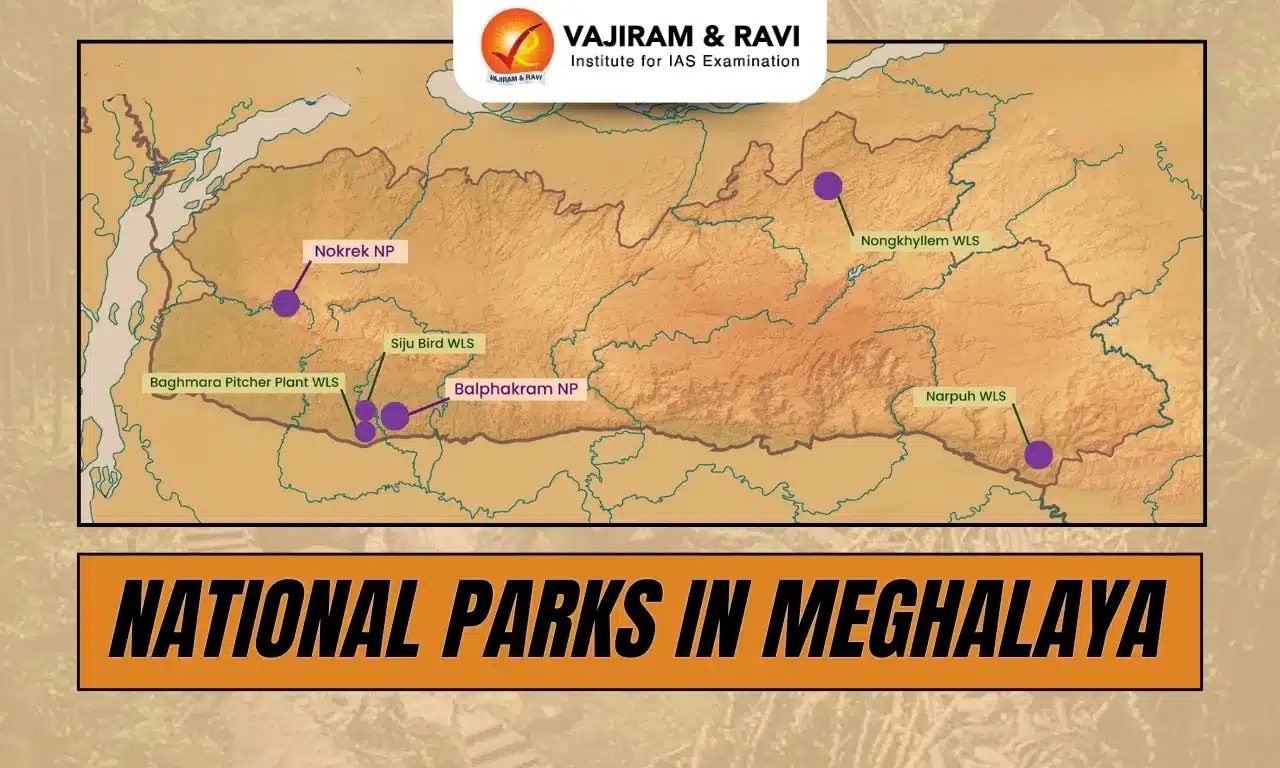
National Parks are large natural or near-natural areas legally protected to conserve ecosystems, species, and ecological processes while allowing education, research, and recreation. According to the IUCN, a protected area is a clearly defined geographical space managed through legal or effective means to ensure long-term conservation of nature, ecosystem services, and cultural values. These areas prevent habitat loss, protect endangered wildlife, conserve rivers and forests, and support climate regulation, biodiversity security, and sustainable livelihoods for local communities over long periods.
Protected Areas in Meghalaya
Meghalaya has a well-defined protected area network covering 1,133.9 square kilometres, about 5.06% of the state’s area.
- Total Coverage: Protected areas span forests, hills, river valleys, and high-altitude ecosystems.
- Category Range: Network includes national parks, wildlife sanctuaries, and a biosphere reserve.
- Biodiversity Role: Areas support in-situ conservation of rare and endangered species.
- Legal Protection: All sites are notified under wildlife conservation laws.
- Ecological Value: These areas preserve habitats critical for mammals, birds, and plants.
Also Read: National Parks in India
National Parks in Meghalaya
Meghalaya has two National Parks that form the backbone of its wildlife conservation framework. These parks protect core forest ecosystems of the Garo Hills, safeguard river origins, and conserve rare flora and fauna. Together, they cover over 260 square kilometres and represent evergreen, semi-evergreen, and deciduous forest types. They also support endangered mammals like hoolock gibbons, elephants, and rare carnivores. Both parks play a crucial role in maintaining ecological stability, preserving genetic diversity, and supporting surrounding wildlife corridors.
Balpakram National Park
Balpakram National Park lies in the South Garo Hills near the India–Bangladesh border and is known for its deep gorges and plateau landscapes.
- Location: Situated south of Garo Hills close to the international border.
- Area Size: Covers about 220 square kilometres of protected forest.
- Habitat Type: Dominated by subtropical evergreen and grassland ecosystems.
- Key Mammals: Supports tiger, elephant, red panda, and wild water buffalo.
- Carnivore Diversity: Home to marbled cat and Asian golden cat populations.
Nokrek National Park
Nokrek National Park forms the ecological core of the Nokrek Biosphere Reserve in the Garo Hills.
- Geographic Setting: Located on the Tura Mountain Range near Nokrek Peak.
- Elevation: Nokrek Peak rises to 1,418 metres above sea level.
- Area Coverage: National park spans about 47.48 square kilometres.
- Vegetation Types: Contains evergreen, semi-evergreen, and deciduous forests.
- Faunal Importance: Habitat for hoolock gibbon, red panda, and Asian elephant.


Wildlife Sanctuaries in Meghalaya
Wildlife sanctuaries in Meghalaya complement national parks by protecting smaller but ecologically vital habitats. These sanctuaries conserve riverine forests, limestone landscapes, and species-specific habitats. They support diverse primates, birds, small carnivores, and rare plants. Meghalaya’s sanctuaries are crucial for conserving fragmented wildlife populations and maintaining ecological connectivity. Together, they protect species such as slow loris, macaques, clouded leopard, otter, and numerous bird species across different districts.
Siju Wildlife Sanctuary
Siju Wildlife Sanctuary lies along the Simsang River in South Garo Hills and is known for bird diversity.
- Location: Situated on Simsang River banks in South Garo Hills district.
- Area Size: Covers approximately 5.81 square kilometres.
- Established Year: Notified as a sanctuary in 1979.
- Habitat Focus: Protects riverine forests and wetland ecosystems.
- Faunal Value: Important refuge for birds and small mammals.
Nongkhyllem Wildlife Sanctuary
Nongkhyllem Wildlife Sanctuary protects forest ecosystems in the Ri-Bhoi district near Assam border.
- District Location: Located in Ri-Bhoi district of Meghalaya.
- Area Extent: Encompasses about 29 square kilometres.
- Notification Year: Declared a wildlife sanctuary in 1981.
- Ecological Role: Conserves subtropical forests and wildlife corridors.
- Fauna Presence: Supports deer, primates, and diverse bird species.
Baghmara Wildlife Sanctuary
Baghmara Wildlife Sanctuary is globally known for conserving unique carnivorous plants.
- River Association: Located on banks of Someshwari River in Garo Hills.
- Area Size: Extremely small sanctuary covering about 0.02 square kilometres.
- Year Established: Declared protected in 1984.
- Botanical Importance: Protects rare pitcher plant species.
- Conservation Value: Focuses on plant-specific habitat preservation.
Narpuh Wildlife Sanctuary
Narpuh Wildlife Sanctuary safeguards forest biodiversity in the East Jaintia Hills region.
- Regional Location: Situated in East Jaintia Hills district.
- Area Coverage: Spreads across about 59.90 square kilometres.
- Establishment Year: Notified as a sanctuary in 2014.
- Habitat Type: Comprises dense forest and hilly terrain ecosystems.
- Wildlife Role: Provides shelter to mammals, birds, and small carnivores.

 Last updated on Oct, 2026
→ UPSC 2027 Notification will be released on 13 January 2027 at upsconline.nic.in.
→ Asian Games 2026 are being held in Aichi-Nagoya, Japan, from 19 September to 4 October.
→ Check Nobel Prize 2026 Winners List here.
→ Download PIB PRiSM Monthly Magazine 2026 here.
→ Check UPSC Monthly Current Affairs Magazine The Recitals here.
→ Check out the latest UPSC Syllabus here.
→ Download UPSC Model Answers for Mains 2026
→ UPSC Mains Question Paper 2026 is out now for Essay & GS Paper 1, 2, 3 & 4.
→ UPSC Calendar 2027 has been released.
→ Enroll in Vajiram & Ravi’s UPSC Mains Test Series 2027 for structured answer writing practice, expert evaluation, and exam-oriented feedback.
→ Join Vajiram & Ravi’s UPSC Mentorship Program 2027 for personalized guidance, strategy planning, and one-to-one support from experienced mentors.
→ Go through the UPSC Mains Previous Year Papers to enhance your preparation.
→ UPSC has released UPSC Toppers List 2025 with the Civil Services final result on its official website.
→ Also check Best UPSC Coaching in India
National Parks in Meghalaya FAQs
Q1. How many National Parks are there in Meghalaya?+
Q2. What area of Meghalaya is under protected areas?+
Q3. Which National Park is part of a Biosphere Reserve in Meghalaya?+
Q4. Why is Balpakram National Park important for wildlife conservation?+
Q5. Which sanctuary in Meghalaya is famous for pitcher plants?+
Tags: national parks in meghalaya