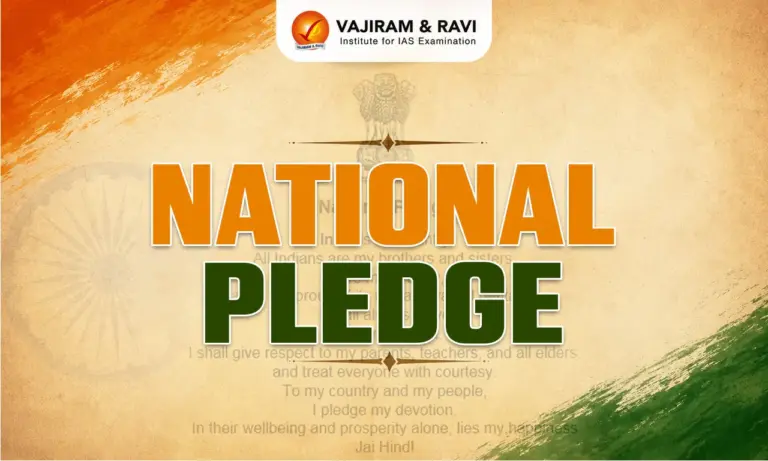
The National Pledge of India is a statement of loyalty, unity and commitment towards the country and its people. It is commonly recited in schools during morning assemblies and on important national occasions such as Independence Day and Republic Day. The pledge promotes national unity, respect, cultural diversity, discipline and the well-being of society.
National Pledge
India is my country. All Indians are my brothers and sisters. I love my country and I am proud of its rich and varied heritage. I shall strive to be worthy of it. I shall respect my parents, teachers and all elders and treat everyone with courtesy. To my country and all my people, I pledge my devotion. In their well-being and prosperity alone lies my happiness.
National Pledge of India History and Origin
- The National Pledge was written in 1962 by Pydimarri Venkata Subba Rao, a Telugu writer and government official. He originally composed the pledge in Telugu while serving as the District Treasury Officer in Visakhapatnam.
- The pledge was first recited in a school in Visakhapatnam in 1963. Its simple language and emphasis on national unity helped it gain wider acceptance in schools.
- Following its initial use, the pledge was translated into several Indian languages so that students across the country could recite it in their respective languages.
- In 1964, the Central Advisory Board on Education discussed the practice of reciting the pledge in schools. It recommended that the pledge should be introduced in schools across the country from 26 January 1965.
- Although the National Pledge is widely regarded as an important national expression of India, it was never formally adopted by the Parliament of India and finds no mention in the Constitution of India.


National Pledge of India Key Message
- The pledge begins with a declaration that India is our country and all Indians are brothers and sisters. This expresses the idea of national unity and a shared sense of belonging despite India’s social and cultural diversity.
- It highlights love and pride for India’s rich and varied cultural heritage. It encourages citizens to value the country’s diverse traditions and work towards becoming worthy of that heritage.
- The pledge also emphasises respect for parents, teachers and elders and calls for courteous behaviour towards others. This reflects the importance of discipline, respect and responsible conduct in society.
- Its concluding message connects an individual’s happiness with the well-being and prosperity of the country and its people. In this way, it encourages a sense of responsibility towards society rather than focusing only on individual interests.
National Pledge of India Importance and Usage
- The National Pledge is widely recited during school morning assemblies, making it an important part of students’ civic and national education. It helps introduce young citizens to ideas of unity, responsibility and respect.
- It is also recited during Independence Day, Republic Day and other important national or public occasions. Its use on such occasions reinforces the values of patriotism and national integration.
- The pledge has been printed in the opening pages of many school textbooks and educational publications, allowing students to become familiar with its words and meaning from an early age.
- Unlike the National Anthem and National Song, the National Pledge is not included in the Constitution of India. Nevertheless, it has an important place in India’s public and educational life.
- The National Pledge promotes the values of national unity, patriotism, social harmony and respect for India’s cultural diversity. Its message is particularly relevant in a country with many languages, religions, traditions and communities.
- It encourages citizens to understand that the progress and happiness of individuals are closely connected with the welfare of society and the nation.

 Last updated on Oct, 2026
→ UPSC 2027 Notification will be released on 13 January 2027 at upsconline.nic.in.
→ Check Nobel Prize 2026 Winners List here.
→ Download PIB PRiSM Monthly Magazine 2026 here.
→ Check UPSC Monthly Current Affairs Magazine The Recitals here.
→ Check out the latest UPSC Syllabus here.
→ Download UPSC Model Answers for Mains 2026
→ UPSC Mains Question Paper 2026 is out now for Essay & GS Paper 1, 2, 3 & 4.
→ UPSC Calendar 2027 has been released.
→ Enroll in Vajiram & Ravi’s UPSC Mains Test Series 2027 for structured answer writing practice, expert evaluation, and exam-oriented feedback.
→ Join Vajiram & Ravi’s UPSC Mentorship Program 2027 for personalized guidance, strategy planning, and one-to-one support from experienced mentors.
→ Go through the UPSC Mains Previous Year Papers to enhance your preparation.
→ UPSC has released UPSC Toppers List 2025 with the Civil Services final result on its official website.
→ Also check Best UPSC Coaching in India
National Pledge of India FAQs
Q1. What is the National Pledge of India?+
Q2. Who wrote the National Pledge of India?+
Q3. When was the National Pledge first recited?+
Q4. When was the National Pledge introduced in schools?+
Q5. What does the National Pledge of India promote?+
Tags: indian polity indian polity notes national pledge