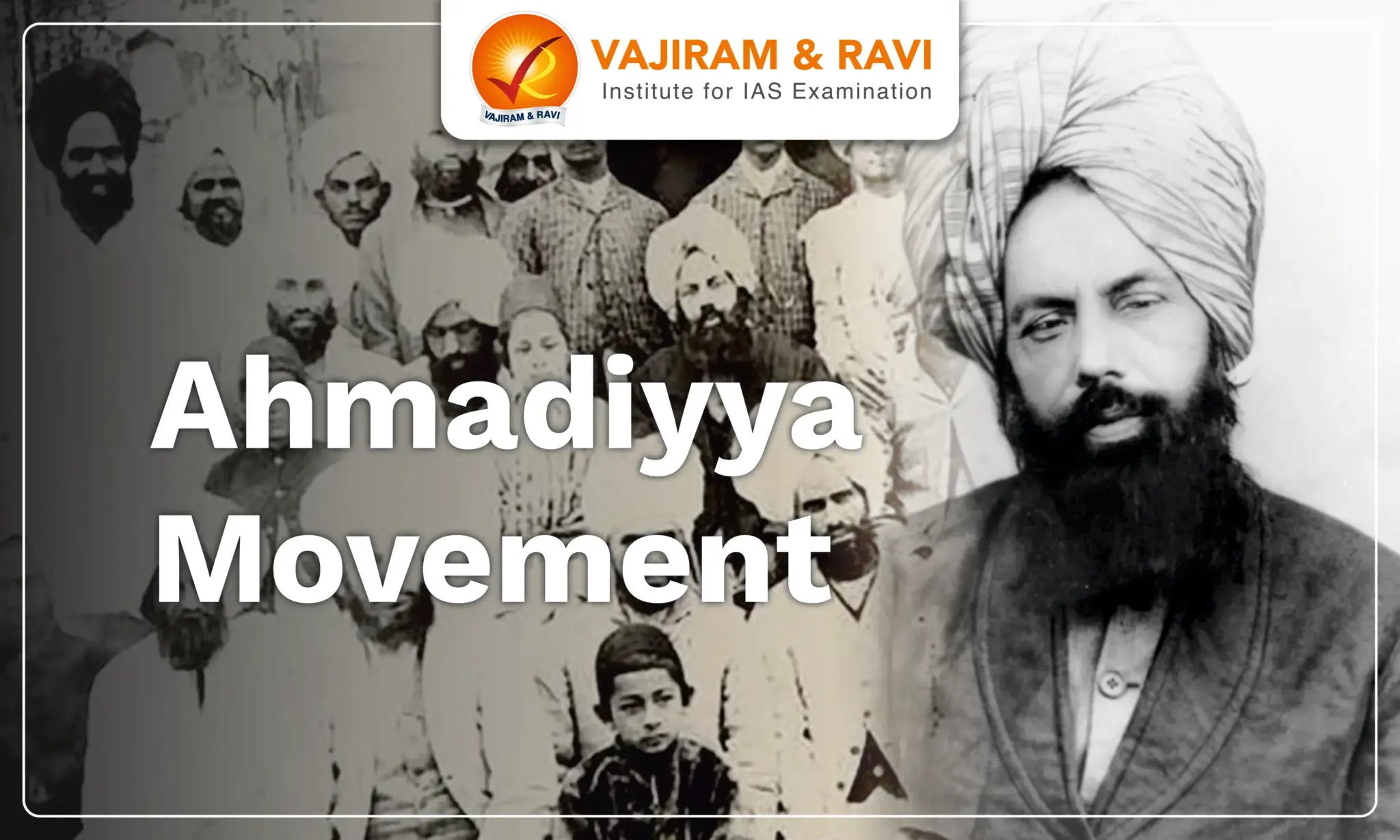
The Ahmadiyya Movement, a reformist movement within Islam, was founded in the late nineteenth century. It has since expanded into a significant global religious community with millions of adherents. The Ahmadiyya Movement aimed to revive Islamic teachings and promote interfaith peace and understanding.
Ahmadiyya Movement Background
The Ahmadiyya Movement was founded in 1889 in Qadian, Punjab, India, by Mirza Ghulam Ahmad. The movement emerged during a time of religious and social upheaval in India, with increasing Western influence and Christian missionary activity. The Ahmadiyya Movement was established on liberal and universal religious principles for all people, just like Brahmo Samaj.
- The Ahmadiyya Movement sought to revitalise Islam by emphasising its spiritual and moral aspects and encouraging peace, tolerance, and dialogue with other religious communities.
- Mirza Ghulam Ahmad sought to defend Islam from criticism and misconceptions by emphasising the faith's peaceful and rational aspects. He claimed to be divinely appointed as the Messiah and Mahdi, tasked with reviving Islam and uniting humanity around its principles.
- The Ahmadiyya Movement faced fierce opposition from the Sunni mainstream after being accused of rejecting Muslim dogma that asserted the finality of Muhammad's prophethood. During British rule in India, the disagreement was purely doctrinal, involving private individuals or voluntary organisations.
- The issue became a critical constitutional one after the majority of Ahmadis migrated to Pakistan, an Islamic state, in 1947. The majority of Sunni Muslims requested that Ahmadis be formally expelled from the Muslim community. This goal was met in 1974 when the Pakistani parliament passed a constitutional amendment designating Ahmadis as non-Muslims despite their strong opposition.
- The Ahmadiyya community is the only Islamic sect that believes Mirza Ghulam Ahmad is the Messiah, sent to end religious wars and bloodshed and restore morality, peace, and justice. They believed in human rights, tolerance, and the separation of mosque and state.
Ahmadiyya Movement Founder Mirza Ghulam Ahmad
The Ahmadiyya Movement was founded by Mirza Ghulam Ahmad (1835-1908) in Qadian, Punjab, India. He claimed to be the Mujaddid, the promised Messiah, and the Mahdi, aiming to revive Islam and promote a peaceful society. His teachings emphasised interpreting Islamic texts with reason and modern knowledge, advocating for interfaith dialogue and rejecting religious violence.
After Mirza Ghulam Ahmad's death in 1908, the leadership of the Ahmadiyya Movement passed to a series of successors known as Caliphs (Khalifas), such as Hakim Noor-ud-din, Mirza Nasir Ahmad and others.


Ahmadiyya Movement Beliefs
The Ahmadiyya Movement, founded on liberal principles, referred to itself as the bearer of the Mohammedan Renaissance. Western liberalism, theosophy, and religious Hindu reform movements all had a strong influence on Ghulam Ahmed. The Ahmadiyya movement's beliefs distinguish it from mainstream Islam.
- Messianic Claims: The Ahmadiyya Movement believed that Mirza Ghulam Ahmad was the promised Messiah and Mahdi, fulfilling prophecies in Islamic and other religious texts. According to Ahmadis, the Qadian branch of the Ahmadiyya Movement in Islam is the only "embodiment of 'True Islam,'".
- Finality of Prophethood: The Ahmadiyya Movement believe that Mirza Ghulam Ahmad was a prophet, although not in the same sense as the Prophet Muhammad, who they regard as the final law-bearing prophet. This belief has led to widespread criticism and accusations of heresy from other Muslim groups who uphold the finality of Muhammad's prophethood.
- Against Jihad: The Ahmadiyya Movement condemned Jihad, or sacred war, against non-Muslims and emphasised the value of human fraternity. It promotes a spiritual interpretation of jihad, advocating for the peaceful spread of faith through dialogue and education rather than violence.
- Separation of Mosques from State: The Ahmadiyya Movement believed in maintaining the mosque's independence from the state, as well as human rights and tolerance.
- Modernity and Rationalism: The Ahmadiyya Movement believes in reconciling Islam with modern science and rational thought, promoting education and intellectual development. By establishing a network of higher education institutions, the movement encouraged Indian Muslims to pursue Western liberal education.
- Interfaith Harmony: The Ahmadiyya Movement emphasises the importance of interfaith dialogue and understanding, promoting the idea that all religions share common truths.
Split in the Ahmadiyya Movement
The Ahmadiyya Movement experienced a significant split in 1914 following the death of the first Khalifa, Hakeem Noor-ud-Din. The split resulted in the formation of two distinct groups: the Ahmadiyya Muslim Community and the Lahore Ahmadiyya Movement.
Ahmadiyya Muslim Community (Qadiani)
Led by the second Khalifa, Mirza Basheer-ud-Din Mahmood Ahmad, this group maintained the movement's original beliefs, including Mirza Ghulam Ahmad's prophetic claims.
Lahore Ahmadiyya Movement
Mirza Basheer-ud-Din Mahmood Ahmad was elected as the second caliph after the first caliph's death, per his predecessor's will. However, Maulana Muhammad Ali and Khwaja Kamal-ud-Din opposed his succession, leading to the formation of the Lahore Ahmadiyya Movement. This split arose from doctrinal differences regarding Mirza Ghulam Ahmad's prophethood, with the Lahore Ahmadis viewing him as a reformer (mujaddid) rather than a prophet.

 Last updated on Oct, 2026
→ UPSC 2027 Notification will be released on 13 January 2027 at upsconline.nic.in.
→ Check Nobel Prize 2026 Winners List here.
→ Download PIB PRiSM Monthly Magazine 2026 here.
→ Check UPSC Monthly Current Affairs Magazine The Recitals here.
→ Check out the latest UPSC Syllabus here.
→ Download UPSC Model Answers for Mains 2026
→ UPSC Mains Question Paper 2026 is out now for Essay & GS Paper 1, 2, 3 & 4.
→ UPSC Calendar 2027 has been released.
→ Enroll in Vajiram & Ravi’s UPSC Mains Test Series 2027 for structured answer writing practice, expert evaluation, and exam-oriented feedback.
→ Join Vajiram & Ravi’s UPSC Mentorship Program 2027 for personalized guidance, strategy planning, and one-to-one support from experienced mentors.
→ Go through the UPSC Mains Previous Year Papers to enhance your preparation.
→ UPSC has released UPSC Toppers List 2025 with the Civil Services final result on its official website.
→ Also check Best UPSC Coaching in India
Ahmadiyya Movement FAQs
Q1. What is the Ahmadiyya movement?+
Q2. What do Ahmadi Muslims believe?+
Q3. Who started Ahmadiyya movement in 1889?+
Q4. Are Ahmadis Sunni or Shia?+
Q5. Why are Ahmadis not allowed in Mecca?+
Tags: ahmadiyya movement quest