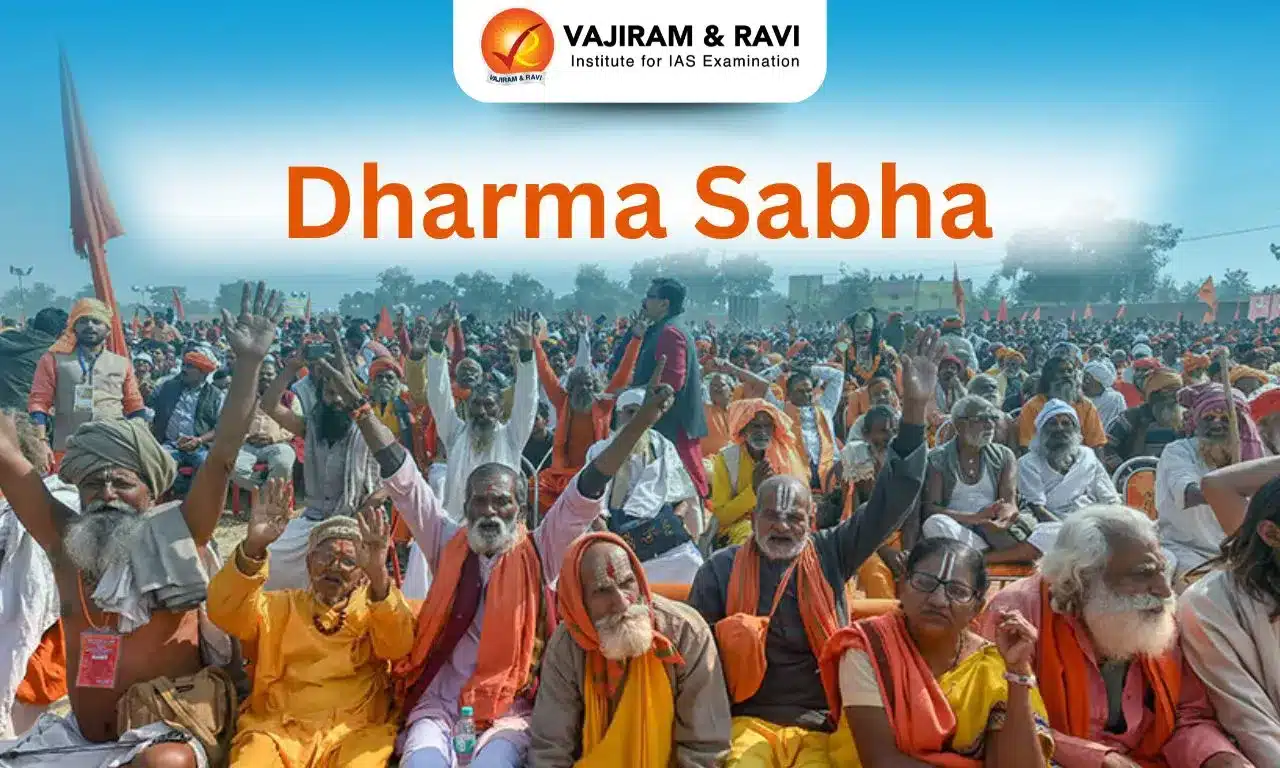
The Dharma Sabha was founded in 1830 in Calcutta by Radhakanta Deb, with the primary goal of opposing the socio-religious reform movements led by figures like Raja Ram Mohan Roy and Henry Derozio. Dharma Sabha served as a conservative response to these reform efforts, aiming to protect traditional Hindu values and practices.
Although an orthodox society, the Dharma Sabha supported the promotion of Western education, even for girls. However, the Dharma Sabha strongly opposed social reforms such as the abolition of sati and worked to maintain the existing socio-religious order.
Dharma Sabha Background
The colonial presence in India sparked a new awareness and desire for social and religious reform in the early 19th century. As traditional institutions faced challenges from Western culture, a re-evaluation of Indian culture and tradition ensued. As a result, theDharma Sabha was formed by conservative Hindu groups in response to Western-focused reform movements like the Brahmo Samaj.
Dharma Sabha Founder
Radhakanta Deb, a prominent leader of conservative Hindu society in Calcutta, established the Dharma Sabha in 1830. A strong advocate for education, he promoted English education among Hindus and supported women's education.
Radhakanta Deb served as the President of the British Indian Association. He also supported David Hare and aided in the establishment of the Hindu College in Calcutta.
In December 1829, following the government's ban on sati under Lord William Bentinck, Radhakanta Deb and other leaders of the Dharma Sabha opposed the legislation, defending traditional Hindu practices.
Dharma Sabha Objectives
The objectives for forming the Dharma Sabha stemmed from a new law introduced by British colonial rule that banned the practice of sati (burning of widows alive). The primary focus of the Dharma Sabha was to oppose this law. Some segments of the Hindu community saw it as British interference in their religious practices.
- Additionally, Dharma Sabha aimed to oppose the reformist ideas of Raja Ram Mohan Roy’s Brahmo Samaj.
- It also aimed to protect and uphold traditional Hindu orthodoxy and customs. It strongly opposed radical social reforms, such as the abolition of sati and the promotion of widow remarriage.
Moreover, the sabha also sought to unite conservative Hindus to resist excessive liberalization and Western influence. Despite its orthodox views, the Dharma Sabha supported the spread of Western education, recognizing the importance of modern learning.


Dharma Sabha Activities
The Dharma Sabha, established in 1830 by Radhakanta Deb, became a significant organization dedicated to preserving Hindu traditions and resisting reforms that challenged orthodox practices.
- Challenge to the Sati Ban: The Dharma Sabha opposed Lord William Bentinck's ban on Sati (1829), arguing it violated George III's assurance of non-interference in Hindu religious practices.
- The matter was taken to the Privy Council, but the appeal was unsuccessful, and the ban was upheld in 1832.
- Opposition to the Widow Remarriage Act: The Sabha strongly opposed the Hindu Widow Remarriage Act of 1856, presenting a petition to resist the reform.
- Despite their efforts, the bill was passed under Lord Canning's leadership.
- The Act was perceived as a significant breach of traditional Hindu customs at the time.
- The Sabha disseminated its ideas and rallied support through its newspaper, Samachar Chandrika, which focused on defending Hindu orthodoxy.
Dharma Sabha Significance
The Dharma Sabha was formed in opposition to reformist movements like the Brahmo Samaj. It tried to preserve traditional Hindu customs and practices, which contributed to the consolidation of conservative Hindu identity in the face of growing Western influence and social change.
- This conservative stance later led to several similar organizations, such as the Sanatana Dharma Sabha (1895), Dharma Maha Parishad in South India, and Dharma Mahamandali in Bengal, Bharat Dharma Mahamandala.
Dharma Sabha UPSC PYQs
Consider the following pairs: (UPSC CSE 2017)
- Radhakanta Deb: First President of the British Indian Association
- GazuluLa kshminarasu Chetty: Founder of the Madras Mahajana Sabha
- Surendranath Banerjee: Founder of the Indian Association
Which of the above pairs is/are correctly matched?
(a) 1 only (b) 1 and 3 only
(c) 2 and 3 only (d) 1, 2 and 3
Ans: (b).

 Last updated on Oct, 2026
→ UPSC 2027 Notification will be released on 13 January 2027 at upsconline.nic.in.
→ Check Nobel Prize 2026 Winners List here.
→ Download PIB PRiSM Monthly Magazine 2026 here.
→ Check UPSC Monthly Current Affairs Magazine The Recitals here.
→ Check out the latest UPSC Syllabus here.
→ Download UPSC Model Answers for Mains 2026
→ UPSC Mains Question Paper 2026 is out now for Essay & GS Paper 1, 2, 3 & 4.
→ UPSC Calendar 2027 has been released.
→ Enroll in Vajiram & Ravi’s UPSC Mains Test Series 2027 for structured answer writing practice, expert evaluation, and exam-oriented feedback.
→ Join Vajiram & Ravi’s UPSC Mentorship Program 2027 for personalized guidance, strategy planning, and one-to-one support from experienced mentors.
→ Go through the UPSC Mains Previous Year Papers to enhance your preparation.
→ UPSC has released UPSC Toppers List 2025 with the Civil Services final result on its official website.
→ Also check Best UPSC Coaching in India
Dharma Sabha FAQs
Q1. Who founded Dharma Sabha?+
Q2. What was the objective of Dharma Sabha?+
Q3. How did the Dharma Sabha view the promotion of widow remarriage?+
Q4. What was one significant publication issued by the Dharma Sabha?+
Q5. How did the Dharma Sabha respond to the ban on sati?+
Tags: dharma sabha quest