



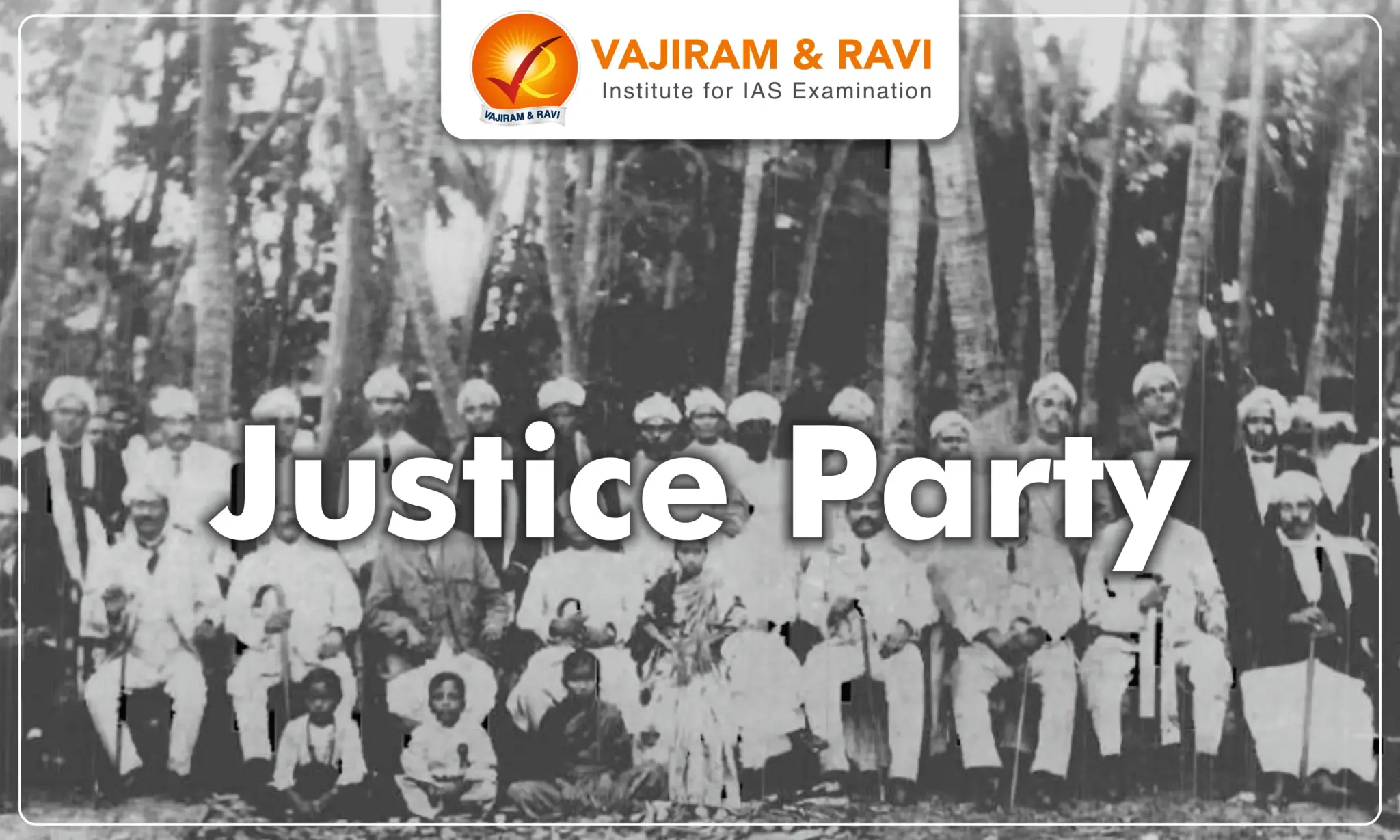
The Justice Party, officially known as the South Indian Liberal Federation was established in 1916, and emerged as a significant political force in the Madras Presidency. It primarily represented the interests of non-Brahmin communities. Founded by Dr. T. M. Nair, P. Tyagaraja Chetty, and C. Natesa Mudaliar, the party sought to challenge the prevailing Brahmin dominance in government jobs and education.
The Justice Party advocated for social justice and affirmative action to enhance representation for marginalised communities. The party's influence was marked by its pioneering efforts in promoting reservation policies for backward classes, educational reforms, and various social initiatives.
Justice Party Background
The backdrop to the beginning of the Justice Movement lies in the deep-rooted caste hierarchy in South India, where Brahmins, though a minority, held significant power in administration and education. Non-Brahmin communities felt marginalized, which led to the rise of organizations advocating for their rights. The Justice Party emerged out of this environment as a platform to represent these non-Brahmin communities.
Justice Party Formation
On November 20, 1916, a significant gathering of non-Brahmin leaders took place at the residence of Advocate T. Mudaliyar in Vepery, Chennai. This meeting led to the establishment of the South Indian Liberal Federation (SILF) as a political movement aimed at addressing the grievances of non-Brahmin communities. The movement later became widely known as the "Justice Party," named after the English daily Justice, which championed non-Brahmin causes.
- In December 1916, the association released "The Non-Brahmin Manifesto," which expressed its loyalty to the British Raj while condemning the bureaucratic dominance of the Brahmin community.
- The manifesto urged non-Brahmins to assert their rights in the face of Brahmin hegemony, emphasizing the need for political representation and equity.
Why was the Justice Party formed?
The Justice Party was formed in response to the systemic inequalities and marginalization faced by non-Brahmin communities in the Madras Presidency. The party aimed to challenge the political and bureaucratic hegemony of Brahmins, who occupied a disproportionate number of positions in government and education. The other key reasons for its formation include:
- In the 1916 election for the Imperial Legislative Council, non-Brahmin candidates T. M. Nair and P. Ramarayaningar were defeated by their Brahmin opponents.
- Similarly, P. Theagaraya Chetty and Kurma Venkata Reddy Naidu lost local council elections to Brahmin candidates backed by the Home Rule League.
- These defeats fueled resentment and highlighted the necessity for a political organization dedicated to representing non-Brahmin interests, ultimately leading to the formation of the Justice Party.





Justice Party Major Works
During its early years, the Justice Party actively petitioned British officials to demand greater representation for non-Brahmins in governance. With the introduction of the diarchial system following the 1919 Montagu–Chelmsford Reforms, the Justice Party participated in presidential governance. In 1920, it achieved a significant milestone by winning the first direct elections for the presidency, forming the government, and serving as the main political alternative to the nationalist Indian National Congress in Madras.
- Theagaraya Chetty requested Montagu for communal representation in the provincial legislature for non-Brahmins, advocating for a system similar to the separate electorates and reserved seats granted to Muslims by the Minto–Morley Reforms of 1909.
- During its time in power, the party enacted several impactful laws, including the Madras Elementary Education Act of 1920, which introduced compulsory education for both boys and girls while increasing funding for elementary education.
Justice Party Decline
The Justice Party began to decline in the 1930s due to internal conflicts and the rising prominence of the Indian National Congress. The Congress's focus on national independence overshadowed the Justice Party's caste-based agenda. Additionally, the party's association with the British government during the independence struggle alienated it from the growing nationalist sentiment. By 1944, the Justice Party transformed itself into the Dravidar Kazhagam.

 Last updated on March, 2026
→ UPSC Final Result 2025 is now out.
→ UPSC has released UPSC Toppers List 2025 with the Civil Services final result on its official website.
→ Anuj Agnihotri secured AIR 1 in the UPSC Civil Services Examination 2025.
→ UPSC Marksheet 2025 is now out.
→ UPSC Notification 2026 & UPSC IFoS Notification 2026 is now out on the official website at upsconline.nic.in.
→ UPSC Calendar 2026 has been released.
→ Check out the latest UPSC Syllabus 2026 here.
→ UPSC Prelims 2026 will be conducted on 24th May, 2026 & UPSC Mains 2026 will be conducted on 21st August 2026.
→ The UPSC Selection Process is of 3 stages-Prelims, Mains and Interview.
→ Prepare effectively with Vajiram & Ravi’s UPSC Prelims Test Series 2026 featuring full-length mock tests, detailed solutions, and performance analysis.
→ Enroll in Vajiram & Ravi’s UPSC Mains Test Series 2026 for structured answer writing practice, expert evaluation, and exam-oriented feedback.
→ Join Vajiram & Ravi’s Best UPSC Mentorship Program for personalized guidance, strategy planning, and one-to-one support from experienced mentors.
→ Shakti Dubey secures AIR 1 in UPSC CSE Exam 2024.
→ Also check Best UPSC Coaching in India
Justice Party FAQs
Q1. Are Justice Party and DMK the same?+
Q2. What was the aim of the Justice Party?+
Q3. Who launched the justice movement?+
Q4. What is the justice movement?+
Q5. Who was the first chief minister of the Justice Party?+
Tags: justice party quest