Money Market, Structure, Participants, Instruments

Money Market

The Money Market is an important financial market that plays an important role in regulating liquidity and meeting short-term financing needs of banks, governments and corporate entities. Having an understanding about the Money Market can help you get clarity for the functioning of the Indian Financial System. In this article, we are going to cover the Money Market, its definitions, structure, major instruments and significance. 

Money Market

The Money Market is a part of the Financial Market where short-term financial instruments are traded. These Money Market instruments have a maturity period of up to one year and are highly  liquid in nature. Since the maturity period is short, securities can be quickly converted into cash. This is why these investments are called cash investments. 

  • The financial Market includes all platforms where buying and selling of financial instruments such as shares, currencies and derivatives take place. 
  • The Financial Market is divided into two main categories:
  • Money Market: Market for short-term instruments with maturity up to 1 year
  • Capital Market: Market for medium and long-term instruments with maturity of more than 1 year.

Money Market Structure 

The Money Market is divided into two important sectors: 

Organised Money Market

  • The organised money market sector is regulated, licensed and systematically supervised by market regulators like the RBI. 
  • The sector works in a structured and coordinated manner under RBI’s control. 
  • Money Market main participants include RBI, commercial banks, non-banking financial companies, mutual funds and insurance companies. 

Unorganised Money Market 

  • The unorganised money market sector is outside the purview of registration or regulation by the RBI. 
  • The sector is called unorganised due to the lack of a formal structure and coordination. 
  • The main participants of the money market includes local moneylenders, chit funds, indigenous bankers etc. 

Money Market Major Instruments 

The Money Market has different types of financial instruments that help meet the needs of lenders and borrowers. These Money Market instruments include: 

Call Money

Call Money is a short-term borrowing and lending among banks and financial institutions for a very small period, ranging from overnight to 14 days. 

  • It helps banks manage sudden liquidity shortages.
  • The interest rate charged in call money market is called the Call Money Rate, which fluctuates frequently, even hourly, depending on demand and supply.
  • Call Money Market has two segments:
    • Call Market (Overnight Market): Borrowing and lending for one day.
    • Short Notice Market: Borrowing and lending for up to 14 days.

Treasury Bills (T-Bills)

    • Treasury Bills are short-term securities issued by the RBI on behalf of the Central Government to raise funds.
    • They are part of Government Securities (G-Secs).
      • T-Bills: T-Bills have a maturity of less than one year and hence is a money market instrument. 
      • Government Bonds: Government Bonds have a maturity of more than one year and hence is a capital market instrument. 
  • Treasury Bills Features: 
      • Issued at a discount and redeemed at face value.
        Example: A ₹100 bill may be issued at ₹95, but redeemed at ₹100 at maturity.
      • They are zero-interest or zero-coupon securities.
      • They are risk-free and highly liquid, being backed by the Government.
      • Only the Central Government issues them; States cannot issue T-Bills.
      • Issued via auction to ensure transparency and maximize government revenue.
      • Available in multiples of ₹25,000.
  • Treasury Bills Types: 

The treasury bills are of three types: 

  • 91-day T-Bill
  • 182-day T-Bill
  • 364-day T-Bill
  • Treasury Bills uses for Banks:
    • The treasury bills can help maintain Statutory Liquidity Ratio (SLR).
    • As collateral with RBI to borrow funds under Repo operations.

Cash Management Bills (CMBs)

  • The Cash Management Bills are similar to treasury bills but with maturity of less than 91 days.
  • These are issued to cover short-term mismatches in government cash flow.
  • CMS bills are Issued at a discount and redeemed at face value through RBI auctions.
  • Banks can also use them to meet SLR requirements.

Ways and Means Advances (WMAs)

  • WMAs are temporary loans provided by the RBI to both Central and State Governments.
  • They were introduced under Section 17(5) of the RBI Act to replace the earlier Ad-hoc T-Bills.
  • They are not a permanent source of government finance but are used to cover short-term mismatches between income and expenditure.
  • Repayment: If repaid within 90 days the debt is treated as Ways and Means Advances and if repayment exceeds 90 days it is treated as overdraft. 
  • Interest charged on ways and means advances is that of repo rate and the overdraft charges repo rate +2%. 

Certificate of Deposit (CD)

  • Certificates of Deposit are issued by Scheduled Commercial Banks and select Financial Institutions permitted by the RBI.
  • Cooperative Banks and Regional Rural Banks (RRBs) cannot issue Certificate of Deposits.
    • Minimum amount that can be issued is ₹1 lakh, issued in multiples of ₹1 lakh.
    • It is issued at discount and redeemed at par.
    • The maturity period is more than 7 days, up to 1 year.
    • Premature withdrawal of the deposits leads to penalty.
    • No loans can be taken against CDs.

Commercial Paper (CP)

  • Commercial Papers are unsecured, short-term debt instruments issued by large corporations, financial institutions, and primary dealers.
  • These are issued as promissory notes to finance short-term needs like inventory and working capital.
  • These are issued privately and not traded on exchanges.
  • Denomination: Minimum ₹5 lakh, issued in multiples of ₹5 lakh.
  • Maturity: Minimum 7 days, maximum up to 1 year.

Commercial Bill (CB) or Trade Bill

  • A commercial bill is a negotiable instrument drawn by the seller or buyer for goods or services supplied.
  • The bill helps sellers extend credit to buyers.
  • When accepted by a commercial bank, it becomes a Trade Bill.
  • Commercial Bills are first discounted by banks and then re-discounted with the RBI.

Money Market Importance

The money market plays an important  role in the financial system because:

  • It helps banks and financial institutions manage liquidity by balancing short-term surpluses and deficits.
  • It provides industries and businesses access to short-term funds without using long-term and expensive resources.
  • It supports both domestic and international trade financing.
  • It shows the prevailing short-term interest rates, offering insight into the state of the economy.
  • Interest rates in the money market serve as benchmarks for pricing loans, mortgages, and credit in broader markets.
Also Check Other Posts
Care Economy Mutual Funds
Alternative Investment Funds - AIF GDP Deflator

Money Market FAQs

Q1: What is the Capital Market?

Ans: The Capital Market is a financial market for long-term funds where stocks, bonds, and securities are traded.

Q2: What do you mean by Money Market?

Ans: The Money Market is a financial market that deals with short-term borrowing and lending of funds, usually up to one year.

Q3: What is the difference between Money Market and Capital Market?

Ans: The Money Market provides short-term funds (up to one year), while the Capital Market provides long-term funds (more than one year).

Q4: What is a Treasury Bill?

Ans: A Treasury Bill (T-Bill) is a short-term government security issued at a discount and redeemed at face value on maturity.

Q5: What do you mean by Ways and Means Advances?

Ans: Ways and Means Advances (WMA) are temporary loan facilities provided by the RBI to the government to meet short-term cash flow mismatches.


UPSC Daily Quiz 1 October 2025

UPSC Daily Quiz

The Daily UPSC Quiz by Vajiram & Ravi is a thoughtfully curated initiative designed to support UPSC aspirants in strengthening their current affairs knowledge and core conceptual understanding. Aligned with the UPSC Syllabus 2025, this daily quiz serves as a revision resource, helping candidates assess their preparation, revise key topics, and stay updated with relevant issues. Whether you are preparing for Prelims or sharpening your revision for Mains, consistent practice with these Daily UPSC Quiz can significantly enhance accuracy, speed, and confidence in solving exam-level questions.

[WpProQuiz 84]

UPSC Daily Quiz FAQs

Q1: What is the Daily UPSC Quiz?

Ans: The Daily UPSC Quiz is a set of practice questions based on current affairs, static subjects, and PYQs that help aspirants enhance retention and test conceptual clarity regularly.

Q2: How is the Daily Quiz useful for UPSC preparation?

Ans: Daily quizzes support learning, help in revision, improve time management, and boost accuracy for both UPSC Prelims and Mains through consistent practice.

Q3: Are the quiz questions based on the UPSC syllabus?

Ans: Yes, all questions are aligned with the UPSC Syllabus 2025, covering key areas like Polity, Economy, Environment, History, Geography, and Current Affairs.

Q4: Are solutions and explanations provided with the quiz?

Ans: Yes, each quiz includes detailed explanations and source references to enhance conceptual understanding and enable self-assessment.

Q5: Is the Daily UPSC Quiz suitable for both Prelims and Mains?

Ans: Primarily focused on Prelims (MCQ format), but it also indirectly helps in Mains by strengthening subject knowledge and factual clarity.

Savanna Climate, Characteristics, Distribution, Vegetation

Savanna Climate

The Savanna Climate, also known as the “Tropical Wet and Dry Climate” and “Sudan Climate”, is one of the most distinctive climatic regions of the world. It lies between the equatorial rainforest climate and the hot desert climate, forming a transitional zone. According to Köppen’s Climate Classification, it is denoted as “Aw type”. The savanna climate is characterized by distinct wet and dry seasons, with high temperatures throughout the year. It plays a vital role in shaping the ecology, agriculture, and livelihoods of millions of people across continents.

Savanna Climate

The Savanna Climate is marked by seasonal rainfall controlled by the movement of the Inter-Tropical Convergence Zone (ITCZ). The wet season coincides with the overhead sun and lasts for about 4 to 6 months, while the remaining months are extremely dry. Average annual rainfall ranges from 750 mm to 1,250 mm, though variability is high. Temperatures remain warm throughout the year, usually between 20°C and 30°C.

Read About: Tropical Climate

Savanna Climate Characteristics

The Savanna climate exhibits features that make it distinct from both equatorial and desert regions.

  • Temperature: Average monthly temperature remains high throughout the year, usually between 25°C and 35°C. Seasonal variation is low.
  • Rainfall: Annual rainfall ranges between 500 mm to 1500 mm, concentrated during the summer months. Rainfall is often in the form of short, heavy showers.
  • Seasons: There are two marked seasons: a wet season (summer) influenced by the Inter-Tropical Convergence Zone (ITCZ), and a dry season (winter) dominated by subtropical high-pressure systems.
  • Humidity: High in wet season, low in dry season, leading to distinct vegetation patterns.
  • Winds: Trade winds dominate in the dry season, while monsoonal winds bring rains in the wet season.

Savanna Climate Distribution

Savanna climate is found across continents, often near the tropics.

  • Africa: The most extensive Savanna stretches across East Africa (Kenya, Tanzania, Uganda), West Africa (Nigeria, Ghana, Ivory Coast), and southern parts such as Zambia and Zimbabwe. Africa contains almost 65% of the world’s savannas.
  • South America: Found in Brazil (Cerrado), Venezuela (Llanos), and Colombia. The Brazilian Cerrado covers about 2 million square kilometers.
  • Australia: Northern regions like Queensland and Northern Territory.
  • India: Certain parts of the Deccan Plateau, Madhya Pradesh, and Chhattisgarh show Savanna-like conditions.
  • Other Regions: Central America, parts of Myanmar, and some Caribbean islands.

Savanna Climate Vegetation

Savanna Vegetation is characterized by a mix of grasslands and scattered trees, adapted to withstand seasonal changes.

  • Grasses- Tall grasses like elephant grass (up to 4 meters) dominate, especially during the wet season.
  • Trees- Scattered drought-resistant trees such as acacia, baobab, and eucalyptus.
  • Adaptations- Many trees have thick barks to resist fire, deep roots to access groundwater, and small leaves to reduce transpiration.
  • Deciduous Nature- Trees shed leaves during the dry season to conserve water.
  • Regional Variations- African savannas have baobab and acacia; Brazilian Cerrado has shrubs and twisted trees.

Savanna Climate Wildlife

Savannas are biodiversity hotspots, particularly in Africa, supporting large herbivores and predators. The Savanna’s mix of grasses and shrubs supports herbivores, which in turn sustain predator populations, creating a balanced food chain.

  • Africa- Home to iconic species such as elephants, giraffes, lions, zebras, wildebeests, cheetahs, and rhinoceroses. Serengeti National Park in Tanzania hosts the annual wildebeest migration, one of the world’s largest animal movements.
  • South America- Capybaras, jaguars, giant anteaters, and maned wolves.
  • Australia- Kangaroos, wallabies, and emus.
  • India- Nilgai, blackbuck, and chinkara in semi-arid savanna tracts.
  • Birds- Ostriches in Africa, rheas in South America, and bustards in India.

Human Adaptations in Savanna Climate

Human societies have long adapted to the challenges and opportunities of Savanna environments.

  • Pastoralism- Nomadic herding of cattle, goats, and sheep is common, especially among the Maasai in East Africa.
  • Agriculture- Crops like millet, sorghum, maize, groundnuts, and cotton are cultivated in wet seasons. Shifting cultivation and subsistence farming are common.
  • Tourism- Wildlife tourism contributes significantly to the economies of countries like Kenya, Tanzania, and South Africa.
  • Settlement- Population densities are moderate, concentrated near water sources.
  • Modern Development- Urbanization and infrastructure growth have increased in savanna belts, particularly in Brazil and Nigeria.

Savanna Climate Economy

Savanna Regions contribute significantly to global and regional economies.

  1. Agriculture- Major source of food grains, livestock, and cash crops like cotton and groundnuts.
  2. Tourism- Wildlife safaris in African savannas attract millions of tourists annually, contributing billions of dollars. For example, tourism in Kenya contributes nearly 10% of GDP.
  3. Forestry- Provides timber, fuelwood, and non-timber products.
  4. Mineral Resources- Many savanna regions are rich in minerals like gold, diamonds, and iron ore (e.g., South Africa, Brazil).
  5. Energy- Potential for solar energy due to long dry seasons and high insolation.

Challenges in Savanna Regions

Despite their importance, Savanna climates face major ecological and human challenges. According to UNEP’s Global Land Outlook (2022), over 50% of savanna ecosystems are at risk of degradation due to human pressures and climate change.

  • Deforestation- Clearing for agriculture, timber, and fuelwood.
  • Overgrazing- Leads to soil erosion and desertification.
  • Wildfires- Natural and man-made fires threaten biodiversity.
  • Climate Change- Increasing droughts, irregular rainfall, and rising temperatures worsen land degradation.
  • Population Pressure- Expansion of agriculture and urbanization reduces natural habitats.
  • Poaching- Threatens wildlife, including elephants and rhinoceroses.

Proposed Reforms and Way Forward for Savanna and Grassland Governance:

  • Scientific Mapping- Proper classification and mapping of grassland and savanna ecosystems in India.
  • Restoration Projects- Launch national-level missions to restore degraded grasslands similar to afforestation drives.
  • Community Participation- Involve local communities and pastoralists in sustainable management.
  • Eco-Tourism Development- Promote regulated eco-tourism in savanna regions to balance economy and ecology.
  • Integration with Climate Policy- Include savanna conservation explicitly under climate adaptation and mitigation strategies.
  • Global Learning- Adopt best practices from African and South American savanna conservation models.

Savanna Regions of the World

Few major regions of Savanna across the globe are listed below:

  • Sudan Savanna (Africa)- Extends across West Africa, supporting millet cultivation and cattle rearing.
  • Serengeti (Tanzania, Africa)- Known for biodiversity and wildebeest migration.
  • Brazilian Cerrado (South America)- One of the world’s richest savanna ecosystems, under threat from soy cultivation.
  • Northern Australia- Characterized by eucalyptus-dominated savannas.
  • Indian Savanna (Deccan Plateau)- Semi-arid grasslands interspersed with drought-resistant trees.

Read About: Equatorial Climate

Provisions Related to Savanna Regions

Though India has only localized patches of savanna-like conditions, their governance ties into broader constitutional provisions, environmental policies, and global treaties that regulate grassland ecosystems, biodiversity, and land use.

  1. Constitutional Framework in India
  • Article 48A- Directs the State to protect and improve the environment and safeguard forests and wildlife.
  • Article 51A(g)- Makes it a fundamental duty of every citizen to protect and improve the natural environment including forests, lakes, rivers, and wildlife.
  • Article 21 (Right to Life)- Judicial interpretations (e.g., Subhash Kumar vs. State of Bihar, 1991) have expanded it to include the right to a clean environment, indirectly protecting grassland and savanna ecosystems.
  1. Judicial Pronouncements
  • M.C. Mehta vs. Union of India (1987-1991)- The Supreme Court emphasized sustainable development as a constitutional mandate.
  • T.N. Godavarman Thirumulpad vs. Union of India (1997)- Expanded the definition of forests, which indirectly includes grasslands and savanna ecosystems.
  • Centre for Environmental Law, WWF vs. Union of India (2013)- Recognized the need for scientific identification and conservation of unique ecosystems.
  1. Policies and Institutional Responses in India
  • National Forest Policy (1988)- Though forest-focused, it indirectly addresses grasslands and savannas under ecological balance.
  • National Biodiversity Action Plan (2008, updated 2014)- Emphasizes conservation of threatened ecosystems including grasslands.
  • Grassland and Desert Ecosystem Division under the Ministry of Environment, Forest and Climate Change (MoEFCC)- Specifically works on restoration and conservation of grassland ecosystems.
  • Protected Area Network- Some Indian savanna-like ecosystems are preserved in sanctuaries and national parks such as Kanha, Gir, and Ranthambore.
  1. International Conventions and Agreements

Savanna regions worldwide are protected under various conventions:

  • Convention on Biological Diversity (CBD, 1992)- Calls for conservation of ecosystems including savannas.
  • UN Convention to Combat Desertification (UNCCD, 1994)- Relevant for savannas threatened by desertification.
  • Paris Agreement (2015)- Climate change mitigation strategies indirectly benefit savanna ecosystems vulnerable to drought.
  • UNESCO World Heritage Sites- Many savanna parks such as Serengeti (Tanzania) and Pantanal (Brazil) are recognized for their global ecological importance.
  1. India’s Global Commitments
  • India is a signatory to the CBD and UNCCD, which influence policies for protecting grassland ecosystems resembling savannas.
  • The National Action Plan on Climate Change (NAPCC) and State Action Plans include components relevant to biodiversity conservation, desertification control, and ecosystem restoration.

Global vs Indian Savanna Ecosystems

A comparative table based on the location, climate, vegetation and wildlife features of savanna has been provided below:

Global vs Indian Savanna Ecosystems
Region/ Country Example of Savanna Climate Features Vegetation Wildlife

Africa

Serengeti (Tanzania, Kenya), Sudan Savanna

Wet and dry seasons, 500-1200 mm rainfall

Tall grasses, acacia, baobab

Elephants, lions, zebras, wildebeest

South America

Brazilian Cerrado, Venezuelan Llanos

Seasonal rainfall, 800-1600 mm

Shrubs, scattered twisted trees

Jaguars, capybaras, giant anteaters

Australia

Northern Territory, Queensland

Monsoonal wet-dry climate, high insolation

Eucalyptus, spinifex grasses

Kangaroos, wallabies, emus

India (Savanna-like)

Deccan Plateau (Madhya Pradesh, Chhattisgarh, Maharashtra), parts of Rajasthan

Semi-arid, 600-1000 mm rainfall

Drought-resistant grasses, acacia, neem

Blackbuck, chinkara, nilgai, great Indian bustard

Savanna Climate UPSC

The Savanna climate is a dynamic and transitional climate zone that plays an essential role in supporting biodiversity, human livelihood, and global ecological balance. Found in Africa, South America, Australia, Asia, and parts of India, it represents the delicate interplay between wet and dry seasons. However, increasing human activities, climate change, and environmental degradation pose serious challenges to the sustainability of savannas.

Also Check Other Posts
Coastal Regulation Zone Global Plastic Treaty
Nitrogen Cycle Carbon Cycle

Savanna Climate FAQs

Q1: What is Savanna Climate and where is it found?

Ans: Savanna Climate, also called tropical wet and dry climate, is found between 5°-20° latitudes in regions like Africa, South America, Australia, and parts of India.

Q2: What are the main characteristics of Savanna Climate?

Ans: Savanna Climate has high temperatures (25-35°C), seasonal rainfall (500-1500 mm), distinct wet and dry seasons, and grassland vegetation with scattered trees.

Q3: Which countries have the largest Savanna Regions?

Ans: Africa has the largest Savanna regions including the Serengeti and Sudan Savanna, followed by Brazil’s Cerrado and Australia’s Northern Territory.

Q4: What kind of vegetation is found in Savanna Climate?

Ans: Savanna vegetation includes tall grasses like elephant grass, and scattered drought-resistant trees such as acacia, baobab, and eucalyptus.

Q5: What is the economic importance of Savanna Climate Regions?

Ans: Savanna regions support agriculture, pastoralism, wildlife tourism, forestry, and mining, contributing significantly to the economy of countries like Kenya, Tanzania, and Brazil.

Gandhi Jayanti 2025, History, Significance, Facts, Date, Death

Gandhi Jayanti 2025

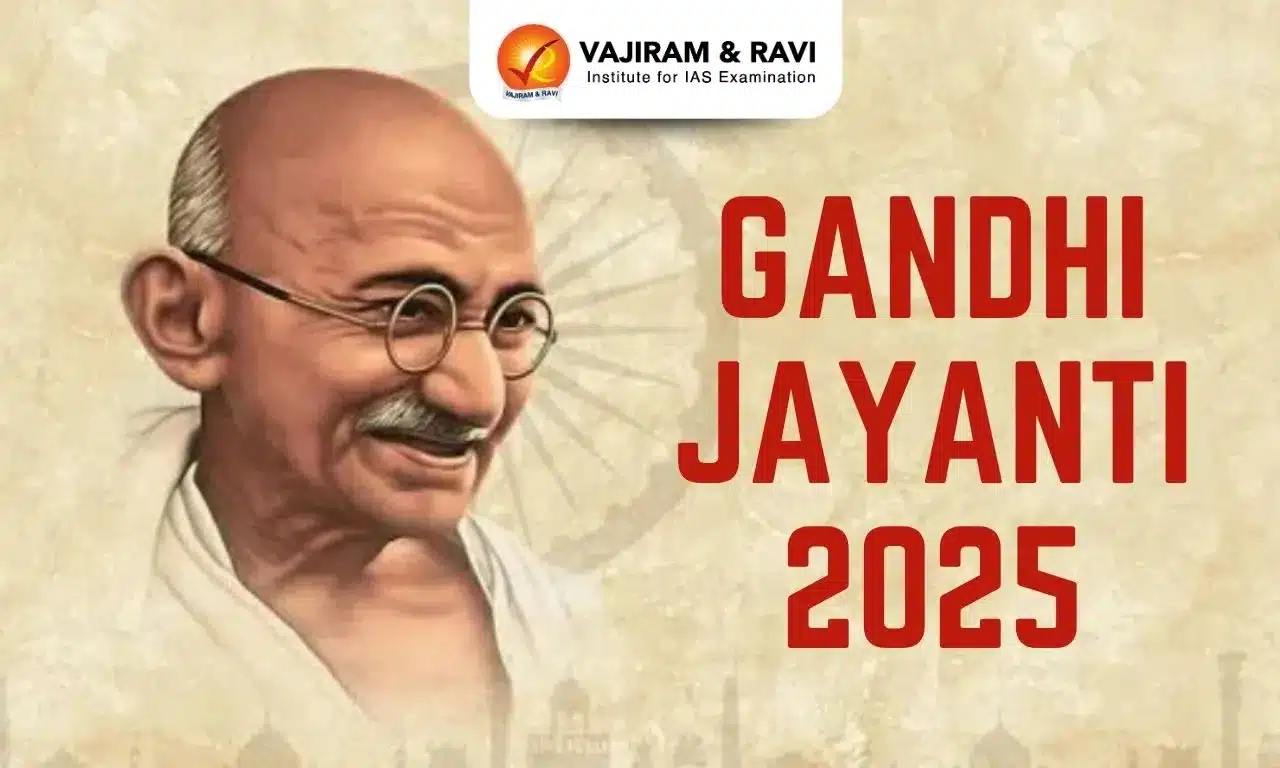
Gandhi Jayanti, observed annually on October 2, celebrates the birth of Mohandas Karamchand Gandhi, affectionately known as Mahatma Gandhi or the Father of the Nation. Gandhi Jayanti 2025 marks his 156th birth anniversary, a momentous occasion not just for India but across the world.

This day serves as a reminder of Gandhi's enduring legacy, particularly his commitment to non-violence, truth, and social justice values that remain highly relevant today amidst rising global conflict and violence.

For UPSC aspirants, understanding Gandhi's life and philosophy is essential, as his role in India's freedom struggle and his contributions to shaping modern India are key components of the exam. Dive deeper into Mahatma Gandhi's life and impact this Gandhi Jayanti 2025.

Mahatma Gandhi Birth Anniversary 2025

Gandhi Jayanti 2025, observed on October 2, will honor Mahatma Gandhi's pivotal role in leading India to independence from British rule. His non-violent resistance, known as Satyagraha, united people from diverse backgrounds, making him a central figure in the freedom movement.

Mahatma Gandhi's 156th birth anniversary in 2025 also coincides with the International Day of Non-Violence, reflecting his enduring global impact. The day will be marked by prayer meetings, commemorations at Raj Ghat in New Delhi, and discussions on the relevance of Gandhian values in today’s world.

Gandhi Jayanti 2025 Biography of Mahatma Gandhi

Gandhi's evolution from a lawyer in London to a leader of a global non-violence movement is a testament to the transformative power of political thought and action. His life stands as a remarkable example of how a single individual can shape the course of history and continue to inspire future generations.

Mahatma Gandhi Biography Overview
Particular Details

Full Name

Mohandas Karamchand Gandhi

Birth

October 2, 1869, Porbandar, Gujarat, India

Family Background

Father: Karamchand Gandhi 

Mother: Putlibai.

Spouse

Kasturbai 

Education

University College London, Alfred High School

President of INC

Belgaum Session (1924)

Major Movements

Champaran Satyagraha, Kheda Satyagraha, Salt March, Quit India Movement

Death

January 30, 1948

Eepitaphs

Hey Ram

Posthumous Recognition

Commemorated globally; October 2 is observed as International Day of Non-Violence.

Gandhi’s Formative Years: Early Life and Education

Mohandas Gandhi was born on October 2, 1869, in Porbandar, Gujarat, into a Hindu Modh Baniya family. His father, Karamchand Gandhi, served as the Diwan of Porbandar, while his mother, Putlibai, was a devoutly religious woman, whose spiritual discipline deeply influenced young Gandhi.

Raised in a strict yet nurturing environment, Gandhi grew up with strong values of honesty and simplicity. At the age of 13, he married Kasturbai. In 1888, he left for London to study law at the Inner Temple, one of the four prestigious law schools. While initially uneasy with Western customs, Gandhi gradually adapted, and his time in England exposed him to diverse intellectual and ethical ideas that profoundly shaped his philosophy and approach to life.

Gandhi’s Time in London 

Despite his initial challenges with adjusting to Western life, Gandhi's time in London offered him valuable insights into European socio-political structures. He delved into the works of philosophers such as Tolstoy and John Ruskin, whose ideas on nonviolence and simplicity profoundly resonated with him.

Ruskin’s Unto This Last was especially impactful, shaping Gandhi’s vision of Sarvodaya—the welfare of all. These intellectual influences became the foundation of his philosophy of Satyagraha, which emphasized the power of truth and nonviolent resistance in the fight for justice.

The South African Chapter A Fight Against Racism

After completing his legal studies, Gandhi traveled to South Africa in 1893 to handle a legal case for Dada Abdullah Jhave. It was here that he first confronted institutionalized racism, a pivotal moment in his life. One defining incident occurred when he was forcibly removed from a train in Pietermaritzburg for refusing to vacate a "whites-only" compartment.

This act of discrimination ignited his determination to fight for justice and the dignity of the oppressed. His first major nonviolent resistance aimed to secure rights for Indian immigrants facing oppressive labor conditions and discriminatory laws. In response, he founded the Natal Indian Congress in 1894, launched Indian Opinion in 1903, and established the Phoenix Settlement in 1904.

South Africa became the proving ground for Gandhi’s philosophy of nonviolent resistance, laying the groundwork for the larger movements he would later lead against British colonialism in India.

Return to India Leading the Freedom Struggle

In 1915, Gandhi returned to India, bringing with him the principles of nonviolent civil disobedience he had developed in South Africa. He soon became deeply involved in the country's struggle for independence, championing the rights of the poorest and most marginalized communities. Gandhi's efforts centered on addressing their grievances and shedding light on the injustices of oppressive taxation and exploitative British policies.

Key Event Year Impact

Champaran Satyagraha

1917

First major victory for Gandhi’s nonviolent resistance

Kheda Satyagraha

1918

Farmers won tax relief from British authorities

Ahmedabad Mill Strike

1918

Highlighted workers’ rights and strengthened Gandhi’s leadership in the labor movement

Rowlatt Satyagraha

1919

Protest against repressive laws; led to widespread unrest and the Jallianwala Bagh massacre.

Non-Cooperation Movement

1920-22

Mobilized masses against British rule and marked a significant rise in nationalist sentiment.

Round Table Conference

1930-32

Provided a platform for Indian leaders to discuss constitutional reforms, though ultimately failed to yield significant change.

Salt March

1930

Sparked nationwide civil disobedience and brought global attention to India’s struggle

Civil Disobedience Movement

1930 to 1934

Marked a crucial phase of mass resistance, leading to widespread protests against British laws.

Poona Pact

1932

Improved representation for Dalits in legislatures and addressed social inequalities.

The Quit India Movement: The Final Struggle for Freedom

In 1942, Gandhi initiated the Quit India Movement, calling for an immediate end to British rule. This became the final major chapter in India's fight for independence. Gandhi's call for mass civil disobedience, encapsulated in the slogan "Do or Die," sparked widespread protests, strikes, and demonstrations across the nation.

Though the movement was suppressed, it significantly weakened British authority and amplified the demand for freedom. By 1947, these efforts culminated in India's independence, cementing Gandhi's legacy of unity and resistance.

Gandhi earned several honorary titles, such as "Mahatma," meaning "Great Soul," bestowed by Rabindranath Tagore, and "Father of the Nation," a tribute from Subhash Chandra Bose, underscoring the deep respect for his leadership.

The Final Years and Legacy of Gandhi

As India approached independence, tensions between Hindus and Muslims escalated, culminating in the partition of India in 1947. Deeply troubled by the ensuing communal violence, Gandhi traveled extensively to advocate for peace and reconciliation.

Tragically, on January 30, 1948, Gandhi was assassinated by Nathuram Godse, a shocking event that reverberated throughout the nation and the world. His death represented a significant loss for India and for those who embraced his vision of nonviolence and communal harmony.

Despite this, Gandhi's legacy as a champion of nonviolence and civil rights endures, continuing to inspire global movements for justice and equality. Influential leaders like Martin Luther King Jr. and Nelson Mandela drew upon his principles to further their own causes.

Relevance of Mahatma Gandhi’s Ideas in Present Times

Gandhi Jayanti 2025 serves as a poignant reminder of the enduring relevance of Mahatma Gandhi’s principles in today’s world. His teachings on non-violence (Ahimsa), truth (Satya), self-reliance (Swadeshi), and sustainable living continue to inspire us as we confront modern challenges.

Non-violence: In an age marked by global conflicts, terrorism, and political unrest, Gandhi’s advocacy for resolving disputes without violence remains a vital lesson for today’s leaders.

Truth and Integrity: Gandhi’s unwavering commitment to truth is especially crucial now, as misinformation and fake news proliferate.

Swadeshi and Self-reliance: The Atma Nirbhar Bharat (self-reliant India) initiative highlights the renewed significance of Gandhi’s emphasis on Swadeshi. His belief in local production and self-sufficiency resonates with contemporary economic strategies.

Sustainable Living: Amid growing environmental concerns and climate change, Gandhi’s promotion of simple living and responsible resource use offers valuable solutions.
 

Also Check About: Mahatma Gandhi's Movements

International Day of Non-Violence 2025

Since 2007, October 2 has been recognized worldwide as the International Day of Non-Violence, a designation established by the United Nations. This day aims to "disseminate the message of non-violence through education and public awareness."

In 2025, the significance of this day is heightened amidst escalating global tensions, wars, and civil unrest in various regions. Events and discussions held around the world will concentrate on peace-building initiatives, conflict resolution, and fostering a culture of dialogue in place of warfare.

Gandhi Jayanti 2025 FAQs

Q1: Which is the birth anniversary of Mahatma Gandhi in 2025?

Ans: Mahatma Gandhi's birth anniversary in 2025 is celebrated on October 2, marking his 156th birthday.

Q2: Is 2nd October a compulsory holiday in India?

Ans: Yes, October 2nd is a compulsory holiday in India, observed as Gandhi Jayanti.

Q3: How many days are there between Independence Day and Gandhi Jayanti 2025?

Ans: There are 48 days between Independence Day (August 15) and Gandhi Jayanti (October 2) in 2025.

Q4: What are some of Mahatma Gandhi’s notable contributions to India’s freedom struggle?

Ans: Gandhi's notable contributions include the Non-Cooperation Movement, the Salt March, and the Quit India Movement. 

Q5: What lessons can we learn from Gandhi’s life today?

Ans: Gandhi’s life teaches us the importance of non-violence, truth, self-reliance, and sustainable living.

Tropical Climate & Monsoon Regions, Characteristics, Wind Patterns

Tropical Climate

The tropical region, located between the Tropics of Cancer and Capricorn, includes Equatorial and Tropical Monsoon climates, characterized by high temperatures, high rainfall, and diverse vegetation. These climates are influenced by trade winds, monsoon patterns, and pressure systems like the ITCZ and subtropical anticyclones. Agriculture dominates the economy, supported by fertile soils and consistent rainfall. Tropical regions exhibit variations in rainfall patterns, dry periods, and vegetation types, making them a vital topic for understanding global climatic systems and their impact on human life and economic activities. In this article, we are going to cover Tropical Climate, Tropical Monsoon Climate, Pressure and Wind Patterns and Characteristics. 

Tropical Climate

The tropical region is located between the Tropic of Cancer at 23.5°N and the Tropic of Capricorn at 23.5°S latitude. This region experiences high temperatures throughout the year, abundant rainfall, and diverse ecosystems. Often, the Equatorial Region spanning roughly 3° north and south of the equator is grouped with the tropical region due to its climatic similarities. The Equatorial Climate, slightly farther from the equator (between 10–12° north and south), is considered a subset of the tropical climate. Understanding tropical climates is crucial for aspirants preparing for UPSC Geography and General Studies, especially in topics related to climate, rainfall, and vegetation.

Tropical Monsoon Climate

The Tropical Monsoon Climate is predominantly found along the east coasts of continents within the tropics. It is characterized by heavy, seasonal rainfall brought by the monsoon winds. Rainfall in these regions is orographic, such as in eastern Brazil, and convective, resulting from intense daytime heating during the summer. Unlike equatorial regions, tropical monsoon areas experience a short dry season but remain generally humid.

Distribution:
Tropical monsoon climates are generally found between 5° and 30° latitude north and south of the equator. Key regions include:

  • Asia: Indian subcontinent, Burma, Thailand, Laos, Cambodia, parts of Vietnam, and southern China.
  • Oceania: Northern Australia and the Philippines.
  • Africa: East Africa and Madagascar.
  • South America: Eastern Brazil and parts of the West Indies.
  • Central America and Caribbean: Coastal areas influenced by the tropical sea climate.

These regions receive monsoon rainfall in summer and experience relatively dry winters. Coastal trade winds moderate temperatures and ensure rainfall is fairly evenly distributed throughout the year.

Tropical Climate Pressure and Wind Patterns

Tropical climates are influenced by global pressure belts and wind systems:

  • Equator: Dominated by the Intertropical Convergence Zone (ITCZ), where northeast and southeast trade winds converge, creating low pressure and heavy rainfall.
  • Subtropics: Subject to subtropical anticyclones, high-pressure areas that influence the onset of dry seasons.

The movement of trade winds and the seasonal oscillation of the ITCZ largely govern rainfall distribution in tropical regions.

Tropical Climate Temperature Characteristics

Tropical regions are known for high temperatures throughout the year. According to the Köppen climate classification, tropical climates maintain monthly average temperatures above 18°C. Despite minimal seasonal variation in temperature, the apparent seasons are defined by rainfall rather than temperature. High solar insolation near the equator results in consistently warm weather with minor fluctuations between summer and winter.

Tropical Climate Precipitation

Rainfall in tropical climates is predominantly cyclonic and orographic. Average annual precipitation is around 150 cm, though local conditions can cause significant spatial and temporal variation. The Southwest Monsoon plays a key role in delivering most of the annual rainfall in tropical monsoon regions, while equatorial areas receive rain throughout the year due to converging trade winds and convective activity.

Tropical Climate Natural Vegetation

Tropical vegetation is largely influenced by seasonal rainfall patterns:

  • Deciduous forests: Predominate in areas with distinct dry seasons; trees shed leaves to conserve water.
  • Tropical jungles: Found in regions with high and evenly distributed rainfall, such as southern Burma, peninsular India, northern Australia, and coastal areas. These forests are less dense and less diverse than equatorial rainforests.
  • Economic Importance: Timber species like teak, sal, acacia, and eucalyptus are valuable for the timber industry. Tropical vegetation also supports rich biodiversity and plays a role in maintaining soil fertility.

Tropical Climatic Conditions

Tropical regions experience two main climate types:

  1. Tropical Monsoon Climate:
    • Caused by differences in heating between land and sea.
    • In summer, land heats up faster than the ocean, creating low pressure over the continents. Moist winds blow from the high-pressure regions in the ocean toward the low-pressure land, causing the southwest monsoon in Asia.
    • In winter, the land cools rapidly, forming high pressure, and winds reverse as northeast monsoons.
  2. Tropical Marine Climate:
    • Found along eastern coasts of continents.
    • Experiences continuous rainfall due to trade winds throughout the year.
    • Rainfall is both orographic and convective, with less pronounced dry seasons compared to monsoon climates.

Tropical Climate Life and Economy

Agriculture is the primary economic activity in tropical regions. Crops cultivated include:

  • Food crops: Rice, wheat, pulses, and various vegetables and fruits.
  • Cash crops: Cotton, jute, sugarcane, coffee, and tea.
  • Livestock raising is widespread, supporting dairy and meat production.

Tropical regions are also rich in minerals, supporting industrial activities. Agriculture remains the backbone of the economy, with high dependence on rainfall and monsoon cycles for productivity.

Variations in Tropical Monsoon Climate

  1. Less Pronounced Dry Periods:
    • Even in the dry season, rainfall is relatively significant.
    • Wet seasons are marked by heavy rains and thunderstorms, but the contrast between wet and dry seasons is minimal.
  2. Pronounced Dry Seasons:
    • Dry periods are longer and less rainy, resembling tropical savanna climates.
    • After the dry season, the region experiences heavy rains, sometimes exceeding 1000 mm, rejuvenating soils and vegetation.

Temperature Patterns

  • Tropical climates maintain average temperatures around 18°C or higher throughout the year.
  • Seasonal variations are minor, and the region is generally hot, aligning with the Ancient Greek concept of the Torrid Zone, which denotes consistently warm and humid conditions.
Also Check Other Posts
Coastal Regulation Zone Global Plastic Treaty
Nitrogen Cycle Carbon Cycle

Tropical Climate FAQs

Q1: What is meant by a tropical climate?

Ans: A tropical climate is a climate characterized by high temperatures (above 18°C monthly) and significant rainfall throughout the year.

Q2: What is the tropical region?

Ans: The tropical region lies between the Tropic of Cancer (23.5°N) and the Tropic of Capricorn (23.5°S) around the equator.

Q3: What is the difference between tropical monsoon and tropical climate?

Ans: Tropical monsoon climate has distinct wet and dry seasons influenced by monsoon winds, whereas a general tropical climate maintains high temperatures and rainfall throughout the year.

Q4: What is temperate climate?

Ans: A temperate climate features moderate temperatures with four distinct seasons: spring, summer, autumn, and winter.

Q5: What is the climate type of India?

Ans: India primarily has a tropical monsoon climate, with variations like tropical wet, tropical dry, and temperate in Himalayan regions.

SRY (Sex-determining Region Y) Gene, Meaning, Role, Mechanism

SRY Gene

The SRY gene remains central to male sex determination, yet rare genetic anomalies can lead to unexpected outcomes. These exceptional cases underscore the complexity of sex differentiation and the need for careful genetic examination, especially of translocated chromosomes. Understanding such variations not only enhances scientific knowledge but also has practical implications for medical counseling, reproductive planning, and the management of DSDs. By studying these genetic anomalies, researchers and clinicians can better comprehend how chromosomal translocations, gene mutations, and X chromosome inactivation interact to influence sex development. This knowledge ultimately contributes to improved diagnostic accuracy, patient care, and guidance for families navigating these rare but significant conditions. In this article, we are going to cover SRY Gene, its mechanisms and its implications.

The SRY Gene (Sex-determining Region Y)

The SRY gene, located on the Y chromosome, plays an important role in determining whether a fetus develops as male or female. The presence of a functional SRY gene generally triggers male development, while its absence or mutation leads to female development. The gene produces the SRY protein, which binds to DNA and regulates the activity of other genes essential for male differentiation. Specifically, the SRY protein initiates processes that form male gonads (testes) and inhibit the development of female reproductive structures. 

Recent research has revealed extraordinary cases where individuals carrying the SRY gene, typically associated with male development, have developed as females. These cases show the intricate nature of genetic influence on sex determination and underscore the need for deeper understanding of chromosomal anomalies.

SRY Gene Mechanism of Sex Determination

  • Chromosomes: Human cells contain 46 chromosomes arranged in 23 pairs. One of these pairs is the sex chromosomes, responsible for determining biological sex.
    • Female sex: Females possess two X chromosomes (XX).
    • Male sex: Males possess one X chromosome and one Y chromosome (XY).
  • Fertilization: The sex of the zygote is determined at fertilization. If a sperm carrying an X chromosome fertilizes the egg, the zygote will be female (XX). If a sperm carrying a Y chromosome fertilizes the egg, the zygote will be male (XY), and the SRY gene will guide male differentiation.

SRY Gene Unusual Sex Development

  • Although the SRY gene typically ensures male development, rare chromosomal anomalies can produce atypical outcomes. In some cases, the SRY gene can translocate from the Y chromosome to the X chromosome.
    • When a zygote inherits two X chromosomes but one carries the SRY gene, the individual generally develops male characteristics. However, such individuals are often infertile due to incomplete male reproductive development.
    • Remarkably, there are exceptional cases where individuals with two X chromosomes and the SRY gene develop as females.
  • X Chromosome Inactivation: In these rare instances, the X chromosome carrying the SRY gene is often inactivated during early embryonic development. This process occurs because the SRY-carrying X chromosome may lack other essential genes. Turning it off helps prevent developmental complications, allowing the individual to develop as female despite the presence of the “male” gene.

Implications for Disorders of Sex Development (DSDs)

The study of the SRY gene is important for understanding Disorders of Sex Development (DSDs), a group of conditions where chromosomal, gonadal, or anatomical sex is atypical. Analysis of SRY translocation events and associated deletions can aid in the accurate diagnosis of DSDs.

  • Genetic counseling: Families can receive informed guidance regarding potential reproductive issues and the likelihood of atypical sex development in offspring.
  • Medical management: Identification of SRY anomalies can help healthcare providers design appropriate interventions, monitor hormonal development, and provide psychosocial support.

SRY Gene FAQs

Q1: What is the SRY gene and what is its function?

Ans: The SRY gene, located on the Y chromosome, triggers male sex determination by producing a protein that initiates the development of testes and suppresses female reproductive structures.

Q2: What happens when the SRY gene is absent?

Ans: If the SRY gene is absent or nonfunctional, the embryo develops female characteristics, including ovaries and female reproductive structures.

Q3: Does the SRY gene produce testosterone?

Ans: No, the SRY gene does not produce testosterone; it produces a protein that directs the development of testes, which then produce testosterone.

Jahandar Shah, Early Life, Reign, Coinage, Decline

Jahandar Shah

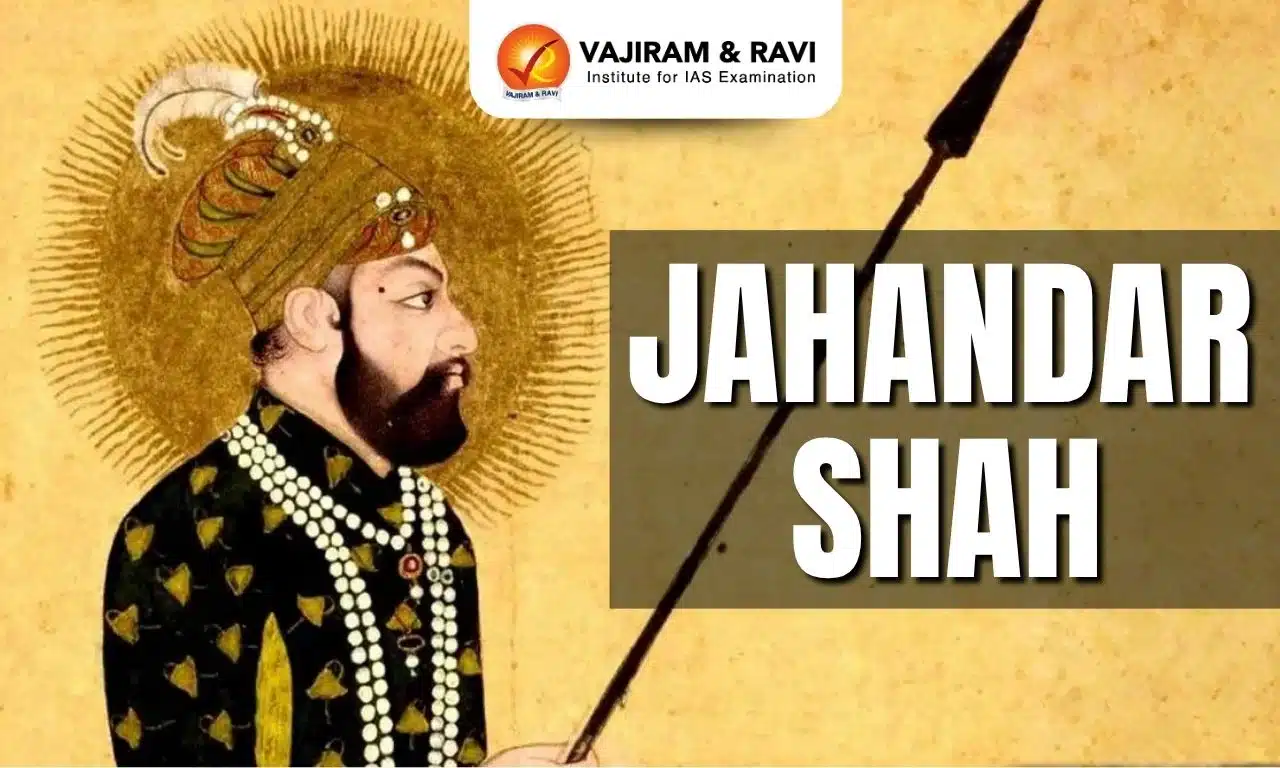
Jahandar Shah’s reign (1712-1713) marked a  turning point in the decline of the Mughal Empire. Unlike his strong predecessors, he was overshadowed by his Wazir, Zulfiqar Khan, and his courtly favorites. Though marked by policy experiments like the abolition of jizya and conciliation with regional powers, his reign ultimately exposed the empire’s fragility. For UPSC preparation, Jahandar Shah’s rule shows the interplay of imperial weakness, noble dominance, and administrative experiments in the post-Aurangzeb period. In this article, we are going to cover the life of Jahandar Shah, his early life, reign and eventually his decline. 

Jahandar Shah

The history of the Mughal Empire in the early 18th century is marked by rapid decline, factional struggles, and short-lived reigns. Among these rulers, Jahandar Shah occupies a unique place. Known by his full name Abu’l Fath Mu’izz-ud-Din Muhammad Jahandar Shah Sahib-i-Qiran Padshah-i-Jahan, he ruled the Mughal Empire for less than a year between 1712 and 1713. Born as Mirza Muhammad Mu’izz-ud-Din, he was the son of Emperor Bahadur Shah I and his consort Nizam Bai, the daughter of Fatehyawar Jang from Hyderabad.

Though his period of ruling was short, Jahandar Shah’s rule shows the growing influence of nobles in imperial politics, the weakening power of the Mughal throne, and experiments in revenue administration. Understanding his life and rule provides insight into the Mughal decline after Aurangzeb.

Jahandar Shah Early Life

Jahandar Shah was born in Deccan Subah during his father’s tenure there. His lineage connected him both to the grandeur of the Mughal dynasty and the aristocracy of Hyderabad through his mother.

His great-grandfather Aurangzeb had appointed him as the vizier of Balkh in 1671, giving him early administrative exposure. However, Jahandar Shah’s ambitions grew only after the death of his father, Bahadur Shah I, in February 1712.

Following Bahadur Shah’s death, his sons engaged in a bloody war of succession. Jahandar Shah and his brother Azim-ush-Shan both proclaimed themselves emperors. In the ensuing battle, Azim-ush-Shan was killed on 17 March 1712, clearing Jahandar Shah’s path to the throne.

Before becoming emperor, Jahandar Shah was known as a man of wealth and trade, having undertaken voyages across the Indian Ocean. He also served as the Subedar of Sindh. Among his children, his son Aziz-ud-Din later ruled as the Mughal Emperor (Shah Alam II) from 1754 to 1759.

Jahandar Shah’s Reign (1712–1713 AD)

The death of Bahadur Shah I plunged the Mughal court into chaos. Unlike the successions before, where the struggle was confined to princes, this phase saw nobles actively manipulating and supporting contenders.

The most powerful noble of the time, Zulfiqar Khan, also played an important role. Backed by him, Jahandar Shah emerged victorious. However, this victory also meant Jahandar Shah was dependent on Zulfiqar Khan, who virtually controlled the empire as the Wazir.

Character of Jahandar Shah

Jahandar Shah is often described by chroniclers as a weak and pleasure-loving ruler. He indulged heavily in luxury, lacked dignity, and allowed his favorite mistress, Lal Kanwar, to dominate court politics. His lack of seriousness reduced imperial prestige, further empowering ambitious nobles.

Policies under Zulfiqar Khan

Despite Jahandar Shah’s shortcomings, Zulfiqar Khan introduced pragmatic policies to stabilize the empire. This included:

  1. Abolition of Jizya Tax: To win Hindu support and ease tensions, the discriminatory jizya tax on non-Muslims was removed.
  2. Conciliation with Rajputs: 
    • Jai Singh of Amber was appointed Governor of Malwa and given the title of Mirza Raja Sawai.
    • Ajit Singh of Marwar was made Governor of Gujarat and honored as Maharaja.
  3. Peace with Marathas: The Chauth and Sardeshmukhi of the Deccan were conceded to the Marathas, though collection was to be done through Mughal officials.
  4. Alliances with Regional Powers:  Peace was made with Chhatrasal Bundela and Churaman Jat, reflecting an effort to integrate local rulers.

These moves highlight Zulfiqar Khan’s vision of balancing imperial authority with regional cooperation, though they also displayed the empire’s weakening central control.

Jahandar Shah’s Coinage

  • Jahandar Shah issued gold, silver, and copper coins during his short ruling period. Some bore restored poetic couplets like Abu al-Fateh and Sahib Qiran. 
  • Copper coins were struck in two weight standards - 20 g and 14 g.
  • The gold mohur was minted in Mustaghir ul-Mulk (meaning “Abode of the Kingdom”). His coinage reflected attempts to maintain Mughal prestige despite political instability.

Introduction of the Ijarah System

One of Jahandar Shah’s significant administrative measures was popularizing the Ijarah system of revenue farming.

  • Under this system, the right to collect revenue from land was auctioned to the highest bidder.
  • The bidder, or revenue farmer, was expected to pay the state nine-tenths of the revenue while retaining the remainder as profit.
  • This system was used especially when peasants lacked resources or in times of crop failure.

Though revenue farming increased immediate state income, it often led to exploitation of peasants. The system became widespread in the 18th century and highlighted the fiscal distress of the Mughal Empire.

Jahandar Shah Decline

Jahandar Shah’s dependence on Zulfiqar Khan, his indulgence in pleasure, and the dominance of Lal Kanwar weakened his authority. Nobles dissatisfied with Zulfiqar Khan soon rallied behind Farrukhsiyar, another grandson of Bahadur Shah I.

In January 1713, Jahandar Shah was defeated by Farrukhsiyar with the help of the powerful Sayyid Brothers (Abdullah Khan and Hussain Ali Khan). He was captured and later executed, ending his brief period of ruling of eleven months.

Jahandar Shah UPSC

Jahandar Shah’s reign (1712-1713) reflects a crucial turning point in the decline of the Mughal Empire. Unlike his strong predecessors, he was overshadowed by his Wazir, Zulfiqar Khan, and his courtly favorites. Though marked by policy experiments like the abolition of jizya and conciliation with regional powers, his reign ultimately exposed the empire’s fragility.

For UPSC preparation, Jahandar Shah’s rule highlights the interplay of imperial weakness, noble dominance, and administrative experiments in the post-Aurangzeb period. It sets the stage for the rapid political fragmentation of the 18th century and the eventual rise of regional states.

Also Check Other Posts
Battle of Plassey Robert Clive
Battle of Buxar Anglo Mysore Wars
Dual Government in Bengal Tipu Sultan
Anglo Maratha Wars Maratha Empire
Third Battle of Panipat Chhatrapati Shivaji Maharaj
Battle of Bhima Koregaon Anglo Burmese War
Maharaja Ranjit Singh Anglo Nepal War

Jahandar Shah FAQs

Q1: Who defeated Jahandar Shah?

Ans: Jahandar Shah was defeated by Farrukhsiyar with the support of the Sayyid Brothers.

Q2: Who was Jahandar Shah in the Mughal Empire?

Ans: Jahandar Shah was a Mughal emperor who ruled from 1712 to 1713.

Q3: How long did Jahandar Shah rule?

Ans: Jahandar Shah ruled for approximately eleven months.

Q4: What were the reasons for the decline of the Mughal Empire?

Ans: The decline of the Mughal Empire was due to weak rulers, noble dominance, succession struggles, fiscal mismanagement, regional revolts, and external invasions.

Q5: Who was Zulfiqar Khan?

Ans: Zulfiqar Khan was a powerful Mughal noble and Wazir who effectively controlled the government during Jahandar Shah’s reign.

False Smut Disease

False Smut Disease

False Smut Disease Latest News

According to reports, the paddy crop, which is at the maturing and harvest stage, has been infested with false smut disease, causing widespread damage across Punjab.

About False Smut Disease

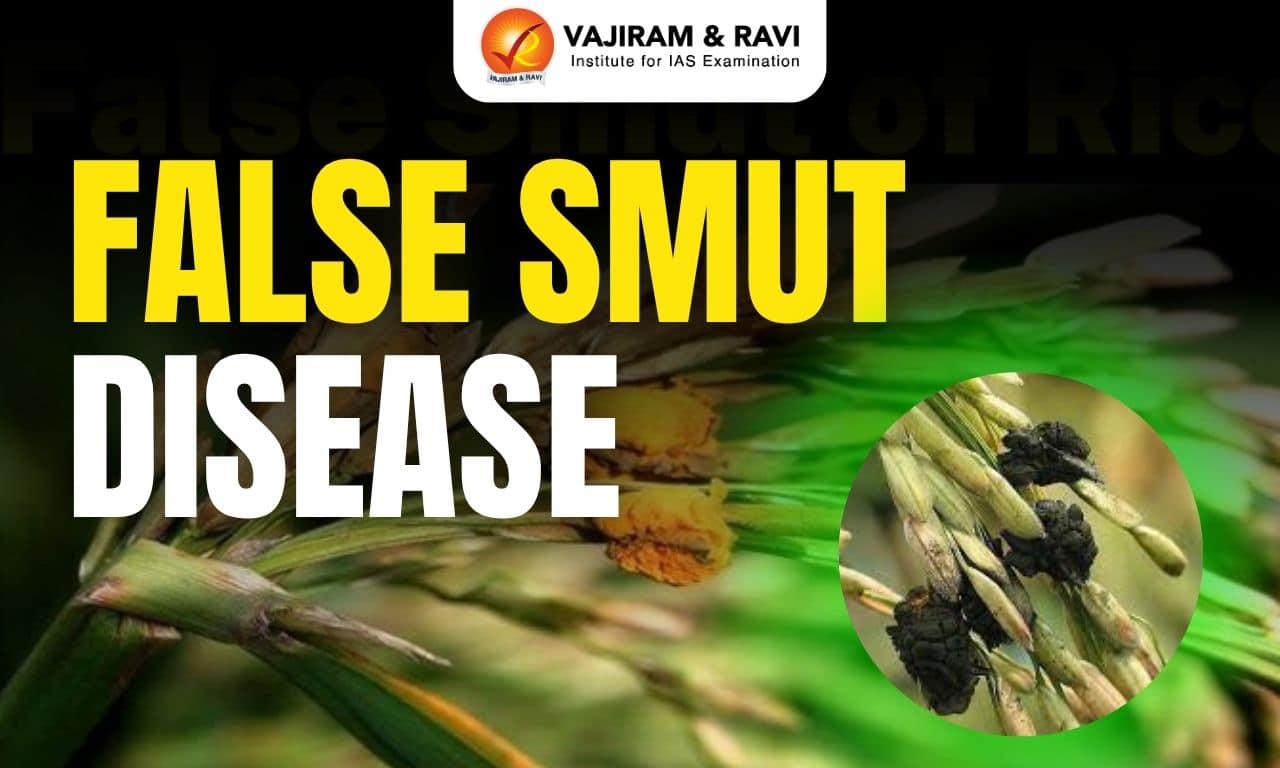
  • False smut (haldi rog) is an important fungal disease of rice (paddy).
  • It is caused by the fungus Ustilaginoidea virens.
  • It is also known as Lakshmi disease or Oothupathi disease of rice. 
  • The disease is hard to stop, because fungus infects the crop during the flowering stage, and symptoms of the disease are evident after emergence of rice panicles. 
  • The typical symptom of the disease is black fungal mycelium growth in paddy grains, which become covered with yellow fungal growth in the field. 
  • Mature spores are orange and turn yellowish green or greenish black in colour. 
  • Only a few grains in a panicle are usually infected, and the rest are normal.
  • It doesn't directly impact other plant parts. 
  • It causes chalkiness of grains, which leads to reduction in grain weight. It also reduces seed germination.
  • The percentage of infected panicles and the extent of infection within each panicle significantly impact yield loss. 
  • Favorable Factors for False Smut in Paddy Crops?
    • Warm and humid weather: Temperatures between 25-30°C and high humidity (>80%) promote fungal growth.
    • Presence of infected plant debris: Spores can survive on leftover stubble and straw from previous harvests.
    • High nitrogen content in soil: Excessive nitrogen application can increase susceptibility.
  • Control of false smut of rice through fungicide application is feasible; however, high usage of fungicides has led to the resistance development in causal agents besides environmental pollution.

Source: HT

False Smut Disease FAQs

Q1: What is the causal organism of False Smut disease in rice?

Ans: It is caused by the fungus Ustilaginoidea virens.

Q2: By which other names is False Smut disease of rice known?

Ans: False Smut disease of rice is also known as Haldi Rog, Lakshmi Disease, and Oothupathi Disease.

Q3: At which stage of crop growth does False Smut infect rice plants?

Ans: It infects the crop during the flowering stage.

Q4: What is the most typical symptom of False Smut disease in paddy grains?

Ans: The typical symptom of the disease is black fungal mycelium growth in paddy grains, which become covered with yellow fungal growth in the field.

Interstellar Mapping and Acceleration Probe

Interstellar Mapping and Acceleration Probe

Interstellar Mapping and Acceleration Probe Latest News

Recently, NASA launched the Interstellar Mapping and Acceleration Probe (IMAP) to show how solar particles are energised and shield us.

About Interstellar Mapping and Acceleration Probe

  • Its goal is to map the heliosphere’s boundary, trace energetic particles, and improve space weather forecasting.
  • The heliosphere is a huge bubble created by the Sun's wind that encapsulates our entire solar system.
  • IMAP will support real-time observations of the solar wind and energetic particles, which can produce hazardous conditions in the space environment near Earth. 
  • It is situated at the first Earth-Sun Lagrange point (L1), at around one million miles from Earth toward the Sun.
  • IMAP will also send data in near real-time to help scientists monitor space weather conditions.
  • Interstellar Mapping and Acceleration Probe will
    • Uncover fundamental physics at scales both tiny and immense. 
    • Improve forecasting of solar wind disturbances and particle radiation hazards from space.
    • Draw a picture of our nearby galactic neighborhood.
    • Help determine some of the basic cosmic building materials of the universe.
    • Increase understanding of how the heliosphere shields life in the solar system from cosmic rays.

Components of Interstellar Mapping and Acceleration Probe

  • IMAP is equipped with 10 scientific instruments, each designed to detect different types of particles or phenomena in space.
  • Some of them are energetic neutral-atom detectors (IMAP-Lo, IMAP-Hi, IMAP-Ultra), which capture neutral atoms that were once charged ions but were changed by acquiring electrons.
  • Other instruments detect charged particles directly, magnetic fields, interstellar dust, and solar-wind structures.

Source: TH

Interstellar Mapping and Acceleration Probe FAQs

Q1: Where will IMAP be stationed?

Ans: At the Sun-Earth L1 Lagrange point.

Q2: What is the primary objective of the Interstellar Mapping and Acceleration Probe (IMAP) mission?

Ans: It is to investigate the acceleration of energetic particles and interaction of the solar wind with the local interstellar medium

NCRB Data on Crime Against Children

NCRB Data on Crime Against Children

NCRB Data on Crime Against Children Latest News

A total of 1,77,335 cases of crime against children were registered in the country in 2023, showing an increase of 9.2% over 2022, according to the latest National Crime Records Bureau (NCRB) report.

About NCRB Data on Crime Against Children

  • A total of 177,335 cases of crime against children were registered in the country in 2023, showing an increase of 9.2% over 2022.
  • The crime rate in 2023 stood at 39.9 per one-lakh child population in comparison to 36.6 in 2022.
  • In percentage terms, major crime heads under “Crime Against Children” in 2023 were “Kidnapping and Abduction of Children” (79,884 cases, 45%) and “Protection of Children from Sexual Offences (POCSO) Act” (67,694 cases, 38.2%).
  • These figures include 40,434 cases of penetrative sexual assault, affecting 40,846 victims. Aggravated assaults and harassment followed with 22,444 cases.
    • Of the 40,434 cases, the offenders were known to the victims in 39,076, which included family members in 3,224 cases, family friends or neighbours or employers or other known persons in 15,146 cases, and friends or online friends or live-in partners on the pretext of marriage in 20,706 cases.
    • Victim demographics show that 762 victims were aged below six years, 3,229 aged between six and 12 years, 15,444 aged between 12 and 16 years and 21,411 aged between 16 and 18 years, bringing the total number of child victims to 40,846.
    • Most were girls in rape-related sections.
  • Kidnapping and abduction emerged as the largest contributor, with 79,884 IPC cases reported, victimising 82,106 children at a rate of 18 per one lakh.
    • Over 58,927 of these were general abductions, including 37,844 instances where the missing children were deemed kidnapped.
    • Notably, 14,637 cases involved abducting minor girls to compel marriage.
  • Other significant IPC crimes included 1,219 murders, with 89 linked to rape or POCSO violations; 3,050 simple hurt cases; and 373 cases of abetment to suicide. 
  • Special and local laws beyond the POCSO Act added to the tally, with 6,038 cases under the Prohibition of Child Marriage Act and 1,390 under the Child Labour Act.
  • Regionally, Madhya Pradesh topped the list with 22,393 total cases, followed by Maharashtra and Uttar Pradesh.
  • Assam reported a sharp spike of 10,174 cases , while Bihar saw 9,906 cases. Union Territories like the Andaman and Nicobar Islands and Delhi had disproportionately high rates, with Delhi alone registering 7,769 cases.
  • While the overall chargesheeting rate was 64.3 percent, it varied widely in Tamil Nadu and Andhra Pradesh, but was low in Delhi and Haryana .
  • Police disposal showed 1,12,290 cases chargesheeted out of 2,57,756 investigated, with 80,198 pending at the end of the year.

Source: TH

NCRB Data on Crime Against Children FAQs

Q1: According to NCRB 2023 data, how many cases of crime against children were registered in India?

Ans: 1,77,335

Q2: Which major crime category accounted for the largest share of crimes against children in 2023?

Ans: Kidnapping and Abduction of Children.

Q3: Which state reported the highest number of cases of crime against children in 2023?

Ans: Madhya Pradesh (22,393 cases)

Key Facts about Philippines

Key Facts about Philippines

Philippines Latest News

Recently, an offshore earthquake of magnitude 6.9 struck Cebu province in central Philippines.

About Philippines

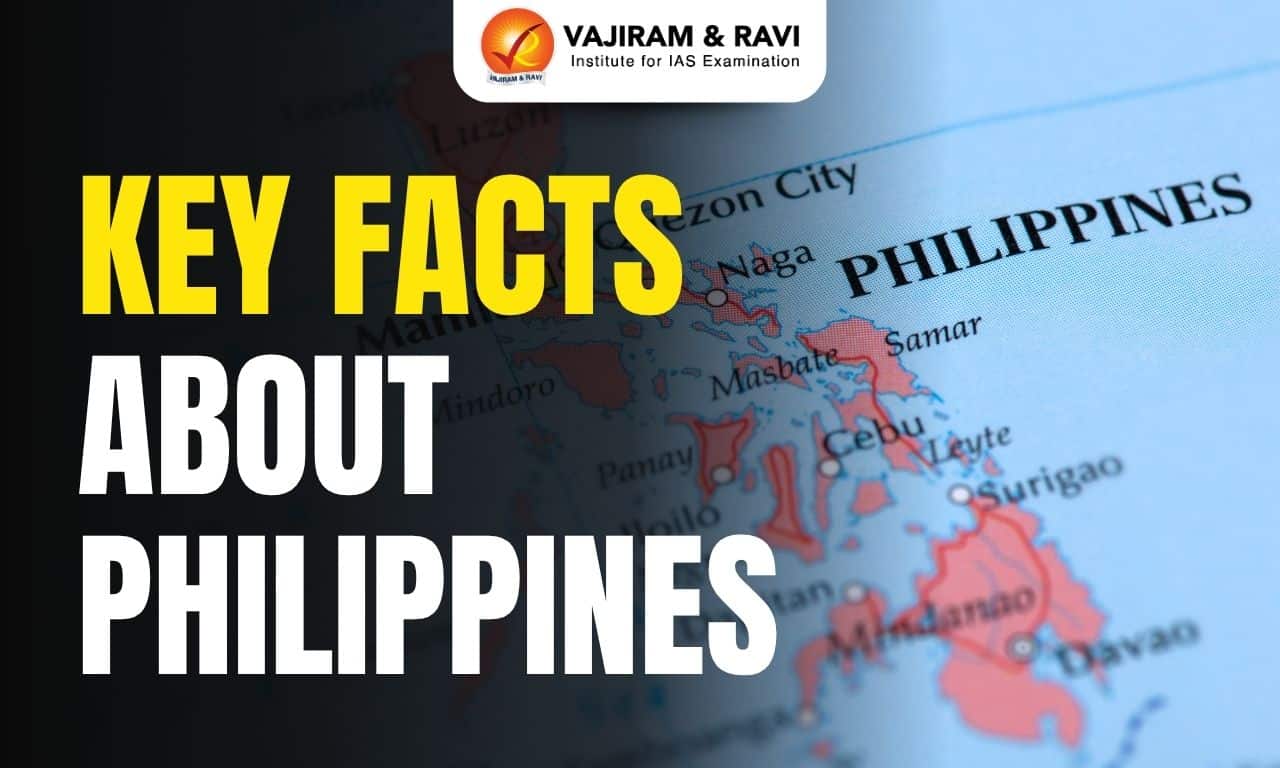
  • Location: It is an island country of Southeast Asia in the western Pacific Ocean.
  • It shares maritime borders with Vietnam to the west, Taiwan to the north, Palau to the east, and Malaysia and Indonesia to the south.
  • Water Bodies: It is surrounded by the South China (north and west); Philippine Sea (east); Celebes Sea (south); and by the Sulu Sea to the (southwest). 
  • Highest Point: Mount Apo.
  • Major Rivers: Cagayan River (Philippines’ longest river), Mindanao, Agusan etc.
  • Volcano: Mayon Volcano, one of the most active in the country.
  • Climate: Tropical and monsoonal.
  • Major Lake: Laguna de Bay
  • Natural resources: Timber, petroleum, nickel, cobalt, silver, gold, salt, copper
  • The Philippines is the third-largest producer of geothermal energy globally, after the United States and Indonesia.
  • World Heritage Site: The Puerto-Princesa Subterranean River National Park site in the Philippines is inscribed on the World Heritage List in 1999.
  • Capital city: Manila

Source: IE

Philippines FAQs

Q1: Where is the Philippines located?

Ans: Southeast Asia

Q2: What is the largest island in the Philippines?

Ans: Luzon

Leyte Island

Leyte Island

Leyte Island Latest News

A 6.7 magnitude earthquake has hit Leyte Island in the Philippines recently.

About Leyte Island

  • It is a large island in the Visayas group of islands in the Philippines
  • It is the eighth-largest island in the Philippines and the sixth most populated.
  • It spans 7056 sq.km. with a coastline of 969 km.
  • In the north it nearly joins the island of Samar, separated by the San Juanico Strait, which becomes as narrow as 2 kilometres (1.2 mi) in some places.  
    • The San Juanico Bridge (2.16 kilometers) connects the islands of Leyte and Samar.
  • Most of Leyte is covered in thick forests and mountains. However, the Leyte Valley in the northeast is a major farming area.
  • The two biggest cities on Leyte are Tacloban, located on the eastern coast, and Ormoc, on the west coast, with the latter hosting geothermal power plants.
  • History
    • The island was known to 16th-century Spanish explorers as Tandaya
    • Its population grew rapidly after 1900, especially in the Leyte and Ormoc valleys. 
    • In World War II, U.S. forces landed on Leyte (October 20, 1944), and, after the Battle of Leyte Gulf, the Japanese were expelled. 
  • Economy
    • Most people on Leyte are farmers, growing crops like rice, corn, coconuts, and bananas. 
    • Fishing is also an important activity.
    • The island has some valuable minerals like manganese, and people also quarry sandstone and limestone.

Source: DEVD

Leyte Island FAQs

Q1: Leyte Island is part of which island group in the Philippines?

Ans: It is a large island in the Visayas group of islands in the Philippines.

Q2: Which strait separates Leyte Island from Samar Island?

Ans: San Juanico Strait

Q3: Which city on Leyte’s west coast is known for geothermal power plants?

Ans: Ormoc

Q4: What was Leyte Island called by Spanish explorers in the 16th century?

Ans: Tandaya

Colonial Architecture, Background, Characteristics, Importance

Colonial Architecture

Colonial architecture in India refers to the diverse architectural styles and structures introduced and developed during the period of European colonial rule. This period, spanning several centuries, began with the Portuguese arrival in the 16th century, followed by the Dutch, French, and ultimately the British, who had the most interesting and lasting influence on Indian architecture. Each colonial power introduced distinct styles, construction techniques, and urban planning methods, leaving behind a rich legacy of architectural heritage that continues to shape the landscape of modern India. In this article, we are going to cover Colonial Architecture, its background, characteristics, different types of architecture and the post independent impact. 

Colonial Architecture

Colonial architecture in India is not just about buildings; it is a reflection of political authority, cultural interaction, and adaptation to local conditions. While the Portuguese were responsible for ornate Baroque churches in Goa, the Dutch built utilitarian forts, the French emphasized urban planning in Pondicherry, and the British left behind monumental structures blending European and indigenous elements. These styles combined to form a unique chapter in India’s architectural evolution.

Colonial Architecture Background

By the 18th century, European powers had established their presence in India, initially through trade but eventually through political dominance. The Portuguese, Dutch, French, Danish, and British set up trading companies that soon transformed into centers of political authority. The Battle of Plassey in 1757 was a turning point, establishing the English East India Company as a major power and paving the way for British architectural dominance. Each colonial power contributed differently:

  • Portuguese introduced Baroque and Iberian styles, focusing on churches, forts, and colorful residences.
  • The Dutch emphasized practicality, constructing forts and warehouses near coastal settlements.
  • French combined Parisian design sensibilities with tropical adaptations, introducing scientific city planning.
  • The British created a wide range of public buildings, railway stations, and administrative complexes, evolving into the Indo-Saracenic style that blended Indian and Western traditions.

Colonial architecture was about showing authority and cultural superiority in the beginning. However, over time, it included local materials, climatic considerations, and even indigenous motifs, resulting in mixed styles that symbolized cultural negotiation between colonizers and the colonized.

Colonial Architecture Characteristics

Although every European nation had its own style, features of Colonial Architecture include: 

  1. Symmetry and Balance: Most colonial structures focused on symmetrical layouts, with equal spacing and proportion on each side of a central axis.
  2. Geometric Shapes: Use of rectangles, squares, and circles in building plans reflected the European preference for order.
  3. Columns and Porticos: Influences of classical European architecture can be seen in Doric, Ionic, and Corinthian columns supporting porticos or porches.
  4. Rooflines:  Gabled roofs, dormer windows, and steep pitches were common, particularly in hill stations like Shimla and Darjeeling.
  5. Use of Materials:  Colonial powers used a mix of brick, wood, stone, and later, iron and concrete. Portuguese preferred brick, while the British often used sandstone and limestone.
  6. Simplistic Ornamentation: Early colonial buildings avoided excessive decoration, focusing on functionality. Later, Indo-Saracenic structures introduced more ornate features.
  7. Multi-pane Windows and Central Chimneys : Common in residential buildings, ensuring ventilation and heating efficiency.
  8. Urban Planning : French introduced Cartesian grids, while the British laid out civil lines and cantonments with orderly streets and open spaces.

These features, though derived from Europe, were adapted to Indian climatic conditions and local cultural influences.

Portuguese Architecture in India

The Portuguese were the earliest Europeans to establish colonies in India, particularly along the western coast. Their legacy is most prominent in Goa, Daman, Diu, and parts of Kerala. Features of Portuguese Architecture include:

  • Iberian Style Churches : The Portuguese built several churches in Goa and Kerala, often in the Iberian and Baroque styles. St. Francis Church in Cochin (1510) is considered the first European church in India.
  • Materials and Design: They extensively used brick, wooden roofs, and colorful interiors. Their buildings often combined simplicity with grandeur.
  • Baroque Influence: The Portuguese popularized the Baroque style, characterized by dramatic contrasts, bold colors, and ornate facades.
  • Patio Homes: They introduced the concept of patio-centered houses, reflecting Mediterranean influence.

Notable Structures:

  • Sé Cathedral (1619, Goa): One of the largest churches in Asia, showcasing late-Gothic Portuguese design.
  • Basilica of Bom Jesus (1604, Goa) : A UNESCO World Heritage Site housing the relics of St. Francis Xavier, famous for its Baroque style.
  • St. Paul’s Church, Diu (1610) : Exemplifying Baroque elegance with detailed woodwork.
  • Anne’s Church, Goa (1695):  Known for its ornate façade.
  • Fortresses like Diu Fort (1535) : Combined defense with religious structures.

Portuguese architecture remains deeply integrated into Goa’s identity, evident in colorful homes, chapels, and forts.

French Architecture in India

The French presence in India was concentrated in Pondicherry, Chandernagore, and parts of Andhra Pradesh and Tamil Nadu. Unlike the Portuguese, the French emphasized urban planning and order.

  • Parisian Influence: Inspired by French Renaissance and Baroque models, with emphasis on elegance and proportion.
  • Town Planning : Pondicherry is the finest example, with a Cartesian grid pattern of perpendicular streets dividing the city into sectors.
  • Architectural Features:  Tall shuttered windows, ornate archways, pastel-colored facades, and narrow street fronts.
  • Public Spaces: Wide boulevards, town squares, and seafront promenades reflected European city planning principles.

Notable Structures:

  • White Town in Pondicherry: Characterized by colonial villas with French balconies, arches, and gardens.
  • Statue of Joan of Arc : Symbol of French cultural pride.
  • Le Café and French Consulate :  Blending local materials with European style.

The French left behind a unique legacy of harmonious city planning, which still distinguishes Pondicherry from other Indian towns.

Dutch Architecture in India

The Dutch had trading posts in Nagapattinam, Pulicat, and Kerala. Their architectural legacy is less grandiose but highly functional.

  • Emphasis on forts, warehouses, and trading posts.
  • Minimalist design with an emphasis on utility.
  • Use of locally available materials for durability.

Notable Structures:

  • Fort Dansborg (1620, Tamil Nadu) – A massive structure showcasing Dutch military architecture.
  • Warehouses and bungalows near Cochin and Pulicat.
  • Though their architectural impact was not as widespread, the Dutch left behind well-fortified trading centers that symbolize their mercantile priorities.

British Architecture in India

The British were the most influential colonizers, ruling India for nearly two centuries. Their architecture ranged from early neoclassical styles to Gothic revival and finally the Indo-Saracenic synthesis.

Early Phase: Neoclassical and Palladian Styles

  • Inspired by Roman and Greek designs.
  • Example: Writers’ Building in Kolkata.

Gothic Revival and Victorian Styles

  • Pointed arches, stained glass, and cruciform ground plans.
  • Example: Victoria Terminus (Chhatrapati Shivaji Maharaj Terminus, Mumbai) – A blend of Gothic revival with Indian motifs.

Indo-Saracenic Movement

A hallmark of late British architecture, blending Hindu, Mughal, and Western elements.

Key Features:

  • Bulbous domes symbolizing the heavens.
  • Cusped arches with floral and geometric motifs.
  • Overhanging eaves (chhajja) for climate adaptation.
  • Minarets and pavilions as decorative features.
  • Vaulted roofs and Chhatris.

Notable Examples:

  • Gateway of India, Mumbai (1924): Combining Islamic and Western motifs.
  • Egmore Railway Station, Chennai: An Indo-Saracenic landmark.
  • Rashtrapati Bhavan, New Delhi: Incorporating Mughal gardens with Western monumentalism.

The British also pioneered civic architecture like courts, universities, post offices, railway stations integrating function with grandeur.

Colonial Architecture Post-Independence Impact

After independence in 1947, Indian architecture transitioned toward modernism while still retaining colonial influences. Two schools emerged:

  1. Revivalist School: Continuing colonial traditions like Indo-Gothic and Indo-Saracenic styles.
    • Example: Continued use of Victoria Memorial and Gateway of India.
  2. Modernist School: Moving towards modern, functional design.
    • Le Corbusier designed Chandigarh, India’s first planned city, with geometric precision.
    • Charles Correa emphasized climate-responsive and culturally sensitive designs.
    • Laurie Baker pioneered low-cost, eco-friendly housing.

Thus, while colonial styles persisted in heritage buildings, modern India embraced new architectural languages.

Colonial Architecture Importance

Colonial Architecture is important due to many reasons:

  • Cultural Fusion: Symbolizes the blending of European and Indian traditions.
  • Urban Identity: Cities like Mumbai, Kolkata, Goa, and Pondicherry owe their distinct character to colonial structures.
  • Heritage and Tourism: Landmarks like Goa’s churches, Pondicherry’s villas, and British-era railway stations are global tourist attractions.

Institutional Legacy: Many universities, courts, and government offices continue to function from colonial-era buildings.

Other Related Posts
Art and Architecture of IVC Gupta Art and Architecture
Mauryan Art and Architecture Pallava Art and Architecture
Gandhara School of Art Imperial Cholas
Mathura School of Art Indo Islamic Architecture
Amaravati School of Art Delhi Sultanate Architecture
Stupas The Mughal Art and Architecture
Jain Art and Architecture

Colonial Architecture FAQs

Q1: What is colonial architecture in India?

Ans: Colonial architecture in India refers to the styles and structures built by European powers like the British, Portuguese, French, and Dutch during their rule, blending European designs with local elements.

Q2: What is the importance of colonial architecture?

Ans: Colonial architecture is important as it reflects cultural exchange, showcases India’s colonial past, and continues to influence urban planning and heritage conservation.

Q3: Is India Gate a colonial architecture?

Ans: Yes, India Gate in New Delhi is an example of British colonial architecture built in the early 20th century.

Q4: What is the post-independent impact of colonial architecture?

Ans: Post-independence, colonial architecture influenced modern Indian designs, with many buildings repurposed for government, education, and cultural use.

Q5: How did Portuguese contribute to colonial architecture?

Ans: The Portuguese contributed by introducing Iberian and Baroque styles, seen in Goan churches like the Basilica of Bom Jesus and Sé Cathedral.

NCRB Data on Road Accidents

NCRB Data on Road Accidents

NCRB Data on Road Accidents Latest News

More than 1.73 lakh people were killed and 4.47 lakh injured in road accidents across the country in 2023, according to the latest data from the National Crime Records Bureau (NCRB).

About NCRB Data on Road Accidents

  • A total of 4,64,029 road accidents took place in the country in 2023, 17,261 more than in 2022.
  • More than 1.73 lakh people were killed and 4.47 lakh injured in road accidents across the country in 2023.
  • The highest number of accidents (20.7% of total) were reported between 6 p.m. and 9 p.m
    • From 3 pm to 6 pm and 12 noon to 3 pm accounted for 17.3 percent and 15 percent , respectively.
  • Two-wheelers accounted for the highest number of fatal road accidents, causing 79,533 deaths, or 45.8% of total deaths, followed by pedestrians at 27,586 (15.9%) and SUV/car/jeep at 24,776 (14.3%).
  • Most of the deaths in two-wheeler accidents were reported in Tamil Nadu (11,490) and Uttar Pradesh (8,370). 
  • A large number of deaths due to SUV/car/jeep accidents were reported in Uttar Pradesh (19.2% of total ) and a large number of deaths due to trucks/lorries/mini truck accidents were also reported in the State (29.9% of total).
  • Generally road accidents have caused more injuries than deaths, but in Andaman and Nicobar Islands, Jharkhand, Punjab, Bihar and Uttar Pradesh, road accidents caused more deaths compared to persons injured. 
  • The Cause-Wise Analysis of Fatal Road Accidents:
    • 58.6% (1,01,841) and 23.6% (41,035) of fatalities were due to speeding and dangerous/careless driving or overtaking, respectively.
    • Poor weather conditions, driving under influence of drug/alcohol, and animal crossings caused 4,952 deaths.
  • The highest number of deaths were reported on the National Highways accounting for 34.6%, followed by State Highways at 23.4%.
  • State/UT-wise patterns revealed that maximum fatalities in road accidents on the National Highways took place in Uttar Pradesh, followed by Tamil Nadu, Maharashtra, Karnataka, and Madhya Pradesh during 2023.
  • Of the 69,910 traffic accidents that were reported in the megacities throughout the year, 5,715 occurred in Delhi, making up 8.2% of the total.
    • Bengaluru and Chennai were ranked second and third on the list, with 4,980 and 3,653 road crashes each. 
    • With 1,457 fatalities, Delhi had the highest number of deaths in the same year.
    • Bengaluru ranked second with 915 road accident deaths in the same year, while Jaipur came in third with 848.

Source: TH

NCRB Data on Road Accidents FAQs

Q1: How many people were killed in road accidents across India in 2023?

Ans: More than 1.73 lakh people were killed in road accidents across India in 2023.

Q2: he highest proportion of road accidents in 2023 occurred between which time interval?

Ans: 6 p.m. – 9 p.m. (20.7%)

Q3: Which category of vehicles caused the highest number of fatal accidents in 2023?

Ans: Two-wheelers

Q4: Which state reported the highest number of deaths from two-wheeler accidents in 2023?

Ans: Tamil Nadu (11,490 deaths)

Q5: What was the leading cause of fatal road accidents in 2023?

Ans: Speeding (58.6%)

Wassenaar Arrangement

Wassenaar Arrangement

Wassenaar Arrangement Latest News

The Wassenaar Arrangement faces challenges in adapting to cloud technology, requiring updates to control lists and enforcement mechanisms.

About Wassenaar Arrangement

  • It is a multilateral “export control regime” for conventional arms and dual-use goods and technologies.
  • The body came into being in 1996 to succeed the Cold War-era Coordinating Committee for Multilateral Export Controls.
  • The name comes from Wassenaar, a suburb of the Hague, Netherlands, where the agreement to start such a multi-lateral cooperation was reached in 1995.
  • Purpose: To promote transparency and greater responsibilities for transfers of conventional arms and dual-use goods, as well as technologies, to prevent destabilizing actions.
  • Member countries: 42 members.
  • India joined the Wassenaar Arrangement in 2017 and incorporated its lists into its Special Chemicals, Organisms, Materials, Equipment, and Technologies framework. 
  • Headquarters: Vienna, Austria.

How does Wassenaar Arrangement work?

  • The group works by regularly exchanging information in respect of technology, both conventional and nuclear-capable, that is sold to, or denied to countries outside the grouping.
  • This is done through maintenance and updating of detailed lists of chemicals, technologies, processes and products that are considered militarily significant.
  • Through this exchange of information, the group aims at controlling the movement of technology, material or components to countries or entities which undermine international security and stability.

Source: TH

Wassenaar Arrangement FAQs

Q1: When was the Wassenaar Arrangement established?

Ans: 1996

Q2: What is the primary purpose of the Wassenaar Arrangement?

Ans: To promote transparency and responsibility in the transfer of conventional arms and dual-use goods and technologies.

Lecanemab Drug

Lecanemab Drug

Lecanemab Drug Latest News

Recently, Australia approved Lecanemab drug for early Alzheimer’s diseases.

About Lecanemab Drug

  • It is a monoclonal antibody drug to treat early stages of Alzheimer’s.
  • It is designed to slow early Alzheimer's progression by targeting amyloid proteins in the brain.
  • It was developed to tackle the causes of Alzheimer’s disease rather than only relieving the symptoms.

Working of Lecanemab Drug

  • It uses antibodies to recognise amyloid in the brain and works with the brain’s immune cells to clear amyloid protein build-up from the brains of people living with early-stage Alzheimer’s disease.
  • These amyloid protein build-ups are thought to be toxic to brain cells, causing them to get sick and eventually die, leading to the symptoms of Alzheimer’s disease. 
  • Lecanemab is given to patients intravenously, which means into a vein through a drip bag.
  • Recent clinical trials show a 27 per cent reduction in disease progression.
  • Issues with : High cost and potential side effects, including brain swelling, limit its accessibility and raise safety concerns.

What is Alzheimer’s Disease?

  • Alzheimer’s disease is a brain disorder that slowly destroys memory and thinking skills and, eventually, the ability to carry out the simplest tasks.
  • It is the most common cause of dementia, a general term for memory loss and other cognitive abilities serious enough to interfere with daily life.
  • Alzheimer’s disease accounts for 60-80% of dementia cases.
  • It involves parts of the brain that control thought, memory, and language.
  • The condition usually affects people aged 65 years and over, with only 10% of cases occurring in people younger than this

Source: DTE

Lecanemab Drug FAQ's

Q1: What is the mechanism of action of Lecanemab?

Ans: Lecanemab targets beta-amyloid, a protein deposition seen in patients with Alzheimer’s disease, and disrupts cell function

Q2: What is Alzheimer's disease?

Ans: A progressive neurologic disorder causing brain atrophy and cell death.

International Civil Aviation Organisation

International Civil Aviation Organization

International Civil Aviation Organization Latest News

Recently, India has been re-elected to Part II of the Council of International Civil Aviation Organization (ICAO).

About International Civil Aviation Organization

  • ICAO is a United Nations (UN) specialized agency, established in 1944, by the Convention on International Civil Aviation (1944) known as Chicago Convention.
  • It is dedicated to developing safe and efficient international air transport for peaceful purposes.
  • Member countries: It consists of 193 Member States
  • Headquarters: Montreal, Canada.

Governance of International Civil Aviation Organization

  • ICAO Assembly: It is convened every three years, is the organization’s sovereign body, comprising all 193 signatory States to the Chicago Convention.
  • ICAO Council: It consists of 36-member, elected by the 193 Member States during the Assembly, and serves as the governing body for a three-year term.

Functions of International Civil Aviation Organization

  • It sets standards and regulations necessary for aviation safety, security and facilitation, efficiency, and economic development of air transport as well as to improve the environmental performance of aviation. 
  • It also serves as a clearinghouse for cooperation and discussion on civil aviation issues among its 193 member states.
  • It also promotes regional and international agreements aimed at liberalizing aviation markets.
  • It helps to establish legal standards to ensure that the growth of aviation does not compromise safety, and encourages the development of other aspects of international aviation law.

Source: PIB

International Civil Aviation Organization FAQs

Q1: When was the International Civil Aviation Organization (ICAO) established?

Ans: 1944

Q2: What is the International Civil Aviation Organization?

Ans: It is a United Nations agency which helps 193 countries to cooperate together and share their skies to their mutual benefit.

Farmer Suicides in India – NCRB Highlights Alarming Trends

Farmer suicides in India

Farmer Suicides Latest News

  • The NCRB’s 2023 report revealed that over 10,700 farmers and agricultural workers died by suicide, with Maharashtra and Karnataka recording the highest numbers.

Farmer Suicides in India: A Chronic Crisis

  • India’s agricultural sector sustains nearly half of its population, yet farmers often remain economically vulnerable. The recurring phenomenon of farmer suicides is not new and has been deeply linked to issues such as:
    • Debt Burden: Dependence on informal credit and high-interest loans often traps farmers in cycles of unmanageable debt.
    • Crop Failures: Erratic monsoons, droughts, floods, and pest infestations leave farmers unable to recover investments.
    • Market Volatility: Price fluctuations in key crops like cotton, soybean, onion, and pulses reduce profitability.
    • Policy Gaps: Inadequate crop insurance, lack of irrigation coverage, and insufficient procurement mechanisms worsen rural distress.
    • Regional Concentration: Farmer suicides are often concentrated in cotton and soybean belts like Vidarbha and Marathwada in Maharashtra, highlighting the vulnerability of monocrop-dependent regions.
  • Various governments have attempted measures such as loan waivers, crop insurance schemes, and MSP (Minimum Support Price) expansions. 
  • However, the persistence of suicides suggests structural reforms are required, particularly in rural credit systems, diversification of crops, and ensuring stable incomes.

Key Highlights of the NCRB Report on Farmer Suicides

  • According to the National Crime Records Bureau (NCRB) 2023 report, 10,786 farmers and agricultural workers died by suicide across India, accounting for 6.3% of all suicides in the country.
  • State-wise Distribution
    • Maharashtra: Reported the highest share at 38.5% of farmer suicides, with Marathwada and Vidarbha remaining epicentres.
    • Karnataka: Accounted for 22.5%, reflecting widespread distress across drought-prone regions.
    • Andhra Pradesh, Madhya Pradesh, and Tamil Nadu: Reported 8.6%, 7.2%, and 5.9% respectively.
    • Zero Reports: States like West Bengal, Bihar, Odisha, and several north-eastern states officially reported no farmer suicides, though experts question the accuracy of this data.
  • Occupation-wise Split
    • Cultivators (Farmers): 4,690 suicides (mostly male).
    • Agricultural Workers: 6,096 suicides, indicating that landless labourers also face severe economic stress.
  • Broader Trends
    • The NCRB data highlights that more than 10,000 suicides annually have been consistently reported from the farming sector in 2021, 2022, and 2023.
    • Experts and farmer organisations argue that the figures may be underreported due to discrepancies in state-level data recording.

Criticism and Concerns Raised

  • Farmer organisations such as the All India Kisan Sabha (AIKS) argue that the government’s policies have aggravated rural distress rather than alleviating it. 
  • Key criticisms include:
    • Trade Liberalisation: Removal of the 11% import duty on cotton has sparked fears that cheaper American cotton will further undercut Indian farmers.
    • Impact of Free Trade Agreements (FTAs): Concerns that upcoming FTAs could threaten domestic agriculture, dairy, and edible oil sectors.
    • Policy Indifference: Critics argue that successive governments have failed to draw lessons from the crisis, remaining focused on corporate-driven models of growth.
  • The data also underscores a cotton and soybean crisis, with farmer suicides most pronounced in these crop belts. 
  • This makes it evident that agricultural reforms cannot be piecemeal but must focus on holistic rural livelihood security.

Source: TH

Farmer Suicides FAQs

Q1: How many farmer suicides were reported in 2023?

Ans: The NCRB reported 10,786 farmer and agricultural worker suicides in 2023.

Q2: Which state reported the highest number of farmer suicides?

Ans: Maharashtra accounted for the largest share at 38.5%.

Q3: What percentage of total suicides in India are from the farm sector?

Ans: Farmer suicides represented 6.3% of the 1.71 lakh suicides reported in 2023.

Q4: What are the major crops linked to farmer suicides?

Ans: Cotton and soybean belts in Maharashtra, particularly Vidarbha and Marathwada, have seen the highest distress.

Q5: Why are experts critical of the NCRB data?

Ans: Experts believe the figures are underreported, as some states officially recorded zero farmer suicides, which contradicts ground realities.

India Needs Double Growth to Solve Jobs Crisis: Morgan Stanley Report

GDP Growth to address underemployment

Unemployment in India Latest News

  • Morgan Stanley (a global financial services firm) warns that India must nearly double its growth rate to meet rising employment needs and tackle underemployment.
  • The analysis projects that a 7.4% average GDP growth is required to maintain stable unemployment, assuming steady labour participation. 
  • If participation rises to 63%, growth of 9.3% would be necessary. To meaningfully reduce underemployment, growth must reach 12.2%.
  • Currently, GDP growth averages 6.1% over the past decade, with the RBI projecting 6.5% for this fiscal year, though recent data shows a stronger 7.8% in April-June 2025.

India’s Youth Unemployment Challenge

  • Despite being the fastest-growing major economy, India struggles with high youth unemployment, a concern flagged by Morgan Stanley in its latest note.
  • According to the Periodic Labour Force Survey (PLFS), the all-India unemployment rate fell to 5.1% in August, but youth unemployment (ages 15–29) stood much higher at 14.6%.
  • In urban areas, the female youth unemployment rate surged to 25.7%, over 10 percentage points higher than that of young urban males, which fell to 15.6% from 17.1%. 
  • This pushed overall urban youth unemployment down slightly to 18% from 19%.
  • In rural India, female youth unemployment rose to 14.3%, while male youth unemployment declined to 12.6%. Both figures were at 13% in July.

Demographic Pressure

  • India’s median age is 28.4 years, making it one of the youngest countries globally. 
  • However, its youth unemployment rate is the highest in the region, creating a mismatch between demographic advantage and job creation.

Weak Employment Creation

  • Over the last two years, employment creation has been subdued, with only modest improvements recently. 
  • Morgan Stanley cautions that GDP growth averaging 6.5% over the next decade—though among the fastest globally—will still fall short of creating sufficient jobs.

The Workforce Surge Ahead

  • Even without rising participation rates, India’s workforce is expected to grow by at least 8.4 crore in the next decade. 
  • Without stronger job creation, this surge will deepen the unemployment and underemployment crisis.

Unemployment and Underemployment Crisis

  • India faces a dual challenge of high unemployment and widespread underemployment
  • Youth unemployment has surged to 17.6%, the highest in South Asia, while a return to agriculture has pushed farm employment to a 17-year high
  • Much of this reflects underemployment, where skills and time remain underutilised. 
  • India’s broad definition of employment — counting even one hour of work a week, including unpaid family labour — further masks the true scale of labour underutilisation.

Poverty Adds to the Challenge

  • With about 603 million Indians living below the $3.65 per day income threshold, the urgency of job creation and economic transformation is amplified. 
  • Solving unemployment and underemployment is not just an economic priority but also a social imperative to prevent rising tensions and ensure inclusive growth.

Asia’s Growing Youth Unemployment Crisis

  • Youth unemployment is not unique to India; it is a regional challenge across Asia
  • According to Morgan Stanley, Asia’s youth unemployment rate stands at 16%, far higher than the 10.5% in the US.
  • For the three most populous economies — China, India, and Indonesia — the problem is especially severe. 
  • Despite falling headline unemployment rates, joblessness among youth has remained stubbornly high.
  • The challenge is expected to intensify with the growing adoption of artificial intelligence (AI), which could displace jobs unless reforms boost investment and reskilling. 

Way Forward for India

  • The report warns that if joblessness worsens, governments may need to adopt redistributive measures to maintain social stability.
  • For India, while reforms have been undertaken to promote growth, a bigger push is needed in the industrial and export sectors
  • The report highlights that every manufacturing export job creates two additional jobs in related fields like transport and logistics. 
  • Yet, India’s share in global exports is just 1.8%, far below its weight in GDP and working-age population — showing significant untapped potential for job creation.
  • The report stresses urgent reforms in industrial and export growth, infrastructure expansion, and workforce skill upgrades
  • Without stronger investment in advanced manufacturing and technology, India risks falling behind in providing meaningful work for its young population.

Source: IE | TN | BS

Unemployment in India FAQs

Q1: Why does India need faster growth to solve its jobs crisis?

Ans: Morgan Stanley says GDP must rise to 12.2% annually to reduce underemployment and absorb 84 million new workers in the coming decade.

Q2: What is the current state of youth unemployment?

Ans: Youth unemployment in India is 14.6% overall, rising to 25.7% among urban females, highlighting serious job creation challenges.

Q3: What is underemployment in India?

Ans: Underemployment occurs when workers’ skills or time are underutilized. Many return to agriculture or unpaid work, masking the scale of labour underuse.

Q4: Why is Asia’s youth unemployment concerning?

Ans: At 16%, Asia’s youth unemployment is higher than the US, with India, China, and Indonesia worst affected, worsened by AI adoption and labour mismatches.

Q5: What reforms does Morgan Stanley suggest for India?

Ans: It urges boosting industrial and export growth, infrastructure, and skills, noting each manufacturing export job creates two more in related sectors.

Trump’s 20-Point Gaza Peace Plan: Key Provisions and India’s Concerns

Trump’s new Gaza ‘peace plan’

Trump Gaza Peace Plan Latest News

  • US President Donald Trump unveiled a 20-point “Comprehensive Plan to End the Gaza Conflict”, marking one of the most ambitious peace initiatives as the war nears its second anniversary. 
  • The plan, prepared over eight months, was announced following Israeli Prime Minister Benjamin Netanyahu’s visit to Washington. 
  • While it outlines measures with significant implications for the Middle East, Trump’s political standing, and India’s interests, its future remains uncertain as Hamas has not yet accepted the proposal.

Broad Contours of Trump’s Gaza Peace Plan

  • US President Donald Trump’s 20-point “Comprehensive Plan to End the Gaza Conflict” lays out ambitious measures to end hostilities, ensure security, and rebuild Gaza. 
  • The war in Gaza has left more than 66,000 people dead, after the October 7, 2023, attacks by Hamas killed 1,200 people and led to about 250 people being taken hostage.

Hamas Disarmament and Safe Passage

  • The plan’s most critical element requires Hamas to surrender and disarm
  • Members committing to peaceful coexistence will be granted amnesty, while those unwilling can leave Gaza with safe passage to countries like Egypt, Jordan, Qatar, or Iran. 
  • Given Hamas’s two-decade rule and history of armed conflict, this is seen as the plan’s toughest hurdle.

International Stabilization Force (ISF)

  • A temporary ISF, backed by the US and Arab partners, will be deployed in Gaza. 
  • Its role includes training vetted Palestinian police, stopping arms inflow, and facilitating aid and goods movement. 
  • Israel has pledged not to annex Gaza and will gradually withdraw its forces as the ISF establishes control, though it plans to retain a security buffer zone until stability is ensured.

Governance and Transitional Authority

  • Gaza will be run by a technocratic, apolitical Palestinian committee, with oversight from an international Board of Peace led by Trump, alongside other leaders, including former UK Prime Minister Tony Blair. 
  • This arrangement aims to provide neutral governance and oversee reconstruction, though Blair’s inclusion has drawn skepticism given his controversial Iraq War legacy.

Humanitarian Aid and Reconstruction

  • The plan permits the resumption of large-scale humanitarian aid, including rehabilitation of water, electricity, sewage, and healthcare systems. 
  • Aid distribution will be overseen by the UN, Red Crescent, and international agencies, ensuring transparent and interference-free relief for Gaza’s population.

Hostage-Prisoner Exchange

  • Within 72 hours of Israel’s acceptance, all hostages — alive and deceased — must be returned. 
  • In exchange, Israel will release 250 prisoners serving life terms and 1,700 Gazans detained since October 7, 2023, including all women and children. 
  • The deal also covers a 15:1 exchange ratio for remains of deceased hostages and Gazans. 
  • With 48 hostages still held by Hamas, this remains a sensitive issue fueling public protests in Israel.

Regional and Global Guarantees

  • The plan ensures compliance through guarantees from regional partners. Eight nations — Qatar, Jordan, UAE, Indonesia, Pakistan, Turkey, Saudi Arabia, and Egypt — have welcomed the proposal. 
  • Major powers like China and Russia have also expressed support, indicating broad international backing.

India’s Stand on Trump’s Gaza Peace Plan

  • PM Modi welcomed Trump’s 20-point Gaza peace plan, calling it a “viable pathway” to long-term peace, security, and development for Palestinians, Israelis, and the wider West Asian region.
  • India views West Asia as part of its extended neighbourhood, with deep ties to Israel, Iran, and Saudi Arabia. 
  • PM Modi’s endorsement, despite ongoing India-US frictions, is seen as a positive diplomatic gesture, acknowledging Trump’s role as peacemaker and aligning India with efforts to stabilise the region for its strategic and economic interests.

What the Gaza Peace Plan Means for India

  • Trump’s Gaza peace proposal carries direct implications for India’s diaspora, economy, energy security, and strategic standing in the Middle East
  • While peace could open opportunities, some geopolitical concerns remain.

Impact on Indian Diaspora

  • Nearly 90 lakh Indians live in the wider Middle East, including 18,000 in Israel and up to 10,000 in Iran. 
  • Stability in the region is critical for their safety and well-being.

Energy Security and Trade

  • India sources 80% of its crude oil from the Middle East. Any reduction in regional tensions can stabilise energy prices, directly benefiting India’s economy. 
  • Moreover, peace may encourage greater Arab investment in India and accelerate initiatives such as the India-Middle East-Europe Economic Corridor, which New Delhi sees as a game-changing connectivity project.

Strategic Concerns: Pakistan’s Role

  • A worrying element for New Delhi is the visible involvement of Pakistan in the peace process. 
  • Trump publicly thanked leaders from Jordan, UAE, Saudi Arabia, and Pakistan, noting Pakistan’s Prime Minister and field marshal were engaged from the beginning. 
  • This revived US-Pakistan engagement could complicate India’s regional strategy and tilt diplomatic equations in ways unfavourable to New Delhi.

Source: IE | ToI | HT

Trump Gaza Peace Plan FAQs

Q1: What is Donald Trump’s Gaza peace plan?

Ans: It’s a 20-point proposal requiring Hamas disarmament, creation of a stabilization force, humanitarian aid, and a transitional governance structure for Gaza.

Q2: How does the plan address Hamas?

Ans: Hamas must surrender arms, with amnesty for peaceful members and safe passage to other countries. This is the toughest condition of the plan.

Q3: What role will international forces play?

Ans: A US-backed International Stabilization Force will secure Gaza, train police, prevent arms inflow, and ensure aid distribution until local stability returns.

Q4: Why is the plan important for India?

Ans: With 90 lakh Indians in West Asia and 80% oil imports from the region, peace ensures diaspora safety, stable energy prices, and trade growth.

Q5: Why is Pakistan’s role a concern for India?

Ans: Trump credited Pakistan as an early supporter of the plan, signaling stronger US-Pak ties, which could complicate India’s strategic calculations.

Daily Editorial Analysis 1 October 2025

Daily Editorial Analysis

A 100-Year Journey as the Guardian of Meritocracy

Context

  • On October 1, 2024, the Union Public Service Commission (UPSC) marked a hundred years of its establishment, completing a journey that mirrors India’s own evolution as a democracy.
  • Founded to safeguard fairness, integrity, and merit in public recruitment, the Commission has grown into one of the most respected institutions in independent India.
  • Its history is not merely institutional but symbolic of the nation’s enduring faith in justice, equal opportunity, and service to the people.

Origins and Evolution

  • The concept of an independent recruitment body predates India’s independence.
  • It was the Government of India Act of 1919 that first laid the groundwork, leading to the establishment of the Public Service Commission in October 1926, based on the recommendations of the Lee Commission.
  • The Commission, under its first chairman Sir Ross Barker, began with limited powers during colonial rule.
  • Later, the Government of India Act of 1935 expanded its scope, elevating it to the Federal Public Service Commission and granting Indians a greater role in governance.
  • With the adoption of the Constitution in 1950, the institution was reconstituted as the UPSC.
  • From conducting a handful of examinations in its early years, it has evolved into a premier body managing recruitment for civil, engineering, forest, medical, and other specialised services.
  • Despite this expansion, its central mandate remains unchanged: the impartial selection of the finest talent for public service.

The Pillars of the UPSC: Trust, Integrity, and Fairness

  • The UPSC’s credibility rests on three pillars: trust, integrity, and fairness.
  • Over decades, millions of aspirants have trusted the Commission to evaluate them purely on merit, without political or personal bias.
  • This trust has been cultivated through transparent processes, impartial evaluation, and an unwavering stand against malpractice.
  • Integrity has meant resisting external pressures and maintaining confidentiality in examination systems.
  • Fairness has ensured that candidates from diverse socio-economic, linguistic, and regional backgrounds compete on equal terms.
  • In a country as heterogeneous as India, this level playing field is one of the proudest achievements of Indian democracy.
  • The Commission’s ethos echoes the wisdom of the Bhagavad Gītā, which advises duty without attachment to outcomes, a philosophy the UPSC has faithfully embodied.

The Indian Dream and Aspirants’ Role

  • At the heart of the UPSC’s journey lies the aspiration of countless candidates who, year after year, prepare to serve the nation.
  • Once dominated by elites from urban centres, today the examination attracts aspirants from the remotest districts, reflecting the inclusivity of modern India.
  • This diversity underscores the Indian Dream, the belief that talent and hard work, not privilege, determine success.
  • Conducting the Civil Services Examination, often described as the world’s most sophisticated competitive exam, is itself a remarkable feat.
  • With over 10 to 12 lakh applicants annually, examinations are conducted across 2,500 venues, covering 48 optional subjects in 22 Indian languages.
  • The logistics, from distributing papers to ensuring anonymous evaluation by subject experts, demonstrate the Commission’s extraordinary capacity to manage scale, complexity, and diversity with precision and fairness.

Unsung Heroes Behind the Commission, Reforms and Future Directions

  • Unsung Heroes Behind the Commission

    • The UPSC’s efficiency is made possible by the tireless efforts of paper-setters, evaluators, and administrators who remain unseen.
    • Their selfless dedication ensures that the institution upholds its values of fairness and rigor.
    • By shaping civil servants who have steered India through crises, reforms, and nation-building, these contributors have had a profound, though often invisible, impact on Indian society.
  • Reforms and Future Directions

    • As the UPSC enters its second century, it faces new challenges from global competition, technological disruptions, and evolving governance needs.
    • In response, the Commission has initiated reforms, such as online application portals, facial-recognition technology to curb impersonation, and PRATIBHA Setu, a program connecting near-finalist aspirants with employment opportunities.
    • Looking forward, the UPSC intends to harness digital tools and artificial intelligence to enhance efficiency while safeguarding integrity.

Conclusion

  • The centenary of the UPSC is both a celebration of its legacy and a call for renewal and, for a hundred years, it has stood as a guardian of meritocracy, trust, and fairness in Indian governance.
  • As India aspires to global leadership, the UPSC must adapt while preserving its gold standard of impartiality and excellence.
  • The institution’s strength lies not only in its systems but in the faith, it commands from citizens.
  • Upholding this faith will ensure that the UPSC continues to serve as a cornerstone of Indian democracy for generations to come.

A 100-Year Journey as the Guardian of Meritocracy FAQs

Q1. When was the Union Public Service Commission (UPSC) established?
Ans. The Union Public Service Commission (UPSC) was first established in October 1926.

Q2. What are the three key pillars of the UPSC?
Ans. The three key pillars of the UPSC are trust, integrity, and fairness.

Q3. Why is the UPSC Civil Services Examination considered unique?
Ans. The UPSC Civil Services Examination is considered unique because it is the world’s largest and most sophisticated competitive exam, conducted across thousands of centres in multiple languages and subjects.

Q4. What initiative has the UPSC introduced to support candidates who reach the interview stage but do not make the final list?
Ans. The UPSC has introduced the PRATIBHA Setu initiative to provide employment opportunities for candidates who reach the interview stage but do not make the final list.

Q5. What does the UPSC’s centenary celebration symbolize?
Ans. The UPSC’s centenary celebration symbolizes both a recognition of its legacy as a guardian of meritocracy and a commitment to adapt to future challenges while upholding integrity and fairness.

Source: The Hindu


Reclaim the District as a Democratic Commons 

Context

  • Across the world, societies are becoming increasingly fragmented and polarised at the very moment when technological, ecological, and demographic upheavals are reshaping human life.
  • For India, this global turbulence presents both an opportunity and a challenge. With nearly 65 percent of its population under the age of 35, India holds a demographic advantage unmatched by most other nations.
  • At the same time, the country faces the urgent question of whether its young people can be integrated meaningfully into economic and democratic life.
  • The answer will determine not only India’s growth trajectory but also the vitality of its democracy.

Key Barriers to Inclusive Growth of India

  • The Unequal Geography of Growth

    • Despite the nation’s aspirations, India’s growth remains strikingly uneven.
    • Cities, which occupy a mere 3 percent of the country’s land, account for more than 60 percent of GDP.
    • Meanwhile, nearly 85 percent of Indians live in the district of their birth, often in semi-urban or rural areas far removed from metropolitan opportunity.
    • This concentration of growth and wealth has led to a dual crisis: the underutilisation of talent and the stagnation of wages.
    • While corporate profits soar, domestic consumption, long India’s economic backbone, remains dampened by low purchasing power across the majority of citizens.
    • In a volatile global order, India cannot rely solely on exports or elite consumption.
    • The next wave of development requires broad-based participation in production, consumption, and innovation, especially from young people outside metropolitan centres.
  • Centralisation and its Discontents

    • A key barrier to inclusive growth lies in India’s heavily centralised model of governance.
    • Policy has long prioritised administrative efficiency, technocratic interventions, and digital service delivery.
    • While these mechanisms improve distribution, they often come at the cost of local political agency.
    • Elected representatives, instead of being leaders shaping developmental direction, are reduced to mediators of entitlements.
    • Electoral politics has increasingly pivoted to welfare through cash transfers, substituting long-term structural transformation with short-term handouts.
    • As a result, both citizens and their representatives are experiencing political fatigue, particularly the youth, whose aspirations for mobility clash with a reality of limited opportunities.

The Path Forward

  • Reimagining Districts as Democratic Commons

    • Districts have long anchored India’s administrative system, but this structure has tended to cast citizens as passive recipients of state services.
    • A democratic transformation would shift this orientation, making districts not just administrative units but civic spaces where governance is accountable, transparent, and locally responsive.
    • A district-first framework would allow national schemes to be disaggregated and outcomes tracked locally, illuminating disparities in investment and opportunity.
    • This would deepen accountability, enabling course correction where progress lags.
    • Moreover, it would tie governance more directly to elected representatives, encouraging them to deliver locally relevant solutions and fostering civic engagement.
    • Measurement alone cannot overcome deficits of capacity or political will, but it can create transparency, surface local innovations, and build coalitions for reform across political leaders, civil society, and private actors.
  • Shared Responsibility for Inclusive Growth

    • For such a transformation to succeed, India’s top 10 percent, its political leaders, corporate executives, and intellectuals, must take visible responsibility.
    • Too often, commitments to inclusion remain abstract principles.
    • A district-first civic framework provides a tangible path for elites to translate good intentions into local action, bridging the persistent gap between policy design and lived reality.
    • By redistributing power to communities and nurturing collective accountability, this approach can create common ground rooted in shared national purpose rather than polarising partisanship.

Conclusion

  • India stands at a crossroads and the youth represent its greatest strength, but their potential will remain stifled unless governance and opportunity extend beyond urban centres.
  • By reimagining districts as democratic commons, India can revitalise both its economic model and its democratic ethos.
  • This district-first vision is not merely an administrative reform; it is a political and moral project that seeks to rebuild trust, expand opportunity, and anchor democracy where citizens actually live.
  • If India fails to act, it risks squandering its demographic dividend and eroding the very foundations of its democracy.

Reclaim the District as a Democratic Commons FAQs

 Q1. What is India’s greatest opportunity and challenge today?
Ans. India’s greatest opportunity and challenge lie in ensuring that its large youth population is meaningfully integrated into economic and democratic life.

Q2. Why is India’s current growth model considered uneven?
Ans. India’s growth is uneven because cities generate over 60 percent of GDP while most people live in districts with far fewer opportunities.

Q3. What problem does centralisation create in governance?
Ans. Centralisation reduces elected representatives to distributors of welfare rather than leaders shaping development, weakening local political agency.

Q4. How can districts strengthen democracy and development?
Ans. Districts can strengthen democracy and development by becoming civic commons where policies are locally tracked, accountable, and responsive to youth needs.

Q5. Why must elites play a role in this transformation?
Ans. Elites must play a role because their active participation can bridge the gap between policy design and lived realities, ensuring inclusive growth.

Source: The Hindu

Daily Editorial Analysis 30 September 2025 FAQs

Q1: What is editorial analysis?

Ans: Editorial analysis is the critical examination and interpretation of newspaper editorials to extract key insights, arguments, and perspectives relevant to UPSC preparation.

Q2: What is an editorial analyst?

Ans: An editorial analyst is someone who studies and breaks down editorials to highlight their relevance, structure, and usefulness for competitive exams like the UPSC.

Q3: What is an editorial for UPSC?

Ans: For UPSC, an editorial refers to opinion-based articles in reputed newspapers that provide analysis on current affairs, governance, policy, and socio-economic issues.

Q4: What are the sources of UPSC Editorial Analysis?

Ans: Key sources include editorials from The Hindu and Indian Express.

Q5: Can Editorial Analysis help in Mains Answer Writing?

Ans: Yes, editorial analysis enhances content quality, analytical depth, and structure in Mains answer writing.

Remission of Duties and Taxes on Exported Products (RoDTEP) Scheme

Remission of Duties and Taxes on Exported Products (RoDTEP) scheme

Remission of Duties and Taxes on Exported Products (RoDTEP) Scheme Latest News

The Government recently extended the Remission of Duties and Taxes on Exported Products (RoDTEP) incentive scheme for exporters until March 31, 2026.

About Remission of Duties and Taxes on Exported Products (RoDTEP) Scheme

  • It was introduced through an amendment to the Foreign Trade Policy 2015-20, and it became effective for exports starting January 1, 2021.
  • The primary aim of this scheme is to offset the taxes and duties incurred on exported goods that wouldn’t otherwise be credited, reimbursed, or refunded in any way, and are integrated into the exported goods.
  • It is designed to reimburse exporters for embedded duties, taxes, and levies that are not otherwise refunded under any other existing scheme.
  • It is compliant with World Trade Organization (WTO) norms and is implemented via a comprehensive end-to-end digital platform to ensure transparency and efficiency.
  • It was enforced to repeal and reduce taxes on exported products, thereby encouraging exports and increasing the number of exports in the country.
  • The scheme is administered by the Department of Revenue, Ministry of Finance.
  • It replaced the Merchandise Export Incentive Scheme (MEIS), in response to the US challenging Indian export subsidies under the MEIS at the WTO. 
  • Tax Reimbursement under RoDTEP Scheme:
    • The Scheme provides a mechanism for reimbursement of taxes, duties, and levies, which are currently not being refunded under any other mechanism at the central, state, and local levels, but which are incurred by the export entities in the process of manufacture and distribution of exported products.
    • This not only includes the direct cost incurred by the exporter but also the prior stage cumulative indirect taxes on goods.
  • RoDTEP Scheme Eligibility Criteria:
    • All sectors are covered under the scheme. 
    • Labor-intensive sectors will be accorded priority.
    • Both manufacturer exporters and merchant exporters (traders) are eligible for the scheme.
    • There is no turnover threshold for availing of benefits under the scheme.
    • The exported products should have India as their country of origin to be eligible for benefits under the scheme.
    • Special Economic Zone Units and Export Oriented Units are also eligible.
    • The scheme also applies to goods that have been exported via courier through e-commerce platforms.
    • Re-exported products are not eligible under this scheme.
  • Process of Refund:
    • Rebates under the scheme are provided to eligible exporters as a percentage of the freight on board (FOB) value of exports.
    • Remission is issued in the form of transferable e-scrips (a type of certificate with some monetary value) maintained in an electronic credit ledger by the CBIC (Central Board of Indirect Taxes and Customs).
    • e-scrips used to pay basic customs duty on imported goods. The credits can also be transferred to other importers.
  • Speedy Clearance Through Digitalization: Faster clearance through a digital platform will be facilitated through a monitoring & audit mechanism, with an IT-based risk management system that would physically verify the exporters’ records.

Source: TH

Remission of Duties and Taxes on Exported Products (RoDTEP) Scheme FAQS

Q1: When did the Remission of Duties and Taxes on Exported Products (RoDTEP) Scheme become effective for exports?

Ans: January 1, 2021

Q2: What is the primary objective of the RoDTEP scheme?

Ans: Offset taxes and duties embedded in exported goods that are not otherwise refunded.

Q3: Which existing export incentive scheme did RoDTEP replace?

Ans: Merchandise Export Incentive Scheme (MEIS)

Q4: Which Ministry administers the RoDTEP scheme?

Ans: Ministry of Finance, Department of Revenue

Q5: Under RoDTEP, how is the reimbursement provided to exporters?

Ans: Transferable e-scrips maintained in an electronic credit ledger.

Enquire Now