Freedom of Press in India, Regulation, Legal Framework, History

Freedom of Press in India

Freedom of the press is an essential pillar of democracy, ensuring that citizens are informed, governments remain accountable, and diverse opinions flourish. In India, this freedom forms the bedrock of participatory governance, enabling the media to act as the “fourth estate.” However, while India’s Constitution guarantees freedom of speech and expression under Article 19(1)(a), the scope of press freedom remains subject to several reasonable restrictions. In recent years, issues such as fake news, censorship, defamation laws, and intimidation of journalists have reignited debates on the true extent of press freedom in India.

Freedom of Press in India

Freedom of press means the right of media organizations and individuals to publish news, express opinions, and disseminate information without undue interference or censorship by the government. It plays a vital role in:

  • Promoting transparency and accountability in governance.
  • Safeguarding democratic rights and ensuring public participation.
  • Acting as a watchdog against corruption and abuse of power.
  • Facilitating informed decision-making among citizens.
  • In essence, a free press acts as the voice of the people and a check on the state’s authority, making it indispensable for a healthy democracy like India.

Freedom of Digital and Social Media

The rise of digital journalism has revolutionized information flow. However, it has also brought regulatory challenges. The Information Technology (Intermediary Guidelines and Digital Media Ethics Code) Rules, 2021, empower the government to monitor digital news platforms and social media intermediaries.

While these regulations aim to curb misinformation, critics argue they may lead to censorship. Balancing digital freedom and accountability remains a pressing challenge in the digital era.

Freedom of Press in India Constitutional Framework

Although the Indian Constitution does not explicitly mention “freedom of the press,” it is derived from Article 19(1)(a), which guarantees the right to freedom of speech and expression. This interpretation was confirmed in the case of Romesh Thappar vs State of Madras (1950), where the Supreme Court held that press freedom is a part of the broader freedom of expression.

However, Article 19(2) places “reasonable restrictions” in the interests of sovereignty, public order, decency, morality, contempt of court, and defamation. Thus, while press freedom is protected, it is not absolute. The balance between liberty and responsibility defines the operational boundaries of the Indian press.

Freedom of Press in India Historical Evolution

The concept of press freedom in India dates back to colonial times.

  • 1780: The first Indian newspaper, Hicky’s Bengal Gazette, was published but soon censored by British authorities.
  • 1799: Lord Wellesley introduced the first censorship law through the Press Regulations Act.
  • 1835: The liberal Metcalfe Act eased press restrictions, marking the first step toward press freedom.
  • 1878: The Vernacular Press Act sought to suppress Indian-language publications critical of British rule.
  • 1910: The Indian Press Act further restricted press freedom, particularly during nationalist movements.
  • After independence, India adopted a democratic constitution that emphasized civil liberties, ensuring freedom of speech and expression for all citizens, including the press.

Press and Media Laws in India

India has a comprehensive legal and institutional framework that governs media operations, ensuring both freedom and accountability. Key Legal Provisions:

  • Article 19(1)(a): Ensures freedom of speech and expression.
  • Article 361A: Grants protection for publications of parliamentary proceedings.
  • Press Council Act, 1978: Established the Press Council of India (PCI) to preserve press freedom and maintain journalistic ethics.
  • Right to Information Act (2005): Strengthens transparency and empowers journalists to access public data.
  • Whistle Blowers Protection Act (2014): Safeguards individuals exposing corruption or misconduct.
  • Press and Registration of Books Act, 1867: Regulates printing presses and registration of newspapers.
  • Information Technology (IT) Act, 2000: Regulates online content and cybercrime, though often debated for misuse.
  • Cable Television Networks (Regulation) Act, 1995: Governs broadcast content to maintain decency and public order.
  • Digital India Programme: Expands access to digital platforms, additionally empowering online journalism.
  • Media Infrastructure Development Schemes: Enhance regional press facilities and training programs.
  • To control the censorship and broadcasting several acts were introduced: Telecommunication Act 2023, Digital Personal Data Protection Act (2023) and Broadcasting Services (Regulation) Bill (Proposed, 2023).

Press and Media Regulation in India

The major institutional bodies and authorities responsible for the management of the Freedom of Press in India are:

  • Press Council of India (PCI): A statutory, quasi-judicial body headed by a retired judge, ensures media accountability; established under the Press Council Act, 1978, oversees journalistic ethics, investigates complaints, and safeguards press freedom.
  • News Broadcasting and Digital Standards Authority (NBDSA): It is a self-regulatory body established by the News Broadcasting Standards Authority (NBSA), Regulates news channels and ensures adherence to content standards
  • Registrar of Newspapers for India (RNI): Manages registration of newspapers and periodicals.
  • Ministry of Information and Broadcasting (MIB): Frames media policies and issues licenses.
  • Prasar Bharati (Broadcasting Corporation of India): An autonomous body managing Doordarshan and All India Radio.

Freedom of Press in India Case Laws

The Indian judiciary has played a pivotal role in interpreting and reinforcing press freedom. These cases highlight how the judiciary has continuously safeguarded the role of the press as a democratic institution. Some landmark judgments include:

  • Romesh Thappar vs State of Madras (1950): Recognized freedom of press as part of freedom of expression.
  • Brij Bhushan vs State of Delhi (1950): Declared pre-censorship unconstitutional.
  • Sakal Papers Ltd vs Union of India (1962): Struck down laws limiting newspaper circulation as unconstitutional.
  • Bennett Coleman & Co. vs Union of India (1973): Upheld that press freedom is part of individual citizens’ right to free expression.
  • Indian Express Newspapers vs Union of India (1985): Reaffirmed that freedom of press includes the right to print, publish, and circulate.
  • R. Rajagopal vs State of Tamil Nadu (1994): Recognized journalists’ right to publish life stories without prior approval, unless defamatory.

Freedom of Press in India Global Aspect

According to the 2024 World Press Freedom Index released by Reporters Without Borders (RSF), India ranked 159th out of 180 countries, a decline from previous years. The report cited issues such as violence against journalists, misuse of sedition laws, and political pressures.

Despite being the world’s largest democracy, the Indian media environment faces challenges like ownership concentration, online trolling, and state surveillance. Yet, India continues to have one of the most vibrant and diverse media landscapes globally, with over 1,30,000 registered publications and 900+ news channels.

Freedom of Press in India International Legal Frameworks

India is a signatory to major global charters protecting press rights:

  • Article 19 of the Universal Declaration of Human Rights (UDHR): Affirms the right to seek, receive, and impart information.
  • Article 19 of the International Covenant on Civil and Political Rights (ICCPR): Protects freedom of expression.
  • UNESCO’s Windhoek Declaration (1991): Promotes an independent and pluralistic press.
  • India’s commitment to these frameworks reinforces its constitutional principles but demands better domestic implementation.

Freedom of Press in India Challenges

Major challenges in the freedom of Press in India are:

  • Political Pressure and Censorship:
    • Many journalists face intimidation for criticizing government actions.
    • Way Forward: Strengthen laws against harassment and ensure editorial independence through autonomous media boards.
  • Misuse of Sedition and Defamation Laws:
    • Provisions like Section 124A of IPC (sedition) and criminal defamation are often misused to suppress dissent.
    • Way Forward: Revisit and reform colonial-era laws to protect free expression.
  • Violence and Safety of Journalists:
    • A recent report suggests more than 50 Journalists were killed between 2006 and 2023 for various grounds of reporting.
    • Way Forward: Implement journalist protection laws and provide legal aid mechanisms.
  • Media Ownership Concentration:
    • Corporate control over media reduces diversity of opinions.
    • Way Forward: Enforce transparent ownership rules and promote independent journalism funds.
  • Fake News and Disinformation:
    • Social media platforms often spread false information.
    • Way Forward: Strengthen fact-checking networks and digital literacy campaigns.
  • Economic Pressures:
    • Advertising dependence influences editorial content.
    • Way Forward: Introduce subsidies and public interest journalism grants.
  • Lack of Accountability:
    • Self-regulation mechanisms remain weak.
    • Way Forward: Empower the PCI with enforcement powers and create grievance redressal mechanisms.
  • Internet Shutdowns:
    • India leads globally in internet shutdowns, affecting digital journalism.
    • Way Forward: Establish clear legal standards limiting arbitrary shutdowns.
  • Regional Disparities:
    • Local journalists face greater risks due to weak institutional support.
    • Way Forward: Extend state-level journalist protection laws and funding.
  • Public Trust Decline:
    • Growing sensationalism and bias erode media credibility.
    • Way Forward: Encourage ethics-based journalism training and transparency in reporting.

Freedom of Press in India UPSC

Freedom of the press in India stands at a crucial juncture, protected by constitutional ideals yet challenged by evolving political, economic, and technological pressures. As Mahatma Gandhi once said, “The press is a great power, but an uncontrolled pen serves but to destroy.” Hence, maintaining a balance between freedom and responsibility is vital. Strengthening institutional independence, ensuring journalist safety, and promoting ethical journalism can secure a truly free and responsible press, one that reflects the voice of India’s democracy.

According to the World Press Freedom Index 2025 by RSF, India continues to face challenges in journalist safety, media transparency, and government interference. India ranked 151st out of 180 countries in the 2025 index, an improvement from 159th in 2024, but still a low rank globally. Despite this, India’s vibrant media ecosystem, with over 900 satellite TV channels, 140,000 publications and 1 billion internet users, remains a cornerstone of democratic expression.

Freedom of Press in India FAQs

Q1: Is Freedom of Press in India a fundamental right?

Ans: Yes, it is protected under Article 19(1)(a) of the Constitution as part of the right to freedom of speech and expression.

Q2: What are the main restrictions on Freedom of Press in India?

Ans: Restrictions include sovereignty, national security, public order, morality, and contempt of court under Article 19(2).

Q3: Who regulates print and broadcast media in India?

Ans: The Press Council of India regulates print media, while NBDA and the Ministry of Information and Broadcasting oversee broadcast and digital media.

Q4: What is India’s rank in the 2025 World Press Freedom Index?

Ans: India ranked 151st out of 180 countries in the 2025 Reporters Without Borders index.

Q5: Why is Freedom of Press in India vital for democracy?

Ans: It ensures transparency, accountability, and public participation, empowering citizens to make informed decisions and hold power structures accountable.
Gandhian Principles, 11 Vows, Influence, Application, Criticism

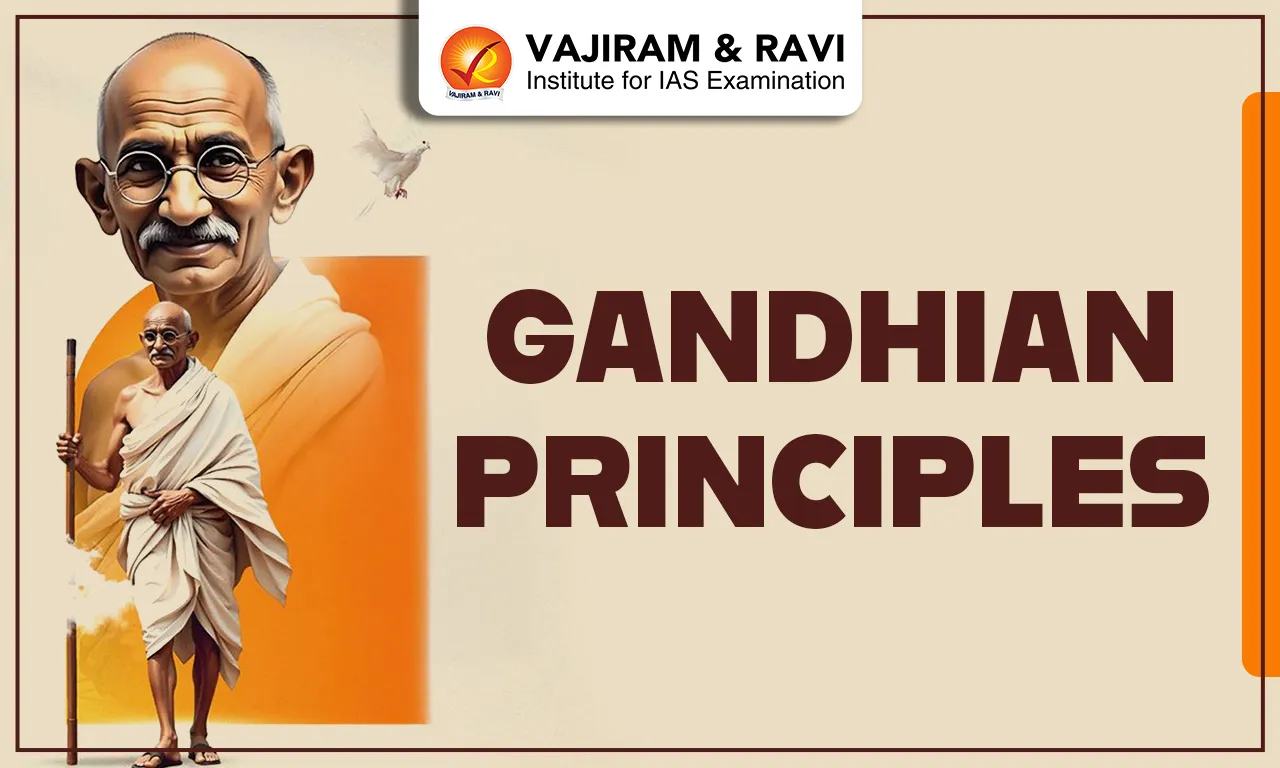
Gandhian Principles

Gandhian principles are the philosophical and ethical foundation laid by Mahatma Gandhi, one of the greatest leaders of the 20th century. Rooted in truth (Satya), non-violence (Ahimsa), self-reliance (Swadeshi), and Sarvodaya (welfare of all), these ideals shaped India’s freedom struggle and continue to influence governance, social justice, and development globally. Gandhi’s thought combined moral integrity with practical action, providing a timeless framework for human conduct and public life.

What are Gandhian Principles?

Gandhian principles refer to a moral and socio-political framework based on ethics, equality, justice, and compassion. Gandhi believed that true freedom could not be achieved without moral self-discipline and service to humanity. His philosophy was influenced by Hinduism, Jainism, Christianity, and Western thinkers like Tolstoy and Ruskin. These principles guided movements such as the Non-Cooperation Movement (1920), Civil Disobedience Movement (1930), and Quit India Movement (1942), which played crucial roles in India’s independence.

Gandhian Principles 11 Vows

The 11 core Gandhian Principles include- Satya, Ahimsa, Brahmacharya, Asteya, Aparigraha or Asangraha, Sharira-Shrama, Asvada, Abhaya, Sarva-Dharma-Samanatva, Swadeshi and Asprishyatanivarana. The key principles are:

  1. Satya (Truth): Truth or Satya was the foundation of Gandhi’s philosophy. He believed that truth is God and living truthfully is the highest moral duty. Gandhi practiced and preached honesty in thought, word, and action, even in difficult circumstances. According to him, truth is not just factual correctness but a way of life rooted in integrity, courage, and justice. His entire life and movements, including the freedom struggle, were based on this core principle of truth.
  2. Ahimsa (Non-Violence): Ahimsa or non-violence was Gandhi’s greatest weapon in the struggle for independence. He believed that real strength lies in the power to forgive and love even one’s enemy. Non-violence is not limited to physical harm but also includes avoiding hatred, anger, and cruelty in thoughts and words. Gandhi’s philosophy of Ahimsa influenced global leaders like Martin Luther King Jr. and Nelson Mandela, proving that moral courage can defeat injustice peacefully.
  3. Brahmacharya (Celibacy and Self-Discipline): Brahmacharya means control over the senses and thoughts, not just sexual restraint. Gandhi believed that celibacy helps channel one’s energy toward service, truth, and spirituality. He practiced self-discipline as a means of inner purification and mental clarity. According to him, controlling desires helps individuals rise above material temptations and focus on higher moral and spiritual goals, contributing to a more balanced and peaceful life.
  4. Asteya (Non-Stealing): Asteya or non-stealing extends beyond taking someone’s property, it also means not desiring or using more than what one truly needs. Gandhi said that exploiting others or wasting natural resources is also a form of theft. This principle promotes honesty, self-restraint, and fairness in personal and social life. Gandhi urged people to live simply and ethically, respecting others’ rights and contributing to a society based on justice and equality.
  5. Aparigraha (Non-Possession): Aparigraha means non-possession or non-attachment to material wealth. Gandhi believed that hoarding possessions leads to inequality and greed. He lived a simple life, owning only what was essential, and encouraged others to do the same. According to him, true happiness lies in minimalism and sharing resources with those in need. This principle supports economic equality and sustainability, forming the moral basis of Gandhi’s vision of a just and cooperative society.
  6. Sharira Shrama (Physical Labour or Bread Labour): Sharira Shrama means earning one’s living through honest physical labour. Gandhi believed that every person must contribute to society through productive work, irrespective of their social status. He promoted the dignity of labour and the idea that intellectual and manual work are equally valuable. Gandhi practiced spinning on the charkha as a symbol of self-reliance. This principle aimed to remove class divisions and inspire respect for all forms of work.
  7. Asvada (Control of Palate): Asvada or control of taste refers to moderation in eating and discipline over one’s desires. Gandhi viewed overeating or eating for pleasure as a form of greed that harms both body and mind. He followed a vegetarian diet and experimented with simple foods to maintain self-control. This principle encourages mindful consumption, balance, and respect for the body, promoting physical health and moral restraint as a path toward spiritual purity.
  8. Abhaya (Fearlessness): Abhaya means freedom from fear. Gandhi believed that fear is the root of falsehood, violence, and oppression. He urged individuals to live courageously, guided by truth and conscience rather than fear of consequences. Fearlessness, according to Gandhi, arises from faith in God and moral strength. This principle empowered millions of Indians to participate in the freedom struggle peacefully and confidently, without being afraid of imprisonment, violence, or death.
  9. Sarva-Dharma-Samanatva (Equal Respect for All Religions): Sarva-Dharma-Samanatva means equal respect and tolerance for all religions. Gandhi believed that every faith leads to the same truth and must be treated with dignity. He regularly read the Gita, Bible, and Quran, advocating interfaith harmony. This principle formed the spiritual foundation of secular India, promoting unity amid diversity. Gandhi’s respect for all religions inspired India’s constitutional commitment to religious freedom and mutual coexistence among communities.
  10. Swadeshi (Duty Towards Neighbour): Swadeshi means prioritizing one’s local community, economy, and resources. Gandhi emphasized self-reliance and the use of indigenous goods to promote national independence. According to him, serving one’s neighbour is the first step toward serving humanity. Swadeshi encourages sustainable living, local production, and empowerment of rural industries. Gandhi’s promotion of the spinning wheel (charkha) symbolized this principle, linking economic freedom with moral and national progress.
  11. Asprishyatanivarana (Removal of Untouchability): Asprishyatanivarana or the removal of untouchability was one of Gandhi’s lifelong missions. He believed that discrimination based on caste was against humanity and religion. Gandhi worked tirelessly for the upliftment of Dalits, whom he called Harijans (children of God). He campaigned for their right to education, temple entry, and equality in society. This principle aimed to establish a society based on equality, compassion, and moral unity among all human beings.

Gandhian Principles Applications

Gandhian philosophy remains deeply embedded in India’s governance and society. Many national programs reflect his ideals:

  • Swachh Bharat Abhiyan (2014): Inspired by Gandhi’s emphasis on cleanliness and sanitation.
  • Make in India & Atmanirbhar Bharat: Reflect the Swadeshi ideal of self-reliance.
  • Gram Swaraj and Panchayati Raj: Manifest Gandhi’s vision of village empowerment and decentralization.
  • Corporate Social Responsibility (CSR): Embodies the trusteeship model for social justice.
  • Non-violence in Diplomacy: India’s foreign policy emphasizes peaceful coexistence and moral leadership, echoing Gandhian ethics.
  • Gandhian institutions such as the Gandhi Peace Foundation, Sevagram Ashram, and Sabarmati Ashram continue to promote research and education on his philosophy.
  • The UN General Assembly declared October 2nd (Gandhi Jayanti) as the International Day of Non-Violence, acknowledging his global relevance.

Gandhian Principles in Contemporary World

Even in the 21st century, Gandhian thought offers answers to pressing global challenges:

  1. Environmental Sustainability: His advocacy for minimal consumption and simple living aligns with modern ecological ethics.
  2. Economic Equity: Trusteeship and Swadeshi support inclusive, sustainable economic growth.
  3. Peace and Conflict Resolution: Non-violence and dialogue remain essential for resolving global conflicts.
  4. Social Justice: His fight against untouchability and inequality continues to inspire human rights movements.
  5. Ethical Governance: Transparency, accountability, and moral leadership resonate with Gandhi’s concept of “Rama Rajya” (ideal governance).

Gandhian Principles in Education and Society

Gandhi’s Nai Talim (Basic Education) emphasized learning through productive work and moral development. Education, according to Gandhi, should combine head, heart, and hand, preparing individuals for self-reliant and ethical living. His educational model inspired community-based learning and vocational training initiatives across India.

Socially, Gandhi’s campaigns against untouchability, alcoholism, and gender inequality reshaped India’s moral and social landscape. His call for equality and dignity for every individual remains central to social reforms today.

Gandhian Principles Criticism

While widely admired, Gandhian principles have faced criticism:

  • Idealism vs. Practicality: Some argue that non-violence and trusteeship are utopian and difficult to apply in a competitive global economy.
  • Ambiguity: Critics claim Gandhi’s ideas on caste and industry were inconsistent.
  • Economic Limitations: Swadeshi and small-scale production may limit large-scale industrial growth.
  • Despite criticisms, Gandhi’s emphasis on ethical means over ends has kept his philosophy relevant, offering a moral compass amid political and economic turbulence.

Gandhian Principles Challenges

The major challenges faced in the implementation of Gandhian Principles has been given here along with the suggested reforms and way forward:

  1. Materialism and Consumerism: Modern lifestyles contradict simplicity and self-restraint. 
    • Way Forward: Promote sustainable consumption through awareness and education.
  2. Political Corruption: Erodes the ideal of truth and transparency.
    • Way Forward: Strengthen ethics in public administration and accountability mechanisms.
  3. Economic Inequality: Contradicts trusteeship and Sarvodaya.
    • Way Forward: Encourage equitable distribution and CSR initiatives.
  4. Religious Intolerance: Undermines communal harmony.
    • Way Forward: Promote interfaith dialogue and civic education.
  5. Environmental Degradation: Violates Gandhi’s principles of coexistence with nature.
    • Way Forward: Integrate Gandhian ecological ethics in development policies.

Gandhian Principles Global Influence

Gandhian thought transcended borders and inspired leaders worldwide:

  • Martin Luther King Jr. adopted non-violence in the American civil rights movement.
  • Nelson Mandela applied Satyagraha principles in South Africa’s anti-apartheid struggle.
  • Aung San Suu Kyi and César Chávez embraced Gandhian ideals in their political movements.
  • Gandhi’s legacy continues to guide global peace-building, human rights, and climate justice initiatives.

Gandhian Principles Influence on DPSP

The Directive Principles of State Policy (DPSP) in the Indian Constitution (Part IV, Articles 36-51) are deeply inspired by Gandhian philosophy. They aim to establish a just, equitable, and moral social order based on Gandhi’s ideals of Sarvodaya, self-reliance, village economy, and social justice. Articles like 40 (village panchayats), 43 (cottage industries), 47 (prohibition and public health), and 48 (animal welfare) directly reflect his thoughts. The DPSPs transform Gandhi’s ethical vision into constitutional goals for governance and welfare of all.

Gandhian Principles UPSC

Gandhian principles represent an enduring philosophy of life, politics, and morality. They advocate for a world built on truth, non-violence, justice, and compassion. In an era marked by inequality, conflict, and environmental crises, Gandhi’s vision offers a blueprint for sustainable peace and ethical progress. His teachings remind humanity that real freedom lies not in power or wealth, but in moral strength, service, and universal love, values that remain as essential today as they were a century ago.

Gandhian Principles FAQs

Q1: What are Gandhian Principles?

Ans: Gandhian Principles are the moral and social values taught by Mahatma Gandhi, focusing on truth, non-violence, simplicity, and service to humanity.

Q2: How do Gandhian Principles influence Indian governance?

Ans: They inspire the Directive Principles of State Policy (DPSP), guiding policies on village development, social justice, and economic equality.

Q3: What is the meaning of Sarvodaya in Gandhian philosophy?

Ans: Sarvodaya means “welfare of all,” reflecting Gandhi’s vision of equal growth and happiness for every section of society.

Q4: What does Swadeshi mean according to Gandhi?

Ans: Swadeshi means using locally made products and promoting self-reliance to strengthen the country’s economy and reduce dependence on foreign goods.

Q5: How is Gandhi’s idea of cleanliness followed today?

Ans: Gandhi’s belief in hygiene and sanitation inspired the Swachh Bharat Abhiyan, promoting cleanliness as a civic and moral responsibility.

Cabinet Ministers of India, List, Tenure, Roles, Responsibilities

Cabinet Ministers of India

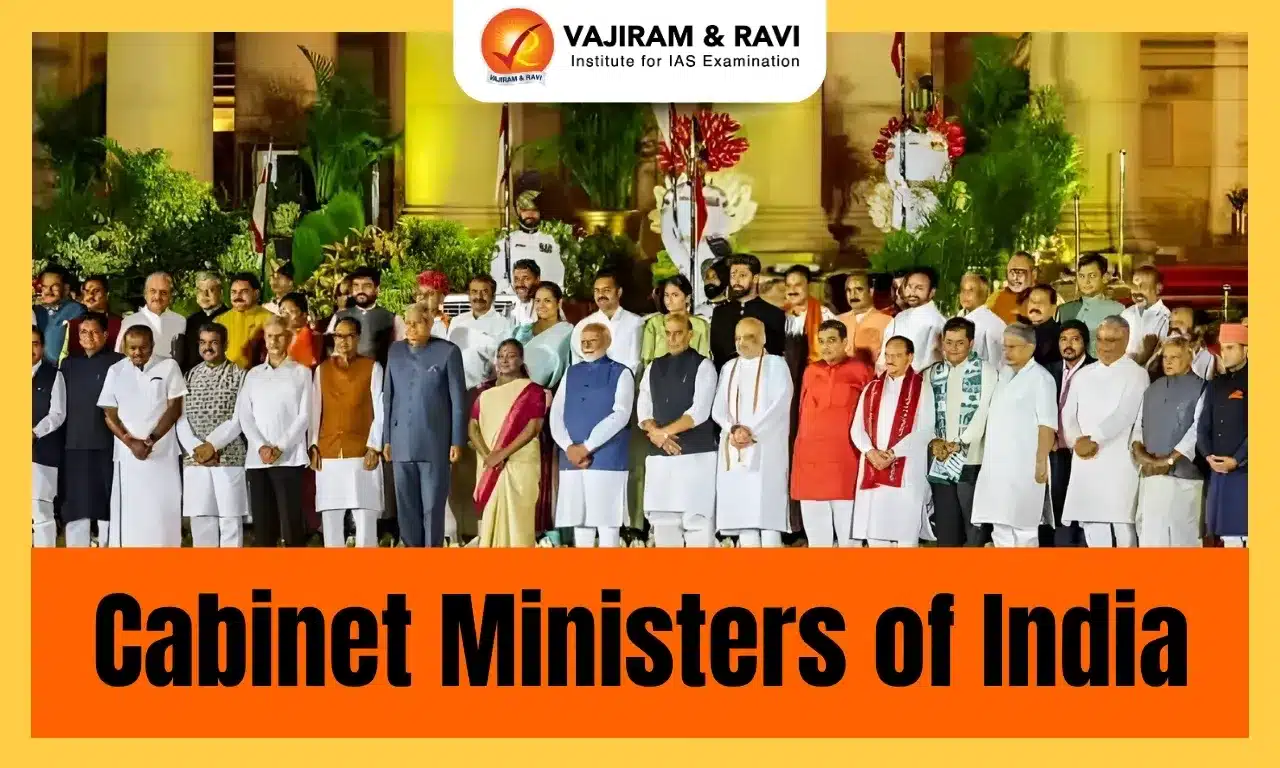
The Cabinet Ministers of India 2025 form the core of the Union Government, headed by Prime Minister Narendra Modi, who began his third term on 9 June 2024. The cabinet includes around 30 Cabinet Ministers, along with Ministers of State (Independent Charge) and Ministers of State. Each minister oversees important portfolios such as Defence, Home Affairs, Finance, External Affairs, and Education. Together, they work to implement government policies, ensure national development, and represent India’s diverse regions and interests.

Cabinet Ministers of India

The Cabinet Ministers of India have an important role in managing the governance of India. They are responsible for taking all the decisions in the executive branch. To understand the functioning of Cabinet Ministers of India, it is important to understand their structure, role and responsibilities, tenure and appointment process.

Cabinet Ministers of India 2025

Here is a list of Cabinet Ministers of India 2025 along with ministers and their portfolios: Here is the detailed List of Cabinet Ministers of India 2025.

Prime Minister

Sl. No. Ministers Portfolios

1

Narendra Modi, Prime Minister

Ministry of Personnel, Public Grievances and Pensions; Department of Atomic Energy; Department of Space

Cabinet Ministers

Sl. No. Cabinet Ministers Portfolios

1

Rajnath Singh

Minister of Defence

2

Amit Shah

Minister of Home Affairs; Minister of Cooperation

3

Nitin Gadkari

Minister for Road Transport & Highways

4

JP Nadda

Minister of Health; and Minister of Chemicals and Fertilizers

5

Shivraj Singh Chouhan

Minister of Agriculture and Farmers Welfare; Minister of Rural Development

6

Nirmala Sitharaman

Minister of Finance; Minister of Corporate Affairs

7

S Jaishankar

Ministry of External Affairs

8

Manohar Lal Khattar

Housing and Urban Affairs, Power

9

HD Kumaraswamy

Minister of Heavy Industries; Minister of Steel

10

Piyush Goyal

Minister of Commerce and Industry

11

Dharmendra Pradhan

Education Ministry

12

Jitan Ram Manjhi

Ministry of Micro, Small and Medium Enterprises

13

Lalan Singh

Minister of Panchayati Raj; Minister of Fisheries, Animal Husbandry and Dairying

14

Sarbananda Sonowal

Minister of Ports, Shipping and Waterways

15

Virendra Kumar

Minister of Social Justice and Empowerment

16

Ram Mohan Naidu

Aviation Ministry

17

Pralhad Joshi

Minister of Consumer Affairs

18

Jual Oram

Minister of Tribal Affairs

19

Giriraj Singh

Minister of Textiles

20

Ashiwnin Vaishnaw

Minister of Railways, Minister of Information and Broadcasting

21

Jyotiraditya Scindia

Minister of Development of North Eastern Region and Telecom

22

Bhupendra Yadav

Minister of Environment, Forest and Climate Change

23

Gajendra Singh Shekhawat

Minister of Culture; Minister of Tourism

24

Annapurna Devi

Minister of Women and Child Development

25

Kiran Rijiju

Minister of Parliamentary Affairs; Minister of Minority Affairs

26

Hardeep Singh Puri

Minister of Petroleum and Natural Gas

27

Mansukh Mandaviya

Minister of Labour and Employment; Minister of Youth Affairs and Sports

28

G Kishan Reddy

Minister of Coal, Mines

29

Chirag Paswan

Minister of Food Processing Industries

30

CR Patil

Minister of Jal Shakti

Cabinet Ministers of India Structure 

The Cabinet Ministers of India are responsible to collectively take decisions of the Government of India. The body is composed of various ministers each having different roles and responsibilities. 

  • Prime Minister: The Prime Minister is the head of the government of India and the leader of the executive branch. He is responsible for ensuring smooth functioning of the government and manages the setting of Agenda for the Cabinet. 
  • Cabinet Ministers: Cabinet Ministers consist of the senior ministers who head the important ministers like Defence, Finance, Home Affairs and External Affairs. These ministers participate in all the important policy discussions and decisions that are responsible for the functioning of the government. 
  • Ministers of State: These are junior-level ministers who may either be assigned independent charge of a ministry or be attached to Cabinet Ministers to assist them in managing their portfolios. They are often responsible for handling specific functions or departments within a larger ministry.
  • Deputy Ministers: Now relatively uncommon, Deputy Ministers were traditionally appointed to support Cabinet Ministers and Ministers of State in carrying out administrative responsibilities and coordinating routine functions.

Cabinet Ministers in India Roles and Responsibilities

The Cabinet Ministers of India are responsible for shaping and executing the government policy. Their roles and responsibilities cover areas like legislation, administration, delivery of public service all coming together and forming the backbone of India’s executive governance. Their Roles and Responsibilities include: 

  • Policy Formulation: Cabinet Ministers of India draft the national policies and legislative proposals. They help shape the overall strategic direction of the government. 
  • Administrative Leadership: Every Cabinet Minister is responsible for managing the functioning of a ministry. This includes handling budgets, implementing schemes, and ensuring the ministry's effective operation.
  • Legislative Participation: Cabinet Ministers are expected to actively participate in the legislative process in the form of introduction of bills, engaging in debates and raising questions in the parliament. 
  • Collective Responsibility: All Cabinet Ministers are collectively accountable to the Parliament. Even if a minister disagrees in internal discussions, they must publicly support Cabinet decisions as part of the principle of collective responsibility.

Cabinet Ministers Tenure and Appointment

The following is the appointment and tenure of Cabinet Ministers

  • Selection Process: The Cabinet Ministers are selected by the Prime Minister based on their competence, experience and political considerations. 
  • Formal Appointment: The President of India formally appoints the Cabinet Minister in accordance with Article 75 of the Constitution on the advice of the Prime Minister. 
  • Tenure: The Cabinet Ministers are appointed for a tenure of 5 years, same as that of the Prime Minister. 
  • Resignation and Removal Ministers can resign or be removed at the discretion of the Prime Minister. The President acts on the Prime Minister’s advice in such matters.
Also Check Related Post
Vice Presidents of India Education Ministers of India
Foreign Ministers of India Finance Ministers of India
Cabinet Ministers of India Prime Ministers of India
Deputy Prime Minister of India Presidents of India
Ministry of External Affairs

Cabinet Ministers of India FAQs

Q1: Who are the 29 cabinet ministers of India?

Ans: The list of the 29 Cabinet Ministers of India is available on the official website of the Government of India and changes with cabinet reshuffles.

Q2: Who are called cabinet ministers in India?

Ans: Cabinet Ministers are senior members of the Council of Ministers who head key ministries and are part of the Prime Minister’s core decision-making team.

Q3: Is the PM a cabinet minister?

Ans: Yes, the Prime Minister is the head of the Cabinet and the most senior Cabinet Minister.

Q4: How is a cabinet minister appointed?

Ans: Cabinet Ministers are appointed by the President of India on the recommendation of the Prime Minister.

Q5: What constitutional article presents Cabinet Minister in India?

Ans: Article 74 and Article 75 of the Indian Constitution deal with the appointment, role, and tenure of Cabinet Ministers.

Important Days in January 2025, National & International List

Important Days in January 2025

The Important Days in January 2025 include very significant historical, cultural, National and International events. The month of January holds an important place especially in India due to the major festivals like Lohri, Makar Sankranti being celebrated in this month. This month is remembered for the commemorations that emphasize the importance of education, technology, human rights and youth empowerment. 

Important Days in January 2025

January 2025 is a month filled with significant observances. World Braille Day, celebrated on 4th January, raises awareness about the rights and inclusion of individuals with disabilities. Pravasi Bharatiya Divas on 11th January honors the achievements and contributions of Non-Resident Indians. National Youth Day, observed on 12th January, emphasizes empowering young minds to positively impact society. Republic Day, celebrated on 26th January, showcases India’s rich cultural heritage and military strength. This month is marked by both national and international days of importance, each carrying a unique message and purpose. 

Important Days in January

Important Days in January 2025 include all days that hold national and international significance and have been recognised for their major events and recognition. These events either have a major impact on Indian society or all over the world. 

Important Days in January 2025

Date 

Event/Occasion 

January 1 (Wednesday)

New Year’s Day, Global Family Day

January 4 (Saturday)

World Braille Day

January 6 (Monday)

Epiphany, National Technology Day

January 9 (Thursday)

Pravasi Bharatiya Divas (NRI Day)

January 10 (Friday)

World Hindi Day

January 12 (Sunday)

National Youth Day (India), 

January 13 (Monday)

Lohri

January 14 (Tuesday)

Makar Sankranti, Pongal, Magh Bihu

January 15 (Wednesday)

Indian Army Day

January 18 (Saturday)

National Immunization Day

January 19 (Sunday)

World Religion Day

January 23 (Thursday)

Netaji Subhas Chandra Bose Jayanti

January 24 (Friday)

International Day of Education, National Girl Child Day (India)

January 25 (Saturday)

National Tourism Day (India), Voters’ Day

January 26 (Sunday)

Republic Day (India), International Customs Day

January 27 (Monday)

International Holocaust Remembrance Day

January 28 (Tuesday)

Data Privacy Day

January 30 (Thursday)

Martyrs’ Day (India), World Leprosy Day

List of Important Days in January 2025

1st January – New Year’s Day

New Year’s Day is important as it marks the beginning of a new year that acknowledges worldwide celebrations and resolutions. The day comes along with new opportunities and rejuvenation. This day also commemorates Global Family Day that promotes harmony and generosity along with worldwide human family. 

4th January – World Braille Day 

Observed on January 4, World Braille Day acknowledges the significance of Braille as a tool for communication that allows individuals who are blind or have any visual impairment to completely realise their human rights.

9th January – Pravasi Bharatiya Divas (NRI Day)

Pravasi Bhartiya Diwas, observed on 9 January every year, highlights the contributions of the overseas Indian Community in India’s development. The day is also a reminder of the return of Mahatma Gandhi from South Africa in 1915. 

12th January – National Youth Day (India)

National Youth Day is also known as Rashtriya Yuva Diwas and is celebrated as the birth anniversary of Swami Vivekananda. The day spreads awareness about the rights of individuals in India and motivates the youth to create a better future inspired by the teachings of Vivekananda.

13th January – Lohri 

Lohri, a festival of Punjab, marks the end of winter days and the arrival of longer days. The day is celebrated by bonfires, dancing, feasting and symbolises joy and prosperity. 

14th January – Makar Sankranti, Pongal, Magh Bihu 

Makar Sankriti celebrated all over India, marks the transition of sun into the Capricorn zodiac, marking longer days. The day is celebrated in Tamil Nadu as Pongal, the harvest festival that honors the sun god. The day is also celebrated as Magh Bihu in Assam by feasting and community celebrations. 

15th January – Indian Army Day

Indian Army Day highlights the bravery and sacrifices of the Indian Army personnel who secure the nation borders and ensure national security. The day pays tribute to the armed forces in the form of parades and ceremonies. 

18th January – National Immunisation Day 

National Immunisation Day encourages vaccinations as an important measure of disease prevention. The day aims to spread awareness about the benefits of immunisation, especially in rural areas ensuring access to life-saving vaccines. 

19th January – World Religion Day

World Religion Day is celebrated every third Sunday of January and was set up by the National Spiritual Assembly of the Baha’s in 1950. The day promotes interfaith understanding and peace among various religious communities. 

24th January – International Day of Education

The International Day of Education 2025 emphasises the power of education that equips individuals and communities and navigates the influence of technological advancements. The theme for International Day of Education 2025 is “ AI and Education: Preserving Human Agency in the World of Automation.”.

26th January – Republic Day (India)

Celebrated on 26 January every year, Republic Day of India honors the adoption of the Indian Constitution and India’s transition to becoming a republic. The day is celebrated by parades, speeches and cultural events and ceremonies. 

28th January – Data Privacy Day 

Celebrated on 28 January every year, Data Privacy Day spreads awareness about the significance of personal data protection and information especially in the digital age. The day will educate individuals and organizations about securing and safeguarding the online identities and promising data privacy. 

30th January – Martyrs’ Day (India)

Observed on 30 January every year, Martyrs’ Day marks the death anniversary of Mahatma Gandhi. The day observes the sacrifices of unsung heroes and freedom fighters who sacrificed their lives for independent India. 

Important Days in January 2025 FAQs

Q1: What are special days in January?

Ans: January hosts several special days, including World Braille Day (4th), Pravasi Bharatiya Divas (9th), National Youth Day (12th), Indian Army Day (15th), and Republic Day (26th), among others.

Q2: What is special on 8 January?

Ans: January 8 does not have any widely recognized national observance in India.

Q3: How many national days are there in India?

Ans: India celebrates three national days: Republic Day (26th January), Independence Day (15th August), and Gandhi Jayanti (2nd October).

Q4: What are the important days in January?

Ans: Important days in January include World Braille Day (4th), Pravasi Bharatiya Divas (9th), National Youth Day (12th), Lohri (13th), and Republic Day (26th).

Q5: What special dates are in January?

Ans: Special dates in January include 4th (World Braille Day), 9th (Pravasi Bharatiya Divas), 12th (National Youth Day), and 26th (Republic Day).

UPSC Daily Quiz 3 November 2025

UPSC Daily Quiz

The Daily UPSC Quiz by Vajiram & Ravi is a thoughtfully curated initiative designed to support UPSC aspirants in strengthening their current affairs knowledge and core conceptual understanding. Aligned with the UPSC Syllabus 2025, this daily quiz serves as a revision resource, helping candidates assess their preparation, revise key topics, and stay updated with relevant issues. Whether you are preparing for Prelims or sharpening your revision for Mains, consistent practice with these Daily UPSC Quiz can significantly enhance accuracy, speed, and confidence in solving exam-level questions.

[WpProQuiz 13]

UPSC Daily Quiz FAQs

Q1: What is the Daily UPSC Quiz?

Ans: The Daily UPSC Quiz is a set of practice questions based on current affairs, static subjects, and PYQs that help aspirants enhance retention and test conceptual clarity regularly.

Q2: How is the Daily Quiz useful for UPSC preparation?

Ans: Daily quizzes support learning, help in revision, improve time management, and boost accuracy for both UPSC Prelims and Mains through consistent practice.

Q3: Are the quiz questions based on the UPSC syllabus?

Ans: Yes, all questions are aligned with the UPSC Syllabus 2025, covering key areas like Polity, Economy, Environment, History, Geography, and Current Affairs.

Q4: Are solutions and explanations provided with the quiz?

Ans: Yes, each quiz includes detailed explanations and source references to enhance conceptual understanding and enable self-assessment.

Q5: Is the Daily UPSC Quiz suitable for both Prelims and Mains?

Ans: Primarily focused on Prelims (MCQ format), but it also indirectly helps in Mains by strengthening subject knowledge and factual clarity.

Longest Bridge in India, List of Longest Bridges in India

Longest Bridge in India

List of Longest Bridge in India 2025: Bridges are vital structures that span water bodies, valleys, or roads, facilitating smooth travel and transport. The Indian engineers community has risen to the occasion, constructing a variety of bridges, including roadways, rail-cum-road bridges, and other remarkable innovations. These structures not only represent the country’s engineering efficiencies but also serve as vital links between regions, stimulating economic growth by connecting key locations. Bridges in India form an integral part of the nation's infrastructure, enhancing connectivity and boosting overall productivity.

Longest Bridge in India 2025

The Dhola–Sadiya Bridge, officially known as the Dr. Bhupen Hazarika Setu, is the Longest Bridge in India 2025. Spanning approximately 9.15 kilometers over the Lohit River, a tributary of the Brahmaputra in Assam, it connects Dhola in Tinsukia district with Sadiya near Arunachal Pradesh. Inaugurated in May 2017, the bridge plays a vital role in improving road connectivity, boosting regional trade, and enhancing defense movement in India’s northeastern region.

List of Longest Bridge in India 2025

Dr. Bhupen Hazarika Bridge stands as the longest river bridge in India, stretching 9.15 kilometers over the Brahmaputra River in Assam. The bridge plays a vital role in improving connectivity between the northern and southern banks of the Brahmaputra River, offering enhanced transportation for both passengers and goods. Below is a List of Longest Bridge in India 2025:

List of Longest Bridge in India 2025
 

Name

Distance

Year of Opening

Connecting

Water Body/Location

1

Dhola Sadiya bridge

9.15 Km

2017

Assam and Arunachal Pradesh

Lohit River, Tinsukia, Assam

2

Dibang River Bridge

6.2 Km

2018

Arunachal Pradesh

Dibang River

3

Mahatma Gandhi Setu

5.75 Km

1982

South Patna to Hajipur

Ganga, Patna, Bihar

4

Bandra-Worli Sea Link (BWSL)

5.57 Km

2009

Bandra to Worli (South Mumbai)

Mahim Bay, Mumbai

5

Bogibeel Bridge

4.94 Km

2018

Dhemaji to Dibrugarh

Brahmaputra River, Assam

6

Vikramshila Setu

4.70 Km

2001

Bhagalpur to Naugachia

Ganga, Bhagalpur, Bihar

7

Vembanad Rail Bridge

4.62 Km

2011

Edappally to Vallarpadam

Vembanad Lake, Kochi, Kerala

8

Digha–Sonpur Bridge

4.55 Km

2016

Digha, Patna to Sonpur, Saran

Ganga, Patna, Bihar

9

Arrah–Chhapra Bridge

4.35 Km

2017

Arrah to Chhapra

Ganga, Saran, Bihar

10

Godavari Bridge

4.13 Km

2015

Kovvur to Rajahmundry

Godavari river, Rajahmundry, Andhra Pradesh

Second Longest Bridge in India

The Dibang River Bridge, also known as the Sisseri Bridge, is the Second Longest Bridge in India. Located in Arunachal Pradesh, it spans around 6.2 kilometers and connects important regions in the northeast, improving connectivity to the India-China border areas. This engineering marvel plays a crucial role in enhancing transportation and defense logistics in the region.

Top 10 Longest Bridge in India

Here is a brief description for the Top 10 Longest Bridge in India:

Dhola Sadiya Bridge (9.15 km)

The Dhola Sadiya Bridge, also called the Bhupen Hazarika Setu, is the Longest Bridge in India that spans over water. Stretching across the Brahmaputra River, this 9.15 km bridge was inaugurated by Prime Minister Narendra Modi. It connects the state of Assam to Arunachal Pradesh, reducing the distance between the two regions by 165 km and saving up to 5 hours of travel time. The bridge plays a vital role in improving regional connectivity and facilitating economic growth.

Dibang River Bridge (6.2 km)

The Dibang River Bridge, also known as the Sikang Bridge, is the second Longest Bridge in India, measuring 6.2 km in length. Located in Arunachal Pradesh, this bridge is crucial for national security, significantly reducing the time required for the Indian Army to access the China border.

Mahatma Gandhi Setu (5.6 km)

Bridge Over the Ganges Connecting Patna and Hajipur in Bihar, the Mahatma Gandhi Setu was once the Longest Bridge in India. Measuring 5.6 km, it stands as a major transportation over the Ganges River. Inaugurated by Indira Gandhi in 1982, it continues to be a key landmark and tourist attraction in Bihar.

Bandra Worli Sea Link (5.57 km) 

The Bandra Worli Sea Link, also known as the Rajiv Gandhi Sea Link, is a cable-stayed bridge that links Bandra to Worli in Mumbai. Spanning 5.57 km, it is not only a major traffic route but also an important part of Mumbai’s skyline. The bridge is a crucial part of the Western Freeway Project.

Bogibeel Bridge (4.94 km)

The Bogibeel Bridge is the longest rail-cum-road bridge in India, measuring 4.94 km. This strategic bridge connects Dhemaji and Dibrugarh districts, and is built to withstand earthquakes of up to magnitude 7. It is Asia’s second-longest such bridge and serves both civilian and military purposes.

Vikramshila Setu (4.7 km)

The Vikramshila Setu, spanning 4.7 km, crosses the Ganges River near Bhagalpur, Bihar. It is named after the ancient Vikramashila Mahavihara. This bridge is an important link for the region’s economic activities, reducing travel time and boosting connectivity.

Vembanad Rail Bridge (4.62 km)

The Vembanad Rail Bridge in Kerala is the Longest Railway Bridge in India at 4.62 km. This bridge connects Edappally and Vallarpadam in Kochi, primarily serving freight trains. It is set against the backdrop of Vembanad Lake, Kerala’s largest lake.

Digha Sonpur Bridge (4.55 km)

The Digha Sonpur Rail Road Bridge, also known as the J.P. Setu, connects Digha Ghat and Pahleja Ghat in Bihar. At 4.55 km, it is a vital infrastructure link, facilitating both road and rail transport between the northern and southern parts of the state.

Arrah Chhapra Bridge (4.35 km)

The Arrah Chhapra Bridge, also known as the Veer Kunwar Singh Setu, is a multi-span bridge across the Ganges River. Measuring 4.35 km, it has significantly reduced travel time between Arrah and Chhapra, promoting economic and cultural exchange between the two regions.

Godavari Bridge (4.13 km)

The Godavari Fourth Bridge, or Kovvur-Rajahmundry 4th Bridge, spans 4.13 km across the Godavari River in Andhra Pradesh. This bridge plays a crucial role in reducing the travel distance between Kolkata and Chennai, making the transportation and boosting regional economic integration easy.

Longest Bridge in India FAQs

Q1: Which is the Longest Bridge in India?

Ans: Dhola Sadiya bridge (Dr. Bhupen Hazarika Bridge) is the longest bridge in India.

Q2: Which is the longest rail cum road bridge in India?

Ans: Bogibeel Bridge is the longest rail cum road bridge in India.

Q3: What is the length of the Longest Bridge in India?

Ans: 9.15 Km is the length of the Longest Bridge in India.

Q4: What is the length of the longest rail cum road bridge in India?

Ans: 4.94 Km is the length of longest rail cum road bridge in India.

Q5: Which is the second Longest Bridge in India?

Ans: Dibang River Bridge is the second Longest Bridge in India.

Difference Between Culture and Civilization, Aspects, Relations, Examples

Difference Between Culture and Civilization

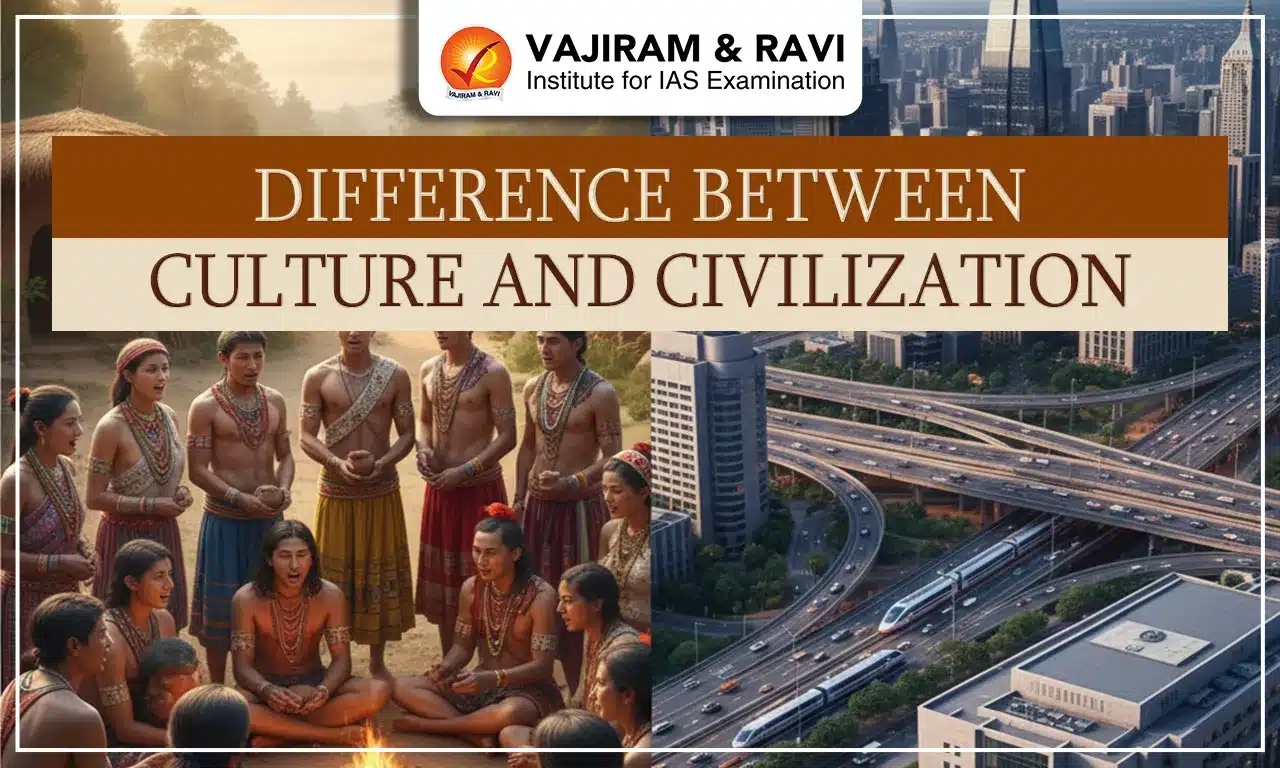
The terms culture and civilization are often used interchangeably, but they represent two distinct aspects of human society. Both are essential to understanding human progress, yet there is a Difference Between Culture and Civilization in scope, meaning, and expression. Culture reflects the values, beliefs, traditions, and artistic expressions of a society, while civilization represents its advanced stage of material, institutional, and technological development.

Difference Between Culture and Civilization

The Difference Between Culture and Civilization lies not in opposition but in purpose, culture refines the inner self, while civilization builds the outer world. Together, they form the twin pillars of human progress. India’s long history exemplifies that sustainable growth depends on harmonizing spiritual values with material advancement.

What is Culture?

Culture is the collective identity of a community. It encompasses customs, traditions, values, languages, arts, religion, food habits, and social norms that define the way people live and interact. According to Edward B. Tylor, culture is “that complex whole which includes knowledge, belief, art, morals, law, customs, and any other capabilities acquired by man as a member of society.”

In India, culture is diverse and deeply rooted in its spiritual and social fabric. Every region, from the folk dances of Rajasthan to the classical music of Tamil Nadu, represents a unique cultural expression. It is transmitted from generation to generation through socialization and education, shaping collective identity and guiding behavior.

Culture Aspects

The major aspects of the Culture has been listed below:

  • Language and Literature: Examples include Sanskrit, Tamil, Hindi, Urdu, and regional literatures that preserve knowledge.
  • Art and Architecture: The Ajanta caves, Mughal paintings, and temple sculptures display India’s cultural depth.
  • Religious Beliefs: Hinduism, Buddhism, Jainism, Islam, Sikhism, and Christianity have coexisted and evolved harmoniously.
  • Customs and Rituals: Practices like Namaste, festivals such as Diwali, Eid, and Christmas, express social unity.
  • Social Values: Respect for elders, community living, and family bonding form the base of Indian culture.

What is Civilization?

Civilization represents the advanced stage of human social and material development characterized by organized governance, technology, economy, and urbanization. It is the external manifestation of human progress, visible in architecture, science, governance, and institutions.

According to Samuel Huntington, civilization is “the highest cultural grouping of people and the broadest level of cultural identity.” Civilization is, therefore, a comprehensive system where multiple cultures coexist under shared political, economic, and social structures.”

The Indus Valley Civilization (2500 BCE) is one of the earliest examples of civilization in India. It had planned cities like Mohenjo-Daro and Harappa, drainage systems, and trade networks showing the material and institutional development of human society.

Civilization Features

The major features of the civilization has been listed below:

  • Urban Development: Planned cities and infrastructure.
  • Political Organization: Centralized administration and laws.
  • Economic Growth: Trade, agriculture, and specialized occupations.
  • Scientific and Technological Progress: Innovations in metallurgy, medicine, and astronomy.
  • Cultural Integration: Interaction among multiple cultural groups.

Difference Between Culture and Civilization Aspects

While culture represents the inner growth of human beings, civilization is the outward expression of that growth. Both complement each other, but their essence lies in different dimensions of human development.

Difference Between Culture and Civilization
Aspects Culture Civilization

Meaning

Culture refers to values, beliefs, customs, and traditions of society.

Civilization refers to the advanced stage of material and institutional development.

Nature

Internal and spiritual.

External and material.

Focus

Moral, ethical, and emotional growth.

Technological, administrative, and structural progress.

Growth Source

Grows from shared values and social interaction.

Grows from innovation, science, and governance.

Change

Changes slowly through tradition and social reform.

Changes rapidly through technology and modernization.

Scope

Narrower- deals with behavior and thought.

Broader- deals with organization and systems.

Dependency

Civilization may exist without culture’s depth.

Culture cannot sustain without civilization’s structure.

Examples

Indian spirituality, art, music, festivals.

Indus Valley, Mesopotamian, Egyptian, Western civilization.

Representation

Expressed through customs and beliefs.

Expressed through infrastructure and institutions.

Objective

To improve the quality of life emotionally and spiritually.

To improve comfort and efficiency materially.

Relationship Between Culture and Civilization

Although there is a Difference Between Culture and Civilization, they are interdependent. A civilization without cultural roots loses its identity, while culture without civilizational support struggles to survive. For instance, ancient India’s civilization thrived because of its deep cultural values of Dharma and collective ethics.

Civilization provides the framework- education, governance, and economy; while culture gives meaning and soul to those structures. The balance between both ensures sustainable progress, as seen in India’s evolution through the Vedic, Mauryan, and Gupta periods where spiritual and material advancements complemented each other.

Difference Between Culture and Civilization in India

India stands as a living example where culture and civilization have evolved together for thousands of years. Indian civilization is one of the world’s oldest, with archaeological, linguistic, and literary evidence showcasing continuity from the Indus Valley Civilization to the modern Republic of India.

  • Spiritual and Philosophical Heritage: Ancient texts like the Vedas, Upanishads, and Arthashastra contributed to India’s intellectual and civilizational depth.
  • Social Organization: The varna system, though later distorted, originally aimed to organize society based on functions and duties.
  • Scientific Progress: Ancient India contributed in mathematics (Aryabhata’s zero), medicine (Charaka Samhita), and architecture.
  • Urban Development: Cities like Pataliputra and Taxila symbolized administrative and educational advancements.
  • Continuity of Values: Despite colonization, India’s civilizational ethos, unity in diversity, has remained intact.

Difference Between Culture and Civilization Philosophical Interpretations

Various thinkers have interpreted the Difference Between Culture and Civilization differently:

  • Mahatma Gandhi viewed civilization as outward progress but believed that true advancement lies in moral and spiritual culture.
  • Arnold Toynbee argued that civilizations rise and fall based on their moral and spiritual vitality.
  • Swami Vivekananda emphasized that material progress must go hand in hand with spiritual and cultural evolution.
  • These interpretations underline the idea that civilization is sustainable only when rooted in strong cultural values.

Difference Between Culture and Civilization Examples

The key examples defining the Difference Between Culture and Civilization in the World History is given below:

  1. Ancient Egypt: Flourished through scientific and architectural progress but declined when moral corruption spread.
  2. Greek Civilization: Excelled in philosophy and governance, blending culture (ethics and arts) with civilization (institutions).
  3. Roman Civilization: Reached heights of infrastructure but collapsed under moral and social decay, showing imbalance between culture and civilization.
  4. Indian Civilization: Survived multiple invasions due to its adaptable and value-based culture.

Culture and Civilization Impact of Modernization

Modernization and globalization have blurred the boundaries between culture and civilization. Technological advancements have accelerated civilizational progress, but they have also challenged traditional cultural norms. In India, while the civilizational progress is visible through urbanization and economic reforms, cultural shifts such as westernization and consumerism have raised concerns about value preservation.

Positive Impacts:

  • Increased cultural exchange through digital media.
  • Preservation of heritage via modern technology.
  • Improvement in education, healthcare, and governance systems.

Negative Impacts:

  • Erosion of traditional values.
  • Homogenization of diverse cultural identities.
  • Overemphasis on material success over ethical living.

Culture and Civilization in India

India’s ability to balance culture and civilization is evident through its historical resilience. Even after colonial exploitation, India revived its cultural heritage through democratic governance and socio-economic reforms. The coexistence of spirituality (culture) with modern institutions (civilization) is reflected in:

  • The Indian Constitution, which upholds equality, secularism, and liberty rooted in civilizational ethics.
  • National symbols like the Ashoka Chakra, representing Dharma and progress.
  • Programs like Ek Bharat Shreshtha Bharat, promoting cultural unity alongside civilizational development.

Culture and Civilization Challenges

Major Challenges in balancing the Culture and Civilization has been listed below along with the suggested reforms. A balanced approach ensures that civilizational growth does not overpower cultural depth, preserving the moral foundation of society.

  • Cultural Erosion: Rapid globalization has weakened traditional practices.
  • Urbanization Pressure: Civilizational growth sometimes leads to loss of rural heritage.
  • Language Decline: Indigenous languages face extinction due to western influence.
  • Moral Crisis: Focus on material progress has led to ethical degradation.
  • Technological Divide: Unequal access affects inclusive civilizational growth.

Way Forward:

  • Cultural Preservation: Encourage local arts, crafts, and languages through education.
  • Inclusive Development: Blend traditional wisdom with modern innovation.
  • Ethical Governance: Promote values of integrity, justice, and empathy.
  • Sustainable Civilization: Integrate ecological balance with technological progress.
  • Education Reform: Include moral and cultural studies alongside technical education.

Difference Between Culture and Civilization FAQs

Q1: What is the main Difference Between Culture and Civilization?

Ans: Culture refers to the values and beliefs of a society, while civilization denotes its material and institutional progress.

Q2: Can Civilization exist without Culture?

Ans: Civilization may exist temporarily without culture, but it becomes hollow and unsustainable without moral and ethical roots.

Q3: Who first defined Culture in Anthropological terms?

Ans: Edward B. Tylor first defined culture as the complete whole of human knowledge, belief, art, and customs.

Q4: How is Indian Civilization unique from others?

Ans: India’s civilization is continuous, spiritually rooted, and adaptive, preserving its cultural essence across centuries.

Q5: What are the major challenges in balancing Culture and Civilization?

Ans: The key challenges in balancing the culture and civilization are: Cultural Erosion, Urbanization Pressure, Language Decline, Moral Crisis and Technological Divide.

Exercise ‘Poorvi Prachand Prahar

Exercise 'Poorvi Prachand Prahar

Exercise 'Poorvi Prachand Prahar Latest News

India to hold tri-service exercise 'Poorvi Prachand Prahar in Mechuka, Arunachal Pradesh.

About Exercise 'Poorvi Prachand Prahar

  • It is a tri-service military exercise conceived as a forward-looking exercise, which will validate multi-domain integration across land, air, and maritime fronts.
  • It will be held in Mechuka, Arunachal Pradesh.
  • Aim: It is aimed at enhancing warfighting capabilities, technological adaptation, and operational synergy among the Army, Navy, and Air.
  • It refines interoperability, improves situational awareness, and validates command-and-control structures for joint missions.
  • Focus: The exercise focuses on multi-domain integration — across land, air and maritime domains — to enhance operational synergy, technological adaptation, and readiness for future conflicts.
  • The exercise involves coordinated employment of special forces, unmanned platforms, precision systems and networked operations centres operating in unison under realistic high-altitude conditions.
  • Previous Exercises: ‘Poorvi Prachand Prahar’ follows previous tri-service drills — ‘Bhala Prahar’ (2023) and ‘Poorvi Prahar’ (2024). 

Source: IE

Exercise 'Poorvi Prachand Prahar FAQs

Q1: Where is Exercise 'Poorvi Prachand Prahar conducted?

Ans: Arunachal Pradesh

Q2: What is the primary objective of Exercise poorvi Prachand Prahar?

Ans: It validates multi-domain integration across land, air, and maritime fronts.

National Beekeeping and Honey Mission

National Beekeeping and Honey Mission

National Beekeeping and Honey Mission Latest News

The National Beekeeping & Honey Mission (NBHM) launched in 2021 by the Government of India which is driving the ambitious "Sweet Revolution”.

About National Beekeeping and Honey Mission

  • It is a Central Sector Scheme launched by the Government of India.
  • It focuses on overall promotion and development of scientific beekeeping and the production of quality honey and other beehive products.
  • It is implemented through the National Bee Board (NBB).
  • Funding:  ₹500 crore for three years (2020–21 to 2022–23) and has been extended for another three years (2023–24 to 2025–26).
  • It is being implemented through 3 Mini Missions (MMs)
    • Mini Mission-I: Under this Mission, thrust will be given on production & productivity improvement of various crops through pollination assisted by adoption of scientific beekeeping;
    • Mini Mission-II: This Mission will concentrate on post-harvest management of beekeeping/beehive products including collection, processing, storage, marketing, value addition, etc.
    • Mini Mission-III: This Mission will concentrate on research & technology generation for different regions/states/agro-climatic and socio-economic conditions.

Objectives of National Beekeeping and Honey Mission

  • Income & employment generation: Promoting holistic growth of the beekeeping industry for providing livelihood support to farm and non-farm households.
  • Infrastructure Development: Developing additional infrastructural facilities for developing quality nucleus stock of honeybees, multiplication of stock by bee breeders and post-harvest and marketing infrastructures.
  • Quality Control: Setting up of state-of-the-art Labs for testing of honey & other beehive products at regional levels and Mini/Satellite Labs at district levels.
  • Traceability: To develop blockchain/ traceability system for of source of honey & other beehive products and using IT tools in beekeeping, including online registration, etc.;
  • Skill Development: To promote, develop and disseminate latest technologies and skill development in beekeeping industry for production of honey & other high value beehive products;
  • Institutional Framework: Strengthening beekeepers through collective approaches like SHGs, FPOs, and cooperatives.

Source: PIB

National Beekeeping and Honey Mission FAQs

Q1: What is the primary objective of the National Beekeeping and Honey Mission (NBHM)?

Ans: To develop the beekeeping industry and increase honey production.

Q2: Which ministry is responsible for implementing the National Beekeeping and Honey Mission (NBHM)?

Ans: Ministry of Agriculture and Farmers' Welfare

Gogabeel Lake

Gogabeel Lake

Gogabeel Lake Latest News

India’s one more wetland, Gogabeel Lake in Katihar district of Bihar, has got a tag of international importance as a Ramsar site.

About Gogabeel Lake

  • Location: It is a part of trans-Gangetic plains of land located in the state of Bihar.
  • Gogabil lake is an ‘ox-bow’ type of wetland.
  • It is flanked by the river Mahananda to the North-East and the river Ganga to the South.
  • It was declared Bihar's first ‘Community Reserve’.
  • Local cultural traditional festivals like Sirva, Adra , Chhat are observed in this wetland.

Flora and Fauna of  Gogabeel Lake

  • Flora: These natural landscapes consist of tropical dry deciduous forests.
  • Fauna: It provides wintering habitat to several migratory bird species and species of global conservation significance.
  • It is home to the Smooth Coated Otter (Lutrogale perspici lata) and Helicopter Catfish (Wa lago attu).
  • It serves as a breeding ground for Vulnerable fish species Walago attu.

What is the Ramsar Convention?

  • The Ramsar Convention was signed in 1971 is a landmark international treaty dedicated to the conservation and sustainable use of wetlands.
  • It aims to conserve and promote the wise use of wetlands through local, national, and international cooperation for sustainable development.

Source: TOI

Gogabeel Lake FAQs

Q1: What is the significance of Gogabeel Lake in Bihar?

Ans: It's Bihar's first community reserve.

Q2: What type of lake is Gogabeel?

Ans: Ox-bow lake

Water Lettuce

Water Lettuce

Water Lettuce Latest News

El Salvador’s Lake Suchitlan is overwhelmed by invasive water lettuce which is impacting thousands of families dependent on fishing and tourism. 

About Water Lettuce

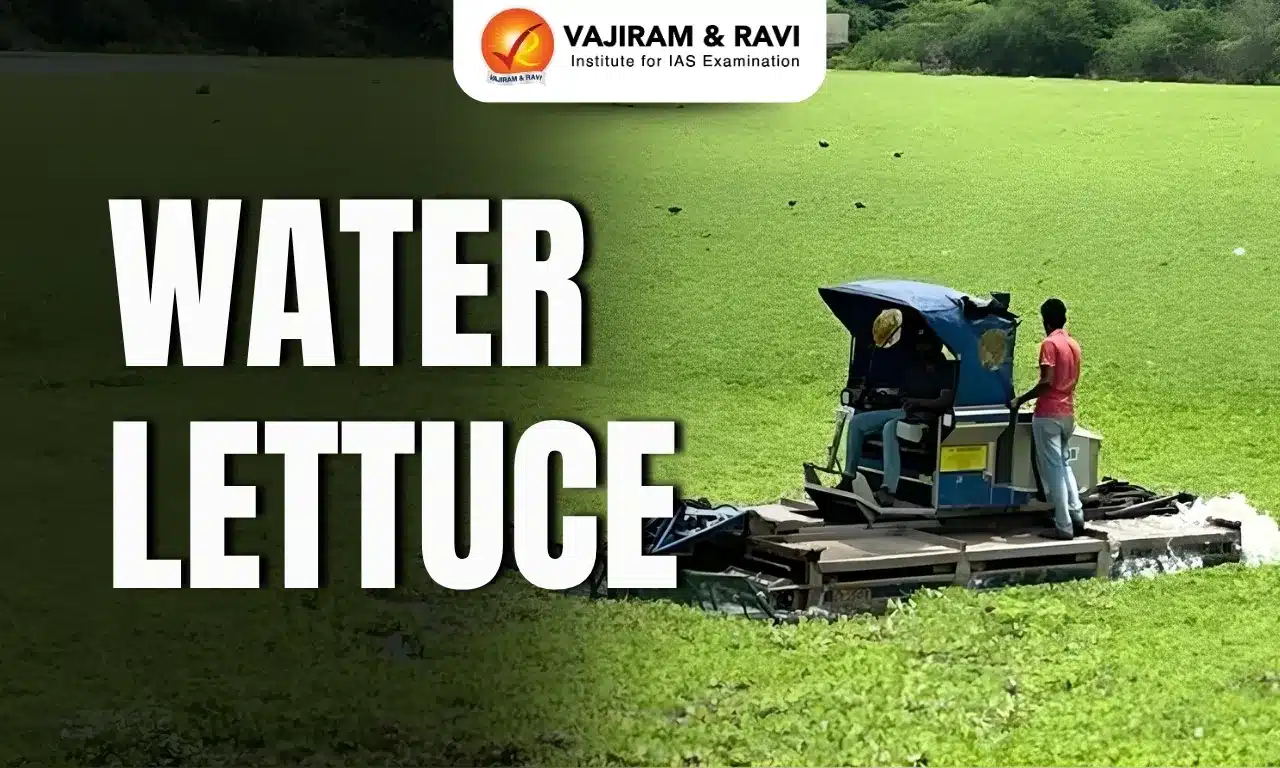
  • Water lettuce is a free-floating aquatic weed found in tropical countries worldwide, including Asia, Africa and equatorial America.
  • It is also known as water cabbage, Nile cabbage, or shellflower.
  • Appearance: It is a floating aquatic herb that resembles a floating head of lettuce. It has white to tan, long and feathery roots that hang beneath the rosette of leaves.
  • It grows best on still or slow moving bodies of fresh water such as farm dams, reservoirs, lakes, rivers and creeks.

Why is it an Invasive Species?

  • It forms dense mats that clog waterways making boating, fishing, and other water activities impossible.
  • These mats also degrade water quality by blocking the air-water interface and greatly reducing oxygen levels which can result in fish die-off and the overall reduction of aquatic fauna and flora diversity.
  • Impact on Environment: It affects water flow, damages native ecosystems.

Source: Reuters

Water Lettuce FAQs

Q1: What is the scientific name of Water Lettuce?

Ans: Pistia stratiotes

Q2: What is a characteristic feature of Water Lettuce?

Ans: It has a rosette of leaves that float on the water surface.

Ramnami Tribe

Ramnami Tribe

Ramnami Tribe Latest News

Two members of the Ramnami tribe became emotional when the Prime Minister broke the protocol allowing them to adorn him with their traditional headgear- peacock feather crown- recently.

About Ramnami Tribe

  • The Ramnamis are a unique sect from Chhattisgarh, India, who tattoo the name "Ram" on their bodies and faces.
  • The Ramnami Samaj is a movement that came up in what is now central and northern Chhattisgarh in the 19th century as an act of peaceful resistance against the caste system in India that denied many of them entry to temples.
  • According to a popular legend, it was started by Parsuram Bhardwaj, the son of a low-caste sharecropper.
  • More than 100 years ago, the sect decided to tattoo their bodies and faces with the name of nirgun (unmanifest) Ram to show that Ram, or God, was omnipresent and everywhere.
  • In 1910, the Ramnami Samaj was taken to court by upper-caste Hindu groups over this unique practice, but they won the case and the right to inscribe Ram's name on their bodies, clothing, and living spaces.
  • Ramnamis emphasize worshiping Ram in any form, whether in saffron robes or with a shaved head. 
  • They prioritize gender equality and adorn themselves with ‘ghungroos’ and a crown crafted from peacock feathers. 
  • In Chhattisgarh, ‘ghungroos’ play a vital role in their dances and Bhajan performances. 
  • Their white attires were also decorated with the name of Ram, while the peacock feathers on their headgear held a rich mythological significance.
  • At one time, their population stood anywhere near 6 lakh, but it has come down to 100,000, with some estimates suggesting only 20,000 Ramnami remain.  

Source: DC

Ramnami Tribe FAQs

Q1: The Ramnami Tribe is primarily associated with which Indian state?

Ans: Chhattisgarh

Q2: The Ramnami movement emerged in which century?

Ans: 19th century

Q3: Who is regarded as the founder or initiator of the Ramnami Samaj according to popular legend?

Ans: Parsuram Bhardwaj

Q4: What unique practice distinguishes the members of the Ramnami Samaj?

Ans: Tattooing the name “Ram” on their bodies and faces.

Enshittification

Enshittification

Enshittification Latest News

The now-viral term ‘enshittification’ helped put a name to a change that internet users are noticing: the feeling that many of your digital experiences, transactions, and services are not improving with time but are actually becoming worse because of their makers’ updates.

About Enshittification

  • It is an informal word used to criticize the degradation in the quality and experience of online platforms over time, often due to profit-seeking behavior or monopolistic control.
  • In 2022, the Canada-born author, tech journalist, and activist Cory Doctorow coined the term “enshittification.” 
  • It is a way of naming the process through which internet platforms are being made deliberately worse for customers, by their decision-makers, until they decay completely. 
  • It is also used to refer to a range of symptoms that degrade your experience as an internet user or customer. 
    • Some examples include the insertion of advertisements, self-preferencing by tech companies, unfair bias in search results, once-free features becoming paid, genuine products being replaced with lower-value dupes, and more.

Source: TH

Enshittification FAQs

Q1: What is enshittification?

Ans: The deliberate decline in quality of online services for profit.

Q2: Who coined the term “Enshittification”?

Ans: In 2022, the Canada-born author, tech journalist, and activist Cory Doctorow coined the term “enshittification.”

Q3: What causes Enshittification, according to the concept?

Ans: Excessive profit-seeking and monopolistic control.

Negros Island

Negros Island

Negros Island Latest News

An earthquake measuring 5.8 in magnitude struck Negros Island, Philippines, recently.

About Negros Island

  • It is one of the Visayan Islands, central Philippines
  • It is the fourth largest and third most populous island in the Philippines.
  • It is a boot-shaped island that is 217 km long and 35 to 79 km wide.
  • It is separated from the island of Panay to the northwest by the Guimaras Strait and from Cebu Island to the east by the Tanon Strait. 
  • The island is bordered on the north and south by the Visayan and Sulu seas, respectively. 
  • A central mountain range runs through the entire island and is deeply dissected by erosion. 
  • The range contains Mount Canlaon, an active volcano that at 8,086 feet (2,465 metres) is the highest point in Negros. 
  • This island has a rugged mountain interior, underwater coral gardens, and beautiful beaches. 
  • The island’s major rivers are the Binalbagan, Ilog, Tolong, and Tanjay.
  • It is famed for its rich marine biodiversity and as the nation’s “Sugar Capital.”

Source: IE

Negros Island FAQs

Q1: Negros Island is located in which country?

Ans: Philippines

Q2: Negros Island is part of which island group in the Philippines?

Ans: Visayan Islands

Q3: Negros Island is separated from Panay Island by which strait?

Ans: Guimaras Strait

Q4: Which seas border Negros Island on the north and south, respectively?

Ans: Visayan Sea and Sulu Sea

Laokhowa Wildlife Sanctuary

Laokhowa Wildlife Sanctuaries

Laokhowa Wildlife Sanctuary

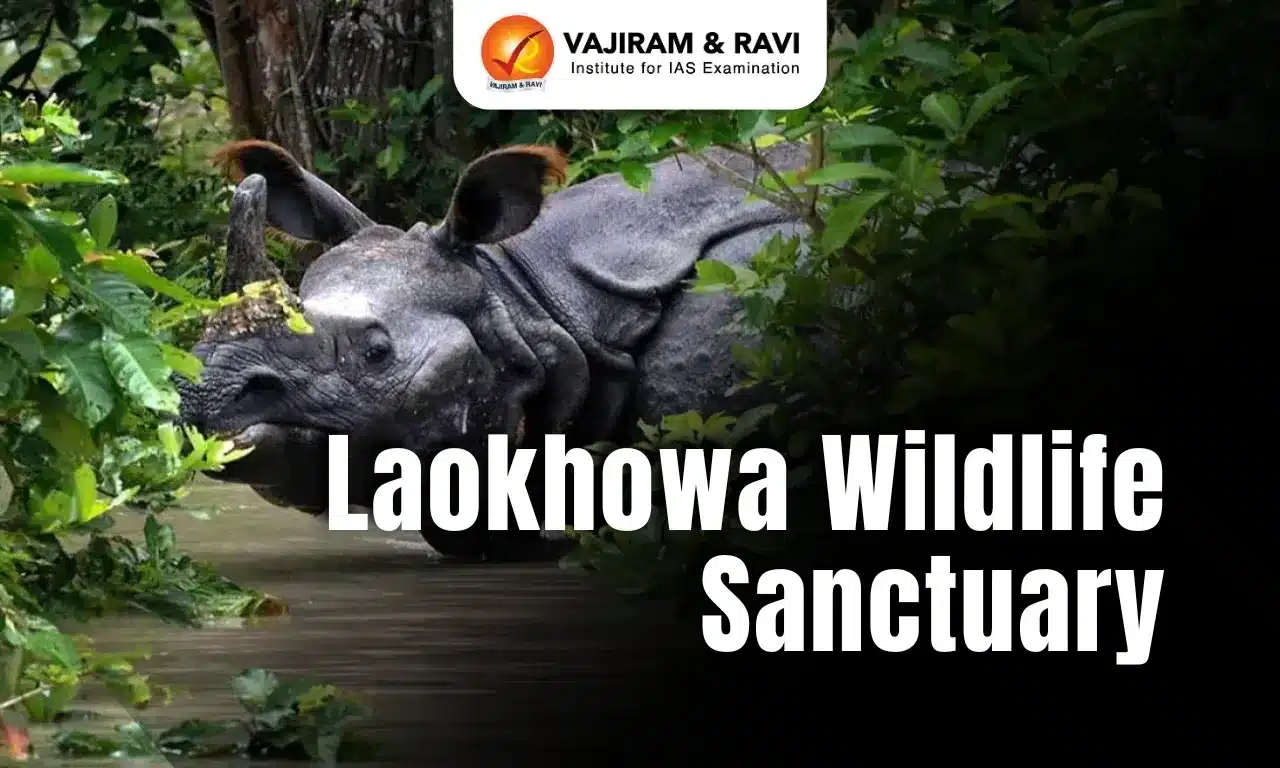
  • Civil society organisations and conservationists in Assam have urged authorities to declare the Roumari-Donduwa Wetland Complex within Laokhowa Wildlife Sanctuary as a Ramsar Site, citing its international ecological significance and rich avian biodiversity.

About Laokhowa Wildlife Sanctuary

  • It is located on the southern part of the Brahmaputra River in the Nagaon District of Assam.
  • It covers an area of around 70.13 sq.km.
  • It forms an integral part of the Laokhowa-Burachapori ecosystem and is a notified buffer of the Kazairanga Tiger Reserve.
  • It is a part of the Brahmaputra valley.
  • The sanctuary is surrounded by human-dominated areas on all sides except for the north. 
  • Flora: The vegetation composition of Laokhowa can be broadly categorized into alluvial grassland, alluvial forest, moist  deciduous forest, and tropical semi-evergreen forest.
  • Fauna
    • The sanctuary is home to the great Indian-one horned rhinoceros, elephants, royal Bengal tigers, Asiatic water buffaloes and more than 225 species of birds.
    • Some of the birds spotted here are the spot-billed pelican, little and large cormorant, egret, open-billed stork, brahminy kite, pond heron, etc.

Source: NM

Laokhowa Wildlife Sanctuary FAQs

Q1: Laokhowa Wildlife Sanctuary is located in which Indian state?

Ans: Assam

Q2: The Laokhowa Wildlife Sanctuary forms an integral part of which ecosystem?

Ans: It forms an integral part of the Laokhowa-Burachapori ecosystem.

Q3: What is the total area covered by Laokhowa Wildlife Sanctuary?

Ans: Around 70.13 sq.km

Q4: Laokhowa Wildlife Sanctuary serves as a buffer zone for which Tiger Reserve?

Ans: Kaziranga Tiger Reserve

Key Facts about Nigeria

Key Facts about Nigeria

Nigeria Latest News

The US President has ordered the Department of War to prepare for possible military action in Nigeria. 

About Nigeria

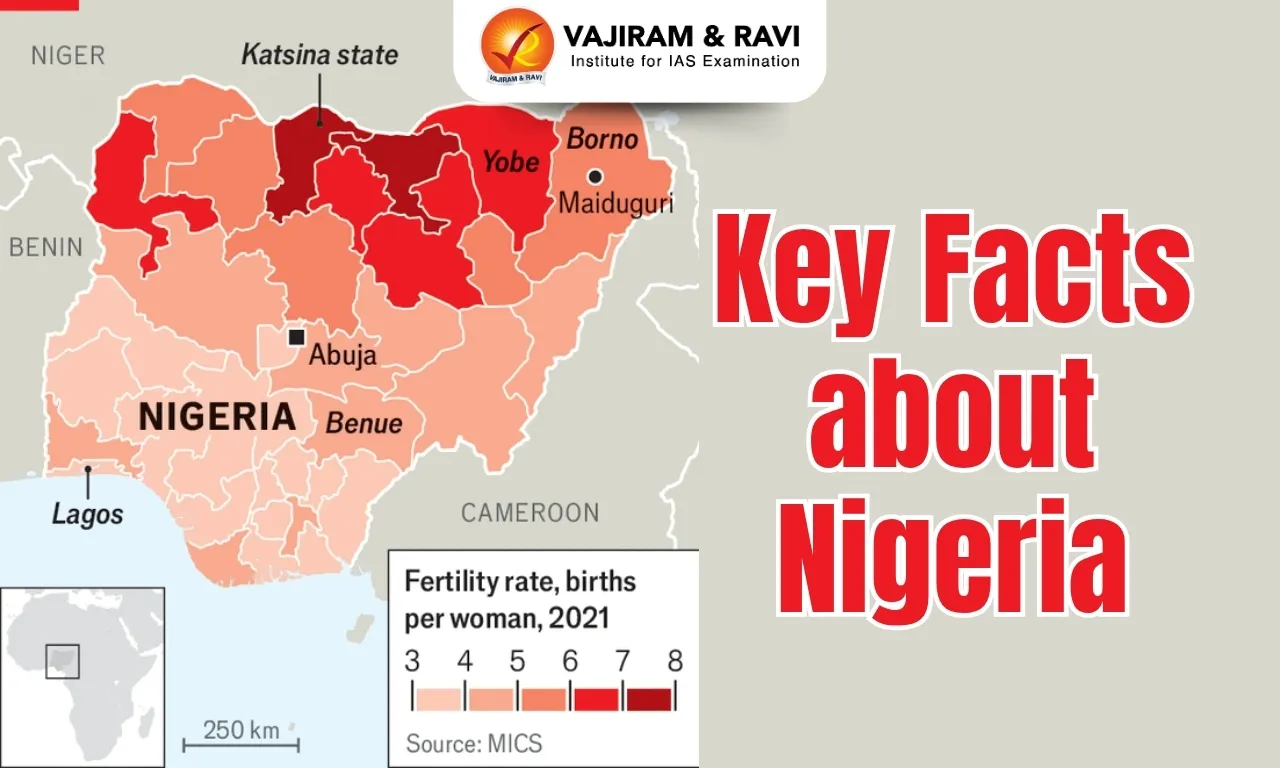
  • Location: It is a country located on the western coast of Africa. It is often called the “Giant of Africa.” 
  • Boundaries: It is bordered to the north by Niger, to the east by Chad and Cameroon, and to the west by Benin. It also has a coastline on the Gulf of Guinea.
  • It is also Africa’s most populous country.
  • Capital: Abuja

Geographical Features of Nigeria

  • Climate: Nigeria has a diverse geography, with climates ranging from arid to humid equatorial.
  • Drainage: The major drainage areas in Nigeria are the Niger-Benue basin, the Lake Chad basin, and the Gulf of Guinea basin.
  • River: The Niger River, for which the country is named, and the Benue, its largest tributary, are the principal rivers.
  • Major Mountain Range: Cameroonian Highlands
  • Natural Resources: It has abundant natural resources, notably large deposits of petroleum and natural gas.

Source: IE

Nigeria FAQs

Q1: Which countries share a border with Nigeria?

Ans: Niger, Chad, Cameroon, and Benin

Q2: What is the capital of Nigeria?

Ans: Abuja

Foreign Debt Inflows Fall Short Despite Easier FAR Norms

Foreign Debt

Foreign Debt Latest News

Foreign debt inflows into India have remained below expectations in 2025 despite relaxed norms under the Fully Accessible Route (FAR) and inclusion of Indian bonds in global indices.

Background

  • India’s efforts to attract more foreign debt investments under the Fully Accessible Route (FAR) have yielded modest results in 2025, despite expectations of record inflows following policy liberalisation and global index inclusion. 
  • Data from the National Securities Depository Ltd (NSDL) shows that foreign portfolio investor (FPI) inflows into Indian debt have amounted to just Rs. 69,073 crore ($7.8 billion) so far this year, far short of the anticipated $20–25 billion expected through FAR alone.

About the Fully Accessible Route (FAR)

  • The Fully Accessible Route is a policy framework introduced by the Reserve Bank of India (RBI) and SEBI to liberalise foreign investment in Indian government securities (G-secs). 
  • Under FAR, foreign portfolio investors and other eligible non-resident investors can freely invest in specified G-secs without any investment caps, repatriation limits, or sectoral restrictions.
  • The FAR mechanism aims to:
    • Deepen the Indian debt market,
    • Enhance the inclusion of Indian bonds in global indices, and
    • Attract long-term, stable foreign capital into government securities.
  • Indian G-secs under FAR are considered particularly attractive due to competitive yields, policy stability, and full repatriation rights, features designed to align India’s bond market with global best practices.

Expectations and Reality: A Missed Opportunity

  • When JP Morgan announced the inclusion of Indian Government Bonds (IGBs) in its Emerging Markets Bond Index, analysts projected inflows of around $20-25 billion over a ten-month period till March 2025. 
  • However, cumulative inflows from 2024-2025 have reached only $10.7 billion, less than half of projections. Investment Distribution (2025 so far):
    • FAR Category: Rs. 66,528 crore ($7.5 billion)
    • Debt-General Category: Rs. 12,083 crore ($1.3 billion)
    • Debt-VRR (Voluntary Retention Route): Outflow of Rs. 9,538 crore
  • This represents a significant reversal from 2024, when Rs. 1.52 lakh crore ($17.3 billion) flowed into Indian debt, led largely by general category investments.

Cautious Policy Moves by the Government and RBI

  • In August 2024, following India’s bond index inclusion, the government and RBI made a strategic move by excluding long-term government bonds (14-year and 30-year maturities) from the FAR.
  • The decision was driven by concerns that unrestricted inflows could destabilise domestic markets, increase yield volatility, and amplify risks if global investors engaged in short-term arbitrage.
  • While the policy ensured macroeconomic prudence, it simultaneously limited the pool of eligible securities, curbing potential inflows.

Global and Domestic Factors Behind Slower Inflows

  • Several macroeconomic and geopolitical factors have influenced investor behaviour in 2025.
  • Global Uncertainty and Interest Rate Volatility:
    • Unpredictable rate movements by the U.S. Federal Reserve, coupled with persistent geopolitical tensions and inflation concerns, have made global investors cautious.
  • Shift in FPI Strategy:
    • FPIs have withdrawn Rs. 1.39 lakh crore from Indian equities this year, reflecting a preference for short-term tactical moves rather than broad-based exposure.
  • Selective Debt Investments:
    • While Indian G-secs offer steady returns, global investors are adopting a “barbell strategy”, balancing between low-risk sovereign debt and high-yield emerging market opportunities.
  • Currency Concerns:
    • Fluctuations in the rupee-dollar exchange rate and rising U.S. Treasury yields have affected the relative attractiveness of Indian bonds.

The Domestic Context: India’s Macro Strengths

  • Despite subdued inflows, India remains a bright spot among emerging markets, thanks to:
    • Stable inflation near RBI’s target of 4-5%,
    • Resilient GDP growth projected at 7% in FY26, and
    • Strong domestic consumption trends, evident in record festive season sales.
  • These fundamentals continue to anchor investor confidence, making Indian debt a long-term opportunity even amid global headwinds.
  • Analysts note that as valuation differentials narrow between India and other markets, FPIs may re-enter Indian bonds more aggressively, especially if the U.S. rate cycle peaks by early 2026.

Importance of Debt Market

  • The Indian government’s inclusion in JP Morgan’s global bond index is a historic milestone, symbolising India’s integration with global capital markets. A robust inflow into government securities would:
    • Reduce borrowing costs for the government,
    • Deepen the sovereign yield curve,
    • Improve liquidity in the bond market, and
    • Support the Rupee’s external stability.
  • However, sustained inflows depend on policy predictability, macro stability, and continued reform momentum in India’s financial markets.

Future Outlook

  • While 2025’s inflows have been below target, analysts remain optimistic about the medium-term outlook. Factors that could boost inflows include:
    • Completion of index inclusion cycles by global rating agencies like FTSE and Bloomberg,
    • The potential India-U.S. trade deal is improving market sentiment, and
    • Gradual easing of global monetary policy.
  • However, risks remain. A resurgence in global inflation or an unexpected rate hike by the Federal Reserve could once again limit the flow of funds into Indian bonds.

Source: IE

Foreign Debt FAQs

Q1: What is the Fully Accessible Route (FAR)?

Ans: FAR is a framework allowing foreign investors unrestricted access to specified Indian government securities without investment limits.

Q2: How much foreign debt inflow has India received in 2025 so far?

Ans: India received Rs. 69,073 crore ($7.8 billion) in debt inflows till October 2025.

Q3: Why are debt inflows below expectations despite FAR easing?

Ans: Global interest rate uncertainty, policy caution, and geopolitical risks have tempered investor enthusiasm.

Q4: How did India’s inclusion in JP Morgan’s bond index impact inflows?

Ans: It brought in $10.7 billion so far, far below the $20–25 billion expected.

Q5: What could boost future debt inflows into India?

Ans: A stabilised U.S. rate environment, India-U.S. trade progress, and stronger macro stability could attract more inflows.

Burevestnik Missile

Burevestnik Missile

Burevestnik Missile Latest News

The Russian President recently announced that Russia had tested its Burevestnik nuclear-powered cruise missile.

About Burevestnik Missile

  • The Burevestnik, whose name translates as “storm petrel“, is a ground-launched, low-flying cruise missile that is not only capable of carrying a nuclear warhead but is also nuclear-powered.
  • It was developed by Russia.
  • It is one of six strategic weapons that the Russian President introduced in a 2018 speech.
  • It is code-named ‘SSC-X-9 Skyfall’ by NATO.

Burevestnik Missile Features

  • It is powered by a small nuclear reactor, which heats up air to propel the missile forward.
  • Its nuclear propulsion gives the missile much longer range than traditional turbojet or turbofan engines that are limited by how much fuel they can carry.
  • That propulsion gives it virtually unlimited range, allowing it to loiter for days, circling the enemy’s air defenses and attacking from an unexpected direction.
  • The missile is also designed to fly at low altitudes, much lower than a conventionally powered cruise missile, which would make it harder for air-defence radar to detect.

Source: IE

Burevestnik Missile FAQs

Q1: The Burevestnik missile has been developed by which country?

Ans: Russia

Q2: What is the NATO code name for the Burevestnik missile?

Ans: SSC-X-9 Skyfall

Q3: The nuclear propulsion of Burevestnik gives what kind of advantage?

Ans: It has virtually unlimited range and endurance.

Govt to Map Highway Black Spots with Real-Time e-DAR Data

Highway Black Spots

Highway Black Spots Latest News

  • To curb road accidents and fatalities, the Ministry of Road Transport and Highways (MoRTH) will soon release black spot data for 2023 and 2024 using the Electronic Detailed Accident Report (e-DAR)/Integrated Road Accident Database (iRAD) system, which compiles real-time accident data from state police.

Black Spots on National Highways

  • India continues to record one of the world’s highest road accident rates, with a large share of fatalities occurring on national highways (NHs) due to accident-prone “black spots” — poorly designed or managed road segments.
  • In March 2025, the Parliamentary Standing Committee on Transport, Tourism and Culture, criticised the MoRTH for what it called a “significant governance failure.” 
  • Out of 13,795 black spots identified across NHs, only 5,036 have been permanently rectified, leaving thousands of dangerous zones unaddressed.

Three-Tier Action Plan

  • The panel proposed a time-bound, three-tier plan to fix black spots:
    • Category A (High Risk): Immediate safety steps; permanent fix within 30 days.
    • Category B (Moderate Risk): Fix within 90 days.
    • Category C (Low Risk): Fix within 180 days.
  • Agencies missing deadlines should face penalties.

Accountability and Targets

  • The committee urged post-implementation audits at 3-month and 12-month intervals and a public dashboard to track progress. 
  • Although MoRTH aims to reduce road fatalities by 95% by 2028 and eliminate all black spots by FY 2027-28, progress remains slow — with short-term fixes outpacing long-term structural solutions.

Electronic Detailed Accident Report (e-DAR) System

  • The Integrated Road Accident Database (iRAD) and e-Detailed Accident Report (e-DAR) system, developed by the Ministry of Road Transport and Highways (MoRTH), serves as India’s national database for road accidents.
  • It enables real-time data collection by police using a mobile app and supports data-driven policymaking to improve road safety and speed up victim compensation.

Key Objectives

  • Build a centralized national database of road accidents.
  • Analyze crash data to identify causes and risk patterns.
  • Enable targeted road safety measures and infrastructure interventions.
  • Streamline and accelerate compensation claims for accident victims and their families.

How the System Works

  • Data Collection: Police officers record accident details instantly using the iRAD app, capturing photos, videos, time, date, and location.
  • Unique ID Creation: Each case gets a unique accident ID for easy tracking.
  • Information Dissemination: Data is uploaded to a central database, and engineers from relevant departments are alerted for analysis and action.
  • Analysis and Reporting: The system generates reports and dashboards to identify black spots and analyze accident causes.
  • Claims Processing: Through the e-DAR portal, victims’ families can access accident data to file compensation claims faster.

MoRTH to Release Real-Time Highway Black Spot Data Using e-DAR

  • To reduce road accidents and fatalities, the Ministry of Road Transport and Highways (MoRTH) will soon publish black spot data for 2023 and 2024 using its Electronic Detailed Accident Report (e-DAR) and Integrated Road Accident Database (iRAD) system.
    • This platform collects real-time, geo-tagged accident data entered by state police through mobile apps, enabling quicker identification of high-risk stretches.
  • A black spot on a National Highway (NH) is defined as a 500-metre stretch that records either five or more fatal or grievous accidents or ten deaths within three years.
  • These areas are prioritised for safety improvements under the government’s road safety programme.

Data Coverage and Progress So Far

  • So far, data up to 2022 was available, limiting preventive planning. 
  • Using e-DAR/iRAD, MoRTH has now compiled data for 2023–2024, to be released soon.
  • From 2016–2022, 13,795 black spots were identified on NHs, and long-term rectification has been completed on 5,036 stretches.

Bridging Data Discrepancies

  • The Transport Research Wing (TRW) validates black spot data collected from states.
  • Discrepancies between TRW and e-DAR data have now dropped to below 5%, after extensive coordination with states — though Punjab and Jharkhand earlier showed the highest mismatches.
  • In 2024, MoRTH recorded a difference of 18,069 accidents (3.96%) and 7,020 fatalities (4.3%) between the two systems.
  • MoRTH officials said efforts are underway to align e-DAR data with state police records, ensuring accuracy and better planning.
  • Once streamlined, the system will enable faster identification and rectification of accident-prone zones, marking a major step toward data-driven road safety management in India.

Source: IE | PIB | iRAD

Highway Black Spots FAQs

Q1: What is the e-DAR/iRAD system?

Ans: It’s a national road accident database that collects real-time, geo-tagged data from police to identify black spots and improve road safety.

Q2: What is a black spot on a highway?

Ans: A 500-metre stretch where either five fatal accidents or ten deaths occur within three years is officially classified as a black spot.

Q3: Why is MoRTH releasing new black spot data?

Ans: To plan targeted safety measures for highways using up-to-date real-time data for 2023 and 2024, improving accident prevention and rectification.

Q4: How does e-DAR improve accuracy?

Ans: It links directly with state police data, reducing data discrepancies to below 5% and enabling quick identification of risky road segments.

Q5: What are India’s current black spot statistics?

Ans: Between 2016 and 2022, 13,795 black spots were identified, but only 5,036 have been permanently rectified so far, highlighting slow progress.

Eighth Pay Commission Approved: Key Mandate, Timeline, and Fiscal Impact

Eighth Pay Commission

Eighth Pay Commission Latest News

  • The government has approved the Terms of Reference (ToR) for the Eighth Central Pay Commission (CPC), paving the way for revised pay, pension, and allowances for about 50 lakh central government employees and 69 lakh pensioners, effective January 1 next year.
  • The Commission will be chaired by Justice Ranjana Prakash Desai, former Supreme Court judge and current Press Council of India chairperson.
  • Other members include IIM Bangalore Professor Pulak Ghosh (Part-time Member) and Petroleum Secretary Pankaj Jain (Member-Secretary).

Understanding the Role of India’s Pay Commissions

  • The Pay Commission is set up by the central government roughly every 10 years to revise salaries and pensions of its employees. 
  • Since Independence, seven such commissions have been formed, with the Eighth Central Pay Commission announced in January this year.
  • After consultations with ministries, state governments, and staff representatives, the terms of reference have been finalised. 
  • The Commission is expected to submit its recommendations within 18 months.

Mandate of the Eighth Central Pay Commission

  • The Eighth Central Pay Commission (CPC) has been tasked with reviewing pay, allowances, and pensions while ensuring fiscal prudence and adequate funds for development and welfare schemes.
  • It will also assess the financial impact on state governments, which often adopt central recommendations, and compare salary structures and benefits in the public and private sectors.
  • A key addition to this Commission’s Terms of Reference is to consider the unfunded cost of non-contributory pension schemes, in light of calls to restore the Old Pension Scheme (OPS).
    • The OPS offered 50% of the last drawn salary as pension to employees who joined before January 1, 2004.
    • Those joining later are covered under the National Pension System (NPS), which is market-linked.
    • To address growing concerns, the government last year launched the Unified Pension Scheme (UPS) — assuring a minimum pension of ₹10,000 for employees with at least 10 years of service, and full assured pension after 25 years of qualifying service.

Timeline for the Eighth Central Pay Commission

  • The Eighth Central Pay Commission’s recommendations are expected to be announced in April 2027 but will be effective retrospectively from January 1, 2026.
  • This means pay and pension hikes will apply from that date, with arrears paid upon implementation, while allowances will be revised prospectively.
  • Historically, implementation has varied — employees waited 19 months after the Fifth Pay Commission and 32 months after the Sixth, while the Seventh Pay Commission was implemented within six months in January 2016.

Key Factors That Will Decide the Pay and Pension Hike

  • The extent of salary and pension increases under the Eighth Central Pay Commission (CPC) will mainly depend on the fitment factor.
    • The fitment factor is a multiplier used when pay scales are revised.
    • In the Seventh Pay Commission, this factor was 2.57, meaning basic pay was raised to 2.57 times the previous level. 
    • The new factor will be finalised after Cabinet approval of the Commission’s recommendations.
  • According to experts, pensioners also want long-pending concerns addressed — such as reducing the pension commutation period from 15 years to 12 years, and improving medical benefits under the Central Government Health Scheme (CGHS).
  • Currently, retirees in areas without CGHS hospitals receive only ₹3,000 per month for medical expenses — an amount pensioners want raised to ₹20,000, along with expanded hospital coverage at the district level.

Fiscal Impact of the Eighth Pay Commission

  • The Eighth Central Pay Commission (CPC) is expected to significantly affect the government’s fiscal balance, as salaries, pensions, and allowances form a major part of revenue expenditure.
  • In 2025–26, the Centre’s spending on these components is projected at over ₹7 lakh crore, nearly 18% of total revenue expenditure.
  • The Seventh Pay Commission had earlier recommended a 23.55% hike, adding ₹1.02 lakh crore to the annual outgo. 
  • It also replaced the pay band and grade pay system with a pay matrix for different employee categories.
  • The minimum monthly pay was raised from ₹7,000 to ₹18,000 for new recruits, and ₹56,100 for Class I officers. 
  • Based on past trends, the minimum pay under the Eighth CPC could exceed ₹46,000 per month.

Source: IE | ToI

Eighth Pay Commission FAQs

Q1: What is the Eighth Central Pay Commission?

Ans: It’s a panel formed by the government to revise pay, allowances, and pensions for central employees and pensioners, effective from January 1, 2026.

Q2: Who chairs the Eighth Pay Commission?

Ans: It is headed by Justice Ranjana Prakash Desai, former Supreme Court judge and current Press Council of India chairperson.

Q3: What is the Commission’s main mandate?

Ans: To recommend pay and pension revisions while ensuring fiscal prudence and considering state finances, OPS costs, and parity with public and private sectors.

Q4: When will the recommendations take effect?

Ans: They’ll apply retrospectively from January 1, 2026, though the announcement is expected in April 2027, with arrears paid on implementation.

Q5: What impact will it have on government finances?

Ans: The last Pay Commission raised spending by ₹1.02 lakh crore; salaries and pensions already form about 18% of India’s total revenue expenditure.

Daily Editorial Analysis 3 November 2025

Daily Editorial Analysis

Engage the Taliban, Don’t Recognise Them 

Context

  • The return of the Taliban to power in Afghanistan in 2021 reshaped the strategic landscape of South Asia, reviving old rivalries and forcing neighbouring states to recalibrate foreign policy choices.
  • For India, historically opposed to Taliban rule and supportive of anti-Taliban forces, the new geopolitical reality demands a delicate balance between national security concerns, regional competition with Pakistan, and the preservation of long-term interests in Afghanistan.
  • Amid these developments, it is important to highlight India’s emerging strategy of conditional and cautious engagement, rooted in pragmatic assessment rather than ideological alignment.

Strategic Calculus and India’s Core Interests

  • India’s Afghanistan policy is shaped by three long-standing objectives.
    • First, New Delhi seeks to protect its substantial investments and goodwill accumulated between 2001 and 2021, when India was one of Afghanistan’s largest regional donors.
    • Second, it aims to prevent Afghan territory from becoming a sanctuary for anti-India militant networks, a scenario that resembles the Taliban’s first regime.
    • Third, preventing Afghanistan from serving as a strategic extension of Pakistan’s security establishment remains a priority, given India–Pakistan rivalry and Islamabad's historical influence over the Taliban.
  • These intertwined interests help explain India’s measured outreach to the Taliban government, including the recent upgrade of its mission in Kabul and diplomatic engagement with Taliban officials.
  • India is exploring whether the Taliban possess a degree of autonomy from Pakistan, particularly in light of deteriorating Pakistan-Taliban relations and cross-border tensions.
  • In this shifting geopolitical context, New Delhi’s policy reflects realpolitik tempered by caution.

The Temptation and Risks of Recognition

  • Although growing diplomatic contact may suggest that formal recognition of the Taliban is on the table, there are profound risks associated with such a step.
  • Recognition could accelerate cooperation with Kabul, counterbalance Pakistan’s influence, and capitalise on emerging rifts between Islamabad and the Taliban.
  • Yet it would also grant legitimacy to a regime whose governance remains deeply repressive and exclusionary.
  • The Taliban’s unchanged ideological foundations raise questions about the durability of their rule and the ethics of normalisation.
  • Their unprecedented restrictions on women’s education, public participation, and employment create severe socio-economic consequences and undermine Afghanistan’s long-term stability.
  • With an economy contracted by one-third and nearly half the population in need of humanitarian assistance, the regime’s internal fragility remains a serious concern.
  • Thus, immediate recognition may be strategically shortsighted, risking India’s leverage and implicating it in the Taliban’s governance failures.

Security Concerns and Terrorist Networks

  • The Taliban’s claim of breaking ties with transnational jihadist networks remains
  • Despite public pledges of non-interference, credible international assessments indicate continued linkages with groups such as al-Qaeda, Lashkar-e-Taiba, Jaish-e-Mohammed, and the Pakistani Taliban.
  • While the Taliban currently suppress overt militant activity to maintain international legitimacy, these networks remain embedded within the Afghan security landscape.
  • A weakening Taliban regime could unleash these groups, making today's tactical enemy's enemy tomorrow’s direct threat.
  • For India, this underscores the necessity of vigilance and strategic patience rather than premature endorsement.

The Way Forward: Toward a Balanced and Long-Term Approach

  • India’s policy trajectory suggests neither wholesale acceptance nor isolation of the Taliban regime.
  • Instead, it pursues a gradual, conditional engagement, maintaining diplomatic channels to influence Taliban behaviour, safeguard security interests, and support Afghan civilians, while retaining leverage through international and regional forums.
  • Crucially, India recognizes that sustainable stability in Afghanistan cannot be achieved solely through coercive religious rule but requires economic recovery, political inclusion, and regional integration.
  • In this view, Afghanistan’s need for assistance exceeds India’s need for Taliban cooperation.
  • Rather than yielding to short-term geopolitical temptation, New Delhi seeks to shape a future where Afghanistan remains neither a security threat nor a satellite in Pakistan's strategic orbit.

Conclusion

  • While pragmatic engagement is necessary given geopolitical realities, India must avoid legitimising a regime that remains ideologically inflexible and structurally unstable.
  • The recommended approach, engage, but do not endorse; influence, but do not yield leverage, aligns with India's long-term interests, regional stability, and commitment to the Afghan people’s rights and aspirations.
  • In a region defined by shifting alliances and unresolved conflicts, restraint paired with strategic foresight may be India’s most effective tool.

Engage the Taliban, Don’t Recognise Them FAQs

 Q1. Why is India engaging with the Taliban despite past hostility?
Ans. India is engaging with the Taliban to protect its investments, prevent anti-India militants from using Afghan soil, and counter Pakistan’s influence.

Q2. What main risk does India face if it recognises the Taliban?
Ans. If India recognises the Taliban, it may grant legitimacy to a repressive regime and lose leverage to push for reforms.

Q3. How has the Taliban’s rule affected Afghanistan’s economy?
Ans. The Taliban’s rule has led to a major economic collapse, leaving almost half the population in need of humanitarian aid.

Q4. Why does India not fully trust the Taliban’s security promises?
Ans. India does not fully trust the Taliban’s promises because credible reports show continued links between the Taliban and global terrorist groups.

Q5. What long-term approach is India advised to adopt toward Afghanistan?
Ans. India is advised to pursue cautious, conditional engagement that promotes stability, inclusion, and economic recovery without rushing to recognise the regime.

 Source: The Hindu


The Vision of Model Youth Gram Sabhas

Context

  • True essence of participatory democracy lies not in national chambers, but in the Gram Sabha, the village assembly that enables citizens to directly deliberate on community development and governance.
  • Enshrined through Article 243A in the 73rd Constitutional Amendment, the Gram Sabha represents every registered voter in a village and grants them the authority to shape local priorities.
  • Yet, despite its foundational role, the Gram Sabha remains under-recognised and under-utilised.
  • To realise the vision of a people-led Viksit Bharat, it is essential to transform grassroots governance into an aspirational democratic experience for young citizens.

The Significance of the Gram Sabha and The Problem

  • The Significance of the Gram Sabha

    • The Gram Sabha is the bedrock of the Panchayati Raj system, enabling direct public participation in decision-making.
    • It allows villagers to collectively evaluate budgets, development proposals, welfare delivery, and administrative performance.
    • Unlike representative democracy at higher levels, the Gram Sabha embodies direct democracy, nurturing accountability, transparency, and community empowerment.
    • When functioning effectively, it becomes a real-time forum for identifying needs, prioritising projects, and ensuring equitable resource use.
    • However, its democratic potential remains largely untapped due to limited awareness and participation.
  • The Problem: Civic Imagination Without Grassroots Democracy

    • Despite its constitutional authority, the Gram Sabha seldom features prominently in India's civic education or public consciousness.
    • Students are extensively introduced to the workings of Parliament, global diplomacy, and Model United Nations, but rarely to the function of village assemblies.
    • As a result, rural leadership is viewed as administrative rather than aspirational, and the idea of becoming a Sarpanch or ward representative rarely enters young people's imagination.
    • This disconnect turns grassroots democracy into an abstract concept rather than a lived civic practice.

The Model Youth Gram Sabha: A Transformative Initiative

  • To bridge this gap, the Government of India launched the Model Youth Gram Sabha in 2025 through a collaboration between the Ministry of Panchayati Raj, Ministry of Education, Ministry of Tribal Affairs, and the Aspirational Bharat Collaborative.
  • MYGS simulates real Gram Sabha proceedings in academic institutions, allowing students to assume roles such as Sarpanch, ward members, engineers, and health workers.
  • They debate budgets, discuss development challenges, and pass resolutions, learning governance by doing.
  • Supported by teacher training and recognition-based incentives, the initiative transforms textbook civics into a dynamic, participatory learning experience.

Scaling the Model: Implementation and Progress

  • The first phase of MYGS includes:
    • 1,000+ schools across 28 States and 8 Union Territories
    • Over 600 Navodaya Vidyalayas, 200 Eklavya Model Schools, and select Zilla Parishad schools
    • 126 master trainers and 1,238 trained teachers across 24 States and UTs
    • Pilot successes in Uttar Pradesh and Rajasthan, including a 300-student simulation in Bundi district
  • Phase 2 seeks to extend MYGS to all state-run schools, embedding democratic practice across India's diverse educational landscape.

Impact on Civic Behaviour and Nation-Building

  • MYGS cultivates more than administrative understanding, it develops citizenship.
  • Students learn public speaking, negotiation, budgeting, problem-solving, and consensus-building.
  • Early exposure to grassroots governance increases the likelihood that future citizens, bureaucrats, and leaders will value decentralised decision-making.
  • When young minds learn that their village assembly is as powerful as Parliament, civic participation becomes habitual rather than symbolic.
  • This cultural shift can strengthen local accountability, deepen democratic values, and expand opportunities for inclusive leadership.

Future Path: Ensuring Sustainability and Inclusivity

  • For MYGS to succeed long-term, it must:
    • Ensure high-quality teacher training
    • Use local languages and context-based village data
    • Encourage participation from girls and marginalised groups
    • Track outcomes such as increased real Gram Sabha participation
  • These steps will ensure the simulation translates into genuine civic transformation.

Conclusion

  • The Gram Sabha is not merely an administrative unit; it is the heartbeat of Indian democracy.
  • Reviving its importance in national imagination requires deliberate civic education and lived participation.
  • The Model Youth Gram Sabha does exactly that by transforming classrooms into micro-democracies and shaping future citizens who value grassroots self-governance.
  • If nurtured and scaled thoughtfully, this initiative can convert democratic rights into democratic habits.

The Vision of Model Youth Gram Sabhas FAQs

 Q1. What is the Gram Sabha?
Ans. The Gram Sabha is a village assembly in India where all registered voters participate directly in decisions about local development and governance.

Q2. Why is the Gram Sabha important in a democracy?
Ans. The Gram Sabha is important because it enables direct citizen participation, promotes accountability, and strengthens grassroots democracy.

Q3. What problem does the Model Youth Gram Sabha address?
Ans. The Model Youth Gram Sabha addresses the lack of awareness and aspiration among students regarding grassroots democratic institutions like the Gram Sabha.

Q4. Who launched the Model Youth Gram Sabha initiative?
Ans. The Model Youth Gram Sabha was launched by the Ministry of Panchayati Raj in collaboration with the Ministry of Education, Ministry of Tribal Affairs, and the Aspirational Bharat Collaborative.

Q5. How does the Model Youth Gram Sabha benefit students?
Ans. The Model Youth Gram Sabha benefits students by giving them hands-on experience in local governance, helping them learn leadership, decision-making, and civic responsibility.

 Source: The Hindu

Daily Editorial Analysis 3 November 2025 FAQs

Q1: What is editorial analysis?

Ans: Editorial analysis is the critical examination and interpretation of newspaper editorials to extract key insights, arguments, and perspectives relevant to UPSC preparation.

Q2: What is an editorial analyst?

Ans: An editorial analyst is someone who studies and breaks down editorials to highlight their relevance, structure, and usefulness for competitive exams like the UPSC.

Q3: What is an editorial for UPSC?

Ans: For UPSC, an editorial refers to opinion-based articles in reputed newspapers that provide analysis on current affairs, governance, policy, and socio-economic issues.

Q4: What are the sources of UPSC Editorial Analysis?

Ans: Key sources include editorials from The Hindu and Indian Express.

Q5: Can Editorial Analysis help in Mains Answer Writing?

Ans: Yes, editorial analysis enhances content quality, analytical depth, and structure in Mains answer writing.

Enquire Now