Monazite Soil, Features, Distribution, Regulation, Significance

Monazite Soil

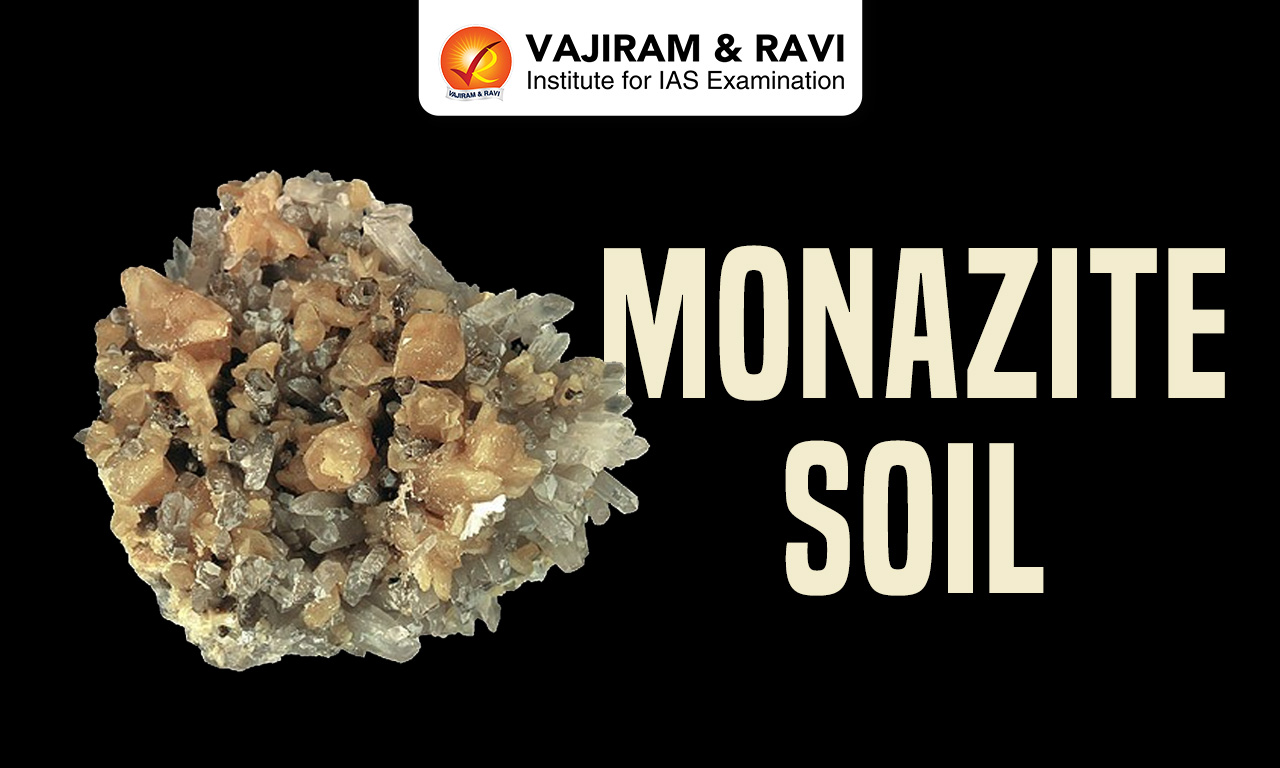
Monazite Soil refers to beach sand deposits rich in the mineral Monazite. Monazite is a reddish-brown phosphate that contains valuable rare earth elements and Thorium. It is highly significant due to its resistance to weathering and its concentration along coastal regions. The presence of Thorium makes it strategically important for nuclear energy development. India possesses substantial Monazite reserves, especially along its coasts, making it a crucial resource for energy security and advanced technologies.

Monazite Soil Features

Monazite Soil is unique due to its mineral composition, radioactivity and economic value derived from rare earth elements and Thorium deposits.

  • Mineral Composition: Monazite is a phosphate mineral containing rare earth elements like lanthanum, cerium, praseodymium and neodymium, which possess magnetic, luminescent and electrochemical properties essential for advanced technologies and industrial applications.
  • Resistance to Weathering: Monazite is highly resistant to chemical weathering, allowing it to accumulate in coastal and placer deposits over time, especially in beach sands where heavy minerals get concentrated naturally.
  • Radioactive Nature: Monazite contains Thorium, a weakly radioactive element, making it an important atomic mineral and subject to strict regulatory control due to its potential use in nuclear energy programs.
  • Rare Earth Element Source: It serves as the primary commercial source of rare earth elements in India, supporting industries like electronics, renewable energy, defense systems and communication technologies.
  • Physical Characteristics: Monazite appears reddish-brown in color and occurs in granular form within beach sands, often associated with minerals like ilmenite, rutile, garnet and zircon in coastal placer deposits.

Monazite Soil Distribution

Monazite deposits are globally distributed in coastal and placer regions, with India having one of the largest concentrations of this valuable mineral resource.

  • Global Distribution: Major Monazite deposits are found in India, Madagascar and South Africa, with coastal placer sands serving as the primary geological setting for these valuable rare earth bearing minerals.
  • Indian Coastal Regions: The largest concentration in India occurs along the Kerala coast, followed by Tamil Nadu, Odisha, Andhra Pradesh, Maharashtra and Gujarat, where beach sand mineral deposits are abundant.
  • Inland Deposits: Apart from coastal regions, Monazite is also found in inland placer deposits in Jharkhand, West Bengal and Tamil Nadu, indicating its wider geological presence beyond beaches.
  • Resource Estimates: India possesses about 10.70 million tonnes of Monazite containing nearly 9,63,000 tonnes of Thorium oxide, with total in situ resources estimated at over 13 million tonnes in recent assessments.
  • Production and Capacity: India produces around 4000 tonnes of Monazite annually, while installed processing capacity reaches about 10,000 tonnes, though actual output is limited due to regulatory and environmental constraints.

Monazite Soil Significance

Monazite Soil holds immense strategic, economic and technological importance due to its rare earth elements and Thorium content, which influence multiple sectors.

  • Energy Security: Thorium present in Monazite can reduce dependence on imported uranium, strengthening national energy security and supporting long term nuclear power generation through indigenous resources.
  • Nuclear Power Potential: India’s Thorium reserves account for about 25 percent of global reserves and can generate approximately 358,000 gigawatt years of electricity, ensuring sustainable energy supply for future generations.
  • Rare Earth Applications: Rare earth elements extracted from Monazite are crucial for manufacturing electronics, electric vehicles, wind turbines, satellites and defense equipment due to their unique physical and chemical properties.
  • Industrial and Economic Value: Monazite supports high value industries such as aerospace, telecommunications and renewable energy, contributing significantly to economic growth and technological advancement.
  • Climate Change Mitigation: Thorium based nuclear energy offers a cleaner alternative to fossil fuels, helping reduce carbon emissions and supporting global efforts toward sustainable and low carbon energy systems.

Monazite Soil Regulation in India

Due to its radioactive nature and strategic importance, Monazite Soil is strictly regulated under various laws and institutions in India.

  • Legal Classification: Monazite is classified as a “prescribed substance” under the Atomic Energy Act, requiring strict control over its mining, handling and export to ensure national security and safety.
  • Regulatory Authority: The Department of Atomic Energy regulates Monazite under the Atomic Energy (Radiation Protection) Rules 2004, ensuring safe usage and preventing unauthorized access to radioactive materials.
  • Licensing Requirements: Extraction, processing and export of Monazite require special licenses and companies must obtain approval from regulatory bodies like the Atomic Energy Regulatory Board for operations.
  • Role of IREL: Indian Rare Earths Limited, a government owned entity, is the only authorized organization to process Monazite and manage its domestic use and export, ensuring centralized control.
  • Mining Restrictions: Recent regulatory changes reduced permissible Monazite thresholds to zero in beach sand mining, effectively restricting private sector participation and preventing environmental damage and illegal extraction. 

Monazite Soil FAQs

Q1: What is Monazite Soil?

Ans: Monazite Soil refers to beach sand deposits rich in Monazite, a phosphate mineral containing rare earth elements and Thorium, making it important for nuclear energy and advanced technologies.

Q2: Why is Monazite important for India?

Ans: Monazite is important because it contains Thorium, which can reduce India’s dependence on imported uranium and support long term nuclear energy generation.

Q3: Where is Monazite mainly found in India?

Ans: Monazite is mainly found along coastal regions such as Kerala, Tamil Nadu, Odisha, Andhra Pradesh, Maharashtra and Gujarat, with additional deposits in inland areas.

Q4: Is Thorium directly used in nuclear reactors?

Ans: No, Thorium is not directly used as fuel; it is converted into Uranium 233 through a nuclear process before being used in reactors.

Q5: Who regulates Monazite mining in India?

Ans: Monazite mining and processing are regulated by the Department of Atomic Energy and Indian Rare Earths Limited is the authorized body for its production and management.

India Austria Relations, Austrian Chancellor 2026 Visit, Outcomes

India Austria Relations

Recently, the visit of Austrian Chancellor Christian Stocker to India and his talks with Prime Minister Narendra Modi marked an important milestone in India-Austria relations. The visit gave fresh momentum to bilateral ties and strengthened cooperation between the two countries in areas such as trade, technology, and global issues, taking the partnership to a deeper and more comprehensive level.

Significance of the Austrian Chancellor 2026 Visit

The recent visit holds strong diplomatic and strategic importance for multiple reasons.

  • This is the first visit by an Austrian Chancellor to India in over four decades, with the last such visit taking place in 1984.
  • It is also the Chancellor’s first visit outside Europe and first official visit to Asia, reflecting India’s growing importance in Austria’s foreign policy priorities.
  • The visit took place in a backdrop of global geopolitical tensions, including conflicts in Ukraine and West Asia, where both countries emphasized the need for peace and dialogue.
  • The visit is also significant in the context of the India-European Union Free Trade Agreement (2026), which is expected to open a new phase of India’s engagement with Europe.

Key Outcomes of the 2026 Visit

The outcomes of the visit reflect a comprehensive expansion of India-Austria relations, with concrete agreements and institutional mechanisms across strategic, economic, technological, and people-centric domains.

Defence and Security Cooperation:

  • Both countries signed a Letter of Intent on cooperation in military matters, which establishes a structured framework for defence policy dialogue, training, and technology partnerships.
  • They agreed to create a Joint Working Group on Counter-Terrorism, aimed at enhancing coordination in combating global terrorism and addressing emerging security challenges.

Economic Engagement and Ease of Doing Business: 

  • Austria identified India as one of its key trading partners outside the European Union.
  • A Fast-Track Mechanism has been introduced to resolve issues faced by businesses and investors in both countries. This mechanism aims to improve the ease of doing business and strengthen investor confidence.

Expanding High-Technology and Innovation Cooperation: 

  • Both nations identified technology as a central pillar of their partnership, focusing on joint research and development.
  • Key areas of cooperation include: Quantum technology, Machine learning, Material science, Laser technologies, Biotechnology. 
  • A Joint Committee on Science and Technology will facilitate structured collaboration in these advanced sectors.

Deepening Cooperation in Infrastructure and Engineering: 

  • Austria’s expertise in tunnelling and engineering has contributed significantly to India’s infrastructure development, including projects like the Delhi Metro, Atal Tunnel, and Girnar Ropeway.
  • Both countries agreed to renew technical cooperation in road infrastructure, especially in Intelligent Transport Systems (ITS), road safety, and traffic management.

Advancing Cybersecurity and Digital Cooperation: 

  • The two sides launched an Institutional Cybersecurity Dialogue, which will address cyber threats and strengthen digital resilience.

Promoting Space Sector Collaboration: 

  • India and Austria agreed to organise a bilateral space industry seminar in Vienna in Autumn 2026, aimed at integrating their space innovation ecosystems.
  • This builds upon earlier cooperation, including the launch of Austrian satellites (TUGSAT-1/BRITE and UniBRITE) from Sriharikota in 2013.

Strengthening Food Safety and Agricultural Trade: 

  • An MoU between FSSAI (India) and AGES (Austria) was signed to promote cooperation in food safety standards, risk assessment, and scientific exchange. The agreement is expected to facilitate safe trade in agricultural and food products.

Expanding Skill Development and Youth Mobility: 

  • The India-Austria Working Holiday Programme has been operationalized to promote youth exchange and cultural understanding.
  • A Letter of Intent on dual vocational training aims to enhance skill development and facilitate mutual recognition of qualifications.
  • Additional cooperation in sectors like nursing reflects practical collaboration in human resource development.

Boosting Startup, Academic and Cultural Cooperation: 

  • The India-Austria Startup Bridge (2024) is being strengthened to promote collaboration between startups, innovation ecosystems, and investors.
  • Austria launched the “Focus India” initiative, a targeted policy to attract Indian students to Austrian technical universities. This initiative is aimed at - Simplifying admission pathways for Indian students, Promoting engineering and technical education in Austria and Strengthening academic and research collaboration. 
  • Leading Austrian technical universities have created dedicated platforms to facilitate Indian student enrolment in master’s programmes.
  • Academic cooperation is exemplified by the MoU between IIT Delhi and Montanuniversität Leoben, described as a strong example of knowledge exchange.
  • An agreement on audiovisual co-production will enhance collaboration in film industries and cultural engagement.

Enhancing Global Peacekeeping and Multilateral Cooperation: 

  • A partnership between India’s Centre for UN Peacekeeping and Austria’s AUTINT has been established to strengthen training and cooperation in peacekeeping missions.
  • Both countries reiterated their commitment to - reform global institutions, uphold multilateralism, and promote a rules-based global order. 

India-Austria Bilateral Relations

India-Austria relations are stable, steadily expanding, and increasingly diversified across economic, technological, educational, and institutional domains. In recent years, the partnership has evolved from a primarily trade-driven engagement into a broader and more future-oriented cooperation framework supported by innovation, investment, and people-to-people connectivity.

Strong Growth in Bilateral Trade: 

  • Bilateral trade has increased from USD 1.08 billion in 2019-20 to USD 2.06 billion in 2023-24, reflecting a robust CAGR of 17.36%.
  • India recorded a trade surplus of USD 214 million in 2023-24, indicating improved export performance.
  • Trade has also reached around 3 billion Euros over the past decade, demonstrating sustained growth.

Diverse Trade Composition: 

  • India exports electronic goods, textiles, and machinery to Austria.
  • Imports from Austria are dominated by heavy machinery and steel, indicating complementary economic structures.

Investment and Industrial Presence: 

  • Austrian Foreign Direct Investment in India has reached USD 663 million (2000–2024).
  • Around 160 Austrian companies are active in India, operating in sectors such as semiconductors, renewable energy, automotive, and infrastructure.
  • This demonstrates a broad-based and diversified economic partnership.

Institutional and Legal Framework: 

  • The relationship is supported by key agreements such as: Double Taxation Avoidance Agreement (1999, amended 2017) and Bilateral Investment Protection Agreement (1999). These agreements provide stability and confidence for investors and businesses.

Migration and Mobility Cooperation: 

  • The Comprehensive Partnership for Migration and Mobility (2023) facilitates the legal movement of skilled workers, students, and researchers.
  • It also aims to address challenges related to illegal migration, making mobility more structured and mutually beneficial

Space Cooperation: 

  • Austria’s first satellites, TUGSAT-1/BRITE and UniBRITE, were launched from India in 2013, reflecting early collaboration in space technology.

India Austria Relations FAQs

Q1: Why is the Austrian Chancellor’s 2026 visit important for India Austria relations?

Ans: The 2026 visit is significant because it is the first Austrian Chancellor visit to India in over 40 years and marks a major push in India Austria relations through new agreements in defence, trade, counter-terrorism, and technology cooperation.

Q2: What agreements were signed during the 2026 visit?

Ans: Key agreements include cooperation in military matters, counter-terrorism, food safety, vocational training, cybersecurity dialogue, and fast-track investment facilitation for businesses.

Q3: What are the key sectors of cooperation in India-Austria relations?

Ans: India-Austria relations cover trade, infrastructure, semiconductors, quantum technology, cybersecurity, space cooperation, education, skill development, and counter-terrorism, with growing emphasis on innovation.

Q4: How important is Austria for India economically?

Ans: Austria is a significant European partner with around 160 companies operating in India and cumulative FDI of about 663 million US dollars between 2000 and 2024, mainly in engineering and technology sectors.

Q5: What is the “Focus India” initiative in India-Austria relations?

Ans: The “Focus India” initiative is a programme launched by leading Austrian technical universities to deepen academic and research cooperation with India by attracting Indian students to engineering and technical master’s programmes.

Women in Indian Armed Forces, Evolution, Women Leaders

Women in Indian Armed Forces

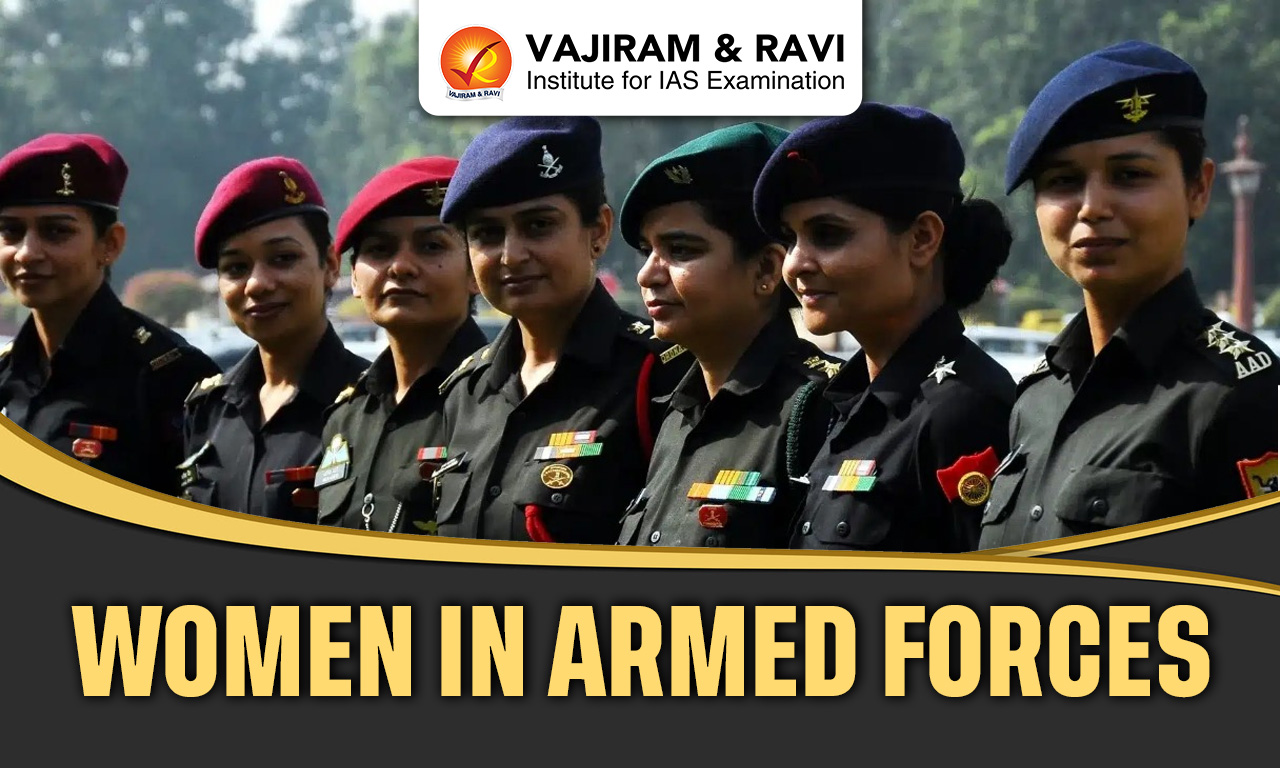
Women in the Indian Armed Forces have steadily increased their presence over the years, contributing to the defence and security of the country. Earlier, their roles were limited mainly to medical and support services, but today women serve in various branches of the Army, Navy, and Air Force. They are now taking up responsibilities in areas such as combat support, flying, and leadership positions. This growing participation reflects changing social attitudes, greater opportunities, and recognition of women’s capabilities in serving the nation.

Women in Indian Armed Forces

  • International Women’s Day is a reminder of how women are growing and taking leadership roles in different fields, including defence services.
  • In India, women are now becoming an important part of the Armed Forces, contributing not only in support roles but also in active and responsible positions.
  • Their increasing participation shows that society is becoming more accepting of gender equality and recognizing the capabilities of women.
  • Today, women officers are handling operational duties, leadership roles, and decision-making responsibilities, which reflects a major positive change in the defence system.
  • This transformation has taken place over time due to policy changes, support from the judiciary, and efforts by the armed forces to create equal opportunities.

Historical Evolution of Women’s Role

  • Pre-Independence Period
    • The involvement of women in military services in India began in 1888 with the formation of the Indian Military Nursing Service, where women mainly worked as nurses and medical staff.
    • During World War II (1942), the British Indian Army created the Women’s Auxiliary Corps, which allowed women to serve in non-combat roles like communication, clerical work, and administration.
    • However, women were not allowed to fight in combat roles in the British Indian Army, unlike in some Western countries.
    • A major exception was seen in the Rani of Jhansi Regiment of the Azad Hind Fauj led by Subhash Chandra Bose, where women actively participated in combat operations.
  • Post-Independence Period
    • After independence, the Army Act of 1950 restricted women from joining the armed forces in regular roles, except in certain special cases.
    • In 1958, a major step was taken when women doctors were granted Permanent Commission in the Army Medical Corps, allowing them long-term service.
    • A big change came in 1992, when women were allowed to join the armed forces as officers through the Women Special Entry Scheme (WSES), but only in selected non-combat branches.
    • Under WSES, women were given short-term roles (5 years) and were not allowed in core combat areas like infantry and armoured corps.
    • In 2006, the WSES was replaced by the Short Service Commission (SSC) scheme for women, giving them slightly better career opportunities, though still limited compared to men.
    • In 2008, women were granted Permanent Commission in limited branches like Judge Advocate General (JAG) and Army Education Corps (AEC).
    • A major breakthrough came in 2019, when the government expanded Permanent Commission to more branches, improving career stability for women officers.
    • In 2020, the Supreme Court (in the Babita Puniya case) ordered that women officers must be given equal opportunity for Permanent Commission, marking a historic step towards gender equality.
    • In 2021, women were allowed entry into the National Defence Academy (NDA), ensuring equal training opportunities from the beginning of their careers.
    • In the Indian Air Force, women were first inducted as pilots in the 1990s, and in 2016, they were allowed into the fighter pilot stream, which was later made permanent.
    • In the Indian Navy, women are now being deployed on warships and aviation roles, showing increased operational inclusion.

Key Milestones in Inclusion

  • In 1958, a major step was taken when women doctors were granted permanent commission in the Army Medical Corps on equal terms with men.
  • This marked the beginning of formal recognition of women’s long-term role in the Armed Forces.
  • In 1992, a significant turning point came when women were allowed to join as officers in various branches of the Armed Forces.
  • The Indian Army introduced the Women Special Entry Scheme (WSES), allowing women to serve in non-combat roles and also providing opportunities to widows of soldiers as a compassionate measure.
  • In the same year, the Indian Navy inducted women officers for the first time, expanding their role beyond medical services.
  • The Indian Air Force also started recruiting women as Short Service Commission officers in flying, technical, and non-technical branches.
  • These developments in 1992 laid the foundation for the gradual expansion of women’s roles across all three services.

Recent Developments and Expanding Opportunities

  • In recent years, several reforms have been introduced to increase the participation and growth of women in the Armed Forces.
  • Women officers are now being considered for promotion to higher ranks such as Colonel, which was earlier limited.
  • They are also being given command positions, allowing them to lead units and take important decisions.
  • To ensure fairness, certain relaxations have been provided to women officers who could not complete specific training requirements during earlier phases of transition.
  • Each branch of the Armed Forces - Army, Navy, and Air Force is taking steps to improve gender inclusion and provide equal career opportunities.
  • These changes are helping women build long-term careers and contribute more effectively to national defence.

Indian Army

  • The Indian Army has taken important steps to give women long-term career opportunities and stability.
  • Women officers are now being granted Permanent Commission, which means they can serve for a full career instead of short-term service.
  • This facility is now available in 12 different Arms and Services, which is a big expansion compared to earlier times.
  • Apart from this, women have already been serving in the Army Medical Corps, Army Dental Corps, and Military Nursing Service.
  • These changes show that the Army is slowly moving towards equal opportunities and recognizing the capability of women in leadership and long-term roles.

Indian Navy

  • The Indian Navy is actively increasing the participation of women in operational roles, especially at sea.
  • Women officers are now being posted onboard warships, which was not allowed earlier, showing a major step towards equality.
  • They are also serving as Pilots and Naval Air Operations (NAO) officers, handling important aviation responsibilities.
  • The Navy has opened almost all branches and specialisations for women, except submarines.
  • It has also become the first service to recruit women under the Agnipath scheme, allowing them to join as officers and Agniveers.
  • In the aviation field, women can now join the Remotely Piloted Aircraft (RPA) stream, and the first woman joined an RPA squadron in 2021.
  • Another important step is that women cadets can now join the Indian Naval Academy through the 10+2 B.Tech entry scheme from 2024.
  • Overall, the Navy is making strong efforts to include women in technical, operational, and leadership roles.

Indian Air Force

  • The Indian Air Force was the first to induct women as pilots in the 1990s, although initially in support roles.
  • A major reform came when women were allowed into combat roles, which started as an experiment in 2015 and became a permanent policy in 2022.
  • Now, women can serve as fighter pilots and in other combat streams, on equal terms with men.
  • Since 2017, women have also been getting opportunities in the flying branch through NCC Special Entry.
  • Women are now being inducted through the National Defence Academy (NDA), with fixed seats in flying and ground duty branches up to 2027.
  • Under the Agnipath scheme, women have joined as Agniveer Vayu, strengthening inclusion in the Air Force.
  • These steps show that the Air Force is leading in providing equal and advanced opportunities to women.

Increasing Opportunities and Participation

  • The number of women joining defence services is steadily increasing every year.
  • In 2025, 17 women cadets graduated from NDA in May and 15 more in November, showing rising participation.
  • By early 2026, a total of 158 women cadets had joined NDA since women were allowed entry in 2022.
  • Among states, Haryana has the highest number of women cadets, followed by Uttar Pradesh and Rajasthan.
  • The Army has also increased the number of seats for women from 80 to 144 in 2024, showing a major expansion in opportunities.
  • These numbers clearly show that more women are choosing defence careers and being encouraged to join.

Women Breaking New Ground

  • Women officers are now taking part in important missions, leadership roles, and international activities.
  • In 2025, a tri-services all-women sailing expedition was conducted, where 11 women officers from Army, Navy, and Air Force completed a long sea journey to Seychelles.
  • This mission showed teamwork, strength, and coordination among the three forces.
  • Women are also gaining visibility in national events, such as participation in the Republic Day Parade and other ceremonial roles.
  • Their growing presence reflects confidence, leadership, and equal participation in defence activities.

Awards and Recognition

  • Women officers are being recognized at national and international levels for their contributions.
  • In 2025, Major Swathi Shanthakumar received a UN award for her work in promoting gender equality and peacekeeping in South Sudan.
  • The NCC Girls Contingent received an Army award for the first time during Army Day celebrations in 2025.
  • Major Radhika Sen was awarded the title of Military Gender Advocate of the Year (2023) by the United Nations.
  • These recognitions highlight the important role women are playing not only in India but also globally.

Global Role and Peacekeeping

  • India is also promoting women’s participation in United Nations peacekeeping missions.
  • By mid-2025, more than 154 Indian women personnel were serving in different UN missions across the world.
  • India has already achieved about 22% representation of women in staff and observer roles in peacekeeping missions.
  • This is in line with global goals to increase women’s participation in international security efforts.
  • These contributions show that Indian women are playing an important role in promoting peace, security, and gender equality worldwide.

Women in Indian Armed Forces Major Policy Reforms

  • Kargil Review Committee (1999):
    • After the Kargil War, this committee studied the functioning of the defence system.
    • It suggested that women should be given more opportunities in areas like logistics, engineering, and intelligence.
    • This was one of the early steps that encouraged the expansion of women’s roles beyond traditional duties.
  • Supreme Court Judgment (2020):
    • The Supreme Court of India gave a landmark decision supporting gender equality in the Army.
    • It directed the government to grant Permanent Commission to women officers, allowing them to serve full careers like men.
    • This decision improved job security, promotion chances, and leadership opportunities for women.
    • It also reinforced the idea that women are equally capable of handling responsibilities in the armed forces.
  • Agnipath Scheme (2022):
    • This scheme opened a new path for young men and women to join the armed forces as Agniveers for a short-term service.
    • For the first time, women were included in this scheme across the Army, Navy, and Air Force.
    • It has increased the number of women entering defence services at an early stage.
  • Entry into National Defence Academy (NDA):
    • Earlier, women were not allowed to join the NDA, which is a key training institution for officers.
    • After a court decision, women cadets were allowed entry, marking a historic change.
    • The first batches of women cadets are set to graduate in 2025, showing real progress in equal training opportunities.
    • This step ensures that women and men now start their defence careers on the same platform.
  • Rising Strength of Women Officers:
    • The number of women officers in the armed forces has increased significantly over the years.
    • It has grown from around 3,000 in 2014 to over 11,000 today, showing steady progress.
    • This rise reflects better policies, increased awareness, and more opportunities for women.
    • It also shows that more women are choosing defence as a career option.
  • Military Nursing Service (MNS):
    • The Military Nursing Service remains the only all-women corps in the armed forces.
    • It has a long history of serving the nation, especially during wars and emergencies.
    • Women in this service play a crucial role in providing medical care and support to soldiers.
    • Even today, it continues to be an important part of the defence system, although women are now entering many other branches as well.

Women Leaders in Indian Armed Forces

  • Sadhna Saxena Nair became the first woman to serve as Director General Medical Services (Army). Her achievement shows that women are now reaching top leadership positions in the Army.
  • Ponung Doming made history as the first woman to command the world’s highest Border Task Force at very high altitude, showing great strength and leadership.
  • Bhawana Kanth was the first Indian woman fighter pilot to qualify for combat missions and also took part in the Republic Day flypast, inspiring many.
  • Annu Prakash has played an important role in maritime security, showing how women are contributing to protecting India’s coastline.
  • Hansja Sharma became the first woman Rudra helicopter pilot in the Army and led an aviation squadron, marking a big achievement.
  • Aastha Poonia became the first woman to enter the fighter stream of Naval Aviation, breaking barriers in a male-dominated field.
  • Avani Chaturvedi was the first Indian woman fighter pilot to take part in an international air combat exercise, showing global-level capability.
  • Shivangi Singh became India’s first woman Rafale fighter jet pilot, highlighting the growing role of women in advanced combat roles.
  • Anjali Singh became the first Indian woman military diplomat posted abroad, showing leadership beyond combat roles.
  • Dilna K and Roopa A completed a historic global sea journey, proving courage and leadership in the Navy.

Challenges Faced by Women in Indian Armed Forces

  • Limited Combat Roles and Career Growth: Women still have restricted entry into frontline combat roles, especially in the Army, which affects their experience, promotions, and chances of reaching higher leadership positions.
  • Infrastructure and Facility Gaps: Many remote and field postings lack proper accommodation, sanitation, and privacy for women, making daily life and work more difficult.
  • Cultural and Social Barriers: Traditional mindsets and gender biases sometimes make it challenging for women to be fully accepted as leaders, forcing them to constantly prove their abilities.
  • Work-Life Balance and Mental Stress: Managing demanding military duties along with family responsibilities, frequent transfers, and long separations can lead to stress and emotional challenges.
  • Safety, Health, and Representation Issues: Concerns like sexual harassment, lack of gender-friendly equipment, and low representation of women in the forces continue to affect their overall experience and confidence.

Women in Indian Armed Forces Significance

  • Promotes gender equality and women empowerment by giving equal opportunities in national defence.
  • Ensures better use of talent and human resources, improving overall efficiency of the forces.
  • Brings diverse perspectives in decision-making, which strengthens operational effectiveness.
  • Enhances India’s global image as a country committed to inclusivity and modern values.
  • Inspires social change and breaks stereotypes, encouraging more women to join defence and other fields.

Women in Indian Armed Forces FAQs

Q1: What is the role of women in the Indian Armed Forces today?

Ans: Women today serve in all three forces as officers, pilots, and leaders. They take part in operational duties, decision-making, and leadership roles.

Q2: How has the role of women evolved over time?

Ans: Earlier, women were limited to medical roles, but now they work in technical, operational, and even combat positions due to reforms and changing attitudes.

Q3: What are the key milestones in women’s inclusion in the Armed Forces?

Ans: Major steps include entry in 1992, Permanent Commission, the Supreme Court judgment in 2020, and NDA entry in 2021, which ensured equal opportunities.

Q4: What opportunities are available for women in different forces?

Ans: Women now serve in Army branches, Navy warships and aviation, and as fighter pilots in the Air Force, showing expanded roles.

Q5: What are the major challenges faced by women in the Armed Forces?

Ans: Women face challenges like limited combat roles, lack of facilities, gender bias, work-life balance issues, and safety concerns.

Mumbai Interbank Offer Rate (MIBOR), Features, Key Difference

Mumbai Interbank Offer Rate (MIBOR)

The Mumbai Interbank Offered Rate (MIBOR) is the interest rate at which banks in India lend short-term funds to each other, usually for overnight periods. It reflects the cost of borrowing in the interbank market and serves as a benchmark for various financial instruments. MIBOR is widely used in pricing loans, bonds, and derivatives. It also indicates the liquidity condition in the banking system and helps in understanding short-term interest rate trends.

Mumbai Interbank Offer Rate (MIBOR) Key Features

MIBOR is a benchmark interest rate that reflects short-term lending rates between banks in India and indicates overall liquidity conditions in the money market.

  • Benchmark rate for the Indian interbank money market
  • Represents short-term (mainly overnight) lending rates
  • Calculated on a daily basis
  • Based on inputs from major banks and primary dealers
  • Derived as a weighted average of lending rates
  • Reflects liquidity conditions in the banking system
  • Used for pricing various financial instruments
  • Ensures transparency in interest rate determination

Mumbai Interbank Bid Rate (MIBID)

The Mumbai Interbank Bid Rate (MIBID) is the rate at which banks are willing to borrow funds from other banks. It works alongside MIBOR and represents the demand side of the interbank market. 

  • MIBID is the borrowing rate, while MIBOR is the lending rate
  • Developed and published by the National Stock Exchange
  • Calculated as a weighted average of deposit rates offered by banks
  • Acts as a benchmark for large bank deposits
  • Forms a pair with MIBOR in the interbank market

Difference Between MIBOR and MIBID

MIBOR and MIBID are benchmark rates used in the interbank market to represent lending and borrowing rates between banks. While MIBOR reflects the rate at which banks lend funds, MIBID indicates the rate at which banks are willing to borrow funds.

Difference Between MIBOR and MIBID

Basis

MIBOR

MIBID

Full Form

Mumbai Interbank Offered Rate

Mumbai Interbank Bid Rate

Meaning

Rate at which banks lend to other banks

Rate at which banks borrow from other banks

Nature

Offer rate

Bid rate

Market Role

Represents supply of funds

Represents demand for funds

Calculation

Weighted average of lending rates

Weighted average of borrowing rates

Use

Benchmark for loans and derivatives

Benchmark for deposits and borrowing

Mumbai Interbank Forward Offer Rate (MIFOR)

The Mumbai Interbank Forward Offer Rate (MIFOR) is a benchmark rate used by Indian banks to price forward rate agreements and derivatives. It combines international and domestic market elements to determine interest rates for future contracts.

MIFOR is calculated using:

  • The international benchmark rate (LIBOR)
  • Forward premium from the Indian foreign exchange market

However, due to global benchmark reforms, the Reserve Bank of India discontinued the use of MIFOR as a standard reference rate after issues related to LIBOR manipulation.

Mumbai Interbank Offer Rate (MIBOR) FAQs

Q1: What is MIBOR?

Ans: MIBOR is the interest rate at which banks in India lend short-term funds to each other in the interbank market.

Q2: Who calculates and publishes MIBOR?

Ans: MIBOR is calculated and published by Financial Benchmarks India Pvt. Ltd.

Q3: Why is MIBOR important?

Ans: It acts as a benchmark for pricing loans, bonds, and derivatives, and reflects liquidity conditions in the banking system.

Q4: Is MIBOR fixed or variable?

Ans: MIBOR is a variable rate that changes daily based on market demand and supply of funds.

Q5: What is the most commonly used MIBOR tenor?

Ans: The overnight MIBOR is the most commonly used rate in the interbank market.

Amazon Rainforest, Characteristics, Flora, Fauna, Threats

Amazon Rainforest

The Amazon Rainforest is the largest tropical rainforest in the world, often called the “Lungs of the Earth” due to its crucial role in oxygen production and carbon absorption. It spreads across nine countries, mainly Brazil, Peru, and Colombia. Covering about 5.5 million square kilometers, the Amazon Basin is drained by the mighty Amazon River, which is the largest river in the world by volume of water.

Amazon Rainforest Characteristics

The Amazon Rainforest is a classic example of a tropical rainforest ecosystem, known for its dense vegetation, high rainfall, and rich biodiversity. Its unique climatic and ecological features make it one of the most complex natural systems on Earth.

  • Equatorial Climate: Located near the equator, it experiences high temperatures (around 25-30°C) and heavy rainfall throughout the year.
  • Heavy Rainfall: Receives more than 2000 mm of rainfall annually, with no distinct dry season.
  • Dense Forest Cover: Thick evergreen forests with multiple layers like emergent, canopy, understory, and forest floor.
  • High Humidity: Humidity levels often exceed 80%, creating a moist and warm environment.
  • Rich Biodiversity: Home to millions of plant and animal species, making it a global biodiversity hotspot.
  • Poor Soil Quality: Soils are heavily leached and low in nutrients despite dense vegetation.
  • Rapid Nutrient Cycling: Nutrients are quickly recycled within the ecosystem due to decomposition of organic matter.
  • Extensive River System: Dominated by the Amazon River and its tributaries.
  • Evergreen Vegetation: Trees do not shed leaves seasonally, maintaining greenery throughout the year.
  • Adaptations of Plants: Features like drip-tip leaves and buttress roots help plants survive heavy rainfall and poor soil.

Carbon Fertilisation Effect

The Carbon Fertilisation Effect refers to the process where increased levels of carbon dioxide (CO₂) in the atmosphere enhance plant growth.

  • Higher CO₂ levels increase photosynthesis, leading to faster plant growth.
  • The Amazon acts as a carbon sink, absorbing large amounts of CO₂.
  • This helps in reducing the impact of global warming.
  • However, recent studies show that due to deforestation and climate stress, the Amazon’s ability to absorb carbon is declining.

Amazon Rainforest Key Facts

  • Location & Size: The Amazon Rainforest is the largest tropical rainforest, covering about 5.5-6 million sq. km, nearly twice the size of India.
  • Geographical Spread: About 60% lies in Brazil, while the rest extends across Peru, Colombia, Venezuela, Ecuador, Bolivia, Guyana, Suriname, and French Guiana.
  • Amazon River Basin: The rainforest lies in the basin of the Amazon River, the largest river system in the world.
  • Natural Boundaries:
    • North: Guiana Highlands
    • West: Andes Mountains
    • South: Brazilian Plateau
    • East: Atlantic Ocean
  • Climate Characteristics:
    • Equatorial climate with high rainfall (2000 mm+)
    • High humidity (above 80%)
    • Warm temperatures (25-30°C) throughout the year
  • Biodiversity Hotspot: Hosts around 10% of the world’s known species, making it one of the richest ecosystems globally.
  • Protected Areas: Important conservation regions include Yasuni National Park (Ecuador), Manu National Park (Peru), and Jaú National Park (Brazil).
  • Global Importance: Acts as a major carbon sink, helps regulate global climate, and supports biodiversity (often called the “Lungs of the Earth”).
  • Amazon River System: Originates in the Andes (Peru) and flows into the Atlantic Ocean; major tributaries include Rio Negro, Madeira, and Xingu.
  • Overall Significance: A critical ecosystem for climate stability, biodiversity conservation, and environmental balance worldwide.

Amazon Rainforest Flora and Fauna

The Amazon Rainforest is one of the most biologically diverse regions on Earth, hosting an incredible variety of plant and animal species. Its dense vegetation and warm, humid climate create ideal conditions for the growth and survival of countless life forms.

Flora (Plant Life)

  • Huge Plant Diversity: More than 40,000 plant species are found in the Amazon.
  • Layered Vegetation: Forest structure includes emergent layer, canopy, understory, and forest floor.
  • Evergreen Trees: Trees remain green throughout the year due to continuous rainfall.
  • Important Trees: rubber tree, mahogany, rosewood, Brazil nut, palm, acacia, and cedar are widely found.
  • Epiphytes and Climbers: Plants like orchids, mosses, and lianas grow on other plants for support.
  • Drip-tip Leaves: Leaves have pointed tips to quickly shed excess rainwater.
  • Medicinal Plants: Many plants are used in modern and traditional medicine.

Fauna (Animal Life)

  • Extremely Rich Animal Diversity: Home to millions of species, many still undiscovered.
  • Mammals: Includes species like the Jaguar, Sloth, and monkeys.
  • Reptiles: Presence of large reptiles like the Anaconda and caimans.
  • Amphibians: Brightly colored species like the Poison Dart Frog are common.
  • Birds: Rich birdlife including parrots, toucans, and macaws.
  • Insects: Around 2.5 million insect species, making it the most insect-rich region.
  • Aquatic Life: Rivers support fish like piranhas and river dolphins.

Amazon Rainforest Significance

The Amazon Rainforest is vital for maintaining both regional and global ecological balance. Its role extends beyond geography, influencing climate, biodiversity, and human survival.

Global Climate Regulation: Helps stabilize Earth’s climate by controlling temperature and atmospheric circulation.

  • Carbon Sink: Absorbs vast amounts of carbon dioxide, reducing the impact of global warming.
  • Oxygen Production: Contributes to oxygen generation through photosynthesis, earning the name “Lungs of the Earth.”
  • Biodiversity Conservation: Supports millions of plant and animal species, many of which are endemic and undiscovered.
  • Water Cycle Maintenance: Releases moisture into the atmosphere through transpiration, influencing rainfall patterns even beyond South America.
  • Indigenous Communities: Provides habitat and livelihood for numerous tribal groups with rich cultural traditions.
  • Medicinal Value: Source of many important medicines and potential future drugs.
  • Economic Importance: Provides resources like timber, rubber, and food products.
  • Soil Protection: Dense vegetation prevents soil erosion and maintains land fertility.
  • Global Environmental Balance: Acts as a buffer against climate change and ecological degradation.

Threats to the Amazon Rainforest

The Amazon Rainforest is facing serious environmental threats due to human activities and climate change. These threats are not only endangering biodiversity but also affecting global climate balance.

  • Deforestation: Large-scale clearing of forests for cattle ranching, agriculture (especially soybean cultivation), and logging is the biggest threat.
  • Forest Fires: Frequent and often human-induced fires destroy vast forest areas and release massive carbon emissions.
  • Climate Change: Rising global temperatures and changing rainfall patterns are weakening the rainforest ecosystem.
  • Illegal Mining: Gold mining and other activities cause deforestation, water pollution, and habitat destruction.
  • Infrastructure Development: Construction of roads, dams, and settlements leads to fragmentation of forests.
  • Loss of Biodiversity: Many plant and animal species are becoming endangered due to habitat loss.
  • Overexploitation of Resources: Unsustainable extraction of timber, rubber, and other forest products.
  • Soil Degradation: Removal of forest cover leads to soil erosion and loss of fertility.
  • Displacement of Indigenous Tribes: Tribal communities lose their habitat and traditional way of life.
  • Tipping Point Risk: Continuous damage may push the Amazon towards a savanna-like ecosystem, reducing its ability to act as a carbon sink.

Amazon Rainforest FAQs

Q1: Where is the Amazon Rainforest located?

Ans: The Amazon Rainforest is located in South America and spreads across nine countries, mainly Brazil, Peru, and Colombia.

Q2: Why is the Amazon Rainforest called the “Lungs of the Earth”?

Ans: It is called so because it absorbs large amounts of carbon dioxide and releases oxygen through photosynthesis, helping regulate the Earth’s atmosphere.

Q3: Which is the main river of the Amazon Rainforest?

Ans: The Amazon River is the main river, and it is the largest river in the world by volume of water.

Q4: How important is the Amazon Rainforest for climate?

Ans: It plays a crucial role in global climate regulation by acting as a carbon sink and influencing rainfall and temperature patterns.

Q5: What are the main threats to the Amazon Rainforest?

Ans: Major threats include deforestation, forest fires, climate change, illegal mining, and large-scale agriculture.

Illegal Sand Mining, Reason, Legal Framework, Cases in India

Illegal Sand Mining

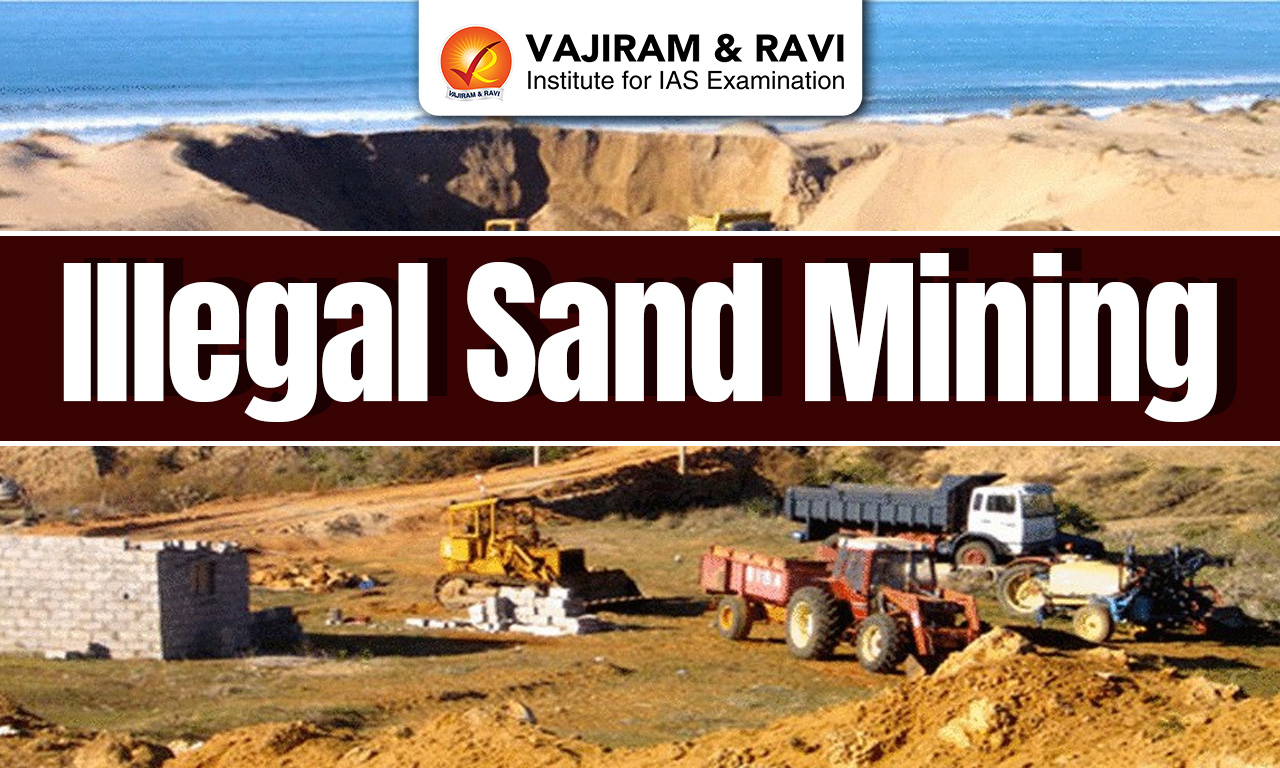
Sand is a naturally occurring granular material formed from weathered rocks and minerals and it is the second most used natural resource after water globally. Sand Mining refers to the extraction of sand from rivers, lakes, coastal areas and other environments for construction and industrial use. Illegal Sand Mining is the unauthorized extraction of sand without permits, often driven by high demand, weak enforcement and organized criminal networks, leading to severe environmental and economic consequences.

Illegal Sand Mining Reasons

Illegal Sand Mining is driven by economic demand, governance gaps and lack of sustainable alternatives, making it a widespread environmental and administrative issue.

  • High Construction Demand: India’s construction sector contributes about 9% of GDP and requires nearly 700 million tonnes of sand annually, while legal supply is around 400 million tonnes, creating a deficit filled through illegal mining activities.
  • Rapid Urbanization: Increasing population and urban expansion significantly raise infrastructure demand, including housing, roads and bridges, which directly increases dependence on sand as a primary raw material.
  • Weak Enforcement Mechanisms: Inadequate regulatory monitoring and weak implementation of laws allow illegal mining operations to continue unchecked, especially in remote riverine and coastal regions.
  • Sand Mafia Networks: Organized criminal groups control illegal mining operations, operating as parallel economies worth ₹40,000-₹50,000 crore annually, often involving violence, corruption and political patronage.
  • Complex Approval Processes: Lengthy and bureaucratic procedures for legal mining approvals discourage compliance, pushing operators toward illegal extraction to save time and costs.
  • Lack of Alternatives: Limited adoption of substitutes like manufactured sand (M sand), fly ash and recycled materials maintains high dependence on natural river sand.
  • Corruption and Nexus: Collusion between local authorities, politicians and illegal miners weakens governance, enabling illegal operations to flourish without fear of strict penalties.
  • Poor EIA Implementation: Weak enforcement of Environmental Impact Assessment norms allows small scale mining activities to bypass regulatory scrutiny and operate illegally.

Sand Mining Legal Framework

Legal Sand Mining refers to regulated extraction carried out under government approval with environmental safeguards, licensing and scientific limits to ensure sustainability and ecological balance.

  • Legal Definition and Nature: Sand is classified as a minor mineral under the Mines and Minerals (Development and Regulation) Act 1957 and its regulation is primarily under State Governments through rules framed under Section 15 of the Act.
  • Environmental Clearance Requirement: Legal mining requires Environmental Clearance under the Environment Impact Assessment Notification 2006, even for areas below 5 hectares, ensuring ecological considerations before extraction activities begin.
  • Role of SEIAA and SEAC: The State Environment Impact Assessment Authority and State Expert Appraisal Committee evaluate mining proposals based on river flow, replenishment capacity and ecological sensitivity before granting approvals.
  • Sustainable Sand Mining Guidelines 2016: Issued by MoEFCC, these guidelines focus on maintaining river equilibrium, preventing groundwater depletion and ensuring environmentally sustainable mining practices across India.
  • Enforcement and Monitoring Guidelines for Sand Mining 2020: These guidelines provide a standardized protocol for tracking sand extraction, transportation and usage using technologies like drones, GPS and satellite monitoring systems.
  • District Survey Report: The government mandates preparation of District Survey Reports as a scientific basis for granting mining leases, which are updated every five years to reflect resource availability and ecological conditions.
  • Legal vs Illegal Sand Mining: Legal mining involves permits, royalty payments and monitoring, while illegal mining operates without authorization, causing revenue loss and environmental degradation with no accountability.
  • Illegal Sand Mining Punishments: MMDR Act amendments (2015) increased penalties to ₹5 lakh per hectare and imprisonment up to 5 years, with Special Courts for speedy trials and State Governments empowered under Section 23C to enforce strict action.
  • Illegal Sand Mining Complaint: Complaints regarding illegal mining can be reported to district authorities, police or mining departments, as State Governments under Section 23C of the MMDR Act are responsible for enforcement, investigation and necessary legal action.

Illegal Sand Mining Cases in India

Illegal Sand Mining in India has grown due to rising demand, weak enforcement and organized networks, creating a large parallel economy and environmental crisis.

  • Economic Scale of Illegal Trade: The Illegal Sand Mining economy in India is estimated to be about ₹50,000 crore annually, indicating the scale of unregulated extraction and associated black market activities.
  • Major Affected Regions: States like Uttar Pradesh, Madhya Pradesh, Maharashtra, Tamil Nadu, Bihar and Odisha face severe illegal mining along rivers such as Yamuna, Narmada, Godavari, Cauvery and Son.
  • Bihar Crackdown: Bihar Police conducted a major operation near the Sone River, arresting sand smugglers, highlighting the presence of organized criminal syndicates controlling illegal mining activities.
  • River System Impact: Rivers such as the Ganga, Brahmaputra and their tributaries experience excessive extraction, altering sediment balance and affecting long term river stability and water systems.
  • Sand Mafia: Illegal mining is often controlled by organized groups with political patronage, leading to violence, intimidation and even killings of officials, journalists and activists.
  • Global Context: Studies indicate that 40 to 50 billion tonnes of sand are extracted annually worldwide, with illegal mining contributing significantly due to lack of global regulatory frameworks.

Illegal Sand Mining Impacts

Illegal Sand Mining has serious environmental, economic and social consequences, affecting river ecosystems, biodiversity and local livelihoods significantly.

  • River Ecology Degradation: According to the Geological Survey of India, excessive sand removal alters riverbeds, disrupts natural flow and destroys aquatic habitats, affecting fish breeding and ecological balance.
  • Erosion and Land Loss: Unregulated mining causes riverbank erosion, leading to loss of agricultural land and displacement of communities living near rivers and coastal areas.
  • Groundwater Depletion: Deep pits created by sand extraction lower groundwater levels, affecting drinking water availability and causing water scarcity in nearby villages.
  • Flood Risk Increase: Removal of sand weakens natural barriers like sandbanks and dunes, increasing vulnerability to floods in riverine and coastal regions.
  • Biodiversity Loss: Habitat destruction impacts species like fish, turtles and birds. Regions like Chambal Sanctuary facing threats to endangered gharials due to illegal mining.
  • Water Quality Decline: Increased sediment imbalance and turbidity reduce water quality, affecting both human consumption and aquatic ecosystems.
  • Social and Economic Consequences: Illegal mining leads to violence, livelihood loss for fishermen and farmers and significant revenue loss to the government due to tax evasion.

Illegal Sand Mining Government Initiatives

The government has introduced policies, laws and technological tools to regulate Sand Mining and curb illegal activities across India.

  • MMDR Act 1957: This Act provides the legal framework for mining regulation, with provisions to prevent illegal mining and empower states to take enforcement actions.
  • National Mineral Policy 2019: It emphasizes transparency, sustainable mining practices and scientific resource management to reduce illegal extraction and promote accountability.
  • Sustainable Sand Mining Guidelines 2016: These guidelines aim to ensure environmentally sustainable mining while protecting river ecosystems and maintaining natural sediment balance.
  • Enforcement and Monitoring Guidelines 2020: Introduces modern monitoring systems including drones, satellite imagery and real time tracking of sand transportation.
  • Mining Surveillance System: Developed using space technology in coordination with BISAG and MeitY, it helps detect illegal mining activities through satellite based monitoring.
  • Digital Tracking Systems: Initiatives like e-Green Watch and digital sand tracking ensure end to end monitoring of mining activities and reduce illegal transportation.
  • State Level Actions: States like Bihar have set up check posts and conducted enforcement drives, while Odisha uses integrated digital systems to regulate mining operations effectively.

Illegal Sand Mining Case Laws

Judicial interventions have played a crucial role in regulating Illegal Sand Mining and addressing environmental concerns arising from illegal extraction.

  • Chambal Sand Mining Case (2026): The Court described Sand Mining cartels as “modern dacoits.” It flagged an “environmental crisis” in National Chambal Sanctuary, ordering CCTV surveillance, GPS tracking, vehicle seizure, joint patrols and warning of complete mining ban or central force deployment for non compliance.
  • UP Sand Mining PIL (2022): The court directed adoption of e-licensing systems to ensure transparency and reduce corruption in Sand Mining processes.
  • NGT v. Tamil Nadu Sand Mining Case (2018): National Green Tribunal directed implementation of digital monitoring systems to track sand transportation and curb illegal activities.
  • Deepak Kumar v. State of Haryana (2013): The Supreme Court mandated environmental clearance for all Sand Mining activities, even below 5 hectares, to prevent ecological damage.

Sustainable Sand Mining Challenges

Despite policies and awareness, achieving eradication of Illegal Sand Mining remains difficult due to multiple structural, economic and governance related challenges.

  • High Construction Demand: Rapid urbanization and infrastructure growth continuously increase demand for sand, making it difficult to reduce dependency on natural sources.
  • Weak Enforcement Mechanisms: Lack of effective monitoring, limited manpower and corruption reduce the effectiveness of laws and guidelines on the ground.
  • Limited Alternatives Adoption: Manufactured sand and recycled materials are not widely adopted due to cost, awareness gaps and market preferences for natural sand.
  • Governance and Coordination Issues: Overlapping responsibilities between central and state authorities create gaps in policy implementation and enforcement.
  • Sand Mafia Influence: Organized criminal networks with political support hinder strict action, making enforcement risky and challenging for authorities.
  • Environmental Assessment Gaps: Weak implementation of Environmental Impact Assessments allows illegal activities to continue without proper ecological evaluation.
  • Data and Monitoring Limitations: Lack of real time data and comprehensive surveys makes it difficult to track extraction levels and ensure sustainable mining practices.

Illegal Sand Mining Measures

Addressing Illegal Sand Mining requires a combination of regulatory reforms, technological solutions and sustainable alternatives to ensure long term environmental protection.

  • Promote Manufactured Sand (M Sand): Encouraging use of crushed stone sand as an alternative can significantly reduce dependence on riverbed sand and lower environmental damage.
  • Strengthen Monitoring Technology: Use of drones, satellite imagery, GPS tracking and remote sensing can help detect illegal mining activities in real time and improve enforcement.
  • Centralized Regulatory Framework: Bringing uniform national level regulation can reduce inconsistencies across states and ensure better control over illegal mining operations.
  • Community Participation: Involving local communities and Gram Panchayats in monitoring can improve reporting of illegal activities and enhance accountability at the grassroots level.
  • Strict Law Enforcement: Strengthening penalties and ensuring swift legal action against offenders can deter illegal mining and reduce the influence of Sand Mafias.
  • Reduce Sand Consumption: Promoting green construction practices using fly ash, recycled materials and alternative technologies can lower overall demand for natural sand.
  • Scientific Mining Practices: Implementing replenishment based extraction limits and periodic audits ensures sustainable use of sand resources while maintaining ecological balance. 

Illegal Sand Mining FAQs

Q1: What is Illegal Sand Mining?

Ans: Illegal Sand Mining refers to the unauthorized extraction of sand from rivers, beaches or other natural areas without government permits, violating environmental and mining laws.

Q2: Why is Sand Mining important?

Ans: Sand is essential for construction activities like making concrete, roads and glass, making it a critical resource for infrastructure and economic development.

Q3: What are the major impacts of Illegal Sand Mining?

Ans: It causes riverbank erosion, groundwater depletion, biodiversity loss, increased flood risk and significant environmental degradation.

Q4: Which law regulates Sand Mining in India?

Ans: Sand Mining is regulated under the Mines and Minerals (Development and Regulation) Act 1957, along with Environmental Impact Assessment guidelines.

Q5: What is the role of Sand Mafias in illegal mining?

Ans: Sand Mafias are organized groups involved in illegal extraction and trade of sand, often linked with corruption, violence and large scale revenue loss to the government.

AI Governance and Economic Group (AIGEG), Composition, Key Functions

AI Governance and Economic Group

The Ministry of Electronics and Information Technology (MeitY), Government of India, has constituted the AI Governance and Economic Group (AIGEG), a high-level inter-ministerial body that will serve as India’s central institutional mechanism for AI governance policy development and coordination.

About AI Governance and Economic Group (AIGEG)

The AI Governance and Economic Group (AIGEG) is an apex inter-ministerial institutional mechanism established to coordinate Artificial Intelligence policy, governance, and economic strategy in India. The AIGEG gives institutional form to recommendations made in India’s Artificial Intelligence Governance Guidelines and the Economic Survey, both of which emphasized the need for a central coordinating authority.

AI Governance and Economic Group (AIGEG) Composition

The AIGEG is structured as a high-level political and administrative body.

  • Chairperson: Minister of Electronics and Information Technology, Railways, and Information and Broadcasting.
  • Vice Chairperson: Minister of State for Electronics and Information Technology and Commerce and Industry: Shri Jitin Prasada
  • Members: The membership of AIGEG includes senior stakeholders from across the Government of India, representing policy development, science and technology, security, and economic affairs. This broad composition ensures cross-sectoral integration of Artificial Intelligence governance.

AI Governance and Economic Group (AIGEG) Key Functions 

The AI Governance and Economic Group (AIGEG) acts as the central body guiding how Artificial Intelligence is governed, used, and regulated in India. Its role is to ensure that technological progress happens in a coordinated, responsible, and economically balanced manner.

  • Policy Coordination: Ensures that ministries, departments, and regulators work in alignment under a common national Artificial Intelligence strategy, reducing duplication and policy inconsistencies.
  • Labour Market Assessment: Examines how Artificial Intelligence will affect jobs by identifying sectors at risk, changes in job roles, and potential new employment opportunities.
  • Workforce Transition: Develops strategies for reskilling and upskilling to help workers adapt to technological changes and minimise disruption.
  • Long-Term Roadmap: Prepares a structured plan for Artificial Intelligence adoption over the next decade, covering sectoral priorities and regional impacts.
  • Use Case Classification: Categorises Artificial Intelligence applications into deploy, pilot, and defer based on data availability, legal readiness, skill levels, and social impact.
  • Regulatory Oversight: Reviews existing laws, identifies regulatory gaps, and ensures that Artificial Intelligence deployment complies with national legal frameworks.
  • Responsible Artificial Intelligence: Promotes ethical, transparent, and safe use of Artificial Intelligence while addressing risks such as bias, misinformation, and data misuse.
  • Global Strategy: Defines India’s approach to global Artificial Intelligence governance and ensures alignment with international standards and developments.

To support its functioning, the AIGEG is assisted by a Technology and Policy Expert Committee (TPEC). The TPEC acts as an advisory body and provides:

  • Expert analysis of emerging Artificial Intelligence technologies
  • Assessment of global Artificial Intelligence governance trends
  • Identification of technological and regulatory risks
  • Inputs for policy formulation and refinement

This ensures that AIGEG decisions are informed by technical expertise and global best practices.

AI Governance and Economic Group (AIGEG) Significance 

The AI Governance and Economic Group (AIGEG) is an important institutional step that strengthens India’s ability to manage the opportunities and challenges of Artificial Intelligence in a structured and balanced manner.

  • Whole-of-Government Approach: AIGEG promotes a whole-of-government approach by bringing together ministries, departments, and regulators to ensure coordinated Artificial Intelligence governance.
  • Coherent National Strategy: It ensures a unified and coherent national Artificial Intelligence strategy, reducing policy fragmentation across sectors.
  • Labour-Centric Approach: It aligns Artificial Intelligence adoption with labour market realities, focusing on employment impacts, skill gaps, and workforce transition.
  • Phased and Responsible Deployment: Through classification into deploy, pilot, and defer categories, it enables a calibrated and responsible approach to Artificial Intelligence adoption.
  • Strengthened Regulatory Governance: It improves regulatory oversight by identifying legal gaps and ensuring compliance with domestic laws.
  • Ethical and Responsible Artificial Intelligence: It promotes responsible Artificial Intelligence development by addressing concerns such as bias, transparency, accountability, and data privacy.
  • Global Governance Alignment: It helps align India’s Artificial Intelligence policies with global frameworks and strengthens its role in international governance discussions.
  • Integration with Economic Planning: It links Artificial Intelligence deployment with economic growth, productivity, and structural transformation.
  • Proactive Risk Governance: It enables early identification and management of emerging risks such as misinformation, security threats, and technological misuse.
  • Inclusive and Balanced Development: It ensures that Artificial Intelligence benefits are distributed equitably, addressing regional disparities and supporting inclusive growth.

AI Governance and Economic Group (AIGEG) Challenges

While the AI Governance and Economic Group (AIGEG) provides a strong institutional framework, its effective functioning will depend on how well it addresses several structural and emerging challenges.

  • Coordination Complexity: Implementing a whole-of-government approach can be difficult due to overlapping responsibilities, bureaucratic delays, and varying priorities among ministries and regulators.
  • Rapid Technological Change: Artificial Intelligence evolves at a very fast pace, making it challenging for policies and governance frameworks to remain relevant and up to date.
  • Regulatory Lag: There is often a gap between technological innovation and legal frameworks, which can lead to unclear regulations and weak enforcement.
  • Limited Institutional Capacity: Effective Artificial Intelligence governance requires technical expertise and institutional capacity, which are still developing within government systems.
  • Labour Market Uncertainty: Predicting the exact impact of Artificial Intelligence on jobs, especially in a largely informal and diverse labour market, remains complex.
  • Data and Privacy Concerns: Ensuring data protection, privacy, and secure use of data is a major challenge in the expansion of Artificial Intelligence systems.
  • Ethical and Social Risks: Issues such as bias in algorithms, misinformation, and surveillance concerns require continuous monitoring and policy intervention.

Way Forward

To ensure the AI Governance and Economic Group (AIGEG) delivers effectively, a focused and strategic approach is needed:

  • Strengthen Institutional and Technical Capacity: Build specialised expertise within government through training, research support, and dedicated Artificial Intelligence units.
  • Adopt Agile and Future-Ready Regulation: Move towards adaptive, principle-based regulatory frameworks that can respond quickly to technological change.
  • Invest in Human Capital: Scale up reskilling and upskilling initiatives to support workforce transition, especially in the informal sector.
  • Build Robust Data Governance: Establish strong data protection, sharing, and accountability frameworks to ensure trust and security.
  • Foster Whole-of-Ecosystem Collaboration: Deepen coordination between government, industry, academia, and startups for innovation and effective implementation.
  • Engage Globally: Proactively engage in global Artificial Intelligence governance to shape standards while safeguarding national priorities.

AI Governance and Economic Group FAQs

Q1: What is the Artificial Intelligence Governance and Economic Group (AIGEG)?

Ans: It is a high-level inter-ministerial body set up by the Government of India to coordinate Artificial Intelligence policy, governance, and economic strategy under a unified national framework.

Q2: Why was the Artificial Intelligence Governance and Economic Group (AIGEG) created?

Ans: It was created to implement recommendations from the Artificial Intelligence Governance Guidelines and the Economic Survey, which highlighted the need for a central authority to align Artificial Intelligence with economic priorities and labour market realities.

Q3: Who leads the Artificial Intelligence Governance and Economic Group (AIGEG)?

Ans: It is chaired by the Union Minister for Electronics and Information Technology, with the Minister of State for Electronics and Information Technology serving as the Vice Chairperson, supported by senior government officials.

Q4: What are the key functions of the Artificial Intelligence Governance and Economic Group (AIGEG)?

Ans: It coordinates policies across ministries, assesses employment impacts, develops deployment strategies, strengthens regulations, promotes responsible Artificial Intelligence use, and defines India’s global governance approach.

Q5: How does the Artificial Intelligence Governance and Economic Group (AIGEG) affect jobs and the economy?

Ans: It studies the impact of Artificial Intelligence on jobs and prepares strategies such as reskilling and workforce transition to ensure balanced and inclusive economic growth.

Hussain Sagar Lake

Hussain Sagar Lake

Hussain Sagar Lake Latest News

Hussain Sagar lake is emitting a strong foul odour as rising summer temperatures trigger heavy algal bloom.

About Hussain Sagar Lake

  • It is an artificial lake located in Hyderabad, Telangana.
  • It is also called Tank Bund and lies on a tributary of River Musi. 
  • It spreads across an area of 5.7 sq.km. It is one of the largest man-made lakes in Asia.
  • It is the largest heart-shaped mark among the marks formed by 78 heart-shaped lakes and 9 heart-shaped islands on the face of the earth.
  • The United Nations World Tourism Organisation has named the lake “Heart of the World”.
  • It was constructed in 1562 AD during the reign of Ibrahim Quli Qutb Shah, the fourth ruler of the Qutb Shahi dynasty. 
  • The lake was named after Hussain Shah Wali, the chief engineer who designed and supervised its construction.
  • It is renowned for its monolith of Lord Buddha that stands right in its centre. It has a height of 16 m and weighs almost 350 tonnes.
  • It had been of significance in the early days since it connected the twin cities of Hyderabad and Secunderabad.
  • It was initially built to cater to the irrigation needs and other water needs of the city. Until the year of 1930, it was used for the same purpose.
  • Indira Park, Lumbini Park, and Sanjeevaiah Park surround the lake on three sides.
  • Over the years, Hussain Sagar Lake has become polluted through the entry of untreated sewage and industrial effluents through the nalas that flow into the lake.

Source: TT

Hussain Sagar Lake FAQs

Q1: Where is Hussain Sagar Lake located?

Ans: It is an artificial lake located in Hyderabad, Telangana.

Q2: On which river system is Hussain Sagar Lake located?

Ans: It lies on a tributary of the Musi River.

Q3: Why is Hussain Sagar Lake unique in shape?

Ans: It is the largest heart-shaped mark among heart-shaped lakes and islands.

Q4: During whose reign was the lake built?

Ans: It was constructed in 1562 AD during the reign of Ibrahim Quli Qutb Shah, the fourth ruler of the Qutb Shahi dynasty.

Q5: After whom is Hussain Sagar Lake named?

Ans: The lake was named after Hussain Shah Wali, the chief engineer who designed and supervised its construction.

Astra Mark 2 Missile

Astra Mark 2 Missile

Astra Mk2 Missile Latest News

India is planning to equip Mirage 2000 jets with Astra Mk2 missiles, enabling long-range interception up to 240 km and strengthening aerial dominance.

About Astra Mk2 Missile

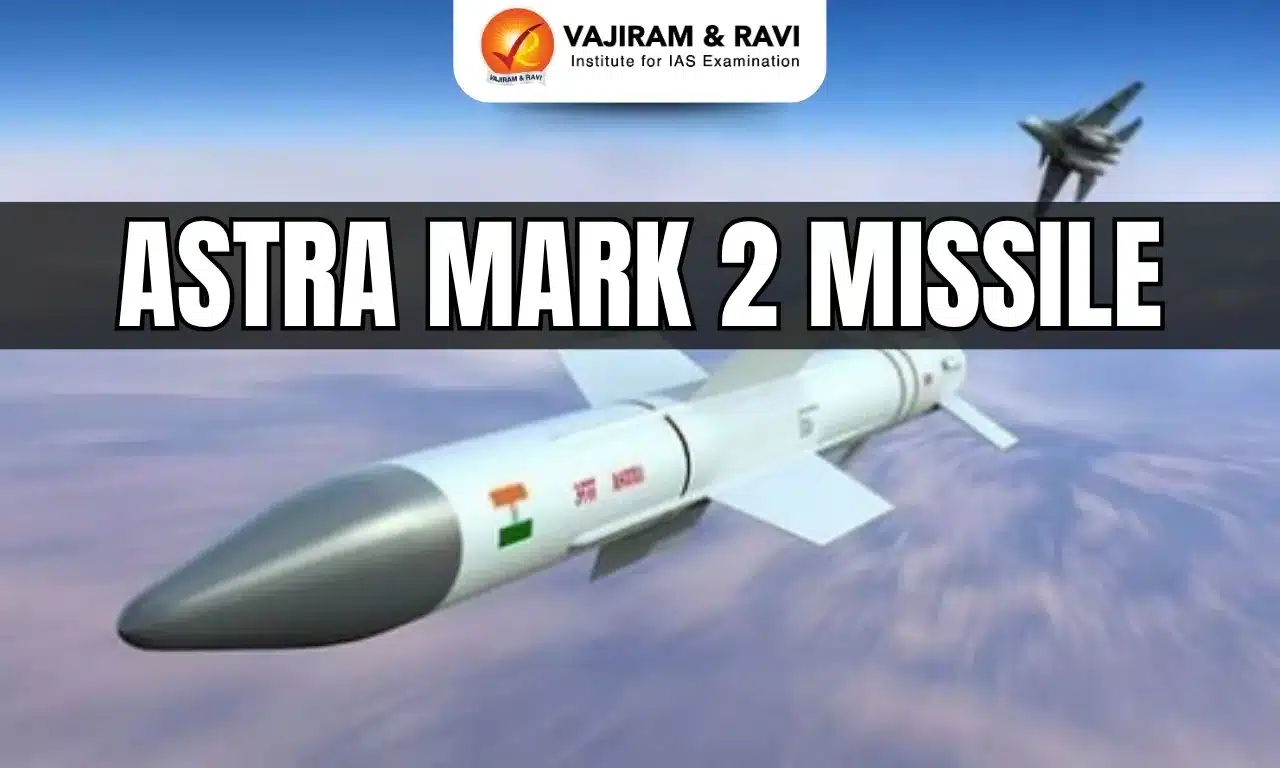
  • It is a Beyond Visual Range (BVR) air-to-air missile.
  • It is being developed by the Defence Research and Development Organisation (DRDO).
  • In addition to various laboratories of DRDO, more than 50 public and private industries, including Hindustan Aeronautics Limited, have contributed towards successful realisation of the weapon system. 
  • The Astra Mark-1 air-to-air missile with a strike range of around 90-100 kms is already in the Indian Air Force and is already integrated with the LCA Tejas and the Su-30 MKI fighter jets.
  • The Astra Mark 2 would give the Indian Air Force an edge over the adversaries in air-to-air combat and can also be offered as an export product to friendly foreign countries.

Astra Mk2 Missile Features

  • While the Astra Mark-1 is a single-pulse, smokeless solid-fueled motor, the Astra Mark-2 uses a dual-pulse solid rocket motor for extended reach and better kinematics during the kill phase. 
  • Astra Mk-1 is 3.6 m (12 ft) long with a diameter of 178 mm (7.0 in) and weighs 154 kg with a maximum range of 110 km. The Astra Mark 2 will be a bigger missile with a diameter of 190 mm and weigh close to 175 kg.
  • Range: 200–240 km (high altitude conditions)
  • Astra Mk-2 will use the indigenous seeker manufactured by Bharat Electronics Limited (BEL).
  • This seeker is equipped with electronic counter-countermeasures (ECCM), enhancing its ability to resist jamming and electronic warfare tactics.
  • Another critical feature is the two-way datalink that enables mid-course updates. This allows the missile to receive real-time guidance corrections from the launch platform or other assets.

Source: IMM

Astra Mk2 Missile FAQ's

Q1: What is the Astra Mk-2 Missile?

Ans: It is a Beyond Visual Range (BVR) air-to-air missile.

Q2: Which organization is developing the Astra Mk-2 missile?

Ans: It is being developed by the Defence Research and Development Organisation (DRDO).

Q3: What type of propulsion system does Astra Mk-2 use?

Ans: Dual-pulse solid rocket motor.

Q4: What is the approximate range of Astra Mk-2?

Ans: 200–240 km (at high altitude).

Austria

Austria

Austria Latest News

India and Austria recently signed multiple agreements and announcements aimed at deepening bilateral cooperation across defence, trade, technology, education, and culture.

About Austria

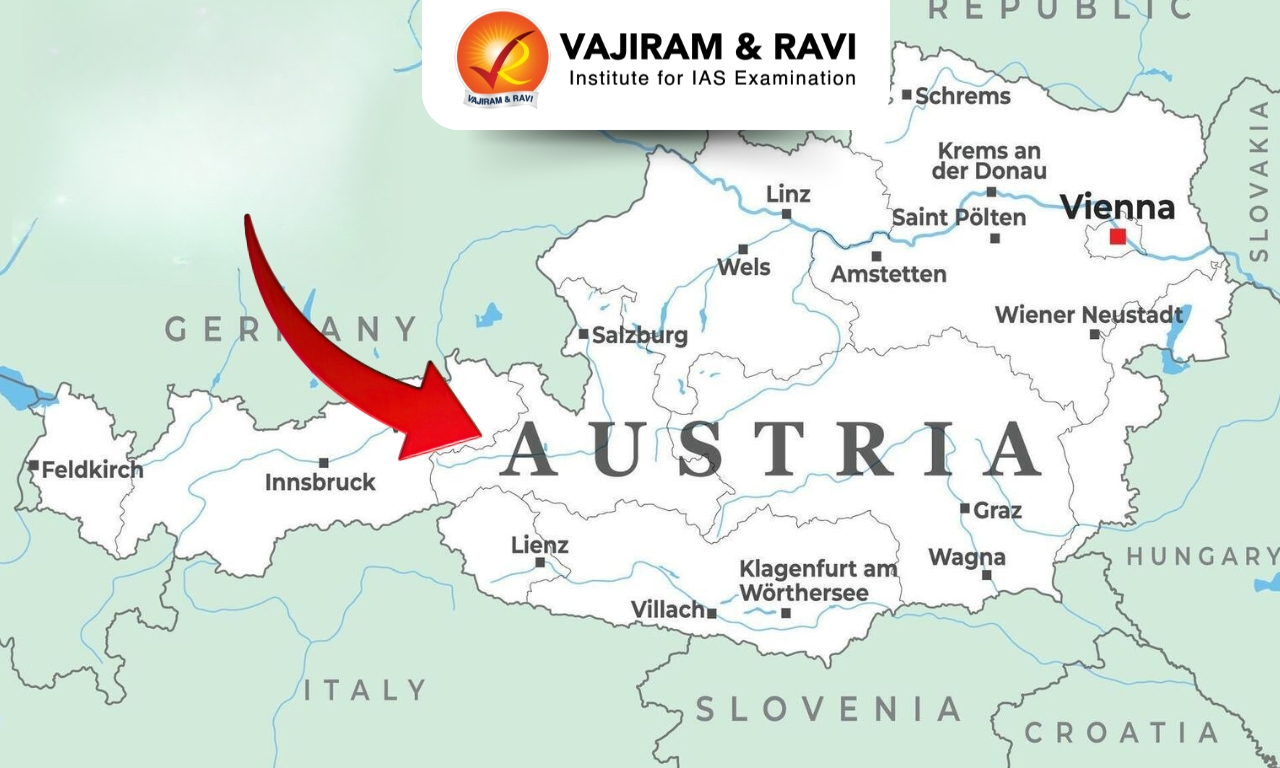
  • It is a largely mountainous landlocked country of south-central Europe. 
  • Capital: Vienna
  • Austria is bordered by 8 countries: by the Czech Republic in the north; by Slovakia in the northeast; by Hungary in the east; by Slovenia in the south; by Italy in the southwest; by Switzerland and Liechtenstein in the west; and by Germany in the northwest.
  • Most of Austria (70%) is covered by the Alpine Region, central and west, as the Alps extend on into Austria from Switzerland.
  • It has a temperate and alpine climate. 
  • The Danube (1,771 miles) (2,850 km) is the most significant river in the country. It's the second-longest river in Europe and a vital waterway for commerce. 
  • Ethnic groups: Germans, Turks, Serbs, Croats, Slovenes, and Bosnians; other recognized minorities include Hungarians, Czechs, Slovaks, and Roma.
  • Languages: The majority of the population speaks German, which is also the country's official language. Other local official languages are Croatian, Hungarian, and Slovene.
  • Political System: It is a federal parliamentary republic with a chancellor who is the head of government and a president who is the head of state.

Austria History

  • The origins of Austria date back to the time of the Roman Empire when a Celtic kingdom was conquered by the Romans in approximately 15 BC and later became Noricum, a Roman province, in the mid-1st century ADan area which mostly encloses today's Austria. 
  • In 788 AD, the Frankish king Charlemagne conquered the area and introduced Christianity. 
  • Under the native Habsburg dynasty, Austria became one of the great powers of Europe. 
  • During the 18th and 19th centuries, Vienna was the European capital of classical music and an important hub of musical innovation.  
  • Legendary musicians like Mozart, Beethoven, Joseph Haydn, Johann Strauss II, and others are all associated with Vienna.
  • In 1867, the Austrian Empire was reformed into Austria-Hungary.
  • The Austro-Hungarian Empire collapsed in 1918 with the end of World War I.
  • The First Austrian Republic was established in 1919.

Source: DDN

Austria FAQs

Q1: What is the capital of Austria?

Ans: Vienna

Q2: Which major mountain range covers most of Austria?

Ans: The Alps

Q3: What is the most significant river in Austria?

Ans: The Danube River

Q4: What is the political system of Austria?

Ans: A federal parliamentary republic.

Tharu Tribe

Tharu Tribe

Tharu Tribe Latest News

The Lucknow bench of the Allahabad High Court recently set aside a district-level committee’s decision to reject the community forest rights claims of the Tharu tribe in Lakhimpur Kheri.

About Tharu Tribe

  • The Tharu tribe is one of the indigenous groups living in the Terai plain on the Indo-Nepal border. 
  • The Tharu are the largest and oldest ethnic group of the Terai region.
  • They live in both India and Nepal.
  • In the Indian Terai, they live mostly in Uttarakhand, Uttar Pradesh, and Bihar. 
  • In 1967, this tribe was documented as a Scheduled Tribe by the Government of India. 
  • Language: They have their own language called Tharu or Tharuhati, a language of the Indo-Aryan subgroup of the Indo-Iranian group of the Indo-European family.
  • Economy: Most Tharu practice agriculture, raise cattle, hunt, fish, and collect forest products. 
  • Most of their food involves rice, lentils, and vegetables. 
  • Tharu traditional homes, known as “Badaghar,” are made with local materials such as mud, wood, and thatch.
  • Society:
    • Despite their patrilineal social system, women have property rights greatly exceeding those recognized in Hindu society.
    • Tharu marriages are patrilocal within the tribe.
    • A common feature of the Tharu community is the joint family system of living in long houses.
    • Tharus live in compact villages, usually in the middle of a forest clearing. 
    • The Panchayat system (Local Social Council) is very strong in this tribe; the head of the panchayat is called ‘’Pradhan’’ in the local Tharu language.
  • Religion: The Tharu people practice a unique blend of animism, Hinduism, and nature worship.

Source: LAWT

Tharu Tribe FAQs

Q1: Who are the Tharu Tribe?

Ans: They are an indigenous group living in the Terai plains along the Indo-Nepal border.

Q2: In which Indian states are Tharu mainly found?

Ans: Uttarakhand, Uttar Pradesh, and Bihar.

Q3: What are traditional Tharu houses called?

Ans: “Badaghar”.

Q4: How are Tharu villages typically structured?

Ans: Compact villages located in forest clearings.

Borrowers’ Platform

Borrowers’ Platform

Borrowers’ Platform Latest News

Recently, developing countries have launched the first-ever Borrowers’ Platform at the International Monetary Fund (IMF)-World Bank Spring Meetings 2026.

About Borrowers’ Platform

  • It is a dedicated space enabling developing countries that are borrowers to come together, share knowledge, exchange experiences and speak collectively on debt issues.
  • It brings together finance ministers and central bank governors from developing countries to strengthen debt management capacity, enhance coordination and amplify their collective voice in global debt discussions.
  • It will be governed by the ministers of finance of participating countries. They will be supported by technical officials responsible for debt.
    • It is not a forum for collective debt-restructuring negotiations.
  • Members: It has 30 members including India. Its working group is chaired by Egypt.
  • Secretariat: It is supported by the United Nations Conference on Trade and Development as its secretariat.
  • Significance: As developing countries’ external debt burden reached $11.7 trillion in 2024. So it will help in addressing the debt burden.

Source: DTE

Borrowers’ Platform FAQs

Q1: Which UN body serves as the secretariat for the Borrowers’ Platform?

Ans: UNCTAD – UN Trade and Development

Q2: What is the main purpose of the Borrowers’ Platform?

Ans: To give debt-hit nations a stronger collective voice in dealings with creditors

River Basin Management Scheme

River Basin Management Scheme

River Basin Management Scheme Latest News

The River Basin Management (RBM) Scheme has led to measurable improvements in water resource planning and infrastructure development across key river basins. 

About River Basin Management Scheme

  • It is a central sector scheme of the Department of Water Resources, River Development, and Ganga Rejuvenation under the Ministry of Jal Shakti.
  • It aims to facilitate integrated planning, investigation, and development of water resources at the river basin level, including both surface water and groundwater systems.
  • It is implemented through three key organisations namely, 
  • It supports activities such as the preparation of basin master plans, the survey and investigation of projects, and the planning of multipurpose projects.
  • It is a comprehensive scheme for the management, protection, improvement, and sustainable use of water resources across river basins.
  • These resources include rivers, lakes, streams, groundwater, and associated ecosystems.
  • Financial Outlay and Duration: It is proposed to be continued during the 16th Finance Commission period from 2026–27 to 2030–31 with a fully funded estimated financial outlay of ₹2183 crore.
  • Objectives of River Basin Management Scheme
    • Ensure protection, improvement, and sustainable use of water resources across river basins.
    • Promote development of surface water and groundwater resources.
    • ​Undertake survey, investigation, and preparation of basin master plans.
    • Facilitate planning of irrigation, hydropower, and multipurpose projects.
    • ​Support integrated development of water resources for multiple uses, including navigation and ecological conservation

Source: PIB

River Basin Management Scheme FAQs

Q1: Which ministry handles River Basin Management Plans?

Ans: Ministry of Jal Shakti

Q2: What is the main aim of River Basin Management Plans in India?

Ans: Integrated cleaning, conservation and management of rivers on basin-wide approach

Chenchu Tribe

Chenchu Tribe

Chenchu Tribe Latest News

Recently, Chenchu tribals in Amrabad Tiger Reserve opposed relocation from forest areas, citing livelihood concerns. 

About Chenchu Tribe

  • The Chenchus primarily reside in the Nallamalai forests of Andhra Pradesh.
  • They are one of the Particularly Vulnerable Tribal Groups (PVTGs) in Andhra Pradesh.
  • They are also found in Telangana, Karnataka, and Odisha.
  • The Chenchus have been classified as the Proto Australoid group.
  • Language: They speak variants of Telugu, the Dravidian language of the region.
  • Society 
    • A Chenchu village is known as “Penta“. 
    • Each penta consists of a few huts that are spaced apart and are grouped together based on kinship patterns. 
    • Small conjugal families predominate, women taking equal rank with men and marrying only upon maturity.
    • “Peddamanishi” or the village elder, is generally the authority to maintain social harmony in a family or a village. 
  • Livelihood
    • The Chenchu live life with exemplary simplicity.  Most of them still gather food from the forest and roam in it to find things to meet their needs.
    • The Chenchus collect forest products like roots, fruits, tubers, beedi leaf, mohua flower, honey, gum, tamarind, and green leaves and make a meagre income from it by selling these to traders and government cooperatives.
  • Religion and Belief
    • Chenchus worship a number of deities. Chenchus have also adopted certain religious practices from Hindus.
    • They mainly believe in Bhagaban Taru who resides in the sky and Garelamai Sama, who is the Goddess of forest.
    • For ages, the Chenchus have been associated with the famous Srisailam temple (dedicated to Lord Shiva and Devi Brahmaramba) in Andhra Pradesh, situated at the heart of Chenchu land.

Source: TT

Chenchu Tribe FAQs

Q1: Chenchu tribe is mainly spread across which Indian states?

Ans: Andhra Pradesh, Telangana, Karnataka & Odisha

Q2: What category status is given to Chenchus by Govt of India?

Ans: Particularly Vulnerable Tribal Group (PVTG)

Zambia

Zambia

Zambia Latest News

Recently, India's talks with Zambia over critical minerals mining have stalled amid a lack of assurances from Lusaka on ​mining rights. 

About Zambia

  • It is a Southern-Central African landlocked country.
  • Bordering Countries: It is bounded by the Democratic Republic of the Congo (North), Zimbabwe and Botswana (South), Tanzania (North-east), Malawi ( West) and Mozambique (Southeast), Angola and Zambia (West) and Namibia to the southwest.
  • Capital City: Lusaka

Geographical Features of Zambia

  • Climate: It has a sub-tropical climate that is tempered by its relatively high altitude, making it more temperate and pleasant than other sub-tropical areas.
  • Rivers: The most significant river is the Zambezi River (which empties into the Indian Ocean). Other major rivers include the Kafue and the Luangwa.
  • Mountain Range: Mafinga Mountains.
  • Lakes: Lake Tanganyika and Lake Kariba
  • Natural Resources: It has a wide range of natural resources including copper, cobalt, silver, uranium, lead, coal, zinc, gold, and emerald.

Source: Reuters

Zambia FAQs

Q1: What is the capital of Zambia?

Ans: Lusaka

Q2: Zambia is a landlocked country located in which continent?

Ans: Africa

Petroleum and Natural Gas Regulatory Board (PNGRB)

Petroleum and Natural Gas Regulatory Board

Petroleum and Natural Gas Regulatory Board (PNGRB) Latest News

The Petroleum and Natural Gas Regulatory Board (PNGRB) recently initiated the bidding process for the development of Liquefied Petroleum Gas (LPG) pipeline infrastructure to eliminate bulk movement to the extent possible.

About Petroleum and Natural Gas Regulatory Board (PNGRB)

  • It is a statutory body established under the Petroleum and Natural Gas Regulatory Board Act 2006.
  • Objective: To protect the interests of consumers and entities engaged in specified activities relating to petroleum, petroleum products, and natural gas and to promote competitive markets and for matters connected therewith or incidental thereto.
  • It has also been mandated to regulate the refining, processing, storage, transportation, distribution, marketing, and sale of petroleum, petroleum products, and natural gas, excluding the production of crude oil and natural gas, so as to ensure an uninterrupted and adequate supply of petroleum, petroleum products, and natural gas in all parts of the country.
  • PNGRB authorises the city gas distribution (CGD) networks, natural gas and petroleum product pipelines, determines tariffs, lays down the technical and safety standards, etc.
  • Entities required to comply with PNGRB regulations include:
    • Natural Gas Pipelines & Petroleum Product Pipelines.
    • City Gas Distribution (CGD) networks.
    • Liquefied Natural Gas (LNG) storage, transportation, and regasification.
    • Petroleum and gas marketing.
    • Refineries and storage terminals.
  • Nodal Ministry: Ministry of Petroleum and Natural Gas.
  • The Board has its seat in Delhi.
  • The board consists of the following members appointed by the Central Government:
    • Chairperson
    • Member (Legal)
    • Three other members
  • Power of the Board: Under Section 12 of the Act, certain powers are given to the PNGRB to deal with the complaints and resolve disputes among the entities. The powers under the Act are:
    • The Board is empowered to adjudicate and decide any dispute or matter among the entities.
    • The Board, on receiving any complaint from any person, is empowered to conduct an inquiry and investigation.
    • The Board can pass any order or issue any direction or refer the matter for investigation as it thinks fit.
    • The Board has similar powers as given to the Civil Court under the Civil Procedure Code, 1908.
    • The Board is subjected to the principles of natural justice and the provisions of the Act.

Source: NIE

Petroleum and Natural Gas Regulatory Board (PNGRB) FAQs

Q1: What is the Petroleum and Natural Gas Regulatory Board (PNGRB)?

Ans: It is a statutory body regulating petroleum and natural gas activities in India.

Q2: What is the main objective of Petroleum and Natural Gas Regulatory Board (PNGRB)?

Ans: To protect consumer interests and promote competitive markets in petroleum and natural gas sectors.

Q3: Does Petroleum and Natural Gas Regulatory Board (PNGRB) regulate the production of crude oil and natural gas?

Ans: No, it does not regulate production of crude oil and natural gas.

Q4: Which activities are regulated by Petroleum and Natural Gas Regulatory Board (PNGRB)?

Ans: Refining, processing, storage, transportation, distribution, marketing, and sale of petroleum and natural gas.

World Anti-Doping Agency

World Anti-Doping Agency

World Anti-Doping Agency Latest News

Recently, the Union Minister of Youth Affairs and Sports addressed the inaugural ceremony of the Final Conference of the World Anti-Doping Agency’s (WADA) Global Anti-Doping Intelligence & Investigations Network (GAIIN).

About World Anti-Doping Agency

  • It was established on 10 November 1999.
  • Its mission is to promote and coordinate the fight against doping in sport internationally.
  • Role: To develop, harmonize and coordinate anti-doping rules and policies across all sports and countries.
  • Its activities include scientific and social science research; education; intelligence & investigations; development of anti-doping capacity; and monitoring of compliance with the World Anti-Doping Program.
  • Headquarter: Montreal, Canada.

Governance of World Anti-Doping Agency

  • Foundation Board (Board)
    • It consists of 42-member and it is the agency’s highest policy-making body.
    • It is jointly composed of representatives of the Olympic Movement (the IOC, National Olympic Committees, International Sports Federations, and athletes) and representatives of governments from all five continents.
  • Executive Committee (ExCo)
    • It consists of 16-member to which the Board delegates the management and running of the agency, including the performance of all its activities and the administration of its assets.

Source: PIB

World Anti-Doping Agency FAQs

Q1: Where is the headquarters of WADA located?

Ans: Montreal, Canada

Q2: In which year was WADA established?

Ans: 1999

India’s Economic Ranking Decline – IMF WEO 2026

Economic Ranking

Economic Ranking Latest News

How Global Economic Rankings Are Measured

  • Global economic rankings are determined using nominal GDP expressed in US dollar terms. 
  • The IMF calculates this using two key variables: GDP in local currency and the exchange rate against the US dollar.
  • This methodology means that even if an economy grows in domestic terms, depreciation of its currency can reduce its ranking globally.

India’s Position in 2026

  • According to IMF estimates, India’s GDP in 2026 is projected at approximately $4.15 trillion
  • In comparison, the United Kingdom is expected to have a GDP of about $4.27 trillion, while Japan’s GDP is estimated at $4.38 trillion. 
  • As a result, India now ranks as the 6th largest economy. This marks a reversal from earlier optimism when India had overtaken the UK in 2022 to become the 5th largest economy. 

Key Reasons for the Decline

  • The decline in ranking is largely due to statistical revisions and exchange rate movements rather than a collapse in economic activity.
  • First, India revised its GDP estimates with a new base year. The revised data showed that earlier estimates had overstated the size of the economy. 
    • India’s GDP for 2025-26 was revised downward from Rs. 357 lakh crore to Rs. 345 lakh crore
  • Second, the Indian rupee depreciated significantly against the US dollar. This reduced the dollar value of India’s GDP. 
    • The effect was amplified because currencies like the British pound and Japanese yen performed relatively better during the same period. 
  • Third, the IMF’s reliance on dollar-based comparisons makes rankings highly sensitive to currency fluctuations. 
    • Even minor exchange rate movements can alter global rankings when economies are closely matched in size.

Global Economic Context

  • The global economy shows a sharp divide between the top two economies and the rest. 
  • The United States remains the largest economy with a GDP exceeding $32 trillion, followed by China at around $20 trillion. 
  • Beyond these two, major economies such as India, Japan, Germany, and the UK are clustered around the $4 trillion mark. 
  • This close grouping means that small changes in GDP estimates or exchange rates can significantly alter rankings. 

Future Outlook for India

  • Despite the current decline, India’s long-term growth trajectory remains strong. 
  • IMF projections indicate that India is likely to regain the position of the 4th largest economy by 2027
  • It is also expected to become the 3rd largest economy by 2031, overtaking Germany. 
  • This suggests that the current decline is temporary and largely driven by short-term statistical and currency-related factors.

Conclusion

  • India’s fall to the 6th position in global economic rankings reflects the limitations of nominal GDP comparisons rather than a structural weakness in the economy. 
  • The episode highlights the importance of exchange rate dynamics and data revisions in shaping global perceptions of economic size.
  • In the long run, India’s consistent growth, demographic advantage, and structural reforms are expected to strengthen its position in the global economic hierarchy.

Source: IE

Economic Ranking FAQs

Q1: Why did India slip to 6th largest economy in 2026?

Ans: Due to GDP revision and rupee depreciation affecting dollar-based GDP calculations.

Q2: How does the IMF rank economies globally?

Ans: It uses nominal GDP in US dollar terms based on local GDP and exchange rates.

Q3: What is India’s projected GDP for 2026?

Ans: Around $4.15 trillion.

Q4: Is India’s economic slowdown the main reason for the decline?

Ans: No, the decline is mainly due to statistical revisions and exchange rate changes.

Q5: When is India expected to regain higher ranking?

Ans: India is projected to become the 4th largest economy by 2027.

Women Representation in India: Trends in Women Representation in Parliament and Assemblies

Women Representation

Women Representation Latest News

  • The Lok Sabha rejected a constitutional amendment Bill seeking to increase women’s representation to 33% in Parliament and state assemblies. 
  • Historically, women’s representation in Indian legislatures has rarely exceeded 15%, highlighting the persistent gender gap in political participation.

Women’s Representation in Parliament: Trends and Party Patterns

  • Women’s representation in the Lok Sabha has gradually increased over time, but remains limited. 
  • It rose from 4.9% in the first Lok Sabha (1951–52) to 13.6% in the 18th Lok Sabha (2024–29). 
  • The highest share recorded was 14.36% in 2019–24, while the lowest was 3.5% during the 6th Lok Sabha (1977–79). 
  • Notably, it took 15 general elections to cross the 10% mark, indicating slow progress.
  • In the Rajya Sabha, women currently make up around 16% (39 out of 245 members), slightly higher than in the Lok Sabha but still far from parity.
  • Experts highlight that women’s representation depends heavily on party leadership priorities. Where leadership is committed, representation improves; otherwise, progress remains slow.

Women’s Representation in State Assemblies: A Limited and Uneven Picture

  • Data from 31 State Assemblies and Union Territories shows that women’s representation remains low across India. 
  • Only Chhattisgarh (21.1%) has crossed the 15% mark, making it an outlier. Historically, no state had exceeded this threshold until Chhattisgarh’s 2023 election.

Leading and Lagging States

  • Among states with relatively higher representation:
    • Tripura: 15% 
    • Jharkhand: 14.8% 
    • Haryana: 14.4% 
    • West Bengal: 13.6% 
  • At the lower end:
    • Nagaland and Puducherry: 3.3% each
    • Notably, Nagaland elected women MLAs for the first time only in 2023, highlighting the depth of the gender gap.

Widespread Underrepresentation

  • As many as 19 Assemblies have less than 10% women MLAs, including major states such as:
    • Gujarat (7.7%) 
    • Maharashtra (7.6%) 
    • Tamil Nadu (7.3%) 
    • Assam (5.5%) 
    • Karnataka (4.5%)
  • Experts attribute this persistent gap to structural inequalities in a patriarchal society, where political power remains less accessible to women.
  • With ongoing Assembly elections in Assam, Kerala, Tamil Nadu, West Bengal, and Puducherry, these figures may shift, offering a potential opportunity to improve women’s representation.

Global Status of Women’s Representation in Parliaments: India’s Position

  • India ranks 147th globally in women’s representation in Lower Houses, according to April 2026 data from Inter-Parliamentary Union (IPU). 
  • This highlights India’s relatively low standing among nearly 190 countries.
  • India’s low global ranking reflects the absence of strong structural mechanisms like quotas, underscoring the need for institutional reforms to improve gender balance in political representation.

Countries Leading in Gender Parity

  • Several countries have achieved 50% or higher representation of women, including:
    • Rwanda, Cuba, Nicaragua 
    • Costa Rica, Bolivia, Mexico 
    • Andorra, United Arab Emirates 
  • Additionally, around 56 countries have over 33% women representation, indicating significant global progress.  

Global Trends Over Time

  • According to IPU data:
    • Women’s representation rose from 11.3% in 1995 to 27.2% in 2025 
    • Growth was steady between 2000 and 2015, but has slowed in recent years

Factors Driving Higher Representation

  • Countries that have made notable progress share common features:
    • Gender quotas in legislatures 
    • Gender-sensitive parliamentary practices 
    • Measures to address violence against women in politics 

Role of Electoral Systems and Quotas

  • Two key determinants of higher representation are:
    • Electoral systems, especially proportional or mixed systems 
    • Gender quotas, which significantly boost participation 
  • In 2024, countries with quotas had 31.2% women representation, compared to 16.8% in countries without quotas.

Source: IE

Women Representation FAQs

Q1: What is the current status of women representation in India?

Ans: Women representation in India remains low, with around 13–16% in Parliament and even lower levels in most state assemblies.

Q2: Why is women representation important in democracy?

Ans: Women representation ensures inclusive decision-making, reflects diverse societal interests, and strengthens democratic legitimacy by giving equal voice to half the population.

Q3: How does India rank globally in women representation?

Ans: India ranks 147th globally in women representation in lower houses, indicating significant gaps compared to countries with gender quotas and proportional systems.

Q4: What factors improve women representation in legislatures?

Ans: Women representation improves with gender quotas, supportive electoral systems, and political party commitment to nominating more women candidates.

Q5: What challenges limit women representation in India?

Ans: Women representation is limited by patriarchal norms, lack of political opportunities, party reluctance, and absence of structural mechanisms like reservation in legislatures.

Bank Nationalisation 1969: Why Bank Nationalisation Changed India’s Economic Policy

Bank Nationalisation

Bank Nationalisation Latest News

  • The nationalisation of banks in 1969 is widely seen as one of the most transformative economic decisions in independent India. 
  • Led by the then PM Indira Gandhi, the government nationalised 14 major private banks on July 19, 1969, marking a decisive shift toward a socialist, state-led development model.
  • The move aimed to align banking with broader social and economic goals, ensuring credit flowed to priority sectors and underserved regions. It built on earlier steps like the nationalisation of the State Bank of India in 1955.
  • Its impact was far-reaching—reshaping India’s financial system for decades and influencing political and economic structures. Between 1951 and 1966, the number of fragile commercial banks had already been reduced, laying the groundwork for this major reform.

Rationale Behind Bank Nationalisation in India

  • Limited Reach of Banking Services - Before the 1960s, banking expansion was largely confined to urban centres, leaving rural and semi-urban areas underserved. As a result, key sectors like agriculture, small-scale industries, and self-employed individuals lacked access to institutional credit.
  • Inadequate Support for Priority Sectors - The absence of banking services in large parts of the country meant that developmental needs of the economy were not being met, particularly in sectors crucial for inclusive growth.
  • Perception of Profit-Oriented Private Banks - There was a growing political belief that private banks prioritised profits over social responsibility. They were seen as reluctant to: Expand into less profitable rural areas; Lend to smaller borrowers; Diversify credit across sectors.

Need for Social Control Over Credit

  • The political leadership felt that banking needed to align with national development goals. Nationalisation was seen as a way to:
    • Ensure equitable distribution of credit 
    • Promote inclusive economic growth 
    • Make banks responsive to societal needs rather than just profits

Political Context Behind Bank Nationalisation

  • Bank nationalisation was not just an economic reform but a strategic political move, consolidating power while embedding a long-term shift toward state-led economic governance.
  • The concept of “social control” of banks emerged in 1967 as a compromise between opposing views—complete state control and continued private ownership. 
  • It reflected growing concern over aligning banking with public welfare.

Bank Nationalisation of 1969: Implementation and Immediate Reactions

  • The nationalisation of banks was executed swiftly through an Ordinance, reflecting strong political resolve, while triggering debate over its economic rationale, procedural propriety, and long-term impact.

Criteria and Selection of Banks

  • The process of nationalisation began with identifying banks based on deposit size
  • Initially, banks with deposits above ₹100 crore were considered, but the threshold was lowered to ₹50 crore to include more major institutions, in line with the RBI’s classification system.
  • On July 19, 1969, the government issued an Ordinance to nationalise 14 major private banks with deposits exceeding ₹50 crore.
  • In her national address, Indira Gandhi justified the move as essential for establishing a socialist economic framework, emphasising:
    • Control over the “commanding heights” of the economy 
    • Mobilisation of resources for development 
    • Reduction of regional and social inequalities

Political and Public Reactions

  • The decision sparked immediate debate:
    • Jayaprakash Narayan criticised it as unwarranted, arguing it would increase bureaucratic power without solving economic issues. 
    • Atal Bihari Vajpayee questioned the use of an Ordinance for such a major reform when Parliament was about to convene.
  • Within the Reserve Bank of India, discussions began shortly after the announcement, though records indicate only limited and cautious deliberation on the implications.

Source: IE | RBI

Bank Nationalisation FAQs

Q1: What is bank nationalisation?

Ans: Bank nationalisation refers to the transfer of private banks into government ownership to align financial systems with national development goals and ensure wider access to credit.

Q2: Why was bank nationalisation introduced in 1969?

Ans: Bank nationalisation was introduced to expand rural banking, support agriculture and small industries, and reduce the profit-driven bias of private banks.

Q3: How did bank nationalisation impact India’s economy?

Ans: Bank nationalisation expanded financial inclusion, increased credit to priority sectors, and strengthened state-led economic development, shaping India’s banking system for decades.

Q4: What was the political context behind bank nationalisation?

Ans: Bank nationalisation was also a political move by Indira Gandhi to consolidate power and promote a socialist economic framework.

Q5: What criticisms were raised against bank nationalisation?

Ans: Critics argued bank nationalisation increased bureaucracy, reduced efficiency, and expanded government control without necessarily solving core economic challenges.

Lok Sabha, Members Count, Qualifications, Election Process, Duration

Lok Sabha

The Lok Sabha represents the people of India, helping in shaping national policies, enacting laws and representing the interests of citizens of India. This lower house of parliament plays an important role in the democratic governance of India. In this article, we are going to cover all about Lok Sabha, its structure, composition, systems of elections of members and other cases. 

Lok Sabha

The Lok Sabha is also known as the Lower House of the Parliament of India or the House of People. The house consists of people directly elected representatives of India. According to the Constitution of India, the Lok Sabha plays an important role in making laws, formulating the Union Budget and articulating the democratic will of people.  

Lok Sabha Composition

The Lok Sabha is composed of 550 members, including: 

  • 530 members are representatives of the States
    • 20 members are representatives of the Union Territories
    • Currently, the Lok Sabha consists of 543 members, including: 
    • 524 members are representatives of the State
    • 19 members are representatives of Union Territories

Also Read: Difference between Lok Sabha and Rajya Sabha

Representation of States in the Lok Sabha

Members representing states in the Lok Sabha are directly elected by the people through territorial constituencies.
The elections are conducted based on the Universal Adult Franchise, meaning:

  • Every Indian citizen aged 18 and above
  • Not disqualified by law or the Constitution
    is eligible to vote.
    Note: The voting age was lowered from 21 to 18 by the 61st Constitutional Amendment Act, 1988.

Representation of Union Territories in the Lok Sabha

The Constitution empowers Parliament to decide how Union Territories are represented in the Lok Sabha.
Under the Union Territories (Direct Election to the House of the People) Act, 1965, members from UTs are also chosen by direct elections.

Representation of Nominated Members in Lok Sabha

Currently, no members are nominated to the Lok Sabha.
Earlier, the President could nominate 2 members from the Anglo-Indian community if they were underrepresented.
This provision was abolished by the 104th Constitutional Amendment Act, 2019, and ceased on 25th January 2020.

Lok Sabha Duration 

  • The duration of Lok Sabha is five years starting from the date when it starts for the first time after the general elections. 
  • The President of India has the power to dissolve the Lok Sabha at any time before the completion of five years and this decision cannot be challenged in court. 
  • The term of Lok Sabha can also be extended by the law to Parliament during the National Emergency , one year at a time, as many times. However, this extension cannot continue beyond a period of six months after the emergency has ceased to be in effect.

Also Read: Functions of Parliament

Lok Sabha System of Elections

One needs to cover multiple aspects to conduct the Lok Sabha Elections: 

  • Territorial Constituencies,
  • Readjustment after each Census,
  • Reservation of seats for SCs and STs, and
  • First-Past-The-Post System. 

Territorial Constituencies and Representation in the Lok Sabha

Division of States into Territorial Constituencies

For the purpose of direct elections to the Lok Sabha, each State is divided into territorial constituencies. To ensure uniformity of representation both:

  • Among States, and
  • Within constituencies of the same State,
    the Constitution makes the following provisions:
  1. Allocation of Seats to States
    • Seats are allotted to each State in such a manner that the ratio between the population of the State and the number of seats allotted is the same for all States.
    • This provision, however, does not apply to States with a population less than six million.

  2. Division into Territorial Constituencies
    • Within each State, constituencies are demarcated in a way that the ratio between the population of each constituency and the number of seats remains the same throughout the State.

Readjustment After Each Census

The Constitution mandates that after every Census, a readjustment must be done in:

  • The allocation of Lok Sabha seats to States, and
  • The division of States into territorial constituencies.
  • Parliament is empowered to determine the authority and procedure for this readjustment.
    For this purpose, the Delimitation Commission Act is enacted as needed.
  • So far, the Delimitation Acts were passed in the years: 1952, 1962, 1972, and 2002.

Freeze on Readjustment of Lok Sabha Seats

Although the Constitution originally required seat readjustment after each Census, certain amendments have frozen this process:

  • 42nd Amendment Act (1976)
    • Froze the allocation of seats and delimitation of constituencies at the 1971 Census level till the year 2000.
  • 84th Amendment Act (2001)
    • Extended the freeze till 2026, but allowed rationalisation of territorial constituencies based on 1991 Census figures.
  • 87th Amendment Act (2003)
    • Modified the basis to 2001 Census for delimiting constituencies, without altering the total number of seats.

Reservation of Seats for SCs and STs in Lok Sabha

The Constitution provides for reservation of seats for Scheduled Castes (SCs) and Scheduled Tribes (STs) in the Lok Sabha based on their population proportion:

  • Formula:

    • (SC/ST seats in a State / Total seats of the State) = (SC/ST population in that State / Total population of the State)
  • These reserved seats are not elected by separate electorates. All voters in the constituency elect the candidate.
  • SC/ST candidates can also contest from general (non-reserved) constituencies.

Reservation Period

  • Initially meant to last only 10 years (till 1960).
  • The reservation has been periodically extended by constitutional amendments.
  • 104th Amendment Act (2019) extended the reservation up to 2030.

Basis of Reservation

  • 84th Amendment Act (2001): Basis was 1991 Census.
  • 87th Amendment Act (2003): Revised the basis to 2001 Census.

Thus, currently, the number of reserved seats for SCs and STs is based on the 2001 Census figures.

Electoral System: First-Past-The-Post (FPTP)

  • System of Territorial Representation: Each constituency elects one Lok Sabha member who represents that geographic area.
  • Single-Member Constituencies: Each constituency returns only one representative.
  • First-Past-The-Post: The candidate with the highest number of votes is declared elected, regardless of whether they secure a majority.

Also Read: Rajya Sabha

Lok Sabha Qualifications of Members

The Constitution of India and the Representation of People’s Act of 1951 provides a list of qualifications that must be met to become a Member of Lok Sabha. These qualifications are both constitutional and statutory in nature. These qualifications are : 

Constitutional Qualifications in the Lok Sabha

As per the Constitution of India, a person must meet the following criteria to be elected as a Member of the Lok Sabha:

  • Must be a citizen of India
  • Must make and subscribe to an oath or affirmation before a person authorised by the Election Commission
  • Must be at least 25 years of age
  • Must possess any other qualifications as prescribed by Parliament

Statutory Qualifications in the Lok Sabha

Under the Representation of the People Act, 1951, the following additional qualifications apply:

  • Must be registered as an elector in a parliamentary constituency from where the person intends to contest
  • For seats reserved for Scheduled Castes (SC) or Scheduled Tribes (ST), the candidate must belong to the respective community in any State or Union Territory

Note: A candidate from SC or ST can also contest from a general (non-reserved) seat.

Lok Sabha Disqualifications of Members

The Constitution of India and the Representatives of People's Act 1951 give many guidelines for the disqualifications of the Members of Lok Sabha. These disqualifications are both constitutional and statutory in nature. The disqualifications include: 

Constitutional Disqualifications for Members of Lok Sabha

As per the Indian Constitution, a person shall be disqualified from being elected as a Member of Lok Sabha:

  • if he/she holds any office of profit under the Union or State Government (except that of a Minister or any other office exempted by Parliament).
  • if he/she is of unsound mind and stands so declared by a court.
  • if he/she is an undischarged insolvent.
  • if he/she is not a citizen of India or has voluntarily acquired the citizenship of a foreign state or is under any acknowledgement of allegiance to a foreign state.
  • if he/she is so disqualified under any law made by Parliament.

Statutory Disqualifications for Members of Lok Sabha

The Indian Parliament has laid down the following additional disqualifications for the Members of Lok Sabha in the Representation of People Act (1951).

  • He/she must not have been found guilty of certain electoral offences or corrupt practices in the elections.
  • He/she must not have been convicted for any offence resulting in imprisonment for two or more years.
    • But, the detention of a person under a preventive detention law is not a disqualification.
  • He/she must not have failed to lodge an account of his/her election expenses within the time.
  • He/she must not have any interest in government contracts, works or services.
  • He/she must not be a Director or Managing agent nor hold an office of profit in a corporation in which the government has a share of at least 25 per cent.
  • He/she must not have been dismissed from government service for corruption or disloyalty to the State.
  • He/she must not have been convicted for promoting enmity between different groups or for the offence of bribery.
  • He/she must not have been punished for preaching and practising social crimes such as untouchability, dowry and sati.

Lok Sabha Oath or Affirmation of Members

The members of Lok Sabha have to make and subscribe to an Oath or Affirmation in front of the President or any person appointed by him/her. 

  • In his/her Oath or Affirmation, a Member of Lok Sabha swears:
    • to bear true faith and allegiance to the Constitution of India,
    • to uphold the sovereignty and integrity of India,
    • to faithfully discharge the duty upon which he/she is about to enter.
  • Without taking the oath, the Member of Lok Sabha is not allowed to vote or participate in the proceedings of the house or use any parliamentary privileges. 
  • A person is liable to a penalty of Rs. 500 for each day he/she sits or votes as a Member in a House in the following conditions:
    • Before taking and subscribing to the prescribed Oath or Affirmation,
    • When he/she knows that he/she is not qualified or that he/she is disqualified for membership in Lok Sabha,
    • When he/she knows that he/she is prohibited from sitting or voting in the House by virtue of any parliamentary law.

Lok Sabha Members Salaries and Allowances 

  • The salaries and allowances of Lok Sabha members are determined by the Parliament.
  • The constitution of India does not give any provision of pension for the Members of Lok Sabha.
    • However, in 1976, the Parliament provided the provision of pension to the Members of the Lok Sabha.
  • Moreover, the Members of Lok Sabha are also given travelling facilities, free accommodation, telephone, vehicle advance, medical facilities and so on.

Lok Sabha Members Vacating of Seats

A Member of Lok Sabha vacates his/her seat in the following cases:

  • Double Membership,
  • Disqualification,
  • Resignation,
  • Absence, and
  • Other Cases

1. Double Membership

  • A person cannot simultaneously be a member of both Houses of Parliament—Lok Sabha and Rajya Sabha.
  • As per the Representation of the People Act, 1951:
    • If elected to both Houses, the individual must choose one within 10 days; otherwise, the Rajya Sabha seat is vacated.
    • If a sitting member of one House is elected to the other, their original seat is vacated.
    • If elected to two seats in the same House, the individual must retain one; failure to choose leads to both seats being vacated.
  • Similarly, one cannot be a member of both Parliament and a State Legislature at the same time. If so elected, the parliamentary seat is vacated unless the state seat is resigned within 14 days.

2. Disqualification

  • A member's seat becomes vacant if they incur any constitutional disqualification, including defection under the Tenth Schedule.

3. Resignation

  • A Lok Sabha member may resign by writing to the Speaker.
  • The seat is vacated upon acceptance of the resignation.
  • However, the Speaker may reject the resignation if it is found to be involuntary or not genuine.

4. Absence

  • If a member is absent from all Lok Sabha meetings for 60 days without permission, the House may declare their seat vacant.
  • Periods when the House is prorogued or adjourned for over four consecutive days are excluded from this count.

5. Other Cases

A Lok Sabha member must vacate their seat if:

  • Their election is declared void by a court,
  • They are expelled by the House,
  • They are elected as President or Vice-President of India,
  • They are appointed as the Governor of a State.

Lok Sabha FAQs

Q1: How many members are there in Lok Sabha?

Ans: The Lok Sabha has a maximum strength of 552 members.

Q2: Who is qualified to join Lok Sabha?

Ans: A person must be an Indian citizen, at least 25 years old, and meet other constitutional and statutory criteria.

Q3: Are there any reserved seats in Lok Sabha?

Ans: Yes, certain seats are reserved for Scheduled Castes (SC) and Scheduled Tribes (ST).

Q4: When can a member of Lok Sabha vacate the seat?

Ans: A seat is vacated due to resignation, disqualification, prolonged absence, or upon assuming certain offices.

Q5: How are members of Lok Sabha elected?

Ans: Members are directly elected by the people through general elections using the first-past-the-post system.

Delimitation Commission, Constitutional Provisions, Members, Objectives

Delimitation Commission

The Delimitation Commission is a statutory body constituted by the Union Government to redraw the boundaries of Lok Sabha and State Assembly constituencies based on Census data, ensuring equal representation. Its formation is guided by Articles 82 and 170, with Articles 330 and 332 covering SC/ST seat reservations. The Commission is chaired by a retired Supreme Court judge, with the Chief Election Commissioner and State Election Commissioners as members.

Delimitation Commission

The Delimitation Commission is a statutory and quasi-judicial body established by the Government of India to redraw the boundaries of Lok Sabha and State Assembly constituencies based on the latest Census. This process ensures that each constituency represents roughly equal population size, maintaining the principle of democratic equality. The Commission’s decisions are final, have the force of law, and cannot be challenged in any court, ensuring independence and integrity in the process.

Delimitation Commission Constitutional Provisions

India’s Constitution contains detailed provisions to ensure population-based representation. These provisions guide how Parliament and the Commission undertake delimitation.

Delimitation Commission Constitutional Provisions
Article Provision

Article 82

Parliament to enact a Delimitation Act after every Census.

Article 170

Readjustment of State Legislative Assembly seats after every Census.

Articles 330 & 332

Reservation of seats for SCs and STs based on population proportion.

Article 327

Parliament’s power to make laws regarding elections.

Article 329(a)

Delimitation orders cannot be challenged in any court.

Delimitation Commission Members

The Delimitation Commission consists of a retired Supreme Court judge as the Chairperson, along with the Chief Election Commissioner and State Election Commissioners as members. This structure ensures neutrality and legal oversight in redrawing constituency boundaries. Associate Members (MPs/MLAs) may participate, but the final authority rests solely with the Commission.

Chairperson: Retired Judge of the Supreme Court
Member: Chief Election Commissioner (CEC) of India
Members: State Election Commissioners of concerned states

Associate Members: Selected MPs/MLAs (consultative only, no voting power)
Decisions: Final and legally binding; cannot be challenged in court

Delimitation Commission Objectives & Functions

The primary objective of the Delimitation Commission is to ensure fair and equal representation by redrawing constituency boundaries based on the latest population data. It aims to correct population imbalances, allocate seats proportionately for SC/ST communities, and improve the administrative coherence of electoral divisions.

Objectives

  • Ensure equal population representation across constituencies.
  • Allocate SC/ST reserved seats as per their population proportion.
  • Maintain electoral fairness by preventing over- or under-representation.
  • Promote balanced federal representation among states.

Functions

  • Redraw boundaries of Lok Sabha and State Assembly constituencies.
  • Fix the total number of seats allocated to each state.
  • Determine SC/ST seat reservation based on Census data.
  • Ensure compact, contiguous, and administratively coherent constituencies.
  • Publish draft proposals, invite public objections, and finalise orders.
  • Implement seat rotation for reserved constituencies where applicable.

Delimitation Acts in India

The Delimitation Acts provide the legal framework for periodically redrawing Lok Sabha and State Assembly constituencies based on Census data. These Acts ensure equal population representation, update SC/ST reserved seats, and maintain electoral fairness across states. India has enacted four major Delimitation Acts in 1952, 1962, 1972, and 2002, each corresponding to a national Census and leading to the formation of a Delimitation Commission

Delimitation Acts in India
Delimitation Act Year of Commission Census Used Key Features

Delimitation Act, 1952

1952

1951 Census

First Delimitation Commission; created initial LS & Assembly constituencies; set SC/ST reserved seats.

Delimitation Act, 1962

1963

1961 Census

Redefined constituencies based on population changes; ensured updated SC/ST reservation.

Delimitation Act, 1972

1973

1971 Census

Third Commission; boundaries readjusted; total seats later frozen by 42nd Amendment (1976).

Delimitation Act, 2002

2002

2001 Census

Fourth Commission; updated boundaries & reserved seats; total seats unchanged due to freeze until 2026.

Delimitation Commission Amendments

Delimitation in India has been influenced by key constitutional amendments aimed at ensuring fair representation while encouraging population control. These amendments froze or adjusted the number of seats and guided the process of redrawing constituency boundaries. Major changes were brought by the 42nd, 84th, and 87th Amendments, which continue to shape delimitation today.

  • 42nd Amendment (1976): Froze total Lok Sabha and Assembly seats until 2001 to promote population control.
  • 84th Amendment (2002): Extended the freeze until 2026 and allowed internal readjustments using the 1991 Census.
  • 87th Amendment (2003): Mandated use of the 2001 Census for SC/ST seat allocation and constituency rationalisation.
  • Impact: Ensures stability in seat allocation but delays adjustment to reflect population changes.

Criteria Used for Delimitation of Constituencies

Delimitation of constituencies is guided by clear criteria to ensure fair representation, administrative efficiency, and electoral equity. The process considers population distribution, geographic contiguity, natural and administrative boundaries, and the proportion of SC/ST population for reserved seats.

  • Population Equality: Each constituency should represent roughly the same number of people.
  • Geographical Compactness: Constituencies must be contiguous and not fragmented.
  • Natural Boundaries: Rivers, hills, and other natural features are considered while drawing boundaries.
  • Administrative Convenience: Districts, blocks, and tehsils should not be unnecessarily split.
  • SC/ST Representation: Reserved seats are allocated in proportion to the SC/ST population in the area.
  • Public Feedback: Draft proposals are published for objections before finalisation.

International Practices Related to Delimitation

Delimitation, or the redrawing of electoral boundaries, is practiced worldwide to ensure fair and equal representation. Different countries adopt various methods, including independent commissions, proportional representation, and legal safeguards to prevent gerrymandering.

International Practices Related to Delimitation
Country Delimitation/Redistricting Authority Key Features

USA

State legislatures, some with independent commissions

Boundaries redrawn every 10 years after Census; gerrymandering is a major concern.

UK

Boundary Commissions

Independent commissions review and propose boundaries; public consultations are mandatory.

Canada

Independent Electoral Boundaries Commissions

Boundaries reviewed every 10 years; transparency and population equality emphasized.

Australia

Australian Electoral Commission (Independent)

Uses strict population quotas; public objections invited; legal challenges allowed.

South Africa

Independent Electoral Commission

Reviews boundaries before general elections; ensures minority and regional representation.

Lessons for India

  • Use independent commissions to reduce political bias.
  • Ensure public consultation and transparency in the delimitation process.
  • Maintain strict population equality with flexibility for geography and administrative convenience.
  • Consider minority representation to protect marginalised communities.

Impact of Delimitation on Political Representation

Delimitation significantly influences political representation by adjusting constituency boundaries to reflect population changes. It ensures that each vote has roughly equal value, enhances fair representation for SC/ST communities, and can alter the political strength of parties across regions.

  • Equal Representation: Balances voter population across constituencies, upholding the principle of “one person, one vote.”
  • SC/ST Reservation Adjustment: Ensures reserved seats reflect current demographic proportions.
  • Shift in Political Power: States or regions may gain or lose influence based on population changes.
  • Effect on Party Strongholds: Traditional strongholds may be altered, influencing election outcomes.
  • Administrative Efficiency: Constituencies become more manageable, improving governance and electoral management.
  • Federal Balance: Adjusts representation among states, preserving equity in Parliament and Assemblies.

Impact of Delimitation on Southern & North-Eastern States

Delimitation has had a significant impact on Southern and North-Eastern states due to differences in population growth compared to the national average. Southern states, which successfully implemented population control measures, retained fewer parliamentary seats relative to their population, while North-Eastern states often maintained smaller constituencies due to geographic and administrative considerations.

Southern States (e.g., Kerala, Tamil Nadu, Karnataka, Andhra Pradesh)

  • Population control led to smaller seat share relative to Northern states despite stable population growth.
  • Political influence in Lok Sabha remains limited due to fixed seat allocation under the freeze (until 2026).
  • Encouraged efficient constituency management with relatively smaller populations per seat.

North-Eastern States (e.g., Nagaland, Manipur, Mizoram, Meghalaya)

  • Constituencies are smaller in population due to difficult terrain and scattered settlements.
  • Seat allocation ensures regional representation despite low population density.
  • Helps preserve minority and tribal representation, maintaining political and cultural inclusivity.

Delimitation Commission Issues

Delimitation faces challenges such as population imbalances, unequal constituency sizes, and political resistance from states fearing loss of seats. Delays and outdated boundaries also affect fair representation and SC/ST seat allocation.

  • Population Imbalance Across States: Southern states successfully controlled population growth, while Northern states have higher growth, creating disparities in representation. The freeze on seats until 2026 prevents proportional adjustment based on current population.
  • Political Sensitivity and Resistance: States fearing loss of seats or political influence often resist delimitation. Redistribution of constituencies may alter party strongholds, causing political friction.
  • Unequal Constituency Sizes: Northern states like Uttar Pradesh have overpopulated constituencies, while North-Eastern states have very small populations per seat. This affects voter equality, with some votes carrying more weight than others.
  • Delayed Delimitation: Lack of regular delimitation results in stale constituency boundaries that no longer reflect demographic realities.
  • SC/ST Reservation Issues: Reserved constituencies for Scheduled Castes and Tribes may not reflect current population distribution, leading to under- or over-representation.
  • Geographical and Administrative Challenges: North-Eastern states and hill regions pose terrain and accessibility challenges, complicating boundary rationalization.

Delimitation Commission Way Forward

To ensure fair and equitable representation, delimitation should be conducted after 2026 using the latest Census data. Greater use of technology, periodic reviews, public consultation, and special attention to Southern and North-Eastern states can enhance transparency, accuracy, and political equity.

  • Conduct delimitation using the latest Census post-2026.
  • Implement periodic delimitation every 10 years.
  • Use GIS and digital mapping for precise boundaries.
  • Ensure public participation and transparency.
  • Protect representation for states with population control.
  • Consider terrain, accessibility, and tribal representation in the North-Eastern and hill regions.

Delimitation Commission UPSC Prelims PYQs

Que. How many Delimitation Commissions have been constituted by the Government of India till December 2023? [UPSC Prelims 2024]

a). One

b). Two

c). Three

d). Four

Ans d Four

Explanation: Delimitation Commissions have been established under the Delimitation Acts of 1952, 1962, 1972, and 2002, leading to commissions being set up in 1952, 1963, 1973, and 2002. Notably, no commissions were created following the 1981 and 1991 Censuses due to political considerations and a nationwide freeze on seat allocation aimed at encouraging population control, which was first introduced by the 42nd Amendment (1976).

The process also considers the reservation of seats for Scheduled Castes (SCs) and Scheduled Tribes (STs) as mandated by Articles 330 and 332 of the Constitution, ensuring proportional representation based on population. Delimitation has a direct impact on political representation, electoral competitiveness, and federal balance among states, making it a crucial mechanism in India’s democratic framework. The next major delimitation is expected after 2026, once the freeze on seat allocation ends, potentially reshaping political dynamics across the country.

Delimitation Commission FAQs

Q1: What is the Delimitation Commission?

Ans: A statutory body constituted by the Union Government to redraw Lok Sabha and State Assembly constituency boundaries based on Census data.

Q2: Under which constitutional provisions does it function?

Ans: Articles 82 and 170 (delimitation) and Articles 330 and 332 (SC/ST reservations).

Q3: Who are the members of the Commission?

Ans: Chairperson (retired Supreme Court judge), Chief Election Commissioner, State Election Commissioners, and Associate MPs/MLAs (consultative role).

Q4: Are its orders legally binding?

Ans: Yes. Under Article 329(a), its decisions cannot be challenged in any court.

Q5: When was the last delimitation conducted?

Ans: Between 2002 and 2008, based on the 2001 Census.

Salient Features of Indian Constitution, List, Complete Details

Salient Features of Indian Constitution

The Indian Constitution is the lengthiest in the world which includes various provisions that, in many other countries, would typically be addressed through ordinary legislation or administrative measures. The framers of the Constitution intentionally incorporated such details to avoid ambiguity, legal uncertainty, or future controversies.

In contrast to the United States where a federal Constitution exists alongside individual state constitutions, India adopted a single, unified Constitution to address the country’s vast size, social and cultural diversity, and administrative complexity. This also led to the inclusion of several temporary and special provisions to modify the unique needs of different regions and communities. This article discusses the Salient Features of Indian Constitution.

List of Salient Features of Indian Constitution

The Indian Constitution was drafted after a comprehensive study of various constitutions across the globe. While it incorporates several provisions from these sources, it has evolved into a unique and enduring document that reflects socio-political diversity of India. The Salient Features of Indian Constitution are:

Lengthiest Written Constitution

There are two primary types of constitutions: written, such as that of the United States, and unwritten, as seen in the United Kingdom. The Constitution of India is widely regarded as the longest and most detailed written constitution in the world. The influence of the Government of India Act, 1935 significantly shaped its structure. India follows a single constitutional framework that governs both the Union and the states, adding to its complexity. 

Drawn from Various Sources

A significant portion of the Indian Constitution draws upon the constitutions of various other nations, as well as the Government of India Act of 1935, which contributed nearly 250 provisions. Dr. B. R. Ambedkar acknowledged that the framers had thoroughly studied several global constitutions to shape India’s own which are discussed in the table below:

Drawn from Various Sources
Source Borrowed

Government of India Act, 1935

Federal Scheme, Office of Governor, Judiciary, Public Service Commissions, Emergency Provisions, Administrative Details

British Constitution

Parliamentary Government, Rule of Law, Legislative Procedure, Single Citizenship, Cabinet System, Prerogative Writs, Parliamentary Privileges, Bicameralism

US Constitution

Fundamental Rights, Independence of Judiciary, Judicial Review, Impeachment of President, Removal of Supreme Court and High Court Judges, Post of Vice-President

Irish Constitution

Directive Principles of State Policy, Nomination of Members to Rajya Sabha, Method of Election of President

Canadian Constitution

Federation with a Strong Centre, Vesting of Residuary Powers in the Centre, Appointment of State Governors by the Centre, Advisory Jurisdiction of Supreme Court

Australian Constitution

Concurrent List, Freedom of Trade, Commerce, and Inter-course, Joint Sitting of Two Houses of Parliament

Weimar Constitution of Germany

Suspension of Fundamental Rights During Emergency

Soviet Constitution (USSR, now Russia)

Fundamental Duties, Ideal of Justice (Social, Economic, and Political) in Preamble

French Constitution

Republic and Ideals of Liberty, Equality, and Fraternity in Preamble

South African Constitution

Procedure for Amendment of Constitution, Election of Members of Rajya Sabha

Japanese Constitution

Procedure Established by Law

Blend of Rigidity and Flexibility

There are broadly two types of constitutions: rigid and flexible. A rigid constitution, such as that of the United States, requires a special and often complex procedure for amendment. On the other hand, a flexible constitution, like that of the United Kingdom, can be amended through the ordinary legislative process. The Indian Constitution represents a blend of both types. Its amendment procedure includes elements that are both strict and adaptable, reflecting a balance between rigidity and flexibility. The nature of its amendment process is what determines this dual character.

Federal System with Unitary Bias

The Constitution of India lays the foundation for a federal system of governance. It incorporates essential characteristics of a federation, including a dual government structure, a clear division of powers, a written and supreme constitution, an independent judiciary, and a bicameral legislature.

Parliamentary Form of Government

The Constitution of India adopts the British Parliamentary System of Government rather than the American Presidential model. This system operates at both the central and state levels. Key features of the Indian parliamentary framework include the presence of a nominal and a real executive, governance by the majority party, collective responsibility of the executive to the legislature, ministers being part of the legislature, leadership by the Prime Minister or Chief Minister, and the authority to dissolve the lower house (Lok Sabha or State Legislative Assembly).

Although the Indian parliamentary system is largely inspired by the British model, it differs in significant ways. The Indian Parliament is not a sovereign body as the British Parliament is. Furthermore, India functions as a republic with an elected head of state, whereas the United Kingdom remains a monarchy with a hereditary head of state.

Synthesis of Parliamentary Sovereignty & Judicial Supremacy

The British Parliament operates on the principle of parliamentary sovereignty, whereas the American system upholds the doctrine of judicial supremacy through its Supreme Court. In contrast, the Indian Supreme Court holds more limited powers of judicial review compared to its American counterpart. This distinction aligns with the differing constitutional philosophies: the Indian Constitution adheres to the principle of “procedure established by law” under Article 21, while the US Constitution guarantees “due process of law.” These differences reflect broader divergences in how legislative and judicial powers are balanced within each system.

Rule of Law

The idea rests on a simple truth: people aren't perfect, so a society must be governed by laws, not by the whims of individuals. This principle is the backbone of any democracy. But more than just having laws, it's the belief in the supremacy of law that no one is above it that truly defines a just system. At its roots, law grows out of long-standing customs, the collective habits and beliefs shaped over generations. In that sense, the rule of law isn’t just a legal idea, it’s the distilled wisdom of society itself.

Integrated and Independent Judiciary

India follows a single, integrated judicial system. The Constitution of India ensures the independence of the judiciary by keeping it free from interference by the legislature and the executive. At the apex of this system stands the Supreme Court, which functions as the highest judicial authority in the country.

Below the Supreme Court are the High Courts at the state level, which in turn oversee subordinate courts, including district and other lower courts. The Supreme Court serves multiple roles: it is the final court of appeal, the guardian of fundamental rights, and the interpreter and protector of the Constitution. To uphold its autonomy, the Constitution provides several institutional safeguards ensuring the judiciary’s independence.

Fundamental Rights

The Constitution of India includes six Fundamental Rights to all citizens under Part III. These rights form the core of the Constitution, reflecting its commitment to individual liberty and democratic values. These rights are not subject to revocation by popular opinion or legislative action. Their purpose is to uphold the ideals of constitutional democracy and ensure that the dignity and autonomy of each citizen are protected.

Fundamental Rights
Rights Articles

Right to Equality

14-18

Right to Freedom

19-22

Right against Exploitation

23-24

Right to Freedom of Religion

25-28

Cultural and Educational Rights

29-30

Right to Constitutional Remedies

32

Directive Principles of State Policy

The Directive Principles of State Policy, described by Dr. BR Ambedkar as a “new aspect” of the Indian Constitution, are enshrined in Part IV. They were incorporated to promote social and economic justice for all citizens and to guide the State in establishing a welfare society. These principles aim to prevent the concentration of wealth in the hands of a few and ensure equitable distribution of resources.

Although they are non-justiciable and not legally enforceable in a court of law, their significance is foundational. In the landmark Minerva Mills case (1980), the Supreme Court emphasized that the Constitution rests on a harmonious balance between Fundamental Rights and Directive Principles.

Fundamental Duties

The original Constitution did not include a section on the fundamental obligations of citizens. Based on the recommendations of the Swaran Singh Committee, the 42nd Constitutional Amendment Act of 1976 introduced Fundamental Duties into the Constitution. This amendment added ten duties that every Indian citizen is expected to observe. Subsequently, the 86th Constitutional Amendment Act of 2002 added an eleventh duty. While Fundamental Rights are guaranteed entitlements provided to individuals, Fundamental Duties represent moral and civic responsibilities expected of every citizen.

Indian Secularism

The Constitution of India guarantees a secular government, meaning the state does not endorse or promote any particular religion. But that doesn’t mean the government is anti-religion. What it really ensures is equal respect and protection for all faiths. This idea of secularism in India is about neutrality not indifference and equal treatment, not preference.

Universal Adult Franchise

Universal Adult Franchise is allowing every citizen who is above 18 years to cast their votes in the Lok Sabha and state assemblies regardless of their caste, race, religion, gender or wealth. The age was lowered from 21 to 18 in 1989, under 61st Constitutional Amendment Act.

Single Citizenship

The Indian Constitution establishes a federal structure with a division of powers between the central and state governments. However, it provides for only a single citizenship, Indian citizenship. This implies that every individual, regardless of the state or territory in which they are born or reside, enjoys the same political and civil rights across the country, without any form of discrimination.

Independent Bodies

The Constitution of India has established various independent bodies other than legislative, executive and judicial of the state and federal governments which are essential for the democratic system of India.

Emergency Provisions

The framers of the Indian Constitution predicted the situations where normal governance might become unjustified. To address such scenarios, the Constitution includes detailed emergency provisions. In times of national crisis, these provisions empower the central government with overriding authority, effectively placing the functioning of state governments under its direct control.

Three-Tier Government

The Indian Constitution originally established a two-tier system of governance, describing the powers and responsibilities of the central and state governments. However, the 73rd and 74th Constitutional Amendment Acts of 1992 introduced a third tier local government which is a rare feature in most other constitutions. The 73rd Amendment added Part IX and the Eleventh Schedule, thereby granting constitutional status to panchayats (rural local bodies). Similarly, the 74th Amendment incorporated Part IX-A and the Twelfth Schedule, formally recognizing municipalities as urban local bodies within the constitutional framework.

Co-operative Societies

The 97th Constitutional Amendment Act, passed in 2011, gave cooperative societies constitutional status and protection. It empowered Parliament to make laws for multi-state cooperatives, while state legislatures were given the authority to regulate those operating within their own states.

Salient Features of Indian Constitution Criticism

The Indian Constitution is widely regarded as one of the most comprehensive drafted constitutions in the world, yet there are various criticism along which are discussed below:

  • Length and Complexity: With over 450 articles spread across numerous parts, schedules, and amendments, the Indian Constitution is among the longest in the world. Its size and intricate structure often make it difficult for the average citizen to fully grasp its contents and implications.
  • Rigidity and Flexibility: While certain parts of the Constitution particularly those related to federal structure and fundamental rights are difficult to amend and require a special majority in Parliament, the Constitution has nonetheless been amended over a hundred times. 
  • Federalism with a Unitary Bias: Although the Constitution establishes a federal system of government, the distribution of powers heavily favors the central government. Provisions such as the power to dismiss state governments under Article 356 and control over the All-India Services have led many to argue that India’s federalism is largely nominal and unitary in practice.
  • Parliamentary System of Government: India’s adoption of the Westminster-style parliamentary system means that the executive is drawn from and accountable to the legislature. Critics argue that this system has led to political instability, coalition governments, and frequent changes in leadership, particularly at the central level during certain periods.
  • Fundamental Rights: The Constitution guarantees six fundamental rights to all citizens. However, critics point out that these rights are subject to various reasonable restrictions, and the scope of certain rights such as the right to equality or freedom of expression has often been narrowed by judicial interpretation or legislative action.
  • Directive Principles of State Policy (DPSPs): While the DPSPs aim to guide the state toward ensuring social and economic justice, they are non-justiciable meaning they cannot be enforced in a court of law. As a result, their practical impact is often seen as limited, leading to concerns about their effectiveness.
  • Emergency Provisions: The Constitution empowers the central government to assume extraordinary powers during national emergencies, including the suspension of fundamental rights and the imposition of President’s Rule in states. These provisions have been criticized for their potential for misuse, as seen during the Emergency of 1975–77, when civil liberties were significantly curtailed.
Other Related Posts
Directive Principles of State Policy Federalism in Indian Polity
Uniform Civil Code Sarkaria Commission
Fundamental Duties Punchhi Commission
Ordinance Making Power of President Inter State Council
Prime Minister of India Fiscal Federalism
Fundamental Rights Rule of Law
Citizenship Emergency in India

Salient Features of Indian Constitution FAQs

Q1: What are the salient features of the Indian Constitution?

Ans: The Indian Constitution is federal in structure, parliamentary in nature, with a written document, fundamental rights, directive principles, secularism, and an independent judiciary.

Q2: Who is considered the chief architect of the Indian Constitution?

Ans: Dr. B.R. Ambedkar, the Chairman of the Drafting Committee, is regarded as the chief architect of the Indian Constitution.

Q3: Is the Indian Constitution rigid or flexible?

Ans: It is a blend of rigidity and flexibility some parts require a special majority for amendment, while others can be changed by a simple majority.

Q4: How is the Indian Constitution federal in nature?

Ans: It divides powers between the Centre and States through three lists in the Seventh Schedule, ensuring a federal system with a strong central government.

Q5: Why is India called a secular country under the Constitution?

Ans: India has no official state religion, and the Constitution guarantees equal treatment of all religions by the state, promoting religious freedom and harmony.

Daily Editorial Analysis 18 April 2026

Daily-Editorial-Analysis

Why Women’s Reservation Cannot Wait Any Longer

Context

  • India is widely regarded as one of the world’s most vibrant democracies, with high voter participation and an increasingly active electorate.
  • A particularly notable development has been the rise of women as a decisive voting force.
  • However, this progress reveals a striking paradox: while women actively participate in elections, they remain significantly underrepresented in legislative institutions.
  • This gap between participation and representation highlights the urgent need for the implementation of the Women’s Reservation Bill.

The Representation Gap

  • Disparity in Numbers
    • Despite constituting nearly 50% of the population, women occupy only a small fraction of legislative seats in India.
    • Their representation stands at approximately 9% in State Assemblies and around 14%–15% in Parliament.
    • These figures fall far short of reflecting the demographic reality and undermine the principle of inclusive democracy.
  • A Structural, Not Just Numerical Issue
    • The underrepresentation of women is not merely a statistical anomaly but a reflection of deeper structural inequalities.
    • While women have become more politically aware and active over time, the system has failed to translate this participation into meaningful representation.

Rise of Women as Political Participants

  • From Passive Voters to Active Agents
    • Over the past two decades, Indian women have transitioned from passive voters to active participants in the political process.
    • In several states, female voter turnout now equals or even surpasses that of men. This shift demonstrates increased awareness, agency, and engagement.
  • The Unfulfilled Transition to Leadership
    • However, this rise in participation has not been matched by an increase in representation.
    • Women continue to remain largely excluded from decision-making roles, indicating a disconnect between democratic participation and political empowerment.

Structural Barriers to Women’s Representation

  • Role of Political Parties
    • Political parties act as gatekeepers to legislative power but consistently nominate fewer women candidates.
    • This limits women’s entry into formal politics and perpetuates their underrepresentation.
  • Socio-Economic Constraints
    • Electoral politics requires financial resources, networks, and social capital.
    • Women often face systemic disadvantages in accessing these resources due to existing socio-economic inequalities.
  • Cultural and Safety Concerns
    • Deep-rooted cultural norms and concerns about safety further discourage women from entering politics. These factors create a cycle of exclusion that continues across elections.

The Case for the Women’s Reservation Bill

  • Addressing Structural Inequality
    • The Women’s Reservation Bill proposes reserving a fixed proportion of seats for women in legislative bodies.
    • This measure directly tackles the structural barriers that prevent fair representation.
  • Debunking the Merit Argument
    • Critics argue that reservation undermines merit and promotes tokenism.
    • However, the current political system is not purely meritocratic, as access to power is often shaped by privilege and networks rather than competence alone.

Broader Social Impact of Representation

  • Challenging Social Norms
    • The presence of women in leadership roles challenges entrenched gender norms and stereotypes, gradually transforming societal attitudes.
  • Creating a Leadership Pipeline
    • Representation also inspires future generations. Young girls begin to see leadership as attainable, helping to build a pipeline of women leaders for the future.

The Urgency of Reform

  • Changing Socio-Economic Landscape
    • India is undergoing rapid transformation, with more women entering education and the workforce. Their aspirations are evolving faster than political institutions.
  • Limitations of Voluntary Measures
    • While political parties have pledged to increase women’s representation, progress has been minimal. Voluntary efforts have proven insufficient, reinforcing the need for legislative intervention.

Deepening Democracy and Development

  • From Participation to Power
    • True democratic empowerment goes beyond voting; it requires representation in decision-making bodies.
    • Ensuring women’s presence in legislatures is essential for deepening democracy.
  • Developmental Benefits
    • Research shows that gender-inclusive governance leads to better policy outcomes, improved social indicators, and more sustainable development. Excluding women from leadership is both unjust and inefficient.

Conclusion

  • India’s democratic journey has been remarkable, but it remains incomplete but the gap between women’s participation and representation is too significant to ignore.
  • Bridging this divide requires bold and immediate action. The Women’s Reservation Bill is not merely a matter of fairness, it is a necessary step toward building a more representative, inclusive, and resilient democracy.
  • The question is no longer whether India is ready for this reform, but whether it can afford to delay it any longer.

Why Women’s Reservation Cannot Wait Any Longer FAQs

Q1. What contradiction exists in India’s democracy regarding women?
Ans. Women actively participate in elections but remain underrepresented in legislative bodies.

Q2.  What is the approximate representation of women in State Assemblies?
Ans. Women constitute about 9% of legislators in State Assemblies.

Q3. Why are women underrepresented in politics?
Ans. Women face structural barriers such as limited access to resources, party nominations, and social constraints.

Q4. How has reservation worked at the local level?
Ans. Reservation in Panchayati Raj institutions has enabled women to govern effectively and prioritise key social issues.

Q5. Why is the Women’s Reservation Bill important?
Ans. It is important because it ensures fair representation and strengthens democracy by including women in decision-making.

Source: The Hindu


Labour Unrest in Noida - Wages, Subsistence and the Road to Industrial Peace

Context

  • Thousands of industrial workers in Noida (UP) recently staged protests, which turned violent and led to several arrests.
  • Similar unrest had earlier surfaced in Barauni, Surat, Manesar, and Panipat — pointing to a pattern of labour discontent that transcends geography and sector.

The Immediate Trigger of Protests

  • The proximate cause was a minimum wage (MW) hike announced in Haryana, which exposed the deep disparity between existing wages and actual living costs.
  • This was compounded by sharp inflationary pressure (especially due to the West Asia conflict) — particularly a steep rise in LPG cylinder prices in the black market — a commodity central to working-class households.

Structural Roots - A Decade of Wage Stagnation

  • Behind the immediate trigger lies a more troubling structural reality. Minimum wages have two components -
    • Basic Pay — last revised in Haryana in 2015 and in Uttar Pradesh (UP) in 2014, despite a statutory requirement for revision every five years.
    • Dearness Allowance (DA) — linked to the Consumer Price Index for Industrial Workers (CPI-IW) and revised twice yearly.
  • While DA adjustments continued, the failure to revise the basic component for over a decade effectively meant that workers were denied their rightful share of gains in labour productivity.
  • Calculations reveal falling real wages between 2021 and 2026 in Noida and Faridabad — the epicentres of the unrest.

The Flaw in Minimum Wage Computation:

  • Underestimation of housing costs:
    • The MW formula accounts for house rent at only 10% of food and clothing expenditure — a figure grossly mismatching ground realities.
    • Rent consumes one-third to half of a worker's monthly income, especially near metro cities.
  • Issues with CPI: The CPI, used to measure inflation, systematically underrepresents price rise in housing, healthcare, and education — sectors that weigh heavily on working-class budgets.
  • Absence of a scientific National Floor Wage (NFW)
    • State governments are legally bound to set MWs above the NFW.
    • However, there exists no objective, needs-based methodology for determining the NFW — a critical institutional gap that allows states to anchor wages at inadequate levels.

Worker Demands and State Response

  • Following the protests, state governments implicitly acknowledged the inadequacy of existing wages.
  • For example, Haryana raised unskilled worker wages by 35%, while UP followed with a 21% hike, yet dissatisfaction persists.
  • Unions in Haryana are still protesting and demanding MW revision to be Rs 23,196. Workers in UP remain aggrieved, partly because both states share the NCR region and face comparable costs of living — making the differential hike feel unjust.

A Pattern, Not an Isolated Incident

  • The Noida protests must be read alongside a broader national trend. Before Noida, there was labour unrest in Barauni (Bihar), Surat (Gujarat), and Manesar, Panipat (Haryana).
  • In all these places, workers were demanding higher wages, improved overtime pay and better working conditions.
  • In Noida, even before the protest of factory workers subsided, domestic workers were on the road demanding wage revision.
  • In 2025, gig workers across India went on strike for fair pay and the suspension of 10 minute delivery.
  • This means, workers across sectors are surviving at the threshold of subsistence — a situation that, left unaddressed, will inevitably spill onto the streets.

Challenges

  • Weak institutionalisation of tripartite dialogue (government–employers–workers).
  • Risk of criminalisation of labour protest, echoing the Maruti Manesar incident where workers faced job loss and imprisonment.
  • Regional wage disparities within shared economic zones like the NCR.

Way Forward

  • Revise: The MW formula to accurately reflect housing, healthcare, and education costs — particularly in peri-urban and metro-adjacent industrial zones. Timely and periodic revision of the basic wage component, with statutory enforcement.
  • Establish: A scientific NFW with clearly defined, needs-based criteria to serve as a credible floor for state-level wage-setting.
  • Institutionalise: Tripartite dialogue as the primary mechanism for resolving industrial disputes before they escalate.
  • Recognise: That stable industrial relations are a prerequisite for sustained investment and economic growth — not a constraint on it.

Conclusion

  • The Noida labour unrest is not merely an episode of street protest — it is a symptom of a wage architecture that has failed to keep pace with the cost of living for over a decade.
  • When workers risk arrest and livelihood to protest, it signals a crisis of subsistence, not agitation for luxury.
  • As India builds world-class infrastructure — airports, industrial corridors, smart cities — the social compact with its labour force must be equally world-class.
  • Industrial peace is not incidental to economic ambition; it is foundational to it.

 Labour Unrest in Noida FAQs

Q1. What are the structural causes behind recent labour unrest in Noida?

Ans. Stagnant minimum wages, falling real incomes, rising living costs, and weak industrial dialogue mechanisms.

Q2. What are the limitations of the current minimum wage determination system in India?

Ans. It underestimates actual living costs, especially housing, healthcare, and education, and suffers from irregular revisions.

Q3. Why is the National Floor Wage important for ensuring wage justice in India?

Ans. It provides a minimum benchmark for states, reduces regional disparities, and promotes equitable labour standards.

Q4. How can tripartite dialogue help maintain industrial peace in India?

Ans. Regular consultation among government, employers, and workers can resolve grievances early and prevent conflicts.

Q5. How economic growth without fair wage distribution can lead to social unrest?

Ans. Growth that excludes workers from productivity gains increases inequality, insecurity, and labour protests.

Source: IE

Daily Editorial Analysis 18 April 2026 FAQs

Q1: What is editorial analysis?

Ans: Editorial analysis is the critical examination and interpretation of newspaper editorials to extract key insights, arguments, and perspectives relevant to UPSC preparation.

Q2: What is an editorial analyst?

Ans: An editorial analyst is someone who studies and breaks down editorials to highlight their relevance, structure, and usefulness for competitive exams like the UPSC.

Q3: What is an editorial for UPSC?

Ans: For UPSC, an editorial refers to opinion-based articles in reputed newspapers that provide analysis on current affairs, governance, policy, and socio-economic issues.

Q4: What are the sources of UPSC Editorial Analysis?

Ans: Key sources include editorials from The Hindu and Indian Express.

Q5: Can Editorial Analysis help in Mains Answer Writing?

Ans: Yes, editorial analysis enhances content quality, analytical depth, and structure in Mains answer writing.

Enquire Now