Operation Desert Storm, Background, Objectives, Significance

Operation Desert Storm

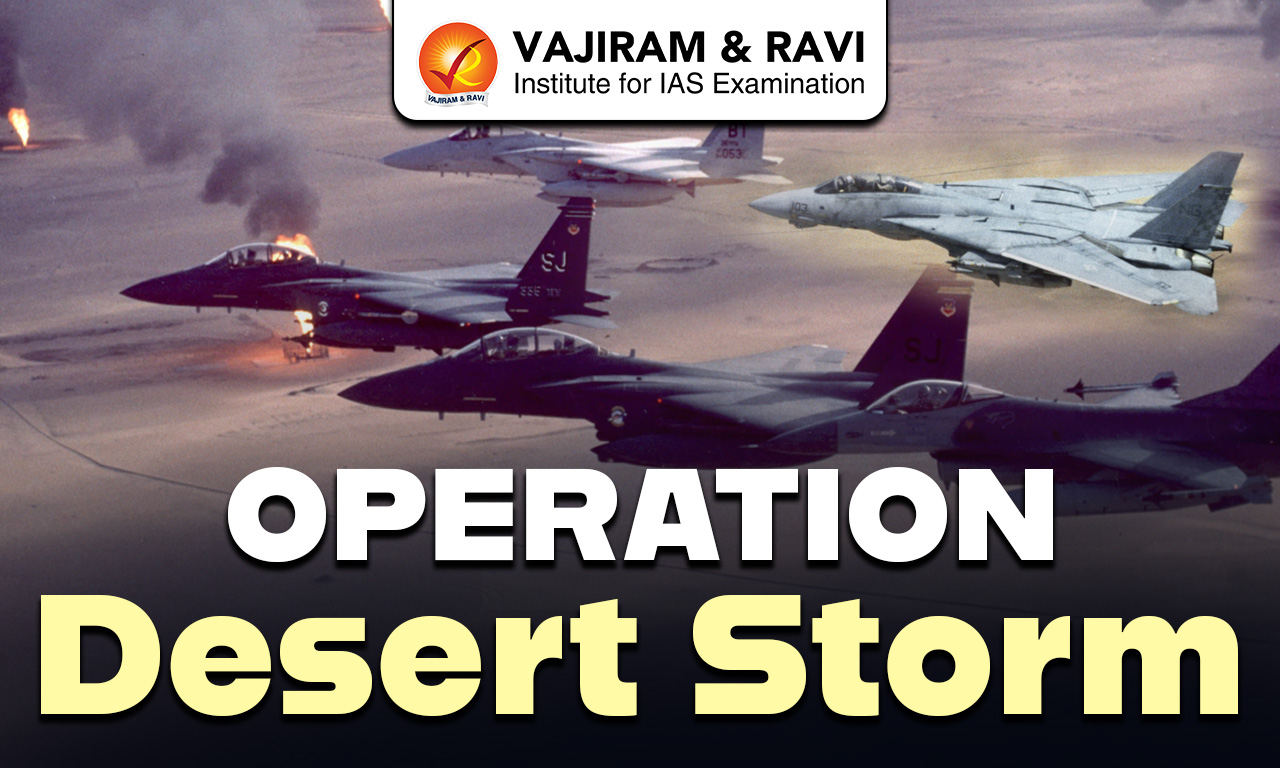
Operation Desert Storm was a military campaign conducted in 1991 by a coalition of countries led by the United States. Its primary aim was to expel Iraqi forces from Kuwait following Iraq’s invasion in 1990. The operation combined air strikes and ground attacks, which quickly resulted in the liberation of Kuwait. It is considered a key example of modern, large-scale international military cooperation, running from January 17 to February 28, 1991. 

Operation Desert Storm Background

  • The background of Operation Desert Storm is tied to Iraq’s invasion of Kuwait. In August 1990, Iraqi forces, led by Saddam Hussein, entered Kuwait and took control of the country. Iraq claimed that Kuwait was overproducing oil and taking oil from shared oil fields, while its primary motivation was believed to be increasing its oil revenues and regional influence.
  • The invasion caused a threat to regional stability and the global oil supply. In response, the United Nations condemned Iraq’s action and set a deadline for withdrawal. When Iraq refused to leave, a coalition of countries, led by the United States, launched Operation Desert Storm in 1991 to free Kuwait and restore peace.

Also Read: Oil Reserves in India

Objectives of Operation Desert Storm

  • Liberate Kuwait: The main goal was to free Kuwait from Iraq’s occupation after Saddam Hussein’s forces invaded in 1990.
  • Protect Regional Stability: To prevent Iraq from threatening other countries in the Gulf region, especially Saudi Arabia.
  • Secure Oil Resources: To safeguard global oil supplies, as the Gulf region produces a large part of the world’s oil.
  • Uphold International Law: To enforce the United Nations’ resolutions that demanded Iraq withdraw from Kuwait.
  • Deter Aggression: To send a strong message that invading other countries would not be tolerated by the international community.

Operation Desert Storm Outcome

The outcome of Operation Desert Storm was that the coalition forces, led by the United States, successfully forced Iraqi troops to leave Kuwait. Kuwait regained its independence, and the country’s government was restored. The operation also weakened Iraq’s military and reduced Saddam Hussein’s control in the region, although he remained in power. It helped protect global oil supplies and showed that countries could work together under the United Nations to stop aggression. 

Also Read: List Of Middle East Countries

Operation Desert Storm Significance

Operation Desert Storm was significant as it liberated Kuwait, upheld international law, and showcased global cooperation through a coalition of countries. It demonstrated modern military technology and strategies, strengthened coalition influence in the Middle East, maintained regional stability and protected vital global oil supplies.

Operation Desert Storm FAQs

Q1: What was Operation Desert Storm?

Ans: It was a military campaign led by the United States in 1991 to remove Iraqi forces from Kuwait after Iraq invaded the country.

Q2: Why was Operation Desert Storm launched?

Ans: It was launched because Iraq invaded Kuwait in 1990, threatening regional stability and global oil supplies and refused to withdraw despite UN warnings.

Q3: Who were the key participants in the operation?

Ans: A coalition of countries led by the United States, including the United Kingdom, France, Saudi Arabia, and several other nations.

Q4: What was the outcome of Operation Desert Storm?

Ans: Iraq was forced to leave Kuwait, restoring its independence. Iraq’s military was weakened, regional stability improved, and global oil supplies were protected.

Q5: Why is Operation Desert Storm significant?

Ans: It demonstrated global cooperation under the UN, enforced international law, showcased modern military technology, protected the Gulf region, and highlighted the effectiveness of large-scale coalition operations.

Siwalik Hills, Features, Biodiversity, Flora and Fauna

Siwalik Hills

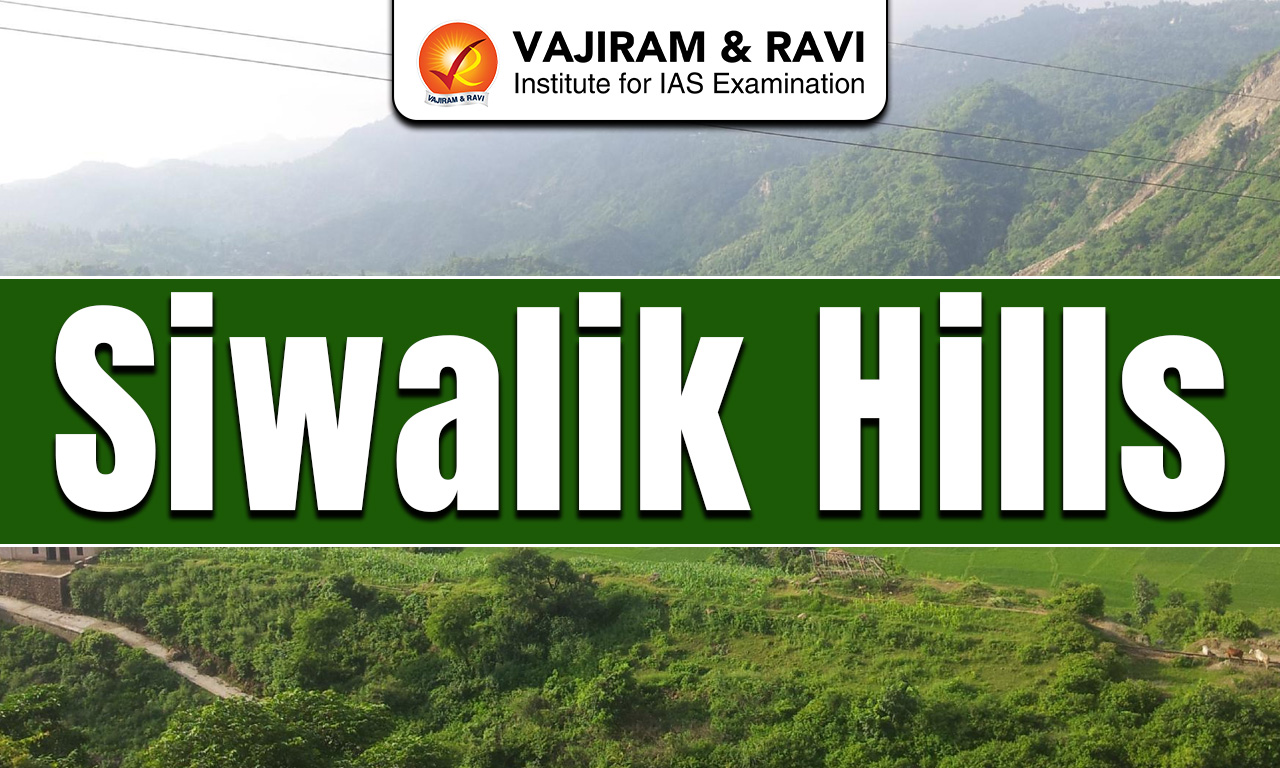
The Siwalik Hills, also called the Shivalik or Outer Himalaya, form the southernmost belt of the Himalayan mountain system. The term “Shivalik” literally means “tresses of Shiva,” reflecting its deep cultural roots in the Indian subcontinent. Stretching nearly 2,400 kilometres from the Indus region in the northwest to areas close to the Brahmaputra basin in the east, this range spreads across India, Nepal, Bhutan and Pakistan. As the youngest Himalayan fold belt, it plays a decisive role in shaping regional drainage, soil formation, biodiversity and human settlement patterns.

Siwalik Hills

The Siwalik Hills constitute the lowest and geologically youngest division of the Himalayas, positioned between the Great Plains to the south and the Lesser Himalaya to the north. Their elevation generally ranges between 600 and 1,500 metres, occasionally rising close to 2,000 metres in certain sectors. The width varies from about 10 to 50 kilometres, being broader in Himachal Pradesh and narrower in Arunachal Pradesh. They are known regionally as Jammu Hills, Churia Hills, Dafla Hills and other names. They display strong east-west continuity while remaining structurally separated by valleys and river gaps.

Siwalik Hills Features

Siwalik Hills display unique geological, structural and geomorphic characteristics shaping northern India's landscape and ecological systems.

  • Classification: The Siwalik sediments are classified into Lower, Middle and Upper Siwaliks based on age and composition.
  • Origin: The Siwaliks belong to Tertiary deposits of the Outer Himalayas and were formed between about 16 and 5.2 million years ago through sediment accumulation derived from erosion of higher Himalayan ranges.
  • Rock Composition: The range consists mainly of poorly consolidated sandstone, conglomerates, gravel, silt and clay, representing solidified detritus transported by rivers from the Greater Himalaya over millions of years.
  • Himalayan Division: They represent the most recent phase of Himalayan uplift, mainly developed during the Neogene and extending into Pleistocene times, making them structurally less stable compared to older Himalayan units.
  • Elevation: Heights generally range from 600 to 1,500 metres, rarely exceeding 1,300 metres in many sectors, with some eastern segments approaching around 2,000 metres.
  • Extent: The hills extend for approximately 2,400 kilometres from the Indus River region towards areas near the Brahmaputra basin, forming a continuous outer arc of the Himalayas.
  • Boundary: The southern margin is defined by the Main Frontal Thrust, a major fault system marking tectonic contact between the Siwaliks and the Indo-Gangetic plains.
  • Slope: Southern slopes are generally steeper compared to northern slopes, particularly noticeable in Himachal Pradesh and Punjab where seasonal streams deeply dissect the terrain.
  • Seasonal Rivers: Numerous seasonal rivers, locally called “choes,” “khads,” or “raus,” flow across the hills, swelling during monsoon months and transporting heavy sediment loads.
  • Alluvial Deposition: Sediments carried by Himalayan rivers accumulate along the foothills, forming coarse alluvial zones known as Bhabar, which gradually transition into the marshy Terai belt further south.
  • Dun Valleys: Longitudinal valleys called “duns” such as Dehradun, Kotli Dun and Patli Dun developed between the Siwaliks and Lesser Himalaya due to sediment blockage and later river incision. Initial conglomerate deposition blocked river channels, creating temporary lakes; later river cutting drained these lakes, leaving flat bottomed fertile valleys termed duns in the west and duars in the east.
  • River Gaps: A significant gap of about 90 kilometres exists between the Teesta and Raidāk rivers, interrupting the otherwise continuous hill alignment.
  • Drainage Influence: Major river systems including the Yamuna, Ganga and Ghaggar pass through or alongside the Siwaliks, contributing fertile soils to adjoining plains.
  • Thrusting Mechanism: The formation involved thrusting of younger sedimentary layers over older deposits, reflecting ongoing tectonic convergence in the Himalayan foreland basin.
  • Seismic Sensitivity: Being located in a tectonically active zone, the region is prone to earthquakes, and its loose sedimentary composition increases vulnerability to ground shaking.
  • Climate Pattern: The climate is predominantly subtropical, characterised by hot summers, cool winters and strong monsoon influence, particularly on southern slopes.
  • Fossil: The Siwaliks are globally significant for Neogene and Pleistocene vertebrate fossils dating from roughly 18 million to 600,000 years before present.
  • Fossil Species: Important discoveries include Megalochelys atlas, the largest known tortoise; Sivatherium giganteum, a massive giraffid; Megantereon falconeri, a sabertooth cat; and the ape Sivapithecus.
  • Cultural Names: Different regions assign local names such as Jammu Hills in Jammu region, Churia Ghat Hills in Nepal, and Dafla or Mishmi Hills in northeastern sectors.
  • Isolation: Despite forming a continuous arc, the Siwaliks are considered one of the most isolated Himalayan divisions due to distinct structural and geomorphic separation from adjacent ranges.
  • Carbon Sequestration: Forested sectors, especially protected areas, show higher carbon stock and sequestration rates compared to regions under open or degraded forest management regimes.

Also Read: Mountain Ranges in India

Siwalik Hills Biodiversity

The Siwalik Hills support diverse subtropical forests, grasslands and riverine ecosystems sustaining rich plant and animal life.

Flora

  • Tropical Deciduous Forests: Dominant vegetation includes tropical deciduous forests, particularly in eastern sectors where rainfall is higher and forest density remains comparatively strong.
  • Sal Dominance: Sal forests form a major component in moist zones, providing ecological stability and supporting multiple associated understory species.
  • Teak Presence: Teak trees are found in suitable climatic pockets, contributing to timber resources and ecological diversity within subtropical forest belts.
  • Sheesham Growth: Sheesham thrives along riverine tracts, benefiting from fertile alluvial soils deposited by seasonal streams.
  • Grassland Ecosystems: Fertile valleys and foothill plains support grasslands that sustain herbivore populations and prevent excessive soil erosion.
  • Riverine Vegetation: Riparian belts along choes and khads contain moisture loving plant species adapted to seasonal flooding and sediment deposition.
  • Forest Cover Gradient: Forest density decreases westward from Nepal towards Punjab and Himachal Pradesh due to declining rainfall from east to west.
  • Erosion Impact on Vegetation: Southern slopes in Punjab and Himachal Pradesh show reduced forest cover where seasonal streams have caused deep channel cutting.
  • Protected Forest Zones: Areas under formal protection exhibit greater biomass density and improved regeneration compared to exploited or fragmented landscapes.
  • Alluvial Soil Fertility: The combination of coarse Bhabar deposits and finer Terai soils enhances plant growth diversity across transitional ecological belts.

Fauna

  • Vertebrate Fossil Diversity: Fossil evidence reveals long term faunal diversity including ancient elephants, horses, rhinoceroses and giant reptiles from Miocene to Pleistocene periods.
  • Megalochelys Atlas: This gigantic tortoise, one of the largest ever recorded, represents a hallmark discovery from Siwalik fossil beds.
  • Sivatherium Giganteum: Recognised as one of the largest giraffids known, this species indicates past grassland and woodland ecosystems in the region.
  • Megantereon Falconeri: The presence of this sabertooth cat fossil demonstrates existence of large carnivores during prehistoric times.
  • Sivapithecus Evidence: Fossils of this ape genus provide important clues about primate evolution in South Asia during the Miocene epoch.
  • Soanian Cultural Association: Stone tool remains linked to Soanian culture indicate coexistence of early human populations with diverse faunal species.
  • Elephant Habitats: Present day forests support elephant populations, particularly in protected landscapes along riverine and forest corridors.
  • Tiger Presence: Dense forest tracts provide habitat conditions suitable for large predators such as tigers within conserved zones.
  • Leopard Distribution: Leopards adapt well to the fragmented hill forests and are reported across multiple Siwalik sectors.
  • Deer Species: Grasslands and mixed forests sustain various deer species, forming essential prey base within ecological food chains.
  • Monkey Populations: Subtropical forests and human settlement edges support several monkey populations adapted to varied vegetation types.
  • Carbon rich Forest Fauna Link: Higher carbon stock forests in protected areas correlate with richer wildlife presence due to better habitat stability and food availability.

Siwalik Hills FAQs

Q1: What are the Siwalik Hills?

Ans: The Siwalik Hills are the southernmost and youngest range of the Himalayan system, stretching about 2,400 km from the Indus region to areas near the Brahmaputra basin across India, Nepal, Bhutan and Pakistan.

Q2: What is the average elevation of the Siwalik Hills?

Ans: The elevation generally ranges between 600 and 1,500 metres, rarely exceeding 1,300 metres in many areas, though some eastern parts rise close to 2,000 metres.

Q3: Why are the Siwalik Hills geologically important?

Ans: They consist of Tertiary sedimentary deposits formed between about 16 and 5.2 million years ago and contain rich Neogene and Pleistocene vertebrate fossils of global scientific value.

Q4: What are ‘Dun’ valleys in the Siwalik region?

Ans: Duns are elongated, flat bottomed valleys such as Dehradun, formed when river blocking conglomerates created temporary lakes that were later drained by river erosion.

Q5: What type of climate do the Siwalik Hills experience?

Ans: The region has a subtropical climate with hot summers, cool winters and strong monsoon rainfall ranging roughly between 1,000 and 2,000 millimetres annually.

Monthly Current Affairs March 2026 for UPSC Prelims and Mains

Monthly Current Affairs March 2026

Monthly Current Affairs March 2026 constitute a vital component of the UPSC Civil Services Examination preparation strategy. Current affairs refer to significant national and international developments taking place across diverse domains such as polity, economy, society, culture, environment, science, technology and sports. A structured understanding of Monthly Current Affairs March 2026 helps aspirants stay updated with relevant events and align their preparation effectively for both Prelims and Mains stages of the examination.

Monthly Current Affairs March 2026

Monthly Current Affairs March 2026 play a crucial role in strengthening conceptual clarity and analytical ability. To assist aspirants systematically, Vajiram & Ravi publish the Monthly Current Affairs Magazine- The Recitals, along with Daily Prelims Pointers, Mains Articles, Editorial Analysis and The Analyst - Newspaper Analysis Video. These resources bring together important updates from authentic platforms such as PIB, Yojana, Kurukshetra, The Hindu, Indian Express, Economic Times and Down to Earth. The information is presented in a simplified format using text explanations, charts, tables and infographics to ensure better comprehension and efficient revision.

Monthly Current Affairs March 2026 for Prelims & Mains

The coverage of Monthly Current Affairs March 2026 includes Daily Prelims Pointers, Mains Articles and Editorial Analysis prepared by experienced faculty members. These are updated daily on the official website and are largely based on content from The Hindu and The Indian Express. Prelims Pointers provide crisp, fact oriented notes tailored for objective questions, while Mains Articles focus on in depth analysis to improve answer writing skills. Additionally, The Analyst - Newspaper Analysis Video offers a detailed breakdown of key news developments, accompanied by concise handouts summarizing essential points in bullet format for quick revision.

UPSC March Current Affairs 2026

On a daily basis, the platform releases ten Prelims Pointers, four Mains Articles and three Editorial Analyses to ensure complete coverage of important issues throughout the month. Aspirants are also provided with a Daily MCQ Quiz and The Analyst - Newspaper Analysis Video to promote regular practice and strengthen conceptual understanding. 

Below is the structured list of links to Daily Prelims Pointers, Mains Articles, Editorial Analyses and The Analyst Videos for March 2026:

Monthly Current Affairs March 2026
March 2026 Date Prelims Pointers Mains Articles Editorial Analysis The Analyst - Newspaper Analysis Video

1 March 2026

Link

Link

Link

Link

2 March 2026

Link

Link

Link

Link

3 March 2026

To be Updated

To be Updated

To be Updated

To be Updated

4 March 2026

To be Updated

To be Updated

To be Updated

To be Updated

5 March 2026

To be Updated

To be Updated

To be Updated

To be Updated

6 March 2026

To be Updated

To be Updated

To be Updated

To be Updated

7 March 2026

To be Updated

To be Updated

To be Updated

To be Updated

8 March 2026

To be Updated

To be Updated

To be Updated

To be Updated

9 March 2026

To be Updated

To be Updated

To be Updated

To be Updated

10 March 2026

To be Updated

To be Updated

To be Updated

To be Updated

11 March 2026

To be Updated

To be Updated

To be Updated

To be Updated

12 March 2026

To be Updated

To be Updated

To be Updated

To be Updated

13 March 2026

To be Updated

To be Updated

To be Updated

To be Updated

14 March 2026

To be Updated

To be Updated

To be Updated

To be Updated

15 March 2026

To be Updated

To be Updated

To be Updated

To be Updated

16 March 2026

To be Updated

To be Updated

To be Updated

To be Updated

17 March 2026

To be Updated

To be Updated

To be Updated

To be Updated

18 March 2026

To be Updated

To be Updated

To be Updated

To be Updated

19 March 2026

To be Updated

To be Updated

To be Updated

To be Updated

20 March 2026

To be Updated

To be Updated

To be Updated

To be Updated

21 March 2026

To be Updated

To be Updated

To be Updated

To be Updated

22 March 2026

To be Updated

To be Updated

To be Updated

To be Updated

23 March 2026

To be Updated

To be Updated

To be Updated

To be Updated

24 March 2026

To be Updated

To be Updated

To be Updated

To be Updated

25 March 2026

To be Updated

To be Updated

To be Updated

To be Updated

26 March 2026

To be Updated

To be Updated

To be Updated

To be Updated

27 March 2026

To be Updated

To be Updated

To be Updated

To be Updated

28 March 2026

To be Updated

To be Updated

To be Updated

To be Updated

29 March 2026

To be Updated

To be Updated

To be Updated

To be Updated

30 March 2026

To be Updated

To be Updated

To be Updated

To be Updated

31 March 2026

To be Updated

To be Updated

To be Updated

To be Updated

Importance of Monthly Current Affairs March 2026 for UPSC Aspirants

Monthly Current Affairs March 2026 remain fundamental to UPSC CSE preparation as they reflect recent developments influencing governance and policy making. Spanning subjects such as polity, economy, social issues, environment and technology, they enhance an aspirant’s awareness and analytical capabilities. Mastering these updates strengthens both factual accuracy for Prelims and analytical depth required for Mains.

Assessing Awareness and Contemporary Understanding

Monthly Current Affairs March 2026 evaluate more than simple recall of facts. They test an aspirant’s ability to interpret developments, understand their broader context and analyze potential outcomes. This process develops critical thinking and helps build a well rounded understanding of national and global dynamics, which is central to civil services preparation.

Bridging Static Knowledge with Current Developments

March 2026 Current Affairs serve as a connecting link between static syllabus topics and real time events. Policy reforms, international meetings and socio economic transformations can be integrated with subjects like history, geography, polity and economics. This linkage improves conceptual clarity and enhances the quality of structured answers in the Mains examination.

Dynamic Character of UPSC Preparation

The evolving nature of Monthly Current Affairs March 2026 makes consistent revision essential. Unlike static subjects, current events change daily and require regular monitoring. This dynamic aspect keeps aspirants engaged, encourages adaptability and ensures preparedness for unpredictable questions in the examination.

Relevance to Administrative Responsibilities

Monthly Current Affairs March 2026 also reflect practical governance challenges and policy decisions that future civil servants must understand. These topics often form the basis of discussion during the Interview stage, where aspirants are assessed on their awareness, balanced judgment and analytical reasoning regarding contemporary national and international matters.

Monthly Current Affairs March 2026 FAQs

Q1: How should aspirants cover Monthly Current Affairs March 2026 effectively?

Ans: By regularly reading newspapers, revising monthly magazines and practicing answer writing based on current topics.

Q2: Why are Monthly Current Affairs important for UPSC CSE?

Ans: They connect static subjects with ongoing developments and are essential for Prelims, Mains and Interview preparation.

Q3: What is included in Vajiram & Ravi Prelims Pointers?

Ans: They consist of concise, exam oriented notes on daily current affairs prepared specifically for UPSC Prelims revision.

Q4: Which newspapers are most useful for Current Affairs preparation?

Ans: The Hindu and The Indian Express are widely recommended for reliable and syllabus focused coverage.

Q5: How can aspirants organize current affairs notes for quick revision?

Ans: By summarizing key issues in bullet form and arranging them according to the General Studies syllabus for systematic revision.

List of Massacres in India, Pre-Colonial Era to British Rule

List of Massacres in India

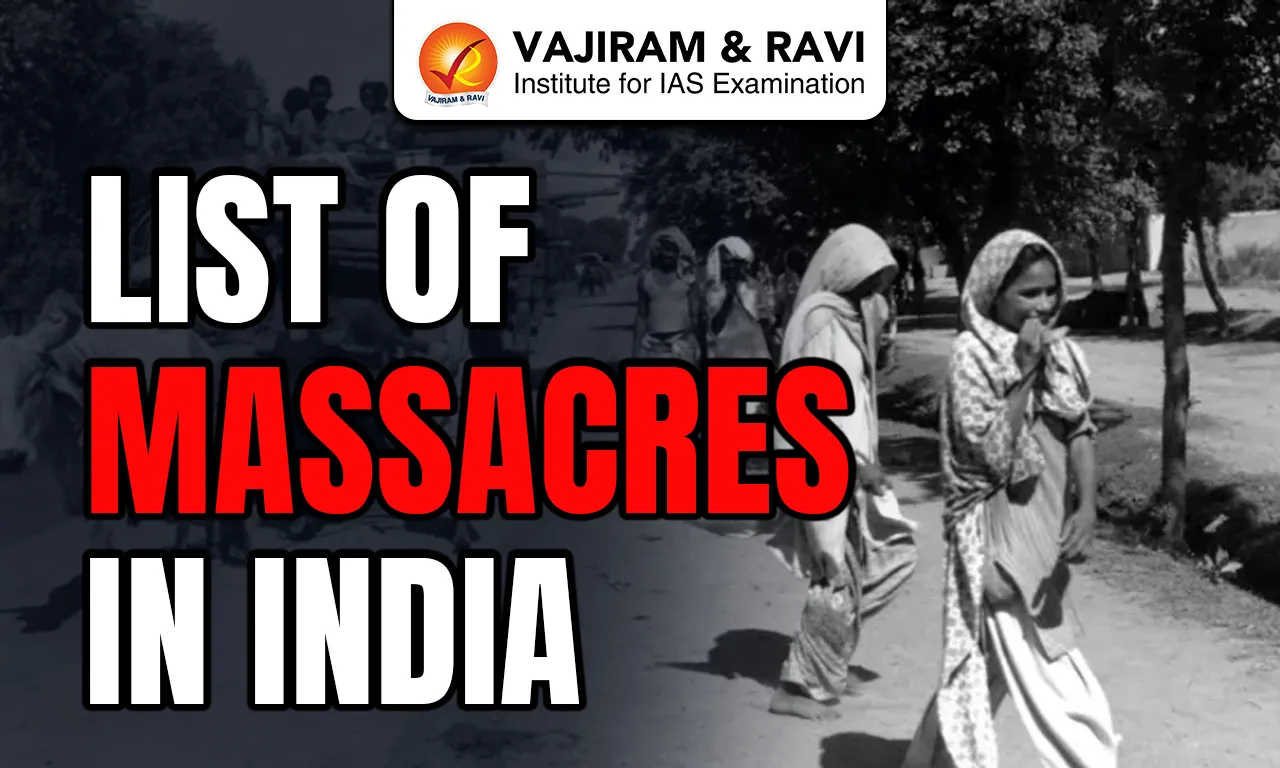
A massacre is the deliberate killing of members of one group by another, usually more powerful group. Unlike a battle where two armed sides fight, a massacre often involves the killing of surrendered soldiers, prisoners, or civilians. It may occur during war, rebellion, communal conflict, or political suppression.

Indian history, spanning ancient kingdoms to colonial rule, has witnessed several tragic massacres that shaped political, social, and communal trajectories. In this article, we have provided the List of Massacres in India.

List of Massacres in India Pre-Colonial

Pre-colonial India witnessed several massacres during invasions, sieges, and regional conflicts as rulers fought for territorial expansion and political dominance. Here is the list of massacres in India during the pre-colonial era.

List of Massacres in India Pre-Colonial

Name of Event

Year

Location

Perpetrator

Estimated Deaths

Key Details

Siege of Chittorgarh

1303

Chittor, Guhila Kingdom (Rajasthan)

Alauddin Khalji (Delhi Sultanate)

~30,000 Hindus

After capturing Chittor, Khalji reportedly ordered mass killings to suppress Rajput resistance.

Siege of Chittorgarh

February 1568

Chittor Fort

Mughal Empire (Akbar)

~30,000 non-combatants

Following a prolonged siege, Akbar ordered a general massacre and took many prisoners.

Capture of Delhi

1398

Delhi region

Timur (Timurid Empire)

100,000 captives executed (overall casualties possibly much higher)

Timur ordered execution of captives before attacking Delhi to prevent rebellion.

Battle of Ahmednagar

1559–1560

Ahmadnagar Sultanate

Vijayanagara Empire & Deccan Sultanate forces

Unknown (large-scale destruction)

Chronicler Firishta describes widespread devastation, massacres, and depopulation.

Khejarli massacre

1730

Khejarli, Marwar

Royal officials of Marwar

363 Bishnois

Villagers sacrificed their lives protecting trees; landmark environmental resistance.

Chhota Ghallughara

1746

Lahore

Mughal Empire

7,000 killed; 3,000 executed

Part of systematic persecution of Sikhs under Mughal rule.

Vadda Ghalughara

1763

Punjab

Afghan forces under Ahmad Shah Durrani

25,000–30,000 Sikhs

Large-scale massacre aimed at crushing Sikh resistance in Punjab.

List of Massacres in India Colonial Period

The colonial period in India (1757–1947) witnessed numerous massacres arising from the Revolt of 1857, tribal uprisings, political repression, and communal tensions preceding Partition. Here is the list of Massacres in India during the colonial period.

List of Massacres in India Colonial Period

Name of Event

Date

Location

Estimated Deaths

Key Details

Siege of Cawnpore

5–25 June 1857

Kanpur

~1,000

European soldiers, civilians, women, and children were killed during the Revolt of 1857.

Bibighar massacre

15 July 1857

Kanpur

~200

British women and children, held as prisoners, were killed; responsibility remains debated.

Mangarh massacre

17 November 1913

Mangadh (Gujarat–Rajasthan border)

Claimed 1,500 tribals

British troops opened fire with machine guns on tribal protesters.

Jallianwala Bagh massacre

13 April 1919

Amritsar, Punjab

379 (official); up to 1,500 (estimates)

General Dyer ordered firing on an unarmed gathering, intensifying the freedom movement.

Nankana massacre

20 February 1921

Nankana Sahib, Punjab

140–260 Sikhs

Peaceful reformist Sikhs were attacked during the Gurdwara Reform Movement.

Qissa Khwani massacre

23 April 1930

Peshawar

~20–230 protesters

British armored vehicles and troops fired on non-violent demonstrators.

Calcutta riots

15 Aug – 17 Sept 1946

Calcutta (West Bengal)

7,000–10,000

Large-scale Hindu-Muslim communal violence during Direct Action Day.

Noakhali riots

Sept–Oct 1946

East Bengal

~5,000

Widespread communal violence, forced conversions, and displacement before Partition.

Bihar Massacre

30 Oct – 7 Nov 1946

Bihar

2,000–3,000

Retaliatory communal killings amid escalating Partition tensions.

Role of Massacres in the Freedom Struggle

Massacres during British rule exposed the harsh realities of colonial oppression and became turning points in India’s struggle for independence.

  • Catalyst for National Awakening: Incidents like the Jallianwala Bagh massacre shocked the entire nation and transformed moderate political opinion into mass resistance against British rule.
  • Strengthening of Mass Movements: After 1919, Mahatma Gandhi expanded the Non-Cooperation Movement, mobilizing millions who lost faith in British justice and reforms.
  • Exposure of Colonial Brutality: Events such as the Qissa Khwani massacre revealed the willingness of colonial authorities to use lethal force even against peaceful protesters.
    Growth of Revolutionary Sentiment: Brutal suppressions pushed some sections of youth toward revolutionary activities, believing armed resistance was necessary.
  • International Criticism of British Rule: Massacres attracted global condemnation, weakening Britain’s moral authority and strengthening India’s case internationally.
  • Unity Across Communities: Tragic events often united Hindus, Muslims, Sikhs, and other communities against a common colonial oppressor.
  • Policy Reforms Under Pressure: Public outrage forced inquiries and limited administrative reforms, though these were often insufficient.
  • Psychological Impact on Leadership: Leaders recognized the need for disciplined mass movements to avoid uncontrolled violence while sustaining pressure for independence.

List of Massacres in India FAQs

Q1: What is a massacre?

Ans: A massacre is the deliberate and large-scale killing of a group of people, usually civilians or disarmed individuals, by a more powerful group.

Q2: Which is the most infamous massacre during British rule in India?

Ans: The Jallianwala Bagh massacre is considered the most infamous colonial massacre. On 13 April 1919, British troops under General Dyer opened fire on an unarmed gathering in Amritsar, killing hundreds and intensifying the Indian freedom struggle.

Q3: What were the major massacres in pre-colonial India?

Ans: Some significant pre-colonial massacres include the Siege of Chittorgarh, Siege of Chittorgarh, Capture of Delhi, Chhota Ghallughara, and Vadda Ghalughara. These occurred during invasions and regional conflicts.

Q4: What role did massacres play in the Revolt of 1857?

Ans: During the Revolt of 1857, incidents such as the Siege of Cawnpore and the Bibighar massacre led to large-scale killings on both sides, escalating violence and shaping British retaliation policies.

Q5: What were the major communal massacres before Partition?

Ans: Major communal massacres before Partition include the Calcutta riots, Noakhali riots, and the Bihar Massacre, which deepened Hindu-Muslim tensions ahead of India’s division in 1947.

UPSC Daily Quiz 2 March 2026

[WpProQuiz 105]

UPSC Daily Quiz FAQs

Q1: What is the Daily UPSC Quiz?

Ans: The Daily UPSC Quiz is a set of practice questions based on current affairs, static subjects, and PYQs that help aspirants enhance retention and test conceptual clarity regularly.

Q2: How is the Daily Quiz useful for UPSC preparation?

Ans: Daily quizzes support learning, help in revision, improve time management, and boost accuracy for both UPSC Prelims and Mains through consistent practice.

Q3: Are the quiz questions based on the UPSC syllabus?

Ans: Yes, all questions are aligned with the UPSC Syllabus 2025, covering key areas like Polity, Economy, Environment, History, Geography, and Current Affairs.

Q4: Are solutions and explanations provided with the quiz?

Ans: Yes, each quiz includes detailed explanations and source references to enhance conceptual understanding and enable self-assessment.

Q5: Is the Daily UPSC Quiz suitable for both Prelims and Mains?

Ans: Primarily focused on Prelims (MCQ format), but it also indirectly helps in Mains by strengthening subject knowledge and factual clarity.

Sittwe Port, Features, Benefits, Significance, Key Details

Sittwe Port

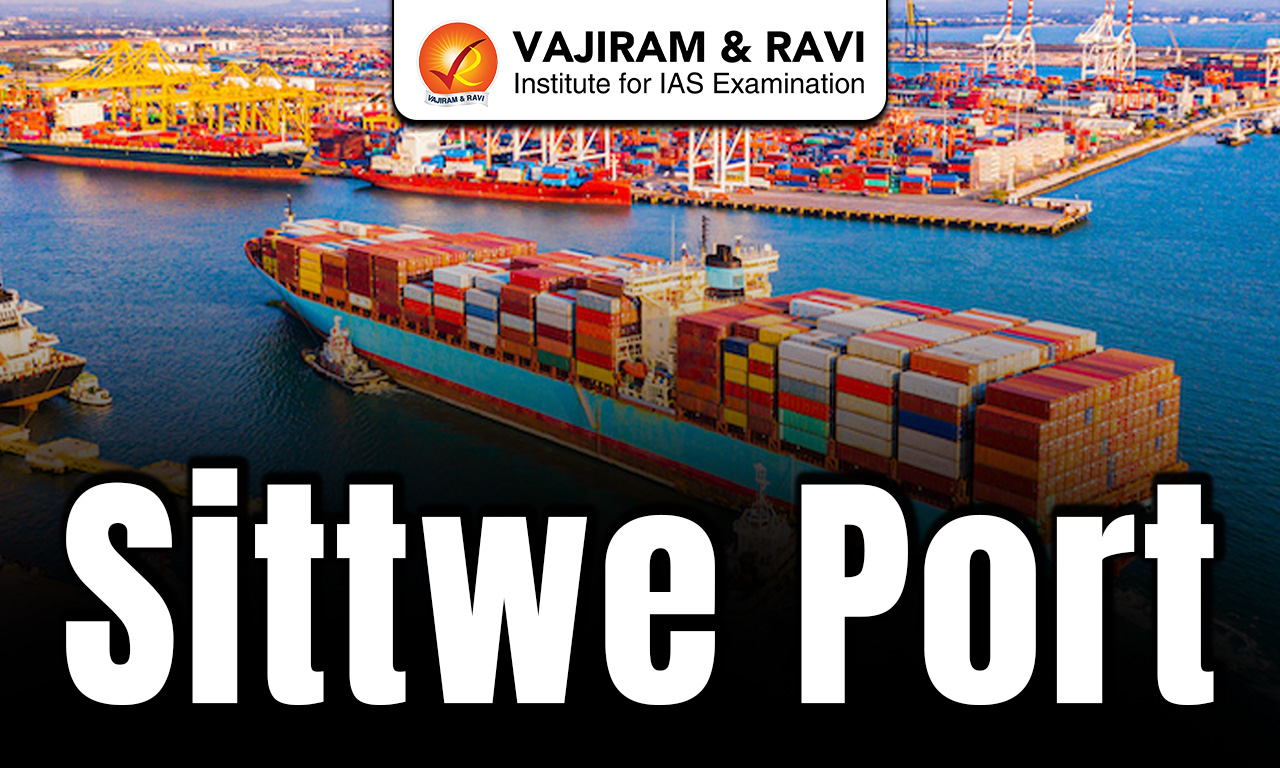
Sittwe Port is a seaport in Myanmar’s Rakhine State on the Bay of Bengal. Developed by India, it aims to improve connectivity with India’s North-Eastern states and strengthen trade, regional ties, and strategic links in the Bay of Bengal.

Sittwe Port Features

  • Sittwe Port is a deep-water port located at the mouth (estuary) of the Kaladan River in Rakhine State of Myanmar. It has been developed by India as part of the Kaladan Multi-Modal Transit Transport Project (KMTTP). The project is funded by the Government of India through grant-in-aid assistance.
  • The main aim of this project is to improve connectivity between India and Myanmar and to provide an alternative route to India’s North-Eastern states, especially Mizoram. Through this project, goods can move from the eastern coast of India (like Kolkata or Haldia) to Sittwe Port by sea, then travel through the Kaladan River by inland water transport up to Paletwa in Myanmar, and finally reach Mizoram by road.

Sittwe Port Key Benefits

  • Sittwe Port is a deep-water port on the Bay of Bengal that improves transport links between northeast India and Myanmar.
  • Goods can be sent from Kolkata by sea to Sittwe Port, then moved through Myanmar to Mizoram by river and road.
  • It provides an alternative route to India’s North-East region. At present, this region is mainly connected to the rest of India through the narrow Siliguri Corridor, also known as the “Chicken’s Neck.”
  • The project helps reduce transport distance, time, and cost for goods moving to states like Mizoram and Tripura.
  • It is expected that transportation time and cost between Kolkata and cities like Aizawl and Agartala may reduce by nearly 50%.

Sittwe Port Significance

  • The operation of Sittwe Port will increase trade between India and Myanmar and improve economic activities in Myanmar’s Rakhine State.
  • Better transport connectivity will create new business opportunities, generate employment, and support regional development in both countries.
  • The port will especially benefit India’s North-Eastern states by giving them easier access to sea routes and international markets.
  • It reduces the dependence of North-East India on the narrow Siliguri Corridor (Chicken’s Neck), improving strategic security.
  • The port is important for India’s Act East Policy, which aims to strengthen economic and strategic relations with Southeast Asian and Asia-Pacific countries.
  • It enhances India’s strategic presence in the Bay of Bengal region.

Kaladan Multi-Modal Transit Transport Project (KMTTP)

  • The Kaladan Multi-Modal Transit Transport Project (KMTTP) is a connectivity project between India and Myanmar. It is funded by the Government of India. The main aim of the project is to provide an alternative route to connect India’s North-Eastern states, especially Mizoram, with the rest of India through Myanmar.
  • At present, the North-East is mainly connected to mainland India through the narrow Siliguri Corridor (Chicken’s Neck). KMTTP reduces this dependence by creating a new sea–river–road route.
  • The project improves trade, transport, and strategic cooperation between India and Myanmar and supports India’s Act East Policy.

Sittwe Port FAQs

Q1: What is Sittwe Port?

Ans: Sittwe Port is a deep-water port located in Rakhine State of Myanmar at the mouth of the Kaladan River. It has been developed by India to improve connectivity with the North-Eastern states.

Q2: Under which project was Sittwe Port developed?

Ans: It was developed under the Kaladan Multi-Modal Transit Transport Project (KMTTP), funded by the Government of India.

Q3: What is the main objective of KMTTP?

Ans: The main aim is to provide an alternative route to connect North-East India, especially Mizoram, with the rest of India through Myanmar using sea, river, and road transport.

Q4: How does Sittwe Port benefit North-East India?

Ans: It reduces dependence on the narrow Siliguri Corridor (Chicken’s Neck) and lowers transport time and cost for states like Mizoram and Tripura.

Q5: Why is Sittwe Port important for India’s Act East Policy?

Ans: The port enhances India’s connectivity with Southeast Asia and increases its strategic presence in the Bay of Bengal region.

Article 45 of Indian Constitution, Amendment, Important Judgements

Article 45 of Indian Constitution

Article 45 is part of the Directive Principles of State Policy (DPSP) in Part IV of the Constitution. Originally, Article 45 stated that the State shall endeavour to provide free and compulsory education to all children up to the age of 14 years within 10 years from the commencement of the Constitution.

However, since it was part of the Directive Principles, it was non-justiciable. That means it could not be enforced in a court of law. It imposed a moral and constitutional duty on the State, but not a legally enforceable right for citizens. Article 45 was made non-justiciable because, at the time of Independence, India lacked sufficient financial and administrative resources to immediately guarantee universal education as a legally enforceable right.

About Directive Principles of State Policy

  • The Directive Principles of State Policy (DPSPs) are contained in Part IV (Articles 36-51) of the Constitution. 
  • The framers of the Constitution borrowed this idea from the Irish Constitution of 1937, which had copied it from the Spanish Constitution. 
  • Dr. B.R. Ambedkar described these principles as ‘novel features’ of the Indian Constitution. 
  • They aim to establish a welfare state by promoting social and economic justice, reducing inequalities, and ensuring dignified living conditions for all citizens.
  • They are non-justiciable, which means they are not legally enforceable in a court of law. If the government fails to implement a Directive Principle, a citizen cannot directly approach the court to demand its enforcement. 
  • However, despite being non-justiciable, they are considered fundamental in the governance of the country (Article 37), and it is the duty of the State to apply these principles while making laws and policies.
  • The Directive Principles, though non-justiciable in nature, help the courts in examining and determining the constitutional validity of a law. The Supreme Court has ruled many a times that in determining the constitutionality of any law, if a court finds that the law in question seeks to give effect to a Directive Principle, it may consider such law to be ‘reasonable’ in relation to Article 14 (equality before law) or Article 19 (six freedoms) and thus save such law from unconstitutionality.

86th Constitutional Amendment Act.

Article 45 of Indian Constitution was amended by the 86th Constitutional Amendment Act. The amendment brought three major changes:

  1. Inserted Article 21A, making free and compulsory education for children aged 6-14 years a Fundamental Right.
  2. Modified Article 45 to focus on early childhood care and education for children below six years.
  3. Added Article 51A(k), making it a Fundamental Duty of parents/guardians to provide educational opportunities to children between 6-14 years.

To implement Article 21A, Parliament enacted the Right of Children to Free and Compulsory Education Act (RTE Act, 2009).

Present Position of Article 45

After the 86th Amendment, Article 45 of Indian Constitution now states that the State shall endeavour to provide early childhood care and education for all children until they complete the age of six years. Thus, Article 45 currently focuses on pre-primary education and early childhood development.

Important Judgements Related to Article 45 of Indian Constitution and Right to Education

  • Mohini Jain v. State of Karnataka (1992): The Supreme Court held that the right to education flows from Article 21 (Right to Life). It stated that the State has a constitutional obligation to provide education.
  • Unni Krishnan v. State of Andhra Pradesh (1993): The Court clarified that the right to education is a fundamental right under Article 21, but limited it to children up to 14 years of age. The Court directly relied on Article 45 to interpret the scope of this right. This judgement laid the foundation for the 86th Amendment.
  • Society for Unaided Private Schools v. Union of India (2012): The Supreme Court upheld the constitutional validity of the RTE Act, 2009, including the provision requiring private schools to reserve 25% seats for economically weaker sections.

Article 45 of Indian Constitution FAQs

Q1: Where is Article 45 placed in the Constitution?

Ans: Article 45 is placed in Part IV (Directive Principles of State Policy) of the Constitution of India.

Q2: What was the original provision of Article 45 of Indian Constitution?

Ans: Originally, it directed the State to provide free and compulsory education to all children up to the age of 14 years within ten years from the commencement of the Constitution.

Q3: Is Article 45 of Indian Constitution enforceable in a court of law?

Ans: No. Article 45 is a Directive Principle and is non-justiciable, meaning it cannot be enforced by courts (as clarified under Article 37).

Q4: Which Constitutional Amendment modified Article 45 of Indian Constitution?

Ans: The 86th Constitutional Amendment Act amended Article 45 in 2002.

Q5: What does Article 45 of Indian Constitution state at present?

Ans: It now directs the State to provide early childhood care and education for all children until they complete six years of age.

Part 9A of Indian Constitution, Articles, Case Laws, Amendments

Part 9A of Indian Constitution

The Constitution of India provides a detailed framework for governance at different levels. While earlier provisions mainly focused on the Union and the States, urban local governance received constitutional recognition through Part 9A of Indian Constitution. This Part was inserted by the Constitution (Seventy fourth Amendment) Act, 1992 to strengthen democracy in cities and towns. It gives constitutional status to Municipalities and lays down rules regarding their structure, powers, elections, finance, planning, and functioning. Part IXA, covering Articles 243P to 243ZG, ensures organized, accountable, and participatory urban administration across India.

Articles of Part 9A of Indian Constitution

Part 9A of Indian Constitution contains Articles 243P to 243ZG dealing with structure, powers, elections, finance and planning of Municipalities.

  • Article 243P- Definitions: This Article explains important terms such as “Municipality” and “Municipal area.” It clarifies the meaning of urban local bodies and defines the geographical area under their jurisdiction for proper administration.
  • Article 243Q- Constitution of Municipalities: It mandates every State to establish Municipalities. It provides for Municipal Corporations in large cities, Municipal Councils in smaller towns, and Nagar Panchayats in transitional areas from rural to urban.
  • Article 243R- Composition of Municipalities: This Article provides that members of Municipalities shall be directly elected by the people. It ensures democratic representation and allows inclusion of persons as specified by State law.
  • Article 243S- Wards Committees: It enables the formation of Wards Committees within Municipalities. These committees handle local matters at ward level and improve citizen participation in governance.
  • Article 243T- Reservation of Seats: It provides reservation of seats for Scheduled Castes and Scheduled Tribes in proportion to their population. At least one-third of total seats are reserved for women, including reserved category seats.
  • Article 243U- Duration of Municipalities: This Article fixes the term of every Municipality at five years. Elections must be conducted before expiry or within six months of dissolution to maintain continuity.
  • Article 243V- Disqualifications for Membership: It lays down conditions under which a person can be disqualified from being a member of a Municipality. State law determines specific grounds of disqualification.
  • Article 243W- Powers and Responsibilities: Municipalities are empowered to perform functions listed in the Twelfth Schedule. These include urban planning, water supply, sanitation, public health, slum improvement, transport, and other civic services.
  • Article 243X- Power to Impose Taxes: It authorizes State Legislatures to grant Municipalities power to levy taxes, duties, tolls, and fees. It also provides for creation and management of municipal funds.
  • Article 243Y- Finance Commission: This Article requires the State Finance Commission to review financial position of Municipalities and recommend distribution of funds between State and urban local bodies.
  • The Constitution of India provides a detailed framework for governance at different levels. While earlier provisions mainly focused on the Union and the States, urban local governance received constitutional recognition through Part 9A of Indian Constitution. This Part was inserted by the Constitution (Seventy fourth Amendment) Act, 1992 to strengthen democracy in cities and towns. It gives constitutional status to Municipalities and lays down rules regarding their structure, powers, elections, finance, planning, and functioning. Part IXA, covering Articles 243P to 243ZG, ensures organized, accountable, and participatory urban administration across India.

    Articles of Part 9A of Indian Constitution

    Part 9A of Indian Constitution contains Articles 243P to 243ZG dealing with structure, powers, elections, finance and planning of Municipalities.

    • Article 243P- Definitions: This Article explains important terms such as “Municipality” and “Municipal area.” It clarifies the meaning of urban local bodies and defines the geographical area under their jurisdiction for proper administration.
    • Article 243Q- Constitution of Municipalities: It mandates every State to establish Municipalities. It provides for Municipal Corporations in large cities, Municipal Councils in smaller towns, and Nagar Panchayats in transitional areas from rural to urban.
    • Article 243R- Composition of Municipalities: This Article provides that members of Municipalities shall be directly elected by the people. It ensures democratic representation and allows inclusion of persons as specified by State law.
    • Article 243S- Wards Committees: It enables the formation of Wards Committees within Municipalities. These committees handle local matters at ward level and improve citizen participation in governance.
    • Article 243T- Reservation of Seats: It provides reservation of seats for Scheduled Castes and Scheduled Tribes in proportion to their population. At least one-third of total seats are reserved for women, including reserved category seats.
    • Article 243U- Duration of Municipalities: This Article fixes the term of every Municipality at five years. Elections must be conducted before expiry or within six months of dissolution to maintain continuity.
    • Article 243V- Disqualifications for Membership: It lays down conditions under which a person can be disqualified from being a member of a Municipality. State law determines specific grounds of disqualification.
    • Article 243W- Powers and Responsibilities: Municipalities are empowered to perform functions listed in the Twelfth Schedule. These include urban planning, water supply, sanitation, public health, slum improvement, transport, and other civic services.
    • Article 243X- Power to Impose Taxes: It authorizes State Legislatures to grant Municipalities power to levy taxes, duties, tolls, and fees. It also provides for creation and management of municipal funds.
    • Article 243Y- Finance Commission: This Article requires the State Finance Commission to review financial position of Municipalities and recommend distribution of funds between State and urban local bodies.
    • Article 243Z- Audit of Accounts: It ensures proper auditing of Municipal accounts according to State law. This promotes transparency, accountability, and financial discipline in urban governance.
    • Article 243ZA- Elections to Municipalities: It vests the responsibility of conducting Municipal elections in the State Election Commission. Elections must be free, fair, and independent.
    • Article 243ZB- Application to Union Territories: It extends provisions of Part IXA to Union Territories, subject to necessary modifications as determined by law.
    • Article 243ZC- Non-Application to Certain Areas: Certain areas are excluded from application of Part IXA. These special areas are governed by separate constitutional or legal provisions.
    • Article 243ZD- District Planning Committee: It provides for constitution of District Planning Committees to consolidate plans prepared by Panchayats and Municipalities and prepare a draft development plan for the district.
    • Article 243ZE- Metropolitan Planning Committee: This Article mandates creation of Metropolitan Planning Committees in metropolitan areas with population exceeding one million to prepare integrated development plans.
    • The Constitution of India provides a detailed framework for governance at different levels. While earlier provisions mainly focused on the Union and the States, urban local governance received constitutional recognition through Part 9A of Indian Constitution. This Part was inserted by the Constitution (Seventy fourth Amendment) Act, 1992 to strengthen democracy in cities and towns. It gives constitutional status to Municipalities and lays down rules regarding their structure, powers, elections, finance, planning, and functioning. Part IXA, covering Articles 243P to 243ZG, ensures organized, accountable, and participatory urban administration across India.

      Articles of Part 9A of Indian Constitution

      Part 9A of Indian Constitution contains Articles 243P to 243ZG dealing with structure, powers, elections, finance and planning of Municipalities.

      • Article 243P- Definitions: This Article explains important terms such as “Municipality” and “Municipal area.” It clarifies the meaning of urban local bodies and defines the geographical area under their jurisdiction for proper administration.
      • Article 243Q- Constitution of Municipalities: It mandates every State to establish Municipalities. It provides for Municipal Corporations in large cities, Municipal Councils in smaller towns, and Nagar Panchayats in transitional areas from rural to urban.
      • Article 243R- Composition of Municipalities: This Article provides that members of Municipalities shall be directly elected by the people. It ensures democratic representation and allows inclusion of persons as specified by State law.
      • Article 243S- Wards Committees: It enables the formation of Wards Committees within Municipalities. These committees handle local matters at ward level and improve citizen participation in governance.
      • Article 243T- Reservation of Seats: It provides reservation of seats for Scheduled Castes and Scheduled Tribes in proportion to their population. At least one-third of total seats are reserved for women, including reserved category seats.
      • Article 243U- Duration of Municipalities: This Article fixes the term of every Municipality at five years. Elections must be conducted before expiry or within six months of dissolution to maintain continuity.
      • Article 243V- Disqualifications for Membership: It lays down conditions under which a person can be disqualified from being a member of a Municipality. State law determines specific grounds of disqualification.
      • Article 243W- Powers and Responsibilities: Municipalities are empowered to perform functions listed in the Twelfth Schedule. These include urban planning, water supply, sanitation, public health, slum improvement, transport, and other civic services.
      • Article 243X- Power to Impose Taxes: It authorizes State Legislatures to grant Municipalities power to levy taxes, duties, tolls, and fees. It also provides for creation and management of municipal funds.
      • Article 243Y- Finance Commission: This Article requires the State Finance Commission to review financial position of Municipalities and recommend distribution of funds between State and urban local bodies.
      • Article 243Z- Audit of Accounts: It ensures proper auditing of Municipal accounts according to State law. This promotes transparency, accountability, and financial discipline in urban governance.
      • Article 243ZA- Elections to Municipalities: It vests the responsibility of conducting Municipal elections in the State Election Commission. Elections must be free, fair, and independent.
      • Article 243ZB- Application to Union Territories: It extends provisions of Part IXA to Union Territories, subject to necessary modifications as determined by law.
      • Article 243ZC- Non-Application to Certain Areas: Certain areas are excluded from application of Part IXA. These special areas are governed by separate constitutional or legal provisions.
      • Article 243ZD- District Planning Committee: It provides for constitution of District Planning Committees to consolidate plans prepared by Panchayats and Municipalities and prepare a draft development plan for the district.
      • Article 243ZE- Metropolitan Planning Committee: This Article mandates creation of Metropolitan Planning Committees in metropolitan areas with population exceeding one million to prepare integrated development plans.
      • Article 243ZF- Continuance of Existing Laws: It states that existing municipal laws will continue for one year after commencement of the Amendment unless modified to conform with Part IXA.
      • Article 243ZG- Bar to Court Interference: Courts are barred from interfering in electoral matters of Municipalities except through election petitions as provided by law.

      Constitution (Seventy fourth Amendment) Act, 1992

      The Seventy fourth Amendment Act, 1992 inserted the Part 9A of Indian Constitution and granted constitutional status to urban local bodies across India.

      • Constitutional Status to Urban Bodies: The Act brought Municipalities under constitutional framework. It ensured uniform structure, democratic functioning, and legal protection to urban local bodies across all States.
      • Three Tier Urban Structure: It introduced Municipal Corporations for large cities, Municipal Councils for smaller towns, and Nagar Panchayats for transitional areas, creating an organized urban governance system.
      • Direct Elections and Representation: The Amendment made direct elections mandatory for members. It ensured representation of women, Scheduled Castes, and Scheduled Tribes in urban governance institutions.
      • Reservation for Women and SC/ST: At least one-third of total seats were reserved for women. Seats for Scheduled Castes and Scheduled Tribes were reserved according to population proportion.
      • Fixed Tenure of Five Years: Municipalities were given a stable five year term. Elections must occur before expiry or within six months of dissolution to prevent administrative vacuum.
      • State Election Commission Role: The Act entrusted municipal elections to the State Election Commission, ensuring independent and impartial conduct of elections at urban level.
      • Financial Empowerment: Provision for State Finance Commission ensured regular review of financial resources. It strengthened fiscal decentralization and resource distribution to Municipalities.
      • Metropolitan Planning Committees: In cities with population above one million, Metropolitan Planning Committees were mandated for coordinated urban development planning.
      • Decentralized Urban Governance: The Amendment aimed at shifting decision making closer to citizens. It enhanced participation, accountability, and responsiveness in managing urban services and infrastructure.

      Case Laws related to Part 9A of Indian Constitution

      Judicial decisions clarified scope, autonomy, and constitutional protection granted to Municipalities under Part 9A of Indian Constitution provisions.

      • Municipal Corporation of Greater Mumbai v. Kohinoor CTNL Infrastructure Co. Ltd. (2014): The Supreme Court emphasized autonomy of Municipal bodies under Part IXA. It held that State authorities cannot bypass municipal institutions in local governance matters, reinforcing constitutional respect for urban self government.
      • Union of India v. R.C. Jain (1981): Though decided before the 74th Amendment, this case defined characteristics of a Municipality. The Court stated that bodies performing sanitation, water supply, and civic functions qualify as municipalities.
      • S. Pushpa v. Sivachanmugavelu (2005): This case examined reservation provisions under Article 243T. The Supreme Court upheld reservation for Scheduled Castes and Scheduled Tribes in Municipalities, affirming inclusive representation in urban governance.
      • K.K. Verma v. Union of India (1993): The Supreme Court upheld constitutional validity of the 74th Amendment. It confirmed that urban local bodies must receive constitutional recognition and functional authority.
      • Municipal Corporation of Greater Mumbai v. K.K. Verma (1997): The Court supported reservation provisions for women, SCs, and STs in Municipal elections, ensuring effective implementation of inclusive governance under Part IXA.
      • State of U.P. v. Pradhan Sangh Kshettra Samiti (1995): The judgment observed that principles of autonomy, elections, and decentralized governance apply equally to rural and urban local bodies after constitutional amendments.
      s: It states that existing municipal laws will continue for one year after commencement of the Amendment unless modified to conform with Part IXA.
    • Article 243ZG- Bar to Court Interference: Courts are barred from interfering in electoral matters of Municipalities except through election petitions as provided by law.

    Constitution (Seventy fourth Amendment) Act, 1992

    The Seventy fourth Amendment Act, 1992 inserted the Part 9A of Indian Constitution and granted constitutional status to urban local bodies across India.

    • Constitutional Status to Urban Bodies: The Act brought Municipalities under constitutional framework. It ensured uniform structure, democratic functioning, and legal protection to urban local bodies across all States.
    • Three Tier Urban Structure: It introduced Municipal Corporations for large cities, Municipal Councils for smaller towns, and Nagar Panchayats for transitional areas, creating an organized urban governance system.
    • Direct Elections and Representation: The Amendment made direct elections mandatory for members. It ensured representation of women, Scheduled Castes, and Scheduled Tribes in urban governance institutions.
    • Reservation for Women and SC/ST: At least one-third of total seats were reserved for women. Seats for Scheduled Castes and Scheduled Tribes were reserved according to population proportion.
    • Fixed Tenure of Five Years: Municipalities were given a stable five year term. Elections must occur before expiry or within six months of dissolution to prevent administrative vacuum.
    • State Election Commission Role: The Act entrusted municipal elections to the State Election Commission, ensuring independent and impartial conduct of elections at urban level.
    • Financial Empowerment: Provision for State Finance Commission ensured regular review of financial resources. It strengthened fiscal decentralization and resource distribution to Municipalities.
    • Metropolitan Planning Committees: In cities with population above one million, Metropolitan Planning Committees were mandated for coordinated urban development planning.
    • Decentralized Urban Governance: The Amendment aimed at shifting decision making closer to citizens. It enhanced participation, accountability, and responsiveness in managing urban services and infrastructure.

    Case Laws related to Part 9A of Indian Constitution

    Judicial decisions clarified scope, autonomy, and constitutional protection granted to Municipalities under Part 9A of Indian Constitution provisions.

    • Municipal Corporation of Greater Mumbai v. Kohinoor CTNL Infrastructure Co. Ltd. (2014): The Supreme Court emphasized autonomy of Municipal bodies under Part IXA. It held that State authorities cannot bypass municipal institutions in local governance matters, reinforcing constitutional respect for urban self government.
    • Union of India v. R.C. Jain (1981): Though decided before the 74th Amendment, this case defined characteristics of a Municipality. The Court stated that bodies performing sanitation, water supply, and civic functions qualify as municipalities.
    • S. Pushpa v. Sivachanmugavelu (2005): This case examined reservation provisions under Article 243T. The Supreme Court upheld reservation for Scheduled Castes and Scheduled Tribes in Municipalities, affirming inclusive representation in urban governance.
    • K.K. Verma v. Union of India (1993): The Supreme Court upheld constitutional validity of the 74th Amendment. It confirmed that urban local bodies must receive constitutional recognition and functional authority.
    • Municipal Corporation of Greater Mumbai v. K.K. Verma (1997): The Court supported reservation provisions for women, SCs, and STs in Municipal elections, ensuring effective implementation of inclusive governance under Part IXA.
    • State of U.P. v. Pradhan Sangh Kshettra Samiti (1995): The judgment observed that principles of autonomy, elections, and decentralized governance apply equally to rural and urban local bodies after constitutional amendments.
    : It ensures proper auditing of Municipal accounts according to State law. This promotes transparency, accountability, and financial discipline in urban governance.
  • Article 243ZA- Elections to Municipalities: It vests the responsibility of conducting Municipal elections in the State Election Commission. Elections must be free, fair, and independent.
  • Article 243ZB- Application to Union Territories: It extends provisions of Part IXA to Union Territories, subject to necessary modifications as determined by law.
  • Article 243ZC- Non-Application to Certain Areas: Certain areas are excluded from application of Part IXA. These special areas are governed by separate constitutional or legal provisions.
  • Article 243ZD- District Planning Committee: It provides for constitution of District Planning Committees to consolidate plans prepared by Panchayats and Municipalities and prepare a draft development plan for the district.
  • Article 243ZE- Metropolitan Planning Committee: This Article mandates creation of Metropolitan Planning Committees in metropolitan areas with population exceeding one million to prepare integrated development plans.
  • Article 243ZF- Continuance of Existing Laws: It states that existing municipal laws will continue for one year after commencement of the Amendment unless modified to conform with Part IXA.
  • Article 243ZG- Bar to Court Interference: Courts are barred from interfering in electoral matters of Municipalities except through election petitions as provided by law.

Constitution (Seventy fourth Amendment) Act, 1992

The Seventy fourth Amendment Act, 1992 inserted the Part 9A of Indian Constitution and granted constitutional status to urban local bodies across India.

  • Constitutional Status to Urban Bodies: The Act brought Municipalities under constitutional framework. It ensured uniform structure, democratic functioning, and legal protection to urban local bodies across all States.
  • Three Tier Urban Structure: It introduced Municipal Corporations for large cities, Municipal Councils for smaller towns, and Nagar Panchayats for transitional areas, creating an organized urban governance system.
  • Direct Elections and Representation: The Amendment made direct elections mandatory for members. It ensured representation of women, Scheduled Castes, and Scheduled Tribes in urban governance institutions.
  • Reservation for Women and SC/ST: At least one-third of total seats were reserved for women. Seats for Scheduled Castes and Scheduled Tribes were reserved according to population proportion.
  • Fixed Tenure of Five Years: Municipalities were given a stable five year term. Elections must occur before expiry or within six months of dissolution to prevent administrative vacuum.
  • State Election Commission Role: The Act entrusted municipal elections to the State Election Commission, ensuring independent and impartial conduct of elections at urban level.
  • Financial Empowerment: Provision for State Finance Commission ensured regular review of financial resources. It strengthened fiscal decentralization and resource distribution to Municipalities.
  • Metropolitan Planning Committees: In cities with population above one million, Metropolitan Planning Committees were mandated for coordinated urban development planning.
  • Decentralized Urban Governance: The Amendment aimed at shifting decision making closer to citizens. It enhanced participation, accountability, and responsiveness in managing urban services and infrastructure.

Case Laws related to Part 9A of Indian Constitution

Judicial decisions clarified scope, autonomy, and constitutional protection granted to Municipalities under Part 9A of Indian Constitution provisions.

  • Municipal Corporation of Greater Mumbai v. Kohinoor CTNL Infrastructure Co. Ltd. (2014): The Supreme Court emphasized autonomy of Municipal bodies under Part IXA. It held that State authorities cannot bypass municipal institutions in local governance matters, reinforcing constitutional respect for urban self government.
  • Union of India v. R.C. Jain (1981): Though decided before the 74th Amendment, this case defined characteristics of a Municipality. The Court stated that bodies performing sanitation, water supply, and civic functions qualify as municipalities.
  • S. Pushpa v. Sivachanmugavelu (2005): This case examined reservation provisions under Article 243T. The Supreme Court upheld reservation for Scheduled Castes and Scheduled Tribes in Municipalities, affirming inclusive representation in urban governance.
  • K.K. Verma v. Union of India (1993): The Supreme Court upheld constitutional validity of the 74th Amendment. It confirmed that urban local bodies must receive constitutional recognition and functional authority.
  • Municipal Corporation of Greater Mumbai v. K.K. Verma (1997): The Court supported reservation provisions for women, SCs, and STs in Municipal elections, ensuring effective implementation of inclusive governance under Part IXA.
  • State of U.P. v. Pradhan Sangh Kshettra Samiti (1995): The judgment observed that principles of autonomy, elections, and decentralized governance apply equally to rural and urban local bodies after constitutional amendments.

Part 9A of Indian Constitution FAQs

Q1: What is Part 9A of Indian Constitution?

Ans: Part IXA contains Articles 243P to 243ZG. It provides constitutional status to Municipalities and regulates urban local governance in India.

Q2: Which Amendment introduced Part 9A of Indian Constitution?

Ans: The Constitution (Seventy fourth Amendment) Act, 1992 inserted Part IXA to strengthen urban local bodies and ensure democratic decentralization in cities and towns.

Q3: What is the duration of a Municipality under Article 243U in Part 9A of Indian Constitution?

Ans: Under Article 243U, every Municipality has a fixed term of five years. Elections must be held before expiry or within six months of dissolution.

Q4: What does Article 243T under Part 9A of Indian Constitution provide?

Ans: Article 243T ensures reservation of seats for Scheduled Castes, Scheduled Tribes, and at least one-third seats for women in Municipalities.

Q5: Who conducts elections to Municipalities under Part 9A of Indian Constitution?

Ans: According to Article 243ZA, the State Election Commission is responsible for conducting free and fair elections to Municipalities.

Mandakini River, Origin, Course, Features, Tributaries

Mandakini River

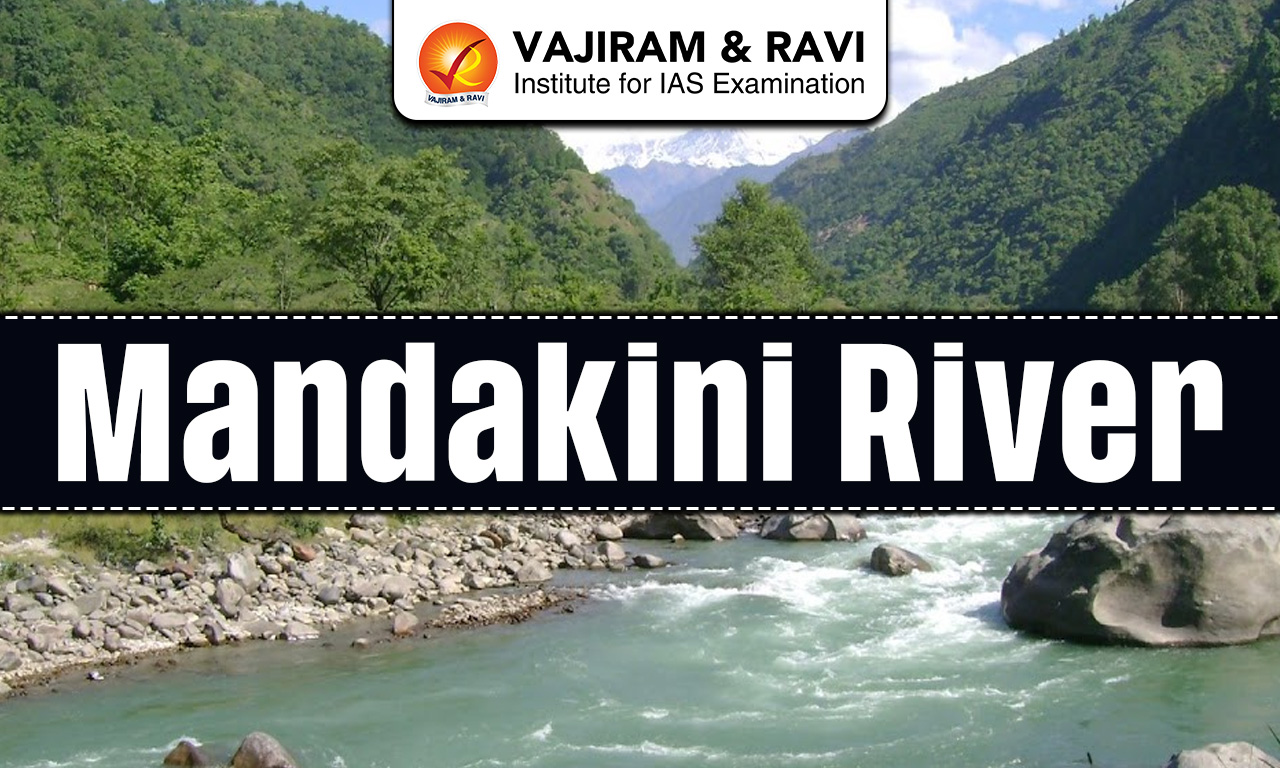
Mandakini River is an important Himalayan river of Uttarakhand and a major tributary of the Alaknanda River. It originates near Kedarnath and flows through the Rudraprayag district before joining the Alaknanda at Rudraprayag.

Mandakini River Origin and Course

  • The Mandakini River originates from the Chorabari Glacier, located at an altitude of about 3,895 metres above sea level, nearly one kilometre above the Kedarnath temple. 
  • The glacier is fed by melting snow from the surrounding Himalayan peaks.
  • From its source, the river flows for about 80-81 kilometres through steep and narrow valleys of the Himalayas. 
  • It passes through important locations such as Sonprayag and finally meets the Alaknanda River at Rudraprayag. After this confluence, the waters ultimately become part of the Ganga river system.

Mandakini River Drainage Basin and Physical Features

  • The Mandakini River basin covers an area of approximately 1,666 sq km. 
  • It falls under the West Himalayan biogeographic zone. 
  • The climate of the basin is generally subtropical in the lower regions, while the upper reaches experience alpine conditions.
  • The basin shows prominent glacial and fluvial landforms. Near Kedarnath, glacio-fluvial deposits and outwash plains are visible. 
  • As the river flows downstream, it forms deep gorges, V-shaped valleys, incised meanders, and waterfalls. These features indicate active erosion and make the region geomorphologically fragile.

Mandakini River Tributaries

The Mandakini River is joined by several tributaries. 

  • The major left-bank tributaries include Basukiganga, Kali Ganga, and Madhyamaheshwar Ganga. 
  • Laster Gad joins the river from the right bank. 
  • These tributaries increase the river’s discharge, especially during the monsoon season.

Mandakini River Hydroelectric Projects

Two important hydroelectric projects are located on the Mandakini River - the Phata-Byung Hydroelectric Project and the Singoli-Bhatwari Hydroelectric Project. 

Mandakini River Religious and Cultural Significance

The Mandakini River carries deep spiritual significance.

  • It flows through the sacred town of Kedarnath, which is one of the twelve Jyotirlingas of Lord Shiva and part of the Chhota Char Dham pilgrimage circuit of Uttarakhand.
  • It also flows near Tungnath, the highest Shiva temple in the world and one of the Panch Kedar shrines.
  • The confluence at Rudraprayag is one of the Panch Prayag (five sacred confluences) along the Alaknanda River.
  • It is named after Lord Rudra, a form of Lord Shiva, and holds great religious importance in Hindu mythology.

Mandakini River Environmental Concerns

The Mandakini basin gained national attention during the 2013 Uttarakhand floods, which caused massive destruction around Kedarnath. Extreme rainfall, glacial melt, and unregulated construction activities aggravated the disaster. The event highlighted the fragile ecology of the Himalayas and the need for sustainable development practices.

Major environmental challenges in the basin include landslides, flash floods, hydropower-related disturbances, tourism pressure, and the impact of climate change on glaciers.

Mandakini River FAQs

Q1: Where does the Mandakini River originate?

Ans: The Mandakini River originates from the Chorabari Glacier at an altitude of about 3,895 metres above sea level. The glacier is located nearly one kilometre above Kedarnath in Uttarakhand.

Q2: Where does the Mandakini River meet the Alaknanda River?

Ans: The Mandakini River joins the Alaknanda River at Rudraprayag. This confluence is one of the five sacred Prayags (Panch Prayag) along the Alaknanda River and holds religious significance.

Q3: What are the major tributaries of the Mandakini River?

Ans: The major left-bank tributaries of the Mandakini River are Basukiganga, Kali Ganga, and Madhyamaheshwar Ganga. Laster Gad joins the river from the right bank.

Q4: Why is the Mandakini River basin environmentally fragile?

Ans: The Mandakini basin is located in the geologically young and tectonically active Himalayan region. It has steep slopes, deep gorges, V-shaped valleys, and glacial landforms. Heavy rainfall, glacial melt, landslides, hydropower construction, and tourism pressure increase the risk of flash floods and ecological imbalance, as seen during the 2013 Uttarakhand floods.

Q5: What is the religious significance of the Mandakini River?

Ans: The Mandakini River flows through Kedarnath, one of the twelve Jyotirlingas of Lord Shiva and part of the Chhota Char Dham pilgrimage circuit. It also flows near Tungnath, the highest Shiva temple in the world. The confluence at Rudraprayag is considered sacred in Hindu mythology and is associated with Lord Rudra (a form of Shiva).

Khajuraho Temples, Location, Features, Architecture, Sculpture

Khajuraho Temples

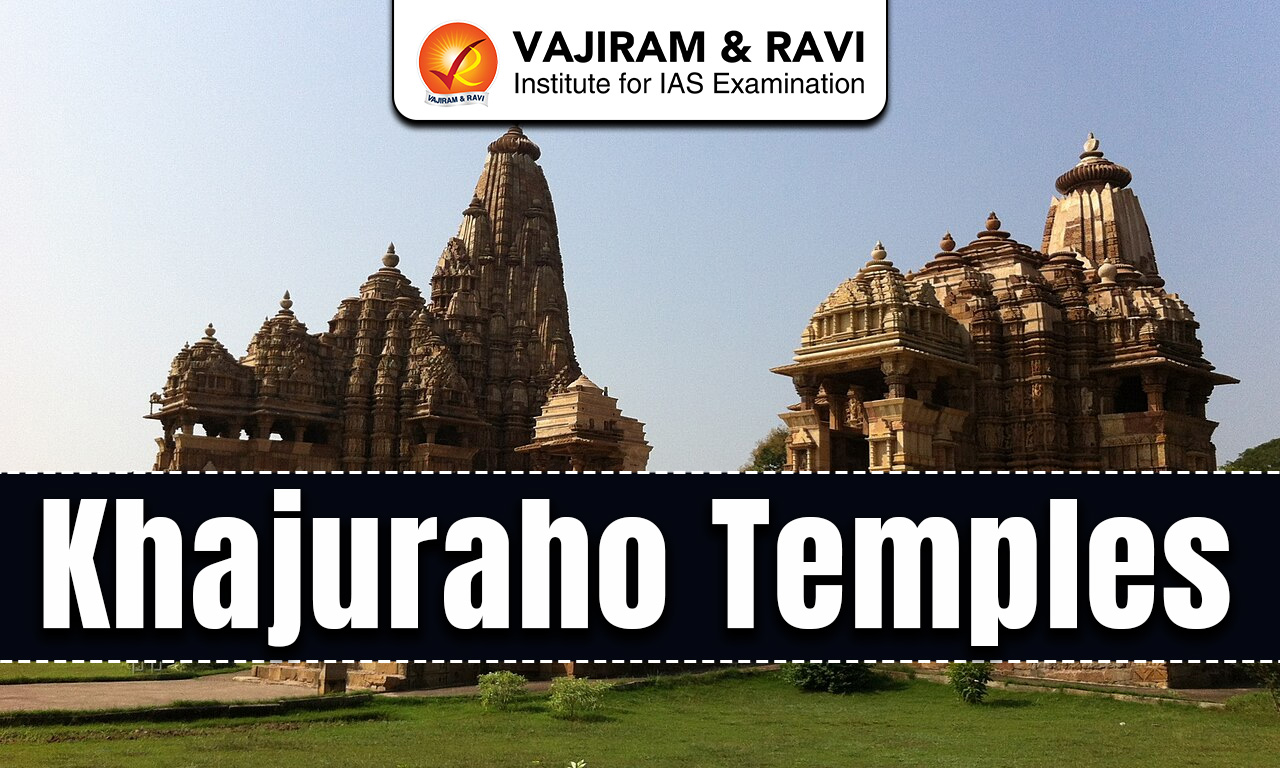
The Khajuraho temples are one of the best examples of medieval Indian temple architecture and sculpture. These temples are located in Chhatarpur district, Madhya Pradesh and were an important cultural and religious centre of central India. In 1986, the Khajuraho Group of Monuments was declared a UNESCO World Heritage Site because of its historical and artistic importance.

About Khajuraho temples 

  • Khajuraho temples are located in Chhatarpur district, Madhya Pradesh. 
  • These temples were built during the reign of the Chandella dynasty between 900 CE to 1130 CE. 
  • In the 12th century, Khajuraho had about 85 temples spread over 20 square kilometres, but today only around 20 temples remain due to the effects of time and historical damage.
  • The first mention of Khajuraho and its temples is in the accounts of Abu Rahyan al Biruni (1022 CE) and Ibn Batuta (1335 CE). 
  • One of the unique features of Khajuraho temples is religious harmony. The temple complex includes structures related to Shaivism, Vaishnavism and Jainism.
  • The Parsvanatha Temple Khajuraho is the largest Jain temple in the complex. Jain temples here contain images of Tirthankaras and Jain philosophical symbols.

Read about: Famous Temples in India

Khajuraho Temples Three Groups

The Temples of Khajuraho are divided into three groups, the Western Group, the Eastern Group and the Southern Group.

  • Western Group: The Western group is the most important and well-preserved. It includes famous temples like the Kandariya Mahadeva Temple, Vishwanath Temple, Lakshmana Temple, Devi Jagdamba Temple, and Chitragupta Temple. The Chausath Yogini Temple in this group is unique because it was built mainly of granite and was associated with goddess worship.
  • Eastern Group: The Eastern group contains both Hindu and Jain temples. Important temples here include the Brahma Temple, Vamana Temple, Javari Temple, and Ghantai Temple. The Ghantai Temple is known for bell-shaped chains and Navagraha representations. 
  • Southern Group: The Southern group includes the Duladeo Temple and Chaturbhuja Temple Khajuraho, where the Chaturbhuja Temple is unique because it does not contain erotic sculptures.

Architectural Style of Khajuraho Temples

The Khajuraho temples are built in the Nagara style of North Indian temple architecture.The Nagara style is characterised by a curvilinear tower called shikhara, which rises above the sanctum. The main components of these temples are:

  • The Garbhagriha (sanctum sanctorum) with antarala, a narrow ante-chamber
  • The Maha Mandapa, a large hall
  • The Ardha Mandapa and a mandapa, which are smaller additional halls
  • The Pradakshina Path, a circumambulation path

A few temples at Khajuraho are of the Panchayatana type, with four shrines dedicated to the divinities and often another shrine in front of the portico dedicated to the vahana (vehicle) of the principal deity.

The temples are mainly built using light-coloured sandstone obtained from the quarries of the Panna region. Some smaller structures also used granite. Iron clamps were used in construction to strengthen the stone joints. Most Khajuraho temples are oriented towards the east so that the rising sun can illuminate the entrance of the temple.

Khajuraho Temples Sculptures

  • Khajuraho temples are globally famous for their exquisite stone sculptures. Nearly 900 sculptures are present on the walls of major temples such as the Kandariya Mahadeva Temple.
  • The sculptures depict various themes including Hindu gods and goddesses, mythological stories, musicians, dancers, ascetics and scenes from daily life
  • Special emphasis was given to the representation of celestial women such as apsaras and surasundaris.
  • The artistic philosophy of Khajuraho is often linked with the four major goals of Hindu life - dharma, artha, kama and moksha. 
  • Erotic sculptures are one of the most discussed features of Khajuraho. These sculptures are believed to reflect the idea of female beauty and fertility. Other scenes depicted on the walls of the temples are a part of the Narathara (the human life cycle) signifying how sexual procreation and kama are an essential aspect of human life.
  • Scholars have proposed different interpretations regarding these sculptures. Some believe they are related to the Shakti worship tradition, while others suggest they represent the role of devadasis in temple culture. Another theory suggests that the sculptures represent the human life cycle.

Today, Khajuraho is one of the most important heritage tourism sites in India. Nearby attractions include Panna National Park, which is famous for tiger conservation. The Khajuraho Dance Festival is organised every year in February to promote classical Indian dance. The temples are protected under the AMASR Act, 1958 and are managed by the Archaeological Survey of India. However, tourism pressure, dust pollution, urban development, and vibration effects from nearby airport activities remain major conservation challenges.

Khajuraho Temples FAQs

Q1: Where are the Khajuraho Temples located?

Ans: Khajuraho Temples are located in Chhatarpur district, Madhya Pradesh, India. They were built by the Chandella dynasty between 900 CE and 1130 CE.

Q2: Why are Khajuraho Temples famous?

Ans: Khajuraho Temples are famous for their Nagara style architecture and beautiful stone sculptures showing gods, goddesses, dancers, musicians and daily life scenes. They are also known for their unique artistic carvings.

Q3: How many Khajuraho Temples are there today?

Ans: In the 12th century, there were about 85 temples, but today only around 20 temples remain due to natural weathering and historical damage.

Q4: When was Khajuraho declared a UNESCO World Heritage Site?

Ans: The Khajuraho Group of Monuments was declared a UNESCO World Heritage Site in 1986 because of its historical and artistic importance.

Q5: What is special about Khajuraho Temple sculptures?

Ans: The sculptures represent Hindu philosophy, including dharma, artha, kama and moksha. Erotic sculptures are also present but form a small part of the total carvings and are generally associated with fertility symbolism and human.

Sustainable Sugarcane Initiative, Objectives, Features, Advantages

Sustainable Sugarcane Initiative

The Sustainable Sugarcane Initiative (SSI) is an improved method of cultivating sugarcane that focuses on higher productivity with lower use of water, seeds and fertilizers. It promotes practices such as planting young seedlings instead of cane sets, wider spacing between plants, and better soil and water management. SSI aims to increase farmers’ income while conserving natural resources and reducing environmental damage.

About Sustainable Sugarcane Initiative

  • It is an improved method of sugarcane cultivation that focuses on higher yield with fewer resources.
  • Farmers use fewer seeds and raise seedlings in nurseries instead of planting cane sets directly.
  • It promotes wider spacing between plants and better management of water and nutrients.
  • Sugarcane production can increase by around 20% while using about 30% less water and fewer chemical fertilizers.
  • It reduces pressure on water resources and lowers environmental damage.
  • The method benefits small and marginal farmers by reducing input costs and increasing income.
  • It also allows intercropping, which provides additional income to farmers.
  • The initiative has received technical and financial support under government programs like the Umbrella Programme for Natural Resource Management (UPNRM).

Sustainable Sugarcane Initiative Objectives

  • To increase sugarcane productivity while reducing the use of seeds, water and chemical fertilizers.
  • To encourage farmers to raise seedlings in nurseries using single-bud chips instead of planting traditional cane sets.
  • To transplant healthy seedlings (25-35 days old) into the main field for better survival and growth.
  • To maintain wider spacing (about 5 × 2 feet) between plants to improve yield.
  • To promote efficient water management through methods like drip irrigation and fertigation.
  • To encourage balanced nutrient management and greater use of organic and eco-friendly plant protection practices.

Sustainable Sugarcane Initiative Features

  • The Sustainable Sugarcane Initiative is implemented with the support of organizations such as Maharashtra Sugar Cooperatives, NABARD and the Umbrella Programme for Natural Resource Management (UPNRM).
  • India is the second-largest producer of sugarcane in the world and sugar production supports the livelihood of nearly 3.5 crore (35 million) farmers. SSI is therefore important for rural income and agricultural sustainability.
  • The initiative promotes eco-friendly and scientific farming practices to improve productivity while conserving natural resources.
  • Farmers are encouraged to adopt SSI through financial assistance, supply of quality seedlings at subsidized rates, exposure visits, and support for organic manure use.
  • Institutions like the Vasantdada Sugar Institute (VSI), Pune, have supported farmers by providing single-bud seedlings and technical guidance.
  • The method encourages intercropping with crops like groundnut and soybean to increase farmers’ income and ensure better land utilization.
  • Large areas (around 280 acres in some projects) have been brought under drip irrigation and SSI cultivation, showing its scalability.
  • Field experiments combining drip irrigation and SSI have significantly improved productivity from about 60 metric tonnes per acre under traditional flood irrigation to around 90 metric tonnes per acre.

Sustainable Sugarcane Initiative Advantages

  • Efficient use of resources: SSI reduces the use of seeds, water and chemical fertilizers through drip irrigation and balanced fertigation. Water use can be reduced by 30-50%, helping conserve scarce water resources.
  • Higher productivity with lower costs: Better spacing, healthy nursery seedlings and scientific practices increase yields by around 20-30%, while reducing cultivation costs by nearly 20-25%. Farmers can also earn extra income through intercropping.
  • Improved crop quality and survival: Transplanting strong seedlings reduces plant mortality and the need for gap filling. Better sunlight and air circulation improve cane quality and sugar content.
  • Higher farmer income and savings: Due to increased yield and reduced input costs, farmers can save a substantial amount per acre, improving their overall profitability.
  • Employment and social benefits: Nursery raising of seedlings creates rural employment opportunities for both men and women and promotes awareness of scientific farming methods.
  • Environmental sustainability: Reduced chemical use and lower water consumption help protect soil health, conserve ecosystems, and support long-term agricultural sustainability.

Sugarcane Industry in India

  • Sugarcane is cultivated in most parts of India except the very cold and hilly regions such as Jammu & Kashmir, Himachal Pradesh, and Arunachal Pradesh, where low temperatures and short growing seasons are not suitable for the crop.
  • In India, sugarcane is mainly grown in two major agro-climatic regions - the tropical region and the subtropical region based on differences in climate and growing conditions.
  • The tropical region includes states such as Maharashtra, Karnataka, Tamil Nadu, Andhra Pradesh, Gujarat, Madhya Pradesh, Kerala, Goa, and the Union Territory of Puducherry. This region has a warm climate, longer growing season, and better sugar recovery rate. Maharashtra is the leading producer of sugarcane and sugar in this region.
  • The subtropical region includes states like Uttar Pradesh, Bihar, Haryana, and Punjab. Although this region has relatively cooler winters and slightly lower sugar recovery rates, it has a large area under cultivation. Uttar Pradesh is the largest producer of sugarcane and sugar in this region as well as in India overall.
  • The location of the sugarcane industry depends on factors such as suitable temperature (20-30°C), adequate rainfall or irrigation facilities, fertile alluvial or black soil, availability of labour, and proximity to sugar mills since sugarcane is bulky and must be processed quickly after harvesting.

Challenges to the Indian Sugar Industry

  • Low productivity and fluctuating supply: Sugarcane yield per hectare in India is relatively low compared to major sugar-producing countries. In addition, farmers often shift to more profitable crops, leading to unstable sugarcane supply and irregular production for mills.
  • Short crushing season and underutilization of capacity: Sugar mills operate only for about 4-7 months during the harvesting period. For the rest of the year, machinery and labour remain underutilized, increasing operational inefficiency and financial burden.
  • High cost of production and low recovery rate: Outdated technology, small and inefficient mills, high labour and transportation costs, and low sugar recovery rates increase the overall cost of sugar production, making Indian sugar less competitive globally.
  • Policy and regulatory constraints: Government interventions such as dual pricing of sugarcane (FRP and SAP), cane area reservation, minimum distance norms between mills, and export-import restrictions create financial stress and reduce operational flexibility.
  • Labour and competition-related issues: Shortage of labour during peak season, rising wages, and diversion of sugarcane towards jaggery or ethanol production further affect the smooth functioning of sugar mills.

UPSC PYQ

What are the significances of a practical approach to sugarcane production known as the 'Sustainable Sugarcane Initiative'? [UPSC 2024]

  1. Seed cost is very low in this compared to the conventional method of cultivation.
  2. Drip irrigation can be practiced very effectively in this.
  3. There is no application of chemical/inorganic fertilizers at all in this.
  4. The scope for intercropping is more in this compared to the conventional method of cultivation.

Select the correct answer using the code given below:

  1.  1 and 3 only
  2.  1, 2 and 4 only
  3.  2, 3 and 4 only
  4.  1, 2, 3 and 4

[Ans - (B)]

Sustainable Sugarcane Initiative FAQs

Q1: What is the Sustainable Sugarcane Initiative (SSI)?

Ans: SSI is an improved method of sugarcane cultivation that increases yield while reducing the use of seeds, water, and fertilizers through nursery-raised seedlings and better resource management.

Q2: How is SSI different from the traditional method?

Ans: SSI uses single-bud seedlings raised in nurseries, wider spacing, and drip irrigation, unlike the traditional method of planting cane sets with closer spacing and flood irrigation.

Q3: What are the main benefits of SSI?

Ans: It increases yield by about 20-30%, reduces water use by 30-50%, lowers input costs, and improves farmers’ income.

Q4: Which institutions support SSI?

Ans: SSI is supported by organizations such as NABARD, Maharashtra Sugar Cooperatives, UPNRM and institutions like VSI, Pune.

Q5: Where is sugarcane mainly grown in India?

Ans: Sugarcane is grown in tropical states like Maharashtra and Karnataka, and subtropical states like Uttar Pradesh, Bihar, Haryana, and Punjab. Uttar Pradesh is the largest producer.

Ramnath Goenka Awards, Criteria, Major Categories, Selection Process

Ramnath Goenka Awards

The Ramnath Goenka Awards are among the most prestigious journalism awards in India. They are given every year to honour journalists who show courage, integrity and excellence in reporting.

These awards are named after Ramnath Goenka, the founder of The Indian Express. He was known for promoting fearless journalism, especially during challenging political periods like the Emergency. The awards were started in 2006 by the Ramnath Goenka Memorial Foundation.Each award under the Ramnath Goenka Excellence in Journalism Awards generally carries a cash prize of ₹1,00,000 (One Lakh Rupees), along with a trophy and a citation (certificate of recognition). 

Ramnath Goenka Awards Major Categories

The Ramnath Goenka Awards are presented across a wide range of categories to recognise specialised and impactful reporting:

  • Hindi Journalism: Awarded to one journalist each from print/digital and broadcast media in Hindi whose coverage stands out for excellence, independence, depth, quality, and public impact.
  • Environment Journalism: Honours exceptional reporting that promotes awareness and understanding of environmental issues, science, and technology.
  • Business and Economic Journalism: Recognises journalists who demonstrate independence, rigour, analytical depth, and clarity while covering business and economic issues.
  • Sports Journalism: Given to journalists whose sports reporting explores new perspectives and brings fresh direction to the field.
  • Feature Writing: Awarded for articles or series on arts, culture, and entertainment that introduce new ideas and innovative approaches.
  • Books (Non-Fiction): Honours authors of English-language books based on in-depth research and investigation that examine issues beyond the scope of regular news reporting.
  • Photojournalism: Recognises a powerful news photograph that captures the essence and drama of a story in a single frame.
  • Regional Languages: Awarded to journalists working in regional languages whose reporting demonstrates excellence, independence, and impact.
  • Uncovering India Invisible: Honours substantive reporting on rural and grassroots issues, judged on quality, forcefulness, and importance to public interest.
  • Reporting on Politics and Government: Recognises journalists whose coverage deepens understanding of political processes and governance.
  • Investigative Reporting: Awarded for original, forceful investigations that reveal new aspects of issues of public interest and create measurable impact.
  • Prakash Kardaley Memorial Award for Civic Journalism: Instituted in memory of Prakash Kardaley, this award honours sustained local reporting that highlights civic issues and compels authorities to act.
  • Foreign Correspondent Covering India: Recognises foreign correspondents in print media who portray India accurately and sensitively to an international audience.

Ramnath Goenka Awards Criteria

Ramnath Goenka Awards evaluate entries based on the significance and impact of the news story. The jury considers the journalist’s resourcefulness and courage in gathering information, as well as the skill with which the story is presented.

Other factors include:

  • The degree of difficulty and logistical challenges faced during reporting.
  • The comprehensiveness and depth of the report.
  • The originality of methods used and the responsible use of available resources.

Ramnath Goenka Awards Eligibility

Journalists working with Indian newspapers, magazines, online platforms, or television channels published or telecast in India are eligible to apply.

Indian language entries must be accompanied by English translations. Foreign correspondents reporting from India are also eligible, provided translations are submitted where required. The awards ensure inclusivity while maintaining high standards of journalistic integrity and professionalism.

Ramnath Goenka Awards Selection Process

The selection process is structured to ensure transparency and credibility:

  • Call for Entries: The Ramnath Goenka Memorial Foundation invites entries from eligible journalists.
  • Submission: Applicants submit their published or telecast work within the specified period, along with translations if required.
  • Screening and Shortlisting: Entries are shortlisted based on defined criteria such as impact, originality, and depth.
  • Jury Evaluation: A distinguished jury of senior editors and eminent personalities independently evaluates the shortlisted work.
  • Award Ceremony: Winners are announced and honoured at a formal ceremony, often attended by high constitutional authorities.

Ramnath Goenka Awards FAQs

Q1: What are the Ramnath Goenka Awards?

Ans: The Ramnath Goenka Awards are prestigious annual journalism awards in India that recognise excellence, courage, and integrity in print, digital, and broadcast reporting.

Q2: Who instituted the Ramnath Goenka Awards?

Ans: The Ramnath Goenka Awards were instituted by the The Indian Express Group in memory of its founder Ramnath Goenka in 2006.

Q3: What does each Ramnath Goenka Award include?

Ans: Each Ramnath Goenka Award generally carries a cash prize of ₹1,00,000, along with a trophy and a citation recognising journalistic excellence.

Q4: Who is eligible for the Ramnath Goenka Awards?

Ans: Journalists working in Indian newspapers, magazines, digital platforms, and television channels are eligible. Foreign correspondents covering India can also apply. Regional language entries must be submitted with an English translation.

Q5: What criteria are used for selecting winners of the Ramnath Goenka Awards?

Ans: The Ramnath Goenka Awards are given based on the significance and impact of the story, originality, depth of research, courage in reporting, ethical standards, and overall quality of presentation.

Operation Garuda, Launch Date, Objective, Key Details

Operation Garuda

Operation Garuda was launched by the Central Bureau of Investigation in September 2022. It is a multi-phase anti-drug operation. It aims to disrupt, degrade and dismantle international drug trafficking networks. The operation focuses on drug syndicates operating across borders, especially in the Indian Ocean Region.

About Operation Garuda

  • Operation Garuda was conducted in close coordination with INTERPOL and the Narcotics Control Bureau (NCB).
  • The operation involves rapid sharing of criminal intelligence related to drug trafficking.
  • It targets key elements of drug networks such as handlers, operatives, production centres and support systems.
  • CBI and NCB coordinate with State and Union Territory police agencies for intelligence collection and joint action.
  • Several States/UTs including Punjab, Himachal Pradesh, Gujarat, Maharashtra, Tamil Nadu, Delhi and Manipur have participated.
  • Operation Garuda strengthens international cooperation and enhances India’s capacity to tackle transnational organised drug crime.

Drug Trafficking in India

Drug trafficking is a serious social, economic, and security challenge in India. It involves the illegal production, transport, sale, and distribution of narcotic drugs and psychotropic substances. India is affected by both international drug smuggling networks and domestic drug distribution channels.

India’s geographic location makes it vulnerable to drug trafficking. The country lies between major Golden Triangle (Myanmar-Laos-Thailand) and Golden Crescent (Afghanistan-Iran-Pakistan) drug production regions.

Drug trafficking in India is mainly controlled under the Narcotic Drugs and Psychotropic Substances Act, 1985 (NDPS Act), which provides strict punishment for illegal drug activities. Another important law is the Prevention of Illicit Traffic in Narcotic Drugs and Psychotropic Substances Act, 1988, which focuses on preventing organised drug trafficking networks.

The Narcotics Control Bureau (NCB) is the main agency responsible for combating drug trafficking in India. It works with state police, border security forces, and international organisations like INTERPOL.

Government Measures to Control Drug Trafficking

The government is following a two-pronged strategy - stopping drug supply through strict enforcement and reducing drug demand through awareness, treatment, and rehabilitation.

  • The government has strengthened the NCORD coordination mechanism at the national, state, district, and local levels to improve cooperation among law enforcement agencies.
  • Narco Coordination Mechanism (NCORD coordination mechanism)  is a multi-level coordination system to control drug trafficking in India. 
    • It improves cooperation among central agencies, state police, and other law enforcement bodies. 
    • It helps in sharing intelligence information related to drug trafficking.
    • It supports joint action and coordinated enforcement against narcotics networks.
  • Special Anti-Narcotics Task Forces have been established in all States and Union Territories to monitor drug-related crimes.
  • An integrated NCORD portal has been developed to provide real-time information related to narcotics enforcement.
  • The 1933 MANAS helpline allows citizens to report drug-related problems and share information with authorities.
  • A specialised task force monitors suspicious financial transactions involving darknet and cryptocurrency linked to drug trafficking.
  • Border security forces such as BSF, SSB, Assam Rifles, and the Coast Guard have been empowered under the NDPS Act to stop drug smuggling along land and sea borders.
  • The Railway Protection Force (RPF) helps prevent inter-state movement of narcotics through rail networks.
  • The Narcotics Control Bureau has expanded its regional and zonal offices to improve enforcement coverage across the country.
  • A Multi Agency Maritime Security Group has been created to monitor drug trafficking through sea routes.
  • Databases like NIDAAN help track arrested drug offenders and support investigations.

Drug Abuse Prevention and Rehabilitation

  • The government is implementing the National Action Plan for Drug Demand Reduction (NAPDDR) to reduce substance abuse among youth.
  • The Nasha Mukt Bharat Abhiyaan is running awareness programmes in all districts to educate people about drug dangers.
  • Rehabilitation centres, outreach centres, and addiction treatment facilities are being supported to help drug victims recover and return to society.
  • Helpline number 14446 provides counselling and immediate support to people seeking help.

Operation Garuda FAQs

Q1: What is Operation Garuda?

Ans: Operation Garuda is an anti-drug operation launched by the Central Bureau of Investigation (CBI) in 2022 to target international drug trafficking networks and dismantle organised narcotics syndicates.

Q2: When was Operation Garuda launched?

Ans: Operation Garuda was launched in September 2022 by the Central Bureau of Investigation (CBI).

Q3: Which region is a special focus of Operation Garuda?

Ans: The operation mainly targets drug trafficking networks operating in the Indian Ocean Region and international routes.

Q4: Which agencies are involved in Operation Garuda?

Ans: The operation is conducted by CBI in coordination with the Narcotics Control Bureau (NCB), INTERPOL, and State/UT police agencies.

Q5: What is the main objective of Operation Garuda?

Ans: The main objective is to disrupt and dismantle international drug trafficking networks and target handlers, production centres, and support syste

Police Commissionerate System, Background, Structure, Provisions

Police Commissionerate System

The Police Commissionerate System is a policing model used in large Indian cities where maintaining law and order is more complex due to high population, traffic, and crime. Under this system, the Commissioner of Police is vested with both policing and certain executive powers, enabling quick decision-making in situations such as protests, riots, and emergencies without relying on the District Magistrate. Unlike the traditional district system, where law and order responsibilities are shared between the Superintendent of Police and the District Magistrate, the Commissionerate System provides unified command under the Police Commissioner for faster and more efficient action.

Police Commissionerate System Background

  • Policing in India is mainly based on the Police Act of 1861, passed by the British after the Revolt of 1857 to create a proper police system and strengthen their control over India.
  • Under the colonial system, a dual administrative structure was introduced in districts - the District Collector (District Magistrate) was the overall head, and the Superintendent of Police (SP) worked under him. This was done to keep strict control over the police and ensure revenue collection and suppression of revolts.
  • This district-based system continued even after Independence in most parts of India.
  • However, in major presidency towns like Kolkata, Mumbai, and Chennai, the British introduced the Police Commissionerate System (even before the 1861 Act), where a senior police officer called the Police Commissioner was given both policing and certain executive powers to handle urban law and order quickly.
  • With rapid urbanisation after Independence, many states adopted the Commissionerate System in large cities. Today, it is considered an important step towards police reforms for better and faster urban policing.

Police Commissionerate System Expansion

  • After Independence, Delhi adopted the Commissionerate System during the period 1977-1979 (Morarji Desai government).
  • The National Police Commission (6th Report, 1983) recommended that cities with a population of 5 lakh or more, or those facing special law and order challenges, should adopt this system.
  • In 2005, the Draft Model Police Act prepared by a committee under the Ministry of Home Affairs also suggested that metro cities and urban areas with a population of 10 lakh or more should have a Commissionerate System.
  • According to Bureau of Police Research and Development (BPRD) data (2018), the system was implemented in 61 cities across 15 states. After further expansion (including Uttar Pradesh), around 63 cities now follow this system.
  • Today, most Indian states have adopted the Commissionerate System in major cities, except a few states where it has not yet been implemented.

Structure of the Commissionerate System

  • The head of the system is the Commissioner of Police (CP), usually an officer of Deputy Inspector General (DIG) rank or above.
  • The CP is assisted by officers such as:
    • Special Commissioner
    • Joint Commissioner
    • Additional Commissioner
    • Deputy Commissioner
  • In this system, the CP directly reports to the State Government, unlike the traditional district system where the police work under the District Magistrate.

Constitutional and Legal Provisions Related to Police

  • Under the Seventh Schedule of the Indian Constitution, Police is placed in the State List. This means that State Governments have the main responsibility for maintaining law and order.
  • The Political Executive at the state level (that is, the Chief Minister and Council of Ministers) has the power of superintendence and control over the state police. This ensures that the police remain accountable to the elected government.
  • Although police is a state subject, the Central Government can maintain its own police forces to assist the states in maintaining law and order. Therefore, the Centre has created several Central Armed Police Forces (CAPFs) and other specialised agencies for tasks such as:
    • Intelligence gathering
    • Criminal investigation
    • Research and record-keeping
    • Police training
  • The Central Government is directly responsible for policing in Union Territories. It also provides intelligence support and financial assistance to state police forces when required.
  • At the state level, police forces generally have two main wings:
    • Civil Police - They handle daily law and order duties, crime investigation, traffic control, and public safety.
    • Armed Police - They are kept as reserve forces and are deployed during serious situations like riots, large protests, or emergencies.

Also Read: Police Reform in India

Empowerment of Police under the System

  • Under the Commissionerate System, the Commissioner of Police (CP) exercises powers similar to those of a District Magistrate in matters of law and order.
  • Officers not below the rank of Assistant Commissioner of Police (ACP) can also exercise certain executive powers.
  • These powers include:
    • Taking preventive arrests to stop possible crimes.
    • Imposing Section 144 of the Criminal Procedure Code (CrPC) to restrict public gatherings during emergencies.
    • Conducting externment proceedings, which means ordering a person to leave the city area for up to two years to maintain peace.
  • This system allows faster decision-making without waiting for approval from the District Magistrate.

Need for the Police Commissionerate System

  • Strong and Effective Policing Model: The Commissionerate System is considered a powerful and efficient system of policing. Similar unified urban policing models exist in many countries.
  • Rapid Urban Growth: Many Indian cities now have populations above 10-20 lakh. Managing law and order in such densely populated urban areas requires faster and more specialised decision-making.
  • Complex Urban Challenges: Big cities often face serious issues such as student protests, caste and communal tensions, labour strikes, organised crime, terrorism, cybercrime, heavy traffic and protests against government policies. These situations need quick action and proper coordination.
  • Unity of Command: In the traditional district system, the Superintendent of Police (SP) depends on the District Magistrate (DM) for certain executive powers. This can sometimes lead to delays or differences of opinion. The Commissionerate System removes this dual control and ensures a single command under the Police Commissioner, allowing faster response.
  • Committee Recommendations: The 6th Report of the National Police Commission (1983) recommended introducing this system in cities with a population of 5 lakh and above. Later, the Draft Model Police Act (2005) also supported it for metro cities and large urban areas.
  • Greater Responsibility and Accountability: The system gives more power as well as responsibility to the Police Commissioner. It reduces the practice of shifting responsibility between police and magistrates.
  • Better Inter-City Coordination: For example, Noida in Uttar Pradesh shares a border with Delhi, which already follows this system. After adopting the Commissionerate System in parts of UP, coordination improved. Similarly, in Mumbai, the system has helped in dealing with complex issues, including organised crime in the past.
  • Additional Legal Powers: Under this system, police officers are given extra powers under laws like the BNS, Police Act, National Security Act, and other security laws. This helps in preventive action and better control of law and order.

Issues with the Police Commissionerate System

  • Concentration of Power: The system gives wide executive and policing powers to the Police Commissioner. Without strong accountability, this may lead to misuse of authority.
  • Low Public Trust: Historically, police in India have not always enjoyed high public confidence. People often feel more comfortable approaching civil officers like the District Magistrate. More powers to police may create fear of “police raj”.
  • Risk of Political Misuse: In the absence of clear transparency and oversight mechanisms, the police machinery may be influenced by the ruling government.
  • Overlapping Responsibilities: The areas of law and order and public order often overlap in practice, leading to possible confusion in handling situations.
  • Need for Public Awareness: The system works better in states where literacy and awareness of legal rights are higher, as informed citizens act as a check on misuse of power.

Difference Between Dual System and Commissionerate System

In India, policing functions under two main models - the Dual System (District System) and the Commissionerate System. The key difference lies in the distribution of powers and command structure. The detailed differences between the two systems are discussed below.

Difference Between Dual System and Commissionerate System

Dual System of Control (District System)

Commissionerate System (City System)

There is a dual command structure in the district. Both the District Magistrate (DM) and the Superintendent of Police (SP) share responsibility for law and order.

There is a single command structure in the city. The Commissioner of Police (CP) is the main authority for both policing and executive functions.

Powers are clearly separated. The DM has executive and magisterial powers (like issuing orders under Section 144, granting licenses, issuing warrants). The SP investigates crimes and makes arrests.

Powers of policing and magistracy are combined in the hands of the CP. The Commissioner can issue prohibitory orders, take preventive action, and also control crime.

The police are accountable to the District Magistrate, which creates a system of checks and balances at the district level.

The CP is directly accountable to the State Government and the Director General of Police (DGP), not to the DM.

There is less concentration of power in the police because executive powers remain with the DM.

There is a higher concentration of power in the hands of the Commissioner, which allows quick action but also raises concerns about misuse.

Decision-making may be slower, as coordination between the DM and SP is required before taking certain actions.

Decision-making is faster, as the CP can take immediate decisions without waiting for approval from civil authorities.

The SP is assisted by officers like Additional SP, Deputy SP, Inspectors, and constables.

The CP is assisted by officers such as Special Commissioner, Joint Commissioner, Additional Commissioner, and Deputy Commissioner. The lower ranks remain the same.

This system is mainly followed in districts and rural areas, where law and order issues are relatively less complex.

This system is mainly used in large cities and metropolitan areas, where population, crime rate and security challenges are higher.

Police Commissionerate System Significance

  • Many states in India have introduced the Commissionerate System in big cities to ensure faster decision-making and better handling of complex urban problems like traffic management, protests, organised crime, and security threats.
  • At the district level, the traditional dual system exists where the Superintendent of Police (SP) works under the District Magistrate (DM). Important decisions require coordination between both officers, which can sometimes delay action.
  • In contrast, at the metropolitan level, the dual system has been replaced by the Commissionerate System in many states. This system allows quicker and more effective responses to urban law and order issues.
  • Under this system, the Commissioner of Police (CP) is the head of a unified police structure in the city. The CP is responsible for maintaining law and order and is directly accountable to the State Government.
  • The CP also has magisterial powers, such as issuing prohibitory orders, regulating public gatherings, and granting certain licenses. This combination of powers helps in taking immediate action during emergencies.
  • The Sixth Report of the National Police Commission (1983) recommended introducing this system in cities with a population of 5 lakh or more.
  • Later, in 2005, the Draft Model Police Act, prepared by a committee set up by the Union Home Ministry, also suggested that metro cities and major urban areas with a population of 10 lakh or more should adopt the Commissionerate System.

Police Commissionerate System FAQs

Q1: What is the Police Commissionerate System?

Ans: It is a policing system used in large cities where the Commissioner of Police (CP) has both policing and executive powers for quick decision-making.

Q2: How is it different from the Dual System?

Ans: In the Dual System, the DM and SP share powers. In the Commissionerate System, powers are combined under the CP, ensuring single command.

Q3: What is the constitutional status of the Police?

Ans: Police is a State List subject under the Seventh Schedule. States control police, while the Centre assists and handles Union Territories.

Q4: What powers does the Commissioner have?

Ans: The CP can impose Section 144, order preventive arrests, and take other executive actions to maintain law and order.

Q5: What have committees recommended?

Ans: The 6th National Police Commission (1983) and Draft Model Police Act (2005) recommended it for large cities.

Article 41 of Indian Constitution, Case Laws, Significance

Article 41 of Indian Constitution

The Constitution of India establishes a welfare-oriented framework through its Directive Principles in Part IV. Among them, Article 41 plays a central role in promoting socio-economic justice. It directs the State to secure the right to work, education, and public assistance for citizens facing hardship. However, this obligation depends upon the State’s economic capacity and level of development. The provision reflects a balanced constitutional vision that combines social responsibility with financial practicality, ensuring progressive realization rather than immediate enforceability.

Article 41 of Indian Constitution

Article 41 of Indian Constitution states that the State shall, within the limits of its economic capacity and development, make effective provision for securing the right to work, to education, and to public assistance in cases of unemployment, old age, sickness, disablement, and other cases of undeserved want. Originally introduced as Draft Article 32 in 1948, it was debated on 23 November 1948 and adopted without amendment. A proposal to add “medical relief” was discussed but considered already covered under Article 47, avoiding repetition in constitutional language.

Article 41 of Indian Constitution Case Laws

Article 41 of Indian Constitution has guided judicial expansion of socio-economic rights under constitutional interpretation.

  • Unni Krishnan J.P. v. State of Andhra Pradesh (1993): The Supreme Court recognised education up to 14 years as part of the right to life, strengthening the educational mandate linked to Article 41.
  • Mohini Jain v. State of Karnataka (1992): The Court held that access to education is essential for dignity, indirectly reinforcing the State’s obligation under Article 41.
  • Minerva Mills Ltd. v. Union of India (1980): The judgment emphasised harmony between Fundamental Rights and Directive Principles, affirming that socio-economic goals guide governance.
  • People’s Union for Civil Liberties v. Union of India (2001): The Court connected subsistence support with the right to life, aligning public assistance objectives with Article 41 principles.
  • Paschim Banga Khet Mazdoor Samity v. State of West Bengal (1996): The ruling stressed State responsibility in providing essential services, supporting assistance during sickness and distress.

Article 41 of Indian Constitution Significance

Article 41 of Indian Constitution strengthens the constitutional commitment to social and economic justice.

  • It establishes responsibility of the State to create employment opportunities and provide assistance to vulnerable citizens facing hardship.
  • Implementation depends on economic capacity, ensuring realistic governance while encouraging gradual expansion of social security measures.
  • By covering unemployment, old age, sickness, and disablement, it addresses major causes of economic vulnerability.
  • It recognises education as a tool for empowerment and long-term social mobility.
  • Though non-justiciable, it influences policymaking and welfare legislation aimed at inclusive development.

Initiatives related to Article 41 of Indian Constitution

Multiple laws and programmes operationalise employment, education, and public assistance objectives under the provisions of Article 41 of Indian Constitution as highlighted below:

  • Right of Children to Free and Compulsory Education Act, 2009: Ensures free education for children aged 6 to 14 years, translating constitutional educational commitments into statutory rights.
  • National Social Assistance Programme, 1995: Offers financial support to elderly persons, widows, and individuals with disabilities living below the poverty line.
  • Ayushman Bharat Scheme, 2018: Provides health insurance coverage to economically vulnerable families, addressing assistance during sickness.
  • National Commission for Enterprises in the Unorganised Sector Report, 2007: Recommended comprehensive social security measures for informal workers, supporting income protection and welfare expansion.

Article 41 of Indian Constitution FAQs

Q1: What does Article 41 of the Indian Constitution provide?

Ans: Article 41 directs the State to secure the right to work, education, and public assistance in cases like unemployment, old age, sickness, disablement, and other situations of undeserved want, within its economic capacity.

Q2: Is Article 41 legally enforceable in courts?

Ans: No, Article 41 is part of the Directive Principles of State Policy, which are non-justiciable. However, courts use it to guide interpretation of Fundamental Rights, especially the right to life.

Q3: Which areas of welfare are mainly covered under Article 41?

Ans: Article 41 focuses on employment opportunities, access to education, and social assistance during unemployment, old age, sickness, disability, and other cases of economic hardship.

Q4: Under which Part of the Constitution is Article 41 placed?

Ans: Article 41 is included in Part IV of the Constitution of India under the Directive Principles of State Policy, which guide the State in framing welfare-oriented laws and policies.

Q5: Does Article 41 include medical relief specifically?

Ans: A proposal to add “medical relief” was discussed during debates, but it was not included because health-related duties were already addressed under Article 47.

AIDS Acquired Immuno Deficiency Syndrome, Causes, Prevention

AIDS

AIDS (Acquired Immuno Deficiency Syndrome) is a serious health condition caused by long-term infection with the Human Immunodeficiency Virus (HIV). It weakens the immune system, making the body unable to fight common infections and diseases. If HIV is not treated in time, it can progress to AIDS, which is the most advanced stage of the infection.

HIV/AIDS remains a global public health challenge. According to the World Health Organization, millions of people worldwide are living with HIV, but improved treatment and awareness have significantly reduced AIDS-related deaths. In India, the National AIDS Control Organisation (NACO) leads national efforts to prevent, treat, and control HIV/AIDS.

AIDS Causes

AIDS is caused by long-term infection with the Human Immunodeficiency Virus (HIV), which gradually weakens the immune system. When HIV is not treated properly, it destroys CD4 cells, leading to severe immune damage and the development of AIDS.

  • Infection with HIV (Primary Cause): AIDS develops only after a person becomes infected with HIV. The virus attacks and destroys CD4 (T-helper) cells that protect the body from infections.
  • Untreated or Late Diagnosis of HIV: If HIV is not detected early, the virus continues to multiply and damage the immune system over several years, eventually progressing to AIDS.
  • Lack of Antiretroviral Therapy (ART): Without proper ART treatment, the viral load increases rapidly, and the immune system becomes severely weakened.
  • High Viral Load in the Body: When HIV replicates actively in the blood, it reduces CD4 cell count significantly, accelerating progression toward AIDS.
  • Co-infections (e.g., Tuberculosis, Hepatitis): Existing infections weaken the immune system further and speed up the progression from HIV to AIDS.
  • Poor Nutrition and Weak Immunity: Malnutrition and poor health conditions make it harder for the body to fight infections, increasing the risk of developing AIDS.
  • Social Stigma and Lack of Awareness: Fear, discrimination, and misinformation often prevent people from seeking timely testing and treatment, leading to advanced disease stages.

Also Read: World AIDS Day 2025

AIDS Transmission

AIDS itself is not directly transmitted; it develops from long-term infection with HIV (Human Immunodeficiency Virus). HIV spreads from one person to another through specific body fluids such as blood, semen, vaginal fluids, rectal fluids, and breast milk.

Unprotected Sexual Contact

  • The most common mode of transmission worldwide.
  • Sexual contact without using condoms increases risk.
  • Risk is higher if one partner has a high viral load or untreated HIV.

Blood Transfusion with Infected Blood

  • Receiving unscreened or contaminated blood can transmit HIV.
  • Strict blood screening in hospitals has greatly reduced this risk.

Sharing Needles and Syringes

  • Common among injecting drug users.
  • Even a tiny amount of infected blood in a needle can transmit HIV.

Mother-to-Child Transmission (MTCT)

  • Can occur during pregnancy, childbirth, or breastfeeding.
  • With proper medical treatment, the risk can be reduced to very low levels.

Organ or Tissue Transplant from an Infected Donor

  • Rare, but possible if proper screening is not done.

Note: HIV is not transmitted through casual social contact or everyday interactions. Activities like hugging, sharing food, using public toilets, coughing, sneezing, or mosquito bites do not spread the virus, as HIV cannot survive or reproduce outside the human body in such conditions.

AIDS Prevention

AIDS can be prevented by stopping the transmission of HIV and by starting early treatment in people who are already infected. Awareness, safe practices, regular testing, and proper medical care are the most effective ways to control the spread of HIV.

  • Safe Sexual Practices: Using condoms correctly during every sexual act significantly reduces the risk of HIV transmission. Limiting the number of sexual partners and maintaining mutual monogamy also lowers risk.
  • Regular HIV Testing: Early testing helps in early detection and timely treatment. People who know their HIV status can take necessary precautions to prevent spreading the virus to others.
  • Antiretroviral Therapy (ART): HIV-positive individuals should start ART as soon as possible. ART reduces the viral load in the body to very low levels, helping people live healthy lives and greatly reducing the chance of transmission.
  • Pre-Exposure Prophylaxis (PrEP): PrEP is a preventive medicine taken by people at high risk of HIV infection. When taken regularly, it significantly lowers the risk of getting HIV through sexual contact.
  • Post-Exposure Prophylaxis (PEP): PEP is an emergency medication that must be started within 72 hours after possible exposure to HIV. It reduces the chance of infection if taken properly.
  • Safe Blood Transfusion: Ensuring that all donated blood is properly screened for HIV prevents transmission through blood transfusion.
  • Avoid Sharing Needles or Syringes: Injecting drug users should never share needles. Use of sterile, single-use syringes is essential to prevent infection.
  • Prevention of Mother-to-Child Transmission: HIV-positive pregnant women should take ART during pregnancy and breastfeeding. Proper medical care can reduce transmission risk to the baby to very low levels.
  • Health Education and Awareness Programs: Community education helps remove myths, reduce stigma, and encourage responsible behavior.
  • Reducing Stigma and Discrimination: Creating a supportive environment encourages people to get tested and treated without fear

Major Government Initiatives

  • Free Antiretroviral Therapy (ART) Centres: The government provides free ART medicines through thousands of centres across India to ensure long and healthy lives for HIV-positive individuals.
  • HIV Testing and Counseling Centres (HTCs/ICTCs): These centres offer free and confidential HIV testing services along with counseling support.
  • Prevention of Parent-to-Child Transmission (PPTCT) Programme: Provides HIV testing and ART to pregnant women to prevent transmission to newborns.
  • Blood Safety Programme: Strict screening of donated blood in blood banks to prevent HIV transmission through transfusion.
  • Targeted Intervention (TI) Programme: Focuses on high-risk groups such as sex workers, injecting drug users, and migrant workers through awareness and preventive services.
  • Red Ribbon Clubs: Established in colleges and educational institutions to spread awareness among youth.
  • HIV and AIDS (Prevention and Control) Act, 2017: This law prohibits discrimination against people living with HIV/AIDS and ensures confidentiality, equal rights, and access to treatment.

National AIDS Control Programme (NACP)

The Government of India has taken several strong steps to control and prevent HIV/AIDS through awareness, free testing, and treatment services. The main body responsible for implementing these programmes is the National AIDS Control Organisation (NACO), which functions under the Ministry of Health and Family Welfare.

The National AIDS Control Programme (NACP) was launched in 1992 to prevent the spread of HIV and reduce AIDS-related deaths in a phased and systematic manner.

  • NACP Phase I (1992–1999): Focused on creating awareness about HIV/AIDS, ensuring safe blood transfusion, and establishing surveillance systems to monitor the spread of HIV.
  • NACP Phase II (1999–2006): Strengthened preventive interventions among high-risk groups, expanded HIV testing facilities, and improved blood safety measures.
  • NACP Phase III (2007–2012): Aimed at reducing new HIV infections and scaling up Antiretroviral Therapy (ART) centres across the country.
  • NACP Phase IV (2012–2017): Focused on consolidating prevention efforts, expanding treatment coverage, and integrating HIV services with the general healthcare system.
  • Current Focus (NACP Phase V): Aligns with global targets to eliminate AIDS as a public health threat by 2030, increase treatment coverage, and achieve the 95-95-95 goals (95% diagnosed, 95% on treatment, 95% virally suppressed).

AIDS FAQs

Q1: What is AIDS?

Ans: AIDS (Acquired Immuno Deficiency Syndrome) is the most advanced stage of HIV infection. It occurs when the immune system becomes severely damaged and the body can no longer fight serious infections and diseases.

Q2: What is the difference between HIV and AIDS?

Ans: HIV (Human Immunodeficiency Virus) is the virus that attacks the immune system. AIDS is the final stage of HIV infection when the CD4 cell count becomes very low or serious opportunistic infections develop.

Q3: How does HIV spread?

Ans: HIV spreads through infected blood, semen, vaginal fluids, rectal fluids, and breast milk. It is mainly transmitted through unprotected sex, sharing needles, infected blood transfusion, and from mother to child during pregnancy, childbirth, or breastfeeding.

Q4: Can HIV spread through casual contact?

Ans: No. HIV does not spread through hugging, shaking hands, sharing food, coughing, sneezing, or mosquito bites.

Q5: Is there a cure for HIV/AIDS?

Ans: There is no complete cure yet. However, Antiretroviral Therapy (ART) allows people living with HIV to lead long, healthy, and near-normal lives.

ALMA Telescope

ALMA Telescope

ALMA Telescope Latest News

Recently, astronomers have captured the central region of our Milky Way and unveiled a complex network of filaments of cosmic gas in unprecedented detail with the help of the Atacama Large Millimeter/submillimeter Array (ALMA) telescope..

About ALMA Telescope

  • Location: The Atacama Large Millimeter/submillimeter Array (ALMA) is a radio telescope located in the Atacama Desert in Chile.
  • It is a state-of-the-art radio-telescope that studies celestial objects at millimetre and submillimetre wavelengths.
  • It has been fully functional since 2013.
  • It was designed, planned and constructed by the US’s National Radio Astronomy Observatory (NRAO), the National Astronomical Observatory of Japan (NAOJ) and the European Southern Observatory (ESO).

Properties of ALMA Telescope

  • It also has extraordinary sensitivity, which allows it to detect even extremely faint radio signals.
  • It consists of 66 high-precision antennas, spread over a distance of up to 16 km in the Atacama Desert of northern Chile.
  • These antennas can be moved closer together or farther apart for different perspectives – like the zoom lens of a camera.

Also Read: ALMA Telescope: Soon it will get a ‘new brain’

Major Discoveries of ALMA Telescope

  • In 2013 it discovered starburst galaxies earlier in the universe’s history than they were previously thought to have existed.
  • It provided detailed images of the protoplanetary disc surrounding HL Tauri — a very young T Tauri star in the constellation Taurus, approximately 450 light years from Earth.
  • It helped scientists observe a phenomenon known as the Einstein ring.
    • The Einstein ring occurs when light from a galaxy or star passes by a massive object en route to the Earth, in extraordinary detail.

Source: Phy.Org

ALMA Telescope FAQs

Q1: Where is the ALMA Telescope located?

Ans: Atacama Desert, Chile

Q2: What is unique about ALMA's location?

Ans: High altitude and dry climate

Eligible Manufacturer Importers (EMIs) Scheme

Eligible Manufacturer Importers Scheme

Eligible Manufacturer Importers (EMIs) Scheme Latest News

Recently, the Central Board of Indirect Taxes and Customs (CBIC) has issued detailed eligibility conditions, application process and operational guidelines for the Eligible Manufacturer Importers (EMIs) scheme.

About Eligible Manufacturer Importers (EMIs) Scheme

  • It is designed as a trust-based facilitation measure, encouraging compliant manufacturers to benefit from simplified procedures.
  • Under this initiative, Eligible Manufacturer Importers (EMI) will be able to clear imported goods without paying Customs duty at the time of clearance.
    • Instead, the applicable duty can be paid on a monthly basis as prescribed under the Deferred Payment of Import Duty Rules, 2016.
  • Duration: EMI facility will be available from 1st April, 2026 and will remain in force till 31st March, 2028.
  • Eligible Manufacturer Importers are: Existing Authorised Economic Operators (AEOs) AEO-T1 entities, including MSMEs that fulfill the eligibility conditions are also eligible to participate.
  • Under this, approved Eligible Manufacturer Importers are expected to progressively obtain AEO-T2 or AEO-T3 status, enabling access to enhanced facilitation, faster clearances and priority treatment under the AEO Programme.
  • It is expected to improve ease of doing business, strengthen compliance culture, and boost domestic manufacturing.

Source: PIB

Eligible Manufacturer Importers (EMIs) Scheme FAQs

Q1: What is the main benefit of the EMI Scheme?

Ans: Deferred payment of customs duty

Q2: When will the EMI Scheme be effective?

Ans: April 1, 2026

Debrigarh Wildlife Sanctuary

Debrigarh Wildlife Sanctuary

Debrigarh Wildlife Sanctuary Latest News

The Debrigarh Wildlife Sanctuary is set to host the second edition of the two-day ‘Indian Bison Fest’.

About Debrigarh Wildlife Sanctuary

  • It is situated in the Bargarh district of Odisha.
  • It is located near Hirakud Dam (the longest dam in India and the longest earthen dam in the world) on the Mahanadi River.
  • It finds a special mention because of noted freedom fighter Veer Surendra Sai. 
  • During his rebellion against the British, his base at Barapathara was located within the sanctuary.
  • Vegetation: Most of the plant sanctuary is covered with mixed and dry deciduous forest. 
  • Flora: Major trees found here are Sal, Asana, Bija, Aanla, Dhaura, etc.
  • Fauna
    • Indian leopards, sloth bears, chousingha (four-horned antelope), sambar deer, gaurs (Indian bison), wild boars, and Indian wild dogs (dholes) are among the notable animal residents.
    • It is one of the most flocked wintering grounds of migratory birds that visit the sanctuary from far-off places.
    • Some of the most prominent among them are the crested serpent eagle, Flower Peckers, red-vented bulbul, tree pie, drongo, and white eye oriental.

Key Facts about Indian Bison

  • The Indian Bison, also known as Gaur, is the largest species among the wild cattle and the Bovidae.
  • Gaur are strong and mightily built, with a high grey ridge on their forehead between their horns, which curve upwards from the sides of the head. 
  • Distribution: Gaurs are indigenous to the South and Southeast parts of Asia.
  • Habitat:
    • Gaurs are primarily found in evergreen and semi-evergreen forests along with moist deciduous forests with open grasslands.
    • They prefer hilly terrains below an altitude of 1,500-1,800 m with large and undisturbed forest tracts and abundant water.
  • Conservation Status:
    • IUCN Red List: Vulnerable.

Source: NIE

Debrigarh Wildlife Sanctuary FAQs

Q1: Where is Debrigarh Wildlife Sanctuary located?

Ans: It is located in Bargarh district of Odisha.

Q2: Near which major dam is Debrigarh Wildlife Sanctuary situated?

Ans: It is located near the Hirakud Dam.

Q3: Which freedom fighter is associated with Debrigarh Wildlife Sanctuary?

Ans: Veer Surendra Sai.

Q4: What type of vegetation dominates Debrigarh Wildlife Sanctuary?

Ans: Mixed and dry deciduous forests.

Kosi River

Kosi River

Kosi River Latest News

Over the past 200 years, the Kosi River has shifted its path westward by over 100 kilometres.

About Kosi River

  • It is a transboundary river which flows through China, Nepal, and India.
  • It is a prominent tributary of the Ganges.
  • People often call it the "Sorrow of Bihar" because of the big floods it can cause, especially in the Indian state of Bihar.
  • Course:
    • The river Kosi is formed by the confluence of three streams, namely the Sun Kosi, the Arun Kosi, and the Tamur Kosi, all of which have their origin in the Himalayan region of Nepal and Tibet. 
    • About 48 km north of the Indian-Nepalese frontier, the Kosi is joined by several major tributaries and breaks southward through the Siwalik Hills at the narrow Chatra Gorge. 
    • The river then emerges on the great plain of northern India in Bihar state on its way to the Ganges River, which it enters south of Purnea after a course of about 724 km. 
  • The Kosi drains an area of 74,500 sq.km, of which only 11,070 sq.km lie within Indian Territory. 
  • Over the last 250 years, the Kosi has shifted its course over 100 kilometres from East to West and the unstable nature of the river is attributed to the heavy silt it carries during the monsoon season.
  • Corn (maize) is extensively cultivated on the sandy soils of the Kosi’s basin.
  • Tributaries: It has seven major tributaries: Sun Koshi, Tama Koshi or Tamba Koshi, Dudh Koshi, Indravati, Likhu, Arun, and Tamore or Tamar.

Source: IT

Kosi River FAQs

Q1: Through which three countries does the Kosi River flow?

Ans: China, Nepal, and India.

Q2: The Kosi River is a tributary of which major river?

Ans: The Ganges.

Q3: Why is the Kosi River called the “Sorrow of Bihar”?

Ans: Because it causes frequent and devastating floods in Bihar.

Q4: What is the approximate total length of the Kosi River?

Ans: About 724 km.

Bureau of Energy Efficiency

Bureau of Energy Efficiency

Bureau of Energy Efficiency Latest News

Recently, the 25th Foundation Day of the Bureau of Energy Efficiency (BEE), Ministry of Power, Government of India, was celebrated in New Delhi.

About Bureau of Energy Efficiency

  • It is a statutory body which was established in 2002 under the provisions of the Energy Conservation Act, 2001.
  • Objective: The primary objective of BEE is to reduce energy intensity in the Indian economy.
  • Nodal Ministry: Ministry of Power.

Function and Duties of Bureau of Energy Efficiency

  • It coordinates with designated consumers, designated agencies and other organizations; recognizes, identifies and utilizes the existing resources and infrastructure, in performing the functions assigned to it under the Energy Conservation Act.
  • The EC Act provides for regulatory and pro­motional functions which are assigned to the organisation.
  • Regulatory functions
    • Develop minimum energy performance standards for equipment and appliances under Standards and Labelling
    • Develop minimum energy performance standards for Commercial Buildings
    • Develop Energy Consumption Norms for Designated Consumers

Schemes of Bureau of Energy Efficiency

Source: PIB

Bureau of Energy Efficiency FAQs

Q1: Under which ministry does BEE operate?

Ans: Ministry of Power

Q2: What is the primary objective of BEE?

Ans: Improve energy efficiency

Sulphur Dioxide

Sulphur Dioxide

Sulphur Dioxide Latest News

Recently, it was observed that India still has no national standards for sulphur dioxide (SO2) emissions from steel-producing facilities like sinter plants, mill zones, despite their being recognised as SO2 emission sources.

About Sulphur Dioxide

  • It is a colorless gas with a pungent odor.
  • Properties of Sulphur Dioxide
    • It is a liquid when under pressure, and it dissolves in water very easily.
    • It has a pungent, irritating odor, familiar as the smell of a just-struck match.
  • Applications: It is used to manufacture chemicals, in paper pulping, in metal and food processing.
  • Impacts of Sulphur Dioxide: It is harmful for human health, environment and climate.

Occurrence of Sulphur Dioxide

  • Sulfur dioxide in the air comes mainly from activities such as the burning of coal and oil at power plants or from copper smelting.
  • It is usually prepared industrially by the burning in air or oxygen of sulfur or such compounds of sulfur as iron pyrite or copper pyrite.
  • In nature, sulfur dioxide can be released to the air from volcanic eruptions.
  • The largest source of SO2 in the atmosphere is the burning of fossil fuels by power plants and other industrial facilities

Source: DTE

Sulphur Dioxide FAQs

Q1: What is the chemical formula of Sulphur Dioxide?

Ans: SO2

Q2: What is the impact of Sulphur Dioxide on the environment?

Ans: Sulfur dioxide can damage trees and plants, inhibit plant growth, and damage sensitive ecosystems and waterways.

India Meteorological Department (IMD)

India Meteorological Department (IMD)

India Meteorological Department (IMD) Latest News

An above-normal number of heatwave days are expected over most parts of the country between March and May, the India Meteorological Department (IMD) said in its monthly forecast.

About India Meteorological Department (IMD)

  • Established in 1875, IMD is the National Meteorological Service of the country and the principal government agency in all matters relating to meteorology and allied subjects.
  • It functions under the Ministry of Earth Sciences (MoES).
  • IMD is headquartered in Delhi and operates hundreds of observation stations across India and Antarctica. 
  • The Director General of Meteorology is the Head of the IMD.
  • There are 6 Regional Meteorological Centres, each under a Deputy Director General, with headquarters at Mumbai, Chennai, New Delhi, Calcutta, Nagpur, and Guwahati.
  • IMD Mandate:
    • To take meteorological observations and to provide current and forecast meteorological information for weather-sensitive activities like agriculture, shipping, aviation, offshore oil explorations, etc.
    • To warn against severe weather phenomena like tropical cyclones, norwesters, duststorms, heavy rains and snow, cold and heat waves,,
    • To provide meteorological statistics required for agriculture, water resource management, industries, oil exploration, and other nation-building activities.
    • To conduct and promote research in meteorology and allied disciplines.
  • IMD is also one of the six Regional Specialized Meteorological Centres of the World Meteorological Organization (WMO)
  • It is responsible for forecasting, naming, and distributing warnings for tropical cyclones in the Northern Indian Ocean region, including the Straits of Malacca, the Bay of Bengal, the Arabian Sea, and the Persian Gulf.

Source: TH

India Meteorological Department (IMD) FAQs

Q1: When was the India Meteorological Department established?

Ans: 1875.

Q2: Under which ministry does the India Meteorological Department function?

Ans: Ministry of Earth Sciences.

Q3: What is the primary role of IMD in weather-sensitive sectors?

Ans: To provide current and forecast meteorological information.

Q4: For which ocean region does IMD provide cyclone forecasting and naming services

Ans: The Northern Indian Ocean region.

Tehran’s Turmoil: Impact of the 1979 Islamic Revolution Reversal

Tehran’s Turmoil

Strait of Hormuz Disruption

Tehran’s Turmoil Latest News

  • The United States and Israel have launched a joint attack on Iran with the stated goal of bringing about regime change in Tehran. The move is seen as an attempt to reverse the 1979 Islamic Revolution.
  • The 1979 Revolution reshaped Iran’s political system by establishing religious rule. It also changed the balance of power in West Asia. 
  • The revolution affected global energy markets and influenced relations among major world powers.

Why the 1979 Revolution Matters

  • The Islamic Revolution created a system in which a Supreme Leader holds ultimate religious and political authority
  • Ayatollah Ali Khamenei consolidated this system and suppressed internal dissent.
  • The revolution also had an external agenda. Iran sought to export its revolutionary ideology across the Middle East
  • It strongly supported the Palestinian cause and positioned itself as a challenger to the US and Israel. This alarmed both Western powers and conservative Arab monarchies.

The Question of Regime Survival

  • The reported killing of Khamenei raises questions about the resilience of the Islamic Republic. The future depends on whether the regime can maintain cohesion after him.
  • Iran has witnessed repeated protest movements since 2000. These protests were crushed by the security apparatus. 
  • However, regime change will not be easy because coercive power remains with the existing state structure.
  • The next phase may see mobilisation by both regime supporters and opponents. The extent of US–Israeli intervention will influence the political outcome in Tehran.

Regional Implications

  • Iran’s revolutionary posture shaped Middle Eastern politics for decades. It deepened sectarian divides and alarmed Gulf Arab states.
  • Today, many Arab governments are not openly supporting Iran. Gulf states that initially stayed neutral have closed ranks after Iranian missiles targeted US bases and civilian infrastructure.
  • The key political battleground is not the “Arab street” but the Iranian public, especially urban groups seeking reform.

Energy and Economic Impact

  • The 1979 revolution contributed to the 1980 oil shock. The present crisis again affects global energy markets. 
  • Iran holds major hydrocarbon reserves. Rising tensions in the Strait of Hormuz are pushing up oil prices.
  • If sanctions are lifted under a new regime, Iranian oil could return to global markets. This would ease global energy prices and benefit major importers like India.

Great Power Competition

  • After 1979, Iran moved closer to Russia and China. It joined platforms like BRICS Plus and the Shanghai Cooperation Organisation.
  • If regime change leads to a pro-US government, Russia and China would face a setback in West Asia. The geopolitical balance would shift significantly.

Implications for India

  • For India, the 1979 revolution and the Soviet intervention in Afghanistan reshaped its regional environment. 
  • India has energy, security, and diaspora interests in West Asia.

Scale of the Indian Presence in the Gulf

  • The Indian diaspora in West Asia is one of the largest overseas Indian communities. 
  • More than nine million Indians live in the Gulf Cooperation Council (GCC) countries. The largest numbers are in the United Arab Emirates and Saudi Arabia.
  • There are over 100,000 Indians in Israel and more than 10,000 in Iran. Thousands of Indian students are also present in the region.
  • In the UAE alone, Indians form about 35 per cent of the population. 
  • Around 43 lakh Indians live there. Many are from Kerala, Tamil Nadu, Andhra Pradesh, Telangana, Uttar Pradesh, Bihar, and Punjab.

Economic Significance: Remittances and Travel

  • The Gulf is vital for India’s economy. According to the RBI’s Remittances Survey 2025, India received $118.7 billion in remittances in 2023–24.
  • The UAE contributed 19.2 per cent of this total, followed by Saudi Arabia at 6.7 per cent. Qatar, Kuwait, and Oman also rank among the top sources.
  • Gulf countries are also major travel destinations for Indians. In 2025, about 86 lakh Indians travelled to the UAE, 34 lakh to Saudi Arabia, and 11 lakh to Qatar.

India’s Ability to Influence the Conflict

  • India has limited ability to influence the conflict. However, it must prepare for possible consequences. 
  • These include energy supply disruptions, shifts in regional alliances, and changes in Iran’s foreign policy.
  • An Iran that is less confrontational could become a stronger economic and strategic partner for India. But instability could also create security and economic risks.

Conclusion

  • The effort to undo the 1979 Islamic Revolution is a major geopolitical development. The outcome will affect regional politics, global energy markets, and great-power competition.
  • For India, the challenge is to adapt to these tectonic shifts. Whatever happens in Tehran will cast a long shadow over West Asia and the wider international system.

Source: IE | IE

Tehran’s Turmoil FAQs

Q1: Why is Tehran’s turmoil globally significant?

Ans: Tehran’s turmoil threatens to reshape West Asian geopolitics, global oil markets, and great power competition involving the US, Russia, and China.

Q2: How did the 1979 Islamic Revolution affect global politics?

Ans: The revolution established clerical rule, altered regional power balance, triggered oil shocks, and reoriented Iran’s relations with the US, Russia, and China.

Q3: What does regime change in Tehran mean for energy markets?

Ans: Tehran’s turmoil could either disrupt oil supplies via Hormuz or, if sanctions ease, bring Iranian oil back to global markets.

Q4: How is India affected by Tehran’s turmoil?

Ans: India has energy dependence, diaspora presence, and strategic interests in West Asia, making Tehran’s turmoil directly relevant to its foreign policy.

Q5: How does Tehran’s turmoil affect Russia and China?

Ans: A pro-US regime in Tehran would weaken Russia and China’s strategic position in West Asia and alter emerging Eurasian alignments.

Strait of Hormuz Disruption: Impact on India’s Energy Security

Strait of Hormuz Disruption

Strait of Hormuz Disruption Latest News

  • The growing conflict involving Iran, the United States, and Israel has disrupted oil and gas movement through the Strait of Hormuz, a key global energy corridor.
  • Following US and Israeli strikes on Iran, Tehran retaliated by targeting Gulf countries hosting American military facilities. Iran’s Islamic Revolutionary Guards Corps reportedly sent messages to vessels claiming the strait had been closed, although no formal announcement was made.
  • Even without an official blockade, many trading houses, insurers, and shipping companies have suspended operations in the area. Reports suggest that hundreds of oil tankers are currently anchored in Gulf waters, reflecting heightened uncertainty and risk in the region.

Strategic Importance of the Strait

  • The Strait of Hormuz is the world’s most critical oil transit chokepoint. 
  • It connects the Persian Gulf with the Gulf of Oman and handles about one-fifth of global petroleum and LNG trade. Around 15 million barrels of crude pass through it daily.
  • Even if alternative Gulf pipelines operate at full capacity, a significant portion of global supply would remain at risk if the strait is closed.

Impact of Strait of Hormuz Disruption on India

  • Any suspension or major curtailment of oil and gas flows through the Strait of Hormuz will affect global energy markets, including India, which relies heavily on this route for imports.
  • Experts believe the disruption may not last long, but the longer it continues, the greater the impact on prices and supply. 
  • India is relatively well positioned to manage a short-term shock in crude oil supplies because it can source oil from alternative markets. However, it will likely face higher energy prices.
  • The challenge is more serious for liquefied petroleum gas (LPG) and liquefied natural gas (LNG), where India’s dependence on the Strait is higher. 
  • In these cases, India may struggle both to secure supplies and to manage rising import costs.

India’s Near-Term Options Amid Strait of Hormuz Disruption

  • About half of India’s crude oil imports — roughly 2.5–2.7 million barrels per day — pass through the strait. India imports over 88% of its crude oil and depends heavily on West Asia for both oil and gas.
  • India is the world’s third-largest oil consumer, making uninterrupted energy flows vital for its economy.

Crude Oil: Short-Term Cushion

  • Indian refiners hold more than 10 days of crude inventory and about a week’s worth of fuel stocks. 
  • India also maintains strategic petroleum reserves that can be tapped in an emergency.
  • India can diversify supplies by increasing imports from Russia, the United States, West Africa, and Latin America. Russian cargoes, including those in floating storage, offer flexibility. 
  • This diversified sourcing strategy reduces the risk of a prolonged crude supply crisis, though prices may rise.

LPG: The Bigger Vulnerability

  • India imports 80–85% of its LPG needs, mostly from Gulf suppliers via the Strait of Hormuz. Unlike crude oil, India does not maintain large strategic LPG reserves.
  • This makes LPG flows more vulnerable in case of prolonged disruption, as structural buffers are limited.

LNG: Limited Safety Net

  • Around 60% of India’s LNG imports pass through the strait. Similar to LPG, there are no strong structural reserves.
  • Spot cargo availability for LNG is limited compared to crude oil. If the strait remains closed for long, securing LNG supplies could become difficult.

Likely Duration and Price Impact of Hormuz Disruption

  • As tensions between the US and Iran escalated, Brent crude prices rose above $72 per barrel, the highest level since late July last year. 
  • With further military escalation, the “war premium” in oil prices could increase when markets reopen.

Price Outlook Depends on Conflict Duration

  • The future direction of oil prices will depend on how long the conflict continues and whether energy flows through the Strait of Hormuz remain disrupted.
  • In a scenario of prolonged regional conflict and sustained supply disruption, oil prices could rise above $100 per barrel.

Why a Full Closure Is Unlikely

  • Although Iran has often threatened to close the Strait of Hormuz, it has never done so. 
  • Gulf energy producers, including Iran itself, rely heavily on uninterrupted exports through the strait for revenue.
  • This mutual dependence reduces the likelihood of a long-term, complete shutdown.

Source: IE

Strait of Hormuz Disruption FAQs

Q1: Why is Strait of Hormuz disruption important for India?

Ans: Strait of Hormuz disruption matters because nearly half of India’s crude imports and major LNG and LPG shipments pass through this strategic chokepoint.

Q2: How much global oil trade passes through the Strait of Hormuz?

Ans: Nearly one-fifth of global petroleum and LNG trade passes through the Strait of Hormuz, making any disruption a major concern for global energy markets.

Q3: Is India prepared for a Strait of Hormuz disruption?

Ans: India holds crude reserves for over 10 days and has strategic petroleum reserves, reducing immediate risks from Strait of Hormuz disruption.

Q4: Why are LPG and LNG more vulnerable during Strait of Hormuz disruption?

Ans: India imports 80–85% of LPG and 60% of LNG via Hormuz, with limited reserves, making them more sensitive to prolonged disruption.

Q5: Could oil prices cross $100 due to Strait of Hormuz disruption?

Ans: If Strait of Hormuz disruption continues for long and regional conflict escalates, oil prices could rise above $100 per barrel.

Daily Editorial Analysis 2 March 2026

Daily-Editorial-Analysis

Sixteenth Finance Commission — Misses and Concerns

Context

  • The Sixteenth Finance Commission (SFC) operated with considerable autonomy, drawing its mandate directly from constitutional provisions.
  • It examined the two core pillars of India’s fiscal federalism: vertical devolution (distribution between Centre and States) and horizontal devolution (distribution among States).
  • While it preserved certain structural features of earlier commissions, it introduced important shifts affecting fiscal balance, constitutional responsibility, and the principle of equalisation.

Vertical Devolution: Fiscal Space and Constitutional Mandate

  • Background: The 42% Shift and Its Aftermath
    • A major restructuring occurred under the Fourteenth Finance Commission, which raised the States’ share in the divisible pool from 32% to 42%, citing the discontinuation of plan grants.
    • This was later revised to 41% after the reorganisation of Jammu and Kashmir and retained by the Fifteenth Finance Commission.
    • The Sixteenth Commission maintained the 41% benchmark, granting it semi-permanence.
    • However, the Centre expressed concerns about shrinking fiscal space, prompting adjustments outside the divisible pool framework.
  • The Issue of Cesses and Surcharges
    • The Centre increasingly relied on non-shareable cesses and surcharges, reduced funding for centrally sponsored schemes, and declined certain grants recommended earlier.
    • Since cesses and surcharges are excluded from the divisible pool, their expansion effectively narrows the States’ share of total central revenue.
    • Instead of firmly addressing this under its constitutional mandate, the Commission proposed a grand bargain: States would accept a smaller share of a larger pool if cesses were merged into regular taxes.
    • Although pragmatic, this approach did not fully reinforce the spirit of Articles 270 and 280.
  • Trends in Effective Transfers
    • Effective transfers (tax devolution plus grants) averaged about 27–28% of the Centre’s pre-transfer gross revenue during the Eleventh to Thirteenth Commissions.
    • This rose sharply to 35.6% under the Fourteenth Commission and moderated to 34.4% under the Fifteenth.
    • For 2026–27, the first year of the Sixteenth Commission’s award, the ratio stands at 32.7%.
    • The projections assume 11% nominal GDP growth, higher than budget estimates, and do not fully account for revenue-reducing GST reforms of September 2025.
    • These assumptions may affect the credibility of long-term fiscal projections and signal a relative contraction in States’ fiscal capacity.
  • Discontinuation of Revenue Deficit and Sector-Specific Grants
    • The discontinuation of revenue deficit grants and the absence of sector-specific grants mark a major departure.
    • Such grants traditionally addressed revenue gaps and structural cost disabilities.
    • Their removal limits scope for calibrated adjustments and weakens redistributive flexibility within the system.

Horizontal Devolution: Efficiency Versus Equalisation

  • Introduction of the Contribution Criterion
    • A new contribution criterion was introduced, measured through a state’s share in aggregate GSDP.
    • While intended to reward efficiency, GSDP reflects market-driven concentration of capital and migration patterns rather than fiscal prudence.
    • High-income States benefit from structural advantages, not necessarily superior fiscal management.
  • Dual Use of GSDP and Conceptual Tensions
    • GSDP was used in opposite ways: the income distance criterion favours lower per capita GSDP States, whereas the contribution criterion rewards higher GSDP States.
    • To moderate extremes, the square root of GSDP was applied.
    • Even so, the same indicator simultaneously advances equity and performance, creating conceptual inconsistency between efficiency and equity objectives.
  • Dropping the Fiscal Discipline Criterion
    • The removal of the fiscal discipline or tax effort criterion contradicts the emphasis on performance.
    • This criterion directly measured fiscal responsibility and revenue mobilization.
    • Its exclusion reduces incentives for prudent financial management and shifts emphasis toward output-based indicators rather than governance quality.

Distributional Impact: Gains and Losses

  • States Experiencing Losses
    • Compared to the Fifteenth Commission, significant States such as Madhya Pradesh, Uttar Pradesh, West Bengal, Bihar, Odisha, Chhattisgarh, and Rajasthan faced reductions.
    • Several smaller and north-eastern States, including Arunachal Pradesh, Meghalaya, Manipur, Nagaland, Tripura, Sikkim, and Goa also experienced losses. Gains among richer States were uneven.
  • The Case for Equalisation Grants
    • Article 275 provides for grants-in-aid addressing State-specific needs, particularly in health and education.
    • Well-designed equalisation grants can offset disparities arising from formula changes.
    • The complete withdrawal of such mechanisms limits corrective capacity and risks widening inter-State disparities.

Conclusion

  • The Sixteenth Finance Commission preserved the 41% devolution benchmark but avoided assertive intervention on expanding cesses and surcharges.
  • The reduction in effective transfers, optimistic growth assumptions, and discontinuation of revenue gap grants signal a cautious recalibration of fiscal federalism.
  • In horizontal distribution, the adoption of a GSDP-based contribution measure introduces tension between performance incentives and the constitutional goal of balanced development.
  • The long-term impact on cooperative federalism, regional equity, and sustainable public finance will unfold over time.

Sixteenth Finance Commission — Misses and Concerns FAQs

Q1. What was the key decision of the Sixteenth Finance Commission regarding vertical devolution?
Ans. The Sixteenth Finance Commission retained the States’ share in the divisible pool of central taxes at 41%, continuing the benchmark set by earlier commissions.

Q2. Why are cesses and surcharges controversial in fiscal federalism?
Ans. Cesses and surcharges are controversial because they are non-shareable taxes that reduce the effective share of revenue transferred to the States.

Q3. What new criterion was introduced in horizontal devolution?
Ans. The Commission introduced a contribution criterion based on a State’s share in aggregate Gross State Domestic Product (GSDP).

Q4. Which major States experienced losses under the new devolution formula?
Ans. States such as Bihar, Uttar Pradesh, and West Bengal experienced reductions in their shares compared to the previous award.

Q5. Why are equalisation grants considered important?
Ans. Equalisation grants are important because they help address inter-State disparities and ensure balanced development by supporting States with greater fiscal needs.

Source: The Hindu


Skill India as Herculean Challenges, Galgotian Blunders

Context

  • India stands at a decisive moment in its development journey. Its demographic dividend, lasting until 2040, offers a rare opportunity to transform a youthful population into productive human capital.
  • However, this opportunity demands systemic reform in vocational education and skill development.
  • Despite ambitious initiatives such as the 2020 National Education Policy, structural weaknesses in financing, governance, and industry participation continue to limit outcomes.
  • Without a shift toward a demand-driven, accountable, and employer-owned model, the demographic advantage risks turning into a demographic burden.

Historical Neglect of Vocational Education

  • International Comparisons
    • Several European Union countries and China have institutionalised strong vocational systems, enrolling nearly 50% of secondary students in vocational streams.
    • In many advanced economies, vocational education receives around 2% of the education budget; in China and Germany, it reaches 11%.
    • India, by contrast, enrols only 1.3% of its secondary students in vocational education.
    • This reflects decades of policy neglect, delayed focus on school education, and insufficient prioritisation of skill pathways.
    • Limited public data and fragmented schemes across ministries further weaken transparency and coordination.
  • Fragmented Financing and Policy Instability
    • Skill initiatives frequently rely on annual Budget announcements, leading to policy instability and short-lived programmes.
    • Schemes are often celebrated one year and forgotten the next. Underutilisation of allocated funds and weak implementation reveal structural inefficiencies.
    • Such inconsistency undermines long-term planning and prevents the development of a stable skills ecosystem.

Policy Ambition versus Ground Reality

  • The National Education Policy (2020)
    • The 2020 National Education Policy aims for 50% of learners to be exposed to vocational education by 2025.
    • However, exposure does not guarantee integration, certification, or employability.
    • A meaningful transformation requires mainstreaming vocational education within the formal system and elevating its social and economic status.
  • Accountability Concerns and CAG Findings
    • Audits by the Comptroller and Auditor General of India of the Pradhan Mantri Kaushal Vikas Yojana reveal persistent governance failures.
    • Financial reporting delays, invalid bank accounts, and limited placement outcomes expose deep financial impropriety and weak accountability.
    • Only about 41% of short-term trainees secured placements, highlighting the limitations of a quantity-driven approach focused on enrolment numbers rather than sustainable employment.
    • The continued emphasis on short-term training without quality assurance, monitoring, and labour market alignment has yielded modest returns.
      • Institutional learning and reform have lagged behind policy ambition.

Reimagining Skill Financing: Three Reform Proposals

  • Skill Loans: Shifting Power to Students
    • A significant portion of public expenditure on skills could be redirected toward skill loans for students rather than operational funding for institutions.
    • This approach would:
      • Empower students with informed choice
      • Encourage competition among training providers
      • Improve quality assurance through market discipline
      • Promote demand-driven development
  • Skill Vouchers: Promoting Lifelong Learning
    • Skill vouchers place purchasing power directly in the hands of learners.
    • Since funding follows the trainee rather than the institution, providers are incentivised to deliver measurable outcomes.
    • Vouchers support lifelong learning, targeted upskilling in Artificial Intelligence, digital and green sectors, and greater inclusion of women in the workforce.
    • They also encourage school leavers to consider vocational pathways instead of defaulting to degree inflation.
    • International experience demonstrates that voucher systems create competitive and responsive markets aligned with evolving labour demands.
  • Skill Levies: Ensuring Employer Ownership
    • A Reimbursable Industry Contribution (RIC) model links employer contributions to payroll and reimburses firms when training is conducted.
    • This mechanism ensures industry ownership, stable funding insulated from political cycles, and stronger alignment with real workforce needs.
    • Transitioning from an employer-engaged to an employer-owned system would deepen private sector responsibility and reduce excessive dependence on government funding.

The Way Forward: The Need for Real-Time Labour Market Intelligence

  • Effective skills planning requires accurate and continuous labour market data. Periodic skill gap studies are insufficient in a rapidly evolving economy.
  • A modern labour market information system should integrate anonymised data from online job platforms, use data analytics and AI modelling, and make aggregated insights available through the National Career Service portal.
  • Real-time intelligence would align training supply with actual demand, enhance transparency, and support evidence-based policymaking.

Conclusion

  • India’s demographic window is narrowing. Harnessing the demographic dividend requires bold structural reform in vocational education and skill development.
  • Sustainable financing, institutional accountability, employer ownership, and real-time labour market intelligence are central to transformation.
  • With decisive action, India can convert its demographic advantage into long-term economic strength and global competitiveness. Without reform, the opportunity may pass unfulfilled.

Skill India as Herculean Challenges, Galgotian Blunders FAQs

Q1. What makes India’s demographic dividend a critical opportunity?
Ans. India’s demographic dividend, lasting until 2040, provides a limited window to transform its young population into productive human capital that can drive economic growth.

Q2. Why is vocational education weak in India compared to other countries?
Ans. Vocational education in India remains weak due to historical policy neglect, low enrolment rates, fragmented financing, and limited budgetary prioritisation.

Q3. What major issues were identified in the audit of PMKVY?
Ans. The audit of the Pradhan Mantri Kaushal Vikas Yojana by the Comptroller and Auditor General of India revealed financial irregularities, invalid bank accounts, and low trainee placement rates.

Q4. How can skill vouchers improve the skill development system?
Ans. Skill vouchers can improve the system by placing purchasing power in the hands of learners and encouraging competition and accountability among training providers.

Q5. Why are skill levies considered a sustainable financing solution?
Ans. Skill levies are considered sustainable because they ensure stable funding, promote employer ownership, and align skill development with industry needs.

 Source: The Hindu

Daily Editorial Analysis 2 March 2026 FAQs

Q1: What is editorial analysis?

Ans: Editorial analysis is the critical examination and interpretation of newspaper editorials to extract key insights, arguments, and perspectives relevant to UPSC preparation.

Q2: What is an editorial analyst?

Ans: An editorial analyst is someone who studies and breaks down editorials to highlight their relevance, structure, and usefulness for competitive exams like the UPSC.

Q3: What is an editorial for UPSC?

Ans: For UPSC, an editorial refers to opinion-based articles in reputed newspapers that provide analysis on current affairs, governance, policy, and socio-economic issues.

Q4: What are the sources of UPSC Editorial Analysis?

Ans: Key sources include editorials from The Hindu and Indian Express.

Q5: Can Editorial Analysis help in Mains Answer Writing?

Ans: Yes, editorial analysis enhances content quality, analytical depth, and structure in Mains answer writing.

UGC Act, New UGC Rules 2026, Provisions, Download UGC Bill PDF

New UGC Rule 2026

The University Grants Commission (UGC) notified the Promotion of Equity in Higher Education Institutions Regulations, 2026 to strengthen fairness, inclusion, and equal treatment across Indian universities and colleges. These rules aim to eliminate discrimination on campuses and ensure that students, teachers, and staff from all backgrounds feel safe, respected, and supported. The detailed UGC Act and New UGC Rules 2026 have been discussed below in detail.

Supreme Court Decision on UGC Rules 2026

The Supreme Court has stayed the UGC (Promotion of Equity in Higher Education Institutions) Regulations, 2026, observing that the regulations raise serious constitutional and social concerns which, if left unaddressed, could have far-reaching and divisive consequences for society, prompting judicial scrutiny of their validity and impact.

What is University Grants Commission?

The University Grants Commission (UGC) is a statutory body responsible for the coordination, funding, and maintenance of standards in higher education in India. It was established to ensure uniform quality and systematic development of universities across the country.

  • The idea of a national higher education system originated from the Sargeant Report, 1944.
  • A University Grants Committee was formed in 1945 to supervise Aligarh, Banaras, and Delhi universities.
  • By 1947, its jurisdiction was extended to all existing universities in India.
  • The University Education Commission (1948) chaired by Dr. S. Radhakrishnan recommended restructuring it on the British model.
  • In 1952, the Union Government designated the University Grants Commission to oversee grants for higher education institutions.
  • The UGC was formally inaugurated in 1953 by Maulana Abul Kalam Azad.
  • It became a statutory body in 1956 under the UGC Act, 1956.
  • The UGC is headquartered in New Delhi.
  • It consists of a Chairman, Vice-Chairman, and ten members appointed by the Central Government.
  • Its main functions include grant allocation, advising on higher education reforms, and maintaining academic standards.

University Grants Commission (Promotion of Equity in Higher Education Institutions) Regulations, 2026 Provisions

  • Comprehensive Coverage of Caste-Based Discrimination: The regulations clearly define caste-based discrimination to include unfair or biased treatment against Scheduled Castes (SCs), Scheduled Tribes (STs), and Other Backward Classes (OBCs). This explicitly extends legal protection to OBCs and addresses a major gap in earlier policy frameworks.
  • Expanded and Inclusive Definition of Discrimination: Discrimination is broadly defined as any unfair, biased, or differential treatment, whether direct or indirect, based on caste, religion, race, gender, place of birth, or disability. It also includes actions that undermine equality in education or violate human dignity.
  • Mandatory Establishment of Equal Opportunity Centres (EOCs): All higher education institutions are required to establish an Equal Opportunity Centre (EOC) to promote equity, social inclusion, and equal access, and to handle complaints related to discrimination on campus.
  • Formation of Equity Committees under EOCs: Each institution must constitute an Equity Committee under the EOC, chaired by the head of the institution, with compulsory representation from SCs, STs, OBCs, women, and persons with disabilities, ensuring inclusive and balanced decision-making.
  • Reporting and Compliance Framework: Equal Opportunity Centres must submit bi-annual reports, and institutions are required to file an annual report on equity-related measures with the UGC, strengthening transparency and institutional accountability.
  • Institutional Responsibility and Leadership Accountability: The regulations place a clear obligation on institutions to eliminate discrimination and promote equity, with the head of the institution held directly responsible for effective implementation and compliance.
  • National-Level Monitoring Mechanism: The UGC will set up a national monitoring committee comprising representatives from statutory bodies and civil society to oversee implementation, review complaints, and recommend preventive measures. The committee will meet at least twice a year.
  • Strict Penalties for Non-Compliance: Institutions that violate the regulations may face debarment from UGC schemes, restrictions on offering degree, distance, or online programmes, or withdrawal of UGC recognition, making the regulations legally enforceable rather than merely advisory

UGC Bill 2026 PDF Link

UGC New Rules 2026 is the official notification of the UGC (Promotion of Equity in Higher Education Institutions) Regulations, 2026, which many sources refer to informally as the UGC Bill 2026. It contains the full text of the new regulations that were published in the Official Gazette. 

Click here to download UGC Bill 2026 PDF

What is UGC Bill 2026 in Hindi?

UGC बिल 2026 केंद्र सरकार द्वारा प्रस्तावित एक नया कानून है, जिसका उद्देश्य उच्च शिक्षा प्रणाली को अधिक पारदर्शी, समान और गुणवत्तापूर्ण बनाना है। इस बिल के तहत विश्वविद्यालयों में समान अवसर, जवाबदेही और छात्रों की शिकायतों के समाधान की व्यवस्था को मजबूत किया गया है। इसमें इक्विटी कमेटी, ओम्बड्सपर्सन और समान अवसर केंद्र जैसी संस्थागत व्यवस्थाओं को अनिवार्य किया गया है। UGC बिल 2026 का मुख्य लक्ष्य उच्च शिक्षा में भेदभाव समाप्त करना और सभी छात्रों को समान अवसर प्रदान करना है।

What is Ombudsperson in New UGC Rules 2026

An Ombudsperson is an independent authority responsible for hearing appeals related to equity-based grievances when a complainant is not satisfied with the decision taken by the institution’s internal mechanisms.

  • The Ombudsperson acts as a neutral and impartial appellate authority.
  • Students or staff can approach the Ombudsperson if their complaint regarding discrimination, exclusion, or unfair treatment is not adequately resolved by the Equity Committee.
  • The Ombudsperson ensures transparency, fairness, and timely justice.
  • Decisions of the Ombudsperson are binding on the institution.

Role of Equal Opportunity Centre

The Equal Opportunity Centre (EOC) is the core institutional mechanism under the 2026 regulations. It functions as the nodal body for promoting equity and inclusion on campus.

  1. Promotion of Equity and Social Inclusion: Ensure equity and equal opportunity for all stakeholders in the HEI and foster social inclusion across the campus.
  2. Elimination of Discrimination: Promote fairness among students, teaching, and non-teaching staff while removing actual and perceived discrimination.
  3. Inclusive and Conducive Campus Environment: Create a socially harmonious atmosphere that encourages healthy academic interaction among students from diverse social backgrounds.
  4. Awareness and Sensitisation: Sensitise students, faculty, and staff on issues of social inclusion, equity, and non-discrimination.
  5. Support and Protection for Disadvantaged Groups: Provide assistance to individuals or groups from disadvantaged sections and protect complainants from retaliation.
  6. Information Dissemination and Reporting Mechanisms: Disseminate information on welfare schemes and maintain an online portal for reporting incidents of discrimination.
  7. Institutional Coordination and Inclusive Processes: Develop inclusive admission procedures and coordinate with government and other agencies to mobilise academic and financial support for disadvantaged students.

Equity Committee Composition

Every Higher Education Institution must constitute an Equity Committee under the Equal Opportunity Centre. The committee examines complaints, recommends action, and ensures compliance with equity norms.

  1. The Head of the Institution shall be the ex-officio Chairperson
  2. Three Professors/Senior Faculty Members of the HEI, as Members
  3. One Staff Member, other than a teacher, of the HEI, as a Member
  4. Two representatives from civil society having relevant experience, as Members
  5. Two student representatives, to be nominated based on academic merit/excellence in sports/performance in co-curricular activities, as Special Invitees.
  6. The Coordinator of the Equal Opportunity Centre shall act as the ex-officio Member Secretary

Representation Requirement

The committee must ensure adequate representation of:

  • Scheduled Castes (SC)
  • Scheduled Tribes (ST)
  • Other Backward Classes (OBC)
  • Women
  • Persons with Disabilities

Legal Provisions Against Caste Discrimination

India has a strong constitutional and legal framework to prevent caste-based discrimination and ensure equality, dignity, and social justice. These provisions protect historically disadvantaged communities, especially Scheduled Castes (SCs) and Scheduled Tribes (STs), from exclusion and abuse.

  • Article 14 (Right to Equality): Guarantees equality before law and equal protection of laws to all persons, prohibiting arbitrary discrimination.
  • Article 15 (Prohibition of Discrimination): Prohibits discrimination by the State on grounds of religion, race, caste, sex, or place of birth and allows affirmative action for socially and educationally backward classes.
    Article 16 (Equality of Opportunity in Public Employment): Ensures equal opportunity in public employment and permits reservation for SCs, STs, and OBCs.
  • Article 17 (Abolition of Untouchability): Abolishes untouchability in all forms and declares its practice a punishable offence.
  • Article 46 (Directive Principle of State Policy): Directs the State to promote the educational and economic interests of SCs, STs, and other weaker sections and protect them from social injustice and exploitation.
    Protection of Civil Rights Act, 1955: Enforces Article 17 by prescribing penalties for practising untouchability and denying civil rights.
  • Scheduled Castes and Scheduled Tribes (Prevention of Atrocities) Act, 1989: Provides stringent punishment for offences against SCs and STs and aims to prevent social, economic, and physical exploitation.
  • Right to Education Act, 2009: Promotes inclusive and non-discriminatory access to elementary education for all children.
  • University Grants Commission Regulations: Mandate higher education institutions to prevent caste-based discrimination and establish grievance redressal and equity mechanisms.
  • Judicial Safeguards: Indian courts have consistently upheld constitutional values of equality and dignity and expanded protections through progressive interpretations.

Impact of Caste-Based Discrimination on Access to Education

  • Erosion of Constitutional Values: Caste discrimination undermines equality, dignity, and fraternity, weakening trust in affirmative action and democratic institutions.
  • Restricted Access to Quality Education: Prejudice and poor schooling outcomes reduce the representation of SC/ST/OBC students in elite institutions, limiting social mobility.
  • Higher Dropout Rates: Combined academic, financial, and psychological pressures result in disproportionately higher dropout rates among marginalised communities.
  • Psychological Exclusion: Stigma associated with “reserved category” status causes anxiety, low self-esteem, and adverse academic outcomes.
  • Weak Grievance Redressal: SC/ST Cells in many institutions lack autonomy and effective enforcement powers, often prioritising institutional reputation.
  • Campus Segregation: The Thorat Committee (2007) highlighted segregation in hostels, dining spaces, and sports facilities, leading to isolation of marginalised students.

[youtube url="https://www.youtube.com/watch?v=FPOJcuHeJ14" width="560" height="315"]

UGC Rules 2026 FAQs

Q1: What are the UGC Promotion of Equity Regulations, 2026?

Ans: These are regulations notified by the University Grants Commission to prevent caste-based discrimination and promote equity, inclusion, and equal access in higher education institutions.

Q2: What is the UGC new rule in 2026?

Ans: The University Grants Commission (UGC) has introduced the Promotion of Equity in Higher Education Institutions Regulations, 2026 to eliminate caste-based discrimination.

Q3: What is the UGC Act 2026 controversy?

Ans: These regulations replace the 2012 framework and introduce a stricter system to address caste-based discrimination on campuses.

Q4: How do the 2026 regulations define discrimination?

Ans: Discrimination includes any direct or indirect, explicit or implicit unfair treatment based on caste, religion, gender, race, place of birth, or disability that undermines equality or human dignity.

Q5: What is the role of the Equal Opportunity Centre (EOC)?

Ans: The EOC promotes equity and inclusion, handles discrimination complaints, provides support to affected persons, and conducts awareness programmes within institutions.

Pilibhit Tiger Reserve

Pilibhit Tiger Reserve

Pilibhit Tiger Reserve Latest News

An adult male tiger, estimated to be between six and seven years old, was found dead near the Mala forest range of Pilibhit Tiger Reserve (PTR).

About Pilibhit Tiger Reserve

  • Location: It is located in the state of Uttar Pradesh, forming part of the Terai Arc Landscape, in the upper Gangetic Plain Biogeographic Province. 
  • It lies along the India-Nepal border in the foothills of the Himalayas.
  • Rivers: The River Gomti originates from the PTR, which is also the catchment of several others like Sharda, Chuka, and Mala Khannot.
  • The Sharda Sagar Dam, extending up to a length of 22 km, is on the boundary of the reserve.
  • It has a dry and hot climate, which brings a combination of dry teak forest and Vindhya Mountain soils.
  • Vegetation: Tropical Moist Deciduous Forests, Tropical Dry Deciduous Forests, Seasonal Swamp Forests and Tropical Semi-evergreen Forests are the major forest types found in the reserve.
  • Flora: The Sal woodland is very dense with good natural regeneration, amounting to almost 76% of the reserve area.
    • The forest patches are interspersed with grass meadows with several species like Sacchrum, Sclerostachya, Imperata, Themeda, Bothriochloa, Vetiveria, Apluda, Dichanthium, Digitaria and Cyperus.
  • Fauna:  It is home to a myriad of wild animals, including the endangered tiger, swamp deer, Bengal florican, hog deer, leopard, etc.

Source: TOI

Pilibhit Tiger Reserve FAQs

Q1: Where is Pilibhit Tiger Reserve located?

Ans: Uttar Pradesh

Q2: Which river flows through Pilibhit Tiger Reserve?

Ans: River Gomti

GDP Revision and New Series – Explained

GDP Revision

GDP Revision Latest News

  • The Ministry of Statistics and Programme Implementation (MoSPI) has introduced a new GDP series with 2022-23 as the base year, leading to a downward revision in nominal GDP and higher fiscal deficit ratios.

Background of the New GDP Series

  • GDP rebasing is a standard statistical practice undertaken periodically to reflect structural changes in the economy, incorporate improved data sources, and refine estimation methodologies. 
  • India has shifted the base year for GDP calculations to 2022-23 from the earlier base year.
  • According to MoSPI, the revised series reflects better databases and updated methods, which generally lead to adjustments in GDP levels. 
  • However, unlike some past revisions that increased GDP size, the latest revision has reduced India’s nominal GDP estimates for recent years.

Key Changes in Growth and Size

  • One of the most notable changes is in the real GDP growth rate for 2023-24. Growth, earlier estimated at 9.2% under the old series, is now revised to 7.2% under the new series. 
  • More importantly, the nominal GDP level has been reduced by around 3-4% for 2025-26 and the previous three years. 
  • For 2025-26, the second advance estimate under the new series places nominal GDP at Rs. 345 lakh crore, about 3.3% lower than earlier estimates. 
  • This downward revision means that the overall size of the Indian economy, in rupee terms, is now assessed to be smaller than previously calculated.

Impact on Fiscal Deficit Ratios

  • A reduction in nominal GDP has direct implications for fiscal metrics because ratios such as fiscal deficit-to-GDP and debt-to-GDP depend on the size of GDP.
  • The Union Budget had targeted a fiscal deficit of 4.4% of GDP for 2025-26. However, using the revised nominal GDP figure under the new series, the fiscal deficit ratio increases to 4.5%. 
  • Similarly, earlier years’ fiscal deficits have also been revised upward:
    • 2022-23: from 6.5% to 6.7%
    • 2023-24: from 5.5% to 5.7%
    • 2024-25: from 4.8% to 4.9% 
  • For 2026-27, the government has set a fiscal deficit target of 4.3% of GDP, amounting to Rs. 16.96 lakh crore. 
  • Achieving this target under the new GDP base will require nominal growth of 13-14%, significantly higher than the 10% nominal growth assumption used in the Budget. 
  • This creates pressure on fiscal consolidation efforts and may require recalibration of borrowing plans.

Debt-to-GDP Ratio and Fiscal Anchor

  • The GDP revision also affects the debt-to-GDP ratio, which has become an important fiscal anchor in recent years.
  • Estimates suggest that the Centre’s debt-to-GDP ratio could rise from 56.2% to 58.1% in 2025-26 under the revised GDP figures. 
  • Even with 10% nominal growth in 2026-27, the debt ratio may remain above the target of 55.6% outlined in the Budget. 
  • Thus, while the fiscal deficit in absolute rupee terms remains unchanged, its ratio to GDP becomes less favourable due to a smaller denominator.

Implications for the $4-Trillion Economy Goal

  • Becoming a $4-trillion economy is seen as a milestone on India’s path to becoming a developed nation by 2047.
  • However, the reduction in nominal GDP under the new series makes this goal more challenging. 
  • At an exchange rate of Rs. 90.98 per US dollar, India’s GDP in 2025-26 is estimated at around $3.8 trillion. 
  • Assuming 10% nominal growth and a stable exchange rate, India could cross the $4-trillion mark in 2026-27. 
  • However, exchange rate dynamics play a crucial role. A depreciation of the rupee reduces GDP in dollar terms even if rupee GDP rises. The example of Nigeria, where rebasing significantly altered GDP size, illustrates how statistical revisions and currency movements can influence global economic rankings. 
  • Thus, both domestic growth and currency stability will determine progress toward the $4-trillion milestone.

Broader Significance of GDP Rebasing

  • GDP rebasing is not unusual and reflects improvements in statistical systems. According to MoSPI, revisions typically become smaller as databases improve over time. 
  • For policymakers, however, such revisions have real consequences. They influence fiscal planning, borrowing strategies, international comparisons, and macroeconomic credibility.

Source: IE

GDP Revision FAQs

Q1: What is the base year of the new GDP series?

Ans: The new GDP series uses 2022-23 as the base year.

Q2: How has nominal GDP changed under the revision?

Ans: Nominal GDP has been reduced by about 3-4% for recent years.

Q3: How does GDP revision affect fiscal deficit ratios?

Ans: A lower GDP increases the fiscal deficit-to-GDP ratio even if the absolute deficit remains unchanged.

Q4: What nominal growth is required to meet the FY27 fiscal deficit target?

Ans: Nominal growth of 13-14% may be required to achieve the 4.3% fiscal deficit target.

Q5: Why is the exchange rate important for the $4-trillion goal?

Ans: GDP measured in US dollars depends on both nominal growth and the rupee’s exchange rate.

Enquire Now