Mumbai-Ahmedabad Bullet Train Project 2026, High-Speed Rail

Mumbai-Ahmedabad Bullet Train Project

The Mumbai-Ahmedabad High-Speed Rail (MAHSR) Project is India's first high speed rail corridor and one of the largest transport infrastructure projects of India. It is spread across 508 km and connects Maharashtra, Gujarat and Dadra & Nagar Haveli using Japanese Shinkansen technology. The project is currently progressing with the first section targeted to open in 2027. 

Mumbai-Ahmedabad Bullet Train Project 2026

The Mumbai-Ahmedabad Bullet Train is designed for a maximum speed of 350 kmph. The MAHSR project aims to reduce travel time between Mumbai and Ahmedabad to about 1 hour 58 minutes. Recent India-Japan discussions have confirmed that operations will initially begin with an indigenously developed Indian high speed train, while Japan will supply the next generation E10 Shinkansen trains in the early 2030s.

Mumbai-Ahmedabad High-Speed Rail (MAHSR) Project 

The Mumbai-Ahmedabad High-Speed Rail Project is India's first dedicated Bullet Train Corridor and marks the beginning of high speed rail services in the country.

  • Project Overview: The MAHSR corridor is 508 km long and passes through Maharashtra, Gujarat and Dadra & Nagar Haveli, connecting Mumbai and Ahmedabad through dedicated high speed rail infrastructure.
  • Foundation of the Project: The foundation stone for the project was laid in September 2017, marking India's entry into the era of high speed railway transportation with Japanese cooperation.
  • Operational Speed: The corridor has a design speed of 350 kmph and will operate at a maximum commercial speed of 320 kmph, far higher than existing Indian passenger trains.
  • Travel Time: The project will reduce the Mumbai-Ahmedabad journey to about 1 hour 58 minutes, significantly improving inter-city passenger connectivity and reducing travel time.
  • Japanese Partnership: Japan is supporting the project through financial assistance, technology transfer, engineering expertise and Shinkansen based operational standards, making it India's largest international rail technology partnership.
  • Dedicated High Speed Infrastructure: The project includes dedicated tracks, viaducts, tunnels, bridges, stations, signalling systems, electrification, power supply, depots and specialised maintenance facilities built exclusively for high speed operations.

Mumbai-Ahmedabad Bullet Train Features

The Mumbai-Ahmedabad High-Speed Rail (MAHSR) Corridor combines advanced engineering, modern safety systems and world class railway technology to establish India's first complete high speed rail network.

  • Stations: The corridor includes 12 stations at Mumbai (BKC), Thane, Virar, Boisar, Vapi, Bilimora, Surat, Bharuch, Vadodara, Anand, Ahmedabad and Sabarmati with multimodal connectivity.
  • Elevated Alignment: Around 90% of the corridor is elevated and constructed using the Full Span Launching Method (FSLM), which is nearly ten times faster than conventional segmental construction.
  • Ballastless Track System: The project uses Japanese J-Slab ballastless track technology for the first time in India, providing greater stability, durability, reduced maintenance and smoother high speed operations.
  • Electrification System: More than 20,000 overhead electrification masts using the 2×25 kV Shinkansen traction system are being installed along the entire corridor.
  • Power Infrastructure: The project includes 12 traction substations, two depot traction substations and sixteen distribution substations to ensure uninterrupted power supply for train operations.
  • Bridge Infrastructure: The corridor contains 25 river bridges and 28 steel bridges crossing highways, railway lines, rivers and canals, making it one of India's largest railway bridge construction programmes.
  • India's First Undersea Rail Tunnel: A 21 km tunnel section in Maharashtra includes India's first approximately 7 km undersea high speed rail tunnel beneath Thane Creek using advanced TBM and NATM technologies.
  • Advanced Tunnel Engineering: Two large Tunnel Boring Machines are constructing the 16 km underground section, while the remaining tunnel is being built using the New Austrian Tunnelling Method.
  • Modern Safety Systems: The corridor incorporates earthquake detection, rainfall monitoring, wind speed monitoring and automated operational control systems to ensure safe high speed train operations.

Mumbai-Ahmedabad High-Speed Rail Project Recent Developments

Construction has accelerated significantly during 2026, while India and Japan continue close cooperation on technology, operations and future high speed train deployment.

  • India-Japan E10 Discussions: India and Japan confirmed that discussions on the MAHSR project are progressing well, with Japan agreeing to provide the next generation E10 Shinkansen trains in the early 2030s.
  • First Section Opening: The first operational section of the MAHSR corridor is planned to open in 2027, while civil construction is progressing rapidly across the entire 508 km route.
  • Interim Operations: Both countries agreed that operations will initially begin with an indigenously developed Indian high speed train until the arrival of Japan's E10 trainsets.
  • Signalling System: Siemens has been awarded the signalling contract and the corridor will use the European Train Control System (ETCS), which supports international interoperability and advanced digital train control.
  • E10 Compatibility: Railway officials confirmed that Japan's E10 Shinkansen trains are fully compatible with the ETCS signalling system already selected for the corridor.
  • Largest Railway TBM: The Mixshield type Tunnel Boring Machine, among the largest used for railway tunnelling in India, employs advanced slurry technology to minimise ground disturbance in Mumbai's urban areas.
  • Major Engineering Progress: During 2026, important milestones included mountain tunnel breakthroughs, steel bridge launches, Sabarmati bridge construction, portal beam installation, TBM assembly, cutterhead lowering and commencement of track installation on the viaduct.

Mumbai-Ahmedabad Bullet Trains

The MAHSR corridor will initially use an indigenous train before transitioning to Japan's next generation Shinkansen technology.

B28 

  • High Speed Train: B28 is India's first indigenous bullet train being jointly developed by BEML Limited and the Integral Coach Factory, with the prototype targeted for completion by March 2027 before extensive testing.
  • Performance: The Bharat made B28 train has a design speed of 280 kmph and an operational speed of 250 kmph, enabling the first commercial services on the MAHSR corridor.
  • Indian Operational Phase: The indigenous train will operate on the Surat-Bilimora section from 2027, allowing Indian Railways to gain operational experience before introducing higher speed Japanese trainsets.

E10 

  • Shinkansen: Japan will provide the next generation E10 series Shinkansen in the early 2030s. The train is currently under development and will become the long term rolling stock for the corridor.
  • Performance: The E10 Shinkansen is expected to operate at 320 kmph on the MAHSR corridor and represents Japan's latest generation of high speed railway technology.

7 High-Speed Rail Corridors in Budget 2026

The Union Budget 2026-27 expanded India's high speed rail vision beyond the Mumbai-Ahmedabad corridor with several new proposed routes. The Budget announced seven proposed high speed rail corridors covering nearly 4,000 km across different regions of India. The proposed high speed rail network is expected to attract investments of around ₹16 lakh crore for infrastructure creation and long term economic development.

The 7 High-Speed Rail Corridors announced in the Union Budget 2026-27 are:

  1. Delhi-Varanasi: Proposed travel time is about 3 hours 50 minutes, improving connectivity between the National Capital Region and eastern Uttar Pradesh.
  2. Varanasi-Patna-Siliguri: The proposed corridor will reduce travel time to around 2 hours 55 minutes while strengthening connectivity across eastern India.
  3. Chennai-Bengaluru: This high speed corridor aims to connect two major technology and industrial centres in about 1 hour 13 minutes.
  4. Bengaluru-Hyderabad: The proposed corridor will reduce travel time between the two major metropolitan cities to nearly 2 hours.
  5. Chennai-Hyderabad: Planned travel time on this high speed route is approximately 2 hours 55 minutes, improving regional mobility in southern India.
  6. Mumbai-Pune: The proposed high speed corridor will reduce travel time between the two cities to only 48 minutes.
  7. Pune-Hyderabad: This proposed corridor is expected to connect Pune and Hyderabad in approximately 1 hour 55 minutes through dedicated high speed rail infrastructure.

MAHSR Bullet Train Project Significance

The MAHSR Project is transforming India's railway sector through modern infrastructure, advanced technology, industrial development and faster regional connectivity.

  • Rail Modernisation: The project introduces India's first complete high speed rail ecosystem covering rolling stock, track systems, signalling, electrification, tunnelling, bridge construction and specialised railway operations.
  • Employment Generation: The project is expected to create around 4,000 direct jobs, 35,000-40,000 indirect jobs and engage nearly 40,000 workers during construction.
  • Skill Development: A dedicated High-Speed Rail Training Institute at Vadodara is preparing Indian engineers and technicians in advanced railway technologies and high speed rail operations.
  • Make in India: Technology transfer, domestic manufacturing and participation of Indian companies are strengthening capabilities in sectors such as steel, cement, electrical equipment, rolling stock and railway engineering.
  • Regional Development: Improved connectivity between major industrial centres such as Mumbai, Surat, Vadodara and Vapi is expected to strengthen supply chains, business activities, tourism and urban development.

Mumbai-Ahmedabad High-Speed Rail (MAHSR) Project FAQs

Q1: What is the Mumbai-Ahmedabad High-Speed Rail (MAHSR) Project?

Ans: The Mumbai-Ahmedabad High-Speed Rail (MAHSR) Project is India's first bullet train corridor. It is a 508 km high speed railway connecting Mumbai and Ahmedabad with trains operating at speeds up to 320 kmph.

Q2: When will the Mumbai-Ahmedabad Bullet Train start operations?

Ans: The first section of the Mumbai-Ahmedabad Bullet Train corridor is expected to become operational in 2027, while Japan's next generation E10 Shinkansen trains are planned to be introduced in the early 2030s.

Q3: Which train will run first on the MAHSR corridor?

Ans: The MAHSR corridor will initially operate with the indigenous B28 high speed train developed by BEML Limited and the Integral Coach Factory before the introduction of Japan's E10 Shinkansen.

Q4: What is the E10 Shinkansen train in the MAHSR Project?

Ans: The E10 Shinkansen is Japan's next generation high speed train being developed for the Mumbai-Ahmedabad High-Speed Rail (MAHSR) Project. It is expected to operate on the corridor at a maximum operational speed of 320 kmph in the early 2030s.

Q5: Which states does the Mumbai-Ahmedabad High-Speed Rail corridor pass through?

Ans: The Mumbai-Ahmedabad High-Speed Rail corridor passes through Maharashtra, Gujarat and the Union Territory of Dadra & Nagar Haveli, covering 12 stations across the 508 km route.

List of Important Acts in India, Laws, Constitutional Amendments

Important Acts in India

Important Acts in India form the foundation of the country’s legal, administrative and governance system. These Acts regulate government functioning, protect citizens’ rights, promote social justice, support economic development and maintain law and order. From the Regulating Act of 1773 to recent laws on digital governance and criminal justice reforms, they reflect the evolution of India’s political, economic and social framework.

List of Important Acts in India

The List of Important Acts in India includes landmark laws that regulate governance, protect citizens' rights, maintain public order, and promote social and economic development. These important Acts form the backbone of India's legal and administrative system. Understanding the List of Important Acts in India helps in gaining a better understanding of the country's constitutional, political, and legal framework.

Colonial Administration and Constitutional Acts (1773-1947)

These Acts represent the constitutional and administrative evolution of British India. They gradually transformed the East India Company from a trading organisation into a political authority under British control and laid the foundation for modern administrative institutions in India.

Act Year Description

Regulating Act 1773 

1773

The first major step by the British Parliament to regulate the affairs of the East India Company. It established the office of the Governor-General of Bengal and created a Supreme Court at Calcutta (1774). It marked the beginning of parliamentary control over Company administration in India.

Pitt’s India Act 1784

1784

Introduced the system of Dual Control between the British Government and the East India Company. It created the Board of Control to supervise the Company’s political affairs while allowing the Company to manage commercial activities.

Charter Act 1813

1813

Ended the East India Company’s monopoly over trade in India except tea and trade with China. It also allowed Christian missionaries to enter India and promoted education through government funds.

Charter Act 1833

1833

Centralised administration by making the Governor-General of Bengal the Governor-General of India. It ended the Company’s commercial activities and made it a purely administrative body.

Charter Act 1853

1853

Introduced open competition for recruitment to the Indian Civil Services and separated the legislative and executive functions of the Governor-General’s Council.

Government of India Act 1858

1858

Passed after the Revolt of 1857, it ended the rule of the East India Company and transferred administration directly to the British Crown. It created the office of the Secretary of State for India assisted by the India Council.

Indian Councils Act 1861

1861

Introduced legislative councils with limited Indian representation and restored legislative powers to provinces. It marked the beginning of association of Indians with the legislative process.

Indian Councils Act 1892

1892

Expanded legislative councils and allowed indirect election through nomination. It also increased the power of councils to discuss budgets and ask questions.

Indian Councils Act (Morley-Minto Reforms) 1909

1909

Introduced separate electorates for Muslims, expanded legislative councils and increased Indian participation in governance. It was an important step in the development of communal representation.

Government of India Act 1919

1919

Introduced Diarchy in provinces, dividing provincial subjects into transferred and reserved categories. It also expanded legislative councils and increased Indian representation.

Government of India Act 1935

1935

The most comprehensive constitutional reform introduced by the British. It provided for Provincial Autonomy, proposed an All-India Federation, expanded the franchise and established the framework for federal governance. Many provisions influenced the Indian Constitution.

Indian Independence Act 1947

1947

Ended British rule in India and created two independent Dominions - India and Pakistan. It transferred legislative sovereignty to the Constituent Assemblies of both countries.

Important Constitutional and Governance Acts 

These Acts provide the legal framework for democratic governance, electoral processes, decentralisation, transparency, accountability and delivery of public services. They strengthen institutions created under the Constitution and support the functioning of India’s administrative system.

Act Year Key Provisions

Representation of the People Act 1950

1950

Provides for electoral rolls, allocation of seats, delimitation of constituencies and the framework for elections to Parliament and State Legislatures.

Representation of the People Act 1951

1951

Regulates the conduct of elections, qualifications and disqualifications of candidates, corrupt practices and election disputes.

Official Languages Act 1963

1963

Provides for the continued use of English along with Hindi for official purposes of the Union.

Anti-Defection Law (52nd Constitutional Amendment Act) 1985 

1985

Added the Tenth Schedule to prevent elected representatives from defecting between political parties.

Administrative Tribunals Act 1985

1985

Established administrative tribunals under Article 323A for resolving service-related disputes of government employees.

National Commission for Scheduled Castes and Scheduled Tribes Act 1990

1990

Provided the statutory framework for protecting the interests of Scheduled Castes and Scheduled Tribes (later replaced by constitutional commissions).

National Commission for Minorities Act 1992

1992

Established the National Commission for Minorities to monitor safeguards for minority communities.

73rd Constitutional Amendment Act (Panchayati Raj Act) 1992

1992

Granted constitutional status to Panchayati Raj Institutions, added Part IX, established Gram Sabhas, provided reservation and ensured regular elections to rural local bodies.

74th Constitutional Amendment Act (Municipalities Act) 1992

1992

Granted constitutional status to Urban Local Bodies, added Part IX-A and provided a framework for municipalities, elections and urban governance.

Panchayats (Extension to Scheduled Areas) Act (PESA) 1996 

1996

Extended Panchayati Raj provisions to Fifth Schedule areas and empowered Gram Sabhas in tribal self-governance and resource management.

Right to Information Act (RTI) 2005

2005

Promotes transparency and accountability by granting citizens the right to access information held by public authorities.

Mahatma Gandhi National Rural Employment Guarantee Act (MGNREGA) 2005

2005

Provides a legal guarantee of 100 days of rural employment and strengthens grassroots participation through social audits.

Viksit Bharat – Guarantee for Rozgar and Ajeevika Mission (Gramin) Act (VB-GRAMG) 2025

2025

Replaced MGNREGA from 1 July 2026; guarantees 125 days of wage employment to eligible rural households, strengthens Gram Panchayat-led planning, promotes durable rural infrastructure, climate resilience, digital governance, and aligns rural development with Viksit Bharat @2047.

Disaster Management Act 2005

2005

Created institutional mechanisms such as NDMA, SDMAs and NDRF for disaster preparedness and management.

Right of Children to Free and Compulsory Education Act (RTE) 2009 

2009

Implements Article 21A by guaranteeing free and compulsory education for children aged 6–14 years.

Lokpal and Lokayuktas Act 2013

2013

Establishes anti-corruption institutions at the Union and State levels for investigating allegations against public officials.

Whistle Blowers Protection Act 2014

2014

Provides safeguards for individuals reporting corruption and wrongdoing in public administration.

Aadhaar Act 2016

2016

Provides legal recognition to Aadhaar-based identification and supports digital delivery of government services.

Rights of Persons with Disabilities Act 2016

2016

Provides equality, accessibility, reservation and protection of rights of persons with disabilities.

Government of National Capital Territory of Delhi (Amendment) Act 2021 

2021

Defines the administrative relationship between the elected government of Delhi and the Lieutenant Governor.

Chief Election Commissioner and Other Election Commissioners Act 2023

2023

Provides a legal framework for appointment, tenure and service conditions of Election Commissioners.

Important Constitutional Amendment Acts

Constitutional Amendment Acts modify the provisions of the Indian Constitution to address changing social, economic and political requirements. They are enacted under Article 368 and play an important role in the evolution of Indian polity.

Constitutional Amendment Act Year Description

1st Constitutional Amendment Act 1951

1951

Introduced Article 15(4) to enable special provisions for socially and educationally backward classes, SCs and STs. It added the Ninth Schedule to protect certain laws from judicial review and introduced reasonable restrictions on freedom of speech under Article 19.

7th Constitutional Amendment Act 1956 

1956

Implemented the recommendations of the States Reorganisation Commission. It reorganised states and introduced the present classification of states and union territories.

24th Constitutional Amendment Act 1971

1971

Confirmed the power of Parliament to amend any part of the Constitution, including Fundamental Rights. It amended Article 13 and Article 368 following the Supreme Court’s decision in the Golaknath case (1967).

25th Constitutional Amendment Act 1971

1971

Introduced Article 31C, giving protection to laws implementing certain Directive Principles of State Policy (Article 39(b) and 39(c)) against challenges based on Fundamental Rights.

26th Constitutional Amendment Act 1971

1971

Abolished the privy purses and privileges of former princely rulers and removed recognition of their titles.

36th Constitutional Amendment Act 1975

1975

Made Sikkim a full state of India and included it as the 22nd state in the Union.

42nd Constitutional Amendment Act 1976

1976

Known as the “Mini Constitution” due to wide-ranging changes. It added the words Socialist, Secular and Integrity to the Preamble, introduced Fundamental Duties under Article 51A and strengthened Directive Principles.

44th Constitutional Amendment Act 1978

1978

Reversed several Emergency-era changes introduced by the 42nd Amendment. It restored civil liberties, strengthened safeguards against misuse of emergency powers and removed the Right to Property from Fundamental Rights.

52nd Constitutional Amendment Act 1985

1985

Introduced the Tenth Schedule containing anti-defection provisions to prevent elected representatives from changing political parties for personal benefits.

61st Constitutional Amendment Act 1989

1989

Reduced the voting age from 21 years to 18 years by amending Article 326, increasing youth participation in democracy.

69th Constitutional Amendment Act 1991

1991

Provided special status to Delhi by creating the National Capital Territory (NCT) of Delhi with a Legislative Assembly and Council of Ministers.

73rd Constitutional Amendment Act 1992

1992

Granted constitutional status to Panchayati Raj Institutions. It added Part IX, established Gram Sabhas, introduced regular elections and provided reservation for SCs, STs and women.

74th Constitutional Amendment Act 1992 

1992

Granted constitutional status to Urban Local Bodies. It added Part IX-A and provided for municipalities, regular elections and reservation provisions.

86th Constitutional Amendment Act 2002

2002

Added Article 21A, making free and compulsory education a Fundamental Right for children aged 6–14 years. It also modified Article 45 and added a duty of parents/guardians under Article 51A(k).

91st Constitutional Amendment Act 2003

2003

Limited the size of the Council of Ministers to 15% of the total strength of the Lok Sabha or State Assembly and strengthened anti-defection provisions.

97th Constitutional Amendment Act 2011

2011

Gave constitutional status to cooperative societies by adding Part IX-B. It promoted democratic functioning and professional management of cooperatives. (Partly struck down by the Supreme Court in 2021 regarding state cooperatives.)

101st Constitutional Amendment Act 2016

2016

Introduced the Goods and Services Tax (GST) by creating a unified indirect tax system. It established the GST Council under Article 279A.

102nd Constitutional Amendment Act 2018

2018

Granted constitutional status to the National Commission for Backward Classes (NCBC) under Article 338B.

103rd Constitutional Amendment Act 2019

2019

Introduced 10% reservation for Economically Weaker Sections (EWS) by adding Articles 15(6) and 16(6).

104th Constitutional Amendment Act 2020

2020

Extended reservation of seats for SCs and STs in Lok Sabha and State Assemblies for another ten years. It ended the provision for Anglo-Indian nomination in legislatures.

105th Constitutional Amendment Act 2021

2021

Restored the power of states and union territories to identify Socially and Educationally Backward Classes (SEBCs) for their own reservation policies.

106th Constitutional Amendment Act (Nari Shakti Vandan Adhiniyam) 2023

2023

Provides for 33% reservation for women in the Lok Sabha and State Legislative Assemblies. Its implementation is linked with the completion of delimitation after the relevant census.

Judiciary and Criminal Justice Acts

These Acts provide the legal framework for the administration of justice, dispute resolution, criminal procedure and protection of legal rights. They aim to improve access to justice, ensure fair trials, reduce delays and modernise India’s judicial system.

Act Year Description

Legal Services Authorities Act 1987 

1987

Enacted to provide free and competent legal services to weaker sections of society under Article 39A of the Constitution. It established the National Legal Services Authority (NALSA), State Legal Services Authorities and District Legal Services Authorities. It also gave statutory recognition to Lok Adalats for speedy and inexpensive settlement of disputes.

Arbitration and Conciliation Act 1996 

1996

Provides a legal framework for domestic arbitration, international commercial arbitration and conciliation. It aims to promote alternative dispute resolution (ADR) mechanisms and reduce the burden on courts by enabling faster settlement of commercial disputes.

Protection of Human Rights Act 1993 

1993

Provides for the establishment of the National Human Rights Commission (NHRC) and State Human Rights Commissions to protect and promote human rights. It defines human rights as rights relating to life, liberty, equality and dignity guaranteed by the Constitution and international conventions.

Juvenile Justice (Care and Protection of Children) Act 2015

2015

Provides a framework for the care, protection, rehabilitation and social reintegration of children in conflict with law and children in need of care and protection. It established Juvenile Justice Boards and Child Welfare Committees and introduced provisions for adoption through the Central Adoption Resource Authority (CARA).

Commercial Courts Act 2015

2015

Establishes specialised commercial courts for speedy resolution of commercial disputes of specified value. It aims to improve the ease of doing business by ensuring efficient settlement of business-related conflicts.

Mediation Act 2023

2023

Provides a statutory framework for mediation as an alternative dispute resolution mechanism. It promotes pre-litigation mediation, institutional mediation and recognition of mediated settlement agreements to reduce the burden on courts.

Bharatiya Nyaya Sanhita (BNS) 2023

2023

Replaces the Indian Penal Code (IPC), 1860 and introduces reforms in substantive criminal law. It reorganises criminal offences, introduces provisions related to organised crime and terrorism, and aims to modernise India’s criminal justice system.

Bharatiya Nagarik Suraksha Sanhita (BNSS) 2023

2023

Replaces the Code of Criminal Procedure (CrPC), 1973 and governs criminal investigation, arrest, trial and judicial procedures. It introduces provisions related to the use of technology, electronic communication and faster criminal proceedings.

Bharatiya Sakshya Adhiniyam (BSA) 2023

2023

Replaces the Indian Evidence Act, 1872 and modernises the law relating to evidence. It gives greater recognition to electronic and digital records as evidence in judicial proceedings.

Economy, Banking and Financial Acts

These Acts provide the legal foundation for India’s financial system, regulate banking and capital markets, ensure fiscal discipline, promote competition, improve corporate governance and strengthen mechanisms to deal with financial crimes and insolvency.

Act Year Description

Reserve Bank of India Act 1934

1934

Established the legal framework for the functioning of the Reserve Bank of India (RBI), which was set up in 1935. The Act defines RBI’s role as the authority responsible for monetary policy, currency management, regulation of banking and maintaining financial stability.

Banking Regulation Act 1949

1949

Provides the regulatory framework for banking companies in India. It empowers the RBI to supervise banks, issue banking licences, regulate management and protect the interests of depositors.

State Bank of India Act 1955

1955

Established the State Bank of India (SBI) by transforming the Imperial Bank of India into a public sector banking institution. It aimed to expand banking services, especially in rural and semi-urban areas.

Securities and Exchange Board of India (SEBI) Act 1992

1992

Established SEBI as the statutory regulator of India’s securities market. It aims to protect investors, regulate stock exchanges and promote the development of capital markets.

Foreign Exchange Management Act (FEMA) 1999

1999

Replaced the Foreign Exchange Regulation Act (FERA), 1973, and introduced a more liberal foreign exchange management system. It regulates foreign exchange transactions and facilitates external trade and payments.

Competition Act 2002

2002

Replaced the Monopolies and Restrictive Trade Practices (MRTP) Act, 1969. It aims to prevent anti-competitive practices, promote fair competition and protect consumer interests through the Competition Commission of India (CCI).

Prevention of Money Laundering Act (PMLA) 2002

2002

Provides a legal framework to prevent money laundering and confiscate property derived from criminal activities. It established the Enforcement Directorate (ED) as the primary agency responsible for investigation under the Act.

Fiscal Responsibility and Budget Management (FRBM) Act 2003

2003

Introduced to ensure fiscal discipline by limiting excessive government borrowing and fiscal deficits. It requires the government to maintain transparency in fiscal management and present fiscal policy statements before Parliament.

Micro, Small and Medium Enterprises Development (MSMED) Act 2006

2006

Provides a legal framework for promoting and developing Micro, Small and Medium Enterprises (MSMEs). It defines MSME categories, supports their growth and provides mechanisms for resolving delayed payments.

Companies Act 2013

2013

Replaced the Companies Act, 1956, and provides a comprehensive framework for corporate governance, incorporation, management and regulation of companies. It introduced concepts such as Corporate Social Responsibility (CSR), independent directors and stronger disclosure requirements.

Insolvency and Bankruptcy Code (IBC) 2016

2016

Establishes a time-bound process for resolving insolvency of companies, firms and individuals. It created the Corporate Insolvency Resolution Process (CIRP) and strengthened institutions such as the National Company Law Tribunal (NCLT) and Insolvency and Bankruptcy Board of India (IBBI).

Goods and Services Tax (GST) Act 2017

2017

Introduced a unified indirect tax system by replacing multiple central and state taxes. It created a common national market and is governed through the GST Council under Article 279A of the Constitution.

Fugitive Economic Offenders Act 2018

2018

Provides a mechanism to confiscate properties of individuals who commit economic offences involving large amounts and escape from India to avoid prosecution. It aims to strengthen action against financial fraud and economic crimes.

Agriculture and Food Security Acts

These Acts provide the legal framework for agricultural production, food security, farmers’ rights, regulation of essential commodities and protection of agricultural resources. They aim to ensure availability of food, improve farmers’ welfare and regulate agricultural markets.

Act Year Description

Essential Commodities Act 1955

1955

Enacted to regulate the production, supply, distribution and pricing of essential commodities to prevent hoarding and black marketing. It empowers the government to control the supply of commodities such as food grains, pulses, edible oils and other essential items during periods of shortage.

Insecticides Act

1968

Regulates the import, manufacture, sale, transport, distribution and use of insecticides to prevent risks to human health, animals and the environment. It provides for registration and quality control of pesticides.

Protection of Plant Varieties and Farmers' Rights Act, 2001 

2001

Provides protection to plant varieties and recognises the rights of farmers as plant breeders and conservers. It established the Protection of Plant Varieties and Farmers’ Rights Authority (PPV&FRA) and balances intellectual property protection with farmers’ traditional rights.

National Food Security Act (NFSA)

2013

Converts food security programmes into a legal entitlement by providing subsidised food grains to around two-thirds of India’s population. It covers priority households and provides nutritional support through schemes such as the Public Distribution System (PDS), Mid-Day Meal Scheme and Integrated Child Development Services (ICDS).

Environment, Forest and Biodiversity Acts

These Acts provide the legal framework for conservation of forests, wildlife, biodiversity and natural resources. They aim to balance economic development with environmental protection by regulating pollution, protecting ecosystems and ensuring sustainable use of natural resources.

Act Year Description

Indian Forest Act 1927

1927

One of the oldest forest legislations in India, enacted during the colonial period. It provides a framework for the classification and management of forests, including Reserved Forests, Protected Forests and Village Forests, and regulates the use and movement of forest produce.

Wild Life (Protection) Act 1972

1972

Provides legal protection to wild animals, birds and plants and establishes a framework for conservation of species and habitats. It enabled the creation of Protected Areas such as National Parks, Wildlife Sanctuaries and Conservation Reserves and established the National Board for Wildlife (NBWL).

Water (Prevention and Control of Pollution) Act 1974

1974

Enacted to prevent and control water pollution and maintain the quality of water resources. It established the Central Pollution Control Board (CPCB) and State Pollution Control Boards (SPCBs) to monitor and regulate pollution.

Forest (Conservation) Act 1980

1980

Enacted to regulate the diversion of forest land for non-forest purposes. It requires prior approval of the Central Government before using forest land for activities such as mining, industries and infrastructure development.

Air (Prevention and Control of Pollution) Act 1981

1981

Provides measures for prevention, control and reduction of air pollution. It empowers CPCB and SPCBs to set emission standards and regulate industrial pollution sources.

Environment (Protection) Act 1986

1986

An umbrella legislation enacted after the Bhopal Gas Tragedy (1984) to provide comprehensive protection of the environment. It empowers the Central Government to regulate industrial activities, set environmental standards and issue rules for pollution control, including EIA Notification and coastal regulation measures.

Biological Diversity Act 2002

2002

Enacted to conserve biological diversity, promote sustainable utilisation of biological resources and ensure fair and equitable sharing of benefits arising from their use. It established the National Biodiversity Authority (NBA), State Biodiversity Boards and Biodiversity Management Committees.

Scheduled Tribes and Other Traditional Forest Dwellers (Recognition of Forest Rights) Act (Forest Rights Act) 2006

2006

Recognises the rights of forest-dwelling Scheduled Tribes and traditional forest communities over forest land and resources. It provides individual and community forest rights and empowers Gram Sabhas in the process of recognising these rights.

National Green Tribunal Act 2010

2010

Established the National Green Tribunal (NGT) for effective and speedy disposal of environmental cases. It applies principles such as sustainable development, precautionary principle and polluter pays principle in environmental decision-making.

Compensatory Afforestation Fund Act (CAMPA Act) 2016

2016

Provides a legal framework for utilisation of funds collected from industries and agencies for diversion of forest land. These funds are used for compensatory afforestation, forest regeneration and wildlife conservation activities.

Biological Diversity Act Amendment 2023

2023

Amended the Biological Diversity Act, 2002 to simplify certain compliance requirements, promote sustainable use of biological resources and encourage greater participation of industries in biodiversity-related activities while maintaining conservation objectives.

Women and Child Welfare Acts

These Acts provide legal protection against discrimination, exploitation and violence faced by women and children. They aim to promote gender equality, ensure child protection, strengthen family welfare and safeguard the dignity and rights of vulnerable sections of society.

Act Year Description

Dowry Prohibition Act 1961

1961

Prohibits the giving and taking of dowry in connection with marriage. It provides penalties for demanding, giving or accepting dowry and aims to address economic exploitation and violence against women related to dowry practices.

Maternity Benefit Act 1961

1961

Provides maternity benefits and employment protection to women workers. It ensures paid maternity leave, safeguards employment during pregnancy and promotes the participation of women in the workforce. The 2017 amendment increased paid maternity leave from 12 weeks to 26 weeks for eligible women employees.

Medical Termination of Pregnancy (MTP) Act 1971

1971 (Amended 2021)

Provides a legal framework for termination of certain pregnancies under specified conditions. The 2021 amendment expanded access to safe abortion services, increased the upper gestation limit for certain categories and strengthened confidentiality provisions.

Pre-Conception and Pre-Natal Diagnostic Techniques (Prohibition of Sex Selection) Act (PCPNDT Act) 1994

1994

Prohibits sex selection and regulates prenatal diagnostic techniques to prevent female foeticide. It restricts misuse of technologies such as ultrasound for determining the sex of the foetus and provides penalties for violations.

Protection of Women from Domestic Violence Act 2005

2005

Provides civil remedies and protection to women facing physical, emotional, sexual or economic abuse within domestic relationships. It allows women to seek protection orders, residence rights and monetary relief.

Prohibition of Child Marriage Act 2006

2006

Replaced the Child Marriage Restraint Act, 1929, and aims to prevent child marriages. It declares marriages involving minors voidable under certain conditions and provides punishment for those involved in conducting or promoting child marriage.

Protection of Children from Sexual Offences (POCSO) Act 2012

2012

Provides comprehensive protection to children below 18 years from sexual assault, sexual harassment and pornography. It establishes child-friendly procedures for reporting, investigation and trial of offences.

Sexual Harassment of Women at Workplace (Prevention, Prohibition and Redressal) Act 2013 

2013

Enacted to prevent and address sexual harassment of women at workplaces. It provides for the establishment of Internal Complaints Committees (ICC) in organisations and lays down procedures for inquiry and redressal.

Criminal Law (Amendment) Act 2013

2013

Introduced significant changes in laws related to crimes against women after the 2012 Delhi gang rape case. It expanded the definition of sexual offences, increased punishments and introduced offences such as stalking and voyeurism.

Juvenile Justice (Care and Protection of Children) Act 2015

2015

Provides a framework for children in conflict with law and children needing care and protection. It establishes Juvenile Justice Boards, Child Welfare Committees and regulates adoption through the Central Adoption Resource Authority (CARA).

Muslim Women (Protection of Rights on Marriage) Act 2019

2019

Declares the practice of instant triple talaq (talaq-e-biddat) void and illegal. It provides legal protection to Muslim women and makes the pronouncement of instant triple talaq a punishable offence.

Surrogacy (Regulation) Act 2021

2021

Regulates surrogacy practices in India by allowing only altruistic surrogacy under specified conditions. It aims to prevent exploitation of surrogate mothers and ensure ethical practices.

Assisted Reproductive Technology (Regulation) Act 2021

2021

Regulates assisted reproductive technology services such as IVF clinics and ART banks. It establishes standards for safe and ethical reproductive services and provides for regulatory authorities.

Labour and Social Security Acts

These Acts provide the legal framework for regulating employment conditions, industrial relations, wages, workplace safety and social security benefits for workers. Recent reforms aim to simplify multiple labour laws by consolidating them into four labour codes

Act Year Description

Trade Unions Act 1926

1926

Provides legal recognition and regulation of trade unions in India. It defines the rights and responsibilities of registered trade unions and provides protection to workers involved in legitimate union activities.

Factories Act 1948

1948

Regulates working conditions in factories and aims to ensure the health, safety and welfare of workers. It includes provisions related to working hours, workplace safety, cleanliness, hazardous processes and welfare facilities.

Industrial Disputes Act 1947

1947

Provides mechanisms for prevention and settlement of industrial disputes between employers and workers. It establishes institutions such as Labour Courts, Industrial Tribunals and National Tribunals for dispute resolution.

Minimum Wages Act 1948

1948

Provides for fixation and revision of minimum wages by governments for certain categories of employment. It aims to protect workers from exploitation and ensure a basic standard of living.

Employees’ State Insurance Act (ESI Act) 1948

1948

Provides social security benefits to workers in the form of medical care, sickness benefits, maternity benefits and employment injury compensation through the Employees’ State Insurance Corporation (ESIC).

Employees’ Provident Funds and Miscellaneous Provisions Act 1952

1952

Provides retirement benefits to employees through provident fund, pension and insurance schemes. It established the Employees’ Provident Fund Organisation (EPFO) for managing these benefits.

Maternity Benefit Act 1961

1961 (Amended 2017)

Provides paid maternity leave and employment protection to women employees. The 2017 amendment increased maternity leave from 12 weeks to 26 weeks for eligible women workers.

Code on Wages 2019

2019

Consolidates four labour laws relating to wages: Minimum Wages Act, Payment of Wages Act, Payment of Bonus Act and Equal Remuneration Act. It provides a uniform definition of wages and aims to ensure timely payment and minimum wage protection.

Industrial Relations Code 2020

2020

Consolidates laws related to trade unions, industrial disputes and employment conditions. It provides a framework for registration of trade unions, standing orders and dispute resolution mechanisms.

Occupational Safety, Health and Working Conditions Code 2020

2020

Consolidates laws related to workplace safety, health standards and working conditions. It covers factories, mines, construction workers, migrant workers and other categories of employees.

Code on Social Security 2020

2020

Consolidates various social security laws relating to provident fund, insurance, maternity benefits, gratuity and welfare schemes. It also extends coverage to gig workers and platform workers.

Science, Technology and Digital Governance Acts

These Acts provide the legal framework for regulating emerging technologies, digital services, cybersecurity, data protection, nuclear energy and innovation. They aim to promote technological development while ensuring security, privacy and responsible use of technology.

Act Year Description

Atomic Energy Act 1962

1962

Provides the legal framework for the development, control and use of atomic energy in India. It gives the Central Government exclusive authority over atomic energy-related activities, including nuclear power generation, radioactive substances and nuclear research.

Information Technology (IT) Act 2000

2000

India’s first major law dealing with cyberspace and digital transactions. It provides legal recognition to electronic records and digital signatures, defines cyber offences and establishes a framework for regulating electronic communication.

Patents Act 1970

1970 (Amended 2005)

Provides the legal framework for granting and protecting patents in India. The 2005 amendment introduced product patents in areas such as pharmaceuticals, aligning India’s intellectual property regime with the TRIPS Agreement of the World Trade Organization.

Copyright Act 1957

1957

Protects original literary, artistic, musical and software works by granting creators exclusive rights over their creations. It provides legal protection against unauthorised use and reproduction of copyrighted works.

Geographical Indications of Goods (Registration and Protection) Act 1999

1999

Provides protection to products associated with a specific geographical origin and traditional characteristics. It helps preserve local heritage and provides economic benefits to producers through GI registration.

Aadhaar Act 2016

2016

Provides legal recognition to Aadhaar-based identification using demographic and biometric information. It enables digital delivery of government services and subsidies through identity authentication.

Digital Personal Data Protection Act 2023

2023

Provides a legal framework for processing digital personal data in India. It defines the rights of individuals regarding their data, obligations of data fiduciaries and establishes the Data Protection Board of India for enforcement.

Telecommunications Act 2023

2023

Replaces major provisions of the Indian Telegraph Act, 1885 and Indian Wireless Telegraphy Act, 1933. It provides a modern regulatory framework for telecommunications, spectrum management, licensing and user protection.

Internal Security and National Security Acts

These Acts provide the legal framework to address threats related to terrorism, organised crime, narcotics, unlawful activities, economic offences and maintenance of public order. They aim to balance national security requirements with constitutional safeguards and individual rights.

Act Year Description

Armed Forces (Special Powers) Act (AFSPA) 1958

1958

Provides special powers to the armed forces in areas declared as “disturbed areas” under the Act. It allows authorised personnel to carry out operations, including search, arrest and use of force, to maintain public order and counter insurgency.

Unlawful Activities (Prevention) Act (UAPA) 1967

1967

India’s primary anti-terror legislation that deals with unlawful associations and terrorist activities. It empowers the government to declare organisations as unlawful or terrorist organisations and provides legal provisions for investigation and prosecution of terrorism-related offences.

Narcotic Drugs and Psychotropic Substances (NDPS) Act 1985

1985

Provides a comprehensive framework for controlling and regulating narcotic drugs and psychotropic substances. It prohibits production, possession, sale and trafficking of illegal drugs while allowing controlled use for medical and scientific purposes.

National Security Act (NSA) 1980

1980

Provides for preventive detention to maintain public order and national security. It allows authorities to detain individuals to prevent actions considered harmful to security, public order or essential services.

Essential Commodities Act 1955

1955

Although mainly an economic law, it has internal security relevance as it enables the government to regulate essential goods during shortages, prevent hoarding and maintain public order.

Prevention of Money Laundering Act (PMLA) 2002

2002

Provides measures to prevent money laundering and confiscate property derived from criminal activities. It strengthens action against financial crimes that can support organised crime and terrorism.

National Investigation Agency (NIA) Act 2008

2008

Established the National Investigation Agency (NIA) as a central agency to investigate and prosecute offences affecting national security, including terrorism and organised crimes.

Benami Transactions (Prohibition) Amendment Act 2016

2016

Strengthens the legal framework against benami property transactions, where property is held in one person’s name but financed by another person to conceal ownership. It provides for confiscation of benami properties.

Important Acts in India FAQs

Q1: Which Act transferred the administration of India from the East India Company to the British Crown?

Ans: The Government of India Act, 1858 transferred the administration of India from the East India Company to the British Crown following the Revolt of 1857.

Q2: Which Act introduced Provincial Autonomy in British India?

Ans: The Government of India Act, 1935 introduced Provincial Autonomy and laid the foundation for India’s present federal system.

Q3: Which Act grants citizens the legal right to obtain information from public authorities?

Ans: The Right to Information (RTI) Act, 2005 empowers citizens to seek information from public authorities, promoting transparency and accountability.

Q4: Which Act established the National Green Tribunal (NGT)?

Ans: The National Green Tribunal Act, 2010 established the National Green Tribunal for the effective and speedy disposal of environmental cases.

Q5: Which Act replaced the Indian Penal Code (IPC), 1860?

Ans: The Bharatiya Nyaya Sanhita (BNS), 2023 replaced the Indian Penal Code (IPC), 1860, as part of India’s criminal law reforms.

Gandhi Peace Prize, Objectives, Eligibility, Selection Process

Gandhi Peace Prize

The Gandhi Peace Prize is an international civilian award instituted by the Government of India in 1995 to commemorate the 125th birth anniversary of Mahatma Gandhi. Administered by the Ministry of Culture, it honours individuals and organisations for their outstanding contribution to peace, non-violence, social justice and humanitarian service through Gandhian principles. The award is open to recipients from all countries and is one of India’s highest international honours.

About Gandhi Peace Prize

The Gandhi Peace Prize is an international award instituted by the Government of India in 1995 to commemorate the 125th birth anniversary of Mahatma Gandhi.

  • It honours individuals, institutions and organisations for their outstanding contribution to social, economic and political transformation through non-violence and other Gandhian methods.
  • The award reflects India’s commitment to Mahatma Gandhi’s ideals of truth, non-violence, peace, social justice and service to humanity.
  • It is administered by the Ministry of Culture, Government of India, and is one of India’s highest international honours in the field of peace and humanitarian service.
  • The award is international in nature and is open to eligible individuals and organisations from all countries.
  • The Gandhi Peace Prize has not been conferred every year. The Jury may decide not to confer the award in a particular year if no nomination is considered suitable for the honour.

Gandhi Peace Prize Objective

The Gandhi Peace Prize recognises outstanding contributions in areas such as:

  • Promotion of peace, non-violence and communal harmony.
  • Social, economic and political transformation through Gandhian methods.
  • Upliftment of disadvantaged and marginalised communities.
  • Rural development and sustainable development.
  • Humanitarian service and international cooperation.

Gandhi Peace Prize Eligibility

  • The award is open to individuals, associations, institutions and organisations from across the world.
  • It recognises contributions that have significantly advanced peace, non-violence, social justice and humanitarian welfare through Gandhian principles.
  • Normally, achievements made during the preceding ten years are considered, although earlier contributions may also be recognised if their significance is realised later.
  • The award is not ordinarily conferred posthumously.
  • The Jury may confer the award jointly on two recipients if both are found equally deserving.

Gandhi Peace Prize Selection Process

The Gandhi Peace Prize is decided by a five-member Jury comprising:

  • Prime Minister of India (Chairperson)
  • Chief Justice of India
  • Leader of Opposition in the Lok Sabha (or the leader of the single largest Opposition party where no recognised Leader of Opposition exists)
  • Two eminent persons nominated by the Prime Minister for a period of three years

The decision of the Jury is final.

Gandhi Peace Prize Prize Components

The Gandhi Peace Prize comprises:

  • Cash award of ₹1 crore
  • Citation
  • Plaque
  • Traditional handicraft or handloom item

The award is presented by the President of India.

Gandhi Peace Prize Major Awardees

The list of major Gandhi Peace Prize awardees has been tabulated below, highlighting distinguished individuals and organizations recognized for their exceptional contributions to peace, social harmony, humanitarian service, and sustainable development.

Year Awardee Contribution

1995

Julius K. Nyerere (Tanzania)

First recipient of the Gandhi Peace Prize. Recognised for promoting African unity, peaceful development and social justice through the philosophy of Ujamaa.

1996

Dr. A. T. Ariyaratne (Sri Lanka)

Founder of the Sarvodaya Shramadana Movement, recognised for promoting rural development, self-reliance and non-violent social transformation.

1997

Dr. Gerhard Fischer (Germany)

He was a German diplomat and humanitarian worker recognised for his dedicated work for the rehabilitation and welfare of persons affected by leprosy and polio in India. 

1998

Ramakrishna Mission

Honoured for its contribution to education, healthcare, disaster relief and humanitarian service inspired by the teachings of Swami Vivekananda.

1999

Baba Amte (India)

Recognised for his lifelong service to persons affected by leprosy and for promoting social justice, rehabilitation and rural development.

2000

Nelson Mandela (South Africa) (Joint Award)

Honoured for his leadership in the struggle against apartheid and his contribution to democracy, reconciliation and peace.

2000

Grameen Bank (Bangladesh) (Joint Award)

Recognised for pioneering microfinance and empowering economically weaker sections, especially women, through financial inclusion.

2001

John Hume (Ireland)

Honoured for his contribution to the Northern Ireland peace process through democratic dialogue and conflict resolution.

2005

Archbishop Desmond Tutu (South Africa)

Recognised for promoting human rights, racial equality and reconciliation through non-violent means.

2014

Indian Space Research Organisation (ISRO)

Honoured for applying space technology to national development, disaster management, communication, education and public welfare.

2015

Vivekananda Kendra, Kanyakumari

Recognised for its work in education, rural development, natural resource management and nation-building inspired by Swami Vivekananda.

2016

Akshaya Patra Foundation (Joint Award)

Honoured for improving child nutrition and supporting school education through one of the world’s largest mid-day meal programmes.

2016

Sulabh International (Joint Award)

Recognised for promoting sanitation, public health, social reform and the eradication of manual scavenging.

2018

Yohei Sasakawa (Japan)

Honoured for his global contribution towards the elimination of leprosy and the welfare of persons affected by the disease.

2019

Sultan Qaboos bin Said Al Said (Oman)

Recognised for promoting peace, diplomacy, regional stability and strengthening India–Oman relations.

2020

Bangabandhu Sheikh Mujibur Rahman (Bangladesh) (Posthumous)

Honoured for his historic leadership in Bangladesh’s Liberation Movement and his lifelong commitment to democracy, justice and the welfare of the people.

2021

Gita Press, Gorakhpur

Recognised for its century-long contribution to preserving and disseminating India’s spiritual, cultural and literary heritage through affordable publications.

Gandhi Peace Prize Significance

The Gandhi Peace Prize:

  • Promotes Mahatma Gandhi’s philosophy of truth and non-violence at the international level.
  • Reflects India’s commitment to peace, humanitarian values and inclusive development.
  • Strengthens India’s soft power and moral leadership in global affairs.
  • Recognises outstanding contributions to social justice, rural development and human welfare.
  • Encourages peaceful and non-violent approaches to resolving national and international challenges.

Gandhi Peace Prize FAQs

Q1: Why was the Gandhi Peace Prize instituted?

Ans: The Gandhi Peace Prize was instituted by the Government of India in 1995 to commemorate the 125th birth anniversary of Mahatma Gandhi and to honour individuals and organisations promoting peace, non-violence and humanitarian service.

Q2: Which ministry administers the Gandhi Peace Prize?

Ans: The Ministry of Culture, Government of India, administers the Gandhi Peace Prize.

Q3: Who selects the recipients of the Gandhi Peace Prize?

Ans: The recipients are selected by a five-member Jury chaired by the Prime Minister of India.

Q4: Is the Gandhi Peace Prize open only to Indian citizens?

Ans: No. It is an international award open to eligible individuals, associations, institutions and organisations from any country.

Q5: Is the Gandhi Peace Prize awarded every year?

Ans: No. The Jury may decide not to confer the award in a particular year if no nomination is considered suitable for the honour.

Operation Meghdoot 1984, Siachen Glacier, Reasons, Outcomes

Operation Meghdoot

Operation Meghdoot was one of India's most significant high altitude military operations. It was launched on 13 April 1984 to secure the strategically important Siachen Glacier in Northern Ladakh. The operation was conducted jointly by the Indian Army and the Indian Air Force (IAF). It became the world's first military operation on the highest battlefield. 

The operation enabled India to secure the Siachen Glacier, the Saltoro Ridge and key mountain passes, giving it a decisive strategic advantage that continues even today. In 2024, Operation Meghdoot completed 40 years, highlighting four decades of continuous military presence in one of the world's harshest environments.

What was Operation Meghdoot 1984?

Operation Meghdoot was India's military operation to secure control over the Siachen Glacier before Pakistan could occupy its strategic heights.

  • Launch: Operation Meghdoot was launched on 13 April 1984 by the Indian Army with extensive operational and logistical support from the Indian Air Force to secure the dominating heights of Northern Ladakh.
  • Objective: The primary objective was to prevent Pakistan from occupying the Siachen Glacier and the Saltoro Ridge while ensuring Indian control over this strategically vital high altitude region.
  • Joint Operation: The operation involved seamless coordination between the Indian Army and the IAF, with transport aircraft and helicopters airlifting troops, equipment and supplies onto inaccessible glacier positions.
  • Highest Battlefield: Operation Meghdoot became the world's first military assault conducted on the highest battlefield, where most deployments were made above 18,000 feet under extreme climatic conditions.
  • Areas Secured: The operation enabled India to secure the nearly 70 km long Siachen Glacier, its tributary glaciers and the important Saltoro Ridge passes of Sia La, Bilafond La and Gyong La.

Siachen Glacier

The Siachen Glacier is among the world's most strategically important glaciers because of its geography, altitude and military significance.

  • Location: The glacier lies in the Eastern Karakoram Range of Ladakh, between the Saltoro Ridge in the west and the Karakoram Range in the east.
  • Length and Altitude: Siachen stretches for about 75 km, begins near Indira Col at around 21,000 feet and descends towards Partapur Base Camp at nearly 12,000 feet.
  • Highest Battlefield: The glacier is recognised as the world's highest active battlefield, where military personnel operate under extreme weather, snowstorms, thin oxygen and severe terrain challenges.
  • Strategic Position: Siachen overlooks the routes connecting Gilgit-Baltistan, Leh, the Karakoram Pass and the Shaksgam Valley, making it strategically important for regional security.
  • Climate: Temperatures frequently fall between minus 20°C and minus 40°C during winter, while higher areas remain below freezing for most of the year.

Operation Meghdoot Background

The origins of Operation Meghdoot lie in the unresolved boundary issue and Pakistan's increasing attempts to strengthen its claim over Siachen.

  • Karachi Agreement: Following the Karachi Agreement of July 1949, the ceasefire line ended at NJ 9842, leaving the Siachen region undemarcated because of its inaccessible terrain.
  • Territorial Dispute: India maintained that the line extended northwards from NJ 9842, whereas Pakistan interpreted it towards the Karakoram Pass, resulting in competing territorial claims.
  • Cartographic Aggression: During the late 1970s and early 1980s, Pakistan encouraged foreign mountaineering expeditions and issued permits showing Siachen as its territory to strengthen its claim.
  • Intelligence Gathering: Colonel Narinder "Bull" Kumar led expeditions in 1978 and by 1981 completed detailed mapping, photographs and surveys of the glacier, providing valuable strategic information.
  • Immediate Trigger: Intelligence reports revealed Pakistan's planned Operation Ababeel and procurement of specialised snow equipment, leading India to launch Operation Meghdoot before Pakistani forces could occupy the heights.

Operation Meghdoot Reasons

Operation Meghdoot was launched to secure India's strategic interests and prevent Pakistan from gaining military advantage in the Siachen region.

  • Pre-emptive Action: India acted before Pakistan could occupy the glacier after receiving intelligence regarding its planned military deployment under Operation Ababeel.
  • Protect Strategic Heights: Securing the Saltoro Ridge prevented Pakistan from dominating the surrounding valleys, passes and communication routes leading towards Ladakh.
  • Counter Cartographic Claims: Pakistan's repeated efforts through maps and foreign expeditions required a firm military response to prevent its claims from gaining legitimacy.
  • Prevent Strategic Linkages: Control over Siachen denied any possibility of a direct strategic connection between Pakistan and China across the sensitive northern region.
  • Border Security: Holding the glacier strengthened India's surveillance over the surrounding areas and protected approaches leading towards Leh and other important locations in Ladakh.

Operation Meghdoot Course and Events

Operation Meghdoot was executed through careful planning, rapid troop deployment and continuous air support in one of the world's toughest operational environments.

  • Planning: Following approval from Prime Minister Indira Gandhi, the operation was directed by Gen. Arun Vaidya, Lt Gen P. N. Hoon and senior military commanders.
  • Initial Deployment: Troops from the Kumaon Regiment and Ladakh Scouts underwent specialised snow and survival training before moving to the Siachen Base Camp for deployment.
  • IAF Airlift: Aircraft including An-12, An-32 and IL-76 transported troops and supplies, while Mi-17, Mi-8, Chetak and Cheetah helicopters ferried personnel onto glacier positions.
  • Strategic Occupation: Around 300 soldiers quickly occupied the dominating heights of Sia La, Bilafond La and Gyong La before Pakistan could establish its presence, providing India with a lasting tactical advantage.
  • Continued Air Operations: Fighter operations began from Leh in September 1984 with Hunter aircraft, later joined by MiG-23, MiG-29, while newer platforms including Rafale, Su-30MKI, Chinook, Apache, LCH Prachand, C-17, C-130J, IL-76 and An-32 continue supporting Operation Meghdoot.

Operation Meghdoot Outcomes

Operation Meghdoot permanently altered the strategic situation in the Siachen region and established India's long term military presence.

  • Success: India successfully secured the entire Siachen Glacier, its tributary glaciers and the dominant heights of the Saltoro Ridge before Pakistan's military deployment.
  • Strategic Control: Indian forces presently control nearly the 76 km glacier, approximately 2,553 sq. km area and the strategically important mountain passes.
  • Military Advantage: Early occupation of commanding heights ensured continued operational superiority despite repeated Pakistani attempts to regain lost positions.
  • Long Term Operations: The Indian Army has maintained continuous deployment since April 1984, with IAF helicopters remaining the only lifeline for logistics, casualty evacuation and emergency response.

Operation Meghdoot Leaders

Several military leaders and officers played vital roles in planning, intelligence gathering and successful execution of Operation Meghdoot.

  • Political Leadership: Prime Minister Indira Gandhi approved the operation after intelligence reports indicated Pakistan's preparations for occupying the glacier.
  • Military Command: The operation was directed under Gen. Arun Vaidya, Lt Gen P. N. Hoon, Lt Gen Manohar Lal Chibber and Maj Gen Shiv Sharma, who supervised planning and execution.
  • Field Leadership: Maj R. S. Sandhu led important operational activities during the initial deployment, while Capt. Sanjay Kulkarni participated in securing Bilafond La.
  • Bull Kumar's Contribution: Colonel Narinder "Bull" Kumar provided crucial reconnaissance, mapping and intelligence through expeditions conducted between 1978 and 1981, forming the operational foundation of Meghdoot.

Operation Meghdoot Significance

Operation Meghdoot remains one of India's most important strategic military achievements because of its lasting impact on border security and regional stability.

  • Strategic Dominance: Control over the Saltoro Ridge allows India to dominate the surrounding region, including approaches towards Gilgit-Baltistan, Leh, Shaksgam Valley and the Karakoram Pass.
  • National Security: The operation prevented Pakistan from establishing control over Siachen and blocked any strategic advantage that could have emerged from closer Pakistan-China military coordination.
  • Operational Excellence: The operation showcased exceptional coordination between the Indian Army and the IAF in executing sustained military operations under extreme altitude and weather conditions.
  • Air Power Role: Continuous support by transport aircraft, helicopters and fighter aircraft has ensured uninterrupted logistics, surveillance, reinforcement and medical evacuation for over four decades.
  • Historic Achievement: Operation Meghdoot remains the world's first and longest continuously sustained military deployment on the highest battlefield, reflecting India's capability to defend strategically important high altitude frontiers.

Operation Meghdoot 1984 FAQs

Q1: What was Operation Meghdoot 1984?

Ans: Operation Meghdoot was a military operation launched by the Indian Army and the Indian Air Force on 13 April 1984 to secure the strategic Siachen Glacier and the Saltoro Ridge in Northern Ladakh.

Q2: Why was Operation Meghdoot launched?

Ans: Operation Meghdoot was launched to prevent Pakistan from occupying the Siachen Glacier after intelligence reports indicated plans to capture the strategically important high altitude region.

Q3: What was the outcome of Operation Meghdoot?

Ans: Operation Meghdoot resulted in India securing the Siachen Glacier, its tributary glaciers and the key Saltoro Ridge passes of Sia La, Bilafond La and Gyong La, maintaining control ever since.

Q4: What is the strategic significance of the Siachen Glacier?

Ans: The Siachen Glacier overlooks key routes near Leh, Gilgit-Baltistan, the Karakoram Pass and the Shaksgam Valley, making it one of the most strategically significant regions in Northern Ladakh.

Q5: Which mountain passes were secured during Operation Meghdoot?

Ans: Operation Meghdoot secured the strategically important Sia La, Bilafond La and Gyong La passes along the Saltoro Ridge, giving India a significant tactical advantage.

Operation Pawan, Background, Objectives, Outcome, Significance

Operation Pawan

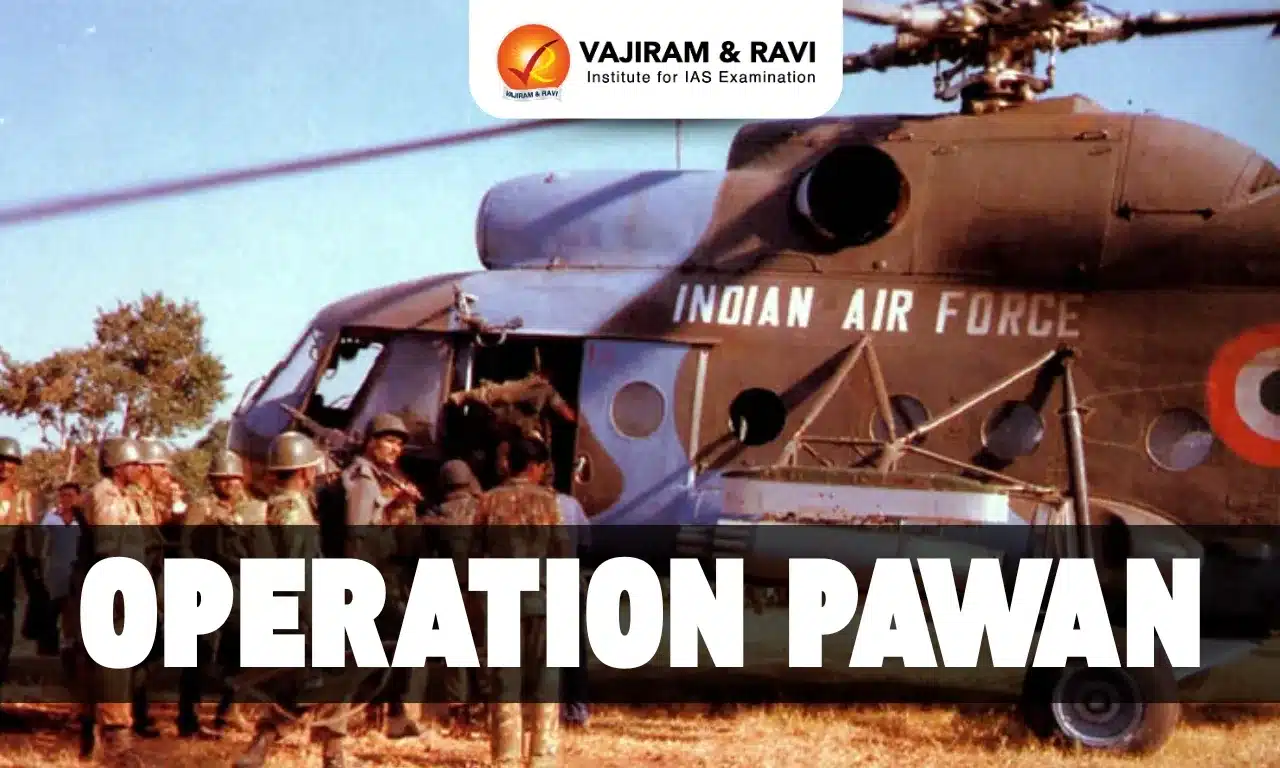
Operation Pawan was the military mission undertaken by the Indian Peace Keeping Force (IPKF) in Sri Lanka as part of the 1987 Indo-Sri Lanka Accord. Conducted during the Sri Lankan Civil War (1983–2009), it marked India's first major international peacekeeping deployment after Independence. The operation aimed to restore peace, enforce the disarmament of militant groups, and help implement the provisions of the peace accord.

Operation Pawan Background

Operation Pawan emerged from the growing ethnic conflict in Sri Lanka and India's efforts to restore peace through the 1987 Indo-Sri Lanka Accord.

  • The Sri Lankan Civil War (1983–2009) was fought between the Sri Lankan government and the Liberation Tigers of Tamil Eelam (LTTE).
  • The conflict stemmed from long-standing ethnic tensions between the Sinhalese majority and the Tamil minority.
  • To end the violence, Prime Minister Rajiv Gandhi of India and President J. R. Jayewardene of Sri Lanka signed the Indo-Sri Lanka Accord on 29 July 1987.
  • Under the Accord, India deployed the Indian Peace Keeping Force (IPKF) to oversee the surrender of weapons by militant groups and support peace implementation.
  • The LTTE later refused to disarm and resumed armed resistance against the IPKF.
  • This led to the launch of Operation Pawan, a military campaign to remove LTTE control from the Jaffna Peninsula and restore order.

Operation Pawan Objectives

The primary objectives of Operation Pawan included:

  • Eliminate LTTE control over the Jaffna Peninsula.
  • Enforce the disarmament of the LTTE and other militant groups.
  • Implement the provisions of the 1987 Indo-Sri Lanka Accord.
  • Restore law and order in conflict-affected areas.
  • Assist the Sri Lankan government in maintaining peace and stability.

Role of the Indian Peace Keeping Force (IPKF)

The Indian Peace Keeping Force (IPKF) was deployed in Sri Lanka under the 1987 Indo-Sri Lanka Accord to enforce peace, oversee the disarmament of militant groups, and assist in restoring stability in the conflict-affected regions.

  • Implemented the Indo-Sri Lanka Accord: Deployed to ensure the provisions of the 1987 agreement were carried out effectively.
  • Oversaw Disarmament: Tasked with collecting weapons from the Liberation Tigers of Tamil Eelam (LTTE) and other Tamil militant groups.
  • Conducted Counter-insurgency Operations: Engaged in military operations after the LTTE refused to surrender its arms and resumed hostilities.
  • Secured the Jaffna Peninsula: Captured key strategic locations and prevented the LTTE from re-establishing control over Jaffna.
  • Maintained Law and Order: Assisted in restoring normalcy and protecting civilians in conflict-affected areas.
  • Supported Humanitarian Efforts: Helped facilitate the delivery of essential supplies and humanitarian assistance in affected regions.
  • Strengthened Regional Security: Demonstrated India's commitment to maintaining peace and stability in South Asia.

Operation Pawan Outcome

Operation Pawan achieved several short-term military objectives but faced significant operational and political challenges, making it one of India's most complex overseas military missions.

  • IPKF captured the Jaffna Peninsula, significantly weakening the LTTE's control over the region.
  • Prevented the LTTE from immediately retaking Jaffna through sustained counter-insurgency operations.
  • The LTTE was not completely eliminated and continued its insurgency using guerrilla warfare tactics.
  • The peacekeeping mission evolved into a prolonged military conflict after the LTTE refused to disarm.
  • The Indian Peace Keeping Force (IPKF) remained deployed from December 1987 to March 1990 before being withdrawn from Sri Lanka.
  • The Indo-Sri Lanka Accord could not be fully implemented, as political differences and continued violence persisted.
  • Operation Pawan highlighted the challenges of peace enforcement, counter-insurgency, and military intervention in internal conflicts.

Operation Pawan Significance

Operation Pawan remains a landmark in India's military history as its first major overseas peacekeeping and counter-insurgency mission after Independence, offering important strategic, diplomatic, and operational lessons.

  • First Major Overseas Military Mission: It marked India's first large-scale international peacekeeping deployment after Independence.
  • Strengthened Regional Security Role: Demonstrated India's willingness to contribute to peace and stability in South Asia.
  • Counter-insurgency Experience: Provided the Indian Armed Forces with valuable experience in urban warfare, jungle warfare, and counter-insurgency operations.
  • Test of Peacekeeping Operations: Highlighted the complexities of enforcing peace when a peacekeeping mission transforms into active combat.
  • Enhanced Military Preparedness: Led to improvements in operational planning, intelligence gathering, logistics, and joint military coordination.
  • Diplomatic Lessons: Underscored the importance of aligning military objectives with political and diplomatic strategies during regional interventions.

Operation Pawan FAQs

Q1: What was Operation Pawan?

Ans: Operation Pawan was a military operation conducted by the Indian Peace Keeping Force (IPKF) in Sri Lanka from December 1987 to March 1990 to remove LTTE control over the Jaffna Peninsula and implement the 1987 Indo-Sri Lanka Accord.

Q2: Why was Operation Pawan launched?

Ans: It was launched after the Liberation Tigers of Tamil Eelam (LTTE) refused to surrender its weapons as required under the Indo-Sri Lanka Accord. The objective was to restore peace and enforce the terms of the agreement.

Q3: What was the objective of Operation Pawan?

Ans: The main objectives were to capture the Jaffna Peninsula, disarm the LTTE, restore law and order, and support the implementation of the Indo-Sri Lanka Accord.

Q4: What was the role of the Indian Peace Keeping Force (IPKF)?

Ans: The IPKF was responsible for enforcing the peace accord, conducting counter-insurgency operations, securing strategic areas, preventing the LTTE from regaining control of Jaffna, and maintaining peace in northern Sri Lanka.

Q5: When was Operation Pawan conducted?

Ans: Operation Pawan was carried out from December 1987 to March 1990 during the Sri Lankan Civil War (1983–2009).

Guru Purnima 2026, Date, History, Significance, Ved Vyasa

Guru Purnima

Guru Purnima is one of the most revered festivals in India, dedicated to expressing gratitude and respect towards teachers, mentors, and spiritual guides. Celebrated on the full moon day (Purnima) of the Hindu month of Ashadha, the festival honors the timeless Guru–Shishya tradition that has shaped India's spiritual, cultural, and educational heritage. Guru Purnima 2026 will be observed on Wednesday, July 29, 2026.

What is Guru Purnima?

Guru Purnima is a traditional Indian festival that celebrates the role of the guru (teacher) in guiding individuals toward knowledge, wisdom, and self-realization. The day recognizes not only academic teachers but also spiritual masters, parents, mentors, and anyone who contributes to a person's intellectual and moral development.

  • Celebrated on the full moon day (Purnima) of Ashadha month.
  • Honors teachers, spiritual gurus, mentors, and guides.
  • Marks the importance of knowledge, discipline, and values.
  • Symbolizes gratitude, respect, and lifelong learning.
  • Celebrated by Hindus, Buddhists, and Jains.
  • Reflects the ancient Guru–Shishya tradition of India.

History and Origin of Guru Purnima

Guru Purnima has its origins in ancient India's Guru–Shishya tradition and has been celebrated for centuries to honor teachers, spiritual wisdom, and the transmission of knowledge across generations.

  • Originated from the ancient Guru–Shishya (teacher-disciple) tradition of India.
  • Celebrated on the full moon day (Purnima) of the Hindu month of Ashadha every year.
  • Believed to mark the birth anniversary of Maharishi Ved Vyasa, also known as Vyasa Purnima.
  • Maharishi Ved Vyasa compiled the four Vedas, authored the Mahabharata, and composed several Puranas.
  • The festival recognizes the role of gurus in preserving and passing on knowledge, values, and spiritual teachings.
  • In Buddhism, the day marks Gautama Buddha's first sermon at Sarnath after attaining enlightenment.
  • In Jainism, it commemorates Lord Mahavira accepting Gautama Swami as his first disciple.
  • The festival has been observed for centuries in ashrams, temples, monasteries, and educational institutions across India.

Why is Guru Purnima Celebrated?

Guru Purnima is celebrated to express gratitude and respect towards teachers, spiritual gurus, and mentors who guide individuals with knowledge and wisdom. The festival honors the ancient Guru–Shishya tradition and recognizes the vital role of gurus in shaping character and values. It is also observed to commemorate Maharishi Ved Vyasa, one of India's greatest sages and scholars.

Who Was Maharishi Ved Vyasa and Why is Guru Purnima Dedicated to Him?

Maharishi Ved Vyasa was one of the greatest sages and scholars of ancient India, and Guru Purnima is dedicated to him in recognition of his unparalleled contribution to preserving and spreading spiritual knowledge.

  • Revered as the Adi Guru (First Guru) in the Indian tradition.
  • Traditionally believed to have been born on Ashadha Purnima, which is celebrated as Vyasa Purnima.
  • Compiled and classified the four Vedas into their present form.
  • Authored the Mahabharata, the world's longest epic.
  • Composed the Brahma Sutras, an important text of Vedanta philosophy.
  • Compiled and edited several Puranas, preserving ancient history and traditions.
  • Played a key role in preserving Vedic knowledge for future generations.
  • Symbolizes wisdom, learning, and the GuruShishya tradition.
  • Guru Purnima is observed to honor his enduring contribution to Indian culture, spirituality, and education.

Religious Significance of Guru Purnima 2026 in Hinduism

Guru Purnima is one of the most sacred festivals in Hinduism, dedicated to honoring gurus who guide individuals from ignorance to knowledge and from darkness to enlightenment.

  • Dedicated to Maharishi Ved Vyasa, the revered Adi Guru and compiler of the Vedas.
  • Recognizes the guru as a guide who imparts spiritual knowledge and moral values.
  • Devotees offer prayers, flowers, and Guru Dakshina to their teachers and spiritual masters.
  • Temples and ashrams organize satsangs, bhajans, and spiritual discourses.
  • Sacred texts such as the Bhagavad Gita, Vedas, and Upanishads are studied and recited.
  • Many devotees observe fasting, meditation, and self-reflection on this day.
  • Spiritual disciples seek the blessings of their gurus for wisdom and inner growth.
  • The festival strengthens the ancient Guru–Shishya tradition in Hindu culture.
  • Emphasizes humility, devotion, discipline, and the pursuit of self-realization.

Guru Purnima in Buddhism

Guru Purnima holds great significance in Buddhism as it marks the day when Gautama Buddha delivered his first sermon after attaining enlightenment, setting the Dharma (Buddhist teachings) in motion.

  • Commemorates Buddha's first sermon at Sarnath.
  • Marks the beginning of the Buddhist Sangha (community of monks).
  • The first sermon is known as the Dhammacakkappavattana Sutta.
  • Monks and devotees observe meditation, prayers, and Dhamma discourses.
  • Followers visit monasteries, offer alms, and perform acts of charity.
  • The day emphasizes compassion, mindfulness, wisdom, and ethical living.
  • Encourages the practice of the Four Noble Truths and the Noble Eightfold Path.

Guru Purnima in Jainism

In Jainism, Guru Purnima is observed to honor the importance of spiritual teachers and commemorates the occasion when Lord Mahavira accepted Gautama Swami as his first disciple.

  • Marks the acceptance of Gautama Swami as the first chief disciple of Lord Mahavira.
  • Highlights the importance of gurus in guiding followers on the path of liberation.
  • Devotees offer prayers to Jain monks and spiritual teachers.
  • Temples organize religious discourses and scriptural readings.
  • Followers practice meditation, self-discipline, and self-reflection.
  • Charity and acts of compassion are encouraged on this day.
  • Reinforces Jain values of non-violence (Ahimsa), truth, and self-restraint.

Guru Purnima 2026 FAQs

Q1: When is Guru Purnima 2026?

Ans: Guru Purnima 2026 will be celebrated on Wednesday, 29 July 2026, on the full moon day (Purnima) of the Hindu month of Ashadha.

Q2: Why is Guru Purnima celebrated?

Ans: Guru Purnima is celebrated to honor teachers, spiritual gurus, and mentors for their guidance, knowledge, and contribution to personal and spiritual growth.

Q3: Who is Guru Purnima dedicated to?

Ans: Guru Purnima is primarily dedicated to Maharishi Ved Vyasa, whose birth anniversary is observed as Vyasa Purnima.

Q4: Why is Guru Purnima important in Buddhism?

Ans: It marks the day when Gautama Buddha delivered his first sermon at Sarnath, marking the beginning of the Buddhist Sangha.

Q5: What is the significance of Guru Purnima in Jainism?

Ans: In Jainism, the festival commemorates Lord Mahavira accepting Gautama Swami as his first disciple and highlights the importance of spiritual teachers.

UPSC Daily Quiz 20 July 2026

UPSC Daily Quiz

[WpProQuiz 214]

UPSC Daily Quiz FAQs

Q1: What is the Daily UPSC Quiz?

Ans: The Daily UPSC Quiz is a set of practice questions based on current affairs, static subjects, and PYQs that help aspirants enhance retention and test conceptual clarity regularly.

Q2: How is the Daily Quiz useful for UPSC preparation?

Ans: Daily quizzes support learning, help in revision, improve time management, and boost accuracy for both UPSC Prelims and Mains through consistent practice.

Q3: Are the quiz questions based on the UPSC syllabus?

Ans: Yes, all questions are aligned with the UPSC Syllabus 2025, covering key areas like Polity, Economy, Environment, History, Geography, and Current Affairs.

Q4: Are solutions and explanations provided with the quiz?

Ans: Yes, each quiz includes detailed explanations and source references to enhance conceptual understanding and enable self-assessment.

Q5: Is the Daily UPSC Quiz suitable for both Prelims and Mains?

Ans: Primarily focused on Prelims (MCQ format), but it also indirectly helps in Mains by strengthening subject knowledge and factual clarity.

Article 6 of the Paris Agreement, Climate Change, Carbon Market

Article 6 of the Paris Agreement

Article 6 of the Paris Agreement provides the framework for voluntary international cooperation to reduce greenhouse gas emissions while supporting sustainable development. It enables countries to work together through carbon markets and non market approaches to achieve their Nationally Determined Contributions (NDCs). 

The framework also helps mobilise climate finance, technology transfer and capacity building, especially for developing countries, while promoting transparency and environmental integrity in global climate action.

What is Article 6 of the Paris Agreement?

Article 6 of the Paris Agreement establishes a framework for voluntary cooperation between countries to achieve their climate commitments under the Paris Agreement through carbon markets and non market approaches.

  • Purpose: Article 6 allows countries to cooperate voluntarily in meeting their Nationally Determined Contributions (NDCs), encouraging higher climate ambition while promoting sustainable development and international collaboration.
  • History: The framework was created under the Paris Agreement adopted at COP21 in Paris on 12 December 2015. After years of negotiations, the detailed international carbon trading rules were finalised under the Paris Agreement framework.
  • Climate Finance: Article 6 enables emission reduction activities to attract investments, helping developing countries secure financial resources, technology access and capacity building support for climate friendly development.
  • International Cooperation: It permits countries to transfer verified emission reductions through internationally agreed mechanisms, allowing climate targets to be achieved more efficiently while maintaining transparent accounting standards.
  • Implementation: The framework is continuously refined through annual meetings of the Conference of the Parties serving as the Meeting of the Parties to the Paris Agreement (CMA), SBSTA meetings and work undertaken by the Article 6.4 Supervisory Body.

Paris Agreement

The Paris Agreement is the global legally binding climate treaty that guides international efforts to limit global warming and strengthen climate resilience.

  • Adoption: The Paris Agreement was adopted by 195 Parties at COP21 in Paris on 12 December 2015, entered into force on 4 November 2016 and had 194 Parties as of 27 January 2026.
  • Temperature Goal: The Agreement aims to keep global temperature rise well below 2°C above pre-industrial levels while pursuing efforts to limit warming to 1.5°C.
  • Nationally Determined Contributions: Countries submit NDCs every five years, with each new submission expected to reflect greater ambition than the previous one through progressively stronger climate actions.
  • Framework: Beginning in 2024, countries report climate actions under the Enhanced Transparency Framework (ETF), with progress collectively assessed through the Global Stocktake to strengthen future climate commitments.
  • Support Mechanisms: The Agreement promotes climate finance, technology development, technology transfer and capacity building, particularly for developing countries facing financial and technical constraints.

National Designated Authority

The National Designated Authority is the institutional mechanism established to implement Article 6 of the Paris Agreement carbon market provisions and supervise eligible emission reduction projects.

  • Formation: The Ministry of Environment, Forest and Climate Change notified the National Designated Authority to operationalise India's carbon trading mechanism under Article 6.
  • Composition: The Authority is a 21 member committee chaired by the Environment Secretary and includes representatives from the Ministry of External Affairs, Ministry of New and Renewable Energy, Ministry of Steel and NITI Aayog.
  • Project Approval: It identifies, evaluates, recommends and authorises projects eligible to generate Emission Reduction Units (ERUs) for international carbon trading.
  • NDC Compliance: The Authority also approves the use of Emission Reduction Units for achieving India's Nationally Determined Contribution commitments under the Paris Agreement.

Components of Article 6 of the Paris Agreement

Article 6 of the Paris Agreement contains three interconnected mechanisms that enable international cooperation through market based and non market approaches for climate action.

Article 6.2 of the Paris Agreement

  • Cooperative Approaches: Enables bilateral or multilateral transfer of Internationally Transferred Mitigation Outcomes (ITMOs), allowing countries to trade verified emission reductions while following internationally agreed accounting and reporting rules.
  • Corresponding Adjustment: Countries transferring or receiving ITMOs must make corresponding adjustments in their emissions accounting to prevent double counting of the same emission reductions.
  • Technical Expert Review: Participating countries submit detailed reports that undergo Technical Expert Review (TER), ensuring transparency, accuracy and consistency while respecting national sovereignty.
  • CARP: The Centralized Accounting and Reporting Platform (CARP) provides reporting templates, submission guidance, authorised project records and accounting information for participating countries.
  • International Registry: Managed by the UNFCCC Secretariat, the International Registry tracks ITMOs from issuance through transfer and final use while supporting accurate reporting.

Article 6.4 of the Paris Agreement

  • Paris Agreement Crediting Mechanism (PACM): Establishes a UNFCCC supervised global carbon crediting mechanism that issues high integrity carbon credits using a baseline and crediting approach.
  • Supervisory Body: Decision 3/CMA.3 established the operational rules and created a 12 member Article 6.4 Supervisory Body to oversee the mechanism under CMA authority.
  • Climate Finance: The mechanism mobilises investments for verified emission reduction projects, supports international cooperation and directs 5% of its proceeds to the Global Adaptation Fund.
  • Private Sector Participation: Companies can generate verified carbon credits through emission reduction projects and transfer them to other entities seeking compliance or net zero objectives.

Article 6.8 of the Paris Agreement

  • Non Market Approaches: Promotes voluntary cooperation without carbon trading by encouraging finance, technology transfer and capacity building for climate mitigation and adaptation.
  • Sustainable Development: Supports climate action alongside poverty eradication while enhancing public and private sector participation in implementing Nationally Determined Contributions.
  • Institutional Coordination: Encourages coordination among existing climate instruments and institutional arrangements to strengthen mitigation, adaptation and international cooperation.

What is the Carbon Market?

Carbon markets create financial incentives for reducing greenhouse gas emissions by allowing verified carbon credits to be bought and sold between countries or companies.

  • Definition: A carbon market allows countries and companies to buy or sell carbon credits to compensate for greenhouse gas emissions through verified emission reduction activities.
  • Evolution: Carbon markets were first introduced under the Kyoto Protocol in 1997 and are now governed internationally through the Article 6 of the Paris Agreement.
  • Carbon Credit: One carbon credit represents one metric tonne of carbon dioxide or equivalent greenhouse gas reduced, removed or avoided.
  • Working Mechanism: Countries or industries earning emission reductions beyond their targets generate carbon credits that can be traded with entities needing additional reductions.
  • Emission Reduction Projects: Carbon credits are generated from activities such as renewable energy, energy efficient technologies, efficient cookstoves, afforestation and other verified emission reduction projects.
  • International Cooperation: Carbon markets attract investments, improve access to clean technologies and help countries achieve climate commitments at lower overall costs.

Article 6 of the Paris Agreement Challenges

Several Challenges and issues associated with the implementation of the Article 6 of the Paris Agreement has been listed below:

  • Double Counting: Weak disclosure requirements may allow the same carbon credit to be counted by multiple entities unless corresponding adjustments are accurately implemented.
  • Risk Reversal: Carbon stored through projects such as forests may later be released because of events like wildfires, reducing the long term effectiveness of emission reductions.
  • Weak Accountability: Limited penalties for inaccurate reporting or misuse of carbon credits may reduce confidence in the credibility of international carbon markets.
  • Project Quality: Transition from the Kyoto Protocol's Clean Development Mechanism to Article 6.4 requires stronger additionality checks to avoid low quality carbon credit projects.
  • Implementation Capacity: Many developing countries require greater institutional capacity, technical expertise and financial support to effectively participate in Article 6 mechanisms.

Article 6 of the Paris Agreement Significance

Article 6 of the Paris Agreement strengthens international climate cooperation by combining carbon markets, transparency standards and sustainable development to accelerate global emission reduction efforts.

  • International Cooperation: It enables countries to collaborate voluntarily in achieving climate targets, improving collective global action against climate change.
  • Climate Finance: Article 6 helps developing countries attract investments for renewable energy, afforestation, low carbon technologies and other emission reduction initiatives.
  • Transparency: Accounting rules, reporting requirements and corresponding adjustments improve transparency while reducing the possibility of double counting emission reductions.
  • Adaptation Support: Five percent of proceeds generated under Article 6.4 contribute to the Global Adaptation Fund, supporting vulnerable countries in strengthening climate resilience.
  • Technology and Capacity Building: The framework promotes technology transfer, institutional strengthening and knowledge sharing, enabling countries to implement more effective climate policies and sustainable development strategies.

Article 6 of the Paris Agreement FAQs

Q1: What is Article 6 of the Paris Agreement?

Ans: Article 6 is a part of the Paris Agreement that allows countries to cooperate through carbon markets and non market approaches to achieve their climate targets and Nationally Determined Contributions (NDCs).

Q2: What are the three components of Article 6 of the Paris Agreement?

Ans: Article 6 has three components: Article 6.2 for trading Internationally Transferred Mitigation Outcomes (ITMOs), Article 6.4 for the UNFCCC carbon crediting mechanism and Article 6.8 for non market cooperation.

Q3: What is an ITMO under Article 6 of the Paris Agreement?

Ans: An Internationally Transferred Mitigation Outcome (ITMO) is a verified emission reduction transferred between countries to help meet their Nationally Determined Contributions under Article 6.2.

Q4: What is the purpose of the National Designated Authority (NDA) under Article 6 of the Paris Agreement?

Ans: The National Designated Authority (NDA) approves eligible emission reduction projects, authorises carbon credit trading activities and ensures that they support national climate commitments.

Q5: What is a carbon credit under Article 6 of the Paris Agreement?

Ans: A carbon credit represents one metric tonne of carbon dioxide (CO₂) or equivalent greenhouse gas reduced, removed, or avoided through verified climate action projects.

Festivals of Odisha, List, Culture, Celebrations, Significance

Festivals of Odisha

Odisha is known for its vibrant festivals that reflect the state's rich cultural heritage, religious traditions, tribal customs, and agricultural practices. Celebrated throughout the year, these festivals bring together people from different communities and showcase Odisha's unique art, music, dance, and devotion. Many of these festivals have historical significance and attract devotees and tourists from across India and abroad.

Major Festivals of Odisha

Odisha celebrates a wide variety of festivals associated with Hindu traditions, tribal culture, seasonal changes, and harvest cycles. Some festivals have gained international recognition, while others continue to preserve the state's regional identity.

1. Jagannath Rath Yatra The Grand Chariot Festival of Puri

.Jagannath Rath Yatra is Odisha's most important religious festival, celebrated annually in Puri and renowned as one of the world's largest chariot festivals.

  • Celebrated on Ashadha Shukla Dwitiya (June–July).
  • Associated with the Jagannath Temple, Puri, one of the Char Dham pilgrimage sites.
  • Dedicated to Lord Jagannath, Lord Balabhadra, and Goddess Subhadra.
  • The deities travel to the Gundicha Temple, symbolizing their annual visit to their aunt's temple.
  • Three new wooden chariots are constructed every year using traditional methods and sacred wood.
  • The three chariots are Nandighosa (Jagannath), Taladhwaja (Balabhadra), and Darpadalana (Subhadra).
  • The Pahandi ritual marks the ceremonial procession of the deities to the chariots.
  • The Chhera Pahanra ritual is performed by the Gajapati King of Puri, symbolizing equality before God.
  • Millions of devotees pull the chariots as an act of devotion.
  • Promotes pilgrimage tourism and preserves Odisha's temple traditions.

2. Raja Parba Odisha's Festival of Womanhood and Agriculture

Raja Parba is a unique cultural festival that celebrates womanhood, fertility, and the beginning of the agricultural season.

  • Celebrated for three days in mid-June before the monsoon.
  • Dedicated to Bhudevi (Mother Earth).
  • Belief that Mother Earth undergoes her annual menstrual cycle.
  • Agricultural activities such as ploughing and digging are suspended.
  • Marks the arrival of the monsoon and preparation for cultivation.
  • Women wear traditional attire and participate in cultural activities.
  • Swings are decorated in villages and towns.
  • Traditional delicacies like Poda Pitha and Manda Pitha are prepared.
  • Folk songs and games are organized across the state.
  • Highlights the close relationship between nature, agriculture, and society.

3. Durga Puja in Odisha

Durga Puja is one of Odisha's grandest festivals, celebrated with elaborate decorations, rituals, and cultural programmes.

  • Celebrated during Ashwin (September–October).
  • Commemorates Goddess Durga's victory over Mahishasura.
  • Cuttack is famous for its silver filigree (Tarakasi) themed pandals.
  • Temples perform special rituals and devotional ceremonies.
  • Large artistic pandals display social and cultural themes.
  • Cultural programmes and fairs attract thousands of visitors.
  • Supports artisans, sculptors, and local businesses.
  • Strengthens community participation and social harmony.
  • Promotes Odisha's traditional craftsmanship.

4. Bali Jatra Celebrating Odisha's Maritime Heritage

Bali Jatra is one of Odisha's largest cultural festivals, commemorating the rich maritime trade and seafaring tradition of ancient Kalinga with Southeast Asian countries.

  • Celebrated annually on Kartika Purnima (October–November), mainly in Cuttack on the banks of the Mahanadi River.
  • Commemorates the overseas voyages of ancient Sadhabas (Odia merchants) who sailed to Bali, Java, Sumatra, Borneo, Sri Lanka, and other Southeast Asian regions for trade.
  • The festival derives its name from Bali Island (Indonesia), reflecting the strong maritime links between ancient Kalinga and Southeast Asia.
  • Devotees perform the ritual of Boita Bandana, floating miniature boats in rivers and ponds while chanting traditional verses.
  • Symbolizes Odisha's flourishing maritime trade during the Kalinga period, especially from the ports of Tamralipti, Palur, Manikpatna, and Chelitalo.
  • Serves as a reminder of Odisha's contributions to ancient Indian Ocean trade, cultural exchange, and navigation.
  • One of India's largest open-air trade fairs, featuring handicrafts, handloom products, traditional cuisine, books, and cultural exhibitions.
  • Promotes Pattachitra paintings, silver filigree (Tarakasi), appliqué work of Pipili, stone carving, and handloom textiles.

5. Nuakhai The Harvest Festival of Western Odisha

Nuakhai is the most important harvest festival of western Odisha, celebrated to express gratitude for the new paddy harvest and to strengthen agricultural and community traditions.

  • Celebrated annually after the harvesting of the kharif paddy crop, usually in the month of Bhadrapada (August–September).
  • The word "Nuakhai" is derived from "Nua" (new) and "Khai" (food/eating), meaning the celebration of the new harvest.
  • Predominantly observed in the districts of Sambalpur, Bargarh, Balangir, Kalahandi, Nuapada, Jharsuguda, Sonepur, and Boudh.
  • The newly harvested rice is first offered to the family or village deity before being consumed by the household
  • Farmers express gratitude to nature and seek blessings for a prosperous agricultural season.
  • Family members reunite to celebrate the festival, reinforcing social harmony and family bonds.
  • Traditional Odia dishes are prepared using freshly harvested rice and local ingredients.
  • Folk dances such as Dalkhai, Rasarkeli, and Karma, along with folk music, form an integral part of the celebrations.
  • Tribal and rural communities participate enthusiastically, reflecting the region's rich cultural diversity.

6. Kumar Purnima Festival of Youth and Prosperity

Kumar Purnima is a traditional festival of Odisha dedicated to Lord Kartikeya (Kumar), celebrated to mark youth, prosperity, and the harvest season under the full moon of Ashwin.

  • Celebrated on the full moon day (Purnima) of the month of Ashwin (September–October).
  • Dedicated to Lord Kartikeya (Kumar), the son of Lord Shiva and Goddess Parvati, who symbolizes youth, courage, and valor.
  • Unmarried girls observe the festival and pray for good health, prosperity, and an ideal life partner.
  • Devotees worship the full moon (Chanda Puja) in the evening, considering it a symbol of beauty, purity, and prosperity.
  • Girls wake up before sunrise to offer prayers to the rising sun and perform traditional rituals.
  • Traditional songs such as Jhia Anukul songs are sung, and cultural games are organized.
  • Homes are decorated with Rangoli (Jhoti Chita) and lamps to mark the occasion.
  • Special delicacies, including Chuda Ghasa, Khai, Coconut, Banana, and seasonal fruits, are offered as prasad.
  • The festival reflects Odisha's rich folk traditions and social customs centered on youth and family values.
  • Encourages community participation through cultural programmes, music, and traditional celebrations.
  • Marks the end of the monsoon season and the arrival of clear autumn skies with a bright full moon.
  • Plays an important role in preserving Odisha's cultural heritage and strengthening social harmony.

7. Dola Purnima

Dola Purnima is an important Vaishnavite festival of Odisha dedicated to Lord Krishna and Goddess Radha, celebrated with devotional processions, temple rituals, and the traditional festival of colours.

  • Celebrated on the full moon day (Purnima) of the month of Phalguna (February–March).
  • Dedicated to Lord Krishna and Goddess Radha, symbolizing divine love and devotion.
  • Considered Odisha's traditional form of Holi and is widely celebrated across the state.
  • Idols of Radha and Krishna are placed in beautifully decorated vimanas (palanquins) and taken in grand processions.
  • Temples organize bhajans, kirtans, devotional singing, and special pujas throughout the festival.
  • Devotees offer Abira (coloured powder), flowers, sweets, and fruits to the deities.
  • People celebrate by applying colours, exchanging greetings, and participating in community gatherings.
  • The festival is closely associated with the Vaishnava tradition and the teachings of Sri Chaitanya Mahaprabhu.
  • Marks the arrival of spring (Vasant Ritu) and symbolizes joy, renewal, and the victory of good over evil.
  • Celebrated with great enthusiasm in Puri, Bhubaneswar, Cuttack, and other parts of Odisha.

Role of Festivals in Preserving Odisha's Art, Culture, and Traditions

The festivals of Odisha play a vital role in preserving the state's rich cultural heritage by promoting traditional arts, religious practices, folk traditions, and community values across generations.

  • Preserve ancient temple rituals, customs, and religious traditions associated with Jagannath culture and other regional deities.
  • Promote classical dance forms such as Odissi and folk dances including Dalkhai, Ghumura, Chhau, Karma, and Sambalpuri dance.
  • Encourage traditional music, devotional bhajans, folk songs, and regional musical instruments.
  • Support indigenous art forms such as Pattachitra painting, Pipili appliqué work, silver filigree (Tarakasi), stone carving, palm leaf engraving, and Dhokra craft.
  • Promote Odisha's famous handloom traditions, including Sambalpuri, Bomkai, Kotpad, and Ikat textiles.
  • Preserve tribal customs, indigenous knowledge, and local cultural practices through community celebrations.
  • Strengthen social harmony by bringing together people from different communities, castes, and regions.
  • Encourage intergenerational transmission of folklore, oral traditions, and cultural values.
  • Boost religious and cultural tourism, generating employment for artisans, performers, guides, and local businesses.
  • Provide platforms for craftsmen, folk artists, musicians, and dancers to showcase their skills
  • Strengthen Odisha's cultural identity while promoting national integration and cultural diversity.

Festivals of Odisha FAQs

Q1: Which is the most famous festival of Odisha?

Ans: Jagannath Rath Yatra is the most famous festival of Odisha. Held annually in Puri, it attracts millions of devotees and is one of the largest chariot festivals in the world.

Q2: What is the harvest festival of Odisha?

Ans: Nuakhai is the major harvest festival of western Odisha, celebrated after the new paddy harvest. Makar Sankranti is also observed as a harvest festival in many parts of the state.

Q3: Which festival marks the Odia New Year?

Ans: Pana Sankranti (Maha Bishuba Sankranti) marks the beginning of the Odia New Year and the traditional Odia solar calendar.

Q4: Why is Bali Jatra celebrated?

Ans: Bali Jatra commemorates the maritime voyages of ancient Sadhabas (Odia merchants) who traded with Southeast Asian countries such as Bali, Java, and Sumatra, highlighting Odisha's rich maritime heritage.

Q5: Why is Raja Parba important in Odisha?

Ans: Raja Parba celebrates womanhood, fertility, and Mother Earth. It also marks the arrival of the monsoon and the beginning of the agricultural season.

Kargil Vijay Diwas 2026, Date, Theme, History, Significance

Kargil Vijay Diwas

Kargil Vijay Diwas 2026 will be observed on 26 July 2026, commemorating the 27th anniversary of India's victory in the Kargil War of 1999. The day pays tribute to the extraordinary courage, sacrifice, and patriotism of the Indian Armed Forces who reclaimed strategic positions occupied by Pakistani intruders along the Line of Control (LoC) in the Kargil sector.

Kargil Vijay Diwas 2026

Kargil Vijay Diwas 2026 commemorates India's successful military victory through Operation Vijay, which restored control over strategic positions in the Kargil sector. The Indian Army and the Government of India organize memorial ceremonies, outreach programmes, and public events to honor the martyrs and veterans. Kargil Vijay Diwas serves as a symbol of patriotism, national unity, and the unwavering commitment of the Indian Armed Forces to safeguarding the country's sovereignty.

Kargil Vijay Diwas 2026 Overview

The key highlights related to the Kargil Vijay Diwas 2026 have been tabulated below.

Kargil Vijay Diwas 2026 Overview

Particular

Details

Name

Kargil Vijay Diwas 2026

Date

26 July 2026

Anniversary

27th Anniversary

Commemorates

India's victory in the Kargil War (1999)

First Observed

2000

Organized By

Government of India and Indian Army

Main Venue

Kargil War Memorial, Dras, Ladakh

Objective

To honor the bravery and sacrifice of Indian soldiers

Theme for 2026

Honouring the heroes of Kargil through nationwide memorial outreach and public participation

Kargil Vijay Diwas 2026 Theme

Unlike many international observances, Kargil Vijay Diwas does not have an officially declared annual theme. The Kargil Vijay Diwas 2026 commemoration focuses on honoring the courage and sacrifice of the Kargil War heroes through nationwide memorial outreach programmes. It also aims to inspire patriotism, national unity, and awareness among the younger generation by sharing the stories of India's brave soldiers.

Kargil Vijay Diwas 2026 Historical Background

Kargil Vijay Diwas commemorates India's victory in the Kargil War of 1999, fought to reclaim strategic positions occupied by Pakistani intruders along the Line of Control (LoC).

  • The Kargil War was fought between India and Pakistan from May to July 1999.
  • Pakistani soldiers and infiltrators crossed the Line of Control (LoC) and occupied strategic mountain peaks in the Kargil sector.
  • The intrusion threatened National Highway 1A (now NH-1), India's key supply route to Ladakh.
  • India launched Operation Vijay to evict the intruders and restore control over the occupied areas.
  • The Indian Air Force supported the mission through Operation Safed Sagar.
  • Fierce battles were fought at Tiger Hill, Tololing, Point 4875, and other high-altitude locations.
  • On 26 July 1999, India successfully regained the occupied territory and declared victory.
  • Since 2000, Kargil Vijay Diwas has been observed every year on 26 July to honor the bravery and supreme sacrifice of the Indian Armed Forces.

Causes of the Kargil War

The Kargil War was triggered by strategic, political, and military factors that led to the infiltration of Pakistani forces across the Line of Control (LoC) in 1999.

  • Cross-border Infiltration: Pakistani soldiers and armed intruders secretly crossed the LoC and occupied strategic Indian positions in the Kargil sector.
  • Kashmir Dispute: The long-standing territorial dispute over Jammu and Kashmir remained the primary cause of tensions between India and Pakistan.
  • Strategic Objective: Pakistan aimed to capture high-altitude peaks overlooking National Highway 1A (now NH-1) to disrupt India's military supply route to Ladakh.
  • Violation of the LoC: The infiltration violated the sanctity of the Line of Control and existing bilateral understandings.
  • Military Miscalculation: Pakistan believed India would find it difficult to reclaim the occupied mountain positions due to the challenging terrain and weather.
  • Failure of Diplomatic Efforts: The conflict occurred despite the Lahore Declaration (1999), which sought to improve relations between the two countries.
  • Nuclear Tensions: The war took place shortly after both India and Pakistan conducted nuclear tests in 1998, raising concerns about escalation between two nuclear-armed neighbours.

Operation Vijay and India's Military Response

Operation Vijay was the military operation launched by India in May 1999 to drive out Pakistani intruders from the Kargil sector and restore the sanctity of the Line of Control (LoC).

  • Launch of Operation Vijay: The Indian Army launched Operation Vijay on 26 May 1999 to recapture strategic peaks occupied by Pakistani forces and infiltrators.
  • Objective: The mission aimed to evict the intruders, secure the Line of Control (LoC), and protect India's territorial integrity.
  • Operation Safed Sagar: The Indian Air Force supported ground operations through Operation Safed Sagar, providing aerial reconnaissance and precision strikes.
  • High-Altitude Warfare: Indian soldiers fought at altitudes of 15,000-18,000 feet, facing steep terrain, freezing temperatures, and enemy fire.
  • Major Battles: Fierce battles were fought at Tiger Hill, Tololing, Point 4875, Batalik, and Dras, leading to the recapture of key positions.
  • Joint Military Effort: The Indian Army, Indian Air Force, and supporting logistics units worked in close coordination throughout the operation.
  • Successful Outcome: By 26 July 1999, India had regained control of the occupied territories, forcing the withdrawal of Pakistani forces and declaring victory.
  • Legacy: Operation Vijay is regarded as one of India's most successful military campaigns and a symbol of the courage, determination, and sacrifice of the Indian Armed Forces.

Kargil Vijay Diwas Significance

Kargil Vijay Diwas honors the bravery and supreme sacrifice of the Indian Armed Forces while celebrating India's victory in the Kargil War of 1999 and reaffirming the nation's commitment to protecting its sovereignty.

  • Honours the Martyrs: Pays tribute to the soldiers who made the supreme sacrifice while defending India's territorial integrity.
  • Celebrates India's Victory: Marks the successful completion of Operation Vijay and India's victory in the Kargil War.
  • Promotes Patriotism: Inspires citizens, especially the youth, with the values of courage, dedication, and service to the nation.
  • Recognises Military Bravery: Highlights the exceptional courage and professionalism displayed by the Indian Armed Forces in high-altitude warfare.
  • Strengthens National Unity: Brings people together to remember the sacrifices made for the country's security and sovereignty.
  • Raises Awareness of National Security: Reminds citizens of the importance of safeguarding India's borders and maintaining defence preparedness.
  • Preserves Military History: Keeps alive the stories of the Kargil heroes and ensures that future generations remember their contributions.
  • Honours Veterans and Their Families: Expresses gratitude to war veterans and the families of soldiers who laid down their lives during the conflict.
  • Encourages Civic Responsibility: Motivates citizens to contribute towards nation-building and uphold the values for which the Kargil heroes fought.

Kargil Vijay Diwas 2026 FAQs

Q1: When is Kargil Vijay Diwas celebrated?

Ans: Kargil Vijay Diwas is observed every year on 26 July. In 2026, India will celebrate the 27th anniversary of its victory in the Kargil War.

Q2: Why is Kargil Vijay Diwas celebrated?

Ans: It commemorates India's victory in the Kargil War of 1999 and honors the brave soldiers of the Indian Armed Forces who sacrificed their lives to protect the nation's sovereignty.

Q3: What was Operation Vijay?

Ans: Operation Vijay was the military operation launched by the Indian Army in 1999 to recapture strategic positions in the Kargil sector that had been occupied by Pakistani intruders.

Q4: Where is the Kargil War Memorial located?

Ans: Captain Vikram Batra, Captain Manoj Kumar Pandey, Grenadier Yogendra Singh Yadav and Rifleman Sanjay Kumar were awarded the Param Vir Chakra for exceptional bravery during the Kargil War.

Q5: What is the significance of the Kargil War Memorial at Dras?

Ans: The Kargil War Memorial is located at Dras in Ladakh, where annual tribute ceremonies are held to honor the Kargil martyrs.

Foreign Contribution (Regulation) Amendment Bill 2026, Key Details

Foreign Contribution (Regulation) Amendment Bill, 2026

The Government of India has introduced the Foreign Contribution (Regulation) Amendment Bill, 2026 in the Lok Sabha to strengthen the regulatory framework governing foreign funding. The Bill seeks to strengthen compliance mechanisms, enhance transparency, and establish a clearer legal framework for the management of foreign contributions and assets created from such funds. The amendment comes in the backdrop of growing concerns regarding misuse, diversion, and lack of accountability in the utilisation of foreign funds by certain organisations.

Key Features of FCRA Amendment Bill, 2026

The Foreign Contribution (Regulation) Amendment Bill, 2026 seeks to strengthen regulation of foreign contributions, ensure proper management of assets, and enhance accountability of organisations and their functionaries under the FCRA framework.

  • Designated Authority for Assets : The bill proposes the creation of a statutory Designated Authority which will take control of foreign funds and assets in specific situations. If an organisation’s FCRA registration is cancelled, surrendered, expired, or not renewed, its foreign funds and assets created from those funds will be transferred to this authority.
  • Vesting of Assets on Closure: If an organisation shuts down, becomes inactive, or ceases to exist, its foreign funds and assets created from them will permanently vest with the government through the Designated Authority.
  • Automatic Cessation of Registration: Provides that FCRA registration will automatically lapse upon expiry, non-renewal, or rejection of renewal, removing administrative ambiguity and enforcing strict compliance timelines.
  • Time-bound Utilisation of Funds: Mandates that foreign contributions must be received and utilised within prescribed timelines, preventing indefinite accumulation and reducing the scope for misuse or diversion of funds.
  • Restrictions During Suspension: Prohibits organisations under suspension from selling, transferring, or mortgaging assets created from foreign funds without prior approval, ensuring asset protection during regulatory scrutiny.
  • Centralised Approval for Investigation: Requires prior approval of the Central Government before initiating any investigation, aiming to ensure uniformity and prevent arbitrary or multiple investigations.
  • Rationalisation of Penalties: The amendment reduces penalties for violations. While earlier provisions allowed for up to five years of imprisonment, the new bill caps punishment at one year, or a fine, or both. 
  • Expanded Definition of "Key Functionary": The definition now includes directors, partners, trustees, karta of Hindu Undivided Family (HUF), office-bearers of societies/trusts/trade unions, and any person with control over management, making them personally liable for offences unless they prove lack of knowledge or due diligence. 

Significance of FCRA Amendment Bill, 2026

The FCRA Amendment Bill, 2026 is significant as it strengthens the regulatory framework for foreign-funded organisations, ensuring transparency, accountability, and proper governance of foreign contributions.

Proposals of FCRA Amendment Bill, 2026 are significant as they: 

  • Strengthen Regulatory Framework: The Bill introduces a more structured and comprehensive system for managing foreign funds, assets, and compliance, reducing earlier legal ambiguities.
  • Enhancing Transparency and Accountability: By fixing timelines, expanding liability to key functionaries, and regulating asset use, it ensures better monitoring and responsible utilisation of foreign contributions.
  • Improved Asset Governance: The creation of a Designated Authority ensures that assets created from foreign funds are properly managed, even after cancellation or closure of organisations.
  • Preventing Misuse of Foreign Funds: Stricter provisions on utilisation, suspension, and investigations help curb diversion of funds for unlawful or anti-national activities.
  • Ensuring Financial Discipline: Time-bound utilisation of funds promotes efficient use of resources and reduces the risk of idle or misused funds.
  • Strengthening National Security: Greater oversight ensures that foreign contributions are not used in activities affecting sovereignty, public order, or internal security.
  • Uniform Enforcement Mechanism: Centralised approval for investigations and clearer rules bring consistency and reduce arbitrary actions across states and agencies.
  • Promoting Responsible Governance in NGOs: Personal accountability of directors, trustees, and office-bearers encourages better internal governance and compliance practices.
  • Reducing Legal Uncertainty: Clear provisions on registration, penalties, and asset disposal reduce confusion and improve ease of regulatory implementation.

Concerns Regarding FCRA Amendment Bill, 2026

While the Bill aims to strengthen regulation and accountability, it has raised several concerns regarding centralisation, operational freedom, and the functioning of civil society. 

  • Excessive Executive Control: The creation of a Designated Authority with powers to manage, transfer, or dispose of assets may grant wide and unguided discretion to the government, potentially undermining independent decision-making by NGOs.
  • Impact on Property Rights: Permanent vesting of assets with the government raises concerns under Article 300A, as organisations may be deprived of property without clear safeguards or judicial oversight.
  • Reduced Parliamentary Oversight: Key aspects such as manner of vesting, management, disposal of assets, timelines, exemptions, and appellate mechanisms are delegated to rules made by the executive, limiting legislative scrutiny.
  • Potential for Selective Enforcement: Mandatory prior approval from the Central Government before investigations could compromise the independence of enforcement agencies and lead to inconsistent or selective application of law.
  • Ambiguity in Asset Management: While the bill provides for asset vesting, detailed guidelines on provisional vs permanent control, utilisation, and disposal are left to be prescribed later, creating uncertainty for NGOs.
  • Chilling Effect on NGOs: Fear of strict regulation and possible asset seizure may discourage organisations from working on sensitive social or advocacy issues.
  • Administrative Burden: Time-bound utilisation, automatic cessation of registration, and stricter compliance requirements may impose heavy administrative pressure on NGOs, especially smaller organisations with limited capacity.

Opposition parties have described the Bill as “draconian” or “dangerous,” arguing that it excessively strengthens government control at the cost of civil society autonomy.

Foreign Contribution (Regulation) Amendment Bill, 2026 FAQs

Q1: What is the Foreign Contribution (Regulation) Amendment Bill, 2026?

Ans: It is a legislative proposal introduced by the Government of India to amend the FCRA, 2010, aiming to strengthen the regulatory framework for foreign contributions, ensure proper management of assets, and enhance accountability of organisations and their functionaries.

Q2: Why was the FCRA Amendment Bill, 2026 introduced?

Ans: The Bill addresses concerns over misuse, diversion, and lack of accountability in the utilisation of foreign funds by certain organisations, providing a clearer legal and operational framework for foreign contributions and assets.

Q3: What is the role of the Designated Authority under the Foreign Contribution (Regulation) Amendment Bill, 2026?

Ans: The Bill establishes a statutory Designated Authority to take control of foreign funds and assets when an organisation’s FCRA registration is cancelled, surrendered, expired, or not renewed. This authority can manage, transfer, or dispose of such assets.

Q4: What happens to assets when an organisation closes or becomes inactive?

Ans: Foreign funds and assets created from them will permanently vest with the government through the Designated Authority, ensuring proper governance and preventing misuse.

Q5: Who are considered ‘Key Functionaries’ under the Foreign Contribution (Regulation) Amendment Bill, 2026?

Ans: The Bill expands the definition of Key Functionaries to include directors, trustees, partners, office-bearers, the karta of HUFs, and anyone with control over management, making them personally accountable for FCRA violations unless due diligence is proved.

Directorate General of Maritime Administration

Directorate General of Maritime Administration

Directorate General of Maritime Administration Latest News

Recently, the Directorate General of Maritime Administration (DGMA) has directed ship-owners to avoid deploying Indian seafarers on vessels undertaking voyages through the Strait of Hormuz until further orders.

About Directorate General of Maritime Administration

  • It is the apex maritime authority of the Government of India which was established in September 1949.
  • Nodal Ministry: It is functioning as an attached office of the Ministry of Ports, Shipping and Waterways.
  • It deals with all executive matters, relating to merchant shipping.
  • Headquarter: Mumbai

Functions of the Directorate General of Maritime Administration

  • The Directorate is responsible for the implementation of national shipping policy and legislation.
  • It is responsible for promotion of maritime education and training in coordination with the International Maritime Organization (IMO).
  •  It extends to the registration, survey and certification of vessels, examination and certification of Merchant Navy Officers.
  • Issuing Licenses and Certifications to Seafarers: DG Shipping issues various important certificates to merchant navy officers, ensuring that they are trained and qualified to work on board ships at sea.
  • Maritime Education and Training: As part of the implementation of its mandate, DG Shipping ensures the continuous development of maritime education and skills training.
  • Protecting Seafarers’ Rights: One of the most important roles of DG Shipping is safeguarding the rights of Indian seafarers.
  • Ship Inspections: DG Shipping ensures that both Indian-flagged ships and foreign vessels operating in Indian waters and ports are compliant with international conventions and regulations. 

Source: News On Air

Directorate General of Maritime Administration FAQs

Q1: Directorate General of Shipping is under which Ministry?

Ans: Ministry of Ports, Shipping and Waterways

Q2: What is the main function of DG Shipping ?

Ans: Regulation of shipping, Seafarer training, Ship safety, Pollution prevention

Narwar Fort

Narwar Fort

Narwar Fort Latest News

A daring overnight theft at Madhya Pradesh's Narwar Fort has left authorities scrambling after a 3,000 kg Scindia-era cannon was recently stolen by an armed gang.

About Narwar Fort

  • It is a historical fort located in the Shivpuri district of Madhya Pradesh
  • It is spread over nearly 8 sq.km. atop the Vindhya ranges and standing about 500 ft above the surrounding plains.
  • Madhav National Park is located a short distance to the west

Narwar Fort History

  • The Narwar town, which lies below the fort, is said to have been the capital of Raja Nala of the Sanskrit epic Mahabharata, and it was called Nalapura until the 12th century. 
  • Constructed by the Kachwaha Rajputs in the 10th century, Narwar Fort has witnessed the rise and fall of various dynasties. 
  • Successively held by the Kachwaha, Parihara, and Tomara Rajputs, it eventually fell under Mughal rule in the 16th century.
  • It was conquered by the Maratha chief Scindia in the early 19th century.  

Narwar Fort Architecture

  • The interior of the fort is divided by cross walls into four sections known as “ahata” and “dholaahata,” 
  • The architecture of the fort and palaces is basically Rajput in style with flat ceilings, fluted columns, and multifold arches. 
  • The inner walls of the palaces have been decorated with bright paint and glass beads.
  • Outside the walled town are memorial pillars of the Tomar chiefs.

News: NDTV

Narwar Fort FAQs

Q1: Where is Narwar Fort located?

Ans: Narwar Fort is located in the Shivpuri district of Madhya Pradesh.

Q2: On which mountain range is Narwar Fort situated?

Ans: It is situated atop the Vindhya Range.

Q3: Who constructed Narwar Fort?

Ans: It was onstructed by the Kachwaha Rajputs in the 10th century.

Q4: Which Rajput dynasties successively ruled Narwar Fort?

Ans: The Kachwaha, Parihara, and Tomara Rajputs.

Q5: Who conquered Narwar Fort in the early 19th century?

Ans: Maratha chief Scindia.

Festivals of Andhra Pradesh, List, Traditions, Significance

Festivals of Andhra Pradesh reflect the state’s rich Telugu cultural heritage, religious traditions, agrarian economy, temple culture and folk practices. Major festivals such as Sankranti, Ugadi, Brahmotsavams, Dasara and regional jatara celebrations bring together religious rituals, traditional arts, fairs, processions and community participation.

Major Festivals of Andhra Pradesh

The festivals of Andhra Pradesh are closely associated with the agricultural cycle, the Telugu calendar, important temples and local traditions. While Sankranti is the principal harvest festival, Ugadi marks the beginning of the Telugu New Year. The state is also known for major temple festivals such as Tirumala Brahmotsavam, Kanipakam Vinayaka Brahmotsavam and Vijayawada Dasara, along with distinctive regional celebrations such as Gangamma Jatara and the Flamingo Festival.

List of Major Festivals of Andhra Pradesh

The major festivals of Andhra Pradesh, along with their key cultural, religious and geographical features, are given below:

Sankranti

Sankranti is the principal harvest festival of Andhra Pradesh and is celebrated in January. It marks the agricultural cycle and is associated with traditional decorations, rural festivities and community celebrations. The festival is particularly important in the agrarian society of the state. 

Ugadi

Ugadi marks the beginning of the Telugu New Year. It is celebrated with traditional rituals and cultural observances and holds an important place in the cultural life of Telugu-speaking communities.

Tirumala Srivari Brahmotsavam

Tirumala Srivari Brahmotsavam is a major nine-day festival dedicated to Lord Venkateswara at Tirumala. The festival is marked by elaborate rituals and processions of the processional.

Kanipakam Vinayaka Brahmotsavam

This festival is celebrated at the Sri Varasiddhi Vinayaka Swamy Temple at Kanipakam in Chittoor district. It is dedicated to Lord Vinayaka and is associated with the temple’s unique self-manifested idol, which devotees believe continues to grow in size. The festival includes rituals and daily Vahana Sevas. 

Gangamma Jatara

Gangamma Jatara is a major local festival of Tirupati dedicated to Goddess Gangamma, regarded as a village deity. It is celebrated through traditional rituals and community participation and forms an important part of the cultural traditions of the Tirupati region. 

Padmavathi Ammavari Brahmotsavam

The annual Brahmotsavam at the Sri Padmavathi Ammavari Temple, Tiruchanur, is dedicated to Goddess Padmavathi, the consort of Lord Venkateswara. The nine-day celebration includes Dwajarohanam, Vahana Sevas, religious rituals and concludes with events such as Chakra Snanam and Teppotsavam. 

Ganga Jatara

Ganga Jatara is a traditional folk and religious festival celebrated in several parts of Andhra Pradesh. It is associated with the worship of local village goddesses and reflects the continuing importance of grama devata traditions in rural Andhra society.

Ratha Saptami

Ratha Saptami is an important festival associated with the worship of the Sun. It is celebrated with special religious observances at Tirumala and other important religious centres of Andhra Pradesh. 

Flamingo Festival

The Flamingo Festival is an eco-tourism and conservation-oriented festival associated with Pulicat Lake and Nelapattu Bird Sanctuary. It highlights the region’s wetland ecosystem and migratory birds, particularly flamingos, while promoting nature tourism and conservation awareness. 

Araku Valley Tribal and Cultural Festivals

The tribal regions of Andhra Pradesh, particularly the Araku Valley area, celebrate various cultural events showcasing tribal traditions, folk music, dance, crafts and local heritage. These events highlight the cultural diversity of the Eastern Ghats region.

Other Important Festivals

Andhra Pradesh also celebrates Vaikunta Ekadashi, Maha Shivaratri, Krishna Janmashtami, Vinayaka Chaturthi, Deepavali, Ram Navami, Karthika Purnima and various temple Brahmotsavams and local Jataras. Together, these festivals reflect the religious diversity and cultural traditions of the state. 

Festivals of Andhra Pradesh Significance 

The festivals of Andhra Pradesh are significant because they:

  • Reflect agrarian traditions: Sankranti is closely associated with the agricultural cycle and harvest celebrations.
  • Preserve Telugu cultural identity: Ugadi and other traditional festivals are linked with the Telugu calendar, customs and regional traditions.
  • Highlight temple heritage: Festivals such as Tirumala Srivari Brahmotsavam, Kanipakam Vinayaka Brahmotsavam and Padmavathi Ammavari Brahmotsavam strengthen the state’s rich temple culture.
  • Preserve folk traditions: Jataras such as Gangamma Jatara and Ganga Jatara reflect the continuing importance of village deities and local folk practices.
  • Promote tribal culture: Cultural events in the Araku Valley showcase the traditions, music, dance and crafts of tribal communities.
  • Support conservation and tourism: The Flamingo Festival combines wetland conservation with eco-tourism and awareness of migratory birds.
  • Strengthen community participation: Fairs, processions, rituals and cultural programmes bring communities together and help transmit traditions across generations.

Festivals of Andhra Pradesh FAQs

Q1: Which festival marks the beginning of the Telugu New Year?

Ans: Ugadi marks the beginning of the Telugu New Year.

Q2: Which is the principal harvest festival of Andhra Pradesh?

Ans: Sankranti is the principal harvest festival of Andhra Pradesh.

Q3: Which major festival is associated with Lord Venkateswara at Tirumala?

Ans: Srivari Brahmotsavam is the major annual festival celebrated at Tirumala in honour of Lord Venkateswara.

Q4: The Flamingo Festival is associated with which important wetland region?

Ans: The Flamingo Festival is associated with the Pulicat Lake–Nelapattu wetland region, known for migratory birds, including flamingos.

Q5: Which festival is associated with the Kanaka Durga Temple in Vijayawada?

Ans: The Dasara festival is the major festival associated with the Kanaka Durga Temple on Indrakeeladri Hill in Vijayawada.

India’s First Immersive Language Museum

India’s First Immersive Language Museum

India’s First Immersive Language Museum Latest News

India's first immersive language museum, the Museum of Word, was recently opened at the National Library.

About India’s First Immersive Language Museum

  • Museum of Word, also known as Shabdalok, at the National Library campus in Kolkata, is India’s first immersive language museum. 
  • It was developed by the National Library under the Union Culture Ministry.
  • It showcases the country’s linguistic heritage and traces the evolution of oral and written traditions through interactive, technology-driven exhibits.  
  • The first phase of the museum chronicles the diversity of Indian languages, scripts, and literature. 
  • Instead of being a conventional repository, it has been designed as an immersive cultural experience with digital displays, holograms, and motion-sensor technology to engage visitors. 
  • The museum has nine galleries that explore different facets of the history of languages and their influence on India’s civilization and culture.  
  • Shabdalok celebrates India’s 22 official languages and traces their journey from oral traditions and ancient manuscripts to printed works and modern electronic texts.
  • One of its key attractions allows visitors to trace the evolution of words over centuries, illustrating how their pronunciation, meaning, and usage have changed over time.

News: ET

India’s First Immersive Language Museum FAQs

Q1: Which is India's first immersive language museum?

Ans: Museum of Word (Shabdalok).

Q2: Where is the Museum of Word (Shabdalok) located?

Ans: It is located at the National Library campus in Kolkata, West Bengal.

Q3: Which institution developed Shabdalok?

Ans: It was developed by the National Library under the Union Culture Ministry.

Q4: What does Shabdalok showcase?

Ans: It showcases India's linguistic heritage.

Q5: How does Shabdalok present India's linguistic heritage?

Ans: Through interactive, technology-driven exhibits.

Hunger Strikes as a Tool of Protest, Constitutional Basis

Hunger Strikes as a Tool of Protest

Hunger strikes have long been one of the most powerful forms of non-violent protest in India and across the world. By voluntarily refusing food, protesters seek to draw public attention, create moral pressure, and compel authorities to respond to their demands. From India's freedom movement to contemporary social and environmental campaigns, hunger strikes continue to influence public discourse and democratic accountability.

Why in News?

Environmental activist Sonam Wangchuk is once again in the spotlight after continuing his indefinite hunger strike at Jantar Mantar, New Delhi. The protest has attracted nationwide attention due to concerns over his deteriorating health and the Delhi High Court's direction for regular medical monitoring.

What is a Hunger Strike?

A hunger strike is a peaceful form of protest in which a person or group voluntarily refuses to eat food to express dissent or demand action from authorities. It is a non-violent method used to draw public attention to an issue. Hunger strikes aim to create moral and political pressure rather than using force. They have been widely used in democratic movements and social campaigns across the world.

Constitutional Basis of Peaceful Protest in India

The Constitution of India does not explicitly mention the "right to protest," but it protects peaceful protest through various Fundamental Rights under Part III. These rights enable citizens to express dissent, assemble peacefully, and participate in a democratic society, subject to reasonable restrictions.

  • Article 19(1)(a): Guarantees the freedom of speech and expression, allowing citizens to voice their opinions and dissent peacefully.
  • Article 19(1)(b): Guarantees the right to assemble peacefully and without arms, forming the constitutional basis for protests and demonstrations.
  • Article 19(1)(c): Provides the right to form associations or unions, enabling citizens to organize protest movements.
  • Article 19(2): Allows reasonable restrictions on free speech in the interests of sovereignty, security, public order, decency, morality, etc.
  • Article 19(3): Permits reasonable restrictions on the right to peaceful assembly to maintain public order and protect national interests.
  • Article 21: Guarantees the right to life and personal liberty, balancing an individual's right to protest with the State's duty to protect life.

Reasonable Restrictions on the Right to Protest

The right to protest is a Fundamental Right, but it is not absolute. Under Articles 19(2) and 19(3) of the Constitution, the State can impose reasonable restrictions to protect public interest and maintain law and order.

  • Sovereignty and Integrity of India: To safeguard the unity and integrity of the nation.
  • Security of the State: To prevent activities that threaten national security.
  • Public Order: To maintain peace and prevent violence or disruption.
  • Friendly Relations with Foreign States: To avoid actions that may harm India's diplomatic relations.
  • Decency and Morality: To prevent obscene or immoral acts during protests.
  • Contempt of Court: To protect the authority and dignity of the judiciary.
  • Defamation: To prevent harm to the reputation of individuals or organizations.
  • Incitement to an Offence: To prohibit speeches or actions that encourage criminal activities.
  • Regulation of Time and Place: Authorities may regulate the venue, timing, and manner of protests to ensure public convenience and safety.

Peaceful Protests Supreme Court Judgments

The Supreme Court has consistently upheld peaceful protest as an essential part of democracy while emphasizing that it must be exercised within constitutional and legal limits.

  • Kameshwar Prasad v. State of Bihar (1962): Peaceful demonstrations are protected under Articles 19(1)(a) and 19(1)(b), but violent demonstrations are not.
  • Himat Lal K. Shah v. Commissioner of Police (1973): Citizens have the right to hold public meetings on public streets, subject to reasonable regulations.
  • Ramlila Maidan Incident v. Home Secretary, Union of India (2012): Peaceful protest is a fundamental democratic right, and police action must be fair, reasonable, and proportionate.
  • Mazdoor Kisan Shakti Sangathan (MKSS) v. Union of India (2018): The right to protest is a constitutional right, but authorities may regulate it to maintain public order.
  • Amit Sahni v. Commissioner of Police (Shaheen Bagh Case) (2020): Public spaces cannot be occupied indefinitely for protests, and the right to protest must be balanced with the rights of others.

Hunger Strike in Indian Freedom Movement

Hunger strikes played a significant role during India's freedom struggle as a powerful tool of non-violent resistance. Freedom fighters used fasting to protest against colonial policies, demand justice, and mobilize public support.

  • Mahatma Gandhi: Used fasting as part of Satyagraha to oppose British rule, communal violence, and social injustice through moral persuasion.
  • Bhagat Singh (1929): Along with fellow revolutionaries, undertook a historic hunger strike in Lahore Jail demanding equal treatment and better conditions for Indian political prisoners.
  • Jatin Das (1929): Participated in the Lahore Jail hunger strike and died after a 63-day fast, becoming a symbol of sacrifice in the freedom movement.
  • Potti Sriramulu (1952): Went on a prolonged hunger strike demanding a separate Telugu-speaking state. His death led to the formation of Andhra State in 1953 and later influenced the linguistic reorganization of states.

Significance of Hunger Strikes in Democracy

Hunger strikes are a powerful form of peaceful and non-violent protest that allow citizens to raise important public issues and hold governments accountable. They reflect the democratic values of dialogue, dissent, and constitutional participation.

  • Provide a peaceful means of expressing dissent without the use of violence.
  • Draw public and media attention to social, political, environmental, or human rights issues.
  • Create moral pressure on governments and authorities to engage in dialogue.
  • Strengthen participatory democracy by giving citizens a voice in public affairs.
  • Encourage government accountability and transparency in decision-making.
  • Uphold the constitutional values of freedom of speech and peaceful assembly.
  • Help mobilize public support for important causes and reforms.
  • Serve as a last resort when petitions, negotiations, and other peaceful methods fail to achieve results.
  • Reinforce the principles of non-violence (Ahimsa) and democratic engagement.
  • Demonstrate the importance of balancing the right to protest, public order, and the State's duty to protect life under the Constitution.

Hunger Strikes as a Tool of Protest FAQs

Q1: Is the right to protest a Fundamental Right?

Ans: Yes. While not expressly mentioned, peaceful protest is derived from Articles 19(1)(a), 19(1)(b), and 19(1)(c) of the Constitution, subject to reasonable restrictions.

Q2: Is a hunger strike legal in India?

Ans: There is no specific law prohibiting hunger strikes. However, authorities may regulate such protests to maintain public order and may intervene on medical grounds when life is at risk.

Q3: Which constitutional article protects peaceful assembly?

Ans: Article 19(1)(b) guarantees the right to assemble peacefully and without arms.

Q4: Can the government stop a hunger strike?

Ans: Authorities may regulate protests or intervene if public order is affected or if the protester's health reaches a critical stage, consistent with constitutional and legal principles.

Q5: Why are hunger strikes considered effective?

Ans: They attract public attention, create moral pressure on authorities, and serve as a powerful form of non-violent civil resistance.

Jantar Mantar, History, Architecture, UNESCO Status, Protests

Jantar Mantar

Jantar Mantar is one of India's finest examples of scientific knowledge, architecture and astronomy coming together in a single monument. It was built during the early eighteenth century under Maharaja Sawai Jai Singh II. These observatories were designed to measure time, track celestial bodies and perform other astronomical activities. 

What is Jantar Mantar?

The name ‘Jantar Mantar’ is derived from the Sanskrit words ‘Yantra’ meaning instrument and ‘Mantra’ meaning calculation. Together, they refer to instruments used for astronomical calculations. These observatories consist of large structures built for naked eye observations of the Sun, Moon, planets and stars. Their primary purpose was to determine time, predict eclipses, calculate planetary movements, prepare astronomical tables and improve the accuracy of astronomical observations using permanent masonry instruments.

Jantar Mantar History

The historical development and evolution of Jantar Mantar has been discussed below:

  • Maharaja Sawai Jai Singh II (1693-1744), founder of Jaipur, commissioned the Jantar Mantars because of his deep interest in Indian, Islamic and European astronomy and the need for more accurate astronomical observations.
  • The observatories were constructed between 1724 and 1735.
  • The observatories followed the tradition of Ptolemaic positional astronomy, allowing astronomers to observe celestial bodies directly with the naked eye and compile astronomical tables called Zij.
  • By 1735, nearly 23 astronomers worked at Jaipur, making it the principal astronomical research centre.
  • Following Jai Singh II's death in 1743, succession disputes reduced royal patronage, scientific activity declined and portions of the Jaipur observatory were later converted into a weapons factory.
  • Maharaja Ram Singh restored the Jaipur observatory in 1876, strengthening several instruments using stone repairs and lead reinforcement before another restoration under Madho Singh II in 1901.
  • Jaipur Jantar Mantar became a Monument of National Importance in 1968 and was inscribed as a UNESCO World Heritage Site in 2010 because of its outstanding scientific and architectural value.

How many Jantar Mantar in India?

Maharaja Sawai Jai Singh II established five Jantar Mantars at Delhi, Jaipur, Ujjain, Varanasi and Mathura during the early eighteenth century. Today only four Jantar Mantars remain, as the Mathura observatory was destroyed shortly before the Revolt of 1857.

  • Oldest Jantar Mantar Observatory: The Delhi Jantar Mantar, completed in 1724, is the oldest surviving observatory among the remaining four.
  • Largest Jantar Mantar Observatory: The Jaipur Jantar Mantar is the largest, most comprehensive and best preserved observatory, containing 19 astronomical instruments and the world's largest stone sundial.
  • UNESCO Recognized Jantar Mantar: The Jantar Mantar at Jaipur became a UNESCO World Heritage Site in 2010, making it internationally recognised for its scientific, architectural and cultural importance.

Jantar Mantar Architecture

The key architectural features of Jantar Mantar buildings has been discussed below:

  • Construction Material: The observatories were built primarily using stone, marble, plaster and masonry, ensuring greater durability and measurement stability than contemporary metal instruments.
  • Observation Method: All observations were performed with the naked eye, allowing astronomers to determine celestial positions without telescopes while maintaining remarkable accuracy.
  • Instruments: The architecture involves several instruments across all four existing Jantar Mantars as highlighted below:
    • Samrat Yantra: Standing about 27 metres high, it is the world's largest stone sundial and can measure time with an accuracy of nearly two seconds.
    • Jai Prakash Yantra: This hemispherical instrument helps determine the positions, altitude, azimuth, declination and hour angle of celestial bodies by projecting an inverted image of the sky.
    • Ram Yantra: Designed as an upright cylindrical structure, it accurately measures the altitude and azimuth of the Sun and other celestial bodies.
    • Misra Yantra: Located at Delhi, this composite instrument consists of five different devices and helps determine the shortest and longest days of the year.
    • Rashi Valaya Yantra: Comprising twelve separate instruments, it measures planetary positions according to the twelve zodiac constellations.
    • Laghu Samrat Yantra: A smaller sundial inclined at approximately 27 degrees, it measures local time with reasonable accuracy though less precise than the Vrihat Samrat Yantra.
    • Nadi Valaya Yantra: This consists of two sundials representing the northern and southern hemispheres and measures local solar time with accuracy of less than one minute.
    • Chakra Yantra: Four semicircular arcs determine the Sun's declination at different times, similar to comparing local times across different world locations.
    • Dakshin Bhitti Yantra: It measures meridian positions, zenith distance and altitude of celestial bodies during their daily movement across the sky.
    • Digamsha Yantra: Used for determining the Sun's azimuth while helping calculate sunrise and sunset timings.
    • Disha Yantra: This instrument accurately determines geographical directions based on astronomical observations.
    • Dhruva Darshak Yantra: Designed specifically to observe the Pole Star and determine its position relative to other celestial objects.
    • Kranti Vritta Yantra: It measures the celestial latitude and longitude of heavenly bodies with considerable precision.
    • Shastanadan Yantra: A dark chamber with a sixty degree meridian arc measures solar declination, zenith distance and even the apparent diameter of the Sun.
    • Unnatamsa Yantra: A metal ring divided into four segments helps determine the altitude of celestial bodies.
  • Scientific Basis: The observatories draw upon astronomical theories developed by Aryabhatta, Brahmagupta, Varahamihira, Lalla, Sripati and Bhaskara, whose works described several astronomical instruments and calculation methods.

Jantar Mantar Delhi

The Jantar Mantar in Delhi is the oldest surviving observatory and continues to remain both a protected monument and an important public gathering location.

  • Construction: Built in 1724, it became the first surviving observatory established by Maharaja Sawai Jai Singh II.
  • Size: It is the second largest Jantar Mantar after Jaipur and contains several important astronomical instruments.
  • Purpose: The observatory was designed for accurate timekeeping, determining planetary positions and measuring celestial movements.
  • Instrument: The Misra Yantra is unique to Delhi and calculates the shortest and longest days of the year.
  • Protection: The monument is maintained by the Archaeological Survey of India (ASI) as a protected monument of national importance.

Jantar Mantar Jaipur

The Jantar Mantar in Jaipur represents the highest achievement of India's historic astronomical observatories through its scale, preservation, scientific innovation and global recognition.

  • Construction: The observatory was completed in 1734 and remained Maharaja Jai Singh II's principal astronomical centre.
  • Instruments: It houses 19 major fixed astronomical instruments, many of which are the largest masonry examples of their kind.
  • UNESCO Status: It was inscribed as a UNESCO World Heritage Site in 2010 because of its outstanding universal scientific and architectural value.
  • Scientific Importance: The observatory contributed to astronomical tables and observations following the Ptolemaic positional astronomy tradition practiced across several civilizations.
  • Largest Sundial: The Samrat Yantra remains the world's largest stone sundial with an accuracy of nearly two seconds.
  • Purpose: It measured time, predicted eclipses, calculated planetary movements and prepared astronomical tables through direct celestial observation.
  • National Recognition: The observatory was declared a Monument of National Importance in 1968.

Jantar Mantar Ujjain

Ujjain Jantar Mantar served as an important astronomical centre because of the city's long standing association with astronomical calculations and observations.

  • Construction: The Ujjain observatory was completed in 1725 under Maharaja Sawai Jai Singh II.
  • Role: It functioned as an important centre for astronomical research and observation of celestial events.
  • Instrument: It contains one of the largest sundials among the Jantar Mantar observatories.
  • Purpose: Astronomers used it for measuring time, tracking celestial bodies and improving astronomical calculations.

Jantar Mantar Varanasi

The Varanasi Jantar Mantar observatory continued Maharaja Jai Singh II's scientific programme through smaller but essential astronomical instruments for celestial observations.

  • Establishment: The observatory was established in 1737 as one of the final Jantar Mantars.
  • Scale: Although smaller than Jaipur and Delhi, it contains essential astronomical instruments for scientific observations.
  • Purpose: It was designed mainly for measuring time and tracking planetary and stellar movements.

Jantar Mantar Mathura

The Jantar Mantar in Mathura marked the beginning of Maharaja Jai Singh II's observatory programme but unfortunately no longer survives.

  • Construction: Built in 1711, it is considered the earliest Jantar Mantar established by Jai Singh II.
  • Historical Importance: It served as the foundation for the later observatories constructed at Delhi, Jaipur, Ujjain and Varanasi.
  • Destruction: The observatory was destroyed shortly before the Revolt of 1857, leaving only historical records of its existence.
  • Present Status: No substantial remains survive today, making it the only lost observatory among the original five.

Jantar Mantar Protests

The Jantar Mantar in Delhi evolved into a major democratic protest site while remaining a protected heritage monument, creating administrative and legal challenges.

  • Protest Centre: During the 1990s, Jantar Mantar became Delhi's principal location for organised public demonstrations.
  • Major Movements: The site hosted significant protests including the Anna Hazare anti corruption movement, demonstrations seeking justice for Rohith Vemula, farmers' protests, anti lynching campaigns, gatherings supporting free speech and recent Sonam Wangchuk’s Hunger Strike 2026 for Educational Reforms in India.
  • Administrative Control: Protest permissions are regulated by the Delhi Police under the Ministry of Home Affairs, while the monument itself remains protected by the Archaeological Survey of India (ASI).
  • NGT Restrictions: In 2017, the National Green Tribunal (NGT) restricted protests citing noise pollution, littering, sanitation problems, unauthorised loudspeakers, public inconvenience and the residential character of the locality.
  • Constitutional Position: The right to assemble peacefully without arms is guaranteed under Article 19(1)(b) but remains subject to reasonable restrictions under Article 19(3) in the interests of public order and national sovereignty.
  • Legal Debate: Discussions surrounding Jantar Mantar continue to balance the constitutional right to dissent, environmental concerns, heritage conservation, urban governance and effective regulation of public demonstrations.
  • Impact on Heritage: Continuous protests, heavy public movement, littering, vibration and unregulated sound systems raised concerns regarding preservation of the nearly three century old protected monument, requiring careful management between democratic activities and conservation.

Jantar Mantar FAQs

Q1: What is Jantar Mantar?

Ans: Jantar Mantar is a group of historic astronomical observatories built by Maharaja Sawai Jai Singh II to measure time, observe celestial bodies and perform astronomical calculations using large stone instruments.

Q2: How many Jantar Mantars are there in India?

Ans: Maharaja Sawai Jai Singh II built five Jantar Mantars. Today, four survive in Jaipur, Delhi, Ujjain and Varanasi, while the Mathura observatory was destroyed before 1857.

Q3: Which Jantar Mantar is a UNESCO World Heritage Site?

Ans: Jantar Mantar Jaipur was declared a UNESCO World Heritage Site in 2010 because of its outstanding scientific, architectural and historical importance.

Q4: What is the famous instrument at Jantar Mantar Jaipur?

Ans: The most famous instrument is the Samrat Yantra, the world's largest stone sundial, which can measure local solar time with remarkable accuracy.

Q5: Why is Jantar Mantar Delhi famous for protests?

Ans: Jantar Mantar Delhi became a major protest site because of its location near Parliament, making it a prominent place for peaceful public demonstrations while remaining a protected heritage monument.

Aral Sea

Aral Sea

Aral Sea Latest News

Drying of the Aral Sea has released more than 200 teragrams of carbon from exposed lake-bed sediments, turning a once-stable carbon reservoir into an active source of greenhouse gases, according to a new study.

About Aral Sea

  • It is a saline lake in Central Asia straddling the boundary between Uzbekistan and Kazakhstan to the south and north.  
  • It was once a large saltwater lake in Central Asia and the world’s fourth-largest body of inland water.
  • The remnants of it nestle in the climatically inhospitable heart of Central Asia, to the east of the Caspian Sea
  • Formation:
    • The Aral Sea depression was formed toward the end of the Neogene Period (which lasted from about 23 to 2.6 million years ago). 
    • It was made by waters from the Syr Darya and the Amu Darya rivers that were dependent on glacial melt.
  • Climate
    • The Aral Sea is located within the harsh climate region of Central Asia. 
    • The area experiences a desert-continental climate, characterized by hot summers, cold winters, and varying diurnal air temperature.
  • Reason for its Disappearance:
    • The lake once covered 68,000 sq.km. between the Kyzylorda and Aktobe regions in Kazakhstan and the Karakalpakstan region of Uzbekistan. 
    • However, the lake started shrinking in the 1960s, when the Soviet government decided to divert the Syr Darya and the Amu Darya, to irrigate the surrounding desert region.  
    • By the 1980s, the Aral Sea had shed 80% of its volume, resulting in the extinction of native fish species and severe ecological degradation, including the emergence of the Aralkum Desert. 
    • Today it is on the verge of complete disappearance.

News: BIO

Aral Sea FAQs

Q1: Where is the Aral Sea located?

Ans: It is located between Uzbekistan and Kazakhstan in Central Asia.

Q2: What type of water body is the Aral Sea?

Ans: It is a saline (saltwater) lake.

Q3: Which two rivers originally fed the Aral Sea?

Ans: The Syr Darya and the Amu Darya.

Q4: Why did the Aral Sea begin to shrink?

Ans: Because the Soviet government diverted the waters of the Syr Darya and Amu Darya rivers for irrigation.

Electronic Gold Receipts

Electronic Gold Receipts

Electronic Gold Receipts Latest News

The National Stock Exchange of India (NSE) introduced Electronic Gold Receipts (EGRs) which is a new exchange-traded segment for buying and selling gold in electronic form. 

About Electronic Gold Receipts

  • Electronic Gold Receipts (EGRs) are exchange-traded securities representing ownership of physical gold (specified purity) stored in SEBI-regulated vaults.
  • They can be held electronically in a demat account, bought and sold in different denominations on the bourse and converted into physical gold via prescribed process.
  • Buying and Selling of Electronic Gold Receipts
    • Like shares, EGRs follow a T+1 settlement cycle with the receipts credited to the buyer’s demat account the next trading day.
    • Retail investors, jewellers, bullion traders, refiners, institutional investors and other eligible market participants can buy EGRs via registered stockbrokers.
    • Investors need both trading and demat accounts to buy and sell EGRs.
  • The EGRs are available in two purity standards: 999 (99.9% pure gold) and 995 (99.5% pure gold). In each purity category, investors have six different denominations such as 10 mg, 100 mg, 1 g, 10 g, 100 g and 1 kg. 
  • Those who prefer physical gold can convert EGRs into gold whenever needed.
  • Advantage: This offers a transparent and standardised way to own gold while removing concerns over purity and personal storage.

Source: TH

Electronic Gold Receipts FAQs

Q1: Electronic Gold Receipts were launched by?

Ans: SEBI

Q2: What is the main objective of EGR ?

Ans: Bring transparency and standardization in gold trading

Mexico

Key Facts about Mexico

Mexico Latest News

A powerful magnitude 7.3 earthquake struck off the coast of southern Mexico triggering a tsunami warning for parts of the Pacific. 

About Mexico

  • Location: It is located in the southern part of North America. 
  • Bordering Countries: It shares its land border with the United States of America to the north and with Guatemala and Belize to the southeast. 
  • Maritime boundaries: It is surrounded by the Pacific Ocean to the south and west; by the Gulf of Mexico and the Caribbean Sea to the east. 
  • Capital City: Mexico City.

Geographical Features of Mexico

  • It is a part of the circum-Pacific “Ring of Fire”—a region of active volcanism and frequent seismic activity. 
  • Peninsulas: It consists of the Baja Peninsula and Yucatan Peninsula.
  • Major Rivers: Rio Grande River and Colorado river (which is shared with US)
  • Lakes: Lake Chapala and Lake Cuitzeo.
  • Major mountain range: Sierra Madre.
  • Natural Resources: Petroleum, silver, Antimony, Copper, Gold, Lead, zinc, natural gas.

Source: BBC

Mexico FAQs

Q1: What are the major water bodies bordering Mexico?

Ans: Pacific Ocean, Gulf of Mexico, Caribbean Sea

Q2: Mexico shares longest border with which country?

Ans: United States of America - USA

Hoollongapar Gibbon Wildlife Sanctuary

Hoollongapar Gibbon Wildlife Sanctuary

Hoollongapar Gibbon Wildlife Sanctuary Latest News

Assam's Hoollongapar Sanctuary, which is home to the endangered western hoolock gibbon, is also one of the richest butterfly habitats in the state where several of the rare winged beauties are found, says a new book.

About Hoollongapar Gibbon Wildlife Sanctuary

  • It is located in the Jorhat district of Assam.
  • It is named after the Hoolock Gibbon, the only ape species found in India. It has the thickest gibbon populations in Assam. 
  • River: The Bhogdoi River creates a waterlogged region dominated by semi-hydrophytic plants along the border of the sanctuary.
  • Vegetation: Most of the vegetation is evergreen in character and is composed of several canopy layers. 
  • Flora: The tall hollong trees form the upper canopy (at around 90 feet), the Nahar trees form the middle canopy (at 30 feet) and the shrubs form the lower canopy. 
  • Fauna
    • It is home to the only nocturnal primate found in the northeast Indian states, the Bengal slow loris. 
    • Other primates include the stump-tailed macaque, northern pig-tailed macaque, eastern Assamese macaque, rhesus macaque, and capped langur. 
    • Also found at the sanctuary are Indian elephants, tigers, leopards, jungle cats, wild boar, three types of civet, four types of squirrel, etc.
    • The sanctuary is home to over 200 species of birds, including several rare and endangered species, such as the white-winged wood duck, the Bengal florican, and the great hornbill.

News: AT

Hoollongapar Gibbon Wildlife Sanctuary FAQs

Q1: Where is Hoollongapar Gibbon Wildlife Sanctuary located?

Ans: It is located in the Jorhat district of Assam.

Q2: After which animal is Hoollongapar Gibbon Wildlife Sanctuary named?

Ans: It is named after the Hoolock Gibbon.

Q3: Which river flows along the border of Hoollongapar Gibbon Wildlife Sanctuary?

Ans: The Bhogdoi River.

Kolleru Wildlife Sanctuary

Kolleru Wildlife Sanctuary

Kolleru Wildlife Sanctuary Latest News

Recently, the Supreme Court-appointed Central Empowered Committee (CEC) is learnt to have issued directions to the Andhra Pradesh government over illegal fish ponds and environmental degradation in the Kolleru Wildlife Sanctuary.

About Kolleru Wildlife Sanctuary

  • Location: It is located in the West Godavari and Krishna districts of Andhra Pradesh.
  • It was established in November 1999, under the Wildlife Protection Act of 1972.
  • The sanctuary covers wetlands and marshes that provide a vital habitat for diverse flora and fauna.
  • The sanctuary protects part of the Kolleru Lake wetland, which gained Ramsar Convention for International importance in 2002.
    • The Lake is fed directly by the seasonal Budameru and Tammileru rivers and is connected to the Krishna and Godavari systems by 67 inflowing drains and channels.
  • It is a crucial wetland ecosystem and serves as a stopover point for migratory birds.
  • Flora: The sanctuary’s flora includes various aquatic plants, submerged macrophytes, and wetland vegetation that provide essential food and shelter for the diverse bird species.
  • Fauna
    • It is home to more than 150 species of resident and migratory birds.
    • Commonly found birds in the sanctuary are: little egret, cattle egret, pied kingfisher, small blue kingfisher, blackcapped kingfisher, pond heron, reef heron, grey heron, night heron, etc.

Source: TH

Kolleru Wildlife Sanctuary FAQs

Q1: Kolleru Wildlife Sanctuary is located in which state?

Ans: Andhra Pradesh

Q2: Kolleru Lake was declared a Ramsar Site in which year?

Ans: 2002

Right to Protest in India, Article 19, Permission, Restrictions

Right to Protest in India

The Right to Protest in India is a vital democratic principle that allows citizens to peacefully express opinions, oppose government decisions and seek policy changes. It is derived from Article 19 of the Constitution through the freedoms of speech, peaceful assembly and association. However, this right is subject to reasonable restrictions to protect public order, national security and the rights of other citizens, ensuring a balance between democratic dissent and public interest.

Why is the Right to Protest in News?

The Right to Protest in India is in focus following the proposed Cockroach Janta Party (CJP) march from Jantar Mantar to Parliament in New Delhi on July 20. The Delhi Police stated that the organisation had neither obtained permission to continue its protest at Jantar Mantar nor applied for approval for the planned march. The CJP has been protesting since June 20, demanding the removal of Union Education Minister Dharmendra Pradhan over educational reforms. The incident has renewed discussions on whether peaceful protests require prior police permission, the limits of constitutional freedoms and the legal framework governing public demonstrations in India.

Right to Protest in India 2026

The Constitution does not recognise the Right to Protest as an independent Fundamental Right. It exists through Article 19 and remains subject to reasonable constitutional restrictions. These constitutional freedoms create the legal basis for peaceful protests, enabling citizens to question government action or inaction through democratic means. 

Peaceful protests allow citizens to act as public watchdogs by highlighting governance concerns, encouraging public debate and providing governments with opportunities to review and improve policies.

Right to Protest in Indian Constitution

The Right to Protest in India is derived from multiple constitutional freedoms that collectively protect peaceful democratic participation. These constitutional articles have been highlighted below:

  • Article 19(1)(a): Guarantees freedom of speech and expression, allowing citizens to publicly express opinions, criticise government policies and peacefully communicate their views through lawful protests.
  • Article 19(1)(b): Gives citizens the right to assemble peacefully and without arms, forming the constitutional foundation for demonstrations, public meetings, rallies and peaceful gatherings.
  • Article 19(1)(c): Protects the freedom to form associations and organisations, enabling citizens, political groups, unions and civil society organisations to collectively raise public issues.

Also Read:- Monsoon Session of Parliament 2026

Restrictions on Right to Protest in India

The Constitution permits reasonable restrictions to ensure protests remain peaceful and do not adversely affect public safety or constitutional values.

  • Article 19(2) restrictions: Freedom of speech may be restricted in the interests of sovereignty and integrity of India, State security, friendly relations with foreign States, public order, decency, morality, contempt of court, defamation and incitement to an offence.
  • Public Assembly Restrictions: Peaceful assemblies may also be regulated when necessary to maintain public order, prevent violence and safeguard the rights and freedoms of other citizens.
  • Violence Prohibited: Constitutional protection extends only to peaceful protests. Violence, destruction of public property, or unlawful activities fall outside constitutional protection.
  • Fundamental Duty under Article 51A: Every citizen has a constitutional duty to safeguard public property and renounce violence during public demonstrations and collective movements.
  • Police Permission: Authorities may refuse permission if a proposed protest is likely to threaten public order, national security, decency, morality, or other constitutional grounds recognised under Article 19.
  • Section 163 of Bharatiya Nagarik Suraksha Sanhita: Authorities may impose prohibitory orders and even revoke permission for ongoing protests when necessary to maintain law and order. This provision replaced the earlier Section 144 of the Code of Criminal Procedure 1973.
  • Reasoned Decision Required: If permission is denied or withdrawn, the police or District Magistrate should communicate specific reasons, including the nature of the perceived threat and public safety concerns.

Right to Protest in India Case Laws

The Supreme Court has consistently recognised peaceful protest as an essential democratic freedom while emphasising that it must coexist with public order.

  • Ramlila Maidan Incident v. Home Secretary, Union of India (2012): The Supreme Court held that peaceful assembly and protest are Fundamental Rights that cannot be curtailed through arbitrary executive or legislative action.
  • Mazdoor Kisan Shakti Sangathan vs Union of India (2018): The Court recognised the right to demonstrate at Jantar Mantar while directing authorities to establish a balanced mechanism protecting both protesters and nearby residents.
  • Shaheen Bagh Judgment (2019): The Court upheld peaceful protest but ruled that public roads and public spaces cannot be occupied indefinitely, stressing a balance between protesters' rights and commuters' rights.

Process of Legal Protest in India

Organising a lawful protest requires compliance with local laws, police permissions and administrative procedures that vary across States.

  • State specific procedures: Since law and order is a State subject, every State may prescribe its own rules governing public protests, rallies, demonstrations and assemblies.
  • No Objection Certificate (NOC): Organisers generally need an NOC from the local police station. Where multiple police jurisdictions are involved, approval is usually granted by the Commissionerate or Deputy Commissioner of Police (DCP).
  • Application details: The application should include organisers' names, addresses, contact details, purpose of protest, expected participants, venue, duration and proposed rally route wherever applicable.
  • Equipment declaration: Organisers must mention arrangements for loudspeakers, tents, pandals, public address systems and other equipment proposed for use during the event.
  • Supporting documents: Applications are generally accompanied by identity proof, residence proof, photographs and any additional documents required by the concerned police authority.
  • Crowd management plan: Police may seek details regarding drinking water, sanitation facilities, crowd control measures, emergency arrangements, coordination with officials, or affidavits from organisers before granting permission.
  • Permission not automatic: Authorities evaluate applications by considering public order, local conditions, security concerns and the rights of nearby residents before granting or refusing approval.

Examples of Peaceful Protests in India

Several peaceful movements have significantly influenced public policy, environmental protection, governance reforms and social justice in India.

  • Chipko Movement (1973): Villagers, particularly women, peacefully embraced trees to oppose deforestation, making the movement a landmark example of Gandhian environmental conservation through non violent resistance.
  • Narmada Bachao Andolan (1985): Farmers, Adivasis, environmentalists and human rights activists united against large dam projects on the Narmada River, influencing debates on rehabilitation, displacement and sustainable development.
  • Jan Lokpal Movement (2011): Anna Hazare's hunger strike at Jantar Mantar generated nationwide public support for stronger anti corruption institutions and accelerated discussions on the Lokpal legislation.
  • Nirbhaya Movement (2012): Nationwide peaceful protests after the Delhi gang rape led to important legal reforms on crimes against women and the establishment of the Nirbhaya Fund for women's safety.
  • Farmers' Protest (2020): Year long peaceful demonstrations against the three farm laws ultimately resulted in the repeal of the legislation and the formation of a committee to examine Minimum Support Price (MSP) related issues.

Right to Protest in India 2026 FAQs

Q1: What is the Right to Protest in India?

Ans: The Right to Protest in India is a constitutional right derived from Article 19, allowing citizens to peacefully express opinions and assemble without arms, subject to reasonable restrictions.

Q2: Can the Right to Protest be Restricted in India?

Ans: Yes. Under Article 19(2), peaceful protests may be restricted to protect sovereignty and integrity, State security, public order, decency, morality and other constitutional interests.

Q3: Can we Protest without permission in India?

Ans: Peaceful protest is a constitutional right, but most public protests, rallies and demonstrations require prior permission from the local police or competent authority under applicable State rules.

Q4: Do we need permission to Protest in India?

Ans: Yes. Generally, organisers must obtain police permission or a No Objection Certificate (NOC) before holding a public protest, especially if it involves roads, public spaces, loudspeakers, or large gatherings.

Q5: Is the Right to Protest a Fundamental Right in India?

Ans: The Right to Protest is not expressly listed as a separate Fundamental Right. It is derived from Articles 19(1)(a), 19(1)(b) and 19(1)(c), which guarantee freedom of speech, peaceful assembly and association, subject to reasonable restrictions.

National Song of India, Vande Mataram, Lyrics, Composed, Adopted

National Song of India

The National Song of India, Vande Mataram, holds a deeply rooted place in the country’s history and cultural heritage. Written by Bankim Chandra Chattopadhyay, it became a rallying cry in the freedom struggle. On 24 January 1950, the Constituent Assembly of India officially adopted it as the national song, giving it enduring significance.

National Song of India

A National Song serves as a symbol of national pride, unity and cultural identity. In India, Vande Mataram represents devotion to the mother-land and the spirit of selfless service. Composed in a mix of Sanskrit and Bengali, it reflects India’s plurality and storied past.

National Song of India Historical Background

The key milestones related to the historical background of the National Song of India has been listed below:

  • Origin (1875): Bankim Chandra Chattopadhyay wrote the poem Vande Mataram on November 07, 1885.
  • 1882: Publication of Anandamath including Vande Mataram
  • First public rendition (1896): It was sung at the 1896 session of the Indian National Congress, evoking patriotic fervour.
  • 1905: Surge of popularity during the Swadeshi Movement
  • Adoption as National Song: On 24 January 1950, the Constituent Assembly declared Vande Mataram as the national song; President Rajendra Prasad emphasised its status equal to the national anthem. 
  • 2025: Celebration of 150 years of the song’s composition.

National Song of India Lyrics

The opening lines of the National Song of India is mentioned below:

“Vande Mataram!

Sujalam, suphalam, malayaja shitalam,

Shasyashyamalam, Mataram!

Vande Mataram!

Shubhrajyotsna pulakitayaminim,

Phullakusumita drumadala shobhinim,

Suhasinim sumadhura bhashinim,

Sukhadam varadam, Mataram!

Vande Mataram, Vande Mataram!”

The meaning of the refrain “Vande Mataram” is “I bow to thee, Mother.” It captures both reverence and devotion.

National Song of India during the Freedom Struggle

National Song of India- “Vande Mataram” became a beacon of resistance against colonial rule.

  • It inspired freedom fighters to embrace national service despite repression.
  • The British government at one point banned its public singing in Bengal, which only amplified its symbolic power.
  • The song unified diverse communities under the shared aspiration of independence.
  • Many of the freedom fighters sacrificed their life while chanting “Vande Mataram” including Shirish Kumar, Babu Genu, etc.

National Song of India Significance

Even today, National Song of India Vande Mataram is sung at national events, schools and flag hoist ceremonies. It stands as:

  • A tribute to India’s cultural heritage and freedom legacy.
  • A symbol of patriotism and collective identity.
  • A reminder of service and sacrifice for the nation.
  • Although the Constitution does not explicitly mention a “national song,” the Indian government’s official portal affirms its unique status.
  • It highlights unity in diversity, written in a mixed language form and sung across communities.
  • It embodies service to the nation and respect for freedom fighters’ sacrifice.
  • It enriches India’s national identity, alongside other national symbols like the flag and anthem.

National Song of India Code of Conduct

While the National Anthem of India has formal guidelines and a legally mandated duration (52 seconds) under the Prevention of Insults to National Honour Act, 1971, the National Song of India- “Vande Mataram” does not carry mandatory legal etiquette or protocols. However, it is deeply respected and has been accorded equal honour by the President.

National Song of India Recent Develments

Prime Minister Narendra Modi will inaugurate the year-long commemoration of 150 years of the National Song “Vande Mataram” on 7th November 2025 at the Indira Gandhi Indoor Stadium, New Delhi. Written by Bankim Chandra Chatterjee on Akshaya Navami in 1875, Vande Mataram symbolizes India’s unity and patriotism. The event features mass singing of the full version nationwide at 9:50 AM and the release of a commemorative stamp and coin, marking the beginning of celebrations that will continue until 7th November 2026 across the country.

National Song of India FAQs

Q1: Who wrote the National Song of India?

Ans: Bankim Chandra Chatterjee wrote Vande Mataram in 1875, originally appearing in his novel Anandamath.

Q2: When is the 150th anniversary of Vande Mataram being celebrated?

Ans: It will be celebrated from 7th November 2025 to 7th November 2026.

Q3: What special events are planned for the commemoration of National Song of India?

Ans: The events include a mass singing of Vande Mataram, and the release of a commemorative stamp and coin by the Prime Minister.

Q4: What does the National Song of India- Vande Mataram symbolize?

Ans: It symbolizes India’s strength, unity, and devotion to the motherland.

Q5: When was the National Song of India Vande Mataram first published?

Ans: It was first published in the literary journal Bangadarshan as part of the novel Anandamath in 1882.

Section 163 of Bharatiya Nagarik Suraksha Sanhita (BNSS), Latest News

Section 163 of Bharatiya Nagarik Suraksha Sanhita

Section 163 of the Bharatiya Nagarik Suraksha Sanhita (BNSS) empowers an Executive Magistrate to issue immediate preventive orders in situations where there is a threat to public peace, safety, health, or tranquility. It is one of the most important preventive provisions in India's criminal procedure framework and has replaced Section 144 of the Code of Criminal Procedure (CrPC), 1973. The provision enables authorities to impose temporary restrictions to prevent violence, riots, unlawful assemblies, and other situations that may disturb public order.

Why in News?

Section 163 of the Bharatiya Nagarik Suraksha Sanhita (BNSS) came into focus after the Delhi Police invoked the provision ahead of the Monsoon Session of Parliament to maintain law and order in the national capital. The restrictions were imposed in view of the Cockroach Janata Party (CJP)'s "Chalo Sansad" protest, prohibiting unauthorized gatherings and demonstrations in sensitive areas to prevent any disruption to public peace.

Also Read:- Monsoon Session of Parliament 2026

What is Section 163 of the Bharatiya Nagarik Suraksha Sanhita?

Section 163 of the Bharatiya Nagarik Suraksha Sanhita (BNSS) 2023 is a preventive legal provision that empowers Executive Magistrates to issue temporary orders to maintain public order and prevent imminent threats to life, safety, health, and public tranquillity.

  • Replaces Section 144 of the Code of Criminal Procedure (CrPC), 1973.
  • Empowers the District Magistrate (DM), Sub-Divisional Magistrate (SDM), and other Executive Magistrates authorized by the State Government.
  • Authorizes issuance of written orders in urgent cases requiring immediate preventive action.
  • Aims to prevent nuisance, obstruction, riots, unlawful assemblies, and disturbances to public peace.
  • Permits restrictions on individuals, groups, organizations, or the general public, depending on the situation.
  • Allows ex parte orders (without prior notice) in emergencies where immediate action is necessary.
  • Enables authorities to regulate certain acts or the use of property to prevent danger.
  • Generally remains in force for up to 60 days, with the State Government empowered to extend the order for a further period not exceeding six months when required.

Objective of Section 163 BNSS

The primary objective of Section 163 of the Bharatiya Nagarik Suraksha Sanhita (BNSS) is to empower authorities to take timely preventive action to maintain public order and protect people from imminent threats.

  • To maintain public peace and tranquillity.
  • To prevent riots, violence, and communal disturbances.
  • To protect human life, health, and public safety.
  • To prevent obstruction, nuisance, and unlawful assemblies.
  • To enable immediate administrative action during emergencies.
  • To safeguard public and private property from damage.
  • To ensure smooth conduct of public events, elections, and sensitive occasions.
  • To prevent situations that may lead to breaches of law and order.
  • To balance individual rights with the larger interest of society.
  • To promote effective law enforcement through preventive measures rather than punitive action.

Also Read:- Right to Protest in India

Powers of the Executive Magistrate Under Section 163

Section 163 of the Bharatiya Nagarik Suraksha Sanhita (BNSS) empowers the Executive Magistrate to take immediate preventive measures when there is a likelihood of danger to public peace, safety, or tranquillity. These powers enable the Magistrate to issue temporary written orders to prevent situations from escalating into violence or disorder while ensuring public safety. Orders must be based on sufficient grounds and recorded reasons.

When Can Section 163 Be Imposed?

Section 163 can be imposed when an Executive Magistrate is satisfied that immediate preventive action is necessary to avert danger, maintain public order, or protect public safety. It is invoked in situations where delaying action could lead to violence, unrest, or harm to people or property.

  • During communal tension or the possibility of riots.
  • Before or during large public gatherings that may disturb public order.
  • During protests, demonstrations, or strikes with a risk of violence.
  • In response to intelligence inputs indicating a threat to law and order.
  • During election periods to maintain peace and security.
  • In cases of terrorist threats or serious security concerns.
  • During religious processions or festivals where clashes are anticipated.
  • During natural disasters or emergencies requiring movement restrictions.
  • During public health emergencies, gatherings are regulated.
  • Whenever there is an imminent threat to human life, safety, health, or public tranquillity.

Legal Consequences of Violating Section 163

Violation of an order issued under Section 163 of the Bharatiya Nagarik Suraksha Sanhita (BNSS) may attract legal action, as disobedience of a lawful order issued by a public servant is a punishable offence. Individuals who fail to comply with such orders can face criminal proceedings in accordance with the applicable provisions of law.

  • Registration of a criminal case for disobeying a lawful order.
  • Arrest by law enforcement authorities where permitted by law.
  • Criminal prosecution before the competent court.
  • Imprisonment, fine, or both upon conviction, as prescribed under the relevant penal provisions.
  • Preventive detention or removal from the prohibited area, where legally authorized.
  • Enhanced legal liability if the violation results in violence, injury, or damage to public or private property.
  • Seizure of prohibited items, such as weapons, if carried in violation of the order.
  • Additional criminal charges may be invoked if other offences are committed while violating the order.

Significance of Section 163 in Maintaining Public Order

Section 163 of the Bharatiya Nagarik Suraksha Sanhita (BNSS) serves as an important preventive legal mechanism for maintaining public order, ensuring public safety, and preventing situations that may lead to violence or unrest. It enables authorities to take timely action while balancing the interests of society and individual rights.

  • Helps prevent riots, violence, and communal disturbances before they escalate.
  • Ensures public peace and tranquillity during sensitive situations.
  • Protects human life, public safety, and property from imminent threats.
  • Enables swift preventive action by the Executive Magistrate in emergencies.
  • Supports the peaceful conduct of elections, festivals, and public events.
  • Assists law enforcement agencies in maintaining law and order.
  • Reduces the risk of unlawful assemblies and public disorder.
  • Strengthens the preventive justice framework under the BNSS.
  • Promotes effective crisis management during emergencies and security threats.
  • Balances fundamental rights with the need to safeguard the larger public interest.

Criticism and Concerns Regarding Section 163

While Section 163 of the Bharatiya Nagarik Suraksha Sanhita (BNSS) is intended to preserve public order, its broad preventive powers have raised concerns regarding the protection of fundamental rights and the possibility of misuse.

  • Possibility of misuse of discretionary powers by authorities.
  • May restrict the fundamental right to freedom of speech and peaceful assembly.
  • Risk of imposing blanket prohibitory orders without sufficient justification.
  • Can affect peaceful protests and democratic dissent.
  • Broad and subjective interpretation of "apprehended danger" may lead to arbitrary action.
  • Prolonged restrictions may impact business activities, education, and daily life.
  • Concerns over lack of adequate judicial oversight during implementation.
  • Necessitates adherence to the principles of necessity, proportionality, and reasonableness while issuing orders.
  • Requires authorities to record clear reasons and ensure restrictions are limited to the extent necessary.
  • Emphasizes the need to balance public order with constitutional freedoms and civil liberties.
Other Related Posts
Important Articles of Indian Constitution 9th Schedule
Schedules of Indian Constitution Anti Defection Law
5th Schedule Preamble of the Indian Constitution
6th Schedule 8th Schedule of Indian Constitution

Section 163 BNSS FAQs

Q1: What is Section 163 of the Bharatiya Nagarik Suraksha Sanhita (BNSS)?

Ans: Section 163 of the BNSS empowers an Executive Magistrate to issue temporary written orders in urgent situations to prevent danger, maintain public order, and protect human life, health, safety, and public tranquillity.

Q2: Which provision of the CrPC has been replaced by Section 163 BNSS?

Ans: Section 163 of the BNSS replaces Section 144 of the Code of Criminal Procedure (CrPC), 1973, while retaining similar preventive powers under the new criminal law framework.

Q3: Who can issue an order under Section 163?

Ans: Orders under Section 163 can be issued by a District Magistrate (DM), Sub-Divisional Magistrate (SDM), or any other Executive Magistrate specially empowered by the State Government.

Q4: When can Section 163 be imposed?

Ans: Section 163 may be imposed when there is an imminent threat to public peace, safety, health, or public order, requiring immediate preventive action to avoid violence or disturbance.

Q5: How long can an order under Section 163 remain in force?

Ans: An order issued under Section 163 generally remains in force for up to 60 days. The State Government may extend it for a further period, subject to the provisions of the BNSS, if necessary.

Strait of Hormuz Conflict: Understanding the Second Phase of the US-Iran War

Strait of Hormuz Conflict

Strait of Hormuz Conflict Latest News

  • Fighting between the US and Iran has resumed after a fragile ceasefire, with the conflict's second phase centred almost entirely on control of the Strait of Hormuz, the strategic waterway through which 20% of the world's energy supply flows. 
  • The renewed hostilities have significant stakes for India, given its large expatriate population in West Asia and its dependence on energy imports through the strait.

Background: The Ceasefire and MoU

  • The US and Iran agreed to a ceasefire on June 14, followed by a Memorandum of Understanding (MoU) signed on June 17. Key terms included:
    • Iran would allow ships free passage for 60 days through the Strait of Hormuz.
    • Iran would work with Oman to define the strait's future administration and maritime services.
  • However, tensions emerged almost immediately, suggesting the two sides never truly agreed on the strait's long-term status.

How Iran Asserted Control

  • Two days after the MoU, Iran's Persian Gulf Strait Authority (PGSA), established in May, circulated terms reasserting itself as the nodal transit authority, requiring vessels to hold passage permits and PGSA-approved insurance. 
  • Though free initially, fees were reserved for later, effectively formalising Iran's stake in the strait's management.
  • While US-Iran delegations met in Switzerland on June 21 and sanctions were lifted the next day. But the PGSA, already sanctioned, was never explicitly relieved — leaving shipping firms wary of dealing with it.

The Omani Route Controversy

  • Later, the International Maritime Organization (IMO), working with Oman, announced a temporary corridor: a southern route via Oman alongside Iran's preferred northern route.
  • This effectively formalised the Omani route without Iran's consultation, prompting Tehran to call any route other than its own "unauthorised and dangerous."

Breakdown of Doha Talks

  • Later, US and Iranian officials met in Doha, where Iran and Oman reportedly proposed a voluntary toll modelled on the Malacca-Singapore Straits. The US rejected this in favour of restoring the pre-war status quo.
    • Notably, the Maritime and Port Authority of Singapore clarified that the Malacca and Singapore Straits, like Hormuz, are "Straits Used for International Navigation," where no fees or tolls are levied on transit passage.
    • A voluntary Aids to Navigation Fund exists but is explicitly not a toll. 
  • Talks in Doha ultimately broke down over US resistance to any formal management arrangement for Hormuz.
  • As a result, fighting resumed in mid-July.
    • On July 7, Iran struck three ships on the Omani route, including the India-bound Al Rekayyat, one of the largest LNG carriers built, an incident considered one of shipping's worst-case scenarios.
    • Trump declared the ceasefire over.

Why Iran Won't Back Down

  • In the second phase, Iran has also targeted alternatives to the strait, hitting ship-to-ship transfers off UAE's Fujairah pipeline and pushing the Houthis to disrupt Saudi Arabia's East-West pipeline route via Red Sea attacks.
  • Despite the MoU's promise of economic relief for a sanctions-hit economy, Iran's resistance stems from two factors:
    • Distrust of US commitments — new leader Ayatollah Mojtaba Khamenei called Trump's signature "utterly worthless and devoid of credibility" after alleged repeated breaches.
    • The imperative to retain control over Hormuz, its most significant strategic leverage.
  • Iran has also continued pushing for a formal transit fee, an Iranian Environmental Protection Agency official reportedly sought "environmental services" charges from ships, citing UNCLOS provisions, according to the Institute for the Study of War (ISW).

Military Lessons from the Conflict

  • According to ISW, Iran has adapted its tactics, deploying high-speed, manoeuvrable missiles and increasingly using cluster munitions to compensate for accuracy issues seen in earlier strikes against Israel. 
  • For the US, the conflict has reinforced lessons from Afghanistan and Iraq: excessive, poorly targeted firepower tends to generate more adversaries rather than resolve conflict.

Stakes for India

  • India faces both humanitarian and economic risks from the conflict:
    • Human cost: Fourteen Indians have died and two remain missing since the war began on February 28, mostly seafarers and workers in the Gulf. New Delhi has protested the loss of lives to both Iran and the US.
    • Economic impact: Rising energy prices linked to the conflict are already having an inflationary and market impact on India's economy.
  • India has urged both parties to return to dialogue and diplomacy, cautioning against a global economic slowdown that would disproportionately hurt the Global South.

Conclusion

  • The US-Iran conflict's second phase shows that control over the Strait of Hormuz, not broader territorial ambitions, is now the central battleground. 
  • With insurers pricing in continued risk and both sides digging in, a durable resolution remains elusive, leaving India exposed to rising energy costs and continued risk to its citizens working across the Gulf and at sea.

Source: IE | TH

Strait of Hormuz Conflict FAQs

Q1: Why is the Strait of Hormuz Conflict central to the second phase of the US-Iran war?

Ans: The Strait of Hormuz Conflict revolves around control of a vital maritime chokepoint through which nearly one-fifth of the world's energy supplies transit.

Q2: How did the Doha talks influence the Strait of Hormuz Conflict?

Ans: The Strait of Hormuz Conflict intensified after the Doha talks collapsed over disagreements on transit management, maritime authority and the future governance of the strategic waterway.

Q3: Why is the Strait of Hormuz Conflict significant for India?

Ans: The Strait of Hormuz Conflict threatens India's energy imports, raises inflationary pressures and endangers Indian citizens and seafarers working across the Gulf region.

Q4: What military lessons have emerged from the Strait of Hormuz Conflict?

Ans: The Strait of Hormuz Conflict demonstrates evolving missile technologies, maritime warfare strategies and the limitations of prolonged military confrontation in achieving lasting political objectives.

Q5: What broader geopolitical challenge does the Strait of Hormuz Conflict highlight?

Ans: The Strait of Hormuz Conflict highlights the strategic importance of maritime chokepoints, freedom of navigation, regional power competition and global energy security.

India’s Uranium Quest: Securing Fuel for Nuclear Power Expansion

India's Uranium Quest

India's Uranium Quest Latest News

  • India has secured a long-term uranium supply deal with Australia, marking a key step toward operationalising the India-Australia Civil Nuclear Cooperation Agreement, signed nearly 12 years ago. 
  • The deal follows similar long-term uranium agreements with Canada and Kazakhstan signed earlier this year, reflecting India's push to diversify and secure fuel supplies for its nuclear power expansion.
  • While the volume of uranium oxide (yellowcake) to be supplied and the duration of the agreement have not been disclosed, the deal is part of a broader strategy to secure fuel amid India's ambitious nuclear expansion plans.

India's Nuclear Power Targets

  • India aims to expand its civil nuclear power capacity to 100 gigawatt-electric (GWe) by 2047. 
  • Last year, the government opened the tightly regulated civil nuclear sector to greater private participation to support this goal.

India's Current Uranium Sourcing

  • Uranium, though a common element found worldwide, requires several processing stages before becoming usable nuclear fuel: Mining and milling; Conversion; Enrichment (where required); Fuel fabrication.
  • India's indigenous Pressurised Heavy Water Reactors (PHWRs), which run on natural uranium, source fuel through a mix of domestic production and imports. 
  • In contrast, enriched uranium used in India's two Light Water Reactor (LWR) plants, Tarapur and Kudankulam, is entirely imported.

Domestic reserves

  • India's uranium oxide reserves stand at around 4.3 lakh tonnes, spread across 47 deposits in Andhra Pradesh, Telangana, Jharkhand, Meghalaya, Rajasthan, Karnataka, Chhattisgarh, Uttar Pradesh, Uttarakhand, Himachal Pradesh, and Maharashtra. 
  • The state-owned Uranium Corporation of India Ltd (UCIL) holds the mandate to mine and process uranium, operating major mines at Jaduguda and Turamdih (Jharkhand) and Tummalapalle (Andhra Pradesh).

The Supply Gap

  • Despite these reserves, domestic sources meet the uranium requirement for only 2.4 GWe out of India's total 8.7 GWe nuclear capacity; the rest depends on imports. 
  • A Ministry of Power committee, tasked with preparing a roadmap for 100 GW capacity by 2047, estimated that India will need an additional 8,029 tonnes of natural uranium and 1,045 tonnes of enriched uranium annually by 2047.

The NSG Waiver and Expanding Partnerships

  • India's ability to import uranium was unlocked in 2008, when the Nuclear Suppliers Group (NSG) granted it a "clean waiver", making India the only non-signatory to the Nuclear Non-Proliferation Treaty (NPT) to enjoy such trading privileges.

Import Trends

  • Between 2008-09 and 2024-25, India imported a total of 18,842.60 metric tonnes of uranium (as ore concentrate, natural uranium dioxide pellets, and enriched uranium dioxide pellets) for reactors under IAEA safeguards.
  • In 2024-25, nuclear plants generated 56,631.48 million units of electricity, of which 39,180 million units came from imported uranium.
  • The estimated requirement of imported natural uranium for operating and proposed safeguarded PHWRs is around 9,000 metric tonnes during 2025-2033.

Current and Emerging Suppliers

  • India currently imports uranium from Russia and Uzbekistan.
  • Cameco Corp. (Canada) signed a $2.6-billion supply agreement in March; shipments are expected to begin next year.
  • Kazatomprom (Kazakhstan), the world's largest uranium producer, agreed in February to sell a substantial volume to India. Both Cameco and Kazatomprom were major suppliers to India until 2020-21.
  • France supplied uranium ores and concentrates in 2025-26, while the US supplied similar imports in 2024-25.

Why India Depends on Imports

  • The core reason is economic: mining and processing domestic uranium into ore concentrate costs three to four times more than importing it internationally, largely due to the poor grade of uranium ore found in India.
  • However, the Ministry of Power committee cautioned that the global push toward nuclear power could drive up international uranium prices in the coming years. 
  • It recommended that India consider enhancing domestic uranium production, even if costly, to maintain energy security, potentially through additional government equity infusion into UCIL to facilitate its expansion.

Conclusion

  • India's push to diversify uranium imports, from Australia to Canada and Kazakhstan, reflects the reality that domestic reserves alone cannot sustain its 100 GWe nuclear ambition by 2047. 
  • Balancing import dependence with long-term investment in domestic uranium production will be central to ensuring both energy security and the pace of India's nuclear expansion.

Source: IE

India's Uranium Quest FAQs

Q1: Why is India's Uranium Quest important for the country's nuclear ambitions?

Ans: India's Uranium Quest aims to secure reliable fuel supplies for expanding nuclear power capacity to 100 GWe by 2047 while strengthening. long-term energy security.

Q2: Why does India's Uranium Quest continue to depend on uranium imports?

Ans: India's Uranium Quest relies on imports because domestic uranium reserves are low-grade, costly to mine and insufficient to meet the country's growing nuclear fuel requirements.

Q3: How did the 2008 NSG waiver support India's Uranium Quest?

Ans: India's Uranium Quest gained momentum after the 2008 NSG waiver enabled civilian nuclear trade with countries such as Australia, Canada, Kazakhstan and Russia.

Q4: Which countries are strengthening India's Uranium Quest through long-term supply agreements?

Ans: India's Uranium Quest has been reinforced through long-term uranium supply agreements with Australia, Canada and Kazakhstan, complementing imports from other global suppliers.

Q5: Why must India's Uranium Quest balance imports with domestic production?

Ans: India's Uranium Quest requires balancing imports and domestic mining to reduce supply risks, improve energy security and support sustained nuclear power expansion.

El Nino, Weak Monsoon and India’s Rising Agricultural Imports

Weak Monsoon

Weak Monsoon Latest News

  • India is witnessing below-normal monsoon rainfall and delayed kharif sowing, while forecasts indicate a strengthening El Nino, raising concerns over domestic production of pulses, oilseeds, and cotton and the possibility of record agricultural imports in 2025-26.

Background

  • India's agriculture remains heavily dependent on the Southwest Monsoon, which contributes nearly 70% of the country's annual rainfall and supports the cultivation of most kharif crops. 
  • Timely and well-distributed rainfall is essential for ensuring adequate acreage, higher crop yields, and stable food prices.
  • During 2025-26, however, rainfall has remained significantly below normal. According to the India Meteorological Department (IMD), rainfall in June was 38% below the Long Period Average (LPA), while cumulative rainfall till July 19 remained 23.8% below normal for the southwest monsoon season.
  • The weak monsoon has coincided with forecasts of a strengthening El Nino, a climatic phenomenon associated with warming of sea surface temperatures in the central and eastern Pacific Ocean. 
  • Historically, El Nino has often been linked with deficient monsoon rainfall and drought-like conditions in India.
  • These developments have raised concerns that India may have to rely more heavily on imports of vegetable oils, pulses, and raw cotton if domestic production declines further.

Impact of Weak Monsoon on Kharif Sowing

  • The rainfall deficit has already begun affecting the sowing of major kharif crops.
  • As of July 10, the total area sown under kharif crops was 16% lower than the corresponding period last year. Among major crops, the decline has been particularly severe for rain-fed crops:
  • Pulses
    • Overall pulse acreage declined by 23.3%, with significant reductions in:
    • Arhar (Tur): 30.3% 
    • Urad: 29.7% 
    • Moong: 10.6% 
    • Moth Bean: 28.1% 
  • Oilseeds
    • Oilseed sowing recorded a decline of 21%, including:
    • Soybean: 15.9% 
    • Groundnut: 34% 
    • Sesame: 46% 
  • Cotton
    • Cotton acreage also fell by 15.3%, largely due to delayed rainfall across major producing regions.
    • Agricultural experts note that while sowing windows for arhar and cotton remain open for some time, continued rainfall deficiency could significantly reduce final acreage and productivity.

How El Nino Could Affect Agricultural Production

  • The current rainfall deficit is a concern, but meteorologists believe the larger challenge lies in the possible strengthening of El Nino during the second half of the year.
  • The US National Oceanic and Atmospheric Administration (NOAA) has projected:
  • An 81% probability of El Nino intensifying into a very strong event during October-December. 
  • A 97% probability that it will persist through March-April. 
  • Unlike a weak monsoon that mainly affects the kharif season, a strong El Nino can also lead to:
    • Higher winter temperatures
    • Reduced soil moisture
    • Shorter and warmer winters
    • Lower reservoir replenishment
  • This may adversely affect rabi crops such as Wheat, Mustard, Gram (Chana), Masoor and Potato.
  • Thus, a prolonged El Nino could impact both major agricultural seasons, placing additional pressure on food production.

Record Agricultural Imports: Emerging Trends

  • India has already witnessed a sharp rise in imports of key agricultural commodities.
  • During 2025-26 (April-March):
    • Vegetable oil imports reached a record 16.9 million tonnes, valued at approximately $19.5 billion. 
    • Raw cotton imports increased to 1.1 million tonnes, worth nearly $1.9 billion. 
    • Pulse imports approached 6 million tonnes, the highest since 2016-17, valued at around $3.6 billion. 
    • If domestic production is adversely affected by poor rainfall and El Nino, these import levels could rise even further.
  • Why Imports are Increasing
    • Declining domestic production due to erratic weather
    • Rising demand from consumers and industries
    • Lower global commodity prices following record harvests in several exporting countries
    • India's structural dependence on edible oil imports, which already account for over 55-60% of domestic consumption

Factors Mitigating the Risk

  • Despite the concerns, certain factors could help moderate the impact.
  • Comfortable Foodgrain Stocks
    • Government foodgrain reserves remain significantly above buffer norms.
    • As of June 1, the Food Corporation of India (FCI) held:
    • 68.3 million tonnes of rice 
    • 53.4 million tonnes of wheat 
    • These stocks are well above the prescribed buffer requirements and can help stabilise food supplies if production declines.
  • Pulse Buffer Stocks
    • Government agencies reportedly possess over 4 million tonnes of pulses, including:
    • Around 2 million tonnes of chana 
    • Approximately 0.6-0.7 million tonnes of arhar 
    • These reserves can be released into the market to contain prices if required.
  • Global Supply Situation
    • Unlike previous years, global supplies remain comfortable.
    • Following record harvests after the Russia-Ukraine conflict, international markets currently have abundant supplies of Wheat, Rice, Corn (Maize), Soybean and Palm oil.
  • Fresh arrivals of arhar from Mozambique, Tanzania, Malawi, and Sudan, along with masoor imports from Canada and Australia, are expected in the coming months, helping ease domestic shortages.

Government's Likely Response

  • If monsoon conditions continue to deteriorate, the government may adopt several policy measures to ensure food security and contain inflation. Possible interventions include:
    • Reducing import duties on edible oils, pulses, and raw cotton. 
    • Releasing buffer stocks of pulses and foodgrains into the market. 
    • Continuing or expanding duty-free imports of select commodities. 
    • Rationalising the ethanol blending programme by restricting diversion of sugarcane juice and molasses towards ethanol production, thereby increasing sugar availability. 
    • Strengthening procurement and distribution through the Public Distribution System (PDS)
  • These measures would aim to moderate food inflation while ensuring adequate domestic availability of essential commodities.

Source: TH

Weak Monsoon FAQs

Q1: What is El Nino?

Ans: El Nino is a climate phenomenon characterised by the abnormal warming of sea surface temperatures in the central and eastern Pacific Ocean, often associated with weaker monsoon rainfall in India.

Q2: Which crops have been most affected by delayed kharif sowing?

Ans: Pulses, oilseeds, and cotton have witnessed the sharpest decline in acreage due to deficient rainfall.

Q3: Why does India import large quantities of edible oils?

Ans: Domestic production is insufficient to meet demand, making India dependent on imports for more than half of its edible oil consumption.

Q4: How can El Nino affect India's agriculture?

Ans: El Nino can reduce monsoon rainfall, increase temperatures, shorten winters, and adversely affect both kharif and rabi crop production.

Q5: What measures can the government take to control food inflation during poor monsoon years?

Ans: The government can release buffer stocks, reduce import duties, facilitate imports of essential commodities, strengthen procurement, and ensure adequate supplies through the Public Distribution System (PDS).

Functions of Parliament, Legislative, Financial, Amendment Power in India

Functions of Parliament

The Parliament is the primary law-making body of the Government of India, responsible for framing laws and overseeing governance. India has a bicameral legislature consisting of The President of India, Rajya Sabha (Council of States - the Upper House) and Lok Sabha (House of the People - the Lower House). The Functions of Parliament in India includes discussions, debates, and decision on key matters such as policies, laws, budget allocations, and governance issues affecting the country. While the Rajya Sabha represents the states and union territories, the Lok Sabha represents the citizens of India directly through elected members.

Parliament of India

The Parliament of India serves as the nation’s supreme legislative authority, holding the central role in law-making and governance. It follows the British Westminster model and functions as a bicameral legislature, meaning it consists of two separate houses, the Rajya Sabha (Council of States) and the Lok Sabha (House of the People).

In addition to these two houses, the President of India is considered an essential part of the Parliament, with the power to summon sessions, give assent to bills, and dissolve the Lok Sabha. Together, these three components work to draft, debate, and pass legislation, approve the national budget, and ensure accountability of the executive to the legislature. This structure allows for a representative and balanced system of governance across different regions and population groups in the country.

Functions of Parliament

The Parliament of India, as the apex legislative body, holds a pivotal role in the country’s political and administrative framework. The Constitution outlines a wide range of powers, responsibilities, and functions assigned to Parliament, shaping the way governance operates in India. Broadly, these Functions of Parliament in Indian Constitution can be grouped under several key categories.

  • Legislative Functions: Makes, amends, and repeals laws for the country.
  • Executive Functions: Holds the executive (Council of Ministers) accountable through questions, debates, motions, and discussions.
  • Financial Functions: Approves the Union Budget, authorizes taxation and public expenditure, and scrutinizes government spending.
  • Constituent Functions: Has the power to amend the Constitution under Article 368.
  • Judicial Functions: Can impeach the President, remove judges of the Supreme Court and High Courts, and punish members for breach of privilege.
  • Electoral Functions: Participates in the election of the President and Vice-President of India.
  • Other Functions: Discusses and debates national issues, raises matters of public concern, and shapes public policy.

Legislative Functions of Parliament

  • The Parliament legislates on all matters listed in the Union List and the Concurrent List.
  • In case of a conflict on matters in the Concurrent List, the union law prevails unless the state law had received prior Presidential assent. However, Parliament can amend or repeal such state law at any time.
  • Parliament can also legislate on matters in the State List under certain conditions:
    • During Emergency or President’s Rule (Article 356): Parliament can make laws on State List subjects if an emergency is in force or a state is under President’s Rule.
    • Under Article 249: If the Rajya Sabha passes a resolution with a two-thirds majority of members present and voting, stating it is necessary in the national interest, Parliament can legislate on State List items.
    • Under Article 253: Parliament can make laws on State subjects to implement international treaties, agreements, or conventions.
    • Under Article 252: If two or more state legislatures pass a resolution requesting a law on a State List subject, Parliament can make that law applicable only to those states. Other states can adopt it later.

Executive Functions of Parliament

In the parliamentary system, the executive is accountable to the legislature, meaning the Parliament has multiple tools to control and supervise the government.

  • No-Confidence Motion: If the Parliament passes this motion, the Cabinet must resign. It’s a direct way to remove a government from power.
  • Question Hour: MPs can question ministers about government actions or failures. This keeps the executive transparent and accountable.
  • Adjournment Motion: Used only in the Lok Sabha, this motion halts normal proceedings to discuss a recent issue of urgent national importance.
  • Committee on Ministerial Assurances: This committee monitors whether ministers fulfill promises made on the floor of the House.
  • Censure Motion: Moved by the opposition in the Lok Sabha to criticize and disapprove of specific government policies. While it doesn’t force resignation, the government must prove it still has the House’s confidence.
  • Cut Motion: This allows MPs to oppose any demand for grants in the budget. It can lead to debates or reductions in government expenditure proposals.

Financial Functions of Parliament

  • Financial Control: Parliament holds the power of the purse. The Executive cannot spend any money without its approval.
  • Union Budget: The annual budget, prepared by the Cabinet, must be passed by Parliament before any funds can be allocated or spent.
  • Taxation Authority: No new tax can be levied or collected without Parliament’s consent.
  • Parliamentary Committees: Two key standing committees, the Public Accounts Committee and the Estimates Committee monitor government spending and ensure accountability.

Amending Powers of Parliament

  • Power to Amend: Parliament holds the authority to amend the Constitution of India under Article 368.
  • Equal Role of Both Houses: Both the Lok Sabha and Rajya Sabha play an equal role in the amendment process.
  • Procedure: A constitutional amendment must be passed by a special majority in both Houses to become effective.

Electoral Functions of Parliament

  • Election of President and Vice President: Parliament participates in the election process for both posts.
  • Electoral College: The elected members of both Lok Sabha and Rajya Sabha are part of the electoral college that elects the President.
  • Removal of President: The President can be removed through impeachment, a resolution must be passed by the Rajya Sabha and agreed to by the Lok Sabha.

Also Read: Difference between Lok Sabha and Rajya Sabha

Judicial Functions of Parliament

  • Breach of Privilege: Parliament can take punitive action if any member breaches the privileges enjoyed by the House or its members.
  • Privilege Motion: A member may move a privilege motion if they believe another member or minister has misrepresented or withheld key facts.
  • Judicial Immunity: Legislative privileges are generally beyond the scope of judicial review in India.
  • Punitive Powers: Parliament has the authority to punish its own members for misconduct or breach of privilege.
  • Impeachment Powers: Parliament can initiate impeachment proceedings against the President, Vice President, judges of the Supreme Court and High Courts, and the Comptroller and Auditor-General.

Other Functions of Parliament

  • Deliberation on Key Issues: Parliament discusses matters of national and international importance, often bringing in multiple perspectives.
  • Role of Opposition: The opposition ensures alternate viewpoints are heard, keeping the ruling government accountable.
  • ‘Nation in Miniature’: Parliament reflects the diversity of the country, representing different regions, communities, and political opinions.
  • Debate Before Decisions: Before passing laws or resolutions, Parliament debates their implications, a key democratic function.
  • Alteration of State Boundaries: Parliament has the power to change the boundaries or status of states and Union Territories.
  • Organ of Information: Ministers are obligated to answer questions and provide information in the House when asked by members.

Functions of Parliament FAQs

Q1: What are the main Functions of Parliament in Indian Constitution?

Ans: The Parliament makes laws, approves budgets, controls the executive, amends the Constitution, and represents the public’s interests.

Q2: What are the legislative Functions of Parliament?

Ans: Parliament formulates, debates, and passes laws for the country on subjects in the Union and Concurrent Lists.

Q3: How does Parliament control the executive?

Ans: Through questions, debates, motions, and committees, Parliament holds the government accountable for its actions and decisions.

Q4: What is the financial function of Parliament?

Ans: Parliament approves the Union Budget, authorizes expenditure, and ensures government spending aligns with national interests.

Q5: How does Parliament amend the Constitution?

Ans: Parliament can amend the Constitution by passing a bill with a special majority in both Houses, sometimes requiring state ratification.

Daily Editorial Analysis 20 July 2026

Daily-Editorial-Analysis

The Stark Reality of the Missing Jobs for India’s Gen Z

Context

  • India possesses one of the world's largest youth populations, with nearly 371 million young people in 2025.
  • This demographic profile is widely viewed as a potential demographic dividend, capable of driving long-term economic growth.
  • However, this advantage can be realized only when young people successfully transition from education to productive employment.
  • Recent labour market trends reveal a growing crisis marked by high unemployment, informal employment, gender inequality, and limited social security, raising concerns about India's ability to convert its youthful population into a productive workforce.

The Weak Transition from Education to Employment

  • A major challenge lies in the fragile transition from education to employment.
  • Although many Gen Z individuals remain in education, delayed entry into the labour market has not resulted in better employment outcomes.
  • Instead, a significant proportion enters casual work, unpaid family work, or other forms of informal employment, while only a small share secures regular salaried employment.
  • This trend reflects a growing skills mismatch between educational qualifications and labour market demands.
  • The rapid expansion of higher education has not been matched by sufficient job creation, making employment opportunities increasingly uncertain.
  • As a result, education alone no longer guarantees stable or rewarding careers.

Gender Inequality in the Labour Market

  • The labour market continues to display deep gender disparities.
  • A large proportion of young women remain outside the labour force because of domestic duties, childcare responsibilities, safety concerns, restricted mobility, and prevailing social norms.
  • Consequently, female labour force participation remains significantly lower than that of men in both rural and urban areas.
  • Women who actively seek employment also face higher unemployment rates than men.
  • Their exclusion from paid work not only limits individual economic independence but also reduces national productivity.
  • Greater participation of women in the workforce is essential for fully realizing India's demographic potential.

The Graduate Unemployment Crisis

  • Contrary to expectations, higher educational attainment no longer guarantees better employment prospects.
  • Graduate unemployment is particularly severe among young women, reflecting the widening gap between the education system and labour market requirements.
  • Growing adoption of automation and artificial intelligence (AI) has further transformed employment patterns by reducing opportunities in several sectors while increasing demand for specialized skills.
  • Prolonged unemployment among educated youth weakens confidence in higher education, places financial pressure on families, and creates widespread frustration, posing risks to long-term social stability.

Informal Employment and Lack of Social Protection

  • Most young workers lack formal employment contracts and access to social security benefits such as insurance, pensions, or workplace protections.
  • The majority continue working in insecure and low-paid positions with limited opportunities for career advancement.
  • The growing informalisation of employment leaves workers vulnerable to unstable incomes and poor working conditions.
  • Such insecurity often contributes to labour unrest, highlighting the urgent need for stronger labour protections and expanded formal employment opportunities.

Structural Problems Rather Than Isolated Issues

  • Unemployment, low female participation, inadequate skilling, informality, and weak labour market transition reinforce one another.
  • Addressing only one aspect cannot resolve the broader crisis.
  • A comprehensive strategy requires expanding labour-intensive industries, strengthening apprenticeships, improving school-to-work pathways and encouraging formal hiring
  • Additionally, creating more urban employment opportunities, and investing in safe transport and childcare facilities will address the employment problem.
  • Skill development programmes remain important but must be complemented by sustained employment generation and stronger links between education and industry.

Conclusion

  • India's youthful population offers immense opportunities for future development, but demographic advantage alone cannot guarantee prosperity.
  • Persistent graduate unemployment, widespread informality, limited social protection, low female participation, and inadequate job creation continue to undermine this potential.
  • Until structural barriers are addressed, India's demographic dividend will remain a promise deferred rather than a foundation for inclusive and sustainable development.

The Stark Reality of the Missing Jobs for India’s Gen Z FAQs

Q1. What is meant by India's demographic dividend?
Ans. India's demographic dividend refers to the economic advantage created by its large young population when they are productively employed.

Q2. Why is graduate unemployment increasing in India?
Ans. Graduate unemployment is increasing because job creation has not kept pace with the growing number of educated youth and changing labour market demands.

Q3. Why do many young women remain outside the labour force?
Ans. Many young women remain outside the labour force due to domestic responsibilities, safety concerns, limited mobility, and social norms.

Q4. What is the major problem with employment among Gen Z workers?
Ans. The major problem is that many Gen Z workers are employed in informal jobs without job security or social protection.

Q5. How can India realize its demographic dividend?
Ans. India can realize its demographic dividend by creating quality jobs, promoting formal employment, improving skill development, and increasing women's workforce participation.

Source: The Hindu


Much More than ‘Melbourne Meets Modi’ 

Context

  • Prime Minister Narendra Modi's visit to Australia marked a significant turning point in India-Australia relations.
  • Although the enthusiastic reception by the Indian diaspora in Melbourne highlighted Modi's popularity, the visit achieved much more than symbolic diplomacy.
  • It strengthened bilateral ties through major agreements in defence, economic cooperation, education, technology, culture, and sports, reflecting the growing strategic partnership between two democratic nations.

Key Areas of India-Australia Cooperation

  • Expansion of Strategic Cooperation

    • The visit resulted in several landmark agreements that enhanced cooperation in regional and global security.
    • The Joint Declaration on Defence and Security Cooperation strengthened defence collaboration, while the Partnership on Cyber, Critical Technologies and Supply Chains improved cyber resilience and technological cooperation.
    • The Maritime Security Collaboration Roadmap reinforced cooperation in the Indo-Pacific, promoting peace, security, and maritime stability.
    • In addition, the agreement on energy security, including Australian uranium exports for peaceful purposes, expanded long-term strategic trust.
  • Economic and Educational Partnership

    • Economic collaboration emerged as a major outcome of the visit.
    • Australia's largest pension fund announced significant investment in India's infrastructure sector, while leading technology companies committed investments in data centres.
    • These developments demonstrate growing confidence in India's expanding economy and investment potential.
    • Education also became an important pillar of bilateral cooperation. Eight Australian universities, including the University of New South Wales (UNSW), decided to establish campuses in India.
    • These institutions will promote innovation, research collaboration, skill development, and academic excellence while strengthening educational ties between both countries.
  • Culture, Sports and the Indian Diaspora

    • The partnership expanded beyond economics and security through cultural and sporting initiatives.
    • The G'Day-Namaste programme will showcase Australian culture and business in India, while the Big Bash League plans to play its first overseas match in India.
    • These initiatives strengthen cultural understanding and deepen people-to-people connections.
    • The Indian diaspora, Australia's fastest-growing migrant community, plays a vital role in strengthening bilateral relations.
    • Its economic contributions, cultural influence, and continued ties with India create a strong bridge between the two nations and enhance long-term cooperation.

Leadership Drives Partnership

  • Successful international partnerships require both shared interests and effective leadership.
  • Prime Ministers Narendra Modi and Anthony Albanese demonstrated mutual respect, trust, and a shared vision for expanding bilateral cooperation.
  • Their strong personal rapport reflects the stability and confidence driving the relationship.
  • Both countries also possess complementary economies. Australia's strengths in energy, mining, education, and technology complement India's rapidly growing manufacturing sector and expanding market.
  • This compatibility creates opportunities for increased investment, trade, and sustainable economic growth.

Conclusion

  • The visit marked a new phase in India–Australia relations, moving beyond symbolic diplomacy toward meaningful and long-term cooperation.
  • Progress in defence cooperation, cyber security, investment, education, culture, sports, and people-to-people exchanges reflects a partnership built on shared democratic values and common strategic interests.
  • With visionary leadership, growing strategic trust, and expanding economic opportunities, India and Australia are well positioned to promote regional stability, prosperity, and a lasting partnership in the Indo-Pacific region.

Much More than ‘Melbourne Meets Modi’ FAQs

Q1. What was the main purpose of Prime Minister Narendra Modi's visit to Australia?
Ans. The visit aimed to strengthen the strategic, economic, and cultural partnership between India and Australia.

Q2. How did the visit enhance India–Australia strategic cooperation?
Ans. It led to new agreements on defence, cyber security, maritime security, and energy cooperation.

Q3. Why is the Indian diaspora important to India–Australia relations?
Ans. The Indian diaspora strengthens economic, cultural, and people-to-people ties between the two countries.

Q4. What role does education play in the India–Australia partnership?
Ans. Educational collaboration promotes research, innovation, skill development, and academic exchange.

Q5. Why is the visit considered more than symbolic diplomacy?
Ans. It produced concrete outcomes that deepened long-term cooperation in multiple sectors.

Source: The Hindu


Reviving India’s Textile Leadership - Building Institutions for Global Competitiveness

Context

  • India, once the world's leading textile producer and exporter, currently accounts for only about 3% of the global apparel export market, despite possessing a fully integrated textile value chain.
  • India's aspiration of achieving $100 billion in textile and apparel (T&A) exports by 2030 requires not just incentives but a robust institutional ecosystem that strengthens scale, productivity, finance, labour, logistics and trade facilitation.

India’s Historical Textile Legacy

  • India has been a global textile powerhouse since the Indus Valley Civilization (IVC), with archaeological evidence of spinning, weaving and dyeing dating back nearly 4,500 years.
  • Key historical milestones:
    • Indian cotton fabrics were traded across Asia and Europe.
    • Dhaka muslin, Murshidabad silk, and fine cotton textiles became globally renowned.
    • Around 1700, India contributed nearly one-fourth of global economic output, largely driven by textiles.
    • The Industrial Revolution in Britain shifted competitiveness from artisanal craftsmanship to mechanised production, resulting in India's decline in textile exports.

Current Status - Strong Capabilities, Weak Global Presence

  • India possesses an integrated textile value chain, covering cotton production, spinning, weaving, processing, garment manufacturing, and exports. However, its share in global apparel exports remains stagnant.
  • For example, China’s global apparel market share in 2024 was 4%, Bangladesh (9.2%), Vietnam (6.4%), and India (3.0%).
  • Although the global apparel market exceeds USD 520 billion, India's participation remains disproportionately low.

Why the Apparel Sector Matters

  • This highlights apparel manufacturing as a strategic sector because of its high employment intensity.
  • Employment generation for every ₹1 crore invested in the apparel sector creates 153 jobs, automobiles create 27 jobs, and steel creates 14 jobs.
  • Thus, apparel manufacturing is particularly valuable for labour-intensive industrialisation, women's employment, rural-to-urban workforce transition, and inclusive economic growth.

Lessons from Successful Exporters

  • China: Developed vertically integrated textile clusters, provided concessional finance, ensured policy stability, and created globally competitive manufacturing ecosystems.
  • Bangladesh: Benefited from Least Developed Country (LDC) trade preferences, supported exporters through RMG (readymade garment)-specific finance, and developed export processing zones.
  • Vietnam: Leveraged foreign investment. Established industrial parks. Signed multiple Free Trade Agreements (FTAs). Built strong industry-academia linkages.
  • Common lesson: Every successful exporter created institutions that enabled firms to compete at scale.

Major Challenges Before India

  • Undervalued currency advantage elsewhere: Countries like China enjoy an implicit export advantage due to relatively undervalued currencies, making their exports more competitive.
  • Missing "middle" in manufacturing: India lacks mid-sized export-oriented firms capable of handling large export orders, delivering quickly, and achieving economies of scale. This remains a major structural weakness.
  • Fibre mix imbalance:
    • Global apparel demand increasingly favours man-made fibres (MMF). For example, global consumption (Cotton : Non-cotton) is 25 : 75, while India’s is 60 : 40.
    • This limits India's participation in rapidly expanding segments such as activewear, technical textiles, and athleisure.
    • Although customs duties on MMF have been rationalised, complementary investments in spinning and weaving remain inadequate.
  • High cost of capital: Real interest rates - India (6.2–8.2%), China (~1.3%), Vietnam (~1%), and Bangladesh (negative real interest rates). Higher financing costs reduce export competitiveness.
  • GST refund delays: Delays in GST refunds, and export incentive disbursals create liquidity constraints for exporters.
  • Labour challenges:
    • The apparel industry depends heavily on migrant labour from states such as Bihar, Odisha, and Jharkhand.
    • Key concerns include seasonal migration, high worker attrition; festival absenteeism; and labour shortages in manufacturing clusters like Bengaluru, Tiruppur and Surat.
    • There is the need to expand production into regions with abundant labour, such as Bihar, following examples like Pearl Global's Muzaffarpur unit.
  • Low female labour force participation: Greater female workforce participation could reduce labour shortages, support labour-intensive manufacturing, and enhance inclusive growth.
  • Trade competitiveness:
    • The recently concluded India–UK Comprehensive Economic and Trade Agreement (CETA) and the EU–India FTA negotiations improve market access. However, tariff reductions alone are insufficient.
    • India must also improve end-to-end logistics, customs efficiency, documentation, digital approvals, supply chain predictability, and compliance processes.

Way Forward - Build Institutions, Not Just Incentives

  • India needs a whole-of-ecosystem approach rather than isolated policy interventions.
  • Priority reforms:
    • Strengthen PM MITRA (Mega Integrated Textile Region and Apparel) Parks.
    • Develop globally competitive textile clusters.
    • Expand manufacturing scale.
    • Improve logistics and port connectivity.
    • Lower financing costs.
    • Accelerate GST refunds.
    • Promote MMF and technical textiles.
    • Encourage investment in spinning, weaving and processing.
    • Improve labour skilling and mobility.
    • Increase female labour force participation.
    • Create digitally enabled and predictable trade facilitation systems.
    • Integrate finance, infrastructure, institutions, skills and market access into a unified industrial strategy.

Conclusion

  • India possesses the historical legacy, raw material base and integrated value chain required to become a global textile leader once again. Yet history alone cannot secure future competitiveness.
  • With structural reforms implemented with urgency, India can reposition itself as a leading global apparel sourcing hub and significantly expand its share in global value chains.

Reviving India’s Textile Leadership FAQs

Q1. Why has India failed to significantly increase its share in global apparel exports?

Ans. India's competitiveness is constrained by high financing costs, inadequate manufacturing scale, weak trade facilitation, etc.

Q2. What is the importance of the apparel sector in achieving inclusive and employment-intensive economic growth?

Ans. It generates around 153 jobs per ₹1 crore invested, promotes women's employment, supports labour-intensive industrialisation, etc.

Q3. What lessons can India learn from China, Bangladesh and Vietnam to strengthen its textile exports?

Ans. India should build integrated textile clusters, provide affordable finance, attract investment, etc.

Q4. Why is diversification towards Man-Made Fibres (MMF) crucial for India's textile sector?

Ans. Expanding MMF production is essential to enhance India's export competitiveness and participation in global value chains.

Q5. What key policy measures are required to achieve India's target of $100 billion textile and apparel exports by 2030?

Ans. India should strengthen PM MITRA parks, reduce logistics and capital costs, ensure timely GST refunds, etc.

Source: IE

Daily Editorial Analysis 2026 FAQs

Q1: What is editorial analysis?

Ans: Editorial analysis is the critical examination and interpretation of newspaper editorials to extract key insights, arguments, and perspectives relevant to UPSC preparation.

Q2: What is an editorial analyst?

Ans: An editorial analyst is someone who studies and breaks down editorials to highlight their relevance, structure, and usefulness for competitive exams like the UPSC.

Q3: What is an editorial for UPSC?

Ans: For UPSC, an editorial refers to opinion-based articles in reputed newspapers that provide analysis on current affairs, governance, policy, and socio-economic issues.

Q4: What are the sources of UPSC Editorial Analysis?

Ans: Key sources include editorials from The Hindu and Indian Express.

Q5: Can Editorial Analysis help in Mains Answer Writing?

Ans: Yes, editorial analysis enhances content quality, analytical depth, and structure in Mains answer writing.

Mangal Pandey

Mangal Pandey

Mangal Pandey Latest News

The Prime Minister recently paid tributes to the great revolutionary Mangal Pandey ji on his birth anniversary.

About Mangal Pandey

  • He was a brave Indian soldier during the pre-independence era. 
  • His attack on British officers on March 29, 1857, was the first major incident of what came to be known as the first war of Independence, also known as the Indian Mutiny/Sepoy mutiny. 
  • He was born on July 19, 1827, Ballia district in Uttar Pradesh.  
  • In 1849, Pandey joined the army of the British East India Company at the age of 22.
  • He served as a sepoy in the 6th Company of the 34th Bengal Native Infantry in Barrackpore.
  • He revolted against the East India Company for introducing cartridges that were greased with animal fat, as it hurt the religious sentiments of the soldiers.
  • Mangal Pandey attacked two British officers on March 29, 1857
  • Following this, he was hanged to death on April 8, 1857, in Barrackpore. He was only 29 years old when he was executed.
  • However, his act of revolt, subsequent arrest, and hanging triggered a nationwide uproar and marked the beginning of the revolt of 1857.  
  • Following this huge mass movement, the British were forced to recognise the trouble and passed new rules through the Government of India Act, 1858.

News: PIB

Mangal Pandey FAQs

Q1: Who was Mangal Pandey?

Ans: He was a brave Indian soldier (sepoy) of the British East India Company who is regarded as one of the earliest heroes of the Revolt of 1857.

Q2: When did Mangal Pandey join the British East India Company's army?

Ans: He joined the army in 1849 at the age of 22.

Q3: Why did Mangal Pandey revolt against the British East India Company?

Ans: He revolted against the introduction of cartridges greased with animal fat, which hurt the religious sentiments of Indian soldiers.

Q4: Which major event was triggered by Mangal Pandey's revolt?

Ans: It marked the beginning of the Revolt of 1857 (First War of Independence/Sepoy Mutiny/Indian Mutiny).

Semi-Cryogenic Engine

Semi-Cryogenic Engine

Semi-Cryogenic Engine Latest News 

ISRO recently successfully conducted the hot test on a semi-cryogenic engine (SE2000), coming closer to finalising the crucial cryogenic stage.

About Semi-Cryogenic Engine

  • A semi-cryogenic engine (SCE) is a liquid rocket engine that uses liquid oxygen (LOX) as an oxidizer and refined kerosene as fuel. 
  • The Indian Space Research Organisation (ISRO) is developing a semi-cryogenic engine with a thrust of 2000 kN to power the booster stages of future heavy-lift launch vehicles. This engine utilizes a combination of liquid oxygen (LOX) and refined kerosene (RP-1) as propellants. 
  • The semi-cryogenic engine offers several advantages over traditional cryogenic engines, including:
    • Higher Density Impulse: The LOX-kerosene combination provides a higher density impulse compared to LOX-liquid hydrogen, resulting in improved performance.
    • Cost-Effectiveness: Kerosene is more cost-effective and easier to handle than liquid hydrogen, reducing overall mission costs.
    • Operational Efficiency: Kerosene can be stored at ambient temperatures, simplifying storage and handling requirements.
  • The development of this engine is expected to enhance the payload capacity of ISRO's existing launch vehicles, such as the LVM3, and is also planned for use in future launch vehicles like the Next Generation Launch Vehicle (NGLV).

Difference Between Semi-Cryogenic Engine and Cryogenic Engine

  • Unlike a cryogenic engine, a semi-cryogenic engine uses refined kerosene instead of liquid hydrogen. The liquid oxygen is used as an oxidiser. 
  • “The advantage of using a semi-cryogenic engine is that it requires refined kerosene, which is lighter than liquid fuel and can be stored at a normal temperature.

Source: IE

Semi-Cryogenic Engine FAQs

Q1: What is a semi-cryo engine?

Ans: A semi-cryogenic engine is an advanced rocket propulsion system that uses liquid oxygen as an oxidizer and refined kerosene as fuel, offering higher thrust and improved payload capacity for space launches.

Q2: What is the fuel in a semi-cryogenic engine?

Ans: The fuel used in a semi-cryogenic engine is refined kerosene, also known as RP-1 (Rocket Propellant-1). It is combined with liquid oxygen as the oxidizer to produce thrust.

Q3: What is the difference between cryogenic and semi-cryogenic?

Ans: Cryogenic engines use liquid hydrogen and liquid oxygen, both stored at extremely low temperatures. Semi-cryogenic engines use refined kerosene (stored at room temperature) and liquid oxygen, simplifying fuel handling and increasing density.

Enquire Now