UPSC Daily Quiz 17 September 2026

UPSC Daily Quiz

[WpProQuiz 256]

UPSC Daily Quiz FAQs

Q1: What is the Daily UPSC Quiz?

Ans: The Daily UPSC Quiz is a set of practice questions based on current affairs, static subjects, and PYQs that help aspirants enhance retention and test conceptual clarity regularly.

Q2: How is the Daily Quiz useful for UPSC preparation?

Ans: Daily quizzes support learning, help in revision, improve time management, and boost accuracy for both UPSC Prelims and Mains through consistent practice.

Q3: Are the quiz questions based on the UPSC syllabus?

Ans: Yes, all questions are aligned with the UPSC Syllabus 2025, covering key areas like Polity, Economy, Environment, History, Geography, and Current Affairs.

Q4: Are solutions and explanations provided with the quiz?

Ans: Yes, each quiz includes detailed explanations and source references to enhance conceptual understanding and enable self-assessment.

Q5: Is the Daily UPSC Quiz suitable for both Prelims and Mains?

Ans: Primarily focused on Prelims (MCQ format), but it also indirectly helps in Mains by strengthening subject knowledge and factual clarity.

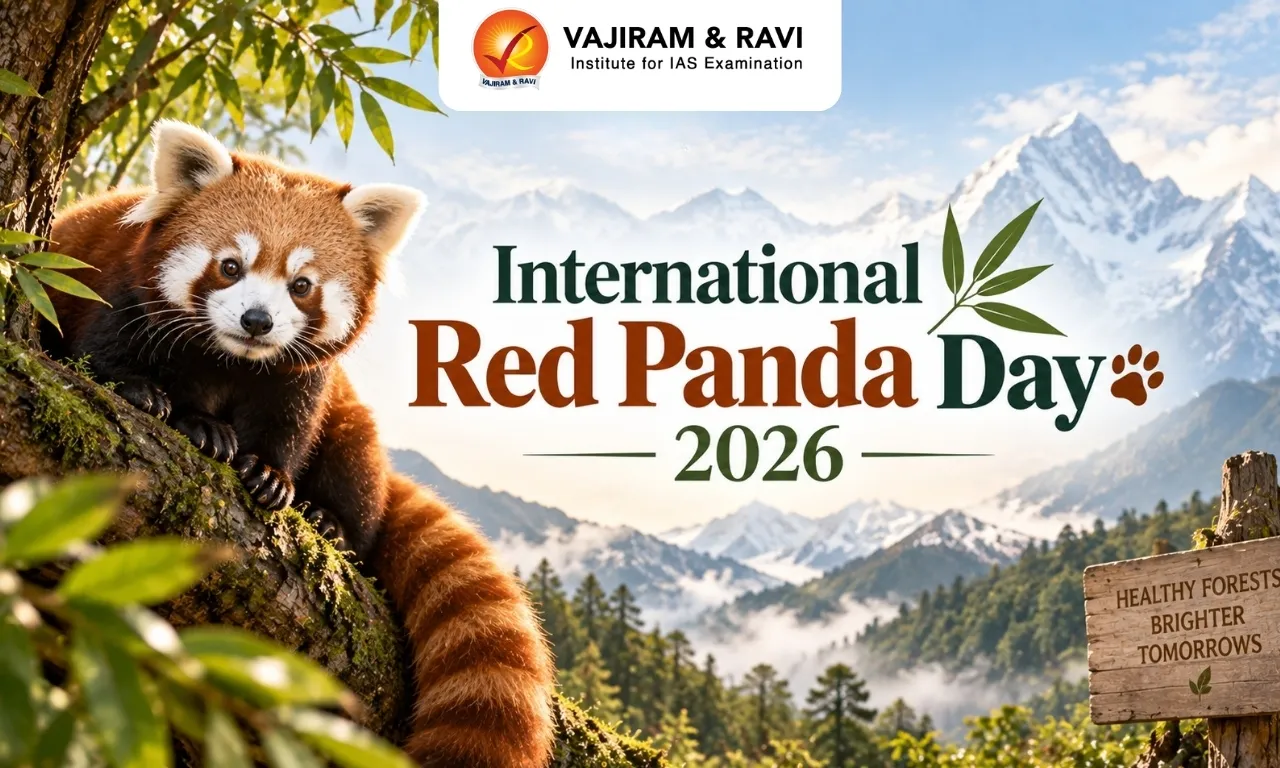
International Red Panda Day 2026, Theme, Status, Conservation

International Red Panda Day 2026

International Red Panda Day is observed on the third Saturday of September every year to create awareness about the endangered Red Panda and strengthen conservation action. The International Red Panda Day 2026 falls on 19 September. The Red Panda is a small mountain mammal found across the Eastern Himalayas and parts of China and Myanmar. India has important Red Panda habitats in Sikkim, Arunachal Pradesh and northern West Bengal.

International Red Panda Day 2026

International Red Panda Day 2026 will be observed on 19 September which is the third Saturday of September. The day focuses on the protection of Red Pandas, their bamboo rich mountain forests and the wider Himalayan ecosystem. The species faces habitat loss, poaching, illegal wildlife trade, infrastructure development and competition for food. Its global population is estimated at fewer than 10,000 breeding individuals.

International Red Panda Day Theme 2026

The official theme for the International Red Panda Day 2026 has not been announced for 19 September 2026 observance. The observance continues to focus on awareness, habitat protection, community participation and conservation of this endangered Himalayan species.

Red Panda

The Red Panda is an arboreal mammal of high altitude forests. It has several unique physical and behavioural features that distinguish it from the Giant Panda.

  • Scientific Name: The scientific name of the Red Panda is Ailurus fulgens. 
  • Other Names: It is also known as the Firefox, Lesser Panda and Red Cat-Bear.
  • Identity: The Red Panda is the sole member of the family Ailuridae. It was earlier considered related to the Giant Panda but is classified separately.
  • Sub Species: The two recognised forms are the Himalayan Red Panda (Ailurus fulgens fulgens) and the Chinese Red Panda (Ailurus fulgens styani).
  • Physical Appearance: It is slightly larger than a domestic cat. It has thick reddish brown fur, black belly and limbs, white facial markings and a long bushy tail.
  • Body Size: Its head and body measure about 50 to 65 cm. Its tail is about 30 to 50 cm long. Its weight generally ranges from 3 to 6.2 kg.
  • Special Features: The Red Panda has hairy soles and semi retractile claws. Its long tail helps it maintain balance while moving through trees and provides warmth during cold weather.
  • Behaviour: Red Pandas are mainly nocturnal and usually solitary. They are skilled climbers and spend much of their time in trees, although feeding can also occur on the ground.
  • Habitat: Red Pandas prefer mixed deciduous and conifer forests with dense bamboo understories. Their preferred altitude generally ranges from 2,200 to 4,800 metres.
  • Diet: Bamboo shoots and leaves form the major part of its diet. It also eats fruits, insects, bird eggs, small lizards and other small animals.
  • Winter Adaptation: The Red Panda can enter torpor during cold periods. This helps it cope with low temperatures and its low energy bamboo based diet.
  • Reproduction: Red Pandas generally give birth to one or two young. Births usually occur in spring after a gestation period of about 130 days.
  • Geographical Range: Its range extends through Nepal, Sikkim, Bhutan, North Bengal, Assam, Arunachal Pradesh, northern Myanmar and the Sichuan and Yunnan provinces of China.
  • Population Division: The Great Bend of the Brahmaputra separates the Himalayan Red Panda and Chinese Red Panda populations. The Yarlung Zangbo River and Siang river system is also described as an important geographical barrier.
  • Ecological Role: The Red Panda is strongly dependent on bamboo forests. It also consumes other plants and small animals, making it part of the ecological balance of mountain forests.
  • Cultural Importance: Red Panda became Sikkim’s state animal in the 1990s. It is also the mascot of the Darjeeling Tea Festival.

Red Panda Conservation Status

The Red Panda has high conservation importance because its small and fragmented populations are affected by several human pressures across its mountain range.

  • IUCN Status: The Red Panda is classified as Endangered on the IUCN Red List. Available information places the global population at fewer than 10,000 breeding individuals.
  • CITES Protection: The Red Panda is included in Appendix I of CITES. This provides strict international controls against commercial international trade in the species.
  • Indian Legal Protection: In India, the Red Panda is protected under Schedule I of the Wildlife Protection Act, 1972, providing it with the highest level of legal protection under the Act.
  • Habitat Importance: Almost 50% of the Red Panda’s habitat is located in the Eastern Himalayas. Loss of nesting trees and bamboo directly affects suitable habitat.
  • Indicator Species: The Red Panda is considered an indicator species for ecological change. Changes in its population can reflect wider changes in mountain forest ecosystems.

Red Panda in India

India is an important part of the Red Panda’s global range. Its populations occur mainly in the eastern Himalayan landscapes of Sikkim, Arunachal Pradesh and northern West Bengal.

  • Sikkim: Red Pandas occur across suitable high altitude forests of Sikkim. The species is the state animal and forms an important part of the state’s Himalayan biodiversity.
  • Sikkim Habitat Outside Parks: Around 66% of Red Panda habitat in Sikkim extends outside protected areas. Community and reserve forests therefore have an important role in species conservation.
  • Pangolakha Wildlife Sanctuary: The Red Panda occurs in Pangolakha Wildlife Sanctuary in Sikkim. Surveys have recorded the species in this protected landscape and identified habitat pressures.
  • West Bengal: In northern West Bengal, Red Pandas are associated with the Darjeeling and Kalimpong districts. Singalila National Park and Neora Valley National Park are important habitats.
  • Singalila National Park: Singalila National Park lies along the Singalila Ridge in Darjeeling district. It became a National Park in 1992 and is the highest protected area in West Bengal.
  • Neora Valley National Park: Neora Valley National Park in the Kalimpong landscape provides important forest habitat for Red Pandas. The surrounding forests also support several other Himalayan species.
  • Arunachal Pradesh: Red Pandas occur in suitable mountain forests of Arunachal Pradesh. Tawang and West Kameng are important landscapes for conservation work.
  • Estimated Population: WWF supported work helped the government of Sikkim estimate around 300 Red Pandas in the state in 2011. Conservation surveys continue to improve knowledge of their distribution.
  • Captive Breeding: Padmaja Naidu Himalayan Zoological Park in Darjeeling started a Red Panda captive breeding programme in the 1990s. The park has developed expertise in conservation breeding.
  • Release Programme: The Padmaja Naidu Himalayan Zoological Park has planned to release 20 captive bred Red Pandas into suitable forests over about five years. Singalila National Park has been identified for releases.

Red Panda Threats

Red Panda populations are declining because their specialised mountain habitat is increasingly affected by human activities and other ecological pressures.

  • Habitat Loss: Forest clearing reduces the nesting trees and bamboo resources required by Red Pandas. Habitat degradation is one of the major threats across their range.
  • Habitat Fragmentation: Roads, settlements and other linear infrastructure can divide continuous forest into smaller patches. Fragmentation reduces connectivity between Red Panda populations.
  • Poaching: Red Pandas are hunted for their distinctive fur. They may also be accidentally killed in traps intended for other animals such as wild pigs and deer.
  • Illegal Wildlife Trade: Illegal trafficking has been reported from Singalila and Neora Valley National Parks in North Bengal. The species has also been affected by the illegal pet trade.
  • Food Competition: Competition for bamboo and other food resources can increase where livestock and wild animals use the same forest areas.
  • Livestock Pressure: Livestock grazing and forest dependence can damage bamboo understories and increase human pressure on Red Panda habitat.
  • Inbreeding: Small and isolated populations face the risk of inbreeding. This can become a major conservation concern when habitat fragmentation limits movement between populations.
  • Forest Resource Dependence: Fuelwood collection can degrade forests around Red Panda habitats. Reducing dependence on forest resources is therefore an important conservation priority.

Red Panda Conservation Measures in India

India uses habitat protection, conservation breeding, community participation and threat reduction to support long term Red Panda conservation.

  • Conservation Breeding: Padmaja Naidu Himalayan Zoological Park began captive breeding in the 1990s. Its Red Panda Conservation Breeding and Augmentation Programme was shortlisted for the 2024 Conservation & Environmental Sustainability Awards by WAZA.
  • Habitat Mapping: WWF India has worked with forest departments in Sikkim and West Bengal to map Red Panda distribution and identify important habitats and threats.
  • Arunachal Pradesh Programme: WWF India works in Tawang and West Kameng to identify suitable habitats, reduce human pressures and strengthen local participation in Red Panda conservation.
  • Community Participation: Local communities are involved in conservation activities, forest surveys and alternative livelihood programmes. Community based tourism is also promoted in suitable Red Panda landscapes.
  • Alternative Energy: Conservation programmes promote alternatives to fuelwood collection. In Sikkim, more than 200 people have been trained in manufacturing bio briquettes.
  • Responsible Tourism: Community based tourism can provide additional income while reducing dependence on activities that damage Red Panda habitat. Similar approaches are being used around important Himalayan landscapes.
  • Feral Dog Control: WWF India has collaborated with Sikkim Anti Rabies and Animal Health to support sterilisation of feral dogs around critical wildlife areas.
  • Habitat Connectivity: Protecting forest patches outside formal protected areas is important because a large share of Red Panda habitat occurs beyond protected area boundaries.
  • Monitoring: Regular surveys and habitat monitoring help identify Red Panda distribution, population trends and threats. Such monitoring supports better planning for protection and possible reintroduction.
  • Public Awareness: International Red Panda Day 2026 provides an opportunity to increase awareness about illegal wildlife trade, habitat protection and community participation in conserving this endangered Himalayan mammal.

International Red Panda Day 2026 FAQs

Q1: When is International Red Panda Day 2026?

Ans: International Red Panda Day 2026 will be observed on 19 September, the third Saturday of September.

Q2: What is the theme of International Red Panda Day 2026?

Ans: The International Red Panda Day Theme 2026 has not been announced as of 19 September 2026.

Q3: What is the scientific name of the Red Panda?

Ans: The scientific name of the Red Panda is Ailurus fulgens. It is also called Firefox, Lesser Panda and Red Cat-Bear.

Q4: What is the conservation status of the Red Panda?

Ans: The Red Panda is listed as Endangered on the IUCN Red List. It is also included in CITES Appendix I and Schedule I of India’s Wildlife Protection Act, 1972.

Q5: Where are Red Pandas found in India?

Ans: Red Pandas are found mainly in Sikkim, Arunachal Pradesh and the Darjeeling and Kalimpong districts of West Bengal.

International Day of Peace 2026, Theme, History and Significance

International Day of Peace 2026

International Day of Peace 2026, also known as World Peace Day, will be observed on Monday, 21 September 2026, to promote the ideals of peace, non-violence and cooperation. The observance provides an opportunity to draw attention to the importance of peaceful societies and collective efforts to prevent conflicts and build lasting peace.

International Day of Peace 2026 Theme

The official theme for International Day of Peace 2026 is “Invest in Peace – For Everyone, Everywhere, Every Day.”

The theme highlights the idea that peace-building is not limited to governments, diplomats or international organisations. It also depends on the actions of individuals and communities in their everyday lives. The United Nations describes these individuals as “everyday architects of peace” - people who take local action, promote stability and help create the conditions for lasting peace. The 2026 theme also presents peace as more than simply the absence of war. It connects peace with everyday experiences of safety, dignity, opportunity and cooperation, which enable societies to address wider global challenges collectively.

Why is International Day of Peace Observed on 21 September?

The United Nations General Assembly established the International Day of Peace in 1981. 21 September was chosen as the date for the observance because it coincides with the opening day of the regular session of the United Nations General Assembly, providing an opportunity for the UN to focus global attention on peace and encourage 24 hours of non-violence and ceasefire.

How is the International Day of Peace Observed?

The United Nations marks the day through activities promoting peace, dialogue and non-violence.

  • Peace Bell Ceremony: The UN Secretary-General rings the Peace Bell at UN Headquarters in New York. Donated by the United Nations Association of Japan, the bell symbolises the universal aspiration for peace.
  • Ceasefire and non-violence: The UN calls on parties to armed conflicts to lay down their weapons, facilitate humanitarian action and create space for dialogue.
  • Awareness activities: Educational, cultural and community activities are organised to promote peace, cooperation and non-violence.

International Day of Peace Significance 

The International Day of Peace highlights the importance of collective efforts to create peaceful and stable societies.

  • It promotes peace and non-violence as essential values for individuals and societies.
  • It encourages dialogue and cooperation as means of addressing conflicts.
  • It highlights the importance of peace-building at the community level, rather than viewing it only as a responsibility of states and international organisations.
  • It draws attention to the broader conditions that support peaceful societies, including safety, dignity, opportunity and cooperation.
  • It reinforces the idea that lasting peace requires continuous efforts by individuals, communities and institutions.

International Day of Peace 2026 FAQs

Q1: What is the International Day of Peace?

Ans: The International Day of Peace, also known as World Peace Day, is a United Nations observance dedicated to promoting peace, non-violence and cooperation among people and nations.

Q2: When is the International Day of Peace observed?

Ans: The International Day of Peace is observed annually on 21 September. In 2026, it falls on Monday, 21 September.

Q3: What is the theme of International Day of Peace 2026?

Ans: The theme of International Day of Peace 2026 is “Invest in Peace – For Everyone, Everywhere, Every Day.” It highlights the role of individuals and communities in building lasting peace.

Q4: Who established the International Day of Peace?

Ans: The United Nations General Assembly established the International Day of Peace in 1981 to promote the ideals of peace and provide a dedicated occasion for strengthening these values.

Q5: What is the significance of the International Day of Peace?

Ans: The day encourages countries and people to promote non-violence, ceasefire, dialogue and peaceful cooperation. It also draws attention to the need for building societies based on safety, dignity, opportunity and mutual cooperation.

India-Vietnam Defence Cooperation 2026, Key Areas, Significance

India-Vietnam Defence Cooperation 2026

India-Vietnam Defence Cooperation is gaining greater strategic importance as both countries deepen defence and security ties, with co-production of Indian defence items emerging as a significant area of cooperation in 2026.

India-Vietnam Defence Cooperation 2026: Why in News?

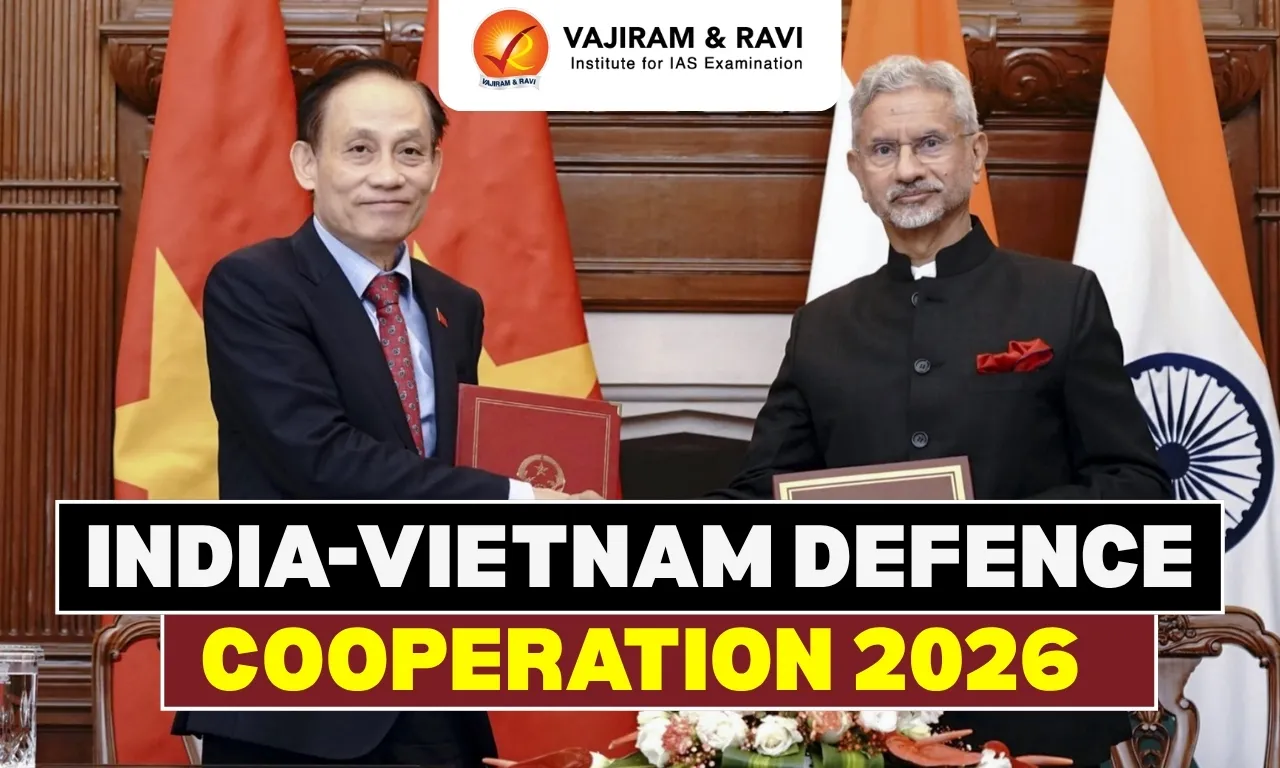
India and Vietnam have agreed to deepen their defence and security cooperation, including co-production of Indian defence items, during the 19th India-Vietnam Joint Commission Meeting held in New Delhi.

  • External Affairs Minister S. Jaishankar and Vietnamese Foreign Minister Le Hoai Trung co-chaired the 19th India-Vietnam Joint Commission Meeting on trade, economic, scientific and technological cooperation.
  • The two sides identified co-production of Indian defence items as a way forward for strengthening their ongoing defence and security cooperation.
  • Defence and security cooperation is one of the central pillars of the Enhanced Comprehensive Strategic Partnership between India and Vietnam.
  • India regards Vietnam as a key partner in its Act East Policy, Vision MAHASAGAR and Indo-Pacific approach.
  • The two sides also discussed trade, investments, supply chains, connectivity, space, nuclear energy, capacity building and people-to-people ties.

India-Vietnam Defence Cooperation Evolution 

India-Vietnam defence ties have gradually expanded from equipment support and capacity building towards broader strategic and defence-industrial cooperation.

  • June 2022: India handed over 12 high-speed guard boats to Vietnam, built by Larsen & Toubro under a US$100 million Line of Credit.
  • July 2023: India gifted the indigenously built missile corvette INS Kirpan to Vietnam, strengthening bilateral maritime and defence cooperation.
  • July 2024: Two additional Lines of Credit worth US$120 million and US$180 million were signed between the Exim Bank of India and the Finance Ministry of Vietnam.
  • May 2026: During Vietnamese General Secretary of the Communist Party of Vietnam and President To Lam's State Visit to India, the two countries elevated their relationship to an Enhanced Comprehensive Strategic Partnership, providing renewed impetus to bilateral ties.
  • September 2026: India and Vietnam identified co-production of Indian defence items as a way forward for deepening defence and security cooperation.

India-Vietnam Defence Cooperation Significance 

The partnership has significance for India's strategic interests, regional security and engagement with Southeast Asia.

  • Strategic balancing: Stronger defence ties with Vietnam expand India's strategic options amid China's growing presence and assertive behaviour in the Indo-Pacific.
  • Act East Policy: Vietnam is a key pillar of India's Act East Policy, making defence cooperation an important component of India's deeper engagement with Southeast Asia.
  • Defence diplomacy: Military dialogue, training and capacity building create sustained institutional linkages between the two countries' armed forces.
  • Defence indigenisation: Co-production of Indian defence items can support India's defence manufacturing ecosystem while creating opportunities for industrial cooperation with Vietnam.
  • Maritime security: Cooperation with Vietnam strengthens India's engagement with the maritime domain and contributes to regional security in the Indo-Pacific.
  • Strategic autonomy: The partnership allows both countries to diversify their strategic relationships without entering a formal military alliance.
  • ASEAN engagement: Stronger ties with Vietnam reinforce India's broader engagement with ASEAN and Southeast Asia.
  • Rules-based order: Greater coordination in regional and multilateral forums supports India's emphasis on a free, open, inclusive and rules-based Indo-Pacific.

India-Vietnam Defence Cooperation 2026 FAQs

Q1: What is the latest development in India-Vietnam Defence Cooperation?

Ans: India and Vietnam have agreed to deepen defence and security cooperation, including co-production of Indian defence items, during the 19th India-Vietnam Joint Commission Meeting held in New Delhi in September 2026.

Q2: What are the major milestones in India-Vietnam Defence Cooperation?

Ans: Major recent milestones include India's transfer of 12 high-speed guard boats in 2022, gifting of INS Kirpan in 2023, additional Lines of Credit in 2024, and the move towards co-production of Indian defence items in 2026.

Q3: Why is Vietnam important for India's Act East Policy?

Ans: Vietnam is a key partner in India's Act East Policy and an important partner in India's engagement with ASEAN and Southeast Asia. Defence cooperation therefore strengthens India's broader strategic engagement with the region.

Q4: How does India-Vietnam Defence Cooperation support India's defence indigenisation?

Ans: The proposed co-production of Indian defence items can strengthen India's defence manufacturing ecosystem while creating opportunities for industrial cooperation, technology partnerships and defence supply chains.

Q5: Why is India-Vietnam Defence Cooperation important for the Indo-Pacific?

Ans: The India-Vietnam Defence Cooperation strengthens India's engagement with Southeast Asia and the maritime domain and supports cooperation for a free, open, inclusive and rules-based Indo-Pacific.

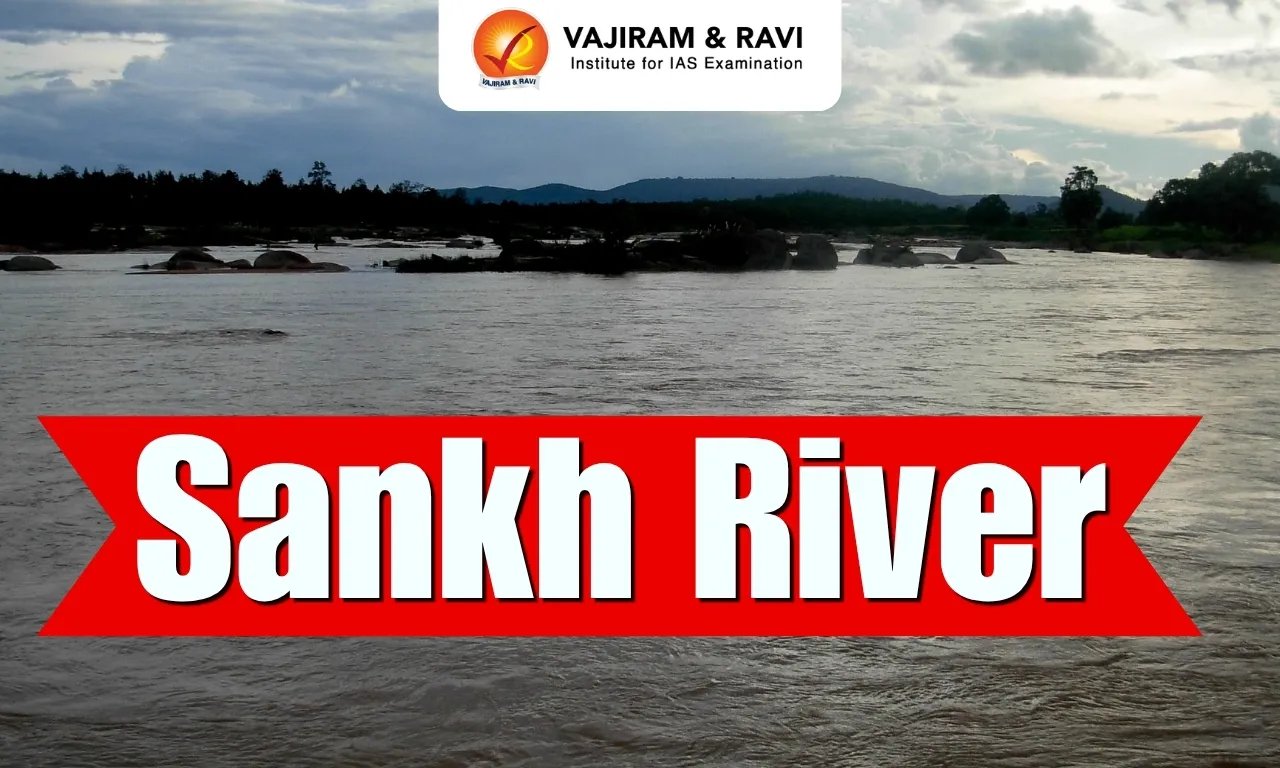
Sankh River

Sankh River

Sankh River Latest News

Tragedy struck Salangabahal village in Odisha when three minor girls drowned in the Sankh river while preparing for the Karma Puja festival recently.

About Sankh River

  • It flows across Jharkhand, Chhattisgarh, and Odisha states in India. 
  • The river is also known locally as the Shankh River and is a key tributary in the Brahmani River system. 
  • Course:
    • The river starts 1,000 metres above sea level in the Lupungpat village in Gumla district in Jharkhand and flows 67.5 kilometres in the state before entering Chhattisgarh. 
    • It runs a distance of about 50 kilometres in Chhattisgarh and enters Jharkhand again to flow for another 78 kilometres. 
    • The river finally enters Odisha and travels another 45 kilometres before merging with the Koel. 
    • The South Koel enters Odisha and joins the Sankh River at Vedavyas near Rourkela, from where it is called the Brahmani. 
  • Total Length: 240 km
  • A major feature along its course is the 60-metre-high Sadni Falls located at the edge of the Ranchi plateau, known as a scarp or knick-line waterfall.

News: NIE

Sankh River FAQs

Q1: Which states does the Sankh River flow through?

Ans: Jharkhand, Chhattisgarh and Odisha.

Q2: Which major river system does the Sankh River form a part of?

Ans: The Brahmani River system.

Q3: Where does the Sankh River originate?

Ans: At Lupungpat village in Gumla district, Jharkhand.

Q4: What is the total length of the Sankh River?

Ans: About 240 kilometres.

Taklamakan Desert

Taklamakan Desert

Taklamakan Desert Latest News

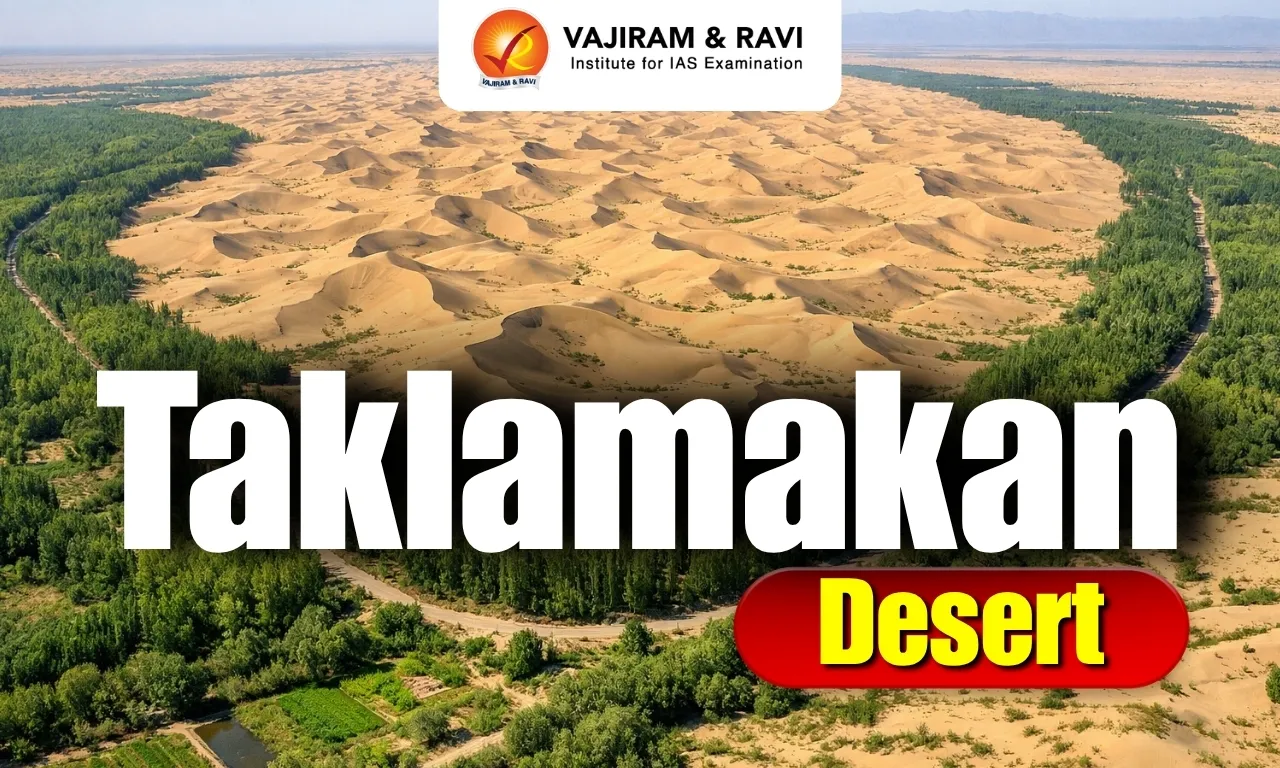
For decades, China has been planting trees and other vegetation around the edges of the Taklamakan Desert, one of the world's largest and driest deserts, in an effort to stop desertification and hold back shifting sand.

About Taklamakan Desert

  • The Taklamakan Desert, located in southwest Xinjiang in northwest China, is one of the world’s largest sandy deserts. 
  • It sits right in the middle of the largest inland basin in China—the Tarim Basin. 
  • The desert area extends about 960 km from west to east, and it has a maximum width of some 420 km and a total area of approximately 320,000 sq.km.  
  • It is the world’s second-largest shifting-sand desert, and 85% of its total area is composed of crescent-shaped dunes.
  • It is flanked by two towering mountain ranges-Tien Shan to the north and Kunlun mountain ranges to the south.
  • It also has the Pamir Mountains and Tian Shan (ancient Mount Imeon) to the west and the famed Gobi Desert to the east.
  • There is a gradual transition to the Lop Nur basin in the east; in the south and west, between the sandy desert and the mountains, lies a band of sloping desert lowland composed of pebble-detritus deposits. 
  • The place has a typical continental climate with strong gusts of wind, very little precipitation, and a significant shift in temperature from daytime to nighttime and vice versa.
  • The continuously shifting nature of the sand in the desert has extended Taklamakan to about 100 km southward during the last thousand years. 
  • There are also small mountain ranges in the desert as well as the Tarim River that flows through its Northern edge. 

News: MC

Taklamakan Desert FAQ's

Q1: Where is the Taklamakan Desert located?

Ans: It is located in southwest Xinjiang in northwest China.

Q2: In which basin is the Taklamakan Desert located?

Ans: It sits right in the middle of the largest inland basin in China—the Tarim Basin.

Q3: What type of desert is the Taklamakan Desert?

Ans: It is a sandy desert.

Q4: Which mountain range lies to the north of the Taklamakan Desert?

Ans: The Tien Shan Mountains.

Q5: What are the major climatic characteristics of the Taklamakan Desert?

Ans: Strong winds, very little precipitation, and large day-night temperature variations.

Ariosoma cmfriense

Ariosoma cmfriense

Ariosoma cmfriense Latest News

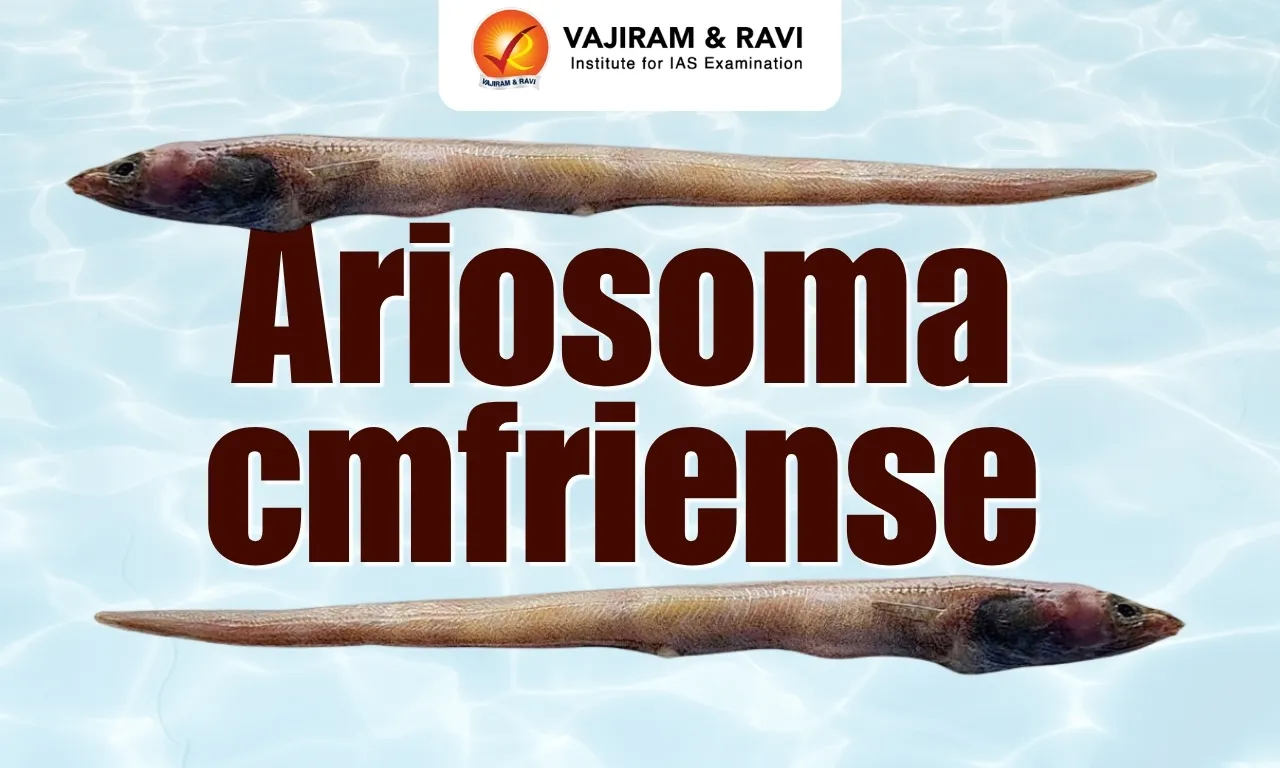
Scientists recently discovered a new species of conger eel named Ariosoma cmfriense from the deep waters of the Arabian Sea. 

About Ariosoma cmfriense

  • It is a new species of conger eel.
    • Conger eels are powerful fish with an elongated, snake-like body which is smooth and scaleless. 
  • It was found in the waters off Kollam, Kerala, at a depth of about 300 metres.
  • The discovery was made by scientists from the ICAR-Central Marine Fisheries Research Institute, Kochi, as part of the research component under the Deep Ocean Mission (DOM), a national programme of the Ministry of Earth Sciences (MoES).
  • Ariosoma cmfriense has several distinct features. 
    • These include a relatively low total vertebral count of 135 and 127-130 lateral-line pores.
    • Its preanal length is nearly half its total length.
    • It also has two supraorbital pores and a dorsal fin that begins just ahead of the pectoral fin base.
    • The fish has a plain pectoral fin, a dark patch over the operculum, and fine black speckling below the lateral line, a feature not observed in the other related species.

News: ETVB

Ariosoma cmfriense FAQs

Q1: What is Ariosoma cmfriense?

Ans: A newly discovered species of conger eel.

Q2: Where was Ariosoma cmfriense discovered?

Ans: In the waters off Kollam, Kerala.

Q3: What type of fish are conger eels?

Ans: Powerful, elongated, snake-like fish with smooth and scaleless bodies.

Q4: What distinctive marking is present over the operculum of Ariosoma cmfriense?

Ans: A dark patch is present over the operculum.

Gallium Nitride Monolithic Microwave Integrated Circuit Technology

Gallium Nitride Monolithic Microwave Integrated Circuit Technology

Gallium Nitride Monolithic Microwave Integrated Circuit Technology Latest News

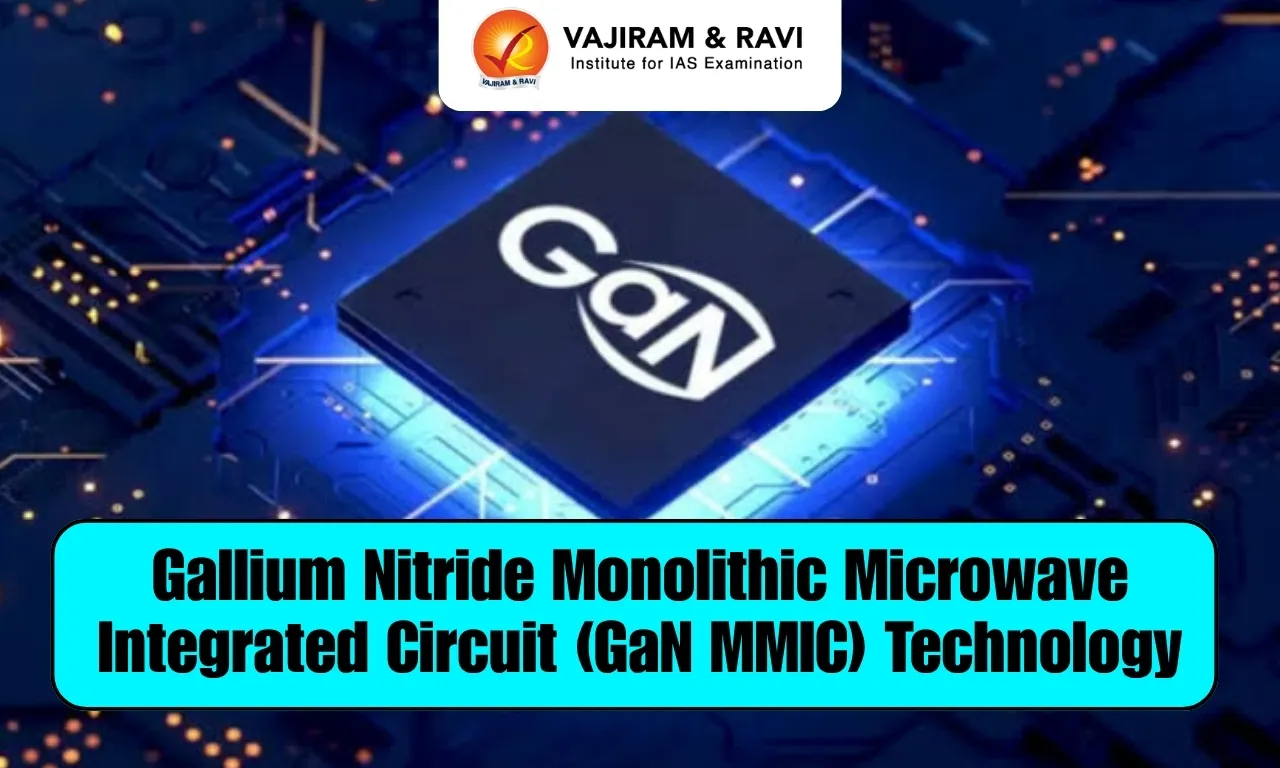
Recently, the Defence Research and Development Organisation (DRDO) has successfully demonstrated and implemented indigenous Gallium Nitride Monolithic Microwave Integrated Circuit (GaN MMIC) Technology.

About Gallium Nitride Monolithic Microwave Integrated Circuit (GaN MMIC) Technology

  • It is a tiny, super-powerful computer chip built on a special chemical material that handles extremely high-frequency wireless signals without melting.
  • It’s an all-in-one chip that combines tiny parts—like transistors, resistors, and capacitors—onto a single piece of material to manage invisible wireless waves (microwaves).
  • It is designed for applications up to the X-band frequency range.
  • Origin: DRDO developed the GaN MMIC technology in 2024 and helped India quietly entered an elite club of seven countries — US, Russia, France, Germany, South Korea, China

Why is GaN Important?

  • It is a material with exceptional thermal and electrical properties, making it critical for advanced defence applications such as sensors, radars, satellites, and missiles.
  • A single indigenous GaN chip, measuring 3.5 x 3 mm can deliver up to 30 watts of power and operate at speeds 300 times faster than silicon.
  • Gallium Nitride (GaN) is considered one of the most important semiconductor technologies for modern defence systems.
  • It offers: Higher power output, Better energy efficiency, Faster signal processing, Reduced size and weight, Improved thermal performance, Greater reliability in harsh environments

Source: TOI

Gallium Nitride Monolithic Microwave Integrated Circuit Technology FAQs

Q1: Who developed Gallium Nitride Monolithic Microwave Integrated Circuit Technology?

Ans: DRDO developed the GaN MMIC technology

Q2: What is Gallium Nitride Monolithic Microwave Integrated Circuit Technology?

Ans: It is a tiny, super-powerful computer chip built on a special chemical material.

Indian Council of World Affairs

Indian Council of World Affairs

Indian Council of World Affairs Latest News

Recently, the Vice-President of India addressed the 25th Anniversary celebrations of Indian Council of World Affairs (ICWA) at Sapru House, New Delhi. 

About Indian Council of World Affairs

  • Origin: It was established in 1943 by a group of Indian intellectuals as a think tank.
    • It was established by a group of eminent intellectuals led by Sir T.B. Sapru and Dr. H.N. Kunzru to create an Indian perspective on international relations and foreign policy issues. 
    • It was registered as a non-official, non-political and non-profit organisation under the Registration of Societies Act 1860.
    • By an Act of Parliament in 2001, the Indian Council of World Affairs has been declared an institution of national importance.
    • The Vice President of India is the ex-officio President of ICWA.
  • It is funded by the Ministry of External Affairs and enjoys full autonomy.
  • Functions: It is devoted exclusively for the study of international relations and foreign affairs.

Source: PIB

Indian Council of World Affairs FAQs

Q1: What is Indian Council of World Affairs?

Ans: It was established in 1943 by a group of Indian intellectuals as a think tank.

Q2: Whos is the president Indian Council of World Affairs?

Ans: The Vice President of India is the ex-officio President of ICWA.

Changthang Wildlife Sanctuary

Changthang Wildlife Sanctuary

Changthang Wildlife Sanctuary Latest News

Authorities will undertake spatial mapping and field verification of military installations within the Changthang Cold Desert Wildlife Sanctuary in Ladakh in coordination with police and the defence establishment, officials said recently.

About Changthang Wildlife Sanctuary

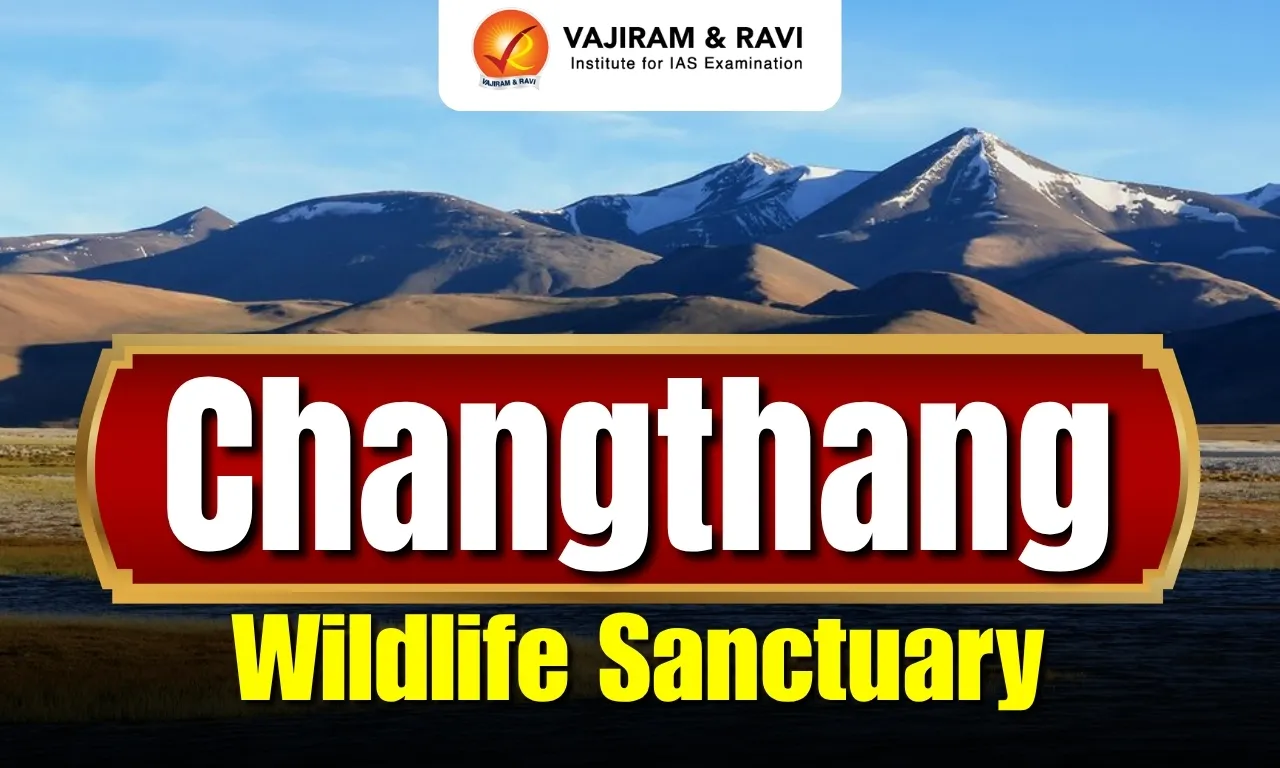
  • It is located in the Ladakhi Changthang plateau in the Leh district of Jammu and Kashmir.
  • It covers an area of almost 4,000 sq.km.
  • The altitude of the sanctuary varies from 14000 to 19000 feet, and the topography is formed of deep gorges and vast plateaus. 
  • It is home to the highest altitude water lakes, namely, Tso Moriri, Pangong Tso, and Tso Kar.
  • The Changthang region is inhabited by nomadic pastoral communities, primarily the Changpa tribe, who lead a traditional way of life herding yaks, goats, and sheep across the vast grasslands.
  • This region is steeped in Tibetan Buddhist culture and heritage.
  • It includes one of the world’s highest villages, Korzok Village, which attracts tourists to the Korzok Monastery.
  • Flora: It is home to almost 200 species of wild plants that grow in the higher pastures and are food for the animals inside the sanctuary.
  • Fauna
    • The major attraction of this place is the Snow Leopard. 
    • Along with that, it is one of the few places in India which is the abode of the Kiang, or Tibetan wild ass, along with the dark-necked crane. 
    • It also houses a huge variety of animal species, which include the Tibetan Wolf, Wild Yak, Bharal, Brown Bear, Tibetan Argali, Tibetan Gazelle, and the Mormot.  
    • It also serves as the habitat for numerous species of avifauna, including Brahminy Ducks and Brown Headed Gulls, etc.

News:TP

Changthang Wildlife Sanctuary FAQ's

Q1: Where is the Changthang Wildlife Sanctuary located?

Ans: It is located in the Ladakhi Changthang Plateau in the Leh district of Jammu and Kashmir.

Q2: Which high-altitude lakes are located in the Changthang Wildlife Sanctuary?

Ans: Tso Moriri, Pangong Tso and Tso Kar.

Q3: Which nomadic pastoral community primarily inhabits the Changthang region?

Ans: The Changpa tribe.

Q4: Which animal is the major attraction of the Changthang Wildlife Sanctuary

Ans: The Snow Leopard.

Dadasaheb Phalke Award

Dadasaheb Phalke Award

Dadasaheb Phalke Award Latest News 

Legendary actor Anant Nag, known for his impressive work in Hindi and Kannada cinema will be honoured with the Dadasaheb Phalke Award for 2024.

About Dadasaheb Phalke Award

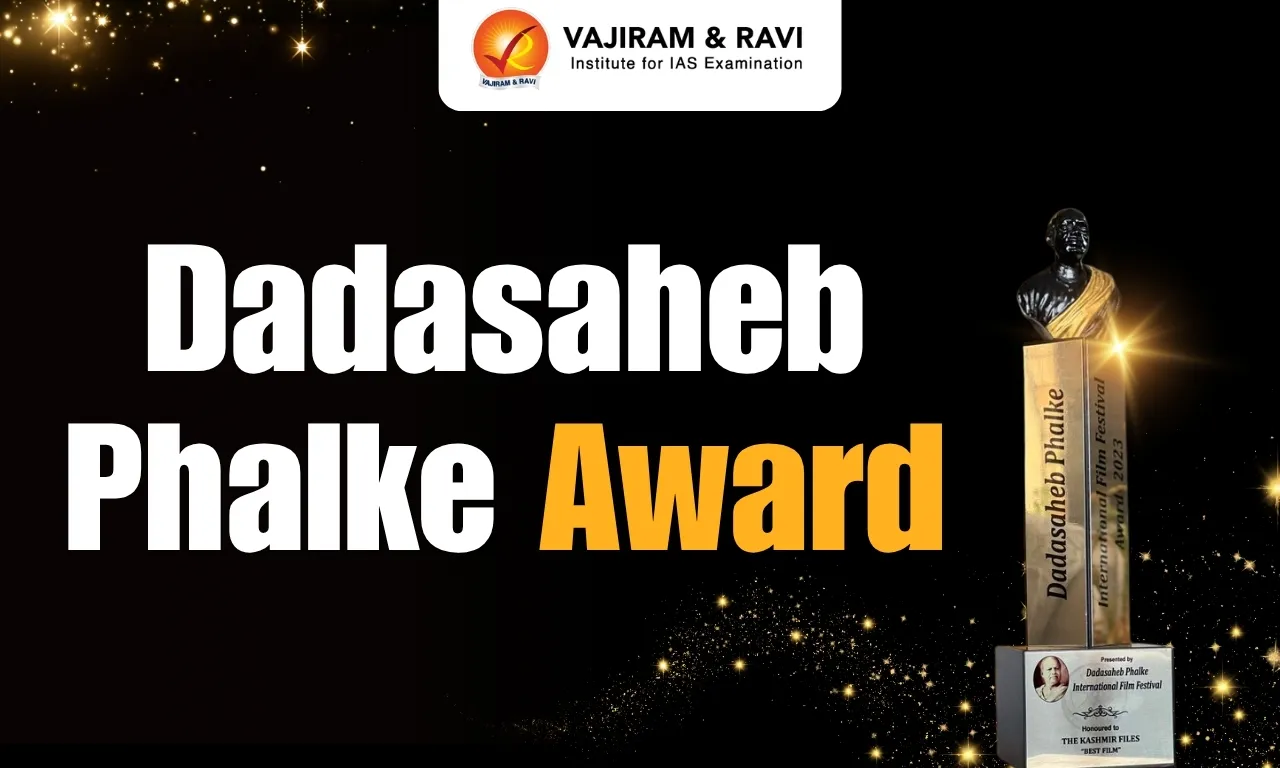
  • It is given by the Indian government for lifetime contribution to Indian cinema.
  • It was instituted in 1969 the birth centenary year of Dadasaheb Phalke.
  • It is the highest award in the field of cinema in India.
  • It was introduced by the Government of India to commemorate Dadasaheb Phalke’s contribution to Indian cinema.
  • The award’s inaugural recipient was Devika Rani, aptly titled “the first lady of Indian cinema”.
  • The recipients are recognized for their ‘outstanding contribution to the growth and development of Indian cinema’.
  • Award includes: The award comprises a Swarna Kamal (Golden Lotus) medallion, a shawl, and a cash prize of ₹10 lakh.
  • It is presented by the President of India. 

Key Facts about Dhundiraj Govind Phalke

  • He was born on April 30, 1870, in Trimbak, Maharashtra.
  • He was a film director who is considered the father of Indian cinema. 
  • He directed India’s first full-length feature film, Raja Harishchandra in 1913.

Source: TH

Dadasaheb Phalke Award FAQs

Q1: What is Dadasaheb Phalke Award?

Ans: It is the highest award in the field of cinema in India.

Q2: When was the Dadasaheb Phalke Award instituted?

Ans: It was instituted in 1969 the birth centenary year of Dadasaheb Phalke.

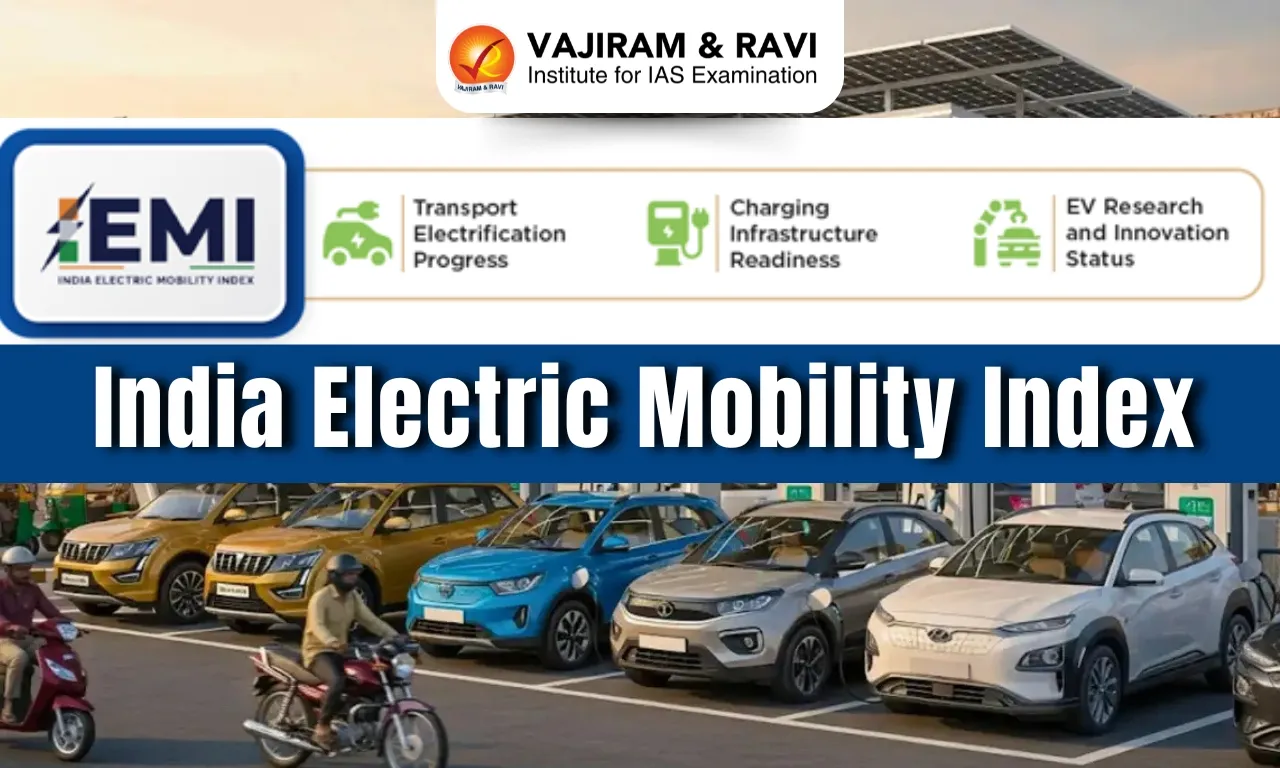
India Electric Mobility Index

India Electric Mobility Index

India Electric Mobility Index Latest News

According to the index released by NITI Aayog, Delhi topped India’s states and Union territories in the India Electric Mobility Index (IEMI) 2025, scoring 84. 

About India Electric Mobility Index

  • It is a composite Index, which assesses the policy framework and implementation outcomes for e-mobility at the state-level.
  • It is developed by the NITI Aayog in collaboration with WRI India.
  • It evaluates and scores all Indian States and UTs out of 100 across 16 indicators under three-core themes: 
    • Transport Electrification Progress to capture demand-side adoption 
    • Charging Infrastructure Readiness to track allied charging infrastructure development
    • EV Research and Innovation Status: Covers supply-side ecosystem R&D efforts.
  • Based on the score, each State or UT was classified into one of the following classes: 
    • Top Performers: score ≥65
    • Frontrunners: score of 50–64
    • Emerging Performers: score of 35–49
    • Aspirants: score <35

Highlights of the India Electric Mobility Index 2025

  • According to the index, the composite scores on performance across all 36 States and Union Territories (UTs) ranges from 10 to 84, and a median score of 40.
  • Delhi bagged the highest score of 84, followed by Maharashtra (78), Karnataka (73), Chandigarh (71), and Goa (65).
  • Madhya Pradesh recorded a substantial improvement, moving from the 23rd to seventh rank.
  • The index further shows that eight large states — Tamil Nadu, Madhya Pradesh, Odisha, Andhra Pradesh, Telangana, Haryana, Rajasthan, and Uttar Pradesh — have qualified as frontrunners.
  • The other seven large states such as Chhattisgarh, West Bengal, Bihar, Kerala, Jharkhand, Punjab, and Gujarat were emerging performers with a score of 35-49.
  • The report also shows that Delhi, Chandigarh, and Maharashtra were the only UTs and states to qualify as top performers in transport electrification progress.
  • In the Charging Infrastructure Readiness (30% weightage), Karnataka recorded the highest score nationwide at 97, Goa (92) and Maharashtra (91).
  • Delhi also achieved the top score of 94 in the EV Research and Innovation Status (20% weightage) category.

Source: IE

India Electric Mobility Index FAQs

Q1: Who publishes India Electric Mobility Index?

Ans: It is developed by the NITI Aayog in collaboration with WRI India.

Q2: What is India Electric Mobility Index?

Ans: It is a composite Index, which assesses the policy framework and implementation outcomes for e-mobility at the state-level.

M. S. Subbulakshmi (1916-2004), Biography, Contributions, Awards

M. S. Subbulakshmi

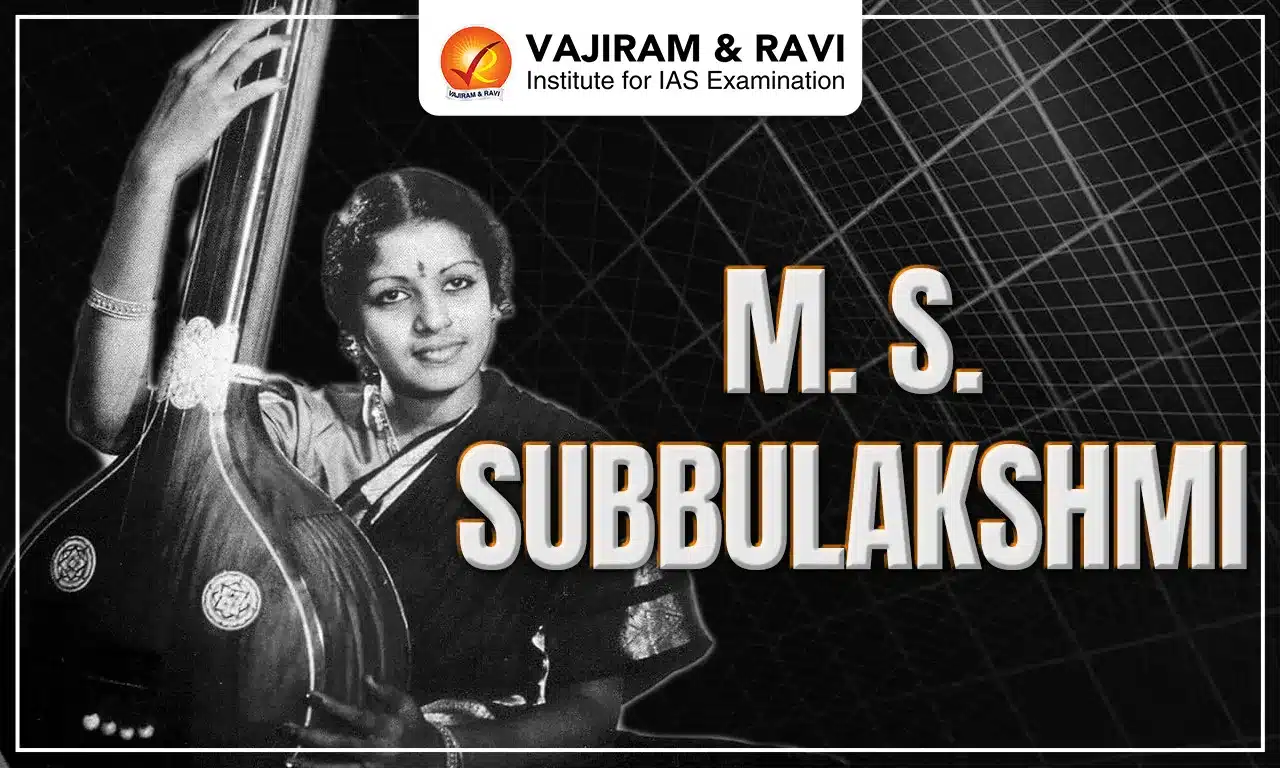
M. S. Subbulakshmi was a renowned Indian Carnatic vocalist and devotional singer. She had a musical career spanning more than seven decades. She became the first musician to receive the Bharat Ratna in 1998. She also became the first Indian musician to receive the Ramon Magsaysay Award in 1974 and the first Indian to perform at the United Nations General Assembly.

M. S. Subbulakshmi Biography

M. S. Subbulakshmi was born into a family with a strong musical background. Her early training and public performances helped establish her as a major Carnatic vocalist.

  • Early Life: Madurai Shanmukhavadivu Subbulakshmi was born on September 16, 1916, in Madurai, Madras Presidency, now Tamil Nadu. Her mother Shanmukhavadivu Ammal was a veena player and her grandmother Akkammal was a violinist.
  • Musical Training: Subbulakshmi learned Carnatic music from an early age. She trained under Semmangudi Srinivasa Iyer and later studied Hindustani music under Pandit Narayanrao Vyas.
  • First Public Performance: At the age of 11, she gave her first public performance in 1927 at the 100-pillar hall of Rockfort Temple in Tiruchirappalli. Mysore Chowdiah played the violin and Dakshinamurthy Pillai played the mridangam.
  • Madras Music Academy: In 1929, at 13, she performed at the Madras Music Academy. In 1933, she became the first woman to sing at its annual conference, marking an important moment in Carnatic music.
  • Marriage: In 1940, Subbulakshmi married T. Sadasivam, a journalist and activist associated with the Indian Independence Movement. He played an important role in managing her career and musical repertoire.
  • Film Career: Subbulakshmi acted in films including Sevasadanam (1938), Sakuntalai (1940), Savithiri (1941) and Meera (1945). The Hindi version of Meera was released in 1947 and expanded her national audience.
  • Later Life: After T. Sadasivam died in 1997, Subbulakshmi withdrew from public performances. She died on December 11, 2004, in Chennai at the age of 88 and was cremated with full state honors.

M. S. Subbulakshmi Contributions

M. S. Subbulakshmi contributed to Carnatic music, devotional music, cinema, cultural diplomacy and charitable activities through performances and recordings.

  • Carnatic Music: Subbulakshmi became one of the leading Carnatic vocalists of her time. Her style combined technical skill, clear brigas and expressive singing with a strong command of complex classical compositions.
  • Devotional Music: She became widely known for bhajans and devotional compositions. Her popular recordings include Bhajagovindam, Hanuman Chalisa, Hari Tuma Haro and Venkateswara Suprabhatam.
  • Musical Repertoire: Her repertoire included works associated with Tyagaraja, Tulsidas, Kabir, Rabindranath Tagore and Annamacharya. She also performed compositions by Muthuswami Dikshitar, Adi Shankaracharya, Meera Bai and Purandara Dasa.
  • International Performances: She performed at the Edinburgh International Festival in 1963, the United Nations General Assembly in New York in 1966, Carnegie Hall in 1977 and Royal Albert Hall in 1982.
  • United Nations Performance: In 1966, M. S. Subbulakshmi became the first Indian to perform at the United Nations General Assembly. She presented Maitreem Bhajata, a Sanskrit composition by Chandrasekharendra Saraswati.
  • Charity Through Music: She gave more than 200 benefit concerts and raised over Rs. 10,000,000 for social and religious causes. Beneficiaries included the Kasturba Gandhi National Memorial Trust, Sankara Nethralaya and the Cancer Institute in Chennai.

M. S. Subbulakshmi Awards and Recognitions

M. S. Subbulakshmi received major national and international honours for her contribution to Indian music and cultural life.

  • Biopic Recognition: On her 110th birth anniversary on September 16th 2026, a biopic titled “MS - A Legacy On Screen” was officially launched in Chennai.
  • Padma Bhushan: She received the Padma Bhushan in 1954 for her contribution to Indian music and public life.
  • Sangeet Natak Akademi Award: She received the Sangeet Natak Akademi Award in 1956, recognising her contribution to Indian performing arts.
  • Sangita Kalanidhi: In 1968, she became a recipient of the Sangita Kalanidhi, one of the major honours associated with Carnatic music.
  • Ramon Magsaysay Award: In 1974, she became the first Indian musician to receive the Ramon Magsaysay Award. The award recognised her contribution to music and cultural service.
  • Padma Vibhushan: She received the Padma Vibhushan in 1975, further recognising her exceptional contribution to Indian music.
  • Other Honours: Her other awards included Kalidas Samman in 1988 and the Indira Gandhi Award for National Integration in 1990. She also received honorary Doctor of Letters degrees from the University of Delhi, Banaras Hindu University and Visva-Bharati University.
  • Bharat Ratna: In 1998, M. S. Subbulakshmi became the first musician to receive the Bharat Ratna, India's highest civilian honour. 
  • Postage Stamp: Her legacy also includes a commemorative Indian postage stamp issued in 2005.

M. S. Subbulakshmi FAQs

Q1: Who was M. S. Subbulakshmi?

Ans: M. S. Subbulakshmi was India’s legendary Carnatic vocalist, known for devotional renditions and global cultural contributions.

Q2: When was M. S. Subbulakshmi born?

Ans: She was born on 16 September 1916 in Madurai, Tamil Nadu, into a family of musicians.

Q3: Which award was given to M. S. Subbulakshmi?

Ans: She received the Bharat Ratna (1998), India’s highest civilian honor, and the Ramon Magsaysay Award (1974).

Q4: What was M. S. Subbulakshmi’s famous song?

Ans: Her rendition of Venkatesa Suprabhatam and Bhajagovindam remain among the most loved devotional songs in India.

Q5: Where did M. S. Subbulakshmi perform internationally?

Ans: She performed at the United Nations (1966), Carnegie Hall, and international festivals, showcasing Indian music to global audiences.

Black-Headed Ibis

Black-Headed Ibis

Black-headed Ibis Latest News

Recently, the Pallar paddy fields at Tirunavaya in Malappuram , Kerala have turned white with the arrival of a large flock of Black-headed ibis(Threskiornis melanocephalus).

About Black-headed Ibis

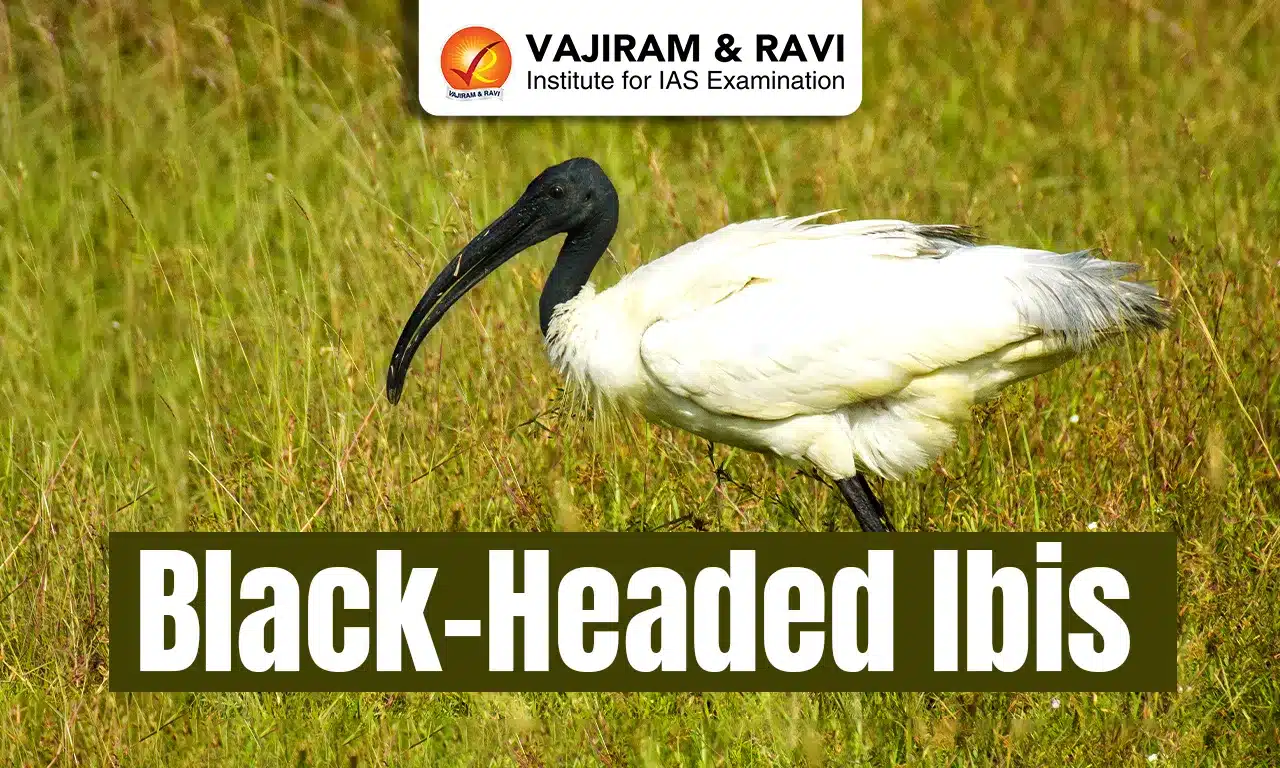
  • It is a species of wading bird of the ibis family Threskiornithidae.
  • It is also known as the Oriental white ibis, Indian white ibis, and black-necked ibis.
  • Adaptability: These are called wader birds due to their adaptability to a wide variety of aquatic environments.
  • Habitat: Found primarily around wetlands including agricultural fields and occasionally around coastal areas, but also seen foraging in dry fields and human-modified landscapes.
  • Distribution: It is found in South- and Southeast Asia from India to the west and as far east as Japan.
  • Features of Black-headed Ibis
    • It is a large wader bird, with adults measuring 65–76 cm in length. 
    • It is the only native ibis species in its range that has an overall white plumage with a black neck and head. 
    • Males and females look similar and both have greyish tail feathers. 
    • Tails of adults bear light grey ornamental feathers that turn jet black during the breeding season. 
  • Conservation Status: It is classified as ‘Least Concern’ under the IUCN Red List.

Source: TH

Black-headed Ibis FAQs

Q1: What is Black-headed Ibis?

Ans: It is a species of wading bird of the ibis family Threskiornithidae.

Q2: What is the IUCN status of Black-headed Ibis?

Ans: Least Concern

India Electric Mobility Index 2025 – Delhi Tops NITI Aayog’s EV Rankings

India Electric Mobility Index

India Electric Mobility Index Latest News

  • NITI Aayog has released the India Electric Mobility Index (IEMI) 2025, with Delhi emerging as the top performer in electric vehicle adoption and e-mobility ecosystem development, followed by Maharashtra and Karnataka.

About the India Electric Mobility Index

  • The India Electric Mobility Index (IEMI) is a composite index that assesses both the policy framework and implementation outcomes for electric mobility at the state level.
  • It was developed by NITI Aayog in collaboration with WRI India. This is the second edition of the index, following the 2024 version.
  • Purpose: The index tracks, evaluates and scores all Indian States and Union Territories out of 100. Its objectives are to:
    • Inform decision-making at the state level
    • Foster healthy competition among states
    • Promote sharing of best practices

Structure of the Index

  • The IEMI assesses performance across 16 indicators grouped under three core themes, each carrying different weightage:
  • Transport Electrification Progress (50% weightage): Evaluates market absorption, consumer acceptance and demand-side momentum by measuring how effectively EVs are being adopted and supported.
  • Charging Infrastructure Readiness (30% weightage): Captures charger-to-vehicle ratio, subsidies for charging infrastructure, building bye-laws for charging, and power availability.
  • EV Research and Innovation Status (20% weightage): Covers EV startups, research and development initiatives, and patents.

News Summary: Key Findings

  • Composite scores across all 36 States and Union Territories range from 10 to 84, with a median score of 40. The top performers are: Delhi (84), Maharashtra (78), Karnataka (73), Chandigarh (71) and Goa (65).
  • Compared with the 2024 index, Delhi and Maharashtra retained the top two positions. Karnataka moved up to third, overtaking Chandigarh, while Goa climbed ten spots to fifth place.
  • The most notable improvement came from Madhya Pradesh, which rose from 23rd to seventh rank.
  • The top score itself improved from 77 in 2024 to 84 in 2025, indicating that leading states are continuing to advance rather than plateauing.

Performance Among Large States

  • Of the 17 large states, only Maharashtra and Karnataka featured among the top performers.
  • Eight large states qualified as frontrunners, scoring between 50 and 64 out of 100:
    • Tamil Nadu, Madhya Pradesh, Odisha, Andhra Pradesh, Telangana, Haryana, Rajasthan and Uttar Pradesh
  • Seven large states were classified as emerging performers, scoring between 35 and 49:
    • Chhattisgarh, West Bengal, Bihar, Kerala, Jharkhand, Punjab and Gujarat

Theme-Wise Performance

  • Transport Electrification Progress
    • This carries the highest weightage at 50%, and performance here was the weakest overall.
    • Only three States and UTs, Delhi, Chandigarh and Maharashtra, qualified as top performers in this category.
    • The report notes that for most States and UTs, transport electrification progress remains the largest opportunity for improving overall performance.
  • Charging Infrastructure Readiness
    • Karnataka recorded the highest score nationwide at 97, followed closely by Goa (92) and Maharashtra (91).
    • This indicates that some states have built charging networks faster than they have converted vehicle fleets, creating a mismatch between infrastructure and adoption.
  • EV Research and Innovation
    • Delhi achieved the top score of 94 in this category, reflecting strength in EV startups, R&D activity and patents.

Identified Barriers

  • The report identifies three main obstacles to progress:
    • Limited charging infrastructure in many states
    • Dispersed settlements, which make charging networks harder and costlier to build
    • A nascent innovation ecosystem outside a few leading states
  • A key observation is that charging rollout and EV adoption are moving at different speeds across the country, a sign that the transition remains uneven.
  • With foundational EV policy now in place for most States and UTs, the report argues that the focus must shift from policy formulation to effective implementation.

Why Electrification Matters

  • Road transport accounts for roughly 12% of India's energy-related carbon dioxide emissions, making the sector central to climate goals.
  • Beyond emissions, the transition also carries economic and strategic significance. 
  • Reducing dependence on imported crude oil improves energy security and eases pressure on the current account, a concern that has grown sharper with elevated global oil prices.
  • NITI Aayog has framed the transition to electric mobility as an economic, environmental and strategic imperative for the Viksit Bharat 2047 ambition.

India's EV Adoption Trajectory

  • The report documents substantial growth in EV uptake:
    • EV penetration, the share of EVs in total vehicles registered, reached 8.25% in 2025-26, up from just 0.5% in 2018.
    • Over 8.7 million EVs were running on Indian roads in 2025-26.
    • Close to 2.5 million EVs were registered during 2025-26 alone, a rise of about 25% over the previous year.

The Global Comparison

  • India's 8.25% penetration rate should be read against international benchmarks.
  • In 2025, electric cars accounted for:
    • Around one-tenth of new car sales in the United States
    • More than a quarter in the European Union
    • Over half in China
  • Projections suggest that by 2040, around 40% of all new car sales globally would be electric.
  • India's position reflects both the distance still to cover and the distinct shape of its transition, driven predominantly by two- and three-wheelers rather than passenger cars, which is a pattern suited to Indian mobility patterns and income levels.

Significance of the Index

  • The IEMI serves three practical functions.
  • It creates comparative pressure among states by making performance visible and ranked, which has proven effective in other policy areas.
  • It disaggregates the challenge by separating adoption from infrastructure from innovation, allowing states to identify where specifically they lag.
  • It shifts attention to implementation. With most states having formulated EV policies, the constraint is no longer policy design but execution, charger deployment, subsidy disbursement, building code enforcement and grid readiness.

Source: IE | PIB

India Electric Mobility Index FAQs

Q1: Who developed the India Electric Mobility Index?

Ans: NITI Aayog developed the index in collaboration with WRI India. This is its second edition.

Q2: Which state topped the IEMI 2025?

Ans: Delhi topped the index with a score of 84, followed by Maharashtra (78), Karnataka (73), Chandigarh (71) and Goa (65).

Q3: What are the three themes of the index and their weightage?

Ans: Transport Electrification Progress (50%), Charging Infrastructure Readiness (30%) and EV Research and Innovation Status (20%).

Q4: What is India's current EV penetration rate?

Ans: EV penetration reached 8.25% in 2025-26, up from 0.5% in 2018, with over 8.7 million EVs on Indian roads.

Q5: Which state scored highest in charging infrastructure readiness?

Ans: Karnataka scored highest nationwide at 97, followed by Goa (92) and Maharashtra (91).

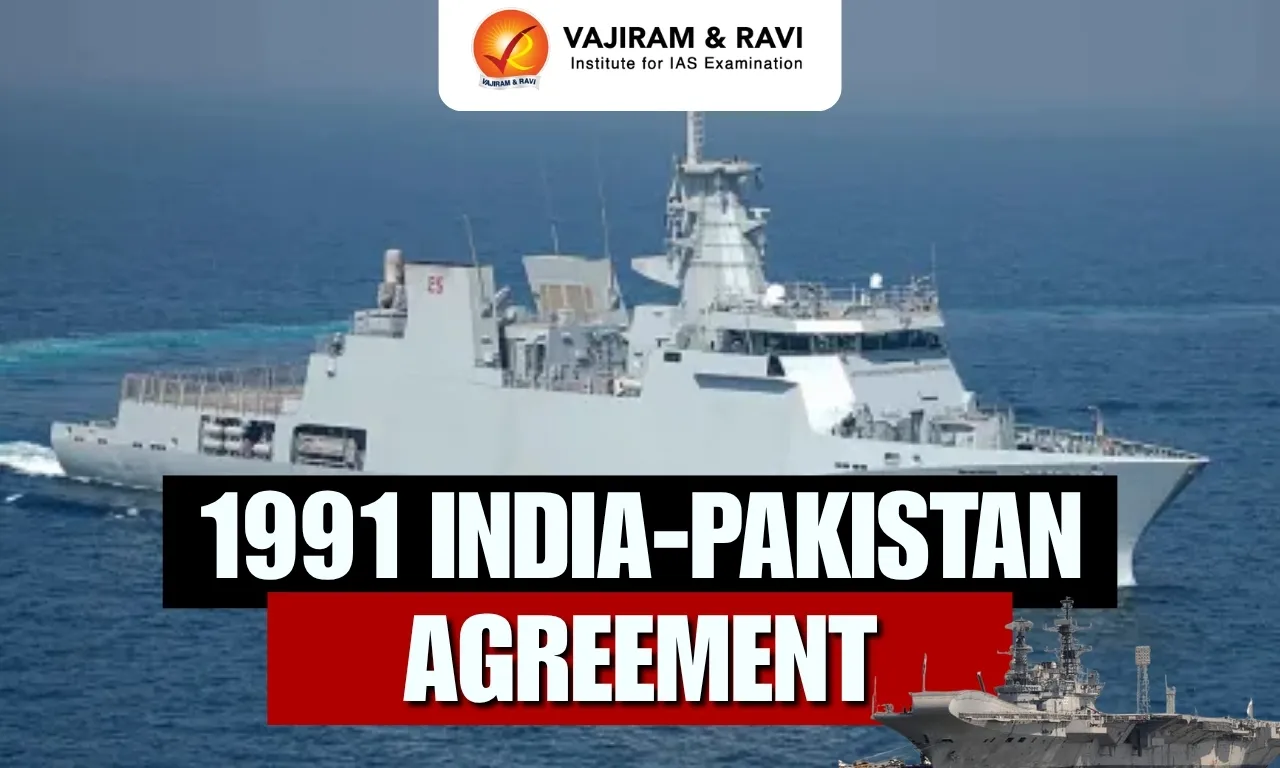
1991 India-Pakistan Agreement: Naval Collision and Grey-Zone Tactics

1991 India-Pakistan Agreement

1991 India-Pakistan Agreement Latest News

  • Recently, Pakistan Naval Ship (PNS) Hunain, a Yarmook-class corvette, approached an Indian Navy warship at high speed in international waters and manoeuvred unsafely, causing a minor collision.
  • The incident occurred about 120 nautical miles from the Gulf of Oman in the North Arabian Sea. 
  • The Indian warship was on a routine surveillance mission and suffered no damage, continuing its mission. PNS Hunain was damaged. 
  • India called the conduct "unacceptable and unprofessional" and a direct violation of Article 10 of the 1991 bilateral agreement on advance notice of military exercises.

The 2011 Precedent

  • This is the second such incident since 2011. In June 2011, the Pakistani warship PNS Babur brushed past the Indian Navy frigate INS Godavari in the Gulf of Aden, causing minor damage to the Indian vessel's helicopter safety net. 
  • That incident was also taken up diplomatically.

Maritime Zones under UNCLOS

  • The incident occurred in international waters. Under the UN Convention on the Law of the Sea:
    • A country's territorial sea extends 12 nautical miles from its coast.
      • One nautical mile equals 1.852 km.
    • The Exclusive Economic Zone (EEZ) extends up to 200 nautical miles, where the coastal state has rights to explore and manage seabed resources.

The 1991 Agreement Explained

  • The Agreement between India and Pakistan on Advance Notice on Military Exercises, Manoeuvres and Troop Movements was signed in April 1991. 
  • Its purpose was to prevent any crisis arising from misreading the other side's intentions. 
  • Key provisions:
    • Major military exercises close to each other's territory should be avoided. If held, they must follow set regulations and the other side must be informed.
    • Advance notice periods: 15 days for certain air and naval exercises, 60 days for corps-level exercises, 90 days for army-level exercises.
    • Either side can seek clarification on assembly of forces, direction, extent and duration of an exercise.
    • Naval definition: A major naval exercise involves six or more ships of destroyer or frigate size and above, exercising together and crossing into the other's EEZ.
    • Article 10: Naval ships and submarines of the two countries must not close within three nautical miles of each other in international waters, to avoid accidents. This is the provision India says was violated.
    • Aircraft rules: Combat aircraft must not fly within 10 km of each other's airspace, including Air Defence Identification Zones. 
      • Exceptions apply for aircraft operating from Jammu, Pathankot, Amritsar and Suratgarh (India) and Pasrur, Lahore, Vehari and Rahimyar Khan (Pakistan), where a 5 km distance applies.
  • On the same day, a companion treaty was signed: the Agreement on Prevention of Air Space Violations and for Permitting Over Flights and Landings by Military Aircraft.

Why the 1991 Agreement Was Signed

  • The 1980s saw a series of confidence-building measures between the two countries. 
  • Contributing factors included both nations' nuclear weapons programmes, which raised the cost of war, and the Soviet invasion of Afghanistan in December 1979, which made Pakistan and the US keen to avoid tension on Pakistan's eastern border. 
  • The immediate trigger was Exercise Brass Tacks IV in January 1987, a massive Indian military exercise in Punjab and Rajasthan. 
  • It involved two opposing corps-level forces, including two armoured divisions and a mechanised division, with simultaneous Air Force and Navy exercises. About 150,000 troops were mobilised. 
  • The scale rattled Pakistan and led to mechanisms for reducing uncertainty.

Ramming as a Naval Tactic

  • Ramming is almost as old as naval warfare. The Greeks and Romans used it as a core weapon. 
  • The first modern instance came in 1862 at the Battle of Hampton Roads during the American Civil War, when CSS Virginia sank the Union frigate Cumberland. 
  • The tactic resurfaced in both World Wars, including the sinking of PT-109 commanded by John F. Kennedy. 
  • It also featured in the Cod Wars between Iceland and the UK over fishing rights.

Grey-Zone Warfare in the Arabian Sea

  • The incident mirrors China's grey-zone tactics in the South China Sea, where Beijing uses its Coast Guard and maritime militia to ram vessels and fire water cannons. 
  • These tactics stay below the threshold of open conflict while advancing strategic goals, exploiting legal ambiguity, similar to salami slicing in Eastern Ladakh
  • Analysts argue that this ambiguity must end: ramming with reinforced hulls or close-range water cannons causing damage comparable to kinetic force should be treated as a grave use of force justifying proportionate self-defence.

Conclusion

  • The PNS Hunain collision violates Article 10 of the 1991 Agreement and signals the arrival of grey-zone tactics in the Arabian Sea. 
  • For two nuclear-armed neighbours, robust rules of engagement at sea are essential to prevent accidents from escalating into crises.

Source: IE |ToI

1991 India-Pakistan Agreement FAQs

Q1: What happened between the Pakistani and Indian naval vessels?

Ans: A Pakistani naval vessel approached an Indian warship at high speed in international waters, manoeuvred unsafely and caused a minor collision in the Arabian Sea.

Q2: What does the 1991 India-Pakistan Agreement regulate?

Ans: The 1991 India-Pakistan Agreement regulates advance notification of military exercises, manoeuvres and troop movements to reduce misunderstandings and prevent potential crises.

Q3: What is Article 10 of the 1991 Agreement?

Ans: Article 10 of the 1991 India-Pakistan Agreement requires naval ships and submarines to maintain at least three nautical miles between them in international waters.

Q4: Why was the 1991 India-Pakistan Agreement signed?

Ans: The 1991 India-Pakistan Agreement emerged from confidence-building efforts following tensions involving nuclear programmes, regional security concerns and the 1987 Exercise Brass Tacks.

Q5: What are grey-zone tactics in maritime conflicts?

Ans: Grey-zone tactics use actions below the threshold of open conflict, such as ramming or water cannons, to pursue strategic objectives while exploiting legal ambiguity.

Plurilateral Trade Agreements: Is India’s BRICS Declaration a Policy Shift?

Plurilateral Trade Agreements

Plurilateral Trade Agreements Latest News

  • India has consistently opposed plurilateral trade agreements at the World Trade Organisation (WTO), insisting that trade rules be negotiated by all members. 
  • But the 2026 BRICS New Delhi Declaration, issued under India's chairship, says members recognise the importance of identifying "pathways" for plurilateral initiatives to enter the WTO legal framework. 
  • This comes just months after India blocked such pacts at the WTO's 14th Ministerial Conference (MC14) in Cameroon in March 2026.

What Plurilateral Agreements Are

  • A plurilateral agreement is a trade deal among a group of WTO members rather than the full membership. 
  • Key features:
    • Countries that join must follow its rules; non-members are generally not bound.
    • Under the Marrakesh Agreement, a plurilateral pact can be added to the WTO rulebook (Annex 4) only by consensus of all members.
    • A multilateral agreement, by contrast, involves the entire WTO membership negotiating rules together.

Why India Opposes Plurilaterals

  • India's objections are systemic rather than issue-specific:
    • Plurilaterals could let a group of powerful or interested countries create new rules without everyone's participation, which is especially risky for developing countries.
    • WTO members should first agree on common safeguards, or "guardrails", for all plurilateral agreements before any single one is added to the rulebook.
    • Adding one agreement first and deciding broader rules later sets a dangerous precedent.

The Investment Facilitation for Development Agreement

  • The clearest test case is the China-backed Investment Facilitation for Development (IFD) agreement, launched by the WTO in 2017 to enhance FDI flows. 
  • At MC14, India blocked its inclusion as an Annex 4 agreement, arguing that:
    • Incorporating IFD risks eroding the WTO's foundational principles and functional limits.
    • Investment is not a core trade issue.
    • Members must first agree on legal safeguards for plurilaterals.
  • As many as 129 members support IFD, leaving India as the primary holdout. 

India's Objection to the E-Commerce Agreement

  • India has also questioned the Western-backed Agreement on Electronic Commerce (ECA). 
    • ECA is the world's first baseline set of global digital trade rules, designed to streamline and secure cross-border digital transactions among participating WTO members.
  • In a recent letter to the WTO, India challenged the legal basis for the Director-General acting as depositary of the ECA. 
  • India pointed out that consensus to add the agreement to Annex 4 was not reached on two occasions and asked on what institutional basis the "interim arrangements" were operating. 
  • According to the WTO Secretariat, 66 members covering about 70 per cent of global trade have adopted a pathway to bring the ECA into force through interim arrangements.

Pressure on India at the Trade Policy Review

  • Several countries targeted India's stance during its trade policy review last month:
    • Canada most prominently opposed India's position on plurilaterals.
    • The EU noted that India has benefited significantly from global trade integration and urged it to see plurilaterals as an opportunity to shape the WTO agenda rather than a threat to multilateralism.
    • Gambia and Costa Rica asked India to withdraw its opposition to IFD.
    • Others urged India to join plurilaterals on fossil fuel subsidy reform, plastics pollution and environmentally sustainable plastics trade.

What the BRICS Declaration Says

  • The New Delhi Declaration commits BRICS members to implementing MC14 outcomes, engaging constructively in WTO reform, and identifying appropriate pathways for plurilateral initiatives into the WTO legal framework, including on development-oriented issues, while exploring forward-looking rules.
    • Notably, the term "guardrails" is absent from the declaration despite India holding the chair. 
    • Experts warn that plurilaterals cannot work for development issues: if developed countries do not join a plurilateral on food security or farm subsidy reduction, the outcome will be meaningless. Such issues must remain multilateral.
  • The declaration also:
    • Strongly advocates immediate restoration of a fully functioning, two-tier binding WTO dispute settlement mechanism and appointment of Appellate Body members without delay.
    • Supports Ethiopia and Iran's bid for WTO accession.
    • Acknowledges China's expansion of zero-tariff treatment to 53 African countries.

Why It Matters for India

  • The direct implication could be India lifting its reservation on IFD, a significant policy shift. 
  • Two sectors are particularly relevant:
    • Services: India has a huge IT and business services industry. If new international services rules emerge, India needs a seat at the table.
    • Digital trade: With over 60 members moving ahead on e-commerce rules through interim arrangements, staying out risks India being bound later by rules it did not shape.

Conclusion

  • The BRICS declaration signals a subtle softening in India's opposition to plurilaterals, driven by mounting international pressure and the risk of isolation. 
  • Yet the missing "guardrails" language and the systemic concerns about IFD and e-commerce remain unresolved. 
  • India must balance openness to shaping new trade rules against protecting the consensus-based multilateralism that safeguards developing countries.

Source: IE | CNBC

Plurilateral Trade Agreements FAQs

Q1: What are plurilateral trade agreements?

Ans: Plurilateral trade agreements are trade deals involving a group of WTO members, where participating countries follow agreed rules while non-members generally remain unbound.

Q2: Why has India opposed plurilateral trade agreements?

Ans: India opposes plurilateral trade agreements because powerful groups could create WTO rules without universal participation, potentially disadvantaging developing countries and weakening consensus.

Q3: What does the BRICS declaration say about plurilateral trade agreements?

Ans: The BRICS declaration supports identifying pathways for plurilateral trade agreements to enter the WTO legal framework, including initiatives concerning development-oriented issues.

Q4: Why is the Investment Facilitation for Development Agreement significant?

Ans: The Investment Facilitation for Development Agreement is significant because India blocked its WTO inclusion, arguing that safeguards for plurilateral trade agreements must be established first.

Q5: What could the BRICS declaration mean for India?

Ans: The BRICS declaration could indicate greater flexibility on plurilateral trade agreements, particularly as India risks being excluded from shaping emerging services and digital trade rules.

MQ-9 Reaper

MQ-9 Reaper

MQ-9 Reaper Latest News

Iran's Islamic Revolutionary Guard Corps claims it shot down a US MQ-9 Reaper drone over Qeshm Island in southern Iran using an advanced air defence system recently.

About MQ-9 Reaper

  • The MQ-9 Reaper (Reaper MQ-9A) is an armed, multi-mission, medium-altitude, long-endurance unmanned aerial vehicle (UAV).
  • It is developed by the American company General Atomics Aeronautical Systems (a United States-based aerospace and defence company), primarily for the United States Air Force (USAF).
  • It is an upgraded version of the MQ-1 Predator and was first deployed in Afghanistan in October 2007. 
  • It is used for strategic and operational reconnaissance, battlefield surveillance, and can directly engage targets. 

MQ-9 Reaper Features

  • It has a wingspan of 66 feet (20 meters) and endurance of more than 27 hours. 
  • It is equipped with a fault-tolerant flight control system and triple redundant avionics system architecture 
  • It is powered by a turboprop engine, integrated with Digital Electronic Engine Control (DEEC), which significantly improves engine performance and fuel efficiency, particularly at low altitudes. 
  • It cruises at roughly 322 to 370 kilometers per hour and can fly at altitudes up to 50,000 feet (15,240 meters), giving it reach across wide areas of operation. 
  • It  can be armed with air-to-ground Hellfire missiles as well as laser-guided bombs.
  • It is remotely operated by a two-person team consisting of a pilot and an aircrew member who operates sensors and guides weapons.

News: TOI

MQ-9 Reaper FAQs

Q1: What is the MQ-9 Reaper?

Ans: An armed, multi-mission, medium-altitude, long-endurance unmanned aerial vehicle (UAV).

Q2: Which company developed the MQ-9 Reaper?

Ans: General Atomics Aeronautical Systems, a U.S.-based aerospace and defence company.

Q3: What are the major roles of the MQ-9 Reaper?

Ans: Strategic and operational reconnaissance, battlefield surveillance, and direct engagement of targets.

Q4: What is the endurance of the MQ-9 Reaper?

Ans: More than 27 hours.

Q5: Which missiles can the MQ-9 Reaper carry?

Ans: Air-to-ground Hellfire missiles.

Cheetah Population in India Rises to 52, Project Cheetah

Cheetah Population in India

Cheetah Population in India has increased to 52 four years after the launch of Project Cheetah, marking a major phase in the country’s efforts to restore the species after its extinction in India. 

According to the four-year status review covering September 2022 to September 2026, the population includes 32 cheetahs born in India. At present, 49 cheetahs are in Kuno National Park and three are in Gandhi Sagar Sanctuary, both in Madhya Pradesh.

How Did the Cheetah Population in India Reach 52?

India began the reintroduction programme in September 2022, when eight cheetahs were brought from Namibia to Kuno National Park. In February 2023, another 12 cheetahs arrived from South Africa. In February 2026, India added nine cheetahs from Botswana.

The growth of the population has increasingly come from natural breeding in India. The four-year review records 32 cubs born in the country after the reintroduction programme began.

Cheetahs from Namibia

  • 8 cheetahs were introduced from Namibia in September 2022.
  • 3 of these cheetahs are currently surviving.
  • They have produced 22 India-born offspring.
  • The surviving Namibian-origin population and its progeny therefore account for 25 cheetahs.

Cheetahs from South Africa

  • 12 cheetahs were introduced from South Africa in February 2023.
  • 8 are currently surviving.
  • They have produced 10 India-born offspring.
  • The South African-origin population and its progeny total 18.
  • Of these, 15 are in Kuno National Park and three are in Gandhi Sagar Sanctuary.

Cheetahs from Botswana

  • 9 cheetahs were introduced from Botswana in February 2026.
  • The group consisted of six females and three males.
  • Their introduction was intended to strengthen the genetic diversity and long-term viability of the Indian cheetah population.

Project Cheetah

Project Cheetah was launched on 17 September 2022 to reintroduce cheetahs in India after the species became extinct in the country in 1952. The programme focuses on establishing a self-sustaining cheetah population through translocation, breeding, habitat management and scientific monitoring.

  • Launch: Project Cheetah was launched on 17 September 2022 at Kuno National Park, Madhya Pradesh.
  • First batch: Eight cheetahs were brought from Namibia in September 2022.
  • South African cheetahs: Another 12 cheetahs were introduced from South Africa in February 2023.
  • Botswana: Nine cheetahs were brought from Botswana in 2026 to strengthen the population and genetic diversity.
  • Current population: India’s cheetah population has reached 52 as of September 17, 2026.
  • India-born cubs: 32 cheetahs have been born in India since the programme began.
  • Major locations: Kuno National Park remains the primary cheetah habitat, while Gandhi Sagar Sanctuary has also become part of the programme.
  • Scientific monitoring: Cheetahs are monitored for their health, movement, breeding, survival and adaptation to Indian environmental conditions.
  • Long-term objective: The programme aims to establish a viable and self-sustaining cheetah population across suitable landscapes in India.
  • Ecological objective: The reintroduction is also intended to help restore the ecological role of the cheetah in grassland, savanna and open-forest ecosystems.

Role of Gandhi Sagar Sanctuary

Gandhi Sagar Sanctuary in Madhya Pradesh is an important second habitat under Project Cheetah, helping expand the reintroduction programme beyond Kuno National Park. It provides additional space for cheetahs to establish territories, breed and contribute to the development of a self-sustaining cheetah population in India.

  • Second major cheetah habitat: It complements Kuno National Park and helps diversify the geographical distribution of cheetahs.
  • Current population: Three cheetahs are currently housed in Gandhi Sagar Sanctuary.
  • Habitat expansion: Its inclusion allows the programme to gradually expand into additional landscapes suitable for cheetah conservation.
  • Population management: Having more than one conservation site can help reduce excessive dependence on a single protected area.
  • Breeding potential: The sanctuary can support future breeding and the establishment of additional cheetah groups.
  • Landscape connectivity: Gandhi Sagar can contribute to the development of a larger network of suitable habitats and movement corridors.
  • Long-term conservation: Its role is linked to India's broader objective of creating a viable and genetically diverse cheetah meta-population.

Why Is the Rise in Cheetah Population Significant?

The increase in the cheetah population in India is important for several ecological and conservation reasons:

  • Restoration of an extinct species: The cheetah was declared extinct in India in 1952.
  • Natural breeding: The presence of 32 India-born cheetahs indicates that reproduction has occurred successfully after reintroduction.
  • Second-generation survival: The survival of cubs born to India-born cheetahs represents a further step towards population establishment.
  • Expansion of habitat: The programme has moved beyond Kuno towards Gandhi Sagar and other potential landscapes.
  • Ecological restoration: Cheetahs occupy an important position as predators in grassland and open-forest ecosystems.
  • Scientific conservation: Continuous monitoring provides data on behaviour, movement, health, breeding and adaptation.
  • Long-term population building: The objective is gradually shifting from bringing animals to India towards establishing a sustainable population.

About Cheetah

The cheetah (Acinonyx jubatus) is the world’s fastest land animal and is highly adapted to open landscapes. Its slender body, long legs, flexible spine and specialised claws help it achieve high speeds while hunting.

  • Habitat: Cheetahs mainly inhabit open grasslands, savannas, scrublands, semi-arid areas and open woodlands, where visibility is important for hunting.
  • Speed: They can reach around 100–120 km/h over short distances, making them the fastest land animals.
  • Physical features: A cheetah has a slender body, long legs, long tail and semi-retractable claws that provide grip while running.
  • Tear marks: The distinctive black tear-like lines from the eyes towards the mouth may help reduce sunlight glare and improve focus during hunting.
  • Diet: Cheetahs primarily feed on small and medium-sized mammals, including gazelles, antelopes and hares.
  • Scent marking: They use urine, faeces and scent to communicate and may mark prominent objects such as trees, bushes, rocks and termite mounds.
  • Social behaviour: Females generally live alone with their cubs, while males may form coalitions, often with brothers.

Cheetah Population in India FAQs

Q1: How many cheetahs are there in India in 2026?

Ans: The cheetah population in India is 52 as of the four-year status review covering 2022, to September 2026.

Q2: How many cheetahs were born in India?

Ans: A total of 32 cheetahs were born in India after the reintroduction programme began.

Q3: Where are cheetahs found in India?

Ans: Currently, 49 cheetahs are in Kuno National Park and three are in Gandhi Sagar Sanctuary, both in Madhya Pradesh.

Q4: When was Project Cheetah launched?

Ans: Project Cheetah was launched on 17 September 2022, when eight cheetahs from Namibia were introduced into Kuno National Park.

Q5: From which countries were cheetahs brought to India?

Ans: Cheetahs have been brought to India from Namibia, South Africa and Botswana.

UPI Merchant Charges Above ₹2,000, New MDR Rules from 15th October

UPI MDR 2026

National Payments Corporation of India (NPCI) has introduced a new Merchant Discount Rate (MDR) framework for selected UPI person-to-merchant (P2M) transactions. From October 15, 2026, a 0.4% MDR will apply to eligible UPI merchant transactions above ₹2,000. The new framework is aimed at supporting the long-term sustainability, infrastructure and security of the digital payments ecosystem.

What is UPI MDR?

Merchant Discount Rate (MDR) is a fee associated with accepting digital payments. It is generally paid within the payment ecosystem by the merchant side and is distributed among participating entities such as banks, payment service providers and payment application providers.

In the case of UPI, MDR is being introduced for a specified category of person-to-merchant transactions above ₹2,000. It is important to note that MDR is not a tax collected by the government. The revenue remains within the payment ecosystem to support its functioning and expansion.

Why has NPCI Introduced MDR on UPI Transactions?

UPI has grown into a large-scale digital payment infrastructure handling billions of transactions every month. With the expansion of the network, payment infrastructure requires continued investment in technology, cybersecurity, fraud prevention, server capacity and customer support.

The new MDR framework provides a revenue mechanism within the payment ecosystem while keeping everyday low-value transactions free. NPCI and the government have also emphasised the need to protect small merchants and ordinary users from additional costs.

Major reasons behind the introduction of MDR

  • Financial sustainability: A revenue mechanism can support the continued operation and expansion of the UPI ecosystem.
  • Infrastructure development: UPI requires continuous investment in payment infrastructure and technology.
  • Cybersecurity: Growing digital payments require stronger systems for preventing fraud and cyber threats.
  • Innovation: Revenue can support technological improvements and new payment solutions.
  • Consumer protection: The framework keeps P2P payments and low-value merchant payments free.
  • Support for small businesses: Eligible small merchants continue to receive zero-MDR benefits.
  • Reduced dependence on government incentives: A payment ecosystem with its own revenue mechanism can reduce dependence on continued public funding.

What is the New 0.4% UPI MDR Rule?

Under the UPI New Rules 2026 framework, a 0.4% MDR will apply to specified person-to-merchant UPI transactions above ₹2,000 from October 15, 2026.

For example, if an eligible merchant receives a ₹3,000 UPI payment, the standard MDR would be ₹12. Similarly, a ₹50,000 eligible transaction would attract ₹200 MDR. For transactions of ₹75,000 and above, the MDR is capped at ₹300 per transaction.

Impact of UPI MDR on Merchants and Consumers

The new UPI MDR framework will mainly affect eligible merchants receiving higher-value UPI payments, while ordinary consumers will continue to use most UPI services without direct charges. The policy aims to maintain affordable digital payments while supporting the financial sustainability of the UPI ecosystem.

  • Consumers: P2P transactions and merchant payments up to ₹2,000 remain free.
  • Merchants: Eligible P2M transactions above ₹2,000 will attract 0.4% MDR.
  • Small merchants: Eligible small merchants continue to benefit from zero MDR.
  • No direct consumer charge: MDR is not intended to be separately recovered from customers.
  • Digital payment ecosystem: MDR can provide a revenue stream for maintaining payment infrastructure, cybersecurity and innovation.
  • Higher-value transactions: Transactions of ₹75,000 and above have an MDR cap of ₹300 per transaction.

Significance of UPI MDR for India’s Digital Payments Ecosystem

The introduction of UPI MDR is significant because it creates a revenue mechanism for supporting the rapidly expanding digital payments infrastructure while keeping most everyday UPI transactions free.

  • Financial sustainability: Provides a revenue stream to support the long-term functioning of the UPI ecosystem.
  • Stronger infrastructure: Can support investment in payment technology, processing capacity and system upgrades.
  • Better cybersecurity: Growing digital transactions require continuous investment in fraud prevention and cybersecurity.
  • Continued innovation: Revenue within the ecosystem can support development of new digital payment solutions.
  • Protection of small users: P2P payments and merchant transactions up to ₹2,000 remain free.
  • Support for small merchants: Eligible small merchants continue to receive zero-MDR benefits.
  • Growth of Digital Public Infrastructure: Strengthens the sustainability of UPI as a major component of India's Digital Public Infrastructure (DPI).
  • Balanced approach: The framework attempts to combine affordable digital payments with the long-term sustainability of payment infrastructure.

About National Payment Corporation of India (NPCI)

National Payments Corporation of India (NPCI) is an umbrella organisation for operating and developing retail payment and settlement systems in India, established as an initiative of the Reserve Bank of India (RBI) and the Indian Banks’ Association (IBA).

  • Established: 2008
  • Headquarters: Mumbai, Maharashtra
  • Legal status: Section 8 company under the Companies Act, 2013
  • Key role: Develops and operates retail payment systems in India.
  • Major payment systems: UPI, RuPay, IMPS, Bharat BillPay, FASTag (NETC) and AePS.
  • Ownership: Promoted by RBI and IBA, with ownership held by member banks.
  • Importance: Acts as a key institution in India's digital payments ecosystem.

UPI MDR 2026 FAQs

Q1: What is UPI MDR?

Ans: UPI MDR (Merchant Discount Rate) is the fee charged to eligible merchants for accepting certain UPI payments. From October 15, 2026, a 0.4% MDR will apply to specified person-to-merchant transactions above ₹2,000.

Q2: When will the new UPI MDR rule come into effect?

Ans: The new UPI MDR framework will come into effect from October 15, 2026.

Q3: Will UPI payments above ₹2,000 be charged to consumers?

Ans: No. The MDR is a merchant-side charge, and consumers will continue to make UPI payments without a separate transaction fee.

Q4: What is the MDR rate for UPI transactions above ₹2,000?

Ans: The standard MDR is 0.4% for eligible person-to-merchant UPI transactions above ₹2,000.

Q5: What is the maximum UPI MDR that can be charged?

Ans: For transactions of ₹75,000 and above, the MDR is capped at ₹300 per transaction.

Daily Editorial Analysis 17 September 2026

Daily-Editorial-Analysis

Mining Amendment is Unfair to States 

Context

  • India’s mineral resources are concentrated in States such as Odisha, Jharkhand, Chhattisgarh and Karnataka.
  • These resources support industrialisation, employment and public revenue. However, mining also causes displacement, environmental degradation, infrastructure pressure and depletion of non-renewable resources.
  • The Mines and Minerals (Development and Regulation) Amendment Act, 2026 raises important questions about the distribution of mining benefits and burdens.
  • Although the amendment seeks to promote investment, it has significant implications for State fiscal autonomy, constitutional federalism and resource justice.

Mineral Wealth and Unequal Regional Development

  • India’s mineral economy reflects the geographical concentration of natural resources.
  • Odisha, Jharkhand, Chhattisgarh and Karnataka possess valuable deposits of coal, iron ore and other minerals that supply industries across the country.
  • Mining generates investment, employment and industrial growth. Royalties, auction premiums and other payments strengthen State finances.
  • However, mineral-producing regions frequently bear the direct costs of extraction, including:
  • Displacement and resettlement of communities.
  • Environmental damage and ecological loss.
  • Pressure on roads, water supply, healthcare and other public infrastructure.
  • Long-term economic consequences of extracting non-renewable resources.

Section 9D and the Question of State Revenue

  • Section 9D restricts State Governments from imposing taxes, cesses or other levies on mineral rights or mineral-bearing land except under conditions prescribed by the Centre.
  • The Central Government argues that the provision will create a predictable taxation environment, prevent excessive levies and encourage long-term investment.
  • Mining projects involve substantial capital and operate over extended periods, making financial stability important for investors.
  • However, the issue extends beyond existing revenues. The Centre maintains that 90% of mining sector revenue accrues to States and that this arrangement will continue.
  • The larger concern is whether States will retain the ability to raise additional revenue from mineral resources in the future.
  • A mineral-rich State possesses a natural economic advantage. Restricting its ability to use that advantage for development may reduce its fiscal flexibility.
  • NITI Aayog’s Fiscal Health Index has recognised the revenue mobilisation performance of Odisha and Chhattisgarh and the role of mining receipts.

The Federal Problem

  • Under Entry 50 of the State List, States possess the power to tax mineral rights, subject to limitations imposed by Parliament through laws relating to mineral development.
  • The 2026 Amendment raises questions about the extent to which Parliament can restrict these powers through mineral-development legislation.
  • While Entry 50 permits limitations on taxation of mineral rights, extending restrictions to mineral-bearing land may create a separate constitutional issue concerning Entry 49.
  • The amendment therefore raises a broader question: can a Central law regulating mineral development substantially restrict a State’s independent power to tax land?

Fiscal Federalism and Resource Justice

  • India’s federal system requires States to perform important responsibilities while possessing adequate financial resources.
  • Mineral-producing States often bear the direct consequences of extraction, including environmental damage, infrastructure stress and social displacement.
  • If States are prevented from raising resources from mineral wealth, they may face difficulties financing the development needs of affected communities.
  • This creates a potential imbalance between national benefits and regional costs.
  • Fiscal federalism requires a balance between national economic objectives and the financial autonomy necessary for States to fulfil their responsibilities.
  • Uniformity may encourage investment, but excessive centralisation can weaken the ability of States to respond to their own economic and environmental conditions.

The Way Forward: Balancing Investment and State Autonomy

  • The debate over the MMDR Amendment should not be reduced to a choice between investment and taxation. Both objectives are important.
  • Investors require stable rules, transparent taxation and long-term certainty. States require adequate revenue, constitutional authority and the ability to finance public services.
  • A balanced approach would seek to:
    • Maintain predictable taxation for mining investors.
    • Preserve the constitutional powers of State Governments.
    • Ensure adequate compensation for extraction-related costs.
    • Strengthen transparency in the distribution of mining revenues.
    • Encourage cooperation between the Centre and States in mineral policy.
    • Such an approach would recognise that national industrial development depends partly on the economic and social stability of mineral-producing regions.

Conclusion

  • The MMDR Amendment, 2026, represents an important development in India’s mining and federal governance framework.
  • Section 9D seeks to promote investment certainty and prevent excessive levies, but it also raises questions about the future fiscal autonomy of mineral-rich States.
  • A sustainable mining policy must combine investment certainty, fiscal federalism, environmental responsibility and equitable resource distribution.
  • The long-term success of India’s mineral economy will depend not only on how much wealth is extracted, but also on how fairly that wealth and its costs are shared.

Mining Amendment is Unfair to States FAQs

Q1. What is the main purpose of the MMDR Amendment, 2026?
Ans. The amendment aims to promote investment certainty and regulate State taxation of mineral resources.

Q2. Which provision restricts State taxation powers?
Ans. Section 9D restricts State Governments from imposing certain levies on mineral rights and mineral-bearing land.

Q3. Why is mining important for mineral-rich States?
Ans. Mining generates revenue, employment and industrial development in mineral-rich States.

Q4. What constitutional issue does the amendment raise?
Ans. The amendment raises questions about the balance between Parliament’s mineral-development powers and State taxation powers.

Q5. What is essential for sustainable mining?
Ans. Sustainable mining requires investment certainty, fiscal federalism, environmental responsibility and equitable resource distribution.

Source: The Hindu


Blue Revolution - Unlocking India’s Maritime Potential for Inclusive and Sustainable Growth

Context

  • India’s development strategy increasingly emphasises inclusive growth, with the idea of Sabka Saath, Sabka Vikas, Sabka Vishwas, Sabka Prayas.
  • The next phase of this inclusive growth can come from India’s vast marine and fisheries resources, particularly through sustainable exploitation of the Exclusive Economic Zone (EEZ) and high seas.
  • The approach seeks to transform geographical and economic marginalisation into opportunity by recognising backward districts as Aspirational Districts, border settlements as Vibrant Villages, and the Northeast as Ashtalakshmi.

From Green and White to Blue Revolution

  • India’s development experience has witnessed major transformations -
    • Green revolution: Addressed food shortages and strengthened India’s contribution to global food security. India is now among the leading producers of rice, wheat, pulses and millets.
    • White revolution: Eliminated chronic milk shortages and dependence on dairy imports, making India the world’s largest milk producer.
    • Blue revolution: The fisheries and aquaculture sector represents the next major opportunity for food security, nutrition, employment and exports.
  • The blue economy broadly refers to the sustainable use of ocean resources for economic growth, improved livelihoods and employment while preserving marine ecosystem health.

India’s Untapped Maritime Potential

  • India has over 11,000 km of coastline; an EEZ of nearly 24 lakh sq km; and a rich maritime heritage and substantial marine biodiversity.
  • Despite this potential, fishing historically remained concentrated close to the coastline.
  • The deep waters of the EEZ and high seas offer opportunities for sustainable harvesting of high-value species such as tuna.
  • The creation of the Ministry of Fisheries, Animal Husbandry and Dairying in 2019 gave dedicated institutional attention to fisheries.
  • The sector has subsequently emerged as a sunrise sector. India is now the 2nd-largest fish-producing country, contributing around 8% of global fish production.
  • Fisheries and aquaculture support the livelihoods of nearly 3 crore fishers and fish farmers, while fish production exceeded 195 lakh tonnes in 2024-25.

Policy Push for Deep-Sea and High-Sea Fisheries

  • The Union Budget 2025-26 recognised the untapped potential of India’s deep waters and proposed an enabling framework for sustainable fisheries in the EEZ and high seas.
  • The Fisheries Rules for the EEZ and Guidelines for Fisheries in the High Seas, 2025 mark an important shift towards expanding India’s marine fishing frontier while keeping conservation at the centre.
  • A key feature is placing traditional fishing communities and their collective institutions at the centre.
  • Priority is given to fisheries cooperatives; Fish Farmer Producer Organisations (FFPOs); and Indian fishermen.
  • This can enable fishing communities to access deeper waters, modern technology, finance and markets rather than allowing expansion to benefit only large commercial operators.

Lakshadweep - A Strategic Maritime Asset

  • Lakshadweep illustrates India’s enormous maritime potential.
  • Despite having a land area of only around 32 sq km, it possesses nearly 145 km coastline; lagoon area of about 4,200 sq km; territorial waters exceeding 20,000 sq km; and EEZ of about 4 lakh sq km.
  • Thus, Lakshadweep accounts for nearly one-sixth of India’s EEZ, highlighting the strategic and economic significance of India’s island territories.
  • The Pradhan Mantri Matsya Sampada Yojana (PMMSY) has also supported fisheries development projects in Lakshadweep.

Fisheries as an Engine of Jobs, Exports and Women’s Participation

  • India’s seafood reaches more than 120 countries. Seafood exports crossed ₹73,000 crore in the last financial year mentioned, representing a rise of over 140% since 2013-14.
  • Greater use of digital authorisation systems; vessel tracking; international certification; processing and quality-control systems can improve traceability, market access and India’s competitiveness in premium seafood markets.
  • Deep-sea fisheries can generate employment beyond fishing itself, including processing, cold chains, transportation, packaging, logistics and exports.
  • This creates opportunities for youth and can expand women’s participation in processing and value addition.

Sustainability Must Accompany Expansion

  • The expansion of marine fisheries must not compromise ocean ecosystems.
  • Unsustainable fishing, overexploitation and Illegal, Unreported and Unregulated (IUU) fishing can undermine long-term food security and livelihoods.
  • The new framework therefore emphasises compliance with conservation measures; sustainable harvesting; monitoring and vessel tracking; action against IUU fishing; and responsible exploitation of marine resources.

Way Forward:

  • For India’s Blue Economy to become genuinely inclusive, the focus should extend from merely increasing fish production to developing a complete marine value chain.
  • This requires -
    • Modern technology: GPS, satellite monitoring, deep-sea fishing technology and digital traceability.
    • Access to finance: Affordable credit and insurance for small fishers and cooperatives.
    • Cold-chain infrastructure: Reducing post-harvest losses and improving export quality.
    • Skill development: Training youth in modern fisheries, navigation, processing and marine technologies.
    • Women-led value addition: Greater participation in processing, packaging and marketing.
    • Marine conservation: Science-based catch limits, sustainable fishing practices and stronger action against IUU fishing.
    • Cooperative approach: Strengthening fisheries cooperatives and FFPOs so that local communities capture a larger share of value.

Conclusion:

  • The Blue Revolution can become an important pillar of Viksit Bharat @ 2047 by combining economic opportunity with ecological responsibility.
  • Therefore, fishing must not merely remain an inherited occupation but as a modern, technology-driven and globally connected profession balancing the ‘triple bottom line’ of economic viability, social equity and ecological sustainability.

Blue Revolution FAQs

Q1. What is the significance of the Blue Revolution for India’s inclusive growth?

Ans. It can enhance food and nutritional security, employment, exports, coastal livelihoods and women’s participation.

Q2. Why are India’s EEZ and high seas important for the future of fisheries?

Ans. India’s nearly 24 lakh sq km EEZ offers substantial untapped potential for sustainable deep-sea fishing.

Q3. How can deep-sea fisheries contribute to employment generation?

Ans. By creating jobs across the harvesting–processing–cold chain–transportation–packaging–logistics–export value chain.

Q4. What are the major sustainability concerns associated with expansion of marine fisheries?

Ans. Fisheries expansion must address overfishing, marine ecosystem degradation and IUU fishing.

Q5. What measures are required to make India’s Blue Economy inclusive and sustainable?

Ans. India needs modern technology, affordable finance, cold-chain infrastructure, skill development, etc.

Source: IE


What India’s Growth Really Means

Context

  • India's real GDP grew 7.8 per cent in April–June 2026, exceeding the RBI's forecast of 7 per cent despite the West Asian conflict, high energy prices and uncertain global trade.
  • In this context, this article highlights that the true significance of this number lies in the breadth of production and demand.
  • It also argues that India must now convert this momentum into private investment, quality jobs and domestic resilience.

A Sustained Growth Trajectory

  • The latest quarter continues a strong run:
    • 2023-24: 7.2 per cent
    • 2024-25: 7.1 per cent
    • 2025-26: 7.7 per cent
    • April–June 2026: 7.8 per cent
  • Real GDP, the value of goods and services after adjusting for inflation, rose to Rs 81.36 lakh crore.
  • Real Gross Value Added (GVA), the value added by farms, factories and services before product taxes and subsidies, grew 8.2 per cent to Rs 82 lakh crore.

Broad-Based Production Growth

  • Growth is spread across sectors, with a few identifiable weak spots:
    • Manufacturing:2 per cent;
    • Utilities:9 per cent;
    • Construction:7 per cent;
    • Secondary sector overall:6 per cent;
    • Services: 10 per cent, led by finance, real estate, IT and professional services at 12.1 per cent;
    • Agriculture:6 per cent;
    • Mining: contracted 2.4 per cent.

Strong Demand Indicators

The Investment Composition

  • Using GFCF data for 2023-24, analysts break down who is investing:
    • Private corporations: 10.3 per cent of GDP;
    • General government: 4.2 per cent of GDP;
    • Total public sector (including public corporations): 7.8 per cent of GDP;
    • Total non-public investment (including household investment in housing and unincorporated businesses): 24.1 per cent of GDP.
  • The lesson is clear. Public capital expenditure has built the platform, but the next acceleration requires more private investment.

Understanding the Base Year Change

  • The base year was updated from 2011-12 to 2022-23. A base year removes inflation and reflects the economy's structure.
  • Updating it replaces an outdated market basket with today's products, services and prices.
  • Some estimates may rise and others fall, but "changing the ruler does not shrink the economy."

India Among the Fastest-Growing Major Economies

  • On comparable year-on-year data, India's 7.8 per cent exceeded:
    • Malaysia: 6 per cent
    • Singapore:9 per cent
    • Indonesia:29 per cent
    • China: 4.3 per cent
  • India's expanding market supports global demand for energy, technology, machinery and services, while offering a trusted location for diversified supply chains.
  • This advances India's path to becoming the world's third-largest economy in nominal terms.
  • But since rankings also reflect prices and exchange rates, the milestone will endure only if real growth leads to higher productivity, stronger firms and better household incomes.

Employment: The Decisive Test

  • India added 19 crore jobs between 2014-15 and 2023-24, according to RBI KLEMS-based data.
  • The next employment revolution must focus on job quality through productivity, wages, formalisation, social security and skilling.
  • Women's labour force participation reached 7 per cent in 2023-24.
  • Bringing more women into productive employment requires safe transport, affordable childcare, flexible work, and access to credit and markets.

The Agenda for the Next Phase

  • Manufacturing must move from assembly to design, components, machinery, electronics and clean technology.
  • Services must spread beyond metros into tourism, health, education, logistics, finance and Indian-language digital businesses.
  • AI preparedness must move from adoption to original capability through domestic compute, Indian-language data, research talent and trusted applications.
  • Free Trade Agreements must be properly used. An FTA utilisation mission should guide firms on tariff rules and markets.
  • MSMEs need hand-holding on non-tariff barriers through shared testing, affordable certification, standards, customs support and buyer discovery.

Energy and Domestic Resilience

  • External ambition requires domestic resilience. India should counter energy risks through diversified suppliers, long-term contracts, strategic reserves, renewables, domestic exploration and efficiency.
  • Timely infrastructure, predictable regulation, easier credit and stable taxation can crowd in private investment.

Conclusion

  • The 7.8 per cent quarter warrants confidence, not complacency.
  • India must convert public capital expenditure into private investment, job numbers into quality employment, and FTAs into opportunities for MSMEs.
  • If energy and macroeconomic stability accompany inclusion, productivity and transparent measurement, becoming the third-largest economy will be a foundation for broad-based prosperity rather than a mere statistical milestone.

What India’s Growth Really Means FAQs

Q1. What was India’s real GDP growth in April–June 2026?

Ans. India’s real GDP grew 7.8 per cent in April–June 2026, exceeding the RBI’s 7 per cent forecast despite global economic uncertainties.

Q2. Which sectors contributed significantly to India’s growth?

Ans. Manufacturing, utilities, construction and services contributed strongly, with services growing 10 per cent and manufacturing expanding 9.2 per cent during the quarter.

Q3. What do demand indicators reveal about India’s growth?

Ans. Demand indicators remained strong, with gross fixed capital formation growing 11.9 per cent, private consumption 7.1 per cent and real exports 12 per cent.

Q4. Why is greater private investment important for India’s growth?

Ans. Public capital expenditure has created the investment platform, but India’s growth needs stronger private investment to sustain the next phase of economic acceleration.

Q5. What should India focus on to sustain economic growth?

Ans. India should strengthen manufacturing, services, AI capabilities, MSMEs, energy security and private investment while improving employment quality, productivity and domestic resilience.

Source: TH

Daily Editorial Analysis 2026 FAQs

Q1: What is editorial analysis?

Ans: Editorial analysis is the critical examination and interpretation of newspaper editorials to extract key insights, arguments, and perspectives relevant to UPSC preparation.

Q2: What is an editorial analyst?

Ans: An editorial analyst is someone who studies and breaks down editorials to highlight their relevance, structure, and usefulness for competitive exams like the UPSC.

Q3: What is an editorial for UPSC?

Ans: For UPSC, an editorial refers to opinion-based articles in reputed newspapers that provide analysis on current affairs, governance, policy, and socio-economic issues.

Q4: What are the sources of UPSC Editorial Analysis?

Ans: Key sources include editorials from The Hindu and Indian Express.

Q5: Can Editorial Analysis help in Mains Answer Writing?

Ans: Yes, editorial analysis enhances content quality, analytical depth, and structure in Mains answer writing.

World Patient Safety Day 2026, Theme, Objectives, Significance

World Patient Safety Day 2026

World Patient Safety Day 2026 will be observed on 17 September 2026 to spread awareness about the importance of patient safety and quality healthcare. The day highlights the need to prevent avoidable harm, improve healthcare practices and strengthen coordination among patients, healthcare workers and health systems. It also encourages global efforts to make healthcare safer, more accessible and patient-centred. 

World Patient Safety Day 2026 Date and Theme

  • World Patient Safety Day 2026 will be observed on 17 September 2026 to promote awareness about patient safety and reduce avoidable harm during healthcare.
  • The Theme of World Patient Safety Day 2026 is “Safe care for noncommunicable diseases”.
  • The campaign slogan for 2026 is “Safe care for life!”, highlighting the need for safe and continuous healthcare for people living with noncommunicable diseases(NCDs).
  • NCDs include long-term conditions such as cardiovascular diseases, cancer, diabetes and chronic respiratory diseases. These conditions often require regular treatment and long-term interaction with healthcare systems.
  • According to the World Health Organization (WHO), around 1 in 10 patients experiences harm during healthcare, and about half of this harm is considered preventable.
  • People living with NCDs can face greater safety risks because they often need repeated consultations, medicines, tests, treatments and follow-up care over many years.
  • The 2026 campaign focuses on making NCD care safe, continuous, coordinated and patient-centred across prevention, diagnosis, treatment, long-term management, rehabilitation, palliative care and self-care.
  • As part of the global campaign, landmarks, buildings and public spaces around the world will be illuminated in orange on 17 September to show support for safer NCD care.
  • In 2026, WHO will also illuminate the Jet d’Eau in Geneva as part of the World Patient Safety Day campaign.

World Patient Safety Day 2026 Significance and Objectives

  • World Patient Safety Day 2026 draws attention to the safety challenges faced by people living with NCDs and the need to prevent avoidable harm throughout their care journey.
  • Long-term and complex treatment can create several points where safety problems may occur, including diagnostic delays, medication errors, poor communication, gaps in follow-up and fragmented care.
  • The campaign stresses the importance of stronger primary healthcare systems so that people can receive safe and well-coordinated care close to their communities.
  • It also highlights the role of health workers, who need proper support, resources and systems to provide safe diagnosis, treatment and medication management.
  • People living with NCDs, along with their families and caregivers, are encouraged to become active partners in healthcare and help identify risks and develop practical solutions.
  • The campaign also recognises that patient safety is influenced not only by healthcare services but also by health system challenges and wider social and economic factors.
  • The main objectives of World Patient Safety Day 2026 include:
    • Creating global awareness about patient safety risks associated with NCDs across the entire continuum of care.
    • Encouraging patient and community participation in identifying safety concerns and developing solutions with healthcare professionals and policymakers.
    • Promoting patient safety principles in NCD-related laws, policies, strategies and healthcare programmes.
    • Supporting healthcare workers in improving practices such as safer diagnosis, medication safety and meaningful patient engagement.
  • The campaign calls for coordinated action by governments, healthcare professionals, patients, communities, policymakers and other stakeholders to make NCD care safer throughout life.

World Patient Safety Day History and Importance

  • World Patient Safety Day is an official WHO global public health day observed every year on 17 September.
  • It was established by the World Health Assembly in 2019 through the Resolution on Global Action on Patient Safety.
  • The Day was created to increase global awareness about patient safety, bring different stakeholders together and encourage action to reduce avoidable harm in healthcare.
  • Every year, World Patient Safety Day focuses on a specific patient safety issue, providing a common platform for patients, families, caregivers, health workers, healthcare leaders, policymakers and communities.
  • Patient safety is important because healthcare can involve complex procedures, medicines, diagnosis, medical devices and long-term treatment. Weak coordination or communication can increase the risk of preventable harm.
  • The 2026 focus on noncommunicable diseases is particularly significant because people with NCDs may require healthcare services repeatedly and across different settings for long periods.
  • The Day promotes the idea that safer healthcare requires shared responsibility. Healthcare institutions and professionals have an important role, but patients, families, communities and policymakers also contribute to improving safety.
  • Through awareness campaigns, policy discussions, technical events and community initiatives, World Patient Safety Day encourages countries and organisations to take practical steps towards safer and better-quality healthcare.

World Patient Safety Day 2026 FAQs

Q1: When is World Patient Safety Day 2026 observed?

Ans: World Patient Safety Day 2026 will be observed on 17 September 2026.

Q2: What is the theme of World Patient Safety Day 2026?

Ans: The theme of World Patient Safety Day 2026 is “Safe care for noncommunicable diseases”.

Q3: What is the slogan of World Patient Safety Day 2026?

Ans: The slogan for World Patient Safety Day 2026 is “Safe care for life!”.

Q4: Why is World Patient Safety Day celebrated?

Ans: It is observed to raise awareness about patient safety, reduce avoidable harm in healthcare and encourage safer and better-quality care.

Q5: Who established World Patient Safety Day?

Ans: World Patient Safety Day was established by the World Health Assembly in 2019 through a resolution on global action on patient safety.

Swachhata Hi Seva Campaign 2026, Theme, Five Pillars, Significance

Swachhata Hi Seva Campaign 2026

Swachhata Hi Seva Campaign 2026 has started across India from 17 September 2026. The campaign will continue until 17 October 2026 and focuses on making cleanliness a shared responsibility through active participation by citizens, institutions, local bodies and government agencies.

What is Swachhata Hi Seva Campaign?

Swachhata Hi Seva is an annual cleanliness campaign that brings together citizens, government institutions, local bodies, schools, youth groups and other organisations for voluntary cleanliness activities.

The campaign has been organised annually since 2017. In 2026, the focus has expanded beyond one-time cleanliness drives to include behavioural change, scientific waste management, safety and dignity of sanitation workers, youth participation and waste-to-wealth initiatives.

The campaign follows a Whole of Government and Whole of Society approach, meaning that cleanliness is treated as a collective responsibility rather than the responsibility of a single department or local authority.

Swachhata Hi Seva Campaign 2026 Theme

The theme of the campaign is: “Swachhata Mein Sahbhag; Swachh Bharat, Viksit Bharat”. The theme places Jan Bhagidari, or people's participation, at the centre of the campaign. It seeks to encourage citizens to take ownership of cleanliness in their homes, neighbourhoods, workplaces, schools and public spaces.

Five Key Pillars of Swachhata Hi Seva 2026

Swachhata Hi Seva 2026 campaign is built around five key pillars that focus on cleanliness, public participation, youth engagement, sanitation worker welfare and waste management. Together, these pillars aim to promote sustained cleanliness through a Whole of Government and Whole of Society approach.

  • Transformation of Cleanliness Target Units and Clean Public Places: Focuses on the cleaning, transformation and maintenance of neglected areas, public places and high-footfall locations.
  • Swachh Paathshala – Yuva for Swachhata: Encourages students and youth to participate in cleanliness activities and develop awareness about waste management and environmental responsibility.
  • Safai Mitra Suraksha Evam Samman Shivir: Focuses on the safety, health, welfare and dignity of Safai Mitras through dedicated support and awareness activities.
  • Jan Bhagidari for Swachhata: Promotes citizen participation and community ownership through shramdaan, cleanliness drives and awareness campaigns.
  • Swachhata Se Samriddhi: Links cleanliness with economic opportunities by promoting recycling, waste-to-wealth, resource recovery and circular economy practices.

Focus on Solid Waste Management Rules, 2026

The campaign promotes awareness of the Solid Waste Management Rules, 2026, with emphasis on source segregation, scientific waste management, stakeholder responsibilities and resource recovery.

  • Four-way source segregation of waste at the point of generation.
  • Clear roles and responsibilities of different stakeholders in waste management.
  • Promotion of scientific collection, transportation, processing and disposal of solid waste.
  • Greater focus on recycling, reuse and resource recovery.
  • Encourages circular economy and waste-to-wealth practices.
  • Promotes responsible participation by citizens, local bodies, institutions and waste generators.
  • Focus on reducing littering, open dumping and improper waste disposal.

Swachh Bharat Diwas 2026

Swachh Bharat Diwas 2026 will be observed on 2 October 2026 as part of the Swachhata Hi Seva Campaign. The day will focus on strengthening Jan Bhagidari and creating awareness about cleanliness and responsible waste management. Special Gram Sabhas in rural areas and Council Meetings in urban areas will discuss the campaign’s progress and the Solid Waste Management Rules, 2026. Plantation activities under Ek Ped Maa Ke Naam will also be undertaken across villages and cities.

Swachhata Hi Seva Campaign 2026 FAQs

Q1: When did Swachhata Hi Seva 2026 start?

Ans: Swachhata Hi Seva 2026 started on 17 September 2026 and will continue until 17 October 2026.

Q2: What is the theme of Swachhata Hi Seva 2026?

Ans: The theme is “Swachhata Mein Sahbhag; Swachh Bharat, Viksit Bharat.”

Q3: What are the five pillars of Swachhata Hi Seva 2026?

Ans: The five pillars are Transformation of Cleanliness Target Units and Clean Public Places; Swachh Paathshala – Yuva for Swachhata; Safai Mitra Suraksha Evam Samman Shivir; Jan Bhagidari for Swachhata; and Swachhata Se Samriddhi.

Q4: What is Ek Din, Ek Ghanta, Ek Saath?

Ans: It is a nationwide voluntary shramdaan and cleanliness drive scheduled for 1 October 2026 from 8:00 AM to 9:00 AM.

Q5: What is the focus of Swachhata Hi Seva 2026 on waste management?

Ans: The campaign promotes awareness of the Solid Waste Management Rules, 2026, including four-way segregation of waste at source and responsible waste management.

SEMICON India 2026, Theme, Date, Venue, Exhibition, Significance

SEMICON India 2026

SEMICON India 2026 is the fifth edition of India’s premier semiconductor conference and exhibition. It is being held from 17 to 19 September 2026 at Yashobhoomi in Dwarka, New Delhi. Prime Minister Narendra Modi inaugurated the event on 17 September. The event brings together global companies, policymakers, industry leaders, researchers, startups, students and semiconductor ecosystem partners.

India achieved target of developing 85,000 semiconductor engineers in four years against the 10-year target, and close to 10% of the global semiconductor industry’s market will be in India in the coming years.

What is SEMICON India 2026?

SEMICON India 2026 is a major semiconductor and electronics industry event jointly organised by the India Semiconductor Mission, Ministry of Electronics & Information Technology and SEMI. It will provide a platform for investment, manufacturing, innovation, policy dialogue, supply chain partnerships and talent development. The event aims to strengthen India’s position in the global semiconductor and electronics ecosystem.

SEMICON India Theme 2026

The official theme of SEMICON India 2026 is “Silicon to Systems: Building the Ecosystem”. The theme reflects India’s effort to develop a complete semiconductor value chain covering design, manufacturing, packaging, supply chains, research, innovation, skills and electronic systems. The event will also introduce a “Sand to Silicon to Systems” Value Chain Experience to showcase this wider ecosystem.

SEMICON India 2026 Background

India’s semiconductor programme has expanded through policy support, approved projects, design initiatives and international industry participation. The fifth edition reflects the shift from ecosystem building towards commercial production and broader value chain development.

  • Semicon India Programme: The India Semiconductor Mission is implementing the Semicon India Programme to develop a strong and resilient semiconductor and display ecosystem in India.
  • Semicon 1.0 Projects: Twelve semiconductor projects were approved under Semicon 1.0. These projects represent combined investments of more than Rs 1.64 lakh crore across Gujarat, Assam, Uttar Pradesh, Punjab, Odisha and Andhra Pradesh.
  • Semicon 2.0: The Union Cabinet approved Semicon 2.0 on 15 July with an outlay of Rs 1,27,500 crore. Its programme period has been extended to 12 years from the earlier five years.

SEMICON India 2026 Overview

SEMICON India 2026 will serve as a three day meeting point for semiconductor manufacturers, technology companies, governments, investors, academia, startups and workforce stakeholders from India and abroad.

  • SEMICON India 2026 Dates: The event will take place from 17 September to 19 September 2026. Prime Minister Narendra Modi will inaugurate the fifth edition on 17 September.
  • SEMICON India 2026 Venue: The Semicon India 2026 Venue is Yashobhoomi, also known as the India International Convention and Expo Centre, in Dwarka, New Delhi.
  • Organisers: The event is jointly organised by the India Semiconductor Mission, Ministry of Electronics & Information Technology and SEMI.
  • International Participation: SEMICON India 2026 will have more than 240 international companies and delegations from more than 40 countries.
  • Country Pavilions: Six international country pavilions will represent Japan, South Korea, Singapore, Malaysia, Germany and the Netherlands.
  • State Participation: The exhibition will include 10 State Government Pavilions. These will showcase state level opportunities and initiatives linked with the semiconductor ecosystem.
  • Participants: SEMICON India 2026 participants will include government officials, industry leaders, investors, researchers, academics, students, startups, supply chain partners and international companies.
  • CEO Roundtable: Prime Minister Narendra Modi will meet global semiconductor chief executives at a roundtable on 16 September 2026, one day before the inauguration.
  • Companies: Major participating companies include ASML, Applied Materials, Teradyne, Infineon, Ebara, Jabil, IBM Research, NXP, Tata Electronics, Micron, Merck KGaA, Rapidus, Lam Research, CG Power, Uno Minda, Advantest, Inox Air Products, HORIBA STEC, SCREEN, Everspin Technologies, Brewer Science, Polar Semiconductor and Tokyo Electron.

SEMICON India 2026 Exhibition Details

The exhibition will connect different parts of the semiconductor and electronics value chain through technology showcases, policy discussions, innovation platforms, country participation and workforce programmes.

  • Conference Tracks: Sessions will cover Manufacturing & Technology, AI & Digital Transformation, Supply Chain, Chemicals, Gases & Materials, Policy & Government Programs, Sustainability & ESG, Product Creation & Design, Startups & Innovation, Talent & Skilling, India Brands & Market Development and Leadership & Strategic Forums.
  • Startup Pavilion: A dedicated Startup Pavilion and Innovation Showcase will provide space for emerging companies and new ideas within the semiconductor ecosystem.
  • SEMICON India Hackathon 2026: A Student Hackathon is expected to form part of the exhibition programme. 
  • Workforce Development: A Workforce Development Pavilion and dedicated workforce development session will focus on building talent for semiconductor manufacturing and related areas.
  • Women Leadership: A dedicated session on Women Empowerment & Leadership will address participation of women in the semiconductor industry and their progression into senior roles.
  • Industry Associations: A special session titled “Stronger Together: Industry Associations Collaborating for India’s ESDM Growth” will focus on industry collaboration for electronics system design and manufacturing.
  • Value Chain Experience: The new “Sand to Silicon to Systems” Value Chain Experience will demonstrate India’s expanding capabilities across the semiconductor value chain.
  • Previous Edition: The 2025 edition in New Delhi attracted more than 350 exhibitors, over 20,750 attendees and 2,500 delegates from 48 countries, showing the event’s growing international reach.

SEMICON India Government Initiatives

Government initiatives supporting the semiconductor sector cover manufacturing, design, research, startups, equipment, materials, packaging and workforce development under an expanding policy framework.

  • India Semiconductor Mission: ISM is the nodal agency for implementing semiconductor and display ecosystem schemes. It aims to establish India as a global hub for electronics manufacturing and design.
  • Semicon 2.0: The second phase covers chip design, machines and materials, fabrication units, assembly and testing with advanced packaging, research and development and talent development.
  • Atmanirbhar Bharat: The semiconductor initiatives support the broader vision of Atmanirbhar Bharat by strengthening domestic capabilities in design, manufacturing, packaging, supply chains and electronic systems.

SEMICON India 2026 Significance

SEMICON India 2026 is significant because it connects India’s semiconductor policy with commercial production, global partnerships, technology development, investment and workforce creation.

  • Global Demand: Global semiconductor requirements are expected to increase from around $1 trillion to $2 trillion. India’s semiconductor requirement is projected to rise from around $100 billion to $200 billion.
  • Supply Chain Position: The event seeks to strengthen India’s role in the global semiconductor supply chain. Its focus extends beyond participation towards becoming an integral part of the global ecosystem.
  • Manufacturing Capability: The commercial production of three approved projects provides evidence of progress under Semicon 1.0. The event will highlight this transition from policy approval to operational capacity.
  • Investment Platform: Participation from international companies, investors and governments creates opportunities for investments, technology partnerships and supply-chain collaboration.
  • Complete Ecosystem: The focus on design, fabrication, packaging, materials, equipment, research and talent reflects an effort to develop a complete semiconductor value chain.
  • Human Capital: Workforce development is important because India has established strengths in chip design but still needs greater manufacturing capabilities and specialised talent.
  • International Partnerships: Six country roundtables and participation from more than 40 countries provide a platform for international cooperation. They can support partnerships across manufacturing, technology and supply chains.
  • Strategic Importance: Semiconductor capability is increasingly linked with electronics manufacturing, digital transformation and technological resilience. SEMICON India 2026 therefore marks an important stage in India’s effort to build a robust, resilient and sustainable semiconductor ecosystem.

SEMICON India 2026 FAQs

Q1: What are the SEMICON India 2026 dates?

Ans: SEMICON India 2026 will be held from 17th to 19th September 2026 in New Delhi.

Q2: Where will SEMICON India 2026 be held?

Ans: SEMICON India 2026 will be held at Yashobhoomi, India International Convention and Expo Centre, Dwarka, New Delhi.

Q3: Who will inaugurate SEMICON India 2026?

Ans: Prime Minister Narendra Modi will inaugurate SEMICON India 2026 on 17th September 2026.

Q4: What is the theme of SEMICON India 2026?

Ans: The theme of SEMICON India 2026 is “Silicon to Systems: Building the Ecosystem”.

Q5: How many exhibitors will participate in SEMICON India 2026?

Ans: More than 500 exhibitors will participate in SEMICON India 2026, including over 240 international companies from the global semiconductor ecosystem.

Narendra Modi Biography, Birth Date, Education and Political Career

Narendra Modi Biography

Narendra Modi, born on 17 September 1950 in Vadnagar, Gujarat, is the Current Prime Minister of India. Rising from humble beginnings, he became an RSS member and later joined the BJP. He served as Chief Minister of Gujarat (2001-2014) before becoming India’s 14th Prime Minister in 2014, known for his dynamic leadership and development-focused governance.

An early member of the Rashtriya Swayamsevak Sangh (RSS), Modi later joined the Bharatiya Janata Party (BJP), where his organisational skills and leadership quickly gained recognition. He holds a degree in Political Science, which laid the foundation for his deep interest in governance and public policy.

Narendra Modi Birthday

Narendra Modi, born on September 17, 1950, has turned 75 on Wednesday, September 17, 2025. His birthday is observed as Sewa Diwas by the BJP and its supporters through social service activities like health camps, cleanliness drives, and blood donation. This year, a special Sewa Pakhwada (Sept 17-Oct 2) will be launched, focusing on Swadeshi and Aatmanirbhar Bharat. On his birthday, Narendra Modi will inaugurate a mega textile park in Dhar, Madhya Pradesh.

Narendra Modi Biography

Narendra Modi, born on September 17, 1950, in Vadnagar, Gujarat, is an Indian politician serving as the Prime Minister of India since May 2014. He represents the Bharatiya Janata Party (BJP), one of the major national parties known for its right-of-center ideology. Modi’s life story reflects a journey from modest beginnings to national leadership. His rise in politics, shaped by discipline, organizational skills, and strong oratory, has made him one of the most prominent and influential figures in contemporary Indian politics.

Narendra Modi Facts

Narendra Modi’s journey from a small town in Gujarat to becoming the Prime Minister of India has been remarkable. Below is a quick overview of Narendra Modi Facts and political details about him.

Narendra Modi Facts

Date of Birth

PM Modi was born on September 17, 1950.

Age

In Vadnagar, Gujarat, on September 17, 1950, the current Prime Minister, Narendra Modi, was born; hence, PM Modi’s Age is 75 years.

Full Name of Narendra Modi

His full name is Narendra Damodardas Modi.

Constituency

He serves as the Lok Sabha representative for the Varanasi constituency and is recognised as a strong party strategist.

Narendra Modi Early Life

Narendra Modi, the Current Prime Minister of India, was born and raised in a small village in northern Gujarat. He went on to pursue higher education at Gujarat University in Ahmedabad, where he earned a Master’s degree in Political Science.

In the early 1970s, Modi became associated with the Rashtriya Swayamsevak Sangh (RSS), a pro-Hindu nationalist organisation. He quickly became active in the Akhil Bharatiya Vidyarthi Parishad (ABVP), the student wing of the RSS, and soon began climbing the organisation’s ranks. His long association with the RSS played a key role in shaping his ideological foundation and proved instrumental in his later political rise.

By 1987, Modi transitioned to formal politics when he joined the Bharatiya Janata Party (BJP). Within the same year, he was appointed General Secretary of the Gujarat unit of the party. Over the next decade, he was deeply involved in expanding the BJP’s influence in Gujarat.

Modi’s organisational skills and political strategy helped the BJP secure a major win in the Gujarat Legislative Assembly Elections 1995, enabling the party to form its first-ever government in the state. Earlier, in 1990, he had also been part of the BJP’s role in forming a coalition government in Gujarat. However, the BJP’s hold on the state was short-lived, lasting only until September 1996.

Narendra Modi Education

Narendra Damodardas Modi, born on 17 September 1950 in Vadnagar, Gujarat, comes from a humble background. He grew up in a lower-middle-class family of grocers, where financial struggles were part of daily life. His early years instilled in him the values of hard work, perseverance, and discipline.

Primary and Secondary Education: Modi completed his primary and higher secondary schooling in Vadnagar. Teachers recall him as a bright and curious student with a deep interest in debates and theatre.

Higher Education:

  • Bachelor’s Degree (BA): Modi pursued Political Science at the University of Delhi, earning his degree in 1978.
  • Master’s Degree (MA): He continued his academic journey at Gujarat University in Ahmedabad, where he completed a Master’s in Political Science in 1983.

After completing his studies, Modi dedicated himself to public service. He became a pracharak (campaigner) for the Rashtriya Swayamsevak Sangh (RSS), where he developed his organisational skills and political ideology. His active involvement in the RSS eventually paved the way for his political career in the Bharatiya Janata Party (BJP).

Narendra Modi Political Timeline

The journey of Narendra Modi of becoming the Longest-Serving Prime Minister outside the Congress party, is marked by significant milestones. The timeline below highlights the key events in his life and career, showcasing how he rose through the ranks, took on leadership roles in Gujarat, and eventually emerged as a national leader.

Narendra Modi Political Timeline

Years

Events

2024

After another strong electoral performance, Narendra Modi was sworn in for a third consecutive term as Prime Minister on June 9, 2024.

2019

Narendra Modi, the prime minister of India, has been elected for a second five-year term.

2014

The 14th and current Prime Minister of India is Narendra Modi. On May 26, 2014, Modi took the oath of office as India’s prime minister. After India gained its independence from the British Empire, he became the country’s first prime minister.

2012

Modi won re-election in Maninagar. This time, he won by 34097 votes over Bhatt Shweta Sanjiv. In his fourth stint as chief minister, he again took the oath. Later, in 2014, he left the assembly.

2007

The third term of Modi’s leadership as CM began on December 23, 2007, and it ended on December 20, 2012. Once more, he prevailed over Maninagar. Dinsha Patel of Congress lost to him.

2002

The assembly election was won by him, who ran from Maninagar. By 38256 votes, he defeated Congressman Oza Yatinbhai Narendrakumar. He continued to serve as Gujarat’s chief minister (his second term).

2001

Keshubhai Patel’s health was deteriorating, and the BJP suffered a couple of losses in by-elections for state assembly seats. Modi took over as Gujarat’s Chief Minister after Patel was ousted by the BJP’s national leadership. Modi took his oath as Gujarat’s chief executive on October 7, 2001. He won the Rajkot II constituency’s by-election on February 24, 2002. By 14,728 votes, he defeated Ashwin Mehta of the INC. This was his first and only temporary position.

1995

He moved to New Delhi after being appointed the BJP national secretary. He oversaw the Himachal Pradesh and Haryana electoral campaigns. In 1996, Modi was allowed to become the BJP’s general secretary.

1990

Modi participated in the planning of L. K. Advani’s 1990 Ram Rath Yatra and Murli Manohar Joshi’s 1991–1992 Ekta Yatra.

1987

Modi was chosen to serve as the Gujarat branch of the BJP’s organising secretary.

1986

Modi succeeded L. K. Advani as BJP president. At that time, the RSS decided to give its members key posts within the BJP.

1985

Modi was given to the BJP by RSS. Modi assisted in planning the BJP’s campaign for the Ahmedabad municipal election later in 1987. The BJP won that election.

1979

He relocated to Delhi and started working with the RSS, where he was assigned to write and do research for the RSS’s account of the Emergency.

1978

He became an “RSS sambhag pracharak,” associated with RSS activity in the Surat and Vadodara regions.

1975

The RSS chose Narendra Modi to be the organisation’s general secretary, or “Gujarat Lok Sangharsh Samiti”. In order to avoid being arrested during the Emergency, Modi was compelled to hide. Printing pamphlets critical of the government was something he did.

Narendra Modi as Chief Minister of Gujarat

Narendra Modi as Chief Minister of Gujarat branded Gujarat as “Vibrant Gujarat,” highlighting economic growth and infrastructure development. Critics, however, point to persistent poverty, malnutrition, and low literacy in the state. According to data in 2014, Gujarat ranked 18th in literacy and 14th in poverty as of 2013. While women’s education and maternal health showed improvement, rural and lower-caste communities reportedly saw little benefit from the state’s progress.

Narendra Modi as Chief Minister of Gujarat

Term

Period

Key Events & Initiatives

Achievements

Controversies / Criticism

First Term

2001-2002

Took oath as CM on 7 Oct 2001; organized BJP for 2002 elections

Initiated privatization of small government institutions

2002 Godhra train incident & subsequent anti-Muslim riots; SIT later found no evidence against Modi, though allegations of concealed evidence emerged

Second Term

2002-2007

Focused on economic development and investment promotion; Vibrant Gujarat Summit 2007

Established financial and technological parks; signed real estate investments worth Rs. 6,600 billion; served 2,063 consecutive days as CM

Critics argued benefits mainly went to urban areas; rural and marginalized communities less affected

Third Term

2007-2012

Strengthened agriculture & rural infrastructure; micro-irrigation; power supply improvements; Sadbhavana Mission launched

500,000 infrastructure projects including 113,738 check dams; normalized groundwater in 60 tehsils; Bt cotton production increased; agriculture growth rate 9.6%; CAGR 10.97%

Critics highlighted continuing rural poverty and marginalization of Dalit & tribal communities; growth seen as benefiting mostly urban middle class

Fourth Term

2012-2014

Elected from Maninagar by a large margin; continued infrastructure & investment focus

Prepared Gujarat for economic growth & smooth transition to national politics

Limited time for term-specific controversies; ongoing criticism about uneven development across social groups

Narendra Modi Major Achievement

The following table provides a detailed overview of the major milestones, initiatives, and achievements of Narendra Modi throughout his political career. It covers his tenure as Chief Minister of Gujarat and as the Prime Minister of India, highlighting key economic reforms, social programs, infrastructure projects, legislative decisions, foreign policy actions, and environmental initiatives. The table is organised chronologically and categorically to give a clear and comprehensive picture of his contributions to India’s development and governance.

Narendra Modi Major Achievement

Category

Initiative / Reform

Launched / Implemented

Objective / Significance

Economic Reforms

Goods and Services Tax (GST)

July 1, 2017

Streamline India’s tax structure into a unified system; improve compliance and ease of doing business

Make in India

September 25, 2014

Encourage domestic & international manufacturing; boost jobs and industrial growth

Digital India

July 1, 2015

Build digitally empowered society; improve e-governance and digital literacy

Atmanirbhar Bharat

May 12, 2020

Promote self-reliance; reduce import dependence, especially post-COVID-19

Social Initiatives

Swachh Bharat Mission

October 2, 2014

Improve sanitation and cleanliness; eliminate open defecation; manage solid waste

Pradhan Mantri Jan Dhan Yojana (PMJDY)

August 28, 2014

Financial inclusion; provide banking services for the unbanked, including zero-balance accounts

Ayushman Bharat

September 23, 2018

Health insurance coverage of ₹5 lakh per family/year; improve healthcare access for economically weaker sections

Infrastructure Development

Pradhan Mantri Awas Yojana (PMAY)

June 25, 2015

Provide affordable housing to urban poor; ensure basic amenities for every family

Ujjwala Yojana

May 1, 2016

Free LPG connections for BPL women; improve health and reduce use of traditional fuels

Foreign Policy & Diplomacy

Strengthening Global Relations

Ongoing

Enhance trade, strategic partnerships, and cooperation with US, Japan, Russia, and others

Act East Policy

Ongoing

Strengthen strategic & economic ties with Indo-Pacific countries, especially ASEAN nations

Legislative / Policy Decisions

Abrogation of Article 370

August 5, 2019

Revoke special status of Jammu & Kashmir; reorganize it into two Union Territories

Citizenship Amendment Act (CAA)

December 12, 2019

Provide citizenship pathway for non-Muslim refugees from Pakistan, Bangladesh, Afghanistan

COVID-19 Response

Vaccine Rollout

January 16, 2021

Phase-wise vaccination starting with healthcare workers and high-risk groups

Economic Stimulus Packages

2020–2021

Financial support for businesses, workers, and healthcare during pandemic

Environmental / Climate Initiatives

International Solar Alliance (ISA)

November 30, 2015

Promote global solar energy use; promotes international collaboration in solar power

Bharat Stage VI (BS-VI) Emission Norms

April 1, 2020

Improve air quality; mandate stricter vehicle emission standards

Narendra Modi Books

Narendra Modi is not only a political leader but also a prolific writer. Over the years, he has authored several books and collections of stories that reflect his thoughts, experiences, and values. These works provide insight into his personal philosophy, social beliefs, and formative influences from his early days as a labourer and RSS pracharak to his vision for education, social harmony, and leadership. The following table summarises his notable literary contributions.

Book Title

Theme / Focus

Key Highlights

Jyotipunj

Inspirational figures

Modi describes the people who inspired him and shaped his life, including reflections from these individuals themselves.

Abode of Love

Short stories on love

A collection of eight stories highlighting the tender, compassionate side of Modi; explores motherly love as the root of all other forms of love.

Premtirth

Maternal feelings

A heartfelt portrayal of maternal emotions through simple yet impactful storytelling.

Kelve Te Kelavani

Education and knowledge

Focuses on the importance of nurturing education, presenting Modi’s vision for a knowledge revolution in Gujarat.

Sakshibhav

Personal reflections

A collection of letters to Jagat Janani Maa, revealing Modi’s emotional journey and inner self during his time with the RSS.

Samajik Samarasata

Social harmony

Papers and talks on social reform, caste equality, and Modi’s encounters with Dalits, reflecting his belief in social peace and action-oriented principles.

Narendra Modi FAQs

Q1: What is the salary of Modi?

Ans: The Prime Minister of India earns ₹2,80,000 per month (basic salary plus allowances), excluding perks and official residence.

Q2: Where is Narendra Modi's birthday?

Ans: Narendra Modi was born on 17 September 1950 in Vadnagar, Gujarat.

Q3: Who is India's Prime Minister in 2025?

Ans: As of 2025, Narendra Modi continues as India’s Prime Minister.

Q4: What is the qualification of Modi?

Ans: Narendra Modi holds a Master’s degree in Political Science from Gujarat University (correspondence program).

Q5: Whose salary is highest in India?

Ans: The Chief Justice of India and the President of India receive higher salaries than the Prime Minister, approximately ₹2.5-5 lakh/month plus allowances.

PM Vishwakarma Scheme 2026, Eligibility, Objective, Benefits

PM Vishwakarma Scheme Eligibility

The PM Vishwakarma Scheme was launched on September 17, 2023 by the Prime Minister of India in order to support artisans and craftsmen practicing traditional trades. It is a central sector scheme and has had a huge response with about two million applications being filled on the ‘pm vishwakarma.gov.in. The Ministry of Micro, Small and Medium Enterprises (MSME) is the implementing ministry of this scheme.

PM Vishwakarma Yojana Latest News 2026

As of September 2026, PM Vishwakarma Yojana has achieved its target of registering 30 lakh beneficiaries as it approaches three years of implementation. By September 15th 2026, more than 24.37 lakh artisans received basic skill training and over 18.16 lakh received toolkits. The scheme supports 18 traditional trades through training, modern toolkits, collateral-free credit, digital incentives and marketing assistance.

PM Vishwakarma Scheme Overview 

The PM Vishwakarma Scheme launched in 2023 aims to support traditional artisans and craftsmen, also known as “Vishwakarmas”, who are engaged in handicrafts and other small-scale industrial activities. 

PM Vishwakarma Scheme Overview

Launch Date

September 17, 2023

Ministry

Ministry of Micro, Small, and Medium Enterprises (MoMSME)

Duration

2023-2028

Financial Outlay

₹13,000 crore

Target Beneficiaries

Artisans in 18 traditional trades (e.g., carpentry, blacksmithing, pottery, weaving)

Key Components

  1. Recognition (Certificate & ID)
  2. Skill Training
  3. Toolkit Incentive
  4. Credit Support
  5. Digital Transaction Incentives
  6. Marketing Support

Credit Support

Collateral-free loans up to ₹3 lakh at 5% interest

Eligibility

Aged 18+, engaged in traditional trade, no similar loans in the past 5 years

Official Website

pmvishwakarma.gov.in

PM Vishwakarma Scheme Objectives 

The PM Vishwakarma Scheme honors traditional artisans by giving them the position of “Vishwakarma” making them eligible for many benefits. The Objectives of PM Vishwakarma are: 

  • Artisans are offered collateral-free loans with reduced borrowing costs due to interest subsidies. 
  • The scheme aims to provide basic and advanced skills to artisans, helping them improve the skills through training programmes.
  • Providing tools and technology to artisans in order to improve productivity and quality of work and products. 
  • Teaching the use of digital payment methods and also offering incentives. 
  • Showcase brands and the access to new markets for business expansion. 
  • Provide economic opportunities by integrating traditional artisans into formal economy and global supply chains.

PM Vishwakarma Yojana Details

Below are the key details of the PM Vishwakarma Yojana:

PM Vishwakarma Yojana Details

Enrolment Process

Enrolment through Common Service Centres (CSCs) using Aadhaar-based biometric authentication on the PM Vishwakarma portal.

Target Groups

Artisans and craftspeople engaged in 18 trades : Carpenter, Boat Maker, Armourer, Blacksmith, Hammer and Tool Kit Maker, Locksmith, Goldsmith, Potter, Sculptor, Stone Breaker, Cobbler, Mason, Basket/Mat/Broom Maker, Doll & Toy Maker, Barber, Garland Maker, Washerman, Tailor, Fishing Net Maker.

Key Benefits Offered

  1. Recognition : PM Vishwakarma certificate and ID card.
  2. Skill Upgradation : Basic (5-7 days) and Advanced (15+ days) Training with Rs. 500 stipend/day.
  3. Toolkit Incentive : Up to Rs. 15,000 in e-vouchers for Basic Skill Training.
  4. Credit Support : Collateral-free loans up to Rs. 3 lakh in two tranches with 5% interest rate and 8% government subvention.
  5. Digital Transaction Incentive : Re. 1 per digital transaction (up to 100 transactions/month).
  6. Marketing Support : Quality certification, branding, e-commerce onboarding, and other marketing activities.
  7. Udyam Assist Platform : Enrolment in formal MSME ecosystem.

Loan Details

  • Loan Amount : Up to Rs. 3 lakh in two tranches (Rs. 1 lakh and Rs. 2 lakh).
  • Interest Rate : 5% with 8% subvention from the Government of India.
  • Tenure : First tranche (Rs. 1 lakh) - 18 months; Second tranche (Rs. 2 lakh) - 30 months.
  • Eligibility for 2nd Tranche : Beneficiaries must have completed Basic Training, maintained a standard loan account, and adopted digital transactions.

Digital Transaction Incentive

Re. 1 per digital transaction, up to a maximum of 100 transactions per month.

Marketing Support

Includes quality certification, branding, promotion on e-commerce platforms like GeM, advertising, and publicity.

PM Vishwakarma Scheme Eligibility

The eligibility criteria for the PM Vishwakarma Scheme are as follows: 

  • The applicant has to be minimum 18 years of age during the time of registration. 
  • The applicant should be enrolled in at least one out of the 18 specified trades within the unorganised sector. 
  • The artisan should be dependent on using hands and tools while working in the unorganised sector. 
  • Applicants who have already applied for schemes like PM-SVANidhi are not eligible to apply for this scheme. One can only reapply after replaying the loan. 
  • Only one member from a family is eligible to apply for the scheme. 
  • Government employees and their families are not eligible to apply for the scheme.

PM Vishwakarma Yojana Benefits 

PM Vishwakarma Yojana offers the following benefits: 

  • Providing the sources and skills to the artisans in order to help improve their trade practices. 
  • Ensuring artisans economic stability by giving them access to credit and modern tools to improve productivity and increased income. 
  • Maintaining the preservation of cultural heritage by promoting recognition and respect of traditional crafts. 
  • Giving sustainable livelihoods to artisans through financial assistance and skill development. 
Related Post
PM Awas Yojana PM Uday Yojana
PMGSY (Pradhan Mantri Gram Sadak Yojana) PM Vishwakarma Scheme
Amrit Bharat Station Scheme PM Schools for Rising India
Pradhan Mantri Surya Ghar Yojana Ayushman Bharat Pradhan Mantri Jan Aarogya Yojana
Pradhan Mantri Swasthya Suraksha Yojna Pradhan Mantri Matru Vandana Yojna
Pradhan Mantri Kaushal Vikas Yojna Pradhan Mantri Garib Kalyan Rojgar Yojana
Pradhan Mantri Gramodaya Yojana Pradhan Mantri Viksit Bharat Rozgar Yojana
Pradhan Mantri Jan Dhan Yojana PM Matru Vandana Yojana
Pradhan Mantri Vaya Vandana Yojana Pradhan Mantri Viksit Bharat Rozgar Yojana
Pradhan Mantri Shram Yogi Maan Dhan Yojana Pradhan Mantri Van Dhan Vikas Yojna
Pradhan Mantri Van Dhan Yojana Pradhan Mantri Ujjwala Yojana
Pradhan Mantri Fasal Bima Yojana
Pradhan Mantri Bhartiya Jan Aushadhi Kendras
Ayushman Bharat Pradhan Mantri Jan Arogya Yojana Pradhan Mantri Bhartiya Janaushadhi Pariyojana
PM VIKAS Scheme Pradhan Mantri Kaushal Vikas Yojana
Pradhan Mantri Jeevan Jyoti Bima Yojana PM Kisan Samman Nidhi Yojana

PM Vishwakarma Scheme FAQs

Q1: What is PM Vishwakarma Yojana?

Ans: PM Vishwakarma Yojana is a government initiative to support artisans and craftspeople in the unorganized sector by providing financial assistance and skill development.

Q2: What is the primary objective of the PM Vishwakarma scheme?

Ans: The primary objective is to promote self-reliance among artisans and enhance the quality, scale, and reach of their products.

Q3: What is the PM Vishwakarma Scheme 2024?

Ans: PM Vishwakarma Scheme 2024 aims to empower traditional craftsmen and artisans through financial aid, skill training, and market linkages.

Q4: What is the scheme of Vishwakarma government?

Ans: The Vishwakarma scheme focuses on enhancing the livelihood of artisans and craftsmen in the unorganized sector through credit support and capacity building.

Q5: What are the 18 trades of PM Vishwakarma Yojana?

Ans: The 18 trades include carpentry, blacksmithing, goldsmithing, pottery, tailoring, cobbling, and others traditionally practiced by artisans.

Enquire Now