Sachindra Nath Sanyal, Revolutionary, HRA Leader and Freedom Fighter

Sachindra Nath Sanyal

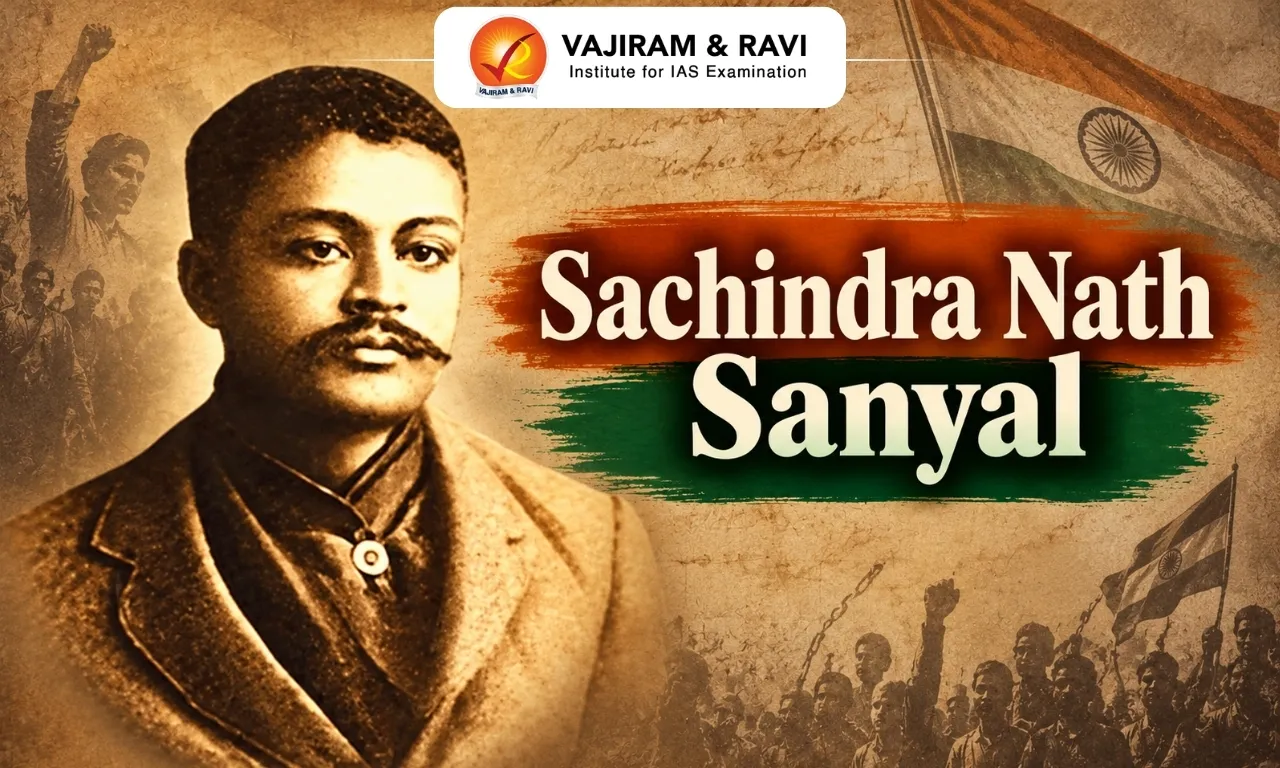
Sachindra Nath Sanyal was a prominent revolutionary who played an important role in different phases of India's freedom struggle. He was associated with the Anushilan Samiti, revolutionary activities during the First World War and later the Hindustan Republican Association (HRA). He also articulated the idea of a democratic republic based on universal suffrage for independent India.

Sachindra Nath Sanyal Early Life

Sachindra Nath Sanyal was born in 1893 in Varanasi and became associated with the revolutionary movement at an early age.

  • He became associated with the Anushilan Samiti and worked to expand its revolutionary activities beyond Bengal.
  • In 1913, Sachindra Nath Sanyal established a branch of the Anushilan Samiti in Patna, with Bankim Chandra Mitra of B.N. College entrusted with its organisational leadership.
  • His activities brought him into contact with revolutionaries in different parts of India.
  • His association with Rash Behari Bose brought him into the wider revolutionary network that sought to organise an armed uprising against British rule.

Sachindra Nath Sanyal and Revolutionary Activities during the First World War

The First World War created an opportunity for Indian revolutionaries to attempt an armed uprising against British rule.

  • Sachindra Nath Sanyal worked with Rash Behari Bose to organise revolutionary activities and encourage an uprising among soldiers.
  • He was involved in the Lahore and Banaras conspiracies of 1915, which were connected with attempts to provoke an armed revolt in the British Indian Army.
  • These plans were connected with the wider Ghadar movement and the Indo-German Conspiracy, which sought to use the conditions created by the First World War to challenge British rule.
  • The planned uprising failed after the British authorities uncovered the revolutionary network, leading to widespread arrests and repression.
  • Sanyal was convicted in the Banaras Conspiracy Case and sentenced to transportation for life to the Cellular Jail in the Andaman Islands.

Sachindra Nath Sanyal and Bandi Jeevan

After his release from prison, Sachindra Nath Sanyal documented his revolutionary experiences in Bandi Jeevan (A Life of Captivity), published in 1922. The work provides an account of the revolutionary movement, its organisation and the experiences of political prisoners. It also records his experiences of revolutionary activity and imprisonment. Bandi Jeevan became an influential work within the revolutionary tradition and was read by younger revolutionaries.

Sachindra Nath Sanyal and the Hindustan Republican Association

After the withdrawal of the Non-Cooperation Movement in 1922, revolutionary groups in northern India sought to reorganise themselves and develop a more coordinated movement.

  • Sachindra Nath Sanyal, along with revolutionaries including Ram Prasad Bismil and Jogesh Chandra Chatterjee, was among the important figures involved in the formation of the Hindustan Republican Association in 1924.
  • The HRA sought to overthrow British imperial rule through an organised revolutionary movement and establish a republican political order in India.
  • Sanyal played an important role in giving the organisation a broader organisational and political direction.

Sachindra Nath Sanyal and the Political Ideas of the HRA

The revolutionary movement associated with Sachindra Nath Sanyal was concerned not only with ending British rule but also with the political structure of independent India.

  • The HRA's manifesto, The Revolutionary, envisaged the establishment of a Federal Republic of the United States of India through an organised armed revolution.
  • The proposed republic was to be based on universal suffrage, reflecting the emphasis placed on political equality.
  • The manifesto also opposed systems that enabled the exploitation of one section of society by another.

These ideas showed that the HRA's objective extended beyond the removal of colonial rule to the establishment of a new political and social order.

Sachindra Nath Sanyal, Kakori and the Later Revolutionary Movement

The Kakori Train Action of 1925 became a major operation associated with the HRA and was followed by a severe British crackdown on the organisation.

  • Sachindra Nath Sanyal was arrested in connection with the Kakori Conspiracy Case and sentenced to transportation for life.
  • The crackdown resulted in the execution of Ram Prasad Bismil, Ashfaqulla Khan, Rajendra Lahiri and Roshan Singh, while several other revolutionaries received long prison sentences.
  • The HRA was later reorganised as the Hindustan Socialist Republican Association (HSRA) in 1928, with younger revolutionaries such as Bhagat Singh and Chandrashekhar Azad playing a prominent role.
  • Sanyal spent the following years in prison before his release in 1937, after which he continued to remain associated with revolutionary activities.

Sachindra Nath Sanyal Later Years and Death

Sachindra Nath Sanyal was released from prison in 1937 after completing his sentence in the Kakori case. During the Second World War, he was arrested again in 1941 under the Defence of India Act for his revolutionary activities. He was later interned in Gorakhpur. Sachindra Nath Sanyal died of tuberculosis in Gorakhpur on 7 February 1942, before India achieved independence.

Sachindra Nath Sanyal FAQs

Q1: Who was Sachindra Nath Sanyal?

Ans: Sachindra Nath Sanyal was a prominent revolutionary of India's freedom struggle who was associated with several phases of the revolutionary movement.

Q2: Where was Sachindra Nath Sanyal born?

Ans: Sachindra Nath Sanyal was born in Varanasi in 1893.

Q3: Which revolutionary organisation did Sachindra Nath Sanyal establish a branch of in Patna?

Ans: Sachindra Nath Sanyal established a branch of the Anushilan Samiti in Patna in 1913.

Q4: Which revolutionary organisation was Sachindra Nath Sanyal associated with in 1924?

Ans: Sachindra Nath Sanyal was one of the important founders of the Hindustan Republican Association (HRA), established in 1924.

Q5: Which book was written by Sachindra Nath Sanyal?

Ans: Sachindra Nath Sanyal wrote Bandi Jeevan (A Life of Captivity) in 1922.

Discombobulator, US Weapon, Working, Uses, Purpose

Discombobulator

The Discombobulator is a term that has recently been used to describe an alleged classified US military capability linked to the January 2026 operation in Venezuela. While reports have associated it with technologies such as electronic warfare, cyber operations, directed energy and sensory disruption, there is no publicly available evidence confirming it as a specific standalone weapon. The exact nature, working and capabilities of the Discombobulator therefore remain unclear. 

Discombobulator

The Discombobulator has recently been described in reports as a classified US capability allegedly used during the January 2026 operation in Venezuela. However, there is no publicly available technical information confirming it as one specific weapon. Key points include:

  • Meaning: The term “Discombobulator” has been used to describe a system intended to disorient personnel and disable defensive equipment and infrastructure.
  • Nature of the system: Experts suggest that it may refer to a combination of electronic warfare, cyber capabilities, directed-energy and other non-kinetic technologies, rather than a single standalone device.
  • Purpose: Such capabilities can be used to disrupt radars, communications, sensors, missile guidance systems and power infrastructure, while other systems can affect personnel through disorientation or intense sensory effects.
  • Electronic warfare: Electronic warfare systems can jam radar and communications, interfere with GPS and confuse sensors, making it difficult for an opponent to detect or coordinate a military operation.
  • High-power microwave systems: Technologies such as the Counter-electronics High Power Microwave Advanced Missile Project (CHAMP) are designed to disrupt or disable electronic equipment using microwave energy.
  • Acoustic systems: Devices such as Long Range Acoustic Devices (LRADs) use highly focused sound. At high levels, they can cause discomfort, pain, vertigo or nausea, although they are not designed to disable electronic equipment.
  • Active Denial System (ADS): This directed-energy system uses millimetre-wave energy to create an intense heating sensation on the skin, encouraging people to move away from an area.
  • Other possible capabilities: The broader set of technologies associated with such operations can include cyber operations, power denial and conductive munitions designed to disrupt infrastructure without relying solely on conventional explosives.

How Does the Discombobulator Work?

There is no confirmed technical description explaining how a weapon officially called the Discombobulator works. Based on expert analysis of existing US military technologies, the term may refer to several capabilities working together.

  • Electronic disruption: Electronic warfare can interfere with the electromagnetic environment by jamming communications, radar, GPS and sensors. This can make defensive systems unable to detect or properly respond to an approaching force.
  • High-power microwave effects: High-power microwave systems can direct intense microwave energy towards electronic components. This can cause circuits to malfunction or stop operating, potentially without leaving obvious physical damage.
  • Cyber operations: Cyber-physical attacks can target computer networks and industrial control systems. Such operations may interfere with command systems or cause connected physical equipment to behave incorrectly.
  • Power disruption: Graphite or carbon-fibre munitions can spread conductive material across electrical infrastructure and cause short circuits and power failures.
  • Personnel disorientation: Acoustic devices and other non-lethal or low-lethality technologies can produce confusion, nausea, vertigo or intense discomfort. These effects are different from the electronic disruption caused by electromagnetic systems.
  • Stealth support: If communications, radar, sensors and electricity are disrupted simultaneously, an attacking force may gain an operational advantage by reducing the target's ability to detect, communicate and coordinate its defence.
  • Venezuela operation: US President Donald Trump said US forces had used a weapon called the “Discombobulator” during the January 3, 2026 operation in Venezuela and said it made equipment stop working. He did not provide technical details.
  • Sonic weapon claim: Trump had earlier referred to a “sonic weapon” being used during the operation. Experts, however, have noted that acoustic systems such as LRADs are not designed to shut down radars, missiles or electronic networks.

Is the Discombobulator a Real Weapon?

The existence of a specific US weapon officially named the Discombobulator has not been publicly verified. The term appears to be based largely on statements about the Venezuela operation and subsequent expert analysis of existing military technologies.

  • No official technical disclosure: The US government has not publicly released details about a weapon system, its manufacturer, configuration or operating mechanism under this name.
  • Possibly a capability rather than one weapon: Experts have suggested that “Discombobulator” could be an informal label for a combination of established electronic warfare, cyber, directed-energy and disorientation capabilities.
  • Different technologies have different effects: Acoustic systems can affect people, while electronic warfare and high-power microwave systems are intended to affect electronics, communications and sensors. Therefore, one technology would not necessarily perform all the functions attributed to the Discombobulator.
  • Reports of physical symptoms: Some accounts from Venezuelan personnel described symptoms such as nausea, vomiting, nosebleeds and disorientation during the operation. These accounts have not been independently verified and do not by themselves establish the existence of a new sonic weapon.
  • Air-defence disruption: Reports that Venezuelan air-defence systems failed could potentially be explained by electronic warfare, cyber operations, suppression of sensors or communications, power disruption, or operational weaknesses. Public information does not establish which explanation applies.
  • Expert assessment: The available evidence therefore points to considerable uncertainty. There is no public evidence confirming a new weapon with the exact capabilities attributed to the “Discombobulator.”
  • Broader military context: The US and other major military powers have developed and tested technologies involving electronic warfare, cyber operations, directed energy and non-kinetic effects. These technologies are established areas of military research, even though their alleged combination in the Venezuela operation remains unclear.

Discombobulator FAQs

Q1: What is the Discombobulator?

Ans: The Discombobulator is reportedly a classified US capability allegedly used during the January 2026 operation in Venezuela. However, no public technical information confirms it as a specific standalone weapon.

Q2: How does the Discombobulator work?

Ans: There is no confirmed explanation of how the Discombobulator works. Experts suggest the term may refer to a combination of electronic warfare, cyber, directed-energy and other non-kinetic technologies.

Q3: Is the Discombobulator a real weapon?

Ans: The existence of a specific US weapon officially named the Discombobulator has not been publicly verified. Its reported capabilities remain uncertain.

Q4: What can the Discombobulator do?

Ans: The capabilities attributed to the Discombobulator include disrupting communications, radar, sensors, electronic systems and possibly causing disorientation among personnel. These claims have not been fully confirmed.

Q5: Is the Discombobulator a sonic weapon?

Ans: The Discombobulator has been described as a sonic weapon in some reports, but this has not been technically confirmed. Acoustic systems can affect people through sound, while electronic warfare systems target communications and electronic equipment.

11th Ayurveda Day 2026, Theme, Celebration, Significance

11th Ayurveda Day 2026

The 11th Ayurveda Day 2026 will be observed on 23 September 2026 with the theme “Ayurveda for a Healthier Tomorrow.” The day highlights India's ancient Ayurvedic tradition and its growing role in modern healthcare, preventive wellness, scientific research and public health. The 2026 observance is also significant as it marks the first Ayurveda Day celebrated on the newly fixed date of 23 September, following the Government of India's decision in 2025 to give the occasion a fixed annual date. 

11th Ayurveda Day 2026 Date and Theme

The 11th Ayurveda Day 2026 will be observed on 23 September 2026. The theme for this year is “Ayurveda for a Healthier Tomorrow.” The theme highlights the role of Ayurveda in promoting health, preventive care, scientific research and holistic wellbeing.

  • More than 9,700 activities have been reported across 30 States and Union Territories as part of the nationwide Ayurveda Day celebrations.
  • More than 3 lakh participants have registered through the official Ayurveda Day platform, while around 89 lakh citizens have pledged their support for Ayurveda.
  • States such as Uttar Pradesh, Maharashtra, Madhya Pradesh and Chhattisgarh have recorded substantial participation in the celebrations.
  • Ayurveda Day 2026 has also received international participation, with activities reported from 10 countries and territories and more than 1,900 participants.
  • The participating countries and territories include the United Kingdom, Afghanistan, Bulgaria, Spain, Algeria, Australia, Denmark, Iceland, the United States and the British Indian Ocean Territory.
  • The official Ayurveda Day microsite provides a platform for citizens, institutions and organisations to register, participate in and report Ayurveda Day activities.

Why is Ayurveda Day Celebrated?

Ayurveda Day is observed to increase awareness about Ayurveda and highlight its potential contribution to health, wellness and preventive healthcare.

  • The observance aims to promote Ayurveda at the national and global level and increase awareness of its traditional principles and practices.
  • It seeks to explore how Ayurveda can contribute to national health policies and public health programmes.
  • Ayurveda Day focuses on using the potential of Ayurveda to help reduce the disease burden and associated morbidity and mortality.
  • It highlights Ayurveda's holistic approach to maintaining the health and wellbeing of people while also recognising the importance of plants, animals and the environment.
  • The celebrations aim to improve public trust and awareness through community participation involving citizens, students, farmers and other groups.
  • Ayurveda Day promotes a shift from illness to wellness, with greater emphasis on prevention, healthy living and holistic wellbeing.
  • It also seeks to create greater awareness about Ayurveda as a traditional medical system that is increasingly being examined through scientific and evidence-based research.

Ayurveda Day 2026 History

Ayurveda Day was first observed in 2016 to recognise and promote India's traditional system of medicine.

  • Before 2026, Ayurveda Day was generally observed on Dhanteras or Dhanwantari Jayanti, meaning its date changed every year according to the Hindu lunar calendar.
  • To give the observance a fixed annual identity, the Government of India issued a Gazette notification in March 2025 declaring 23 September as Ayurveda Day every year.
  • Therefore, 2026 is the first year in which Ayurveda Day is being observed on the newly fixed date of 23 September.
  • The fixed date is intended to make national and international planning easier and encourage wider participation in Ayurveda Day activities.
  • The date of 23 September coincides with the autumnal equinox, when day and night are nearly equal in length.
  • The idea of balance associated with the equinox also reflects Ayurveda's emphasis on maintaining balance between the body, mind and surrounding environment.
  • The decision gives Ayurveda Day a more consistent calendar identity and is expected to support its wider recognition at the international level.

11th Ayurveda Day 2026 Significance

The 11th Ayurveda Day 2026 is significant because Ayurveda is increasingly being connected with public healthcare, education, scientific research, digital healthcare, regulation and international cooperation.

Healthcare Infrastructure, Telemedicine and Insurance

The Government is expanding Ayush healthcare services through the National Ayush Mission (NAM) and the National Health Mission (NHM).

  • Between 2014-15 and 2025-26, the Central Government released more than ₹6,406.99 crore through NAM to States and Union Territories for the expansion and integration of Ayush healthcare.
  • Existing Ayush clinics and dispensaries are being upgraded into Ayushman Arogya Mandirs (Ayush) to provide better-equipped healthcare services.
  • As of 19 September 2026, 12,260 Ayushman Arogya Mandirs were functional against a target of 12,500.
  • Ayush services are also being provided alongside conventional medical care in 13,249 public health facilities across the country.
  • These facilities include 6,302 Primary Health Centres, 3,191 Community Health Centres, 475 District Hospitals and 3,281 other local health facilities.
  • The government supports the salaries of 25,322 Ayush doctors and 5,666 Ayush paramedics working across States and Union Territories.
  • The government is also upgrading existing hospitals, establishing new integrated hospitals, improving healthcare infrastructure and ensuring the availability of essential Ayush medicines.
  • The government's eSanjeevani platform provides free telemedicine services and has served more than 50 crore patients, including through its Ayush OPD services.
  • In 2024, IRDAI directed insurers to offer products or add-ons covering different systems of medicine, including Ayurveda, under board-approved policies.
  • On 10 February 2026, the All India Institute of Ayurveda (AIIA), New Delhi, signed a Common Empanelment MoU with the General Insurance Council, covering 32 general insurance companies for cashless treatment.
  • AIIA also launched an Ayush Health Insurance Helpline to help beneficiaries with insurance-related queries and improve awareness about Ayush coverage.

Ayurveda Education, Research and Digital Initiatives

The expansion of Ayurveda healthcare is being supported by greater investment in education, research and digital resources.

  • Under the National Ayush Mission, the government supports the establishment and expansion of undergraduate and postgraduate Ayurveda institutions, along with pharmacy and paramedical programmes.
  • As of 13 March 2026, India had 593 Ayurveda colleges, with 45,245 undergraduate seats and 5,673 postgraduate seats.
  • Under NAM, 17 Ayush colleges have been approved for establishment, of which 12 are focused on Ayurvedic education.
  • The AYURGYAN Scheme, launched in 2021-22, provides financial support for research and development in traditional medicine.
  • Out of ₹17.79 crore across 34 projects, Ayurveda received ₹9.38 crore for 17 dedicated projects.
  • The AYUR SWASTHYA Yojana, implemented from 2021 to 2026, supported clinical research, drug research, education, public health initiatives and Centres of Excellence.
  • Out of 25 projects supported through late 2025, 22 focused on or included Ayurveda interventions.
  • The scheme supported 28 Centres of Excellence, including 22 focused on Ayurveda-related research and healthcare delivery.
  • The Central Council for Research in Ayurvedic Sciences (CCRAS) coordinates scientific research through a network of 30 national and regional institutes.
  • The SPARK Programme encourages undergraduate Ayurveda students to undertake short-term research projects. Between 2022-23 and 2024-25, 289 Ayurveda colleges benefited from the programme.
  • In March 2026, CCRAS partnered with Anuvadini AI, an AI-based translation platform developed by the Ministry of Education's AICTE, to translate research material and journals into 13 Indian languages.
  • This initiative aims to make Ayurveda research and educational resources more accessible to students, practitioners and the wider public.

Quality Standards and Ayurveda Aahara

The Government is also strengthening the regulatory framework for Ayurvedic medicines and traditional dietary products.

  • Ayurvedic medicines are regulated under the Drugs and Cosmetics Act, 1940, and Drugs Rules, 1945.
  • Manufacturers must follow Good Manufacturing Practices (GMP) and meet applicable safety, efficacy and pharmacopoeial standards.
  • Government Drug Inspectors conduct sampling and testing to monitor the quality of Ayurvedic medicines.
  • A specialised Ayush vertical within the Central Drugs Standard Control Organisation (CDSCO) supports regulatory oversight.
  • The e-Aushadhi portal enables paperless processing and real-time tracking of drug manufacturing licence applications.
  • The Food Safety and Standards Authority of India (FSSAI), in collaboration with the Ministry of Ayush, has introduced standards for Ayurveda Aahara.
  • The framework provides standards for recognised Ayurvedic dietary products and supports licensing and registration of manufacturers.
  • These measures aim to improve product quality, consumer safety, transparency and public confidence in Ayurvedic products.

WHO Recognition and Global Expansion

The international recognition of Ayurveda has expanded through global partnerships, standardisation efforts and cooperation in traditional medicine.

  • Ayurveda-related terminology has been included in the World Health Organization's International Classification of Diseases, 11th Revision (ICD-11) module.
  • This allows Ayurveda, Siddha and Unani diagnoses to be recorded using standardised codes.
  • Standardised terminology can support health data collection, research, policymaking and health planning.
  • India has signed 27 country-to-country MoUs for cooperation in traditional medicine and Homoeopathy.
  • It has also signed 16 MoUs with international institutions for Ayush Academic Chairs and 57 institute-to-institute MoUs for collaborative research and academic cooperation.
  • India has established 46 Ayush Information Cells across 43 foreign countries.
  • The International Ayush Fellowship and Scholarship Programme has provided 104 scholarships to foreign nationals.
  • The WHO Global Traditional Medicine Centre in Jamnagar, Gujarat, serves as an important global research and policy hub for traditional medicine.
  • India has also worked with WHO on standard training resources for Ayurveda and Unani and participated in international workshops and research programmes.

International Cooperation, Yoga and Medical Value Travel

India is also using international cooperation and cultural outreach to expand awareness of traditional health systems.

  • In December 2025, New Delhi hosted the Second WHO Global Summit on Traditional Medicine at Bharat Mandapam.
  • The summit brought together delegates from more than 100 countries and 22 health ministers under the theme “Restoring Balance: The Science and Practice of Health and Well-being.”
  • The summit resulted in the Delhi Declaration, which encouraged countries to integrate traditional medicine into primary healthcare based on scientific evidence.
  • The 11th International Day of Yoga in 2025 saw around 2,000 events across 191 countries, while Yoga activities were also organised at World Expo 2025 in Osaka, Japan.
  • India has introduced dedicated Ayush Visa categories for people travelling to India for Ayush-based treatment.
  • The M-3 visa is available for patients seeking Ayush treatment, while the M-4 visa is meant for accompanying caregivers.
  • These initiatives support India's efforts to expand Ayurveda and other Ayush systems through international cooperation and medical value travel.

Union Budget 2026-27 and Ayurveda

The Union Budget 2026-27 allocated ₹4,408 crore to the Ministry of Ayush to strengthen healthcare, research, infrastructure and international outreach.

  • The Budget provides for the establishment of three new All India Institutes of Ayurveda (AIIA) to strengthen education, clinical services and research.
  • It supports the upgradation of Ayush pharmacies and Drug Testing Laboratories to improve quality and standardisation.
  • The measures also aim to strengthen the availability of skilled manpower in the Ayush sector.
  • The WHO Global Traditional Medicine Centre at Jamnagar is being upgraded to support evidence-based research and international cooperation.
  • The allocation reflects the growing focus on Ayush healthcare, scientific research, innovation and global outreach.

Ayurveda for a Healthier Tomorrow

The 11th Ayurveda Day 2026 highlights the changing role of Ayurveda in India's healthcare system. Along with preserving traditional knowledge, current efforts focus on scientific research, healthcare infrastructure, education, digital access, quality control and international cooperation.

  • The expansion of Ayush healthcare facilities is making Ayurveda more accessible through public health institutions.
  • Research programmes are working to build stronger evidence on the safety and effectiveness of Ayurvedic interventions.
  • Education and training initiatives are expanding the pool of qualified Ayurveda professionals.
  • Regulatory measures are strengthening the quality and safety of Ayurvedic medicines and traditional food products.
  • Digital platforms such as eSanjeevani are creating new ways for people to access Ayurveda consultations.
  • International partnerships are supporting greater recognition of Ayurveda and cooperation in traditional medicine research.
  • The overall approach seeks to connect India's traditional knowledge with contemporary healthcare systems while placing greater emphasis on evidence, quality and responsible integration.
  • The theme “Ayurveda for a Healthier Tomorrow” reflects the broader goal of promoting Ayurveda as part of India's healthcare, research and holistic wellbeing ecosystem

11th Ayurveda Day 2026 FAQs

Q1: When is the 11th Ayurveda Day 2026?

Ans: The 11th Ayurveda Day 2026 will be observed on 23 September 2026. It is the first Ayurveda Day to be celebrated on the newly fixed annual date.

Q2: What is the theme of Ayurveda Day 2026?

Ans: The theme of Ayurveda Day 2026 is “Ayurveda for a Healthier Tomorrow.” It focuses on the role of Ayurveda in preventive healthcare, research, wellness and holistic health.

Q3: Why is Ayurveda Day celebrated?

Ans: Ayurveda Day is celebrated to promote awareness of Ayurveda, highlight its contribution to healthcare and wellness, encourage scientific research, and expand its role in public health and preventive care.

Q4: When was Ayurveda Day first observed?

Ans: Ayurveda Day was first observed in 2016. Until 2025, it was generally celebrated on Dhanteras or Dhanwantari Jayanti, whose date changes according to the lunar calendar.

Q5: Why is Ayurveda Day celebrated on 23 September?

Ans: The Government of India fixed 23 September as Ayurveda Day every year through a Gazette notification issued in March 2025. The date also coincides with the autumnal equinox, symbolising balance, an important principle in Ayurveda.

Rajamannar Committee, Centre-State Relations, Recommendations

Rajamannar Committee

The Rajamannar Committee was an important initiative related to Centre-State relations and Indian federalism. Set up by the Tamil Nadu Government in 1969, the committee examined the distribution of powers, financial resources and administrative responsibilities between the Centre and the States. Its recommendations focused on greater state autonomy and a more balanced federal structure. 

What is the Rajamannar Committee?

The Rajamannar Committee was a three-member committee appointed by the DMK government of Tamil Nadu in 1969 to examine Centre-State relations and suggest measures to give greater autonomy to the states. It was headed by Dr. P. V. Rajamannar, former Chief Justice of the Madras High Court, with A. Lakshmanaswami Mudaliar and P. Chandra Reddy as its members.

  • The committee was constituted on 22 September 1969 to examine the distribution of powers and resources between the Centre and the States.
  • It was the first state-level initiative to undertake a detailed review of Centre-State relations under the Indian Constitution.
  • The committee examined constitutional, administrative and financial arrangements that, in its view, had increased the centralisation of power.
  • It submitted its report to the Tamil Nadu Government in 1971, recommending several changes to strengthen state autonomy and the federal structure.
  • The committee particularly focused on the Seventh Schedule, financial relations, emergency provisions, All-India Services and the role of institutions such as the Planning Commission.

Rajamannar Committee Background

The Rajamannar Committee was set up against the background of growing concerns in Tamil Nadu about the increasing powers of the Union government and the limited autonomy available to states.

  • The committee believed that several constitutional provisions gave the Centre extensive powers, which could affect the autonomy of elected state governments.
  • It identified the centralisation of financial resources as another concern, as states depended heavily on the Centre for financial assistance.
  • The committee also examined the role of the Planning Commission, which had a major role in central planning and the allocation of resources to states.
  • It argued that the existing distribution of legislative powers under the Union, State and Concurrent Lists needed to be reconsidered to create a better federal balance.
  • The committee also examined the use of provisions such as Articles 356, 357 and 365, which could increase Union control over state governments.
  • Its objective was to suggest constitutional and administrative changes that would provide greater autonomy to states while maintaining the federal structure.

Key Recommendations of the Rajamannar Committee

The Rajamannar Committee recommendations focused on reducing excessive centralisation and strengthening the powers of state governments. Some of its major recommendations were:

  • Strengthening the Inter-State Council: The committee recommended the immediate establishment of a strong Inter-State Council under Article 263 to promote consultation and resolve differences between the Centre and States.
  • Making the Finance Commission permanent: It suggested making the Finance Commission a permanent body to provide a more stable mechanism for Centre-State financial relations.
  • Revising the Seventh Schedule: The committee called for a re-examination and redistribution of subjects in the Union, State and Concurrent Lists to give states greater legislative powers.
  • Transfer of subjects to the State List: It recommended transferring certain subjects from the Union and Concurrent Lists to the State List, including areas such as trade unions, industrial and labour disputes, electricity and some aspects of inland waterways.
  • Transfer of residuary powers: The committee recommended that residuary legislative powers should be given to the States instead of being vested with Parliament.
  • Repealing Articles 356, 357 and 365: It called for the deletion of these provisions, particularly Article 356, which allows the imposition of President's Rule in a state.
  • Abolition of All-India Services: It recommended abolishing All-India Services such as the IAS, IPS and IFS to reduce the Centre's influence over state administration.
  • Replacing the Planning Commission: The committee proposed replacing the Planning Commission with a statutory body, arguing that the existing arrangement increased the Centre's influence over state finances and planning.
  • Greater financial resources for states: It called for widening the basis of revenue devolution so that states could have greater financial resources and reduce their dependence on the Centre.

Significance of the Rajamannar Committee for Centre-State Relations

The Rajamannar Committee holds an important place in the evolution of India's debate on federalism and Centre-State relations. Although its recommendations were not implemented in full, its report brought several issues of state autonomy into national discussion.

  • It highlighted concerns about the growing centralisation of political, administrative and financial powers in India.
  • Its recommendations strengthened the debate on creating a more balanced relationship between the Union and State governments.
  • The proposal for a stronger Inter-State Council later became an important part of discussions on cooperative federalism.
  • Its recommendations on Article 356 and state autonomy contributed to the wider debate on the use of President's Rule and the constitutional balance between the Centre and States.
  • The committee's views also influenced subsequent discussions and studies on Centre-State relations, including the Sarkaria Commission and later the Punchhi Commission.
  • Although the Central Government did not accept its recommendations, the report remains an important reference point in understanding demands for greater state autonomy and fiscal devolution.
  • The Rajamannar Committee therefore represents an important milestone in India's continuing debate over how to balance a strong Union with meaningful state autonomy.

Rajamannar Committee FAQs

Q1: What is the Rajamannar Committee?

Ans: The Rajamannar Committee was a three-member committee set up by the DMK government of Tamil Nadu in 1969 to examine Centre-State relations and recommend measures to strengthen state autonomy.

Q2: Who was the Chairman of the Rajamannar Committee?

Ans: The committee was headed by Dr. P. V. Rajamannar, former Chief Justice of the Madras High Court. A. Lakshmanaswami Mudaliar and P. Chandra Reddy were its other members.

Q3: When did the Rajamannar Committee submit its report?

Ans: The Rajamannar Committee submitted its report in 1971 to the Tamil Nadu Government.

Q4: What were the major recommendations of the Rajamannar Committee?

Ans: Its major recommendations included strengthening the Inter-State Council, making the Finance Commission permanent, transferring more subjects to the State List, giving residuary powers to states, and abolishing Articles 356, 357 and 365.

Q5: What did the Rajamannar Committee recommend about Article 356?

Ans: The committee recommended the deletion of Article 356, which provides for the imposition of President's Rule in a state.

Bhakra Nangal Dam, Location, Height, Project, Significance

Bhakra Nangal Dam

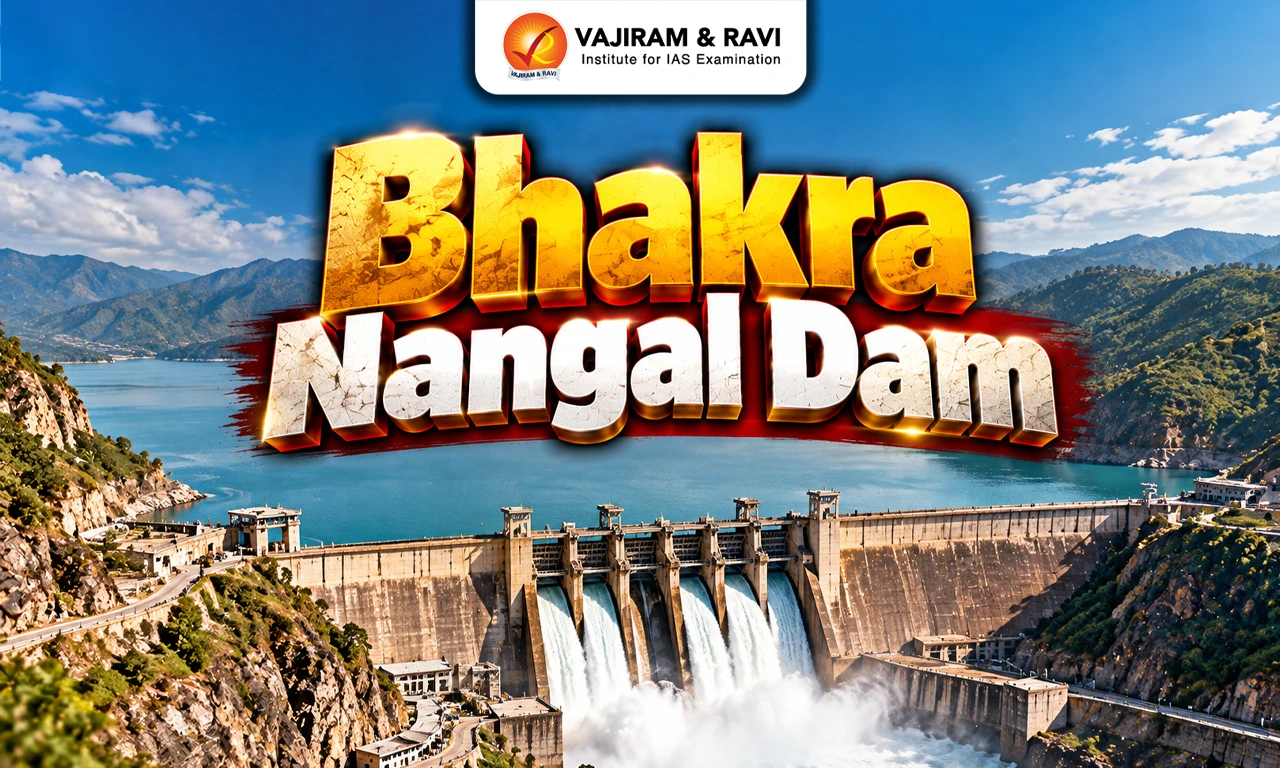
Bhakra Nangal Dam is a major multipurpose river valley project on the Satluj River in northern India. Bhakra Dam is located at Bhakra Village in Bilaspur district, Himachal Pradesh. The project includes Bhakra Dam, Nangal Dam, hydel channels and powerhouses. Bhakra Dam creates the Gobind Sagar Reservoir. It supports irrigation, hydropower generation and flood management across several northern Indian states.

Bhakra Nangal Dam

Bhakra Dam and Nangal Dam are two separate structures. Nangal Dam is located downstream at Nangal in Punjab. They are commonly referred to together as the Bhakra Nangal Dam project.

Bhakra Nangal Dam remains an important infrastructure project because of its role in water storage, irrigation and hydropower generation. The project is managed by the Bhakra Beas Management Board (BBMB). The board regulates water and power supplies from the Bhakra Nangal and Beas projects for Punjab, Haryana, Rajasthan, Himachal Pradesh, Delhi and Chandigarh.

Bhakra Dam

Bhakra Dam is the main upstream structure of the project and creates the large Gobind Sagar reservoir in Bilaspur district.

  • Location: Bhakra Dam is located at Bhakra Village in Bilaspur district, Himachal Pradesh. Its coordinates are 31°24′39″N 76°26′0″E.
  • River: The dam is constructed across the Sutlej River. 
  • Type: It is a concrete gravity dam with controlled overflow spillways.
  • Height and length: Bhakra Dam is 741 feet or 226 metres high. Its total length is about 1,700 feet or 520 metres.
  • Width: The dam has a crest width of 30 feet or 9.1 metres. Its base width reaches 625 feet or 191 metres.
  • Gobind Sagar: Bhakra Dam creates the Gobind Sagar reservoir. The reservoir is about 90 km long and covers 168.35 square kilometres.
  • Water storage: Gobind Sagar can store up to 9.34 billion cubic metres of water. The reservoir has a maximum water depth of 1,680 feet.
  • Power capacity: The Bhakra powerhouses have a combined installed capacity of 1,325 MW. They use five 108 MW and five 157 MW Francis-type turbines.
  • Power distribution: Electricity generated at Bhakra is supplied to Himachal Pradesh, Punjab, Haryana, Rajasthan, Chandigarh and Delhi.
  • Spillway system: Bhakra Dam has four controlled spillway gates. They are used when the reservoir level rises beyond the permitted maximum level.
  • Historical recognition: Jawaharlal Nehru described Bhakra Dam as the “New Temple of Resurgent India”. The project was dedicated to the nation in October 1963.

Nangal Dam

Nangal Dam is the downstream structure of the Bhakra Nangal Project and regulates water released from Bhakra Dam.

  • Location: Nangal Dam is situated at Nangal in Punjab. It is located downstream of Bhakra Dam, at a distance of about 10 to 13 km.
  • Structure: Nangal Dam is a barrage-type dam. It is separate from Bhakra Dam, although both are commonly referred to together as the Bhakra Nangal Dam.
  • Water regulation: Water released from Bhakra Dam reaches Nangal Dam. The structure regulates this flow before it enters the Nangal Hydel Channel.
  • Canal system: The Nangal Hydel Channel later becomes the Bhakra Main Line after the Ganguwal and Kotla power plants. It mainly supplies irrigation water to Punjab.
  • Additional power: The project has Ganguwal, Kotla and Anandpur Sahib power stations. Their capacities are 77.65 MW, 77.65 MW and 134 MW respectively.

Bhakra Nangal Dam Project

The Bhakra Nangal Dam Project was developed as a multipurpose river valley project for irrigation, power generation and flood management.

  • Early concept: Sir Chhotu Ram conceptualised the Bhakra Dam idea in early 1923. An agreement with the Raja of Bilaspur was signed in November 1944.
  • Project approval: The project plan was finalised on 8 January 1945. Preliminary work began in 1946, while dam construction formally started in 1948.
  • Construction milestone: Jawaharlal Nehru poured the first bucket of concrete into the dry Sutlej riverbed on 17 November 1955.
  • Completion: The Bhakra Dam was completed by the end of 1963. Successive stages of the larger project continued into the early 1970s.
  • Construction cost: The recorded construction cost was ₹245.28 crore. The project involved large-scale engineering and construction work after independence.
  • Project administration: Bhakra Beas Management Board was constituted in 1966. It began administration, maintenance and operation of the Bhakra Nangal Project from 1 October 1967.

Bhakra Nangal Dam Significance

The project combines water storage, irrigation, hydropower generation and flood management, making it significant for the northern Indian river valley system.

  • Irrigation: Water from Bhakra supports irrigation across Punjab, Haryana and Rajasthan. The Bhakra Canal system provides irrigation to about 10 million acres or 40,000 km² of agricultural fields.
  • Flood Management: The reservoir stores excess monsoon water and allows controlled releases during the year. This helps reduce the risk of flood damage in the Satluj-Beas river valley.
  • Hydropower: The 1,325 MW Bhakra power system supplies electricity to partner states and Union Territories. Additional power stations at Ganguwal, Kotla and Anandpur Sahib have capacities of 77.65 MW, 77.65 MW and 134 MW respectively.
  • Water and Power Distribution: BBMB regulates water and power supplies from the Bhakra Nangal and Beas projects. The beneficiary regions include Punjab, Haryana, Rajasthan, Himachal Pradesh, Delhi and Chandigarh.
  • Fisheries: Gobind Sagar supports several fish species, including the endangered Mahseer. Commercial fishing in the reservoir provides a source of revenue for local communities.
  • Displacement: Creation of the large reservoir submerged about 371 villages in Bilaspur district. The displacement and resettlement of affected people remain an important social aspect of the project.

Bhakra Nangal Dam FAQs

Q1: Where is Bhakra Nangal Dam located?

Ans: Bhakra Nangal Dam is located on the Sutlej River, with Bhakra Dam in Bilaspur district, Himachal Pradesh, and Nangal Dam in Punjab.

Q2: What is the height of Bhakra Dam?

Ans: Bhakra Dam is 226 metres or 741 feet high. It is a concrete gravity dam built across the Sutlej River.

Q3: Which reservoir is created by Bhakra Dam?

Ans: Bhakra Dam creates the Gobind Sagar reservoir. It can store up to 9.34 billion cubic metres of water.

Q4: What is the power generation capacity of Bhakra Dam?

Ans: Bhakra Dam has an installed hydropower capacity of 1,325 MW through ten Francis-type turbines.

Q5: Why is Bhakra Nangal Dam important?

Ans: Bhakra Nangal Dam supports irrigation, hydropower generation and flood management. Its water and electricity benefit Punjab, Haryana, Rajasthan, Himachal Pradesh, Delhi and Chandigarh.

UPSC Daily Quiz 23 September 2026

UPSC Daily Quiz

[WpProQuiz 261]

UPSC Daily Quiz FAQs

Q1: What is the Daily UPSC Quiz?

Ans: The Daily UPSC Quiz is a set of practice questions based on current affairs, static subjects, and PYQs that help aspirants enhance retention and test conceptual clarity regularly.

Q2: How is the Daily Quiz useful for UPSC preparation?

Ans: Daily quizzes support learning, help in revision, improve time management, and boost accuracy for both UPSC Prelims and Mains through consistent practice.

Q3: Are the quiz questions based on the UPSC syllabus?

Ans: Yes, all questions are aligned with the UPSC Syllabus 2025, covering key areas like Polity, Economy, Environment, History, Geography, and Current Affairs.

Q4: Are solutions and explanations provided with the quiz?

Ans: Yes, each quiz includes detailed explanations and source references to enhance conceptual understanding and enable self-assessment.

Q5: Is the Daily UPSC Quiz suitable for both Prelims and Mains?

Ans: Primarily focused on Prelims (MCQ format), but it also indirectly helps in Mains by strengthening subject knowledge and factual clarity.

Battle of Haifa 1918, Indian Cavalry’s Historic Victory and Significance

Battle of Haifa

The Battle of Haifa was an important battle of the First World War fought in Haifa, a port city on the Mediterranean coast of present-day Israel. Indian cavalry units serving under British rule, particularly the Jodhpur and Mysore Lancers, fought against Ottoman forces and captured the city. The battle is remembered for the successful cavalry charge that helped capture Haifa despite strong Ottoman defences.

When Was the Battle of Haifa Fought?

The Battle of Haifa was fought on 23 September 1918, during the Sinai and Palestine Campaign, a series of battles in the First World War in which British-led Allied forces fought Ottoman forces for control of the Sinai Peninsula and Palestine.

At the time, Haifa was under Ottoman control, and British-led Allied forces were advancing through Palestine to push Ottoman forces out of the region. The Battle of Haifa took place during the final phase of this campaign, following the Allied breakthrough at the Battle of Megiddo, which began on 19 September 1918.

Why Was the Battle of Haifa Fought?

The Battle of Haifa was fought because the Allied forces wanted to capture Haifa and secure an important position on the Mediterranean coast. The city was strategically important for the following reasons:

  • Important port: Haifa had a major Mediterranean port that could support the movement of troops and supplies.
  • Railway connection: Its railway connections made it important for transporting men, equipment and supplies.
  • Control of the coast: Capturing Haifa helped the Allies secure the northern part of the Palestinian coast.
  • Advance towards Syria: Control of Haifa also supported the Allied advance further north towards Syria.

Therefore, capturing Haifa was an important military objective in the Allied advance through the region.

Who Fought in the Battle of Haifa?

The Battle of Haifa was fought between British-led Allied forces and Ottoman forces defending the city. The Allied force included cavalry units from the Indian princely states, which were serving under British command during the First World War.

  • Jodhpur Lancers
  • Mysore Lancers
  • Hyderabad Lancers

These three units formed the 15th Imperial Service Cavalry Brigade, which was part of the 5th Cavalry Division of the British Indian Army.

The Ottoman side included Ottoman troops supported by German and Austrian personnel, including machine-gun and artillery units defending the approaches to Haifa.

Role of Indian Forces in the Battle of Haifa

The Indian forces involved in the Battle of Haifa were the Jodhpur, Mysore and Hyderabad Lancers, which formed the 15th Imperial Service Cavalry Brigade under British command. The Jodhpur and Mysore Lancers played the main role in the assault.

  • The Jodhpur Lancers led the main cavalry charge towards Haifa and attacked Ottoman and German positions protected by machine guns and artillery.
  • The Mysore Lancers attacked the Austrian artillery positions on Mount Carmel, helping to weaken the defences around Haifa.
  • Major Dalpat Singh Shekhawat, commander of the Jodhpur Lancers, led his men during the attack and was killed in the battle. Captain Aman Singh Rathore then took command and continued the assault.

The Hyderabad Lancers were part of the brigade but did not take part in the main assault on Haifa. The combined action of the Indian cavalry helped the Allied forces break through the defences and capture the city.

Course of the Battle of Haifa

The Battle of Haifa involved a difficult cavalry advance against well-defended Ottoman positions around the city. The attacking forces had to overcome both challenging terrain and sustained artillery and machine-gun fire before reaching Haifa.

The advance was particularly difficult near the Kishon River, where quicksand and broken ground restricted the movement of cavalry. The lower slopes of Mount Carmel also provided the defenders with favourable positions from which to direct artillery and machine-gun fire against the advancing forces.

The Allied forces nevertheless succeeded in overcoming the defensive positions and advancing towards the city. Once the main line of resistance was broken, the forces entered Haifa, compelling the defending troops to surrender.

The battle resulted in the capture of approximately 1,350 German and Ottoman prisoners, along with several artillery pieces and machine guns.

The capture of Haifa on 23 September 1918 secured an important position on the Mediterranean coast and formed part of the rapid Allied advance through Palestine towards Syria.

Battle of Haifa Outcome 

The Battle of Haifa resulted in a decisive Allied victory, with the Ottoman forces losing control of the city.

  • Haifa came under Allied control, strengthening their position along the Mediterranean coast.
  • The Ottoman defensive system in the area was weakened, facilitating further Allied operations in northern Palestine.
  • The victory contributed to the rapid collapse of Ottoman resistance in the region following the wider Allied breakthrough at Megiddo.
  • The Allied advance continued towards Syria, with Damascus captured on 1 October 1918 and Aleppo on 23 October 1918.
  • The battle also demonstrated that cavalry could still play an important operational role in 1918, particularly when rapid movement was combined with coordinated attacks against weakened defensive positions.

Overall, the capture of Haifa formed part of the final phase of the Allied campaign against the Ottoman Empire in the Middle Eastern theatre of the First World War.

Battle of Haifa Significance 

The Battle of Haifa is significant for its military importance, India's contribution to the First World War and its continuing historical relevance.

  • The battle is remembered as a notable example of successful cavalry warfare against positions defended by modern artillery and machine guns, demonstrating that cavalry could still achieve decisive results under suitable tactical conditions.
  • It highlights the contribution of Indian troops and the forces of Indian princely states to the First World War, particularly in the Middle Eastern theatre.
  • The battle illustrates the transition from traditional mounted warfare towards modern mechanised warfare, when cavalry increasingly operated alongside artillery and other modern military technologies.
  • The battle has become part of the historical memory associated with India–Israel relations, particularly through the commemoration of Indian soldiers who participated in the capture of Haifa.

How Is the Battle of Haifa Remembered Today?

The Battle of Haifa is commemorated on 23 September as Haifa Day.

The Haifa War Cemetery and Memorial in Israel commemorates Indian soldiers associated with the campaign, while commemorative events are held to remember their contribution. The Indian government has also continued to mark the battle as part of India's military heritage. 

In New Delhi, the Teen Murti Memorial is closely associated with the 15th Imperial Service Cavalry Brigade. Built in 1922 and inaugurated in 1924, the memorial's three mounted figures represent the Mysore, Hyderabad and Jodhpur Lancers. Its inscriptions also record the brigade's service in locations including Haifa, Damascus and Aleppo. 

The memorial therefore preserves the memory of the wider contribution of Indian princely-state cavalry forces in the Middle East during the First World War.

Battle of Haifa FAQs

Q1: When was the Battle of Haifa fought?

Ans: The Battle of Haifa was fought on 23 September 1918 during the Sinai and Palestine Campaign of the First World War.

Q2: Why was the Battle of Haifa fought?

Ans: The Battle of Haifa was fought to capture Haifa, an important Mediterranean port and strategic position that could support the Allied advance through Palestine towards Syria.

Q3: Who fought in the Battle of Haifa?

Ans: The Battle of Haifa was fought between British-led Allied forces and Ottoman forces defending the city. The Allied forces included cavalry units from Indian princely states serving under British command.

Q4: What was the role of India in the Battle of Haifa?

Ans: Indian cavalry played a central role in the capture of Haifa. The Jodhpur, Mysore and Hyderabad Lancers formed the 15th Imperial Service Cavalry Brigade, with the Jodhpur and Mysore Lancers playing the principal role in the assault.

Q5: What was the outcome of the Battle of Haifa?

Ans: The Battle of Haifa ended in an Allied victory, with Haifa captured from Ottoman forces. The victory weakened Ottoman resistance in the area and supported the subsequent Allied advance towards Syria.

Oxyserphus narendrani

Oxyserphus narendrani

Oxyserphus narendrani Latest News

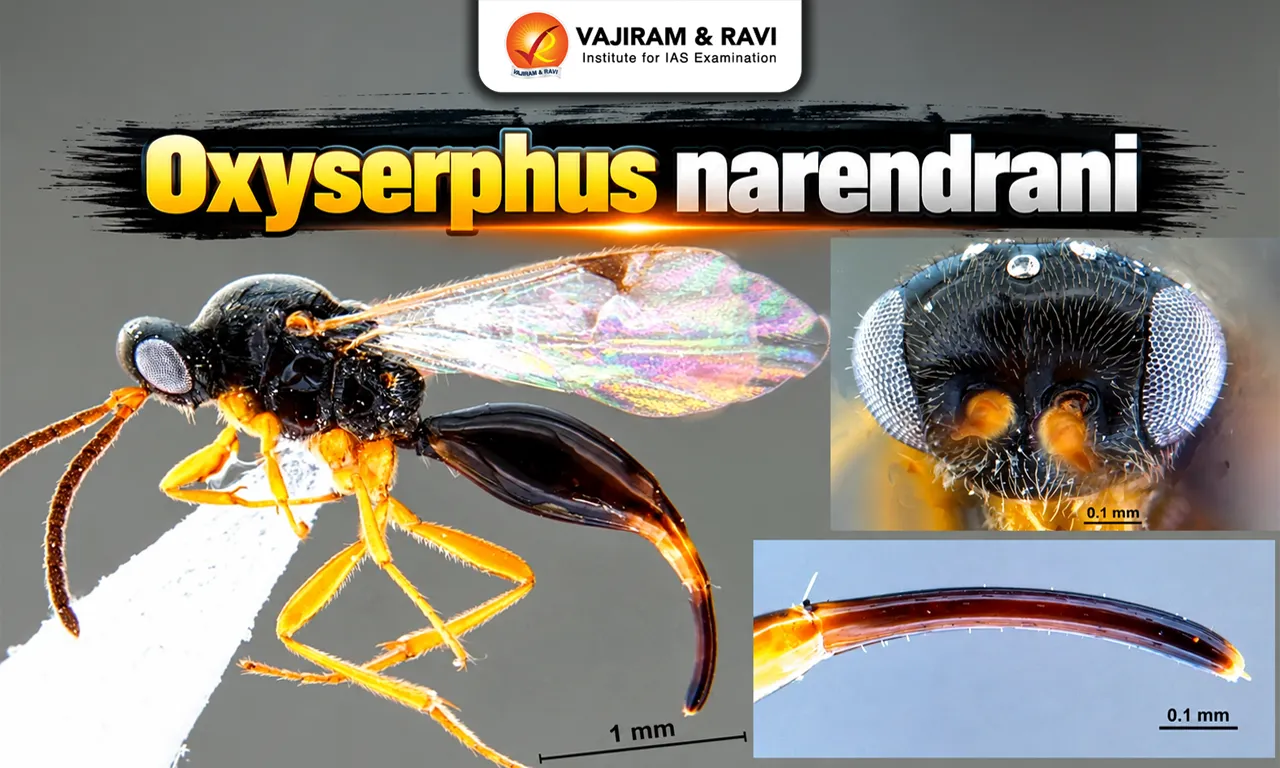
Researchers discovered the tiny insect in Dibru-Saikhowa National Park and named it Oxyserphus narendrani.

About Oxyserphus narendrani

  • It is a new species of parasitic wasp discovered in Dibru-Saikhowa National Park Assam.
  • The members of the Oxyserphus genus are incredibly rare in insect collections globally and are typically only found in high-altitude areas.
  • Features
    • It has a black head, a brownish-black body, and striking yellow legs.
    • It has a unique single horizontal groove on the side of its thorax.
    • It has a much shorter egg-laying reproductive structure, known as an ovipositor sheath, and a uniquely shaped wing spot.

Key Facts about Dibru-Saikhowa National Park

  • Location: It is located in the Dibrugarh and Tinsukia districts of Assam.
  • It was originally created to help conserve the habitat of the rare white-winged wood duck.
  • Rivers: The park is bounded by the Brahmaputra and Lohit Rivers in the north and Dibru River in the south.
  • Vegetation: It mainly consists of moist mixed semi-evergreen forests, moist mixed deciduous forests, canebrakes and grasslands. It is the largest salix swamp forest in north-eastern India.
  • Climate: It has a tropical monsoon climate with a hot and wet summer and cool and usually dry winter. 
  • Flora: It mainly consists of Hollong, Nahor, Simul, Sissoo, Khair, and Jamun are commonly found.
  • Fauna: Asian Elephant, Wild Water Buffalo, Leopard, Clouded Leopard, Fishing Cat, Jungle Cat, Hog Deer, Sambar Deer, and Barking Deer are commonly found.

Source: RM

Oxyserphus narendrani FAQs

Q1: What is Oxyserphus narendrani?

Ans: It is a new species of parasitic wasp.

Q2: Where was Oxyserphus narendrani discovered?

Ans: Dibru-Saikhowa National Park Assam

Garamantes Civilization

Garamantes Civilization

Garamantes Civilization Latest News

A recent study using satellite imagery and aerial photographs has revealed previously undocumented fortified farms, walled villages and fortified towns in Libya’s Fezzan region, providing new evidence of the Garamantes civilization and its extensive settlement network.

About Garamantes Civilization

  • They were an ancient civilization that thrived in the Sahara Desert from approximately 500 BCE to 200 CE, primarily centered in the Fazzan region of southwest Libya. 
  • They established significant urban centers, including their capital, Germa, as well as Zinchera and Saniat Gebril, alongside numerous other settlements. 
  • Contrary to historical depictions of them as nomadic, archaeological findings suggest that the Garamantes were an advanced society skilled in constructing extensive underground irrigation systems known as foggara, which allowed them to access groundwater for agriculture in an arid environment. 
  • This ingenuity enabled them to cultivate crops such as cereals, grapes, olives, and dates, supporting a population that may have reached 50,000 at its peak.
  • The origins of the Garamantes remain debated among scholars, with theories ranging from Berber ancestry to connections with Neolithic peoples. 
  • Their civilization engaged in trade with nearby Mediterranean regions, exchanging goods like salt, gold, ivory, and slaves, and transitioned from military conflict to becoming important trading partners with the Roman Empire. 
  • However, environmental changes, particularly falling water levels, led to the decline of the Garamantes by the sixth century CE, resulting in the eventual abandonment of their urban centers. 
  • The legacy of the Garamantes is marked by their innovative adaptation to a challenging landscape and their role in shaping the cultural and historical landscape of ancient North Africa.

News: TOI

Garamantes Civilization FAQs

Q1: Who were the Garamantes?

Ans: The Garamantes were an ancient civilization that flourished in the Sahara Desert, primarily in the Fezzan region of southwestern Libya.

Q2: When did the Garamantes civilization approximately flourish?

Ans: It flourished approximately from 500 BCE to 200 CE.

Q3: What was the capital of the Garamantes civilization?

Ans: Germa was the capital of the Garamantes.

Q4: What were the underground irrigation systems developed by the Garamantes called?

Ans: They were called foggara or foggaras.

Q5: What was the primary purpose of the Garamantes' foggara irrigation systems?

Ans: They were used to access groundwater for agriculture in the arid Sahara.

International Mobile Equipment Identity Number

International Mobile Equipment Identity Number

International Mobile Equipment Identity Number Latest News

India’s active wireless mobile subscriber base reached 1,204.01 million in July 2026 and it brings new security challenges i.e the misuse of the International Mobile Equipment Identity (IMEI) number or IMEI tampering.

About International Mobile Equipment Identity Number

  • It is a unique 15-digit number that identifies a mobile device on a telecom network.
  • The first eight digits of an IMEI form the Type Allocation Code (TAC), which identifies the device model or type.
  • Allocation of IMEI numbers: The Global System for Mobile Communications Association (GSMA) oversees the global allocation of TAC.
  • GSMA allocate TACs to manufacturers and brand owners. Manufacturers then assign unique IMEIs to individual devices.
  • A dual-SIM phone generally has two IMEI numbers, one for each SIM slot.
  • Identification: Users can dial *#06# on their mobile device to display its IMEI number.

India's IMEI Ecosystem

  • Manufacturers: They must register the IMEI numbers of all applicable telecom devices manufactured in India with the Government before their first sale, testing, research or other use. 
    • Registration is carried out through the Device Setu–Indian Counterfeited Device Restriction (ICDR) portal. 
  • Importers: They must register IMEI numbers on Indian Counterfeited Device Restriction (ICDR) portal with the Central Government before importing applicable telecom equipment into India.
  • Resellers and retailers: They also must ensure that telecom devices offered for sale have valid and untampered IMEI numbers.
  • Brand owners: They must ensure that devices sold under their brands comply with applicable IMEI registration and cybersecurity requirements.

India’s Legal Framework to Protect the Telecommunication Ecosystem

  • The Telecommunications Act, 2023: It provides stringent action against tampering with telecommunication identifiers, including the IMEI number of mobile handsets and other telecommunication devices.
    • Section 42(3)(c) prohibits tampering with telecommunication identifiers. 
    • Section 42(3)(e) prohibits obtaining Subscriber Identity Modules (SIMs) or telecommunication identifiers through fraud, cheating or impersonation.
    • Violations may attract imprisonment for up to three years, a fine of up to ₹50 lakh, or both. Such offences are cognizable and non-bailable under Section 42(7) of the Act.
    • Under Section 42(6), persons who abet or promote the commission of such offences are also liable to the same punishment.

Source: PIB

International Mobile Equipment Identity Number FAQs

Q1: What is International Mobile Equipment Identity Number ?

Ans: It is a unique 15-digit number that identifies a mobile device on a telecom network.

Q2: Who allocates Type Allocation Code?

Ans: Global System for Mobile Communications Association

Great Cormorant

Great Cormorant

Great Cormorant Latest News

A Hyderabad-born Canadian birder spotted a rare leucistic Great Cormorant at Ameenpur Lake near BHEL recently.

About Great Cormorant

  • It is a large waterbird and a member of the cormorant family of seabirds.
  • Scientific Name: Phalacrocorax carbo 

Great Cormorant Habitat and Distribution

  • They are probably the most widespread member of the cormorant family with a range that includes North America, Europe, Africa, China, India, Southeast Asia, New Zealand, Papua New Guinea and Australia.  
  • Well adapted to aquatic environments, they live in the shallow waters along marine shorelines but may inhabit lakes and rivers.  

Great Cormorant Features

  • It is the largest member of the cormorant family, reaching 35-40 inches in length with a wingspan of over five feet. 
  • Males are typically larger and heavier than females. 
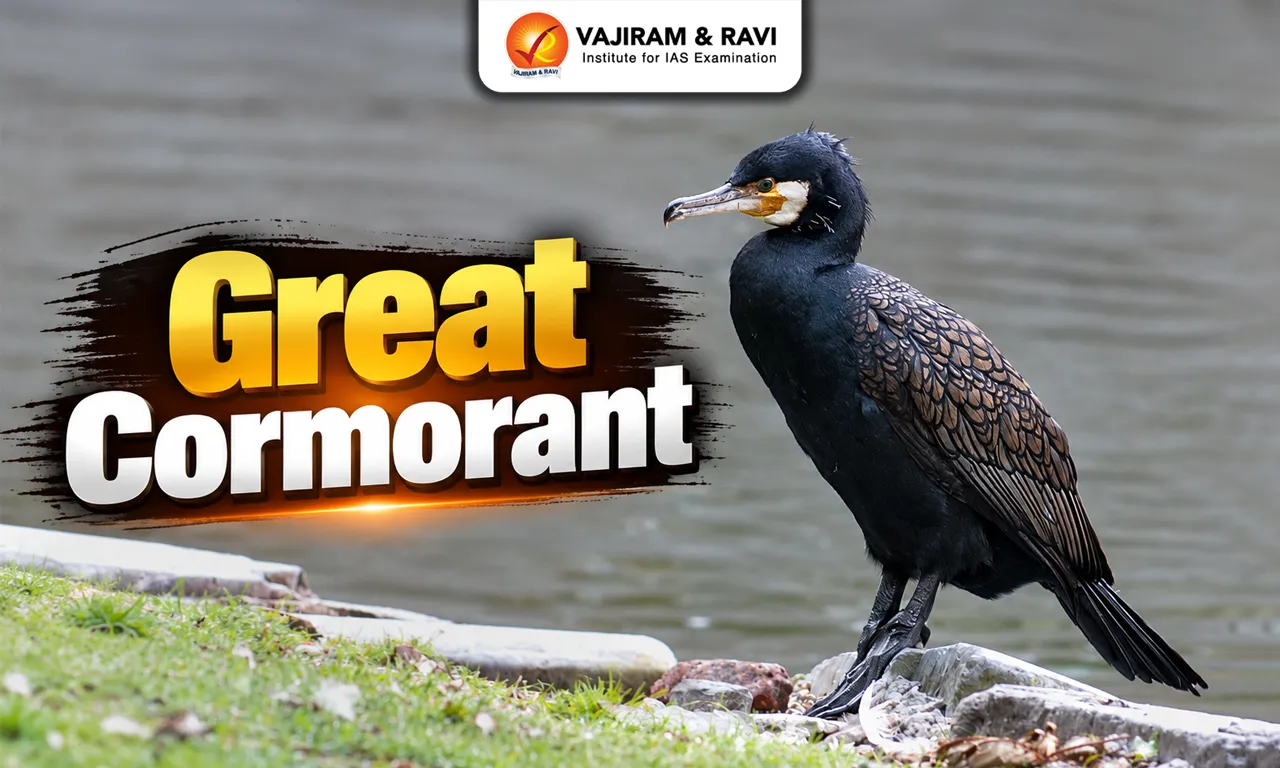
  • They have dark, glossy plumage, very long necks, long, hooked bills and webbed feet. 
  • They have a longish tail and a yellow throat patch. Adults have white thigh patches in the breeding season. 
  • Their powerful bills are greyish with white patches around its base. 
  • They employ their powerful webbed feet for efficient swimming and diving to catch a variety of prey, including fish, crabs, and, in some areas, frogs or ducklings. 
  • Notably, the Great Cormorant has a unique fishing partnership with Asian fishermen, who train them to catch fish while preventing them from swallowing their catch using rings around their necks. 
  • Like other cormorants, their plumage has limited waterproofing. The birds spread their wings to dry when they leave the water after diving.  
  • These birds typically nest in small colonies, sometimes expanding to over 2,000 pairs.

Great Cormorant Conservation Status

It is classified as 'Least Concern' under the IUCN Red List.

News: TT

Great Cormorant FAQs

Q1: What is the Great Cormorant?

Ans: The Great Cormorant is a large waterbird belonging to the cormorant family.

Q2: Where is the Great Cormorant distributed?

Ans: It has a very wide distribution covering North America, Europe, Africa, China, India, Southeast Asia, New Zealand, Papua New Guinea and Australia.

Q3: What type of plumage does the Great Cormorant have?

Ans: It has dark, glossy plumage.

Q4: What are the major physical features of the Great Cormorant?

Ans: It has a long neck, long hooked bill, webbed feet, longish tail and yellow throat patch.

Q5: What is the conservation status of the Great Cormorant according to the IUCN Red List?

Ans: Least Concern (LC).

Emi Koussi Volcano

Emi Koussi Volcano

Emi Koussi Volcano Latest News

A 2024 astronaut photo captured an unusual salt patch shining like snow on top of northern Chad's imposing Emi Koussi volcano, which is covered with ancient lava, hidden vents and shadowy waterways.

About Emi Koussi Volcano

  • It is a large shield volcano located in the central Sahara in the north of the Republic of Chad. 
  • It lies at the southeast end of the Tibesti Mountains. 
  • At 3,415 meters above sea level, it is not only the highest mountain in Chad but also the highest in the Sahara. 
  • Its crater is 19 kilometers wide and 1,219 meters deep. 
  • Two nested calderas cap the volcano, the outer one being about 12 by 15 km in size. 
  • Within it on the southeast side is a smaller caldera, about 2–3 km wide and 350 m deep. 
  • Numerous lava domes, cinder cones, maars, and lava flows are found both within the calderas and along the outer flanks of the shield. 
  • Nested within the main caldera is a smaller crater that contains white salts of a dry lake at its lowest point. 
  • The smaller crater is surrounded by a region of darker rocks—a geologically young dome of lava studded with several small circular volcanic vents. 
  • The dark volcanic rocks of the volcano provide a sharp contrast to the underlying tan and light brown sandstone exposed to the west, south, and east. 
  • Emi Koussi is extinct, and it is not known when it last erupted. 

What is a Maar?

  • A maar is a broad, low-relief volcanic crater caused by an explosion which occurs when groundwater comes into contact with hot lava or magma. 
  • A maar characteristically fills with water to form a relatively shallow crater lake.

News: LS

Emi Koussi Volcano FAQs

Q1: What type of volcano is Emi Koussi Volcano?

Ans: It is a large shield volcano.

Q2: Where is the Emi Koussi Volcano located?

Ans: It is located in the central Sahara in the north of the Republic of Chad.

Q3: What is the geographical significance of Emi Koussi?

Ans: It is the highest mountain in Chad and the highest point in the Sahara.

Q4: What is the volcanic status of Emi Koussi?

Ans: Emi Koussi is considered extinct.

Lord Howe Island

Lord Howe Island

Lord Howe Island Latest News

A 16-year study from Lord Howe Island found record levels of plastic ingestion in fledgling sable shearwaters.

About Lord Howe Island

  • It is a crescent-shaped, volcanic island.
  • Location:  It is located about 650 kilometres off Australia's east coast in the Tasman Sea.
  • Discovered By: The Island was discovered in 1788 and named for Admiral Lord Howe by Lieutenant Henry Lidgbird Ball of the British navy.
  • Geographical Features
    • Peaks: The island has two peaks (Mounts Gower and Lidgbird), each rising above 2,500 feet (760 metres) at its southern end. 
    • It has the most southerly coral reef in the world.
  • Flora and Fauna
    • About 47% of the island's vascular plants are endemic, including the famous Kentia Palm (Howea forsteriana).
    • It has endemic species like the Lord Howe Island Phasmid which is considered the world’s largest stick insect, and the flightless Lord Howe Woodhen (Gallirallis sylvestris).
    • It hosts the world’s largest known population of sable shearwaters, with an estimated 22,000 breeding pairs.
  • The Lord Howe Island Group is a UNESCO World Heritage Site that boasts countless unique plants and animals, many of which are endemic to the region. 

Source: DTE

Lord Howe Island FAQs

Q1: Where is Lord Howe Island located?

Ans: It is located about 650 kilometres off Australia's east coast in the Tasman Sea.

Q2: Who discovered the Lord Howe Island?

Ans: Admiral Lord Howe

Exercise Tarang Shakti

Exercise Tarang Shakti

Exercise Tarang Shakti 2026 Latest News

The Indian Air Force (IAF) will host the second edition of its largest-ever multinational air exercise, Tarang Shakti-26 in Jodhpur. 

About Exercise Tarang Shakti 2026

  • It is the multinational air exercise to be conducted in Jodhpur.
    • The maiden edition of the exercise took place in August-September 2024 in two phases.
  • Participating Countries: Eight friendly foreign countries such as Australia, Bangladesh, France, Germany, Greece, Sri Lanka, UAE and USA will participate with air assets, while 32 nations will be attending as observers. 
  • It is aimed at enhancing interoperability among participating air forces, while providing a platform for exchanging operational experience and showcasing India’s air combat capabilities.
  • The exercise will see the participation of advanced combat aircraft, including the U.S. Air Force’s F-35, the French Rafale, the UAE’s F-16 and a Bangladeshi C-130J.
    • The IAF will field a range of its frontline platforms, including the Rafale, Mirage-2000, Jaguar, Tejas, MiG-29 and Su-30MKI.

Source: IE

Exercise Tarang Shakti 2026 FAQs

Q1: What is Exercise Tarang Shakti 2026?

Ans: It is the multinational air exercise to be conducted in Jodhpur.

Q2: Which countries are participating in Exercise Tarang Shakti 2026?

Ans: Australia, Bangladesh, France, Germany, Greece, Sri Lanka, UAE and USA

National Single Window System

National Single Window System

National Single Window System Latest News

The National Single Window System marks a significant step towards creating a transparent, and technology-driven regulatory ecosystem. 

About National Single Window System

  • It serves as a digital platform that guides investors in identifying and applying for the approvals required for their businesses.
  • It is a digital platform that guides investors in identifying the approvals required for their businesses. 
  • It was launched in September 2021.
  • It is implemented by the Department for Promotion of Industry and Internal Trade (DPIIT), Ministry of Commerce & Industry.
  • It integrates approvals offered by Central Ministries, State Governments, and regulatory authorities on a common digital platform.   

Key Functionalities of NSWS

  • Know Your Approvals: It is the Know Your Approvals (KYA) module, a tool that identifies the approvals applicable to a business based on its proposed activities.
  • The portal hosts applications for approvals from 32 Central Ministries/ Departments and 34 State Governments and Union Territories. This helps investors navigate regulatory requirements for business.
  • Common Registration Form: It captures information through a single interface and enables reuse of information across applications.
  • Access to State Single Window Systems: It offers seamless access through a dedicated State Registration Form, ensuring integration with State-level approval mechanisms.
  • Applicant Dashboard: It includes an applicant dashboard for submitting applications, monitoring their status, and responding to departmental queries.
  • A centralized Document Repository enables one-time upload and reuse of documents across multiple approvals, reducing duplication of submissions.
  • E-Communication Module: It facilitates online exchange of queries and clarifications between applicants and the concerned Ministries and State Governments.

Significance of National Single Window System

  • It simplifies the approval process by enabling one-time submission of information and documents.
  • It helps reduce compliance and approval timelines. The platform also enhances transparency through real-time application tracking and online communication with regulatory authorities.
  • NSWS minimizes duplication of information across departments and improves coordination among government agencies through an integrated digital ecosystem.

 Source: PIB

National Single Window System FAQs

Q1: What is National Single Window System?

Ans: It is a digital platform that guides investors in identifying the approvals required for their businesses.

Q2: Who implements the National Single Window System?

Ans: It is implemented by the Department for Promotion of Industry and Internal Trade (DPIIT), Ministry of Commerce & Industry.

Koel River

Koel River

Koel River Latest News

Four teenagers recently drowned in the Koel River in Jharkhand's Palamu district while immersing materials used for Karma Puja.

About Koel River

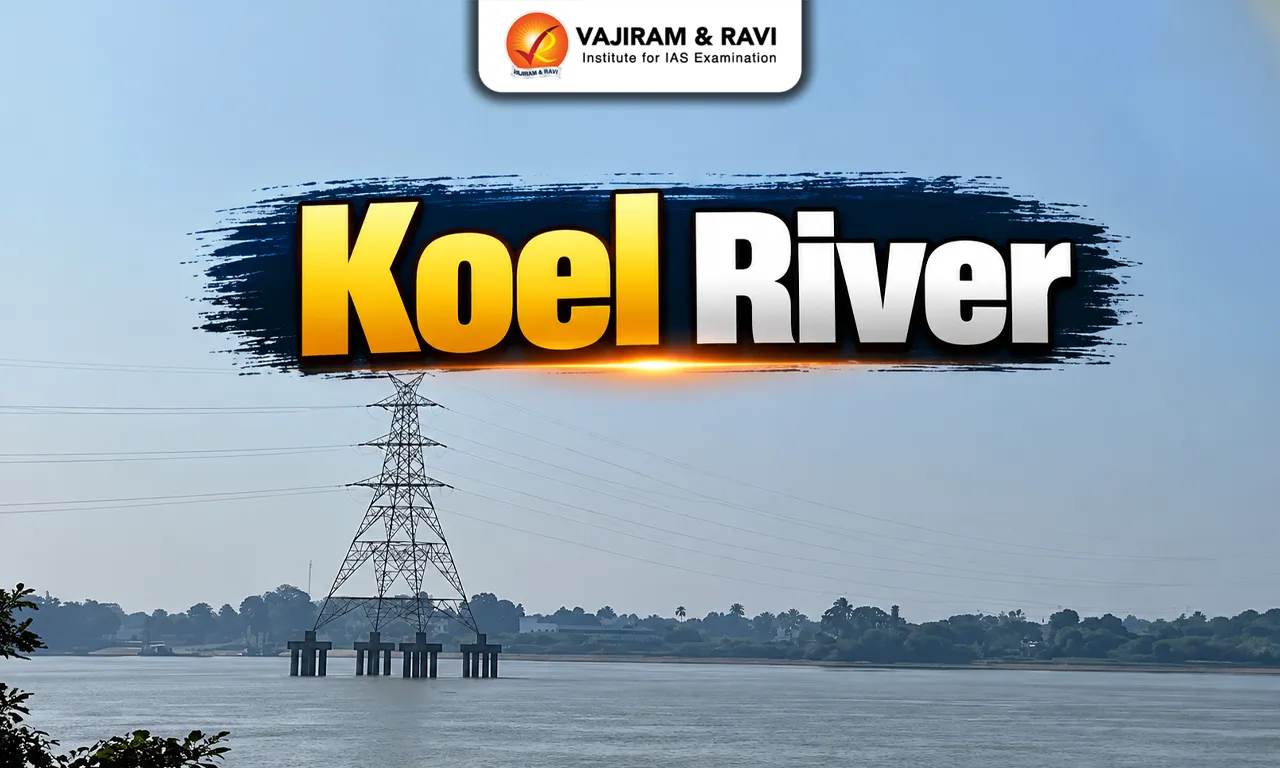
  • It is an important river flowing through the states of Jharkhand and Odisha. 
  • Course:
    • It originates from the Palamau Tiger Reserve, Jharkhand, and flows in the western part of Palamu District. 
    • The river is believed to be fed by three streams of Jharkhand, namely South Karo, North Karo and Koina. 
    • The river divides into two:
      • North Koel River: It is tapped near Kutku for irrigation reasons and finally joins with the Son River (a principal southern tributary of the Ganges). 
      • South Koel River: It joins the Sankh River near Rourkela in Odisha to form the Brahmani River. 
  • Flowing through the hilly terrain of Jharkhand and Odisha, the Koel River is part of the larger Damodar Valley region, known for its mineral-rich landscape.
  • It is prone to seasonal flooding, particularly during the monsoon months.
  • Hydropower Potential: The North Koel Dam, also known as the Mandal Dam, was constructed on the North Koel River in Jharkhand, intended to generate hydroelectric power and supply irrigation water.

News: ETVB

Koel River FAQs

Q1: Which states does the Koel River flow through?

Ans: The Koel River flows through Jharkhand and Odisha.

Q2: Where does the Koel River originate?

Ans: It originates from the Palamau Tiger Reserve in Jharkhand.

Q3: Which major river does the North Koel River eventually join?

Ans: The North Koel eventually joins the Son River, a major southern tributary of the Ganges.

Central Drugs Standard Control Organization

Central Drugs Standard Control Organization

Central Drugs Standard Control Organisation Latest News

The Central Drugs Standard Control Organisation recently called for rational, safe and responsible use of non-steroidal anti-inflammatory drugs, used commonly to relieve pain and inflammation, and antibiotics.

About Central Drugs Standard Control Organisation 

  • It is the National Regulatory Authority (NRA) of India for pharmaceuticals, medical devices, and cosmetics.
  • It is responsible for discharging functions assigned to the Central Government under the Drugs and Cosmetics Act 1940 and Rules 1945.  
  • Its primary responsibility is to ensure the safety, efficacy, and quality of drugs, medical devices, and diagnostic kits.
  • The organization plays a pivotal role in the regulation and supervision of drug development, manufacturing, distribution, and marketing in India. 
  • Nodal Ministry: It works under the Directorate General of Health Services, Ministry of Health & Family Welfare, Government of India.
  • Headed By: The Drugs Controller General of India (DCGI) is the head of the CDSCO.
  • Headquarters: New Delhi  
  • Under the Drugs and Cosmetics Act, CDSCO is responsible for,
    • Approval of new drugs; Conduct of clinical trials; Laying down the standards for drugs; Control over the quality of imported drugs in the country; Coordination of the activities of State Drug Control Organizations;
    • CDSCO, along with state regulators, is jointly responsible for the grant of licenses for certain specialized categories of critical drugs such as blood and blood products, I. V. Fluids, Vaccine, and Sera.
    • It is also responsible for overseeing the import, manufacture, sale, and distribution of medical devices in the country. 
    • The CDSCO ensures that medical devices comply with safety, quality, and efficacy standards.

News: NIE

Central Drugs Standard Control Organisation FAQs

Q1: What is the Central Drugs Standard Control Organisation (CDSCO)?

Ans: CDSCO is the National Regulatory Authority (NRA) of India for pharmaceuticals, medical devices and cosmetics.

Q2: What is the primary responsibility of Central Drugs Standard Control Organisation (CDSCO)?

Ans: Its primary responsibility is to ensure the safety, efficacy and quality of drugs, medical devices and diagnostic kits.

Q3: Under which ministry does Central Drugs Standard Control Organisation (CDSCO) function?

Ans: CDSCO functions under the Ministry of Health & Family Welfare through the Directorate General of Health Services (DGHS).

Q4: Who heads the Central Drugs Standard Control Organisation (CDSCO)?

Ans: The Drugs Controller General of India (DCGI) heads CDSCO.

SSA 5000 – Sustainability Assurance and the Fight Against Greenwashing

Greenwashing

SSA 5000 Latest News

  • The Institute of Chartered Accountants of India (ICAI) has issued the Standard on Sustainability Assurance (SSA) 5000, aligned with the International Standard on Sustainability Assurance (ISSA) 5000, with certain provisions tailored to the Indian context.
  • The standard will become effective from April 1, 2027, and seeks to bring greater rigour, consistency and credibility to corporate sustainability disclosures. 

About Sustainability Assurance

  • Sustainability assurance refers to the independent examination and verification of information disclosed by companies regarding their environmental, social and governance (ESG) performance.
  • Unlike financial statements, which are generally prepared and audited according to established accounting and auditing standards, sustainability information can be collected through different methodologies and may involve both measurements and estimates.
  • This creates challenges relating to consistency, comparability, data quality and verification.
  • SSA 5000 seeks to address these concerns by establishing principles and procedures for assurance practitioners to:
    • Examine sustainability disclosures
    • Assess relevant risks
    • Collect and evaluate evidence
    • Examine internal controls
    • Identify material misstatements
    • Issue an assurance conclusion

What Does SSA 5000 Cover?

  • The framework covers sustainability information across a wide range of ESG parameters. These may include:
    • Greenhouse gas emissions
    • Energy consumption
    • Water usage
    • Waste management
    • Biodiversity impacts 
    • Diversity and employee practices
    • Governance indicators
  • The standard replaces earlier ICAI standards such as SSAE 3000 and SAE 3410, which provided an umbrella framework for sustainability assurance engagements.
  • Its introduction comes at a time when companies are reporting sustainability information under multiple frameworks, including Business Responsibility and Sustainability Reporting (BRSR), Global Reporting Initiative (GRI) and International Sustainability Standards Board (ISSB) standards.

SSA 5000 and Greenwashing

  • A major concern in sustainability reporting is that companies themselves prepare their sustainability reports and determine which achievements to highlight.
  • SSA 5000 introduces a greater role for an independent assurance practitioner, who must assess whether sustainability claims are supported by adequate evidence and whether disclosures contain material errors or misleading presentations.
  • For example, if a company claims that it has reduced its carbon emissions by a particular percentage, the assurer would examine:
    • Emission-related calculations
    • Energy consumption records 
    • Supporting documentation
    • Relevant internal processes and controls
  • This shifts sustainability reporting from management assertions towards evidence-based disclosures.

Addressing Selective Disclosure

  • Greenwashing is the practice of making misleading or exaggerated claims about a company’s environmental or sustainability performance to appear more eco-friendly than it actually is.
    • Example: A company markets itself as “carbon neutral” while achieving little actual reduction in its emissions.
  • Greenwashing may also occur through selective disclosure or “cherry-picking”, where positive sustainability achievements are highlighted while negative information is omitted.
  • SSA 5000 requires assurance professionals to assess whether disclosures provide a balanced picture.
  • They must consider whether the reporting scope excludes significant operations or negative information that could influence stakeholder decisions.
  • The framework also addresses sustainability impacts across the wider value chain. A company may report improvements in its own operations while excluding emissions or social impacts generated by suppliers and other parts of its value chain.
  • Assurance practitioners must therefore assess whether reporting boundaries are appropriate and whether significant activities have been excluded without adequate justification.

Verification of Sustainability Claims

  • SSA 5000 requires assurance professionals to critically examine management assumptions rather than simply accepting explanations provided by companies.
  • For instance, a claim of “carbon-neutral operations” may require examination of how emissions have been calculated, whether carbon offsets are genuine and whether claimed emission reductions are permanent.
  • This is particularly important because sustainability information often involves technical calculations, estimates and measurement methodologies.
  • The framework therefore requires practitioners to assess data quality, understand measurement processes and undertake procedures to verify the information.

Challenges in Implementation

  • Complex Supply Chains
    • Assessing sustainability impacts across multiple suppliers and business partners can be difficult, particularly when companies lack reliable data from their wider value chains.
  • Lack of Standardised Data
    • Differences in data collection and measurement methodologies can make sustainability information difficult to compare across companies.
  • Forward-Looking Claims
    • Claims relating to Net Zero targets and future climate commitments involve assumptions about future actions, technology and business decisions, making their assurance more complex.
  • Shortage of Skilled Professionals
    • Sustainability assurance requires multidisciplinary expertise covering accounting, auditing, environmental science and technology. A shortage of professionals with this combination of skills could constrain implementation.
  • Higher Compliance Costs
    • Companies may need to invest in data-management systems, technology and specialised personnel to make sustainability information assurance-ready. These costs could be particularly significant for smaller firms.

Opportunities

  • The emergence of sustainability assurance can create demand for professionals and firms capable of integrating accounting, assurance, environmental expertise, technology and regulatory advisory services.
  • The sustainability consulting market has already expanded following SEBI's introduction of BRSR requirements for listed companies.
  • SSA 5000 could therefore contribute to the emergence of integrated sustainability-management firms that help companies collect reliable data, prepare disclosures and meet assurance requirements.

Source: TH

SSA 5000 FAQs

Q1: What is SSA 5000?

Ans: SSA 5000 is the ICAI's Standard on Sustainability Assurance that establishes principles and procedures for independently verifying corporate sustainability information.

Q2: When will SSA 5000 become effective?

Ans: SSA 5000 will become effective from April 1, 2027.

Q3: What is greenwashing?

Ans: Greenwashing refers to sustainability or environmental claims that may be exaggerated, misleading, selectively presented or inadequately supported by evidence.

Q4: Which areas can SSA 5000 cover?

Ans: The standard can cover information relating to greenhouse gas emissions, energy, water, waste, biodiversity, employee practices, diversity and governance.

Q5: How does SSA 5000 address greenwashing?

Ans: It requires independent assurance practitioners to examine evidence, reporting boundaries, assumptions, data quality and potential material misstatements rather than relying solely on management claims.

81st United Nations General Assembly (UNGA) – Reforming Multilateralism Amid Global Geopolitical Stress

81st United Nations General Assembly

81st United Nations General Assembly (UNGA) Latest News

  • External Affairs Minister S. Jaishankar called for stronger and reformed multilateralism amid growing geopolitical competition, conflicts and pressures on international cooperation. 
  • He made the remarks while co-chairing the inaugural Partners for Multilateralism, International Law, Peace & Prosperity (P4M) Summit with European Council President Antonio Costa on the sidelines of the 81st UNGA in New York.
  • The summit comes at a time when the global order is experiencing strategic rebalancing, geopolitical tensions and conflicts, while the UN system faces criticism over limited representation and decision-making effectiveness.

Global Order Under Stress

  • Jaishankar argued that the long-term rebalancing of global power has acquired a more difficult character because of intense strategic competition.
  • If these pressures remain unchecked, they could weaken the spirit of international cooperation. 
  • Therefore, multilateralism needs to assert itself more strongly to address common global challenges.
  • He stressed that cooperation is essential in areas such as -
    • Peace and international security
    • Climate action and climate justice
    • Emerging technologies
    • Development finance
    • Counter-terrorism
    • Global supply chains
    • Disaster resilience
    • Pandemic preparedness

The 4F Crisis

  • A major concern highlighted by Jaishankar was the vulnerability of global systems to disruptions in essential supplies. 
  • He referred to the “4F crisis” — fuel, food, fertiliser and finance.
  • He called for -
    • Frameworks and guardrails for emerging technologies and capabilities.
    • De-risking and diversification where countries face dependence on strategic chokepoints.
    • International cooperation to prevent disruptions in critical supply chains.
    • Greater resilience against geopolitical shocks.
  • This approach is particularly significant for countries such as India, which seek to maintain strategic autonomy while reducing excessive dependence on any single country or supply source.
  • The emphasis on diversification is consistent with India’s broader approach of building resilient supply chains and maintaining multiple strategic partnerships rather than relying excessively on any single geopolitical bloc.

Reformed Multilateralism

  • India advocated “reformed multilateralism” based on -
    • More participative deliberations
    • Transparent decision-making
    • Greater representation of contemporary global realities
    • Respect for international law, rules and norms
  • India argues that institutions created in an earlier geopolitical era need to become more representative of the present distribution of economic and political power.
  • This is particularly relevant to UN Security Council (UNSC) reform, where India has been seeking permanent membership.

India and Visegrad Group

  • Slovakia backed India’s bid for permanent membership of the UNSC, describing India as an important country of the Global South and an emerging power in the Indo-Pacific.
  • Jaishankar also participated in the first V4+India Foreign Ministers’ Meeting.
  • The Visegrád Group (V4) consists of Czechia (Czech Republic), Hungary, Poland, and Slovakia.
  • The meeting focused on strengthening cooperation in political and diplomatic affairs, economy and trade, defence and security, technology, space, connectivity, and people-to-people (P2P) relations.
  • The new V4+India format expands India’s engagement with Central Europe and provides another platform for cooperation beyond traditional bilateral relationships.

Bilateral and Regional Engagements

  • During his UNGA visit, Jaishankar held meetings with foreign ministers of France, Ukraine, Hungary and Moldova.
  • With France, discussions covered the Ukraine and Gulf crises, bilateral strategic cooperation and reform of the UN Security Council.
  • With Ukraine, discussions included peace efforts, bilateral cooperation and the Black Sea, including the importance of freedom of navigation for global food security.
  • These engagements demonstrate India’s effort to maintain dialogue with multiple stakeholders while pursuing its independent foreign-policy interests.

Significance for India

  • Strategic autonomy: Maintaining independent decision-making amid competing geopolitical blocs.
  • Global South leadership: Advocating greater representation and voice for developing countries.
  • Multilateral reform: Seeking institutions that are more representative, participatory and transparent.
  • Supply-chain resilience: Reducing vulnerability arising from excessive dependence and geopolitical chokepoints.
  • Rules-based international order: Supporting international law, norms and peaceful resolution of disputes.

Way Forward

  • A more effective multilateral system requires representative institutions, transparent decision-making, respect for international law and greater cooperation on transnational challenges.
  • India’s advocacy of reformed multilateralism seeks to move global governance beyond bloc politics towards a system capable of addressing emerging challenges such as -
    • Climate change, 
    • Technological disruption, 
    • Pandemics, 
    • Terrorism, 
    • Food and energy insecurity.

Source: ToI | IE

81st United Nations General Assembly (UNGA) FAQs

Q1: What is meant by ‘Reformed Multilateralism’?

Ans: It seeks more representative institutions, participative deliberations, transparent decision-making, etc.

Q2: How can de-risking and diversification strengthen global supply-chain resilience?

Ans: Diversifying suppliers, markets and strategic dependencies can reduce vulnerability to geopolitical chokepoints.

Q3: What are the major concerns associated with the ‘4F crisis’?

Ans: It highlights vulnerabilities caused by geopolitical conflicts, supply disruptions and economic shocks.

Q4: How does India’s advocacy of reformed multilateralism reflect its foreign-policy priorities?

Ans: It reflects India’s emphasis on strategic autonomy, Global South representation, UN reform, international law, etc.

Q5: What is the significance of the V4+India framework for India’s foreign policy?

Ans: It strengthens India’s engagement with Central Europe through cooperation in politics, defence, economy, technology, etc.

Women Farmers in India: Maharashtra’s Law and the Recognition Gap

Women Farmers

Women Farmers Latest News

  • Picture a farmer. The image that comes to mind is usually of a man. But the reality on India's farms is increasingly female. 
  • This mismatch between perception and reality stems from decades-old practices of collecting data, designing policy, and defining who counts as a "farmer." It renders millions of working women nearly invisible. 
  • In July 2026, Maharashtra passed the Women Farmers' Empowerment Bill, seeking to change this. Maharashtra's move is well-timed. 
  • The United Nations has designated 2026 as the International Year of the Woman Farmer. The state has positioned itself as a potential first mover, paving the way for others.

What the Maharashtra Act Does

  • The Act grants women independent recognition as farmers, irrespective of land ownership, through a "Woman Farmer Certificate."
  • It recognises women engaged in agriculture for at least one agricultural season a year, regardless of the nature of the land.
  • It explicitly covers categories such as landless cultivators, landless livestock rearers, agricultural labourers, plantation labourers, and pastoralists.
  • This creates a route for women without land titles to gain an independent agricultural identity and access welfare schemes and credit.

Historical Significance

  • This is the first Indian State legislation to give enforceable legal form to the activity-based, land-delinked definition of "farmer" that the National Policy for Farmers, 2007 had proposed but never operationalised. 
  • It is described as the culmination of three decades of women farmers' movements backed by civil society.
  • Earlier state efforts had made partial progress: Kerala's Kudumbashree collectives enabled group farming for women, and Odisha's KALIA scheme reached landless and sharecropper women. 
  • But a women farmers' registry delinked from land records was missing until now.

The Scale of the Recognition Gap

  • Women's role in Indian agriculture has grown sharply, but recognition has not kept pace.
    • In 2025, agriculture employed roughly 110 million women and 127 million men (rural, PLFS/Census-adjusted) — bringing the sector close to gender parity.
    • Women's agricultural workforce has more than doubled since 2017–18.
    • Nearly three-quarters of rural women workers are now in agriculture, compared with less than half of men.
  • Yet most of this work goes unrecognised and unpaid:
    • In 2025, over 41% of female agricultural workers were unpaid, against 20% of men.
    • Nearly 63% of men were own-account workers, compared with 39% of women.

The Worker-Owner Dichotomy

  • The core structural problem is this: women largely work on family land without owning it or having their name on records, due to patriarchal land-titling norms.
  • Only 14% of operational agricultural landholdings are held by women (Agricultural Census, 2015–16).
  • Since the person named in land records is the one counted in databases and given benefits, women's contribution remains statistically invisible.
  • Because most states use land revenue records as their "source of truth" for administrative purposes, this bias is carried forward into scheme access.
  • The consequence is concrete exclusion from credit, subsidies, technology and extension services. 
  • For instance, only 23% of PM-KISAN beneficiaries are women, despite the scheme providing ₹6,000/year to landholding farmer families.

What the Data Reveals Across States

  • A comparison of women's workforce share versus their scheme-beneficiary share exposes sharp gaps.
  • Even in states where women form over 50% of the agriculture workforce, their share of beneficiaries is often below one-third.
  • Exceptions: Meghalaya (women are 70% of PM-KISAN beneficiaries) and Kerala (44%) stand out — explained by matrilineal/customary tenure systems in the Northeast and Kudumbashree-style collective farming in Kerala.
  • Widest gaps: In Jammu & Kashmir and Himachal Pradesh, women form nearly two-thirds of the workforce but represent only a small fraction of beneficiaries.
  • The pattern is telling: the binding constraint is not land itself, but the identification system built on land records. Where land records act as gatekeeper, women get filtered out. Where an alternative mechanism exists, their access rises sharply.

From Recognition to Real Access

  • Passing a law is only the first step. Several implementation challenges remain:
    • Identification mechanism: Women must be registered either through self-registration or identification by the Gram Sabha, including those with no land titles in their name. This will require a strong information campaign.
    • Database integration: The Act creates a new database of women farmers. Linking it with existing agricultural databases — while avoiding duplication or exclusion — is a significant administrative task.
    • Standardisation across states: A common system for definitions, certificate issuance, and database maintenance would allow women farmers' identities to be linked seamlessly across schemes, avoiding multiple registrations.
    • Agri Stack integration: Certificates must be linked to the Agri Stack — the Union Agriculture Ministry's digital platform — and Farmer IDs issued to women, integrating them into the broader digital agricultural ecosystem.
    • Sustained local outreach: Recognition translates into empowerment only if continuous local efforts make women aware of schemes and actively help them access benefits.

Conclusion

  • Women already do the work; the law has simply been slow to see them. Maharashtra's Act finally separates the identity of a farmer from the ownership of land. But a certificate on paper means little without databases, digital integration and sustained outreach behind it. 
  • Real empowerment will be measured not in legislation, but in how many women actually reach the schemes meant for them.

Source: TH

Women farmers FAQs

Q1: Why are women farmers often under-recognised in India?

Ans: Women farmers often work on family land without ownership or land records in their names, making their agricultural contributions invisible to administrative systems.

Q2: What does Maharashtra's Women Farmers' Empowerment Act provide?

Ans: Maharashtra's law provides women farmers independent recognition through a Woman Farmer Certificate, regardless of land ownership or the nature of land cultivated.

Q3: How many women work in Indian agriculture?

Ans: In 2025, approximately 110 million women worked in agriculture, compared with 127 million men, bringing the agricultural workforce close to gender parity.

Q4: Why does land ownership affect women farmers' access to schemes?

Ans: Land records often determine farmer identification, so women farmers without land titles can be excluded from credit, subsidies, technology, extension services and welfare schemes.

Q5: How can recognition improve access for women farmers?

Ans: Recognition can improve access by linking women farmers' certificates with agricultural databases, Farmer IDs, Agri Stack and welfare schemes while providing sustained local outreach.

Canal-Top Photovoltaics: How India’s Canals Can Power Solar Energy

Canal-Top Photovoltaics

Canal-Top Photovoltaics Latest News

  • As India expands clean energy capacity, land for solar projects is becoming scarce and costly. This has pushed interest towards innovative solutions that generate power without consuming more land. 
  • The recently approved PM Surya Sarovar Yojana (PM-SSY) targets 5,000 MW of floating solar capacity on reservoirs and inland water bodies. 
  • But India's water infrastructure holds another under-explored resource: its vast canal network, among the largest in the world.

About Canal-Top Photovoltaics (CTPV)

  • In Canal-Top Photovoltaics (CTPV), solar panels are mounted on specialised elevated structures built over canal stretches. 
  • This differs from floating solar, where panels sit on platforms floating directly on water.
  • Structures may span the canal or be installed along the canal banks, depending on width, design and orientation.
  • In every configuration, the design must allow unobstructed water flow underneath.

Why CTPV Makes Sense

  • Land Saved - Like floating solar, CTPV's biggest advantage is that it needs virtually no additional land. In Punjab, installing 20 MW of CTPV capacity is estimated to have saved nearly 100 acres of land.
  • Water Saved - Panels covering canal stretches reduce evaporation losses — valuable in India's water-stressed regions.
  • Better Panel Performance - The cooling effect of water beneath the panels can improve efficiency in hot weather.
  • A Working Example - A 1-MW CTPV system over the Narmada Canal in Mehsana, Gujarat, commissioned in 2012, reportedly saves close to 9 million litres of water annually while generating 1.6 million units of electricity each year.

India's Track Record So Far

  • CTPV remains a niche application, but India was an early mover.
    • 2012: First CTPV installation at Mehsana, Gujarat.
    • 2014–2017: Two 10-MW systems commissioned in Vadodara, Gujarat.
    • 2017–2018: 20 MW commissioned across Punjab.
    • September 2025: The Punjab Energy Development Agency invited expressions of interest for 40-MW CTPV projects across Punjab's canal network, which spans over 10,000 km.
    • Haryana has begun exploring CTPV over six of its irrigation canals.

Policy Support: Past and Present

  • CTPV first received formal backing in 2014, when the Ministry of New and Renewable Energy (MNRE) launched a pilot-cum-demonstration scheme for grid-connected CTPV and canal-bank projects.
  • Target: 50 MW each for CTPV and canal-bank projects.
  • Financial assistance: Rs 3 crore per MW (CTPV) and Rs 1.5 crore per MW (canal-bank), or 30% of project cost, whichever was lower.

The Scale of the Opportunity

  • A 2024 assessment, co-authored by the Center for Study of Science, Technology and Policy (CSTEP), estimated India's combined CTPV and canal-bank potential at around 131 GW.
    • This covers canals up to 30 metres wide, plus vertical bifacial installations for canals wider than 30 metres.
    • The assessment factored in solar irradiation, canal characteristics, distance from substations, and protected areas.
  • The five states with highest potential: Uttar Pradesh, Bihar, Karnataka, Andhra Pradesh and Punjab.

Why Deployment Has Stayed Limited

  • Despite early progress, CTPV has not scaled meaningfully in over a decade.
  • High system cost is the primary bottleneck. Elevated structures spanning canals cost more than simple ground-mounted panels.
  • Structures must be engineered to not disrupt canal operations and to withstand wind loads, requiring extra structural steel, foundations and maintenance access.
  • Maintenance is harder — cleaning, repair and replacement work is more difficult on structures elevated above a working canal.
  • The linear, winding nature of canals complicates layout, especially where canals change direction or substations are poorly located, raising the cost of electricity produced.

The Way Forward

  • PM-SSY is expected to revitalise floating solar and signal growing policy interest in land-neutral solar solutions. This momentum could extend to CTPV as well, but scaling it requires deliberate steps:
    • Site selection based on land scarcity, nearby electricity demand, grid connectivity, and canal orientation.
    • Tailored financing — viability gap funding and low-cost debt — to attract developers and help early projects build experience, eventually reducing costs through scale.
    • A lesson from 2014: financial support alone is not enough. The earlier MNRE scheme did not convert pilots into large-scale deployment.
    • What's now needed is a renewed policy approach combining financial assistance, standardised specifications and guidelines, capacity building of state nodal agencies and irrigation departments, and streamlined approval processes.
  • CTPV will not replace ground-mounted or rooftop solar. But even a fraction of its technical potential could meaningfully boost India's renewable capacity without adding pressure on land.

Conclusion

  • India does not lack sunlight or canals — it lacks the financing and standardisation to link the two at scale. CTPV shows that clean energy need not always compete with agriculture or habitation for land. 
  • Turning canal water into a power asset, rather than just a resource in transit, is a quiet but meaningful opportunity waiting to be prioritised.

Source: TH | ToI

Canal-Top Photovoltaics FAQs

Q1: What are canal-top photovoltaics?

Ans: Canal-top photovoltaics are solar panels mounted on elevated structures over canals, generating electricity while allowing water to flow underneath without obstruction.

Q2: How can canal-top photovoltaics save land and water?

Ans: Canal-top photovoltaics require little additional land and can reduce evaporation from covered canal stretches, particularly benefiting water-stressed regions.

Q3: What is India's potential for canal-top photovoltaics?

Ans: A 2024 assessment estimated India's combined canal-top photovoltaics and canal-bank solar potential at approximately 131 GW across suitable canal networks.

Q4: Why have canal-top photovoltaics not scaled rapidly in India?

Ans: Canal-top photovoltaics face high structural costs, complex engineering requirements, difficult maintenance, canal layouts and challenges connecting projects efficiently to substations.

Q5: Which states have significant potential for canal-top photovoltaics?

Ans: Uttar Pradesh, Bihar, Karnataka, Andhra Pradesh and Punjab have the highest estimated potential for canal-top photovoltaics and canal-bank solar installations.

DPDP Rules 2025, India’s New Digital Data Protection Framework

DPDP Act 2023

The Government of India notified the Digital Personal Data Protection (DPDP) Rules, 2025 on 14 November 2025, completing the full operationalisation of the DPDP Act 2023. Together, the Act and the Rules establish a clear, citizen-centric framework for the responsible handling of digital personal data. They balance the protection of individual rights with the need for lawful and accountable data processing. The detailed article has been shared below.

Digital Personal Data Protection (DPDP) Act 2023

The Digital Personal Data Protection (DPDP) Act 2023, enacted in August 2023, establishes India’s legal framework for safeguarding digital personal data. It outlines the responsibilities of organisations that process such data and adopts the SARAL approach: Simple, Accessible, Rational, and Actionable, to ensure the law remains easy to understand and implement. The framework also seeks to balance the individual Right to Privacy under Article 21 of the Indian Constitution with transparency by aligning its provisions with the Right to Information (RTI) Act, 2005.

DPDP Act 2023 Objectives

The objective of the DPDP Act 2023 is to make sure that people’s personal information is kept private and protected while, at the same time, allowing certain types of data to be processed (for example, legally, securely, and appropriately) by both government and business entities. The purpose of the DPDP Act 2023 has been shared below.

  • Safeguarding Individual Privacy: Provides a legal framework to protect personal data, prevent misuse, and limit unauthorised access or surveillance.
  • Ensuring Responsible Data Processing: Allows data processing only for lawful purposes with user consent, ensuring accuracy, security, and timely deletion.
  • Consent-Centric Data Governance: Requires clear, informed consent with the option to withdraw anytime; mandates parental consent for minors and persons with disabilities.
  • Balancing Privacy with Digital Innovation: Reduces compliance burden for startups and small entities while imposing stricter obligations on major data processors.
  • Secure Cross-Border Data Flow: Permits international data transfers to government-approved countries, supporting global digital operations with safeguards.

Also Read: Consumer Protection Act 1986

DPDP Act 2023 Features

  • Establishes a consent-based system where personal data can be processed only with clear, informed, and revocable consent of the individual.
  • Introduces rights for individuals, including the right to access, correct, erase personal data, and the right to grievance redressal.
  • Provides special protections for children’s data by requiring parental consent and prohibiting harmful data-processing practices.
  • Allows classification of certain entities as Significant Data Fiduciaries, imposing stricter obligations like data audits and impact assessments.
  • Includes provisions for government-notified exemptions in the interest of national security, public order, and research.
  • Permits cross-border data transfers to approved countries while ensuring adequate protection safeguards.
  • Follows the SARAL principle to keep rules simple, clear, and easy to implement for individuals and organisations.

Justice BN Srikrishna Committee

 The Justice BN Srikrishna Committee was set up to study global data protection practices and recommend a comprehensive framework for India, which laid the groundwork for the initial draft of the DPDP Act. 

The DPDP Act 2023 and subsequent DPDP Rules 2025 were finalised through public consultations and parliamentary enactment. The Ministry of Electronics and Information Technology carried forward the Committee’s recommendations to create India’s citizen-centric data protection framework.

DPDP Act 2023 Provisions

The DPDP Act 2023 lays down a comprehensive legal framework for processing digital personal data in a lawful, transparent, and accountable manner. It outlines the rights of individuals, obligations of organisations, rules for consent, and a graded system of penalties for violations.

  • The Act permits cross-border transfer of personal data to countries approved by the government, ensuring controlled and secure data flow.
  • Personal data may be retained for up to three years from the last interaction, with mandatory 48-hour prior notice to the Data Principal before erasure.
  • A digital-first Data Protection Board of India (DPBI) is established to handle consent, grievances, and enforcement through an online system for faster resolution.
  • Major digital platforms with large user bases, such as social media and e-commerce giants, are designated as Significant Data Fiduciaries with enhanced obligations.
  • The DPDP Act 2023 prescribes stringent monetary penalties for breaches by Data Fiduciaries. The maximum fine of up to ₹250 crore is imposed for failing to implement adequate security safeguards. 
  • Penalties of up to ₹200 crore may apply for not reporting a data breach or violating obligations related to children’s data. For all other forms of non-compliance with the Act or its Rules, fines can go up to ₹50 crore.

Data Protection Board of India

A central pillar of the DPDP Act 2023 is the creation of the Data Protection Board of India, a dedicated authority to regulate compliance and address grievances.

Structure and Appointment

  • Members are appointed by the Central Government.
  • Tenure is two years, with eligibility for reappointment.

Data Protection Board of India (DPBI) Functions

  • Enforcing compliance with the DPDP Act 2023.
  • Monitoring and responding to data breaches.
  • Investigating complaints and imposing penalties.
  • Coordinating with organisations during breach incidents.
  • Providing an online, digital-first grievance mechanism.
  • Facilitating appeals to the Telecom Disputes Settlement and Appellate Tribunal (TDSAT).

DPDP Rules 2025

The DPDP Rules 2025 provide detailed procedures, compliance timelines, and mechanisms to implement the DPDP Act 2023 effectively. They ensure citizen rights, secure data handling, and transparent grievance redressal while guiding organisations on responsible digital data management.

  • DPDP Rules 2025 strengthen citizen rights, ensure responsible data use by organisations and curb unauthorised use of personal data.  
  • The Digital Personal Data Protection Rule reduces digital harms, supports innovation and helps build a secure, trusted digital economy for India. 
  • The DPDP framework puts citizens at the centre of data protection, giving them clear control over how their personal data is used.

Also Read: Protection of Human Rights Act 1993

How the DPDP Rules 2025 Empower Individuals

The DPDP framework strengthens citizen-centric privacy by giving individuals full control over how their personal data is collected, used, and protected. It ensures clear rights, transparent processes, and strict accountability for all Data Fiduciaries.

  • Right to Give or Refuse Consent: Individuals can allow, deny, or withdraw consent anytime, and it must always be clear and informed.
  • Right to Know How Data Is Used: Citizens may seek simple, clear information on what data is collected and why.
  • Right to Access Personal Data: Individuals can request a copy of their personal data held by any Data Fiduciary.
  • Right to Correct or Update Data: People may ask for corrections or updates when data is inaccurate or outdated.
  • Right to Erasure: Personal data can be requested for deletion, and the Data Fiduciary must act within the allowed timeframe.
  • Right to Nominate Another Person: Individuals can appoint someone to exercise their data rights on their behalf.
  • Mandatory 90-Day Response: All requests for access, correction, updating, or deletion must be resolved within 90 days.
  • Breach Notification: Individuals must be informed promptly with clear details if their data is compromised.
  • Contact Point for Queries: Every Data Fiduciary must provide an accessible officer or DPO for grievance and query handling.
  • Protection for Children: Processing children’s data requires verifiable parental/guardian consent except for essential services.
  • Protection for Persons with Disabilities: Consent must come from a verified lawful guardian when the individual cannot decide independently.

Challenges and Criticisms of the DPDP Act 2023

The DPDP Act 2023 faces several concerns regarding its implementation, enforcement, and impact on individual privacy. Many experts argue that certain provisions may dilute accountability and grant excessive powers to the government.

  • The Act grants wide exemptions to government bodies, which can weaken transparency and reduce accountability in how citizens’ data is handled.
  • It gives the government broad authority to access, process, or block data, creating concerns about potential overreach and surveillance.
  • The absence of a fully independent regulatory authority limits neutral oversight and may affect fair enforcement of data protection rules.
  • Some key terms remain loosely defined, leading to confusion among organizations about proper compliance and interpretation of obligations.
  • The Act places minimal restrictions on cross-border data transfers, raising questions about data security and exposure to foreign laws.

Way Forward

  • Strengthen Independent Oversight: Establish a more autonomous regulatory body to enhance public trust. For example, creating an independent Privacy Commission similar to the UK’s ICO can ensure impartial supervision.
  • Improve Citizen Awareness: Launch large-scale digital literacy campaigns on consent, data rights, and grievance mechanisms. Like the RBI's “RBI Kehta Hai” campaign, a nationwide “Data Suraksha” campaign could educate citizens.
  • Streamline Compliance for Startups: Provide toolkits, model privacy policies, and simplified reporting formats for smaller firms. For instance, a government-issued “Startup Compliance Sandbox” could reduce operational burden.
  • Enhance Data Security Standards: Mandate periodic security audits and certifications for high-risk platforms. A system akin to ISO 27001 certification could be adapted as an Indian standard for digital platforms.
  • Promote Privacy-by-Design Innovation: Encourage companies to embed privacy features in new technologies. For example, apps could use automatic data minimisation or end-to-end encryption by default.

DPDP Act 2023 FAQs

Q1: What is the DPDP Act 2023?

Ans: It is India’s first comprehensive law on digital personal data, establishing rules for collection, storage, processing, and sharing, while safeguarding individual privacy.

Q2: Who does the Act apply to?

Ans: The Act applies to all digital personal data processed in India, and to data processed outside India if it relates to offering goods or services to Indian residents.

Q3: What are the rights of individuals under the Act?

Ans: Individuals have rights to: consent or refuse, access, correct, update, erase their data, nominate a representative, and receive grievance redressal.

Q4: How is consent managed under the Act?

Ans: Consent must be clear, informed, and revocable. Pre-ticked boxes, bundled permissions, or implied consent are prohibited. For minors and persons with disabilities, verifiable parental or guardian consent is mandatory.

Q5: What are the obligations of Data Fiduciaries?

Ans: Data Fiduciaries must ensure data accuracy, implement security safeguards, notify breaches, delete data when no longer needed, and comply with DPBI regulations.

Daily Editorial Analysis 23 September 2026

Daily-Editorial-Analysis

Using Trade Treaty Policy to Strengthen Arbitration

Context

  • India’s expanding network of Bilateral Investment Treaties (BITs) and Free Trade Agreements (FTAs) reflects its efforts to deepen economic integration, attract investment and expand international market access.
  • Recent agreements with the UAE, Israel, Uzbekistan, UK, EFTA, Oman and New Zealand demonstrate this growing engagement.
  • Their importance, however, extends beyond tariffs and investment protection to commercial dispute resolution and arbitration.
  • For international investors, the attractiveness of an economy depends not only on market opportunities but also on what happens when commercial relationships break down.
  • India can therefore use its treaty framework to strengthen its domestic arbitration ecosystem and establish itself as a credible international arbitration jurisdiction.

The Opportunity Beyond Market Access

  • The Arbitration and Conciliation Act, 1996 provides the statutory foundation for domestic arbitration, international commercial arbitration and enforcement of foreign awards.
  • The challenge is to connect this framework more effectively with India's international treaty policy.
  • India’s recent FTAs have generally omitted Investor-State Dispute Settlement (ISDS), reflecting concerns about regulatory autonomy and potential claims against the State.
  • However, substantial foreign investment occurs through contracts between investors and Indian government agencies.
  • In such cases, commercial arbitration can provide an alternative to ordinary court litigation.
  • Future FTAs could clarify that the absence of ISDS is supported by the availability of effective commercial arbitration remedies in India.
  • Such clarity would reassure investors while preserving India’s reservations concerning international investment arbitration.

Distinguishing ISDS from Commercial Arbitration

  • India’s BITs increasingly distinguish treaty-based investment arbitration from contractual commercial arbitration.
  • The India-Uzbekistan BIT, for example, excludes disputes arising solely from contractual breaches from ISDS.
  • Greater clarity is required regarding local-remedy requirements. Some BITs require investors to approach domestic courts or administrative bodies before initiating international arbitration.
  • Commercial arbitration seated in India should potentially be recognised as another legitimate mechanism for addressing investment-related contractual disputes.
  • Future BITs could therefore clarify that pursuing a dispute through Indian commercial arbitration may satisfy applicable local-remedy requirements.
  • This would better integrate domestic arbitration into India’s investment-protection architecture while avoiding unnecessary procedural uncertainty.

Third-Party Funding: A Need for Nuance

  • Third-party funding allows external financiers to bear arbitration costs in return for an agreed financial interest in the outcome.
  • India’s reservations about such funding in ISDS are understandable because investment disputes involve sovereign decisions and may affect regulatory policymaking.
  • However, these concerns do not necessarily apply to ordinary commercial disputes.
  • Restrictions on third-party funding in ISDS should therefore not automatically imply its prohibition in domestic commercial arbitration.
  • India could develop a comprehensive regulatory framework covering disclosure, conflicts of interest, transparency and procedural fairness.
  • A clear distinction between ISDS funding and commercial arbitration funding would help create a more mature arbitration ecosystem.

The Evaluation Parameters of Investors

  • Investors evaluate economies on more than taxation, tariffs and market access. They also consider whether disputes can be resolved predictably and efficiently.
  • A strong investment environment requires three interconnected elements:
    • Prevention of disputes through clear treaties and contracts.
    • Efficient arbitration proceedings that resolve disputes fairly and promptly.
    • Predictable judicial enforcement of arbitral awards.
  • India does not need to transform every BIT or FTA into an arbitration agreement.
  • Instead, treaties should complement domestic reforms and clearly establish the relationship between ISDS, courts and commercial arbitration.

India as a Global Arbitration Hub

  • India’s ambition to become a global arbitration hub requires consistency between treaty policy, legislation, judicial practice and institutional capacity.
  • A credible arbitration ecosystem can reduce commercial uncertainty, strengthen investor confidence and facilitate long-term contracts.
  • At the same time, appropriate safeguards are necessary to protect legitimate governmental regulation and prevent excessive claims against the State.
  • The objective should therefore be a balanced system that protects commercial interests without compromising regulatory autonomy.

Conclusion

  • India’s growing BIT and FTA network provides an opportunity to integrate trade, investment protection and dispute resolution more effectively.
  • The absence of ISDS in some agreements need not create a legal vacuum if commercial arbitration in India is made credible, accessible and predictable.
  • Future treaties should distinguish investment disputes from contractual disputes, clarify the relationship between local remedies and Indian-seated arbitration, and separate restrictions on ISDS funding from the potential use of third-party funding in commercial arbitration.

Using Trade Treaty Policy to Strengthen Arbitration FAQs

Q1. What is the significance of India’s growing BIT and FTA network?
Ans. India’s BITs and FTAs can strengthen trade, investment and dispute-resolution mechanisms.

Q2. Why is commercial arbitration important for India?
Ans. Commercial arbitration provides investors with a predictable and efficient mechanism for resolving contractual disputes.

Q3. What is ISDS?
Ans. ISDS allows foreign investors to bring certain investment disputes against host States before international arbitral tribunals.

Q4. Why should India distinguish ISDS from commercial arbitration?
Ans. The distinction helps protect regulatory autonomy while strengthening contractual dispute resolution within India.

Q5. How can India become a global arbitration hub?
Ans. India can become a global arbitration hub by ensuring efficient proceedings, predictable enforcement and a credible legal framework.

Source: The Hindu

Daily Editorial Analysis 2026 FAQs

Q1: What is editorial analysis?

Ans: Editorial analysis is the critical examination and interpretation of newspaper editorials to extract key insights, arguments, and perspectives relevant to UPSC preparation.

Q2: What is an editorial analyst?

Ans: An editorial analyst is someone who studies and breaks down editorials to highlight their relevance, structure, and usefulness for competitive exams like the UPSC.

Q3: What is an editorial for UPSC?

Ans: For UPSC, an editorial refers to opinion-based articles in reputed newspapers that provide analysis on current affairs, governance, policy, and socio-economic issues.

Q4: What are the sources of UPSC Editorial Analysis?

Ans: Key sources include editorials from The Hindu and Indian Express.

Q5: Can Editorial Analysis help in Mains Answer Writing?

Ans: Yes, editorial analysis enhances content quality, analytical depth, and structure in Mains answer writing.

Enquire Now