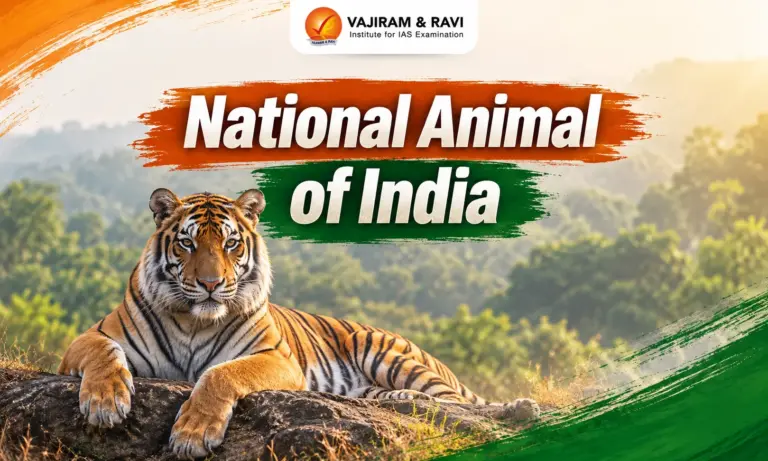
National Symbols represent a country’s identity, heritage, culture and natural wealth. A National Animal is chosen for its symbolic value, national presence and importance for conservation. The National Animal of India is the Royal Bengal Tiger. It represents strength, grace, agility and power. Its designation also supports public attention towards protecting India’s wildlife and preserving important tiger habitats.
National Animal of India
The Royal Bengal Tiger is the National Animal of India and belongs to the tiger species Panthera tigris. It is a powerful carnivore found across diverse Indian habitats.
- Scientific Name: The Royal Bengal Tiger belongs to the species Panthera tigris. The Bengal tiger subspecies is scientifically identified as Panthera tigris tigris.
- Appearance: It has a thick yellow to orange coat marked with dark stripes. Its muscular body, strong jaws, retractable claws and powerful limbs support hunting.
- Habitat: Tigers occupy tropical and subtropical forests, grasslands, swamps, dry scrublands, deciduous forests and mangrove ecosystems such as the Sundarbans.
- Distribution: The Royal Bengal Tiger occurs across India except the north-western region. Its range also extends into Nepal, Bhutan and Bangladesh.
- Diet: It is a carnivore and hunts prey such as deer, wild boar, gaur, sambar and buffalo. It functions as an apex predator within ecosystems.
Why was Tiger Adopted as National Animal of India?
The Royal Bengal Tiger was selected as the National Animal of India because of its national distribution, ecological importance and distinctive qualities of strength, grace, agility and power.
- Adoption in 1972: The Indian Board for Wildlife adopted the Bengal Tiger as India’s National Animal in 1972, replacing the Asiatic Lion due to its wider national presence.
- Earlier National Animal: The Asiatic Lion was accepted as the National Animal of India by Prime Minister of India Pt. Jawahar Lal Nehru in 1948 and continued the status till 1972.
- Wider Distribution: The Bengal Tiger occurred across as many as 16 States, while the lion was found only in one State. This gave the tiger greater national representation.
- Need for Protection: Declining tiger numbers created an urgent need for strict protection across its range. Its national status strengthened attention towards tiger conservation.
- Population Comparison: In the 2010 assessment, India’s wild tiger population was estimated at 1,707, compared with 411 Asiatic lions in Greater Gir, according to the Government of Gujarat.


Royal Bengal Tiger Conservation Status and Measures
The conservation of the National Animal of India Tiger involves legal protection, protected habitats, scientific monitoring and dedicated programmes against population decline.
- Conservation Status: The tiger is listed as Endangered on the IUCN Red List and placed in CITES Appendix I, providing strict international protection against commercial trade.
- Project Tiger: Launched on April 1, 1973, Project Tiger aimed to conserve tiger populations and their habitats. It initially established protected tiger reserves for long-term species survival.
- Tiger Reserves: India has 58 Tiger Reserves as of July 2026. These reserves protect important habitats and support breeding tiger populations.
- NTCA: The National Tiger Conservation Authority was established under the Wildlife (Protection) Amendment Act 2006. It administers Project Tiger and supports scientific tiger conservation.
- Legal Protection: The Wildlife Protection Act 1972 provides strong legal safeguards against hunting, poaching and illegal wildlife trade involving tigers and their body parts.
- Population Recovery: India’s tiger population was estimated at 1,827 in 1972 and reached 3,682 according to the 2022 All India Tiger Estimation Report published by NTCA.
- Anti-Poaching Measures: Forest protection, trained personnel and modern surveillance systems are used to prevent poaching, illegal hunting and trafficking of tiger skins and body parts.

 Last updated on Oct, 2026
→ UPSC 2027 Notification will be released on 13 January 2027 at upsconline.nic.in.
→ Asian Games 2026 are being held in Aichi-Nagoya, Japan, from 19 September to 4 October.
→ Check Nobel Prize 2026 Winners List here.
→ Download PIB PRiSM Monthly Magazine 2026 here.
→ Check UPSC Monthly Current Affairs Magazine The Recitals here.
→ Check out the latest UPSC Syllabus here.
→ Download UPSC Model Answers for Mains 2026
→ UPSC Mains Question Paper 2026 is out now for Essay & GS Paper 1, 2, 3 & 4.
→ UPSC Calendar 2027 has been released.
→ Enroll in Vajiram & Ravi’s UPSC Mains Test Series 2027 for structured answer writing practice, expert evaluation, and exam-oriented feedback.
→ Join Vajiram & Ravi’s UPSC Mentorship Program 2027 for personalized guidance, strategy planning, and one-to-one support from experienced mentors.
→ Go through the UPSC Mains Previous Year Papers to enhance your preparation.
→ UPSC has released UPSC Toppers List 2025 with the Civil Services final result on its official website.
→ Also check Best UPSC Coaching in India
National Animal of India FAQs
Q1. What is the National Animal of India?+
Q2. When was the Tiger adopted as the National Animal of India?+
Q3. Why was the tiger chosen as India’s National Animal?+
Q4. What is the conservation status of the Royal Bengal Tiger?+
Q5. What is Project Tiger?+
Q6. Which animal was the National Animal of India before the tiger?+
Tags: national animal national animal of india