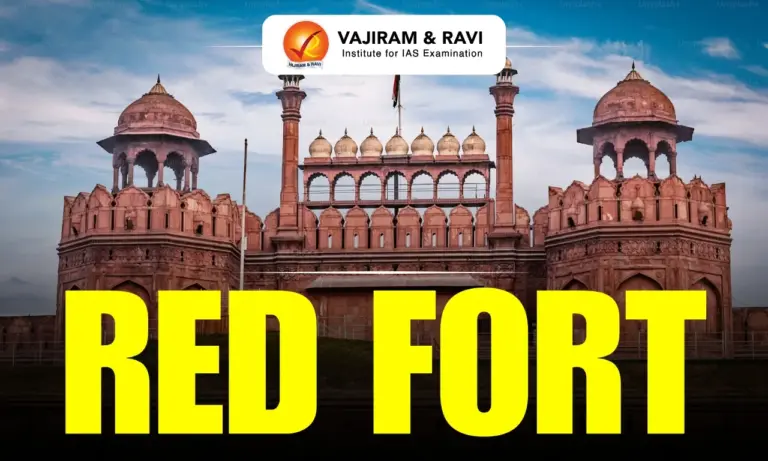
The Red Fort, also known as Lal Qila, is a historic Mughal fort located in Old Delhi, India. It was built by the fifth Mughal Emperor Shah Jahan as the palace fort of Shahjahanabad, the new Mughal capital. Construction began in 1639 and the fort was completed in 1648. It remained the residence of the Mughal emperors for nearly 200 years until 1857. The Red Fort Complex became a UNESCO World Heritage Site in 2007. Today, it is a symbol of India’s heritage where the Prime Minister hoists the national flag every year on 15 August.
Red Fort History
The Red Fort reflects centuries of political, cultural and architectural developments in India. It has witnessed Mughal rule, British occupation and India’s independence.
- Foundation and Construction: Shah Jahan commissioned the Red Fort on 12 May 1639 after shifting the Mughal capital from Agra to Delhi. Architects Ustad Ahmad Lahauri and Ustad Hamid designed the fort using red sandstone and white marble.
- Mughal Capital: The fort became the royal residence of the Mughal emperors and the administrative centre of Shahjahanabad. It remained the imperial palace for nearly two centuries until the Revolt of 1857.
- Historical Events: Nadir Shah plundered the fort in 1739 and carried away valuable treasures, including the Peacock Throne. During British rule after 1857, nearly 80 percent of the inner palace structures were demolished.
- National Importance: The Indian National Army trials were held here in 1945. On 15 August 1947, Jawaharlal Nehru hoisted the national flag, beginning the Independence Day tradition.
- Conservation Status: The Red Fort Complex was inscribed as a UNESCO World Heritage Site in 2007. It is protected under the Ancient Monuments and Archaeological Sites and Remains Act 1959 and managed by the Archaeological Survey of India.
Red Fort Features
The Red Fort combines military strength with royal luxury. It represents the highest level of Mughal planning, design and artistic excellence.
- Strategic Location: The fort stands along the Yamuna River, whose waters originally filled the surrounding moats. It also forms the Red Fort Complex with the adjacent Salimgarh Fort built by Islam Shah Suri in 1546.
- Dimensions: The fort spreads across about 254.67 acres and is enclosed by nearly 2.41 kilometres of defensive walls. The walls rise from about 18 metres on the river side to 33 metres on the city side.
- UNESCO Recognition: UNESCO recognises the Red Fort Complex for its fusion of Islamic, Persian, Timurid and Hindu traditions. Its planning and garden design influenced later monuments across Delhi, Agra and Rajasthan.
- Modern Challenges: A recent scientific study reported the formation of a black crust on the fort’s walls due to severe air pollution. Pollutants such as particulate matter, nitrogen dioxide, sulphur dioxide, carbon monoxide and heavy metals are contributing to this damage.
- National Symbol: The Red Fort remains one of India’s most important heritage monuments. It hosts the annual Independence Day ceremony and attracts thousands of visitors every year.
- Independence Day Flag Hoisting: The Prime Minister of India hoists the National Flag at the Lahori Gate of the Red Fort every Independence Day and addresses the nation from its historic ramparts.


Red Fort Architecture
The Red Fort is considered the finest example of architecture developed during the reign of Shah Jahan. It blends artistic beauty with practical planning.
- Architectural Style: The palace layout follows Islamic planning while incorporating Persian, Timurid and Hindu architectural elements. This combination created the distinctive Shahjahani style of Mughal architecture.
- Walls and Layout: The fort has an octagonal plan with a longer north-south axis. Massive red sandstone walls, about 75 feet or 23 metres high, surround palaces, gardens, baths, canals and religious structures.
- Decorative Elements: White marble, floral carvings, double domes, precious stone inlay and elegant arches reflect the refined craftsmanship of later Mughal architecture and palace design.
- Water System: The private royal apartments were connected by the Nahr-i-Behisht or Stream of Paradise. This continuous water channel cooled the palace and enhanced its aesthetic appeal.
Red Fort Structures
The Red Fort contains several important buildings that served administrative, residential, religious and ceremonial functions during the Mughal period.
- Diwan-i-Am and Diwan-i-Khas: The Diwan-i-Am was the Hall of Public Audience with 60 red sandstone pillars. The white marble Diwan-i-Khas hosted private meetings with nobles and once housed the famous Peacock Throne.
- Gates of the Red Fort: The Red Fort has three main gates. Lahori Gate is the principal public entrance and remains operational. Delhi Gate is another public gate but is generally not used for regular visitor entry. Khizrabad Gate (Khizr Gate) faced the Yamuna River and was reserved exclusively for the Mughal emperor. It is no longer operational.
- Royal Apartments: The Khas Mahal served as the emperor’s residence. Rang Mahal housed royal women, while Mumtaz Mahal now functions as an archaeological museum displaying historical artefacts.
- Religious and Utility Buildings: Aurangzeb built the white marble Moti Masjid in 1659 for private worship. The Hammam consisted of royal baths with domed chambers and fountains.
- Gardens and Pavilions: Hayat Bakhsh Bagh, meaning Life Bestowing Garden, featured water channels, marble pavilions and the Zafar Mahal. The gardens reflected the Mughal Charbagh planning tradition.
- Important Entrances and Market: The Lahori Gate opens into Chhatta Chowk, a covered market that once sold luxury goods for the royal household. The Naubat Khana, or Drum House, announced ceremonial arrivals through daily musical performances.

 Last updated on Sep, 2026
→ UPSC 2027 Notification will be released on 13 January 2027 at upsconline.nic.in.
→ Asian Games 2026 are being held in Aichi-Nagoya, Japan, from 19 September to 4 October.
→ Check out the latest UPSC Syllabus here.
→ Download UPSC Model Answers for Mains 2026
→ UPSC Mains Question Paper 2026 is out now for Essay & GS Paper 1, 2, 3 & 4.
→ UPSC Calendar 2027 has been released.
→ Enroll in Vajiram & Ravi’s UPSC Mains Test Series 2027 for structured answer writing practice, expert evaluation, and exam-oriented feedback.
→ Join Vajiram & Ravi’s UPSC Mentorship Program 2027 for personalized guidance, strategy planning, and one-to-one support from experienced mentors.
→ Go through the UPSC Mains Previous Year Papers to enhance your preparation.
→ UPSC has released UPSC Toppers List 2025 with the Civil Services final result on its official website.
→ Also check Best UPSC Coaching in India
Red Fort FAQs
Q1. Who built the Red Fort?+
Q2. What was the original name of the Red Fort?+
Q3. Who were the principal architects of the Red Fort?+
Q4. Why is the Red Fort a UNESCO World Heritage Site?+
Q5. Why is the Red Fort important on Independence Day?+
Q6. Which river is associated with the Red Fort?+
Q7. What is the recent environmental concern related to the Red Fort?+
Q8. Why is the flag hoisted at the Red Fort Lahori Gate on Independence Day?+
Tags: art and architecture history medieval history red fort