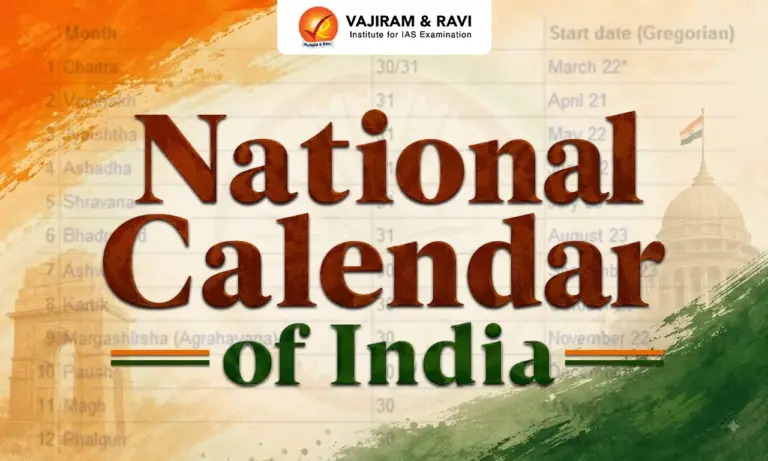
The National Calendar of India is based on the Saka Era and was officially adopted by the Government of India in 1957. It is used along with the Gregorian calendar for official purposes. The calendar reflects India’s historical and astronomical traditions while providing a common system of dates for government use.
National Calendar of India Saka Calendar
- The Indian National Calendar is based on the Saka calendar, also known as the Saka Samvat. It follows a system of 12 months and 365 days in a normal year and is used as the country’s official civil calendar.
- The first month of the Saka calendar is Chaitra. Normally, 1 Chaitra falls on 22 March, while in a Gregorian leap year, it falls on 21 March.
- The Saka Era begins in 78 CE and is traditionally associated with the Shalivahana or Saka Era. The calendar has historical and cultural importance and is also used in some traditional and religious contexts.
- The present form of the national calendar was developed after efforts to bring greater uniformity and accuracy to the different calendar systems followed in India.
Adoption and History of the Indian National Calendar
- The Government of India constituted the Calendar Reform Committee under Meghnad Saha to examine the different calendar systems used across the country and recommend a more standardised system.
- Based on the committee’s recommendations, the Saka calendar was adopted as India’s National Calendar in 1957. It came into official use from 22 March 1957, corresponding to 1 Chaitra 1879 in the Saka Era.
- One major reason for adopting a national calendar was to bring greater uniformity in official date-keeping. At the time, several regional calendars were in use across different parts of India.
- The reform process also focused on correcting variations in calendar calculations and ensuring that the dates were based on reliable astronomical calculations.


Uses of the National Calendar of India
- The Saka calendar is used along with the Gregorian calendar for several official purposes of the Government of India. It provides a standard Indian calendar system for government-related communication and publications.
- It is used in the Official Gazette of India, making it an important part of formal government documentation and notifications.
- The calendar is also used in news broadcasts by All India Radio, government-issued calendars and official communications intended for the public.
- The use of the Saka calendar alongside the Gregorian calendar helps maintain a uniform system of official dates while preserving an important element of India’s historical and cultural heritage.
Significance of the Indian National Calendar
- The National Calendar has both administrative and cultural significance. Administratively, it provides a common calendar for official purposes, while culturally, it represents India’s long tradition of astronomical observation and timekeeping.
- The adoption of a standardized calendar helped address the challenges created by the existence of multiple regional calendar systems and promoted greater consistency in official use.
- The Saka calendar also has relevance beyond India. It is associated with traditional calendar practices in parts of Southeast Asia, including Bali, where the Saka New Year is observed through the Nyepi festival.

 Last updated on Oct, 2026
→ UPSC 2027 Notification will be released on 13 January 2027 at upsconline.nic.in.
→ Check Nobel Prize 2026 Winners List here.
→ Download PIB PRiSM Monthly Magazine 2026 here.
→ Check UPSC Monthly Current Affairs Magazine The Recitals here.
→ Check out the latest UPSC Syllabus here.
→ Download UPSC Model Answers for Mains 2026
→ UPSC Mains Question Paper 2026 is out now for Essay & GS Paper 1, 2, 3 & 4.
→ UPSC Calendar 2027 has been released.
→ Enroll in Vajiram & Ravi’s UPSC Mains Test Series 2027 for structured answer writing practice, expert evaluation, and exam-oriented feedback.
→ Join Vajiram & Ravi’s UPSC Mentorship Program 2027 for personalized guidance, strategy planning, and one-to-one support from experienced mentors.
→ Go through the UPSC Mains Previous Year Papers to enhance your preparation.
→ UPSC has released UPSC Toppers List 2025 with the Civil Services final result on its official website.
→ Also check Best UPSC Coaching in India
National Calendar of India FAQs
Q1. What is the National Calendar of India?+
Q2. When was the Saka Calendar adopted as the National Calendar of India?+
Q3. What is the first month of the Indian National Calendar?+
Q4. What is the Saka Era?+
Q5. Who headed the Calendar Reform Committee?+
Q6. Why was the Saka Calendar adopted as the National Calendar?+
Q7. Where is the National Calendar of India used?+
Q8. How many months are there in the Saka Calendar?+
Q9. What is the significance of the Indian National Calendar?+
Q10. What is the relationship between the Saka Calendar and the Gregorian Calendar?+
Tags: history history notes indian polity indian polity notes national calendar of india