UPSC Daily Quiz 30 September 2025

UPSC Daily Quiz

The Daily UPSC Quiz by Vajiram & Ravi is a thoughtfully curated initiative designed to support UPSC aspirants in strengthening their current affairs knowledge and core conceptual understanding. Aligned with the UPSC Syllabus 2025, this daily quiz serves as a revision resource, helping candidates assess their preparation, revise key topics, and stay updated with relevant issues. Whether you are preparing for Prelims or sharpening your revision for Mains, consistent practice with these Daily UPSC Quiz can significantly enhance accuracy, speed, and confidence in solving exam-level questions.

[WpProQuiz 83]  

UPSC Daily Quiz FAQs

Q1: What is the Daily UPSC Quiz?

Ans: The Daily UPSC Quiz is a set of practice questions based on current affairs, static subjects, and PYQs that help aspirants enhance retention and test conceptual clarity regularly.

Q2: How is the Daily Quiz useful for UPSC preparation?

Ans: Daily quizzes support learning, help in revision, improve time management, and boost accuracy for both UPSC Prelims and Mains through consistent practice.

Q3: Are the quiz questions based on the UPSC syllabus?

Ans: Yes, all questions are aligned with the UPSC Syllabus 2025, covering key areas like Polity, Economy, Environment, History, Geography, and Current Affairs.

Q4: Are solutions and explanations provided with the quiz?

Ans: Yes, each quiz includes detailed explanations and source references to enhance conceptual understanding and enable self-assessment.

Q5: Is the Daily UPSC Quiz suitable for both Prelims and Mains?

Ans: Primarily focused on Prelims (MCQ format), but it also indirectly helps in Mains by strengthening subject knowledge and factual clarity.

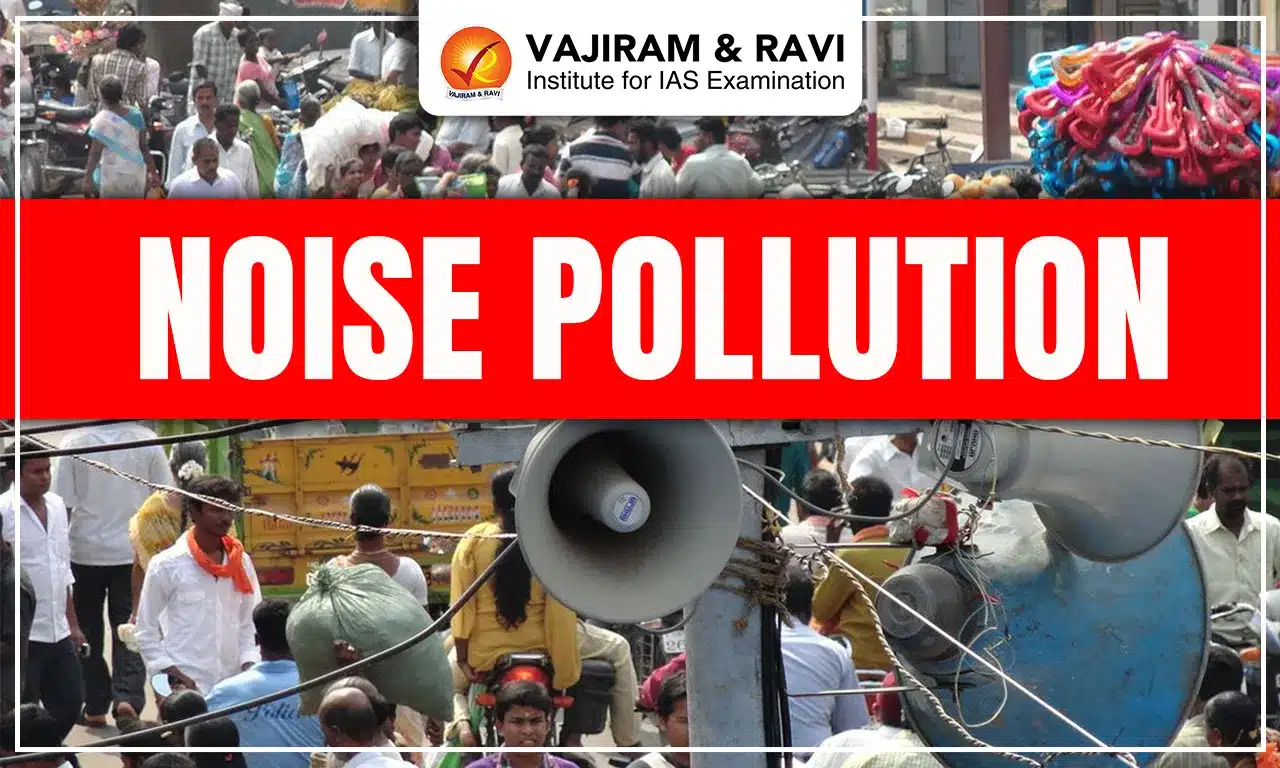
Noise Pollution, Definition, Sources, Impact, Preventive Measures

Noise Pollution

Noise pollution has emerged as a growing environmental concern in India as well as globally. It refers to the excessive and unwanted sound that disrupts normal life and causes harmful effects on human health, environment, and economy. According to the Noise Pollution (Regulation and Control) Rules, 2000, noise above 55 decibels (dB) during the day and 45 dB at night is harmful to human health. In India, with rapid urbanization, industrial growth, and increasing traffic, noise pollution has become one of the most pressing urban environmental issues.

Noise Pollution in India

India is among the world’s most affected countries in terms of urban noise levels. The Central Pollution Control Board (CPCB), under the Noise Pollution (Regulation and Control) Rules, 2000, sets permissible noise limits for different zones such as industrial, commercial, residential, and silence zones. However, major Indian cities like Delhi, Mumbai, Kolkata, and Bengaluru regularly exceed these limits. For example, the CPCB 2023 survey recorded average noise levels in Delhi ranging from 65-75 dB during the day, well above the permissible limit of 55 dB for residential areas.

Noise Pollution Sources

Noise pollution arises from a wide range of human and industrial activities. The major causes include:

  • Vehicular Traffic: Heavy use of cars, motorcycles, buses, and trucks. In cities like Delhi and Mumbai, traffic noise is the largest contributor.
  • Industrial Activities: Factories, construction sites, and power plants generate continuous high-decibel noise.
  • Urbanization and Construction: Roadwork, metro rail construction, flyovers, and housing projects significantly add to city noise.
  • Social and Cultural Activities: Use of loudspeakers in marriages, religious events, festivals, and political rallies.
  • Air Traffic: Airports near cities increase noise exposure for nearby residents. For example, areas around IGI Airport, Delhi experience noise levels above 70 dB.

Noise Pollution Impact

The Noise Pollution impacts the Human Beings as well as the wildlife and environment adversely. Below we have discussed the impact of noise pollution:

  1. Impact of Noise Pollution on Health

Excessive noise exposure has serious health effects. WHO identifies noise pollution as the second biggest environmental cause of health problems after air pollution in Europe. In India, similar concerns are rising.

  • Hearing Loss: Long exposure above 85 dB can lead to permanent hearing damage.
  • Sleep Disturbances: Night-time noise disrupts rest and reduces productivity.
  • Cardiovascular Diseases: High noise levels increase risk of hypertension, stress, and heart attacks.
  • Mental Health Issues: Anxiety, irritability, depression, and reduced concentration.
  • Child Development Issues: Studies show children exposed to noise near airports have lower reading comprehension and memory.
  1. Environmental and Social Impact of Noise Pollution

Noise pollution not only affects humans but also impacts the environment and animals.

  • Wildlife Disturbance: Animals in forests and urban areas face stress and habitat disturbance. Bird communication gets disrupted, affecting breeding.
  • Marine Noise Pollution: Increasing ship traffic and industrial activity harm whales and dolphins that rely on sound for communication.
  • Social Impact: Reduced quality of life in urban areas, increased complaints in residential colonies, and decline in property values in high-noise areas.

Permissible Noise Levels in India (CPCB)

According to the data released by CPCB, The Noise Pollution (Regulation and Control) Rules, 2000, the permissible limit for the Noise Levels based on the zones and areas is tabulated below:

Permissible Noise Levels in India (CPCB)
Zone/ Area Daytime Limit (6 am-10 pm) Night-time Limit (10 pm-6 am)

Industrial

75 dB

70 dB

Commercial

65 dB

55 dB

Residential

55 dB

45 dB

Silence Zone

50 dB

40 dB

Global Scenario of Noise Pollution

Noise is a worldwide challenge. According to WHO’s 2018 report, around 1.6 million healthy life years are lost annually in Western Europe due to environmental noise. The European Environment Agency (EEA) noted that more than 100 million people in Europe are exposed to harmful noise levels above 55 dB. In the United States, the EPA estimates that nearly 30 million workers are exposed to hazardous noise levels at workplaces.

Noise Pollution in Indian Cities

As per the latest data released by the CPCB Annual Report 2017 under “Status of Ambient Noise Level in India 2017”, the approximate level of Noise in major cities of the Indian States are listed below:

Noise Pollution in Indian Cities
City Average Day Noise (dB) Permissible Limit (dB) Status

Delhi

70-75

55

Above Limit

Mumbai

68-72

55

Above Limit

Kolkata

65-70

55

Above Limit

Bengaluru

66-71

55

Above Limit

Lucknow

64-70

55

Above Limit

Noise Pollution Legal Framework and Regulations

The Indian government and the Supreme Court of India has taken several steps to address noise pollution:

  • Noise Pollution (Regulation and Control) Rules, 2000 under the Environment Protection Act, 1986.
  • Motor Vehicles Act, 1988 to regulate use of horns and silencers.
  • Factories Act, 1948 for worker safety against occupational noise.
  • Role of National Green Tribunal (NGT) in hearing cases and imposing penalties on violators.
  • Supreme Court Judgments restricting use of loudspeakers and firecrackers beyond permissible limits.
  • Noise Monitoring Network: CPCB launched a National Ambient Noise Monitoring Network (NANMN) in 2011 covering 35 cities.
  • Silence Zone Enforcement: Strict regulations around hospitals, schools, and courts.
  • Smart City Mission: Integration of noise mapping for sustainable urban planning.
  • Public Awareness Campaigns: Use of “No Horn” campaigns in metro cities.

Preventive Measures for Noise Pollution

Solutions require both policy action and public participation.

  • Promotion of electric vehicles and improved public transport.
  • Use of sound barriers and green belts along highways.
  • Strict enforcement of permissible decibel limits in residential areas.
  • Adoption of silent generators and machines in industries.
  • Awareness campaigns to reduce honking and loudspeaker usage.
  • Urban planning to create noise buffer zones.

Challenges in Controlling Noise Pollution

Despite existing regulations, several challenges hinder effective control of noise pollution:

  • Non-Compliance: Many individuals and organizations flout noise norms, especially during festivals and public events.
  • Lack of Awareness: Public awareness about the health impacts of noise pollution is limited.
  • Inadequate Enforcement: Enforcement agencies often lack the resources and manpower to monitor and control noise pollution effectively.
  • Technological Limitations: Limited use of modern technology for real-time monitoring and data collection.

Way Forward:

To effectively address noise pollution, the following reforms are proposed:

  • Strengthening Enforcement: Enhance the capacity of enforcement agencies through training and provision of resources.
  • Public Awareness Programs: Launch nationwide campaigns to educate the public about the harmful effects of noise pollution.
  • Technological Integration: Implement real-time noise monitoring systems and mobile applications for public reporting.
  • Policy Revisions: Regularly update noise pollution norms to keep pace with urbanization and technological advancements.

Public and Institutional Responses to Noise Pollution

Various public and institutional responses have been initiated to combat noise pollution:

  • Judicial Interventions: Courts have actively intervened in noise pollution cases, issuing directives for stricter enforcement of noise regulations.
  • NGOs and Civil Society: Organizations like Awaaz Foundation and Legal Initiative for Forest and Environment (LIFE) have been at the forefront, filing Public Interest Litigations (PILs) and conducting awareness campaigns.
  • Local Authorities: Municipal corporations and local bodies have been empowered to take direct action against noise pollution under the amended Noise Pollution Rules.

Constitutional Framework and Case Laws Related to Noise Pollution

The Constitution of India provides a framework for addressing noise pollution:

  • Article 21: Guarantees the right to life and personal liberty, which includes the right to live in a pollution-free environment.
  • Article 51A: Enjoins every citizen to protect and improve the natural environment.

Case Laws:

  • In Re: Noise Pollution (2005): The Supreme Court recognized noise pollution as a violation of the right to life under Article 21 and directed the enforcement of noise regulations.
  • Forum for Prevention of Environment and Sound Pollution v. Union of India (2005): The Court issued directions for controlling noise pollution, including restrictions on the use of loudspeakers and firecrackers.
  • Balwant Singh v. Commissioner of Police (2015): The Court emphasized the need for strict enforcement of noise pollution norms and held that the right to peaceful enjoyment of life is a fundamental right under Article 21.

Noise Standard for Fire Crackers

According to the CPCB protocol the Noise Standards for Fire Crackers were released in 2006 under the Environment (Protection) Act, 1986. These standards are-

  • Prohibition in manufacturing and sale of fire-crackers generating noise above 125 dB at 4 meters distance from the point of bursting.
  • For the individual fire cracker constituting series, the above mentioned limit is reduced by 5 log10 (N) dB, here N= number of crackers joined together.
  • The Department of Explosives is responsible for the implementation of the rules.

Noise Pollution UPSC

Noise pollution is no longer just an urban nuisance; it is a public health crisis. With rising urbanization and industrialization, India needs urgent interventions to curb noise levels. Strict enforcement of CPCB rules, adoption of green infrastructure, use of technology for monitoring, and public cooperation are essential. Addressing this challenge will help India ensure a healthier, more sustainable, and peaceful future.

Also Check Other Posts
Coastal Regulation Zone Global Plastic Treaty
Nitrogen Cycle Carbon Cycle

Noise Pollution FAQs

Q1: What Are The Causes Of Noise Pollution?

Ans: Causes of Noise Pollution include Vehicular Traffic, Industrial Activities, Construction Work, Loudspeakers, and Air Traffic.

Q2: What Are The Noise Pollution Limits In India?

Ans: CPCB sets Noise Limits at 55 dB Day and 45 dB Night for Residential Areas under Noise Pollution Rules, 2000.

Q3: What Are The Measures To Control Noise Pollution?

Ans: Measures include Electric Vehicles, Sound Barriers, Silent Machines, Noise Buffer Zones, and Public Awareness.

Q4: What Are The Provisions On Noise Pollution In India?

Ans: Noise Pollution is regulated by Environment Protection Act, 1986, Noise Rules, 2000, Motor Vehicles Act, and Supreme Court Judgments.

Q5: What Are The Fire Cracker Noise Standards By CPCB?

Ans: CPCB Fire Cracker Standards restrict Noise Level to 125 dB at 4 Meters; Series Crackers have reduced limits.

Aeolian Landforms, Meaning,Types, Formation, Examples, Location

Aeolian Landforms

Aeolian landforms are land features shaped by the action of wind, especially in arid and semi-arid regions where rainfall is low and vegetation cover is sparse. The term Aeolian comes from the term- “Aeolus”- the Greek god of winds. These landforms are formed through wind processes such as erosion, transportation, and deposition. In India, aeolian activity is most visible in the Thar Desert of Rajasthan, covering about 2,00,000 sq. km of area.

Aeolian Landforms

Aeolian landforms are shaped through processes of erosion, transportation, and deposition by wind. Wind plays a significant role in desert regions, carrying fine particles over long distances and shaping both small-scale features like ripples and large-scale features like dunes. According to the Geological Survey of India (GSI), about 61% of India’s arid land is affected by aeolian processes, making them crucial in India’s desert ecology and land use.

Aeolian Landforms Types

Aeolian landforms are broadly divided into erosional landforms (formed by removal of material) and depositional landforms (formed by accumulation of material).

Aeolian Landforms Types
Types Examples Description

Erosional Landforms

Yardangs, Deflation Hollows, Mushroom Rocks, Ventifacts

Created when wind removes or sculpts materials

Depositional Landforms

Sand Dunes, Loess, Ripple Marks, Barchans, Longitudinal Dunes

Formed by deposition of wind-blown sediments

Aeolian Processes in Geography

Aeolian Processes play a central role in shaping desert landscapes. These processes together create distinct erosional and depositional landforms. The main processes include:

  • Deflation: The removal of loose particles like dust, silt, and sand by strong winds.
  • Abrasion: The wearing down of rock surfaces by wind-driven sand particles.
  • Attrition: Breaking down of particles when they collide with each other during transport.
  • Transportation: Wind carries sediments in three ways:
    • Suspension (fine particles carried over long distances)
    • Saltation (bouncing movement of sand grains)
    • Surface Creep (rolling of coarse particles along the ground)

Erosional Aeolian Landforms

Erosional landforms are created when wind removes or sculpts material.

  1. Yardangs
  • Yardangs are streamlined ridges carved by wind abrasion.
  • They are elongated in the direction of prevailing winds.
  • Famous examples are found in the Sahara Desert (Egypt, Libya) and Thar Desert near Jaisalmer.
  1. Deflation Hollows
  • Large depressions formed by wind removal of loose materials.
  • When the depression deepens below the water table, oases may form.
  • Example: Qattara Depression in Egypt, one of the largest in the world.
  1. Mushroom Rocks (Pedestal Rocks)
  • Rocks shaped like mushrooms due to stronger erosion at the base compared to the top.
  • Common in Jaisalmer and Barmer districts of Rajasthan.
  • Created due to differential abrasion by sand-laden winds.
  1. Ventifacts
  • Stones or pebbles polished and faceted by wind abrasion.
  • Found in cold deserts of Ladakh and also in parts of the Thar Desert.
  1. Zeugen
  • Tabular masses of soft rock overlain by harder rock.
  • Wind erodes the softer part, leaving flat-topped ridges.
  • Example: Sahara Desert.
  1. Demoiselles
  • Rock pillars formed when softer rock erodes, leaving behind harder rock caps.
  • They look like “rock statues” or “earth pillars”.
  • Found in deserts as well as in some glacial regions.
  1. Inselbergs (Isolated Hills)
  • Steep-sided isolated hills rising abruptly from desert plains.
  • Although partly fluvial in origin, wind action enhances their prominence.
  • Example: Inselbergs in Kalahari Desert; in India, Arawalli outcrops in western Rajasthan.
  1. Blowouts (Deflation Basins)
  • Shallow depressions created by strong winds removing loose sand.
  • Common in Thar Desert.
  1. Desert Pavement
  • Surface covered by pebbles and gravel after finer particles are blown away.
  • Example: Southwestern USA deserts; also seen in parts of Rajasthan.

Depositional Aeolian Landforms

When wind loses energy, it deposits sediments, forming characteristic landforms. These depositional landforms are vital for understanding desert dynamics and soil distribution.

  1. Sand Dunes

Sand dunes are the most common aeolian depositional landforms. Their shapes depend on wind direction, speed, and sand availability.

  • Barchans (Crescent-shaped Dunes):
      • Formed by unidirectional winds.
      • The convex side faces the wind, with slip faces on the leeward side.
      • Found in Jaisalmer and Bikaner(Rajasthan).
  • Seif or Longitudinal Dunes:
      • Long parallel ridges aligned with prevailing winds.
      • Can extend for several kilometers.
      • Seen in the western Thar Desert.
  • Transverse Dunes:
      • Formed perpendicular to prevailing winds when sand supply is abundant.
      • Found near Barmer in Rajasthan.
  • Parabolic Dunes:
      • U-shaped dunes formed in coastal areas with vegetation anchoring their arms.
      • Found along the Odisha and Tamil Nadu coasts.
  • Star Dunes:
    • Pyramid-shaped dunes formed by multi-directional winds.
    • Common in large deserts like the Sahara but rare in India.
  1. Loess Deposits
  • Fine dust and silt carried by wind and deposited over large areas.
  • Loess creates highly fertile soils.
  • The Loess Plateau in China is the best example globally.
  • In India, thin loess deposits are found in parts of Ladakh and Kashmir valleys.
  1. Ripple Marks
  • Small-scale ridges formed on sand surfaces due to wind action.
  • Common on sand dunes in Rajasthan deserts and coastal beaches across India.
  1. Sand Sheets (Ergs or Sand Seas)
  • Vast flat areas covered by sand with little vegetation.
  • Example: Rub al-Khali (Saudi Arabia); in India, Marusthali in Rajasthan.
  1. Draas (Mega Dunes)
  • Very large dunes that can be several kilometers in length and hundreds of meters in height.
  • Found in the Sahara Desert; smaller forms in the Thar Desert.
  1. Loess Plateau
  • Large accumulation of loess forming a plateau.
  • Example: Loess Plateau in China (world’s thickest loess deposits).

Aeolian Landforms in India

India presents a variety of aeolian features, mainly in arid and semi-arid zones. According to the National Remote Sensing Centre (ISRO), over 40,000 sq. km in Rajasthan is dominated by active sand dunes, showing the intensity of aeolian activity.

    • Thar Desert (Rajasthan): Extensive dune fields, yardangs, mushroom rocks covering nearly 60% of India’s arid land.
  • Rann of Kutch (Gujarat): Seasonal desert with aeolian deposits.
  • Cold Deserts (Ladakh and Spiti): Ventifacts and small sand dunes formed by strong cold winds.
  • Coastal Regions (Odisha, Tamil Nadu, Gujarat): Parabolic dunes and ripple marks are common.

Aeolian Landforms Significance

Aeolian landforms have geographical, ecological, and economic importance as listed below:

  • Agriculture: Loess deposits form some of the world’s most fertile soils.
  • Tourism: Sand dunes in Jaisalmer and Bikaner are major tourist attractions.
  • Wind Energy: Desert landscapes with high wind speeds are suitable for wind farms.
  • Cultural Value: Desert communities adapt their lifestyle around these landforms.
  • Hazards: Shifting dunes and dust storms can damage infrastructure and reduce soil fertility.

Aeolian Landforms Global Context

Globally, Aeolian Landscapes are found in deserts, semi-arid regions, and sandy coasts. Comparing India’s aeolian landforms with global examples helps in understanding their diversity and distribution.

Aeolian Landforms Global Context
Region Notable Features

Sahara Desert

Yardangs, star dunes, deflation hollows

Gobi Desert (China & Mongolia)

Longitudinal dunes, ventifacts

Loess Plateau (China)

World’s thickest loess deposits

Atacama Desert (Chile)

Mushroom rocks, barchans

Great Victoria Desert (Australia)

Large sand ridge systems

Aeolian Landforms UPSC

Aeolian landforms are a product of wind erosion and deposition, shaping landscapes in deserts and coastal regions. In India, they are prominently visible in the Thar Desert, Rann of Kutch, Ladakh, and coastal belts. From yardangs and mushroom rocks to sand dunes and loess deposits, these features reflect the dynamic interaction between wind and sediments. While these landforms enrich physical geography, they also pose challenges of desertification and land degradation.

Also Check Other Posts
Geomorphology Major Dams in India
Composition and Structure of Atmosphere Major Ports in India
Types of Forests in India Coastal States of India
Ocean Acidification Migration in India
Deep Ocean Mission Natural Vegetation of India

Aeolian Landforms FAQs

Q1: What are Aeolian landforms?

Ans: Aeolian landforms are features shaped by wind erosion, transport, and deposition of sediments.

Q2: Which is the best example of Aeolian Landforms in India?

Ans: The Thar Desert in Rajasthan is the best example, with dunes, yardangs, and mushroom rocks.

Q3: What is the difference between erosional and depositional aeolian landforms?

Ans: Erosional landforms like yardangs are carved by wind, while depositional landforms like dunes are formed by sediment accumulation.

Q4: Where are Parabolic Dunes found in India?

Ans: Parabolic dunes are found in coastal Odisha and Tamil Nadu regions.

Q5: Where are Ventifacts found in India?

Ans: Ventifacts are majorly found in the Cold Desert region of Ladakh and Spiti.

Precipitation, Meaning, Types, Importance, Examples, Benefits

Precipitation

Precipitation is one of the most fundamental processes in the Earth’s hydrological cycle. It refers to the fall of water, in liquid or solid form, from the atmosphere to the Earth’s surface. This natural process is not only central to the recycling of water but also vital for sustaining life, regulating climate, and shaping ecosystems. Without precipitation, rivers would dry up, groundwater would not recharge, and agriculture would collapse. In this article, we are going to cover Precipitation, its types and importance. 

Precipitation

Precipitation occurs when water vapor in the atmosphere condenses into droplets or ice crystals, eventually becoming too heavy to remain suspended in clouds. Once gravity overcomes the upward atmospheric forces, these droplets or crystals fall to the ground.

This process plays a dual role: on one hand, it replenishes freshwater sources such as rivers, lakes, and aquifers; on the other, it regulates heat distribution by transferring latent heat through evaporation and condensation.

Several factors influence precipitation, including:

  • Temperature: manages whether precipitation falls as rain, snow, or sleet.
  • Humidity: Affects the condensation process within clouds.
  • Atmospheric pressure and wind currents: Influence cloud formation, movement, and rainfall intensity.

Thus, precipitation is not just a weather phenomenon but an important environmental and climatic regulator. Its importance is spread across agriculture, drinking water, biodiversity conservation, and even energy generation through hydropower.

Precipitation Types

Precipitation can occur in different forms depending on prevailing atmospheric conditions. The main types include:

  1. Rain
    • Rain refers to liquid water droplets that fall when the atmospheric temperature is above freezing. Droplets typically range from 0.5 mm to several millimeters in diameter.
    • Rain is the most common and most beneficial form of precipitation. It sustains agriculture, fills reservoirs, and supports plant growth. Seasonal rainfall patterns, such as the Indian monsoon, directly influence food security and rural livelihoods.
  2. Snow
    • Snow is formed when atmospheric temperatures remain below freezing, allowing water vapor to crystallize into snowflakes.
    • Snow provides water storage in the form of glaciers and snowpacks, which gradually melt to supply rivers during warmer months. It also creates unique ecosystems in polar and mountainous regions.
  3. Sleet
    • Sleet occurs when raindrops pass through a cold layer of air near the ground, freezing into small ice pellets.
    • Though less common, sleet can make roads dangerously slippery, disrupt transportation, and damage crops.
  4. Hail
    • Hail consists of large ice pellets formed in thunderclouds with powerful updrafts that repeatedly carry droplets upward into freezing layers.
    • Hailstorms can devastate agriculture, damage property, and pose risks to human safety. Farmers in hail-prone areas often face significant economic losses.
  5. Freezing Rain
    • This occurs when raindrops remain liquid while falling but freeze instantly upon contact with cold surfaces.
    • Freezing rain creates hazardous icy coatings on roads, trees, and power lines, leading to accidents, power outages, and infrastructure damage.
  6. Drizzle
    • Drizzle is very fine rainfall with small droplets that fall slowly and consistently, often associated with overcast skies.
    • While it rarely causes major damage, drizzle maintains soil moisture and often contributes to prolonged damp conditions.

These forms of precipitation highlight the diversity of atmospheric processes and their varying impacts on human life, infrastructure, and ecosystems.

Precipitation Importance

Precipitation is not only a weather event but also a life-supporting natural system. Its importance can be understood under the following aspects:

  1. Water Supply
    • Precipitation replenishes rivers, lakes, and aquifers, ensuring a constant supply of freshwater for drinking, sanitation, irrigation, and industries. Regions dependent on rainfall for agriculture, such as India, are highly vulnerable to rainfall variability.
  2. Ecosystem Support
    • Rain and snow nourish vegetation, which in turn sustains herbivores and carnivores, maintaining ecological balance. Forests, wetlands, and grasslands owe their existence to regular precipitation.
  3. Climate Regulation
    • Through the processes of condensation and evaporation, precipitation redistributes heat energy across the globe. This regulates regional and global climates, reducing temperature extremes.
  4. Agriculture and Food Security
    • Crops rely heavily on rainfall for growth. Adequate precipitation ensures food availability, while erratic rainfall often leads to crop failure, hunger, and poverty in developing nations.
  5. Flood and Drought Management
    • Predictable precipitation patterns help mitigate the risks of droughts and floods. Too much rainfall in a short period leads to flooding, while prolonged absence results in droughts, both of which have severe human and economic costs.

Distribution of Precipitation Around the World

Precipitation is unevenly distributed across the Earth due to latitude, altitude, proximity to oceans, and atmospheric circulation.

  1. Equatorial Regions
    • Receive very high rainfall due to convection currents and the Intertropical Convergence Zone (ITCZ).
    • Example: Amazon Basin, Congo Basin.
  2. Tropical Monsoon Regions
    • Marked by seasonal heavy rains caused by shifting winds and oceanic moisture.
    • Example: South Asia (India, Bangladesh), West Africa.
  3. Arid and Semi-Arid Regions
    • Receive very low precipitation due to descending dry air masses.
    • Example: Sahara Desert, Middle East.
  4. Coastal Regions
    • Experience moderate to high rainfall influenced by maritime winds.
    • Example: Western Europe, East Africa.
  5. Polar and Subpolar Regions
    • Extremely low precipitation, mostly as snow, due to cold air holding little moisture.
    • Example: Antarctica, Greenland.
  6. Mountainous Regions
    • High precipitation caused by orographic lifting, where moist air rises and cools over mountains.
    • Example: Himalayas, Andes, Rockies.

Precipitation Examples Around the World

  • Amazon Rainforest (Brazil): Over 2000 mm annual rainfall, supporting lush biodiversity.
  • Mumbai (India): Heavy monsoon rains exceeding 2000 mm, vital for agriculture but also causing floods.
  • Mediterranean Coast (Greece): 400-800 mm annually, concentrated in winters with dry summers.
  • Sahara Desert (Algeria): Less than 50 mm annually, making it one of the driest places on Earth.
  • Alps (Switzerland): 1000-1500 mm, mostly as snowfall, vital for rivers and tourism.
  • Vancouver (Canada): 1000-1500 mm annually, heavy rainfall due to Pacific maritime air.
  • Darfur (Sudan): Semi-arid with 250-500 mm, highly seasonal, influencing agriculture.
  • Christchurch (New Zealand): 600-1000 mm evenly distributed throughout the year.

Precipitation Benefits

Managing precipitation is important in today’s era of climate change. Benefits include:

  • Strengthening weather forecasting systems to predict rainfall and prevent disasters.
  • Enhancing rainwater harvesting and groundwater recharge systems to store excess rain.
  • Developing flood-control infrastructure like embankments and reservoirs.
  • Promoting climate-resilient agriculture that can withstand droughts or excessive rains.
  • International cooperation to address global issues such as changing monsoon patterns and glacier melt.
Also Check Other Posts
Geomorphology Major Dams in India
Composition and Structure of Atmosphere Major Ports in India
Types of Forests in India Coastal States of India
Ocean Acidification Migration in India
Deep Ocean Mission Natural Vegetation of India

Precipitation FAQs

Q1: What do you mean by precipitation?

Ans: Precipitation is the process by which water in liquid or solid form, such as rain, snow, sleet, or hail, falls from the atmosphere to the Earth’s surface.

Q2: What does 80% precipitation mean?

Ans: 80% precipitation means there is an 80% chance of measurable rainfall, snow, or other forms of precipitation occurring in a given area.

Q3: What is sleet?

Ans: Sleet is a form of precipitation in which raindrops freeze into small ice pellets before reaching the ground.

Q4: What is the importance of precipitation?

Ans: Precipitation is important because it replenishes freshwater sources, sustains ecosystems, supports agriculture, and regulates Earth’s climate.

Q5: Which geographical region receives the maximum precipitation?

Ans: The equatorial region, especially tropical rainforests like the Amazon Basin, receives the maximum precipitation on Earth.

Difference Between Law, Act and Bill, Definition, Examples

Difference Between Law, Act and Bill

While Law, Act, and Bill are closely related terms, they represent different phases in the legislative framework. A Bill is the seed, a proposal that seeks to address a problem or introduce a change. Once it successfully navigates legislative scrutiny, it becomes an Act, which is a specific legal instrument. Over time, as Acts accumulate and operate collectively, they form the body of Law that governs society. Understanding this progression is fundamental to comprehending how policies are shaped, debated, and enforced in a democracy. It underscores the dynamic nature of governance and the essential role legislation plays in maintaining order, protecting rights, and driving social and economic development. In this article, we are going to cover the difference between Law, Act and Bill.

Difference Between Law, Act, and Bill

The legislative process in any democratic country is the backbone of its governance structure. It provides the legal framework that provides the rights and responsibilities of citizens, ensures justice, and maintains public order. Within this legislative framework, three terms- Law, Act, and Bill are regularly used and often used interchangeably by the general public. However, each of these terms represents a different stage in the law-making process and carries a different meaning and function. Having knowledge about the differences between these three is important for understanding how a proposed idea or policy transforms into a legally binding rule that governs society. It also provides deeper insight into how democratic systems function and how policies, once discussed and debated in the legislature, become enforceable on the ground.

Definition of Law, Act, and Bill

  • Law: A law is a set of rules and regulations created and enforced by a governing authority. It is binding on all citizens and institutions within a jurisdiction and is backed by the judiciary. Laws define the rights and duties of individuals and organizations and ensure order, justice, and governance.
  • Act: An Act is a formal legislation that has been passed by the legislature and enacted into law. It is a specific type of law dealing with a particular subject, sector, or issue. Once a Bill is passed by both houses of Parliament and receives presidential assent, it becomes an Act.
  • Bill: A Bill is a draft or proposal for a new law or for amending an existing law. It is the starting point in the legislative process and is introduced in Parliament or a state legislature for discussion, debate, and approval. Only after it is passed by the legislature and receives assent does it become an Act, which is then implemented as a law.

Major Differences Between Law, Act, and Bill 

Here are the differences in between Law, Act and Bill: 

Aspect Law Act Bill

Definition

A set of binding rules enforced by the government.

A formal written law passed by the legislature.

A proposed law under consideration by the legislature.

Legal Status

Fully enforceable and binding.

Legally binding after enactment.

Not legally binding until passed.

Stage in Process

Final stage after Bill becomes Act and is enforced.

Final stage of a Bill before becoming law.

Initial stage introduced in legislature.

Application

Applies to all citizens and entities.

Applies once enacted.

Does not apply until passed.

Enactment

Already enacted.

Needs legislative approval.

Not enacted yet.

Scope

Covers wide legal areas.

Specific to a particular subject.

Specific to an issue or problem.

Authority

Derived from the Constitution or legislature.

Derived after being passed by legislature.

Derived from the legislature once passed.

Duration

Indefinite until amended or repealed.

Indefinite until amended or repealed.

Temporary ceases if not passed.

Examples

Indian Penal Code (IPC), Civil Rights Law.

Companies Act, GST Act.

Citizenship (Amendment) Bill, 2023.

Differences in Between Law, Act and Bill in Detail 

The differences in between law, act and bill includes: 

  • Legal Status and Stage in Legislative Process

A Bill represents the beginning of the legislative journey as it is an idea or proposal that seeks to become law. It is introduced by a minister or a member of Parliament and goes through several stages: introduction, discussion, committee scrutiny, voting, and finally, presidential assent. Once a Bill is approved by both houses and receives assent, it becomes an Act. Over time, the Act, once enforced and implemented, forms part of the larger body of Law.

  • Application and Enforceability

A Law applies universally within the jurisdiction of the state that is to individuals, organizations, and government bodies. An Act is applicable once it has been enacted and often addresses a specific subject (e.g., taxation, corporate regulation, social welfare). A Bill holds no legal power unless it successfully completes the legislative process.

  • Authority and Origin

All three derive their authority from the Constitution and the legislative powers vested in Parliament or state legislatures. However, their authority grows progressively — a Bill has potential authority, an Act gains authority once passed, and a Law holds the highest legal authority once in force.

  • Purpose and Role
    • Law provides the overarching framework for governance and regulation.
    • The Act translates government policies into specific legal instruments.
    • Bill initiates the legal transformation process by proposing changes or new rules.

The Legislative Process From Bill to Law

The journey from Bill becoming an Act finally into a Law follows a structured process:

  1. Introduction of the Bill: The proposed legislation is introduced in either house of Parliament (Lok Sabha or Rajya Sabha).
  2. First Reading: The Bill’s title and objectives are read, and it is published in the official gazette.
  3. Second Reading: The Bill is examined clause by clause, debated, and possibly amended.
  4. Committee Stage: A parliamentary committee may scrutinize the Bill in detail and suggest changes.
  5. Third Reading and Voting: The Bill is put to a final vote.
  6. Other House Consideration: The Bill undergoes a similar process in the other house.
  7. Presidential Assent: The Bill is sent to the President for approval.
  8. Becomes an Act: Upon assent, it is notified in the Gazette and becomes an Act.
  9. Implementation: Once enforced, it becomes part of the legal system that is a Law.

Revision, Amendment, and Public Involvement

Laws and Acts are not static; they evolve over time to reflect changing societal needs. Legislatures can amend, revise, or repeal them through the same legislative procedure. Public consultation plays an important role during the Bill and Act stages through parliamentary committees, debates, and civil society participation. However, once a law is enacted, it generally does not require public input.

Legal Implications and Enforcement

The violation of a Law or Act carries significant legal consequences, including fines, penalties, or imprisonment. Since a Bill is not yet law, its violation does not entail legal penalties. Enforcement agencies, courts, and government departments are responsible for implementing Acts and ensuring compliance with laws.

Also Check Other Posts
Important Articles of Indian Constitution 9th Schedule
Schedules of Indian Constitution Anti Defection Law
5th Schedule Preamble of the Indian Constitution
6th Schedule

Difference Between Law, Act and Bill FAQs

Q1: What is the difference between a law and an act?

Ans: A law is a set of rules enforceable by the government, while an act is a specific legislation passed by the Parliament or state legislature.

Q2: What is the difference between the act and the rules?

Ans: An act lays down the broad framework of law, whereas rules provide detailed procedures for its implementation.

Q3: What is the difference between a bill and an act?

Ans: A bill is a proposal for a new law or amendment, and it becomes an act once it is passed by the legislature and receives assent.

Q4: What is the difference between a bill and a law?

Ans: A bill is a draft of proposed legislation, while a law is the final enforceable version after approval and enactment.

Major and Minor Ocean Relief Features, Important Details

Major and Minor Ocean Relief Features

The Major and Minor Ocean Relief Features are formed over millions of years through natural processes such as tectonic activity, volcanic eruptions, sediment deposition, and erosion. From the expansive continental shelves to the deep, mysterious oceanic trenches, each feature on the seafloor provides valuable insights into Earth’s geological history. Understanding these underwater landscapes is important for studying the dynamic processes that continually shape our planet. The ocean floor is not just a flat, uniform surface; it is a varied terrain with mountains, valleys, plateaus, ridges, and depressions that reveal the story of Earth's evolution and the interplay of internal and external geological forces. In this article, we are going to cover Major and Minor Ocean Relief Features.

Major and Minor Ocean Floor Relief Features

The ocean floor consists of both major and minor relief features, including mountain ranges, deep trenches, mid-ocean ridges, hills, seamounts, guyots, submarine canyons, atolls, and more. 

  • Each of these features has a unique origin and provides crucial information about the planet’s tectonic and sedimentary processes.
  • Formation: The seafloor is primarily shaped by tectonic activities, such as plate movements, subduction, and rifting, as well as volcanic activity that forms mountains and seamounts. 
  • In addition, deposition by rivers, ocean currents, and underwater events plays a significant role in sculpting features like continental rises and abyssal plains. 
  • Erosion and sedimentation processes continually modify the seafloor, creating a dynamic and ever-changing underwater landscape. 

Major Ocean Relief Features

The Major Ocean Relief Features include: 

Continental Shelf

According to the United Nations Convention on the Law of the Sea, the continental shelf of a coastal state is defined as the submerged prolongation of its land territory, including the seabed and subsoil beyond the territorial sea, extending to the outer edge of the continental margin, or up to 200 nautical miles if the margin does not reach that distance.

Characteristics of the Continental Shelf:

  • Seaward Extension: The continental shelf extends from the coastline to the continental edge, generally reaching depths of 100–200 meters.
  • Area: It covers approximately 7.5% of the total oceanic area.
  • Depth: It is the shallowest part of the ocean, with an average gradient of less than 1°.
  • Shelf Break: The shelf terminates at a steep slope called the shelf break.
  • Width: The width varies from one region to another, averaging about 80 kilometers.
  • Absence: Shelves are narrow or absent along margins of ocean–continent or ocean to ocean convergence zones.
  • Examples: Notable shelves include the coasts of Chile and the west coast of Sumatra.
  • Largest Shelf: The Siberian Shelf in the Arctic Ocean is the largest continental shelf in the world.

  • The shelf contains thick sedimentary deposits that serve as sources of fossil fuels, such as oil and natural gas.
  • Shelves are formed through a combination of land tilting, marine erosion, submergence of continental margins, relative sea-level rise, and sediment deposition by rivers.

Continental Slope

The continental slope connects the continental shelf to the deep ocean basins and marks the edge of the continent. Its gradient typically ranges between 2° and 5°, and it is characterized by the presence of submarine canyons and trenches formed by erosion and tectonic activity. The slope region represents a transition between shallow coastal areas and the deep ocean floor.

Continental Rise

The continental rise is a major depositional feature formed at the base of the continental slope, consisting of thick sequences of sediments transported from the continents. Sediments accumulate here through underwater landslides, river deposition, and turbidity currents. The rise has a gentle slope, typically ranging from 1:50 to 1:500, and serves as a sedimentary bridge between the slope and the deep abyssal plains.

Deep Sea Plain / Abyssal Plain

Abyssal plains are flat, gently sloping regions of the ocean floor covered with fine sediments such as clay and silt. These plains typically lie at depths between 3,000 and 6,000 meters and occupy nearly 40% of the oceanic area. They are formed as sediments from continental sources and shallow marine environments bury the irregular topography of the seafloor, creating an extensive flat relief that dominates much of the ocean basins.

Oceanic Deeps / Trenches

Oceanic trenches are the deepest parts of the oceans, located at the base of continental slopes and along island arcs. These long, narrow, steep-sided depressions are often associated with active volcanoes and strong earthquakes. Trenches form at convergent plate boundaries due to subduction processes, where one tectonic plate sinks beneath another. The Pacific Ocean contains the largest number of trenches, including the Mariana Trench, which is the deepest point on Earth.

Minor Ocean Relief Features

The Minor Ocean Relief Features include: 

Mid-Oceanic Ridges

Mid-ocean ridges consist of two mountain chains separated by a central rift valley. Peaks may even rise above the ocean surface, as seen in Iceland, which is part of the Mid-Atlantic Ridge. Ridges are generally formed at divergent plate boundaries, where tectonic plates move apart, allowing magma to rise and form new crust. Rift valleys at the center of these ridges provide crucial evidence for seafloor spreading and plate tectonics.

Seamounts and Guyots

Seamounts are submarine mountains with pointed summits rising over 1,000 meters from the seafloor, primarily of volcanic origin. Flat-topped seamounts are called guyots, which indicate gradual subsidence over time. An example is the Emperor Seamount in the Pacific Ocean.

Submarine Canyons

These are long, narrow, and deep valleys cutting across continental shelves and slopes, often extending from the mouths of large rivers. They are formed through erosion and mass wasting on steep slopes. A notable example is the Hudson Canyon off the coast of the United States.

Atolls

Atolls are low islands in tropical oceans, consisting of coral reefs encircling a central lagoon. They may enclose a body of water that is fresh, brackish, or saline, and are formed through coral growth and subsidence of volcanic islands.

Other Ocean Relief Features

  • Volcanic Island Arcs: Chains of volcanic islands formed along subduction zones; examples include Japan and Indonesia.
  • Fracture Zones: Linear features with faults cutting across mid-ocean ridges, created by variable tectonic plate movements; e.g., Mid-Atlantic Fracture Zone.
  • Abyssal Hills: Small, well-defined hills rising from the abyssal seafloor.
  • Banks: Flat-topped elevations near continental margins, often in shallow water; examples include Dogger Bank and Grand Bank.

Hydrothermal Vents: Openings in the ocean floor that release mineral-rich, heated water, usually near volcanically active areas, supporting unique ecosystems.

Also Check Other Posts
Geomorphology Major Dams in India
Composition and Structure of Atmosphere Major Ports in India
Types of Forests in India Coastal States of India
Ocean Acidification Migration in India
Deep Ocean Mission Natural Vegetation of India

Major and Minor Ocean Relief Features FAQs

Q1: Which of these is a minor feature of the ocean floor?

Ans: Seamounts, guyots, atolls, submarine canyons, and abyssal hills are minor features of the ocean floor.

Q2: What are the major features of the ocean basin?

Ans: The major features of the ocean basin are the continental shelf, continental slope, continental rise, abyssal plain, and oceanic trenches.

Q3: Which of these is a minor feature of ocean floor, continental shelf, continental slope, guyot, abyssal plain?

Ans: Among these, a guyot is a minor feature of the ocean floor.

Q4: What is a continental shelf?

Ans: A continental shelf is the shallow, submerged extension of a continent that stretches from the coastline to the continental slope.

Q5: What are seamounts and guyots?

Ans: Seamounts are underwater volcanic mountains with pointed peaks, while guyots are flat-topped seamounts formed due to subsidence.


Dr. Shyama Prasad Mukherjee, Biography, Political Career, Ideologies

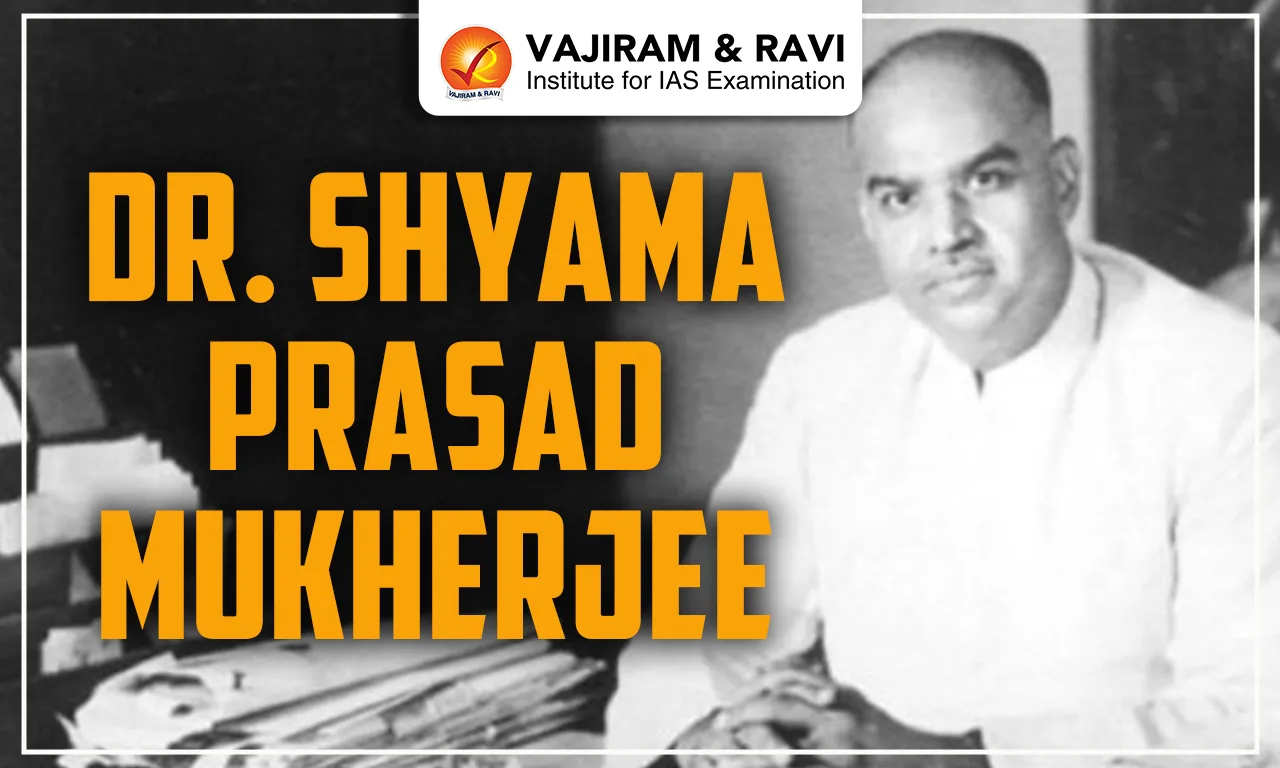
Dr. Shyama Prasad Mukherjee

Dr. Shyama Prasad Mukherjee was a nationalist leader, educationist, barrister, and politician who played a crucial role in shaping India’s political discourse after independence. He is best known as the founder of the Bharatiya Jana Sangh, the predecessor of today’s Bharatiya Janata Party (BJP). A strong critic of the Nehruvian policies, Mukherjee emphasized cultural nationalism, national integration, and the importance of self-reliance.

Dr. Shyama Prasad Mukherjee

Dr. Shyama Prasad Mukherjee was the youngest Vice-Chancellor of Calcutta University (1934-38), where he worked to expand higher education in India. Entering politics during the pre-independence era, he initially worked with the Indian National Congress but later emerged as a strong leader within the Hindu Mahasabha. After independence, he became India’s first Industry and Supply Minister (1947-50) under Prime Minister Jawaharlal Nehru. However, ideological differences led him to resign and eventually form the Bharatiya Jana Sangh in 1951.

Dr. Shyama Prasad Mukherjee Biography

Dr. Shyama Prasad Mukherjee was born on 6 July 1901 in Calcutta (Kolkata), hailed from a distinguished family of academicians and lawyers. This overview shows his personal information and contribution as both an intellectual and a political leader who laid the foundation of a nationalist alternative in Indian politics.

Dr. Shyama Prasad Mukherjee Biography
Aspects Details

Full Name

Dr. Shyama Prasad Mukherjee

Born

6 July 1901, Calcutta (West Bengal)

Education

Barrister from Lincoln’s Inn, London

Profession

Politician, Educationist, Lawyer

Major Positions

Vice-Chancellor, Calcutta University (1934-38); Industry and Supply Minister (1947-50)

Contribution

Founder of Bharatiya Jana Sangh (1951)

Died

23 June 1953, Srinagar (Kashmir)

Dr. Shyama Prasad Mukherjee’s Early Life and Education

Mukherjee was born into an Educated Family. His father, Sir Ashutosh Mukherjee, was a renowned judge and educationist. Completing his BA and MA in English, Mukherjee pursued law and went on to study at Lincoln’s Inn in London, qualifying as a barrister in 1927. His academic excellence and leadership qualities soon brought him recognition, and by 1934, he was appointed as the youngest Vice-Chancellor of Calcutta University, at just 33 years of age.

Dr. Shyama Prasad Mukherjee’s Political Career

Mukherjee’s political journey began in the Bengal Legislative Council as an independent candidate in 1929. Later, he joined the Indian National Congress but distanced himself due to ideological differences. He became associated with the Hindu Mahasabha during the 1930s and opposed policies that he believed undermined Hindu interests.

After independence, he was inducted into Nehru’s cabinet as the first Industry and Supply Minister. He played a key role in laying the foundation of India’s industrial development by supporting small-scale industries, industrialization plans, and self-reliance. However, his disagreements with Nehru on issues such as Kashmir, Pakistan, and secularism led him to resign in 1950.

Founding of Bharatiya Jana Sangh

In 1951, Mukherjee founded the Bharatiya Jana Sangh, which later evolved into the Bharatiya Janata Party (BJP). The Jana Sangh was built on the principles of cultural nationalism, economic self-reliance, and strong national unity. Under his leadership, the party emerged as an important opposition force, giving shape to a new direction in Indian politics. His vision provided the foundation for future political debates on nationalism, identity, and governance.

Mukherjee’s Role in Jammu and Kashmir

Mukherjee strongly opposed the special status of Jammu and Kashmir under Article 370. He believed that it threatened India’s unity and integration. His slogan “Ek desh mein do vidhan, do pradhan aur do nishan nahi chalenge” (One country cannot have two constitutions, two prime ministers, and two flags) became a rallying cry for national integration. In 1953, he entered Jammu and Kashmir without a permit to protest against the special status. He was arrested and later died in custody on 23 June 1953 in Srinagar, under controversial circumstances.

Mukherjee’s Contributions to Indian Politics and Society

Mukherjee’s legacy is marked by his contributions in multiple fields:

  • Education: Expanded higher education as Vice-Chancellor of Calcutta University.
  • Industrial Policy: Advocated for self-reliance and supported industrial growth as the first Industry Minister.
  • Nationalism: Founded Bharatiya Jana Sangh, laying the ideological foundation for BJP.
  • Jammu & Kashmir Issue: Opposed Article 370 and demanded full integration of the state with India.
  • Opposition Politics: Established a strong opposition voice against Nehru’s policies.

Challenges Faced by Shyama Prasad Mukherjee

Despite his contributions, Mukherjee faced several challenges:

  • Ideological conflicts with the ruling Congress Party.
  • Limited organizational strength of the newly formed Jana Sangh.
  • Resistance from political rivals regarding his stance on Kashmir and Hindu nationalism.
  • Lack of resources and grassroots support compared to the Congress.

Way Forward:

Dr. Shyama Prasad Mukherjee’s vision still holds relevance in contemporary Indian politics. His emphasis on national unity, cultural identity, and self-reliance continues to guide political thought.

Dr. Shyama Prasad Mukherjee Legacy

Dr. Shyama Prasad Mukherjee remains one of India’s most significant nationalist leaders, whose ideas shaped post-independence politics. His opposition to Article 370, emphasis on self-reliance, and foundation of the Bharatiya Jana Sangh continue to influence Indian politics.

Dr. Shyama Prasad Mukherjee’s Ideologies

Dr. Shyama Prasad Mukherjee’s ideologies centered around cultural nationalism, economic self-reliance, and strong national unity. He believed that India’s progress depended on connecting its governance with cultural identity. He opposed excessive appeasement in politics and advocated for equal rights for all citizens. His vision of economic policy emphasized small-scale industries, indigenous enterprise, and reducing foreign dependence. His ideological foundation later shaped the Bharatiya Jana Sangh and continues to influence modern Indian politics through the Bharatiya Janata Party (BJP).

Shyama Prasad Mukherjee’s Death

Dr. Mukherjee’s life came to a sudden end on 23 June 1953 in Srinagar, Jammu and Kashmir. He had entered Kashmir without a permit to protest against Article 370 and was arrested by state authorities. While in custody, his health deteriorated, and he died under controversial circumstances. Many of his supporters believed negligence and political conspiracy were behind his death. His passing created a strong wave of protest across India and turned him into a martyr for the cause of national unity.

Also Check Other Posts
Battle of Plassey Robert Clive
Battle of Buxar Anglo Mysore Wars
Dual Government in Bengal Tipu Sultan
Anglo Maratha Wars Maratha Empire
Third Battle of Panipat Chhatrapati Shivaji Maharaj
Battle of Bhima Koregaon Anglo Burmese War
Maharaja Ranjit Singh Anglo Nepal War

Dr. Shyama Prasad Mukherjee FAQs

Q1: Who was Dr. Shyama Prasad Mukherjee?

Ans: He was a nationalist leader, educationist, barrister, and founder of Bharatiya Jana Sangh.

Q2: When and where was Dr. Shyama Prasad Mukherjee born?

Ans: He was born on 6 July 1901 in Calcutta (now Kolkata), West Bengal.

Q3: What was Dr. Shyama Prasad Mukherjee’s role in Indian politics?

Ans: He was India’s first Industry Minister and founder of Bharatiya Jana Sangh.

Q4: Why did Dr. Shyama Prasad Mukherjee oppose Article 370?

Ans: He believed Article 370 weakened India’s unity by giving Jammu and Kashmir special status.

Q5: When did Dr. Shyama Prasad Mukherjee die?

Ans: He died on 23 June 1953 in Srinagar under controversial circumstances.

Preponderance of Probability

Preponderance of Probability

Preponderance of Probability Latest News

The judgment on the title battle over the 1,500 square yards in the town of Ayodhya is founded on the “test of preponderance of probabilities” over who had possession of the outer and inner courtyards of the disputed premises, according to former Chief Justice of India D.Y. Chandrachud.

About Preponderance of Probability

  • It is a widely accepted standard of proof in civil proceedings.
  • The preponderance of probability refers to the greater likelihood of one event or fact over another. 
  • In this context, a fact is considered proven when the evidence suggests that the occurrence of the fact is more likely than not. 
  • It is not about certainty or eliminating all doubts but rather about weighing evidence to see which side presents a more probable scenario. 
  • In civil cases, the party bearing the burden of proof needs to show that their version of events is more plausible than the opposing party’s.
  • This standard contrasts sharply with the criminal law standard of “beyond a reasonable doubt,” where the prosecution must prove the defendant’s guilt to a much higher level of certainty. 
  • In civil cases, by contrast, the balance of probabilities leans toward the more convincing narrative.
  • In Narayan Ganesh Dastane v. Sucheta Narayan Dastane (1975), the Supreme Court of India stated that under Section 3 of the Indian Evidence Act, a fact is said to be proved when the court believes in its existence based on a “preponderance of probability.” 
  • The court applies this test by evaluating conflicting probabilities and choosing the most probable scenario.

Application of Preponderance of Probability in Civil Law

  • The preponderance of probability is the standard of proof used in most civil litigation. 
  • Civil cases typically involve disputes over rights, contracts, property, or torts, and the plaintiff must demonstrate that their claim is more likely true than false. 
  • For example, in a breach of contract case, the plaintiff must show that it is more likely than not that the contract was breached.

Source: TH

Preponderance of Probability FAQs

Q1: What is meant by the term preponderance of probability in civil law?

Ans: The preponderance of probability refers to the greater likelihood of one event or fact over another.

Q2: In which type of legal proceedings is the preponderance of probability standard primarily applied?

Ans: The preponderance of probability standard is primarily applied in civil proceedings.

Q3: What does the plaintiff need to establish in a civil case under the preponderance of probability standard?

Ans: In a civil case under the preponderance of probability standard, the plaintiff needs to establish that their version of events is more likely true than false.

Ophiorrhiza Echinata

Ophiorrhiza Echinata

Ophiorrhiza echinata Latest News

A new coffee plant species named Ophiorrhiza echinata was recently found in the Western Ghats.

About Ophiorrhiza echinata

  • It is a new species of coffee plant.
  • It was discovered in the highly biodiversity-rich shola forests of the Western Ghats at Devikulam in the Idukki District of Kerala.
  • It grows in the ecotone region between evergreen forest and grassland vegetation at an elevation of 1,630 m above sea level and may have medicinal potential.
  • It belongs to the family Rubiaceae and is closely related to the genus Ophiorrhiza mungos, which is a key ingredient in cancer treatment and antidote preparations.
  • Ophiorrhiza echinata has so far only been collected from the type locality. 
  • The area of occupancy is estimated to be less than four square kilometres, and the known populations contain a maximum of only 35 plants.

Source: TOI

Ophiorrhiza echinata FAQs

Q1: What is Ophiorrhiza echinata?

Ans: It is a new species of coffee plant.

Q2: Where was the new plant species Ophiorrhiza echinata discovered?

Ans: Devikulam, Idukki District, Kerala

Q3: In which biodiversity-rich ecosystem was Ophiorrhiza echinata discovered?

Ans: Shola forests of the Western Ghats

Q4: Why is Ophiorrhiza echinata considered highly vulnerable?

Ans: It has very limited area of occupancy and low population size.

Abhinav Bharat Society, Foundation, Dissolution, History, Activities

Abhinav Bharat Society

The Abhinav Bharat Society was a secret revolutionary organization founded in the early 20th century to overthrow British colonial rule in India. Established by Vinayak Damodar Savarkar (Veer Savarkar) in 1904, it became one of the earliest groups to promote armed struggle for independence. The society played a crucial role in shaping revolutionary nationalism and inspired future organizations that carried forward the freedom struggle.

Abhinav Bharat Society

The Abhinav Bharat Society was created as a platform to unite young revolutionaries under the common cause of ending British domination through force if necessary. Its name, meaning "Young India" or "New India," reflected the aspiration for a modern and independent nation. It spread its influence in Maharashtra, Bengal, and Punjab, connecting Indian revolutionaries with global movements.

Abhinav Bharat Society Foundation

The Abhinav Society’s activities included military training, arms procurement, revolutionary literature, and organizing secret cells across India. It had a strong ideological base, largely inspired by Savarkar’s writings and the Italian revolutionary Giuseppe Mazzini. It was founded as ‘Mitra Mela’ in 1899 and later renamed as Abhinav Bharat Society. According to the National Archives of India, the society operated until 1952, when it was finally dissolved.

Abhinav Bharat Society Historical Background

The idea of Abhinav Bharat was inspired by Savarkar’s admiration for Giuseppe Mazzini, the Italian nationalist who fought for unification of Italy. Savarkar translated Mazzini’s biography into Marathi and circulated it among Indian youth, advocating the path of revolutionary nationalism. The society emerged against the backdrop of rising dissatisfaction with moderate Congress politics and the limitations of constitutional agitation.

Abhinav Bharat Society Activities

The Abhinav Society engaged in multiple activities to build revolutionary momentum in India:

  • Military Training: Members practiced shooting, bomb-making, and physical drills.
  • Circulation of Literature: Revolutionary pamphlets and Savarkar’s works like The First War of Independence, 1857 were distributed.
  • Arms Procurement: Attempts were made to smuggle weapons from Europe into India.
  • Secret Cells: Organized networks of revolutionaries in Maharashtra, Bengal, and Punjab.
  • Political Assassinations: The group was linked to the assassination of British officials like A.M.T. Jackson (Collector of Nashik, 1909).

Role of Vinayak Damodar Savarkar in Abhinav Bharat

Savarkar was the ideological force behind Abhinav Bharat. While studying law in London, he mobilized Indian students, formed India House, and established international connections with revolutionaries. His book The First War of Independence, 1857 reinterpreted the revolt of 1857 as a national struggle against colonialism, inspiring future revolutionaries.

Major Incidents of Abhinav Bharat Society

Some significant incidents associated with the Abhinav Society include:

  • Assassination of A.M.T. Jackson (1909): An act of retribution for the arrest of revolutionaries, carried out by Anant Laxman Kanhere, linked with Abhinav Bharat.
  • London Activities: Savarkar and his associates in London, including Madan Lal Dhingra, plotted against British officers and promoted armed resistance.
  • Suppression of the Group: British intelligence cracked down on its members, leading to arrests, deportations, and imprisonment.

Challenges Faced by the Abhinav Bharat Society

The society, being secretive and radical, faced several challenges:

  • Lack of widespread public support due to its violent methods.
  • Strong surveillance and repression by British intelligence.
  • Ideological split among revolutionaries regarding armed struggle vs. political negotiations.
  • Limited resources and difficulty in sustaining large-scale armed movements.

Way Forward:

Although Abhinav Bharat no longer exists, its history offers lessons for India’s freedom movement and nation-building. Acknowledging the role of such organizations ensures a comprehensive understanding of India’s independence struggle. 

Trial of Savarkar

The British government viewed Vinayak Damodar Savarkar as one of the most dangerous revolutionaries linked with Abhinav Bharat. After the assassination of A.M.T. Jackson in 1909, Savarkar was arrested in London for his involvement in revolutionary activities, including arms smuggling and incitement of violence. In 1910, he was extradited to India and tried under charges of sedition and conspiracy. He was sentenced to two life imprisonments (50 years) in the Cellular Jail, Andaman Islands, which symbolized the severity of colonial repression against revolutionaries.

Dissolution of Abhinav Bharat Society

The Abhinav Bharat Society gradually weakened due to the arrests of its leaders, lack of resources, and intense British surveillance. By the 1920s, its influence declined as other revolutionary groups like HSRA and Hindustan Republican Association took prominence. After independence in 1947, the society had lost its purpose, and in 1952, it was officially dissolved. Despite its dissolution, the Abhinav Bharat Society is remembered as one of the earliest organizations to promote militant nationalism in India’s freedom movement.

Legacy of Abhinav Bharat Society

Despite limited resources, the Abhinav Bharat Society ignited a spirit of defiance against colonialism. It influenced later revolutionary groups like the Hindustan Socialist Republican Association (HSRA) and provided ideological foundations for radical nationalism.

Abhinav Bharat Society UPSC

The Abhinav Bharat Society occupies a crucial place in India’s freedom struggle as one of the earliest revolutionary organizations advocating armed resistance. Founded by Veer Savarkar in 1904, it united young revolutionaries, carried out daring acts against British officials, and inspired future generations. Although eventually suppressed, its contribution to India’s nationalist awakening remains significant.

Also Check Other Posts
Battle of Plassey Robert Clive
Battle of Buxar Anglo Mysore Wars
Dual Government in Bengal Tipu Sultan
Anglo Maratha Wars Maratha Empire
Third Battle of Panipat Chhatrapati Shivaji Maharaj
Battle of Bhima Koregaon Anglo Burmese War
Maharaja Ranjit Singh Anglo Nepal War

Abhinav Bharat Society FAQs

Q1: Who founded the Abhinav Bharat Society?

Ans: It was founded by Vinayak Damodar Savarkar in 1904.

Q2: What was the aim of Abhinav Bharat Society?

Ans: Its aim was to overthrow British rule through revolutionary activities and armed struggle.

Q3: Which incident is linked to Abhinav Bharat Society?

Ans: The assassination of A.M.T. Jackson, Collector of Nashik in 1909, is linked to it.

Q4: Where was the Abhinav Bharat Society most active?

Ans: It was mainly active in Maharashtra, with networks in Bengal, Punjab, and London.

Q5: When was Abhinav Bharat Society dissolved?

Ans: It was formally disbanded in 1952.

Swachh Shehar Jodi Initiative

Swachh Shehar Jodi Initiative

Swachh Shehar Jodi Initiative Latest News

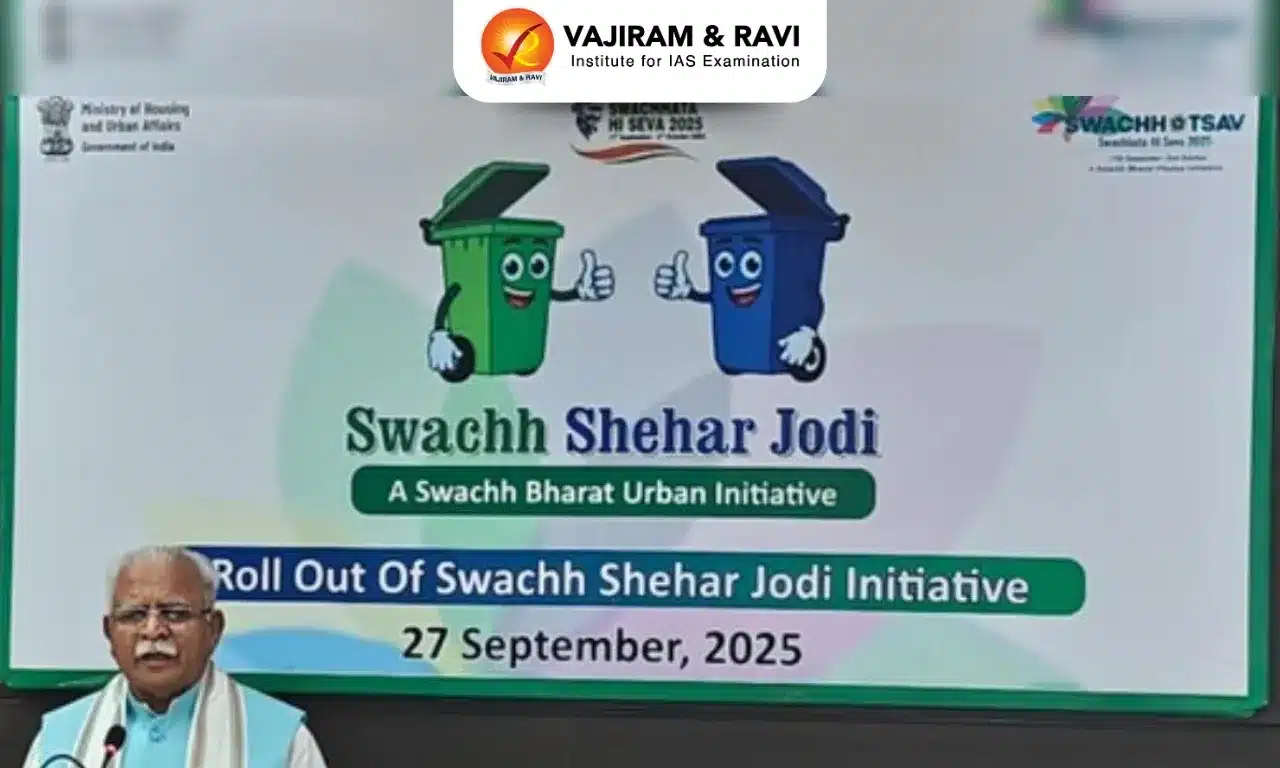
Recently, the Ministry of Housing and Urban Affairs (MoHUA) has launched the Swachh Shehar Jodi (SSJ) initiative.

About Swachh Shehar Jodi Initiative

  • It is a structured mentorship and collaborative action program involving 72 mentor cities and around 200 mentee cities.
  • Based on the recent performance in the Swachh Survekshan rankings, top-performing cities have been identified as mentor cities and paired with low-performing mentee cities. It is implemented under the Swachh Bharat Mission – Urban (SBM-U).
  • It is aimed to foster knowledge and experience sharing, peer learning and transforming best practices in sanitation and waste management across urban India.

Objectives of Swachh Shehar Jodi Initiative

  • The objective is to support comparatively low performing cities in improving their swachhata performance by drawing on the experience of mentor cities to:
  • Replicate tested best practices in sanitation and waste management

Implementation of Swachh Shehar Jodi Initiative

  • It is envisioned that the mentor cities will be those cities that adhere to the following criteria:
    • Top performing cities that have featured across Rank 1, 2 or 3 in Swachh Survekshan (SS) 2022, 2023, and 2024 ( i.e. – cities that are part of the Super Swachh League)
    • Top three cities that are featured across population categories in Swachha Sarvesksha 2024.
    • Promising clean cities that emerge across States/UTs as part of SS 2024.
  • The mentee city may be selected on the baisis of the following criteria:
    • Featured in the bottom of the State cumulative ranking of the latest SS rankings
    • Geographical proximity of the jodi cities to each other
  • Funding: Both mentor and mentee cities may utilize the Capacity Building (CB) Funds allocated to each State/UT as part of SBM-U 2.0. State/UT Governments are encouraged to top up this fund, if required.
  • Cities can also leverage funds from other sources / partner organizations.

Source: PIB

Swachh Shehar Jodi Initiative FAQs

Q1: What is the duration of the mentorship program under Swachh Shehar Jodi?

Ans: 100 days.

Q2: What is the primary objective of the Swachh Shehar Jodi initiative?

Ans: To foster city-to-city mentorship for waste management.

Pallid Fish Eagle

Pallid Fish Eagle

Pallid Fish Eagle Latest News

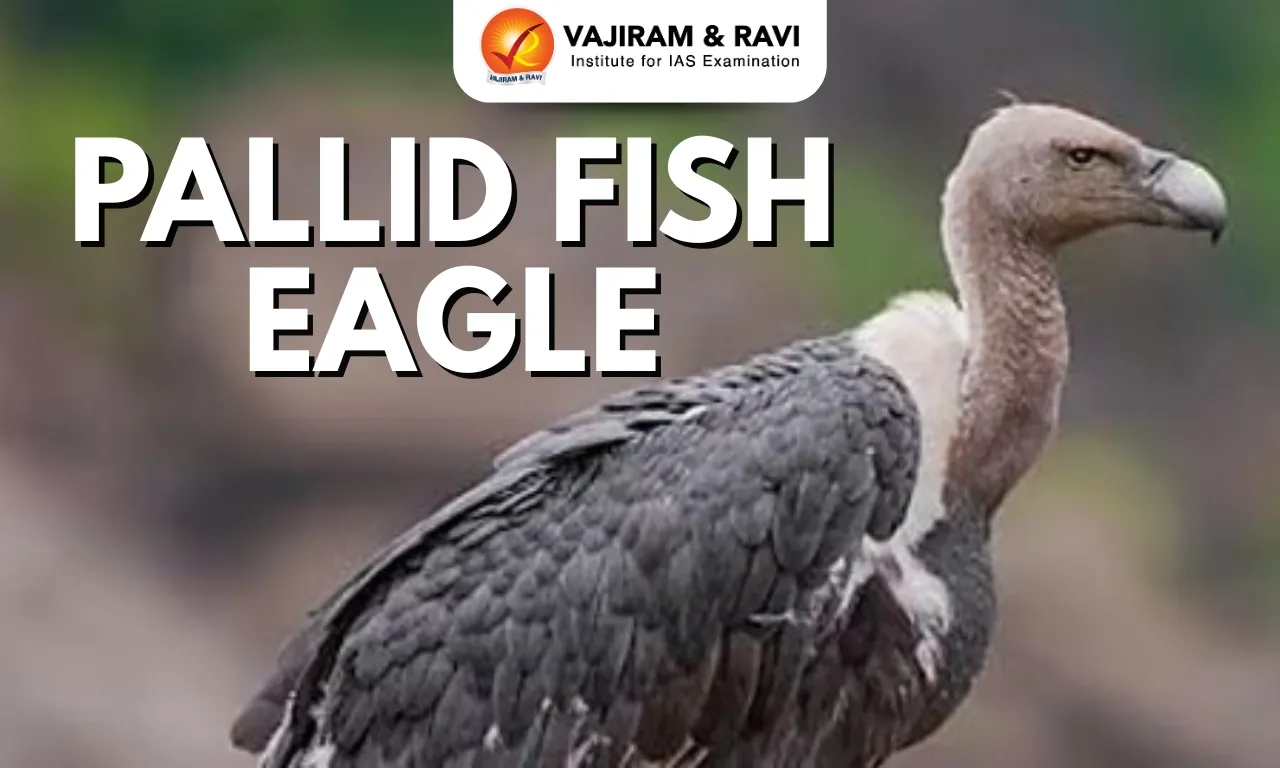
Recently, a survey conducted jointly by the State Forest Department and the World Wide Fund for Nature (WWF) has revealed rare nesting of Pallid Fish Eagle in Corbett Tiger Reserve.

About Pallid Fish Eagle

  • It is also known as Pallas’s sea eagle or band-tailed fish eagle, is a large, brownish sea eagle.
  • It can be seen near lakes, marshes and large rivers, from lowlands to 5,000 metres of elevation.
  • Food: It feeds primarily on fish, but many other prey are part of its diet.
  • It breeds usually near water in a large nest placed in a tall tree.
  • It is partially migratory, with Central Asian birds wintering among the southern Asian birds in northern India, and also further west to the Persian Gulf.
  • Distribution: It is found in the east Palearctic in Kazakhstan, Russia, Tajikistan, Turkmenistan, Uzbekistan, Mongolia,China, India, Nepal, Bangladesh and Myanmar. 
  • Conservation status: IUCN Red List: Endangered
  • Threats: Humans contribute to the decline of this species through habitat degradation, pollution, and draining or overfishing lakes.

Key Facts about Corbett Tiger Reserve

  • It is located on the foothills of the Himalayas in Uttarakhand.
  • It was originally established as Hailey National Park in 1936.
  • It is not only the first national park in India, but also the first to come under the Project Tiger initiative.
  • Terrain: The terrain is undulating with several valleys. The rivers Ramganga, Pallaen, and Sonanadi flow through the valleys.
  • It is spread over the Bhabar and lower Shivalik regions with a deep-water table.
  • Vegetation: North Indian tropical moist deciduous forests and tropical dry deciduous forests. In general, the vegetation comprises sal and mixed forests, interspersed with grass lands and riparian vegetation.

Source: New India Express

Pallid Fish Eagle FAQs

Q1: Where is the Pallid Fish Eagle primarily found?

Ans: East Palearctic region

Q2: What is the primary source of food for the Pallid Fish Eagle?

Ans: Fish

Infectious Bovine Rhinotracheitis

Infectious Bovine Rhinotracheitis

Infectious Bovine Rhinotracheitis Latest News

Recently, Indian Immunologicals (IIL) has launched India’s first indigenously developed glycoprotein E (gE) deleted DIVA marker vaccine against infectious bovine rhinotracheitis (IBR).

About Infectious Bovine Rhinotracheitis

  • It is endemic in India and caused by Bovine Herpes Virus (BHV-1). 
  • BoHV-1 is a member of the genus Varicellovirus in the subfamily Alphaherpesvirinae,
  • It is a disease of domestic and wild cattle.
  • There are three forms: respiratory, genital and encephalitic, the first two are more common.
  • Transmission: The disease is transmitted through the aerosol route and affects reproductive systems. It is also transmitted by semen from bulls to milch animals.
  • Impacts on Bovines: Infertility, abortions and lower milk productivity are some of the major impacts of the disease.
  • Treatment: There is no vaccine available in India and there is no specific treatment against this disease thus far. 

Symptoms of Infectious Bovine Rhinotracheitis

  • It is characterised by clinical signs of the upper respiratory tract, such as a (muco)purulent nasal discharge, hyperaemia of the muzzle (red nose disease) and by conjunctivitis.
  • Signs of general illness are fever, depression, inappetence, abortions and reduced milk yield.

Source: TH

Infectious Bovine Rhinotracheitis FAQs

Q1: What is the causative agent of Infectious Bovine Rhinotracheitis (IBR)?

Ans: It is caused by Bovine alphaherpesvirus 1 (BoHV-1).

Q2: What are the primary symptoms of Infectious Bovine Rhinotracheitis (IBR)?

Ans: Respiratory issues, fever, and nasal discharge.

National Crime Records Bureau

National Crime Records Bureau

National Crime Records Bureau Latest News

According to the latest data released by the National Crime Records Bureau (NCRB), crimes against Scheduled Tribes (STs) increased 28.8 per cent in 2023 as compared to the previous year.

About National Crime Records Bureau

  • It was established in 1986 to act as a repository of information on crime and criminals. 
  • It was set up based on the recommendations of the Tandon Committee, the National Police Commission (1977-1981) and the Task Force of the Home Ministry.
  • Nodal Ministry: It comes under the Ministry of Home Affairs (MHA), Government of India.
  • Headquarters: New Delhi

Functions of National Crime Records Bureau

  • It is responsible for collecting and analysing crime data as well as serving as a repository of such information to aid investigators in tracing crimes and criminals.
  • It is entrusted with the responsibility of monitoring, coordination, and implementing the Crime and Criminal Tracking Network and System (CCTNS) project. 
  • Under the National Digital Police Portal police officers  look for a criminal or suspect on the CCTNS database and give citizens with services such as online complaint filing, etc.
  • The Bureau has also been entrusted to maintain the National Database of Sexual Offenders (NDSO) and share it with the States/UTs on a regular basis.
  • NCRB has also been designated as the Central Nodal Agency to manage the technical and operational functions of the ‘Online Cyber-Crime Reporting Portal’ through which any citizen can lodge a complaint or upload a video clip as evidence of crime related to child pornography, rape/gang rape.
  • The NCRB has also launched CyTrain, a portal for online training of different stakeholders in cybercrime investigations and prosecution. 
  • The Central Finger Print Bureau under the NCRB is a national repository of all fingerprints in the country.
  • NCRB also compiles and publishes National Crime Statistics i.e. Crime in India, Accidental Deaths & Suicides, and also Prison Statistics. 

Source: IE

National Crime Records Bureau FAQs

Q1: When was the National Crime Records Bureau (NCRB) established?

Ans: 1986.

Q2: What is the Crime and Criminal Tracking Network & Systems (CCTNS) project?

Ans: A project to connect police stations across the country. The CCTNS project aims to create a comprehensive and integrated system for enhancing policing efficiency.

Hunga Tonga–Hunga Haʻapai (HTHH) Volcano

Hunga Tonga–Hunga Haʻapai (HTHH) Volcano

Hunga Tonga–Hunga Haʻapai Volcano Latest News

A collaborative research team recently returned from a major 54-day voyage on CSIRO research vessel (RV) Investigator to explore the impacts of the devastating 2022 eruption of Tonga's underwater Hunga Volcano.

About Hunga Tonga–Hunga Haʻapai Volcano

  • It is a submarine stratovolcano in the Tongan archipelago in the southern Pacific Ocean.
  • The HTHH volcano includes the small islands of Hunga Tonga and Hunga Ha’apai, along with shallow reefs along the caldera rim of a much larger submarine edifice in the western South Pacific Ocean, west of the main inhabited islands in the Kingdom of Tonga. 
  • It is located about 30 km south of the submarine volcano of Fonuafoʻou and 65 km north of Tongatapu, the country’s main island.
  • The volcano is part of the highly active Tonga–Kermadec Islands volcanic arc, a subduction zone extending from New Zealand north-northeast to Fiji.
    • The Tonga-Kermadec arc was formed as a result of the subduction of the Pacific Plate beneath the Indo-Australian Plate. 
  • It has erupted regularly over the past few decades.
  • On January 15, 2022, the HTHH volcano experienced an explosive eruption, considered one of the largest volcanic eruptions of the 21st century.
    • The eruption caused a plume of volcanic materials and gasses to be pushed into the stratosphere and sent shock waves through the atmosphere and tsunami waves across ocean basins.

What is a Stratovolcano?

  • It is a tall, steep, and cone-shaped type of volcano.
  • Unlike flat shield volcanoes, they have higher peaks.
  • They are typically found above subduction zones, and they are often part of large volcanically active regions, such as the Ring of Fire that frames much of the Pacific Ocean.
  • Strato Volcanoes comprise the largest percentage (~60%) of the Earth’s individual volcanoes, and most are characterized by eruptions of andesite and dacite, lavas that are cooler and more viscous than basalt.
  • These more viscous lavas allow gas pressures to build up to high levels. Therefore, these volcanoes often suffer explosive eruptions. 
  • They are usually about half-half lava and pyroclastic material, and the layering of these products gives them their other common name, composite volcanoes.
  • At their peak, they usually have a small crater. The crater may be filled with water or ice, or it may contain a volcanic dome during a period of relative inactivity.

Source: PHYS

Hunga Tonga–Hunga Haʻapai (HTHH) Volcano FAQs

Q1: The Hunga Tonga–Hunga Haʻapai (HTHH) Volcano is located in which ocean?

Ans: Southern Pacific Ocean

Q2: Hunga Tonga–Hunga Haʻapai (HTHH) is classified as which type of volcano?

Ans: Submarine stratovolcano

Q3: To which country does the HTHH volcano belong?

Ans: The Hunga Tonga–Hunga Haʻapai (HTHH) volcano belongs to Tonga.

Daily Editorial Analysis 30 September 2025

Daily Editorial Analysis

An Anti-Terror Role That Defies Logic 

Context

  • The global fight against terrorism is often portrayed as a unified front, spearheaded by international bodies such as the United Nations (UN).
  • Yet recent developments have exposed troubling contradictions at the heart of this struggle.
  • Pakistan, a country long accused of sponsoring and sheltering terrorist organisations, has been granted leadership positions within the very UN committees designed to combat terrorism.
  • This paradox not only undermines the credibility of the UN but also poses serious risks to regional and global security.

Pakistan’s Terror Infrastructure

  • For decades, Pakistan has been accused of nurturing terrorism as a tool of state policy.
  • From harbouring Osama bin Laden in Abbottabad, just a short distance from its military academy, to providing direct support for groups such as Lashkar-e-Taiba (LeT) and Jaish-e-Mohammad (JeM), its role is well documented.
  • High-profile incidents such as the 2008 Mumbai attacks, the 2019 Pulwama bombing, and the April 2025 Pahalgam attack highlight a sustained pattern of cross-border terrorism nurtured on Pakistani soil.
  • India’s response to the latest attack, Operation Sindoor, underscored the entrenched nature of this terror infrastructure.
  • Further evidence came from the presence of Pakistani officials at the funerals of slain militants, demonstrating institutional complicity.
  • The continuing prominence of UN-designated terrorists like Hafiz Saeed, who remains politically and socially active despite his supposed imprisonment, reinforces Pakistan’s status as a terror shelter.

The UN’s Contradictory Decisions

  • Against this backdrop, Pakistan’s elevation to leadership roles in the UN’s counter-terrorism mechanisms is deeply troubling.
  • In June 2025, Pakistan was appointed to chair the Taliban Sanctions Committee and serve as vice-chair of the Counter-Terrorism Committee.
  • By July, it even assumed the rotating presidency of the UN Security Council.
  • These decisions echo earlier controversies, such as Libya chairing the Human Rights Commission or Saudi Arabia leading the Women’s Rights Commission.
  • Four key issues emerge:
    • Contradiction of Mandates: Pakistan’s sponsorship of terror groups directly violates the objectives of the UN committees it now leads.
    • Weak Vetting Standards: Its removal from the Financial Action Task Force (FATF) grey list in 2022 despite ongoing concerns about terror financing reflects systemic leniency.
    • Geopolitical Bias: Major powers often prioritise strategic or economic interests over moral imperatives, enabling Pakistan’s ascent.
    • Dangerous Precedent: Rewarding duplicity legitimises state-sponsored terrorism and sends the message that diplomatic packaging can outweigh security realities.
  • The situation was compounded when the International Monetary Fund (IMF) approved a $1 billion loan for Pakistan in May 2025, sparking concerns that the funds might be diverted to sustain terror networks.

Implications for India and Global Security

  • The UN’s decisions undermine India’s efforts to highlight Pakistan as a state sponsor of terrorism.
  • With a foothold in UN counter-terrorism bodies, Pakistan can shape global narratives, deflect accusations, and even obstruct sanctions against its proxy groups.
  • It also gains leverage to weaken India’s diplomatic engagement with the Taliban regime and project itself as a responsible international actor.
  • For India, the challenge is twofold: neutralising Pakistan’s diplomatic manoeuvres while simultaneously reinforcing its own security. Countermeasures must include:
    • Leveraging alliances with UNSC members to balance Pakistan’s influence.
    • Highlighting Pakistan’s terror links in global forums and pushing for stringent accountability.
    • Deepening engagement with Afghanistan, including humanitarian aid missions, to reduce Pakistan’s sway over the Taliban.
    • Launching a global information campaign through media, academia, and diaspora networks to expose Pakistan’s duplicity.
    • Strengthening intelligence and cyber-security frameworks to mitigate asymmetric threats.

The UN’s Crisis of Integrity

  • The UN’s willingness to overlook Pakistan’s terror links raises profound questions about its moral compass and credibility.
  • By placing Pakistan in charge of counter-terrorism, the UN risks undermining its own authority, alienating victims of terrorism, and emboldening state sponsors of extremism.
  • The appointment also reflects a larger pattern of selective morality in international governance, where political convenience trumps ethical consistency.

Conclusion

  • The paradox of Pakistan’s elevation to UN counter-terrorism leadership illustrates the dangerous gap between rhetoric and reality in global governance.
  • For India, the challenge lies not just in managing Pakistan’s duplicity but also in ensuring that the international community recognises the threat such decisions pose to collective security.
  • Ultimately, the issue is larger than India or Pakistan: it is about whether the UN can remain a credible arbiter in the fight against terrorism.
  • If state sponsors of terror are allowed to dictate the global counter-terrorism agenda, the world risks legitimising extremism instead of eradicating it.

An Anti-Terror Role That Defies Logic FAQs

 Q1. Why is Pakistan’s leadership role in UN counter-terrorism committees controversial?
Ans. It is controversial because Pakistan has a long history of harbouring and supporting terrorist groups, which directly contradicts the objectives of those committees.

Q2. What event in April 2025 highlighted Pakistan’s continuing support for terrorism?
Ans. The Pahalgam attack on tourists in April 2025 exposed Pakistan’s ongoing role as a haven for terror groups.

Q3. How does Pakistan’s UN role affect India’s counter-terrorism efforts?
Ans. Pakistan’s new position allows it to shape narratives, block sanctions, and undermine India’s attempts to portray it as a state sponsor of terrorism.

Q4. What larger problem does Pakistan’s elevation reveal about the UN?
Ans. It reveals a crisis of credibility within the UN, showing that geopolitical convenience often outweighs moral and security imperatives.

Q5. What strategies should India adopt in response?
Ans. India should strengthen its alliances, expose Pakistan’s duplicity internationally, engage Afghanistan more actively, and reinforce its intelligence and security systems.

Source: The Hindu


South-South and Triangular Cooperation is More Than a Diplomatic Phrase

Context

  • With only a third of the time left before the 2030 deadline for the Sustainable Development Goals (SDGs), the urgency of reimagining global cooperation has never been more pressing.
  • Among the most promising frameworks for collective progress is South-South and Triangular Cooperation (SSTC), an approach rooted in solidarity, mutual respect, and shared learning.
  • First formalised through the Buenos Aires Plan of Action (BAPA) in 1978, SSTC has evolved into a vital mechanism for development, offering cost-effective, replicable, and contextually relevant solutions in a rapidly changing global landscape.

The Evolution and Relevance of SSTC

  • Unlike traditional aid models, SSTC operates on principles of equality and mutual benefit, enabling developing nations to learn from one another’s experiences.
  • Its importance has grown in an era defined by geopolitical instability, climate change, and widening inequality.
  • By amplifying the strengths of developing countries and pooling resources, SSTC provides more sustainable and scalable solutions at a time when funding for humanitarian and development efforts is shrinking.
  • Triangular cooperation further expands this framework by connecting developing nations with traditional donors, emerging economies, civil society, and the private sector.
  • This diversified partnership approach enhances accountability, trust, and inclusivity, resulting in development models that are people-centred and resilient.

India’s Philosophy and Leadership in SSTC

  • India’s development philosophy is anchored in Vasudhaiva Kutumbakam, the idea that the world is one family.

  • This ethos informs its role as a key driver of SSTC, where it combines moral leadership with practical innovation.
  • India has consistently positioned itself as an advocate for sovereignty, inclusion, and multilateral cooperation.
  • Concrete contributions highlight India’s leadership:
    • Global advocacy and diplomacy: Hosting the Voice of the Global South Summits and pushing for permanent African Union membership in the G20.
    • Institutional mechanisms: Establishing the Development Partnership Administration and implementing the Indian Technical and Economic Cooperation (ITEC) programme, which has trained professionals in over 160 countries.
    • Financial support: Launching the India-UN Development Partnership Fund, which has financed over 75 projects across 56 countries.
    • Technological innovation: Sharing digital public infrastructure models like Aadhaar and UPI, alongside advancements in climate resilience, healthcare, and sustainable financing.

India and the World Food Programme: A Model of Innovation

  • India’s collaboration with the World Food Programme (WFP) provides a striking example of how SSTC can generate scalable solutions.
  • Over six decades, this partnership has produced innovations that improved India’s food security and now serve as models for other nations. Notable initiatives include:
  • Annapurti (Grain ATMs) for efficient food distribution.
  • Optimised national supply chains for the public distribution system.
  • Women-led Take-Home Ration programmes improving nutrition at scale.
  • National rice fortification projects enhancing dietary quality.
  • These interventions exemplify how localised innovation can achieve global relevance, offering replicable models for countries facing similar challenges.

Financing and Scaling SSTC

  • Sustained progress requires strong institutions and predictable financing. Encouragingly, contributions to SSTC have steadily grown.
  • In the past three decades, 47 governments have supported the UN Fund for South-South Cooperation, benefitting people in 155 countries.
  • The India-UN Fund has further extended these efforts, particularly in Least Developed Countries (LDCs) and Small Island Developing States (SIDS).
  • In 2024 alone, the WFP mobilised over $10.9 million from Global South countries and the private sector for SSTC projects targeting Zero Hunger (SDG 2).
  • Initiatives like rice fortification in Nepal and development projects in Lao PDR demonstrate the tangible outcomes of these partnerships.

The Way Forward: Towards a Renewed Spirit of Partnership

  • The 2025 theme for UN Day for South-South and Triangular Cooperation, New Opportunities and Innovation through SSTC, captures the pressing need to invest in creativity, knowledge-sharing, and institutional strength.
  • The challenges ahead demand not only technical solutions but also a new spirit of partnership grounded in equality, innovation, and mutual accountability.
  • SSTC is not merely a diplomatic instrument; it is a transformative pathway.
  • By valuing contributions from all nations, nurturing innovation, and prioritising the needs of communities, it can drive progress towards a more equitable and sustainable global future.

Conclusion

  • The trajectory of SSTC illustrates how solidarity among developing nations can generate lasting global impact.
  • India’s leadership, through innovation, financing, and advocacy, showcases the transformative potential of this model.
  • Yet, achieving the SDGs requires more than isolated successes; it calls for a collective renewal of partnerships across sectors and regions.
  • In this shared journey, SSTC offers both a compass and a lifeline, guiding the world toward a future of inclusivity, resilience, and sustainability.

South-South and Triangular Cooperation is More Than a Diplomatic Phrase FAQs

Q1. What is South-South and Triangular Cooperation (SSTC)?
Ans. SSTC is a development model where countries of the Global South share knowledge, resources, and innovations, often in partnership with traditional donors, to achieve sustainable and equitable progress.

Q2. Why is SSTC considered more effective than traditional aid in some contexts?
Ans. SSTC is cost-effective, replicable, and tailored to local conditions, making it more relevant and impactful than one-size-fits-all traditional aid models.

Q3. How does India’s philosophy of Vasudhaiva Kutumbakam influence its role in SSTC?
Ans. The philosophy that “the world is one family” guides India to promote inclusion, solidarity, and mutual respect in its global development partnerships.

Q4. What are some innovations developed through India’s partnership with the World Food Programme?
Ans. Notable innovations include Grain ATMs, supply chain optimisation for food distribution, women-led Take-Home Ration programmes, and rice fortification projects.

Q5. What is the theme for the 2025 UN Day for South-South and Triangular Cooperation?
Ans. The theme is New Opportunities and Innovation through SSTC, highlighting the need for strong institutions, financing, and creative solutions.

Source: The Hindu

Daily Editorial Analysis 30 September 2025 FAQs

Q1: What is editorial analysis?

Ans: Editorial analysis is the critical examination and interpretation of newspaper editorials to extract key insights, arguments, and perspectives relevant to UPSC preparation.

Q2: What is an editorial analyst?

Ans: An editorial analyst is someone who studies and breaks down editorials to highlight their relevance, structure, and usefulness for competitive exams like the UPSC.

Q3: What is an editorial for UPSC?

Ans: For UPSC, an editorial refers to opinion-based articles in reputed newspapers that provide analysis on current affairs, governance, policy, and socio-economic issues.

Q4: What are the sources of UPSC Editorial Analysis?

Ans: Key sources include editorials from The Hindu and Indian Express.

Q5: Can Editorial Analysis help in Mains Answer Writing?

Ans: Yes, editorial analysis enhances content quality, analytical depth, and structure in Mains answer writing.

Red Sanders

Red Sanders

Red Sanders Latest News

Recently, the National Biodiversity Authority (NBA) has sanctioned an amount of ₹82 lakh to the Andhra Pradesh Biodiversity Board for the conservation of the endemic plant species Red Sanders (Pterocarpus santalinus). 

About Red Sanders

  • It is native to the Southern Eastern Ghats and found particularly in the districts of Anantapur, Chittoor, Kadapa, and Kurnool of Andhra Pradesh.
  • Required Climatic Conditions: It usually grows in rocky, degraded and fallow lands with Red Soil and a hot and dry climate.
  • Threats: It has been under heavy threat due to its high commercial value, leading to rampant smuggling.
  • Conservation Status:

Key Facts about National Biodiversity Authority

  • It is a statutory body established under the Biological Diversity Act, 2002.
  • It was formally set up in 2003.
  • To ensure effective implementation of the Act at different administrative levels, two additional entities were created alongside the NBA:
    • State Biodiversity Boards (SBBs): Functioning at the state level to regulate access to biological resources within their jurisdiction.
    • Biodiversity Management Committees (BMCs): Established at the local village or panchayat level to promote grassroots-level biodiversity conservation and documentation.
  • Headquarters: Chennai, Tamil Nadu.

Composition of National Biodiversity Authority

  • Chairperson: An eminent person with proven knowledge and experience in biodiversity conservation, sustainable use of biological resources, and equitable sharing of benefits.
  • 10 Ex-officio Members: Senior representatives from the Government of India, nominated to provide policy insights and ensure inter-ministerial coordination.
  • 5 Non-Official Members: Experts and professionals from diverse fields related to biodiversity management, nominated to contribute independent perspectives and specialized expertise.

Source: PIB

Red Sanders FAQs

Q1: What is the IUCN conservation status of Red Sanders?

Ans: Endangered

Q2: Where is Red Sanders primarily found?

Ans: Eastern Ghats

India’s E-Waste Recycling Challenges and Opportunities

E-Waste Recycling

E-Waste Recycling Latest News

  • While the Union government promotes local electronics manufacturing through initiatives like semiconductor fabs and the Electronics Component Manufacturing Scheme, e-waste recycling remains a weak link. 
  • Millions of tonnes of discarded consumer electronics and appliances have piled up in recent years. 
  • Policymakers see recycling as crucial to extract scarce and valuable metals, especially as electronics consumption is projected to surge in the coming years.

E-Waste

  • E-waste refers to discarded electronic devices such as smartphones, laptops, TVs, fridges, and chargers. 
  • While these often contain valuable materials, they are usually dumped instead of being reused or recycled.

Need for Effective e-Waste Management

  • Health Risks - E-waste contains toxic substances like lead, mercury, and cadmium. Improper handling leads to contamination of soil and water, causing neurological disorders, kidney failure, and long-term chronic diseases.
  • Environmental Damage - Hazardous recycling practices pollute air, soil, and water. They also release greenhouse gases, worsening climate change and harming ecosystems.
  • Economic Loss - Inefficient recycling causes wastage of valuable resources such as gold, silver, and copper, which could otherwise be recovered and reused in production.

Link with Environmental, Gocial, and Governance (ESG) and SDGs

  • E-waste management aligns with global sustainability frameworks:
    • SDG 12: Responsible Consumption and Production.
    • SDG 13: Climate Action.
  • It strengthens India’s ESG commitments by integrating resource efficiency and environmental protection into growth.

Electronics Consumption and Indigenous Push

  • India, despite having over 93.9 crore mobile broadband connections, accounts for only 4% of global electronics consumption
  • Fragile global supply chains have pushed the government to expand domestic manufacturing and raw material access, including a ₹1,500 crore mineral recycling scheme announced in September.

E-Waste Volumes and Processing

  • According to the Global E-Waste Monitor 2020, India is the world’s third-largest e-waste generator after China and the USA. 
    • With India being one of the fastest-growing electronics markets, this trend is expected to rise further.
    • As per one report, India’s electronics industry to grow at a CAGR of 16.6%, from USD 215 billion in FY19 to USD 540 billion by FY25. 
    • This rapid expansion will add significantly to e-waste volumes.
  • India generated an estimated 4.17 million metric tonnes of e-waste in 2022, but only one-third was processed through proper channels

Legal Framework for E-Waste Management

  • Improper disposal of end-of-life EEE products has severe negative externalities, including risks to human health and environmental degradation. Effective management is essential to mitigate these harms.
  • E-waste in India is regulated by the E-Waste (Management) Rules, 2022, published by the Ministry of Environment, Forest and Climate Change (MoEFCC). These rules came into force on April 1, 2023.
  • State Pollution Control Boards, responsible for inventorying, use inconsistent methods, causing discrepancies between Indian and international data.
  • The Central Pollution Control Board has begun auditing recyclers, with over 50 firms checked in recent months. 
  • Companies are working to aggregate informal operations into formal “mandi”-style streams, recovering metals such as gold, copper, aluminium, and steel.

Extended Producer Responsibility (EPR) Framework and Associated Concerns

  • The government has introduced EPR rules requiring manufacturers to collect end-of-life appliances for recycling metals like copper, aluminium, nickel, cobalt, and lithium. 
  • This move is partly driven by geopolitical risks, such as China’s export restrictions on rare earth elements.

Dominance of Informal Sector

  • A 2023 Indian Cellular and Electronics Association report flagged the dominance of the informal sector in India’s recycling ecosystem. 
  • These operators focus on repairing and harvesting components, but remain outside formal frameworks, hindering the creation of a circular economy. 
  • Even within EPR, issues like “paper trading” persist, with recyclers overstating volumes for financial incentives.

Concerns on Traceability and Best Practices

  • Experts stress that malpractices plague the sector, with many players lacking true metal extraction capacity
  • They highlighted the need for third-party audits, better environmental safeguards, and life-cycle visibility of products
  • Inventorying remains weak in India, unlike Western countries that count products as potential e-waste from the point of sale.

Future Potential

  • While the share of recycled precious metals in India’s supply chains remains negligible, industry leaders argue that with the right policy push, India could meet up to 70% of its rare earth requirements within 18 months. 
  • Recycling’s impact is growing each year, highlighting its potential as a key pillar in India’s electronics ecosystem.

Source: TH | PSA | GE

E-Waste Recycling FAQs

Q1: What is e-waste recycling in India?

Ans: E-waste recycling involves recovering valuable metals like copper, gold, and lithium from discarded electronics, but India faces challenges due to informal sector dominance.

Q2: Why is e-waste recycling important in India?

Ans: Recycling reduces toxic pollution, protects human health, and helps recover critical resources needed for India’s growing electronics manufacturing sector and sustainable development goals.

Q3: What are India’s e-waste rules?

Ans: E-waste in India is regulated under the 2022 E-Waste Management Rules, effective from April 2023, focusing on extended producer responsibility (EPR) and proper disposal methods.

Q4: What challenges exist in e-waste recycling?

Ans: Informal sector dominance, lack of traceability, paper trading, and weak inventorying systems undermine India’s recycling ecosystem and prevent a robust circular economy.

Q5: What is the future of e-waste recycling in India?

Ans: With proper policies, India could meet up to 70% of its rare-earth needs within 18 months, making recycling a key pillar of its electronics ecosystem.

India Secures Second Deep-Sea Mineral Exploration Contract in Indian Ocean

Deep-Sea Mineral Exploration

Deep-Sea Mineral Exploration Latest News

  • India has signed a new contract with the International Seabed Authority (ISA) granting exclusive rights to explore Polymetallic Sulphides (PMS) in the Carlsberg Ridge of the Indian Ocean. 
  • With this, India has become the first country in the world to hold two such ISA contracts, commanding the largest seabed area allocated internationally for PMS exploration. 
  • The National Centre for Polar and Ocean Research (NCPOR), Goa, will begin exploration in 2026 through geophysical and hydrographic surveys. 
  • India’s application, submitted in 2024, was approved last week, allotting a 10,000 sq km area in the Carlsberg Ridge
  • This builds on its earlier 2016 contract for exploration in the Central and Southwest Indian Ridges, marking both a scientific breakthrough and a strategic advantage.

Polymetallic Sulphides and Their Importance for India

  • Polymetallic Sulphides (PMS) are rich seabed deposits containing copper, zinc, lead, gold, silver, and trace amounts of rare and precious elements. 
  • Found near hydrothermal vents on the ocean floor, these deposits form when seawater seeps into cracks, interacts with magma beneath the Earth’s crust, and resurfaces as mineral-rich hot water that solidifies on the seabed. 
  • For India, PMS exploration is vital as land-based reserves of such minerals are limited. 
  • Securing these resources is crucial for strategic industries, renewable energy systems, high-technology applications, and green technologies, thereby enhancing the country’s resource security and self-reliance.

India’s Experience in PMS Exploration

  • Since signing its first PMS exploration contract with the International Seabed Authority (ISA) in 2016, India’s National Centre for Polar and Ocean Research (NCPOR) has carried out extensive surveys in the central and southwest Indian Ocean ridges, building significant expertise and infrastructure. 
  • The government’s Deep Ocean Mission has strengthened these efforts by adding deep-sea vessels, advanced tools like Autonomous Underwater Vehicles (AUVs).
  • The upcoming Matsya submersible under the Samudrayaan mission, which will further expand exploration capacity. 
  • NCPOR follows a three-phase plan:
    • Reconnaissance surveys with ship-based tools to locate potential PMS sites.
    • Near-seabed surveys using AUVs and Remotely Operated Vehicles (ROVs) to confirm deposits.
    • Resource evaluation of identified PMS areas for assessing their economic potential.

Significance of the Carlsberg Ridge

  • The Carlsberg Ridge, part of the mid-ocean ridge system in the Indian Ocean, was formed by seafloor spreading between the Indian Plate and Somali Plate about 40 million years ago. 
  • With a slow spreading rate of 2.4–3.3 cm per year, it features rugged flanking topography and a median valley typical of slow-spreading ridges
  • The ridge hosts hydrothermal vent systems, making it a potential hotspot for Polymetallic Sulphide (PMS) deposits. 
  • India has been studying these systems for over three decades. 
  • Strategically, its proximity — located near 2°N latitude, much closer to India than the Central and Southwest Indian Ridges at 26°S — makes it highly significant for resource security and scientific exploration.

How PMS Exploration Differs from Other Underwater Mineral Searches

  • PMS exploration is far more complex than other seabed mineral investigations. 
  • PMS deposits occur near hydrothermal vents along mid-ocean ridges, at depths of 2,000–5,000 metres, where the terrain is rocky, uneven, and remote. 
  • Survey operations require deep-sea vessels with dynamic positioning, precise navigation, and advanced communication systems. 
  • Unlike other explorations, PMS demands a multidisciplinary team of marine geologists, geophysicists, oceanographers, biologists, and deep-sea technologists. 
  • Exploration methods involve ship-mounted geophysical surveys for reconnaissance, and Autonomous Underwater Vehicles (AUVs) and Remotely Operated Vehicles (ROVs) for detailed near-seabed mapping and sample collection. 
  • Advanced tools are essential to accurately analyse mineral composition, making PMS exploration one of the most technically demanding deep-sea missions.

How ISA Allocates Mineral Exploration Sites

  • The International Seabed Authority (ISA), established under the UNCLOS framework, manages mineral exploration in international waters. 
  • Countries, through their governments, public sector bodies, or sponsored entities, apply to the ISA for exploration rights. 
  • Applications must include details of the proposed area, a work plan, environmental baseline studies, and proof of technical and financial capacity
  • The ISA’s Legal and Technical Commission (LTC) reviews these submissions for compliance. 
  • If approved, the application is forwarded to the ISA Council for final clearance, granting the applicant exclusive exploration rights in the designated seabed area.

India’s Plans for Additional Mineral Exploration in the Indian Ocean

  • As part of its Blue Economy initiatives, India is pursuing more seabed mineral exploration rights in the Indian Ocean. 
  • Beyond its existing contracts for Polymetallic Sulphides (PMS), India has applied to the ISA for rights to explore cobalt-rich ferromanganese crusts on the Afanasy-Nikitin Seamount in the Central Indian Ocean. This application is currently under review. 
  • Securing such rights would further strengthen India’s access to strategic and critical minerals vital for technology, renewable energy, and long-term resource security.

Source: IE | PIB

Deep-Sea Mineral Exploration FAQs

Q1: What is deep-sea mineral exploration in India?

Ans: It involves exploring seabed deposits like polymetallic sulphides rich in copper, zinc, gold, and rare elements, vital for India’s green technologies and resource security.

Q2: Why is the Carlsberg Ridge significant for India?

Ans: Located close to India, the ridge hosts hydrothermal vent systems with rich mineral deposits, offering both strategic and scientific advantages for exploration.

Q3: What role does NCPOR play in PMS exploration?

Ans: The Goa-based National Centre for Polar and Ocean Research (NCPOR) leads exploration, using advanced vessels, Autonomous Underwater Vehicles (AUVs), and Remotely Operated Vehicles (ROVs).

Q4: How is PMS exploration different from other seabed mining?

Ans: PMS occurs in rugged, deep-sea hydrothermal zones, requiring specialised technology, multidisciplinary expertise, and precise navigation tools for successful surveys and sampling.

Q5: Is India planning more deep-sea exploration?

Ans: Yes, India has applied to the ISA to explore cobalt-rich ferromanganese crusts in the Central Indian Ocean, strengthening access to critical strategic minerals.

Crime in India 2023 – NCRB Report Highlights Surge in Cybercrime in India

Crime in India 2023

Crime in India 2023 Latest News

  • The National Crime Records Bureau (NCRB) has released its Crime in India 2023 report (after a two-year gap), highlighting a significant increase in cybercrime cases. 
  • The data reflects growing vulnerabilities in India’s digital ecosystem, with fraud, extortion, and sexual exploitation emerging as dominant motives behind such crimes.

Key Findings of the Report

  • Overall crime statistics:
    • The data reflects a 7.2% overall increase in recorded crimes, reaching 6.24 million cases (crimes every five seconds on average in 2023).
    • Traditional violent crimes such as murder (↓2.8%) and rape (↓5.9%) have declined.
    • But cybercrime, economic offences, and miscellaneous crimes like obstruction on public way (Sec.283 IPC - ↑62%) and Motor Vehicle Act violations (↑103%) have surged.
  • Offences against vulnerable sections:
    • Crime against women: Marginal rise of 0.7% (448,211 cases).
    • Crimes against SCs: ↑0.4% (57,789 cases).
    • Crimes against children: ↑9.2%.
    • Crimes against STs: ↑28.8%.

Cybercrime Trends

  • Rising: Cybercrime cases rose 31.2% in 2023, reaching 86,420 cases compared to 65,893 in 2022. The cybercrime rate increased from 4.8% in 2022 to 6.2% in 2023.
  • Consistent rise since 2018:
    • 2018 – 27,248 cases
    • 2019 – 44,735 cases
    • 2020 – 50,035 cases
    • 2021 – 52,974 cases
    • 2022 – 65,893 cases
    • 2023 – 86,420 cases
  • Motives behind cybercrimes:
    • Fraud: 68.9% of total cases (59,526 cases) – the largest category.
    • Sexual exploitation: 4.9% (4,199 cases).
    • Extortion: 3.8% (3,326 cases).

State-Wise Data on Cybercrime

  • Karnataka: Highest with 21,889 cases in 2023 (sharp rise from 8,136 in 2021 and 12,556 in 2022). Included 18,166 cases of cheating by personation and 1,007 obscene video transfers.
  • Telangana: 18,236 cases in 2023 (up from 15,297 in 2022).
  • Uttar Pradesh: 10,794 cases in 2023 (up from 10,117 in 2022).

Economic Offences (Broader Category)

  • Total cases in 2023: 2,04,973 (6% increase from 1,93,385 in 2022).
  • Categories:
    • Forgery, cheating and fraud (FCF) – 1,81,553 cases.
    • Criminal breach of trust – 22,759 cases.
    • Counterfeiting – 661 cases.

Analysis and Implications

  • Crime patterns shifting: From traditional violent crimes to economic and technology-driven crimes. 
  • Shift in crime categorisation and tracking: It is the last annual report under the IPC, as the Bharatiya Nyaya Sanhita (BNS) came into force in July 2024.
  • Digital fraud: It is the biggest challenge in India’s cybercrime landscape. The concentration of cases in Karnataka, Telangana, and UP suggests urbanisation, IT penetration, and digital adoption are key drivers.
  • Economic offences’ steady rise: Highlights the need for robust financial cybersecurity mechanisms.

Way Ahead

  • Strengthening cybersecurity infrastructure and digital literacy programs are crucial.
  • Equipping law enforcement agencies: With advanced cyber forensic tools and training.
  • Enhanced public-private collaboration: In monitoring, prevention, and quick response mechanisms.
  • Multi-stakeholder approach: Covering government, judiciary, tech companies, and citizens—can mitigate risks and build a resilient digital ecosystem.

Source: IE | HT

Crime in India 2023 FAQs

Q1: What major shift in crime trends does the NCRB Crime in India 2023 report highlight?

Ans: Traditional violent crimes like murder and rape have declined, while cybercrimes, fraud, rash driving, and miscellaneous offences have surged.

Q2: Which state reported the highest number of cybercrime cases in 2023 and why is this significant?

Ans: Karnataka reported 21,889 cases, reflecting higher digital penetration and vulnerabilities in IT-driven economies.

Q3: How did crimes against vulnerable groups such as women, children, SCs, and STs evolve in 2023?

Ans: Crimes against women rose marginally (0.7%), against children (9.2%), SCs (0.4%), and saw a sharp increase against STs (28.8%).

Q4: What role did Information Technology Act cases play in the rise of cybercrimes?

Ans: IT Act cases, especially cheating by personation, contributed 60% to cybercrime growth, nearly doubling from 13,506 cases in 2022 to 25,334 in 2023.

Q5: What is the significance of the NCRB 2023 report in the context of India’s criminal justice framework?

Ans: It is the last annual report under the IPC, as the Bharatiya Nyaya Sanhita (BNS) came into force in July 2024, marking a shift in crime categorisation and tracking.

EV Charging Infrastructure – Govt Rolls Out 100% Subsidy

EV Charging

EV Charging Latest News

  • The government has launched guidelines under the Rs. 10,000 crore PM E-Drive scheme, offering 100% subsidy for EV charging infrastructure to accelerate India’s transition to clean mobility.

Introduction

  • India has set ambitious targets for transitioning towards sustainable transportation, with electric vehicles (EVs) positioned at the centre of its clean mobility vision. 
  • To bridge the critical infrastructure gap, the government has rolled out guidelines under the Rs. 10,000 crore PM E-Drive scheme, offering up to 100% subsidy for setting up EV charging stations and battery swapping stations. 
  • The move aims to accelerate EV adoption by addressing one of the sector’s biggest challenges, inadequate charging infrastructure.

India’s Push for EV Adoption

  • The EV sector in India has gained momentum over the past decade, supported by policies such as the Faster Adoption and Manufacturing of Hybrid and Electric Vehicles (FAME) scheme and state-level incentives. 
  • However, the lack of sufficient charging points continues to deter buyers. India currently has fewer than 20,000 public charging stations, far behind global EV leaders like China and the U.S.
  • The PM E-Drive scheme seeks to address this bottleneck by prioritising subsidies for high-density urban areas, smart cities, and critical transport corridors. 
  • By linking subsidies to demand aggregation, the scheme ensures a coordinated approach between ministries, state governments, and public sector enterprises.

Key Features of the PM E-Drive Subsidy Scheme

  • The new guidelines allocate Rs. 2,000 crore out of the Rs. 10,000 crore scheme exclusively for charging infrastructure. Some of the notable features include:
  • 100% Subsidy Coverage: Eligible entities will receive full financial support for upstream infrastructure like transformers, cables, circuit breakers, and civil works. In some cases, even the cost of EV supply equipment (EVSE), including charging guns, will be subsidised.
  • Priority Areas: Focus on cities with populations above one million, notified smart cities, satellite towns near metros, and cities under the National Clean Air Programme (NCAP).
  • Highways Integration: Selected inter-city and inter-state highways will be made EV-ready through coordinated planning with the Ministry of Road Transport and Highways.
  • Eligible Entities: Central ministries, State governments, PSUs, and CPSEs can submit proposals. Companies like IOCL, BPCL, HPCL, NHAI, AAI, and metro rail corporations are also eligible.
  • Operational Flexibility: Entities may directly operate charging stations or appoint Charge Point Operators (CPOs).

Expected Impact on EV Ecosystem

  • The subsidy scheme is designed to create a network of charging stations that matches the pace of EV adoption in India. The immediate benefits include:
  • Boost to EV Sales: Assured availability of charging infrastructure is expected to encourage more consumers to switch from internal combustion engine vehicles to EVs.
  • Public Sector Leadership: Involving large PSUs such as IOCL and NHAI ensures that the scheme benefits from established networks and infrastructure expertise.
  • Pollution Reduction: By prioritising NCAP cities and capital cities, the scheme aligns EV infrastructure growth with India’s clean air goals.
  • Economic Opportunities: The expansion of charging networks will create business opportunities for Charge Point Operators, equipment manufacturers, and service providers.

Challenges Ahead

  • While the subsidy plan is a breakthrough, its success will depend on implementation. Some key challenges include:
  • Land Acquisition: Identifying and securing suitable sites for charging stations in densely populated urban areas.
  • Grid Readiness: Strengthening India’s power distribution systems to handle increased EV charging load without causing disruptions.
  • Private Sector Participation: Encouraging private players to complement PSU-led efforts for a balanced rollout.
  • Consumer Awareness: Educating users about charging locations, pricing models, and safety standards.

Source: TH

EV Charging FAQs

Q1: What is the PM E-Drive scheme?

Ans: The PM E-Drive is a Rs. 10,000 crore government scheme to boost electric vehicle adoption, with Rs. 2,000 crore earmarked for charging infrastructure.

Q2: Who is eligible for the EV charging subsidy?

Ans: Central ministries, State governments, PSUs, CPSEs, and entities like IOCL, BPCL, HPCL, and NHAI can apply.

Q3: How much subsidy is offered under the scheme?

Ans: Up to 100% subsidy is provided for upstream infrastructure and, in some cases, EV supply equipment costs.

Q4: Which areas will be prioritized for EV charging stations?

Ans: Cities with populations above one million, smart cities, satellite towns, NCAP cities, and inter-state highways will be prioritized.

Q5: What is the expected impact of this scheme?

Ans: It is expected to boost EV adoption, reduce pollution in cities, and strengthen India’s EV ecosystem through wider charging access.

Gulf of Aden

Gulf of Aden

Gulf of Aden Latest News

A suspected missile strike, likely from Yemen's Houthi rebels, caused a vessel to catch fire in the Gulf of Aden recently.

About Gulf of Aden

  • It is an extension of the Indian Ocean, located between the Arabian Peninsula and the African continent. 
  • The gulf connects the Red Sea to the Arabian Sea via the Strait of Bab el Mandeb.
  • The gulf is named after “Aden,” a port city on Yemen’s coast.
    • It is one of the largest natural harbors in the world, with an area of about 70 sq. km of sheltered water.
  • It is approximately 900 km long and 500 km wide and covers roughly 410,000 sq.km.
  • It is bounded to the south by Somalia and the Socotra Islands (part of Yemen), north by Yemen, east by the Arabian Sea, and west by Djibouti
  • The gulf is connected to the Somali Sea to the south by the Guardafui Channel.
  • In the west, it narrows into the Gulf of Tadjoura,near Djibouti.
  • It is demarcated from the Arabian Sea by the Horn of Africa and the Socotra Islands.
  • It is a geologically young body of water with a unique rich biodiversity that comprises many varieties of coral, fish, seabirds, and invertebrates.
  • The dominant relief feature of the gulf’s terrain is the Sheba Ridge,an extension of the Indian Ocean ridge system, which extends along the middle of the gulf.
  • The Gulf of Aden is strongly influenced by the upwelling of cool, nutrient-rich waters during the southwest and northeast monsoons and is characterized by a prevailing high-energy climate.
  • Compared to the neighbouring Red Sea, the Gulf of Aden has a lower saline content.
  • Some of the major cities near the gulf include Aden, Mukalla, Ahnwar, Balhaf, Berbera, Bosaso, and Djibouti City.
  • Major Ports: Aden in Yemen, and Berbera and Bosaso in Somalia. 
  • It is also a critical part of the Suez Canal shipping route, which connects the Red Sea and the Mediterranean Sea.
  • An estimated 11% of seaborne petroleum passes through the Gulf of Aden en route to the Mediterranean or Arabian Seas.

Source: TOI

Gulf of Aden FAQs

Q1: The Gulf of Aden connects which two major bodies of water?

Ans: Red Sea and Arabian Sea

Q2: Which countries does the Gulf of Aden border?

Ans: Yemen, Somalia, Djibouti

Q3: How does the salinity of the Gulf of Aden compare to the Red Sea?

Ans: Lower than the Red Sea.

Q4: Which major ports are located along the Gulf of Aden?

Ans: Aden in Yemen, and Berbera and Bosaso in Somalia.

Antlions

Antlions

Antlions Latest News

Researchers recently discovered two new species of antlions named Indophanes keralaensis and Indophanes sahyadriensis belonging to the family Myrmeleontidae under the order Neuroptera.

About Antlions

  • Antlions are a group of about 2,000 different species of insects. 
  • They belong to a family called Myrmeleontidae
  • They are named for the predatory nature of the larvae, which commonly trap ants and other small insects in pits dug into the ground.
  • Adult antlions are not as well known. They live for a shorter time than the larvae. 
    • Adult antlions, sometimes called antlion lacewings, usually fly at dusk or after dark. 
    • People sometimes mistake them for dragonflies or damselflies.
  • Habitat and Distribution:
    • Antlions live all over the world. 
    • Most types are found in warm, tropical places. 
    • But some species, like the European Euroleon nostras, live in colder areas. 
    • They often live in dry, sandy places. This is where their larvae can easily dig their traps. 
    • However, some larvae hide under leaves or other bits of nature. They wait to ambush their prey there.
  • They come in various shapes and sizes, with larvae typically measuring from a few millimeters to several centimeters, depending on the species. 
    • Antlion larvae have rounded bodies with long sickle-shaped jaws
    • The larvae are found at the base of cone-shaped pits in sandy areas.
    • In North America, these larvae are sometimes called doodlebugs. This is because of the wiggly marks they leave in the sand.
    • They usually remain in the larval stage for one to two years, depending on the species.
    • Once they pupate, they require up to one month to complete their development.
  • Antlions are harmless and cause no damage to flowers, people, or structures.
  • They are highly beneficial and feed on ants and other insects that fall into their traps.

Source: TH

Antlions FAQs

Q1: Antlions belong to which insect family?

Ans: Myrmeleontidae

Q2: Why are antlions named so?

Ans: Because their larvae trap ants and other insects in sandy pits.

Q3: How long do antlion larvae usually remain in the larval stage?

Ans: 1–2 years

Q4: Adult antlions are often mistaken for which insects?

Ans: Dragonflies and damselflies

Q5: Where are antlions most commonly found?

Ans: Warm, tropical regions with sandy soil.

Enquire Now