Alluvial Soil, Distribution, Formation, Composition, Importance

Alluvial Soil

Alluvial soil is the most widespread and agriculturally important soil type in India. It covers nearly 45.6% of the country’s total land area and forms the foundation of agriculture in many regions. 

Alluvial Soil Distribution

  • Alluvial soils are mainly found in the northern plains of India. 
  • Alluvial soils also extend into Rajasthan and Gujarat through a narrow corridor. 
  • In addition, they are found in the eastern coastal plains, particularly in the delta regions of rivers such as the Mahanadi River, Godavari River, Krishna River and Kaveri River.

Alluvial Soil Formation and Composition

  • Alluvial soils are formed by the deposition of sediments such as sand, silt and clay carried by rivers.
  • These have been deposited by three important Himalayan river systems -  the Indus, the Ganga and the Brahmaputra. 
  • Composition: Contains sand, silt and clay in different proportions.
  • The composition of the soil varies across regions depending on river flow and deposition patterns.
    • In the upper parts of river valleys, particularly near the foothills, the soil is relatively coarse and sandy. Such soils are common in the piedmont plains such as the Duars, Chos and Terai regions.
    •  As rivers move toward the plains, the soil particles become finer and richer in nutrients.

Alluvial Soil Types

Based on age and formation, alluvial soils are broadly classified into two types:

  • Bhangar (Old Alluvial Soil): Bhangar refers to the older alluvial deposits found in slightly elevated areas away from river floodplains. These soils often contain kankar (calcareous nodules) and are relatively less fertile compared to the newer deposits.
  • Khadar (New Alluvial Soil): Khadar is the newer alluvial soil deposited by rivers during floods. It is finer in texture, richer in nutrients and therefore more fertile. Khadar soils are mainly found in the active floodplains of rivers.

Alluvial Soil Characteristics

Alluvial soils have several distinctive features:

  • Alluvial soils are very fertile and suitable for agriculture.
  • They are rich in potash and lime but relatively poor in nitrogen and phosphorus.
  • They are generally immature soils with thin profiles.
  • The colour varies from light grey to ash grey.
  • In some regions, kankar beds are found, particularly in older alluvial soils.
  • The soil texture ranges from loamy to clayey, especially in the middle and lower Ganga plains and the Brahmaputra valley.
  • The sand content decreases from west to east, making soils in eastern regions finer and more fertile.

Alluvial Soil Economic Importance

  • Alluvial soils play a crucial role in India’s agricultural economy. Their natural fertility and favourable texture make them ideal for growing a wide variety of crops. 
  • Major crops grown in these soils include Rice, Wheat, Sugarcane, Pulses, Oilseeds, Vegetables and fruits
  • Because of their productivity, regions with alluvial soils are intensively cultivated and densely populated. Even in drier areas, these soils can become productive with proper irrigation and soil management.

Alluvial Soil FAQs

Q1: What is Alluvial Soil?

Ans: Alluvial soil is a fertile soil formed by the deposition of sediments such as sand, silt and clay carried by rivers, and it is the most widespread soil type in India.

Q2: Where is alluvial soil mainly found in India?

Ans: It is mainly found in the northern plains and also in the coastal plains and river deltas of rivers such as the Mahanadi River, Godavari River, Krishna River and Kaveri River.

Q3: Which rivers are mainly responsible for the formation of alluvial soil?

Ans: Alluvial soil is mainly formed by the deposition of sediments from the Indus River, Ganga River and Brahmaputra River river systems.

Q4: What are the main types of alluvial soil?

Ans: Alluvial soil is classified into Bhangar (old alluvium) and Khadar (new alluvium) based on their age and formation.

Q5: Why is alluvial soil important for agriculture?

Ans: Alluvial soil is highly fertile and suitable for crops like rice, wheat, sugarcane and pulses, making it crucial for India’s agricultural production.

Rajput Paintings, Features, Origin, Schools, Significance

Rajput Paintings

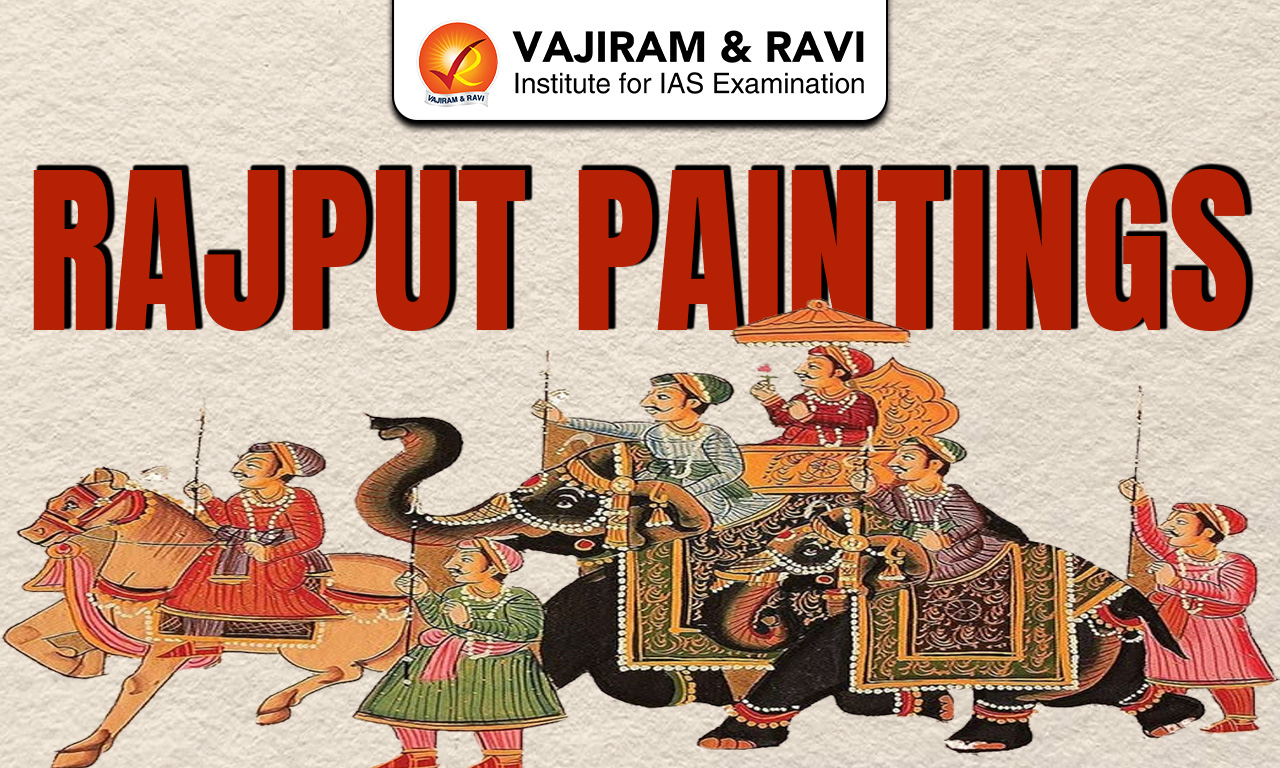
Rajput painting is a traditional style of Indian painting that developed in the royal courts of Rajasthan and nearby regions during the medieval period. These paintings were mainly supported by Rajput rulers and reflected themes related to religion, culture, nature, and court life. Known for their bright colours, decorative style, and expressive figures, Rajput paintings represent an important part of India’s artistic and cultural heritage.

Rajput Paintings Features

  • Religious and Cultural Themes: Rajput painting was strongly influenced by Hindu traditions such as Vaishnavism, Shaivism, and Shaktism. Many paintings depict stories from the Ramayana, Mahabharata, and Bhagavata Purana, especially the life and love stories of Krishna and Radha. Scenes of royal life, festivals, hunting, and nature were also common.
  • Style and Use of Colours: The paintings are known for bold outlines, bright and vibrant colours, and a decorative style. Colours were prepared from natural sources such as minerals, plants, and sometimes gold or silver. Artists focused more on emotional expression than realistic perspective.
  • Representation of Figures and Scenes: Human figures were usually stylized with large expressive eyes, sharp features, and detailed clothing. Paintings often appear flat with little attempt to show depth, and sometimes the surface was divided into different coloured sections to show multiple scenes.
  • Influence and Regional Schools: Interaction with Mughal painting brought more refinement in drawing and some natural elements in trees and figures. Over time, several regional styles developed in Rajasthan and nearby areas, such as the Mewar School of Painting, Marwar School of Painting, Bundi School of Painting, and Kangra School of Painting.
  • Medium and Form: Most Rajput paintings were miniature paintings made on paper, though some were also created on materials like ivory, silk, and on the walls of palaces and forts.

Rajput Paintings Origin

  • Rajput painting developed between the 16th and 17th centuries in the royal courts of Rajasthan and nearby regions. These paintings grew out of earlier Indian artistic traditions and later evolved by interacting with other styles.
  • Indigenous Roots: The early form of Rajput painting was influenced by local manuscript painting traditions, especially the Chaurapanchasika style of western India. These early paintings used bright colours, bold lines, and simple compositions.
  • Influence of Mughal Art: Contact with the Mughal painting style during the 16th century introduced better techniques of drawing, portrait making, and more detailed backgrounds. This interaction helped refine the Rajput style while still keeping its traditional character.
  • Spread and Development: When the Mughal Empire weakened during the reign of Aurangzeb, many artists left the Mughal court and moved to Rajput kingdoms. These artists brought new artistic skills, which led to the further development of regional schools of Rajput painting.
  • Over time, Rajput paintings flourished from the 16th to 19th centuries, depicting themes such as stories of Krishna, scenes from the Ramayana, musical themes like Ragamala paintings, and the lifestyle of Rajput courts. These paintings became an important part of India’s traditional miniature painting heritage.

Schools of Rajput Painting

Rajput painting developed in different Rajput kingdoms, and each region created its own artistic style. These styles are usually named after the princely states where they flourished. Although they share some common features, each school developed unique themes, techniques, and artistic expressions.

  • Mewar School
    • One of the earliest and most important Rajput painting styles, developed under the patronage of the Mewar rulers.
    • The famous artist Sahibdin illustrated works such as Rasikapriya, Ramayana, and Bhagavata Purana.
    • Later paintings began to show scenes from royal court life.
    • A notable feature was “tamasha” paintings, which depicted court ceremonies and detailed city views.
  • Kishangarh School
    • Developed in the kingdom of Kishangarh, founded by Kishan Singh in 1609.
    • Flourished under the patronage of Man Singh.
    • Known for romantic and devotional themes, especially the love of Radha and Krishna.
    • The famous painting Bani Thani became a symbol of this style.
  • Bundi School
    • It emerged in Bundi in the Hadoti region of Rajasthan.
    • Known for detailed landscapes showing trees, gardens, rivers, and nature.
    • Human figures usually have round faces with slightly pointed noses.
    • The sky is often painted in bright colours, sometimes with a red band.
  • Amber-Jaipur School
    • Developed in the regions of Amber and Jaipur, also called the Dhundar school.
    • Early examples can be seen in wall paintings at Bairat and Amer Palace.
    • Shows both folk and Mughal influences in style and clothing.
    • It reached its peak under Sawai Pratap Singh in the eighteenth century.
  • Malwa School
    • Developed in the Malwa region of central India.
    • Known for bright colours and simple compositions.
    • Figures are often shown against solid coloured backgrounds.
    • Themes mainly include religious texts and Ragamala paintings.
  • Kota School
    • Developed from the Bundi style in the kingdom of Kota.
    • Famous for dynamic hunting scenes of kings and nobles.
    • Artists paid special attention to animals and forests.
    • Known for lively brushwork, shading, and the depiction of double-eyelid eyes.
  • Bikaner School
    • Developed in the kingdom of Bikaner founded by Rao Bika Rathore.
    • Influenced by Mughal artists who worked in the region.
    • Known for delicate lines, fine detailing, and soft colours like blue, green, and red.
    • Female figures are shown as slender with graceful, deer-like eyes.
  • Jodhpur School
    • It flourished under the rulers of Jodhpur, especially Maharaja Jaswant Singh.
    • Early examples include a Ragamala series painted by artist Virji in 1623.
    • Many paintings depict themes related to Krishna and the Bhagavata Purana.
    • Important works during the reign of Man Singh include the Ramayana, Dhola-Maru, Panchatantra, and Shiva Purana.

Differences between the Mughal Painting and Rajput Painting

Mughal painting and Rajput painting are two important traditions of Indian miniature painting that developed during the medieval period. However, they differ in themes, style, and artistic influences. The major Differences between the Mughal Painting and Rajput Painting are discussed below.

Differences between the Mughal Painting and Rajput Painting

Basis

Mughal painting

Rajput painting

Nature of Style

Developed mainly as a courtly and aristocratic art under the patronage of Mughal emperors.

Developed in Rajput courts but was closely connected with local traditions and popular culture.

Themes

Focused on royal life, court scenes, battles, hunting, and portraits of emperors and nobles.

Mainly depicted religious stories, mythology, love themes, and nature, especially stories of Krishna and Radha.

Artistic Influence

Strongly influenced by Persian painting and Central Asian traditions, later blending with Indian elements.

Rooted largely in indigenous Indian traditions and also influenced by local folk art.

Purpose and Audience

Created mainly for Mughal emperors and royal patrons, often kept within imperial collections.

Produced for regional courts and society, reflecting cultural and religious life of the people.

Style and Technique

Known for fine detailing, realism, and naturalistic representation of humans, animals, and landscapes.

Characterized by bold lines, bright colours, stylized figures, and decorative compositions.

Subject Approach

Mostly portrayed historical events and contemporary court activities.

Focused on spiritual, mythological, and emotional themes.

Representation of Animals and Nature

Animals and nature were often shown realistically, especially in hunting scenes.

Animals and nature were often shown symbolically and aesthetically, sometimes with religious meaning.

Form of Painting

Primarily miniature paintings created for manuscripts and albums.

Included miniatures as well as wall paintings and murals in palaces and temples.

Rajput Paintings Significance

Rajput painting holds an important place in the history of Indian art and culture. It reflects the social, religious, and cultural life of the Rajput kingdoms.

  • Cultural Heritage: Rajput paintings represent the rich artistic traditions of Rajasthan and nearby regions and are an important part of India’s cultural heritage.
  • Religious Expression: Many paintings depict stories from Hindu texts such as the Ramayana, Mahabharata, and Bhagavata Purana, helping to spread religious ideas and devotion.
  • Reflection of Society and Culture: These paintings show the lifestyle of kings, royal courts, festivals, nature, and daily life, providing insights into the society of that period.
  • Development of Regional Art Styles: Different regional schools such as the Mewar School of Painting and Kishangarh School of Painting contributed to the diversity and growth of Indian miniature painting.
  • Influence on Later Art: Rajput painting influenced many later forms of Indian art and remains an important subject of study in Indian art history.

Rajput Paintings FAQs

Q1: What are Rajput paintings?

Ans: Rajput painting is a style of Indian miniature painting that developed in the royal courts of Rajasthan between the 16th and 19th centuries, depicting religious, cultural, and courtly themes.

Q2: What are the main themes of Rajput paintings?

Ans: They mainly depict stories from the Ramayana, Mahabharata, and Bhagavata Purana, especially the life of Krishna, along with scenes of royal life and nature.

Q3: What are the main features of Rajput paintings?

Ans: They are known for bright colours, bold lines, stylized figures, and emotional expression, with less focus on realistic perspective.

Q4: What influenced the development of Rajput painting?

Ans: Rajput painting developed from local Indian traditions and was later refined through interaction with Mughal painting.

Q5: What are some important schools of Rajput painting?

Ans: Major schools include the Mewar School of Painting, Kishangarh School of Painting, Bundi School of Painting, Kota School of Painting, and Bikaner School of Painting.

Jal Mahotsav 2026, About, Aim, Tagline, Key Activities

Jal Mahotsav 2026

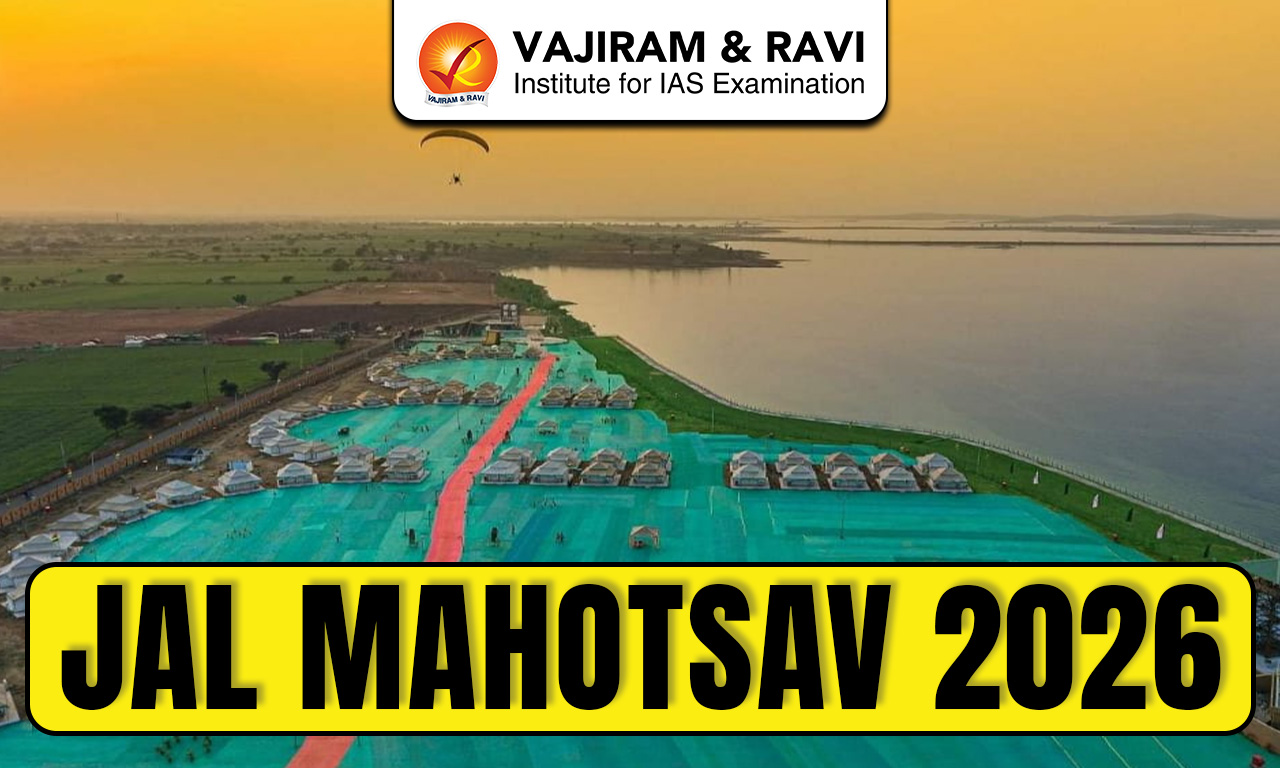
Jal Mahotsav 2026 is a nationwide campaign launched by the Ministry of Jal Shakti to promote community participation in rural drinking water management under the Jal Jeevan Mission. The campaign was launched from Gujarat by the Union Minister of Jal Shakti and aims to strengthen Jan Bhagidari (people’s participation) and encourage communities to take responsibility for managing village water systems. It also supports the vision of creating “Sujal Gram” (water-secure villages) across the country.

About Jal Mahotsav 2026

  • Jal Mahotsav 2026 is a flagship campaign of the Department of Drinking Water and Sanitation under the Ministry of Jal Shakti. 
  • It aims to transform water management into a people-led movement by linking national policy discussions with grassroots action.
  • The campaign brings together a wide range of stakeholders including Gram Panchayats, Village Water and Sanitation Committees (VWSCs), Self-Help Groups, youth volunteers, academic institutions and development partners. 
  • The idea is to ensure that rural communities not only receive tap water through the Jal Jeevan Mission but also take responsibility for maintaining and sustaining water supply systems.
  • The tagline of the campaign is “Gaon ka Utsav, Desh ka Mahotsav”, emphasising that local water initiatives can collectively become a national movement.
  • The campaign began on 8 March (International Women’s Day) and will continue until 22 March (World Water Day).
  • The campaign is designed to operate at different administrative levels to ensure coordinated action.
    • At the national level, Jal Mahotsav works as a platform where different ministries coordinate efforts related to water, sanitation, health and rural livelihoods.
    • At the state level, programmes such as Rajya Jal Utsav or Nadi Utsav are organised to create awareness about river conservation and the importance of water resources.
    • At the village level, Lok Jal Utsav encourages communities to promote water conservation through local traditions, cultural activities and community participation.
    • At the Gram Panchayat level, activities include Har Ghar Jal declarations, Jal Chaupal discussions, water quality testing in schools and preparation of village water management plans under the Jal Jeevan Mission.
  • A major focus of Jal Mahotsav 2026 is recognising the transformative role of women in rural water management.

Key Activities under Jal Mahotsav 2026

Jal Mahotsav 2026 includes several community-driven activities aimed at promoting water conservation, strengthening local ownership of water infrastructure, and recognising grassroots efforts in rural drinking water management.

  • Jal Arpan Diwas: The campaign began with Jal Arpan, symbolising the handover of rural drinking water infrastructure to Gram Panchayats and Village Water and Sanitation Committees. This step aims to strengthen local ownership and accountability in water management.
  • Jal Bandhan and Jal Sankalp: Community activities such as Jal Bandhan, where sacred threads are tied around water infrastructure, and Jal Sankalp, a pledge for water conservation, were organised to encourage collective responsibility toward water resources.
  • National Mega Event: A national-level event held on 11 March 2026 at Vigyan Bhawan where the President of India Droupadi Murmu recognises grassroots leaders working under the Jal Jeevan Mission for their contributions to sustainable rural drinking water management.

Convergence with Other Development Initiatives

Jal Mahotsav 2026 promotes inter-ministerial collaboration to strengthen rural development outcomes. Some important initiatives include:

  • Nal Jal Mitra Programme, aligned with World Plumbers Day, to build technical capacity for maintaining water systems.
  • Water-Nutrition-Health Convergence, involving the Ministries of Women and Child Development and Health.
  • Jal Seva Adhyayan, a youth engagement initiative led by the All India Council for Technical Education to encourage students to participate in water management activities.

This integrated approach recognises that water security is closely linked with health, nutrition, sanitation and livelihoods.

Jal Mahotsav 2026 Significance

Jal Mahotsav 2026 represents an important shift from infrastructure-driven water supply to community-led water governance.

  • It strengthens community ownership of rural water systems.
  • It promotes sustainable water management and conservation practices.
  • It encourages women’s leadership in local governance.
  • It fosters multi-stakeholder participation and institutional convergence.
  • It contributes to the broader national vision of water-secure villages and a developed India (Viksit Bharat).

Jal Mahotsav 2026 FAQs

Q1: What is Jal Mahotsav 2026?

Ans: Jal Mahotsav 2026 is a nationwide campaign launched by the Ministry of Jal Shakti to promote community participation in rural drinking water management under the Jal Jeevan Mission.

Q2: When is Jal Mahotsav 2026 observed?

Ans: The campaign is observed from 8 March (International Women’s Day) to 22 March (World Water Day) to highlight the importance of water conservation and community ownership.

Q3: What is the main objective of Jal Mahotsav 2026?

Ans: Its main objective is to strengthen Jan Bhagidari (people’s participation) and ensure that rural communities actively manage and sustain village water supply systems.

Q4: What are some key activities under Jal Mahotsav 2026?

Ans: Important activities include Jal Arpan Diwas, Jal Bandhan, Jal Sankalp, and a national event at Vigyan Bhawan where grassroots leaders are recognised by Droupadi Murmu.

Q5: Why is Jal Mahotsav 2026 significant?

Ans: It promotes community-led water governance, women’s participation, and sustainable water management, contributing to the vision of water-secure villages and Viksit Bharat.

80th Constitutional Amendment Act 2000, Changes, Significance 

80th Constitutional Amendment Act

The 80th Constitutional Amendment Act also known as Constitution (Eightieth Amendment) Act, 2000 introduced important changes in the system of financial distribution between the Union and the States in India. It modified provisions related to tax collection and sharing under the Constitution. The amendment mainly altered Articles 269 and 270 and removed Article 272 to create a clearer structure for allocating tax revenues between different levels of government.

80th Constitutional Amendment Act 2000

The 80th Constitutional Amendment Act 2000 was enacted by Parliament in the 51st Year of the Republic of India. It restructured the constitutional provisions governing tax distribution. The amendment ensured that several central taxes collected by the Union Government were appropriately assigned to States. It also provided a retrospective effect to certain provisions from 1 April 1996.

Changes Under 80th Constitutional Amendment Act

This amendment reorganized tax sharing provisions between the Union and States by modifying Articles 269 and 270 and omitting Article 272.

  • Amendment of Article 269: The amendment replaced clauses (1) and (2) of Article 269. It provided that taxes on sale or purchase of goods and taxes on consignment of goods in inter-State trade are levied and collected by the Union but assigned to the States.
  • Definition of Tax Categories: The amendment clarified that taxes on sale or purchase of goods include transactions in inter-State trade except newspapers, while taxes on consignment of goods include goods transferred during inter-State commerce.
  • Distribution of Net Proceeds: The net proceeds of these taxes collected in a financial year do not form part of the Consolidated Fund of India. Instead, they are assigned to States where the taxes are leviable and distributed according to parliamentary law.
  • Substitution of Article 270: A new Article 270 replaced the earlier provision. It stated that taxes and duties in the Union List, except those under Articles 268 and 269, along with exclusions like surcharges and cesses, are distributed between Union and States.
  • Role of the President and Finance Commission: The percentage of tax distribution is prescribed by the President. After the establishment of a Finance Commission, the President determines the distribution after considering its recommendations.
  • Omission of Article 272: Article 272, which earlier dealt with Union excise duties distribution, was removed. Any tax revenue distributed as grants-in-aid to States after 1 April 1996 was deemed to follow the new Article 270 provisions.

80th Constitutional Amendment Act Significance

The major highlighting importance of the 80th Constitutional Amendment Act has been listed below:

  • The amendment created a broader divisible tax pool by allowing Union taxes listed in the Union List to be shared with States under Article 270, strengthening cooperative fiscal federalism.
  • By giving retrospective effect, the amendment regularized earlier financial transfers made to States, ensuring constitutional validity of revenue distributions already implemented.
  • Removal of Article 272 simplified the constitutional structure governing Union excise duty distribution, replacing multiple mechanisms with a unified framework under the revised Article 270.
  • The amendment strengthened the institutional role of the Finance Commission, since the President determines the share of taxes for States after considering its recommendations on revenue distribution.
  • Assigning proceeds of inter-State sales and consignment taxes to States under Article 269 ensured that revenue generated through inter-State commerce directly supported the finances of concerned States.

80th Constitutional Amendment Act FAQs

Q1: What is the 80th Constitutional Amendment Act 2000?

Ans: The 80th Constitutional Amendment Act, 2000 revised the constitutional provisions related to distribution of taxes between the Union and the States by amending Articles 269 and 270 and removing Article 272.

Q2: When did the provisions of the 80th Constitutional Amendment Act take effect?

Ans: Although the Act was passed in 2000, several provisions were given retrospective effect from 1 April 1996 for the purpose of tax distribution between the Union and States.

Q3: Which constitutional articles were changed under the 80th Constitutional Amendment Act?

Ans: The amendment modified Article 269, substituted Article 270, and omitted Article 272 of the Constitution to reorganize the system of sharing central tax revenues.

Q4: How are inter-State sales taxes treated under Article 269 after the 80th Constitutional Amendment Act?

Ans: Taxes on inter-State sale or purchase of goods and consignment of goods are levied and collected by the Union Government but assigned to the States where the tax is applicable.

Q5: Who decides the percentage of tax distribution between the Union and the States?

Ans: The President of India determines the percentage of tax distribution based on the recommendations of the Finance Commission once it has been constituted as per the 80th Constitutional Amendment Act.

91st Constitutional Amendment Act, Background, Provisions, Case Laws

91st Constitutional Amendment Act

The 91st Constitutional Amendment Act was enacted in 2003 to strengthen the anti-defection framework in India and to bring stability to governments. The amendment made important changes to the Constitution of India by modifying provisions related to political defections and the size of the Council of Ministers.

This amendment mainly strengthened the Tenth Schedule, which deals with the Anti-Defection Law, and also introduced limits on the number of ministers in the Union and State governments. The aim was to prevent political instability caused by frequent defections and to ensure responsible governance.

91st Constitutional Amendment Act Background

The 91st Constitutional Amendment Act was introduced to address the growing problem of political defections and instability in governments.

  • The 52nd Constitutional Amendment Act (1985) introduced the Anti-Defection Law but allowed one-third of legislators to split from a party, which created loopholes.
  • Frequent party switching by legislators caused political instability and misuse of ministerial positions.
  • To remove these loopholes and strengthen the law, Parliament enacted the 91st Constitutional Amendment Act in 2003.

91st Constitutional Amendment Act Provisions

The 91st Constitutional Amendment Act introduced important provisions to strengthen the Anti-Defection Law and to control the size of the Council of Ministers in the Union and State governments. The amendment made changes to the Constitution of India by modifying Article 75 and Article 164, and by adding new provisions to prevent political defections.

  • Limit on Council of Ministers: The total number of ministers, including the Prime Minister or Chief Minister, cannot exceed 15% of the total strength of the Lok Sabha or State Legislative Assembly.
  • Minimum Number of Ministers: In smaller states, the number of ministers in the Council of Ministers must not be less than 12.
  • Disqualification of Defectors from Ministerial Office: The amendment added Article 75(1B) and Article 164(1B), which state that a member disqualified under the Tenth Schedule cannot be appointed as a minister until they are re-elected.
  • Disqualification from Holding Political Posts: The amendment introduced Article 361B, which prevents a disqualified legislator from holding any remunerative political post until their term ends or they are re-elected.
  • Removal of Split Provision: The amendment removed the earlier rule that allowed one-third of legislators to split from a political party without disqualification. Now only a merger supported by two-thirds of legislators is permitted under the Anti-Defection Law.

91st Constitutional Amendment Act Case Laws

Several important judgments of the Supreme Court of India have interpreted the Anti-Defection Law and the provisions strengthened by the 91st Constitutional Amendment Act. These cases clarified how disqualification of legislators and party defections should be handled under the Tenth Schedule.

  1. Kihoto Hollohan v. Zachillhu: In this landmark judgment, the Supreme Court upheld the constitutional validity of the Tenth Schedule (Anti-Defection Law). The Court ruled that the Speaker or Chairman has the authority to decide disqualification cases, but their decisions are subject to judicial review by the courts.
  2. Ravi S. Naik v. Union of India: In this case, the Supreme Court clarified the meaning of “voluntarily giving up membership of a political party.” The Court held that a legislator may be disqualified even without formally resigning from the party if their actions clearly show that they have abandoned party loyalty.
  3. Rajendra Singh Rana v. Swami Prasad Maurya: This case involved defections in the Uttar Pradesh Legislative Assembly. The Supreme Court emphasized that the Speaker must act promptly while deciding disqualification petitions under the Anti-Defection Law to maintain the stability of democratic governments.

91st Constitutional Amendment Act FAQs

Q1: What is the 91st Constitutional Amendment Act?

Ans: The 91st Constitutional Amendment Act was enacted in 2003 to strengthen the Anti-Defection Law and to limit the size of the Council of Ministers in the Union and State governments.

Q2: What is the main objective of the 91st Amendment?

Ans: The main objective is to prevent political defections, ensure stable governments, and reduce the size of the Council of Ministers.

Q3: What is the maximum size of the Council of Ministers under this amendment?

Ans: The number of ministers cannot exceed 15% of the total strength of the Lok Sabha or State Legislative Assembly.

Q4: Which constitutional provisions were added by the 91st Amendment?

Ans: The amendment added Articles 75(1B), 164(1B), and 361B to the Constitution of India.

Q5: What change was made in the Anti-Defection Law?

Ans: The amendment removed the provision allowing one-third of legislators to split from a party without disqualification, thereby strengthening the Tenth Schedule.

Women Representation in Judiciary, Status, Significance

Women Representation in Judiciary

Recently, the Chief Justice of India, Justice Surya Kant, while speaking at the conference “Bridging the Bench Gap: Women and Judicial Leadership”, highlighted the need to increase women’s representation in the judiciary.

Status of Women Representation in Judiciary

Despite progress in women entering the legal profession, Women Representation in Judiciary remains extremely limited at higher levels.

  • As highlighted by the India Justice Report 2025, women constitute only 14% of judges in the High Courts and a mere 3.1% in the Supreme Court
  • Women account for nearly 38% of the overall strength of the lower judiciary.
  • Since 1950, only 11 women judges have been appointed to the Supreme Court of India.
  • Out of 287 total judges appointed since independence, women account for only about 3.8%.
  • At present, B. V. Nagarathna remains the only woman judge in the Supreme Court, out of a sanctioned strength of 34 judge.
  • Women judges were last appointed to the Supreme Court in 2021, when the collegium led by N. V. Ramana appointed three women judges simultaneously. Even then, women representation crossed 10% for the first time in the Supreme Court.

These numbers show that the pipeline of Women Representation in Judiciary becomes narrower as one moves upward in the judicial hierarchy.

Structural Problems in Women Representation in Judiciary

Despite increasing participation of women in the legal profession, Women Representation in Judiciary remains limited due to several structural and institutional barriers.

  • Lack of Diversity in Appointments: Limited Women Representation in Judiciary is not only about numbers but also about diversity. Among the few women judges appointed to the Supreme Court of India, Fathima Beevi remains the only woman from a minority faith, and there has been no representation of women from Scheduled Castes or Scheduled Tribes, highlighting intersectional inequality in judicial appointments.
  • Bar-to-Bench Disparity: Women Representation in Judiciary is also restricted due to the limited elevation of women advocates directly from the Bar. While several male judges have been appointed directly from legal practice, only Indu Malhotra has been directly elevated from the Bar to the Supreme Court, reflecting systemic barriers for women lawyers.
  • Late Appointment of Women Judges: Women are often appointed to higher courts at a later stage in their careers, resulting in shorter tenures, limited opportunities to reach senior positions in the Court, and reduced chances of becoming Chief Justice of India. 
    • For example, B. V. Nagarathna is expected to become the first woman Chief Justice of India but will have a tenure of only about 36 days.
  • Opaque Collegium System: The appointment process under the collegium system lacks transparency, as the criteria for selecting judges are not clearly defined, which raises concerns about fairness and accountability.
  • Gender Not Institutionalised in Selection Criteria: Although factors such as regional, caste, and religious representation may sometimes be considered in judicial appointments, gender diversity is not formally recognised as a criterion, limiting Women Representation in Judiciary.
  • Lack of Supportive Infrastructure: Nearly 20% of the district court complexes in 2023 lacked separate toilets for women, according to a report published by the Centre for Research and Planning of the Supreme Court.

Significance of Women Representation in Judiciary

Women Representation in Judiciary is essential as it : 

  • Strengthen Democratic Legitimacy: Greater Women Representation in Judiciary makes courts more reflective of society’s diversity, enhancing the legitimacy and credibility of institutions like the Supreme Court of India.
  • Ensure Substantive Gender Justice: Women judges often bring gender-sensitive perspectives while interpreting laws related to domestic violence, sexual harassment and reproductive rights, leading to more inclusive justice.
  • Diverse Judicial Reasoning: Increased Women Representation in Judiciary introduces diverse life experiences and perspectives, improving the quality of judicial deliberation and decision-making.
  • Strengthen Public Trust in Courts: A gender-balanced bench increases confidence among citizens, especially women, that the justice system understands and addresses their concerns.
  • Role Model Effect: Women judges inspire more women to pursue careers in law and litigation, helping expand the pipeline for Women Representation in Judiciary.
  • Promote Equality in Public Institutions: Higher participation of women in the judiciary reinforces constitutional values of equality, inclusiveness and non-discrimination.
  • Address Structural Gender Bias: Greater Women Representation in Judiciary helps challenge patriarchal norms within legal institutions and promotes gender-sensitive institutional culture.
  • Improve Access to Justice for Women: Women litigants may feel more comfortable approaching courts when they see representation of women on the Bench.
  • Transformative Constitutionalism: Supports the constitutional vision of equality, dignity and justice.

Ways to Improve Women Representation in Judiciary

Suggestions by the Chief Justice of India

The Chief Justice of India Surya Kant has suggested several measures to improve Women Representation in Judiciary.

  • Expanding the Talent Pipeline: Efforts should focus on increasing the number of women in litigation and legal practice so that more women become eligible for judicial appointments.
  • Active Role of High Court Collegiums: High Court collegiums should proactively identify capable women lawyers and judges for elevation.
  • Widening the Zone of Consideration: If suitable candidates are not available within a particular age bracket, collegiums should consider women advocates practising in the Supreme Court who belong to that state.
  • Institutional Measures in Legal Bodies: Steps such as reserving 30% seats for women in State Bar Councils can strengthen the pipeline of women lawyers.
  • Institutional Imagination: The CJI emphasised that institutional intent must be accompanied by institutional imagination to address gender imbalance.

Other Suggestions 

  • Creation of All India Judicial Service (AIJS): The President of India, Droupadi Murmu, has suggested establishing an All India Judicial Service to recruit judges through a merit-based, competitive and transparent national examination, which can expand the talent pool and provide greater opportunities to underrepresented groups, thereby improving Women Representation in Judiciary.
  • Transparent and Inclusive Appointment Process: Reforming the collegium system to ensure greater transparency and diversity considerations can help address structural barriers in judicial appointments.
  • Strengthening Representation in Legal Institutions: Reserving seats for women in Bar Councils and legal associations can enhance women’s participation in decision-making bodies of the legal profession.
  • Workplace Support for Women Lawyers: Providing institutional support such as maternity benefits, childcare facilities and safe workplace environments will help retain women in litigation.

Women Representation in Judiciary FAQs

Q1: Why is Women Representation in Judiciary important?

Ans: Women Representation in Judiciary is important because it ensures a representative and inclusive justice system, strengthens democratic legitimacy, and promotes gender-sensitive interpretation of laws affecting women.

Q2: What is the current status of Women Representation in Judiciary in India?

Ans: Women remain significantly underrepresented in higher courts. Since 1950, only 11 women judges have been appointed to the Supreme Court of India, accounting for about 3.8% of total judges, and currently B. V. Nagarathna is the only woman judge on the Supreme Court bench.

Q3: What are the major challenges affecting Women Representation in Judiciary?

Ans: Key challenges include lack of diversity in appointments, limited elevation of women advocates from the Bar, late appointment of women judges, opaque collegium processes, and the absence of gender as a formal criterion in judicial appointments.

Q4: Who was the first woman judge of the Supreme Court of India?

Ans: Fathima Beevi became the first woman judge of the Supreme Court in 1989, marking a historic milestone in Women Representation in Judiciary.

Q5: What steps have been suggested to improve Women Representation in Judiciary?

Ans: The Chief Justice of India Surya Kant has suggested expanding the pipeline of women lawyers, proactive identification of women candidates by High Court collegiums, widening the zone of consideration for appointments, reserving seats for women in Bar Councils, and encouraging institutional reforms to address gender imbalance.

UPSC Daily Quiz 10 March 2026

[WpProQuiz 110]

UPSC Daily Quiz FAQs

Q1: What is the Daily UPSC Quiz?

Ans: The Daily UPSC Quiz is a set of practice questions based on current affairs, static subjects, and PYQs that help aspirants enhance retention and test conceptual clarity regularly.

Q2: How is the Daily Quiz useful for UPSC preparation?

Ans: Daily quizzes support learning, help in revision, improve time management, and boost accuracy for both UPSC Prelims and Mains through consistent practice.

Q3: Are the quiz questions based on the UPSC syllabus?

Ans: Yes, all questions are aligned with the UPSC Syllabus 2025, covering key areas like Polity, Economy, Environment, History, Geography, and Current Affairs.

Q4: Are solutions and explanations provided with the quiz?

Ans: Yes, each quiz includes detailed explanations and source references to enhance conceptual understanding and enable self-assessment.

Q5: Is the Daily UPSC Quiz suitable for both Prelims and Mains?

Ans: Primarily focused on Prelims (MCQ format), but it also indirectly helps in Mains by strengthening subject knowledge and factual clarity.

Sattriya Dance, Origin, Features, Music, Exponents, History

Sattriya Dance

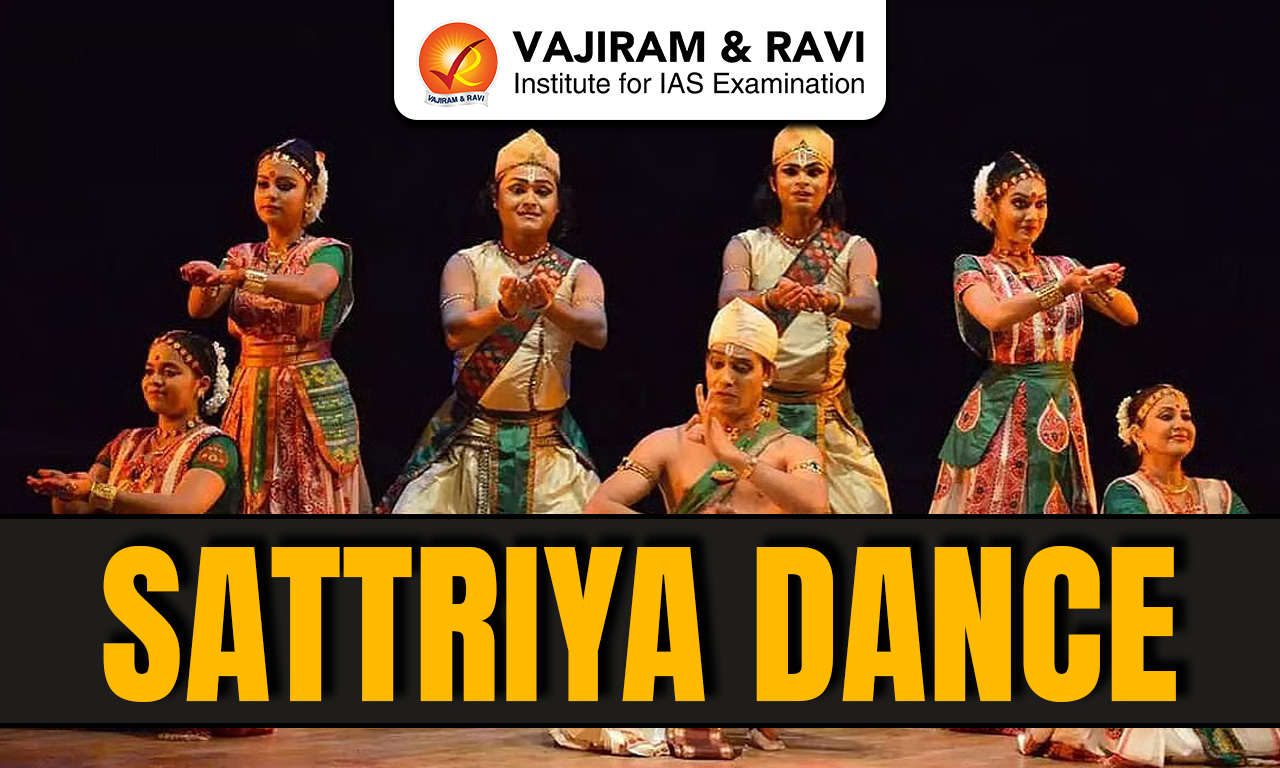
Sattriya Dance is a classical dance tradition from Assam that developed within the Vaishnavite monasteries known as Sattras. It emerged during the Bhakti movement in the 15th century under the guidance of saint-reformer Srimanta Sankardev. Originally performed as devotional dance-drama, Sattriya integrates music, expressive acting, and rhythmic movements to communicate spiritual stories and moral teachings.

Sattriya Dance

Sattriya Dance is one of the eight recognised classical dance traditions of India. The dance form evolved from monastic devotional performances connected with Ankiya Nat plays and Vaishnavite practices. It gradually moved from temple spaces to public stages while preserving its traditional structure and aesthetics.

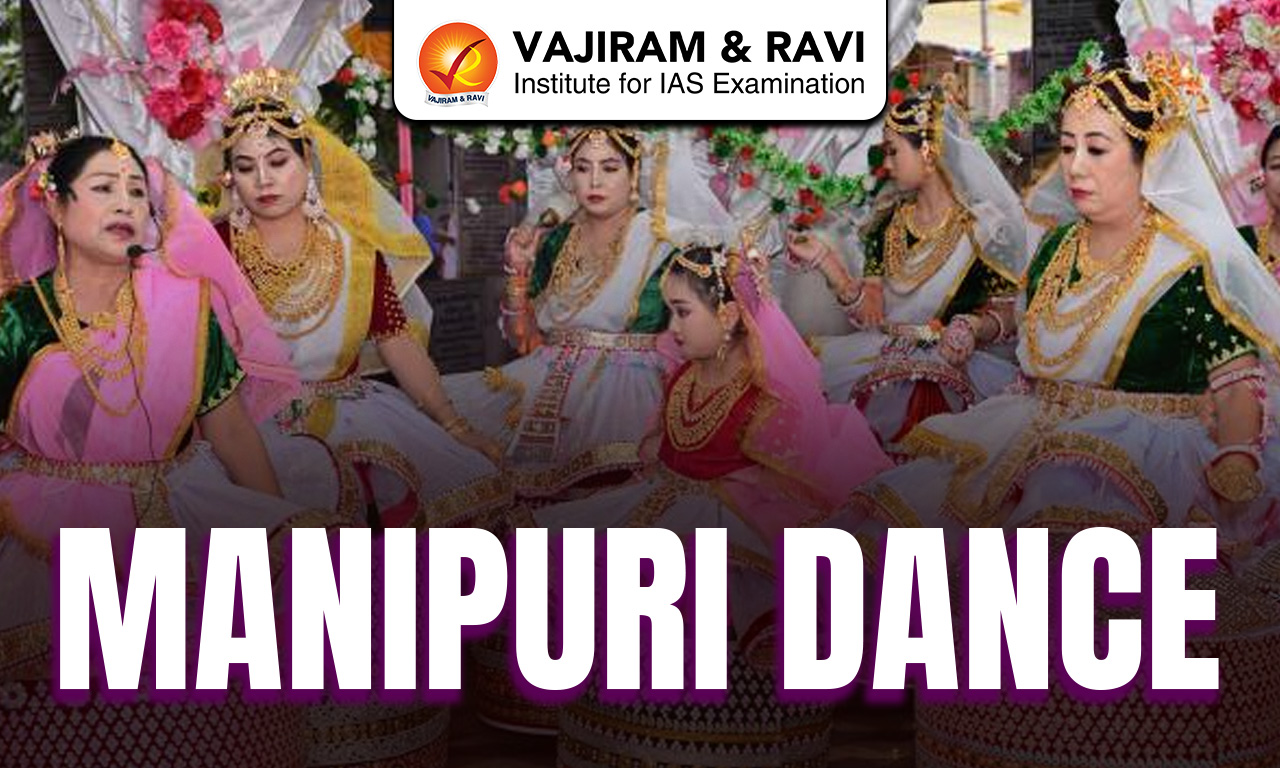
Also Read: Manipuri Dance

Sattriya Dance Features

Sattriya Dance represents a devotional cultural tradition shaped by monastic rituals, classical dramaturgy, and Assamese music traditions. The key features of the dance form has been listed below:

  • Origin: Sattriya originated in Assam’s Vaishnavite monasteries called Sattras during the 15th century. 
  • History: It developed as a devotional art associated with the Ek Sharan Naam Dharma philosophy propagated by saint Srimanta Sankardev to promote devotion to one supreme deity. The modern structure of Sattriya was systematised by Sankardev and his disciple Madhavdev. Dance-dramas based on the Bhagavata Purana were performed as Ankiya Nat plays inside monasteries, combining religious teaching with dramatic storytelling and expressive dance.
  • Classical Status: In November 2000, the Sangeet Natak Akademi formally recognised Sattriya as one of India’s eight classical dance traditions. 
  • Components: Sattriya performances combine three core elements- 
    • Nritta: represents abstract rhythmic movements, 
    • Nritya: expresses emotions through gestures and expressions, and 
    • Natya: involves dramatic storytelling through dialogue, mime, and symbolic actions.
  • Basic Stance: The dance has distinctive body positions known as Purush Pak for male dancers and Prakriti Pak for female dancers. These stances define posture, energy level, and movement style throughout performances.
  • Themes: The dance largely depicts mythological narratives related to Krishna and Radha, stories of Rama and Sita, and episodes from the Ramayana and Mahabharata.
  • Streams: Sattriya includes two main repertories. The Bhaona-related tradition begins with Gayan-Bhayanar Nach and continues to Kharmanar Nach, while independent dance numbers include Chali, Rajagharia Chali, Jhumura, and Nadu Bhangi.
  • Dance Structure: The basic training unit in Sattriya is called Mati Akhara. There are sixty-four foundational exercises divided into categories such as Ora, Saata, Jhalak, Sitika, Pak, Jap, Lon, and Khar which develop control, balance, and rhythmic accuracy.
  • Costume: Male dancers traditionally wear dhoti, chadar, and paguri turban, while female performers wear ghuri, chadar, and kanchi waist cloth. Costumes often use Pat silk from Assam with decorative motifs representing regional artistic traditions.
  • Ornaments: Performers wear traditional Assamese ornaments crafted using Kesa Sun technique made from raw gold. Popular ornaments include Kopali forehead pieces, Muthi Kharu bracelets, Dhulbiri necklaces, and other culturally symbolic jewellery designs.
  • Music Tradition: Sattriya performances are accompanied by devotional songs known as Borgeets composed by Sankardev and Madhavdev. These compositions follow classical ragas and form an essential musical foundation of the dance.
  • Musical Instruments: The primary instrument used is the Khol, a two-sided drum producing high and deep tones. Other instruments include cymbals such as Manjira and Bhortal, Bahi flute, violin, tanpura, harmonium, and conch shell.
  • Traditional Performers: Historically the dance was performed only by male monks called Bhokots within monastery rituals. Over time, it expanded beyond the Sattras and is now performed by both male and female artists on professional stages.
  • Prominent Exponents: Important artists who promoted the tradition include Guru Jatin Goswami, Ghanakanta Bora, Manik Barbayan, Bhabananda Barbayan, Sharodi Saikia, Indira PP Bora, Anita Sharma, Anwesha Mahanta, and Mallika Kandali.
  • Recent Recognition: Dance historian Dr. Sunil Kothari was honoured with the Madhabdev Award by the Government of Assam for his contribution to popularising Sattriya dance and promoting its cultural significance.

Also Read: Classical Dances of India

Sattriya Dance FAQs

Q1: What is Sattriya Dance?

Ans: Sattriya is a classical dance form from Assam that originated in Vaishnavite monasteries and combines dance, music, and drama to present devotional themes.

Q2: How did Sattriya Dance originate?

Ans: Sattriya dance was introduced in the 15th century by the Vaishnavite saint and reformer Srimanta Sankardev to spread the philosophy of devotional worship.

Q3: When was Sattriya recognised as a Classical Dance of India?

Ans: Sattriya received official recognition as one of India’s classical dances in the year 2000 by the Sangeet Natak Akademi.

Q4: What are the main components of Sattriya Dance performance?

Ans: Sattriya includes three main elements: Nritta (pure dance movements), Nritya (expressive dance conveying emotions), and Natya (dramatic storytelling).

Q5: Which musical instrument is most important in Sattriya Dance?

Ans: The Khol, a two-sided drum producing both high and deep tones, is the primary instrument used in Sattriya dance performances.

Boston Tea Party, Background, Events, Legacy, Key Details

Boston Tea Party

The Boston Tea Party was a major protest that took place in 1773 in the American colonies against the tax policies imposed by Great Britain. Colonists opposed these taxes because they had no representation in the British Parliament. As a form of protest, a group of colonists threw tea from British ships into the harbor. This event increased tensions between Britain and the colonies and became an important step toward the American Revolution.

Boston Tea Party Background

  • The Boston Tea Party was the result of growing tensions between the American colonies and Great Britain over political and economic issues.
  • One major reason was the financial crisis of the British East India Company. To support the company, the British government introduced policies that allowed it to dominate the tea trade in the colonies, which harmed colonial merchants.
  • Another important issue was the dispute over taxation. The colonies opposed taxes imposed by the British Parliament because they had no representation in it. Tensions increased further after the French and Indian War, when Britain imposed new taxes such as the Stamp Act of 1765.
  • Later, the Tea Act of 1773 allowed the East India Company to sell tea directly in the colonies, giving it a monopoly. In protest against these policies and “taxation without representation,” members of the Sons of Liberty threw 342 chests of tea into Boston Harbor on 16 December 1773.

Boston Tea Party Events

  • Before the Boston Tea Party, many American colonists avoided British taxes by buying smuggled tea from other countries. To control this practice and help the financially struggling British East India Company, the British government passed the Tea Act of 1773. This law allowed the company to sell tea directly in the colonies at a cheaper price than smuggled tea.
  • Although the tea became cheaper, the colonists strongly opposed it because the tax imposed by the British Parliament was still included in the price. Accepting the tea would mean accepting Parliament’s right to tax them without representation, which the colonists rejected.
  • On 16 December 1773, members of the Sons of Liberty, led by Samuel Adams, disguised themselves as Native Americans and boarded three British ships - Dartmouth, Eleanor, and Beaver anchored at Boston Harbor. They threw 342 chests of tea into the water as a protest against British taxation and trade policies.
  • This act was not just about tea but a symbolic protest against British control over the colonies. The event spread political awareness throughout the colonies and greatly increased tensions between Britain and the colonists. In response, Britain introduced harsh measures known as the Intolerable Acts, which further escalated the conflict and eventually contributed to the outbreak of the American Revolution.

Boston Tea Party Legacy

  • The Boston Tea Party had a lasting impact on American society and politics. After the event, many colonists considered drinking tea to be unpatriotic because it was associated with Great Britain. As a result, tea consumption declined and coffee gradually became a more popular drink.
  • The protest also highlighted the issue of taxation without representation. Colonists opposed the taxes imposed by the British Parliament because they had no role in making those decisions. The event strengthened unity among the colonies and increased resistance to British rule, eventually contributing to the American Revolution.

Boston Tea Party FAQs

Q1: What was the Boston Tea Party?

Ans: The Boston Tea Party was a protest in 1773 where American colonists threw British tea into Boston Harbor to oppose unfair taxation by Great Britain.

Q2: Why did the American colonists oppose British taxes?

Ans: They opposed the taxes because they had no representation in the British Parliament, leading to the slogan “taxation without representation.”

Q3: What was the role of the Tea Act of 1773?

Ans: The Tea Act of 1773 allowed the British East India Company to sell tea directly in the colonies, giving it a monopoly over the tea trade.

Q4: Who organized the Boston Tea Party?

Ans: The protest was organized by the Sons of Liberty, led by Samuel Adams.

Q5: What happened during the Boston Tea Party?

Ans: On 16 December 1773, colonists boarded British ships and threw 342 chests of tea into Boston Harbor.

Role of Civil Services in a Democracy, Significance, Issues, Reforms

Role of Civil Services in a Democracy

The Civil Services play an important role in the functioning of a democratic system. In a democracy like India, elected representatives make laws and policies, while civil servants help in implementing them effectively. They act as a link between the government and the people. Civil servants work to maintain administration, ensure delivery of public services, and support the implementation of the Constitution of India and government policies. The Role of Civil Services in Democracy has been discussed in detail in this article.

Significance and Role of Civil Services in a Democracy

The Civil Services play a very important role in public administration and democratic governance. They help the government run the country smoothly and ensure that policies and laws are properly implemented.

  • Steel Frame of Governance: The civil services are often called the “steel frame” of administration, a term used by Sardar Vallabhbhai Patel. This means that the entire system of governance depends on the efficiency and stability of civil servants.
  • Protecting Constitutional Values: Civil servants work to preserve the principles of the Constitution of India, such as democracy, rule of law, national unity and federalism.
  • Assisting the Political Executive: In a democracy, elected leaders make policies. Civil servants assist them by implementing these policies and ensuring that government programs reach the people.
  • Ensuring Free and Fair Elections: Civil servants help the Election Commission of India conduct free, fair and peaceful elections, which are essential for democracy.
  • Ensuring Smooth Transfer of Power: Civil services provide administrative continuity when governments change, ensuring that governance continues smoothly.
  • Handling Emergencies and Crises: During situations like National Emergency or President’s Rule, civil servants manage administration, maintain law and order, and ensure stability.

Role of Civil Services in Governance

  • Basis of Government: The Civil Services form the administrative foundation of governance. Every country requires civil servants to implement government policies and run administration.
  • Policy Making and Implementation: Civil servants assist the government in policy formulation by collecting data, analyzing issues and suggesting solutions. They also ensure that policies are implemented effectively in accordance with the Constitution of India and existing laws.
  • Providing Public Services: Civil servants deliver essential services such as maintaining law and order, protecting the environment, managing public enterprises, and implementing welfare programs for citizens.
  • Continuity in Administration: Civil services ensure stability in governance even when governments change. During situations like President’s Rule, civil servants help maintain administration.
  • Other Administrative Functions: Civil servants assist ministers in their work with the Parliament of India, manage government finances, improve administrative efficiency, and perform quasi-judicial functions in bodies like the Income Tax Appellate Tribunal.

Importance of Civil Services in Modern Day Democracy

The Civil Services play a crucial role in the functioning of a modern democratic state. As governance becomes more complex, civil servants help the government manage administration, implement development programs, and respond to the needs of citizens. They act as an important support system that ensures policies and laws are effectively carried out.

  • Ensuring Democratic Accountability: Civil servants work according to the laws and principles laid down in the Constitution of India. Through administrative procedures, audits, and oversight by institutions such as the Parliament of India, they help maintain accountability and transparency in governance.
  • Promoting Social Justice and Equality: Civil services play a key role in implementing welfare schemes related to education, healthcare, poverty alleviation, and social security. Through these programs, they help reduce social and economic inequalities and promote inclusive development.
  • Maintaining Continuity in Governance: In a democracy, governments may change after elections, but the administrative system continues to function. Civil servants provide stability and continuity by ensuring that policies and development programs are implemented consistently.
  • Crisis and Disaster Management: Civil servants play a leading role during emergencies such as natural disasters, health crises, and other national challenges. They coordinate relief operations, maintain law and order, and ensure quick delivery of assistance to affected people.
  • Efficient Implementation of Policies: Another important role of civil services is to convert government decisions into practical actions. By implementing policies and development projects effectively, they help achieve the goals of economic growth and public welfare.

Relationship between Civil Services and Democracy

The Civil Services play a vital role in supporting democratic governance. In a democracy, power belongs to the people and is exercised through their elected representatives. Civil servants help implement the decisions of these representatives and ensure that government policies benefit the public.

  • Impartiality and Political Neutrality: Civil servants are expected to remain neutral and impartial. They must serve the government of the day without being influenced by political parties or personal interests. This helps maintain fairness and stability in administration.
  • Accountability and Transparency: Civil services are accountable to democratic institutions such as the Parliament of India and state legislatures. Parliamentary committees, audits, and administrative rules ensure transparency and reduce corruption in governance.
  • Upholding the Rule of Law: Civil servants are responsible for implementing laws and policies according to the Constitution of India. By enforcing laws fairly, they help maintain order and protect citizens’ rights.
  • Responsiveness to Public Needs: Civil servants interact directly with citizens through government programs, grievance redressal systems, and public services. By collecting feedback and addressing public concerns, they help make governance more responsive and citizen-centric.
  • Link Between State and Society: Civil services act as a bridge between the government and the people. They communicate government policies to citizens and also convey public concerns to policymakers, which helps build trust in democratic institutions.

Evolution of Civil Services in India

  • Civil Services in Ancient India: The roots of civil administration in India go back to the time of the Mauryan Empire. During this period, administrative principles were clearly explained in Arthashastra written by Kautilya. The text discussed how officials should be selected, promoted, and evaluated, and also described the ethical conduct expected from government officials. This shows that a structured administrative system existed even in ancient India.
  • Civil Services in Medieval India: During the Mughal Empire, administration became more organized, especially in areas such as revenue collection and governance. Akbar strengthened the administrative system by introducing land revenue reforms and improving the functioning of officials. These arrangements later influenced the structure of administration and taxation in India.
  • Civil Services in the Colonial Period: The modern administrative system began to take shape under the East India Company. Initially, civil servants mainly looked after revenue collection and law and order. In 1771, Warren Hastings created the post of District Collector. Later, Lord Cornwallis reorganized the administration and introduced reforms in police, judiciary, and revenue services, which laid the foundation for modern civil services. Later developments such as the Charter Act of 1853 introduced competitive examinations for civil service recruitment, although Indians were allowed to participate fully only gradually.
  • Civil Services in Independent India: After independence, the role of civil services changed significantly. Instead of serving colonial interests, they became responsible for development, welfare, and nation-building. Civil servants helped in tasks such as refugee rehabilitation, maintaining internal security, and promoting economic and social development. Today, civil services in India include All India Services, Central Civil Services, and State Civil Services. They are also classified into different groups and categories based on their functions and responsibilities.

Issues with Civil Services in India

The Civil Services play a key role in governance, but civil servants also face many challenges while performing their duties.

  • Maintaining Political Neutrality: Civil servants are expected to remain neutral and work according to the law. However, they may sometimes face pressure from political leaders to take decisions that favour certain individuals or groups. This can create a conflict between professional duty and political expectations.
  • High Public Expectations and Pressure: Civil servants deal with many complex social and economic issues. People often expect quick solutions to problems such as poverty, unemployment, and poor infrastructure. Sometimes officers also face criticism from the public for strict or unpopular decisions that are necessary for effective administration.
  • Lack of Infrastructure and Resources: In many parts of India, especially rural and remote districts, there is a shortage of infrastructure, staff, and financial resources. This makes it difficult for officers to implement government schemes and deliver public services efficiently.
  • Problems in Performance Evaluation: The system of performance appraisal, such as the Annual Performance Assessment Report (APAR), may sometimes be affected by favoritism, personal conflicts, or political influence. This can reduce fairness and transparency in evaluating officers’ performance.
  • Difficulties in Promotion: Even after good performance, some officers may not be selected for higher positions like Joint Secretary. Often, they do not receive clear feedback about the reasons for not being promoted, which can affect morale.
  • Salary and Incentive Issues: Senior civil servants, such as Secretaries to the Government, hold responsibilities similar to top corporate executives. However, their salaries are much lower compared to the private sector, which may reduce motivation and sometimes create risks of corruption.
  • Work-Life Balance: Civil service jobs, especially in the early years for officers of services like the Indian Administrative Service and Indian Police Service, involve long working hours, heavy responsibilities, and frequent transfers. This can make it difficult to maintain a proper work-life balance.

Civil Services Reforms in India

Civil service reforms in India aim to make the Civil Services more efficient, transparent, accountable, and citizen-oriented. With increasing governance challenges and public expectations, reforms focus on improving skills, performance, and the overall functioning of civil servants.

  • Mission Karmayogi: The government launched Mission Karmayogi in 2020 under the National Programme for Civil Services Capacity Building. Its aim is to improve the skills and knowledge of civil servants through continuous learning. The digital platform iGOT Karmayogi provides online training to make officers more capable and future-ready.
  • Lateral Entry in Civil Services: To bring specialized knowledge into administration, the government introduced lateral entry, which allows experts from private sector, academia, and other fields to join senior positions such as Joint Secretary or Director.
  • Capacity Building and Skill Development: Modern governance requires knowledge of technology, data analysis, and new policy areas. Therefore, training programs are being redesigned to develop specific competencies and professional skills among civil servants.
  • Performance Management Reforms: Efforts are being made to improve the performance evaluation system so that promotions and career growth are more closely linked to merit and performance rather than seniority alone.
  • Promoting Transparency and Accountability: Reforms also focus on improving transparency in administration through digital governance, simplified procedures, and ethical conduct among public officials.
  • Strengthening Recruitment and Administration: Recruitment through the Union Public Service Commission and State Public Service Commissions continues to be strengthened to select capable candidates. Administrative reforms also aim to reduce red tape, improve service delivery, and create a citizen-centric administration.
  • Fixed Tenure and Administrative Stability: Some reforms propose fixed tenures for key administrative posts to reduce frequent transfers and political interference, which can help officers work more effectively.

Important Articles related to Civil Service

Here are the important articles related to the civil services in the Indian Constitution.

Article

Provision

Description

Article 308

Interpretation

Defines the scope of civil services and applies these provisions to Union and State civil services.

Article 309

Recruitment and Conditions of Service

Empowers Parliament and State Legislatures to make laws regarding recruitment and service conditions of civil servants.

Article 310

Doctrine of Pleasure

States that civil servants hold office during the pleasure of the President (Union) or the Governor (State).

Article 311

Protection to Civil Servants

Provides safeguards against arbitrary dismissal, removal, or reduction in rank without proper inquiry.

Article 312

All India Services

Allows Parliament to create All India Services such as Indian Administrative Service and Indian Police Service.

Article 312A

Power of Parliament

Allows Parliament to change or revoke service conditions of certain civil service officers.

Article 315

Public Service Commissions

Provides for the establishment of the Union Public Service Commission and State Public Service Commissions.

Articles 316–319

Appointment and Service Conditions of PSC Members

Deals with appointment, tenure, and conditions of service of members of UPSC and State PSCs.

Article 320

Functions of Public Service Commissions

Defines the functions of UPSC and State PSCs such as recruitment and advisory roles.

Article 323A

Administrative Tribunals

Allows Parliament to establish tribunals to resolve disputes related to service matters.

Role of Civil Services in a Democracy FAQs

Q1: What is the role of Civil Services in a democracy?

Ans: Civil services implement government laws and policies, deliver public services, and act as a link between citizens and the government under the Constitution of India.

Q2: Why are Civil Services called the “Steel Frame of Governance”?

Ans: They provide stability and continuity in administration; the term was used by Sardar Vallabhbhai Patel.

Q3: How do Civil Services help in policy making and implementation?

Ans: They collect data, analyze issues, advise the government, and implement policies and schemes.

Q4: What are the major challenges faced by Civil Servants in India?

Ans: Political pressure, high public expectations, limited resources, promotion issues, and work–life balance problems.

Q5: What are the major Civil Service reforms in India?

Ans: Reforms include Mission Karmayogi, lateral entry of experts, digital training through iGOT Karmayogi, and better performance evaluation.

India-Iran Relations, Area of Cooperation, Significance, Challenges

India-Iran Relations

India-Iran Relations share one of the oldest civilisational relationships in the world, rooted in centuries of cultural exchange, trade and political interaction. The connection dates back to the Indus Valley and Mesopotamian civilizations when maritime trade flourished across the Persian Gulf and Arabian Sea. Over time, diplomatic engagement, energy cooperation, and strategic connectivity projects have strengthened ties.

India-Iran Relations

India-Iran Relations formally began after India’s independence with the establishment of diplomatic ties on 15 March 1950. Since then, cooperation has expanded across trade, energy, connectivity, and regional security. Political visits, agreements such as the Tehran Declaration, and strategic projects like Chabahar Port and the INSTC have strengthened bilateral engagement despite occasional geopolitical constraints.

India-Iran Relations Area of Cooperation

India-Iran Relations cooperate across multiple strategic sectors including politics, energy, trade, culture, connectivity, and regional security frameworks.

  • Political Engagement: India and Iran formally established diplomatic relations on 15 March 1950. High-level political exchanges strengthened ties over decades, including Prime Minister Narasimha Rao’s visit to Iran in 1993 and President Rafsanjani’s visit to India in 1995. The relationship advanced significantly during Prime Minister Atal Bihari Vajpayee’s Tehran visit in April 2001, when the “Tehran Declaration” was signed outlining cooperation areas and emphasizing dialogue among civilizations.
  • Strategic Partnership: The “New Delhi Declaration” further articulated a long term strategic partnership framework between the two countries. Prime Minister Manmohan Singh attended the 16th Non-Aligned Movement Summit in Tehran in 2012. In 2016, Prime Minister Narendra Modi visited Iran and released a joint statement titled “Civilizational connect, contemporary context,” reaffirming the depth of bilateral ties.
  • Agreements during Iranian President Hassan Rouhani’s Visit: During Iranian President Hassan Rouhani’s visit to India in February 2018, both sides signed nine agreements covering several sectors. These included avoidance of double taxation, easing visa norms, cooperation in traditional medicine, and an extradition treaty. The countries also concluded a lease agreement related to Phase-1 of Shahid Beheshti Port at Chabahar.
  • Trade and Commercial Relations: Economic engagement has traditionally revolved around India’s import of Iranian crude oil. During 2016-17, bilateral trade reached about USD 12.89 billion. India imported around USD 10.5 billion worth of goods mainly crude oil while exporting about USD 2.4 billion. Major Indian exports included rice, tea, iron and steel, pharmaceuticals, electrical machinery and organic chemicals.
  • Oil Trade Dynamics: Before international sanctions intensified, Iran was among India’s largest energy suppliers. In 2018-19 India imported crude oil worth about USD 12.11 billion from Iran. Earlier, during April-June 2018, India was the second largest buyer of Iranian crude after China. Iran was also the second largest crude supplier to India during that period.
  • Currency Settlement Mechanism: To address payment challenges arising from international sanctions, the Reserve Bank of India and Iran’s central bank introduced a currency swap arrangement allowing India to pay for Iranian oil using the Indian rupee. This mechanism reduced reliance on US dollar transactions and helped India preserve foreign exchange reserves while maintaining trade flows.
  • Energy Cooperation and Investment: Indian companies expressed willingness to invest nearly USD 20 billion in Iran’s oil, gas, petrochemical, and fertilizer sectors. India has also explored the possibility of establishing petrochemical plants and fertilizer units in the Chabahar Special Economic Zone to strengthen long term energy collaboration.
  • Farzad-B Gas Field: The Farzad-B gas field in the Persian Gulf was discovered by an Indian consortium led by ONGC Videsh Limited in 2008. Negotiations have continued over its development, and discussions were pursued by Indian officials during visits to Iran. The gas reserves in Farzad-B are believed to be significantly larger than many gas reserves discovered within India.
  • Chabahar Port: Chabahar Port in southeastern Iran is located in Iran’s Sistan-Balochistan province on the Gulf of Oman. It is Iran’s only oceanic port with direct access to open seas. In May 2016, India and Iran signed a historic agreement allowing India to develop and operate two terminals and five berths of the port for ten years.
  • Chabahar-Zahedan Railway Project: Alongside port development, India committed to provide services and financing support worth about USD 1.6 billion for the Chabahar-Zahedan railway line. This rail corridor is intended to connect the port with Iran’s inland transport network and improve access toward Central Asia and Afghanistan.
  • International North-South Transport Corridor (INSTC): India, Iran and Russia signed the INSTC agreement in 2000 to develop a 7,200 kilometre multi-modal transport network combining ship, rail and road routes. The corridor aims to connect Mumbai with cities such as Tehran, Baku, Astrakhan and Moscow. It is expected to reduce cargo transit time from around 40 days to nearly half while lowering transport costs by roughly 30%.
  • Ashgabat Agreement: India’s accession to the Ashgabat Agreement strengthened connectivity with Central Asia through a multimodal transport corridor involving Iran, Oman, Kazakhstan, Uzbekistan and Turkmenistan. The agreement facilitates transport of goods between Central Asia and the Persian Gulf region.
  • Cultural Exchanges: Cultural centres operate in both countries including an Indian Cultural Centre in Tehran and Iranian cultural institutions in Delhi, Hyderabad and Mumbai. A Hindi language chair was established at Tehran University. Institutions such as the National Archives of India and the National Library and Archives Organisation of Iran have also entered collaborative arrangements to preserve historical documents and research materials relating to shared heritage.
  • Counter-Terrorism Cooperation: Both countries face threats from extremist organisations such as Al-Qaeda and the Islamic State. Security cooperation therefore includes dialogue on counter-terrorism strategies and regional stability, particularly regarding developments in Afghanistan and West Asia.

India-Iran Relations Significance

The India-Iran Relations carries major strategic importance in energy security, regional connectivity, geopolitical balance and economic engagement.

  • Iran occupies a crucial geographic position connecting South Asia with the Middle East, Central Asia and the Caucasus region. Through Iran, India can access landlocked Central Asian republics and Eurasian markets. Connectivity projects linking the Indian Ocean to the Caspian Sea allow India to expand trade routes beyond traditional maritime channels.
  • Chabahar Port provides India an alternative route to Afghanistan and Central Asia that bypasses Pakistan. Pakistan does not permit Indian goods to transit through its territory to Afghanistan. By using a sea-land corridor through Chabahar, India can transport goods efficiently to Afghan and Central Asian markets.
  • The distance between Kandla Port in Gujarat and Chabahar Port is shorter than the distance between Delhi and Mumbai. This geographic proximity provides logistical advantages for trade operations. Reduced transportation costs and faster shipping make Chabahar a strategically valuable trading gateway for India.
  • China is developing the Gwadar Port in Pakistan under its broader regional infrastructure strategy. Gwadar lies less than 100 kilometres from Chabahar by sea. India’s presence in Chabahar strengthens its strategic visibility in the Arabian Sea and helps balance Chinese maritime influence in the region.
  • The INSTC provides a faster and cheaper trade route linking India with Russia and Europe through Iran and the Caspian region.
  • Iran possesses the world’s second largest reserves of natural gas and substantial oil reserves. For India, cooperation with Iran provides an opportunity to diversify energy sources. 
  • India has used Iranian crude oil supplies to strengthen its Strategic Petroleum Reserves. Maintaining reserves equivalent to around 90 days of consumption helps India manage supply disruptions and energy security risks during geopolitical crises or market volatility.
  • The proposed undersea gas pipeline project connecting Iran to India through the Oman Sea and Indian Ocean is expected to transport approximately 31.5 million standard cubic metres of gas per day.
  • India is one of Iran’s major suppliers of basmati rice. Other important exports include tea, pharmaceuticals and agricultural products.
  • Both India and Iran have shared concerns regarding extremist groups operating in Afghanistan. Cooperation between the two countries has previously included support for the Northern Alliance during the 1990s. Continued engagement can contribute to regional security and stability in Afghanistan.
  • Through projects like INSTC and the Ashgabat Agreement corridor, India can access markets across Eurasia by connecting to cities such as Moscow, Tehran, Baku and Astrakhan.
  • India is one of the world’s largest economies with a vast consumer base and demographic advantage. For Iran, economic cooperation with India provides access to a large nearby market for energy exports and investment partnerships.

India-Iran Relations Challenges

Despite strong historical ties, several geopolitical and economic factors continue to create difficulties in the bilateral India-Iran Relations.

  • Impact of US Sanctions: The United States withdrew from the Iran nuclear agreement in May 2018 and re-imposed sanctions. These measures forced India to stop importing Iranian crude oil after May 2019. The sanctions significantly disrupted energy trade and affected India’s access to an important supplier.
  • Banking and Payment Difficulties: Financial sanctions complicated payment mechanisms between the two countries. Earlier, India used the Asian Clearing Union system for payments, but the Reserve Bank of India discontinued it in 2010 citing lack of transparency. Alternative banking channels also collapsed due to European Union sanctions, creating payment delays.
  • Accumulated Trade Debt: Because of payment restrictions, Indian companies accumulated nearly USD 5 billion in unpaid oil bills to Iran during the early 2010s. Negotiations were required to settle these liabilities gradually and restore commercial confidence between the two countries.
  • Iran-Pakistan-India Gas Pipeline Issues: The proposed Iran-Pakistan-India pipeline was designed to transport gas from Iran’s South Pars field to both countries with a capacity of about 60 million standard cubic metres per day. India withdrew from the project in 2009 due to concerns about security, pricing and transit through Pakistan.
  • Delay in Farzad-B Gas Field Development: Although Indian companies discovered the Farzad-B gas field, Iran has not yet awarded the development rights to ONGC Videsh Limited. Instead, Tehran entered preliminary discussions with Russia’s Gazprom for exploration. This has created uncertainty regarding India’s future participation in the project.
  • Chabahar Railway Project Disagreement: Iran decided to proceed independently with the Chabahar-Zahedan railway project due to delays in Indian financing and implementation. This decision temporarily slowed progress in the connectivity initiative linked to the Chabahar port project.
  • Regional Geopolitical Rivalries: India maintains strong relations with Gulf countries such as Saudi Arabia and the United Arab Emirates while also engaging with Iran. Rivalry between Iran and Gulf states complicates India’s diplomatic balancing in West Asia, particularly during conflicts affecting shipping routes and energy markets.
  • Iran-Israel Dynamics: India enjoys close strategic relations with Israel, whereas Iran has been strongly critical of Israeli policies. Managing relations with both countries requires careful diplomatic balancing to ensure that cooperation with one partner does not adversely affect ties with the other.
  • Iran’s Strategic Partnership with China: Iran has strengthened economic and strategic relations with China, including a long term cooperation agreement linked to the Belt and Road Initiative. India has opposed certain aspects of China’s infrastructure initiatives, creating potential competition in regional connectivity projects.
  • Statements on Kashmir Issue: Iran’s leadership has occasionally made statements regarding the situation in Jammu and Kashmir, including comments by Supreme Leader Ayatollah Khamenei. Such remarks have been viewed critically by India, which considers Kashmir an internal matter and rejects external commentary.
  • Decline in Bilateral Trade Volumes: Due to sanctions and financial restrictions, India’s imports from Iran dropped sharply from about USD 13.53 billion in 2018-19 to roughly USD 1.4 billion in 2019-20. 
  • Rupee Reserve Depletion Issue: Iran’s rupee reserves accumulated in Indian banks have reduced significantly, affecting its capacity to import Indian goods such as basmati rice and tea. This issue has highlighted the need for more stable financial arrangements to sustain trade relations.
  • Dependence on Global Political Environment: India-Iran Relations are heavily influenced by international politics, particularly sanctions regimes and nuclear negotiations. Changes in the global diplomatic environment often determine the pace and depth of economic engagement between the two countries.

India-Iran Relations FAQs

Q1: When were diplomatic India-Iran Relations established?

Ans: India and Iran formally established diplomatic relations on 15 March 1950 after India’s independence, marking the beginning of modern bilateral engagement.

Q2: Why is the Chabahar Port important for India-Iran Relations?

Ans: Chabahar Port in southeastern Iran provides India direct access to Afghanistan and Central Asia, bypassing Pakistan and improving trade connectivity.

Q3: What is the International North-South Transport Corridor (INSTC)?

Ans: INSTC is a 7,200 km multimodal transport network connecting India, Iran, Russia and Eurasian countries to reduce transit time and trade costs.

Q4: Why is India-Iran Relations important for India’s energy security?

Ans: Iran has one of the world’s largest oil and natural gas reserves and historically supplied large volumes of crude oil to India.

Q5: What are the major challenges in India-Iran Relations?

Ans: Key challenges include US sanctions on Iran, banking restrictions, regional geopolitical tensions, and delays in projects like Farzad-B gas field and Chabahar railway line.

99th Constitutional Amendment Act, Features, Constitutionality

99th Constitutional Amendment Act

The 99th Constitutional Amendment Act of India was passed to reform the system of appointing judges in India. It amended the Constitution of India to establish the National Judicial Appointments Commission (NJAC), which aimed to replace the Collegium System used for appointing judges to the Supreme Court of India and High Courts of India. The main objective of the amendment was to make the judicial appointment process more transparent and participatory. It is significant in constitutional studies as it reflects the debate over judicial reforms and the independence of the judiciary in India.

99th Constitutional Amendment Act Background

  • The background of the 99th Constitutional Amendment Act of India is related to the long-standing debate about how judges should be appointed in India. Under the Collegium System, judges of the Supreme Court of India and High Courts of India were selected mainly by senior judges of the judiciary. Over time, this system faced criticism for lacking transparency and accountability.
  • Many people, including the government and legal experts, believed that the appointment process should include a broader group and be more open. As a result, the government proposed a change to the Constitution of India to create a new body called the National Judicial Appointments Commission (NJAC). The aim was to make the appointment process more transparent and balanced by involving both the judiciary and the executive.
  • Thus, the 99th Constitutional Amendment Act was introduced as an attempt to reform the judicial appointment system while maintaining the functioning of the judiciary.

99th Constitutional Amendment Act Features

  • Creation of NJAC: The amendment created a new body called the National Judicial Appointments Commission (NJAC) to recommend the appointment of judges.
  • Change in Appointment Process: It changed the system of appointing judges to the Supreme Court of India and High Courts of India, making appointments based on the recommendation of the NJAC.
  • Composition of the Commission: The NJAC consisted of six members: the Chief Justice of India, two senior Supreme Court judges, the Union Law Minister, and two eminent persons chosen by a committee.
  • Role in Judicial Transfers: The commission was also responsible for recommending the transfer of judges and Chief Justices between different High Courts.
  • Focus on Merit and Integrity: The NJAC was expected to ensure that only persons with ability, merit, and integrity were recommended for judicial appointments.
  • Power of Parliament to Regulate Procedure: Parliament was given the power to make laws to regulate the procedure for judicial appointments and the functioning of the NJAC.
  • Amendments in Various Constitutional Articles: Several provisions of the Constitution of India were amended to replace the earlier consultation process with the recommendation of the NJAC.

99th Constitutional Amendment Act Constitutionality

  • In 2015, the Supreme Court of India examined the validity of the 99th Constitutional Amendment Act of India and the National Judicial Appointments Commission Act, 2014 in the case of Supreme Court Advocates-on-Record Association v. Union of India.
  • The Court declared both laws unconstitutional and void. It held that the amendment affected the independence of the judiciary, which is an essential part of the Basic Structure Doctrine.
  • The Court observed that the National Judicial Appointments Commission (NJAC) reduced the role and importance of the Chief Justice of India and senior judges in judicial appointments. The inclusion of the Law Minister and two eminent persons in the commission could allow political influence in the appointment of judges.
  • Another concern was that any two members of the NJAC could veto a recommendation, which might override the opinion of the judges. The Court also pointed out that the method of selecting the “eminent persons” was not clearly defined.
  • Therefore, by a 4:1 majority judgment, the Supreme Court of India struck down the amendment and restored the Collegium System for the appointment of judges.

99th Constitutional Amendment Act Case Law

  • In Supreme Court Advocates-on-Record Association v. Union of India (2015), the Supreme Court of India declared the 99th Constitutional Amendment Act of India and the National Judicial Appointments Commission Act, 2014 unconstitutional by a 4:1 majority.
  • The Court held that the National Judicial Appointments Commission (NJAC) violated the Basic Structure Doctrine, especially the principle of judicial independence. As a result, the Court struck down the NJAC and restored the Collegium System for the appointment of judges.

99th Constitutional Amendment Act FAQs

Q1: What is the 99th Constitutional Amendment Act of India?

Ans: It amended the Constitution of India to create the National Judicial Appointments Commission (NJAC) for appointing judges to higher courts.

Q2: Why was the amendment introduced?

Ans: It aimed to reform the Collegium System and make judicial appointments more transparent and participatory.

Q3: What was the NJAC?

Ans: The National Judicial Appointments Commission was a body created to recommend appointments and transfers of judges to the Supreme Court of India and High Courts of India.

Q4: What was the composition of the NJAC?

Ans: It consisted of the Chief Justice of India, two senior Supreme Court judges, the Union Law Minister, and two eminent persons.

Q5: Which case challenged the constitutionality of the amendment?

Ans: The amendment was challenged in Supreme Court Advocates-on-Record Association v. Union of India.

85th Constitutional Amendment Act, Background, Provisions, Case Laws

85th Constitutional Amendment Act

The 85th Constitutional Amendment Act is an important amendment to the Constitution of India that deals with reservation in promotion for Scheduled Castes (SCs) and Scheduled Tribes (STs) in government services. This amendment introduced the concept of “consequential seniority” for SC/ST employees who are promoted through reservation in public employment.

85th Constitutional Amendment Act Background

The 85th Constitutional Amendment Act was introduced to address issues related to reservation in promotion for Scheduled Castes (SCs) and Scheduled Tribes (STs) in government services. Earlier court judgments created uncertainty regarding the seniority of SC/ST employees promoted through reservation

To resolve this issue and protect their service rights, the amendment modified Article 16 by introducing the concept of consequential seniority.

  • The Indra Sawhney v. Union of India judgment limited reservation in promotions, creating concerns about representation of SC/ST employees in higher government posts.
  • The government introduced earlier amendments such as the 77th Constitutional Amendment Act, 81st Constitutional Amendment Act, and 82nd Constitutional Amendment Act to address reservation issues.
  • Despite these measures, seniority disputes continued, leading to the enactment of the 85th Constitutional Amendment Act in 2001 with retrospective effect from 17 June 1995.

85th Constitutional Amendment Act Objectives

The major objectives of the 85th Constitutional Amendment Act are:

  • To provide consequential seniority to SC/ST employees promoted through reservation.
  • To ensure adequate representation of SC/ST communities in higher government posts.
  • To protect the service rights and career progression of SC/ST employees.
  • To strengthen the reservation policy in public employment and promote social justice.
  • To maintain the constitutional principle of equal opportunity in government services.

85th Constitutional Amendment Act Provisions

The amendment modified Article 16, particularly Article 16(4A), to provide reservation in promotion with consequential seniority for SC/ST employees.

  • Amendment to Article 16(4A): The amendment added the words “with consequential seniority” to Article 16(4A) of the Constitution.
  • Reservation in Promotion: It allows the government to provide reservation in promotions for SC/ST employees in government services.
  • Consequential Seniority: SC/ST employees promoted through reservation will retain seniority over general category employees promoted later.
  • Retrospective Effect: The amendment came into force retrospectively from 17 June 1995.
  • Applicability: The provisions apply to government services and public sector employment where reservation policies are implemented.
  • Strengthening Social Justice: The amendment aims to ensure fair representation of historically disadvantaged communities in higher administrative positions.

85th Constitutional Amendment Act Case Laws

Several important judgments of the Supreme Court of India have interpreted and clarified the provisions related to the 85th Constitutional Amendment Act and other amendments dealing with reservation in promotions for Scheduled Castes (SCs) and Scheduled Tribes (STs)

  1. M. Nagaraj v. Union of India: In this landmark judgment, the Supreme Court examined the constitutional validity of the 77th, 81st, 82nd, and 85th Constitutional Amendments. The Court upheld these amendments but stated that the government must collect quantifiable data before providing reservation in promotions. The data should prove the backwardness of the class, inadequate representation in services, and maintenance of administrative efficiency.
  2. 2. Jarnail Singh v. Lachhmi Narain Gupta: In this case, the Supreme Court partly modified the earlier judgment in the M. Nagaraj case. The Court ruled that the government does not need to prove the backwardness of SC/ST communities again, as they are already recognized as backward under the Constitution. However, the government must still show inadequate representation and ensure administrative efficiency while implementing reservation in promotions.

85th Constitutional Amendment Act FAQs

Q1: What is the 85th Constitutional Amendment Act?

Ans: The 85th Constitutional Amendment Act, 2001 provides reservation in promotion with consequential seniority for SC/ST employees in government services.

Q2: Which Article was amended by the 85th Amendment?

Ans: The amendment modified Article 16, specifically Article 16(4A).

Q3: When did the 85th Constitutional Amendment come into force?

Ans: It was enacted in 2001 but made effective from 17 June 1995.

Q4: What is consequential seniority?

Ans: Consequential seniority means that an SC/ST employee promoted through reservation retains seniority from the date of promotion.

Q5: Why was the 85th Constitutional Amendment introduced?

Ans: It was introduced to protect the seniority rights of SC/ST employees and ensure their fair representation in higher government positions.

Anavaran Portal

Anavaran Portal

Anavaran Portal Latest News

Recently, the Forest Survey of India stopped its Anavaran-Deforestation Alert System on deforestation.

About Anavaran Portal

  • It has been operational since January 2024.
  • It has been using satellite data and machine learning to enable Forest Survey of India to issue location alerts on the loss of forest cover to states every 15 days so that targeted field inspections can be carried out.
  • Technology Used
    • The Anavaran alert system is based on the Google Earth Engine (GEE) platform.
    • It uses Sentinel-2 satellite images as input data.
    • For continuous monitoring during cloudy and monsoon seasons, this is further integrated with Sentinel-1 Synthetic Aperture Radar (SAR) data.

Key Facts about Forest Survey of India (FSI)

  • It is a premier national organization under the union Ministry of Environment, Forests and Climate Change.
  • It was established on June 1,1981 by succeeding the "Preinvestment Survey of Forest Resources" (PISFR)” 
    • Preinvestment Survey of Forest Resources" (PISFR), was a project initiated in 1965 by Government of India with the sponsorship of FAO and UNDP.
  • Mandate: It is responsible for assessment and monitoring of the forest resources of the country regularly. In addition, it is also engaged in providing the services of training, research and extension.
  • It has been publishing the State of Forest Report on a biennial basis since 1987.
    • State of Forest Report carries out an in-depth assessment of the forest and tree resources of the country based on interpretation of Remote Sensing satellite data and field based National Forest Inventory (NFI).

Source: IE

Anavaran Portal FAQs

Q1: What is the primary purpose of the Anavaran Portal?

Ans: To monitor and manage forest resources

Q2: Which technology is used by the Anavaran Portal?

Ans: Artificial Intelligence and Machine Learning

Exercise LAMITIYE

Exercise LAMITIYE

Exercise LAMITIYE Latest News

Indian Armed Forces contingent is participating in the eleventh edition of joint military Exercise “LAMITIYE-2026” with Seychelles Defence Forces (SDF) in Seychelles. 

About Exercise LAMITIYE

  • It is the joint military exercise conducted between India and Seychelles.
  • LAMITIYE’ means ‘Friendship’ in the Creole language.
  • It is a biennial training event and has been conducted in Seychelles since 2001.
  • Participating Troop: The contingent comprises personnel from the ASSAM Regiment and participation from Indian Navy and Indian Air Force including INS Trikand and a C-130 aircraft.
  • Exercise LAMITIYE 2026
    • This edition marks a significant milestone with the participation of all three services of the Indian Armed Forces.
    • The exercise will strive to enhance synergy in the domains of Sub-conventional Operations in Semi-Urban environment and cooperation and interoperability between both the sides during Peace Keeping Operations.
    • Both sides will jointly train, plan and execute a series of tactical drills for neutralisation of likely threats that may be encountered in a Semi-Urban environment, while exploiting and showcasing New Generation Equipment and technology.
    • It will include Field Training Exercises, combat discussions, case studies, lectures & demonstrations, culminating with Validation Exercise.

Source: PIB

Exercise LAMITIYE FAQs

Q1: Exercise LAMITIYE is a joint military exercise between India and which country?

Ans: Seychelles

Q2: What is the primary objective of Exercise LAMITIYE 2026?

Ans: To enhance synergy and interoperability in sub-conventional operations

National Highways Green Cover Index

National Highways Green Cover Index

National Highways Green Cover Index Latest News

Recently, the National Highways Authority of India (NHAI) released the first National Highways Green Cover Index (NH-GCI).

About National Highways Green Cover Index

  • It is an initiative of National Highways Authority of India.
  • It has been prepared in coordination with the National Remote Sensing Centre (NRSC) of the Indian Space Research Organisation (ISRO).
  • The initiative aims to provide a scientific and quantitative assessment of green cover within the Right of Way (RoW) along the National Highways network by leveraging advanced space-based technologies.
  • Methodology Used
    • The assessment is derived from chlorophyll content detected through high-resolution satellite sensors.
    • It measures the percentage of land covered with vegetation along highway corridors, including plantations on the left and right sides of the road, as well as in the median wherever feasible.
    • The analysis is conducted for every one-kilometre highway segment using the Normalized Difference Vegetation Index (NDVI) derived from satellite imagery.
  • Coverage: Approximately 30,000 km of National Highways spanning 24 States have been covered for the period July–December 2024.
  • Significance
    • It offers a robust, reliable, cost-effective, and time-efficient mechanism for macro-level estimation of the green cover along the National Highways.
    • It will enable comparison, ranking, and targeted interventions for improved plantation management.

Source: PIB

National Highways Green Cover Index FAQs

Q1: What is the primary objective of the National Highways Green Cover Index (NH-GCI)?

Ans: To assess and monitor green cover along national highways

Q2: Which state has the highest green cover along national highways, according to the NH-GCI report?

Ans: Assam

Key Facts about Malawi

Key Facts about Malawi

Malawi Latest News

Recently, India has dispatched a consignment of one thousand metric tonnes of rice to Malawi to support Malawi’s efforts towards food security following the drought caused by the El Niño effect. 

About Malawi

  • It is a landlocked nation in southeastern Africa.
  • Bordering Countries: It is bordered by three countries namely Mozambique on the east, south, and southwest. Tanzania to the north and northeast and Zambia is located to the west.
  • Capital City: Lilongwe

Geographical Features of Malawi

  • It occupies a narrow, curving strip of land along the East African Rift Valley.
  • Major Lakes:  Lake Nyasa, known in Malawi as Lake Malawi, accounts for more than one-fifth of the country’s total area.
  • Major Rivers: Shire,  Rukuru, Dwangwa, Lilongwe, Bua etc.
  • Plateaus: The two largest plateaus are the Nyika Plateau and the Shire Highlands. 
  • Highest Peak: Sapitwa Peak in Mt. Mulanje near the Mozambique border.
  • Waterfalls: Likhubula Falls is a stunning waterfall located in Malawi.
  • Natural Resources: Coal, lime, limestone, graphite, black granite, aquamarine, tourmaline, ruby, sapphire, bauxite, and marble are some of the minerals found in Malawi.

Source: News On Air

Malawi FAQs

Q1: Where is Malawi located?

Ans: Southern Africa

Q2: What is the capital city of Malawi?

Ans: Lilongwe

Manipuri Dance, Evolution, Features, Key Details

Manipuri Dance

Manipuri Dance is one of the important classical dance forms of India that originated in the state of Manipur. It is known for its graceful movements and devotional themes. The dance form mainly reflects the culture, traditions, and religious beliefs of the region and often depicts stories related to Lord Krishna.

Manipuri Dance Evolution

  • The origin of Manipuri Dance can be traced back to ancient times and is closely linked with the rituals and cultural traditions of the people of Manipur.
  • One of its earliest influences is the festival Lai Haraoba, a pre-Vaishnavite ritual festival celebrated mainly by the Meitei community. In this festival, maibas and maibis (priests and priestesses) perform ritual dances depicting the creation of the world, which form the foundation of Manipuri dance.
  • A major transformation occurred with the spread of Vaishnavism in the 15th century, which introduced devotional themes based on Radha and Krishna.
  • During the reign of King Bhagyachandra, the famous Ras Leela dance tradition developed, and later rulers further enriched the dance with new compositions and rhythms.
  • In modern times, Rabindranath Tagore helped popularize the dance by introducing it at Visva-Bharati University in Santiniketan, which brought wider recognition to Manipuri dance.

Also Read: Classical Dances of India

Manipuri Dance Salient Features

  • The main theme of Manipuri Dance is the divine love stories of Radha and Krishna, especially the stories of Krishna and the Gopis.
  • The dance form includes elements described in the Natya Shastra, such as Nritta (pure dance), Nritya (expressive dance), and Natya (dramatic representation) with the use of facial expressions, hand gestures, and body movements.
  • The songs used in the performances are written in languages like Brajaboli, old Bengali, Maithili, Sanskrit, Braj, and now also in Manipuri, composed by devotional poets like Jayadeva, Vidyapati, and Chandidas.
  • Manipuri dance has two main styles: Jagoi, which reflects the graceful Lasya aspect seen in Ras Leela, and Cholom, which represents the energetic Tandava aspect, often performed by male dancers.
  • The dance is traditionally performed during autumn and spring festivals, often on full moon nights, and is presented in the form of dance-dramas that may include graceful as well as energetic movements.
  • The costumes are unique, with female dancers wearing the cylindrical Potloi skirt similar to a Manipuri bridal dress, while male dancers portraying Krishna wear a yellow dhoti and peacock feather crown.
  • The movements are soft, flowing, and graceful, often compared to bamboo trees swaying in the wind, and dancers usually do not wear ankle bells, so rhythm is expressed mainly through music.
  • The dance combines masculine and feminine elements, and performances often include instruments such as the Pung, Pena, cymbals, flute, and harmonium.
  • Famous Proponents: Jhaveri sisters- Nayana, Suverna, Ranjana and Darshana, Guru Bipin Singha, etc.

Manipuri Dance FAQs

Q1: What is Manipuri Dance?

Ans: Manipuri Dance is a major classical dance form of India that originated in Manipur. It is known for its graceful movements and devotional themes, especially stories of Krishna.

Q2: What is the origin of Manipuri Dance?

Ans: Its roots lie in ancient ritual traditions of Manipur, especially the festival Lai Haraoba, where priests and priestesses performed dances depicting the creation of the world.

Q3: How did Vaishnavism influence Manipuri Dance?

Ans: With the spread of Vaishnavism in the 15th century, devotional themes related to Radha and Krishna became central to the dance form.

Q4: Who developed the Ras Leela tradition in Manipuri Dance?

Ans: The famous Ras Leela dances were developed during the reign of King Bhagyachandra of Manipur.

Q5: What are the two main styles of Manipuri Dance?

Ans: The two major styles are Jagoi (graceful, Lasya style) and Cholom (vigorous, Tandava style).

Sinhagad Fort

Sinhagad Fort

Sinhagad Fort Latest News

At least 25 people were injured after a swarm of bees attacked visitors at Sinhagad Fort recently.

About Sinhagad Fort

  • Sinhagad, earlier known as ‘Kondhana’, is a fortress located near Pune, Maharashtra. 
  • It perched on an isolated cliff of the Bhuleswar range of Sahyadri Mountains, 1,312 m above sea level. 
  • According to history, the fort was built 2,000 years ago and it is said that the name Kondana was derived from sage Kaundinya. 
  • Early inscriptions and carvings suggest it served as a spiritual retreat and strategic outpost for ancient dynasties. 
  • Mohammed bin Tughalak captured the fort from the Koli tribal chieftain, Nag Naik in 1340 CE. 
  • In 1496 CE, Malik Ahmad, the founder of the Nizam Shahi dynasty took control of the fort.
  • Nearly 200 years later, the Maratha leader Shahaji Bhonsale captured the fort. 
  • In 1647 CE, Shivaji held the stronghold.
  • In 1665 CE, as per the Treaty of Purandar, Shivaji handed over Sinhagad to the Mughals and again captured it in 1670 CE, under the direction of Tanaji Malusare who was Shivaji's favorite general. 
  • It has witnessed epic battles, including the legendary Battle of Sinhagad in 1670, where valor, sacrifice, and strategy led to an unforgettable victory for the Marathas over the Mughal Army.
  • While recouping the fort during Battle of Sinhagad, Malusare lost his life for which Shivaji Maharaj honoured the fort with the name Sinhagad Fort or Lion’s Fort.
  • Aurangzeb laid siege to Sinhagad in 1701- 03 CE, but could not hold it for long. 
  • Finally the British seized the fort from the Marathas in 1818 AD. The fort was later used as a retreat for many European residents of Pune. 

Sinhagad Fort Architecture

  • It is a marvel of Maratha architecture and engineering. 
  • The fort features two main entrances—the Pune Darwaza, facing Pune, and the Kalyan Darwaza, opening towards the Konkan region—both showcasing intricate stonework and strategic placement for enhanced security.
  • It has an advanced water storage system, which includes ancient rainwater harvesting techniques and natural reservoirs that ensure a continuous water supply.
  • The fort has several bastions, ramparts, walls, and gates that enclose its premises. 
  • The fort also houses a temple dedicated to Goddess Kali, a brewery, some military sheds and the tombs of Rajaram Chhatrapati (Shivaji’s youngest son) and Tanaji Malusare.

Source: IE

Sinhagad Fort FAQs

Q1: Where is Sinhagad Fort located?

Ans: Near Pune in Maharashtra.

Q2: What was the earlier name of Sinhagad Fort?

Ans: Kondhana.

Q3: Which famous battle was fought at Sinhagad Fort in 1670?

Ans: The Battle of Sinhagad.

Q4: Which Maratha warrior’s tomb is also located in Sinhagad Fort?

Ans: Tanaji Malusare, who was Shivaji's favorite general.

Essential Commodities Act 1955, Provisions, Amendment, Recent Aspects

Essential Commodities Act 1955

The Essential Commodities Act 1955 is a key economic regulation law enacted by the Parliament of India to ensure the uninterrupted availability of essential goods to citizens at reasonable prices. The Act empowers the government to control the production, supply, and distribution of critical commodities such as food items, petroleum products, fertilizers, and drugs. It was designed to prevent hoarding, black marketing, and artificial scarcity that could disrupt normal public life and threaten national food and economic security.

Essential Commodities Act 1955 Provisions

The Essential Commodities Act provides regulatory powers to the government to maintain the supply of crucial goods and prevent exploitation as highlighted below:

  • Declaration of Essential Commodities: The Act defines essential commodities as goods listed in the Schedule of the legislation. Items include drugs, fertilizers, foodstuffs including edible oils, petroleum products, raw jute, seeds, and yarn. The Central Government can modify this list depending on national economic and supply conditions.
  • Power Under Section 3: Section 3 empowers the Central Government to regulate the production, supply, and distribution of essential commodities. It may impose stock limits, restrict hoarding, regulate transportation and storage, and ensure equitable distribution so that consumers receive these goods at fair and controlled prices.
  • Price Regulation Authority: The Act authorizes the government to fix the selling price of certain commodities whenever market fluctuations threaten affordability. This provision has historically helped regulate prices of food grains, sugar, edible oils, and petroleum products to prevent inflation from affecting common households.
  • Stock Holding Limits: When shortages occur, the government can impose limits on how much of a commodity traders, wholesalers, retailers, or importers may store. Any stock exceeding the permitted quantity must immediately be released into the market, increasing supply and helping reduce retail prices.
  • Enforcement by State Governments: Through Section 5 of the Act, the Central Government can delegate its powers to state governments or authorized officers. This allows local administrations to conduct inspections, enforce stock limits, and implement market regulations more effectively at the regional level.
  • Penalties for Violations: Individuals or traders violating orders issued under Section 3 face strict penalties. Punishments may include imprisonment ranging from three months to seven years along with financial penalties. These strict provisions discourage black marketing and unlawful stockpiling of essential goods.
  • Confiscation Powers: Authorities are empowered to seize commodities stored illegally under the Act. Vehicles, storage facilities, or equipment used for transporting such goods may also be confiscated. Confiscated stocks are often auctioned or distributed through fair price shops to stabilize supply.
  • Market Surveillance Mechanism: State enforcement agencies conduct inspections, raids, and monitoring activities to ensure compliance. Traders who stock goods beyond permitted limits are required to release excess quantities into the market, helping to maintain adequate supply and prevent artificial shortages.
  • Commodities Addition: During the COVID 19 crisis, the government temporarily included masks and hand sanitizers under the Essential Commodities framework to prevent shortages and ensure that protective medical supplies were sold at affordable prices to the public.

Essential Commodities Act 1955 Amendment

The Essential Commodities Act has undergone several amendments to balance market freedom with consumer protection.

  • In 2020, Parliament amended the law through Essential Commodities (Amendment) Act 2020 to reduce excessive government intervention in agricultural markets. 
  • The amendment ordinance was issued on 5 June 2020. The Lok Sabha passed the amendment bill on 15 September 2020 and the Rajya Sabha approved it on 22 September 2020. The law came into force on 27 September 2020 after receiving presidential assent.
  • The amendment aimed to encourage private investment in agricultural storage, supply chains, and infrastructure by limiting the government’s power to impose stock limits on certain commodities.
  • Cereals, pulses, potatoes, onions, edible oilseeds, and edible oils were removed from routine regulatory control. These commodities can now be regulated only during extraordinary situations such as war, famine, natural calamity, or abnormal price surges.
  • The amendment introduced clear triggers for government intervention. Stock limits may be imposed only when retail prices rise sharply, such as a 100% increase for horticultural produce and a 50% rise for non-perishable agricultural food items.
  • Processors, exporters, and supply chain operators were largely exempted from stock limits based on their production capacity or export commitments. This measure was intended to promote agricultural trade and prevent disruptions in food processing industries.
  • The amendment sought to create a balance between consumer protection and market efficiency. By limiting regulatory control during normal circumstances, the government aimed to attract investment in storage facilities, cold chains, and agricultural logistics systems.
  • Several policymakers and farmer organizations expressed concerns that removing certain commodities from strict regulation might increase the risk of hoarding and price manipulation, particularly affecting poor consumers who depend heavily on stable food prices.

Essential Commodities Act 1955 Recent Developments

Recent geopolitical tensions affecting global energy markets have led the government to invoke provisions of the Essential Commodities Act for energy security.

  • Rising global energy uncertainty caused by the US-Israel-Iran conflict and disruptions in West Asian oil supply routes has created concerns regarding petroleum availability and price stability in international markets.
  • In response to the evolving crisis, the Government of India used the Essential Commodities Act to ensure stable domestic availability of key petroleum products, particularly Liquefied Petroleum Gas used in households.
  • Oil refineries across India were directed to maximise production of Liquefied Petroleum Gas to ensure uninterrupted supply for domestic cooking needs and maintain price stability in the national energy market.
  • Authorities instructed petroleum companies to prioritise LPG distribution to domestic consumers to prevent shortages that could affect daily cooking fuel requirements of millions of households.
  • Refineries were prohibited from diverting propane and butane streams to petrochemical manufacturing. These inputs must be primarily utilised for LPG production to maintain sufficient household fuel supply.
  • Petroleum and its derivatives, including LPG, are officially recognised as essential commodities under the Act, allowing the government to regulate their production and distribution during supply disruptions.
  • The United States temporarily allowed India to purchase Russian crude oil for a period of 30 days. This measure was aimed at stabilising global energy markets and maintaining steady crude oil flows.

Essential Commodities Act 1955 FAQs

Q1: What is the Essential Commodities Act 1955?

Ans: The Essential Commodities Act 1955 is a law that regulates the production, supply, and distribution of essential goods so that they remain available to consumers at fair and reasonable prices.

Q2: Why was the Essential Commodities Act 1955 enacted?

Ans: The Act was introduced to prevent hoarding, black marketing, and artificial shortages of essential goods such as food items, petroleum products, fertilizers, and drugs, etc.

Q3: Which authority can regulate essential commodities under the Essential Commodities Act?

Ans: Under Section 3 of the Act, the Central Government has the authority to regulate essential commodities and impose stock limits when necessary.

Q4: What changes were introduced in the Essential Commodities (Amendment) Act 2020?

Ans: The 2020 amendment limited government regulation of agricultural commodities like cereals, pulses, onions, and potatoes to extraordinary situations such as war, famine, natural calamities, or sharp price rise.

Q5: What commodities are considered essential under the Essential Commodities Act?

Ans: Essential commodities include drugs, fertilizers, foodstuffs including edible oils, petroleum products, raw jute, seeds, and other goods that are necessary for public consumption and economic stability.

Sheshnaag-150

Sheshnaag-150

Sheshnaag-150 Latest News

India is developing the Sheshnaag-150, a long-range swarm attack drone that can fly over 1,000 km, carry powerful warheads and strike targets.

About Sheshnaag-150

  • It is a long-range collaborative attack swarm drone, with autonomous systems capable of deep strikes and saturation attacks.
  • It is being developed by NewSpace Research and Technologies (NRT), a Bengaluru-based aerospace startup focusing on AI-driven unmanned systems and swarm robotics.

Sheshnaag-150 Features

  • Weighing about 150 kg, Sheshnag can carry 25-40 kg payload which is sufficient to damage infrastructure, military vehicles or personnel.
  • What sets it apart is its AI-powered swarm techmultiple drones can team up autonomously to evade defenses and hit targets together.
  • It has an operational range of over 1,000 km.
  • It can stay airborne for over five hours, enabling it to loiter over target areas before executing an attack.
  • It is equipped with real-time surveillance, autonomous target identification, and strike capabilities.
  • It has the ability to operate in GPS-denied environments using visual navigation systems. This ensures that the drone can still reach targets even if satellite navigation signals are jammed during warfare.

Source: BS

Sheshnaag-150 FAQs

Q1: What is Sheshnaag-150?

Ans: It is a long-range collaborative attack swarm drone with autonomous strike capabilities.

Q2: Which organisation is developing the Sheshnaag-150 drone?

Ans: It is being developed by NewSpace Research and Technologies (NRT), a Bengaluru-based aerospace startup.

Q3: What is the operational range of Sheshnaag-150?

Ans: Over 1,000 km.

Q4: What is the key advantage of swarm technology used in Sheshnaag-150?

Ans: Multiple drones can coordinate autonomously to evade defenses and conduct saturation attacks.

Gurudongmar Lake

Gurudongmar Lake

Gurudongmar Lake Latest News

Tourism to the high-altitude Gurudongmar Lake in North Sikkim has begun to revive after more than two years of disruption following the devastating South Lhonak Lake GLOF, which severely damaged road infrastructure.

About Gurudongmar Lake

  • It is located on the northern-most edge of Sikkim, very close to the Chinese Tibetan border.
  • It is one of the highest lakes in the world and in India, located at an altitude of 17,800 ft (5,430 m).
  • It is spread out over 290 acres and is surrounded by snow-covered mountain ranges all around.
  • The lake is primarily fed by glaciers and is a source stream for the Tso Lahmu Lake that later forms the source of the Teesta River. 
  • It is considered sacred by Buddhists, Sikhs, and Hindus. 
  • The lake is named after Guru Padmasambhava—also known as Guru Rinpochefounder of Tibetan Buddhism. 
  • Guru Padmasambhava visited the lake in the 8th century on the way back from Tibet. 
  • Even in extreme winters, a part of this lake never freezes. 
    • The myth behind this is that Guru Padmasambhava had once touched and consecrated this lake and made it partially frozen throughout the year.

Source: EM

Gurudongmar Lake FAQs

Q1: Where is Gurudongmar Lake located?

Ans: It is located in the northernmost part of Sikkim, close to the China.

Q2: Why is Gurudongmar Lake geographically significant?

Ans: It is one of the highest lakes in the world and in India, located at an altitude of 17,800 ft (5,430 m).

Q3: What is the main source of water for Gurudongmar Lake?

Ans: It is mainly fed by glaciers.

Q4: Which lake receives water from Gurudongmar Lake and later forms the source of the Teesta River?

Ans: Tso Lhamo Lake.

Q5: After whom is Gurudongmar Lake named?

Ans: Guru Padmasambhava, also known as Guru Rinpoche.

DART Mission

DART Mission

DART Mission Latest News

A groundbreaking study has revealed that NASA’s DART Mission not only altered the motion of a small asteroid within its system but also slightly changed the orbit of the entire asteroid pair around the Sun.

About DART Mission

  • DART (Double Asteroid Redirection Test) was a NASA space probe dedicated to investigating and demonstrating one method of asteroid deflection by changing an asteroid’s motion in space through kinetic impact.
  • It was launched on November 24, 2021.
  • It was the first-ever space mission to demonstrate asteroid deflection by a kinetic impactor.
  • It was the world’s first planetary defense technology demonstration.
  • It was aimed at finding out whether or not we could redirect the trajectory of a near-Earth object simply by crashing into it. 
  • The target of DART was a binary asteroid system consisting of a smaller moonlet, Dimorphos, orbiting around a larger asteroid, Didymos.
    • Because the two were linked by gravity, the theory went, knocking little Dimorphos off-kilter would affect both objects.
  • DART spacecraft successfully collided with Dimorphos on 26 September 2022.
    • Weighing in at over 1,000 pounds, the spacecraft’s collision with Dimorphos was as energetic as an explosion of over three tons of TNT. 
    • DART’s collision shortened the orbit of the asteroid by around 33 minutes. 
    • The collision also slightly altered the orbit of the Didymos system around the Sun. 
    • Researchers found that the solar orbital period changed by about 0.15 seconds.
  • The mission was a success. For the first time, humans have successfully demonstrated the ability to change the motion of an asteroid in space.

Source: MC

DART Mission FAQs

Q1: What does DART stand for?

Ans: Double Asteroid Redirection Test.

Q2: Which organisation launched the DART mission?

Ans: NASA.

Q3: What was the main objective of the DART mission?

Ans: To test asteroid deflection by crashing a spacecraft into an asteroid (kinetic impact method).

Q4: Which asteroid system was targeted by the DART mission?

Ans: The Didymos–Dimorphos system.

Q5: What major scientific achievement did the DART mission demonstrate?

Ans: Humans can change the motion of an asteroid in space for planetary defence.

Doomsday Fish

Doomsday Fish

Doomsday Fish Latest News

Two giant oarfish, rarely seen deep-sea creatures sometimes called “doomsday fish,” were recently spotted near the shore in Cabo San Lucas, Mexico, in an extremely rare sighting.

About Doomsday Fish

  • The oarfish is commonly known as the “doomsday fish”.
  • It is a deep-sea dweller that rarely comes near the surface.
  • Scientific Name: Regalecus glesne
  • Habitat: They are deep-sea dwellers, thriving most often in the zone least explored by scientists to date: the mesopelagic zone (waters down to 1,000 meters).

Doomsday Fish Features

  • It is known for its long, ribbon-like body that enables the species to float inconspicuously throughout the water column.
  • It also boasts large eyes and foreboding red spines that stick out to form a crown-like cluster. 
  • Oarfish can reach up to 30 feet (about 9 metres) long, making them the longest bony fish known to exist in the ocean.
  • They float vertically and use their reflective bodies as a type of camouflage.
  • It is a filter feeder and primarily eats krill, plankton, and other small crustaceans. 

Folklore Related to Doomsday Fish

  • In some areas of the world, these creatures are seen as being harbingers of bad news, particularly disasters or destruction.
  • The oarfish has the nickname of “Ryugu no tsukai,” or “sea god’s palace messenger,” in Japanese folklore.
  • This myth traces back to the 17th century and says that the surfacing of the oarfish is a harbinger of future natural disasters.

Source: MC

Doomsday Fish FAQs

Q1: Which fish is commonly known as the “Doomsday Fish”?

Ans: The Oarfish.

Q2: Why is the oarfish called the “Doomsday Fish”?

Ans: Because folklore associates its appearance near the surface with natural disasters or bad events.

Q3: In which ocean zone do oarfish mainly live?

Ans: They are deep-sea dwellers, thriving most often in the zone least explored by scientists to date: the mesopelagic zone (waters down to 1,000 meters).

Q4: What is the typical body shape of an oarfish?

Ans: It has a long, ribbon-like body.

Q5: Why is the oarfish considered unique among fishes?

Ans: It is the longest bony fish in the ocean.

Challenges With Special Intensive Revision In West Bengal

Special Intensive Revision

Special Intensive Revision Latest News

  • The Supreme Court recently intervened in the Special Intensive Revision (SIR) of electoral rolls in West Bengal by deploying judicial officers to examine nearly 60 lakh disputed cases related to voter list verification. 

Special Intensive Revision (SIR) of Electoral Rolls

  • The Special Intensive Revision (SIR) is a comprehensive exercise conducted by the Election Commission of India (ECI) to update and verify electoral rolls. 
  • The purpose of the process is to ensure that voter lists remain accurate, inclusive, and free from errors such as duplicate or ineligible entries.
  • Electoral rolls form the foundation of democratic elections in India because only those whose names appear on the voter list are eligible to vote. 
  • Therefore, maintaining accurate and updated rolls is essential to protect the integrity of the electoral process.
  • The SIR process typically involves several steps:
    • Verification of existing voter records
    • Identification of discrepancies in voter information
    • Inclusion of newly eligible voters
    • Deletion of names of deceased or ineligible persons
    • Correction of errors in personal details
  • Electoral Registration Officers (EROs) and Assistant Electoral Registration Officers (AEROs) play a key role in scrutinising applications and documents submitted by citizens.

Categories of Cases in the SIR Process

  • During the SIR exercise, certain cases are flagged for deeper scrutiny due to irregularities or inconsistencies in voter data.
  • Two major categories identified in the West Bengal revision process include:
    • Logical Discrepancies: These cases arise when inconsistencies appear in voter details such as age, address, or identity information that do not logically match official records.
    • Unmapped Cases: These involve voter entries that cannot be clearly linked with previously verified electoral rolls or relevant documentation.
  • Individuals falling under these categories are required to submit supporting documents to confirm their eligibility.
  • In the ongoing revision process in West Bengal, nearly 60 lakh such cases require adjudication, making the exercise unusually large and complex. 

Supreme Court’s Intervention in the SIR Process

  • The Supreme Court stepped in when disputes arose between the Election Commission and the West Bengal government regarding the conduct of the SIR process.
  • On February 20, 2026, the Court invoked its extraordinary powers under Article 142 of the Constitution to ensure the continuation and completion of the electoral roll revision. 
  • The Court directed the deployment of judicial officers to assist in scrutinising and adjudicating disputed voter cases.
  • Initially, judicial officers from West Bengal were deployed. Later, the Court facilitated the inclusion of additional officers from neighbouring states such as Odisha and Jharkhand to accelerate the process. 
  • This measure was taken because the second phase of the SIR was nearing completion, and the large number of pending cases required urgent examination.

Dispute Between the Election Commission and the State Government

  • The conflict primarily revolved around the availability of appropriate officials to carry out quasi-judicial functions related to voter verification.
  • The Election Commission argued that the State government had not provided Group ‘A’ officers of the rank of Sub-Divisional Officer (SDO) or Sub-Divisional Magistrate (SDM) to serve as Electoral Registration Officers. 
  • Instead, the State had deployed officials from Group ‘B’ and ‘C’ cadres, which the Commission considered unsuitable for adjudicating complex documentation cases.
  • The West Bengal government, however, disputed these claims and raised concerns regarding the procedures adopted by the Election Commission.
  • Another issue involved the deployment of micro-observers by the Election Commission to assist in the verification process. The State government argued that this move was inconsistent with the guidelines governing the SIR exercise. 

Supreme Court’s Observations on the Issue

  • The Supreme Court emphasised that the SIR process should not be delayed, particularly because elections were approaching.
  • The Court criticised repeated petitions filed regarding the SIR process and stressed that unnecessary litigation should not obstruct electoral preparations. 
  • At the same time, the Court attempted to strike a balance between two objectives:
    • Ensuring that the SIR process is completed on time
    • Maintaining the credibility and seriousness of the electoral roll verification exercise
  • By appointing judicial officers to examine disputed cases, the Court sought to bring an independent and credible mechanism to the process.

Structural Issues in India’s Electoral System

  • The controversy surrounding the SIR process has revived a long-standing institutional question about the Election Commission’s administrative structure.
  • Under Article 324 of the Constitution, the Election Commission is responsible for the supervision, direction, and control of elections.
  • However, the Commission does not have a permanent administrative staff of its own. Instead, it relies on personnel temporarily deputed from the Central and State governments.
  • The recent dispute in West Bengal highlights the limitations of this arrangement. Since election officials ultimately belong to government services, questions sometimes arise regarding their independence in sensitive electoral processes.

Importance of Accurate Electoral Rolls

  • An accurate and transparent electoral roll is crucial for the credibility of democratic elections. Errors in voter lists can result in:
    • Exclusion of eligible voters
    • Inclusion of ineligible individuals
    • Electoral disputes and litigation
  • Therefore, periodic revisions such as the SIR help ensure that electoral rolls remain updated and reliable.

Source: TOI | TH

Special Intensive Revision FAQs

Q1: What is the Special Intensive Revision (SIR) of electoral rolls?

Ans: SIR is a comprehensive exercise conducted by the Election Commission to update and verify voter lists.

Q2: Why did the Supreme Court intervene in the West Bengal SIR process?

Ans: The Court intervened to ensure timely adjudication of nearly 60 lakh disputed voter cases.

Q3: Which constitutional provision empowers the Election Commission to conduct elections?

Ans: Article 324 of the Constitution grants the Election Commission authority over elections.q

Q4: Why were judicial officers deployed in the SIR process?

Ans: Judicial officers were deployed to independently examine disputed voter cases and expedite verification.

Q5: Why are accurate electoral rolls important for democracy?

Ans: Accurate electoral rolls ensure that only eligible citizens vote and that elections remain fair and credible.

Silent Valley National Park

Silent Valley National Park

Silent Valley National Park Latest News

Recently, a comprehensive bird survey conducted in Silent Valley National Park documented 192 bird species.

About Silent Valley National Park

  • Location: It is located along the southwest corner of the Nilgiris in South India, in the State of Kerala.
  • It is one of the last undisturbed tracts of tropical rainforest in India. 
  • It constitutes the centerpiece of the Nilgiri Biosphere Reserve, sanctified as a World Heritage Site by UNESCO in 2012.
  • The altitude of the park varies between 658 to 2383 meters. 
  • River: It is nourished by the Kunthipuzha River.
  • Vegetation: It has four types of vegetation “West Coast tropical evergreen forest, southern sub-tropical broad-leaved hill forest, montane wet temperature forest, and grasslands.
  • Flora: The flora of the valley includes about 1000 species of flowering plants, 107 species of orchids, 100 ferns and fern allies, 200 liverworts, 75 lichens, and about 200 algae.
    • Plants of high medicinal value as well as the towering Culinea trees are also found here. 
  • Fauna:  It is famous for its population of lion-tailed macaques, Nilgiri langur, Malabar giant squirrel, Indian elephant, tiger, leopard, and gaur (Indian bison).

Source: TH

Silent Valley National Park FAQs

Q1: Where is the Silent Valley National Park located?

Ans: Kerala

Q2: Silent Valley National Park lies along which geographical region?

Ans: Southwest corner of the Nilgiris in South India.

Q3: What type of forest is mainly found in Silent Valley National Park?

Ans: Tropical wet evergreen forest.

Q4: Which river nourishes the Silent Valley National Park?

Ans: Kunthipuzha River.

Q5: Why is the valley called “Silent Valley”?

Ans: Because of the absence of cicadas that make buzzing sounds

$100 Oil: Why Supply Security Matters More for India

$100 Oil

$100 Oil Latest News

  • Crude oil prices surged above $100 per barrel, briefly touching nearly $120, due to the escalating Iran war and disruptions in oil supplies through the Strait of Hormuz. 
  • The price spike has raised concerns about global energy supply and economic stability.
  • The appointment of Mojtaba Khamenei, son of the late Ayatollah Ali Khamenei, as Iran’s new Supreme Leader has signalled continuity in Iran’s leadership. 
  • This development has heightened geopolitical tensions and contributed to rising oil prices.

Surge in Global Oil Prices

  • Amid intensifying conflict in West Asia, crude oil prices rose sharply, reaching levels last seen in 2022. 
  • Prices remained above $100 per barrel, although reports of a possible coordinated release of about 400 million barrels of oil from G7 strategic reserves helped moderate the surge.
  • The war, which began on February 28, has created fears of prolonged supply disruptions. 
  • Tanker movements through the Strait of Hormuz, a crucial global oil transit route, have been effectively suspended. 
  • Additionally, some Gulf producers are cutting output due to storage constraints.

India’s Vulnerability to Oil Price Shocks

  • India imports over 88% of its crude oil, making its economy highly sensitive to global oil price fluctuations. 
    • India depends heavily on the Strait of Hormuz for oil imports. 
    • Around 2.5–2.7 million barrels per day, nearly half of India’s oil imports, recently passed through this route. 
    • The crude mainly comes from Iraq, Saudi Arabia, the UAE, and Kuwait.
  • Rising oil prices affect the current account deficit, inflation, exchange rate, and foreign exchange reserves.
  • Despite concerns about rising oil prices, India’s immediate focus is on ensuring uninterrupted crude oil supply and fuel availability, as supply security has become a more urgent priority than price stability during the ongoing conflict.

Strategic Importance of the Strait of Hormuz

  • The Strait of Hormuz, located between Iran and Oman, connects the Persian Gulf with the Gulf of Oman and the Arabian Sea
  • It is the most critical oil transit chokepoint in the world, handling about one-fifth of global oil consumption and LNG trade. Around 15 million barrels of crude oil pass through the strait daily.
  • Although some Gulf countries have pipelines that bypass the Strait, their capacity is limited. 
  • Even at full capacity, about 9 million barrels per day (9% of global demand) would remain at risk if the Strait is closed.

Production Cuts by Gulf Countries

  • Storage Constraints - With tankers unable to transport oil due to the disruption, oil inventories are building up in the Gulf region. As storage capacity is becoming limited, major oil producers have started cutting production.
  • Countries Reducing Output - Iraq and Kuwait have already begun reducing crude output, while Saudi Arabia and the UAE may also cut production if the situation continues.
  • Attacks on Oil Infrastructure - Recent attacks on oil infrastructure in West Asia have increased concerns about supply disruptions. These developments have further heightened market uncertainty and contributed to rising oil prices.

Impact of Rising Oil Prices on India

  • India imports 1.8–2 billion barrels of crude oil annually, making it highly sensitive to global price fluctuations. 
  • A $1 increase per barrel can raise India’s annual oil import bill by up to $2 billion. 
  • According to experts, India is among the most vulnerable Asian economies to rising oil prices, as a 10% increase in oil prices can widen the current account deficit by about 0.4% of GDP.

Broader Economic Risks

  • Higher oil prices could increase imported inflation by raising fuel costs and weakening the Indian rupee. 
  • The conflict involving US-Israel strikes on Iran has increased geopolitical risks around the Strait of Hormuz, pushing energy prices upward.
  • Apart from crude oil, natural gas and LPG supplies are also critical for India’s economy and energy security.

Government Strategy on Fuel Prices

  • Despite the surge in global crude prices, the government currently has no immediate plans to increase petrol and diesel prices. 
  • Keeping pump prices stable helps limit inflationary pressures. 

Other Measures to Ensure Energy Security

  • Diversifying Oil Imports - To maintain supply, Indian refiners are increasing oil purchases from regions outside the Strait of Hormuz, which already account for about 60% of India’s imports.
  • Adequate Fuel Stocks - India currently has six to eight weeks of crude oil and fuel stocks, which are being replenished continuously as additional shipments arrive from alternative sources.
  • Global Procurement Efforts - The government and oil companies are coordinating with international suppliers and trading firms, including major energy traders, to secure additional crude oil and LPG supplies.

Ensuring LPG and Natural Gas Availability

  • Using powers under the Essential Commodities Act, the government has directed refiners to maximise LPG production and prioritise supply for domestic consumers. 
    • This is important as over 80% of India’s LPG imports pass through the Strait of Hormuz.
  • Natural gas allocations to some sectors have already been reduced in anticipation of tighter LNG supplies, as more than half of India’s LNG imports pass through Hormuz. 
  • If the situation worsens, the government may reprioritise gas allocation to critical sectors, with some industries switching to alternative fuels.

Source: IE

$100 Oil FAQs

Q1: Why did $100 oil prices become a major concern for India?

Ans: $100 oil prices increase India’s import bill, inflation risks, and current account deficit. As India imports over 88% of crude oil, supply security becomes critical during geopolitical conflicts.

Q2: How does the Strait of Hormuz affect $100 oil and global supply?

Ans: The Strait of Hormuz handles about one-fifth of global oil trade. Disruptions here can trigger $100 oil prices and threaten energy supply for countries dependent on West Asian crude.

Q3: How vulnerable is India to $100 oil price shocks?

Ans: India imports nearly 2 billion barrels of crude annually. Every $1 rise in oil prices can increase the import bill by around $2 billion, worsening macroeconomic balances.

Q4: What measures is India taking during the $100 oil crisis?

Ans: India is diversifying crude imports, increasing purchases from non-Hormuz regions, maintaining six-to-eight weeks of fuel stocks, and coordinating with global suppliers to ensure supply continuity.

Q5: Why is supply security more important than price during $100 oil periods?

Ans: During geopolitical crises, uninterrupted fuel availability is crucial for economic stability, transportation, and industry. Ensuring supply prevents shortages even if global oil prices remain high.

Deficient Winter Rains Trigger Early Summer in India

Deficient Winter Rains

Deficient Winter Rains Latest News

  • Several regions of north and west India experienced an unusually early rise in temperatures as the cool conditions of February quickly gave way to abnormally warm weather. 
  • Temperatures were 8–13°C above normal, reaching levels that qualify as heat-wave conditions. 
  • Although a similar pattern occurred three years ago, such early onset of intense heat is uncommon.

Western Disturbances: Key Winter Weather System

  • A Western Disturbance is an eastward-moving weather system that originates over the Mediterranean Sea and surrounding regions. 
  • It is carried by westerly winds and travels long distances before reaching the Indian subcontinent.
  • As the system moves towards northwest India through Pakistan, it gathers moisture. 
  • When this moist air collides with the Himalayan mountains, it rises and cools, resulting in cloud formation, rainfall, and snowfall.

Importance for India’s Winter Climate

  • Western Disturbances are most active between December and February.
  •  It serves as the primary source of winter rain and snowfall for northern states such as Jammu and Kashmir, Himachal Pradesh, Uttarakhand, Punjab, and Haryana.
  • Recent shifts in the pattern of Western Disturbances have led to reduced snowfall and rainfall in Himalayan regions, contributing to unusual weather patterns in India.

Unusually Warm March Across India

  • The India Meteorological Department (IMD) had predicted above-normal day temperatures in western Himalayan regions, central India, and peninsular India for March, along with more heatwave days in Gujarat and Andhra Pradesh. 
  • These forecasts materialised within the first week of March, with several regions experiencing unusually high temperatures.
  • For instance, Himachal Pradesh recorded temperatures above 25°C, which is rare for March since summer in Shimla usually peaks in May–June and heatwaves are uncommon. 
  • Similar conditions were observed in Jammu & Kashmir and Ladakh.
  • According to the IMD, temperatures are expected to remain high for a few days but may decline with the arrival of a Western Disturbance, a winter weather system originating near Iran that brings moisture from the Mediterranean region.

Dry Winter Behind Early Heat

  • The unusually warm conditions are partly due to a dry winter season. 
  • February was the third driest since 1901, with all-India rainfall in January–February only 16 mm, about 60% below normal. Both rainfall and snowfall remained significantly low.
  • This occurred because of fewer Western Disturbances since November 2025, which normally bring winter precipitation. 
  • Additionally, the absence of wind convergence between westerly and easterly winds, which usually carries moisture to central and northern India, reduced rainfall further.
  • Dry winters often lead to an early onset of summer heat, as the lack of soil moisture allows land to heat up more quickly, resulting in higher temperatures.

Rising Temperatures Threaten Rabi Crops

  • The sudden increase in temperatures is likely to affect standing rabi crops such as mustard, wheat, gram, groundnut, sesame, sorghum, and safflower, along with vegetables like potato and fruits such as apples.
  • Farmers have been advised to increase irrigation to maintain soil moisture, but this could place additional pressure on already stressed local water resources.

Source: IE | IT

Deficient Winter Rains FAQs

Q1: How do deficient winter rains trigger early summer conditions?

Ans: Deficient winter rains reduce soil moisture, allowing land to heat faster. This accelerates temperature rise in early months, leading to unusually warm conditions and heatwave-like temperatures.

Q2: What role do Western Disturbances play in winter rainfall?

Ans: Western Disturbances bring rain and snowfall to northern India during winter. When these systems weaken, deficient winter rains occur, affecting climate patterns and seasonal temperatures.

Q3: Why did temperatures rise unusually early in March?

Ans: Deficient winter rains and fewer Western Disturbances reduced rainfall and snowfall, causing dry soil conditions that warmed quickly and produced unusually high temperatures in several regions.

Q4: How do deficient winter rains affect agriculture?

Ans: Deficient winter rains reduce soil moisture and increase heat stress on crops such as wheat, mustard, gram, and vegetables, forcing farmers to rely more on irrigation.

Q5: Which crops are affected by early summer heat?

Ans: Rabi crops such as wheat, mustard, gram, sorghum, sesame, safflower, potatoes, and apples face stress due to rising temperatures and reduced soil moisture.

India Emerging as a Global Business Powerhouse, Reforms, Details

India Emerging as a Global Business Powerhouse

In the past decade, India is emerging as a global business powerhouse as it has taken major steps to improve its business environment. Through regulatory reforms, digital governance, and financial sector changes, the government has made it easier to start and run businesses in the country.

These reforms have strengthened investor confidence and encouraged entrepreneurship. The number of active registered companies increased from 1.55 lakh in 2020-21 to around 1.98 lakh in 2025-26, reflecting the growing strength of India’s business ecosystem and its rising position in the global economy.

Institutional Reforms Supporting Businesses

India’s emergence as a global business powerhouse is driven by regulatory simplification, digital governance, and financial sector reforms that collectively improve the Ease of Doing Business.

Ease of Doing Business

Improving the Ease of Doing Business (EoDB) has become a key policy priority in India. The government aims to create a business environment that is transparent, efficient, and predictable.

Several measures have been taken to achieve this goal:

  • Simplifying rules and regulations
  • Reducing unnecessary compliances
  • Promoting digital governance
  • Improving tax systems
  • Encouraging investment and entrepreneurship

The Union Budget 2026-27 also introduced reforms to promote digital trade, reduce compliance burden, and improve tax certainty for businesses.

Strengthening the Startup Ecosystem

The Startup India initiative has played a major role in promoting innovation and entrepreneurship in India. The initiative seeks to build a robust and inclusive startup ecosystem that fosters innovation, drives sustainable economic growth, and generates large-scale employment opportunities across the country. Startups recognised by the government receive benefits such as:

  • Tax incentives
  • Simplified regulatory procedures
  • Faster patent and intellectual property approvals
  • Support for funding and business growth

As of February 2026, India has more than 2.16 lakh recognised startups, making it one of the largest startup ecosystems in the world.

These initiatives also encourage innovation in areas such as technology, rural development, and research.

Improving Access to Finance

Access to credit is essential for businesses, especially Micro, Small and Medium Enterprises (MSMEs). To support them, the government has introduced several credit guarantee schemes that allow entrepreneurs to obtain loans without collateral.

Important schemes include:

  • Credit Guarantee Scheme for Micro & Small Enterprises (CGTMSE): Facilitates credit guarantees for credit support of up to ₹10 crore to Micro and Small Enterprises (MSEs).
  • Credit Guarantee Scheme for Startups (CGSS): Supports startups by providing credit guarantees; the revised framework has enhanced guarantee coverage, increasing the maximum limit from ₹10 crore to ₹20 crore per eligible borrower. 
  • Credit Guarantee Scheme for Exporters (CGSE): Additional collateral-free credit support of up to ₹20,000 crore to direct and indirect exporter MSMEs.

These schemes reduce risk for banks and make it easier for entrepreneurs to obtain loans. Public sector banks have introduced a Credit Assessment Model (CAM) that uses digital data to evaluate loan applications from MSMEs. This system allows faster and more transparent loan approvals.

Insurance Sector Reforms

The Sabka Bima, Sabki Raksha (Amendment of Insurance Laws) Act, 2025 introduces comprehensive reforms by amending the Insurance Act, 1938, the Life Insurance Corporation Act, 1956, and Insurance Regulatory and Development Authority Act, 1999. 

The objective is to strengthen policyholder protection, deepen insurance penetration, accelerate sectoral growth, and significantly improve EoDB.

A key reform is the increase in the FDI limit to 100%. The Act promotes EoDB through:

  • One-time registration for insurance intermediaries to ensure seamless operations and better service continuity.
  • Raising the IRDAI approval threshold for share transfers from 1% to 5%, simplifying compliance.
  • Reducing the Net Owned Fund requirement for foreign reinsurers from ₹5,000 crore to ₹1,000 crore, encouraging greater reinsurance participation and capacity in India.

These reforms will attract investment and improve insurance coverage for businesses and individuals.

Trade and Investment Facilitation

The government has introduced several measures to improve trade processes and reduce delays in cargo movement.

Major initiatives include:

  • A single digital window for cargo clearances
  • Faster customs clearance for goods with no compliance requirements
  • Introduction of Customs Integrated System (CIS)
  • Use of AI-based risk assessment and scanning technologies
  • Increased investment opportunities for foreign investors

These steps improve efficiency in international trade and make India more attractive for global investors.

Regulatory Reforms to Improve Business Environment

  • The Reserve Bank of India has simplified its regulatory framework by consolidating thousands of circulars into Master Directions, making regulations easier to understand.
  • Similarly, the Securities and Exchange Board of India (SEBI) has simplified rules related to securities markets to improve transparency and compliance.
  • The government has taken several steps to make taxation simpler and more predictable:
    • Reduction in penalties for minor offences
    • Decriminalisation of technical tax violations
    • Lower pre-deposit requirement for appeals
    • Simplified prosecution rules

These reforms reduce legal disputes and make the tax system more business-friendly.

Rationalizing Penalty and Prosecution

The government has reduced compliance stress by simplifying penalties and prosecution rules.

  • Pre-deposit for appeals reduced from 20% to 10%.
  • Companies can update returns even after reassessment by paying 10% additional tax.
  • Protection from penalty and prosecution now covers misreporting if full tax and interest are paid.
  • Non-production of books, TDS mistakes, and other minor violations now attract fines instead of criminal charges.
  • Many technical penalties are now treated as fees.
  • Simple imprisonment is limited to 2 years and can be converted to a fine.
  • Non-disclosure of foreign assets below ₹20 lakh (from 1.10.2024) is exempted.

Trust-Based Customs System

Trust-based systems allow trusted businesses to get faster customs clearance with fewer checks, making trade easier.

  • Deferred duty payment: Importers can clear goods first and pay customs duty later (“Clear first, Pay later”).
  • Authorised Economic Operator (AEO): Trusted companies involved in international trade get faster customs clearance and fewer inspections.
  • Longer duty payment time: Duty deferral period for Tier-2 and Tier-3 AEOs increased from 15 days to 30 days.
  • Facility for manufacturer-importers: Eligible manufacturer-importers can also use duty deferral, encouraging them to become AEOs.
  • Advance ruling validity increased: Customs advance ruling validity extended from 3 years to 5 years, helping better business planning.
  • Faster cargo clearance: AEO businesses get preferential treatment in cargo clearance.
  • Less verification for trusted importers: Risk-based systems reduce inspections for reliable traders.
  • Simplified warehousing system: Self-declarations, electronic tracking, and risk-based audits reduce delays and compliance costs.

Jan Vishwas Act

  • The Jan Vishwas (Amendment of Provisions) Act, 2023 removed criminal penalties for 183 minor offences across 42 laws.
  • Minor and technical violations now attract monetary penalties instead of criminal punishment.
  • The proposed Jan Vishwas Bill, 2025 aims to further decriminalise several provisions to reduce regulatory burden and promote a more business-friendly governance system.

Insolvency and Bankruptcy Reforms

  • It provides a clear and time-bound process to resolve financially stressed companies.
  • Its main objective is to revive companies in financial distress instead of letting them shut down.
  • Since its introduction, 3,865 companies have been rescued (till Sept 2025) through resolution plans, settlements, or withdrawals.
  • Creditors have recovered about ₹3.99 lakh crore, which is around 170% of liquidation value.
  • By improving recovery and transparency, IBC increases credit availability and investor confidence.

The Securities Markets Code, 2025 (SMC) 

  • The SMC Code, 2025 replaces the Securities Contracts (Regulation) Act, 1956, the SEBI Act, 1992, and the Depositories Act, 1996, thereby consolidating the uneven laws governing India’s securities markets. 

Quality Control Orders (QCOs)

Quality Control Orders are rules issued by the government that make quality standards mandatory for certain products.

  • QCOs ensure that products meet required quality and safety standards.
  • By December 2025, 143 QCOs covering 723 products have been notified, compared to 214 products in 2019.
  • Better quality standards help Indian products compete in global markets and attract investment.

Regulatory Compliance Burden (RCB) Initiative

  • Launched in 2020, the RCB initiative seeks to ease regulatory pressures on businesses and citizens through a comprehensive self-review by Central Ministries, Departments, and States/UTs. 
  • Over the past five years, more than 47,000 compliances have been reduced.

Minimum Alternate Tax (MAT)   

Minimum Alternate Tax (MAT) enhances the EoDB in India by creating a fair, transparent tax structure that ensures profitable companies pay a minimum tax. Recently, significant rationalization measures have been proposed under the MAT framework in the Union Budget 2026-27.

  • The MAT rate is proposed to be reduced from 15% to 14% to simplify taxation.
  • Non-residents choosing presumptive taxation will be exempt from MAT, reducing compliance burden.
  • Share buybacks will be taxed as capital gains in the hands of shareholders.
  • Companies can set off MAT credit up to one-fourth of their tax liability under the new tax regime.
  • Treating MAT as a final tax simplifies the tax structure and improves ease of doing business.

Labour Reforms

  • Simplified labour laws: 29 central labour laws have been merged into 4 Labour Codes, making rules easier to understand and follow.
  • Faster approvals: Permission for factory construction or expansion must now be given within 30 days (earlier it could take up to 90 days).
  • Easier compliance: Businesses now have single online registration, a single return, and a single all-India licence valid for 5 years, reducing paperwork.
  • Relaxed rules for small contractors: Contractors employing fewer than 50 workers do not need a licence.
  • Less strict penalties: Minor violations now attract monetary fines instead of criminal penalties, and businesses get 30 days to fix issues before legal action.
  • Greater flexibility for companies: The threshold for lay-offs, retrenchment, and closure has been increased to 300 workers, allowing businesses to operate more flexibly.

GST Reforms

  • Simplified tax slabs: GST reforms simplified the structure mainly into two slabs :  5% and 18%, replacing the earlier multiple slabs (5%, 12%, 18%, 28%).  
  • Reduction in tax rates: Tax rates were reduced in some sectors, lowering the overall tax burden on businesses.
  • Lower compliance and transaction costs: Simpler tax rules reduce paperwork, time, and cost involved in tax compliance.
  • Improved affordability and entrepreneurship: Rationalisation of tax rates improves affordability and supports new businesses.
  • Correction of inverted duty structure: Tax imbalances in sectors such as textiles and fertilisers have been corrected.

GST simplification has expanded the tax base from 60 lakh taxpayers in 2017 to more than 1.6 crore in 2026, indicating greater formalisation of the economy.

India Emerging as a Global Business Powerhouse FAQs

Q1: How is India emerging as a global business powerhouse?

Ans: India is emerging as a global business powerhouse through regulatory reforms, digital governance, financial sector changes, and simplified tax and labour laws, making it easier to start and run businesses.

Q2: How do GST reforms support India emerging as a global business powerhouse?

Ans: GST reforms simplified tax slabs, reduced rates in key sectors, corrected inverted duties, and lowered compliance costs, improving business competitiveness and encouraging entrepreneurship.

Q3: What labour reforms help India in emerging as a global business powerhouse?

Ans: Merging 29 central labour laws into 4 Labour Codes, faster approvals for factories, relaxed contractor rules, and simplified penalties have made business operations more flexible and efficient.

Q4: How does IBC contribute to India emerging as a global business powerhouse?

Ans: The Insolvency and Bankruptcy Code provides a clear, time-bound process to revive or liquidate distressed companies, increasing creditor confidence and fostering a stable business environment.

Q5: How are startups and MSMEs supported to make India a global business powerhouse?

Ans: Startups get tax incentives, easier regulatory approvals, faster IP registration, and funding support, while MSMEs benefit from credit guarantee schemes that enable collateral-free loans and smoother access to finance.

UPSC Result 2026 Declared at upsc.gov.in, Download PDF Link

UPSC Result 2026 Declared

UPSC Result 2026 has been officially released by the Union Public Service Commission on its official website at upsc.gov.in. Candidates who appeared for the Civil Services Examination (CSE) 2025 can now check their results online in PDF format. The result includes the roll numbers and names of candidates selected in the final list.

UPSC Result 2026 Out

The UPSC Result 2026 has been officially released on 6th March 2026 by the Union Public Service Commission on its official website, upsc.gov.in. Candidates who appeared for the Civil Services Examination 2026 can now check their qualifying status in the result PDF available online. 

UPSC CSE Result 2026 Overview

The UPSC CSE Result 2026 is officially declared by the Union Public Service Commission on the official portal. It determines the selection of candidates for prestigious services like IAS, IPS, IFS, and other Group A & B central services. UPSC has also released UPSC Marksheet 2025 PDF which includes mains and interview marks of all the candidates selection in the UPSC.

UPSC CSE Result 2026 Overview
Particulars Details

Exam Name

Civil Services Examination (CSE) 2026

Conducting Authority

Union Public Service Commission (UPSC)

Exam Level

National

Exam Stages

Prelims, Mains, Interview (Personality Test)

Mode of Result

Online (PDF Format)

Services Offered

IAS, IPS, IFS, IRS, and other Central Services

UPSC Result 2026 Date

March 6, 2026

Final Merit Basis

Mains Written Marks + Interview Marks

Total Marks (Final Merit)

2025 Marks (1750 Mains + 275 Interview)

Selection Process

Written Examination + Personality Test

Training Academies

LBSNAA (IAS), SVPNPA (IPS), and other service academies

Result Availability

Official website – upsc.gov.in

UPSC Result 2026 Download PDF

The UPSC Result 2026 PDF is released on March 6, 2026, on the official UPSC website and contains the list of qualified candidates for various stages of the Civil Services Examination. This downloadable PDF includes roll numbers of candidates who have cleared interview, which is the final stage of the selection process.

UPSC Result 2026 Download PDF

Steps to Download UPSC Result 2026 PDF

The UPSC Result 2026 PDF can be easily downloaded from the official website of the Union Public Service Commission. Candidates must carefully follow the official steps to access the result and verify their roll number or name in the list.

  1. Visit the Official Website: Open your browser and go to upsc.gov.in.
  2. Go to the Examination Section: On the homepage, click on the “Examination” tab available in the top menu.
  3. Click on Active Examinations: From the dropdown menu, select “Active Examinations” to view the latest updates.
  4. Find the Result Link: Look for the link titled “Civil Services Examination, 2026 – Result” (Prelims/Mains/Final).
  5. Open the PDF File: Click on the result link; the PDF will open in a new tab.
  6. Search Your Roll Number: Press Ctrl + F (or use the search option on mobile) and enter your Roll Number.
  7. Verify Your Details: If your roll number appears in the list, you have qualified for the next stage or final selection.
  8. Download the PDF: Click on the download icon to save the result file to your device.
  9. Take a Printout: Keep a printed copy for future reference, especially for DAF submission and interview rounds.
  10. Check Official Notices: Also review any additional instructions mentioned along with the result notification.

UPSC Toppers List 2025

The UPSC Toppers List 2025 has been published along with the final result by the Union Public Service Commission. Candidates who appeared in the Civil Services Examination 2025 will be able to check the toppers’ names, All India Rank (AIR), roll numbers, and marks.

Rank Roll Number Name Total Marks
1 1131589 Anuj Agnihotri 1071
2 4000040 Rajeshwari Suve M 1067
3 3512521 Akansh Dhull 1057
4 0834732 Raghav Jhunjhunwala 1042
5 0409847 Ishan Bhatnagar 1038
6 6410067 Zinnia Aurora 1037
7 0818306 A R Rajah Mohaideen 1035
8 0843487 Pakshal Secretry 1035
9 0831647 Astha Jain 1033
10 1523945 Ujjwal Priyank 1033
11 1512091 Yashaswi Raj Vardhan 1032
12 0840280 Akshit Bhardwaj 1031
13 7813999 Ananya Sharma 1028
14 5402316 Surabhi Yadav 1027
15 3507500 Simrandeep Kaur 1026
16 0867445 Monika Srivastava 1025
17 0829589 Chitwan Jain 1025
18 5604518 Sruthi R B 1025
19 0105602 Nisar Dishant Amrutlal 1024
20 6630448 Ravi Raaz 1024

UPSC Cut Off 2025

The UPSC Cut Off 2025 has been released by the Union Public Service Commission as the final result has already been declared. The cut-off marks are published category-wise and stage-wise on the official website after the completion of the entire selection process. Candidates will be able to check the Prelims, Mains, and Final cut-off marks in PDF format. Below is a previous year cut off.

Category 2025 2024 2023 2022 2021 2020
General 963 947 953 960 953 944
EWS 926 917 923 926 916 894
OBC 931 910 919 923 910 907
SC 905 880 890 893 886 875
ST 902 884 891 900 883 876
PwBD-1 917 876 894 879 892 867
PwBD-2 944 913 930 913 932 910
PwBD-3 804 701 756 632 689 675
PwBD-5 631 461 589 590 701 465


[youtube url="https://www.youtube.com/watch?v=jt7VPv1sj2Q" width="560" height="315"]

What is After UPSC Final Result 2026?

After the declaration of the UPSC Final Result 2026 by the Union Public Service Commission, selected candidates officially enter the final phase of the Civil Services selection process. The final merit list is prepared based on marks obtained in the Mains Examination and the Personality Test. This stage marks the transition from aspirant to future civil servant, followed by service allocation and training.

Publication of Final Merit List

  • UPSC releases a merit list containing names, roll numbers, and All India Ranks (AIR).
  • Marks of recommended and non-recommended candidates are also published later.
  • The merit list determines service allocation priority.

Service Allocation Process

  • Services such as IAS, IPS, IFS, IRS, and other Group A & B services are allotted.
  • Allocation depends on rank, category, medical status, and service preference filled in DAF.
  • Higher rank generally increases the chances of getting top preferred services.

Cadre Allocation (For IAS/IPS/IFS)

  • Selected candidates are allotted state cadres or joint cadres.
  • Cadre allocation follows the official cadre policy and reservation norms.
  • Once allotted, officers usually serve most of their career in that cadre.

Medical Examination

  • Candidates must undergo a detailed medical test at designated government hospitals.
  • Medical fitness is essential, especially for services like IPS and IFS.
  • Unfit candidates may be considered for alternative services if eligible.

Document Verification

  • Original certificates (educational, category, age, etc.) are verified.
  • Any discrepancy can lead to cancellation of candidature.
  • Candidates must ensure all documents match the details submitted earlier.

Foundation Course Training

  • Selected candidates join the Foundation Course before service-specific training.
  • IAS officers train at Lal Bahadur Shastri National Academy of Administration.
  • IPS officers undergo training at Sardar Vallabhbhai Patel National Police Academy.

Probation Period

  • Officers remain on probation for a specified period.
  • They receive practical field training and departmental exposure.
  • Performance during probation impacts confirmation in service.

First Posting

  • After training completion, officers receive their first official posting.
  • IAS officers are usually appointed as Sub-Divisional Magistrates (SDM) or equivalent roles.
  • IPS officers begin as Assistant Superintendent of Police (ASP).

UPSC Result 2026 FAQs

Q1: When will the UPSC Result 2026 be declared?

Ans: The UPSC Result 2026 has been declared on 6th March 2026, as per the official notification.

Q2: How can I check my UPSC Result 2026?

Ans: You can visit upsc.gov.in, download the result PDF, and search your Roll Number or Name using the Ctrl + F option.

Q3: Is the UPSC Result released name-wise?

Ans: Yes, the final result is released name-wise along with the All India Rank (AIR) of recommended candidates.

Q4: What details are mentioned in the UPSC Result 2026 PDF?

Ans: The result PDF includes Roll Numbers, Candidate Names (final list), and Rank details for selected candidates.

Q5: What happens after the UPSC Final Result 2026?

Ans: After the final result, candidates undergo service allocation, medical examination, document verification, and training at their respective academies.

Daily Editorial Analysis 10 March 2026

Daily-Editorial-Analysis

The Lesson is National Security Cannot be Outsourced

Context

  • The war involving Iran, the United States, and Israel has exposed serious weaknesses in the security framework of the Persian Gulf.
  • What was expected to be a rapid victory for two of the world’s most technologically advanced militaries has instead evolved into a conflict that challenges long-standing assumptions about military power, deterrence, and regional alliances.
  • Iran’s ability to retaliate against strategic targets has shaken the confidence of Gulf states in decades-old security guarantees offered by the United States.
  • The unfolding conflict reveals the fragility of externally backed security arrangements and reinforces a fundamental principle: national security cannot be permanently outsourced.

Iran’s Strategic Retaliation and the Changing Nature of War

  • Iran’s response has altered the anticipated course of the war. Rather than collapsing under pressure, Iran has demonstrated the capacity for strategic retaliation by striking targets previously considered safe.
  • These include multiple American military bases across the Gulf region in Saudi Arabia, the United Arab Emirates, Qatar, Bahrain, Jordan, Iraq, Syria, and Oman.
  • By targeting these facilities, Iran has demonstrated that even the most protected installations are not immune to modern warfare.
  • The attacks have extended beyond military installations to include critical energy infrastructure, such as oil depots, oil fields, and gas facilities.
  • The most disruptive development has been the closure of the Strait of Hormuz, one of the world’s most vital energy chokepoints.

The Gulf Security Arrangement and Its Failures

  • The Gulf Security Arrangement
    • After the Iranian Revolution of 1979–80, Gulf monarchies perceived Iran as a major geopolitical and ideological threat.
    • In response, the United States emerged as the primary guarantor of regional stability.
    • The Carter Doctrine declared that any attempt by external forces to control the Persian Gulf would be viewed as a threat to American vital interests, to be countered with military force if necessary.
    • Over time, this commitment evolved into an extensive system of defence partnerships, military deployments, and arms agreements with Gulf states.
    • One initiative was the proposed Middle East Strategic Alliance (MESA), often described as an Arab NATO.
  • The Failures
    • The framework aimed to unite Gulf Cooperation Council members with Egypt and Jordan in a coordinated regional defence structure supported by the United States.
    • However, political divisions within the region, including the Qatar blockade in 2017, prevented the alliance from materialising.
    • Reports indicate that several Gulf countries have depleted their missile interceptors, while the United States prioritises limited defensive resources for Israel.
    • For many Gulf states, the realisation that external security guarantees may not hold during major crises has been deeply unsettling.

Regional Consequences and Strategic Reassessment

  • Gulf states are increasingly reassessing their dependence on American military protection.
  • Discussions have emerged about reducing investment commitments in the United States and reconsidering the presence of American military bases on Gulf soil.
  • Such decisions would represent a profound transformation of the regional security architecture that has existed since the late twentieth century.
  • The strategic alignment between the Gulf monarchies and the United States has long been a cornerstone of Middle Eastern geopolitics.
  • A shift away from this arrangement could lead to new partnerships, diversified security strategies, or greater emphasis on regional self-reliance.

Lessons for India: The Importance of Strategic Self-Reliance

  • For decades, India remained one of the world’s largest arms importers, relying heavily on foreign suppliers for military equipment.
  • The Kargil War of 1999 exposed critical shortages and operational vulnerabilities caused by excessive dependence on imports.
  • The Kargil Review Committee subsequently emphasised the need for defence self-reliance.
  • Meaningful progress accelerated after 2014 with the policy emphasis on Atma Nirbharta.
  • Domestic defence manufacturing expanded significantly, reducing the share of imports while encouraging private sector participation.
  • Indigenous platforms such as the BrahMos missile, the Tejas fighter aircraft, advanced artillery systems, and domestic ammunition production strengthened India’s strategic capabilities.
  • India has also expanded defence exports, reaching record levels in recent years while reducing import dependency.
  • The development of a stronger domestic defence industry has improved strategic autonomy, ensuring that national security decisions are not constrained by external suppliers during crises.

Conclusion

  • The Iran–U.S.–Israel conflict has exposed structural weaknesses in the Gulf’s long-standing security framework.
  • Iran’s ability to strike high-value targets has challenged the perception of military invulnerability surrounding American infrastructure in the region.
  • More importantly, the inability of the United States to fully shield its allies has raised serious questions about the credibility of external protection systems.
  • In an era of rapidly evolving warfare, self-reliance, preparedness, and strategic independence remain the most reliable guarantees of national security.

The Lesson is National Security Cannot be Outsourced FAQs

Q1. Why did Iran target American military bases in the Gulf region?
Ans. Iran targeted American military bases to retaliate against the joint offensive and to demonstrate that U.S. military installations in the region are vulnerable.

Q2. How did the closure of the Strait of Hormuz affect the conflict?
Ans. The closure of the Strait of Hormuz disrupted global oil transportation and created serious concerns for global energy security.

Q3. What weakness in the Gulf security arrangement was revealed during the conflict?
Ans. The conflict revealed that long-standing U.S. security guarantees to Gulf states may not be fully reliable during large-scale regional crises.

Q4. What major lesson does the conflict offer regarding national security?
Ans. The conflict shows that national security cannot be outsourced and must rely on strong domestic capabilities.

Q5. What lesson does the situation provide for India’s defence policy?
Ans. The situation highlights the importance of defence self-reliance and strengthening indigenous military production in India.

Source: The Hindu


Reversing Falling Fertility - Financial Incentives Approach and Lessons from Sikkim and the World

Context

  • Recently, Andhra Pradesh Chief Minister N. Chandrababu Naidu proposed a ₹25,000 cash incentive for couples having a second or third child to counter the state’s declining fertility rate.
  • Andhra Pradesh’s Total Fertility Rate (TFR) is about 1.4, well below the replacement level of 2.1.
  • This has revived the broader debate on whether financial incentives can reverse declining birth rates, an issue already witnessed in Sikkim and several countries globally.

India’s Emerging Demographic Concern

  • Declining fertility in States
    • Several Indian states are witnessing fertility decline below replacement level.
    • For example, Sikkim has the lowest TFR in India (~1.1). Andhra Pradesh (1.4) is also facing a similar trajectory.
  • Potential implications: Ageing population, shrinking workforce, pressure on social security systems, and reduced demographic dividend
  • These concerns have prompted state governments to explore pro-natalist policies.

Sikkim’s Pro-Natalist Policy Experiment

  • Around 2022, Sikkim introduced one of India’s most comprehensive pro-natalist policies.
  • Key features of these policies:
    • Financial incentives for government employees: One additional salary increment for the birth of a second child, and two increments for a third child.
    • Childcare support: State-funded childcare attendants for women employees after childbirth. This is designed to reduce work–family conflict.
    • Expanded parental leave: Maternity leave extended to one year, and paternity leave introduced to promote shared parenting.
    • Benefits for private sector mothers: ₹5,000 per month for one year after the second child. ₹10,000 per month for one year after the third child.
    • Addressing infertility: (The Vatsalya Scheme)
      • Government funding for up to two IVF cycles for couples unable to conceive naturally.
      • 38 women enrolled in the initial phase, indicating infertility as a contributing factor.
    • Outcome: Despite these extensive incentives, Sikkim’s fertility rate remains extremely low, and the anticipated baby boom has not materialised.

Global Experience with Pro-Natalist Policies

  • Many countries facing demographic decline have experimented with similar policies. For example,
  • Singapore (TFR: 1.0): Measures include baby bonuses, tax rebates, subsidised childcare, and housing incentives. Despite generous support, fertility remains very low.
  • South Korea (TFR: 0.7 [lowest globally]): Massive investment in cash grants, childcare subsidies, housing benefits, and parental leave. Yet fertility continues to decline sharply.
  • Japan (TFR: 1.3): Long-standing policies to support families, but birth rates remain below replacement level.
  • China: After abandoning the one-child policy, China allowed two and later three children, with incentives. However, birth rates continue to fall.
  • Hungary (a partial success):
    • TFR rose from 1.23 (2011) to 1.55 after aggressive family-support policies - housing subsidies, subsidised loans written off after multiple births, and lifetime income tax exemption for mothers with four or more children
    • However, fertility still remains below replacement level, and some experts attribute the rise to earlier childbirth rather than more children overall.

Structural Causes of Fertility Decline

  • Financial incentives often fail because fertility decline is driven by deeper socio-economic transformations.
  • These are -
    • Changing social norms: Delayed marriage (declining fertility window), greater female workforce participation (childbirth leading to career interruptions for women), and changing aspirations regarding family size.
    • Rising cost of living: Urban housing costs, expensive education and childcare.
    • Quality vs quantity of children: Couples prefer fewer children with higher investment per child.
    • Work–life balance challenges: Limited flexible workplaces, lack of affordable childcare infrastructure, gender inequality in caregiving responsibilities.

Way Forward - Building Family-Friendly Societies

  • International experience suggests that long-term structural support works better than short-term incentives.
    • Affordable childcare infrastructure: Publicly supported daycare systems.
    • Predictable parental leave: Gender-neutral parental leave policies.
    • Flexible work arrangements: Remote work, flexible hours, and work-life balance policies.
    • Housing and social security support: Family-friendly housing policies. Strengthening social protection systems.
    • Addressing infertility: Expanded access to assisted reproductive technologies (ART) such as IVF.
  • Countries like France and Nordic states have managed to stabilise fertility levels by making parenthood compatible with modern lifestyles.

Conclusion

  • The proposal by Andhra Pradesh reflects growing concern about India’s long-term demographic trajectory. However, financial incentives alone cannot reverse declining fertility.
  • Therefore, effective population policies must focus on creating a supportive ecosystem for families shaped by economic security, social stability, gender equality, and work-life balance.
  • Ultimately, the decision to have children is less about incentives and more about a family’s confidence in its economic future and social stability.

Reversing Falling Fertility FAQs

Q1. Can financial incentives effectively reverse declining fertility rates?

Ans. These alone have limited impact as structural factors like urbanisation, career priorities, shape reproductive decisions.

Q2. What are the major demographic concerns arising from declining fertility rates in India?

Ans. This may lead to population ageing, a shrinking workforce, and pressure on economic growth and social security systems.

Q3. What are the lessons from Sikkim's pro-natalist policy experiment?

Ans. Sikkim introduced salary increments, extended parental leave, IVF assistance, but fertility rates remain extremely low.

Q4. Why have pro-natalist policies in countries like Singapore, South Korea, largely failed to significantly raise fertility rates?

Ans. Because fertility decline is driven by deeper socio-economic changes including delayed marriage, rising living costs, etc.

Q5. What policy measures can help stabilise fertility rates in modern societies?

Ans. Long-term family-friendly policies such as affordable childcare, flexible workplaces, gender-equal parental leave, etc.

Source: IE


The Need to Recognise 'Volunteer' Care Work

Context

  • The Union Budget 2026–27 proposes to create a strong care ecosystem by training 1.5 lakh multiskilled caregivers in geriatric and allied care under the National Skills Qualification Framework (NSQF). This step is important as India’s demand for care services is increasing.
  • However, the proposal highlights a contradiction. While the government plans to train new care professionals, it does not address the condition of over five million women already working in the care system.
  • These include ASHA workers, Anganwadi workers and helpers, and mid-day meal workers.
  • These workers provide essential health, nutrition and childcare services, but they are still classified as ‘volunteers’ rather than regular employees.
  • As a result, they remain excluded from the formal care ecosystem that the government aims to strengthen.

Women Care Workers: A Shadow Labour Force

  • Women such as Anganwadi workers, ASHAs, and mid-day meal workers form the backbone of India’s health, nutrition, and childcare services.
  • They play a crucial role in delivering welfare programmes across the country.
  • Despite their essential role, these workers operate in uncertain and insecure conditions.
  • They receive low honorariums, and lack formal employment contracts, paid leave, and maternity benefits.
  • Limited and Fragmented Support
    • Some support is provided through state-level honorarium increases, gratuity benefits, and national schemes like Ayushman Bharat and Pradhan Mantri Shram Yogi Maandhan. However, these measures vary across states and remain limited.
    • India’s care economy relies heavily on this large feminised workforce, yet the state continues to classify them as ‘honorary workers’ rather than formal employees.
    • This limits their access to labour rights and social security protections.

Care Work in India: A Gendered Reality

  • Care work in India reflects deep gender inequalities. According to the 2024 Time Use Survey, about 41% of women aged 15–59 spend 140 minutes daily on caregiving, while only 21.4% of men spend about 74 minutes.
  • Care Work Viewed as Women’s Duty
    • India’s welfare system often treats care work as an extension of women’s domestic responsibilities.
    • Many women providing health and welfare services are labelled as ‘volunteers’, even though their work requires significant skill and effort.
    • Because care work is considered ‘natural’ for women, it is often undervalued and poorly paid.
    • This creates a cycle where care work is not recognised as skilled labour, keeping a large female workforce in informal and insecure employment.
  • Neglect of the Existing Care Workforce
    • While recent policies aim to train new care workers, they do not adequately address the needs of the existing workforce.
    • Current workers already perform complex tasks requiring community knowledge, coordination, and emotional labour, yet remain underpaid and unprotected.
    • India’s care workers are central to the functioning of the welfare state.
    • Strengthening the care economy will require greater financial investment and a shift in societal attitudes, recognising care work as skilled labour deserving fair wages and protections.

Reimagining India’s Care Economy

  • Ending the ‘Volunteer’ Label
    • India needs to move beyond classifying care workers as ‘volunteers’.
    • The Supreme Court’s 2025 ruling in “Dharam Singh vs State of U.P.” stated that work that is continuous and essential to an institution cannot remain temporary indefinitely.
    • This strengthens the case for converting such roles into permanent posts.
  • Transition to Formal Employment
    • With the Union Budget’s focus on skilling, there is an opportunity to review employment norms in the care sector.
    • The state can create transition frameworks to move workers from honorariums to fair wages and formal contracts.
  • Skill Development for Existing Workers
    • The proposed NSQF-aligned training programmes should also be extended to ASHA and Anganwadi workers, who already perform complex and essential tasks in the welfare system.
  • Recognising Workers’ Rights and Voice
    • Care workers have long demanded dignity and recognition.
    • The government should implement the ‘Reward’ and ‘Represent’ principles of the International Labour Organisation’s 5R Framework for Decent Care Work, ensuring fair pay and a voice in policy decisions.
  • Toward a Fair Care Economy
    • Strengthening India’s care economy requires proper compensation, formal employment protections, and meaningful participation of care workers in decision-making.

The Need to Recognise 'Volunteer' Care Work FAQs

Q1. Why is the Union Budget 2026–27’s care ecosystem proposal seen as contradictory?

Ans. The Budget proposes training new caregivers but ignores the condition of over five million existing care workers who provide essential services yet remain classified as volunteers without formal employment protections.

Q2. Who are India’s major ‘volunteer’ care workers?

Ans. India’s volunteer care workforce mainly includes ASHA workers, Anganwadi workers and helpers, and mid-day meal workers who deliver health, nutrition, and childcare services across the country.

Q3. What does the 2024 Time Use Survey reveal about care work in India?

Ans. The survey shows strong gender inequality in care work, with 41% of women spending about 140 minutes daily on caregiving compared to 21.4% of men spending around 74 minutes.

Q4. How does the Supreme Court’s 2025 Dharam Singh judgment support care workers’ demands?

Ans. The ruling states that work which is continuous and essential to an institution cannot remain temporary indefinitely, strengthening demands to convert honorary care worker roles into permanent posts.

Q5. What reforms are suggested to strengthen India’s care economy?

Ans. Reforms include ending the volunteer label, formalising employment, extending skill programmes to existing workers, ensuring fair wages and social security, and implementing ILO’s ‘Reward’ and ‘Represent’ principles.

Source: TH

Daily Editorial Analysis 10 March 2026 FAQs

Q1: What is editorial analysis?

Ans: Editorial analysis is the critical examination and interpretation of newspaper editorials to extract key insights, arguments, and perspectives relevant to UPSC preparation.

Q2: What is an editorial analyst?

Ans: An editorial analyst is someone who studies and breaks down editorials to highlight their relevance, structure, and usefulness for competitive exams like the UPSC.

Q3: What is an editorial for UPSC?

Ans: For UPSC, an editorial refers to opinion-based articles in reputed newspapers that provide analysis on current affairs, governance, policy, and socio-economic issues.

Q4: What are the sources of UPSC Editorial Analysis?

Ans: Key sources include editorials from The Hindu and Indian Express.

Q5: Can Editorial Analysis help in Mains Answer Writing?

Ans: Yes, editorial analysis enhances content quality, analytical depth, and structure in Mains answer writing.

Enquire Now