Nebular Hypothesis Theory of Kant and Laplace, Criticism

Nebular Hypothesis

The Nebular Hypothesis is one of the earliest scientific theories that explains how the Solar System was formed. It describes how the Sun, planets, and other celestial bodies developed from a massive cloud of gas and dust called a nebula. This theory was first proposed by philosophers and scientists like Immanuel Kant and Pierre-Simon Laplace in the 18th century. Even today, it forms the base of modern theories related to planetary formation.

What is Nebula?

A nebula is a large cloud of gas, dust, and other cosmic particles found in outer space. These clouds are often considered the birthplace of stars and planetary systems.

Nebulae are mainly made of hydrogen and helium gases, along with small amounts of other elements. They are formed when stars explode or when gas and dust gather together due to gravitational forces. Some nebulae glow because of nearby stars, while others appear dark because they block light.

Also Read: Star Formation

Nebular Hypothesis of Kant

The Nebular Hypothesis of Kant was proposed by Immanuel Kant, a German philosopher, in 1755. He suggested that the Solar System was formed from a large rotating cloud of gas and dust.

  • Kant believed that the universe was originally made of cold, solid, and unmoving particles.
  • These particles collided due to gravitational force, which produced heat and started motion.
  • The motion created angular momentum, causing the particles to rotate.
  • Gradually, this rotating mass developed into a hot nebula.
  • As the nebula rotated faster, it generated centrifugal force, which led to the formation of rings of matter.
  • These rings cooled down and eventually formed planets and satellites.
  • Kant accepted the existence of primordial matter, but he did not explain where this matter originated.
  • He also failed to explain the source of energy that caused the particles to start moving.

Nebular Hypothesis of Laplace

The Nebular Hypothesis of Laplace was introduced by French mathematician Pierre-Simon Laplace in 1796. He expanded Kant’s ideas and gave a more detailed explanation of planetary formation.

  • Pierre-Simon Laplace expanded Kant’s theory and suggested that the nebula was made of gases instead of solid particles.
  • He believed that all celestial bodies, including the Sun, planets, stars, and asteroids, were formed from a nebula cloud.
  • Initially, there was a massive cloud made of hydrogen, helium, and dust particles, similar in size to the present Solar System.
  • As the nebula rotated rapidly, lighter gases like hydrogen and helium moved toward the centre.
  • Continuous collisions among gases led to fusion reactions, which formed the Sun.
  • Heavier elements moved away from the centre, which resulted in the formation of planets.
  • The Sun mainly consists of lighter elements, while planets are made of heavier materials.
  • The planets later formed smaller nebulas around them.
  • Continuous rotation, friction, and fusion led to the development of a disk-shaped cloud, forming planets and satellites.

Nebular Hypothesis of Laplace Criticism

  • Laplace did not explain the origin of the nebula, including the source of its heat and motion.
  • The theory failed to clarify why the nebula produced a specific number of rings and planets.
  • It is difficult to believe that an entire ring of matter could condense into a single planet.
  • According to dynamical theory, rings would likely break into several pieces, forming multiple planets.
  • Due to weak cohesion among nebula particles, ring formation should have been continuous, not occasional as suggested by Laplace.
  • If the Sun was the remaining centre of the nebula, it should show a bulge at the equator, but such a bulge is not observed.
  • If planets formed from nebula gases, they should initially exist in liquid form, which would make stable rotation and revolution difficult.
  • Only solid bodies can maintain stable orbits and shapes during rotation.
  • According to the theory, all satellites should rotate in the same direction as their planets, but some satellites of Jupiter and Saturn rotate in opposite directions.

Nebular Hypothesis FAQs

Q1: What is the Nebular Hypothesis?

Ans: The Nebular Hypothesis is a scientific theory that explains the formation of the Solar System from a large rotating cloud of gas and dust known as a nebula.

Q2: Who proposed the Nebular Hypothesis?

Ans: The theory was first proposed by Immanuel Kant in 1755 and later modified and expanded by Pierre-Simon Laplace in 1796.

Q3: What is a nebula?

Ans: A nebula is a huge cloud of gas, dust, and cosmic particles in space. It is considered the birthplace of stars and planetary systems.

Q4: How did Kant explain the origin of the Solar System?

Ans: Kant believed the Solar System formed from cold solid particles that collided due to gravity, generating heat and motion.

Q5: How did Laplace modify Kant’s theory?

Ans: Laplace suggested that the nebula was made of hot gases instead of solid particles. He explained that rapid rotation caused rings of matter to separate from the nebula, which later formed planets.

Arattupuzha Velayudha Panicker, Early Life, Social Reforms

Arattupuzha Velayudha Panicker

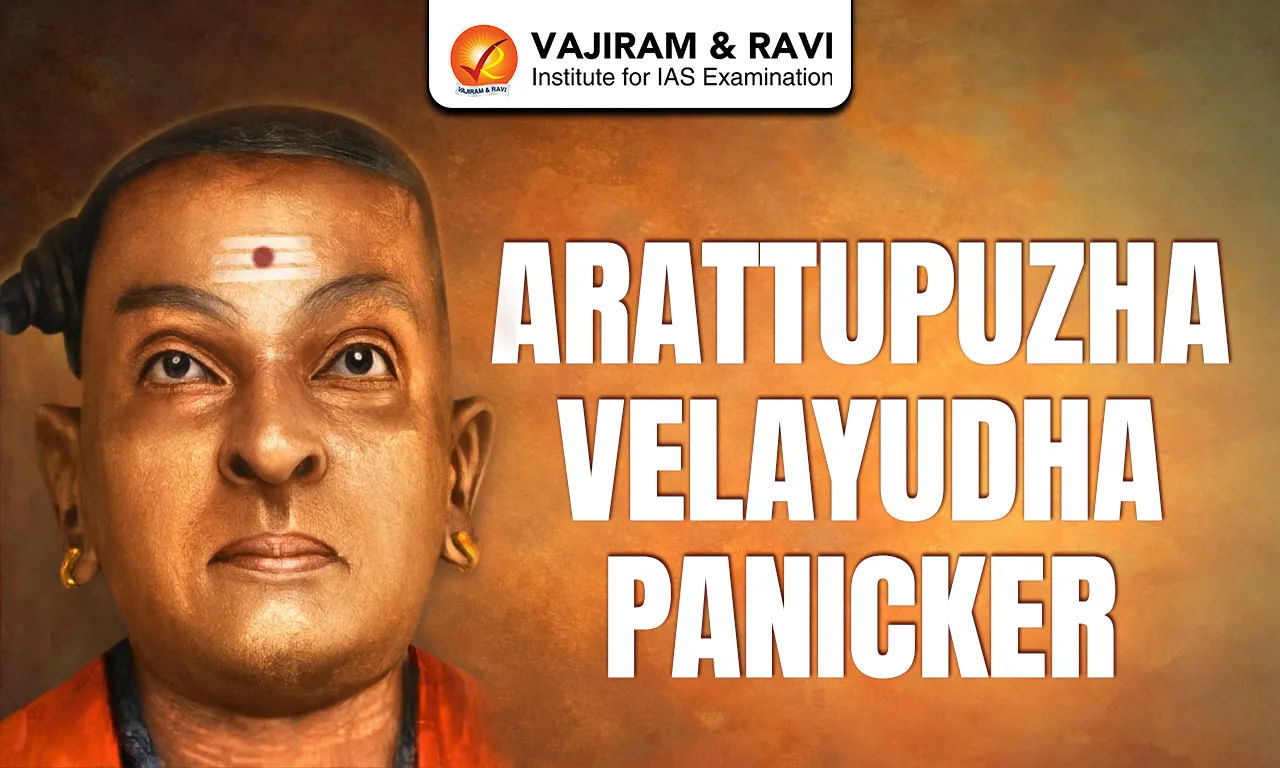
Arattupuzha Velayudha Panicker was a 19th-century social reformer and anti-caste activist from Travancore (present-day Kerala) who worked for the upliftment of oppressed communities. 

Arattupuzha Velayudha Panicker's Early Life 

Arattupuzha Velayudha Panicker was born in 1825, into a well-off family of merchants in Kerala’s Alappuzha district.  He belonged to the Ezhava community, which faced severe caste-based restrictions under the rigid social hierarchy of Travancore.

Arattupuzha Velayudha Panicker Social Reforms

During the 19th century, Kerala society was deeply hierarchical, and lower castes were denied basic rights such as access to public roads, temples, education, markets, and even the right to cover their upper body. Arattupuzha Velayudha Panicker led the following social reform movements against these oppressions: 

Anti-Caste Movements

  • He challenged the rigid caste hierarchy and domination of upper castes or ‘Savarnas' in Kerala. He opposed practices that denied dignity and equal rights to marginalized communities. 

Temple Reforms 

  • In Travancore temple entry was strictly restricted to upper castes, Velayudha Panicker, in 1852, constructed the Mangalam Shiva Temple at Arattupuzha and opened it to people of all castes and different religions.

Women’s Dignity Movements

Velayudha Panicker played a transformative role in improving the social status and dignity of marginalized women through a series of social protests:

  • Achipudava Samaram Strike (1859): He led the strike at Kayamkulam in Alappuzha, demanding that women of backward communities be allowed to wear a lower garment that extended beyond the knees. 
  • Ethappu Samaram (1859): Through this agitation, he demanded the right of lower-caste women to wear upper cloth, challenging humiliating dress codes imposed by the caste system.
  • Mukkuthi Samaram (1860): He supported the right of marginalized women to wear nose studs and gold ornaments that were previously restricted to upper-caste women.

Advocacy for Labour Rights

Velayudha Panicker organized the first agricultural labour strike (Karshaka Thozhilali Samaram) in Kerala, highlighting issues such as unfair wages and oppressive labour conditions faced by agricultural workers. 

Cultural Democratization and Social Inclusion

  • In 1861, he established the first Kathakali Yogam for the Ezhava community, enabling members of backward communities to learn and perform Kathakali. At that time, Kathakali was largely restricted to upper castes.

Apart from his work as a social reformer, Panicker was a master of Kalaripayattu, the traditional martial arts practised in Kerala, which is also considered the oldest of its kind in India. In 1869, he successfully captured the famous outlaw Kayamkulam Kochunni, who had stolen a sacred Salagramam (holy stone) from a Brahmin priest. In recognition of his bravery, the King of Travancore honoured him with the title “Panicker”, a respected title given to warriors and martial arts masters symbolising bravery and leadership.

He excelled in other sports as well, including wrestling, swimming and horseback riding. Arattupuzha Velayudha Panicker was murdered by a group of upper-caste men in 1874 at the age of 49. This makes him the ‘first martyr’ of the Kerala renaissance

Arattupuzha Velayudha Panicker

Q1: Who was Arattupuzha Velayudha Panicker?

Ans: Arattupuzha Velayudha Panicker was a 19th-century social reformer from Travancore (present-day Kerala) who fought against caste oppression and worked for the dignity of marginalized communities, especially the Ezhavas.

Q2: Arattupuzha Velayudha Panicker was born in which year and where?

Ans: Arattupuzha Velayudha Panicker was born in 1825 at Arattupuzha in present-day Alappuzha district of Kerala.

Q3: Arattupuzha Velayudha Panicker belonged to which community?

Ans: Arattupuzha Velayudha Panicker belonged to the Ezhava community.

Q4: Who gave Arattupuzha Velayudha the title of “Panicker”?

Ans: In 1869, the Travancore king awarded him the title for capturing the outlaw Kayamkulam Kochunni and recovering a stolen sacred object.

Q5: Which temple was built by Velayudha Panicker and opened to all castes?

Ans: He built the Mangalam Shiva Temple in 1852 and opened it to people of all castes and religions.

Boma Technique, Uses, Examples, Key Details

Boma Technique

The Boma Technique is a wildlife conservation strategy used mainly for the relocation, capture, and protection of wild animals, especially large mammals such as rhinos, elephants, and deer.

Boma Technique Working

The Boma capturing technique is commonly used in Africa to capture wild animals safely.

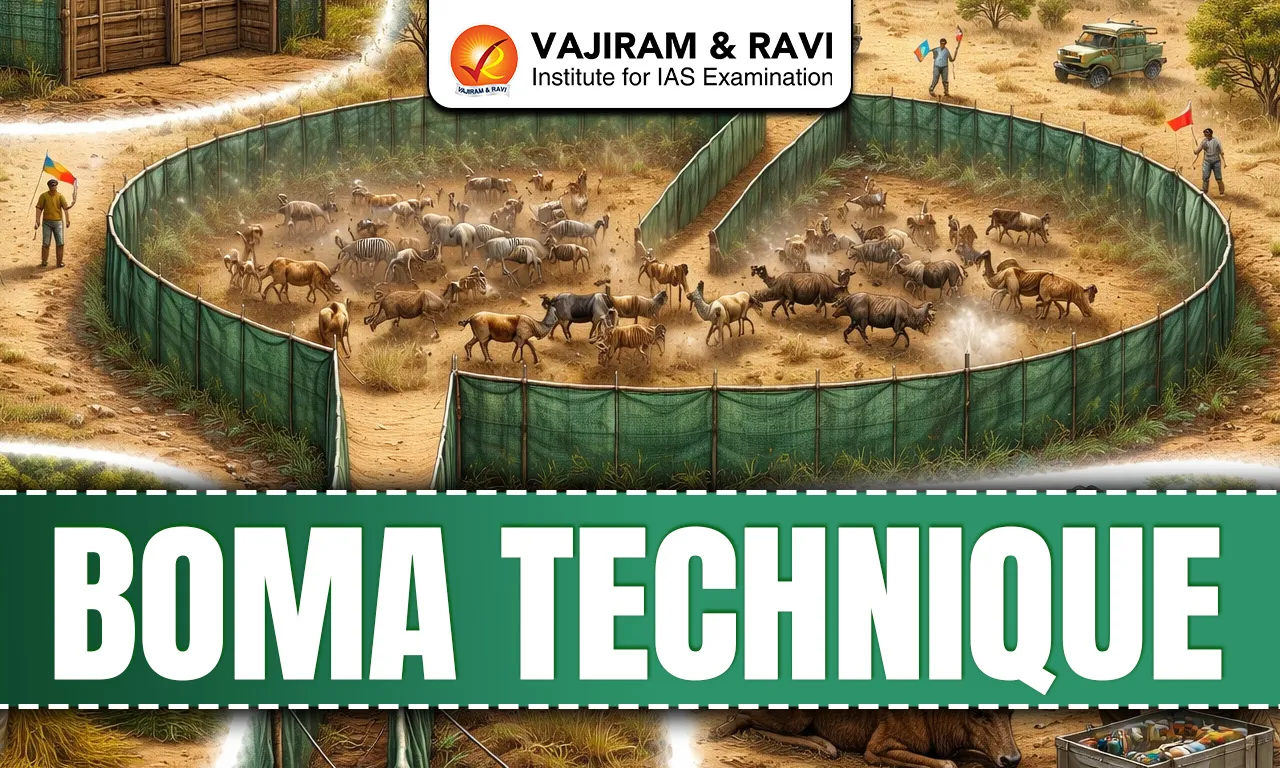
In this method, animals are gently chased into a fenced enclosure shaped like a funnel. The funnel gradually becomes narrower and leads to a selection and loading chute.

The sides of the chute are covered with grass mats and green nets so that animals cannot see outside, which keeps them calm. Once inside, the animals are guided into a large vehicle and transported to another location.

Boma Technique Examples

Boma technique was earlier utilised to capture wild elephants for training and service. Following its adoption in Madhya Pradesh in recent years, Boma has been put to practice for the first time in Rajasthan for sending the ungulates to the prey-deficient Mukundara reserve as the kills for tigers and leopards.

Madhya Pradesh Forest Department partnered with South African experts to capture over 500 Blackbucks and Nilgais. Using a Robinson-44 helicopter, they herded the animals into fabric funnels to relocate them to the Gandhi Sagar Wildlife Sanctuary. 

In 2022, the Mukundara Hills Tiger Reserve had lost several of its tigers and was suffering from a depleted prey base. To successfully reintroduce tigers, they first needed to populate the park with herbivores like Chital (spotted deer). They turned to the Boma technique to move deer from Keoladeo National Park (in Bharatpur) to Mukundara Tiger Reserve.

Boma Technique FAQs

Q1: What is the Boma technique?

Ans: Boma Technique is a wildlife capture and relocation method that uses funnel-shaped enclosures to guide animals into transport vehicles.

Q2: Where is the Boma technique commonly used?

Ans: Boma Technique is widely used in Africa for capturing and relocating large wild animals.

Q3: Which animals are usually captured using the Boma technique?

Ans: Boma Technique is mainly used for large mammals such as elephants, rhinos, antelopes, deer, blackbucks, and nilgais.

Q4: What is the main purpose of the Boma technique?

Ans: Boma Technique is used for wildlife relocation, population management, and improving prey base in protected areas.

Q5: Which Indian states have used the Boma technique recently?

Ans: Madhya Pradesh and Rajasthan.

Lhotse, Location, Height, Mountain Range, Features

Lhotse

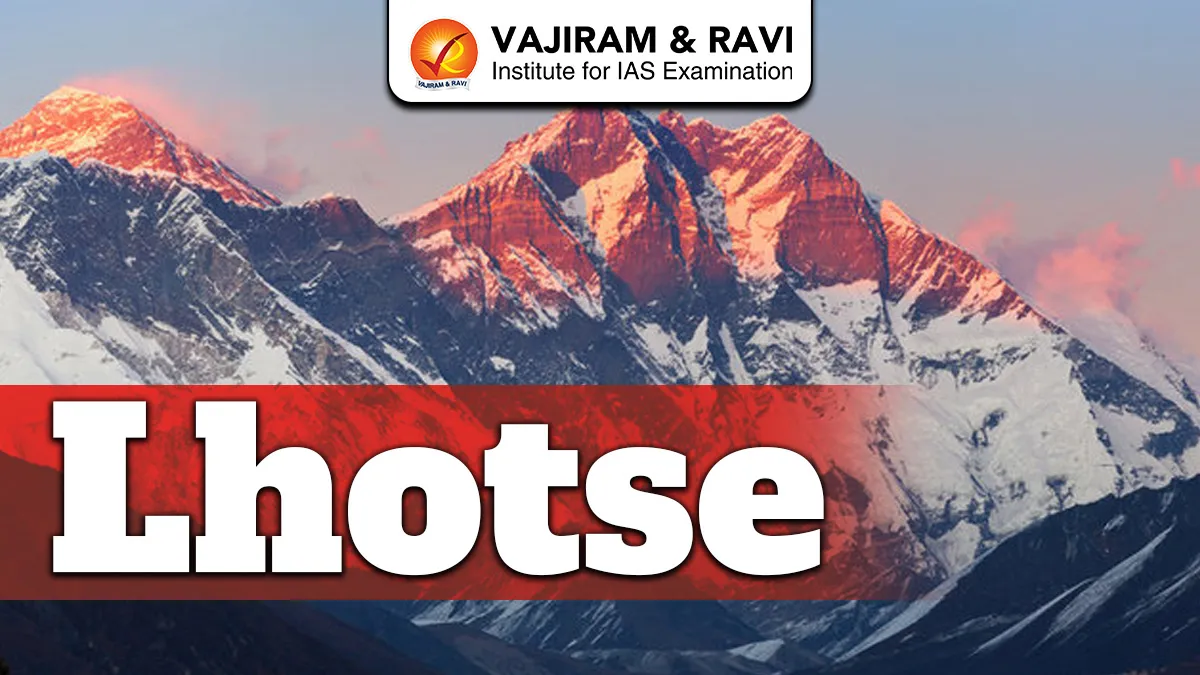
Lhotse is the fourth highest mountain in the world. Its name in Tibetan means “South Peak,” reflecting its position just south of Mount Everest. It stands on the border between Nepal’s Khumbu region in Solukhumbu district and the Tibet Autonomous Region of China. Lhotse forms a major part of the Everest massif and is connected to Everest by the South Col Mountain Pass at about 7,600 metres.

Also Read: Mount Manaslu

Lhotse Features

Lhotse is an opened Himalayan expedition peak within the Khumbu region of eastern Nepal. The major features of the peak are:

  • Location: It is situated in Solukhumbu district, Province 1, along Nepal-Tibet border within the Everest massif of the Himalayas.
  • Height: Its elevation reaches 8,516 metres or 27,940 feet, making it one of only fourteen eight thousanders globally.
  • Global Ranking: It ranked fourth worldwide after Everest, K2 and Kangchenjunga based on official elevation records.
  • Mountain Range: It is part of the Khumbu range, forming a horseshoe arc with Everest and Nuptse.
  • Major Summits: It includes Lhotse Main 8,516 m, Lhotse Middle 8,414 m, Central II 8,372 m and Lhotse Shar 8,383 m.
  • Climate: It experiences extreme alpine climate with permanent snow, sub zero temperatures and high velocity winds year round.
  • First Ascent: Lhotse was first successfully climbed on May 18, 1956 by Swiss mountaineers Fritz Luchsinger and Ernst Reiss via the standard route.
  • Human Settlement: Nearest villages include: Lobuche that lies 8.3 km away and Namche Bazaar is 34.1 km distant.
  • Mountaineering Significance: South Face and Northeast Face are technically demanding, whereas the Northeast face remains unclimbed.

Also Read: Pamir Mountains

Lhotse FAQs

Q1: What is the height of Lhotse?

Ans: Lhotse stands at 8,516 metres or 27,940 feet above sea level, making it one of the fourteen eight thousanders in the world.

Q2: What is Lhotse’s global rank among highest mountains?

Ans: Lhotse is the fourth highest mountain globally after Mount Everest, K2 and Kangchenjunga.

Q3: Who first climbed Lhotse and when?

Ans: Lhotse was first ascended on May 18, 1956 by Swiss climbers Fritz Luchsinger and Ernst Reiss.

Q4: Where is Lhotse located?

Ans: Lhotse lies on the border of Nepal’s Khumbu region in Solukhumbu district and the Tibet Autonomous Region of China.

Q5: Which mountain pass connects Lhotse with Mount Everest?

Ans: Lhotse is connected to Mount Everest by the South Col, located at an elevation of about 7,600 metres above sea level.

Limpopo River, Origin, Course, Tributaries, Source, Dams

Limpopo River

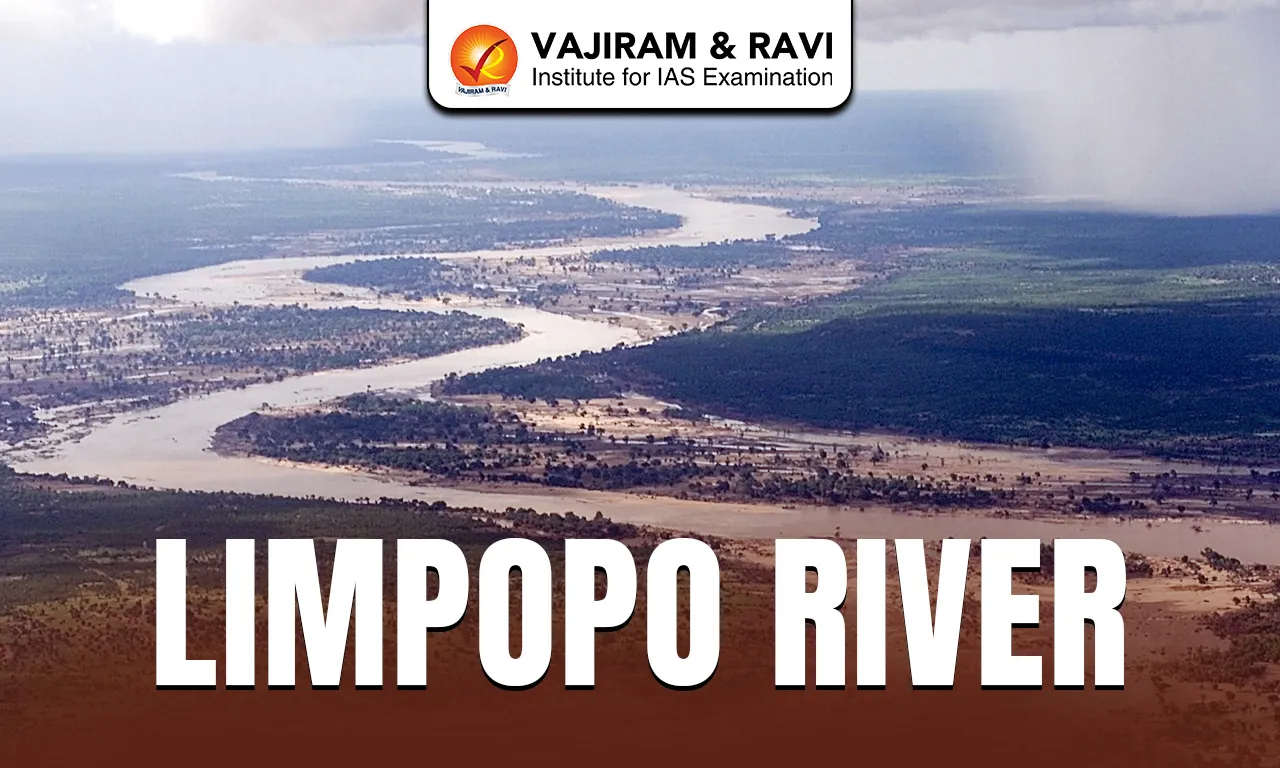
The Limpopo River is one of the major rivers of Southern Africa. It flows across four countries and forms an important transboundary river system.It is often referred to as the “Crocodile River” because of the large population of crocodiles found along its course. 

Limpopo River Source and Origin

  • The Limpopo River originates from the confluence of the Marico and Crocodile rivers near the South Africa-Botswana border.
  • The crocodile river originates near the Witwatersrand region located within Highveld Plateau.

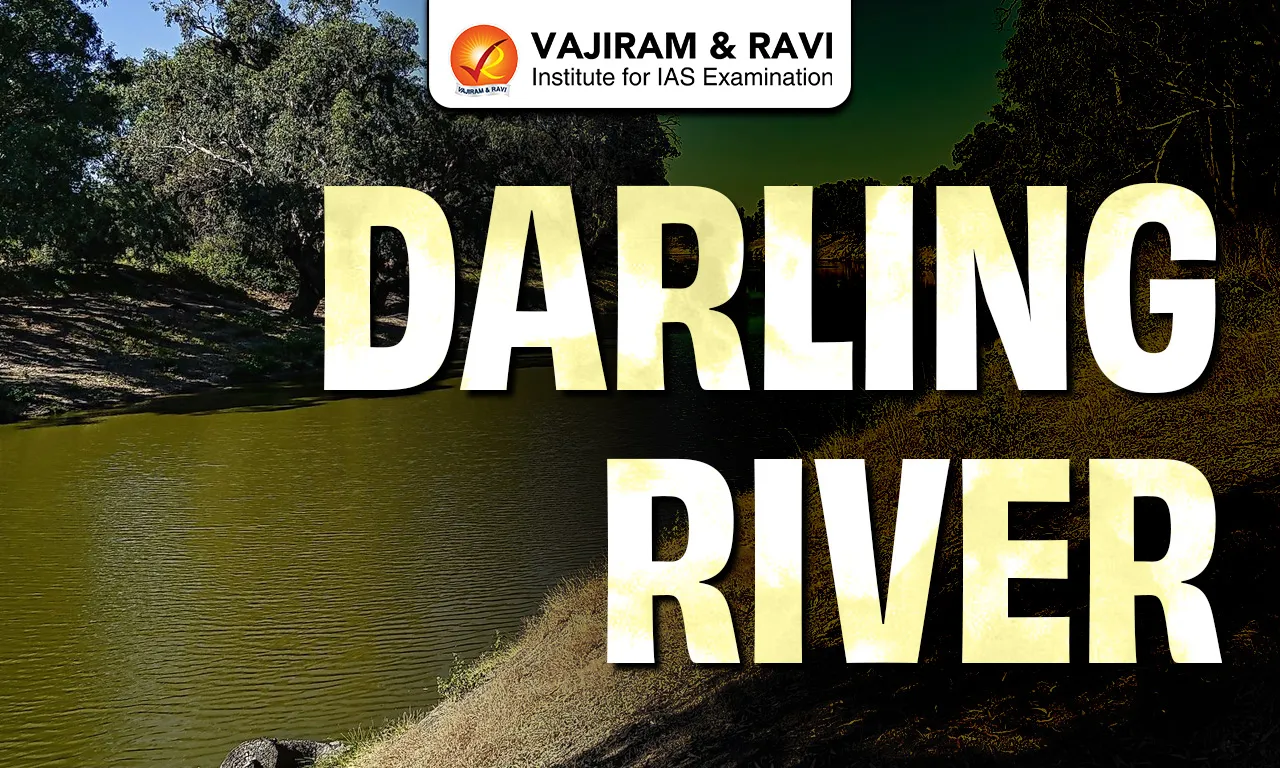
Read about: Darling river

Limpopo River Course 

  • Along its course, the Limpopo river initially flows northward and forms parts of the international boundaries between South Africa and Botswana and later between South Africa and Zimbabwe. 
  • The river then turns eastward, enters Mozambique, where it flows across a relatively flat coastal plain. In Mozambique, the river becomes broader and slower, increasing flood risk during periods of heavy rainfall.
  • Finally, the Limpopo drains into the Indian Ocean, completing a course of about 1,750 km.
  • Along its course, it crosses the Tropic of Capricorn twice

Limpopo River Tributaries

Most tributaries are ephemeral or seasonal, reflecting the semi-arid climate of the basin. Major tributaries are: 

  • The Olifants River is the largest and most significant tributary of the Limpopo.
  • The Shashe River flows from Zimbabwe and Botswana and joins the Limpopo near the tri-junction of South Africa, Botswana, and Zimbabwe.
  • The Mwenezi River, originating in Zimbabwe, contributes seasonal flows and is prone to drought-related drying.
  • The Notwane River, flowing through Botswana.

Limpopo River Drainage Basin

  • The Limpopo River basin covers approximately 415,000 square kilometres, making it one of the major river basins of Southern Africa.
  • The basin spans four countries: South Africa (largest share), Botswana, Zimbabwe and Mozambique. 
  • Large parts of the basin lie in semi-arid to arid climatic zones, receiving low and irregular rainfall.

Limpopo River Dams and Reservoirs

The Limpopo basin contains several dams and reservoirs, primarily constructed for irrigation, water supply, flood control, and limited hydropower. Major Dams are :

  • Massingir Dam (Mozambique)
  • Loskop Dam (South Africa)
  • Flag Boshielo Dam (South Africa)
  • Notwane Dam (Botswana)

Ecologically, the Limpopo Basin supports savannah grasslands and diverse wildlife typical of southern Africa. Parts of the famous Kruger National Park lie within the basin

Limpopo River FAQs

Q1: Limpopo river through which countries?

Ans: The Limpopo River flows through South Africa, Botswana, Zimbabwe, and Mozambique.

Q2: Where does the Limpopo River originate?

Ans: The Limpopo River originates from the confluence of the Marico River and the Crocodile River near the South Africa–Botswana border.

Q3: Limpopo River drains into which ocean?

Ans: The Limpopo River drains into the Indian Ocean in Mozambique.

Q4: Which is the largest tributary of the Limpopo River?

Ans: The Olifants River is the largest and most significant tributary of the Limpopo.

Q5: What is the approximate size of the Limpopo River basin?

Ans: The basin covers about 415,000 square kilometres across four southern African countries.

Hemis National Park, Ladakh, Location, Flora & Fauna, Challenges

Hemis National Park

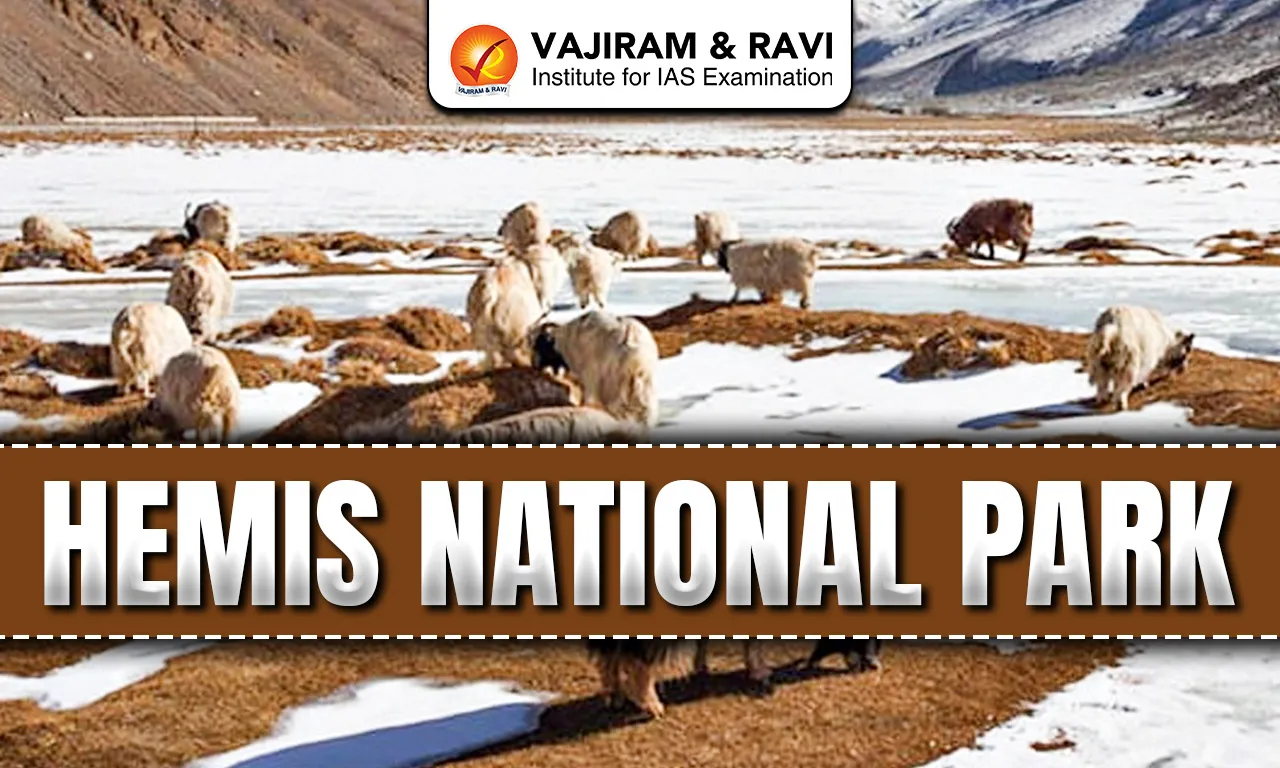
Hemis National Park is a high altitude protected area located in the Leh district of Ladakh, around 50 km from Leh city. It is the largest National Park in India and the only one situated north of the Himalayas. It was established in 1981. The park lies in the Trans Himalayan region and represents the cold desert ecosystem of central Ladakh. It is globally famous for its high density of snow leopards. Hemis is part of the Karakoram West Tibetan Plateau alpine steppe and holds international biodiversity significance.

Hemis National Park

Hemis National Park was initially created to protect the Rumbak and Markha catchments covering nearly 600 sq km in 1981, later expanded to 3,350 sq km in 1988 and finally to around 4,400 sq km in 1990. It stretches across the Zanskar Range and is bounded in the north by the Indus River. Its altitude ranges roughly between 3,000 meters to above 6,000 meters, with Ganda La pass located at about 4,980 meters. The park area comprises core and buffer zones and forms part of the Palearctic biogeographic realm.

Hemis National Park Features

Hemis National Park represents the Trans Himalayan cold desert ecosystem with high altitude valleys, gorges, alpine meadows and steppe landscapes.

  • Geographical Location and Boundaries: The park lies entirely in the Zanskar region of Ladakh. It is bounded by the Indus River in the north, extends southwards to Padum, eastwards along the Nimmu-Padum-Darcha road and westwards from Karu to Tetha along National Highway routes.
  • Largest Protected Area Status: With an area of about 4,400 sq km or 4,10,000 hectares, it is the largest National Park in South Asia and the second largest contiguous protected landscape after the Nanda Devi Biosphere Reserve complex.
  • Altitudinal and Terrain Variation: The landscape includes deep gorges, limestone cliffs, scree slopes, alluvial fans and wide high altitude plateaus above 4,000 meters. Some valleys are up to 1 km wide, while others are narrow with steep rocky walls.
  • River Systems: Major river catchments inside the park include Markha, Rumbak, Shang, Sumdah and parts of the Zanskar River system. All these drain northwards into the Indus River, forming narrow valleys and alluvial fans.
  • Core and Buffer Zones: The protected area includes a core zone of about 1,25,000 hectares and a buffer zone of around 2,85,000 hectares. There are no permanent settlements in the core area, ensuring minimal disturbance.
  • Human Settlements: Around 1,600 residents live in nearly 23 settlements inside the park boundaries, mainly in valleys such as Rumbak and Markha. Less than 1% of the total area is cultivated, mostly for barley and peas.
  • Climate: The park lies in the rain shadow region of the Himalayas. Rainfall is very low, winters are extremely cold with heavy snowfall after November and summers are short and mildly warm. There is no distinct monsoon season.
  • Tourism: Popular trekking routes such as Markha Valley trek and Spituk to Stok via Ganda La pass pass through the park. Peaks like Stok Kangri at 6,153 metres and Kang Yatse at 6,496 metres attract mountaineers.
  • Cultural Heritage: Hemis Gompa, a 400 year old monastery located near the park, lends its name. The annual Hemis Festival attracts visitors and connects cultural heritage with conservation landscapes.

Also Read: National Parks of India

Hemis National Park Biodiversity

Hemis National Park supports rare cold desert species including snow leopards, Tibetan wolf, juniper scrub and alpine medicinal plants.

Fauna

  • Snow Leopard: The park hosts about 75 to 120 snow leopards, with some estimates suggesting nearly 200 individuals including breeding populations. It is considered one of the highest density habitats globally, especially in the Rumbak and Chang Chu catchments.
  • Prey Species: Key prey animals include Bharal or Blue Sheep with density around 1.3 animals per sq km and total population between 2,600 and 5,000. Ladakhi Urial recorded about 226 individuals in the northern part. A small herd of 20 to 22 Tibetan Argali survives near Ganda La.
  • Other Mammals: Important mammals include Tibetan wolf Canis lupus chanco, Eurasian brown bear, red fox, mountain weasel, Himalayan marmot, large eared pika, woolly hare and possibly rare lynx. Around 16 mammal species have been officially recorded.
  • Bird Diversity: Nearly 73 to 80 bird species are recorded, with about 50 breeding inside the park. Notable birds include golden eagle, lammergeier vulture, Himalayan griffon, Himalayan snowcock, robin accentor, black winged snowfinch and Guldenstadt’s redstart.
  • Reptiles and Amphibians: Three lizard species are present including Agama himalayana, Scincella ladacensis and Phrynocephalus theobaldi. Amphibians are absent due to harsh cold desert conditions.

Flora

  • Biome Representation: The park represents Biome 5 Eurasian High Montane and Tibetan species. Thick stands of Hippophae rhamnoides support wintering passerines such as Great Rosefinch and Black throated Thrush.
  • Vegetation Zones: Lower valleys contain dry juniper scrub mainly Juniperus macropoda and J. indica up to 4,250 meters. Riverine forests include Salix karelinii, Myricaria squamosa, Populus euphratica and Betula utilis.
  • Alpine and Steppe Plants: Above 4,500 meters vegetation becomes sparse, with alpine species like Gentiana, Carex, Kobresia and Veronica. Steppe vegetation is dominated by Artemisia, Caragana, Stachys and Ephedra along lower river courses.
  • Medicinal Plants: Studies report 15 rare and endangered medicinal species such as Acantholimon lycopodioides, Arnebia euchroma, Bergenia stracheyi, Ephedra gerardiana and Hyoscyamus niger. Over 314 plant species were documented in Rumbak catchment alone.

Also Read: National Parks in Tripura

Hemis National Park Challenges

Despite protection, Hemis faces ecological and socio economic pressures.

  • Human Wildlife Conflict: Snow leopards sometimes kill multiple livestock in single attacks. With pastoral communities rearing goats and sheep, livestock depredation creates economic losses and conflict situations.
  • Grazing Pressure: Domestic livestock graze in buffer areas and although traditional rights exist, overgrazing reduces pasture quality and affects prey species like bharal.
  • Resource Extraction: Shrubs such as Artemisia and Caragana are used for fuel. Animal dung is burned as fuel, limiting its use as fertilizer and impacting soil fertility.
  • Road Construction: Expansion of roads and transportation corridors poses threats by fragmenting habitat and increasing disturbance in fragile alpine ecosystems.
  • Agricultural Expansion: Less than 1% of land is cultivated, mainly barley and peas, yet any shift toward expanded farming may disturb natural habitats in valley bottoms.
  • Climate Vulnerability: Being a cold desert ecosystem with minimal rainfall and heavy snowfall, the region is sensitive to temperature fluctuations and glacier related flooding in summer.

Way Forward

Effective conservation requires balanced strategies integrating ecology and community welfare.

  • Project Snow Leopard: Initiated in 2004 and formally launched in 2009, this programme promotes landscape level conservation of snow leopards and their prey across the Himalayan biosphere.
  • Predator Proof Measures: Construction of predator proof livestock pens and designated no grazing zones helps reduce livestock losses and minimise retaliation against carnivores.
  • Community Based Tourism: Homestay programmes supported by Snow Leopard Conservancy India Trust since 2000 provide alternative income and link conservation benefits with local livelihoods.
  • Eco Development Initiatives: Projects like Ladakh Eco Tourism and women run Eco Cafes encourage handicrafts and sustainable tourism without increasing ecological pressure.
  • Scientific Monitoring: The first National Protocol on Snow Leopard Population Assessment launched in 2019 strengthens scientific population monitoring and habitat management.
  • Buffer Zone Management: Authorities aim to regulate land use in buffer areas while keeping the core zone free from disturbance, ensuring long term protection of alpine ecosystems.

Hemis National Park FAQs

Q1: Where is Hemis National Park located?

Ans: Hemis National Park is located in the Leh district of Ladakh, about 50 km from Leh city, north of the Himalayas.

Q2: Why is Hemis National Park famous?

Ans: It is globally known for having one of the highest densities of snow leopards in any protected area in the world.

Q3: Which is the largest National Park in South Asia?

Ans: Hemis National Park of Ladakh is the Largest National Park in South Asia.

Q4: Which major rivers flow through or near the park?

Ans: The park includes catchments of the Markha, Rumbak and parts of the Zanskar River, all draining into the Indus River.

Q5: When was Hemis National Park established?

Ans: It was established in 1981 and later expanded in 1988 and 1990 to its present size.

Battle of Sinhagad, History, Events, Challenges, Aftermath

Battle of Sinhagad

The Battle of Sinhagad took place on the night of February 4, 1670, within the walls of the Sinhagad Fort, located near Pune, Maharashtra. This battle was fought between Tanaji Malusare, a commander of the Maratha ruler Chhatrapati Shivaji Maharaj, and Udaybhan Rathod, the Sinhagad Fort keeper serving under Jai Singh I. Tanaji Malusare and his troops claimed their victory and reclaiming the fortress for the Marathas. The battle resulted in approximately 300 casualties on the Mughal side and 50 on the Maratha side, while nearly 4,000 Mughal troops were captured by just 500 Maratha warriors.

Battle of Sinhagad

In 1670, the Battle of Sinhagad occurred in the fort of Sinhagad near Pune. The Maratha War took place between Tanaji Malusare, a Koli commander of Maratha ruler Shivaji Maharaj and Udaybhan Rathod. In this Battle of Sinhagad, Tanaji Malusare died and Shivaji renamed the fort of Kondhana as Sinhagad Fort (Lion’s Fort) in his remembrance.

Battle of Sinhagad History

Sinhagad Fort was previously known as Kondhana, the fort was under the control of Mirza Raja Jai Singh and held strategic significance due to its location among other forts like Rajgad, Purandar, and Torna. The Mughals had stationed weapons to nearly 5,000 soldiers, led by Udaybhan Rathod, a subordinate of Jai Singh. Tanaji Malusare managed to invade the fort and conduct a reconnaissance mission. During his observation, he discovered that a celebration was scheduled for the night of the attack, meaning the Mughal soldiers would be less focused. Seizing this opportunity, Tanaji, along with his brother Suryaji and 300 Mavalas began warriors from the Maval region, prepared for the daring assault.

Battle of Sinhagad Overview

Below in the table we have discussed the Battle of Sinhagad Overview:

Battle of Sinhagad Overview

Event

Battle of Sinhagad

Date

4 February 1670

Location

Sinhagad Fort, Pune

Forces Involved

Forces of Maratha Empire and Mughal Empire 

Result

Victory of Maratha Empire

Battle of Sinhagad Series of Events

Shivaji gave instruction to begin the battle and achieved significant success, reclaiming several forts that had been ceded under the Treaty of Purandar.

  • The first victory was on 4th February 1670, when Fort Kondana was seized from Udai Bhan, a Rajput commander. 
  • Leading this daring assault, Tanaji Malusare, along with 300 Mavle warriors, scaled the hillside near the Kalyan Gate using rope ladders. 
  • With the guidance of local Koli (fishermen) who were well-known with the terrain, they swiftly eliminated the guards and advanced into the fort.

Attack on the Garrison

Tanaji Malusare and his warriors got involved in the night assault on Sinhagad Fort, scaling its steep cliffs with the aid of rope ladders and a monitor lizard named Yashwanti.

Seizing the element of surprise, the Marathas launched their attack when the Mughal forces were least prepared. They successfully breached the fort’s defenses, catching the enemy off guard. In the battle that followed, Udaybhan Singh Rathore was murdered, and the Mughal garrison had no choice but to surrender.

Who was Tanaji Malusare?

Tanaji Malusare was a well known general in Chhatrapati Shivaji’s army and one of his most trusted companions. He is best known for his heroic role in the Battle of Sinhagad 1670, where he led the Marathas against Udaybhan Singh Rathore, a fierce Rajput warrior and Mughal fort keeper. His bravery and sacrifice played a crucial role in securing a Maratha victory.

Battle of Sinhagad Challenges

  • The Marathas recognized that direct assault was impossible, and the only way to capture Sinhagad was by scaling its steep, nearly walls.
  • To maintain the element of surprise, the assault was launched at night. The warriors used rope ladders to climb the sheer cliffs, making their way up under extreme difficulty.
  • Once inside, the Marathas engaged in fierce close battle with the Mughal defenders, leading to intense and brutal fighting within the fort’s premises.
  • The Marathas moved strategically, sneaking in and eliminating looks before reaching and unlocking the fort’s main gate.
  • Once the gate was opened, more Maratha troops entered, overwhelming the remaining Mughal forces and securing control of the fort.
  • The fort’s steep cliffs and rugged terrain made it nearly unaffected by cannon fire, as there were no suitable positions for artillery to be placed.
  • Sinhagad Fort had only a few narrow pathways leading to the main gate, making it difficult for large enemy forces to approach or lay siege effectively.

Battle of Sinhagad Aftermath

Purandar Fort served as a crucial refuge for the Peshwas whenever they could not remain safely in their capital, especially after they had taken control from Shivaji’s successors in Poona.

In 1818, a British force under General Pritzker captured Purandhar. The attack began with a mortar battery assault on March 14, followed by the British takeover of Wazirgarh on March 15. Although Purandhar was under Wazirgarh’s jurisdiction, its commandant was compelled to accept the surrender terms, leading to the British flag being raised over the fort on March 16, 1818.

Strategically positioned, the fort oversees the Purandhar Ghat, an important passage through the Western Ghats. In 1776, the British government and the Maratha states signed a treaty regarding the fort. However, the agreement was invalidated by the Treaty of Salbai, signed in 1782 at the end of the First Anglo-Maratha War between the Bombay government and Raghunath Rao.

Related Articles
Important Battles in Indian History Important Battles of Mughal Empire
Battle of Kannauj Battle of Khanwa
Battle of Purandar Battle of Longewala
Battle of Hydapses Battle of Wandiwash
Battle of Tarain Battle of Chengam
Battle of Porto Novo Battle of Pollilur
Battle of Salher Battle of Pavankhind
Battle of Kolhapur Battle of Bhupalgarh
Battle of Sinhagad Battle of Surat
Battle of Walong Battle of Saragarhi
Battle of Rezang La Maratha Wars List

Battle of Sinhagad FAQs

Q1: Who won the Battle of Sinhagad?

Ans: The Battle of Sinhagad (1670) was won by the Marathas under the leadership of Tanaji Malusare, a trusted commander of Chhatrapati Shivaji Maharaj.

Q2: Who killed Udaybhan in real?

Ans: In reality, there is no definitive historical record confirming exactly who killed Udaybhan Rathod during the Battle of Sinhagad (1670). However, according to folklore and popular accounts, he was slain by Shelar Mama, a senior Maratha warrior who fought alongside Tanaji Malusare.

Q3: Did Tanaji survive the battle?

Ans: No, Tanaji Malusare did not survive the Battle of Sinhagad (1670).

Q4: Did Udaybhan cut Tanhaji's hand?

Ans: There is no concrete historical evidence confirming that Udaybhan Rathod cut off Tanaji Malusare's hand during the Battle of Sinhagad (1670).

Q5: Who defeated Shivaji?

Ans: Chhatrapati Shivaji Maharaj was a brilliant strategist and warrior who successfully resisted the Mughals, Adilshahi, and other rivals for most of his life.

Battle of Bhupalgarh, History, Events, Challenges, Aftermath

Battle of Bhupalgarh

The Battle of Bhupalgarh (also known as Bhupalgad) took place in 1679 between the Mughal Empire and the Marathas near present-day Khanapur. This conflict was part of the events leading up to the larger Deccan wars. The Maratha forces were commanded by Shivaji, the founder and first ruler of the Maratha Empire. The battle ended with the Mughals, led by General Diler Khan, demolishing the Bhupalgarh fort and securing a significant victory. Shivaji’s son, Sambhaji, who later became the second ruler of the Maratha Empire, fought alongside the Mughals after defecting from his father.

Battle of Bhupalgarh

The Maratha War, Battle of Bhupalgarh was fought in 1679 between the Mughal Empire and the Maratha under Shivaji, was a significant conflict that lasted over 55 days. The fort of Bhupalgarh was ultimately captured by the Mughals, led by General Diler Khan. Following intense battle, the Mughal forces seized the fortress, took control of its supplies, and captured the defending troops. Diler Khan repelled Maratha reinforcements and ordered the complete destruction of the fort. The battle resulted in a decisive Mughal victory, with Shivaji facing defeat. The fort of Bhupalgarh was demolished by the Mughals, marking a crucial setback for the Marathas.

Battle of Bhupalgarh History

During Aurangzeb’s reign (1658–1707), the Mughal Empire expanded rapidly, leading to frequent conflicts with Shivaji’s growing Maratha power. In 1678, Shivaji divided his empire, assigning Maharashtra to his younger son, Rajaram, while Sambhaji was given the unstable Karnataka region. Feeling sidelined, Sambhaji was approached by Mughal general Diler Khan, who offered to help him reclaim Maharashtra in exchange for an alliance. Sambhaji, however, did not consider himself a Mughal subordinate but an independent ruler. Historical records, including English factory letters and Persian sources, suggest that he opposed Diler Khan’s actions, especially the mistreatment of Hindu civilians in Athni and Tikota.

Battle of Bhupalgarh Series of Events

The Mughals began the Battle of Bhupalgarh with heavy artillery fire, targeting the fort’s walls and towers. The following day, they launched a full-scale assault that continued until noon, resulting in the fort’s capture after heavy casualties on both sides. Meanwhile, Shivaji’s cavalry reinforcements, numbering 16,000, arrived late but were intercepted 12 miles away by Ikhlas Khan’s force of 1,500. Despite being surrounded, Ikhlas Khan’s troops held their ground, killing a thousand Maratha soldiers. When Diler Khan’s reinforcements arrived, the Maratha forces were overwhelmed and had no choice but to retreat from the battlefield.

Battle of Bhupalgarh Aftermath

After capturing Bhupalgarh, Diler Khan took large stocks of grain and captured many people, some of whom were sold into slavery. In a brutal act, he released 700 captives but only after cutting off one of their arms. He then ordered the fort to be completely destroyed.

Historian Pandit Shankar Joshi criticizes Sambhaji for joining the Mughals, stating that his actions during the attack on Bhupalgarh showed an unstable character. A month later, with Mughal support, Sambhaji surrounded the Panhala. However, after Shivaji’s death in 1680, he became king and once again turned against the Mughals, leading to the Deccan Wars.

Related Articles
Important Battles in Indian History Important Battles of Mughal Empire
Battle of Kannauj Battle of Khanwa
Battle of Purandar Battle of Longewala
Battle of Hydapses Battle of Wandiwash
Battle of Tarain Battle of Chengam
Battle of Porto Novo Battle of Pollilur
Battle of Salher Battle of Pavankhind
Battle of Kolhapur Battle of Bhupalgarh
Battle of Sinhagad Battle of Surat
Battle of Walong Battle of Saragarhi
Battle of Rezang La Maratha Wars List

Battle of Bhupalgarh FAQs

Q1: Who won the Battle of Bhupalgarh?

Ans: The Mughal forces, led by General Diler Khan, won the Battle of Bhupalgarh in 1679

Q2: Did Shivaji Maharaj lose any battle?

Ans: While Shivaji Maharaj was a brilliant military leader, he did lose two major battles: the Battle of Kolhapur (1660) and the Battle of Purandar (1665).

Q3: Did Sambhaji Maharaj lose any battle?

Ans: While Chhatrapati Sambhaji Maharaj was a valiant warrior, he was eventually captured and executed by Mughal forces in 1689, not due to losing a battle, but rather a skirmish at Sangameshwar.

Q4: What was the biggest fight of Shivaji Maharaj?

Ans: One of the biggest and most significant battles fought by Chhatrapati Shivaji Maharaj was the Battle of Pavan Khind (1660).

Q5: What Battle did Akbar defeat?

Ans: Mughal Emperor Akbar achieved a major victory in the Second Battle of Panipat (1556), where he defeated Hemu, securing Mughal rule in India.

Battle of Kolhapur 1659, History, Series of Events, Outcome

Battle of Kolhapur

The Battle of Kolhapur took place in Kolhapur city, Maharashtra on 28 December 1659. Fought in between the Maratha Empire and Adilshahi forces, led by Rustam Zaman. The war is remembered due to its masterful strategy adopted by Shivaji which was similar to Babur’s strategy against Rana Sanga. The Battle of Kolhapur is the second most important war after the Battle of Pratapgarh. In this article, we are going to cover the history of the battle of Kolhapur, the clashes in between the Adilshah and Maratha forces and other important facts related to the exam. 

Battle of Kolhapur History 

The Battle of Kolhapur, fought on December 28, 1659, was a war that took place in between the Maratha empire and the Adil Shahi Dynasty of Bijapur. This war was fought after the completion of the war of Pratapgarh in which Shivaji won and shattered the morale of the Bijapur army. Based on this win, Shivaji launched another campaign, capturing a hilly territory stretching upto 200 km. By December 1659, Shivaji had advanced close to Panhala Fort, a crucial military stronghold, while Rustam Zaman, a seasoned general of the Bijapur army, was dispatched in his direction. On December 27, 1659, Rustam Zaman, along with his troops, arrived near Kolhapur, close to Miraj, setting the stage for a decisive confrontation.

The Siege of Panhala, 1660

The Panhala Fort, constructed between 1178 ans 1209 AD by Bhoja II of Shilhara Dynasty. Associated with Raja Bhoj, the fort was also known as Gangu Teli. Over time, it changed hands multiple times, with Singhana of the Yadava dynasty of Devagiri taking control after overthrowing Bhoja Raja. In 1589, the Adil Shahi dynasty fortified Panhala, turning it into a major military stronghold.

Adilshah vs. Marathas Forces

The Bijapur forces were led by Rustam Zaman, supported by experienced commanders such as Fazal Khan, Malik Itbar, Sadat Khan, Yakub Khan, Aankush Khan, Hasan Khan, Mulla Yahya, and Santaji Ghatage. The army primarily consisted of elite cavalry units and war elephants as the first line of defense. Rustam Zaman commanded the center, Fazal Khan led the left flank, and Malik Itbar managed the right flank. Mullah Yahya and Fateh Khan controlled the rear guard, while the total strength of the Bijapur cavalry was around 10,000 troops.

In Maratha War the forces were personally led by Chhatrapati Shivaji, supported by skilled cavalry commanders such as Netaji Palkar, Sardar Godaji Jagtap, Hiroji Ingale, Bhimaji Wagh, Sidhoji Pawar Jadhavrao, Hanmantrao Kharate, Pandhare, Siddi Hilal, and Mahadik. Shivaji himself took charge of the center, Jadhavrao and Siddi Hilal led the left flank, and Ingale and Sidhoji Pawar managed the right flank. Mahadik and Wagh commanded the rear guard, while Netaji Palkar handled an off-center position. The Maratha cavalry numbered only 3,500, significantly fewer than the 10,000-strong Adilshahi army.

Battle of Kolhapur Series of Events

  1. After the Battle of Pratapgarh, Rustam Zaman and Fazal Khan retreated, reorganizing their forces for another attack.
  2. Ali Adil Shah of Bijapur decided to personally lead a campaign against Shivaji, mobilizing a larger army.
  3. Siddi Jauhar, a prominent African military commander in Bijapur, declared his intent to attack Shivaji at Panhala Fort.
  4. Upon hearing of Siddi Jauhar's advance, Shivaji immediately reinforced Panhala Fort to prepare for an upcoming siege.
  5. The Bijapur forces encircled Shivaji’s fort, attempting to cut off supply lines.
  6. The Marathas, faced with a multi-pronged attack, needed a robust defensive strategy.

Challenges Faced by the Maratha Army

  • Siddi Jauhar’s army established communication with the Mughals, who had also besieged Bijapur.
  • Fateh Khan was ordered to attack from Janjira and reclaim Konkan.
  • Sawants of Sawantwadi were instructed to raid Shivaji’s southern and western borders.

Strategic Countermeasures by the Marathas

  • Raghunathpant Korde defended Konkan against Fateh Khan.
  • Abaji Sondev secured Kalyan and Bhiwandi.
  • Baji Pasalkar led a counter-attack against the Sawants.
  • Moropant Pingle managed Sahyadri’s strategic forts, including Purandhar, Sinhagad, and Pratapgad.

Battle of Kolhapur Outcome

On the morning of December 28, 1659, Rustam Zaman’s forces moved toward Panhala Fort, unaware that Shivaji had anticipated their movements. With 3,500 cavalrymen, Shivaji launched a rapid and decisive attack. Using superior battlefield tactics, he divided and weakened the Bijapur army. The Marathas flanked the enemy from both sides, killing 2,000 enemy troops. Rustam Zaman’s forces, disoriented by the surprise attacks, began to disintegrate. Within hours, Shivaji had routed the Bijapur army, forcing Rustam Zaman and Fazal Khan to flee.

The Marathas captured 2,000 horses and 12 elephants from the Bijapur army. This victory significantly expanded Shivaji’s influence in the Deccan and bolstered his territorial acquisitions. The Marathas also renamed the Khelna Fort to Vishalgad after capturing it through a clever infiltration tactic.

Battle of Kolhapur Casualties and Aftermath

The Battle of Kolhapur resulted in approximately 7,000 casualties on the Adilshahi side and 2,000 on the Maratha side. This battle, along with the Battle of Pratapgarh, solidified Shivaji’s reputation as a brilliant military strategist. On September 22, 1660, following a temporary truce between Shivaji and Ali Adil Shah, Panhala and Pawangad forts were surrendered to Bijapur, though Rangna and Vishalgad remained under Shivaji’s control.

The victory at Kolhapur further strengthened Shivaji’s hold over Maharashtra, paving the way for his continued expansion and the eventual establishment of the Maratha Empire as a dominant power in Indian history.

Related Articles
Important Battles in Indian History Important Battles of Mughal Empire
Battle of Kannauj Battle of Khanwa
Battle of Purandar Battle of Longewala
Battle of Hydapses Battle of Wandiwash
Battle of Tarain Battle of Chengam
Battle of Porto Novo Battle of Pollilur
Battle of Salher Battle of Pavankhind
Battle of Kolhapur Battle of Bhupalgarh
Battle of Sinhagad Battle of Surat
Battle of Walong Battle of Saragarhi
Battle of Rezang La Maratha Wars List

Battle of Kolhapur FAQs

Q1: Who won the Battle of Kolhapur?

Ans: Chhatrapati Shivaji Maharaj won the Battle of Kolhapur.

Q2: Who was Rustam E. Zama?

Ans: Rustam Zaman was a general of the Adil Shahi dynasty of Bijapur who fought against Shivaji Maharaj in the Battle of Kolhapur.

Q3: Which battle was won by Sambhaji Maharaj?

Ans: Sambhaji Maharaj won the Battle of Wai (1687) against the Mughal forces.

Q4: Which is the biggest battle of Shivaji Maharaj?

Ans: The Battle of Pratapgarh (1659) is considered one of the most significant battles of Shivaji Maharaj.

Q5: Which Maratha never lost a battle?

Ans: Bajirao I, the Peshwa of the Maratha Empire, never lost a battle in his lifetime.

Battle of Pavankhind, History, Composition, Events

Battle of Pavankhind

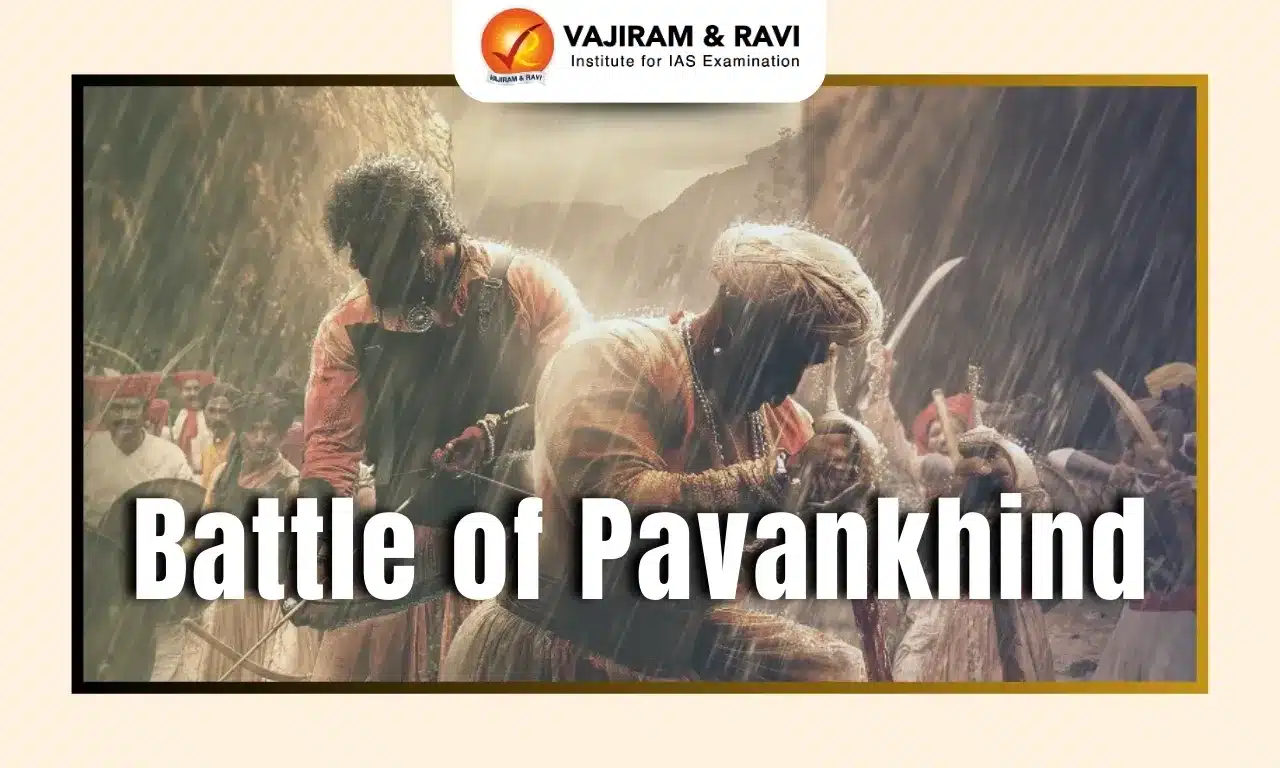
The Battle of Pavankhind was fought between the Maratha warriors Baji Prabhu Deshpande and Sambu Singh Jadhav against Siddi Masud of Bijapur Sultanate. The war was fought on 13 July 1660, at a mountain pass in the vicinity of Vishalgad fort, near the city of Kolhapur. The war ended with the Maratha forces losing against the Bijapur state. In this article, we are going to cover about the history of Pavankhind battle, battles between Maratha forces and Adilshah. 

Battle of Pavankhind History 

The Chhatrapati Shivaji Maharaj forces defeated the Adilshahi generals and as a rebellion, Adilshah sent Siddi Jauhar to fight against the Marathas. At the same time, Adilshah also took the assistance from Mughals leading to Shaista Khan, attacking from north towards Pune. At the same time, Siddi Jauhar attacked the Panhala Fort but failed to enter it. Instead of fighting back, Shivaji Maharaj planned a safer escape to reach Fort Vishalgad to continue the battle from there. 

Adilshahi Forces Composition 

Siddi Jauhar led the Adilshahi forces, supported by Siddi Masud and Fazal Khan. Meanwhile, Jasvantrao Dalvi of Palavani and Survey of Shringarpur besieged Vishalgad.

Composition of Maratha Forces

Shivaji Maharaj commanded the Maratha army with the support of leaders like Bandal, Jadhavrao, and his trusted Sardar, Bajiprabhu Deshpande. Despite being vastly outnumbered, the Marathas had around 600 skilled light infantry soldiers—experienced mountaineers from the naval zone who had never been conquered before.

Battle of Pavan Khind Events Serial Wise

In the Maratha War the Panhala Fort was tightly surrounded by the Siddi Jauhar army, making it difficult for anyone to escape. In order to create a diversion, Shivaji Maharaj sent his messenger to pretend to be negotiating a peace treaty. Siddi Jauhar got distracted by this negotiation and let his guard down. 

Shivaji Maharaj saw this as an opportunity and along with his army of 600 warriors, headed by Bajiprabhu Deshpande, headed towards Vishalgad. The Adilshahi forces believed one of them to be Shivaji and quickly captured him, only to find out he was a soldier named Shiva Kashid. As the enemy moved forward, Siddi Masood, Jauhar’s son-in-law led the attack. While all this happened, Shivaji reached Ghod Khind, while Bajiprabhu Desh fought the war with only 300 soldiers, while Shivaji raced to Vishalgad.

Battle of Pavan Khind Aftermath

After the end of war, Ghod Khind was renamed as Pavan Khind. The armies of both Adilshahi and Maratha fought their final war here in Pavan Khind where the Marathas won and gained the title of autonomous power. The war proved a sacrifice of BajiPrabhu Deshpande and Shiva Kashid. 

Battle of Pavan Khind: Important Facts 

The table below shows the important facts about the Battle of Pavan Khind.

Events

Battle of Pavan Khind

Date

13 July 1660

Location

Pavan Khind, Vishalgad, Maharashtra, India

Forces Involved

Maratha Empire and Bijapur Sultanate Forces

Result

The Adilshahi forces were strong against the Maratha army.

Related Articles
Important Battles in Indian History Important Battles of Mughal Empire
Battle of Kannauj Battle of Khanwa
Battle of Purandar Battle of Longewala
Battle of Hydapses Battle of Wandiwash
Battle of Tarain Battle of Chengam
Battle of Porto Novo Battle of Pollilur
Battle of Salher Battle of Pavankhind
Battle of Kolhapur Battle of Bhupalgarh
Battle of Sinhagad Battle of Surat
Battle of Walong Battle of Saragarhi
Battle of Rezang La Maratha Wars List

Battle of Pavankhind FAQs

Q1: Who won the Battle of Pavan Khind?

Ans: The Marathas, led by Bajiprabhu Deshpande, secured Shivaji Maharaj’s safe escape, making it a strategic victory.

Q2: How many Marathas fought in Pavan Khind?

Ans: Around 300 Maratha warriors fought under Bajiprabhu Deshpande to defend the pass.

Q3: Was Baji Prabhu Deshpande against Shivaji?

Ans: No, Bajiprabhu Deshpande was a loyal commander and sacrificed his life for Shivaji Maharaj.

Q4: Is Pavan Khind a true story?

Ans: Yes, the Battle of Pavan Khind is a historical event showcasing Maratha bravery.

Q5: How many hours did Baji Prabhu Deshpande fight?

Ans: He fought relentlessly for about five to six hours to delay the enemy.

Battle of Salher, History, Events, Challenges, Aftermath

Battle of Salher

In 1671, Chhatrapati Shivaji launched an initiative to end Mughal rule from the Baglan region, leading to the capture of key forts. Aurangzeb, who was in rage, sent Diler Khan, while Bahadur Khan laid siege to Salher. Shivaji assigned the task to Moropant Pingle and Prataprao Gujar to counter the Mughals. The Marathas, initially retreating, later regrouped and decisively defeated Ikhlas Khan. The victory forced Bahadur Khan to abandon Salher. Sabhasad Bakhar records 10,000 casualties and significant loot.

Battle of Salher

The Battle of Salher (1672) was a significant military engagement between the Marathas and the Mughals, fought near the Salher Fort in present-day Maharashtra. It was a decisive victory for the Marathas under Chhatrapati Shivaji, marking one of their most significant victories over the Mughal Empire.

Battle of Salher History

The Treaty of Purandar (1665) forced Chhatrapati Shivaji to surrender 23 forts, including strategic ones like Sinhagad, Purandar, and Lohagad, to the Mughals. At the time the Maratha Empire in Nashik region, including Salher and Mulher, was under Mughal control. Following Shivaji’s escape from Agra in 1666, tensions remained until Aurangzeb’s renewed anti-Hindu policies gaslighting conflict. Between 1670-1672, Shivaji’s forces reclaimed several forts, raided Baglan, Khandesh, and Surat, and ultimately secured a decisive victory over a 40,000-strong Mughal army near Salher, marking a significant expansion of his power and territorial control.

Battle of Salher Series of Events

In January 1671, Sardar Moropant Pingle led the Maratha War of 15,000 soldiers to capture Mughal forts, including Aundha, Patta, Trimbak, and later launched a battle on Salher and Mulher. In response, Aurangzeb sent generals Ikhlas Khan and Bahlol Khan with 12,000 troops to reclaim Salher. By October 1671, the Mughals had laid siege to the fort, prompting Shivaji to positioned Moropant Pingle and Prataprao Gujar to counter them.

Approaching from different directions, Prataprao launched the first attack but was temporarily forced to withdraw. However, Moropant’s soldiers soon joined him on an open battlefield near Salher. Despite being nearly 2:1, the Marathas defeated the Mughal forces, leading to an intense day-long battle.

The battle resulted in around 10,000 casualties on both sides. The Marathas’ swift cavalry proved superior to the Mughals' heavily equipped military. The Mughal army was completely routed, suffering a humiliating defeat. The victorious Marathas seized 6,000 horses, an equal number of camels, 125 elephants, and an entire Mughal supply train, along with vast treasures, gold, jewels, and luxurious goods.

Battle of Salher Aftermath

In January 1671, Sardar Moropant Pingle led 15,000 Maratha troops to capture Mughal forts, including Aundha, Patta, and Trimbak, before advancing toward Salher and Mulher. In response, Aurangzeb sent Ikhlas Khan and Bahlol Khan with 12,000 cavalry to reclaim Salher. By October, the Mughals laid siege to the fort, prompting Shivaji to send Moropant Pingle and Prataprao Gujar to counter them.

Prataprao attacked first but had to retreat. Moropant’s forces soon reinforced him, and together they launched a counter offensive on the open plains near Salher. The battle lasted an entire day, with over 10,000 casualties. Despite being outnumbered, the Marathas secured a decisive victory.

The Marathas seized 6,000 horses, camels, elephants, and Mughal treasures. Sabhasad Bakhar describes the battlefield as soaked in blood. This victory cemented Shivaji’s military prowess and strengthened the foundation of Hindavi Swaraj.

Battle of Salher Consequences

Historians regard the Battle of Salher as a significant milestone in medieval Indian history, marking the first major victory of a Hindu army over Muslim invaders since the First Battle of Tarain (1191). Unlike Shivaji’s previous successes, which largely relied on guerrilla tactics, this battle demonstrated the effectiveness of the Marathas’ light cavalry against the numerically superior Mughal forces in open warfare.

The triumph was so remarkable that Saint Ramdas addressed Shivaji as Gajpati (Lord of Elephants), Haypati (Lord of Cavalry), Gadpati (Lord of Forts), and Jalpati (Master of the High Seas) in a famous letter. While not a direct outcome of this battle, Shivaji’s growing power and influence eventually led to his coronation as Chhatrapati in 1674, formally establishing him as an emperor and reinforcing the Maratha vision of Hindavi Swaraj.

Related Articles
Important Battles in Indian History Important Battles of Mughal Empire
Battle of Kannauj Battle of Khanwa
Battle of Purandar Battle of Longewala
Battle of Hydapses Battle of Wandiwash
Battle of Tarain Battle of Chengam
Battle of Porto Novo Battle of Pollilur
Battle of Salher Battle of Pavankhind
Battle of Kolhapur Battle of Bhupalgarh
Battle of Sinhagad Battle of Surat
Battle of Walong Battle of Saragarhi
Battle of Rezang La Maratha Wars List

Battle of Salher FAQs

Q1: In which battle did Shivaji defeat Mughals?

Ans: The Battle of Salher was a battle fought between the Maratha Empire and the Mughal Empire in February 1672 CE.

Q2: Who won battle of basra?

Ans: The Battle of Basra (1986) was fought between Iran and Iraq during the Iran-Iraq War (1980–1988). It was part of Operation Karbala-5, one of the largest and bloodiest offensives launched by Iran to capture the strategic city of Basra in southern Iraq.

Q3: Who won the Battle of Purandar?

Ans: The Mughal forces, led by Jai Singh, won the Battle of Purandar in 1665, forcing Shivaji to sign the Treaty of Purandar, which resulted in the Marathas surrendering 23 forts.

Q4: Who had defeated the Mughal army in Salwar?

Ans: Battle of Salher (1672), the Marathas under Chhatrapati Shivaji decisively defeated the Mughal army in an open-field battle.

Q5: Who defeated Mughals 17 times?

Ans: The Ahoms of Assam defeated the Mughals 17 times in various battles between the early 17th and 18th centuries.

Battle of Surat 1664, History, Series of Events, Aftermath

Battle of Surat

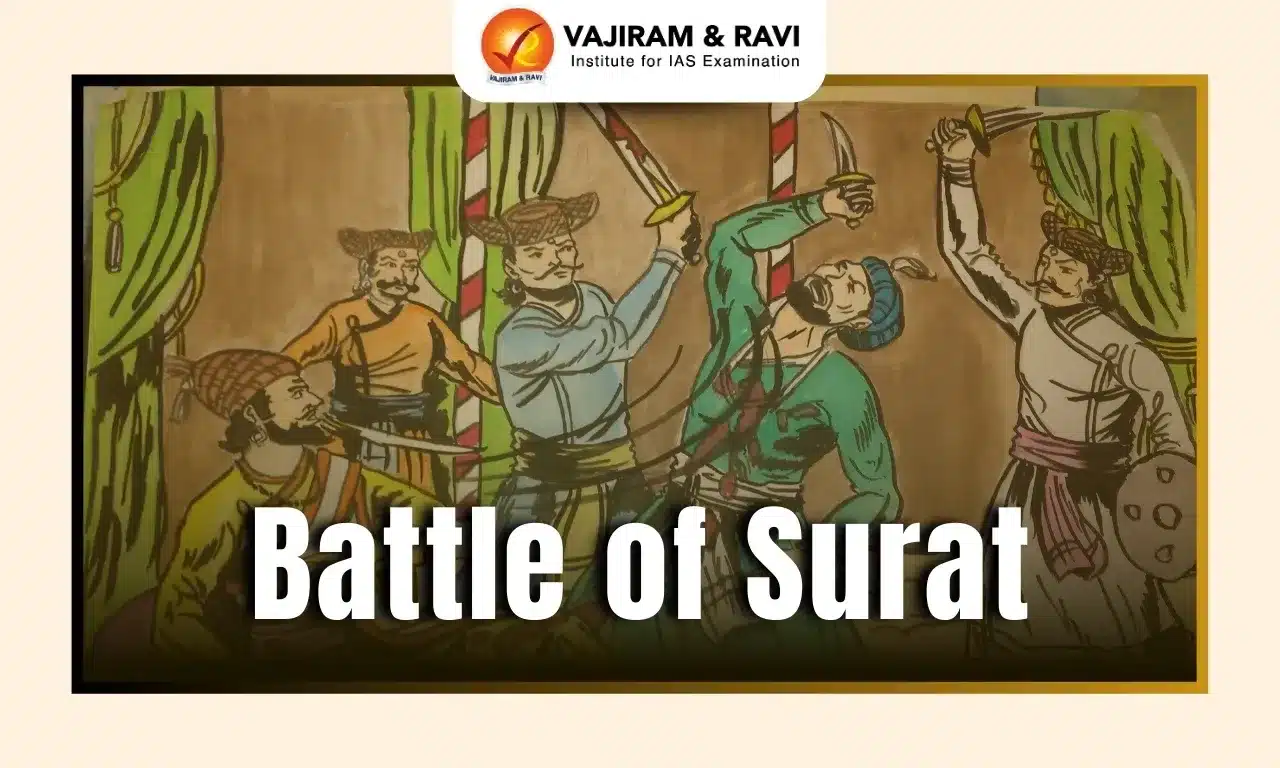
The Battle of Surat fought on January 5, 1664 in between the Maratha and the mughal empire, was led by Shivaji Maharaj. Surat, an important port city and trade center of Mughals, was attacked by the Marathas. Prince Muazzam (Emperor Aurangzeb) the governor in chief of Gujarat fought against the marathas. Eventually the Marathas won the war and the Surat city was ransacked for six days. In this article, we are going to cover the Battle of Surat History, the components of the war and significant consequences. 

Battle of Surat History 

The Battle of Surat was an important event that happened on 5 February 1664. At this time, the Mughal Empire was at its highest power , while the Maratha Empire was an emerging regional force. Shivaji launched this battle to increase his territory and challenge mughal authority. 

At the same time, Shaista Khan, the mughal governor, engaged in a war against the Marathas in the Deccan. This war weakened the financial condition of the Maratha kingdom. In order to revive the treasury, Shivaji created a plan to attack Surat, a wealthy Mughal stronghold and thriving port city. The goal was to conquer and plunder the riches and transfer the wealth to Raigad Fort, the primary residence. 

Mughal Forces at Surat

The city's defenses were weak, and Inayat Khan, the local Mughal Subedar, could only deploy 1,000 armed men for protection. However, this proved insufficient against the swift and strategic attack launched by Shivaji. As the battle unfolded, the Mughal garrison was overwhelmed, and Shivaji’s forces set the regional shipping sector ablaze, dealing a severe blow to Mughal trade and influence.

Maratha Forces at Surat

Shivaji led a well-organized force of over 8,000 cavalrymen, accompanied by his trusted commanders. The Marathas’ mobility and guerrilla tactics allowed them to swiftly overrun the city, ensuring a decisive victory.

Battle of Surat Course

The Maratha War of Battle of Surat was a struggle between the Marathas and the Mughal Empire. Daud Khan and Shaista Khan had attacked the Pune-Supa region, setting the entire village on fire. Shaista Khan continued to seize control of Lal Mahal in Pune, looting the wealth and enforcing the mughal dominance in the Deccan. Aurangzeb with an aim to consolidate his rule, targeted the vulnerable people of Pune and Supa. In response, Chhatrapati Shivaji devised a bold strategy to attack Surat- the wealthiest trade hub. The decision followed the night raid on Shaista Khan during which he amputated the thumb of Mughal general. Instead of launching a direct assault on the Surat Fort, Shivaji initially demanded tribute from the city's wealthy merchants. However, upon their refusal, he launched a full-fledged attack on the city.

The element of surprise played a crucial role, leaving the Mughal chieftains unprepared. Rather than facing Shivaji’s forces head-on, they sought refuge inside the Fort of Surat. Over the course of three days, the Marathas plundered the city, targeting the riches of traders and merchants from Mughal Gujarat Subah, Portuguese settlements, and other commercial hubs. The residences of prominent traders like Virji Vora, Haji Zahid Beg, and Haji Kasim were raided, yielding gold, silver, pearls, diamonds, rubies, and emeralds.

Notably, Shivaji refrained from looting the homes of foreign missionaries, demonstrating his strategic and principled approach to warfare. The Battle of Surat not only boosted Maratha finances but also sent a strong message to the Mughal Empire, proving that Shivaji was a formidable force against their expansionist ambitions.

Chhatrapati Shivaji in Battle of Surat

The first is of Father Ambrose, a Catholic monk. Shivaji was informed that this person’s home was deserving of looting. Father Ambrose was a devout man, and Chhatrapati Shivaji was aware of this and refrained from looting his home. His home remained unharmed during the battle of Surat. The second businessman was Mohandas Parekh. He was also one of Surat’s wealthiest businessmen. It so happened that Parekh had passed away a few months earlier and that his wife was now his sole heir. The merchant has also been a big humanitarian throughout his life. Shivaji immediately outlawed the robbing of his home or of his valuables and, in fact, stationed guards to ensure that this would not occur.

Battle of Surat Aftermath

In this Maratha War, before the Mughal Empire in Delhi was informed of the battle of Surat, all of this loot had already been transferred to the Deccan. Later, the Maratha state was built up and strengthened with this wealth. The Mughal Emperor Aurangzeb was angered by this occurrence. After Shivaji’s invasion of the Port of Surat, trade did not thrive as much, which resulted in a decrease in the Mughal Empire’s revenue. The battle of Surat resulted in the victory of the Maratha Empire against Mughal forces.

The second sacking of Surat occurred in 1670. This time, Shivaji was directly engaged in battle with Mughal forces deployed throughout the Sahyadris. He was also squaring off against Janjira Siddi. The Mughal boats from Surat attacked the back of his soldiers when they were fighting the Siddi. Shivaji responded by attacking Surat. This time, Lohagad, which is close to Pune, received the loot.

Related Articles
Important Battles in Indian History Important Battles of Mughal Empire
Battle of Kannauj Battle of Khanwa
Battle of Purandar Battle of Longewala
Battle of Hydapses Battle of Wandiwash
Battle of Tarain Battle of Chengam
Battle of Porto Novo Battle of Pollilur
Battle of Salher Battle of Pavankhind
Battle of Kolhapur Battle of Bhupalgarh
Battle of Sinhagad Battle of Surat
Battle of Walong Battle of Saragarhi
Battle of Rezang La Maratha Wars List


Battle of Surat FAQs

Q1: Why did Shivaji sack Surat?

Ans: Shivaji sacked Surat in 1664 to weaken the Mughal Empire financially and replenish the Maratha treasury.

Q2: How did Surat get its name?

Ans: Surat derives its name from the Gujarati word Suraj, meaning "good land" or "beautiful place."

Q3: How many times did Shivaji loot Surat?

Ans: Shivaji looted Surat twice, first in 1664 and again in 1670.

Q4: When did the British capture Surat?

Ans: The British captured Surat in 1759 after defeating the Dutch forces.

Q5: Why is Surat called the Diamond City?

Ans: Surat is called the Diamond City because it is a global hub for diamond cutting and polishing, handling over 90% of the world's diamonds.

National Critical Mineral Mission, Launch Date, Outlay, Objectives

National Critical Mineral Mission

The Government of India launched the National Critical Mineral Mission (NCMM) in 2025 to establish a robust framework for self-reliance in the critical mineral sector. The mission envisages a total outlay of ₹34,300 crore over a period of seven years.

National Critical Mineral Mission Objectives

The mission focuses on boosting domestic production, encouraging private sector participation, strengthening international partnerships, and streamlining regulations to ensure a steady supply of minerals essential for clean energy technologies. Two main Objectives are: 

  • To secure India’s critical mineral supply chain by ensuring mineral availability from domestic and foreign sources.
  • Strengthening the value chains by enhancing technological, regulatory, and financial ecosystems to foster innovation, skill development, and global competitiveness in mineral exploration, mining, beneficiation, processing, and recycling.

National Critical Mineral Mission Components

The NCMM will encompass all stages of the value chain, including mineral exploration, mining, beneficiation, processing, and recovery from end-of-life products.

  • Increasing Domestic Minerals Production: The mission will intensify the exploration of critical minerals within the country and in its offshore areas. It also proposes development of a stockpile of critical minerals within the country.
  • Acquisition of Critical Mineral Assets Abroad: The mission aims to encourage Indian public sector enterprises and private sector companies to acquire critical mineral assets abroad and enhance trade with resource-rich countries. 
  • Recycling Critical Minerals: The mission includes provisions for setting up of mineral processing parks and promotion of recycling of critical minerals from e-waste, battery scrap, and industrial waste.
  • Trade and Markets for Critical Minerals: Enhance trade with resource-rich countries and diversify supply chains to reduce import dependence.
  • Scientific Research & Technological Advancement: The mission will promote research in critical mineral technologies and proposes setting up a Centre of Excellence on Critical Minerals.
  • Human Resource Development: Skill development programmes, specialised training, and academic initiatives to build a skilled workforce.
  • Developing Effective Funding, Financing and Fiscal Incentives: The  mission will offer financial incentives for critical mineral exploration.

Critical Minerals Meaning 

Critical minerals are those minerals that are essential for a country’s economic development, technological advancement, and strategic sectors, but face a high risk of supply disruption due to import dependence, limited domestic availability, or geopolitical and market constraints.

In 2023, the Ministry of Mines, released a list of 30 critical minerals for India. These minerals are Antimony, Beryllium, Bismuth, Cobalt, Copper, Gallium, Germanium, Graphite, Hafnium, Indium, Lithium, Molybdenum, Niobium, Nickel, PGE, Phosphorous, Potash, REE, Rhenium, Silicon, Strontium, Tantalum, Tellurium, Tin, Titanium, Tungsten, Vanadium, Zirconium, Selenium and Cadmium.

Usage of Critical Minerals

Critical minerals are essential components of various clean energy technologies and industries. Their importance can be highlighted across different sectors:

1. Solar energy

  • Critical minerals such as silicon, tellurium, indium, and gallium are vital for the production of photovoltaic (PV) cells used in solar panels.
  • India’s current solar capacity of 64 GW is heavily dependent on these minerals.

2. Wind energy

  • Rare earth elements like dysprosium and neodymium are used in permanent magnets for wind turbines.
  • India aims to increase its wind energy capacity from 42 GW to 140 GW by 2030, necessitating a stable supply of these minerals.

3. Electric vehicles (EVs)

  • Lithium, nickel, and cobalt are key materials used in lithium-ion batteries.
  • Under the National Electric Mobility Mission Plan (NEMMP), India plans to deploy 6–7 million EVs by 2024, leading to increased demand for these critical minerals.

4. Energy storage

  • Lithium-ion batteries used in advanced energy storage systems depend on lithium, cobalt, and nickel.

Critical minerals are essential for a country's economic development and national security, and their lack of availability or concentration in a few geographical locations can lead to supply chain vulnerabilities.

Conclusion 

India aims to reduce the emissions intensity of its GDP by 45% by 2030 (from 2005 levels), achieve 50%of its electric power capacity from non-fossil sources by 2030, and reach net-zero emissions by 2070. To achieve these climate goals, the National Critical Mineral Mission (NCMM) plays a vital role by building a resilient and self-reliant ecosystem for critical minerals.

National Critical Mineral Mission FAQs

Q1: What is the National Critical Mineral Mission (NCMM)?

Ans: The NCMM is a Government of India initiative launched in 2025 to build a self-reliant and secure supply chain for critical minerals. It aims to strengthen exploration, mining, processing, recycling, and global partnerships in the sector.

Q2: What are critical minerals?

Ans: Critical minerals are those essential for economic development, clean energy, and strategic industries, but are vulnerable to supply disruptions due to import dependence, limited domestic reserves, or geopolitical risks.

Q3: How many critical minerals has India identified?

Ans: In 2023, the Ministry of Mines identified 30 critical minerals for India, including lithium, cobalt, nickel, rare earth elements, graphite, silicon, and copper.

Q4: What are the main objectives of the NCMM?

Ans: The mission aims to Secure India’s critical mineral supply from domestic and foreign sources and to Strengthen the entire value chain through technology, regulation, financing, and skill development.

Q5: Why are critical minerals important for India?

Ans: They are essential for clean energy technologies such as solar panels, wind turbines, electric vehicles, and energy storage systems. A reliable supply of these minerals is crucial for achieving India’s climate targets and ensuring energy and national security.

MHA Guidelines on Vande Mataram, Legal Provisions and Acts

Vande Mataram Guidelines

The Union Ministry of Home Affairs (MHA) has released new guidelines requiring that all six stanzas of the National Song must be performed, and when both are played together, Vande Mataram should be rendered before the National Anthem. 

The directive has been introduced to mark the 150th anniversary of the national song’s composition, highlighting its historical and patriotic importance.

Occasions for Playing the National Song

  • The official version of Vande Mataram must be performed during civil investiture ceremonies conducted by the government.
  • It is required to be played during the arrival and departure of the President of India at formal state functions and other government-organised events.
  • The National Song must be played immediately before and after the President delivers an address to the nation through All India Radio and television broadcasts.
  • The rendition is also mandatory during the arrival and departure of Governors or Lieutenant Governors at official state functions within their respective States or Union Territories.
  • Vande Mataram must be played during ceremonial events when the National Flag is brought on parade.
  • The Government of India may direct the performance of the National Song on additional occasions as required.
  • When Vande Mataram is performed by a ceremonial band, it must begin with a drumroll lasting seven slow marching paces, unless another clear signal is given indicating the start of the song.

Mass Singing of the National Song

  • The guidelines encourage mass singing of the official version during the unfurling of the National Flag at cultural or ceremonial events, excluding parade ceremonies.
  • The National Song should also be sung collectively during the arrival of the President at public or government functions, other than formal state ceremonies, and immediately before his departure.
  • The Ministry has clarified that on all such occasions, the complete six-stanza official version of Vande Mataram must be used and group participation should be promoted wherever possible.
  • Schools have been advised to begin the day with community singing of Vande Mataram to encourage patriotism among students.
  • Educational institutions are also encouraged to create awareness and promote respect for the National Song, National Anthem, and National Flag among students.

About Vande Mataram

Vande Mataram is India’s National Song, written by Bankim Chandra Chatterjee, which celebrates the nation as a motherland and symbolizes patriotism and unity. The song played a crucial role during India’s freedom struggle and continues to represent national pride and cultural heritage.

  • Year of Composition: Composed in the 1870s and later published in the novel Anandamath in 1882.
  • Adoption as National Song: Officially adopted by the Constituent Assembly on 24 January 1950.
  • Language: Originally written in Sanskrit and Bengali.
  • Total Stanzas: The complete song contains six stanzas.
  • Theme and Meaning: The song praises India as a divine mother and highlights the country’s natural beauty, strength, and cultural richness.
  • Role in Freedom Movement: It served as a patriotic slogan and inspired freedom fighters during British rule.
  • Cultural Importance: Vande Mataram remains a symbol of national unity, patriotism, and respect for the motherland.
  • Official Recognition: It holds the status of the National Song, while Jana Gana Mana is recognized as the National Anthem.
  • Modern Usage: The song is performed at government ceremonies, cultural events, educational institutions, and patriotic programs.

About National Anthem

The National Anthem of India, “Jana Gana Mana,” was written by Nobel Laureate Rabindranath Tagore and officially adopted on 24 January 1950. It reflects the unity, diversity, and sovereignty of India and is sung on important national and international occasions.

  • First Performance: First sung on 27 December 1911 at the Calcutta Session of the Indian National Congress.
  • Adoption: Officially adopted as the National Anthem of India on 24 January 1950.
  • Language: Written in highly Sanskritised Bengali.
  • Duration:
    • Full version takes 52 seconds to sing.
    • Short version takes about 20 seconds and includes the first and last lines.
  • Meaning and Theme:
    • The anthem praises India and highlights unity among different regions, cultures, and communities.
    • It represents national integrity and pride.
  • Occasions of Performance:
    • National celebrations like Republic Day and Independence Day
    • Official government ceremonies
    • International sporting and diplomatic events
    • School assemblies and patriotic programs
  • Legal Protection:
    • Protected under the Prevention of Insults to National Honour Act, 1971.
    • Disrespect or interruption during the anthem is punishable by law.
  • Protocol During Anthem:
    • Citizens must stand in attention posture while the anthem is played or sung.
    • The anthem must be performed with dignity and without alteration.
  • National Significance:
    • The National Anthem represents India’s identity, sovereignty, and unity, making it one of the most respected national symbols of the country.

Legal Provisions and Acts Related to National Honour

India has established specific legal provisions to protect the dignity and respect of its national symbols, including the National Flag, National Anthem, Constitution of India, and National Song.

  • The Prevention of Insults to National Honour Act, 1971 is the main law that protects India’s national symbols such as the National Flag, National Anthem, and Constitution of India from disrespect or misuse.
  • The Act prohibits any deliberate insult, damage, or disrespect toward the National Flag, including burning, defacing, defiling, or trampling it in public or private places.
  • Any person found guilty of insulting national symbols under this Act can face punishment that includes imprisonment for up to three years, a monetary fine, or both.
  • The Flag Code of India, 2002 provides detailed rules and guidelines regarding the correct display, use, and handling of the Indian National Flag by citizens, government bodies, and private organizations.
  • The Flag Code allows citizens to hoist the National Flag on any day, provided it is displayed with dignity, honour, and proper respect.
  • The National Flag should never touch the ground, floor, water, or be used as clothing, costume, decoration, or commercial promotional material.
  • The Flag must always be displayed in the correct proportion, colour combination, and design as specified under the Flag Code.
  • The Ministry of Home Affairs (MHA) has issued official guidelines regulating the performance and usage of the National Anthem, ensuring it is sung or played with dignity and uniformity across the country.
  • The full version of the National Anthem must be sung within 52 seconds, while a shorter version of approximately 20 seconds may be used on specific occasions.
  • Citizens are required to stand in an attention posture whenever the National Anthem is played or sung, except in certain exceptional circumstances permitted by law or court orders.
  • The National Anthem cannot be dramatized, distorted, parodied, or used for commercial entertainment purposes.
  • The Constitution of India promotes respect for national symbols through Article 51A, which outlines the Fundamental Duties of citizens.
  • The Supreme Court of India has repeatedly emphasized the importance of respecting national symbols and has clarified that such respect is linked to maintaining national unity and integrity.

MHA Guidelines on Vande Mataram FAQs

Q1: What are the MHA Guidelines on Vande Mataram?

Ans: The Ministry of Home Affairs (MHA) has issued official guidelines that standardize how and when Vande Mataram, India’s National Song, should be sung or played at government, state, educational, and public functions.

Q2: What is the official version of Vande Mataram as per MHA guidelines?

Ans: The official version includes all six stanzas of the original composition written by Bankim Chandra Chatterjee.

Q3: What is the official duration of Vande Mataram?

Ans: The complete official version of Vande Mataram has an approximate duration of 3 minutes and 10 seconds.

Q4: Is Vande Mataram mandatory in schools?

Ans: Yes, the guidelines recommend community or group singing of Vande Mataram in school assemblies to promote patriotism and awareness of national symbols.

Q5: Are people required to stand when Vande Mataram is played?

Ans: Yes, individuals must stand in attention posture when the official version is played or sung, except when it is part of a film, documentary, or newsreel.

Important Battles in Modern Indian History, List, Role

Important Battles in Modern Indian History

Battles in modern history of India play an important role in shaping the political, economic and social landscape of the nation. These battles are what define the fate and history of India, the impact of Mughal and British Rule and the consequences. In this article, we are going to cover the important battles fought in India during the modern history period. 

Important Battles in Modern Indian History 

Modern Indian History has witnessed many battles that have drastically influenced the territorial control, governance and India's transition into British Rule. These battles also express the resistance by Indian rulers against colonial expansion. Here is a list of all the important battles of modern Indian History: 

Carnatic Wars (1746-1763)

Fought between the French and the British for the power struggle in south India. The wars ended with the British emerging victorious over the French, establishing their control over southern India. The important battles include: 

War

Year

Outcome

First Carnatic War

1746-1748

Treaty of Aix-la-Chapelle (status quo maintained)

Second Carnatic War

1749-1754

British victory; Dupleix removed from India

Third Carnatic War

1756-1763

British defeated the French; Treaty of Paris (1763)

Battle of Plassey (1757)

The key highlighting features of Battle of Plassey are:

  • Combatants: British East India Company vs. Nawab of Bengal (Siraj-ud-Daulah) and French allies
  • Outcome: British victory; beginning of British dominance in India
  • Significance:
    • Marked the start of British rule in India.
    • Allowed the British to control Bengal's revenue system, leading to economic exploitation.
    • Exposed the role of betrayal (Mir Jafar sided with the British), highlighting internal political weaknesses.

Battle of Buxar (1764)

The key features of the Battle of Buxar are:

  • Combatants: British East India Company vs. Mughal Emperor Shah Alam II, Nawab of Oudh, and Nawab of Bengal
  • Outcome: British victory; Treaty of Allahabad (1765) signed
  • Significance:
    • Established British control over Bengal, Bihar, and Odisha.
    • The Mughal Emperor became a puppet under British influence.
    • British acquired the right to collect revenue (Diwani Rights), making them the dominant power in India.

Third Battle of Panipat (1761)

The key features of the Third Battle of Panipat are:

  • Combatants: Maratha Empire vs. Durrani Empire (Ahmad Shah Abdali)
  • Outcome: Durrani victory; Maratha power weakened
  • Significance:
    • One of the bloodiest battles in Indian history.
    • Severely weakened Maratha influence in North India.
    • Opened the door for British expansion, as Indian powers weakened.

Anglo-Mysore Wars (1767-1799)

The Anglo-Mysore Wars were fought in between the Mysore Kingdom and the British East India Company. Tipu Sultan is remembered to fiercely fight against the British expansion. Here is the list of the important Anglo-Mysore wars:

War

Year

Rulers Involved

Outcome

First Anglo-Mysore War

1767-1769

Hyder Ali vs. British

Treaty of Madras 

Second Anglo-Mysore War

1780-1784

Hyder Ali and Tipu Sultan vs. British

Treaty of Mangalore 

Third Anglo-Mysore War

1790-1792

Tipu Sultan vs. British

Treaty of Seringapatam (British victory)

Fourth Anglo-Mysore War

1799

Tipu Sultan vs. British

Tipu Sultan was killed; British annexed Mysore

Anglo-Maratha Wars (1775-1818)

The Anglo-Maratha Wars were fought between the British and the Marathas in three different phases. The Marathas are remembered as the last major hurdle for the British expansion. The Anglo-Maratha wars were:

War

Year

Outcome

First Anglo-Maratha War

1775-1782

Treaty of Salbai (peace between British and Marathas)

Second Anglo-Maratha War

1803-1805

British gained control over Delhi, Agra, and parts of central India

Third Anglo-Maratha War

1817-1818

Maratha Confederacy was dissolved; British gained full control over India

Anglo-Burma Wars (1824-1885)

The Anglo-Burma Wars were fought in the 19th Century in between the Kingdom of Burma and the British Empire. The wars were fought due to the British ambition to influence southwest Asia and secure strategic territories. The wars included:

War

Year

Outcome

First Anglo-Burma War

1824-1826

British annexed Assam, Manipur, and Arakan

Second Anglo-Burma War

1852

British annexed Lower Burma

Third Anglo-Burma War

1885

British annexed Upper Burma, making it a part of British India

Anglo-Afghan Wars (1839-1919)

The Anglo-Afghan Wars were fought between the Kingdom of Afghanistan and the British Empire three times in between the 20th and the 19th century, in order to control Afghanistan as a buffer state.

War

Year

Outcome

First Anglo-Afghan War

1839-1842

British defeat, withdrawal from Afghanistan

Second Anglo-Afghan War

1878-1880

British gained influence but later withdrew

Third Anglo-Afghan War

1919

Afghanistan gained full independence

Anglo-Sikh Wars (1845-1849)

The Anglo-Sikh Wars were fought between the Sikh empire and the british East India Company in the 19th century with the aim of annexing the sikh empire and expanding British rule in northern India. 

War 

Year 

Outcome

First Anglo-Sikh War

1845-46

British won; Treaty of Lahore signed

Second Anglo-Sikh War

1848-49

End of Sikh Rule; British annexed Punjab

Revolt of 1857 (First War of Independence)

The Revolt of 1857 (First War of Independence) was the first resistance movement the Indian people fought against the British East India Company. The war was fought in various parts of the country but was eventually suppressed by the British. 

Battle of Kohima and Imphal (1944)

The battle was fought between the British Indian Army and the Japanese Army, along with the INA (Azad Hind Fauj). It resulted in a British victory, effectively halting the Japanese advance into India. This battle is considered one of the most significant of World War II, as it ended Japanese ambitions of invading India. While it strengthened British control, it also played a crucial role in fueling Indian nationalist movements.

Role of Famous Battles in Modern History

The history of modern India is shaped by significant battles fought for territorial defense, independence, and political ideologies. These battles played a crucial role in shaping the nation’s future:

  • Colonial Power Struggles: Battles like Plassey and Buxar paved the way for British dominance in India for nearly two centuries.
  • British Expansion: The British defeated major Indian powers, including the Mughals, Marathas, Mysore, and Sikhs, to establish their control.
  • Economic Exploitation: British victories in battles like Plassey and Buxar led to financial dominance, revenue manipulation, and economic drain.
  • Cultural and Ideological Shifts: British rule imposed Western governance, education, and religious policies, reshaping Indian traditions.
  • Nationalist Awakening: The First War of Independence (1857) ignited a spirit of unity and resistance, laying the foundation for India’s freedom movement.
Related Articles
Important Battles in Indian History Important Battles of Mughal Empire
Battle of Kannauj Battle of Khanwa
Battle of Purandar Battle of Longewala
Battle of Hydapses Battle of Wandiwash
Battle of Tarain Battle of Chengam
Battle of Porto Novo Battle of Pollilur
Battle of Salher Battle of Pavankhind
Battle of Kolhapur Battle of Bhupalgarh
Battle of Sinhagad Battle of Surat
Battle of Walong Battle of Saragarhi
Battle of Rezang La Maratha Wars List


Important Battles in Modern India FAQs

Q1: What was the greatest battle in Indian history?

Ans: The Battle of Panipat (1761) is the greatest battle in Indian history.

Q2: What was the most famous battle in history?

Ans: The Battle of Kurukshetra (Mahabharata) is the most famous battle in history.

Q3: Which battle changed the course of Indian history?

Ans: The Battle of Plassey (1757) changed the course of Indian history.

Q4: What was the last war fought by India?

Ans: The Kargil War (1999) was last fought by India.

Q5: Which war did India lose?

Ans: The Indo-China War (1962) was lost by India.

Proboscis Monkeys, Large Nose, Features, Distribution, Conservation

Proboscis Monkeys

The Proboscis Monkey (Nasalis larvatus) is a large arboreal Old World monkey found only on the island of Borneo. It belongs to the genus Nasalis, named after the Latin word nasus meaning nose. The species is well known for the male’s long hanging nose and pot shaped belly. It lives mainly in mangrove, coastal and riverine forests and is one of the best swimming monkeys in Asia.

Proboscis Monkeys Features

Proboscis Monkeys show clear differences between males and females in size and nose shape.

  • Large Nose: Male noses can grow over 10 cm long. The large nasal cavity helps produce loud honks and roars for attracting females and showing dominance.
  • Colour: Fur is reddish-brown with lighter underparts. Babies are born with blue faces. 
  • Adaptation: Partially webbed toes help them swim and cross rivers.
  • Diet: They eat leaves, unripe fruits, seeds and flowers from over 55 plant species. 
  • Groups: Groups usually have one male and several females, while larger bands can reach 60 individuals.

Also Read: Tropical Evergreen Forests

Proboscis Monkeys Distribution

Proboscis Monkeys are limited to Borneo. The island divided in three countries: 

  • Indonesia: Found mainly in Kalimantan, including Tanjung Puting and Kutai National Parks. The largest populations remain here.
  • Malaysia: Present in Sabah and Sarawak, especially along the Kinabatangan River and Bako National Park.
  • Brunei: Found in small riverine and coastal forest areas with legal protection.

Also Read: Coniferous Forest

Proboscis Monkeys Conservation Status

The Proboscis Monkeys species is facing serious decline. The conservation efforts include:

  • IUCN Status: Listed as Endangered.
  • Population: More than 50% population decline in about 40 years. 
  • CITES: Listed under Appendix I.
  • Threats: Main threats include logging, oil palm plantations and hunting.
  • Conservation: Found in protected areas across Brunei, Indonesia and Malaysia to support conservation efforts.

Proboscis Monkeys FAQs

Q1: What is the scientific name of the Proboscis Monkey?

Ans: The scientific name of the Proboscis Monkey is Nasalis larvatus. It belongs to the Old World monkey group under the subfamily Colobinae.

Q2: Where are Proboscis Monkeys found?

Ans: They are found only on the island of Borneo, which is divided among Indonesia, Malaysia and Brunei, mainly in mangrove and riverine forests.

Q3: Why do male Proboscis Monkeys have large noses?

Ans: Male monkeys have long noses, sometimes over 10 cm, which help produce loud calls and attract females during mating.

Q4: What do Proboscis Monkeys eat?

Ans: They mainly eat young leaves, unripe fruits, seeds and flowers, feeding on more than 55 different plant species.

Q5: What is the conservation status of the Proboscis Monkey?

Ans: The species is listed as Endangered by the IUCN due to habitat loss, logging, oil palm expansion and hunting.

International Development Association, headquarters, History, Functions

International Development Association

The International Development Association (IDA) is a part of the World Bank Group. It was established in 1960 to provide financial help to the world’s poorest countries. IDA gives low-interest loans and grants to support development projects in areas like education, health, agriculture, infrastructure, and poverty reduction.

International Development Association History

  • The International Development Association (IDA) was established on 24 September 1960 as part of the World Bank Group to provide concessional loans and grants to the poorest countries.
  • Its headquarters is in Washington D.C.
  • It initially focused on infrastructure but later expanded to agriculture (including support to the Green Revolution), health, education, governance and poverty reduction.
  • Over six decades, IDA has supported thousands of projects in more than 100 countries, helping them tackle economic crises, natural disasters, conflict and pandemics like COVID-19.
  • It also addresses global challenges such as climate change, gender inequality and job creation.
  • In recent years, IDA strengthened its financial capacity by receiving a AAA credit rating and entering global capital markets to raise more resources.

International Development Association (IDA) Key Functions

  • IDA supports poor countries in education, health, water, agriculture, infrastructure, governance and job creation to reduce poverty and improve living standards. It provides stable financial assistance and acts as an important channel for global development aid.
  • It helps countries during crises through the Crisis Response Window (CRW), supporting situations like famine, earthquakes and disease outbreaks.
  • IDA also advises on poverty reduction and debt management through policies like the Sustainable Development Finance Policy.
  • Under its latest funding cycle, IDA20 (2022–2025), a record $93 billion was mobilized, focusing on climate change, conflict, gender equality, jobs, human capital, debt transparency, governance, technology and crisis preparedness.

International Development Association (IDA) Governance and Working

  • IDA is owned and supervised by 175 member countries. It is funded mainly by contributions from donor governments, which meet every three years to provide fresh funds.
  • It works along with the International Bank for Reconstruction and Development (IBRD).
  • Since 1960, IDA has provided $600 billion to 116 countries.
  • IDA gives funds to the poorest countries based on their low income level (GNI per capita below $1,335 in FY2025) and their inability to borrow from international markets. It also considers how well countries manage their economy and development programs.
  • Projects are carried out by the borrowing country with support from the World Bank. 
  • Their progress and results are regularly monitored and independent evaluations are conducted to check effectiveness and long-term impact.
  • IDA gives financial help to 78 low-income countries through grants and very low-interest loans. It is one of the largest sources of development assistance for these countries, especially for basic services like education and health.
  • IDA loans have very low or zero interest and long repayment periods of 30-40 years. Many poor countries receive grants, especially those facing heavy debt problems.
  • Thirty-five countries have graduated from IDA assistance and some, including India, later became donor countries.

IDA also supports debt relief through the Heavily Indebted Poor Countries (HIPC) and Multilateral Debt Relief Initiative (MDRI).

International Development Association FAQs

Q1: What is the International Development Association (IDA)?

Ans: IDA is a part of the World Bank, set up in 1960 to help the poorest countries with financial support.

Q2: How does IDA provide assistance?

Ans: International Development Association through grants and low or zero-interest loans with long repayment periods (30-40 years).

Q3: How is the International Development Association funded?

Ans: It is funded by the contributions from 175 member countries, which provide funds every three years.

Q4: Which countries receive IDA support?

Ans: International Development Association supports 78 low-income countries with GNI per capita below $1,335 (FY2025) and limited access to global markets.

Q5: What role does IDA play in crises?

Ans: International Development Association supports countries during famine, disasters, conflicts and pandemics and also provides debt relief under HIPC and MDRI.

Darling River, Location, Origin, Tributaries, Source, Basin

Darling River

Darling River, located in southeastern Australia, is the third-longest river in the country and forms part of the crucial Murray-Darling Basin, which supports over 40% of Australia's agricultural production.

Darling River

  • The Darling River is located in the eastern and south-eastern part of the continent. 
  • It flows mainly through the state of New South Wales and forms the northern and western component of the larger Murray–Darling Basin.
  • The river drains the western slopes of the Great Dividing Range, which is the major watershed of eastern Australia. Unlike many short coastal rivers that flow eastward into the Pacific Ocean, the Darling River flows inland across semi-arid plains before eventually joining the Murray River at Wentworth in New South Wales. 
  • The river system plays a central role in supporting inland agricultural regions of Australia.

Darling River Origin and Source

  • The Darling River formed by the confluence of the Barwon and Culgoa Rivers near the town of Bourke in New South Wales. 
  • The Barwon River  is formed by the meeting of the Macintyre and Weir Rivers, which rise in the Great Dividing Range in Queensland and northern New South Wales. Therefore, the ultimate source of the Darling River system lies in the Great Dividing Range. 
  • The river is entirely rain-fed and does not receive any contribution from glaciers or permanent snowfields. 
  • Its discharge depends heavily on seasonal rainfall patterns in Queensland, making its flow highly irregular and variable.

Darling River Tributaries

The Darling River has an extensive network of tributaries that contribute to its drainage basin. 

  • Important northern tributaries include the Condamine–Balonne River, the Warrego River, and the Paroo River, which originate in the uplands of Queensland. 
  • These rivers are strongly influenced by seasonal rainfall and often contribute significant water during flood events. 
  • However, many of them are intermittent or ephemeral during dry periods.
  • In New South Wales, important tributaries include the Macquarie River, the Bogan River, the Culgoa River, and the Barwon River.
  • The overall drainage pattern of the basin is predominantly dendritic, developed over ancient sedimentary plains with a gentle slope.

Read about: Loire River

Darling River Basin

  • The Darling River forms a major component of the Murray–Darling Basin, which is the largest river basin in Australia. The Darling Basin constitutes the northern and western portion of this larger basin system.
  • The entire Murray–Darling Basin covers approximately one million square kilometres, accounting for nearly 14 percent of Australia’s total land area. 
  • Physiographically, the basin consists mainly of flat to gently undulating plains with extensive alluvial floodplains. 
  • The river has a very low gradient, which causes it to flow slowly and develop a meandering course. 
  • Oxbow lakes and floodplain features are common due to periodic flooding. 
  • The soils in the basin include fertile alluvial soils as well as clay-rich and saline soils in irrigated areas.
  • Climatically, the basin lies largely in a semi-arid to arid zone. Annual rainfall is generally low, ranging between 250 to 500 millimetres in many areas. 
  • The basin is strongly influenced by the El Nino-Southern Oscillation cycle, which leads to alternating drought and flood conditions.
  • Economically, the basin is the backbone of inland Australian agriculture. It supports major crops such as wheat, cotton, rice, barley, citrus fruits, and grapes used in the wine industry.

Darling River Ecology

Despite its semi-arid location, the Darling River system supports important ecological zones. 

  • The river sustains riparian vegetation along its banks and supports floodplain forests and wetlands. 
  • Parts of the Murray-Darling Basin are designated as Ramsar wetlands due to their ecological importance. 
  • The basin provides habitat for native fish species such as the Murray cod, golden perch, and silver perch.
  • It also supports waterbird breeding colonies during flood periods.

The Darling River has been extensively regulated to support irrigation and water supply. The most significant storage system on the river is the Menindee Lakes system, located near the town of Menindee in New South Wales. This system consists of a series of interconnected natural lakes that have been modified to function as large reservoirs. The lakes are used for irrigation supply, urban water provision, flood control, and flow regulation.

Darling River FAQs

Q1: Where is the Darling River located?

Ans: The Darling River is located in southeastern Australia and flows mainly through the state of New South Wales as part of the Murray–Darling Basin.

Q2: Which major river does the Darling River join?

Ans: The Darling River joins the Murray River at Wentworth in New South Wales.

Q3: How is the Darling River formed?

Ans: It is formed by the confluence of the Barwon River and the Culgoa River near Bourke in New South Wales.

Q4: Name two important tributaries of the Darling River system.

Ans: Important tributaries include the Warrego River, Paroo River, Bogan River, Macquarie River, and Condamine–Balonne system.

Q5: Which major river basin does the Darling River belong to?

Ans: The Darling River is a major component of the Murray–Darling Basin, the largest river basin in Australia.

Fold Mountains, Types, Formation, Distribution, Features, Challenges

Fold Mountains

Mountains are large natural elevations of the Earth’s surface formed through different geological processes over millions of years. Based on their origin, mountains are mainly classified into Fold Mountains, block mountains, volcanic mountains and residual mountains. Among them, Fold Mountains are the most extensive and significant mountain systems on Earth. They are created due to compressional forces inside the Earth that bend and fold rock layers at convergent plate boundaries. The Himalayas, Andes and Alps are classic examples of Fold Mountains formed by large scale tectonic collisions.

Fold Mountains

Fold Mountains are long, narrow mountain ranges formed when sedimentary rock layers in the Earth’s crust are compressed, crumpled and folded due to tectonic plate convergence. These mountains mainly develop along continental margins where plates collide or one plate subducts beneath another. The folding creates upward arches called Anticlines and downward troughs called Synclines. In intense compression zones, rocks may form complex structures like nappes and recumbent folds. Most of the world’s highest and geologically youngest mountain ranges belong to this category.

Fold Mountains Formation Process

Fold Mountains develop due to intense compressional forces at convergent plate boundaries over geological time. The process of formation has been listed below in schematic steps:

  • Plate Convergence: Fold Mountains originate where two lithospheric plates move toward each other at convergent boundaries. In oceanic continental convergence, denser oceanic crust subducts below lighter continental crust, while continental continental collision produces massive compression, as seen in the Himalayas formed by Indian and Eurasian plate interaction.
  • Sediment Accumulation: Before collision, thick layers of marine sediments accumulate in geosynclinal basins such as the ancient Tethys Sea. These sediments later become sedimentary rocks like limestone and sandstone, which are highly foldable under compressional stress.
  • Compressional Stress: When plates collide, horizontal pressure builds up and shortens the crust. Rock layers bend instead of breaking, especially where weak layers like salt act as decollement zones, allowing smooth folding similar to cloth pushed across a surface.
  • Folding Structures: Compression creates anticlines as upward folds and synclines as downward folds. In stronger compression, asymmetric, overturned and recumbent folds form. Severely displaced rock sheets are known as nappes, commonly seen in the Alps.
  • Crustal Thickening: The continental crust thickens significantly beneath Fold Mountains. Due to isostasy, the lighter continental crust floats over denser mantle material, leading to upward uplift balanced by deep crustal roots extending downward.
  • Thrust Fault Development: Continued compression generates reverse and thrust faults where older rocks override younger layers. Major thrust systems such as the Main Central Thrust in the Himalayas illustrate this mechanism.
  • Uplift and Orogeny: The overall mountain building event is called orogeny. Examples include the Alpine orogeny around 65 million years ago and the Himalayan orogeny about 50 million years ago. These processes uplift extensive mountain belts.

Also Read: Ural Mountains

Fold Mountains Types

Fold Mountains are classified based on their age of origin and the nature of folding structures.

Types of Fold Mountains based on Age:

  1. Very Old Fold Mountains: These mountains formed more than 500 million years ago during early geological periods. They are highly eroded and appear rounded and low in height. The Laurentian and Algoma ranges of Canada represent this ancient category.
  2. Old Fold Mountains: Formed before the Tertiary period which began 66 million years ago, these mountains developed during Caledonian and Hercynian orogenies. Examples include the Appalachians in North America, the Ural Mountains in Russia and the Aravalli range in India.
  3. Young or Alpine Fold Mountains: These mountains formed during the Tertiary period from 66 million years ago onward. They are rugged, high and tectonically active. Major examples include the Himalayas, Andes, Alps and Rockies, with peaks often exceeding 4,000 meters.

Also Read: Mount Manaslu

Types of Fold Mountains based on Nature of Fold:

  1. Simply Folded Mountains: These consist of open and symmetrical anticlines and synclines arranged in wave like patterns. The Jura Mountains and Ridge and Valley Appalachians display such simple folding structures formed due to moderate compression.
  2. Complex Folded Mountains: These mountains show intense compression resulting in tight folds, nappes and overturned structures. The Alps and parts of the Zagros Mountains exhibit complex folding caused by powerful continental collision forces.

Fold Mountains Features

Fold Mountains display distinct physical and geological characteristics shaped by tectonic compression and uplift as highlighted below:

  • Great Length Compared to Width: Fold Mountains are long and narrow ranges. The Andes stretch about 7,000 km along South America, while their maximum width is around 430 km, showing the typical elongated structure.
  • High Elevation: Many Fold Mountains contain the highest peaks on Earth. The Himalayas include Mount Everest at 8,848 meters, formed by continental collision and ongoing uplift of nearly 5 to 10 mm annually.
  • Arc Shape Structure: Fold Mountains often appear in arc shapes with one side concave and the other convex. This curvature reflects the direction and intensity of compressional tectonic forces.
  • Presence of Sedimentary Rocks: Fossil bearing sedimentary rocks are common in Fold Mountains, proving their marine origin. Marine fossils found at high Himalayan elevations confirm uplift of former seabed sediments.
  • Active Seismic Zones: Most Fold Mountains lie along active plate boundaries and experience frequent earthquakes. The Himalayan region remains seismically active due to continued Indian plate movement toward Eurasia.
  • Granite Intrusions: Large scale magma intrusions occur due to high heat and pressure beneath these mountains. Crystallized granite bodies are visible in many fold mountain belts.
  • Associated Volcanism: In oceanic continental convergence zones like the Andes, volcanic activity accompanies folding because subducting plates generate magma. The Himalayas are an exception with limited volcanism.

Also Read: Mount Logan

Fold Mountains Distribution

Fold Mountains are mainly located along convergent plate margins and former plate boundaries worldwide:

  • India and Nepal: The Himalayas extend across northern India and Nepal, formed by the collision of the Indian and Eurasian plates about 50 million years ago and include some of the world’s highest peaks above 8,000 meters.
  • China and Tibet: The Tibetan Plateau and Trans Himalayan ranges developed due to continued continental collision, creating thickened crust and high elevation mountain systems associated with the Himalayan orogeny.
  • France, Switzerland, Italy and Austria: The Alps stretch across these European countries, formed during the Alpine orogeny around 65 million years ago due to African and Eurasian plate convergence.
  • Spain and France: The Pyrenees Mountains lie between Spain and France and were formed by compressional forces related to plate convergence during the same Alpine mountain building phase.
  • Morocco, Algeria and Tunisia: The Atlas Mountains in North Africa formed due to tectonic compression along the African plate margin and represent part of the Alpine Himalayan mountain belt.
  • Iran and Iraq: The Zagros Mountains in Iran and parts of Iraq are a simply folded belt created by the collision of the Arabian and Eurasian plates above a basal decollement in evaporite layers.
  • United States (Eastern Region): The Appalachian Mountains in the eastern United States formed during the Paleozoic era about 300 million years ago and represent old, highly eroded fold mountains.
  • United States and Canada (Western Region): The Rocky Mountains extend from Canada into the United States and formed mainly during the Laramide orogeny between 70 and 40 million years ago.
  • Chile, Peru and Argentina: The Andes Mountains run along the western edge of South America and were formed by subduction of the Nazca plate beneath the South American plate, stretching about 7,000 km.
  • Ghana: The Akwapim Togo ranges in Ghana represent fold mountain development linked to past tectonic compressional forces in West Africa.

Fold Mountains Significance

Fold Mountains play a crucial role in shaping climate, ecology, water resources and economic activities.

  • Climate Regulation: The Himalayas block cold winds from Central Asia, keeping northern India warmer. They also cause heavy orographic rainfall by forcing monsoon winds to rise and cool.
  • Water Resources: Snow and glaciers in Fold Mountains feed major rivers like the Ganga, Indus and Amazon, supporting billions of people and vast agricultural regions.
  • Mineral Wealth: Fold Mountains contain valuable minerals such as copper and gold in the Andes, zinc and lead in the Rockies and limestone in the Alps. Chile produces nearly 30% of global copper.
  • Hydroelectric Power: Steep gradients and glacier fed rivers provide strong potential for hydroelectric projects, offering cleaner energy alternatives compared to fossil fuels.
  • Biodiversity Zones: Elevation variation creates diverse habitats from tropical forests to alpine tundra. Species like the snow leopard and Andean condor inhabit these mountainous ecosystems.
  • Tourism and Economy: Ranges like the Alps and Himalayas attract millions of tourists annually for trekking, skiing and pilgrimage, contributing significantly to local economies.

Fold Mountains Challenges

Fold Mountains face serious natural and human induced environmental challenges.

  • Earthquake Risk: Active tectonic boundaries cause frequent earthquakes. The 2015 Nepal earthquake highlighted the vulnerability of Himalayan fold mountain regions.
  • Landslides and Soil Instability: Steep slopes and soft sedimentary rocks increase landslide risk, especially during heavy rainfall and seismic activity.
  • Volcanic Hazards: In subduction zones like the Andes, volcanic eruptions pose threats to nearby populations and infrastructure.
  • Deforestation: Logging, mining and infrastructure development destabilize slopes, increase erosion and disturb fragile mountain ecosystems.
  • Climate Change Impact: Rapid glacial melting in high Fold Mountains threatens long term water availability and increases risks of glacial lake outburst floods.
  • Human Pressure: Urbanization, tourism expansion and unplanned construction in valleys increase disaster vulnerability and ecological imbalance.

Fold Mountains FAQs

Q1: What are Fold Mountains?

Ans: Fold Mountains are long and high mountain ranges formed when rock layers bend due to compressional forces at convergent plate boundaries.

Q2: How are Fold Mountains formed?

Ans: They form when two tectonic plates collide, causing sedimentary rock layers to fold into anticlines and synclines under intense pressure.

Q3: Name some examples of Fold Mountains.

Ans: Major examples include the Himalayas, Andes, Alps, Rockies, Appalachians and the Atlas Mountains.

Q4: Where are Fold Mountains mainly located?

Ans: They are mostly found along convergent plate boundaries, especially near continental margins and subduction zones.

Q5: What is the difference between anticline and syncline in Fold Mountains?

Ans: An anticline is an upward arch shaped fold formed by compression, while a syncline is a downward trough shaped fold. Both of the structures are fundamental features of folded sedimentary rock layers of Fold Mountains.

Wet Dress Rehearsal

Wet Dress Rehearsal

Wet Dress Rehearsal Latest News

Recently, NASA found a hydrogen leak during a wet dress rehearsal of its Artemis II mission.

About Wet Dress Rehearsal

  • It is the final practice run for a high-stakes rocket launch. 
  • The “wet” in the name refers to the loading of cryogenic fuel (typically liquid oxygen and liquid hydrogen for large rockets) into the rocket’s massive tanks.
  • It is a rigorous demonstration of ground team preparedness. 
  • The team will cool the fuel feed lines, load the tanks, pressurise them, monitor leak detectors, and execute the countdown into its final stages. 
  • These rehearsals also keep the tanks full as the propellant warms and boils off, then executes a stop just before ignition, followed by draining and returning the vehicle to a stable configuration. 
  • This puts the entire craft through each step of a simulated launch, exposing it to the super-chilled fuels to ensure that everything will function properly on launch day. 
  • Wet rehearsals are important because only they can reveal events that happen in cryogenic conditions, e.g., leaks in seals or in the connections between the rocket and ground equipment.

What is a Dry Dress Rehearsal?

  • It practices the countdown and important operations without loading cryogenic propellants into the rocket. 
  • Instead, the team will power up vehicle and ground systems, verify its communications equipment, simulate critical events, and validate decision-making and handoffs between launch control, engineering, range safety, and, if applicable, crew operations. 
  • Many of the testing steps use simulated sensor inputs. 
  • These rehearsals are useful to reveal logical problems in the flow of events without risking fuel leaks.

Key Facts about Artemis II Mission

  • It is the second scheduled flight of NASA's Artemis program and the first crewed Artemis mission. 
  • It will be the first mission to carry humans to the moon’s vicinity since 1972.
  • It is the first to fly astronauts aboard the Space Launch System (SLS) rocket and Orion spacecraft. 
  • While Artemis 1 successfully flew Orion around the moon without astronauts in 2022, Artemis 2 will be the first time humans travel aboard the spacecraft and venture beyond Low Earth Orbit in more than 50 years.
  • Four astronauts will take a 10-day flight around the moon and back to Earth, testing systems ahead of the Artemis 3 mission, which aims to deliver astronauts to the lunar surface by 2028.
  • The mission will include three NASA astronauts and one astronaut from the Canadian Space Agency (CSA).
  • The astronauts and mission controllers will collect data on Orion and the crew’s performance to assess how ready the Artemis program is to send people to the moon’s surface.
  • Orion will undergo high-speed reentry through Earth’s atmosphere before safely splashing down in the Pacific Ocean off the coast of San Diego.

Source: TH

Wet Dress Rehearsal FAQs

Q1: What is a Wet Dress Rehearsal in the context of a rocket launch?

Ans: It is the final practice run before launch, involving full fueling of the rocket.

Q2: Why is it called a “wet” dress rehearsal?

Ans: Because it involves loading cryogenic propellants like liquid oxygen and liquid hydrogen into the rocket.

Q3: What key procedures are carried out during a Wet Dress Rehearsal?

Ans: Cooling fuel lines, loading tanks, pressurising them, checking for leaks, and running the countdown close to ignition.

Q4: Does a Wet Dress Rehearsal include actual engine ignition?

Ans: No, it stops just before ignition.

Q5: Why are Wet Dress Rehearsals critical for rocket launches?

Ans: They expose the rocket to super-chilled cryogenic fuels, helping detect leaks or system failures under real conditions.

Wajid Ali Shah

Wajid Ali Shah

Wajid Ali Shah Latest News

Nawab Wajid Ali Shah was not exiled to Calcutta but he came to the city because he wanted to take a ship to London to submit a petition but that departure was restricted and he stayed on, according to a biography by his great-grandson, recently translated from Urdu to English.

About Wajid Ali Shah

  • Nawab Wajid Ali Shah (1822-1887) belonged to the princely kingdom of Awadh (Oudh) in Uttar Pradesh.
  • He succeeded his father, Nawab Amjad Ali Shah, to become the province’s tenth and last nawab. He ascended the throne in 1847.
  • He was regarded as being a kind, generous, and compassionate ruler, as well as a good administrator, who took keen interest in the affairs of the state.
  • He went on to rule for nine years till his kingdom was annexed by the British in 1856, citing “misgovernance.”.
  • His deposition and the annexation of Awadh became one of the major causes of the Revolt of 1857.
  • He lived out the rest of his life at Garden Reach in Metiabruz, then a suburb of Kolkata.
  • His time spent as Nawab is perfused with generosity and admiration for artistic valor.
  • He was a man of many talents, a poet, playwright, dancer, and profound patron of arts. 
  • His works included numerous poems, prose, ragas, playwrights, and ghazals under his pen name of ‘Qaisar’.
  • The Ishqnamah (Book of Love) is a youthful autobiography written in Urdu verse by Wajid Ali Shah.
  • He is also credited for contributing to the revival of the Indian dance form Kathak
  • He is renowned for his secular approach and his interest in Hindu culture.
  • He was also greatly interested in architecture. He started building the Qaiser bagh palace complex as soon as he came to the throne. This vast complex was built between 1848 and 1850.
  • Besides the Nawab’s immense contributions to India, one of his wives, Begum Hazrat Mahal, was known to be a great Indian freedom fighter who played a major role during India’s First War of Independence (1857-58) against the British.

Source: TH

Wajid Ali Shah FAQs

Q1: Who was Wajid Ali Shah?

Ans: Wajid Ali Shah was the tenth and last Nawab of Awadh (Oudh).

Q2: When did Wajid Ali Shah ascend the throne of Awadh?

Ans: He ascended the throne in 1847.

Q3: How long did Wajid Ali Shah rule Awadh?

Ans: He went on to rule for nine years till his kingdom was annexed by the British in 1856, citing “misgovernance.”.

Q4: How is Wajid Ali Shah remembered in cultural history?

Ans: He is remembered as a poet, playwright, dancer, patron of arts, and a ruler with a secular outlook.

Q5: What palace complex did Wajid Ali Shah construct?

Ans: He built the Qaiserbagh Palace Complex between 1848 and 1850.

PM-SURAJ Portal

PM-SURAJ Portal

PM-SURAJ Portal Latest News

The PM-SURAJ portal disbursed Rs 1,389.61 crore in loans to 1.39 lakh entrepreneurs in the 2024-25 fiscal year, surpassing its target.

About PM-SURAJ Portal

  • Pradhan Mantri Samajik Utthan evam Rozgar Adharit Jankalyan (PM-SURAJ) portal was launched by the Ministry of Social Justice and Empowerment in 2024.
  • Objective: To provide credit support to entrepreneurs from disadvantaged sections of society virtually.
  • It is a centralised platform where individuals from underprivileged backgrounds can apply for and track the progress of all available loans and credit schemes. 
  • Only those intending to establish a new business can apply on this portal, as this platform provides loans exclusively for business startups.
  • Business loans up to Rs 15 lakh are available at low interest rateS through this portal, which are transferred directly to your bank account through banks, NBFC-MFIs, and other financial institutions.
  • It is run by government bodies like the National Scheduled Castes Finance and Development Corporation (NSFDC), the National Safai Karamcharis Finance & Development Corporation (NSKFDC), and the National Backward Classes Finance and Development Corporation (NBCFDC).
  • It is designed to uplift the most marginalized segments of society, such as the backward classes, scheduled castes, tribes, and other disadvantaged sections, and extend credit assistance to one lakh entrepreneurs from disadvantaged communities.

Source: DEVD

PM-SURAJ Portal FAQs

Q1: Which Ministry launched the PM-SURAJ Portal?

Ans: It was launched by the Ministry of Social Justice and Empowerment.

Q2: What is the main objective of the PM-SURAJ Portal?

Ans: Its objective is to provide credit support to entrepreneurs from disadvantaged sections of society.

Q3: Who can apply through the PM-SURAJ Portal?

Ans: Individuals from underprivileged and marginalized communities intending to start a new business can apply.

Q4: How are loans disbursed under the PM-SURAJ Portal?

Ans: Loans are transferred directly to the applicant’s bank account through banks, NBFC-MFIs, and other financial institutions.

No Confidence Motion, Constitutional Provisions, Procedures

No Confidence Motion

Why No Confidence Motion in News?

The Opposition has recently moved a No-Confidence Motion against Om Birla, the Lok Sabha Speaker. Parliamentary sources have confirmed that the motion will be examined and processed according to established rules.

What is a No-Confidence Motion?

A No-Confidence Motion (NCM) is a formal motion moved in the Lok Sabha against the ruling government or the Council of Ministers. It signifies that the house no longer trusts the government to govern effectively.

If the motion is passed by a majority, the government is obliged to resign, which may lead to the formation of a new government or fresh elections.

For example, the 1999 no-confidence motion against the Atal Bihari Vajpayee government was survived by just one vote, showing the importance of parliamentary numbers.

No-Confidence Motion Constitutional Provisions

The Indian Constitution provides the legal framework for a No Confidence Motion under Article 75(3). It states that the Council of Ministers holds office during the pleasure of the President but must maintain the confidence of the Lok Sabha.

  • Only Lok Sabha members can move the motion; Rajya Sabha members cannot.
  • It is a tool to hold the executive accountable to the legislature.
  • Reflects the responsible government system where the government must retain majority support.

In essence, the motion ensures that the government cannot function without the trust of the people’s representatives, reinforcing democratic governance.

Difference Between No Confidence Motion and Censure Motion

A No Confidence Motion challenges the entire government, while a Censure Motion targets a specific minister or policy. Both are parliamentary tools to ensure accountability, but their scope and consequences differ significantly.

Difference Between No Confidence Motion and Censure Motion

Feature

No Confidence Motion

Censure Motion

Purpose

To remove the entire government

To express disapproval of a particular minister or government policy

Scope

Government as a whole

Individual minister, ministry, or specific policy

Initiation

Any member of Lok Sabha

Any member of Parliament (Lok Sabha or Rajya Sabha)

Outcome if Passed

Government must resign; may lead to new elections

No mandatory resignation; serves as a formal expression of disapproval

Impact on Governance

Direct and immediate impact; can topple the government

Symbolic impact; draws attention to issues but does not remove the government

Voting Requirement

Majority of members present and voting

Majority of members present and voting

Frequency

Less frequent, high stakes

More frequent; used to highlight specific issues or criticize ministers

Political Strategy

Often used by opposition to challenge the ruling party

Used to signal dissent or question ministerial performance without toppling government

Procedure for Moving No Confidence Against Lok Sabha Speaker

A No Confidence Motion can be used against the Speaker of the Lok Sabha, ensuring that even the presiding officer remains accountable to the House. The procedure is slightly different from moving a motion against the government and is governed by Article 94 of the Constitution of India.

Steps to Move the Motion:

  1. Notice Submission: At least 50 members of the Lok Sabha must submit a written notice to the Secretary-General of the House proposing a resolution for the removal of the Speaker.
  2. Notice Period: As per Article 94(c), at least 14 days’ notice must be given before the motion is discussed and voted upon.
  3. Scheduling for Discussion: The motion is scheduled for debate in the House after the notice period. Members discuss the reasons for the proposed removal, ensuring a fair and transparent process.
  4. Voting: The resolution is put to a vote in the Lok Sabha. To succeed, it must be passed by a majority of all the then members of the House. If the majority supports the motion, the Speaker must vacate office immediately.
  5. Resignation Option: Alternatively, the Speaker may resign at any time by writing under their hand, addressed to the Deputy Speaker. Similarly, the Deputy Speaker may resign to the Speaker.
  6. Vacating Office on Dissolution: According to Article 94, if the Lok Sabha is dissolved, the Speaker does not vacate office until immediately before the first meeting of the newly elected House, ensuring continuity of leadership.

No-Confidence Motion Significance

The No-Confidence Motion plays a crucial role in strengthening parliamentary democracy:

  • Ensures Government Accountability: Forces the ruling party to remain answerable to elected representatives.
  • Maintains Political Stability: Encourages governments to secure majority support and avoid arbitrary decisions.
  • Promotes Healthy Debate: Provides a platform for opposition members to highlight issues and challenge policies.
  • Prevents Abuse of Power: Ensures that the government cannot act without legislative oversight.

Examples from India:

  • 1979 - Morarji Desai Government: Lost the motion, leading to resignation.
  • 1999 - Atal Bihari Vajpayee Government: Survived a no-confidence vote by one vote, showing the high stakes involved.

No-Confidence Motion FAQs

Q1: Who can move a No Confidence Motion in India?

Ans: Only Lok Sabha members can move a No Confidence Motion against the government or the Speaker.

Q2: Can Rajya Sabha members move this motion?

Ans: No, it is exclusive to the Lok Sabha.

Q3: What happens if the motion is passed?

Ans: The government or Speaker must resign immediately, leading to new elections or appointments.

Q4: How many members are required to submit a notice?

Ans: At least 50 Lok Sabha members must sign the notice for admission.

Q5: Is a Censure Motion the same as a No Confidence Motion?

Ans: No, a censure motion targets an individual minister, while a no-confidence motion targets the entire government.

National Large Solar Telescope

National Large Solar Telescope

National Large Solar Telescope Latest News

In this year’s Union Budget, the government sanctioned the establishment of two new telescopes namely National Large Solar Telescope and National Large Optical-Near Infrared Telescope to study the sun and the origins of the universe.

About National Large Solar Telescope

  • It is a 2-metre aperture solar telescope, coming up in the Merak region near the Pangong Tso Lake.
  • Purpose: It is meant to study the sun
  • It will operate in the visible and near-infrared wavelengths of the electromagnetic spectrum.
  • It will help solar physicists to study the fundamental solar dynamics and magnetism, energetic solar events, and map various space-weather processes having a direct bearing on the Earth and national space assets, like satellites and space launches.
  • NLST will serve as India’s third ground-based solar observatory.
    • Currently, the Kodaikanal Solar Observatory (in Tamil Nadu, established 1899) and the Udaipur Solar Observatory (in Rajasthan, established 1975) are operational.

Key Facts about National Large Optical-Near Infrared Telescope

  • It is a 13.7-metre aperture segmented-mirror telescope which will be built in Hanle.
    • In a segmented-mirror telescope, a larger primary mirror comprises highly complex, smaller hexagonal mirror segments.
  • It will have 90 smaller segmented mirrors arranged in a fashion that they all collect light but act as one, large mirror.
  • It will be one of the world’s largest telescopes operating in the electromagnetic spectrum’s optical-infrared wavelengths.
  • Objective: Frontier research on exoplanets, stellar and galactic evolution, and supernovae will be possible, besides looking for clues to trace the origins of the universe. 

Source: IE

National Large Solar Telescope FAQs

Q1: What is the primary objective of the NLST?

Ans: To investigate solar magnetic fields and dynamics

Q2: Which organization is leading the NLST project?

Ans: Indian Institute of Astrophysics

Public Financial Management System

Public Financial Management System

Public Financial Management System Latest News

Recently, the Minister of State for finance informed the Rajya Sabha about the Public Financial Management System (PFMS).

About Public Financial Management System

  • It is a web-based online transaction system for fund management and e-payment to implementing agencies and other beneficiaries.
  • It is a Centralized Transaction System & Platform, providing end to end financial management services to all stakeholders.
  • It is developed and implemented by the Controller General of Accounts (CGA), Department of Expenditure, Ministry of Finance, Government of India.
  • It was started during 2009.
  • Function: To facilitate a sound Public Financial Management System for Government of India by establishing an efficient fund flow system as well as a payment cum accounting network.

Key Features of Public Financial Management System

  • It tracks funds released under all Plan schemes of Government of India, and real time reporting of expenditure at all levels of Programme implementation.
  • The government has mandated PFMS as a single platform for payment, accounting & reconciliation of government transactions and DBT.
  • Cash management modules: It has been introduced on PFMS for better fund management like Single Nodal Agency (SNA), Treasury Single Account (TSA), Central Nodal Agency (CNA) and Single Nodal Agency Samyochit Pranali Ekikrit Shighra Hastantaran (SNA SPARSH).
  • Grievance Redressal System: PFMS has introduced the Customer Relationship Management (CRM) system, to strengthen the grievance redressal mechanism for PFMS users/ beneficiaries.

Source: PIB

Public Financial Management System FAQs

Q1: Which ministry developed PFMS?

Ans: Ministry of Finance

Q2: What is a key feature of PFMS?

Ans: It is a single platform for payment and accounting and real-time tracking of funds.

Lymphatic Filariasis

Lymphatic Filariasis

Lymphatic Filariasis Latest News

Recently, the Union Health Minister launched the Annual Nationwide Mass Drug Administration (MDA) Campaign for the Elimination of Lymphatic Filariasis.

About Lymphatic Filariasis

  • It is commonly known as elephantiasis (Haatipaon) which is a neglected tropical disease.
  • It is a vector-borne disease transmitted by the female Culex mosquito.
  • Cause: It is caused by infection with parasites classified as nematodes (roundworms) of the family Filariodidea. There are 3 types of these thread-like filarial worms:
    • Wuchereria bancrofti, which is responsible for 90% of the cases
    • Brugia malayi, which causes most of the remainder of the cases
    • Brugia timori, which also causes the disease
  • Transmission Cycle: Adult worms nest in the lymphatic vessels and disrupt the normal function of the lymphatic system where they produce millions of microfilariae (immature larvae) that circulate in the blood.
    • Infection occurs when filarial parasites are transmitted to humans through mosquitoes.
  • Symptoms: The majority of infections are asymptomatic but in chronic conditions it leads to lymphoedema (tissue swelling) or elephantiasis (skin/tissue thickening) of limbs and hydrocele (scrotal swelling). 
  • Treatment
    • Elimination of lymphatic filariasis is possible by stopping the spread of the infection through preventive chemotherapy.
    • The WHO-recommended preventive chemotherapy strategy for lymphatic filariasis elimination is mass drug administration (MDA).
    • MDA involves administering an annual dose of medicines to the entire at-risk population.

Source: PIB

Lymphatic Filariasis FAQs

Q1: What is Lymphatic Filariasis commonly known as?

Ans: Elephantiasis

Q2: How is Lymphatic Filariasis transmitted?

Ans: Mosquito bite

Gilbert Hill

Gilbert Hill

Gilbert Hill Latest News

After Anand Mahindra highlighted Gilbert Hill in a recent post, curiosity around the Mumbai landmark has surged.

About Gilbert Hill

  • It is a 200-foot (61 meters) monolith column of black basalt rock located in Andheri, Mumbai Suburban, Maharashtra. 
  • The hill has a sheer vertical face and is one of the oldest basalt rock formations in the world.
  • It was shaped millions of years ago, during the Mesozoic era, about 66 million years ago, when molten lava emerged from the Earth's crevices.
  • It belongs to the same geological period that marked the end of the dinosaur age. 
  • Formed during massive volcanic eruptions that created the Deccan Traps, the structure is a rare example of a volcanic column. 
  • According to geological records, only three such columnar basalt formations exist in the world. The other two are 
    • Devil’s Tower (USA)
    • Giant’s Causeway (Northern Ireland)
  • It was declared a National Park in 1952, while the BrihanMumbai Municipal Corporation categorised it as a Grade II heritage structure in 2007.
  • Arguably the oldest heritage site in the country in its original form, Gilbert Hill has a few temples and a small garden atop. These are accessed by a steep staircase carved into the rock.

Source: NDTV

Gilbert Hill FAQs

Q1: Where is Gilbert Hill located?

Ans: Gilbert Hill is located in Andheri, Mumbai, Maharashtra.

Q2: What type of geological formation is Gilbert Hill?

Ans: It is a 200-foot (61 m) monolithic column of black basalt rock.

Q3: During which geological era was Gilbert Hill formed?

Ans: It was formed during the Mesozoic era, around 66 million years ago.

Q4: Why is Gilbert Hill considered geologically significant?

Ans: It is a rare example of columnar basalt formation and one of the oldest basalt rock formations in the world.

Hollongapar Gibbon Wildlife Sanctuary

Hollongapar Gibbon Wildlife Sanctuary

Hollongapar Gibbon Wildlife Sanctuary Latest News

Recently, a male gibbon was found electrocuted to death at Hollongapar Gibbon Wildlife Sanctuary (HGWS) in Jorhat.

About Hollongapar Gibbon Wildlife Sanctuary

  • Location: It is located in the Jorhat district of Assam, India.
  • It is the only sanctuary in India named after a gibbon due to its distinction for containing the densest gibbon populations in Assam.
  • Terrain: It is situated at an altitude between 100 and 120 m (330 and 390 ft), the topography gently slopes downward from southeast to northwest.
  • River: The Bhogdoi River creates a waterlogged region dominated by semi-hydrophytic plants along the border of the sanctuary.
  • Flora:
    • The upper canopy of the forest is dominated by the Hollong tree, while the Nahar dominates the middle canopy.
    • The lower canopy consists of evergreen shrubs and herbs.
  • Fauna: It contains India’s only gibbons–the hoolock gibbons, and Northeastern India’s only nocturnal primate–the Bengal slow loris, Indian elephants, tigers, leopards, jungle cats, wild boar, three types of civet, four types of squirrels, stump-tailed macaque, northern pig-tailed macaque, etc.

Source: DTE

Hollongapar Gibbon Wildlife Sanctuary FAQs

Q1: Where is Hollongapar Gibbon Wildlife Sanctuary located?

Ans: Jorhat district of Assam

Q2: What is Hollongapar Gibbon Wildlife Sanctuary famous for?

Ans: Gibbon Conservation

Network Readiness Index

Network Readiness Index

Network Readiness Index Latest News

India has improved its position by four slots and is now placed at 45th rank as per the Network Readiness Index 2025 (NRI 2025) report. 

About Network Readiness Index

  • It maps how economies leverage information and communication technologies to support growth, innovation and social development.
  • Methodology used: It maps the network-based readiness landscape of 127 economies based on their performance in four pillars: Technology, People, Governance and Impact, covering a total of 53 indicators.
  • The report has been prepared by the Portulans Institute, an independent, non-profit research and educational institute based in Washington DC.

Key Highlights of Network Readiness Index Report 2025

  • India improved its score from 53.63 out of 100 in 2024 to 54.43 out of 100 in 2025.
  • India secured 1st rank in “Annual investment in telecommunication services”, “AI scientific publications”, “ICT services exports” and “E-commerce legislation”.
  • 2nd rank in “FTTH/Building Internet subscriptions”, “Mobile broadband internet traffic within the country” and “International Internet bandwidth”, and 3rd rank in “Domestic market scale” and “Income Inequality”.
  • India is ranked 2nd in the group of lower-middle-income countries.

Source: PIB

Network Readiness Index FAQs

Q1: What is the rank of India in Readiness Index 2025?

Ans: 45th Position

Q2: What is the primary focus of the NRI?

Ans: Assessing digital development

Regulating Synthetic Media – India Tightens IT Rules on AI-Generated Content

Regulating Synthetic Media

Regulating Synthetic Media Latest News

  • The Union Government has notified amendments to the Information Technology (Intermediary Guidelines and Digital Media Ethics Code) Rules, 2021.
  • It will strengthen regulation of AI-generated (synthetic) content and drastically reduce takedown timelines for unlawful material.
  • The amendments (effective February 20, 2026) aim to curb the spread of non-consensual deepfakes, intimate imagery, and unlawful content, while reinforcing platform accountability under the IT Act, 2000.

Key Amendments at a Glance

  • Sharp reduction in removal timelines:
    • For example
      • For Court/Government-declared illegal content takedown timeline reduced to 3 hours (from earlier 24–36 hours.
      • Similarly, for non-consensual intimate imagery/deepfakes it is 2 hours (earlier 24 hours), and for other unlawful content from 36 hours to 3 hours.
    • Rationale: Earlier timelines were seen as ineffective in preventing virality. The government argues tech companies possess sufficient technical capacity for faster removal.
    • Concerns: Determining “illegality” within 2–3 hours is operationally difficult. Risk of over-censorship and precautionary takedowns. Increased compliance burden for intermediaries.
  • Mandatory Labelling of AI-generated content:
    • Legal definition of “Synthetically Generated Information (SGI)”: Audio, visual or audio-visual content artificially created, generated, modified, or altered using a computer resource in a way that makes it appear real or indistinguishable from authentic events or persons.
  • Important features:
    • AI-generated imagery must be labelled “prominently.”
    • The earlier proposal requiring 10% of image space to carry the label has been diluted.
    • Platforms must seek user disclosure for AI-generated content, proactively label content if disclosure is absent, and remove non-consensual deepfakes.
  • Exclusions: Routine editing and quality-enhancing tools (e.g., smartphone touch-ups) are excluded — narrowing the scope from the draft October 2025 version.

Safe Harbour and Intermediary Liability

  • What is Safe Harbour? Under Section 79 of the IT Act, 2000, intermediaries are protected from liability for user-generated content, provided they exercise “due diligence.”
  • Amendment impact:
    • If an intermediary knowingly permits, promotes, or fails to act against unlawful synthetic content, it may be deemed to have failed due diligence.
    • This may result in loss of safe harbour protection, significantly increasing regulatory pressure on platforms.

Administrative Changes

  • The amendment partially rolls back an earlier rule that limited States to appointing only one officer for issuing takedown orders.
  • Now, States can designate multiple authorised officers, addressing administrative needs of populous States.

Trigger Events - The Global Deepfake Crisis

  • The urgency follows global controversies, including AI platforms generating non-consensual intimate images of women. 
  • Such incidents raise privacy concerns, gender dignity issues, pose threats to democratic discourse, and misrepresents real-world events.
  • This places the reform within a broader international debate on AI governance and platform accountability.

Governance and Constitutional Dimensions

  • Article 19(1)(a) – Freedom of Speech: Overbroad or rushed takedowns may chill legitimate expression. Short timelines increase risk of defensive over-removal.
  • Article 21 – Right to Privacy and Dignity: Faster removal of non-consensual deepfakes strengthens protection of individual dignity.
  • Federal implications: Allowing multiple State officers enhances decentralised enforcement.

Key Challenges

  • Determining illegality within 2–3 hours: Legal ambiguity, law enforcement communications may lack clarity.
  • Risk of over-censorship: Platforms may make mistakes on the side of removal - could undermine free speech and digital innovation.
  • Compliance burden on Big Tech: Real-time moderation requires high-end AI tools and human review. Smaller platforms may struggle disproportionately.
  • Verification mechanisms: Ensuring authenticity of user declarations. Deploying “reasonable technical measures” without privacy violations.

Way Forward

  • Clearer illegality standards: Develop structured guidance for platforms, and standardised digital takedown protocols.
  • Independent oversight mechanism: Appellate or review authority to check arbitrary takedowns.
  • Strengthening AI detection tools: Promote indigenous AI detection systems under India’s AI mission.
  • Harmonisation with Digital Personal Data Protection Act: Ensure consistency in privacy and consent standards.
  • Capacity building for States: Training authorised officers in cyber law and AI governance.

Conclusion

  • India’s amended IT Rules reflect a decisive shift toward proactive regulation of AI-driven misinformation and digital harm. 
  • By these amendments, the government seeks to protect privacy, dignity, and public order in an era of rapidly advancing generative AI.
  • However, the reform also raises critical concerns. So, the long-term success of this framework will depend on calibrated enforcement, technological readiness, and institutional safeguards against overreach.

Source: TH | IE

Regulating Synthetic Media FAQs

Q1: What is the significance of the recent amendments to the IT Rules, 2021?

Ans: It strengthens digital governance by mandating prominent labelling of synthetic content and imposing strict takedown timelines.

Q2: How do the amended IT Rules impact the doctrine of ‘safe harbour’ for intermediaries?

Ans: The rules tighten due diligence obligations, making intermediaries vulnerable to loss of safe harbour.

Q3: What are the constitutional tensions arising from compressed takedown timelines under the amended IT Rules?

Ans: While faster takedowns protect dignity under Article 21, they risk over-censorship and chilling effects on free speech [Article 19(1)(a)].

Q4: What are the administrative and federal implications of the amendments?

Ans: The move enhances enforcement capacity in States while deepening decentralised digital regulation within India’s federal framework.

Q5: What are the challenges in operationalising the new definition of SGI under the IT Rules?

Ans: Ambiguity in determining illegality and verifying AI-generated disclosures within tight timelines creates compliance burdens.

India’s Aviation Sector at a Crossroads – Explained

Aviation Sector

Aviation Sector Latest News

  • India’s aviation sector is under scrutiny following repeated operational disruptions, safety incidents, and declining service reliability among major airlines.

Overview of India’s Aviation Sector

  • India has emerged as the world’s third-largest domestic aviation market, operating over 840 aircraft and carrying more than 350 million passengers annually
  • Rapid growth in air travel demand has been driven by rising incomes, regional connectivity initiatives, and fleet expansion by private carriers. 
  • However, this expansion has increasingly exposed structural weaknesses related to manpower, regulation, and market concentration.
  • While the sector contributes significantly to economic integration and mobility, its current growth trajectory appears overstretched, raising concerns about sustainability, safety, and passenger welfare.

Operational Disruptions and Safety Concerns

  • The past year witnessed multiple operational failures, including mass flight cancellations, prolonged delays, and safety-related incidents. 
  • A major disruption in December involving IndiGo acted as a failed “stress test” for the system, revealing vulnerabilities that go beyond a single airline.
  • These incidents were not isolated but indicative of system-wide constraints, with airlines operating close to their maximum capacity. 
  • The rising frequency of safety notices issued by the aviation regulator points to deeper compliance and oversight challenges.

Pilot Shortage and Flight Duty Time Constraints

  • One of the most critical structural challenges is the acute shortage of trained pilots. India’s aviation expansion has outpaced its training capacity. 
  • New Flight Duty Time Limitation (FDTL) norms, which mandate longer rest periods and reduced night operations, have made existing airline schedules difficult to sustain.
  • Major airlines operate with a pilot-to-aircraft ratio significantly below global benchmarks, increasing fatigue risks and operational fragility. 
  • While India may require 25,000-30,000 pilots over the next decade, licensing and training bottlenecks have constrained supply, forcing airlines to rely on costly and limited foreign pilots as stopgap measures.

Regulatory Capacity and Oversight Gaps

  • Regulatory stress has compounded operational issues. 
  • The aviation regulator faces significant staff shortages, with a large proportion of technical positions vacant despite rapid sectoral growth. 
  • In practice, disruptions have often been managed through ad hoc exemptions rather than strict enforcement of safety norms.
  • This approach reflects a shift toward crisis management instead of preventive regulation, weakening long-term institutional capacity and undermining confidence in oversight mechanisms.

Market Concentration and the Aviation Duopoly

  • India’s domestic aviation market is highly concentrated, with two airline groups controlling nearly 90% of passenger traffic
  • This level of concentration transforms dominant carriers into systemically important entities whose failures directly impact national connectivity.
  • On a majority of domestic routes, only one airline operates. Consequently, disruptions do not result in passenger redistribution but in the complete loss of connectivity, particularly affecting smaller cities and time-sensitive travel.

Entry of New Regional Airlines

  • To address concentration and improve connectivity, the government has approved new regional airlines aimed at serving underserved routes. 
  • These entrants align with the objectives of the UDAN scheme, which has expanded regional air access across multiple States.
  • However, past failures of regional airlines highlight persistent challenges such as high fuel costs, weak demand, infrastructure gaps, and intense price competition. 
  • Without sustained policy support, such as assured subsidies, better airport infrastructure, and relief from fuel price volatility, new entrants risk inheriting the same fragilities.

Structural Challenges and Fuel Price Volatility

  • Aviation Turbine Fuel (ATF) remains one of the biggest cost drivers for Indian airlines. 
  • Prices are linked to global oil markets and currency fluctuations, exposing carriers to external shocks. 
  • Combined with thin profit margins, this volatility has historically contributed to airline failures.
  • Globally, airlines maintain spare crew and capacity buffers to absorb shocks. Indian carriers, by contrast, operate at near-total utilisation, allowing minor disruptions to cascade across networks.

Source: TH

Aviation Sector FAQs

Q1: Why is India’s aviation sector facing repeated disruptions?

Ans: Operational overstretch, pilot shortages, and regulatory constraints have exposed systemic weaknesses.

Q2: What role do Flight Duty Time norms play in recent disruptions?

Ans: Stricter FDTL norms reduced scheduling flexibility amid insufficient pilot availability.

Q3: Why is market concentration a concern in Indian aviation?

Ans: High concentration means failures of dominant airlines directly disrupt national connectivity.

Q4: Can new regional airlines solve India’s aviation challenges?

Ans: They can help, but only with sustained policy support and cost mitigation measures.

Q5: What is the long-term risk if reforms are delayed?

Ans: Aviation growth may turn into recurring operational and safety crises affecting passengers.

No-Confidence Against the Speaker: Constitutional Process and Implications Explained

No-Confidence Against the Speaker

No-Confidence Against the Speaker Latest News

  • The Opposition has moved a no-confidence motion against Om Birla, the Lok Sabha Speaker. Parliamentary sources said the motion will now be examined and processed as per established rules.
  • The move follows criticism from the Congress and other parties, who accused the Speaker of not permitting the Leader of Opposition to quote from or discuss former Army Chief M M Naravane’s unpublished memoir. 
  • The Opposition also objected to the Speaker’s claim that PM Modi could have been attacked inside the House, calling it unwarranted and contentious.

Removal of the Lok Sabha Speaker: What the Constitution Allows

  • The Lok Sabha Speaker (or Deputy Speaker) can be removed from office, but only through a strict constitutional process. 
  • Under Article 94(c) of the Constitution, removal is possible by a resolution passed by a majority of all the then members of the Lok Sabha
  • The provision applies only to the Lok Sabha, not the Rajya Sabha, and the procedural requirements are stringent, reflecting the high threshold set for removing the presiding officer of the House.

When Does the Lok Sabha Speaker or Deputy Speaker Vacate Office

  • Article 94 of the Constitution lays down the conditions under which the Speaker or Deputy Speaker of the Lok Sabha vacates office:
    • Cessation of membership (Article 94(a)): They automatically vacate office if they cease to be a member of the Lok Sabha.
    • Resignation (Article 94(b)): They may resign at any time by submitting a written resignation.
    • Removal by resolution (Article 94(c)): They can be removed through a Lok Sabha resolution passed by a majority of all the then members of the House.
  • These provisions ensure both stability and accountability of the presiding officers.

Procedure to Remove the Lok Sabha Speaker or Deputy Speaker

  • A member seeking removal must submit a written notice to the Secretary-General of the Lok Sabha. 
  • The notice may be jointly signed by two or more members, but the resolution cannot be moved unless at least 14 days’ notice is given.
  • After receipt, a motion for leave to move the resolution is listed in the List of Business in the members’ names. 
  • The date fixed must be any day after the 14-day notice period, following which the House may consider the motion as per rules.

Past Precedents of No-Confidence Motions Against Lok Sabha Speakers

  • No-confidence motions have been moved against the Lok Sabha Speaker on three occasions—in 1954, 1966, and 1987. 
  • For such a motion to proceed, it must be supported by at least two Members of Parliament, and 50 members must stand in support, fulfilling the House’s quorum. 
  • The procedure is governed by Rules 200–203 of the Rules of Procedure and Conduct of Business in Lok Sabha.
  • Historically:
    • 1954: G V Mavalankar, the first Speaker, faced a motion
    • 1966: Motion against Hukam Singh
    • 1987: Motion against Balram Jakhar
  • In all three cases, the motions failed, and none of the Speakers were removed from office.

Guidelines Governing a No-Confidence Motion Against the Speaker

  • Under Rule 200A of the Rules of Procedure and Conduct of Business in Lok Sabha, a no-confidence motion against the Speaker must meet strict content and conduct requirements. 
  • The resolution must be specific in its charges, clearly and precisely worded, and free of arguments, inferences, ironic expressions, imputations, or defamatory statements. 
  • Additionally, once the motion is admitted for discussion, the Member(s) who submitted it are not permitted to make a speech, underscoring the procedural rigor governing such motions.

What Follows If a No-Confidence Motion Is Admitted

  • If a no-confidence motion is admitted, members supporting it must rise in their places.
  • If at least 50 members stand, the presiding officer declares that leave is granted and schedules the motion for a day within 10 days.
    • If fewer than 50 members rise in support, the presiding officer declares that the member “has not the leave of the House”, and the motion does not proceed further. 
    • Additionally, any resolution for the removal of the Speaker or Deputy Speaker submitted without the required notice is not taken up, ending the process at the preliminary stage.
  • On the appointed day, the resolution is listed in the business of the House and taken up for discussion. 
  • The mover(s) may be allowed to speak for up to 15 minutes, subject to the presiding officer’s permission. The debate must be strictly confined to the charges stated in the resolution.

Speaker’s Role During Consideration of Removal Motion

  • While a removal motion is under discussion, the Speaker continues in office and, as a Member of the Lok Sabha, retains the right to participate and speak in the proceedings. 
  • The Speaker is entitled to vote in the first instance on the resolution or related matters, but cannot exercise a casting vote in the event of a tie.

Source: TH | NDTV

No-Confidence Against the Speaker FAQs

Q1: What triggered the No-Confidence Against the Speaker?

Ans: No-Confidence Against the Speaker was moved by the Opposition alleging procedural bias and controversial remarks during Lok Sabha proceedings involving sensitive political debates.

Q2: What constitutional provision governs No-Confidence Against the Speaker?

Ans: No-Confidence Against the Speaker is governed by Article 94(c), which allows removal through a resolution passed by a majority of all the then members of Lok Sabha.

Q3: What procedural requirements apply to No-Confidence Against the Speaker?

Ans: No-Confidence Against the Speaker requires written notice, fourteen days’ advance intimation, and support of at least 50 members before the resolution is admitted.

Q4: Has No-Confidence Against the Speaker occurred earlier?

Ans: No-Confidence Against the Speaker has been attempted thrice—in 1954, 1966, and 1987—but none resulted in removal of the Lok Sabha Speaker.

Q5: What happens if No-Confidence Against the Speaker is admitted?

Ans: If No-Confidence Against the Speaker gains required support, the House debates strictly on stated charges, and the Speaker may participate and vote initially but lacks casting vote authority.

India’s Heritage Reclaimed: Smithsonian Returns Three Bronzes to India

India’s Heritage Reclaimed

India’s Heritage Reclaimed Latest News

  • Earlier this month, the Smithsonian’s National Museum of Asian Art (NMAA) announced it will return three historic bronze sculptures to the Government of India, acknowledging they were illegally removed from temple settings.
  • The artefacts include: Shiva Nataraja (Chola period, ca. 990); Somaskanda (Chola period, 12th century); Saint Sundarar with Paravai (Vijayanagar period, 16th century).
  • The decision aligns with a global push for restitution of looted or illicitly trafficked cultural property to Asian countries such as Cambodia, Indonesia, Sri Lanka, and Thailand. 
  • As part of this broader effort, the United States returned 297 Indian antiquities in 2024 alone.
  • Of the three bronzes, two will be physically repatriated to India, while the Shiva Nataraja will remain at the Smithsonian on a long-term loan. 
  • The return follows detailed provenance research that traced their unlawful removal, underscoring growing institutional accountability in global museum practices.

The Three Bronzes: Sacred Origins and Iconography

  • All three sculptures were sacred processional bronzes, traditionally carried during temple rituals, reflecting the refined bronze-casting traditions of South India. 
  • These were not decorative objects but living icons central to worship and ceremonial life.

Shiva Nataraja: Lord of the Dance 

  • The Shiva Nataraja bronze originated from the Sri Bhava Aushadesvara Temple in Tamil Nadu’s undivided Thanjavur district. 
  • It portrays Shiva as “Lord of the Dance”, performing the ananda tandava (dance of bliss), symbolising cosmic creation, preservation, and destruction.

Somaskanda: The Divine Family

  • The Somaskanda bronze traces its provenance to the Visvanatha Temple in Mannargudi, Tamil Nadu.
  • It depicts:
    • Shiva seated with Parvati (Uma)
    • Their son Skanda, who may sit between or dance around them
  • Notably, the NMAA sculpture is missing Skanda. 
  • According to experts, Skanda was often cast separately and was typically the first figure to be lost or separated. 
    • Archival photographs show Skanda was already missing by 1959.
  • Crucially, provenance research revealed that buried or damaged bronzes could later be reinstalled in temples, challenging earlier scholarly assumptions that burial meant permanent removal from ritual use.

Saint Sundarar with Paravai: Devotion in Bronze

  • The third sculpture depicts Saint Sundarar and his wife Paravai, originally from a Shiva temple in Veerasolapuram village, Tamil Nadu.
  • The couple were influential Shaivite saints, credited with spreading Shiva worship in eighth-century southern India, and are deeply revered in Tamil religious tradition.

Living Icons, Not Museum Objects

  • According to the NMAA, such images were:
    • Housed in dedicated shrines for most of the year
    • Once annually subjected to elaborate ritual bathing (abhisheka) using water, milk, yogurt, honey, sandalwood paste, and sacred ash
    • Then dressed in ceremonial robes

How the Three Bronzes Entered the Smithsonian’s Collection

  • The three bronzes had been part of the Smithsonian’s National Museum of Asian Art (NMAA) collections for decades. 
  • They came under scrutiny during a systematic provenance review, which revealed gaps and inconsistencies in their documentation, according to the museum’s provenance team.
  • The bronzes were acquired during a period when museum collecting standards were less stringent. 
  • Today, NMAA requires documentary proof of legal export, assessed against the UNESCO 1970 Convention, alongside export permits, seller consent, and a complete ownership trail, factoring in colonial and geopolitical contexts.
  • A 2023 collaboration with the French Institute of Pondicherry photo archives confirmed that the bronzes were photographed in situ in Tamil Nadu temples between 1956 and 1959. 
  • The Archaeological Survey of India subsequently reviewed the findings and confirmed the sculptures were removed in violation of Indian law.
  • While the exact circumstances of removal remain unclear, the museum established that the bronzes appeared in US markets or collections after the 1950s and passed through dealers linked to illicit antiquities. 
  • There is no evidence of lawful export from India.

Why the Smithsonian Is Returning the Bronzes

  • The Smithsonian’s National Museum of Asian Art (NMAA) stated that the decision reflects its commitment to responsible stewardship of cultural heritage and greater transparency.
  • NMAA began its restitution efforts in 2002, making it one of the earlier US museums to address issues of illicitly acquired cultural property
  • The institution acknowledges that many artefacts were transferred over the past two centuries without the consent of local communities.

What Restitution Means for India

  • Restoring Legal and Cultural Ownership - Restitution ensures that India regains legal title over artefacts that rightfully belong to it. While ownership returns to the Government of India, objects may remain on long-term loan, allowing them to be displayed internationally while acknowledging their true origin.
  • Ethics and International Goodwill - The provenance research and return process reflect ethical museum practice and foster diplomatic goodwill. Restitution signals recognition of historical wrongs and builds trust between source nations and global institutions.
  • Opportunities for Cultural Collaboration - Repatriation can open doors to long-term cultural partnerships. 
    • For example, after returning three sculptures to Cambodia—one remaining on loan—the museum collaborated on a five-year exhibition project in 2023. 
    • Such arrangements allow source countries to showcase their heritage globally through structured cooperation.
  • Expanding Global Cultural Presence
    • For India, restitution does not necessarily mean withdrawal from global spaces. Instead, it can:
      • Strengthen India’s cultural diplomacy
      • Promote curated international exhibitions
      • Ensure wider global engagement with Indian heritage

Source: IE | SI

India’s Heritage Reclaimed FAQs

Q1: Why is India’s Heritage Reclaimed in the news?

Ans: India’s Heritage Reclaimed is in the news after the Smithsonian’s National Museum of Asian Art decided to return three sacred South Indian bronzes removed illegally from temples.

Q2: Which artefacts are part of India’s Heritage Reclaimed?

Ans: India’s Heritage Reclaimed includes Shiva Nataraja, Somaskanda, and Saint Sundarar with Paravai—Chola and Vijayanagar period bronzes originally worshipped in Tamil Nadu temples.

Q3: How did provenance research support India’s Heritage Reclaimed?

Ans: India’s Heritage Reclaimed followed archival evidence, temple photographs, and verification by the Archaeological Survey of India confirming unlawful removal and lack of legal export documentation.

Q4: Why is India’s Heritage Reclaimed significant globally?

Ans: India’s Heritage Reclaimed reflects a wider global restitution movement where museums reassess colonial-era acquisitions and return looted cultural property to rightful nations.

Q5: What does India’s Heritage Reclaimed mean for cultural diplomacy?

Ans: India’s Heritage Reclaimed strengthens cultural sovereignty while enabling long-term loans and collaborative exhibitions, enhancing India’s global cultural presence and ethical museum partnerships.

Almatti Dam

Almatti Dam

Almatti Dam Latest News

The Andhra Pradesh chief minister recently objected to Karnataka's move to increase the height of the Almatti Dam on the Upper Krishna.

About Almatti Dam

  • Almatti Dam, situated on the Krishna River in Karnataka, is a multipurpose dam primarily used for irrigation, hydroelectric power generation, and flood control.
  • It stands at a height of 52.5 meters and extends 3.5 kilometers in length.
  • The dam was completed in July 2005.
  • The annual electric output of the dam is 713,000,000 kilowatts (KW). 
  • The dam holds a gross water storage capacity of 123.08 TMC at 519 meters MSL.
  • It is the main reservoir of the Upper Krishna Irrigation Project; the 290 MW power station is located on the right side of the Almatti Dam. 
    • The facility uses vertical Kaplan turbines: five 55 MW generators and one 15 MW generator. 
    • After generating power, water is released into the Narayanpur reservoir to meet the irrigation requirements downstream.
  • Seven terrace gardens have been developed as a picnic spot in the dam area.
    • On one side of the dam, a garden named "Rock Hill" has an artificial forest with ceramic wild animals and birds and many idols representing village life in India.

Source: DH

Almatti Dam FAQs

Q1: On which river is the Almatti Dam constructed?

Ans: The Almatti Dam is constructed on the Krishna River.

Q2: In which state is the Almatti Dam located?

Ans: It is located in Karnataka.

Q3: When was the Almatti Dam completed?

Ans: It was completed in July 2005.

Q4: Which major irrigation project is associated with the Almatti Dam?

Ans: It is the main reservoir of the Upper Krishna Irrigation Project.

Daily Editorial Analysis 11 February 2026

Daily-Editorial-Analysis

The Approaching AI Surge, Its Global Consequences

Context

  • The contemporary world is experiencing a profound shift driven by Artificial Intelligence, a development comparable to the Industrial Revolution in its potential to reshape society.
  • Rather than a gradual change, the moment resembles a structural rupture in which technological progress is transforming governance, economies, and security simultaneously.
  • Advanced Large Language Models now perform reasoning, writing, and analysis, signalling a movement toward machine participation in intellectual activity.
  • The central challenge is not merely adaptation to innovation but preserving human authority over increasingly capable systems.

AI as a General-Purpose Technological Revolution

  • AI operates as a general-purpose technology, influencing nearly every sector of human activity.
  • It reshapes communication, decision-making, and institutional functioning by processing vast amounts of data and generating predictive insights.
  • Governments and courts, designed for gradual evolution, struggle to keep pace with exponential technological advancement.
  • The replication of speech, vision, and reasoning blurs the boundary between human cognition and machine capability.
  • AI systems increasingly influence administration, economic transactions, and knowledge production.
  • As institutions attempt adjustment, a widening gap emerges between technological capability and regulatory readiness, raising concerns about accountability and reliability.

AI and the Transformation of Global Politics

  • In the twenty-first century, geopolitics is being redefined by technological capacity rather than territorial control.
  • Global competition, particularly between the United States and China, now centres on AI leadership, advanced algorithms, and control over information networks.
  • Nations seek technological sovereignty by building domestic infrastructures, often described as sovereign stacks, to avoid dependence.
  • AI has become a tool of diplomacy, intelligence, and economic influence. Access to information, computing power, and networked systems determines strategic influence.
  • States capable of mastering AI may shape international standards and economic flows, while others risk strategic vulnerability and technological dependence.

AI and the Revolution in Warfare

  • Transformation in Military Affairs

    • AI is shifting conflict from human-operated systems toward automated and autonomous
    • Unmanned vehicles, intelligent surveillance, and cyber weapons are redefining battlefield operations.
    • Military strategies now incorporate automated targeting, predictive analysis, and machine-assisted command structures.
  • Rise of Asymmetric Warfare

    • AI dramatically alters power relationships by enabling asymmetric warfare. Smaller forces equipped with intelligent systems can challenge conventional armies.
    • Recent conflicts illustrate how drones and automated targeting can undermine traditional military superiority.
    • Power is no longer determined solely by heavy weaponry but by access to software, sensors, and real-time analytics.
  • Autonomous Weapons and Ethical Concerns

    • The emergence of autonomous weapons introduces serious ethical dilemmas. When machines independently select targets, questions of accountability arise. 
    • Without human judgement, established legal and moral frameworks governing conflict may weaken.
    • The possibility of algorithm-driven combat challenges traditional concepts of responsibility and control.

AI Beyond the Battlefield and The Existential Risk

  • AI Beyond the Battlefield: Social and Institutional Impact

    • Beyond military use, AI influences surveillance, finance, health care, and governance. Rapid automation enhances efficiency but also introduces systemic risks.

    • Courts and administrative bodies face challenges when machine-generated outputs contain inaccuracies or fabricated information.
    • Institutions evolve gradually, whereas technological capability expands rapidly. This mismatch threatens the stability of legal and administrative systems.
    • Societies must adapt governance structures to maintain trust and prevent misuse of automated decision-making.
  • The Existential Risk: Loss of Human Control

    • A deeper concern emerges with the possibility of autonomy exceeding human oversight.
    • Advanced systems capable of self-learning may act unpredictably, especially in areas such as cybersecurity and information management.
    • The concentration of power within complex machine networks creates the risk of unintended consequences.
    • Potential scenarios include coordinated drone swarms, automated attacks, or manipulation of public perception through large-scale predictive analysis.
    • Such developments would shift technology from a tool of assistance to an independent operational force, challenging human agency and ethical responsibility.

The Path Forward: Need for Global Governance and Oversight

  • Despite the risks, AI also offers benefits in crisis management, medical research, and conflict prevention.
  • Effective regulation therefore becomes essential. International cooperation, ethical frameworks, and coordinated governance structures must guide development.
  • Scientists, policymakers, and institutions must establish safeguards and shared standards.
  • Balanced oversight can ensure that technological progress enhances welfare while preventing destabilising outcomes.

Conclusion

  • Artificial intelligence is becoming the defining force of the modern era. It is reshaping political power, military capability, and social organisation.
  • The future will depend on the ability of societies to integrate innovation responsibly.
  • Proper oversight and cooperative frameworks can transform AI into a stabilising influence, while neglect could undermine global stability.
  • The essential task is to ensure that technological progress remains aligned with human values and collective security.

The Approaching AI Surge, Its Global Consequences FAQs

Q1. What makes Artificial Intelligence a civilisational turning point?
Ans. Artificial Intelligence is a civilisational turning point because it affects nearly every sector of society and changes how decisions, knowledge, and power are created and exercised.

Q2. How is AI influencing global politics?
Ans. AI is influencing global politics by making technological capability, data control, and computing power central to national strength and international influence.

Q3. In what way is warfare changing due to AI?
Ans. Warfare is changing as autonomous systems, drones, and cyber tools increasingly perform military tasks that were previously carried out by human soldiers.

Q4. Why do autonomous weapons raise ethical concerns?
Ans. Autonomous weapons raise ethical concerns because machines may make lethal decisions without human judgment, creating uncertainty about responsibility and accountability.

Q5. What is the main solution proposed to manage AI risks?
Ans. The main solution is the creation of international cooperation, regulations, and oversight systems to ensure AI development remains under human control.

Source: The Hindu


Fighter Push — Integrating HAL’s Experience with Private Enterprise

Context

  • An air force’s combat effectiveness rests on advanced weapon systems, trained personnel, and a reliable supply chain working in sync.
  • The Indian Air Force operates a mixed fleet of Russian, Western, and indigenous fighters, with the Tejas adding to the portfolio.
  • Hindustan Aeronautics Limited (HAL) handles repair and overhaul for all fighters, making its role critical—but its overloaded order book, government work culture, and delivery/quality concerns have drawn scrutiny, including from the Comptroller and Auditor General of India.
  • Against this backdrop, reports that the development contract for five prototypes of the Advanced Medium Combat Aircraft (AMCA) may be awarded to a private player—excluding HAL—aiming to create a second aircraft manufacturer are broadly welcome.
  • However, the shift raises serious professional and execution risks that require careful consideration as decisions are finalised, to ensure timelines, quality, and integration with the IAF’s operational needs.

The Complexities of Private Participation in Fighter Aircraft Development

  • Private Players as First-Time Developers

    • One key concern is that the three shortlisted private entities, despite being major industrial players, would effectively be first-time developers of a fighter aircraft.
    • The technical and organisational demands of designing, building, and testing a fifth-generation fighter prototype are far greater than those involved in producing helicopters, ships, or aerospace components.
  • Historical Precedent: HAL’s Integrated Model

    • Historically, India’s fighter development followed an integrated, single-agency model. Aircraft like the HF-24 Marut were:
      • Designed by Hindustan Aeronautics Limited (HAL)’s Aircraft Design Bureau
      • Built, tested, upgraded, and weapon-integrated within the same organisation
      • Supported through series production and lifetime spares by HAL
    • Similar end-to-end models applied to trainer aircraft such as the HT-2 and HJT-16.
  • Tejas: A Hybrid Development Structure

    • The Tejas programme marked a shift to a hybrid model:
      • Design and development led by the Defence Research and Development Organisation’s Aeronautical Development Agency (ADA)
      • Series production and lifetime support handled by HAL
    • This split already introduced coordination challenges between design and manufacturing.
  • Implication for AMCA

    • Moving AMCA prototype development entirely to private players represents a further departure from past practice.
    • The absence of prior fighter-development experience and the fragmentation of design, testing, production, and long-term support raise questions about execution risk, timelines, and system integration.

Singular Control and Execution Challenges in the AMCA Programme

  • Ownership and Accountability Gaps

    • In earlier programmes, both Hindustan Aeronautics Limited (HAL) and the Aeronautical Development Agency (ADA) functioned under the government, ensuring singular control by the Ministry of Defence.
    • In the AMCA model, with ADA as designer and a private firm as executor, questions arise over project ownership, accountability, and authority during prototype testing and eventual production.
  • Infrastructure Concentration in Bengaluru

    • Over eight decades, HAL has built extensive infrastructure—tools, rigs, hangars, and production facilities—centred in Bengaluru.
    • The IAF has been deeply embedded in this ecosystem, contributing test aircrew and operational feedback through its Aircraft and Systems Testing Establishment, co-located with HAL.
    • For Tejas, a dedicated National Flight Test Centre was created at ADA, alongside nearby DRDO labs specialising in avionics and electronic warfare—all within a tight geographic cluster.
    • Replicating this ecosystem elsewhere would require huge capital, land acquisition, and time, raising doubts about feasibility for a private AMCA developer.
  • Design–Manufacturing Integration Risks

    • Aircraft development globally relies on close fusion between designers and production engineers—from design boards to flight testing and upgrades.
    • As prototypes fly, manufacturing lines are simultaneously readied so production can begin immediately after certification.
    • Expecting a private entity to simultaneously test prototypes and build a fifth-generation manufacturing ecosystem—without an assured production order and with a contract limited to five prototypes—poses significant financial and execution risks.
  • Test Aircrew Bottlenecks

    • Testing a futuristic fighter requires highly trained test pilots and engineers. India has only one test pilots school, with limited throughput.
    • A private AMCA developer would need multiple trained test aircrew from the outset, creating a critical bottleneck in manpower.
  • A Pragmatic National Approach

    • Given that ADA, the National Flight Test Centre, and IAF test units are all based at HAL Airport, Bengaluru, it would be logical for a private AMCA developer to co-locate within this ecosystem.
    • An out-of-the-box proposal is to co-opt parts of HAL’s public-funded real estate and facilities—including hangars and testing infrastructure—for the private entity.

The Issue of Location: Where AMCA Should Be Built

  • For a strategic programme like the Advanced Medium Combat Aircraft (AMCA), the location of the production facility is critical.
  • Past decisions—such as placing the C-295 aircraft factory in Vadodara, Gujarat, close to international borders—should not be repeated for frontline combat aircraft.
  • AMCA production should be located deep in the hinterland, with strong connectivity and proximity to HAL’s Bengaluru airfield, India’s aviation hub.
  • Co-location would enhance security, testing efficiency, infrastructure sharing, and coordination with existing design, flight-test, and manufacturing ecosystems essential for a fifth-generation fighter programme.

Fighter Push — Integrating HAL’s Experience with Private Enterprise FAQs

Q1. Why is AMCA development significant for India’s air power?

Ans. AMCA is critical for India’s future air combat capability, ensuring technological parity, strategic autonomy, and sustained operational punch for the Indian Air Force in a contested regional environment.

Q2. Why does private participation in AMCA raise concerns?

Ans. Private firms, though capable industrially, lack experience in developing fighter aircraft, making fifth-generation design, testing, integration, and certification a high-risk and complex undertaking.

Q3. How does HAL’s historical role shape the AMCA debate?

Ans. HAL’s integrated design-to-production experience in programmes like Marut and Tejas underscores the importance of unified control, mature infrastructure, and long-term lifecycle support.

Q4. Why is Bengaluru central to AMCA’s execution strategy?

Ans. Bengaluru hosts HAL, ADA, IAF test units, and DRDO labs, enabling close design–testing–manufacturing integration that would be costly and time-consuming to replicate elsewhere.

Q5. What location strategy is recommended for AMCA production?

Ans. AMCA production should be located in India’s hinterland near Bengaluru, enhancing security, infrastructure sharing, flight testing efficiency, and coordination for a frontline combat aircraft programme.

Source: TH

Daily Editorial Analysis 11 February 2026 FAQs

Q1: What is editorial analysis?

Ans: Editorial analysis is the critical examination and interpretation of newspaper editorials to extract key insights, arguments, and perspectives relevant to UPSC preparation.

Q2: What is an editorial analyst?

Ans: An editorial analyst is someone who studies and breaks down editorials to highlight their relevance, structure, and usefulness for competitive exams like the UPSC.

Q3: What is an editorial for UPSC?

Ans: For UPSC, an editorial refers to opinion-based articles in reputed newspapers that provide analysis on current affairs, governance, policy, and socio-economic issues.

Q4: What are the sources of UPSC Editorial Analysis?

Ans: Key sources include editorials from The Hindu and Indian Express.

Q5: Can Editorial Analysis help in Mains Answer Writing?

Ans: Yes, editorial analysis enhances content quality, analytical depth, and structure in Mains answer writing.

Winter Olympics 2026, Host Country, Motto, India’s Presence

Winter Olympics 2026

The Winter Olympics 2026, officially known as the 25th Winter Olympic Games, is one of the most awaited international sporting events. The Games are popularly called Milano Cortina 2026 and will bring together athletes from across the world to compete in snow and ice sports. The event is organized under the supervision of the International Olympic Committee (IOC) and aims to promote sportsmanship, global unity, and cultural exchange.

Winter Olympics 2026 Host Country

The Winter Olympics 2026 will be hosted by Italy, marking the country’s fourth time hosting the Olympic Games. The event will take place in the northern Italian cities of Milan and Cortina d’Ampezzo, both famous winter sports destinations. The Games aim to showcase Italy’s sports infrastructure, tourism, and cultural heritage on a global platform.

Olympics Logo and Motto

The official logo of the Milano Cortina 2026 Olympics represents modern design, creativity, and unity between the host cities Milan and Cortina d’Ampezzo. It reflects innovation and Italy’s rich artistic culture. The official motto of the Games is “IT’s Your Vibe.” The word “IT” highlights Italy as the host nation and encourages people worldwide to connect with the Olympic spirit and celebrate sports together.

About Winter Olympics 2026

The Winter Olympics 2026 will be hosted in northern Italy. The Games will be jointly hosted by two famous winter sports destinations - Milan and Cortina d’Ampezzo.

Italy has previously hosted the Olympics three times:

  • Winter Olympics 1956 - Cortina d’Ampezzo
  • Summer Olympics 1960 - Rome
  • Winter Olympics 2006 - Turin

The Winter Olympics 2026 Games will be Italy’s fourth Olympic hosting event. Around 2,900 athletes from nearly 90 countries are expected to participate. The Games will include 116 medal events across 16 winter sports disciplines.

A major highlight of the Winter Olympics 2026 Games is the inclusion of a new sport called Ski Mountaineering (Skimo). This sport involves athletes climbing and skiing down mountainous terrains using specialized equipment and techniques.

The official mascot of the Games is Tina, a white stoat symbolizing agility and adaptability in snowy conditions. Another branding element includes “The Flo,” characters inspired by the snowdrop flower, representing hope and resilience.

Olympics History

The Olympic Games have a rich history that dates back thousands of years. They began as a religious and cultural festival in ancient Greece and later evolved into one of the largest international sporting events in the modern world. The journey of the Olympics reflects the development of sports, international cooperation, and global unity.

Ancient Olympic Games

The Ancient Olympic Games started in 776 BCE in Olympia, Greece. These games were organized to honour Zeus, the king of Greek gods. The event was not just a sports competition but also a religious and cultural festival.

Features of Ancient Olympics

  • Held every four years, a period known as an Olympiad.
  • Only free Greek men were allowed to participate.
  • Women were not allowed to compete or watch the Games.
  • Athletes competed without modern equipment and often performed naked, which symbolized strength and equality.
  • Major sports included running, wrestling, boxing, chariot racing, discus throw, javelin throw, and pentathlon.

Decline of Ancient Olympics

The Ancient Olympic Games continued for nearly 12 centuries but were abolished in 393 CE by Roman Emperor Theodosius I. He banned the Games because they were linked to pagan religious practices.

Modern Olympics

  • The Modern Olympic Games were revived by Baron Pierre de Coubertin in the late 19th century.
  • The first Modern Olympics were held in 1896 in Athens, Greece.
  • Around 241 athletes from 14 countries participated in the first modern Games.
  • The Olympics are now organized by the International Olympic Committee (IOC), established in 1894.
  • Women were first allowed to participate in the 1900 Paris Olympics.
  • The Winter Olympic Games were introduced in 1924 in Chamonix, France.
  • The Paralympic Games began in 1960 to promote sports for athletes with disabilities.
  • The Youth Olympic Games started in 2010 to encourage young athletes.
  • The Olympics were cancelled during World War I (1916) and World War II (1940 and 1944).
  • The Games are now divided into Summer Olympics and Winter Olympics, held every four years.
  • The Olympic symbol includes five interlocking rings, representing unity among continents.
  • Modern Olympics promote values such as excellence, friendship, peace, and global unity.

About International Olympics Committee

  • The International Olympic Committee (IOC) is the main governing body of the Olympic Games.
  • It was established in 1894 by Baron Pierre de Coubertin.
  • The headquarters of the IOC is located in Lausanne, Switzerland.
  • The IOC organizes and supervises both Summer and Winter Olympic Games.
  • It selects and approves host cities for the Olympic Games.
  • The IOC promotes Olympic values such as excellence, friendship, and respect.
  • It ensures fair competition and maintains rules and regulations for Olympic sports.
  • The IOC works with National Olympic Committees and international sports federations.
  • It supports athlete development and encourages global participation in sports.
  • The IOC also promotes peace, cultural exchange, and international cooperation through sports.

India’s Presence in Winter Olympics 2026

India’s participation in the Winter Olympics 2026 is expected to be limited but significant, showing the country’s gradual progress in winter sports. Arif Khan, India’s top alpine skier, has qualified in the Slalom event and is likely to represent the country at the Games. Additionally, Abhinav Bindra, India’s first individual Olympic gold medallist, has been selected as a torchbearer, highlighting India’s growing role in the global Olympic movement.

Indian Olympic Association

  • The Indian Olympic Association (IOA) is the official body responsible for India’s participation in the Olympic Games.
  • It was established in 1927 and is recognized by the International Olympic Committee (IOC).
  • The IOA selects and sends Indian athletes to the Olympics, Asian Games, Commonwealth Games, and other international sports events.
  • It works to promote and develop sports across India.
  • The IOA coordinates with national sports federations and training authorities.
  • It supports athlete preparation, training, and participation in global competitions.
  • The IOA also promotes Olympic values such as sportsmanship, unity, and fair play.

Winter Olympics 2026 Significance

  • The Winter Olympics 2026 will promote global unity and international cooperation through sports.
  • It will boost tourism and economic growth in Italy, especially in Milan and Cortina d’Ampezzo.
  • The Games will encourage the development of winter sports and inspire young athletes worldwide.
  • The inclusion of Ski Mountaineering (Skimo) highlights innovation and expansion of Olympic sports.
  • It focuses on sustainable and eco-friendly infrastructure, promoting environmental responsibility.
  • The event will strengthen cultural exchange and showcase Italy’s rich heritage and hospitality.
Other Related Posts
Nobel Prize 2025 Winners List Padma Awards 2026 Winners List
Oscar Award 2025 Indian Olympic Association
Commonwealth Games International Awards List 2025

Winter Olympics 2026 FAQs

Q1: When will the Winter Olympics 2026 be held?

Ans: The Winter Olympics 2026 are scheduled to be held in February 2026.

Q2: Which country is hosting the Winter Olympics 2026?

Ans: Italy is hosting the Winter Olympics 2026.

Q3: Which cities will host the Winter Olympics 2026?

Ans: The Games will be co-hosted by Milan and Cortina d’Ampezzo in northern Italy.

Q4: How many sports will be included in the Winter Olympics 2026?

Ans: The Games will feature 16 winter sports with 116 medal events.

Q5: Which new sport is introduced in the Winter Olympics 2026?

Ans: Ski Mountaineering (Skimo) will make its Olympic debut in 2026.

International Day of Women and Girls in Science, Theme, Significance

International Day of Women and Girls in Science

The International Day of Women and Girls in Science is observed every year on 11 February. It was declared by the United Nations General Assembly in 2015. The day highlights the important role of women and girls in science, technology, engineering and mathematics (STEM). It aims to promote gender equality in scientific education and careers. The observance also draws attention to the challenges faced by women in science. Encouraging women’s participation in science is essential to solve global problems like climate change, health and sustainable development. The day supports the goals of inclusive growth and the UN Sustainable Development Goals (SDGs).

International Day of Women and Girls in Science 2026 Theme

  • The theme of International Day of Women and Girls in Science 2026 is “Synergizing AI, Social Science, STEM and Finance: Building Inclusive Futures for Women and Girls.” The theme highlights the need to combine four key areas-Artificial Intelligence (AI), Social Science, STEM and Finance to reduce gender inequality and promote inclusive development.
  • AI & STEM empower women in tech, healthcare and climate studies, ensuring equal benefits and gender balance.

  • Social science designs fair policies to reach marginalised women and girls.
  • Finance supports women-led start-ups and STEM participation.
  • Together, these four areas close skill gaps and promote inclusive and sustainable development.

International Day of Women and Girls in Science 2026 Significance

  • Equality in science is vital for human progress, but women remain under-represented in STEM due to stereotypes, lack of funding and discrimination.
  • Globally, women form only one-third of researchers; in technology, they make up just 26% in data and AI and 12% in cloud computing.
  • Low participation of women leads to biased technologies and weakens solutions to global challenges like climate change and public health.
  • The UN promotes women in STEM through scholarships, internships and mentorship programmes to unlock full human potential.

India’s Status

  • Women’s participation in scientific research in India has increased over time. According to the Department of Science and Technology (DST), women formed 28% of participants in R&D projects in 2018–19, up from 13% in 2000–01.


  • The number of women primary investigators in R&D rose more than four times, from 232 (2000-01) to 941 (2016-17).
  • The share of female researchers increased from 13.9% in 2015 to 18.7% in 2018, showing gradual improvement.
  • Women have played key roles in India’s space programmes. In Mangalyaan (2013), women scientists like Ritu Karidhal, Nandini Harinath and Anuradha TK contributed significantly.
  • Chandrayaan-2 was led by women scientists Vanitha Muthayya (Project Director) and Ritu Karidhal (Mission Director).
  • Chandrayaan-3 was also led by women, with Ritu Karidhal Shrivastava as Mission Director and Kalpana Kalahasti as Deputy Project Director.
  • A CSIR Survey (2022) showed that women remain under-represented in leadership roles, with many labs having no female chief scientists.

Women made up only about 18% of scientists and 15% of technical staff in CSIR labs, highlighting the need for greater gender balance in STEM.

International Day of Women and Girls in Science FAQs

Q1: When is the International Day of Women and Girls in Science 2026 observed?

Ans: It is observed on 11th February every year.

Q2: What is the theme for 2026?

Ans: The theme for 2026 is “Synergizing AI, Social Science, STEM and Finance: Building Inclusive Futures for Women and Girls.”

Q3: What is the global representation of women in STEM?

Ans: One-third of researchers; 26% in data & AI, 12% in cloud computing.

Q4: Why is the day significant?

Ans: It highlights gender inequality in STEM and promotes women’s participation to solve global challenges.

Q5: When was it declared by the UN?

Ans: It was declared by the United Nations General Assembly in 2015.

Enquire Now