


India has 106 National Parks, according to the Wildlife Institute of India (WII) database. These are government-protected areas established to conserve wildlife, natural habitats and ecological diversity. India also has 573 Wildlife Sanctuaries, which play an important role in biodiversity conservation and wildlife protection. Madhya Pradesh has the highest number of National Parks, with 11, followed by Assam with 7.
What is a National Park?
A National Park is a protected area notified by the State Government under Section 35 of the Wild Life (Protection) Act, 1972, to conserve wildlife, flora, fauna and natural ecosystems.
The primary objective of a National Park is to protect biodiversity and provide a secure habitat for wild animals and plants. Human activities such as hunting, poaching, grazing and exploitation of forest resources are subject to strict legal restrictions.
National Parks also support ecological research, wildlife monitoring, environmental education and regulated nature tourism.
How many National Parks are there in India in 2026?
According to the Wildlife Institute of India, India has 106 existing National Parks covering 44,402.95 sq. km. These parks protect different ecosystems, including tropical rainforests, grasslands, wetlands, mangroves, deserts and Himalayan landscapes.
| Particulars | Details |
|---|---|
| Total National Parks | 106 (WII national database) |
| Total area covered | 44,402.95 sq. km |
| State with the highest number | Madhya Pradesh |
Important update: The Odisha Government officially declared Similipal a National Park on 24 April 2025 and described it as India’s 107th National Park. However, the WII’s central National Parks page continues to report 106. Therefore, the figure of 106 is used here when referring to the WII national database.


List of National Parks in India – State-wise
According to the Wildlife Institute of India (WII), India has 106 existing National Parks, covering an area of 44,402.95 sq. km. Madhya Pradesh has the highest number of National Parks (11), followed by Assam (7). The following table presents the state-wise list of National Parks in India, arranged in descending order by the number of parks.
|
S.No |
National Park Name |
Year Established |
|
National Park in Madhya Pradesh (11) |
||
|
1 |
1955 |
|
|
2 |
1959 |
|
|
3 |
1968 |
|
|
4 |
1975 |
|
|
5 |
1979 |
|
|
6 |
1981 |
|
|
7 |
Sanjay National Park |
1981 |
|
8 |
1981 |
|
|
9 |
1983 |
|
|
10 |
2011 |
|
|
11 |
2018 |
|
|
National Park in Assam (7) |
||
|
12 |
1974 |
|
|
13 |
1990 |
|
|
14 |
1998 |
|
|
15 |
1999 |
|
|
16 |
1999 |
|
|
17 |
2021 |
|
|
18 |
2021 |
|
|
National Park in Andaman and Nicobar Islands (6) |
||
|
19 |
1983 |
|
|
20 |
1987 |
|
|
21 |
1987 |
|
|
22 |
1992 |
|
|
23 |
1992 |
|
|
24 |
1996 |
|
|
National Park in Kerala (6) |
||
|
25 |
1978 |
|
|
26 |
1982 |
|
|
27 |
1984 |
|
|
28 |
2003 |
|
|
29 |
2003 |
|
|
30 |
2003 |
|
|
National Park in Maharashtra (6) |
||
|
31 |
1955 |
|
|
32 |
1975 |
|
|
33 |
1975 |
|
|
34 |
Pench (Jawaharlal Nehru) National Park |
1975 |
|
35 |
1983 |
|
|
36 |
2004 |
|
|
National Park in Uttarakhand (6) |
||
|
37 |
1936 |
|
|
38 |
1982 |
|
|
39 |
1982 |
|
|
40 |
1983 |
|
|
41 |
1989 |
|
|
42 |
1990 |
|
|
National Park in West Bengal (6) |
||
|
43 |
1984 |
|
|
44 |
1986 |
|
|
45 |
1986 |
|
|
46 |
Buxa National Park |
1992 |
|
47 |
1992 |
|
|
48 |
2014 |
|
|
National Park in Himachal Pradesh (5) |
||
|
49 |
1984 |
|
|
50 |
1987 |
|
|
51 |
2010 |
|
|
52 |
Khirganga National Park |
2010 |
|
53 |
2010 |
|
|
National Park in Karnataka (5) |
||
|
54 |
1974 |
|
|
55 |
1974 |
|
|
56 |
1987 |
|
|
57 |
1987 |
|
|
58 |
1988 |
|
|
National Park in Rajasthan (5) |
||
|
59 |
1980 |
|
|
60 |
1981 |
|
|
61 |
1992 |
|
|
62 |
1992 |
|
|
63 |
2006 |
|
|
National Park in Tamil Nadu (5) |
||
|
64 |
1976 |
|
|
65 |
1980 |
|
|
66 |
1989 |
|
|
67 |
1990 |
|
|
68 |
1990 |
|
|
National Park in Gujarat (4) |
||
|
69 |
1975 |
|
|
70 |
1976 |
|
|
71 |
1979 |
|
|
72 |
1982 |
|
|
National Park in Jammu and Kashmir (4) |
||
|
73 |
1981 |
|
|
74 |
1981 |
|
|
75 |
1992 |
|
|
76 |
Kazinag National Park |
2000 |
|
National Park in Andhra Pradesh (3) |
||
|
77 |
1989 |
|
|
78 |
Rajiv Gandhi (Rameswaram) National Park |
2005 |
|
79 |
2008 |
|
|
National Park in Chhattisgarh (3) |
||
|
80 |
1981 |
|
|
81 |
1982 |
|
|
82 |
1982 |
|
|
National Park in Telangana (3) |
||
|
83 |
1994 |
|
|
84 |
1994 |
|
|
85 |
1994 |
|
|
National Park in Arunachal Pradesh (2) |
||
|
86 |
1983 |
|
|
87 |
1986 |
|
|
National Park in Haryana (2) |
||
|
88 |
1989 |
|
|
89 |
2003 |
|
|
National Park in Manipur (2) |
||
|
90 |
1977 |
|
|
91 |
Shirui National Park |
1982 |
|
National Park in Meghalaya (2) |
||
|
92 |
1986 |
|
|
93 |
1997 |
|
|
National Park in Mizoram (2) |
||
|
94 |
1997 |
|
|
95 |
2003 |
|
|
National Park in Odisha (2) |
||
|
96 |
1988 |
|
|
97 |
2025 |
|
|
National Park in Tripura (2) |
||
|
98 |
2007 |
|
|
99 |
2007 |
|
|
National Park in Bihar (1) |
||
|
100 |
1989 |
|
|
National Park in Goa (1) |
||
|
101 |
1992 |
|
|
National Park in Jharkhand (1) |
||
|
102 |
1986 |
|
|
National Park in Ladakh (1) |
||
|
103 |
1981 |
|
|
National Park in Nagaland (1) |
||
|
104 |
1993 |
|
|
National Park in Sikkim (1) |
||
|
105 |
1977 |
|
|
National Park in Uttar Pradesh (1) |
||
|
106 |
1977 |
|
Note: Sikhna Jwhwlao is proposed to be Assam’s eighth National Park. The Assam Government issued a preliminary notification on 5 March 2025 under Sections 35(1) and 35(2) of the Wildlife (Protection) Act, 1972, expressing its intention to constitute the 316.29 sq. km area in Kokrajhar and Chirang districts as a National Park. It has not yet received the final notification under Section 35(4) required for its formal declaration as a National Park. Therefore, it is not included in the WII list of 106 National Parks.
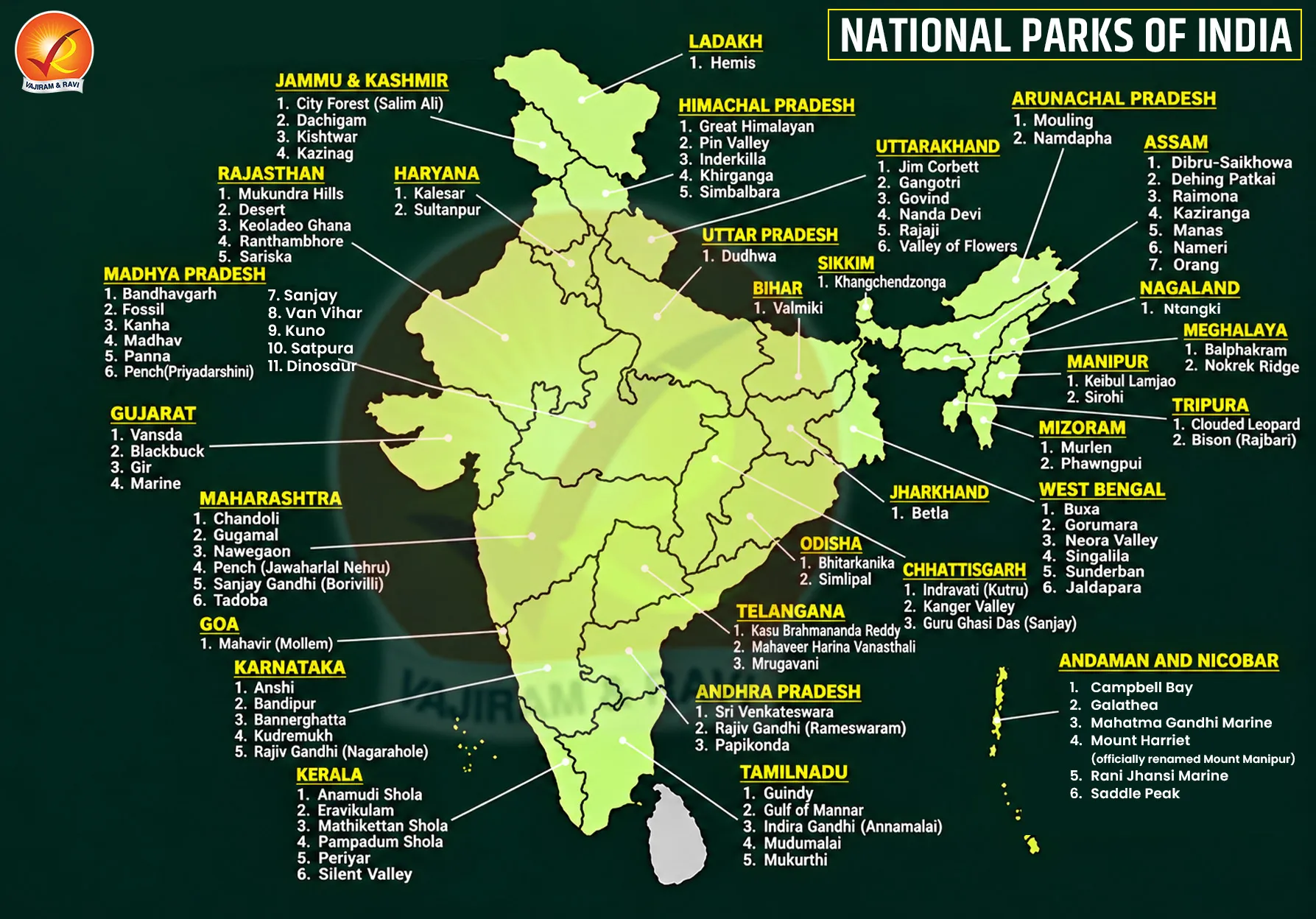
National Parks in India 2026 Map
There are 106 National Parks in India as of 2026 covering around 44,403 km2 covering the diverse including the Himalayas to coastal regions. The First National Park in India is Jim Corbett National Park which was initially known as Hailey National Park established in 1936 in Uttarakhand where as South Button Island NP in the Andaman & Nicobar Islands, which is referred as the Smallest National Park in India about 5 km².
Which State has the highest number of National Parks in India?
Madhya Pradesh has the highest number of National Parks in India, with 11 National Parks. The state is known for its rich forest cover, diverse wildlife and important tiger habitats.
Some of its prominent National Parks include:
- Kanha National Park
- Bandhavgarh National Park
- Pench National Park
- Panna National Park
- Satpura National Park
- Kuno National Park
- Madhav National Park
Assam ranks second, with seven National Parks, including Kaziranga, Manas, Nameri, Orang, Dibru-Saikhowa, Dehing Patkai and Raimona.
Which state has the lowest number of National Parks in India?
Several states and Union Territories have only one National Park each, making them the regions with the lowest number of National Parks in India.
These include:
- Bihar – Valmiki National Park
- Goa – Mollem National Park
- Jharkhand – Betla National Park
- Ladakh – Hemis National Park
- Nagaland – Intanki National Park
- Sikkim – Khangchendzonga National Park
- Uttar Pradesh – Dudhwa National Park
Each of these states and Union Territories has one National Park in the state-wise inventory.
Which is the Largest National Park in India?
Hemis National Park in Ladakh is the largest National Park in India, covering approximately 4,400 sq. km. Established in 1981, it is located in the Trans-Himalayan region and is known for its high-altitude ecosystem. The park is particularly famous for the snow leopard and also supports species such as the bharal (blue sheep), Tibetan wolf and red fox.
Which is the Smallest National Park in India?
India’s smallest National Park is South Button Island National Park, located in the Andaman and Nicobar Islands. Spread across approximately 5 sq. km, it is part of the marine ecosystem of the Rani Jhansi Marine National Park, which also includes North Button and Middle Button islands.
Latest National Parks in India 2026
Similipal National Park is the Newest National Parks in India, established in 2025. The Top 3 Recently Added National Parks in India 2026 are:
| Newest National Parks in India 2026 | |||
| Rank | National Parks | Location | Year |
|
1 |
Similipal National Park |
Odisha |
2025 |
|
2 |
Dihing Patkai National Park |
Assam |
2021 |
|
4 |
Raimona National Park |
Assam |
2021 |
Which is the Oldest National Park in India?
Corbett National Park, established in 1936, is the Oldest National Parks in India. Located in the Himalayas in Uttarakhand, it was initially named Hailey National Park. Renowned for its rich biodiversity, the park is especially famous for being the first area to come under the Project Tiger initiative in 1973. Jim Corbett Tiger Reserve is home to Bengal tigers, elephants, leopards, and hundreds of bird species, making it one of the most prominent wildlife sanctuaries in India.
| Oldest National Parks in India 2026 | |||
|
S.No |
National Parks in India |
Location |
Year |
|
1 |
Corbett National Park |
Uttrakhand |
1936 |
|
2 |
Madhya Pradesh |
1955 |
|
|
3 |
Tadoba National Park |
Maharashtra |
1955 |
India has several protected areas recognised by UNESCO for their outstanding natural and ecological significance. These sites represent diverse ecosystems, including tropical grasslands, wetlands, mangrove forests, alpine meadows and high-altitude Himalayan landscapes.
Six National Parks in India are included in UNESCO Natural World Heritage properties, while Khangchendzonga National Park in Sikkim is recognised as a Mixed World Heritage Site for its natural and cultural significance.
1. Kaziranga National Park, Assam
- Recognised as a UNESCO Natural World Heritage Site in 1985.
- Located in Assam and famous for the Indian one-horned rhinoceros.
- Comprises floodplain grasslands, wetlands and riverine ecosystems associated with the Brahmaputra River.
- Also provides habitat to Bengal tigers, Asian elephants, wild water buffaloes and swamp deer.
2. Keoladeo National Park, Rajasthan
- Formerly known as Bharatpur Bird Sanctuary.
- Recognised as a UNESCO Natural World Heritage Site in 1985.
- Located in Bharatpur, Rajasthan, and known for its rich bird diversity.
- Serves as an important habitat for resident and migratory birds.
3. Manas Wildlife Sanctuary, Assam
- Recognised as a UNESCO Natural World Heritage Site in 1985.
- Located along the India-Bhutan international border in Assam.
- Comprises tropical forests, grasslands and riverine habitats.
- Supports endangered species such as the Bengal tiger, Indian rhinoceros, Asian elephant and golden langur.
Note : Manas is recognised by UNESCO as a Wildlife Sanctuary, not as a National Park. It should not be counted among the six National Parks mentioned above.
4. Nanda Devi and Valley of Flowers National Parks, Uttarakhand
- Both National Parks are included in the same UNESCO Natural World Heritage property.
- Nanda Devi National Park was recognised in 1988, while Valley of Flowers was added in 2005.
- Nanda Devi is known for its high-altitude mountain ecosystems, glaciers and alpine vegetation.
- Valley of Flowers is famous for its seasonal display of alpine flowering plants.
- The region provides habitat to snow leopards, Himalayan musk deer and Himalayan black bears.
5. Sundarbans National Park, West Bengal
- Recognised as a UNESCO Natural World Heritage Site in 1987.
- Located in the Gangetic Delta and forms part of the world’s largest mangrove forest region, shared by India and Bangladesh.
- Comprises tidal waterways, mudflats, estuaries and mangrove forests.
- Famous for the Royal Bengal tiger and also supports saltwater crocodiles and diverse aquatic species.
- Mangroves contribute to coastal protection, biodiversity conservation and climate resilience.
6. Great Himalayan National Park, Himachal Pradesh
- The Great Himalayan National Park Conservation Area was inscribed on the UNESCO World Heritage List in 2014.
- Located in Kullu district of Himachal Pradesh.
- Includes high mountain peaks, alpine meadows, glaciers and riverine forests.
- Provides habitat to threatened species such as the snow leopard, Himalayan brown bear, Himalayan tahr and Western tragopan.
7. Khangchendzonga National Park, Sikkim
- Recognised as a UNESCO Mixed World Heritage Site in 2016.
- It became India’s first Mixed World Heritage Site.
- Located in Sikkim and includes Mount Khangchendzonga, the world’s third-highest mountain.
- Features glaciers, alpine grasslands, forests, valleys and lakes.
- Recognised for both its natural biodiversity and cultural and spiritual significance.
- Supports species such as the red panda, snow leopard and musk deer.
Difference Between National Parks, Wildlife Sanctuaries, Biosphere Reserves
National Parks, Wildlife Sanctuaries and Biosphere Reserves are protected areas established to conserve wildlife, biodiversity and natural ecosystems. However, they differ in their legal status, level of protection, objectives and permitted human activities.
|
Basis |
National Park |
Wildlife Sanctuary |
Biosphere Reserve |
|---|---|---|---|
|
Meaning |
A protected area established to conserve wildlife, natural habitats and ecosystems. |
An area designated to protect particular species of animals, plants and their habitats. |
A large area designated to conserve biodiversity while promoting sustainable development and research. |
|
Legal status in India |
Declared under Section 35 of the Wild Life (Protection) Act, 1972. |
Declared under Section 18 of the Wild Life (Protection) Act, 1972. |
Designated under UNESCO’s Man and the Biosphere (MAB) Programme or notified by the government; not a separate category under the Wild Life (Protection) Act, 1972. |
|
Objective |
To protect entire ecosystems, including flora, fauna and their habitats. |
To protect wildlife and their habitats, particularly threatened species. |
To conserve biodiversity, promote sustainable development and support scientific research. |
|
Area |
Generally has clearly defined boundaries. |
Has clearly defined boundaries. |
Usually covers a much larger area and may include National Parks and Wildlife Sanctuaries. |
|
Human activities |
Activities such as grazing and private exploitation of resources are prohibited, subject to legally permitted exceptions. |
Certain human activities and rights may be permitted or regulated by the authorities. |
Limited and regulated human activities are permitted, depending on the zone. |
|
Zonation |
No formal core-buffer-transition zonation. |
No formal core-buffer-transition zonation. |
Divided into three zones: Core, Buffer and Transition. |
|
Human habitation |
Generally restricted, subject to legal provisions. |
May be permitted, subject to applicable rights and restrictions. |
Human settlements and economic activities are permitted, particularly in the transition zone. |
|
Examples |
Jim Corbett National Park, Kaziranga National Park and Kanha National Park. |
Indian Wild Ass Sanctuary, National Chambal Sanctuary and Bhadra Wildlife Sanctuary. |
Nilgiri Biosphere Reserve, Nanda Devi Biosphere Reserve and Sundarbans Biosphere Reserve. |
Importance of National Parks in India
National Parks in India play a vital role in wildlife conservation, biodiversity protection, and the preservation of natural ecosystems. They help protect endangered species, maintain ecological balance, and ensure sustainable use of natural resources for future generations.
- Conservation of Wildlife: National Parks provide a safe and protected habitat for various wildlife species, including endangered animals such as the Bengal Tiger, Asiatic Lion, and One-Horned Rhinoceros.
- Protection of Biodiversity: These parks preserve a wide variety of flora and fauna, ensuring the survival of numerous plant, bird, reptile, and mammal species.
- Maintenance of Ecological Balance: National Parks help maintain healthy ecosystems by protecting forests, grasslands, wetlands, and other natural habitats that support life.
- Preservation of Natural Habitats: They prevent habitat destruction caused by deforestation, urbanization, and human encroachment, allowing wildlife to thrive in their natural environment.
- Climate Change Mitigation: Forests within National Parks act as carbon sinks, absorbing carbon dioxide and helping reduce the effects of global warming and climate change.
- Protection of Water Resources: Many National Parks safeguard rivers, lakes, wetlands, and watersheds, ensuring a continuous supply of clean water and supporting groundwater recharge.
- Scientific Research and Conservation Studies: National Parks serve as important centers for wildlife research, ecological studies, and biodiversity monitoring, helping scientists understand environmental changes.
- Promotion of Eco-Tourism: Parks attract millions of tourists every year, promoting sustainable tourism while creating awareness about wildlife conservation and environmental protection.
- Environmental Education and Awareness: They provide opportunities for students, researchers, and visitors to learn about ecosystems, wildlife, and conservation practices.
- Protection of Endangered Species: Several conservation programs are implemented within National Parks to protect species facing the risk of extinction and to increase their population.
- Support for Ecosystem Services: National Parks contribute to essential ecosystem services such as pollination, soil conservation, water purification, and nutrient cycling.
- Preservation of Genetic Diversity: They protect the genetic resources of plants and animals, which are important for future scientific research and species adaptation.
- Control of Soil Erosion: Forest vegetation and natural landscapes in National Parks help prevent soil erosion and land degradation.
- Boost to Local Economy: Eco-tourism and conservation-related activities generate employment opportunities for local communities, guides, forest staff, and tourism operators.
- Protection of India’s Natural Heritage: National Parks preserve India’s unique wildlife and natural landscapes, ensuring that future generations can experience and benefit from this rich ecological heritage.
- Support for National Conservation Programs: Many National Parks are part of initiatives such as Project Tiger and Project Elephant, which focus on protecting key wildlife species and their habitats.
- Disaster Risk Reduction: Healthy ecosystems within National Parks help reduce the impact of floods, droughts, landslides, and other natural disasters by stabilizing the environment.
- Contribution to Sustainable Development: National Parks support the goals of sustainable development by balancing environmental conservation with economic and social benefits.
- Conservation of Rare and Medicinal Plants: Many National Parks protect valuable medicinal and endemic plant species that are important for healthcare, research, and biodiversity conservation.
National Parks in India UPSC PYQs
Q1. Which one of the following protected areas is well-known for the conservation of a sub-species of the Indian swamp deer (Barasinga) that thrives well on hard ground and is exclusively graminivorous? (2020)
(a) Kanha National Park
(b) Manas National Park
(c) Mudumalai Wildlife Sanctuary
(d) Tal Chhapar Wildlife Sanctuary
Answer: (a) Kanha National Park
Q2. With reference to India’s Desert National Park, which of the following statements are correct? (2020)
- It is spread over two districts.
- There is no human habitation inside the Park.
- It is one of the natural habitats of the Great Indian Bustard.
Select the correct answer using the code given below:
(a) 1 and 2 only
(b) 2 and 3 only
(c) 1 and 3 only
(d) 1, 2 and 3
Answer: (c) 1 and 3 only
Q. Which one of the following National Parks lies completely in the temperate alpine zone? (2019)
(a) Manas National Park
(b) Namdapha National Park
(c) Neora Valley National Park
(d) Valley of Flowers National Park
Answer: (d) Valley of Flowers National Park

 Last updated on Nov, 2026
→ UPSC Interview 2026 is scheduled from 7 December 2026 to 12 February 2027.
→ UPSC Interview Guidance Programme (IGP) 2026 by Vajiram & Ravi helps aspirants prepare confidently for the UPSC Personality Test.
→ UPSC DAF 2026 application form is available from 11 to 25 November 2026, till 6:00 PM.
→ UPSC 2027 Notification will be released on 13 January 2027 at upsconline.nic.in.
→ Download PIB PRiSM Monthly Magazine 2026 here.
→ Check UPSC Monthly Current Affairs Magazine The Recitals here.
→ Check out the latest UPSC Syllabus here.
→ UPSC Calendar 2027 has been released.
→ Enroll in Vajiram & Ravi’s UPSC Mains Test Series 2027 for structured answer writing practice, expert evaluation, and exam-oriented feedback.
→ Join Vajiram & Ravi’s UPSC Mentorship Program 2027 for personalized guidance, strategy planning, and one-to-one support from experienced mentors.
→ Go through the UPSC Mains Previous Year Papers to enhance your preparation.
→ UPSC has released UPSC Toppers List 2025 with the Civil Services final result on its official website.
→ Also check Best UPSC Coaching in India
National Parks in India 2026 FAQs
Q1. How many National Parks are there in India in 2026?+
Q2. Which state has the highest number of National Parks in India?+
Q3. Which is the first National Park in India?+
Q4. Which is the largest and smallest National Park in India?+
Q5. Which National Park is famous for the Sangai deer?+
Q6. Which National Park is associated with the conservation of hard-ground Barasingha?+
Q7. Which National Park lies completely in the temperate alpine zone?+
Q8. Which National Park is known for its tropical to alpine climatic range?+
Q9. Which National Parks in India are recognised as UNESCO World Heritage Sites?+
Q10. Under which law and section are National Parks declared in India?+
Tags: geography how many national parks are there in india how many national parks in India 2026? how many national parks in India? national park in india national parks in india national parks in india 2026 total national park in india