Modern Architecture refers to a style of building design that emerged in the late 19th and early 20th centuries as a response to industrialization, technological advancements, and changing social needs. It rejected excessive ornamentation and emphasized simplicity, functionality, and the use of new materials such as steel, glass, and reinforced concrete. Modern architecture represents a shift from traditional styles to a more rational, scientific, and utility-oriented approach to construction.
Nature of Modern Architecture
Modern architecture is characterized by a departure from historical styles and a focus on innovation and practicality.
- It emphasizes functionality over decoration, meaning that buildings are designed primarily based on their purpose and use.
- It promotes simplicity in design, avoiding unnecessary ornamentation and focusing on clean lines and geometric forms.
- It reflects the idea that “form follows function,” where the shape of a building is determined by its intended use.
- It uses modern construction materials such as steel, glass, and reinforced concrete, enabling new structural possibilities.
- It is closely linked with urbanization, industrial growth, and changing lifestyles in the modern world.
Modern Architecture in India
Modern architecture in India emerged through a gradual interaction between indigenous building traditions and European architectural styles during the colonial period. The arrival of European powers marked a turning point in the evolution of Indian architecture, introducing new construction techniques, materials, and design philosophies. The Portuguese, French, and British established settlements and introduced their respective architectural styles, which gradually blended with local traditions
Portuguese Influence
- The Portuguese were the earliest Europeans to leave a strong architectural imprint in India, especially along the western coast.
- They introduced the Iberian style of architecture, initially constructing trading posts and warehouses which later evolved into fortified coastal towns.
- Their architecture was deeply linked to Christianity, leading to the construction of grand churches and cathedrals.
- A key contribution was the introduction of Baroque style, characterized by elaborate decoration, dramatic visual effects, and the use of contrasting colours to reflect the power of the Church.
- They also introduced patio houses, suited to tropical climates.
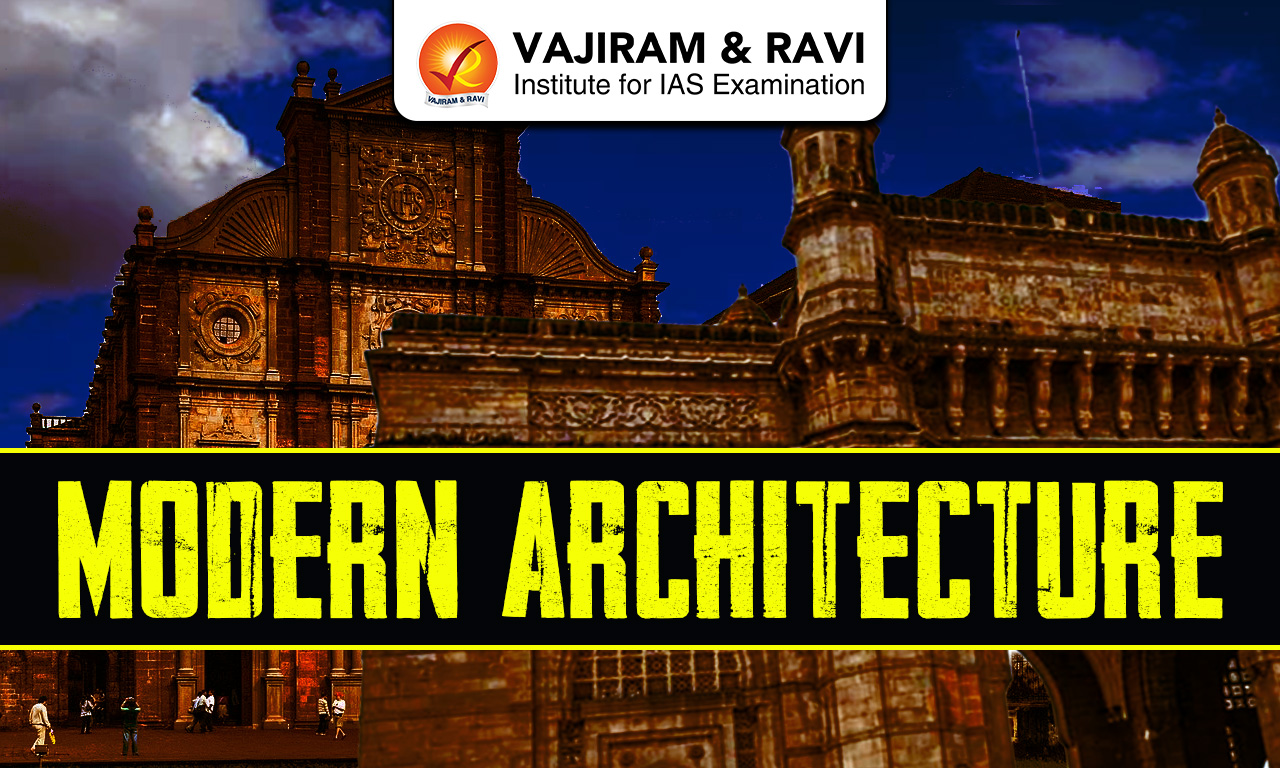
- Notable examples include the Sé Cathedral in Goa, famous for its “Golden Bell”, and the Basilica of Bom Jesus, a UNESCO World Heritage Site completed in 1604. Other examples include St. Paul’s Church in Diu and Castella de Aguada (Bandra Fort) in Mumbai.
French Influence
The French contribution to Indian architecture is most visible in urban planning and town design.
- They introduced the concept of planned cities based on Cartesian grid patterns, bringing scientific precision to town layouts.
- Cities like Puducherry and Chandannagar were designed with straight roads, sectors, and organized spatial planning.
- French architecture emphasized simplicity and functionality, often referred to as “anonymous architecture,” with minimal ornamentation similar to modern architectural ideas.
- They also developed coastal settlements such as Mahe, Karaikal, and Yanam. Examples include the Church of Sacred Heart of Jesus in Puducherry and structures in Chandannagar.
British Influence
The British had the most significant and lasting impact on modern architecture in India.
- They initially introduced the Gothic style, which later merged with Indian elements to create the Indo-Gothic (Victorian) style. This style was marked by large and elaborate buildings, pointed arches, thin walls, large windows for ventilation, and advanced engineering techniques.
- Over time, British architecture evolved into the Neo-Classical and Neo-Roman styles, especially after 1911. This phase is often called the “Rome of Hindustan,” reflecting the attempt to recreate classical European grandeur in India.
- A notable feature introduced during this period was the upturned dome, visible in buildings like Rashtrapati Bhavan and the Supreme Court. Architects such as Edwin Lutyens and Herbert Baker played a key role in shaping imperial architecture.
Indo-Gothic / Victorian Architecture
The Indo-Gothic style represents a fusion of Indian, Persian, and Gothic elements. Buildings were grand in scale, with pointed arches, large windows, and cruciform layouts in churches. The use of modern materials like iron and steel improved structural strength. Important examples include the Chhatrapati Shivaji Terminus in Mumbai and other colonial public buildings.
Indo-Saracenic Architecture
The Indo-Saracenic style represents the culmination of colonial architectural synthesis, combining Indian, Islamic, and Western elements.
- It developed during the late 19th and early 20th centuries, reflecting both imperial ambitions and emerging Indian identity.
- The style blended Gothic Revival and Neo-classical elements with Mughal and Rajput architectural features.
Salient Features of Indo-Saracenic Architecture:
- Bulbous domes were widely used, symbolizing grandeur and often crowning major buildings such as museums and railway stations.
- Overhanging eaves (chhajja) provided climatic protection and were adopted from Mughal architecture.
- Vaulted roofs, derived from Islamic traditions, were incorporated into public buildings.
- Chhatris, or domed pavilions, were added as decorative features reflecting Rajput architecture.
- Minarets were used to enhance verticality and grandeur in structures.
- Pavilions and subsidiary structures added complexity and aesthetic appeal to large buildings.
- Cusped arches, a Mughal feature, were frequently used and ornamented with
Post-Independence Architecture (After 1947)
After independence, India faced the challenge of defining its architectural identity. Two schools emerged: the Revivalists, who supported traditional styles, and the Modernists, who favored functional and scientific design. Under Jawaharlal Nehru, modernism was adopted as a symbol of progress. However, colonial influences continued, leading to a transitional phase in Indian architecture.
Modern Architecture: Features and Developments
Modern architecture in India emphasized functionality, simplicity, and use of new materials.
The introduction of steel, iron, and reinforced concrete allowed new forms of construction. Buildings became more practical, with focus on ventilation, natural light, and efficient space utilization.
Key Architects and Contributions:
- Le Corbusier played a major role in shaping modern India by designing Chandigarh. His work emphasized urban planning, geometric design, and exposed concrete structures.
- Charles Correa contributed significantly to urban architecture and planning. He combined modern principles with Indian traditions and designed important buildings such as the Madhya Pradesh Assembly and Gandhi Memorial Museum.
- Laurie Baker, known for low-cost housing, promoted sustainable architecture using local materials. He introduced techniques like filler slab construction, reducing the use of steel and cement while improving thermal comfort.
Modern Architecture FAQs
Q1: What are the key features of Modern Architecture?
Ans: Modern Architecture is characterized by clean lines, open floor plans, minimal decoration, use of new materials, and the principle that form follows function.
Q2: How did Modern Architecture develop in India?
Ans: Modern Architecture in India developed through the interaction of indigenous traditions with European styles during the colonial period and later evolved after independence with a focus on functionality, urban planning, and nation-building.
Q3: What role did European powers play in shaping Modern Architecture in India?
Ans: Modern Architecture in India was significantly influenced by European powers, as the Portuguese, French, and British introduced new styles, materials, and planning concepts that blended with local traditions.
Q4: What is Indo-Saracenic architecture in the context of Modern Architecture in India?
Ans: Indo-Saracenic architecture is a colonial hybrid style that blends Indian, Islamic, and Western architectural elements, forming an important transitional phase in the evolution of Modern Architecture in India.
Q5: Who are the important architects associated with Modern Architecture in India?
Ans: Modern Architecture in India is strongly associated with architects like Le Corbusier, Charles Correa, and Laurie Baker, who contributed to urban planning, climate-sensitive design, and sustainable architecture.