The Maratha Advance into Gujarat and Malwa, Phases of Conquest

The Maratha Advance into Gujarat and Malwa

The Maratha Advance into Gujarat and Malwa marked a decisive phase in 18th century Indian politics, reflecting the systematic rise of Maratha power after Mughal decline. After Aurangzeb’s death in 1707, central authority weakened, creating space for regional forces. Under Shahu and Peshwa Baji Rao I, the Marathas transformed from raiders into territorial rulers. Their campaigns in Gujarat and Malwa were driven by fiscal demands for Chauth and Sardeshmukhi, strategic control over trade routes and the need to secure northern frontiers. These advances reshaped the balance of power in western and central India. By the 1730s, Maratha supremacy over the Deccan was recognized, while Gujarat and Malwa became pillars of Maratha power between 1720 and 1761.

The Maratha Advance into Gujarat

The Maratha advance into Gujarat progressed from fiscal claims to full annexation. Strategic pressure, negotiated settlements and repeated military interventions steadily dismantled Mughal authority, culminating in Maratha control over Ahmedabad and surrounding districts by the early 1750s.

Read about: Anglo Maratha War

First Phase of The Maratha Advance into Gujarat

The first phase of the Maratha Advance into Gujarat focused on legitimizing Maratha fiscal claims while consolidating limited territorial control.

  • Recognition of Chauth Rights: In May 1726, Sarbuland Khan accepted Maratha claims to Chauth and Sardeshmukhi, marking the first formal Mughal acknowledgment of Maratha authority in Gujarat.
  • Limited Administrative Focus: Peshwa Baji Rao prioritized Malwa and Deccan affairs, allowing Gujarat operations to proceed mainly through sardars rather than centralized campaigns.
  • Southern Gujarat Control: By the late 1720s, Maratha sardars controlled 28 districts in southern Gujarat, ensuring steady revenue collection and weakening Mughal administrative reach.
  • Return of Baji Rao in 1730: Baji Rao’s re-entry into Gujarat politics altered power equations, as Mughal governors promised fixed payments to secure Maratha military support.

Second Phase of The Maratha Advance into Gujarat

The second phase of the Maratha Advance into Gujarat emphasized consolidation through force and coordinated Maratha action.

  • Territorial Enforcement by 1732: Marathas gained effective control over revenue districts, ensuring Chauth collection through direct presence rather than negotiated consent.
  • Resistance by Gaekwar: The Mughal backed governor Gaekwar attempted to expel Maratha forces militarily but failed due to lack of coordination and popular support.
  • Unified Maratha Response: The killing of a prominent Maratha sardar led to collective retaliation, displaying unity among Maratha factions operating in Gujarat.
  • Retreat of Gujarat Forces: Unable to stabilize the province, opposing forces withdrew towards Marwar, leaving Marathas as the dominant power.

Third Phase of The Maratha Advance into Gujarat

The final phase of the Maratha Advance into Gujarat transformed de facto control into formal annexation.

  • Shift from Revenue to Land: Maratha demands moved beyond Chauth to outright possession of Gujarat’s territories, reflecting confidence in sustained control.
  • Imperial Sanction Pending: Only a written imperial grant was needed to legalize Maratha authority, indicating Mughal weakness rather than Maratha restraint.
  • Appointment of Fakr-ud-Daulah: In 1749, the Mughals appointed Fakr-ud-Daulah as governor in a last attempt to recover Gujarat administratively.
  • Fall of Ahmedabad in 1753: The capture of Ahmedabad led to the seize of Gujarat from Maratha.

Read about: Important Rulers of the Maratha Empire

The Maratha Advance into Malwa

The Maratha advance into Malwa unfolded through sustained military pressure against Mughal governors. Control over Chauth evolved into territorial partition among Maratha sardars, turning Malwa into a central base for northern expansion by the mid-eighteenth century.

First Phase of The Maratha Advance into Malwa

The first phase of the Maratha Advance into Malwa centered on asserting fiscal rights against determined Mughal resistance.

  • Organized Campaign of 1723: Under Baji Rao, Marathas launched their first coordinated effort to enforce Chauth claims in Malwa.
  • Appointment of Girdhar Bahadur: In June 1725, Girdhar Bahadur became Mughal subahdar, emerging as a resolute opponent of Maratha demands.
  • Rejection of Negotiations: Despite Shahu’s directives, Girdhar Bahadur refused to allow Chauth collection, escalating tensions into open conflict.
  • Prolonged Warfare: Continuous skirmishes across Malwa strained Mughal resources and tested Maratha mobility and endurance.

Second Phase of The Maratha Advance into Malwa

This phase witnessed decisive military victories and territorial restructuring.

  • Battle of Amjhara 1728: The conflict culminated in November 1728 with the deaths of Girdhar Bahadur and Daya Ram, breaking Mughal resistance.
  • Bundelkhand Campaign: Baji Rao’s invasion of Bundelkhand forced M. Khan Bangash to surrender conquered territories under military pressure.
  • Territorial Concessions: Bangash exchanged territory and recognition of Maratha authority for political survival, strengthening Maratha influence.
  • Partition of Malwa: Within three years, Malwa was divided among Maratha sardars, ensuring decentralized but effective control.

Third Phase of The Maratha Advance into Malwa

The third phase tested Maratha dominance against a united Mughal-Rajput alliance.

  • Mughal Counteroffensive, 1734-35: Wazir Qamar-ud-Din and Khan-i-Dauran led massive forces aiming to expel Marathas beyond the Narmada.
  • Rajput Participation: Leading rulers like Jai Singh, Abhai Singh and Durjan Sal joined the alliance, alarmed by Maratha raids into Rajputana.
  • Numerical Superiority of Mughals: Combined forces numbered around 75,000 troops, dwarfing Maratha field armies in conventional strength.
  • Battle of Toda Tank: Maratha light cavalry encircled and defeated the allied forces, proving mobility superior to numerical advantage.
  • Battle of Bhopal (1737): The Maratha conquered Mughals, led by Peshwa Bajirao I. The victory resulted in the Treaty of Bhopal 1738, which made the Mughals hand over Malwa to the Marathas.

Read about: Battle of Bhima Koregaon

Maratha Rulers in Gujarat and Malwa Conquest

The conquest of Gujarat and Malwa was shaped by coordinated leadership rather than individual ambition.

  • Shahu: As Chhatrapati, Shahu provided legitimacy and strategic direction, enabling Peshwas to pursue northern expansion confidently.
  • Balaji Vishwanath: His 1719 negotiations secured imperial recognition of Maratha fiscal rights, laying the legal foundation for expansion.
  • Peshwa Baji Rao I: Baji Rao’s military leadership transformed Chauth collection into territorial dominance through rapid cavalry campaigns.
  • Maratha Sardars: Leaders like Holkar and Gaekwar administered conquered areas, ensuring revenue flow and local stability.

The Maratha Advance into Gujarat and Malwa FAQs

Q1: Why did the Marathas advance into Gujarat and Malwa?

Ans: The Marathas aimed to secure Chauth and Sardeshmukhi revenues and establish political control over strategically important and prosperous provinces.

Q2: Who played the most important role in Maratha expansion into these regions?

Ans: Peshwa Baji Rao I played the central role by leading military campaigns and converting fiscal claims into territorial control.

Q3: When did the Marathas seize Gujarat from Mughals?

Ans: Maratha dominance developed gradually from 1726, with Mughal authority ending after the fall of Ahmedabad in 1753.

Q4: What was the significance of the Battle of Amjhara?

Ans: The 1728 Battle of Amjhara ended strong Mughal resistance in Malwa with the deaths of Girdhar Bahadur and Daya Ram.

Q5: How did the conquest of Gujarat and Malwa impact Mughal power?

Ans: The loss of these provinces severely weakened Mughal finances and accelerated the decline of Mughal authority in western and central India.

UPSC Daily Quiz 21 January 2026

UPSC Daily Quiz

[WpProQuiz 73]

UPSC Daily Quiz FAQs

Q1: What is the Daily UPSC Quiz?

Ans: The Daily UPSC Quiz is a set of practice questions based on current affairs, static subjects, and PYQs that help aspirants enhance retention and test conceptual clarity regularly.

Q2: How is the Daily Quiz useful for UPSC preparation?

Ans: Daily quizzes support learning, help in revision, improve time management, and boost accuracy for both UPSC Prelims and Mains through consistent practice.

Q3: Are the quiz questions based on the UPSC syllabus?

Ans: Yes, all questions are aligned with the UPSC Syllabus 2025, covering key areas like Polity, Economy, Environment, History, Geography, and Current Affairs.

Q4: Are solutions and explanations provided with the quiz?

Ans: Yes, each quiz includes detailed explanations and source references to enhance conceptual understanding and enable self-assessment.

Q5: Is the Daily UPSC Quiz suitable for both Prelims and Mains?

Ans: Primarily focused on Prelims (MCQ format), but it also indirectly helps in Mains by strengthening subject knowledge and factual clarity.

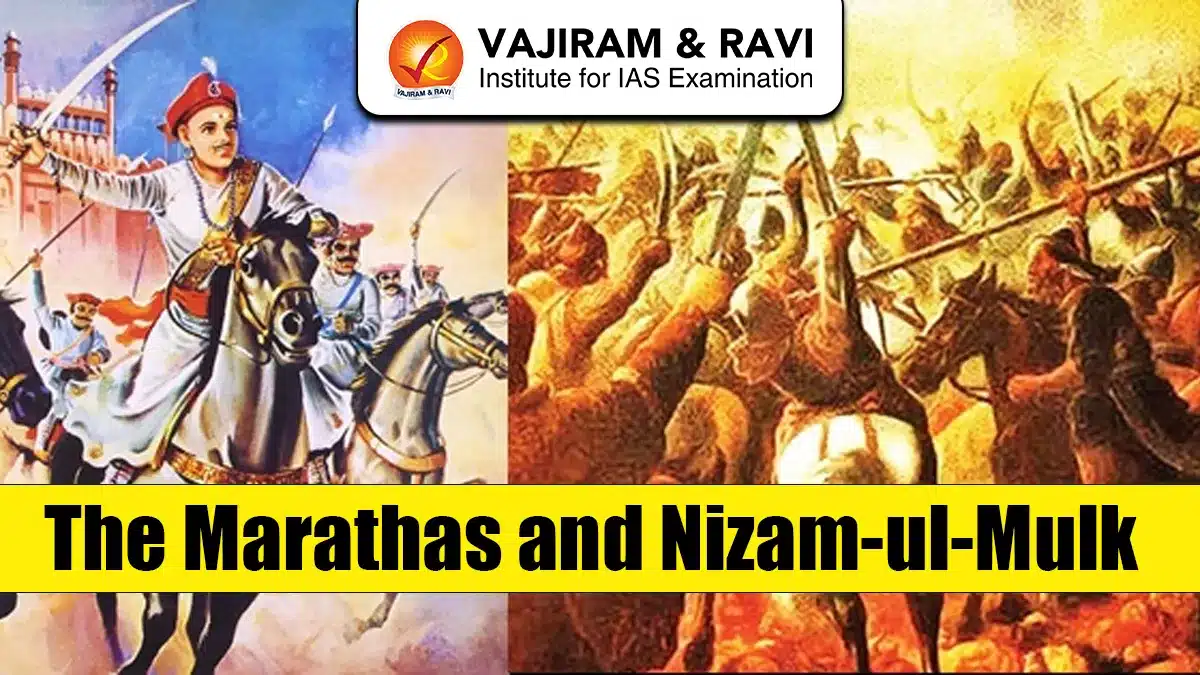
The Marathas and Nizam-ul-Mulk, Rise, Conflicts, Alliances

The Marathas and Nizam-ul-Mulk

The history of 18th-century India is marked by the rise of regional powers following the decline of the Mughal Empire. Among these powers, the Marathas and Nizam-ul-Mulk played significant roles in shaping the political landscape of the Deccan and northern India. Their interactions, sometimes cooperative and at other times contentious, had long-lasting effects on the subcontinent’s history.

The Marathas

The Marathas were a powerful warrior group that emerged in the western Deccan region under the leadership of Shivaji Maharaj in the 17th century. Initially, they fought against the Mughal Empire to establish their autonomy, but by the 18th century, they had become a dominant force in India.

  • Origins and Leadership: The Marathas originated from the western region of Maharashtra. After Shivaji’s death, the Peshwas became the real power behind the Maratha Confederacy.
  • Military Prowess: Known for their guerrilla warfare tactics, the Marathas effectively challenged the Mughal forces across the Deccan and northern India.
  • Expansion: By the mid-18th century, the Marathas had extended their influence to Malwa, Gujarat, Bundelkhand, and parts of the north, making them one of the most formidable powers of the era.
  • Revenue and Administration: The Marathas implemented an efficient revenue system, the Chauth and Sardeshmukhi, which helped finance their military campaigns.
  • Cultural Impact: They promoted Marathi language and culture, patronized temples, and strengthened local governance.

Nizam-ul-Mulk

Nizam-ul-Mulk, also known as Asaf Jah I, was the founder of the Hyderabad state in the early 18th century. Originally a Mughal noble, he became the first Nizam of Hyderabad, establishing a semi-independent state in the Deccan.

  • Early Life: Born in 1671, he served as a high-ranking officer under the Mughal emperor Aurangzeb before moving to establish his own rule in the Deccan.
  • Founding of Hyderabad: In 1724, he declared autonomy over the Deccan, marking the beginning of the Asaf Jahi dynasty.
  • Administration: Nizam-ul-Mulk implemented strong administrative structures, efficient tax collection, and maintained a well-organized army.
  • Political Strategy: He skillfully balanced relations with the declining Mughal Empire, the Marathas, and other regional powers to maintain his sovereignty.
  • Legacy: His governance laid the foundation for Hyderabad’s political and cultural prominence for over two centuries.

Relations between Marathas and Nizam-ul-Mulk

The relationship between the Marathas and Nizam-ul-Mulk was complex, characterized by both conflict and temporary alliances:

  • First Encounter: Nizam-ul-Mulk met the young Peshwa Baji Rao for the first time on January 4, 1721. Despite Nizam’s attempts to establish cordial relations, no long-term understanding could be achieved.
  • Key Point of Dispute: The most critical dispute between them was over Karnataka. Nizam-ul-Mulk claimed it by right of succession from the Bijapur and Golconda kingdoms, while the Marathas, since Shahji’s time, had considered Karnataka a prime hunting and plunder region under tribute.
  • Breakdown of Agreements: Between 1721 and 1724, in Nizam’s absence, his subordinate Mubariz-ul-Mulk violated the Chauth and Sardeshmukhi agreements, igniting hostilities with the Marathas.
  • Attempts at Diplomacy: In 1723, on his way to Gujarat, Nizam met Baji Rao in Malwa to maintain peaceful relations. In 1724, when Mubariz-ul-Mulk tried to prevent Nizam from reestablishing authority in the Deccan, Nizam convened a conference with Baji Rao to negotiate.
  • Temporary Cooperation: At the Battle of Shakar Khera in 1725, a Maratha contingent actually fought alongside Nizam’s forces, showing that alliances were sometimes pragmatic.
  • Rising Tensions: By 1728, Nizam-ul-Mulk was deeply concerned about the expansion of Maratha influence in Malwa and Gujarat. Though he accompanied Shahu on campaigns to Karnataka in 1725 and 1726, he secretly ordered his commander to confront the Marathas.
  • Exploiting Maratha Internal Conflicts: Nizam leveraged disputes between the Satara and Kolhapur courts and tensions between Baji Rao and the Pratinidhi. He suspended Chauth and Sardeshmukhi payments, citing a conflict between Shahu and Sambhaji of Kolhapur, and proposed arbitration as the Mughal Emperor’s envoy, attempting to weaken Maratha unity.
  • Strategic Maneuvering: Nizam built connections with Kolhapur soldiers and sought to dismiss Baji Rao. Initially, Shahu considered Nizam’s arbitration, but he quickly regained control and recalled Maratha forces, preparing defenses.
  • Decisive Conflict – Battle of Palkhed: Baji Rao returned from Karnataka and decisively rejected Nizam’s peace overtures. In a swift and strategic campaign, the Marathas defeated Nizam-ul-Mulk at the Battle of Palkhed on February 7, 1728, showcasing Maratha mobility and military expertise.
  • Aftermath – Treaty of Mungi Shevgaon (1728): Following the defeat, Nizam-ul-Mulk acknowledged Shahu’s authority over Deccan Chauth and Sardeshmukhi and pledged not to support Sambhaji of Kolhapur, formalizing Maratha dominance in the region.

The Marathas and Nizam-ul-Mulk FAQs

Q1: Who were the Marathas?

Ans: The Marathas were a powerful warrior group from western India, originating in Maharashtra under Shivaji Maharaj.

Q2: Who was Nizam-ul-Mulk?

Ans: Nizam-ul-Mulk, also known as Asaf Jah I, was a Mughal noble who founded the Hyderabad State in 1724. He established a semi-independent rule in the Deccan.

Q3: When did the Marathas and Nizam-ul-Mulk first meet?

Ans: Nizam-ul-Mulk met Baji Rao, the young Peshwa, for the first time on January 4, 1721. Despite initial diplomatic efforts, they could not achieve a lasting understanding.

Q4: What was the main cause of conflict between them?

Ans: The main point of dispute was Karnataka. Nizam claimed it as his rightful territory from the Bijapur and Golconda kingdoms, while the Marathas considered it a region for tribute, hunting, and expansion.

Q5: Did the Marathas and Nizam-ul-Mulk ever fight together?

Ans: Yes, in 1725, during the Battle of Shakar Khera, a Maratha contingent fought alongside Nizam’s forces, showing that their relationship was sometimes cooperative.

National Action Plan on Climate Change (NAPCC), Features, Challenges

National Action Plan on Climate Change

The National Action Plan on Climate Change (NAPCC) was launched by the Government of India in 2008 to address climate change through sustainable development. It consists of eight national missions focusing on areas such as renewable energy, water conservation, agriculture, forests, and sustainable urban development. The plan aims to reduce the impact of climate change while supporting economic growth and energy security. It also helps India meet its commitments under international climate agreements like the Paris Agreement.

National Action Plan on Climate Change (NAPCC) Components

The backbone of National Action Plan on Climate Change (NAPCC) is its eight National Missions, which are integrated, multi-pronged strategies designed to tackle climate change across different sectors. These missions are:

  1. National Solar Mission (NSM) – Promote solar energy adoption.
  2. National Mission for Enhanced Energy Efficiency (NMEEE) – Improve energy efficiency in industries and buildings.
  3. National Mission on Sustainable Habitat (NMSH) – Make urban areas energy-efficient and climate-resilient.
  4. National Water Mission (NWM) – Conserve water and ensure equitable distribution.
  5. National Mission for Sustaining the Himalayan Ecosystem (NMSHE) – Protect Himalayan biodiversity and glaciers.
  6. National Mission for a Green India (GIM) – Increase forest cover and biodiversity conservation.
  7. National Mission for Sustainable Agriculture (NMSA) – Promote climate-resilient agricultural practices.
  8. National Mission on Strategic Knowledge for Climate Change (NMSKCC) – Generate and share knowledge on climate change.

National Action Plan on Climate Change Features

The National Action Plan on Climate Change (NAPCC) is guided by the following principles:

  • Inclusive Development: Protecting poor and vulnerable communities through climate-sensitive strategies.
  • Sustainable Growth: Achieving economic growth while maintaining ecological balance.
  • Technology Deployment: Promoting technologies for reducing greenhouse gas (GHG) emissions and climate adaptation.
  • Regulatory and Voluntary Mechanisms: Encouraging sustainable practices and innovation through policy measures and market-driven mechanisms.
  • International Cooperation: Leveraging research, funding, and technology transfer under frameworks like the UN Framework Convention on Climate Change (UNFCCC).

1. National Solar Mission (NSM)

  • National Solar Mission (NSM) was launched in 2010 under the National Action Plan on Climate Change (NAPCC).
  • It is implemented by the Ministry of New and Renewable Energy (MNRE).
  • It aims to promote ecologically sustainable growth while ensuring India’s energy security.
  • It initially targeted 20 GW of solar capacity by 2022, which was later enhanced to 100 GW in 2015.
  • It seeks to achieve 60 GW from large and medium solar projects and 40 GW from rooftop solar systems.
  • It supports India’s commitment under the Paris Agreement, where India pledged that 40% of installed power capacity will be from clean sources by 2030.
  • It forms part of India’s broader goal of achieving 175 GW renewable energy capacity by 2022, including solar, wind, bioenergy, and small hydro.
  • It promotes net metering, allowing households to feed surplus solar power into the grid and pay only for net electricity consumption.

2. National Mission for Enhanced Energy Efficiency (NMEEE)

  • National Mission for Enhanced Energy Efficiency (NMEEE) was approved in 2010 and is implemented by the Ministry of Power.
  • It is based on the Energy Conservation Act, 2001.
  • It aims to unlock India’s large energy efficiency potential estimated at ₹1.6 lakh crore.
  • It promotes market-based mechanisms to improve energy efficiency across industries and households.
  • It introduced the Perform, Achieve and Trade (PAT) scheme, which sets energy-saving targets for industries and allows trading of Energy Saving Certificates (ESCerts).
  • It includes the Market Transformation for Energy Efficiency (MTEE) scheme to promote energy-efficient appliances.
  • It supports financing mechanisms through Energy Efficiency Financing Platform (EEFP).
  • It includes FEEED, which provides risk guarantee and venture capital support for energy efficiency projects.

3. National Mission on Sustainable Habitat (NMSH)

  • National Mission on Sustainable Habitat (NMSH) was approved in 2010 and is implemented by the Ministry of Housing and Urban Affairs.
  • It aims to make cities sustainable, energy-efficient, and climate-resilient.
  • It promotes energy-efficient buildings through Energy Conservation Building Codes.
  • It encourages public transport, non-motorised transport, and urban mobility planning.
  • It focuses on scientific management of solid and liquid waste, including waste-to-energy projects.
  • It supports recycling, reuse, and improved sanitation systems.
  • It strengthens climate resilience of cities through disaster preparedness and early warning systems.
  • It is implemented through schemes such as AMRUT, Smart Cities Mission, Swachh Bharat Mission, and Urban Transport Programme.

4. National Water Mission (NWM)

  • National Water Mission (NWM) is implemented by the Ministry of Jal Shakti.
  • It aims to ensure integrated and sustainable water resource management.
  • It targets 20% improvement in water-use efficiency.
  • It promotes rainwater harvesting and groundwater recharge.
  • It encourages recycling and reuse of wastewater in urban areas.
  • It promotes basin-level planning and climate-resilient water management.
  • It supports desalination technologies for coastal cities.
  • It promotes efficient irrigation methods like drip and sprinkler irrigation.

5. National Mission for Sustaining the Himalayan Ecosystem (NMSHE)

  • National Mission for Sustaining the Himalayan Ecosystem (NMSHE) was approved in 2014 and is implemented by the Ministry of Science and Technology.
  • It aims to protect the fragile Himalayan ecosystem and glaciers.
  • It focuses on monitoring climate change impacts on glaciers and water systems.
  • It supports biodiversity conservation and wildlife protection.
  • It addresses increased risks of floods, landslides, and droughts.
  • It promotes scientific research and long-term ecological monitoring.
  • It supports livelihood security of Himalayan communities.
  • It strengthens institutional and research capacities for sustainable development.

6. National Mission for a Green India (GIM)

  • National Mission for a Green India (GIM) was approved in 2014 and is implemented by the Ministry of Environment, Forest and Climate Change.
  • It aims to protect, restore, and enhance forest and tree cover.
  • It targets increasing forest and tree cover on 5 million hectares.
  • It aims to improve the quality of forest cover on another 5 million hectares.
  • It seeks to enhance carbon sequestration by 50–60 million tonnes annually.
  • It promotes biodiversity conservation and ecosystem services.
  • It encourages community participation and forest-based livelihoods.
  • It enhances ecological connectivity through biological corridors.

7. National Mission for Sustainable Agriculture (NMSA)

  • National Mission for Sustainable Agriculture (NMSA) was launched in 2010 and is implemented by the Ministry of Agriculture and Farmers’ Welfare.
  • It aims to make agriculture climate-resilient, especially in rainfed areas.
  • It focuses on soil health management and efficient water use.
  • It promotes drought-resistant crops and climate-resilient farming techniques.
  • It supports micro-irrigation, crop diversification, and integrated farming systems.
  • It strengthens agricultural insurance and risk management mechanisms.
  • It promotes soil health cards to improve fertilizer use efficiency.
  • It enhances farmers’ income and food security under changing climate conditions.

8. National Mission on Strategic Knowledge for Climate Change (NMSKCC)

  • National Mission on Strategic Knowledge for Climate Change (NMSKCC) is implemented by the Ministry of Science and Technology.
  • It aims to build a strong knowledge base to support climate action.
  • It promotes climate research and data generation.
  • It supports the Indian Network for Climate Change Assessment (INCCA).
  • It develops climate models for regional impact assessment.
  • It strengthens research on agriculture, health, biodiversity, and coastal zones.
  • It encourages international collaboration and data sharing.
  • It supports evidence-based policymaking for climate change mitigation and adaptation.

National Action Plan on Climate Change Achievements

The National Action Plan on Climate Change (NAPCC) launched in 2008, has played a crucial role in shaping India’s response to climate change by integrating sustainable development with climate mitigation and adaptation. Over the years, it has strengthened India’s domestic climate action and enhanced its global climate leadership.

  • The NAPCC led to rapid expansion of renewable energy, especially solar power, with India crossing 70 GW solar capacity and becoming one of the world’s leading renewable energy producers.
  • It strengthened energy efficiency through the National Mission for Enhanced Energy Efficiency, introducing PAT scheme, star labelling, and LED programs that significantly reduced power consumption and emissions.
  • The plan improved urban sustainability by promoting energy-efficient buildings, sustainable transport, waste management, and climate-resilient urban planning through the Sustainable Habitat Mission.
  • It enhanced water security by promoting efficient water use, rainwater harvesting, basin-level planning, and wastewater reuse under the National Water Mission.
  • The Green India Mission contributed to increasing forest and tree cover, restoring degraded land, and enhancing carbon sequestration, supporting India’s target of creating an additional carbon sink of 2.5–3 billion tonnes.
  • The Himalayan Ecosystem Mission improved glacier monitoring, biodiversity conservation, and disaster risk reduction while supporting sustainable livelihoods in climate-vulnerable mountain regions.
  • Climate-resilient agriculture was promoted through better soil management, drought-resistant crops, micro-irrigation, and climate-smart farming practices to protect farmers from climate shocks.

National Action Plan on Climate Change Challenges

The National Action Plan on Climate Change (NAPCC) faces several challenges despite India’s strong potential to adopt a low-carbon growth path. Since India is still developing and contributes relatively less to global emissions, it has the opportunity to leapfrog using clean and advanced technologies.

  • The NAPCC does not set any binding target for reducing carbon emissions, which weakens its overall impact and accountability.
  • Although India has strong potential for low-carbon growth, the plan does not clearly define a long-term transition roadmap.
  • Excessive focus on the National Solar Mission has led to neglect of other important missions like water, agriculture, and sustainable habitat.
  • Missions related to water, forestry, agriculture, and urban development are multi-sectoral and involve many ministries, making coordination slow and complex.
  • Many ongoing schemes already align with mission goals, but lack of integration leads to duplication of efforts and wastage of resources.
  • Monitoring and evaluation mechanisms are weak, and progress data is available only for a few missions such as solar and energy efficiency.
  • Cross-cutting missions face difficulty in implementation due to overlapping responsibilities and unclear accountability.
  • Institutional challenges such as lack of technical expertise, financial constraints, and delays in project approvals affect progress.

Way Forward

  • Strengthen coordination among ministries and states to ensure smooth and time-bound implementation of all climate missions.
  • Improve monitoring, data collection and reporting systems for better evaluation of mission-wise progress.
  • Enhance financial support through green finance, private investment and international climate funds.
  • Promote clean technologies, renewable energy and climate-resilient infrastructure at a faster pace.
  • Integrate climate action into development planning, urban growth, agriculture and industrial policies.
  • Increase public awareness, community participation and capacity building for effective grassroots implementation.

National Action Plan on Climate Change (NAPCC) FAQs

Q1: What is the National Action Plan on Climate Change (NAPCC)?

Ans: NAPCC is India’s national strategy to address climate change through sustainable development, launched in 2008 by the Government of India.

Q2: Who launched the NAPCC?

Ans: It was launched by the Prime Minister’s Council on Climate Change.

Q3: What is the main objective of NAPCC?

Ans: Its main objective is to promote sustainable development while addressing climate change through mitigation and adaptation measures.

Q4: How many missions are there under NAPCC?

Ans: There are eight National Missions under NAPCC covering energy, water, agriculture, forests, urban development, and climate research.

Q5: Which ministry coordinates the NAPCC?

Ans: The Ministry of Environment, Forest and Climate Change (MoEFCC) coordinates the overall implementation.

PM Matsya Sampada Yojana, Objectives, Features, Contributions

PM Matsya Sampada Yojana

The Pradhan Mantri Matsya Sampada Yojana (PMMSY) is the flagship scheme of the Government of India launched in September 2020 to bring a blue revolution in the fisheries and aquaculture sector. It aims to modernise fisheries infrastructure, enhance fish production, increase fishermen’s income, and ensure sustainable utilization of aquatic resources.

The scheme is implemented by the Department of Fisheries, Ministry of Fisheries, Animal Husbandry and Dairying, and is considered one of the most comprehensive fisheries development programs in India.

Read about: Pradhan Mantri Garib Kalyan Rojgar Yojana Scheme

PM Matsya Sampada Yojana Objectives

The key objectives of Pradhan Mantri Matsya Sampada Yojana (PMMSY) focus on economic growth, employment generation, sustainability, and fishers’ welfare.

  • To enhance fish production from 137 lakh tonnes (2019-20) to 220 lakh tonnes by 2024–25
  • To increase fisheries sector contribution to GVA from 1.24% to nearly 1.5%
  • To double the income of fishers and fish farmers
  • To generate over 55 lakh direct and indirect employment opportunities
  • To modernize fisheries value chain including harvesting, processing, storage, and marketing
  • To promote sustainable, responsible, and inclusive fisheries development
  • To strengthen inland fisheries, marine fisheries, and aquaculture infrastructure

PM Matsya Sampada Yojana Features

The features of Pradhan Mantri Matsya Sampada Yojana are shared below.

  • PMMSY is a centrally sponsored scheme with a total investment of ₹20,050 crore for the period 2020-21 to 2024-25.
  • PM Matsya Sampada Yojana is a centrally sponsored flagship scheme launched in 2020 to bring comprehensive development in India’s fisheries sector.
  • The scheme covers the entire fisheries value chain, including fish seed production, aquaculture, harvesting, processing, storage, transportation, and marketing.
  • It aims to promote sustainable and responsible fisheries while ensuring long-term conservation of aquatic resources.
  • The scheme focuses on both marine and inland fisheries, including brackish water and freshwater aquaculture.
  • It supports modernisation of fisheries through the adoption of advanced technologies such as biofloc farming, cage culture, recirculatory aquaculture systems, mariculture, and seaweed cultivation.
  • PMMSY provides financial assistance for the development of fish ponds, hatcheries, fishing vessels, cold storage units, ice plants, and processing facilities.
  • The funding pattern under the scheme is 60:40 for general states, 90:10 for northeastern and Himalayan states, and 100% central assistance for Union Territories.
  • It aims to enhance fish production to around 220 lakh tonnes and improve the contribution of fisheries to the agricultural GDP.

PM Matsya Sampada Yojana Beneficiaries

The Pradhan Mantri Matsya Sampada Yojana is aimed at benefiting fishers, fish farmers, fish workers, and stakeholders associated with the fisheries sector.

  • Fishers
  • Fish farmers
  • Fish workers and Fish vendors
  • Fisheries Development corporations
  • Self Help Groups (SHGs)/Joint Liability Groups (JLGs) in fisheries sector
  • Fisheries cooperatives
  • Fisheries Federations
  • Entrepreneurs and private firms
  • Fish Farmers Producer Organizations/Companies (FFPOs/Cs)
  • SCs/STs/Women/Differently abled persons
  • State Governments/UTs and their entities
  • State Fisheries Development Boards (SFDB)
  • Central Government and its entities

Read about: PM SVANidhi Scheme

Contribution of Fisheries Sector in Indian Economy

  • The fisheries sector supports around 30 million people, with a significant portion coming from marginalized and vulnerable communities.
  • India produced 175.45 lakh tonnes of fish in FY 2022-23, making it the third-largest fish-producing country in the world.
  • The fisheries sector contributes approximately 1.09% to India’s Gross Value Added (GVA) and over 6.724% to the agricultural GVA.
  • To promote development and transformation in fisheries, several schemes and initiatives have been implemented:
    • Fisheries and Aquaculture Infrastructure Development Fund (FIDF): Launched in 2018-19 with a total fund size of ₹7,522.48 crore, this scheme provides interest subvention up to 3% per annum for a repayment period of 12 years, including a 2-year moratorium on principal repayment.
    • Kisan Credit Card (KCC) for Fishers and Fish Farmers: Introduced from FY 2018-19, the scheme enables fishers and fish farmers to access short-term credit and working capital for aquaculture, fisheries operations, and allied activities.

PM Matsya Sampada Yojana Challenges

The challenges of Pradhan Mantri Matsya Sampada Yojana are:

  • Many small and marginal fish farmers, especially in remote areas, are unaware of the scheme, its benefits, or the process for availing financial and technical support, which reduces effective participation.
  • Fishers and entrepreneurs often face challenges in obtaining institutional loans or subsidies, and the high cost of modern fishing equipment, vessels, hatcheries, and advanced aquaculture technologies prevents widespread adoption.
  • Lack of sufficient cold storage, ice plants, refrigerated transport, and modern fish markets in many regions results in high post-harvest losses and limits income from fish sales.
  • Unsustainable fishing practices, overexploitation of fish stocks, and poor regulation of inland and marine resources threaten long-term production and ecological balance.
  • Rising sea and water temperatures, floods, cyclones, and erratic rainfall patterns adversely affect fish breeding, aquaculture, and overall production, making the sector highly vulnerable.
  • Many fish farmers and fishers continue traditional methods due to a lack of training, awareness, or technical knowledge, resulting in lower productivity and income potential.

Way Forward

  • Strengthen awareness campaigns so all 30 million fishers, especially marginalised communities, benefit from schemes.
  • Improve access to credit and Kisan Credit Card facilities for fishers and fish farmers to adopt modern technologies.
  • Expand cold chains, ice plants, and refrigerated transport to reduce 20–25% post-harvest losses.
  • Promote sustainable fishing practices to prevent overfishing and conserve biodiversity.
  • Implement climate-resilient aquaculture techniques to mitigate floods, cyclones, and rising sea temperatures.
  • Enhance skill development and capacity building, targeting 5 lakh fishers annually, including digital marketing and value addition.
  • Encourage women’s participation, as they make up 70% of inland fish processing and marketing workers.
  • Develop fisheries clusters, integrated aquaculture parks, and export-oriented units to increase production and global competitiveness.

PM Matsya Sampada Yojana FAQs

Q1: What is PM Matsya Sampada Yojana?

Ans: PMMSY is a central government scheme launched in 2020 to promote sustainable development of fisheries and aquaculture in India.

Q2: Which ministry implements PMMSY?

Ans: It is implemented by the Department of Fisheries, Ministry of Fisheries, Animal Husbandry and Dairying.

Q3: What is the total outlay of PMMSY?

Ans: The total outlay is ₹20,050 crore for the period 2020–2025.

Q4: What is the main objective of PMMSY?

Ans: The main objective is to increase fish production, double fishermen’s income, and modernize the fisheries sector.

Q5: Who are the beneficiaries of PMMSY?

Ans: Fish farmers, fishermen, fish vendors, SHGs, FPOs, and fisheries entrepreneurs.

Sir John Shore (1751-1834), Biography, Time Period, Reforms, Events

Sir John Shore

Sir John Shore, the 1st Baron Teignmouth, was a distinguished British administrator who served as the Governor General of Bengal from 1793 to 1798. Shore rose through the ranks of the East India Company starting as a humble writer in 1768. Unlike many of his contemporaries, he was celebrated for his unwavering honesty and deep intellectual engagement with Indian culture, mastering both Persian and Bangla. His career was defined by his expertise in revenue systems, where he advocated for stable land taxes as the bedrock of British political control. Beyond politics, he was a man of letters and faith, serving as the first president of the British and Foreign Bible Society.

Sir John Shore Biography

Sir John Shore's journey from an apprentice clerk to a peer of the realm is a testament to his administrative brilliance and integrity.

  • Early Life and Education: Born in Piccadilly in 1751, he was educated at Harrow School before attending a commercial school to learn bookkeeping, preparing him for a career in the East India Company.
  • Linguistic Prowess: Upon arriving in Calcutta in 1769, he dedicated himself to studying local languages, gaining a mastery over Persian and Bangla that informed his deep understanding of Bengali customs.
  • Revenue Expertise: Shore served as the principal revenue advisor to Warren Hastings from 1772 to 1785, eventually becoming the President of the Board of Revenue.
  • Permanent Settlement: He played a pivotal role in the Permanent Settlement of 1793, where he favored the proprietary rights of zamindars but urged caution regarding fixed revenue rates.
  • Abolitionist and Scholar: A close friend of orientalist Sir William Jones, Shore succeeded him as President of the Asiatic Society and was a vocal advocate for the abolition of slavery.

Sir John Shore Governor General of Bengal

Sir John Shore succeeded Lord Cornwallis in 1793, pursuing a tenure characterized by peace, non-intervention and the consolidation of British colonial administration.

  • Non-Interventionist Policy: Shore faithfully followed a policy of neutrality, refusing to interfere in the conflicts of native powers unless British interests were directly threatened.
  • The Cornwallis Code: Despite personal disagreements with some of Cornwallis's legal views, Shore strictly adhered to the Cornwallis Code to maintain administrative continuity.
  • Honesty in Governance: In an era marked by company corruption, Shore’s administration was an "outlier," known for its financial integrity and lack of "private profiteering."
  • Oudh Succession: He showed significant firmness in the Oudh succession crisis, replacing Wazir Ali with Saadat Ali Khan II to ensure regional stability.
  • Military Mutiny: He faced and navigated a delicate mutiny of the officers of the Bengal Army, maintaining the authority of the company without resorting to extreme hostilities.

Events During Sir John Shore

The five years of Sir John Shore's rule were relatively calm but included significant diplomatic tests and major revenue milestones.

  • Battle of Kharda (1795): The Maratha Empire defeated the Nizam of Hyderabad; Shore’s refusal to intervene on behalf of the Nizam led to a temporary loss of British prestige.
  • Permanent Settlement Implementation: The definitive 1793 settlement of Bengal, Bihar and Odisha was solidified during his term, establishing the zamindari land holding system.
  • French Influence: Shore observed the growth of French trained subsidiary forces in native Indian courts but avoided direct military confrontation to follow his home instructions.
  • The Charter Act of 1793: He effectively managed the administrative transitions required by the renewal of the Company’s charter, focusing on internal efficiency rather than territorial expansion.
  • Massacre of Benares 1799: This tragic event occurred as a fallout of the Oudh succession dispute, yet Shore was praised by the Court of Directors for his temperate and firm handling of the aftermath.

Sir John Shore Reforms

Sir John Shore was a revenue specialist who prioritized administrative stability and financial integrity over territorial expansion through several key reforms:

  • Permanent Settlement: He provided the intellectual framework for the 1793 settlement, establishing the proprietary rights of zamindars in Bengal.
  • Revenue Administration: Shore initiated the tax reforms of 1786 and 1790, focusing on a fair and stable land tax system.
  • Judicial Improvements: In his 1785 "Remarks," he proposed plans for reorganizing exchequer cases and administering justice more effectively to natives.
  • Anti-Slavery Advocacy: He was a prominent advocate for the abolition of slavery, supporting the campaign to end the slave trade.
  • Civil Service Integrity: Shore enforced strict honesty within the company, curbing the rampant corruption and private profiteering of British officials.

Sir John Shore FAQs

Q1: What was Sir John Shore’s policy toward Indian states?

Ans: He followed a non-interventionist policy, refusing to interfere in the internal conflicts of native powers like the Marathas and Nizam.

Q2: What was Sir John Shore’s major contribution to the land revenue system?

Ans: Shore was the primary architect of the Permanent Settlement, though he initially advocated for more caution and further inquiry.

Q3: Why was Sir John Shore known as an "outlier" among British officials?

Ans: Unlike many corrupt company officials, Shore was famous for his unflinching honesty and high standards of financial integrity.

Q4: How did Sir John Shore handle the Battle of Kharda?

Ans: He remained neutral when the Marathas attacked the Nizam, adhering strictly to the policy of non-interference despite British-Nizam ties.

Q5: What were Sir John Shore’s contributions other than politics?

Ans: He was a scholar who mastered Persian and Bangla and served as the first president of the Bible Society

Geological Heritage Sites of India, Definition, List, Recent Additions

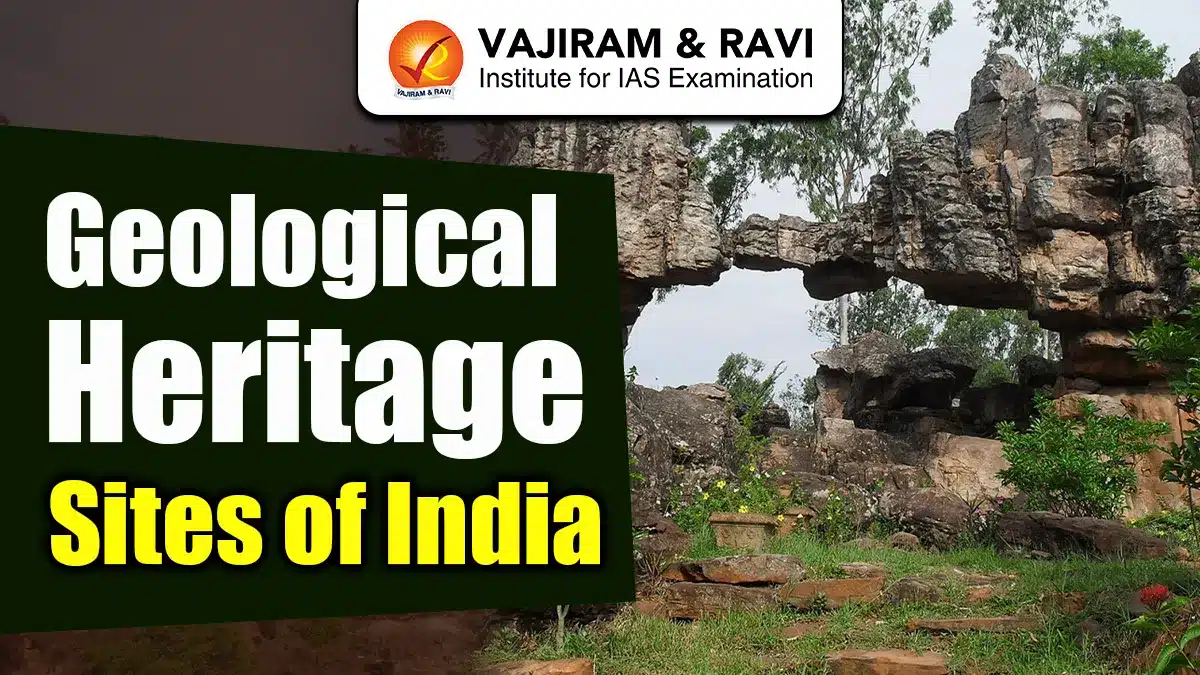
Geological Heritage Sites of India

Geological Heritage Sites of India represent locations of exceptional geological importance that reveal the long and complex history of the Earth. These sites preserve rock formations, fossils, minerals and landforms formed over billions of years through natural processes. Recognizing this value, India safeguards these sites to support scientific research, education and awareness about Earth’s evolution, climate history and natural resources.

Geological Heritage Sites of India

Geological Heritage Sites of India are officially recognized locations that showcase unique geological features holding scientific, educational or cultural importance. Designated by the Geological Survey of India, these sites act as natural archives recording Earth’s evolution from over 2.5 billion years ago to recent geological times. They include impact craters, fossil parks, volcanic structures, ancient sedimentary layers and tectonic features. Together, they help explain continental drift, volcanic activity, climate shifts and the origin of life, making them invaluable for understanding India’s geological and environmental past.

Geological Heritage Sites of India Organizations

Geological Heritage Sites of India are identified, documented and maintained through coordinated efforts of scientific and administrative institutions working under national and international heritage frameworks.

  • Geological Survey of India (GSI): Established in 1851, GSI is the primary authority identifying geo-heritage sites and national geological monuments, conducting surveys, research and awareness initiatives across India.
  • Ministry of Mines: The ministry provides administrative support and policy direction to GSI, ensuring geological heritage protection aligns with national mineral and conservation strategies.
  • Archaeological Survey of India (ASI): ASI acts as the nodal agency for UNESCO World Heritage Convention submissions, assisting in global recognition of geological and natural heritage sites.
  • UNESCO World Heritage Convention: India’s membership enables global safeguarding standards, allowing geological sites to enter the Tentative List as a prerequisite for World Heritage status.
  • State Governments: State authorities assist in site protection, land management, signage installation and tourism regulation at recognized geological heritage locations.

Geological Heritage Sites of India List

As of 2025, India has officially recognized 69 Geological Heritage Sites and National Geological Monuments, representing diverse geological processes across multiple states and time periods. Mawmluh Cave in Meghalaya is considered as the first Geological Heritage Site of India. The list of major Geological Heritage Sites in India is given below:

  1. Volcanogenic Bedded Barytes, Mangampeta: Located in Andhra Pradesh, this deposit represents submarine volcanic activity and is one of the world’s largest bedded baryte formations.
  2. Eparchaean Unconformity, Tirumala Hills: This site exposes a time gap of over 800 million years between ancient granite and younger sedimentary rocks.
  3. Erra Matti Dibbalu, Visakhapatnam: These red sand hills preserve paleo-climatic records and coastal geomorphological evolution.
  4. Varkala Cliff Section, Kerala: India’s only seaside cliff formation reveals Mio-Pliocene sedimentary layers and fossil bearing strata.
  5. Fossil Wood Park, Tiruvakkarai: Fossilized tree trunks over 20 million years old demonstrate ancient tropical forest ecosystems.
  6. National Fossil Wood Park, Sattanur: This park preserves silicified wood dating back to the Cretaceous period.
  7. Charnockite, St. Thomas Mount: The site displays charnockite rock, significant in understanding Precambrian crust formation.
  8. Badlands of Karai Formation: Cretaceous fossils here provide evidence of ancient marine environments.
  9. Lonar Lake, Maharashtra: A hyper velocity meteorite impact crater formed around 576,000 years ago in basaltic Deccan Traps.
  10. Sedimentary Eddy Markings, Kadan Dam: These structures reveal ancient water current directions and sediment deposition patterns.
  11. Sendra Granite, Rajasthan: Demonstrates plutonic igneous activity and continental crust evolution.
  12. Barr Conglomerate: Represents ancient river systems depositing rounded pebbles under high energy conditions.
  13. Stromatolite Fossil Park, Jhamarkotra: Contains Precambrian stromatolites, evidence of early microbial life over 2 billion years old.
  14. Akal Fossil Wood Park, Jaisalmer: Preserves Jurassic age fossilized tree trunks from desert environments.
  15. Great Boundary Fault, Bundi: A major tectonic feature marking crustal displacement in the Indian subcontinent.
  16. St. Mary’s Islands, Karnataka: Columnar basalt formations formed around 85 million years ago during Deccan volcanism.
  17. Peninsular Gneiss, Lalbagh: One of the oldest rock formations, representing early continental crust.
  18. Pillow Lavas, Chitradurga: Formed by underwater volcanic eruptions.
  19. Lower Permian Marine Beds, Manendragarh: Evidence of ancient marine conditions during Gondwana times.
  20. Siwalik Fossil Park, Himachal Pradesh: Rich in vertebrate fossils from the Plio-Pleistocene period.

Recently Added Geological Heritage Sites of India

Recently added Geological Heritage Sites reflect India’s growing focus on global recognition and advanced geo-conservation practices. These sites have been added to the UNESCO’s Tentative List of World Heritage Sites. 

  1. Deccan Traps, Panchgani-Mahabaleshwar: Among the world’s largest volcanic provinces, these lava flows document massive eruptions 66 million years ago linked to mass extinction events.
  2. St. Mary’s Island Cluster: Late Cretaceous columnar basalts provide rare insights into mantle plume volcanism during India’s drift from Gondwana.
  3. Meghalayan Age Caves, Meghalaya: Mawmluh Cave serves as the global stratotype for the Meghalayan Age of the Holocene Epoch.
  4. Naga Hill Ophiolite: Represents mid-ocean ridge crust and deep-sea mantle materials uplifted through tectonic collisions.
  5. Natural Heritage of Tirumala Hills: Showcases the Eparchaean Unconformity and Silathoranam natural arch spanning 1.5 billion years of history.
  6. Varkala Cliffs, Kerala: Expose Warkalli Formation sediments, natural springs and erosional features of Mio-Pliocene age.
  7. Erra Matti Dibbalu: Recognized for paleo-climate indicators and coastal evolution evidence.

Geological Heritage Sites of India Significance

Geological Heritage Sites of India play a vital role in advancing scientific knowledge, education, environmental awareness and sustainable tourism.

  • Understanding Earth’s Evolution: Rock layers and fossils help reconstruct geological history spanning billions of years.
  • Evidence of Plate Tectonics: Deccan Traps and ophiolite belts demonstrate continental drift and mantle processes.
  • Volcanic Activity Records: Sites like Lonar Lake and St. Mary’s Islands reveal ancient volcanic events.
  • Paleoenvironment Studies: Fossil parks provide insights into extinct ecosystems and biodiversity changes.
  • Climate History Reconstruction: Sedimentary formations record past climate variations and environmental shifts.
  • Mineralogical Insights: Mineral rich sites explain ore formation and metamorphic processes.
  • Educational Value: These sites serve as outdoor classrooms for geology students and researchers.
  • Tourism Potential: Geo-tourism supports local economies while promoting scientific awareness.

Geological Heritage Sites of India Challenges

Despite recognition, Geological Heritage Sites of India face multiple structural, legal and social challenges affecting their long term preservation.

  • Low Public Awareness: Geo-conservation receives less attention compared to biodiversity or cultural heritage.
  • Development Pressure: Mining, construction and urban expansion threaten fossil and rock formations.
  • Absence of Dedicated Legislation: India lacks a specific geo-heritage conservation law.
  • Limited Enforcement Powers: GSI identifies sites but cannot legally prevent damage or encroachment.
  • Administrative Gaps: Delayed implementation of proposed geo-conservation frameworks weakens protection.
  • Tourism Mismanagement: Unregulated tourism leads to vandalism and physical degradation.

Way Forward:

  • Dedicated Geo-Conservation Law: A law similar to the Biological Diversity Act should safeguard geological heritage.
  • National Geo-Conservation Authority: An independent body can oversee site protection and enforcement.
  • Comprehensive Site Inventory: Expanding identification beyond current GSI listed sites is essential.
  • Community Participation: Local involvement ensures awareness and shared responsibility.
  • Scientific Autonomy: Protecting researchers and collectors from bureaucratic constraints encourages innovation.
  • Integrated Tourism Planning: Geo-tourism must balance education, conservation and economic benefits.

Geological Heritage Sites of India FAQs

Q1: What are Geological Heritage Sites?

Ans: Geological Heritage Sites are locations with unique rocks, fossils, landforms, or structures that explain Earth’s history and geological processes.

Q2: Who declares Geological Heritage Sites of India?

Ans: The Geological Survey of India identifies and declares Geological Heritage Sites and National Geological Monuments in the country.

Q3: How many Geological Heritage Sites are there in India?

Ans: India has officially recognized 69 Geological Heritage Sites with the recent addition of 7 sites in 2025 across different states.

Q4: Why are Geological Heritage Sites of India important?

Ans: They help scientists study Earth’s evolution, climate change, tectonic movements and ancient life forms.

Q5: What are major threats to Geological Heritage Sites of India?

Ans: Urbanization, mining, lack of legal protection, low public awareness and weak enforcement mechanisms threaten these sites.

Colour Revolution, Features, Major Colour Revolutions

Colour Revolution

Colour Revolution refers to mass protest movements that emerged mainly in Eastern Europe and parts of Asia against authoritarian governments, demanding democratic reforms and fair elections. These movements were largely peaceful and relied on public mobilisation, civil society participation, and symbolic use of colours or flowers. Key features included non-violent protests, strong youth involvement, media support, and opposition to corruption and political repression.

What is Colour Revolution?

Colour Revolutions refer to a series of popular mass uprisings that emerged mainly in former communist countries of Eastern Europe and Central Asia during the early 2000s. These movements were largely peaceful and were driven by public dissatisfaction with authoritarian rule, electoral fraud, corruption, and lack of political freedoms. Over time, the term has also been used to describe similar mass protests in West Asia and North Africa, especially during the Arab Spring.

Read about: Cuban Revolution

Colour Revolution Features

The features of the Colour Revolution are given below.

  • Colour Revolutions were mass protest movements that emerged mainly in Eastern Europe and parts of Asia to challenge authoritarian governments.
  • They were driven by public dissatisfaction over corruption, lack of political freedom, and unfair or manipulated elections.
  • These movements were largely peaceful and relied on non-violent methods such as rallies, sit-ins, and street demonstrations.
  • A distinct colour or symbol was used to unite protesters and create a common identity, such as orange in Ukraine or jasmine in Tunisia.
  • Youth groups, students, civil society organisations, and activists played a major role in mobilising people.
  • Free and fair elections, democratic reforms, and accountability were the main demands of the protesters.
  • Media, especially independent and social media, helped spread awareness and coordinate protests.
  • Many movements gained international attention and diplomatic support from democratic nations.

Read about: Velvet Revolution

Major Colour Revolutions

The Colour Revolutions were a series of mass protest movements that emerged in different countries during the early 2000s, mainly against authoritarian regimes and electoral corruption. The Major Colour Revolutions are:

1. Orange Revolution - Ukraine (2004-2005)

  • The Orange Revolution took place after allegations of large-scale electoral fraud in the 2004 Ukrainian presidential election.
  • The contest was mainly between Viktor Yushchenko (pro-democracy candidate) and Viktor Yanukovych (pro-government candidate).
  • International and domestic observers reported serious irregularities, including vote rigging and intimidation.
  • Massive peaceful protests erupted across Kyiv and other cities, with protesters wearing orange as a symbol of resistance and unity.
  • The movement was largely led by youth groups, civil society organisations, and opposition parties.

2. Tulip Revolution - Kyrgyzstan (2005)

  • The Tulip Revolution occurred in Kyrgyzstan following controversial parliamentary elections in 2005.
  • The elections were widely criticised for corruption, vote manipulation, and favouring President Askar Akayev’s family members.
  • Public anger grew over economic hardship, nepotism, and authoritarian governance.
  • Large-scale protests erupted in cities like Bishkek and Osh.
  • Demonstrators demanded free elections and the resignation of President Akayev.
  • The movement was called the “Tulip Revolution” to symbolise renewal and change.

3. Jasmine Revolution - Tunisia (2010-2011)

  • The Jasmine Revolution began in December 2010 in Tunisia due to widespread unemployment, corruption, and political repression.
  • The immediate trigger was the self-immolation of Mohamed Bouazizi, a street vendor protesting police harassment.
  • His death sparked nationwide protests against President Zine El Abidine Ben Ali’s authoritarian rule.
  • Demonstrations quickly spread across urban and rural areas, involving youth, workers, and civil society groups.
    Protesters demanded political freedom, social justice, and an end to corruption.
  • In January 2011, President Ben Ali fled the country after 23 years in power.
  • The revolution led to democratic reforms and free elections in Tunisia.

Colour Revolution FAQs

Q1: What is meant by Colour Revolution?

Ans: Colour Revolution refers to a series of mass protest movements aimed at overthrowing authoritarian regimes through peaceful public mobilisation, often symbolised by a specific colour or flower.

Q2: Why are they called Colour Revolutions?

Ans: They are called so because protesters used a particular colour or symbol—such as Orange in Ukraine or Jasmine in Tunisia to represent unity and resistance.

Q3: Where did Colour Revolutions first occur?

Ans: They first emerged in Eastern Europe and Central Asia during the early 2000s, especially in former Soviet states.

Q4: What was the main objective of the Colour Revolutions?

Ans: The main aim was to demand free and fair elections, democratic reforms, and the removal of corrupt or authoritarian governments.

Q5: Which was the first major Colour Revolution?

Ans: The Orange Revolution in Ukraine (2004-2005) is considered one of the earliest and most prominent Colour Revolutions.

Parbati Giri

Parbati Giri

Parbati Giri Latest News

The Prime Minister recently paid homage to freedom fighter Parbati Giri on the occasion of her birth centenary, saying that she played a commendable role in India’s freedom struggle against colonial rule.

About Parbati Giri

  • Also known as the Mother Teresa of Western Odisha, and epithet as ‘Banhi-kanya’ (daughter of fire) Giri was a prominent freedom fighter from Odisha. 
  • While she fought for the Independence of India, after independence she dedicated her life as a social worker.
  • Born on 19 January 1926 to mother Srimati and father Dhananjay Giri of Samleipadar village near Bijepur of the present Bargarh district and undivided Sambalpur district of Odisha, she was filled with patriotism since childhood. 
  • In 1942, she was just 16 when she was in the forefront of agitation following Mahatma Gandhi’s ‘Quit India’ movement
  • She had also staged an agitation at Bargarh Court to persuade the lawyers to boycott the erstwhile court in defiance of the British.
  • Parbati Giri initiated her journey as a freedom fighter from her village only. 
  • She was inspired by Gandhian philosophy. She had even come in contact with Mahatma Gandhi. 
  • She had taken tutelage at the famous Ashrams in Bari, Wardha, and Delhi Gandhi Sebashram. 
  • Giri was also associated with freedom fighter and social reformer Rama Devi.
  • Dearly known as Badamaa (Big mother) to the inmates of her Ashrams, the legendary woman from the Western Odishan district Bargarh worked for the poor and downtrodden till her death.

Source: DDN

Parbati Giri FAQs

Q1: Who was Parbati Giri?

Ans: She was a prominent freedom fighter from Odisha and a dedicated social worker after Independence.

Q2: By which popular title is Parbati Giri known in Western Odisha?

Ans: She is known as the Mother Teresa of Western Odisha.

Q3: When was Parbati Giri born?

Ans: She was born on 19 January 1926.

Q4: Which national movement did Parbati Giri actively participate in during 1942?

Ans: She participated in the Quit India Movement.

Central Silk Board

Central Silk Board

Central Silk Board Latest News

Recently, the government has increased the Central Silk Board’s financial approval limit to ₹1 crore from ₹50 lakh by amending Rule 22 of the Central Silk Board Rules, 1955.

About Central Silk Board

  • It is a statutory body established in 1948 by an Act of Parliament.
  • Nodal Ministry: It is working under the administrative control of Ministry of Textiles, Government of India.
  • Headquarter: Bengaluru

Mandate of Central Silk Board

  • To advise the central Government on all matters relating to the development of silk industry including import and export of raw silk
  • To prepare and furnish such other reports relating to the silk industry as may be required by the Central Government from time to time.
  • To create greater opportunities for gainful employment and improved levels of income in sericulture through spread of scientific sericulture practices

Silk production in India

  • India is the second-largest producer and consumer of silk globally.
  • India's raw silk production increased from 31,906 MT in 2017-18 to 38,913 MT in 2023-24.
  • Major silk producing states: Karnataka (the largest silk producing state), Andhra Pradesh,
  • Major Silk varieties Produced: Mulberry, Eri, Tasar and Muga.

Source: LM

Central Silk Board FAQs

Q1: Where is the Central silk Board situated?

Ans: Bengaluru

Q2: In which year was the Central silk Board established?

Ans: 1948

World Economic Forum (WEF)

World Economic Forum (WEF)

World Economic Forum (WEF) Latest News

Union minister Ashwini Vaishnaw recently clarified that while India remains engaged with major global powers, the World Economic Forum (WEF) at Davos is largely a platform for the exchange of ideas rather than a venue for formal group-to-group trade negotiations.

About World Economic Forum (WEF)

  • It is an international non-profit organisation that brings together business, political, and social leaders to discuss global challenges.
  • Established in 1971, the WEF promotes stakeholder theory for broader societal impact.
  • This body has a concise mission: ‘To improve the state of the world through public-private cooperation’.
  • The WEF is best known for its annual WEF Meeting at Davos, the Swiss ski resort. 
  • The WEF Annual Meeting brings together top decision-makers from government, business, and civil society to address major global issues and priorities for the year ahead.
  • WEF addresses major global concerns such as climate change, economic challenges, and global security.
  • The organization is funded by its diverse membership, which includes prominent global figures.

Source: TOI

World Economic Forum (WEF) FAQs

Q1: What is the World Economic Forum (WEF)?

Ans: It is an international non-profit organisation that brings together business, political, and social leaders to discuss global challenges.

Q2: When was the World Economic Forum established?

Ans: It was established in 1971.

Q3: Where is the annual World Economic Forum (WEF) Meeting held?

Ans: At Davos, the Swiss ski resort.

Mount Aso

Mount Aso

Mount Aso Latest News

Authorities recently initiated an extensive search operation after a helicopter vanished while flying near a 'highly active' Mount Aso volcano in Japan.

About Mount Aso

  • It is located in Kumamoto-ken (prefecture), Kyushu, Japan, rising to an elevation of 1,592 meters.
  • It is the largest active volcano in Japan.
  • It has the largest active crater in the world, measuring 114 km in circumference, 27 km from north to south, and 16 km from east to west. 
  • Its Caldera (bowl-shaped volcanic depression) marks the original crater and contains the active volcano of Naka-dake and numerous hot springs. 
  • The crater is inhabited and is crossed by roads and railways. 
  • Its mountain pastures are used for cattle raising and dairy farming. 
  • The volcano is the central feature of Aso-Kuju National Park.
  • The volcano has been erupting sporadically for decades, most recently in 2021.

Source: MSN

Mount Aso FAQs

Q1: Where is Mount Aso located?

Ans: It is located in Kumamoto-ken (prefecture), Kyushu, Japan.

Q2: What is the elevation of Mount Aso?

Ans: It rises to an elevation of about 1,592 metres.

Q3: Why is Mount Aso considered significant among volcanoes in Japan?

Ans: It is the largest active volcano in Japan.

Q4: Which active volcano is located within the caldera of Mount Aso?

Ans: Naka-dake.

Responsible Nations Index

Responsible Nations Index

Responsible Nations Index Latest News

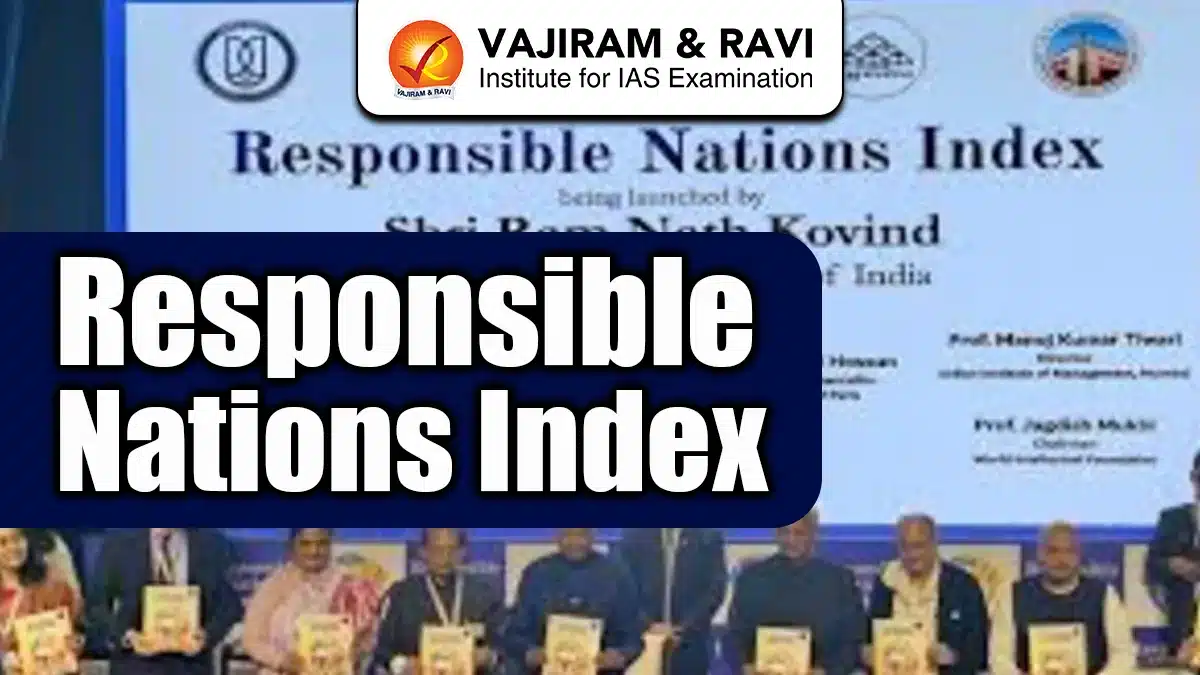
Recently, India launched the Responsible Nations Index (RNI) at the Dr. Ambedkar International Centre, New Delhi.

About Responsible Nations Index

  • It is India’s first globally anchored index.
  • It is developed by the World Intellectual Foundation (WIF) in collaboration with Jawaharlal Nehru University (JNU), IIM Mumbai, and the Dr. Ambedkar International Centre.
  • The Index covers 154 countries and is built on transparent, globally sourced data to ensure credibility and comparability.
  • It is designed to assess countries on the basis of responsible governance, social well-being, environmental stewardship, and global responsibility, moving beyond conventional power- and GDP-based measures.
  • It is structured around three core dimensions, namely
    • Internal responsibility: It focuses on dignity, justice, and the well-being of citizens;
    • Environmental responsibility: It is covering stewardship of natural resources and climate action.
    • External responsibility: It measures a country's contribution to peace, cooperation, and global stability.
  • Significance: It seeks to promote a global dialogue on ethics, responsibility, global food security, and sustainable leadership in international affairs.
    • It is expected to contribute to a more balanced and value-based understanding of national performance on the global stage.

Source: PIB

Responsible Nations Index FAQs

Q1: What is the primary focus of the Responsible Nations Index?

Ans: Ethical governance and responsibility

Q2: How many countries are covered in the Responsible Nations Index?

Ans: 154

Darwin’s Bark Spider

Darwin’s Bark Spider

Darwin’s Bark Spider Latest News

Recently, scientists from institutions in China, Madagascar, Slovenia, and the US studied bark spiders (Caerostris darwini and Caerostris kuntneri) to understand the conditions in which they produce the tough silk. 

About Darwin’s Bark Spider

  • The Darwin’s Bark Spider (Caerostris darwini) is a remarkable arachnid famed for producing the largest and toughest known webs in the animal kingdom.
  • It belongs to the family Araneidae, or orb-weaver spiders.
  • It was discovered in 2001 and formally described in 2009.
  • Habitat: It inhabits riverine forests and wetlands.
  • Distribution: It is found in the forests of Madagascar.

Appearance of Darwin’s Bark Spiders

  • These are medium-sized, with females reaching about 0.8–1 inch (2–2.5 cm) in body length, while males are significantly smaller.
  • They are typically dark brown with mottled patterns, which helps them blend into tree bark.

Characteristics of Darwin’s Bark Spiders

  • It weaves silk that outperforms steel and most human-made fibres in both strength and toughness.
  • Their silk is more than twice as tough as any other spider silk studied.
  • Web-Building Ability: Darwin’s bark spiders construct orb webs that can span rivers and streams, with diameters up to 82 ft (25 m). 
  • Lifespan: They have relatively short lifespans, typical of orb-weaving spiders, with females living longer than males.
  • Unique Habitat: Unlike most orb-weavers, it builds webs over open water rather than in vegetation.
  • Ecological Role of Darwin’s Bark Spiders: They play an important role in controlling insect populations.

Source: TH

Darwin’s Bark Spider FAQs

Q1: What is unique about Darwin's Bark Spider?

Ans: It produces the strongest silk known

Q2: Where is Darwin's Bark Spider primarily found?

Ans: Madagascar

Souparnika River

Sowparnika River

Souparnika River Latest News

The National Green Tribunal (NGT) recently directed the Udupi DC and the Chairman of the Karnataka Urban Water Supply and Drainage Board (KUWSDB) to file a detailed report outlining proposed action along with approximate estimates and timelines to stop the flow of wastewater into the Sauparnika River in Kollur.

About Souparnika River

  • The Souparnika River, also known as Sowparnika, is a west-flowing river in Karnataka.
  • It is surrounded by lush green forests of the Western Ghats.
  • Course: Originating from the Kodachadri Hills in the Western Ghats, it flows through the Byndoor taluk, passing near the renowned Mookambika Temple in Kollur, before merging with the Arabian Sea.
  • It is deeply associated with Hindu mythology.
  • Legend has it that Garuda (the divine bird and vehicle of Lord Vishnu) performed penance on the riverbanks, which is how it got its name “Souparnika” (named after “Suparna,” another name for Garuda). 
  • A unique feature of the Souparnika River is observed near Maravanthe Beach, where the river runs parallel to the Arabian Sea, separated by a narrow stretch of land. 
  • This rare geographical phenomenon offers a picturesque landscape, making it a popular spot for tourists and photographers.

Source: NIE

Souparnika River FAQs

Q1: In which Indian state does the Souparnika River flow?

Ans: It flows in Karnataka.

Q2: Which major mountain range surrounds the Souparnika River?

Ans: The Western Ghats.

Q3: From where does the Souparnika River originate?

Ans: It originates from the Kodachadri Hills in the Western Ghats.

Q4: Near which famous temple does the Souparnika River pass?

Ans: It passes near the Mookambika Temple at Kollur.

Kamchatka Peninsula

Kamchatka Peninsula

Kamchatka Peninsula Latest News

Russia’s Far Eastern Kamchatka Peninsula is reeling under extreme and record-breaking snowfall, with powerful winter storms dumping several metres of snow.

About Kamchatka Peninsula

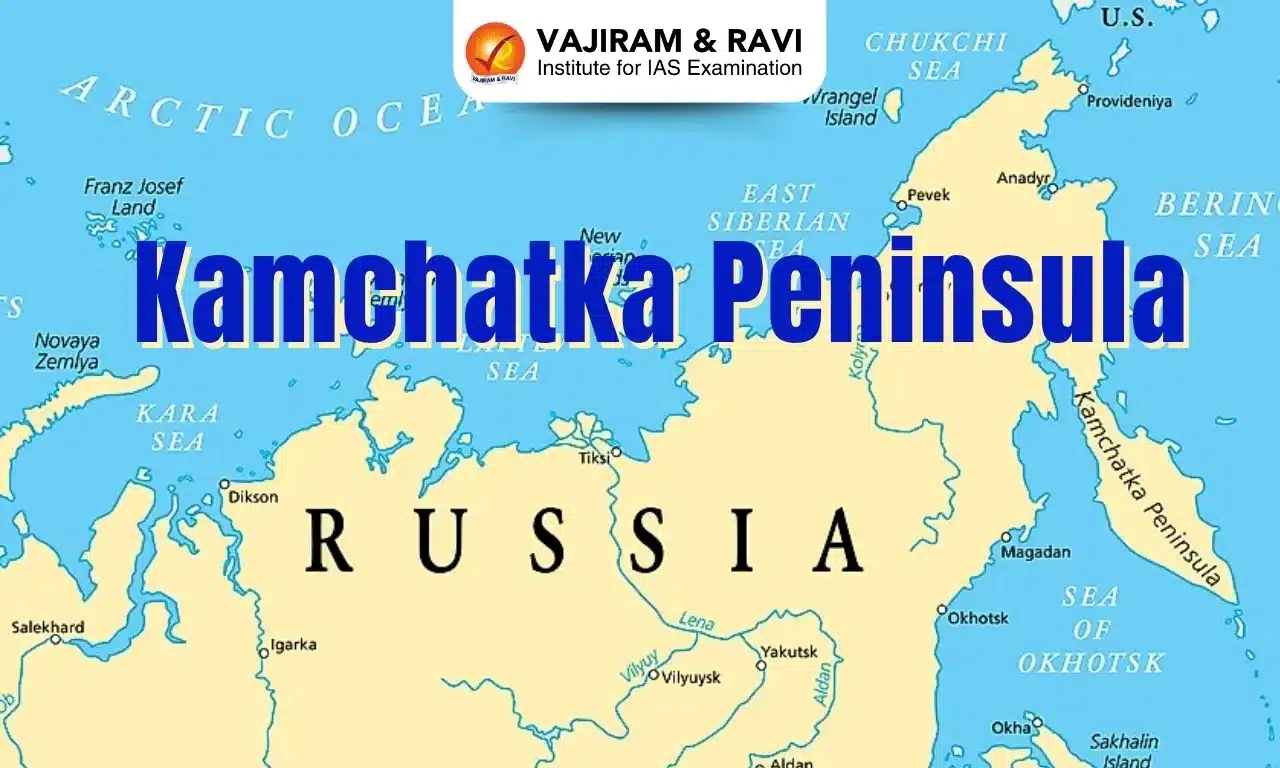
  • Location: It lies in far eastern Russia, between the Sea of Okhotsk on the west and the Pacific Ocean and Bering Sea on the east.
  • It is one of the world’s most concentrated areas of geothermal activity.
  • It contains the “volcanoes of Kamchatka”, a UNESCO World Heritage Site.
  • It is part of the Kamchatka Krai. Kamchatka, also known as a land of fire and ice, sits on the Pacific Ring of Fire and is home to over 150 volcanoes, including 29 active volcanoes.
  • It is one of the largest peninsulas in the world.
  • Climate: It experiences severe, with prolonged, cold, and snowy winters and wet, cool summers.
  • Highest Point: The Klyuchevskaya Sopka in the Eastern Range is the highest point on the Kamchatka Peninsula. 
    • The Kuril island chain runs from the southern tip of the peninsula to a short distance from Japan’s northern Hokkaido Island.

Source: TOI

Kamchatka Peninsula FAQs

Q1: Which ocean is the Kamchatka Peninsula bordered by?

Ans: Pacific Ocean

Q2: What is Kamchatka Peninsula known for?

Ans: Volcanic activity

Kumbhalgarh Wildlife Sanctuary

Kumbhalgarh Wildlife Sanctuary

Kumbhalgarh Wildlife Sanctuary Latest News 

The Centre recently declared the biodiversity-rich area, ranging from zero to one kilometre around Kumbhalgarh Wildlife Sanctuary, located in one of the most fragile ecosystems of the Aravali Range in Rajasthan, as an eco-sensitive zone (ESZ).

About Kumbhalgarh Wildlife Sanctuary

  • It is situated in the Rajsamand district of Rajasthan.
  • It spreads in an area of 610.5 sq.km. stretching across the Aravalli ranges.
    • It covers four hill and mountain ranges of the Aravallis – the Kumbhalgarh Range, the Sadri Range, the Desuri Range, and the Bokhada Range.
  • Once the hunting grounds of royals, this area was declared a wildlife sanctuary in 1971.
  • It encompasses the historic Kumbhalgarh Fort and is also named after the fort.
  • The sanctuary’s landscape is varied. The eastern part has hills ranging from 500 to 1300 meters high, while the western part borders the Marwar plains. 
  • Drainage: 
    • The eastern section is the starting point for the Banas River, which flows into the Bay of Bengal. 
    • Meanwhile, rainwater from the western slopes forms small rivers like Sukdi, Sumer, Mithdi, and Kot, all of which are tributaries of the Luni River that eventually flow into the Arabian Sea.
  • Flora: The flora of the sanctuary is mainly herbs. The species of Churel, Dhok, Khair, and Salar grow abundantly. among others.
  • Fauna: The sanctuary provides a natural abode to many creatures like Wolf, Leopards, Sloth bear, Hyena, jackal, Jungle cat, Sambhar, Nilgai, Chausingha (the four horned antelope), Chinkara and Hare.

Source: TOI

Kumbhalgarh Wildlife Sanctuary FAQs

Q1: Where is the Kumbhalgarh Wildlife Sanctuary located?

Ans: It is located in the Rajsamand district of Rajasthan.

Q2: Across which mountain range does the Kumbhalgarh Wildlife Sanctuary extend?

Ans: It stretches across the Aravalli mountain ranges.

Q3: Which river originates from the eastern section of the sanctuary?

Ans: The Banas River originates from the eastern section.

Indian Skimmer

Indian Skimmer

Indian Skimmer Latest News

Recently, the Bombay Natural History Society (BNHS) has launched a new conservation project under the National Mission for Clean Ganga (NMCG) at Dehradun to protect Indian Skimmer in the Ganga Basin.

About Indian Skimmer

  • It is one of the three species that belong to the skimmer genus Rynchops in the family Laridae. 
  • It gets its name from the way it feeds, flying low over the water surface and ‘skimming’for fish.
  • Habitat: It occurs primarily on larger, sandy, lowland rivers, around lakes and adjacent marshes, and, in the non-breeding season, in estuaries and coasts.
  • Distribution: It is native to South Asia and mainly found in India, Bangladesh, and Pakistan, with some populations extending to Nepal and Myanmar.
    • In India, one of the key areas for spotting Indian Skimmers is the Chambal River.
  • Conservation status: IUCN: Endangered.
  • Threats:  Loss of river habitats, unplanned water release from dams, sand mining, threats from predators.

Features of Indian Skimmer

  • It has a striking appearance. Its upper body is black, while its underbelly is white.
  • The most eye-catching feature is its beak, which is orange with a lower mandible that is much longer than the upper one.
  • This special beak helps the bird skim across the surface of the water to catch small fish and aquatic creatures.
  • The bird’s wings are long and angular, designed for fast, precise flight.

Source: DTE

Indian Skimmer FAQs

Q1: What is the scientific name of the Indian Skimmer?

Ans: Rynchops albicollis

Q2: What is the conservation status of the Indian Skimmer?

Ans: Endangered

Himachal Apple Import Duty: Why Farmers Want 100% Protection

Himachal Apple Import Duty

Himachal Apple Import Duty Latest News

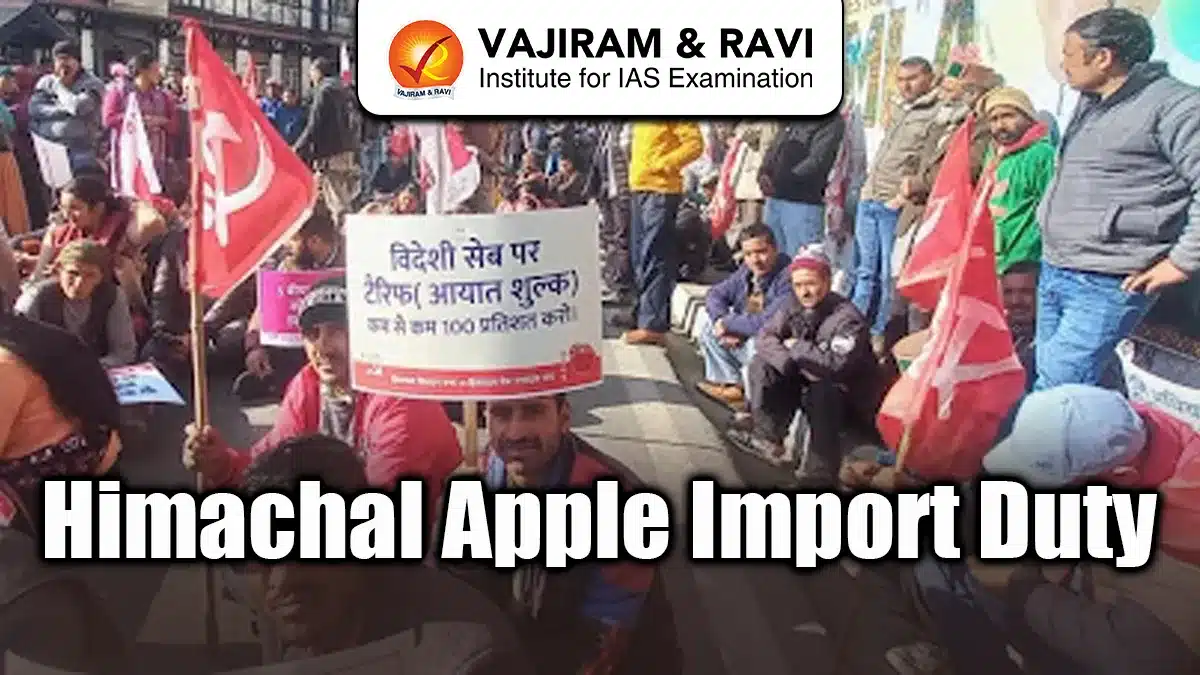
  • Himachal Pradesh Chief Minister has urged the Centre to raise import duty on foreign apples from 50% to 100% and impose a seasonal ban on imports from July to November to protect about 2.5 lakh apple farmers. Apples account for nearly 80% of the state’s fruit output. 
  • The demand follows the Centre’s decision to cut import duty on New Zealand apples to 25% for April–August under the India–New Zealand FTA. 
  • Jammu and Kashmir has echoed similar concerns, warning that rising imports add to existing challenges faced by domestic apple growers.

India Cuts Import Duty on New Zealand Apples Under FTA

  • Under the India–New Zealand Free Trade Agreement, India has reduced import duty on New Zealand apples from 50% to 25% under a quota system. 
  • The quota starts at 32,500 tonnes in the first year and rises to 45,000 MT by the sixth year. 
  • Imports must meet a minimum import price of $1.25 (₹113.6) per kg, while shipments beyond the quota will continue to attract the higher 50% duty.

Apple Production in India: J&K and Himachal at the Core

  • India produces around 28 lakh metric tonnes (LMT) of apples annually. 
  • Jammu & Kashmir dominates output with about 20 LMT, followed by Himachal Pradesh at 5–6 LMT. 
  • The remaining production comes from Uttarakhand and a few north-eastern states, where cultivation is still nascent.
  • The apple economy is valued at roughly ₹12,000 crore in J&K and ₹4,500 crore in Himachal Pradesh, making growers in these two states the most vulnerable to increased imports and tariff concessions.

Farmers’ Concerns Over Cheaper Imports

  • Apple growers are worried about the overlap between New Zealand’s export window and India’s off-season market. 
  • In India, apples are harvested between July and November, while off-season sales depend on cold storage and Controlled Atmosphere (CA) facilities. 
  • New Zealand, however, harvests apples between January/February and May, allowing it to supply fresh apples when Indian farmers sell stored produce.

Impact on Domestic Prices and Sales

  • Farmers warn that lower import duties will make foreign apples cheaper than domestic produce, directly affecting sales. 
  • In Jammu & Kashmir, high-density varieties like Gala arrive in June, while Royal Delicious reaches markets by September. 
  • Since the duty cut applies from April to August, growers fear significant losses during peak marketing periods.

Threat to Market Share

  • Orchardists from Himachal Pradesh and Jammu & Kashmir argue that cheaper imports will depress domestic prices, reduce market share.
  • It will hit farmers hardest during the off-season, undermining incomes in India’s key apple-producing regions.

Challenges Beyond Import Competition

  • Climate Stress and Falling Yields - Apple production in HP and J&K has been hit hard by climate change, erratic weather, reduced snowfall, prolonged dry spells, floods, cloudbursts and landslides. 
    • These factors have weakened orchards and lowered productivity.
  • Rising Disease Burden - Changing climatic conditions have led to a surge in plant diseases such as fire blight, apple scab, powdery mildew, sooty blotch and bitter rot. 
    • Reduced snowfall and higher temperatures have worsened water scarcity, increasing disease vulnerability during dry seasons.
  • Production Losses and Quality Decline - In 2023, Himachal’s apple output fell to 4.84 LMT, nearly 28% lower than 2022, following devastating floods. 
    • Although production recovered to 6.87 LMT in 2025, excessive rainfall and disasters caused quality deterioration, with nearly 1 LMT rejected for poor size and quality.
  • Infrastructure and Transport Bottlenecks - Logistical disruptions have compounded farmers’ problems. 
    • The prolonged closure of the Jammu–Srinagar National Highway (NH-44) due to landslides last year stranded hundreds of trucks during peak harvest, delaying market access and causing losses.

Farmers’ Demands for Protection

  • Given these cumulative pressures, farmers’ groups have demanded 100% import duty on foreign apples, a July–November import ban, special category protection, and higher subsidies. 
  • They argue that unlike countries such as New Zealand, where apple farming is heavily subsidised and insured, Indian growers receive limited direct support.
  • Farmer leaders stress that instead of increasing exposure to foreign competition, the government should focus on targeted support, productivity enhancement, and resilience-building for domestic apple growers.

Source: IE

Himachal Apple Import Duty FAQs

Q1: Why is the Himachal apple import duty in news?

Ans: The Himachal apple import duty is debated after the state sought a hike to 100% and a seasonal ban to protect farmers from cheaper New Zealand imports.

Q2: What triggered concerns over the Himachal apple import duty?

Ans: Concerns rose after India cut duty on New Zealand apples to 25% under an FTA, increasing competition during India’s apple marketing season.

Q3: How many farmers depend on the Himachal apple economy?

Ans: Around 2.5 lakh farmers depend on apples in Himachal Pradesh, making the Himachal apple import duty crucial for rural incomes.

Q4: Why are New Zealand apples a threat to Indian growers?

Ans: They enter India when domestic apples rely on storage, undercutting prices if the Himachal apple import duty remains low.

Q5: What additional challenges do apple farmers face besides imports?

Ans: Climate change, diseases, transport disruptions, and falling yields compound risks, intensifying demands for higher Himachal apple import duty.

Combating ‘Digital Arrest’ Scams – Kill Switch and Fraud Insurance as India’s New Digital Safety Nets

Digital Arrest

Digital Arrest Latest News

  • India is witnessing a sharp rise in digital frauds, particularly the phenomenon of “digital arrest” scams, leading to massive financial losses and erosion of trust in digital payments. 
  • In response, a high-level inter-departmental committee (IDC) constituted by the Ministry of Home Affairs (MHA) is examining systemic solutions, including a transaction “kill switch” and a fraud insurance mechanism. 

‘Digital Arrest’ Scams

  • Meaning:
    • Cyber-enabled fraud: Fraudsters impersonate law enforcement officials via video calls. Victims are shown fake IDs, arrest warrants, and threatened with arrest. Leaked personal data is used to build credibility.
    • Social engineering: Victims are kept under psychological pressure for hours and coerced into transferring money to mule accounts.
  • Estimated losses: Victims across India are believed to have collectively lost nearly Rs 3,000 crore to digital arrest scams, prompting the Supreme Court to take suo motu cognizance of the issue.

Key Proposals Under Consideration

  • Transaction ‘Kill Switch’:
    • An emergency button embedded in UPI apps, and banking/payment applications.
    • Once activated all banking and financial transactions are instantly frozen, preventing further outflow of funds during suspected fraud.
    • It aims to create last-mile consumer protection, and real-time intervention in fraud scenarios.
  • Tracking and blocking fraudulent transactions: Exploring systems to identify suspicious transactions, prevent instant splitting of funds into multiple mule accounts, and address rapid laundering techniques used by fraud networks.
  • Fraud insurance mechanism:
    • Proposal to introduce insurance coverage for fraud-related losses in banking.
    • Driven by increasing scale and sophistication of digital frauds, and recognition that traditional audits and compliance are insufficient.
    • RBI’s evolving stance - Shift from viewing fraud as merely a compliance issue to a systemic and balance-sheet risk.

Insurance Framework Involved

  • The IDC is chaired by Special Secretary (Internal Security), MHA, with representatives from:
    • Ministry of Electronics and Information Technology (MeitY), 
    • Department of Telecommunications (DoT), 
    • Ministry of External Affairs (MEA), 
    • Department of Financial Services (DFS), 
    • Ministry of Law & Justice (MoLJ), 
    • Ministry of Consumer Affairs (MoCA), 
    • Reserve Bank of India (RBI), 
    • CBI, NIA, Delhi Police, and 
    • The Indian Cyber Crime Coordination Centre (I4C) (with the CEO, I4C acting as Member-Secretary).
  • Additionally: MeitY met major IT intermediaries (Google, WhatsApp, Telegram, Microsoft) earlier.

Role of RBI and Insurance Sector

  • RBI observations:
    • There were 23,879 fraud cases involving an amount of Rs 34,771 crore as of 2024-25. 
    • The RBI’s Payment Vision 2025 report has proposed studying the feasibility of setting up a Digital Payment Protection Fund (DPPF) to provide security cover to defrauded customers and payment instrument issuers.
  • Expert view: Existing cyber insurance does not cover first-party fraud losses, especially those caused by customer manipulation.
  • Preferred option - Insurance pool model:
    • Backed by contributions from banks, insurers and potentially supported by regulatory frameworks – that could spread fraud risk across the system.
    • This will be similar to terrorism insurance pools in several countries. 
    • Such a structure would help manage tail risks while keeping premiums affordable.

Key Challenges and Way Ahead

  • Operational complexity: Avoiding misuse or accidental triggering of the kill switch.
    • Technology-based safeguards - AI-driven fraud detection and transaction velocity checks.
  • Interoperability: Uniform adoption across banks, UPI platforms, and fintech apps.
    • Strengthened coordination - Banks–Insurers–Regulators–Tech platforms partnership.
  • Moral hazard: Risk of reduced consumer vigilance if insurance is guaranteed.
    • Consumer awareness - Nationwide campaigns on digital arrest scams.
  • Regulatory coordination: RBI, IRDAI, MeitY, and banks must act in sync. 
    • Regulatory clarity - Clear SOPs for kill switch activation and reversal.
    • Legal backing - Amendments to IT and banking regulations for rapid response.
  • Coverage gaps: Current cyber insurance inadequate for social engineering frauds.
    • Insurance innovation - Creation of a fraud insurance pool under IRDAI leadership.

Conclusion

  • India’s rapid digitalisation has outpaced traditional risk-control mechanisms, making digital fraud a systemic threat rather than a mere compliance issue. 
  • The proposed initiatives represent a paradigm shift towards proactive, consumer-centric and system-wide protection. 
  • If implemented with robust safeguards, regulatory coordination and public awareness, these measures can significantly enhance the resilience and credibility of India’s digital financial ecosystem.

Source: IE

Digital Arrest

Q1: What are ‘digital arrest’ scams?

Ans: Digital arrest scams are cyber-enabled social engineering frauds where criminals impersonate law enforcement to coerce victims.

Q2: How does the proposed ‘transaction kill switch’ strengthen consumer protection?

Ans: It provides real-time consumer empowerment by instantly freezing all financial transactions during suspected fraud.

Q3: Why are traditional banking controls insufficient to tackle modern digital frauds?

Ans: They are reactive, whereas modern digital frauds are fast, distributed, and driven by social engineering.

Q4: What is the rationale for a fraud insurance pool in India’s banking system?

Ans: It spreads systemic digital fraud risk across banks and insurers, manages tail risks, and ensures affordable protection.

Q5: How does a high-level inter-departmental committee reflect India’s governance approach to cyber fraud?

Ans: It reflects a whole-of-government approach, integrating institutions to address cyber fraud holistically.

Pax Silica and India – Securing Critical Technology Supply Chains

Pax Silica

Pax Silica Latest News

  • India is likely to be invited to join the U.S.-led Pax Silica initiative aimed at securing global semiconductor, AI, and critical mineral supply chains.

Understanding Pax Silica

  • Pax Silica is a multilateral initiative launched by the United States in December 2025 to secure supply chains of critical technologies such as semiconductors, artificial intelligence (AI), and rare earth elements (REEs). 
  • The term “Pax” denotes peace, while “Silica” refers to silicon-based semiconductor technologies, symbolising a stable and cooperative global technology order.
  • The Pax Silica Declaration emphasises three core objectives: 
    • Reducing coercive economic dependencies, 
    • Ensuring secure global technology and AI supply chains, and 
    • Building trusted digital infrastructure. 
  • The initiative reflects growing concerns that over-dependence on a single country for critical inputs can expose economies to geopolitical coercion.

Global Context Behind Pax Silica

  • The global economy is witnessing a shift where advanced technologies such as AI, semiconductors, and digital infrastructure are becoming central to economic and strategic power. 
  • At the same time, supply chains for rare earths and critical minerals remain highly concentrated.
  • China currently dominates the global supply of rare earth elements and processing capabilities. 
  • In recent years, it has used export restrictions as a strategic tool, including suspending REE exports following tariff disputes with the U.S. India too faced disruptions in rare-earth magnet supplies, affecting its automobile and electronics industries.
  • The COVID-19 pandemic further exposed vulnerabilities of globally fragmented and concentrated supply chains, prompting countries to pursue diversification and resilience strategies.

Key Members of Pax Silica

  • The Pax Silica grouping brings together technologically advanced and resource-rich countries. 
  • Key participants include the United States and Japan as technology leaders; Australia as a major lithium and rare-earth exporter; the Netherlands for advanced lithography technologies; South Korea for memory chip manufacturing; and Singapore for semiconductor fabrication.
  • Israel contributes expertise in AI software, defence technologies, and cybersecurity, while the United Kingdom hosts one of the world’s largest AI markets. 
  • Gulf countries such as Qatar and the UAE add financial strength through sovereign investment funds. 
  • Canada, the European Union, OECD, and Taiwan currently participate as observers.

India’s Strategic Relevance

  • India is not yet a formal member but is expected to be invited soon. India brings several strengths to Pax Silica. 
  • It has one of the world’s most robust digital public infrastructures, a rapidly growing AI market, and a large pool of skilled technology professionals.
  • The Government of India has also launched the India Semiconductor Mission and national AI initiatives with significant financial support. 
  • Investments by Indian firms such as the Tata Group and foreign companies like Micron indicate growing confidence in India’s semiconductor ecosystem. 
  • Additionally, a steady return of skilled Indian professionals trained abroad could strengthen domestic capabilities.

Existing Supply Chain Initiatives Involving India

  • India has already taken steps to enhance supply chain resilience. In 2021, it joined Australia and Japan in launching the Supply Chain Resilience Initiative
  • India is also part of the Quad’s Critical Minerals Initiative, aimed at securing emerging technology supply chains.
  • Collaborations with Japan, Singapore, and Israel in semiconductor manufacturing further position India as a credible partner in Pax Silica-aligned ecosystems.

Challenges for India in Joining Pax Silica

  • Despite the opportunities, India faces challenges. Pax Silica members are largely high-income U.S. allies, whereas India would be the first developing country and non-ally strategic partner in the grouping. 
  • This may create expectation gaps on policy alignment and strategic responses.
  • India also prioritises strategic autonomy and may resist frameworks that constrain independent foreign or economic policy choices. 
  • Moreover, India may seek to protect its nascent semiconductor and AI industries through subsidies, procurement preferences, and calibrated import controls, policies that may not fully align with the current U.S. policy environment.

Strategic Implications and the Road Ahead

  • The emergence of Pax Silica signals the likelihood of two parallel global technology supply chains, one centred around China and the other around Pax Silica countries. 
  • Given India’s long-standing technological collaboration with Western economies and recent supply disruptions from China, aligning with Pax Silica appears strategically advantageous.
  • However, India is expected to proceed cautiously, engaging in dialogue to ensure that participation strengthens domestic capabilities without compromising strategic autonomy or development priorities.

Source : TH

Pax Silica FAQs

Q1: What is Pax Silica?

Ans: Pax Silica is a U.S.-led initiative aimed at securing global semiconductor, AI, and critical mineral supply chains.

Q2: Why is Pax Silica important for India?

Ans: It can help India reduce dependence on China and strengthen its semiconductor and AI ecosystems.

Q3: Which countries are part of Pax Silica?

Ans: Members include the U.S., Japan, Australia, South Korea, the Netherlands, Singapore, and others.

Q4: What challenges could India face in joining Pax Silica?

Ans: Balancing strategic autonomy, policy flexibility, and expectations of high-income member countries.

Q5: How does Pax Silica impact global geopolitics?

Ans: It signals the emergence of competing technology supply chains led by China and Pax Silica countries.

Trump Trade Wars: How U.S. Protectionism Is Strengthening China

Trump Trade Wars

Trump Trade Wars Latest News

  • US President Donald Trump’s second term has triggered sweeping geopolitical and economic disruptions, with his aggressive trade and foreign policies paradoxically strengthening China’s global economic position.
  • In his first year back in office, President Trump signed hundreds of executive orders, launched a renewed trade war, withdrew the US from key international institutions, ordered mass deportations, and undertook military actions in Yemen, Iran, and Nigeria, reshaping global stability.

Trump’s Upheaval and its Unintended Impact

  • From Ally to Threat: Europe’s Shock - Where Russia once dominated Europe’s threat perception, the US has now emerged as a major source of uncertainty, unsettling transatlantic relations and altering Europe’s strategic calculations.
  • Markets Signal Global Anxiety - Rising geopolitical and economic instability under Trump has driven investors toward safe-haven assets, pushing gold and silver prices to record highs amid fears linked to US policy unpredictability.
  • The China Paradox - Despite Trump’s intent to isolate China through trade curbs and technology restrictions, China has emerged economically stronger, benefiting from a record trade surplus that surged to historic highs by December 2025.
    • China achieved 5% economic growth in 2025, meeting official targets. A booming trade surplus offset domestic challenges such as weak consumption and a prolonged property crisis, even amid tariff pressures.
    • Rather than retreating, China responded to US pressure by deepening integration with global markets, reinforcing its position in international trade and reshaping global trade relationships.

Canada–China Reset After Years of Strain

  • Canadian Prime Minister Mark Carney’s visit to Beijing marked a pivotal reset in bilateral ties after nearly a decade of diplomatic chill
  • Canada and China agreed on tariff reductions for Canadian canola and seafood, and limited access for Chinese EVs to the Canadian market.
  • During the visit, Carney and Chinese President Xi Jinping signalled the start of a “new strategic partnership”, reflecting a pragmatic turn driven by shifting global trade dynamics and shared economic interests.

Beijing Draws Global Leaders

  • Carney’s trip fits into a broader pattern of world leaders re-engaging with China. 
  • South Korean President Lee Jae Myung visited Beijing earlier this month, the first such visit since 2019. 
  • UK Prime Minister Keir Starmer and German Chancellor Friedrich Merz are also expected to visit soon.
  • As the US retreats from its traditional role as the anchor of global trade under President Trump, countries are increasingly bypassing Washington to deepen partnerships with China and among themselves, reshaping the global economic order.

Global Supply Chains Are Stretching, Not Shrinking

  • Recent analysis by the analysts shows that global trade is reconfiguring rather than retreating. 
  • Average trade distances are at record highs, with expanding flows across Asia, West Asia and Africa more than offsetting reduced US trade.
  • As per their analysis, trade surged in early 2025 as firms front-loaded shipments ahead of expected tariff changes.

China’s Rising Influence in Global Perceptions

  • A January 2026 paper by Timothy Garton Ash and colleagues highlights a growing global expectation that China’s influence will expand over the next decade. 
  • More countries now view Beijing as an ally or necessary partner, even as confidence in US leadership declines.
  • Another study points out that the expectations of US leadership under Donald Trump have fallen sharply over the past year, including in countries like India and South Africa. 
  • Many now believe Trump’s actions have inadvertently strengthened China’s global standing.
  • Many Europeans no longer see the US as a reliable ally and are keen to rearm. Russians now view the EU as a greater adversary than the US, while Ukrainians increasingly look to Brussels rather than Washington for support.

India’s Cautious Rebalancing Toward China

  • New Delhi has begun a calibrated opening in its engagement with China, reflecting a pragmatic reassessment of foreign policy options amid a sharply deteriorating economic relationship with the United States under the Trump administration.
  • Even as border disputes and strategic differences persist, India and China have addressed some “low-hanging fruit” in bilateral ties. 
  • However, New Delhi now expects reciprocity from Beijing, particularly in easing curbs on Indian businesses and sensitive sectors such as rare earth magnets, before further liberalisation on its part.
  • India’s trade data signals this pivot. In December, exports to China surged nearly 70% to $2 billion, while shipments to the United States fell by almost 2% to $6.8 billion, as steep US tariffs reshaped export priorities.
  • The US has imposed tariffs of up to 50% on Indian goods — among the highest levied on any country, even exceeding those on China. 
  • These measures have disrupted trade flows and strained diplomatic ties, pushing India to diversify markets and recalibrate external economic partnerships.

Source: IE

Trump Trade Wars FAQs

Q1: What are Trump trade wars?

Ans: Trump trade wars refer to aggressive tariffs, trade curbs, and protectionist policies aimed at rivals, especially China, during Trump’s second term.

Q2: How have Trump trade wars affected China?

Ans: Trump trade wars paradoxically strengthened China, boosting its trade surplus and global integration despite attempts to isolate it.

Q3: Why has Europe been unsettled by Trump trade wars?

Ans: Europe increasingly sees the U.S. as unpredictable, with Trump trade wars undermining trust and transatlantic economic stability.

Q4: How have global supply chains responded to Trump trade wars?

Ans: Supply chains have stretched further, with increased trade across Asia, West Asia, and Africa offsetting reduced U.S. trade links.

Q5: How has India reacted to Trump trade wars?

Ans: India has diversified exports and cautiously rebalanced toward China after facing steep U.S. tariffs under Trump trade wars.

Daily Editorial Analysis 21 January 2026

Daily Editorial Analysis

The ‘Donroe Doctrine’, A Broken International Order

Context

  • The turn of 2026 underscores the erosion of the post–Second World War international order.
  • Structures once rooted in multilateral norms and collective security are giving way to a fragmented environment driven by unilateral coercion, regional power assertions, and opportunistic diplomacy.
  • The year reveals a world transitioning from rules-based order to competitive multipolarity, where norms often yield to force and influence.

The New ‘Donroe Doctrine’ and the Return of Hemispheric Hegemony

  • The year begins with a dramatic U.S. operation: the abduction of Venezuelan President Nicolás Maduro, justified as a security imperative and framed as an updated incarnation of the nineteenth-century Monroe Doctrine.
  • This new ‘Donroe Doctrine’ reflects President Donald Trump’s instinct to restore hemispheric primacy and assert the United States as the dominant guarantor of security in the Western Hemisphere.
  • Trump’s November 2025 National Security Strategy (NSS) articulates ambitions to deny non-Hemispheric competitors’ strategic access to the region.
  • The Venezuelan action fits a broader pattern of hemispheric reassertion, combined with veiled signals toward Cuba, Colombia, Mexico, and even Greenland.
  • The muted international response reinforces the perception that sovereignty norms have weakened and that the post-1945 security architecture is no longer constraining major powers.
  • This environment invites emulation: China and Russia now appear more confident about advancing their own spheres of influence, with Taiwan representing China’s most salient potential flashpoint.
  • Global politics edges toward a world of regional doctrines rather than global consensus.

The Trouble in Asia: A Region of Uneven Fires

  • The Trouble in West Asia
    • West Asia enters 2026 in a fractured state. Israel’s military offensives in Gaza have paused, yet durable peace remains elusive.
    • Violence persists as a background condition, especially in densely populated and contested zones.
    • Instability deepens with unrest in Iran, where the regime identifies itself as fighting four simultaneous wars: economic, psychological, military, and counterterrorism.
    • The U.S. and Israel perceive an opportunity to undermine the Khamenei regime, reviving unfinished objectives from 2025.
    • Additional sanctions and covert manoeuvres heighten regional tension, making escalation more likely than reconciliation.
  • Afghanistan and Bangladesh
    • The Tehreek-e-Taliban Pakistan (TTP) and allied militant groups gain renewed momentum, threatening the fragile Afghanistan–Pakistan frontier.
    • Pakistan experiences intensified military dominance under Field Marshal Asim Munir, with democratic processes further eroded.
    • Yet Islamabad paradoxically enjoys revived status as a preferred U.S. partner and recipient of advanced weapons systems, reshaping regional balances.
    • Bangladesh confronts democratic uncertainty as elections promise procedural renewal without guaranteeing stability.
    • Together, these trends render West and Northwest Asia a mosaic of local crises without regional mechanisms for conflict resolution.

China’s Strategic Poise and the Pacific Reshuffle

  • Amid this volatility, China finishes 2025 with strengthened geopolitical posture.
  • The tariff confrontation with the U.S. fails to cripple Chinese industry; instead, Beijing consolidates its position in global supply chains and uses rare earth export restrictions as strategic leverage.
  • These actions underscore China’s capacity for economic statecraft.
  • China’s influence expands across Southeast Asia and the Indian Ocean, eroding traditional U.S. dominance in the Eastern Pacific.
  • Power shifts occur quietly through investments, infrastructure, and maritime logistics rather than direct confrontation.
  • The U.S. finds itself stretched between reasserting hemispheric control and countering Chinese expansion across the Indo-Pacific.

India at the Crossroads: Strategic Uncertainty and Diplomatic Constraints

  • India enters 2026 in an ambiguous strategic position. Despite alignment with U.S. interests on several fronts, Trump criticizes India’s continued imports of Russian oil and cultivates closer ties with Pakistan, producing a subtle diplomatic chill.
  • This reduces India’s leverage in West Asian crises and narrows its mediation space.
  • Mini-lateral initiatives such as I2U2 and the India–Middle East–Europe Economic Corridor progress, yet economic vulnerabilities remain.
  • China holds a tactical advantage in tariff and trade disputes, limiting India’s ability to hedge.
  • The improvement in India-China relations after the 2025 Tianjin meeting stabilizes tensions but does not generate momentum for deeper rapprochement.
  • Terrorism persists as an ambient threat in 2026. While India may avoid major attacks, Islamic State and al-Qaeda activity in Africa and West Asia ensures that militant networks remain dispersed, resilient, and transnational.

Conclusion

  • The emerging world of 2026 is defined not by institution-building but by geopolitical disorder.
  • The Donroe Doctrine symbolises a shift from multilateral restraint to unilateral assertion, encouraging similar ambitions among rival powers.
  • Middle states such as India must adapt to an environment where power increasingly substitutes for legitimacy and where regionalism replaces global security consensus.

The ‘Donroe Doctrine’, A Broken International Order FAQs

 Q1. What is the ‘Donroe Doctrine’?
Ans. The ‘Donroe Doctrine’ is the updated U.S. strategy under President Trump asserting U.S. dominance in the Western Hemisphere and restricting external influence.

Q2. Why is West Asia described as unstable in 2026?
Ans. West Asia is unstable due to unresolved conflicts in Gaza, widespread unrest in Iran, and heightened regional tensions driven by U.S. and Israeli pressure.

Q3. How did China strengthen its geopolitical position in 2025?
Ans. China strengthened its position by resisting U.S. tariffs, reinforcing global supply chains, and expanding its influence in Southeast Asia and the Indian Ocean.

Q4. What challenges does India face in 2026?
Ans. India faces strategic uncertainty due to U.S. criticism, closer U.S.-Pakistan ties, and limited leverage in tariff and trade disputes with China.

Q5. Why is terrorism considered an ongoing threat in 2026?
Ans. Terrorism remains a threat because networks like Islamic State and al-Qaeda continue operating across Africa, West Asia, and South Asia despite shifting fronts.

Source: The Hindu


The EV Boom is Accelerating a Copper Crunch

Context

  • The rapid global shift to electric vehicles is driving an unprecedented surge in copper demand, as the metal is essential for EV batteries, motors, wiring, charging networks, and power grids.
  • While EV sales have grown exponentially over the past decade, copper supply has lagged due to underinvestment, declining ore quality, and long mine development timelines.
  • This mismatch could trigger a structural copper deficit as early as 2026, reshaping global trade, intensifying geopolitical competition, and potentially slowing or raising the cost of the EV transition.
  • This article highlights how the rapid global shift to electric vehicles is triggering an underappreciated copper crunch, as soaring EV demand collides with slow-moving supply, creating a structural risk to electrification, trade, and climate goals.

EV Sales and Copper Demand in Lockstep

  • The electric vehicle transition shows a strong, near one-to-one relationship between EV sales growth and copper demand.
  • From 2016 to 2024, copper demand rose faster than EV adoption, with elasticity mostly above 1.0, despite efficiency improvements.
  • Rising Copper Intensity of Electrification
    • EV-related copper use jumped from about 39,000 tonnes in 2016 to over 1.1 million tonnes in 2024, alongside EV sales growth from 0.75 million to nearly 17 million units.
    • The peak elasticity in 2019 reflected larger batteries, more power electronics, and rapid charging infrastructure.
  • Structural Pressure on Copper Supply
    • Even as elasticity moderates with efficiency gains, absolute copper demand will keep rising due to scale.
    • EVs use four to five times more copper than conventional vehicles, with no viable substitutes, making copper a key constraint on global electrification.

Supply–Demand Imbalance in the Copper Market

  • Global copper demand is rising rapidly, while supply growth has slowed, creating a widening structural gap often described as a “jaw-opening deficit”.
  • This imbalance marks the start of a prolonged copper shortage phase.
  • Why Supply Is Falling Behind - Supply growth is constrained by declining ore grades at existing mines, long 10–15 year timelines for new projects, and environmental opposition in key producers such as Chile, Peru and the United States.
  • From Surplus to Severe Deficit - In 2024, global copper supply is expected to exceed demand by about 0.3 million tonnes. By 2026, demand may reach 30 million tonnes, while supply lags near 28 million tonnes.
  • A Rapidly Widening Gap - The deficit could widen to 4.5 million tonnes by 2028 and nearly 8 million tonnes by 2030 — equivalent to the combined output of the world’s ten largest copper mines.
  • Implications for Electrification - Such shortages could raise EV costs, delay charging infrastructure, and strain decarbonisation goals. Without rapid expansion of mining, recycling and material innovation, copper scarcity may become electrification’s main bottleneck.

China at the Centre of EV-Driven Copper Demand

  • The geography of EV-led copper consumption is reshaping global market dynamics, with China emerging as the dominant force.
  • China’s EV-related copper demand rose from about 78,000 tonnes in 2020 to nearly 6,78,000 tonnes in 2024 and is projected to reach around 7,80,000 tonnes by 2025, accounting for almost 60% of global EV-linked copper use.
  • Integrated Supply Chains and Strategic Advantage
    • China’s dominance is driven not just by EV sales but by its control of over 70% of global battery cell production and a deeply integrated supply chain.
    • This gives Beijing strong pricing power, long-term contracting leverage, and strategic influence over copper-rich regions.
  • Uneven Global Consumption Patterns
    • By 2025, EV-related copper demand is expected to reach around 2,10,000 tonnes in the European Union and 1,14,000 tonnes in the United States, while India’s demand remains modest at roughly 7,200 tonnes.
    • This asymmetry reinforces China’s structural advantage.
  • Copper as the Artery of the Energy Transition
    • The EV revolution is transforming not just transport but the global metals economy.
    • Copper has become the critical artery of electrification, with demand nearing levels that outpace supply in unprecedented ways.
  • Resource Strategy Will Shape Electrification
    • Policymakers, investors and planners must recognise that the energy transition is inseparable from resource strategy.
    • Without decisive action on copper supply, recycling and innovation, geology—not ambition—will set the pace of electrification.

The EV Boom is Accelerating a Copper Crunch FAQs

Q1. Why is copper critical to the electric vehicle transition?

Ans. Copper is essential for EV batteries, motors, wiring, charging infrastructure and power grids, making electrification far more copper-intensive than conventional automotive and energy systems.

Q2. How closely are EV sales and copper demand linked?

Ans. EV sales and copper demand move almost in lockstep, with copper demand often growing faster than EV adoption due to larger batteries, power electronics and charging networks.

Q3. Why is a global copper deficit expected after 2026?

Ans. Decades of underinvestment, declining ore grades, long mine development timelines, and environmental resistance have constrained supply as EV-driven demand accelerates sharply.

Q4. How does China dominate EV-related copper consumption?

Ans. China accounts for nearly 60% of global EV-linked copper demand, driven by high EV sales, control over battery production, and deeply integrated supply chains.

Q5. What risks does copper scarcity pose to electrification goals?

Ans. Copper shortages could raise EV costs, delay charging infrastructure, intensify geopolitical competition, and slow decarbonisation, making resource availability a key constraint on energy transition ambitions.

Source: TH

Daily Editorial Analysis 21 January 2026 FAQs

Q1: What is editorial analysis?

Ans: Editorial analysis is the critical examination and interpretation of newspaper editorials to extract key insights, arguments, and perspectives relevant to UPSC preparation.

Q2: What is an editorial analyst?

Ans: An editorial analyst is someone who studies and breaks down editorials to highlight their relevance, structure, and usefulness for competitive exams like the UPSC.

Q3: What is an editorial for UPSC?

Ans: For UPSC, an editorial refers to opinion-based articles in reputed newspapers that provide analysis on current affairs, governance, policy, and socio-economic issues.

Q4: What are the sources of UPSC Editorial Analysis?

Ans: Key sources include editorials from The Hindu and Indian Express.

Q5: Can Editorial Analysis help in Mains Answer Writing?

Ans: Yes, editorial analysis enhances content quality, analytical depth, and structure in Mains answer writing.

Enquire Now