Ceuta Migrant Crisis 2026, Causes, Legal Developments

Ceuta Migrant Crisis 2026

The Ceuta Migrant Crisis 2026 has come into focus after thousands of migrants crossed from Morocco into the Spanish enclave of Ceuta, creating a major border management challenge. 

About Ceuta

Ceuta is a strategically important Spanish autonomous city located on the northern coast of Africa along the Strait of Gibraltar

  • Although geographically located in Africa, Ceuta is politically part of Spain and the European Union (EU).
  • Together with Melilla, another Spanish enclave on Morocco’s Mediterranean coast, it forms the European Union’s only land borders with Africa.
  • The city covers around 18.5 sq km and has a population of nearly 85,000 people comprising diverse communities, including Christians and Muslims of Spanish and Moroccan origin.
  • Ceuta lies close to mainland Spain across the Strait of Gibraltar and shares a land border with Morocco.
  • Its location near the Strait of Gibraltar gives it strategic importance for maritime trade, defence and border management.
  • Ceuta has remained under Spanish administration since 1580, although Morocco continues to claim Ceuta and Melilla as its territories.
  • Due to its status as EU territory, reaching Ceuta provides migrants access to European immigration and asylum systems, making it a major route for irregular migration.

About Ceuta Migrant Crisis 2026

The 2026 Ceuta migrant crisis refers to the sudden arrival of thousands of migrants from Morocco into the Spanish enclave of Ceuta. Many migrants crossed by swimming around coastal barriers, using inflatable devices or climbing the high border fence, overwhelming Spanish security forces and reception facilities.

The scale of the influx created a serious law-and-order and humanitarian challenge. Spanish authorities deployed the military to support the Civil Guard, while Spain and Morocco reached an agreement to facilitate the return of migrants who entered the territory illegally.

Ceuta Migrant Crisis 2026 Reasons 

The 2026 Ceuta migrant crisis was not caused by a single event but by a combination of geographical, economic, political and humanitarian factors. Ceuta’s location on the Morocco-Spain border, together with growing migration pressures from Africa and the activities of smuggling networks, turned the enclave into the centre of one of Europe’s largest recent border crises.

Reasons Behind the Ceuta Migrant Crisis: 

  • Gateway to Europe: Ceuta is part of Spain and the European Union, making it one of the closest and easiest entry points into Europe from Africa.
  • Economic hardship: Poverty, unemployment and the search for better livelihood opportunities continue to drive many migrants towards Europe.
  • Conflict and instability: Violence, political instability and humanitarian crises in several African countries have forced many people to migrate.
  • Role of smuggling networks: Criminal organisations involved in human trafficking and migrant smuggling reportedly facilitated and encouraged many of the crossings.
  • Geographical proximity: Ceuta shares a land border with Morocco and is separated by only a short coastal stretch, making it relatively easier to reach by swimming, inflatable boats or by crossing the border fence.
  • Possible legal factor: Some analysts believe a recent Spanish court ruling requiring due process before returning migrants arriving by sea may have encouraged more people to attempt the crossing.
  • Persistent migration pressure: Ceuta and Melilla have long remained major migration hotspots because they are the European Union’s only land borders with Africa, attracting repeated attempts at irregular entry.

Legal Trigger Behind the Ceuta Migrant Crisis 2026

A major factor behind the 2026 Ceuta migrant surge was a Spanish Supreme Court ruling in June 2026 regarding the process of returning migrants who enter the country illegally.

  • Earlier, Spain’s border policy allowed authorities to immediately return migrants who were caught while crossing the land fence separating Ceuta from Morocco.
  • The Supreme Court clarified that this immediate return procedure would apply only to people crossing the physical border fence and not to those entering through the sea route.
  • Migrants reaching Ceuta by sea would now have to undergo a regular legal process, including identification, legal assistance and examination of possible asylum claims.
  • Spanish authorities argued that this created a practical challenge because the existing security system, including fences, cameras and surveillance, was mainly designed to stop land crossings and could not effectively prevent sea arrivals.
  • As a result, the legal change created a gap between border control mechanisms and new migration routes, encouraging more migrants to attempt entry through coastal waters.

Ceuta Migrant Crisis 2026 FAQs

Q1: What is Ceuta?

Ans: Ceuta is a Spanish autonomous city located on the northern coast of Africa. Although geographically situated in Africa, it is politically part of Spain and the European Union.

Q2: Why is Ceuta strategically important?

Ans: Ceuta overlooks the Strait of Gibraltar, one of the world’s busiest maritime passages, making it important for maritime trade, defence, border management and regional security.

Q3: Why has Ceuta become a migration hotspot?

Ans: Its location on the African coast and its status as European Union territory make it one of the most accessible entry points for irregular migrants attempting to reach Europe.

Q4: Why did the 2026 Ceuta migrant crisis occur?

Ans: Thousands of migrants crossed from Morocco in search of safety and better economic opportunities, overwhelming local authorities and prompting Spain to strengthen border security with military support.

Q5: Why does Morocco claim Ceuta?

Ans: While Spain has administered Ceuta since 1580 and considers it an integral part of the country, Morocco regards both Ceuta and Melilla as occupied Moroccan territories.

80th Independence Day 2026 (15th August), Theme, Celebrations

80th Independence Day 2026

India will celebrate its 80th Independence Day on Saturday, August 15, 2026. The main national event will be held at the Red Fort in New Delhi, where the Prime Minister will hoist the National Flag and address the nation. The celebrations will also include the Har Ghar Tiranga campaign and patriotic events across the country, marking 80 years of India's independence while reaffirming the vision of Viksit Bharat by 2047.

80th Independence Day 2026 (15th August)

India is moving steadily towards its vision of Viksit Bharat 2047, and to celebrate this journey, the Ministry of Defence along with MyGov has launched the Independence Day Celebrations 2026 campaign. This initiative aims to celebrate the spirit of freedom while motivating citizens, especially the youth, to actively contribute to building a strong and self-reliant nation.

  • The campaign is deeply based on the values of patriotism, constitutional ideals, women-led development, scientific growth, and technological advancement, encouraging people across the country to reflect on India’s progress and future goals.
  • India’s Independence Day celebrations do not have a chief guest; instead, the Prime Minister hoists the national flag at the Red Fort and addresses the nation, making it a purely national event focused on India’s freedom and unity. 
  • Along with technology, there is a strong focus on Green Transition, including initiatives like Mission LiFE, Solar-Powered Villages, and the Green Hydrogen Mission, reflecting India’s commitment to sustainable development.
  • A major highlight of 2026 celebrations is Atmanirbhar Defence, where for the first time, all equipment used at the Red Fort will be completely indigenous equipment, showcasing the country’s growing defence capabilities.
  • The government will use Digital India Bhashini (AI-based translation tool) to translate the Prime Minister’s speech in real time into 22+ Indian languages, ensuring that people across the country can understand the vision of Viksit Bharat in their own mother tongue.
  • Another important event during this week is the Young Leaders Dialogue, where Gen-Z and young entrepreneurs will present innovative solutions in areas like agriculture, fitness, and startups directly to national leaders, highlighting the role of youth in shaping India’s future.
  • This year’s Independence Day also coincides with Navroz (Parsi New Year), bringing a unique cultural blend, especially visible in states like Maharashtra and Gujarat, where celebrations of both occasions take place together.

Independence Day 2026 Theme

The theme of Independence Day 2026 has not been officially announced yet, but it is expected to revolve around key values like patriotism, unity, national growth, and the legacy of freedom fighters, reflecting India’s journey and aspirations.

The celebration aims to highlight India’s progress through unity, innovation, and inclusive development, as the country moves towards its vision of becoming a $5 trillion economy by 2047.

Independence Day 2026 Historical Background

  • India’s First Independence Day (1947): India celebrated its first Independence Day on 15 August 1947, marking the end of British rule and the beginning of a free and sovereign nation.
  • Nehru’s Historic “Tryst with Destiny” Speech: On the midnight of independence, Jawaharlal Nehru, India’s first Prime Minister, delivered the iconic “Tryst with Destiny” speech, symbolizing the start of a new era.
  • First Flag Hoisting at Red Fort: The raising of the Indian tricolour at the Red Fort for the first time represented the end of colonial rule and the birth of self-governance.
  • Tradition of National Celebrations: Since 1947, Independence Day has been celebrated every year with official ceremonies across India, honoring the sacrifices of freedom fighters.
  • Prime Minister’s Role in Celebrations: A key tradition includes the Prime Minister hoisting the National Flag of India at the Red Fort, followed by an address to the nation.
  • Honouring Freedom Fighters of India: The day serves as a reminder of the courage, struggles, and vision of leaders and freedom fighters who played a crucial role in India’s independence.

Independence Day 2026 Events & Celebrations

  • Flag Hoisting at Red Fort: On Independence Day, the Prime Minister of India hoists the National Flag at the Red Fort in New Delhi, followed by the National Anthem and a Guard of Honour, symbolizing the nation’s pride and sovereignty.
  • Prime Minister’s Address: The Prime Minister delivers a national speech highlighting India’s achievements, challenges, and future goals, with a strong focus on development, unity, and progress.
  • Cultural Performances: Students, artists, and cultural groups present patriotic songs, dances, and performances, showcasing India’s rich cultural diversity and heritage.
  • Tribute to Freedom Fighters: Special programs and ceremonies are organized to honour the sacrifices of freedom fighters, including flower tributes and remembrance events across the country.
  • Public Participation Campaigns: Platforms like MyGov and My Bharat host competitions such as essays, quizzes, and photography, encouraging citizens to actively engage in the celebrations.
  • Red Fort Ceremony Highlights: The national event includes a 21-gun salute and the presence of special invitees, such as grassroots workers, youth achievers, and women contributors, recognizing their role in nation-building.
  • Local Celebrations Across India: Schools, colleges, and offices conduct flag hoisting, National Anthem singing, and cultural programs, making it a truly nationwide celebration.
  • Global Recognition of India’s Independence Day: India’s Independence Day is also acknowledged internationally, with global institutions and landmarks recognizing the occasion, reflecting India’s growing global presence.

Importance of National Flag and Flag Hoisting Ceremony

  • Meaning of the Independence Day Flag: The National Flag hoisted on Independence Day represents India’s freedom from colonial rule. On 15 August 1947, India became an independent nation, and the flag stands as a symbol of that historic moment and national pride.
  • Symbol of Rising Nation: During the ceremony, the flag is raised from the bottom to the top of the flagpole, which reflects the idea of India rising steadily and confidently in the world. This act represents progress, growth, and self-governance.
  • Beyond Just a Ceremony: Flag hoisting is not just a formal event; it is a reminder of the sacrifices made during the freedom struggle and the importance of protecting the freedom we have today.
  • Process of Flag Hoisting: The flag is first tied at the base of the pole and then pulled up to the top, after which it is secured so that it can fly freely in the air, showing dignity and respect.
  • Symbolism of the Act: This upward movement of the flag represents achievement, independence, and the birth of a free nation, making it a powerful and emotional moment for citizens.
  • Celebration Across the Country: People across India follow this tradition in schools, homes, offices, and public places, making it a collective expression of patriotism and unity.
  • Importance of Understanding the Tradition: When people understand the meaning behind flag hoisting, it becomes more than a ritual and helps them connect with the country’s history and values.
  • Message of Responsibility: The flag and its ceremony remind citizens not only of their freedom but also their responsibilities, highlighting that nation-building is an ongoing process that requires awareness, respect, and active participation from everyone.

Role of Freedom Fighters in India’s Independence

  • Uniting the Nation for a Common Goal: Freedom fighters brought people from different regions, religions, and backgrounds together with one shared aim, freedom from British rule. Their efforts helped create a strong sense of national unity and identity.
  • Leading Non-Violent Movements: Leaders like Mahatma Gandhi inspired millions through peaceful protests and Civil Disobedience Movement, Non-Cooperation Movement, Dandi March, and Quit India Movement, proving that change could be achieved without violence.
  • Organizing Mass Movements and Protests: Leaders like Sardar Vallabhbhai Patel led farmer-based movements such as the Kheda Satyagraha and Bardoli Satyagraha, helping people stand up against unfair taxes and British policies.
  • Shaping Political Vision and Leadership: Jawaharlal Nehru played a key role in shaping India’s political direction and strongly advocated for complete independence (Purna Swaraj), motivating people to strive for full freedom.
  • Taking Up Armed Resistance: Some revolutionaries chose a more direct approach. Subhas Chandra Bose formed the Indian National Army (INA) to fight British rule, while Bhagat Singh, Shivaram Rajguru, and Sukhdev sacrificed their lives to inspire courage and patriotism among the youth.
  • Inspiring Youth and National Pride: Revolutionary leaders like Chandra Shekhar Azad and Bhagat Singh motivated young Indians to actively participate in the freedom struggle and stand against injustice.
  • Promoting Social Reform and Inclusion: Leaders such as Sarojini Naidu encouraged women to take part in the freedom movement, while many others worked to reduce caste and religious divisions, promoting equality and unity.
  • Spreading National Awareness: Leaders like Bal Gangadhar Tilak, Bipin Chandra Pal, and Lala Lajpat Rai spread awareness through movements like Swadeshi and public gatherings, encouraging people to boycott British goods and support Indian products.
  • Strengthening Regional Movements: Freedom fighters like Chittaranjan Das led movements at the regional level, especially in Bengal, ensuring that the struggle for independence reached every corner of the country.
  • Making Sacrifices for Freedom: Above all, freedom fighters made immense sacrifices, including imprisonment and even giving up their lives, to ensure that future generations could live in a free and independent India.

Patriotic Activities and Celebrations Across India

  • Grand National Celebrations in New Delhi: The main Independence Day event takes place in the capital, where the Prime Minister hoists the national flag at the Red Fort and delivers a speech to the nation, reflecting on achievements and future goals.
  • Military Parades and Gun Salute: The celebration includes a 21-gun salute, National Anthem, and impressive parades by the armed forces and NCC cadets, showcasing India’s strength and discipline.
  • Flag Hoisting Across the Country: Schools, colleges, offices, and residential societies organize flag hoisting ceremonies, followed by singing the National Anthem and patriotic programs.
  • Kite Flying Tradition: In many parts of India, especially in the north, people celebrate by flying colorful kites, symbolizing freedom, joy, and the spirit of independence.
  • Tricolour Decorations Everywhere: Homes, streets, and public places are decorated with the colors of the national flag - saffron, white, and green along with lights, rangoli designs, and flags.
  • School and Youth Activities: Students actively participate in competitions like speeches, quizzes, fancy dress as freedom fighters, and group dances, helping them connect with the country’s history.
  • State-Level Celebrations: In different states, Chief Ministers lead local parades and events, which include police marches, cultural performances, and traditional folk dances.
  • Community and Public Participation: People come together in communities to celebrate with patriotic songs, cultural events, and social gatherings, making Independence Day a truly nationwide festival of unity and pride.

India at 80 Years of Independence: Achievements and Challenges

As India marks 80 years since independence, the country's journey from a newly freed, largely agrarian nation to one of the world's largest economies offers a striking contrast of progress and persistent gaps. 

  • Key Achievements
    • Strong Economic Growth: India’s GDP has reached approximately $3.5-4 trillion (2024-2025), making it the 5th largest economy in the world.
    • High Growth Rate: Real GDP growth is running at 6.5-7.4%, among the highest of any major economy and the fastest-growing large economy per IMF's 2025-26 outlook. 
    • Improved Literacy Rate: Literacy has climbed from ~18% (1951 Census) to 74.04%  (2011 Census)  nearly a fourfold rise.
    • Large Education Network: India now has 1,000+ universities, 40,000+ colleges, and over 1.5 million schools, making it one of the largest education systems globally.
    • Space and Technology Success: India has successfully launched 100+ satellites and completed landmark missions like Chandrayaan and Mangalyaan, establishing itself as a leading space power, while the upcoming Gaganyaan mission aims to mark India’s entry into human spaceflight.
    • Digital Growth: India passed 1 billion internet users in 2025 (~70% penetration), fueled by Digital India, cheap mobile data, and Indic-language content growth. 
  • Ongoing Challenges 
    • Low Per Capita Income: GDP per capita sits at just $2,700-2,900 (2025) outside the global top 140, showing growth hasn't yet translated into broad prosperity. 
    • Income Inequality: Wealth remains concentrated among a small share of the population, a well-documented risk to inclusive growth. 
    • Unemployment Issues: Youth unemployment remains a concern, with rates often estimated between 7-8%, depending on surveys and periods.
    • Low Investment in R&D: India spends just 0.6-0.7% of GDP on R&D, versus 2-3%+ in the US and China and 4%+ in South Korea and Israel, hampered by weak private-sector participation. 
    • Urban-Rural Divide: Differences in education and living standards remain, with urban literacy around 88-90% and rural literacy around 75-77%.
    • Environmental Challenges: India faces serious issues like air pollution, water scarcity, and climate change, affecting health and sustainability.

Independence Day 2026 Significance

  • 80th Independence Day 2026 - A Major Milestone: India will celebrate its 80th Independence Day on 15 August 2026, marking 80 years of freedom and sovereignty. The occasion highlights the country’s journey and its strong push towards becoming a developed and self-reliant nation.
  • Focus on Viksit Bharat 2047: The celebrations emphasize the vision of Viksit Bharat 2047, which aims at achieving overall economic growth, social development, and global leadership in the coming years.
  • Rise of Indigenous Technology: A key highlight is the focus on home-grown innovations, including 6G technology trials, the Semiconductor Mission, and the use of Artificial Intelligence, showing India’s growing strength in advanced technology.
  • Digital India and Language Inclusion: Through Digital India Bhashini, the Prime Minister’s speech will be translated in real time into more than 22 Indian languages, making it accessible to people across different regions and languages.
  • Atmanirbhar Defence Initiative: The celebrations showcase self-reliance in defence, where for the first time, equipment used during the Red Fort ceremony will be fully indigenously made, reflecting India’s defence capabilities.
  • Green Growth and Sustainability: There is a strong focus on environment-friendly development, with initiatives like Mission LiFE, solar-powered villages, and the Green Hydrogen Mission, promoting a sustainable and cleaner future.
  • Towards a Self-Reliant and Developed India: Independence Day 2026 highlights India’s commitment to innovation, sustainability, and self-reliance, as the country continues its journey towards becoming a developed nation by 2047.
Also Check
Important Days in 2026 Republic Day 2026
Freedom Fighters National Anthem
National Song National Flag
National Flag Code of India 2002 Indian National Movements

80th Independence Day 2026 FAQs

Q1: What is the significance of 80th Independence Day 2026 in India?

Ans: Independence Day 2026 marks 80 years of India’s freedom from British rule, highlighting the nation’s journey of growth, unity, and progress toward becoming a developed country.

Q2: When will India celebrate its 80th Independence Day?

Ans: India will celebrate its 80th Independence Day on 15th August 2026, commemorating its independence achieved in 1947.

Q3: Who hoists the national flag on Independence Day?

Ans: The Prime Minister of India hoists the national flag at the Red Fort in New Delhi and addresses the nation.

Q4: Is there a chief guest on Independence Day celebrations?

Ans: No, Independence Day is a purely national event with no chief guest, unlike Republic Day celebrations.

Q5: What is the theme of Independence Day 2026?

Ans: The official theme is not announced yet, but it is expected to focus on patriotism, unity, innovation, and India’s growth journey.

Khardung La Pass, Location, Elevation, Connectivity, Significance

Khardung La Pass

Khardung La Pass is a strategically important high altitude mountain pass in the Union Territory of Ladakh. It is located about 40 km north of Leh on the Ladakh Range. It connects the Indus River Valley with the Shyok River Valley and provides the main road link to the Nubra Valley and Siachen Glacier. The pass has long served as a historic trade route and today remains significant for defence logistics, transport, geography and high altitude infrastructure in northern India.

Khardung La Pass Features

Khardung La Pass is one of the most important mountain passes in Ladakh because of its geographical, historical, strategic, transport and climatic importance.

  • Location: Khardung La lies in Leh district of Ladakh, around 40 km north of Leh city. 
  • Height: Scientific GPS surveys and satellite data place its elevation at 5,359 m (17,582 ft), although signboards at the summit popularly display 5,602 m (18,379 ft). It is widely recognised as the second highest motor-able pass after Umling La.
  • Mountain Range: The pass is situated on the Ladakh Range.
  • Connectivity: It acts as a natural gateway between the Indus River Valley and the Shyok River Valley. It helps connect Leh with Nubra Valley and provides further access towards the strategically important Siachen Glacier.
  • Historical Trade Route: For centuries, Khardung La formed part of the famous caravan route linking Leh with Kashgar in Central Asia. Historical records mention nearly 10,000 horses and camels using this route annually for long distance trade across the Himalayas.
  • Ancient Trade Commodities: The historic caravan route transported valuable goods between Central Asia and the Indian subcontinent. Wool, silver, tea, silk, gold, jade, carpets, musk, coral and borax arrived from the north, while cotton goods, shawls, spices, tobacco, sugar cane, cereals and honey moved northward.
  • Nearby Settlements and Checkpoints: The nearest major urban centre is Leh. The two important road bases on either side of the pass are South Pullu and North Pullu, where security and permit verification are conducted for travellers entering restricted areas.
  • Climate Characteristics: Khardung La experiences an Arctic tundra (ET) climate with very short, cool summers and long, intensely cold winters. The weather remains severe throughout the year because of its extreme height and exposed Himalayan Region.
  • Khardung La Tunnel Project: BRO has prepared the Detailed Project Report (DPR) for the proposed 5.5 km Khardung La Tunnel. As of 2026, the project awaited funding approval from the Ministry of Defence. Once sanctioned, construction is expected to take about four years.
  • Air Connectivity: Kushok Bakula Rimpochee Airport (IXL) in Leh is the nearest airport that serves as the principal aviation gateway for both civilian travel and military logistics in Ladakh.
  • Future Railway Connectivity: The under construction Bhanupli-Leh railway line is planned to include a station at Leh, about 35 km south of Khardung La, improving long term multimodal transport connectivity across the region.
  • Permit Regulations: Non local visitors travelling beyond Leh towards Khardung La must obtain an Inner Line Permit (ILP) and pay the Ladakh Environment Fee. Permit verification takes place at both South Pullu and North Pullu checkpoints.

Khardung La Pass Significance

Khardung La remains one of the most important mountain passes in the Himalayas because it combines strategic defence value, historic trade importance, high altitude engineering, difficult climate and vital regional connectivity between Leh, Nubra Valley and the northern frontier of Ladakh.

  • Strategic Importance: The motorable road over Khardung La was constructed by the Border Roads Organisation (BRO) in 1976. It serves as a critical supply route for the Indian Army to transport personnel, equipment and essential materials to military deployments in the Siachen Glacier region.
  • Role in Border Infrastructure: The road forms an important section of the India-China Border Roads (ICBR) network. Continuous maintenance under Project Himank has improved road conditions despite difficult terrain, frequent snowfall, slush, potholes and landslide prone sections.
  • Importance during World War II: During the Second World War, Khardung La gained additional strategic relevance when efforts were made to transport military supplies towards China using this historic mountain route across the Himalayas.
  • Transport Significance: Khardung La is linked to Leh by a road distance of nearly 40 km. Regular bus services, motorcycles, four wheel drive vehicles and military convoys use this route to reach Nubra Valley and forward defence locations.
  • Benefits of the Proposed Tunnel: The planned tunnel aims to reduce travel time, minimise traffic exposure to extreme weather, decrease vehicle movement over the Khardung Glacier and help protect glacier fed water resources that support Leh city.
  • Khardung La Challenges: Although BRO has upgraded much of the highway, narrow one lane stretches, avalanches, falling rocks, washouts, traffic congestion and seasonal road damage continue to create operational and engineering challenge throughout the year.

Khardung La Pass FAQs

Q1: Where is Khardung La Pass located?

Ans: Khardung La Pass is located about 40 km north of Leh in the Union Territory of Ladakh on the Ladakh Range, connecting the Indus and Shyok river valleys.

Q2: What is the official elevation of Khardung La Pass?

Ans: GPS surveys and satellite data place Khardung La Pass at 5,359 m (17,582 ft) above sea level, though local signboards display 5,602 m (18,379 ft).

Q3: Why is Khardung La Pass strategically important?

Ans: The pass connects Leh with Nubra Valley and serves as a major supply route for the Indian Army to the Siachen Glacier through the road built by BRO.

Q4: What is the climate and weather conditions at Khardung La Pass?

Ans: Khardung La has an Arctic tundra climate with long, extremely cold winters, short cool summers and temperatures ranging from -36°C in winter to about 7°C in summer.

Q5: Is an Inner Line Permit (ILP) required for Khardung La Pass?

Ans: Yes. Non local travellers must obtain an Inner Line Permit (ILP) and complete permit verification at South Pullu and North Pullu checkpoints before crossing the pass.

Rohtang Pass, Location, Height, Atal Tunnel, Importance

Rohtang Pass

Rohtang Pass is one of the most famous mountain passes in the Indian Himalayas. It is located in the Pir Panjal Range and serves as a vital gateway between the lush green valleys of Kullu and the cold desert regions of Lahaul and Spiti in Himachal Pradesh. Due to its strategic, geographical, and tourism importance, Rohtang Pass is frequently covered in geography and current affairs.

Rohtang Pass

Rohtang Pass is a high-altitude mountain pass located at an elevation of around 3,978 metres (13,051 feet) above sea level in Himachal Pradesh. It lies on the Leh-Manali Highway (NH-3) and acts as an important link between Kullu Valley and Lahaul and Spiti Valley. The pass remains covered with snow for several months and is generally open only from May to November, depending on weather conditions.

  • Acts as the natural watershed between the Beas River and Chenab River basins.
  • The Beas River originates from Beas Kund, located on the southern side of the pass.
  • The Chenab River is formed by the confluence of the Chandra and Bhaga rivers in the Lahaul region beyond the pass.
  • The Ravi River rises to the west of Rohtang Pass in the Kullu hills of Himachal Pradesh.
  • Receives heavy snowfall during winter, leading to seasonal closure.
  • It is a popular destination for snow sports, trekking, and tourism.

Atal Tunnel

  • The Atal Tunnel is a landmark engineering project built beneath Rohtang Pass to provide all-weather connectivity between Manali and Lahaul Valley.
  • Named after former Prime Minister Atal Bihari Vajpayee.
  • It is 8.8 kilometres long and passes under Rohtang Pass.
  • Located at an altitude of over 10,000 feet (3,000 metres).
  • It is the world's longest highway tunnel above 10,000 feet.
  • Reduces the distance between Manali and Keylong by about 46 km.
  • Cuts travel time by nearly 4-5 hours.
  • Provides year-round road connectivity, even during heavy snowfall.
  • Strengthens tourism, trade, defence logistics, and socio-economic development in the Lahaul-Spiti region.
  • Built by the Border Roads Organisation (BRO).

Rohtang Pass Importance

significance, tourism potential, and role in connecting remote regions of Himachal Pradesh.

  • Strategic Connectivity: Connects the Kullu Valley with the Lahaul and Spiti Valleys and provides access towards Ladakh.
  • Defence Importance: Facilitates the movement of Indian Armed Forces and military supplies to border areas.
  • Tourism Hub: A major tourist destination known for its snowfall, scenic beauty, skiing, snowboarding, and adventure activities.
  • Economic Significance: Promotes trade, transport, and local livelihoods through tourism and road connectivity.
  • Geographical Importance: Lies on the watershed between the Beas and Chenab river basins, making it significant for physical geography.
  • All-Weather Access: The Atal Tunnel has improved year-round connectivity by reducing travel time and bypassing heavy snowfall.
  • Disaster Management: Serves as a key route for relief and emergency operations in the remote Himalayan region.
  • Environmental Significance: Located in the fragile Himalayan ecosystem, making it important for studies on climate change, glaciers, and mountain biodiversity.

Rohtang Pass FAQs

Q1: Where is Rohtang Pass located?

Ans: Rohtang Pass is located in the Pir Panjal Range of the Himalayas in Himachal Pradesh. It connects the Kullu Valley with the Lahaul and Spiti Valleys.

Q2: What is the altitude of Rohtang Pass?

Ans: Rohtang Pass is situated at an altitude of about 3,978 metres (13,051 feet) above sea level.

Q3: Why is Rohtang Pass important?

Ans: Rohtang Pass is important for its strategic location, tourism, defence connectivity, and geographical significance. It also serves as a gateway to Lahaul-Spiti and Ladakh.

Q4: Which mountain range is Rohtang Pass part of?

Ans: Rohtang Pass is part of the Pir Panjal Range, a sub-range of the Himalayas.

Q5: What is the Atal Tunnel?

Ans: The Atal Tunnel is an 8.8-km-long highway tunnel built beneath Rohtang Pass. It is the world's longest highway tunnel above 10,000 feet and provides all-weather connectivity between Manali and Lahaul Valley.

Chandrayaan 5 Mission (LUPEX), Launch, Objectives, Latest News

Chandrayaan 5 Mission

Chandrayaan 5 Mission is also called the Lunar Polar Exploration Mission (LUPEX). It is a joint lunar exploration mission of the Indian Space Research Organisation (ISRO) and the Japan Aerospace Exploration Agency (JAXA). The mission is planned for launch in 2028 and will focus on studying water and water-ice in the Moon's south polar region. It represents India's fifth lunar mission and is expected to strengthen international cooperation in advanced lunar exploration through contributions from NASA and the European Space Agency (ESA).

Chandrayaan 5 Mission Latest News 2026

ISRO and JAXA have reviewed the progress of Chandrayaan 5 Mission during technical meetings held in Bengaluru, including discussions on spacecraft communication, payload integration and launch planning. The mission remains targeted for 2028, while both agencies continue work on lander, rover and scientific payload development. 

ISRO has also confirmed that Gaganyaan 1 Mission hardware is nearing completion and Chandrayaan 4 Mission is India's immediate next lunar mission before Chandrayaan 5.

Chandrayaan 5 (LUPEX) Mission Features

A joint lunar mission planned for 2028 to explore water and water-ice near the Moon's south pole. The key features of the Chandrayaan 5 Mission (LUPEX) has been listed below:

  • Mission name: Chandrayaan 5 is officially known as the Lunar Polar Exploration Mission (LUPEX). It is the fifth mission in India's Chandrayaan programme and is being jointly developed by ISRO and JAXA for advanced lunar surface exploration.
  • Launch schedule: The mission is targeted for 2028, with ISRO and JAXA reviewing the possible launch window through regular technical meetings. It received Government of India approval with financial sanction on 10 March 2025.
  • Launch vehicle: Chandrayaan 5 will be launched by Japan's H3 rocket, specifically the H3-24L launch vehicle, making it one of the major international launches involving Indian lunar hardware.
  • Lander: The lunar lander is being developed by ISRO. It will carry scientific instruments, safely land near the lunar south pole and deploy the rover for detailed surface exploration.
  • Rover: The rover is being developed by JAXA, with Mitsubishi Heavy Industries (MHI), Japan, contributing to its development. After landing, it will travel across the lunar surface to collect scientific observations.
  • Scientific instruments: The mission will carry seven scientific instruments across the lander and rover. Scientific payloads are being contributed by ISRO, JAXA, NASA and ESA, demonstrating large scale international cooperation.
  • International payloads: NASA will provide neutron spectrometers for detecting hydrogen rich regions, while ESA will contribute a mass spectrometer to analyse the composition of lunar materials and volatile substances.
  • Mission duration: Chandrayaan 5 is designed to operate on the Moon for around 100 days or nearly three and a half months, with some mission planning considering the possibility of a longer operational life if conditions permit.

Chandrayaan 5 Mission Objectives

The Chandrayaan 5 Mission is designed to improve scientific understanding of lunar water resources and support future long duration lunar exploration.

  • Study lunar water: The primary objective is to detect and analyse water and water-ice present on both the lunar surface and beneath the surface, particularly in the Moon's south polar region.
  • Explore Permanently Shadowed Regions: Chandrayaan 5 will investigate Permanently Shadowed Regions (PSRs) near the lunar south pole, where water-ice is expected to remain preserved because sunlight rarely reaches these areas.
  • Analyse lunar volatiles: The mission will conduct in situ analysis of lunar volatile materials using advanced scientific instruments to understand their distribution, composition and long term stability.
  • Drill lunar soil: The rover will study the lunar regolith by examining water content, quality and composition, helping scientists understand the availability of resources beneath the Moon's surface.

Chandrayaan 5 Mission Significance

The significance and advantages of the Chandrayaan 5 Mission (LUPEX) is listed below:

  • Support future lunar missions: Information collected during Chandrayaan 5 will help assess the feasibility of using lunar water resources for future robotic missions and long duration human exploration activities.
  • Advance lunar science: Observations from spectrometers and onboard sensors will improve knowledge of lunar geology, surface processes and the evolution of the Moon's south polar environment.
  • Strengthen international collaboration: The mission combines the expertise of ISRO, JAXA, NASA and ESA, making it one of India's most significant multinational scientific missions in deep space exploration.
  • Continue India's lunar programme: Chandrayaan 5 builds upon Chandrayaan 1, which confirmed water molecules on the Moon, Chandrayaan 2 with its operational orbiter, Chandrayaan 3, which achieved the first soft landing near the lunar south pole in 2023 and the planned Chandrayaan 4 lunar sample return mission.

Gaganyaan Mission

Gaganyaan remains India's first human spaceflight programme, with the uncrewed Gaganyaan 1 mission serving as an important technology demonstration before sending astronauts into space.

  • Current Progress: ISRO has informed Parliament that the Crew Module and Service Module for Gaganyaan 1 are in the final stages of assembly, integration and testing.
  • Mission Objectives: Gaganyaan 1 is an uncrewed precursor mission designed to validate the Crew Module, Service Module, Crew Escape System and life support technologies before future crewed flights.
  • Launch Status: The mission was earlier shifted from late 2025 to the first quarter of 2026. However, ISRO has not yet announced a revised launch schedule.
  • Significance: Technologies demonstrated during Gaganyaan are expected to strengthen India's future human spaceflight capability and support the country's long term space exploration goals.

Chandrayaan 5 Mission Challenges

The success of Chandrayaan 5 Mission depends on technical coordination, international cooperation and timely completion of multiple complex mission components.

  • Joint system integration: Integrating the ISRO developed lander with the JAXA developed rover requires extensive testing, interface compatibility and continuous technical coordination between both agencies.
  • Communication systems: Scientists are working on Inter Spacecraft Communication, ensuring reliable data exchange between mission components during landing, rover operations and scientific observations.
  • Multi agency coordination: Scientific payloads from ISRO, JAXA, NASA and ESA must be integrated efficiently while maintaining compatibility with mission objectives and operational requirements.
  • Dependence on H3 launch vehicle: The mission relies on Japan's H3 launch vehicle, making launch readiness dependent on successful coordination between Indian and Japanese mission timelines.
  • Managing multiple flagship missions: ISRO is simultaneously progressing with Chandrayaan 4, Gaganyaan, Earth observation missions and other national space programmes, requiring careful allocation of financial resources, technical manpower and infrastructure.
  • Mission timeline: Maintaining the planned 2028 launch requires timely completion of lander, rover, payload development, ground systems, landing site selection and all joint technical milestones agreed upon by ISRO and JAXA.

Chandrayaan 5 Mission FAQs

Q1: What is Chandrayaan 5 Mission?

Ans: Chandrayaan 5, also known as LUPEX (Lunar Polar Exploration Mission), is a joint Moon mission of ISRO and JAXA to study water and water-ice near the lunar south pole.

Q2: When will Chandrayaan 5 be launched?

Ans: Chandrayaan 5 Mission is currently planned for launch in 2028 aboard Japan's H3 launch vehicle, subject to mission readiness and final launch schedule.

Q3: What is the main objective of Chandrayaan 5 Mission?

Ans: The mission aims to detect and analyse lunar water and water-ice, especially in the Moon's Permanently Shadowed Regions, through in situ scientific exploration.

Q4: Which countries are participating in Chandrayaan 5 Mission?

Ans: The mission is led by ISRO (India) and JAXA (Japan), with scientific payload contributions from NASA (United States) and the European Space Agency (ESA).

Q5: What makes Chandrayaan 5 Mission different from earlier Chandrayaan missions?

Ans: Unlike previous missions, Chandrayaan 5 is India's first joint lunar rover mission with Japan and will focus on detailed exploration of lunar water resources using advanced international scientific instruments.

Alanine aminotransferase (ALT)

Alanine aminotransferase (ALT)

Alanine aminotransferase Latest News

The Union Health Ministry has urged people to monitor alanine aminotransferase (ALT) levels as an early indicator of liver injury.

About Alanine aminotransferase

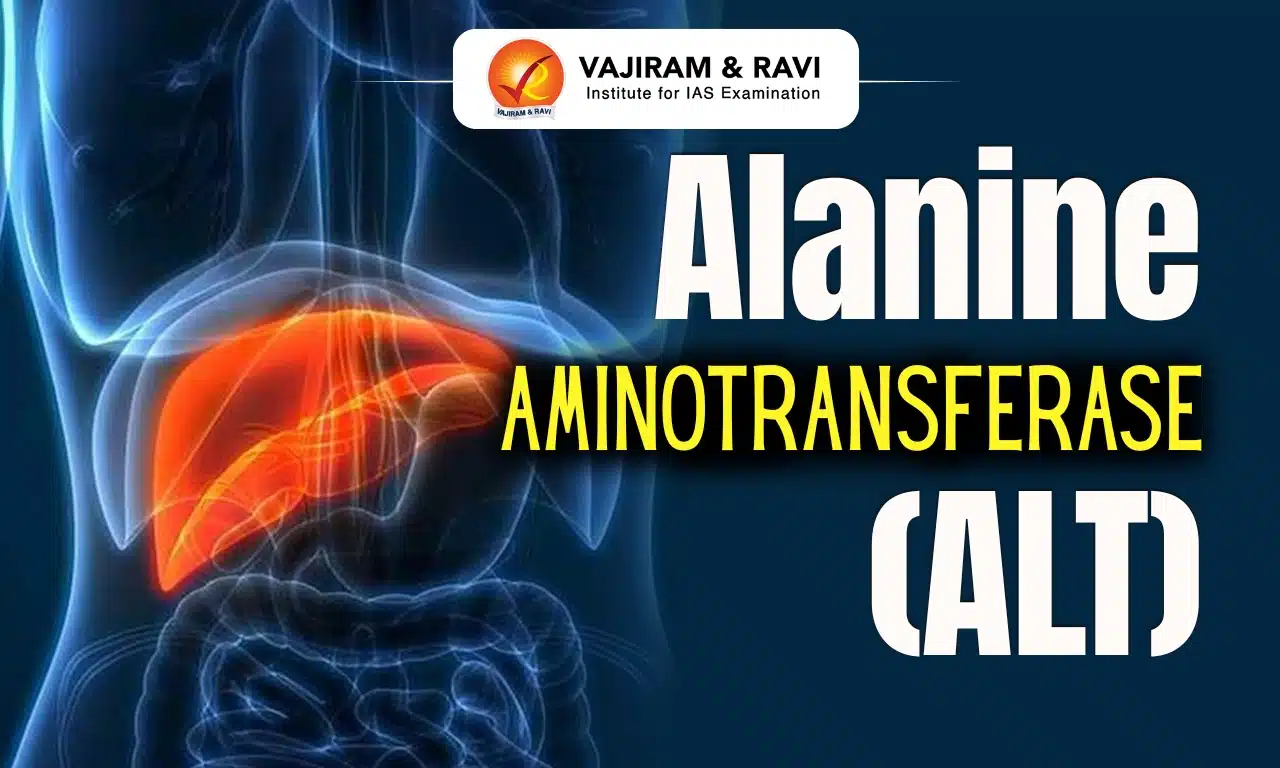
  • Alanine aminotransferase (ALT), also known as serum glutamic-pyruvic transaminase (SGPT), is an enzyme found predominantly inside liver cells, though it exists in other parts of your body. 
  • It plays a key role in the metabolism of amino acids, breaking them down to produce energy for the body’s essential functions. 
  • Usually, you will have low levels of ALT in your blood. But when liver cells are damaged due to conditions like inflammation, infection, or injury, the enzyme leaks into the bloodstream. 
  • High levels of ALT in your blood may be a sign of a liver injury or disease.  
  • However, since ALT is also present in smaller amounts in other parts of the body, an elevated ALT level does not necessarily indicate liver disease and should prompt further evaluation to identify the source of the abnormality.
  • ALT is one component of the liver function test, which includes other liver enzymes and measures of liver function. 
  • Although ALT is a sensitive indicator of ongoing liver injury, patients can still have significant liver disease despite normal ALT values.
  • ALT testing is performed on a blood sample, with results typically available within a few hours. 
  • Although many laboratories consider ALT levels below 40 units per litre as normal, interpretation depends on the patient’s condition. 
    • For example, lower thresholds are often applied in people with chronic hepatitis B or C.

News: TH

Alanine aminotransferase FAQs

Q1: What is Alanine Aminotransferase (ALT)?

Ans: ALT is an enzyme found predominantly inside liver cells that plays a key role in amino acid metabolism.

Q2: Why are Alanine Aminotransferase (ALT) levels normally low in the blood?

Ans: Because ALT is normally contained within liver cells.

Q3: What causes Alanine Aminotransferase (ALT) levels in the blood to increase?

Ans: Damage to liver cells, causing ALT to leak into the bloodstream.

Q4: Can elevated Alanine Aminotransferase (ALT) levels occur without liver disease?

Ans: Yes, because ALT is also present in smaller amounts in other body tissues.

Q5: Does an elevated Alanine Aminotransferase (ALT) level always indicate liver disease?

Ans: No, further evaluation is needed to determine the cause.

Kh-101 Missile

Kh-101 Missile

Kh-101 Missile Latest News

A suspected Russian Kh-101 missile landed in eastern Poland recently, creating security tensions on NATO's eastern flank. 

About Kh-101 Missile

  • The Kh-101 (NATO: AS-23A Kodiak) is a Russian-made advanced stealthy long-range subsonic cruise missile that is launched from a strategic bomber.   
  • The missile was developed in the late 1990s by Russia's Tactical Missile Armament Corporation (KTRV). 
  • It is designed to destroy ground targets such as buildings, bunkers, and military installations.  
  • The Kh-101 is primarily carried by Russia's strategic bombers, such as the Tu-95MS, Tu-160, and Tu-22M3, as well as the Tu-142 maritime surveillance aircraft.  

Kh-101 Missile Features

  • The missile has a streamlined airframe, which is optimized for low observability and minimal radar cross-section.
  • It has a length of approximately 7.5 m and a wingspan of about 4.4 m. 
  • The missile is powered by a turbofan engine and is capable of flying at a maximum speed of Mach 0.76. 
  • It has a range of 2,500 km to 3,000 km.
  • It can carry a variety of conventional warheads, including high explosive, penetrator, and cluster munitions. 
  • The Kh-101 features advanced guidance and control systems, including inertial navigation, satellite navigation, and terrain mapping, which enable it to navigate and strike targets with high precision.

Kh-101 Missile Variants

  • Over the years, the Kh-101 has undergone several upgrades and modifications to improve its performance and capabilities. 
  • For example, a newer version, the Kh-102, was introduced in 2015, which reportedly has a longer range and improved accuracy compared to the Kh-101.
  • It is the nuclear-capable version of Kh-101.

News: DEVD

Kh-101 Missile FAQ's

Q1: What is the Kh-101 missile?

Ans: The Kh-101 is an advanced stealthy air-launched long-range subsonic cruise missile.

Q2: Which country developed the Kh-101 missile?

Ans: Russia.

Q3: What is the NATO reporting name of the Kh-101 missile?

Ans: AS-23A Kodiak.

Q4: What is the operational range of the Kh-101 missile?

Ans: Approximately 2,500–3,000 km.

Moken People

Moken People

Moken People Latest News

Scientists recently confirmed that Moken sea nomad children living on the Andaman Sea can see underwater with twice the clarity of other children, constricting their pupils to dolphin-like precision through years of ocean training.

About Moken People

  • Often called sea nomads or sea gypsies, the Moken are seafaring people who have been living off the coast of Thailand and Myanmar on the Andaman Sea.
  • Their name, in their own language, means "sea drowned."
  • The Moken have lived across the Andaman Sea for centuries, moving between the roughly 800 islands that stretch along the coastlines of Myanmar and Thailand.
  • They are one of the last sea nomad peoples in the world.
  • Traditionally, they travel in wooden vessels called kabang, moving with the seasons and tides. 
  • Fishing, diving, and gathering shellfish form the backbone of their subsistence lifestyle, and from a very young age, Moken children are immersed in the marine environment.  
  • Possessing a rich knowledge of the reefs, the Moken have exceptional underwater skills such as free diving and spear hunting. 
  • They have their own language, which is Austronesian, a language used in Southeast Asia and Oceania. 
  • Most Moken are stateless as a result of their nomadic lifestyle. They have no citizenship in Thailand or Myanmar.
  • They came into the international spotlight following the 2004 Indian Ocean tsunami because they managed to sense warning signs from nature in the form of the water receding back into the ocean and moving away from dangerous areas.

News: ET

Moken People FAQs

Q1: Who are the Moken people?

Ans: The Moken are sea nomads (sea gypsies) who live off the coasts of Thailand and Myanmar in the Andaman Sea.

Q2: Why are the Moken known as "sea nomads"?

Ans: Because they traditionally live and travel by sea, moving between islands according to the seasons and tides.

Q3: What are the traditional wooden boats used by the Moken called?

Ans: Kabang.

Q4: Why do the Moken have exceptional underwater abilities?

Ans: Because they are immersed in the marine environment from a very young age.

Alanine aminotransferase

Alanine aminotransferase

Alanine aminotransferase Latest News

Recently, the Union Health Ministry has urged people to monitor alanine aminotransferase (ALT) levels as an early indicator of liver injury.

About Alanine aminotransferase

  • It is also known as serum glutamic-pyruvic transaminase (SGPT), is an enzyme found predominantly inside liver cells.
  •  It is also found in other tissues such as the kidneys, heart, and muscle cells. 
  •  It plays a crucial role in metabolism, turning food into energy.
  • ALT is one component of the liver function test, which includes other liver enzymes and measures of liver function.
  • The ALT test is often part of an initial screening for liver disease.

What is an ALT Test?

  • An ALT test is also known as a serum glutamic-pyruvic transaminase (SGPT) test or an alanine transaminase test.
  • When liver cells are damaged or inflamed, ALT leaks into the bloodstream. This causes serum ALT levels to rise.
  • An increase in ALT is often the first sign of a liver problem, and ALT is often elevated before other symptoms appear.
  • ALT testing is performed on a blood sample.

Source: TH

Alanine aminotransferase FAQs

Q1: Where does Alanine aminotransferase found?

Ans: It is mainly found in Liver cells.

Q2: What is the normal function of ALT?

Ans: Transfer amino group from alanine to alpha-ketoglutarate

INS NIPUN

INS NIPUN

INS NIPUN Latest News

Recently, the INS Nipun was delivered to the Indian Navy at Visakhapatnam. 

About INS NIPUN

  • It is the second Diving Support Vessel (DSV) built by Hindustan Shipyard Limited.
  • The vessel has been designed and constructed in accordance with Classification Rules of the Indian Register of Shipping (IRS).
  •  ‘Nipun’ draws her name from Sanskrit signifying ‘one who is adept, capable, and well versed in a particular discipline’.
  • This ship is highly specialised and is capable of undertaking deep sea dive operations and rescue operations at sea.

Features of INS NIPUN

  • The ship is installed with state-of-the-art Dive Equipment and has capability to undertake Deep Sea Saturation Diving. 
  • It is equipped with advanced dynamic positioning systems, saturation diving equipment, submarine rescue machinery, and deep-sea intervention tools.
  • It would also serve as the Mother Ship for the Deep Submergence Rescue Vessel (DSRV), to evacuate personnel in case of an emergency in a submarine.
  • It has nearly 75 percent Indigenous Content.

Source: PIB

INS NIPUN FAQs

Q1: INS NIPUN is which type of vessel of the Indian Navy?

Ans: Diving Support Vessel

Q2: What is the Primary role of INS NIPUN?

Ans: Underwater salvage, ROV ops and diving support

Urban Challenge Fund

Urban Challenge Fund

Urban Challenge Fund Latest News

The government has so far approved or accorded in-principle approval to 33 projects under the Urban Challenge Fund (UCF), Union minister informed the Lok Sabha recently.

About Urban Challenge Fund 

  • It is a new centrally sponsored scheme of the Ministry of Housing and Urban Affairs.
  • It supports transformative and bankable urban projects through competitive "challenge-mode". 
  • Financial Outlay: Total Central assistance of ₹1 lakh crore.
  • Tenure: It will be operational from FY 2025–26 to FY 2030–31, with an extendable implementation period up to FY 2033–34.
  • Under UCF, cities will be supported to do projects under three verticals, 
    • Creative development of cities
    • Cities as growth hubs
    • Water and sanitation
  • Cities will be expected to take reforms in urban governance, urban finance, and urban planning.
  • Features:
    • Centre’s assistance under the scheme is capped at 25 percent of the cost of bankable projects
      • This will lead to a total investment of ₹4 lakh crore in the urban sector in the next five years.
    • At least 50 percent of the project cost has to be mobilised through market-based sources such as municipal bonds, bank loans, and public-private partnerships (PPPs).
    • The remaining share may be contributed by States, Union Territories (UTs), Urban Local Bodies (ULBs), or other sources.
    • Projects will be selected through a transparent and competitive challenge mode, ensuring support to high-impact and reform-oriented proposals.
    • Private sector participation will be encouraged through structured risk-sharing frameworks and benchmarking of service delivery standards.
    • Credit Repayment Guarantee for Smaller Cities:
      • In order to facilitate first-time access to market finance for all Cities/ULBs in Northeastern & Hilly States and smaller ULBs (<1,00,000 population) in other States/UTs, a Credit Repayment Guarantee Scheme of ₹5,000 crore has been approved. 
      • The scheme will provide a Central guarantee of up to ₹7 crore or 70 percent of the loan amount (whichever is lower) for first-time loans. 
  • The Fund will cover:
    • All cities with a population of 10 lakh or more (2025 estimates);
    • All State and Union Territory capitals not covered above; and
    • Major industrial cities with a population of 1 lakh or more
    • Additionally, all ULBs in hilly states, Northeastern States, and smaller ULBs with a population below 1 lakh will be eligible for support under the Credit Repayment Guarantee Scheme
    • In principle all cities will be covered under UCF.

News: TP

Urban Challenge Fund FAQs

Q1: What is the Urban Challenge Fund (UCF)?

Ans: It is a new Centrally Sponsored Scheme of the Ministry of Housing and Urban Affairs (MoHUA).

Q2: What is the objective of the Urban Challenge Fund (UCF)?

Ans: To support transformative and bankable urban projects through a competitive challenge-mode.

Q3: What is the total Central financial outlay under the Urban Challenge Fund?

Ans: ₹1 lakh crore.

Q4: What are the three project verticals under the Urban Challenge Fund?

Ans: Creative development of cities, Cities as Growth Hubs, and Water & Sanitation.

Q5: What is the maximum Central assistance under UCF for a bankable project?

Ans: 25% of the project cost.

NAKSHA Project

NAKSHA Project

NAKSHA Project Latest News

The Directorate of Settlement and Land Records (DSLR) prepares to launch its month-long inquiry under the NAKSHA pilot program in Margao and Cuncolim and Panaji city.  

About NAKSHA Project

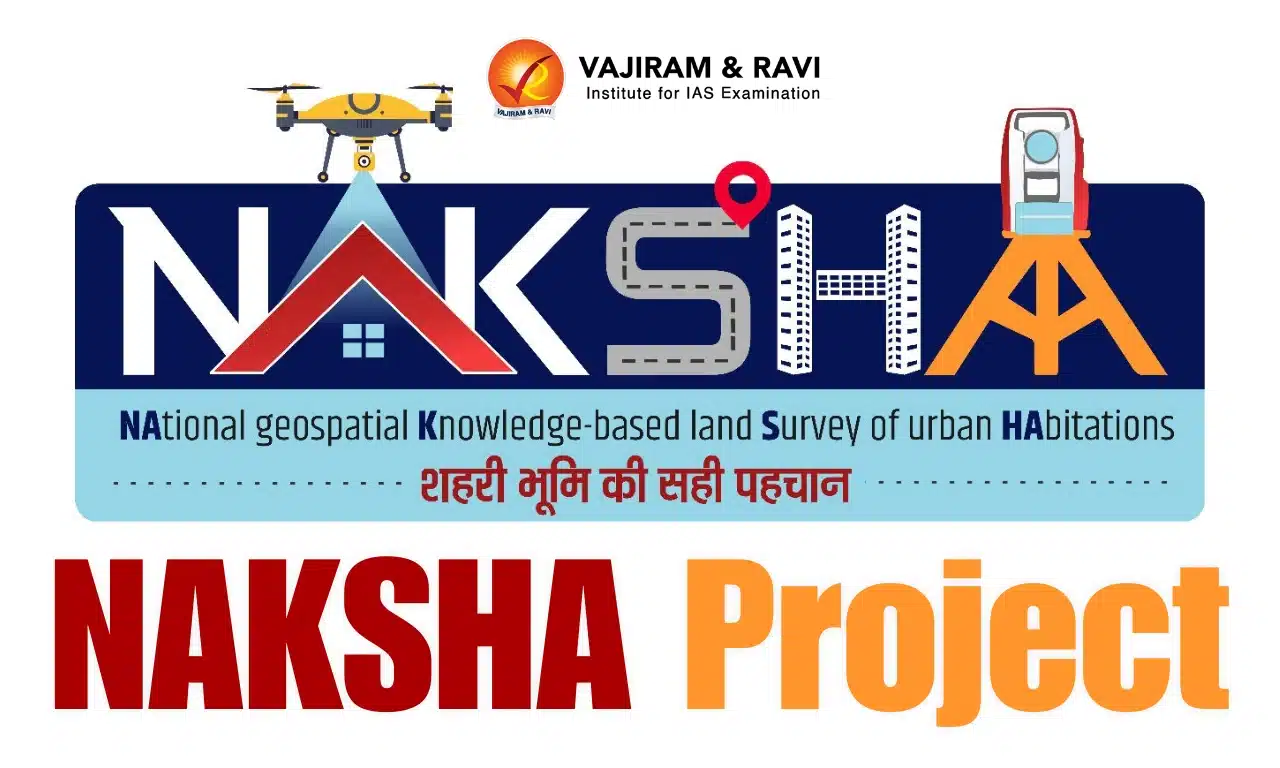
  • NAKSHA (National Geospatial Knowledge-based Land Survey of Urban Habitations) is a modern, GIS-based urban land parcel mapping initiative.
  • It aims to revolutionize urban land records across Urban Local Bodies (ULBs) in States and Union Territories.
  • The program operates under the broader framework of the Digital India Land Records Modernization Programme (DILRMP).
  • Technology: NAKSHA specifically leverages cutting-edge technology to create highly accurate digital maps for complex urban and peri-urban habitations across multiple states and Union Territories, ensuring our cities are future-ready.
  • Implemented by: The initiative is being implemented with the technical support of Survey of India, National Informatics Centre Services Inc. (NICSI).
  • The Survey of India is the technical partner for NAKSHA programme which is responsible for conducting aerial surveys.
  • Nodal Ministry: It was launched by the Department of Land Resources (DoLR), Ministry of Rural Development.
  • Objectives of NAKSHA Programme
    • Creates a comprehensive geospatial database for urban land records
    • Uses aerial and field surveys integrated with GIS technology.
    • Enhances land governance, streamlines property records, and supports urban planning.
    • Improves decision-making, ensures efficient land use, and facilitates smoother property transactions.

Source: PIB

NAKSHA Project FAQs

Q1: NAKSHA Project is implemented by which Ministry?

Ans: Ministry of Rural Development

Q2: What is the Key benefit of NAKSHA Project?

Ans: Reduce land disputes and improve urban planning

Crete Island

Crete Island

Crete Island Latest News

Thousands of people were evacuated recently as fires threatened a tourist resort on the Greek island of Crete and continued to rage, fanned by violent winds.

About Crete Island

  • It is the largest island of Greece. 
  • It is located in the southern part of the Aegean Sea (an arm of the Mediterranean Sea) 160 km to the south of the mainland of Greece. 
  • Covering an area of 8,336 sq.km, it is the fifth-largest Mediterranean Sea island. 
  • It is bordered by the Sea of Crete in the north, the Libyan Sea in the south, the Myrtoan Sea in the west, and the Carpathian Sea in the east. 
  • It is relatively long and narrow, stretching for about 260 km east-west and about 60 km at its widest point. 
  • The island is characterized by a diverse landscape, including a mountain chain that runs the length of the island, sandy beaches, and fertile plains.
  • Crete’s economy is primarily based on tourism, agriculture, and shipping. 
  • Capital and Largest City: Heraklion. 

Crete Island History

  • The island of Crete has been inhabited since the Paleolithic Age by early hominids.
  • The earliest advanced European civilization, the Minoan Civilization, started on the island around 2700-1420 BCE.
  • The Minoan civilization ended after a major earthquake, and thereafter, the island’s rule was taken over by the Mycenaean civilization.
  • The island was then subsequently ruled by the Romans, the Byzantines, the Andalusians, the Venetians, and the Ottomans.
  • After the island’s independence from Ottoman rule, Crete became a part of Greece.
  • During the Second World War, the island was occupied by the Nazi German forces and also served as the battleground of the famous “Battle of Crete.”

News: NIE

Crete Island FAQs

Q1: Which is the largest island of Greece?

Ans: Crete.

Q2: Where is Crete Island located?

Ans: In the southern part of the Aegean Sea, about 160 km south of mainland Greece.

Q3: Which sea lies to the north of Crete?

Ans: The Sea of Crete.

Q4: What are the major physical features of Crete?

Ans: A mountain chain, sandy beaches, and fertile plains.

Q5: What is the capital of Crete?

Ans: Heraklion.

Cloudburst

Cloudburst

Cloudburst Latest News

Recently, the India Meteorological Department (IMD) rejected reports that Assam and Nagaland had experienced cloudbursts over the preceding few days and that they were responsible for the Upper Assam floods. 

About Cloudburst

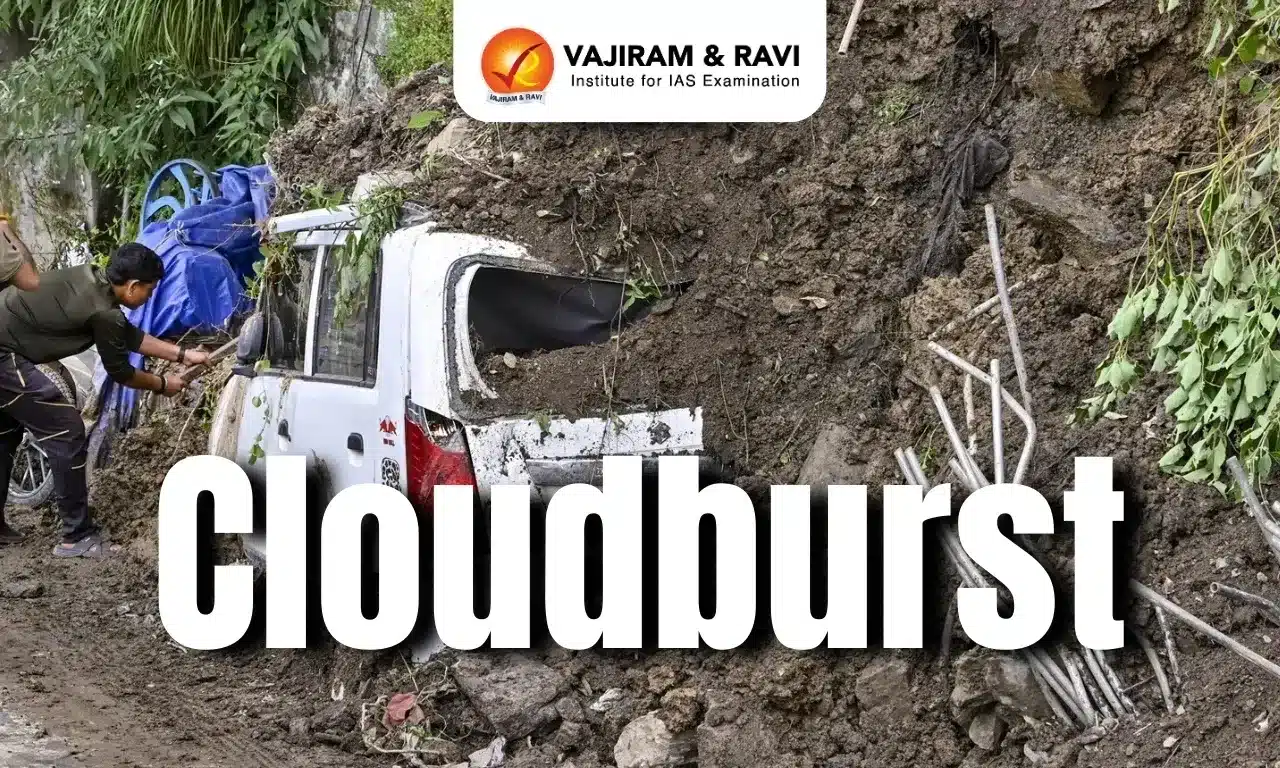
  • A cloudburst is an extreme weather phenomenon characterized by an intense and sudden downpour of rain.
  • It can also occur in plains, the phenomenon is most common in hilly regions.
  • According to the India Meteorological Department (IMD), a cloudburst occurs when a small area, around 20-30 sq. km, receives 10 cm or more of rain in an hour.
  • Impact: Short spells of very heavy rainfall over a small geographical area can cause widespread destruction.

How does a Cloudburst Form?

  • It typically begins with convection, when warm, moist air rises rapidly into the atmosphere.
  • In mountainous areas, this is called orographic lifting, where monsoon winds are forced upwards by steep slopes.
  • As the air rises, it cools and condenses into towering cumulonimbus clouds, which can be up to 15 km tall.
  • Water droplets begin to form inside these clouds and, as they get heavier, they would normally fall as rain.
  • However, if the currents of warm air moving upwards are very strong, they can keep the raindrops suspended in the air for longer.
  • Eventually, the weight of the water droplets becomes too great for gravity and the updrafts to hold, or the updrafts weaken, sending the water plummeting down like an ocean descending on the ground.

Source: TH

Cloudburst FAQs

Q1: Cloudbursts are most commonly associated with which type of clouds?

Ans: Cumulonimbus

Q2: Cloudburst is a major concern in which Indian region?

Ans: Himalayan Region

Arctic Council

Arctic Council

Arctic Council Latest News

Recently, the Parliamentary committee on External Affairs has recommended that India should appoint a Polar Ambassador and urged the government to seek “full-fledged membership” of the Arctic council.

About Arctic Council

  • It was established by the Ottawa Declaration in 1996.
  • It is an intergovernmental forum for addressing issues related to the Arctic Region.
  • It is not a treaty-based international organization but rather an international forum that operates on the basis of consensus, echoing the peaceful and cooperative nature of the Arctic Region.
  • Member Countries: Canada, Denmark, Finland, Iceland, Norway, Sweden, the Russian Federation, and the United States
  • It has six Permanent Participants (PP) groups representing the indigenous people of the Arctic.
  • Observer States: Observer status in the Arctic Council is open to non-arctic states, inter-governmental and inter-parliamentary organizations, global and regional and non-governmental organizations.
    • India is currently one of the 13 observer countries (France, Germany, Netherlands, Poland, Spain, U.K., India, China, Japan, Singapore, South Korea, Italy and Switzerland)  of the Arctic Council.
    • The observer countries do not have decision making powers. They also can’t make financial contributions or undertake research in the arctic directly.
  • Function: The Council focuses its work on matters related to sustainable development, the environment, and scientific cooperation.
  • Traditionally, the Council is chaired by the foreign minister of the country holding the chairmanship.

Source: IE

Arctic Council FAQs

Q1: What is the main focus areas of Arctic Council ?

Ans: Environmental protection and Sustainable development

Q2: India became an Observer in Arctic Council in which year?

Ans: 2013

Quit India Movement Day 2026, Theme, History, Significance

Quit India Movement Day 2026

Quit India Movement Day 2026 will be observed on 8 August 2026 to commemorate the launch of the historic Quit India Movement (Bharat Chhodo Andolan) by Mahatma Gandhi in 1942. The movement marked one of the most decisive phases of India's freedom struggle, calling for an immediate end to British colonial rule. Every year, the day is observed to remember the sacrifices of freedom fighters and inspire citizens with the values of patriotism, unity, and democracy.

Quit India Movement Day 2026 Theme

Quit India Movement Day (August Kranti Diwas), observed every year on 8 August, does not have an officially announced national theme. Instead, the observance is dedicated to commemorating the historic Quit India Movement of 1942, honouring the sacrifices of India's freedom fighters, and reaffirming Mahatma Gandhi's powerful "Do or Die" call that inspired millions to fight for India's independence.

History of the Quit India Movement

The Quit India Movement, also known as the August Movement (August Kranti), was launched on 8 August 1942 by the Indian National Congress under the leadership of Mahatma Gandhi to demand the immediate end of British rule in India.

  • Launched on: 8 August 1942 during the Bombay Session of the All India Congress Committee (AICC).
  • Venue: Gowalia Tank Maidan (now August Kranti Maidan), Bombay (Mumbai).
  • Reason: The failure of the Cripps Mission (1942) and growing dissatisfaction with British rule during World War II.
  • Leader: Mahatma Gandhi, who gave the historic "Do or Die" call.
  • Objective: To compel the British to leave India immediately and achieve complete independence.
  • British Response: Gandhi and other Congress leaders were arrested on 9 August 1942, soon after the movement began.
  • Public Participation: Students, workers, farmers, women, and ordinary citizens participated in protests, strikes, and underground activities across the country.
  • Historical Importance: Although suppressed by the British, the movement became a turning point in India's freedom struggle and accelerated the path to Independence in 1947.

Causes of the Quit India Movement

Several political, economic, and wartime developments led to the launch of the Quit India Movement in 1942, as Indians demanded an immediate end to British colonial rule.

  • Failure of the Cripps Mission (1942): The British proposals did not promise immediate self-rule, leading to widespread disappointment among Indian leaders.
  • India's Involvement in World War II: Britain declared India a participant in the war without consulting Indian political representatives.
  • Demand for Complete Independence: The Indian National Congress intensified its demand for Purna Swaraj (Complete Independence) instead of limited constitutional reforms.
  • Economic Hardships: Wartime inflation, food shortages, unemployment, and rising prices caused severe public distress.
  • Repressive British Policies: Frequent arrests of nationalist leaders, censorship, and restrictions on civil liberties increased public anger.
  • Growing Nationalist Sentiment: Decades of freedom movements had strengthened the desire for self-governance among people across the country.
  • Japanese Advance in Asia: The rapid expansion of Japanese forces during World War II exposed Britain's weakening control and encouraged Indian leaders to press for immediate independence.
  • Mahatma Gandhi's Leadership: Gandhi believed that British rule had become morally and politically unacceptable, leading him to give the historic "Do or Die" call on 8 August 1942.

Major Leaders of the Quit India Movement

The Quit India Movement was led by Mahatma Gandhi and supported by several prominent freedom fighters who organized protests, underground resistance, and mass mobilization across India.

  • Mahatma Gandhi: Launched the Quit India Movement and gave the historic "Do or Die" call on 8 August 1942.
  • Jawaharlal Nehru: A senior Congress leader who actively supported the movement and was arrested soon after its launch.
  • Sardar Vallabhbhai Patel: Mobilized public support and encouraged nationwide participation in the movement.
  • Maulana Abul Kalam Azad: Then President of the Indian National Congress, he played a key role in adopting the Quit India Resolution.
  • Aruna Asaf Ali: Hoisted the Indian National Flag at Gowalia Tank Maidan after senior leaders were arrested, becoming a symbol of resistance.
  • Ram Manohar Lohia: Organized underground activities and spread nationalist messages despite British repression.
  • Jayaprakash Narayan: Escaped from prison and led underground resistance against British rule.
  • Usha Mehta: Operated the secret Congress Radio, which broadcast patriotic messages and movement updates across the country.
  • Achyut Patwardhan: Helped coordinate underground networks and resistance activities.
  • Yusuf Meherally: Coined the slogan "Quit India" and played an important role in mobilizing public support for the movement.

Quit India Movement Day 2026 Significance

Quit India Movement Day commemorates one of the most significant milestones in India's freedom struggle. It honours the courage, unity, and sacrifices of millions of Indians who participated in the Quit India Movement of 1942 and reaffirms the nation's commitment to the ideals of freedom and democracy.

  • Honours Freedom Fighters: Pays tribute to the countless individuals who sacrificed their lives and endured imprisonment for India's independence.
  • Commemorates the Quit India Movement: Marks the launch of the historic Bharat Chhodo Andolan on 8 August 1942 under Mahatma Gandhi's leadership.
  • Promotes Patriotism: Encourages citizens, especially the youth, to appreciate India's freedom struggle and uphold national values.
  • Highlights National Unity: Recognizes how people from different regions, communities, and backgrounds came together with a common goal of independence.
  • Strengthens Democratic Values: Reinforces the importance of freedom, justice, equality, and constitutional principles in modern India.
  • Inspires Civic Responsibility: Motivates citizens to actively contribute to nation-building and protect the country's democratic institutions.
  • Preserves Historical Legacy: Ensures that future generations remain aware of the events and sacrifices that shaped India's journey to independence.

Quit India Movement Day 2026 FAQs

Q1: When is Quit India Movement Day 2026 observed?

Ans: Quit India Movement Day 2026 will be observed on 8 August 2026 (Saturday) to commemorate the launch of the Quit India Movement in 1942.

Q2: Why is Quit India Movement Day celebrated?

Ans: The day is celebrated to honour the Quit India Movement (Bharat Chhodo Andolan), launched by Mahatma Gandhi on 8 August 1942, and to pay tribute to the sacrifices of India's freedom fighters.

Q3: Who launched the Quit India Movement?

Ans: The Quit India Movement was launched by Mahatma Gandhi under the leadership of the Indian National Congress (INC) during the Bombay Session of the All India Congress Committee (AICC).

Q4: What was the famous slogan of the Quit India Movement?

Ans: The most famous slogan of the movement was "Do or Die", given by Mahatma Gandhi, urging Indians to achieve freedom through determined non-violent resistance.

Q5: Where was the Quit India Movement launched?

Ans: The movement was launched at Gowalia Tank Maidan, now known as August Kranti Maidan, in Bombay (Mumbai) on 8 August 1942.

National Handloom Day 2026, Date, Theme, History, Significance

National Handloom Day 2026

National Handloom Day 2026 will be observed across India on 7 August 2026, to celebrate the country's rich handloom heritage and honour the invaluable contribution of handloom weavers and artisans. 

The National Handloom Day 2026 commemorates the Swadeshi Movement, which began on 7 August 1905 at Calcutta Town Hall to encourage the use of indigenous products and reduce dependence on foreign goods.

National Handloom Day 2026 Theme

The National Handloom Day 2026 Theme has not yet been announced by the Ministry of Textiles. Every year, a unique theme is chosen to highlight the importance of India's handloom heritage, support traditional weavers, and promote sustainable handwoven textiles. The 2026 celebrations are expected to focus on preserving indigenous weaving traditions, empowering artisans, and encouraging the "Vocal for Local" movement through greater public participation.

National Handloom Day 2026 History

National Handloom Day commemorates the historic Swadeshi Movement and celebrates India's rich handloom heritage by honouring the country's weaving community.

  • 7 August 1905: The Swadeshi Movement was launched at Calcutta Town Hall to boycott foreign goods and promote indigenous industries.
  • Handloom weavers played a key role in the movement by producing and promoting Indian-made textiles.
  • To commemorate this historic event, the Government of India declared 7 August as National Handloom Day.
  • The first National Handloom Day was celebrated on 7 August 2015.
  • The celebration was initiated by Prime Minister Narendra Modi to recognise the contribution of handloom weavers and artisans.
  • Since 2015, the Ministry of Textiles has organised annual events, exhibitions, and awareness campaigns across the country.
  • National Handloom Day 2026 marks the 12th edition of the annual celebration, continuing efforts to preserve traditional weaving techniques and promote Indian handloom products.

National Handloom Day 2026 Significance

National Handloom Day 2026 highlights the importance of preserving India's traditional weaving heritage while recognising the contribution of millions of handloom weavers to the country's economy, culture, and sustainable development.

  • Honours handloom weavers and artisans for preserving India's centuries-old weaving traditions.
  • Commemorates the Swadeshi Movement (1905), which promoted indigenous industries and self-reliance.
  • Preserves India's cultural heritage by encouraging traditional weaving techniques and regional textile crafts.
  • Supports sustainable and eco-friendly fashion, as handloom production requires minimal electricity and has a lower environmental impact.
  • Strengthens rural livelihoods by generating employment for millions of people in villages and semi-urban areas.
  • Empowers women, who make up nearly 70% of the handloom workforce, by providing income and entrepreneurship opportunities.
  • Promotes the "Vocal for Local" initiative by encouraging consumers to purchase authentic Indian handloom products.
  • Boosts the textile economy by increasing domestic demand and enhancing the global recognition of Indian handwoven fabrics.
  • Encourages innovation through initiatives such as the Handloom Hackathon, helping artisans adopt modern designs and market opportunities.
  • Raises awareness among younger generations about the value of traditional craftsmanship and the need to preserve India's handloom legacy for the future.

Famous Handloom Traditions of India

India is home to diverse handloom traditions, with each region producing unique handwoven textiles that reflect its history, culture, and exceptional craftsmanship.

  • Banarasi Silk (Uttar Pradesh): Famous for its luxurious silk fabric, intricate zari work, and exquisite bridal sarees.
  • Kanchipuram Silk (Tamil Nadu): Renowned for rich silk, vibrant colours, and durable gold-thread borders used in traditional sarees.
  • Jamdani (West Bengal): A fine muslin weave featuring delicate floral and geometric motifs crafted using the supplementary weft technique.
  • Sambalpuri Ikat (Odisha): Known for its distinctive tie-and-dye weaving process and intricate traditional patterns.
  • Pochampally Ikat (Telangana): Recognised for its geometric designs and colourful double ikat weaving technique.
  • Paithani (Maharashtra): Celebrated for handwoven silk sarees adorned with peacock, lotus, and floral motifs using pure zari.
  • Chanderi (Madhya Pradesh): Lightweight fabric admired for its sheer texture, elegant finish, and traditional motifs.
  • Maheshwari (Madhya Pradesh): Popular for its reversible borders, fine cotton-silk blend, and classic striped or checked patterns.
  • Muga Silk (Assam): Exclusive to Assam, this naturally golden silk is valued for its durability and natural sheen.
  • Bhagalpuri Silk (Bihar): Also called Tussar Silk, it is prized for its natural texture, softness, and eco-friendly production.
  • Kota Doria (Rajasthan): Lightweight cotton-silk fabric featuring the signature square-check pattern known as khat.
  • Kasavu (Kerala): Traditional off-white sarees with elegant golden borders, commonly worn during festivals and cultural occasions.

Government Initiatives for the Handloom Sector

The Government of India has launched several initiatives to strengthen the handloom sector by improving weavers' livelihoods, promoting traditional textiles, enhancing market access, and preserving India's rich weaving heritage.

  • National Handloom Development Programme (NHDP): Provides financial assistance for skill development, infrastructure, design innovation, and marketing support to handloom weavers.
  • India Handloom Brand (IHB): Promotes high-quality, authentic handloom products that meet strict quality standards and helps increase consumer confidence.
  • Yarn Supply Scheme (YSS): Ensures the timely availability of quality yarn at subsidised rates to reduce production costs for handloom weavers.
  • Comprehensive Handloom Cluster Development Scheme (CHCDS): Develops major handloom clusters by improving common facilities, technology, and market connectivity.
  • Raw Material Supply Scheme (RMSS): Facilitates easy access to quality raw materials, enabling artisans to maintain production and improve product quality.
  • Handloom Marketing Assistance (HMA): Supports participation in national and international exhibitions, fairs, and buyer-seller meets to expand market opportunities.
  • National Handloom Expo: Organises exhibitions across the country where artisans can directly sell their products and connect with consumers.
  • Weaver MUDRA Scheme: Provides affordable credit and financial assistance to handloom weavers for expanding their businesses and purchasing equipment.
  • Handloom Export Promotion: Encourages the export of Indian handloom products through trade fairs, branding, and international marketing initiatives.

National Handloom Day 2026 FAQs

Q1: When is National Handloom Day 2026 celebrated?

Ans: National Handloom Day 2026 will be observed on 7 August 2026 (Friday) across India to honour the country's handloom weavers and promote its rich textile heritage.

Q2: What is the theme of National Handloom Day 2026?

Ans: The National Handloom Day 2026 theme has not yet been announced by the Ministry of Textiles. It will be updated once the official theme is released.

Q3: Why is National Handloom Day celebrated on 7 August?

Ans: National Handloom Day is celebrated on 7 August to commemorate the launch of the Swadeshi Movement in 1905, which promoted indigenous industries and encouraged the use of Indian-made handloom products.

Q4: Who started National Handloom Day?

Ans: Prime Minister Narendra Modi initiated National Handloom Day in 2015, and the first celebration was held on 7 August 2015.

Q5: Which National Handloom Day will be celebrated in 2026?

Ans: India will celebrate the 12th National Handloom Day in 2026, marking twelve years of recognising the contribution of the handloom sector.

Pradhan Mantri Fasal Bima Yojana 2026, Eligibility, Benefits

Pradhan Mantri Fasal Bima Yojana (PMFBY)

The Union government has decided to expand the ambit of the PM Fasal Bima Yojana to include crop damage by animals as a ground for payouts, a long-standing demand by farmers, an official said recently.

About Pradhan Mantri Fasal Bima Yojana

  • Launched on 18th February 2016, PMFBY is a crop insurance scheme by the Department of Agriculture, Cooperation, and Farmers’ Welfare, Ministry of Agriculture.
  • PMFBY aims to provide financial protection to farmers against crop loss due to natural disasters (hail, drought, famine), pests, and diseases. 
  • PMFBY provides crop insurance at a cost-effective premium to all Indian farmers. 
  • It is implemented through a network of insurance companies and banks

Pradhan Mantri Fasal Bima Yojana Objectives

  • To provide financial assistance and support to farmers suffering from crop damage or loss arising out of unforeseen events.
  • To stabilise the income of farmers and ensure continuance in farming.
  • To encourage the farmers to adopt modern and innovative agricultural practices.
  • To ensure crop diversification, and creditworthiness of the farmers, enhance growth, and competitiveness of the agriculture sector and protect the farmers from production risks.

Pradhan Mantri Fasal Bima Yojana Eligibility

  • All farmers, including sharecroppers and tenant farmers, growing the notified crops in the notified areas are eligible for coverage.
  • Compulsory Component:All farmers availing Seasonal Agricultural Operations (SAO) loans from Financial Institutions (i.e. loanee farmers) for the notified crops would be covered compulsorily.
  • Voluntary Component: The Scheme would be optional for the non-loanee farmers.
  • Farmers must have an insurable interest in the insured crops.
  • Farmers must possess a valid and authenticated land ownership certificate or a valid land tenure agreement.
  • Farmers must not have received compensation for the same crop loss from any other medium or source.
  • Special efforts shall be made to ensure maximum coverage of SC/ST/Women farmers under the scheme. 
  • Budget allocation and utilization under this should be in proportion to land holdings of SC/ ST/ General along with women in the respective state cluster.

Pradhan Mantri Fasal Bima Yojana Benefits

  • Affordable Premiums:
    • The maximum premium payable by the farmer will be 2% for the Kharif food and oilseed crops. 
    • For rabi food and oilseed crops, it is 1.5% and for yearly commercial or horticultural crops it will be 5%. 
    • The remaining premium is subsidized by the government.
    • For the farmers in the North-Eastern States, Jammu, Kashmir, and Himachal Pradesh, the government also pays the entire premium.
  • Comprehensive Coverage:
    • The scheme covers natural disasters (droughts, floods), pests, and diseases.
    • Post-harvest losses due to local risks like hailstorms and landslides are also included.
    • Loss or damage to notified insured crops due to war, nuclear risks, malicious damage and other preventable risks is excluded from the scope of coverage.
  • Timely Compensation: PMFBY aims to process claims within two months of the harvest to ensure that farmers get the compensation quickly, preventing them from falling into debt traps.
  • Technology-Driven Implementation: 
    • PMFBY integrates advanced technologies like satellite imaging, drones, and mobile apps for precise estimation of crop loss, ensuring accurate claim settlements.
    • The National Crop Insurance Portal (NCIP) digitizes processes for seamless farmer-insurer-bank interaction. YES-TECH (Yield Estimation System Based on Technology) ensures remote sensing based accurate yield estimation, while CROPIC (Collection of Real-time photos and Observations of Crops) uses geotagged photos to verify crops for precise damage assessment.

Source: HT

Pradhan Mantri Fasal Bima Yojana FAQs

Q1: Who are called sharecroppers?

Ans: A sharecropper is a tenant farmer, someone who works land that's rented from its owner

Q2: What are Rabi Crops?

Ans: Rabi crops are cultivated during the spring season, which typically lasts from November to April in India. 

Q3: What are Kharif crops?

Ans: Rabi crops are winter crops sown after the monsoon and harvested in spring, thriving in cool, dry conditions.

Q4: What is remote sensing?

Ans: Remote sensing is the science of obtaining information about objects or areas from a distance, typically from aircraft or satellites.

PM Kisan Samman Nidhi Yojana 2026, Eligibility Beneficiary, Benefits

PM Kisan Samman Nidhi Yojana

The Central Sector Scheme named PM Kisan Samman Nidhi Yojana was introduced under the Government of India to facilitate income support to farmers and their families. The scheme was implemented as the Rythu Bandhu Scheme in Telangana by their state government where a fixed amount was transferred directly to the farmers who were eligible for the scheme. During the Interim Union Budget of India on 1 February 2019, Piyush Goyal announced the project as a country wise project.

Pradhan Mantri Kisan Samman Nidhi Yojana was launched on 24th February 2019 by the Prime Minister Narendra Modi in Gorakhpur, Uttar Pradesh. 

What is PM Kisan Samman Nidhi Yojana?

The Pradhan Mantri Kisan Samman Nidhi (PM-KISAN) was launched in February 2019 to offer direct financial aid to small and marginal farmers. Under this scheme, eligible farming families receive ₹6,000 a year, paid in three instalments of ₹2,000 each, credited into their bank accounts directly.

The core idea behind PM Kisan Samman Nidhi Yojana is to promote farmer’s income, helping them manage agricultural costs and household needs more effectively. It specifically targets those with limited land, aiming to improve rural livelihoods and strengthen the rural economy. PM KISAN also aligns with the broader goal of increasing the farmer’s income and tackling rural struggles, making it a pillar in the country’s agricultural support system.

PM Kisan Samman Nidhi Yojana 24th Installment 2026

The PM Kisan Samman Nidhi Yojana (PM KISAN) Installment provides ₹2,000 to each eligible small and marginal farmer as part of the annual ₹6,000 aid. More than 10 crore farmers across the country benefit from this direct financial transfer. The scheme plays a crucial role in empowering farmers and promoting sustainable growth in the agricultural sector. The PM Kisan Samman Nidhi Yojana (PM KISAN) 23rd Installment of ₹2,000 is released in the month of June 2026. while the next PM Kisan Samman Nidhi Yojana 24th Installment is expected to be released in the month of October 2026. The scheme ensures that farmers receive timely monetary support to manage agricultural expenses and household needs.

PM Kisan Samman Nidhi Yojana 2026

The key highlights of the PM Kisan Samman Nidhi Yojana 2026 has been tabulated below:

PM Kisan Samman Nidhi Yojana Overview
Aspect Description

Name of the scheme

PM-KISAN Yojana

Full-Form

Pradhan Mantri Kisan Samman Nidhi Yojana

Date of launch

24th February 2019

Government Ministry

Ministry of Agriculture and Farmers Welfare

Official Website

https://pmkisan.gov.in/

PM Kisan Samman Nidhi Yojana 2026 Features

The key features of the PM Kisan Samman Nidhi Yojana 2026 has been listed below:

  • The PM Kisan Samman Nidhi Yojana is introduced to support around 12 crore small and marginal farmers across India. With an annual budget of ₹75,000 crore, it stands as one of the largest direct income support programs in the country.
  • Every farmer who is eligible receives ₹6,000 per year, distributed in three equal instalments of ₹2,000. This amount is transferred straight into their bank accounts via Direct Benefit Transfer (DBT), cutting out delays and eliminating middlemen.
  • This scheme ensures a basic, reliable income for farming families. With timely payments every four months, it provides expected support for managing agricultural and household expenses.
  • There are no restrictions on how the money should be spent. Whether it’s seeds, fertilizers, family needs, or medical expenses, farmers are free to use the funds as they see fit.
  • The scheme is entirely financed by the central government. From its introduction, the Centre has committed ₹75,000 crore annually, ensuring a consistent flow of funds through the DBT system.
  • To access the benefits of PM Kisan Samman Nidhi Yojana, Aadhaar authentication is required. Farmers without Aadhaar can get enrolled at the nearest Common Service Centre (CSC) to become eligible for the scheme.
  • The process has been made user-friendly. Farmers can register themselves using the PM-KISAN mobile app or visit a CSC for assistance. This self-registration setup ensures broader and quicker access.
  • A centralized call center has been established to handle queries, resolve issues, and assist farmers with registration or any problems they might face with the scheme.

PM Kisan Samman Nidhi Yojana Objectives

The Pradhan Mantri Kisan Samman Nidhi Yojana (PM-KISAN) is a scheme launched by the Government of India to increase the income of small and marginal farmers. It serves as a direct support mechanism for rural households dependent on agriculture. PM Kisan Samman Nidhi Yojana Objectives are as follow:

  • The PM Kisan Samman Nidhi Yojana aims to provide assured income support to eligible farmer families with cultivable land, helping them manage both agricultural and household expenses.
  • PM-KISAN also helps farmers purchase essential inputs like seeds, fertilizers, and equipment. The goal is to promote better crop health and improve farm productivity, thereby stabilizing farm income.
  • The government plans to expand the scheme’s coverage to nearly 14.5 crore farmers, up from the current base, with a target of including 2 crore more beneficiaries.
  • PM Kisan Samman Nidhi Yojana coverage is expected to cost ₹87,217.50 crore, fully financed by the Central Government.

PM Kisan Samman Nidhi Yojana Eligibility Criteria 2026

To be eligible for the Pradhan Mantri Kisan Samman Nidhi Yojana 2026 (PM KISAN 2026), small and marginal farmers must not fall under certain exclusion categories. The scheme is meant for land-owning farmers, and specific individuals and groups are banned from receiving its benefits.

  • Institutional landholders - Any land owned by institutions rather than individuals is excluded.
  • High-ranking public officials which includes:
    • Former and current holders of constitutional posts.
    • Ex or current Union and State Ministers.
    • Sitting or former Members of Parliament (Lok Sabha or Rajya Sabha) or State Legislatures.
    • Former and present Mayors of Municipal Corporations.
    • Former and current Chairpersons of District Panchayats.
  • Government employees and retirees - Any serving or retired employee of Central or State Government departments, offices, or ministries is ineligible. This also applies to retirees drawing a monthly pension of ₹10,000 or more.
  • Income taxpayers - Anyone who paid income tax in the most recent assessment year is automatically excluded.
  • Professionals practicing independently - Registered doctors, engineers, lawyers, chartered accountants, and architects actively practicing their profession are not eligible, even if they own agricultural land.

PM Kisan Samman Nidhi Yojana Verification 2026

Documents required for verification by eligible farmers under the PM Kisan Samman Nidhi Yojana 2026 are:

  • Valid proof of Indian citizenship
  • Landholding documents to prove ownership
  • Aadhaar card for identity authentication
  • Active bank account details to receive DBT transfers

PM Kisan Samman Nidhi Yojana Benefits

The major benefits, advantages and significance of the PM Kisan Samman Nidhi Yojana 2026 has been provided below:

  • One of the PM Kisan Samman Nidhi Yojana Advantages is the direct transfer of money to farmer’s bank accounts. An example was on December 25, 2020, when ₹18,000 crore was deposited into the accounts of 9 crore farmers in the presence of Prime Minister Narendra Modi. This kind of direct benefit transfer ensures speed, transparency, and zero leakage.
  • All beneficiary details are maintained on a central digital platform. This has streamlined both registration and fund distribution, making the process more efficient and reliable. The digital shift has also helped in reducing errors and eliminating duplication.
  • By providing timely financial assistance, PM Kisan Samman Nidhi Yojana helps ease the cash issues that farmers often face, especially during sowing or harvest seasons. This support can make a real difference in managing day-to-day farming and household expenses.
  • With improved financial support, farmers are in a better position to adopt improved practices, invest in inputs, or even explore new technologies.
  • The selection of beneficiaries is based on eligibility criteria, leaving no room for bias or political interference.

PM Kisan Samman Nidhi Yojana 2026 Challenges

  • While the intent is to offer income support, the ₹6,000 annual aid may not be enough to meaningfully improve the financial stability of small farmers. The fixed amount also doesn’t consider the size of landholding or varying cost of living across regions, limiting its real impact.
  • Despite being positioned as a poor welfare scheme, data suggests that the benefits often reach relatively better-off farmers, those who already had access to land and resources even before the pandemic, leaving out some of the most vulnerable rural households.
  • One of the major drawbacks is the exclusion of landless agricultural workers. Since eligibility is only restricted to land ownership, millions of rural households who work on leased land or as laborers don’t qualify, even though they form a critical part of the rural economy.
  • The PM Kisan Samman Nidhi Yojana follows a top-down structure, where the central government funds and directs it while states identify beneficiaries. This model often faces coordination issues, delays in updating records, and gaps in last-mile delivery which reduces its overall effectiveness.
  • As more focus and funding shift toward cash transfer schemes like PM-KISAN, there’s growing concern that critical long-term investments like those in irrigation, infrastructure, and market support which will affect the agricultural sector in a longer run.
Related Post
PM Awas Yojana PM Uday Yojana
PMGSY (Pradhan Mantri Gram Sadak Yojana) PM Vishwakarma Scheme
Amrit Bharat Station Scheme PM Schools for Rising India
Pradhan Mantri Surya Ghar Yojana Ayushman Bharat Pradhan Mantri Jan Aarogya Yojana
Pradhan Mantri Swasthya Suraksha Yojna Pradhan Mantri Matru Vandana Yojna
Pradhan Mantri Kaushal Vikas Yojna Pradhan Mantri Garib Kalyan Rojgar Yojana
Pradhan Mantri Gramodaya Yojana Pradhan Mantri Viksit Bharat Rozgar Yojana
Pradhan Mantri Jan Dhan Yojana PM Matru Vandana Yojana
Pradhan Mantri Vaya Vandana Yojana Pradhan Mantri Viksit Bharat Rozgar Yojana
Pradhan Mantri Shram Yogi Maan Dhan Yojana Pradhan Mantri Van Dhan Vikas Yojna
Pradhan Mantri Van Dhan Yojana Pradhan Mantri Ujjwala Yojana
Pradhan Mantri Fasal Bima Yojana
Pradhan Mantri Bhartiya Jan Aushadhi Kendras
Ayushman Bharat Pradhan Mantri Jan Arogya Yojana Pradhan Mantri Bhartiya Janaushadhi Pariyojana
PM VIKAS Scheme Pradhan Mantri Kaushal Vikas Yojana
Pradhan Mantri Jeevan Jyoti Bima Yojana PM Kisan Samman Nidhi Yojana

PM Kisan Samman Nidhi Yojana 2026 FAQs

Q1: What is PM Kisan Samman Nidhi Yojana 2026?

Ans: It is a Central Sector Scheme launched by the Government of India that provides ₹6,000 per year to eligible farmers in three equal installments directly into their bank accounts.

Q2: What is the PM Kisan Samman Nidhi Yojana Eligibility 2026

Ans: All landholding farmer families with cultivable land, as per official land records, are eligible. However, income tax payers, institutional landholders, and professionals like doctors or engineers are excluded.

Q3: How can a farmer register for PM Kisan?

Ans: Farmers can register through the official PM Kisan portal (pmkisan.gov.in), local CSC centers, or through the agriculture department of their respective states.

Q4: What documents are required for PM Kisan registration?

Ans: Aadhaar card, bank account details, land ownership proof, and mobile number are required for registration.

Q5: How is the PM Kisan amount disbursed?

Ans: The amount of ₹2,000 is transferred thrice a year, usually in April-July, August-November, and December-March directly into the beneficiary’s Aadhaar-linked bank account.

Public Examination Amendment Bill 2026 – Explained

Public Examination

Public Examination Latest News

  • Parliament has passed the Public Examination (Prevention of Unfair Means) Amendment Bill, 2026, introducing tougher punishments, fast-track courts, and time-bound investigation and trial in paper leak cases.

Public Examinations Law in India

  • To tackle paper leaks and organised exam fraud, Parliament enacted the Public Examination (Prevention of Unfair Means) Act, 2024. 
  • The law aimed to address unfair practices in major public examinations conducted by bodies such as:
    • Union Public Service Commission (UPSC)
    • Staff Selection Commission (SSC)
    • Railway Recruitment Board (RRB)
    • Institute of Banking Personnel Selection (IBPS)
    • National Testing Agency (NTA), including the NEET exam
  • It was the first dedicated central law targeting question paper leaks, organised cheating, and exam-related fraud in public examinations.
  • However, after the NEET-UG paper leak in May 2026, public anger and student protests intensified. 
  • The controversy exposed weaknesses in the existing law, especially in relation to deterrence, speed of investigation, and disposal of cases. 
  • In response, the government moved to strengthen the law through the Public Examination (Prevention of Unfair Means) Amendment Bill, 2026.

Background of the 2024 Law

  • The original 2024 Act provided punishments for individuals and organised groups using unfair means in public exams. Its main objective was to protect the transparency, credibility, and fairness of recruitment and entrance examinations.
  • Under the earlier law:
    • Individuals involved in unfair means faced imprisonment of 3 to 5 years and a fine up to Rs 10 lakh.
    • In certain cases, penalties included a fine up to Rs 1 crore and a ban on exam-related responsibilities for four years.
    • Organised crime related to exam fraud attracted imprisonment of at least 3 years and a fine of Rs 1 crore.
    • In the gravest offences, punishment extended to 5 to 10 years imprisonment and a fine of Rs 1 crore.
  • Even though the law existed, the recent paper leak controversy led to demands for harsher punishment, special courts, and faster justice delivery.

Public Examination Amendment Bill, 2026

  • The Lok Sabha passed the Amendment Bill by voice vote, and the Rajya Sabha also cleared it by voice vote. The Bill strengthens the 2024 law in four important ways.
  • Tougher Punishments
    • Punishment of 3 to 5 years and fine up to Rs 10 lakh has now been raised to 5 to 10 years imprisonment and fine up to Rs 50 lakh.
    • Punishment involving fine up to Rs 1 crore and a ban of four years has been enhanced to fine up to Rs 5 crore and a ban of eight years.
    • Punishment of at least 3 years imprisonment and Rs 1 crore fine has been raised to at least 5 years imprisonment and Rs 5 crore fine.
    • Punishment of 5 to 10 years imprisonment and Rs 1 crore fine has been strengthened to at least 7 years imprisonment and Rs 10 crore fine.
    • Thus, the law now provides a much stronger deterrent against organised paper leak networks.
  • Statutory Backing for Fast-Track Courts
    • The Bill gives statutory backing to fast-track courts for trying offences under the Act.
    • This is significant because it moves beyond an executive announcement and embeds the fast-track mechanism directly in law. Once the amendment comes into force, all future offences under the Act can be tried by fast-track courts.
    • The government has already announced that such courts would initially be set up in the four High Courts where NEET-related cases are ongoing.
  • Five-Month Timeline for Investigation and Trial
    • Another major feature is the imposition of a strict time frame:
      • Investigation must be completed within two months.
      • Trial must be completed within three months.
    • This means that a paper leak case should, in principle, reach a conclusion within five months.
  • Provision for a Special Task Force
    • The Bill also empowers the Union government to establish a Special Task Force to investigate offences under the Act. 
    • This is aimed at strengthening coordination, especially where paper leak networks operate across states or involve organised criminal syndicates.

Significance of the Bill

  • The Amendment Bill is important because it attempts to address both substantive weakness and procedural delay.
  • On the substantive side, it raises punishment sharply, especially in cases involving organised crime. On the procedural side, it introduces:
    • Fast-track adjudication
    • Statutory time limits
    • A Special Task Force
  • This combination is meant to make the law not only stricter but also more effective in practice.
  • The Bill also reflects a broader recognition that exam fraud is no longer a routine malpractice but a serious governance and public trust issue affecting merit, opportunity, and social justice.

Concerns and Challenges

  • Even with stronger penalties, the real effectiveness of the law will depend on implementation.
  • Some important challenges remain:
    • Whether investigations can genuinely be completed within two months.
    • Whether fast-track courts will have the capacity and staffing to meet the deadline.
    • Whether states and investigating agencies can coordinate effectively.
    • Whether digital and logistical vulnerabilities in examination systems are also corrected.
  • Experience with other fast-track courts, including those under special laws such as POCSO, shows that pendency can still rise if infrastructure and staffing do not keep pace.

Source: IE | TH

Public Examination FAQs

Q1: What is the Public Examination Amendment Bill, 2026?

Ans: It is a law amending the Public Examination (Prevention of Unfair Means) Act, 2024 to impose tougher punishments and faster trial mechanisms for paper leak cases.

Q2: What is the maximum punishment under the amended law?

Ans: The amended law provides for imprisonment up to 10 years and fines up to Rs 10 crore, depending on the offence.

Q3: What timeline does the new law prescribe for paper leak cases?

Ans: It provides for a two-month investigation period and a three-month trial period, making the total timeline five months.

Q4: Which exam bodies are covered under the law?

Ans: The law covers examinations conducted by bodies such as UPSC, SSC, RRB, IBPS, and NTA, including NEET.

Q5: What new institutional mechanism does the Bill provide?

Ans: It gives statutory backing to fast-track courts and allows the Union government to create a Special Task Force for investigation.

Cauvery Water Dispute – CWMA Upholds Water Release Amid Distress Conditions

Cauvery Water Dispute

Cauvery Water Dispute Latest News

  • The Cauvery Water Management Authority (CWMA) has endorsed the Cauvery Water Regulation Committee (CWRC) decision directing Karnataka to release 3,500 cusecs of water to Tamil Nadu for 15 days (July 29–August 12, 2026).
  • This amounts to nearly 4.5 thousand million cubic feet (tmc ft). 
  • The decision comes amid deficient southwest monsoon rainfall and severe water shortages in the Cauvery basin, reviving concerns over equitable sharing of river waters during distress years.

Institutional Framework for Cauvery Water Management

  • The CWRC functions under the CWMA, which was established in 2018 to implement the Cauvery Water Disputes Tribunal (CWDT) Award (2007) as modified by the Supreme Court (2018).
  • Statutory body: The CWMA is formed under the Inter-State River Water Disputes Act, 1956, operating under the Union Ministry of Jal Shakti.
  • Composition of CWRC:
    • Headquartered in New Delhi, it is headed by the Member (Water Resources), CWMA.
    • Members include -
      • Chief Engineers of all Cauvery basin States.
      • Representatives from the India Meteorological Department (IMD), Central Water Commission (CWC) and Ministry of Agriculture & Farmers’ Welfare.
  • Mandate and functions of CWRC: The committee performs both regulatory and technical functions, including -
    • Monitoring daily water levels, inflows and storage in eight major reservoirs -
      • Karnataka: Hemavathy, Harangi, Krishnarajasagara (KRS), Kabini.
      • Tamil Nadu: Mettur, Bhavanisagar, Amaravathy.
      • Kerala: Banasurasagar.
    • Ensuring scheduled daily and monthly water releases as directed by CWMA.
    • Preparing seasonal (Southwest Monsoon, Northeast Monsoon, Hot Weather) and annual water accounts.
    • Reviewing compliance with previous directions and reassessing basin conditions through fortnightly meetings during the monsoon.
  • CWDT: It was constituted by the Government of India on June 2, 1990, under the Inter-State River Water Disputes Act, 1956.
  • Inter-State River Water Disputes Act, 1956: It is enacted under Article 262 of Constitution of India to resolve the water disputes that would arise in the use, control and distribution of an interstate river or river valley.

How does the CWRC Decide Water Releases?

  • The committee relies on scientific hydro-meteorological assessment rather than fixed allocations during distress years. 
  • Key parameters include -
    • Rainfall received and IMD's forecast.
    • Live storage in reservoirs.
    • Reservoir inflows and outflows.
    • The river flows at Biligundulu (inter-State measuring point).
    • Water availability in intermediate catchments.
    • Compliance with earlier release orders.
  • This data-driven approach seeks to balance drinking water, irrigation requirements and ecological considerations.

Factors Behind the Latest Decision

  • The CWRC considered multiple indicators before fixing the release at 3,500 cusecs -
    • Net inflows into Karnataka reservoirs were nearly 60% below the 30-year average.
    • River flow at Biligundulu showed a 90% deficit, indicating severe basin-wide stress.
    • IMD forecasts suggested continued weak rainfall, limiting future inflows.
    • Combined storage in Karnataka's four major reservoirs stood at 64.15 tmc ft against a capacity of 114.57 tmc ft.
  • Considering these distress conditions, the committee opted for a quantity that would be operationally feasible while partially meeting Tamil Nadu's requirements.

Divergent Responses from the Riparian States

  • Karnataka's position:
    • The State has not commenced irrigation releases due to inadequate rainfall.
    • It considers the CWRC order burdensome under prevailing drought-like conditions.
    • The government is examining the possibility of appealing before the CWMA.
    • Farmers' organisations have demanded application of a "distress-sharing formula" instead of fixed allocations.
  • Tamil Nadu's position:
    • Tamil Nadu views the ordered release as insufficient.
    • It argues Karnataka should release the entire deficit of 9.8 tmc ft calculated by the committee.
    • The kuruvai cultivation season requires nearly 100 tmc ft of water for about 4 lakh acres.
    • Mettur reservoir storage is around 36 tmc ft, of which nearly 10 tmc ft must be reserved for drinking water and dead storage.

Key Challenges and Way Forward

  • Challenges:
    • Absence of an agreed distress-sharing formula during deficient rainfall years.
    • Conflicting priorities between drinking water, irrigation and reservoir conservation.
    • Increasing uncertainty due to climate variability affecting monsoon reliability.
    • Balancing legal water entitlements with ground-level hydrological realities.
    • Recurring inter-State political tensions despite an institutional dispute-resolution mechanism.
  • Way forward:
    • Develop a mutually agreed distress-sharing formula to proportionately distribute shortages among basin States during drought years.
    • Strengthen real-time hydrological monitoring, transparent data sharing and scientific forecasting.
    • Promote cooperative federalism through continuous dialogue between Karnataka, Tamil Nadu and the CWMA.
    • Encourage water-use efficiency, micro-irrigation, crop diversification and basin-level integrated water resources management.
    • Institutionalise periodic reviews to ensure adaptive water allocation under changing climatic conditions.

Source: TH

Cauvery Water Dispute FAQs

Q1: How does the Cauvery Water Regulation Committee (CWRC) determine water releases?

Ans: It bases decisions on hydro-meteorological parameters such as rainfall, reservoir storage, inflows, river flows, etc.

Q2: What is the institutional role of the Cauvery Water Management Authority (CWMA)?

Ans: It implements the Cauvery Water Disputes Tribunal Award (2007), as modified by the Supreme Court (2018).

Q3: Why is the absence of a distress-sharing formula a major challenge?

Ans: It leads to recurring conflicts as States differ on how water shortages should be equitably shared during deficient rainfall years.

Q4: How does climate variability complicate inter-State river water governance in India?

Ans: Uncertain monsoon patterns reduce water availability, making fixed allocations difficult.

Q5: What measures can improve long-term resolution of the Cauvery water dispute?

Ans: A distress-sharing formula, transparent data sharing, cooperative federalism, integrated river basin management, etc.

US-Iran Conflict Reshapes Gulf Security Architecture: Regional Realignments and India’s Energy Security

US-Iran Conflict Reshapes Gulf Security Architecture

US-Iran Conflict Reshapes Gulf Security Architecture Latest News

  • The US-Iran conflict has triggered significant strategic realignments among Gulf Arab states, ranging from renewed defence pacts with Pakistan to a rekindled Houthi-Saudi confrontation, with implications for regional stability and India's energy security.

Background: The US-Iran Standoff

  • US strikes targeted Iran's capability to threaten shipping in the Strait of Hormuz, after Iran rejected American proposals for a new shipping channel through Omani waters and targeted non-compliant vessels.
  • Despite the offensive, Iran retains control over Hormuz, and Tehran-Muscat talks to operationalise Article 5 (joint Iran-Oman administration of the Strait) continue — now expanded to include Saudi Arabia.
    • This was seen in Iranian FM Araghchi's talks with Saudi counterpart Faisal bin Farhan.
  • Washington remains incentivised to strike Iranian nuclear and Hormuz-related targets again, as its self-defined objectives remain unmet.

Fallout One: Gulf States Deepen Ties with Pakistan

  • Recently, Kuwait ratified a June 2023 Defence Cooperation Agreement (DCA) with Pakistan for five years, covering training, intelligence sharing, logistics, and defence technology exchange.
  • Qatar committed to deepening security cooperation with Pakistan during bilateral talks in Doha.
  • Unlike the Saudi-Pakistan Strategic Mutual Defence Agreement (SMDA) of September 2025, Kuwait's DCA does not bind either side to defend the other if attacked.
    • It should be noted that the SMDA has not translated into mutual military action (Pakistan has not struck Iran or Houthi territory; Saudi Arabia has not struck Afghanistan).
    • This suggests its real purpose is entrenching Pakistan's role in long-term capability-building rather than immediate collective defence.
  • For Gulf states, securing dependable defence partners for domestic capability development outweighs intra-Gulf political differences. 
  • Pakistan's economic dependence on these states adds a layer of leverage for the Gulf side.

Fallout Two: Resumption of Houthi-Saudi Hostilities

  • Fighting resumed recently when the Saudi-backed Yemeni government-in-exile bombed Sana'a airport, reportedly to block an Iranian aircraft landing.
  • The Houthis retaliated with ballistic missiles into Saudi territory and declared a naval blockade in the Bab-el-Mandeb strait — unprecedented since the 2022 truce.
  • Saudi Arabia struck the Houthi-controlled Hodeida port, handling over 70% of Yemen's trade and humanitarian aid, provoking Houthi strikes on Saudi Aramco facilities and a partial shutdown of the 400,000 bpd Jazan Refinery.
  • For the first time, both the Red Sea and the Strait of Hormuz were simultaneously under conflict-related disruption.
  • Riyadh, however, is unlikely to seek full-scale war, instead preferring engagement — evident in Saudi participation in US strikes on Iran-backed militias in Iraq rather than direct retaliation against the Houthis.

Why Saudi Arabia Seeks Stability

  • Recently, Saudi Arabia signed a 123 Agreement with the US for civil nuclear cooperation — raising the stakes for regional calm, since a Houthi strike on a future nuclear facility would be far more dangerous than attacks on oil infrastructure.
  • Recent drone strike on the UAE's Barakah nuclear plant had already revived post-Fukushima safety concerns among Arab states.
  • The 123 Agreement may also strengthen Iran's own case for enrichment rights, potentially reducing its willingness to concede ground in nuclear talks.
  • Preventing a "broken windows effect" on Arab economies remains a key regional priority even amid mounting US war fatigue.
    • If the current conflict (Houthi attacks, US-Iran strikes, disruptions to oil facilities and shipping) is allowed to drag on and damage confidence, it could trigger a similar spiral:
      • Investors start losing confidence
      • Businesses and tourists stay away
      • Oil and trade routes seem unsafe
    • This damages the reputation and stability of the whole region, not just the areas directly hit.

Conclusion

  • The US-Iran conflict has exposed the fragility of Gulf security, pushing states like Kuwait and Qatar toward Pakistan for capability-building, while Saudi Arabia balances renewed Houthi threats against its nuclear ambitions. 
  • For India, sustained instability in the Hormuz-Red Sea corridor threatens energy imports and regional equities.

Source: IE

US-Iran Conflict Reshapes Gulf Security Architecture FAQs

Q1: How does US-Iran Conflict Reshapes Gulf Security Architecture affect Gulf countries?

Ans: US-Iran Conflict Reshapes Gulf Security Architecture by encouraging Gulf nations to strengthen defence partnerships, diversify security arrangements, and prepare for prolonged regional instability.

Q2: Why is Pakistan important in US-Iran Conflict Reshapes Gulf Security Architecture?

Ans: US-Iran Conflict Reshapes Gulf Security Architecture highlights Pakistan's growing defence cooperation with Gulf states through military training, intelligence sharing, logistics, and long-term capability building.

Q3: How has the Houthi conflict influenced US-Iran Conflict Reshapes Gulf Security Architecture?

Ans: US-Iran Conflict Reshapes Gulf Security Architecture has intensified with renewed Houthi-Saudi hostilities, disrupting the Red Sea and increasing risks to global shipping and regional stability.

Q4: Why does Saudi Arabia seek stability despite US-Iran Conflict Reshapes Gulf Security Architecture?

Ans: US-Iran Conflict Reshapes Gulf Security Architecture makes regional stability crucial for Saudi Arabia to protect its nuclear cooperation, economic reforms, energy infrastructure, and investor confidence.

Q5: How does US-Iran Conflict Reshapes Gulf Security Architecture impact India?

Ans: US-Iran Conflict Reshapes Gulf Security Architecture affects India's energy security by increasing risks to crude oil imports, shipping routes through Hormuz and the Red Sea, and regional economic interests.

Transmission Bottlenecks Threaten India’s Renewable Energy Boom: Grid Delays, T-GNA and Financial Risks

Transmission Bottlenecks Threaten India's Renewable Energy Boom

Transmission Bottlenecks Threaten India's Renewable Energy Boom Latest News

  • Nearly 21 GW — about 9% of India's installed renewable energy capacity — is running on temporary grid connections due to delayed dedicated transmission infrastructure, putting project revenues and clean energy targets at risk.

The Core Problem

  • Renewable energy capacity is being added faster than the transmission network needed to evacuate that power.
  • Around 12 GW faces restrictions on power evacuation during peak solar generation hours.
    • Power evacuation refers to transferring electricity generated at a plant to the point of consumption.
  • In FY26, about 6,900 GWh of clean electricity faced restrictions due to this mismatch; during April–June alone, 8,133 GWh of solar electricity was curtailed.

Understanding the GNA-TGNA Framework

  • Under the General Network Access (GNA) framework, inter-state transmission-connected projects with long-term GNA get firm evacuation rights — that is, guaranteed access to send their power into the grid.
  • Projects awaiting dedicated transmission infrastructure operate under Temporary General Network Access (T-GNA), a stopgap arrangement that allows scheduling of power only when spare capacity exists.
  • During congestion, long-term GNA projects get priority, forcing T-GNA projects to curtail (reduce) generation — by as much as 70-80% of capacity, according to developers.
  • Electricity curtailment means the intentional reduction of power output from renewable generators.

Financial Stress on Developers

  • Solar power enjoys "must-run" status in India, but can still be backed down for grid security, technical constraints, or transmission bottlenecks.
  • Developers get compensated for grid-security-related curtailment, but not for T-GNA-related curtailment — directly eroding revenues.
  • In Rajasthan, curtailment has reportedly touched 90-95% for some projects, with roughly 4 GW of state capacity affected.
  • Developers are increasingly funding operations through equity and reserves rather than actual power revenue — an unsustainable model over time.
  • As a result, the experts have demanded moratorium on principal repayment during transmission delays, interest-free/concessional bridge financing, extended loan tenure without credit downgrades, and debt restructuring without asset reclassification.

Risk of NPAs and Systemic Impact

  • Industry experts warn affected projects could turn into Non-Performing Assets (NPAs) if the issue persists.
  • They noted generators lose over 50% of generation during peak solar hours due to T-GNA curtailment — a rate unsustainable beyond a few months for loan servicing.
  • 12 public sector banks, along with IREDA, PFC, REC, NaBFID, IIFCL, and SIDBI, cumulatively deployed about Rs 5.08 lakh crore in the renewable sector over FY25-26 — meaning financial institutions also bear risk if project viability deteriorates.
  • Analysts have flagged that continued slippage in transmission commissioning could hit capacity additions, cash flows, Internal Rate of Returns (IRRs), and investor confidence.

Conclusion

  • India's renewable energy growth is being outpaced by transmission infrastructure, trapping a significant share of green capacity in a temporary, low-priority access regime. 
  • Left unaddressed, this mismatch threatens developer solvency, banking sector exposure, and India's broader clean energy targets — making transmission planning as critical as capacity addition itself.

Source: IE | BS

Transmission Bottlenecks Threaten India's Renewable Energy Boom FAQs

Q1: Why do Transmission Bottlenecks Threaten India's Renewable Energy Boom?

Ans: Transmission Bottlenecks Threaten India's Renewable Energy Boom because renewable capacity is growing faster than transmission infrastructure, leading to power curtailment, revenue losses, and delayed clean energy integration.

Q2: How does the T-GNA system contribute to Transmission Bottlenecks Threaten India's Renewable Energy Boom?

Ans: Under T-GNA, projects receive only temporary grid access and face priority restrictions during congestion, making Transmission Bottlenecks Threaten India's Renewable Energy Boom through frequent power curtailment.

Q3: What financial challenges arise because Transmission Bottlenecks Threaten India's Renewable Energy Boom?

Ans: As Transmission Bottlenecks Threaten India's Renewable Energy Boom, developers suffer revenue losses, rely on reserves for operations, seek debt restructuring, and face increasing risks of loan defaults.

Q4: How do Transmission Bottlenecks Threaten India's Renewable Energy Boom and the banking sector?

Ans: Transmission Bottlenecks Threaten India's Renewable Energy Boom by increasing the possibility of NPAs, affecting banks and financial institutions that have invested heavily in renewable energy projects.

Q5: What measures can reduce Transmission Bottlenecks Threaten India's Renewable Energy Boom?

Ans: Faster transmission infrastructure, timely grid connectivity, bridge financing, extended loan tenures, and improved transmission planning can reduce Transmission Bottlenecks Threaten India's Renewable Energy Boom.

Daily Editorial Analysis 31 July 2026

Daily-Editorial-Analysis

The Next DPI — How India Can Commoditise AI 

Context

  • India has emerged as a global leader in Digital Public Infrastructure (DPI) by integrating Aadhaar, Unified Payments Interface (UPI), and DEPA/Account Aggregator into an interoperable ecosystem.
  • Unlike countries that excel in individual digital systems, India has combined digital identity, payments, and data-sharing at an unprecedented scale.
  • The next step is to extend this model to Artificial Intelligence (AI) by making intelligence a foundational public utility that is affordable, accessible, and interoperable.

India’s Digital Public Infrastructure Success Story

  • India’s DPI has transformed governance and financial inclusion through Aadhaar, which has enrolled over 1.4 billion people and enabled low-cost digital identity verification.
  • UPI has revolutionised payments by processing nearly 20 billion monthly transactions at minimal cost.
  • Between 2016 and 2019, affordable mobile data connected nearly 500 million Indians, accelerating digital inclusion, Direct Benefit Transfers (DBTs), startups, e-commerce, and digital governance.
  • India’s success lies in creating competitive digital markets supported by strong public infrastructure rather than direct subsidies.

Artificial Intelligence as the Fourth Digital Public Infrastructure

  • AI is becoming the next essential infrastructure after identity, payments, and data.
  • Instead of competing with global technology giants in expensive AI model training, India should focus on making AI inference inexpensive and widely accessible.
  • The objective is to reduce the cost of using AI through public infrastructure, enabling innovation across education, healthcare, agriculture, governance, and industry.

India’s Unequal Position in the Global AI Economy

  • India contributes significantly to the global AI ecosystem through its engineering talent, researchers, multilingual data, and data annotation workforce.
  • However, Indian start-ups depend heavily on costly foreign AI models and proprietary APIs, making them vulnerable to external pricing and policy decisions.
  • This resembles the historical pattern of exporting raw materials while importing high-value finished products.
  • India must move from being a supplier of AI inputs to becoming a producer of AI capabilities.

Building India’s National AI Token Economy

  • Affordable Compute Infrastructure

    • The IndiaAI Mission, with an allocation of around ₹10,372 crores, seeks to build AI infrastructure through public-private partnerships.
    • More than 38,000 GPUs have been on boarded, with a target of 1,00,000 GPUs, providing subsidised compute access to startups and researchers.
    • AI infrastructure should also be integrated into the National Electricity Plan, supported by renewable and nuclear energy to ensure reliable, low-cost power for data centres.
  • Open-Source Foundation Models

    • Affordable computing must be complemented by open-source Large Language Models (LLMs).
    • India should utilise anonymised public datasets such as legal judgments, agricultural information, and educational content in all 22 Scheduled Languages to develop indigenous AI models.
    • AI systems created using public funding should be released under open-weights licences, encouraging innovation while reducing dependence on proprietary foreign platforms.
  • Unified Intelligence Interface (UII)

    • India should establish a Unified Intelligence Interface (UII) based on the principles of UPI.
    • A common AI API gateway would provide interoperability, identity verification, consent management, billing, and safety standards.
    • Government agencies, educational institutions, start-ups, and businesses could access multiple AI services through a single platform, reducing costs and encouraging competition.

AI Token Entitlements for Inclusive Growth

  • A national freemium AI model could provide free monthly AI tokens to verified students, researchers, and startups through Aadhaar authentication.
  • Larger enterprises could pay commercial rates, creating a sustainable funding model.
  • AI support for schools, research institutions, and public services would accelerate innovation and reduce barriers to technology adoption.

Socio-Economic Benefits of Near-Free Intelligence

  • Affordable AI can significantly improve healthcare, education, agriculture, MSMEs, and governance.
  • AI-assisted healthcare can expand medical access, personalised tutoring can benefit millions of students, multilingual AI can assist farmers in accessing government services, and small businesses can utilise AI for accounting, marketing, and compliance.
  • AI-powered governance can further enhance efficient citizen service delivery.

Challenges

  • Key challenges include high infrastructure costs, dependence on imported semiconductor technologies, data privacy, cybersecurity, algorithmic bias, responsible AI governance, and sustainable financing.
  • Addressing these issues is essential for developing secure, inclusive, and trustworthy AI infrastructure.

Way Forward

  • India should expand the IndiaAI Mission, promote open-source AI, invest in AI-specific energy infrastructure, develop Indic AI models.
  • Also, India should establish the Unified Intelligence Interface, strengthen AI governance under the Digital Personal Data Protection Act, and encourage collaboration among government, academia, startups, and industry.

Conclusion

  • India’s success with Digital Public Infrastructure demonstrates how public digital goods can reduce costs and expand participation.
  • Extending this model to AI can democratise intelligence through affordable compute, open-source models, AI token entitlements, and a Unified Intelligence Interface.
  • By making intelligence widely accessible, India can strengthen technological sovereignty, develop innovation, and ensure that AI becomes a powerful engine of inclusive economic and social development rather than a privilege available only to a few.

The Next DPI — How India Can Commoditise AI FAQs

Q1. Why is India’s Digital Public Infrastructure (DPI) considered unique?
Ans. India’s DPI uniquely integrates Aadhaar, UPI, and DEPA into an interoperable digital ecosystem.

Q2. Why should India focus on AI inference instead of AI model training?
Ans. AI inference is less capital-intensive and can make AI services affordable and widely accessible.

Q3. What is the objective of the IndiaAI Mission?
Ans. The IndiaAI Mission aims to provide affordable compute infrastructure and promote indigenous AI innovation.

Q4. What is the proposed Unified Intelligence Interface (UII)?
Ans. The UII is an interoperable AI platform that enables seamless access to multiple AI models through a common API.

Q5. How can affordable AI benefit India?
Ans. Affordable AI can improve healthcare, education, agriculture, MSMEs, and public service delivery by making intelligence accessible to everyone.

Source: The Hindu


The Bay of Bengal as India’s SHANTI Anchor 

Context

  • The Bay of Bengal has emerged as a strategic centre of the Indo-Pacific, linking South Asia, Southeast Asia, and major global trade and energy routes.
  • Alongside increasing geopolitical competition, the region faces climate-induced disasters, illegal fishing, cyber threats, marine pollution, and supply chain disruptions.
  • These transnational challenges require regional cooperation rather than unilateral responses.
  • India's SHANTI (Securing Holistic Advancement through Norms, Trust and Integrity) initiative seeks to establish a rules-based, trust-driven framework for maritime governance.

Why the Bay of Bengal Matters?

  • Historically, the Bay connected civilizations through commerce and cultural exchange.
  • Today, it is central to India's Act East Policy, provides access to the strategic Malacca Strait, and connects the eastern Indian Ocean with global maritime routes.
  • China's expanding regional presence, driven by its Malacca Dilemma, has intensified strategic competition.
  • Consequently, the Bay has become a vital arena where maritime security, economic connectivity, and regional governance converge.

Need for SHANTI

  • Despite growing maritime capabilities, the region lacks common norms, coordinated institutions, and collective mechanisms to address shared challenges.
  • Countries face similar concerns, including disaster risk reduction, Humanitarian Assistance and Disaster Relief (HADR), Illegal, Unreported and Unregulated (IUU) fishing, coastal erosion, undersea cable protection, Blue Economy development, and climate adaptation.
  • Since these issues transcend national boundaries, they require coordinated regional action based on cooperation and mutual trust.

Evolution of India's Maritime Vision

  • SAGAR (2015) introduced the vision of Security and Growth for All in the Region, promoting inclusive maritime cooperation and equitable development.
  • MAHASAGAR (2025) expanded this vision to the wider Indo-Pacific and the Global South, recognising the interconnected nature of maritime security.
  • SHANTI (2026) provides the operational framework built on Norms, Trust, and Integrity.
  • It shifts the focus from military competition to demand-driven cooperation, institution-building, long-term resilience, and governance of the shared maritime commons.
  • Together, these initiatives position India as a preferred security partner and first responder in the region.

Bay of Bengal as the Ideal Laboratory

  • The Bay of Bengal is well suited for implementing SHANTI because it is relatively cooperative compared to the conflict-prone western Indian Ocean.
  • Its littoral states share common environmental, economic, and security challenges, while institutions such as BIMSTEC already provide a foundation for collaboration.
  • Rather than creating new organisations, SHANTI aims to strengthen coordination among existing mechanisms, with India acting as a regional convener through regional stewardship instead of dominance.

From Principles to Practice

  • Progress towards implementing SHANTI is already visible.
  • At the 2026 BIMSTEC National Security Advisers' Meeting, member states adopted common principles for maritime law enforcement and HADR.
  • And they agreed to conduct the first joint maritime security exercise in November 2026, and continued discussions on a White Shipping Information Sharing Agreement.
  • These initiatives strengthen maritime domain awareness, build confidence, and promote rules-based cooperation across the Bay.

Benefits and Challenges

  • SHANTI can strengthen maritime governance, improve disaster preparedness, enhance climate resilience, safeguard critical maritime infrastructure, promote the Blue Economy, and deepen trust among regional partners.
  • However, challenges remain, including strategic rivalry among major powers, institutional fragmentation, varying national priorities, limited financial and technological capacities, and the need to ensure that India's leadership remains inclusive and non-hegemonic.

Way Forward

  • India should institutionalise regular BIMSTEC maritime exercises, expand maritime information-sharing networks.
  • Additionally, India should establish regional disaster response mechanisms, promote joint Blue Economy projects, strengthen environmental protection.
  • There is a need to build capacity among smaller littoral states, and encourage rules-based maritime governance consistent with international law.

Conclusion

  • The Bay of Bengal is a shared maritime commons whose future depends on cooperation rather than competition.
  • Through SHANTI, India seeks to promote Norms, Trust, Integrity, Resilience, and Shared Responsibility as the foundation of regional security.
  • If implemented effectively through institutions such as BIMSTEC, SHANTI can transform the Bay into a model of cooperative maritime governance for the wider Indo-Pacific, advancing a free, open, inclusive, and rules-based maritime order.

The Bay of Bengal as India’s SHANTI Anchor FAQs

Q1. What is the primary objective of the SHANTI initiative?
Ans. The SHANTI initiative aims to promote norms, trust, and integrity for cooperative maritime governance in the Bay of Bengal and the wider Indo-Pacific.

Q2. Why is the Bay of Bengal strategically important for India?
Ans. The Bay of Bengal connects India's Act East Policy with ASEAN, provides access to the Malacca Strait, and links major global trade and energy routes.

Q3. How does SHANTI differ from SAGAR and MAHASAGAR?
Ans. While SAGAR provides the vision and MAHASAGAR expands its scope, SHANTI establishes the principles for implementing maritime cooperation through rules-based governance.

Q4. What role does BIMSTEC play in implementing SHANTI?
Ans. BIMSTEC promotes SHANTI by facilitating joint maritime exercises, maritime law enforcement cooperation, and humanitarian assistance and disaster relief initiatives.

Q5. What is the long-term significance of SHANTI?
Ans. SHANTI seeks to transform maritime security from deterrence and rivalry to resilience, shared responsibility, and cooperative governance of the maritime commons.

Source: The Hindu

Daily Editorial Analysis 2026 FAQs

Q1: What is editorial analysis?

Ans: Editorial analysis is the critical examination and interpretation of newspaper editorials to extract key insights, arguments, and perspectives relevant to UPSC preparation.

Q2: What is an editorial analyst?

Ans: An editorial analyst is someone who studies and breaks down editorials to highlight their relevance, structure, and usefulness for competitive exams like the UPSC.

Q3: What is an editorial for UPSC?

Ans: For UPSC, an editorial refers to opinion-based articles in reputed newspapers that provide analysis on current affairs, governance, policy, and socio-economic issues.

Q4: What are the sources of UPSC Editorial Analysis?

Ans: Key sources include editorials from The Hindu and Indian Express.

Q5: Can Editorial Analysis help in Mains Answer Writing?

Ans: Yes, editorial analysis enhances content quality, analytical depth, and structure in Mains answer writing.

Enquire Now