National Sports Day 2026, Major Dhyan Chand, Date, Initiatives

National Sports Day 2026

National Sports Day 2026 is observed on 29 August across India to mark the birth anniversary of Major Dhyan Chand, the legendary Indian hockey player. The day celebrates his contribution to Indian sports and highlights the wider importance of sports, fitness and sporting excellence. It also encourages young people to participate in sports and promotes a stronger sporting culture across the country. 

National Sports Day 2026 Date

  • National Sports Day 2026 is observed on 29 August 2026 across India to commemorate the birth anniversary of legendary hockey player Major Dhyan Chand, one of the most celebrated figures in Indian sports.
  • The day highlights the importance of sports, physical fitness, discipline, teamwork and healthy lifestyles. It also provides an opportunity to recognise the contribution of athletes, coaches and other professionals who support the development of Indian sports.
  • National Sports Day also encourages people, particularly children and young people, to participate in different sporting activities and make physical fitness a regular part of their lives.
  • The celebrations are linked with the broader vision of creating a fit, active and sporting India and strengthening the role of sports in youth development and nation-building.

Major Dhyan Chand and the Significance of National Sports Day

  • Major Dhyan Chand is remembered for his exceptional contribution to Indian hockey and his remarkable achievements at the international level. His career continues to inspire young sportspersons through values such as dedication, discipline, focus and national pride.
  • He represented India in the 1928, 1932 and 1936 Olympic Games, where the Indian hockey team won gold medals. His outstanding ball control and goal-scoring ability earned him the popular titles “The Hockey Wizard” and “The Magician.”
  • National Sports Day uses his legacy to encourage greater participation in sports and to create awareness about the importance of physical activity and fitness in everyday life.
  • On this occasion, sporting events and fitness activities are organised in different parts of the country. People from different age groups participate in activities such as hockey, kabaddi, basketball, marathons and other sports.

Government Initiatives for Sports Development in India

  • The Government of India has been strengthening the sports ecosystem through programmes focused on grassroots participation, talent identification, athlete training, infrastructure and sports education. The Ministry of Youth Affairs and Sports received an allocation of ₹3,794 crore for FY 2025-26, including ₹2,191 crore for Central Sector Schemes.
  • Khelo India - National Programme for Development of Sports, launched in FY 2016-17, focuses on increasing mass participation and developing sporting talent. It has supported sports infrastructure, Khelo India Centres, State Centres of Excellence and athletes across the country.
  • KIRTI (Khelo India Rising Talent Identification) focuses on identifying and nurturing sporting talent among children aged 9 to 18 years through systematic talent assessment and modern technology.
  • The Target Olympic Podium Scheme (TOPS) provides selected athletes with customised financial and training support for their preparation for major international competitions, including the Olympic and Paralympic Games.
  • The FIT India Movement promotes fitness as part of daily life and seeks to encourage behavioural changes towards a more physically active lifestyle. It aims to turn fitness into a wider people’s movement.
  • The Revamped Khelo India Scheme, approved for 2026-27 to 2030-31, aims to build a complete sports development pathway from school and village-level participation to elite and Olympic-level performance. With a combined allocation of ₹36,441 crore for the revamped scheme and the enhanced ANSF Scheme, it seeks to identify and support sporting talent irrespective of location, economic background or access to opportunities.
  • The scheme brings together sports, education, fitness, technology and high-performance training in line with the Khelo Bharat Niti 2025 and NEP 2020. It is also designed to strengthen India’s preparations for major sporting events, including the 2030 Commonwealth Games, the 2036 Olympic ambitions, and the broader goal of Viksit Bharat@2047.

National Sports Governance Act 2025 and Khelo Bharat Niti 2025

  • The National Sports Governance Act, 2025, enacted on 18 August 2025, introduced reforms aimed at improving transparency, accountability, ethics and athlete welfare in sports administration.
  • The Act places emphasis on athlete protection, including provisions relating to safe sports policies, codes of ethics and internal grievance redressal mechanisms for athletes, coaches and other stakeholders.
  • It also provides for reforms in the structure of sports bodies, including age and tenure limits for office bearers, with provisions aimed at promoting greater accountability and renewal in sports administration.
  • Khelo Bharat Niti 2025, launched in July 2025, seeks to transform sports into a wider national movement and a viable career option. It connects sports development with education, grassroots talent identification, infrastructure and India’s long-term sporting ambitions.
  • The policy supports the broader objective of developing India into a stronger sporting nation and contributes to the vision of Viksit Bharat 2047 and the ambition of becoming a leading sporting power.

National Sports Awards and Other Sports Development Measures

  • National Sports Awards are presented annually on National Sports Day to honour outstanding contributions by athletes, coaches and institutions. These awards recognise excellence and encourage greater commitment to Indian sports.
  • The Sports Authority of India (SAI) works towards promoting sports and achieving sporting excellence through talent scouting, athlete training, scientific support, infrastructure development and preparation of national teams.
  • The National Sports University, established in 2018 at Imphal, Manipur, focuses on sports education, coaching, sports sciences, technology and management, helping develop skilled athletes and sports professionals.
  • The National Sports Development Fund (NSDF) supports sports development by mobilising contributions from the private sector, NRIs and philanthropic organisations for infrastructure, athletes and other sporting initiatives.
  • The National Centre of Sports Sciences and Research (NCSSR) strengthens scientific support for athletes through research, sports medicine, injury prevention, rehabilitation and performance enhancement.
  • Welfare measures such as the Pension to Meritorious Sportspersons and the Pandit Deendayal Upadhyay National Welfare Programme for Sportspersons provide financial and other assistance to eligible retired or former athletes facing financial or medical difficulties.

National Sports Day 2026 FAQs

Q1: When is National Sports Day 2026 celebrated?

Ans: National Sports Day 2026 is celebrated on 29 August 2026 across India.

Q2: Why is National Sports Day celebrated on 29 August?

Ans: National Sports Day is observed on 29 August to commemorate the birth anniversary of Major Dhyan Chand, the legendary Indian hockey player.

Q3: Who was Major Dhyan Chand?

Ans: Major Dhyan Chand was a legendary Indian hockey player who represented India in the 1928, 1932 and 1936 Olympic Games, helping the Indian team win gold medals.

Q4: What is the significance of National Sports Day 2026?

Ans: National Sports Day 2026 promotes sports, physical fitness, discipline, teamwork and healthy lifestyles while encouraging greater participation in sports.

Q5: What is the role of Khelo India in sports development?

Ans: Khelo India aims to promote mass participation in sports and identify sporting talent by supporting grassroots athletes, sports infrastructure and training facilities.

RK-251 Drug

RK-251 Drug

RK-251 Drug Latest News

Recently, the Ministry of Science and Technology informed, about a new smart drug named RK-251 that can replace traditional chemotherapy. 

About RK-251 Drug

  • It is a smart cancer drug designed to activate primarily in cancer cells and does not harm healthy cells.
  • It is developed in collaboration with Dr. Asis Bala from the Institute of Advanced Study in Science and Technology (IASST) and Dr. K.P. Bhabak from the Indian Institute of Technology-Guwahati.
  • Working Mechanism
    • When RK-251 enters a cancer cell with high reactive oxygen species (ROS) levels, these molecules trigger the drug’s activation, releasing an anticancer compound called NBDHEX.
    • NBDHEX blocks target proteins that many cancer cells use to survive and resist treatment. 
    • The idea is to keep RK-251 relatively inactive in normal tissues and activate its anticancer action inside cancer cells.
    • It exhibited strong activity against aggressive triple-negative breast cancer cells, with much less effect on healthy cells.
    • It displayed the desired fluorescence in the presence of reactive oxygen species.
      • The fluorescence response also provides an indication that the drug is being activated in an ROS-rich environment, supporting the underlying mechanism of the targeted approach.

Source: News On Air

RK-251 Drug FAQs

Q1: RK-251 is a drug candidate developed for the treatment of which disease?

Ans: Cancer

Q2: What is the key advantage of RK-251 over conventional chemotherapy?

Ans: It attacks only cancer cells and spares healthy cells

Parichha Dam

Parichha Dam

Parichha Dam Latest News

Recently, the International Commission on Irrigation and Drainage (ICID) has recognized the historic Parichha dam as a ‘World Heritage Irrigation Structure (WHIS)’. 

About Parichha Dam

  • Location: It is located on Betwa River in Jhansi, Uttar Pradesh.
  • It is a key component of Betwa Canal System, which supplies water for agriculture to drought-prone areas of Bundelkhand.
  • Parichha Dam has played an important role in the irrigation system of Bundelkhand for nearly 140 years.
  • It benefits irrigation in several areas of Uttar Pradesh and Madhya Pradesh.
  • Historical Background
    • In 1855, Captain Strachey proposed developing a canal system for Bundelkhand, following which surveys were undertaken.
    • Construction of the dam began in 1881 and it became operational in 1886.
  • Others in the World Heritage Irrigation Structure list: In 2022, the Sukwa-Dukwan Weir in Jhansi was included in the ICID heritage list

International Commission on Irrigation and Drainage

  • It was established in 1950.
  • It is a leading scientific, technical, international not-for-profit, non-governmental organization.
  • Mission: ICID's mission is to promote ‘Sustainable agriculture water management’ to achieve ‘Water secure world free of poverty and hunger through sustainable rural development’.
  • It is working on irrigation, drainage and flood management.
  • Under its WHIS programme, the ICID recognises historically significant irrigation and drainage structures for their engineering, historical and continuing significance.
  • Criteria for World Heritage Irrigation Structure: 
    • The structure shall be more than 100 years old;
    • The structures shall fall under one of the following categories:
      • Dams (operational largely for irrigation purpose),
      • Water storage structures such as tanks for irrigation,
      • Barrages and other water diversion structures,
      • Canal Systems,
      • Old waterwheels,
      • Old shadouf,
      • Agriculture drainage structures,
      • Any site or structure functionally related to present or past agricultural water management activity.

Source: News On Air

Parichha Dam FAQs

Q1: Parichha Dam is located on which river?

Ans: Betwa River

Q2: Parichha Dam is situated in which state?

Ans: Uttar Pradesh

Pradhan Mantri Janjatiya Vikas Mission

Pradhan Mantri Janjatiya Vikas Mission

Pradhan Mantri Janjatiya Vikas Mission Latest News

The government is seeking to strengthen the forest-based economy through the Pradhan Mantri Janjatiya Vikas Mission (PMJVM). 

About Pradhan Mantri Janjatiya Vikas Mission

  • It was launched in 2021-22 to create a more organised system for tribal communities to process, add value to and market Minor Forest Produce.
  • The mission seeks to move tribal communities beyond selling raw forest produce by providing them with skills, technology, infrastructure and market linkages.
  • Objective: It has the objective to strengthen the tribal forest economy by combining traditional knowledge and locally available resources with modern processing, technology and market access.
  • This mission provides support at different stages, from collection and processing to marketing.
    • Skill development: Tribal gatherers are trained in scientific harvesting, processing and value addition.
    • Infrastructure: Van Dhan Vikas Kendra (VDVK) receives support for setting up facilities at beneficiaries’ homes or in government or Gram Panchayat buildings.
    • Processing equipment: Depending on the locally available produce, centres can receive equipment such as cutting and sieving tools, decorticators, dryers and packaging equipment.
    • Working capital: Financial linkages are facilitated through banks, financial institutions and the National Scheduled Tribes Finance and Development Corporation.
    • Storage and transportation: Support is also provided for storage and transportation on a rental basis.
  • A key component of the mission is the Van Dhan Vikas Kendra (VDVK) model.
    • VDVKs bring tribal forest gatherers together through self-help groups and help them undertake primary processing and value addition.
    • A VDVK is generally formed by clustering around 15 self-help groups, comprising about 300 tribal members.
    • At least 60 per cent of the members are required to belong to Scheduled Tribe communities.
    • The Van Dhan Yojana, launched in 2018, forms the foundation of this model.

Source: PIB

Pradhan Mantri Janjatiya Vikas Mission FAQs

Q1: Pradhan Mantri Janjatiya Vikas Mission is implemented by which Ministry?

Ans: Ministry of Tribal Affairs

Q2: What is the primary objective of Pradhan Mantri Janjatiya Vikas Mission?

Ans: Livelihood promotion through value addition to MFP and entrepreneurship

Divyastra Mk3

Divyastra Mk3

Divyastra Mk3 Latest News

Kawa UAV Pvt. Ltd., a defence start-up based in Lucknow, Uttar Pradesh, on Sunday announced that it successfully conducted a maiden flight test of the Divyastra Mk3.

Why in News?

  • The maiden flight marks the first instance in India's defence history of an indigenously designed, developed, and manufactured jet-powered loitering munition fitted with a fully indigenous powerplant taking to the skies.

About Divyastra Mk3

  • It is an indigenous loitering munition (kamikaze drone or suicide drone).
  • It was developed by Lucknow-based defence startup Kawa UAV Pvt. Ltd  (HoverIt).
  • It is designed to destroy high-value enemy assets, infrastructure, and personnel in a warzone by striking the target directly with an onboard explosive warhead.

Divyastra Mk3 Features

  • It is powered by an indigenous jet-propulsion system developed by New Delhi-based DG Propulsion.
  • While official specifications have not been disclosed, indicative data puts the UAV’s range at around 300-400 km, its speed at 250-300 kmph and its warhead capacity at up to 15-20 kg.
  • It features autonomous flight control and AI-enabled target-engagement capabilities.

Why Does Jet Propulsion Matter?

  • Its propulsion system sets it apart from many conventional drones and one-way attack UAVs because it uses a jet engine rather than a propeller-driven piston engine or an electric motor.
  • Conventional UAVs such as Iran’s Shahed-136 use an internal-combustion engine to drive a propeller, an architecture that generally prioritises endurance, simplicity, and relatively low-cost operation. 
  • Divyastra Mk3, by contrast, uses a compact indigenous jet engine designed to give it a higher speed. 
  • This could reduce the time available for an adversary to detect, track, and engage the incoming weapon. 
  • This makes the Mk3 closer in concept to a small jet aircraft than to a conventional propeller-driven UAV.

News: MC

Divyastra Mk3 FAQs

Q1: What is Divyastra Mk3?

Ans: Divyastra Mk3 is an indigenous loitering munition, also known as a kamikaze drone or suicide drone.

Q2: Which company developed Divyastra Mk3?

Ans: It was developed by Lucknow-based defence startup Kawa UAV Pvt. Ltd. (HoverIt).

Q3: What is the primary purpose of Divyastra Mk3?

Ans: It is designed to destroy high-value enemy assets, infrastructure and personnel in a warzone.

Q4: What type of propulsion system powers Divyastra Mk3?

Ans: It is powered by an indigenous jet-propulsion system.

Christmas Island

Christmas Island

Christmas Island Latest News

SpaceX has recently towed Starship to waters off Christmas Island after the spacecraft floated in the Indian Ocean for nearly 24 days.

About Christmas Island

  • It is a special territory of Australia located in the Indian Ocean. 
  • It lies about 360 km south of the island of Java and 1,400 km northwest of Australia.
  • The island is the summit of an oceanic mountain whose highest point on the island is Murray Hill, rising to 1,184 feet (361 metres) in the western part of the island. 
  • The island has steep cliffs along most of its coast. 
  • The main settlement and chief port is at Flying Fish Cove on the northeastern part of the island.
  • History:
    • Although Europeans sighted Christmas Island in 1615, it was named for the day of its rediscovery in 1643.
    • The discovery of phosphate on the island in 1887 led to the UK annexing it the following year. 
    • In 1900 Christmas Island was incorporated into the British crown colony of the Straits Settlements with its capital at Singapore. 
    • During World War II the island was occupied by the Japanese. 
    • In 1958 the island became an Australian territory.
  • Most of the island is covered in tropical rainforest. Much of the island (63%) is a national park. 
  • One of the island’s best-known animal residents is the Christmas Island red crab (Gecarcoidea natalis), whose spectacular annual emergence and migration draws large numbers of tourists.
  • The reefs around Christmas Island have healthy coral. They are home to several rare marine animals. 
    • These reefs, along with those near the Cocos (Keeling) Islands, are sometimes called "Australia's Galapagos Islands". 
  • The population includes many ethnic Chinese, a small number of people of European ancestry, and Malay labourers recruited mainly from Malaysia, Singapore, and the Cocos (Keeling) Islands.
  • Economy: 
    • The economy was completely based on phosphate mining and extraction earlier. 
    • With the mineral close to exhaustion now, subsistence cropping, fishing, and tourism serve as the backbone of its economy.

News: IT

Christmas Island FAQs

Q1: Where is Christmas Island located?

Ans: It is located in the Indian Ocean, about 360 km south of Java and 1,400 km northwest of Australia.

Q2: What is the highest point of Christmas Island?

Ans: Murray Hill, which rises to about 361 metres (1,184 feet).

Q3: What type of vegetation covers most of Christmas Island?

Ans: Tropical rainforest covers most of the island.

Q4: Which communities form a significant part of the population of Christmas Island?

Ans: The population includes many ethnic Chinese, people of European ancestry, and Malay labourers.

Sea Urchin

Sea Urchin

Sea Urchin Latest News

Researchers from IIT Mandi have developed a sea urchin inspired surface coating on 3D-printed bone implants capable of mechanically disrupting bacteria and accelerating integration of the implant with bones. 

About Sea Urchin

  • It belongs to a group of marine invertebrates called echinoderms, which means spiny-skinned animals. 
  • It includes other well-known marine creatures like starfish and sea cucumbers.
  • Habitat: They can be found in various marine environments, including rocky shores, coral reefs, seagrass beds, and sandy bottoms. They live on the ocean floor, usually on hard surfaces, and use tube feet or spines to move about.
  • Appearance: Sea urchins are characterized by their spherical to somewhat flattened, spiny bodies.
  • Features
    • They have a globular body and a radial arrangement of organs, shown by five bands of pores running from mouth to anus over the test (internal skeleton).
    • The pores accommodate tube feet, which are slender, extensible, and often sucker-tipped. 
    • They have a hard exoskeleton, or test, made up of interlocking plates or ossicles, which are often covered with movable spines.
    • From nodules on the test arise long, movable spines and pedicellariae (pincerlike organs); these structures may have poison glands.
  • Food Habit: They are herbivorous, primarily feeding on algae and plant material.
  • They use their specialized mouthparts, called Aristotle’s lantern, to scrape algae and other food sources from rocks or the seafloor.

Source: DD News

Sea Urchin FAQs

Q1: Sea Urchin belongs to which Phylum?

Ans: Echinodermata

Q2: Sea Urchins are primarily found in which habitat?

Ans: Marine ecosystem

AIKosh Platform

AIKosh Platform

AIKosh Platform Latest News

Recently, a workshop on the AIKosh platform was organised at the India Habitat Centre, New Delhi.

About AIKosh Platform

  • It is a national platform for datasets, AI models and related resources.
  • It aims to enhance access to datasets and models from various sources to boost AI innovation, support AI solution development with shared toolkits, and showcase use cases to inspire new applications.
  • It is designed to enable greater discoverability, access and responsible use of AI-ready resources for India's AI ecosystem.
  • It also features AI sandbox capabilities through an integrated development environment along with tools and tutorials.
  • It is an initiative under the IndiaAI Mission.
  • Nodal Ministry: Ministry of Electronics and Information Technology (MeitY).

What is IndiaAI Mission?

  • It was initially launched as a joint initiative between the Ministry of Electronics and Information Technology and Nasscom in 2023. 
  • Aim: To bolster India’s AI ecosystem by making high-end computing resources accessible to startups and researchers.
  • Implementing agency: IndiaAI an independent business division under the Ministry of Electronics and Information Technology (MeitY).
  • Pillars of the IndiaAI Mission
    • Common Compute Facility
    • AI Kosha (IndiaAI Datasets Platform)
    • AI Safety Institute of India (Upcoming)
    • IndiaAI Innovation Centre
    • AI Application Development Initiative
    • Future Skills Initiative
    • Startup Financing

Source: PIB

AIKosh Platform FAQs

Q1: AIKosh Platform is launched under which Mission?

Ans: IndiaAI Mission

Q2: AIKosh Platform is managed by which Ministry?

Ans: Ministry of Electronics & IT

New SIM Card Rules 2026, Per Person Limit, e-SIM, Working

New SIM Card Rules 2026

A SIM Card is a small integrated circuit or microchip that identifies a subscriber on a cellular network. SIM stands for Subscriber Identity Module. It enables mobile devices to access GSM networks through authentication. A SIM Card stores identifiers, network preferences and selected subscriber data. This article covers its features, working process, e-SIM technology and the New SIM Card Rules 2026.

New SIM Card Rules 2026 Latest News

The Department of Telecommunications has introduced a new verification system to stop individuals from obtaining mobile connections beyond the prescribed limit. From August 24, 2026, telecom operators must identify subscribers crossing the limit and deny additional connections. The initial system of New SIM Card Rules 2026 may work post facto, while real time verification is required by November 30, 2026. The Digital Intelligence Platform will support this process.

What is a SIM Card?

A SIM Card works as a digital identity for a subscriber and helps the cellular network authenticate a legitimate mobile connection. The key features of the SIM Card are:

  • Subscriber Identity: A SIM Card contains the International Mobile Subscriber Identity (IMSI), which helps the network identify and confirm the subscriber when communication is initiated.
  • Authentication Key: Each SIM Card stores a unique authentication key. The user cannot directly access this key through the phone. Network signals are authenticated using this key.
  • Stored Information: A SIM Card can store its Integrated Circuit Card Identifier, IMSI, subscriber location area identity, preferred roaming networks and emergency contact numbers.
  • International Standard: SIM Cards follow the ISO/IEC 7816 international standard. The standard is maintained by the International Organisation for Standardisation and the International Electrotechnical Commission.
  • Network Access: A SIM Card is mandatory for connecting a mobile phone to a cellular network following the Global System for Mobile Communications standard.

Also Read:- Telecommunications Act 2023

New SIM Card Rules 2026

The New SIM Card Rules 2026 strengthen verification of mobile connections and require telecom operators to prevent subscribers from exceeding prescribed connection limits.

  • Maximum Limit: An individual can hold a maximum of nine mobile connections across all telecom operators and licensed service areas in India.
  • Regional Limits: The maximum is six mobile connections in Jammu and Kashmir, Assam and the North-East. Other parts of India follow the nine connection limit.
  • August 24 System: From August 24, 2026, telecom operators must identify subscribers seeking connections beyond the permitted limit and communicate that another connection cannot be issued.
  • Digital Intelligence Platform: From August 23, the Digital Intelligence Platform will provide representative subscriber photographs of individuals who have reached the prescribed limit. Operators must download these images daily for verification.
  • Real Time Verification: The initial verification can operate on a post facto basis. Telecom operators must move to real time identification during enrolment and activation by November 30, 2026.
  • Customer Declaration: Customers must declare in the Customer Application Form the mobile connections already held across telecom operators and licensed service areas.
  • Excess Connections: Any connection activated beyond the permitted limit during the transition period must be immediately suspended until the matter is resolved. Licensed Service Areas will decide implementation related issues.

Also Read:- Global Navigation Satellite System

SIM Card Working Process

A SIM Card connects subscriber identity with network authentication through an integrated circuit, metal contacts and protected authentication information.

  • Card Structure: The integrated circuit is attached to a silicon substrate. Metal contacts connect the chip with the phone’s data connectors.
  • Pin Functions: The metal contacts are divided into pins. The ISO/IEC 7816-2 standard defines their functions. SIM Cards have 15 pins in total.
  • Authentication: When a subscriber makes a call, the phone sends network data authenticated using the key stored on the SIM Card. The network checks the legitimacy of the connection.
  • Call Routing: The authenticated information reaches a telephone exchange. If the recipient is connected to the same exchange, the call is routed directly. Otherwise, the network selects an appropriate route.

What is an e-SIM?

An e-SIM replaces the removable physical card with a permanent, non removable UICC installed inside a compatible device.

  • Embedded Technology: The e-SIM software is loaded onto a permanent UICC during device manufacturing.
  • Remote Reprogramming: Users can change or join networks without physically replacing a SIM Card. Network operators can remotely reprogram the e-SIM.
  • Environmental Benefit: e-SIM technology reduces the requirement for additional plastic and metal used in physical SIM Cards because the embedded unit can be reprogrammed.
  • Security Benefit: e-SIM technology makes separate access to the SIM application more difficult. It also makes duplication more challenging.

New SIM Card Rules 2026 FAQs

Q1: What is a SIM Card?

Ans: A SIM Card is a small integrated circuit that identifies a subscriber and enables a mobile phone to connect to a cellular network.

Q2: What is the full form of SIM?

Ans: SIM stands for Subscriber Identity Module. It stores subscriber identification and authentication information.

Q3: How many SIM Cards are allowed per person in India in 2026?

Ans: An individual can have a maximum of nine mobile connections across telecom operators in most parts of India. The limit is six in Jammu and Kashmir, Assam and the North-East.

Q4: What are the SIM Card Rules 2026?

Ans: From August 24, 2026, telecom operators must identify subscribers seeking mobile connections beyond the prescribed limit and prevent additional connections.

Q5: What is an e-SIM Card?

Ans: An e-SIM is a permanent, non removable UICC embedded in a compatible device. It allows network operators to remotely reprogram the SIM without replacing a physical card.

Singhbhum Craton

Singhbhum Craton

Singhbhum Craton Latest News

Researchers recently identified a 3.5-billion-year-old layered rock formation within the Singhbhum craton in eastern India that could contain some of the earliest chemical evidence of life on the planet.

About Singhbhum Craton

  • The Singhbhum Craton, located in eastern India (Jharkhand and Odisha states) between the Chhota Nagpur plateau and the Eastern Ghats, is one of the oldest and most important cratons in the Indian Shield. 
    • A craton is a stable continental block composed of ancient crystalline rocks, typically surrounded by mobile belts. 
    • Studying them offers a window into how processes within and on the surface of Earth operated in the past.  
  • It represents a fragment of the ancient Gondwana supercontinent and holds significant geological and economic importance due to its rich mineral resources. 
  • This ancient part of the Earth’s crust has been found in previous research to date back to 3.5 billion years ago.
  • The craton’s oldest rock assemblages are largely volcanic and sedimentary rocks, also known as greenstone successions.
    • Greenstones are rock assemblages made up mostly of sub-marine volcanic rocks with minor sedimentary rocks.
  • The geology of this area shares stark similarity with the greenstone belts documented in South Africa’s Barberton and Nondweni areas and the Pilbara Craton in western Australia.
    • All these areas experienced widespread submarine mafic — meaning high in magnesium oxidevolcanic eruptions between 3.5 and 3.3 billion years ago, preserved as pillowed lava and komatiites.
  • Significance:
    • They offer a clearer picture of Earth’s early tectonic activities during the Archaean times, contributing to our understanding of the planet’s formative years.
    • The Singhbhum Craton’s unique geological features, including its greenstone belts, provide invaluable information about Earth’s surface and atmospheric processes.
    • This is crucial for hypothesising early habitable conditions and the emergence of life on Earth.

News: BS

Singhbhum Craton FAQs

Q1: What is the Singhbhum Craton?

Ans: The Singhbhum Craton is one of the oldest and most important cratonic blocks of the Indian Shield, located in eastern India.

Q2: Where is the Singhbhum Craton located?

Ans: It is located mainly in Jharkhand and Odisha in eastern India.

Q3: How old is the Singhbhum Craton?

Ans: Parts of the Singhbhum Craton date back to about 3.5 billion years.

Q4: What is the geological significance of the Singhbhum Craton?

Ans: It provides important evidence about Earth’s early crustal evolution and geological processes.

Tanguturi Prakasam Pantulu Birth Anniversary 2026, Biography

Tanguturi Prakasam Pantulu Birth Anniversary 2026

Tanguturi Prakasam Pantulu Birth Anniversary 2026 commemorates the 154th birth anniversary of Tanguturi Prakasam. He was an Indian jurist, politician, freedom fighter and Gandhian nationalist. He was popularly known as Prakasam Pantulu. His courageous role during the Simon Commission protest earned him the title “Andhra Kesari”, meaning Lion of Andhra. He later served as the Premier of Madras Presidency and the first Chief Minister of Andhra State.

Tanguturi Prakasam Pantulu Birth Anniversary 2026

Tanguturi Prakasam Pantulu Birth Anniversary 2026 will mark 154 years since his birth in 1872. He was born at Vinodarayunipalem in the present day Prakasam district of Andhra Pradesh. The Andhra Pradesh government declared his birth anniversary a state function in 2014. His public life covered the freedom struggle, constitutional work, provincial administration and the movement for a separate Andhra State.

Tanguturi Prakasam Pantulu Biography

Tanguturi Prakasam was born on 23 August 1872 in Guntur district of the then Madras Presidency. He completed his schooling in Ongole and studied the Fellow of Arts programme at Rajahmundry. He went to the United Kingdom in 1904 to study law. He returned to India and practised at the Madras High Court. His political journey expanded through the Indian National Congress, journalism, legislative work and the freedom movement. His autobiography, The Journey of My Life, records important aspects of his personal experiences, legal career and public life.

Tanguturi Prakasam Pantulu Role in Freedom Struggle

Tanguturi Prakasam played an important role in the Indian independence movement through political mobilisation, journalism, protests, Satyagraha and participation in major nationalist campaigns.

  • Nationalist influence in Britain: During his legal studies in the United Kingdom, Prakasam interacted with Dadabhai Naoroji, Romesh Chunder Dutt and Lala Lajpat Rai. These interactions strengthened his understanding of Indian nationalism.
  • Congress participation: After the Lucknow Pact of 1916, Prakasam regularly attended Congress meetings. He supported making the independence movement and Satyagraha accessible to ordinary people.
  • Swarajya newspaper: He established Swarajya as a newspaper published in English, Tamil and Telugu. It became a platform for political communication and his involvement in ground level nationalist activities.
  • Non Cooperation Movement: In 1921, Prakasam responded to Mahatma Gandhi’s call for Non Cooperation. He gave up his successful legal practice and devoted himself to the freedom movement.
  • Andhra Region Congress Committee: In 1921, he was elected president of the Andhra Region Congress Committee. This position strengthened his organisational role in the nationalist movement.
  • Simon Commission protest: In 1928, Prakasam opposed the Simon Commission during its visit to Madras. When police threatened protesters, he exposed his chest and challenged the armed police to shoot him.
  • Andhra Kesari title: His courage during the Simon Commission protest earned him the title “Andhra Kesari”, meaning “Lion of Andhra”. The title became closely associated with his public identity.
  • Salt March: In 1930, Prakasam led a Salt March from Devarampadu in response to Mahatma Gandhi’s campaign against the British salt monopoly. It was conducted in coordination with the wider Civil Disobedience movement.
  • Imprisonment: Prakasam underwent imprisonment during the freedom movement. He was also arrested for participating in the Quit India Movement and had earlier faced jail terms during nationalist activities.

Tanguturi Prakasam Pantulu Contributions

Tanguturi Prakasam contributed to provincial administration, land reform, constitution making, linguistic state formation, journalism and social causes before and after independence.

  • Revenue Minister: Prakasam served as Revenue Minister in the cabinet of C. Rajagopalachari during the Madras Presidency government from 1937 to 1939. He prepared a report supporting the abolition of Zamindari.
  • Zamindari reform: He advocated ending the Zamindari system and establishing land ownership for the Ryot. Zamindari was legally abolished in the region in the following period.
  • Cottage industries: During his legislative career, Prakasam promoted cottage industries. He also proposed closing textile factories in Madras as part of his economic approach.
  • Constitution making: Prakasam was elected to the Constituent Assembly from Madras on a Congress ticket. He participated in discussions concerning village republics and the discretionary powers of the Governor.
  • Andhra State movement: After independence, Prakasam worked for the creation of Andhra State on linguistic lines. His political work became closely connected with the demand for a separate Telugu speaking state.
  • Hyderabad State Praja Party: He formed the Hyderabad State Praja Party in 1952. His later political activities also involved the Praja Party, Kisan Mazdoor Praja Party and Praja Socialist Party.
  • First Chief Minister of Andhra State: Andhra State was formed on 1 October 1953. Prakasam became its first Chief Minister and served from 1 October 1953 to 15 November 1954.
  • Dalit issues: Prakasam continued to campaign on Dalit issues after independence. His public work therefore extended beyond constitutional and administrative questions.
  • Prakasam Barrage: The barrage across the Krishna near Vijayawada was later named Prakasam Barrage in his honour. He laid its foundation stone in 1954.

Tanguturi Prakasam Pantulu Death

Tanguturi Prakasam died on 20 May 1957 in Hyderabad after a brief illness. He was 84 years old. His death marked the end of a public career spanning the freedom struggle, provincial politics, constitution making and the creation of Andhra State. Ongole district was renamed Prakasam district in 1972 to honour his contribution as a freedom fighter and political leader.

Tanguturi Prakasam Pantulu Birth Anniversary 2026 FAQs

Q1: When is Tanguturi Prakasam Pantulu Birth Anniversary 2026?

Ans: Tanguturi Prakasam Pantulu Birth Anniversary 2026 will be observed on 23 August 2026, marking his 154th birth anniversary.

Q2: Who was Tanguturi Prakasam Pantulu?

Ans: Tanguturi Prakasam Pantulu was an Indian jurist, freedom fighter, politician and Gandhian nationalist. He was popularly known as Andhra Kesari.

Q3: Why was Tanguturi Prakasam called Andhra Kesari?

Ans: He was given the title Andhra Kesari, meaning “Lion of Andhra”, for his courage during the 1928 Simon Commission protest in Madras.

Q4: When did Tanguturi Prakasam become Chief Minister of Andhra State?

Ans: Tanguturi Prakasam became the first Chief Minister of Andhra State on 1 October 1953, when the separate Andhra State was formed.

Q5: When did Tanguturi Prakasam Pantulu die?

Ans: Tanguturi Prakasam Pantulu died on 20 May 1957 in Hyderabad after a brief illness. He was 84 years old.

National Centre for Polar and Ocean Research

National Centre for Polar and Ocean Research (NCPOR)

National Centre for Polar and Ocean Research Latest News

Recently, the Ministry of Earth Sciences organized the 8th Meeting of the BRICS Working Group on Ocean Polar Science and Technology (OPST) at Goa, hosted by the National Centre for Polar and Ocean Research (NCPOR). 

About National Centre for Polar and Ocean Research

  • It was established as an autonomous Research and Development Institution on the 25th May 1998.
  • It was formerly known as the National Centre for Antarctic and Ocean Research (NCAOR).
  • It has been at the forefront of leading India’s scientific expeditions and research programmes in the Polar Regions and the Southern Ocean.
  • Nodal Ministry: Ministry of Earth Sciences Government of India
  • Location: Vasco da Gama, Goa

Functions of National Centre for Polar and Ocean Research

  • It is designated as the nodal organization for the co-ordination and implementation of the Indian Antarctic Programme, and executing polar expeditions in the Antarctic, Arctic, Southern Ocean, and Himalayas.
  • It also works on strategically vital projects like: Mapping of Exclusive Economic Zone (EEZ), Continental shelf surveys, and the Deep Ocean Mission.
  • It has established and operationalised permanent Indian research stations — DakshinGangotri, Maitri, and Bharati in Antarctica, and Himadri in the Arctic, along with the Himalayan station Himansh.

Source: PIB

National Centre for Polar and Ocean Research FAQs

Q1: Where is National Centre for Polar and Ocean Research headquartered located?

Ans: Vasco da Gama, Goa

Q2: National Centre for Polar and Ocean Research functions under which Ministry?

Ans: Ministry of Earth Sciences

Zambia

Zambia

Zambia Latest News

Recently, the Prime Minister of India has congratulated Hakainde Hichilema on being re-elected as the President of Zambia. 

About Zambia

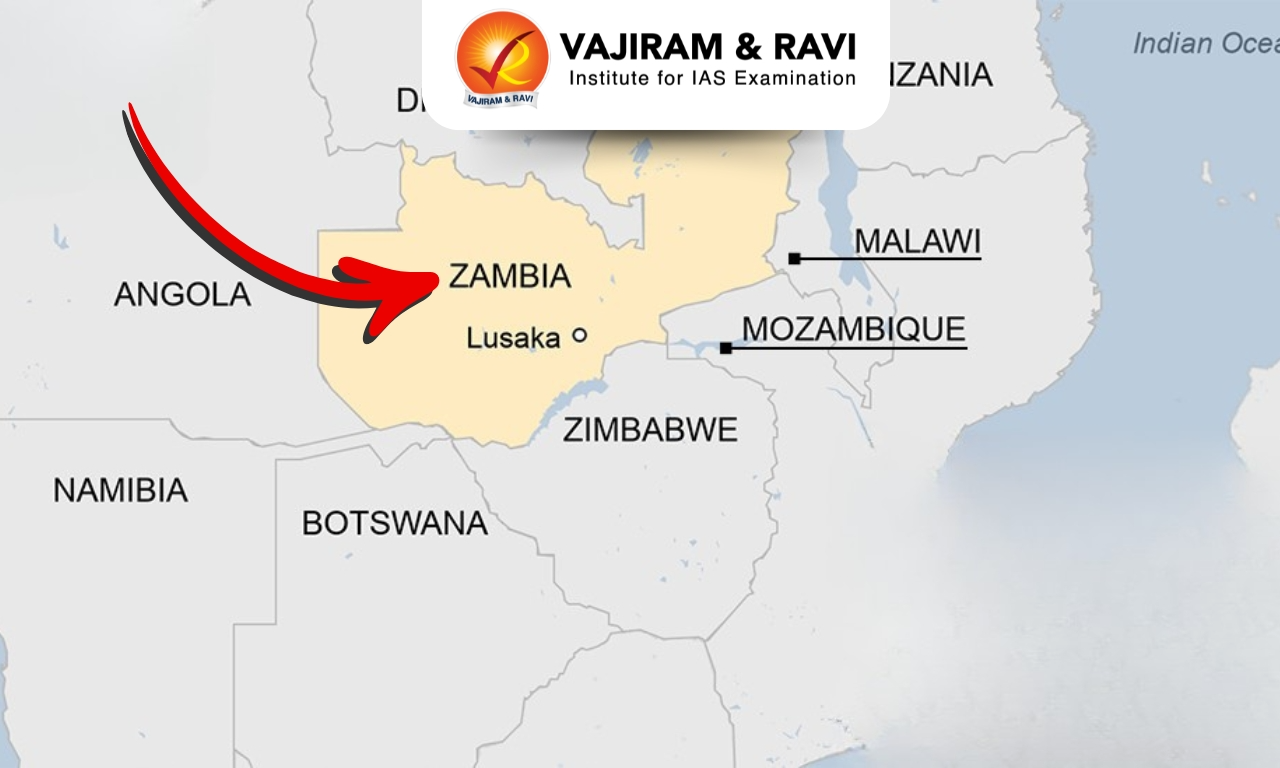
  • It is a Southern-Central African landlocked country.
  • Bordering Countries: It is bounded by the Democratic Republic of the Congo (North), Zimbabwe and Botswana (South), Tanzania (North-east), Malawi ( West) and Mozambique (Southeast), Angola and Zambia (West) and Namibia to the southwest.
  • Capital City: Lusaka.

Geographical Features of Zambia

  • Climate: It has a sub-tropical climate that is tempered by its relatively high altitude, making it more temperate and pleasant than other sub-tropical areas.
  • Rivers: The most significant river is the Zambezi River (which empties into the Indian Ocean). Other major rivers include the Kafue and the Luangwa.
  • Mountain Range: Mafinga Mountains.
  • Lakes: Lake Tanganyika and Lake Kariba
  • Natural Resources: It majorly consists of copper, cobalt, silver, uranium, lead, coal, zinc, gold, and emerald.

Source: News On Air

Zambia FAQs

Q1: Which river forms Victoria Falls?

Ans: Zambezi River

Q2: What is the capital of Zambia?

Ans: Lusaka

Supreme Court Redefines the Meaning of ‘Industry’

Meaning of ‘Industry’

Meaning of ‘Industry’ Latest News

  • The Supreme Court’s nine-judge Constitution Bench, headed by Chief Justice of India Surya Kant, has delivered a 5:4 verdict on the meaning of ‘industry’ under labour law. 
  • The Court has held that the expansive interpretation laid down in the landmark Bangalore Water Supply & Sewerage Board v. R. Rajappa (1978) will not govern future disputes under the Industrial Relations Code (IRC), 2020.
  • The ruling marks an important shift in India’s labour jurisprudence, particularly regarding the balance between workers’ rights, industrial peace, State functions and ease of doing business.

The 1978 ‘Bangalore Water Supply’ Verdict

  • The 7-judge Bench in 1978 gave an expansive interpretation to “industry” under Section 2(j) of the Industrial Disputes Act, 1947.
  • The ‘triple test’: An activity was treated as an industry if it involved -
    • Systematic activity;
    • Cooperation between employer and employee; and
    • Production or distribution of goods or services to satisfy human wants and wishes.
  • The Court held that the profit motive was not essential. Consequently, institutions such as hospitals, educational institutions, municipalities, clubs and certain welfare activities could fall within labour-law protection.
  • It also evolved the Dominant Nature Test for organisations carrying out multiple or integrated activities.
  • The broad definition enabled workers to seek legal remedies concerning wages, working conditions, unionisation, strikes, collective bargaining and protection against arbitrary dismissal.

Why the Definition Matters

  • The classification of an establishment as an “industry” determines whether statutory labour protections and dispute-resolution mechanisms apply to its employees.
  • The expansive 1978 interpretation, however, generated substantial litigation. A later Constitution Bench referred to the resulting increase in labour litigation as a “docket explosion”.
  • The issue became particularly contentious after LPG (liberalisation, privatisation and globalisation), as activities earlier performed by the State increasingly shifted to private entities.

Supreme Court’s Majority View

  • The majority held that the definition of “industry” under Section 2(p) of the Industrial Relations Code, 2020 must be interpreted on a clean slate.
  • It should not be “burdened” by the 1978 interpretation of Section 2(j) of the repealed Industrial Disputes Act.
  • The 1978 judgment therefore remains relevant for legacy disputes pending under the 1947 Act, but it will not serve as the foundation for interpreting the IRC in future cases.
  • CJI Surya Kant also observed that aspects of the triple test could have been articulated differently to better reflect the statutory provision. The Court’s detailed formulation of the modified test is awaited.

Pending vs Future Cases

  • Pending proceedings under the Industrial Disputes Act, 1947: Continue to be governed by the Bangalore Water Supply interpretation.
  • Future disputes under the IRC, 2020: Will be governed by the new statutory framework and the Court’s prospective interpretation.
  • This distinction prevents retrospective disruption and unequal treatment of workers involved in existing disputes.

Justice Nagarathna’s Dissent

  • Justice B.V. Nagarathna, joined by Justices Dipankar Datta and Ujjal Bhuyan, opposed reconsideration of the 1978 judgment.
  • She argued that the broad definition remains necessary in an economy transformed by privatisation and liberalisation, where workers have increasingly moved from public-sector to private-sector employment.
  • She maintained that merely because an activity is performed by the State, it does not automatically become a sovereign function. 
  • Government-run social welfare schemes and services may constitute industrial activities depending upon their nature.
  • She also defended the Dominant Nature Test, arguing that the focus should be on the character of the activity rather than simply on who performs it.
  • Justice Datta emphasised that institutional credibility requires respect for finality, while Justice Bhuyan supported retaining the established framework.
  • Justice Joymalya Bagchi: Adopting a nuanced position, he held that the IRC should not be encumbered by the 1978 judgment in future disputes, but disagreed with the majority’s proposed reformulation of the triple test.

Legislative and Policy Background

  • The Industrial Disputes (Amendment) Act, 1982 attempted to narrow the definition of “industry”, but the relevant provision was never brought into force.
  • Between 2019 and 2020, Parliament consolidated 29 labour laws into four Labour Codes -
    • Code on Wages, 2019
    • Industrial Relations Code, 2020
    • Occupational Safety, Health and Working Conditions Code, 2020
    • Code on Social Security, 2020
  • The labour reforms have faced strong opposition from trade unions, reflecting the continuing tension between labour protection and labour-market flexibility.

Way Forward

  • The judgment seeks to create a clearer distinction between legacy disputes and the new labour-law regime. 
  • Its ultimate impact will depend on the precise formulation of the new definition of “industry” and whether it succeeds in reducing litigation without weakening workers’ statutory protection.
  • The larger policy challenge is to achieve a balanced labour regime that protects workers from exploitation while providing enterprises and public institutions with sufficient flexibility to function efficiently.

Source: THIE

Meaning of ‘Industry’ FAQs

Q1: What was the ‘triple test’ laid down in Bangalore Water Supply v. R. Rajappa (1978)?

Ans: It required systematic activity, employer–employee cooperation, and production/distribution of goods or services.

Q2: What is the significance of the SC’s 5:4 verdict on the definition of ‘industry’?

Ans: The 1978 interpretation will govern pending disputes under the 1947 Act, but will not determine the meaning of “industry” under the IRC.

Q3: Why did Justice B.V. Nagarathna favour retaining the broad definition of ‘industry’?

Ans: She argued that privatisation and liberalisation have shifted employment from the public to private sector.

Q4: How does the Supreme Court’s ruling address the conflict between labour protection and ease of doing business?

Ans: By allowing the 1978 framework for existing disputes while permitting a fresh interpretation under the IRC.

Q5: Why is the distinction between sovereign and non-sovereign functions important?

Ans: Core sovereign functions remain outside industrial regulation, but State-run welfare and commercial activities can qualify.

Public Streets and Parking Rights: Who Controls Roadside Parking Outside Your Home?

Public Streets and Parking Rights

Public Streets and Parking Rights Latest News

  • As Delhi Police prepares a fresh congestion-management plan, officials hves directed every traffic circle to identify at least one "problem area" marked by encroachment, roadside parking, or chronic congestion. 
  • This crackdown on unauthorised parking raises a key legal question: does living next to a public street give a resident any special right over the parking space outside their home?

Who Owns a Public Street?

  • A public street does not belong to the homeowner whose gates open onto it.
  • The Delhi Municipal Corporation Act, 1957 (DMC Act) defines a "public street" as any street that vests in the Corporation.
  • Section 298 vests all public streets in the Corporation, placing them under the control of the Commissioner, who maintains, controls, and regulates them as per bye-laws.
  • No provision of the DMC Act grants an adjoining resident exclusive rights over the road stretch outside their property
  • Even prolonged use of a parking spot does not create any special entitlement.

Is Roadside Parking Legal?

  • Parking on a public road is not inherently illegal, but it is closely regulated:
    • Section 117, Motor Vehicles Act, 1988: Empowers state governments to designate places where motor vehicles may stand, indefinitely or for specified periods.
    • Section 122: Prohibits leaving a vehicle in a manner causing danger, obstruction, or undue inconvenience to other road users.
    • Section 127: Allows towing or immobilising vehicles left in violation of parking rules.

Delhi-Specific Parking Rules

  • The Delhi Maintenance and Management of Parking Places Rules, 2019 (framed under the Motor Vehicles Act): 
    • Prohibit on-street parking within 25 metres of an intersection.
    • Bar parking in green areas, parks, footpaths, bus stops, and other designated locations.
    • Under Rule 11, Area Parking Plans must include residential areas, developed in consultation with residents or Resident Welfare Associations (RWAs).
    • Mandate that one lane in residential colony roads remain free for emergency vehicles.
  • The Delhi Motor Vehicles Rules, 1993 empower the District Magistrate — in consultation with the State Transport Authority, Deputy Commissioner of Police (Traffic), and local authorities — to notify parking places within their jurisdiction.
  • In essence, curbside parking is governed entirely by the public authority controlling that stretch of road, not by the adjacent resident.

What the Supreme Court Has Said

  • In M.C. Mehta v Union of India (2019), a Bench of Justices Arun Mishra and Deepak Gupta examined Delhi's parking crisis, framing it as a conflict between the rising number of vehicles and shrinking available land, with significant implications for urban planning.
  • The Court directed the Delhi government to notify the 2019 Parking Rules, observing that an effective parking policy helps reduce congestion, pollution, and crime.
  • It also acknowledged ground realities, noting it was "not oblivious to the hard reality" that in many colonies, some roadside parking must be permitted since vehicle numbers exceed available indoor parking space.

Conclusion

  • Legally, no resident holds ownership or exclusive rights over the public road outside their home — such streets vest entirely in the municipal corporation and are governed by statutory rules under the Motor Vehicles Act and DMC Act. 
  • While courts have recognised the practical necessity of some roadside parking in residential areas, this remains a regulated privilege, not a private right, reinforcing that urban road space is fundamentally a shared public resource.

Source: IE

Public Streets and Parking Rights FAQs

Q1: What do Public Streets and Parking Rights mean for residents living beside a road?

Ans: Public Streets and Parking Rights mean adjoining residents do not automatically own or enjoy exclusive rights over the road space outside their homes.

Q2: Who controls public streets under Public Streets and Parking Rights in Delhi?

Ans: Under Public Streets and Parking Rights, public streets vest in the municipal corporation and remain subject to statutory control, regulation, and maintenance.

Q3: Is roadside parking a legal right under Public Streets and Parking Rights?

Ans: Public Streets and Parking Rights treat roadside parking as a regulated activity, permitting authorities to restrict vehicles causing obstruction, danger, or inconvenience.

Q4: What do Delhi's rules say about Public Streets and Parking Rights near intersections and footpaths?

Ans: Public Streets and Parking Rights restrict parking near intersections, green areas, parks, footpaths, and bus stops, while preserving residential emergency access.

Q5: What has the Supreme Court said about Public Streets and Parking Rights?

Ans: Public Streets and Parking Rights recognise practical residential parking needs, but the Supreme Court considers parking regulation essential for reducing congestion, pollution, and crime.

SEBI Bond Tokenisation Pilot: Transforming India’s Bond Market and FPI Onboarding

SEBI Bond Tokenisation Pilot

SEBI Bond Tokenisation Pilot Latest News

What Is Bond Tokenisation?

  • Bond tokenisation converts a traditional bond into digital tokens on a blockchain
  • Each token represents partial ownership of the bond, giving investors the same returns — interest payments and principal repayment — but at much smaller ticket sizes.

How It Differs from Traditional Bond Investing

  • Traditional bonds pass through multiple intermediaries for issuance, settlement, and custody.
  • Tokenised bonds can be issued, traded, and settled digitally with fewer intermediaries, backed by a real-time verifiable transaction record.
  • Accessibility for retail investors: Corporate bonds have traditionally been an institutional product requiring large capital. Fractional ownership through tokenisation removes this barrier, opening fixed income to everyday investors.

Key Benefits

  • Faster Settlement - Corporate bonds currently settle on a T+2 cycle (two days after the transaction). On blockchain, settlement can happen in real time, freeing up capital faster and reducing counterparty risk during the trade-to-settlement window.
  • Greater Transparency - Every transaction on a distributed ledger is recorded and immutable, giving investors full visibility into ownership history, coupon payments, and redemptions without depending on intermediaries for accurate record-keeping.

Key Risks and Concerns

  • Cryptographic vulnerability: SEBI has flagged concerns that future quantum computers could potentially break the cryptographic algorithms securing blockchain systems, risking the integrity of the entire record.
  • Interoperability challenges: Integration between legacy depository systems and new blockchain infrastructure remains untested at scale.
  • Regulatory gaps: India currently lacks a comprehensive legal framework defining ownership rights, dispute resolution, and investor protection for tokenised bonds — a gap that is likely to keep institutional participation limited until addressed.
  • Liquidity constraints: In the early pilot phase, secondary market depth is expected to be limited, meaning entry may be easier than exit for investors.

SEBI's Bond Tokenisation Plan

  • SEBI plans to launch the pilot "in the near future," in coordination with the Reserve Bank of India (RBI), to improve accessibility, transparency, and efficiency in the bond market.
  • The core idea is to test whether a shared ledger can enable simultaneous transfer of the security and money, making settlement more efficient and reducing reconciliation costs.
  • The pilot will also examine the feasibility of automated coupon payments and other bond-servicing events through smart contracts.
  • The move comes as SEBI pushes to deepen the bond market to channel more capital toward economic growth.
  • It aligns with the regulator's broader push to modernise debt market infrastructure using technology.

Credit Risk-o-Meter for Investor Protection

  • SEBI is also consulting on introducing a "Credit Risk-o-Meter" for debt securities to strengthen investor protection in a market that has been gaining traction.
  • It will be a standardised, colour-coded visual scale mapped to existing credit-rating symbols.
  • It will be displayed both in the offer document and on platforms selling the securities, along with the credit rating and the name of the credit-rating agency.

Framework for Fixed Income Channel Partners

  • SEBI will "shortly" introduce a framework for fixed income channel partners, similar to mutual fund distributors, to improve distribution of the corporate bond market.
  • These partners will be certified through the National Institute of Securities Markets (NISM).
  • Importantly, channel partners will not handle client funds or securities, nor charge investors separately — the goal being to expand market reach while maintaining accountability and investor safeguards.

Easing FPI Onboarding: Digital Power of Attorney

  • In a separate move effective immediately, SEBI now allows FPIs to submit a digitally signed Power of Attorney (PoA) to their custodians.
  • A PoA authorises custodians — SEBI-registered institutions responsible for holding and managing FPI investments — to act on the FPI's behalf.
  • This eliminates the need for notarisation, apostillisation, or consularisation of the PoA, significantly reducing onboarding time and improving ease of doing business.
  • This builds on earlier SEBI measures, such as a common application form for FPI registration, aimed at simplifying compliance for foreign investors.

Conclusion

  • SEBI's twin initiatives — piloting blockchain-based bond tokenisation and simplifying FPI onboarding — reflect its dual focus on deepening India's debt market through technology while making the market more accessible to foreign capital. 
  • Together with the proposed Risk-o-Meter and channel partner framework, these steps aim to build a more efficient, transparent, and investor-friendly bond market ecosystem.

Source: IE | LM

SEBI Bond Tokenisation Pilot FAQs

Q1: What is the SEBI Bond Tokenisation Pilot?

Ans: The SEBI Bond Tokenisation Pilot will test blockchain-based digital bond ownership, enabling potentially faster settlement, greater transparency, and smaller investment opportunities.

Q2: How can the SEBI Bond Tokenisation Pilot benefit retail investors?

Ans: The SEBI Bond Tokenisation Pilot can enable fractional ownership, allowing retail investors to access corporate bonds at smaller ticket sizes than traditional investments.

Q3: What risks does the SEBI Bond Tokenisation Pilot face?

Ans: The SEBI Bond Tokenisation Pilot faces cryptographic vulnerabilities, interoperability problems, regulatory gaps, and limited secondary-market liquidity during its initial implementation phase.

Q4: How will the SEBI Bond Tokenisation Pilot improve settlement efficiency?

Ans: The SEBI Bond Tokenisation Pilot will examine simultaneous transfer of securities and money, potentially enabling real-time settlement and reducing reconciliation and counterparty risks.

Q5: How do FPI reforms complement the SEBI Bond Tokenisation Pilot?

Ans: Alongside the SEBI Bond Tokenisation Pilot, digitally signed Powers of Attorney simplify FPI onboarding by eliminating notarisation, apostillisation, and consularisation requirements.

NAMASTE Scheme – Mechanised Sanitation, Safety and Rehabilitation of Sanitation Workers

NAMASTE Scheme

NAMASTE Scheme Latest News

  • The Government is considering expanding the National Action for Mechanised Sanitation Ecosystem (NAMASTE) from urban areas to rural India, while recent government data highlight the progress as well as continuing challenges in ensuring the safety, dignity and rehabilitation of sanitation workers.

NAMASTE Scheme

  • The NAMASTE Scheme was launched in 2023 by the Ministry of Social Justice and Empowerment in collaboration with the Ministry of Housing and Urban Affairs.
  • The scheme seeks to replace hazardous manual cleaning practices with mechanised sanitation solutions while improving the safety and socioeconomic conditions of sanitation workers.
  • The initial focus was on sewer and septic tank workers (SSWs) and was subsequently expanded to include waste pickers.
  • The broader approach of NAMASTE is based on three interconnected objectives:
    • Eliminating hazardous manual cleaning practices.
    • Improving occupational safety and dignity.
    • Providing livelihood, skill development and social-security support.

Key Components of NAMASTE

  • Mechanisation and Capital Assistance
    • The scheme provides financial assistance to eligible sanitation workers for procuring mechanised cleaning equipment.
    • This enables workers and sanitation enterprises to transition from hazardous manual cleaning towards safer mechanised operations.
  • Personal Protective Equipment (PPE)
    • The scheme provides PPE kits to sanitation workers and waste pickers.
    • PPE is particularly important because workers may remain exposed to occupational hazards even when mechanised equipment is used.
  • Training and Skill Development
    • NAMASTE also provides occupational safety and skill development training.
    • The objective is to equip workers with the technical and safety skills required to operate mechanised sanitation equipment and undertake sanitation-related activities safely.
  • Health and Social Security
    • The scheme also seeks to strengthen social protection for sanitation workers through access to health insurance and other welfare measures.
    • This is important because sanitation workers face occupational risks as well as broader socioeconomic vulnerabilities.
  • Rehabilitation of Manual Scavengers
    • NAMASTE is complemented by measures for the rehabilitation of identified manual scavengers.
    • The Government has undertaken surveys to identify persons engaged in manual scavenging and subsequently provide rehabilitation assistance.

Progress & Achievements Under NAMASTE

Image Caption: Achievements of NAMASTE Scheme

  • These figures indicate that the scheme is combining mechanisation with occupational safety and social protection rather than treating mechanisation as a standalone intervention.
  • Rehabilitation of Identified Manual Scavengers
    • Surveys conducted in 2013 and 2018 identified 58,098 manual scavengers across the country. According to the Government:
    • All identified beneficiaries have received one-time cash assistance.
    • 27,926 beneficiaries have undergone skill development training.
    • 2,803 beneficiaries have received capital subsidy for establishing general self-employment projects.
  • These measures are intended to provide alternative livelihood opportunities and facilitate the socioeconomic rehabilitation of identified manual scavengers.

News Summary

  • The Central government has proposed expanding NAMASTE from towns and cities to rural areas.
  • The proposed expansion would broaden the categories of workers covered by the scheme to include:
    • Drain cleaners
    • Workers in sewage treatment plants (STPs)
    • Workers in faecal sludge treatment plants
  • The proposed expanded scheme would have an estimated outlay of approximately Rs. 498.73 crore, to be spent from the current financial year through 2030-31.
  • The proposed expansion is significant because hazardous sanitation work is not confined to urban sewer and septic tank systems. 
  • Extending mechanisation and occupational-safety interventions to rural sanitation infrastructure could widen the reach of the programme.

Significance

  • The expansion of NAMASTE reflects a shift towards a more comprehensive approach to sanitation-worker welfare.
  • The central objective is not merely to prevent manual entry into sewers and septic tanks but to create an ecosystem in which sanitation workers have access to:
    • Mechanised equipment
    • Occupational safety training
    • Protective equipment
    • Health insurance
    • Skill development
    • Alternative livelihood opportunities
  • The proposed rural expansion is particularly important because sanitation infrastructure is increasingly being developed beyond major urban centres.
  • At the same time, the gaps identified in capital subsidy approvals and disbursements demonstrate that effective implementation and timely access to financial assistance remain critical challenges.

Source: TH | PIB

NAMASTE Scheme FAQs

Q1: What is the NAMASTE Scheme?

Ans: NAMASTE, or the National Action for Mechanised Sanitation Ecosystem, is a government scheme launched in 2023 to eliminate hazardous sanitation work through mechanisation while improving the safety, dignity and socioeconomic conditions of sanitation workers.

Q2: Who are the primary beneficiaries of NAMASTE?

Ans: The scheme initially focused on sewer and septic tank workers and was subsequently expanded to include waste pickers. The proposed expansion would also cover drain cleaners and workers in sewage and faecal sludge treatment plants.

Q3: What is the proposed outlay for the expansion of NAMASTE to rural India?

Ans: The Social Justice Ministry has proposed an outlay of approximately Rs. 498.73 crore for the expanded scheme through 2030-31.

Q4: How many sanitation workers have received health insurance under NAMASTE?

Ans: According to the PIB release, 1,81,062 beneficiaries have been covered under health insurance.

Q5: How many manual scavengers were identified through the 2013 and 2018 surveys?

Ans: The surveys identified 58,098 manual scavengers across the country.

Bismillah Khan Death Anniversary 2026, Date, Musical Journey, Awards

Bismillah Khan Death Anniversary 2026

Bismillah Khan Death Anniversary 2026 is observed on 21 August 2026 to remember the legendary shehnai maestro Ustad Bismillah Khan and his lasting contribution to Indian music. He is remembered for his exceptional talent, dedication to music and important role in making the shehnai a respected classical instrument. His musical legacy continues to hold a special place in India’s cultural heritage

Bismillah Khan Death Anniversary 2026 Date and Significance

  • Bismillah Khan Death Anniversary 2026 is observed on 21 August 2026, marking 20 years since the legendary shehnai maestro passed away.
  • Ustad Bismillah Khan died on 21 August 2006 in Varanasi, Uttar Pradesh, at the age of 90 following a cardiac arrest.
  • Born as Qamruddin Khan, he became one of the most celebrated names in Indian classical music and played a major role in giving the shehnai a respected place on the concert stage.
  • He is remembered not only for his exceptional music but also for his message of communal harmony, cultural unity and spiritual devotion.
  • His association with the Kashi Vishwanath Temple, his deep connection with the Ganga and his devotion to Lord Vishwanath became important parts of his musical and personal journey.

Bismillah Khan Early Life and Musical Journey

  • Ustad Bismillah Khan was born on 21 March 1916 in Dumraon, Bihar, into a family with a long tradition of serving as court musicians.
  • His original name was Qamruddin Khan and he was introduced to the shehnai at a very young age through his family and relatives associated with music.
  • At around six years of age, he moved to Varanasi, where his maternal uncle Ali Bux ‘Vilayatu’ Khan, a shehnai player at the Kashi Vishwanath Temple, became his mentor.
  • He spent long hours practising the shehnai at temples and on the banks of the River Ganga, gradually developing his own distinctive style of playing.
  • His dedicated practice helped him master ragas, rhythm and improvisation, while also expanding the expressive possibilities of the shehnai.
  • His major breakthrough came in 1937 at the All India Music Conference in Kolkata, where his performance brought the shehnai into the wider classical music scene.
  • He later performed across India and represented Indian music at international events, including the World Exposition in Montreal, Cannes Art Festival and Osaka Trade Fair.

Bismillah Khan’s Contribution to Indian Classical Music

  • Before Bismillah Khan, the shehnai was mainly associated with weddings, temples and other ceremonial occasions and was not widely regarded as a major classical concert instrument.
  • Through his exceptional performances, he transformed the shehnai into a respected classical musical instrument capable of long and sophisticated concert performances.
  • His music combined technical skill, emotional depth and improvisation, allowing the shehnai to express the richness of Indian classical ragas.
  • One of the most memorable moments of his career came on 15 August 1947, when he performed the shehnai from the Red Fort on the occasion of India's Independence.
  • He also performed on important national and cultural occasions, helping make the sound of the shehnai an important part of India's cultural identity.
  • Bismillah Khan's music reflected Hindu-Muslim unity and communal harmony. He respected different religious traditions and often described his musical ability as a blessing of Lord Vishwanath.
  • He also made selected contributions to Indian cinema, including Goonj Uthi Shehnai and Sannadi Appanna, helping introduce the sound of the shehnai to a wider audience.

Bismillah Khan Awards, Achievements and Legacy

  • Bismillah Khan received several of India's most prestigious honours for his outstanding contribution to Indian classical music and culture.
  • He was awarded the Bharat Ratna in 2001, India's highest civilian honour, recognising his exceptional contribution to music.
  • He received the Padma Shri in 1961, Padma Bhushan in 1968 and Padma Vibhushan in 1980 for his contribution to Indian music.
  • He was honoured with the Sangeet Natak Akademi Award and later received the Sangeet Natak Akademi Fellowship in recognition of his distinguished musical career.
  • His other honours included the Tansen Award, Swathi Sangeetha Puraskaram, T. Choudayya National Award and the Tahar Mausique Award.
  • He was also conferred honorary doctorates by Banaras Hindu University and Visva-Bharati University for his contribution to music and culture.
  • Bismillah Khan's greatest legacy lies in the way he elevated the shehnai from a largely ceremonial instrument to an internationally recognised classical concert instrument.
  • His music, humility, dedication and message of cultural harmony continue to inspire musicians and music lovers, making him an enduring symbol of India's rich musical heritage.

Bismillah Khan Death Anniversary 2026 FAQs

Q1: When is Bismillah Khan Death Anniversary 2026?

Ans: Bismillah Khan Death Anniversary 2026 is observed on 21 August 2026, marking 20 years since his death.

Q2: Who was Ustad Bismillah Khan?

Ans: Ustad Bismillah Khan was a legendary Indian shehnai maestro who played a major role in establishing the shehnai as a respected classical concert instrument.

Q3: When and where was Bismillah Khan born?

Ans: Bismillah Khan was born on 21 March 1916 in Dumraon, Bihar. His original name was Qamruddin Khan.

Q4: When did Bismillah Khan die?

Ans: Ustad Bismillah Khan passed away on 21 August 2006 in Varanasi, Uttar Pradesh, at the age of 90.

Q5: What was Bismillah Khan's contribution to Indian classical music?

Ans: He helped transform the shehnai from a mainly ceremonial instrument into a prominent classical concert instrument through his innovative and soulful performances.

Daily Editorial Analysis 21 August 2026

Daily-Editorial-Analysis

Centre’s Fiscal Outlook Faces Geopolitical, Revenue Risks

Context

  • India’s fiscal outlook for 2026–27 is being shaped by tax reforms, geopolitical instability, crude oil prices, and expenditure pressures.
  • Recent rationalisation of PIT and GST rates has temporarily weakened tax collections, while the West Asian crisis has raised energy costs and subsidy requirements.
  • Nevertheless, strong non-tax revenues, RBI dividends, policy interventions, and robust capital expenditure are likely to keep fiscal outcomes broadly aligned with budgetary targets.

Centre’s Revenue Receipts

  • According to CGA data, gross tax revenue grew by only 3.7% in the first quarter of 2026–27, mainly because of weak PIT and GST collections.
  • PIT growth, which was almost stagnant at 0.037% in 2025–26, improved to 6.8% in the first quarter. However, GST revenue contracted by 11%, reflecting the continuing revenue impact of earlier rate reductions.
  • The West Asian crisis further strained revenue mobilisation by pushing up global crude oil prices.
  • To protect consumers from rising fuel prices, the government reduced excise duties, causing Union excise revenue to contract by 22.4% during the quarter.
  • The government responded by introducing the Health Security se National Security (HSNS) Cess, raising the windfall tax on petroleum exports, and increasing import duties on gold, silver and other precious metals.
  • These measures aim to compensate for revenue losses.
  • Higher-than-budgeted nominal GDP growth of 12.5–13%, supported by real growth of around 7% and moderate inflation, may also strengthen tax collections.
  • Yet nominal GDP is estimated at ₹391 lakh crore against the budgeted ₹393 lakh crore. Hence, gross tax revenue is likely to meet the target or fall short only marginally.

Transfers to States

  • The Sixteenth Finance Commission retained States’ share at 41% of the divisible pool of central taxes.
  • However, the introduction of the non-shareable HSNS Cess may marginally reduce the pool available for devolution.
  • Tax devolution to States contracted sharply by 19.5% in the first quarter, although an improvement is expected later as central tax collections strengthen.
  • Finance Commission grants to States are also budgeted to decline by ₹23,556 crores.
  • Maintaining adequate transfers remains essential for cooperative federalism, particularly when States themselves face expenditure and revenue pressures.

The Role of Non-Tax Revenue

  • Strong non-tax revenue has emerged as a major fiscal stabiliser. The RBI transferred a substantial dividend to the Centre in May 2026, covering 77% of the budgeted annual dividends and profits within the first three months.
  • Non-tax revenues contributed 37% of net revenue receipts during the first quarter.
  • The government also expects its budgeted non-debt capital receipts to be realised.
  • These inflows have helped compensate for weak tax collections and strengthened the Centre’s revenue position without requiring additional borrowing.

Expenditure Pressures and Capital Spending

  • Higher crude oil prices forced major subsidies to rise by 37.4% in the first quarter.
  • If this trend continues, annual subsidies could exceed the budget estimate by approximately ₹50,000 crores.
  • Despite this pressure, revenue expenditure growth remained contained at 7.4%. More importantly, capital expenditure increased by 23.7%, reversing the 23.3% contraction recorded in the previous quarter.
  • Strong public capital spending can support infrastructure development, employment, productivity and long-term economic growth, making it important to protect capital expenditure even during periods of fiscal stress.

Debt and Fiscal Deficit

  • The Centre’s first-quarter fiscal deficit represented 18.2% of the annual budget estimate, while the revenue deficit accounted for only 0.4%.
  • Strong non-debt receipts, particularly the RBI dividend, have supported the revenue account.
  • The fiscal deficit is estimated at ₹18.16 lakh crore, equivalent to around 4.6% of GDP, while the debt-to-GDP ratio is estimated at 55.8%.
  • These levels remain broadly consistent with budgetary expectations.
  • However, some fiscal slippage could result from weak tax collections, higher subsidies, and external debt pressures caused by rupee depreciation.

Geopolitical Risks and Fiscal Sustainability

  • The West Asian crisis remains the biggest external risk to India’s fiscal position.
  • As a major crude oil importer, India is vulnerable to higher energy prices, which can increase the import bill, inflation, subsidies and production costs while weakening consumption and GST collections.
  • A prolonged conflict could therefore simultaneously increase expenditure and reduce revenue, complicating fiscal consolidation.
  • Conversely, easing geopolitical tensions would moderate crude prices, reduce subsidy requirements and improve economic activity.
  • Fiscal sustainability will consequently depend not only on domestic tax reforms but also on the trajectory of global energy markets.

Conclusion

  • India’s fiscal position in 2026–27 remains resilient but vulnerable to external shocks.
  • Weak PIT and GST collections, lower fuel excise revenue and rising subsidies have created pressures, but these are being offset by RBI dividends, non-tax receipts, new revenue measures and strong capital expenditure.
  • The Centre is therefore likely to remain broadly on track with its fiscal targets.
  • However, sustained fiscal discipline will require careful subsidy management, stronger tax buoyancy and protection of productive capital spending.
  • Above all, an escalation of geopolitical tensions could significantly alter the fiscal outlook, making energy security and prudent fiscal management central to India’s economic stability.

Centre’s Fiscal Outlook Faces Geopolitical, Revenue Risks FAQs

Q1. What is the main challenge to the Centre’s revenue receipts in 2026–27?
Ans. Weak PIT and GST collections are the main challenges to revenue receipts.

Q2. Why have fuel excise revenues declined?
Ans. Fuel excise revenues declined because the government reduced duties to cushion consumers from high crude oil prices.

Q3. How has the RBI supported the Centre’s finances?
Ans. The RBI supported the Centre by transferring a substantial dividend.

Q4. What is the estimated fiscal deficit-to-GDP ratio?
Ans. The fiscal deficit-to-GDP ratio is estimated at 4.6%.

Q5. What is the biggest external risk to fiscal stability?
Ans. An escalation of the West Asian crisis is the biggest external risk to fiscal stability.

Source: The Hindu


The Vanashakti Verdict is Balanced and Pragmatic

Context

  • Environmental regulation in India seeks to balance economic development with ecological sustainability.
  • The Environment Impact Assessment (EIA) Notification, 2006 makes prior Environmental Clearance (EC) mandatory for specified projects so that environmental risks are assessed before construction or operations begin.
  • The Supreme Court’s July 29, 2026 judgment in Vanashakti vs Union of India has clarified the legal position on projects that commenced without prior EC while leaving limited scope for addressing genuine legacy violations.

Prior Environmental Clearance as a Legal Imperative

  • Preventive Nature of Environmental Regulation

    • The Court reaffirmed that prior EC is a mandatory legal requirement, rather than a procedural formality that can be fulfilled retrospectively.
    • Environmental assessment is intended to be preventive, enabling authorities to examine ecological risks, alternatives and mitigation measures before a project begins.
  • Preventing the Violate First, Regularise Later Approach

    • Routine post-facto approval could create a violate first, regularise later culture and weaken environmental governance.
    • Project proponents therefore cannot treat retrospective clearance as an alternative to obtaining mandatory approval before commencement.

Closure of Earlier Violation Mechanisms

  • End of the 2017 and 2021 Routes

    • Project proponents that commenced construction or operations without prior EC and did not utilise earlier violation mechanisms cannot now seek regularisation under the 2017 Notification or 2021 Standard Operating Procedure.
  • Implications for Existing Projects

    • The decision affects numerous industrial, infrastructure, commercial and real-estate projects with unresolved environmental violations.
    • The immediate message is clear: mandatory environmental approvals must be obtained before project commencement.

Administrative Instructions versus Statutory Authority

  • Limits of Office Memoranda

    • An administrative Office Memorandum cannot override the statutory requirement of prior EC.
    • Executive instructions cannot independently create a broad mechanism for retrospective environmental approval.
  • Scope under the Environment (Protection) Act

    • The Central Government retains powers under Section 3 of the Environment (Protection) Act, 1986 to formulate environmental measures through legally authorised statutory action.
    • Thus, while administrative instructions cannot dilute statutory requirements, a properly framed statutory mechanism remains legally possible.

Balancing Environmental Protection and Public Interest

  • Risks of Blanket Regularisation

    • Unrestricted regularisation could weaken environmental law and encourage deliberate violations.
    • It could also undermine the credibility of the prior-EC regime by creating an expectation that non-compliance can eventually be resolved through payment or retrospective approval.
  • Problems with Indiscriminate Closure

    • Conversely, automatic closure or demolition of every violating project may not always serve environmental or public interest, particularly where substantial investment has already occurred or where projects provide essential infrastructure or public utilities.
  • The Middle Path

    • The appropriate approach is to distinguish between legitimising violations and responsibly managing legacy violations.
    • Environmental governance must combine strict enforcement with practical, scientifically informed solutions.

Possibility of a Fresh Statutory Framework

  • Government’s Discretion

    • The Court has not directed the Central Government to introduce a new regularisation scheme.
    • It has merely recognised that such intervention may be considered in the larger public interest.
  • Essential Safeguards

    • If a new mechanism is introduced, it should be:
      • One-time and exceptional, rather than permanent.
      • Based on clear statutory authority.
      • Supported by environmental damage assessment.
      • Accompanied by remediation and environmental compensation.
      • Subject to strict future compliance and monitoring.
      • Based on clearly defined eligibility criteria.
    • Such safeguards would prevent any new framework from becoming an incentive for future violations.

Wider Implications for Environmental Governance

  • Strengthening Regulatory Certainty

    • The judgment reinforces regulatory certainty and environmental rule of law.
    • Developers and implementing agencies cannot routinely rely on regulatory uncertainty or mistaken interpretation to bypass mandatory approvals.
  • Scientific and Accountable Regulation

    • Effective environmental governance requires more than permissions and prohibitions.
    • Scientific assessment, ecological restoration, compensation, monitoring and long-term compliance are essential for meaningful environmental protection.
  • Strengthening Institutional Capacity

    • The government must also improve preventive enforcement through digital monitoring, effective inspections, timely regulatory decisions and better coordination between authorities.
    • Stronger institutions can reduce the emergence of future violation cases.

The Road Ahead

  • The earlier 2017 and 2021 mechanisms are no longer available for fresh applications.
  • Whether a new statutory framework is created rests entirely with the Central Government.
  • If such a mechanism is considered necessary, it should be transparent, time-bound, scientifically grounded and narrowly targeted.
  • Projects involving serious or irreversible ecological damage should face stronger restrictions, while cases involving limited or procedural violations may be assessed according to objective environmental criteria.
  • The priority must simultaneously remain on preventing new violations through stronger compliance systems and more effective environmental monitoring.

Conclusion

  • The Vanashakti judgment establishes a middle path between blanket retrospective regularisation and indiscriminate punitive action.
  • It firmly protects the principle that environmental clearance must ordinarily precede project commencement while recognising the practical challenge posed by existing legacy violations.
  • Any future intervention must ensure that environmental violations are neither rewarded nor ignored.
  • Statutory legitimacy, environmental accountability, scientific assessment, remediation and strict compliance should form its foundation.

The Vanashakti Verdict is Balanced and Pragmatic FAQs

Q1. Why is prior Environmental Clearance (EC) important?
Ans. Prior EC ensures that environmental risks are assessed before a project begins.

Q2. What did the Supreme Court decide about the 2017 and 2021 violation mechanisms?
Ans. The Court held that these mechanisms cannot be used for fresh regularisation applications.

Q3. Can the Central Government create a new regularisation mechanism?
Ans. Yes, it may create one through a properly authorised statutory notification if required in the public interest.

Q4. What safeguards should a future mechanism include?
Ans. It should include damage assessment, remediation, environmental compensation and strict compliance conditions.

Q5. What is the broader significance of the judgment?
Ans. The judgment balances strict environmental enforcement with the practical need to address genuine legacy violations.

Source: The Hindu

Daily Editorial Analysis 2026 FAQs

Q1: What is editorial analysis?

Ans: Editorial analysis is the critical examination and interpretation of newspaper editorials to extract key insights, arguments, and perspectives relevant to UPSC preparation.

Q2: What is an editorial analyst?

Ans: An editorial analyst is someone who studies and breaks down editorials to highlight their relevance, structure, and usefulness for competitive exams like the UPSC.

Q3: What is an editorial for UPSC?

Ans: For UPSC, an editorial refers to opinion-based articles in reputed newspapers that provide analysis on current affairs, governance, policy, and socio-economic issues.

Q4: What are the sources of UPSC Editorial Analysis?

Ans: Key sources include editorials from The Hindu and Indian Express.

Q5: Can Editorial Analysis help in Mains Answer Writing?

Ans: Yes, editorial analysis enhances content quality, analytical depth, and structure in Mains answer writing.

Enquire Now