Begum Hazrat Mahal (1820-1879), Biography, Contribution, Death

Begum Hazrat Mahal

Begum Hazrat Mahal was a prominent leader of the 1857 rebellion in Awadh. She was the second wife of Nawab Wajid Ali Shah and became regent after the British annexed Awadh in 1856. She declared her son Birjis Qadr as ruler and led resistance from Lucknow. Her refusal to accept British authority continued even after she was forced into exile in Nepal.

Who was Begum Hazrat Mahal?

Begum Hazrat Mahal was born around 1820 in Faizabad, the former capital of Awadh. Her birth name was Muhammadi Khanum. She later entered the royal household and became the wife of Nawab Wajid Ali Shah.

  • Muhammadi Khanum was born in Faizabad around 1820. She was sold by her parents and entered the Awadh royal household through royal agents.
  • She entered the court as a Khawasin and was later promoted to a pari. She became associated with the royal harem of Nawab Wajid Ali Shah.
  • She became the junior wife of Nawab Wajid Ali Shah. The title Hazrat Mahal was given to her after the birth of their son, Birjis Qadr.
  • Her son Birjis Qadr was born in 1845. He later became the political basis of her claim to continue the Awadh monarchy after British Annexation.
  • The British East India Company annexed Awadh on February 7, 1856. Wajid Ali Shah was subsequently exiled to Calcutta on March 13, 1856.
  • Begum Hazrat Mahal stayed in Lucknow with Birjis Qadr. This decision brought her directly into the political struggle that followed the Annexation of Oudh.

Begum Hazrat Mahal Role in Freedom Struggle

Begum Hazrat Mahal transformed her position within the Awadh royal family into political leadership during the 1857 rebellion against British Rule.

  • Leadership in 1857: When rebellion spread across Awadh, Begum Hazrat Mahal assumed responsibility for protecting the interests of the displaced royal family and opposing Company authority.
  • Proclamation of Birjis Qadr: On July 5, 1857, Birjis Qadr was proclaimed ruler of Awadh at Lucknow. Begum Hazrat Mahal acted as regent because of his young age.
  • Administration of Awadh: She took charge of the rebel administration in Lucknow. She coordinated political activities and supported resistance against British forces operating in the region.
  • Alliance with revolutionaries: Begum Hazrat Mahal worked with important rebel leaders, including Nana Saheb and Maulavi Ahmad Ula Shah. Her resistance was connected with the wider rebellion across northern India.
  • Religious concerns: She strongly criticised British policies affecting Hindu and Muslim religious institutions. Her proclamation questioned British claims that their rule would not interfere with religion.
  • Defence of Lucknow: She encouraged rebel forces during the fighting around Lucknow. She reportedly appeared on an elephant on February 25, 1858, while issuing instructions concerning military movements.
  • British reconquest: British forces under Sir Colin Campbell launched a major offensive against Lucknow in 1858. Moosa Bagh, Char Bagh and Kesar Bagh were among the important positions captured by March 19, 1858.
  • Retreat from Awadh: The British regained control over Lucknow and much of Awadh. Begum Hazrat Mahal was forced to leave the region with Birjis Qadr and her supporters.
  • Refusal of British amnesty: She rejected British offers of surrender and refused to accept assurances made under Queen Victoria's proclamation. Her decision reflected her continued opposition to British authority.
  • Exile in Nepal: Begum Hazrat Mahal eventually crossed into Nepal. Nepalese authorities initially hesitated to provide asylum but later allowed her to remain there.
  • Continued resistance: Her refusal to surrender made her different from leaders who accepted British terms after the rebellion. She remained outside British controlled India for the rest of her life.

Begum Hazrat Mahal Death

Begum Hazrat Mahal spent her final years in Kathmandu after leaving Awadh. She died in Nepal in 1879 and was buried near Kathmandu's Jama Masjid.

  • Life in Nepal: After reaching Nepal, Begum Hazrat Mahal was permitted to stay there despite initial opposition from Rana Prime Minister Jung Bahadur.
  • Death: Begum Hazrat Mahal died on April 7, 1879, in Kathmandu. She died in exile after refusing to accept British authority or return under their conditions.
  • Burial: She was buried in a nameless grave in the grounds of Kathmandu's Jama Masjid. Her burial site remains associated with her memory.

Begum Hazrat Mahal Memorial

Begum Hazrat Mahal's legacy is remembered through memorials, a commemorative postage stamp and public recognition in India and Nepal.

  • Kathmandu tomb: Her tomb is located near Jama Masjid in central Kathmandu, close to Ghantaghar and Darbar Marg. The Jama Masjid Central Committee looks after the site.
  • Lucknow Memorial: On August 15, 1962, she was honoured at Old Victoria Park in Hazratganj, Lucknow. The park was renamed and a marble memorial was constructed in her honour. The Lucknow memorial contains a marble tablet with four round brass plaques. These plaques carry the coat of arms of the Awadh royal family.
  • Commemorative stamp: The Government of India issued a commemorative postage stamp in her honour on May 10, 1984. The stamp recognised her contribution to the 1857 rebellion.
  • National scholarship: The Ministry of Minority Affairs introduced the Begum Hazrat Mahal National Scholarship for meritorious girls belonging to minority communities. The Maulana Azad Education Foundation implements the scholarship.
  • Historical legacy: Begum Hazrat Mahal is remembered as one of the major women Freedom Fighters of the 1857 rebellion. Her leadership in Awadh and refusal to accept British amnesty remain central to her historical importance.

Begum Hazrat Mahal FAQs

Q1: Who was Begum Hazrat Mahal?

Ans: Begum Hazrat Mahal was the second wife of Wajid Ali Shah and a leading figure of the 1857 rebellion in Awadh.

Q2: What was Begum Hazrat Mahal's role in the 1857 revolt?

Ans: She led resistance in Awadh, governed as regent and supported the rebel administration after declaring Birjis Qadr ruler of Awadh.

Q3: Who was the son of Begum Hazrat Mahal?

Ans: Her son was Birjis Qadr, whom she declared ruler of Awadh in 1857 after the British annexation and exile of Wajid Ali Shah.

Q4: When and where did Begum Hazrat Mahal die?

Ans: Begum Hazrat Mahal died on April 7, 1879, in Kathmandu, Nepal, after spending her final years in exile.

Q5: Where is Begum Hazrat Mahal's tomb located?

Ans: Her tomb is located in the grounds of Kathmandu's Jama Masjid in central Kathmandu, Nepal.
UPSC Daily Quiz 8 September 2026

UPSC Daily Quiz

[WpProQuiz 249]

UPSC Daily Quiz FAQs

Q1: What is the Daily UPSC Quiz?

Ans: The Daily UPSC Quiz is a set of practice questions based on current affairs, static subjects, and PYQs that help aspirants enhance retention and test conceptual clarity regularly.

Q2: How is the Daily Quiz useful for UPSC preparation?

Ans: Daily quizzes support learning, help in revision, improve time management, and boost accuracy for both UPSC Prelims and Mains through consistent practice.

Q3: Are the quiz questions based on the UPSC syllabus?

Ans: Yes, all questions are aligned with the UPSC Syllabus 2025, covering key areas like Polity, Economy, Environment, History, Geography, and Current Affairs.

Q4: Are solutions and explanations provided with the quiz?

Ans: Yes, each quiz includes detailed explanations and source references to enhance conceptual understanding and enable self-assessment.

Q5: Is the Daily UPSC Quiz suitable for both Prelims and Mains?

Ans: Primarily focused on Prelims (MCQ format), but it also indirectly helps in Mains by strengthening subject knowledge and factual clarity.

Luni River, Origin, Length, Tributaries, Biodiversity, Project

Luni River

The Luni River is the largest river of the Thar Desert and a major west flowing seasonal river of northwestern India. It rises in the Aravalli Range near Ajmer, Rajasthan and flows southwest through the arid districts before reaching the Rann of Kachchh in Gujarat. The river is important for irrigation, agriculture and local water needs despite becoming highly saline downstream.

Luni River

The Luni River connects the Aravalli hills with the Thar Desert and follows an important westward drainage system across Rajasthan and Gujarat.

  • Luni River Origin: The Luni River Origin lies in the Naga Hills of the western Aravalli Range near Pushkar valley in Ajmer district at about 772 metres elevation. It is initially known as Sagarmati.
  • Formation of Luni: After passing Govindgarh, the river meets Sarsuti, which originates from Pushkar Lake. From this point, the river is known as Luni.
  • Flow Direction: The river generally flows southwestward. It passes through the plains of the Marwar region before entering the Thar Desert and continuing towards Gujarat.
  • Luni River Length: The Luni River Length is about 495 km according to the principal course description. Another supplied figure gives its length as 511 km, while some descriptions cite about 530 km.
  • Luni River End Point: The Luni River End Point is the marshy region of the Rann of Kutch in Gujarat. Its water spreads into the marsh and does not reach the Arabian Sea.
  • Luni River In Which State: The Luni River flows mainly through Rajasthan and finally enters Gujarat. 
  • Luni River District: Its basin includes parts of Ajmer, Barmer, Jalore, Jodhpur, Nagaur, Pali and Sirohi, along with Banaskantha and Patan.
  • River Basin: The Luni basin covers about 32,879 sq km in the detailed basin description. Another supplied estimate gives approximately 37,363 sq km, reflecting different basin delineations.
  • Luni River Tributaries: Major tributaries include Jawai, Sukri, Guhiya, Bandi, Khari, Mithri, Sagi and Jojari. Jojari is the only major tributary joining the right bank.
  • Salinity: The river is not highly saline in its upper course. Salinity increases around Balotra because of salt rich soils, evaporation and downstream conditions.
  • Irrigation Projects: Important irrigation structures associated with the system include Jaswant Sagar, Sardar Samand and Jawai Dam. Sardar Samand Dam was constructed in 1905.
  • Jaswant Sagar: Maharaja Jaswant Singh II constructed Jaswant Sagar in 1892 at Pichiyak village in Jodhpur district. The artificial lake irrigates more than 12,000 acres.

Luni River Biodiversity

The seasonal Luni River supports freshwater and saline aquatic habitats along with desert vegetation adapted to limited rainfall and high evaporation.

  • Fish Diversity: Cyprinids dominated the recorded fish diversity. Samdhari and Gandhav recorded the highest diversity, with 12 species reported at each location.
  • Invasive Species: African Catfish (Clarias gariepinus) and Mozambique tilapia (Oreochromis mossambicus) were widely recorded during the fish diversity assessment.
  • Vegetation: The river passes through arid and semi arid landscapes dominated by vegetation adapted to low rainfall, seasonal water availability, saline conditions and high evaporation.
  • Desert Ecosystem: The Luni supports a riverine ecological corridor across the Thar region. Seasonal water availability also supports livestock, agriculture and local habitats along its course.

Luni River Challenges

The Luni River faces pollution, salinity, flooding, encroachment and declining water quality, which directly affect agriculture, groundwater and surrounding ecosystems.

  • Industrial Pollution: Textile industries around Balotra, Bithuja, Jasol and Pali have discharged hazardous pollutants into the river. This has degraded surface water and affected groundwater quality.
  • Irrigation Impact: The National Green Tribunal declared polluted Luni water unfit for irrigation in a case involving textile dyeing units. Around 800 textile units were ordered to shut for violating environmental norms.
  • Groundwater Contamination: Industrial pollutants entering the river can contaminate nearby groundwater and surface water bodies. This creates risks for agriculture and communities dependent on local water resources.
  • Salinity: Salinity becomes a major downstream concern, particularly around Balotra. Saline water can enter nearby agricultural fields during rainfall and reduce soil fertility.
  • Encroachment: Encroachments in the river catchment reduce the natural drainage space. The absence of adequate embankments also increases the risk of saline water reaching farmland.
  • Flash Floods: Heavy monsoon rainfall can rapidly increase discharge because of the shallow riverbed. The 2006 flood demonstrated the vulnerability of settlements and agricultural areas.

Mahi-Luni Link Project

The proposed Mahi-Luni Link Project seeks to use surplus Mahi water for water scarce areas while supporting irrigation, drinking water supply and groundwater recharge.

  • Project Objective: The Mahi-Luni Link Project aims to utilise surplus water of the Mahi River. It also seeks to improve water availability in water scarce Jalore district.
  • Feasibility Study: WAPCOS is preparing the feasibility report for the Western Rajasthan Canal Project. The work examines options for connecting the Mahi and Luni River systems.
  • Water Management: The project proposes better water conservation and recharge of existing water sources. Dam recharging is also being considered under the Run off Water Grid Scheme.
  • Project Reports: Feasibility studies, the Detailed Project Report (DPR) and Pre Feasibility Report (PFR) are part of the planning process. Water supply options are also being examined through the Sujalam-Sufalam project.

Luni River FAQs

Q1: Where does the Luni River originate?

Ans: The Luni River originates in the Naga Hills of the Aravalli Range near Pushkar valley in Ajmer district, Rajasthan, at an elevation of about 772 metres.

Q2: Where does the Luni River end?

Ans: The Luni River ends in the marshy lands of the Rann of Kachchh in Gujarat. It does not reach the Arabian Sea.

Q3: What is the length of the Luni River?

Ans: The Luni River is about 495 km long. Some sources and measurements give its length as approximately 511 km.

Q4: Which are the major tributaries of the Luni River?

Ans: The major tributaries of the Luni River include Jawai, Sukri, Guhiya, Bandi, Khari, Mithri, Sagi and Jojari. Jojari is the major right bank tributary.

Q5: Why does the Luni River become saline?

Ans: The Luni River becomes increasingly saline downstream, especially around Balotra, because it passes through salt rich soils and experiences high evaporation in the arid region.

NATO Countries List 2026, Meaning, Full Form, 32 Members, Flags

NATO Countries List 2026

NATO Countries form a transatlantic political and military alliance. NATO has 32 member countries in 2026. The North Atlantic Treaty Organization (NATO) brings together countries from North America and Europe to ensure collective security, defense cooperation and regional stability. The alliance began with 12 founding members from Europe and North America and expanded through 10 rounds of enlargement.

What is NATO (North Atlantic Treaty Organization)?

The North Atlantic Treaty Organization (NATO) is an intergovernmental military alliance dedicated to promoting peace and security among its member states. It operates under the principle of collective defense, as discussed in Article 5 of the NATO Treaty, which states that an attack on one member is considered an attack on all. NATO continues to adapt to emerging global security challenges through collective defense, crisis management and cooperative security initiatives.

What are NATO Countries?

NATO Countries are sovereign states that participate in the alliance’s political consultations, security cooperation and collective decision making by consensus. Article 10 provides the framework for admitting eligible European states. The NATO Countries include 12 Founder Countries and 20 Member Countries, counting to total 32 Participant Nations.

NATO Founder Countries

Belgium, Canada, Denmark, France, Iceland, Italy, Luxembourg, The Netherlands, Norway, Portugal, the United Kingdom and the United States signed the treaty on 4 April 1949.

NATO Member Countries

The NATO Countries List 2026 contains a total 20 members excluding the founding countries as: Albania, Bulgaria, Croatia, Czechia, Estonia, Finland, Germany, Greece, Hungary, Latvia, Lithuania, Montenegro, North Macedonia, Poland, Romania, Slovakia, Slovenia, Spain, Sweden and Türkiye.

NATO Countries List 2026

NATO Countries List 2026 Year Wise comprises 32 member countries, expanding from its original 12 founding nations. Below is a table listing the 32 NATO Countries along with their capitals:

NATO Countries List 2026 Year Wise With Flags
Country Year Joined NATO NATO Countries Flag
Belgium 1949 (Founding Member) Belgium
Canada 1949 (Founding Member) Canada
Denmark 1949 (Founding Member) Denmark
France 1949 (Founding Member) France
Iceland 1949 (Founding Member) Iceland
Italy 1949 (Founding Member) Italy
Luxembourg 1949 (Founding Member) Luxembourg
The Netherlands 1949 (Founding Member) The Netherlands
Norway 1949 (Founding Member) Norway
Portugal 1949 (Founding Member) Portugal
United Kingdom 1949 (Founding Member) United Kingdom
United States 1949 (Founding Member) United States
Greece 1952 Greece
Turkey 1952 Türkiye
Germany (West Germany at accession) 1955 Germany
Spain 1982 Spain
Czechia (Czech Republic) 1999 Czechia
Hungary 1999 Hungary
Poland 1999 Poland
Bulgaria 2004 Bulgaria
Estonia 2004 Estonia
Latvia 2004 Latvia
Lithuania 2004 Lithuania
Romania 2004 Romania
Slovakia 2004 Slovakia
Slovenia 2004 Slovenia
Albania 2009 Albania
Croatia 2009 Croatia
Montenegro 2017 Montenegro
North Macedonia 2020 North Macedonia
Finland 2023 Finland
Sweden 2024 Sweden

NATO Countries Objectives

NATO Countries coordinate defence and security policies to deter aggression, protect members and strengthen stability through political consultation and collective action.

  • Collective Defence: NATO protects members through Article 5, which treats an armed attack against one or more members as an attack against all.
  • Political Consultation: Members discuss political and security concerns and take major NATO decisions through consensus among all Allies.
  • Crisis Management: NATO has supported security operations and cooperation beyond its traditional territory when such activities affect Allied security interests.
  • Cooperative Security: NATO develops partnerships and security cooperation with countries outside the alliance to strengthen wider Euro-Atlantic stability.

NATO Countries Features

Key features of NATO Countries explain its structure, membership, decision making process and collective security framework in simple and factual terms.

  • Full Form: NATO Full Form is North Atlantic Treaty Organization. The alliance was created on 4 April 1949 through the North Atlantic Treaty.
  • Headquarter: NATO’s Headquarter is in Brussels, Belgium. Its military headquarters, SHAPE, is located in Mons, Belgium.
  • Article 5: Article 5 establishes collective defence. An armed attack against one or more members is considered an attack against them all.
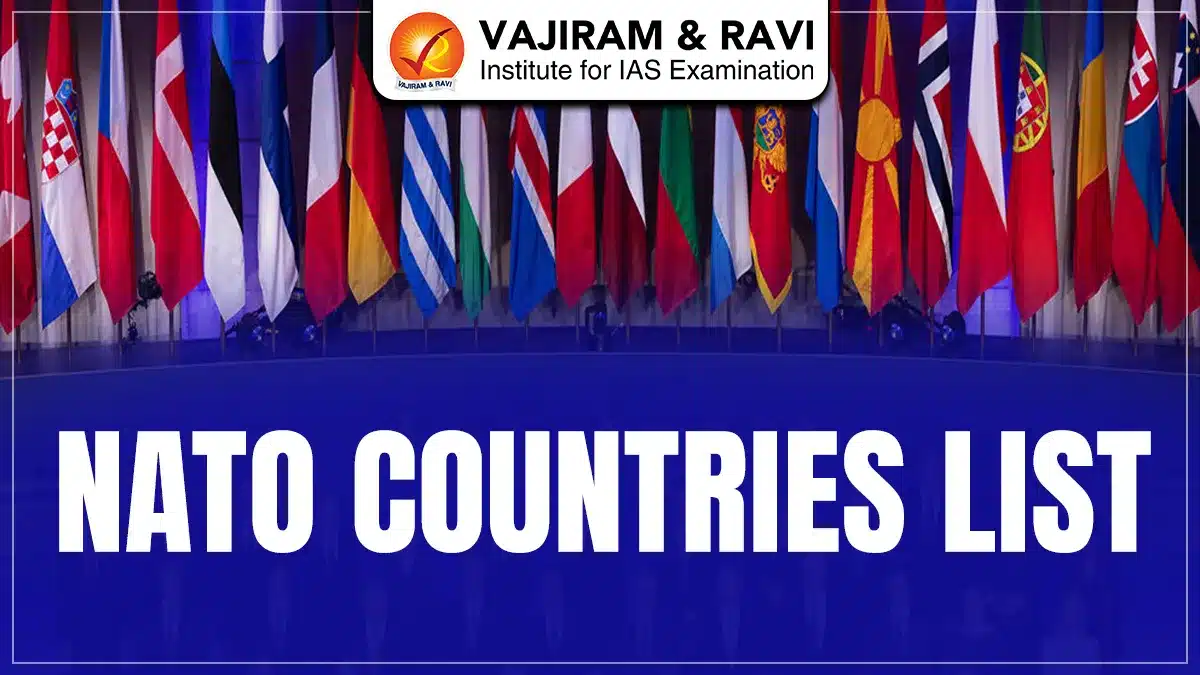
  • Membership: NATO has 32 members in 2026. The alliance displays 32 national flags at its headquarters in Brussels.
  • Decision Making: NATO decisions are based on consensus. The North Atlantic Council is the alliance’s principal political decision making body.
  • Membership Rule: Article 10 allows membership for European states able to advance treaty principles and contribute to North Atlantic security.

NATO Historical Evolution

NATO’s historical evolution reflects major changes in European security, Cold War politics and the post Cold War international order from 1949 to the present.

  • Origin: NATO was established on 4 April 1949 through the North Atlantic Treaty in Washington, D.C., creating a collective security framework for Europe and North America.
  • Cold War Security: During the Cold War, NATO became the principal Western military alliance opposing the Soviet led security bloc. The alliance focused on deterrence, collective defence and maintaining transatlantic security.
  • 1966 French Withdrawal: France withdrew from NATO’s integrated military command structure while remaining politically involved in the organisation. However, rejoined in 2009.
  • 1989-1991 Transformation: The fall of the Berlin Wall in 1989 and dissolution of the Soviet Union in 1991 ended the Cold War and forced NATO to reconsider its strategic role and future priorities.
  • Post Cold War Operations: NATO expanded its security role beyond traditional collective defence by undertaking major crisis management and peace support operations, including in the Balkans and Afghanistan.
  • 2014-2022 Security Shift: Russia’s annexation of Crimea in 2014 and full scale invasion of Ukraine in 2022 significantly changed NATO’s security priorities, strengthening its eastern flank deterrence and defence posture.

Which Countries Recently Joined NATO 2026?

In recent years, two Countries Joined NATO including Finland in 2023 and Sweden in 2024 as highlighted below:

1. Finland Joined NATO in 2023

Finland Joined NATO as 31st member marks a significant shift in the security landscape of northeastern Europe. With an 832-mile border with Russia, Finland’s membership not only strengthens its own security but also extends NATO’s direct frontier with Russia, altering regional dynamics.

This expansion challenges Russia’s influence, potentially escalating tensions between Moscow and the West. Finland’s inclusion supports NATO’s strategic presence in the Baltic Sea region, reshaping the balance of power. Beyond Europe, it also impacts Arctic geopolitics, as Finland's military capabilities strengthen Western influence in the Nordic region. Given India’s observer role in the Arctic Council, this development could have implications for global governance in the polar north.

2. Sweden Joined NATO in 2024

Sweden officially joined NATO on March 7, 2024, becoming the 32nd member of the alliance. This marked a historic shift in Sweden’s long-standing policy of military neutrality, which it had maintained for over 200 years. The decision to join NATO was largely influenced by the changing security landscape in Europe following Russia’s invasion of Ukraine in 2022. Sweden’s membership aims to strengthen regional security in Northern Europe and enhance cooperation with other NATO countries, especially neighboring Finland, which joined the alliance in 2023.

Is India Part of NATO?

No, India is not a NATO Member; it maintains a close partnership with the alliance. India has contributed to NATO-led missions, including the International Security Assistance Force (ISAF) in Afghanistan. In recent years, there have been growing assumptions about India potentially joining NATO, but the Indian government has not expressed any intent to seek membership but remains open to strengthening cooperation.

In 2021, India and NATO signed a “Framework for Enhanced Cooperation”, which was a collaboration on various security issues. While the future of India’s NATO relationship remains uncertain, both sides are expected to continue working together on global security challenges.

Also Read
World Health Organization United Nations
World Bank ASEAN


NATO Countries List 2026 FAQs

Q1: How many countries are in the NATO Treaty?

Ans: 32 countries are in the NATO Treaty.

Q2: What is the full meaning of NATO?

Ans: North Atlantic Treaty Organization is the full form of NATO.

Q3: What countries are in NATO in 2024?

Ans: Sweden joined NATO in 2024.

Q4: Is India a member of NATO?

Ans: India is not a member of NATO.

Q5: How many countries are in BRICS?

Ans: BRICS is an intergovernmental organization consisting of ten countries.

India’s 10 Million Medical Tourism Target, Five Point Action Plan

India’s 10 Million Medical Tourism Target

India is positioning medical value tourism as a major healthcare and economic opportunity. The Union Minister of Commerce and Industry of India, Piyush Goyal announced the annual India’s 10 Million Medical Tourism Target while outlining measures to strengthen India’s global healthcare ecosystem. He highlighted India’s clinical capabilities, advanced technology and healthcare costs that are 60-80% lower than developed countries.

India’s 10 Million Medical Tourism Target Latest News

On September 7th 2026, Union Commerce and Industry Minister Piyush Goyal said India should target 10 million international medical value tourists annually. He made the statement during the inaugural ceremony of Sanjeevani 2026 at Bharat Health Global Expo 2026 in New Delhi. India has already served 3.5 million international patients over seven years, creating a base for further expansion.

India’s 10 Million Medical Tourism Target

India’s 10 Million Medical Tourism Target focuses on quality, affordability, patient trust, skilled manpower and wider international access to Indian healthcare services. The key highlighted points of the target announced include:

  • Indian healthcare costs are estimated to be 60-80% lower than in developed countries, strengthening India’s competitiveness as a medical tourism destination.
  • Foreign patients should receive treatment only at National Accreditation Board for Hospitals & Healthcare Providers (NABH) accredited, verified and panelled hospitals.
  • India needs trained and certified caregivers who can provide services according to international standards and improve the overall patient experience.
  • Pharmaceuticals, medtech, diagnostics, hospitals, doctors, nurses, technicians, caregivers, Ayurveda, Yoga and Unani together strengthen India’s medical value tourism capacity.

Five Points Action Plan for India’s 10 Million Medical Tourism Target

Piyush Goyal proposed a Five Point Action Plan for Medical Value Tourism covering workforce development, hospital participation, patient services, global promotion and state level expansion.

  1. Train Caregivers: India should train and certify caregivers to build a skilled workforce capable of delivering healthcare services that meet international expectations and standards.
  2. Expand Heal in India Initiative: More hospitals should join the Heal in India gateway and provide transparent treatment packages while maintaining ethical practices and protecting India’s credibility.
  3. Seamless Patient Journey: Insurers and health tech companies should support cashless payments, timely reimbursements, teleconsultation and telemedicine before and during international patients’ treatment journeys.
  4. Global Promotion: India should conduct international exhibitions, establish healthcare facilitators and create hospital tie ups while directing foreign patients towards NABH accredited and verified facilities.
  5. State Level Expansion: States should improve hospitals and wellness centres, build networks and promote quality facilities globally while extending medical value tourism beyond metropolitan cities.

Need for India’s 10 Million Medical Tourism Target

India faces an opportunity created by rising healthcare costs, ageing populations, long waiting periods and shortages of specialised healthcare services in several countries.

  • Global Healthcare Demand: Ageing populations and growing healthcare needs are increasing international demand for quality treatment, tertiary care, pharmaceuticals and trained healthcare professionals.
  • Economic Growth: Medical value tourism can create employment and business opportunities across hospitals, pharmaceutical manufacturing, medical equipment, diagnostics, healthcare services and related infrastructure.
  • International Goodwill: Ethical and patient centred healthcare can strengthen India’s international reputation while reflecting the principle of "Atithi Devo Bhava".
  • Healthcare Infrastructure: Expanding medical value tourism to Tier 2 and Tier 3 cities can improve healthcare facilities, generate local employment and widen access to quality services.
  • Patient Trust: International patients need clarity, dignity, compassion and integrity because travelling abroad for treatment involves financial, medical and emotional uncertainty.

India’s 10 Million Medical Tourism Target Significance

India’s 10 Million Medical Tourism Target can combine healthcare, employment, manufacturing and international cooperation while ensuring that domestic patients receive the same quality of treatment.

  • Employment Creation: Expansion can generate jobs for doctors, nurses, technicians, caregivers, teachers and professionals across pharmaceutical, medical equipment and hospital sectors.
  • Global Healthcare Gateway: India can strengthen its position as a gateway for international health and wellness services by combining clinical excellence, technology, affordability and traditional healthcare systems.
  • Equal Healthcare: Medical tourism expansion should not create separate quality standards for foreign patients. India must ensure comparable healthcare quality for Indians and international visitors.
  • COVID 19 Experience: During COVID 19, India supplied medicines and equipment to over 100 countries and provided essential supplies to several countries free of charge or at cost.
  • Quality and Integrity: The success of India’s 10 Million Medical Tourism Target depends on transparent pricing, professional certification, ethical treatment, zero tolerance for corruption and patient centric healthcare.

India’s 10 Million Medical Tourism Target FAQs

Q1: What is India’s 10 Million Medical Tourism Target?

Ans: India aims to serve over 10 million international medical value tourists annually, up from 3.5 million patients served over the past seven years.

Q2: Who announced India’s 10 Million Medical Tourism Target?

Ans: Union Commerce and Industry Minister Piyush Goyal announced the target at Sanjeevani 2026 in New Delhi on 7 September 2026.

Q3: Why is India targeting 10 million medical tourists annually?

Ans: The target aims to expand healthcare exports, create employment, strengthen international goodwill and use India’s affordable, high quality medical ecosystem.

Q4: What is the cost of Healthcare in India?

Ans: According to Piyush Goyal, healthcare costs in India are 60-80% lower than in developed countries, supporting India’s competitiveness in medical value tourism.

Q5: What is the Five Point Action Plan for Medical Value Tourism?

Ans: It focuses on trained caregivers, wider Heal in India participation, seamless patient journeys, global healthcare promotion and quality focused expansion across states.

RVV BD Missile

RVV BD Missile

RVV BD Missile Latest News

To significantly enhance the beyond-visual-range (BVR) combat capabilities of the IAF, the Ministry of Defence is evaluating a critical proposal to equip the Su-30MKI fighter fleet with Russian-made RVV-BD long-range air-to-air missiles.

About RVV BD Missile

  • The RVV-BD (Raketa Vozduh-Vozduh Bolshoy Dalnosti) is a Russian-developed beyond-visual-range air-to-air missile. 
  • The RVV BD is the export version of the R-37M missile, one of the world’s longest-range air-to-air missiles.  
  • It is specifically designed to engage strategic targets such as Airborne Early Warning and Control (AEW&C) aircraft, airborne command platforms, and other critical aerial assets.  

RVV BD Missile Features

  • It is known that the missile has a maximum firing range in the forward hemisphere of up to 200 kilometres.  
  • The missile travels at hypersonic speeds of around Mach 6.  
  • It carries a 60 kg high-explosive fragmentation warhead and uses a radioactive proximity fuse plus contact sensor for assured detonation.  
  • At ~4 meters length and ~510 kg weight, it can be mounted under the Su-30MKI without compromising agility.  
  •  It is equipped with an active-passive radar homing head, an inertial guidance system, and a radio correction link.

News: DEF

RVV BD Missile FAQs

Q1: What is the RVV-BD missile?

Ans: The RVV-BD is a Russian-developed beyond-visual-range air-to-air missile.

Q2: Which country developed the RVV-BD missile?

Ans: Russia.

Q3: What is the maximum firing range of the RVV-BD in the forward hemisphere?

Ans: Up to 200 kilometres.

Q4: At approximately what speed can the RVV-BD missile travel?

Ans: Around Mach 6, which is hypersonic speed.

MatsyaMetri

MatsyaMetri

MatsyaMetri Latest News

A man was killed after being attacked by a wild buffalo while working in a jute field on a river island near the Burachapori Wildlife Sanctuary in Assam’s Nagaon district recently.

About MatsyaMetri

  • It is a smartphone application developed by the Central Marine Fisheries Research Institute (CMFRI), headquartered in Kochi.
  • It can measure the length and width of fish without physically handling them. 
  • The application, which has been designed for fisheries scientists, researchers, and field survey teams, facilitates rapid and systematic collection of biological data to support fisheries assessment and management. 
  • The application simplified biological data collection by automatically recording measurements and generating length-frequency datasets.
  • It allows multiple individuals of the same fish species or aquatic resource to be measured under a single sampling session. 
  • Once measurements are completed, the system automatically generates length-frequency distributions using appropriate class intervals.
  • The recorded measurements and the corresponding photographs can be saved along with the sampling session and subsequently exported as a CSV file for further analysis.

News: TH

MatsyaMetri FAQ's

Q1: What is MatsyaMetri?

Ans: MatsyaMetri is a smartphone application developed for the rapid and systematic collection of biological data from fish and other aquatic resources.

Q2: Which organisation developed MatsyaMetri?

Ans: The Central Marine Fisheries Research Institute (CMFRI).

Q3: Where is the headquarters of the Central Marine Fisheries Research Institute (CMFRI) located?

Ans: Kochi, Kerala.

Q4: What is the major advantage of MatsyaMetri in measuring fish?

Ans: It can measure fish length and width without physically handling the fish.

Q5: Who are the primary users of MatsyaMetri?

Ans: Fisheries scientists, researchers, and field survey teams.

Virtual Private Network (VPN)

Virtual Private Network (VPN)

Virtual Private Network Latest News

Authorities in Jammu and Kashmir's Doda recently ordered a complete ban on the use of Virtual Private Networks (VPNs) across the district for two months, citing concerns over cybersecurity, unlawful activities and maintaining public order.

About Virtual Private Network 

  • It is a service that creates a secure, encrypted connection between a user's device and the internet. 
  • It works by creating an encrypted connection, often called a tunnel, between your device and a secure server operated by the VPN provider. 
  • By routing web traffic through the isolated digital tunnel, it hides the user's actual IP address and protects their data from unauthorized interception. 
  • This ensures privacy and data security when accessing corporate networks or utilizing public internet connections. 
  • VPNs protect data from hackers, mask IP addresses, and are commonly used for secure remote access and bypassing geographic restrictions. 
  • However, VPNs don't provide total anonymity, as ISPs can still see the size of incoming and outgoing traffic, but not the content. 

What are VPNs Used for?

  • Regular internet users and organizations use VPNs for virtual privacy. 
    • Organizations deploy VPNs to ensure authorized users can access their data center using encrypted channels. 
    • VPNs also enable users to connect to a database from the same organization located in a different area.
  • VPNs provide remote employees, gig economy freelance workers, and business travelers with access to software applications hosted on proprietary networks. 
    • To gain access to a restricted resource through a VPN, the user must be authorized to use the VPN and provide one or more authentication factors. 
    • These can be passwords, security tokens, or biometric data.
  • When an internet user surfs the web, an attacker could access information, including browsing habits or IP addresses. 
    • If privacy is a concern, a VPN can provide users with peace of mind. 
    • Most users find value in VPNs’ encryption, anonymity, and ability to get around geographically blocked content.
  • For example, getting around blocked content from another country might be extremely useful for journalists. If a country is likely to block internet content from foreign entities, journalists could use a VPN to look like they're within that country.

News: NIE

Virtual Private Network FAQs

Q1: What is a Virtual Private Network (VPN)?

Ans: A VPN is a service that creates a secure, encrypted connection between a user's device and the internet.

Q2: What does a VPN hide from websites and online services?

Ans: The user's actual IP address.

Q3: How does a VPN protect data from unauthorized interception?

Ans: By routing internet traffic through an encrypted digital tunnel.

Q4: What is the primary purpose of a VPN?

Ans: To enhance privacy and data security by encrypting internet traffic and masking the user's IP address.

Puga Valley Geothermal Energy Project, India’s First Geothermal Project

Puga Valley Geothermal Energy Project

Puga Valley Geothermal Energy Project in Ladakh is an important step towards harnessing India’s geothermal energy potential. Located at an altitude of more than 14,000 feet, Puga Valley is known for its hot springs and strong geothermal activity. The project is being developed by the ONGC Energy Centre and aims to demonstrate electricity generation using heat stored beneath the Earth’s surface.

What is Geothermal Energy?

Geothermal energy is the energy obtained from the natural heat present inside the Earth. This heat warms underground rocks and water, which can be brought to the surface and used for electricity generation, heating, agriculture and other purposes. It is a renewable and relatively low-carbon source of energy that can provide power continuously.

  • Source: Heat stored deep inside the Earth’s crust.
  • Renewable: It is considered a renewable energy source because Earth's internal heat is continuously generated.
  • Electricity generation: Hot water or steam from underground can be used to drive turbines and generate electricity.
  • Direct heating: Geothermal heat can be used directly for space heating, greenhouses and industrial processes.
  • 24×7 availability: Unlike solar and wind energy, geothermal energy can provide continuous power and is less dependent on weather.
  • Low emissions: Geothermal power generally produces lower greenhouse-gas emissions than fossil-fuel-based power.
  • Geothermal hotspots: Areas with hot springs, geysers and volcanic activity often have significant geothermal potential.
  • India's potential: India has several promising geothermal regions, including Ladakh, Himachal Pradesh, Uttarakhand and Gujarat.
  • Puga Valley: Puga Valley in Ladakh is one of India's important geothermal sites and is being developed for geothermal power generation.

How Will the Puga Valley Geothermal Energy Project Generate Electricity?

Puga Geothermal Project will use the natural heat stored beneath the Earth’s surface to generate electricity. Geothermal fluids heated by underground rocks will be brought to the surface through production wells. The heat or steam will then be used to run a turbine connected to a generator, while the cooled water can be reinjected underground to support sustainable use of the geothermal reservoir. The project is being developed as a 1 MW pilot geothermal power project.

Step-by-Step Process

  1. Drilling Geothermal Wells: Deep wells are drilled into the Earth's crust to reach the hot geothermal reservoir. At Puga, two wells have been developed to around 1,000 metres depth.
  2. Bringing Hot Fluid to the Surface: Underground water absorbs heat from hot rocks and becomes extremely hot. The production well brings this geothermal fluid towards the surface.
  3. Producing Steam or Heat: Due to the high temperature, the geothermal fluid can produce steam, which can be used to drive a turbine.
  4. Running the Turbine: The steam or geothermal heat is used to rotate a turbine. The turbine is connected to a generator.
  5. Generating Electricity: As the turbine rotates, the generator converts mechanical energy into electrical energy.
  6. Reinjecting Water: After the heat is extracted, the cooled geothermal fluid can be reinjected into the underground reservoir through an injection well. This helps maintain the geothermal system and reduce water wastage.

National Policy on Geothermal Energy

National Policy on Geothermal Energy, notified by MNRE in September 2025, provides a framework to promote the exploration, development and utilisation of geothermal energy in India and supports the country’s goal of achieving Net Zero emissions by 2070.

  • Promotes geothermal energy for electricity generation and direct-heat applications.
  • Identifies promising areas, including 42 geothermal manifestations for further development.
  • Encourages research, innovation and technology development in geothermal energy.
  • Supports international cooperation and technology transfer.
  • Promotes the possible repurposing of abandoned oil and gas wells for geothermal energy.
  • Supports clean-energy transition and Net Zero by 2070 by diversifying India’s renewable energy mix and reducing dependence on fossil fuels.

Puga Valley Geothermal Energy Project FAQs

Q1: What is the Puga Valley Geothermal Energy Project?

Ans: Puga Valley Geothermal Energy Project is a geothermal energy initiative in Ladakh that aims to use the natural heat beneath the Earth’s surface for power generation. It is being developed by the ONGC Energy Centre.

Q2: Where is Puga Valley located?

Ans: Puga Valley is located in the Changthang region of Ladakh, at an altitude of more than 14,000 feet above sea level. It is known for its hot springs and underground geothermal heat resources.

Q3: Why is Puga Valley suitable for geothermal energy?

Ans: Puga Valley has naturally occurring hot springs and significant underground heat, indicating the presence of geothermal resources that can potentially be used for electricity generation and other applications.

Q4: Who is developing the Puga Geothermal Project?

Ans: The project is being developed by the ONGC Energy Centre (OEC). The Centre commissioned India's first two geothermal wells at Puga Valley in July 2026.

Q5: What is the proposed capacity of the Puga geothermal project?

Ans: The project is planned as India's first 1 MW demonstration geothermal power project. The initial wells will also help in evaluating the geothermal reservoir and understanding its power-generation potential.

Shekhawati Havelis

Shekhawati Havelis

Shekhawati Havelis Latest News

The state government announced recently that the historic and richly frescoed havelis of Rajasthan’s Shekhawati region have been included in UNESCO’s tentative list.

What are Havelis?

  • Havelis are old mansions or large townhouses constructed around an open courtyard. 
  • The name comes from the Arabic hawali, a "private space," since they were originally enclosed family dwellings. 
  • This type of building is found throughout India, but particularly in northwestern India (Rajasthan, Punjab, and Gujarat), where large climatic variations pose challenges in terms of living comfort. 
  • These multi-story houses—frequently constructed by royalty or merchants—have central courtyards (generally with fountains) that bring in light and ventilation in the hot climate of India.
  • Contrary to Western mansions, havelis focus on inwardly facing design with intricately ornamented balconies (jharokhas), latticework screens, and frescoed walls. 
  • Originally busy family residences, numerous havelis now are "living museums" of India's history, restored as heritage hotels or cultural centers.

About Shekhawati Havelis

  • Located in the northeastern Rajasthan, the Shekhawati region is often associated with its magnificent havelis covered in intricate wall paintings. 
  • Towns and villages across the region feature historic mansions whose façades, courtyards and interiors showcase detailed frescoes.
  • These paintings depict a fascinating mix of themes, ranging from Hindu mythology and royal and local traditions to scenes influenced by everyday life and changing times. 
  • Some artworks also reflect the arrival of modern technology and foreign influences, creating a distinctive visual record of the region’s history.
  • The havelis themselves are equally notable for their architectural details, including ornate gateways, balconies, courtyards, carved elements, and decorative façades.
  • Together, the buildings and paintings create a unique urban landscape that sets Shekhawati apart from other heritage regions of Rajasthan.

News: TP

Shekhawati Havelis FAQs

Q1: Where is the Shekhawati region located?

Ans: Northeastern Rajasthan.

Q2: What type of paintings are prominently found on the havelis of Shekhawati?

Ans: Detailed fresco paintings.

Q3: What themes are commonly depicted in the frescoes of Shekhawati havelis?

Ans: Hindu mythology, royal and local traditions, everyday life, and changing times.

Q4: What architectural features are characteristic of Shekhawati havelis?

Ans: Ornate gateways, balconies, courtyards, carved elements, and decorative façades.

Daily Editorial Analysis 8 September 2026

Daily-Editorial-Analysis

India's Opportunity to Put BRICS Back Together

Context

  • The 18th BRICS Summit will be held in New Delhi on September 12–13, 2026. India is the chair this year.
  • In this context, former BRICS Sherpa T.S. Tirumurti argues that BRICS has drifted far from its original purpose.
  • The Delhi summit gives India a chance to bring coherence back to the expanded grouping and restore its reform-oriented agenda.

BRICS Was Built for Reform, Not Rivalry

  • BRICS was formed to give Brazil, Russia, India, China and South Africa a greater voice in global governance, especially in financial and economic institutions.
  • Its aim was a more equitable multilateral order. India was an enthusiastic early participant and saw the group as a vehicle for real reform.
  • India hosted its first BRICS Summit in 2012 (the fourth overall) under the theme "Global Stability, Security and Prosperity."
  • The Indian presidency helped lead to the creation of the New Development Bank (BRICS Bank). India also pushed for integrating a counter-terrorism architecture into BRICS' work.

China Changed the Direction of BRICS

  • China saw BRICS differently. It treated the group as a counterpoise to Western dominance and as a platform to amplify its own global ambitions.
  • In 2010, BRICS countries accounted for nearly 20 per cent of world GDP, which made the group useful for China.
  • Through BRICS-Plus and BRICS Outreach, China sought to reach the Global South and position itself as the second pole in a future bipolar world.
  • India soon found itself doing two jobs at once: pursuing reform and acting as a counterweight to China.
  • India, Brazil and South Africa also realised that Chinese support for reform was selective.
    • China did not back their bid for permanent seats on the UN Security Council.
  • India therefore shifted its focus to BRICS consolidation and intra-BRICS cooperation.
  • This year's theme for India's chairship rests on four pillars — Resilience, Innovation, Cooperation and Sustainability. It draws on PM Modi's vision of "Humanity First" and a "people-centric" approach.

The Consensus Principle Is Under Strain

  • Consensus kept BRICS cohesive. There was a real danger that BRICS would go the way of the Shanghai Cooperation Organisation, where the majority can push its views through.
  • India and Brazil resisted this. The 2019 Brasilia Summit was held with only the five original members and no invited guests.
  • In 2020, under the Russian presidency, the first non-consensus chair's statement was issued on COVID-19.
  • The same happened at the BRICS Foreign Ministers' meeting in New Delhi in May 2026 because the new members could not agree. Experts warn that if non-consensus documents become routine, BRICS will cease to be effective.

Expansion Has Tested Cohesion

  • China pushed for expanding the New Development Bank and then BRICS itself. India and Brazil resisted but could not prevent it.
  • BRICS now has 11 members after the addition of Egypt, Ethiopia, Iran, Saudi Arabia, the UAE and Indonesia, along with 10 partner countries.
  • India's caution has been vindicated. The new members have begun fighting among themselves and are subverting BRICS through bilateral conflicts.
  • The original five have serious differences too, but they know how to manage them for the greater good of the group.
  • In this context, analysts cautions that BRICS must not become another SAARC, where bilateral disputes paralysed the organisation.

The Struggle Between "Non-West" and "Anti-West"

  • India wants BRICS to remain a "non-West" group. Some members are pushing to make it "anti-West."
  • This pressure is growing because of several developments: China's competition with the US for global leadership, Russia's war in Ukraine, and Iran being bombarded by the US and Israel.
  • India's own position has become harder. Brazil and India face punitive tariffs from US President Donald Trump. The US Congress is considering legislation to penalise countries importing Russian oil.
  • The Quad is being weakened by the US, India-US relations are under pressure, and Pakistan is being courted by the US at India's expense. The more erratic the US is towards BRICS, the greater the risk of BRICS moving in the wrong direction.
  • Fortunately, many other BRICS members share India's view. They want change in the global order, but not geopolitical realignment with China and Russia. They benefit from engaging with multiple actors across camps.

The Larger Danger of Parallel Global Structures

  • Both the US and China are building parallel visions of the world and playing by their own rules rather than negotiated international norms.
  • Neither is interested in reforming existing institutions. They are creating parallel structures in emerging areas such as Artificial Intelligence, digital and internet governance, data ownership, 5G/6G and telecom, satellite navigation, and electric vehicles.
  • China has set up a new World AI Cooperation Organisation in Shanghai. This adds to earlier initiatives like the Asian Infrastructure Investment Bank, the Belt and Road Initiative and the Digital Silk Road, all of which challenge the Bretton Woods institutions.
  • China sees BRICS as one vehicle for these goals. Its push for de-dollarisation through a common BRICS currency has received a lukewarm response. Members are uncomfortable with a renminbi-dominated currency.
  • They prefer linking payment systems, central bank digital currencies and national-currency transactions. Still, China is formally launching mBridge, an alternative payment system. India does not want an alternative Bretton Woods system dominated by China.

Reviving Reformed Multilateralism

  • The Delhi Summit is an opportunity for course correction. India has worked hard to persuade new members to set aside political differences.
  • PM Modi first articulated the idea of "reformed multilateralism" at the 2018 BRICS Summit in South Africa. By 2019, India, Brazil and South Africa had placed it in the Brasilia Summit document.

BRICS as the Voice of Global South Middle Powers

  • At Davos, the Canadian Prime Minister spoke of West-centric middle powers coming together. Global South middle powers are different, and BRICS is the only credible organisation of such powers.
  • It has weaknesses: China is hardly a middle power and holds disproportionate influence, and some deserving middle powers are absent.
  • India and China need to find greater synergy on emerging global issues even as their bilateral differences are contained. Despite these limitations, BRICS has great geopolitical and geo-economic potential.

Conclusion

  • BRICS has drifted from reform towards rivalry, and expansion has weakened its cohesion.
  • As chair of the Delhi Summit, India must revive the grouping's original purpose of reformed multilateralism, protect the consensus principle, and keep BRICS "non-West" rather than anti-West.
  • This serves India's core interest of multi-alignment. If India does not lead, others will.

India's Opportunity to Put BRICS Back Together FAQs

Q1. Why was BRICS originally created?

Ans: BRICS was created to give emerging economies greater influence in global governance, particularly financial institutions, while promoting a more equitable multilateral order.

Q2. How has China's approach influenced BRICS?

Ans: China increasingly viewed BRICS as a counterweight to Western dominance, using expansion and outreach to amplify its global ambitions and Global South influence.

Q3. Why is the consensus principle important for BRICS?

Ans: Consensus has helped BRICS manage differences among members; routine non-consensus decisions could weaken cohesion and reduce the grouping's effectiveness.

Q4. Why does India oppose making BRICS an anti-West grouping?

Ans: India prefers BRICS to remain a non-West platform because it supports reforming global institutions without forcing geopolitical alignment against Western countries.

Q5. What opportunity does India's BRICS chairship provide?

Ans: India's chairship provides an opportunity to revive reformed multilateralism, strengthen consensus, manage expansion-related divisions and reinforce BRICS as a Global South platform.

Source: TH

Daily Editorial Analysis 2026 FAQs

Q1: What is editorial analysis?

Ans: Editorial analysis is the critical examination and interpretation of newspaper editorials to extract key insights, arguments, and perspectives relevant to UPSC preparation.

Q2: What is an editorial analyst?

Ans: An editorial analyst is someone who studies and breaks down editorials to highlight their relevance, structure, and usefulness for competitive exams like the UPSC.

Q3: What is an editorial for UPSC?

Ans: For UPSC, an editorial refers to opinion-based articles in reputed newspapers that provide analysis on current affairs, governance, policy, and socio-economic issues.

Q4: What are the sources of UPSC Editorial Analysis?

Ans: Key sources include editorials from The Hindu and Indian Express.

Q5: Can Editorial Analysis help in Mains Answer Writing?

Ans: Yes, editorial analysis enhances content quality, analytical depth, and structure in Mains answer writing.

Barakuru

Barakuru

Barakuru Latest News

A historically significant Siditale hero stone has been recently discovered at Barakuru during an epigraphical survey of the Panchalingeshwara Temple.

About Barakuru

  • Barakuru, also known as Barkur, is an ancient historical port town located in Udupi district, Karnataka. 
  • It is situated on the banks of the river Sita. The town is about 5 km east of the Arabian Sea Coast.    
  • The place was called by several names in ancient times as Varakula, Barakanur, and Barahkanyapura.
  • History:
    • The port town was a busy commercial centre almost from the 2nd century B.C. 
    • Evidence of Megalithic and Mesolithic ages has been discovered recently.
    • The maritime port enjoyed massive economic prosperity, trading extensively with foreign nations across the wide Arabian Sea. 
    • The Alupa rulers converted this commercial centre into a political centre by making it their capital during the 10th-11th centuries A.D. 
    • It led to further development of socio-economic activities. With new vigour the city became the heart and hearth of the Tuluva culture.
    • In later times, the city became the provincial headquarters of the Hoysalas and then the Vijayanagara Empire. The city was expanded with a new fort during this period. 
    • Further, Barakur witnessed the rule of Keladi Nayaks, Haider, and Tipu of Mysore and the British.
  • The city had ten extensions called Keris–each being named after its professional residents. Each Keri had a tank and a number of temples. 
  • The town's main attractions are the temples with typical tiled roofs. 
    • It once housed an incredible network of exactly 365 temples. The deeply pious Alupa kings strictly visited one unique temple each day of the entire calendar year. 
    • The Panchalingeshwara Temple situated at the southern end of the town is the most famous among the temples here. 
  • Barkur was also a Jain settlement in the ancient days. 
  • The place abounds with history and has yielded a little over 100 stone and several copper plate inscriptions. 
    • They belong to the Alupa, the Hoysala, the Vijayanagara, and the Keladi periods. 

News: IS

Barakuru FAQs

Q1: Where is Barakuru, also known as Barkur, located?

Ans: Udupi district, Karnataka.

Q2: What type of historical settlement is Barakuru?

Ans: An ancient historical port town.

Q3: On the banks of which river is Barakuru situated?

Ans: River Sita.

Q4: By what other names was Barakuru known in ancient times?

Ans: Varakula, Barakanur, and Barahkanyapura.

Q5: Which dynasty made Barakuru its capital during the 10th–11th centuries A.D.?

Ans: The Alupa dynasty.

Mindoro bleeding-heart Pigeon

Mindoro bleeding-heart Pigeon

Mindoro bleeding-heart Pigeon Latest News

Recently, Mindoro bleeding-heart pigeon reappeared after 20 years which confirmed that it is still surviving in the wild. 

About Mindoro bleeding-heart Pigeon

  • It is a ground-dwelling pigeon endemic to Mindoro, Philippines.
  • It is one of seven species of bleeding-hearts, or “bleeding-heart” doves, five of which are endemic to the Philippines.
  • Appearance: It measures about 30 cm in length and has orange-red spot on white chest, together with the iridescent green plumage on its head and neck.
  • Habitat: It has generally been described as a lowland forest specialist, typically occurring at elevations of around 400 meters (1,300 feet), and occasionally up to 800 m (2,600 ft).
  • Behaviour: It is ground-dwelling and usually takes flight only when threatened.
  • Males and females look almost identical.
  • Conservation Status: IUCN Red List:  Critically Endangered (CR)
  • Threats: It is threatened by hunting and habitat loss.
    • Its habitat is affected by slash-and-burn agriculture, agricultural use, rattan harvesting, and marble quarrying.

Source: TOI

Mindoro bleeding-heart Pigeon FAQs

Q1: What is Mindoro bleeding-heart Pigeon ?

Ans: It is a ground-dwelling pigeon endemic to Mindoro, Philippines.

Q2: What is the IUCN status of Mindoro bleeding-heart Pigeon?

Ans: Critically endangered

Western Zonal Council Meeting 2026, Amit Shah Chairs Key Meet in Panaji

Western Zonal Council Meeting 2026

Recently, the 28th Western Zonal Council Meeting was held in Panaji, Goa. The meeting brought together representatives of the Centre, member States and the Union Territory to discuss issues affecting the western region and strengthen institutional mechanisms for inter-state cooperation.

About Western Zonal Council Meeting 2026

Recently, the 28th Western Zonal Council Meeting was held on 7 September 2026 in Panaji, Goa. The meeting deliberated on inter-state coordination, cooperative governance and sharing of best practices among the participating States and Union Territory.

  • Chairman: Union Home Minister Amit Shah.
  • Vice-Chairman: Chief Minister of Goa, with the position rotating annually among the Chief Ministers of member States.
  • Members: Goa, Gujarat, Maharashtra and the Union Territory of Dadra and Nagar Haveli and Daman and Diu.
  • Participants: Chief Ministers of Goa, Maharashtra and Gujarat, the Administrator of Dadra and Nagar Haveli and Daman and Diu, and senior officials from the Union and State Governments.
  • Organised by: Inter-State Council Secretariat, Ministry of Home Affairs, Government of India.
  • Hosted by: Government of Goa.
  • Standing Committee: A committee at the level of Chief Secretaries examines issues proposed by the States before unresolved matters are placed before the Zonal Council.
  • Nature: The Zonal Council is advisory and provides a platform for mutual understanding and cooperation on issues involving two or more States or the Centre and States.

Western Zonal Council Meeting 2026 Key Highlights

The Western Zonal Council Meeting 2026 focused on strengthening inter-State coordination, cooperative governance and sharing of best practices, while addressing key issues related to security, justice, welfare, cooperatives, financial inclusion and infrastructure.

  • WEST Engine: The western region was highlighted as the “WEST Engine” of India’s growth, covering wealth and finance, exports and ports, start-ups and semiconductors, and tourism and blue economy.
  • Coastal security: The meeting emphasised strengthening coastal security in the western region, with further measures planned over the next two years.
  • Narcotics control: The participating States were urged to strengthen the national fight against narcotics through coordinated action.
  • New criminal laws: Western States were encouraged to take the lead in implementing the three new criminal laws and strengthen coordination among police, prosecution and justice-delivery institutions.
  • Fast-track justice: The implementation of Fast Track Special Courts (FTSCs) was reviewed to ensure speedy investigation and disposal of cases involving rape and offences against women and children.
  • Emergency response: The meeting also reviewed the Emergency Response Support System (ERSS-112) to strengthen emergency response mechanisms.
  • Cybercrime and digital fraud: Greater coordination was emphasised to combat cybercrime and digital financial fraud, including integration of cooperative banks with CFCFRMS and I4C, along with the use of MuleHunter AI to identify mule accounts.
  • PACS computerisation: The meeting stressed strengthening Primary Agricultural Credit Societies (PACS) through computerisation, with Maharashtra and Gujarat reporting computerisation levels of around 98% and 92%, respectively.
  • Gobardhan model: States were encouraged to adopt the Gobardhan model of Banas Dairy, Gujarat, to promote waste-to-wealth activities and strengthen the rural cooperative economy.
  • Financial inclusion: The need to ensure brick-and-mortar banking facilities within the prescribed radius of every village was highlighted.
  • Health and nutrition: Discussions covered Ayushman Bharat–PMJAY, Poshan Abhiyaan, child malnutrition and food safety standards, along with measures to strengthen healthcare delivery.
  • Public hospitals: Greater participation of public hospitals in Ayushman Bharat–PMJAY was emphasised to expand access to healthcare services.
  • Education: The meeting called for stronger measures to reduce school dropout rates.
  • Infrastructure and urban development: The meeting discussed railway development, environmental clearances, urban master planning and electricity supply as areas requiring effective coordination.
  • Green energy: The western States were encouraged to leverage their leading position in green energy and contribute to India's clean-energy transition.
  • Data centres: States were encouraged to make greater use of opportunities arising from data-centre policies and investments.

About Zonal Councils

Zonal Councils are statutory and advisory bodies established under Part III of the States Reorganisation Act, 1956. The idea of Zonal Councils was proposed by Jawaharlal Nehru in 1956 during discussions on the reorganisation of States.

  • Objective: They were created to promote cooperation among States, strengthen Centre-State relations, reduce regional and linguistic tensions, and facilitate balanced socio-economic development.

Composition of Zonal Councils

The composition of Zonal Councils is provided under the States Reorganisation Act, 1956.

  • Chairman: Union Home Minister.
  • Vice-Chairman: Chief Minister of a member State, with the position rotating annually among the member States.
  • State representation: Chief Ministers and two senior Ministers from each member State form part of the Council.
  • Union Territory representation: Representatives of member Union Territories participate in the Council.
  • Other Participants: Senior officials such as Chief Secretaries and other advisers participate in meetings to assist the Council in examining various issues.
  • Standing Committee: Each Zonal Council has a Standing Committee comprising Chief Secretaries of the member States, which examines issues and facilitates their consideration before the Council.
  • Secretariat: The Inter-State Council Secretariat under the Ministry of Home Affairs provides administrative and institutional support for the functioning of Zonal Councils.

Five Zonal Councils in India

India has five Zonal Councils, established under the States Reorganisation Act, 1956.

  • Northern Zonal Council: Covers States and Union Territories of the northern region.
  • Central Zonal Council: Uttar Pradesh, Uttarakhand, Madhya Pradesh and Chhattisgarh.
  • Eastern Zonal Council: Bihar, Jharkhand, Odisha and West Bengal.
  • Western Zonal Council: Goa, Gujarat, Maharashtra and Dadra and Nagar Haveli and Daman and Diu.
  • Southern Zonal Council: Andhra Pradesh, Karnataka, Kerala, Tamil Nadu and Telangana, along with Puducherry, Andaman and Nicobar Islands and Lakshadweep.

The North Eastern Council, established under the North Eastern Council Act, 1971, is a separate statutory body and should not be confused with the five Zonal Councils.

Zonal Councils and the Inter-State Council

Both Zonal Councils and the Inter-State Council are important institutional mechanisms for promoting cooperative federalism, but they differ in their constitutional basis, composition and scope of functioning.

Basis

Zonal Councils

Inter-State Council

Nature

Statutory body

Constitutional body

Legal Basis

States Reorganisation Act, 1956

Article 263 of the Constitution

Establishment

Created in 1956

Established in 1990 by Presidential Order

Scope

Regional and inter-State issues within specific zones

Wider Centre-State and inter-State issues

Chairman

Union Home Minister

Prime Minister

Main Purpose

Promote cooperation among States within a region

Promote coordination and cooperation between the Union and States

Nature of Recommendations

Advisory and non-binding

Advisory and non-binding

Number

Five Zonal Councils

One Inter-State Council

Secretariat

Inter-State Council Secretariat, Ministry of Home Affairs

Inter-State Council Secretariat, Ministry of Home Affairs

Focus

Regional cooperation, common issues and inter-State disputes

Broader issues concerning Centre-State and inter-State relations

Zonal Councils Significance 

Zonal Councils provide an institutional mechanism for translating the principle of cooperative federalism into regular inter-governmental dialogue.

  • Strengthen Centre-State relations: They provide a structured platform for the Centre and States to discuss issues requiring joint action.
  • Facilitate inter-state cooperation: Neighbouring States can coordinate on issues such as transport, infrastructure, water resources and public services.
  • Support dispute resolution: Dialogue through Zonal Councils can help address inter-state disputes before they escalate into prolonged conflicts.
  • Improve welfare delivery: Joint monitoring helps States identify implementation gaps in welfare schemes and social-sector programmes.
  • Promote best practices: Successful State-level initiatives can be shared and adapted by other States facing similar challenges.
  • Strengthen internal security: Issues such as cybercrime, narcotics, coastal security and emergency response increasingly require coordinated action across State boundaries.
  • Promote balanced development: Regional discussions on infrastructure, economic development and social planning can help address common developmental constraints.
  • Strengthen national integration: Regular interaction among governments can reduce regional tensions and foster mutual understanding.

Zonal Councils Challenges

The effectiveness of Zonal Councils remains dependent on sustained political cooperation and effective implementation of their recommendations.

  • Advisory nature: Since their recommendations are not legally binding, implementation ultimately depends on the willingness of the concerned governments.
  • Political differences: Differences between the Centre and States or among States can make consensus difficult on politically sensitive issues.
  • Implementation gap: Resolution of an issue at the Council level does not automatically ensure timely implementation on the ground.
  • Follow-up limitations: Delays in monitoring unresolved issues can reduce the effectiveness of the mechanism.
  • Institutional overlap: The existence of multiple forums dealing with Centre-State and inter-state issues can sometimes lead to duplication and fragmented coordination.

Western Zonal Council Meeting 2026 FAQs

Q1: Where was the Western Zonal Council Meeting 2026 held?

Ans: The 28th Western Zonal Council Meeting was held in Panaji, Goa, on 7 September 2026.

Q2: Which States and Union Territory are part of the Western Zonal Council?

Ans: The Western Zonal Council comprises Goa, Gujarat, Maharashtra and Dadra and Nagar Haveli and Daman and Diu.

Q3: Under which law were Zonal Councils established?

Ans: Zonal Councils were established under Part III of the States Reorganisation Act, 1956.

Q4: Who is the Chairman of the Western Zonal Council?

Ans: The Union Home Minister is the Chairman of the Western Zonal Council.

Q5: Are Zonal Councils constitutional or statutory bodies?

Ans: Zonal Councils are statutory and advisory bodies, unlike the Inter-State Council, which is a constitutional body under Article 263.

₹1.10 Lakh Crore Defence Procurement, List of Systems Approved

₹1.10 Lakh Crore Defence Procurement

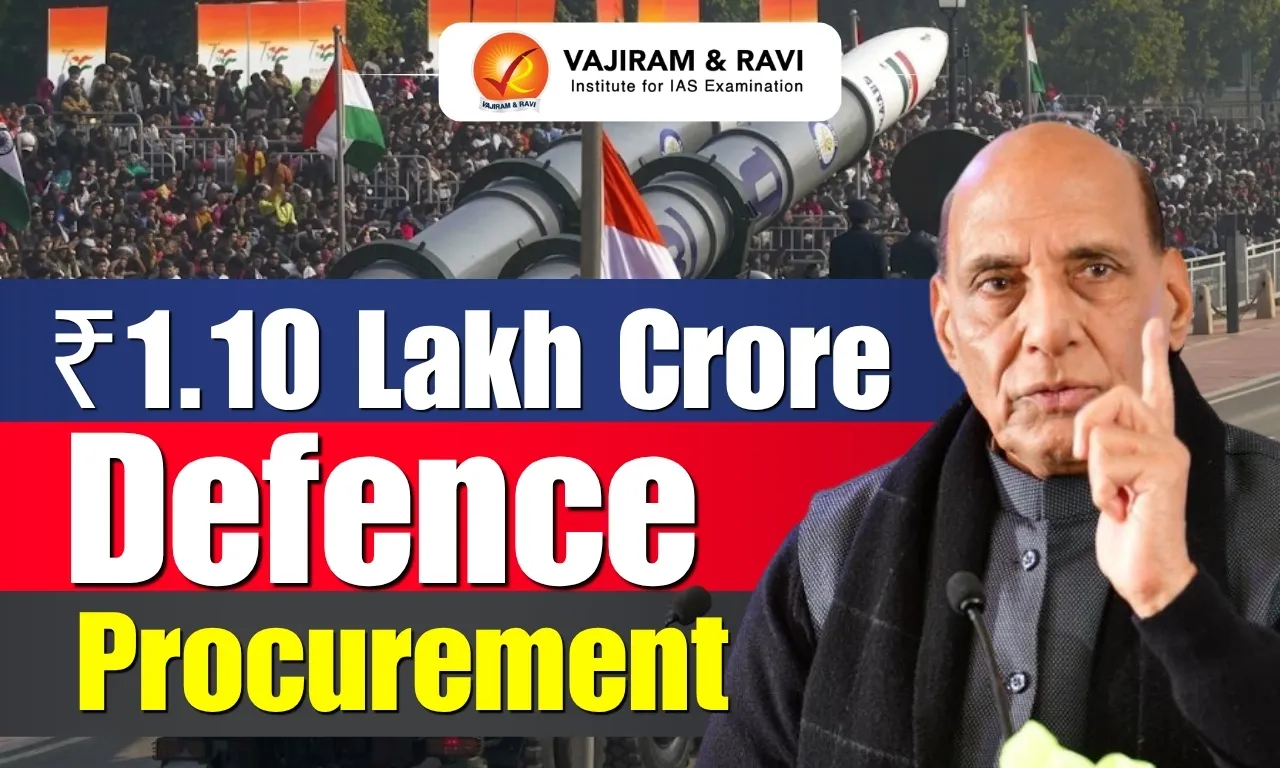
₹1.10 Lakh Crore Defence Procurement: The Defence Acquisition Council (DAC), chaired by Defence Minister Rajnath Singh, approved capital acquisition proposals worth approximately ₹1.10 lakh crore on 7 September 2026. The decision covers the Indian Army, Indian Navy and Indian Air Force. Around 98% of these procurements will come from Indian industry. The approvals focus on defence modernisation, operational readiness, indigenous manufacturing and reduced dependence on foreign suppliers.

What is ₹1.10 Lakh Crore Defence Procurement?

The ₹1.10 Lakh Crore Defence Procurement package received Acceptance of Necessity (AoN), marking in principle administrative approval for major military acquisitions.

  • Domestic procurement: Around 98% of the approved procurement value is earmarked for Indian industry, supporting indigenous defence manufacturing and technological self reliance.
  • AoN significance: Acceptance of Necessity is an important stage in capital acquisition. It confirms the requirement before subsequent tendering, evaluation, negotiations and contract execution.
  • Three services: The proposals cover equipment and systems for the Army, Navy and Air Force, strengthening capabilities across land, maritime and aerial operations.

Defence Systems Approved in ₹1.10 Lakh Crore Procurement

The ₹1.10 Lakh Crore Defence Procurement includes mobility, surveillance, electronic warfare, mine warfare and specialised military systems.

  • CBRN Recce Vehicles: These vehicles will detect, identify, monitor and mark areas contaminated by Chemical, Biological, Radiological and Nuclear agents, improving operational safety.
  • High Mobility Vehicles: HMVs will strengthen logistics, troop movement and operational mobility, particularly in challenging and difficult terrains.
  • Mechanical Mine Layers: Self Propelled Mechanical Mine Layers will enable rapid minelaying in difficult terrain and support defensive as well as offensive military operations.
  • Advanced Light Helicopters: ALHs will undertake complex missions across different terrains and operational conditions for both the Indian Army and Indian Air Force.
  • Arudhra Radars: The Indian Navy will procure Arudhra radars to replace existing Air Route Surveillance Radars at various Naval Air Stations.
  • Marine Gas Turbines: The Navy will pursue design, development and procurement of Marine Gas Turbines, reducing dependence on foreign vendors for warship propulsion systems.
  • Ground Based Multi Purpose Jammer: GBMPJ will provide electronic warfare capability by jamming adversarial radar systems and strengthening battlefield countermeasures.
  • DEFSAC System: The Defence Forces Secure Access Card system will replace paper based identity arrangements with interoperable RFID based smart cards for secure authentication.
  • Trawl Tanks and Sarvatra Bridge: These systems will support composite crossings for fighting formations operating across varied terrains and improve battlefield mobility.

Defence Acquisition Process and Indigenisation

The ₹1.10 Lakh Crore Defence Procurement reflects the growing preference for indigenous acquisition under India's defence modernisation framework.

  • DAC role: The Defence Acquisition Council is the apex body for capital defence acquisitions and is chaired by the Union Minister of Defence.
  • Procurement stages: The acquisition process moves through requirement identification, AoN, Request for Proposal, technical and commercial evaluation, contract negotiation and contract execution.
  • Indian industry: The high domestic procurement share creates opportunities for Defence PSUs, private companies, MSMEs and start ups involved in defence manufacturing.
  • Self reliance: Indigenous procurement supports the broader Atmanirbhar Bharat objective by reducing import dependence and strengthening domestic defence capabilities.

Significance of ₹1.10 Lakh Crore Defence Procurement

The ₹1.10 Lakh Crore Defence Procurement has strategic, operational and industrial significance for India's defence preparedness and long term military modernisation.

  • Strategic autonomy: Indigenous systems can reduce dependence on foreign vendors, particularly in critical areas such as naval propulsion and specialised military equipment.
  • Operational readiness: CBRN vehicles, HMVs, helicopters, mine layers, bridges and electronic warfare systems address diverse operational requirements across different environments.
  • Defence industry: Orders of this scale can encourage domestic manufacturing, research and development, skilled employment and expansion of defence supply chains.
  • Inter service capability: Equipment for all three services can support greater standardisation, interoperability and coordination during joint operations.

₹1.10 Lakh Crore Defence Procurement Challenges

The ₹1.10 Lakh Crore Defence Procurement also requires timely production, technology absorption, quality control and effective integration with existing military systems.

  • Technology gaps: Critical technologies such as marine gas turbines and advanced radar systems require sustained domestic research, development and technology absorption.
  • Manufacturing capacity: Indian industry needs adequate infrastructure, skilled manpower and reliable supply chains to meet large defence orders within required timelines.
  • System integration: New platforms must work effectively with existing equipment, requiring compatible interfaces, testing and necessary retrofitting.
  • Implementation: Timely funding, transparent procurement, field trials and post deployment assessment are essential to convert approved requirements into effective military capability.
  • R&D collaboration: Greater cooperation among DRDO, academic institutions, public sector units and private industry can strengthen indigenous development of advanced defence technologies.

₹1.10 Lakh Crore Defence Procurement FAQs

Q1: What is ₹1.10 Lakh Crore Defence Procurement?

Ans: It refers to capital acquisition proposals worth approximately ₹1.10 lakh crore approved by the Defence Acquisition Council on 7 September 2026.

Q2: Who approved the ₹1.10 Lakh Crore Defence Procurement?

Ans: The Defence Acquisition Council, chaired by Defence Minister Rajnath Singh, approved the proposals through Acceptance of Necessity.

Q3: What percentage of the procurement will come from Indian industry?

Ans: Approximately 98% of the approved defence procurements will be sourced from Indian industry to promote domestic manufacturing and self reliance.

Q4: Which defence systems are included in the procurement?

Ans: The proposals include CBRN Recce Vehicles, Advanced Light Helicopters, Arudhra Radars, Marine Gas Turbines, mine layers, jammers and DEFSAC systems.

Q5: What is the significance of ₹1.10 Lakh Crore Defence Procurement?

Ans: The procurement will support military modernisation, operational readiness, indigenous defence manufacturing and reduced dependence on foreign defence suppliers.

Financial Fraud Risk Indicator

Financial Fraud Risk Indicator

Financial Fraud Risk Indicator Latest News

The Department of Telecommunications (DoT) has prevented suspected cyber fraud losses of more than ₹5,000 crore through its Financial Fraud Risk Indicator (FRI) in the 15 months since its launch. 

About Financial Fraud Risk Indicator

  • It was launched in May 2025 by the Department of Telecommunications (DoT’s) Digital Intelligence Unit (DIU).
  • It is a risk-based metric that classifies mobile numbers into three categories: Medium, High, and Very High Risk based on their likelihood of involvement in financial fraud.
  • The classification draws from a comprehensive analysis using inputs from various platforms, including the Indian Cybercrime Coordination Centre’s National Cybercrime Reporting Portal (NCRP), DoT’s Chakshu platform, and intelligence shared by banks and financial institutions.
  • This tool enables banks, non-banking financial companies (NBFCs), and UPI service providers to take appropriate measures for customer protection and transaction validation.

Key Facts about Digital Intelligence Unit

  • It was launched in 2024.
  • It is a secure, nationwide intelligence-sharing and coordination platform developed by DoT.
  • Purpose: To counter telecom-enabled cyber frauds and the misuse of telecom resources.
  • Functions
    • It enables real-time collaboration with telecom service providers, banks, financial institutions, law enforcement agencies and government departments, through the sharing of actionable intelligence on the Mobile Number Revocation List (MNRL), suspected fraudulent mobile numbers (FRI) and related digital identifiers.
    • By bringing these stakeholders onto a single platform, DIP has institutionalised a whole-of-ecosystem approach to fraud prevention.

Source: PIB

Financial Fraud Risk Indicator FAQs

Q1: Which organisation launched the Financial Fraud Risk Indicator?

Ans: It was launched in May 2025 by the Department of Telecommunications (DoT’s) Digital Intelligence Unit (DIU).

Q2: What is Digital Intelligence Unit?

Ans: It is a secure, nationwide intelligence-sharing and coordination platform developed by Department of Telecommunication.

Hindon River

Hindon River

Hindon River Latest News

Two men in their 20s are feared to have drowned in the Hindon River near Haibatpur in Greater Noida recently.

About Hindon River

  • It is a tributary of the Yamuna River.
  • Course:
    • It originates in the Saharanpur district of Uttar Pradesh, in the Siwalik Hills, at an elevation of about 800 meters above sea level.
    • It flows across the industrial belt of Western Uttar Pradesh and Haryana before merging with the Yamuna River near Noida.
  • Total Length: 400 km
  • The river is entirely fed by rain, with a significant increase in water flow during the monsoon season.
  • Tributaries: The Kali (West) River and Krishni River are the main tributaries.
  • It is on the banks of this river that archeologists found traces of the Harappan civilization with sites dating back to as long as 2500 BC. 
  • The Hindon River was a site for several skirmishes between Indian troops and British soldiers in the first revolt of independence 1857, including the battle of Badli-ki-serai, and the graves of British soldiers and officers can still be seen. 
  • Due to urban, agricultural, and industrial waste which is being released without sufficient treatment into its waters, the Hindon is now one of the most polluted stretches in the Ganga basin.
  • In 2015, the Central Pollution Control Board (CPCB) found the Hindon’s pollution levels were so severe that it was declared a ‘dead river’ and ‘unfit’ even for bathing in several sections of the river.

News: HT

Hindon River FAQs

Q1: Hindon River is a tributary of which major river?

Ans: It is a tributary of the Yamuna River.

Q2: Where does the Hindon River originate?

Ans: It originates in the Siwalik Hills of Saharanpur district, Uttar Pradesh.

Q3: Through which region does the Hindon River flow?

Ans: It flows across the industrial belt of Western Uttar Pradesh and Haryana.

Q4: What is the total length of the Hindon River?

Ans: About 400 km.

Cell Broadcasting System

Cell Broadcasting system

Cell Broadcast System Latest News

Recently, the Cell Broadcast System (CBS) has been resumed in India, by the Centre for Development of Telematics (C-DoT). 

About Cell Broadcast System

  • It is a telecom-enabled public warning system that enables authorities to broadcast simultaneous, geo-targeted alerts to mobile devices within a defined area.
  • It is indigenous technology developed by the Centre for Development of Telematics (C-DOT) under the Department of Telecommunications (DoT), in collaboration with the National Disaster Management Authority and the Ministry of Home Affairs (MHA).

Features of Cell Broadcast System

  • It uses common messaging protocols that have been incorporated by all the major handset makers around the world. 
  • Unlike SMS alerts, CB messages are broadcast to all mobile phones in a specific area, ensuring rapid delivery even in congested networks.
  • Messages are delivered in near real-time, reaching users within seconds without any queuing delays.
  • It offers precise geo-targeting capabilities, enabling alerts to be disseminated at the level of individual cell towers or clusters.
  • It provides universal reach by covering all mobile users within the targeted area, including those who are roaming.
  • Supported across 2G to 5G networks, it ensures wide reach in both urban and rural areas, including last-mile and roaming populations.
  • These alerts are delivered as priority notifications, appearing as pop-up messages accompanied by distinct loud tones, with text messages with multilingual alerts read aloud on supported mobile handsets.

Source: TH

Cell Broadcast System FAQs

Q1: What is Cell Broadcast System?

Ans: is a telecom-enabled public warning system that enables authorities to broadcast simultaneous, geo-targeted alerts to mobile devices within a defined area.

Q2: Which organisation developed the Cell Broadcast System?

Ans: It is indigenous technology developed by the Centre for Development of Telematics.

e-FAST India Initiative

e-FAST India Initiative

e-FAST India Initiative Latest News

Recently, NITI Aayog launched the Platform for Aggregating Clean Transport (PACT) at the 5th e-FAST India Summit 2026. 

About e-FAST India Initiative

  • The e-FAST India (Electric Freight Accelerator for Sustainable Transport - India) is a NITI Aayog government–industry platform focused on moving medium- and heavy-duty freight towards zero-emission vehicles.
  • It brings together government and industry stakeholders
  • It includes OEMs, logistics service providers, financiers, shippers and charge point operators - to accelerate the transition to zero-emission freight in India, particularly in the medium- and heavy-duty vehicle segments.

What is the Platform for Aggregating Clean Transport (PACT)?

  • It is a flagship initiative under the e-FAST India platform.
  • It is designed to aggregate freight demand from shippers, Logistics Service Providers (LSPs) and other ecosystem stakeholders and translate it into deployment opportunities across identified freight corridors.
  • It brings together shippers, LSPs, vehicle manufacturers, financiers, charge point operators (CPOs) to improve demand visibility, support charging infrastructure planning and strengthen the commercial case for electric medium- and heavy-duty vehicles (e-MHDVs).

Source: PIB

e-FAST India Initiative FAQs

Q1: What is e-FAST India Initiative?

Ans: It is a NITI Aayog government–industry platform focused on moving medium- and heavy-duty freight towards zero-emission vehicles.

Q2: What is NITI Aayog?

Ans: NITI Aayog (National Institution for Transforming India) is the premier public policy think tank of the Government of India, established on January 1, 2015,

Antimicrobial Resistance in India: Why Antibiotic Overuse Is Not the Only Problem

Antimicrobial Resistance in India

Antimicrobial Resistance in India Latest News

  • A new study by the Indian Council of Medical Research (ICMR) has found that infections caused by antibiotic-resistant Gram-negative bacteria are deadlier and costlier to treat than infections caused by drug-susceptible strains. 
  • India's antimicrobial resistance (AMR) crisis goes well beyond antibiotic overuse. Delayed diagnosis, hospital transmission and weak infection control are equally responsible.

Understanding Gram-Negative Bacteria and Carbapenems

  • Gram-negative bacteria have a thin peptidoglycan cell wall and an outer membrane containing lipopolysaccharides. They stain pink or red during Gram staining.
  • They cause infections in the lungs, urinary tract, wounds and bloodstream. Common hospital pathogens in this group include Escherichia coli (E. coli), Klebsiella pneumoniae, Acinetobacter baumannii and Pseudomonas aeruginosa.
  • Carbapenems are a powerful class of antibiotics used for serious infections. They are often the last line of defence. 
  • When bacteria become resistant to carbapenems, doctors are left with very few effective medicines.

Key Findings of the ICMR Study

  • The study was conducted by ICMR's antimicrobial resistance surveillance network across 20 tertiary-care hospitals between April 2022 and April 2025. 
  • Mortality was consistently higher among patients with carbapenem-resistant infections across all four major pathogens. The relative risk of death was 1.16 to 1.43 times higher. 
  • More than 61 per cent of Gram-negative infections in the study were carbapenem-resistant. 
  • Experts call carbapenem resistance a major threat to patient survival, especially in severe and bloodstream infections. However, they caution against treating resistance as an entirely independent cause of death. 
  • Severity of illness, timing of treatment, source control and patient factors also shape outcomes. Resistance is best understood as an important marker of excess mortality.
  • The study also points to healthcare-associated transmission, invasive devices, recent surgery, antibiotic pressure and gaps in infection prevention and diagnosis. 
  • AMR is the product of a complex interaction among these factors. It cannot be reduced to antibiotic overuse alone.

The Hidden Economic Burden

  • The study's cost figures are conservative. Researchers looked only at the cost of antibiotics available under the Jan Aushadhi scheme. 
  • They excluded ICU charges, bed costs, diagnostics, procedures, supportive care and consultation fees.
  • Even on this narrow measure, antibiotic costs for resistant infections were 1.1 to 2 times higher. The true burden on patients, families and the healthcare system is likely far greater.

A Signal, Not a Verdict, on Newer Drugs

  • The antibiotic Ceftazidime-avibactam was linked to better outcomes in some resistant E. coli and K. pneumoniae infections, including bloodstream infections. Experts describe this as an important signal rather than proof of superiority. 
  • The study was observational and could not fully adjust for disease severity, timing of therapy or resistance mechanisms. 
  • The results reflect real-world treatment patterns in India, not a definitive drug ranking. 
  • This underlines the need for better diagnostics to guide treatment instead of simply escalating to newer, broader antibiotics.

Antibiotics Cannot Replace Infection Prevention

  • More than 85 per cent of bloodstream infections in the study were healthcare-associated. This shows that Indian hospitals are relying on antibiotics to fix what is essentially an infection-prevention failure.
  • Hospitals must place infection prevention and control at the centre of their AMR response. 
  • This includes hand hygiene, prevention of device-associated infections, appropriate insertion and early removal of invasive devices, environmental cleaning, surgical infection prevention and surveillance of healthcare-associated infections.
  • Antimicrobial stewardship is equally vital. The answer to rising resistance is not stronger antibiotics. 
  • It is to prevent infections, diagnose them quickly and use the narrowest effective antibiotic for the shortest appropriate duration.

The Way Forward: An Integrated Response

  • First, India must move from isolate-based surveillance to integrated surveillance that links laboratory results with patient outcomes, mortality and treatment. 
  • Second, faster and more accurate diagnostics are needed to distinguish bacterial from non-bacterial illness and detect resistance early. 
  • Third, antimicrobial stewardship must become routine clinical practice, not an optional programme. 
  • Fourth, infection prevention must receive as much attention as prescribing. 
  • Finally, India needs responsible access to newer antimicrobials, backed by stewardship, so these drugs remain effective when truly needed.

Conclusion

  • The ICMR study confirms that carbapenem resistance is a serious threat to survival and a heavy economic burden. India's AMR crisis cannot be solved by discovering a new antibiotic each time an old one fails. 
  • Preventing infections, diagnosing them early and preserving existing antibiotics must become the core of national health policy.

Source: IE

Antimicrobial Resistance in India FAQs

Q1: What is causing antimicrobial resistance in India?

Ans: Antimicrobial Resistance in India results from antibiotic pressure alongside delayed diagnosis, healthcare-associated transmission, invasive devices and inadequate infection prevention practices.

Q2: Why is carbapenem resistance particularly concerning in India?

Ans: Carbapenem resistance is serious because these antibiotics often serve as a last line of defence against severe infections caused by resistant bacteria.

Q3: What did the ICMR study reveal about antimicrobial resistance in India?

Ans: The ICMR study found higher mortality among patients with carbapenem-resistant infections, with resistance-associated risks varying across four major Gram-negative pathogens.

Q4: How does antimicrobial resistance increase healthcare costs in India?

Ans: Antimicrobial Resistance in India increases treatment costs because resistant infections require costlier antibiotics and often involve more complicated, prolonged healthcare.

Q5: How can India address its antimicrobial resistance crisis?

Ans: India can address Antimicrobial Resistance in India through faster diagnostics, infection prevention, antimicrobial stewardship, surveillance and responsible access to newer medicines.

Nicotine Pouches in India: Legal Status, Regulation and Health Concerns

Nicotine Pouches in India

Nicotine Pouches in India Latest News

  • A new study led by the ICMR-National Institute of Cancer Prevention and Research has found that nicotine pouches are reaching Indian cities through online platforms, hookah shops and gig delivery services. 
  • The study follows a warning by the World Health Organization in May 2026 about the health dangers of these products. Yet it remains unclear which Indian law, if any, governs them.

About Nicotine Pouches

  • A nicotine pouch is a small, tobacco-free, tea-bag-like sack. It contains nicotine, flavourings and plant-based fibres. 
  • Users place it between the lip and gum for up to an hour. Nicotine is absorbed directly into the bloodstream. 
  • There is no smoke, no vapour and no spitting. This makes the product discreet and easy to use, which adds to its appeal among young consumers.

Why COTPA Does Not Apply

  • The Cigarettes and Other Tobacco Products Act, 2003 (COTPA) regulates the marketing, advertising and sale of cigarettes and other tobacco products. However, it does not cover every product containing nicotine.
    • COTPA's definition of tobacco products is limited to items listed in the Act.
    • Nicotine pouches are not among the listed products.
    • Restrictions on the freedom of trade and commerce must be strictly interpreted. Courts cannot stretch the law to cover unlisted products.
  • If Parliament wanted to cover every extract of the tobacco plant, it could have said so. Since it did not, nicotine pouches fall outside COTPA.

The Debatable Position under the Drugs Act

  • The status of nicotine pouches under the Drugs and Cosmetics Act, 1940 is unclear. There are arguments on both sides.

Argument for coverage

  • Nicotine is not listed as a drug in any schedule of the Act. But nicotine patches and gums have been approved as drugs by the Drug Controller General of India for treating nicotine addiction. 
  • Schedule K of the Drugs and Cosmetics Rules, 1945 exempts gums and lozenges containing less than 2 mg of nicotine from licensing and prescription requirements. 
  • If nicotine were not a drug at all, there would be no need for such an exemption. 
  • This suggests that all other nicotine products are meant to be regulated under the Act.

Argument against coverage

  • Pouches are different from patches and gums. They make no therapeutic claim and do not aim to treat addiction. 
  • They are simply a substitute for cigarettes. On this reading, they are not drugs.

Why the Vape Ban Does Not Cover Pouches

  • The Prohibition of Electronic Cigarettes Act, 2019 (PECA) bans the import and sale of vapes. The very need for PECA shows that the Drugs Act did not give the government enough power to ban vapes. 
  • Nicotine pouches differ from vapes in two important ways: they contain no electronic device, and they produce neither smoke nor vapour. Hence PECA does not apply to them.

Could Pouches Be Treated as Food?

  • The Prevention of Food Adulteration Act and the Food Safety and Standards Act define food very broadly. 
  • Food includes any processed, partially processed or unprocessed substance meant for human consumption. 
  • Court rulings on supari and chewing tobacco have held that this definition covers items that are chewed rather than swallowed. 
  • It is therefore arguable that nicotine pouches could fall within the definition of food.

The Import Framework

  • Import restrictions in India flow from two laws:
    • Foreign Trade (Development and Regulation) Act, 1992: Empowers the Central government to prohibit, restrict or regulate imports. The Directorate General of Foreign Trade (DGFT) administers this and publishes the ITC-HS classification, listing which goods are free, restricted or banned.
    • Customs Act, 1962: Section 11 allows the government to prohibit goods by notification, including on grounds of protecting human, animal or plant life.
  • After the World Customs Organization updated the Harmonized System, new sub-categories were created for oral nicotine products that do not involve combustion. 
  • Code 2404 91 30 covers tobacco-free single-use pouches (Zyn or Lyft type). Code 2404 91 90 covers other non-therapeutic oral nicotine products.
  • Under the DGFT schedule and the rules of the Central Board of Indirect Taxes and Customs, goods under 2404 91 30 are "restricted". This means:
    • They cannot be cleared merely on payment of duty, unlike "free" items.
    • They are not banned outright, unlike "prohibited" e-cigarettes.
    • They require a specific licence or permission, for which the DGFT consults the health and other ministries.

The Duty-Free Shop Question

  • Nicotine pouches are currently sold at a few duty-free stores at Indian airports. These stores are licensed under Section 58 of the Customs Act. 
  • In Flemingo Duty Free Shop Pvt. Ltd. v. Shri Kaushik Bhattacharya (2024), the Calcutta High Court held that a duty-free store does not "import" goods into India, as it is deemed to be located outside India for customs purposes.
  • However, this does not mean Indian law is absent from duty-free shops. If it were, such shops could stock arms and ammunition, and no court or police station would have jurisdiction over crimes committed there. That would be absurd. 
  • Only specified goods such as cigarettes, alcohol, jewellery, watches, food and small electronics are permitted at duty-free shops. 
  • Nicotine pouches are not on this list, unless they are classified as food. Given their "restricted" status, it is unlikely that any import licence has been granted.

The Way Forward

  • The legal position is complex, but the solution is simple. 
  • A notification under the Customs Act and the Foreign Trade Act banning the import and sale of nicotine pouches on health grounds can be issued within minutes. 
  • The lesson from vapes is clear: the government acted slowly, demand became entrenched, and the eventual ban led to large-scale smuggling.

Source: TH

Nicotine Pouches in India FAQs

Q1: What are nicotine pouches in India?

Ans: Nicotine Pouches in India are tobacco-free sachets containing nicotine, flavourings and plant fibres, placed between the lip and gum for nicotine absorption.

Q2: Why does COTPA not clearly regulate nicotine pouches in India?

Ans: COTPA does not list nicotine pouches among its defined tobacco products, making its provisions difficult to extend to these products through interpretation.

Q3: Are nicotine pouches in India covered by the vape ban?

Ans: No. Nicotine Pouches in India do not fall under PECA because they contain no electronic device and produce neither smoke nor vapour.

Q4: What is the import status of nicotine pouches in India?

Ans: Nicotine Pouches in India classified under specific customs codes are restricted imports, requiring appropriate licensing or permission rather than being freely importable.

Q5: Why is regulation of nicotine pouches in India difficult?

Ans: Regulating Nicotine Pouches in India is difficult because their classification under tobacco, drugs, food and import laws remains legally contested.

Digital Hawala – Technology’s New Frontier in Money Laundering and Terror Financing

Digital Hawala

Digital Hawala Latest News

  • The centuries-old hawala and other underground banking systems are undergoing rapid technological transformation, dubbed as digital hawala. 
  • This is highlighted in the latest report of the Financial Action Task Force (FATF), titled “Investigating Professional Money Laundering, Underground Banking, and the Use of Hawala and Other Similar Service Providers”.
  • It identifies the fusion of traditional hawala with virtual assets, fintech platforms, encrypted communication and artificial intelligence (AI) as a major emerging threat.
  • Nearly 90% of surveyed jurisdictions reported hawala networks operating within their territories, while nearly 70% observed the incorporation of new technologies into such networks.

From Traditional Hawala to ‘Digital Hawala’

  • Hawala is an informal value-transfer mechanism in which money or value can be transferred across borders without conventional banking channels, often relying on trust, brokers and settlement through cash, trade or other transactions.
  • Digital hawala refers to the technology-enabled evolution of informal value-transfer networks using encrypted communication, fintech platforms, virtual assets, AI and digital infrastructure.
  • The FATF identifies six broad forms of digital hawala -
    • Digital coordination, traditional settlement – Encrypted messaging apps, online platforms and shared digital ledgers are used to communicate instructions, recruit couriers and maintain records, while settlement continues through traditional means.
    • Digital customer interface – Mobile wallets and fintech applications provide the customer-facing interface, but operators may still settle balances through cash or trade.
    • Virtual-asset settlement – Stablecoins and other virtual assets can be used to settle balances directly.
    • Integration with formal digital infrastructure – Payment service providers, fintech platforms and virtual IBANs can facilitate movement of funds.
    • AI-enabled operations – AI can support automated transaction structuring, dynamic routing through mule accounts, and rapid fiat-to-cryptocurrency conversion.
    • Hawala applications/ecosystems – Integrated platforms may combine messaging, cloud storage, social media, Virtual Asset Service Providers (VASPs), lending applications and gaming platforms.

Why Digitisation Matters

  • Digitisation is not necessarily replacing traditional hawala; rather, it is acting as a catalyst for existing settlement mechanisms. Cash remains important at collection and exit points.
  • Technology makes underground financial networks -
    • Faster and more geographically extensive;
    • More opaque and difficult to trace;
    • More resilient against disruption;
    • Less dependent on identifiable interpersonal relationships; and
    • Capable of combining informal finance with formal digital infrastructure.
  • This illustrates the broader Anti-Money Laundering and Counter-Terrorist Financing (AML/CFT) challenge created by the convergence of fintech, crypto-assets and informal finance.
    • In this way, legitimate financial innovations can simultaneously create new avenues for illicit finance.

Turkiye Case - Digital Hawala and Terror Financing

  • Turkiye provides a significant example of the security implications of digital hawala. 
  • In 2023, raids targeting an ISIL administrative officer uncovered approximately $57,250 in cash, followed by a further $554,000, along with hawala notebooks and digital transfer receipts.
  • A jeweller and two mobile-phone shops allegedly functioned as fronts, while transactions were disguised as charitable donations. 
  • The network reportedly used VASPs; Over-the-Counter (OTC) brokers; mule accounts; jewellers and precious-metals dealers; and digital transfer mechanisms.
  • The case demonstrates how virtual assets, conventional businesses and informal settlement systems can operate together, complicating the detection of terrorist financing.

Professionalisation of Underground Banking

  • The FATF observes that underground banking is becoming increasingly professionalised and business-like. 
  • Networks are developing hierarchical structures; formal management practices; digitised record-keeping; international broker networks; and specialised logistical arrangements.
  • Professional intermediaries such as lawyers, accountants, auditors, notaries and real-estate agents are increasingly being drawn into laundering chains.
  • The Netherlands’ Operation Klaver exposed an underground banking operation that processed around €500 million in criminal proceeds in only eight months, using couriers, counting warehouses, coded ledgers and international brokers.

Challenges

  • Structural weaknesses:
    • Lack of reliable data on the scale of underground banking;
    • Inconsistent terminology, particularly the varied use of the term “hawala”;
    • Difficulty in cross-border information sharing;
    • Increasing use of virtual assets and digital platforms; and
    • Fragmented enforcement across jurisdictions.
  • For law enforcement:
    • Digitalisation has weakened traditional investigative methods based on tracing personal relationships and physical cash movements. 
    • Access-controlled digital platforms can conceal participants and compartmentalise networks.
  • The policy paradox:
    • The FATF also highlights an important unintended consequence: aggressive AML/CFT enforcement and bank de-risking can push legitimate customers away from formal channels and towards informal systems.
    • Therefore, excessively punitive approaches may inadvertently strengthen the very underground networks that authorities seek to dismantle.

Way Forward - FATF Recommendations

  • Greater use of technology-enabled financial investigation. 
    • For example, Indonesia’s Financial Intelligence Unit uses blockchain analytics to trace virtual-asset flows where unlicensed transfer services intersect with crypto-assets.
  • Balancing law-enforcement: 
    • The policymakers must avoid excessive de-risking that drives legitimate financial activity into informal channels.
    • The objective should be to expand legitimate access to regulated financial channels while maintaining strong risk-based AML/CFT controls.
  • A comprehensive response: Risk-based regulation, stronger FIU capabilities, blockchain and digital-forensics expertise, cross-border intelligence sharing, regulation of VASPs, improved data collection, etc. 

Source: FP | TH

Digital Hawala

Q1: What is ‘digital hawala’?

Ans: It refers to the technology-enabled evolution of informal value-transfer networks using encrypted communication.

Q2: How are virtual assets transforming traditional hawala networks?

Ans: They enable faster and more opaque cross-border settlement, while making illicit financial flows harder to trace.

Q3: Why does excessive bank de-risking pose a challenge to AML/CFT efforts?

Ans: By cutting off high-risk customers and jurisdictions from formal financial channels towards informal channels.

Q4: How is the professionalisation of underground banking affecting money laundering?

Ans: It is becoming hierarchical and business-like, employing digitised records, international brokers, etc.

Q5: What measures has FATF recommended to counter digital underground banking?

Ans: Technology-driven investigations, blockchain analytics, clearer legal classification of underground banking, etc.

Bhitarkanika National Park

Bhitarkanika National Park

Bhitarkanika National Park Latest News

Recently, hundreds of saltwater crocodile hatchlings have begun emerging from nests in the Bhitarkanika National Park.

About Bhitarkanika National Park

  • Located: It is located in the state of Odisha.
  • It is surrounded by the Bhitarkanika Wildlife Sanctuary. Gahirmatha Beach and Marine Sanctuary lie to the east, and separates a swamp region covered with a canopy of mangroves from the Bay of Bengal. 
  • It is India’s second largest mangrove ecosystem after the Sunderbans. 
  • It is nestled in the estuary of Brahmani, Baitarani, and Dhamra rivers.
  • Vegetation: The vegetation and species of the sanctuary are those that are mainly found in the tropical and subtropical intertidal regions.
  • It is also designated as a Ramsar site.
  • Flora: Mangrove species, casuarinas, and grasses like the indigo bush.
  • Fauna
    • It is home to the largest congregation of saltwater crocodiles in the country.
    • The Gahirmatha Beach is the largest colony of the Olive Ridley Sea Turtles.
    • It is also home to numerous animals like hyenas, wild boar, Chitals, Sambar, Spotted Deer, Wild Boar, Jungle cat, Wild Pigs, etc., and migratory birds, which make it their home during the winter season, lending a vibrant hue to the ecosystem.

Source: DH

Bhitarkanika National Park FAQs

Q1: Where is Bhitarkanika National Park located?

Ans: Odisha

Q2: Bhitarkanika National Park is home to which type of crocodile?

Ans: It is home to the largest congregation of saltwater crocodiles in the country.

Consolidation of Regional Rural Banks – Significance & Concerns

Regional Rural Banks

Regional Rural Banks Latest News

  • Former RBI Governor C. Rangarajan has criticised the consolidation of Regional Rural Banks as "a step in the wrong direction," warning that the move undermines their local character and could eventually lead to their absorption into universal banks.

About Regional Rural Banks

  • Regional Rural Banks (RRBs) are scheduled commercial banks established to provide credit and banking services to rural areas, particularly to small and marginal farmers, agricultural labourers, artisans and small entrepreneurs.
  • They were set up under the Regional Rural Banks Act, 1976, following the recommendations of the Narasimham Working Group. The first RRBs were established in 1975.

Ownership Structure

  • RRBs have a three-way ownership pattern:
    • Central Government: 50%
    • Sponsor Bank: 35%
    • State Government: 15%
  • Each RRB is sponsored by a public sector commercial bank, which provides managerial and financial support.
  • RRBs are regulated by the Reserve Bank of India and supervised by NABARD.

Purpose and Rationale

  • The core idea behind RRBs was that their local character would allow credit to be distributed more evenly across rural India. 
  • Being rooted in a specific region, these banks were expected to understand local conditions, borrower profiles and credit needs better than large national institutions.
  • They were part of a broader sequence of institutional efforts to extend credit to vulnerable and weaker sections, which included bank nationalisation, priority-sector lending norms, Local Area Banks, Self-Help Groups (SHGs) and, more recently, Small Finance Banks (SFBs).

The Consolidation Process

  • The government has progressively consolidated RRBs since 2005 with the stated objective of improving operational viability and taking advantage of economies of scale.
  • The reduction has occurred in phases:
    • First phase (2005-2010): Number reduced from 196 to 82
    • Subsequent phases: Further reductions followed
    • Latest phase - 'One State-One RRB': Number reduced from 43 to 28, effective May 1, 2025
  • Under the current structure, most states now have a single RRB. In at least one case, the sponsor bank itself absorbed the RRB entirely.

News Summary: Rangarajan's Concerns

  • Former RBI Governor C. Rangarajan raised concerns about both RRB consolidation and the state of small finance banks.
  • On RRB Consolidation
    • Rangarajan questioned what had happened to Regional Rural Banks, noting that mergers had left one RRB per state, with the parent bank absorbing the RRB in one instance.
    • His central argument is that RRBs were originally created precisely because their local character would help distribute credit more evenly. Consolidating them into state-level entities, and potentially into universal banks thereafter, defeats the purpose for which they were established.
  • On Small Finance Banks
    • Rangarajan also urged the RBI to consider ways to incentivise the setting up of small finance banks, arguing that their current numbers are insufficient.
    • There are currently only 11 small finance banks operating in India, which he said would not be enough to meet the unmet credit needs of the sector.
    • He identified a structural disincentive: SFBs are obliged to fulfil the same set of conditions as universal banks. Unless prospective promoters are motivated by other considerations, there is little commercial incentive to establish such institutions.
  • On Self-Help Groups
    • Rangarajan also expressed concern about the drift in the functioning of Self-Help Groups.
    • SHGs were conceived as a model in which people come together to produce or manage something collectively. 
    • "Now, virtually what has happened is that the SHGs have become mere instruments for fulfilling some of the government projects," he observed, describing this as counter to the spirit in which they were established.

The Broader Argument

  • Rangarajan situated these observations within a wider pattern in Indian financial policy.
  • India's response to gaps in credit delivery has repeatedly been to create new institutions. "Whenever we felt that something was not happening, we said, 'We will create a new institution,'" he noted.
  • But he cautioned that institutional creation alone does not resolve underlying problems. "Creating an institution by itself is not the answer, because institutions can come and still the problems will continue."

Arguments For and Against the Consolidation of RRBs

  • The Case for Consolidation
    • The government's rationale rests on operational viability. 
    • Many RRBs were small, financially weak, and struggled with capital adequacy and technology adoption. Larger entities can:
      • Achieve economies of scale in operations and technology
      • Maintain stronger capital positions
      • Offer a wider range of products
      • Reduce administrative and compliance costs
  • The Case Against
    • The counter-argument is that RRBs were never designed to be commercially optimal institutions. Their purpose was developmental, not purely financial. Concerns include:
      • Loss of local knowledge as decision-making moves further from the ground
      • Reduced regional focus when a single entity covers an entire state
      • Risk of eventual absorption into universal banks, ending the RRB model altogether
      • Weakening of the last-mile credit channel for small and marginal borrowers

Significance

  • Rural credit remains a persistent challenge in India. Small and marginal farmers, landless labourers and rural micro-enterprises often fall outside the reach of commercial banking, leaving them dependent on informal lenders.
  • The institutional architecture built over five decades- RRBs, cooperative banks, SHGs, microfinance institutions and SFBs- was designed to close this gap. 
  • If consolidation dilutes the local character of RRBs without a corresponding expansion of SFBs or other last-mile institutions, the credit gap may widen rather than narrow.

Source: TH | TOI

Regional Rural Banks FAQs

Q1: When and under which law were RRBs established?

Ans: RRBs were first established in 1975 and are governed by the Regional Rural Banks Act, 1976.

Q2: What is the ownership structure of RRBs?

Ans: The Central Government holds 50%, the sponsor bank 35%, and the State Government 15%.

Q3: How many RRBs currently operate in India?

Ans: The number was reduced from 43 to 28 under the 'One State-One RRB' phase, effective May 1, 2025.

Q4: How many small finance banks are operational in India?

Ans: There are currently 11 small finance banks.

Q5: What concern was raised about Self-Help Groups?

Ans: That SHGs have become mere instruments for fulfilling government projects, which runs counter to the spirit in which they were established.

Sex Ratio in India 2026 Data, State-Wise Ratio and Trends

Sex Ratio in India

The sex ratio in India is one of the key demographic indicators used to measure gender balance within the population. It represents the number of females per 1,000 males and reflects the country’s socio-economic and cultural dynamics. A balanced sex ratio is vital for equitable development, social stability, and sustainable population growth. However, India has long struggled with gender disparities rooted in deep-seated social and cultural preferences.

Sex Ratio in India

The sex ratio serves as a mirror to gender equity, social progress, and health conditions. As per Census 2011, India’s overall sex ratio stood at 943 females per 1,000 males, marking an improvement from 933 in 2001. The Sample Registration System (SRS) Statistical Report 2023 estimated India’s sex ratio at 1,020 females per 1,000 males, showing gradual improvement, especially in southern states. However, the child sex ratio (0-6 years) remains a concern, declining from 927 in 2001 to 919 in 2011, indicating persistent issues like sex-selective abortions and gender bias

Read About: Neighbouring Countries of India

Sex Ratio in India Historical Background

India’s sex ratio has witnessed significant fluctuations since the early 20th century. In 1901, the sex ratio was 972 females per 1,000 males. It declined to 933 by 2001, before slightly improving in 2011. The fall was mainly due to gender discrimination, preference for male children, and unequal healthcare access. The NFHS-5 (2019-21) data later revealed a positive trend, showing 1,020 females per 1,000 males, indicating gradual social transformation and better health outcomes for women.

Sex Ratio in India State-Wise

According to Census 2011, states like Kerala (1084) and Puducherry (1037) recorded the highest sex ratios, while Haryana (879), Delhi (868), and Chandigarh (818) had the lowest. Key highlights include:

  • Kerala: 1084 females per 1000 males
  • Puducherry: 1037
  • Tamil Nadu: 996
  • Uttar Pradesh: 912
  • Haryana: 879
  • Punjab: 895
  • Delhi: 868

Child Sex Ratio in India

The Child Sex Ratio (CSR), which measures the number of girls per 1,000 boys aged 0–6 years, is a crucial indicator of gender bias at birth. As per Census 2011, the child sex ratio in India stood at 919, down from 927 in 2001. The SRS Statistical Report 2023 shows improvement in CSR to around 935, supported by schemes like Beti Bachao Beti Padhao and awareness against prenatal sex selection.

States such as Chhattisgarh (969) and Kerala (964) show balanced ratios, while Haryana (834) and Punjab (846) remain among the lowest, though improving in recent years.

Factors Influencing Sex Ratio in India

Various factors that influence the Sex Ratio in India are:

  1. Socio-Cultural Preference for Sons: Historical patriarchal beliefs and inheritance patterns favor male children for economic and social reasons.
  2. Female Foeticide and Infanticide: Widespread use of sex determination tests in past decades led to declining birth rates of girls.
  3. Migration Patterns: Male-dominated labor migration from rural to urban areas skews the ratio in certain states.
  4. Health Inequalities: Poor nutrition, limited access to maternal healthcare, and early marriages impact female survival rates.
  5. Educational and Economic Gaps: Lower education and employment levels among women often translate to less empowerment and autonomy.

Read About: Highest Peak in India

Sex Ratio in India Government Initiatives to Improve

The Government of India has prevailed several initiatives and policies to improve the Sex Ratio in India as given below:

  1. Beti Bachao Beti Padhao (2015): Launched in Panipat, Haryana, this flagship scheme aims to prevent gender-biased sex selection and promote the education and survival of girl children. It helped improve the child sex ratio in Haryana from 834 (2011) to 923 (2022).
  2. Sukanya Samriddhi Yojana (2015): A savings scheme for the girl child that provides financial security and encourages families to value female education and empowerment.
  3. Janani Suraksha Yojana: Promotes institutional deliveries and maternal healthcare, reducing female infant mortality.
  4. Poshan Abhiyan (2018): Addresses malnutrition and anemia among adolescent girls and women, improving overall health indicators contributing to sex ratio balance.
  5. National Girl Child Day: Celebrated every year on January 24, it promotes gender equality and awareness about rights of the girl child.

Sex Ratio in India Regional Variation

The southern and northeastern states such as Kerala, Tamil Nadu, and Meghalaya consistently report higher sex ratios due to better female literacy, healthcare access, and matrilineal traditions. In contrast, northern states like Haryana, Punjab, and Delhi lag behind due to stronger patriarchal structures and lower participation of women in workforce and decision-making.

Sex Ratio in India Impact

The skewed Sex Ratio in India has several impacts on the social, cultural, developmental and other aspects as mentioned here:

  1. Marriage Squeeze: Shortage of women in northern states leads to delayed marriages and rise in trafficking.
  2. Social Instability: Gender imbalance increases violence against women.
  3. Labor Market Effects: Reduced female participation affects economic growth.
  4. Population Aging: Declining female birth rates impact demographic stability in the long term.
  5. Health Burden: Poor reproductive health and stress among women in male-dominated societies.

Sex Ratio in India Challenges

The challenges faced in the balancing of the Gender disparities are:

  1. Persistent Gender Bias: Deep-rooted son preference in rural and semi-urban India continues. Way Forward: Gender sensitization programs in schools and local governance reforms are vital.
  2. Economic Dependence of Women: Limited job opportunities restrict women’s empowerment. Way Forward: Promote skill-based employment and financial inclusion.
  3. Incomplete Enforcement of Laws: Laws like PCPNDT Act often face poor implementation. Way Forward: Strengthen monitoring and impose strict penalties for violations.
  4. Health Disparities: Maternal and infant health services remain inadequate in some regions. Way Forward: Expand healthcare outreach and nutritional programs.
  5. Cultural Resistance: Traditions favoring dowry and son preference still prevail. Way Forward: Promote awareness campaigns and incentivize girl child education.

Sex Ratio in India International Comparison

According to World Bank Data and UN, the global average sex ratio is 984 females per 1,000 males, while India’s ratio stands around 1,020 as per NFHS-5 (2019-20), indicating notable improvement but still facing child sex ratio concerns. Countries like China (926) continue to struggle with similar issues, showing that socio-cultural bias remains a global challenge.

Sex Ratio in India SDG

Balanced sex ratio directly contributes to achieving SDG 5 (Gender Equality) and SDG 3 (Good Health and Well-being). Ensuring equal survival, education, and employment opportunities for women forms the foundation for inclusive development in India.

Sex Ratio in India Status of Women

Today, India is witnessing gradual improvement in gender parity, reflected in higher political participation, rising education levels, and workforce inclusion. Women now hold 33% of Parliament seats and increasingly occupy leadership positions. The narrowing gender gap is reshaping India’s social fabric and contributing to its human capital growth.

NFHS-5 Survey on Sex Ratio in India (2019-21)

The National Family Health Survey (NFHS-5) conducted in 2019-21 provided updated demographic insights into India’s population and gender balance. It reported a total sex ratio of 1,020 females per 1,000 males, a significant rise from 991 in NFHS-4 (2015-16), showing gradual improvement. However, the sex ratio at birth remained low at 929, below the natural level of 950-970, due to continued sex-selective practices. The child sex ratio also stood at 929, reflecting regional variations and modest progress in reducing gender imbalance.

Projected Sex Ratio in India by 2036

By 2036, India’s population is projected to reach 152.2 crore, with women forming 48.8% of the total, up from 48.5% in 2011. The overall sex ratio is expected to improve to 952 females per 1,000 males, reflecting a more balanced demographic structure. With declining fertility rates, enhanced maternal healthcare, and rising female literacy and workforce participation, India’s demographic future looks more gender equitable. The emphasis on women’s education, entrepreneurship, and participation in policymaking will further shape a progressive and inclusive Vision 2036.

Sex Ratio in India UPSC

The journey of India’s sex ratio, from 933 (2001) to over 1,020 (2019-20), represents progress driven by awareness, legal reforms, and policy interventions. However, regional disparities, cultural prejudices, and child sex ratio decline remain pressing concerns. Strengthening gender-sensitive education, enforcing anti-discrimination laws, and promoting economic independence for women are crucial to achieving a balanced and equitable demographic future.

As per the recent estimates, India’s overall sex ratio has reached 1,020 females per 1,000 males, marking a significant milestone. This improvement is attributed to better maternal health, rising female literacy (77.70% in 2021-2022, according to the National Family Health Survey (NFHS-5) and the National Statistical Office), and government-led welfare programs focusing on girl child education and protection.

  • NFHS-5 (2019-20) reported 1,020 females per 1,000 males, for the first time showing a slightly higher number of females.
  • Maternal Mortality Ratio (MMR) dropped from 556 (1990) to 97 (2020) per 100,000 live births (WHO data).
  • Female Literacy improved to 77.70% in 2021 from 54.16% in 2001 (Census).
  • Government interventions and legal bans on sex selection have curbed female foeticide significantly.

Sex Ratio in India FAQs

Q1: What is the Sex Ratio in India as per Census 2011?

Ans: The sex ratio of India in 2011 was 943 females per 1,000 males, an increase from 933 in 2001.

Q2: Which state has the highest Sex Ratio in India?

Ans: According to Census 2011, Kerala recorded the highest sex ratio of 1084 females per 1,000 males.

Q3: What is India’s current sex ratio as per NFHS-5 (2019-20)?

Ans: India’s sex ratio improved to 1,020 females per 1,000 males, reflecting progress toward gender balance.

Q4: Which states have the lowest Sex Ratio in India?

Ans: Haryana (879), Punjab (895), and Delhi (868) recorded the lowest sex ratios in 2011, though improving in recent years.

Q5: What measures has the government taken to improve the Sex Ratio in India?

Ans: Key schemes include Beti Bachao Beti Padhao, Sukanya Samriddhi Yojana, and strict enforcement of the PCPNDT Act (1994) to prevent sex-selective practices

Enquire Now