Mahatma Gandhi in South Africa (1893-1914), Contributions, Legacy

Mahatma Gandhi in South Africa

Mohandas Karamchand Gandhi spent 21 transformative years in South Africa (1893-1914), where he evolved from a young lawyer into a global symbol of nonviolent resistance. His experiences during this period shaped the philosophy of Satyagraha and laid the foundation for India’s freedom struggle as well as global civil rights movements. This article explains about Mahatma Gandhi in South Africa.

Gandhi’s Association with South Africa

Mohandas Karamchand Gandhi went to South Africa in 1893 as a young lawyer, but the harsh racial discrimination he faced changed his life completely. His experiences there made him aware of injustice and inspired him to fight for the rights of Indians. During his 21-year stay, he developed leadership qualities and the idea of Satyagraha.

  • Arrival in 1893: Gandhi reached Durban on 24 May 1893 to handle a legal case for Dada Abdullah Jhaveri.
  • Train Incident: Thrown out of a train at Pietermaritzburg railway station despite having a first-class ticket, which became a turning point in his life.
  • Realization of Racism: Understood the deep racial discrimination faced by Indians and Africans in South Africa.
  • Decision to Stay: Instead of returning to India, he decided to stay back and fight for justice.
  • 21-Year Stay (1893–1914): This long period helped him grow from a lawyer into a mass leader.
  • Development of Ideas: Formed the foundation of truth, nonviolence, and civil rights activism.
  • Global Impact: His experiences later influenced movements in India and across the world.

Gandhi’s Contribution to South Africa

Gandhi made significant contributions to improving the condition of Indians in South Africa. He used peaceful methods like petitions, protests, and Satyagraha to fight injustice. His efforts not only brought reforms but also created a strong sense of unity and political awareness among Indians.

  • Pietermaritzburg Train Incident (1893): Mohandas Karamchand Gandhi was thrown out of a first-class compartment at Pietermaritzburg railway station despite having a valid ticket. This humiliation became the turning point that inspired him to fight racial discrimination through nonviolent means.
  • Realization of Racial Injustice: Gandhi observed that Indians and Africans were treated as inferior and denied basic civil rights in South Africa. This realization pushed him to dedicate his life to fighting inequality and injustice.
  • Political Awakening of Indians: Gandhi educated Indians about their rights and encouraged them to unite against discrimination. He transformed a divided and unaware community into a politically conscious group.
  • Use of Petitions and Legal Methods: He initially used petitions and legal appeals to the governments of Natal, Britain, and India. These efforts helped bring attention to Indian grievances at both local and international levels.
  • Formation of Natal Indian Congress (1894): Gandhi founded the Natal Indian Congress to represent Indian interests. It became the first organized political platform to fight for civil rights through peaceful means.
  • Role of Indian Opinion Newspaper (1903): Gandhi started Indian Opinion to spread awareness. It highlighted discrimination, connected communities, and promoted unity and Satyagraha.
  • Durban Mob Attack (1896): Gandhi was attacked and injured by a white mob when he returned from India. He refused to take revenge, showing his commitment to nonviolence and moral strength.
  • Participation in Second Boer War: Gandhi organized an Indian Ambulance Corps of about 1100 volunteers to assist the British. He hoped this service would improve Indian conditions, but discrimination continued.
  • Shift from Legal to Mass Struggle: Gandhi realized that legal petitions alone were not enough to bring change. He began organizing mass movements based on unity and moral pressure.
  • Phoenix Settlement (1904): Inspired by John Ruskin, Gandhi established a community near Durban. It promoted simple living, equality, and became a center for training Satyagrahis.
  • Development of Satyagraha (1906): Gandhi introduced Satyagraha as a method of nonviolent resistance against unjust laws. It focused on truth, self-discipline, and peaceful protest rather than violence.
  • First Satyagraha Campaign (1906): He launched the first movement against the Transvaal Asiatic Ordinance. This marked the beginning of organized civil disobedience in South Africa.
  • Mass Participation in Movements: Gandhi mobilized thousands of Indians including workers, traders, and women. This unity gave strength and visibility to the movement.
  • Imprisonment and Sacrifice (1908 onwards): Gandhi was jailed multiple times for leading protests against unjust laws. He accepted punishment willingly to show moral courage and inspire others.
  • Negotiations with Jan Smuts: Gandhi held discussions with government officials to resolve issues peacefully. Though agreements often failed, he continued dialogue along with protest.
  • Pass Burning Movement (1908): Gandhi led a campaign to burn registration passes as a protest. This act symbolized rejection of unjust laws and strengthened resistance.
  • Tolstoy Farm (1910): Established with Herman Kallenbach, it trained Satyagrahis. It focused on discipline, self-reliance, and collective living.
  • Struggle Against Marriage Laws (1913): Gandhi protested laws that invalidated non-Christian marriages. This issue affected Indian families deeply and became a major movement.
  • 1913 Mass Movement and March: Gandhi led around 2,000 Indians across Transvaal in protest against injustice. This peaceful march gained national and international attention.
  • Role of Women in Movement: Women actively participated in protests and faced imprisonment. Kasturba Gandhi and others strengthened the movement’s moral force.
  • Indian Relief Act (1914): After long struggle, the government passed reforms benefiting Indians. It included recognition of marriages and removal of certain taxes.
  • 21 Years of Continuous Effort: Gandhi spent over two decades fighting injustice in South Africa. This period shaped his ideology and leadership style.
  • Influence on Future Movements: His methods inspired later anti-apartheid struggles and civil rights movements. Leaders like Nelson Mandela followed similar principles.
  • Global Legacy of Nonviolence: Gandhi’s South African experience gave the world the idea of peaceful resistance. Satyagraha became a powerful tool used in movements across the globe.

About Natal Indian Congress (NIC)

The Natal Indian Congress was established by Mohandas Karamchand Gandhi in 1894 to protect the rights of Indians in South Africa.

  • First Organized Political Body: NIC was the first structured organization for Indians in South Africa. It provided a common platform for traders, workers, and professionals.
  • Leadership of Gandhi: Gandhi played a key role in organizing and guiding the NIC in its early years. He used it to promote unity, discipline, and nonviolent protest.
  • Drafting of Constitution: A formal constitution was adopted on 22 August 1894. It defined objectives, membership rules, and methods of functioning.
  • Methods of Protest: NIC mainly used petitions, memorandums, and peaceful protests. It appealed to British authorities in India and London for justice.
  • Fight Against Discrimination: Opposed laws restricting Indian voting rights, movement, and trade. Highlighted racial injustice faced by Indians in South Africa.
  • Promoting Unity Among Indians: Brought together Indians from different religions, languages, and regions. Helped reduce divisions and build a collective identity.
  • Link with Wider Movements: Later collaborated with African National Congress. This broke racial barriers and promoted joint struggle against oppression.
  • Role in 20th Century Politics: Continued as a major Indian political body throughout the 1900s. Became part of the South African Indian Congress (SAIC).
  • Leadership of G. M. Naicker: In the 1940s, NIC adopted more active and militant protest strategies. It became stronger in resisting apartheid policies.
  • Repression and Challenges: Many NIC leaders were jailed during the 1950s–60s movements. Government pressure limited its activities.
  • Revival and Later Role: Revived in 1971 with a focus on civic and social work. Played an important role in forming the United Democratic Front (UDF) in the 1980s.
  • Historical Significance: NIC laid the foundation for organized political resistance by Indians. It also influenced broader anti-apartheid movements in South Africa.

Mahatma Gandhi in South Africa FAQs

Q1: When did Mahatma Gandhi go to South Africa?

Ans: Mahatma Gandhi went to South Africa on 24 May 1893 to work as a legal advisor for an Indian merchant. This journey became a turning point in his life and political thinking.

Q2: Why did Gandhi go to South Africa?

Ans: Gandhi traveled to South Africa to handle a legal case for Dada Abdullah Jhaveri, a businessman. During his stay, he witnessed racial discrimination against Indians, which inspired him to fight for civil rights.

Q3: What incident changed Gandhi’s life in South Africa?

Ans: A major turning point was the Pietermaritzburg railway incident, where Gandhi was thrown out of a train despite having a valid first-class ticket. This humiliation motivated him to challenge racial injustice.

Q4: How long did Gandhi stay in South Africa?

Ans: Gandhi lived in South Africa for about 21 years (1893–1914). During this period, he developed his ideas and methods of peaceful resistance.

Q5: What is Satyagraha and where did Gandhi start it?

Ans: Satyagraha means truth and non-violent resistance. Gandhi first developed and practiced this method in South Africa to fight against unjust laws.

Difference Between OPEC and OPEC+, Members, Formation

Difference Between OPEC and OPEC+

The Organization of the Petroleum Exporting Countries (OPEC) is a formal group of oil-exporting countries formed in 1960 to manage oil supply and stabilize prices. In contrast, OPEC+ is a broader alliance created in 2016 that includes OPEC members along with non-OPEC producers. OPEC mainly focuses on setting production quotas for its members, while OPEC+ works through wider cooperation to influence global oil markets. Due to the inclusion of major producers like Russia, OPEC+ has greater control and impact on global oil prices.

Difference Between OPEC and OPEC+

The difference between Organization of the Petroleum Exporting Countries (OPEC) and OPEC+ (OPEC Plus) lies mainly in their membership and scope of cooperation in regulating global oil production.

Difference Between OPEC and OPEC+

Feature

OPEC

OPEC+

Main Purpose

Regulate oil supply and stabilize prices

Expand control by including non-OPEC producers

Formation

Founded in 1960 in Baghdad by Iraq, Iran, Kuwait, Saudi Arabia, and Venezuela

Formed in 2016 through cooperation between OPEC and 10 non-OPEC countries

Nature

Formal intergovernmental organization

Informal alliance/coalition

Objective

Coordinate petroleum policies among member nations

Strengthen global oil market management through wider cooperation

Members

OPEC has 12 member countries: Algeria, Congo, Equatorial Guinea, Gabon, Iran, Iraq, Kuwait, Libya, Nigeria, Saudi Arabia, United Arab Emirates, and Venezuela.

OPEC members + countries like Russia, Kazakhstan, Mexico, Oman, etc.

Leadership

Dominated by Saudi Arabia

Joint leadership of Saudi Arabia and Russia

Oil Market Share

Produces ~30–40% of global crude oil and holds ~80% reserves

Produces ~40–50% of global oil, giving higher influence

Decision-Making

Internal quota system among members

Collective decisions with both OPEC & non-OPEC partners

Influence on Prices

Adjusts production to manage price stability

Stronger price influence due to wider participation

Response to Market Changes

Changes output based on demand-supply conditions

Implements larger coordinated production cuts or increases

Headquarters

Vienna, Austria

No separate HQ; follows OPEC framework

About Organization of Petroleum Exporting Countries

  • Organization of the Petroleum Exporting Countries is an intergovernmental organization established in 1960 to coordinate petroleum policies among member countries.
  • Its primary objective is to stabilize global oil markets and ensure fair prices for producers along with a steady supply for consumers.
  • OPEC was founded in Baghdad, Iraq, by five countries: Iran, Iraq, Kuwait, Saudi Arabia, and Venezuela.
  • The headquarters of OPEC is located in Vienna, Austria, since 1965.
  • The organization mainly includes oil-producing countries from the Middle East, Africa, and South America.
  • OPEC has 12 member countries: Algeria, Congo, Equatorial Guinea, Gabon, Iran, Iraq, Kuwait, Libya, Nigeria, Saudi Arabia, United Arab Emirates, and Venezuela.
  • Congo joined OPEC in 2018, Equatorial Guinea in 2017, and Gabon rejoined in 2016.
  • Iran, Iraq, Kuwait, Saudi Arabia, and Venezuela are founding members of OPEC.
  • OPEC members collectively hold more than 75–80% of the world’s proven crude oil reserves.
  • The organization produces around 35–40% of the world’s total crude oil supply.
  • OPEC plays a crucial role in influencing global oil prices by adjusting production levels.
  • Member countries meet regularly to decide production quotas based on global demand and supply conditions.
  • Saudi Arabia is considered the most influential member due to its large oil production capacity.
  • Angola withdrew from OPEC in January 2024, reducing the total number of members.
  • Qatar (2019), Indonesia (2016), and Ecuador (2020) have left or suspended their memberships in recent years.

About OPEC+

  • It is the alliance of major oil-exporting nations. 
  • It is an extension of the Organization of the Petroleum Exporting Countries formed in 2016.
  • It consists of 22 oil-exporting countries which meet regularly to decide how much crude oil to sell on the world market.
  • Members of OPEC+: It comprises 12 OPEC countries plus Azerbaijan, Bahrain, Brunei, Kazakhstan, Russia, Mexico, Malaysia, South Sudan, Sudan, and Oman.
  • These nations aim to work together on adjusting crude oil production to bring stability to the oil market.

Difference Between OPEC and OPEC+ FAQs

Q1: What is the main difference between Organization of the Petroleum Exporting Countries and OPEC+?

Ans: OPEC is a formal organization of oil-exporting countries, while OPEC+ is a broader alliance that includes OPEC members along with major non-OPEC producers to strengthen global oil control.

Q2: When were OPEC and OPEC+ formed?

Ans: OPEC was established in 1960 in Baghdad, whereas OPEC+ was formed in 2016 to enhance cooperation between oil-producing nations.

Q3: Why was OPEC+ created?

Ans: OPEC+ was created to include large oil producers like Russia and improve coordination in stabilizing global oil markets and prices.

Q4: Which countries are part of OPEC+?

Ans: OPEC+ includes all OPEC members along with non-OPEC countries such as Kazakhstan, Mexico, and others.

Q5: Which has more influence on global oil prices, OPEC or OPEC+?

Ans: OPEC+ has greater influence because it includes additional major oil producers, increasing its share in global oil supply.

OPEC, Meaning, Headquarter, Countries List, Latest Developments

Organisation of the Petroleum Exporting Countries (OPEC)

Organisation of the Petroleum Exporting Countries (OPEC) is a key global oil organization shaping petroleum supply, pricing and policies among major oil producing nations worldwide. It plays a central role in influencing global energy markets through coordinated actions.

Why is OPEC in News?

The OPEC is currently in news due to a major geopolitical development related to the exit of the United Arab Emirates from OPEC and OPEC+ as announced on 28 April 2026, with effect from 1 May 2026 after more than 50 years of membership. 

UAE Exits OPEC and OPEC+

UAE Leaves OPEC and OPEC+ due to strategic, political and economic reasons amid global energy crisis and geopolitical tensions in the Gulf region. The major factors for the Exit of United Arab Emirates can be seen below:

  • Strategic Policy Decision: UAE Exits OPEC after reviewing its long term energy strategy. The government wants flexibility in production decisions without being bound by OPEC quotas and restrictions.
  • Production Freedom: Outside OPEC, UAE can increase oil output freely. It aims to expand production capacity from about 3.4 million barrels per day to nearly 5 million barrels by 2027.
  • Saudi Arabia Factor: A major reason behind OPEC UAE Exit is disagreement with Saudi Arabia over production levels. Saudi Arabia preferred lower output, while UAE wanted higher production to maximize profits.
  • Iran War Impact: The ongoing Iran conflict disrupted oil supply routes like the Strait of Hormuz. This reduced OPEC Oil Production significantly and exposed internal divisions among Gulf nations.
  • Pakistan Factor: UAE showed dissatisfaction with Pakistan’s neutral stance during the Iran conflict. It also reacted to Pakistan’s close ties with Saudi Arabia, contributing to geopolitical tensions.
  • Geopolitical Realignment: UAE is strengthening ties with the United States and Israel. Leaving OPEC allows it to act independently and gain strategic influence in global energy markets.
  • Economic Motivation: UAE aims to capture larger global market share and benefit from rising demand. It wants to monetize its reserves before global transition to renewable energy reduces oil demand.

What is OPEC?

Organisation of the Petroleum Exporting Countries (OPEC) is an intergovernmental body coordinating oil policies among member nations. The key details related to OPEC has been listed below:

  • OPEC Full Form: OPEC stands for Organization of the Petroleum Exporting Countries. 
  • Establishment: It was founded at the Baghdad Conference during September 10-14, 1960 and formally began functioning in 1961 with five founding countries.
  • Founding Members: The original OPEC Members were Saudi Arabia, Iran, Iraq, Kuwait and Venezuela. These nations aimed to control oil pricing policies and protect their economic interests from multinational oil companies.
  • OPEC Headquarters: The OPEC Headquarters was initially located in Geneva, Switzerland, but was shifted to Vienna, Austria in 1965, where it continues to function as the central administrative hub.
  • OPEC Purpose: The main OPEC Purpose is to coordinate petroleum policies, ensure stable oil markets, maintain fair prices for producers and provide regular supply of petroleum to global consumers efficiently.
  • OPEC Structure: The organization includes the Conference, Board of Governors and Secretariat. The Secretariat handles research, implementation of decisions and technical analysis related to OPEC Oil and global energy trends.
  • Global Share: OPEC Countries collectively hold nearly four fifths of global proven oil reserves and contribute around two fifths of world oil production, making them highly influential in OPEC Oil Production decisions.

OPEC History

The History of Organisation of the Petroleum Exporting Countries (OPEC) reflects the evolution of oil politics, production control and global economic influence since its formation in 1960.

  • Early Phase (1960s): OPEC Established to prevent oil price cuts by major companies. During this period, it focused on asserting control over petroleum resources and stabilizing falling oil prices globally.
  • Rise in Power (1970s): OPEC gained prominence by increasing oil prices significantly during 1973 oil crisis. Prices rose sharply due to supply restrictions and geopolitical tensions, increasing its global influence.
  • Market Challenges (1980s): Oil demand declined, causing price collapse below $10 per barrel. Internal conflicts like Iran-Iraq war weakened unity, forcing members to shift focus from price control to market share.
  • Stabilization Phase (1990s): OPEC adopted production quotas and coordinated with non members. It managed crises like Gulf War and worked toward balancing global oil demand and supply.
  • Global Integration (2000s): OPEC became more cooperative with countries like Russia and Norway. Oil prices surged before falling during the global financial crisis, increasing volatility in OPEC Oil markets.
  • Modern Era (2010s-2020s): Climate concerns, COVID 19 pandemic and energy transitions shaped OPEC History. The group implemented large production cuts in 2020 to stabilize collapsing oil demand globally.

OPEC Member Countries List

Organisation of the Petroleum Exporting Countries (OPEC) Member Countries include major oil exporters with varying reserves, production capacity and geopolitical influence shaping global energy markets.

  • Algeria: Algeria is a North African OPEC Member with significant natural gas and oil reserves. It plays a strategic role in supplying energy to European markets and maintaining regional energy stability.
  • Congo: The Republic of the Congo joined OPEC in 2018. It has moderate oil reserves and contributes to African oil exports, supporting its economy through petroleum revenues.
  • Equatorial Guinea: This small African country joined in 2017. It depends heavily on oil exports, making it a crucial part of OPEC Countries in terms of production diversification.
  • Gabon: Gabon initially joined in 1975, left in 1995 and rejoined in 2016. Its economy relies significantly on oil exports despite relatively smaller production levels.
  • Iran: Iran holds one of the largest oil reserves globally. It is a key OPEC Member, though its production is often affected by sanctions and geopolitical tensions.
  • Iraq: Iraq has vast oil reserves and plays an important role in OPEC Oil Production. Its output levels are high due to increasing domestic demand and reconstruction needs.
  • Kuwait: Kuwait has very large per capita oil reserves and often adjusts production levels strategically to stabilize oil markets within OPEC Members.
  • Libya: Libya possesses significant reserves but faces instability due to internal conflicts, affecting its ability to maintain consistent OPEC Oil output levels.
  • Nigeria: Nigeria is Africa’s largest oil producer in OPEC. It contributes significantly to global supply but faces challenges like infrastructure issues and oil theft.
  • Saudi Arabia: Saudi Arabia is the most influential OPEC Member, controlling about one-third of OPEC reserves. It plays a leading role in setting production levels and stabilizing oil prices globally.
  • United Arab Emirates: UAE joined in 1967 and has major reserves, especially in Abu Dhabi. It is one of the few countries with spare production capacity in the OPEC UAE structure. However it has announced its exit on April 28th effective from May 01st 2026.
  • Venezuela: Venezuela has the world’s largest proven oil reserves. However, economic and political crises have reduced its actual production significantly over the years.

OPEC FAQs

Q1: What is the full form of OPEC?

Ans: OPEC Full Form is Organization of the Petroleum Exporting Countries.

Q2: When was OPEC established?

Ans: OPEC was established in 1960 at the Baghdad Conference.

Q3: Where is the OPEC Headquarters located?

Ans: OPEC Headquarters is located in Vienna, Austria.

Q4: Why did UAE leave OPEC?

Ans: UAE Leaves OPEC to gain production freedom and follow independent energy policies.

Q5: How does OPEC impact global oil prices?

Ans: OPEC influences prices by controlling oil production and supply levels globally.

Mammogram

Mammogram

Mammogram Latest News

Doctors say a mammogram can pinpoint breast arterial calcifications (BAC) — calcium deposits in breast arteries that are now recognised as markers of underlying vascular damage that can raise cardiovascular risks.

About Mammogram

  • Mammography is a test that uses low-dose X-rays to create images of the breast. These images are called mammograms
  • Healthcare providers use mammograms, or mammography, to look for early signs of breast cancer before symptoms develop. This is called a screening mammogram. 
  • Providers also use mammography to look for any abnormalities if you develop a new symptom, such as a lump, pain, nipple discharge or breast skin changes. This is called a diagnostic mammogram. 
    • Although it’s called a “diagnostic mammogram,” it can’t diagnose breast cancer.
    • However, it can show whether the abnormal findings look like breast cancer.  
    • But these abnormal signs can also be caused by a breast condition that is benign (not cancer).
  • A Mammogram may show:
    • No signs of breast cancer
    • A benign (not cancer) breast condition or other change that does not suggest cancer
    • An abnormal finding that needs follow-up tests to rule out cancer
  • What Happens if a Mammogram is Not Normal?
    • An abnormal mammogram does not always mean that there is cancer.
    • You will need to have additional mammograms, tests, or exams before your provider can tell for sure. 
    • You may also be referred to a breast specialist or a surgeon. 
    • A breast biopsy can determine if tissue is cancerous or noncancerous.

Why Early Diagnosis of Breast Cancer Important?

  • Aside from skin cancer, breast cancer is the most common cancer that affects females.
  • An early diagnosis plays a big role in your breast cancer survival rate. 
  • Routine mammograms are key to catching breast cancer early. 
  • When breast cancer is detected early, the five-year survival rate is 99%. 
  • Mammograms are the gold standard in detecting breast tissue changes before they turn into cancer.

Source: TOI

Mammogram FAQs

Q1: What is mammography?

Ans: It is a test that uses low-dose X-rays to create images of the breast.

Q2: What is the purpose of a screening mammogram?

Ans: To detect early signs of breast cancer before symptoms appear.

Q3: What is a diagnostic mammogram used for?

Ans: To evaluate abnormalities when symptoms like a lump, pain, or nipple discharge occur.

Q4: What can a mammogram indicate about abnormal findings?

Ans: It can show whether they appear suspicious for breast cancer.

Q5: Does an abnormal mammogram always mean cancer?

Ans: No, it does not always mean cancer.

Noyyal River

Noyyal River

Noyyal River Latest News

Farmers dependent on Noyyal river in the region are looking forward to accelerating their campaign for securing the commitment of the next government for its remediation.

About Noyyal River

  • It is a tributary of the Kaveri River and flows through Tamil Nadu.
  • Course
    • It begins from numerous small streams in the Vellingiri Hills of the Western Ghats.
    • It flows through the districts of Coimbatore, Tirupur, and Erode and meets the Cauvery River at the Noyyal village in Karur District.  
  • Total Length: 158 km
  • It is a seasonal river with rapid flows during the monsoon periods. 
  • The Noyyal watershed is connected with a series of 32 tanks, 14 major canals, 23 anicuts, and 55 check dams. 
  • Most of these check dams and anicuts were constructed by the Chola Kings, who ruled the region in the 9th to 12th centuries to augment irrigation and control floods downstream. 
  • Until the early 20th century, the Noyyal was the main drinking water source for the region.  
  • Today the Noyyal is one of the most polluted rivers in India. 

Source: TH

Noyyal River

Q1: The Noyyal River is a tributary of which river?

Ans: It is a tributary of the Cauvery River.

Q2: In which state does the Noyyal River flow?

Ans: It flows through Tamil Nadu.

Q3: Where does the Noyyal River originate?

Ans: It originates from streams in the Vellingiri Hills of the Western Ghats.

Q4: What is the total length of the Noyyal River?

Ans: It is about 158 km long.

Tapir

Tapir

Tapir Latest News

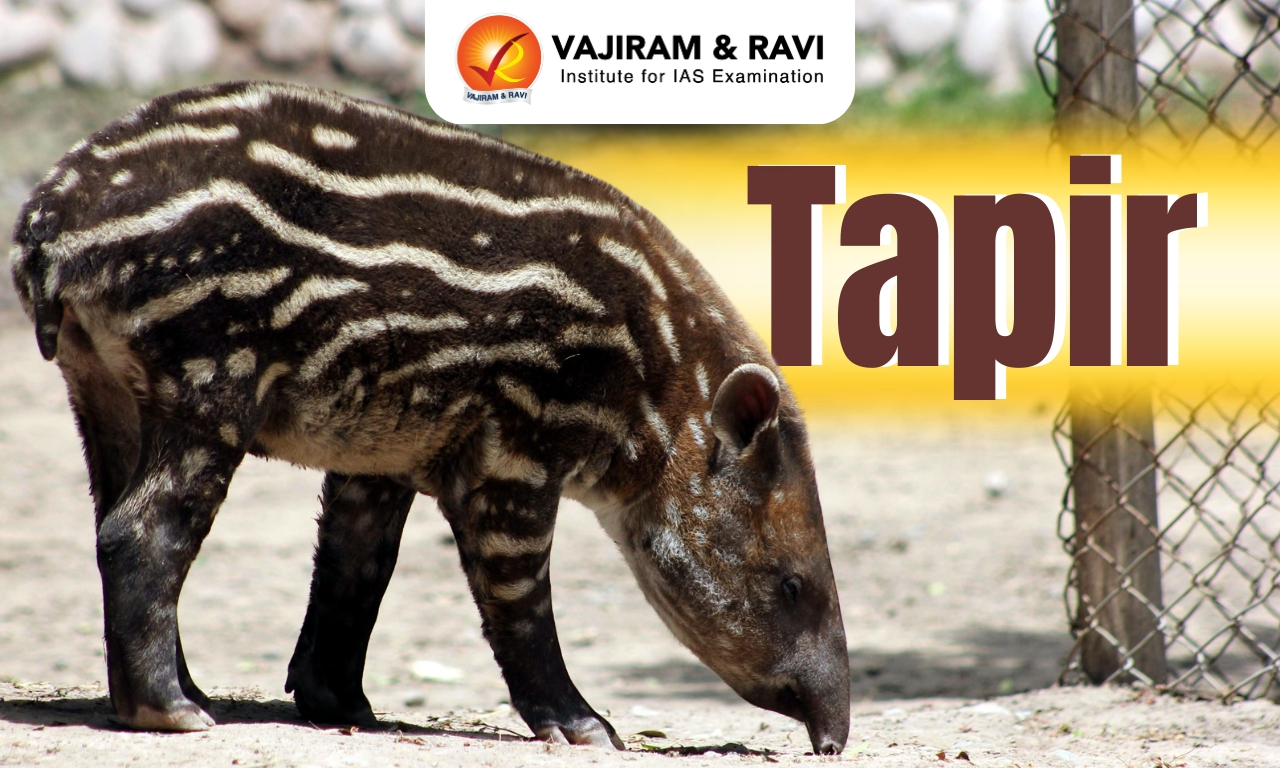
World Tapir Day is celebrated every year on April 27.

About Tapir

  • Tapirs are large herbivorous mammals.
  • They are often called “living fossils” due to their lineage dating back millions of years.
  • Appearance: They have short, flexible snouts, and tapirs use them to grab leaves and fruits.
  • They are also excellent swimmers and spend a lot of time in water.
  • Diet: They’re herbivores and fifty per cent of their diet consists of fruit.
  • Distribution: They inhabit jungle and forest regions of South America, Central America, and Southeast Asia. 
  • There are only four species of tapirs. They live in distinct geographical areas.
    • Malayan Tapir: It is the largest of the tapirs which is native to Southeast Asia. Its black-and-white stripes help it blend into the forest. (IUCN Status: Endangered)
    • Baird’s Tapir: It is Central America's biggest land mammal. It is found in tropical forests and around water. (IUCN Status: Endangered)
    • Lowland Tapir: The South American tapir is the most widespread. It is found in the Amazon Basin and other areas. (IUCN Status: Vulnerable)
    • Mountain Tapir: It is the rarest and found in the high Andes. (IUCN Status: Endangered)
  • Ecological Role: They form an important part of the ecosystem as seed dispersers. 

Source: News On Air

Tapir FAQs

Q1: Tapirs are most closely related to which animals?

Ans: Horses & Rhinoceroses

Q2: What is the ecological role of tapirs?

Ans: Seed dispersers & “Gardeners of the forest”

Organisation of the Petroleum Exporting Countries (OPEC)

Organisation of the Petroleum Exporting Countries

Organisation of the Petroleum Exporting Countries Latest News

The United Arab Emirates has announced it will exit the Organisation of the Petroleum Exporting Countries and the broader OPEC+ alliance, with the decision taking effect from May 1, 2026.

About Organisation of the Petroleum Exporting Countries

  • It is a permanent intergovernmental organization of oil-exporting countries.
  • It was established in 1960 by the five founding members Iran, Iraq, Kuwait, Saudi Arabia, and Venezuela
  • Objective: Its primary objective is to stabilize global oil markets and ensure fair prices for producers along with a steady supply for consumers.
  • Member countries: Currently, it has 12 members, including Algeria, Congo, Equatorial Guinea, Gabon, Libya, Nigeria, and the United Arab Emirates (Decided to quit from May 1 2026).
  • Angola withdrew its membership effective 1 January 2024.
  • Headquarters: Vienna, Austria.
  • OPEC members collectively hold more than 75–80% of the world’s proven crude oil reserves.
  • The organization produces around 35–40% of the world’s total crude oil supply.
  • OPEC plays a crucial role in influencing global oil prices by adjusting production levels.

What is OPEC+?

  • It is an extension of the Organization of the Petroleum Exporting Countries formed in 2016.
  • It consists of 22 oil-exporting countries which meet regularly to decide how much crude oil to sell on the world market.
  • Members of OPEC+: It comprises 12 OPEC countries plus Azerbaijan, Bahrain, Brunei, Kazakhstan, Russia, Mexico, Malaysia, South Sudan, Sudan, and Oman.
  • These nations aim to work together on adjusting crude oil production to bring stability to the oil market.

Source: News On Air

Organisation of the Petroleum Exporting Countries FAQs

Q1: OPEC was established in which year?

Ans: 1960 – Baghdad Conference,

Q2: Where is the headquarters of OPEC located?

Ans: Vienna, Austria

Theridion Himalayana

Theridion Himalayana

Theridion Himalayana Latest News

Recently, scientists discovered a new spider species and named it as Theridion himalayana’.

About Theridion Himalayana

  • It is a new species of ‘happy-face spider’ belongs to the ‘Theridiidae’ family
  • It was discovered in western Himalayas of India.
  • Features
    • It is polymorphic in both sexes and has 32 different morphs that exhibit patterns of a smiling face with dots in colours of red, black and white arranged differently.
    • It has unique reproductive structures.
      • The copulatory ducts of the species are long, strongly curved and project forward, running almost parallel before bending downward at the ends.
      • The fertilisation ducts, on the other hand, are short, thin and point upward, spreading apart in a V-shape.
    • The species preys upon small flies and insects and plays a significant role in insect control in the forests. 
    • It could also be a crucial pollinator for some plants

Source: NIE

Theridion Himalayana FAQ's

Q1: Theridion himalayana is a species of which animal group?

Ans: Spider

Q2: Theridion himalayana was recently discovered in which Indian state?

Ans: Sikkim

Somalia

Somalia

Somalia Latest News

Suspected pirates have boarded a St. Kitts and Nevis-flagged general cargo vessel off Somalia’s waters and were sailing it towards the Somali coastline.

About Somalia

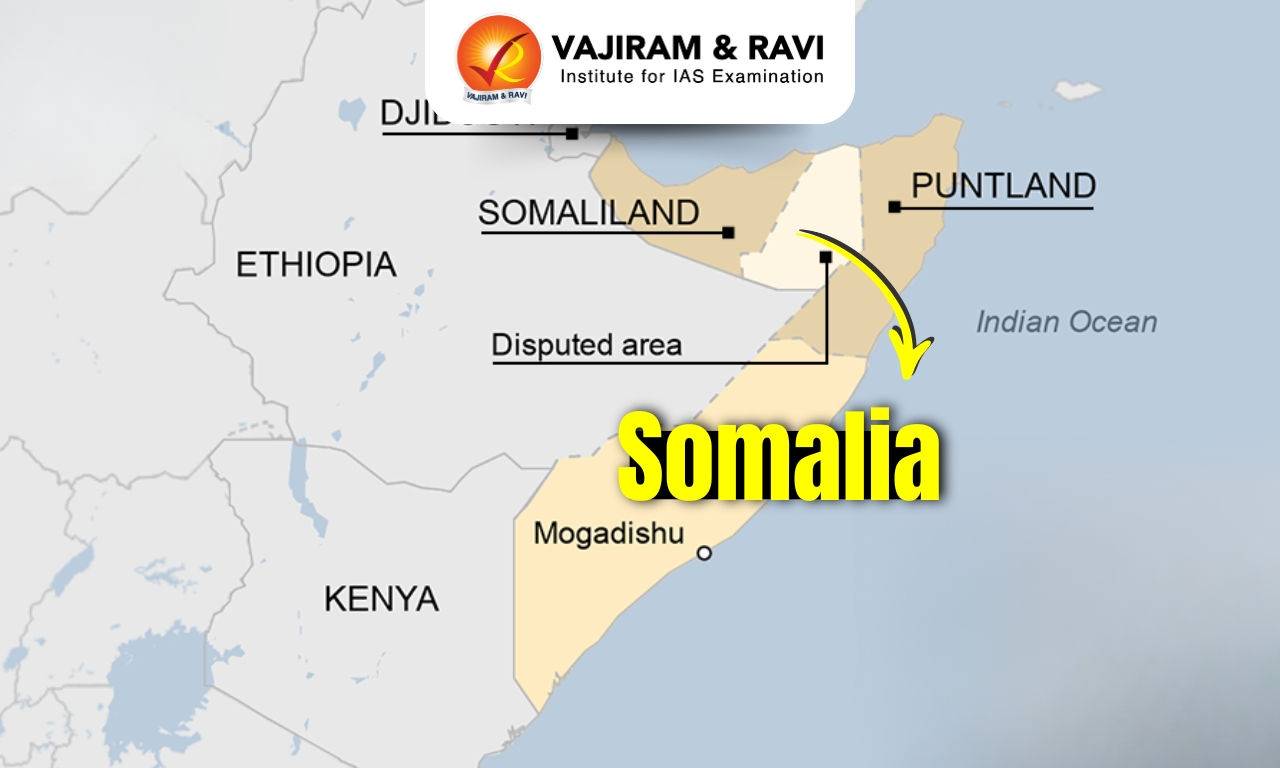
  • It is an African country located in the Horn of Africa.
  • The Equator passes through southern Somalia.
  • Bordering Countries: It is bordered by Djibouti (Northwest), Ethiopia (West), and Kenya (Southwest). 
  • Maritime Borders: The Gulf of Aden and Indian Ocean
  • Capital city: Mogadishu

Geographical Features of Somalia

  • Climate: It has an arid or semiarid climate, and there is little seasonal change in temperature.
  • Relief: The Somali peninsula consists mainly of a tableland of young limestone and sandstone formations.
  • In the extreme north, along the Gulf of Aden is a narrow coastal plain called the Guban.
  • Rivers: Jubba and the Shabeelle
  • Highest Peak: Highest point in Somalia is the 2,460 m tall Mount Shimbiris. 
  • Natural Resources:  It mainly consists of iron ore, uranium, copper, tin, bauxite, gypsum, salt. 

Source: DD News

Somalia FAQs

Q1: Which major river flows through southern Somalia?

Ans: Jubba River & Shabelle River

Q2: What is the capital of Somalia?

Ans: Mogadishu

Holocene Epoch

Holocene Epoch

Holocene Epoch Latest News

A Fossil Bed dating back to the Holocene period has been recently discovered in Thoothukudi, Tamil Nadu.

About Holocene Epoch

  • It is the current period of geologic time. 
  • The term was introduced by Gervais in 1869 and was accepted as part of valid geological nomenclature by the International Geological Congress in 1885. 
  • Another term that is sometimes used is the ‘’Anthropocene Epoch’’, because its primary characteristic is the global changes caused by human activity.
  • The Holocene Epoch began 12,000 to 11,500 years ago at the end of the last Ice Age (the Pleistocene Epoch) and continues to the present. 
  • Continental motions are negligible over a span of only 10,000 years—less than a kilometer. However, ice melt caused world sea levels to rise about 35 meters in the early part of the Holocene.  
  • It is marked by a significant warming trend and relative climate stability compared to the previous glacial period.
  • The sediments of the Holocene, both continental and marine, cover the largest area of the globe of any epoch in the geologic record, but the Holocene is unique because it coincides with the late and post-Stone Age history of humankind. 
  • Among interglacial periods, the Holocene is unique as the period in which more complex human civilisations and agriculture developed.
  • It also encompasses within it the growth and impacts of the human species worldwide, including all its written history and overall significant transition toward urban living in the present.  
  • The Holocene also witnessed significant technological advancements. From simple stone tools to complex machinery, the progress in technology has been staggering.

Source: NOA

Holocene Epoch FAQs

Q1: What is the Holocene Epoch?

Ans: It is the current period of geologic time.

Q2: When did the Holocene Epoch begin?

Ans: Around 12,000 to 11,500 years ago.

Q3: The Holocene Epoch began after which epoch?

Ans: The Pleistocene Epoch.

Q4: What type of climate characterizes the Holocene Epoch?

Ans: A warm and relatively stable climate.

Q5: What major human developments occurred during the Holocene?

Ans: Agriculture and complex civilizations.

Pompeii

Pompeii

Pompeii Latest News

AI has helped archaeologists at Pompeii reconstruct the face and final moments of a man killed during the AD 79 eruption of Mount Vesuvius.

About Pompeii

  • It is a preserved ancient Roman city located near modern-day Naples, Italy.
  • It lies at the southeastern base of Mount Vesuvius.
  • The area was originally settled in the Bronze Age on an escarpment at the mouth of the Sarnus (modern Sarno) River. 
  • Pompeii was built on a spur formed by a prehistoric lava flow to the north of the mouth of the Sarno River.
  • Pompeii was founded around the 6th century BC by the Samnites, an ancient Italian tribe.
  • It was conquered and absorbed into the Roman Empire in 80 BCE.
  • At its height, the small city had a thriving economy based on trade and agriculture.
  • The population of the town has been estimated at 10-12,000, with one-third being slaves. 
  • The city featured a complex municipal water system, an amphitheater, and a gymnasium.
  • The city was buried in volcanic ash following the eruption of Mt. Vesuvius in 79 CE, instantly killing its inhabitants and preserving the city in a remarkable state of preservation. 
  • Pompeii was basically lost and forgotten until it was rediscovered in 1748.
  • Its excellent state of preservation gives an invaluable insight into Roman everyday life.
  • It is the only archaeological site in the world that provides a complete picture of an ancient Roman city. 
  • It is a UNESCO World Heritage Site.

Source: IT

Pompeii FAQs

Q1: Where is Pompeii located?

Ans: It is located near Naples in Italy.

Q2: At the base of which volcano does Pompeii lie?

Ans: It lies at the base of Mount Vesuvius.

Q3: Near which river was Pompeii originally settled?

Ans: It was settled near the Sarnus (modern Sarno) River.

Q4: When was Pompeii absorbed into the Roman Empire?

Ans: In 80 BCE.

Q5: What happened to Pompeii in 79 CE?

Ans: It was buried under volcanic ash after the eruption of Mount Vesuvius.

India’s Night-Time Energy Crisis – Power Grid Under Pressure

India’s Night-Time Energy Crisis

India’s Night-Time Energy Crisis Latest News

  • India is currently facing an unprecedented electricity demand surge, with peak power consumption hitting record highs driven by early and intense heatwave conditions. 
  • This episode is especially noteworthy not only because of the magnitude of demand but also because it is most severe after sunset, when the nation's enormous solar power is unavailable.

The Record Demand Surge

  • According to the Grid India data, India's peak power demand touched a historic 256 GW on 25th April, 2026, with a shortfall of around 4.2 GW at 10:39 PM.
  • A day earlier, saw a peak demand of 240 GW at 10:34 PM, accompanied by a steepest recorded shortfall of 5.4 GW.
  • Crucially, daytime peak demand (around 3:45 PM) was met without any shortage, exposing a structural vulnerability: the grid can handle solar-hours demand, but struggles once the sun goes down.

The Solar Paradox

  • India now has nearly 150 GW of installed solar capacity, a testament to its clean energy ambitions. 
  • But this very success creates a new problem — a sharp evening drop-off in generation, sometimes called the "duck curve" effect, where supply falls steeply just as residential demand climbs due to cooling needs. 
  • The grid then falls back entirely on coal, gas, hydro, nuclear, and wind to bridge the gap during non-solar hours (6 PM–6 AM).

Why Coal Plants Failed to Deliver

  • The immediate trigger for the shortfall was a spike in forced and partial outages in thermal power plants.
  • While planned outages were expected at around 3 GW, forced and partial outages surged to nearly 26 GW, according to government sources.
  • A senior official cited forced outages of around 18 GW in coal plants, with an additional 3–4 GW of partial outages, totalling around 21 GW of unavailable capacity.
  • Thermal plants generated only 184–187 GW against an installed capacity of 227 GW — a significant gap.
  • Extreme heat itself was the culprit: high ambient temperatures put additional thermal stress on generation equipment, reducing plant availability exactly when the grid needed it most.

Price Shock in the Spot Market

  • The grid stress has fed directly into electricity prices. 
  • Data from the Indian Energy Exchange (IEX), India's largest power trading platform, shows spot prices in the Day Ahead Market (DAM) hitting the regulatory ceiling of ₹10 per kWh at night, before crashing to around ₹1.5 per kWh during the day.
  • This reflects a dramatic intra-day swing highlighting the solar-hours surplus and night-time scarcity.

What Makes 2025-26 Different

  • Traditionally, India's peak power demand arrives during June–July or September–October. 
  • This year, the surge has arrived in April itself — an unusually early onset linked to an intense, prolonged heatwave. 
  • The last time annual peak demand was reached this early was in 2022–23. Year-on-year, the jump is steep: April 2025 saw a peak of 235 GW, compared to 256 GW already recorded in April 2026.

Key Challenges

  • Evening demand surge coinciding with the complete withdrawal of solar power creates a dangerous daily window of vulnerability.
  • Forced outages in coal plants during peak heat — the very conditions that drive maximum demand — expose a thermal generation reliability problem.
  • Absence of utility-scale battery storage means there is no buffer to store surplus daytime solar energy for night-time use.
  • Early seasonality of heatwaves is compressing the grid planning cycle, leaving less time to prepare.
  • Spot price volatility (₹1.5 to ₹10/kWh within the same day) signals market stress and could burden distribution companies (DISCOMs).

Way Forward

  • Battery Energy Storage Systems (BESS): Scaling up grid-scale storage is the most direct solution to the solar drop-off problem, enabling excess afternoon solar power to serve evening demand.
  • Demand-side management: Incentivising large consumers to shift loads away from the 6–10 PM window can ease the peak.
  • Thermal plant resilience: Heat-proofing of coal plant equipment and improving predictive maintenance to reduce forced outages during summer months.
  • Pumped storage hydro: Expanding pumped hydro capacity as a proven, large-scale storage technology.
  • Operationalising idle gas-based capacity: For evening peak support, alongside a coherent domestic gas pricing framework.
  • Transmission strengthening: Expanding inter-regional transmission capacity so surplus power in one region can flow to deficit zones without congestion.

Conclusion

  • India's power crisis of April 2026 is a preview of a structural challenge that will only deepen as solar capacity expands and climate change brings forward and intensifies heatwaves. 
  • The country has made remarkable strides in renewable energy, but the grid architecture — storage, thermal backup reliability, and demand management — has not kept pace. 
  • The issue sits at the intersection of energy security, climate adaptation, grid infrastructure, and economic governance, making it a rich case study in the complexities of India's energy transition.

Source: IE

India's Night-Time Energy Crisis FAQs

Q1: What structural challenges are highlighted by India’s rising night-time power shortages?

Ans: Intermittency of solar power and inadequate energy storage capacity.

Q2: Why are coal-based thermal power plants still crucial for India’s electricity security?

Ans: They provide dependable base-load and balancing power during non-solar hours.

Q3: How do heatwaves impact India’s power sector beyond increasing electricity demand?

Ans: They also reduce plant efficiency and cause forced outages in thermal stations.

Q4: Why are spot electricity prices higher at night compared to daytime in India?

Ans: Due to supply shortages after solar generation declines and demand remains high.

Q5: What is the most effective long-term solution to manage evening peak power demand in India?

Ans: Large-scale battery storage and grid modernisation with flexible renewable integration.

Aviation Turbine Fuel Pricing and Airline Crisis in India

Aviation Turbine Fuel

Aviation Turbine Fuel Latest News

  • Indian airlines have raised concerns over rising Aviation Turbine Fuel prices, warning of operational disruptions.

Aviation Turbine Fuel (ATF): Basics

  • Aviation Turbine Fuel (ATF) is a refined petroleum product used as fuel in aircraft engines, particularly jet engines.
  • It is derived from crude oil and is similar to kerosene in composition, but with higher quality specifications to ensure safety, efficiency, and performance at high altitudes.
  • ATF is a critical input cost for airlines, accounting for 30-50% of total operating expenses.

ATF Pricing in India

  • ATF pricing in India is market-linked but not fully deregulated like petrol and diesel. Prices are revised periodically by oil marketing companies (OMCs).
  • The price of ATF varies across states due to differences in state-level taxation (VAT), making India one of the costliest markets for aviation fuel.

ATF Pricing Formula

  • The pricing of ATF is based on a combination of international and domestic factors.
    • International Benchmark Prices: ATF prices are linked to global jet fuel prices, which in turn depend on crude oil prices. 
    • Exchange Rate: Since crude oil is imported, fluctuations in the rupee-dollar exchange rate directly affect prices. 
    • Freight and Insurance Costs: Transportation and logistics costs are added to the base price. 
    • OMC Margins: Oil companies include refining and marketing margins. 
    • State Taxes (VAT): States impose VAT ranging from 1% to over 25%, leading to price variation across locations. 
  • Thus, ATF price = Import Parity Price + Refining Margin + Freight + Marketing Margin + State Taxes.

Challenges in ATF Pricing

  • India’s ATF pricing faces structural issues.
    • High taxation increases operational costs for airlines.
    • Lack of uniform tax structure leads to regional price disparities, affecting airline route planning.
  • ATF is currently outside the GST framework, which prevents input tax credit benefits.

News Summary: Airline Concerns over Rising ATF Prices

  • Leading Indian carriers such as Air India, IndiGo, and SpiceJet have warned of possible operational disruptions or shutdown risks due to rising fuel costs.
  • The sharp increase in ATF prices has significantly raised the operational burden on airlines, as fuel constitutes the largest expense component.
  • Airlines are struggling to absorb these costs, especially in a competitive market where ticket prices cannot be increased proportionately.
  • Impact on Airline Viability
    • Persistent high fuel costs are affecting the financial health and sustainability of airlines.
    • Some carriers have indicated that continued cost escalation may lead to capacity reduction, route rationalisation, or service disruptions.
  • Demand for Policy Intervention
  • Airlines have urged the government to take measures such as:
    • Bringing ATF under the GST regime. 
    • Reducing state-level VAT. 
    • Providing temporary relief measures to stabilise the sector. 
  • These steps are seen as necessary to ensure the survival and competitiveness of the aviation industry.

Source: IE | TH

Aviation Turbine Fuel FAQs

Q1: What is Aviation Turbine Fuel (ATF)?

Ans: It is a refined petroleum product used as fuel in jet aircraft engines.

Q2: Why is ATF expensive in India?

Ans: High state taxes and import dependence increase its cost.

Q3: What factors determine ATF pricing?

Ans: Global crude prices, exchange rates, OMC margins, and state VAT determine pricing.

Q4: Why do airlines demand GST on ATF?

Ans: GST would reduce tax burden and allow input tax credit benefits.

Q5: How does ATF price impact airlines?

Ans: It directly affects operating costs and profitability of airlines.

UAE Exit from OPEC: Why UAE Exit from OPEC Will Impact Global Oil Prices

UAE Exit from OPEC

UAE Exit from OPEC Latest News

  • The United Arab Emirates has announced its exit from Organization of the Petroleum Exporting Countries (OPEC) and the wider OPEC+ alliance, effective May 1. 
  • The decision is linked to Abu Dhabi’s long-term economic strategy, though it comes amid major disruptions in global oil markets triggered by the US-Iran conflict.
  • After more than five decades in the grouping, the move signals a significant shift in global energy dynamics, raising questions about its impact on oil supply, pricing, and market stability.

OPEC and UAE Membership: Origins and Evolution

  • OPEC was founded in 1960 at the Baghdad Conference by five countries—Iran, Iraq, Kuwait, Saudi Arabia, and Venezuela—to coordinate oil policies and ensure stable revenues for producing nations.
  • It emerged as a response to the dominance of Western multinational oil companies (the “Seven Sisters”), which earlier controlled pricing. 
  • OPEC currently has 12 members, including, aside from the UAE: Algeria, Republic of the Congo, Equatorial Guinea, Gabon, Iran, Iraq, Kuwait, Libya, Nigeria, Saudi Arabia, and Venezuela.
  • The United Arab Emirates joined OPEC in 1967, initially through Abu Dhabi, becoming part of the expanding group of oil-producing nations.

Emergence of OPEC+ and Global Role

  • OPEC+ is a grouping formed in 2016 between OPEC and 10 major non-OPEC producers such as Russia, Mexico, and Kazakhstan. 
  • It coordinates oil production quotas to manage global supply and stabilise crude prices.
  • This alliance today accounts for a large share of global oil production and trade, reinforcing its role in shaping energy markets.
    • As per a report, OPEC+ produced roughly 40% of the world’s crude oil and accounts for 60% of internationally traded petroleum.

OPEC’s Role in Global Oil Markets

  • OPEC functions much like a central bank for the global oil market, using production controls as its primary instrument
  • By setting output quotas for member countries, OPEC regulates how much oil is produced collectively.
  • These quotas prevent oversupply during periods of low demand, helping avoid sharp declines in oil prices. 
    • Member countries may have to produce below their maximum capacity to maintain market stability.
  • In times of tight supply, OPEC can increase production, ensuring that oil prices do not rise excessively and disrupt global markets.
  • Since many member nations rely heavily on oil revenues, this coordinated approach helps stabilise their incomes and domestic budgets, shielding them from sudden price volatility.

Iran War and UAE’s Exit from OPEC

  • Security Risks and Disrupted Oil Flows - The US-Iran conflict has heightened security concerns for the United Arab Emirates, especially around the Strait of Hormuz—a route that previously carried about one-fifth of global oil trade.
  • Constraints within OPEC Framework - As Iran is a founding member of OPEC, the bloc’s consensus-based decision-making limits the UAE’s flexibility in responding to the crisis and securing its oil exports.
  • Shifting Security Dynamics - Gulf nations have traditionally depended on the United States for regional security. However, the conflict exposed gaps in this arrangement, as the U.S. could not prevent spillover impacts on Gulf infrastructure and trade.
  • Strategic Autonomy through Exit - By exiting OPEC, the UAE seeks to remove diplomatic constraints, enabling it to independently leverage its oil production, pursue new strategic partnerships, and explore alternative security arrangements beyond traditional Western alliances.

UAE’s Economic Drivers Behind Exit from OPEC

  • Production Constraints and Capacity Underutilisation - Beyond geopolitical factors, the UAE faced economic limitations within OPEC quotas, which capped its oil output below full capacity. Concerns over production policies influenced the decision to exit.
  • Balancing Oil Dependence and Economic Diversification - At the same time, the UAE is pursuing a transition toward a knowledge-based economy, expanding into sectors like education and technology to attract global talent. Achieving this shift requires higher oil production in the short term to generate the financial resources needed for long-term diversification.

Impact of UAE Exit on Global Oil Prices

  • Weakening of OPEC’s Collective Power - A key concern is the erosion of spare capacity control—the unused oil production that can be quickly deployed—traditionally held by countries like Saudi Arabia, Kuwait, and the UAE.
  • Rise of Competition and Market Pressure - UAE could emerge as a more aggressive independent producer, putting pressure on OPEC members to increase their own production. This shift introduces greater competition in global oil markets.
  • Downward Pressure and Volatility in Prices - In line with basic economic principles, higher supply and competition are expected to push oil prices downward and increase market volatility, especially amid disruptions from the ongoing geopolitical tensions.
  • Implications for Oil-Importing Countries - In the short term, lower oil prices could benefit import-dependent countries like India by reducing energy costs. Over time, increased competition may also expand the range of oil suppliers, improving energy security.
  • Risk of Further Fragmentation - The UAE’s move may set a precedent, raising the possibility that other members—such as Saudi Arabia—could reconsider quota commitments, potentially leading to further fragmentation of OPEC.

Source: IE| IE | AJ

UAE Exit from OPEC FAQs

Q1: What is UAE exit from OPEC?

Ans: UAE exit from OPEC refers to the country leaving the oil cartel after decades, allowing it to independently decide production levels and pursue its own energy strategy.

Q2: Why did UAE choose exit from OPEC?

Ans: UAE exit from OPEC was driven by production limits, economic diversification goals, Iran war risks, and the need for strategic autonomy in global oil markets.

Q3: How does UAE exit from OPEC affect oil prices?

Ans: UAE exit from OPEC increases competition and oil supply, putting downward pressure on global oil prices while increasing volatility in energy markets.

Q4: What role did the Iran war play in UAE exit from OPEC?

Ans: The Iran war exposed supply risks and decision-making constraints within OPEC, pushing the UAE to exit and gain flexibility over oil exports and security strategy.

Q5: What are the global implications of UAE exit from OPEC?

Ans: UAE exit from OPEC may weaken the cartel, reduce coordinated supply control, encourage other members to exit, and reshape global oil trade dynamics.

Indonesia Biofuel B50: How Indonesia Biofuel B50 Raises Cooking Oil Prices in India

Indonesia Biofuel B50

Indonesia Biofuel B50 Latest News

  • Indonesia has announced the rollout of B50 biofuel, a blend of 50% palm oil-based biodiesel and 50% diesel, amid rising global oil prices due to the Iran war. The move is expected to increase domestic use of palm oil in Indonesia, reducing exports.
  • For India, a major importer of Indonesian palm oil, this could lead to tighter supply and higher cooking oil prices, linking global energy policy shifts directly to domestic food inflation.

Drivers Behind Indonesia’s B50 Biofuel Push

  • Indonesia’s move toward B50 biofuel is largely driven by its need to cut crude oil imports, which stood at about $7.8 billion in 2025. 
  • By substituting diesel with palm oil-based biodiesel, the country aims to improve energy security, especially as global oil prices surge beyond $100 per barrel amid geopolitical tensions.

Expanding Biofuel Strategy Beyond Road Transport

  • The policy also aligns with Indonesia’s broader clean energy roadmap, including plans to introduce Sustainable Aviation Fuel (SAF) from 2027. 
  • Major airports are expected to adopt aviation fuel blended with around 1% SAF, signalling a gradual expansion of biofuels into aviation.
  • The B50 initiative contributes to emissions reduction efforts and promotes alternative fuels, positioning Indonesia as a regional leader in green energy transition.

Supporting Domestic Palm Oil Industry

  • Increasing domestic consumption of palm oil helps absorb surplus production, especially as export markets tighten due to regulations such as those in the European Union targeting deforestation-linked imports. 
  • This ensures price stability and support for local producers.

Impact of Indonesia’s B50 Policy on Global Vegetable Oil Markets

  • Indonesia’s shift toward the B50 programme is expected to divert a significant portion of palm oil from exports to domestic biodiesel use. 
  • Since Indonesia accounts for nearly half of global palm oil exports, this reallocation will tighten global supply, leading to higher international palm oil prices.

Implications for India as a Major Importer

  • For India, the impact is substantial. India imports around $8.5 billion worth of palm oil, with over 50% sourced from Indonesia. 
  • Given its widespread use in cooking, food processing, and industries like soaps and oleochemicals, supply constraints are likely to increase import costs, resulting in:
    • Higher household expenditure 
    • Rising food inflation 
    • Increased input costs for industries, potentially pushing up final product prices

Limited Substitution Options

  • India can attempt to diversify imports toward alternatives like sunflower oil (from Russia and Ukraine) and soybean oil (from Argentina and Brazil). 
  • However, these options are:
    • More expensive 
    • Available in smaller volumes 
    • Linked to longer and riskier supply chains 
  • This limits India’s ability to fully offset the palm oil shortage.

Potential Upside for Domestic Sector

  • Higher global prices may encourage greater domestic oilseed production, benefiting farmers through better price realisation and strengthening India’s edible oil value chain over time.

Why India Imports Large Volumes of Vegetable Oils

  • India imports large quantities of vegetable oils because domestic demand far exceeds supply, driven by population growth and rising consumption. 
  • A key structural issue is low productivity of oilseeds, with yields per hectare below global standards. 
  • In addition, the policy environment—especially Minimum Support Price (MSP) incentives—has historically favoured cereals like wheat and rice, leading to lower acreage and investment in oilseed cultivation.

Alternatives to Palm Oil in the Indian Market

  • The main alternatives to palm oil include sunflower oil and soybean oil. However, these are:
    • More expensive than palm oil 
    • Imported from distant regions such as Russia, Ukraine, Argentina, and Brazil 
    • Associated with longer and riskier supply chains

Domestic Option: Mustard Oil

  • Mustard oil, produced within India, serves as a domestic alternative but has limited scalability and is largely consumed in specific regions, restricting its nationwide substitution potential.

Palm Oil Biodiesel and Climate Impact: A Mixed Outcome

  • Palm oil–based biodiesel can be environmentally beneficial if it relies on existing plantations and productivity gains, rather than expanding cultivation. 
  • In countries like Indonesia, where large plantations and high yields already exist, programmes like B50 can remain closer to climate-positive outcomes—provided deforestation is avoided and sustainability standards are enforced.
  • However, if biodiesel expansion leads to clearing forests or converting carbon-rich land, the resulting emissions can offset or even exceed the benefits of replacing fossil fuels. 
  • In such cases, the policy risks undermining climate goals rather than supporting them.

India’s Constraints and Trade-offs

  • For India, the situation is more complex. Lower agricultural productivity means scaling up biofuel feedstock may require diverting food crops or expanding farmland, raising concerns about food security, land use, and resource stress
  • This makes biofuel expansion less automatically climate-friendly.

Source: IE

Indonesia Biofuel B50 FAQs

Q1: What is Indonesia biofuel B50?

Ans: Indonesia biofuel B50 is a fuel blend of 50% palm oil-based biodiesel and 50% diesel, aimed at reducing crude oil imports and improving energy security.

Q2: Why is Indonesia biofuel B50 important globally?

Ans: Indonesia biofuel B50 matters because Indonesia supplies nearly half of global palm oil exports, so diverting supply domestically impacts global edible oil prices significantly.

Q3: How will Indonesia biofuel B50 affect India?

Ans: Indonesia biofuel B50 will reduce palm oil exports, increasing import costs for India, leading to higher cooking oil prices, food inflation, and rising industrial input costs.

Q4: Can India substitute palm oil under Indonesia biofuel B50?

Ans: Under Indonesia biofuel B50, substitution is limited as sunflower and soybean oils are costlier, available in smaller volumes, and involve longer and riskier supply chains.

Q5: Is Indonesia biofuel B50 climate-friendly?

Ans: Indonesia biofuel B50 can be climate-positive if based on existing plantations, but expansion causing deforestation can negate emissions benefits and harm sustainability goals.

Atacama Desert

Atacama Desert

Atacama Desert Latest News

Recently, it was observed that light pollution is threatening the world’s darkest skies in the Atacama desert.

About Atacama Desert

  • Location: It is the driest desert in the world, located in northern Chile.
  • It is nestled between the Andes Mountains on the east and the Pacific Ocean on the west.
  • It forms a continuous strip for nearly 1,000 km along the narrow coast of the northern third of Chile. 
  • Bordered by: It is bordered by Argentina, Peru, and Bolivia
  • It also hosts 12 volcanoes, mainly located in the western outliers of the Andes.
  • Rainfall: Average rainfall in this region is about 1 mm per year. Some locations within the desert have never had any rainfall whatsoever.
  • Temperature: Temperatures are comparatively mild throughout the year. The average temperature in the desert is about 63 degrees F (18 degrees C).
  • Natural Resources: This region has the largest natural supply of Sodium Nitrate, which can be used for producing fertilizers and explosives, amongst other things. 
  • Chinchorro Mummies: The oldest artificially mummified human remains have been found in the Atacama Desert.

Source: TH

Atacama Desert FAQs

Q1: Atacama Desert is located in which country?

Ans: Chile

Q2: Which is the world’s highest active volcano located in Atacama region?

Ans: Ojos del Salado

Nahargarh Wildlife Sanctuary

Nahargarh Wildlife Sanctuary

Nahargarh Wildlife Sanctuary Latest News

The Rajasthan High Court recently set aside a National Board for Wildlife panel decision that denied wildlife clearance to Taj Amber, a five-star property located about 97 metres from the Nahargarh Wildlife Sanctuary boundary.

About Nahargarh Wildlife Sanctuary

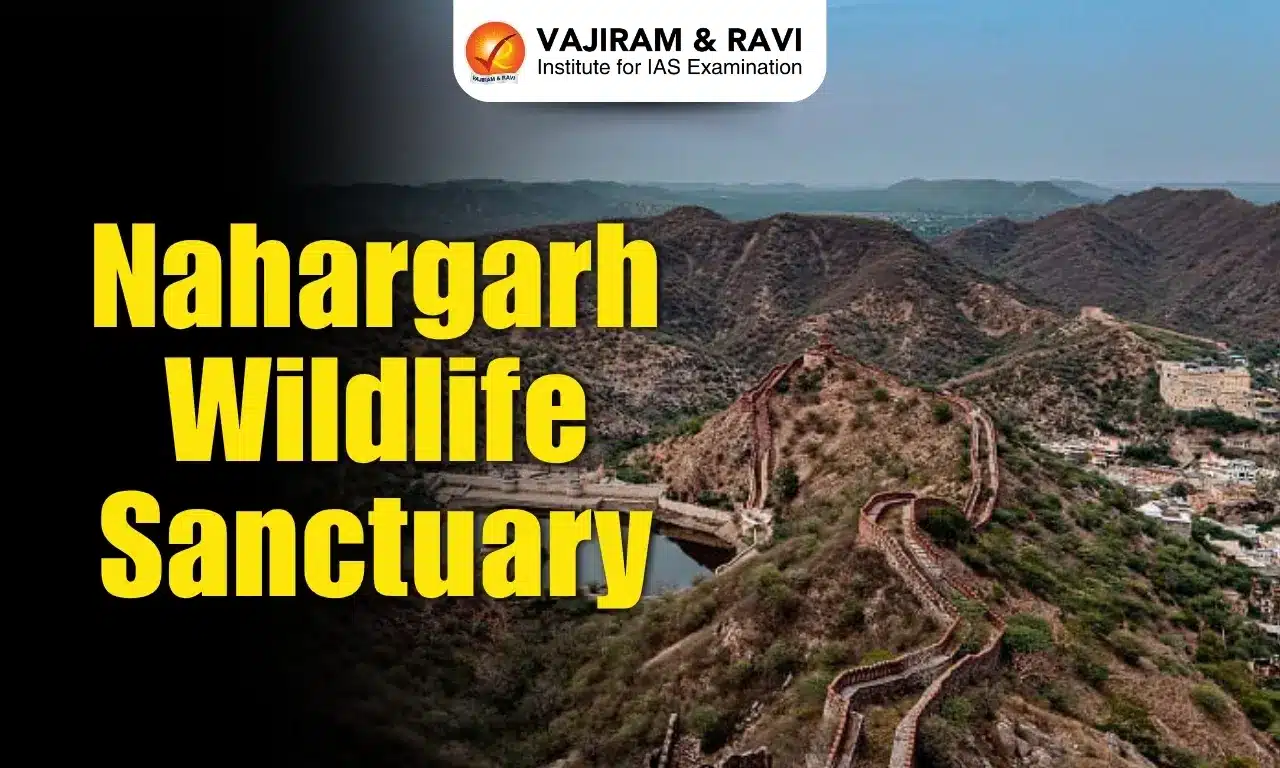
  • It is located just 20 kilometres from Jaipur, Rajasthan.
  • It’s a small sanctuary of 52 sq.km.  and is situated in the Aravalli range.
  • The sanctuary is named after Nahargarh Fort, a historic fort built in the 18th century by Maharaja Sawai Jai Singh II, the founder of Jaipur. 
  • It connects ecologically with other forest areas like the Ranthambore Tiger Reserve. 
  • Within the sanctuary is the Nahargarh Biological Park, which covers 720 hectares and focuses on conservation, including species like Bengal tigers, Asiatic lions, and sloth bears.  
  • Flora: The sanctuary features a rugged terrain with hills, valleys, seasonal streams, and dry deciduous forests typical of the semi-arid region, including trees such as dhok, babool, khejri, and ber.
  • Fauna: 
    • Common species include leopards, wild boars, deer, lions, tigers, sloth bears, and several small mammals.
    • It’s a haven for bird watchers, with a variety of species, including peacocks, owls, and eagles.
    • It is also home to reptiles like Indian rock pythons, monitor lizards, and amphibians like frogs and toads.

Source: TOI

Nahargarh Wildlife Sanctuary FAQs

Q1: Where is Nahargarh Wildlife Sanctuary located?

Ans: It is located about 20 km from Jaipur in Rajasthan.

Q2: In which mountain range is Nahargarh Wildlife Sanctuary situated?

Ans: It is situated in the Aravalli Range.

Q3: What type of vegetation is found in Nahargarh Wildlife Sanctuary?

Ans: It has dry deciduous forests typical of semi-arid regions.

Factories Act 1948, Applicability, Provisions, Rules, Amendments

Factories Act 1948

The Factories Act 1948 is a landmark labour law enacted in 1948 and enforced from 1 April 1949 to regulate factory conditions. It consolidates laws relating to labour in factories and focuses on health, safety, welfare, working hours and protection of vulnerable workers. The Factories Act 1948 created a statutory framework ensuring humane working conditions and shifted industrial regulation toward worker protection.

Factories Act 1948 Provisions

The Factories Act 1948 lays down comprehensive legal rules covering factory definition, licensing, worker protection, safety systems, working hours, welfare facilities and enforcement mechanisms ensuring minimum standards.

  • Definition of factory: The Act defines a factory as premises where manufacturing occurs with at least 10 workers using power or 20 workers without power, making applicability dependent on workforce strength and use of machinery.
  • Approval and licensing: The Factories Act 1948 requires prior approval, licensing and registration of factories, ensuring regulatory control before operations begin and preventing unregulated industrial activities outside the legal compliance framework.
  • Health provisions: Sections 11-20 ensure cleanliness, waste disposal, ventilation, temperature control, dust prevention, lighting, drinking water and sanitation facilities to maintain hygienic working environments in factories.
  • Safety provisions: Sections 21-41 mandate machine fencing, safe operation of equipment, protection from hazardous processes and accident prevention measures to reduce industrial injuries.
  • Protection against hazardous fumes: Workers cannot enter confined spaces with toxic gases unless proper safety measures, ventilation and escape arrangements are ensured.
  • Creche facilities: Factories employing more than 30 women workers must provide creches for children below six years, ensuring childcare support and enabling women’s participation in the workforce.
  • Working hours regulation: The Factories Act 1948 limits working hours to 48 hours per week and regulates daily hours, rest intervals, spread over and overtime wages.
  • Overtime wages: Workers performing extra work beyond prescribed hours must be paid overtime wages at higher rates, discouraging exploitation.
  • Employment of women: The Act includes protective provisions restricting women’s work in hazardous processes and regulating working hours, reflecting a protective labour policy approach.
  • Employment of young persons: Children below 14 years are prohibited from working, while adolescents require fitness certificates and regulated working hours.
  • Hazardous processes provisions: Chapter IV A introduces strict rules for industries involving hazardous substances, including disclosure requirements and safety responsibilities of occupiers.
  • Worker participation: Workers are given rights to participate in safety management and to warn about imminent dangers, promoting collective responsibility for workplace safety.
  • Annual leave with wages: Workers who complete 240 days of work annually are entitled to paid leave, ensuring rest and work life balance.
  • Registers and records: Factories must maintain registers for workers, accidents, leave, overtime and inspections, ensuring transparency and accountability.
  • Penalties for violations: Section 92 provides penalties including imprisonment up to two years and fines up to ₹2 lakh for violations, with additional fines for continued offences.
  • Liability provisions: Owners, occupiers and managers can be held liable for non compliance, ensuring accountability in maintaining safety and welfare standards.
  • Special provisions: The Act empowers governments to apply provisions to certain premises, regulate dangerous operations and investigate accidents or occupational diseases.

Also Read: Bonded Labour Act

Factories Act 1948 Amendments

The Factories Act 1948 has been amended multiple times to strengthen safety norms, expand coverage and address industrial hazards emerging from technological and economic changes.

Some of the major amendments to this act has been listed below:

  • Amendment 1951: Early amendments refined implementation rules, extended applicability to new states and improved administrative provisions after initial enforcement of the Act.
  • Amendment 1954: Changes aligned with international labour standards, restricted night work for women and children, improved safety measures and revised provisions on working hours and leave with wages.
  • Amendment 1976: Expanded definitions of factory and worker to include contract labour, introduced new safety provisions and mandated approval of factory sites and building plans.
  • Amendment 1987: Triggered by industrial disasters like the Bhopal gas tragedy, it introduced Chapter IV A dealing with hazardous processes and stricter penalties.

Factories Act 1948 Current Status

The Factories Act 1948 remains historically significant but has largely been subsumed into a modern labour law framework under consolidated labour codes in India.

  • The Factories Act 1948 has been transitioned to Labour Codes. India consolidated 29 central labour laws into four codes, including occupational safety laws, reducing complexity and modernizing compliance systems.
  • The Occupational Safety, Health and Working Conditions Code, 2020 replaced major provisions of the Factories Act 1948 relating to safety and working conditions.
  • Government communications indicate that labour codes became operational around November 2025, marking a shift from older laws to a unified legal framework.
  • As per 2022 data, registered factories increased from 224,851 to 228,585, with 84.16% operational, showing continued industrial expansion under regulatory frameworks.
  • The majority of workers reported working between 45-48 hours weekly, aligning with statutory limits under the Act.
  • Reported injuries increased to 2799 in 2022, though frequency rate per lakh mandays declined, indicating mixed safety outcomes.
  • Around 96.52% of factories were inspected once annually, reflecting ongoing enforcement under labour administration.
  • Out of 2870 convictions, 20.91% were related to safety violations, showing enforcement focus on workplace safety compliance.
  • Government proposals include online registration and self certification systems, aiming to simplify procedures but raising concerns about reduced regulatory oversight.

Factories Act 1948 FAQs

Q1: What is the purpose of the Factories Act 1948?

Ans: The Factories Act, 1948 aims to regulate working conditions in factories by ensuring health, safety, welfare, proper working hours and protection of workers from exploitation.

Q2: When did the Factories Act 1948 come into force?

Ans: The Factories Act 1948 was enacted in 1948 and came into force on 1 April 1949 across India to regulate factory labour conditions.

Q3: What is the maximum working hours under the Factories Act 1948?

Ans: The Act limits working hours to 48 hours per week and generally not more than 9 hours per day, along with rest intervals and weekly holidays.

Q4: Who is responsible for compliance under the Factories Act 1948?

Ans: The occupier and manager of the factory are legally responsible for ensuring compliance with all provisions related to safety, health and welfare.

Q5: Is the Factories Act 1948 still in force today?

Ans: The Act is largely replaced by the Occupational Safety, Health and Working Conditions Code, 2020 but remains important as a foundational labour law.

Daily Editorial Analysis 29 April 2026

Daily-Editorial-Analysis

A Recusal Test the Delhi High Court Failed

Context

  • The refusal of Justice Swarana Kanta Sharma of the Delhi High Court to recuse herself from hearing the case Central Bureau of Investigation vs Kuldeep Singh and Others (April 20, 2026) has reignited debate on the principles governing judicial recusal in India.
  • The matter, involving prominent political figures such as Arvind Kejriwal, raises fundamental questions about judicial impartiality, institutional integrity, and public confidence in the legal system.
  • This episode appears to depart from established jurisprudence, which prioritises not only actual fairness but also the perception of fairness in judicial proceedings.

Background of the Case

  • The case arose from a plea by Arvind Kejriwal, who appeared in person before the High Court, seeking the recusal of Justice Sharma.
  • The Central Bureau of Investigation had challenged a trial court order discharging the accused in the Delhi excise policy case, including Kejriwal himself.
    • The recusal plea was based on several grounds:
    • Prior adverse findings by the judge in related proceedings
    • Her participation in events organised by the Akhil Bharatiya Adhivakta Parishad (ABAP)
    • The professional engagements of her children with the government
    • A public statement by Home Minister Amit Shah suggesting an unfavourable outcome for Kejriwal

Legal Framework on Judicial Recusal

  • Absence of Codified Law
    • Judicial recusal in India is not governed by a specific statute, instead, it is rooted in ethical principles, judicial precedents, and global best practices.
    • This makes recusal more a matter of judicial conscience guided by established norms than rigid legal rules.
  • Foundational Principles
    • The principle that justice must not only be done but also be seen to be done has long been recognised in common law jurisprudence.
    • The Bangalore Principles of Judicial Conduct (2002) further reinforce that judges must avoid both impropriety and its appearance.

Indian Judicial Precedents

  • Ranjit Thakur v Union of India (1987): Emphasised that the test is not the judge’s own perception of bias but that of the litigant.
  • K. Ghosh v J.G. Rajput (1995): Held that recusal is appropriate when a litigant reasonably apprehends bias, especially where alternatives exist.
  • State of Punjab v Davinder Pal Singh Bhullar (2011): Established that even the appearance of bias is sufficient to vitiate a decision.
  • Supreme Court Advocates-on-Record Association v Union of India (2015): Reiterated the test of reasonable doubt in the mind of a fair observer regarding impartiality.

Analysis of the Judgment

  • Shift from Established Standards
    • Justice Sharma’s judgment departs from settled principles by focusing on the absence of proven bias rather than addressing the reasonable apprehension of bias.
    • This effectively raises the threshold for recusal, contradicting established jurisprudence.
  • Defensive and Personal Reasoning
    • The judgment includes responses to allegations concerning the judge’s personal and professional associations, such as her children’s careers and her attendance at certain events.
    • While these clarifications may be relevant, they do not directly engage with the legal test of perceived impartiality.
  • Mischaracterisation of Criticism
    • Another notable aspect is the conflation of criticism of the judge with criticism of the judiciary as an institution.
    • This approach weakens the analytical strength of the judgment and diverts attention from the core issue of maintaining public confidence.

The Issue of Self-Adjudication

  • A structural concern highlighted by this case is that the judge whose recusal is sought also decides the recusal application.
  • This creates an inherent tension with the principle that no person should be a judge in their own cause.
  • A more appropriate course of action would have been to refer the recusal plea to another judge.
  • Such a step would have ensured greater objectivity and reinforced the credibility of the judicial process.

Implications for Judicial Integrity

  • Erosion of Public Confidence
    • Judicial legitimacy depends heavily on public trust. In politically sensitive cases, even a perception of bias can significantly undermine confidence in the system.
  • Impact on Proceedings
    • The decision led to a breakdown in trust, with the litigants refusing to participate further in proceedings before the same judge.
    • This shows how procedural concerns can directly affect the administration of justice.
  • Risk of Problematic Precedent
    • By deviating from established standards, the judgment risks setting a precedent that may weaken safeguards against perceived bias in future cases.

Conclusion

  • The Delhi High Court episode underscores the delicate balance between judicial independence and the need for accountability.
  • While judges must guard against frivolous recusal requests, they must also prioritise the appearance of impartiality.
  • Established legal principles in India clearly favour recusal in situations where a reasonable apprehension of bias exists.
  • Ultimately, the strength of the judiciary lies not only in its decisions but in the trust it commands.

A Recusal Test the Delhi High Court Failed FAQs

Q1. What was the main issue in the Delhi High Court case?
Ans. The main issue was whether the judge should recuse herself due to a perceived likelihood of bias.

Q2. On what grounds did Arvind Kejriwal seek recusal?
Ans. Arvind Kejriwal sought recusal citing prior adverse findings, associations of the judge, and possible conflicts of interest.

Q3. What is the key legal principle governing judicial recusal?
Ans. The key principle is that justice must not only be done but also be seen to be done.

Q4. How did the judgment deviate from established jurisprudence?
Ans. The judgment focused on the absence of actual bias instead of considering the reasonable apprehension of bias.

Q5. Why is judicial recusal important for the legal system?
Ans. Judicial recusal is important because it helps maintain public confidence in the fairness and impartiality of the judiciary.

Source: The Hindu


The RTE Act and the Idea of Social Inclusion

Context

  • In India, the Right to Education (RTE) Act, 2009 embodies the constitutional commitment to ensuring equitable access to elementary education for all children.
  • A key provision of this Act, Section 12(1)(c), mandates that private unaided schools reserve 25 percent of their seats for children from economically weaker sections and disadvantaged groups.
  • This vision reflects not merely access to education, but the creation of shared social spaces that advance equality of status and opportunity.

The Constitutional Vision Behind Section 12(1)(c)

  • Section 12(1)(c) is rooted in the idea that true equality requires more than formal guarantees, it demands meaningful social integration.
  • The provision seeks to dismantle entrenched social divisions by bringing children from diverse socioeconomic backgrounds into the same learning environments.
  • By developing interaction among students of different classes, the law challenges the segregation that often defines educational spaces in India.
  • Schools, in this sense, become sites where social barriers can be reduced, and mutual understanding can develop.
  • This reflects a broader constitutional vision of equality as lived experience, not merely legal principle.

Transformative Impact: Stories from the Ground

  • The real significance of this provision becomes evident through lived experiences.
  • Consider the case of Karthik, a footwear vendor, and his wife Sunita, who aspired to provide better educational opportunities for their children.
  • Through Section 12(1)(c), their son gained admission to a reputed private school.
  • In this new environment, he excelled academically and in sports, benefiting from supportive teachers and inclusive peer relationships.
  • For his family, this opportunity represented more than education, it offered a pathway toward upward mobility and a chance to break the cycle of poverty.
  • Such examples illustrate that the provision is not just about access to schools, but about expanding a child’s social world, aspirations, and future possibilities.

Addressing Common Misconceptions

  • One common critique is that it promotes private schooling or allows the state to neglect public education. However, this interpretation is flawed.
  • Firstly, the provision does not reduce the state’s responsibility to strengthen government schools.
  • Instead, it acknowledges the existing educational ecosystem, where private institutions play a significant role, and incorporates them into the broader constitutional mandate.
  • Secondly, the shift toward private schooling predates the RTE Act, thus, Section 12(1)(c) is not the cause of this trend.
  • Evidence from the Annual Status of Education Report (ASER) 2006 shows that declining enrolment in government schools was already underway due to concerns about infrastructure, teacher availability, and perceived quality.

Evidence of Effectiveness

  • Since its implementation, over five million children have gained access to educational environments that were previously inaccessible.
  • Research also highlights the social benefits of integrated classrooms.
  • Studies suggest that such environments promote generosity, reduce discrimination, and encourage pro-social behaviour among students.
  • Importantly, these outcomes are achieved without negatively affecting academic performance or classroom discipline.
  • Additionally, improvements in implementation, such as centralised reimbursements and state-level digital systems, have enhanced transparency and efficiency, making the provision more effective over time.

Challenges in Implementation

  • Despite its successes, the implementation of Section 12(1)(c) faces several challenges.
  • Some private schools resist full inclusion, sometimes imposing hidden costs for uniforms, books, and other materials, which undermines the principle of free education.
  • There are also inconsistencies across states in terms of transparency, grievance redress mechanisms, and awareness among eligible families.
  • Delays in reimbursements and gaps in last-mile delivery further hinder effective implementation.
  • These challenges highlight the gap between policy intent and ground reality, emphasizing the need for stronger administrative systems.

Pathways for Improvement

  • The challenges associated with Section 12(1)(c) are not insurmountable.
  • Several states, including Rajasthan, Gujarat, and Delhi, have demonstrated that effective governance can significantly improve outcomes.
  • Measures such as digital admission platforms, streamlined monitoring systems, timely reimbursements, and robust grievance redress mechanisms have strengthened both access and accountability.
  • Ensuring that private schools comply with inclusion norms and eliminating hidden costs are essential steps toward realizing the provision’s full potential.

Conclusion

  • Section 12(1)(c) of the RTE Act represents a bold constitutional experiment aimed at fostering social integration through education.
  • It is not merely a policy of inclusion but a strategic effort to reshape social realities by bringing children from diverse backgrounds into shared spaces of learning.
  • The Supreme Court’s 2026 reaffirmation underscores that the provision is neither a substitute for public education nor an endorsement of privatisation.
  • By addressing administrative challenges and ensuring genuine inclusion, India can move closer to a society where a child’s future is determined not by their birth, but by the opportunities they are given.

The RTE Act and the Idea of Social Inclusion FAQs

Q1. What is the main purpose of Section 12(1)(c) of the RTE Act?
Ans. Section 12(1)(c) aims to promote social integration by reserving 25% of seats in private schools for children from economically weaker and disadvantaged backgrounds.

Q2. How does this provision support constitutional equality?
Ans. It supports constitutional equality by creating shared learning spaces where children from different social classes study together as equals.

Q3. What is a common misconception about Section 12(1)(c)?
Ans. A common misconception is that it promotes private schooling or reduces the state’s responsibility toward public education, which is not true.

Q4. What impact has the provision had on students?
Ans. The provision has enabled millions of children to access quality education and develop greater confidence, aspirations, and social skills.

Q5. What is a major challenge in implementing this provision?
Ans. A major challenge is the uneven implementation across states, including hidden costs and lack of effective grievance redress systems.

Source: The Hindu

Daily Editorial Analysis 29 April 2026 FAQs

Q1: What is editorial analysis?

Ans: Editorial analysis is the critical examination and interpretation of newspaper editorials to extract key insights, arguments, and perspectives relevant to UPSC preparation.

Q2: What is an editorial analyst?

Ans: An editorial analyst is someone who studies and breaks down editorials to highlight their relevance, structure, and usefulness for competitive exams like the UPSC.

Q3: What is an editorial for UPSC?

Ans: For UPSC, an editorial refers to opinion-based articles in reputed newspapers that provide analysis on current affairs, governance, policy, and socio-economic issues.

Q4: What are the sources of UPSC Editorial Analysis?

Ans: Key sources include editorials from The Hindu and Indian Express.

Q5: Can Editorial Analysis help in Mains Answer Writing?

Ans: Yes, editorial analysis enhances content quality, analytical depth, and structure in Mains answer writing.

Enquire Now