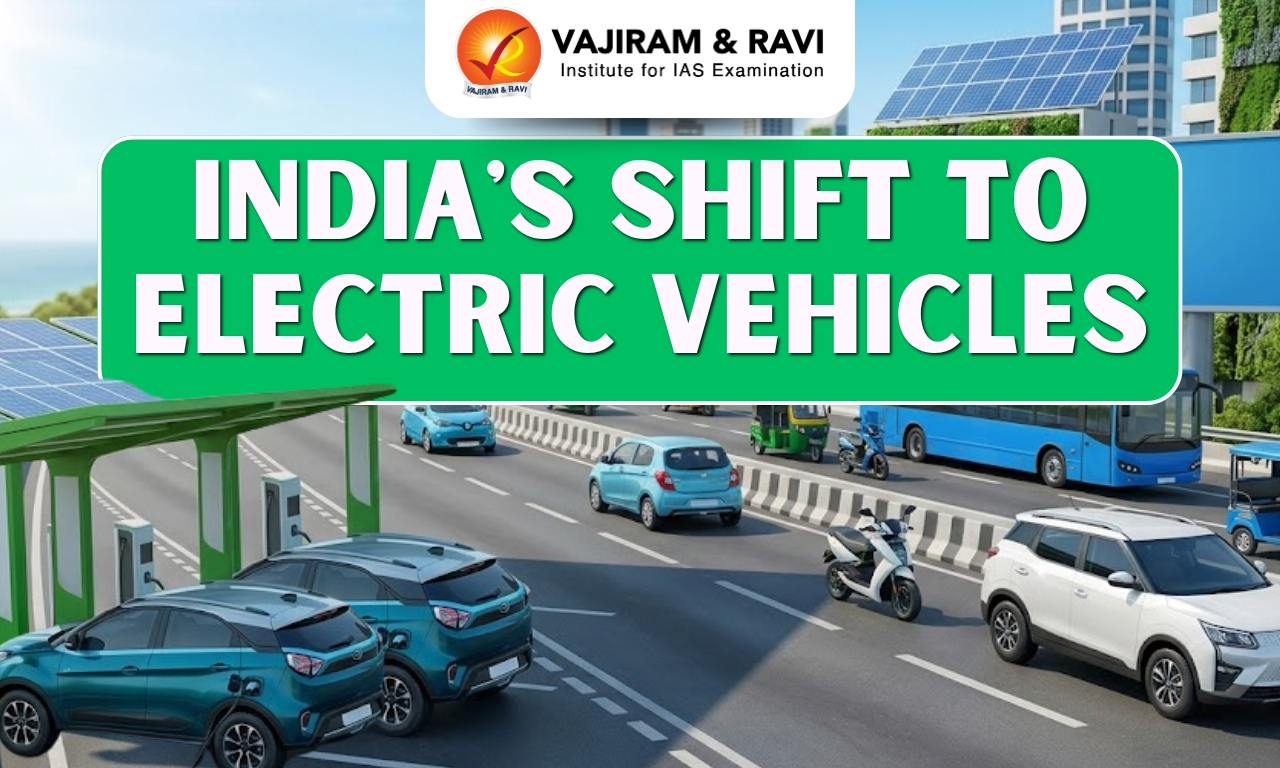
Electric mobility has become the new global industrial reality. According to the IEA Global EV Outlook 2025, EVs account for over 50% of new car sales in China, more than 20% in Europe, and around 10% in the United States. India is also transitioning from Internal Combustion Engine (ICE) vehicles to Electric Vehicles (EVs) as part of a broader shift towards clean, sustainable and future-ready mobility.
Status of India’s Transition Towards Electric Mobility
As the world’s third-largest automobile market, contributing nearly 7% to GDP, India is steadily transitioning towards electric mobility in line with the global shift to cleaner transportation.
- This transition is gaining momentum, with EVs accounting for 7.5% of total vehicle sales in 2024-25, including 6.1% of two-wheelers, 23.4% of three-wheelers, 2% of passenger cars and 5.3% of buses.
- Companies such as Tata Motors, Mahindra, Ather and Bajaj are investing in EV platforms, battery manufacturing and critical components.
- Simultaneously, India is strengthening the supporting ecosystem by expanding charging infrastructure, developing domestic battery manufacturing, securing critical mineral supply chains and promoting battery recycling.
- Guided by its vision of achieving 30% EV penetration by 2030, India aims to emerge as a global hub for clean mobility while advancing energy security, industrial competitiveness and climate goals.
Government Initiatives to Promote Electric Vehicles
The Government of India has adopted a comprehensive policy framework to accelerate EV adoption through demand incentives, domestic manufacturing, charging infrastructure and public transport electrification.
- National Electric Mobility Mission Plan (NEMMP) 2020: Provides the long-term roadmap for promoting electric mobility through faster EV adoption, domestic manufacturing and supporting infrastructure.
- FAME India Scheme (FAME-I & FAME-II): Promotes EV adoption through purchase incentives, charging infrastructure and support for electric buses.
- FAME-I (2015–19): Supported 2.55 lakh EVs and approved 520 charging stations.
- FAME-II (2019 onwards): Outlay of ₹11,500 crore; supported over 16.29 lakh EVs, sanctioned 6,862 e-buses, and facilitated installation of 8,885 public charging stations (as of June 2025).
- PM E-DRIVE Scheme (2024–28): A ₹10,900 crore flagship scheme providing incentives for electric two-wheelers, three-wheelers, trucks, ambulances and buses, while also supporting public charging infrastructure and EV testing facilities.
- Production Linked Incentive (PLI) Scheme for Auto & Auto Components: ₹25,938 crore scheme to promote domestic manufacturing of Advanced Automotive Technologies (AAT), attract investments and generate employment.
- PLI Scheme for Advanced Chemistry Cell (ACC) Batteries: ₹18,100 crore scheme to establish indigenous battery manufacturing capacity, reduce import dependence and strengthen the EV value chain.
- Scheme for Promotion of Manufacturing of Electric Passenger Cars (SPMEPCI): Encourages global and domestic manufacturers to establish EV manufacturing in India through investment-linked incentives and domestic value addition requirements.
- PM e-Bus Sewa Scheme: ₹20,000 crore scheme to deploy 10,000 electric buses under the PPP model for cleaner and more efficient urban public transport.
- PM e-Bus Sewa – Payment Security Mechanism (PSM): Provides financial security to public transport authorities and private operators to encourage large-scale deployment of electric buses.
- Expansion of Charging Infrastructure: Government is establishing EV charging stations at highways, cities and fuel outlets through public and private sector participation to reduce range anxiety.
- India Electric Mobility Index (IEMI): Developed by NITI Aayog to assess and rank States and Union Territories based on EV adoption, charging readiness and innovation.
- State EV Policies: Several states provide purchase subsidies, tax exemptions, registration fee waivers and incentives for EV manufacturing and charging infrastructure.
- Support for Domestic Value Chains: Initiatives under Make in India, Aatmanirbhar Bharat and the National Critical Mineral Mission aim to strengthen domestic manufacturing of batteries, EV components, critical minerals and recycling ecosystems.
Why is India Transitioning Towards Electric Vehicles?
India’s transition towards electric mobility is driven by environmental, economic, technological and strategic imperatives.
- Combat Air Pollution: Reduce vehicular emissions, a major contributor to urban air pollution, as EVs produce zero tailpipe emissions and are nearly three times more energy-efficient than ICE vehicles.
- Achieve Climate Commitments: Support India’s commitments under the Paris Agreement, reduce carbon emissions, and achieve Net Zero by 2070.
- Reduce Oil Import Dependence: Lower dependence on imported crude oil, improve energy security and reduce the current account deficit.
- Align with Global Transition: Keep pace with the global shift towards electric mobility, where EVs have become the new industrial reality, ensuring India’s automobile industry remains globally competitive.
- Promote Green Industrialisation: Build a globally competitive EV ecosystem spanning battery manufacturing, charging infrastructure, software, semiconductors, recycling and advanced automotive technologies.
- Generate Employment: Create high-quality jobs across EV manufacturing, battery production, R&D, charging infrastructure, digital services, maintenance and recycling, with the sector having the potential to generate over 50 million jobs by 2030.
- Reduce Lifetime Cost of Mobility: Despite higher upfront costs, EVs offer significantly lower running and maintenance costs, benefiting consumers, commercial operators and gig workers over the vehicle’s lifetime.
- Strengthen Energy Transition: As India’s renewable energy capacity expands, EVs will become progressively cleaner and cheaper to operate through green electricity and smart charging.
- Promote Aatmanirbhar Bharat: Develop domestic manufacturing of batteries, EV components and critical minerals while reducing dependence on imported technologies.
- Strengthen Strategic Resilience: Reduce vulnerability arising from fossil fuel imports and build resilient supply chains for critical minerals, battery materials and rare earth processing.
- Improve Urban Mobility: Support cleaner, quieter and more sustainable public transport through electrification of buses, two-wheelers and three-wheelers.
- Promote Technological Leadership: Encourage innovation in battery chemistry, power electronics, artificial intelligence, connected mobility and advanced manufacturing.
- Leapfrog to Clean Mobility: Move directly towards zero-emission transport instead of relying on transitional technologies such as hybrids, which continue to consume fossil fuels and provide only limited emission reductions.
- Improve Public Health and Quality of Life: Cleaner transport reduces pollution-related diseases, healthcare costs and environmental degradation, especially in highly polluted urban centres.
Challenges in India’s Shift to Electric Vehicles
India’s transition to electric mobility is essential for clean growth, but several economic, technological and institutional challenges need to be addressed to ensure a smooth and faster shift.
- Industry Resistance: Some automobile manufacturers oppose a rapid shift due to fears of revenue loss, stranded investments, high transition costs and increased competition from new EV firms.
- Inadequate Charging Infrastructure: Limited public charging stations and battery-swapping facilities continue to create range anxiety and slow EV adoption.
- Dependence on Critical Mineral Imports: India relies heavily on imports of lithium, cobalt, graphite, rare earths and battery components, with China dominating global processing.
- Weak Domestic Supply Chain: Limited domestic manufacturing of batteries, EV components and critical minerals increases import dependence and supply-chain vulnerabilities.
- High Upfront Purchase Cost: Although EVs have lower lifetime operating costs, their initial purchase price remains higher than conventional vehicles, especially for low-income buyers.
- Employment Transition Concerns: Mechanics and workers associated with ICE vehicle manufacturing and servicing fear job losses during the shift to electric mobility.
- Slow Policy Implementation: Delays in strengthening fuel efficiency standards and adopting Zero-Emission Vehicle (ZEV) mandates slow the pace of transition.
- Hybrid Vehicle Diversion: Continued emphasis on hybrid vehicles diverts investments away from full battery electric vehicles despite their limited environmental benefits.
- Battery Recycling Ecosystem: India still lacks a robust ecosystem for battery reuse, recycling and safe disposal of end-of-life batteries.
- Consumer Awareness and Range Anxiety: Concerns regarding charging availability, battery life and resale value continue to discourage many potential buyers.
- Need for Greater Industry Innovation: Higher investment in indigenous R&D, battery technology, charging solutions and advanced manufacturing is required to remain globally competitive.
- Balancing Growth with Clean Mobility: Policymakers must balance industrial interests with urgent public health concerns, as delaying the EV transition will only increase environmental and economic costs.
Way Forward
India’s transition to electric mobility requires a balanced approach that combines regulatory certainty, technological innovation, industrial competitiveness and consumer-centric policies.
- Provide a Clear Policy Roadmap: Adopt a time-bound strategy for the gradual phase-out of fossil fuel vehicles to provide regulatory certainty and encourage long-term investments.
- Strengthen Regulatory Framework: Tighten Corporate Average Fuel Efficiency (CAFE) norms and introduce Zero Emission Vehicle (ZEV) mandates to accelerate the adoption of clean mobility.
- Expand Charging Infrastructure: Develop an extensive network of public charging stations and battery-swapping facilities while ensuring the Right-to-Charge in residential and commercial buildings.
- Strengthen Domestic EV Ecosystem: Promote indigenous manufacturing of batteries, EV components, power electronics and critical minerals under Make in India and the National Critical Mineral Mission.
- Enhance Research and Innovation: Increase investments in advanced battery technologies, recycling, rare-earth alternatives and next-generation electric mobility solutions to improve technological self-reliance.
- Develop a Circular Economy: Establish efficient systems for battery reuse, recycling and recovery of critical minerals to enhance resource security and environmental sustainability.
- Facilitate Just Transition: Reskill workers employed in conventional automobile manufacturing and servicing to ensure a smooth and inclusive transition towards electric mobility.
- Improve Consumer Accessibility: Expand affordable financing, targeted incentives and innovative ownership models to reduce the upfront cost of EV adoption.
- Strengthen Industry-Government Partnership: Encourage automobile manufacturers to collaborate with the government in developing charging infrastructure, battery recycling, indigenous technologies and resilient supply chains.
- Align Economic and Environmental Goals: View electric mobility not merely as an environmental necessity but as a strategic opportunity to enhance energy security, reduce oil imports, improve air quality and position India as a global hub for clean mobility.
India’s Shift to Electric Vehicles FAQs
Q1: Why is India transitioning towards Electric Vehicles (EVs)?
Ans: India is promoting EVs to reduce air pollution, cut crude oil imports, achieve climate goals, improve energy security and build a globally competitive clean mobility industry. The EV ecosystem is also expected to generate over 50 million jobs by 2030.
Q2: What are the major government initiatives promoting electric mobility?
Ans: Key initiatives include NEMMP, FAME-I & FAME-II, PM E-DRIVE, PLI Schemes for Auto and ACC Batteries, PM e-Bus Sewa, SPMEPCI, expansion of charging infrastructure, India Electric Mobility Index (IEMI) and various State EV policies.
Q3: What are the major challenges in India’s EV transition?
Ans: Major challenges include inadequate charging infrastructure, dependence on imported critical minerals, high upfront costs, industry resistance, weak domestic supply chains, battery recycling gaps, employment transition concerns and the need for greater indigenous R&D.
Q4: How can India accelerate the transition towards electric mobility?
Ans: India should strengthen CAFE and ZEV regulations, expand charging infrastructure, promote domestic battery and EV manufacturing, invest in R&D and recycling, provide affordable financing, reskill workers and encourage industry-government collaboration.
Q5: Why are Electric Vehicles strategically important for India?
Ans: EVs reduce oil dependence and emissions, improve air quality and public health, support Net Zero 2070, strengthen Aatmanirbhar Bharat, create employment and position India as a global hub for clean mobility.