Shyok Tunnel, Location, Height, Connectivity, Significance

Shyok Tunnel

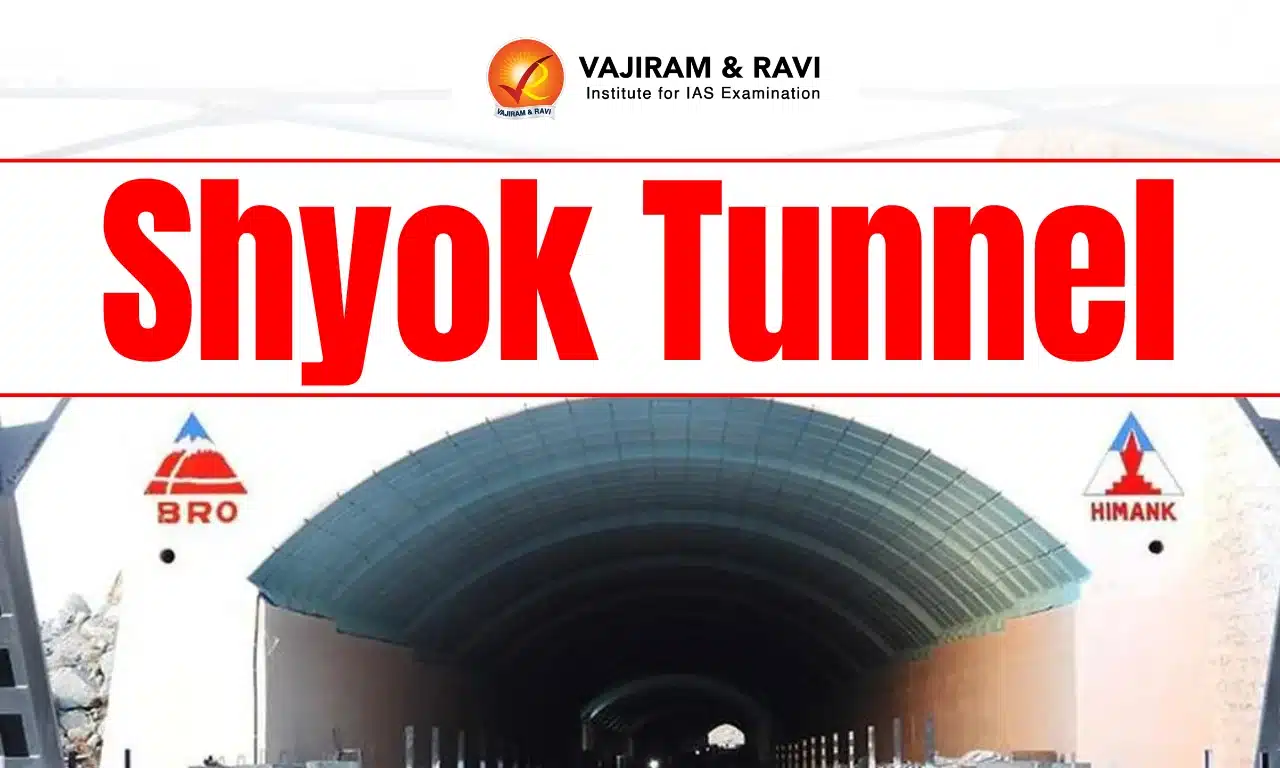
The Shyok Tunnel is a strategically important border infrastructure project built by the Border Roads Organisation (BRO) on the Darbuk-Shyok-Daulat Beg Oldie (DS-DBO) Road in eastern Ladakh. It was inaugurated by India's Defence Minister as part of 125 BRO infrastructure projects. The 920 metre cut and cover tunnel is located at an altitude of over 12,000 feet. It strengthens year round connectivity to India's northern frontier and supports faster movement to sensitive areas near the Line of Actual Control (LAC) with China.

Shyok Tunnel Features

The Shyok Tunnel improves transport in one of India's most difficult high altitude border regions through reliable all weather connectivity.

  • Location: The tunnel is built on the Darbuk-Shyok-Daulat Beg Oldie (DS-DBO) Road in eastern Ladakh. 
  • Connects: This strategic route connects Leh with Daulat Beg Oldie (DBO), India's northernmost military outpost near the Line of Actual Control (LAC).
  • Design and Construction: It is a 920 metre long cut and cover tunnel constructed by the Border Roads Organisation (BRO)
  • Height: The tunnel is situated at an altitude of more than 12,000 feet, making it one of the important high altitude border infrastructure projects.
  • All Weather Connectivity: The tunnel bypasses a road section regularly affected by heavy snowfall, avalanches, landslides and extreme winter conditions. It ensures uninterrupted movement even when nearby surface roads become inaccessible during harsh weather.
  • Built By: The Shyok Tunnel was inaugurated along with 125 BRO infrastructure projects, reflecting India's continued investment in strengthening transport and connectivity across strategically important border regions.

Shyok Tunnel Significance

The Shyok Tunnel plays a vital role in improving border logistics, military mobility and strategic preparedness in eastern Ladakh.

  • Support to Daulat Beg Oldie: The DS-DBO Road is the only surface route connecting Daulat Beg Oldie, India's northernmost military outpost. The tunnel strengthens this critical supply corridor and improves access to forward military positions.
  • Military Logistics: Reliable year round connectivity allows faster movement of troops, weapons, equipment and essential supplies. It significantly reduces disruptions during winter and helps maintain a stable logistics chain for forces deployed in eastern Ladakh.
  • Strategic Importance: The tunnel's strategic value increased after the 2020 Galwan Valley clashes and the subsequent military standoff with China. Improved mobility enhances India's operational readiness and strengthens border defence along the LAC.
  • Support for Siachen Region: Better connectivity on the DS-DBO Road also supports surveillance and logistical access towards the Siachen Glacier region, improving the efficiency of military operations in India's northern frontier.
  • National Security: The Shyok Tunnel reduces logistical vulnerabilities in a sensitive border area. Along with roads, bridges and other BRO infrastructure, it strengthens India's long term border management, rapid response capability and territorial security in Ladakh.

Shyok Tunnel FAQs

Q1: What is the Shyok Tunnel?

Ans: The Shyok Tunnel is a 920 metre cut and cover tunnel built by the Border Roads Organisation (BRO) on the DS-DBO Road in eastern Ladakh.

Q2: Where is the Shyok Tunnel located?

Ans: The Shyok Tunnel is located on the Darbuk-Shyok-Daulat Beg Oldie (DS-DBO) Road in eastern Ladakh near the Line of Actual Control (LAC) with China.

Q3: Why is the Shyok Tunnel important?

Ans: The tunnel provides all weather connectivity, improves military logistics and ensures uninterrupted access to Daulat Beg Oldie despite heavy snowfall, avalanches and landslides.

Q4: Which organisation constructed the Shyok Tunnel?

Ans: The Shyok Tunnel was constructed by the Border Roads Organisation (BRO) to strengthen strategic border infrastructure in eastern Ladakh.

Q5: Why did the Shyok Tunnel gain strategic importance after 2020?

Ans: Its importance increased after the 2020 Galwan Valley clashes, as it enables faster troop movement, reliable supply chains and stronger operational readiness along the Line of Actual Control (LAC).


F-35 Fighter Jets, Features, Variants, Technology, Global Use

F-35 Fighter Jets

The F-35 Fighter Jets are modern, advanced military aircraft developed by the United States. It is known for its stealth technology, which helps it avoid detection by enemy radar, and its ability to perform multiple roles such as air combat, ground attack, and surveillance. Designed with cutting-edge systems and high-speed capabilities, the F-35 is used by several countries to strengthen their air forces and maintain security. 

Why in News: F-35 Fighter Jets 

Recently, tensions between the United States and Iran escalated after both sides carried out military strikes, breaking a temporary pause in hostilities. In this context, Iran’s Islamic Revolutionary Guard Corps (IRGC) claimed that it destroyed three US F-35 stealth fighter jets at the Al-Azraq Air Base in Jordan during its retaliatory missile strikes. However, the United States rejected these claims.

F-35 Fighter Jets

The F-35 Lightning II is a fifth-generation fighter aircraft, which means it represents one of the most advanced categories of modern combat jets. It is designed as a multirole aircraft, capable of handling different types of missions such as air combat, ground attack, and reconnaissance operations. The aircraft has been developed by the American defense company Lockheed Martin, along with contributions from global partners.

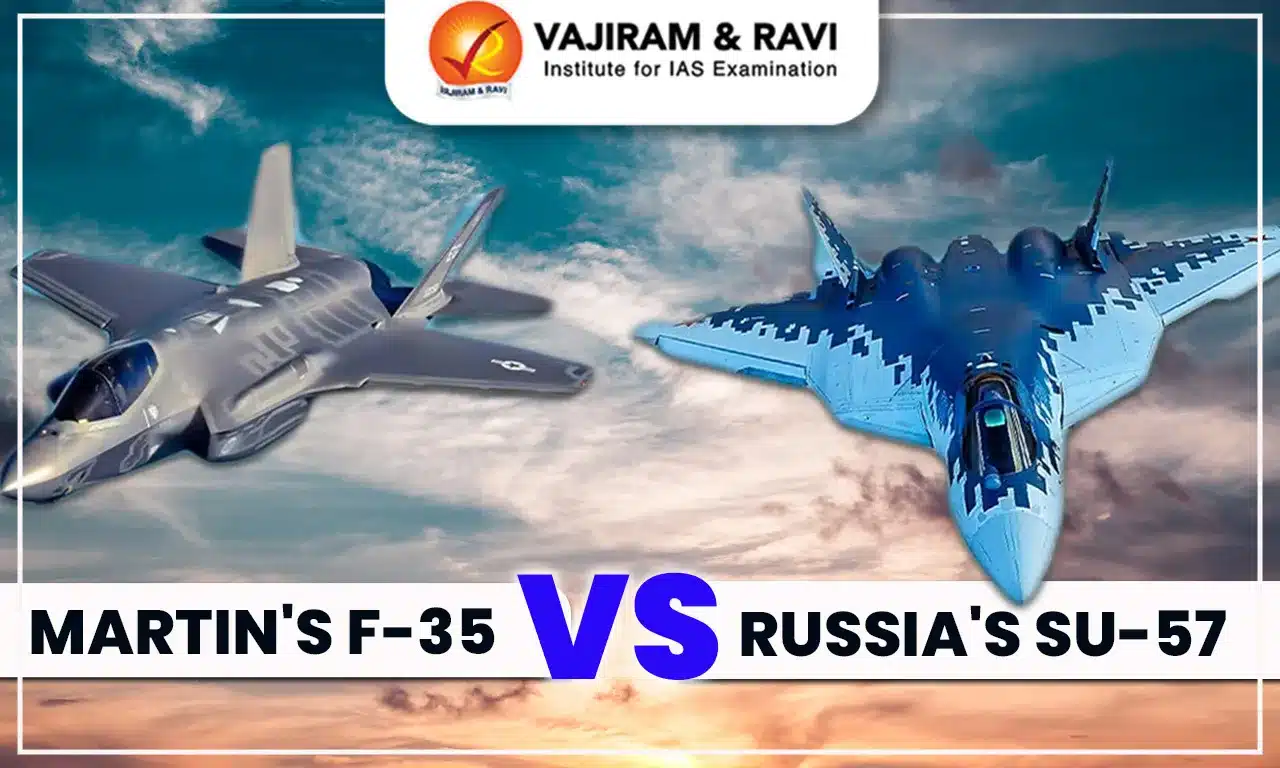
Also Read:- US Lockheed Martin's F-35 vs Russia's Su-57

Variants of the F-35

  • F-35A (CTOL - Conventional Takeoff and Landing):This version is designed for normal runways and is mainly used by air forces. It offers high maneuverability and is equipped with an internal cannon, making it suitable for traditional combat operations.
  • F-35B (STOVL - Short Takeoff and Vertical Landing):This variant can take off from short runways and land vertically like a helicopter, which makes it highly useful for operations from small bases or ships. It uses advanced lift-fan technology for this capability.
  • F-35C (Carrier-Based):This version is specially designed for aircraft carrier operations. It has larger wings and stronger landing gear, allowing it to operate efficiently from naval ships.

F-35 Fighter Jets Key Features

  • Stealth Technology:The F-35 is built using special designs and materials that reduce its visibility on radar, making it difficult for enemy systems to detect and track it. This gives it a major advantage in combat situations.
  • Advanced Avionics and Sensor Fusion:The aircraft is equipped with modern communication, radar, and surveillance systems. All this information is combined and displayed to the pilot in a simplified way, helping in better and faster decision-making during missions.
  • Powerful Weapon Systems:The F-35 can carry and launch a wide range of weapons, including advanced missiles and precision-guided bombs. It can perform both air-to-air and air-to-ground attacks effectively.
  • Network-Centric Warfare Capability:One of its most important features is connectivity. The F-35 can share real-time data with other aircraft, ground forces, and command centers, improving coordination and overall combat efficiency.
  • Supersonic and Multirole Capability:It is a single-seat, single-engine, supersonic jet capable of performing multiple missions in a single flight, which increases operational flexibility.

F-35 Fighter Jets Global Use and Importance

  • The F-35 is used by several countries including the United States, United Kingdom, Israel, Japan, South Korea, and Australia, among others.
  • It plays a major role in intelligence, surveillance, reconnaissance (ISR), and precision strike missions across the world.
  • Due to its advanced features, it is considered crucial for maintaining air superiority and national security in modern warfare.

F-35 Fighter Jets FAQs

Q1: What is the F-35 fighter jet?

Ans: The F-35 is a fifth-generation stealth fighter aircraft developed by the United States, designed for multiple missions like air combat, ground attack, and surveillance.

Q2: Who developed the F-35 Lightning II?

Ans: The F-35 was developed by Lockheed Martin, along with contributions from several international partners.

Q3: Why is the F-35 called a fifth-generation fighter?

Ans: It is called a fifth-generation fighter because it combines stealth technology, advanced sensors, and network-based warfare capabilities, making it highly advanced.

Q4: What are the main variants of the F-35?

Ans: The three main variants are F-35A (CTOL), F-35B (STOVL), and F-35C (carrier-based), each designed for different operational needs.

Q5: What makes the F-35 stealthy?

Ans: The F-35 uses special design shapes and radar-absorbing materials, which reduce its visibility on enemy radar systems.

Delimitation and Lok Sabha Expansion, Need, Issues, Way Forward

Delimitation and Lok Sabha Expansion

The delimitation exercise has emerged as one of the most significant constitutional issues in India. Along with the proposed readjustment of parliamentary constituencies, discussions on increasing the strength of the Lok Sabha from 543 seats to nearly 800-850 seats have raised important questions regarding democratic representation, cooperative federalism and the effectiveness of Parliament.

About Delimitation

Delimitation is the process of redrawing the boundaries of parliamentary and legislative assembly constituencies and reallocating seats among States based on changes in population.

Its primary objective is to uphold the democratic principle of “One Person, One Vote, One Value” by ensuring that each elected representative represents nearly an equal number of people.

The delimitation exercise is conducted by an independent Delimitation Commission, whose decisions have the force of law and cannot ordinarily be challenged before courts.

Delimitation Constitutional Framework

The Constitution provides a comprehensive framework for delimitation and representation.

  • Article 81: Provides for the composition of the Lok Sabha and allocation of seats among States based on population.
  • Article 82: Mandates Parliament to enact a Delimitation Act after every Census to readjust parliamentary constituencies.
  • Article 170: Provides similar provisions for the readjustment of seats in State Legislative Assemblies.
  • Article 327: Empowers Parliament to legislate on matters relating to elections.

Historical Evolution of Delimitation in India

India has conducted delimitation exercises periodically to maintain representative equality.

  • First Delimitation Commission (1952) established after the first general elections to determine parliamentary and assembly constituencies.
  • Delimitation Commissions were constituted in 1963, 1973 and 2002.
  • 42nd Constitutional Amendment Act, 1976 froze the allocation of Lok Sabha and State Assembly seats based on the 1971 Census. The objective was to encourage population control by ensuring that States adopting family planning measures were not politically disadvantaged.
  • 84th Constitutional Amendment Act, 2001extended the freeze on inter-State allocation of seats until the first Census after 2026. Allowed readjustment of constituency boundaries.
  • 87th Constitutional Amendment Act, 2003 permitted delimitation using the 2001 Census without altering the number of seats allocated to States.
  • 106th Constitutional Amendment Act, 2023 provides one-third reservation for women in the Lok Sabha and State Assemblies after the completion of delimitation following the Census.

Need for Fresh Delimitation

India’s demographic and socio-economic landscape has changed significantly since the last major seat allocation.

  • Changing Population Distribution: The present allocation of seats is based on the population pattern of 1971, which no longer reflects current demographic realities.
  • Growing Representation Gap: Several MPs today represent a much larger population compared to earlier decades, making effective representation challenging.
  • Rapid Urbanisation: Emerging metropolitan regions and urban centres require adequate political representation.
  • Maintaining Democratic Equality: A democracy must periodically update its institutions to ensure that citizens have equal political representation.
  • Constitutional Requirement: The Constitution envisages periodic readjustment to ensure that democratic institutions reflect contemporary realities.

Arguments in Favour of Lok Sabha Expansion through Delimitation

Supporters argue that expansion is necessary to correct representational inequalities created by decades of population growth and changing demographic patterns.

  • Ensuring Equal Political Representation: Increasing seats can reduce the population represented by each MP and strengthen the principle of equal representation.
  • Reducing MP-Citizen Distance: Smaller constituencies can improve accessibility, responsiveness and interaction between citizens and elected representatives.
  • Representing Emerging Regions: Growing urban centres and densely populated regions can receive representation according to their present demographic importance.
  • Correcting Constituency Imbalance: Delimitation can reduce disparities where some MPs represent significantly larger populations than others.
  • Strengthening Inclusive Representation: Expansion can create greater opportunities for representation of women and marginalised communities.
  • Facilitating Women’s Reservation: The exercise provides the constitutional pathway for implementing women’s reservation in legislatures.
  • Enhancing Democratic Legitimacy: A Parliament reflecting contemporary population realities can strengthen public confidence in representative institutions.

Concerns Against Lok Sabha Expansion through Delimitation 

Critics argue that while representation is important, an oversized Parliament may weaken the very democratic functions it is expected to perform.

Impact on Parliamentary Deliberation

  • Reduced Participation of MPs: Parliamentary time is limited; a very large House may leave many MPs with fewer opportunities to participate in debates and Question Hour.
  • Decline in Quality of Debate: Beyond a certain size, a legislature may become less deliberative and more focused on numerical strength.
  • Marginalisation of Backbenchers: Smaller parties and individual MPs may struggle to get adequate space to raise issues and influence legislation.

Weakening Executive Accountability

  • Reduced Parliamentary Scrutiny: A Parliament where fewer members actively participate may weaken examination of government policies and Bills.
  • Risk of Executive Dominance: When legislative debate declines, the executive may gain greater control over the law-making process.
  • Parliament as a Voting Body: An oversized chamber may risk reducing MPs to numbers required for voting rather than active contributors to policymaking.

Challenges for Parliamentary Committees

  • Overburdened Committee System: Increasing the number of MPs without proportionately strengthening Department-related Standing Committees may reduce the quality and effectiveness of legislative scrutiny.
  • Limited Research Support: Insufficient professional and research assistance may affect MPs’ ability to effectively examine complex Bills and policies.

Financial and Administrative Burden

  • Higher Public Expenditure: Expansion would require additional spending on salaries, accommodation, offices, staff and parliamentary facilities.
  • Infrastructure Requirements: A larger Parliament requires adequate institutional infrastructure and support systems.

Federal Concerns Associated with Delimitation

Delimitation is not only an electoral issue; it also affects India’s federal balance.

  • Concerns of Southern States: States, particularly in southern India, have expressed concerns that they may be politically penalised for successfully implementing population stabilisation measures. Through investments in education, healthcare and family planning, these States achieved lower fertility rates and controlled population growth. However, a delimitation based primarily on population numbers could reduce their relative share of Lok Sabha seats while increasing the representation of States with higher population growth.

Global Experience and Lessons for India

International experience suggests that the effectiveness of a legislature depends not merely on the number of representatives but on the strength of supporting institutions, parliamentary procedures and accountability mechanisms.

The United States House of Representatives provides an important example. Despite a significant increase in population, the size of the House has remained fixed at 435 members since 1929. Instead of continuously expanding representation, the US strengthened constituency offices, professional legislative staff, communication systems and committee mechanisms to enable representatives to effectively serve larger populations.

The key lesson for India is that representation cannot be measured only through the number of MPs. Any expansion of the Lok Sabha should be accompanied by institutional reforms such as : 

  • Strengthening Parliamentary Committees: More Bills should undergo detailed committee examination before being passed.
  • Increasing Parliamentary Working Days: More sitting days are required for meaningful debate and accountability.
  • Providing Professional Support to MPs: Legislative researchers and policy experts can improve the quality of parliamentary work.
  • Clarifying Roles of Different Levels of Government: MPs should focus on national legislation, economic policy, foreign affairs and executive accountability.
  • Empowering Local Governments: Panchayats and Municipalities under the 73rd and 74th Constitutional Amendments should be strengthened to handle grassroots issues.

Way Forward

India needs a balanced approach that improves representation without weakening parliamentary effectiveness.

  • Build Political Consensus: The Union Government, States and political parties should engage in constructive dialogue.
  • Balance Population and Federal Equity: The delimitation framework should respect both demographic realities and concerns of States that achieved population stabilisation.
  • Link Expansion with Institutional Reform: Any increase in Lok Sabha strength should be accompanied by stronger committees, better research support and improved parliamentary procedures.
  • Strengthen Decentralisation: Empowered local institutions can reduce excessive dependence on MPs for local governance issues.
  • Focus on Quality Representation: The success of democracy depends not only on the number of representatives but also on their ability to debate, scrutinise and hold power accountable.

Delimitation and Lok Sabha Expansion FAQs

Q1: What is delimitation?

Ans: Delimitation is the process of redrawing electoral boundaries and reallocating seats based on population changes to ensure equal representation.

Q2: Which constitutional provisions deal with delimitation?

Ans: Articles 81, 82, 170 and 327 provide the constitutional framework for delimitation and electoral readjustment.

Q3: Why were Lok Sabha seats frozen after the 1971 Census?

Ans: The 42nd Constitutional Amendment Act, 1976 froze seat allocation to encourage population stabilisation and prevent States adopting family planning measures from losing representation.

Q4: Why are southern States concerned about delimitation?

Ans: They fear losing their relative representation despite successfully controlling population growth through better social development outcomes.

Q5: What are the concerns regarding Lok Sabha expansion?

Ans: Critics argue that an oversized Lok Sabha may weaken debate, legislative scrutiny and executive accountability unless supported by institutional reforms.

India Becomes World’s Second-Largest Supplier Of Seafarers

India Becomes World’s Second-Largest Supplier Of Seafarers

Recently, India has emerged as the world’s second-largest supplier of seafarers, according to the BIMCO-ICS Seafarer Workforce Report 2026

India’s Rise in Global Seafaring Workforce

According to the BIMCO-ICS Seafarer Workforce Report 2026, India contributes 311,936 maritime professionals, accounting for 12.16% of the global seafaring workforce.

  • India has moved from the fifth position in 2015 to the second position in 2026, demonstrating significant growth in its maritime manpower capabilities.
  • In 2015, India accounted for only 5.2% of the global seafaring workforce, which increased to 6% in 2021 before rising sharply to 12.16% in 2026.
  • India now ranks second globally after the Philippines and ahead of China, the Russian Federation and Indonesia in supplying seafarers.
  • India’s contribution is particularly strong in the officer category, with 140,718 officers representing 13.41% of the global officer workforce.
  • The country also supplies 171,218 ratings, contributing 11.29% of the global ratings serving aboard merchant vessels.
  • The growing presence of Indian seafarers strengthens India’s role in supporting international trade and meeting the rising demand for skilled maritime professionals.

Factors Behind India’s Rise in Global Seafaring Workforce

India’s emergence as a leading supplier of seafarers has been driven by continuous reforms in maritime education, skill development, regulatory modernisation and alignment with global shipping standards.

  • Expansion of maritime education and training infrastructure has increased the availability of skilled professionals capable of meeting the requirements of the international shipping industry.
  • Modernisation of maritime training institutes and improvement in shipboard training opportunities have enhanced the practical skills and employability of Indian seafarers.
  • Digitisation of seafarer certification, documentation and regulatory services through the Directorate General of Shipping (DGS) has improved transparency, efficiency and ease of access for maritime professionals.
  • India has strengthened compliance with the International Maritime Organization’s Standards of Training, Certification and Watchkeeping (STCW), ensuring global recognition of Indian seafarers.
  • The government has introduced major maritime sector reforms, including the Inland Vessels Act, 2021, to create a modern regulatory framework for inland water transport.
  • Legislative reforms such as the Merchant Shipping Act, 2025, Indian Ports Act, 2025, Coastal Shipping Act, 2025, Bills of Lading Act, 2025 and Carriage of Goods by Sea Act, 2025 have modernised maritime governance and aligned Indian laws with international conventions.
  • These reforms have focused on improving seafarer welfare, simplifying regulatory procedures, strengthening maritime safety and promoting ease of doing business in the shipping sector.
  • Greater focus on skill development, industry-academia partnerships and adoption of digital technologies has improved the global competitiveness of Indian maritime professionals.
  • Initiatives under Maritime India Vision 2030 and Maritime Amrit Kaal Vision 2047 have provided a long-term roadmap for developing India as a leading maritime nation.

Mission 20%: India’s Future Roadmap

Building on these reforms and the growing demand for skilled maritime professionals, the government has launched Mission 20% to further strengthen India’s position in the global seafaring sector.

  • The initiative aims to increase India’s share of the global seafaring workforce from the current 12.16% to 20%, ensuring greater participation of Indian professionals in international shipping.
  • Mission 20% focuses on expanding maritime training capacity, improving shipboard training opportunities and strengthening industry-academia partnerships to create a future-ready workforce.
  • The initiative also promotes the use of digital technologies in maritime education and aims to increase the participation of women in seafaring careers.
  • The long-term vision is to ensure that one out of every five seafarers serving on merchant ships globally is an Indian professional recognised for competence, professionalism and excellence.

About BIMCO-ICS Seafarer Workforce Report 2026

The BIMCO-ICS Seafarer Workforce Report is a globally recognised report that analyses the availability and demand of seafarers in the global maritime industry.

  • The report provides insights into global workforce trends, seafarer supply, demand patterns and future manpower requirements of the shipping sector.
  • The 2026 edition highlights the shortage of qualified officers worldwide, creating a growing demand for skilled maritime professionals.
  • It estimates the global seafaring workforce at 2.57 million, while the demand stands at 2.55 million, indicating a tight maritime labour market.
  • The report highlights India’s growing importance as a major supplier of skilled seafarers and its role in supporting global shipping operations.

India Becomes World’s Second-Largest Supplier Of Seafarers FAQs

Q1: What is the BIMCO-ICS Seafarer Workforce Report?

Ans: BIMCO-ICS Seafarer Workforce Report is a global report that assesses the supply and demand of seafarers and provides insights into maritime workforce trends.

Q2: What is India’s rank in global seafarer supply according to the BIMCO-ICS Seafarer Workforce Report 2026?

Ans: India has become the world’s second-largest supplier of seafarers, ranking after the Philippines and ahead of China, the Russian Federation and Indonesia.

Q3: Which country is the largest supplier of seafarers globally?

Ans: The Philippines is the world’s largest supplier of seafarers.

Q4: What is India’s share in the global seafaring workforce?

Ans: India accounts for 12.16% of the global seafaring workforce with 311,936 maritime professionals.

Q5: What is Mission 20% related to?

Ans: Mission 20% aims to increase India’s share of the global seafaring workforce from 12.16% to 20%.

Helicopter Money, Features, Working, Advantages, Risks, Examples

Helicopter Money

Helicopter Money is a simple idea used in times when the economy is weak and people are not spending enough, where the government or central bank creates new money and gives it directly to citizens to boost spending and demand; the term comes from Milton Friedman, who imagined money being dropped from a helicopter for people to pick up, and while this approach can quickly stimulate economic activity, it is used carefully because it may also lead to inflation if too much money is circulated.

Helicopter Money

  • Helicopter Money is an unconventional monetary policy tool used during economic crisis situations like recession or deflation, when traditional tools become less effective
  • It involves the central bank creating new money and ensuring its direct transfer to people, usually with the help of the government
  • The main aim is to increase demand in the economy by encouraging higher spending and consumption
  • Unlike traditional policies, it does not go through banks or financial institutions, making it more direct and immediate
  • The idea was proposed by Milton Friedman, who explained it as money being dropped from a helicopter
  • It was later popularized by Ben Bernanke in the context of modern economic challenges
  • The concept gained importance during the COVID-19 pandemic, when many countries used direct cash transfers and stimulus packages similar to helicopter money.

Also Read : Reserve Bank of India

Working of Helicopter Money Works in an Economy

  • The process starts when the central bank creates new money, either by printing it or generating it digitally.
  • This newly created money is then given directly to the public, usually through the government in the form of cash transfers, direct deposits, or tax cuts.
  • Unlike traditional methods, this approach does not go through banks or lending systems, so money reaches people quickly.
  • Once people receive the money, they tend to spend it on goods and services, increasing overall consumer demand.
  • As demand rises, businesses respond by increasing production, which helps improve economic activity and growth.
  • This increase in spending also helps raise inflation slightly, which is useful during periods of deflation or very low price growth.
  • The process works by directly injecting money into the hands of consumers, leading to higher spending and helping the economy recover.

Helicopter Money Advantages

  • Immediate Boost to Demand: Helicopter Money puts money directly into people’s hands, which means they can start spending right away. This leads to a quick rise in demand for goods and services, helping businesses recover faster.
  • No Increase in Government Debt: Unlike traditional stimulus methods, this policy does not depend on borrowing money. Since the central bank creates the money, there is no additional burden of public debt on the government.
  • No Fear of Future Tax Burden: Because the government is not borrowing, people do not have to worry about higher taxes in the future to repay that money. This makes consumers more confident and willing to spend.
  • Effective Against Deflation and Recession: Helicopter money is especially useful during deflation (falling prices) or deep recessions, as it quickly injects money into the economy and helps revive economic activity.
  • Direct Impact Without Banking Delays: Unlike Quantitative Easing, which works through banks, helicopter money bypasses the banking system and ensures that funds reach people directly, making it faster and more effective.
  • Stronger Impact on Economic Growth: Since people receive cash directly, it leads to an immediate increase in aggregate demand, which can stimulate economic growth more effectively compared to indirect policies like QE.
  • Maintains Stable Interest Rates: As the government does not need to borrow heavily from markets, this helps in keeping interest rates stable, avoiding sudden fluctuations.
  • Avoids Crowding Out of Private Investment: Because funds are created by the central bank and not taken from investors, private investments are not reduced or pushed aside, allowing both public and private sectors to grow together.
  • Simple and Quick Policy Tool: The process is straightforward and easy to implement, especially during emergencies, making it a useful last-resort option to revive a struggling economy.
  • Builds Consumer Confidence: When people receive direct financial support, it improves confidence and financial security, encouraging them to spend rather than save excessively during uncertain times.

Also Read : Monetary Policy in India

Helicopter Money Disadvantages

  • Irreversible Nature of Policy: Helicopter Money is permanent in nature, meaning once money is given to people, it cannot be taken back easily. This makes it risky, as mistakes cannot be corrected later, unlike other policies.
  • Not a Long-Term Solution: Many economists argue that it is not suitable for long-term economic growth, because it provides only a temporary boost in spending without addressing deeper structural problems.
  • Risk of High Inflation: When a large amount of money is injected into the economy, it can lead to too much demand, causing prices of goods and services to rise rapidly (inflation). In extreme cases, it may even lead to hyperinflation.
  • Currency Devaluation: Printing excessive money can reduce the value of the domestic currency in global markets, making it weaker in the foreign exchange market and reducing its purchasing power.
  • Loss of Purchasing Power: As inflation rises and currency value falls, people may find that their money buys fewer goods and services, negatively affecting real income.
  • No Repayment Discipline: Since the money is given without any repayment obligation, critics say it may encourage careless economic behavior and reduce financial discipline in the system.
  • Loss of Trust in the Monetary System: Bypassing traditional fiscal and monetary rules may reduce confidence in the central bank, both domestically and internationally, affecting its credibility.
  • Uncertain Spending Behavior: There is no guarantee that people will spend the money; they might save it instead, reducing the intended impact on demand and growth.
  • Impact on Foreign Investment: A weaker currency and unstable policies may discourage foreign investors, as they may see the economy as risky.
  • Comparison with Other Policies: Unlike Quantitative Easing, which can be reversed and controlled, helicopter money is less flexible and harder to manage once implemented.

Helicopter Money vs Quantitative Easing Key Differences

Helicopter Money and Quantitative Easing (QE) are two important unconventional monetary policy tools used by central banks during times of economic stress.The key differences between them are discussed below to help clearly understand how each approach functions and when it is used. 

Helicopter Money vs Quantitative Easing Key Differences

Basis

Helicopter Money

Quantitative Easing (QE)

Basic Meaning

Helicopter Money means creating new money and giving it directly to people to boost spending.

Quantitative Easing means creating money to buy government bonds or financial assets from banks.

How It Works

Money is directly distributed to the public through cash transfers, checks, or tax cuts.

Money is used by the central bank to purchase securities from banks and institutions.

Flow of Money

Goes straight into people’s hands, increasing spending immediately.

Goes first to banks and financial institutions, which may then lend it further.

Repayment / Liability

No repayment required; people receive money freely with no debt created.

The government must repay for the bonds/assets bought by the central bank, so it involves indirect liability.

Impact on Central Bank Balance Sheet

Does not create corresponding assets, as money is simply distributed.

Increases assets on the central bank’s balance sheet (government bonds, securities).

Reversibility

Permanent and irreversible; once given, money is not taken back.

Reversible; central bank can sell assets later to withdraw money from the economy.

Speed of Impact

Has a quick and direct effect on demand because people spend immediately.

Has a slower, indirect effect, depending on bank lending and borrowing.

Main Objective

To boost consumer demand and inflation quickly during deep recession or deflation.

To lower interest rates, increase liquidity, and encourage lending in the economy.

Economic Impact

Can rapidly increase spending, but may lead to high inflation or currency weakening if overused.

Helps stabilize markets and improves credit flow, but may increase wealth inequality and has less direct impact on consumers.

Channels Used

Bypasses the banking system, directly reaches citizens.

Works through the banking and financial system.

Real-World Use

Seen in direct cash transfers or stimulus payments (e.g., during COVID-19).

Widely used by central banks like the Federal Reserve during crises like the 2008 recession.

When Do Governments Use Helicopter Money?

  • During Deep Economic Crises: Governments and central banks use Helicopter Money when the economy is facing a serious slowdown or crisis, and immediate action is needed to revive growth and confidence.
  • When Interest Rates Are Near Zero: In situations where interest rates are already very low or close to zero, central banks cannot reduce them further to encourage borrowing, so they turn to more direct methods like helicopter money.
  • In Liquidity Trap Conditions: This policy is used during a liquidity trap, where even cheap loans do not encourage people or businesses to borrow and spend, making traditional monetary tools ineffective.
  • During Severe Deflation: When the economy experiences continuous fall in prices (deflation) and people start saving instead of spending, helicopter money helps by pushing money directly into circulation.
  • When Consumer Spending Collapses: If people stop spending due to uncertainty or crisis, it leads to reduced demand. In such cases, direct cash support helps restart consumption and market activity.
  • When Quantitative Easing (QE) Fails: If Quantitative Easing does not effectively reach common people and money remains within banks or financial markets, helicopter money is used to directly impact households.

Real-World Examples of Helicopter Money Policies

  • Japan’s Consideration (2016): Japan explored the idea of helicopter money during its long period of slow growth. Ben Bernanke discussed possible measures with Shinzo Abe and Haruhiko Kuroda, but instead of directly distributing cash, Japan chose large-scale asset purchases.
  • COVID-19 Stimulus in the United States: A practical example close to helicopter money was seen in the United States during the COVID-19 crisis, when the government provided direct cash payments to citizens to support spending.
  • Combined Policy Approach: Along with direct payments, the Federal Reserve also used Quantitative Easing (QE), showing how helicopter money-like measures are often used alongside other policies to stabilize the economy.

Helicopter Money FAQs

Q1: What is Helicopter Money in simple terms?

Ans: Helicopter Money is an economic policy where the central bank creates new money and gives it directly to people to increase spending and boost the economy.

Q2: Why is it called Helicopter Money?

Ans: The term was coined by Milton Friedman, who imagined money being dropped from a helicopter as a simple way to explain direct cash distribution.

Q3: When is Helicopter Money used?

Ans: It is used during economic crises, recessions, deflation, or when interest rates are near zero and traditional policies stop working.

Q4: How does Helicopter Money work?

Ans: The central bank creates new money and distributes it directly to citizens, increasing spending, demand, and economic activity.

Q5: Is Helicopter Money the same as Quantitative Easing (QE)?

Ans: No, Helicopter Money gives money directly to people, while QE injects money into banks by buying financial assets.

UPSC Daily Quiz 31 July 2026

UPSC Daily Quiz

[WpProQuiz 220]

UPSC Daily Quiz FAQs

Q1: What is the Daily UPSC Quiz?

Ans: The Daily UPSC Quiz is a set of practice questions based on current affairs, static subjects, and PYQs that help aspirants enhance retention and test conceptual clarity regularly.

Q2: How is the Daily Quiz useful for UPSC preparation?

Ans: Daily quizzes support learning, help in revision, improve time management, and boost accuracy for both UPSC Prelims and Mains through consistent practice.

Q3: Are the quiz questions based on the UPSC syllabus?

Ans: Yes, all questions are aligned with the UPSC Syllabus 2025, covering key areas like Polity, Economy, Environment, History, Geography, and Current Affairs.

Q4: Are solutions and explanations provided with the quiz?

Ans: Yes, each quiz includes detailed explanations and source references to enhance conceptual understanding and enable self-assessment.

Q5: Is the Daily UPSC Quiz suitable for both Prelims and Mains?

Ans: Primarily focused on Prelims (MCQ format), but it also indirectly helps in Mains by strengthening subject knowledge and factual clarity.

Honour Killing, Meaning, Causes, Indian Context, Safeguards

Honour Killing

Honour Killing is a serious human rights and social issue in which individuals are murdered by family or community members for allegedly bringing dishonour through marriage, relationships or personal choices. In India, it is closely associated with caste, patriarchy, gender discrimination and informal social control. The issue raises important concerns regarding constitutional rights, legal safeguards, judicial interventions, crime trends and the need for stronger institutional and social measures to protect individual freedom and dignity.

What is Honour Killing?

Honour Killing refers to the murder of a person, usually a woman or a young couple, by relatives or community members for allegedly violating family or community honour. Such killings commonly arise from inter caste, inter faith, same gotra or self choice marriages, refusal of arranged marriages, divorce or even suspicion regarding personal relationships. 

Honour Killing in India

Honour Killings remain a serious social problem despite constitutional guarantees of equality and liberty.

  • Nature of Crime: Honour Killings generally target couples involved in inter caste, inter faith or self choice marriages. Women are disproportionately affected because patriarchal societies treat their marriage and sexuality as symbols of family prestige.
  • Caste Based Violence: In India, caste remains deeply embedded in society. Honour Killings are increasingly used to preserve caste hierarchy by preventing inter caste marriages, particularly where dominant castes oppose relationships involving Dalits.
  • Underreporting of Cases: Honour Killings are not recognised as a separate offence by the National Crime Records Bureau (NCRB). They are recorded under murder, making proper identification, classification and policy intervention difficult.
  • NCRB Statistics: According to Crime in India data, reported Honour Killing cases were 25 in 2020, increased to 33 in 2021 and declined to 18 in 2022. Experts believe actual numbers are significantly higher due to underreporting.
  • State Wise Pattern: During 2020-2022, Jharkhand, Punjab, Madhya Pradesh, Haryana, Telangana, Andhra Pradesh, Bihar and Chhattisgarh reported notable cases, while several States recorded none, indicating regional variations and reporting differences.
  • Continuing Social Acceptance: Many incidents remain hidden because families, village communities or local groups justify such violence. In several cases, murders are falsely reported as suicides or accidents, preventing proper investigation.

Causes of Honour Killing in India

Honour Killings result from the combined influence of caste, patriarchy, family control and weak enforcement of law.

  • Patriarchal Mindset: Male family members often consider themselves responsible for protecting women's "purity" and family honour. Women exercising independent choices regarding marriage or relationships are viewed as dishonouring the family.
  • Rigid Caste System: Inter caste marriages, particularly involving Dalits and dominant castes, are viewed as threats to traditional social hierarchy, leading to violent reactions from families and communities.
  • Family Socialisation: Caste identity and honour values are passed through family traditions, customs, marriage practices and inherited prejudices, making children accept caste boundaries from an early age.
  • Community Pressure: Informal institutions such as Khap Panchayats in northern India and similar caste councils in southern India reinforce caste endogamy and often support punishment against couples defying social norms.
  • Paradox of Social Progress: States such as Tamil Nadu, Telangana, Maharashtra and Kerala witness both greater Dalit empowerment and higher inter caste marriages, resulting in stronger backlash from dominant caste groups.
  • Weak Criminal Justice Response: Honour Killings are frequently concealed, poorly investigated or supported indirectly by local communities, reducing accountability and encouraging perpetrators.
  • Digital Reinforcement: Social media platforms sometimes amplify caste pride, inherited social privilege and hostility towards inter caste relationships, strengthening community based resistance to individual choice.

Honour Killing Implications

Honour Killings affect individuals, families, society, governance and India's human rights record.

  • Violation of Human Rights: Honour Killings directly violate the right to life, dignity, equality, liberty and freedom of personal choice guaranteed under the Constitution.
  • Gender Inequality: Women remain the primary victims because patriarchal norms restrict their autonomy over marriage, education, sexuality and personal decisions.
  • Reinforcement of Caste Hierarchy: Such crimes preserve caste based discrimination by discouraging inter caste marriages and maintaining inherited social divisions instead of promoting equality.
  • Psychological Trauma: Families, survivors and young people experience fear, insecurity, emotional distress and hesitation in exercising their constitutional right to choose a life partner.
  • Weakening Rule of Law: Parallel caste councils and community diktats challenge constitutional authority, reduce public confidence in governance and undermine democratic institutions.
  • International Concern: Honour Killings attract global human rights criticism and negatively affect India's image regarding gender justice, equality and protection of fundamental freedoms.

Honour Killing Constitutional Safeguards

The Constitution provides strong protection against Honour Killing and violence through fundamental rights.

  • Article 14: Guarantees equality before law and equal protection of laws, ensuring every individual receives equal legal protection irrespective of caste, religion, gender or community.
  • Article 15: Prohibits discrimination based on religion, race, caste, sex or place of birth, thereby protecting individuals entering inter caste or inter faith marriages.
  • Article 19: Protects freedom of choice, movement, association and expression, including the liberty of adults to choose their partners without unlawful interference.
  • Article 21: Guarantees the right to life and personal liberty. The Supreme Court has consistently recognised the freedom to marry a person of one's choice as part of this right.

Honour Killing Legal Safeguards

India addresses Honour Killings through existing criminal laws and marriage related legislation.

  • Bharatiya Nyaya Sanhita 2023: Honour Killings are prosecuted as murder under criminal law because no separate legislation specifically defines Honour Killing as an independent offence.
  • Special Marriage Act 1954: Provides legal recognition to inter caste and inter faith marriages, although such marriages often face opposition from families and informal caste bodies.
  • Hindu Marriage Act 1955: Recognises inter caste and sagotra marriages within the legal framework, challenging traditional caste based restrictions on matrimonial alliances.

Honour Killing Case Laws

The Supreme Court has consistently protected individual choice and condemned Honour Killing and violence.

  • Lata Singh vs. State of U.P. (2006): The Supreme Court declared inter caste marriages legal and directed police authorities to provide protection to couples facing threats from family members.
  • Arumugam Servai vs. State of Tamil Nadu (2011): The Court held Khap Panchayats illegal and stated that any orders targeting inter caste marriages must be firmly suppressed.
  • Vikas Yadav vs. State of U.P. (2016): The Supreme Court ruled that women's freedom to choose their life partner cannot be restricted in the name of family honour.
  • Shakti Vahini vs. Union of India (2018): The Court expanded the understanding of honour crimes, recognised individual choice as part of dignity and directed States to establish safe houses, monitor unlawful gatherings and fix accountability for official negligence.
  • Shafin Jahan vs. Asokan K.M. (2018): The Supreme Court reaffirmed that every adult has the constitutional right under Article 21 to marry a person of his or her own choice.

Honour Killing Global Context

Honour Killings are a global human rights issue and are not confined to any single religion or country.

  • Global Magnitude: The United Nations Population Fund estimates around 5,000 women are killed annually worldwide in the name of honour, although actual numbers are believed to be much higher.
  • Regional Distribution: Honour Killings occur across different societies but have been reported more frequently in parts of the Middle East and South Asia, with India and Pakistan accounting for nearly half of reported incidents.
  • Legal Variations: Some countries historically provided reduced punishment or legal protection to offenders. For example, Jordan's Article 340 and Article 76 allowed legal defences or reduced punishment in certain honour related crimes.
  • Growing International Attention: Since the early twenty first century, global awareness has increased, leading to stronger human rights advocacy against honour based violence and demands for stricter criminal laws.

Honour Killing Challenges

Despite legal safeguards, multiple structural barriers continue to sustain Honour Killings.

  • Absence of Separate Offence: Recording Honour Killings under murder hides the actual scale of the crime and weakens targeted policy responses.
  • Community Support: Families, caste councils and local communities often justify or silently support Honour Killings, making investigation and prosecution difficult.
  • Fear Among Victims: Couples facing threats frequently avoid approaching authorities due to fear of violence, social boycott and lack of effective protection.
  • Implementation Gaps: Weak policing, delayed investigations, inadequate witness protection and limited safe houses reduce confidence in the justice system.

Way Forward:

  • Need for Social Reform: Long term reduction requires legal reforms, gender equality, education, community awareness, digital counter narratives and promotion of constitutional values over caste based social control.
  • Need for Dedicated Law: Experts, courts and legal bodies have repeatedly recommended a separate law on Honour Killings to improve reporting, investigation, victim protection and prosecution.
  • Institutional Protection: Establishing safe houses, witness protection programmes, police sensitisation and fast track courts can strengthen legal protection for threatened couples.

Honour Killing FAQs

Q1: What is Honour Killing?

Ans: Honour Killing is the murder of a person, usually by family members, for allegedly bringing dishonour through inter caste, inter faith, self choice marriage or other personal decisions.

Q2: Is Honour Killing a separate crime in India?

Ans: No. Honour Killing is not recognised as a separate offence. It is prosecuted as murder under the Bharatiya Nyaya Sanhita, along with other applicable legal provisions.

Q3: Which constitutional rights protect people from Honour Killings?

Ans: Articles 14, 15, 19 and 21 protect equality, freedom from discrimination, personal liberty and the right to choose a life partner without unlawful interference.

Q4: What are the main causes of Honour Killings in India?

Ans: Major causes include caste based discrimination, patriarchal values, family pressure, opposition to inter caste or inter faith marriages and weak enforcement of law.

Q5: What are the major Supreme Court Judgments on Honour Killing?

Ans: Important judgments include Lata Singh vs. State of U.P. (2006), Arumugam Servai vs. State of Tamil Nadu (2011), Vikas Yadav vs. State of U.P. (2016), Shakti Vahini vs. Union of India (2018) and Shafin Jahan vs. Asokan K.M. (2018).

US Lockheed Martin’s F-35 vs Russia’s Su-57, Key Features

US Lockheed Martin's F-35 vs Russia's Su-57

As India aims to modernize its air combat capabilities, the choice between two fifth-generation fighter jets, the US Lockheed Martin's F-35 vs Russia's Su-57 has become a strategic decision with global implications. With both aircraft making headlines at Aero India 2025, India's next move could reshape its military weapon inventory for decades.

Why India Needs a Fifth-Gen Fighter

India's weapon inventory currently includes around 600 fighter jets, but none belong to the fifth-generation category. With increasing regional threats from China’s rapidly growing stealth fleet and Pakistan’s reported interest in acquiring similar technologies, India faces pressure to have a fifth-generation fighter. While domestic efforts like the Advanced Medium Combat Aircraft (AMCA) are underway, operational readiness is not expected before 2036. This opens the door for immediate imports, where the F-35 and Su-57 are top options.

F-35 Lightning II

The US Lockheed Martin's F-35, is widely regarded as the world’s most advanced multirole fighter. It is available in three variants:

  • F-35A for the Air Force
  • F-35B with short take-off and vertical landing (STOVL) capabilities for the Marine Corps
  • F-35C designed for aircraft carriers in the Navy

Key Features:

  • Top Speed: Mach 1.6
  • Combat Range: ~1,500 km
  • Payload: 8,160 kg
  • Fuel Capacity: 18,498 lbs
  • Operational Altitude: Over 50,000 feet
  • Sensors: Electro-Optical Targeting System (EOTS), Distributed Aperture System (DAS)
  • Helmet-Mounted Display System (HMDS): Provides real-time targeting data and situational awareness

With more than 1,000 operational units worldwide and development support from nine partner nations, the F-35 is a battle-tested and interoperable platform in NATO operations.

Sukhoi Su-57

The Su-57, developed by Russia’s Sukhoi Design Bureau, is a twin-engine multirole stealth fighter designed for both air superiority and ground strike roles. Russia has pitched its export version, Su-57E, as a cost-effective alternative for partners like India.

Key Features:

  • Top Speed: Mach 2
  • Combat Range: ~1,900 km
  • Payload: 7,400 kg
  • Max Operating Altitude: ~54,100 feet
  • Engine: Saturn AL-41F1
  • Stealth Enhancements: Serrated exhaust nozzle and internal weapon bays
  • AI Integration: Onboard "electronic second pilot" system
  • Radar Spread: Distributed radar array across the airframe

Although only around 40 Su-57s have been produced as of 2025, Russia claims the aircraft matches or exceeds the F-35 in certain performance metrics, especially agility and range.

US Lockheed Martin's F-35 vs Russia's Su-57

The Lockheed Martin F-35 and the Sukhoi Su-57 represent two of the most advanced fifth-generation fighter aircraft developed by the United States and Russia, respectively. Designed for air superiority, stealth, and multi-role capabilities, both jets showcase cutting-edge technologies in modern aerial warfare. This comparison offers a detailed analysis of their design philosophies, capabilities, and strategic roles in shaping the future of air combat.

US Lockheed Martin's F-35 vs Russia's Su-57
Feature F‑35B (STOVL) Sukhoi Su‑57

Origin & Manufacturer

US – Lockheed Martin (with Pratt & Whitney engine)

Russia – Sukhoi (United Aircraft Corporation)

Stealth Generation

5th-generation, with advanced RCS reduction (~0.005–0.3 m²)

5th-generation, RCS ~0.1–0.5 m²

Engine Configuration

Single-engine (Pratt & Whitney F135)

Twin-engine (AL-41F1) with 3D thrust vectoring

Max Speed

~Mach 1.6 (supersonic dash, no supercruise)

Up to Mach 2; can supercruise at Mach 1.3

Combat Range

Ferry range ~1,670 km (no external tanks); combat radius shorter

Combat range ~1,900 km; ferry ~3,500 km

Maneuverability

Fly-by-wire, high-alpha capability; no thrust-vectoring

Super-maneuverable with 3D TVC, high-alpha & Cobra maneuvers

Weapon Bays / Payload

Internal bays + up to 6 external hardpoints

Two internal bays + side bays; also 6 external hardpoints

Avionics & Sensors

Advanced sensor fusion, AESA radar, EW, targeting pods

AESA X-band radar + L-band sensors, IRST, DIRCM, sensor fusion suite

Operational Service

F‑35B IOC since July 31, 2015; over 100 built

Introduced in 2020; about 32 built as of late 2023

Unit Cost

~$109 million (per F‑35B)

~$35–40 million

Operational Cost

F‑35 program estimated lifetime cost > $1.5 trillion (total fleet)

Less well documented; lower unit cost implies lower O&M overall

Export Version

Foreign Military Sales (F‑35B available to US allies)

Su‑57E export version marketed

Strategic Considerations for India

India’s defense ties with both Russia and the US make the decision complex. Russia has been a longstanding defense partner, known for easier technology transfer and fewer restrictions. The US, while offering advanced systems, often includes stringent end-use monitoring clauses.

  • Technology Transfer: Russia is more open to sharing tech; the US is more restrictive.
  • Sanctions Risk: Buying from Russia risks CAATSA-related US sanctions; buying from the US risks geopolitical dependencies.
  • Parts and Servicing: Russian jets can be supported locally with fewer dependencies.
  • Geopolitical Alignment: A deal with the US could strengthen Indo-Pacific ties, especially in countering China.

Global Landscape

  • F-35: Operated by over 14 nations, including the US, UK, Italy, Australia, and Japan.
  • Su-57: Operational only in Russia, with no confirmed international buyers yet.

China, meanwhile, is rapidly closing the gap with over 200 J-20 stealth fighters and a growing fleet of J-35s, posing a real threat to India's air dominance.

US Lockheed Martin's F-35 vs Russia's Su-57 FAQs

Q1: Which is faster: F-35 or Su-57?

Ans: The Su-57 is faster, with a top speed of Mach 2 compared to the F-35’s Mach 1.6.

Q2: Which fighter jet is cheaper?

Ans: The Su-57 is significantly cheaper, costing around $35–$40 million, while the F-35 costs between $80-$115 million.

Q3: Which fighter has better stealth?

Ans: The F-35 has superior stealth due to advanced radar-absorbing materials and a stealth-optimized design.

Q4: Is India buying the F-35 or Su-57?

Ans: India has not finalized any deal yet and is still evaluating both options.

Q5: How many F-35s are in service globally?

Ans: Over 1,000 F-35s are currently in operation across 14+ countries.

Ceuta Migrant Crisis 2026, Causes, Legal Developments

Ceuta Migrant Crisis 2026

The Ceuta Migrant Crisis 2026 has come into focus after thousands of migrants crossed from Morocco into the Spanish enclave of Ceuta, creating a major border management challenge. 

About Ceuta

Ceuta is a strategically important Spanish autonomous city located on the northern coast of Africa along the Strait of Gibraltar

  • Although geographically located in Africa, Ceuta is politically part of Spain and the European Union (EU).
  • Together with Melilla, another Spanish enclave on Morocco’s Mediterranean coast, it forms the European Union’s only land borders with Africa.
  • The city covers around 18.5 sq km and has a population of nearly 85,000 people comprising diverse communities, including Christians and Muslims of Spanish and Moroccan origin.
  • Ceuta lies close to mainland Spain across the Strait of Gibraltar and shares a land border with Morocco.
  • Its location near the Strait of Gibraltar gives it strategic importance for maritime trade, defence and border management.
  • Ceuta has remained under Spanish administration since 1580, although Morocco continues to claim Ceuta and Melilla as its territories.
  • Due to its status as EU territory, reaching Ceuta provides migrants access to European immigration and asylum systems, making it a major route for irregular migration.

About Ceuta Migrant Crisis 2026

The 2026 Ceuta migrant crisis refers to the sudden arrival of thousands of migrants from Morocco into the Spanish enclave of Ceuta. Many migrants crossed by swimming around coastal barriers, using inflatable devices or climbing the high border fence, overwhelming Spanish security forces and reception facilities.

The scale of the influx created a serious law-and-order and humanitarian challenge. Spanish authorities deployed the military to support the Civil Guard, while Spain and Morocco reached an agreement to facilitate the return of migrants who entered the territory illegally.

Ceuta Migrant Crisis 2026 Reasons 

The 2026 Ceuta migrant crisis was not caused by a single event but by a combination of geographical, economic, political and humanitarian factors. Ceuta’s location on the Morocco-Spain border, together with growing migration pressures from Africa and the activities of smuggling networks, turned the enclave into the centre of one of Europe’s largest recent border crises.

Reasons Behind the Ceuta Migrant Crisis: 

  • Gateway to Europe: Ceuta is part of Spain and the European Union, making it one of the closest and easiest entry points into Europe from Africa.
  • Economic hardship: Poverty, unemployment and the search for better livelihood opportunities continue to drive many migrants towards Europe.
  • Conflict and instability: Violence, political instability and humanitarian crises in several African countries have forced many people to migrate.
  • Role of smuggling networks: Criminal organisations involved in human trafficking and migrant smuggling reportedly facilitated and encouraged many of the crossings.
  • Geographical proximity: Ceuta shares a land border with Morocco and is separated by only a short coastal stretch, making it relatively easier to reach by swimming, inflatable boats or by crossing the border fence.
  • Possible legal factor: Some analysts believe a recent Spanish court ruling requiring due process before returning migrants arriving by sea may have encouraged more people to attempt the crossing.
  • Persistent migration pressure: Ceuta and Melilla have long remained major migration hotspots because they are the European Union’s only land borders with Africa, attracting repeated attempts at irregular entry.

Legal Trigger Behind the Ceuta Migrant Crisis 2026

A major factor behind the 2026 Ceuta migrant surge was a Spanish Supreme Court ruling in June 2026 regarding the process of returning migrants who enter the country illegally.

  • Earlier, Spain’s border policy allowed authorities to immediately return migrants who were caught while crossing the land fence separating Ceuta from Morocco.
  • The Supreme Court clarified that this immediate return procedure would apply only to people crossing the physical border fence and not to those entering through the sea route.
  • Migrants reaching Ceuta by sea would now have to undergo a regular legal process, including identification, legal assistance and examination of possible asylum claims.
  • Spanish authorities argued that this created a practical challenge because the existing security system, including fences, cameras and surveillance, was mainly designed to stop land crossings and could not effectively prevent sea arrivals.
  • As a result, the legal change created a gap between border control mechanisms and new migration routes, encouraging more migrants to attempt entry through coastal waters.

Ceuta Migrant Crisis 2026 FAQs

Q1: What is Ceuta?

Ans: Ceuta is a Spanish autonomous city located on the northern coast of Africa. Although geographically situated in Africa, it is politically part of Spain and the European Union.

Q2: Why is Ceuta strategically important?

Ans: Ceuta overlooks the Strait of Gibraltar, one of the world’s busiest maritime passages, making it important for maritime trade, defence, border management and regional security.

Q3: Why has Ceuta become a migration hotspot?

Ans: Its location on the African coast and its status as European Union territory make it one of the most accessible entry points for irregular migrants attempting to reach Europe.

Q4: Why did the 2026 Ceuta migrant crisis occur?

Ans: Thousands of migrants crossed from Morocco in search of safety and better economic opportunities, overwhelming local authorities and prompting Spain to strengthen border security with military support.

Q5: Why does Morocco claim Ceuta?

Ans: While Spain has administered Ceuta since 1580 and considers it an integral part of the country, Morocco regards both Ceuta and Melilla as occupied Moroccan territories.

Khardung La Pass, Location, Elevation, Connectivity, Significance

Khardung La Pass

Khardung La Pass is a strategically important high altitude mountain pass in the Union Territory of Ladakh. It is located about 40 km north of Leh on the Ladakh Range. It connects the Indus River Valley with the Shyok River Valley and provides the main road link to the Nubra Valley and Siachen Glacier. The pass has long served as a historic trade route and today remains significant for defence logistics, transport, geography and high altitude infrastructure in northern India.

Khardung La Pass Features

Khardung La Pass is one of the most important mountain passes in Ladakh because of its geographical, historical, strategic, transport and climatic importance.

  • Location: Khardung La lies in Leh district of Ladakh, around 40 km north of Leh city. 
  • Height: Scientific GPS surveys and satellite data place its elevation at 5,359 m (17,582 ft), although signboards at the summit popularly display 5,602 m (18,379 ft). It is widely recognised as the second highest motor-able pass after Umling La.
  • Mountain Range: The pass is situated on the Ladakh Range.
  • Connectivity: It acts as a natural gateway between the Indus River Valley and the Shyok River Valley. It helps connect Leh with Nubra Valley and provides further access towards the strategically important Siachen Glacier.
  • Historical Trade Route: For centuries, Khardung La formed part of the famous caravan route linking Leh with Kashgar in Central Asia. Historical records mention nearly 10,000 horses and camels using this route annually for long distance trade across the Himalayas.
  • Ancient Trade Commodities: The historic caravan route transported valuable goods between Central Asia and the Indian subcontinent. Wool, silver, tea, silk, gold, jade, carpets, musk, coral and borax arrived from the north, while cotton goods, shawls, spices, tobacco, sugar cane, cereals and honey moved northward.
  • Nearby Settlements and Checkpoints: The nearest major urban centre is Leh. The two important road bases on either side of the pass are South Pullu and North Pullu, where security and permit verification are conducted for travellers entering restricted areas.
  • Climate Characteristics: Khardung La experiences an Arctic tundra (ET) climate with very short, cool summers and long, intensely cold winters. The weather remains severe throughout the year because of its extreme height and exposed Himalayan Region.
  • Khardung La Tunnel Project: BRO has prepared the Detailed Project Report (DPR) for the proposed 5.5 km Khardung La Tunnel. As of 2026, the project awaited funding approval from the Ministry of Defence. Once sanctioned, construction is expected to take about four years.
  • Air Connectivity: Kushok Bakula Rimpochee Airport (IXL) in Leh is the nearest airport that serves as the principal aviation gateway for both civilian travel and military logistics in Ladakh.
  • Future Railway Connectivity: The under construction Bhanupli-Leh railway line is planned to include a station at Leh, about 35 km south of Khardung La, improving long term multimodal transport connectivity across the region.
  • Permit Regulations: Non local visitors travelling beyond Leh towards Khardung La must obtain an Inner Line Permit (ILP) and pay the Ladakh Environment Fee. Permit verification takes place at both South Pullu and North Pullu checkpoints.

Khardung La Pass Significance

Khardung La remains one of the most important mountain passes in the Himalayas because it combines strategic defence value, historic trade importance, high altitude engineering, difficult climate and vital regional connectivity between Leh, Nubra Valley and the northern frontier of Ladakh.

  • Strategic Importance: The motorable road over Khardung La was constructed by the Border Roads Organisation (BRO) in 1976. It serves as a critical supply route for the Indian Army to transport personnel, equipment and essential materials to military deployments in the Siachen Glacier region.
  • Role in Border Infrastructure: The road forms an important section of the India-China Border Roads (ICBR) network. Continuous maintenance under Project Himank has improved road conditions despite difficult terrain, frequent snowfall, slush, potholes and landslide prone sections.
  • Importance during World War II: During the Second World War, Khardung La gained additional strategic relevance when efforts were made to transport military supplies towards China using this historic mountain route across the Himalayas.
  • Transport Significance: Khardung La is linked to Leh by a road distance of nearly 40 km. Regular bus services, motorcycles, four wheel drive vehicles and military convoys use this route to reach Nubra Valley and forward defence locations.
  • Benefits of the Proposed Tunnel: The planned tunnel aims to reduce travel time, minimise traffic exposure to extreme weather, decrease vehicle movement over the Khardung Glacier and help protect glacier fed water resources that support Leh city.
  • Khardung La Challenges: Although BRO has upgraded much of the highway, narrow one lane stretches, avalanches, falling rocks, washouts, traffic congestion and seasonal road damage continue to create operational and engineering challenge throughout the year.

Khardung La Pass FAQs

Q1: Where is Khardung La Pass located?

Ans: Khardung La Pass is located about 40 km north of Leh in the Union Territory of Ladakh on the Ladakh Range, connecting the Indus and Shyok river valleys.

Q2: What is the official elevation of Khardung La Pass?

Ans: GPS surveys and satellite data place Khardung La Pass at 5,359 m (17,582 ft) above sea level, though local signboards display 5,602 m (18,379 ft).

Q3: Why is Khardung La Pass strategically important?

Ans: The pass connects Leh with Nubra Valley and serves as a major supply route for the Indian Army to the Siachen Glacier through the road built by BRO.

Q4: What is the climate and weather conditions at Khardung La Pass?

Ans: Khardung La has an Arctic tundra climate with long, extremely cold winters, short cool summers and temperatures ranging from -36°C in winter to about 7°C in summer.

Q5: Is an Inner Line Permit (ILP) required for Khardung La Pass?

Ans: Yes. Non local travellers must obtain an Inner Line Permit (ILP) and complete permit verification at South Pullu and North Pullu checkpoints before crossing the pass.

Rohtang Pass, Location, Height, Atal Tunnel, Importance

Rohtang Pass

Rohtang Pass is one of the most famous mountain passes in the Indian Himalayas. It is located in the Pir Panjal Range and serves as a vital gateway between the lush green valleys of Kullu and the cold desert regions of Lahaul and Spiti in Himachal Pradesh. Due to its strategic, geographical, and tourism importance, Rohtang Pass is frequently covered in geography and current affairs.

Rohtang Pass

Rohtang Pass is a high-altitude mountain pass located at an elevation of around 3,978 metres (13,051 feet) above sea level in Himachal Pradesh. It lies on the Leh-Manali Highway (NH-3) and acts as an important link between Kullu Valley and Lahaul and Spiti Valley. The pass remains covered with snow for several months and is generally open only from May to November, depending on weather conditions.

  • Acts as the natural watershed between the Beas River and Chenab River basins.
  • The Beas River originates from Beas Kund, located on the southern side of the pass.
  • The Chenab River is formed by the confluence of the Chandra and Bhaga rivers in the Lahaul region beyond the pass.
  • The Ravi River rises to the west of Rohtang Pass in the Kullu hills of Himachal Pradesh.
  • Receives heavy snowfall during winter, leading to seasonal closure.
  • It is a popular destination for snow sports, trekking, and tourism.

Atal Tunnel

  • The Atal Tunnel is a landmark engineering project built beneath Rohtang Pass to provide all-weather connectivity between Manali and Lahaul Valley.
  • Named after former Prime Minister Atal Bihari Vajpayee.
  • It is 8.8 kilometres long and passes under Rohtang Pass.
  • Located at an altitude of over 10,000 feet (3,000 metres).
  • It is the world's longest highway tunnel above 10,000 feet.
  • Reduces the distance between Manali and Keylong by about 46 km.
  • Cuts travel time by nearly 4-5 hours.
  • Provides year-round road connectivity, even during heavy snowfall.
  • Strengthens tourism, trade, defence logistics, and socio-economic development in the Lahaul-Spiti region.
  • Built by the Border Roads Organisation (BRO).

Rohtang Pass Importance

significance, tourism potential, and role in connecting remote regions of Himachal Pradesh.

  • Strategic Connectivity: Connects the Kullu Valley with the Lahaul and Spiti Valleys and provides access towards Ladakh.
  • Defence Importance: Facilitates the movement of Indian Armed Forces and military supplies to border areas.
  • Tourism Hub: A major tourist destination known for its snowfall, scenic beauty, skiing, snowboarding, and adventure activities.
  • Economic Significance: Promotes trade, transport, and local livelihoods through tourism and road connectivity.
  • Geographical Importance: Lies on the watershed between the Beas and Chenab river basins, making it significant for physical geography.
  • All-Weather Access: The Atal Tunnel has improved year-round connectivity by reducing travel time and bypassing heavy snowfall.
  • Disaster Management: Serves as a key route for relief and emergency operations in the remote Himalayan region.
  • Environmental Significance: Located in the fragile Himalayan ecosystem, making it important for studies on climate change, glaciers, and mountain biodiversity.

Rohtang Pass FAQs

Q1: Where is Rohtang Pass located?

Ans: Rohtang Pass is located in the Pir Panjal Range of the Himalayas in Himachal Pradesh. It connects the Kullu Valley with the Lahaul and Spiti Valleys.

Q2: What is the altitude of Rohtang Pass?

Ans: Rohtang Pass is situated at an altitude of about 3,978 metres (13,051 feet) above sea level.

Q3: Why is Rohtang Pass important?

Ans: Rohtang Pass is important for its strategic location, tourism, defence connectivity, and geographical significance. It also serves as a gateway to Lahaul-Spiti and Ladakh.

Q4: Which mountain range is Rohtang Pass part of?

Ans: Rohtang Pass is part of the Pir Panjal Range, a sub-range of the Himalayas.

Q5: What is the Atal Tunnel?

Ans: The Atal Tunnel is an 8.8-km-long highway tunnel built beneath Rohtang Pass. It is the world's longest highway tunnel above 10,000 feet and provides all-weather connectivity between Manali and Lahaul Valley.

Chandrayaan 5 Mission (LUPEX), Launch, Objectives, Latest News

Chandrayaan 5 Mission

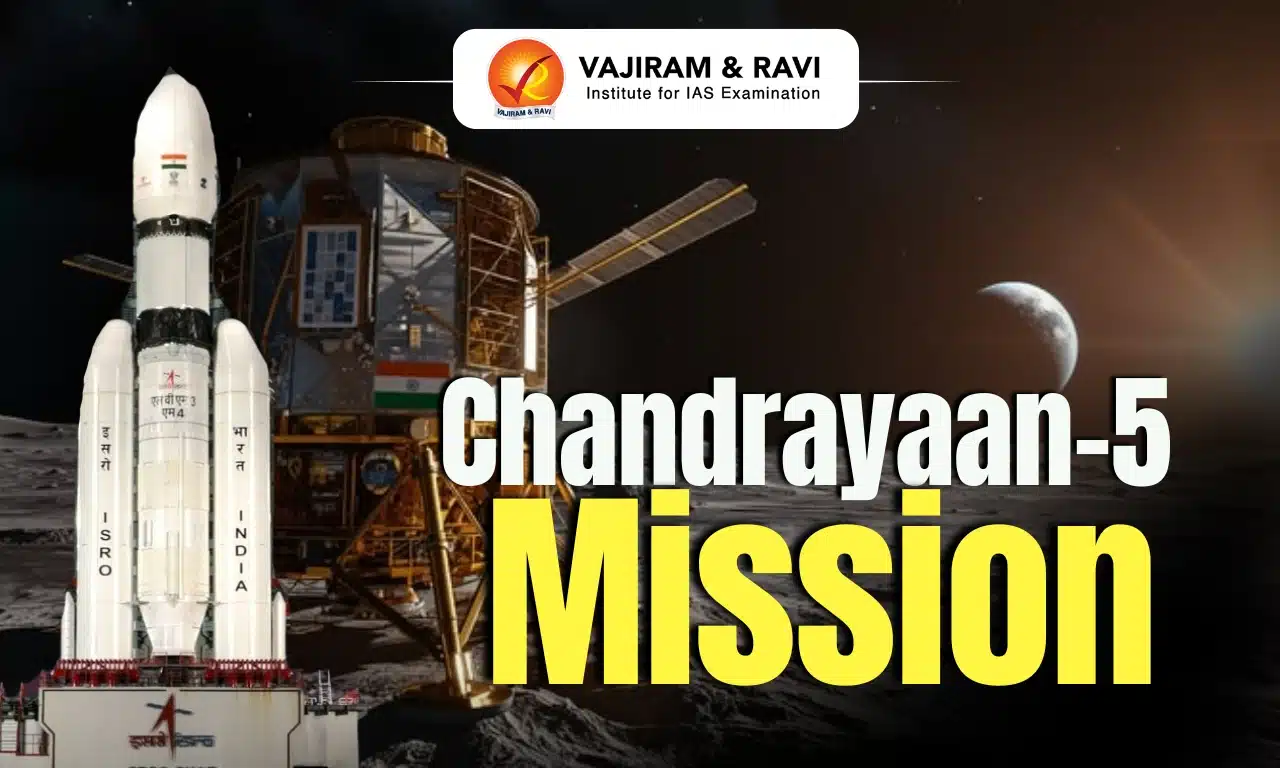
Chandrayaan 5 Mission is also called the Lunar Polar Exploration Mission (LUPEX). It is a joint lunar exploration mission of the Indian Space Research Organisation (ISRO) and the Japan Aerospace Exploration Agency (JAXA). The mission is planned for launch in 2028 and will focus on studying water and water-ice in the Moon's south polar region. It represents India's fifth lunar mission and is expected to strengthen international cooperation in advanced lunar exploration through contributions from NASA and the European Space Agency (ESA).

Chandrayaan 5 Mission Latest News 2026

ISRO and JAXA have reviewed the progress of Chandrayaan 5 Mission during technical meetings held in Bengaluru, including discussions on spacecraft communication, payload integration and launch planning. The mission remains targeted for 2028, while both agencies continue work on lander, rover and scientific payload development. 

ISRO has also confirmed that Gaganyaan 1 Mission hardware is nearing completion and Chandrayaan 4 Mission is India's immediate next lunar mission before Chandrayaan 5.

Chandrayaan 5 (LUPEX) Mission Features

A joint lunar mission planned for 2028 to explore water and water-ice near the Moon's south pole. The key features of the Chandrayaan 5 Mission (LUPEX) has been listed below:

  • Mission name: Chandrayaan 5 is officially known as the Lunar Polar Exploration Mission (LUPEX). It is the fifth mission in India's Chandrayaan programme and is being jointly developed by ISRO and JAXA for advanced lunar surface exploration.
  • Launch schedule: The mission is targeted for 2028, with ISRO and JAXA reviewing the possible launch window through regular technical meetings. It received Government of India approval with financial sanction on 10 March 2025.
  • Launch vehicle: Chandrayaan 5 will be launched by Japan's H3 rocket, specifically the H3-24L launch vehicle, making it one of the major international launches involving Indian lunar hardware.
  • Lander: The lunar lander is being developed by ISRO. It will carry scientific instruments, safely land near the lunar south pole and deploy the rover for detailed surface exploration.
  • Rover: The rover is being developed by JAXA, with Mitsubishi Heavy Industries (MHI), Japan, contributing to its development. After landing, it will travel across the lunar surface to collect scientific observations.
  • Scientific instruments: The mission will carry seven scientific instruments across the lander and rover. Scientific payloads are being contributed by ISRO, JAXA, NASA and ESA, demonstrating large scale international cooperation.
  • International payloads: NASA will provide neutron spectrometers for detecting hydrogen rich regions, while ESA will contribute a mass spectrometer to analyse the composition of lunar materials and volatile substances.
  • Mission duration: Chandrayaan 5 is designed to operate on the Moon for around 100 days or nearly three and a half months, with some mission planning considering the possibility of a longer operational life if conditions permit.

Chandrayaan 5 Mission Objectives

The Chandrayaan 5 Mission is designed to improve scientific understanding of lunar water resources and support future long duration lunar exploration.

  • Study lunar water: The primary objective is to detect and analyse water and water-ice present on both the lunar surface and beneath the surface, particularly in the Moon's south polar region.
  • Explore Permanently Shadowed Regions: Chandrayaan 5 will investigate Permanently Shadowed Regions (PSRs) near the lunar south pole, where water-ice is expected to remain preserved because sunlight rarely reaches these areas.
  • Analyse lunar volatiles: The mission will conduct in situ analysis of lunar volatile materials using advanced scientific instruments to understand their distribution, composition and long term stability.
  • Drill lunar soil: The rover will study the lunar regolith by examining water content, quality and composition, helping scientists understand the availability of resources beneath the Moon's surface.

Chandrayaan 5 Mission Significance

The significance and advantages of the Chandrayaan 5 Mission (LUPEX) is listed below:

  • Support future lunar missions: Information collected during Chandrayaan 5 will help assess the feasibility of using lunar water resources for future robotic missions and long duration human exploration activities.
  • Advance lunar science: Observations from spectrometers and onboard sensors will improve knowledge of lunar geology, surface processes and the evolution of the Moon's south polar environment.
  • Strengthen international collaboration: The mission combines the expertise of ISRO, JAXA, NASA and ESA, making it one of India's most significant multinational scientific missions in deep space exploration.
  • Continue India's lunar programme: Chandrayaan 5 builds upon Chandrayaan 1, which confirmed water molecules on the Moon, Chandrayaan 2 with its operational orbiter, Chandrayaan 3, which achieved the first soft landing near the lunar south pole in 2023 and the planned Chandrayaan 4 lunar sample return mission.

Gaganyaan Mission

Gaganyaan remains India's first human spaceflight programme, with the uncrewed Gaganyaan 1 mission serving as an important technology demonstration before sending astronauts into space.

  • Current Progress: ISRO has informed Parliament that the Crew Module and Service Module for Gaganyaan 1 are in the final stages of assembly, integration and testing.
  • Mission Objectives: Gaganyaan 1 is an uncrewed precursor mission designed to validate the Crew Module, Service Module, Crew Escape System and life support technologies before future crewed flights.
  • Launch Status: The mission was earlier shifted from late 2025 to the first quarter of 2026. However, ISRO has not yet announced a revised launch schedule.
  • Significance: Technologies demonstrated during Gaganyaan are expected to strengthen India's future human spaceflight capability and support the country's long term space exploration goals.

Chandrayaan 5 Mission Challenges

The success of Chandrayaan 5 Mission depends on technical coordination, international cooperation and timely completion of multiple complex mission components.

  • Joint system integration: Integrating the ISRO developed lander with the JAXA developed rover requires extensive testing, interface compatibility and continuous technical coordination between both agencies.
  • Communication systems: Scientists are working on Inter Spacecraft Communication, ensuring reliable data exchange between mission components during landing, rover operations and scientific observations.
  • Multi agency coordination: Scientific payloads from ISRO, JAXA, NASA and ESA must be integrated efficiently while maintaining compatibility with mission objectives and operational requirements.
  • Dependence on H3 launch vehicle: The mission relies on Japan's H3 launch vehicle, making launch readiness dependent on successful coordination between Indian and Japanese mission timelines.
  • Managing multiple flagship missions: ISRO is simultaneously progressing with Chandrayaan 4, Gaganyaan, Earth observation missions and other national space programmes, requiring careful allocation of financial resources, technical manpower and infrastructure.
  • Mission timeline: Maintaining the planned 2028 launch requires timely completion of lander, rover, payload development, ground systems, landing site selection and all joint technical milestones agreed upon by ISRO and JAXA.

Chandrayaan 5 Mission FAQs

Q1: What is Chandrayaan 5 Mission?

Ans: Chandrayaan 5, also known as LUPEX (Lunar Polar Exploration Mission), is a joint Moon mission of ISRO and JAXA to study water and water-ice near the lunar south pole.

Q2: When will Chandrayaan 5 be launched?

Ans: Chandrayaan 5 Mission is currently planned for launch in 2028 aboard Japan's H3 launch vehicle, subject to mission readiness and final launch schedule.

Q3: What is the main objective of Chandrayaan 5 Mission?

Ans: The mission aims to detect and analyse lunar water and water-ice, especially in the Moon's Permanently Shadowed Regions, through in situ scientific exploration.

Q4: Which countries are participating in Chandrayaan 5 Mission?

Ans: The mission is led by ISRO (India) and JAXA (Japan), with scientific payload contributions from NASA (United States) and the European Space Agency (ESA).

Q5: What makes Chandrayaan 5 Mission different from earlier Chandrayaan missions?

Ans: Unlike previous missions, Chandrayaan 5 is India's first joint lunar rover mission with Japan and will focus on detailed exploration of lunar water resources using advanced international scientific instruments.

Alanine aminotransferase (ALT)

Alanine aminotransferase (ALT)

Alanine aminotransferase Latest News

The Union Health Ministry has urged people to monitor alanine aminotransferase (ALT) levels as an early indicator of liver injury.

About Alanine aminotransferase

  • Alanine aminotransferase (ALT), also known as serum glutamic-pyruvic transaminase (SGPT), is an enzyme found predominantly inside liver cells, though it exists in other parts of your body. 
  • It plays a key role in the metabolism of amino acids, breaking them down to produce energy for the body’s essential functions. 
  • Usually, you will have low levels of ALT in your blood. But when liver cells are damaged due to conditions like inflammation, infection, or injury, the enzyme leaks into the bloodstream. 
  • High levels of ALT in your blood may be a sign of a liver injury or disease.  
  • However, since ALT is also present in smaller amounts in other parts of the body, an elevated ALT level does not necessarily indicate liver disease and should prompt further evaluation to identify the source of the abnormality.
  • ALT is one component of the liver function test, which includes other liver enzymes and measures of liver function. 
  • Although ALT is a sensitive indicator of ongoing liver injury, patients can still have significant liver disease despite normal ALT values.
  • ALT testing is performed on a blood sample, with results typically available within a few hours. 
  • Although many laboratories consider ALT levels below 40 units per litre as normal, interpretation depends on the patient’s condition. 
    • For example, lower thresholds are often applied in people with chronic hepatitis B or C.

News: TH

Alanine aminotransferase FAQs

Q1: What is Alanine Aminotransferase (ALT)?

Ans: ALT is an enzyme found predominantly inside liver cells that plays a key role in amino acid metabolism.

Q2: Why are Alanine Aminotransferase (ALT) levels normally low in the blood?

Ans: Because ALT is normally contained within liver cells.

Q3: What causes Alanine Aminotransferase (ALT) levels in the blood to increase?

Ans: Damage to liver cells, causing ALT to leak into the bloodstream.

Q4: Can elevated Alanine Aminotransferase (ALT) levels occur without liver disease?

Ans: Yes, because ALT is also present in smaller amounts in other body tissues.

Q5: Does an elevated Alanine Aminotransferase (ALT) level always indicate liver disease?

Ans: No, further evaluation is needed to determine the cause.

Kh-101 Missile

Kh-101 Missile

Kh-101 Missile Latest News

A suspected Russian Kh-101 missile landed in eastern Poland recently, creating security tensions on NATO's eastern flank. 

About Kh-101 Missile

  • The Kh-101 (NATO: AS-23A Kodiak) is a Russian-made advanced stealthy long-range subsonic cruise missile that is launched from a strategic bomber.   
  • The missile was developed in the late 1990s by Russia's Tactical Missile Armament Corporation (KTRV). 
  • It is designed to destroy ground targets such as buildings, bunkers, and military installations.  
  • The Kh-101 is primarily carried by Russia's strategic bombers, such as the Tu-95MS, Tu-160, and Tu-22M3, as well as the Tu-142 maritime surveillance aircraft.  

Kh-101 Missile Features

  • The missile has a streamlined airframe, which is optimized for low observability and minimal radar cross-section.
  • It has a length of approximately 7.5 m and a wingspan of about 4.4 m. 
  • The missile is powered by a turbofan engine and is capable of flying at a maximum speed of Mach 0.76. 
  • It has a range of 2,500 km to 3,000 km.
  • It can carry a variety of conventional warheads, including high explosive, penetrator, and cluster munitions. 
  • The Kh-101 features advanced guidance and control systems, including inertial navigation, satellite navigation, and terrain mapping, which enable it to navigate and strike targets with high precision.

Kh-101 Missile Variants

  • Over the years, the Kh-101 has undergone several upgrades and modifications to improve its performance and capabilities. 
  • For example, a newer version, the Kh-102, was introduced in 2015, which reportedly has a longer range and improved accuracy compared to the Kh-101.
  • It is the nuclear-capable version of Kh-101.

News: DEVD

Kh-101 Missile FAQ's

Q1: What is the Kh-101 missile?

Ans: The Kh-101 is an advanced stealthy air-launched long-range subsonic cruise missile.

Q2: Which country developed the Kh-101 missile?

Ans: Russia.

Q3: What is the NATO reporting name of the Kh-101 missile?

Ans: AS-23A Kodiak.

Q4: What is the operational range of the Kh-101 missile?

Ans: Approximately 2,500–3,000 km.

Moken People

Moken People

Moken People Latest News

Scientists recently confirmed that Moken sea nomad children living on the Andaman Sea can see underwater with twice the clarity of other children, constricting their pupils to dolphin-like precision through years of ocean training.

About Moken People

  • Often called sea nomads or sea gypsies, the Moken are seafaring people who have been living off the coast of Thailand and Myanmar on the Andaman Sea.
  • Their name, in their own language, means "sea drowned."
  • The Moken have lived across the Andaman Sea for centuries, moving between the roughly 800 islands that stretch along the coastlines of Myanmar and Thailand.
  • They are one of the last sea nomad peoples in the world.
  • Traditionally, they travel in wooden vessels called kabang, moving with the seasons and tides. 
  • Fishing, diving, and gathering shellfish form the backbone of their subsistence lifestyle, and from a very young age, Moken children are immersed in the marine environment.  
  • Possessing a rich knowledge of the reefs, the Moken have exceptional underwater skills such as free diving and spear hunting. 
  • They have their own language, which is Austronesian, a language used in Southeast Asia and Oceania. 
  • Most Moken are stateless as a result of their nomadic lifestyle. They have no citizenship in Thailand or Myanmar.
  • They came into the international spotlight following the 2004 Indian Ocean tsunami because they managed to sense warning signs from nature in the form of the water receding back into the ocean and moving away from dangerous areas.

News: ET

Moken People FAQs

Q1: Who are the Moken people?

Ans: The Moken are sea nomads (sea gypsies) who live off the coasts of Thailand and Myanmar in the Andaman Sea.

Q2: Why are the Moken known as "sea nomads"?

Ans: Because they traditionally live and travel by sea, moving between islands according to the seasons and tides.

Q3: What are the traditional wooden boats used by the Moken called?

Ans: Kabang.

Q4: Why do the Moken have exceptional underwater abilities?

Ans: Because they are immersed in the marine environment from a very young age.

Alanine aminotransferase

Alanine aminotransferase

Alanine aminotransferase Latest News

Recently, the Union Health Ministry has urged people to monitor alanine aminotransferase (ALT) levels as an early indicator of liver injury.

About Alanine aminotransferase

  • It is also known as serum glutamic-pyruvic transaminase (SGPT), is an enzyme found predominantly inside liver cells.
  •  It is also found in other tissues such as the kidneys, heart, and muscle cells. 
  •  It plays a crucial role in metabolism, turning food into energy.
  • ALT is one component of the liver function test, which includes other liver enzymes and measures of liver function.
  • The ALT test is often part of an initial screening for liver disease.

What is an ALT Test?

  • An ALT test is also known as a serum glutamic-pyruvic transaminase (SGPT) test or an alanine transaminase test.
  • When liver cells are damaged or inflamed, ALT leaks into the bloodstream. This causes serum ALT levels to rise.
  • An increase in ALT is often the first sign of a liver problem, and ALT is often elevated before other symptoms appear.
  • ALT testing is performed on a blood sample.

Source: TH

Alanine aminotransferase FAQs

Q1: Where does Alanine aminotransferase found?

Ans: It is mainly found in Liver cells.

Q2: What is the normal function of ALT?

Ans: Transfer amino group from alanine to alpha-ketoglutarate

INS NIPUN

INS NIPUN

INS NIPUN Latest News

Recently, the INS Nipun was delivered to the Indian Navy at Visakhapatnam. 

About INS NIPUN

  • It is the second Diving Support Vessel (DSV) built by Hindustan Shipyard Limited.
  • The vessel has been designed and constructed in accordance with Classification Rules of the Indian Register of Shipping (IRS).
  •  ‘Nipun’ draws her name from Sanskrit signifying ‘one who is adept, capable, and well versed in a particular discipline’.
  • This ship is highly specialised and is capable of undertaking deep sea dive operations and rescue operations at sea.

Features of INS NIPUN

  • The ship is installed with state-of-the-art Dive Equipment and has capability to undertake Deep Sea Saturation Diving. 
  • It is equipped with advanced dynamic positioning systems, saturation diving equipment, submarine rescue machinery, and deep-sea intervention tools.
  • It would also serve as the Mother Ship for the Deep Submergence Rescue Vessel (DSRV), to evacuate personnel in case of an emergency in a submarine.
  • It has nearly 75 percent Indigenous Content.

Source: PIB

INS NIPUN FAQs

Q1: INS NIPUN is which type of vessel of the Indian Navy?

Ans: Diving Support Vessel

Q2: What is the Primary role of INS NIPUN?

Ans: Underwater salvage, ROV ops and diving support

Urban Challenge Fund

Urban Challenge Fund

Urban Challenge Fund Latest News

The government has so far approved or accorded in-principle approval to 33 projects under the Urban Challenge Fund (UCF), Union minister informed the Lok Sabha recently.

About Urban Challenge Fund 

  • It is a new centrally sponsored scheme of the Ministry of Housing and Urban Affairs.
  • It supports transformative and bankable urban projects through competitive "challenge-mode". 
  • Financial Outlay: Total Central assistance of ₹1 lakh crore.
  • Tenure: It will be operational from FY 2025–26 to FY 2030–31, with an extendable implementation period up to FY 2033–34.
  • Under UCF, cities will be supported to do projects under three verticals, 
    • Creative development of cities
    • Cities as growth hubs
    • Water and sanitation
  • Cities will be expected to take reforms in urban governance, urban finance, and urban planning.
  • Features:
    • Centre’s assistance under the scheme is capped at 25 percent of the cost of bankable projects
      • This will lead to a total investment of ₹4 lakh crore in the urban sector in the next five years.
    • At least 50 percent of the project cost has to be mobilised through market-based sources such as municipal bonds, bank loans, and public-private partnerships (PPPs).
    • The remaining share may be contributed by States, Union Territories (UTs), Urban Local Bodies (ULBs), or other sources.
    • Projects will be selected through a transparent and competitive challenge mode, ensuring support to high-impact and reform-oriented proposals.
    • Private sector participation will be encouraged through structured risk-sharing frameworks and benchmarking of service delivery standards.
    • Credit Repayment Guarantee for Smaller Cities:
      • In order to facilitate first-time access to market finance for all Cities/ULBs in Northeastern & Hilly States and smaller ULBs (<1,00,000 population) in other States/UTs, a Credit Repayment Guarantee Scheme of ₹5,000 crore has been approved. 
      • The scheme will provide a Central guarantee of up to ₹7 crore or 70 percent of the loan amount (whichever is lower) for first-time loans. 
  • The Fund will cover:
    • All cities with a population of 10 lakh or more (2025 estimates);
    • All State and Union Territory capitals not covered above; and
    • Major industrial cities with a population of 1 lakh or more
    • Additionally, all ULBs in hilly states, Northeastern States, and smaller ULBs with a population below 1 lakh will be eligible for support under the Credit Repayment Guarantee Scheme
    • In principle all cities will be covered under UCF.

News: TP

Urban Challenge Fund FAQs

Q1: What is the Urban Challenge Fund (UCF)?

Ans: It is a new Centrally Sponsored Scheme of the Ministry of Housing and Urban Affairs (MoHUA).

Q2: What is the objective of the Urban Challenge Fund (UCF)?

Ans: To support transformative and bankable urban projects through a competitive challenge-mode.

Q3: What is the total Central financial outlay under the Urban Challenge Fund?

Ans: ₹1 lakh crore.

Q4: What are the three project verticals under the Urban Challenge Fund?

Ans: Creative development of cities, Cities as Growth Hubs, and Water & Sanitation.

Q5: What is the maximum Central assistance under UCF for a bankable project?

Ans: 25% of the project cost.

NAKSHA Project

NAKSHA Project

NAKSHA Project Latest News

The Directorate of Settlement and Land Records (DSLR) prepares to launch its month-long inquiry under the NAKSHA pilot program in Margao and Cuncolim and Panaji city.  

About NAKSHA Project

  • NAKSHA (National Geospatial Knowledge-based Land Survey of Urban Habitations) is a modern, GIS-based urban land parcel mapping initiative.
  • It aims to revolutionize urban land records across Urban Local Bodies (ULBs) in States and Union Territories.
  • The program operates under the broader framework of the Digital India Land Records Modernization Programme (DILRMP).
  • Technology: NAKSHA specifically leverages cutting-edge technology to create highly accurate digital maps for complex urban and peri-urban habitations across multiple states and Union Territories, ensuring our cities are future-ready.
  • Implemented by: The initiative is being implemented with the technical support of Survey of India, National Informatics Centre Services Inc. (NICSI).
  • The Survey of India is the technical partner for NAKSHA programme which is responsible for conducting aerial surveys.
  • Nodal Ministry: It was launched by the Department of Land Resources (DoLR), Ministry of Rural Development.
  • Objectives of NAKSHA Programme
    • Creates a comprehensive geospatial database for urban land records
    • Uses aerial and field surveys integrated with GIS technology.
    • Enhances land governance, streamlines property records, and supports urban planning.
    • Improves decision-making, ensures efficient land use, and facilitates smoother property transactions.

Source: PIB

NAKSHA Project FAQs

Q1: NAKSHA Project is implemented by which Ministry?

Ans: Ministry of Rural Development

Q2: What is the Key benefit of NAKSHA Project?

Ans: Reduce land disputes and improve urban planning

Crete Island

Crete Island

Crete Island Latest News

Thousands of people were evacuated recently as fires threatened a tourist resort on the Greek island of Crete and continued to rage, fanned by violent winds.

About Crete Island

  • It is the largest island of Greece. 
  • It is located in the southern part of the Aegean Sea (an arm of the Mediterranean Sea) 160 km to the south of the mainland of Greece. 
  • Covering an area of 8,336 sq.km, it is the fifth-largest Mediterranean Sea island. 
  • It is bordered by the Sea of Crete in the north, the Libyan Sea in the south, the Myrtoan Sea in the west, and the Carpathian Sea in the east. 
  • It is relatively long and narrow, stretching for about 260 km east-west and about 60 km at its widest point. 
  • The island is characterized by a diverse landscape, including a mountain chain that runs the length of the island, sandy beaches, and fertile plains.
  • Crete’s economy is primarily based on tourism, agriculture, and shipping. 
  • Capital and Largest City: Heraklion. 

Crete Island History

  • The island of Crete has been inhabited since the Paleolithic Age by early hominids.
  • The earliest advanced European civilization, the Minoan Civilization, started on the island around 2700-1420 BCE.
  • The Minoan civilization ended after a major earthquake, and thereafter, the island’s rule was taken over by the Mycenaean civilization.
  • The island was then subsequently ruled by the Romans, the Byzantines, the Andalusians, the Venetians, and the Ottomans.
  • After the island’s independence from Ottoman rule, Crete became a part of Greece.
  • During the Second World War, the island was occupied by the Nazi German forces and also served as the battleground of the famous “Battle of Crete.”

News: NIE

Crete Island FAQs

Q1: Which is the largest island of Greece?

Ans: Crete.

Q2: Where is Crete Island located?

Ans: In the southern part of the Aegean Sea, about 160 km south of mainland Greece.

Q3: Which sea lies to the north of Crete?

Ans: The Sea of Crete.

Q4: What are the major physical features of Crete?

Ans: A mountain chain, sandy beaches, and fertile plains.

Q5: What is the capital of Crete?

Ans: Heraklion.

Cloudburst

Cloudburst

Cloudburst Latest News

Recently, the India Meteorological Department (IMD) rejected reports that Assam and Nagaland had experienced cloudbursts over the preceding few days and that they were responsible for the Upper Assam floods. 

About Cloudburst

  • A cloudburst is an extreme weather phenomenon characterized by an intense and sudden downpour of rain.
  • It can also occur in plains, the phenomenon is most common in hilly regions.
  • According to the India Meteorological Department (IMD), a cloudburst occurs when a small area, around 20-30 sq. km, receives 10 cm or more of rain in an hour.
  • Impact: Short spells of very heavy rainfall over a small geographical area can cause widespread destruction.

How does a Cloudburst Form?

  • It typically begins with convection, when warm, moist air rises rapidly into the atmosphere.
  • In mountainous areas, this is called orographic lifting, where monsoon winds are forced upwards by steep slopes.
  • As the air rises, it cools and condenses into towering cumulonimbus clouds, which can be up to 15 km tall.
  • Water droplets begin to form inside these clouds and, as they get heavier, they would normally fall as rain.
  • However, if the currents of warm air moving upwards are very strong, they can keep the raindrops suspended in the air for longer.
  • Eventually, the weight of the water droplets becomes too great for gravity and the updrafts to hold, or the updrafts weaken, sending the water plummeting down like an ocean descending on the ground.

Source: TH

Cloudburst FAQs

Q1: Cloudbursts are most commonly associated with which type of clouds?

Ans: Cumulonimbus

Q2: Cloudburst is a major concern in which Indian region?

Ans: Himalayan Region

Arctic Council

Arctic Council

Arctic Council Latest News

Recently, the Parliamentary committee on External Affairs has recommended that India should appoint a Polar Ambassador and urged the government to seek “full-fledged membership” of the Arctic council.

About Arctic Council

  • It was established by the Ottawa Declaration in 1996.
  • It is an intergovernmental forum for addressing issues related to the Arctic Region.
  • It is not a treaty-based international organization but rather an international forum that operates on the basis of consensus, echoing the peaceful and cooperative nature of the Arctic Region.
  • Member Countries: Canada, Denmark, Finland, Iceland, Norway, Sweden, the Russian Federation, and the United States
  • It has six Permanent Participants (PP) groups representing the indigenous people of the Arctic.
  • Observer States: Observer status in the Arctic Council is open to non-arctic states, inter-governmental and inter-parliamentary organizations, global and regional and non-governmental organizations.
    • India is currently one of the 13 observer countries (France, Germany, Netherlands, Poland, Spain, U.K., India, China, Japan, Singapore, South Korea, Italy and Switzerland)  of the Arctic Council.
    • The observer countries do not have decision making powers. They also can’t make financial contributions or undertake research in the arctic directly.
  • Function: The Council focuses its work on matters related to sustainable development, the environment, and scientific cooperation.
  • Traditionally, the Council is chaired by the foreign minister of the country holding the chairmanship.

Source: IE

Arctic Council FAQs

Q1: What is the main focus areas of Arctic Council ?

Ans: Environmental protection and Sustainable development

Q2: India became an Observer in Arctic Council in which year?

Ans: 2013

Pradhan Mantri Fasal Bima Yojana 2026, Eligibility, Benefits

Pradhan Mantri Fasal Bima Yojana (PMFBY)

The Union government has decided to expand the ambit of the PM Fasal Bima Yojana to include crop damage by animals as a ground for payouts, a long-standing demand by farmers, an official said recently.

About Pradhan Mantri Fasal Bima Yojana

  • Launched on 18th February 2016, PMFBY is a crop insurance scheme by the Department of Agriculture, Cooperation, and Farmers’ Welfare, Ministry of Agriculture.
  • PMFBY aims to provide financial protection to farmers against crop loss due to natural disasters (hail, drought, famine), pests, and diseases. 
  • PMFBY provides crop insurance at a cost-effective premium to all Indian farmers. 
  • It is implemented through a network of insurance companies and banks

Pradhan Mantri Fasal Bima Yojana Objectives

  • To provide financial assistance and support to farmers suffering from crop damage or loss arising out of unforeseen events.
  • To stabilise the income of farmers and ensure continuance in farming.
  • To encourage the farmers to adopt modern and innovative agricultural practices.
  • To ensure crop diversification, and creditworthiness of the farmers, enhance growth, and competitiveness of the agriculture sector and protect the farmers from production risks.

Pradhan Mantri Fasal Bima Yojana Eligibility

  • All farmers, including sharecroppers and tenant farmers, growing the notified crops in the notified areas are eligible for coverage.
  • Compulsory Component:All farmers availing Seasonal Agricultural Operations (SAO) loans from Financial Institutions (i.e. loanee farmers) for the notified crops would be covered compulsorily.
  • Voluntary Component: The Scheme would be optional for the non-loanee farmers.
  • Farmers must have an insurable interest in the insured crops.
  • Farmers must possess a valid and authenticated land ownership certificate or a valid land tenure agreement.
  • Farmers must not have received compensation for the same crop loss from any other medium or source.
  • Special efforts shall be made to ensure maximum coverage of SC/ST/Women farmers under the scheme. 
  • Budget allocation and utilization under this should be in proportion to land holdings of SC/ ST/ General along with women in the respective state cluster.

Pradhan Mantri Fasal Bima Yojana Benefits

  • Affordable Premiums:
    • The maximum premium payable by the farmer will be 2% for the Kharif food and oilseed crops. 
    • For rabi food and oilseed crops, it is 1.5% and for yearly commercial or horticultural crops it will be 5%. 
    • The remaining premium is subsidized by the government.
    • For the farmers in the North-Eastern States, Jammu, Kashmir, and Himachal Pradesh, the government also pays the entire premium.
  • Comprehensive Coverage:
    • The scheme covers natural disasters (droughts, floods), pests, and diseases.
    • Post-harvest losses due to local risks like hailstorms and landslides are also included.
    • Loss or damage to notified insured crops due to war, nuclear risks, malicious damage and other preventable risks is excluded from the scope of coverage.
  • Timely Compensation: PMFBY aims to process claims within two months of the harvest to ensure that farmers get the compensation quickly, preventing them from falling into debt traps.
  • Technology-Driven Implementation: 
    • PMFBY integrates advanced technologies like satellite imaging, drones, and mobile apps for precise estimation of crop loss, ensuring accurate claim settlements.
    • The National Crop Insurance Portal (NCIP) digitizes processes for seamless farmer-insurer-bank interaction. YES-TECH (Yield Estimation System Based on Technology) ensures remote sensing based accurate yield estimation, while CROPIC (Collection of Real-time photos and Observations of Crops) uses geotagged photos to verify crops for precise damage assessment.

Source: HT

Pradhan Mantri Fasal Bima Yojana FAQs

Q1: Who are called sharecroppers?

Ans: A sharecropper is a tenant farmer, someone who works land that's rented from its owner

Q2: What are Rabi Crops?

Ans: Rabi crops are cultivated during the spring season, which typically lasts from November to April in India. 

Q3: What are Kharif crops?

Ans: Rabi crops are winter crops sown after the monsoon and harvested in spring, thriving in cool, dry conditions.

Q4: What is remote sensing?

Ans: Remote sensing is the science of obtaining information about objects or areas from a distance, typically from aircraft or satellites.

Public Examination Amendment Bill 2026 – Explained

Public Examination

Public Examination Latest News

  • Parliament has passed the Public Examination (Prevention of Unfair Means) Amendment Bill, 2026, introducing tougher punishments, fast-track courts, and time-bound investigation and trial in paper leak cases.

Public Examinations Law in India

  • To tackle paper leaks and organised exam fraud, Parliament enacted the Public Examination (Prevention of Unfair Means) Act, 2024. 
  • The law aimed to address unfair practices in major public examinations conducted by bodies such as:
    • Union Public Service Commission (UPSC)
    • Staff Selection Commission (SSC)
    • Railway Recruitment Board (RRB)
    • Institute of Banking Personnel Selection (IBPS)
    • National Testing Agency (NTA), including the NEET exam
  • It was the first dedicated central law targeting question paper leaks, organised cheating, and exam-related fraud in public examinations.
  • However, after the NEET-UG paper leak in May 2026, public anger and student protests intensified. 
  • The controversy exposed weaknesses in the existing law, especially in relation to deterrence, speed of investigation, and disposal of cases. 
  • In response, the government moved to strengthen the law through the Public Examination (Prevention of Unfair Means) Amendment Bill, 2026.

Background of the 2024 Law

  • The original 2024 Act provided punishments for individuals and organised groups using unfair means in public exams. Its main objective was to protect the transparency, credibility, and fairness of recruitment and entrance examinations.
  • Under the earlier law:
    • Individuals involved in unfair means faced imprisonment of 3 to 5 years and a fine up to Rs 10 lakh.
    • In certain cases, penalties included a fine up to Rs 1 crore and a ban on exam-related responsibilities for four years.
    • Organised crime related to exam fraud attracted imprisonment of at least 3 years and a fine of Rs 1 crore.
    • In the gravest offences, punishment extended to 5 to 10 years imprisonment and a fine of Rs 1 crore.
  • Even though the law existed, the recent paper leak controversy led to demands for harsher punishment, special courts, and faster justice delivery.

Public Examination Amendment Bill, 2026

  • The Lok Sabha passed the Amendment Bill by voice vote, and the Rajya Sabha also cleared it by voice vote. The Bill strengthens the 2024 law in four important ways.
  • Tougher Punishments
    • Punishment of 3 to 5 years and fine up to Rs 10 lakh has now been raised to 5 to 10 years imprisonment and fine up to Rs 50 lakh.
    • Punishment involving fine up to Rs 1 crore and a ban of four years has been enhanced to fine up to Rs 5 crore and a ban of eight years.
    • Punishment of at least 3 years imprisonment and Rs 1 crore fine has been raised to at least 5 years imprisonment and Rs 5 crore fine.
    • Punishment of 5 to 10 years imprisonment and Rs 1 crore fine has been strengthened to at least 7 years imprisonment and Rs 10 crore fine.
    • Thus, the law now provides a much stronger deterrent against organised paper leak networks.
  • Statutory Backing for Fast-Track Courts
    • The Bill gives statutory backing to fast-track courts for trying offences under the Act.
    • This is significant because it moves beyond an executive announcement and embeds the fast-track mechanism directly in law. Once the amendment comes into force, all future offences under the Act can be tried by fast-track courts.
    • The government has already announced that such courts would initially be set up in the four High Courts where NEET-related cases are ongoing.
  • Five-Month Timeline for Investigation and Trial
    • Another major feature is the imposition of a strict time frame:
      • Investigation must be completed within two months.
      • Trial must be completed within three months.
    • This means that a paper leak case should, in principle, reach a conclusion within five months.
  • Provision for a Special Task Force
    • The Bill also empowers the Union government to establish a Special Task Force to investigate offences under the Act. 
    • This is aimed at strengthening coordination, especially where paper leak networks operate across states or involve organised criminal syndicates.

Significance of the Bill

  • The Amendment Bill is important because it attempts to address both substantive weakness and procedural delay.
  • On the substantive side, it raises punishment sharply, especially in cases involving organised crime. On the procedural side, it introduces:
    • Fast-track adjudication
    • Statutory time limits
    • A Special Task Force
  • This combination is meant to make the law not only stricter but also more effective in practice.
  • The Bill also reflects a broader recognition that exam fraud is no longer a routine malpractice but a serious governance and public trust issue affecting merit, opportunity, and social justice.

Concerns and Challenges

  • Even with stronger penalties, the real effectiveness of the law will depend on implementation.
  • Some important challenges remain:
    • Whether investigations can genuinely be completed within two months.
    • Whether fast-track courts will have the capacity and staffing to meet the deadline.
    • Whether states and investigating agencies can coordinate effectively.
    • Whether digital and logistical vulnerabilities in examination systems are also corrected.
  • Experience with other fast-track courts, including those under special laws such as POCSO, shows that pendency can still rise if infrastructure and staffing do not keep pace.

Source: IE | TH

Public Examination FAQs

Q1: What is the Public Examination Amendment Bill, 2026?

Ans: It is a law amending the Public Examination (Prevention of Unfair Means) Act, 2024 to impose tougher punishments and faster trial mechanisms for paper leak cases.

Q2: What is the maximum punishment under the amended law?

Ans: The amended law provides for imprisonment up to 10 years and fines up to Rs 10 crore, depending on the offence.

Q3: What timeline does the new law prescribe for paper leak cases?

Ans: It provides for a two-month investigation period and a three-month trial period, making the total timeline five months.

Q4: Which exam bodies are covered under the law?

Ans: The law covers examinations conducted by bodies such as UPSC, SSC, RRB, IBPS, and NTA, including NEET.

Q5: What new institutional mechanism does the Bill provide?

Ans: It gives statutory backing to fast-track courts and allows the Union government to create a Special Task Force for investigation.

Cauvery Water Dispute – CWMA Upholds Water Release Amid Distress Conditions

Cauvery Water Dispute

Cauvery Water Dispute Latest News

  • The Cauvery Water Management Authority (CWMA) has endorsed the Cauvery Water Regulation Committee (CWRC) decision directing Karnataka to release 3,500 cusecs of water to Tamil Nadu for 15 days (July 29–August 12, 2026).
  • This amounts to nearly 4.5 thousand million cubic feet (tmc ft). 
  • The decision comes amid deficient southwest monsoon rainfall and severe water shortages in the Cauvery basin, reviving concerns over equitable sharing of river waters during distress years.

Institutional Framework for Cauvery Water Management

  • The CWRC functions under the CWMA, which was established in 2018 to implement the Cauvery Water Disputes Tribunal (CWDT) Award (2007) as modified by the Supreme Court (2018).
  • Statutory body: The CWMA is formed under the Inter-State River Water Disputes Act, 1956, operating under the Union Ministry of Jal Shakti.
  • Composition of CWRC:
    • Headquartered in New Delhi, it is headed by the Member (Water Resources), CWMA.
    • Members include -
      • Chief Engineers of all Cauvery basin States.
      • Representatives from the India Meteorological Department (IMD), Central Water Commission (CWC) and Ministry of Agriculture & Farmers’ Welfare.
  • Mandate and functions of CWRC: The committee performs both regulatory and technical functions, including -
    • Monitoring daily water levels, inflows and storage in eight major reservoirs -
      • Karnataka: Hemavathy, Harangi, Krishnarajasagara (KRS), Kabini.
      • Tamil Nadu: Mettur, Bhavanisagar, Amaravathy.
      • Kerala: Banasurasagar.
    • Ensuring scheduled daily and monthly water releases as directed by CWMA.
    • Preparing seasonal (Southwest Monsoon, Northeast Monsoon, Hot Weather) and annual water accounts.
    • Reviewing compliance with previous directions and reassessing basin conditions through fortnightly meetings during the monsoon.
  • CWDT: It was constituted by the Government of India on June 2, 1990, under the Inter-State River Water Disputes Act, 1956.
  • Inter-State River Water Disputes Act, 1956: It is enacted under Article 262 of Constitution of India to resolve the water disputes that would arise in the use, control and distribution of an interstate river or river valley.

How does the CWRC Decide Water Releases?

  • The committee relies on scientific hydro-meteorological assessment rather than fixed allocations during distress years. 
  • Key parameters include -
    • Rainfall received and IMD's forecast.
    • Live storage in reservoirs.
    • Reservoir inflows and outflows.
    • The river flows at Biligundulu (inter-State measuring point).
    • Water availability in intermediate catchments.
    • Compliance with earlier release orders.
  • This data-driven approach seeks to balance drinking water, irrigation requirements and ecological considerations.

Factors Behind the Latest Decision

  • The CWRC considered multiple indicators before fixing the release at 3,500 cusecs -
    • Net inflows into Karnataka reservoirs were nearly 60% below the 30-year average.
    • River flow at Biligundulu showed a 90% deficit, indicating severe basin-wide stress.
    • IMD forecasts suggested continued weak rainfall, limiting future inflows.
    • Combined storage in Karnataka's four major reservoirs stood at 64.15 tmc ft against a capacity of 114.57 tmc ft.
  • Considering these distress conditions, the committee opted for a quantity that would be operationally feasible while partially meeting Tamil Nadu's requirements.

Divergent Responses from the Riparian States

  • Karnataka's position:
    • The State has not commenced irrigation releases due to inadequate rainfall.
    • It considers the CWRC order burdensome under prevailing drought-like conditions.
    • The government is examining the possibility of appealing before the CWMA.
    • Farmers' organisations have demanded application of a "distress-sharing formula" instead of fixed allocations.
  • Tamil Nadu's position:
    • Tamil Nadu views the ordered release as insufficient.
    • It argues Karnataka should release the entire deficit of 9.8 tmc ft calculated by the committee.
    • The kuruvai cultivation season requires nearly 100 tmc ft of water for about 4 lakh acres.
    • Mettur reservoir storage is around 36 tmc ft, of which nearly 10 tmc ft must be reserved for drinking water and dead storage.

Key Challenges and Way Forward

  • Challenges:
    • Absence of an agreed distress-sharing formula during deficient rainfall years.
    • Conflicting priorities between drinking water, irrigation and reservoir conservation.
    • Increasing uncertainty due to climate variability affecting monsoon reliability.
    • Balancing legal water entitlements with ground-level hydrological realities.
    • Recurring inter-State political tensions despite an institutional dispute-resolution mechanism.
  • Way forward:
    • Develop a mutually agreed distress-sharing formula to proportionately distribute shortages among basin States during drought years.
    • Strengthen real-time hydrological monitoring, transparent data sharing and scientific forecasting.
    • Promote cooperative federalism through continuous dialogue between Karnataka, Tamil Nadu and the CWMA.
    • Encourage water-use efficiency, micro-irrigation, crop diversification and basin-level integrated water resources management.
    • Institutionalise periodic reviews to ensure adaptive water allocation under changing climatic conditions.

Source: TH

Cauvery Water Dispute FAQs

Q1: How does the Cauvery Water Regulation Committee (CWRC) determine water releases?

Ans: It bases decisions on hydro-meteorological parameters such as rainfall, reservoir storage, inflows, river flows, etc.

Q2: What is the institutional role of the Cauvery Water Management Authority (CWMA)?

Ans: It implements the Cauvery Water Disputes Tribunal Award (2007), as modified by the Supreme Court (2018).

Q3: Why is the absence of a distress-sharing formula a major challenge?

Ans: It leads to recurring conflicts as States differ on how water shortages should be equitably shared during deficient rainfall years.

Q4: How does climate variability complicate inter-State river water governance in India?

Ans: Uncertain monsoon patterns reduce water availability, making fixed allocations difficult.

Q5: What measures can improve long-term resolution of the Cauvery water dispute?

Ans: A distress-sharing formula, transparent data sharing, cooperative federalism, integrated river basin management, etc.

US-Iran Conflict Reshapes Gulf Security Architecture: Regional Realignments and India’s Energy Security

US-Iran Conflict Reshapes Gulf Security Architecture

US-Iran Conflict Reshapes Gulf Security Architecture Latest News

  • The US-Iran conflict has triggered significant strategic realignments among Gulf Arab states, ranging from renewed defence pacts with Pakistan to a rekindled Houthi-Saudi confrontation, with implications for regional stability and India's energy security.

Background: The US-Iran Standoff

  • US strikes targeted Iran's capability to threaten shipping in the Strait of Hormuz, after Iran rejected American proposals for a new shipping channel through Omani waters and targeted non-compliant vessels.
  • Despite the offensive, Iran retains control over Hormuz, and Tehran-Muscat talks to operationalise Article 5 (joint Iran-Oman administration of the Strait) continue — now expanded to include Saudi Arabia.
    • This was seen in Iranian FM Araghchi's talks with Saudi counterpart Faisal bin Farhan.
  • Washington remains incentivised to strike Iranian nuclear and Hormuz-related targets again, as its self-defined objectives remain unmet.

Fallout One: Gulf States Deepen Ties with Pakistan

  • Recently, Kuwait ratified a June 2023 Defence Cooperation Agreement (DCA) with Pakistan for five years, covering training, intelligence sharing, logistics, and defence technology exchange.
  • Qatar committed to deepening security cooperation with Pakistan during bilateral talks in Doha.
  • Unlike the Saudi-Pakistan Strategic Mutual Defence Agreement (SMDA) of September 2025, Kuwait's DCA does not bind either side to defend the other if attacked.
    • It should be noted that the SMDA has not translated into mutual military action (Pakistan has not struck Iran or Houthi territory; Saudi Arabia has not struck Afghanistan).
    • This suggests its real purpose is entrenching Pakistan's role in long-term capability-building rather than immediate collective defence.
  • For Gulf states, securing dependable defence partners for domestic capability development outweighs intra-Gulf political differences. 
  • Pakistan's economic dependence on these states adds a layer of leverage for the Gulf side.

Fallout Two: Resumption of Houthi-Saudi Hostilities

  • Fighting resumed recently when the Saudi-backed Yemeni government-in-exile bombed Sana'a airport, reportedly to block an Iranian aircraft landing.
  • The Houthis retaliated with ballistic missiles into Saudi territory and declared a naval blockade in the Bab-el-Mandeb strait — unprecedented since the 2022 truce.
  • Saudi Arabia struck the Houthi-controlled Hodeida port, handling over 70% of Yemen's trade and humanitarian aid, provoking Houthi strikes on Saudi Aramco facilities and a partial shutdown of the 400,000 bpd Jazan Refinery.
  • For the first time, both the Red Sea and the Strait of Hormuz were simultaneously under conflict-related disruption.
  • Riyadh, however, is unlikely to seek full-scale war, instead preferring engagement — evident in Saudi participation in US strikes on Iran-backed militias in Iraq rather than direct retaliation against the Houthis.

Why Saudi Arabia Seeks Stability

  • Recently, Saudi Arabia signed a 123 Agreement with the US for civil nuclear cooperation — raising the stakes for regional calm, since a Houthi strike on a future nuclear facility would be far more dangerous than attacks on oil infrastructure.
  • Recent drone strike on the UAE's Barakah nuclear plant had already revived post-Fukushima safety concerns among Arab states.
  • The 123 Agreement may also strengthen Iran's own case for enrichment rights, potentially reducing its willingness to concede ground in nuclear talks.
  • Preventing a "broken windows effect" on Arab economies remains a key regional priority even amid mounting US war fatigue.
    • If the current conflict (Houthi attacks, US-Iran strikes, disruptions to oil facilities and shipping) is allowed to drag on and damage confidence, it could trigger a similar spiral:
      • Investors start losing confidence
      • Businesses and tourists stay away
      • Oil and trade routes seem unsafe
    • This damages the reputation and stability of the whole region, not just the areas directly hit.

Conclusion

  • The US-Iran conflict has exposed the fragility of Gulf security, pushing states like Kuwait and Qatar toward Pakistan for capability-building, while Saudi Arabia balances renewed Houthi threats against its nuclear ambitions. 
  • For India, sustained instability in the Hormuz-Red Sea corridor threatens energy imports and regional equities.

Source: IE

US-Iran Conflict Reshapes Gulf Security Architecture FAQs

Q1: How does US-Iran Conflict Reshapes Gulf Security Architecture affect Gulf countries?

Ans: US-Iran Conflict Reshapes Gulf Security Architecture by encouraging Gulf nations to strengthen defence partnerships, diversify security arrangements, and prepare for prolonged regional instability.

Q2: Why is Pakistan important in US-Iran Conflict Reshapes Gulf Security Architecture?

Ans: US-Iran Conflict Reshapes Gulf Security Architecture highlights Pakistan's growing defence cooperation with Gulf states through military training, intelligence sharing, logistics, and long-term capability building.

Q3: How has the Houthi conflict influenced US-Iran Conflict Reshapes Gulf Security Architecture?

Ans: US-Iran Conflict Reshapes Gulf Security Architecture has intensified with renewed Houthi-Saudi hostilities, disrupting the Red Sea and increasing risks to global shipping and regional stability.

Q4: Why does Saudi Arabia seek stability despite US-Iran Conflict Reshapes Gulf Security Architecture?

Ans: US-Iran Conflict Reshapes Gulf Security Architecture makes regional stability crucial for Saudi Arabia to protect its nuclear cooperation, economic reforms, energy infrastructure, and investor confidence.

Q5: How does US-Iran Conflict Reshapes Gulf Security Architecture impact India?

Ans: US-Iran Conflict Reshapes Gulf Security Architecture affects India's energy security by increasing risks to crude oil imports, shipping routes through Hormuz and the Red Sea, and regional economic interests.

Transmission Bottlenecks Threaten India’s Renewable Energy Boom: Grid Delays, T-GNA and Financial Risks

Transmission Bottlenecks Threaten India's Renewable Energy Boom

Transmission Bottlenecks Threaten India's Renewable Energy Boom Latest News

  • Nearly 21 GW — about 9% of India's installed renewable energy capacity — is running on temporary grid connections due to delayed dedicated transmission infrastructure, putting project revenues and clean energy targets at risk.

The Core Problem

  • Renewable energy capacity is being added faster than the transmission network needed to evacuate that power.
  • Around 12 GW faces restrictions on power evacuation during peak solar generation hours.
    • Power evacuation refers to transferring electricity generated at a plant to the point of consumption.
  • In FY26, about 6,900 GWh of clean electricity faced restrictions due to this mismatch; during April–June alone, 8,133 GWh of solar electricity was curtailed.

Understanding the GNA-TGNA Framework

  • Under the General Network Access (GNA) framework, inter-state transmission-connected projects with long-term GNA get firm evacuation rights — that is, guaranteed access to send their power into the grid.
  • Projects awaiting dedicated transmission infrastructure operate under Temporary General Network Access (T-GNA), a stopgap arrangement that allows scheduling of power only when spare capacity exists.
  • During congestion, long-term GNA projects get priority, forcing T-GNA projects to curtail (reduce) generation — by as much as 70-80% of capacity, according to developers.
  • Electricity curtailment means the intentional reduction of power output from renewable generators.

Financial Stress on Developers

  • Solar power enjoys "must-run" status in India, but can still be backed down for grid security, technical constraints, or transmission bottlenecks.
  • Developers get compensated for grid-security-related curtailment, but not for T-GNA-related curtailment — directly eroding revenues.
  • In Rajasthan, curtailment has reportedly touched 90-95% for some projects, with roughly 4 GW of state capacity affected.
  • Developers are increasingly funding operations through equity and reserves rather than actual power revenue — an unsustainable model over time.
  • As a result, the experts have demanded moratorium on principal repayment during transmission delays, interest-free/concessional bridge financing, extended loan tenure without credit downgrades, and debt restructuring without asset reclassification.

Risk of NPAs and Systemic Impact

  • Industry experts warn affected projects could turn into Non-Performing Assets (NPAs) if the issue persists.
  • They noted generators lose over 50% of generation during peak solar hours due to T-GNA curtailment — a rate unsustainable beyond a few months for loan servicing.
  • 12 public sector banks, along with IREDA, PFC, REC, NaBFID, IIFCL, and SIDBI, cumulatively deployed about Rs 5.08 lakh crore in the renewable sector over FY25-26 — meaning financial institutions also bear risk if project viability deteriorates.
  • Analysts have flagged that continued slippage in transmission commissioning could hit capacity additions, cash flows, Internal Rate of Returns (IRRs), and investor confidence.

Conclusion

  • India's renewable energy growth is being outpaced by transmission infrastructure, trapping a significant share of green capacity in a temporary, low-priority access regime. 
  • Left unaddressed, this mismatch threatens developer solvency, banking sector exposure, and India's broader clean energy targets — making transmission planning as critical as capacity addition itself.

Source: IE | BS

Transmission Bottlenecks Threaten India's Renewable Energy Boom FAQs

Q1: Why do Transmission Bottlenecks Threaten India's Renewable Energy Boom?

Ans: Transmission Bottlenecks Threaten India's Renewable Energy Boom because renewable capacity is growing faster than transmission infrastructure, leading to power curtailment, revenue losses, and delayed clean energy integration.

Q2: How does the T-GNA system contribute to Transmission Bottlenecks Threaten India's Renewable Energy Boom?

Ans: Under T-GNA, projects receive only temporary grid access and face priority restrictions during congestion, making Transmission Bottlenecks Threaten India's Renewable Energy Boom through frequent power curtailment.

Q3: What financial challenges arise because Transmission Bottlenecks Threaten India's Renewable Energy Boom?

Ans: As Transmission Bottlenecks Threaten India's Renewable Energy Boom, developers suffer revenue losses, rely on reserves for operations, seek debt restructuring, and face increasing risks of loan defaults.

Q4: How do Transmission Bottlenecks Threaten India's Renewable Energy Boom and the banking sector?

Ans: Transmission Bottlenecks Threaten India's Renewable Energy Boom by increasing the possibility of NPAs, affecting banks and financial institutions that have invested heavily in renewable energy projects.

Q5: What measures can reduce Transmission Bottlenecks Threaten India's Renewable Energy Boom?

Ans: Faster transmission infrastructure, timely grid connectivity, bridge financing, extended loan tenures, and improved transmission planning can reduce Transmission Bottlenecks Threaten India's Renewable Energy Boom.

Daily Editorial Analysis 31 July 2026

Daily-Editorial-Analysis

The Next DPI — How India Can Commoditise AI 

Context

  • India has emerged as a global leader in Digital Public Infrastructure (DPI) by integrating Aadhaar, Unified Payments Interface (UPI), and DEPA/Account Aggregator into an interoperable ecosystem.
  • Unlike countries that excel in individual digital systems, India has combined digital identity, payments, and data-sharing at an unprecedented scale.
  • The next step is to extend this model to Artificial Intelligence (AI) by making intelligence a foundational public utility that is affordable, accessible, and interoperable.

India’s Digital Public Infrastructure Success Story

  • India’s DPI has transformed governance and financial inclusion through Aadhaar, which has enrolled over 1.4 billion people and enabled low-cost digital identity verification.
  • UPI has revolutionised payments by processing nearly 20 billion monthly transactions at minimal cost.
  • Between 2016 and 2019, affordable mobile data connected nearly 500 million Indians, accelerating digital inclusion, Direct Benefit Transfers (DBTs), startups, e-commerce, and digital governance.
  • India’s success lies in creating competitive digital markets supported by strong public infrastructure rather than direct subsidies.

Artificial Intelligence as the Fourth Digital Public Infrastructure

  • AI is becoming the next essential infrastructure after identity, payments, and data.
  • Instead of competing with global technology giants in expensive AI model training, India should focus on making AI inference inexpensive and widely accessible.
  • The objective is to reduce the cost of using AI through public infrastructure, enabling innovation across education, healthcare, agriculture, governance, and industry.

India’s Unequal Position in the Global AI Economy

  • India contributes significantly to the global AI ecosystem through its engineering talent, researchers, multilingual data, and data annotation workforce.
  • However, Indian start-ups depend heavily on costly foreign AI models and proprietary APIs, making them vulnerable to external pricing and policy decisions.
  • This resembles the historical pattern of exporting raw materials while importing high-value finished products.
  • India must move from being a supplier of AI inputs to becoming a producer of AI capabilities.

Building India’s National AI Token Economy

  • Affordable Compute Infrastructure

    • The IndiaAI Mission, with an allocation of around ₹10,372 crores, seeks to build AI infrastructure through public-private partnerships.
    • More than 38,000 GPUs have been on boarded, with a target of 1,00,000 GPUs, providing subsidised compute access to startups and researchers.
    • AI infrastructure should also be integrated into the National Electricity Plan, supported by renewable and nuclear energy to ensure reliable, low-cost power for data centres.
  • Open-Source Foundation Models

    • Affordable computing must be complemented by open-source Large Language Models (LLMs).
    • India should utilise anonymised public datasets such as legal judgments, agricultural information, and educational content in all 22 Scheduled Languages to develop indigenous AI models.
    • AI systems created using public funding should be released under open-weights licences, encouraging innovation while reducing dependence on proprietary foreign platforms.
  • Unified Intelligence Interface (UII)

    • India should establish a Unified Intelligence Interface (UII) based on the principles of UPI.
    • A common AI API gateway would provide interoperability, identity verification, consent management, billing, and safety standards.
    • Government agencies, educational institutions, start-ups, and businesses could access multiple AI services through a single platform, reducing costs and encouraging competition.

AI Token Entitlements for Inclusive Growth

  • A national freemium AI model could provide free monthly AI tokens to verified students, researchers, and startups through Aadhaar authentication.
  • Larger enterprises could pay commercial rates, creating a sustainable funding model.
  • AI support for schools, research institutions, and public services would accelerate innovation and reduce barriers to technology adoption.

Socio-Economic Benefits of Near-Free Intelligence

  • Affordable AI can significantly improve healthcare, education, agriculture, MSMEs, and governance.
  • AI-assisted healthcare can expand medical access, personalised tutoring can benefit millions of students, multilingual AI can assist farmers in accessing government services, and small businesses can utilise AI for accounting, marketing, and compliance.
  • AI-powered governance can further enhance efficient citizen service delivery.

Challenges

  • Key challenges include high infrastructure costs, dependence on imported semiconductor technologies, data privacy, cybersecurity, algorithmic bias, responsible AI governance, and sustainable financing.
  • Addressing these issues is essential for developing secure, inclusive, and trustworthy AI infrastructure.

Way Forward

  • India should expand the IndiaAI Mission, promote open-source AI, invest in AI-specific energy infrastructure, develop Indic AI models.
  • Also, India should establish the Unified Intelligence Interface, strengthen AI governance under the Digital Personal Data Protection Act, and encourage collaboration among government, academia, startups, and industry.

Conclusion

  • India’s success with Digital Public Infrastructure demonstrates how public digital goods can reduce costs and expand participation.
  • Extending this model to AI can democratise intelligence through affordable compute, open-source models, AI token entitlements, and a Unified Intelligence Interface.
  • By making intelligence widely accessible, India can strengthen technological sovereignty, develop innovation, and ensure that AI becomes a powerful engine of inclusive economic and social development rather than a privilege available only to a few.

The Next DPI — How India Can Commoditise AI FAQs

Q1. Why is India’s Digital Public Infrastructure (DPI) considered unique?
Ans. India’s DPI uniquely integrates Aadhaar, UPI, and DEPA into an interoperable digital ecosystem.

Q2. Why should India focus on AI inference instead of AI model training?
Ans. AI inference is less capital-intensive and can make AI services affordable and widely accessible.

Q3. What is the objective of the IndiaAI Mission?
Ans. The IndiaAI Mission aims to provide affordable compute infrastructure and promote indigenous AI innovation.

Q4. What is the proposed Unified Intelligence Interface (UII)?
Ans. The UII is an interoperable AI platform that enables seamless access to multiple AI models through a common API.

Q5. How can affordable AI benefit India?
Ans. Affordable AI can improve healthcare, education, agriculture, MSMEs, and public service delivery by making intelligence accessible to everyone.

Source: The Hindu


The Bay of Bengal as India’s SHANTI Anchor 

Context

  • The Bay of Bengal has emerged as a strategic centre of the Indo-Pacific, linking South Asia, Southeast Asia, and major global trade and energy routes.
  • Alongside increasing geopolitical competition, the region faces climate-induced disasters, illegal fishing, cyber threats, marine pollution, and supply chain disruptions.
  • These transnational challenges require regional cooperation rather than unilateral responses.
  • India's SHANTI (Securing Holistic Advancement through Norms, Trust and Integrity) initiative seeks to establish a rules-based, trust-driven framework for maritime governance.

Why the Bay of Bengal Matters?

  • Historically, the Bay connected civilizations through commerce and cultural exchange.
  • Today, it is central to India's Act East Policy, provides access to the strategic Malacca Strait, and connects the eastern Indian Ocean with global maritime routes.
  • China's expanding regional presence, driven by its Malacca Dilemma, has intensified strategic competition.
  • Consequently, the Bay has become a vital arena where maritime security, economic connectivity, and regional governance converge.

Need for SHANTI

  • Despite growing maritime capabilities, the region lacks common norms, coordinated institutions, and collective mechanisms to address shared challenges.
  • Countries face similar concerns, including disaster risk reduction, Humanitarian Assistance and Disaster Relief (HADR), Illegal, Unreported and Unregulated (IUU) fishing, coastal erosion, undersea cable protection, Blue Economy development, and climate adaptation.
  • Since these issues transcend national boundaries, they require coordinated regional action based on cooperation and mutual trust.

Evolution of India's Maritime Vision

  • SAGAR (2015) introduced the vision of Security and Growth for All in the Region, promoting inclusive maritime cooperation and equitable development.
  • MAHASAGAR (2025) expanded this vision to the wider Indo-Pacific and the Global South, recognising the interconnected nature of maritime security.
  • SHANTI (2026) provides the operational framework built on Norms, Trust, and Integrity.
  • It shifts the focus from military competition to demand-driven cooperation, institution-building, long-term resilience, and governance of the shared maritime commons.
  • Together, these initiatives position India as a preferred security partner and first responder in the region.

Bay of Bengal as the Ideal Laboratory

  • The Bay of Bengal is well suited for implementing SHANTI because it is relatively cooperative compared to the conflict-prone western Indian Ocean.
  • Its littoral states share common environmental, economic, and security challenges, while institutions such as BIMSTEC already provide a foundation for collaboration.
  • Rather than creating new organisations, SHANTI aims to strengthen coordination among existing mechanisms, with India acting as a regional convener through regional stewardship instead of dominance.

From Principles to Practice

  • Progress towards implementing SHANTI is already visible.
  • At the 2026 BIMSTEC National Security Advisers' Meeting, member states adopted common principles for maritime law enforcement and HADR.
  • And they agreed to conduct the first joint maritime security exercise in November 2026, and continued discussions on a White Shipping Information Sharing Agreement.
  • These initiatives strengthen maritime domain awareness, build confidence, and promote rules-based cooperation across the Bay.

Benefits and Challenges

  • SHANTI can strengthen maritime governance, improve disaster preparedness, enhance climate resilience, safeguard critical maritime infrastructure, promote the Blue Economy, and deepen trust among regional partners.
  • However, challenges remain, including strategic rivalry among major powers, institutional fragmentation, varying national priorities, limited financial and technological capacities, and the need to ensure that India's leadership remains inclusive and non-hegemonic.

Way Forward

  • India should institutionalise regular BIMSTEC maritime exercises, expand maritime information-sharing networks.
  • Additionally, India should establish regional disaster response mechanisms, promote joint Blue Economy projects, strengthen environmental protection.
  • There is a need to build capacity among smaller littoral states, and encourage rules-based maritime governance consistent with international law.

Conclusion

  • The Bay of Bengal is a shared maritime commons whose future depends on cooperation rather than competition.
  • Through SHANTI, India seeks to promote Norms, Trust, Integrity, Resilience, and Shared Responsibility as the foundation of regional security.
  • If implemented effectively through institutions such as BIMSTEC, SHANTI can transform the Bay into a model of cooperative maritime governance for the wider Indo-Pacific, advancing a free, open, inclusive, and rules-based maritime order.

The Bay of Bengal as India’s SHANTI Anchor FAQs

Q1. What is the primary objective of the SHANTI initiative?
Ans. The SHANTI initiative aims to promote norms, trust, and integrity for cooperative maritime governance in the Bay of Bengal and the wider Indo-Pacific.

Q2. Why is the Bay of Bengal strategically important for India?
Ans. The Bay of Bengal connects India's Act East Policy with ASEAN, provides access to the Malacca Strait, and links major global trade and energy routes.

Q3. How does SHANTI differ from SAGAR and MAHASAGAR?
Ans. While SAGAR provides the vision and MAHASAGAR expands its scope, SHANTI establishes the principles for implementing maritime cooperation through rules-based governance.

Q4. What role does BIMSTEC play in implementing SHANTI?
Ans. BIMSTEC promotes SHANTI by facilitating joint maritime exercises, maritime law enforcement cooperation, and humanitarian assistance and disaster relief initiatives.

Q5. What is the long-term significance of SHANTI?
Ans. SHANTI seeks to transform maritime security from deterrence and rivalry to resilience, shared responsibility, and cooperative governance of the maritime commons.

Source: The Hindu

Daily Editorial Analysis 2026 FAQs

Q1: What is editorial analysis?

Ans: Editorial analysis is the critical examination and interpretation of newspaper editorials to extract key insights, arguments, and perspectives relevant to UPSC preparation.

Q2: What is an editorial analyst?

Ans: An editorial analyst is someone who studies and breaks down editorials to highlight their relevance, structure, and usefulness for competitive exams like the UPSC.

Q3: What is an editorial for UPSC?

Ans: For UPSC, an editorial refers to opinion-based articles in reputed newspapers that provide analysis on current affairs, governance, policy, and socio-economic issues.

Q4: What are the sources of UPSC Editorial Analysis?

Ans: Key sources include editorials from The Hindu and Indian Express.

Q5: Can Editorial Analysis help in Mains Answer Writing?

Ans: Yes, editorial analysis enhances content quality, analytical depth, and structure in Mains answer writing.

Enquire Now