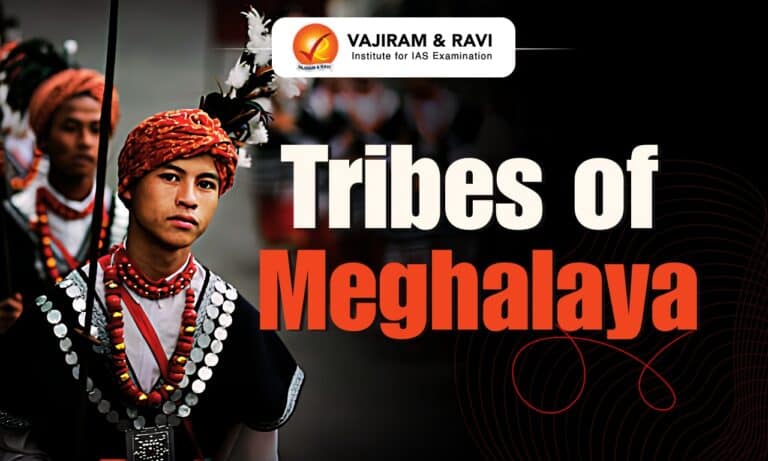
The Tribes of Meghalaya form an important part of the state’s culture and identity. The major tribes include the Khasi, Garo, and Jaintia, each having their own language, traditions, and customs. These tribes mainly live in close connection with nature and follow a simple lifestyle based on agriculture and community life. They are also known for their unique social systems, rich folk traditions, and strong sense of cultural heritage, which make Meghalaya one of the most culturally diverse states in India.
Tribes of Meghalaya
The Tribes of Meghalaya form the core of the state’s social and cultural life. These communities have their own distinct traditions, languages, and customs, and many of them follow a matrilineal system, where lineage and property pass through the mother’s side. The major tribes of the state – Khasi, Garo, and Jaintia are discussed below in detail, highlighting their unique lifestyles, beliefs, and cultural practices.
Khasi Tribe
- The Khasi tribe is one of the major Tribes of Meghalaya, forming a significant part of the population and mainly living in the Khasi Hills and Jaintia Hills. They belong to the larger group called “Hynniew Trep” (Seven Huts), which also includes sub-groups like Pnar, Bhoi, War, and Lyngngam.
- They are considered among the earliest settlers of the Indian subcontinent. Traditionally, they followed their indigenous religion known as Ka Niam Khasi / Ka Niam Tre, but with the arrival of missionaries, a large number have converted to Christianity.
- The Khasi language belongs to the Mon-Khmer branch of the Austro-Asiatic language family, which is unique compared to neighboring tribes.
- Khasi society follows a matrilineal system, where descent and inheritance pass through women, and the youngest daughter (Ka Khadduh) inherits family property. Women hold an important position in both family and social life.
- Music and dance are central to Khasi culture. A unique musical form called “Phawar” (improvised chant) is commonly performed during gatherings.
- The most important festival is Nongkrem (Ka Pom-Blang Nongkrem), a five-day harvest festival celebrated in Smit village during October-November, where people pray for peace, prosperity, and good harvest.
Garo Tribe
- The Garo tribe is the second largest tribal group in Meghalaya, mainly residing in the Garo Hills, and also found in parts of Assam and West Bengal. They call themselves “Achik Mande”, meaning hill people.
- Historically, they are believed to have migrated from Tibet and belong to the Tibeto-Burman racial and linguistic group. Their language is the Garo language, which has several dialects.
- Traditionally, they followed an animist religion called Songsarek, but with the arrival of missionaries, most Garos have converted to Christianity.
- Like the Khasi, the Garo society is also matrilineal, where lineage is traced through the mother, and the youngest daughter inherits property. After marriage, the husband usually lives in the wife’s house, which is a distinct social feature.
- Women play a dominant role in society, especially in matters of property and family decisions.
- The Garo people are great lovers of music and dance, using various traditional instruments such as stringed, wind, and percussion instruments.
- The most important festival is Wangala, also known as the “100-drum festival”, celebrated in October as a harvest thanksgiving festival dedicated to the deity Salijong.
Jaintia (Pnar) Tribe
- The Jaintia tribe, also known as Pnar, mainly inhabits the Jaintia Hills of Meghalaya. They are closely related to the Khasi but maintain their distinct identity, customs, and traditions.
- Historically, they were part of the powerful Jaintia Kingdom, which later came under British rule after the Treaty of Yandaboo (1826) and was annexed in 1835.
- The tribe includes sub-groups like Pnar (central region), War (southern region), and Bhoi (northern region), all collectively referred to as Jaintias.
- They follow a matrilineal system, where property is inherited by daughters, especially the youngest daughter, who also performs family rituals. After marriage, the husband lives in the wife’s house.
- In family structure, the mother is the most important figure, followed by the maternal uncle, who plays a key role in family decisions.
- Many Jaintias still follow their traditional religion called Niamtre, although some have adopted Christianity. Their religious practices include worship of nature, such as rivers, mountains, and forests.
- Their festivals are mainly agricultural in nature. Important ones include Behdienkhlam (harvest and disease prevention festival) and Raliang rituals, along with Siat Khnam (archery festival) popular among youth.
- Dance and music are an integral part of their culture. Popular dances include Laho Dance and Shad Pliang (plate dance). Instruments like Duitara (string instrument) and various drums and flutes are widely used.
Constitutional Safeguards for the Tribes of Meghalaya
- Core Constitutional Provisions
- Article 244(2) and the Sixth Schedule provide a framework for the administration of tribal areas in Meghalaya, ensuring a degree of autonomy in governance.
- Article 342 empowers the President of India to notify specific communities, such as the Khasi, Garo, and Jaintia, as Scheduled Tribes, enabling them to access special protections and benefits.
- Article 46 directs the State to promote the educational and economic interests of Scheduled Tribes and protect them from social injustice and exploitation.
- Autonomous Governance under the Sixth Schedule
- The Sixth Schedule establishes Autonomous District Councils (ADCs) in the Khasi Hills, Jaintia Hills, and Garo Hills.
- These councils possess legislative, executive, and limited judicial powers.
- ADCs can make laws on matters such as:
- Land use and land transfer
- Forest management
- Shifting cultivation
- Marriage, divorce, and inheritance
- Customary laws and social practices
- A key feature is land protection, which restricts the transfer of tribal land to non-tribal individuals, thereby preserving indigenous ownership and identity.
- Identification and Cultural Safeguards
- Article 342 ensures official recognition of tribal communities as Scheduled Tribes.
- Article 29 safeguards the rights of these communities to preserve their distinct language, script, and culture.
- It also ensures that no citizen is denied admission to state-funded educational institutions on grounds of religion, race, caste, or language.
- Educational and Social Safeguards
- Article 15(4) enables the State to make special provisions for the advancement of socially and educationally backward classes, including Scheduled Tribes.
- This includes measures such as:
- Reservation in educational institutions
- Scholarships and financial assistance
- Targeted welfare programs
- Article 350(A) promotes the provision of primary education in the mother tongue for children belonging to linguistic minorities.
- Reservation and Political Representation
- Article 16(4) allows reservation for Scheduled Tribes in public employment.
- Article 330 provides for reservation of seats for Scheduled Tribes in the Lok Sabha.
- Article 334 originally set a time limit for such reservations, though it has been periodically extended to ensure continued representation.
- Institutional Mechanisms for Protection
- Article 338A establishes the National Commission for Scheduled Tribes (NCST).
- The Commission is responsible for:
- Monitoring safeguards provided to Scheduled Tribes
- Investigating complaints regarding rights violations
- Advising the government on policy matters related to tribal welfare
- Article 275 provides for grants-in-aid from the Union to states for the welfare of Scheduled Tribes and the development of Scheduled Areas.
- Forest Rights Act, 2006 : Recognizes the rights of forest-dwelling Scheduled Tribes and traditional forest dwellers over land and forest resources.
- Scheduled Castes and Scheduled Tribes (Prevention of Atrocities) Act, 1989.


Key Government Schemes for Tribal Empowerment
- Dharti Aaba Janjatiya Gram Utkarsh Abhiyan – This scheme focuses on holistic development of tribal villages by improving infrastructure, healthcare, education, and livelihood opportunities, covering around 63,000 villages and benefiting over 5 crore tribal people.
- Eklavya Model Residential Schools (EMRS) – Provides quality residential education to tribal students from Class VI to XII, with modern facilities aimed at improving academic performance, skill development, and access to higher education.
- Pradhan Mantri Janjati Adivasi Nyaya Maha Abhiyan (PM-JANMAN) – Targets Particularly Vulnerable Tribal Groups (PVTGs) by improving road connectivity, housing, electrification, healthcare, and basic services in remote tribal regions.
- Pre-Matric and Post-Matric Scholarship Schemes – Offer financial assistance to tribal students to reduce dropout rates and support education from secondary level to higher studies.
- National Overseas Scholarship for ST Students – Enables meritorious tribal students to pursue higher education abroad, promoting global exposure and academic excellence.
- Particularly Vulnerable Tribal Groups (PVTGs) Development Program – Focuses on the most vulnerable tribal communities by improving access to healthcare, education, housing, and livelihood opportunities.
- Support to Tribal Research Institutes (TRIs) – Promotes research, documentation, and preservation of tribal culture, traditions, and languages while supporting policy development.
- Development Action Plan for Scheduled Tribes (DAPST) – Ensures coordinated efforts across ministries for tribal welfare, focusing on filling gaps in education, healthcare, and infrastructure.
- National Fellowship for ST Students – Provides financial assistance for higher education and research through a transparent digital system, encouraging advanced studies among tribal students.
- National Scheduled Tribes Finance and Development Corporation (NSTFDC) – Offers concessional financial support to tribal individuals for self-employment and income-generating activities.
- Tribal Cooperative Marketing Development Federation of India (TRIFED) – Promotes tribal products through marketing platforms, supporting artisans and creating sustainable livelihood opportunities.
- Aadi Mahotsav and Cultural Initiatives – Organizes cultural festivals to showcase tribal heritage, promote handicrafts, and generate economic opportunities through cultural promotion.
- Pradhan Mantri Adi Adarsh Gram Yojana (PMAAGY) – Aims to develop tribal-majority villages by providing basic infrastructure such as roads, drinking water, and housing.
- National Health Mission (NHM) – Tribal Focus – Strengthens healthcare services in tribal areas, addressing major health issues and improving access to medical facilities.
- Sickle Cell Anaemia Elimination Mission – Focuses on screening, awareness, and treatment to eliminate sickle cell disease, which is prevalent among tribal populations.

 Last updated on Sep, 2026
→ UPSC 2027 Notification will be released on 13 January 2027 at upsconline.nic.in.
→ Asian Games 2026 are being held in Aichi-Nagoya, Japan, from 19 September to 4 October.
→ Check out the latest UPSC Syllabus here.
→ Download UPSC Model Answers for Mains 2026
→ UPSC Mains Question Paper 2026 is out now for Essay & GS Paper 1, 2, 3 & 4.
→ UPSC Calendar 2027 has been released.
→ Enroll in Vajiram & Ravi’s UPSC Mains Test Series 2027 for structured answer writing practice, expert evaluation, and exam-oriented feedback.
→ Join Vajiram & Ravi’s UPSC Mentorship Program 2027 for personalized guidance, strategy planning, and one-to-one support from experienced mentors.
→ Go through the UPSC Mains Previous Year Papers to enhance your preparation.
→ UPSC has released UPSC Toppers List 2025 with the Civil Services final result on its official website.
→ Also check Best UPSC Coaching in India
Tribes of Meghalaya FAQs
Q1. Who are the major Tribes of Meghalaya?+
Q2. What is unique about the social structure of Meghalaya tribes?+
Q3. Which language is spoken by the Tribes of Meghalaya?+
Q4. What are the traditional occupations of Meghalaya tribes?+
Q5. What religions are followed by the Tribes of Meghalaya?+
Q6. What are some popular festivals of Meghalaya tribes?+
Tags: indian polity indian polity notes tribes of meghalaya