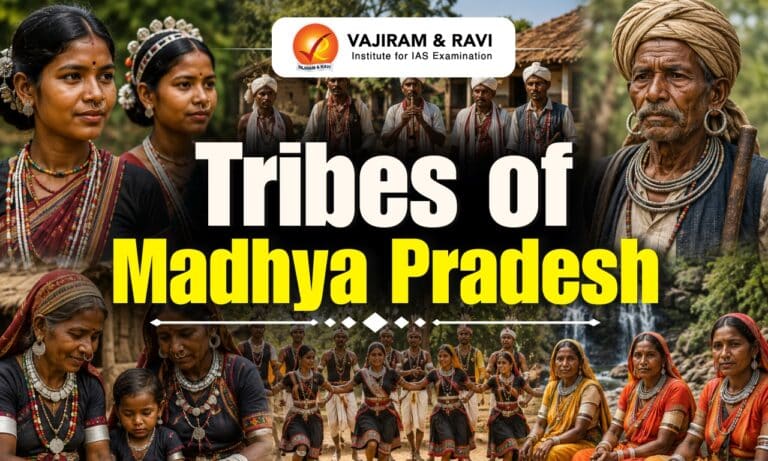
Madhya Pradesh has the largest tribal population in India, with Scheduled Tribes (STs) constituting about 21.1% of the state’s population (Census 2011). The state is home to 46 notified Scheduled Tribes, each with its distinct language, culture, traditions, and livelihood practices. These communities have played a significant role in preserving India’s biodiversity, indigenous knowledge, and cultural heritage.
Major Tribes of Madhya Pradesh
Madhya Pradesh is home to 46 Scheduled Tribes, each contributing to the state’s rich cultural diversity and traditional knowledge systems. These communities preserve unique customs, languages, art forms, and livelihoods while playing an important role in forest conservation and rural development.
|
Major Tribes of Madhya Pradesh |
|
|
Tribe |
Key Features |
|
Gond |
The largest tribal community in Madhya Pradesh, known for Gond paintings, agriculture, and rich cultural heritage. |
|
Bhil |
One of India’s largest tribal groups, recognised for the Bhagoria Festival, traditional archery, and farming. |
|
Baiga |
A Particularly Vulnerable Tribal Group (PVTG) famous for indigenous medicinal knowledge, forest-based livelihood, and traditional tattoo art. |
|
Korku |
Primarily dependent on agriculture and the collection of Minor Forest Produce (MFP), with a distinct language and customs. |
|
Kol |
Traditionally engaged in farming and labour, with a rich heritage of folk songs and community traditions. |
|
Sahariya |
A PVTG facing socio-economic challenges, supported through special government welfare programmes. |
|
Bharia |
A PVTG renowned for its knowledge of medicinal plants and traditional healing practices. |
|
Halba |
Known for agriculture, weaving, bamboo craft, and preservation of tribal customs. |
|
Oraon (Kurukh) |
An agriculture-based tribe recognised for vibrant festivals, folk dances, and community life. |
|
Pardhan |
Traditionally associated with the Gond community as musicians, storytellers, and custodians of oral traditions. |
|
Bhilala |
A sub-group of the Bhils, primarily engaged in agriculture and known for blending tribal and regional cultural traditions. |
|
Barela |
Recognised for farming, folk music, colourful attire, and vibrant community festivals. |
Particularly Vulnerable Tribal Groups (PVTGs) in Madhya Pradesh
Madhya Pradesh is home to three Particularly Vulnerable Tribal Groups (PVTGs). These communities are identified by the Government of India based on factors such as declining or stagnant population, pre-agricultural technology, low literacy levels, and dependence on forest resources.
1. Baiga
The Baiga tribe mainly inhabits Dindori, Mandla, Balaghat, and Umaria districts. Traditionally practising shifting cultivation, the Baigas possess extensive knowledge of medicinal herbs and forest biodiversity. They are renowned for their unique tattoo traditions, folk dances, and nature-based lifestyle.
2. Bharia
The Bharia tribe primarily resides in Patalkot Valley of Chhindwara district. They are famous for their indigenous healthcare practices, herbal medicine, and conservation of medicinal plants. Agriculture and forest produce remain their primary sources of livelihood.
3. Sahariya
The Sahariya tribe is concentrated in Sheopur, Shivpuri, and Guna districts. They depend on agriculture, wage labour, and forest produce collection. Due to poor socio-economic conditions, the community receives special assistance through nutrition, healthcare, education, and livelihood development programmes.


Culture and Traditions of the Tribes of Madhya Pradesh
The tribes of Madhya Pradesh have a rich cultural heritage shaped by their close relationship with forests, nature, and traditional community life. Their unique customs, festivals, art forms, and indigenous knowledge have been preserved and passed down through generations.
- Languages: Major tribal languages include Gondi, Bhili, Korku, Baigani, Bharia, and Bareli, along with Hindi and regional dialects.
- Traditional Occupations: Agriculture, collection of Minor Forest Produce (MFP), animal husbandry, bamboo craft, weaving, fishing, and traditional medicine are the primary occupations.
- Festivals: Popular tribal festivals include Bhagoria, Karma, Madai, Hareli, Navakhani, and Pola, celebrated with music, dance, and community gatherings.
- Folk Dances: Saila, Karma Dance, Bhagoria Dance, Matki Dance, and Gond Dance are performed during festivals and social occasions.
- Art and Handicrafts: The state is famous for Gond paintings, bamboo handicrafts, wood carving, terracotta, bead jewellery, and traditional weaving.
- Religious Beliefs: Most tribes practise nature worship, ancestor worship, and revere village deities, sacred groves, rivers, hills, and forests.
- Traditional Housing: Houses are typically built using mud, bamboo, wood, stone, and thatched roofs, reflecting eco-friendly indigenous architecture.
- Food Habits: The staple diet includes maize, millet (jowar and kodo), rice, pulses, forest tubers, wild fruits, mahua flowers, and leafy vegetables.
- Traditional Attire: Tribal communities wear colourful garments and ornaments made from silver, beads, shells, and brass, especially during festivals.
- Music and Instruments: Folk music is an integral part of tribal life, with instruments such as the Mandar, Dhol, Timki, Flute, and Thali accompanying songs and dances.
Constitutional Safeguards for the Tribes of Madhya Pradesh
The Constitution of India provides special provisions to safeguard the rights, culture, land, education, and socio-economic development of the Scheduled Tribes (STs) in Madhya Pradesh.
- Article 46: Promotes the educational and economic interests of Scheduled Tribes and protects them from social injustice and exploitation.
- Article 244: Provides for the administration of Scheduled Areas under the Fifth Schedule.
- Fifth Schedule: Ensures special governance, protection of tribal land, and the establishment of the Tribes Advisory Council (TAC).
- Article 275(1): Provides grants-in-aid from the Union Government for tribal welfare and development.
- Articles 330 & 332: Reserve seats for Scheduled Tribes in the Lok Sabha and State Legislative Assemblies.
- Article 335: Ensures due consideration for Scheduled Tribes in public employment while maintaining administrative efficiency.
- Article 338A: Establishes the National Commission for Scheduled Tribes (NCST) to protect tribal rights and monitor welfare measures.
- Article 339: Authorises the Union Government to oversee the administration and welfare of Scheduled Tribes.
- Panchayats (Extension to Scheduled Areas) Act, 1996 (PESA): Empowers Gram Sabhas to govern local resources, preserve traditions, and participate in decision-making in Scheduled Areas.
- Forest Rights Act, 2006 (FRA): Recognises individual and community forest rights, including ownership and use of forest resources by tribal communities.
Government Schemes for Tribal Development in Madhya Pradesh
The Central and Madhya Pradesh Governments implement several schemes to improve the education, healthcare, livelihood, infrastructure, and socio-economic development of Scheduled Tribes and Particularly Vulnerable Tribal Groups (PVTGs).
- Pradhan Mantri Janjati Adivasi Nyaya Maha Abhiyan (PM-JANMAN): Focuses on the holistic development of PVTGs through housing, drinking water, healthcare, education, roads, electricity, and livelihood support.
- Dharti Aaba Janjatiya Gram Utkarsh Abhiyan (DAJGUA): Aims to improve infrastructure and basic services in tribal-majority villages through convergent development.
- Eklavya Model Residential Schools (EMRS): Provides quality residential education to tribal students from Classes VI to XII in remote areas.
- PM Van Dhan Yojana: Promotes value addition, processing, and marketing of Minor Forest Produce (MFP) to enhance tribal incomes.
- Pre-Matric and Post-Matric Scholarship Schemes: Offer financial assistance to Scheduled Tribe students for school and higher education.
- National Fellowship and National Overseas Scholarship for STs: Supports higher education, research, and overseas studies for eligible tribal students.
- Minimum Support Price (MSP) for Minor Forest Produce Scheme: Ensures remunerative prices for tribal gatherers selling notified forest produce.
- Special Central Assistance to Tribal Sub-Scheme (SCA to TSS): Funds income-generating activities, skill development, and infrastructure in tribal areas.
- Pradhan Mantri Aadi Adarsh Gram Yojana (PMAAGY): Promotes integrated development of tribal villages by improving education, health, sanitation, and connectivity.

 Last updated on Sep, 2026
→ UPSC 2027 Notification will be released on 13 January 2027 at upsconline.nic.in.
→ Asian Games 2026 are being held in Aichi-Nagoya, Japan, from 19 September to 4 October.
→ Check out the latest UPSC Syllabus here.
→ Download UPSC Model Answers for Mains 2026
→ UPSC Mains Question Paper 2026 is out now for Essay & GS Paper 1, 2, 3 & 4.
→ UPSC Calendar 2027 has been released.
→ Enroll in Vajiram & Ravi’s UPSC Mains Test Series 2027 for structured answer writing practice, expert evaluation, and exam-oriented feedback.
→ Join Vajiram & Ravi’s UPSC Mentorship Program 2027 for personalized guidance, strategy planning, and one-to-one support from experienced mentors.
→ Go through the UPSC Mains Previous Year Papers to enhance your preparation.
→ UPSC has released UPSC Toppers List 2025 with the Civil Services final result on its official website.
→ Also check Best UPSC Coaching in India
Tribes of Madhya Pradesh FAQs
Q1. Which state has the largest tribal population in India?+
Q2. How many Scheduled Tribes are there in Madhya Pradesh?+
Q3. Which is the largest tribe in Madhya Pradesh?+
Q4. How many Particularly Vulnerable Tribal Groups (PVTGs) are there in Madhya Pradesh?+
Q5. Which are the major tribes of Madhya Pradesh?+
Tags: Particularly Vulnerable Tribal Groups (PVTGs) tribes of madhya pradesh