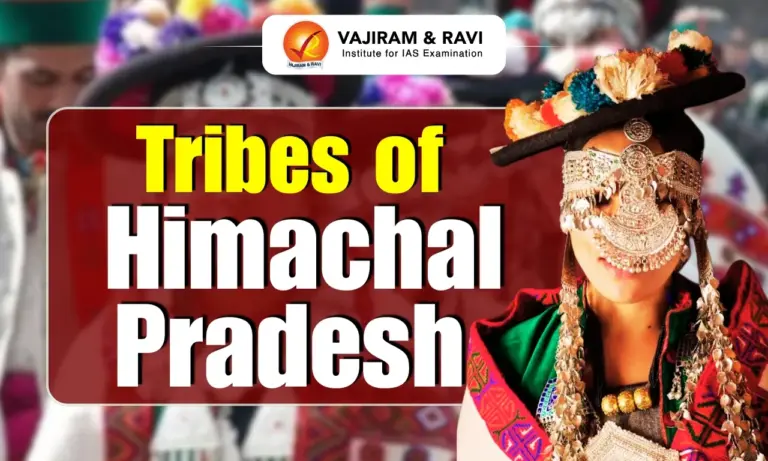
The tribes of Himachal Pradesh are an important part of the state’s rich cultural heritage. Living mainly in the high-altitude Himalayan regions, these tribal communities have preserved their unique languages, traditions, customs, festivals, and traditional occupations for centuries. The tribal population is concentrated mainly in Kinnaur, Lahaul-Spiti, Pangi, and Bharmour. These regions have been notified as Scheduled Areas under the Constitution because of their significant tribal population.
Major Tribes of Himachal Pradesh
The major tribes of Himachal Pradesh have preserved their unique traditions, languages, festivals, and livelihoods for generations, contributing significantly to the state’s cultural diversity and Himalayan heritage.
1. Gaddi Tribe
The Gaddi Tribe is one of the largest and most prominent tribal communities of Himachal Pradesh, known for its pastoral lifestyle, rich traditions, and strong connection with the Himalayan region.
- Primarily found in Chamba, Kangra, and Bharmour regions.
- Traditionally practice pastoralism, rearing sheep and goats.
- Follow seasonal migration (transhumance) to access grazing lands.
- Also engage in agriculture and horticulture for livelihood.
- Mostly follow Hinduism, with Lord Shiva as their chief deity.
- Wear traditional woollen cholas, colourful caps, and shawls.
- Speak the Gaddi dialect, along with Hindi and Pahari.
- Known for preserving folk music, dances, and cultural traditions.
2. Gujjar Tribe
The Gujjar Tribe is a pastoral community known for its expertise in buffalo rearing, dairy farming, and seasonal migration across the Himalayan foothills.
- Mainly inhabits Chamba, Kangra, Una, and Sirmaur districts.
- Traditionally engaged in buffalo and cattle rearing.
- Produce milk, ghee, curd, and other dairy products.
- Practice nomadic or semi-nomadic migration for grazing.
- Majority follow Islam, while some practice Hinduism.
- Speak Gojri, Hindi, and local Pahari dialects.
- Live in temporary shelters during migration.
- Livestock forms the backbone of their economy.
3. Kinnaura (Kanaura) Tribe
The Kinnaura Tribe is famous for its unique blend of Hindu and Buddhist traditions, colourful culture, and thriving horticulture in the Kinnaur region.
- Primarily resides in Kinnaur district.
- Follows both Hinduism and Buddhism.
- Known for apple orchards, terrace farming, and horticulture.
- Skilled in handloom weaving and woollen handicrafts.
- Recognized for the famous green Kinnauri cap.
- Celebrate festivals like Losar and Phulaich.
- Speak the Kinnauri language along with Hindi.
- Preserve rich traditions through folk songs and dances.
4. Lahaula Tribe
The Lahaula Tribe inhabits the cold desert region of Lahaul and is known for its resilience, agricultural practices, and Tibetan cultural influence.
- Mainly found in Lahaul Valley.
- Live in high-altitude cold desert conditions.
- Cultivate potatoes, peas, barley, and other hardy crops.
- Rear yaks, sheep, and other livestock.
- Follow both Buddhism and Hinduism.
- Practice traditional wool weaving and handicrafts.
- Houses are built using stone and mud to withstand harsh winters.
- Tibetan culture significantly influences their lifestyle and customs.
5. Pangwala Tribe
The Pangwala Tribe is a tribal community of the remote Pangi Valley, known for its simple lifestyle, traditional farming, and vibrant folk culture.
- Mainly inhabits the Pangi Valley of Chamba district.
- Depends on agriculture and animal husbandry.
- Rears sheep and goats for income.
- Skilled in traditional weaving and handicrafts.
- Wear distinctive woollen dresses suited to cold climates.
- Celebrate local fairs and community festivals.
- Preserve unique folk music, dances, and oral traditions.
- Maintain close-knit family and community relationships.
6. Swangla Tribe
The Swangla Tribe is an agricultural community of Lahaul Valley that has preserved its traditional customs, religious practices, and mountain lifestyle.
- Found mainly in Lahaul Valley.
- Engaged in farming, trade, and livestock rearing.
- Cultivate crops suitable for high-altitude regions.
- Follow Hinduism and worship local deities.
- Live in traditional wooden and stone houses.
- Skilled in weaving woollen garments and handicrafts.
- Preserve traditional folk songs, dances, and festivals.
- Community life is based on strong social and cultural values.
7. Bhot (Bodh) Tribe
The Bhot (Bodh) Tribe is a Buddhist community of the trans-Himalayan region, recognized for its monasteries, wool production, and Tibetan cultural heritage.
- Primarily found in Lahaul-Spiti district.
- Follow Tibetan Buddhism and monastic traditions.
- Rear yaks, sheep, and goats for livelihood.
- Produce high-quality wool, carpets, and handicrafts.
- Practice agriculture despite harsh climatic conditions.
- Celebrate Buddhist festivals such as Losar.
- Speak Bhoti (Tibetan dialects) and Hindi.
- Preserve centuries-old Buddhist art, architecture, and customs.
8. Jad, Lamba, and Khampa Tribe
The Jad, Lamba, and Khampa Tribes are small Himalayan tribal communities known for their Tibetan heritage, pastoral economy, and distinct cultural identity.
- Inhabit the border regions adjoining Tibet.
- Strongly influenced by Tibetan culture and Buddhism.
- Traditionally engaged in cross-border trade before border restrictions.
- Depend on animal husbandry and livestock rearing.
- Rear yaks, sheep, and goats in high-altitude pastures.
- Wear thick woollen clothing to withstand extreme cold.
- Preserve unique languages, customs, and religious traditions.
- Continue to maintain their traditional way of life while adapting to modern development.
Government Schemes Related to Tribal Welfare
The Government of India and the Himachal Pradesh Government implement various welfare schemes to improve the education, healthcare, livelihood, infrastructure, and socio-economic development of tribal communities while preserving their cultural heritage.
- Pradhan Mantri Janjati Adivasi Nyaya Maha Abhiyan (PM-JANMAN): Improves housing, roads, healthcare, education, and basic services for Particularly Vulnerable Tribal Groups (PVTGs).
- Dharti Aaba Janjatiya Gram Utkarsh Abhiyan (DAJGUA): Focuses on the holistic development of tribal villages through better infrastructure, education, healthcare, and livelihood opportunities.
- Eklavya Model Residential Schools (EMRS): Provides quality residential education to Scheduled Tribe students in tribal-dominated areas.
- Pradhan Mantri Adi Adarsh Gram Yojana (PMAAGY): Develops tribal villages by improving roads, drinking water, sanitation, schools, and healthcare facilities.
- Post-Matric Scholarship for Scheduled Tribe Students: Offers financial assistance to ST students pursuing higher education.
- National Fellowship and Scholarship for Higher Education of ST Students: Supports Scheduled Tribe students in postgraduate and doctoral studies.
- Forest Rights Act, 2006 (FRA): Recognizes the land and forest rights of forest-dwelling Scheduled Tribes and other traditional forest dwellers.
- Minimum Support Price (MSP) for Minor Forest Produce Scheme: Ensures fair prices for tribal communities selling minor forest produce.
- Pradhan Mantri Van Dhan Yojana (PMVDY): Promotes value addition, processing, and marketing of tribal forest products to increase tribal incomes.
- Tribal Sub-Plan (TSP) / Development Action Plan for Scheduled Tribes (DAPST): Allocates dedicated funds for the socio-economic development of Scheduled Tribe communities.


 Last updated on Sep, 2026
→ UPSC 2027 Notification will be released on 13 January 2027 at upsconline.nic.in.
→ Check out the latest UPSC Syllabus here.
→ Download UPSC Model Answers for Mains 2026
→ UPSC Mains Question Paper 2026 is out now for Essay & GS Paper 1, 2, 3 & 4.
→ UPSC Calendar 2027 has been released.
→ Enroll in Vajiram & Ravi’s UPSC Mains Test Series 2027 for structured answer writing practice, expert evaluation, and exam-oriented feedback.
→ Join Vajiram & Ravi’s UPSC Mentorship Program 2027 for personalized guidance, strategy planning, and one-to-one support from experienced mentors.
→ Go through the UPSC Mains Previous Year Papers to enhance your preparation.
→ UPSC has released UPSC Toppers List 2025 with the Civil Services final result on its official website.
→ Also check Best UPSC Coaching in India
Tribes of Himachal Pradesh FAQs
Q1. Which are the major tribes of Himachal Pradesh?+
Q2. Which district has the highest tribal population in Himachal Pradesh?+
Q3. What is the main occupation of the tribes of Himachal Pradesh?+
Q4. Which religion is mainly followed by the tribes of Himachal Pradesh?+
Q5. Which are the Scheduled Tribal Areas in Himachal Pradesh?+
Q6. Which are the Scheduled Tribal Areas in Himachal Pradesh?+
Q7. Which tribe is famous for sheep and goat rearing?+
Q8. Which tribe of Himachal Pradesh is known for apple cultivation?+
Q9. Which tribe primarily follows Tibetan Buddhism?+
Q10. Which language is spoken by the Gujjar Tribe?+
Tags: himachal pradesh tribes tribes of himachal pradesh