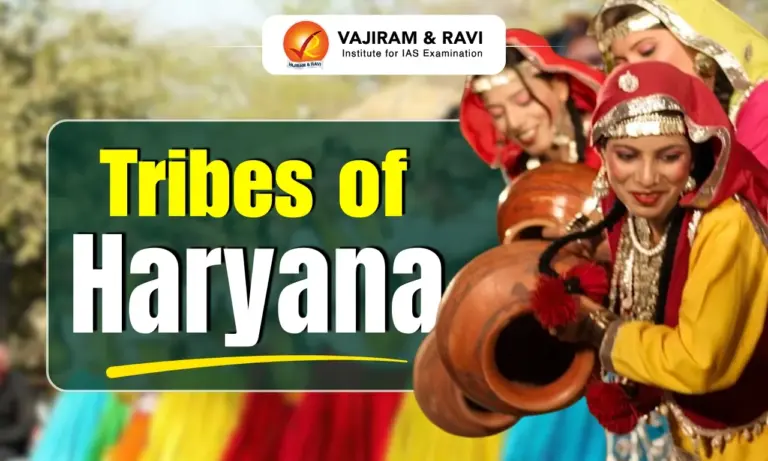
The Tribes of Haryana refer to the various traditional communities and social groups that have been living in the region for generations. These groups are mostly connected with agriculture, trade, and rural life, and each has its own unique culture, customs, and traditions. Even though Haryana does not have officially recognized Scheduled Tribes, these communities play an important role in shaping the state’s social structure, economy, and cultural identity.
Major Tribes of Haryana
The Tribes of Haryana mainly belong to Indo-Aryan and Indo-Dravidian backgrounds. Most of these communities are actually agricultural and pastoral groups rather than officially recognized tribes. They are deeply connected with farming, trade, and rural life, and each group has its own unique culture, traditions, and customs. Haryana does not have officially listed Scheduled Tribes (STs), but it is home to many important ethnic and agrarian communities. Some of the major Tribes of Haryana are discussed below:
1. Jat Tribe
- The Jats are one of the largest and most dominant communities in Haryana, especially in districts like Hisar, Rohtak, and Karnal.
- They are mainly known as hardworking farmers and play a major role in the state’s agricultural economy.
- Jats are divided into several clans, each with its own identity and traditions.
- Apart from farming, many Jats are also involved in trade, local businesses, and production activities in rural areas.
- They have a strong presence in government services, especially in the army, police, and civil services, showing their contribution to national service.
2. Rajput Tribe
- The Rajputs are traditionally known as a warrior class (Kshatriyas) and have a long history of bravery and leadership.
- In Haryana, important Rajput clans include Chauhans, Mandhars, Badgujars, and Tunwars.
- They have historically been associated with land ownership and military roles.
- Today, Rajputs are involved in agriculture, administration, and modern professions, while still maintaining their cultural pride and traditions.
3. Ahir Tribe
- The Ahir community is mainly found in Mahendragarh and Rewari regions of Haryana.
- They are closely related to Jats in terms of lifestyle and clan structure.
- Traditionally, Ahirs are known for cattle rearing and dairy farming, making them important to the rural economy.
- They are also engaged in agriculture and local trade, contributing to village life and development.
4. Ror Tribe
- The Ror community is a relatively small but important agricultural group, mainly concentrated in Karnal district.
- They are primarily involved in farming and allied agricultural activities.
- Despite their smaller population, Rors have a strong identity and are known for their simple lifestyle and dedication to agriculture.
5. Gujjar Tribe
- The Gujjars are traditionally pastoral and agricultural people, often associated with cattle rearing and dairy activities.
- They are found in canal-side villages and rural areas, especially in Karnal and nearby regions.
- Gujjars are believed to have connections with both Kshatriya and Brahmin traditions.
- Many Gujjars also participate in farming, livestock management, and local trade, supporting the rural economy.
6. Harijan Communities
- The Harijan communities make up a significant portion (around one-fifth) of Haryana’s population.
- Major groups include Chamars, Chhuras, Dhanaks, and Julahas.
- These communities have traditionally been involved in various occupations, including agriculture, craftsmanship, and labor work.
- Over time, they have made progress in education, employment, and social development, contributing to the state’s growth.
7. Bania Community
- The Bania community is traditionally known as the main trading and business class in Haryana.
- Major sub-groups include Aggarwalas, Oswals, and Maheshwaris.
- They play a key role in trade, commerce, and finance, both in rural and urban areas.
- Despite being smaller in number, Banias have strong influence in business, markets, and even politics.
8. Meo Tribe
- The Meo community mainly lives in the Mewat region (covering parts of Gurgaon, Alwar, and Bharatpur).
- They are known for their unique cultural blend of Hindu and Islamic traditions.
- Meos are primarily engaged in agriculture and pastoral activities.
- Their identity is closely linked to the region of Mewat, from which they get their name.
Nomadic and Denotified Tribes of Haryana
- Haryana is also home to several nomadic and semi-nomadic groups, recognized for state welfare support.
- These include communities like Jogi, Bhat, Madari, Sapera (snake charmers), Bazigar, and Bauria.
- Traditionally, they were involved in performing arts, animal handling, storytelling, and mobile occupations.
- Today, many of these groups are working towards social inclusion, education, and stable livelihoods.
- There are no Particularly Vulnerable Tribal Groups (PVTGs) identified or residing in the state of Haryana.


Constitutional Safeguards for the Tribes of Haryana
- Educational and Economic Safeguards
- Article 46 directs the state to promote the educational and economic interests of Scheduled Tribes and protect them from social injustice and exploitation.
- Article 15(4) allows the government to make special provisions, such as reservation in educational institutions, for the advancement of tribal communities.
- Article 16(4) ensures reservation in public employment, helping improve job opportunities and economic security.
- Various support measures like scholarships, financial assistance, and welfare programs help reduce inequality and improve access to education.
- Article 23 & 24 protect tribal people from forced labour (begar) and child labour in hazardous industries, ensuring their basic human rights and dignity.
- Identification and Cultural Safeguards
- Article 342 provides official recognition of communities as Scheduled Tribes, enabling them to access constitutional benefits and protections.
- Article 29 protects the language, script, and culture of tribal communities, helping preserve their unique identity.
- It also ensures that no citizen is denied admission to state-funded educational institutions on grounds like religion, caste, or language.
- These provisions help maintain cultural diversity and heritage of tribal societies.
- Institutional Mechanisms for Protection
- Article 338A establishes the National Commission for Scheduled Tribes (NCST), which monitors and safeguards tribal rights.
- The Commission works to investigate complaints, monitor safeguards, and advise the government on tribal welfare policies.
- Article 275 provides grants-in-aid from the Union Government for the development of Scheduled Areas and tribal welfare programs.
- The Forest Rights Act, 2006 recognizes the rights of tribal communities over forest land and resources, supporting their livelihood and traditional practices.
- The SC/ST (Prevention of Atrocities) Act, 1989 protects tribal people from violence, discrimination, and exploitation, ensuring legal protection and justice.
Key Government Schemes for Tribal Empowerment
- Dharti Aaba Janjatiya Gram Utkarsh Abhiyan – This scheme focuses on holistic development of tribal villages by improving infrastructure, healthcare, education, and livelihood opportunities, covering around 63,000 villages and benefiting over 5 crore tribal people.
- Eklavya Model Residential Schools (EMRS) – Provides quality residential education to tribal students from Class VI to XII, with modern facilities aimed at improving academic performance, skill development, and access to higher education.
- Pradhan Mantri Janjati Adivasi Nyaya Maha Abhiyan (PM-JANMAN) – Targets Particularly Vulnerable Tribal Groups (PVTGs) by improving road connectivity, housing, electrification, healthcare, and basic services in remote tribal regions.
- National Overseas Scholarship for ST Students – Enables meritorious tribal students to pursue higher education abroad, promoting global exposure and academic excellence.
- Support to Tribal Research Institutes (TRIs) – Promotes research, documentation, and preservation of tribal culture, traditions, and languages while supporting policy development.
- Development Action Plan for Scheduled Tribes (DAPST) – Ensures coordinated efforts across ministries for tribal welfare, focusing on filling gaps in education, healthcare, and infrastructure.
- National Fellowship for ST Students – Provides financial assistance for higher education and research through a transparent digital system, encouraging advanced studies among tribal students.
- National Scheduled Tribes Finance and Development Corporation (NSTFDC) – Offers concessional financial support to tribal individuals for self-employment and income-generating activities.
- Tribal Cooperative Marketing Development Federation of India (TRIFED) – Promotes tribal products through marketing platforms, supporting artisans and creating sustainable livelihood opportunities.
- Aadi Mahotsav and Cultural Initiatives – Organizes cultural festivals to showcase tribal heritage, promote handicrafts, and generate economic opportunities through cultural promotion.
- Pradhan Mantri Adi Adarsh Gram Yojana (PMAAGY) – Aims to develop tribal-majority villages by providing basic infrastructure such as roads, drinking water, and housing.
- National Health Mission (NHM) – Tribal Focus – Strengthens healthcare services in tribal areas, addressing major health issues and improving access to medical facilities.

 Last updated on Sep, 2026
→ UPSC 2027 Notification will be released on 13 January 2027 at upsconline.nic.in.
→ Check out the latest UPSC Syllabus here.
→ Download UPSC Model Answers for Mains 2026
→ UPSC Mains Question Paper 2026 is out now for Essay & GS Paper 1, 2, 3 & 4.
→ UPSC Calendar 2027 has been released.
→ Enroll in Vajiram & Ravi’s UPSC Mains Test Series 2027 for structured answer writing practice, expert evaluation, and exam-oriented feedback.
→ Join Vajiram & Ravi’s UPSC Mentorship Program 2027 for personalized guidance, strategy planning, and one-to-one support from experienced mentors.
→ Go through the UPSC Mains Previous Year Papers to enhance your preparation.
→ UPSC has released UPSC Toppers List 2025 with the Civil Services final result on its official website.
→ Also check Best UPSC Coaching in India
Tribes of Haryana FAQs
Q1. What are the Tribes of Haryana?+
Q2. Does Haryana have any Scheduled Tribes (STs)?+
Q3. Are there any PVTGs in Haryana?+
Q4. Which is the largest community in Haryana?+
Q5. What is the main occupation of tribes in Haryana?+
Q6. Who are the Jats in Haryana?+
Q7. What is the traditional role of Rajputs in Haryana?+
Q8. Where are Ahirs mainly found in Haryana?+
Q9. What are Gujjars known for in Haryana?+
Q10. Who are the Meo community?+
Tags: indian polity indian polity notes tribes of haryana