India-Egypt Defence Cooperation, Outcomes, Significance

India-Egypt Defence Cooperation

India and Egypt convened the 11th Joint Defence Committee meeting in Cairo to strengthen bilateral defence cooperation and outline a roadmap for future engagement. 

India-Egypt 11th Joint Defence Committee (JDC)

The India-Egypt Joint Defence Committee (JDC) serves as the principal institutional mechanism for reviewing ongoing cooperation and setting the direction for future engagement between the two countries.

  • During the 11th JDC meeting, both sides reviewed the progress made since the previous round and emphasised the need to deepen military cooperation through sustained and structured interactions.
  • A forward-looking defence cooperation roadmap for 2026-27 was agreed upon, focusing on expanding military engagements, joint training, and maritime security cooperation.
  • The meeting witnessed the inaugural Navy-to-Navy staff talks, marking a new phase in maritime cooperation.
  • Both sides explored avenues for defence industry collaboration, including co-development and co-production of defence systems.
  • Greater emphasis was placed on enhancing joint military exercises and operational coordination across services.

India-Egypt Defence Cooperation Roadmap (2026-27)

The two sides agreed on a forward-looking defence cooperation plan for 2026-27 aimed at deepening institutional and operational engagement. 

  • The roadmap focuses on expanding structured military interactions, intensifying joint training programmes, enhancing maritime security cooperation, and increasing the scope and complexity of bilateral military exercises. 
  • The emphasis is on building sustained interoperability and long-term strategic coordination between the armed forces of both countries.

Defence Industry Collaboration and Capability Building

A key highlight of the discussions was the growing emphasis on defence industrial cooperation. 

  • India showcased its expanding defence manufacturing ecosystem, with production exceeding 20 billion US dollars and exports reaching approximately 4 billion US dollars to more than 100 countries.
  • Both sides explored avenues for co-development and co-production in defence platforms and systems.
  • This reflects a broader shift towards technology-driven cooperation, with defence industry collaboration emerging as a critical pillar of bilateral relations.

Maritime and Air Force Cooperation

The meeting witnessed the inaugural Navy-to-Navy staff talks, marking an important milestone in naval engagement. 

  • India highlighted the role of the Indian Navy in ensuring freedom of navigation in the Indian Ocean Region and reiterated the significance of the Information Fusion Centre – Indian Ocean Region in strengthening maritime domain awareness and regional maritime security cooperation.
  • The Indian delegation also held discussions with the leadership of the Egyptian Air Force to further enhance cooperation in training, operational exchanges, and capacity building, thereby broadening the scope of tri-service engagement.

Expanding Military Engagement and Joint Exercises

Both countries reaffirmed their commitment to expanding bilateral military exercises and training engagements.

  • The focus areas include counter-terrorism, desert warfare, special operations, and emerging domains such as drone warfare and hybrid threats.
  • These engagements are aimed at improving operational interoperability, enhancing tactical coordination, and strengthening preparedness for evolving security challenges.

Some of the key exercises between India and Egypt include:

  • Exercise Cyclone, a Special Forces exercise focusing on counter-terrorism operations and desert warfare.
  • Exercise Desert Warrior, a joint air exercise aimed at enhancing coordination between the two air forces.
  • Egypt’s participation in multinational exercises such as Bright Star, along with its involvement in India’s naval exercise MILAN-2024, reflects a gradual broadening of defence cooperation beyond bilateral formats to wider regional and multilateral security engagements.

Significance of India-Egypt Defence Ties

The growing defence partnership has wider strategic implications.

  • Geostrategic Importance: Egypt’s location near the Suez Canal and India’s role in the Indian Ocean make cooperation crucial for global trade and security.
  • Counter-terrorism and Stability: Both countries share concerns over terrorism and regional instability.
  • Defence Industrial Growth: Collaboration supports India’s goal of self-reliance in defence manufacturing.
  • Multipolar World Order: Strengthens South-South cooperation and diversifies strategic partnerships.

India-Egypt Defence Cooperation FAQs

Q1: What was the outcome of the 11th India-Egypt Joint Defence Committee meeting.

Ans: The meeting resulted in a forward-looking defence cooperation roadmap for 2026-27 focusing on deeper military engagement, training, and strategic coordination.

Q2: What areas are covered under the India-Egypt defence cooperation roadmap?

Ans: It includes joint military exercises, maritime security, defence industry collaboration, and expansion of structured military interactions.

Q3: What are the main objectives of the India-Egypt defence roadmap for 2026-27?

Ans: The roadmap aims to expand military-to-military interactions, enhance joint training, strengthen maritime security, and build long-term operational coordination.

Q4: What new development took place in naval cooperation between India and Egypt?

Ans: The two countries held their first-ever Navy-to-Navy staff talks, signalling a new phase of structured maritime engagement

Q5: Which joint military exercises are conducted between India and Egypt?

Ans: Key exercises include Exercise Cyclone for Special Forces and Exercise Desert Warrior for air force cooperation, along with participation in multilateral exercises.

Types of Democracy, Meaning, List, Direct and Indirect Model

Types of Democracy

Types of Democracy explain different ways people exercise political power in a state system. Democracy as an idea has evolved from ancient republics to modern nation states with diverse structures. The concept focuses on participation, representation and accountability. Understanding Models of Democracy is essential to analyse governance systems, institutions and political processes across countries in a clear and factual manner.

Democracy

Democracy means rule by the people where authority ultimately lies with citizens. The term comes from Greek words ‘demos’ meaning people and ‘kratos’ meaning power. According to Abraham Lincoln, democracy is "Government of the people, by the people, for the people". Merriam Webster defines it as a system where people exercise power directly or through elected representatives via free elections. In Mohan Lal v. District Magistrate (1993), it was described as a political philosophy based on representative governance.

Types of Democracy List

Types of Democracy are classified based on participation, structure, authority and functioning of institutions in governance systems worldwide. The two major Types of Democracy include:

  • Direct Democracy (Deliberative and Participatory)
  • Representative Democracy (Presidential and Parliamentary)
  • Other Models of Democracy (Authoritarian, Constitutional, Monitory, Religious, Substantive, Procedural, Social, Cosmopolitan, etc.)

Direct Democracy

Direct Democracy is a system where citizens directly participate in decision making without intermediaries, historically seen in Athens and currently practiced partially in Switzerland and some regions globally.

  • Referendum: Public votes directly on laws or policies with yes or no options, widely used in Switzerland and New Zealand, including citizen initiated and government initiated referendums requiring significant voter participation thresholds.
  • Initiative: Citizens propose laws through petitions, either directly voted by people or reviewed by legislature, as seen in California’s high speed rail initiative and Argentina’s agenda initiative cases.
  • Recall: Voters remove elected officials before term completion, ensuring accountability and public control over governance decisions in democratic frameworks.
  • Sub types: Includes Deliberative Democracy focusing on rational debate and Participatory Democracy encouraging active citizen involvement in policy making processes.

Deliberative Democracy

Deliberative Democracy emphasizes decision making through discussion, debate and reasoned arguments among citizens and representatives.

  • Reason Based Decisions: Policies are justified through logical reasoning and public debate rather than majority dominance.
  • Inclusiveness: Ensures accessibility of arguments and participation for all citizens in decision making processes.
  • Binding Outcomes: Decisions reached through deliberation are accepted as legitimate and binding for a period.
  • Thinkers’ Contribution: Developed by scholars like John Rawls, Joshua Cohen and Amy Gutmann focusing on fairness and rational discourse.

Participatory Democracy

Participatory Democracy promotes active involvement of citizens in governance beyond voting, inspired by thinkers like Rousseau, J.S. Mill and G.D.H. Cole.

  • Active Participation: Citizens directly engage in policy making and implementation processes rather than passive voting.
  • Decentralization: Local governance systems like Panchayati Raj enhance grassroots participation and decision making.
  • Political Engagement: Encourages continuous interaction between government and citizens for accountability and responsiveness.
  • Challenges: Large population size and lack of motivation can limit effective participation.

Representative Democracy

Representative Democracy, also known as Indirect Democracy, involves elected officials making decisions on behalf of citizens, forming the most common system globally, including countries like India, USA, UK, Canada and Australia.

  • Elections: Representatives are chosen through universal adult franchise, ensuring equal voting rights regardless of caste, gender, religion, or region, forming the electorate base.
  • Institutional Structure: Governance operates through legislature, executive and judiciary under constitutional principles ensuring organized functioning and separation of powers.
  • Representation Types: Territorial representation divides regions into constituencies, while functional representation allows occupational groups to elect representatives based on interests.
  • Sub types: Includes Parliamentary and Presidential systems, both functioning under indirect Democracy principles with variations in executive authority and accountability.

Presidential Democracy

Presidential Democracy is a system where the President is both head of state and government, exercising significant executive powers independently of the legislature, seen in USA, Brazil and Sri Lanka.

  • Executive Authority: President holds real executive power, acting as both de jure and de facto leader of the state and government simultaneously.
  • Cabinet Formation: President appoints cabinet members independently, often selecting experts without legislative interference, enhancing administrative efficiency.
  • Legislative Relation: Executive is not directly accountable to legislature and cannot be removed through no confidence motions, ensuring stability in governance.
  • Policy Role: President plays a major role in policy formulation and governance direction, influencing legislative decisions significantly.

Parliamentary Democracy

Parliamentary Democracy is a system where the executive derives authority from the legislature and remains accountable to it, followed in India, UK, Canada, Netherlands and Italy.

  • Executive Accountability: Council of Ministers is responsible to Parliament and must maintain majority support to remain in power.
  • Head of State: President or monarch acts as nominal head, while the Prime Minister exercises real executive authority.
  • Collective Responsibility: Ministers function as a unified body, supporting majority decisions or resigning collectively in case of disagreement.
  • Legislative Dominance: Parliament holds greater authority in law making and can remove the government through no confidence motions.

Other Types of Democracy

The list of various other Models of Democracy has been explained here:

Authoritarian Democracy

Authoritarian Democracy is a system where elections exist but political power is concentrated among elite groups, limiting genuine public participation despite democratic structures.

  • Elite Dominance: Wealthy or influential groups dominate political representation, restricting competition to a limited pool of candidates.
  • Controlled Choice: Citizens vote among selected elites rather than having open democratic competition, reducing inclusiveness.
  • Structural Democracy: Maintains executive and legislative institutions but limits real democratic freedom and participation.
  • Efficiency: Decision making is faster due to fewer actors involved, reducing time and cost in elections and governance.

Constitutional Democracy

Constitutional Democracy emphasizes rule of law and protection of rights by limiting government power through constitutional provisions, followed in the USA, Germany, Japan and Israel.

  • Rule of Law: Government operates under constitutional limits ensuring legal accountability and structured governance.
  • Minority Protection: Focuses on safeguarding rights of minorities against majority dominance in decision making processes.
  • Separation of Powers: Divides authority among legislature, executive and judiciary with checks and balances to prevent misuse.
  • g: Guarantees fundamental rights like freedom of expression, equality and privacy under constitutional framework.

Monitory Democracy

Monitory Democracy refers to systems where multiple institutions continuously monitor government actions, a concept developed after World War II by John Keane.

  • Watchdog Bodies: Includes ombudsmen, audits, commissions and public inquiries ensuring accountability and transparency in governance processes.
  • Guide Institutions: Anti corruption agencies and regulatory bodies supervise government functioning and prevent misuse of power.
  • Civil Society Role: NGOs, think tanks and forums actively monitor policies and inform citizens, strengthening democratic accountability.
  • Expanded Oversight: Uses tools like petitions, media scrutiny and citizen forums to maintain constant checks on authorities.

Religious Democracy

Religious Democracy is a system where governance is based on religious principles or scriptures while maintaining elements of democratic representation.

  • Religious Basis: Laws and policies are framed according to religious doctrines, such as Islamic principles in Islamic democracies.
  • Representation: Elected representatives function within religious frameworks, aligning governance with faith based values.
  • Hybrid Structure: Combines democratic institutions with religious authority influencing political decisions.
  • Legal Framework: Secular laws often coexist but remain subordinate to religious guidelines in governance.

Substantive Democracy

Substantive Democracy focuses on actual outcomes and equality rather than just procedures, ensuring real participation and welfare of citizens.

  • Equality Focus: Ensures equal participation and benefits across social, economic and political spheres beyond formal rights.
  • Outcome Based: Evaluates Democracy based on results such as justice, fairness and welfare rather than electoral processes alone.
  • Public Interest: Government policies aim to reflect true will and needs of the people in decision making.
  • Thinkers’ Views: Scholars like Dahl emphasized collective decision making outcomes, while critics like Fareed Zakaria highlighted challenges in defining good governance.

Procedural Democracy

Procedural Democracy emphasizes processes like elections and institutional frameworks rather than outcomes, focusing on legality and structure of governance.

  • Electoral Process: Free and fair elections with universal suffrage form the core of procedural Democracy.
  • Institutional Focus: Emphasizes systems like legislatures, constitutions and political parties as essential democratic components.
  • Limitations: May ignore social inequalities affecting real participation despite formal equality.
  • Thinkers’ Perspective: Robert Dahl highlighted citizen control over leaders, while Schumpeter emphasized competition for votes.

Social Democracy

Social Democracy combines democratic governance with social justice, aiming to reduce inequalities and ensure welfare through state intervention.

  • Welfare Focus: Ensures economic and social rights along with political rights for citizens.
  • Equality Measures: Promotes redistribution policies to reduce income and opportunity disparities.
  • State Role: Government actively provides resources to make rights meaningful in real life.
  • Thinkers’ Ideas: Thomas Meyer emphasized combining liberal rights with social justice for effective Democracy.

Cosmopolitan Democracy

Cosmopolitan Democracy seeks to extend democratic principles beyond nation states to global governance and international institutions.

  • Global Governance: Focuses on democratic decision making at international level addressing global issues like human rights and peace.
  • Ethical Framework: Promotes moral obligations across borders ensuring justice beyond national boundaries.
  • Peace Objective: Aims to prevent conflicts through democratic cooperation among nations.
  • Thinkers’ Views: Supported by Immanuel Kant, David Held and Daniele Archibugi emphasizing global democratic expansion.

Types of Democracy FAQs

Q1: What are Types of Democracy?

Ans: Types of Democracy refer to different forms of governance based on how people participate and how power is exercised, such as direct, representative, parliamentary and presidential systems.

Q2: What is the Type of Democracy in India?

Ans: India follows a representative democracy with a parliamentary system. Citizens elect representatives through universal adult franchise, and the government is formed by the majority in Parliament, with the Prime Minister as the executive head.

Q3: What is the main difference between Direct and Indirect (Representative) Democracy?

Ans: In Direct Democracy, people take decisions themselves, while in Indirect or Representative Democracy, elected leaders make decisions for the people.

Q4: What is Constitutional Democracy?

Ans: Constitutional Democracy is a system where government powers are limited by a constitution that protects citizens' rights and ensures rule of law.

Q5: Can a country follow more than one Type of Democracy?

Ans: Yes, many countries combine different Types of Democracy, such as representatives with parliamentary or presidential features, depending on their political system.

Property Rights of Women in India, Government Policies, Case Laws

Property Rights of Women in India

Property rights of women in India refer to a woman’s legal right to own, use, and inherit property like land, house, or money. Over time, laws have been made to ensure that women get equal rights as men in owning and managing property. These rights are important for women’s independence, dignity, and financial security. However, in many cases, social attitudes and lack of awareness still affect their proper implementation.

Property Rights of Women in India under Hindu Law

  • In India, the property rights of Hindu women are mainly governed by two important laws - the Hindu Succession Act, 1956 and the Hindu Women’s Right to Property Act, 1937. These laws explain how women can own and inherit property.
  • The Hindu Women’s Right to Property Act, 1937 mainly focused on widows. It gave a Hindu widow the right to get a share in her husband’s property if he died without a will, similar to what her sons would receive.
  • However, this 1937 law had limitations. It did not cover the rights of all women and did not treat women equally in family property matters.

Understanding Coparcenary Property

  • Coparcenary property means ancestral property that belongs to a Hindu Undivided Family (HUF) and is shared among family members.
  • Before 2005, only male members (like sons, grandsons, and great-grandsons) were considered coparceners. This meant:
    • Only men had rights in ancestral property by birth
    • Daughters were not given any share in such property
  • For example, if a father had a son and a daughter, only the son would get a share in ancestral property, not the daughter.

Changes after the 2005 Amendment

  • A major change came with the 2005 Amendment to the Hindu Succession Act.
  • After this amendment:
    • Daughters are now treated the same as sons
    • A daughter becomes a coparcener by birth, just like a son
    • This applies to families governed by Mitakshara law
  • This means:
    • A daughter has equal rights in ancestral property
    • She also has equal responsibilities (like debts or liabilities)

Property Rights of Women in India Key Aspects

  • Equal rights in family property (Coparcenary rights): Under the Hindu Succession law, daughters now have the same rights as sons in ancestral property. They get an equal share and also have equal responsibilities, no matter whether they are married or unmarried.
  • Full ownership of property: A Hindu woman has complete control over any property she owns. Whether she got it through inheritance, gift, purchase, or her own earnings, she is the full owner and can sell, gift, or use it freely without needing anyone’s permission.
  • Equal inheritance rights: If a Hindu man dies without making a will, his property is equally divided among his wife, children (sons and daughters), and mother. This ensures that women get a fair share in family property.
  • Right to home and maintenance: A wife has the right to live in her matrimonial home and is entitled to maintenance (financial support) from her husband. If needed, she can also ask for a separate place to live.
  • Right during family partition: When a joint family property is divided, a woman (like a wife) is entitled to a fair share, similar to other family members.
  • Property rights under Muslim law: Muslim women also have strong property rights. They have full ownership over their property, including mehr (dower) and inherited assets, and they can manage and use their property independently.

Landmark Cases on Property Rights of Women in India

  • Mary Roy v. State of Kerala (1986): The Supreme Court held that discriminatory provisions of the Travancore Succession Act were unconstitutional and gave equal property rights to daughters under the Indian Succession Act, ensuring Mary Roy received her rightful share.
  • Madhu Kishwar v. State of Bihar (1996): The Court struck down some discriminatory provisions favouring men but also recognized that tribal communities follow their own customs, and not all general inheritance laws apply to them.
  • Prakash v. Phulavati (2016): The Supreme Court ruled that the 2005 Amendment granting coparcenary rights to daughters applies only if the father was alive at the time of the amendment.
  • Danamma v. Amar Singh (2018): The Supreme Court held that daughters have equal coparcenary rights even if the father died before 2005, allowing daughters to claim equal share in property.
  • Vineeta Sharma v. Rakesh Sharma (2020): The Supreme Court clarified that daughters are coparceners by birth, regardless of whether the father is alive, and confirmed that the 2005 Amendment applies retrospectively.

Property Rights of Women in India Constitutional and Legal Provisions

  • Article 14 - Equality Before Law: This article ensures that every person is treated equally in the eyes of the law. It means women cannot be denied property rights just because of their gender.
  • Article 15 - No Discrimination: It clearly says that discrimination on the basis of sex is not allowed. It also allows the government to make special laws or policies to support and protect women’s rights, including property rights.
  • Article 21 - Right to Life and Dignity: This article protects a person’s right to live with dignity. Courts have interpreted this to include economic security, meaning women should not be deprived of property through unfair customs or practices.
  • Article 39(a) - Equal Livelihood Opportunities: This is a directive principle that guides the government to ensure that both men and women have equal opportunities to earn and own resources for their livelihood.
  • Hindu Succession Act, 2005 Amendment: This law gives daughters equal rights as sons in ancestral property, making them coparceners by birth. However, it does not apply to tribal communities, as they are governed by their own customary laws.
  • Forest Rights Act, 2006 (FRA): This law recognizes the rights of people living in forest areas. It provides joint ownership (in the name of both husband and wife), which helps strengthen the position of tribal women.
  • Scheduled Tribes and Other Traditional Forest Dwellers Act: This law supports fair and inclusive land rights, ensuring that women in tribal and forest communities are also recognized as rightful owners along with men.

Gender Gap in Property Ownership in India

  • Property ownership among women in India is still quite low compared to men, which clearly shows a gender gap in access to economic resources and financial security.
  • As per data from the United Nations Population Fund (UNFPA), only a small percentage of women have full ownership of property:
    • Around 13% of women (aged 15-49) own a house in their own name, which means very few women have complete control over housing property.
    • A slightly better number, about 29.2% of women, own houses jointly with others, usually with their husbands or family members, which gives them partial ownership.
  • When it comes to land ownership, the gap becomes even more visible:
    • Only 8.3% of women own land independently, showing that very few women have direct control over land resources.
    • Around 23.4% of women own land jointly, which again indicates shared ownership rather than full independence.
  • According to the National Family Health Survey-5 (NFHS-5), there is a clear difference between men and women:
    • About 42.3% of women own a house (either alone or jointly), while a much higher 62.5% of men have ownership
    • In terms of land, 31.7% of women own it compared to 43.9% of men, showing that men still dominate property ownership.
  • There is also a noticeable rural–urban difference in women’s property ownership:
    • Around 45% of women in rural areas own a house either alone or jointly, which is relatively higher.
    • In urban areas, only about 37% of women own houses, suggesting that women in villages may have slightly better access to property than those in cities.
  • Some Indian states show better performance in terms of women owning houses:
    • In states like Karnataka, Punjab, Telangana, Meghalaya, and Jharkhand, more than 60% of women own a house either alone or jointly.
    • This shows that certain regions are doing better in promoting women’s property ownership.

Government Policies and Initiatives for Women’s Property Ownership

  • The Forest Rights Act (FRA), 2006 is an important law that supports people living in forest areas, especially tribal communities:
    • It provides joint ownership of forest land in the name of both husband and wife, which helps women get equal rights
    • By the year 2025, more than 2.4 million land titles have been given, many of which have benefited women
    • This law has helped improve the social and economic position of women in forest regions
  • The Pradhan Mantri Janjati Adivasi Nyaya Maha Abhiyan (PM-JANMAN), 2025 focuses on the development of tribal communities:
    • It aims to develop around 63,000 tribal villages across India
    • One of its key features is spreading awareness about land rights (land literacy) among women
    • This helps women understand their legal rights and claim ownership of property
  • The Digital India Land Records Modernization Programme (DILRMP) is a step towards making land records more transparent and accessible:
    • It works on digitizing land records, making them easier to access and verify
    • This reduces disputes and helps women prove their ownership claims more easily
    • It is also linked with laws like the Forest Rights Act, making the system more efficient
  • The Pradhan Mantri Awas Yojana (PMAY) promotes housing for all, with special focus on women:
    • It encourages or requires houses to be registered in the name of women or jointly with them
    • Women are given priority in allotment of houses under the scheme
    • This increases women’s ownership of homes and strengthens their financial security
  • The Mahila Samridhi Yojana (MSY) supports women from weaker sections of society:
    • It provides low-interest loans (microfinance) to women
    • These loans help women buy property or start small businesses
    • This scheme promotes financial independence and helps women build assets in their own name

Property Rights of Women in India Implementation Challenges

  • Patriarchal mindset and social pressure: In many families, traditional beliefs favour men, and women are often pressured to give up their property rights to maintain family harmony or follow customs.
  • Fear of disputes and lack of awareness: Many women avoid claiming their share due to fear of family conflict and social isolation, along with limited awareness about their legal rights.
  • Misconceptions like dowry as inheritance: The practice of dowry is wrongly seen as a substitute for a daughter’s share in property, which leads to denial of her rightful ownership.
  • Lengthy legal processes and poor land records: Court cases take a long time and are expensive, and unclear or outdated land records make it difficult for women to prove ownership.
  • Economic dependence and limited financial access: Women’s financial dependence on male family members and lack of access to credit or resources make it hard for them to fight legal battles or invest in property.
  • Documentation issues and weak implementation: Many women struggle with paperwork and required documents for schemes like Pradhan Mantri Awas Yojana, and even existing laws and policies are not properly implemented at the ground level.

Measures for Strengthening Property Rights of Women in India

  • Bring uniform and equal laws for all: Introducing a Uniform Civil Code (UCC) can help create the same property and inheritance rules for all religions, removing discrimination and ensuring equal rights for women in matters like marriage, divorce, and property succession.
  • Ensure joint ownership of property: The government should strictly implement rules that require property (especially houses and land) to be registered jointly in the name of both husband and wife, so that women get equal ownership and security.
  • Strengthen legal protection for women: Stronger laws should be enforced to prevent situations where property is forcefully taken from women or just registered in their name without giving them real control, including stricter action against benami (fake ownership) practices.
  • Improve land record systems: Land records should be fully digitized and regularly updated under programs like Digital India Land Records Modernization Programme so that ownership details are clear, transparent, and easy for women to access and claim.
  • Provide easy and affordable legal support: The government should expand free or low-cost legal aid services, especially for poor and rural women, so they can fight property cases without financial burden or fear.
  • Promote awareness and support through groups: Women’s self-help groups (SHGs) and community organizations should be strengthened so women can support each other, learn about their rights, and gain access to financial services and property ownership opportunities.
  • Offer financial benefits and special support: Providing incentives like lower stamp duty, cheaper home loans, tax benefits, and special schemes for widows and single women can encourage more women to own property and become financially independent.

Property Rights of Women in India FAQs

Q1: What are property rights of women in India?

Ans: Property rights of women in India refer to their legal right to own, inherit, use, and transfer property like land, houses, or money. These rights ensure women’s financial independence, equality, and dignity in society.

Q2: Do daughters have equal rights in ancestral property in India?

Ans: Yes, after the 2005 amendment to the Hindu Succession Act, daughters have equal rights as sons in ancestral property. They are considered coparceners by birth and can claim an equal share.

Q3: Can a woman sell or transfer her property without permission?

Ans: Yes, a woman has full ownership over her property and can sell, transfer, or use it in any way without needing permission from family members.

Q4: What are the key laws protecting women’s property rights in India?

Ans: Important laws include the Hindu Succession Act, 1956 (amended in 2005), the Forest Rights Act, 2006, and constitutional provisions like Articles 14 and 15 that ensure equality and prevent discrimination.

Q5: What are some landmark cases related to women’s property rights?

Ans: Cases like Mary Roy v. State of Kerala (1986) and Vineeta Sharma v. Rakesh Sharma (2020) played a major role in ensuring equal property rights for women and removing gender-based discrimination.

Kattunayakan Tribe, Culture, Language, History, PVTGs, Mudumalai

Kattunayakan Tribe

Kattunayakan Tribe is one of the oldest forest dwelling communities of South India. It is known for deep ecological knowledge and dependence on natural resources. The Kattunayakan Tribe lives mainly in the Western Ghats and is recognized as a Particularly Vulnerable Tribal Group (PVTG). Their lifestyle reflects hunting gathering traditions, strong cultural beliefs and close interaction with forests, making the Kattunayakan Tribe important for understanding indigenous knowledge systems.

Kattunayakan Tribe

The Kattunayakan Tribe is an ancient forest dependent community of the Western Ghats, known for honey collection, hunting practices and distinct cultural traditions rooted in nature.

  • Origin: The term Kattunayakan means “king of the jungle” in Tamil and Malayalam, reflecting their identity as forest rulers.
  • Historical Background: The Kattunayakan Tribe is considered among the earliest inhabitants of the Western Ghats, historically living as forest based hunter gatherers and maintaining continuity of traditional practices, ecological knowledge and cultural identity over centuries. 
  • Distribution: The Kattunayakan Tribe is found in the regions like Tamil Nadu, Kerala, Karnataka and Andhra Pradesh, with local names like Cholanaickan in Nilambur interiors and Pathinaickans in plains regions.
  • Population Status: With an approximate population of 20,251, the Kattunayakan Tribe is officially recognized as a Scheduled Tribe and categorized among the 75 Particularly Vulnerable Tribal Groups in India.
  • Livelihood Practices: The tribe depends on forest produce such as honey, wax, roots and bark, along with fishing and trapping small animals, maintaining a hunter gatherer lifestyle with minimal agricultural activity.
  • Language: Their language is a mixture of Dravidian languages including Tamil, Kannada and Malayalam, reflecting cultural interactions while retaining distinct tribal identity and oral traditions.
  • Social Structure: The Kattunayakan Tribe follows a patrilineal system with monogamy as a norm and marriages usually occur after puberty, replacing earlier child marriage practices.
  • Religion and Beliefs: They follow Hinduism blended with animism, worshipping Lord Shiva as Bhairava along with animals, trees, rocks, snakes and ancestors, showing strong ecological spirituality.
  • Culture: Music, dance and oral storytelling are integral, while traditional medicine and rituals, including belief in magic and sorcery, continue to shape their social and spiritual life.
  • Cultural Recognition: The Oscar winning documentary “The Elephant Whisperers” highlighted Bomman and Bellie from the Kattunayakan Tribe, showcasing their role in nurturing orphaned elephants in Mudumalai.

Kattunayakan Tribe and Mudumalai Protected Areas

The Kattunayakan Tribe has a deep association with Mudumalai landscapes, where their traditional knowledge supports wildlife conservation and elephant care systems.

  • Mudumalai National Park Location: Located in the Nilgiri Hills of Tamil Nadu, it borders Kerala and Karnataka and forms part of the Nilgiri Biosphere Reserve, one of India’s key biodiversity hotspots.
  • Mudumalai Tiger Reserve: Declared a tiger reserve in 2007, Mudumalai hosts species like Bengal tiger, Indian leopard, elephant and sloth bear within a large contiguous forest ecosystem.
  • Mudumalai Elephant Habitat: The region represents one of the largest habitats for Asian elephants, supported by grasslands, bamboo forests and water sources like the Moyar River and its tributaries.
  • Theppakadu Elephant Camp: Established in 1927, it is among the oldest elephant camps in Asia, housing around 28 elephants and relying on tribal mahouts, mainly from the Kattunayakan Tribe.
  • Role of Tribe Conservation: Members of the Kattunayakan Tribe serve as caretakers and mahouts, using traditional knowledge to manage elephants and assist in forest conservation activities.

Particularly Vulnerable Tribal Groups (PVTGs)

Particularly Vulnerable Tribal Groups are the most vulnerable tribal groups in India, identified based on socio-economic and demographic criteria, requiring focused protection, development policies and targeted welfare schemes.

  • Definition: Particularly Vulnerable Tribal Groups are characterized by declining or stagnant population, low literacy, pre agricultural technology and high dependence on forests and natural resources.
  • Distribution: India has 75 PVTGs across 18 states and one Union Territory, with Odisha having the highest number, while Punjab and Haryana have no identified PVTGs.
  • Identification Criteria: Criteria include economic backwardness, technological simplicity, low literacy and demographic vulnerability, with proposals submitted by states and approved by the central government.
  • Development Schemes: The PVTG Development Scheme launched in 2008 focuses on housing, land development, agriculture, social security and infrastructure through Conservation-cum-Development Plans.
  • Governance Framework: The Ministry of Tribal Affairs implements policies, while expert committees approve plans, ensuring targeted funding for survival, protection and socio-economic development.
  • Kattunayakan Tribe: As a PVTG, the Kattunayakan Tribe represents traditional ecological knowledge systems and highlights the need for balancing conservation with livelihood security in forest regions. 

Kattunayakan Tribe FAQs

Q1: What is the Kattunayakan Tribe known for?

Ans: The Kattunayakan Tribe is known for honey collection, forest based livelihood and traditional ecological knowledge.

Q2: Where is the Kattunayakan Tribe found?

Ans: They are mainly found in Tamil Nadu, Kerala, Karnataka and Andhra Pradesh regions of the Western Ghats.

Q3: Why is the Kattunayakan Tribe classified as a PVTG?

Ans: They have low literacy, economic backwardness and depend on pre agricultural forest based livelihood systems.

Q4: What language do the Kattunayakan people speak?

Ans: They speak a mixed Dravidian language with elements of Tamil, Kannada and Malayalam.

Q5: What is the role of the Kattunayakan Tribe in Mudumalai?

Ans: They work as mahouts and caretakers, helping in elephant conservation and forest protection activities.

Indian Treasure Trove Act 1878, Provisions, State Amendments

Indian Treasure Trove Act 1878

The Indian Treasure Trove Act 1878 was enacted on 12 February 1878. The act regulates discovery and ownership of hidden valuables found in soil. It defines “treasure” as anything of value hidden underground exceeding ten rupees. The Indian Treasure Trove Act 1878 assigns authority to the Collector and ensures reporting, inquiry and lawful distribution. It aimed to protect valuable artefacts and establish state control over historically significant finds.

Indian Treasure Trove Act 1878 Provisions

The Indian Treasure Trove Act 1878 lays down procedures for reporting, inquiry, ownership determination and penalties regarding discovered treasure in India.

  • Extent: The Act extends across India. It replaced earlier laws and was adapted post independence to apply to Indian territories with modifications.
  • Definitions: The act defines several terms such as Treasure and Collector. Treasure means anything valuable hidden in soil or attached property and Collector includes district revenue officers or officials appointed by the government to perform such functions.
  • Mandatory Notice by Finder: Any treasure above Ten Rupees must be reported in writing to the Collector with details of value, location and date. Finders must deposit it or provide security for production.
  • Public Notification for Claimants: Collector publishes notice inviting claims within four to six months. If land belongs to another person, a special notice is also issued to that person.
  • Forfeiture of Claims: Persons failing to appear after notification lose their rights over the treasure, ensuring timely legal claims and administrative efficiency.
  • Inquiry by Collector: Collector investigates finder identity, discovery circumstances and possible original owner, including whether treasure was hidden within the past hundred years.
  • Civil Court Role: If recent ownership is suspected, time is given for claimants to approach civil courts to establish legal ownership through formal suits.
  • Declaration of Ownerless Treasure: If no valid claim exists or suit fails, the Collector declares treasure ownerless. Appeal can be filed within two months before revenue authority.
  • Distribution Rules: Treasure may be given fully to finder or divided with the landowner. Normally, finder gets three fourths and landowner one fourth unless prior agreement exists.
  • Dispute Resolution: In case of multiple claims, proceedings are stayed and civil courts decide ownership. Final division follows court decision or defaults to finder if claims fail.
  • Government Acquisition Power: Government may acquire treasure by paying its material value plus one fifth extra compensation, making it state property.
  • Finality and Powers: Collector decisions are final and protected if done in good faith. The collector holds civil court powers and state governments can frame rules.
  • Penalties for non compliance: Failure to report, concealment or illegal alteration leads to forfeiture and punishment up to one year imprisonment, fine or both.
  • Penalty for abetment: Landowners aiding concealment face up to six months imprisonment or fine and lose their share in the treasure.

Indian Treasure Trove Act 1878 State Amendments

Several states modified the Indian Treasure Trove Act 1878 to suit administrative needs and strengthen reporting, ownership and enforcement mechanisms.

  • Himachal Pradesh amendments: Introduced Section 3A allowing government permission for treasure search. Modified sharing rules by including government share and changed the appeal authority to Financial Commissioner.
  • Bihar amendments: Expanded Section 5 by allowing action on information from any source. Added provision treating non reporting by landowners within two months as abetment under penalty provisions.
  • Tamil Nadu amendments: Made notice mandatory for owners and occupiers within two months. Allowed the Collector to act even on indirect information and added penalties for failure to report discovery.
  • Maharashtra amendments: Extended applicability to Hyderabad and Saurashtra regions through Bombay Act 1958. Also included repeal and savings clause preserving earlier actions under previous laws.

Indian Treasure Trove Act 1878 Criticism

The Indian Treasure Trove Act 1878 has faced criticism for complexity, outdated provisions and limited incentives for finders in modern administrative and archaeological contexts.

  • Lack of incentives: Finder often receives limited shares or the government acquires treasure, reducing motivation for voluntary reporting and discouraging discoveries by individuals.
  • Outdated colonial framework: The law reflects colonial priorities, focusing on state control rather than heritage preservation, making it less relevant in present legal and archaeological practices.
  • Complex procedures: Multi stage inquiry, notifications and court involvement make the process lengthy and difficult, especially for ordinary citizens unfamiliar with legal formalities.
  • Overlapping jurisdiction: Agencies like the Archaeological Survey of India dominate excavations, reducing practical relevance of the Act in organized treasure exploration and heritage management. 

Indian Treasure Trove Act 1878 FAQs

Q1: What is the Indian Treasure Trove Act 1878?

Ans: It is a law that regulates discovery, reporting and ownership of hidden treasures found in India.

Q2: What is considered “treasure” under the Indian Treasure Trove Act 1878?

Ans: Treasure means any valuable object hidden in soil or attached to land worth more than ten rupees.

Q3: Who must be informed after finding treasure as per Indian Treasure Trove Act 1878?

Ans: The finder must inform the District Collector in writing with details of the treasure and its location.

Q4: How is treasure distributed under the Indian Treasure Trove Act 1878?

Ans: Treasure is usually shared between finder and landowner or given fully to finder if no claims exist.

Q5: What happens if treasure is not reported under Indian Treasure Trove Act 1878?

Ans: Failure to report can lead to forfeiture of share and punishment including fine or imprisonment.

Extreme Weather Events to Impact 36% Land Animal Habitats by 2085

Extreme weather events to impact 36% land animal habitats by 2085

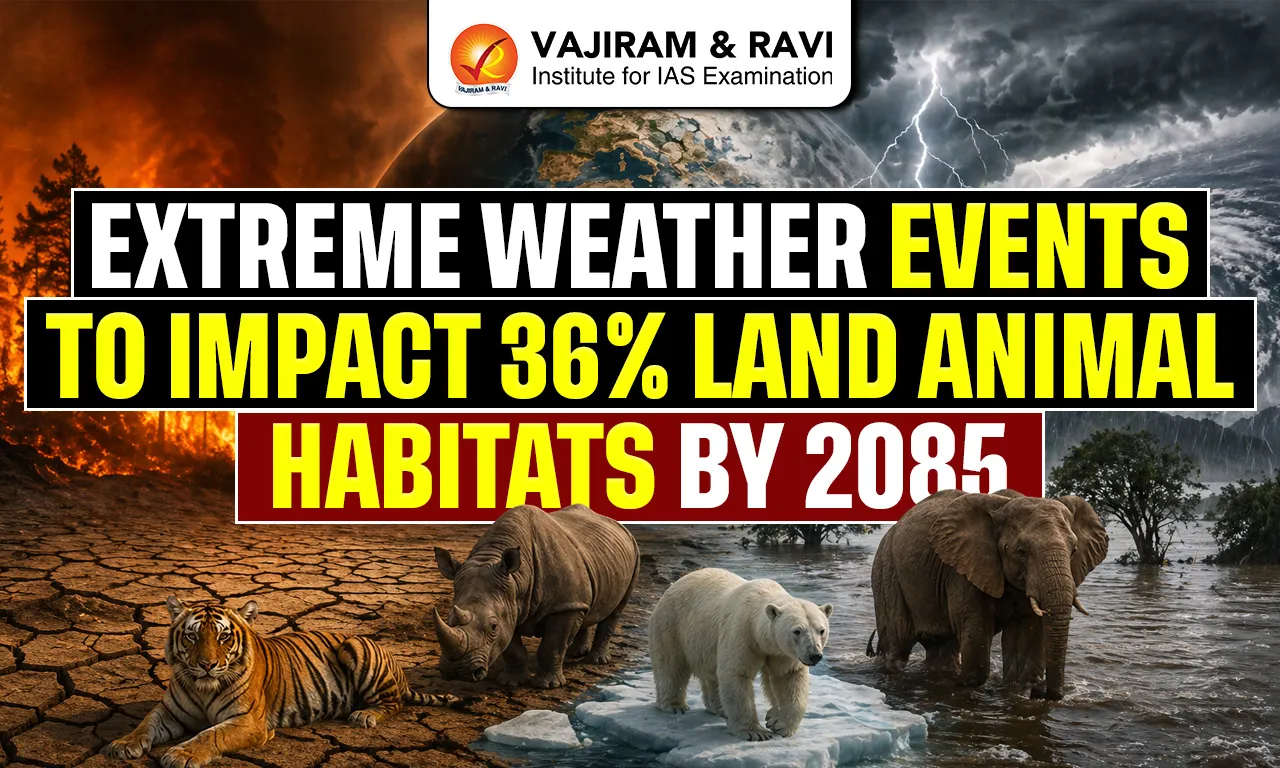
A recent study published in the journal Nature Ecology & Evolution warns that extreme weather events could severely disrupt global biodiversity, with nearly 36% of terrestrial animal habitats at risk by 2085, if current emission trends continue. 

Key Findings of the Study

The study, conducted by researchers from the Potsdam Institute for Climate Impact Research, provides a comprehensive assessment of climate risks to biodiversity. It analysed 33,936 terrestrial vertebrate species across 794 ecoregions using climate projections and impact simulations.

  • By 2085, around 36% of terrestrial habitats could experience compounded extreme events such as heatwaves, wildfires, droughts, and floods.
  • By 2050, 74% of animal habitats on land will be exposed to heatwaves, 16% to wildfire, 8% to droughts, and 3% to floods if warming continues into the latter half of the century.
  • Biodiversity hotspots such as the Amazon, tropical Africa, and Southeast Asia are expected to witness the highest increase in extreme events.

What are Compounded Climate Events?

The study introduces the concept of compounded climate risks, which significantly amplifies ecological damage.

  • These refer to multiple extreme weather events occurring simultaneously or in quick succession.
  • Their combined impact is greater than the sum of individual events, leading to cascading ecological failures.
  • For example, drought followed by wildfire weakens ecosystems, resulting in higher species mortality.
  • Evidence from the 2019-20 Australian bushfires shows 27-40% greater species decline in drought-affected areas.

Also Read: Climate of India

Impact on Biodiversity

Extreme weather events are already causing widespread damage to ecosystems and species survival.

  • The 2019-20 Australian heatwave killed over 72,000 flying foxes.
  • Wildfires in the Pantanal region (South America) resulted in the death of nearly 17 million vertebrates.
  • Native species tend to be more vulnerable than non-native species due to lower adaptability.
  • Loss of vegetation affects food availability, shelter, and breeding patterns, disrupting entire ecosystems.
  • The study finds that while some species may temporarily benefit from extreme events, for example the ornate chorus frog faces less predation during droughts, overall, the increasing intensity and frequency of such events due to climate change are exceeding the ability of most species to adapt.

Concerns with Current Conservation Planning

The findings reveal significant gaps in existing biodiversity conservation strategies.

  • Most conservation frameworks focus on gradual temperature rise rather than extreme events.
  • Extreme events are still underestimated in conservation planning.
  • Lack of integration of compound risks and climate shocks makes current strategies inadequate.
  • This calls for a shift towards dynamic, risk-based, and resilience-focused conservation models.

Also Read: Climatic Regions

Can the Situation be Reversed?

Despite the alarming projections, the study makes it clear that the outcome is not inevitable and can still be altered through timely action.

  • Achieving net-zero emissions can dramatically reduce the share of habitats exposed to multiple extreme events from about 36% to nearly 9%, highlighting the power of mitigation.
  • Rapid and sustained cuts in greenhouse gas emissions can limit the intensity and frequency of extreme events, thereby protecting biodiversity and ecosystem stability.
  • The findings emphasise that immediate and coordinated global action is crucial to avoid long-term and irreversible ecological damage, making the present decade decisive for conservation efforts.

Extreme weather events to impact 36% land animal habitats by 2085 FAQs

Q1: What does the study in Nature Ecology & Evolution say about the impact of extreme weather on animal habitats?

Ans: The study finds that about 36% of terrestrial animal habitats could face multiple extreme weather events like heatwaves, wildfires, and floods by 2085 if emissions continue to rise

Q2: What are compounded climate events?

Ans: Compounded events refer to multiple extreme weather events occurring together or in quick succession, causing much greater damage than individual events.

Q3: Which regions are most vulnerable to these impacts?

Ans: Biodiversity hotspots such as the Amazon, tropical Africa, and Southeast Asia are expected to experience the highest increase in extreme weather events.

Q4: How do extreme weather events affect biodiversity?

Ans: They cause mass mortality, habitat destruction, and disruption of food chains, with native species being more vulnerable and less able to adapt.

Q5: Can these impacts be reduced or prevented?

Ans: Yes, achieving net-zero emissions and rapidly reducing greenhouse gases can significantly lower risks and limit the damage to ecosystems and biodiversity.

Leaf Spot Diseases

Leaf Spot Diseases

Leaf Spot Diseases Latest News

With leaf spot disease in arecanut plantations remaining a major concern for growers, the three-year field demonstrations launched by two premier government institutes in Karnataka to guide farmers on how to manage the disease by adopting a package of practices will complete a year soon.

About Leaf Spot Diseases

  • Leaf spot is the name given to a group of plant diseases caused by fungi, bacteria, or other microorganisms. 
  • These pathogens exploit the leaf’s surface and, once established, can quickly proliferate, producing visible spots or lesions.
  • The spots on the leaves can be small or large. Leaf spot also interferes with the plant's photosynthesis. 
  • If left untreated, leaf spot can eventually severely damage the plant’s foliage.
  • Heavily infected leaves turn yellow and brown, shrivel, and drop prematurely. 
  • Almost every region around the world is susceptible to some form of leaf spot disease. 
  • The prevalence and severity depend on local climate conditions, with humid and wet environments particularly conducive to the spread and growth of these pathogens.
  • They are common on vegetables, bedding plants, fruit trees, ornamental trees and shrubs.
  • The two main types of leaf spot are either fungal or bacterial, with 85% of plant diseases caused by fungi.
  • While not caused by a pathogen, certain environmental conditions can cause symptoms that resemble leaf spots.
    • Factors such as water stress, sun scald, chemical burn from pesticides or herbicides, or nutrient imbalances can lead to spot-like lesions on leaves.
  • Leaf spot diseases present a serious threat to global agriculture, impacting food production, economic stability, and environmental health. 
  • Controlling and preventing leaf spot diseases require a combination of cultural, biological, and chemical methods.

Source: TH

Leaf Spot Diseases FAQs

Q1: What is leaf spot disease?

Ans: A group of plant diseases caused by fungi, bacteria, or other microorganisms

Q2: How do leaf spot pathogens affect plant leaves?

Ans: They infect the leaf surface and produce visible spots or lesions

Q3: What happens if leaf spot disease is left untreated?

Ans: It can severely damage plant foliage.

Q4: Are leaf spot diseases limited to specific regions?

Ans: No, they occur in almost every region worldwide.

Q5: What percentage of leaf spot disease are caused by fungi?

Ans: About 85%

Kawasaki Disease

Kawasaki Disease

Kawasaki Disease Latest News

A multicenter study recently found that the addition of prednisolone to the conventional primary therapy for Kawasaki disease had no effect on lowering the number of cases of coronary-artery lesions at one month from the onset of the disease.

About Kawasaki Disease

  • Kawasaki Disease, also known as Kawasaki syndrome or mucocutaneous lymph node syndrome, is a rare disease that causes fever and inflammation of the blood vessels.
  • It occurs mostly in children younger than 5 years old and affects boys more often than girls.
  • The disease was first described in Japan by Tomisaku Kawasaki in 1967, and the first cases outside of Japan were reported in Hawaii in 1976.
  • The cause of Kawasaki disease is unknown, although more cases happen in late winter and early spring. 
  • It is the most common form of acquired (not present at birth) heart disease in children in developed countries. 
  • The condition causes the immune system to attack blood vessels, which become inflamed and swollen.
  • It tends to affect the coronary arteries, which carry blood to the heart muscle. 
  • It can also cause problems with lymph nodes, skin, and the lining of a child’s mouth, nose, and throat.
  •  It is not contagious, so it cannot spread from person to person. 

Kawasaki Disease Symptoms

  • Symptoms of Kawasaki disease can appear in two phases and may last several weeks.
  • Common symptoms include:
    • A high fever lasting more than five days.
    • A rash on the main part of the body or in the genital area.
    • An enlarged lymph node in the neck.
    • Very red eyes without a thick discharge.
    • Red, dry, cracked lips and a red, swollen tongue.
    • Swollen, red skin on the palms of the hands and the soles of the feet. Later the skin on fingers and toes peels.

Kawasaki Disease Treatment

  • It is often treatable. With early treatment, most children get better and have no long-lasting problems.
  • It is usually treated in the hospital with an intravenous (IV) dose of immunoglobulin (IVIG) antibodies.

Source: MD

Kawasaki Disease FAQs

Q1: What is Kawasaki Disease?

Ans: A rare disease that causes fever and inflammation of blood vessels.

Q2: Which age group is most affected by Kawasaki Disease?

Ans: Children younger than 5 years.

Q3: During which seasons are more cases of Kawasaki Disease observed?

Ans: Late winter and early spring.

Q4: How does Kawasaki Disease affect the immune system?

Ans: It causes the immune system to attack blood vessels.

Q5: Which arteries are mainly affected in Kawasaki Disease?

Ans: Coronary arteries.

Functions of Judiciary, Roles, Powers & Constitutional Provisions

Functions of Judiciary

The judiciary is one of the most important pillars of a democratic system, alongside the legislature and executive. In countries like India, the judiciary ensures that the Constitution is upheld, laws are properly interpreted, and justice is delivered fairly to all citizens. The Indian judiciary, led by the Supreme Court of India, plays a crucial role in maintaining the rule of law, protecting fundamental rights, and resolving disputes.

Functions of Judiciary

The judiciary performs several crucial functions to ensure justice, uphold the Constitution, and maintain the rule of law in a democratic system.

1. Interpretation of Laws

The judiciary interprets laws to clarify meaning, resolve ambiguities, and ensure their proper implementation in real-life situations.

  • Provides authoritative interpretation of the Constitution and statutes
  • Clarifies ambiguous or vague provisions in laws passed by Parliament and State Legislatures
  • Harmonizes conflicting provisions between different laws or within the same law
  • Applies the doctrine of precedent (stare decisis) to ensure consistency in judgments
  • Uses principles like literal rule, golden rule, and mischief rule for interpretation
  • Ensures laws are interpreted in line with constitutional values and intent
  • Associated Articles: Articles 124-147, 214-231

2. Protection of Fundamental Rights

The judiciary acts as the guardian of Fundamental Rights and ensures that no authority violates them.

  • Citizens can directly approach courts for enforcement of rights
  • Courts issue writs such as Habeas Corpus, Mandamus, Certiorari, Prohibition, and Quo Warranto
  • Protects rights against state as well as private violations (in some cases)
  • Expands scope of rights through judicial activism and progressive interpretation
  • Ensures speedy remedy in case of rights violations
  • Acts as a shield against arbitrary laws and executive actions
  • Associated Articles: Article 32, Article 226

3. Judicial Review

Judicial review is the power to examine the constitutional validity of legislative and executive actions.

  • Declares laws void if they violate Fundamental Rights or Constitution
  • Reviews constitutional amendments to ensure they do not violate the Basic Structure
  • Maintains checks and balances among three organs of government
  • Prevents tyranny of majority by limiting legislative power
  • Ensures all actions follow the basic structure doctrine
  • Strengthens constitutional supremacy over parliamentary supremacy
  • Associated Articles: Articles 13, 32, 131–136, 226

4. Settlement of Disputes

The judiciary resolves disputes to maintain law, order, and harmony in society.

  • Adjudicates civil disputes like property, contracts, family matters
  • Handles criminal cases involving offenses and punishments
  • Resolves Centre-State and inter-state disputes in federal structure
  • Provides binding judgments enforceable by law
  • Ensures peaceful resolution instead of conflict or violence
  • Acts as a neutral and impartial arbiter between parties
  • Associated Articles: Article 131, Articles 132–136

5. Guardian of the Constitution

The judiciary ensures that the Constitution remains supreme and its provisions are protected.

  • Interprets Constitution as the final authority
  • Protects basic structure (e.g., democracy, secularism, federalism)
  • Prevents unconstitutional laws and amendments
  • Maintains balance of power between Centre and States
  • Ensures all branches act within their constitutional limits
  • The Supreme Court of India has the final say in constitutional matters
  • Associated Articles: Articles 32, 136, 141, 142

6. Advisory Jurisdiction

The judiciary advises the executive on important legal and constitutional matters when requested.

  • The President can seek opinion on questions of public importance
  • Provides legal clarity before implementation of policies
  • Helps avoid constitutional conflicts and disputes
  • Advisory opinion is not binding but carries strong authority
  • Used in complex or sensitive national issues
  • Strengthens coordination between executive and judiciary
  • Associated Articles: Article 143

7. Administration of Justice

The judiciary ensures justice through a structured legal process involving trials and judgments.

  • Conducts fair and impartial trials based on evidence
  • Ensures due process of law is followed
  • Protects rights of both accused and victims
  • Awards punishments, compensation, or relief as per law
  • Ensures transparency and accountability in legal proceedings
  • Promotes access to justice through legal aid and Lok Adalats
  • Associated Articles: Articles 21, 39A

8. Maintenance of Rule of Law

The judiciary ensures that law is supreme and applies equally to all individuals.

  • Upholds equality before law and equal protection of laws
  • Ensures no person is above the law, including government officials
  • Prevents arbitrary and discriminatory actions
  • Strengthens legal certainty and predictability
  • Promotes fair governance and justice delivery
  • Acts as a foundation for democratic governance
  • Associated Articles: Articles 14, 21

9. Protection Against Arbitrary Actions

The judiciary checks misuse of power by the executive and administrative authorities.

  • Reviews administrative decisions for legality and fairness
  • Ensures decisions follow principles of natural justice
  • Protects individuals from abuse of authority
  • Can quash illegal orders or actions
  • Ensures reasonableness and non-arbitrariness in governance
  • Strengthens accountability of public officials
  • Associated Articles: Articles 32, 226, 136

10. Public Interest Litigation (PIL)

PIL allows courts to address issues affecting the public at large, especially weaker sections.

  • Any person can file a petition for public welfare, even if not directly affected
  • Promotes social justice and human rights protection
  • Addresses issues like environment, corruption, bonded labor, etc.
  • Makes justice accessible to poor and marginalized sections
  • Encourages judicial activism in public matters
  • Expands scope of right to life and dignity under Article 21
  • Associated Articles: Articles 32, 226

Functions of Judiciary FAQs

Q1: What are the main functions of the judiciary?

Ans: The main functions include interpretation of laws, protection of Fundamental Rights, judicial review, settlement of disputes, and safeguarding the Constitution.

Q2: What is the primary role of the judiciary in India?

Ans: The primary role is to deliver justice and ensure that all laws and actions comply with the Constitution under the supervision of the Supreme Court of India.

Q3: What is judicial review in simple terms?

Ans: Judicial review is the power of courts to examine laws and government actions and declare them invalid if they violate the Constitution.

Q4: How does the judiciary protect Fundamental Rights?

Ans: It allows citizens to approach courts directly and provides remedies through writs like Habeas Corpus, Mandamus, and Certiorari.

Q5: What is the importance of Article 32?

Ans: Article 32 gives citizens the right to approach the Supreme Court of India directly for enforcement of Fundamental Rights.

Thrissur Pooram

Thrissur Pooram

Thrissur Pooram Latest News

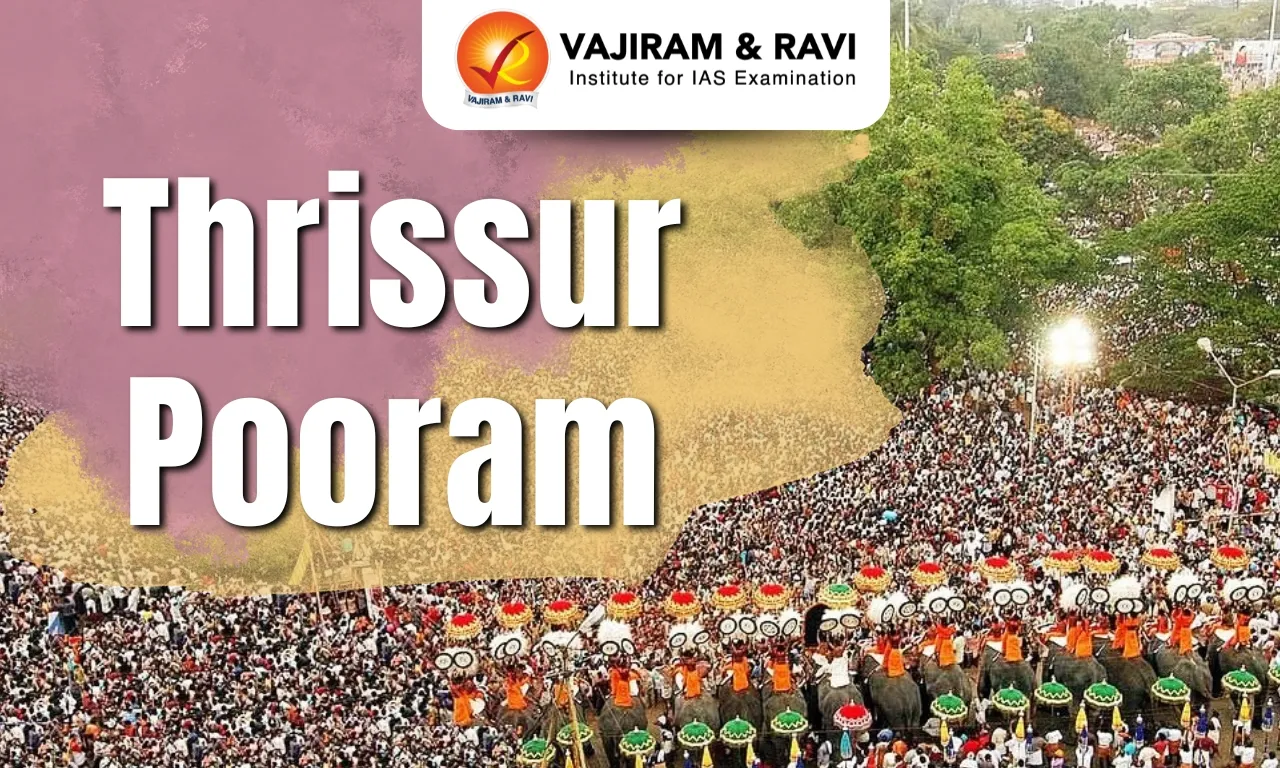
Even as the celebrations of the Thrissur Pooram festival was scaled down in view of the firework unit explosion that claimed around 15 lives, thousands thronged the ground of the Vadakkunnathan temple in Thrissur city recently to witness the festival.

About Thrissur Pooram

  • It is one of the most popular temple festivals in Kerala. 
  • It is held at the Thekkinkadu Maidanam of Vadakkunnathan Temple in the heart of the Thrissur district, every year in the Malayalam month of Medam (April-May).
  • The history of Thrissur Pooram dates back over 200 years.
  • Often called the "Mother of all Poorams." It was the brainchild of Raja Rama Varma, or famously known as Sakthan Thampuran, the Maharaja of Cochin (1790–1805). 
  • It unites ten temples in a spectacular display of devotion and rivalry.
  • Major participants include Paramekkavu Bhagavathy Temple and Thiruvambady Krishna Temple.
  • Highlights:
    • Elephant Processions: Over 50 richly adorned elephants carry idols amid Panchavadyam music and melam beats. 
    • Kudamattam: Thrilling parasol exchanges between rival groups showcase precision and flair. 
    • Fireworks Spectacle: Midnight display features aerial bursts and ground effects lasting hours. 
    • Panchapradakshinam: Deities circle the ancient Vadakkunnathan Temple in a sacred ritual.
    • Ilanjithara Melam: A mesmerizing performance of traditional instruments.

Source: DH

Thrissur Pooram FAQs

Q1: What is Thrissur Pooram?

Ans: One of the most popular temple festivals in Kerala.

Q2: Where is Thrissur Pooram held?

Ans: Thekkinkadu Maidanam of Vadakkunnathan Temple in the heart of the Thrissur district, Kerala.

Q3: Who founded Thrissur Pooram?

Ans: It was the brainchild of Raja Rama Varma, or famously known as Sakthan Thampuran, the Maharaja of Cochin (1790–1805).

Q4: Which are the two main participating temples in Thrissur Pooram?

Ans: Paramekkavu Bhagavathy Temple and Thiruvambady Krishna Temple

INS Kalpeni

INS Kalpeni

INS Kalpeni Latest News

An Indian Navy fast attack craft, INS Kalpeni, recently arrived at Gan in the Addu Atoll, marking a significant step in the ongoing maritime engagement between India and the Maldives.

About INS Kalpeni

  • It is a fast attack craft of the Indian Navy.
  • It belongs to a series of 10 Fleet Car Nicobar class Waterjet Fast Attack Craft (FAC) built by the Garden Reach Shipbuilders and Engineers (GRSE), Kolkata for the Indian Navy. 
  • It was commissioned into the Indian Navy on October 14, 2010.
  • The ship is named after Kalpeni Island in the Lakshadweep group of islands.
  • The ship is based at Kochi under the Southern Naval Command with the primary role of Coastal Surveillance and Defence.
  • It specialises in anti-smuggling, Vessel Boarding Search & Seizure as well as Search & Rescue operations.
  • Armaments:
    • The main armament of the ship is 30 mm CRN 91 Gun with an Optronic Pedestal Sight as its Director. 
    • In addition the 49-metre-longship has been fitted with 11 Machine guns of various types and shoulder launched IGLA Surface to Air Missiles to neutralise aerial threats.

Source: TOI

INS Kalpeni FAQs

Q1: What is INS Kalpeni?

Ans: A fast attack craft of the Indian Navy

Q2: When was INS Kalpeni commissioned into the Indian Navy?

Ans: October 14, 2010

Q3: Kalpeni Island belongs to which group of islands?

Ans: Lakshadweep

Q4: Where is INS Kalpeni based?

Ans: The ship is based at Kochi under the Southern Naval Command.

Q5: What is the primary role of INS Kalpeni?

Ans: Coastal surveillance and defence.

Pushkarmema curajae

Pushkarmema curajae

Pushkarmema curajae Latest News

Researchers from the Central University of Rajasthan recently identified a new species of cyanobacteria named Pushkarmema curajae from Pushkar Lake in Ajmer.

About Pushkarmema curajae

  • It is a new species of cyanobacteria.
  • It was identified from Pushkar Lake in Ajmer, Rajasthan.
  • The genus name Pushkar and species name curajae are dedicated to Pushkar Lake and Central University of Rajasthan.
  • P. curajae could potentially be used to develop drugs, biofertilizers, and even nutrient-rich supplements that improve immunity and overall health.   

Key Facts about Cyanobacteria

  • They are photosynthetic microscopic organisms found naturally in all types of water.
  • They were originally called blue-green algae (though they are not true algae) because dense growths often turn the water green, blue-green, or brownish-green. 
  • They are usually unicellular, though they often grow in colonies large enough to see. 
  • They are prokaryotic organisms (lack a true nucleus and membrane-bound organelles).
  • While often a green or blue-green colour, they can also be white, brown, blue, yellow-brown, or red.
  • They live in fresh, brackish (combined salt and fresh water), and marine water.
  • They photosynthesise like plants and have similar requirements for sunlight, nutrients, and carbon dioxide to grow and produce oxygen.
  • In addition to being photosynthetic, many species of cyanobacteria can also “fix” atmospheric nitrogen—that is, they can transform the gaseous nitrogen of the air into compounds that can be used by living cells.
  • They have the distinction of being the oldest known fossils, more than 3.5 billion years old.
  • The cyanobacteria have also been tremendously important in shaping the course of evolution and ecological change throughout earth's history. 
  • The oxygen atmosphere that we depend on was generated by numerous cyanobacteria during the Archaean and Proterozoic Eras. 
  • High nutrient concentrations can promote a population explosion of these organisms and result in algal blooms, especially during warm weather. 
    • Cyanobacterial blooms lead to deterioration of water quality and production of toxins by some species. 
    • Exposure to algal toxins has been linked to fatalities of livestock, wildlife, and pets.

Source: TOI

Pushkarmema curajae FAQs

Q1: What is Pushkarmema curajae?

Ans: A new species of cyanobacteria.

Q2: From which lake was Pushkarmema curajae identified?

Ans: Pushkar Lake

Q3: What potential application does Pushkarmema curajae have in medicine?

Ans: Development of drugs.

Bnei Menashe

Bnei Menashe Community

Bnei Menashe Latest News

The Government of India’s advisory about the security situation in Israel, amid the ongoing war in West Asia, came into focus recently when Israel airlifted around 240 individuals from Mizoram to Tel Aviv as part of Israel’s ‘Operation Wings of Dawn’.

About Bnei Menashe

  • The Bnei Menashe, known in India as the Shinlung, is an ethnic community that hails from the northeastern states of Mizoram and Manipur. 
  • They are a community of about 10,000 people from Tibeto-Burman ethnic groups. They include members of the Chin, Kuki, and Mizo groups. 
  • The population claims to be descendants of the Biblical tribe of Manasseh, one of the Ten Lost Tribes of Israel, which were exiled by the Assyrian Empire in 722 BC.
  • They are Christians converted into Jews and observe traditional Jewish practices and celebrate holidays such as Sukkot. 
  • After a centuries-long exodus through Persia, Afghanistan, Tibet, and China, the community reached India's northeast and settled in Manipur and Mizoram.
  • Historians believe this community may have arrived in India within the last 300–500 years.
  • Their ancestors were exiled long before the Roman dispersion, but they continued to practice Judaism across the generations, even if not in a contemporary Orthodox way. 
  • Once they came into contact with Israel and global Jewry in the 1980s, they embraced modern Jewish learning and practice.
  • Nearly half of the ‘Bnei Menashe’ population migrated to Israel over a period of time and became its citizens.

Operation Wings of Dawn

  • In 2025, the Israeli government launched ‘Operation Wings of Dawn’ to facilitate the immigration of the remaining members of the Bnei Menashe community to Israel.
  • The programme includes flights, conversion classes, housing, Hebrew lessons, and other benefits.
  • According to the recent Israeli Government plan, approximately 1,200 community members are expected to immigrate to Israel by the end of 2026. 
  • A second stage, slated for completion by 2030, will bring an additional 4,600 people, effectively completing the arrival of the entire community.

Source: TH

Bnei Menashe FAQs

Q1: Who are the Bnei Menashe?

Ans: An ethnic community from northeastern India claiming descent from a lost tribe of Israel

Q2: From which Indian states do the Bnei Menashe originate?

Ans: Mizoram and Manipur

Q3: The Bnei Menashe claim descent from which Biblical tribe?

Ans: The population claims to be descendants of the Biblical tribe of Manasseh, one of the Ten Lost Tribes of Israel.

Q4: What is Operation Wings of Dawn?

Ans: An initiative by Israel to facilitate the immigration of Bnei Menashe members.

Difference between Article 32 and Article 226, Key Details

Difference between Article 32 and Article 226

The difference between Article 32 and Article 226 of the Constitution of India lies in their scope and role in protecting rights. Article 32 allows citizens to directly approach the Supreme Court of India for the enforcement of Fundamental Rights, making it a guaranteed remedy. In contrast, Article 226 empowers the High Courts of India to provide a wider range of remedies for both Fundamental Rights and other legal rights. This article explains the key differences between Article 32 and Article 226 of the Indian Constitution.

Difference between Article 32 and Article 226

The difference between Article 32 and Article 226 lies in their scope and nature of remedies provided by courts.

Difference between Article 32 and Article 226

Article 32

Article 226

It is a Fundamental Right, ensuring citizens can directly seek constitutional remedies for violation of Fundamental Rights.

It is a constitutional provision, not a Fundamental Right, giving High Courts power to ensure justice.

It can be invoked only for enforcement of Fundamental Rights guaranteed under Part III.

It can be invoked for Fundamental Rights as well as other legal rights, including statutory rights.

It provides the right to directly approach the Supreme Court of India, without going through lower courts.

It allows individuals to approach the High Courts, usually as the first level of judicial remedy.

The jurisdiction of the Supreme Court is nationwide, and its orders are enforceable across India.

The jurisdiction of High Courts is territorial, limited to their respective states or regions.

The Supreme Court is duty-bound (mandatory) to entertain petitions if Fundamental Rights are violated.

High Courts exercise discretionary power and may refuse relief in certain cases.

It can be suspended during a National Emergency under Article 359.

It cannot be suspended, even during an Emergency, ensuring continued access to justice.

The scope is narrow and specific, focused only on protection of Fundamental Rights.

The scope is wider and more flexible, covering broader legal and administrative matters.

It is considered the “heart and soul” of the Constitution, as described by B. R. Ambedkar.

It plays a crucial role in judicial review at the state level, ensuring legality of government actions.

It does not strictly follow the rule of alternative remedy, allowing direct access to the Supreme Court.

High Courts generally follow the rule of alternative remedy and may deny relief if another remedy exists.

Mainly focuses on the guaranteed protection of Fundamental Rights.

Focuses on ensuring justice, legality, and protection of both Fundamental and legal rights.

What is Article 32 of Indian Constitution?

Article 32 of the Constitution of India gives citizens the right to directly approach the Supreme Court of India for the enforcement of their Fundamental Rights. It acts as a guaranteed remedy when these rights are violated and is considered essential for protecting individual liberty.

  • It is a Fundamental Right under Part III of the Constitution.
  • Provides the right to move the Supreme Court for enforcement of Fundamental Rights.
  • The Supreme Court can issue writs such as Habeas Corpus, Mandamus, Prohibition, Certiorari, and Quo Warranto.
  • Known as the “heart and soul of the Constitution”, as stated by B. R. Ambedkar.
  • It ensures judicial protection against violation of Fundamental Rights.
  • Can be suspended during a National Emergency under certain conditions.

What is Article 226 of Indian Constitution?

Article 226 of the Constitution of India empowers the High Courts of India to issue writs for the enforcement of Fundamental Rights as well as other legal rights. It provides a wider scope of judicial remedy compared to Article 32 and plays a key role in ensuring justice at the state level.

  • It is a constitutional provision, not a Fundamental Right.
  • High Courts can issue writs like Habeas Corpus, Mandamus, Prohibition, Certiorari, and Quo Warranto.
  • Applicable for both Fundamental Rights and other legal/statutory rights.
  • Wider scope than Article 32 due to broader jurisdiction.
  • Power is discretionary, meaning High Courts may refuse relief in certain cases.
  • Operates within the territorial jurisdiction of the respective High Court.
  • Cannot be suspended even during a National Emergency.

Difference between Article 32 and Article 226 FAQs

Q1: What is the main difference between Article 32 and Article 226?

Ans: Article 32 of the Constitution of India allows citizens to directly approach the Supreme Court of India for enforcement of Fundamental Rights, whereas Article 226 empowers the High Courts of India to enforce both Fundamental Rights and other legal rights.

Q2: Which Article has a wider scope, 32 or 226?

Ans: Article 226 has a wider scope because it covers not only Fundamental Rights but also other legal and statutory rights, unlike Article 32 which is limited to Fundamental Rights.

Q3: Is Article 32 a Fundamental Right?

Ans: Yes, Article 32 itself is a Fundamental Right, while Article 226 is only a constitutional provision.

Q4: Can High Courts refuse relief under Article 226?

Ans: Yes, High Courts have discretionary power under Article 226 and may refuse relief, especially if an alternative remedy is available.

Q5: Can Article 32 be suspended during Emergency?

Ans: Yes, Article 32 can be suspended during a National Emergency under certain conditions, whereas Article 226 continues to function.

Doppler Weather Radar

Doppler Weather Radar

Doppler Weather Radar Latest News

Recently, the Indian Institute of Tropical Meteorology (IITM) in Pune commissioned a new X-band Doppler Weather Radar at Mahabaleshwar under Mission Mausam. 

About Doppler Weather Radar

  • It is a specialized radar that uses the Doppler Effect to produce velocity data about objects at a distance.
  • These radar systems can provide information regarding the movement of targets as well as their position.
  • Types of weather Radar Bands: Varying frequencies like S-band, C-band and X-band — are commonly used by the IMD in India.

Working of Doppler weather Radars

  • In radars, a beam of energy, called radio waves, is emitted from an antenna.
  • When this beam strikes an object in the atmosphere, the energy scatters in all directions, with some reflecting directly back to the radar.
  • The larger the object deflecting the beam, the greater is the amount of energy that the radar receives in return.
  • Observing the time required for the beam to be transmitted and returned to the radar allows weather forecasting departments to “see” raindrops in the atmosphere, and measure their distance from the radar.

Applications of Doppler weather Radars 

  • Weather System: It is used to track the movement of weather systems and cloud bands, and gauge rainfall over its coverage area of about 500 km.
    • X-band radar is used to detect thunderstorms and lightning, whereas a C-band radar helps in cyclone tracking.

Source: News On Air

Doppler Weather Radar FAQs

Q1: Which electromagnetic waves are used by DWR?

Ans: Microwaves – S, C, X band – S-band for long range, X-band for short range are used.

Q2: What additional information does DWR provide over conventional radar?

Ans: Velocity of raindrops/wind within storm + direction of motion

Blackbuck

Blackbuck

Blackbuck Latest News

Chhattisgarh’s Barnawapara Wildlife Sanctuary has reported a steady increase in its blackbuck population following a reintroduction programme initiated in 2018.

About Blackbuck

  • It is a medium-sized antelope native to India and Nepal.
  • Habitat: The blackbuck mostly lives in open grasslands, dry scrub areas, and thinly forested areas.
  • Distribution: It is widespread in the states of Rajasthan, Gujarat, Madhya Pradesh, Tamil Nadu, Odisha, and other areas throughout peninsular India.
  • It has been declared as the state animal by the governments of Punjab, Haryana, and Andhra Pradesh. 

Characteristics of Blackbuck

  • It is known for its beautiful spiraling horns.
  • Males are characterised by dark coats and spiral horns, while females are generally lighter in colour and often lack horns. 
  • Young males and females are lighter in color, often yellowish-brown.
  • They have very good eyesight and are also very fast runners, which comprise their main defense against predators.
  • They are gregarious and social animals with herds generally ranging from 5 to 50 animals.
  • Blackbuck Conservation Status: It is classified as ‘Least Concerned’ under the IUCN Red List.

Source: HT

Blackbuck FAQs

Q1: What is the IUCN Red List status of Blackbuck?

Ans: Least Concern

Q2: Under which Schedule of Wildlife Protection Act, 1972 is Blackbuck protected in India?

Ans: Schedule I

Abhilekh Patal Portal

Abhilekh Patal Portal

Abhilekh Patal Portal Latest News

Recently, the Prime Minister of India urged citizens to explore the ‘Abhilekh Patal’ portal for a deeper understanding of India’s historical legacy.

About Abhilekh Patal Portal

  • It is a full-featured web-portal to access the National Archives of India’s reference media and its digitized collections through the internet.
  • It is a digital repository thoughtfully curated by the National Archives of India (NAI).
  • It has a mission to provide easy access to India's historical archives, comprising an astounding 7 million records.
  • Purpose: Its purpose is to ensure the effortless accessibility of historical records, reaching across geographical borders to engage a diverse global community.
  • The archival collections available through the Abhilekh Patal portal cover a wide range of historical records preserved by the National Archives of India. These include:
    • Public records transferred from various Ministries and Departments of the Government of India
    • Private papers of eminent personalities
    • Archival reference media such as photographs, maps, microfilms and rare documents
    • Digitised historical government files and archival collections maintained by NAI

Key Facts about the National Archives of India

  • It was established on 11 March 1891 at Calcutta (Kolkata) as the Imperial Record Department, it is the biggest archival repository in South Asia.
  • It is the repository of the non-current records of the Government of India and is holding them in trust for the use of record creators and general users.
  • It has a vast corpus of records viz., public records, private papers, oriental records, cartographic records and microfilms, which constitute an invaluable source of information for scholars-administrators and users of archives.
  • Head office: New Delhi
  • It has one Regional Office in Bhopal and three Records Centres at Bhubaneswar, Jaipur and Puducherry.
  • Nodal Ministry: Ministry of Culture, Government of India.

Source: DD News

Abhilekh Patal Portal FAQs

Q1: Where is National Archives of India headquartered?

Ans: New Delhi

Q2: Abhilekh Patal portal is an initiative of which organization?

Ans: National Archives of India (NAI)

Electoral Roll Revision – Impact of Special Intensive Revision

Electoral Roll Revision

Electoral Roll Revision Latest News

  • The Special Intensive Revision of electoral rolls has led to reduced voter lists but higher turnout percentages across several states.

Electoral Roll in India: Basics and Importance

  • The electoral roll is a constituency-wise list of eligible voters, maintained by the Election Commission of India.
  • It forms the foundation of India’s electoral democracy, as only those registered in the roll can exercise the right to vote.
  • The Constitution mandates that all citizens above 18 years of age, subject to certain disqualifications, must be included in the roll.
  • Accuracy of the electoral roll is crucial for ensuring free, fair, and credible elections.

Types of Electoral Roll Revisions

  • Electoral rolls are updated through two main processes.
    • Summary Revision is conducted annually with limited corrections and additions.
    • Special Intensive Revision (SIR) involves a comprehensive re-verification of voters, often requiring fresh enumeration and documentation.
  • SIR is more rigorous and aims to eliminate inaccuracies accumulated over time.

Growth of India’s Electorate

  • India’s electorate has expanded significantly since independence.
  • From about 17 crore voters in 1951, it has grown to over 96 crore in recent years, reflecting population growth and improved voter registration. 
  • At one point, the total electorate was projected to approach 100 crore, highlighting the scale of India’s democratic system. 

News Summary: Impact of Special Intensive Revision

  • Reduction in Electoral Roll Size
    • The SIR exercise has led to a significant trimming of electoral rolls by removing names of absent, shifted, dead, and duplicate voters (ASDD).
    • Across 13 States and Union Territories, the number of electors declined from about 51 crore to below 46 crore during the revision process
    • This marks a notable departure from the usual trend of continuous growth in the electorate.
  • Higher Voter Turnout Despite Smaller Electorates
    • States such as Tamil Nadu recorded over 85% turnout, significantly higher than previous elections.
    • Similarly, West Bengal witnessed turnout levels above 90% in certain phases. 
    • This trend is partly attributed to the removal of “ghost voters,” which increases turnout percentages when calculated on a reduced voter base.
  • Reasons for Deletion of Names
    • The primary reason for the decline in voter numbers is the removal of ASDD entries.
    • Additional deletions occurred due to non-submission of enumeration forms, inability to verify identity, and failure to meet eligibility criteria. 
    • In many cases, the burden of proof shifted to citizens to re-establish their eligibility.
  • Partial Recovery through Fresh Enrolment
    • While initial drafts showed sharp reductions, final rolls witnessed some recovery due to new registrations and corrections.
    • For example, Uttar Pradesh saw a drop from 15.44 crore to 12.55 crore in draft rolls, later rising to 13.39 crore in final rolls. 
    • This indicates that SIR is not purely a deletion exercise but also includes the re-inclusion of eligible voters.
  • Possible Decline in National Electorate Size
    • After covering nearly 60 crore voters, the overall electorate has already declined by around 6 crore.
    • Once completed nationwide, the total electorate could fall to around 90 crore, reversing the earlier trend towards a billion voters. 
  • Concerns over Exclusion and Disenfranchisement
    • The SIR process has raised concerns about the accidental exclusion of genuine voters, especially vulnerable groups lacking documentation.
    • There are apprehensions that strict verification procedures may lead to disenfranchisement on technical grounds. 
  • Need for Balancing Accuracy and Inclusion
    • While SIR improves the accuracy of electoral rolls, it must ensure that no eligible voter is left out.
    • The Election Commission now faces the challenge of restoring confidence by focusing on inclusion alongside verification. 

Source: TH

Electoral Roll Revision FAQs

Q1: What is Special Intensive Revision (SIR)?

Ans: It is a comprehensive revision of electoral rolls involving fresh verification of voters.

Q2: Why has voter turnout increased after SIR?

Ans: Removal of ineligible names reduces the voter base, raising turnout percentages.

Q3: What are ASDD voters?

Ans: They are absent, shifted, dead, or duplicate entries in electoral rolls.

Q4: How much has the electorate reduced due to SIR?

Ans: It has declined by about 6 crore voters so far.

Q5: What is the key challenge after SIR?

Ans: Ensuring that no eligible voter is excluded from the electoral roll.

Firecracker Factory Explosions India: Why Firecracker Factory Explosions India Keep Happening

Firecracker Factory Explosions

Firecracker Factory Explosions Latest News

  • Recent explosions in firecracker units in southern India have once again highlighted the recurring safety crisis in the industry
    • In Kerala’s Thrissur district, blasts at a fireworks unit killed at least 14 people ahead of the Thrissur Pooram, leading to cancellation of the event’s fireworks. 
    • Days earlier, a major explosion in Tamil Nadu’s Virudhunagar—India’s main fireworks hub producing about 90% of the country’s firecrackers—claimed at least 23 lives.
  • While investigations are ongoing, such incidents are not isolated and point to systemic issues. 
  • Key contributing factors include the highly combustible nature of raw materials, climatic conditions, safety lapses, and weak enforcement of regulations, making firecracker manufacturing a persistently hazardous sector.

How Fireworks Work: Chemistry and Mechanism

  • A firework is built from four essential elements: an oxidiser, fuel, ‘stars’, and a binder
  • The oxidiser (such as nitrates, chlorates, or perchlorates) supplies oxygen for combustion, while the fuel—typically black powder made of sulfur, charcoal, and potassium nitrate—releases energy when ignited. 
  • The ‘stars’ are small chemical pellets containing metals like barium, strontium, and copper that produce vivid colours, and the binder holds the mixture together until ignition.

Ignition and Explosion Process

  • When the fuse is lit, heat travels through the firework shell placed inside a mortar. 
  • It ignites the lift charge, generating gas pressure that propels the shell into the air. 
  • At a set height, a timed fuse triggers the burst charge, which explodes and ignites the ‘stars’, creating the familiar bright patterns in the sky.

Risks and Toxic Effects

  • The process involves highly reactive chemicals and heavy metals. 
  • During combustion—or mishandling—these substances can release toxic microscopic particles, making fireworks inherently hazardous in terms of manufacturing, storage, and usage.

Climate and Firecracker Safety: How Weather Increases Explosion Risks

  • Firecracker manufacturing is highly sensitive to climatic conditions because it involves volatile chemical mixtures. 
  • While warm, dry weather is generally preferred for production, extreme summer heat increases instability, making chemicals more prone to ignition. 
  • Low humidity further worsens the situation by preventing the dissipation of static electricity, allowing even minor movements—like mixing powders—to generate sparks capable of triggering explosions.

Role of Moisture and Temperature Fluctuations

  • It is not just dryness that poses risks. Fluctuations between dry heat and humid conditions can introduce moisture into chemical compounds. 
  • When such damp chemicals are later exposed to intense heat, they can undergo exothermic reactions or even spontaneous combustion. 
  • Improper drying practices, especially when chemicals are alternately exposed to moisture and sunlight, significantly increase the likelihood of accidents.

Environmental Conditions in Firecracker Hubs

  • Regions like Virudhunagar, despite not being extremely low in humidity, experience hot, arid conditions with low rainfall, creating an environment conducive to instability in chemical handling. 
  • These climatic factors contribute to the frequency of accidents in such manufacturing clusters.

Additional Hazards: Toxic Dust Accumulation

  • Apart from explosion risks, stagnant summer heat traps toxic chemical dust near the ground, increasing the oxidative potential of the air inside factories. 
  • This not only raises fire hazards but also poses serious health risks to workers.

Human Factors Behind Firecracker Accidents: Systemic Risks

  • While climatic and chemical risks are well understood, the human factor is often the decisive trigger behind major accidents. 
  • A key issue is the piece-rate wage system, where workers are paid based on output. 
  • This creates pressure to prioritise speed over safety, leading to shortcuts in handling highly volatile materials.

Weak Enforcement and Regulatory Gaps

  • Despite existing regulations under the Explosives Act, enforcement remains weak. 
  • Non-compliance is widespread, especially in areas like safe storage, ventilation, and handling protocols, increasing the likelihood of accidents.

Dangerous Storage Practices

  • A major risk arises from the stockpiling of raw chemicals and finished fireworks in confined, poorly ventilated spaces, often far exceeding legal limits. 
  • These unsafe practices turn minor ignition sources into large-scale disasters.
  • In such conditions, even a small static spark—common in hot weather—can trigger a chain reaction, rapidly escalating into deadly explosions due to the presence of unregulated and densely packed combustible materials.

Source: IE

Firecracker Factory Explosions FAQs

Q1: Why are firecracker factory explosions common?

Ans: Firecracker factory explosions occur due to volatile chemicals, unsafe handling, climatic factors, and poor enforcement of safety regulations in manufacturing units.

Q2: How do fireworks function in firecracker factory explosions?

Ans: Firecracker factory explosions involve oxidisers, fuel, and chemical reactions that release energy, making fireworks highly reactive and prone to accidental ignition.

Q3: How does climate contribute to firecracker factory explosions?

Ans: Firecracker factory explosions are worsened by heat, low humidity, and temperature fluctuations, which increase static electricity and chemical instability.

Q4: What human factors cause firecracker factory explosions?

Ans: Firecracker factory explosions are linked to piece-rate labour systems, safety shortcuts, improper storage, and weak enforcement of regulations.

Q5: What are the risks associated with firecracker factory explosions?

Ans: Firecracker factory explosions lead to mass casualties, toxic exposure, and environmental damage due to uncontrolled chemical reactions and poor safety practices.

Bnei Menashe Explained: How Bnei Menashe Forged Links with Israel

Bnei Menashe Community

Bnei Menashe Latest News

  • Around 250 members of the B’nei Menashe from Manipur and Mizoram recently arrived in Tel Aviv under an official relocation programme—the first such batch supported by the Israeli government.
  • The community, numbering about 7,000 and drawn largely from Mizo and Kuki tribes, claims descent from one of the “ten lost tribes of Israel.” 
  • While migration to Israel has been ongoing since the 1990s, this marks a new phase of state-backed resettlement, with more groups expected to follow.

The ‘Lost Tribes of Israel’: Origins and the B’nei Menashe Claim

  • Around 722 BCE, the Assyrian conquest of Israel led to the exile of ten tribes from northern Israel. These included Reuben, Simeon, Dan, Naphtali, Gad, Asher, Issachar, Zebulun, Ephraim, and Manasseh
  • Over time, their descendants became known as the “lost tribes of Israel”, with their whereabouts remaining uncertain.
  • Global Search for Descendants - For centuries, Jewish communities worldwide have searched for traces of these tribes, including in regions like the Indian subcontinent, where several groups claim ancestral links.
  • The B’nei Menashe Claim - The B’nei Menashe of Manipur and Mizoram believe they descend from the tribe of Manasseh, the largest among the lost tribes. Their name literally means “sons of Manasseh.”
  • Migration Narrative and Cultural Link - According to community belief, their ancestors migrated eastward over centuries through Persia (modern Iran) and Afghanistan before settling in Northeast India.
  • Role of Religious Transformation - Interestingly, the belief in Jewish ancestry gained traction after the community’s conversion to Christianity, which exposed them to biblical narratives and shaped their understanding of possible historical roots.

From Christianity to Judaism: The Evolution of the B’nei Menashe Identity

  • The roots of the transformation trace back to 19th-century Protestant missionary activity, as noted by the analysts. 
  • Missionaries introduced the Bible to local tribes, whose pre-existing belief in messianic figures helped facilitate the spread of Christianity and exposure to Israelite history.
  • Christian revivalist movements (1930s–1960s) in Mizoram, combined with regional unrest and resistance in the 1960s, created conditions for reinterpreting identity. This environment encouraged some groups to seek deeper historical and religious roots.

The Turning Point: Vision of Ancestry

  • A pivotal moment came in 1951, when Mizo mystic Challianthanga (Mela Chala) claimed a dream revealing that Mizo, Kuki, and Chin tribes were descendants of ancient Israelites. 
  • This idea catalysed a shift toward Jewish identity.
  • From the late 1970s, a structured movement toward Judaism emerged among these communities. 
  • The process involved research, outreach to Jewish communities in India, and growing interest in reconnecting with Israel.

Role of Israeli Support and Organisations

  • The Israeli organisation Amishav played a crucial role in guiding religious transformation and facilitating ties with Israel. 
  • Institutions like the Mizo Israel Zionist Organization (1974) further formalised these efforts.
  • By the 1980s, many members of the community had formally adopted Judaism, though a significant portion of the population in Manipur and Mizoram continues to remain Christian.

Re-establishing Links with Israel: Recognition, Migration, and Challenges

  • Efforts were made to highlight oral histories and cultural practices linking the B’nei Menashe to Israel.
  • In 2005, the Chief Rabbinate of Israel recognised them as the “Lost Seed of Israel”, based partly on inconclusive genetic studies. 
    • However, further tests by Technion – Israel Institute of Technology also remained inconclusive, keeping the scientific debate unresolved.

Migration Policies and Institutional Support

  • Following recognition, Israel allowed gradual migration in small batches, sometimes pausing the process.
  • In November 2025, the Israeli government approved funding for the relocation of nearly 5,000 B’nei Menashe members, marking a significant step in formal resettlement efforts.
  • Despite recognition, many B’nei Menashe migrants face racial discrimination and integration challenges in Israel, particularly due to differences in physical features and cultural background.

Other ‘Lost Tribes’ Claims: Diverse Identities and Motivations

  • Another Indian group, the B’nei Ephraim, claims descent from the tribe of Ephraim. 
  • They believe their ancestors reached India via Central Asia about a thousand years ago.
  • Belonging largely to the Dalit community, their claim to Jewish ancestry is sometimes interpreted as a way to challenge caste discrimination and seek social mobility, including recognition from global Jewish communities.

Source: IE | IT

Bnei Menashe FAQs

Q1: Who are the Bnei Menashe?

Ans: Bnei Menashe are a community from Manipur and Mizoram claiming descent from the lost tribe of Manasseh, with many members migrating to Israel over recent decades.

Q2: Why do Bnei Menashe claim Jewish ancestry?

Ans: Bnei Menashe trace their origins to biblical Israelite tribes, influenced by missionary exposure to the Bible and later religious transformation toward Judaism.

Q3: How did Bnei Menashe adopt Judaism?

Ans: Bnei Menashe gradually transitioned from Christianity to Judaism through visions, organised movements, and support from Israeli groups like Amishav during the late 20th century.

Q4: What is Israel’s role in Bnei Menashe migration?

Ans: Israel recognised Bnei Menashe as a lost tribe in 2005 and has allowed phased migration, recently supporting relocation of thousands under official programmes.

Q5: What challenges do Bnei Menashe face in Israel?

Ans: Bnei Menashe migrants often face integration challenges and discrimination, despite official recognition and support for resettlement by Israeli institutions.

New Zealand

New Zealand

New Zealand Latest News

India and New Zealand will sign a Free Trade Agreement (FTA) that will remove tariffs on 100% of India’s exports to New Zealand.

About New Zealand

  • It is an island country and one of the many islands that make up Oceania.
  • It is located in the South Pacific Ocean to the southeast of Australia, south of New Caledonia, Fiji and Tonga Islands. 
  • It is primarily divided into two main islands, the North Island and the South Island, separated by the Cook Strait.
  • Capital City: Wellington

Geographical Features of New Zealand

  • It is part of the Pacific Ring of Fire—the circum-Pacific seismic belt marked by frequent earthquakes and considerable volcanic activity. 
  • Climate: New Zealand's climate is complex and varies from warm subtropical in the far north to cool temperate climates in the far south.
  • Highest Peak: Mount Cook at 12,316 feet is the highest peak of New Zealand
  • Active Volcano: Mount Ruapehu
  • Glacier: Tasman Glacier, the largest in New Zealand
  • Lake: Lake Taupō which is the largest natural lake.
  • Natural Resources: It consists of gold, silver, iron sands, phosphate and limestone etc.

Source: TH

New Zealand FAQ

Q1: Which major fault line runs through South Island causing frequent earthquakes?

Ans: Alpine Fault

Q2: New Zealand is located in which ocean?

Ans: South Pacific Ocean

Difference between Mediation and Conciliation, Meaning, Features

Difference between Mediation and Conciliation

Mediation and Conciliation are important methods under alternative dispute resolution that help parties settle conflicts without court intervention. Both processes are private, confidential and aim to reduce time and cost while preserving relationships. However, they differ in procedure, legal framework and role of the neutral third party. These distinctions make each method suitable for different dispute situations and legal requirements.

Difference between Mediation and Conciliation

The Difference between Mediation and Conciliation mainly lies in the role of the neutral party, level of control, legal structure and enforceability.

Difference between Mediation and Conciliation

Aspect

Mediation

Conciliation

Definition

A structured negotiation process where a mediator facilitates communication and helps parties voluntarily reach an agreement without imposing decisions.

A dispute resolution process where a conciliator actively participates, suggests solutions and works to bring parties to a compromise settlement.

Role of Third Party

Mediator acts only as a facilitator, ensuring dialogue, identifying issues and guiding parties without suggesting or imposing settlement terms.

Conciliator plays an active role by evaluating issues, proposing solutions and influencing parties toward a mutually acceptable settlement.

Nature of Procedure

Flexible and informal process with no strict procedural rules; parties decide how sessions are conducted based on mutual agreement.

More structured compared to Mediation; may involve formal hearings, evidence submission and defined stages under statutory framework.

Outcome Control

Entire control of outcome lies with parties; mediator does not influence final decision, ensuring voluntary and mutually agreed settlement.

Conciliator significantly influences outcome through suggestions, though final agreement is formally accepted by parties involved.

Legal Framework

Recognised under Civil Procedure Code, 1908 and Mediation Act, 2023, including provisions like pre litigation Mediation under Section 12A of Commercial Courts Act, 2015.

Governed by Arbitration and Conciliation Act, 1996 (Part III), with structured provisions for initiation, proceedings and settlement agreement.

Enforceability

Mediated settlement agreement under Section 27(2) of Mediation Act, 2023 is enforceable like a civil court decree.

Settlement agreement under Section 74 of Arbitration and Conciliation Act, 1996 is enforceable as an arbitral award.

Decision Making Power

Parties retain full authority to decide terms; mediator has no power to impose or draft independent solutions.

Conciliator may draft and reformulate settlement terms based on discussions and suggestions from parties.

Confidentiality

Based on mutual trust and voluntary disclosure; confidentiality is maintained throughout flexible proceedings.

Confidentiality is legally structured and governed by statutory provisions ensuring protection of proceedings and disclosures.

Objective

Focuses on maintaining long term relationships by encouraging dialogue, cooperation and mutual understanding between parties.

Aims to achieve settlement quickly, especially where compromise is necessary to continue contractual or institutional relationships.

Applicability

Suitable for family disputes, commercial disagreements and cases involving ongoing relationships or reputation concerns.

Common in labour disputes, industrial conflicts and situations with unequal bargaining power, such as under Industrial Disputes Act, 1947.

Formality Level

Less formal compared to Conciliation and arbitration; emphasis on voluntary participation and communication.

More formal than Mediation but less than arbitration; includes structured hearings and involvement of conciliator in proceedings.

Initiation Process

Begins through mutual agreement or court referral; proceedings start upon notice or appointment of mediator.

Initiated through written invitation to conciliate, followed by acceptance and appointment of one or more conciliators.

Outcome Nature

Results in mediated settlement agreement or failure report if no consensus is reached between parties.

Results in a written settlement agreement prepared and authenticated by conciliator, binding on both parties.

International Framework

Guided by UNCITRAL Mediation Rules, 2021 and Singapore Mediation Act, 2017 defining mediator’s limited authority.

Influenced by UNCITRAL Conciliation Rules, 1980, providing structured guidelines for international Conciliation proceedings.


Difference between Mediation and Conciliation FAQs

Q1: What is the key Difference between Mediation and Conciliation?

Ans: The main difference lies in the role of the third party; a mediator facilitates, while a conciliator actively suggests solutions.

Q2: Which process of the Mediation and Conciliation gives more control to parties?

Ans: Mediation gives complete control to the parties, whereas Conciliation involves influence from the conciliator in shaping the outcome.

Q3: Are Mediation and Conciliation legally binding?

Ans: Yes. Settlements in both processes are enforceable, with Mediation agreements treated like court decrees and Conciliation like arbitral awards.

Q4: Which law governs Mediation and Conciliation in India?

Ans: Mediation is governed by the Mediation Act, 2023 and Civil Procedure Code, 1908, while Conciliation is governed by the Arbitration and Conciliation Act, 1996.

Q5: When is Conciliation preferred over Mediation?

Ans: Conciliation is preferred when an active role is needed to reach settlement, especially in industrial or complex disputes.

Daily Editorial Analysis 27 April 2026

Daily-Editorial-Analysis

Summer As a Source of Income Shock for Gig Workers

Context

  • As India enters another summer, extreme heat is no longer an occasional phenomenon but a recurring feature of the country’s climate.
  • Consequently, the central concern has shifted from whether heatwaves will occur to whether India is adequately prepared to manage their broader consequences.
  • While public health impacts have received attention, the economic implications, especially for gig and delivery workers, remain significantly underexplored.

Rising Heatwaves and Expanding Gig Economy

  • Increasing Frequency of Heatwaves
    • Recent meteorological data highlight a clear trend: heatwaves in India are becoming more frequent, longer-lasting, and more severe.
    • The year 2022 alone recorded significant heat-related mortality, reinforcing the urgency of the issue.
    • These patterns indicate that extreme heat is no longer an isolated risk but a persistent climatic challenge.
  • Growth of the Gig Workforce
    • According to NITI Aayog, approximately 77 lakhs individuals were engaged in gig work in 2020–21, a number expected to rise to over 2.3 crore by 2029–30.
    • This workforce includes delivery riders, e-commerce couriers, app-based drivers, and logistics personnel who play a crucial role in sustaining urban economies.

Economic Impact of Heat on Gig Workers

  • Income Linked to Productivity
    • Gig workers’ earnings are directly tied to their output, such as the number of deliveries completed or hours spent on digital platforms.
    • Unlike salaried employees, they lack fixed wages, paid leave, or the option to work remotely.
  • Heat as an Income Shock
    • High temperatures slow physical movement, increase fatigue, and elevate health risks such as dehydration and heat exhaustion.
    • As a result, workers face a difficult choice: reduce working hours and lose income, or continue working and risk their health.
    • Thus, heatwaves act not only as a public health hazard but also as a direct economic shock for gig workers.

Limitations of Current Preparedness Measures

  • Health-Centric Approach
    • India has made progress in addressing heatwaves through Heat Action Plans, early warning systems, and emergency responses.
    • However, these measures primarily treat heat as a public health issue.
    • Advisories often recommend staying indoors, reducing physical exertion, and taking frequent breaks.
  • Inadequacy for Gig Workers
    • Such recommendations are impractical for gig workers whose livelihoods depend on continuous mobility.
    • Even infrastructural measures like water kiosks, shaded rest areas, and cooling centres are rarely designed for highly mobile workers.
    • Consequently, while these interventions may reduce mortality, they do little to prevent income loss.

Policy Recommendations for Inclusive Adaptation

  • Recognising Heat as a Labour Issue
    • Heat must be viewed not only as a health concern but also as a labour and productivity issue.
    • This would justify measures such as:
      • Mandatory rest periods during peak heat hours
      • Access to shaded waiting areas
      • Provision of drinking water at common work locations
  • Addressing Income Volatility
    • Policymakers must acknowledge that heatwaves create income instability.
    • Mechanisms such as labour protections, insurance schemes, or integration with welfare programs are necessary to cushion income losses.
  • Role of Digital Platforms
    • Digital labour platforms should actively contribute to climate adaptation by:
    • Reducing delivery pressure during peak heat hours
    • Introducing flexible performance metrics
    • Incorporating climate-sensitive algorithms
  • Strengthening Institutional Coordination
    • Effective adaptation requires collaboration among labour departments, urban local bodies, disaster management authorities, and platform regulators.
    • A coordinated approach would ensure that heatwaves are addressed as an economic as well as a seasonal challenge.

The Way Forward: Rethinking Climate Resilience

  • India’s urban systems increasingly rely on gig and delivery workers for essential services such as food and medicine delivery.
  • These workers absorb significant risks to keep cities functioning. As temperatures rise, their exposure to these risks will intensify.
  • True resilience must go beyond issuing advisories or setting up cooling centres.
  • It must ensure that workers can operate safely and maintain stable incomes without compromising their health.

Conclusion

  • India’s approach to heatwave preparedness remains incomplete as long as it overlooks the economic vulnerabilities of gig and delivery workers.
  • With rising temperatures and a rapidly expanding gig economy, the need for inclusive and coordinated adaptation strategies is more urgent than ever.
  • Protecting this essential workforce is not only a matter of social justice but also critical to sustaining the functioning of urban economies in an era of climate uncertainty.

Summer As a Source of Income Shock for Gig Workers FAQs

Q1. Why are heatwaves a growing concern in India?
Ans. Heatwaves are becoming more frequent, prolonged, and intense, posing serious health and economic risks.

Q2. How does extreme heat affect gig workers’ income?
Ans. Extreme heat reduces their productivity, leading to fewer completed tasks and immediate income loss.

Q3.  Why are current heat advisories ineffective for gig workers?
Ans. They recommend staying indoors and resting, which is not feasible for workers dependent on mobility for income.

Q4. What is a major gap in India’s heatwave preparedness?
Ans. Policies largely focus on health impacts while ignoring economic risks, especially for gig workers.

Q5. What role can digital platforms play in reducing heat risks?
Ans. They can adjust delivery targets and introduce flexible performance measures during extreme heat.

Source: The Hindu


 Information Asymmetry in Higher Education

Context

  • Universities and colleges showcase attractive brochures, polished websites, and carefully curated success stories.
  • Yet, despite this apparent abundance of information, students are often required to make some of the most important decisions of their lives with limited, uneven, and sometimes unreliable data.
  • This disconnect points to a deeper structural issue in India’s higher education system, information asymmetry.


Expansion of Higher Education and Rising Complexity

  • Enrolment increased from 3.42 crore in 2014–15 to 4.33 crore in 2021–22, alongside improvements in the Gross Enrolment Ratio.
  • The academic landscape has also evolved from traditional standalone degrees to multidisciplinary programmes offered under diverse institutional models.
  • While this expansion has improved access and widened choices, it has simultaneously made decision-making more complex.
  • Students and families now face a broader array of options, making it harder to evaluate institutions effectively.

The Problem of Information Asymmetry

  • At the core of this issue lies the imbalance of information between institutions and students.
  • Universities possess detailed knowledge about their faculty, infrastructure, teaching processes, and placement outcomes.
  • In contrast, students rely on brochures, advertisements, informal advice, and selective data, sources that are often incomplete or difficult to verify.
  • This situation reflects the concept of information asymmetry, explained by George Akerlof through his theory of the market for lemons.
  • According to this theory, when one party has more information than the other, lower-quality providers can imitate higher-quality ones, distorting decision-making.
  • In the context of higher education, institutions with weaker academic standards can still appear attractive through marketing and selective disclosure.
  • This leads to adverse selection, where high-quality institutions struggle to distinguish themselves, and students may end up making suboptimal choices.

Implications for Students and Society

  • Choosing an unsuitable institution can affect learning outcomes, employability, and career prospects.
  • On a broader scale, it undermines trust in the education system and hampers national goals such as building a skilled workforce and ensuring inclusive, quality education.
  • Thus, information asymmetry is not merely a personal challenge but a systemic issue with far-reaching implications.

Information Overload vs. Information Quality

  • In today’s digital age, one might assume that greater access to information solves this problem, however, the reality is more complex.
  • Institutional websites, rankings, and social media platforms provide large volumes of data, but not necessarily reliable or comparable information.
  • Much of this data is self-reported and often promotional. Indicators such as faculty strength, research output, and placement rates are not uniformly defined across institutions.
  • Additionally, some ranking systems lack transparency in their methodologies.
  • As a result, students tend to rely on easily visible signals such as brand reputation, campus infrastructure, or fees.
  • While these factors are accessible, they do not always reflect true academic quality.
  • This can encourage institutions to prioritise visibility over substantive improvements in education.

Role of Public Ranking Frameworks and Data Portals

  • To address these challenges, standardised and verified information systems have become increasingly important.
  • The National Institutional Ranking Framework (NIRF), introduced in 2016, represents a key initiative in this direction.
  • It evaluates institutions based on common indicators such as teaching resources, research output, graduation outcomes, outreach, and perception.
  • By requiring structured data disclosure, NIRF enhances comparability and helps students make more informed decisions.
  • Similarly, centralised data portals that provide verified information on enrolment, accreditation, and faculty strength can reduce reliance on informal and unreliable sources.

Limitations of Existing Systems

  • Rankings depend on how indicators are selected and weighted, which can incentivise institutions to focus on improving scores rather than actual quality.
  • Moreover, many important aspects of education, such as classroom experience, mentorship, and practical learning, are difficult to measure.
  • There is also a tendency to overinterpret rankings, even when differences between institutions are minimal.
  • This highlights the need for methodological transparency and the use of rank bands instead of rigid rankings.

The Way Forward: Strengthening Information Systems

  • To build a strong and inclusive higher education system, India must prioritise the development of robust information systems.
  • This includes improving data verification processes, standardising definitions, ensuring transparency in ranking methodologies, and presenting information in accessible formats.
  • Better visualisation tools and user-friendly platforms can also help students and families interpret complex data more effectively.
  • Strengthening these systems will not only support informed decision-making but also enhance institutional accountability and credibility.

Conclusion

  • The central question remains: can students make sound choices if they cannot clearly understand what they are choosing?
  • Until the gap in information is reduced, India’s higher education system will continue to reward not only genuine quality but also the ability to present it convincingly.
  • Addressing information asymmetry is therefore essential, not just for improving individual outcomes, but for strengthening the entire education ecosystem and achieving broader national development goals.

Information Asymmetry in Higher Education FAQs

Q1. What is the main issue students face during admissions in India?
Ans. Students face the problem of limited and uneven information while making important educational decisions.

Q2. What is information asymmetry in higher education?
Ans. Information asymmetry refers to a situation where institutions have more information about their quality than students do.

Q3. Who introduced the idea of the market for lemons?
Ans. The idea of the market for lemons was introduced by George Akerlof.

Q4. What is the role of the National Institutional Ranking Framework (NIRF)?
Ans. The National Institutional Ranking Framework helps standardise and compare institutional data to support informed decision-making.

Q5. Why can too much information still be a problem for students?
Ans. Too much information can be confusing because it is often self-reported, inconsistent, and not always reliable.

Source: The Hindu


India–New Zealand Free Trade Agreement (FTA) - A Strategic Leap Towards Viksit Bharat

Context

  • India signed its Free Trade Agreement (FTA) with New Zealand, becoming the latest in a series of landmark trade pacts with developed economies — following agreements with the United Kingdom (UK) and the European Union (EU).
  • This agreement is being projected as a model of inclusive, development-oriented trade diplomacy, rooted in the Indian PM's vision of leveraging global commerce for domestic empowerment.

Key Highlights of the Agreement

  • Market access and tariff elimination

    • New Zealand has committed to the immediate elimination of tariffs on all Indian products, a significant gain given that key Indian exports currently face duties of up to 10% in that market.
    • This gives Indian goods a direct competitive advantage.
    • Sectors set to benefit are garments, carpets, yarn, fabrics, footwear, bags, belts, automobile components, machinery, tools, gems and jewellery, and handicrafts.
    • These sectors form the backbone of India's MSME ecosystem and labour-intensive manufacturing clusters.
  • Agricultural cooperation with safeguards:

    • New Zealand will support agricultural productivity action plans for kiwi, apples, and honey — covering research collaboration, improved planting material, post-harvest improvements, food safety systems, and Centres of Excellence (CoE).
    • Crucially, India has ring-fenced sensitive agricultural products from tariff concessions, including -
      • Dairy products — milk, cream, whey, yoghurt, cheese
      • Vegetables — onions, chana, peas, corn
      • Other items — almonds, sugar, select oils and fats
    • This reflects India's consistent stance across all trade negotiations - farmer and fishermen interests are non-negotiable.
  • A first - Women-led negotiation:

    • In what is being described as India's first women-led FTA, nearly the entire negotiating team comprised women — including the Chief Negotiator, Deputy Chief Negotiator, sectoral leads, and India's Ambassador to New Zealand.
    • This is a significant marker of Nari Shakti in governance and aligns with India's broader push for women's leadership in decision-making.
  • Mobility and opportunities for Indian youth:

    • This agreement carves out unprecedented pathways for India's youth in the global arena.
    • For example,
      • No numerical caps on Indian students in New Zealand.
      • Students are permitted to work at least 20 hours per week during studies.
      • Post-study work rights - up to 3 years for STEM graduates, up to 4 years for doctoral scholars.
      • Temporary Employment Entry Visa for up to 5,000 Indian professionals at any given time (3-year stays) in IT, engineering, healthcare, education, construction, and traditional fields like yoga, Ayurveda, Indian cuisine, and music.
      • Working Holiday Visa - 1,000 young Indians annually for up to 12 months.
    • Investment commitments:
      • New Zealand has pledged to facilitate $20 billion of investment into India, targeting manufacturing, infrastructure, renewable energy, digital services, and innovation ecosystems.
      • A notable rebalancing clause has been built in — allowing India to take corrective action if investment commitments fall short, ensuring accountability beyond paper pledges.

Challenges

  • Monitoring: Investment inflows of $20 billion requires robust institutional mechanisms; the rebalancing clause is promising but untested.
  • Ensuring: Trickle-down benefits to artisan communities and small enterprises demands targeted policy support beyond the FTA itself.
  • Managing: The diaspora and mobility pathways effectively without creating brain-drain pressures in critical sectors like IT and healthcare.
  • Threats of dilution: Dairy and agricultural exclusions, while protective domestically, may face pressure in future review rounds as New Zealand is a global dairy powerhouse.
  • Broader challenge: Ensuring that MSME clusters are export-ready to actually capitalise on zero-tariff access.

Way Forward

  • Strengthening: Export infrastructure in labour-intensive sectors to absorb and scale up the market access gains.
  • Fast-tracking: The Centres of Excellence in agriculture to boost productivity in horticulture and beekeeping.
  • Building: Institutional frameworks to track and enforce the $20 billion investment commitment.
  • Using this FTA as a template: For ongoing negotiations with other developed economies, especially around student mobility and professional visa frameworks.
  • Mainstreaming: Women's leadership in trade diplomacy as a stated policy priority.

Conclusion

  • The India–New Zealand FTA is not merely a bilateral trade deal — it is a statement of intent.
  • It signals that India today negotiates from a position of strength, securing meaningful market access for its workers and exporters while firmly defending its agricultural sensitivities.
  • The agreement's unique features (like, a women-led negotiation) position it as a model for 21st-century trade diplomacy.
  • As India marches towards Viksit Bharat 2047, agreements like this demonstrate how trade policy, when anchored in inclusivity and strategic foresight, can become a powerful engine of employment, empowerment, and economic resilience.

 India–New Zealand Free Trade Agreement (FTA) FAQs

Q1. What is the significance of the India–New Zealand FTA?

Ans. It enhances market access, boosts exports, creates jobs, and reflects India’s strategic integration with advanced economies.

Q2. How does this FTA balance export promotion with protection of domestic agriculture?

Ans. While expanding trade opportunities, it excludes sensitive sectors like dairy, pulses, sugar, and oils from tariff concessions.

Q3. What is the role of the India–New Zealand FTA in promoting youth mobility and skilled migration?

Ans. It provides student work rights, post-study visas, professional mobility pathways, and working holiday opportunities.

Q4. Why is the India–New Zealand FTA described as India’s first women-led trade agreement?

Ans. Because the negotiating team was predominantly led by women, symbolising rising female leadership in diplomacy and governance.

Q5. How can the India–New Zealand FTA contribute to India’s vision of Viksit Bharat 2047?

Ans. By aligning trade policy with inclusive growth through jobs, investment, technology transfer, and global competitiveness.

Source: IE

Daily Editorial Analysis 27 April 2026 FAQs

Q1: What is editorial analysis?

Ans: Editorial analysis is the critical examination and interpretation of newspaper editorials to extract key insights, arguments, and perspectives relevant to UPSC preparation.

Q2: What is an editorial analyst?

Ans: An editorial analyst is someone who studies and breaks down editorials to highlight their relevance, structure, and usefulness for competitive exams like the UPSC.

Q3: What is an editorial for UPSC?

Ans: For UPSC, an editorial refers to opinion-based articles in reputed newspapers that provide analysis on current affairs, governance, policy, and socio-economic issues.

Q4: What are the sources of UPSC Editorial Analysis?

Ans: Key sources include editorials from The Hindu and Indian Express.

Q5: Can Editorial Analysis help in Mains Answer Writing?

Ans: Yes, editorial analysis enhances content quality, analytical depth, and structure in Mains answer writing.

Enquire Now