Mongolia

Mongolia

Mongolia Latest News

Recently, the Union Environment, Forest and Climate Change held high-level bilateral meetings with South Asian counterparts on the sidelines of the 17th session of the Conference of the Parties to the United Nations Convention to Combat Desertification at Ulaanbaatar in Mongolia. 

About Mongolia

  • Location: It is a landlocked country located in north-central Asia.
  • Bordering Countries: Mongolia is bordered by two nations: China (South) and Russia  (North).
  • Capital City: Ulaanbaatar

Geographical Features of Mongolia

  • Climate: It has continental climate because of its high latitude and elevation and distance from oceans.
  • It has four main vegetation zones that run from north to south and from mountains to basins: forest-steppe, steppe, semidesert, and desert.
  • Major Mountains: Khentii Mountains, Khangai Mountains, and the Altay Mountains.
  • Highest Point: The highest point of Mongolia is Nayramadlin Orgil at 14,350 ft. (4,374 m)
  • Major River: Orkhon River (Orkhon River valley was inscribed by UNESCO in the World Heritage List).
  • Major Lake: Hovsgol Nuur, one of Asia’s largest freshwater lakes, is located on its border with the Russian Federation.
  • Natural Resources: It possesses large deposits of coal and fluorite (fluorspar) and of copper, gold, silver, and other metallic ores.

Source: News On Air

Mongolia FAQs

Q1: What is the Capital of Mongolia?

Ans: Ulaanbaatar

Q2: Mongolia is landlocked between which two countries?

Ans: China and Russia

Dihing Patkai National Park

Dihing Patkai National Park

Dihing Patkai National Park Latest News

Recently, a male tiger was camera-trapped in Assam's Dihing Patkai National Park.

About Dihing Patkai National Park

  • Located: It is located in the Dibrugarh and Tinsukia districts of Assam.
  • It lies in the Dehing Patkai Landscape, which is a dipterocarp-dominated lowland rainforest.
  • It is situated at the foothills of Patkai Hill Ranges, on the banks of the River Dehing (Tributary of Brahmaputra), and adjacent to the Namdapha Wildlife Sanctuary.
  • It is famous for its largest stretch of tropical lowland rainforests in India.
  • It was declared a wildlife sanctuary on 13 June 2004. On 13 December 2020, Government of Assam upgraded it into a national park. 
  • Tribal Communities: indigenous Assamese communities, particularly Tai Phake, Khamyang, Khampti, Singpho, Nocte, Ahom, Kaibarta, Moran and Motok, Burmese, and non-indigenous Nepali people.
  • Vegetation: The Park is a deciduous rainforest with semi-evergreen and lush green flora.
  • Flora: It is dominated by species like Hollong, Nahor, Mekai, Paroli, Simul, various orchids, ferns, cane, and bamboo.
  • Fauna: The rich biodiversity includes diverse species such as slow loris, pig-tailed macaque, stump-tailed macaque, capped langur, Indian leopard, Asian elephant, royal Bengal tiger, etc.

Source: TH

Dihing Patkai National Park FAQs

Q1: Where is Dihing Patkai National Park?

Ans: Assam

Q2: Which river flows through Dihing Patkai?

Ans: Dehing River

Adi Vaani Platform

Adi Vaani Platform

Adi Vaani Platform Latest News

Recently, the Ministry of Tribal Affairs today began the three-day National Conclave on Tribal Languages & Museums in Mysuru, Karnataka in which a full-fledged Adi Vaani Platform was launched. 

About Adi Vaani Platform

  • It is India’s first AI-powered translator for tribal languages.
  • It is designed to bridge communication gaps between tribal and non-tribal communities, while safeguarding endangered tribal languages using advanced Artificial Intelligence (AI).
  • It is developed by a national consortium of premier institutions led by IIT Delhi with BITS Pilani, IIIT Hyderabad, and IIIT Nava Raipur in collaboration with Tribal Research Institutes (TRIs) in Jharkhand, Odisha, Madhya Pradesh, Chhattisgarh, and Meghalaya.
  • AI Language Models: Refined deployment of models such as No Language Left Behind (NLLB) and IndicTrans2 for low-resource tribal languages.
  • It aims to:
    • Enable real-time translation (text and speech) between Hindi/English and tribal languages.
    • Provide interactive language learning for students and early learners.
    • Digitally preserve folklore, oral traditions, and cultural heritage.
    • Support digital literacy, healthcare communication, and civic inclusion in tribal communities.
    • Awareness of the government schemes and important speeches
  • Features
    • Multilingual Translator: It converts images and documents to editable text in seconds.
    • Audio files to Text: It transcribes live speech or audio files into text and translates into indigenous languages instantly.
    • Speech to speech Translation: Speak or upload speech in English or Hindi and listen to real-time voice translation in Santali, Mundari, or Bhili.

Source: PIB

Adi Vaani Platform FAQs

Q1: Which AI models used in Adi Vaani?

Ans: NLLB and IndicTrans2

Q2: What is Adi Vaani?

Ans: India's first AI tribal translator

Dak MITRA and Dak Sewa Apps

Dihing Patkai National Park

Dak MITRA and Dak Sewa Apps Latest News

Recently, the Union Minister for Communications launched the revamped Dak Sewa App and Dak MITRA App at a function in New Delhi.  

About Dak MITRA App

  • The upgraded Dak MITRA (Mobile Interface for Transactions & Rural Assistance) application serves as a unified operational platform for more than 1.4 lakh Branch Post Offices.
  • It is developed indigenously by the Centre for Excellence in Postal Technology (CEPT) under the Advanced Postal Technology (APT) platform as part of DoP IT 2.0 Modernization,
  • It enables Branch Postmasters to undertake paperless and real-time postal and financial transactions.
    • It includes mail booking, OTP-based doorstep delivery, Core Banking Services, insurance services, Aadhaar-based biometric e-KYC, cash deposits and withdrawals etc.

Key Facts about Dak Sewa App

  • It provides citizens with 24x7 access to postal services, including tracking, booking, complaints; Post Office and PIN code locators, and financial calculators.
  • It supports 23 Indian languages through BHASHINI.

Source: PIB

Dak MITRA and Dak Sewa Apps FAQ's

Q1: Dak Sewa supports how many languages?

Ans: 23 languages via BHASHINI

Q2: Which organisation developed Dak MITRA App?

Ans: It is developed indigenously by the Centre for Excellence in Postal Technology (CEPT).

Lead

Lead

Lead Latest News

Researchers at the ICMR-National Institute of Nutrition (ICMR-NIN), Hyderabad, have found that exposure to lead can significantly disrupt the natural waste-clearing and recycling system of nerve cells. 

About Lead

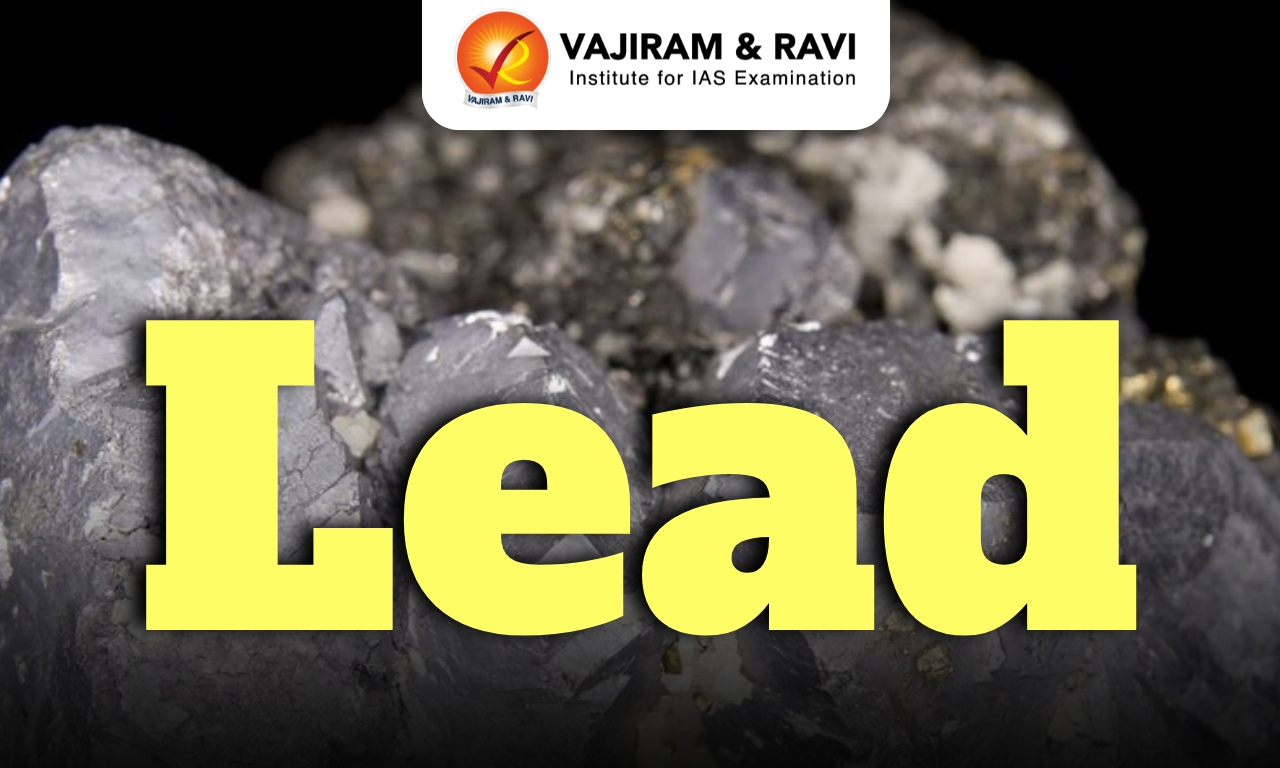
  • It is a naturally occurring element found in small amounts in the earth’s crust.
  • Properties
    • It is a soft, silvery white or grayish metal in Group 14 (IVa) of the periodic table.
    • Lead has a bright lustre and is a dense, ductile, very soft, highly malleable, bluish-white metal that has poor electrical conductivity.
    • It is also highly resistant to corrosion and because of this property is used to contain corrosive liquids (e.g. sulphuric acid).
  • Occurrence: It is usually found in ore with zinc, silver and copper and is extracted together with these metals.
  • The main lead mineral is galena (PbS). Other common varieties include cerussite (PbCO3) and angelsite (PbSO4).
  • Uses of Lead
    • It is used for lead-acid batteries for vehicles, backup emergency systems, the telecoms sector and fork lift trucks.
    • It is also used in rolled and extruded products, compounds in the glass and plastics industries, shot and ammunition and for radiation shielding.
  • Impacts of Lead on Human Health
    • It is highly toxic to humans and the environment.
    • Exposure to lead can affect multiple body systems and is particularly harmful to young children and women of child-bearing age.

Source: TH

Lead FAQ's

Q1: What is the chemical symbol of lead?

Ans: Pb - Plumbum

Q2: What is the major use of lead?

Ans: It is majorly used in Lead-acid batteries.

Information Technology Resilience Index

Information Technology Resilience Index

Information Technology Resilience Index Latest News

Recently, the Securities and Exchange Board of India (SEBI) has introduced an Information Technology Resilience Index (ITRI) for market infrastructure institutions (MIIs). 

About Information Technology Resilience Index

  • It is introduced to assess the functioning and resilience of information technology systems of market infrastructure institutions (MIIs), including stock exchanges, depositories and clearing corporations.
  • It is an initiative of the Securities and Exchange Board of India.
  • Aim: It is aimed at strengthening oversight of the resilience of IT systems and identifying emerging weaknesses at an early stage, so that timely corrective measures can be taken.

Key Features of IT Resilience Index

  • Parameters: The ITRI will be computed using a uniform set of nine parameters, each carrying a specific weightage to ensure comparability across MIIs.
    • These parameters are namely availability, security, integrity, governance, reliability and monitoring, business continuity, modularity and flexibility, scalability, and other relevant factors.
  • Weightage: Availability and security will carry the highest weightage of 20 per cent each, followed by integrity, governance, reliability and monitoring, business continuity, and modularity and flexibility at 10 per cent each.
  • MIIs would be required to calculate the index on a half-yearly basis within 60 days of the end of each half-year.
  • They would also have to submit a comparative analysis of two consecutive half-years on a rolling basis, along with details of corrective actions taken or proposed, to their Standing Committee on Technology (SCOT) and governing boards.
  • MIIs will also develop an Early Warning System (EWS) to detect any deterioration in ITRI parameters that could potentially lead to performance issues, system slowness or other disruptions, and take remedial measures.

Source: TH

Information Technology Resilience Index FAQs

Q1: Which organisation introduced IT Resilience Index (ITRI)?

Ans: SEBI

Q2: What is the objective of Information Technology Resilience Index?

Ans: Assess functioning and resilience of IT systems of MIIs

Multipurpose River Valley Project, Major Projects, Benefits

Multipurpose River Valley Project

A Multipurpose River Valley Project is a large-scale water resource development project built around a river system to meet several needs at the same time. It generally includes dams, reservoirs, canals and powerhouses and is used for irrigation, electricity generation, flood control, water supply and other activities. These projects play an important role in the planned utilisation of India's river water resources. 

Multipurpose River Valley Project Objectives

  • Irrigation: Multipurpose projects provide a more reliable supply of water to agricultural fields, especially during dry periods. Canals and reservoirs help extend irrigation facilities to areas that receive irregular or insufficient rainfall.
  • Hydroelectric Power Generation: Water stored in reservoirs is used to generate hydroelectricity. Hydropower is a renewable source of energy and supports agricultural activities, industries, households and other economic activities.
  • Flood Control: Dams and reservoirs can store excess water during periods of heavy rainfall and regulate its release. This helps reduce the intensity of floods in downstream areas, although the effectiveness of flood control depends on proper reservoir management.
  • Water Supply: Reservoirs created by these projects provide water for drinking, domestic use and industrial activities. They are particularly useful for supplying water to towns, cities and industrial regions.
  • Navigation: Regulated river flows and canals can support inland water transport in suitable areas. Navigation can provide a relatively economical way of transporting people and bulk goods.
  • Fisheries: Reservoirs and associated water bodies can create suitable conditions for fish breeding and fisheries development, providing livelihood opportunities for local communities.
  • Tourism and Recreation: Large reservoirs and surrounding landscapes can become centres for boating, fishing, tourism and other recreational activities, contributing to local economic development.
  • Soil Conservation and Afforestation: Vegetation around catchment areas and reservoirs can help reduce soil erosion and support ecological conservation. Watershed management and afforestation are therefore important parts of sustainable river valley development.

Major Multipurpose River Valley Projects in India

India has developed several important Multipurpose River Valley Projects across different river basins. Some of the major projects are given below: 

Multipurpose River Valley Project

River

Major States/Region

Major Uses

Bhakra-Nangal Project

Sutlej

Himachal Pradesh, Punjab, Haryana, Rajasthan

Irrigation, hydropower, flood control, water supply

Damodar Valley Project

Damodar

Jharkhand, West Bengal

Flood control, irrigation, power generation, industrial development

Hirakud Project

Mahanadi

Odisha

Irrigation, hydropower, flood control, water supply

Sardar Sarovar Project

Narmada

Gujarat, Madhya Pradesh, Maharashtra, Rajasthan

Irrigation, drinking water, hydropower

Nagarjuna Sagar Project

Krishna

Telangana, Andhra Pradesh

Irrigation, hydropower, water supply

Chambal Valley Project

Chambal

Madhya Pradesh, Rajasthan

Irrigation, hydropower, flood moderation

Kosi Project

Kosi

Bihar, Nepal

Flood control, irrigation, power and water management

Gandak Project

Gandak

Bihar, Uttar Pradesh

Irrigation and water management

Tehri Project

Bhagirathi

Uttarakhand

Hydropower, irrigation, water supply

Rihand Project

Rihand

Uttar Pradesh

Irrigation, power generation, industrial water supply

Tungabhadra Project

Tungabhadra

Karnataka, Andhra Pradesh

Irrigation, hydropower, water supply

Koyna Project

Koyna

Maharashtra

Hydropower, water management

Mahi Project

Mahi

Gujarat, Rajasthan

Irrigation and hydropower

Ukai Project

Tapi

Gujarat

Irrigation, hydropower, flood control

Rana Pratap Sagar Project

Chambal

Rajasthan

Hydropower, irrigation, water management

Mayurakshi Project

Mayurakshi

West Bengal

Irrigation, flood control, power generation

Mahi Bajaj Sagar Project

Mahi

Rajasthan

Irrigation and hydropower

Narmada Valley Projects

Narmada

Madhya Pradesh, Gujarat and adjoining regions

Irrigation, hydropower, water supply

  • Bhakra-Nangal Project: The Bhakra-Nangal Project is one of India's major Multipurpose River Valley Projects. Built on the Sutlej River, it supports irrigation and electricity generation and provides water to several parts of northern India. The project has played an important role in agricultural development in Punjab, Haryana and Rajasthan.
  • Damodar Valley Project: The Damodar Valley Project was developed in the Damodar River basin covering parts of Jharkhand and West Bengal. It was influenced by the model of the Tennessee Valley Authority in the United States. The project focuses on flood control, irrigation and power generation and has also supported industrial development in the region.
  • Hirakud Project: The Hirakud Project is built across the Mahanadi River in Odisha. It is particularly important for flood moderation, irrigation and hydroelectric power generation. The reservoir also supports water supply and other economic activities in the region.
  • Sardar Sarovar Project: The Sardar Sarovar Project is a major project on the Narmada River. It is an important component of the broader Narmada Valley development and provides irrigation and drinking water benefits, particularly to water-stressed areas of western India. It also contributes to hydropower generation.
  • Nagarjuna Sagar Project: The Nagarjuna Sagar Project is constructed on the Krishna River and serves areas of Telangana and Andhra Pradesh. It is mainly associated with irrigation and hydropower generation and has contributed significantly to agricultural development in the Krishna basin.

Advantages of Multipurpose River Valley Projects in India

The importance of these projects goes beyond individual uses of river water. They contribute to the economic and regional development of different parts of India.

  • Agricultural Development: By improving access to irrigation, these projects reduce excessive dependence on seasonal rainfall. They can support multiple cropping and improve agricultural productivity in areas with limited rainfall.
  • Energy Security: Hydropower generated by these projects adds to the country's electricity supply. It provides a renewable energy source that can support agriculture, industries and urban development.
  • Regional Economic Development: The availability of water and electricity can encourage the growth of industries, towns and supporting infrastructure around project areas.
  • Drinking Water Security: Multipurpose projects can help meet the water requirements of growing rural and urban populations, especially in areas experiencing seasonal or chronic water shortages.
  • Employment Generation: Activities related to construction, irrigation, fisheries, tourism, power generation and other associated sectors can create direct and indirect employment opportunities.
  • Support for Rural Development: Better irrigation, water availability and associated economic activities can improve income opportunities and contribute to the development of rural areas.
  • Integrated Water Resource Management: These projects promote planned utilisation of river water for different requirements. This makes it possible to coordinate water use for agriculture, energy, domestic needs and other sectors.

Challenges of Multipurpose River Valley Projects

Despite their developmental benefits, multipurpose river valley projects face several economic, administrative and technical challenges 

  • High Construction and Maintenance Costs: Large dams, canals and powerhouses require substantial financial investment. Their maintenance, repair and long-term management also involve significant expenditure.
  • Displacement of People: Construction of reservoirs often requires the acquisition and submergence of land. This can force people to relocate and may affect their homes, livelihoods and community networks.
  • Loss of Agricultural Land: Fertile agricultural land may be submerged under reservoirs. This can reduce available farmland and affect the livelihoods of farming communities.
  • Deforestation and Habitat Loss: Large projects may require clearing forests and other natural areas. This can result in the loss or fragmentation of wildlife habitats and natural ecosystems.
  • Siltation: Rivers carry sediments that can accumulate in reservoirs over time. Siltation reduces the effective storage capacity of reservoirs and can affect the long-term efficiency and life of a project.
  • Inter-State Water Disputes: Many Indian rivers flow through multiple states. Differences over the sharing and management of river water can create conflicts and make coordinated planning difficult.
  • Changes in River Ecosystems: Dams alter the natural flow of rivers and can affect aquatic ecosystems, fish migration, sediment movement and downstream habitats.
  • Risk of Seismic and Geological Problems: Large reservoirs can alter pressure conditions in the surrounding areas. In some locations, this may contribute to reservoir-induced seismicity, making geological assessment and monitoring important.
  • Management Challenges: Multipurpose projects have to balance several competing demands such as irrigation, drinking water, electricity generation and flood control. Poor coordination or inappropriate reservoir operation can reduce their effectiveness.

Environmental and Social Impacts of Multipurpose River Valley Projects

The environmental and social impacts of Multipurpose River Valley Projects are linked to changes in river ecosystems, land use and the lives of local communities. The major impacts related to environmental changes, displacement, livelihoods and rehabilitation are discussed below. 

Environmental Impacts

  • Submergence of Forests: Large reservoirs can submerge forest areas and lead to the loss of vegetation and wildlife habitats. This may reduce biodiversity and disturb local ecological systems.
  • Changes in River Ecology: Dams change the natural flow, temperature and sediment movement of rivers. These changes can affect fish, aquatic organisms and downstream ecosystems.
  • Loss of Biodiversity: The destruction or fragmentation of natural habitats can affect plant and animal species. Species dependent on free-flowing rivers may be particularly affected.
  • Soil and Sediment Issues: The trapping of sediments behind dams can reduce sediment flow downstream and increase sediment accumulation inside reservoirs. Over time, this can reduce reservoir storage capacity.
  • Water Quality Concerns: Changes in water flow and the accumulation of organic matter in reservoirs can affect water quality. Proper monitoring and management are therefore necessary.

Social Impacts

  • Displacement and Rehabilitation: People living in areas required for reservoirs and other infrastructure may have to relocate. Effective resettlement and rehabilitation are essential to protect their livelihoods and living conditions.
  • Loss of Livelihoods: Farmers, forest-dependent communities, fishers and others may lose access to land or natural resources on which they depend for income.
  • Impact on Local Communities: Submergence can affect villages, community spaces and cultural sites. Development planning therefore needs to consider both economic and social costs.
  • Unequal Distribution of Benefits: The benefits of a project, such as electricity and irrigation, may reach distant regions while the environmental and social costs are concentrated among communities living near the project area.
  • Need for Community Participation: Involving local communities in planning, rehabilitation and environmental management can improve transparency and help address local concerns.

Multipurpose River Valley Project FAQs

Q1: What is a Multipurpose River Valley Project?

Ans: A Multipurpose River Valley Project is a large-scale water resource project built around a river to serve several purposes, such as irrigation, hydropower generation, flood control and water supply.

Q2: What are the main objectives of Multipurpose River Valley Projects?

Ans: The main objectives include irrigation, hydroelectric power generation, flood control, water supply, navigation, fisheries, tourism and soil conservation.

Q3: Which are the major Multipurpose River Valley Projects in India?

Ans: Major projects include Bhakra-Nangal, Damodar Valley, Hirakud, Sardar Sarovar, Nagarjuna Sagar, Tehri, Chambal Valley and Tungabhadra projects.

Q4: What is the importance of Multipurpose River Valley Projects in India?

Ans: These projects support agriculture, energy generation, flood management, drinking water supply, regional development and employment generation.

Q5: What are the advantages of Multipurpose River Valley Projects?

Ans: The major advantages include multiple uses of water, improved irrigation, renewable energy generation, flood and drought management, industrial development, fisheries and tourism.

Doronicum sanctum

Doronicum sanctum Plant

Doronicum sanctum Latest News

Researchers from the CSIR-Institute of Himalayan Bioresource Technology (IHBT) have announced the discovery of a new plant species and named it as Doronicum sanctum.

About Doronicum sanctum

  • It was discovered in the high-altitude wilderness of Arunachal Pradesh.
  • It is the new plant species belonging to the sunflower family.
  • It is the first time a member of the Doronicum genus, commonly known as Leopard’s bane, has been documented in Northeast India.
  • Nomenclature: The researchers chose sanctum name because the plant’s type locality is situated near the Chumi Gyatse Holy Waterfalls, a site held in high spiritual regard by the local population. 
  • It was found at an elevation of approximately 4,086 metres above sea level in the Tawang district.
  • Characteristics
    • It possesses pubescent ray cypselae, which are tiny, hairy seeds at the edge of the flower head, and a caducous pappus, a feathery structure that falls off easily.
    • It has dilated flower stalks (peduncle apex) and flat, lance-shaped green bracts that cup the flower.
    • It has vibrant yellow flowers and heart-shaped leaves, the species appears to be extremely rare.

Source: RM

Doronicum sanctum FAQs

Q1: What is the Family of Doronicum sanctum?

Ans: Asteraceae

Q2: Arunachal Pradesh is part of which biodiversity hotspot?

Ans: Himalaya, Indo-Burma

Q3: Doronicum sanctum discovered from which state?

Ans: Arunachal Pradesh

Gen-Next Support for Innovative Startups Scheme

Gen-Next Support for Innovative Startups Scheme

Gen-Next Support for Innovative Startups Scheme Latest News

Recently, the Ministry of Electronics and Information Technology through MeitY Startup Hub (MSH) has launched Gen-Next Support for Innovative Startups (GENESIS) Entrepreneur-in-Residence (EIR) Cohort 3.

About Gen-Next Support for Innovative Startups Scheme

  • It is a flagship initiative of the Ministry of Electronics and Information Technology (MeitY) Startup Hub.
  • It is designed to discover, support, grow and accelerate startups across India's Tier-II and Tier-III cities.
  • Focus: Through its Entrepreneur-in-Residence, Pilot (EIR), Investment and DeepTech funding components, GENESIS supports startups and innovators from early ideation and experimentation through to validation, investment and scale.
    • The EIR component specifically provides funding of up to Rs 10 lakh per startup to help innovators, students and entrepreneurs at the ideation and prototype stages develop their ideas into pilot-ready solutions.
  • Financial Assistance: Total budget outlay of ₹490 crore,
  • The scheme seeks to unlock the entrepreneurial potential of emerging regions and connect them more deeply with India’s growing innovation ecosystem.

Key Facts about GENESIS EIR 3.0

  • It will support innovations in areas including artificial intelligence and machine learning, Internet of Things, semiconductor and VLSI technologies, cybersecurity, blockchain, quantum technologies, and augmented reality, virtual reality, spatial and immersive technologies.
  • Eligibility for GENESIS EIR 3.0
    • Applicants must be Indian citizens and may include entrepreneurs, innovators, researchers, students or founders and co-founders of early-stage startups.
    • The proposed innovation must be at Technology Readiness Level (TRL) 1-4, covering stages from ideation and proof of concept to prototype, MVP or early validation.
    • For incorporated startups, the company must be less than two years old as of the date of application and must be based in a Tier-II or Tier-III city.
    • Applicants are also required to ensure that the proposed idea or startup has not received financial assistance exceeding Rs 10 lakh under any Central or State government scheme.

Source: PIB

Gen-Next Support for Innovative Startups Scheme FAQs

Q1: Which ministry launched the Gen-Next Support for Innovative Startups Scheme?

Ans: Ministry of Electronics and Information Technology

Q2: What is the total outlay and target of GENESIS?

Ans: Rs 490 crore - 1,600 startups

Guggal Plant

Guggal Plant

Guggal Plant Latest News

A Kutch-based non-profit is planting Khara and Mitha Guggal across five villages to restore native medicinal heritage and biodiversity on community grazing lands.

About Guggal Plant

  • It is a spiny shrub or small tree belonging to the Burseraceae family.
  • Distribution: It is native to India, Arabia and Pakistan.
  • In India, it is found in the arid, rocky tracts of Rajasthan, Gujarat, Madhya Pradesh and Karnataka in India.

Characteristics of Guggal Plant

  • It has an ash-colored bark that comes off in large rough flakes, exposing the under bark that also peels away.
  • The tree remains without any foliage for most of the year.
  • The plant prefers arid and semi-arid climates and is tolerant of poor soil.
  • It grows well in sandy to silt loam soils, which are poor in organic matter and rich in other matters and also considered as drought and salinity resistant plant.
  • Guggal seeds do not germinate easily and the saplings take a long time to mature—about 10 years

Uses of Guggul Gum

  • Traditional Uses: Gum guggul is used as incense, to make lacquers, varnishes, and ointments, as a fixative in perfumes, and in medicine.
  • Modern Uses: Modern therapeutic uses of guggul include nervous diseases, hemiplegia, leprosy, marasmus, musclespasms, neuralgia rtc.
  • Guggal-gum extract targets the Farnesoid X Receptor (FXR) that regulates cholestrol and checks bile acids produced from cholestrol by the liver.
  • The resin from the Guggal tree, known as guggul, is valued in Ayurvedic medicine for treating various ailments.

Source: DTE

Guggal Plant FAQs

Q1: What is the Scientific name of Guggal?

Ans: Commiphora wightii

Q2: Guggal is found in which states?

Ans: Rajasthan, Gujarat, MP, Karnataka

Q3: Which organization prioritizes Guggal as top medicinal plant for conservation?

Ans: National Medicinal Plants Board

Waterspout

Waterspout

Waterspout Latest News

Recently, a rare weather phenomenon resembling a waterspout was observed over the Brahmaputra in Assam’s Barpeta district.  

About Waterspout

  • A waterspout is a large column of air and mist rotating over a water body.
  • It is less intense and typically lasts for around five minutes — occasionally it can last up to 10 minutes.
  • The average waterspout can be around 165 feet in diameter, with wind speeds of 100 kilometres per hour.
  • They occur when there are high levels of humidity and relatively warm water temperatures compared to the overlying air.

Types of waterspouts

  • Tornadic waterspouts
    • These are tornadoes that form over water, or move from land to water.
    • They have the same characteristics as a land tornado.
    • They are associated with severe thunderstorms, and are often accompanied by high winds and seas, large hail, and frequent dangerous lightning.
  • Fair-weather waterspouts
    • These are usually formed under calmer conditions along the dark flat base of a line of developing cumulus clouds.
    • It is generally not associated with thunderstorms.
    • It is developed from the water’s surface upward. (While tornadic waterspouts develop downward in a thunderstorm)
    • Typically move very little due to light wind conditions.

Source: IT

Waterspout FAQs

Q1: How many types of waterspouts are there?

Ans: 2 types - Tornadic waterspout and Fair-weather waterspout

Q2: What is Waterspout?

Ans: A waterspout is a large column of air and mist rotating over a water body.

UGC Rollback, Centre Reconsiders UGC Equity Regulations 2026

UGC Rollback

UGC Rollback issue is in the news after the Central Government told the Supreme Court that it is reconsidering the UGC (Promotion of Equity in Higher Educational Institutions) Regulations, 2026. The regulations were introduced to prevent discrimination in higher educational institutions but faced protests and legal challenges. The Supreme Court had earlier kept the regulations on hold.

What is the UGC Rollback Issue?

The UGC Rollback issue is related to the reconsideration of the UGC (Promotion of Equity in Higher Educational Institutions) Regulations, 2026.

The regulations were introduced by the University Grants Commission (UGC) to create stronger rules against discrimination in colleges and universities. They aimed to ensure that students from different social backgrounds could study in a safe and equal environment.

However, some groups raised objections to the regulations and questioned the way certain forms of discrimination were defined.

Also Read:- New UGC Rules 2026

Why Were the Regulations Introduced?

Caste-based discrimination and other forms of discrimination have been a concern in several educational institutions.

The issue also came before the Supreme Court through a petition filed by the mothers of Rohith Vemula and Payal Tadvi. They sought stronger safeguards against discrimination in educational institutions.

The 2026 regulations were intended to create a more detailed and enforceable system to deal with such complaints.

Supreme Court Stay on UGC Regulations 2026

On January 29, 2026, the Supreme Court placed the 2026 UGC regulations on hold.

The Court raised concerns about some provisions and their possible misuse. As a result, the new regulations could not be implemented while the legal challenge was being considered.

The earlier UGC Regulations of 2012 continued to provide the relevant framework during this period.

Centre Reconsidering UGC Regulations 2026

In August 2026, the Central Government informed the Supreme Court that it was reconsidering the 2026 regulations.

Solicitor General Tushar Mehta told a Supreme Court bench headed by Chief Justice Surya Kant that the government was examining the regulations again.

The development is important because it suggests that the government may make changes to the existing framework.

The Court gave the Centre additional time to complete the reconsideration process.

Why Are the UGC Equity Regulations Important?

The UGC Equity Regulations are important because they aim to promote equal opportunities, social justice and a discrimination-free environment in higher educational institutions.

  • Prevent Discrimination: Protect students from caste-based and other forms of discrimination.
  • Promote Social Justice: Support marginalised and disadvantaged communities in higher education.
  • Ensure Equal Opportunities: Help create a fair and inclusive learning environment for all students.
  • Institutional Accountability: Make universities and colleges responsible for addressing discrimination complaints.
  • Protect Student Rights: Provide mechanisms for reporting, investigating and resolving grievances.
  • Promote Campus Inclusion: Encourage equality, dignity and inclusiveness among students.

Key Issues in the UGC Rollback Debate

The UGC Rollback debate focuses on how to balance protection from discrimination with equality, clarity and fair implementation of regulations.

  • Preventing Discrimination: Ensuring effective protection against caste-based discrimination and other forms of harassment in higher education.
  • Clarity of Rules: Some provisions were considered ambiguous or vague, raising concerns about their interpretation and implementation.
  • Possibility of Misuse: The Supreme Court had expressed concerns that certain provisions could be misused if not clearly defined.
  • Equal Protection: The debate includes whether the framework provides fair protection to students from all social categories.
  • Ragging and Harassment: Questions were also raised about the exclusion of ragging from the framework despite its connection with harassment in educational institutions.
  • Institutional Accountability: Universities need effective complaint and grievance-redressal mechanisms to address discrimination.
  • Social Justice vs Equality: The main challenge is balancing special safeguards for disadvantaged groups with the broader principle of equality before law.

Constitutional Connection

UGC Equity Regulations are closely linked with the constitutional principles of equality, non-discrimination, social justice and dignity, particularly through the following provisions:

  • Article 14: Guarantees equality before law and equal protection of laws.
  • Article 15: Prohibits discrimination on specified grounds and permits special provisions for socially and educationally backward classes.
  • Article 17: Abolishes untouchability and prohibits its practice in any form.
  • Article 21: Protects the right to life and personal liberty, including the broader principle of living with dignity.
  • Article 29(2): Prohibits denial of admission to educational institutions maintained or aided by the State on specified grounds.
  • Article 46: Directs the State to promote the educational and economic interests of weaker sections, particularly Scheduled Castes and Scheduled Tribes.

UGC Rollback FAQs

Q1: What is UGC Rollback?

Ans: UGC Rollback refers to the possibility of withdrawing or changing the UGC Equity Regulations 2026, which the Central Government is currently reconsidering.

Q2: What are the UGC Equity Regulations 2026?

Ans: These are regulations introduced by the University Grants Commission to strengthen measures against discrimination and promote equity in higher educational institutions.

Q3: When were the UGC Equity Regulations 2026 notified?

Ans: The regulations were notified on January 13, 2026.

Q4: When did the Supreme Court put the regulations on hold?

Ans: The Supreme Court placed the 2026 regulations on hold on January 29, 2026.

Q5: Has the government completely rolled back the UGC Regulations 2026?

Ans: No. The government has said that the regulations are under reconsideration. A final decision on complete withdrawal has not been announced.

Durgawati Devi (Durga Bhabhi), Biography, Contributions & Role in Freedom Struggle

Durgawati Devi

Durgawati Devi (Durga Bhabhi) was an Indian revolutionary and freedom fighter who actively participated in the armed struggle against British colonial rule. She became associated with the Naujawan Bharat Sabha and revolutionary networks linked with the HSRA. She is remembered for helping Bhagat Singh escape Lahore in disguise after John P. Saunders was killed in 1928.

Durgawati Devi (Durga Bhabhi) Biography

Durgawati Devi’s life combined family responsibilities with revolutionary activities and direct participation in the freedom struggle.

  • Birth and marriage: Durgawati Devi (Durga Bhabhi) was born on 7 October 1907 in Allahabad. She was married to Bhagwati Charan Vohra at about 10 or 11 years of age. Vohra was an HSRA member.
  • Revolutionary association: Durgavati Devi became an active member of the Naujawan Bharat Sabha. She gained prominence during the 11th anniversary observance of Kartar Singh Sarabha’s martyrdom in Lahore on 16 November 1926.
  • Escape of Bhagat Singh: On 19 December 1928, Sukhdev approached Devi for assistance. She travelled with Bhagat Singh from Lahore while posing as his wife, with her son Sachin accompanying them. Bhagat Singh had shaved his beard and cut his hair to avoid identification. Rajguru travelled separately as their servant. They travelled towards Cawnpore, continued through Lucknow, and eventually reached Howrah.
  • Support for revolutionaries: Durgawati Devi spent her savings of ₹5,000 on revolutionary activities and assistance to Indian revolutionaries. She also sold ornaments worth ₹3,000 to support Bhagat Singh and his comrades during their trial.
  • Jatin Das funeral: After Jatin Das died following a 63-day jail hunger strike, Devi led his funeral procession from Lahore towards Calcutta. Large crowds joined the procession along the route.
  • Death: Durgawati Devi died in Ghaziabad on 15 October 1999 at the age of 92. Her role remains significant in understanding women’s participation in India’s revolutionary movement.

Durgawati Devi Contributions

Durgawati Devi directly supported revolutionary operations and undertook dangerous actions against British officials during the final phase of colonial rule.

  • Attempt against Lord Hailey: After Bhagat Singh surrendered following the 1929 Assembly bombing, Devi attempted to assassinate Lord Hailey. Hailey survived, while some of his associates were injured.
  • Bomb-making activities: Durgavati Devi and Bhagwati Charan Vohra assisted Vimal Prasad Jain in operating an HSRA bomb-making facility at Qutub Road, Delhi. It operated under the name ‘Himalayan Toilets’ as a cover.
  • Use of explosives: The revolutionary facility handled picric acid, nitroglycerine and fulminate of mercury. This reflected Devi’s involvement in the technical and organisational side of revolutionary activities.
  • Attack in Bombay: On 8 October 1930, Devi fired at a British sergeant and his wife near Lamington Road in South Bombay. The action was linked to the death sentences of Bhagat Singh, Sukhdev and Rajguru.
  • Arrest and imprisonment: British authorities eventually arrested Durgawati Devi in September 1932. She was imprisoned for three years because of her revolutionary activities.
  • Life after independence: In 1935, Devi moved to Ghaziabad and worked as a teacher. She later established a school for poor children in Lucknow and lived quietly after independence.

Durgawati Devi (Durga Bhabhi) FAQs

Q1: Who was Durgawati Devi (Durga Bhabhi)?

Ans: Durgawati Devi, popularly known as Durga Bhabhi, was an Indian revolutionary and freedom fighter associated with the Naujawan Bharat Sabha and HSRA.

Q2: When was Durgawati Devi born?

Ans: Durgawati Devi was born on 7 October 1907 in Allahabad, now known as Prayagraj.

Q3: How did Durgawati Devi help Bhagat Singh?

Ans: She helped Bhagat Singh escape Lahore after the killing of John P. Saunders by posing as his wife during the train journey.

Q4: What was Durgawati Devi’s role in the revolutionary movement?

Ans: She supported revolutionary activities, helped fugitives, participated in armed actions and assisted in revolutionary operations involving the HSRA.

Q5: When did Durgawati Devi die?

Ans: Durgawati Devi died on 15 October 1999 in Ghaziabad at the age of 92.

India’s Youth Unemployment Crisis Runs Deeper Than the Jobless Rate

Youth Unemployment

Youth Unemployment Latest News

  • Recent data show that around 9.2 crore young Indians are neither in education, employment nor training, a figure the falling unemployment rate does not capture.

The Official Picture

  • The government has often cited the Unemployment Rate (UER) to suggest India is doing well on jobs. 
  • The UER measures the number of unemployed people as a share of the total labour force, those currently working or actively looking for work.
  • By this measure, the trend looks positive. Data from the Periodic Labour Force Surveys (PLFS) shows the UER falling steadily from 6.1% in 2017-18, a 45-year high, to just 3.1% in 2025, for those aged 15 and above.
  • However, relying only on this headline figure obscures three significant problems.

Problem One: Youth Unemployment Remains High

  • Unemployment among young Indians aged 15 to 29 is far higher than the overall rate.
  • It fell from almost 18% in 2017-18 to around 10% in 2022-23, but has since stayed stuck at that level.
  • More troubling is that unemployment rises with educational attainment. Graduates aged 25 face the highest unemployment rate, close to 40%. 
  • This means roughly four out of every ten graduates aged 25 who are looking for work fail to find it.
  • Analysis in the State of Working India (SWI) 2026 report by researchers at Azim Premji University found that unemployment among young Indians with education up to graduation or more was actually higher in 2023 than in 1983. 
  • Educated unemployment is not new in India, but the situation appears to be worsening over time.

Problem Two: The Quality of Jobs Created

  • India's workforce has undoubtedly expanded. The total number of people employed rose from 43.3 crore in 2017-18 to around 61 crore by December 2025. But a closer look at where these jobs came from raises concerns.
  • The SWI 2026 report found that between 2021-22 and 2023-24, India's employed population grew from 49 crore to 57.2 crore. Employment rates rose from 71% to 74% for men and from 26% to 34% for women.
  • However, of the 8.3 crore jobs added in this period, 4 crore were in agriculture, with women accounting for a large share at 3.8 crore. 
  • Agriculture is typically low-productivity, low-paying work, and a shift towards it is generally a sign of distress rather than progress.
  • The pattern is similar for women's employment overall. The number of women in the workforce rose sharply from 9.4 crore in 2017-18 to 18.6 crore in 2023-24. But the report notes that the number of women in own-account self-employment has increased nearly fourfold since 2017, while self-employment earnings for women and salaried earnings for both men and women have largely stagnated.
  • More people are working, in other words, but not necessarily earning more.

Problem Three: The UER Understates the Problem

  • In a developing economy like India, using the unemployment rate to assess labour market stress can be deeply misleading.
  • The UER counts only those who are willing to work and actively searching for a job. In India, however, many people who could work do not register in surveys as looking for work. 
  • They are therefore counted outside the labour force altogether, and never appear in the unemployment figure.
  • As one of the SWI report's authors explains, this happens particularly with women. Regardless of their education, even after completing graduation, many are not recorded as looking for work, and thus fall out of the labour force entirely.
  • If these individuals were counted as unemployed, they would enter the labour force and the unemployment rate would be considerably higher.
  • The UER is therefore best understood as the lowest possible estimate of people not being mobilised into the workforce. 
  • Beyond it lies a large pool of people outside the labour force, either discouraged workers who have given up searching, or those kept out by social norms, most often women.

The Better Measure: NEET

  • A different metric captures this reality more accurately: NEET, or Not in Employment, Education, or Training.
  • The logic behind NEET is straightforward. Those pursuing education cannot reasonably be expected to be working. NEET therefore measures how many people are in none of these three categories, not studying, not training, and not working.
  • As the SWI report describes it, NEET is a comprehensive measure of labour under-utilisation that excludes those in education or training. It includes not just the unemployed, but also those of working age who are neither in education nor in training nor in employment.

The Scale of the Problem

  • According to official PLFS data released in March this year, 25% of Indian youth were classified as NEET.
  • Applying this proportion to current population figures produces a striking number. 
  • Based on Ministry of Health and Family Welfare projections, India's youth population in 2026 stands at 36.8 crore, the largest youth population in the world.
  • At 25%, this means roughly 9.2 crore young Indians are currently neither in education, nor skilling, nor any form of employment. That is a figure almost equal to the entire population of Iran.

Why This Matters

  • The combination of high youth unemployment and an enormous absolute NEET population helps explain the growing youth unrest in the country.
  • What makes it more striking is the context. These figures coexist with government satisfaction over the pace of economic growth based on GDP figures, a period some have described as a "goldilocks" phase for the Indian economy.
  • The disconnect is the core issue. Headline growth and a falling unemployment rate can both look healthy while a very large share of young people remain entirely disconnected from productive activity.

Source: IE

Youth Unemployment FAQs

Q1: What is the Unemployment Rate and what does it measure?

Ans: The UER measures the number of unemployed people as a share of the labour force — those working or actively looking for work.

Q2: What is India's current unemployment rate?

Ans: The UER fell from 6.1% in 2017-18 to 3.1% in 2025 for those aged 15 and above.

Q3: What is the unemployment rate among 25-year-old graduates?

Ans: It is close to 40%, meaning about four out of ten graduates aged 25 looking for work fail to find it.

Q4: How many young Indians are estimated to be NEET?

Ans: Around 9.2 crore, based on 25% of a youth population of 36.8 crore in 2026.

Q5: Why is NEET considered a better measure than the unemployment rate?

Ans: Because the UER excludes discouraged workers and those kept out of the labour force by social norms, while NEET captures all working-age people outside education, training and employment.

Tracing Ashoka in Ujjain: Vaishya Tekri Excavation and History

Tracing Ashoka in Ujjain

Tracing Ashoka in Ujjain Latest News

  • The Madhya Pradesh government has begun restoring Buddhist monuments linked to the Mauryan emperor Ashoka, starting with a fresh excavation at Vaishya Tekri in Ujjain
  • The initiative has renewed scholarly interest in Ashoka's connection to the city and raised questions about how much the site can actually confirm historically.

The Vaishya Tekri Stupa: Scale and Earlier Findings

  • According to academic Peter Skilling's 2011 paper, Vaishya Tekri — the largest stupa at the site — measures about 350 feet at its base and 100 feet high, notably larger than the 54-foot stupa at Sanchi. 
  • Nearby stands a smaller structure called Kumbhar (or Kumhar) Tekri; both remain relatively undisturbed, save for a power line and pylon running through the area.
  • Initial excavations by the Department of Archaeology of the erstwhile Gwalior State in 1938-39 uncovered large bricks and punch-marked coins, leading archaeologists to date the structures to the Mauryan period. 
  • However, historians have urged caution, noting that this excavation report is decades old and its interpretation was shaped by earlier accounts — particularly Alexander Cunningham's writings on Ashoka. 
  • They argue that further investigation beyond the 1938-39 findings is needed before drawing firm conclusions.

Ashoka's Years in Ujjain

  • Ujjayini (modern Ujjain), located on the Sipra river (a tributary of the Chambal), was the capital of the Avanti kingdom and a major commercial centre. 
  • Historian Romila Thapar notes that Ujjain linked trade routes to western coastal ports like Broach and Sopara, as well as to Pataliputra — Ptolemy referred to it as "Ozene."
  • Ashoka was sent to Avanti as viceroy by his father, Emperor Bindusara. Unlike his brief posting in Taxila, he is believed to have spent nearly a decade in Avanti, headquartered at Ujjain — reportedly in recognition of his earlier work at Taxila.
  • Historians call Ujjain the "Greenwich of India," since Hindu astronomers calculated the prime meridian of longitude from the city. 
  • They suggest Ashoka arrived around 282 BCE, roughly a decade before Bindusara's death, by which time Ujjain was already an urban centre with 300 years of history along the Sipra. 
  • Mud fortifications first appeared around Ujjain in the 7th century BCE, and by the 6th century BCE, Avanti had emerged as a powerful independent kingdom.

Where Ashoka Met Devi

  • En route to Ujjain, Ashoka stopped at Vidisha, where he met and married Vedisadevi (Devi), daughter of a local merchant — though Thapar notes historical records do not confirm a legal marriage. The couple had two children: Mahinda and Samghamitta.
  • Evidence for Ashoka's Ujjain posting includes his own edicts, issued later as emperor, which mention a prince (kumara) stationed at Ujjain. 
  • Experts also note that Vidisha, where Ashoka met Devi, lies directly on the route from Pataliputra to Ujjain. 
  • However, scholars disagree on physical evidence: while Skilling considers it plausible that Ashoka erected pillars or edicts at such an important site, they point out that no Ashokan pillars have been found in Ujjain, particularly near the stupas, and that the excavations reveal little about Ujjain's political structure during Ashoka's time.

The Stupa and the 'Hell'

  • Local traditions in Sri Lanka associate Vaishya Tekri with Devi — its name reportedly deriving from her merchant (Vaishya) family background. 
  • In contrast, Kumhar Tekri carries a starkly different association: Chinese scholar-pilgrim Xuanzang, who visited Ujjain in the 7th century, recorded a stupa marking the site where "King Ashoka made a hellish prison." 
  • Thapar notes that earlier excavations at Kumhar Tekri revealed a burial-cum-cremation ground dating to the 3rd century BCE, corroborating Xuanzang's account.
  • About a decade into his Ujjain viceroyalty, Ashoka returned to Pataliputra after Bindusara fell critically ill — setting the stage for his subsequent, and violent, struggle for the Mauryan throne.

The Fresh Excavation: Promise and Caution

  • Scholars have welcomed the government's renewed funding for excavation, noting archaeology typically receives limited financial support. 
  • However, they caution that the focus should extend beyond the stupa structure itself to the broader cultural landscape — drawing a parallel with Sanchi, where the ashes of Buddhist teachers were found buried in cemeteries surrounding the stupas. 
  • They suggest the excavation should aim to understand how the site evolved over time, including other structures and the monks associated with it, rather than treating the stupa as an isolated monument. 
  • Concerns have also been raised about encroaching urbanisation, with the once-rural site now bordered by an expanding industrial zone around Ujjain.

Conclusion

  • The Vaishya Tekri excavation offers a valuable opportunity to deepen understanding of Ashoka's decade-long Ujjain viceroyalty and early Buddhist history in Malwa. 
  • Yet, as historians caution, the site's grand scale and evocative local traditions must be weighed against the limits of decades-old evidence — making a broader, landscape-level investigation essential for the fresh dig to yield historically reliable conclusions rather than reinforce old assumptions.

Source: IE

Tracing Ashoka in Ujjain FAQs

Q1: What does Tracing Ashoka in Ujjain reveal about Vaishya Tekri?

Ans: Tracing Ashoka in Ujjain highlights Vaishya Tekri as a massive Buddhist stupa whose earlier discoveries suggest Mauryan origins, though historians urge caution.

Q2: Why is Ujjain important while Tracing Ashoka in Ujjain?

Ans: Tracing Ashoka in Ujjain is important because Ashoka reportedly served nearly a decade as viceroy of Avanti, headquartered at this major commercial centre.

Q3: What is Devi's connection with Tracing Ashoka in Ujjain?

Ans: Tracing Ashoka in Ujjain examines traditions linking Vaishya Tekri with Devi, whom Ashoka reportedly met at Vidisha before proceeding towards Ujjain.

Q4: What archaeological limits affect Tracing Ashoka in Ujjain?

Ans: Tracing Ashoka in Ujjain remains difficult because earlier excavations are decades old, no Ashokan pillars have been found, and evidence requires fresh investigation.

Q5: Why is the fresh excavation important for Tracing Ashoka in Ujjain?

Ans: Tracing Ashoka in Ujjain may gain stronger historical evidence through broader landscape-level excavation examining stupas, surrounding structures, cultural evolution and Buddhist communities.

Press Note 3 Relaxations: Impact on FDI Inflows into India

Press Note 3 Relaxations

Press Note 3 Relaxations Latest News

  • The Union government announced that India received foreign direct investment (FDI) worth ₹4,895.65 crore over the last few months from companies benefiting from recent relaxations to India's FDI rules. 
  • These changes were designed to ease the flow of investments that had earlier been restricted under Press Note 3.

About Press Note 3

  • The Union government issued Press Note 3 in April 2020, amending India's FDI policy. 
  • Previously, entities from Bangladesh and Pakistan required prior government approval to invest in India. 
  • Press Note 3 extended this requirement to all countries sharing a land border with India — thereby covering Pakistan, China, Bangladesh, Nepal, and Bhutan.
  • While popular perception links this decision to the India-China border clashes at Galwan, the timeline contradicts this: Press Note 3 was issued in April 2020, a month before the Galwan clashes occurred in May 2020. 
  • The actual trigger was the COVID-19 pandemic — India and several other countries observed Chinese companies acquiring majority stakes in firms whose valuations had collapsed due to the pandemic. 
  • The rule aimed to prevent such opportunistic, hostile takeovers. The subsequent tightening and continuation of this restriction over the years was indeed shaped by the deteriorating India-China relationship.

What Changed in March 2026?

  • In March 2026, the Centre eased the Press Note 3 restrictions. 
  • Under the revised norms, FDI from entities would be permitted through the automatic route — without requiring explicit government approval — provided these entities had less than 10% ownership stake held by investors based in land-bordering countries.
  • This meant companies with minority, non-controlling stakes from these countries could now access the simpler automatic route for investment. 
  • The government justified this move by noting that substantial investment had been stalled because even companies with negligible Chinese ownership faced the same stringent approval requirements as those with majority Chinese control. 
  • The stated objective was to provide regulatory clarity, ease of doing business, and to facilitate FDI inflows, technology access, domestic value addition, and stronger integration with global supply chains.

Impact So Far

  • As of August 10, 2026, the Ministry of Commerce and Industry reported that 29 FDI projects worth ₹4,895.65 crore had been received under the revised framework. 
  • These investments span diverse sectors — information technology, artificial intelligence, information and communication, manufacturing, pharmaceuticals, data centres, and transport services.
  • The investments originated from countries including Mauritius, the U.S., the Republic of Korea, Japan, Singapore, Luxembourg, and the Cayman Islands.
  • While the announcement signals policy success, the scale remains modest — the reported investment amounts to less than 1% of India's total FDI inflows in 2025-26
  • However, given that the relaxation is barely months old, this is still an early indicator rather than a conclusive trend.

Conclusion

  • The Press Note 3 relaxation reflects India's calibrated approach to balancing security concerns over land-border-country investments with the need to ease compliance burdens and attract capital. 
  • Although the reported FDI gains remain marginal relative to India's overall inflows, the diversity of source countries and sectors suggests the policy may unlock previously stalled investment over time — making sustained monitoring essential to assess its long-term impact.

Source: IE

Press Note 3 Relaxations FAQs

Q1: What are Press Note 3 Relaxations?

Ans: Press Note 3 Relaxations allow eligible companies with less than 10% ownership from land-bordering countries to access India's automatic FDI route without prior government approval.

Q2: Why were Press Note 3 Relaxations introduced in 2026?

Ans: Press Note 3 Relaxations were introduced to reduce compliance burdens and prevent companies with negligible Chinese or other land-bordering ownership from facing unnecessarily stringent approval requirements.

Q3: How have Press Note 3 Relaxations affected FDI inflows?

Ans: Press Note 3 Relaxations facilitated 29 FDI projects worth ₹4,895.65 crore by August 10, 2026, although the amount remains less than 1% of total inflows.

Q4: Which sectors have benefited from Press Note 3 Relaxations?

Ans: Press Note 3 Relaxations have supported investments in information technology, artificial intelligence, manufacturing, pharmaceuticals, data centres, information and communication, and transport services.

Q5: Can Press Note 3 Relaxations be considered a complete policy success?

Ans: Press Note 3 Relaxations show early positive results, but their long-term success remains uncertain because the policy is new and investment gains are still modest.

Difference Between Governor General and Viceroy

Difference Between Governor General and Viceroy

The Governor General and Viceroy were important offices in the administration of British India. Although the two terms are often used together, they belonged to different phases of British rule and reflected a change in the authority controlling India. The Governor General was associated mainly with the administration of territories under the East India Company, while the Viceroy represented the British Crown after 1858.  The Difference Between Governor General and Viceroy is discussed in detail in this article.

Difference Between Governor General and Viceroy Meaning and Historical Background

  • The office of Governor General was created by the Regulating Act of 1773, with Warren Hastings becoming the first Governor General of Bengal.
  • The Charter Act of 1833 changed the designation to Governor General of India. Lord William Bentinck became the first Governor General of India under this arrangement.
  • After the Revolt of 1857, the Government of India Act, 1858 ended the East India Company’s rule and transferred the administration of India to the British Crown.
  • From 1858, the same official held both the titles of Governor General of India and Viceroy of India. Lord Canning was the first Viceroy.
  • The title Governor General mainly reflected the official’s administrative role, while Viceroy highlighted his position as the representative of the British monarch in India.
  • The office of Viceroy ended with Indian Independence in 1947, while the office of Governor General continued in independent India until 1950.

Difference Between Governor General and Viceroy

The Difference Between Governor General and Viceroy mainly relates to their period, authority and roles in British India. Although both titles were held by the same official after 1858, they reflected different aspects of administration and representation of British authority, as discussed below.

Difference Between Governor General and Viceroy

Basis

Governor General

Viceroy

Period

The office developed during East India Company rule, beginning in 1773.

The title was introduced in 1858 after the transfer of power to the British Crown.

Authority

Worked under the authority of the East India Company before 1858.

Served as the representative of the British Crown in India.

Historical context

Associated with the development and administration of British territories under Company rule.

Emerged after the Revolt of 1857 and the beginning of direct Crown rule.

First important holder

Warren Hastings was the first Governor General of Bengal; Lord William Bentinck was the first Governor General of India.

Lord Canning was the first Viceroy of India.

Main role

Focused mainly on the administration and governance of British-controlled territories.

Combined administrative responsibilities with the role of representing the British monarch.

Princely states

Relations with princely states were part of the broader responsibilities of the colonial administration.

The title Viceroy particularly emphasised the Crown's political and diplomatic relationship with princely states.

Appointment

Before 1858, the Governor General was appointed through the East India Company’s system of authority.

After 1858, the Viceroy was appointed by the British Crown under the new system of direct rule.

End of office

The position of Governor General continued even after 1858 and later continued in independent India until 1950.

The office of Viceroy ended with Indian Independence in 1947.

Last holder

C. Rajagopalachari was the last Governor General of India.

Lord Mountbatten was the last Viceroy of India.

Governor General and Viceroy Powers and Functions

The powers and functions of the Governor-General and Viceroy evolved significantly during British rule in India. They exercised wide-ranging executive, legislative, judicial, financial and military powers, with the nature of their authority changing after the transfer of power from the East India Company to the British Crown in 1858. The major powers and functions are discussed below. 

Governor General

  • The Governor General was responsible for the overall administration of British-controlled territories and played a central role in implementing laws, policies and regulations.
  • During the East India Company period, the Governor General exercised significant authority over the Company's administrative and political affairs and helped consolidate British control in India.
  • The office also played an important role in military and territorial expansion, including the use of wars, treaties and diplomatic arrangements to extend British influence.
  • The Governor General supervised various branches of administration and worked with other senior officials to maintain revenue collection, law and order and governance.

Viceroy

  • The Viceroy acted as the personal representative of the British monarch in India after the transfer of power from the East India Company to the Crown in 1858.
  • The Viceroy exercised broad authority over British India's political, administrative, military and economic affairs and implemented policies of the British government.
  • A major aspect of the Viceroy's role was maintaining relations with the princely states, making the office important in managing the political structure of British India.
  • The Viceroy also worked with the Secretary of State for India and other British authorities, linking India's administration with the government in Britain.
  • In practice, after 1858, the Governor General and Viceroy were the same person holding two titles. The difference was mainly in the nature and emphasis of their roles: Governor General represented administrative authority, while Viceroy represented the British Crown.

List of Governors-General of India

The office of Governor-General evolved during British rule in India. The Regulating Act of 1773 created the post of Governor-General of Bengal, while the Charter Act of 1833 changed the designation to Governor-General of India. The following table highlights the major Governors-General and their important contributions: 

Governor-General

Tenure

    Major Contributions and Events

Warren Hastings

1773-1785

  • First Governor-General of Bengal.
  • Introduced important judicial and revenue reforms.
  • Strengthened the administrative system of the East India Company.

Sir John Macpherson

1785-1786

  • Served as Acting Governor-General of Bengal.
  • Continued the existing administrative policies of the Company.

Lord Cornwallis

1786-1793

  • Introduced the Permanent Settlement of Bengal (1793).
  • Established the Cornwallis Code for civil, judicial and police administration.
  • Introduced reforms in the Company's civil services.

Sir John Shore

1793-1798

  • Followed a policy of non-intervention in the affairs of Indian states.
  • The Charter Act of 1793 was passed during his tenure.

Lord Wellesley

1798-1805

Sir George Barlow

1805-1807

  • Served as Acting Governor-General.
  • Followed a policy of financial economy and retrenchment.
  • The Vellore Mutiny of 1806 occurred during his tenure.

Lord Minto I

1807-1813

  • Signed the Treaty of Amritsar (1809) with Maharaja Ranjit Singh.
  • The Charter Act of 1813 was passed during his tenure.

Lord Hastings

1813-1823

  • Oversaw the Anglo-Nepalese War (1814-1816).
  • Led the British during the Third Anglo-Maratha War (1817-1818).
  • Introduced the Policy of Paramountcy.

Lord Amherst

1823-1828

  • Oversaw the First Anglo-Burmese War (1824-1826).
  • The war ended with the Treaty of Yandabo
  • The Barrackpore Mutiny of 1824 occurred during his tenure.

Lord William Bentinck

1828-1835

  • Abolished Sati in 1829.
  • Took measures against female infanticide and Thuggee.
  • Promoted English education in India.

Sir Charles Metcalfe

1835-1836

  • Known as the “Liberator of the Indian Press.”
  • Removed several restrictions on the Indian press.

Lord Auckland

1836-1842

  • The First Anglo-Afghan War took place during his tenure.
  • Promoted education and commercial development.

Lord Ellenborough

1842-1844

  • Followed an active policy towards neighbouring territories.
  • Sindh was annexed during his tenure.

Lord Hardinge I

1844-1848

  • The First Anglo-Sikh War (1845-1846) took place during his tenure.
  • The Treaty of Lahore followed the British victory.

Lord Dalhousie

1848-1856

  • Introduced railways, telegraph and modern postal reforms.
  • Implemented the Doctrine of Lapse.
  • The first railway line between Bombay and Thane was opened in 1853.
  • Promoted the development of public works and infrastructure.

Lord Canning

1856-1858

  • Was the last Governor-General under East India Company rule.
  • The Revolt of 1857 occurred during his tenure.
  • Became the first Viceroy of India after the transfer of power to the British Crown in 1858.

List of Viceroy of India

The office of Viceroy of India was introduced in 1858 after the end of East India Company rule. The Viceroy represented the British Crown and remained the highest authority in British India until independence in 1947. 

Viceroy

Tenure

    Major Contributions and Events

Lord Canning

1858-1862

  • First Viceroy of India.
  • Withdrew the Doctrine of Lapse.
  • The Indian Penal Code (1860) and Indian High Courts Act (1861) were introduced. 
  • The Indian Councils Act (1861) and Police Act (1861) were passed.

Lord Elgin I

1862-1863

  • His short tenure witnessed the Wahabi Movement.
  • British authorities took measures to suppress the movement.

Lord Lawrence

1864-1869

  • Followed the policy of “Masterly Inactivity” in Afghanistan.
  • The Anglo-Bhutanese War (1864-1865) took place.
  • The Punjab and Oudh Tenancy Acts were passed.

Lord Mayo

1869-1872

  • Introduced financial decentralisation between the Centre and provinces.
  • The first regular census of India was conducted in 1872.
  • Established the Statistical Survey of India.

Lord Northbrook

1872-1876

  • The Kuka Movement in Punjab was an important event during his tenure.
  • The Gaekwad of Baroda was removed in 1875.
  • The Bihar Famine of 1873-74 occurred during his tenure.

Lord Lytton

1876-1880

  • Organised the Delhi Durbar of 1877 to proclaim Queen Victoria as Empress of India.
  • Passed the Vernacular Press Act (1878) and Arms Act (1878).
  • The Great Famine of 1876-78 occurred during his tenure.
  • Reduced the maximum age for the Civil Services examination from 21 to 19 years.

Lord Ripon

1880-1884

  • Known as the “Father of Local Self-Government in India.”
  • Repealed the Vernacular Press Act.
  • Introduced reforms to strengthen local self-government.
  • The First Factory Act (1881) was passed.
  • Appointed the Hunter Commission on Education (1882).
  • The Ilbert Bill Controversy (1883) took place during his tenure.

Lord Dufferin

1884-1888

  • The Indian National Congress was founded in 1885.
  • The Third Anglo-Burmese War (1885-1886) took place.
  • Burma was annexed to British India in 1886.

Lord Lansdowne

1888-1894

  • The Indian Councils Act, 1892 introduced limited representation and discussion of the budget.
  • The Second Factory Act (1891) provided regulations concerning working conditions.
  • The Durand Commission (1893) was appointed to demarcate the India-Afghanistan boundary.

Lord Elgin II

1894-1899

  • The Great Famine of 1896-1897 occurred during his tenure.

Lord Curzon

1899-1905

  • Implemented the Partition of Bengal in 1905.
  • Passed the Indian Universities Act, 1904.
  • The Raleigh Commission was appointed to review higher education.
  • Promoted administrative and archaeological reforms and strengthened the Archaeological Survey of India.
  • The Cooperative Credit Societies Act, 1904 was passed.

Lord Minto II

1905-1910

  • The Morley-Minto Reforms of 1909 introduced separate electorates for Muslims.
  • The All-India Muslim League was founded in 1906.
  • The Surat Split in the Congress occurred in 1907.
  • The Swadeshi and Anti-Partition Movement continued during his tenure.

Lord Hardinge II

1910-1916

  • The Partition of Bengal was annulled in 1911.
  • The capital was shifted from Calcutta to Delhi in 1911-12.
  • The Third Delhi Durbar was held in 1911.
  • The Delhi conspiracy case and revolutionary activities were important developments during his tenure.

Lord Chelmsford

1916-1921

  • The Government of India Act, 1919 introduced dyarchy in the provinces.
  • The Rowlatt Act (1919) was passed.
  • The Home Rule Movement gained momentum during this period.
  • The Jallianwala Bagh massacre (1919) occurred during his tenure.

Lord Reading

1921-1926

  • The Non-Cooperation Movement and Chauri Chaura incident (1922) occurred during his tenure.
  • The Swaraj Party was formed in 1923.
  • The Rowlatt Act was repealed.
  • The decision was taken to hold ICS examinations simultaneously in India and Britain.

Lord Irwin

1926-1931

  • The Civil Disobedience Movement and Dandi March (1930) were launched.
  • The Simon Commission was strongly opposed in India.
  • The First Round Table Conference (1930) was held.
  • The Gandhi-Irwin Pact (1931) was signed.

Lord Willingdon

1931-1936

  • The Second and Third Round Table Conferences were held during his tenure.
  • The Communal Award (1932) and Poona Pact (1932) were important developments.
  • The Government of India Act, 1935 was passed.
  • Civil disobedience and nationalist activities faced strong government action.

Lord Linlithgow

1936-1944

  • The Government of India Act, 1935 was implemented and provincial elections were held in 1937.
  • The August Offer (1940) was announced.
  • The Cripps Mission (1942) arrived in India.
  • The Quit India Movement (1942) was launched during his tenure.
  • India was involved in World War II under British rule.

Lord Wavell

1944-1947

  • Introduced the Wavell Plan (1945) and organised the Shimla Conference.
  • The Cabinet Mission (1946) came to India to discuss the transfer of power.
  • The Direct Action Day (1946) was observed amid growing political tensions.
  • The Interim Government was formed in 1946.

Lord Mountbatten

1947-1948

  • Last Viceroy of British India.
  • Announced the Mountbatten Plan (3 June 1947) for the transfer of power and partition.
  • The Indian Independence Act, 1947 provided the legal framework for independence.
  • Became the first Governor-General of independent India.

Difference Between Governor General and Viceroy FAQs

Q1: What is the Difference Between Governor General and Viceroy?

Ans: The Governor General mainly represented the administrative authority of British India, while the Viceroy represented the British Crown after 1858.

Q2: Who was the first Governor General of India?

Ans: Lord William Bentinck was the first Governor General of India under the arrangement introduced by the Charter Act of 1833.

Q3: Who was the first Governor General of Bengal?

Ans: Warren Hastings was the first Governor General of Bengal, a post created by the Regulating Act of 1773.

Q4: Who was the first Viceroy of India?

Ans: Lord Canning was the first Viceroy of India after the transfer of power to the British Crown in 1858.

Q5: When was the office of Viceroy introduced in India?

Ans: The office of Viceroy was introduced in 1858 following the end of East India Company rule and the beginning of direct Crown rule.

Article 31 of Indian Constitution, Amendments, Case Laws

Article 31 of Indian Constitution

Article 31 of Indian Constitution originally guaranteed the Right to Property as a Fundamental Right. It was included in Part III of the Constitution and protected individuals from being deprived of their property without legal authority.

However, the Right to Property was removed from the list of Fundamental Rights by the 44th Constitutional Amendment Act, 1978. Today, property is protected as a constitutional legal right under Article 300A.

Article 31 of Indian Constitution and Land Reforms

Article 31 of the Indian Constitution played an important role in land reforms by protecting the Right to Property, but its strong protection often led to legal challenges against laws aimed at abolishing zamindari, redistributing land and reducing economic inequality.

  • Land Acquisition: Protected property owners when the State acquired land for public purposes.
  • Zamindari Abolition: Land reform laws were frequently challenged as violations of the Right to Property.
  • Agrarian Reforms: Created constitutional challenges to laws aimed at redistribution of agricultural land.
  • Social Justice: The government sought to balance private property rights with economic equality and social welfare.
  • Constitutional Amendments: Articles 31A and 31B were introduced to protect certain land reform laws from Fundamental Rights challenges.
  • Right to Property: The 44th Constitutional Amendment Act, 1978 removed the Right to Property from Fundamental Rights.
  • Article 300A: Property is now protected as a constitutional legal right under Article 300A.

Important Amendments Related to Article 31 of Indian Constitution

The Important Amendments Related to Article 31 changed the constitutional status of the Right to Property and provided protection to land reforms and socio-economic legislation from certain Fundamental Rights challenges. 

Important Amendments Related to Article 31 of Indian Constitution

Constitutional Amendment

Year

Key Provision

1st Constitutional Amendment

1951

Introduced Articles 31A and 31B and the Ninth Schedule to protect land reform laws.

4th Constitutional Amendment

1955

Further modified provisions relating to compulsory acquisition of property and compensation.

25th Constitutional Amendment

1971

Introduced Article 31C and replaced the term “compensation” with “amount” in Article 31(2).

42nd Constitutional Amendment

1976

Expanded Article 31C to provide protection to laws implementing all Directive Principles, but this expansion was later struck down by the Supreme Court.

44th Constitutional Amendment

1978

Deleted Article 31 and removed the Right to Property from Fundamental Rights; introduced Article 300A to protect property as a constitutional legal right.

Why Was Article 31 Deleted?

Article 31 was deleted because the Right to Property as a Fundamental Right often led to legal challenges against land reforms and public welfare laws. The government wanted greater freedom to implement land redistribution, economic reforms and development projects. The 44th Constitutional Amendment Act, 1978 removed Article 31 from Part III. However, the Right to Property was retained as a constitutional legal right under Article 300A.

Articles 31A, 31B and 31C

Articles 31A, 31B and 31C were introduced through constitutional amendments to protect certain land reform, social welfare and socio-economic laws from challenges based on Fundamental Rights.

  • Article 31A: Protects certain laws related to land reforms, acquisition of estates and management of property from challenges under Articles 14 and 19.
  • Article 31B: Provides protection to laws listed in the Ninth Schedule from being declared invalid for violating Fundamental Rights, subject to the Basic Structure Doctrine.
  • Article 31C: Provides protection to laws made to implement Article 39(b) and Article 39(c), relating to the distribution of resources and prevention of concentration of wealth.
  • Important: Although Article 31 was deleted by the 44th Constitutional Amendment Act, 1978, Articles 31A, 31B and 31C continue to remain part of the Constitution.

Article 31 of Indian Constitution Case Laws

The Right to Property under Article 31 led to several landmark Supreme Court cases that shaped the relationship between Fundamental Rights, land reforms and Parliament's power to amend the Constitution.

  • Shankari Prasad v. Union of India (1951): The Supreme Court upheld the First Constitutional Amendment and accepted Parliament's power to amend Fundamental Rights.
  • Sajjan Singh v. State of Rajasthan (1965): The Court upheld the 17th Constitutional Amendment, which protected certain land reform laws from constitutional challenges.
  • Golaknath v. State of Punjab (1967): The Supreme Court held that Parliament could not amend Fundamental Rights in a way that takes away or abridges them.
  • Kesavananda Bharati v. State of Kerala (1973): The Court established the Basic Structure Doctrine, holding that Parliament cannot alter the basic structure of the Constitution through amendments.
  • Minerva Mills v. Union of India (1980): The Court struck down the attempt to give unlimited priority to Directive Principles over Fundamental Rights and reinforced the importance of judicial review.
  • I.R. Coelho v. State of Tamil Nadu (2007): The Supreme Court held that laws placed in the Ninth Schedule after 24 April 1973 can be reviewed if they violate the Basic Structure of the Constitution.
Also Check Related Articles
Article 167 of Indian Constitution Article 93 of Indian Constitution
Article 141 of Indian Constitution Article 47 of Indian Constitution
Article 84 of Indian Constitution Article 174 Of Indian Constitution
Article 128 of Indian Constitution Article 114 of Indian Constitution
Article 17 of Indian Constitution Article 32 of Indian Constitution
Article 21 of Indian Constitution Article 19 of indian constitution
Article 14 of indian constitution Article 18 of Indian Constitution
Article 23 of Indian Constitution Article 24 of Indian Constitution
Article 3 of Indian Constitution Article 38 of Indian Constitution
Article 43 of Indian Constitution Article 48 of Indian Constitution
Article 143 of Indian Constitution Article 326 of Indian Constitution
Article 124 of indian constitution Article 45 of Indian Constitution
Article 41 of Indian Constitution Article 160 of Indian Constitution
Article 340 of Indian Constitution Article 43b of Indian Constitution
Article 156 of Indian Constitution Article 144 of Indian Constitution
Article 365 of Indian Constitution
Article 201 of Indian Constitution
Article 140 of Indian Constitution Article 35 of Indian Constitution
Article 166 of Indian Constitution Article 102 of Indian Constitution
Article 83 of Indian Constitution Article 88 of Indian Constitution
Article 28 of Indian Constitution Article 103 of Indian Constitution
Article 36 of Indian Constitution Article 62 of Indian Constitution
Article 82 of Indian Constitution Article 97 of Indian Constitution
Article 224 of Indian Constitution Article 251 of Indian Constitution
Article 13 of Indian Constitution Article 29 & 30 of Indian Constitution
Article 15 of Indian Constitution Article 4 of Indian Constitution
Article 85 of Indian Constitution Article 27 of Indian Constitution
Article 238 of Indian Constitution Article 312 of Indian Constitution
Article 137 of Indian Constitution Article 118 of Indian Constitution
Article 353 of Indian Constitution Article 111 of Indian Constitution
Article 113 of Indian Constitution Article 76 of Indian Constitution
Article 44 of Indian Constitution Article 50 of Indian Constitution
Article 295 of Indian Constitution Article 194 of Indian Constitution
Article 39 of Indian Constitution Article 191 of Indian Constitution
Article 20 of Indian Constitution Article 16 of Indian Constitution
Article 67 of Indian Constitution Article 40 of Indian Constitution
Article 78 of Indian Constitution

Article 31 of Indian Constitution FAQs

Q1: What is Article 31 of the Indian Constitution?

Ans: Article 31 originally protected the Right to Property as a Fundamental Right and placed restrictions on the State's power to acquire private property.

Q2: Is Article 31 still in the Indian Constitution?

Ans: No. Article 31 was deleted by the 44th Constitutional Amendment Act, 1978.

Q3: What happened to the Right to Property after Article 31 was deleted?

Ans: The Right to Property was removed from the list of Fundamental Rights and is now protected as a constitutional legal right under Article 300A.

Q4: When was Article 31 deleted?

Ans: Article 31 was deleted through the 44th Constitutional Amendment Act, 1978.

Q5: Is the Right to Property a Fundamental Right?

Ans: No. The Right to Property is not a Fundamental Right today. It is a constitutional legal right under Article 300A.

Taiga Biome, Distribution, Vegetation, Wildlife, Importance

Taiga Biome

The Taiga Biome, also called the Boreal Forest, is the world’s largest terrestrial biome and forms a vast belt of mainly coniferous forests across the high latitudes of the Northern Hemisphere.

What is the Taiga Biome?

The Taiga Biome is a cold, coniferous forest biome found between the Arctic tundra in the north and temperate forests or grasslands in the south.

  • It is also known as the Boreal Forest or Snow Forest and is associated with the sub-arctic or cool temperate continental climate.
  • The word Taiga is of Russian/Turkic origin and is commonly associated with forest or land of little sticks, referring to the stunted trees found towards its northern margins.
  • The biome is named after the vast forests of Siberia, where its largest continuous extent occurs.

Taiga Biome Distribution

The Taiga Biome forms a largely continuous circumpolar belt between about 50°N and 70°N, mainly across North America, Europe and Asia.

  • In North America, it covers Alaska and much of inland Canada.
  • In Europe, it occurs mainly across Norway, Sweden and Finland, with limited areas in the Scottish Highlands.
  • In Asia, it extends across Russia, particularly Siberia, forming the largest and most continuous taiga region.
  • Siberia contains an enormous belt of taiga extending for about 5,800 km from the Ural Mountains to the Pacific Ocean.
  • The taiga is found almost entirely in the Northern Hemisphere because there is insufficient landmass between 50°S and 70°S to develop a comparable sub-arctic continental climate.
  • Towards the north, the taiga gradually changes into Arctic tundra, while towards the south it changes into temperate forests or steppe/grasslands.

Taiga Biome Climate

The Taiga Biome has a sub-arctic climate characterised by long, severe winters and short, cool summers.

  • Winters usually last for 6-8 months, with temperatures commonly falling below −30°C to −40°C, while extreme temperatures in interior Siberia may approach −50°C to −65°C.
  • Summers are short and mild, generally lasting for only a few months, with temperatures around 10°C–20°C.
  • The biome has one of the largest annual temperature ranges on Earth because of its strong continentality.
  • Annual precipitation is relatively low to moderate, around 30-85 cm, with most precipitation occurring as snow in winter and light rain in summer.
  • Long summer days and very short winter days result from the high latitude of the region.
  • Coldness, rather than low precipitation, is the main climatic factor controlling the taiga ecosystem.
  • The taiga climate is commonly represented by Koppen types Dfc, Dfd, Dwc and Dwd.

Taiga Biome Soil

The cold climate and slow decomposition produce thin, acidic and nutrient-poor soils, with podzol being the characteristic soil type.

  • Podzol is an acidic, ash-grey soil produced through strong leaching under coniferous forests.
  • Low temperatures slow down weathering and decomposition, causing partially decomposed conifer needles to accumulate on the forest floor.
  • The acidic litter further reduces the availability of nutrients and limits undergrowth.
  • Permafrost occurs across large parts of the northern taiga and can restrict drainage.
  • Where drainage is poor, muskegs, which are shallow, waterlogged and spongy bogs, develop with mosses, sedges and stunted trees.
  • Slow decomposition allows large quantities of organic carbon to accumulate in the soil, peat and permafrost.

Taiga Biome Vegetation

The Taiga Biome is dominated by coniferous, needle-leaved and cone-bearing trees that are adapted to severe cold and a short growing season.

  • Major trees include spruce, pine, fir and larch, with hemlock occurring in some regions.
  • Needle-shaped leaves reduce water loss and help trees survive physiological drought when soil water remains frozen.
  • The conical shape and flexible branches allow snow to slide off and reduce damage from heavy snowfall.
  • The dark green colour of needles helps absorb available sunlight during the short growing season.
  • Most conifers are evergreen, allowing them to resume photosynthesis quickly when favourable conditions return.
  • Important trees include birch, aspen and poplar, while larch or tamarack is a notable conifer that sheds its needles annually.
  • The undergrowth is generally sparse because of low light, acidic soils and cold temperatures, but includes mosses, lichens and low shrubs such as blueberry, willow and alder.
  • Closed-canopy taiga develops in wetter areas, while open or lichen taiga occurs in colder and drier areas near the tundra boundary.
  • Montane taiga develops at high altitudes where conditions resemble those of high-latitude environments.

Taiga Biome Wildlife

The Taiga Biome supports a relatively low-diversity but highly specialised community of cold-adapted animals.

  • Large mammals include moose, reindeer or caribou, brown bear, wolf and lynx.
  • Smaller mammals include wolverine, fox, ermine, beaver and snowshoe hare.
  • Many birds are migratory, arriving during summer when insects are abundant and leaving before the harsh winter.
    • Finches, crossbills and sparrows are among the birds capable of remaining in the region throughout the year.
  • Seasonal ponds created by melting snow provide breeding grounds for insects, which become an important food source for birds and rodents.
  • Soil fauna is dominated by small organisms such as protozoans, nematodes, rotifers and tardigrades, while larger decomposers such as earthworms and millipedes are largely absent.

Taiga animals survive the harsh climate through migration, hibernation and insulation such as thick fur, feathers and fat reserves, while some species also develop seasonal white camouflage.

Taiga Biome Ecological and Economic Significance

The Taiga Biome is important for both global environmental stability and human economic activities because of its enormous forest area, carbon storage and natural resources.

  • The taiga is a major terrestrial carbon store, with most of its stored carbon held in soil, peat and permafrost rather than living vegetation.
    • Around 95% of the taiga’s stored carbon is estimated to occur in its soil, particularly in frozen peat and permafrost.
    • Some estimates indicate that taiga permafrost stores about twice as much carbon as is currently present in the atmosphere, making its protection important for climate stability.
  • The taiga contains around 18% of the world’s total biomass, reflecting its enormous geographical extent.
  • Its forests are a major global source of softwood timber, supporting construction, pulp and paper industries in countries such as Russia, Canada and Scandinavia.
  • Indigenous communities in Siberia and northern Canada depend on the taiga for hunting, fishing, trapping and small-scale forestry.
  • Taiga regions, particularly in Russia and Canada, also contain important mineral, oil and natural gas resources, supporting extractive industries.
  • The large seasonal vegetation cover also contributes to the regulation of carbon dioxide and oxygen in the atmosphere.

Threats to the Taiga Biome

The Taiga Biome is increasingly threatened by logging, climate change, wildfires, insect outbreaks and resource extraction, which can disrupt its carbon and ecological cycles.

  • Large-scale logging and clear-cutting for timber, pulp and paper directly reduce natural forest cover.
  • Illegal logging, particularly in parts of the Russian Far East, further threatens forest ecosystems.
  • Replanting after logging often uses single-species monocultures, which can reduce biodiversity compared with natural forests.
  • Climate change is particularly severe in high-latitude regions, where warming is occurring faster than the global average.
  • Permafrost thaw can release stored carbon dioxide and methane, creating a positive feedback loop that further accelerates global warming.
  • Thawing permafrost can also destabilise the ground, damage infrastructure and increase waterlogging.
  • Warmer and drier conditions are increasing the risk and intensity of forest fires, releasing large amounts of stored carbon.
  • Repeated fires can alter forest composition by favouring deciduous trees over conifers.
  • Warmer winters allow pests such as bark beetles to survive and spread, damaging large areas of coniferous forest.
  • Mining, oil and gas extraction cause habitat destruction, soil erosion, water pollution and fragmentation of wildlife habitats.
  • Acid rain and industrial pollution can damage coniferous forests and increase soil acidification.
  • Roads, settlements and industrial infrastructure cause habitat fragmentation, disrupting animal migration and breeding patterns.

Taiga Biome and Climate Change

Climate change poses a particularly serious threat to the taiga because warming affects both its forests and frozen carbon reserves. High-latitude warming can increase permafrost thaw, wildfires and insect outbreaks.

  • Thawing permafrost releases carbon dioxide and methane, strengthening the greenhouse effect.
  • More frequent and intense fires can release carbon stored in vegetation and soil and reduce the capacity of forests to act as carbon stores.
  • Changes in temperature and moisture can shift the boundary between taiga, tundra and temperate vegetation.
  • Therefore, degradation of the taiga can create a positive climate feedback, making the biome important for global climate policy.

Taiga Biome FAQs

Q1: What is the Taiga Biome?

Ans: The Taiga, or Boreal Forest, is the world’s largest terrestrial biome, dominated by coniferous forests and found mainly across the northern high latitudes.

Q2: Where is the Taiga Biome found?

Ans: It forms a broad belt across Alaska and Canada, Scandinavia and Russia, roughly between 50°N and 70°N, south of the Arctic tundra.

Q3: What are the main features of the Taiga climate?

Ans: It has long, severely cold winters, short cool summers, low to moderate precipitation and a very high annual temperature range due to strong continentality

Q4: What vegetation and soil are characteristic of the Taiga Biome?

Ans: The Taiga Biome is dominated by spruce, pine, fir and larch, while its characteristic soil is acidic, nutrient-poor Podzol; permafrost and muskegs occur in many northern areas.

Q5: Why is the Taiga Biome important and threatened?

Ans: The Taiga Biome is a major carbon store, timber source and habitat for cold-adapted wildlife, but it faces threats from climate change, permafrost thaw, wildfires, logging, mining and habitat fragmentation.

Daily Editorial Analysis 25 August 2026

Daily-Editorial-Analysis

Labour Rights Beyond the Shadow of BWSSB 

Context

  • The Supreme Court’s August 20, 2026 judgment on the meaning of industry under labour law revisits the landmark Bangalore Water Supply and Sewerage Board v. A. Rajappa (BWSSB), 1978
  • The case concerned the validity of its Triple Test for determining whether an activity qualifies as an industry under Section 2(j) of the Industrial Disputes Act (ID Act), 1947.
  • However, the ID Act had already been repealed and replaced by the Industrial Relations Code (IRC), 2020, which came into force on November 21, 2025.

Background to the Reference

  • In BWSSB, the Supreme Court adopted a broad interpretation of industry based on a Triple Test involving systematic activity, employer-employee cooperation and production or distribution of goods or services.
  • In State of U.P. v. Jai Bir Singh (2005), a five-judge Bench questioned BWSSB and referred it for reconsideration. A seven-judge Bench subsequently referred the matter to a nine-judge Bench in 2017.
  • The nine-judge Bench framed questions concerning the correctness of BWSSB, the 1982 amendment, the IRC, government welfare activities and sovereign functions.
  • Yet, with the repeal of the ID Act, the Reference had arguably become academic and otiose.

A Judgment on a Repealed Law

  • Several judges recognised the difficulty of deciding an issue concerning a repealed statute.
  • Justice D. Datta and Justice U. Bhuyan held that the Reference required no answer.
  • Justice B.V. Nagarathna described the exercise as unnecessary and academic, while Justice P.S. Narasimha noted that repeal had made the determination unnecessary.
  • This raises an important principle of judicial restraint. Courts generally decide live controversies rather than provide abstract interpretations of laws that no longer operate.
  • The IRC is an independent legislative enactment and must be interpreted according to its own language, structure and purpose.
  • Since Section 2(p) of the IRC was not directly before the Court, its interpretation should be left to an appropriate future case.

The Hypothetical Reformulation of BWSSB

  • The Chief Justice, writing for four judges, nevertheless proposed a hypothetical reformulation of the Triple Test.
  • It would not apply to pending disputes, which remain governed by BWSSB, and cannot govern future cases under the repealed ID Act.
  • The opinion also stated that BWSSB should not become the sheet anchor for interpreting the IRC.
  • This creates a tension: while declining to interpret the IRC directly, the Court indicated how an important precedent should not be used in interpreting it.
  • Justice Nagarathna adopted a more restrained position, holding that BWSSB’s relevance to the IRC should be determined through a comparison of the actual statutory provisions in a concrete case.

Why BWSSB Became Controversial

  • The deeper controversy concerns the perceived pro-worker character of BWSSB.
  • Jai Bir Singh criticised its worker-oriented approach for allegedly overlooking employers' interests. Similar concerns appear in the present judgment through references to freeing labour law from the perceived burden of BWSSB.
  • However, employer and worker do not generally possess equal bargaining power. Labour law exists precisely because contractual freedom cannot eliminate structural inequality.
  • Justice Bagchi’s observation that a workman seldom negotiates as an equal captures this reality.

Labour Rights and the Meaning of ‘Industry’

  • The ID Act sought to maintain industrial peace, provide minimum labour protections and establish mechanisms for resolving industrial disputes.
  • Consequently, the definition of industry was not merely technical. It determined who received statutory protection and access to legal remedies.
  • A restrictive definition could exclude workers from the very framework designed to protect them.
  • BWSSB’s broad approach therefore sought to ensure that workers were not denied protection merely because their employment did not fit a narrow conception of industry.

Constitutional Social Justice and Labour Reform

  • The Constitution places social and economic justice at the heart of governance.
  • Article 42 requires the State to secure just and humane working conditions, while Article 23 protects against forced labour and exploitation.
  • The unequal relationship between capital and labour remains relevant amid privatisation, contractualisation, informal employment and ease-of-doing-business reforms.
  • Labour reform must therefore balance economic flexibility with worker dignity and fair working conditions.
  • Economic liberty without bargaining equality can enable private domination. Labour protections are consequently not merely pro-worker; they are safeguards against structural inequality.

The Industrial Relations Code and the Way Forward

  • The IRC must ultimately be interpreted through its own text, scheme and purpose.
  • Earlier BWSSB jurisprudence cannot simply be erased, but its relevance must be assessed carefully in future litigation.
  • The crucial question is whether the new framework promotes industrial peace and effective dispute resolution without creating exclusionary gaps in worker protection.

Conclusion

  • The 2026 judgment raises important questions about judicial restraint, statutory repeal and labour justice.
  • Once the ID Act was repealed, there was a strong basis for leaving Section 2(j) questions unanswered.
  • Future courts should interpret the IRC through its own statutory language while remaining conscious of the constitutional commitment to social justice.
  • India’s labour reforms must therefore seek a balance between economic growth, industrial flexibility, worker dignity, social justice and meaningful legal remedies.

Labour Rights Beyond the Shadow of BWSSB FAQs

Q1. What was the main issue in the Supreme Court Reference?
Ans. The main issue was the correctness of the BWSSB Triple Test for defining “industry”.

Q2. Why did the Reference become largely academic?
Ans. The Reference became academic because the Industrial Disputes Act, 1947, was repealed in 2025.

Q3. What is the significance of BWSSB for workers?
Ans. BWSSB provided a broad definition of “industry”, thereby extending labour protections and legal remedies to more workers.

Q4. Why is labour protection constitutionally important?
Ans. Labour protection is important because the Constitution promotes social justice and humane working conditions.

Q5. How should the Industrial Relations Code be interpreted?
Ans. The Industrial Relations Code should be interpreted according to its own text, structure, purpose and constitutional values.

Source: The Hindu


The Fact is Youth Unemployment Has a Household Cost

Context

  • India’s youth unemployment crisis extends beyond the number of young people unable to find work.
  • PLFS 2025 places unemployment among 18–29-year-olds at 14.8%, rising to 29.4% among tertiary-educated youth, however, unemployment excludes those outside the labour force.
  • The broader picture is reflected in the 40.1% NEET rate among tertiary-educated youth. Among tertiary-educated young women who are NEET, 7% are outside the labour force.

Beyond the Conventional Understanding of Unemployment

  • Limits of the Unemployment Rate

    • Unemployment captures people who are not working but are actively seeking or available for work.
    • It does not include those who have stopped looking for employment or remain outside the labour force.
    • Consequently, conventional unemployment figures can understate the scale of youth economic exclusion, particularly among young women.
  • From Individual to Household Unemployment

    • Youth joblessness is commonly associated with recruitment delays, examination paper leaks, inadequate employment opportunities and the demographic dividend.
    • Yet unemployment rarely affects only the individual.
    • Families often finance higher education and continue supporting unemployed graduates during their job search.
    • Therefore, the crucial question is not only how many young people are unemployed, but how long households can sustain their unemployment.

Economic Burden on Educated Households

  • Household Investment in Education

    • Around 15.4% of Indian households have a tertiary-educated young adult aged 18–29.
    • These households generally view higher education as an investment in secure employment, upward mobility and economic security.
    • However, 20.8% of households support at least one unemployed tertiary-educated young adult, turning the expected return on education into prolonged financial dependence.
  • Declining Household Consumption

    • Households with unemployed educated youth face measurable consumption pressures.
    • They spend ₹1,087 less per month overall and ₹710 less per household member than households without unemployed educated youth.
    • This demonstrates that prolonged youth unemployment can affect not only employment outcomes but also household living standards and consumption capacity.
  • Weak Earning Capacity

    • The financial vulnerability of these households is further evident from their limited earning base:
    • They have only 1.5 earning members on average, compared with two in other households.
    • 4% have no active earning member.
    • 5% depend on a single earner.
    • In 62.5% of households, no member has a regular salaried job.

Prolonged Unemployment and Its Consequences

  • The Duration of Job Search

    • The length of unemployment is particularly important. 58% of unemployed tertiary-educated youth have searched for work for more than one year, while 28.9% have remained unemployed for more than two years.
    • A prolonged job search can deplete savings, reduce consumption and increase dependence on family income.
  • Unequal Ability to Wait

    • The capacity to wait for a suitable job is an economic privilege. Families with multiple earners may support extended job searches, while households dependent on one income face immediate financial pressure.
    • Young people from vulnerable households may therefore accept jobs below their qualifications simply to begin earning.
    • For such families, the choice is often not between a good job and a bad job, but between any job and economic insecurity.

Gender Dimension of Youth Exclusion

  • The problem is particularly serious for young women. Among tertiary-educated women who are NEET, 74.7% are outside the labour force.
  • This indicates that women’s exclusion is not adequately captured by unemployment statistics.
  • Barriers to labour-force participation can prevent educated women from even entering the category of active jobseekers.
  • It makes female labour-force participation an essential part of India’s employment debate.

Policy Challenges

  • Limitations of Existing Approaches

    • Employment policy has traditionally focused on skilling, apprenticeships and hiring incentives.
    • These interventions are important, but they do not fully address the household costs of prolonged unemployment.
  • Need to Reduce the Transition Period

    • Policy should pay greater attention to the duration of unemployment and the economic circumstances of households supporting young jobseekers.
    • Reducing recruitment delays, lengthy selection processes and avoidable administrative bottlenecks can shorten the transition from education to employment.
    • This would reduce both labour-market inefficiency and household financial stress.
  • Creating Better Employment Pathways

    • India needs stronger pathways connecting higher education with productive employment. This requires:
      • Faster and more transparent recruitment.
      • Expansion of quality employment opportunities.
      • Better alignment between education and labour-market demand.
      • Stronger apprenticeship and workplace-transition mechanisms.
      • Greater attention to women’s participation in the workforce.

Conclusion

  • India’s youth unemployment crisis is fundamentally a problem of delayed economic independence, household vulnerability and unequal access to opportunities.
  • Conventional unemployment rates capture only part of the challenge, while NEET figures reveal a much wider exclusion from employment, education and training.
  • The demographic dividend will materialise only when India can efficiently convert its large educated youth population into productive economic participation.
  • Employment policy must therefore move beyond counting unemployed individuals and recognise the families that finance prolonged job searches.

The Fact is Youth Unemployment Has a Household Cost FAQs

Q1. What is the unemployment rate among 18–29-year-olds?
Ans. The unemployment rate is 14.8%.

Q2. What percentage of tertiary-educated youth are NEET?
Ans. Around 40.1% of tertiary-educated youth are NEET.

Q3. How does youth unemployment affect households?
Ans. It reduces household consumption and increases financial pressure.

Q4. Why is prolonged unemployment particularly harmful?
Ans. It depletes savings and increases dependence on household income.

Q5. What should employment policy focus on?
Ans. Employment policy should reduce recruitment delays and accelerate the transition from education to work.

Source: The Hindu


Census 2027 and the Risk of Making Persons with Disabilities Invisible

Context

  • Self-enumeration for Census 2027 began on August 17 in snow-bound areas of Jammu and Kashmir, Ladakh, Himachal Pradesh and Uttarakhand, ahead of the wider population enumeration.
  • The exercise is significant because Census data forms the foundation for public policy, welfare allocation and evidence-based governance.
  • However, concerns have been raised over the disability question in the forthcoming Census.
  • Despite improvements in the revised questionnaire, limited categorisation of disabilities could lead to substantial undercounting and misclassification, weakening the evidence base for disability-related policies.

Disability Question - An Apparent Improvement

  • The Census questionnaire contains 40 questions, with Question 13 dealing with disability.
  • It first asks whether a person has a disability and, if yes, permits selection of up to three categories from nine options.
  • These are seeing, hearing, speech, mobility, intellectual disability, mental illness, acid attack, chronic neurological disease, and blood disorder.
  • The inclusion of blood disorder and replacement of the outdated term “mental retardation” with intellectual disability are welcome changes.
  • However, the improvement is limited because the classification does not adequately reflect the broader legal framework governing disability in India.

The Gap with the Rights of Persons with Disabilities (RPwD) Act, 2016

  • The RPwD Act, 2016 expanded recognised disabilities from 7 to 21
  • These include autism spectrum disorder, specific learning disabilities, cerebral palsy, dwarfism, muscular dystrophy, thalassemia, haemophilia and sickle cell disease, among others.
  • Yet several of these conditions do not appear separately in the Census questionnaire.

Why This Matters

  • The absence of distinct categories can produce misclassification and undercounting.
  • For instance, autism may be recorded as intellectual disability because assessment boards or enumerators lack the capacity to distinguish the two.
  • Reproducing such broad categorisation at the national level could distort the actual prevalence of particular disabilities and affect the delivery of appropriate services.
  • The Census has also removed two useful provisions present in the 2011 exercise: “Any other disability”, and “Multiple disability”.
  • Although respondents can select up to three disabilities in the new questionnaire, it remains unclear how multiple disabilities will ultimately be recorded and whether this could lead to duplication or distorted estimates.
  • The 2011 Census explicitly provided for multiple disabilities and an “any other” category to improve coverage.

Flawed Classification

  • The new classification is also conceptually inconsistent. Acid attack is listed as an independent category, although under the RPwD framework it falls within the broader domain of locomotor disability.
  • Placing a specific condition alongside broad categories such as mobility raises questions about the principles used to construct the classification.
  • A Census questionnaire should ideally follow a consistent, legally aligned and mutually coherent taxonomy.

Why UDID and NSS Cannot Fill the Gap

  • It may be argued that the Unique Disability ID (UDID) database can compensate for gaps in Census data.
  • However, UDID registration does not cover the entire disabled population and depends on access to certification procedures, healthcare facilities and transportation—conditions often absent in remote areas.
  • Similarly, National Sample Survey (NSS) exercises can provide prevalence estimates but cannot substitute for a complete population count.
  • Thus, neither database can adequately replace Census-based disaggregated data.

The Biggest Challenge - Remote and Inaccessible Regions

  • The concern is particularly acute in the very regions where enumeration is difficult.
  • Enumerators may lack adequate guidance on -
    • What constitutes a chronic neurological condition;
    • How to sensitively ask about mental illness;
    • How to identify intellectual disability without clinical training; and
    • How to distinguish overlapping disabilities.
  • In remote and snow-bound areas, specialist healthcare and formal diagnostic infrastructure are often scarce.
  • Consequently, the Census risks becoming “backward among the backwards”—producing the weakest disability data precisely in areas where reliable information is most difficult to obtain.

Data Determines Policy

  • Disaggregated disability data is essential for determining budgetary allocations, healthcare infrastructure, educational interventions, social security and district-level welfare programmes.
  • The problem becomes particularly evident with the broad category of blood disorders.
  • Thalassemia, haemophilia and sickle cell disease have very different treatment requirements -
    • Thalassemia → regular transfusion and iron chelation;
    • Haemophilia → factor concentrates and appropriate storage/cold-chain facilities;
    • Sickle cell disease → medicines such as hydroxyurea and crisis-management protocols.
  • Combining these conditions into a single Census category prevents policymakers from determining their individual burden and evaluating disease-specific programmes.
  • It also limits understanding of hereditary and carrier burdens, which is important for prevention and early intervention.
  • Similarly, the complete absence of specific learning disabilities can undermine education planning, despite the importance of early diagnosis, remediation and geographically targeted interventions.

Way Forward

  • The disability question should be aligned with the RPwD Act, 2016 and India's broader commitment to inclusive development.
  • Three immediate reforms are important -
    • Expand or restructure categories to reflect the 21 recognised disabilities under the RPwD Act.
    • At minimum, restore a structured “Other—Please Specify” provision and the multiple-disability category.
    • Provide comprehensive enumerator training and standardised guidance for identifying and recording disabilities sensitively and accurately.

Conclusion

  • The Census is conducted only once in a decade. If disability categories are inadequately designed, the resulting errors can influence budgets, welfare programmes, healthcare planning and educational interventions for years.
  • The objective should not merely be to count persons with disabilities, but to count them accurately, identify their diverse needs and make them visible in public policy.

Census 2027 FAQs

Q1. Why could the disability question in Census 2027 lead to undercounting?

Ans. Its nine broad categories omit several of the 21 disabilities recognised under the RPwD Act, 2016.

Q2. How does inadequate disability data affect welfare governance in India?

Ans. Poorly disaggregated data can distort budgetary allocation, healthcare planning, educational interventions, etc.

Q3. Why cannot the UDID database and NSS estimates substitute for comprehensive Census disability data?

Ans. UDID coverage depends on certification and access to healthcare infrastructure, while NSS provides prevalence estimates.

Q4. What are the major conceptual flaws in the proposed disability classification for Census 2027?

Ans. It mixes broad categories with specific conditions, such as placing acid attacks alongside umbrella categories.

Q5. What measures are needed to make disability enumeration under Census 2027 more inclusive and accurate?

Ans. India should align Census categories with the RPwD Act, 2016, restore “other” and “multiple disability” provisions, etc.

Source: IE

Daily Editorial Analysis 2026 FAQs

Q1: What is editorial analysis?

Ans: Editorial analysis is the critical examination and interpretation of newspaper editorials to extract key insights, arguments, and perspectives relevant to UPSC preparation.

Q2: What is an editorial analyst?

Ans: An editorial analyst is someone who studies and breaks down editorials to highlight their relevance, structure, and usefulness for competitive exams like the UPSC.

Q3: What is an editorial for UPSC?

Ans: For UPSC, an editorial refers to opinion-based articles in reputed newspapers that provide analysis on current affairs, governance, policy, and socio-economic issues.

Q4: What are the sources of UPSC Editorial Analysis?

Ans: Key sources include editorials from The Hindu and Indian Express.

Q5: Can Editorial Analysis help in Mains Answer Writing?

Ans: Yes, editorial analysis enhances content quality, analytical depth, and structure in Mains answer writing.

Enquire Now