Famous Temples of Odisha, History, Architecture & Significance

Famous Temples of Odisha

Odisha is known as the “Land of Temples” because of its rich cultural and religious heritage. The state is home to many ancient and beautiful temples that reflect its deep spiritual traditions and unique architecture. These temples are not only places of worship but also important symbols of history, art, and devotion. From the famous Jagannath Temple, Puri to the stunning Sun Temple, Konark, Odisha’s temples attract devotees and tourists from all over the world, making the state an important center of faith and culture in India. Some of the Famous Temples of Odisha are discussed in detail in this article.

Some of the Famous Temples of Odisha

The temples discussed below are some of the important and well-known temples of Odisha. They reflect the state’s rich religious, cultural, and architectural heritage. Each temple is unique in its history, design, and significance, showing the diversity of Odisha’s temple traditions. 

Jagannath Temple (Puri)

  • The Jagannath Temple is one of the most famous and sacred temples of India, located in Puri, Odisha, and is known by many names like Puri Dham, Srikshetra, Sri Mandira, Bada Deula, Nilachala Dham, Purusottama Kshetra, and Sankha Kshetra, showing its deep religious importance.
  • It is dedicated to Lord Jagannath (a form of Lord Vishnu) and is worshipped along with Balabhadra and Subhadra, making it a unique example of family worship in Hindu tradition.
  • The present temple was built in the 12th century AD during the reign of King Anantavarman Chodaganga Deva of the Eastern Ganga Dynasty, and was completed around 1230 AD under Anangbheema Deva III, who installed the deities.
  • The temple is about 214 feet high, making it one of the tallest monuments in India and an important symbol of Odisha’s cultural and architectural heritage.
  • It is one of the Char Dham pilgrimage sites, which are the four most sacred religious destinations for Hindus, giving it great spiritual significance.
  • The temple is closely associated with the famous Ratha Yatra (Chariot Festival), which attracts millions of devotees every year.
  • It is a fine example of Kalinga architecture, known for curved towers, detailed carvings, and beautiful sculptures, reflecting the artistic excellence of ancient Odisha.
  • The temple is surrounded by two walls – the outer Meghanada Prachira and the inner Kurma Prachira, adding to its structural strength and uniqueness.
  • The complex includes many smaller shrines, sacred tanks, and gardens, creating a calm and spiritual atmosphere for devotees.
  • The main temple stands on a raised platform, and it is believed that no shadow of the temple falls on the ground, adding a sense of mystery and belief.
  • At the top is a 20-foot-high Sudarshan Chakra, which is visible from all parts of the city, symbolizing divine presence.
  • The carvings mainly show gods and goddesses, highlighting its strong religious focus.
  • The temple is also called the “White Pagoda” and is part of Odisha’s Golden Triangle along with Bhubaneswar (City of Temples) and Sun Temple, Konark (Black Pagoda), which are major tourist and pilgrimage centers.
  • It has four main gates in the four cardinal directions, each named after different animals, representing traditional beliefs and protection.

Konark Sun Temple (Konark)

  • The Konark Sun Temple is located on the coastline of Odisha in the Puri district, near the sacred city of Puri, and is one of the most important heritage monuments in India.
  • It is also known as Surya Devalaya because it is dedicated to the Sun God (Surya), who held great importance in ancient Indian worship.
  • The temple was built in the 13th century (around 1250 CE) by King Narasimhadeva I of the Eastern Ganga Dynasty, showing the power and prosperity of that time.
  • The Eastern Ganga Dynasty (also called Rudhi Gangas or Prachya Gangas) ruled the Kalinga region for many centuries and played a major role in promoting art and architecture.
  • It was declared a UNESCO World Heritage Site in 1984, which highlights its global cultural significance.
  • The temple is a fine example of Kalinga (Odisha) style of architecture, known for its grand structure, detailed carvings, and artistic beauty.
  • The entire temple is designed like a huge stone chariot of the Sun God, with 24 carved wheels and seven horses, making it unique and symbolic.
  • The 24 wheels are believed to represent the 24 hours of a day or the 12 months of a year, while the seven horses symbolize the seven days of the week.
  • These wheels also function as sundials, which can be used to measure time accurately, showing advanced scientific knowledge.
  • The temple faces the east, so that the first rays of the sunrise fall on the entrance, connecting it directly with the Sun God.
  • Its original height was about 227 feet, making it one of the tallest temples built in India.
  • The temple was constructed using different stones like laterite (for base and walls), khondalite (main structure), and chlorite (for door frames and carvings).
  • Iron strips were used to hold the heavy stones together, and some of these can still be seen in the ruins.
  • The walls of the temple are covered with detailed carvings of gods, animals, warriors, plants, and scenes from daily life and mythology, showing the richness of Indian culture.
  • European sailors called it the “Black Pagoda” because of its dark appearance, and it was used as a navigation landmark.
  • There is also a popular belief that the temple had magnetic powers that could attract ships, though this is mostly a legend.
  • The temple represents the highest achievement of Kalinga architecture, combining art, science, and spirituality in a remarkable way.
  • The Konark Sun Temple stands as a symbol of India’s rich heritage, architectural brilliance, and deep spiritual tradition.

Lingaraja Temple

  • The Lingaraj Temple is one of the oldest and largest temples in the city of Bhubaneswar, often called the heart of Odisha’s temple culture.
  • The temple we see today was mainly built in the 11th century AD, though its origins go back earlier, and it is believed to have been constructed by King Yayati I of the Somvanshi dynasty.
  • Standing at around 180 feet tall, the temple is massive and creates a strong sense of awe and respect among visitors.
  • It is dedicated to Lord Shiva, but what makes it special is that the deity here is worshipped as Hari-Hara, a combined form of Shiva (Hara) and Vishnu (Hari). This shows a beautiful unity between Shaivism and Vaishnavism traditions.
  • The main Shivling in the temple is considered “Swayambhu” (self-originated), meaning it is believed to have appeared naturally rather than being man-made.
  • Architecturally, the temple is a classic example of Kalinga style, known for its strong structure, detailed carvings, and precise design. It represents the peak development of temple architecture in Bhubaneswar.
  • The temple complex is very large and includes around 150 smaller shrines, each dedicated to different deities, making it a complete religious center.
  • The temple walls are beautifully decorated with carvings of daily life, cultural scenes, and divine figures, showing that it was not just a place of worship but also a center of social and cultural life, similar to a modern community space. 

Mukteswara Temple

  • The Mukteshwar Temple was built in the 10th century (around 950 CE) during the rule of the Somavanshi dynasty, and is often linked to King Yayati I.
  • It is dedicated to Lord Shiva and is one of the most beautiful and artistically refined temples in Odisha.
  • The temple is popularly known as the “Gem of Odishan Architecture” because of its elegant design and detailed carvings.
  • It represents the transition phase of Kalinga architecture, acting as a bridge between early temples and later grand structures like the Lingaraj Temple.
  • Built in the Kalinga style (a form of Nagara architecture), it shows important innovations in temple construction.
  • One major feature is the Jagamohana (assembly hall), which has a pyramidal (tiered) roof, unlike earlier temples that had flat roofs.
  • The most striking element is its beautifully carved arched gateway (Torana), which stands separately at the entrance. This design shows influence from Buddhist art styles.
  • The Shikhara (tower) has five levels and is richly decorated with motifs like Chaitya windows, kirtimukha (face motifs), and dwarf figures.
  • The design of the temple shows uniform ornamentation, where both the sanctum and hall follow a similar decorative style.
  • Unlike many other temples, it is compact and complete, with no later additions, which helps us clearly understand its original design.

Rajarani Temple

  • The Rajarani Temple was built in the 11th century AD during the later period of the Somavamsi dynasty.
  • The temple is named after the reddish and yellow sandstone (Rajarani stone) used in its construction, which over time gives the structure a warm golden-amber appearance.
  • It is popularly known as the “Love Temple” because of the beautiful and expressive carvings of couples and women on its walls.
  • Even though there is no idol inside the temple today, historians believe it was originally dedicated to Lord Shiva, and was possibly called Indresvara Temple.
  • This belief is supported by architectural clues like the figure of sage Lakulisa, which is closely associated with Shaivism.
  • The temple is admired for its balanced design, symmetry, and detailed craftsmanship, making it a masterpiece of Odisha temple architecture.
  • Its architectural style shows similarity with the Kandariya Mahadeva Temple, indicating cultural connections with Central India.
  • The temple has a contrast in design, where the sanctum is richly decorated while the entrance hall remains comparatively plain, possibly because the structure was left incomplete.
  • One of its most unique features is the tower (Shikhara), which rises like a beehive with many small clustered towers, giving it the look of a mountain-like structure.
  • This design is often seen as a symbol of spiritual ascent, representing the soul’s journey towards the divine.
  • The temple is located in a peaceful and scenic environment, enhancing its beauty and appeal as a tourist site.

Sri Lokanath Mandir

  • The Sri Lokanath Temple is one of the most important Shiva temples in Odisha, located close to the Jagannath Temple.
  • The temple is believed to have been built between the 11th-12th century, though its religious importance is greater than its architectural value.
  • It is dedicated to Lord Shiva, worshipped here as Lokanath, meaning Lord of the World.
  • According to legend, Lord Rama established this shrine during his journey to Lanka in search of Sita, after a local tribal (Sabara) offered him a pumpkin-shaped object resembling a Shivling.
  • The original name is believed to be “Laukanath”, derived from lauka (pumpkin), which later evolved into Lokanath.
  • The most unique feature of the temple is that the Shivling remains submerged in water throughout the year, due to a natural underground spring connected to the Parvati tank.
  • Devotees can see the Shivling clearly only once a year during Pankoddhar Ekadashi, just before Mahashivaratri, when the water is temporarily removed.
  • The temple follows the typical Kalinga style layout, consisting of the sanctum (Vimana), assembly hall (Jagamohana), dance hall (Natamandapa), and offering hall (Bhogamandapa).
  • The temple has an important cultural role as the festival idol (Bhandar Lokanath) is kept inside the Jagannath Temple and is considered the guardian of its treasury and valuables.
  • It holds a special place in the religious life of Puri and attracts many devotees, especially during Mahashivaratri.

Alarnath Temple

  • The Alarnath Temple is a famous Vaishnavite shrine located in Brahmagiri, near Puri.
  • It is dedicated to Lord Vishnu, who is worshipped here as Alarnath (or Alwarnath).
  • The present temple was built in the 14th century and is believed to have been constructed by Rajputs from Alwar, who settled in Odisha during that time.
  • The name Alarnath is derived from Alwarnath, showing its connection to the settlers from Alwar.
  • The main idol of the temple is made of black stone and represents a form of Lord Vishnu, believed to have been created as per divine instruction to Brahma.
  • The temple holds special importance for devotees of the Jagannath Temple. During the period when Lord Jagannath is believed to be unwell (Anasara period), devotees cannot see him.
  • At that time, people visit Alarnath Temple and worship Lord Vishnu here as a substitute, believing they receive the same blessings.
  • This belief became popular due to Chaitanya Mahaprabhu, who is said to have seen Lord Jagannath in the form of Alarnath and spent time worshipping here.

Chausathi Yogini Temples

  • The Chausathi Yogini Temple at Hirapur (near Bhubaneswar, Odisha) is believed to be the earliest 64 Yogini temples in India, from where this tradition spread to other regions. It is also the smallest among the four surviving Yogini temples.
  • Out of the four temples, two are in Odisha (Hirapur and Ranipur-Jharial, Bolangir) and two in Madhya Pradesh (Khajuraho - 9th century, Jabalpur - 10th century).
  • The Ranipur-Jharial temple (c. 900 AD) was built using coarse sandstone, now partially eroded, and its dating is supported by the nearby Somesvara shrine.
  • The Hirapur temple (9th century AD), located about 15 km from Bhubaneswar, is attributed to Queen Hiradevi of the Bhaumakar dynasty.
  • These temples have a circular, open-roof design, different from typical Odisha temples, reflecting the practices of the Yogini cult (8th-13th century AD).
  • The cult combined yoga and tantra, worshipping a chakra with 64 spokes. The main deity is Goddess Kali, and Yoginis are forms of Shakti, linked to the Saptamatrikas.
  • The Yoginis represent divine feminine power and are shown as lively figures carved in black slate stone, riding their vahanas.
  • The open structure may relate to worship of the five elements - air, water, fire, earth, and sky.
  • Unlike other temples of that time, these do not have erotic carvings, possibly due to the cult’s emphasis on celibacy.
  • The Hirapur temple was rediscovered in 1953 by Kedarnath Mohapatra and is now the best-preserved Yogini temple, protected by the ASI.

Harishankar Temple, Balangir

  • Sri Harishankar Devasthana is a well-known temple situated on the southern slopes of the Gandhamardhan Hills in Odisha. It is famous for its natural beauty and its rare connection to both Lord Vishnu and Lord Shiva, which makes it spiritually significant.
  • The temple has a strong historical background. It was built in the 14th century under the guidance of Queen Durlabha Devi during the rule of Maharaja Vaijjal Dev Chauhan. However, its religious importance goes back earlier, when the deity was discovered by the Chauhan rulers.
  • Archaeological evidence adds to its importance. A dancing Ganesha idol from the 12th century has been found here, showing the rich cultural and artistic heritage of the site.
  • The nearby plateau area has remains of ancient Buddhist structures, believed to be part of the famous Parimalgiri University, which adds another layer of historical importance.
  • There is also a deer park near the Gandhamardhan Hills, which is an important attraction for tourists and nature lovers.

Significance of Famous Temples of Odisha

  • Religious and Spiritual Importance - Temples of Odisha are major centers of Hindu worship, dedicated to deities like Shiva, Vishnu, Durga. They play a key role in preserving spiritual traditions and ritual practices.
  • Architectural Excellence - These temples showcase the unique Kalinga Architecture, including forms like Rekha Deula, Pidha Deula, Khakara Deula, known for their intricate carvings and advanced design.
  • Historical Value - Built mainly between the 7th-13th centuries, these temples provide insights into ancient dynasties like Somavamsis and Eastern Gangas, reflecting Odisha’s rich past.
  • Cultural and Artistic Heritage - Temple sculptures depict mythology, dance, music, and daily life, helping preserve art forms like Odissi Dance and traditional craftsmanship.
  • Tourism and Economy - These temples attract pilgrims and tourists, supporting local economy, handicrafts, and the hospitality sector.
  • Festivals and Traditions - Temples are centers of major festivals like Rath Yatra, Durga Puja, Shivaratri, strengthening community bonding and cultural continuity.
  • Syncretism and Diversity - Odisha temples reflect a blend of traditions like Shaivism, Vaishnavism, Tantrism, showing religious harmony and diversity.

Famous Temples of Odisha FAQs

Q1: Why is Odisha called the “Land of Temples”?

Ans: Odisha is called the Land of Temples because it has a large number of ancient and historic temples known for their religious importance, architecture, and cultural heritage.

Q2: Which is the most famous temple in Odisha?

Ans: The Jagannath Temple, Puri is the most famous temple, known for its Char Dham status and the grand Rath Yatra festival.

Q3: What is special about the Konark Sun Temple?

Ans: The Konark Sun Temple is designed like a giant stone chariot with 24 wheels and 7 horses, and it is a UNESCO World Heritage Site.

Q4: Which temple represents the best of Kalinga architecture?

Ans: The Lingaraj Temple, Bhubaneswar is considered a classic example of Kalinga architecture with its grand structure and detailed carvings.

Q5: What makes Mukteshwar Temple unique?

Ans: The Mukteshwar Temple is called the “Gem of Odishan Architecture” because of its beautiful carvings and decorative torana (arch gateway).
Tribes of Gujarat, Major Communities, Culture, Constitutional Safeguards

Tribes of Gujarat

Tribes of Gujarat include a variety of indigenous communities that live mainly in the forest, hilly, and rural regions of the state. They are known for their simple lifestyle, strong connection with nature, and rich cultural traditions, and play an important role in the social and cultural diversity of Gujarat

Major Tribes of Gujarat

  • Gujarat is home to around 29 major Scheduled Tribes, including Bhil, Gamit, Dhodia, Rabari, and Siddi, reflecting significant ethnic and cultural diversity in western India.
  • These tribes have diverse origins, some are indigenous, while others like the Siddis (African origin) and Rabaris (Central Asian links) migrated historically.
  • Tribal life is deeply rooted in nature worship, where elements like forests, rivers, mountains, and stones are considered sacred and form part of their belief system.
  • Their primary occupations include agriculture, animal husbandry, fishing, hunting, and handicrafts, showing a strong dependence on natural resources.
  • Institutional support for tribal welfare was strengthened through the creation of the Tribal Development Department (1972), Commissionerate (1976), and separate department (1984).

Bhil Tribe

  • The Bhil tribe is one of the largest and most widely distributed tribal groups in India, found across Gujarat, Rajasthan, Madhya Pradesh, and Maharashtra, which reflects their historical expansion and demographic significance.
  • Traditionally, Bhils have been forest dwellers and subsistence agriculturists, relying on shifting cultivation, hunting, and collection of forest produce, which connects their livelihood closely with the forest ecosystem.
  • Their housing pattern typically consists of kutcha houses made from bamboo, wood, and mud, designed to suit local environmental conditions and resource availability.
  • A distinctive cultural feature is the Gol Gadhedo marriage system, which highlights their unique customs, social norms, and community-based traditions.
  • Although Bhil society is largely patriarchal, women play a significant economic role, actively participating in farming, household management, and local economic activities.

Gamit Tribe

  • The Gamit tribe is primarily concentrated in South Gujarat, especially in districts like Surat, Tapi, Bharuch, and Valsad, where they form an important regional tribal population.
  • Their religious beliefs are centered around Sun worship and nature-based practices, indicating a strong connection with natural cycles and agricultural seasons.
  • Housing structures are typically made using locally available eco-friendly materials such as bamboo, mud, and grass, often located in hilly or forested regions.
  • The cultural life of the Gamits is vibrant, with folk songs, dances, and traditional musical instruments playing an essential role during festivals like Holi, reflecting their rich oral traditions.
  • Women wear traditional ornaments like Kanthi and Donto, which not only signify cultural identity but also reflect their artistic traditions and craftsmanship.

Dhodia Tribe

  • The Dhodia tribe is considered relatively more advanced in terms of education, economic conditions, and social development, compared to many other tribal groups in Gujarat.
  • Their customs and traditions show a strong influence of mainstream Hindu culture, including practices like Kanyadaan, structured marriage rituals, and festival celebrations.
  • The tribe is engaged in diverse occupations, including agriculture, fishing, wage labour, and increasingly modern employment sectors, indicating a transition towards a mixed economy.
  • Women in the Dhodia tribe enjoy a comparatively better social status, with active participation in family decisions and economic activities, reflecting gradual social progress.
  • Housing conditions are relatively better, with many families living in semi-pucca or pucca houses equipped with electricity, showing improved living standards.

Bawcha Tribe

  • The Bawcha tribe has an uncertain origin, with most of its history preserved through oral traditions rather than written records, making it less documented.
  • They are believed to have migrated from Maharashtra due to socio-political reasons, which reflects the mobility and adaptive nature of tribal communities.
  • Traditionally, they were known for bamboo basket-making, but over time many members have shifted to industrial work and service sector jobs, especially in urban areas.
  • Their housing pattern has evolved, with many families now living in pucca houses, particularly those settled in towns and cities.
  • Certain traditional beliefs related to menstruation and pregnancy continue to influence their social customs and practices, indicating persistence of cultural norms.

Kunbi Tribe

  • The Kunbi tribe is primarily an agrarian community, with agriculture forming the backbone of their economic life and social structure.
  • Their customs and traditions are closely aligned with mainstream Hindu society, including rituals like Sagai (engagement) and marriage ceremonies, showing cultural integration.
  • The social system is largely patriarchal, where men dominate decision-making, and women have limited autonomy in social and economic matters.
  • Festivals such as Diwali and Nag Panchami are celebrated with community participation, music, and dance, reflecting their cultural vibrancy.
  • Their settlements are generally located in electrified villages with basic infrastructure, indicating moderate levels of development.

Rabari Tribe

  • The Rabari tribe is traditionally pastoralist, engaged in rearing camels, sheep, and cattle, and producing milk and dairy products, which form the basis of their economy.
  • They are believed to have migrated from regions like Afghanistan or Central Asia, reflecting historical migration and cultural diffusion.
  • Women enjoy a relatively strong position within society, actively participating in both household decision-making and economic activities.
  • Rabari women are particularly known for their intricate embroidery work, which has gained recognition as a form of traditional art and livelihood support.
  • Cultural traditions include Siya folk songs and traditional dances, which help preserve their unique identity and heritage.

Siddi Tribe

  • The Siddi tribe is unique due to its African origin, with ancestors believed to have arrived in India centuries ago through migration and trade routes.
  • They are mainly concentrated in the Junagadh and Gir forest regions, often living in rural and forest-based settlements.
  • Their culture represents a blend of African, Hindu, and Islamic traditions, making them a distinct example of cultural fusion.
  • The Dhamal dance is a significant cultural expression that reflects their African roots and musical heritage.
  • Despite their unique identity, the community faces challenges such as low literacy, poverty, and limited access to development opportunities, requiring targeted policy support.

Patelia Tribe

  • The Patelia tribe is considered relatively economically better-off, with improvements in education, occupation, and living standards.
  • They are mainly found in Panchmahal, Surat, and Ahmedabad regions, where they actively participate in agriculture and modern employment sectors.
  • Both men and women contribute to economic activities, indicating a more balanced gender role in livelihood generation.
  • There is a noticeable emphasis on education for both boys and girls, which has contributed to their social advancement.
  • Festivals such as Holi and Navratri (Garba dance) are celebrated with enthusiasm, reflecting their cultural integration with mainstream society.

Naikda Tribe

  • The Naikda tribe is spread across South and Central Gujarat, with internal divisions based on regional and social variations.
  • Their society allows greater participation of women in both economic and social activities, indicating a relatively inclusive social structure.
  • Traditional attire includes ornaments like payal, earrings, and sindoor, which symbolize their cultural identity and traditions.
  • Social and religious gatherings such as Shivratri fairs play an important role in maintaining community bonds and cultural continuity.
  • Literacy levels have historically been low, but there is a gradual improvement due to government education initiatives and awareness.

Chaudhary Tribe

  • The Chaudhary tribe is relatively well-organized and socially progressive, with a history of active participation in social and political movements.
  • They contributed to social reforms and the freedom movement, indicating an early sense of political awareness and leadership.
  • The tribe is divided into subgroups based on endogamy and social customs, which helps maintain internal social structure.
  • Literacy rates are comparatively higher, supported by better educational access and awareness.
  • Traditional beliefs related to spirits and supernatural elements still exist, showing a blend of modernity and tradition.

Other Important Tribes

  • Rathwa - Known for Pithora painting, an important form of tribal art and ritual expression.
  • Warli - Famous for Warli art, depicting daily life and nature in geometric patterns.
  • Halpati (Dubla) - Historically economically weaker, often engaged in agricultural labour.
  • Kukana - Limited documentation, but culturally linked with Kunbi traditions.
  • Tadvi - A subgroup of Bhils with distinct identity and customs.

Constitutional Safeguards for the Tribes of Gujarat

  • Political and Administrative Safeguards
    • Article 164 provides for a Minister in charge of Tribal Welfare in states like Gujarat, where there is a significant tribal population. This ensures focused governance, policy implementation, and administrative attention toward tribal development.
    • Article 330 & Article 332 ensure reservation of seats for Scheduled Tribes (STs) in the Lok Sabha and Gujarat Legislative Assembly, enabling political representation and participation in decision-making processes at both national and state levels.
    • The Fifth Schedule applies to Scheduled Areas in Gujarat (such as districts like Dahod, Narmada, Chhota Udepur, Tapi, and parts of Valsad), giving special powers to the Governor to protect tribal land and restrict its transfer to non-tribals.
    • It also provides for the establishment of Tribes Advisory Councils (TAC), which play a crucial role in advising the state government on tribal welfare policies, administration, and protection of tribal interests.
  • Educational and Economic Safeguards
    • Article 46 directs the state to promote the educational and economic interests of Scheduled Tribes and protect them from social injustice and exploitation, forming the basis of many welfare schemes in Gujarat.
    • Article 15(4) empowers the state to make special provisions such as reservation in educational institutions, helping improve access to education among tribal communities.
    • Article 16(4) ensures reservation in public employment, which enhances job opportunities, economic security, and social mobility for tribal populations.
    • Various initiatives in Gujarat, such as scholarships, hostels, skill development programs, and financial assistance schemes, help reduce inequality and improve educational outcomes among tribal youth.
    • Article 23 & Article 24 prohibit forced labour (begar) and child labour, especially in hazardous industries, thereby protecting basic human rights, dignity, and labour security of tribal communities.
  • Grassroots Governance and Cultural Autonomy
    • Article 243D provides for reservation of Scheduled Tribes in Panchayati Raj Institutions (PRIs), ensuring their participation in local self-governance and decentralized decision-making.
    • The PESA Act, 1996 (Panchayats Extension to Scheduled Areas) is applicable in Scheduled Areas of Gujarat, granting Gram Sabhas significant powers over local resources, minor forest produce, land use, and dispute resolution.
    • This strengthens grassroots democracy, allowing tribal communities to govern according to their traditional customs and socio-cultural practices.
    • It also helps in ensuring community ownership of natural resources, promoting sustainable development and protection of tribal livelihoods.
  • Identification and Cultural Safeguards
    • Article 342 provides for the official identification of Scheduled Tribes, including tribes in Gujarat such as Bhil, Gamit, Dhodia, Rabari, and Siddi, enabling them to access constitutional protections and welfare benefits.
    • Article 29 safeguards the language, script, and culture of tribal communities, ensuring the preservation of their unique cultural identity and heritage.
    • It also guarantees that no citizen is denied admission to state-funded educational institutions on grounds of religion, caste, or language, promoting inclusivity and equality.
    • These provisions are essential for maintaining cultural diversity while enabling integration with mainstream development.
  • Institutional Mechanisms for Protection
    • Article 338A establishes the National Commission for Scheduled Tribes (NCST), which monitors the implementation of safeguards, investigates complaints, and advises the government on tribal welfare policies.
    • The Commission plays a key role in ensuring accountability, protection of rights, and policy effectiveness for tribal communities in Gujarat and across India.
    • Article 275 provides for grants-in-aid from the Union Government to support development programs in Scheduled Areas and tribal welfare schemes in Gujarat.
    • The Forest Rights Act, 2006 (FRA) recognizes the rights of tribal communities over forest land and resources, which is particularly relevant in Gujarat’s forest regions like Dang and Narmada, supporting livelihood and traditional practices.
    • The SC/ST (Prevention of Atrocities) Act, 1989 provides legal protection against violence, discrimination, and exploitation, ensuring justice, dignity, and social security for tribal populations.

Key Government Schemes for Tribal Empowerment

  • Dharti Aaba Janjatiya Gram Utkarsh Abhiyan - This scheme focuses on holistic development of tribal villages by improving infrastructure, healthcare, education, and livelihood opportunities, covering around 63,000 villages and benefiting over 5 crore tribal people.
  • Eklavya Model Residential Schools (EMRS) - Provides quality residential education to tribal students from Class VI to XII, with modern facilities aimed at improving academic performance, skill development, and access to higher education.
  • Pradhan Mantri Janjati Adivasi Nyaya Maha Abhiyan (PM-JANMAN) - Targets Particularly Vulnerable Tribal Groups (PVTGs) by improving road connectivity, housing, electrification, healthcare, and basic services in remote tribal regions.
  • National Overseas Scholarship for ST Students - Enables meritorious tribal students to pursue higher education abroad, promoting global exposure and academic excellence.
  • Particularly Vulnerable Tribal Groups (PVTGs) Development Program - Focuses on the most vulnerable tribal communities by improving access to healthcare, education, housing, and livelihood opportunities.
  • Support to Tribal Research Institutes (TRIs) - Promotes research, documentation, and preservation of tribal culture, traditions, and languages while supporting policy development.
  • Development Action Plan for Scheduled Tribes (DAPST) - Ensures coordinated efforts across ministries for tribal welfare, focusing on filling gaps in education, healthcare, and infrastructure.
  • National Fellowship for ST Students - Provides financial assistance for higher education and research through a transparent digital system, encouraging advanced studies among tribal students.
  • National Scheduled Tribes Finance and Development Corporation (NSTFDC) - Offers concessional financial support to tribal individuals for self-employment and income-generating activities.
  • Tribal Cooperative Marketing Development Federation of India (TRIFED) - Promotes tribal products through marketing platforms, supporting artisans and creating sustainable livelihood opportunities.
  • Aadi Mahotsav and Cultural Initiatives - Organizes cultural festivals to showcase tribal heritage, promote handicrafts, and generate economic opportunities through cultural promotion.
  • Pradhan Mantri Adi Adarsh Gram Yojana (PMAAGY) - Aims to develop tribal-majority villages by providing basic infrastructure such as roads, drinking water, and housing.
  • National Health Mission (NHM) - Tribal Focus - Strengthens healthcare services in tribal areas, addressing major health issues and improving access to medical facilities.

Tribes of Gujarat FAQs

Q1: What are the major tribes of Gujarat?

Ans: Gujarat has around 29 Scheduled Tribes, including Bhil, Gamit, Dhodia, Rabari, and Siddi, reflecting rich ethnic diversity and varied cultural traditions.

Q2: What is the lifestyle of tribes in Gujarat?

Ans: Tribal communities follow a simple, nature-dependent lifestyle, relying on agriculture, forest resources, animal husbandry, and handicrafts for livelihood.

Q3: Why is nature important in tribal culture of Gujarat?

Ans: Tribal beliefs are based on nature worship, where forests, rivers, mountains, and stones are considered sacred, shaping their cultural and spiritual practices.

Q4: What is unique about the Siddi tribe of Gujarat?

Ans: The Siddi tribe has African origin and represents a unique cultural fusion of African, Hindu, and Islamic traditions, making it distinct in India.

Q5: What constitutional provisions protect tribes in Gujarat?

Ans: Key safeguards include Article 46 (welfare), Article 330 & 332 (political reservation), Fifth Schedule (land protection), and Article 342 (ST identification) ensuring rights and development.

Urban Governance Crisis in India, Causes, Challenges, Solutions

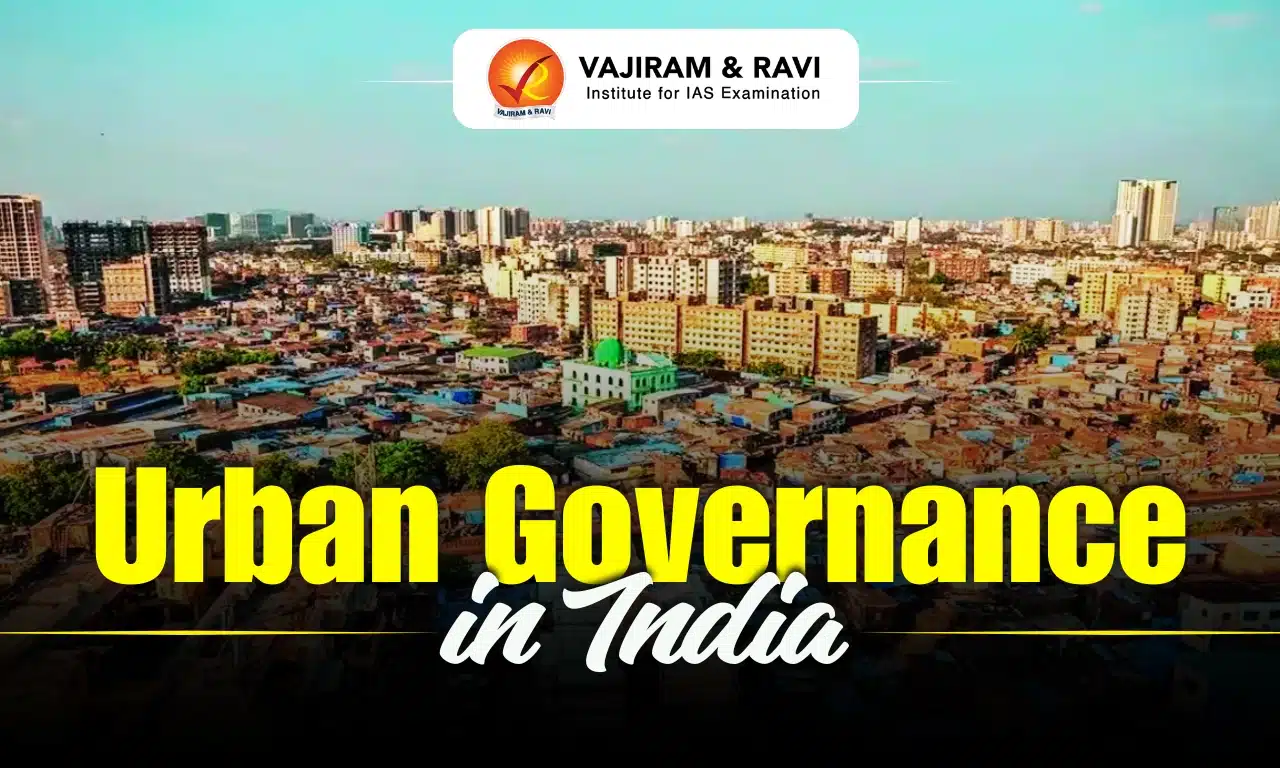
Urban Governance in India

A series of fatal urban disasters in 2026, including the Aliganj (Lucknow) fire that claimed 15 lives and the Malviya Nagar (Delhi) fire, has exposed the growing Urban Governance Crisis in India. These incidents have highlighted how illegal construction, weak enforcement, fragmented institutions and lack of accountability continue to convert preventable risks into human tragedies.

Urban Governance in India

Urban governance refers to the planning, regulation and management of cities through institutions such as Urban Local Bodies (ULBs), Development Authorities and various public agencies. It covers urban planning, land use, infrastructure, public health, disaster management and civic service delivery.

The 74th Constitutional Amendment Act, 1992 sought to establish municipalities as institutions of self-government through Article 243W and the Twelfth Schedule, which assigns 18 municipal functions. However, governance in most Indian cities remains fragmented, centralised and weakly accountable.

With cities contributing nearly two-thirds of India’s GDP and India’s urban population projected to approach 50% by 2047, addressing the Urban Governance Crisis in India is essential for achieving Viksit Bharat.

Nature of the Urban Governance Crisis in India

Recent disasters demonstrate that the Urban Governance Crisis in India extends far beyond inadequate infrastructure.

  • The Lucknow fire (2026) occurred in an illegally operating commercial establishment inside a residential locality without functional fire exits despite earlier demolition notices.
  • The Delhi Malviya Nagar fire similarly exposed unauthorised construction and poor emergency preparedness.
  • Fires in Bhiwadi (Rajasthan) and Virudhunagar (Tamil Nadu) were linked to illegal industrial units operating in violation of safety norms.
  • Repeated flooding in Mumbai and Bengaluru, contaminated water-related deaths in Indore, and civic hazards in Noida reveal deeper failures in urban planning and governance.

Despite different political administrations, these incidents reflect similar governance failures.

Reasons for the Urban Governance Crisis in India

The Urban Governance Crisis in India stems from structural, institutional, financial and administrative weaknesses that have undermined the capacity of cities to ensure safe, planned and resilient urban development.

  • Institutional fragmentation: Urban governance is divided among municipal corporations, development authorities, public works departments, transport agencies and water boards, leading to overlapping responsibilities and weak coordination. The NITI Aayog report Moving Towards Effective City Government (2026) identifies fragmented governance as a major challenge.
  • Weak regulatory enforcement: Despite comprehensive building bye-laws, land-use regulations and fire safety norms, illegal constructions and unsafe commercial activities continue because of poor enforcement, corruption, political patronage and delayed administrative action.
  • Unplanned urbanisation: Rapid urban growth has outpaced planning capacity, resulting in mixed land use, inadequate emergency infrastructure, congested neighbourhoods and growing pressure on drainage, roads and public utilities.
  • Poor disaster preparedness: Weak fire safety audits, inadequate emergency response systems and limited disaster planning have made cities increasingly vulnerable to fires, floods and other urban disasters. 
  • Technology-governance gap: Although India possesses technologies such as Artificial Intelligence (AI), Geographic Information Systems (GIS), drones and satellite imagery to detect illegal constructions and monitor compliance, these tools are not systematically integrated into urban governance and regulatory enforcement.
  • Limited municipal capacity: Most Urban Local Bodies (ULBs) suffer from inadequate financial autonomy, low municipal revenues and shortages of planners, engineers, architects, fire safety experts and disaster management professionals. The RBI Report on Municipal Finances highlights the need to strengthen municipal fiscal capacity.
  • Ethical and accountability deficit: Corruption, administrative negligence and weak accountability mechanisms allow repeated violations to persist with limited consequences, while post-disaster inquiries rarely translate into meaningful institutional reforms.

Consequences of the Urban Governance Crisis in India

Weak urban governance has serious human, economic, social and environmental consequences, undermining the quality and sustainability of urban development.

  • Loss of lives and property: Poor enforcement of safety norms increases the frequency of preventable disasters such as fires, building collapses and urban flooding.
  • Declining public trust: Repeated governance failures and weak accountability reduce citizens’ confidence in public institutions and regulatory authorities.
  • Economic losses: Infrastructure failures, business disruptions and disaster recovery impose significant costs on governments, businesses and households.
  • Reduced urban resilience: Inadequate planning and weak disaster preparedness make cities more vulnerable to climate change, extreme weather events and other urban risks.
  • Environmental degradation: Unplanned urbanisation, illegal construction and encroachments damage natural drainage systems, green spaces and urban ecosystems.
  • Rising social inequality: Vulnerable groups, particularly the urban poor and informal settlements, bear the highest burden of unsafe infrastructure and inadequate civic services.
  • Slower sustainable urban development: Weak governance hinders the achievement of SDG 11 (Sustainable Cities and Communities) and India’s vision of Viksit Bharat 2047.

Challenges in Addressing the Urban Governance Crisis

Despite constitutional reforms and multiple urban development initiatives, several challenges continue to impede effective urban governance reforms.

  • Incomplete decentralisation: The 74th Constitutional Amendment remains inadequately implemented, with limited devolution of Functions, Funds and Functionaries (3Fs) to Urban Local Bodies.
  • Weak municipal capacity: Many ULBs lack financial autonomy, skilled manpower and technical expertise for effective urban planning and service delivery.
  • Inter-agency coordination: Overlapping jurisdictions and poor coordination among multiple urban agencies delay decision-making and accountability.
  • Political economy constraints: Political interference, corruption and regulatory capture often weaken enforcement against illegal constructions and safety violations.
  • Rapid urbanisation: Fast-growing cities continue to outpace planning, infrastructure creation and regulatory oversight.
  • Climate and technological adaptation: Integrating climate resilience and digital technologies such as AI, GIS and drones into routine urban governance remains limited.

Way Forward

Resolving the Urban Governance Crisis in India requires strengthening institutions rather than merely introducing new urban schemes.

  • Fully implement the 74th Constitutional Amendment by empowering Urban Local Bodies with adequate powers, finances and personnel.
  • Clearly define institutional responsibilities to eliminate overlapping jurisdictions and accountability gaps.
  • Strictly enforce building bye-laws, land-use regulations and fire safety standards through regular independent audits.
  • Integrate AI, GIS, drones and satellite-based monitoring into urban regulatory enforcement and compliance systems.
  • Strengthen municipal finances and professionalise urban administration through greater recruitment of planners, engineers and disaster management experts.
  • Mainstream disaster resilience, fire safety and climate adaptation into urban planning in line with NDMA Guidelines, the Sendai Framework and SDG 11.
  • Promote transparency, digital governance, citizen participation and independent oversight to improve accountability.

Urban Governance in India FAQs

Q1: What is meant by the Urban Governance Crisis in India?

Ans: The Urban Governance Crisis in India refers to persistent failures in city planning, regulation, service delivery and institutional accountability, leading to recurring urban disasters, poor infrastructure and declining quality of urban life.

Q2: What are the major reasons behind the Urban Governance Crisis in India?

Ans: The Urban Governance Crisis in India is driven by fragmented institutions, weak enforcement of urban laws, rapid unplanned urbanisation, inadequate municipal finances, corruption and limited implementation of the 74th Constitutional Amendment.

Q3: How has the 74th Constitutional Amendment addressed Urban Governance in India?

Ans: The 74th Constitutional Amendment sought to strengthen Urban Local Bodies by devolving Functions, Funds and Functionaries (3Fs) and promoting democratic decentralisation, but its implementation remains uneven across States.

Q4: Why is technology important for addressing the Urban Governance Crisis in India?

Ans: Technologies such as Artificial Intelligence (AI), Geographic Information Systems (GIS), drones and satellite imagery can improve urban planning, monitor illegal constructions, strengthen regulatory enforcement and enhance disaster preparedness.

Q5: What is the way forward to overcome the Urban Governance Crisis in India?

Ans: Addressing the Urban Governance Crisis in India requires empowered Urban Local Bodies, stronger enforcement of urban regulations, institutional accountability, greater municipal capacity, technology-enabled governance and citizen-centric urban planning.

UPSC Daily Quiz 30 July 2026

UPSC Daily Quiz

[WpProQuiz 219]

UPSC Daily Quiz FAQs

Q1: What is the Daily UPSC Quiz?

Ans: The Daily UPSC Quiz is a set of practice questions based on current affairs, static subjects, and PYQs that help aspirants enhance retention and test conceptual clarity regularly.

Q2: How is the Daily Quiz useful for UPSC preparation?

Ans: Daily quizzes support learning, help in revision, improve time management, and boost accuracy for both UPSC Prelims and Mains through consistent practice.

Q3: Are the quiz questions based on the UPSC syllabus?

Ans: Yes, all questions are aligned with the UPSC Syllabus 2025, covering key areas like Polity, Economy, Environment, History, Geography, and Current Affairs.

Q4: Are solutions and explanations provided with the quiz?

Ans: Yes, each quiz includes detailed explanations and source references to enhance conceptual understanding and enable self-assessment.

Q5: Is the Daily UPSC Quiz suitable for both Prelims and Mains?

Ans: Primarily focused on Prelims (MCQ format), but it also indirectly helps in Mains by strengthening subject knowledge and factual clarity.

India-Nepal Rail Trade, Direct Freight Train Connectivity, Latest News

India-Nepal Rail Trade

The Direct Commercial Container Freight Train is a major step in strengthening rail based trade between India and Nepal. The service enables seamless movement of containerised cargo without border transhipment, making freight transport faster, cheaper, more reliable and environmentally sustainable while enhancing regional economic connectivity.

Direct Commercial Container Freight Train Latest News 2026

Indian Railways achieved a landmark in cross border freight transport by operating the first ever Direct Commercial Container Freight Train from Kolkata Port to Biratnagar Customs Yard Nepal. The train carried a consignment of canola in 40 wagons under the revised India-Nepal Rail Transit Protocol. 

Direct Commercial Container Freight Train

A Direct Rail Freight System improves cargo movement by reducing delays, handling and transportation costs while creating an efficient cross border logistics network.

  • The revised India-Nepal Rail Transit Protocol allows containerised cargo to move directly to Biratnagar without unloading and reloading at the border, reducing delays, cargo handling and the risk of damage.
  • The service became possible after implementation of the revised India-Nepal Rail Transit Protocol and the revised Letter of Exchange signed in November 2025, enabling seamless end to end rail movement of freight.
  • The freight rake was booked on 19 July, reached Biratnagar on 23 July and was released after unloading on 25 July, demonstrating efficient cross border cargo movement through rail.

India-Nepal Rail Trade

India-Nepal Rail Trade has improved bilateral trade by expanding railway connectivity, reducing transport costs and enabling faster, reliable movement of goods between India and Nepal.

  • Direct Commercial Freight: The Direct Commercial Container Freight Train enables faster transport of containerised and bulk cargo, lowers logistics costs and strengthens India-Nepal bilateral trade.
  • Broad Gauge Rail Connectivity: The Jogbani-Biratnagar broad gauge rail link, inaugurated in June 2023 laid the foundation of the direct commercial rail freight.
  • Improved Trade Facilitation: The revised transit arrangement allows containerised and bulk cargo to move directly from Kolkata and Visakhapatnam ports to the Biratnagar Customs Yard, improving supply chain efficiency.
  • Expanded Transit Corridors: The revised protocol includes the Kolkata-Jogbani, Kolkata-Nautanwa and Visakhapatnam-Nautanwa rail corridors, providing Nepal with additional railway routes for international cargo movement.
  • Institutional Railway Cooperation: India and Nepal review railway cooperation through the Project Steering Committee (PSC) and Joint Working Group (JWG).

Dedicated Freight Corridor (DFC)

Dedicated Freight Corridor (DFC) is India's dedicated railway network for freight transport, including Direct Commercial Container Freight Train.

  • Project Purpose: The Dedicated Freight Corridor (DFC) separates freight trains from passenger trains, reducing railway congestion and allowing faster, safer and more efficient movement of heavy goods.
  • Project Background: The DFC project was conceived in 2005 and approved by the Union Cabinet in 2008 to strengthen India's freight transport system and improve railway efficiency.
  • Implementation Agency: The Dedicated Freight Corridor Corporation of India Limited (DFCCIL), a Special Purpose Vehicle under the Ministry of Railways, plans, builds, operates, maintains and develops the freight corridors.
  • Network Coverage: The Eastern Dedicated Freight Corridor and Western Dedicated Freight Corridor together cover about 2,843 km, with most sections already commissioned for freight operations.

Direct Commercial Container Freight Train Significance

The key highlighting significance of the Direct Commercial Container Freight Train has been listed below:

  • Economic Benefits: Direct rail movement removes border transhipment, reducing transportation expenses, cargo handling charges and transit time, making cross border import and export operations more cost effective.
  • Faster and Reliable Supply Chain: End to end rail transportation improves delivery reliability, reduces cargo handling points and lowers the risk of delays, cargo damage and operational disruptions.
  • Boost to Trade and Economy: The service benefits exporters, importers, logistics companies and industries by providing faster cargo movement, better freight reliability and improved business efficiency.
  • Stronger India-Nepal Connectivity: The freight train strengthens railway links between India and Nepal, supporting regional trade, modern transport infrastructure and smoother cross border logistics.
  • Sustainable Transport: Greater use of rail freight promotes an environmentally sustainable transport system by shifting cargo from road to electrified railway corridors with higher operational efficiency.
  • Supports Future Freight Network: The initiative reflects Indian Railways' long term vision of building an integrated, efficient and future ready freight network that promotes economic growth and ease of doing business.

Direct Commercial Container Freight Train FAQs

Q1: What is the Direct Commercial Container Freight Train?

Ans: It is the first direct commercial container freight train connecting Kolkata Port in India with Biratnagar Customs Yard in Nepal without border transhipment.

Q2: Why is the Direct Commercial Container Freight Train important?

Ans: It reduces transit time, logistics costs, cargo handling and border delays while improving the efficiency and reliability of India-Nepal cross border trade.

Q3: Which agreement made the Direct Commercial Container Freight Train possible?

Ans: The service became operational under the revised India-Nepal Rail Transit Protocol and the revised Letter of Exchange (LoE) signed in November 2025.

Q4: When was the first Direct Commercial Container Freight Train operated?

Ans: The first Direct Commercial Container Freight Train completed its journey to Biratnagar Customs Yard on 23 July, marking a new milestone in India-Nepal rail connectivity.

Q5: What is the route of the First Direct Commercial Container Freight Train?

Ans: The train runs from Kolkata Port in India to Biratnagar Customs Yard in Nepal through the Jogbani-Biratnagar broad-gauge rail link.

Pickaxe Mountain, Location, Geology, Construction, Importance

Pickaxe Mountain

Pickaxe Mountain, an underground facility linked to Iran’s nuclear programme, has gained global attention after US President Donald Trump threatened possible military strikes on the site, alleging that it could play a role in Iran’s future nuclear activities.

About Pickaxe Mountain

Pickaxe Mountain, also known as Kuh-e Kolang Gaz La, is an underground facility located near Iran’s Natanz nuclear complex.

  • It is located around 220 km south of Tehran and around 1.5-2 km from the Natanz nuclear facility.
  • The mountain rises to around 1,600 metres above sea level.
  • The facility is believed to be constructed at least 100 metres below the mountain surface.
  • It is linked to Iran’s nuclear programme, particularly its efforts related to advanced centrifuge infrastructure.
  • It is not confirmed to be operational, and there is no publicly verified evidence of active nuclear activity at the site. However, its location, design and purpose have raised international concerns regarding its possible future use.

Pickaxe Mountain Geographical and Geological Features

The geographical setting of Pickaxe Mountain provides it with significant natural protection.

  • The mountain lies within the Karkas Mountain Range of central Iran, a volcanic mountain system.
  • The range extends for over 100 km between Kashan and Ardestan across an arid plateau.
  • It was formed through ancient tectonic and volcanic processes, resulting in a rugged mountainous landscape.
  • The mountain is composed largely of hard volcanic rocks, making underground construction and military penetration more difficult.

Why is it called “Pickaxe Mountain” and Iran’s “Natural Fortress”?

Pickaxe Mountain is the English name used for Iran’s underground facility known locally as Kuh-e Kolang Gaz La (Kolang Kouh). The name refers to the mountain where the underground complex is being constructed.

It is described as Iran’s “natural fortress” because its geological features and underground design provide exceptional protection.

  • Thick layers of hard volcanic rock make the facility highly resistant to conventional military strikes.
  • Faults, fractures and variations in rock density can disperse shock waves, making underground targeting and blast assessment difficult.
  • The deep underground location provides natural protection against aerial attacks.
  • The combination of natural geological barriers and engineered underground tunnels provides Iran with a significant strategic advantage.

Pickaxe Mountain Background and Current Status 

Construction of Pickaxe Mountain began in 2020 after an explosion damaged Iran’s above-ground advanced centrifuge assembly facility at Natanz. Iran stated that the new underground complex was intended to replace the damaged centrifuge assembly facility and provide a more secure location for nuclear-related activities.

The development reflects Iran’s broader approach of shifting sensitive nuclear infrastructure to protected underground locations to reduce vulnerability to possible external attacks.

  • Iran maintains that its nuclear programme is peaceful and intended for civilian purposes.
  • Tehran has stated that its nuclear activities are declared to the International Atomic Energy Agency (IAEA) under safeguards obligations.
  • However, the IAEA has not been granted access to Pickaxe Mountain, limiting independent verification of activities at the site.
  • The agency has also faced challenges in independently assessing Iran’s centrifuge production capabilities in recent years.

Pickaxe Mountain FAQs

Q1: What is Pickaxe Mountain?

Ans: Pickaxe Mountain (Kuh-e Kolang Gaz La) is a deeply buried underground nuclear-related facility being developed by Iran near the Natanz nuclear complex, a major uranium enrichment site.

Q2: Where is Pickaxe Mountain located?

Ans: It is located around 220 km south of Tehran and approximately 2 km from the Natanz nuclear facility in central Iran.

Q3: Why is Pickaxe Mountain called Iran’s “Natural Fortress”?

Ans: The facility is built deep inside a mountain, where layers of rock provide natural protection against aerial attacks. Its underground location makes it highly difficult to destroy compared to conventional above-ground facilities.

Q4: Why was Pickaxe Mountain constructed?

Ans: Construction began in 2020 after an explosion damaged Iran’s above-ground centrifuge assembly facility at Natanz. Iran stated that the underground complex was intended to replace the damaged facility and provide a more secure location for nuclear-related activities.

Q5: Is Pickaxe Mountain an operational nuclear facility?

Ans: There is no confirmed evidence that Pickaxe Mountain is currently operational. Satellite imagery suggests that construction is continuing, but experts believe it could potentially support sensitive nuclear activities in the future.

Hiroshima Day 2026, Theme, History, Consequences, Significance

Hiroshima Day 2026

Hiroshima Day 2026 is observed on August 6, 2026, marking the 81st anniversary of the atomic bombing of Hiroshima during World War II. The day honours the lives lost, remembers the suffering of survivors, and spreads awareness about the devastating consequences of nuclear warfare. It also strengthens the global commitment to peace, nuclear disarmament, and preventing such tragedies in the future.

Why is Hiroshima Day Observed?

Hiroshima Day is observed every year to commemorate the atomic bombing of Hiroshima on August 6, 1945, one of the most devastating events in human history.

The day serves as a reminder of the immense destruction caused by nuclear weapons and promotes global efforts towards peace, non-violence, and nuclear disarmament. Governments, international organisations, peace activists, and citizens across the world participate in memorial events to honour the victims.

Hiroshima Day 2026 Theme

Hiroshima Day 2026 marks the 81st anniversary of the 1945 atomic bombing of Hiroshima and is centred on the principles of Remembrance, Responsibility, and Resilience, honouring the victims while reinforcing the global commitment to peace and a world free of nuclear weapons.

Hiroshima Day 2026 History

Hiroshima Day commemorates the atomic bombing of Hiroshima on 6 August 1945, remembering the victims of the tragedy and reinforcing the global commitment to peace and nuclear disarmament.

  • 7 December 1941: Japan attacked the U.S. Naval Base at Pearl Harbor, bringing the United States into World War II.
  • 6 August 1945: The U.S. B-29 bomber Enola Gay dropped the "Little Boy" atomic bomb on Hiroshima at 8:15 a.m.
  • The bombing caused the immediate deaths of around 130,000 people, with the toll rising to nearly 140,000 by the end of 1945 due to injuries and radiation.
  • 9 August 1945: A second atomic bomb, "Fat Man," was dropped on Nagasaki.
  • 15 August 1945: Japan announced its surrender, effectively bringing World War II to an end.
  • Since then, 6 August has been observed annually as Hiroshima Day to honour the victims and promote global peace.
  • Since 1964, the Flame of Peace at Hiroshima Peace Memorial Park has burned continuously as a symbol of the world's determination to eliminate nuclear weapons.

Atomic Bombing of Hiroshima

The Atomic Bombing of Hiroshima was carried out on 6 August 1945 during the final phase of World War II. It marked the first use of a nuclear weapon in armed conflict and caused widespread destruction, immense human suffering, and long-lasting environmental and health consequences.

  • The bombing occurred during the final stages of World War II.
  • The United States targeted the Japanese city of Hiroshima with an atomic bomb.
  • The bomb, known as "Little Boy," was dropped from the B-29 bomber Enola Gay.
  • The explosion destroyed large parts of the city within moments.
  • Thousands of civilians lost their lives, while many others suffered severe injuries.
  • Survivors, known as Hibakusha, experienced lifelong physical and psychological effects due to radiation exposure.
  • Homes, hospitals, schools, and public infrastructure were extensively damaged.
  • The bombing highlighted the catastrophic humanitarian consequences of nuclear weapons.
  • It was followed by the atomic bombing of Nagasaki three days later.
  • The tragedy continues to strengthen global efforts toward peace, nuclear disarmament, and the prevention of future nuclear conflicts.

Human Consequences of Hiroshima

The atomic bombing of Hiroshima caused devastating humanitarian consequences, affecting not only those who died immediately but also generations of survivors.

  • Immediate Loss of Life: Approximately 70,000–80,000 people died instantly from the blast and intense heat.
  • Rising Death Toll: By the end of 1945, the total number of deaths had reached around 140,000 due to burns, injuries, and radiation sickness.
  • Radiation Sickness: Thousands suffered from acute radiation syndrome, causing nausea, vomiting, hair loss, internal bleeding, fever, and weakened immunity.
  • Long-Term Health Effects: Survivors experienced a significantly higher risk of leukaemia, thyroid cancer, breast cancer, lung cancer, cataracts, and other chronic illnesses.
  • Severe Burn Injuries: Many victims sustained extensive burns from the intense thermal radiation, resulting in permanent disfigurement and lifelong disabilities.
  • Psychological Trauma: Survivors endured post-traumatic stress, anxiety, depression, grief, and survivor's guilt for many years.
  • Hibakusha (Survivors): The survivors, known as Hibakusha, often faced social stigma and discrimination in employment, education, and marriage due to fears about radiation exposure.
  • Homelessness and Humanitarian Crisis: Around 90% of Hiroshima's buildings were damaged or destroyed, leaving tens of thousands homeless and without access to food, clean water, or medical care.
  • Impact on Children: Many children were orphaned, while others developed long-term health complications linked to radiation exposure.
  • Generational Effects: Scientific studies have monitored the long-term health of survivors and their children, although significant hereditary genetic effects have been found to be more limited than initially feared.
  • Environmental Damage: Fires and radioactive fallout devastated the city's infrastructure and disrupted normal life for years.

Hiroshima Day 2026 Significance

Hiroshima Day 2026 serves as a powerful reminder of the devastating consequences of nuclear warfare and reinforces the global commitment to peace, humanity, and nuclear disarmament.

  • Honours the Victims: Pays tribute to the thousands of people who lost their lives in the Hiroshima atomic bombing and remembers their suffering.
  • Raises Awareness: Educates people about the humanitarian impact of nuclear weapons on civilians and future generations.
  • Promotes Nuclear Disarmament: Strengthens global support for the elimination of nuclear weapons and the prevention of nuclear war.
  • Encourages World Peace: Inspires nations to resolve conflicts through dialogue, diplomacy, and peaceful cooperation.
  • Recognises the Hibakusha: Acknowledges the resilience of the Hibakusha (atomic bomb survivors) and preserves their testimonies for future generations.
  • Preserves Historical Memory: Ensures that the lessons of Hiroshima remain an important part of world history and peace education.
  • Supports Humanitarian Values: Reinforces the importance of protecting human rights, civilians, and human dignity during conflicts.
  • Promotes Global Unity: Brings together governments, international organisations, and communities in a shared commitment to a world free of nuclear weapons.

Hiroshima Day 2026 FAQs

Q1: When is Hiroshima Day 2026 observed?

Ans: Hiroshima Day 2026 is observed on 6 August 2026, marking the 81st anniversary of the atomic bombing of Hiroshima in 1945.

Q2: Why is Hiroshima Day observed?

Ans: Hiroshima Day is observed to remember the victims of the atomic bombing, honour the survivors (Hibakusha), and promote peace, nuclear disarmament, and awareness of the humanitarian consequences of nuclear warfare.

Q3: What is the theme of Hiroshima Day 2026?

Ans: The theme of Hiroshima Day 2026 is "Remembrance, Responsibility, and Resilience," highlighting the need to remember the past, promote peace, and prevent future nuclear conflicts.

Q4: What happened on 6 August 1945?

Ans: On 6 August 1945, the United States dropped the "Little Boy" atomic bomb on Hiroshima, Japan, causing massive destruction and the deaths of approximately 140,000 people by the end of 1945.

Q5: Who were the Hibakusha?

Ans: Hibakusha are the survivors of the atomic bombings of Hiroshima and Nagasaki. Many suffered lifelong physical illnesses, radiation-related diseases, psychological trauma, and social discrimination.

Tigers Outside Tiger Reserves (TOTR) Initiative, Objectives, Features

Tigers Outside Tiger Reserves (TOTR) Initiative

The Ministry of Environment, Forest and Climate Change (MoEFCC) has launched the Tigers Outside Tiger Reserves (TOTR) Initiative to address the growing presence of tigers outside notified Tiger Reserves and promote safe coexistence between humans and wildlife across shared landscapes.

About Tigers Outside Tiger Reserves (TOTR) Initiative

The Tigers Outside Tiger Reserves (TOTR) Initiative, launched by the Ministry of Environment, Forest and Climate Change (MoEFCC), is a pilot programme aimed at conserving tigers in human-dominated landscapes outside notified Tiger Reserves through a science-based, landscape-level and coexistence-oriented approach.

The Tigers Outside Tiger Reserves (TOTR) Initiative has been launched in response to the increasing number of tigers dispersing beyond protected areas due to habitat saturation and population recovery.

Tigers Outside Tiger Reserves (TOTR) Initiative Need 

India’s remarkable success in tiger conservation has created a new conservation reality. The tiger population has increased from 1,411 in 2006 to 3,682 in 2022, making India home to over 70% of the world’s wild tigers. As tiger populations recover, many disperse beyond Tiger Reserves into villages, agricultural lands and forest fringes in search of new territories. According to the National Tiger Conservation Authority (NTCA), nearly 35-40% of India’s tigers now live outside Tiger Reserves, leading to increased human–tiger interactions, livestock depredation, rescue operations and public anxiety.

Tigers Outside Tiger Reserves (TOTR) Initiative Objectives

Tigers Outside Tiger Reserves (TOTR) Initiative seeks to promote safe and sustainable coexistence between people and tigers across shared landscapes through a science-based approach.

  • Establish a scientifically grounded, landscape-based framework for conserving tigers outside Tiger Reserves.
  • Shift from reactive conflict response to proactive, technology-driven conflict prevention.
  • Reduce human-tiger conflict while safeguarding human lives, livelihoods and tiger populations.
  • Strengthen surveillance, monitoring, rescue infrastructure and rapid response mechanisms.
  • Promote community participation, awareness and timely compensation to build public trust.
  • Generate field-based evidence through pilot implementation to guide future national policy.

Tigers Outside Tiger Reserves (TOTR) Initiative Key Features 

Tigers Outside Tiger Reserves (TOTR) Initiative adopts an integrated approach that combines scientific management, technology and community participation to manage tigers across shared landscapes.

  • Pilot-based implementation: Introduced initially in 40 forest divisions across nine States - Uttarakhand, Uttar Pradesh, Rajasthan, Madhya Pradesh, Maharashtra, Karnataka, Tamil Nadu, Telangana and Assam to generate field-based evidence before nationwide expansion.
  • Dual implementation strategy: Built on two complementary pillars - strengthening conflict mitigation and field protection, and promoting long-term human-tiger coexistence through community engagement.
  • Technology-enabled conservation: Utilises camera traps, GPS-enabled monitoring, drones and Artificial Intelligence (AI) for surveillance, early warning and evidence-based decision-making.
  • Strengthened institutional capacity: Enhances communication systems, rapid response teams, rescue infrastructure and coordination among forest departments during conflict situations.
  • Community-centric approach: Promotes awareness programmes, local participation and partnership with villagers, recognising that conservation outside protected areas depends on community trust.
  • Improved compensation mechanism: Encourages timely and simplified compensation for human casualties, livestock loss and crop damage to reduce resentment and strengthen public confidence.
  • Capacity building: Focuses on training forest personnel, veterinarians and wildlife rescue teams to improve preparedness and professional response.
  • Adaptive policy framework: Uses continuous monitoring and lessons from the pilot phase to refine future conservation strategies for tigers outside protected areas.

Tigers Outside Tiger Reserves (TOTR) Initiative Significance

The Tigers Outside Tiger Reserves (TOTR) Initiative reflects India’s shift from reserve-centric conservation to landscape-level conservation.

  • Secures tigers beyond reserves: Recognises that a large share of India’s tigers now live outside Tiger Reserves and need dedicated conservation measures.
  • Promotes human-tiger coexistence: Focuses on preventing conflict while protecting both human lives and tiger populations.
  • Conserves wildlife corridors: Protects dispersal routes that maintain genetic diversity and healthy tiger populations.
  • Strengthens conservation governance: Improves monitoring, rapid response, institutional capacity and technology-driven management.
  • Supports sustainable development: Balances biodiversity conservation with local livelihoods through community participation and timely compensation.
  • Strengthens India’s global leadership: Builds on the success of Project Tiger and contributes to SDG 15 (Life on Land) and the Kunming-Montreal Global Biodiversity Framework.

Tigers Outside Tiger Reserves (TOTR) Initiative FAQs

Q1: What is the Tigers Outside Tiger Reserves (TOTR) Initiative?

Ans: The Tigers Outside Tiger Reserves (TOTR) Initiative is a Ministry of Environment, Forest and Climate Change (MoEFCC) pilot programme for conserving tigers outside notified Tiger Reserves through a landscape-based and coexistence-oriented approach.

Q2: Why was the Tigers Outside Tiger Reserves (TOTR) Initiative launched?

Ans: The Tigers Outside Tiger Reserves (TOTR) Initiative was launched as nearly 35-40% of India’s tigers now live outside Tiger Reserves, increasing human-tiger interactions.

Q3: What are the objectives of the Tigers Outside Tiger Reserves (TOTR) Initiative?

Ans: The Tigers Outside Tiger Reserves (TOTR) Initiative aims to reduce human–tiger conflict, strengthen monitoring and rescue systems, and promote community participation.

Q4: What are the key features of the Tigers Outside Tiger Reserves (TOTR) Initiative?

Ans: The Tigers Outside Tiger Reserves (TOTR) Initiative includes pilot implementation in 40 forest divisions across nine States, technology-enabled monitoring, rapid response teams and timely compensation.

Q5: Why is the Tigers Outside Tiger Reserves (TOTR) Initiative significant?

Ans: The Tigers Outside Tiger Reserves (TOTR) Initiative expands tiger conservation beyond protected areas and promotes long-term human–tiger coexistence across shared landscapes.

Fields Medal 2026, Winners List, History, Eligibility, Significance

Fields Medal 2026

The Fields Medal 2026, one of the highest honours in mathematics, was announced during the International Congress of Mathematicians (ICM) 2026 held in Philadelphia, USA, from 23-30 July 2026. The 2026 edition was significant as it was the first ICM hosted in the United States since 1986.The medal was awarded to Yu Deng, John Pardon, Hong Wang and Jacob Tsimerman for their outstanding contributions to modern mathematics. 

About Fields Medal

The Fields Medal is the world’s highest honour in mathematics, recognising exceptional mathematical achievements and encouraging future research among young mathematicians. The Fields Medal was instituted by Canadian mathematician John Charles Fields and was first awarded in 1936 to Lars Ahlfors and Jesse Douglas at the International Congress of Mathematicians (ICM), Oslo.

  • Awarded every four years during the International Congress of Mathematicians (ICM).
  • Conferred by the International Mathematical Union (IMU).
  • Awarded to mathematicians below 40 years of age on 1 January of the award year.
  • Recognises both outstanding mathematical discoveries and the recipient’s future research potential.
  • Normally awarded to up to four mathematicians.
  • The medal carries a cash prize of 15,000 Canadian Dollars (CAD)
  • Popularly regarded as the “Nobel Prize of Mathematics”, although no Nobel Prize exists for mathematics.

Fields Medal Objectives 

The Fields Medal aims to promote excellence in mathematical sciences and inspire future generations of researchers.

  • Recognise path-breaking contributions to mathematics.
  • Encourage young mathematicians to pursue frontier research.
  • Promote innovation across diverse branches of mathematics.
  • Foster international collaboration in mathematical sciences.
  • Inspire future generations through excellence in research.

Fields Medal 2026 Winners

The Fields Medal 2026 recognised four mathematicians whose work has solved long-standing mathematical problems and expanded the frontiers of modern mathematics, with important applications in physics, geometry, number theory and Artificial Intelligence.

Yu Deng (University of Chicago, USA)

  • Yu Deng was awarded the Fields Medal for solving a part of David Hilbert’s Sixth Problem, one of the famous 23 mathematical problems proposed in 1900.
  • His work created a strong connection between the microscopic world of particles and the macroscopic behaviour of fluids such as water flow.
  • In simple terms, he mathematically explained how the movement and interaction of individual particles can lead to large-scale physical phenomena.
  • His research strengthened the foundations of kinetic theory and fluid dynamics, creating a major link between mathematics and physics.
  • Deng, who won a gold medal at the International Mathematical Olympiad (IMO) in 2006, became the first Chinese national since Shing-Tung Yau (1982) to receive the Fields Medal.

John Pardon (Stony Brook University, USA)

  • Honoured for solving the 20-year-old MNOP Conjecture, a landmark problem involving Calabi-Yau threefolds, and for developing the theory of Virtual Fundamental Cycles, now widely used in modern geometry.
  • His work advances symplectic geometry, which provides the mathematical framework for describing the motion of physical systems and has applications in theoretical physics, including string theory.
  • Earlier gained international recognition for solving a 30-year-old knot distortion problem while still an undergraduate.

Hong Wang (New York University, USA)

  • Hong Wang was awarded the Fields Medal for solving the three-dimensional Kakeya Conjecture, a major mathematical problem that remained unsolved for nearly 50 years.
  • Her work advanced harmonic analysis (the study of patterns and waves) and geometric measure theory (the study of geometric structures and their properties).
  • Her research has applications in areas such as signal processing, wave analysis and partial differential equations.
  • She became the third woman to receive the Fields Medal, after Maryam Mirzakhani (2014) and Maryna Viazovska (2022).

Jacob Tsimerman (University of Toronto, Canada)

  • Jacob Tsimerman was awarded the Fields Medal for his pioneering work connecting number theory, algebraic geometry and mathematical logic.
  • He proved Griffiths’ Conjecture by applying the concept of o-minimality, a tool from mathematical logic that helps study complex geometric structures.
  • Earlier in his career, he contributed to the proof of the Andre-Oort Conjecture, a major problem in number theory and geometry, for which he received the SASTRA Ramanujan Prize in 2015.

India and the Fields Medal

Although no Indian citizen has won the Fields Medal, mathematicians of Indian origin have made significant contributions.

  • Manjul Bhargava (2014) became the first mathematician of Indian origin to receive the Fields Medal for his pioneering work in number theory.
  • Akshay Venkatesh (2018) received the Fields Medal for groundbreaking contributions linking analytic number theory, topology and homogeneous dynamics.
  • India’s rich mathematical heritage, represented by Srinivasa Ramanujan, continues to inspire global mathematical research through recognitions such as the SASTRA Ramanujan Prize.

About International Congress of Mathematicians (ICM)

The International Congress of Mathematicians (ICM) is the largest and most prestigious global conference in mathematics.

  • It is organised once every four years under the aegis of the International Mathematical Union (IMU).
    • International Mathematical Union (IMU) is an international non-governmental and non-profit scientific organisation established to promote global cooperation in mathematic
  • It brings together mathematicians, researchers, educators and scholars to:
    • Present cutting-edge research.
    • Discuss emerging areas of mathematics.
    • Shape future directions in mathematical sciences.
  • Apart from the Fields Medal, other major awards presented at ICM include:
    • IMU Abacus Medal: Awarded for outstanding contributions in the mathematical aspects of information science and computer science.
    • Carl Friedrich Gauss Prize: Recognises mathematical research with significant impact beyond mathematics, including engineering, technology and business.
    • Chern Medal Award: Honours lifetime achievements and exceptional contributions to mathematics.
    • Leelavati Prize: Recognises contributions towards public outreach and popularisation of mathematics.

Fields Medal 2026 FAQs

Q1: What is the Fields Medal?

Ans: The Fields Medal is the world’s highest honour in mathematics, awarded every four years by the International Mathematical Union (IMU) to outstanding mathematicians below the age of 40.

Q2: Who is eligible for the Fields Medal?

Ans: Mathematicians who are below 40 years of age on 1 January of the award year are eligible for the Fields Medal.

Q3: Which organisation awards the Fields Medal?

Ans: The International Mathematical Union (IMU) awards the Fields Medal during the International Congress of Mathematicians (ICM).

Q4: Why is the Fields Medal called the “Nobel Prize of Mathematics”?

Ans: Fields Medal is regarded as the most prestigious award in mathematics because no Nobel Prize is awarded in mathematics.

Q5: Who won the Fields Medal 2026?

Ans: The Fields Medal 2026 was awarded to Yu Deng, John Pardon, Hong Wang and Jacob Tsimerman.

Shyok River, Origin, Flow, Tributary, Shyok Valley, Significance

Shyok River

The Shyok River is one of the major tributaries of the Indus River, flowing through northern Ladakh in India before entering Gilgit-Baltistan in Pakistan. The river is approximately 550 km (340 miles) long and drains a basin of about 33,465 sq km spread across India, Pakistan and China. It is known for its unusual course, glacial origin, strategic valley and important role in sustaining life in the cold desert region of the Karakoram.

Shyok River

The word "Shyok" has different explanations. It is popularly interpreted as "River of Death" because of its dangerous floods, while another explanation links it to the Tibetan word "Shayog," meaning "gravel spreader," referring to the large amount of gravel deposited by the Shyok River. Historically, the Shyok Valley served as an important trade route between Ladakh, Baltistan and Central Asia. During the British Period, the Survey of India mapped the valley, while today the river corridor remains strategically important because it flows between the Line of Actual Control (LAC), the Siachen region and the Karakoram.

Shyok River Features

The Shyok River has a unique glacial course, high altitude valley and several important tributaries that make it one of the key rivers of the Indus basin.

  • Origin: The river originates from the Rimo Glacier in eastern Karakoram at about 4,980 metres elevation. 
  • Flow Direction: It first flows south-southeast, makes a distinctive V shaped turn near the Chang Chenmo Range and later moves west-northwest. 
  • Course: The Shyok River flows through the Union Territory of Ladakh in India before entering Gilgit-Baltistan in Pakistan, where it finally joins the Indus River.
  • River Length and Basin: The river extends nearly 550 km and drains a 33,465 sq km basin distributed across India (54%), Pakistan (28%) and China (18%), making it an important transboundary Himalayan river.
  • Confluence with Indus: The river passes through broad valleys, narrow gorges and braided channels before it meets Indus at Keris near Skardu in Gilgit-Baltistan. It is often described as a major Right Bank Tributary of the Indus because it joins from the right bank.
  • Major Tributaries: Important Tributaries include the Chip Chap, Galwan, Chang Chenmo, Nubra and Hushe rivers. The Nubra River is its principal right bank tributary and joins the Shyok near Diskit.

Shyok Valley

The Shyok Valley is a high altitude cold desert valley carved by the Shyok River through the Karakoram. It connects remote mountain regions, supports small settlements through irrigation and remains an important geographical corridor in Ladakh.

  • Climate: The Shyok valley has a cold semi arid climate with annual rainfall generally below 200 mm. Summer temperatures often exceed 30°C, while winter temperatures commonly fall to around -10°C.
  • Cold Desert Landscape: The valley has a cold desert environment with very low rainfall, generally below 200 mm annually, sparse natural vegetation and large seasonal temperature variations.
  • Altitude: The valley descends from nearly 4,980 metres near the Rimo Glacier to about 2,289 metres near the river's confluence with the Indus, creating diverse landforms along its course.
  • Agricultural Settlements: Irrigation from the Shyok River supports small villages where farmers cultivate wheat, barley, potatoes and fruit orchards of apricots, apples and walnuts despite the harsh climate.
  • Winter Connectivity: During severe winters, sections of the frozen river have traditionally served as a natural route connecting the Nubra Valley with Khaplu, helping local movement across difficult terrain.
  • Geographical Formation: The valley was shaped by long term glacial activity, river erosion and tectonic movements, resulting in broad valleys, braided river channels, U shaped glacial landforms and narrow rocky gorges.
  • Gateway to Ladakh: The valley acts as an important approach to Nubra Valley and passes through several scenic locations, making it a key travel corridor across the eastern Karakoram region.

Shyok River Significance

The Shyok River supports strategic connectivity, local livelihoods, regional ecology and historical trade across the high altitude Karakoram region.

  • Strategic Importance: The river valley provides access to key mountain routes including the Karakoram Pass. Infrastructure such as the Darbuk-Shyok-Daulat Beg Oldi (DS-DBO) Road has strengthened connectivity near the Siachen Glacier and border areas.
  • Agriculture and Water Source: Despite harsh climatic conditions, irrigation from the river supports cultivation of wheat, barley, potatoes, along with orchards of apricots, walnuts and apples in lower parts of the valley.
  • Historical Trade Route: For centuries, caravans travelling between Leh, Baltistan, western Tibet and Central Asia used the Shyok Valley, making it an important corridor for trade and movement.
  • Tourism Value: The river enhances tourism by providing access to Nubra Valley, Diskit Monastery, Hundar sand dunes, Bactrian camel rides and the annual Diskit Gustor Festival of Ladakh, attracting adventure and cultural travellers.
  • Geomorphological Importance: The river flows through the Shyok Suture Zone, where the Indian and Eurasian tectonic plates collided. Glacial activity and river erosion have created braided channels, U shaped valleys and river terraces.

Shyok River Biodiversity

The Shyok River corridor forms an important ecological zone in the cold desert landscape despite sparse vegetation and harsh climatic conditions.

  • Flora: Vegetation changes with altitude and water availability. Common plant species include false tamarisk (Myricaria), sea buckthorn (Hippophae rhamnoides), tamarisk (Tamarix), willows (Salix) and poplars (Populus) along the riverbanks.
  • Fauna: The river supports high altitude wildlife including snow trout (Schizothorax). Gravel bars provide breeding habitat for the ibisbill (Ibidorhyncha struthersii), while riparian vegetation shelters small mammals and passerine birds.
  • Ecological Region: The river forms part of the Upper Indus freshwater ecoregion and the Karakoram-West Tibetan Plateau alpine steppe, serving as an important ecological corridor across the high mountains.
  • Protected Areas: A large section of the river in India lies within or along the boundary of the Nubra-Shyok/ Karakoram Wildlife Sanctuary (Ladakh), one of the country's largest protected areas supporting fragile Himalayan ecosystems.
  • Environmental Challenges: Seasonal glacier melt, heavy sediment transport, flash floods and temporary blockage by the Chong Kumdan Glacier have historically caused flooding and continue to influence the river's natural flow and surrounding settlements.

Shyok River FAQs

Q1: Where does the Shyok River originate?

Ans: The Shyok River originates from the Rimo Glacier in the eastern Karakoram Range of Ladakh. It is mainly fed by glacier melt and snowmelt.

Q2: Where does the Shyok River join the Indus River?

Ans: The Shyok River joins the Indus River near Keris, close to Skardu in Gilgit-Baltistan, after flowing for about 550 km.

Q3: Why is the Shyok River called the River of Death?

Ans: The Shyok River is called the River of Death because sudden floods and difficult terrain made travel along the river extremely dangerous in the past.

Q4: Which is the main tributary of the Shyok River?

Ans: The Nubra River is the main right bank tributary of the Shyok River. Other important tributaries include the Chip Chap, Galwan, Chang Chenmo and Hushe rivers.

Q5: Why is the Shyok River strategically important?

Ans: The Shyok River Valley is strategically important because it provides access to the Karakoram Pass, the Siachen region and areas near the Line of Actual Control (LAC).

Cauvery Water Dispute, History, SC Verdict & Latest News

Cauvery Water Dispute

The Cauvery Water Dispute is one of India's oldest and most complex inter-state river water disputes. It concerns the sharing of the waters of the Cauvery River among Karnataka, Tamil Nadu, Kerala, and the Union Territory of Puducherry. The river is the lifeline for millions of people, supporting agriculture, drinking water supply, industries, and ecosystems across southern India.

Why in News?

The Cauvery Water Dispute has resurfaced following renewed differences over Karnataka's proposed Mekedatu Balancing Reservoir Project on the Cauvery River.

Recently, Tamil Nadu Chief Minister C. Joseph Vijay wrote to Prime Minister Narendra Modi, urging the Central Government to ensure that no statutory or administrative approval is granted to the Mekedatu project unless it fully complies with the Cauvery Water Disputes Tribunal (CWDT) Award of 2007 and the Supreme Court's 2018 judgment on the sharing of Cauvery waters.

Cauvery Water Dispute History

The Cauvery Water Dispute has evolved over more than a century, beginning with colonial-era agreements and continuing through tribunal awards, Supreme Court judgments, and the establishment of institutional mechanisms for equitable water sharing.

  • 1892 Agreement: Signed between the Madras Presidency and the Princely State of Mysore, requiring Mysore to obtain prior consent before undertaking major irrigation projects.
  • 1924 Agreement: Replaced the 1892 agreement, allowing the construction of the Krishnarajasagar Dam and Mettur Dam; remained valid for 50 years.
  • 1974: Karnataka considered the 1924 agreement to have expired, leading to fresh disagreements over water sharing.
  • 1990: The Central Government constituted the Cauvery Water Disputes Tribunal (CWDT) under the Inter-State River Water Disputes Act, 1956.
  • 1991 Interim Award: The Tribunal directed Karnataka to release a specified quantity of water to Tamil Nadu, triggering protests in both states.
  • 2007 Final Tribunal Award: The CWDT allocated Cauvery waters among Karnataka, Tamil Nadu, Kerala, and Puducherry based on basin requirements.
  • 2013: The Central Government notified the Tribunal's final award in the Official Gazette, making it legally enforceable.
  • 2018 Supreme Court Judgment: The Supreme Court modified the Tribunal's allocation, increased Karnataka's share by 14.75 TMC, and directed the establishment of the Cauvery Water Management Authority (CWMA).
  • 2018: The CWMA and the Cauvery Water Regulation Committee (CWRC) were established to implement the water-sharing arrangement and monitor compliance.
  • 2025-26: The dispute resurfaced over Karnataka's proposed Mekedatu Balancing Reservoir Project, with Tamil Nadu seeking strict adherence to the 2007 Tribunal Award and the 2018 Supreme Court judgment before any approval is granted.

Supreme Court Judgment (2018) on Cauvery Water Dispute

In February 2018, the Supreme Court delivered its final verdict on the Cauvery Water Dispute, modifying the 2007 Cauvery Water Disputes Tribunal (CWDT) Award and laying down a permanent framework for equitable water sharing among the basin states.

  • Karnataka's allocation increased by 14.75 TMC, raising its total share to 284.75 TMC.
  • Tamil Nadu's allocation reduced from 419 TMC to 404.25 TMC.
  • Kerala (30 TMC) and Puducherry (7 TMC) retained their allocations.
  • Directed Karnataka to ensure the annual release of 177.25 TMC of water to Tamil Nadu at Biligundlu.
  • Recognised Bengaluru's growing drinking water needs as a key reason for increasing Karnataka's share.
  • Held that inter-state river water is a national resource and no state can claim exclusive ownership.
  • Reaffirmed the principle of equitable and reasonable utilisation of inter-state river waters.
  • Directed the Central Government to establish the Cauvery Water Management Authority (CWMA) and Cauvery Water Regulation Committee (CWRC) for implementation and monitoring.
  • Declared the judgment final and binding, providing the legal basis for future water-sharing and dispute resolution.

What is the Mekedatu Project?

The Mekedatu Project is a proposed balancing reservoir and drinking water project on the Cauvery River near Mekedatu in Ramanagara district, Karnataka. The project is being developed by the Government of Karnataka to store excess monsoon water and meet the growing drinking water needs of Bengaluru and nearby regions.

  • Location: Mekedatu, Ramanagara district, Karnataka, on the Cauvery River.
  • Purpose: To provide drinking water, regulate river flow, and generate hydroelectric power.
  • Implementing Agency: Government of Karnataka.
  • Storage Capacity: Proposed reservoir with a storage capacity of about 67.16 TMC (Thousand Million Cubic Feet).
  • Drinking Water Supply: Intended to supply drinking water to Bengaluru and surrounding areas.
  • Hydropower Generation: Proposed installed capacity of around 400 MW.
  • Estimated Cost: Approximately ₹9,000 crore (subject to revision).

Cauvery Water Management Authority (CWMA)

The Cauvery Water Management Authority (CWMA) is a statutory body established by the Central Government in June 2018 to implement the Supreme Court's 2018 judgment and ensure the equitable sharing of Cauvery River waters among the basin states. Key Functions of the CWMA are:

  • Implements the Cauvery Water Disputes Tribunal (CWDT) Award and the Supreme Court's 2018 judgment.
  • Monitors water levels in reservoirs across the Cauvery basin.
  • Ensures monthly water releases among Karnataka, Tamil Nadu, Kerala, and Puducherry as per the approved schedule.
  • Coordinates with the Cauvery Water Regulation Committee (CWRC) for monitoring rainfall, inflows, and reservoir storage.
  • Resolves operational issues related to water sharing among the basin states.
  • Collects and analyses hydrological and meteorological data for effective water management.
  • Submits reports and recommendations to the Central Government on Cauvery water management.
  • Promotes compliance with legal and institutional mechanisms to reduce inter-state disputes.

Constitutional and Legal Framework

The Constitutional and Legal Framework governing the Cauvery Water Dispute provides the basis for adjudicating inter-state river water disputes and ensuring equitable sharing of river waters among the basin states.

  • Article 262: Empowers Parliament to enact laws for the adjudication of inter-state river water disputes and permits it to exclude the jurisdiction of courts in such matters.
  • Entry 56 of the Union List (Seventh Schedule): Authorises the Central Government to regulate and develop inter-state rivers and river valleys in the public interest.
  • Inter-State River Water Disputes Act, 1956: Provides for the constitution of Water Disputes Tribunals to resolve disputes over inter-state rivers; the Cauvery Water Disputes Tribunal (CWDT) was established under this Act in 1990.
  • River Boards Act, 1956: Enables the establishment of River Boards for the regulation and development of inter-state river basins, though no River Board has been constituted under the Act.

About the Cauvery River

The Cauvery River, often called the "Ganga of South India", is one of the most important east-flowing rivers of peninsular India. It is a major source of irrigation, drinking water, and hydropower for the southern states.

  • Origin: Rises at Talakaveri in the Brahmagiri Hills of the Western Ghats, Kodagu district, Karnataka.
  • Length: Flows for approximately 800 km before emptying into the Bay of Bengal.
  • Basin States: The river basin extends across Karnataka, Tamil Nadu, Kerala, and the Union Territory of Puducherry.
  • Drainage Area: Covers about 81,155 sq. km, making it one of the major river basins in southern India.
  • Major Tributaries: Kabini, Hemavati, Harangi, Shimsha, Arkavathi, Bhavani, Amaravati, and Noyyal.
  • Major Dams: Krishnarajasagar (KRS), Mettur Dam, Kabini Dam, Hemavati Dam, and Harangi Dam.
  • Mouth: Empties into the Bay of Bengal near Poompuhar (Kaveripoompattinam), Tamil Nadu, forming a fertile delta.
  • Economic Importance: Supports agriculture, drinking water supply, hydroelectric power generation, fisheries, and industries across the basin states.

Cauvery Water Dispute FAQs

Q1: What is the Cauvery Water Dispute?

Ans: The Cauvery Water Dispute is an inter-state river water sharing dispute among Karnataka, Tamil Nadu, Kerala, and Puducherry regarding the equitable distribution and use of Cauvery River waters.

Q2: Why is the Mekedatu Project controversial?

Ans: Tamil Nadu believes the proposed Mekedatu Reservoir could affect the downstream flow of water and reduce its legally allocated share under the 2007 Tribunal Award and the Supreme Court's 2018 judgment.

Q3: What is the role of the Cauvery Water Management Authority?

Ans: The CWMA implements the Supreme Court's directions, monitors reservoir levels, regulates water releases, and ensures compliance with the approved water-sharing arrangement.

Q4: Which law governs inter-state river water disputes in India?

Ans: Inter-state river water disputes are governed by the Inter-State River Water Disputes Act, 1956, enacted under Article 262 of the Constitution of India.

Q5: Why is the Cauvery River important?

Ans: The Cauvery River supports irrigation, drinking water supply, hydropower generation, biodiversity, and the livelihoods of millions of people across southern India.

DAANVEER Initiative

DAANVEER Initiative

DAANVEER Initiative Latest News

Recently, the Ministry of Panchayati Raj launched the DAANVEER initiative. 

About DAANVEER Initiative

  • It is a citizen participation initiative that enables individuals and organisations to voluntarily contribute computers to gram panchayats.
  • It is done through the ‘Meri Panchayat’ mobile application to strengthen digital infrastructure at the grassroots.
  • It is an initiative of the Ministry of Panchayati Raj, it has been developed in collaboration with the National Informatics Centre (NIC) and DigiHaat.
  • Features
    • It provides an end-to-end digital and verifiable mechanism through which citizens and organisations can contribute towards the technology and infrastructure needs of gram panchayats.
    • The initiative is available through the Meri Panchayat app, which is integrated with the DigiHaat marketplace.
    • Donors can choose from pre-approved computer bundles mapped to state-specific technical specifications, while delivery details are automatically populated to eliminate additional paperwork.
    • The platform also allows contributors to track their donations from dispatch to installation and provides them with a digital certificate of appreciation.
  • Significance: Through this citizens can meaningfully participate in strengthening rural digital infrastructure while contributing to the broader vision of a digitally empowered and self-reliant rural India.

Source: PIB

DAANVEER Initiative FAQs

Q1: Which ministry launched the initiative for voluntary donation of computers to Gram Panchayats?

Ans: Ministry of Panchayati Raj

Q2: What is the main objective of DAANVEER Initiative?

Ans: Digitize Gram Panchayat offices and improve service delivery

Raimona National Park

Raimona National Park

Raimona National Park Latest News

A firing incident was recently reported from the Athiabari Range of Raimona National Park in Assam's Kokrajhar district, with a man suspected of involvement in illegal deforestation allegedly being shot by forest personnel.

About Raimona National Park

  • It is located in the Kokrajhar district of Assam within the Bodoland Territorial Region.
  • It lies along the India-Bhutan border at the foothills of the Eastern Himalayas.  
  • It shares contiguous forest patches of Phibsoo Wildlife Sanctuary and Jigme Singye Wangchuck National Park in Bhutan, creating a transboundary conservation landscape of more than 2,400 sq km. 
  • Rivers:
    • The Sankosh River flows along the western boundary.
    • The Saralbhanga River lies on the eastern side.
    • Pekua River forms the southern boundary.
  • Flora:
    • Mostly, this park flourishes with myriads of orchid species, other tropical rainforest species, and riverine grasslands. 
    • Other intriguing fauna includes varieties of bamboo and numerous wetland ecosystems.  
  • Fauna
    • It boasts of an endangered primate species called the Golden Langur, which has been named the mascot of the Bodoland region.  
    • The park is also inhabited by various other species such as elephant, Bengal tiger, wild bison, white-spotted deer, clouded leopard, and wild buffalo. 
    • It has recorded four to five species of hornbills, 170 species of birds, and more than 150 species of butterflies.

News: IT

Raimona National Park FAQs

Q1: Where is Raimona National Park located?

Ans: Raimona National Park is located in the Kokrajhar district of Assam within the Bodoland Territorial Region.

Q2: Along which international border is Raimona National Park situated?

Ans: It is situated along the India–Bhutan border at the foothills of the Eastern Himalayas.

Q3: Which protected areas in Bhutan form a transboundary conservation landscape with Raimona National Park?

Ans: Phibsoo Wildlife Sanctuary and Jigme Singye Wangchuck National Park.

Q4: Which river forms the western boundary of Raimona National Park?

Ans: The Sankosh River.

Q5: Which animal has been designated as the mascot of the Bodoland region?

Ans: The Golden Langur.

Sooty Bark Disease

Sooty Bark Disease

Sooty Bark Disease Latest News

In British Columbia, Canada, maple trees have been observed with sooty bark disease, and researchers are working on ways to reduce the rate at which the disease spreads.

About Sooty Bark Disease

  • It is a fungal disease of maple trees, which causes rapid wilting and mortality.
  • The disease is caused by the fungus Cryptostroma corticale.
  • It can also have implications for human health if fungal spores are inhaled. 
  • The fungus is endemic to the Great Lakes region of North America but is considered an introduced disease in Europe. 
  • It is most often noticed after periods of hot weather when extensive black sooty patches are revealed beneath the bark of affected trees.  
  • It is a disease which needs high temperatures for extended periods of time.
  • The fungus may remain dormant inside a tree for years before becoming active under hot, dry conditions, and it can kill a tree in as little as three years.
  • The main characteristic of sooty bark disease is the predominantly black discolouration caused by concentrated spore formation on the trunk. 
  • There is currently no control that exists for sooty bark disease.

News: TOI

Sooty Bark Disease FAQs

Q1: What is Sooty Bark Disease (SBD)?

Ans: It is a fungal disease of maple trees that causes rapid wilting and mortality.

Q2: Which fungus causes Sooty Bark Disease?

Ans: The fungus Cryptostroma corticale.

Q3: Which trees are primarily affected by Sooty Bark Disease?

Ans: Maple trees.

Q4: Where is the fungus Cryptostroma corticale endemic?

Ans: The Great Lakes region of North America.

Q5: Which climatic conditions activate the fungus causing Sooty Bark Disease?

Ans: Hot and dry conditions.

Danube River

Danube River

Danube River Latest News

The remains of a mammoth were recently discovered in northern Bulgaria as Danube River levels reached a historic low, revealing bones potentially thousands of years old.

About Danube River

  • It is the second-longest river of the European continent, after the Russian Volga River.  
  • Course
    • It flows for 2,850 km, sourcing from the confluence of the Brigach and Breg rivers, close to the German town of Donaueschingen in the Black Forest region of Germany. 
    • The river passes through 10 European nations: Germany, Austria, Hungary, Serbia, Bulgaria, Croatia, Slovakia, Moldova, Ukraine, and Romania. 
    • It ultimately drains into the Black Sea via the Danube Delta.  
  • The Danube delta covers an area of some 4,300 sq. km. 
    • Located in the Tulcea County of Romania, it is comparatively young and continuously growing at a rate of 24 to 30 m annually towards the sea.
    • It is a UNESCO World Heritage Site renowned for its rich biodiversity. 
  • The Danube is fed by major tributaries like the Inn, Drava, Sava, Tisza, Prut, and Siret.
  • The Danube River flows directly through many significant European cities, including four national capitals – Vienna (Austria), Bratislava (Slovakia), Budapest (Hungary), and Belgrade (Serbia). 
  • History:
    • Sailors from ancient Greece began exploring the Danube as early as the 600s BCE. 
    • The river later served as the northern boundary of the Roman Empire. 
    • Several other empires took control of the lands along the river over the years. Eventually people began to use the river for trade.  
    • The Danube played a vital role in the settlement and political evolution of central and southeastern Europe. 
    • An agreement in the mid-1800s opened the Danube to the shipping of all nations. 
  • Countries along the river ship goods from such ports as Belgrade, Serbia; Budapest, Hungary; Vienna, Austria; and Regensburg, Germany. 
  • Through the Rhine-Main-Danube Canal, it connects the North Sea at Rotterdam to the Black Sea at Sulina, forming a 3,500 km trans-European inland waterway.

News: DEVD

Danube River FAQs

Q1: How long is the Danube River?

Ans: Approximately 2,850 km.

Q2: Where does the Danube River originate?

Ans: It originates from the confluence of the Brigach and Breg rivers near Donaueschingen in the Black Forest region of Germany.

Q3: Into which sea does the Danube River drain?

Ans: The Black Sea.

Q4: Which are the countries through which the Danube River flows?

Ans: Germany, Austria, Slovakia, Hungary, Croatia, Serbia, Bulgaria, Romania, Moldova, and Ukraine.

Q5: Which canal connects the Danube River to the Rhine River?

Ans: The Rhine–Main–Danube Canal.

Machilipatnam ASW Warship

Machilipatnam ASW Warship

Machilipatnam ASW Warship Latest News

Recently, the Machilipatnam (BY 529) Anti-Submarine Warfare Shallow Water Craft (ASW SWC) was launched.

About Machilipatnam ASW Warship

  • It is the seventh of the Mahe-class Anti-Submarine Warfare Shallow Water Craft (ASW-SWC).
  • It derives its name from the historic port city of Machilipatnam, in Krishna district of Andhra Pradesh.
  • It is built by Cochin Shipyard Limited (CSL) for the Indian Navy.
  • Features
    • It has a displacement of around 900 tonnes, a maximum speed of 25 knots and an endurance of 1,800 nautical miles.
    • The ships are equipped with indigenously developed advanced systems, including hull-mounted sonar and low-frequency variable depth sonar, in line with the Government’s Atmanirbhar Bharat initiative.
    • It is equipped for Underwater Surveillance, Anti-Submarine Warfare (ASW) operations, and Low Intensity Maritime Operations (LIMO), along with Mine Warfare capability.
    • It has indigenous content exceeding 80 percent.
  • Significance: It will further bolster coastal defence and enhance Maritime Domain Awareness.

Source: PIB

Machilipatnam ASW Warship FAQs

Q1: What is Machilipatnam ASW Warship?

Ans: It is the seventh of the Mahe-class Anti-Submarine Warfare Shallow Water Craft (ASW-SWC).

Q2: INS Machilipatnam has been built by which shipyard?

Ans: It is built by Cochin Shipyard Limited (CSL) for the Indian Navy.

Vitamin A

Vitamin A

Vitamin A Latest News

Higher levels of vitamin A were significantly associated with better lung function in children and adults with asthma.

About Vitamin A

  • It is a fat-soluble vitamin primarily stored in the liver.
  • Although vitamin A is often considered a single nutrient, it is actually a group of fat-soluble compounds, including retinol, retinal, and retinyl esters. 
  • There are two types of vitamin A that are found in the diet.
    • Preformed vitamin A is found in animal products such as meat, fish, poultry, and dairy foods.
    • Precursors to vitamin A, also known as provitamin A, are found in plant-based foods such as fruits and vegetables. The most common type of provitamin A is beta-carotene.
  • In order to use these two types of vitamin A, the body must convert them into the active forms of the vitamin, retinal and retinoic acid.  
  • Foods with the highest levels of vitamin A include:
    • Beef liver and other organ meats
    • Some types of fish such as herring and salmon and cod fish oil
    • Eggs
    • Dairy products such as cheese and fortified milk 
    • Fortified breakfast cereals
    • Orange and yellow vegetables and fruits, such as carrots, sweet potatoes, mangos, and cantaloupe
    • Broccoli, spinach, and most dark green, leafy vegetables.
  • Function:
    • It supports cell growth, immune function, fetal development, and vision.
    • One of the best-known functions of vitamin A is its role in vision and eye health. 
    • It is also known as retinol because it produces the pigments in the retina of the eye.
    • Vitamin A promotes good eyesight, especially in low light. 
    • Vitamin A helps protect surface tissues such as the skin, intestines, lungs, bladder, and inner ear.
    • It supports immune function by promoting the growth and distribution of T cells, a type of white blood cell that protects the body from infection.
    • Vitamin A supports male and female reproductive health and fetal development. 
  • If you do not get enough vitamin A, you have more risk of eye problems such as:
    • Reversible night blindness
    • Non-reversible corneal damage known as xerophthalmia
    • It can also lead to hyperkeratosis or dry, scaly skin.
  • Vitamin A deficiency can be treated with vitamin A supplements.
  • Just as vitamin A deficiency can negatively affect health, taking too much can also be dangerous. 
    • Taking too much vitamin A can cause serious side effects and can even be fatal if consumed in extremely high doses.

News: MED

Vitamin A FAQs

Q1: What type of vitamin is Vitamin A?

Ans: Vitamin A is a fat-soluble vitamin.

Q2: Where is Vitamin A primarily stored in the body?

Ans: It is primarily stored in the liver.

Q3: What are the major functions of Vitamin A?

Ans: It supports vision, immune function, cell growth, and fetal development.

Q4: Why is Vitamin A also known as retinol?

Ans: Because it helps produce the pigments in the retina of the eye.

Q5: Can excessive intake of Vitamin A be harmful?

Ans: Yes. Too much Vitamin A can cause serious side effects and may even be fatal in extremely high doses.

Pradhan Mantri Vidyalaxmi Scheme

Pradhan Mantri Vidyalaxmi Scheme

Pradhan Mantri Vidyalaxmi Scheme Latest News

The Pradhan Mantri Vidyalaxmi scheme is positively contributing to the goals of Sustainable Development Goal 4 and NEP 2020 by advancing inclusive and equitable quality education.

About Pradhan Mantri Vidyalaxmi Scheme

  • It is a flagship initiative of the Education Ministry that seeks to make quality higher education accessible to deserving students facing financial constraints. 
  • Eligibility Criteria for Students:
    • It is available to students who have secured merit-based admission through competitive exams in any of the designated Quality Higher Education Institutions (QHEIs) in India.
    • The scheme provides education loans for all degree and diploma courses.
  • Eligibility Criteria for Higher Education Institutions
    • Top 100 ranked HEIs in the overall/ category-specific and/or domain-specific rankings in the latest list of National Institutional Ranking Framework (NIRF) published by the Ministry of Education
    • Top 200 ranked HEIs under the governance of State/Union Territories governments in the latest list of NIRF published by the Ministry of Education
    • All remaining HEIs under the governance of the Government of India.
  • Loan Repayment Period: The repayment period of the education loan would be up to 15 years excluding the moratorium period (course period + 1 year).
  • Credit Guarantee: Loans up to ₹ 7.5 lakhs are provided 75% credit guarantee by Government of India.
  • Interest Subvention
    • For students with up to ₹ 8 lakhs annual family income, the scheme provides for 3% interest subvention on loans up to ₹ 10 lakh.
    • This is in addition to the full interest subvention already offered to students with up to ₹ Rs. 4.5 lakhs annual family income.
  • The educational loans are provided through Scheduled Banks, Regional Rural Banks (RRBs), and Cooperative Banks participating in the scheme.
  • The scheme offers affordable education loans with interest rates capped at the bank's Externally Benchmarked Lending Rate (EBLR) + 0.5%.
  • Under this, interest subvention and credit guarantee benefits are available only once for undergraduate, postgraduate, or integrated courses. 

Source: PIB

Pradhan Mantri Vidyalaxmi Scheme FAQs

Q1: Which ministry is the nodal ministry for PM Vidyalaxmi Scheme?

Ans: Ministry of Education

Q2: PM Vidyalaxmi Scheme is aligned with which policy?

Ans: National Education Policy 2020

e-Zero FIR System

e-Zero FIR System

e-Zero FIR System Latest News

Recently, the Minister of State for Home informed that the government has introduced the system of registering e-Zero FIRs in cybercrime cases across eighteen states and Union Territories.

About e-Zero FIR System

  • It is a technology-based platform that enables the automated registration of Zero FIRs for value cyber financial crimes. 
  • It is a new mechanism where financial cybercrime complaints involving fraud above ₹10 lakh are automatically converted into FIRs if reported via the 1930 helpline or the National Cybercrime Reporting Portal (NCRP).
  • Statutory Backing: It is enabled under Section 173 of the Bharatiya Nagarik Suraksha Sanhita (BNSS), 2023.
  • Nodal Body: It is led by the Indian Cybercrime Coordination Centre (I4C), Ministry of Home Affairs.

How Does the System Work?

  • Complaints of financial cybercrime losses above ₹10 lakh, once filed through 1930 or NCRP, will automatically trigger a Zero FIR at the e-Crime Police Station.
  • This Zero FIR is immediately routed to the relevant territorial cybercrime police station, based on the complainant’s location.
  • Victims are required to visit the cybercrime police station within 3 days to get the Zero FIR converted into a regular FIR.
  • Integration of Key Platforms
    • The process involves integration of: I4C’s National Cybercrime Reporting Portal (NCRP), and National Crime Records Bureau’s (NCRB) Crime and Criminal Tracking Network & Systems (CCTNS).
    • This interlinking of databases facilitates real-time processing, auto-routing, and nationwide interoperability for cybercrime cases.

Source: News On Air

e-Zero FIR System FAQs

Q1: Which ministry has launched e-Zero FIR System?

Ans: Ministry of Home Affairs

Q2: e-Zero FIR primarily targets which type of cyber crime?

Ans: Financial frauds like phishing, UPI fraud

Heat Dome, Meaning, Causes, Formation, Effect, Latest News

Heat Dome

A Heat Dome is a major weather event that causes unusually high temperatures over a large area for several days or even weeks. It develops when atmospheric conditions prevent heat from escaping, leading to continuous warming. Heat Domes can trigger severe heat waves, droughts, wildfires and serious health risks. Understanding how they form, the role of the jet stream and their impacts is important because such extreme heat events are becoming more frequent and intense in many parts of the world.

Why Heat Dome in News 2026?

Heat Dome is in the news after an intense high pressure system expanded across the central United States in 2026, bringing temperatures above 100°F from Dallas to North Dakota. Around 70 million people came under heat advisories, while many regions recorded temperatures 10°F to 15°F above normal. Forecasters warned that high humidity, warm nights and the stationary weather pattern would significantly increase heat stress and health risks.

What is a Heat Dome?

A Heat Dome is an atmospheric condition where a persistent high pressure system traps warm air close to the Earth's surface for an extended period. Since the hot air cannot rise, cloud formation becomes limited and rainfall decreases. Continuous sunshine further heats the land, dries the soil and reduces evaporation. As the trapped air becomes compressed near the ground, temperatures rise day after day. Heat Domes often trigger severe heat waves, although heat waves can also occur without a Heat Dome.

What Causes Heat Dome Formation?

Heat Dome formation depends on atmospheric circulation, pressure systems, ocean temperatures and changing climate conditions that allow hot air to remain trapped over a region.

  • Persistent High Pressure: A strong high pressure system pushes air downward. As the sinking air becomes compressed, it warms further and creates a dome of hot, dry air that remains over the same area for several days or weeks.
  • Clear Sky and Continuous Heating: High pressure prevents clouds from developing because warm air cannot rise and cool. More sunlight reaches the surface, increasing land temperatures, drying soils and reducing evaporation that could otherwise provide cooling.
  • Ocean Temperature Gradient: Differences between warmer and cooler ocean waters increase convection over warm oceans. Rising warm air is transported by prevailing winds, later becoming trapped over land under high pressure conditions, strengthening extreme heat.
  • Reduced Rainfall and Soil Moisture: Dry soils release less moisture through evaporation, leaving more solar energy available for heating the ground. This feedback continuously raises daytime temperatures and prolongs extremely hot conditions.
  • Influence of Climate Change: Researchers suggest rising global temperatures may increase the intensity and duration of Heat Domes by making atmospheric circulation and jet stream patterns more irregular, leading to more frequent extreme heat events.
  • La Niña Connection: Heat Domes are considered more likely during La Niña years because cooler eastern Pacific waters and warmer western Pacific waters strengthen temperature contrasts that support the atmospheric conditions needed for their development.

Role of Jet Stream in Heat Dome

The Jet Stream plays a central role by controlling the movement of weather systems and determining whether a high pressure system remains stationary.

  • The Jet Stream is a narrow band of powerful winds located about 5 to 9 miles above Earth's surface in the mid to upper troposphere, generally flowing from west to east.
  • Under normal conditions, the jet stream follows a north-south wave pattern that continuously shifts weather systems, preventing prolonged heating over any one region.
  • When jet stream waves become larger, elongated and slow moving, they may become nearly stationary. This allows a high pressure system to remain fixed, creating a long lasting Heat Dome.
  • Warm air trapped beneath the stationary high pressure system cannot escape upward. Continuous compression and uninterrupted sunshine steadily increase temperatures and maintain dangerous heat conditions.
  • Scientists suggest that rising global temperatures may make the jet stream more wavy with larger deviations, increasing the likelihood of persistent Heat Domes and prolonged extreme heat episodes.

Heat Dome Effects and Impacts

Heat Domes produce prolonged extreme heat that affects human health, agriculture, ecosystems, infrastructure and energy demand over large geographical regions.

  • Extreme Heat and Heat Waves: Heat Domes create long lasting heat waves with temperatures rising well above seasonal averages. During the 2026 United States event, temperatures exceeded 100°F, with many places recording 10°F to 15°F above normal.
  • Greater Health Risks: Weak winds, high humidity and warmer nights reduce the body's ability to cool through sweating. This increases the risk of heat exhaustion, heat stroke, dehydration and heat related deaths, especially among children, older adults and people with medical conditions.
  • Reduced Night Time Recovery: High humidity prevents sufficient cooling after sunset, allowing heat stress to accumulate over consecutive days and increasing pressure on the heart, lungs and respiratory system.
  • Agriculture and Drought: Continuous sunshine and reduced rainfall dry soils and vegetation, damaging crops, lowering agricultural productivity and increasing drought conditions across affected regions.
  • Wildfire and Infrastructure Damage: Hot, dry weather makes forests and grasslands more vulnerable to wildfires. Extreme heat can also damage roads, buildings and other infrastructure not designed for prolonged high temperatures.
  • Higher Energy Demand: Increased dependence on air conditioning during Heat Domes sharply raises electricity demand, placing additional pressure on power systems and increasing energy consumption.
  • Historical Impact: One of the deadliest examples occurred during the 1995 Chicago heat wave, when an estimated 739 people died within five days, highlighting the severe consequences of prolonged extreme heat.

Heat Dome vs Heat Wave

Heat Dome and Heat Wave are closely related but represent different atmospheric concepts.

  • Basic Difference: A Heat Dome is a high pressure weather system that traps hot air over a region, whereas a Heat Wave is a prolonged period of unusually hot weather lasting more than two days.
  • Cause and Result: A Heat Dome is one atmospheric mechanism that can produce a heat wave, but heat waves may also develop without a Heat Dome when warm, humid tropical air remains over an area.
  • Atmospheric Conditions: Heat Domes are associated with persistent high pressure, sinking air, clear skies and reduced cloud formation. Heat waves mainly describe the period of excessive heat regardless of the exact weather system causing it.
  • Duration: Heat Domes can remain stationary for several days or even weeks, continuously intensifying temperatures. Heat waves continue as long as unusually hot conditions persist, whether caused by a Heat Dome or other atmospheric patterns.
  • Humidity and Human Impact: Both events can become more dangerous when humidity is high because the heat index rises and the body cools less effectively through sweating. Extremely high wet bulb temperatures can make prolonged outdoor exposure life threatening.

Heat Dome FAQs

Q1: What is a Heat Dome?

Ans: A Heat Dome is a weather phenomenon in which a strong high pressure system traps hot air over a region, causing temperatures to rise continuously for several days or even weeks.

Q2: Why does a Heat Dome cause extreme heat?

Ans: A Heat Dome blocks cloud formation and traps warm air near the surface. Continuous sunshine and sinking air increase temperatures, making the weather hotter each passing day.

Q3: What is the role of the jet stream in Heat Dome formation?

Ans: When the jet stream slows down or becomes stationary, it allows a high pressure system to remain over one area, leading to the formation of a Heat Dome.

Q4: What are the major Effects and Impacts of a Heat Dome?

Ans: Heat Domes can trigger severe heat waves, droughts, wildfires, crop damage, higher electricity demand, infrastructure stress and increased risks of heat related illnesses and deaths.

Q5: What is the difference between a Heat Dome and a Heat Wave?

Ans: A Heat Dome is a high pressure system that traps hot air, while a Heat Wave is a prolonged period of unusually hot weather that may occur with or without a Heat Dome.

Himalayan Chandra Telescope

Himalayan Chandra Telescope

Himalayan Chandra Telescope Latest News

25 years of the successful operations of the Himalayan Chandra Telescope (HCT) atop Hanle in Ladakh was recently celebrated with a conference highlighting its history, engineering challenges, scientific research, and the road ahead.

About Himalayan Chandra Telescope

  • It is a 2 meter optical-infrared telescope named after Nobel laureate Subramaniam Chandrasekhar.
  • It is located at the Indian Astronomical Observatory (IAO) in Hanle near Leh in Ladakh.
  • It is currently the tenth highest optical telescope in the world, situated at an elevation of 4,500 meters.
  • The cloudless skies and low atmospheric water vapour make it one of the best sites in the world for optical, infrared, sub-millimetre, and millimetre wavelengths. 
  • The telescope saw its 'First Light' on 26 September 2000, and was dedicated to the nation in August 2001
  • The telescope is remotely operated using a dedicated satellite communication link from the Centre for Research & Education in Science & Technology (CREST), Indian Institute of Astrophysics (IIA), Hosakote, about 35 km northeast of Bangalore.  
  • Currently, the HCT hosts HFOSC (a spectrograph and camera in the optical), uTIRSPEC (a near-infrared spectrometer and imager), and HESP (a high-resolution Echelle spectrograph). 
  • HCT is used by astronomers from across India, to study objects as varied as planets and asteroids, to stars and galaxies. 
  • Some research highlights have been spectroscopy of comets, study of atmospheres of exo-planets, and participation in the discovery of the famous Trappist 1b exoplanet in the field of planetary science. 

News: PIB

Himalayan Chandra Telescope FAQs

Q1: What is the Himalayan Chandra Telescope (HCT)?

Ans: It is a 2-meter optical-infrared telescope.

Q2: After whom is the Himalayan Chandra Telescope named?

Ans: Nobel laureate Subrahmanyan Chandrasekhar.

Q3: Where is the Himalayan Chandra Telescope located?

Ans: It is located at the Indian Astronomical Observatory (IAO) in Hanle, near Leh in Ladakh.

Q4: From where is the Himalayan Chandra Telescope remotely operated?

Ans: From the Centre for Research & Education in Science & Technology (CREST) of the Indian Institute of Astrophysics (IIA) at Hosakote, near Bengaluru.

Delhi Lakshmi Yojana 2026, Eligibility, Benefits ₹2500 Per Month

Delhi Lakshmi Yojana

Delhi Lakshmi Yojana 2026 is a women focused welfare scheme approved by the Delhi Government to strengthen economic empowerment and social security. The scheme provides eligible women with monthly financial assistance of ₹2,500. The government has allocated ₹5,110 crore in the 2026-27 Budget for its implementation. Registration starts from 1 August and the scheme is expected to benefit more than 17 lakh women by improving financial security, savings, education, healthcare, skill development and social participation.

Delhi Lakshmi Yojana 2026

The Delhi Lakshmi Yojana aims to provide regular financial support while encouraging long term savings and financial inclusion among eligible women.

  • Monthly Financial Assistance: Every eligible woman will receive financial assistance of ₹2,500 per month under the scheme. The initiative has been introduced to improve women's economic security and increase their financial independence.
  • Budget Allocation: The Delhi Government has earmarked ₹5,110 crore in the 2026-27 Budget for implementing the scheme, making it one of the major welfare initiatives focused on women in the national capital.
  • Registration Date: The online registration portal opens on 1 August. Applicants must complete online registration and document verification before becoming eligible for receiving financial assistance.
  • Expected Beneficiaries: The government estimates that more than 17 lakh women across Delhi will benefit from the scheme, making it one of the largest direct financial support programmes for women in the city.
  • Savings Based Payment Model: Beneficiaries can choose between depositing ₹1,500 into a Recurring Deposit (RD) or Fixed Deposit (FD) and ₹1,000 into a Digital Rupee wallet, or depositing the full ₹2,500 into an RD or FD to promote long term savings.
  • Three Year Lock in: Money deposited in the Recurring Deposit remains locked for three years, after which the accumulated amount along with earned interest is credited to the beneficiary's bank account.
  • Direct Benefit Transfer: Financial assistance is expected to be transferred directly into Aadhaar linked bank accounts after successful verification, ensuring transparent and efficient benefit delivery.

Delhi Lakshmi Yojana Eligibility Criteria 2026

Eligible applicants must satisfy the prescribed age, income, residence and family related conditions before receiving benefits under the Delhi Lakshmi Yojana 2026.

  • Age Requirement: Women between 21 and 60 years of age are eligible under the approved scheme. As per the detailed operational guidelines, only one eligible woman from each family can receive the benefit.
  • Income Limit: Applicants must belong to families having an annual income of up to ₹2.5 lakh. Income verification is a mandatory part of the application process before financial assistance is approved.
  • Delhi Residency: The applicant should have been a resident of Delhi for at least 10 years and must submit a self declaration confirming continuous residence during registration.
  • Family Conditions: Only the eldest eligible woman in a family can receive benefits where multiple women qualify. The applicant and family members should not have any criminal record.

Who is Not Eligible for Delhi Lakshmi Yojana 2026?

  • Government Employees and Pensioners: Women who are government employees, receive government pensions, or already receive regular financial assistance under another government scheme are not eligible.
  • Taxpayers and High Income Households: Women from families paying income tax, filing GST returns, owning a four wheeler, or consuming more than 2,400 electricity units annually are excluded from the scheme.
  • Family Restrictions: Women with more than three living children are not eligible. Families having members employed in Central Government, State Government, Public Sector Undertakings, or other government organisations are also excluded.

Delhi Lakshmi Yojana Benefits 2026

The Delhi Lakshmi Yojana Scheme combines direct financial assistance with savings incentives to improve household financial stability and women's long term economic security.

  • Regular Financial Support: A monthly assistance of ₹2,500 provides eligible women with a reliable source of financial support for household needs and greater financial independence.
  • Promotes Savings: Mandatory or voluntary deposits into RD or FD accounts encourage disciplined savings and help beneficiaries build long term financial assets through accumulated interest.
  • Supports Social Development: The scheme is designed to improve access to education, healthcare, skill development, savings and greater participation of women in economic and social activities.
  • Strengthens Financial Inclusion: Aadhaar linked Direct Benefit Transfer and digital payment options encourage formal banking, digital financial participation and transparent fund distribution.

Delhi Lakshmi Yojana Apply Online Process 2026

Applicants must complete online registration and verification before receiving benefits under the Delhi Lakshmi Yojana scheme.

  • Portal Registration: Eligible women should visit the official registration portal from 1 August, complete the application form and provide all required personal, income and family information.
  • Document Submission: Applicants must upload prescribed documents, submit the required self declaration and provide Aadhaar linked bank account details for verification and fund transfer.
  • Verification and Payment: Government authorities will verify eligibility, residence, income and other conditions before approving applications. The first instalment is expected around Raksha Bandhan, tentatively on 28 August.

Delhi Lakshmi Yojana Documents Required

Applicants must submit valid identity, residence and financial documents to establish eligibility under the Delhi Lakshmi Yojana.

  • Identity Documents: Aadhaar Card and Voter Identity Card are required to establish identity during online registration and verification.
  • Residence and Income Proof: Applicants must submit proof of residence, income related documents and a self declaration confirming at least 10 years of Delhi residence and absence of any criminal record.
  • Bank and Family Details: Aadhaar linked bank account details, information about family members and other supporting documents are required for eligibility verification and Direct Benefit Transfer.

Delhi Lakshmi Yojana Significance

The Delhi Lakshmi Yojana is expected to strengthen women's financial security by combining monthly income support with long term savings. 

  • With a budget allocation of ₹5,110 crore and an expected coverage of over 17 lakh women, the scheme focuses on Women Empowerment, social security, financial inclusion and household stability. 
  • Its emphasis on Direct Benefit Transfer, digital payments and savings based financial support seeks to improve women's participation in economic activities while encouraging responsible financial planning and self reliance.

Delhi Lakshmi Yojana 2026 FAQs

Q1: What is the Delhi Lakshmi Yojana 2026?

Ans: Delhi Lakshmi Yojana is a Delhi Government scheme that provides eligible women with ₹2,500 per month to promote economic empowerment and social security.

Q2: Who is eligible for the Delhi Lakshmi Yojana 2026?

Ans: Women aged 21 to 60 years with an annual family income of up to ₹2.5 lakh and meeting the prescribed eligibility conditions can apply.

Q3: When will Delhi Lakshmi Yojana registration begin?

Ans: The online registration portal for the Delhi Lakshmi Yojana will open on 1 August 2026, after which eligible women can submit applications.

Q4: What documents are required for Delhi Lakshmi Yojana 2026?

Ans: Applicants generally need an Aadhaar Card, Voter ID, income proof, residence proof, Aadhaar linked bank account details and the required self declaration.

Q5: Who is not eligible for Delhi Lakshmi Yojana 2026?

Ans: Women with more than three children, government employees, pensioners, taxpayers, GST filers and families not meeting prescribed eligibility conditions are ineligible.

Smooth Coated Otter

Smooth-Coated Otter

Smooth Coated Otter Latest News

A recent study has identified evidence of a significant smooth coated otter population in Mettur dam and Cauvery River stretches of Salem district which prompted researchers to call for the area to be declared a protected freshwater habitat.

About Smooth Coated Otter

  • It is a species of otter, the only extant representative of the genus Lutrogale. 
  • Appearance: It has rounder head, prominent naked noses, and flattened tails, webbed feet and strong dexterous paws that are armed with sharp claws.
  • Distribution: They live in southern and Southeast Asia, China, and India, and in Iraq there is a small population.
  • Habitat: It is mostly found in lowlands, coastal mangrove forests, peat swamp forests, freshwater wetlands, large forested rivers, lakes, and rice paddies.
  • This species is equally comfortable on land and can travel long distances overland in search of suitable habitat. 
  • Features of Smooth-coated Otters
    • They are the largest otter in Southeast Asia.
    • The fur of this species is smoother and shorter than that of other otters.
    • The fur is light to dark brown dorsally and light brown to almost gray ventrally.
    • They have short, tightly packed under fur and longer, water-repellant guard hairs.
    • They are strong swimmers and hunt in groups. When fishing, they travel in a V-formation going upstream.
  • Threats:  Loss of habitat, habitat degradation due to water pollution from fertilizers and pesticides and poaching.
  • Conservation Status
    • IUCN: Vulnerable

Source: TH

Smooth Coated Otter FAQs

Q1: The Smooth-coated Otter is listed under which IUCN category?

Ans: Vulnerable

Q2: What are the characteristic of Smooth-coated Otter?

Ans: Short, smooth fur and broad muzzle

Education Ministers of India (1947–2026), List, New Education Minister

Education Ministers of India

The Education Minister of India is a member of the Union Cabinet who heads the Ministry of Education. The ministry is responsible for formulating national education policies, improving school and higher education, promoting research and innovation, strengthening teacher training, and expanding access to quality education across India. Pralhad Joshi has assumed the office of Education Minister after Dharmendra Pradhan resigned from his position on 25th July 2026 due to ongoing student protest over paper leak and accountability.

Education Ministers of India Complete List (1947– Present)

Since India’s independence in 1947, several distinguished leaders have served as the Education Minister. Each has contributed to strengthening the country’s education system through new policies, institutions, and reforms. 

Complete List of Education Ministers of India
Education Minister Tenure

Maulana Abul Kalam Azad

15 August 1947 – 2 February 1958

Dr. K. L. Shrimali

22 February 1958 – 31 August 1963

Humayun Kabir

1 September 1963 – 21 November 1963

M. C. Chagla

21 November 1963 – 13 November 1966

Fakhruddin Ali Ahmed

14 November 1966 – 13 March 1967

Dr. Triguna Sen

16 March 1967 – 14 February 1969

Dr. V. K. R. V. Rao

14 February 1969 – 18 March 1971

Siddhartha Shankar Ray

18 March 1971 – 20 March 1972

S. Nurul Hasan

24 March 1972 – 24 March 1977

Pratap Chandra Chunder

26 March 1977 – 28 July 1979

Dr. Karan Singh

30 July 1979 – 14 January 1980

B. Shankaranand

14 January 1980 – 17 October 1980

S. B. Chavan

17 October 1980 – 8 August 1981

Sheila Kaul

8 August 1981 – 31 December 1984

K. C. Pant

31 December 1984 – 25 September 1985

P. V. Narasimha Rao

25 September 1985 – 25 June 1988

P. Shiv Shankar

25 June 1988 – 2 December 1989

V. P. Singh (Additional Charge)

2 December 1989 – 10 November 1990

Rajmangal Pandey

21 November 1990 – 21 June 1991

Arjun Singh

23 June 1991 – 24 December 1994

P. V. Narasimha Rao

24 December 1994 – 9 February 1995

Madhavrao Scindia

9 February 1995 – 17 January 1996

P. V. Narasimha Rao

17 January 1996 – 16 May 1996

Murli Manohar Joshi

16 May 1996 – 1 June 1996

S. R. Bommai

5 June 1996 – 19 March 1998

Murli Manohar Joshi

19 March 1998 – 22 May 2004

Arjun Singh

23 May 2004 – 22 May 2009

Kapil Sibal

28 May 2009 – 28 October 2012

M. M. Pallam Raju

28 October 2012 – 26 May 2014

Smriti Irani

26 May 2014 – 5 July 2016

Prakash Javadekar

5 July 2016 – 30 May 2019

Ramesh Pokhriyal ‘Nishank’

30 May 2019 – 7 July 2021

Dharmendra Pradhan

7 July 2021 – 25 July 2026 (Resigned)

Pralhad Joshi 25 July 2026 - Present

First Education Minister of India

Maulana Abul Kalam Azad was the first Education Minister of independent India. A freedom fighter, scholar, journalist, and senior leader of the Indian National Congress, he played a crucial role in building the foundation of India’s modern education system.

Major Contributions of Maulana Abul Kalam Azad: 

  • Laid the foundation of India’s modern education system.
  • Played an important role in establishing the University Grants Commission (UGC) in 1956.
  • Supported the development of the Indian Institutes of Technology (IITs).
  • Promoted universal primary education and adult literacy.
  • Encouraged scientific research, technical education, and women’s education.
  • Supported major cultural institutions including the Indian Council for Cultural Relations (ICCR), Sahitya Akademi, Sangeet Natak Akademi, and Lalit Kala Akademi.

Because of his remarkable contribution to education, 11 November, his birth anniversary, is celebrated as National Education Day in India.

Who is the New Education Minister of India 2026?

Pralhad Joshi has been appointed as the new Union Education Minister of India. He has been provided additional charge of the Ministry of Education along with the charge of Ministry of Consumer Affair, Food and Public Distribution as well as Ministry of New and Renewable Energy.  Amid ongoing students' protest in 2026 over Paper Leaks and accountability, Dharmendra Pradhan (previous Education Minister) has officially resigned from his position on 25th July 2026

Major Educational Reforms and Contributions of Education Ministers of India

Since independence, India’s Education Ministers have played a significant role in shaping the country’s education system through institution building, policy reforms, expansion of educational opportunities, and promotion of research and innovation. Their contributions have influenced school education, higher education, technical learning, literacy programmes, and digital transformation.

  • Maulana Abul Kalam Azad (1947-1958): Laid the foundation of India’s modern education system after independence. He promoted universal primary education, adult literacy, women’s education, and scientific research. He played a key role in strengthening higher education through institutions like the University Grants Commission (UGC) and supported the development of the Indian Institutes of Technology (IITs). He also encouraged the growth of cultural and literary institutions to preserve India’s heritage.
  • Dr. K. L. Shrimali (1958-1963): Focused on expanding access to education at school and university levels. He strengthened teacher training programmes, promoted educational planning, and worked towards improving rural education facilities.
  • Humayun Kabir (1963): During his brief tenure, he encouraged curriculum development, supported higher education expansion, and promoted cultural and academic activities within the education system.
  • M. C. Chagla (1963-1966): Worked towards modernising education by promoting science education, technical learning, and improvements in secondary and higher education. He emphasised education as an important tool for national development.
  • Fakhruddin Ali Ahmed (1966-1967): Focused on educational planning, literacy improvement, and expansion of educational opportunities, particularly in rural areas.
  • Dr. Triguna Sen (1967-1969): Strengthened technical and engineering education and supported improvements in higher education institutions. His tenure was influenced by the recommendations of the Kothari Commission, which contributed to the National Policy on Education, 1968.
  • Dr. V. K. R. V. Rao (1969-1971): Promoted educational planning, academic research, and expansion of higher education institutions. He encouraged the development of education policies based on research and social needs.
  • S. Nurul Hasan (1972-1977): Continued major education reforms and strengthened academic and research institutions. He played an important role in promoting historical and social science research through institutions such as the Indian Council of Historical Research (ICHR) and supported the development of higher education.
  • Pratap Chandra Chunder (1977-1979): Focused on improving educational administration, curriculum development, value-based education, and ensuring equal educational opportunities for different sections of society.
  • Dr. Karan Singh (1979-1980): Promoted cultural education, heritage studies, and academic research. He emphasised the importance of Indian culture within the education system.
  • B. Shankaranand (1980): Worked towards expanding educational opportunities and supported initiatives aimed at improving access to education, especially in rural areas.
  • S. B. Chavan (1980-1981): Focused on literacy programmes, educational planning, and strengthening the school education system.
  • Sheila Kaul (1981-1984): Promoted girls’ education, expansion of primary education, and welfare-oriented educational programmes to improve access for disadvantaged groups.
  • K. C. Pant (1984-1985): Encouraged modernisation of education, strengthened science education, and supported reforms in higher education policies.
  • P. V. Narasimha Rao (1985-1988): Introduced the landmark National Policy on Education (NPE), 1986, which focused on universal elementary education, teacher training, adult literacy, women’s education, and vocational education. Major initiatives such as Jawahar Navodaya Vidyalayas, Operation Blackboard, and District Institutes of Education and Training (DIETs) were introduced during this period.
  • P. Shiv Shankar (1988-1989): Continued the implementation of the National Policy on Education, 1986, and worked towards strengthening educational administration and policy execution.
  • V. P. Singh (1989-1990): Held additional charge of the Education portfolio as Prime Minister and continued existing educational policies and programmes.
  • Rajmangal Pandey (1990-1991): Focused on literacy programmes, educational equality, and strengthening school education initiatives.
  • Arjun Singh (1991-1994; 2004-2009): Played an important role in expanding higher education institutions, including Central Universities, IITs, IIMs, and IISERs. During his second tenure, major developments took place regarding the Right of Children to Free and Compulsory Education Act, 2009, and policies promoting inclusion in higher education.
  • Madhavrao Scindia (1995-1996): Focused on improving the quality of higher education, modernising institutions, and promoting academic excellence.
  • S. R. Bommai (1996-1998): Strengthened educational administration and continued policy implementation during the United Front government period.
  • Murli Manohar Joshi (1998-2004): Expanded the Sarva Shiksha Abhiyan (SSA), promoted science and technology education, and introduced curriculum reforms through the National Curriculum Framework (NCF), 2000.
  • Kapil Sibal (2009-2012): Played a key role in implementing the Right to Education (RTE) Act, 2009. He introduced the Continuous and Comprehensive Evaluation (CCE) system along with the CGPA-based grading system for CBSE Class 10 examinations, promoted technology-based learning, and encouraged reforms in higher education.
  • M. M. Pallam Raju (2012-2014): Focused on improving teacher education, expanding higher education opportunities, promoting skill development, and enhancing the quality of educational institutions.
  • Smriti Irani (2014-2016): Promoted digital education initiatives, improved school education programmes, encouraged innovation, and focused on strengthening educational quality.
  • Prakash Javadekar (2016-2019): Expanded technology-based education through initiatives such as DIKSHA, encouraged digital classrooms, promoted research and innovation, and strengthened learning outcomes in schools.
  • Ramesh Pokhriyal ‘Nishank’ (2019-2021): Oversaw the approval and early implementation process of the National Education Policy (NEP) 2020, one of India’s biggest education reforms. During his tenure, the Ministry of Human Resource Development was renamed the Ministry of Education.
  • Dharmendra Pradhan (2021-2026): Leading the implementation of NEP 2020 with a focus on multidisciplinary education, skill development, digital learning, multilingual education, research, and innovation. His tenure has included initiatives such as PM SHRI Schools, the National Curriculum Framework, Academic Bank of Credits, National Credit Framework, and strengthening research through the Anusandhan National Research Foundation (ANRF). He has officially resigned from his post on 25 July 2026 due to nationwide massive students' protest for paper leak and accountability.
  • Pralhad Joshi (2026- Present): After the resignation of Dharmendra Pradhan, Joshi has been provided additional charges of Ministry of Education in India.

History of the Ministry of Education in India

The Ministry of Education was established on 15 August 1947 after India gained independence.

  • Initially focused on expanding literacy, school education, and higher education institutions.
  • During the 1980s, the ministry was renamed the Ministry of Human Resource Development (MHRD) in 1985.
  • The ministry was renamed back to the Ministry of Education on 29 July 2020 with the announcement of the National Education Policy (NEP) 2020.

The Ministry of Education currently functions through two major departments:

  • Department of School Education and Literacy.
  • Department of Higher Education.

Education Ministers of India FAQs

Q1: Who was the first Education Minister of India?

Ans: Maulana Abul Kalam Azad was the first Education Minister of independent India. He served from 1947 to 1958.

Q2: Who is the new Education Minister of India 2026?

Ans: Pralhad Joshi has been appointed as the new Education Minister after Dharmendra Pradhan has resigned on 25th July 2026 amid ongoing nationwide student protest for paper leak and accountability.

Q3: When was the Ministry of Education established?

Ans: The Ministry of Education was established on 15 August 1947.

Q4: When was the Ministry of Human Resource Development created?

Ans: The ministry was renamed as the Ministry of Human Resource Development in 1985.

Q5: When was the ministry renamed back to the Ministry of Education?

Ans: The ministry was renamed back to the Ministry of Education on 29 July 2020.

Anti Paper Leak Bill 2026 Passed, Objectives, Features, Challenges

Anti-Paper Leak Bill 2026

The Anti Paper Leak Bill 2026 refers to the Public Examinations (Prevention of Unfair Means) Amendment Bill, 2026, which aims to strengthen the legal framework against question paper leaks, organised cheating, and other unfair practices in public examinations. The proposed amendment seeks to amend the Public Examinations (Prevention of Unfair Means) Act, 2024 by introducing stricter penalties, fast-track courts, and enhanced accountability to ensure fair and transparent examinations.

Why Anti Paper Leak Bill 2026 in News?

Anti Paper Leak Bill 2026, is in the news because it was passed by the Lok Sabha on 29 July 2026. The Bill strengthens the existing anti-paper leak law by introducing stricter punishments, faster investigations and trials, and tougher measures against organised examination fraud to protect the integrity of public examinations.

What is the Public Examinations (Prevention of Unfair Means) Amendment Bill, 2026?

The Public Examinations (Prevention of Unfair Means) Amendment Bill, 2026 is a proposed legislation that seeks to amend the Public Examinations (Prevention of Unfair Means) Act, 2024. Its objective is to create a stronger legal framework to prevent paper leaks, impersonation, organised cheating, and other unfair means adopted during public examinations.

The amendment focuses on ensuring speedy investigation, stronger punishment, improved examination security, and better institutional accountability to preserve the credibility of recruitment and entrance examinations.

Anti Paper Leak Bill 2026 Objectives

The Anti Paper Leak Bill 2026 aims to ensure a transparent, secure, and merit-based examination system across the country.

  • Prevent question paper leaks and examination malpractices.
  • Deter organised cheating through stricter legal provisions.
  • Ensure fair and merit-based recruitment.
  • Protect the interests of honest candidates.
  • Improve transparency in public examinations.
  • Strengthen digital security and confidentiality of examination papers.
  • Enhance accountability of examination agencies and officials.
  • Enable speedy justice through fast-track courts.
  • Restore public confidence in recruitment and entrance examinations.

Anti Paper Leak Bill 2026 Key Features

The Anti Paper Leak Bill 2026 strengthens the existing legal framework by introducing stricter penalties, faster judicial processes, enhanced examination security, and greater accountability to prevent paper leaks and ensure fair public examinations.

  • Fast-Track Courts: Establishes special courts for the speedy trial and disposal of paper leak and examination malpractice cases.
  • Stricter Punishments: Provides enhanced imprisonment and higher monetary penalties for individuals and organised groups involved in examination fraud.
  • Action Against Organised Syndicates: Targets criminal networks involved in paper leaks through stricter investigation and prosecution.
  • Enhanced Digital Security: Promotes secure handling and transmission of question papers using advanced cybersecurity measures and encryption.
  • Institutional Accountability: Fixes responsibility on examination authorities and service providers for maintaining examination integrity.
  • Protection of Genuine Candidates: Ensures fair opportunities by safeguarding the examination process from unfair practices.
  • Improved Investigation Mechanism: Strengthens coordination among investigating agencies for effective detection and prosecution of offences.
  • Deterrence Against Malpractices: Creates a stronger legal deterrent to reduce cheating, impersonation, and question paper leaks in public examinations.

Also Read: Jan Vishwas (Amendment of Provisions) Bill 2026

Need for the Amendment

The Public Examinations (Prevention of Unfair Means) Amendment Bill, 2026 has been proposed to address the growing menace of paper leaks and organised examination fraud, which have undermined the credibility of public examinations and delayed recruitment processes across the country.

  • Rising Paper Leak Incidents: Frequent leaks have compromised the integrity of recruitment and entrance examinations.
  • Stronger Legal Deterrence: Existing provisions require tougher penalties to discourage organised examination fraud.
  • Speedy Justice: Fast-track courts are needed for the timely investigation and disposal of paper leak cases.
  • Protection of Merit: Ensures that deserving candidates are selected based on merit rather than unfair practices.
  • Prevent Organised Crime: Targets criminal syndicates involved in paper leaks, impersonation, and cheating.
  • Restore Public Trust: Rebuilds confidence in the fairness and transparency of public examinations.
  • Strengthen Digital Security: Addresses evolving cyber threats through enhanced security measures for examination systems.

Also Read: UGC Rules 2026

Challenges in Implementation

While the Anti Paper Leak Bill 2026 strengthens the legal framework against examination malpractices, its effective implementation will require robust coordination, technological capacity, and timely enforcement across the country.

  • Organised Paper Leak Networks: Criminal syndicates use sophisticated methods, making detection and prosecution challenging.
  • Insider Involvement: Leaks may occur due to the involvement of officials, printing staff, or other personnel with access to confidential examination materials.
  • Cybersecurity Threats: Digital examination systems remain vulnerable to hacking, data breaches, and cyberattacks.
  • Coordination Among Agencies: Effective implementation requires seamless coordination between central agencies, state governments, police, and examination authorities.
  • Timely Investigation and Trial: Ensuring fast-track courts function efficiently without creating case backlogs may be challenging.
  • Capacity Constraints: Investigating examination fraud requires trained personnel, digital forensic experts, and modern technological infrastructure.
  • Uniform Implementation Across States: Differences in administrative capacity and enforcement mechanisms may lead to inconsistent implementation.
  • Protection of Genuine Candidates: Authorities must ensure that strict enforcement does not unfairly impact innocent candidates during investigations or re-examinations.
Also Check Other Related Posts

7th Schedule of Indian Constitution

44th Constitutional Amendment Act

42nd Constitutional Amendment Act

103rd Constitutional Amendment Act

73rd Constitutional Amendment Act

74th Constitutional Amendment Act

Anti Paper Leak Bill 2026 FAQs

Q1: What is the Anti Paper Leak Bill 2026?

Ans: The Anti Paper Leak Bill 2026 refers to the Public Examinations (Prevention of Unfair Means) Amendment Bill, 2026, which seeks to amend the Public Examinations (Prevention of Unfair Means) Act, 2024 to strengthen measures against paper leaks and examination malpractices.

Q2: Why was the Anti Paper Leak Bill 2026 introduced?

Ans: The Bill was introduced to curb the increasing incidents of paper leaks, organised cheating, and examination fraud by providing stricter punishments, fast-track courts, and enhanced security measures for public examinations.

Q3: What are the key features of the Anti Paper Leak Bill 2026?

Ans: The Bill proposes fast-track courts, stricter penalties, stronger cybersecurity measures, greater accountability of examination authorities, action against organised paper leak syndicates, and better protection for genuine candidates.

Q4: Which Act does the Anti Paper Leak Bill 2026 amend?

Ans: It seeks to amend the Public Examinations (Prevention of Unfair Means) Act, 2024, which provides the legal framework to prevent unfair means in public examinations.

Q5: Who introduced the Anti Paper Leak Bill 2026?

Ans: The Public Examinations (Prevention of Unfair Means) Amendment Bill 2026, will be introduced in the Lok Sabha during the Monsoon Session of Parliament.

By-Elections in India, Meaning, Legal Provisions, Importance

By-Elections in India

By Elections in India are conducted to fill vacant seats in the Lok Sabha, Rajya Sabha, State Legislative Assemblies, or Legislative Councils before the completion of their regular term. These elections ensure that every constituency continues to have elected representation even when a seat becomes vacant due to resignation, death, disqualification, or other reasons. Conducted by the Election Commission of India (ECI), by-elections play a crucial role in maintaining the continuity of India's democratic system.

Why Are By-Elections Conducted?

By Elections in India are conducted to ensure that citizens continue to have representation in Parliament or State Legislatures whenever a seat falls vacant before the House completes its term.

The major objectives include:

  • Ensuring Representation: Every constituency continues to have an elected representative.
  • Maintaining Democratic Governance: Vacant seats are filled without waiting for the next general election.
  • Protecting Voters' Rights: Citizens retain their voice in legislative decision-making.
  • Strengthening Accountability: Political representatives remain accountable throughout the tenure.
  • Maintaining Legislative Strength: Prevents prolonged vacancies in Parliament and State Assemblies.

Constitutional and Legal Provisions for By-Elections

The legal framework governing By Elections in India is provided by the Constitution and the Representation of the People Act, 1951.

  • Article 324 empowers the Election Commission of India (ECI) to supervise, direct, and control elections.
  • Representation of the People Act, 1951 lays down the procedures for conducting elections, including by-elections.
  • Section 151A of the Representation of the People Act, 1951 provides that a by-election should ordinarily be conducted within six months of the vacancy.
  • A by-election may not be held if:
    • The remaining term of the House is less than one year, or
    • The Election Commission certifies that holding the election within six months is impractical due to exceptional circumstances.

Reasons for Holding By-Elections

A legislative seat may become vacant before the completion of its term for several reasons. Common reasons include:

  • Death of an MP or MLA
  • Resignation from the legislature
  • Disqualification under constitutional or legal provisions
  • Election declared void by a competent court
  • Conviction resulting in disqualification
  • Acceptance of an office of profit or another incompatible constitutional office
  • Vacating one seat after being elected from multiple constituencies or Houses

Who Conducts By-Elections?

By Elections in India are conducted by the Election Commission of India (ECI), an independent constitutional body established under Article 324 of the Constitution. The ECI is responsible for announcing the election schedule, supervising the entire polling process, and ensuring free and fair elections. It also works with state election officials to manage polling, vote counting, and the declaration of results.

Difference Between General Elections and By-Elections

Both general elections and by-elections are essential to India's democratic system, but they differ in their purpose, timing, coverage, and the tenure of elected representatives.

Difference Between General Elections and By-Elections
Basis of Comparison General Elections By-Elections
Meaning Held to elect representatives for all constituencies after the completion of a legislative term. Held to fill a vacant seat in a specific constituency before the legislative term ends.
Purpose To constitute a new government or legislature. To fill an unexpected vacancy and ensure continued representation.
Coverage Conducted across the entire country or state. Conducted only in the constituency where the vacancy has occurred.
Timing Held at the end of the normal tenure of the House. Held whenever a seat becomes vacant during the tenure.
Number of Seats Covers all or most seats in the legislature. Usually involves one or a few vacant seats.
Tenure of the Elected Representative Serves a full legislative term. Serves only the remaining term of the previous member.
Reason for Conducting Scheduled as part of the regular electoral cycle. Triggered by death, resignation, disqualification, conviction, or other vacancy.
Government Formation May result in the formation of a new government. Does not usually change the government but fills a vacant seat.
Frequency Conducted at fixed intervals as per the Constitution. Conducted only when a vacancy arises before the end of the term.

Importance of By-Elections in Indian Democracy

By-Elections in India play a vital role in ensuring uninterrupted democratic representation and the smooth functioning of legislative bodies. They fill vacant seats promptly, allowing citizens to continue having an elected representative in Parliament or State Legislatures.

  • Ensures Continuous Representation: Every constituency remains represented even if a seat becomes vacant.
  • Strengthens Democracy: Upholds the principle of representative government by filling vacancies without delay.
  • Protects Voters' Rights: Ensures citizens continue to have a voice in the legislative process.
  • Maintains Legislative Functioning: Prevents prolonged vacancies that could affect law-making and governance.
  • Promotes Political Accountability: Gives voters an opportunity to assess the performance of political parties between general elections.
  • Reflects Public Sentiment: By-election results often indicate changing political trends and voter preferences.
  • Encourages Democratic Participation: Enables eligible voters to exercise their voting rights whenever a vacancy arises.
  • Provides Opportunities for New Leaders: Allows emerging political leaders to enter Parliament or State Legislatures before the next general election.

By-Elections in India FAQs

Q1: What are By-Elections in India?

Ans: By-Elections in India are elections held to fill a vacant seat in Parliament or a State Legislature before the completion of its regular term.

Q2: Why are By-Elections conducted in India?

Ans: By-elections are conducted when a seat becomes vacant due to death, resignation, disqualification, conviction, or the election being declared void.

Q3: Who conducts By-Elections in India?

Ans: The Election Commission of India (ECI) conducts by-elections under the powers granted by Article 324 of the Constitution of India.

Q4: Within how much time are By-Elections held?

Ans: As per Section 151A of the Representation of the People Act, 1951, a by-election should generally be held within six months of the vacancy, subject to certain exceptions.

Q5: Does a candidate elected in a by-election serve a full term?

Ans: No. A candidate elected through a by-election serves only for the remaining tenure of the previous representative.

Supreme Court on Ex-Post Facto Environmental Clearances (ECs)

Environmental Clearances

Environmental Clearances (ECs) Latest News

  • The Supreme Court has struck down the Union government's 2021 Office Memorandum (OM) that permitted retrospective (ex-post facto) Environmental Clearances (ECs) for projects that had already commenced construction or operations without prior approval. 
  • However, the Court upheld the possibility of a limited, statutory, public interest-based amnesty under the Environment (Protection) Act (EPA), 1986, thereby balancing environmental protection with developmental necessities.

Background - Ex-Post Facto Environmental Clearance

  • Under the Environmental Impact Assessment (EIA) Notification, 2006, specified projects must obtain prior Environmental Clearance (EC) before commencement.
  • Despite this requirement, many projects began operations without ECs.
  • To address past violations, the Centre issued -
    • March 2017 Statutory Notification: One-time, six-month amnesty allowing violators to disclose violations and seek EC after environmental appraisal.
    • July 2021 OM: Introduced a Standard Operating Procedure (SOP) enabling an ongoing mechanism for granting ex-post facto ECs to violation cases.

Key Supreme Court Ruling

  • 2021 OM declared invalid: The Court held that -
    • The 2021 OM lacked statutory authority and was merely an administrative instruction.
    • It created a perpetual mechanism for regularising environmental violations.
    • An executive instruction cannot override or modify delegated legislation issued under a statute.
    • Consequently, the OM was declared ultra vires the Environment (Protection) Act, 1986.
  • Limited statutory amnesty permissible: 
    • The Court clarified that -
      • Ex-post facto ECs cannot be granted through executive orders.
      • However, the Central Government may issue a narrowly tailored statutory notification under Section 3 of the Environment (Protection) Act, 1986, if -
        • justified by supervening public interest,
        • applicable only to clearly identified categories of projects,
        • satisfies the principles of reasonableness and proportionality.
    • Thus, blanket regularisation has been prohibited, while exceptional statutory relief remains constitutionally permissible.
  • Prospective operation of judgment: To avoid disruption, existing environmental clearances granted under the 2021 OM will remain valid. The judgment will apply prospectively.

Administrative Order vs Statutory Notification

  • While OM is a administrative instruction, statutory notifications are issued under statutory authority.
  • OM has no force of law, while statutory notifications are legally enforceable.
  • While OM cannot amend delegated legislation, statutory notifications can create a legally valid regulatory framework.
  • OMs are issued by the Ministry, and statutory notifications are issued under powers delegated by Parliament.
  • The Court emphasised that environmental regulation must derive authority from law, not merely executive convenience.

Evolution of Supreme Court Jurisprudence

  • Common Cause v. Union of India (2017):In this case, the SC held that mining activities requiring EC cannot begin without prior approval. It reinforced the preventive nature of environmental regulation.
  • Alembic Pharmaceuticals v. Rohit Prajapati (2020): The SC declared ex-post facto EC inconsistent with the Precautionary Principle, and Preventive environmental governance.
  • Pahwa Plastics v. Dastak (2022): The apex court adopted a pragmatic approach, and held that remediation and regulation may sometimes better serve environmental protection than immediate closure.
  • Vanashakti litigation:
    • May 2025 judgment: Struck down both the 2017 notification, and 2021 OM. It held ex-post facto ECs impermissible "in any form or manner."
    • Review (November 2025): A 2:1 majority recalled the judgment, observing that earlier binding precedents and public interest considerations had not been adequately examined.
    • Present judgment (July 2026): Distinguished between a time-bound statutory amnesty, and a permanent administrative regularisation mechanism.

Constitutional and Legal Principles Involved

  • Environment (Protection) Act, 1986: Section 3 - It empowers the Central Government to issue environmental protection notifications, and provides legal basis for exceptional statutory amnesty.
  • General Clauses Act, 1897: Sections 20 and 21 support modification or issuance of statutory notifications where authorised.
  • Fundamental Rights: The Court held that the 2021 OM violated -
    • Article 14 – Equality before law, due to arbitrary and perpetual regularisation.
    • Article 21 – Right to life, which includes the right to a healthy environment.
  • Role of Jan Vishwas Act, 2023: The Court observed that -
    • It decriminalised several regulatory contraventions under the Environment (Protection) Act, reflecting legislative intent towards regulatory compliance rather than punitive action.
    • However, decriminalisation does not justify unrestricted post-facto environmental approvals.

Projects Affected and the Significance of the Judgment

  • Projects: 
    • Before the Supreme Court stayed the 2021 OM (January 2024) - 
      • More than 100 projects had already received ex-post facto ECs.
      • Around 150 additional projects had entered the appraisal process.
    • These included coal, iron and bauxite mines; greenfield airports; cement and steel plants; chemical industries; industrial estates; hospitals; and commercial buildings.
  • Significance:
    • Reinforces: The Precautionary Principle while recognising developmental realities.
    • Prevents: Routine legalisation of environmental violations.
    • Strengthens: The distinction between executive instructions and delegated legislation.
    • Establishes: Public interest as the constitutional benchmark for any future amnesty.
    • Balances: Environmental governance, sustainable development, and administrative flexibility.

Source: IE | IE

Environmental Clearances (ECs) FAQs

Q1: What are the implications of the Supreme Court's ruling on ex-post facto Environmental Clearances?

Ans: The ruling upholds Articles 14 and 21 by disallowing perpetual administrative regularisation.

Q2: What is the difference between an Office Memorandum and a statutory notification?

Ans: An Office Memorandum is an administrative instruction, whereas a statutory notification derives legal authority.

Q3: Why is the Precautionary Principle central to India's Environmental Impact Assessment (EIA) framework?

Ans: It mandates prior environmental assessment to prevent irreversible ecological harm before projects commence.

Q4: How the Supreme Court balanced environmental protection with developmental needs?

Ans: It prohibited blanket ex-post facto clearances but allowed narrowly tailored statutory amnesty schemes.

Q5: What is the significance of Section 3 of the Environment (Protection) Act, 1986?

Ans: It empowers the Central Government to issue legally valid statutory notifications, enabling exceptional environmental amnesty schemes.

Red Sea Disruption and India’s Oil Security: How Russian Crude Buffers Supply Risks

Red Sea Disruption and India's Oil Security

Red Sea Disruption and India's Oil Security Latest News

  • The Yemen-based Houthi militia announced recently that it will target Saudi Arabian tankers crossing the Bab al-Mandab strait
  • It has already attacked several ships — widening the West Asia conflict's impact on India's crude oil imports beyond the earlier Strait of Hormuz crisis.

The New Chokepoint Threat

  • The Bab al-Mandab connects the Red Sea to the Gulf of Aden and the Arabian Sea — a critical global trade and energy chokepoint, alongside the Strait of Hormuz.
  • Impact already visible: Vessel crossings through Bab al-Mandab fell to an average of 31 per day over the past three days, down from 43 per day in the first half of July (S&P Global data).
  • Saudi Arabia had been using this route — independent of the Strait of Hormuz — to export oil, including to India, as Hormuz traffic dwindled to a trickle.

Immediate Consequences of a Houthi Blockade

  • Oil shipments to Asia would face delays, as tankers reroute westward through the Suez Canal and around Africa.
  • This could add up to four weeks to the journey and raise costs due to higher freight and insurance premiums.
  • The blockade could keep oil prices elevated — a significant concern since India depends on imports for over 88% of its oil needs.
  • Despite these risks, industry experts describe the situation as "a matter of concern" but manageable.

India's First Fallback: Russian Crude

  • Russian oil has so far remained safe from Houthi attacks, as in earlier Bab al-Mandab blockades by the Iran-backed militia.
  • The Suez Canal-Red Sea route is the primary corridor for Russian oil reaching Indian ports.
  • If Russian oil supply via this route remains unaffected while the blockade targets only Saudi Arabia, the impact should be limited — expecting Russian crude movement to increase and compensate for Saudi volume losses.
  • [my_image src="https://vajiramias.sgp1.cdn.digitaloceanspaces.com/wp/current-affairs/2026/07/Russian-Oil-Flow-to-India.png?v=2" size="full" align="none" width="auto" height="430px" alt="" title="Russian Oil Flow to India"]

Scale of India's Russian Oil Dependence

  • Russian crude imports rose sharply from around 1 million bpd in February to record highs of 2.6 million bpd in June — over 50% of India's total oil imports.
  • July imports are tracking at similar levels.
  • Before the war, over 40% of India's oil imports came from West Asia via the Strait of Hormuz.
  • As per the analysts, Russian crude imports could potentially rise toward or above 3 million bpd if market conditions and Russian export availability permit.

Other Supply Buffers

  • Saudi Arabia's East-West (Yanbu) pipeline currently supplies roughly 300,000–500,000 bpd, offering a buffer if Red Sea transit stays open.
  • UAE's Murban crude can bypass both the Strait of Hormuz and Bab al-Mandab, loading from Fujairah and reaching India in 5–6 days — a practical emergency option.
  • American and South American oil remain theoretical alternatives, but long voyage times make them unsuitable as emergency replacement barrels.
  • India's increasingly diversified crude slate, spanning dozens of global suppliers, provides greater flexibility than in previous years, reducing severe disruption risk.

Pricing Pressure on Russian Oil

  • Russian Urals crude was earlier offered at around a $7/barrel discount to Dubai crude before the latest escalation.
  • These discounts have disappeared, with Russian barrels now trading at premiums as Indian refiners compete for supply.
  • India's incremental access to Urals is limited, as China and Turkey compete for the same barrels.

The Bigger Risk: Russia's Black Sea Exports

  • Experts flag that Russian Black Sea export infrastructure — particularly the Novorossiysk terminal — may pose a greater risk to India than the Red Sea disruption itself:
    • Unlike Red Sea cargoes (reroutable via Africa), Black Sea export alternatives are limited.
    • The Sheskharis terminal at Novorossiysk halted operations last week following Ukrainian strikes.
    • This terminal is critical for India: of 1.1 million bpd loaded there in June, ~840,000 bpd went to India — the Novorossiysk complex supplied about 28% of India's Russian crude imports that month.
    • Satellite tracking suggests loadings paused from June 20, though some tankers are reportedly switching off transponders to avoid attacks; the port infrastructure itself appears undamaged, and the disruption is expected to be temporary.

Medium-Term Risk: Russian Refinery Recovery

  • Russia recently increased crude exports as Ukrainian strikes forced several refineries offline for repairs, freeing additional barrels for export (mainly to China and India).
  • Russia exported a record 4.5 million bpd of crude in June, of which about 55% went to India.
  • As affected refineries resume operations, Moscow is expected to prioritise domestic fuel needs over exports — Russian crude exports could fall by as much as 1 million bpd once refineries fully recover.

Conclusion

  • India's oil security faces a layered risk — a Houthi blockade at Bab al-Mandab threatens Saudi supplies, but experts suggest Russian Black Sea export infrastructure, particularly around Novorossiysk, now poses an equally or more significant medium-term risk given Russia's dominant 50%+ share of India's crude imports. 
  • A diversified supplier base and flexible sourcing from the UAE and elsewhere give India some cushion, but sustained disruption on either front would test that resilience.

Source: IE | IE

Red Sea Disruption and India's Oil Security FAQs

Q1: How does Red Sea Disruption and India's Oil Security affect crude oil imports?

Ans: Red Sea Disruption and India's Oil Security highlights how Houthi attacks can delay Saudi oil shipments, increase freight costs, and raise crude prices for India.

Q2: Why is Russian crude important in Red Sea Disruption and India's Oil Security?

Ans: Red Sea Disruption and India's Oil Security explains that Russian crude acts as India's primary supply buffer, compensating for potential disruptions in Saudi oil exports.

Q3: What is the biggest risk discussed in Red Sea Disruption and India's Oil Security?

Ans: Red Sea Disruption and India's Oil Security identifies Russia's Black Sea export infrastructure, especially Novorossiysk, as a major medium-term threat to India's oil supplies.

Q4: How does India reduce risks highlighted in Red Sea Disruption and India's Oil Security?

Ans: Red Sea Disruption and India's Oil Security notes that diversified suppliers, UAE's Fujairah route, and flexible sourcing strengthen India's resilience against global supply disruptions.

Q5: Why is Bab al-Mandab significant in Red Sea Disruption and India's Oil Security?

Ans: Red Sea Disruption and India's Oil Security shows that Bab al-Mandab is a crucial global energy chokepoint where disruptions can delay shipments and increase global oil prices.

IRDAI Insurance Sector Reforms 2026: Policyholder Protection, 100% FDI and Key Regulatory Changes

IRDAI Insurance Sector Reforms

IRDAI Insurance Sector Reforms Latest News

  • The Insurance Regulatory and Development Authority of India (IRDAI) has introduced a comprehensive set of reforms aimed at modernising the insurance sector, strengthening governance, and accelerating insurance penetration across the country. 
  • The reforms were approved at the IRDAI board meeting held recently.

Legislative Backdrop

  • The reforms are designed to support implementation of the Sabka Bima Sabki Raksha (Amendment of Insurance Laws) Act, 2025 (SBSR Act). 
  • The measures span regulatory, supervisory, and developmental areas, aiming to:
    • Provide insurers greater operational flexibility
    • Facilitate capital formation
    • Improve governance standards
    • Reinforce policyholder protection
    • Enhance ease of doing business across the insurance ecosystem

Key Regulatory Amendments Approved

  • IRDAI (Actuarial, Finance and Investment Functions of Insurers) (Second Amendment) Regulations, 2026
  • IRDAI (Registration, Capital Structure, Transfer of Shares and Amalgamation of Insurers) (Amendment) Regulations, 2026
  • According to IRDAI, these changes give insurers more flexibility. 
    • Investment norms have been eased. 
    • Capital infusion and corporate restructuring now have a clearer framework. 
    • Rules on share transfers and amalgamations have been simplified. 
    • At the same time, actuarial oversight and financial governance will be stronger. Policyholder interests remain protected.

Policyholder Protection: The Centrepiece Reform

  • IRDAI approved the IRDAI (Policyholders' Education and Protection Fund) Regulations, 2026, operationalising the Policyholders’ Education and Protection Fund (PEPF) established under Section 16A of the IRDA Act, 1999, introduced via the SBSR Act. 
  • The PEPF creates a dedicated institutional mechanism to: 
    • Promote insurance awareness and literacy
    • Strengthen grievance redressal mechanisms
    • Leverage technology to improve policyholder services
    • Facilitate tracing and recovery of unclaimed insurance amounts
    • Support other policyholder empowerment initiatives

Reforms for Insurance Intermediaries

  • Mandatory tagging of the authorised salesperson to every insurance proposal, policy, and certificate of insurance — enhancing accountability, traceability, and transparency for policyholders.
  • Perpetual registration for intermediaries through an annual fee regime, replacing the earlier system of periodic renewals.
  • The revised framework streamlines compliance, aligns with the SBSR Act and Foreign Investment Rules, and strengthens governance through enhanced disclosure standards.
  • These measures are expected to reduce compliance costs for intermediaries, third-party administrators, and surveyors, freeing them to focus on better policyholder service delivery.

Strengthening Regulatory Certainty

  • IRDAI (Manner and Procedure for Imposition of Penalties) Regulations, 2026
    • Establishes a transparent, uniform, and proportionate enforcement framework under the Insurance Act, 1938, and the IRDAI Act, 1999.
    • Provides a structured process for initiating proceedings, issuing show-cause notices, and passing reasoned orders — promoting consistency, fairness, and transparency in regulatory actions.
    • Aimed at enhancing regulatory certainty for regulated entities while strengthening public confidence in the sector.
  • New Market Entrant
    • IRDAI granted a Certificate of Registration to ProTec General Insurance Ltd, permitting it to commence general insurance business.
    • This marks the fourth registration approved by IRDAI in calendar year 2026 — comprising two general insurers, one health insurer, and one reinsurer.

Progress on FDI Reforms

  • Following the government's decision to permit up to 100% foreign investment in insurers, two insurance companies — one life insurer and one general insurer — have already increased foreign shareholding beyond the earlier 74% ceiling.
  • IRDAI stated this development signals enhanced investor confidence, facilitates greater capital inflows, and reaffirms India's position as an attractive destination for long-term investment in the insurance sector.

Conclusion

  • IRDAI's latest reform package reflects a dual regulatory philosophy — liberalising capital and operational norms to attract investment and improve ease of doing business, while simultaneously institutionalising stronger policyholder safeguards through the PEPF, intermediary accountability measures, and a transparent penalty framework. 
  • Combined with the 100% FDI liberalisation gaining early traction, these steps position India's insurance sector for both deeper penetration and greater consumer trust.

Source: IE | TH

IRDAI Insurance Sector Reforms FAQs

Q1: What are the major IRDAI Insurance Sector Reforms approved in 2026?

Ans: The IRDAI Insurance Sector Reforms simplify insurer registration, ease investment norms, improve governance, strengthen actuarial oversight, facilitate capital infusion, and enhance policyholder protection.

Q2: How do IRDAI Insurance Sector Reforms improve policyholder protection?

Ans: The IRDAI Insurance Sector Reforms establish the Policyholders' Education and Protection Fund, improve grievance redressal, promote insurance literacy, and help recover unclaimed insurance amounts.

Q3: What changes have IRDAI Insurance Sector Reforms introduced for insurance intermediaries?

Ans: The IRDAI Insurance Sector Reforms mandate authorised salesperson tagging, introduce perpetual registration through annual fees, simplify compliance, and enhance transparency and accountability.

Q4: How do IRDAI Insurance Sector Reforms support foreign investment?

Ans: The IRDAI Insurance Sector Reforms complement 100% FDI liberalisation by providing regulatory certainty, attracting capital inflows, strengthening governance, and encouraging long-term investment in India's insurance sector.

Q5: Why are IRDAI Insurance Sector Reforms important for India's insurance sector?

Ans: The IRDAI Insurance Sector Reforms improve ease of doing business, strengthen consumer trust, expand insurance penetration, attract investment, and modernise India's insurance regulatory framework.

The IACS and the Making of Modern Indian Science

Modern Indian Science

Modern Indian Science Latest News

  • The Indian Association for the Cultivation of Science (IACS), India’s first national institution dedicated to scientific research by Indians, is marking its 150th anniversary.

Indian Association for the Cultivation of Science

  • The Indian Association for the Cultivation of Science occupies a unique place in the history of Indian science. Established in 1876, it was the first national institution in India created specifically for scientific research by Indians
  • Its founding marked not just the creation of a laboratory or academic centre, but the beginning of a larger movement for scientific self-reliance in colonial India.
  • The institution emerged during the broader intellectual and cultural awakening often described as the Bengal Renaissance. 
  • Although similar reformist and intellectual currents were visible in other parts of the country, Bengal became the most influential centre of this awakening. It shaped modern India’s development in philosophy, literature, education, social reform, and science.
  • Within this setting, IACS became one of the earliest expressions of the idea that Indians should not merely receive Western scientific knowledge, but actively produce new knowledge themselves.

Mahendralal Sircar and the Idea of Scientific Self-Reliance

  • The central figure behind the founding of IACS was Mahendralal Sircar (1833-1904), one of the most important scientific thinkers of nineteenth-century India. 
  • He was deeply concerned that the colonial government had not created enough opportunities for Indians to pursue serious education and research in the natural sciences.
  • In 1869, in an article published in the Calcutta Journal of Medicine, Sircar argued that scientific education was essential for India’s intellectual and social progress. 
  • He believed that the cultivation of the physical sciences was the most effective way to fully develop the Indian mind and improve society.
  • A few years later, in 1872, while addressing a meeting of the Bethune Society at the Medical College Theatre in Calcutta, he openly criticised the colonial administration for failing to provide support for scientific research by Indians.
  • These statements reveal the depth of his foresight. At a time when India had very limited institutional support for modern scientific inquiry, Sircar imagined an institution that would enable Indians to engage in science independently and contribute to the global growth of knowledge.
  • That vision took concrete form with the establishment of IACS on July 29, 1876.

Role of IACS in Modern Indian Science

  • The importance of IACS lies in the fact that it offered an Indian institutional space for scientific work at a time when such opportunities were rare. It represented an early and powerful form of national scientific assertion under colonial rule.
  • Its contribution can be understood at three levels:
    • First, it created a research culture in India by emphasising experimentation, inquiry, and intellectual independence rather than rote learning.
    • Second, it nurtured generations of scientists and helped create a framework for scientific institution-building in India.
    • Third, it embodied the larger nationalist aspiration that science must become a tool of modernisation, self-confidence, and nation-building.
  • Over the past century and a half, IACS has continued to contribute to scientific research and has remained one of the country’s important centres of scientific excellence.

C.V. Raman and the Global Recognition of Indian Science

  • Among the most celebrated scientists associated with IACS was C.V. Raman, whose work transformed modern physics and brought global recognition to Indian science.
  • Shortly after joining the Accountant General’s Office in Calcutta in 1907, Raman came across the signboard of the Indian Association for the Cultivation of Science. 
  • Curious about the institution, he made enquiries and was introduced to Amrit Lal Sircar, the son of the founder.
  • Recognising Raman’s passion for research, Amrit Lal Sircar allowed him to use the Association’s laboratories outside office hours. 
  • For nearly a decade, Raman maintained an extraordinary routine: he worked as a government officer during the day and spent early mornings and evenings conducting experiments at IACS.
  • This continued until 1917, when he resigned from government service to accept the Palit Professorship of Physics at the University of Calcutta. Even after that, IACS remained the principal site of his experimental research.
  • It was in the laboratories of IACS that Raman made his most famous discovery, the Raman Effect, which he announced on February 28, 1928. 
  • This landmark discovery earned him the Nobel Prize in Physics in 1930, making him the first Asian scientist to win a Nobel Prize in the sciences.
  • Raman’s achievement symbolised the fulfilment of Mahendralal Sircar’s dream: that an institution built and sustained by Indians for the cultivation of science could produce discoveries of the highest international significance.

IACS as a Symbol of National Scientific Awakening

  • The founding of IACS was much more than the creation of one research institution. It represented a deeper transformation in Indian intellectual life. It showed that:
    • Science could be pursued as a national mission.
    • Indians could build institutions of knowledge and research on their own.
    • Scientific progress was closely tied to social reform and national development.
    • Modern India’s emergence required not just political awakening, but also scientific awakening.
  • In this sense, IACS became one of the foundational institutions in the making of modern Indian science.

Continuing Legacy

  • The legacy of IACS continues to endure because it stands at the intersection of three important ideas Scientific excellence, Institution-building & National self-reliance.
  • Its story remains relevant even today, when India is emphasising research, innovation, indigenous technology, and self-reliance in science and industry. 
  • The institution reminds us that scientific capability is not built overnight; it requires vision, persistence, and a social commitment to inquiry.
  • As India marks the 150th anniversary of IACS, the celebration is not only about an old institution surviving through time. 
  • It is about recognising a turning point in Indian history when science began to be seen not as an imported body of knowledge, but as something Indians could shape, advance, and contribute to for the world.

Source: TH

Modern Indian Science FAQs

Q1: When was the Indian Association for the Cultivation of Science established?

Ans: It was established on July 29, 1876.

Q2: Who founded the IACS?

Ans: The institution was founded by Mahendralal Sircar.

Q3: Why is IACS important in Indian history?

Ans: It was India’s first national institution dedicated to scientific research by Indians and played a foundational role in the growth of modern Indian science.

Q4: Which major scientific discovery is associated with IACS?

Ans: C.V. Raman discovered the Raman Effect in the laboratories of IACS.

Q5: Why is the Raman Effect historically significant?

Ans: It earned C.V. Raman the Nobel Prize in Physics in 1930, making him the first Asian scientist to win a Nobel Prize in the sciences.

Daily Editorial Analysis 30 July 2026

Daily-Editorial-Analysis

India’s Theatre Reform Needs a Readiness Framework

Context

  • India is undertaking a major defence reform by introducing Integrated Theatre Commands (ITCs), replacing the traditional single-service command system with a unified operational structure.
  • The objective is to improve joint warfare, optimise resources, and enhance operational efficiency.
  • However, the transition may temporarily reduce military readiness, making it essential to balance reform with national security requirements.

Understanding Theatre-isation

  • Theatre-isation reorganises military forces under geographically or functionally defined commands where a single commander controls assets of the Army, Navy, and Air Force.
  • This model, already adopted by countries like the United States, China, and the United Kingdom, enables coordinated planning and execution across multiple domains of warfare.

Need for Theatre-isation

  • Promotes joint operations and seamless coordination among the three services.
  • Improves utilisation of personnel, logistics, intelligence, and infrastructure.
  • Enables faster and more integrated responses during military crises.
  • Prepares the armed forces for multi-domain warfare, including cyber, space, and electronic warfare.

Challenges During the Transition

  • Leadership and Knowledge Gap

    • A theatre commander must lead forces from all three services despite having expertise in only one.
    • Although supported by specialist staff, the absence of deep operational experience across domains may affect decision-making during high-intensity conflicts such as Operation Sindoor (2025).
  • Organisational and Cultural Integration

    • The Army, Navy, and Air Force possess distinct traditions, career structures, and command cultures.
    • Issues related to rank equivalence, promotions, career progression, and professional identity may affect morale and reduce operational effectiveness if not addressed carefully.
  • Decision-Making Complexity

    • The inclusion of the Chief of Defence Staff (CDS) and Vice Chief of Defence Staff (VCDS) may create additional layers of command.
    • During fast-moving operations, such organisational complexity could delay critical decisions, particularly while the new system remains untested.
  • Temporary Decline in Operational Readiness

    • The transition may expose weaknesses in interoperability, logistics, communications, and data-sharing.
    • Such capability gaps often become evident only during actual military operations, increasing risks during the transition period.

Time and Cost of Transition

  • Theatre-isation is primarily an institutional reform rather than a technological one.
  • While new equipment can be inducted quickly, transforming command structures requires years of organisational adaptation.
  • International experience shows that even successful reforms took considerable time to mature.
  • India may require 2–3 years for implementation and nearly a decade to achieve full operational effectiveness.
  • The greatest challenge lies in changing institutional mind-sets rather than acquiring resources.

Importance of Military Readiness

  • India's defence planning has traditionally focused on the 4Ms; Money, Manpower, Machines, and Material.
  • However, true military readiness measures the armed forces' ability to fight effectively.
  • A comprehensive readiness framework should assess unit readiness, force readiness, sustainability, and surge capacity, ensuring that operational capability remains intact throughout the transition.

Key Reforms Required

  • Establish clear readiness metrics based on evolving security threats, including a possible two-front conflict.
  • Shift from input-based planning to capability-based assessment.
  • Create institutional mechanisms such as a Defence Readiness Council and a Military Readiness Committee to monitor preparedness.
  • Maintain strategic reserve forces outside the new command structure until theatre commands become fully operational.
  • Strengthen diplomacy with neighbouring countries to provide strategic time for completing the transition.

Conclusion

  • Theatre-isation is a transformative reform that can significantly strengthen India's defence capabilities through greater jointness, improved resource utilisation, and enhanced operational coordination.
  • However, institutional restructuring inevitably carries short-term costs, including leadership challenges, organisational friction, and reduced readiness.
  • A phased implementation supported by a robust military readiness framework, continuous evaluation, and institutional oversight will ensure that India achieves the long-term benefits of theatre-isation without compromising national security.

India’s Theatre Reform Needs a Readiness Framework FAQs

Q1. What is the objective of theatre-isation in India?
Ans. The objective of theatre-isation is to integrate the Army, Navy, and Air Force under unified commands for better coordination and operational efficiency.

Q2. Why may military readiness decline during the transition to theatre commands?
Ans. Military readiness may decline temporarily due to leadership gaps, organisational restructuring, and challenges in integrating the three services.

Q3. Why is military readiness more important than defence preparedness?
Ans. Military readiness focuses on the armed forces' actual ability to fight and sustain operations, whereas defence preparedness mainly measures resources and inputs.

Q4. What institutional reforms are needed to support theatre-isation?
Ans. India should establish a Defence Readiness Council, a Military Readiness Committee, and capability-based readiness standards to monitor operational preparedness.

Q5. How can India reduce the risks associated with theatre-isation?
Ans. India can reduce the risks by implementing the reforms in phases, maintaining strategic reserve forces, strengthening joint training, and continuously assessing military readiness.

Source: The Hindu


India’s Refusal to Uphold a Global Gig Work Law 

Context

  • The adoption of ILO Convention No. 193 on Decent Work in the Platform Economy marks a landmark development in global labour governance.
  • It is the first binding international treaty dedicated to protecting gig workers and platform workers.
  • Although the Convention received overwhelming support worldwide, India abstained, raising concerns about its commitment to safeguarding the rights of its rapidly growing gig workforce.

The Significance of ILO Convention No. 193

  • The Convention establishes a global minimum standard for decent work in the platform economy, irrespective of whether workers are classified as employees or independent contractors.
  • It guarantees minimum wages, timely payment, occupational safety, social security, and algorithmic transparency.
  • It also mandates human oversight over automated decisions and requires governments to determine worker status based on the actual nature of work rather than contractual labels.
  • These provisions aim to ensure fairness and accountability in the digital labour market.

India’s Expanding Gig Economy

  • India has become one of the world's largest platform economies.
  • According to NITI Aayog, the gig workforce is projected to grow from 7.7 million in 2020-21 to 2.35 crore by 2029-30, accounting for nearly 6.7% of the non-agricultural workforce.
  • Gig workers are now essential to sectors such as food delivery, ride-hailing, logistics, e-commerce, and digital services, making them a crucial pillar of the urban economy.

Challenges Faced by Gig Workers

  • Despite their growing importance, gig workers remain economically vulnerable.
  • Many earn between ₹10,000–₹40,000 per month after working long hours while bearing fuel and maintenance expenses themselves.
  • Only about 15% receive any form of social security, leaving most without health insurance, accident cover, pensions, paid leave, or income protection.
  • Another major concern is algorithmic management, where digital platforms use automated systems to allocate work, determine incentives, monitor performance, and suspend accounts without transparency or an effective appeal mechanism.

India’s Existing Legal Framework

  • The Code on Social Security, 2020, implemented with the Labour Codes in 2025, legally recognises gig workers and platform workers.
  • It requires aggregators to contribute 1–2% of their annual turnover, subject to a ceiling of 5% of worker pay-outs, towards a social security fund, however, significant gaps remain.
  • The law does not clearly specify benefits, eligibility, or implementation mechanisms, leaving most welfare provisions largely unimplemented. Consequently, legal recognition has yet to translate into meaningful protection.

Role of States

  • Several States have taken proactive steps to protect gig workers.
  • Rajasthan's Platform-Based Gig Workers Act, 2023, along with proposed welfare boards in Karnataka and Telangana, demonstrates that effective regulation of platform work is achievable.
  • These initiatives provide useful models for a comprehensive national framework.

Reasons Behind India’s Abstention

  • India generally ratifies international conventions only after ensuring complete alignment with domestic laws.
  • The Concurrent List status of labour also necessitates coordination between the Centre and States.
  • Additionally, concerns over increased compliance costs, reduced labour market flexibility, and the impact on digital innovation may have contributed to the government's cautious approach.

Implications of the Abstention

  • India's abstention delays stronger legal protections for millions of gig workers and weakens accountability of digital platforms.
  • Without internationally recognised standards, workers continue to face insecure employment, opaque algorithmic decisions, and inadequate welfare benefits.
  • As a founding member of the ILO, India also risks creating a gap between its commitment to inclusive growth and the actual protection available to platform workers.

Way Forward

  • India should operationalise the Social Security Code by defining concrete welfare schemes and ensuring their effective implementation.
  • A comprehensive national social security fund should provide health insurance, accident cover, pensions, and maternity benefits.
  • The government should also mandate algorithmic transparency, establish robust grievance redressal mechanisms, harmonise State initiatives with a national framework, and progressively align domestic laws with international labour standards to enable future ratification of ILO Convention No. 193.

Conclusion

  • The platform economy has transformed India's labour market by creating new employment opportunities, but it has also exposed workers to significant insecurity.
  • Protecting gig workers through adequate social security, transparent algorithmic management, and fair labour standards is essential for inclusive economic growth.
  • A balanced regulatory framework that promotes both innovation and decent work will ensure that India's expanding digital economy remains equitable, sustainable, and globally competitive.

India’s Refusal to Uphold a Global Gig Work Law FAQs

Q1. What is ILO Convention No. 193?
Ans. ILO Convention No. 193 is the first legally binding international treaty that establishes minimum labour rights and protections for platform and gig workers.

Q2. Why did India’s abstention from Convention No. 193 attract criticism?
Ans. India’s abstention was criticised because it delayed stronger legal protections and social security benefits for millions of gig workers.

Q3. What are the major challenges faced by gig workers in India?
Ans. Gig workers face low incomes, long working hours, inadequate social security, and a lack of transparency in algorithm-based management.

Q4. What does the Code on Social Security, 2020 provide for gig workers?
Ans. The Code recognises gig and platform workers and requires aggregators to contribute towards a social security fund, though its implementation remains limited.

Q5. What measures should India take to improve the welfare of gig workers?
Ans. India should strengthen social security, ensure algorithmic transparency, establish grievance redressal mechanisms, and align domestic laws with international labour standards.

Source: The Hindu

Daily Editorial Analysis 2026 FAQs

Q1: What is editorial analysis?

Ans: Editorial analysis is the critical examination and interpretation of newspaper editorials to extract key insights, arguments, and perspectives relevant to UPSC preparation.

Q2: What is an editorial analyst?

Ans: An editorial analyst is someone who studies and breaks down editorials to highlight their relevance, structure, and usefulness for competitive exams like the UPSC.

Q3: What is an editorial for UPSC?

Ans: For UPSC, an editorial refers to opinion-based articles in reputed newspapers that provide analysis on current affairs, governance, policy, and socio-economic issues.

Q4: What are the sources of UPSC Editorial Analysis?

Ans: Key sources include editorials from The Hindu and Indian Express.

Q5: Can Editorial Analysis help in Mains Answer Writing?

Ans: Yes, editorial analysis enhances content quality, analytical depth, and structure in Mains answer writing.

Enquire Now