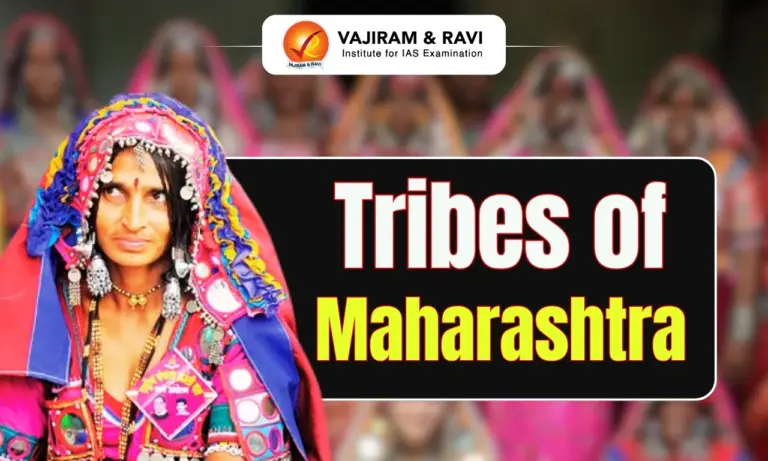
Tribes of Maharashtra are communities with a common language, culture, traditions and historical identity. They have traditionally lived in forest, hill and remote regions of the state. Maharashtra has 36 districts and the largest tribal population is concentrated in the eastern forest belt of Chandrapur, Gadchiroli, Bhandara, Gondia, Nagpur, Amravati and Yavatmal, along with the western hilly districts of Dhule, Nandurbar, Jalgaon, Nashik, Palghar and Thane. Their cultural diversity and traditional knowledge form an important part of the state’s social heritage.
Tribes of Maharashtra
A tribe is a social group that shares common ancestry, language, customs and cultural practices. In India, tribal communities notified under Article 342 of the Constitution are recognised as Scheduled Tribes (STs). Maharashtra has more than 50 tribal communities, with several classified as Particularly Vulnerable Tribal Groups (PVTGs). The state has 29 Integrated Tribal Development Project (ITDP) Offices for tribal welfare. Among these, Nashik, Kalwan, Taloda, Jawhar, Dahanu, Dhaarani, Kinwat, Pandharkavda, Gadchiroli, Aheri and Bhamragad are identified as the most sensitive tribal development areas.
List of Major Tribes of Maharashtra 2026
The major Tribes of Maharashtra mainly inhabit the Western Ghats, Satpura Range, Sahyadri Hills and eastern forest regions. They preserve distinct languages, customs, festivals and traditional occupations.
Bhil
- It is one of the largest tribal communities of Maharashtra.
- Major sub groups include Bhilala, Vasava, Pawara, Kokna, Bhil Mavchi, Pardhi Bhil, Bhil Garasia, Bhil Gamit, Barda Bhil and Dhanka Bhil.
- Bhils mainly inhabit Dhule, Nandurbar, Nashik, Jalgaon, Ahmednagar and Pune.
- They celebrate traditional harvest festivals and maintain strong folk dance and archery traditions.
Gond
- Maharashtra’s largest forest tribe includes Maria Gond, Raj Gond, Dorla Gond, Dhurve Gond, Pardhan Gond, Naikpod Gond and Khatola Gond.
- They are concentrated in Gadchiroli, Chandrapur, Gondia, Nagpur, Bhandara, Wardha and Yavatmal.
- Nature worship, clan based traditions and festivals linked with agriculture remain central to Gond culture.
Kolam
- A recognised PVTG in Maharashtra. Major groups include Kolam, Gondhali Kolam, Pardhan Kolam, Dorla Kolam and Raj Kolam.
- They mainly live in Yavatmal, Chandrapur, Nanded and Wardha.
- Shifting cultivation, forest produce collection and traditional spiritual practices remain important.
Korku
- Found mainly in Amravati and Akola districts. Important groups include Bhil Korku, Halam Korku, Nihal Korku, Bharia Korku and Nahul Korku.
- Agriculture, forest resources and colourful community festivals shape their traditional lifestyle.
Warli
- Famous worldwide for Warli painting, an important tribal folk art using simple geometric designs.
- Major groups include Warli, Dhodi Warli, Kholcha Warli, Kudala Warli and Mokhada Warli.
- They mainly reside in Palghar, Thane, Nashik and nearby hill regions.
Mahadeo Koli
- Found across western Maharashtra, especially Nashik, Pune, Satara and Ahmednagar.
- Important groups include Thakur Koli, Kadam Koli, Rathod Koli, Dhangar Koli and Dhuri Koli.
- Farming, hunting traditions and local village festivals remain significant.
Katkari
- Also recognised as a PVTG.
- Important groups include Rajkatkari, Dhor Kathkari, Son Kathkari, Toli Kathkari and Dhankar Kathkari.
- They are mainly distributed in Raigad, Palghar, Thane, Ratnagiri and Sindhudurg.
- Bamboo work, forest produce collection and seasonal labour support their livelihoods.
Thakar
- Major groups include Thakar, Thakar Vareli, Thakar Dhodia, Thakar Kholcha and Thakar Kudala.
- They are largely concentrated in western Maharashtra and continue traditional farming, folk songs and religious celebrations.
Dhangar
- Important groups include Hatkar Dhangar, Ahir Dhangar, Khutekar Dhangar, Khatik Dhangar and Gavli Dhangar.
- Many communities traditionally practise sheep and goat rearing, pastoralism and seasonal migration across Maharashtra.


Tribes of Maharashtra Significance
- Constitutional Recognition: Scheduled Tribe status provides constitutional safeguards, reservation benefits, welfare programmes and focused development through tribal specific schemes.
- Geographical Distribution: Tribal communities are concentrated in eastern forests and western hills, making these regions important for biodiversity conservation and balanced regional development.
- Integrated Tribal Development: Maharashtra operates 29 ITDP Offices. Eleven offices, including Gadchiroli, Aheri, Jawhar, Dahanu, Taloda, Nashik, Kalwan, Dhaarani, Kinwat, Pandharkavda and Bhamragad, receive priority attention because of higher developmental challenges.
- Cultural Heritage: Tribal communities preserve unique languages, folk music, dances, rituals, oral traditions, handicrafts and world famous Warli painting, enriching Maharashtra’s cultural identity.
- Traditional Knowledge: Indigenous knowledge of forests, medicinal plants, biodiversity conservation and sustainable resource use continues to support environmental protection and local livelihoods.
- Economic Importance: Agriculture, animal husbandry, bamboo crafts, forest produce collection, fishing and handicrafts remain major livelihood sources and contribute to the rural economy.
- Social Challenges: Limited education, seasonal migration, temporary settlements and dependence on forests continue to affect socio-economic development in several tribal regions.

 Last updated on Sep, 2026
→ UPSC 2027 Notification will be released on 13 January 2027 at upsconline.nic.in.
→ Check out the latest UPSC Syllabus here.
→ Download UPSC Model Answers for Mains 2026
→ UPSC Mains Question Paper 2026 is out now for Essay & GS Paper 1, 2, 3 & 4.
→ UPSC Calendar 2027 has been released.
→ Enroll in Vajiram & Ravi’s UPSC Mains Test Series 2027 for structured answer writing practice, expert evaluation, and exam-oriented feedback.
→ Join Vajiram & Ravi’s UPSC Mentorship Program 2027 for personalized guidance, strategy planning, and one-to-one support from experienced mentors.
→ Go through the UPSC Mains Previous Year Papers to enhance your preparation.
→ UPSC has released UPSC Toppers List 2025 with the Civil Services final result on its official website.
→ Also check Best UPSC Coaching in India
Tribes of Maharashtra FAQs
Q1. How many Integrated Tribal Development Project (ITDP) Offices are there in Maharashtra?+
Q2. Which are the major tribes of Maharashtra?+
Q3. Which districts have the highest concentration of tribal population in Maharashtra?+
Q4. What is a Particularly Vulnerable Tribal Group (PVTG) in Maharashtra?+
Q5. What is the most famous tribal art of Maharashtra?+
Tags: maharashtra tribes tribes of maharashtra