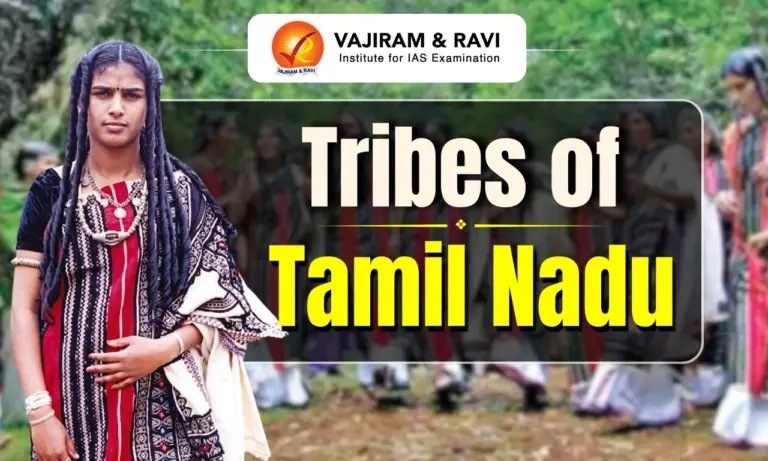
Tribes of Tamil Nadu form an important part of the state’s social and cultural diversity. According to the 2011 Census, Tamil Nadu had 794,697 Scheduled Tribe population. Scheduled Tribes accounted for 1.1% of the state’s total population. Major tribal areas include the Nilgiris, Jawadhu Hills, Kalrayan Hills, Kolli Hills, Yercaud, Anamalai and Palani Hills.
Tribes of Tamil Nadu
Tribes of Tamil Nadu are mainly concentrated in hilly, forested and plain regions. The state has 36 Scheduled Tribe groups living across 38 districts. Their occupations, food habits, languages and religious practices reflect close links with forests, hills and natural resources. Important communities include Malayali, Toda, Kota, Kurumba, Irular, Paniyan, Kattunayakan, Kadar and Palliyan. These communities have preserved distinct cultural traditions despite gradual social and economic changes.
List of Major Tribes of Tamil Nadu 2026
The major Tribes of Tamil Nadu show wide variation in settlement, occupation, food, language, religious practices and interaction with forests.
Malayali
- The Malayali are among the major tribal communities and are associated with hill regions including the Jawadhu Hills, Elagiri Hills, Kalrayan Hills and Kolli Hills.
- Agriculture and forest based activities are important.
Toda
- Toda communities are mainly associated with the Nilgiris. They traditionally practise dairy based pastoral activities and commercial agriculture.
- Cabbage and potatoes are important cultivated crops.
- They largely follow a vegetarian food pattern.
Kota
- Kota communities are closely associated with the Nilgiris. Traditional occupations include pottery, carpentry and blacksmith work.
- Their staple food includes ragi, samai, wheat and rice.
- They also consume various non vegetarian foods.
Kurumba
- Kurumbas include groups such as Betta Kurumbas, Jenu or Teen Kurumbas, Mullu Kurumbas and Urali Kurumbas.
- Traditional livelihoods include hunting, food gathering and forest based activities.
- Ragi, bamboo seeds, edible roots and wild yams are important foods.
Irular
- The Irular are traditionally linked with forests and hill areas.
- Rat and snake catching, fishing and forest based activities have been important occupations.
- Their diet includes rice, ragi, pulses, vegetables, roots and different animal foods.
Paniyan
- The Paniyan are associated mainly with agricultural and forest environments.
- Their traditional food includes tapioca, vegetables, roots, fish and animal flesh.
- Tea, coffee, toddy and other beverages also form part of their food culture.
Kattunayakan
- Kattunayakan means “Chief of the forest”.
- Traditional occupations include hunting, food gathering and collection of honey and wax.
- Ragi and millets are important staples, along with pulses, vegetables, roots, tubers and fruits.
Kadar
- Kadar communities have traditionally maintained strong links with forests.
- Forest resources, food gathering and knowledge of the natural environment have played an important role in their traditional livelihood and cultural practices.
Palliyan
- Palliyans are traditionally associated with forest environments and forest based food gathering.
- Honey collection is an important traditional activity.
- Seasonal availability strongly influences their food habits and use of natural resources.
Kanikkar
- Kanikkar are among the recognised Scheduled Tribe communities of Tamil Nadu.
- Their traditional life is closely linked with forest and hill environments, where natural resources have historically supported livelihood and subsistence.
Muthuvan
- Muthuvan communities are associated with hilly forest regions.
- Their traditional lifestyle reflects dependence on agriculture, forests and locally available resources.
- Their cultural practices have developed in close association with the surrounding mountain environment.
Sholagar
- Sholagar communities traditionally depend on forest surroundings and natural resources.
- Their food and livelihood patterns reflect seasonal availability of plants, roots, forest products and other resources found in their local environment.
Mala Malasar
- Mala Malasar communities are traditionally associated with forest and hill areas.
- Their livelihood has historically included forest based activities and collection of naturally available resources for food and household needs.
Urali
- Urali communities are among the recognised Scheduled Tribe groups of Tamil Nadu.
- Their traditional livelihood and cultural practices are connected with hill environments, forests, agriculture and locally available natural resources.
Palliyar
- Palliyar communities have traditionally depended on forest resources and seasonal food gathering.
- Their food culture includes naturally available products, showing the wider relationship between southern tribal communities and their surrounding ecosystems.
Other Tribes
- Adiyan, Aranadan, Eravallan, Kammara, Kaniyan, Kochuvelan, Konda Kapus, Konda Reddi, Koraga, Kudiya, Kurichchan, Kurumans, Malai Arayan, Malai Pandaram, Malai Vedan, Malakkuravan, Malaekandi, Mannan, Mudugar, Palleyan, Narikoravan, Kuruvikkaran and other listed communities add further diversity to the tribal population.


Particularly Vulnerable Tribal Groups (PVTGs) in Tamil Nadu
Tamil Nadu has 6 Particularly Vulnerable Tribal Groups identified for focused welfare, livelihood support, infrastructure development and protection of their traditional ways of life.
- List of PVTGs in Tamil Nadu: Toda, Kota, Kurumbas, Irular, Paniyan and Kattunayakan are the six PVTGs of Tamil Nadu. They are mainly associated with the Nilgiris and adjoining hilly areas.
- Population and livelihood status: These communities have historically shown population decline or stagnancy in the state. Many depend on traditional occupations, forest resources and pre agricultural methods of cultivation.
- Economic vulnerability: Low income, limited infrastructure and dependence on natural resources have contributed to economic backwardness among several PVTG communities. Agricultural and cattle development are important welfare measures.
- Development objective: PVTG welfare programmes aim to improve income, agriculture, livestock, infrastructure and access to basic services while supporting the overall development of vulnerable tribal settlements.
- Health and social challenges: Limited medical facilities, sanitation problems, poverty and low awareness can affect tribal health. Traditional medicinal knowledge based on locally available plants remains important in several communities.
Tribes of Tamil Nadu Development Measures
Several initiatives and measures associated with the development of the Tribes in Tamil Nadu are:
- Housing and basic facilities: Government grants support traditional house construction, drinking water facilities, street lights, roads, bore wells and other basic infrastructure in PVTG settlements.
- Livelihood support: Development measures include distribution of milch animals, fishing nets, two wheelers, beehive boxes and support for economic activities suited to local conditions.
- Irrigation development: Check dams and other irrigation facilities are developed to improve agricultural opportunities. Brick kilns and related livelihood activities are also supported under development programmes.
- Education facilities: A school building was planned for the EMR School started in June 2018 at Pattipulam in Kancheepuram District. Such facilities aim to improve access to education.
- Nilgiris connectivity: Two Eicher Cab shuttle services were provided in the Nilgiris District to help people and students travel between hill settlements and plain areas.
Tribes of Tamil Nadu Significance
The significance of Tribes of Tamil Nadu extends across culture, ecology, traditional knowledge, food systems, livelihoods and conservation of local heritage.
- Cultural diversity: Tribal communities preserve distinct customs, rituals, languages, social practices, religious traditions and food systems. Their traditions contribute substantially to Tamil Nadu’s diverse cultural heritage.
- Tribal food culture: Seasonal cereals, mushrooms, potatoes, yams, vegetables, greens, roots and tubers form important food sources. Fish, crabs, snails and other animal foods are also traditionally consumed by several communities.
- Honey and forest foods: Honey is an important traditional food and livelihood product. Communities such as the Palliyans have traditionally collected honey from forests. It is valued for its long shelf life and nutritional properties.
- Traditional medicine: Several tribal communities possess knowledge of medicinal plants used traditionally for conditions such as cough, fever, indigestion, jaundice, joint pain, skin problems, wounds and stomach disorders.
- Religious practices: Tribal religious traditions commonly involve nature, mountains, trees, animals and local deities. Toda worship includes Shiva and mountains, while Kota traditions include reverence for fire, moon and nature.
- Languages: Most tribal languages belong to the Dravidian language family. Tamil, Malayalam, Kannada, Telugu and other regional linguistic influences are found among different communities according to their geographical location.
- Economic contribution: Agriculture, forest produce collection, honey and wax collection, pottery, carpentry, blacksmithing, fishing and other traditional occupations support tribal livelihoods and contribute to local rural economies.
- Geographical importance: Tribal settlements occur across major hill systems including Jawadhu, Elagiri, Kalrayan, Pachamalai, Kolli, Yercaud, Sitteri, Anamalai, Palani, Elumalai and Varshanad Hills.
- Heritage conservation: The continued preservation of tribal languages, food traditions, crafts, rituals and ecological knowledge is important for protecting the living cultural heritage of Tamil Nadu.

 Last updated on Oct, 2026
→ UPSC 2027 Notification will be released on 13 January 2027 at upsconline.nic.in.
→ Asian Games 2026 are being held in Aichi-Nagoya, Japan, from 19 September to 4 October.
→ Check Nobel Prize 2026 Winners List here.
→ Download PIB PRiSM Monthly Magazine 2026 here.
→ Check UPSC Monthly Current Affairs Magazine The Recitals here.
→ Check out the latest UPSC Syllabus here.
→ Download UPSC Model Answers for Mains 2026
→ UPSC Mains Question Paper 2026 is out now for Essay & GS Paper 1, 2, 3 & 4.
→ UPSC Calendar 2027 has been released.
→ Enroll in Vajiram & Ravi’s UPSC Mains Test Series 2027 for structured answer writing practice, expert evaluation, and exam-oriented feedback.
→ Join Vajiram & Ravi’s UPSC Mentorship Program 2027 for personalized guidance, strategy planning, and one-to-one support from experienced mentors.
→ Go through the UPSC Mains Previous Year Papers to enhance your preparation.
→ UPSC has released UPSC Toppers List 2025 with the Civil Services final result on its official website.
→ Also check Best UPSC Coaching in India
Tribes of Tamil Nadu FAQs
Q1. How many Scheduled Tribes are there in Tamil Nadu?+
Q2. How many PVTGs are found in Tamil Nadu?+
Q3. Which is the largest tribal community in Tamil Nadu?+
Q4. Where do most Tribes of Tamil Nadu live?+
Q5. What are the main occupations of tribes in Tamil Nadu?+
Tags: tribal heritage tribes of india tribes of tamil nadu