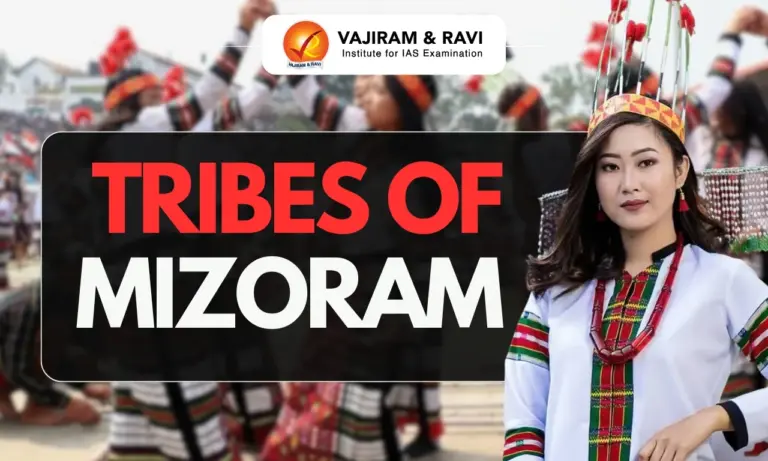
Tribes of Mizoram are at the heart of the state’s identity and way of life. The population is largely made up of Scheduled Tribes, each with its own unique culture, traditions, language, and customs. These tribes share a strong sense of community, unity, and respect for tradition, which is reflected in their daily lives. Despite modernization, they have successfully preserved their rich heritage and social values, making Mizoram one of the most culturally vibrant states in India.
Tribes of Mizoram
- Mizoram is a tribal-dominated state located in the southern part of Northeast India, known for its rich cultural diversity and strong community traditions. According to the 2011 Census, the state had a population of about 10.97 lakh, out of which nearly 94.43% (10.36 lakh people) belong to Scheduled Tribes (STs).
- The tribal population in Mizoram has shown significant growth, with a 23.45% increase between 2001 and 2011. The state officially recognizes 15 different tribal communities, reflecting its diverse ethnic composition.
- Among these, the Lushai (Mizo) tribe is the largest, making up around 70.9% of the total tribal population. The Chakma tribe is the second largest group, contributing about 9.35%. Other important tribes like Pawi (Lai), Lakher (Mara), Kuki, and Hmar together form a considerable share of the population.
- Religion plays an important role in the lives of people in Mizoram. A large majority of the tribal population, about 90.07%, follow Christianity. Buddhism is the second most practiced religion (around 8.78%), mainly followed by the Chakma community.
- The tribes of Mizoram can broadly be divided into Mizo tribes and non-Mizo tribes. The term “Mizo” comes from two words – “mi” (people) and “zo” (hill or highland), which together mean “people of the hills” or “highlanders.”
- However, the word “Mizo” is not limited to a single tribe. It is a collective or umbrella term used for groups that share similar culture, traditions, and historical background. In this way, it acts as a unifying identity for many tribes in the state.
- Over time, some smaller sub-tribes have gradually merged into larger groups, adopting their customs, language, and way of life. As a result, a few tribes have lost their separate identities.
- Some of the major tribes in Mizoram today include Mizo (Lushai), Pawi (Lai), Lakher (Mara), and Chakma, each contributing to the state’s unique cultural richness and heritage.
- Mizoram does not have any officially recognized Particularly Vulnerable Tribal Groups (PVTGs).
Major Tribes of Mizoram
Major Tribes of Mizoram play a vital role in shaping the state’s culture and identity. The population is largely made up of Scheduled Tribes, each with distinct traditions, languages, and social practices. Prominent groups like the Lushai (Mizo), Pawi (Lai), Lakher (Mara), and Chakma are discussed below, highlighting their key features and cultural significance. Some of the Major Tribes of Mizoram are discussed below:
1. Lushai Tribe
- The Lushai Tribe (also called Lusei) is the largest Mizo tribe, mainly found in Aizawl and Lunglei districts of Mizoram.
- The term “Lushai” is a British-adopted version of the original “Lusei”.
- They migrated from Myanmar during the 17th-18th century along with other Mizo sub-tribes.
- Society was clan-based with 6 chief clans and 10 commoner clans; the Sailo clan dominated and held hereditary chieftainship.
- The Duhlian dialect became the lingua franca of Mizos and belongs to the Kuki-Chin group of the Tibeto-Burman family.
- British colonial rule (1890s) and Christian missionaries brought major changes, leading to widespread conversion to Christianity by the 1930s.
- Traditional practices like Zu (rice beer), Zawlbuk, and animal sacrifice declined; replaced by tea, modern education, and YMA (Young Mizo Association).
- The family system is patrilocal and patrilineal, with ultimogeniture (youngest son inherits), later partly replaced by primogeniture under British rule.
- Women traditionally had no inheritance rights, but later legal reforms allowed them property rights.
- Marriage involves bride-price (formerly mithun, now cash) and is now conducted under Christian rites.
- Agriculture (jhum/shifting cultivation) is the main occupation, though economic diversification is increasing.
- The Mautam famine (1959) led to insurgency (1966) by the Mizo National Front, ending with the 1986 Peace Accord.
- Village grouping during insurgency disrupted traditional social harmony and changed community structures.
- The tribe has a high literacy rate (95.6%), though higher education levels remain low.
2. Pawi Tribe
- The Pawi (Lai) Tribe forms about 5% of Mizoram’s population (51,406) as per the 2011 Census.
- They are mainly concentrated in Lawngtlai District and around Phawngpui (Blue Mountain), with many also in Chin State (Myanmar).
- Lawngtlai town is the seat of the Pawi (Lai) Autonomous District Council.
- Almost all Pawis are Christians (99.28%), with a high literacy rate (91.6%).
- Villages are located on hilltops (2500-4000 ft) with a moderate climate.
- They have four main dialects: Khuofo, Thantlang (Mizoram) and Halkha (Haka), Laizo (Myanmar) under the Tibeto-Burman language family.
- Originally no script, later written using Roman script by Christian missionaries.
- Many Pawis now speak Duhlian (Mizo dialect) due to missionary influence and education.
- The Church (Biakin) is the central institution; pastors and elders are key leaders.
- Traditional dances like Rawkha Tlak and Chawnglaizawn declined but are now being revived.
- Society follows monogamy, patrilocal residence, and patrilineal descent.
- Traditionally, the eldest son inherited property, but now property is shared, including with daughters.
- The economy is based on land and forest, mainly jhum (shifting) cultivation.
- Land is community-owned, and the village council allocates plots annually.
3. Lakher Tribe
- The Lakher (Mara) Tribe is a Scheduled Tribe mainly inhabiting the Mara Autonomous District Council (Mizoram), with populations also in Chin State and Rakhine State (Myanmar).
- The name “Mara” replaced “Lakher” officially in 1978; earlier names included Shendu, Zho, Tlosai, Khongzai.
- As per 2011 Census, population is 42,855 (4.13%) of Mizoram.
- The region has 50 villages and 59 village councils, with Saiha as the capital.
- They belong to the Kuki-Chin group of the Tibeto-Burman family and are believed to have migrated from Southern China via Tibet and Myanmar in the 17th century.
- Major sub-groups: Tlosaih-Siaha, Zyhno, Hawthai, Chapi, Vytu, each with distinct dialects; Tlosai-Siaha dialect acts as lingua franca.
- Literacy rate is 81.93%, and Mara language is used as medium of instruction (up to class VI).
- Before British rule, there was frequent inter-village conflict; British rule (till 1924) brought peace, end of slavery, and economic changes.
- Post-independence, the chief’s power declined, and modern administrative councils were established.
- Society is rural, with strong kinship ties and community cooperation.
- The family system is nuclear, with patrilocal residence and patrilineal descent; father is head.
- Inheritance follows primogeniture (eldest son inherits), though the youngest son gets a share.
- With Christianity (introduced 1907, fully adopted by 1959), major changes occurred: decline of raiding, superstitions, and traditional hierarchy.
- Adoption of Western lifestyle and values, while still retaining some traditional customs.
4. Chakma Tribe
- The Chakma Tribe (Changma) is the second largest Scheduled Tribe in Mizoram (9.35%).
- They are mainly settled in the south-western and western parts of Mizoram, bordering Tripura and Bangladesh.
- They have an Autonomous District Council (since 1972) under the Sixth Schedule, headquartered at Kamalanagar (Chawngte).
- The Chakmas migrated from the Chittagong Hill Tracts (Bangladesh) and belong to the Tibeto-Burman group (ethnically), though linguistically different.
- Their language, Chakma (Changma Vaj/Kodha), belongs to the Indo-Aryan (Southeastern Bengali branch), showing a shift from original roots.
- They primarily follow Theravada Buddhism, mixed with Hindu elements (e.g., worship of Lakshmi) and traditional practices.
- Each village has a Buddhist temple (Kaang), and monks (Bhikhus) lead religious ceremonies.
- Despite Buddhism, animal sacrifice is practiced to appease spirits causing illness.
- Society is divided into clans (gojas) and sub-clans (guttis) with strict endogamy (no marriage within the same clan).
- Marriage (Chumulong) is arranged, involves bride-price (now symbolic), and is performed by Buddhist priests.
- Polygyny is allowed but rare; remarriage and elopement (with fines) are accepted.
- Family structure includes nuclear and extended families, with growing preference for nuclear families.
- The majority live in rural areas (only 0.8% urban), indicating low development levels.
- Main occupation is agriculture (shifting + semi-permanent cultivation) with no individual land ownership.
- Some have moved to labor and white-collar jobs, but most remain in farming due to limited opportunities.
- The literacy rate is low (45.3%), with male 56.2% and female 33.6%, the lowest among Mizoram tribes.


Constitutional Safeguards for the Tribes of Mizoram
- Strong Constitutional Protection: The tribes of Mizoram are safeguarded by special provisions in the Indian Constitution, which help protect their culture, land, and traditional way of life while supporting their overall development.
- Article 371G – Protection of Traditions and Land: This provision ensures that laws made by Parliament on matters like religious practices, social customs, customary laws, and land ownership do not automatically apply to Mizoram. Such laws can only be implemented if the Mizoram Legislative Assembly agrees, thereby preserving the unique identity of the tribal communities.
- Sixth Schedule – Self-Governance (Article 244): Under this provision, Autonomous District Councils (ADCs) are established to give tribes the power to govern themselves at the local level. In Mizoram, important councils include the Lai, Mara, and Chakma Autonomous District Councils.
- Powers of Autonomous District Councils: These councils have the authority to make decisions on important local matters such as:
- Land use and management
- Shifting cultivation (jhum)
- Forest resources (excluding reserved forests)
- Marriage, divorce, and inheritance laws
- Social customs and traditions
- This ensures that decisions are made according to local needs and customs.
- Traditional Justice System: The councils can also set up village courts to settle disputes among local people based on customary laws and practices, making justice more accessible and culturally relevant.
- Financial Independence (District Funds): Each Autonomous District Council maintains its own District Fund, where it collects revenue from sources like taxes, land fees, and markets. This helps in carrying out local development activities independently.
- Control Over Trade and Money Lending: The councils can regulate trading activities and money-lending by outsiders to prevent exploitation of tribal communities and ensure fair economic practices.
- Protection of Identity and Culture: Overall, these provisions help protect the distinct identity, traditions, and community systems of the tribes, ensuring that modernization does not harm their cultural roots.
Key Government Schemes for Tribal Empowerment
- Dharti Aaba Janjatiya Gram Utkarsh Abhiyan – This scheme focuses on holistic development of tribal villages by improving infrastructure, healthcare, education, and livelihood opportunities, covering around 63,000 villages and benefiting over 5 crore tribal people.
- Eklavya Model Residential Schools (EMRS) – Provides quality residential education to tribal students from Class VI to XII, with modern facilities aimed at improving academic performance, skill development, and access to higher education.
- Pradhan Mantri Janjati Adivasi Nyaya Maha Abhiyan (PM-JANMAN) – Targets Particularly Vulnerable Tribal Groups (PVTGs) by improving road connectivity, housing, electrification, healthcare, and basic services in remote tribal regions.
- National Overseas Scholarship for ST Students – Enables meritorious tribal students to pursue higher education abroad, promoting global exposure and academic excellence.
- Support to Tribal Research Institutes (TRIs) – Promotes research, documentation, and preservation of tribal culture, traditions, and languages while supporting policy development.
- Development Action Plan for Scheduled Tribes (DAPST) – Ensures coordinated efforts across ministries for tribal welfare, focusing on filling gaps in education, healthcare, and infrastructure.
- National Fellowship for ST Students – Provides financial assistance for higher education and research through a transparent digital system, encouraging advanced studies among tribal students.
- National Scheduled Tribes Finance and Development Corporation (NSTFDC) – Offers concessional financial support to tribal individuals for self-employment and income-generating activities.
- Tribal Cooperative Marketing Development Federation of India (TRIFED) – Promotes tribal products through marketing platforms, supporting artisans and creating sustainable livelihood opportunities.
- Aadi Mahotsav and Cultural Initiatives – Organizes cultural festivals to showcase tribal heritage, promote handicrafts, and generate economic opportunities through cultural promotion.
- Pradhan Mantri Adi Adarsh Gram Yojana (PMAAGY) – Aims to develop tribal-majority villages by providing basic infrastructure such as roads, drinking water, and housing.
- National Health Mission (NHM) – Tribal Focus – Strengthens healthcare services in tribal areas, addressing major health issues and improving access to medical facilities.

 Last updated on Oct, 2026
→ UPSC 2027 Notification will be released on 13 January 2027 at upsconline.nic.in.
→ Asian Games 2026 are being held in Aichi-Nagoya, Japan, from 19 September to 4 October.
→ Check Nobel Prize 2026 Winners List here.
→ Download PIB PRiSM Monthly Magazine 2026 here.
→ Check UPSC Monthly Current Affairs Magazine The Recitals here.
→ Check out the latest UPSC Syllabus here.
→ Download UPSC Model Answers for Mains 2026
→ UPSC Mains Question Paper 2026 is out now for Essay & GS Paper 1, 2, 3 & 4.
→ UPSC Calendar 2027 has been released.
→ Enroll in Vajiram & Ravi’s UPSC Mains Test Series 2027 for structured answer writing practice, expert evaluation, and exam-oriented feedback.
→ Join Vajiram & Ravi’s UPSC Mentorship Program 2027 for personalized guidance, strategy planning, and one-to-one support from experienced mentors.
→ Go through the UPSC Mains Previous Year Papers to enhance your preparation.
→ UPSC has released UPSC Toppers List 2025 with the Civil Services final result on its official website.
→ Also check Best UPSC Coaching in India
Tribes of Mizoram FAQs
Q1. What is the demographic composition of tribes in Mizoram?+
Q2. Which is the largest tribe in Mizoram?+
Q3. Which is the second largest tribe in Mizoram?+
Q4. What does the term “Mizo” mean?+
Q5. How are tribes of Mizoram broadly classified?+
Q6. What are the major tribes of Mizoram?+
Q7. What religion is mainly followed by tribes in Mizoram?+
Tags: indian polity indian polity notes mizoram tribes of mizoram