India-France Space Cooperation, Gaganyaan, TRISHNA & Innovation 2026

India France Space Cooperation

India-France Space Cooperation has evolved from sounding rocket experiments in the 1960s into a broad partnership covering joint satellite missions, launch vehicle technologies, human spaceflight and emerging space applications. The partnership is now entering a new phase with greater focus on human spaceflight, start-ups and a wider space ecosystem involving governments, research institutions and industries.

India-France Space Cooperation Enters a New Phase

A high-level French delegation led by Prof. Philippe Baptiste, French Minister for Higher Education, Research and Space, met Dr. Jitendra Singh in New Delhi on September 28, 2026, to discuss the next phase of bilateral cooperation.

The discussions covered the Space Summit, India-France Year of Innovation 2026, scientific and technological cooperation, CEFIPRA and the Blue Economy.

The focus is shifting from traditional space-agency cooperation towards a wider ecosystem involving governments, research institutions, industries and start-ups, with greater emphasis on human spaceflight and emerging space applications.

Major Areas of India-France Space Cooperation

The partnership has expanded from early space experiments to joint satellite missions, launch technologies and human spaceflight.

  • India-France space cooperation began with sounding rocket experiments in the 1960s and has progressed to present-day human spaceflight cooperation.
  • Megha-Tropiques and SARAL are important joint satellite missions developed by the Indian Space Research Organisation (ISRO) and France.
  • Cooperation has also covered launch vehicle engine development, marking an important area of technological collaboration.
  • The partnership is now expanding towards human spaceflight, astronaut health, microgravity research and emerging space applications.

TRISHNA and Gaganyaan

TRISHNA and Gaganyaan represent important areas in the current phase of India-France Space Cooperation.

  • The realisation of TRISHNA, the third joint satellite, is progressing well.
  • TRISHNA represents continued cooperation between India and France in the space sector and was highlighted by both sides as an important example of their partnership.
  • France is supporting India's Gaganyaan programme through the supply of consumables and training of flight surgeons.
  • Indian and French teams have initiated discussions on microgravity research and parabolic flights in connection with human spaceflight.
  • France has also expressed interest in expanding cooperation in human spaceflight and astronaut health.

Space Start-ups and the New Space Ecosystem

India's expanding private space ecosystem is creating new opportunities to broaden India-France Space Cooperation beyond established government institutions.

  • India now has more than 400 space start-ups working in areas including rocket building, satellite building and space applications.
  • India's space-sector transformation creates opportunities to bring together government institutions, industries and start-ups from both countries.
  • Wider participation can create a larger ecosystem and broader resource pool for cooperation in the space sector.
  • France has expressed interest in connecting research institutions and start-ups from both countries.
  • The emerging partnership therefore has the potential to involve a wider range of stakeholders beyond the traditional cooperation between space agencies.

India-France Year of Innovation 2026

The India-France Year of Innovation 2026 provides a platform for advancing cooperation in innovation and emerging technologies.

  • The initiative was inaugurated by Prime Minister Narendra Modi and the President of France in February 2026.
  • It provides an opportunity to take India-France cooperation in innovation and emerging technologies forward.
  • A Water Cycle and TRISHNA Mission event is scheduled in Bengaluru on October 11, where ISRO will contribute outreach material and senior officials will speak about the TRISHNA satellite and its applications.
  • The initiative can support deeper engagement among institutions, industries and other stakeholders in both countries.

Wider Scientific and Blue Economy Cooperation

India-France Space Cooperation forms part of a wider scientific partnership covering several areas of science and technology.

  • India-France scientific cooperation extends to biotechnology, digital sciences and technologies and ocean sciences.
  • CEFIPRA and Indo-French joint centres provide continuing institutional mechanisms for cooperation.
  • The partnership also includes discussions on the Blue Economy and ocean sciences.
  • India's Deep Ocean Mission, which seeks to explore the scientific and resource potential of the deep oceans, provides an area for further cooperation.
  • The expanding engagement across space, science, technology and ocean research creates opportunities for a broader India-France partnership involving institutions and stakeholders across the ecosystem.

India-France Space Cooperation Significance

The expanding partnership is significant because it connects traditional space-agency cooperation with human spaceflight, private-sector participation and emerging scientific applications.

  • Human spaceflight is becoming a major area of cooperation through France's support for Gaganyaan and discussions on astronaut health and microgravity research.
  • Space start-ups provide opportunities to expand bilateral cooperation beyond government institutions and established agencies.
  • Joint satellite missions demonstrate continued cooperation in advanced space technologies.
  • Scientific research can benefit from stronger connections between institutions and research organisations in both countries.
  • Emerging space applications can create opportunities for wider cooperation between governments, industries and start-ups.
  • Cooperation across space, science, technology and ocean sciences can contribute to a broader and more integrated bilateral innovation ecosystem.

Way Forward

The next phase of India-France Space Cooperation can focus on building a wider and more integrated ecosystem.

  • Expand cooperation in human spaceflight through astronaut health, microgravity research and related areas.
  • Strengthen government-industry collaboration by bringing Indian and French industries into the partnership.
  • Connect start-ups and research institutions from both countries to develop a wider innovation ecosystem.
  • Build on TRISHNA and other joint missions to expand cooperation in emerging space applications.
  • Use the India-France Year of Innovation 2026 to deepen cooperation in innovation and emerging technologies.
  • Expand cooperation across space, science, technology and ocean research through institutions and stakeholders across both countries.

India-France Space Cooperation FAQs

Q1: What is India-France Space Cooperation?

Ans: India-France Space Cooperation is a long-standing partnership that has evolved from sounding rocket experiments in the 1960s to joint satellite missions, launch vehicle technologies, human spaceflight and emerging space applications.

Q2: What are the major joint space missions under India-France Space Cooperation?

Ans: Megha-Tropiques and SARAL are major joint satellite missions developed by the Indian Space Research Organisation (ISRO) and France. TRISHNA, the third joint satellite, is also progressing well.

Q3: How is France supporting India’s Gaganyaan programme?

Ans: Under India-France Space Cooperation, France is supporting the Gaganyaan programme through the supply of consumables and training of flight surgeons. The two sides have also initiated discussions on microgravity research and parabolic flights related to human spaceflight.

Q4: What role do start-ups play in India-France Space Cooperation?

Ans: India has more than 400 space start-ups working in areas such as rocket building, satellite building and space applications. This creates opportunities to connect Indian and French start-ups, industries and research institutions and build a wider space ecosystem.

Q5: What is the significance of the India-France Year of Innovation 2026 for space cooperation?

Ans: The India-France Year of Innovation 2026 provides a platform to strengthen cooperation in innovation and emerging technologies. It can also support wider institutional, industrial and start-up collaboration in areas including space, science and technology.

Indian Peafowl

Indian Peafowl

Indian Peafowl Latest News

Orang National Park and Tiger Reserve recently recorded the Indian peafowl (Pavo cristatus) for the first time, adding a new species to the protected area’s biodiversity record and another chapter to Assam’s rich birdlife.

About Indian Peafowl

  • Indian peafowl are a species in a group of birds called pheasants. 
  • The males are called peacocks, while the females are called peahens. Together, they are peafowl. 
  • Scientific Name: Pavo cristatus

Indian Peafowl Habitat and Distribution

  • They are resident breeders across the Indian subcontinent and inhabit the drier lowland areas of Sri Lanka. 
  • They are found in moist and dry deciduous forests near water and in montane forests and can also adapt to live in cultivated regions and around human habitations. 
  • It is the national bird of India and has a significant cultural and historical presence. 
  • The famous peacock throne of the Mughal empire, Jaipur's enthralling Peacock Gate, and a popular tourist destination, the Peacock temple in Tumkur, Karnataka—the bird has marked its presence across cultures, regions, and beliefs.  

Indian Peafowl Features

  • Peafowl are among the largest of all birds that fly.  
  • The head and body of adult peafowl range from 3 to 4 feet long, and their tail can be 5 feet long. 
  • Males and females show strong physical differences. 
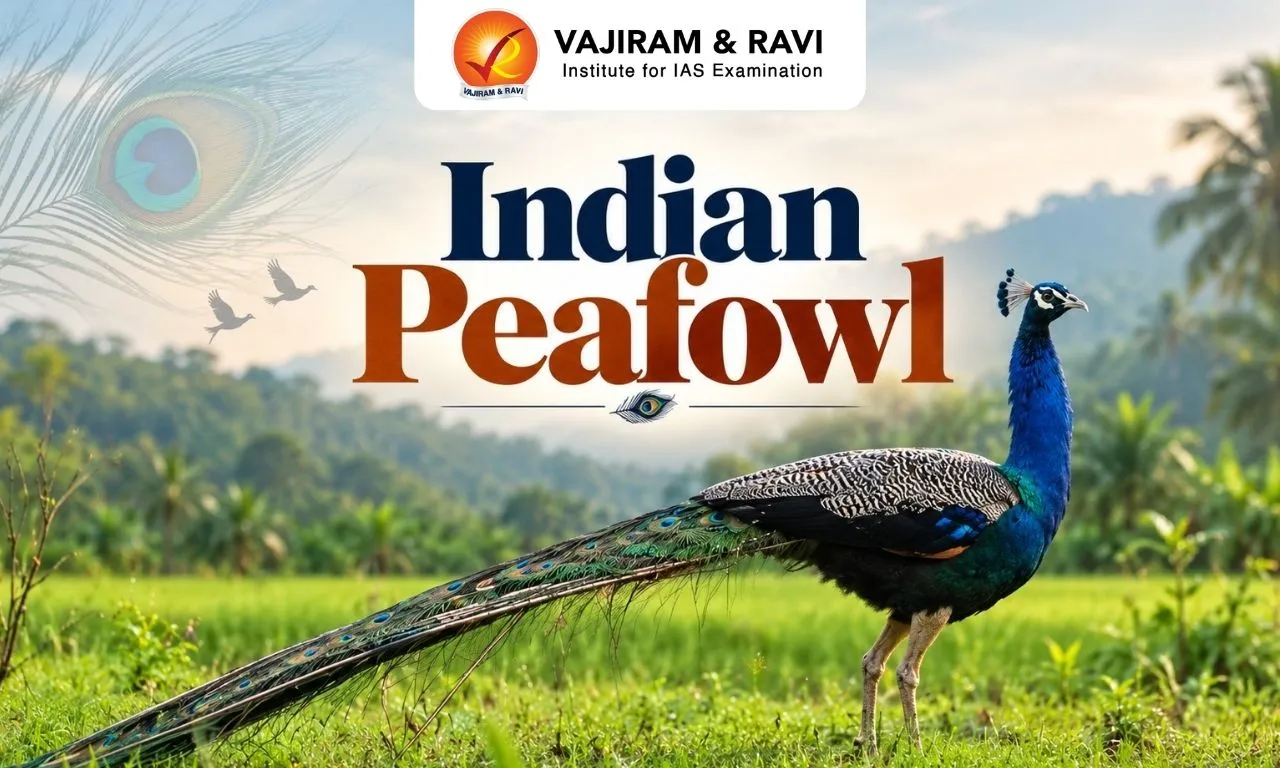
    • Peacock is brightly colored, with a predominantly blue fan-like crest of spatula-tipped wire-like feathers, and is best known for the long train (tail) made up of elongated upper-tail covert feathers, which bear colorful eyespots. 
    • These stiff feathers are raised into a fan and quivered in a display during courtship. 
    • Despite the length and size of these covert feathers, peacocks are still capable of flight. 
    • Peahens lack the train and have a greenish lower neck and duller brown plumage.  
  • Diet: Omnivorous; feeds on seeds, grains, fruits, insects, reptiles, and other small animals. 

Indian Peafowl Conservation Status

It is classified as 'Least Concern' under the IUCN Red List.

News: HUB

Indian Peafowl FAQs

Q1: Which group of birds does the Indian Peafowl belong to?

Ans: Pheasants.

Q2: Where is the Indian Peafowl naturally distributed?

Ans: Across the Indian subcontinent and the drier lowland areas of Sri Lanka.

Q3: What is the national bird of India?

Ans: Indian Peafowl.

Q4: What is the IUCN Red List conservation status of the Indian Peafowl?

Ans: Least Concern.

Swell Wave

Swell Wave

Swell Wave Latest News

Recently, the Indian National Centre for Ocean Information Services (INCOIS) has issued a Red Alert across all coastal districts in Keralam, warning residents and authorities of dangerous sea conditions caused by potential swell waves.  

About Swell Wave

  • Swell waves are long-wavelength ocean waves formed on the surface of the seas and travel away from their places of origin.
  • These are composed of a series of surface gravity waves.
  • Swell waves are also called Kallakkadal waves in India, which is a colloquial term used by Keralam fishermen.
  • These waves organise themselves into groups of similar heights and periods, and then travel long distances without much change. 
  • Early warning systems in India: Indian National Centre for Ocean Information Services (INCOIS) Swell Surge Forecast System launched in 2020 which gives forewaring seven days in advance.
  • Formation
    • They are usually created by windstorms or other weather systems.
    • Windstorms and other powerful air current systems transfer energy from the air to water, making swell waves more powerful than locally generated waves. 
    • During such storms, huge energy transfer takes place from the air into the water, leading to the formation of very high waves. Such waves can travel thousands of kilometres from the storm centre until they strike shore.
    • They occur not due to the local winds, but rather due to distant storms like hurricanes, or even long periods of fierce gale winds.

Features of Swell Wave

  • Swells have a narrower range of frequencies and directions than locally generated wind waves.
  • It is because swell waves have dispersed from their generation area, have dissipated and therefore lost an amount of randomness, taking on a more defined shape and direction.
  • These waves can propagate in directions that differ from the direction of the wind, in contrast to a wind sea.
  • Their wavelengths may rarely exceed more than 150 m. Swell wavelength, also, varies from event to event. Occasionally, swells which are longer than 700 m occur as a result of the most severe storms.
  • It occurs without precursors or any kind of local wind activity and as a result.

Source: TH

Swell Wave FAQs

Q1: What are Swell waves?

Ans: Swell waves are long-wavelength ocean waves formed on the surface of the seas and travel away from their places of origin.

Q2: Which organisation formed the Swell Surge Forecast System?

Ans: Indian National Centre for Ocean Information Services (INCOIS)

Manchester of India, Ahmedabad’s Textile History, Industry and Significance

manchester of india

Ahmedabad in Gujarat is known as the “Manchester of India” because of its historical importance as a major cotton textile centre. The growth of textile mills transformed Ahmedabad into an important industrial city and connected its history with labour movements, Swadeshi and Mahatma Gandhi’s Satyagraha.

Historical Basis of the Manchester of India

Ahmedabad’s rise as the Manchester of India was supported by its location in a cotton-growing region, availability of local capital, entrepreneurial activity, labour and established trade networks.

  • Ranchhodlal Chhotalal established the first cotton textile mill in Ahmedabad in 1861.
  • The Ahmedabad Mill Owners’ Association was established in 1891, reflecting the growing importance of the textile industry.
  • Ahmedabad had more than 60 textile mills by the 1950s.
  • The disruption of British textile imports during the First World War provided additional opportunities for Indian textile mills.

Factors Behind the Manchester of India

The development of Ahmedabad as the Manchester of India was supported by several industrial-location factors:

  • Raw cotton was readily available from Gujarat and neighbouring cotton-producing regions.
  • Local capital from established merchant and business communities supported investment in textile mills.
  • Entrepreneurship encouraged the expansion of modern textile manufacturing.
  • Labour availability supported the growth of a large industrial workforce.
  • Markets and trade networks connected Ahmedabad’s textile products with consumers in Gujarat and other parts of India.
  • Transport facilities helped move raw cotton to mills and finished textiles to markets.
  • Growing domestic demand supported the expansion of textile production.

Manchester of India and the Labour Movement

The expansion of textile mills created a large workforce and also led to disputes over wages and working conditions.

  • Anasuya Sarabhai played an important role in organising Ahmedabad’s textile workers.
  • The Ahmedabad Textile Labour Association, also known as the Majoor Mahajan Sangh, became an important organisation representing textile workers.
  • Ahmedabad therefore became an important centre of organised labour and industrial dispute resolution.

Ahmedabad Mill Strike of 1918

The Ahmedabad Mill Strike of 1918 was a dispute between textile workers and mill owners over wages.

  • Mahatma Gandhi supported the workers and used Satyagraha and non-violence during the dispute.
  • Gandhi undertook a fast and urged workers to maintain discipline.
  • The dispute was eventually settled, making it an important example of applying Satyagraha to a labour dispute.

Manchester of India, Swadeshi and National Movement

Ahmedabad’s textile industry also became closely connected with the economic dimension of Indian nationalism.

  • The Swadeshi movement encouraged the use of indigenous goods and reduced dependence on imported British textiles.
  • Mahatma Gandhi promoted khadi, spinning and Swadeshi as instruments of economic self-reliance and national mobilisation.
  • Gandhi established the Kochrab Ashram in 1915 and later the Sabarmati Ashram in Ahmedabad.

Thus, the history of the Manchester of India is connected not only with industrialisation but also with the economic aspects of the freedom struggle.

Decline of Traditional Textile Mills

Ahmedabad’s traditional textile mills declined significantly during the later 20th century.

  • Outdated machinery and low productivity reduced the competitiveness of older mills.
  • Competition from modern textile units and other textile centres increased.
  • Rising costs and labour disputes affected several mills.
  • Technological and structural changes weakened the traditional large-scale mill model.
  • Mill closures resulted in significant employment losses and social disruption.

An Indian Institute of Management Ahmedabad study recorded that around 50,000 workers lost their jobs during 1983-84 following the closure of privately owned textile mills in Ahmedabad.

Manchester of India Today

The decline of traditional mills did not end Ahmedabad’s textile importance. The industry has shifted towards more diversified and value-added activities.

  • Modern textile activities include spinning, weaving, processing, garments, apparel, man-made fibres and technical textiles.
  • Gujarat continues to be an important textile-producing state.
  • Ahmedabad has also developed a diversified economy covering pharmaceuticals, chemicals, engineering, services and information technology.

Manchester of India FAQs

Q1: Which city is known as the Manchester of India?

Ans: Ahmedabad in Gujarat is known as the Manchester of India because of its historical importance as a major cotton textile centre.

Q2: Why is Ahmedabad called the Manchester of India?

Ans: Ahmedabad is called the Manchester of India because its cotton textile industry played a major role in the city’s industrial and economic development, particularly during the late 19th and early 20th centuries.

Q3: When was the first textile mill established in Ahmedabad?

Ans: The first modern cotton textile mill in Ahmedabad was established by Ranchhodlal Chhotalal in 1861, marking the beginning of the city’s modern textile industry.

Q4: What factors helped Ahmedabad become the Manchester of India?

Ans: The major factors included availability of raw cotton, local capital, entrepreneurship, labour, markets, transport facilities and established trade networks.

Q5: What factors made Ahmedabad the Manchester of India?

Ans: The main factors were the availability of raw cotton, local capital, entrepreneurial activity, labour, markets, transport facilities and established trade networks, which supported the growth of Ahmedabad’s cotton textile industry.

Exercise KAZIND

Exercise KAZIND

Exercise KAZIND Latest News

A 60-member Indian Armed Forces contingent departed for Oskemen, Kazakhstan, to participate in the ninth edition of the Exercise KAZIND.

About Exercise KAZIND

  • It is a joint military exercise conducted between India–Kazakhstan.
  • Participating Contingent: The Indian contingent is drawn mainly from a battalion of the GARHWAL RIFLES, along with troops from other arms and services, and personnel from the Indian Air Force.
  • The exercise aims to enhance interoperability and strengthen the joint capability of both forces to undertake Joint Counter-Terrorism operations in a sub-conventional environment under a United Nations mandate.
  • KAZIND-2026 will focus on
    • Joint Counter-Terrorism operations in semi-urban and mountainous terrain, with an emphasis on joint planning and execution, air mobility and the integrated employment of Unmanned Aerial Systems and Counter-UAS capabilities.
  • The participating contingents will train together in joint responses to terrorist actions, raids, search-and-destroy missions, cordon-and-search operations, the securing of helipads and landing sites, and Special Heliborne Operations, among other activities.
  • It will further deepen military-to-military cooperation between India and Kazakhstan and reinforce the shared commitment of both nations towards regional peace, stability and collective security.

Source: PIB

Exercise KAZIND FAQs

Q1: What is Exercise KAZIND?

Ans: It is a joint military exercise.

Q2: Exercise KAZIND is conducted between which countries?

Ans: India–Kazakhstan

National Digital Tourism Stack

National Digital Tourism Stack

National Digital Tourism Stack Latest News

Recently, the Ministry of Tourism on World Tourism Day 2026  launched the National Digital Tourism Stack and the National Mission for Alternative Destinations ­— ­­­­Dekho Apna Desh Campaign 2.0. 

About National Digital Tourism Stack

  • It is an open digital public infrastructure initiative aimed at making tourism offerings more discoverable, accessible and trustworthy.
  • Developed by: It is being developed in collaboration with Open Network for Digital Commerce (ONDC) and the support of International Centre for DPI Innovation and Advancement (ICDIA),
  • Features
    • It will enable tourism providers to make their offerings available across participating platforms, supported by capabilities such as verified identities and supplier credentials, search and discovery, payments, ratings and grievance redressal.
    • It is envisaged as a collaborative effort involving the Ministry, States, Union Territories and industry, the programme will be implemented in phases with a pilot planned for January 2027.

Key Facts about National Mission for Alternative Destinations

  • It is a mission for distribution of tourism demand and promotion of lesser-known destinations under Dekho Apna Desh Campaign 2.0.
  • It seeks to promote tourism-ready, lesser-known destinations across India to diversify domestic tourist flows, improve visitor experience and create opportunities for local communities and tourism enterprises.

Four Pillars of the National Mission for Alternative Destinations

  • Selection of destinations: States and Union Territories will nominate tourism-ready destinations with a distinct appeal, adequate infrastructure and accommodation capacity to receive additional visitors, and willingness to share tourism data.
    • The pilot themes: Mountain alternatives, coastal and waterfront alternatives, heritage and cultural destinations, and regional pilgrimage alternatives.
  • Packaging of tourism products: Selected destinations will be developed into bookable tourism products and themed itineraries integrating accommodation, transport, food, experiences and local activities.
    • The packages will connect artisans, self-help groups, guides, food vendors and cultural groups with tourism opportunities, enabling greater participation by local communities.
  • Joint promotion: Destinations will be promoted through coordinated campaigns with States, Union Territories and industry partners.
  • Data-driven management: A national tourism monitoring dashboard or framework will support destination management by tracking tourist footfall, carrying capacity and visitor feedback.

Source: PIB

National Digital Tourism Stack FAQ's

Q1: What is National Digital Tourism Stack ?

Ans: It is an open digital public infrastructure initiative aimed at making tourism offerings more discoverable, accessible and trustworthy.

Q2: Who is developing the National Digital Tourism Stack ?

Ans: It is being developed in collaboration with Open Network for Digital Commerce (ONDC) and the support of International Centre for DPI Innovation and Advancement

FICCI FRAMES 2026, Venue, Theme, Dates & Significance

FICCI FRAMES 2026

FICCI FRAMES 2026 is the 26th edition of FICCI’s flagship convention on India’s media and entertainment industry. It is being held on 29-30 September 2026 at the Grand Hyatt, Mumbai. The convention brings together policymakers, media executives, filmmakers, actors, creators, technology companies, investors, broadcasters and digital platforms to discuss the changing landscape of the media and entertainment sector.

FICCI FRAMES 2026 Overview

FICCI FRAMES 2026 is the 26th edition of FICCI’s flagship media and entertainment convention, bringing together industry leaders, policymakers, creators and technology innovators on 29–30 September 2026 at the Grand Hyatt, Mumbai.

FICCI FRAMES 2026 Overview

Particular

Details

Event

FICCI FRAMES 2026

Edition

26th

Dates

29–30 September 2026

Venue

Grand Hyatt, Mumbai, Maharashtra

Organiser

Federation of Indian Chambers of Commerce and Industry (FICCI)

Theme

India’s Media Moment: Creating Value in an Age of Infinite Content

Sector

Media and Entertainment

Key Areas

Film, television, OTT, digital media, gaming, sports, creator economy and AVGC-XR

Major Focus

Technology, creativity, business, policy and global partnerships

Major Award Platform

Best Animated FRAMES (BAF) Awards

FICCI FRAMES 2026 Theme

The theme of FICCI FRAMES 2026 is “India’s Media Moment: Creating Value in an Age of Infinite Content.” It focuses on how India can convert the rapid expansion of content, digital platforms and audience reach into sustainable economic and creative value.

Key Initiatives at FICCI FRAMES 2026

  • Frame Your Idea (FYI): A structured platform connecting emerging writers and creative talent with producers, content platforms and industry professionals.
  • Talent Discovery: Provides new creators with opportunities to present their ideas, scripts and creative concepts to industry stakeholders.
  • Industry Networking: Facilitates meaningful connections between writers, producers, studios and digital platforms.
  • Content Development: Helps bridge the gap between creative ideas and commercial content production.
  • BAF Awards: The Best Animated FRAMES (BAF) Awards recognise excellence and innovation in animation, VFX, gaming, comics and emerging technologies.
  • Creative Excellence: Provides recognition to outstanding creative and technical talent in the animation and digital entertainment ecosystem.
  • AVGC-XR Promotion: Supports greater visibility for Animation, Visual Effects, Gaming, Comics and Extended Reality (AVGC-XR).
  • Emerging Technologies: Highlights the role of digital technologies and innovation in transforming the media and entertainment industry.

FICCI FRAMES 2026 Significance

FICCI FRAMES 2026 is significant as India's media and entertainment sector is undergoing rapid changes due to digitalisation, AI, streaming platforms, changing audience preferences and emerging content formats.

  • Industry-government dialogue: It provides a platform for interaction between policymakers and industry stakeholders on issues affecting the sector.
  • Technology and innovation: Discussions focus on AI, digital platforms, gaming, XR, VFX and other emerging technologies.
  • Creator economy: The convention highlights opportunities for independent creators and new forms of content production.
  • Global collaboration: It facilitates international partnerships, investment and knowledge exchange.
  • Employment generation: The expansion of the creative economy is creating opportunities across technical, creative and managerial fields.
  • Content monetisation: The event examines how increasing content production can be converted into sustainable commercial value.
  • Cultural outreach: Indian films, television, digital content and other creative products can strengthen India's presence in global entertainment markets.

India’s Media and Entertainment Economy

India's media and entertainment industry has expanded significantly with the growth of television, digital media, OTT platforms, gaming, advertising, films, sports and live entertainment.

According to the FICCI-EY Media & Entertainment Report released in March 2026, the sector grew by 9% in 2025 to ₹2.78 lakh crore and directly employed around 2.75 million people. It is projected to reach around ₹3.3 lakh crore by 2028.

Major Components of the Sector

  • Television: Continues to remain an important part of India's entertainment ecosystem.
  • Digital media: Growing internet and smartphone penetration has expanded digital content consumption.
  • OTT and streaming: Streaming platforms have changed how audiences access films, series and other content.
  • Film industry: Indian cinema continues to contribute to employment, investment and cultural exports.
  • Gaming: Online and digital gaming is emerging as an important part of the creative economy.
  • AVGC-XR: Animation, Visual Effects, Gaming, Comics and Extended Reality offer opportunities for technology-driven creative industries.
  • Sports media: Live sports broadcasting and digital sports consumption are becoming major components of the media ecosystem.
  • Creator economy: Social media and digital platforms have enabled individual creators to reach large audiences and develop new revenue models.

Policy Issues in the Media and Entertainment Sector

The rapid growth of digital media, OTT platforms, AI and the creator economy has created new regulatory, legal, technological and ethical challenges for India’s media and entertainment sector.

  • Copyright and IPR: Protecting creative works from piracy, unauthorised reproduction and misuse, including the use of copyrighted content for AI training.
  • Artificial Intelligence: Addressing concerns related to AI-generated content, consent, copyright, deepfakes, attribution and employment.
  • OTT Regulation: Balancing freedom of expression, content regulation, user safety and platform accountability.
  • Digital Piracy: Strengthening mechanisms to prevent unauthorised distribution and monetisation of films, music and other digital content.
  • Data Privacy: Ensuring responsible collection, processing and use of consumer data by digital platforms.
  • Deepfakes and Misinformation: Developing effective safeguards against manipulated audio, video and images that can undermine public trust.
  • Creator Rights: Ensuring fair contracts, remuneration, intellectual property protection and transparency for creators.
  • Skill Development: Building a skilled workforce in animation, VFX, gaming, AI, XR and digital production.
  • Global Competitiveness: Promoting international collaborations, investment, co-productions and global distribution of Indian content.

Conclusion

FICCI FRAMES 2026 reflects the transformation of India's media and entertainment industry from a primarily traditional sector into a technology-driven and globally connected creative economy. Its theme, “India’s Media Moment: Creating Value in an Age of Infinite Content,” highlights the central challenge of converting growing content production and audience reach into sustainable economic and creative value.

FICCI FRAMES 2026 FAQs

Q1: What is FICCI FRAMES 2026?

Ans: FICCI FRAMES 2026 is the 26th edition of FICCI's flagship convention focusing on India's media and entertainment industry.

Q2: When is FICCI FRAMES 2026 being held?

Ans: FICCI FRAMES 2026 is being held on 29 and 30 September 2026.

Q3: Where is FICCI FRAMES 2026 being held?

Ans: The event is being held at the Grand Hyatt, Mumbai, Maharashtra.

Q4: What is the theme of FICCI FRAMES 2026?

Ans: The theme is “India’s Media Moment: Creating Value in an Age of Infinite Content.”

Q5: Which sectors are covered under FICCI FRAMES 2026?

Ans: The convention covers film, television, OTT, digital media, gaming, sports, animation, VFX, comics, Extended Reality, creator economy and emerging technologies.

Asian Games 2026 Day 11, India Events, Schedule & Medals

Asian Games 2026 Day 11

Asian Games 2026 Day 11 is being held on 29 September 2026 in Aichi-Nagoya, Japan. The Indian contingent has a packed schedule across athletics, shooting, boxing, archery, surfing, cycling, squash, sailing, tennis, kurash and other sports. Athletics is particularly important as several finals are scheduled, including the men’s 5000m, women’s high jump, men’s pole vault and relay events.

India began Day 11 with 45 medals, 4 gold, 20 silver and 21 bronze after adding eight medals on Day 10. The latest Day 11 update saw India add a silver medal in the women’s trap team event, taking the tally to 46 medals: 4 gold, 21 silver and 21 bronze.

Asian Games 2026 Day 11

Asian Games 2026 Day 11 is one of the busiest days of the competition for India, with medal opportunities spread across several disciplines.

The focus is particularly on athletics and shooting, while Indian boxers are also competing in semifinal bouts where a place in the final is at stake. Gulveer Singh will again be in action in the men's 5000m after already winning medals earlier in the Games.

Asian Games 2026 Day 11 India Schedule

Asian Games 2026 Day 11 is being held on 29 September 2026 in Aichi-Nagoya, Japan. India has a packed schedule across shooting, archery, boxing, athletics, cycling, squash, tennis, sailing, surfing and volleyball, with several medal events lined up.

Asian Games 2026 Day 11 India Schedule

Time (IST)

Sport/Event

Indian Athletes/Team

Stage

4:54 AM

Surfing – Men’s Shortboard

Kishore Kumar Anbarasu

Quarterfinal

5:30 AM

Archery – Men’s Recurve

Dhiraj Bommadevara, Neeraj Chauhan

Elimination

6:24 AM

Kurash – Men’s 66kg

Vipin Kumar

Round of 16

6:30 AM

Shooting – Men’s Trap

Shapath Bharadwaj, Kynan Chenai, Ahvar Rizvi

Team Final/Qualification

6:30 AM

Shooting – Women’s Trap

Neeru, Manisha Keer, Aashima Ahlawat

Team Final/Qualification

6:30 AM onwards

Squash – Women’s Team

India vs Iran

Group Match

6:38 AM onwards

Track Cycling – Men’s Team Sprint

Rojit Singh, David Beckham, Ronaldo Singh, Jemsh Singh

Qualification/Medal Races

7:00 AM onwards

Canoe Slalom

Indian athletes

Heats

7:12 AM onwards

Track Cycling – Women’s Team Pursuit

Harshita Jakhar, Pooja Danole, Meenakshi, Swosti Singh

Qualification

9:45 AM

Archery – Women’s Recurve

Kirti, Kumkum Mohod

Individual

10:00 AM

Sailing – Men’s Dinghy

Vishnu Saravanan

Race

10:00 AM

Tennis – Men’s Singles

Dhakshineswar Suresh

Second Round

10:15 AM

Boxing – Women’s 65kg

Parveen

Semifinal

11:00 AM

Boxing – Men’s 80kg

Ankush Panghal

Semifinal

11:30 AM

Boxing – Men’s +90kg

Narender

Semifinal

12:00 PM

Shooting – Men’s Trap

Indian shooters

Individual Final, if qualified

12:30 PM onwards

Tennis

Sumit Nagal, Yuki Bhambri/Dhakshineswar Suresh, Anirudh Chandrasekar/N Sriram Balaji

Second Round

12:30 PM

Volleyball – Men’s Pool C

India vs Qatar

Pool Match

2:50 PM

Athletics – Men’s Pole Vault

Dev Kumar Meena, Kuldeep Kumar

Final

3:30 PM onwards

Tennis – Mixed Doubles

Ankita Raina/N Sriram Balaji

First Round

3:35 PM

Athletics – Women’s High Jump

Pooja, Supriya Sindigere Basavaraju

Final

4:05 PM

Athletics – Women’s Hammer Throw

Anushka Yadav, Tanya Chaudhary

Final

4:20 PM

Athletics – Women’s 800m

Indian athletes

Final

4:35 PM

Athletics – Men’s 800m

Mohammed Afsal Pulikkalakath

Final

4:45 PM

Athletics – Men’s 5000m

Gulveer Singh, Avinash Sable

Final

Evening

Athletics – Relays

Indian relay teams

Finals

Asian Games 2026 Day 11 Boxing

Boxing is another major medal opportunity for India.

Several Indian boxers are scheduled to compete in semifinal bouts. Reaching the semifinals already guarantees at least a bronze medal under the tournament's boxing medal structure, while victory would take the boxer into the gold-medal bout.

Important Indian boxers in action include:

  • Parveen in the women's 65kg category
  • Ankush in the men's 80kg category
  • Narender in the men's +90kg category

The Indian Express Day 11 schedule also highlights boxing as one of the key sections of India's programme.

Asian Games 2026 Day 11 Archery

Indian archers will also be involved in elimination rounds on Day 11.

The recurve archery programme features elimination-stage competition, with Indian athletes attempting to progress through the knockout rounds.

Archery is another sport where India has medal ambitions, making the elimination rounds important for the country's overall medal prospects.

Track Cycling

Indian cyclists will participate in important track cycling events, including:

  • Men's Team Sprint
  • Men's Team Pursuit

The men's team sprint programme includes qualification-dependent bronze and gold medal finals.

Indian cyclists involved include Rojit Singh Yanglem, David Beckham Elkatohchoongo and Ronaldo Singh Laitonjam.

Asian Games 2026 Day 11 Cricket Update

Rain has already affected the men's cricket competition at the Games.

The quarterfinal matches were abandoned because of persistent rain, with higher-ranked teams progressing under the competition rules. As a result, India advanced to the semifinal stage without playing its scheduled quarterfinal. Reuters reported that India, the defending champion, is set to face Sri Lanka in the semifinal.

This makes the upcoming semifinal an important part of India's campaign as the team looks to defend its Asian Games men's cricket title.

Asian Games 2026 Day 11: India’s Key Athletes to Watch

India’s Day 11 campaign features several prominent athletes across athletics, shooting, boxing and other disciplines, with many competing in finals or medal-stage events.

  • Gulveer Singh: Competes in the men’s 5000m final after winning a silver medal in the 10,000m.
  • Avinash Sable: Joins Gulveer Singh in the men’s 5000m final.
  • Mohammed Afsal Pulikkalakath: Competes in the men’s 800m final.
  • Dev Kumar Meena: Represents India in the men’s pole vault final.
  • Kuldeep Kumar: Competes alongside Dev Kumar Meena in the men’s pole vault final.
  • Pooja: Takes part in the women’s high jump final.
  • Supriya Sindigere Basavaraju: Competes in the women’s high jump final.
  • Neeru Dhanda: Leads India’s shooting campaign in trap, having already contributed to the women’s team silver.
  • Manisha Keer: Competes in the women’s trap events and was part of India’s silver-medal-winning team.
  • Aashima Ahlawat: Joins Neeru Dhanda and Manisha Keer in the women’s trap competition.
  • Parveen: Represents India in the women’s 65kg boxing semifinal.
  • Ankush Panghal: Competes in the men’s 80kg boxing semifinal.
  • Narender: Takes part in the men’s +90kg boxing semifinal.
Related Articles
Asian Games 2026 Asian Games 2026 India Schedule
Asian Games 2026 Medal Tally Asian Games 2026 Sports List
Asian Games 2026 Indian Cricket Team India's medals at Asian Games 2026
Asian Games 2026 Day 3 Asian Games 2026 Day 4
Asian Games 2026 Day 5 Asian Games 2026 Day 6
Asian Games 2026 Day 7 Asian Games 2026 Day 8

Asian Games 2026 Day 11 FAQs

Q1: When is Asian Games 2026 Day 11?

Ans: Asian Games 2026 Day 11 is being held on Tuesday, 29 September 2026 in Aichi-Nagoya, Japan.

Q2: What is India's medal tally after Day 10?

Ans: India entered Day 11 with 45 medals — 4 gold, 20 silver and 21 bronze.

Q3: What is India's latest medal tally on Day 11?

Ans: After the women's trap team won silver, India's tally reached 46 medals — 4 gold, 21 silver and 21 bronze.

Q4: Which Indian athlete is competing in the men's 5000m?

Ans: Gulveer Singh and Avinash Mukund Sable are competing in the men's 5000m final.

Q5: Which Indian athletes are competing in women's high jump?

Ans: Pooja and Supriya Sindigere Basavaraju are representing India in the women's high jump final.

Dengue

Dengue

Dengue Latest News

Kerala scientists recently developed a Dengue Early Warning System (DEWS) using machine learning, six years of case data, and weather variables to forecast district-level dengue trends and help health authorities act before outbreaks intensify.

About Dengue

  • Dengue (break-bone fever) is a mosquito-borne viral infection caused by the dengue virus (DENV).
  • While many dengue infections are asymptomatic or produce only mild illness, the virus can occasionally cause more severe cases and even death.
  • The virus is most common in tropical and subtropical regions, including Central and South America, Africa, parts of Asia, and the Pacific Islands, mostly in urban and semi-urban areas.
  • Dengue epidemics tend to have seasonal patterns, with transmission often peaking during and after rainy seasons. 

Dengue Transmission

  • It is transmitted to humans through the bite of infected Aedes mosquitoes carrying one of four types of dengue virus (DENV).
  • It isn’t contagious from person to person except when passed from a pregnant person to their child.
  • An estimated 400 million dengue infections occur worldwide each year, with about 96 million resulting in illness.
  • A person can be infected with dengue multiple times in their life.

Dengue Symptoms

  • The most common symptoms are high fever, headache, body aches, nausea, and rash. Most will get better in 1–2 weeks.
  • A very small portion of people with dengue fever get a severe case. It’s called dengue hemorrhagic fever.
  • This severe form of dengue fever happens when the infection harms blood vessels and causes them to leak. 
  • The number of clot-forming cells, called platelets, in the bloodstream drops. 
  • This can lead to shock, bleeding inside the body, organ failure, and death. 
  • Individuals who are infected for the second time are at greater risk of severe dengue. 

Dengue Treatment

  • There is no specific medicine to treat dengue. The focus is on treating pain symptoms.
  • It is generally treated with supportive care such as pain relievers, bed rest, and fluids.

News: NDTV

Dengue FAQs

Q1: What is dengue?

Ans: Dengue is a mosquito-borne viral infection caused by the dengue virus (DENV).

Q2: How is dengue primarily transmitted to humans?

Ans: Through the bite of an infected Aedes mosquito.

Q3: In which regions of the world is dengue most common?

Ans: Tropical and subtropical regions.

Q4: Can dengue normally spread directly from one person to another?

Ans: No, dengue is not normally transmitted directly from person to person.

Q5: Is there a specific medicine that cures dengue?

Ans: No, there is no specific medicine to treat dengue.

Eurasian Whimbrel

Eurasian Whimbrel

Eurasian Whimbrel Latest News

Recently, Eurasian whimbrel (Numenius phaeopus) was sighted at Kadalundi-Vallikkunnu Community Reserve of Keralam.

About Eurasian Whimbrele

  • It is a wading bird in the large family Scolopacidae.
  • Habitat: It winters mainly along the coastline, coastal wetlands, mangroves, marshes, and larger rivers.
  • Distribution
    • They have an extensive range that spans across five continents: North America, South America, Asia, Africa, and Europe.
    • They breed in the subarctic regions of Siberia and Alaska during the summer months before migrating south to wintering grounds in southern USA, Central America, South America, Africa, and South Asia, including Nepal.
  • Features
    • It is a fairly large greyish-brown bird with a long, decurved bill with a kink.
    • It has a distinct head pattern with dark eye-stripes and crown-sides.
    • It is mottled dark brown above, pale below, with much brown streaking on the throat and breast. 
    • It is generally solitary when nesting, the Whimbrel tends to become gregarious outside of the breeding season.  
    • Whimbrels are known for their high-pitched call consisting of a repetitive series of seven notes.
    • Diet: This species feeds by probing soft mud for small invertebrates and by picking small crabs and similar prey off the surface.
  • Conservation Status: IUCN Red List: Least Concern

Source: TH

Eurasian Whimbrel FAQs

Q1: What is Eurasian Whimbrel?

Ans: It is a wading bird in the large family Scolopacidae.

Q2: What is the IUCN status of Eurasian Whimbrel?

Ans: Least Concern

Ladakh Governance Model – Sixth Schedule and Article 371-K Explained

Ladakh Governance Model

Ladakh Governance Model Latest News

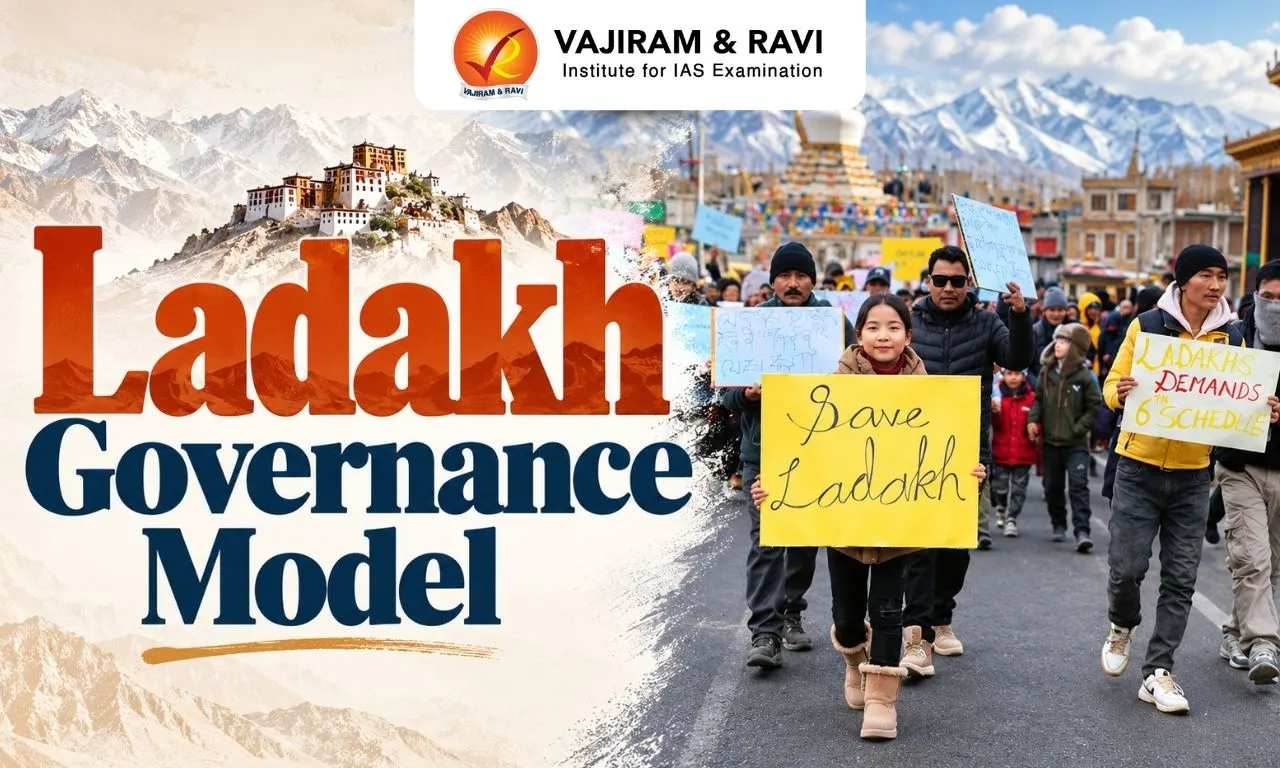
  • Ladakh’s demand for Sixth Schedule status has been accompanied by a proposal to create a directly elected legislative body through a new constitutional provision, Article 371-K.

Ladakh’s Governance Context

  • Ladakh became a Union Territory without a Legislative Assembly under the Jammu and Kashmir Reorganisation Act, 2019. 
  • The change generated concerns among local groups regarding protection of the region’s culture, language, traditions, customary practices and land rights, along with demands for greater political representation.
  • The Sixth Schedule emerged as a major demand because it provides constitutionally recognised mechanisms for autonomous local governance, particularly in areas with significant tribal populations.
  • The current debate therefore concerns how Ladakh can receive greater local participation and institutional protection while retaining its status as a Union Territory.

About the Sixth Schedule

  • The Sixth Schedule is implemented through Articles 244(2) and 275(1) of the Constitution and currently applies to specified tribal areas in Assam, Meghalaya, Tripura and Mizoram.
  • It provides for Autonomous District Councils with substantial powers over local governance. 
  • A district council can have a maximum of 30 members, with the institutional structure designed to provide greater autonomy to communities in designated areas.
  • The historical basis of the Sixth Schedule lies partly in the administrative treatment of several tribal areas during British rule. Meghalaya, Tripura and Mizoram subsequently became separate States while retaining Sixth Schedule protections in specified areas.
  • The underlying objective is to provide institutional mechanisms through which distinct tribal communities can participate in governing matters affecting their social, cultural and economic interests.

Why Has Ladakh Demanded Sixth Schedule Status?

  • Ladakh has a distinctive ethnic, cultural and geographical character, which has contributed to demands for stronger constitutional safeguards.
  • The major concerns include:
    • Protection of local languages, traditions and customary practices. 
    • Safeguarding local land rights against excessive acquisition by outsiders. 
    • Greater political representation for the local population. 
    • Greater participation in decisions affecting development and governance. 
  • The demand also reflects the broader constitutional objective of accommodating India's diverse social and cultural communities within democratic institutions.

Proposed Article 371-K

  • Instead of extending Sixth Schedule provisions to Ladakh, the Central Government has proposed inserting Article 371-K into Part XXI of the Constitution, which deals with temporary, transitional and special provisions.
  • The proposed framework seeks to create a directly elected legislative authority for Ladakh while maintaining the Union Territory's existing constitutional position.
  • The proposed institution could potentially be placed above the existing Ladakh Autonomous Hill Development Councils (LAHDCs) while retaining panchayats and other district-level institutions.
  • The objective is to establish a governance structure that combines local democratic participation with Union-level administration.

Key Questions Under the Proposed Model

  • Role of the Lieutenant Governor
    • The precise relationship between the proposed legislative authority and the Lieutenant Governor would need to be defined, particularly regarding executive and administrative powers.
  • Financial Autonomy
    • The extent of financial powers available to the proposed authority is another important issue. This includes questions concerning taxation, expenditure and control over financial resources.
  • Relationship with Existing Institutions
    • The proposed body would have to function alongside the LAHDCs, panchayats and district-level institutions. Clear allocation of functions would be necessary to avoid overlapping jurisdictions.
  • National Security
    • Ladakh's strategic geographical location makes national security an important consideration in designing its governance framework. The proposed model therefore seeks to balance local autonomy with the Union's responsibilities relating to territorial security.

Is Special Constitutional Status for a UT Possible?

  • Providing a special governance arrangement to a Union Territory is constitutionally possible.
  • India's constitutional framework does not follow a completely uniform model for every territorial unit. 
  • Parliament has previously created special arrangements for Union Territories, including the National Capital Territory of Delhi under Articles 239AA and 239AB.
  • Therefore, a special constitutional provision for Ladakh would represent another example of differentiated governance within India's federal structure.

Balancing Local Autonomy and National Administration

  • The Ladakh debate illustrates an important feature of Indian federalism: constitutional governance can accommodate different institutional arrangements for different territories.
  • The challenge is to create sufficient space for local democratic participation and protection of cultural interests while maintaining administrative coordination and national responsibilities.
  • A directly elected legislative authority under a special constitutional provision could potentially provide a framework for this balance, although its effectiveness would depend on the precise distribution of legislative, administrative and financial powers.

Source: TH

Ladakh Governance Model FAQs

Q1: When did Ladakh become a Union Territory?

Ans: Ladakh became a Union Territory without a Legislative Assembly under the Jammu and Kashmir Reorganisation Act, 2019.

Q2: Which States are currently covered by the Sixth Schedule?

Ans: The Sixth Schedule applies to specified tribal areas in Assam, Meghalaya, Tripura and Mizoram.

Q3: Which Articles govern the Sixth Schedule?

Ans: The Sixth Schedule operates primarily through Articles 244(2) and 275(1).

Q4: What is proposed under Article 371-K?

Ans: Article 371-K has been proposed to provide Ladakh with a directly elected legislative authority for local governance.

Q5: What are the existing major local governance institutions in Ladakh?

Ans: The Ladakh Autonomous Hill Development Councils, panchayats and district-level institutions are among the existing local governance structures.

Uttar Pradesh Floods: How Two Weather Systems Collided

Uttar Pradesh Floods

Uttar Pradesh Floods Latest News

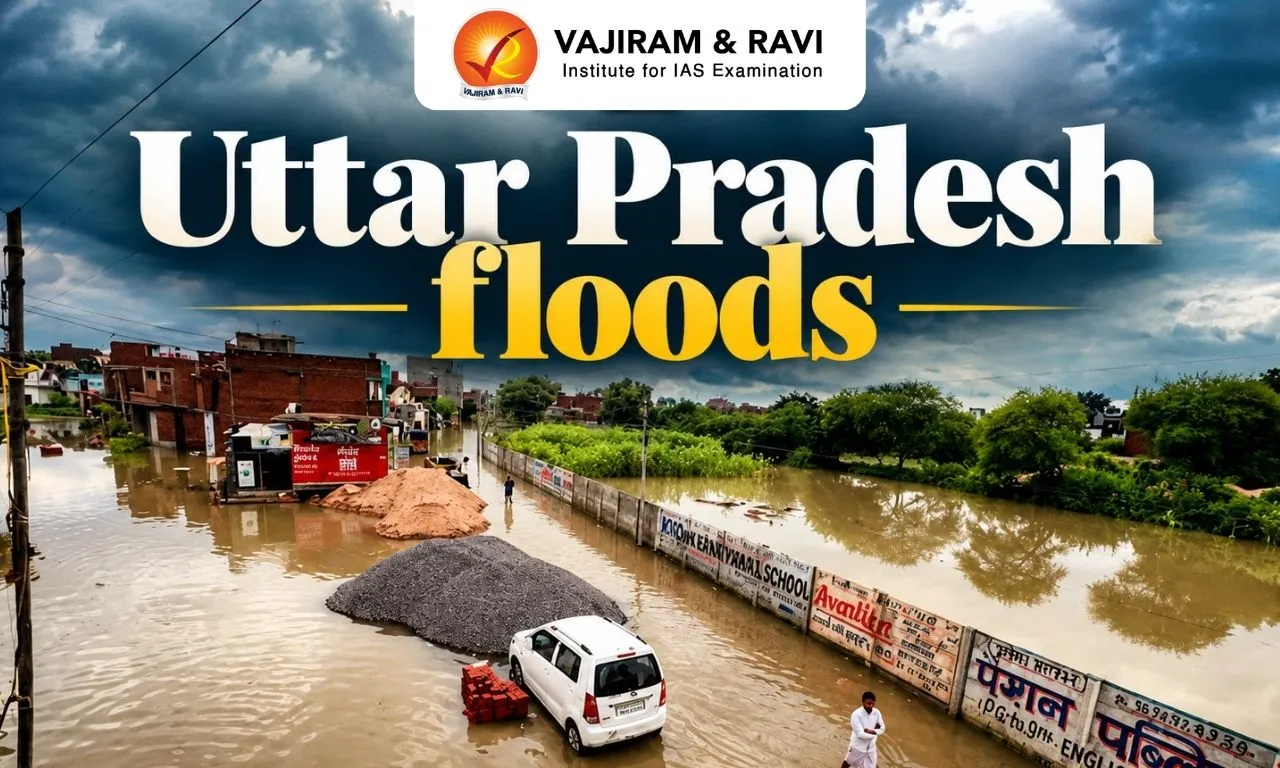
  • An intense three-day wet spell in Uttar Pradesh has left several districts facing a flood-like situation, disrupting normal life and damaging crops. 
  • Between September 25 and September 27 morning, 56 people died and 46 were injured in rain and storm-related incidents, according to the state's Office of Relief Commissioner. As many as 1,021 houses were damaged.

The Scale of the Impact

  • Heavy rain lashed Kanpur, Varanasi, Prayagraj, Gorakhpur, Bareilly, and several other parts of the state.
  • Strong winds reaching 30–40 kmph accompanied the downpour, uprooting trees and electric poles and inundating roads, lanes and villages.
  • The state received 45.1 mm of rainfall in the 24 hours ending September 27, against a normal of just 1.8 mm — a massive deviation.
  • 56 of Uttar Pradesh's 75 districts recorded excessive rainfall.
  • According to the India Meteorological Department (IMD), the flood-like situation stems from the likely interaction of two different weather systems.

The First System: A Deep Depression from the Bay of Bengal

  • The IMD noted that a deep depression lay centred over parts of north-eastern Madhya Pradesh and adjoining south-eastern Uttar Pradesh.
  • The depression had formed over the Bay of Bengal, crossed the North Andhra Pradesh–South Odisha coast, and then weakened.

What is a Depression?

  • It is an organised low-pressure weather system.
  • A low-pressure area forms where atmospheric pressure is lower than surroundings, typically due to localised heating over a landmass from greater sunshine.
  • The heated air becomes less dense, rises, and lowers atmospheric pressure further.
  • Simultaneously, warm, moist air flows inward toward the low-pressure centre and moves upward, where it cools and condenses into clouds and rain (or snow).

Effects and Trajectory

  • Depressions typically produce strong winds and heavy rain.
  • As a depression degrades into a well-marked low-pressure area, it loses strength — wind speeds drop, reducing rain intensity.
  • By 5:30 am on Sunday, the IMD noted the system had moved north-northwestwards and weakened into a well-marked low-pressure area.
  • It was expected to continue in the same direction across Uttar Pradesh, gradually weakening further into a low-pressure area over the following 12 hours.

The Second System: A Western Disturbance

  • The IMD's note also flagged a "likely interaction" with a Western Disturbance (WD), which could bring:
    • Strong gusty surface winds.
    • Heavy to very heavy rainfall, with isolated extremely heavy rainfall in the central Terai belt.
    • Exceptionally heavy rainfall (>30 cm) at one or two places.

What is a Western Disturbance (WD)?

  • WDs are weather systems that typically travel into northern India from the west.
  • They are east-moving, rain-bearing wind systems originating beyond Afghanistan and Iran.
  • They gather moisture from the Mediterranean Sea, Black Sea, Caspian Sea, and the Arabian Sea.
  • WDs are essentially extra-tropical cyclones, formed through interactions between polar and tropical winds.

How WDs reach India

  • The subtropical westerly jet stream — a high-altitude, fast-moving west-to-east air current — carries WDs toward the Himalayan and Tibetan highlands.
  • As moisture-laden WDs strike the Himalayas, they rise and cool, producing cloudy weather, rain, and thunderstorms, especially over north and northwest India.

Current Status

  • The IMD's weather bulletin for Uttar Pradesh noted this WD was present high up in the atmosphere as a trough — an elongated zone of relatively lower pressure — over northwestern India.

Why the Interaction Matters

  • The interaction between the Western Disturbance and the deep depression, occurring even as the southwest monsoon withdraws across north and northwestern India, is what has produced these intense spells of rainfall over specific areas of Uttar Pradesh.
  • This timing is significant: two independent weather systems — one tropical (from the Bay of Bengal) and one extra-tropical (from west/central Asia) — converged over the same region during the monsoon withdrawal phase, a period that already tends to be meteorologically unstable.

Conclusion

  • Uttar Pradesh's floods illustrate how India's weather is shaped by systems from opposite directions — a Bay of Bengal depression from the east, and a Western Disturbance from the west — meeting over the same terrain. 
  • As the monsoon's retreat becomes less predictable, such cross-system interactions may become a more frequent source of extreme, localised rainfall events.

Source: IE

Uttar Pradesh Floods FAQs

Q1: What caused the recent Uttar Pradesh floods and flood-like conditions?

Ans: The Uttar Pradesh floods resulted from the interaction of a Bay of Bengal depression and a Western Disturbance during the monsoon withdrawal phase.

Q2: What was the first weather system behind the Uttar Pradesh floods?

Ans: The first system was a deep depression formed over the Bay of Bengal that moved across Andhra Pradesh, Odisha and Uttar Pradesh.

Q3: What is a Western Disturbance associated with Uttar Pradesh floods?

Ans: A Western Disturbance is an east-moving, rain-bearing extra-tropical weather system originating beyond Afghanistan and Iran and affecting northern India.

Q4: Why did the two systems intensify rainfall during the Uttar Pradesh floods?

Ans: Their convergence brought tropical and extra-tropical systems together over Uttar Pradesh, producing intense rainfall while the southwest monsoon was withdrawing.

Q5: How severe was the rainfall associated with the Uttar Pradesh floods?

Ans: Uttar Pradesh received 45.1 mm rainfall in 24 hours against a normal 1.8 mm, while 56 districts recorded excessive rainfall.

Rare-Disease Drugs: Can India Become a Global Drug Hub?

Rare-Disease Drugs

Rare-Disease Drugs Latest News

  • India transformed global healthcare by making generic drugs affordable. Experts argue that the next frontier for India is to make rare-disease drugs accessible. 
  • With a streamlined regulatory pathway and government procurement, India could build a globally competitive rare-disease pharmaceutical sector.

Understanding the Scale of the Problem

  • Each rare disease affects very few people, but collectively the numbers are staggering.
  • There are around 8,000 rare diseases worldwide, cumulatively affecting hundreds of millions of people.
  • In India, 1,004 rare genetic disorders have been reported so far.
  • Because patient numbers for any single disease are tiny, pharmaceutical interest has historically been limited — hence the term "orphan drugs."

How Other Countries Solved This: The Orphan Drug Act

  • To overcome industry hesitancy, several governments introduced incentives.
  • The US Orphan Drug Act (1983) offered tax incentives, seven years of market exclusivity, grants, and regulatory fee waivers.
  • Impact: Before the Act, only 38 relevant drugs had been approved in the US. By 2022, this rose to 1,122 approvals.
  • Japan, Australia, and the European Union later adopted similar legislation.
  • The catch: Because markets remain small, companies set very high prices. A year's treatment can cost $100,000 (₹1 crore) or more — putting it out of reach without insurance or government support.

India's Current Support System — and Its Limits

  • The Indian government supports rare disease patients with up to ₹50 lakh total for treatment.
  • This is often insufficient to cover even a year's costs, forcing patients toward crowdfunding.
  • Example: In mid-2025, ₹9 crore was crowdfunded for gene therapy for a 16-month-old child in Kolkata.
  • Nearly 4,000 children are listed on a Government of India crowdfunding platform, with cumulative annual treatment costs exceeding ₹9,000 crore.
  • Existing drugs cover only about 5% of rare diseases — most patients have no suitable drug at all, even at high cost.

The Two Core Challenges in Drug Development

  • Finding a patient cohort large enough for clinical trials.
  • Determining trial endpoints — what "success" means for a very rare condition.
  • Beyond approval, affordable, high-quality small-scale manufacturing and distribution remain major hurdles.

India's Advantage: A Natural Trial Ground

  • India's demographics make it uniquely suited for rare-disease research.
  • With a population exceeding 1.4 billion, India has large absolute numbers of patients even for very rare conditions.
  • High rates of endogamy in certain communities raise disease prevalence further. For instance, beta-thalassemia prevalence is 10.5% in specific ethnic groups, versus 3.7% in India's general population (2023 review).
  • The Indian diaspora's gene pool carries unique mutations across ethnicities, adding further research value.

The Gap

  • Indian patients rarely participate in international orphan-drug trials, despite this potential. 
  • Analysts suggest government-fostered collaboration between foreign companies and local organisations — similar to India's approach in chip manufacturing — and inviting multinational firms to set up rare-disease drug-development centres with patient groups.

A Benefit-Sharing Model for Pricing

  • Experts propose a key principle: Indian patients participating in drug development should be beneficiaries of the resulting drugs, not just data sources.
  • Proposal: India should be allowed to decide the price of drugs sold domestically or in the Global South, while companies remain free to set prices elsewhere.
  • This echoes the benefit-sharing concept discussed under the WHO's Pandemic Agreement, where pathogen information shared globally must lead to fair, equitable access to resulting drugs and vaccines.
  • US and Chinese firms are already racing on rare-disease drugs, with China leveraging patient access and low-cost manufacturing. Western companies may find India an attractive collaboration partner too.

India's Manufacturing Strength

  • India is already the "pharmacy of the world" for generics.
    • India fills 47% of US generic prescriptions.
    • It has the largest number of US-regulator-approved manufacturing sites outside the US.
    • Indian firms supply 15% of all biosimilars sold in the US.
    • Indian facilities now produce CAR-T therapy — a personalised cancer treatment — to international standards.
  • Regulatory shortcut: Under Rule 101 of the New Drugs and Clinical Trials Rules, 2019, the CDSCO allows drugs already approved in six specified countries (including the US and UK) to skip a fresh Indian clinical trial before regulatory approval. 
  • This is a strong incentive for manufacturing such drugs locally — though the authors call for greater transparency and guidance documents to ease the application process. 

What the Government Should Do

  • Analysts propose a policy package modelled on Production-Linked Incentive (PLI) schemes:
    • Tax incentives for investing in orphan drug manufacturing.
    • Production-linked incentives for approved orphan drugs.
    • Support for technology transfer with national laboratories.
    • Advance Market Commitments (AMCs) — government pre-committing to buy a certain output at a set price.
    • Distribution through Centres of Excellence on Rare Diseases, the Central Government Health Scheme, and Pradhan Mantri Bhartiya Jan Aushadhi Kendras.
    • Incentives for exporting to low- and middle-income countries.
  • The Underlying Philosophy: The goal shouldn't be simply subsidising companies, but de-risking initial investment enough to make orphan drug manufacturing commercially viable on its own.

Source: TH | RD

Rare-Disease Drugs FAQs

Q1: Why are rare-disease drugs difficult to develop commercially?

Ans: Rare-disease drugs have limited patient populations, making clinical trials difficult and reducing pharmaceutical companies' commercial incentives to develop them.

Q2: What incentives did the US Orphan Drug Act provide for rare-disease drugs?

Ans: The US Orphan Drug Act provided tax incentives, market exclusivity, grants and regulatory fee waivers to encourage rare-disease drugs development.

Q3: What support does India currently provide for rare-disease treatment?

Ans: India provides up to ₹50 lakh for rare-disease treatment, but the support can remain inadequate against extremely high treatment costs.

Q4: Why could India become a research hub for rare-disease drugs?

Ans: India's large population, diverse genetic groups and manufacturing capabilities provide opportunities for clinical research and production of rare-disease drugs.

Q5: What policies could strengthen India's rare-disease drugs ecosystem?

Ans: Proposed measures include tax incentives, production-linked incentives, technology transfer, advance market commitments and distribution through specialised health centres.

Bhima River

Bhima River

Bhima River Latest News

Karnataka Forest, Ecology, and Environment Minister recently directed the State Pollution Control Board (KSPCB) to take action against industries in the Kadechur-Badiyal industrial area over reports of untreated industrial effluents being discharged into the Bhima River.

About Bhima River

  • It is a perennial river and the largest tributary of the Krishna River.
  • Course:
    • It originates near Bhimashankar Temple in the Bhimashankar hills on the western side of the Western Ghats in the Pune District of Maharashtra. 
    • It flows through Maharashtra, Karnataka, and Telangana.
    • It merges into the Krishna River in Karnataka’s Raichur district.
  • Total Length: It has a total length of 861 km, out of which 450 km flows through Maharashtra.
  • The Bhima drainage area is defined by the Western Ghats (west), the Balaghat Range (north), and the Mahadeo Hills (south).
  • It runs in a well-entrenched valley, and its banks are heavily populated.
  • The river is prone to flooding due to heavy rainfall during the monsoon season.  
  • Major Tributaries:
    • Right Bank: Indrayani River, Mula River, Mutha River, and Pavana River.
    • Left Bank: Sina and Nira, etc.
  • The basin has been inhabited since prehistoric times. Ancient kingdoms, including the Satavahanas, Chalukyas, Rashtrakutas, and Yadavas, flourished along its banks. 
  • Spiritual Significance: 
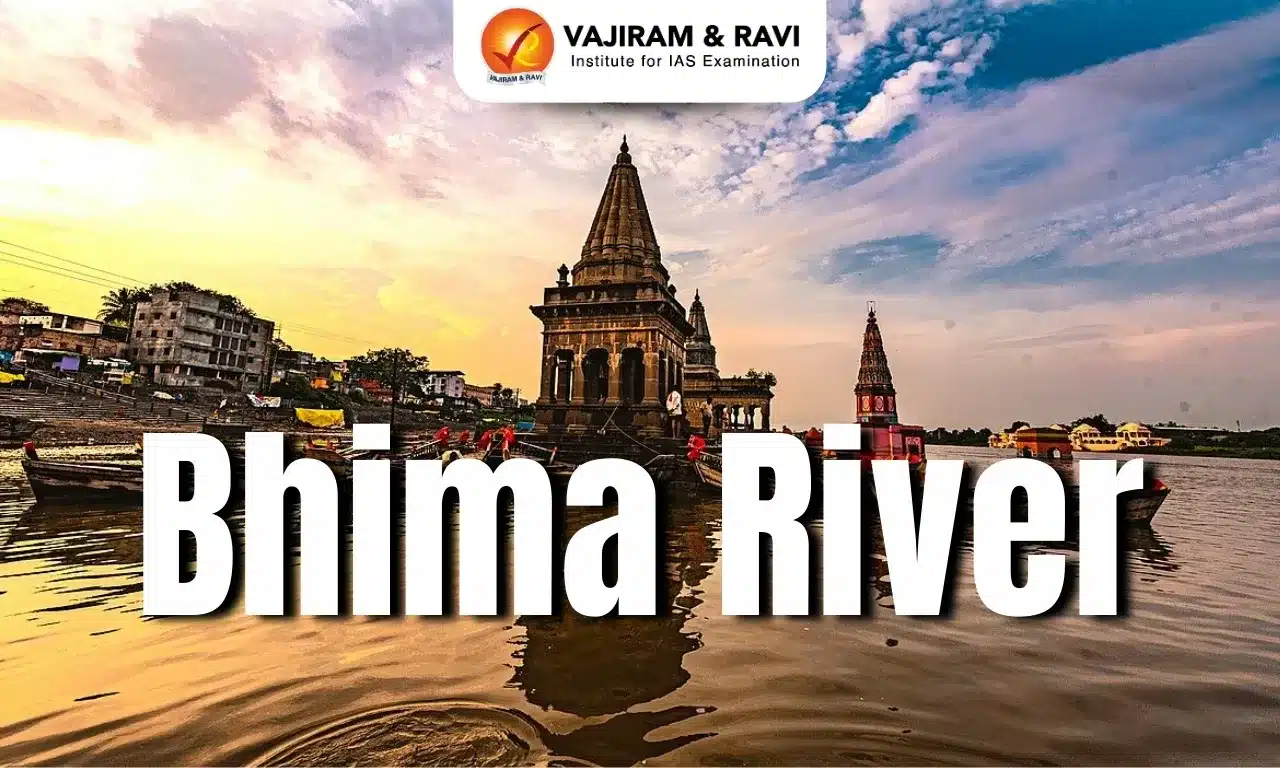
    • Pandharpur is an important pilgrimage centre located on the right bank of the Bhima River.
    • The river is also referred to as Chandrabhaga River, especially at Pandharpur, as it resembles the shape of the moon.
    • Bhimashankar Temple: It is one of the 12 holy Jyotirlinga shrines in India.

News: TH

Bhima River FAQs

Q1: Bhima River is a tributary of which river?

Ans: It is the largest tributary of the Krishna River.

Q2: Where does the Bhima River originate?

Ans: Near Bhimashankar Temple in the Bhimashankar hills of Maharashtra.

Q3: Through which states does the Bhima River flow?

Ans: Maharashtra, Karnataka and Telangana.

Q4: What is the total length of the Bhima River?

Ans: About 861 km.

Q5: Which important pilgrimage centre is located on the right bank of the Bhima River?

Ans: Pandharpur

Pradhan Mantri Matsya Kisan Samridhi Sah-Yojana

Pradhan Mantri Matsya Kisan Samridhi Sah-Yojana

Pradhan Mantri Matsya Kisan Samridhi Sah-Yojana Latest News

The government is seeking to make insurance an integral part of aquaculture risk management through the Pradhan Mantri Matsya Kisan Samridhi Sah-Yojana (PM-MKSSY). 

About Pradhan Mantri Matsya Kisan Samridhi Sah-Yojana

  • It is a Central Sector Sub-scheme under the Pradhan Mantri Matsya Sampada Yojana launched in 2024.
  • It focuses on formalization of the fisheries sector and supporting fisheries micro and small enterprises.
  • Funding: With an investment of over Rs. 6,000 crores
  • Time Period: It is implemented for 4 years from FY 2023-24 to FY 2026-27 across all the States and UTs.
  • Objectives
    • Gradual Formalization of the unorganized fisheries sector
    • Facilitating access to institutional financing fisheries sector micro and small enterprises
    • Providing one-time incentive to beneficiaries for purchasing aquaculture insurance.
    • lncentivizing fisheries and aquaculture microenterprises through performance grants
    • Incentivising adoption and expansion of fish and fishery product safety and quality assurance systems
  • Intended Beneficiaries
    • Fishers, Fish (Aquaculture) Farmers, Fish workers, Fish Vendors or such other persons directly engaged in fisheries value chain.
    • Micro and Small enterprises Cooperatives, Federations Self Help Groups (SHGs), Fish Farmers Producer Organizations (FFPOs) etc
    • FFPOs also include Farmers Producer Organizations (FPOs).
    • Any other beneficiaries that may be included by the Department of Fisheries, Gol as targeted beneficiaries

Implementation Strategy of Pradhan Mantri Matsya Kisan Samridhi Sah-Yojana 

  • Component 1-A: Formalization of fisheries sector
    • A National Fisheries Digital Platform (NFDP) is created and all the stakeholders will be mobilized to register on it.
    • It serves multiple functions including disbursement of financial incentives. It also undertakes activities such as training and extension support, improving financial literacy.
  • Component 1-B: Facilitating adoption of aquaculture insurance:
    • It facilitates creation of appropriate insurance products and to cover at least 1 lakh hectare of aquaculture farms during the project period to provide the scale of operation.
    • SC, ST and Women beneficiaries are provided an additional incentive @ 10% of the incentive payable for General Categories. 
  • Component 2: Supporting microenterprises to improve fisheries sector value chain efficiencies
  • Component 3: Adoption and expansion of fish and fishery product safety and quality assurance systems
  • Component 4: Project management, monitoring and reporting
    • The Project Management Units (PMUs) were set up to manage, implement, monitor and evaluate project activities.

Source: PIB

Pradhan Mantri Matsya Kisan Samridhi Sah-Yojana FAQs

Q1: What is Pradhan Mantri Matsya Kisan Samridhi Sah-Yojana?

Ans: It is a Central Sector Sub-scheme under the Pradhan Mantri Matsya Sampada Yojana launched in 2024.

Q2: What is the time period of Pradhan Mantri Matsya Kisan Samridhi Sah-Yojana?

Ans: It is implemented for 4 years from FY 2023-24 to FY 2026-27 across all the States and UTs.

Tiangong Space Station

Tiangong Space Station

Tiangong Space Station Latest News

Pakistan is set to send its first astronaut into space under a cooperation programme with China, with one of two Pakistani candidates expected to join a short-duration mission aboard China’s Tiangong space station as a payload specialist.

About Tiangong Space Station

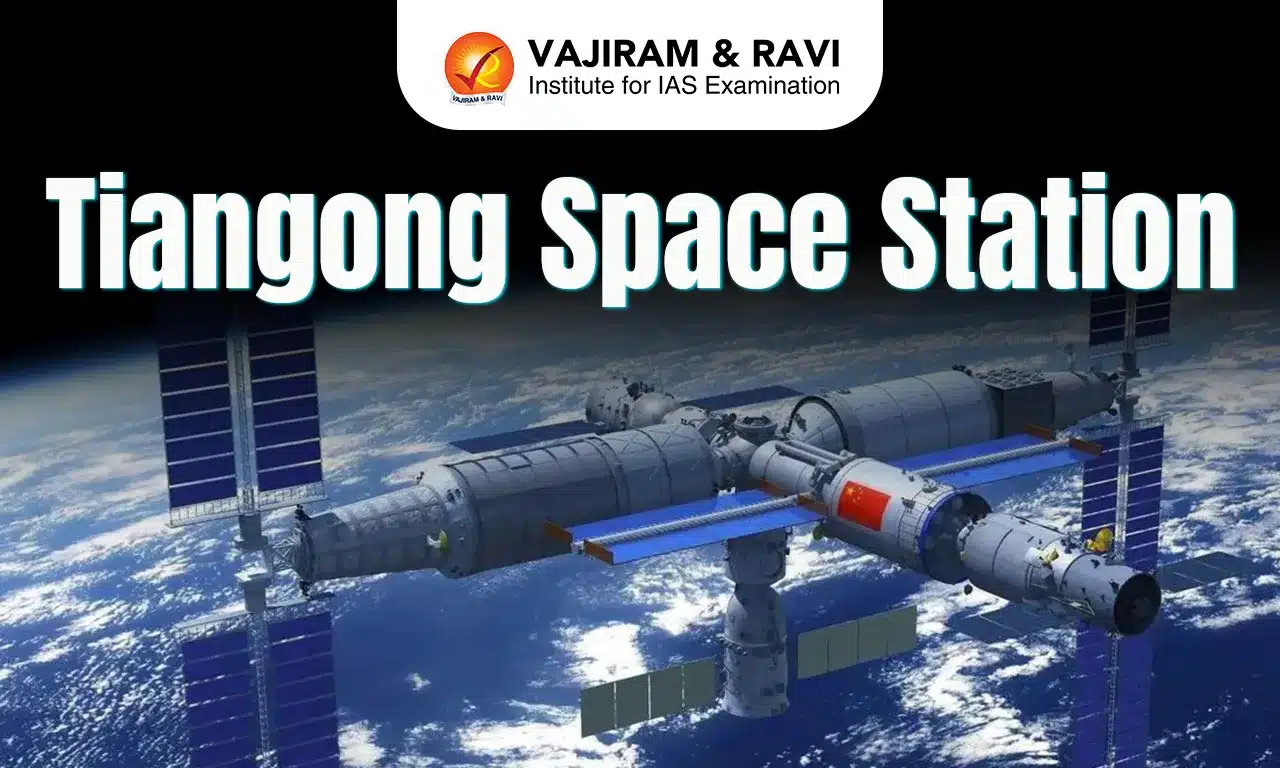
  • The Tiangong Space Station, translating to ‘Sky Palace’, is a Chinese-owned and operated permanently crewed space station in Low Earth Orbit (LEO).
  • It represents the third and final step of China’s Manned Space Program. 
  • The first module of the space station was launched in April 2021, following two precursor missions, Tiangong-1 and Tiangong-2. 
  • The station consists of a core module known as Tianhe, which connects two science modules, Wentian and Mengtian, as well as a planned space telescope module, Xuntian.
    • Xuntian is a huge, Hubble-like space telescope, which will share the space station's orbit and be able to dock with it for repairs, maintenance, and possibly upgrades.  
  • Tiangong orbits Earth at an altitude between 340 to 450 kilometers, approximately the same orbital height as the International Space Station (ISS).  
  • Tiangong is much smaller than the ISS, with only three modules compared with 16 modules on the ISS. 
  • Tiangong is also considerably lighter than the ISS, which weighs about 400 tons (450 metric tons); the Chinese station is about 20% as massive.
  • But unlike the ISS, Tiangong is operated by a single nation. 
  • The station typically hosts three astronauts at a time for six-month stays. It can support six astronauts at a time during crew handovers.
  • China plans to expand Tiangong with additional modules in the coming years. 
  • The aims of the Tiangong Space Station are to:
    • Build a long-term, reliable space station in orbit.
    • Guarantee the long-term health and safety of stationed astronauts.
    • Provide conditions for scientific and technological experiments in space.
  • The station serves as an in-orbit laboratory with 23 enclosed experiment racks, each covering a different proposed experiment in the fields of:
    • Space life sciences and biotechnology
    • Microgravity fluid physics and combustion
    • Material science in space
    • Fundamental physics in microgravity
  • The space station also features platforms for exposed and unpressurised external experiments.

News: OUT

Tiangong Space Station FAQs

Q1: What is the Tiangong Space Station?

Ans: A Chinese-owned and operated permanently crewed space station in Low Earth Orbit.

Q2: When was the first module of the Tiangong Space Station launched?

Ans: April 2021.

Q3: What is the core module of the Tiangong Space Station called?

Ans: Tianhe.

Q4: How does Tiangong compare with the International Space Station in terms of size and mass?

Ans: Tiangong is considerably smaller and lighter than the ISS.

Q5: How many astronauts does Tiangong typically accommodate at a time?

Ans: The station typically hosts three astronauts at a time for six-month stays.

Asian Games 2026 Medal Tally, Country-Wise Medals and Rankings

Asian Games 2026 Medal Tally

Asian Games 2026 Medal Tally is updated as athletes from across Asia compete for medals at the 20th Asian Games in Aichi-Nagoya, Japan. The Asian Games 2026 are being held from 19 September to 4 October 2026. The event features 43 sports, 71 disciplines and 469 medal events.

China, Japan, South Korea and other Asian countries are competing across multiple sports. The medal table ranks countries based primarily on the number of gold medals, followed by silver and bronze medals. 

India has won 46 medals at the Asian Games 2026, including 4 gold medal, 21 silver medals and 21 bronze medals. Indian athletes have earned these medals across events such as shooting and mixed martial arts.

Asian Games 2026 Medal Tally

The following is the Asian Games 2026 medal tally based on the latest figures provided as of 29th September 2026.

Rank Country Gold Silver Bronze Total
1 China 135 53 45 233
2 Japan 41 68 63 172
3 South Korea 21 26 44 91
4 Uzbekistan 12 17 13 42
5 Thailand 10 8 12 30
6 Kazakhstan 9 13 23 45
7 Bahrain 9 3 3 15
8 Iran 8 15 10 33
9 North Korea 7 5 5 17
10 Malaysia 6 4 9 19
11 Hong Kong, China 5 12 18 35
12 India 4 21 21 46
13 Chinese Taipei 3 7 23 34
14 Qatar 3 2 2 7
15 Indonesia 2 7 20 29
16 Singapore 2 5 3 10
17 Philippines 2 3 10 15
18 Tajikistan 2 2 1 5
19 Vietnam 2 1 17 20
20 Kuwait 2 1 3 6
21 Macao, China 1 4 1 6
22 Jordan 1 1 1 3
23 Myanmar 1 1 1 3
24 Sri Lanka 1 1 0 2
25 United Arab Emirates 1 1 0 2
26 Saudi Arabia 0 2 5 7
27 Kyrgyzstan 0 1 3 4
28 Afghanistan 0 1 2 3
29 Iraq 0 1 2 3
30 Lebanon 0 1 1 2
31 Oman 0 1 1 2
32 Turkmenistan 0 1 0 1
33 Cambodia 0 0 4 4
34 Pakistan 0 0 4 4
35 Nepal 0 0 2 2
36 Bangladesh 0 0 1 1
37 Brunei Darussalam 0 0 1 1
38 Laos 0 0 1 1
39 Mongolia 0 0 1 1
40 Syria 0 0 1 1

Note: The medal tally changes throughout the Asian Games as more events are completed. The table above reflects the figures provided for this update and should be treated as a live/ongoing tally rather than the final medal standings.

India in Asian Games 2026 Medal Tally

India has recorded 46 medals in the provided Asian Games 2026 medal tally, including 4 gold medal, 16 silver medals and 17 bronze medals.

India in Asian Games 2026 Medal Tally

Medal

Number

Gold

4

Silver

21

Bronze

21

Total

46

Indian Medallists at Asian Games 2026

India delivered a strong performance at the Asian Games 2026, winning 46 medals, 4 Gold, 21 Silver and 21 Bronze across sports including shooting, athletics, kabaddi, cricket, squash, weightlifting, badminton, rowing, wushu and table tennis.

No. Medal Winner(s) Sport Event Medal
1 Indian Women’s Cricket Team Cricket Women’s T20 Gold
2 Suruchi Singh & Kamaljeet Shooting 10m Air Pistol Mixed Team Gold
3 Indian Women’s Kabaddi Team Kabaddi Women’s Final Gold
4 Indian Men’s Kabaddi Team Kabaddi Men’s Final Gold
5 Niraj Kumar, Aishwary Pratap Singh Tomar & Rudrankksh Patil Shooting Men’s 50m Rifle 3P Team Silver
6 Mirabai Chanu Weightlifting Women’s 49kg Silver
7 Elavenil Valarivan, Sonam Maskar & Vidarsa Vinod Shooting Women’s 10m Air Rifle Team Silver
8 Elavenil Valarivan Shooting Women’s 10m Air Rifle Silver
9 Rudrankksh Patil, Parth Mane & Himanshu Dhillon Shooting Men’s 10m Air Rifle Team Silver
10 Himanshu Dhillon Shooting Men’s 10m Air Rifle Silver
11 Naorem Roshibina Devi Wushu Women’s Sanda 60kg Silver
12 Vishal T.K., M.R. Poovamma, Manu T.S. & Vithya Ramraj Athletics Mixed 4×400m Relay Silver
13 Gulveer Singh Athletics Men’s 10,000m Silver
14 Sawan Barwal Athletics Men’s Marathon Silver
15 Ashi Chouksey, Tilottama Sen & Vidarsa Kochalumkal Shooting Women’s 50m Rifle 3P Team Silver
16 Tajinderpal Singh Toor Athletics Men’s Shot Put Silver
17 Ancy Sojan Athletics Women’s Long Jump Silver
18 Sarvesh Kushare Athletics Men’s High Jump Silver
19 Abhay Singh Squash Men’s Singles Silver
20 Anahat Singh Squash Women’s Singles Silver
21 Rudrankksh Patil Shooting Men’s 10m Air Rifle Bronze
22 Suchika Tariyal MMA Women’s Traditional MMA -60kg Bronze
23 Raiza Dhillon, Maheshwari Chauhan & Parinaaz Dhaliwal Shooting Women’s Skeet Team Bronze
24 Anantjeet Singh Naruka, Mairaj Ahmad Khan & Bhavtegh Singh Gill Shooting Men’s Skeet Team Bronze
25 Jay Meena Soft Tennis Men’s Singles Bronze
26 Indian Men’s Badminton Team Badminton Men’s Team Bronze
27 Satnam Singh & Salman Khan Rowing Men’s Double Sculls Bronze
28 Anantjeet Singh Naruka & Parinaaz Dhaliwal Shooting Mixed Team Skeet Bronze
29 Seema Kumari Athletics Women’s 10,000m Bronze
30 Manush Shah & Diya Chitale Table Tennis Mixed Doubles Bronze
31 Manpreet Kaur Athletics Women’s Shot Put Bronze
32 Baranica Elangovan Athletics Women’s Pole Vault Bronze
33 Prachi Choudhary Athletics Women’s 400m Bronze
34 Harita Bhadra Athletics Women’s 200m Bronze
35 Tejaswin Shankar Athletics Men’s Decathlon Bronze
36 Parul Chaudhary Athletics Women’s 3000m Steeplechase Bronze
37 Joshna Chinappa & Velavan Senthilkumar Squash Mixed Doubles Bronze
38 Yashvir Singh Athletics Men’s Javelin Throw Silver
39 Murali Sreeshankar Athletics Men’s Long Jump Silver
40 Gulveer Singh Athletics Men’s 1500m Silver
41 Esha Singh Shooting Women’s 25m Pistol Silver
42 Rohit Yadav Athletics Men’s Javelin Throw Bronze
43 Vithya Ramraj Athletics Women’s 400m Hurdles Bronze
44 Parul Chaudhary Athletics Women’s 5000m Bronze
45 Pincky Balhara Kurash Women’s -78kg Bronze
46 Neeru Dhanda, Manisha Keer & Aashima Ahlawat Shooting Women’s Trap Team Silver

India at Asian Games 2026 Day-Wise Medal Updates

India has won 46 medals at the Asian Games 2026 in Aichi-Nagoya, comprising 4 Gold, 16 Silver and 17 Bronze medals as of 29 September. India’s medal campaign has seen strong contributions from shooting, athletics, kabaddi, cricket, squash, weightlifting, wushu, rowing, badminton and table tennis.

29 September Update

India added one silver medal on 29 September at the Asian Games 2026, taking its overall medal tally to 46 medals, 4 gold, 21 silver and 21 bronze.

  • Neeru Dhanda, Manisha Keer and Aashima Ahlawat won the silver medal in the women’s trap team event in shooting.
  • The Indian trio finished second in the team competition.
  • With this medal, India’s shooting medal tally increased further at the Games.
  • Neeru Dhanda also advanced to the final of the women’s individual trap event.

28 September Update

India entered 28 September with 37 medals, 4 Gold, 16 Silver and 17 Bronze. The day features medal opportunities in athletics, shooting, boxing, squash and hockey, along with India's men's cricket quarter-final against Afghanistan. Key Indian athletes in action include Manu Bhaker, Avinash Sable and Lovlina Borgohain.

  • Athletics: Avinash Sable begins his campaign in the men's 3000m steeplechase as he looks to defend his Asian Games title.
  • Shooting: Manu Bhaker competes in the women's 25m pistol event after India's strong showing in shooting earlier in the Games.
  • Boxing: Lovlina Borgohain and other Indian boxers continue their campaigns across different weight categories.
  • Cricket: India's men's cricket team takes on Afghanistan in the quarter-final.
  • Hockey: The Indian women's hockey team continues its campaign after topping its group with five wins from five matches.
  • Medal tally: No new Indian medal had been added at the time of this update; India's latest confirmed tally remained 37 medals.

27 September Update – Seven More Medals

India added seven medals on 27 September, taking its overall tally to 37 medals. Athletics contributed five medals, while India won two silver medals in squash.

  • Ancy Sojan – Silver (Athletics): Won silver in the women's long jump.
  • Sarvesh Kushare – Silver (Athletics): Won silver in the men's high jump, clearing 2.25m.
  • Anahat Singh – Silver (Squash): Won silver in the women's singles after losing the final to Malaysia's Sivasangari Subramaniam.
  • Abhay Singh – Silver (Squash): Won silver in the men's singles after losing the final to Malaysia's Ng Eain Yow.
  • Tejaswin Shankar – Bronze (Athletics): Secured bronze in the men's decathlon with 7,934 points.
  • Harita Bhadra – Bronze (Athletics): Won bronze in the women's 200m.
  • Parul Chaudhary – Bronze (Athletics): Secured bronze in the women's 3000m steeplechase.

26 September Update – India Wins Double Kabaddi Gold

India enjoyed a highly successful day on 26 September, winning seven medals, including two gold medals in kabaddi. The men's and women's teams both defeated Iran in their respective finals, completing India's historic kabaddi double.

  • Men's Kabaddi Gold: India defeated Iran 40–34 in the final to successfully defend its Asian Games title.
  • Women's Kabaddi Gold: India defeated Iran 37–34 to win the women's kabaddi title and successfully defend its crown.
  • Sawan Barwal – Silver (Athletics): Won silver in the men's marathon, setting a national record and becoming India's first Asian Games marathon medallist since 1982.
  • Tajinderpal Singh Toor – Silver (Athletics): Secured silver in the men's shot put.
  • Ashi Chouksey, Tilottama Sen & Vidarsa Kochalumkal – Silver (Shooting): Won silver in the women's 50m rifle 3 positions team event.
  • Prachi Chaudhary – Bronze (Athletics): Won bronze in the women's 400m.
  • Joshna Chinappa & Velavan Senthilkumar – Bronze (Squash): Secured bronze in mixed doubles.

Following the day's results, India had 4 Gold, 12 Silver and 14 Bronze medals, taking its tally to 30 medals at the end of 26 September.

25 September Update

India added two medals on 25 September, including a gold medal in shooting. Kamaljeet and Suruchi Singh won the 10m Air Pistol Mixed Team event, securing India's second gold medal of the Games and India's first shooting gold.

India also won a silver medal in the Men's 50m Rifle 3 Positions Team event, with Aishwary Pratap Singh Tomar, Rudrankksh Patil and Niraj Kumar finishing second.

Athlete/Team Sport Event Medal
Kamaljeet & Suruchi Singh Shooting 10m Air Pistol Mixed Team Gold
Aishwary Pratap Singh Tomar, Rudrankksh Patil & Niraj Kumar Shooting Men's 50m Rifle 3 Positions Team Silver

Following these results, India's medal tally stands at 2 Gold, 8 Silver and 9 Bronze, 19 medals in total.

24 September Update Wushu Silver and Rowing Bronze

  • Roshibina Devi – Silver (Wushu): Won silver in the women's 60kg sanda category after losing the final to China's Zhang Xiaoyu. This is her third consecutive Asian Games medal, following bronze in 2018 and silver in 2023.
  • Satnam Singh and Salman Khan – Bronze (Rowing): Won bronze in the men's double sculls, clocking 6:13.25. It is India's first Asian Games medal in the men's double sculls.
  • Anantjeet Singh Naruka and Parinaaz Dhaliwal: Qualified for the mixed skeet team final, keeping India in contention for another shooting medal.
  • Balraj Panwar: Finished fourth in the men's single sculls after staying in medal contention for much of the race.

23 September Update India's Five-Medal Day

  • Mirabai Chanu – Silver (Weightlifting): Won silver in the women's 49kg category, ending India's 28-year wait for an Asian Games weightlifting medal since Karnam Malleswari's bronze in 1998.
  • Women's skeet team – Bronze (Shooting): Parinaaz Dhaliwal, Raiza Dhillon and Maheshwari Chauhan won bronze.
  • Men's skeet team – Bronze (Shooting): Anantjeet Singh Naruka, Bhavtegh Singh Gill and Mairaj Ahmad Khan secured bronze.
  • Jay Meena – Bronze (Soft Tennis): Won India's first-ever Asian Games medal in soft tennis in the men's singles.
  • Men's badminton team – Bronze: India secured bronze after reaching the semi-finals.
  • Women's hockey: India defeated Thailand 20-1, with Deepika Sehrawat scoring nine goals.
  • Women's kabaddi: The defending champions defeated Iran 37-23 to record their second consecutive group-stage win.

22 September Update India Wins First Gold

  • Women's cricket team – Gold: India defeated Sri Lanka by 147 runs in the final to retain the Asian Games women's cricket title.
  • Record total: India scored 216/3, the highest team total in Asian Games cricket, with Smriti Mandhana scoring 79, Shafali Verma 48 and Richa Ghosh remaining unbeaten on 49.
  • Shooting: Elavenil Valarivan and Parth Mane finished fourth in the 10m air rifle mixed team event.
  • Swimming: India's men's 4x100m medley relay team qualified for the final with the seventh-fastest time.
  • Karate: Chetan Bhatt missed a bronze medal in the men's 84kg kumite event.

Which Country is Leading the Asian Games 2026 Medal Tally?

China is at the top of the Asian Games 2026 medal tally with 105 gold medals and a total of 169 medals.

Japan is next with 30 gold medals, followed by South Korea with 13 gold medals and Kazakhstan with 8 gold medals.

The Asian Games medal table is generally arranged according to gold medals first, followed by silver and bronze medals. Therefore, the total number of medals alone does not determine the position of a country in the table.

Also Read:- Asian Games 2026 Indian Cricket Team

Asian Games 2026 Host Country

Japan is the host country of the 20th Asian Games. The event is officially called the Aichi-Nagoya 2026 Asian Games.

The Games are being organised in Aichi Prefecture and Nagoya, with competitions taking place across multiple venues. The official event programme includes 43 sports and 71 disciplines.

The Asian Games are being held from 19 September 2026 to 4 October 2026. The Opening Ceremony took place on 19 September 2026, while the Closing Ceremony is scheduled for 4 October 2026.

Also Read:- India's medals at Asian Games 2026

How is the Asian Games Medal Tally Calculated?

The Asian Games medal tally records the number of gold, silver and bronze medals won by each participating country or region.

The ranking generally follows this order:

  1. Number of gold medals
  2. Number of silver medals
  3. Number of bronze medals

For example, a country with 5 gold medals is placed above a country with 4 gold medals even if the second country has a higher overall medal count.

The Total column is calculated by adding: Gold + Silver + Bronze = Total Medals

Asian Games 2026 Key facts for UPSC Prelims

20th Asian Games, hosted by Aichi Prefecture and Nagoya, Japan, are being held from 19 September to 4 October 2026, featuring 43 sports, 71 disciplines and 469 medal events under the Olympic Council of Asia (OCA).

Parameter Details
Edition 20th Asian Games (XX Asian Games)
Host Aichi Prefecture and Nagoya, Japan
Dates 19 September – 4 October 2026
Sports / Disciplines / Events 43 / 71 / 469
Governing Body Olympic Council of Asia (OCA), headquartered in Kuwait City
Debut Sport Mixed Martial Arts (MMA)
India’s Firsts in 2026 First MMA medal – Suchika Tariyal; first soft tennis medal – Jay Meena; first wushu medals at three consecutive Games – Roshibina Devi
First Asian Games New Delhi, India – 1951
India at Hangzhou 2023 106 medals (28 Gold, 38 Silver, 40 Bronze) – 4th position; India’s first 100+ medal haul
Next Editions Doha 2030 and Riyadh 2034

Asian Games 2026 Medal Tally FAQs

Q1: What is the Asian Games 2026 Medal Tally?

Ans: The Asian Games 2026 Medal Tally is the country-wise record of gold, silver and bronze medals won at the Aichi-Nagoya 2026 Asian Games.

Q2: Which country is leading the Asian Games 2026 Medal Tally?

Ans: China is leading the medal tally with 135 gold medals and 233 total medals.

Q3: How many medals has India won in Asian Games 2026?

Ans: According to the provided update, India has won 46 medals, including 4 gold, 21 silver and 21 bronze medals.

Q4: How many gold medals has India won in Asian Games 2026?

Ans: India has won 4 gold medals in the provided medal tally.

Q5: When are the Asian Games 2026 being held?

Ans: Asian Games 2026 are being held from 19 September to 4 October 2026 in Aichi-Nagoya, Japan.

Asian Games 2026, Medal Tally, Participating Countries, Host Country

Asian Games 2026, officially known as the 20th Asian Games Aichi-Nagoya 2026, are being held in Japan from 19 September to 4 October 2026. Aichi Prefecture and Nagoya are hosting the continental multi-sport event, which brings together athletes from across Asia.

The Games feature 43 sports, 71 disciplines and 469 medal events. The official programme also includes newer sports such as teqball, padel, sport climbing, skateboarding, surfing, esports and mixed martial arts (MMA).

Asian Games 2026 Overview

The key highlights related to the Asian Games 2026 have been tabulated below...

Asian Games 2026 Overview

Particulars

Details

Event

20th Asian Games

Official Name

Aichi-Nagoya 2026

Host Country

Japan

Host Region

Aichi Prefecture and Nagoya

Dates

19 September – 4 October 2026

Total Indian Delegation

768

New and Emerging Sports at Asian Games 2026

Asian Games 2026 feature several new and emerging sports, reflecting the changing interests of athletes and younger audiences. These sports add more variety to the Games and give athletes from newer sporting disciplines an international platform.

  • Teqball: A football-based sport played on a curved table, making its Asian Games debut in 2026.
  • Mixed Martial Arts (MMA): Included in the Games for the first time, with competitions across different weight categories.
  • Padel: A racket sport combining elements of tennis and squash, included in men's and women's competitions.
  • Surfing: Features shortboard events for men and women.
  • Skateboarding: Includes different disciplines that test balance, speed and technical skills.
  • Sport Climbing: Includes speed, bouldering and lead events.
  • Esports: Continues to provide a competitive platform for digital sports and gaming.

Also Read:- India to Host Commonwealth Games 2030

Asian Games 2026 Participating Countries

Asian Games 2026 feature participation from 45 countries and regions across Asia. The participating delegations represent South Asia, Southeast Asia, East Asia, Central Asia and West Asia.

No. Country/Region No. Country/Region No. Country/Region
1 Afghanistan 16 Kazakhstan 31 Philippines
2 Bahrain 17 Kuwait 32 Qatar
3 Bangladesh 18 Kyrgyzstan 33 Korea
4 Bhutan 19 Lao PDR 34 Saudi Arabia
5 Brunei 20 Lebanon 35 Singapore
6 Cambodia 21 Macao, China 36 Sri Lanka
7 Chinese Taipei 22 Malaysia 37 Syria
8 DPR Korea 23 Maldives 38 Tajikistan
9 Hong Kong, China 24 Mongolia 39 Thailand
10 India 25 Myanmar 40 Timor-Leste
11 Indonesia 26 Nepal 41 Turkmenistan
12 Iraq 27 Oman 42 United Arab Emirates
13 IR Iran 28 Pakistan 43 Uzbekistan
14 Japan 29 Palestine 44 Vietnam
15 Jordan 30 China 45 Yemen

Asian Games 2026 Host Country

Japan is hosting the 20th Asian Games 2026 in Aichi-Nagoya, marking the third time the country has hosted the Asian Games. The event is being held from 19 September to 4 October 2026 across multiple venues in Aichi Prefecture and Nagoya. Japan previously hosted the Asian Games in Tokyo in 1958 and Hiroshima in 1994. The Games feature athletes from across Asia competing in a wide range of sports and disciplines.

Also Read:- India's medals at Asian Games 2026

India at Asian Games 2026

India is participating in the 20th Asian Games in Aichi-Nagoya with 503 athletes across 36 disciplines. The contingent includes 269 men and 234 women, supported by coaches, officials and other staff. India enters the Games after winning a record 107 medals at Hangzhou 2023, including 28 gold, 38 silver and 41 bronze medals.

No. Medal Winner(s) Sport Event Medal
1 Indian Women’s Cricket Team Cricket Women’s T20 Gold
2 Suruchi Singh & Kamaljeet Shooting 10m Air Pistol Mixed Team Gold
3 Indian Women’s Kabaddi Team Kabaddi Women’s Final Gold
4 Indian Men’s Kabaddi Team Kabaddi Men’s Final Gold
5 Niraj Kumar, Aishwary Pratap Singh Tomar & Rudrankksh Patil Shooting Men’s 50m Rifle 3P Team Silver
6 Mirabai Chanu Weightlifting Women’s 49kg Silver
7 Elavenil Valarivan, Sonam Maskar & Vidarsa Vinod Shooting Women’s 10m Air Rifle Team Silver
8 Elavenil Valarivan Shooting Women’s 10m Air Rifle Silver
9 Rudrankksh Patil, Parth Mane & Himanshu Dhillon Shooting Men’s 10m Air Rifle Team Silver
10 Himanshu Dhillon Shooting Men’s 10m Air Rifle Silver
11 Naorem Roshibina Devi Wushu Women’s Sanda 60kg Silver
12 Vishal T.K., M.R. Poovamma, Manu T.S. & Vithya Ramraj Athletics Mixed 4×400m Relay Silver
13 Gulveer Singh Athletics Men’s 10,000m Silver
14 Sawan Barwal Athletics Men’s Marathon Silver
15 Ashi Chouksey, Tilottama Sen & Vidarsa Kochalumkal Shooting Women’s 50m Rifle 3P Team Silver
16 Tajinderpal Singh Toor Athletics Men’s Shot Put Silver
17 Ancy Sojan Athletics Women’s Long Jump Silver
18 Sarvesh Kushare Athletics Men’s High Jump Silver
19 Abhay Singh Squash Men’s Singles Silver
20 Anahat Singh Squash Women’s Singles Silver
21 Rudrankksh Patil Shooting Men’s 10m Air Rifle Bronze
22 Suchika Tariyal MMA Women’s Traditional MMA -60kg Bronze
23 Raiza Dhillon, Maheshwari Chauhan & Parinaaz Dhaliwal Shooting Women’s Skeet Team Bronze
24 Anantjeet Singh Naruka, Mairaj Ahmad Khan & Bhavtegh Singh Gill Shooting Men’s Skeet Team Bronze
25 Jay Meena Soft Tennis Men’s Singles Bronze
26 Indian Men’s Badminton Team Badminton Men’s Team Bronze
27 Satnam Singh & Salman Khan Rowing Men’s Double Sculls Bronze
28 Anantjeet Singh Naruka & Parinaaz Dhaliwal Shooting Mixed Team Skeet Bronze
29 Seema Kumari Athletics Women’s 10,000m Bronze
30 Manush Shah & Diya Chitale Table Tennis Mixed Doubles Bronze
31 Manpreet Kaur Athletics Women’s Shot Put Bronze
32 Baranica Elangovan Athletics Women’s Pole Vault Bronze
33 Prachi Choudhary Athletics Women’s 400m Bronze
34 Harita Bhadra Athletics Women’s 200m Bronze
35 Tejaswin Shankar Athletics Men’s Decathlon Bronze
36 Parul Chaudhary Athletics Women’s 3000m Steeplechase Bronze
37 Joshna Chinappa & Velavan Senthilkumar Squash Mixed Doubles Bronze
38 Yashvir Singh Athletics Men’s Javelin Throw Silver
39 Murali Sreeshankar Athletics Men’s Long Jump Silver
40 Gulveer Singh Athletics Men’s 1500m Silver
41 Esha Singh Shooting Women’s 25m Pistol Silver
42 Rohit Yadav Athletics Men’s Javelin Throw Bronze
43 Vithya Ramraj Athletics Women’s 400m Hurdles Bronze
44 Parul Chaudhary Athletics Women’s 5000m Bronze
45 Pincky Balhara Kurash Women’s -78kg Bronze
46 Neeru Dhanda, Manisha Keer & Aashima Ahlawat Shooting Women’s Trap Team Silver

Medal Tally at Asian Games 2026

As of 29 September 2026, China leads the Asian Games 2026 medal table with 233 medals, while India is ranked 12th with 46 medals, including 4 gold, 21 silver and 21 bronze.

Rank Country Gold Silver Bronze Total
1 China 135 53 45 233
2 Japan 41 68 63 172
3 South Korea 21 26 44 91
4 Uzbekistan 12 17 13 42
5 Thailand 10 8 12 30
6 Kazakhstan 9 13 23 45
7 Bahrain 9 3 3 15
8 Iran 8 15 10 33
9 North Korea 7 5 5 17
10 Malaysia 6 4 9 19
11 Hong Kong, China 5 12 18 35
12 India 4 21 21 46
13 Chinese Taipei 3 7 23 34
14 Qatar 3 2 2 7
15 Indonesia 2 7 20 29
16 Singapore 2 5 3 10
17 Philippines 2 3 10 15
18 Tajikistan 2 2 1 5
19 Vietnam 2 1 17 20
20 Kuwait 2 1 3 6
21 Macao, China 1 4 1 6
22 Jordan 1 1 1 3
23 Myanmar 1 1 1 3
24 Sri Lanka 1 1 0 2
25 United Arab Emirates 1 1 0 2
26 Saudi Arabia 0 2 5 7
27 Kyrgyzstan 0 1 3 4
28 Afghanistan 0 1 2 3
29 Iraq 0 1 2 3
30 Lebanon 0 1 1 2
31 Oman 0 1 1 2
32 Turkmenistan 0 1 0 1
33 Cambodia 0 0 4 4
34 Pakistan 0 0 4 4
35 Nepal 0 0 2 2
36 Bangladesh 0 0 1 1
37 Brunei Darussalam 0 0 1 1
38 Laos 0 0 1 1
39 Mongolia 0 0 1 1
40 Syria 0 0 1 1

About Asian Games

Asian Games, also known as the Asiad, are a major multi-sport event held every four years for athletes from across Asia. The Games have evolved significantly since their beginning in 1951.

  • Early Origins: The idea of an Asian multi-sport event was influenced by the Far Eastern Championship Games (1913) and the West Asian Games (1934).
  • 1948 Initiative: During the 1948 London Olympics, Asian representatives discussed creating a larger sporting event for Asian countries. Indian IOC representative Guru Dutt Sondhi played an important role in promoting the idea.
  • Asian Games Federation: The Asian Games Federation (AGF) was established in 1949 in New Delhi to organise and govern the new continental sporting event.
  • First Asian Games: The first Asian Games were held in New Delhi in March 1951, with 489 athletes from 11 countries competing in 6 sports and 57 events.
  • Expansion: The Games gradually expanded to more countries and sports, with editions held in Manila (1954), Tokyo (1958), Jakarta (1962), Bangkok (1966 and 1970) and other Asian cities.
  • Formation of OCA: In 1981, the Olympic Council of Asia (OCA) was created to replace the Asian Games Federation. It later became the main governing body for the Asian Games.
  • Modern Asian Games: The Games continued to grow, with recent editions held in Guangzhou (2010), Incheon (2014), Jakarta-Palembang (2018) and Hangzhou (2023).

Asian Games 2026 FAQs

Q1: When are the Asian Games 2026 being held?

Ans: Asian Games 2026 are being held from 19 September to 4 October 2026 in Aichi-Nagoya, Japan.

Q2: Where are the Asian Games 2026 being held?

Ans: The Games are being hosted by Aichi Prefecture and Nagoya in Japan, with competitions taking place across multiple venues.

Q3: How many sports are there in Asian Games 2026?

Ans: The official Aichi-Nagoya programme features 43 sports, 71 disciplines and 469 medal events.

Q4: How many athletes are representing India?

Ans: India has sent 503 athletes, comprising 269 men and 234 women, across 36 disciplines.

Q5: How many members are there in India's Asian Games contingent?

Ans: India's total approved contingent consists of 768 members, including 503 athletes and accompanying support staff and officials.

World Heart Day 2026, Theme, Date, CVDs, Indian Initiatives

World Heart Day 2026

World Heart Day 2026 will be observed on 29 September to raise awareness about cardiovascular diseases (CVDs), their warning signs, prevention and global health burden. The World Heart Federation (WHF) leads this annual global campaign with its network of members. The 2026 campaign focuses on recognising hidden symptoms, protecting heart health and encouraging governments to make equitable cardiovascular health a priority.

World Heart Day 2026

World Heart Day 2026 will continue the “Don’t Miss a Beat” campaign. It highlights how heart disease can remain unnoticed until serious complications occur. The campaign calls for greater awareness of CVD symptoms, healthier daily choices and stronger national action on cardiovascular health. The WHF campaign also highlights that CVD causes over 20 million deaths every year.

World Heart Day Theme 2026

The theme of World Heart Day 2026 is “Don’t Miss a Beat”. The campaign focuses on three broad priorities, including recognising symptoms, protecting heart health and demanding stronger government action. It also highlights that less than 20 countries have a standalone national plan to tackle CVD.

World Heart Day 2026 History

World Heart Day 2026 developed into a global platform for spreading awareness about cardiovascular diseases and encouraging preventive action.

  • Established in 1999: The World Heart Federation, in collaboration with the World Health Organization, announced the establishment of World Heart Day in 1999.
  • First observed in 2000: The first World Heart Day was celebrated on 24 September 2000. It was originally observed on the last Sunday of September until 2011.
  • Fixed Observance Date: World Heart Day is now observed annually on 29 September since 2012. The WHF coordinates the campaign with its global network of members and partners.
  • Global campaign: The observance promotes awareness through public education, health activities, campaigns and actions focused on prevention and cardiovascular health.

What are Cardiovascular diseases (CVDs)?

Cardiovascular Diseases (CVDs) are a group of disorders affecting the heart and blood vessels. They include coronary heart disease, cerebrovascular disease, rheumatic heart disease and other related conditions.

  • Major diseases: CVDs include coronary heart disease, cerebrovascular disease and rheumatic heart disease. According to WHO, Heart attacks and strokes account for more than four out of five CVD deaths.
  • Global deaths: According to WHO, CVDs caused an estimated 19.8 million deaths in 2022. More than 85% CVD deaths are caused by heart attacks and strokes.
  • Risk factors: Major behavioural risk factors include unhealthy diet, physical inactivity, tobacco use and alcohol consumption. These can contribute to raised blood pressure, blood glucose, blood lipids and obesity.
  • Preventable burden: The World Heart Day 2026 campaign states that 80% of CVD deaths are caused by risk factors that can be prevented or managed.

World Heart Day 2026 in India

India faces a substantial cardiovascular disease burden, making prevention, early diagnosis, affordable medicines and accessible treatment important areas of public health action. The World Heart Day 2026 highlights the major requirement and status of healthcare system related to Heart Health in India.

  • Disease burden: According to WHO, NCDs caused 63% of total deaths in India in 2016. CVDs accounted for 27% of these deaths and 45% of deaths among people aged 40-69 years.
  • NPCDCS: The National Programme for Prevention and Control of Cancer, Diabetes, Cardiovascular Diseases and Stroke (NPCDCS) is implemented under the National Health Mission (NHM) to address major non-communicable diseases.
  • AMRIT outlets: Affordable Medicines and Reliable Implants for Treatment (AMRIT) Deendayal outlets have been opened at 159 Institutions/Hospitals to provide cancer and cardiovascular medicines and implants at discounted prices.
  • Jan Aushadhi: Jan Aushadhi stores are established by the Department of Pharmaceuticals to provide generic medicines at affordable prices and improve access to essential treatment.
  • Maharashtra STEMI Project: The Maharashtra government launched the ST-Elevation Myocardial Infarction (STEMI) Project, recognised by NHM in 2021, to support rapid diagnosis of heart attacks. Maharashtra’s STEMI project has helped detect over 2,000 heart attacks in a year.
  • Preventive action: Tobacco cessation, lower salt intake, more fruits and vegetables, regular physical activity and avoiding alcohol can reduce cardiovascular risk. Accessible primary healthcare and timely treatment remain important for preventing premature deaths.

World Heart Day 2026 Significance

World Heart Day 2026 is significant because cardiovascular disease remains the leading cause of death globally and many associated risk factors can be prevented or managed.

  • Global burden: CVD claims over 20 million lives every year as well as One out of three are killed by Heart Diseases. The campaign describes it as the world’s number one killer and calls for stronger preventive action.
  • Hidden warning signs: High blood pressure often has no symptoms until a heart attack occurs. The campaign also highlights overlooked symptoms among women and people with uncontrolled hypertension.
  • Congenital heart disease: Around 50% of babies born with congenital heart disease (CHD) are not diagnosed at birth, showing the importance of timely recognition and care.
  • Premature deaths: The campaign states that 1 in 5 people will die prematurely from heart disease. It also highlights that most CVD deaths are linked to preventable or manageable risk factors.
  • Public participation: The 2026 campaign includes Heart Stories, the Heart Smart Quiz, Keep the Beat, Walk More Live More and calls for stronger national heart-health action.

World Heart Day 2026 FAQs

Q1: When is World Heart Day 2026 celebrated?

Ans: World Heart Day 2026 will be observed on 29 September to raise awareness about cardiovascular diseases, their warning signs, prevention and global impact.

Q2: What is the theme of World Heart Day 2026?

Ans: The theme of World Heart Day 2026 is “Don’t Miss a Beat”, focusing on recognising hidden symptoms, protecting heart health and demanding stronger action.

Q3: Who started World Heart Day?

Ans: The World Heart Federation (WHF), in collaboration with the World Health Organization (WHO), established World Heart Day in 1999. The first observance was held in 2000.

Q4: What are Cardiovascular Diseases?

Ans: Cardiovascular Diseases are disorders of the heart and blood vessels. They include coronary heart disease, cerebrovascular disease and rheumatic heart disease, etc.

Q5: What are the initiatives related to Heart Health in India?

Ans: India is implementing measures such as NPCDCS, AMRIT outlets, Jan Aushadhi stores and the Maharashtra STEMI Project to improve prevention, diagnosis, medicine access and cardiovascular care.

Daily Editorial Analysis 29 September 2026

Daily-Editorial-Analysis

Tackling Food Loss and Waste — India’s Opportunity

Context

  • Food loss and waste are major global challenges with far-reaching consequences for food security, nutrition, climate change, natural resources and economic productivity.
  • India produces enough food to feed its population of 1.4 billion, yet substantial quantities are lost across the agrifood value chain.
  • Reducing these losses can generate a triple win: improving food security and nutrition, reducing environmental pressures and emissions, and enhancing incomes and productivity.
  • The International Day of Awareness of Food Loss and Waste on September 29 underlines the importance of addressing this issue.

India’s evidence base, a global first

  • India has developed an important foundation for tackling food loss through three nationally representative post-harvest loss surveys, making it the only country to have conducted such a sustained exercise.
  • The Ministry of Food Processing Industries conducted surveys during 2005-07, 2012-14 and 2020-22, covering an increasing number of commodities from farm to retail. A fourth survey is now under way.
  • This evidence supports India's reporting under the Food Loss Index of the Sustainable Development Goals and helps identify areas requiring intervention.
  • However, significant data gaps remain. Existing assessments focus mainly on farm and supply-chain losses, while systematic information on food waste in households, retail, hotels and restaurants remains limited.
  • Better data is essential for identifying loss hotspots, directing investment and measuring policy outcomes.

From Measurement to Action

  • Better storage, drying, cooling, moisture management and processing can substantially reduce post-harvest losses.
  • Digital technologies, particularly traceability systems, can improve the movement and management of food throughout supply chains.
  • Food loss and waste should be integrated into agricultural planning, food-processing strategies, climate action and investment decisions.
  • Financial resources must target technologies and infrastructure with high potential impact while ensuring that solutions remain affordable and accessible to small farmers, producer organisations and small businesses.
  • A circular-economy approach can further enhance resource efficiency.
  • Surplus edible food can be redistributed, while unavoidable organic residues can be converted into compost, biogas and energy, reducing environmental damage and creating additional economic value.

Wholesale markets, overlooked opportunity

  • Assessments by the FAO and COSAMB indicate that major wholesale markets can generate up to 100 tonnes of organic waste per day.
  • Nationally, this amounts to an estimated 5 million tonnes annually, while large quantities of urban organic waste end up in landfills.
  • Treating this waste as a resource rather than a liability can reduce emissions and create economic opportunities.
  • Its effective utilisation could potentially offset approximately 3 million tonnes of CO₂-equivalent emissions annually.
  • A 50-tonne-per-day bio-CNG plant in Surat, Gujarat, demonstrates how market waste can be converted into useful energy.
  • The project reportedly reduces methane-related emissions by approximately 7,500 tonnes annually.
  • Such models should be adapted to local commodity mixes, infrastructure and market conditions.
  • Municipalities and market committees can strengthen waste segregation, collection and treatment, while developing markets for compost, biogas and other recovered materials.

Investment and innovation

  • India must move from isolated interventions towards a coordinated national approach with financing at its core.
  • Partnerships involving the FAO and SIDBI can connect food-loss hotspots with climate-resilient technologies, including improved drying, moisture control, energy-efficient cooling and storage.
  • Access to finance is especially important for small and medium enterprises, enabling them to adopt technologies that reduce losses and improve productivity.
  • Urban areas also require systematic solutions.
  • A practical Package of Practices for urban food-loss and waste management can enable municipalities to measure, prevent, reduce, redistribute and valorise waste across households, wholesale markets, retail and food-service establishments.

Key Challenges

  • Despite significant progress, several challenges require attention:
    • Inadequate data on consumer-level and urban food waste.
    • Insufficient storage and cold-chain infrastructure.
    • Limited access to finance and modern technologies among small producers and enterprises.
    • Weak segregation and treatment of organic waste.
    • Fragmented interventions across agricultural, urban and climate policies.
    • Limited markets for compost, biogas and other recovered resources.
  • Addressing these challenges requires coordinated action among governments, farmers, businesses, financial institutions, municipalities and research organisations.

The Way Forward

  • India now has data, technology and viable models to substantially reduce food loss and waste. The way forward should focus on:
    • Closing data gaps across the entire food system.
    • Expanding storage, cooling, drying and processing infrastructure.
    • Providing affordable finance and technology to farmers and small businesses.
    • Strengthening digital traceability and supply-chain management.
    • Promoting food redistribution and circular-economy solutions.
    • Developing efficient systems for segregating and treating organic waste.
    • Integrating food-loss reduction into agricultural, food-processing, urban and climate policies.

Conclusion

  • Food loss and waste should not be viewed merely as an agricultural or waste-management problem.
  • They represent a broader challenge involving food security, environmental sustainability, climate action and economic efficiency.
  • India has already established a strong evidence base and demonstrated that technological and circular solutions are viable.
  • The priority now is to scale these initiatives through better data, targeted investment, modern infrastructure, accessible finance and coordinated policymaking.
  • By transforming wasted food and organic residues into productive resources, India can strengthen food security, conserve natural resources, reduce emissions and build a more resilient, efficient and sustainable agrifood system.

Tackling Food Loss and Waste — India’s Opportunity FAQs

Q1. Why is food loss and waste a major concern for India?
Ans. It threatens food security, wastes natural resources, increases emissions, and reduces economic productivity.

Q2. How has India strengthened its evidence base on food loss?
Ans. India has conducted three nationally representative post-harvest loss surveys and is undertaking a fourth.

Q3. What are the key measures for reducing food loss?
Ans. Better storage, cooling, drying, moisture management, processing, and digital traceability can reduce food loss.

Q4. How can wholesale-market waste become a resource?
Ans. Organic waste can be converted into compost, biogas, and bio-CNG, reducing emissions and creating economic value.

Q5. What should India prioritise going forward?
Ans. India should close data gaps, expand investment, improve infrastructure, and integrate food-loss reduction into public policies.

Source: The Hindu


Revisiting the Farmer Question

Context

  • India is no longer an agriculture-dominated economy, yet it remains deeply dependent on agriculture for employment and rural livelihoods.
  • Agriculture contributes about 15–18% of GDP while supporting nearly 46% of the workforce, creating a structural imbalance between its economic contribution and employment dependence.
  • Small holdings, water scarcity, climate change, rising input costs and weak market linkages continue to undermine farm incomes.
  • The birth centenary of S. Swaminathan offers an opportunity to revisit the National Commission on Farmers (NCF) and adapt its vision to contemporary challenges.

The Structural Challenges of Indian Agriculture

  • Small and Fragmented Landholdings

    • Around 86% of farmers own less than two hectares, limiting economies of scale, mechanisation, diversification and technological adoption.
    • Fragmented holdings also weaken farmers’ bargaining power in agricultural markets.
  • Water Stress and Ecological Vulnerability

    • Nearly half of cultivated land remains dependent on unpredictable rainfall, increasing exposure to droughts and erratic monsoons.
    • Conversely, intensive irrigation has caused groundwater depletion in several regions.
    • Conflicts such as the Cauvery dispute demonstrate the growing competition for finite water resources.
  • Climate Change and Rising Costs

    • Climate change is intensifying agricultural vulnerability through heat waves, floods, droughts and irregular rainfall.
    • Simultaneously, rising prices of seeds, fertilisers, pesticides and fuel are squeezing already narrow farm margins.
  • Weak Position in the Value Chain

    • Farmers often receive only a limited share of consumer prices because of inadequate storage, processing facilities, fragmented supply chains and multiple intermediaries.
    • Consequently, increased production does not automatically translate into higher farm incomes.

What the NCF Got Right

  • Focus on Agricultural Distress

    • The NCF’s central insight was that agricultural distress is fundamentally an income and livelihood problem rather than merely a productivity problem.
    • Agricultural policy should therefore be assessed by improvements in farmers’ economic well-being rather than simply higher yields.
    • The Commission emphasised timely access to water, institutional credit, technology, livestock, fisheries and other productive resources.
    • Stronger links between research institutions and farmers were also necessary to ensure that innovation addressed practical agricultural needs.
  • Ecological Sustainability

    • The NCF recognised that higher productivity cannot come at the expense of soil health, water security and natural-resource conservation.
    • Efficient irrigation and sustainable farming practices therefore need to form an integral part of agricultural policy.
  • Strengthening Farmers’ Bargaining Power

    • The Commission advocated district-level agricultural infrastructure, direct marketing and improved storage, grading, packaging, processing and transportation.
    • These measures could increase farmers’ share in agricultural value chains.
    • Its vision extended beyond cultivation to livelihood security through agriculture, allied activities, rural enterprises and non-farm employment.
    • This approach also broadly converged with the economic thinking associated with Chaudhary Charan Singh, particularly the emphasis on small farmers, remunerative agriculture and rural purchasing power.
  • From Production to Farmer Income

    • Several NCF recommendations have been incorporated into different schemes, but its integrated framework for farmer income, risk reduction, markets and sustainability remains incomplete.
    • Agricultural policy should therefore measure net farm income per household, alongside conventional productivity indicators.
    • A shift from an exclusively MSP-centric approach to comprehensive income-risk management is necessary.
    • MSP should be complemented by crop insurance, income support, irrigation, affordable credit, storage, processing and market linkages.

Agriculture and Global Markets

  • India cannot permanently insulate agriculture from global markets, but small farmers should not be exposed to international competition without adequate safeguards.
  • Free Trade Agreements can create export opportunities, while import competition and global price volatility can create risks.
  • The appropriate approach is a combination of farmer aggregation, productivity enhancement, value addition, risk management, remunerative prices and carefully designed trade safeguards.
  • Strong Farmer Producer Organisations and cooperatives can improve bargaining power and enable farmers to participate more effectively in domestic and international value chains.

The Way Forward: Updating the NCF Vision

  • The agricultural landscape has changed significantly since the NCF’s recommendations, with climate stress, migration, technological transformation and expanding global value chains creating new challenges.
  • The objective should not be to reproduce the NCF mechanically but to update its fundamental vision.
  • Farmers need economic security, ecological sustainability and stronger market participation.
  • Making the NCF a constitutional body could provide institutional continuity and encourage coordinated, long-term agricultural policymaking.

Conclusion

  • India’s agricultural challenge is no longer simply to produce more food but to ensure secure incomes, sustainable livelihoods and dignified economic opportunities for farming communities.
  • The NCF anticipated many of these concerns by placing farmer welfare at the centre of agricultural policy.
  • An integrated farmer-income architecture linking production with water, technology, credit, insurance, infrastructure, processing and markets can transform Indian agriculture.
  • Revisiting the NCF’s vision can help India move from an output-oriented agricultural system towards one centred on farmer prosperity, resilience and sustainable rural transformation.

Revisiting the Farmer Question FAQs

Q1. What is the central challenge facing Indian agriculture?
Ans. India faces the challenge of ensuring viable farm incomes despite agriculture’s high employment dependence.

Q2. What was the key focus of the NCF?
Ans. The NCF focused on farmer income and livelihood security, rather than production alone.

Q3. Why are small landholdings problematic?
Ans. Small landholdings restrict economies of scale, mechanisation, diversification and technological adoption.

Q4. How can farmer incomes be strengthened?
Ans. Farmer incomes can be strengthened through MSP, insurance, credit, irrigation, storage, processing and better market linkages.

Q5. Why should the NCF vision be revisited?
Ans. The NCF vision should be revisited to address climate change, technology, migration and global market integration.

Source: The Hindu

Daily Editorial Analysis 2026 FAQs

Q1: What is editorial analysis?

Ans: Editorial analysis is the critical examination and interpretation of newspaper editorials to extract key insights, arguments, and perspectives relevant to UPSC preparation.

Q2: What is an editorial analyst?

Ans: An editorial analyst is someone who studies and breaks down editorials to highlight their relevance, structure, and usefulness for competitive exams like the UPSC.

Q3: What is an editorial for UPSC?

Ans: For UPSC, an editorial refers to opinion-based articles in reputed newspapers that provide analysis on current affairs, governance, policy, and socio-economic issues.

Q4: What are the sources of UPSC Editorial Analysis?

Ans: Key sources include editorials from The Hindu and Indian Express.

Q5: Can Editorial Analysis help in Mains Answer Writing?

Ans: Yes, editorial analysis enhances content quality, analytical depth, and structure in Mains answer writing.

Enquire Now