World Toilet Day 2026, Theme, History, Significance, Challenges

World Toilet Day 2026

World Toilet Day 2026 will be observed on 19 November to highlight the importance of safe sanitation, hygiene and gender equality. The observance draws attention to global sanitation inequalities and the need for accessible toilet facilities that protect human health, dignity, safety and equal opportunities, particularly for women and girls.

World Toilet Day 2026

World Toilet Day is an annual United Nations observance dedicated to addressing the global sanitation crisis and promoting access to safe toilets for everyone. Observed on 19 November, it encourages collective action towards sustainable sanitation and highlights the importance of inclusive facilities in improving public health and human dignity.

World Toilet Day Theme 2026

The theme of World Toilet Day 2026 is ‘Safe toilets. Equal futures.’ It highlights the connection between sanitation and gender equality, emphasising how secure and accessible toilets protect women and girls from health risks, safety concerns and discrimination while supporting their education, employment, independence and participation in society.

World Toilet Day 2026 History

World Toilet Day originated in 2001 and became an official United Nations observance in 2013 through international efforts towards universal sanitation.

  • Establishment in 2001: The World Toilet Organization (WTO) was established on 19 November 2001 by Singapore based philanthropist Jack Sim, who introduced World Toilet Day to increase global awareness about sanitation.
  • International Recognition: The Sustainable Sanitation Alliance (SuSanA) began supporting World Toilet Day in 2007, strengthening international efforts to address inadequate sanitation and promote sustainable sanitation practices.
  • Recognition of Human Right: In 2010, the United Nations officially recognised access to water and sanitation as a human right, strengthening the global commitment towards universal sanitation facilities.
  • UN Recognition in 2013: A joint initiative by Singapore's Government and the World Toilet Organization led to the adoption of the resolution 'Sanitation for All' at the 67th UN General Assembly. Supported by 122 countries, it established the observance as an official UN day.
  • Coordination by UN Water: Since 2013, UN Water has coordinated the annual observance and selected its themes to encourage international cooperation, public awareness and progress towards sustainable sanitation.

World Toilet Day 2026 SDGs

World Toilet Day 2026 supports sustainable development by connecting sanitation access with public health, gender equality, human dignity and inclusive growth. The Sustainable Development Goals connecting to the World Toilet Day are:

  • SDG 6 - Clean Water and Sanitation: It promotes universal access to safe toilets, hygiene facilities and sustainable sanitation systems, supporting the availability and sustainable management of water and sanitation for all by 2030.
  • SDG 3 - Good Health and Well Being: Safe sanitation reduces exposure to harmful diseases caused by inadequate hygiene and unsafe waste disposal, helping protect communities and improve public health outcomes.
  • SDG 5 - Gender Equality: Accessible and secure toilets, menstrual hygiene facilities, soap and water protect women's dignity, safety and health while enabling girls to attend schools and women to participate in employment.
  • SDG 10 - Reduced Inequalities: Inclusive sanitation facilities address unequal access among disadvantaged communities, including older persons, persons with disabilities and gender diverse individuals, ensuring that essential services reach everyone without discrimination.

Also Read:- Important Days in November 2026

World Toilet Day in India

India's sanitation initiatives focus on universal toilet access, improved hygiene, women's dignity and sustainable waste management through national programmes and institutional partnerships.

  • Swachh Bharat Mission: Launched in 2014, the mission accelerated household toilet construction and helped India achieve Open Defecation Free (ODF) status in 2019, strengthening sanitation access, cleanliness and dignity.
  • Swachh Bharat Mission Urban 2.0: The programme extends urban sanitation efforts beyond ODF status towards ODF++ certification, emphasising safe sanitation, improved public facilities and comprehensive faecal sludge management.
  • Improved Urban Sanitation: According to the 2024 Joint Monitoring Programme report by WHO and UNICEF, nearly 55 million urban residents in India gained access to safely managed, improved sanitation facilities over the preceding two years.
  • Aspirational Toilets: Under SBM U 2.0, 29,000 Aspirational Toilet seats have received approval. These facilities focus on smart designs, accessibility, gender neutral arrangements, child friendly infrastructure and environmentally sustainable technologies.
  • Technology and Institutional Partnerships: The Ministry of Housing and Urban Affairs has encouraged innovation through the Swachhata Startup Challenge and Toilet Design Challenge, alongside partnerships with HUL and Sulabh International for developing and maintaining community toilets.
  • Behavioural Change Initiatives: Campaigns such as 'Toilet Paas Hai' and 'Main Saaf Hi Achha Hoon' promote responsible toilet usage and hygiene practices. Educational resources also encourage children to develop cleanliness habits from an early age.

World Toilet Day 2026 Significance

World Toilet Day 2026 highlights sanitation as a basic human right and an essential foundation for equality, public health and sustainable development.

  • Promotes Gender Equality: Safe and private toilets reduce the risks of harassment, insecurity and discrimination faced by women and girls, supporting their freedom, independence and equal participation in society.
  • Protects Public Health: Proper sanitation and hygiene facilities reduce exposure to human waste and disease causing organisms, helping prevent sanitation related illnesses and improving community health outcomes.
  • Safeguards Human Dignity: Access to clean and functional toilets protects privacy, self respect and personal security, particularly for people who otherwise depend on unsafe or inadequate sanitation facilities.
  • Supports Education and Employment: Accessible toilets and menstrual hygiene facilities help girls continue their education and allow women to work without sanitation related barriers, improving their opportunities and social participation.
  • Strengthens Sustainable Development: Effective sanitation systems contribute to environmental protection, better waste management and healthier settlements, supporting progress towards the Sustainable Development Goals.
  • Encourages Inclusive Infrastructure: The observance highlights the need for sanitation services that consider women, children, older persons, persons with disabilities and other groups disproportionately affected by inadequate facilities.

World Toilet Day 2026 Challenges

Despite improvements in sanitation infrastructure, unequal access, inadequate facilities and climate related disruptions continue to affect vulnerable populations worldwide.

  • Global Sanitation Gap: Around 3.4 billion people still lack access to safely managed sanitation, exposing communities to health risks and restricting their access to essential sanitation services.
  • Gender Based Inequality: Women and girls face greater risks of disease, harassment and abuse when safe toilets are unavailable, affecting their dignity, education, employment and personal security.
  • Inadequate Public Facilities: Unclean, damaged or poorly maintained toilets discourage their use and create additional difficulties for women, children and persons with disabilities in public spaces.
  • Climate Change Impacts: Floods and extreme weather events can disrupt sanitation infrastructure and essential services, increasing health and safety risks for communities, particularly women and girls.
  • Limited Inclusive Planning: Sanitation infrastructure often fails to address the specific requirements of different population groups, resulting in facilities that remain inaccessible or unsuitable for many users.

Way Forward

Addressing sanitation inequalities requires inclusive planning, sustained investment and stronger community participation to ensure safe and accessible facilities for everyone.

  • Gender Responsive Sanitation Planning: Women and girls must actively participate in designing, managing and delivering sanitation services so that infrastructure addresses their actual needs, safety concerns and hygiene requirements.
  • Investment in Sanitation Infrastructure: Governments should strengthen investments in safe toilets, clean water, soap and menstrual hygiene facilities across schools, healthcare institutions, workplaces and public spaces.
  • Climate Resilient Sanitation Systems: Sanitation infrastructure must be designed to withstand floods and extreme weather conditions, ensuring uninterrupted services and protecting vulnerable communities during environmental emergencies.
  • Inclusive Facility Design: Toilets should incorporate accessible infrastructure, child friendly arrangements and gender sensitive facilities to address the requirements of older persons, persons with disabilities and other disadvantaged groups.
  • Community Awareness and Participation: Public awareness campaigns, hygiene education and community involvement can encourage responsible toilet usage, improve sanitation practices and strengthen collective responsibility towards cleanliness.
  • Strengthening Institutional Cooperation: Governments, international organisations, private institutions and civil society must work together to improve sanitation management, encourage innovation and ensure equitable access to safe sanitation services.

World Toilet Day 2026 FAQs

Q1: When is World Toilet Day observed every year?

Ans: World Toilet Day is observed annually on 19 November to raise awareness about the global sanitation crisis and promote safe sanitation for all.

Q2: What is the theme of World Toilet Day 2026?

Ans: The theme is ‘Safe toilets. Equal futures.’, highlighting the importance of safe sanitation in promoting gender equality, dignity and opportunities for women and girls.

Q3: Who established World Toilet Day?

Ans: World Toilet Day was established in 2001 by the World Toilet Organization, founded by Singapore based philanthropist Jack Sim.

Q4: When was World Toilet Day recognised as an official UN observance?

Ans: The United Nations recognised World Toilet Day in 2013 through Resolution A/RES/67/291, adopted at the 67th session of the UN General Assembly.

Q5: Which Sustainable Development Goal is primarily associated with World Toilet Day?

Ans: World Toilet Day primarily supports SDG 6, which aims to ensure the availability and sustainable management of water and sanitation for all by 2030.

International Students Day 2026, Date, History and Significance

International Students Day 2026

International Students Day 2026 will be observed on 17 November to recognise the contribution, struggles and rights of students worldwide. The day commemorates students who stood against Nazi oppression in 1939 and highlights the importance of education, freedom, democracy, cultural diversity and student participation in society.

International Students Day 2026

International Students Day 2026 falls on Tuesday, 17 November. It promotes student unity, international cooperation and equal educational opportunities. Although observed across several countries and universities, it is not officially recognised as a United Nations (UN) observance. Today, it also celebrates multiculturalism among international students.

International Students Day 2026 History

International Students Day traces its origin to the Nazi repression of Czech students in 1939 and the subsequent international movement against authoritarianism.

  • Student Protests (1939): On 28 October 1939, Czech students protested against German occupation. Student Jan Opletal was shot during the demonstration and died on 11 November.
  • Nazi Crackdown (17 November 1939): Nazi authorities closed all Czech universities, executed nine students and professors without trial and deported more than 1,200 students to concentration camps.
  • Declaration (1941): Student representatives from 14 countries proclaimed 17 November as International Students Day in London to commemorate victims of Nazi repression and promote freedom and democracy.
  • Velvet Revolution (1989): A student demonstration in Prague against communist rule was violently suppressed on 17 November. The incident helped trigger the Velvet Revolution in Czechoslovakia.
  • Revival (2004): International student organisations revived global observances of 17 November during the World Social Forum held in Mumbai, India.

What is Velvet Revolution?

The Velvet Revolution was a nationwide, peaceful protest movement in Czechoslovakia during November-December 1989 that ended over 40 years of communist rule. Triggered by police violence against student demonstrators in Prague, it led to the formation of a transition government and the election of Václav Havel as interim President on 29 December 1989.

Also Read:- Important Days in November 2026

International Students Day 2026 Significance

International Students Day highlights the historical struggles of students and reinforces their role in protecting democratic values, educational rights and international cooperation. Its significance includes:

  • Remembering Student Sacrifices: The day honours Czech students and professors who lost their lives or faced imprisonment under Nazi rule in 1939, recognising their courage against oppression and their contribution to the struggle for freedom.
  • Promoting Educational Rights: It draws attention to the importance of accessible and inclusive education for everyone. It encourages efforts towards removing educational barriers and ensuring students receive equal opportunities to learn and develop.
  • Encouraging Student Participation: The observance recognises students as important participants in social and political change. It encourages their involvement in democratic processes, peaceful movements and discussions concerning their educational and social rights.
  • Celebrating Cultural Diversity: Universities across different countries use this occasion to appreciate multiculturalism and international student communities. It promotes cultural exchange, mutual understanding and cooperation among students belonging to different nationalities.
  • Supporting Freedom and Democracy: The historical connection with the Velvet Revolution highlights the importance of freedom of expression, democratic participation and resistance against authoritarian practices that restrict individual rights.
  • Strengthening International Student Unity: The day encourages student organisations across countries to work together on common educational and social concerns. It reinforces international solidarity and collective efforts towards a more inclusive educational environment.

International Students Day 2026 FAQs

Q1: When is International Students Day 2026 celebrated?

Ans: International Students Day 2026 will be celebrated on 17 November 2026, commemorating the Czech student movement and the tragic events of 1939.

Q2: Why is International Students Day celebrated on 17 November?

Ans: 17 November marks the 1939 Nazi crackdown on Czech universities, during which nine students and professors were executed and more than 1,200 students were sent to concentration camps.

Q3: Who established International Students Day?

Ans: International Students Day was proclaimed in 1941 through the efforts of the Central Association of Czechoslovak Students and student representatives from 14 countries.

Q4: Is International Students Day recognised by the United Nations?

Ans: No, International Students Day is not an officially designated United Nations observance. It is an internationally observed occasion supported by student communities and educational institutions.

Q5: What happened on 17 November 1989 in Czechoslovakia?

Ans: A student demonstration in Prague against communist rule was violently suppressed by police. The incident contributed to the Velvet Revolution, which led to major political changes in Czechoslovakia.

National Epilepsy Day 2026, Date, Causes, Symptoms and Treatment

National Epilepsy Day 2026

National Epilepsy Day 2026 is observed in India on November 17 to raise awareness about epilepsy, a chronic neurological disorder that causes repeated seizures. The day aims to educate people about the causes, symptoms, diagnosis and treatment of epilepsy while reducing the social stigma associated with the condition. According to the World Health Organization (WHO), around 50 million people worldwide live with epilepsy, including an estimated 10 million people in India. With timely diagnosis, proper medication and medical care, many people with epilepsy can lead healthy and active lives. 

National Epilepsy Day 2026 Date

National Epilepsy Day 2026 will be observed on Tuesday, November 17, 2026, across India. Initiated by the Epilepsy Foundation of India, the observance promotes public understanding of epilepsy and encourages early diagnosis, treatment and social acceptance.

  • Date: National Epilepsy Day is observed annually on November 17 in India to spread awareness about epilepsy and its management.
  • Objective: The day focuses on removing misconceptions, reducing discrimination and encouraging timely treatment for people living with epilepsy.
  • Significance: Awareness programmes, medical camps and educational activities help people recognise seizures and understand how to respond safely.
  • Global Observance: International Epilepsy Day is celebrated on the second Monday of February each year to raise awareness worldwide.
  • Treatment Awareness: According to the WHO, up to 70% of people with epilepsy could become seizure-free with appropriate diagnosis and treatment.

Also Read:- Important Nov Days in 2026

About Epilepsy

Epilepsy is a chronic, non-communicable neurological disorder characterised by repeated, unprovoked seizures caused by abnormal electrical activity in the brain. Seizures may involve uncontrolled body movements, brief loss of awareness or changes in behaviour and sensation. Epilepsy can affect people of all ages, but it is often manageable with proper medical treatment. 

Causes of Epilepsy

The exact cause of epilepsy remains unknown in nearly 50% of cases. However, several factors can increase the risk of developing the condition.

  • Genetic Factors: Certain inherited conditions and genetic changes can increase the likelihood of seizures.
  • Brain Injuries: Severe head injuries or damage to brain tissues may lead to epilepsy.
  • Brain Infections: Infections such as meningitis and neurocysticercosis can affect brain functioning.
  • Other Conditions: Stroke, brain tumours and developmental abnormalities may also cause epilepsy.

Symptoms of Epilepsy

Epilepsy symptoms vary depending on the type of seizure and the affected area of the brain. Common signs include:

  • Uncontrolled movements: Sudden jerking or shaking of the arms, legs or body.
  • Loss of awareness: Brief unconsciousness, confusion or blank staring.
  • Sensory changes: Unusual smells, tastes, sensations or feelings before a seizure.
  • Other symptoms: Sudden falls, muscle stiffness or temporary loss of bladder control.

Diagnosis and Treatment of Epilepsy

Epilepsy is diagnosed through medical history, neurological examinations, electroencephalogram (EEG) tests and brain imaging, when required. Treatment aims to control seizures and improve quality of life.

  • Anti-Seizure Medicines: The primary treatment for controlling seizures and reducing their frequency.
  • Ketogenic Diet: A medically supervised high-fat, low-carbohydrate diet may help selected patients with drug-resistant epilepsy.
  • Epilepsy Surgery: In certain cases, surgery may remove the brain region responsible for seizures or prevent their spread.
  • Deep Brain Stimulation (DBS): An implanted device delivers electrical stimulation to specific brain areas to help control difficult-to-treat seizures.

Importance of National Epilepsy Day

National Epilepsy Day highlights the need for better healthcare access, early treatment and social support for people living with epilepsy.

  • Awareness: Educates communities about epilepsy and challenges misconceptions that contribute to discrimination.
  • Early Diagnosis: Encourages people experiencing repeated seizures to seek medical evaluation.
  • Treatment Access: Promotes affordable medicines and neurological healthcare, especially in underserved areas.
  • Social Inclusion: Supports equal opportunities in education, employment and everyday life.

National Epilepsy Day 2026 FAQs

Q1: When is National Epilepsy Day 2026 Observed in India?

Ans: National Epilepsy Day 2026 is observed on November 17, 2026 (Tuesday), to raise awareness about epilepsy, its symptoms, treatment and early diagnosis.

Q2: Why is National Epilepsy Day celebrated?

Ans: National Epilepsy Day is observed to spread awareness about epilepsy, reduce social stigma, promote early diagnosis and encourage timely treatment for people living with the condition.

Q3: Who started National Epilepsy Day in India?

Ans: The Epilepsy Foundation of India initiated National Epilepsy Day to improve public understanding of epilepsy and promote better treatment and social acceptance.

Q4: What is epilepsy and what causes it?

Ans: Epilepsy is a chronic neurological disorder that causes repeated seizures due to abnormal electrical activity in the brain. Major causes include genetic factors, head injuries, brain infections, strokes and brain tumours.

Q5: What are the common symptoms of epilepsy?

Ans: Common epilepsy symptoms include uncontrolled body movements, sudden jerking, loss of consciousness, blank staring, confusion and unusual sensations during seizures.

UPSC Daily Quiz 16 November 2026

UPSC Daily Quiz

[WpProQuiz 299]

UPSC Daily Quiz FAQs

Q1: What is the Daily UPSC Quiz?

Ans: The Daily UPSC Quiz is a set of practice questions based on current affairs, static subjects, and PYQs that help aspirants enhance retention and test conceptual clarity regularly.

Q2: How is the Daily Quiz useful for UPSC preparation?

Ans: Daily quizzes support learning, help in revision, improve time management, and boost accuracy for both UPSC Prelims and Mains through consistent practice.

Q3: Are the quiz questions based on the UPSC syllabus?

Ans: Yes, all questions are aligned with the UPSC Syllabus 2025, covering key areas like Polity, Economy, Environment, History, Geography, and Current Affairs.

Q4: Are solutions and explanations provided with the quiz?

Ans: Yes, each quiz includes detailed explanations and source references to enhance conceptual understanding and enable self-assessment.

Q5: Is the Daily UPSC Quiz suitable for both Prelims and Mains?

Ans: Primarily focused on Prelims (MCQ format), but it also indirectly helps in Mains by strengthening subject knowledge and factual clarity.

Biosphere Reserves in India 2026, Definition, Total UNESCO List

Biosphere Reserve in India

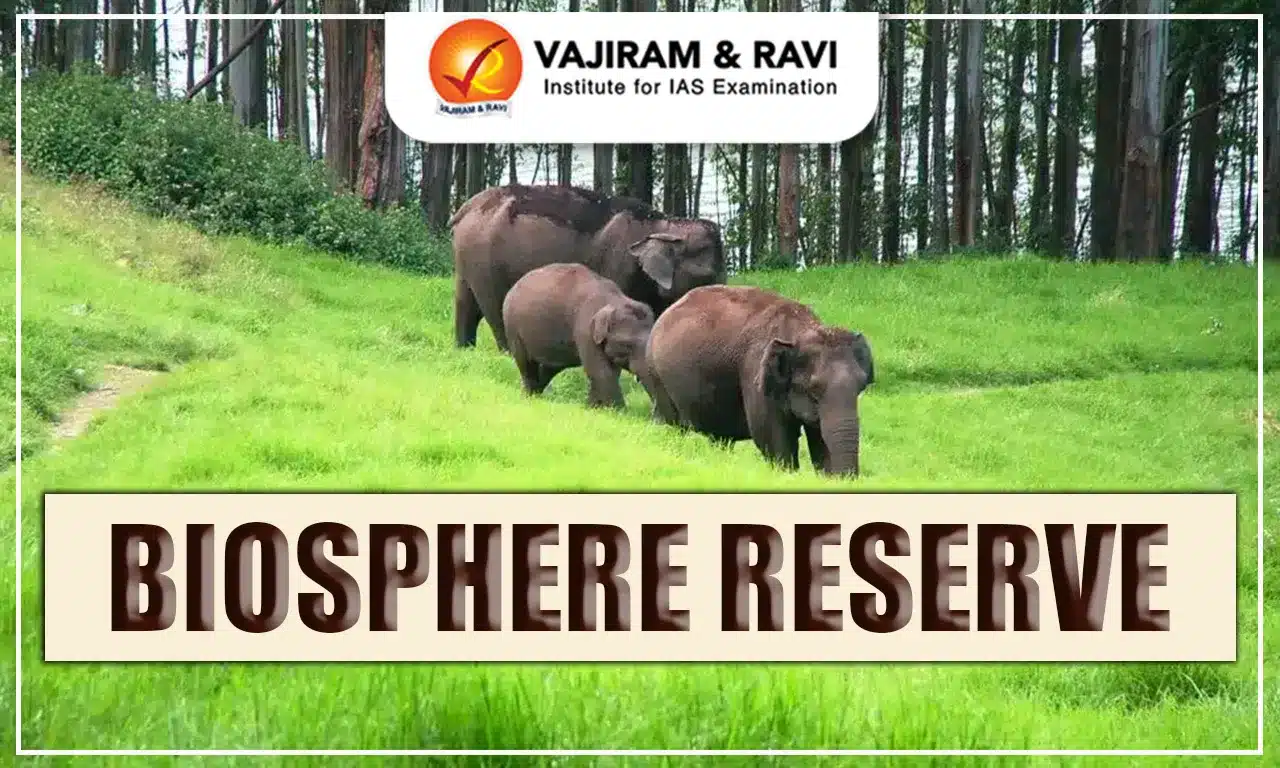
Biosphere Reserves in India 2026 are designated by the Government of India and recognized by the UNESCO (United Nations Educational, Scientific and Cultural Organization) to protect representative parts of natural and cultural landscapes. These areas may cover large terrestrial, coastal, or marine ecosystems, or a combination of both. It protects and maintains the diversity of flora, fauna, and ecosystems and promotes economic and social development that aligns with ecological conservation. Biosphere Reserves serve as living examples of coexistence between humans and nature, demonstrating how development and conservation can progress together while respecting each other’s needs.

What is Biosphere Reserve?

Biosphere Reserves are declared by countries and recognized under UNESCO’s Man and the Biosphere (MAB) Programme. Their main goal is to promote sustainable development through local community involvement and scientific management.

  • These reserves encompass terrestrial, marine, and coastal ecosystems, conserving all forms of life in situ along with their support systems. They also act as reference sites for monitoring and evaluating ecological changes over time.
  • Part of UNESCO’s Man and Biosphere (MAB) framework since 1971, Biosphere Reserves are nominated by national governments. There are over 500 reserves across more than 100 countries, highlighting their importance in preserving ecosystems while supporting human development.
  • The Biosphere Reserves programme was initiated by UNESCO in 1971, with the first reserve established in 1979. Since then, the network has grown to 686 reserves across 122 countries, including 20 transboundary sites.
  • Biosphere Reserves are nominated by national governments and remain under the sovereign jurisdiction of the countries where they are located. Despite this, their status is internationally recognized, highlighting their global importance in biodiversity conservation and sustainable development.

Biosphere Reserves Structure

Biosphere Reserves are structured into three interconnected zones, each designed to balance conservation with sustainable use. These zones work together to protect biodiversity while supporting research, education, and local livelihoods.

Biosphere Reserve Structure
Zone Description Purpose/ Function

Core Area

Strictly protected ecosystem.

Conserves landscapes, ecosystems, species, and genetic variation.

Buffer Zone

Surrounds or adjoins the core area.

Supports ecological practices, scientific research, monitoring, training, and education.

Transition Area

Outermost zone with human settlements and activities.

Encourages sustainable economic and human development, blending ecological and socio-cultural needs.

Biosphere Reserves Declaration Criteria 2026

The core area of the Biosphere Reserves should represent a typical bio-geographical unit and be large enough to sustain viable populations across all trophic levels.

  • It must include an effectively protected and minimally disturbed core zone with significant value for nature conservation.
  • The site should have potential for preserving traditional tribal or rural lifestyles that reflect harmonious use of the environment.
  • The management authority must involve and cooperate with local communities to integrate biodiversity conservation with socio-economic development.
  • Efforts should focus on managing and containing conflicts while using community knowledge and experience for sustainable outcomes.

How Many Biosphere Reserves are there in India?

There are currently 18 total Biosphere Reserves in India as of 2026. Among these, 13 Reserves are officially recognized by UNESCO under MAB (Man and the Biosphere) Programme. According to the 2025 report of FAO, India ranks 9th globally in terms of Forest Area cover and 3rd globally in terms of annual gain through forests. Several Government initiatives promote the management and functioning of the Biosphere Reserves in India, such as- Project Tiger, Project Elephant, Green India Mission, etc.

List of 18 Biosphere Reserves of India with States 2026

India is home to a rich natural heritage, with ecosystems, to preserve this biodiversity and promote sustainable development, the country has established 18 Biosphere Reserves.  Below is the complete List of Biosphere Reserves in India 2026, along with their year of establishment, states covered, and key species protected.

List of 18 Biosphere Reserves in India State Wise 2026
S No Establish Year UNESCO Recognition Date Biosphere Reserves UNESCO Recognition State(s) Key Species Area (km²)
1

1986

2000

Nilgiri

Recognized

Tamil Nadu, Karnataka, Kerala

Nilgiri Tahr, Tiger

5,520

2

1988

2004

Nanda Devi

Recognized

Uttarakhand

Snow Leopard, Musk Deer

5,860

3

1988

2009

Nokrek

Recognized

Meghalaya

Red Panda, Hoolock Gibbon

820

4

1989

2001

Gulf of Mannar

Recognized

Tamil Nadu

Dugong, Olive Ridley Turtle

10,500

5

1989

2001

Sundarbans

Recognized

West Bengal

Royal Bengal Tiger

9,630

6

1989

-

Manas

Not Recognized

Assam

Asiatic Elephant, Golden Langur

2,837

7

1989

2013

Great Nicobar

Recognized

Andaman & Nicobar

Saltwater Crocodile, Nicobar Megapode

885

8

1994

2009

Simlipal

Recognized

Odisha

Gaur, Tiger, Elephant

4,374

9

1998

-

Dihang-Dibang

Not Recognized

Arunachal Pradesh

Takin, Red Panda

5,112

10

1997

-

Dibru-Saikhowa

Not Recognized

Assam

Gangetic Dolphin, Bengal Tiger

765

11

1999

2009

Pachmarhi

Recognized

Madhya Pradesh

Indian Giant Squirrel

4,981

12

2000

2018

Khangchendzonga

Recognized

Sikkim

Red Panda, Snow Leopard

2,620

13

2001

2016

Agasthyamalai

Recognized

Kerala, Tamil Nadu

Nilgiri Tahr, Elephant

3,500

14

2005

2012

Achanakmar-Amarkantak

Recognized

Madhya Pradesh, Chhattisgarh

Wild Dog, Sarus Crane

3,835

15

2008

-

Great Rann of Kutch

Not Recognized

Gujarat

Indian Wild Ass

12,454

16

2009

2025

Cold Desert

Recognized

Himachal Pradesh

Snow Leopard

7,770

17

2010

-

Seshachalam Hills

Not Recognized

Andhra Pradesh

Slender Loris

4,755

18

2011

2020

Panna

Recognized

Madhya Pradesh

Bengal Tiger, Chinkara

2,998

UNESCO Biosphere Reserves in India 2026

There are a total 13 Biosphere Reserves in India Recognized by UNESCO under MAB.  These include: Achanakmar-Amarkantak, Pachmarhi, Agasthyamala, Gulf of Mannar, Khangchendzonga, Nokrek, Cold Desert, Great Nicobar, Nilgiri, Panna, Similipal, Nanda Devi and Sunderban. These UNESCO Biosphere Reserves have been discussed in detail below:

1. Achanakmar-Amarkantak Biosphere Reserve

The Achanakmar-Amarkantak Biosphere Reserve is a biodiversity rich UNESCO Biosphere Reserve spread across Madhya Pradesh and Chhattisgarh with diverse forests and wildlife.

  • Location: The biosphere reserve covers about 3,83,551 hectares at the junction of major hill ranges in Madhya Pradesh and Chhattisgarh. Its landscape includes mountains, valleys, plains and dense forests, creating diverse natural habitats.
  • UNESCO Recognition: The reserve was included in the UNESCO World Network of Biosphere Reserves in 2012.
  • Biodiversity: About 63% of the reserve is covered by moist deciduous forests. It supports nearly 1,498 plant species and 327 animal species, including the four horned antelope, Indian wild dog, sarus crane, Asian white backed vulture and several rare and threatened species.
  • Ecological and Human Importance: The reserve has varied rocks and fertile soils that support forests, rivers and wildlife. Around 418 villages with tribal and non tribal communities depend on agriculture, medicinal plants, bamboo handicrafts and other non timber forest products for their livelihoods.

2. Pachmarhi Biosphere Reserve

Pachmarhi Biosphere Reserve is a UNESCO recognised protected area in central India, known for its rich forests, wildlife, unique landscapes and ecological importance.

  • Location: Pachmarhi Biosphere Reserve is located in Madhya Pradesh within the Satpura Range of the Deccan Peninsula. It covers about 4,981.72 sq km and includes Bori Sanctuary, Satpura National Park and Pachmarhi Sanctuary, together forming the Satpura Tiger Reserve.
  • UNESCO Recognition: It was recognised by UNESCO in 2009. The reserve is internationally recognised under UNESCO's World Network of Biosphere Reserves for conserving biodiversity while promoting sustainable development.
  • Biodiversity and Ecosystems: Tropical moist deciduous, tropical dry deciduous and subtropical hill forests dominate the reserve. Teak and sal are the major tree species. It also contains over 150 medicinal plant species, 50 mammal species, 254 bird species, 30 reptile species and 50 butterfly species.
  • Important Ecological and Cultural Features: The reserve includes valleys, waterfalls, marshes, streams and the Pachmarhi Plateau, often called the "Queen of Satpura." It provides habitat for gaur, tiger, leopard, giant squirrel and crested serpent eagle, while also preserving ancient rock paintings and supporting traditional tribal communities.

3. Agasthyamala Biosphere Reserve

Agasthyamala Biosphere Reserve or Agasthyamalai Biosphere Reserve is a UNESCO recognised biodiversity hotspot in the southern Western Ghats, known for its rich forests and endemic species.

  • Location: Agasthyamala Biosphere Reserve is located at the southern end of the Western Ghats across Kerala and Tamil Nadu. It covers about 3,500 sq. km., extends through Thiruvananthapuram, Kollam, Tirunelveli and Kanniyakumari and includes Agasthyamala Peak (1,868 m).
  • UNESCO Recognition: The reserve was recognised as a UNESCO Biosphere Reserve in 2016 for its exceptional biodiversity and conservation value. 
  • Other Protected Areas: It includes Shendurney, Peppara, Neyyar Wildlife Sanctuaries and the Kalakad Mundanthurai Tiger Reserve, strengthening ecosystem protection.
  • Biodiversity: The reserve supports 2,254 higher plant species (about 405 are endemic). It is home to mammals, birds, reptiles, amphibians and fish, and plant species including cardamom, pepper, nutmeg, jamun and plantain.
  • Communities and Cultural Significance: The Kani tribal community depends on forest resources for its livelihood while following traditional conservation practices.

4. Gulf of Mannar Biosphere Reserve

Gulf of Mannar is one of India's richest marine biodiversity regions, known for coral reefs, seagrass beds, mangroves and rare marine species.

  • Location: The Gulf of Mannar lies between the south-eastern coast of Tamil Nadu and Sri Lanka in the Indian Ocean. It covers about 10.5 lakh hectares and includes 21 islands, making it an important marine ecosystem and coastal conservation region.
  • UNESCO Recognition: The Gulf of Mannar Biosphere Reserve was recognised under UNESCO's Man and the Biosphere (MAB) Programme in 2001. It is India's first marine biosphere reserve and promotes biodiversity conservation, sustainable resource use and community participation.
  • Rich Marine Biodiversity: The Gulf supports over 4,200 species of plants and animals. Its coral reefs, seagrass beds and mangrove forests provide habitat for dugong (Dugong dugon), sea turtles, ornamental fishes, crustaceans, molluscs, echinoderms and the rare Balanoglossus living fossil.
  • Ecological and Cultural Importance: Seagrass beds act as breeding and feeding grounds for marine life, while coral reefs protect the coastline and support fisheries. The region also includes Rameswaram on Pamban Island, an important pilgrimage centre, making the Gulf significant for both ecology and cultural heritage.

5. Khangchendzonga Biosphere Reserve

Khangchendzonga Biosphere Reserve is a UNESCO recognised Himalayan biosphere reserve in Sikkim, known for its rich biodiversity, glaciers, alpine ecosystems and rare wildlife.

  • Location: Located in northern and western Sikkim along the borders of Nepal and Tibet (China), the biosphere reserve covers about 2,93,112 hectares.
  • UNESCO Recognition: Khangchendzonga Biosphere Reserve was included in the UNESCO World Network of Biosphere Reserves in 2018. It lies within one of the world's 34 global biodiversity hotspots and plays an important role in conserving the Himalayan ecosystem.
  • Biodiversity and Ecological Features: The reserve contains glaciers, alpine meadows, forests, deep valleys, rocky landscapes and important lakes spread across seven watersheds. 
  • Cultural and Conservation Importance: The biosphere reserve has great religious significance, with many sacred mountains, lakes, caves, hot springs and pilgrimage sites. Around 44 villages are located in the transition zone, where people mainly depend on agriculture, horticulture, animal husbandry and limited tourism for their livelihood.

6. Nokrek Biosphere Reserve

Nokrek Biosphere Reserve is a UNESCO Biosphere Reserve in Meghalaya, known for its rich biodiversity, evergreen forests, rare wildlife and unique wild citrus species.

  • Location: Nokrek Biosphere Reserve is located on the Tura Range of the Meghalaya Plateau in north-eastern India. It covers about 82,000 hectares and includes Nokrek Peak (1,412 m), the highest point in the Garo Hills. Major rivers such as the Simsang, Ganol and Dareng originate here.
  • UNESCO Recognition: Nokrek Biosphere Reserve was included in the UNESCO World Network of Biosphere Reserves in 2009.
  • Rich Biodiversity: Nearly 90% of the reserve is covered by evergreen forests. It is famous for the rare Indian wild orange (Citrus indica). Important plant species include cotton tree, hairy sterculia and golden shower tree. Wildlife includes tiger, leopard, Asian elephant, hoolock gibbon, slow loris, giant flying squirrel and pig tailed macaque.
  • Conservation Importance: The reserve protects important river catchments, supports groundwater recharge and helps maintain ecological balance in the Garo Hills. Sustainable livelihood programmes, including beekeeping, horticulture and freshwater pond development, are being promoted to reduce shifting cultivation and conserve biodiversity.

7. Cold Desert Biosphere Reserve

Cold Desert Biosphere Reserve is a high altitude UNESCO Biosphere Reserve in the Trans Himalayan region of Himachal Pradesh, known for its unique cold desert ecosystem and rich biodiversity.

  • History: The Cold Desert was established in 2009 and was officially included in the UNESCO World Network of Biosphere Reserves in September 2025.
  • Location: The Cold Desert Biosphere Reserve is located in the Lahaul and Spiti district of Himachal Pradesh. Spread over about 7.77 lakh hectares, it lies at elevations between 3,300 and 6,600 metres and includes Pin Valley National Park, Kibber Wildlife Sanctuary and Chandratal Wildlife Sanctuary.
  • UNESCO Status: India nominated the Cold Desert Biosphere Reserve to the UNESCO World Network of Biosphere Reserves in 2025. It represents one of the world's highest cold desert ecosystems.
  • Biodiversity: Important flora include Himalayan birch, willow leaved sea buckthorn and Persian juniper, while key wildlife includes the snow leopard, Himalayan ibex, blue sheep, Himalayan wolf, Himalayan snowcock and golden eagle.
  • People and Conservation Significance: Local communities mainly practice agro pastoralism, yak and goat rearing and cultivate barley and peas. Traditional Sowa Rigpa medicine, Buddhist culture and community based management help conserve the fragile alpine ecosystem while supporting sustainable livelihoods.

8. Great Nicobar Biosphere Reserve

Great Nicobar Biosphere Reserve is a biodiversity rich protected area in the southernmost Nicobar Islands, known for tropical forests, endemic wildlife and UNESCO recognition.

  • Location: Great Nicobar Biosphere Reserve is located on Great Nicobar Island, the southernmost island of the Nicobar archipelago in the Andaman and Nicobar Islands. It covers about 104,400 hectares with Mount Thullier (642 m) as its highest peak.
  • UNESCO Recognition: The reserve was included in the UNESCO World Network of Biosphere Reserves in 2013. 
  • Flora and Fauna: The reserve supports around 650 plant species, including rare Cyathea albosetacea (tree fern) and Phalaenopsis speciosa (orchid). It also records over 1,800 animal species, including the dugong, Nicobar megapode, saltwater crocodile, marine turtles, crab eating macaque and Nicobar tree shrew, many of which are endemic or threatened.
  • Indigenous Communities and Conservation: The reserve is home to the Shompen and Nicobarese communities. The Shompen mainly depend on forests for hunting and gathering, while the Nicobarese and other settlers rely on fishing, agriculture and horticulture, making conservation and sustainable resource use important for the region.

9. Nilgiri Biosphere Reserve

Nilgiri Biosphere Reserve is India's first biosphere reserve, located in the Western Ghats and known for its exceptional biodiversity, endemic species and diverse forest ecosystems.

  • Location: The Nilgiri Biosphere Reserve is spread across Tamil Nadu, Kerala and Karnataka in the Western Ghats. It includes hills, valleys, grasslands and forests.
  • UNESCO Status: India nominated the Nilgiri Biosphere Reserve under UNESCO's Man and the Biosphere (MAB) Programme in 2000.
  • Biodiversity: The reserve contains evergreen, semi evergreen, moist deciduous, dry deciduous, thorn forests, montane shola forests and grasslands.
  • Flora and Fauna: The reserve protects endangered wildlife such as the Bengal tiger, Asian elephant, lion tailed macaque, Nilgiri tahr, gaur, sambar, chital and barking deer. Notable endemic plants include Rhododendron arboreum, Michelia nilagirica, Garcinia gummi gutta and Actinodaphne malabarica, making it a globally important conservation landscape.

10. Panna Biosphere Reserve

Panna Biosphere Reserve in Madhya Pradesh protects forests, wetlands, rivers and endangered wildlife, including the Bengal tiger population.

  • Location: Located in the Central Highlands of Madhya Pradesh, the reserve covers about 2,99,898 hectares. It includes Panna National Park, parts of Gangau Sanctuary and surrounding reserved and protected forests, forming an important ecological landscape of north-central India.
  • UNESCO status: Panna Biosphere Reserve was nominated to UNESCO’s World Network of Biosphere Reserves in 2020. 
  • flora and fauna: The reserve supports dry deciduous forests, seasonal vegetation, aquatic habitats and marshy ecosystems. Important animals include the Bengal tiger, caracal, jungle cat and bird species including the Indian paradise flycatcher along the Ken River.
  • Conservation and human importance: Panna National Park is also a Tiger Reserve and contains a notified Critical Tiger Habitat. Nearly 300 villages depend on forest resources, while agriculture, ecotourism, medicinal plants and cultural tourism support sustainable development in the region.

11. Similipal Biosphere Reserve

Similipal Biosphere Reserve is a UNESCO recognised protected area in Odisha, known for rich biodiversity, dense sal forests, wildlife conservation and tribal heritage.

  • Location: Similipal Biosphere Reserve is located in the Mayurbhanj district of Odisha within the Mahanadian East Coastal and Chhotanagpur biogeographical regions. It has volcanic sedimentary rock formations, the Khairiburu peak (1,168 m) and many waterfalls and rivers, including the Budhabalang, Baitarani and Subarnarekha.
  • UNESCO Biosphere Reserve Status: Similipal was included in the UNESCO World Network of Biosphere Reserves in 2009. 
  • Flora and Fauna: The reserve contains India's largest sal (Shorea robusta) forest and supports plant species including orchid and medicinal plants. It is home to Bengal tigers, Asiatic elephants and several endangered plants and animals.
  • Tribal and Cultural Importance: Indigenous communities such as the Erenga Kharias, Mankirdias, Ho, Munda and Gonda maintain traditional livelihoods.

12. Nanda Devi Biosphere Reserve

Nanda Devi Biosphere Reserve is a UNESCO recognised Himalayan biosphere reserve in Uttarakhand, known for rich biodiversity, alpine ecosystems, glaciers and rare wildlife.

  • Location: Nanda Devi Biosphere Reserve is located in Uttarakhand in the western Himalayas. It includes the Nanda Devi National Park and Valley of Flowers National Park as its core protected areas. The reserve lies between the Zanskar and Great Himalaya mountain ranges.
  • UNESCO Recognition: The reserve was designated as a UNESCO Biosphere Reserve in 2004. Its core areas are also part of the UNESCO World Heritage Site in India.
  • Biodiversity: The reserve consists of diverse habitats such as alpine meadows (bugyals), forests, glaciers and snowfields. It supports Rhododendron campanulatum, Rhododendron anthopogon and Salix denticulata, with many native and endemic Himalayan species.
  • Important Wildlife and Communities: The reserve provides habitat to endangered animals such as the snow leopard, Himalayan black bear, brown bear, musk deer and bharal (blue sheep). Local communities, including the Bhotia people, depend on agriculture, medicinal plants, sheep rearing and ecotourism for their livelihoods.

13. Sunderban Biosphere Reserve

The Sunderban Biosphere Reserve is the world's largest mangrove ecosystem and an important biodiversity hotspot located in the Ganga Delta.

  • Location: The Sunderban Biosphere Reserve is situated in the Ganga Delta of West Bengal, bordering Bangladesh. It is bounded by the Muriganga River in the west and the Harinbhanga and Raimangal rivers in the east. 
  • UNESCO Status: It was designated as a UNESCO Biosphere Reserve in 2001. The core area of the reserve is the Sunderban National Park, which is also a UNESCO World Heritage Site.
  • Biodiversity: The reserve contains mangrove plant species and several animal species. It is the largest continuous habitat of the Royal Bengal Tiger and also supports saltwater crocodiles, hawk eagles, etc.
  • Significance: The Sunderban acts as a natural fish nursery, supports fisheries, protects coastal areas and helps maintain ecological balance. Local communities depend on forest products such as honey, wax, timber and fuelwood, while conservation programmes promote sustainable livelihoods.

Biosphere Reserves in India Not Recognized by UNESCO 2026

There are total 18 Biosphere Reserves in India out of which 13 have been recognized under MAB while remaining 5 Biosphere Reserves include:

1. Dihang-Dibang Biosphere Reserve

Established in 1998, Dihang-Dibang Biosphere Reserve protects one of the richest biodiversity zones of the Eastern Himalayas in Arunachal Pradesh.

  • Location: Situated across Dibang Valley, Upper Siang and West Siang districts of Arunachal Pradesh, it lies in the Eastern Himalayas and Mishmi Hills, named after the Dihang (Siang) and Dibang rivers, with elevations exceeding 5,000 metres.
  • Flora: Vegetation changes continuously from subtropical evergreen forests to temperate forests, conifer forests, alpine meadows and mountain tundra, supporting orchids, rhododendrons, oak, maple, fir, spruce, juniper, bamboo, medicinal plants, mosses and lichens.
  • Fauna: It shelters rare species including Red Panda, Mishmi Takin, Musk Deer, Red Goral, Gongshan Muntjac, Tiger, Clouded Leopard, Snow Leopard and Asiatic Black Bear, besides important birds such as Sclater's Monal and Blyth's Tragopan.
  • Key Features: The reserve includes Mouling National Park and Dibang Wildlife Sanctuary, forms a major ecological corridor of the Eastern Himalayas, protects Brahmaputra watershed systems and has recorded discoveries such as the Mechuka Giant Flying Squirrel.

2. Dibru-Saikhowa Biosphere Reserve

Located in Assam, Dibru-Saikhowa Biosphere Reserve protects floodplain forests, wetlands and river islands shaped by the Brahmaputra river system.

  • Location: Situated in Assam, the reserve is influenced by the Dibru and Brahmaputra rivers and experiences a tropical monsoon climate, creating extensive wetlands and floodplain ecosystems.
  • Flora: Major vegetation includes semi evergreen forests, tropical moist deciduous forests, swamp forests, bamboo, cane brakes and grasslands, with notable plants such as Rauvolfia (Sarpagandhi), Benteak and Livistona orchids.
  • Fauna: It provides habitat for endangered species including the White winged Wood Duck, Hoolock Gibbon and Wild Buffalo, besides supporting rich wetland birds and aquatic wildlife.
  • Key Features: The reserve contains Dibru-Saikhowa National Park, which was first declared a Wildlife Sanctuary in 1986 and is recognised for conserving Assam's riverine floodplain biodiversity.

3. Great Rann of Kutch Biosphere Reserve

The Great Rann of Kutch preserves India's vast seasonal salt desert and supports unique desert wildlife and traditional communities.

  • Location: Located in Gujarat, it is a vast seasonal salt marsh that was once connected to the Arabian Sea before geological changes transformed it into an inland salt desert.
  • Flora: Sparse shrub vegetation, saline grasslands and scattered wetland patches appear after the monsoon, supporting plant communities adapted to highly saline and dry conditions.
  • Fauna: The nearby Little Rann of Kutch Wild Ass Sanctuary, covering about 4,953 sq km, protects the world's last wild population of the Indian Wild Ass (Khur) along with Blackbuck, Chinkara and Nilgai.
  • Key Features: During the monsoon the marsh fills with water, while summer leaves a white salt crust. Wetlands attract Pink Flamingoes and surrounding villages are renowned for Kutchi embroidery, Rogan painting, pottery and leather crafts.

4. Seshachalam Hills Biosphere Reserve

Declared in September 2010, Seshachalam Hills became Andhra Pradesh's first Biosphere Reserve, conserving Eastern Ghats biodiversity and endemic Red Sanders forests.

  • Location: Spread across Chittoor and Kadapa districts of Andhra Pradesh, the reserve covers about 4,756 sq km within the Eastern Ghats, with rugged hills, deep valleys and elevations reaching nearly 1,000 metres.
  • Flora: Dominated by Tropical Southern Dry Mixed Deciduous forests, it is globally famous for the endangered Red Sanders (Pterocarpus santalinus) and also supports moist deciduous patches, semi evergreen vegetation and medicinal plants.
  • Fauna: The reserve supports wildlife such as the Slender Loris, numerous reptiles, birds and several other forest species adapted to the dry hill ecosystem.
  • Key Features: It includes Sri Venkateswara National Park, the Tirumala Natural Arch, seasonal streams of the Pennar basin and the culturally important seven Tirumala hills, combining ecological and religious significance.

5. Manas Biosphere Reserve

Manas Biosphere Reserve is among India's finest grassland forest ecosystems and an internationally important conservation landscape along the India-Bhutan border.

  • Location: Located in Assam at the foothills of the Eastern Himalayas, it shares a transboundary landscape with Royal Manas National Park in Bhutan, while the Manas River, a Brahmaputra tributary, shapes its fertile floodplains.
  • Flora: The reserve contains semi evergreen forests, moist deciduous forests, swamp forests and alluvial grasslands, supporting diverse trees, shrubs, herbs, orchids, climbers and grasses.
  • Fauna: It supports nearly 60 mammal species, over 500 bird species and more than 40 reptile species, including the Bengal Tiger, Indian Elephant, One horned Rhinoceros, Wild Water Buffalo, Clouded Leopard, Golden Langur, Pygmy Hog, Hispid Hare and Bengal Florican.
  • Key Features: Declared a Wildlife Sanctuary (1950), included under Project Tiger (1973), designated a UNESCO World Heritage Site (1985), notified as a Biosphere Reserve (1989) and upgraded to a National Park (1990), it remains a vital transboundary conservation landscape.

Which is the 18th Biosphere Reserve of India 2026?

As of November 2026, Panna Biosphere Reserve in Madhya Pradesh is the 18th Biosphere Reserve of India in 2026, established in 2011 and covering 2,998 km². The Cold Desert Biosphere Reserve (2025) is the latest UNESCO addition but was established as a reserve by the government earlier in 2009.

First Biosphere Reserve in India

The Nilgiri Biosphere Reserve, established in 1986, holds the distinction of being the 1st Biosphere Reserve in India. Spread across Tamil Nadu, Karnataka, and Kerala, it forms part of the Western Ghats, a global biodiversity hotspot. This reserve shelters a wide range of unique flora and fauna, including the endangered Nilgiri Tahr, the Lion-tailed Macaque, and the Malabar Giant Squirrel. Its diverse landscapes, from montane forests to grasslands, make it a vital ecological region, balancing conservation with the livelihood needs of local communities.

Smallest Biosphere Reserve in India

Nokrek Biosphere Reserve in Meghalaya is known as the Smallest Biosphere Reserve in India covering only 820 km². The location provides shelter to Red Panda, Hoolock Gibbon and unique citrus plant species.

Biosphere Reserves under MAB Importance

  • Conservation of Biodiversity - Protects endangered species, rare plants, animals, and ecosystems.
  • Sustainable Development - Encourages eco-tourism, organic farming, and traditional practices supporting local communities.
  • Climate Change Mitigation - Forests and wetlands act as carbon sinks, reducing global warming.
  • Research and Education - Provides opportunities for scientific research, wildlife studies, and conservation awareness.
  • Cultural Preservation - Safeguards indigenous tribes, their traditions, and sustainable lifestyles.

Biosphere Reserves Challenges

  • Human Encroachment - Expansion of agriculture, grazing, and settlements disrupts natural habitats.
  • Deforestation & Poaching - Illegal logging, hunting, and wildlife trade reduce biodiversity.
  • Climate Change - Alters rainfall, temperature, and ecosystem balance, affecting species survival.
  • Lack of Funding - Limited financial support weakens conservation and monitoring programs.
  • Tourism Pressure - Unregulated tourism leads to waste generation and habitat degradation.
  • Conflict with Locals - Restrictions on resource use often clash with community livelihood needs.

Difference Between Biosphere Reserves and National Parks/ Wildlife Sanctuaries

To understand conservation in India better, it’s important to know Difference Between Biosphere Reserve and National Park & Wildlife Sanctuaries. Both aim at protecting biodiversity, but their objectives, legal backing, and approach vary.

Difference Between Biosphere Reserves and National Park & Wildlife Sanctuaries

National Park/ Wildlife Sanctuary

Biosphere Reserves

National Parks, Wildlife Sanctuaries, Conservation Reserves, Community Reserves and Tiger Reserves are established as per provisions of the Wildlife Protection Act 1972

There is no law as such under which these Reserves are established.

No grazing or private tenurial rights land rights are allowed in National Parks.

Biosphere reserves serve as ‘living laboratories’ for testing out and demonstrating integrated management of land, water and biodiversity. Thus, limited economic activity (sand and stone mining) is permitted

Wildlife sanctuaries and national parks are set up for the protection of mammals normally

They envisage protection of plant species, Invertebrates and biotic community as a whole


Also Check Other Posts
Biosphere Reserves in India National Parks in India
Waterfalls in India Highest Peak in India
Ramsar Sites in India Wildlife Sanctuaries in India
Dams in India Tiger Reserves in India
Mountain Passes in India Longest Bridge in India

Biosphere Reserves in India FAQs

Q1: What is the definition of Biosphere Reserve?

Ans: A biosphere reserve is a protected area conserving biodiversity, supporting sustainable development, and prompting research and education for environmental protection.

Q2: How many Biosphere Reserve in India 2026?

Ans: There are 18 total biosphere reserves in India 2026, of which 13 are part of UNESCO’s World Network of Biosphere Reserves under MAB.

Q3: How any UNESCO Biosphere Reserves in India 2026?

Ans: As of 2026, there are total 13 UNESCO Biosphere Reserves in India out of total 18 officially recognized Biosphere Reserves in India

Q4: What is the difference between a national park and a biosphere reserve?

Ans: A national park protects specific wildlife, while a biosphere reserve conserves biodiversity, includes human settlements, and promotes sustainable use.

Q5: Which is the Largest Biosphere Reserve in India?

Ans: The Gulf of Mannar Biosphere Reserve in Tamil Nadu is the largest in India.

Cyclone Akvan 2026, Origin, Formation, Affected Areas and Impact

Cyclone Akvan

Cyclone Akvan is a tropical cyclonic weather system developing over the Bay of Bengal, posing a threat to India's eastern coastal regions. Formed from a low-pressure system, it is expected to bring heavy rainfall, strong winds, rough seas and possible coastal flooding. According to the India Meteorological Department (IMD), the cyclone may intensify into a severe cyclonic storm and move towards the Andhra Pradesh coast, affecting neighbouring states such as Tamil Nadu, Odisha and West Bengal. 

Cyclone Akvan Latest News

Cyclone Akvan is a developing tropical cyclone over the Bay of Bengal, expected to intensify into a severe cyclonic storm. The India Meteorological Department (IMD) has issued warnings for heavy rainfall and strong winds across several coastal states.

  • Cyclone Formation: The IMD has forecast that a deep depression over the southeast and adjoining southwest Bay of Bengal will strengthen into Cyclone Akvan on November 16, 2026, and a severe cyclonic storm by November 17.
  • Expected Movement: The cyclone is moving north-northwestwards and is likely to approach the Andhra Pradesh coast around November 19, potentially intensifying into a very severe cyclonic storm.
  • Rainfall Alerts: Heavy to extremely heavy rainfall is expected across Andhra Pradesh, Tamil Nadu, Puducherry, Karaikal and Odisha, while parts of West Bengal may also receive heavy rain.
  • Disaster Preparedness: Andhra Pradesh and Odisha have stepped up emergency preparations, including rescue teams, evacuation arrangements and warnings for fishermen.

How Was Cyclone Akvan Named and its Meaning?

The name Cyclone Akvan was proposed by Iran under the international tropical cyclone naming system. Cyclone names help meteorological agencies communicate weather warnings clearly and improve public awareness and disaster preparedness.

  • Naming Country: The name Akvan was proposed by Iran under the naming system of the World Meteorological Organization (WMO) and UNESCAP Panel on Tropical Cyclones.
  • Meaning of Akvan: The name is associated with Akvan-e Div, a demon-like character from Persian mythology mentioned in the epic Shahnameh, written by Ferdowsi. However, the official naming list does not specify an English translation.
  • Naming Authority: The Regional Specialised Meteorological Centre (RSMC), New Delhi, operated by the IMD, assigns names to cyclonic storms forming over the Bay of Bengal and Arabian Sea.
  • Naming Process: The 13 participating countries have contributed 169 cyclone names, which are used in a fixed sequence to help identify storms and communicate weather warnings.

Also Read:- Cyclone Arnab 2026

Development of Cyclone Akvan

Cyclone Akvan developed from a low-pressure system over the southeast Bay of Bengal. Favourable atmospheric and oceanic conditions allowed it to strengthen into a depression, with the IMD forecasting further intensification as it moves towards India's eastern coast.

  • Initial Formation: A low-pressure area developed over the southeast Bay of Bengal on November 13, 2026, strengthening into a well-marked low-pressure area on November 14.
  • Depression Stage: The system intensified into a depression on November 15 and subsequently developed into a deep depression while moving north-northwestwards.
  • Cyclonic Intensification: The IMD expects the system to become a cyclonic storm on November 16 and a severe cyclonic storm on November 17 over the west-central Bay of Bengal.
  • Further Strengthening: It may develop into a very severe cyclonic storm by November 19, with sustained winds potentially reaching 120-130 kmph, gusting up to 145 kmph.
  • Recent Cyclonic Activity: Akvan follows Cyclones Arnab and Murasu, making it the third cyclone threat in the Bay of Bengal region within a few weeks.

Also Read:- Cyclone Murasu 2026

Expected Path of Cyclone Akvan and Affected Areas

According to the IMD forecast of November 16, 2026, Cyclone Akvan is expected to move northwestwards towards the Andhra Pradesh coast, bringing heavy rainfall, strong winds and rough sea conditions. Several coastal states have been placed on alert due to possible flooding and infrastructure damage.

  • Andhra Pradesh: Heavy to extremely heavy rainfall is expected during November 19-20, with possible landfall between Nellore and Tuni on November 20 and winds of 120-130 kmph.
  • Tamil Nadu, Puducherry and Karaikal: Heavy to very heavy rainfall is likely during November 17-19, particularly in Chennai, Tiruvallur and Chengalpattu, with possible waterlogging.
  • Odisha: Ganjam, Gajapati and Puri may experience heavy to very heavy rainfall during November 19-21, prompting evacuation and emergency preparedness measures.
  • West Bengal: Heavy rainfall is expected in South 24 Parganas, Purba Medinipur, Howrah and nearby districts during November 19-21, with winds reaching 40 kmph.
  • Potential Impact: The cyclone may cause coastal flooding, crop damage, waterlogging and transport disruptions. Fishermen have been advised to avoid rough seas, while rescue teams remain on alert.

Cyclone Akvan FAQs

Q1: What is Cyclone Akvan?

Ans: Cyclone Akvan is a developing tropical cyclone over the Bay of Bengal, forecast to intensify into a severe cyclonic storm by November 17, 2026, bringing heavy rainfall and strong winds to India's eastern coast.

Q2: Which country has named Cyclone Akvan?

Ans: Iran proposed the name Akvan under the WMO/ESCAP Panel on Tropical Cyclones naming system for the North Indian Ocean.

Q3: What is the meaning of Cyclone Akvan?

Ans: The name Akvan is associated with Akvan-e Div, a mythical demon-like character mentioned in the Persian epic Shahnameh.

Q4: When and where did Cyclone Akvan form?

Ans: Cyclone Akvan originated from a low-pressure area over the southeast Bay of Bengal on November 13, 2026, which strengthened into a depression on November 15.

Q5: When and where is Cyclone Akvan expected to make landfall?

Ans: According to the November 16 IMD forecast, Cyclone Akvan may make landfall between Nellore and Tuni in Andhra Pradesh on November 20, 2026, with winds of 120-130 kmph.

Russia Deploys Geran-5 K5-K Jet-Powered Attack Drones Against Ukrainian Cities

Geran-5

Geran-5 Latest News

Russia began using a variant of its Geran-5 drone known as the K5-K to attack Ukrainian cities, the GUR, Kyiv's military intelligence agency, said recently.

About Geran-5

  • It is a Russian jet-powered one-way attack drone built in the shape of a small cruise missile.  
  • Features:
    • Unlike the propeller-driven Geran-2 drones commonly used in  Russia’s Shahed-style attacks, the Geran-5 is powered by a  turbojet engine and has a conventional aircraft configuration.
    • It is 6.5 meters long, has a wingspan of 3.2 meters and a maximum takeoff weight of up to 850 kilograms. 
    • It is equipped with a warhead weighing about 90 kilograms.
    • It has a cruising speed of 450–600 km/h, a range of about 950 kilometers and can reach an altitude of up to 6 kilometers. 
    • It features an autonomous optical navigation system and a modified fuselage design. 
    • It is equipped with an electro-optical correction system that allows it to navigate using images of the ground surface.

News: BUS

Geran-5 FAQs

Q1: What is Geran-5?

Ans: It is a Russian jet-powered, one-way attack drone designed in the shape of a small cruise missile.

Q2: What type of engine powers the Geran-5 drone?

Ans: A turbojet engine.

Q3: What is the operational range of the Geran-5 drone?

Ans: Approximately 950 km.

Q4: What type of navigation system is used by the Geran-5 drone?

Ans: An autonomous optical navigation system.

Scientists Discover Five New Horned Frog Species in Arunachal Pradesh, Including India’s First Snail-Eating Frog

New Frog Species

New Frog Species Latest News

Recently, a team of Indian and American scientists has discovered five new species of diminutive horned frogs in Arunachal Pradesh.

About New Frog Species  

  • These new five frog species belong to genus Jingophrys, commonly known as diminutive horned frogs.
  • All five new species were discovered in Arunachal Pradesh.
  • Jingophrys taniitatii
    • It is also known as the Tanii Horned Frog, honours the Tanii tribe of the Ziro Valley region and incorporates the Apatani word ‘tatii’, meaning frogs and toads.
  • Jingophrys Tanogogo
    • It is also known as the Snail-eating Horned Frog.
    • The species is the first snail-eating frog known from India and represents the first report of snail-eating behaviour in the frog family Megophryidae.
    • The word ‘tanogogo’ for snails has also been adopted from the Apatani tribal language that is spoken in the region.
  • Jingophrys siangensis
    • It is known as Siang Horned Frog which is named after the Siang region,
    • Other two frog species: Jingophrys hrdy (Hrdy’s Horned Frog) and Jingophrys wularsoni (WuLarson’s Horned Frog) were named after anthropologist Sarah Blaffer Hrdy, medical professor Daniel Bruce Hrdy, and herpetologists.

Source: TH

New Frog Species FAQs

Q1: Where was Snail-eating Horned Frog was discovered?

Ans: Arunachal Pradesh

Q2: Jingophrys taniitatii was named after which tribes ?

Ans: Tanii tribe of the Ziro Valley region

Three Butterfly Species Recorded for First Time in Kerala’s Silent Valley National Park

Silent Valley National Park

Silent Valley National Park Latest News

Three butterfly species — Branded Royal, Extra Lascar and Orange-spotted Grass Jewel — were recorded for the first time in Silent Valley National Park during a three-day butterfly survey that concluded recently. 

About Silent Valley National Park

  • It is located in the heart of the Western Ghats in the Palakkad District of Kerala.
  • Spanning an area of approximately 237.52 sq.km., this national park is part of the Nilgiri Biosphere Reserve and is one of the last undisturbed tracts of tropical rainforest in India.  
  • It is said to be "silent" because of the absence of the cicadas, a type of insect that produces a loud buzzing sound in many forests. 
  • Kunthipuzha, known as the Silent River of India, flows quietly through the park. 
  • Tribal Communities: Kurumba, Muduga, Irula, and Kattu Naiken.
  • Flora: 
    • It is home to over 1,000 species of flowering plants, 108 species of orchids, and several rare and endangered plants. 
    • Plants of high medicinal value as well as the towering Culinea trees are also found here. 
  • Fauna: 
    • The park is famous for its population of lion-tailed macaques, an endangered primate species that is endemic to the Western Ghats. 
    • Other notable mammals include the Nilgiri langur, Malabar giant squirrel, Indian elephant, tiger, leopard, and gaur (Indian bison). 
    • The park is also a paradise for bird watchers, with over 200 species of birds, including the great Indian hornbill, Nilgiri wood pigeon, and several species of eagles and owls.

News: TOI

Silent Valley National Park FAQs

Q1: Where is Silent Valley National Park located?

Ans: In the Western Ghats of Palakkad district, Kerala.

Q2: Which biosphere reserve is Silent Valley National Park part of?

Ans: Nilgiri Biosphere Reserve.

Q3: Which river flows through Silent Valley National Park?

Ans: Kunthipuzha River, also known as the Silent River of India.

Q4: Which endangered primate is Silent Valley National Park particularly famous for?

Ans: Lion-tailed macaque.

Canary Islands Bus Crash: One Dead, 27 Injured After Tourist Bus Falls into Ravine

Canary Islands

Canary Islands Latest News

Spain’s coastguard rescued 1,488 migrants in 14 boats off the Canary Islands recently, the highest one-day total since 2020, with most landing on the small island of El Hierro.

About Canary Islands

  • The Canary Islands are an archipelago located off the northwest coast of Africa in the Macaronesia region of the North Atlantic Ocean.
  • Geographically, the archipelago is part of continental Africa, but politically and economically it is part of Europe.
  • The archipelago is a Spanish territory and is its southernmost autonomous community. 
  • It is approximately 100 km from Morocco and southwest of Spain.
  • It is Macaronesia’s largest and most populated archipelago. 
  • The archipelago comprises seven major islands and numerous other minor islands or islets, divided into two groups.
    • The western group consists of La Palma, Tenerife, La Gomera, Gran Canaria, and Ferro. This group is made up of mountain peaks rising directly from the deep seabed. 
    • The eastern island group comprises Fuerteventura, Lanzarote, and six islets (the Chinijo Archipelago) that all sit on an underwater plateau, the Canary Ridge. 
  • Tenerife is the largest island, spanning 2,034 sq.km. It is the second-largest island in Spain and also Spain’s most populated island.
  • The Canary Islands’ capital, Santa Cruz de Tenerife, is located on the island. Tenerife also hosts Teide, Spain’s highest point.
  • The Canary Islands formed millions of years ago through volcanic eruption, and some of the volcanoes are still active. 
  • The archipelago is the only Spanish region where a volcanic eruption has taken place in the modern era.
  • Most beaches along the Canaries have black sand due to their volcanic composition.

News: FP

Canary Islands FAQs

Q1: Where are the Canary Islands located?

Ans: The Canary Islands are an archipelago located off the northwest coast of Africa in the Macaronesia region of the North Atlantic Ocean.

Q2: Which country does the Canary Islands belong to?

Ans: Spain.

Q3: Which is the largest island in the Canary Islands archipelago?

Ans: Tenerife.

Q4: How were the Canary Islands formed?

Ans: Through volcanic eruptions millions of years ago.

Indian Visa Rules 2026, New Categories, Eligibility and Exemptions

Indian Visa Rules 2026

The Indian Visa Rules 2026 introduce a simplified visa system to make it easier for foreign nationals to visit India for tourism, education, medical treatment, business and other purposes. The Ministry of Home Affairs (MHA) has reduced the number of main visa categories from 13 to 9 and sub-categories from 49 to 23. The new rules aim to simplify visa applications, reduce paperwork and promote tourism, international education, medical travel and investment in India. 

Indian Visa Rules 2026 Latest News

The Indian Visa Rules 2026 introduce a simpler visa system for foreign nationals visiting India for tourism, education, medical treatment, business and other purposes.

  • Fewer Visa Categories: Main categories reduced from 13 to 9 and sub-categories from 49 to 23.
  • Visitor Visa: The Tourist Visa has been renamed the Visitor Visa, covering tourism and other short-term activities.
  • Simplified Application Forms: Visa application forms will have 65-70% fewer fields, reducing paperwork.
  • Medical Visa: Medical visas, including eligible e-Visas, will generally offer one-year validity with multiple entries.
  • Student Visa: Eligible foreign students can receive an e-S1 Visa for up to five years or their course duration, whichever is shorter.
  • Business Visa: Clearer provisions have been introduced for foreign investors, business professionals and technical specialists.

What Are the Different Types of Indian Visas?

Under the revised Indian Visa Rules 2026, visas are organised into nine main categories based on the purpose of travel.

Visa Category

Purpose

1. Visitor Visa

Tourism, business meetings, wellness retreats, transit and mountaineering.

2. Business Visa

Business ventures, investment, conferences, commercial activities and film production.

3. Medical Visa

Conventional and AYUSH medical treatment, including accompanying attendants.

4. Student Visa

Education, research, internships and student exchange programmes.

5. Work Visa

Employment in Indian organisations, NGOs and missionary activities.

6. Diplomatic Visa

Foreign diplomats, including UN diplomats, and their dependents.

7. Official Visa

Non-diplomatic foreign officials, including UN officials, and their dependents.

8. Journalist Visa

Foreign journalists accredited in India.

9. Miscellaneous Visa

Persons of Indian origin, eligible dependents, long-term residents and other specified purposes.

What Are the New Visa Rules?

  • Visitor Visa: Replaces the Tourist Visa, with V-1 (short-term, 30-day multiple entry) and V-2 (longer duration, valid 1, 5 or 10 years).
  • Medical Visa: Four sub-categories - M-1 (conventional treatment), M-2 (attendant for M-1), M-3 (AYUSH treatment) and M-4 (attendant for M-3); M-1 and M-3 generally valid one year with multiple entries.
  • Student Visa: S-1 (school, graduate and postgraduate education) and S-2 (PhD, research, faculty, internships and exchange programmes).
  • Business Visa: B-1 (long-term, licence-based) and B-2 (short-term, contract-based).

What Are the Eligibility Criteria for an Indian Visa in 2026?

Eligibility depends on the applicant's nationality, purpose of visit, duration of stay and visa category.

  • Tourists and Visitors: Foreign nationals visiting India for tourism, short-term meetings, wellness activities or cultural learning.
  • Students: Foreign students admitted to recognised Indian educational institutions.
  • Medical Patients: Foreign nationals seeking conventional or AYUSH medical treatment.
  • Business Professionals: Investors, entrepreneurs, engineers and technical specialists undertaking eligible business activities.
  • Employees: Foreign nationals working with eligible Indian companies, organisations or NGOs.

What Are the New Visa Exemption Rules in India in 2026?

The Immigration and Foreigners (Exemption) (Amendment) Order, 2026 revises visa and passport exemptions for certain foreign nationals.It amends the Immigration and Foreigners (Exemption) Order, 2025, issued under the Immigration and Foreigners Act, 2025. Key provisions include:

  • Religious Minorities: Hindus, Sikhs, Buddhists, Jains, Parsis and Christians from Afghanistan, Bangladesh and Pakistan who entered India by 31 December 2024 due to religious persecution or fear of it retain specified passport and visa exemptions. However, an appropriate visa is required for continued stay.
  • Tibetan Refugees: Tibetans entering India after 1959 with an Entry Permit before 30 May 2003, or a Special Entry Permit thereafter, retain specified exemptions, subject to registration.
  • Sri Lankan Tamil Refugees: Registered Sri Lankan Tamils who sought shelter in India by 9 January 2015 remain eligible for specified exemptions, subject to registration requirements.
  • Other Categories: Certain military personnel, long-term Pakistani residents, Partition-era migrants and persons of Indian origin also receive specified exemptions.
  • Visa Manual: Officially defined as Central Government instructions governing visas, immigration and related matters.

What Are the Passport and Visa Rules for Nepal and Bhutan?

  • Indian, Nepali and Bhutanese citizens travelling between these countries must produce the identity documents prescribed in the Visa Manual.
  • Indian citizens travelling to or returning from third countries through Nepal or Bhutan require valid passports and must use designated immigration posts.
  • Nepali and Bhutanese citizens travelling between India and third countries require valid passports.
  • Those arriving after embarkation or transit through China, Macau, Hong Kong or Pakistan require both valid passports and visas.

Indian Visa Rules 2026 FAQs

Q1: What are the Indian Visa Rules 2026?

Ans: The Ministry of Home Affairs has introduced a simplified visa framework that cuts main visa categories from 13 to 9 and sub-categories from 49 to 23, making applications faster and easier.

Q2: When will the new Indian visa rules come into effect?

Ans: The framework was announced on 11 November 2026 and is expected to become operational by the end of 2026, after the necessary IT upgrades.

Q3: What is the new Visitor Visa in India?

Ans: The Visitor Visa replaces the Tourist Visa. V-1 is a short-term visa with 30-day multiple entry, while V-2 is valid for 1, 5 or 10 years.

Q4: What are the Medical Visa categories under the new rules?

Ans: There are four: M-1 (conventional treatment), M-2 (attendant for M-1), M-3 (AYUSH treatment) and M-4 (attendant for M-3). M-1 and M-3 generally offer one-year multiple-entry validity.

Q5: How long is the Student Visa valid in India?

Ans: Eligible students can get an e-S1 Visa valid for up to five years or the course duration, whichever is shorter.

Ekalavya Model Residential Schools to Introduce Amazon Future Engineer Programme for Tribal Students

Eklavya Model Residential Schools

Eklavya Model Residential School Latest News

Recently, the Prime Minister of India inaugurated four newly constructed Eklavya Model Residential Schools (EMRS) across Tripura on the occasion of the 151st birth anniversary of tribal freedom fighter Bhagwan Birsa Munda.

About Eklavya Model Residential School

  • It is a flagship intervention of the Ministry of Tribal Affairs launched in 1998.
  • It aims to provide quality residential education to Scheduled Tribes students from Class 6th to 12th in remote areas to enable them to access the best opportunities in education and to bring them at par with the general population.
  • The programme was revamped during the year 2018-19 to expand the geographical outreach and enhance the quality of facilities.
  • EMRSs to be set up in every block with more than 50% ST population and at least 20,000 tribal persons. 
  • Governance: The National Education Society for Tribal Students (NESTS), an autonomous organization, has been set up under the Ministry of Tribal Affairs to establish and manage EMRS across the country.

Features of Eklavya Model Residential Schools

  • EMRSs are co-educational residential schools from Class VI to XII.
  • Eklavya schools will be on par with Navodaya Vidyalayas and will have special facilities for preserving local art and culture besides providing training in sports and skill development.
  • Infrastructure: The school infrastructure will include classroom, administrative block, hostels, playground.
  • CBSE curriculum is followed in these schools, and education is completely free.
  • Each school has a capacity of 480 students with an equal number of seats for boys and girls.
  • Non-ST students can be admitted in these schools on seats up to 10% of the total seats. And also reservation of 20% of seats under sports quota for deserving ST students who have excelled in the field of sports.

Source: News On Air

Eklavya Model Residential School FAQs

Q1: What is Eklavya Model Residential School ?

Ans: It is a flagship intervention of the Ministry of Tribal Affairs launched in 1998.

Q2: Which organisationestablish and manage EMRS across the country?

Ans: National Education Society for Tribal Students (NESTS),

Yamuna River Cleaning Drive Launched with Four-Pronged Strategy to Restore River in 3 Years

Yamuna River

Yamuna River Latest News

Despite the political slugfest over the Yamuna River recently, official data show that the river’s Delhi stretch remains heavily polluted for most of the year, with water quality improving during the monsoon, when floodwaters flush out pollutants.

About Yamuna River

  • It is the major tributary of the Ganges River. 
  • Course:
    • It rises in the high Himalaya, in the Yamunotri Glacier in Uttarakhand, at the height of 4,421 meters.
    • It flows in a southerly direction swiftly through the Himalayan foothills and, exiting Uttarakhand, onto the Indo-Gangetic Plain, along the border between Uttar Pradesh and Haryana state to the west. 
    • The Eastern and Western Yamuna canals are fed from the river at that point.
    • The Yamuna then passes Delhi, where it feeds the Agra Canal.
    • South of Delhi, and now wholly within Uttar Pradesh, it turns southeastward.
    • Near Prayagraj, after a course of about 1,376 km, the Yamuna joins the Ganges River. 
    • The confluence of the two rivers is an especially sacred place to Hindus and is the site of annual festivals as well as the Kumbh Mela, which is held every 12 years.
  • Tributaries:
    • Near Dehradun, the capital city of Uttarakhand, the Yamuna is joined by its biggest tributary, the Tons River.
    • The Chambal River is Yamuna’s biggest tributary on the right.
    • Other important tributaries of the Yamuna include the Hindon, Sarda, and Giri rivers on the right and the Betwa and Sindh on the left.
  • The Yamuna River flows near many important cities and landmarks, each adding to its cultural importance:
    • Yamunotri
    • Delhi
    • Agra
    • Mathura
    • Haridwar
    • Vrindavan
    • Prayagraj
    • Etawah
    • Noida
    • Faridabad
    • Hathras

News: TH

Yamuna River FAQs

Q1: Where does the Yamuna River originate?

Ans: From the Yamunotri Glacier in Uttarakhand, in the high Himalayas.

Q2: What is the approximate total length of the Yamuna River?

Ans: Approximately 1,376 km.

Q3: Which is the biggest tributary of the Yamuna River?

Ans: The Tons River.

Q4: Which city is located at the confluence of the Yamuna and Ganges rivers?

Ans: Prayagraj.

Minister Faces Criticism After Video Shows Him Pursuing Tiger in Mudumalai Tiger Reserve

Mudumalai Tiger Reserve

Mudumalai Tiger Reserve  Latest News

Recently, a state minister faced flak after a video showing him pursuing a tiger in the Mudumalai Tiger Reserve (MTR) was posted on social media. 

About Mudumalai Tiger Reserve

  • Location: It is located in the Nilgiris District of Tamil Nadu.
  • It is at the tri–junction of three states, viz, Karnataka, Kerala, and Tamil Nadu.
  • It is part of the Nilgiris Biosphere Reserve, the first biosphere reserve in India.
  • It has a common boundary with Wayanad Wildlife Sanctuary (Kerala) on the west, Bandipur Tiger Reserve (Karnataka) on the north.
  • Terrain: The terrain is undulating, with the elevation ranging from 960m to 1266m.
  • Vegetation: A variety of habitats ranging from tropical evergreen forest, moist deciduous forest, moist teak forest, dry teak forest, secondary grasslands, and swamps are found here.
  • River: The Moyar River runs through the reserve.
  • Flora: It has tall grasses, commonly referred to as “Elephant Grass”, bamboo of the giant variety, and valuable timber species like Teak, Rosewood, etc.
    • It has wild relatives of cultivated plants, viz. wild rice, ginger, turmeric, cinnamon, etc.
  • Fauna: It includes elephant, gaur, sambar, four-homed antelope, spotted deer, barking deer, blackbuck, wild pig, mouse deer, and predators like tigers, leopards, and wild dogs

Source: TH

Mudumalai Tiger Reserve FAQs

Q1: Where is Mudumalai Tiger Reserve located?

Ans: It is located in the Nilgiris District of Tamil Nadu.

Q2: Mudumalai Tiger Reserve shares border with which Wildlife Sanctuary?

Ans: It has a common boundary with Wayanad Wildlife Sanctuary (Kerala).

Government Raises Lakhpati Didi Initiative Target to 6 Crore Women by March 2029

Lakhpati Didi Initiative

Lakhpati Didi Initiative Latest News

Recently, it was observed that, as of June 2026 Lakhpati Didi Initiative has enabled 3.76 crore Lakhpati Didis, with a target of six crore by March 2029. 

About Lakhpati Didi Initiative     

  • It is a flagship effort to strengthen women's economic participation in rural India.
  • It aims to improve household incomes through sustainable livelihood opportunities and enterprise development.
  • The government announced this initiative on 15 August 2023.
  • Target
    • It initially targeted two crore women from Self-Help Group (SHG) households. The target was subsequently increased to three crore in February 2024.
    • The initiative aims to create six crore Lakhpati Didis by March 2029. This target was envisioned in February 2026.
  • The initiative builds on the institutional network of the Deendayal Antyodaya Yojana-National Rural Livelihoods Mission (DAY-NRLM).
  • Objective: To encourage women to start micro-enterprises within their villages.
  • Lakhpati Didi Strategy
    • Deepen, Strengthen and Expand Livelihood options : The households will be facilitated and enabled to take up diversified income-generating activities.
    • Capacity Building: A Cascade Training Strategy is adopted to enable training and handholding of Potential Lakhpati Didis (SHG members) from across all States and Union Territories in India.
  • Financial Assistance:  DAY-NRLM serves as a catalyst, facilitating financial assistance and providing a platform for these women to thrive.
  • Nodal Ministry: Ministry of Rural Development.

Source: PIB

Lakhpati Didi Initiative FAQs

Q1: What is Lakhpati Didi Initiative ?

Ans: It is a flagship effort to strengthen women's economic participation in rural India.

Q2: When was Lakhpati Didi Initiative launched?

Ans: It was launched on 15 August 2023.

Women’s Labour Force Participation – Addressing the Unpaid Care Work Barrier

Women’s Labour Force Participation

Women’s Labour Force Participation Latest News

  • Achieving the goal of Viksit Bharat by 2047 requires India to raise its economic growth rate closer to 8% and expand women’s participation in the workforce.
  • According to the World Bank, increasing the Female Labour Force Participation Rate (FLFPR) to 50% (from  34.6% in Sept 2026) could significantly accelerate India’s progress towards becoming a high-income economy.
  • However, inadequate data on unpaid domestic and caregiving responsibilities makes it difficult to understand why women remain outside paid employment.

Understanding the Gender Gap in Workforce Participation

  • Women’s participation in paid employment is influenced by several factors, including unpaid domestic work, childcare, eldercare, mobility restrictions and workplace accessibility.
  • However, experts caution against assuming a direct relationship between care responsibilities and women's withdrawal from the workforce without adequate empirical evidence.
  • The government is therefore attempting to improve its statistical framework to understand the relationship between unpaid care work and women's employment decisions.
  • The Ministry of Statistics and Programme Implementation (MoSPI) has proposed changes to two major surveys following suggestions from academics, government ministries and economic advisers.

Periodic Labour Force Survey (PLFS)

  • The proposed changes aim to capture the nature and extent of unpaid household work.
  • Key additions include:
    • Identifying whether household-produced goods and services, such as cooking, feeding children and caring for elderly people, are meant for self-consumption or commercial purposes.
    • Asking whether individuals actively sought paid employment during the previous 30 days.
    • Identifying whether they currently wish to undertake paid work.
    • Recording the principal reasons for not seeking employment, including family and household responsibilities.
  • Existing data gap:
    • The PLFS already asks individuals outside the workforce why they are not seeking employment. 
    • However, its existing categories, such as childcare and personal commitments in homemaking, are considered too generic.
    • In 2025, 44.4% of women cited childcare or personal commitments in homemaking as their primary reason for not seeking employment.
    • The existing framework does not distinguish between women who undertake unpaid work by choice and those who do so because of social expectations or a perceived sense of duty.

Annual Survey of Unincorporated Sector Enterprises (ASUSE)

  • MoSPI also proposes collecting information from female business owners on barriers affecting women's entrepreneurial participation, particularly:
    • Limited time available for entrepreneurial activities.
    • Restrictions on women's mobility outside their homes.
    • Household responsibilities and caregiving obligations.
  • These additions could help identify gender-specific barriers to women's participation in the informal and entrepreneurial sectors.

Unpaid Care Work - The Gendered Burden

  • The government's Time Use Surveys (2019 and 2024) highlight the unequal distribution of unpaid domestic and caregiving responsibilities.
  • For example, working-age men (aged 15-59 years) spent 62 minutes a day on various unpaid activities in 2024, down from 74 minutes in 2019.
  • In comparison, women in the same age bracket saw their time spent on unpaid activities go up slightly from 364 minutes per day in 2019 to 366 minutes in 2024. 
  • Key observations:
    • Women spend nearly six times as much time as men on unpaid activities.
    • While men's unpaid work declined between 2019 and 2024, women's contribution remained almost unchanged.
    • Despite this persistent disparity, female LFPR increased from approximately 26.5% to 43.6% during the same period.
  • Significance: These contrasting trends demonstrate the need to examine how women balance paid employment with unpaid responsibilities rather than assuming that unpaid care work automatically prevents labour market participation.

Importance of Improved Data Collection

  • The proposed survey changes could strengthen evidence-based policymaking in several ways:
    • Better measurement: Establish the magnitude and distribution of unpaid domestic and care work.
    • Regional analysis: Identify differences between rural and urban areas and across States.
    • Demographic insights: Examine variations among younger and older women.
    • Employment preferences: Understand whether women outside the workforce actually wish to undertake paid employment.
    • Policy targeting: Distinguish between lack of employment opportunities, social restrictions and caregiving responsibilities.
  • However, the reliability of findings will depend on respondents providing accurate information. 
  • MoSPI officials believe that people generally report their work accurately, although expectations of government benefits may sometimes influence responses.

Addressing Structural Barriers - Lessons from Tamil Nadu

  • Unpaid care responsibilities are only one part of the problem. Women's employment also depends on suitable wages, workplace proximity, safe transportation and appropriate living arrangements.
  • Tamil Nadu employs four out of every ten directly employed female factory workers in India.
  • The State has adopted elements of the Chinese manufacturing model by providing dormitories for women workers near factories or within industrial campuses.
  • Significance of the model:
    • Reduces commuting distances and mobility-related constraints.
    • Provides safer and more accessible accommodation.
    • Facilitates the employment of migrant women workers.
    • Supports manufacturing growth amid demographic ageing in several southern States.
  • However, re-entering the workforce requires multiple conditions to come together, including adequate remuneration, accessible workplaces, safe transportation and childcare and eldercare support.

Way Forward

  • Strengthen care infrastructure: Expand affordable crèches, childcare centres and accessible eldercare facilities.
  • Recognise unpaid work: Improve measurement and recognition of women's unpaid domestic and caregiving contributions.
  • Promote shared responsibilities: Encourage equitable distribution of household and caregiving duties between men and women.
  • Improve workplace accessibility: Provide safe transport, affordable accommodation and gender-sensitive workplace facilities.
  • Support women entrepreneurs: Improve access to credit, skills, markets and flexible working arrangements.
  • Adopt evidence-based policymaking: Use disaggregated PLFS and ASUSE data to develop region-specific interventions.
  • Generate decent employment: Expand formal, secure and adequately remunerated employment opportunities for women.

Conclusion

  • Achieving Viksit Bharat by 2047 requires moving beyond merely increasing women's labour force participation figures towards addressing the structural barriers that restrict their economic choices. 
  • Better data on unpaid care work can transform women's economic participation into a major driver of India's inclusive and sustainable growth.

Source: IE

Women’s Labour Force Participation FAQs

Q1: How can higher Female Labour Force Participation Rate (FLFPR) contribute to Viksit Bharat 2047?

Ans: Raising FLFPR to 50% can expand India's productive workforce, boost GDP growth, improve household incomes, etc.

Q2: How does unpaid care work act as a barrier to women's workforce participation?

Ans: Disproportionate responsibility for childcare, eldercare and household activities restricts women's time, mobility, etc.

Q3: What is the significance of MoSPI's proposed changes in PLFS and ASUSE?

Ans: They will generate disaggregated data on unpaid care work, employment preferences and entrepreneurial barriers.

Q4: What lessons can India learn from Tamil Nadu's women-friendly industrial employment model?

Ans: Factory-linked dormitories and accessible accommodation can reduce mobility and safety constraints.

Q5: What measures will address the gender gap in India's labour market?

Ans: Affordable childcare, eldercare facilities, safe transport, equal household responsibilities, flexible workplaces, etc.

India and Egypt Hold 7th Joint Trade Committee Meeting to Strengthen Bilateral Economic Ties

Egypt

Egypt Latest News

Recently, India and Egypt held a ministerial-level 7th joint trade committee meeting to strengthen bilateral economic ties. 

About Egypt

  • Location: It is located in the northeast corner of Africa to the southwest corner of Asia.
  • The Sinai Peninsula of Egypt acts as the land bridge between Africa and Asia continents.
  • Bordering Countries: It has land borders with Sudan (south), Libya (west), Israel and the Gaza Strip (northeast).
  • Water Bodies: It has a coastline on the Mediterranean Sea (North) while the Red Sea and Gulf of Aqaba border it to the east.
  • Capital City:  Cairo

Geographical Features of Egypt

  • Terrain: Its topography is marked by a striking contrast between its arid desert regions and the fertile Nile River Valley.
  • Climate: It has a tropical climate and has high temperatures throughout the year. 
  • Rivers: The Nile River, the longest river in the world, flows from south to north through Egypt.
  • Highest Peak: Egypt’s highest point Mount Catherine reaching 2,642 meters (8,668 feet) above sea level, 
  • Natural Resources: Egypt’s natural resources include petroleum, natural gas, phosphates, and iron ore.

Source: PIB

Egypt FAQs

Q1: What is the capital city of Egypt?

Ans: Cairo

Q2: Where is Egypt located?

Ans: It is located in the northeast corner of Africa to the southwest corner of Asia.

First GPS-Tracked Bar-Headed Goose Reveals Migration Route and Flight Patterns in Eastern India

Bar-Headed Goose

Bar-Headed Goose Latest News

The bar-headed goose, famed for flying over the Himalayas and surviving at altitudes where oxygen levels are dangerously low, has been spotted at Nandur Madhmeshwar Wildlife Sanctuary after a gap of eight to 10 years.

About Bar-Headed Goose

  • It is a migratory bird species which is known to be one of the highest-flying birds in the world.
  • Scientific Name: Anser indicus 

Bar-Headed Goose Habitat and Distribution 

  • It breeds in Central Asia in colonies of thousands near mountain lakes and winters in South Asia, as far south as peninsular India. 
  • They reside near water bodies, preferring high-altitude lakes during the breeding season and freshwater lakes, rivers, and streams in their wintering habitats. 
  • It can fly at altitudes of 25,000 feet, while migrating over the Himalayas, where oxygen and temperature levels are extremely low.

Bar-Headed Goose Features

  • This species is gray and white with two horseshoe-shaped, brownish-black bars on the back of its white head. 
  • The body is gray overall, and the bill and legs are pink, orange, or yellow. 
  • Although male and female birds appear similar, the male bird is slightly larger than the female.
  • They usually form monogamous pairs and are seasonal breeders.

Bar-Headed Goose Conservation Status

It is classified as 'Least Concern' under the IUNC Red List.

News: TOI

Bar-Headed Goose FAQs

Q1: What is the Bar-Headed Goose?

Ans: It is a migratory bird species known as one of the highest-flying birds in the world.

Q2: What is the scientific name of the Bar-Headed Goose?

Ans: Anser indicus.

Q3: In which region does the Bar-Headed Goose breed?

Ans: Central Asia.

Q4: Where does the Bar-Headed Goose migrate during winter?

Ans: South Asia, extending as far south as peninsular India.

Q5: What is the IUCN Red List conservation status of the Bar-Headed Goose?

Ans: Least Concern (LC).

Physical AI – Applications, Industrial Transformation and Challenges

Physical AI

Physical AI Latest News

  • The deployment of Physical AI is gaining momentum as companies increasingly integrate AI-powered autonomous systems into industrial operations, with applications ranging from robotics and predictive maintenance to energy exploration and automated manufacturing.

About Physical AI

  • Physical AI refers to the application of artificial intelligence to autonomous systems that can perceive, understand and perform complex actions in the physical world. 
  • It combines AI models with sensors, actuators and control systems, enabling machines to interact with and respond to real-world environments.
  • Unlike conventional AI applications that operate primarily in digital environments, Physical AI enables systems to move beyond software-based tasks and perform physical actions.
  • For instance, traditional industrial robots are generally programmed to perform predefined tasks in controlled environments, such as repeatedly welding the same section of an automobile. In contrast, AI-enabled robots can use broader contextual understanding to adapt to different situations and perform more complex tasks.
  • Physical AI can be applied to individual robots as well as larger systems, including AI-powered factories, smart energy grids and fleets of autonomous vehicles.

Evolution from Generative AI to Physical AI

  • Generative AI models such as ChatGPT and Meta's Llama are primarily trained on large volumes of text and image data. 
  • They can generate language, visuals and abstract concepts but have limitations in understanding physical environments and real-world interactions.
  • Physical AI seeks to overcome these limitations by integrating AI models with multimodal inputs, including:
    • Images and videos
    • Text and speech
    • Real-world sensor data
    • Spatial and environmental information
  • These inputs enable autonomous machines to understand their surroundings, interpret physical conditions and execute appropriate actions.
  • Physical AI also combines large language models (LLMs) with reinforcement learning and specialised training. 
  • This allows robots to develop general contextual understanding alongside task-specific capabilities.
  • Real-world data is particularly important because synthetic data alone is insufficient to train machines for complex physical environments. 
  • Robots need exposure to actual operating conditions and multiple sensory inputs to improve their performance over time.

Real-World Industrial Applications

  • Physical AI is increasingly being deployed across energy, manufacturing and logistics sectors.
  • Energy and Oil Industry
    • Several major energy companies are integrating AI into their operations:
    • ADNOC: The Abu Dhabi state-owned oil company has partnered with G42 and OpenAI to deploy advanced AI capabilities across its operations, focusing on operational efficiency and complex engineering challenges.
    • Shell: It has implemented a predictive maintenance system with C3.ai to monitor more than 13,000 pieces of equipment, helping prevent failures and reduce emergency repair costs.
    • BP: It uses AI to analyse real-time drilling data and optimise drilling parameters. The company has reported a 7% reduction in exploration and drilling costs and an approximately 8% reduction in non-productive time.
    • Chevron: Its AI-powered seismic interpretation system, ApEX, uses multiple search agents to improve subsurface imaging and assess potential drilling sites.
  • Manufacturing and Robotics
    • Taiwanese electronics manufacturer Foxconn has begun deploying AI-powered robotic systems to address rising labour costs and changing manufacturing requirements.
    • By combining AI with digital twin technology, the company simulates and automates complex tasks such as screw tightening and cable insertion.
    • The reported outcomes include:
      • Nearly 50% reduction in deployment time for new systems.
      • 20-30% improvement in robotic cycle times.
      • 25% reduction in error rates.
  • These applications demonstrate how Physical AI can improve manufacturing precision, operational efficiency and production flexibility.

Physical AI and the Monetisation Challenge

  • One of the major reasons behind the growing interest in Physical AI is the AI industry's challenge of converting technological capabilities into sustainable revenue.
  • Although generative AI has attracted significant investment, monetisation remains a concern for technology companies. 
  • Physical AI offers an opportunity to deploy AI in industrial environments where measurable improvements in productivity, maintenance, operational efficiency and cost reduction can generate commercial value.
  • Partnerships between AI companies and industrial organisations, such as the OpenAI-G42-ADNOC agreement, reflect this shift towards enterprise applications.
  • According to McKinsey estimates, robotics and Physical AI could generate at least US$1 trillion in economic value between 2026 and 2040, primarily across manufacturing and logistics.
  • The economic impact may extend beyond replacing workers or improving productivity. It could transform how products are designed and manufactured and how responsibilities are distributed between humans and automated systems.

Challenges in Deploying Physical AI

  • Dependence on real-world data: Physical AI systems require extensive data from actual operating environments. Capturing and integrating multiple sensory inputs remains a significant challenge.
  • Complexity of physical environments: Unlike digital systems, real-world environments are dynamic and unpredictable. Machines must respond safely and accurately to changing conditions.
  • Integration with industrial infrastructure: Deploying AI-powered robots requires integration with existing machinery, sensors, control systems and operational processes.
  • Commercial viability: Companies must demonstrate measurable returns on investment through reduced costs, improved productivity and better operational outcomes.

Source: IE

Physical AI FAQs

Q1: What is Physical AI?

Ans: Physical AI refers to AI-enabled autonomous systems that can perceive, understand and perform actions in the physical world using models, sensors, actuators and control systems.

Q2: How is Physical AI different from Generative AI?

Ans: Generative AI primarily creates digital outputs such as text and images, whereas Physical AI enables machines to interpret real-world environments and perform physical actions.

Q3: What are the major applications of Physical AI?

Ans: Its applications include industrial robotics, predictive maintenance, automated manufacturing, energy exploration, smart grids and autonomous vehicles.

Q4: How are companies such as Shell, BP and Foxconn using Physical AI?

Ans: Shell uses AI for predictive maintenance, BP for drilling optimisation, and Foxconn for automating complex manufacturing tasks through AI-powered robots and digital twin technology.

Q5: Why is Physical AI important for the technology industry?

Ans: It offers opportunities to convert AI capabilities into measurable commercial value through industrial automation, operational efficiency and improved manufacturing processes.

Rebalancing India’s Rice Economy – Water, Exports and Sustainability

Rice Economy

Rice Economy Latest News

  • India's position as the world's largest rice exporter has renewed the focus on the water, energy and environmental costs of rice production, highlighting the need to shift agricultural policy from export volumes towards sustainable value creation.

India's Position in the Global Rice Market

  • India has remained the world's largest rice exporter since 2012, accounting for approximately 30-35% of global rice exports in recent years. The country produced an estimated 154.02 million tonnes of rice in 2025-26.
  • Rice exports increased from 17.73 million tonnes in 2020-21 to 21.57 million tonnes in 2025-26, while export earnings rose from $8.82 billion to $11.54 billion.
  • The major rice-producing States include Uttar Pradesh, Telangana, West Bengal, Punjab, Chhattisgarh, Odisha, Madhya Pradesh, Bihar, Andhra Pradesh and Tamil Nadu.
  • India's rice exports comprise two major categories:
    • Basmati rice: In 2025-26, India exported 6.52 million tonnes, valued at Rs. 50,138 crore ($5.67 billion).
    • Non-Basmati rice: Exports reached 15.04 million tonnes, valued at Rs. 51,892 crore ($5.86 billion).
  • Although non-Basmati rice accounted for more than twice the export volume of Basmati rice, its aggregate export value was only marginally higher. 
  • This highlights the potential for improving export earnings through quality, branding and value addition rather than relying primarily on higher volumes.

The Hidden Resource Cost of Rice Exports

  • A major concern surrounding India's rice economy is the water embedded in agricultural production and exports. This is referred to as virtual water trade, which represents the water used to produce goods that are subsequently traded internationally.
  • Two categories of water are particularly important:
    • Green water: Rainwater stored in soil and used by crops. Rice cultivation dependent on rainfall generally places relatively little pressure on local freshwater resources.
    • Blue water: Water drawn from rivers, reservoirs and groundwater aquifers for irrigation. Excessive dependence on these sources can deplete already scarce water resources.
  • The pressure is particularly acute in Punjab, Haryana and western Uttar Pradesh. Groundwater-fed rice cultivation in parts of West Bengal, Bihar, Odisha, Chhattisgarh, Telangana, Andhra Pradesh, Tamil Nadu and Karnataka also contributes to water stress.
  • Therefore, the sustainability of rice exports cannot be measured only through export earnings and volumes. The amount of scarce blue water used to produce every tonne of exported rice is equally important.

Rice Cultivation and Climate Change

  • Rice production also contributes to greenhouse gas emissions, particularly through two major sources:
    • Methane emissions: Flooded paddy fields create anaerobic conditions that encourage methane-producing microorganisms, making rice cultivation a significant source of agricultural methane emissions.
    • Nitrous oxide emissions: Excessive or inappropriate application of nitrogen-based fertilisers can increase nitrous oxide emissions. Other intensive conventional farming practices also contribute to greenhouse gas emissions.
  • Several agricultural practices can improve resource efficiency and reduce emissions:
    • Alternate Wetting and Drying (AWD): A water-management technique that periodically allows paddy fields to dry rather than keeping them continuously flooded.
    • Direct-Seeded Rice (DSR): Rice seeds are directly sown in fields instead of being raised in nurseries and transplanted.
    • Integrated Nutrient Management: Combines organic and inorganic nutrient sources to improve fertiliser efficiency and soil health.
  • However, the effectiveness of these interventions varies across agro-climatic and soil conditions. Their environmental benefits and possible trade-offs between different greenhouse gases require context-specific assessment.

Moving from Volume to Value

  • India's rice policy needs a differentiated production and export strategy based on regional water availability, agro-climatic conditions and groundwater status.
  • The key priorities include:
    • Crop diversification: In highly water-stressed regions, farmers should be encouraged to shift towards less water-intensive crops, supported by appropriate incentives.
    • Improved irrigation efficiency: Better water-management practices and efficient irrigation systems can reduce pressure on groundwater and other freshwater resources.
    • Quality and branding: Export competitiveness should increasingly depend on product quality, branding, processing, traceability and geographical indications (GIs), rather than simply increasing physical export volumes.
    • Sustainable agricultural practices: Wider adoption of AWD, DSR and integrated nutrient management can improve water-use efficiency and reduce the environmental footprint of rice cultivation.
  • The objective is not necessarily to export less rice, but to produce and export higher-value rice with lower water and environmental costs.

Measuring Sustainability Through a Water-Carbon-Value Framework

  • A more comprehensive assessment of rice exports requires indicators that capture their economic and environmental performance.
  • The proposed water-carbon-value framework includes:
    • Export value per tonne of rice.
    • Export value per cubic metre of blue water consumed.
    • Groundwater used per tonne of rice produced.
    • Irrigation water productivity.
    • Greenhouse gas emissions per kilogramme of rice.
    • Farmer income generated per unit of water.
    • Groundwater trends across major rice-producing districts.
  • These indicators can help policymakers assess whether improvements in export earnings are being achieved alongside better resource efficiency and environmental sustainability.

Source: TH

Rice Economy FAQs

Q1: What is virtual water trade?

Ans: Virtual water trade refers to the water used in producing goods that are subsequently traded internationally. Rice exports therefore also represent the export of the water used during cultivation.

Q2: What is the difference between green water and blue water?

Ans: Green water refers to rainwater stored in soil and used by crops, whereas blue water refers to freshwater drawn from rivers, reservoirs and groundwater sources.

Q3: Why is rice cultivation associated with methane emissions?

Ans: Flooded paddy fields create oxygen-deficient conditions that encourage methane-producing microorganisms, resulting in methane emissions.

Q4: What is Alternate Wetting and Drying (AWD)?

Ans: AWD is an irrigation technique in which paddy fields are periodically allowed to dry instead of remaining continuously flooded, potentially reducing water consumption and methane emissions.

Q5: What is Direct-Seeded Rice (DSR)?

Ans: DSR is a cultivation method in which rice seeds are directly sown in the field rather than being raised in nurseries and transplanted.

Daily Editorial Analysis 16 November 2026

Daily-Editorial-Analysis

India’s Green Law Needs Baselines, Not Snapshots

Context

  • The Supreme Court's August 22 decision overturning the National Green Tribunal's (NGT) December 2017 judgment on the Art of Living's World Culture Festival raises important questions about environmental accountability, judicial reasoning and ecological protection.
  • Held from March 11 to 13, 2016, the festival occupied 25 hectares of the Yamuna floodplain in Delhi.
  • The NGT had directed the organisers to deposit ₹5 crores as environmental compensation.
  • The Supreme Court ordered the amount to be refunded, questioning whether the organisers had caused additional damage to an already degraded floodplain.

The Supreme Court's Decision and the Polluter Pays Principle

  • Understanding the Principle

    • The Polluter Pays Principle establishes that those responsible for environmental damage must bear the costs of compensation and restoration.
    • However, liability must be based on demonstrable responsibility rather than mere occupation of land.
  • The Importance of Establishing Causation

    • The central question was whether the festival caused additional ecological damage or whether the destruction already existed.
    • The Supreme Court emphasised that environmental penalties require evidence of causation and individual responsibility.
    • Although legally justified, this approach should not allow uncertainty to become an excuse for escaping environmental accountability.

A Tribunal That Decided Too Early

  • Premature Determination of Liability

    • On March 9, 2016, two days before the festival, the NGT permitted the event after directing organisers to deposit ₹5 crore and bear restoration costs if damage was established.
    • However, it declared that the floodplain had been drastically altered without providing adequate reasons or conducting a comprehensive investigation.
  • Evidence of Pre-existing Degradation

    • The floodplain was already damaged before the festival.
    • An April 2014 expert report described it as ruined, while the NGT's July 2015 order recorded that earlier restoration directions remained unimplemented.
    • In December 2015, construction debris across 25-30 acres was reported, and the Delhi Development Authority permitted its removal.
  • Restoration versus Ecological Upgradation

    • The investigating committee later admitted that it could not establish the site's original ecological condition.
    • Nevertheless, it recommended comprehensive improvement, including a biodiversity park that had never existed there.
    • Restoration means returning an ecosystem to its previous condition, whereas ecological upgradation means improving it beyond that condition.
    • Section 15 of the NGT Act provides for environmental restoration, not automatically for creating new ecological facilities.

A Statute That Anticipated the Problem

  • Section 17(2) and Shared Environmental Liability

    • Section 17(2) of the NGT Act addresses environmental damage resulting from multiple activities.
    • It empowers the Tribunal to apportion liability equitably among those responsible when damage cannot be attributed to a single activity.
  • The Missing Legal Analysis

    • The Supreme Court reproduced this provision but did not adequately examine its applicability.
    • Since the Yamuna floodplain was already degraded, determining the additional damage caused by the festival was difficult.
    • Although organisers' contributions still needed to be established, the Court should have explained why equitable apportionment was unavailable.
    • Shared environmental responsibility could have provided a balanced approach.

The Way Forward

  • Mandatory Baseline Environmental Surveys

    • Before allotting floodplains or wetlands, authorities should conduct compulsory baseline ecological surveys documenting:
      • Land levels and topographical features.
      • Soil density and water-absorption capacity.
      • Vegetation, wetlands and water bodies.
      • Dated photographs and geographical records.
    • Both the government officer and the recipient should sign the survey to establish the land's original condition.
  • Lessons from International Precedent: The Costa Rica–Nicaragua Case

    • In 2018, the International Court of Justice addressed environmental damage along the Costa Rica–Nicaragua border.
    • Although the original ecological condition was uncertain, it reduced the compensation claim but still awarded damages.
    • This demonstrates that scientific uncertainty need not result in complete acquittal.

Conclusion

  • The Yamuna floodplain judgment highlights the challenges of balancing environmental justice, scientific evidence and legal accountability.
  • Although the Supreme Court rightly emphasised the need to establish responsibility before imposing penalties, its limited examination of Section 17(2) and evidentiary shortcomings leave important questions unresolved.
  • India needs stronger environmental governance, compulsory ecological surveys and effective enforcement of restoration laws.
  • Environmental degradation must never become a justification for further destruction.

India’s Green Law Needs Baselines, Not Snapshots FAQs

Q1. What is the Polluter Pays Principle?

Ans. The Polluter Pays Principle requires those responsible for environmental damage to bear the costs of compensation and restoration.

Q2. Why did the Supreme Court overturn the NGT's judgment?

Ans. The Supreme Court found insufficient evidence establishing that the festival organisers had caused additional damage to the already degraded Yamuna floodplain.

Q3. What is the significance of Section 17(2) of the NGT Act?

Ans. Section 17(2) allows equitable distribution of environmental liability among multiple parties responsible for ecological damage.

Q4. Why are baseline ecological surveys important?

Ans. Baseline ecological surveys establish the original condition of public land and help identify subsequent environmental damage.

Q5. What is the major lesson from the Yamuna floodplain case?

Ans. The case demonstrates that environmental protection requires scientific evidence, preventive regulation and effective accountability.

Source: The Hindu


PM in Manila: Giving New Momentum to India’s Act East Policy

Context

  • Prime Minister Modi’s participation in the ASEAN-India Summit and East Asia Summit in Manila on November 16–17, 2026, comes at a crucial time for regional cooperation.
  • Growing geopolitical rivalries, economic uncertainties and challenges to the international order have increased the importance of India-ASEAN relations.
  • The summits offer an opportunity to reaffirm ASEAN centrality, strengthen the Indo-Pacific framework and advance India's Act East Policy.
  • India's approach is based on respecting ASEAN's strategic autonomy and promoting inclusive regional institutions.

Evolution of India-ASEAN Relations

  • India and ASEAN established their Dialogue Partnership in 1992, initially focusing on trade and cultural exchanges.
  • The relationship has gradually expanded into a multidimensional partnership covering economic cooperation, maritime security, technology, education and strategic affairs.
  • In 2027, the partnership will complete 35 years of dialogue relations and five years of the Comprehensive Strategic Partnership.
  • This evolution reflects the growing importance of Southeast Asia in India's foreign policy and the convergence of their interests in maintaining regional stability.

Maritime Cooperation: A Central Pillar of Engagement

  • The second ASEAN-India Maritime Exercise, MILAN 2026, the International Fleet Review and the Indian Ocean Naval Symposium strengthened operational familiarity and regional engagement.
  • India seeks to expand cooperation in Maritime Domain Awareness, information-sharing, search and rescue, protection of submarine cables and Humanitarian Assistance and Disaster Relief (HADR).
  • The Information Fusion Centre-Indian Ocean Region (IFC-IOR), involving six ASEAN countries, supports information-sharing and maritime security.
  • Such cooperation strengthens regional capabilities, builds mutual confidence and complements ASEAN-led initiatives without challenging their institutional leadership.

Economic Cooperation: Addressing the Unfinished Agenda

  • Bilateral trade reached approximately $128 billion, but considerable potential remains untapped.
  • The review of the ASEAN-India Trade in Goods Agreement (AITIGA) requires urgent attention.
  • Issues include market access, rules of origin and non-tariff barriers. The Manila summit could provide political direction for completing the review.
  • Indian exports to ASEAN increased by 56% in the current year, primarily because of higher petroleum product exports.
  • India must diversify its export basket and improve competitiveness to ensure balanced and sustainable trade growth.

Digital Economy and Technological Connectivity

  • ASEAN recognises India's experience in Digital Public Infrastructure (DPI) and financial technology as valuable for regional economic integration.
  • Project Nexus, which aims to connect national instant-payment systems, could facilitate faster and cheaper cross-border transactions.
  • Improved submarine cable connectivity would strengthen digital services, cloud computing and artificial intelligence.
  • The ASEAN-India Scale Hub, established in Bali in July 2026, further promotes collaboration among start-ups, investors and technology enterprises.
  • These initiatives demonstrate that the Act East Policy is expanding beyond traditional diplomacy towards technological and economic integration.

Strategic Significance of the East Asia Summit

  • The 21st East Asia Summit assumes importance amid tensions in the South China Sea, uncertainty surrounding Taiwan and continuing conflicts in West Asia and Europe.
  • Inclusive regional dialogue is essential for preventing escalation and maintaining stability.
  • India follows a multi-alignment strategy, participating in the Quad while maintaining relations with Russia, China, Japan, Australia, Europe and the United States.
  • This diversified engagement enables India to bridge geopolitical divisions while supporting a rules-based and inclusive Indo-Pacific.
  • The possibility of a Quad summit in Manila, involving all four member countries, would further strengthen regional strategic cooperation.

Philippines' Chairmanship and Broader Regional Engagement

  • The Philippines' chairmanship adds significance to the Manila summits. India-Philippines relations have advanced strategically, particularly in defence and maritime cooperation.
  • India also maintains important partnerships with Singapore, Indonesia, Vietnam, Malaysia and Thailand.
  • BRICS provides another platform for engagement with ASEAN countries.
  • At the 2026 BRICS Summit in New Delhi, Indonesia participated as a member, while Malaysia, Thailand and Vietnam participated as partner countries.
  • These overlapping institutional arrangements create additional opportunities for regional cooperation.

People-to-People Relations and Development Cooperation

  • Strong regional partnerships require engagement beyond governments. Universities, businesses, research institutions and youth contribute to deeper bilateral relations.
  • Growing direct air connectivity is promoting tourism and cultural exchanges.
  • Nalanda University is attracting more ASEAN students, while cooperation in healthcare, renewable energy and skill development is expanding.
  • Strengthening educational exchanges, research collaboration and business partnerships will make India-ASEAN relations more inclusive and people-centric.

Conclusion

  • The success of the Manila summits will depend on converting the achievements of 2026 into a forward-looking agenda for 2027 and beyond.
  • The ASEAN-India Plan of Action for 2026-2030 provides the framework for advancing maritime security, trade facilitation, digital connectivity and people-to-people exchanges.
  • India's Act East Policy is increasingly focused on working with ASEAN to shape a stable, prosperous and inclusive Indo-Pacific.
  • Amid growing international fragmentation, a stronger partnership can provide both sides with greater strategic autonomy, economic opportunities and collective resilience.

PM in Manila: Giving New Momentum to India’s Act East Policy FAQs

Q1. What is the significance of the ASEAN-India partnership?

Ans. The partnership strengthens regional stability, economic integration and cooperation in the Indo-Pacific.

Q2. Why is maritime cooperation important for India and ASEAN?

Ans. Maritime cooperation promotes regional security, information-sharing and protection of critical maritime infrastructure.

Q3. What is the major unfinished agenda in India-ASEAN economic relations?

Ans. The completion of the ASEAN-India Trade in Goods Agreement (AITIGA) review remains the major unfinished agenda.

Q4. How can digital cooperation strengthen India-ASEAN relations?

Ans. Digital cooperation through Project Nexus, fintech and digital infrastructure can facilitate cross-border transactions and economic integration.

Q5. What role does ASEAN play in India's Act East Policy?

Ans. ASEAN serves as a central partner in India's efforts to build a stable, prosperous and inclusive Indo-Pacific region.

Source: The Hindu


DPDP Act - Turning Data Privacy Compliance into a Competitive Business Advantage

Context

  • India’s Digital Personal Data Protection (DPDP) Act, 2023, is scheduled to come into force in May 2027.
  • While businesses largely view compliance as a financial and operational burden, early adoption of data protection practices can create a competitive advantage by strengthening consumer trust, improving customer experience and attracting privacy-conscious customers.
  • Every organisation handling digital personal data will have to comply with the Act. Companies that prepare early can differentiate themselves before data protection becomes an industry-wide norm.

Growing Consumer Awareness and Demand for Data Privacy

  • Although privacy awareness in India is still evolving, consumer concerns regarding the collection and use of personal data are already significant.
  • Cisco's 2024 survey: 37% of Indian respondents were aware of the country's privacy law, and 66% of those aware viewed privacy laws favourably.
  • PwC's 2024 Voice of the Consumer survey:
    • 83% considered it important that their devices protect their personal information.
    • 67% typically opted out of marketing communications while browsing or purchasing.
    • 75% would avoid purchasing from an organisation they did not trust with their data.
  • Globally, Cisco found that 51% of privacy-conscious consumers willing to act on their concerns had switched companies because of their data practices.
  • Key takeaway: Data privacy is increasingly influencing consumer preferences, purchasing decisions and brand loyalty.

Privacy Protection Influences Consumer Behaviour

  • Carnegie Mellon University Study:

    • Consumers preferred retailers offering stronger privacy protection. Some were even willing to pay a premium for better data protection.
    • This indicates that privacy can become a differentiating factor in competitive markets.
  • Apple's Privacy Labels:

    • Apple introduced standardised privacy labels displaying the categories of personal information collected by mobile applications.
    • Researchers subsequently observed a 14% relative decline in weekly iOS downloads, and a 15% fall in revenue compared with corresponding Android trends.
    • Applications collecting more personal information experienced stronger effects, suggesting that consumers particularly object to excessive or unwanted data collection.

How Indian Businesses can Convert Compliance into Competitive Advantage

  • Indian businesses can use DPDP compliance to build stronger customer relationships rather than treating it merely as a regulatory obligation. For example,
  • Building trust through meaningful consent:

    • Retail stores frequently demand customers' mobile numbers during checkout without explaining why the information is required. Such practices can create discomfort and undermine trust.
    • Instead, businesses should -
      • Explain the specific purpose of collecting personal information.
      • Obtain meaningful and informed consent.
      • Clearly communicate the benefits of sharing information, such as loyalty points or discounts.
      • Allow customers to exercise their choices without unnecessary pressure.
    • Strengthening customer acquisition:

      • Transparent data practices can attract consumers who prioritise privacy.
      • Businesses that demonstrate responsible handling of personal information can differentiate themselves from competitors and build a positive brand image.
    • Improving customer retention:

      • Privacy protection is equally important for retaining existing customers.
      • Cisco's findings indicate that consumers may switch service providers because of concerns about data practices.
      • Companies that respect customer preferences, avoid unsolicited marketing and respond appropriately to privacy concerns can strengthen long-term customer relationships.

Early Compliance as a Strategic Advantage

  • The benefits of early adoption are likely to become more visible once individuals begin exercising their rights under the DPDP framework.
  • For instance, a customer who requests a company to stop sending marketing messages but continues receiving them may lose trust in that organisation.
  • After enforcement begins, all regulated entities will have to respect such choices. Companies that fail to improve their practices beforehand risk losing customers even before the statutory deadline.
  • Early preparation also requires strengthening internal systems -
    • Consent management: Maintaining accurate records corresponding to the consent actually provided by individuals.
    • Grievance and rights management: Establishing mechanisms to receive and address individuals' requests.
    • Data retention: Identifying and deleting personal data once its specified purpose has been fulfilled, subject to applicable legal retention requirements.
    • Process integration: Aligning customer-facing interactions and internal operations with privacy requirements.
  • Thus, compliance-related investments can improve routine business processes and customer experience.

Way Forward

  • Businesses should move from a compliance-centric approach towards a privacy-by-design and trust-centric business model.
  • Begin DPDP readiness assessments and identify gaps in existing data-handling practices.
  • Adopt transparent consent mechanisms and purpose-specific data collection.
  • Train employees to communicate privacy requirements effectively.
  • Strengthen data governance, accountability and grievance-redressal mechanisms.
  • Treat responsible data practices as an integral component of corporate reputation and customer relations.

Conclusion

  • The DPDP Act should not be viewed merely as a regulatory burden but as an opportunity to build a trust-based digital economy.
  • Companies that invest early in responsible data practices can gain customer loyalty, improve market differentiation and strengthen their competitive position.
  • In the emerging digital economy, protecting consumer data can become as important as delivering quality products and services.

DPDP Act FAQs

Q1. How can the DPDP Act, 2023, become a competitive advantage for Indian businesses?

Ans. By promoting transparent data practices, strengthening consumer trust, improving customer retention, etc.

Q2. What do consumer surveys indicate about the growing importance of data privacy in India?

Ans. PwC's 2024 survey found that 83% of Indian consumers valued device privacy.

Q3. How does meaningful consent contribute to consumer trust under the DPDP framework?

Ans. It ensures transparency, gives individuals control over personal data and prevents unauthorised data collection.

Q4. What is the significance of the Carnegie Mellon study in understanding privacy-driven consumer behaviour?

Ans. It demonstrated that consumers prefer retailers offering stronger privacy protection.

Q5. What measures are needed for businesses to convert DPDP compliance into a strategic advantage?

Ans. Adopt privacy-by-design, strengthen consent management, establish grievance-redressal mechanisms, etc.

Source: IE

Daily Editorial Analysis 2026 FAQs

Q1: What is editorial analysis?

Ans: Editorial analysis is the critical examination and interpretation of newspaper editorials to extract key insights, arguments, and perspectives relevant to UPSC preparation.

Q2: What is an editorial analyst?

Ans: An editorial analyst is someone who studies and breaks down editorials to highlight their relevance, structure, and usefulness for competitive exams like the UPSC.

Q3: What is an editorial for UPSC?

Ans: For UPSC, an editorial refers to opinion-based articles in reputed newspapers that provide analysis on current affairs, governance, policy, and socio-economic issues.

Q4: What are the sources of UPSC Editorial Analysis?

Ans: Key sources include editorials from The Hindu and Indian Express.

Q5: Can Editorial Analysis help in Mains Answer Writing?

Ans: Yes, editorial analysis enhances content quality, analytical depth, and structure in Mains answer writing.

Enquire Now