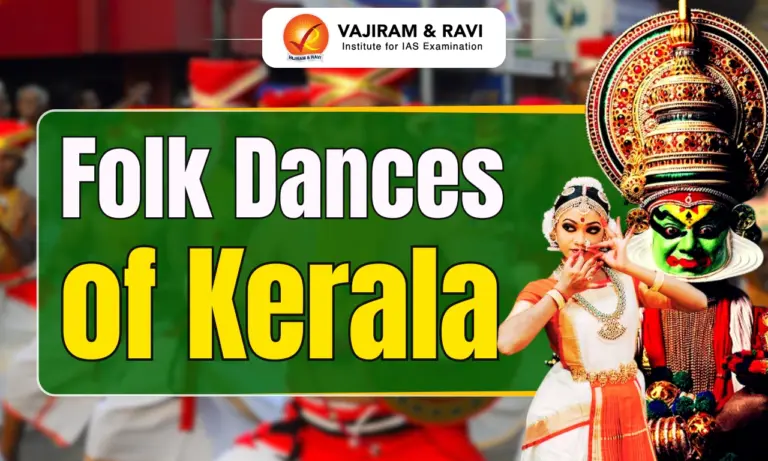
Folk dances of Kerala present a lively and colorful glimpse into the state’s deep-rooted culture and traditions. They are an integral part of festivals, temple celebrations, and community gatherings, performed with graceful movements, rhythmic patterns, and vibrant attire. Beyond entertainment, these dances serve as a medium to convey stories, express emotions, and strengthen social unity, reflecting the simplicity and harmony of life in Kerala.
Famous Folk Dances of Kerala
Folk dances of Kerala reflect the rich cultural heritage, traditions, and social life of the state. These dance forms are deeply connected with festivals, temples, rituals, and everyday life, showcasing themes of mythology, devotion, and community bonding. Each dance has its own unique style, costumes, music, and significance, representing different regions and communities of Kerala. Some of the most famous folk dances are discussed below in detail, highlighting their features and cultural importance.
1. Kathakali
- Kathakali is one of the most famous and visually striking classical dance forms of Kerala, dating back around 500 years.
- The term means “story play”, as it combines dance, drama, music, and storytelling into one performance.
- It mainly portrays stories from Indian epics like the Ramayana and Mahabharata, focusing on the battle between good and evil.
- The performers undergo intensive training, especially in controlling their eye movements, facial expressions, and body gestures.
- The costumes are extremely elaborate, with large headgear, layered skirts, and detailed face painting using natural colors.
- Each color in the makeup represents a particular character trait, such as green for heroes and red for villains.
- The performance is accompanied by traditional instruments like chenda and maddalam, along with singers who narrate the story.
- Kathakali is not just a dance but a complete theatrical experience that requires patience and deep understanding from the audience.
2. Mohiniyattam
- Mohiniyattam is a graceful and elegant classical dance form, traditionally performed by women.
- The name means “dance of the enchantress”, inspired by the mythical character Mohini.
- It combines elements from Kathakali and Bharatanatyam, but focuses more on soft, flowing, and feminine movements.
- The dancer usually wears a white saree with golden borders, traditional ornaments, and jasmine flowers in the hair, symbolizing purity.
- The dance includes gentle swaying movements, subtle expressions, and slow rhythmic steps.
- It is performed to Carnatic music, which enhances its soothing and devotional mood.
- Themes often revolve around love, devotion, and feminine emotions, making it emotionally expressive.
- Mohiniyattam is appreciated for its simplicity, beauty, and refined gestures.
3. Theyyam
- Theyyam is a ritualistic and highly spiritual dance form performed mainly in North Kerala.
- It is closely linked to temple worship and local deities, and is considered more than just a performance.
- The dancer is believed to become the deity during the performance, and people seek blessings from them.
- The costumes are extremely grand, featuring massive headgear, vibrant face paint, and detailed body decorations.
- The preparation itself can take several hours, showing the importance of tradition and precision.
- The performance includes dance, music, chanting, and rituals, making it a complete religious experience.
- It reflects the belief systems, myths, and social history of local communities.
- Theyyam also plays a role in social equality, as performers often come from specific communities regardless of caste hierarchy.
4. Kolkali
- Kolkali is a folk dance that originated among rural farming communities in Kerala.
- It is performed using wooden sticks, making it lively and energetic.
- A group of about 24 dancers moves in a circle, striking sticks in perfect coordination.
- The rhythm gradually increases, requiring timing, concentration, and teamwork.
- The songs sung during the performance often narrate local legends and stories of gods.
- The dance reflects the spirit of cooperation and unity in village life.
- It is commonly performed during festivals and social gatherings.
- Kolkali also helps in developing physical coordination and group discipline.
5. Ottamthullal
- Ottamthullal is a lively and humorous dance form created to entertain and educate people.
- It was developed by Kunchan Nambiar as a response to more serious art forms.
- The performer presents stories in a simple and relatable manner, often using satire.
- It focuses on social criticism, moral lessons, and everyday life situations.
- The dancer uses expressive gestures, facial expressions, and rhythmic movements.
- The costume is colorful but simpler compared to Kathakali.
- The language used is easy to understand, making it accessible to common people.
- It remains popular for its entertaining and meaningful storytelling style.
6. Kalaripayattu
- Kalaripayattu is not just a dance but a traditional martial art form of Kerala.
- It is considered one of the oldest fighting systems in the world.
- It includes physical exercises, weapon training, and combat techniques.
- The movements involve strength, flexibility, speed, and balance, making it physically demanding.
- It was originally practiced by warriors for self-defense and battlefield training.
- Today, it is also performed as a cultural demonstration and stage performance.
- It promotes discipline, mental focus, and physical fitness.
- Many modern performance arts and even films draw inspiration from Kalaripayattu techniques.
7. Padayani
- Padayani is a ritual folk dance performed in temples, especially dedicated to Goddess Bhadrakali.
- It is known for its large, colorful masks made from natural materials like areca leaves.
- The dance is performed during temple festivals that can last several days.
- It includes music, chanting, and dramatic movements, creating a powerful atmosphere.
- The performers follow strict rituals and traditions, showing deep devotion.
- Each mask represents a different character or divine figure.
- The dance symbolizes the victory of good over evil.
- Padayani highlights the strong connection between art, mythology, and religion.
8. Margamkali
- Margamkali is a traditional dance of the Syrian Christian community in Kerala.
- It is performed by a group of women moving in a circular formation.
- A lighted oil lamp at the center symbolizes spiritual presence and guidance.
- The dance narrates religious stories and teachings of Christianity.
- It is usually performed during festivals, church events, and weddings.
- The steps are simple, focusing more on coordination and devotion.
- It represents faith, unity, and cultural identity.
- Margamkali shows how Kerala’s dance traditions include different religions and communities.
9. Koodiyattam
- Koodiyattam is an ancient Sanskrit theatre tradition performed in temples.
- The name means “acting together”, as it involves both male and female performers.
- It is considered one of the oldest living theatre forms in the world.
- Performances can last for several days, sometimes up to 20 days.
- It focuses on detailed storytelling, slow movements, and deep emotional expression.
- Actors use highly controlled facial expressions and gestures to convey meaning.
- The performance includes Sanskrit verses, music, and traditional instruments.
- It requires patience and cultural understanding to fully appreciate.
10. Chakyar Koothu
- Chakyar Koothu is a solo storytelling performance traditionally held in temples.
- It is performed by members of the Chakyar community.
- The performer narrates stories from epics and ancient texts in an engaging way.
- It combines humour, satire, and serious storytelling, making it unique.
- The artist uses expressions, gestures, and voice modulation effectively.
- Sometimes, the performer includes commentary on current social issues.
- It is both educational and entertaining, keeping the audience engaged.
- This art form highlights the importance of oral storytelling traditions in Kerala.
Folk Dances of Kerala Cultural Significance
- Folk dances of Kerala play an important role in preserving the state’s cultural heritage and traditions, with forms like Kathakali and Mohiniyattam reflecting classical storytelling and artistic excellence.
- Many dances are closely connected with religious beliefs and rituals, such as Theyyam and Padayani, where performances are considered sacred and linked to temple worship.
- These dance forms help in expressing mythological stories and moral values, as seen in Kathakali and Koodiyattam, which narrate stories from epics like the Ramayana and Mahabharata.
- Folk dances promote social unity and community bonding, especially group performances like Kolkali, Oppana, and Margamkali, where people participate together during festivals and celebrations.
- They reflect the cultural diversity of Kerala, with dances like Oppana (Muslim community) and Margamkali (Christian community) showing the coexistence of different traditions.
- Some dance forms act as a medium of social awareness and entertainment, such as Ottamthullal, which uses humour and satire to convey messages to the public.
- Traditional practices like Kalaripayattu highlight the importance of physical fitness, discipline, and self-defense, while also influencing performance arts.


 Last updated on Sep, 2026
→ UPSC 2027 Notification will be released on 13 January 2027 at upsconline.nic.in.
→ Asian Games 2026 are being held in Aichi-Nagoya, Japan, from 19 September to 4 October.
→ Check out the latest UPSC Syllabus here.
→ Download UPSC Model Answers for Mains 2026
→ UPSC Mains Question Paper 2026 is out now for Essay & GS Paper 1, 2, 3 & 4.
→ UPSC Calendar 2027 has been released.
→ Enroll in Vajiram & Ravi’s UPSC Mains Test Series 2027 for structured answer writing practice, expert evaluation, and exam-oriented feedback.
→ Join Vajiram & Ravi’s UPSC Mentorship Program 2027 for personalized guidance, strategy planning, and one-to-one support from experienced mentors.
→ Go through the UPSC Mains Previous Year Papers to enhance your preparation.
→ UPSC has released UPSC Toppers List 2025 with the Civil Services final result on its official website.
→ Also check Best UPSC Coaching in India
Folk Dances of Kerala FAQs
Q1. What are the most famous folk dances of Kerala?+
Q2. What is the significance of folk dances in Kerala?+
Q3. Which dance form of Kerala includes satire and humour?+
Q4. What is special about Theyyam dance?+
Q5. What is the theme of Mohiniyattam dance?+
Q6. What makes Kolkali unique among Kerala dances?+
Tags: art and culture art and culture notes folk dances of kerala