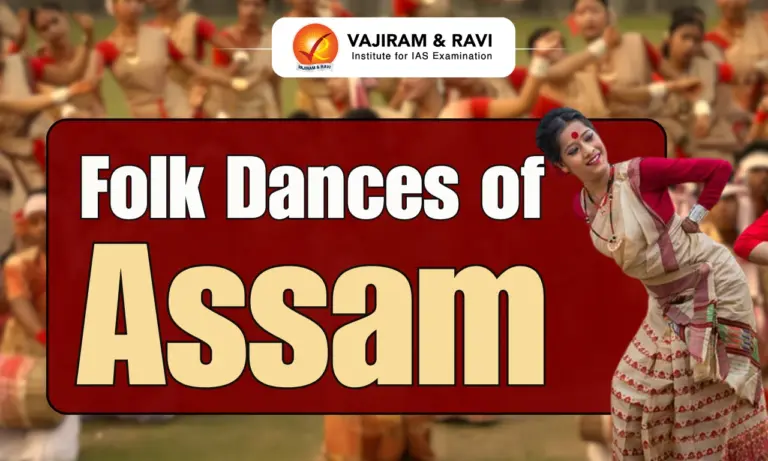
Folk Dances of Assam reflect the cultural diversity of its many ethnic communities and their close relationship with agriculture, nature, religion and community life.
Major Folk Dances of Assam
The major folk dances of Assam include Bihu, Bagurumba, Jhumur or Jhumoir, Ojapali, Deodhani and several community-specific dances such as Gumrag, Hacha Kekan, Farkanti and Pisu.
Bihu Dance
Bihu is the most widely recognised folk dance of Assam and a major symbol of Assamese cultural identity.
- Bihu is performed mainly during Bohag or Rongali Bihu, celebrated in April as the Assamese New Year and spring festival.
- Bihu is also associated with Kati/Kongali Bihu and Magh/Bhogali Bihu, which are linked with different stages of the agricultural cycle.
- Women traditionally wear the mekhela-chador, while men commonly wear the dhoti and gamosa.
- The Bihu dance is accompanied by traditional instruments such as the dhol, pepa, gogona, toka, taal and xutuli.
- Husori is a related community tradition in which groups visit households during Bohag Bihu and perform songs and dances while offering blessings.
On 14 April 2023, Assam created the Guinness World Record for the largest Bihu dance, with 11,298 participants in Guwahati.
Also Check: Folk Dances of Gujarat
Bagurumba
Bagurumba is a traditional folk dance of the Bodo community and is primarily associated with Bwisagu, the Bodo New Year and spring festival.
- The Bagurumba dance is traditionally performed mainly by Bodo women in groups.
- Its graceful and flowing movements are inspired by elements of nature, particularly butterflies, birds, flowers and the movement of leaves. It is therefore popularly known as the “Butterfly Dance.”
- Dancers traditionally wear the dokhna, jwmgra and aronai.
- The performance is accompanied by instruments such as the kham, sifung, serja, jotha and gongwna.
Jhumur or Jhumoir
Jhumur, also known as Jhumoir, is closely associated with the Tea Tribe and Adivasi communities of Assam. Its cultural roots are connected with communities brought to Assam during the colonial period to work in the tea plantations.
- Women generally perform the dance in coordinated group formations, often standing shoulder-to-shoulder. Men traditionally provide musical accompaniment using instruments such as the madal, dhol, cymbals, flute and shehnai.
- Jhumur songs and performances express themes of love, nature, community life, migration and the historical experiences of tea-garden workers.
- Jhumur serves as an important expression of the cultural identity and collective memory of Assam’s Tea Tribe and Adivasi communities.
Ojapali
Ojapali is a traditional Assamese performance form that combines singing, narration, rhythmic movement, dance and storytelling.
- The performance is led by an Oja, who acts as the principal singer and narrator, while the Palis form the accompanying group.
- Ojapali performances often draw upon religious and mythological narratives.
- Important forms include Ramayani Ojapali, based on the Ramayana; Byah Ojapali, associated with love stories; and Suknanni or Sukananni Ojapali, associated with the traditions of the serpent goddess Manasa.
- Darrang is regarded as an important historical centre of Ojapali.
Deodhani
- Deodhani is a traditional shamanistic folk dance of Assam, primarily performed by women in honour of the serpent goddess Manasa, also known as Maroi in certain traditions.
- The term Deodhani is driver from Deo, meaning ‘god’, and Dhani, meaning ‘woman’. The tradition is associated with the Bodo-Kachari cultural heritage of Assam.
- The dance is closely associated with Manasa or Maroi Puja and is traditionally performed during the monsoon period.
- During the performance, the dancer may enter a trance-like state believed to represent divine possession. The ritual is accompanied by the chanting and singing of an Oja and the rhythmic sounds of instruments such as the dhol and taal.
- The dancer may perform rapid head movements with open, unbraided hair and imitate the swaying movements of a cobra, reflecting the dance’s association with the serpent goddess.
- The performance may also include warrior-like movements using a traditional da or sword and shield, giving Deodhani a distinctive martial character.
- The dancer traditionally wears Assamese attire such as a mekhela-chador, complemented by traditional jewellery.
Gumrag
Gumrag, also known as Gumrag Sohman or Gumrag Paksong, is a traditional folk dance of the Mising community of Assam.
- It is primarily performed during Ali-Ai-Ligang, the Mising spring agricultural festival, and is associated with Mishing Bihu.
- The dance is generally performed by young people in the evening after the daytime rituals and may begin from the easternmost house of a village before moving towards open fields or riverbanks.
- It is accompanied by traditional instruments such as the dhol and kartal.
- Dancers wear colourful indigenous handloom attire with distinctive yarn patterns, along with traditional tribal jewellery and ornaments.
Hacha Kekan
Hacha Kekan is a traditional post-harvest folk dance of the Karbi community of Assam, performed to celebrate the successful harvesting and storage of grains.
- The dance is primarily performed as a group performance by men dressed in traditional Karbi attire.
- Its simple, rhythmic movements and songs depict different stages of rice cultivation and harvesting.
- A lead singer known as the Lunsepo leads the performance, while the dancers respond with the chorus “Ha-sa-ha, eha-ha-ha.”
Farkanti
Farkanti is a traditional funeral and ritual folk dance of the Rabha community, found mainly in Assam and Meghalaya.
- It is performed as part of death and memorial ceremonies and is associated with the belief that the souls of the deceased transform into birds and ascend to the heavens.
- Rabha oral traditions connect the dance with stories of women searching for warriors lost in battle, whose souls were believed to guide them in the form of birds.
- Women dancers traditionally perform with a sword and shield, while male performers carry the Manchelengka, a sacred emblem of the Rabha community.
- The dance is marked by synchronised circular formations and rhythmic footwork.
Pisu
Pisu is a traditional folk dance of the Tiwa (Lalung) community of Assam, associated with the community’s local spring and harvest festival of the same name.
- Celebrated around mid-April, it marks the arrival of spring, agricultural renewal and gratitude for a successful harvest.
- It is characterised by lively rhythmic footwork and coordinated group movements, with participants traditionally wearing community attire.


 Last updated on Sep, 2026
→ UPSC 2027 Notification will be released on 13 January 2027 at upsconline.nic.in.
→ Asian Games 2026 are being held in Aichi-Nagoya, Japan, from 19 September to 4 October.
→ Check out the latest UPSC Syllabus here.
→ Download UPSC Model Answers for Mains 2026
→ UPSC Mains Question Paper 2026 is out now for Essay & GS Paper 1, 2, 3 & 4.
→ UPSC Calendar 2027 has been released.
→ Enroll in Vajiram & Ravi’s UPSC Mains Test Series 2027 for structured answer writing practice, expert evaluation, and exam-oriented feedback.
→ Join Vajiram & Ravi’s UPSC Mentorship Program 2027 for personalized guidance, strategy planning, and one-to-one support from experienced mentors.
→ Go through the UPSC Mains Previous Year Papers to enhance your preparation.
→ UPSC has released UPSC Toppers List 2025 with the Civil Services final result on its official website.
→ Also check Best UPSC Coaching in India
Folk Dances of Assam FAQs
Q1. Which is the most widely recognised folk dance of Assam?+
Q2. Which folk dance of Assam is associated with the Bodo community?+
Q3. Which folk dance of Assam is associated with Assam’s Tea Tribe and Adivasi communities?+
Q4. Which folk dance of Assam is associated with the Mising community?+
Q5. What is Ojapali?+
Tags: folk dances of assam