


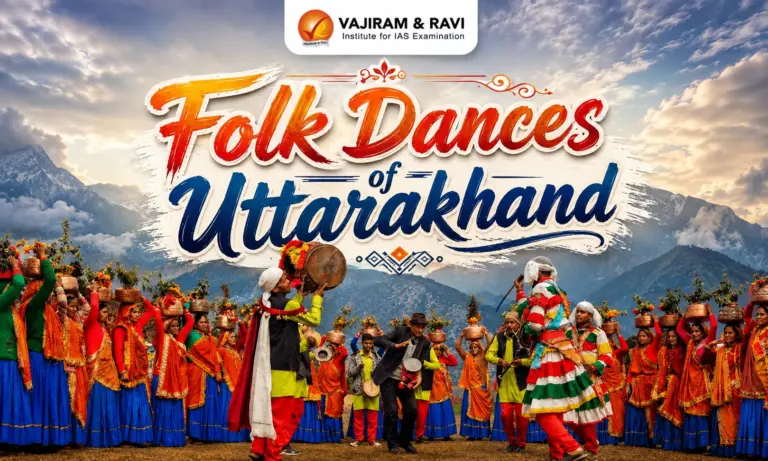
Folk Dances of Uttarakhand are closely rooted in the State’s Himalayan landscape, religious beliefs, seasonal festivals, agriculture, weddings and community life. The traditions vary across its two major cultural regions, Garhwal and Kumaon, as well as among communities such as the Jaunsari and Bhotiya. From the sword movements of Chholiya to the community circle of Jhora, these dances bring together the region’s religious traditions, social customs and everyday life.
Major Folk Dances of Uttarakhand
Major folk dances of Uttarakhand include Chholiya, Jagar, Langvir Nritya, Pandav Nritya, Jhora, Chanchari, Thadiya and Barada Nati. Each is associated with a particular region (Garhwal or Kumaon), occasion, or community. Together, they capture Uttarakhand’s blend of martial tradition, religious devotion and communal celebration.
Chholiya (Choliya)
Chholiya is a famous folk dance of the Kumaon region, known for its sword fighting movements and martial character.
- It originated over a thousand years ago among the warring Kshatriyas of the Khasa/Khasiya kingdom of Kumaon, at a time when marriages were said to be performed “at the point of the sword.”
- It is traditionally performed to accompany Rajput wedding processions, leading the groom’s party to the bride’s house, and is believed to ward off evil spirits from the baraat.
- Performed only by men – a troupe of about 22 members typically includes 8 sword-and-shield dancers (called Chhaliyas) and 14 musicians; one performer traditionally cross-dresses to play a female role, as women do not participate.
- Dancers wield swords and shields in choreographed mock combat, accompanied by instruments such as the Dhol, Damau, Turi, Ransingha and Mashakbeen (bagpipe).
- It is especially popular in the Kumaon districts of Almora, Bageshwar, Champawat and Pithoragarh.
Also Read: Folk Dances of West Bengal
Jagar
Jagar is a distinctive ritual dance tradition of Uttarakhand in which a medium, called the Pashwa (or Dagariya), becomes possessed by a local deity or ancestral spirit and dances to invoke divine justice.
- The word “Jagar” comes from the Sanskrit root jaga, meaning “to awaken.”
- A Jagariya (or Das) sings the Jagar – invocatory ballads about local deities such as Golu Devta, Gangnath and Bholanath – to the beat of the Dhol and Damau/Thali.
- As the singing and drumming build in intensity, the Pashwa enters a trance-like state and dances vigorously, believed to be embodying the deity, sometimes performing feats such as holding burning coals.
- It is practised across both Garhwal and Kumaon, though regional variations exist in the deities invoked and musical style.
- Jagar is broadly classified into Dev Jagar (benevolent deities) and Bhoot Jagar (ancestral/spirit worship).
Langvir Nritya
Langvir Nritya is a unique acrobatic dance of the Tehri Garhwal region, performed exclusively by men.
- A long bamboo pole is fixed upright in the ground.
- A dancer climbs to the top and balances on his stomach/navel, then performs acrobatic feats – rotating and moving his hands and feet – while balanced at the top.
- A band of musicians plays the Dhol and Damau at the base of the pole throughout the performance.
- It is considered one of the oldest and most famous dance forms of Garhwal, requiring great physical skill and courage.
Pandav Nritya
Pandav Nritya is a devotional dance-drama that narrates episodes from the Mahabharata, especially popular in the Garhwal region (notably Chamoli and Pauri Garhwal districts).
- It is performed in an open ground called a Mandaan, to the rhythm of the Dhol and Damaun.
- The dance combines singing, narration and enactment of the story of the Pandavas, and can extend over several nights in some villages.
- It is typically performed on occasions such as Dussehra and Diwali.
- It reflects Garhwal’s strong devotional association with the Pandava legend and with Lord Shiva (Nataraja).
Jhora
Jhora is a popular community group dance performed across both the Kumaon and Garhwal regions.
- Dancers – men and women, sometimes in separate groups – link arms and form a circle, moving with synchronised steps, often leaning forward rhythmically.
- It is performed at the arrival of spring, at fairs, and during weddings, and is known for breaking down social/caste boundaries during the dance, as people from different backgrounds join the same circle.
- A group can range from as few as six dancers to as many as two hundred.
- Related regional forms include Chanchari (Chopali) and Thadiya.
Chanchari (Chopali)
Chanchari is considered a form of Jhora, especially associated with the Danpur Patti area of Bageshwar district in Kumaon.
- Dancers move in a semi-circle, holding hands, at a slow tempo that gradually quickens.
- It is danced through the moonlit night, especially around the month of Magha, led by a singer playing the Hudkadrum in the centre of the circle.
- It is performed to mark weddings and other festive occasions.
Thadiya
Thadiya is a social group dance popular at fairs and festivals across the hill regions.
- Dancers are divided into two groups, linked by placing hands on the next dancer’s shoulder, and move in a semi-circular arc.
- It is often performed alongside songs of the same name, reflecting the joys of community and social life.
Barada Nati
Barada Nati is a folk dance of the Jaunsar-Bawar region (Chakrata Tehsil, Dehradun district), performed by the Jaunsari community.
- It belongs to the wider Nati family of dances found across the Western Himalayas (also seen in Himachal Pradesh); in Garhwal proper, a related form is called Tandi.
- Both men and women participate, moving in a circle to a story embedded in song – depicting social or spiritual themes.
- It is performed on the eve of religious festivals and social occasions, with colourful traditional Jaunsari costumes.
Mukhota Dance
- Mukhota Dance is a traditional folk dance of Uttarakhand, performed during a fair held in Vaishakha.
- The fair begins on Vaishakha Sankranti, marking the Sun’s entry into a new zodiac sign, and is associated with the worship of Bhumiyal Devta.
- During the festival, people prepare and offer ground-rice preparations every day as part of the religious observances.
- Participants wear traditional clothing along with masks representing various deities and demons.
Other Folk Dances of Uttarakhand
Beyond the major forms above, Uttarakhand has several other regional dance traditions:
- Chhapeli – a group dance performed mainly by women during festivals; the female dancer performs holding a mirror in one hand and a coloured handkerchief in the other.
- Dhurang and Dhuring – dances of the Bhotiya tribal community, connected with death ceremonies, aimed at liberating the soul of the deceased; noted for similarities with pastoral dances of Himachal Pradesh.
- Chounphula – a spinning dance performed at night by both men and women, associated with seasonal appreciation of nature, performed from Basant Panchami to Baisakhi.
- Jhumeila – a seasonal dance, generally restricted to women, performed at occasions such as Guru Purnima, Baisakhi and Makar Sankranti.
Also Read: Folk Dances of Himachal Pradesh


Cultural Significance of Folk Dances of Uttarakhand
The folk dances of Uttarakhand reflect the State’s deep connection with religion, Himalayan traditions, agriculture, festivals and community life.
- Religious traditions: Jagar and Pandav Nritya are closely associated with local deities, spirits and the Mahabharata tradition.
- Martial heritage: Chholiya preserves the sword-fighting and warrior traditions of Kumaon.
- Regional identity: Chholiya and Jhora are associated with Kumaon, while Langvir Nritya and Pandav Nritya are strongly associated with Garhwal.
- Community life: Jhora, Chanchari and Thadiya bring people together during fairs, festivals, weddings and social occasions.
- Seasonal traditions: Jhora, Chounphula and Jhumeila are connected with spring and the agricultural calendar.
- Gender roles: Chholiya and Langvir Nritya are traditionally performed by men, while Chhapeli and Jhumeila are mainly associated with women.
- Cultural preservation: These dances preserve folk songs, local beliefs, traditional customs and community identity across generations.

 Last updated on Oct, 2026
→ UPSC 2027 Notification will be released on 13 January 2027 at upsconline.nic.in.
→ Check Nobel Prize 2026 Winners List here.
→ Download PIB PRiSM Monthly Magazine 2026 here.
→ Check UPSC Monthly Current Affairs Magazine The Recitals here.
→ Check out the latest UPSC Syllabus here.
→ Download UPSC Model Answers for Mains 2026
→ UPSC Mains Question Paper 2026 is out now for Essay & GS Paper 1, 2, 3 & 4.
→ UPSC Calendar 2027 has been released.
→ Enroll in Vajiram & Ravi’s UPSC Mains Test Series 2027 for structured answer writing practice, expert evaluation, and exam-oriented feedback.
→ Join Vajiram & Ravi’s UPSC Mentorship Program 2027 for personalized guidance, strategy planning, and one-to-one support from experienced mentors.
→ Go through the UPSC Mains Previous Year Papers to enhance your preparation.
→ UPSC has released UPSC Toppers List 2025 with the Civil Services final result on its official website.
→ Also check Best UPSC Coaching in India
Folk Dances of Uttarakhand FAQs
Q1. What are the major folk dances of Uttarakhand? +
Q2. What is Jagar in Uttarakhand? +
Q3. Which folk dance of Uttarakhand narrates the Mahabharata?+
Q4. Which folk dance of Uttarakhand is associated with the Jaunsari community?+
Q5. Which folk dance of Uttarakhand is linked to death rituals?+
Tags: folk dances of uttarakhand








