Feudalism in India, Meaning, Rise, Features, Impact, Decline

Feudalism in India

Feudalism in India means decentralized socio-economic and political system in which power and authority are distributed among local rulers, landlords and religious institutions, on the basis of land ownership. This system shaped the agrarian economy of India, its social hierarchy and governance structures from the medieval period. The European model of feudalism was a legal and military arrangement between kings, nobles and vassals while the Indian model was unique in response to land grants, agrarian needs and the decline of urban centres. In this article, we are going to cover Feudalism in India, its origin, meaning, role and causes in its decline. 

What is Feudalism in India?

Feudalism was a hierarchical system in Europe( 9th-15th century A.D.) under which the king granted land to nobles in return of portions to vassals in exchange for military and administrative services. However, in India the system was different. Kings and rulers were unable to directly control vast territories or reward supporters  with monetary payments and hence donated land to brahmins, officials and military commanders. These land grants not only transferred revenue rights but often included administrative and judicial powers, hence creating a decentralised order of governance.  Thus, while Indian feudalism shared the principle of land-based authority with its European counterpart, it developed its own unique structure, deeply tied to religion, caste, and agrarian relations.

Rise of Feudalism in India

Feudalism in India originated because of: 

  • Decline of Urban Centres: After the end of the Gupta Empire, trade and urban economic activity declined and villages became largely self-sufficient. 
  • Land Grants to Brahmins: From 1st Century A.D. rulers donated land to brahmins, scholars, and temples while providing them with ownership and revenue rights. 
  • Religious Sanction: Texts like the Dharmashastras, Puranas, and Mahabharata (Anusasana Parva) glorified land grants, sanctifying the practice.
  • Erosion of Community Rights: Over the period, peasants lost customary rights over land and became dependent on landlords and intermediaries.
  • Rise of a Middle Class of Landlords: Local feudatories (Samantas and Mahasamantas) emerged as an intermediary ruling class, reducing the king’s authority.

Indian Feudalism Features

Feudalism in India was practiced in the following ways: 

  • Political Decentralisation: Land grants created semi-autonomous rulers like Samantas, who collected revenue and maintained order in their regions.
  • Emergence of New Classes: A new class of landholding intermediaries and Brahmin feudatories came into existence, and altered the social fabric of medieval India.
  • Changes in Agrarian Structure: Peasants were tied to the land and lost their mobility and freedom. Localised customs, languages, and rituals developed in isolated agrarian units.
  • Nature of Land Grants: Initially limited to revenue rights, grants later included administrative, judicial, and police functions. By the Gupta period, kings often relinquished almost all rights, including taxation and punishment of offenders.

Feudalism in Indian History

The system of feudalism in India can be traced back to medieval times as highlighted below: 

  • Gupta and Post-Gupta Period (4th–8th centuries): Foundation of feudalism laid through widespread land grants; kings increasingly dependent on local feudatories.
  • Rajput Period (8th–12th centuries): Rajput rulers consolidated feudal practices. Warrior elites held estates, and political power became decentralised.
  • Delhi Sultanate (13th–15th centuries): The Iqta system resembled feudal practices, with land grants made to military commanders for revenue collection and administrative duties.
  • Mughal Period (16th–18th centuries): The Mansabdari and Jagirdari systems displayed feudal characteristics. Mansabdars collected revenue and maintained troops in return for jagirs.
  • South India (Vijayanagara Empire, 14th–17th centuries): The Nayaka system reflected feudal arrangements, with Nayakas governing regions in return for military service and tribute.

Feudalism in India Social and Economic Impact 

Feudalism in India caused the following social and economic impact: 

  • Social Stratification
    • Reinforced caste-based hierarchy, with Brahmins and Kshatriyas as landholding elites.
    • Reduced peasantry to a dependent and exploited class.
  • Agrarian Economy
    • Predominantly rural and agrarian, with peasants paying heavy taxes in produce.
    • Decline of trade and urban centres limited economic diversification.
  • Local Autonomy and Political Fragmentation
    • Strengthened local powers but weakened centralised authority.
    • Led to frequent conflicts among feudatories.

Feudalism in India Decline 

Feudalism in India declined due to the following reasons: 

  • Rise of Centralised Empires: Under the Mughals, especially Akbar, centralised administration curbed feudal autonomy.
  • British Colonial Policies: The Permanent Settlement (1793) created zamindars as revenue collectors, altering feudal relations. Systems like Ryotwari and Mahalwari redefined agrarian administration.
  • Peasant Uprisings: Exploitation by zamindars and landlords led to numerous peasant revolts, eroding feudal authority

Feudalism in India FAQs

Q1: What is the feudal system in India?

Ans: The feudal system in India was a decentralised socio-economic and political order where land ownership determined power, and kings granted land to landlords, officials, and religious elites in return for service.

Q2: Who was the first to begin feudalism in India?

Ans: The practice of feudalism in India began with the Satavahanas and later expanded during the Gupta period through widespread land grants.

Q3: What are the 4 types of feudalism?

Ans: The four types of feudalism are land-based feudalism, military feudalism, administrative feudalism, and religious feudalism.

Q4: What is feudalism in simple words?

Ans: Feudalism is a system where land is exchanged for service and loyalty, with peasants working for landlords who, in turn, served the king.

Q5: What are the three main characteristics of feudalism?

Ans: The three main characteristics are land-based hierarchy, decentralised political power, and mutual obligations between lords and vassals/peasants.

Central Pollution Control Board, Establish, Headquarter, Chairman, Act

Central Pollution Control Board

The Central Pollution Control Board (CPCB) is India's apex statutory pollution control authority responsible for monitoring, regulating and improving environmental quality across the country. It works under the Ministry of Environment, Forest and Climate Change. CPCB develops pollution standards, coordinates with every State Pollution Control Board, provides technical guidance, conducts nationwide monitoring programmes and supports environmental policy implementation.

What is Central Pollution Control Board?

The Central Pollution Control Board is the national statutory authority responsible for preventing, controlling and reducing pollution across India through scientific monitoring, regulation and technical support.

  • Establishment: CPCB was established in September 1974 under the Water (Prevention and Control of Pollution) Act 1974.
  • Expansion: Its responsibilities increased after the Air (Prevention and Control of Pollution) Act 1981, which authorised it to regulate air pollution alongside water pollution across the country.
  • Environmental framework: CPCB also functions under the Environment (Protection) Act 1986, providing technical services to the Ministry while supporting implementation of national environmental rules and standards.
  • Constitutional Basis: The Water Act 1974 was enacted under Article 252 of the Constitution, allowing Parliament to legislate on pollution control for consenting states through a common central law.

Central Pollution Control Board Objectives

The Central Pollution Control Board works to maintain environmental quality by preventing pollution, improving monitoring systems and supporting coordinated pollution control across India.

  • Clean water resources: The primary objective is to promote cleanliness of rivers, streams and wells through prevention, control and abatement of water pollution across different states.
  • Better air quality: CPCB aims to improve ambient air quality by preventing, controlling and reducing emissions from industries, transport systems and other pollution-generating activities.
  • National environmental standards: It develops and revises standards for ambient air quality, water quality, industrial emissions, effluent discharge, biomedical waste treatment and environmental noise limits.
  • Scientific policy support: The Board generates environmental data, conducts research, prepares technical reports and provides scientific inputs for national environmental policies and government programmes.
  • Capacity building: CPCB strengthens the functioning of every State Pollution Control Board through technical guidance, training programmes, awareness campaigns and coordinated implementation of pollution control measures.

Central Pollution Control Board Historical Background

The development of Central Pollution Control Board reflects India's gradual strengthening of pollution control laws and environmental governance over the last five decades.

  • 1974: CPCB was constituted on 23 September 1974 under the Water Act to address growing concerns regarding pollution of rivers, lakes and groundwater.
  • 1981: Following enactment of the Air Act in 1981, CPCB received additional statutory powers to regulate and monitor air pollution throughout India.
  • 1986: The Environment (Protection) Act 1986 significantly widened CPCB's role by empowering it to support enforcement of various environmental rules issued by the Central Government.
  • 1988: The organisation originally functioned as the Central Board for the Prevention and Control of Water Pollution before being renamed Central Pollution Control Board in April 1988 to reflect broader responsibilities.
  • 2025: During its 51st Foundation Day celebration on 22 September 2025, Union Minister Shri Bhupender Yadav announced new laboratories at Pune and Shillong, launched SAMEER App Version 2.0, released important technical publications and laid the foundation stone for the Board's new building.

Central Pollution Control Board Organisation Structure

The organisational structure enables the Central Pollution Control Board to function as the country's apex environmental regulator while maintaining coordination with states and Union Territories.

  • Administrative control: CPCB functions under the Ministry of Environment, Forest and Climate Change, providing technical assistance and environmental expertise for national policy implementation.
  • Leadership: The organisation is headed by a Chairman, supported by a Member Secretary, government representatives, experts from different sectors and nominees from State Boards. As of 2026, Shri Vir Vikram Yadav is serving as the Chairman.
  • Headquarter: The CPCB headquarter is located at Parivesh Bhawan, New Delhi, from where national environmental monitoring, coordination and regulatory activities are managed.
  • Coordination network: CPCB works closely with every State Pollution Control Board, Pollution Control Committees in Union Territories, research institutions, laboratories and government agencies for effective pollution management.
  • Regional strengthening: New environmental laboratories inaugurated in Pune and Shillong can monitor 70 and 62 environmental parameters respectively, expanding monitoring capacity for Maharashtra and the North-Eastern States.

Central Pollution Control Board Powers and Functions

Central Pollution Control Board performs regulatory, advisory, technical and monitoring functions to ensure effective implementation of environmental laws throughout the country.

  • Government advisory role: It advises the Central Government on prevention, control and abatement of water and air pollution while recommending measures for improving environmental quality.
  • National programmes: CPCB plans and implements nationwide programmes for pollution prevention, environmental monitoring, manpower training, scientific research and public awareness through different communication platforms.
  • Standards and Guidelines: It develops environmental standards, revises COINDS, prepares manuals, technical codes and guidelines for sewage treatment, industrial effluents, stack emissions and pollution control technologies.
  • Monitoring Responsibilities: CPCB establishes standards for ambient air quality, water quality, industrial emissions, hazardous waste, biomedical waste, diesel engines, LPG and CNG generator sets, while formulating Minimal National Standards (MINAS) for industries.
  • Regulatory Powers: On behalf of the Ministry, CPCB can issue directions to industries, local bodies and authorities violating environmental standards under the Environment (Protection) Rules 1986, while also coordinating and resolving disputes among State Boards.

Central Pollution Control Board Recent Developments

Recent initiatives show CPCB's increasing focus on scientific monitoring, digital governance and stronger environmental regulation across India.

  • Maha Kumbh Monitoring: CPCB submitted a report before the National Green Tribunal highlighting concerns regarding river water quality at Prayagraj during the Maha Kumbh Mela.
  • SAMEER App 2.0: The updated application introduced a user-friendly interface, personalised alerts, location-based services and stronger citizen participation for pollution monitoring on Android and iOS platforms.
  • Recent Reports: CPCB released the report "Classification of Polluted River Stretches, 2025" and a technical manual on identifying polluted water bodies using freshwater benthic macroinvertebrates.
  • Capacity expansion: The Board strengthened its scientific infrastructure by opening advanced regional laboratories, recruiting 13 new officials and expanding environmental testing capabilities across different regions.
  • Future direction: CPCB is focusing on cleaner technologies, stronger collaboration with IITs, expansion of environmental laboratories, improved regulatory systems and enhanced capacity building for every State Pollution Control Board to balance economic growth with environmental protection.

Central Pollution Control Board FAQs

Q1: What is the Central Pollution Control Board (CPCB)?

Ans: CPCB is India's statutory pollution control authority established in 1974 to prevent and control water and air pollution.

Q2: Under which Act was the Central Pollution Control Board established?

Ans: CPCB was established under the Water (Prevention and Control of Pollution) Act 1974 and later received powers under the Air (Prevention and Control of Pollution) Act 1981.

Q3: Which ministry is the Central Pollution Control Board under?

Ans: CPCB functions under the Ministry of Environment, Forest and Climate Change (MoEFCC).

Q4: Where is the headquarters of the Central Pollution Control Board located?

Ans: The headquarters of CPCB is located at Parivesh Bhawan, New Delhi.

Q5: What is the main function of the Central Pollution Control Board?

Ans: CPCB sets environmental standards, monitors pollution, advises the Central Government and coordinates with the State Pollution Control Boards to control pollution across India.

UPSC Daily Quiz 2 July 2026

UPSC Daily Quiz

[WpProQuiz 200]

UPSC Daily Quiz FAQs

Q1: What is the Daily UPSC Quiz?

Ans: The Daily UPSC Quiz is a set of practice questions based on current affairs, static subjects, and PYQs that help aspirants enhance retention and test conceptual clarity regularly.

Q2: How is the Daily Quiz useful for UPSC preparation?

Ans: Daily quizzes support learning, help in revision, improve time management, and boost accuracy for both UPSC Prelims and Mains through consistent practice.

Q3: Are the quiz questions based on the UPSC syllabus?

Ans: Yes, all questions are aligned with the UPSC Syllabus 2025, covering key areas like Polity, Economy, Environment, History, Geography, and Current Affairs.

Q4: Are solutions and explanations provided with the quiz?

Ans: Yes, each quiz includes detailed explanations and source references to enhance conceptual understanding and enable self-assessment.

Q5: Is the Daily UPSC Quiz suitable for both Prelims and Mains?

Ans: Primarily focused on Prelims (MCQ format), but it also indirectly helps in Mains by strengthening subject knowledge and factual clarity.

Five New Species of Flowering Plants

Five New Species of Flowering Plants

New Species of Flowering Plants Latest News

Researchers recently discovered five entirely new species of Impatiens named Impatiens berchmansiensis; Impatiens ninanii; Impatiens filcyii; Impatiens xanthopetala; Impatiens flavispicata.

About Five New Species of Flowering Plants

  • They were discovered within the misty, rain-soaked peaks of the Western Ghats in Kerala.
  • They belong to the genus Impatiens, a large genus of flowering plants belonging to the Balsaminaceae family. 
  • Impatiens berchmansiensis:
    • It is a delicate balsam with bright yellow flowers.
    • It was found beside the cold highland streams of Vagamon, Idukki District.
  • Impatiens ninanii:
    • It is a resilient herb with beautiful violet petals and deep purple-speckled stems.
    • It was found in the quiet wilderness of Mankulam Viripara, Idukki District.
  • Impatiens filcyii:
    • It has a striking pinkish-purple flower, bearing a vibrant splash of yellow and purple at its heart.
    • It was found deep in the open grasslands of Mamalakkandam, Ernakulam District.
  • Impatiens xanthopetala:
    • It literally means 'yellow-petalled', clings precariously to the sheer, rocky cliffs, showing off deep golden petals marked with dark brown spots like a solitary drop of sunshine.
    • It was found in Pambanar, Idukki District.
  • Impatiens flavispicata:
    • It bears pure white flowers with a hidden yellow spur.
    • It was found in the dense pockets of Mamalakkandam, Ernakulam District.

News: MATH

Five New Species of Flowering Plants FAQs

Q1: Where were the five new species of flowering plants recently discovered?

Ans: They were discovered in the Western Ghats of Kerala.

Q2: The genus Impatiens belongs to which plant family?

Ans: Balsaminaceae

Q3: What is the distinguishing feature of Impatiens flavispicata?

Ans: It bears pure white flowers with a hidden yellow spur.

Q4: What is the distinguishing feature of Impatiens filcyii?

Ans: It has pinkish-purple flowers with a vibrant yellow and purple centre.

Exosomes

Exosomes

Exosomes Latest News

Tiny particles called exosomes released by most human cells may be promising targets for diagnosis and treatment of an array of diseases from cancer to Alzheimer's, but scientists have struggled to see them and study them in detail.

About Exosomes

  • They are small extracellular vesicles secreted by cells.
  • They typically measure 30–200 nanometres (nm) in diameter
  • They are enclosed by a lipid bilayer membrane, similar to the cell membrane
  • They’re naturally produced by almost all cells in the body and are packed with a cargo of proteins, lipids, RNAs and various signalling molecules
  • In many ways, they reflect the status of their parent cell, passing on that "information" to nearby cells. 
  • They mediate the exchange of substances between cells, thereby affecting the biological properties and activities of recipient cells. 
  • They play significant roles in intercellular communication, immune response modulation, and the transfer of genetic materials.

News: NM

Exosomes FAQs

Q1: What are exosomes?

Ans: Exosomes are small extracellular vesicles secreted by cells.

Q2: What is the typical size range of exosomes?

Ans: Exosomes typically measure 30–200 nanometres (nm) in diameter.

Q3: Are exosomes naturally produced by cells?

Ans: Yes, exosomes are naturally produced by almost all cells in the body.

Q4: What do exosomes contain?

Ans: They contain proteins, lipids, RNAs, and various signalling molecules.

Q5: What is the primary function of exosomes?

Ans: They mediate the exchange of substances between cells.

Parliamentary Form of Government, Meaning, History, Source

Parliamentary Form of Government

A Parliamentary Form of Government is a form of democracy in which the political party that wins the most seats in a national election forms the ruling government. In this system, the executive is drawn from the legislature and is accountable to it. India follows a parliamentary system similar to that of the United Kingdom.

In a parliamentary system, there is a close relationship between the executive and legislative branches, with the executive being dependent on the confidence of the legislature. This arrangement ensures greater accountability and makes the Parliament the central institution of governance.

What is Parliamentary Form of Government?

The key features explaining the concept of the Parliamentary Form of Government has been provided below:

  • Real and Nominal Executives: The President acts as the formal or nominal executive, while the Prime Minister serves as the actual (de facto) executive. In this arrangement, the President represents the State, whereas the Prime Minister runs the government’s day-to-day affairs.
  • Dual Membership: The executive (Prime Minister and Council of Ministers) is drawn from the legislature (Parliament). Members of Parliament elect the Prime Minister and other cabinet ministers, linking the executive and legislative branches closely.
  • Collective Responsibility: The Council of Ministers is collectively accountable to the legislature. This principle ensures that all ministers share responsibility for government policies and decisions, even if individual ministers are directly responsible for their departments.
  • Secret Procedure: Cabinet discussions and deliberations are conducted in private and are not disclosed publicly, allowing for open and candid decision-making among ministers.
  • Leadership under the Prime Minister: The Prime Minister heads the government and exercises leadership over the Council of Ministers, guiding policy and administration.
  • Majority Party Rule: The Prime Minister is usually the leader of the party that holds a majority in the lower house of the legislature, ensuring stability and alignment between the executive and legislative branches.
  • Bicameral Legislature: Most parliamentary democracies have a bicameral legislature, consisting of two chambers, typically an upper house and a lower house, which provide checks and balances on lawmaking.
  • Political Homogeneity: Members of the Council of Ministers usually share similar political ideologies, as they belong to the same party. In coalition governments, ministers are bound by coalition agreements to maintain unity.
  • No Fixed Term: The government’s tenure depends on maintaining the confidence of the lower house. If a motion of no-confidence succeeds, the Council of Ministers must resign, triggering elections and the formation of a new government.

Also Read: Salient Features of Indian Constitution

Parliamentary Form of Government History

Since ancient times, councils of headmen, whose decisions were guided by village elders, existed in tribal societies. These early consultative bodies gradually evolved into modern parliamentary institutions. In 1188, King Alfonso IX of León (Spain) convened the Cortes of León, considered one of Europe’s first parliaments. A proto-parliamentary system also emerged during the Dutch Revolt (1581), when the States-General assumed power from King Philip II of Spain. The modern parliamentary framework developed in the United Kingdom (1707-1800) and Sweden (1721-1772), gaining broader acceptance across Europe after World War I.

  • Adoption in the Indian Constitution: India adopted the parliamentary system from Britain after thorough deliberations. During the Constituent Assembly debates, different models including Presidential and Parliamentary systems were discussed. The parliamentary model was preferred for its capacity to provide strong leadership while ensuring accountability to the elected legislature.
  • Notable Opinions
    • Professor K. T. Shah emphasized that parliamentary government connects the Executive, Legislature, and Judiciary effectively.
    • Shri K. Hanumanthaiya argued that the parliamentary system was better suited to India’s needs than a Presidential system.

Parliamentary Form of Government Constitutional Provision

The Indian Constitution contains specific provisions that establish and support the parliamentary system of governance at both the central and state levels. The following table summarizes the key articles, their scope, and the way they define the roles, responsibilities, and accountability of the executive in relation to the legislature.

Parliamentary Form of Government Constitutional Provision

Article

Level

Provision

Key Features

Accountability

74

Central

Council of Ministers to aid and advise the President

President acts on advice of the Cabinet headed by PM; advice can be reconsidered but must be adopted

Not subject to judicial review

75

Central

Appointment and responsibility of the Council of Ministers

President appoints PM; PM recommends other ministers; ministers hold office during President’s pleasure

Council of Ministers is collectively responsible to Lok Sabha

163

State

State Council of Ministers to aid and advise the Governor

Governor acts on advice of Council headed by CM; discretionary powers in certain matters

Not subject to judicial review

164

State

Appointment and responsibility of State Ministers

Governor appoints CM; CM recommends other ministers; ministers hold office during Governor’s pleasure

Council of Ministers is collectively responsible to State Legislative Assembly

Parliamentary Form of Government Advantages

The Parliamentary Form of Government Advantages that contribute to effective governance and political stability. Its structure ensures cooperation between branches, accountability of the executive, prevention of despotism, and broad representation of diverse interests. The key merits are summarized below.

Parliamentary Form of Government Advantages

Merit

Description

Cooperation Between Legislative and Executive Branches

The parliamentary system fosters close coordination between the legislature and the executive, ensuring smooth policy-making and implementation.

Responsible Government

Ministers are accountable to Parliament, and their actions are scrutinized through tools such as question periods, debates, adjournment motions, and no-confidence motions.

Prevents Despotism

Executive power is vested in a council of ministers rather than a single individual, decentralizing authority and reducing the risk of authoritarianism.

Wide Representation

The council of ministers represents diverse regions, communities, and interests, enabling the government to reflect the country’s varied demographic and cultural composition.

Parliamentary Form of Government Disadvantages

While the Parliamentary Form of Government has several advantages, it is not without shortcomings. Certain structural and political factors can lead to instability, inefficiency, and limited accountability. The key demerits are summarized below.

Parliamentary Form of Government Disadvantages

Demerit

Description

No Separation of Powers

When the ruling party has a strong majority, the legislature may struggle to check the executive. Anti-defection laws further restrict MPs from voting independently, reducing legislative oversight.

Unqualified Lawmakers

Legislators often aim to join the executive rather than focus on lawmaking, resulting in a lack of expertise in drafting effective laws.

Instability

Governments depend on maintaining a parliamentary majority. Coalition governments can be short-lived and unstable, forcing the administration to prioritize staying in power over public welfare.

Ministers

Ministers are typically chosen from the ruling party, limiting the inclusion of subject-matter experts in governance.

Failure to Make Quick Decisions

The absence of fixed tenure can delay significant long-term policy decisions, as the Council of Ministers often prioritizes political considerations.

Party Politics

Parliamentary systems can accentuate party interests over national concerns, leading to partisan decision-making.

Bureaucratic Control

Civil servants wield significant influence over ministers and policy, yet they are not directly accountable to the legislature.

Parliamentary Form of Government vs Presidential Form of Government

The Parliamentary Form of Government and Presidential Form of Government are two prominent forms of democratic governance. While both aim to uphold democracy, they differ significantly in structure, powers, and functioning. The table below highlights the key Differences Between the Parliamentary Form of Government and the Presidential Form of Government in India.

Parliamentary Form of Government vs Presidential Form of Government

Feature

Parliamentary Form of Government

Presidential Form of Government

Head of State

President (formal executive)

President (both head of state and government)

Head of Government

Prime Minister (real executive)

President

Executive-Legislature Relationship

Executive is drawn from the legislature and is accountable to it

Executive and legislature are separate; President is not responsible to legislature

Collective Responsibility

Council of Ministers is collectively responsible to the legislature

No concept of collective responsibility; President acts independently

Tenure

Depends on parliamentary confidence; no fixed term for government

Fixed tenure for the President and government officials

Decision-Making

Cabinet decisions are made collectively

President can make independent decisions

Stability

Can be unstable if no clear parliamentary majority

Generally more stable due to fixed tenure

Political Homogeneity

Ministers usually belong to the majority party or coalition

Cabinet may include members from different political affiliations if allowed

Removal of Executive

By parliamentary vote of no-confidence

Impeachment through constitutional procedure

Role of Legislature

Strong oversight and accountability of executive

Legislature and executive function independently

Also Check Other Posts
Important Articles of Indian Constitution 9th Schedule
Schedules of Indian Constitution Anti Defection Law
5th Schedule Preamble of the Indian Constitution
6th Schedule


Parliamentary Form of Government FAQs

Q1: Which is the best definition of a parliamentary form of government?

Ans: A parliamentary government is a system where the executive (Prime Minister and Council of Ministers) is accountable to the legislature and derives authority from it.

Q2: Which country is a parliamentary form of government?

Ans: Countries like India, the United Kingdom, Canada, Australia, and Japan follow a parliamentary system, where the executive is responsible to the legislature.

Q3: What is the difference between parliamentary and presidential government?

Ans: In parliamentary systems, the executive is accountable to the legislature; in presidential systems, the executive is independent and directly elected by the people.

Q4: Why is India a parliamentary form of government?

Ans: India adopted a parliamentary system to ensure accountability of the executive, collective decision-making, and flexibility in governance, modeled on the British system.

Q5: What are the two types of parliamentary form of government?

Ans: The two types are Westminster (British) model, where the head of state is ceremonial, and European (continental) model, with more active head-of-state powers.

Article 39 of Indian Constitution, Clauses, Provisions

Article 39 of Indian Constitution

Article 39 comes under Part IV of the Constitution of India under the Directive Principles of State Policy. The article lays down the guidelines for the state to create policies for a just and equitable society. The goal is to provide social and economic justice to all the citizens of the country. Distribution of resources, economic equity and protection of workers and children all come under this article. In this article, we are going to cover all about Article 39 of the constitution. 

Article 39 of the Indian Constitution Provisions

The Constitution of Indian states the following about Article 39: 

The state shall, in particular, direct its policy towards securing- 

  • that the citizens, men and women equally, have the right to an adequate means to livelihood
  • that the ownership and control of the material resources of the community are so distributed as best to sub serve the common good
  • that the operation of the economic system does not result in the concentration of wealth and means of production to the common detriment
  • that there is equal pay for equal work for both men and women
  • that the health and strength of workers, men and women, and the tender age of children are not abused and that citizens are not forced by economic necessity to enter avocations unsuited to their age or strength
  • that children are given opportunities and facilities to develop in a healthy manner and in conditions of freedom and dignity and that childhood and youth are protected against exploitation and against moral and material abandonment.

Article 39 of Indian Constitution Clauses

Article 39 of the Indian Constitution outlines important principles of policy that the State must try to follow. It includes six specific directives aimed at securing economic justice and equality. These are: 

  • Adequate Means of Livelihood (Article 39A): Article 39 emphasises that a state should make sure that all the citizens irrespective of their sex should have equal opportunity and access to sufficient means of livelihood. 
  • Distribution of Resources (Article 39b): The Article 39b of the Constitution of India, talks about the responsibility of the state to distribute resource and ownership of materials in a way that works for all and helps avoid the concentration of wealth. 
  • Article 39(c) emphasizes economic equity with a goal of aiming to prevent the concentration of wealth and means of production in a manner detrimental to the common good, thereby promoting social justice.
  • Article 39(d) tells the State to ensure equal pay for equal work for both men and women, reinforcing gender equality in employment.
  • Article 39(e) focuses on the protection of workers, stating that individuals, regardless of age or gender, should not be forced into employment that is harmful to their health or well-being.
  • Article 39(f) addresses child welfare, requiring the State to create conditions that ensure children grow up in a healthy and dignified environment, shielded from exploitation and neglect.
Also Check Related Articles
Article 167 of Indian Constitution Article 93 of Indian Constitution
Article 141 of Indian Constitution Article 47 of Indian Constitution
Article 84 of Indian Constitution Article 174 Of Indian Constitution
Article 128 of Indian Constitution Article 114 of Indian Constitution
Article 17 of Indian Constitution Article 32 of Indian Constitution
Article 21 of Indian Constitution Article 19 of indian constitution
Article 14 of indian constitution Article 18 of Indian Constitution
Article 23 of Indian Constitution Article 24 of Indian Constitution
Article 3 of Indian Constitution Article 38 of Indian Constitution
Article 43 of Indian Constitution Article 48 of Indian Constitution
Article 143 of Indian Constitution Article 326 of Indian Constitution
Article 124 of indian constitution Article 45 of Indian Constitution
Article 41 of Indian Constitution Article 160 of Indian Constitution
Article 340 of Indian Constitution Article 43b of Indian Constitution
Article 156 of Indian Constitution Article 144 of Indian Constitution
Article 365 of Indian Constitution
Article 201 of Indian Constitution
Article 140 of Indian Constitution Article 35 of Indian Constitution
Article 166 of Indian Constitution Article 102 of Indian Constitution
Article 83 of Indian Constitution Article 88 of Indian Constitution
Article 28 of Indian Constitution Article 103 of Indian Constitution
Article 36 of Indian Constitution Article 62 of Indian Constitution
Article 82 of Indian Constitution Article 97 of Indian Constitution
Article 224 of Indian Constitution Article 251 of Indian Constitution
Article 13 of Indian Constitution Article 29 & 30 of Indian Constitution
Article 15 of Indian Constitution Article 4 of Indian Constitution
Article 85 of Indian Constitution Article 27 of Indian Constitution
Article 238 of Indian Constitution Article 312 of Indian Constitution
Article 137 of Indian Constitution Article 118 of Indian Constitution
Article 353 of Indian Constitution Article 111 of Indian Constitution
Article 113 of Indian Constitution Article 76 of Indian Constitution
Article 44 of Indian Constitution Article 50 of Indian Constitution
Article 295 of Indian Constitution Article 194 of Indian Constitution
Article 39 of Indian Constitution Article 191 of Indian Constitution
Article 20 of Indian Constitution Article 16 of Indian Constitution
Article 67 of Indian Constitution Article 40 of Indian Constitution
Article 78 of Indian Constitution

Article 39 of Indian Constitution FAQs

Q1: What is the Article 39 of the Constitution of India?

Ans: Article 39 directs the State to ensure economic justice and prevent wealth concentration by securing rights to adequate livelihood, equal pay, and child protection.

Q2: What is Article 39 of the UPSC?

Ans: For UPSC, Article 39 is part of the Directive Principles of State Policy (DPSP) and is crucial for understanding India's approach to socio-economic justice in governance.

Q3: What is Article 39b of the Constitution?

Ans: Article 39(b) ensures that the ownership and control of material resources are distributed to serve the common good.

Q4: Article 39 is of which part of the Constitution?

Ans: Article 39 is part of Part IV of the Constitution, which deals with the Directive Principles of State Policy.

Q5: What is the Article 40 of the Constitution?

Ans: Article 40 mandates the State to organize Village Panchayats and endow them with powers for self-governance.

PaleoIndia Portal

PaleoIndia Portal

PaleoIndia Portal Latest News

The Union Minister of Environment, Forest, and Climate Change recently launched the PaleoIndia Portal.

About PaleoIndia Portal

  • It is a digital initiative developed jointly by the  Zoological Survey of India (ZSI) and the National Centre for Sustainable Coastal Management (NCSCM), Chennai, using dynamic geological maps provided by the GSI
  • The digital platform documents fossil fauna across all 28 states and 8 Union Territories. 
  • It currently hosts information on more than 5,000 fossil specimens spanning mammals, reptiles, birds, fishes, amphibians, molluscs, arthropods, foraminifera, echinoderms, and ichnofossils. 
  • It features a real-time data upload system to enable field-based and citizen science contributions for safeguarding India’s paleontological heritage.

Key Facts about National Centre for Sustainable Coastal Management

  • It was established by the Ministry of Environment, Forest, and Climate Change (MoEF&CC) in 2011 as an autonomous institution to support the protection, conservation, rehabilitation, management, and policy advice of the coast. 
  • Headquarters: Chennai, Tamil Nadu
  • Aims and Objectives:
    • Strive for being a world-class knowledge institution related to coastal zones, environment, resources, and processes.
    • To promote integrated and sustainable management of the coastal and marine areas in India for the benefit and well-being of the traditional coastal and island communities.
    • Advise the Union and State Governments and other associated stakeholder(s) on policy and scientific matters related to Integrated Coastal Zone Management (ICZM).
  • Its work includes coastal vulnerability assessments, coastal environmental impact studies, mapping of Ecologically Sensitive Areas (ESAs), and creating Integrated Coastal Zone Management (ICZM) plans. 
  • The Six Research Divisions of the NCSCM are: 
    • Geospatial Sciences, Remote Sensing and Geographic Information Systems (GIS), 
    • Integrated Social Sciences & Economics, 
    • Coastal environmental impact assessment, 
    • Conservation of Coastal & Marine Resources, 
    • Knowledge, Governance and Policy, 
    • Futuristic Research and Integrated Island Management Unit.

News: TI

PaleoIndia Portal FAQs

Q1: What is the PaleoIndia Portal?

Ans: It is a digital platform which documents fossil fauna across all 28 states and 8 Union Territories.

Q2: Which organisations jointly developed the PaleoIndia Portal?

Ans: The Zoological Survey of India (ZSI) and the National Centre for Sustainable Coastal Management (NCSCM), Chennai.

Q3: Approximately how many fossil specimens are currently documented in the PaleoIndia Portal?

Ans: More than 5,000 fossil specimens.

Transcaspian marinka

Transcaspian marinka

Transcaspian marinka Latest News

Recently, Sangon clan in Arunachal Pradesh has launched an initiative to conserve a Himalayan ray-finned fish Transcaspian marinka (Schizothorax pelzami).

About Transcaspian marinka

  • It is a species of ray-finned fish in the genus Schizothorax in the family Cyprinidae.
  • Distribution: It is mainly found in Afghanistan, Turkmenistan and Iran.
  • Habitat: It inhabits freshwater rivers, streams, springs, and qanats, where it occupies a benthopelagic niche.
  • It is locally in Arunachal Pradesh known as Ngarsing in the Nyishi language.
  • Conservation Status
    • IUCN: Least Concern

Key Facts about Ray-Finned Fishes

  • Actinopterygians, or ‘ray-finned fishes,’ are the largest and most successful group of fishes and make up half of all living vertebrates. 
  • Habitat: Ray-finned fishes inhabit a variety of extreme environments. These include high altitude lakes and streams, desert springs and subterranean caves.
  • Behaviour: Many ray-finned fishes exhibit migratory behavior.
  • Communication: It perceives the external environment in five major ways – vision, mechanoreception, chemoreception, electroreception and magnetic reception.

Source: TH

Transcaspian marinka FAQs

Q1: What is the IUCN conservation status of Transcaspian marinka?

Ans: Least Concern

Q2: What is the scientific name of Transcaspian marinka?

Ans: Schizothorax pelzami

Chambal River, Tributaries, Length, States, Projects, Map

Chambal River

The Chambal River is one of the most important rivers of northern and central India and the largest river flowing through Rajasthan. The river is known as Charmanvati in the ancient texts. It is a major right bank tributary of the Yamuna River and forms part of the Gangetic drainage system. It is widely recognised as One of the cleanest rivers in India because of its clear water and relatively low pollution. The river is also called the ghost river of India due to its long association with deep ravines and the historic presence of dacoits. Today, the Chambal is equally important for irrigation, hydropower, biodiversity conservation and regional development across three Indian states.

Chambal River

The Chambal River has a unique geographical course, important tributaries, major dams and significant conservation projects that make it one of India's most important river systems.

  • Origin: The river starts at Janapav Hills, south of Mhow near Indore in Madhya Pradesh, on the southern slopes of the Vindhya Mountain Range. It is a perennial river and flows throughout the year.
  • Length: The Chambal River has a total length of 1,024 km. 
  • River Course: From its source, it flows north-northeast through Madhya Pradesh, enters Rajasthan, forms the Rajasthan-Madhya Pradesh boundary, then turns southeast before joining the Yamuna in Uttar Pradesh as a major tributary.
  • States: The Chambal flows through three states of India: Madhya Pradesh, Rajasthan and Uttar Pradesh which makes it crucial for Inter State Water Management.
  • Longest flowing River of Rajasthan: It is the largest river flowing through Rajasthan and plays an important role in irrigation, drinking water supply and power generation.
  • Confluence: The river ends its journey at the famous Pachnada confluence near Bhareh in Uttar Pradesh, where the Chambal meets the Yamuna along with the Kwari, Sind and Pahuj rivers.
  • Drainage Basin: The Chambal basin is surrounded by the Vindhyan Range on the south, east and west, while the Aravalli Range forms its northwestern boundary. The basin mainly drains the Malwa Plateau of northwestern Madhya Pradesh.
  • Tributaries: The main tributaries include Banas and Mej on the left bank, while Parbati, Kali Sindh and Shipra join from the right bank. The Banas is the largest tributary and drains southeastern Rajasthan.
  • Dams and Projects: The river supports several major water resource structures including Gandhi Sagar Dam, Rana Pratap Sagar Dam, Jawahar Sagar Dam, Kota Barrage, Kotwal Dam, Pagara Dam and Pillowa Dam. These dams provide irrigation, hydroelectricity, flood control and water supply.
  • Infrastructure Development: The Chambal has transformed Kota into an important industrial and agricultural centre. The Kota Barrage supplies irrigation water to large parts of Rajasthan and supports farming across the Chambal command area.
  • Ravines and soil conservation: The lower Chambal valley contains nearly 16 km wide badland ravines created by severe soil erosion. These ravines have become the focus of major soil conservation projects aimed at reducing erosion and restoring degraded land.
  • Ravines: These are steep sided valleys formed mainly by stream bank erosion. Their slopes generally range between 20% and 70%. They are larger than gullies but smaller than canyons and are a defining landscape of the Chambal basin.
  • Latest environmental concern: Recent efforts to reclaim degraded Chambal ravines have raised ecological concerns. Experts warn that large scale land modification may increase erosion and flood risks while affecting wildlife habitats and local communities.

Chambal River Biodiversity

The Chambal River supports one of India's richest freshwater ecosystems and remains an important centre for wildlife conservation because of its clean water and protected river habitats.

  • National Chambal Sanctuary: Established in 1979, the National Chambal Sanctuary spreads over nearly 5,400 sq km across Rajasthan, Madhya Pradesh and Uttar Pradesh, making it India's first and only tri-state protected riverine sanctuary.
  • Gharial and Crocodile Conservation: The sanctuary is globally famous for protecting the critically endangered Gharial crocodile. It also conserves other crocodile species, freshwater turtles and numerous native fish found in the Chambal ecosystem.
  • Rich bird diversity: More than 300 bird species have been recorded in the sanctuary. It is especially known for the endangered Indian Skimmer, making the river one of India's most important birdwatching destinations.
  • Freshwater ecosystem: The Chambal supports healthy fish populations, aquatic reptiles, turtles, river dolphins in some stretches and many migratory birds because its waters remain comparatively clean and less polluted than many other major rivers.
  • One of the cleanest rivers: The Chambal is widely recognised as One of the cleanest rivers in India due to limited industrial pollution, lower urban discharge and strong conservation efforts that have helped preserve its natural ecological balance.
  • Ghost river of India: The Chambal is often called the ghost river of India because its deep ravines once sheltered notorious dacoits. Today, these same landscapes are better known for wildlife conservation and ecological importance.
  • Flora: Native grasses, thorn forests, scrub vegetation and dry deciduous trees dominate the riverbanks. This vegetation stabilises soil, reduces erosion and provides habitat for mammals, reptiles and nesting birds.
  • Challenges: Recently, the Supreme Court of India stayed a Rajasthan notification that proposed altering the National Chambal Gharial Sanctuary by excluding 732 hectares along the river.

Chambal River FAQs

Q1: Where does the Chambal River originate?

Ans: The Chambal River starts from the Janapav Hills near Mhow in Madhya Pradesh on the southern slopes of the Vindhya Range.

Q2: Which states does the Chambal River flow through?

Ans: The Chambal River flows through Madhya Pradesh, Rajasthan and Uttar Pradesh before joining the Yamuna River..

Q3: What are the major tributaries of the Chambal River?

Ans: The major tributaries of the Chambal River are Banas, Mej, Parbati, Kali Sindh and Shipra.

Q4: Which major Dams are built on the Chambal River?

Ans: Major dams on the Chambal River include Gandhi Sagar Dam, Rana Pratap Sagar Dam, Jawahar Sagar Dam and Kota Barrage.

Q5: Which is the Ghost River of India?

Ans: The Chambal River is called the Ghost River of India because its deep ravines once served as hideouts for notorious dacoits.

Taal Volcano

Taal Volcano

Taal Volcano Latest News

Taal Volcano recently produced a brief four-minute phreatomagmatic eruption, sending a plume about 450 meters above its crater as magma interacted with water.

About Taal Volcano

  • It is a stratovolcano located in Batangas province about 70 kilometers south of Manila, Philippines.
  • It is classified as a “complex” volcano by the Philippine Institute of Volcanology and Seismology (PHIVOLCS).
  • It does not rise from the ground as a distinct, singular dome but consists of multiple stratovolcanoes, conical hills, and craters of all shapes and sizes.
  • It is one of the active volcanoes in the Philippines and part of the Pacific Ring of Fire”.
  • It had at least 38 recorded eruptions in the last 450 years.
  • It has a massive caldera which presently holds Taal Lake, a picturesque expanse of water 100-150 meters deep, spanning approximately 265 sq.km
  • Within Taal Lake lies Volcano Island, which covers an area of about 24 sq.km. 
  • Volcano Island cradles Crater Lake, which is 1.2 sq.km. and contains a prominent rock formation known as Vulcan Point.  
  • The caldera rim consists of deeply eroded hills and cliffs. 
  • The caldera is believed to have formed during a series of prehistoric eruptions between 140,000 and 5,380 BCE.

What is a Phreatomagmatic Eruption?

  • It is a type of volcanic eruption that results from the explosive interaction between magma and water. 
  • When magma touches groundwater, surface water, or water-rich rocks, it rapidly converts water into steam. 
  • The explosive release of steam and the fragmentation of magma and surrounding rocks produce a mix of ash and other pyroclastic materials and fragments of overlying and adjacent rocks.

News: IE

Taal Volcano FAQs

Q1: Where is Taal Volcano located?

Ans: Taal Volcano is located in Batangas Province, about 70 kilometres south of Manila, Philippines.

Q2: Why is Taal Volcano called a complex volcano?

Ans: Because it consists of multiple stratovolcanoes, conical hills, and craters rather than a single volcanic cone.

Q3: Is Taal Volcano an active volcano?

Ans: Yes, it is one of the active volcanoes in the Philippines.

Q4: What occupies the massive caldera of Taal Volcano?

Ans: Taal Lake.

Chandaka Wildlife Sanctuary

Chandaka Wildlife Sanctuary

Chandaka Wildlife Sanctuary Latest News

With Chandaka wildlife sanctuary having a lot of anthropogenic pressure, particularly due to the presence of cattle, the wildlife wing of the forest department has put on hold the ambitious Indian gaur (bison) translocation programme.

About Chandaka Wildlife Sanctuary

  • It is located on the outskirts of Bhubaneswar in Odisha
  • It represents the northeastern limits of the Eastern Ghats.
  • It was declared primarily to preserve wild elephants and elephant habitats.  
  • The Kumarkhunti reservoir is the only water reservoir inside the sanctuary that sustains wildlife during the summer. 
  • Vegetation: Flora is moderately diverse with an intimate mixture of evergreen and deciduous elements. 
  • Flora: Main tree species are Kochila, Kalicha, Belo, Kangada, Giringa, Sunari, Sal, Kumbhi, Jamu, Karanja, Teak, and Sidha. 
  • Fauna
    • Elephants, Chital, Barking Deer, Wild Boar, Rhesus Monkey, Pangolin, Sloth Bear, Indian Wolf, Hyena, and other mammals.
    • A variety of snakes, like the Python and the monitor lizard, can also be sighted there. 
    • Prominent birds of the sanctuary are peafowl, red junglefowl, crested serpent eagle, great horned owl, black headed oriole, paradise flycatcher, coucal and stone curlew.

News: TOI

Chandaka Wildlife Sanctuary FAQs

Q1: Where is Chandaka Wildlife Sanctuary located?

Ans: It is located on the outskirts of Bhubaneswar in Odisha.

Q2: Which is the only water reservoir inside Chandaka Wildlife Sanctuary?

Ans: The Kumarkhunti Reservoir.

Q3: What type of vegetation is found in Chandaka Wildlife Sanctuary?

Ans: An intimate mixture of evergreen and deciduous vegetation.

Q4: Why was Chandaka Wildlife Sanctuary primarily declared?

Ans: To preserve wild elephants and their habitats.

Centralised IT-Enabled System (CITES) Project

Centralised IT-Enabled System (CITES) Project

Centralised IT-Enabled System (CITES) Project Latest News

Recently, the Employees’ Provident Fund Organisation (EPFO) carried out a planned nationwide database consolidation under its Centralised IT-Enabled System (CITES) project. 

About Centralised IT-Enabled System (CITES) Project

  • It is EPFO's initiative to modernise its service delivery mechanism through automation and rule-based processing.
  • It is designed by the Centre for Development of Advanced Computing (C-DAC). 

Features of Centralised IT-Enabled System (CITES) Project

  • Single Database: CITES provides a single centralised system architecture with one national database.
  • Online services: Most of the services, including KYC updates, can be done online using the new platform.
  • Faster Service: The new interface simplifies transfers, helps maintain an accurate service history, and enables faster settlements.
  • Members or beneficiaries will now be able to approach any PF office across the country for the redress of their queries and for seeking clarifications.
  • The current Universal Account Number (UAN) and password created by the member can be used to access the new system. 
  • It allows members to see all their previous member IDs under the Universal Account Number linked with a single KYC (Aadhaar). 
  • EPFO offices can process the claims and can raise queries electronically through the system.

Source: TH

Centralised IT-Enabled System (CITES) Project FAQs

Q1: Who developed CITES 2.01 for EPFO?

Ans: Centre for Development of Advanced Computing (C-DAC)

Q2: What major member benefit does CITES provide regarding PF offices?

Ans: Can approach any PF office across India for queries/clarifications

SHE-LEAPS Platform

SHE-LEAPS Platform

SHE-LEAPS Platform Latest News

India’s efforts to strengthen women-led rural entrepreneurship have entered a new phase with the launch of SHE-LEAPS platform.

About SHE-LEAPS Platform

  • SHE-LEAPS stands for ‘Self-Help Entrepreneur-Livelihoods and Enterprise Application for Prosperity and Sustainability’.
  • It was launched at the Rashtriya Gramin Vikas Sammelan.
  • It is a digital platform for empowering women associated with Self-Help Groups (SHGs) across rural India for enterprise creation, monitoring and performance tracking.
  • It is designed to strengthen women-led rural enterprises and accelerate the Lakhpati Didi initiative through data-driven entrepreneurship. 
  • Implemented by: The SHE-LEAPS mobile application is developed by the Digital India Corporation and implemented under the LokOS platform.
  • Outreach: The nationwide rollout of SHE-LEAPS will cover 34 States and Union Territories, supporting State Rural Livelihood Missions in strengthening women-led enterprises.
  • Objectives
    • Empowering rural SHG women entrepreneurs nationwide.
    • Creating and strengthening women-led enterprises in rural areas.
    • Integrating rural producers with formal value chains
    • Enhancing the financial inclusion of SHG households
    • Enabling data-driven rural entrepreneurship

Key Features SHE-LEAPS Platform

  • It captures real-time operational data across sectors and tracks the complete livelihood journey.
  • It supports both farm and non-farm rural enterprises, aiming to build a stronger and more sustainable rural economy.
  • It further strengthens digital monitoring, improves governance, and enables better planning, intervention, and informed policy decisions.

Source: PIB

SHE-LEAPS Platform FAQs

Q1: What does SHE-LEAPS stand for?

Ans: Self-Help Entrepreneur-Livelihoods and Enterprise Application for Prosperity and Sustainability

Q2: Which Ministry launched the SHE-LEAPS platform?

Ans: Ministry of Rural Development through Digital India Corporation

International Plastic Bag Free Day 2026, Theme, Significance

International Plastic Bag Free Day 2026

Plastic pollution has become one of the biggest environmental challenges of the 21st century. Every year, millions of plastic bags are used for just a few minutes but remain in the environment for hundreds of years. To spread awareness about this growing problem, International Plastic Bag Free Day 2026 is observed annually on 3 July across the world. The day encourages individuals, businesses, and governments to reduce the use of single-use plastic bags and adopt sustainable alternatives such as cloth, jute, paper, and reusable bags.

International Plastic Bag Free Day 2026

International Plastic Bag Free Day 2026 will be observed on Friday, 3 July 2026. The campaign is supported by environmental organizations, governments, schools, businesses, and citizens worldwide to encourage people to refuse single-use plastic bags and switch to eco-friendly alternatives.

International Plastic Bag Free Day 2026 Theme

The International Plastic Bag Free Day 2026 theme, "Breaking Free from Single-Use Plastics: Towards a Sustainable Future," encourages people to reduce their dependence on disposable plastics by choosing reusable bags and adopting sustainable habits in their everyday lives.

International Plastic Bag Free Day 2026 Significance

International Plastic Bag Free Day 2026 highlights the urgent need to reduce single-use plastic bag consumption, protect the environment, and encourage individuals, businesses, and governments to adopt sustainable alternatives for a cleaner future.

  • Raises awareness about the harmful effects of plastic bags on land, rivers, and oceans.
  • Encourages the use of reusable cloth, jute, and eco-friendly bags.
  • Helps reduce plastic pollution and littering in public spaces.
  • Protects wildlife and marine organisms from ingestion and entanglement in plastic waste.
  • Supports sustainable consumption and responsible waste management practices.
  • Promotes community participation through clean-up drives, awareness campaigns, posters, and educational activities.
  • Encourages governments and businesses to strengthen plastic reduction policies and eco-friendly packaging initiatives.
  • Contributes to global efforts to achieve environmental sustainability and reduce plastic pollution.

Why Reducing Plastic Bag Use is Important?

Reducing the use of plastic bags is essential to minimize plastic pollution, protect ecosystems, conserve natural resources, and promote a cleaner and more sustainable environment for future generations.

  • Reduces plastic pollution in rivers, oceans, forests, and urban areas.
  • Protects marine life and wildlife from choking, entanglement, and ingestion of plastic.
  • Prevents the formation of microplastics that contaminate soil, water, and the food chain.
  • Lowers the amount of non-biodegradable waste sent to landfills.
  • Helps prevent drainage blockages, reducing the risk of urban flooding.
  • Conserves natural resources and fossil fuels used in plastic production.
  • Reduces greenhouse gas emissions associated with the manufacture and disposal of plastic bags.
  • Encourages the adoption of reusable and eco-friendly alternatives such as cloth and jute bags.
  • Supports cleaner cities and healthier ecosystems through responsible waste management.
  • Promotes sustainable lifestyles and environmentally responsible consumer behavior.

International Treaties and Global Initiatives to Reduce Plastic Pollution

International treaties and global initiatives play a vital role in combating plastic pollution by promoting international cooperation, strengthening waste management systems, and encouraging countries to reduce the production and use of single-use plastics.

  • Global Plastics Treaty (Under Negotiation): A proposed legally binding international agreement led by the United Nations to address plastic pollution throughout the entire lifecycle of plastics, from production to disposal.
  • United Nations Environment Assembly (UNEA): The world's highest decision-making body on environmental issues, which adopted a landmark resolution in 2022 to develop a global treaty to end plastic pollution.
  • Basel Convention Plastic Waste Amendments (2019): Regulates the transboundary movement of plastic waste and ensures environmentally sound management of plastic waste through international cooperation.
  • MARPOL Convention (Annex V): Prohibits ships from dumping plastics and other garbage into the sea, helping to reduce marine pollution.
  • UNEP Clean Seas Campaign: A global initiative launched by the United Nations Environment Programme (UNEP) to encourage governments, industries, and individuals to reduce marine plastic pollution.
  • Beat Plastic Pollution Campaign: An international awareness campaign that promotes reducing plastic consumption, improving recycling, and adopting sustainable alternatives. It is also the theme of many World Environment Day celebrations.
  • Sustainable Development Goals (SDGs): Several SDGs, particularly SDG 12 (Responsible Consumption and Production), SDG 13 (Climate Action), SDG 14 (Life Below Water), and SDG 15 (Life on Land), support efforts to reduce plastic pollution and protect ecosystems.
  • Global Partnership on Plastic Pollution and Marine Litter (GPML): A multi-stakeholder platform that brings together governments, businesses, researchers, and civil society to share knowledge and accelerate action against plastic pollution.
  • New Plastics Economy Global Commitment: Led by the Ellen MacArthur Foundation in collaboration with UNEP, this initiative encourages businesses and governments to eliminate unnecessary plastics, promote reuse, and improve recycling systems.

India’s Efforts to Curb Single-Use Plastic and Plastic Bag Usage

India has introduced several policies, regulations, and awareness campaigns to reduce the use of single-use plastics and promote eco-friendly alternatives. These initiatives aim to minimize plastic pollution, improve waste management, and encourage sustainable consumption across the country.

  • Nationwide Ban on Identified Single-Use Plastics (2022): India banned the manufacture, import, stocking, distribution, sale, and use of several identified single-use plastic (SUP) items from 1 July 2022 under the Plastic Waste Management Rules.
  • Plastic Waste Management Rules, 2016: These rules provide a comprehensive framework for the collection, segregation, recycling, and environmentally sound disposal of plastic waste. The rules have been amended over time to strengthen implementation.
  • Extended Producer Responsibility (EPR): Under the EPR framework, plastic producers, importers, and brand owners are responsible for collecting, recycling, and managing the plastic packaging waste generated by their products.
  • Swachh Bharat Mission: The mission promotes scientific solid waste management, cleanliness, and public participation, encouraging citizens to reduce plastic waste and maintain cleaner surroundings.
  • Awareness and Behaviour Change Campaigns: The government regularly conducts public awareness drives, educational programs, and campaigns to encourage people to carry cloth and jute bags instead of plastic bags.
  • Promotion of Eco-Friendly Alternatives: India supports the use of cloth bags, jute bags, paper bags, compostable carry bags, and other sustainable packaging materials to reduce dependence on conventional plastics.
  • Plastic Waste Collection and Recycling: Urban Local Bodies and State Pollution Control Boards have strengthened plastic waste collection, segregation, and recycling systems in many cities.
  • Support for Circular Economy: The government encourages industries to adopt recycling technologies, resource efficiency, and circular economy practices that reduce plastic waste generation.

International Plastic Bag Free Day 2026 FAQs

Q1: When is International Plastic Bag Free Day 2026 observed?

Ans: International Plastic Bag Free Day 2026 will be observed on 3 July 2026 (Friday) to encourage people worldwide to reduce the use of single-use plastic bags and adopt sustainable alternatives.

Q2: What is the purpose of International Plastic Bag Free Day?

Ans: The day aims to raise awareness about plastic pollution, promote the use of reusable bags, and inspire individuals, businesses, and governments to reduce their dependence on single-use plastics.

Q3: What is the theme of International Plastic Bag Free Day 2026?

Ans: The 2026 theme is "Breaking Free from Single-Use Plastics: Towards a Sustainable Future," encouraging people to replace disposable plastic bags with eco-friendly alternatives and adopt sustainable habits.

Q4: Why are plastic bags harmful to the environment?

Ans: Plastic bags take hundreds of years to decompose, pollute land and oceans, harm wildlife, block drainage systems, and break down into microplastics that contaminate soil, water, and the food chain.

Q5: What are the best alternatives to plastic bags?

Ans: Some of the best alternatives include cloth bags, jute bags, cotton bags, canvas bags, paper bags, and other reusable shopping bags, which are durable and environmentally friendly.

Greece

Key Facts about Greece

Greece Latest News

Recently, the Union Minister for Commerce and Industry has discussed strengthening India-Greece economic ties by enhancing cooperation in financial services, fintech, digital payments, and emerging technologies. 

About Greece

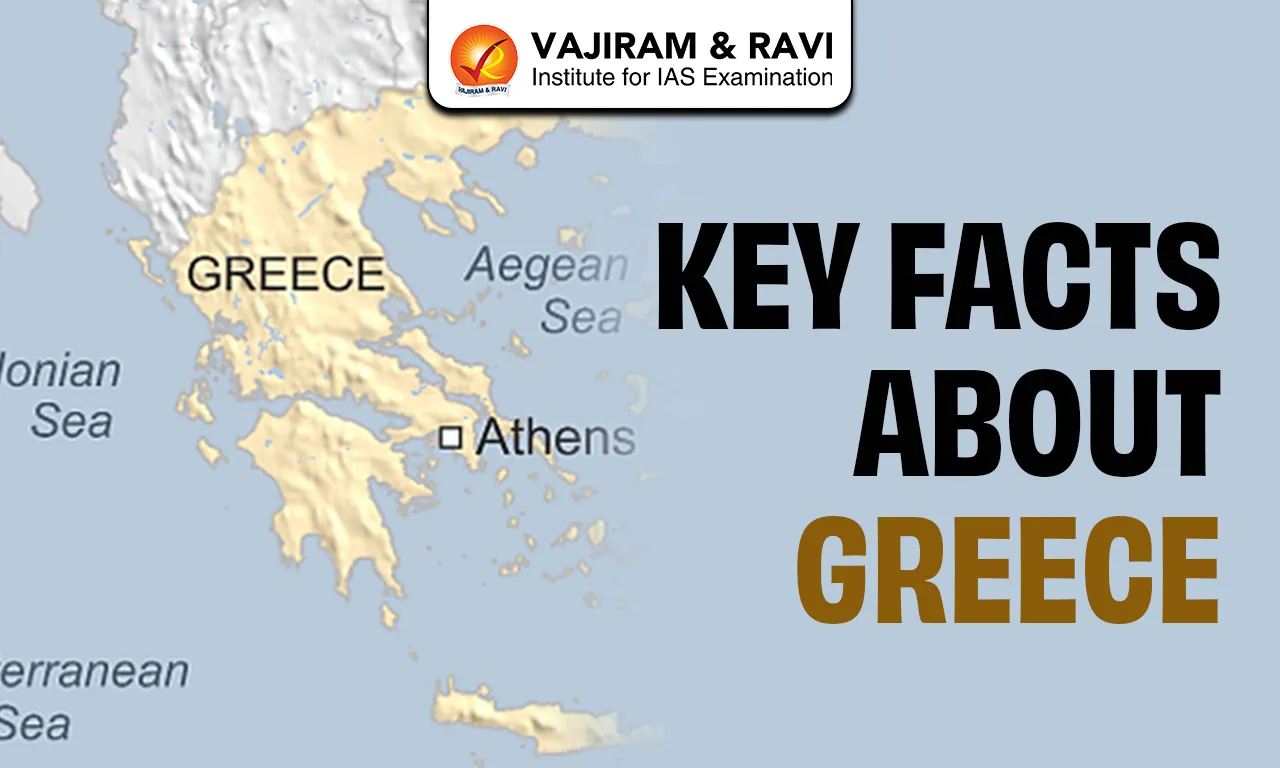
  • Location: It is located on the southern edge of the Balkan Peninsula.
  • Bordering Countries: It is bordered by 4 nations namely, North Macedonia and Bulgaria in the north, Albania in the northwest, and Turkey in the northeast.
  • Maritime Borders: It is also bounded by the Aegean Sea in the east, Ionian Sea in the west and the Mediterranean Sea in the south.
  • Capital:  Athens

Geographical Features of Greece

  • Terrain: It is predominantly mountainous, with approximately 80% of its terrain consisting of mountains or hills, making it one of the most mountainous countries in Europe. 
  • Climate: The climate of Greece is typically Mediterranean.
  • Major Mountain:  Pindus mountain range on the mainland contains one of the world’s deepest gorges, Vikos Gorge, which plunges 3,600 feet (1,100 meters).
  • Highest Peak: The highest Greek mountain is Mount Olympus, rising to 2,918 meters.
  • Major Rivers: Maritsa, Struma and Vardar etc.
  • Natural Resources:  It mainly consists of petroleum, magnetite, lignite, bauxite, hydropower, and marble.

Source: News On Air

Greece FAQs

Q1: Which sea lies to the west of Greece?

Ans: Ionian Sea; Aegean Sea to east, Mediterranean Sea to south

Q2: Which mountain is the highest peak in Greece?

Ans: Mount Olympus

National Rainfed Area Authority

National Rainfed Area Authority

National Rainfed Area Authority Latest News

Recently, the National Rainfed Area Authority (NRAA) has achieved a significant milestone in the conservation of India's wild rice (Oryza rufipogon) genetic resources in Sonitpur District of Assam.

About National Rainfed Area Authority

  • It was established in 2006 as an advisory body under the Ministry of Agriculture and Farmers’ Welfare.
  • It aims to promote sustainable agriculture in rainfed regions, enhance productivity, and improve the livelihoods of the farming communities.
  • Mandate: It is wider than mere water conservation and covers all aspects of sustainable and holistic development of rainfed areas, including appropriate farming and livelihood system approaches.
  • Governance Structure
    • Governing Board: It provides necessary leadership and appropriate coordination in implementation of programmes. 
      • The Governing Board is chaired by the Union Agriculture Minister and co-chaired by the Union Minister of Rural Development.
    • Executive Committee: It consists of technical experts and representatives from stakeholder Ministries. 
      • The Executive Committee would be headed by a full time Chief Executive Officer who should be a recognized expert on the subject.
    • The CEO will be supported by five full-time technical experts.
  • Headquarter: It is located in New Delhi.

Source: PIB

National Rainfed Area Authority FAQs

Q1: Where is the headquarters of National Rainfed Area Authority (NRAA ) located?

Ans: New Delhi

Q2: Under which Ministry does NRAA function?

Ans: Ministry of Agriculture & Farmers Welfare

Telecommunications Act 2023: Understanding the New Telecom Rules and Their Implications

Telecommunications Act 2023

Telecommunications Act 2023 Latest News

  • The government has notified a new set of rules recently under the Telecommunications Act, 2023. These are the:
    • Telecommunications (Authorisation for Provision of Principal Telecommunication Services) Rules, 2026
    • Telecommunications (Authorisation for Captive Telecommunication Services) Rules, 2026
    • Telecommunications (Authorisation for Provision of Miscellaneous Telecommunication Services) Rules, 2026
  • The rules mark a shift in India's telecom regulatory framework, though much of the implementation remains incomplete.

The Big Picture: What the Parent Act Does

  • The main objective of the Telecommunications Act, 2023 is to simplify and replace the much-amended, colonial-era Indian Telegraph Act, 1885 (along with other laws like the Wireless Telegraphy Act, 1933).
  • Importantly, for telecom operators and ordinary users, there are not many operational changes on the ground. 
  • The exercise is largely about modernising and consolidating the legal framework rather than altering day-to-day services.

The Key Shift: From "Licence" to "Authorisation"

  • The central change in the newly notified rules is a move away from the old licensing framework to an authorisation regime.
    • The term "licence" is replaced with "authorisation."
  • The paperwork that telecom operators and Internet Service Providers (ISPs) must complete is simplified and modified.
  • Anti-spam enforcement is added as an obligation under the parent Act.
  • Operators have flexibility in the transition: telcos and ISPs can migrate to the new authorisation regime now, or wait until their existing licences expire and then apply afresh.

Greater Powers for the Government

  • Along the way, the Act has expanded the Union government's powers. 
  • Notable examples include:
    • A broad definition of "telecommunication" that could be used to regulate messaging apps. 
      • Though the government initially denied this intent, experts note that last year the Department of Telecommunications (DoT) attempted to make WhatsApp log out web users every six hours and "bind" every user to a SIM, as an anti-spam measure.
    • Renaming the Universal Service Obligation Fund (into which telcos pay to fund telecom infrastructure in remote, financially unviable areas) as the Digital Bharat Nidhi.
    • Power to seize telecom infrastructure on national security or war grounds.
    • A replacement for interception orders — despite pushback from industry and civil society, the government retained senior officials' powers to issue phone and internet tapping orders.

The Unfinished Business: Satellite Internet and Starlink

  • Implementation is still incomplete, and satellite internet is the biggest grey area.
    • The Act recognises satellite internet, but the final rules removed explicit references to GMPCS (Global Mobile Personal Communications by Satellite) that were present in the draft rules.
    • Starlink, the world's largest satellite internet provider, still awaits approvals to launch in India.
    • The delay reportedly reflects the government's lingering concern about whether it can truly shut off Starlink, given how the service has been used in countries like Iran in defiance of local governments — a national security and controllability worry.

Why the New Telecom Regime Is Not Fully Ready Yet

  • Even though the rules have been notified, the system is not yet fully working on the ground. Notifying a rule is only the first step; the government still has to spell out many practical details before operators can actually function under the new regime. 
  • Legal analysts have pointed out that several of these details are still missing.
    • First is the "sound track-record" criterion. To get an authorisation, a telecom company is expected to have a good past record. 
      • But the government has not yet defined what counts as a "sound" record — for example, whether past penalties, dues, or compliance failures would disqualify a company. 
      • Without a clear yardstick, operators cannot be sure whether they will qualify.
    • Second are the exemption thresholds. Not every service or entity will need to go through the full authorisation process; smaller players or certain categories may be exempted. 
      • But the government has not yet specified the size or nature of operations below which such exemptions apply. 
      • Until this is fixed, companies do not know whether the rules even apply to them.
    • Third are the technical directions and detailed specifications — the fine print on how systems must be set up, what standards must be met, and how compliance will actually be carried out.

Source: TH

Telecommunications Act 2023 FAQs

Q1: What is the key reform introduced under the Telecommunications Act 2023?

Ans: The Telecommunications Act 2023 replaces the traditional licensing framework with an authorisation regime, simplifying regulatory procedures for telecom service providers.

Q2: How does the Telecommunications Act 2023 strengthen government powers?

Ans: The Telecommunications Act 2023 expands powers relating to telecom infrastructure, interception, national security, anti-spam measures and regulation of telecommunication services.

Q3: Why is satellite internet an unresolved issue under the Telecommunications Act 2023?

Ans: The Telecommunications Act 2023 recognises satellite internet, but detailed implementation rules and regulatory clarity for providers like Starlink are still pending.

Q4: What challenges remain in implementing the Telecommunications Act 2023?

Ans: The Telecommunications Act 2023 requires further clarification on eligibility criteria, exemption thresholds, technical standards and operational compliance before full implementation.

Q5: Why is the Telecommunications Act 2023 important for India's digital ecosystem?

Ans: The Telecommunications Act 2023 modernises India's telecom laws, improves regulatory efficiency and lays the legal foundation for future communication technologies and digital infrastructure.

WhatsApp Username Feature Under Scrutiny – Explained

WhatsApp username

WhatsApp Username Latest News

  • The government has asked WhatsApp to put its planned username feature on hold over concerns that it may increase impersonation, phishing, and online fraud.

WhatsApp Username Feature

  • WhatsApp has proposed a new username-based feature that would allow users to chat or receive messages without sharing their phone numbers. 
  • The feature is similar to systems already available on platforms like Telegram and Signal.
  • Under the proposed model:
    • Users can choose a unique username for their account.
    • Other users can contact them using that username instead of their mobile number.
    • The feature is meant to improve privacy, especially when interacting with new people.
    • Users would still need a phone number to create and operate a WhatsApp account.
  • According to WhatsApp, the idea is to let people communicate more privately in situations where sharing a phone number may feel unnecessary or intrusive.

News Summary

  • The Union government has raised concerns over WhatsApp’s planned username feature and has asked the company not to roll it out for now.
  • A notice has been sent asking the company to provide a detailed explanation within three days and to keep the feature on hold until further consultation is completed.
  • Government’s Concerns: The government’s central concern is that the new system could make it easier for bad actors to misuse the platform for:
    • Impersonation
    • Phishing
    • Online fraud
    • Digital arrest scams
    • Spam messaging
  • Officials fear that users may create usernames that closely resemble those of:
    • Public figures
    • Government institutions
    • Verified entities
    • Known individuals and organisations
  • This could make it difficult for ordinary users, especially those who are not digitally aware, to distinguish genuine accounts from fake ones.
  • The concern becomes more serious because impersonation-linked scams are already being carried out through WhatsApp. 
  • The government believes that allowing contact through usernames, without showing phone numbers upfront, may give fraudsters another tool to mislead users.

WhatsApp’s Response

  • WhatsApp has clarified that the feature is not yet live and will be introduced gradually later this year. The company has said it has built several safeguards into the feature.
  • These include:
    • Reserving high-profile usernames such as those of public figures, government entities, celebrities, and verified Meta accounts.
    • Blocking lookalike derivatives of known names.
    • Requiring users to know the exact username in order to contact someone.
  • Showing useful account information when a first message is received, such as: 
    • Whether the sender is a new account
    • Whether they are already in the contact list
    • Whether they are part of common groups
    • Whether they are located in a different country
  • Limiting how many new people an account can contact.
  • Blocking repeated attempts to guess a username key.
  • Using systems to detect and remove common impersonation and abuse patterns.
  • The company has also said that impersonation-related abuse will be taken seriously and that accounts violating the rules may lose their usernames or be banned entirely.

Wider Regulatory Context

  • This is not the first time WhatsApp has come under government scrutiny.
  • Earlier, the Department of Telecommunications had directed the platform to:
    • Ensure users cannot access WhatsApp without the registered SIM being active on the device
    • Log out WhatsApp Web users every six hours
  • While the second direction was rolled back, the SIM-related requirement continues.
  • The current development shows that digital platforms are increasingly being examined not just for privacy and encryption issues, but also for how new features could affect cyber safety, impersonation risks, and fraud prevention.

Significance

  • The controversy highlights a larger policy challenge in digital governance: how to balance privacy-enhancing features with the need to prevent online abuse and cybercrime.
  • On one side, username-based communication can reduce unnecessary exposure of personal phone numbers. 
  • On the other, if not designed carefully, it may create new risks of deception and identity misuse.
  • The government’s intervention suggests that future platform features may face closer scrutiny if they are seen as likely to increase vulnerability for users.

Source: TH | IE

WhatsApp Username FAQs

Q1: What is WhatsApp’s username feature?

Ans: It is a planned feature that would allow users to contact each other through usernames without revealing phone numbers initially.

Q2: Why has the government objected to it?

Ans: The government fears it may increase impersonation, phishing, spam, and digital fraud.

Q3: Has the feature been rolled out already?

Ans: No. WhatsApp has said the feature is not yet live and will be introduced gradually later.

Q4: What safeguards has WhatsApp proposed?

Ans: These include reserving high-profile usernames, blocking lookalike names, limiting contact attempts, and showing account details such as country and common groups.

Q5: Will users still need a phone number for WhatsApp?

Ans: Yes. WhatsApp has clarified that a phone number will still be required to use the platform.

Sovereign Credit Ratings: India’s Grievances with Global Credit Rating Agencies Explained

Sovereign Credit Ratings

Sovereign Credit Ratings Latest News

  • Speaking at a business conference in London, Commerce Minister Piyush Goyal questioned the methodologies of sovereign rating agencies, saying they have been "unfair to India." 
  • He contrasted this with praise for one agency — CareEdge Ratings — for being "objective." This is not the first time India has raised this concern, and it has revived the debate over how the country is rated.

What Do Rating Agencies Measure

  • India is rated by seven international sovereign credit rating agencies: S&P, Moody's, Morningstar DBRS, Fitch, the Japanese Credit Rating Agency (JCRA), Rating and Investment Information (R&I), and CareEdge Ratings. 
  • The three most widely accepted globally are S&P, Fitch, and Moody's.
  • Their core job is to measure an entity's ability and willingness to repay its debt. The entity can be a company, a municipal corporation, a state, or — in the case of sovereign ratings — a national government.
  • How the scale works: Ratings use an alphabet scale. Fitch and S&P use AAA as the highest (Moody's uses Aaa), descending through AA+, AA, AA-, A+, A, A-, then into the 'B' ratings, down to D, which means the entity is in default.
  • Why ratings matter: They determine the interest rate at which an entity can borrow. A AAA rating implies no default risk and the lowest borrowing costs. The lower the rating, the higher the perceived risk — and the higher the interest rate demanded to offset it.

The Key Distinction: Ability vs. Willingness to Repay

  • This is the conceptual heart of the dispute. The two metrics are very different:
    • Ability to repay is largely quantitative — backed by hard numbers that show whether a country can service its debt.
    • Willingness to repay is largely qualitative — it relies on opinion and judgement rather than hard data.
  • This distinction underpins India's entire grievance.

How India Has Been Rated So Far

  • For years, India has been rated at the lowest rung of investment grade — just a grade or two above "junk" status (the point at which lenders stop lending for fear of default). 
  • Strikingly, these ratings went unchanged for over a decade, and in some cases nearly two decades.
  • Recent upgrades have come, but slowly:
  • Even after these upgrades, India remains only just above junk grade.

India's Core Objections

  • Despite the upgrades, the government argues the ratings do not reflect reality. The agencies "haven't recognised the India growth story, the strong India fundamentals and the sovereign capabilities." 
  • The issue has even featured in official documents. The Economic Survey 2020-21 devoted an entire chapter to it. Its key arguments:
    • It was the first time the world's fifth-largest economy had been assigned such a low rating.
    • India's macroeconomic fundamentals are strong — more than enough to demonstrate its ability to repay.
    • On willingness, India has never defaulted on its sovereign debt despite several crises — which should be strong proof of its willingness to pay.
  • The central allegation: Global agencies rely too heavily on qualitative metrics rather than quantitative ones. These qualitative judgements are often based on the opinions of a small group of experts, making them subjective and prone to skewing the overall rating. 
  • Meanwhile, quantitative metrics — where India performs relatively well — are given comparatively lower weightage.

Why CareEdge Ratings Is Favoured

  • CareEdge stands apart for two reasons:
    • It is the first sovereign rating agency headquartered in India, so the perception is that it can better capture the ground realities of India's economy.
    • More importantly, its stated methodology gives primary importance to quantitative factors — precisely the metrics on which India scores well, and precisely the fix India has been demanding of the global agencies.

Conclusion

  • India's dispute with global rating agencies boils down to a single argument: that ratings lean too much on subjective, opinion-based qualitative judgements and too little on hard quantitative data, where India performs well. 
  • With strong fundamentals, a clean record of never defaulting, and status as the world's fifth-largest economy, New Delhi feels its persistent ranking just above junk grade is unjustified. 
  • The recent upgrades by S&P, Moody's, R&I and others suggest some movement, but the deeper concern remains — that the methodology itself needs reform. 
  • The government's endorsement of the India-headquartered, quantitatively-driven CareEdge signals the kind of approach it believes would rate India more fairly.

Source: TH | IE

Sovereign Credit Ratings FAQs

Q1: Why does India object to current Sovereign Credit Ratings?

Ans: India argues that Sovereign Credit Ratings rely excessively on subjective qualitative assessments while giving insufficient weight to quantitative indicators like growth, debt repayment and macroeconomic stability.

Q2: How do Sovereign Credit Ratings affect a country's economy?

Ans: Sovereign Credit Ratings influence borrowing costs, investor confidence, foreign capital inflows and the interest rates governments pay on international debt.

Q3: What is the difference between ability and willingness in Sovereign Credit Ratings?

Ans: In Sovereign Credit Ratings, ability reflects measurable repayment capacity, whereas willingness depends on qualitative judgments about a government's commitment to honour its debt.

Q4: Why does India consider its Sovereign Credit Ratings unfair?

Ans: India believes its Sovereign Credit Ratings underestimate its strong economic fundamentals, never-default record and status as one of the world's largest economies.

Q5: Why is CareEdge Ratings highlighted in the debate on Sovereign Credit Ratings?

Ans: CareEdge Ratings emphasises quantitative indicators in Sovereign Credit Ratings, aligning more closely with India's view that objective economic data should carry greater weight.

Daily Editorial Analysis 2 July 2026

Daily-Editorial-Analysis

The Case for Building India’s Coal Chemistry Capability

Context

  • The 2026 Strait of Hormuz crisis tested India's ability to withstand a major disruption in global energy supplies.
  • The country's effective response demonstrated that energy security depends not only on diplomatic engagement or diversified imports but also on indigenous scientific capability, technological self-reliance, and robust industrial institutions.
  • While India successfully managed the immediate crisis, achieving long-term resilience requires reducing dependence on imported fuels through domestic technological innovation.

India's Successful Crisis Management

  • Refinery Flexibility and Technical Capability
    • India's response was built on decades of investment in research and development, process engineering, metallurgy, and workforce training.
    • Modern refineries developed the flexibility to process crude oil with different density, sulphur, and viscosity characteristics from multiple suppliers, including the Americas, West Africa, Russia, and West Asia.
    • Within weeks of the disruption, non-Hormuz crude sourcing increased from 55% to 70%.
    • Engineers rapidly adjusted refinery operations, optimized production processes, and maintained product quality without disrupting fuel supplies.
    • During the LPG shortage, domestic refinery output increased from 35 to 54 thousand metric tonnes per day, reflecting India's strong technical capability, engineering expertise, and accumulated institutional knowledge.
  • Indigenous Capability as Strategic Insurance
    • The crisis highlighted that lasting national resilience is built on scientific capability and human capital rather than temporary geopolitical arrangements.
    • Investments in research and industrial expertise enabled India to absorb external shocks with confidence.
    • However, although crude imports can be diversified, LPG imports remain concentrated among a limited number of exporting countries, leaving a significant structural vulnerability.

From Crisis Management to Structural Reform

  • Strengthening long-term energy security requires replacing imported fuels with domestic alternatives.
  • Dimethyl Ether (DME), produced through coal gasification, is chemically similar to LPG and can be blended into existing cylinders and pipelines without major infrastructure changes.
  • With abundant coal reserves, India possesses a significant comparative advantage. The Bureau of Indian Standards has approved blending up to 20% DME with LPG.
  • Such blending could replace approximately 6.3 million tonnes of LPG imports annually and save nearly ₹34,000 crore in foreign exchange, while enhancing strategic autonomy and reducing exposure to global supply disruptions.

The Way Forward: Innovation Ecosystem and Policy Support

  • An effective innovation ecosystem requires collaboration among research institutions, government, and industry.
  • Indigenous DME technology developed by the CSIR's National Chemical Laboratory and its rapid scaling through the Centre for High Technology illustrate how scientific research can be transformed into strategic national capability.
  • Recognising this potential, the Union Cabinet approved a ₹37,500 crore coal gasification programme targeting 100 million tonnes annually by 2030.
  • The scheme provides financial incentives, long-term coal linkages, and policy certainty for industrial investment.
  • However, challenges such as high-ash coal, limited gasification capacity, and the need for greater technical expertise require sustained investment, industrial discipline, and continuous technological advancement.

Conclusion

  • The Hormuz crisis demonstrated that indigenous capability is India's most reliable safeguard against global energy disruptions.
  • Decades of investment in science, engineering, and industrial capacity enabled the country to manage an immediate crisis effectively.
  • Applying the same commitment to coal gasification and DME production can reduce import dependence, strengthen energy resilience, promote innovation, and enhance India's long-term economic security and strategic independence.

The Case for Building India’s Coal Chemistry Capability FAQs

Q1. What did the 2026 Strait of Hormuz crisis reveal about India's energy security?
Ans. The crisis showed that indigenous scientific capability and technological self-reliance are essential for long-term energy security.

Q2. How did Indian refineries respond to the supply disruption?
Ans. Indian refineries adapted by processing crude oil from multiple sources through technical flexibility and engineering expertise.

Q3. Why is Dimethyl Ether (DME) important for India?
Ans. DME can reduce India's dependence on imported LPG by serving as a domestically produced alternative fuel.

Q4. What role does coal gasification play in energy security?
Ans. Coal gasification enables the production of DME from India's abundant coal reserves, strengthening energy resilience.

Q5. What is the key lesson from the Hormuz crisis?
Ans. The key lesson is that sustained investment in research, innovation, and industrial capability creates lasting national resilience.

Source: The Hindu


A Unified Policy Architecture for India’s Energy Future

Context

  • As India aspires to achieve energy self-reliance by 2047 and net-zero emissions by 2070, the next phase of its energy transition requires a more integrated and coordinated approach to planning and governance.
  • Recognising this need, the Indian National Science Academy (INSA) released a policy brief in May 2026 proposing a Unified National Energy Framework.
  • The framework aims to integrate diverse energy resources, technologies, and institutions to achieve energy security, affordability, sustainability, and long-term economic growth.

India's Energy Transition: Achievements and Emerging Challenges

  • Major Achievements
    • India has made significant progress in improving energy accessibility and sustainability through several landmark initiatives, including:
      • Saubhagya Scheme, which achieved near-universal household electrification.
      • Pradhan Mantri Ujjwala Yojana (PMUY), which expanded access to clean cooking fuel for millions of households.
      • Rapid expansion of renewable energy capacity from approximately 40 GW in 2015 to nearly 260 GW by 2025, making India one of the world's fastest-growing renewable energy markets.
  • Emerging Challenges
    • Despite these successes, India's energy sector faces several structural challenges:
      • Rising energy demand due to rapid industrialization, urbanization, and economic growth.
      • Continued dependence on imported crude oil and natural gas.
      • Balancing multiple priorities, including energy security, affordability, sustainability, and economic competitiveness.
      • Increasing complexity arising from the integration of conventional and renewable energy sources.

Need for an Integrated National Energy Framework

  • The INSA policy brief argues that India's evolving energy landscape requires a holistic approach rather than fragmented sector-specific policies.
  • An integrated framework seeks to:
    • Coordinate planning across all energy sources.
    • Improve collaboration among various institutions and stakeholders.
    • Integrate generation, transmission, storage, distribution, and emerging technologies.
    • Ensure long-term policy consistency.
    • Enhance energy resilience while supporting sustainable development.
  • By viewing the energy sector as a single interconnected system, the framework aims to optimize resource utilization and improve policy effectiveness.

The Four Pillars of the Proposed Energy Framework

  • Adequacy: Ensuring Reliable Energy Supply
    • Adequacy focuses on maintaining a secure and diversified energy supply capable of meeting India's growing energy demand.
    • Key strategies include:
      • Diversification of conventional and renewable energy sources.
      • Modernization of energy infrastructure.
      • Expansion of energy storage systems.
      • Adoption of digital technologies for efficient grid management.
      • Strengthening national energy resilience and reducing long-term vulnerabilities.
  • Access: Providing Reliable and Equitable Energy
    • Building upon India's achievements in electrification and clean cooking fuel access, this pillar emphasizes universal access to quality energy services.
    • Priority areas include:
      • Improving last-mile connectivity.
      • Enhancing reliability and quality of electricity supply.
      • Expanding decentralized and off-grid renewable energy solutions.
      • Ensuring equitable access for rural and remote communities.
  • Affordability: Making Energy Economically Accessible
    • A successful energy transition must remain financially sustainable for consumers and industries alike.
    • The framework promotes:
      • Innovative financing mechanisms.
      • Efficient and competitive energy markets.
      • Consumer protection measures.
      • Cost-effective deployment of clean energy technologies.
      • Inclusive economic growth without imposing excessive financial burdens.
  • Appropriate Sustainability: A Context-Specific Approach
    • Unlike a one-size-fits-all sustainability model, the framework advocates an approach tailored to India's developmental priorities and resource availability.
    • This includes:
      • Region-specific transition strategies.
      • Support for local communities.
      • Workforce reskilling and employment generation.
      • Environmentally responsible development aligned with socio-economic realities.
    • The concept recognises that sustainability must complement, not hinder, India's development goals.

Phased Roadmap for Energy Transition

  • Short-Term Priorities
    • Immediate focus areas include:
      • Strengthening energy infrastructure.
      • Accelerating renewable energy deployment.
      • Promoting emerging technologies such as green hydrogen.
      • Establishing institutional mechanisms for better coordination.
  • Long-Term Priorities
    • Over time, emphasis will shift toward:
      • Greater integration of low-carbon technologies.
      • Increased use of bio-resources.
      • Development of resilient and interconnected energy systems.
      • Continuous technological innovation and digitalisation.

Conclusion

  • India's energy transition extends beyond increasing renewable energy capacity; it seeks to build an integrated, resilient, affordable, and sustainable energy system capable of supporting future economic growth and environmental commitments.
  • The Unified National Energy Framework proposed by the Indian National Science Academy provides a comprehensive roadmap by emphasizing the four pillars of adequacy, access, affordability, and appropriate sustainability.
  • Through coordinated planning, technological innovation, and inclusive governance, India can strengthen its energy security, reduce import dependence, and successfully achieve its long-term goals of energy self-reliance by 2047 and net-zero emissions by 2070.

A Unified Policy Architecture for India’s Energy Future FAQs

Q1. What is the main objective of India's Integrated National Energy Framework?
Ans. The main objective is to create a secure, affordable, sustainable, and integrated energy system for India.

Q2. What are the four pillars of the proposed energy framework?
Ans. The four pillars are adequacy, access, affordability, and appropriate sustainability.

Q3. Why does India need an integrated energy framework?
Ans. India needs an integrated energy framework to coordinate diverse energy sources and ensure long-term energy security and sustainable development.

Q4. What role does renewable energy play in India's energy transition?
Ans.  Renewable energy helps diversify the energy mix and reduce dependence on fossil fuels.

Q5. What are India's long-term energy goals?
Ans. India aims to achieve energy self-reliance by 2047 and net-zero emissions by 2070.

Source: The Hindu


Reimagining India's PPP Model - Why Capital Circulation is the Key to Infrastructure Financing

Context

  • India's ambitious goal of becoming a developed nation by 2047, alongside achieving net-zero emissions by 2070, requires unprecedented investment in infrastructure.
  • While the first generation of Public-Private Partnerships (PPPs) transformed sectors such as airports, highways and ports, their financing structure was fundamentally flawed.
  • Instead of abandoning PPPs, India should adopt a second-generation financing architecture centred on capital circulation, enabling continuous recycling of public and private capital.

Need for a New Infrastructure Financing Model

  • India's infrastructure pipeline had expanded to over 13,000 projects worth nearly ₹185 lakh crore by March 2025, yet this represents only a fraction of future requirements.
  • Massive investments are needed in renewable energy, power transmission networks, green hydrogen, climate-resilient urban infrastructure, and adaptation and decarbonisation projects.
  • Achieving net-zero by 2070 is estimated to require investments exceeding $20 trillion. Such a scale cannot be financed solely through government expenditure or corporate balance sheets.

Lessons from the First Generation of PPPs

  • The PPPs themselves did not fail; their financing model did.
  • Core problem - Asset-liability mismatch: Infrastructure assets typically generate returns over 30–50 years, but many PPP projects were financed through bank loans with repayment periods of only 7–10 years.
  • Consequently:
    • Debt servicing peaked during the early years when revenues were uncertain.
    • Following the Global Financial Crisis (2008) and domestic economic slowdown, project revenues declined while debt obligations remained fixed.
    • This led to rising Non-Performing Assets (NPAs), stressed infrastructure projects and declining investor confidence.
  • Key takeaway:
    • Long-term infrastructure was financed using short-term capital, creating systemic financial stress.

From Capital Scarcity to Capital Circulation

  • India's challenge today is not merely raising more capital but efficiently matching different sources of capital with different stages of project risk.
  • Risk-based financing across the project lifecycle:
    • Different investors should finance projects according to their risk appetite.
    • Project stage (Appropriate investor):
      • Project preparation, land acquisition, construction (Government/public sector).
      • Operational and revenue-generating stage [Developers and Infrastructure Investment Trusts (InvITs)].
      • Mature, low-risk assets (Pension funds, insurance companies, sovereign wealth funds).
    • This ensures that public capital is recycled instead of remaining locked in completed projects.

India's Existing Institutional Strengths:

  • India has already developed important financing platforms, like,
    • Infrastructure Investment Trusts (InvITs): Enable monetisation of operational infrastructure assets.
    • National Investment and Infrastructure Fund (NIIF): Has successfully attracted global institutional investors.
  • However, these mechanisms need to function within a continuous capital recycling framework, where ownership and financing shift as project risks decline.

The Concept of Circular Finance with Continuous Capital Recycling

  • Working:
    • Government and developers finance project construction.
    • Once projects become operational and revenues stabilise, InvITs acquire these assets.
    • Governments and developers recover capital and reinvest it in new infrastructure.
    • Operational projects are refinanced through Infrastructure Debt Funds (IDFs).
    • Eventually, mature assets are financed by pension funds, insurance companies and sovereign wealth funds, which seek stable long-term returns.
  • Implication:
    • This reduces financing costs while ensuring capital remains available for successive infrastructure projects.

Role of Financial Sector Reforms:

  • Dynamic risk-based loan repricing:
    • The Reserve Bank of India (RBI) must mandate dynamic risk-based repricing of infrastructure loans.
    • Currently, banks continue charging interest rates based on construction-stage risks even after projects become operational. This discourages refinancing and delays capital recycling.
    • Risk-based repricing would lower borrowing costs for de-risked projects and facilitate transfer of assets to long-term investors.
  • Reviving infrastructure debt funds:
    • Infrastructure Debt Funds should serve as intermediaries between operational infrastructure assets and institutional investors by -
      • Refinancing expensive bank loans.
      • Providing long-term, lower-cost capital.
      • Improving overall financial sustainability of infrastructure projects.

Why Capital Circulation Matters

  • Keeping public funds or bank capital locked indefinitely in mature infrastructure reduces the economy's capacity to finance new projects.
  • A robust capital circulation framework would:
    • Improve efficiency in infrastructure financing.
    • Reduce pressure on public finances.
    • Lower the cost of capital.
    • Attract global long-term institutional investors.
    • Support sustainable infrastructure expansion while maintaining fiscal discipline.

Conclusion

  • India's infrastructure ambitions demand a shift from merely mobilising private capital to creating a financing ecosystem where capital circulation is as important as capital mobilisation in achieving the Viksit Bharat 2047 vision.
  • Therefore, the second generation of PPPs must focus on risk-appropriate financing, refinancing, asset recycling and institutional participation.

Reimagining India's PPP Model FAQs

Q1. Why did the first generation of Public-Private Partnerships (PPPs) in India face financial distress?

Ans. Because long-term infrastructure assets were financed through short-term bank loans, creating an asset-liability mismatch.

Q2. What is meant by 'capital circulation' in infrastructure financing?

Ans. It refers to the continuous recycling of public, developer and institutional capital across different stages of an infrastructure project.

Q3. Why is dynamic risk-based repricing of infrastructure loans important?

Ans. It aligns borrowing costs with declining project risks, encourages refinancing, reduces the cost of capital, etc.

Q4. What is the role of the InvITs and Infrastructure Debt Funds (IDFs) in India's infrastructure financing?

Ans. InvITs monetise operational infrastructure assets, while IDFs refinance mature projects and connect them with pension and insurance funds.

Q5. How can a circular finance model contribute to achieving India's Viksit Bharat 2047 and net-zero goals?

Ans. By recycling capital into successive infrastructure projects, reducing fiscal pressure, attracting long-term institutional investment, etc.

Source: IE

Daily Editorial Analysis 2026 FAQs

Q1: What is editorial analysis?

Ans: Editorial analysis is the critical examination and interpretation of newspaper editorials to extract key insights, arguments, and perspectives relevant to UPSC preparation.

Q2: What is an editorial analyst?

Ans: An editorial analyst is someone who studies and breaks down editorials to highlight their relevance, structure, and usefulness for competitive exams like the UPSC.

Q3: What is an editorial for UPSC?

Ans: For UPSC, an editorial refers to opinion-based articles in reputed newspapers that provide analysis on current affairs, governance, policy, and socio-economic issues.

Q4: What are the sources of UPSC Editorial Analysis?

Ans: Key sources include editorials from The Hindu and Indian Express.

Q5: Can Editorial Analysis help in Mains Answer Writing?

Ans: Yes, editorial analysis enhances content quality, analytical depth, and structure in Mains answer writing.

यूपीएससी पाठ्यक्रम 2026, आईएएस प्रारंभिक और मुख्य परीक्षा पाठ्यक्रम पीडीएफ

यूपीएससी पाठ्यक्रम 2026 upsc syllabus in hindi

यूपीएससी का पाठ्यक्रम उम्मीदवारों के ज्ञान, योग्यता और विश्लेषणात्मक क्षमताओं का आकलन करने के लिए डिज़ाइन किया गया है, और इसमें दो चरण शामिल हैं: प्रारंभिक परीक्षा (प्रीलिम्स) और मुख्य परीक्षा (मेन्स), जिसके बाद साक्षात्कार/व्यक्तित्व परीक्षण होता है। प्रारंभिक परीक्षा के लिए यूपीएससी के पाठ्यक्रम में दो अनिवार्य प्रश्नपत्र शामिल हैं: सामान्य अध्ययन प्रश्नपत्र-I और सामान्य अध्ययन प्रश्नपत्र-II (जिसे सीसैट या सिविल सेवा योग्यता परीक्षा भी कहा जाता है)। ये प्रश्नपत्र इतिहास, भूगोल, अर्थशास्त्र, राजनीति, पर्यावरण, विज्ञान और समसामयिक मामलों सहित कई विषयों को कवर करते हैं।

यूपीएससी मुख्य परीक्षा का पाठ्यक्रम अधिक विशिष्ट है और इसमें नौ पेपर होते हैं, जिनमें एक निबंध पेपर, चार सामान्य अध्ययन पेपर, दो वैकल्पिक विषय पेपर और दो भाषा पेपर (दोनों ही योग्यता प्रकृति के) शामिल हैं।

यूपीएससी पाठ्यक्रम 2026 पीडीएफ

यूपीएससी पाठ्यक्रम पीडीएफ उम्मीदवारों के लिए एक रोडमैप का काम करता है, जिससे उन्हें परीक्षा के प्रत्येक चरण, जिसमें प्रारंभिक परीक्षा, मुख्य परीक्षा और व्यक्तित्व परीक्षण (साक्षात्कार) शामिल हैं, में क्या अपेक्षित है, इसकी स्पष्ट समझ मिलती है। उम्मीदवार प्रारंभिक और मुख्य परीक्षा के लिए यूपीएससी पाठ्यक्रम पीडीएफ निम्नलिखित लिंक से डाउनलोड कर सकते हैं:

यूपीएससी प्रारंभिक परीक्षा पाठ्यक्रम 2026

परीक्षा का पहला चरण, यानी सिविल सेवा प्रारंभिक परीक्षा, केवल एक स्क्रीनिंग परीक्षा है और मुख्य परीक्षा के लिए उम्मीदवारों का चयन करने के लिए आयोजित की जाती है। अंतिम मेरिट तैयार करते समय प्रारंभिक परीक्षा में प्राप्त अंकों को ध्यान में नहीं रखा जाता है।

प्रारंभिक परीक्षा में वस्तुनिष्ठ प्रकार के दो प्रश्नपत्र होते हैं जिनके अधिकतम अंक 400 होते हैं।

यूपीएससी प्रारंभिक परीक्षा पाठ्यक्रम 2026
विवरण जानकारी

प्रश्नपत्रों की संख्या

2 अनिवार्य पेपर

प्रश्नों के प्रकार

वस्तुनिष्ठ (MCQ) प्रकार

कुल अधिकतम अंक

400 (प्रत्येक पेपर 200)

परीक्षा की अवधि

2 घंटे (दृष्टिहीन अभ्यर्थियों और लोकोमोटर विकलांगता व सेरेब्रल पाल्सी [न्यूनतम 40% विकलांगता] वाले अभ्यर्थियों के लिए 20 मिनट प्रति घंटा अतिरिक्त समय)

नकारात्मक अंकन

किसी प्रश्न के लिए निर्धारित अंकों का 1/3 भाग

परीक्षा का माध्यम

द्विभाषी (हिंदी और अंग्रेजी)

यूपीएससी सामान्य अध्ययन पेपर I का पाठ्यक्रम

इसमें निम्नलिखित विषयों को कवर करने वाले 100 प्रश्न हैं, जिनके अधिकतम अंक 200 हैं तथा इन्हें 2 घंटे में हल करना है।

  • राष्ट्रीय एवं अंतर्राष्ट्रीय महत्व की समसामयिक घटनाएँ।
  • भारत का इतिहास एवं भारतीय राष्ट्रीय आंदोलन।
  • भारतीय एवं विश्व भूगोल - भारत एवं विश्व का भौतिक, सामाजिक, आर्थिक भूगोल।
  • भारतीय राजनीति एवं शासन-संविधान, राजनीतिक व्यवस्था, पंचायती राज, सार्वजनिक नीति, अधिकार संबंधी मुद्दे, आदि।
  • आर्थिक एवं सामाजिक विकास - सतत विकास, गरीबी, समावेशन, जनसांख्यिकी, सामाजिक क्षेत्र की पहल, आदि।
  • पर्यावरण पारिस्थितिकी, जैव-विविधता और जलवायु परिवर्तन पर सामान्य मुद्दे - जिनके लिए विषय विशेषज्ञता की आवश्यकता नहीं है।
  • सामान्य विज्ञान।

यूपीएससी सामान्य अध्ययन पेपर-II का पाठ्यक्रम

इसमें निम्नलिखित विषयों से 80 प्रश्न होंगे जिनके लिए अधिकतम 200 अंक निर्धारित होंगे तथा इन्हें 2 घंटे में हल करना होगा।

  • समझ।(Comprehension)
  • संचार कौशल सहित पारस्परिक कौशल।
  • तार्किक तर्क एवं विश्लेषणात्मक क्षमता।
  • निर्णय लेना एवं समस्या समाधान करना।
  • सामान्य मानसिक क्षमता.
  • बुनियादी संख्यात्मकता (संख्याएँ और उनके संबंध, परिमाण के क्रम, आदि) (कक्षा X स्तर), डेटा व्याख्या (चार्ट, ग्राफ़, तालिकाएँ, डेटा पर्याप्तता, आदि - कक्षा X स्तर)

CSAT एक अर्हक परीक्षा है जिसके लिए न्यूनतम अर्हक अंक 33% निर्धारित हैं। मूल्यांकन के उद्देश्य से, किसी उम्मीदवार के लिए IAS प्रारंभिक परीक्षा के दोनों प्रश्नपत्रों में उपस्थित होना अनिवार्य है।

यूपीएससी मुख्य परीक्षा पाठ्यक्रम 2026

सिविल सेवा मुख्य परीक्षा में लिखित परीक्षा और साक्षात्कार (व्यक्तित्व परीक्षण) शामिल हैं। सिविल सेवा मुख्य परीक्षा में निम्नलिखित प्रश्नपत्र शामिल हैं, जिन्हें दो श्रेणियों में विभाजित किया गया है - अर्हक प्रश्नपत्र और योग्यता के लिए गिने जाने वाले प्रश्नपत्र।

यूपीएससी मुख्य परीक्षा पाठ्यक्रम 2026


योग्यता पत्र

विषय

निशान

पेपर-ए

संविधान की आठवीं अनुसूची में शामिल भाषाओं में से उम्मीदवार द्वारा चुनी जाने वाली एक भारतीय भाषा

300

पेपर-बी

अंग्रेजी

300

पेपर-I

निबंध

250

पेपर-II

सामान्य अध्ययन-I (भारतीय विरासत एवं संस्कृति, विश्व का इतिहास एवं भूगोल तथा समाज)

250

पेपर-III

सामान्य अध्ययन-II (शासन व्यवस्था, संविधान, राजनीति, सामाजिक न्याय एवं अंतर्राष्ट्रीय संबंध)

250

पेपर-IV

सामान्य अध्ययन-III (प्रौद्योगिकी, आर्थिक विकास, जैव-विविधता, पर्यावरण, सुरक्षा तथा आपदा प्रबंधन)

250

पेपर-V

सामान्य अध्ययन-IV (नैतिकता, सच्चाई और योग्यता)

250

पेपर-VI

वैकल्पिक विषय – पेपर 1

250

पेपर-VII

वैकल्पिक विषय – पेपर 2

250

उप-योग (लिखित परीक्षा)


1750

व्यक्तिगत परीक्षण


275

कुल योग


2025

महत्वपूर्ण बिंदु:

  • भारतीय भाषाओं और अंग्रेजी (पेपर ए और पेपर बी) के पेपर क्वालीफाइंग प्रकृति के होंगे और इन पेपरों में प्राप्त अंकों को रैंकिंग के लिए नहीं गिना जाएगा।
  • भारतीय भाषाओं और अंग्रेजी (पेपर ए और पेपर बी) के पेपर मैट्रिकुलेशन या समकक्ष स्तर के होंगे।
  • केवल ऐसे अभ्यर्थियों के निबंध, सामान्य अध्ययन और वैकल्पिक विषय के प्रश्नपत्रों पर विचार किया जाएगा, जो इन अर्हक प्रश्नोंपत्रों में न्यूनतम अर्हक मानक के रूप में 'भारतीय भाषा' में 25% अंक और 'अंग्रेजी' में 25% अंक प्राप्त करेंगे।
  • अभ्यर्थियों द्वारा केवल पेपर I-VII में प्राप्त अंक ही मेरिट रैंकिंग के लिए गिने जाएंगे।
  • मुख्य परीक्षा के प्रश्नपत्र पारंपरिक (निबंध) प्रकार के होंगे तथा प्रत्येक प्रश्नपत्र 3 घंटे की अवधि का होगा।
  • अभ्यर्थियों को अर्हक भाषा के प्रश्नपत्रों, प्रश्नपत्र-ए और प्रश्नपत्र-बी को छोड़कर, सभी प्रश्नपत्रों के उत्तर भारत के संविधान की आठवीं अनुसूची में शामिल किसी भी भाषा में या अंग्रेजी में देने का विकल्प होगा।
  • प्रश्न पत्र (भाषा साहित्य के प्रश्नपत्रों को छोड़कर) केवल हिंदी और अंग्रेजी में तैयार किए जाएंगे।
  • दृष्टिबाधित अभ्यर्थियों तथा लोकोमोटर विकलांगता और मस्तिष्क पक्षाघात से ग्रस्त अभ्यर्थियों, जिनमें प्रमुख (लेखन) अंग इस सीमा तक प्रभावित होता है कि उनके कार्य निष्पादन में कमी आ जाती है (न्यूनतम 40% हानि), को सिविल सेवा (प्रारंभिक) तथा सिविल सेवा (मुख्य) परीक्षा दोनों में बीस मिनट प्रति घंटा का प्रतिपूरक समय दिया जाएगा।

यूपीएससी पाठ्यक्रम 2026 अर्हक पत्रों के लिए (भारतीय भाषाएं और अंग्रेजी)

प्रश्नों का स्वरूप मोटे तौर पर इस प्रकार होगा:

अंग्रेजी भाषा:

  • दिए गए अनुच्छेदों की समझ।
  • सटीक लेखन.
  • उपयोग और शब्दावली.
  • लघु निबंध.

भारतीय भाषाएँ:

  • दिए गए अनुच्छेदों की समझ।
  • सटीक लेखन.
  • उपयोग और शब्दावली.
  • लघु निबंध.
  • अंग्रेजी से भारतीय भाषा में तथा इसके विपरीत अनुवाद।

यूपीएससी निबंध पाठ्यक्रम 2026

अभ्यर्थियों को कई विषयों पर निबंध लिखने की आवश्यकता हो सकती है।

उनसे अपेक्षा की जाएगी कि वे निबंध के विषय पर बारीकी से नज़र रखें, अपने विचारों को व्यवस्थित ढंग से प्रस्तुत करें और संक्षिप्त लेखन करें। प्रभावी और सटीक अभिव्यक्ति के लिए अंक दिए जाएँगे।

यूपीएससी जीएस 1 पाठ्यक्रम 2026

भारतीय विरासत और संस्कृति, विश्व का इतिहास और भूगोल तथा समाज।

  • भारतीय संस्कृति में प्राचीन काल से लेकर आधुनिक काल तक के कला रूपों, साहित्य और वास्तुकला के प्रमुख पहलुओं को शामिल किया जाएगा।
  • अठारहवीं शताब्दी के मध्य से लेकर वर्तमान तक का आधुनिक भारतीय इतिहास- महत्वपूर्ण घटनाएँ, व्यक्तित्व, मुद्दे।
  • स्वतंत्रता संग्राम - इसके विभिन्न चरण और देश के विभिन्न भागों से इसमें महत्वपूर्ण योगदानकर्ता/योगदान।
  • स्वतंत्रता के बाद देश के भीतर एकीकरण और पुनर्गठन।
  • विश्व के इतिहास में 18वीं शताब्दी की घटनाएं शामिल होंगी, जैसे औद्योगिक क्रांति, विश्व युद्ध, राष्ट्रीय सीमाओं का पुनः सीमांकन, उपनिवेशीकरण, उपनिवेशवाद-विमुक्ति, राजनीतिक दर्शन जैसे साम्यवाद, पूंजीवाद, समाजवाद आदि - उनके स्वरूप और समाज पर प्रभाव।
  • भारतीय समाज की मुख्य विशेषताएँ , भारत की विविधता
  • महिलाओं की भूमिका और महिला संगठन, जनसंख्या और संबंधित मुद्दे, गरीबी और विकास संबंधी मुद्दे, शहरीकरण, उनकी समस्याएं और उनके समाधान।
  • भारतीय समाज पर वैश्वीकरण के प्रभाव।
  • सामाजिक सशक्तिकरण, सांप्रदायिकता , क्षेत्रवाद और धर्मनिरपेक्षता
  • विश्व के भौतिक भूगोल की प्रमुख विशेषताएँ।
  • विश्व भर में प्रमुख प्राकृतिक संसाधनों का वितरण (दक्षिण एशिया और भारतीय उपमहाद्वीप सहित); विश्व के विभिन्न भागों (भारत सहित) में प्राथमिक, द्वितीयक और तृतीयक क्षेत्र के उद्योगों की अवस्थिति के लिए उत्तरदायी कारक।
  • महत्वपूर्ण भूभौतिकीय घटनाएं जैसे भूकंप, सुनामी, ज्वालामुखीय गतिविधि, चक्रवात आदि, भौगोलिक विशेषताएं और उनके स्थान-महत्वपूर्ण भौगोलिक विशेषताओं (जल निकायों और बर्फ-टोपियों सहित) और वनस्पतियों और जीवों में परिवर्तन और ऐसे परिवर्तनों के प्रभाव।

यूपीएससी जीएस 2 पाठ्यक्रम 2026

शासन, संविधान, राजनीति, सामाजिक न्याय और अंतर्राष्ट्रीय संबंध।

  • भारतीय संविधान-ऐतिहासिक आधार, विकास, विशेषताएँ, संशोधन, महत्वपूर्ण प्रावधान और मूल संरचना
  • संघ और राज्यों के कार्य और जिम्मेदारियां, संघीय ढांचे से संबंधित मुद्दे और चुनौतियां, स्थानीय स्तर तक शक्तियों और वित्त का हस्तांतरण और उसमें चुनौतियां।
  • विभिन्न अंगों, विवाद निवारण तंत्रों और संस्थाओं के बीच शक्तियों का पृथक्करण
  • भारतीय संवैधानिक योजना की अन्य देशों के साथ तुलना।
  • संसद और राज्य विधानमंडल-संरचना, कार्यप्रणाली, कार्य संचालन, शक्तियां एवं विशेषाधिकार तथा इनसे उत्पन्न होने वाले मुद्दे।
  • कार्यपालिका और न्यायपालिका की संरचना, संगठन और कार्यप्रणाली - सरकार के मंत्रालय और विभाग; दबाव समूह और औपचारिक/अनौपचारिक संघ और राजनीति में उनकी भूमिका।
  • जनप्रतिनिधित्व अधिनियम की मुख्य विशेषताएं .
  • विभिन्न संवैधानिक पदों पर नियुक्ति, विभिन्न संवैधानिक निकायों की शक्तियां, कार्य और जिम्मेदारियां।
  • वैधानिक, विनियामक और विभिन्न अर्ध-न्यायिक निकाय।
  • विभिन्न क्षेत्रों में विकास के लिए सरकारी नीतियां और हस्तक्षेप तथा उनके डिजाइन और कार्यान्वयन से उत्पन्न मुद्दे।
  • विकास प्रक्रियाएं और विकास उद्योग - गैर सरकारी संगठनों, स्वयं सहायता समूहों, विभिन्न समूहों और संघों, दाताओं, धर्मार्थ संस्थाओं, संस्थागत और अन्य हितधारकों की भूमिका।
  • केन्द्र और राज्यों द्वारा जनसंख्या के कमजोर वर्गों के लिए कल्याणकारी योजनाएं और इन योजनाओं का निष्पादन; इन कमजोर वर्गों के संरक्षण और बेहतरी के लिए गठित तंत्र, कानून, संस्थाएं और निकाय।
  • स्वास्थ्य, शिक्षा, मानव संसाधन से संबंधित सामाजिक क्षेत्र/सेवाओं के विकास और प्रबंधन से संबंधित मुद्दे।
  • गरीबी और भुखमरी से संबंधित मुद्दे।
  • शासन, पारदर्शिता और जवाबदेही के महत्वपूर्ण पहलू, ई-गवर्नेंस- अनुप्रयोग, मॉडल, सफलताएं, सीमाएं और संभावनाएं; नागरिक चार्टर, पारदर्शिता और जवाबदेही तथा संस्थागत और अन्य उपाय।
  • लोकतंत्र में सिविल सेवाओं की भूमिका.
  • भारत और उसके पड़ोसी संबंध।
  • द्विपक्षीय, क्षेत्रीय और वैश्विक समूह तथा भारत से संबंधित और/या भारत के हितों को प्रभावित करने वाले समझौते।
  • विकसित और विकासशील देशों की नीतियों और राजनीति का भारत के हितों, भारतीय प्रवासियों पर प्रभाव।
  • महत्वपूर्ण अंतर्राष्ट्रीय संस्थाएं, एजेंसियां ​​और मंच - उनकी संरचना, अधिदेश।

यूपीएससी जीएस 3 पाठ्यक्रम 2026

प्रौद्योगिकी, आर्थिक विकास, जैव विविधता, पर्यावरण, सुरक्षा और आपदा प्रबंधन

  • भारतीय अर्थव्यवस्था तथा नियोजन, संसाधनों का जुटाव, वृद्धि, विकास और रोजगार से संबंधित मुद्दे।
  • समावेशी विकास और इससे उत्पन्न मुद्दे।
  • सरकारी बजट.
  • देश के विभिन्न भागों में प्रमुख फसलें-फसल पैटर्न, - विभिन्न प्रकार की सिंचाई और सिंचाई प्रणालियाँ, कृषि उपज का भंडारण, परिवहन और विपणन तथा मुद्दे और संबंधित बाधाएँ; किसानों की सहायता में ई-प्रौद्योगिकी।
  • प्रत्यक्ष एवं अप्रत्यक्ष कृषि सब्सिडी और न्यूनतम समर्थन मूल्य से संबंधित मुद्दे; सार्वजनिक वितरण प्रणाली-उद्देश्य, कार्यप्रणाली, सीमाएं, सुधार; बफर स्टॉक और खाद्य सुरक्षा के मुद्दे; प्रौद्योगिकी मिशन; पशुपालन का अर्थशास्त्र।
  • भारत में खाद्य प्रसंस्करण एवं संबंधित उद्योग- कार्यक्षेत्र एवं महत्व, स्थान, अपस्ट्रीम एवं डाउनस्ट्रीम आवश्यकताएं, आपूर्ति श्रृंखला प्रबंधन।
  • भारत में भूमि सुधार.
  • अर्थव्यवस्था पर उदारीकरण के प्रभाव, औद्योगिक नीति में परिवर्तन और औद्योगिक विकास पर उनके प्रभाव।
  • बुनियादी ढांचा: ऊर्जा, बंदरगाह, सड़कें, हवाई अड्डे, रेलवे आदि।
  • निवेश मॉडल.
  • विज्ञान एवं प्रौद्योगिकी- विकास और उनके अनुप्रयोग तथा दैनिक जीवन पर प्रभाव।
  • विज्ञान एवं प्रौद्योगिकी में भारतीयों की उपलब्धियां ; प्रौद्योगिकी का स्वदेशीकरण और नई प्रौद्योगिकी का विकास।
  • आईटी, अंतरिक्ष, कंप्यूटर, रोबोटिक्स , नैनो-टेक्नोलॉजी , जैव-टेक्नोलॉजी और बौद्धिक संपदा अधिकारों से संबंधित मुद्दों के क्षेत्र में जागरूकता ।
  • संरक्षण, पर्यावरण प्रदूषण और क्षरण, पर्यावरणीय प्रभाव मूल्यांकन।
  • आपदा एवं आपदा प्रबंधन।
  • विकास और उग्रवाद के प्रसार के बीच संबंध।
  • आंतरिक सुरक्षा के लिए चुनौतियां पैदा करने में बाहरी राज्य और गैर-राज्य अभिनेताओं की भूमिका।
  • संचार नेटवर्क के माध्यम से आंतरिक सुरक्षा के लिए चुनौतियां, आंतरिक सुरक्षा चुनौतियों में मीडिया और सामाजिक नेटवर्किंग साइटों की भूमिका, साइबर सुरक्षा की मूल बातें; धन शोधन और इसकी रोकथाम।
  • सीमावर्ती क्षेत्रों में सुरक्षा चुनौतियां और उनका प्रबंधन - संगठित अपराध का आतंकवाद से संबंध।
  • विभिन्न सुरक्षा बल एवं एजेंसियां ​​तथा उनका अधिदेश।

जीएस पेपर 4 पाठ्यक्रम 2026

नैतिकता, अखंडता और योग्यता

इस प्रश्नपत्र में सार्वजनिक जीवन में ईमानदारी, सत्यनिष्ठा से संबंधित मुद्दों के प्रति अभ्यर्थियों के दृष्टिकोण और दृष्टिकोण तथा समाज के साथ व्यवहार करते समय उनके सामने आने वाले विभिन्न मुद्दों और संघर्षों के प्रति उनकी समस्या समाधान की दृष्टि का परीक्षण करने के लिए प्रश्न शामिल होंगे।

इन पहलुओं को निर्धारित करने के लिए प्रश्नों में केस स्टडी दृष्टिकोण का उपयोग किया जा सकता है।

निम्नलिखित व्यापक क्षेत्रों को कवर किया जाएगा:

  • नैतिकता और मानवीय अंतरसंबंध: मानवीय कार्यों में नैतिकता का सार, निर्धारक और परिणाम; नैतिकता के आयाम; निजी और सार्वजनिक संबंधों में नैतिकता। मानवीय मूल्य - महान नेताओं, सुधारकों और प्रशासकों के जीवन और शिक्षाओं से शिक्षा; मूल्यों के विकास में परिवार, समाज और शैक्षणिक संस्थाओं की भूमिका।
  •  दृष्टिकोण: विषय-वस्तु, संरचना, कार्य; विचार और व्यवहार पर इसका प्रभाव और संबंध; नैतिक और राजनीतिक दृष्टिकोण; सामाजिक प्रभाव और अनुनय।
  • सिविल सेवा के लिए योग्यता और आधारभूत मूल्य, ईमानदारी, निष्पक्षता और गैर-पक्षपात, वस्तुनिष्ठता, सार्वजनिक सेवा के प्रति समर्पण, कमजोर वर्गों के प्रति सहानुभूति, सहिष्णुता और करुणा।
  • भावनात्मक बुद्धिमत्ता-अवधारणाएं, तथा प्रशासन और शासन में उनकी उपयोगिताएं और अनुप्रयोग।
  • भारत और विश्व के नैतिक विचारकों और दार्शनिकों का योगदान।
  • लोक प्रशासन में सार्वजनिक/सिविल सेवा मूल्य और नैतिकता: स्थिति और समस्याएं; सरकारी और निजी संस्थानों में नैतिक चिंताएं और दुविधाएं; नैतिक मार्गदर्शन के स्रोत के रूप में कानून, नियम, विनियम और विवेक; जवाबदेही और नैतिक शासन; शासन में नैतिक और नैतिक मूल्यों को मजबूत करना; अंतर्राष्ट्रीय संबंधों और वित्त पोषण में नैतिक मुद्दे; कॉर्पोरेट प्रशासन।
  • शासन में ईमानदारी: सार्वजनिक सेवा की अवधारणा; शासन और ईमानदारी का दार्शनिक आधार; सरकार में सूचना साझाकरण और पारदर्शिता, सूचना का अधिकार, आचार संहिता, आचरण संहिता, नागरिक चार्टर, कार्य संस्कृति, सेवा वितरण की गुणवत्ता, सार्वजनिक धन का उपयोग, भ्रष्टाचार की चुनौतियां।
  • उपरोक्त मुद्दों पर केस स्टडीज़।

यूपीएससी वैकल्पिक पाठ्यक्रम 2026

वैकल्पिक विषय के पेपर I और II, प्रत्येक 250 अंकों के हैं और कुल मिलाकर 500 अंक हैं। यूपीएससी ने चुनने के लिए 48 वैकल्पिक विषयों की सूची उपलब्ध कराई है। इन पेपरों में प्राप्त अंक अंतिम यूपीएससी सिविल सेवा परीक्षा परिणाम में रैंक निर्धारित करने में महत्वपूर्ण रूप से सहायक हो सकते हैं।

यूपीएससी वैकल्पिक पाठ्यक्रम 2026

UPSC Agriculture Syllabus

UPSC Animal Husbandry and Veterinary Science Syllabus

UPSC Anthropology Syllabus

UPSC History Syllabus

UPSC Botany Syllabus

UPSC Law Optional Syllabus

UPSC Chemistry Syllabus

UPSC Management Syllabus

UPSC Civil Engineering Syllabus

UPSC Maths Optional Syllabus

UPSC Commerce and Accountancy Syllabus

UPSC Mechanical Engineering Syllabus

UPSC Economics Syllabus

UPSC Medical Science Syllabus

UPSC Electrical Engineering Syllabus

UPSC Philosophy Syllabus

UPSC Geography Syllabus

UPSC Physics Optional Syllabus

UPSC Geology Syllabus

UPSC PSIR Optional Syllabus

UPSC Psychology Syllabus

UPSC Public Administration Optional Syllabus

UPSC Sociology Optional Syllabus

UPSC Statistics Syllabus

UPSC Zoology Syllabus

यूपीएससी वैकल्पिक साहित्य पाठ्यक्रम 2026

यूपीएससी के वैकल्पिक पाठ्यक्रम में 22 वैकल्पिक साहित्य विषय शामिल हैं। इन विषयों में असमिया, संस्कृत, तमिल आदि भारतीय भाषाएँ शामिल हैं। ये वैकल्पिक विषय भाषा के ज्ञान का परीक्षण करते हैं, जिसमें प्रसिद्ध लेखकों के साथ-साथ महत्वपूर्ण साहित्यिक ग्रंथ, गद्य और पद्य शामिल हैं।  यूपीएससी साहित्य पाठ्यक्रम में निम्नलिखित विषय शामिल हैं

यूपीएससी वैकल्पिक साहित्य पाठ्यक्रम 2026
UPSC Assamese Optional Syllabus UPSC Bengali Literature Syllabus
UPSC Gujarati Literature Optional Syllabus UPSC Hindi Literature Optional Syllabus
UPSC Maithili Literature Syllabus UPSC Malayalam Literature Syllabus
UPSC Manipuri Literature Optional Syllabus UPSC Odia Literature Syllabus
UPSC Punjabi Literature Syllabus UPSC Telugu Literature Syllabus
UPSC English Literature Syllabus UPSC Urdu Literature Syllabus
UPSC Dogri Literature Syllabus UPSC Kannada Literature Syllabus
UPSC Kashmiri Literature Syllabus UPSC Konkani Literature Syllabus
UPSC Marathi Literature Syllabus UPSC Nepali Literature Syllabus
UPSC Sanskrit Literature Syllabus UPSC Santhali Literature Syllabus
UPSC Sindhi Literature Syllabus UPSC Tamil Literature Syllabus
यूपीएससी 2026 के अन्य संबंधित पोस्ट
UPSC Syllabus UPSC Exam Pattern
UPSC Age Limit IAS Salary
UPSC Exam Date 2026 UPSC Calendar
UPSC Prelims 2027 UPSC Mains 2026
UPSC Mains Syllabus UPSC Interview
UPSC Prelims Result UPSC Mains Result
UPSC Final Result UPSC Cut Off
UPSC CSAT Syllabus UPSC Books
UPSC Admit Card UPSC Previous Year Papers
UPSC Answer Key IAS vs IPS


यूपीएससी पाठ्यक्रम 2026 FAQs

Q1: यूपीएससी परीक्षा 2026 का पाठ्यक्रम क्या है?

Ans: यूपीएससी पाठ्यक्रम 2026 में प्रारंभिक परीक्षा (सामान्य अध्ययन, सीएसएटी) और मुख्य परीक्षा (निबंध, जीएस I-IV, वैकल्पिक विषय और भाषा के पेपर सहित नौ पेपर) शामिल हैं।

Q2: क्या 2026 में यूपीएससी का पैटर्न बदल जाएगा?

Ans: यूपीएससी 2026 परीक्षा पैटर्न में किसी बड़े बदलाव की कोई आधिकारिक जानकारी नहीं है; यह पिछले वर्षों की तरह ही रहने की उम्मीद है।

Q3: यूपीएससी 2026 का पेपर पैटर्न क्या है?

Ans: यूपीएससी परीक्षा पैटर्न 2026 में प्रारंभिक परीक्षा (वस्तुनिष्ठ), मुख्य परीक्षा (वर्णनात्मक) और साक्षात्कार शामिल हैं। मुख्य परीक्षा में सामान्य अध्ययन, निबंध और एक वैकल्पिक विषय सहित नौ पेपर होते हैं।

Q4: आईएएस के लिए कौन सा विषय सर्वोत्तम है?

Ans: सर्वोत्तम वैकल्पिक विषय व्यक्तिगत रुचि के अनुसार भिन्न होता है, लेकिन लोकप्रिय विकल्पों में लोक प्रशासन, भूगोल, इतिहास, समाजशास्त्र और राजनीति विज्ञान शामिल हैं।

Q5: यूपीएससी के लिए कितने प्रयास मिलते है?

Ans: यूपीएससी सिविल सेवा परीक्षा के लिए, उम्मीदवारों को निर्धारित आयु सीमा के भीतर सामान्य के लिए 6 प्रयास, ओबीसी के लिए 9 और एससी/एसटी के लिए असीमित प्रयास मिलते हैं।

Enquire Now