Indian Ocean, location, Map, Countries, Depth, Features

Indian Ocean

The Indian Ocean, covering nearly 70.56 million sq km, is the world’s third-largest ocean and one of the most strategically significant maritime regions today. Its semi-enclosed nature, monsoon-driven currents, rich biodiversity, and dense network of global trade routes make it crucial not just for India but for Asia, Africa, and world powers. 

Indian Ocean

The Indian Ocean holds immense climatic and geopolitical importance due to its central location between Africa, Asia, Australia, and Antarctica. It forms a vital link between the energy-rich Middle East and the manufacturing hubs of East Asia. Over the decades, this ocean has emerged as the epicentre of global trade, strategic competition, and environmental vulnerability.

  • Total area: ~70.56 million sq km (20% of world ocean)
  • Surrounded by 36 littoral and 14 landlocked countries
  • Unique for monsoon reversal of currents
  • Crucial for global shipping, food security, and energy supplies

Indian Ocean Location

The Indian Ocean extends from the east coast of Africa to western Australia and merges with the Southern Ocean in the south. Unlike the Pacific and Atlantic, it is landlocked to the north, giving it a semi-closed character. This geography makes the Indian Ocean sensitive to geopolitical developments, resource competition, and climatic events.

  • Lies roughly between 20°E to 147°E longitude.
  • Extends from the equator towards 60°S latitude.
  • Warmest ocean among major oceans due to enclosed nature.
  • Accounts for nearly 20% of Earth’s water surface.

The Indian Ocean spans a vast area of around 70.56 million sq km, making it slightly smaller than the Atlantic and Pacific but larger than the Arctic and Southern Oceans. It is characterized by deep basins, ridges, and significant monsoon-driven current systems. Its average depth is approximately 3,900 meters, with the Java Trench (7,258 m) as its deepest point.

Indian Ocean Boundaries

he Indian Ocean is surrounded by diverse landmasses that shape its climatic systems, ocean currents, and maritime routes. The northern boundary is almost completely enclosed by Asia, while the eastern and western boundaries are open and connected to major straits. The southern boundary merges with the Southern Ocean, forming a continuous circumpolar water mass.

Northern Boundary

  • Bounded by Asia, including India, Pakistan, Bangladesh, Sri Lanka, and Indonesia.
  • Contains semi-enclosed seas such as the Arabian Sea and Bay of Bengal.
  • Highly influenced by the Indian Monsoon System.

Western Boundary

  • Bordered by Africa, including Somalia, Kenya, Tanzania, Mozambique, and South Africa.
  • Features key choke points like Bab-el-Mandeb and the Mozambique Channel.

Eastern Boundary 

  • Includes Australia, Indonesia, and the Timor Sea region.
  • Acts as a transition zone between the Pacific and Indian Oceans.
  • Major straits such as Malacca, Sunda, and Lombok lie here.

Southern Boundary

  • Opens into the Southern Ocean (Antarctic Ocean) around 60°S latitude.
  • Characterized by powerful circumpolar currents and cold water masses.

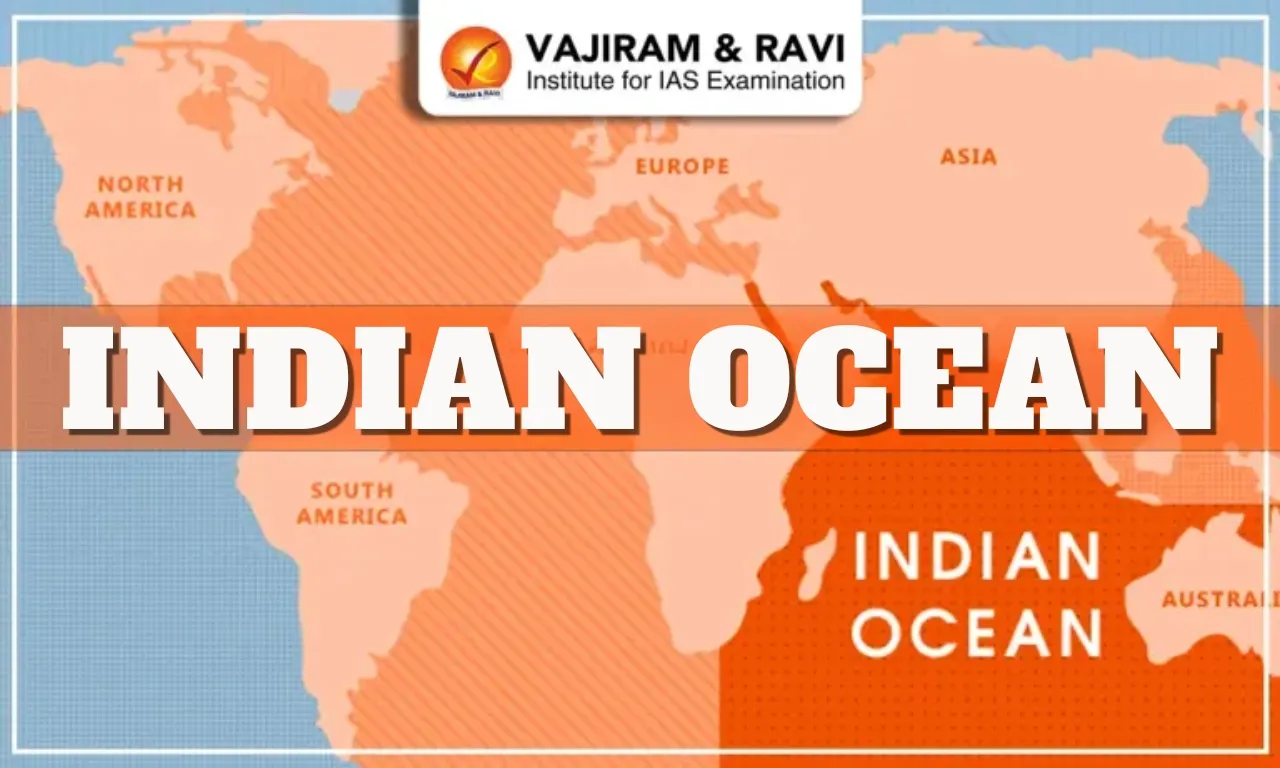
Indian Ocean Map

The Indian Ocean spans the region between Africa, Asia, Australia, and the Southern Ocean, covering an area of about 70.56 million sq. km. It includes major seas such as the Arabian Sea, Bay of Bengal, Andaman Sea, and important islands like Sri Lanka, Maldives, Seychelles, and Mauritius. The map also highlights strategic sea lanes, chokepoints like Malacca Strait and Hormuz, and resource-rich zones, emphasizing the ocean’s geopolitical and economic importance.

Bordering Countries of the Indian Ocean

The Indian Ocean is bordered by 36 countries, along with numerous island nations, territories, and dependencies. These countries influence the politics, economics, and maritime security of the region. Many of them are part of regional groupings like IORA, BIMSTEC, and SAARC, making the region geopolitically active.

List of Bordering Countries of the Indian Ocean
Region Countries

South Asia

India, Pakistan, Sri Lanka, Bangladesh, Maldives

West Asia / Middle East

Iran, Oman, Yemen, UAE, Saudi Arabia

East Africa (Horn of Africa)

Somalia, Djibouti, Eritrea

East African Coast

Kenya, Tanzania, Mozambique, South Africa

Island Nations (Western & Central IO)

Madagascar, Mauritius, Seychelles, Comoros

Southeast Asia

Indonesia, Thailand, Malaysia

Australia Region

Australia, Timor-Leste

Additional Littoral States

Myanmar (Indo-Pacific region), Bahrain and Qatar (via Persian Gulf opening), Kuwait (connected waters)

Geographical Features of the Indian Ocean

The Indian Ocean is characterized by deep basins, mid-oceanic ridges, trenches, plateaus, and monsoon-driven current systems that make it unique among the world’s oceans. Its semi-enclosed nature and warm waters create distinct climatic, tectonic, and ecological patterns.

  • Contains major deep basins such as the Arabian Basin, Somali Basin, Central Indian Basin, and Wharton Basin, reaching depths of 4,000-6,000 meters.
  • Features a prominent Mid-Indian Ridge System, including the Central, Southwest, and Southeast Indian Ridges, forming a T-shaped tectonic structure.
  • Home to the Java/ Sunda Trench, the deepest point in the Indian Ocean at approximately 7,258 meters.
  • Includes large submarine plateaus like the Kerguelen Plateau, Ninety East Ridge, and Chagos-Laccadive Ridge, formed mainly by volcanic hotspots.
  • Hosts diverse island groups such as Madagascar, Maldives, Seychelles, Mauritius, Comoros, and Andaman & Nicobar Islands.
  • Bordered by marginal seas including the Arabian Sea, Bay of Bengal, Red Sea, and Andaman Sea, each influencing monsoon and regional climate.
  • Characterized by varied continental shelves, broad along India’s west coast and narrow off the East African coastline.
  • Displays strong monsoon-driven current reversals, especially the Somali Current, which reverses direction between SW and NE monsoon seasons.
  • Exhibits significant tectonic activity due to divergent and convergent plate boundaries, leading to earthquakes and tsunamis, such as the 2004 Indian Ocean tsunami.
  • Shows distinct temperature patterns, being the warmest ocean, with higher salinity in the Arabian Sea and lower salinity in the Bay of Bengal due to high river discharge.

Indian Ocean and UNCLOS

The Indian Ocean is governed by the principles of the United Nations Convention on the Law of the Sea (UNCLOS), which provides the legal framework for maritime rights, navigation, resource utilization, and dispute resolution. UNCLOS plays a crucial role in defining the maritime boundaries of Indian Ocean littoral states, including Exclusive Economic Zones (EEZs), continental shelves, and territorial waters.

Indian Ocean and UNCLOS
Maritime Zone UNCLOS Definition Extent (from Baseline) India’s Rights Examples/Notes (India)

Internal Waters

Waters landward of the baseline

Landward side of baseline

Full sovereignty, same as land territory

Ports: Mumbai, Kochi, Chennai

Territorial Sea

Belt of coastal waters under full sovereignty

Up to 12 nautical miles

Complete sovereignty; foreign ships have innocent passage

India enforces security & customs laws; used for patrols

Contiguous Zone

Additional zone beyond territorial sea

12-24 nautical miles

Rights to prevent & punish infringements of customs, immigration, sanitation laws

Indian Coast Guard actively monitors this zone

Exclusive Economic Zone (EEZ)

Zone for exclusive resource rights

Up to 200 nautical miles

Exclusive rights to explore/exploit living & non-living resources

India’s EEZ = 2.37 million sq. km (one of the largest in world)

Continental Shelf

Seabed/subsoil extending to margin of continental slope

200-350 nautical miles

Exclusive rights over seabed minerals like hydrocarbons

India claims extended shelf in the Arabian Sea & Bay of Bengal

High Seas (Beyond National Jurisdiction)

Open ocean beyond EEZ

Beyond 200 nautical miles

Freedom of navigation, fishing (regulated), overflight

India participates in global fisheries management

Archipelagic Waters

Applies to archipelago states

Not applicable to India

-

India is not an archipelagic state

International Seabed Area (The “Area”)

Seabed beyond continental shelves

Beyond national jurisdiction

Common heritage of mankind; regulated by ISA

India has a pioneer investor status for deep-sea mining (Polymetallic nodules in Central Indian Ocean Basin)

Indian Ocean Importance

The Indian Ocean is vital for global trade, energy security, climate regulation, and strategic power competition, making it one of the most significant oceans in the 21st century. Its sea lanes, resources, and geopolitical leverage shape the economic and security interests of India and the world.

  • Facilitates nearly 80% of global maritime oil trade and connects major economies across Asia, Africa, and Europe.
  • Hosts critical Sea Lanes of Communication (SLOCs) that carry two-thirds of the world’s oil shipments and one-third of global bulk cargo.
  • Contains vital choke points like the Strait of Malacca, Strait of Hormuz, and Bab-el-Mandeb, essential for global energy and trade flows.
  • Rich in hydrocarbons, especially in the Persian Gulf, Arabian Sea, and Bay of Bengal, supporting global energy supply chains.
  • Supports a diverse blue economy, including fisheries, tourism, mineral resources, and maritime industries.
  • Plays a crucial role in monsoon formation and climate regulation, influencing weather patterns across South and Southeast Asia.
  • Acts as a key arena for geopolitical rivalry, especially between India, China, the US, and regional powers.
  • Enhances India’s strategic depth, allowing it to project power through the Andaman & Nicobar Command and a growing naval presence.
  • Serves as a hub for disaster response and humanitarian operations, especially in regions affected by cyclones and tsunamis.

Major Challenges Faced in Indian Ocean Region

  • China’s presence in the region continues to expand, with major port investments like the Kyaukpyu deep-sea port in Myanmar (over USD 1.3 billion), increasing strategic pressure on India.
  • In 2024, Sri Lanka imposed a one-year suspension on all foreign research vessels after repeated controversies involving Chinese survey ships operating in the Indian Ocean.
  • India’s Defence Ministry (2025) reaffirmed that 95% of India’s trade by volume and 68% by value passes through the Indian Ocean, highlighting increasing security vulnerabilities.
  • Maritime piracy and armed robbery incidents in the Indian Ocean touched 227 cases in 2024, reflecting a 17% rise from 2023, especially near the Gulf of Aden and East Africa.
  • Hybrid maritime threats, missile attacks, drone strikes, and water-borne improvised explosive devices rose sharply, with over 270 incidents reported in 2024, mostly linked to regional conflicts.
  • The ongoing Red Sea and West Asian crises triggered spillover: 128 out of 175 maritime violence incidents in 2024 were associated with retaliatory drone and missile attacks affecting Indian Ocean shipping lines.
  • The Indian Navy significantly expanded its operational role: 30+ warships, 5,000 personnel, and 900+ hours of aerial surveillance were deployed in 2024-25 for anti-piracy and security operations.
  • Narcotics trafficking through the Arabian Sea surged, with seizures amounting to nearly 5,000 kg of drugs (including heroine and methamphetamine) by Indian naval forces in late 2024.
  • Illegal, unreported, and unregulated (IUU) fishing remains a key challenge, with 78 distinct IUU incidents recorded in January 2025 alone, affecting India’s coastal states and maritime ecology.
  • Competition among major powers: India, China, the US, France, and Australia has intensified, with India conducting its largest-ever combined naval exercises with African littoral states in early 2025.
  • Climate events such as cyclones have become more frequent and intense in the Bay of Bengal and Arabian Sea; Cyclone Mocha (2023) and Cyclone Tej (2024) highlighted the vulnerability of coastal populations.
  • Rising sea levels and warming ocean temperatures threaten Indian Ocean coral reefs, fisheries, and shipping routes, contributing to ecosystem degradation and livelihood losses for coastal communities.

Steps Taken to Strengthen Indian Ocean Region

  • India has expanded Mission-Based Deployments to ensure continuous naval presence across key IOR chokepoints like the Gulf of Aden, Malacca Strait, and Mozambique Channel.
  • Over 30 Indian Navy warships and long-range maritime aircraft (P-8I, MQ-9B drones) are regularly deployed to secure sea lanes and monitor threats.
  • The commissioning of INS Vikrant and strengthening of the Andaman & Nicobar Command enhanced India’s maritime power projection.
  • India operates the Information Fusion Centre-IOR (IFC-IOR), sharing real-time maritime data with 50+ partner nations.
  • Coastal radar systems have been provided to Maldives, Mauritius, Seychelles, Sri Lanka, and Myanmar to expand joint maritime surveillance.
  • India has signed white-shipping agreements to track non-military vessels and detect piracy, trafficking, and illegal fishing.
  • Diplomatic initiatives under SAGAR strengthen India’s role as the primary security provider in the Indian Ocean.
  • India actively participates in IORA, IONS, and other maritime forums to coordinate disaster relief, security, and economic projects.
  • India provides patrol vessels, aircraft, training, and hydrography support to countries like Sri Lanka, Maldives, Mauritius, Mozambique, and Seychelles.
  • Regular naval exercises such as SLINEX, VARUNA, EKUVERIN, AUSINDEX, and TRILATERAL exercises with Sri Lanka-Maldives improve interoperability.

India’s Deep Ocean Mission

Deep Ocean Mission (DOM), aims to explore and utilise polymetallic nodules, cobalt crusts, and hydrothermal minerals in the Central Indian Ocean Basin. It strengthens India’s blue economy, maritime resource security, and technological capabilities in deep-sea exploration.

  • India has 75,000 sq. km allocated in the Central Indian Ocean Basin for polymetallic nodule exploration.
  • Estimated resources include manganese, nickel, copper, cobalt, and rare earth minerals.
  • Development of MATSYA 6000, a 6,000 m depth-rated manned submersible, for deep-sea missions.
  • Indigenous Crawler-based mining technology is being tested for seabed nodule collection.
  • Mission contributes to India’s energy transition and strategic autonomy in critical minerals for technology and renewable sectors.
Also Check
Pacific Ocean Atlantic Ocean
Indian Ocean Bottom Topography Ocean Relief Features

Indian Ocean FAQs

Q1: What is the Indian Ocean?

Ans: The Indian Ocean is the third-largest ocean in the world, bounded by Asia (north), Africa (west), Australia (east), and the Southern Ocean (south). It is strategically and economically important for global trade and energy security.

Q2: Which countries border the Indian Ocean?

Ans: Countries bordering the Indian Ocean include India, Sri Lanka, Maldives, Seychelles, Mauritius, Indonesia, Australia, South Africa, Kenya, Tanzania, Somalia, Oman, UAE, and Yemen, among others.

Q3: What are the major seas and gulfs in the Indian Ocean?

Ans: Major seas and gulfs include the Arabian Sea, Bay of Bengal, Andaman Sea, Red Sea, Gulf of Aden, Gulf of Oman, and Laccadive Sea.

Q4: What are the key maritime zones under UNCLOS in the Indian Ocean?

Ans: The Indian Ocean coastal states follow Internal Waters, Territorial Sea (12 nm), Contiguous Zone (24 nm), Exclusive Economic Zone (200 nm), and Continental Shelf (up to 350 nm).

Q5: Why is the Indian Ocean strategically important?

Ans: It is critical due to major sea lanes of trade, oil and gas transit, fishing resources, seabed minerals, and strategic military presence, accounting for over 80% of global oil trade by sea.

LokOS Platform

LokOS Platform

LokOS Platform Latest News

LokOS platform has significantly expanded its reach across India, enabling large-scale digital transformation of community institutions. 

About LokOS Platform

  • LokOS (Lok = People, OS = Operating System) is a web and mobile platform under the Deendayal Antyodaya Yojana-National Rural Livelihoods Mission (DAY-NRLM).
  • It offers a comprehensive digital solution for managing Self-Help Groups (SHGs) and Community-Based Organizations (CBOs).
  • The web application of LokOS supports administrators, E-bookkeepers, and transaction approvers in creating and approving SHGs, Village Organizations (VOs), Cluster Level Federations (CLFs), and their members.
    • The mobile application enables efficient recording and management of Community-Based Organization (CBO) activities in the field.
  • It has enabled large-scale digital integration of community institutions Cluster Level Federations (CLFs), Village Organizations (VOs), Self-Help Groups (SHGs) and SHG Members nationwide.
  • LokOS supports the Lakhpati Didi initiative through large-scale outreach, beneficiary tracking, and digital monitoring. 
  • Coverage: It currently covers 34 States/UTs.
  • Key Features of LokOS App
    • End-to-End Digital Management: Registers and manages SHGs, Village Organizations (VOs), Cluster Level Federations (CLFs), and their members.
    • Unique Digital IDs: Generates Aadhaar- and bank-linked digital identities for CBOs and members.
    • Digital Financial Records: Records savings, loans, repayments, and other financial transactions.
    • Livelihood Profiling: Captures livelihood data to support planning and convergence with government schemes.
    • Role-Based Administration: Enables user management, approvals, monitoring, and reporting from village to national level.
    • Real-Time Analytics: Provides dashboards and one-click reports for data-driven decision-making.

Source: PIB

LokOS Platform FAQs

Q1: LokOS is a national platform under which mission?

Ans: National Rural Livelihoods Mission (NRLM), Ministry of Rural Development (MoRD)

Q2: Which CBOs are covered under LokOS?

Ans: Self Help Groups (SHGs), Village Organizations (VOs), Cluster Level Federations (CLFs)

El Nino, Meaning, Effect in India and World, Weather Conditions

El Nino

The term “El Nino” means “The Little Boy” in Spanish, as it was first noticed by fishermen near South America around Christmas time. It is part of a larger climate system called the El Nino-Southern Oscillation (ENSO), which also includes its opposite phase, La Nina. It is a natural climate phenomenon in which the surface water of the central and eastern Pacific Ocean becomes warmer than usual. This warming disrupts normal weather patterns across the world, leading to extreme events such as droughts, floods, and heatwaves. It influences agriculture, water resources, food security, energy demand and disaster risks across many regions.

What is El Nino?

El Nino is the warm phase of the ENSO which is one of the world's most important natural climate patterns. It develops when sea surface temperatures in the central and eastern equatorial Pacific Ocean become unusually warm, changing global wind systems and rainfall patterns. It normally occurs every two to seven years and lasting about nine to twelve months. Its effects depend on intensity, duration and interaction with other climate systems such as the Indian Ocean Dipole.

El Nino 2026

El Nino Weather conditions strengthened during 2026, with global agencies warning of widespread weather disruptions, higher temperatures and changing rainfall patterns.

  • WMO Forecast: The World Meteorological Organization (WMO) estimated an 80% probability of El Niño during June-August 2026, with the likelihood rising to 90% or more of continuing until at least November 2026.
  • Ocean Monitoring: Observations during late April to mid-May showed sea surface temperatures in the central-eastern equatorial Pacific approaching El Nino thresholds. Subsurface waters exceeded 6°C above average, providing a large heat reserve that continued warming the ocean surface.
  • Atmospheric Signals: The Southern Oscillation Index (SOI) also shifted towards El Niño conditions, confirming weakening atmospheric circulation. Together with warmer ocean waters, these indicators showed that El Niño development was well underway during 2026.
  • NOAA Advisory: On 11 June 2026, the National Oceanic and Atmospheric Administration (NOAA) officially issued an El Nino Advisory. It forecast a 63% probability of sea surface temperatures crossing 2°C above average, indicating the possibility of a very strong El Niño (Super El Nino).

El Nino Effects on India and World

El Nino influences rainfall, temperatures and weather systems worldwide, affecting agriculture, food security, public health, water resources and economic activity.

Effect on India

  • El Niño weakens the Southwest Monsoon by shifting the Walker Circulation eastward. During late June 2026, India's cumulative monsoon rainfall remained around 42% below normal, increasing drought risk, reducing reservoir levels and affecting agricultural production.
  • Reduced rainfall and prolonged heat increase temperatures above 45°C across many parts of India. Lower hydropower generation, combined with rising electricity demand exceeding 240 GW, places additional pressure on thermal power generation and electricity prices.
  • Nearly 45% of India's workforce depends on agriculture. Weak monsoon conditions reduce crop yields, raise food inflation, lower rural incomes, affect FMCG and automobile demand, and increase government spending on relief measures and food imports.

Global Impact

  • Rainfall Changes: El Niño generally brings heavier rainfall to southern South America, southern United States, the Horn of Africa and Central Asia, while causing drier conditions across Australia, Indonesia, Central America, northern South America, the Caribbean and parts of southern Asia.
  • Europe Heatwaves 2026: During June 2026, Europe experienced record-breaking heat, with temperatures reaching 43.8°C in France, 41.7°C in Germany, and 40.7°C in Hungary, causing severe stress on agriculture, infrastructure and public health.
  • Human Health Risks: Prolonged El Niño-driven heatwaves increase heat stress, dehydration and heat-related illnesses. WHO reported more than 1,300 excess deaths in Europe after 21 June 2026, while over 150 million people were affected by extreme heat conditions.
  • Agriculture and Food Security: Rising temperatures and changing rainfall reduce crop productivity across several regions. The 2026-27 El Niño is expected to affect agriculture in India, China, Australia, Brazil and Sub-Saharan Africa, increasing food security concerns and disrupting global agricultural markets.
  • Wildfires and Drought: El Niño raises drought risk in Australia, South-East Asia, southern Africa and Central America, while prolonged dry conditions increase the probability of forest fires, water shortages and ecosystem degradation across vulnerable regions.
  • Flood and Disaster Risk: While some regions become drier, East Africa, parts of Central and East Asia, and large areas of North and South America are expected to receive above-normal rainfall, increasing the risk of floods, landslides, soil erosion and waterlogging.
  • Urban Heat Stress: El Niño intensifies the urban heat island effect, where cities remain much hotter than surrounding areas. Warm nights prevent the human body from recovering, increasing health risks, especially for elderly people, children, outdoor workers and those with chronic illnesses.
  • Water Resource Pressure: Reduced rainfall and prolonged drought lower reservoir levels and groundwater recharge in many regions, increasing competition for drinking water, irrigation and industrial use while raising the likelihood of water scarcity.
  • Marine Ecosystems: Warmer Pacific waters alter fish migration patterns, push cold-water species into deeper waters and encourage harmful algal blooms in some coastal regions, affecting fisheries, marine biodiversity and coastal livelihoods.
  • Compound Climate Disasters: WMO highlighted that El Niño can trigger multiple hazards simultaneously, including heatwaves, droughts, floods, storms and wildfires, creating cascading impacts on food systems, water availability, public health and national economies.

El Nino Formation

El Nino develops when the normal ocean-atmosphere system of the Pacific Ocean gets disturbed due to changes in wind patterns and heat distribution, leading to large-scale climatic impacts across the globe.

  • Weakening of Trade Winds: The easterly trade winds, which normally push warm water toward the western Pacific, lose strength or may even reverse direction.
  • Eastward Movement of Warm Water: Warm surface water accumulated near Asia and Australia starts flowing back toward the central and eastern Pacific Ocean.
  • Reduction in Upwelling: The usual rise of cold, nutrient-rich water along the western coast of South America decreases significantly, affecting ocean productivity.
  • Increase in Sea Surface Temperature (SST): The central and eastern Pacific Ocean experience abnormal warming, which is the core feature of El Nino.
  • Shift in Convection Zone: The region of rising warm air and cloud formation moves eastward, changing rainfall patterns across the Pacific.
  • Disturbance in Atmospheric Circulation: The Walker Circulation weakens or shifts, disrupting the balance between ocean and atmosphere.
  • Change in Pressure Systems: The pressure difference between the eastern and western Pacific reduces, influencing global wind systems.
  • Alteration of Jet Streams: The Pacific jet stream shifts its path, affecting weather patterns in different parts of the world.

Also Read: Primary Winds

El Nino and Indian Monsoon

El Nino has a strong and often negative impact on the Indian monsoon, which is crucial for agriculture, water supply, and the overall economy. When El Nino develops, the warming of the Pacific Ocean weakens the monsoon circulation over India, leading to reduced rainfall and increased chances of drought.

  • Weak Monsoon Winds: El Nino reduces the strength of southwest monsoon winds, leading to less moisture transport toward India.
  • Deficient Rainfall: Many regions experience below-normal rainfall, especially during strong El Nino years.
  • Increased Drought Risk: Lower rainfall increases the chances of drought, particularly in central and northwestern India.
  • Rise in Temperature: Reduced cloud cover and rainfall lead to higher temperatures and heatwave conditions.
  • Agricultural Impact: Crop yields decline due to insufficient water, affecting food production and farmer income.
  • Water Scarcity: Reservoir levels, groundwater, and rivers receive less recharge, causing water shortages.
  • Regional Variability: While most areas face deficit rainfall, some regions may still receive normal or even excess rain due to local factors.

Impacts of El Nino

El Nino significantly alters global weather systems by redistributing heat and moisture across the Pacific Ocean. This leads to widespread climatic disturbances such as floods, droughts, and temperature extremes in different parts of the world.
eastern Pacific Ocean.

  • Australia and Indonesia: Face severe drought conditions and increased risk of forest fires due to reduced rainfall.
  • North America: Southern regions (like California) may receive heavy rainfall, while northern areas experience warmer winters.
  • Asia: Countries like India may face weak monsoon and drought-like conditions, while Southeast Asia also sees reduced rainfall.
  • Africa: Eastern Africa often receives above-normal rainfall causing floods, while Southern Africa may experience drought.
  • Global Temperature Rise: El Nino years are generally warmer, contributing to short-term global warming spikes.
  • Marine Ecosystem Impact: Reduced upwelling affects fish populations, especially along the South American coast.
  • Coral Bleaching: Warmer ocean temperatures lead to widespread coral bleaching events in tropical oceans.
  • Cyclone/Hurricane Patterns: Decreases Atlantic hurricanes but may increase cyclone activity in the Pacific.
  • Agriculture Impact: Crop yields decline in drought-affected regions, while floods damage crops elsewhere.
  • Water Resources: Causes water scarcity in some regions and excess water in others, disrupting supply systems.
  • Economic Losses: Leads to global economic impacts due to damage to agriculture, fisheries, and infrastructure.

El Nino Management

Early monitoring, climate planning and resilient infrastructure help governments reduce the economic and humanitarian impacts of El Nino.

  • Early Warning Systems: WMO issues global El Niño/ La Niña Updates, seasonal climate forecasts and regional outlooks to support governments, humanitarian agencies and sectors such as agriculture, water management, health and energy in timely decision-making.
  • Scientific Monitoring: Continuous monitoring through ONI, RONI, SOI, satellite observations, ocean buoys and atmospheric measurements enables earlier detection of changing Pacific Ocean conditions and improves forecast accuracy.
  • Climate-Resilient Agriculture: Promoting millets, pulses and oilseeds, expanding drip irrigation, using AI-based weather advisories and developing drought-tolerant crop varieties improve agricultural resilience against weak monsoon conditions.
  • Water and Urban Management: Rainwater harvesting, groundwater recharge, restoration of wetlands, canal-top solar projects, efficient reservoir management and urban "cool roof" programmes help reduce water shortages and heat stress.
  • International Coordination: Organizations including WMO, NOAA, IMD, IITM, ECMWF, IRI and regional climate forums regularly share forecasts, technical expertise and humanitarian guidance for coordinated preparedness across countries.

Also Check: Difference Between El Nino and La Nina

El Nino FAQs

Q1: What is El Nino?

Ans: El Nino is a climate phenomenon in which the central and eastern Pacific Ocean becomes warmer than normal, affecting global weather patterns.

Q2: What causes El Nino?

Ans: It is mainly caused by the weakening or reversal of trade winds, which allows warm water to move eastward across the Pacific Ocean.

Q3: How often does El Nino occur?

Ans: El Nino typically occurs every 2 to 7 years as part of the El Niño–Southern Oscillation (ENSO) cycle.

Q4: What is the difference between El Nino and La Nina?

Ans: El Nino involves warming of Pacific waters, while La Niña involves cooling, leading to opposite weather effects.

Q5: How does El Nino affect India?

Ans: It usually weakens the monsoon, leading to less rainfall, drought conditions, and higher temperatures.

Borjuli Wetland

Borjuli Wetland

Borjuli Wetland Latest News

Recently, the Borjuli wetland in Assam‘s Sonitpur district has been declared a Biodiversity Heritage Site (BHS) by the National Biodiversity Authority.  

About Borjuli Wetland

  • Location: It is located in the state of Assam.
  • It is known for harbouring a disease and pest-resistant variety of wild rice known as Oryza rufipogon.
    • Oryza rufipogon, is the progenitor of present-day cultivated rice, Oryza sativa.
    • It is resistant to pests and diseases and can tolerate flooding and saline conditions, making it a valuable genetic resource for developing climate-resilient crop varieties.
    • It is photosensitive in nature and flowers during short days during the months of November and December.
    • The seeds have a tendency to shatter as soon as they mature.

Key Facts about Biodiversity Heritage Site

  • BHS are unique ecosystems having rich biodiversity comprising of any one or more of the following components:
    • Richness of wild as well as domesticated species or intra-specific categories.
    • High endemism
    • Presence of rare and threatened species, keystone species, and species of evolutionary significance.
    • Wild ancestors of domestic/cultivated species or their varieties.
    • Past pre-eminence of biological components represented by fossil beds and having significant cultural, ethical or aesthetic values and are important for the maintenance of cultural diversity, with or without a long history of human association with them.
  • Under Section-37 of the Biological Diversity Act, 2002, the State Government, in consultation with local bodies, may notify areas of biodiversity importance as BHS.
  • The purpose of declaring BHS is to enhance the quality of life of the local communities through the conservation of such sites.
  • In 2007, the Nallur Tamarind Grove in Bengaluru, Karnataka, was designated as India’s first BHS.

Source: DD News

Borjuli Wetland FAQs

Q1: Which agency funds the Borjuli wild rice project?

Ans: National Rainfed Area Authority (NRAA), Ministry of Agriculture & Farmers Welfare

Q2: Under which Act are Biodiversity Heritage Sites declared?

Ans: Biological Diversity Act, 2002

Kothari Commission 1964-1966, Report, Chairman, Recommendations

Kothari Commission

Kothari Commission was formed under the chairmanship of Dr. Daulat Singh Kothari with 17 other members and is also known as National Education Commission, 1964. It was a temporary committee established by the government of India to streamline the education system of India. The main objective of the Kothari Commission was to create an educational framework and provide recommendations and create policies for the development of the education system in India.

Kothari Commission

Kothari Commission sustained from 1964 till 1966 under the chairmanship of Dr. DS Kothari aimed to lay down the framework for a national education policy from primary school to the highest level. The scope excluded medical and legal education but covered every other aspect of the education system of India.

The Kothari Commission worked for two years and submitted the report on 29th June 1966. It formed 12 Task Forces to focus on key areas like School Education, Technical and Higher Education, and Agricultural Education. Alongside, 7 Working Groups were created to study specific issues in greater detail.

Kothari Commission Formation

The Kothari Commission was formed with the core agenda of crafting a roadmap for the educational development and policy formation to contribute to growth and progress of the country. Other than this commission was formed to address the below mentioned needs:

  • To conduct a thorough review of Education System of India and identify gaps at every level from primary to higher education.
  • To tackle inequalities in access and quality, especially in rural and underprivileged regions.
  • To push for broad reforms in areas like curriculum design, infrastructure, teacher training, and overall learning quality.
  • To make education more relevant to the evolving social and economic needs of a developing India.
  • To introduce a unified and consistent national education framework across the country.

Kothari Commission Report

Kothari Commission Report was submitted on 29th June 1996 with title “Education and National Development” based on how education is the most important and essential resource that every citizen has the right and must equip with for the development of the country. The report was divided into four sub parts including:

  • Part I: Focused on the General issues.
  • Part II: Studied the Stages of Education.
  • Part III: Provided Recommendations and programmes.
  • Part IV: Deals with additional papers.

Also further based on four main themes including:

  • Increase of Productivity
  • Promoting National and social integration
  • Modernization and Education
  • Developing moral, social, and spiritual values

Kothari Commission Recommendations

  • Kothari Commission proposed a unified school system to offer equal learning opportunities to all children, regardless of their background.
  • Recommended free education for all children up to the age of 14.
  • The commission emphasized creativity, critical thinking, and the holistic development of learners through a well-rounded curriculum.
  • Suggested that students should learn three Language:
    • Mother tongue or regional language
    • Official language of the state
    • English
  • Standardized the academic progression into 10+2+3 Education Structure:
    • 10 years of school (Class 1-10)
    • 2 years of higher secondary (Class 11-12)
    • 3 years of undergraduate education (Bachelor’s degree)
  • Teacher-Student Ratio must be an optimal ratio to ensure better attention and instruction.
  • Expanding access to girl’s education, including setting up schools and hostels for female students.
  • Recommended revamping teacher education to improve teaching quality and morale.
  • Focus on Core Subjects by integrating science, mathematics, social studies, and national service throughout the education journey.
  • Proposed increasing the number of universities and investing in research and innovation.
  • Emphasized developing vocational and technical institutions to serve the needs of a modern economy.

Kothari Commission Impact

As a result of the recommendations by the Kothari Commission, National Policy on Education was formed. Other recommendations includes:

  • Education System followed the pattern of 10+2+3
  • Education became the fundamental right which provided education to children who are between the age of 6 to 14 years.
  • The equalization of the education system was adopted to all sections of the society.
  • The revision in the pay scale and status was seen in the aspect of teachers.
  • There was a setup of two different boards i.e. the central board and the state board was done. The Board of Higher Secondary Education was formed in 1986.

Kothari Commission Limitations

There were also some Kothari Commission Limitations which are discussed below:

  • The Commission’s recommendations were leaned toward a centralized model and didn’t fully reflect India’s vast linguistic, cultural, and regional differences.
  • Many recommendations required heavy funding, better infrastructure, and inter-governmental coordination, which were not always feasible leading to delays and uneven execution.
  • While it offered structural suggestions for universities, the Commission fell short of providing a sustainable roadmap for funding higher education.
  • It did not propose a strong framework for revisiting and updating policies over time.
  • The emphasis was more on structure and access than measurable learning outcomes or quality metrics.
Also Read
Parliamentary Committee Join Parliamentary Committee
Ethics Committee Drafting Committee

Kothari Commission FAQs

Q1: What is the Kothari Commission?

Ans: A landmark education commission formed in 1964 to examine India’s education system and recommend reforms for national development.

Q2: When was the Kothari Commission formed?

Ans: It was established in July 1964 and submitted its final report in 1966.

Q3: Who headed the Kothari Commission?

Ans: Dr. Daulat Singh Kothari, then Chairman of the University Grants Commission (UGC), led the commission.

Q4: Why was the Kothari Commission formed?

Ans: To evaluate the Indian education system and suggest a uniform, modern, and nationalistic educational structure.

Q5: How many members were in the Kothari Commission?

Ans: It had 17 members, including educationists, scientists, and administrators from India and abroad.

National Water Awards

National Water Awards

National Water Awards Latest News

Recently, the Ministry of Jal Shakti has launched the 7th National Water Awards on the Rashtriya Puraskar portal of Ministry of Home Affairs. 

About National Water Awards

  • The first edition of the National Water Awards was introduced in the year 2018. 
  • It aims to sensitize the public about the importance of water and motivate them to adopt the best water usage practices.
  • These awards are instituted by the Department of Water Resources, River Development and Ganga Rejuvenation, Ministry of Jal Shakti.
  • Objective: The objective of the National Water Awards is to encourage the stakeholders to adopt a holistic approach toward water resource management in the country as surface water and groundwater play a significant role in the water cycle.
  • Eligibility for the awards: Any State, District, Urban Local Body, Dam Own Agencies, & Industry who have done good work in the field of water conservation and management is eligible.
  • Trophy and Citation: Each winner would be provided a Trophy with a Citation.
  • Categories: This year's awards cover several categories, including Best State, Best District, Best Urban Local Body, Best Implemented Project in the Water Sector, and Best Industry for Corporate Social Responsibility (CSR) initiatives in the water sector.

Source: News On Air

National Water Awards FAQs

Q1: Which Ministry instituted the National Water Awards?

Ans: Ministry of Jal Shakti

Q2: In which year were the National Water Awards launched?

Ans: 2018

Specialised Investment Fund

Specialised Investment Fund

Specialised Investment Fund Latest News

Recently, it was observed that the newly introduced Specialised Investment Funds (SIFs) have witnessed rapid adoption, with the category crossing Rs 13,814 crore in assets under management (AUM). 

About Specialised Investment Fund

  • It is a new investment product introduced by Securities and Exchange Board of India (SEBI).
  • It was introduced to bridge the gap between regular mutual funds and high-ticket Portfolio Management Services (PMS).
  • This framework has been introduced through amendments to the SEBI (Mutual Funds) Regulations, 1996.
  • Minimum Investment
    • The minimum investment in a SIF will be Rs 10 lakh per investor.
    • The fund house can offer a systematic investment plan (SIP) and systematic withdrawal plan (SWP), but it must comply with the minimum threshold amount.
    • The SIF can be open-ended, closed-ended, or interval-based.
  • Categories of Investment Strategy
    • Equity-oriented strategies: Such as equity long-short funds, equity ex-top 100 long-short funds and sector rotation longshort funds.
    • Debt-oriented strategies: Such as debt long-short funds and sectoral debt long-short funds.
    • Hybrid strategies:  Like active asset allocator long-short funds and hybrid long-short funds. The current framework allows only one strategy per category per SIF.
  • Eligibility Criteria for SIFs
    • The eligibility criteria for Asset Management Companies (AMCs) to establish an SIF include two routes:
    • The fund house must be in operation for three years at least and have average assets under management (AUM) of Rs 10,000 crore immediately preceding the three years.
    • The alternative route is that the AMC must appoint a chief investment officer (CIO) with at least 10 years of experience and managing assets of Rs 5,000 crore or more.
    • The AMC must also have an additional fund manager and have at least three years of experience managing an AUM of Rs 500 crore.

Source: PTI

Specialised Investment Fund FAQs

Q1: What is the minimum investment required for SIF?

Ans: ₹10 lakh per investor per AMC

Q2: SIFs bridge the gap between which two investment products?

Ans: Mutual Funds (MFs) and Portfolio Management Services (PMS)

Nameri Tiger Reserve

Nameri Tiger Reserve

Nameri Tiger Reserve Latest News

The population of tigers at the 344 square km Nameri Tiger Reserve in north-central Assam’s Sonitpur district has quadrupled in three years. 

About Nameri Tiger Reserve

  • Location: It is situated in the northern part of the Sonitpur district of Assam.
  • It shares its northern boundary with the Pakke Tiger Reserve of Arunachal Pradesh.
  • It has been carved out of two protected areas: Nameri National Park & Sonai-Rupai Wildlife Sanctuary, and two Reserve Forests: Naduar Reserve Forest & Balipara Reserve Forest.
  • Rivers: The area is drained by the Jia Bhoroli and its tributaries namely the Diji, Dinai, Doigurung, Nameri, Dikorai, Khari etc.
    • Jia Bhoroli river of Assam is famous for the Golden Mahseer fish- The Tiger of Indian rivers. 
  • Vegetation: The habitat of Nameri is made up of tropical evergreen, semi-evergreen, moist deciduous forests, cane brakes and grassland.
  • Flora:  Hollong, Nahor, Simul, Orchids and Medicinal Plants are found here.
  • Fauna: Leopard, Clouded leopard and Wild dog, Asian Elephant etc.

Source: TH

Nameri Tiger Reserve FAQs

Q1: Nameri Tiger Reserve is located in which state?

Ans: Assam.

Q2: Nameri is a key breeding site for which endangered bird?

Ans: White-winged Wood Duck

Radio Telemetry

Radio Telemetry

Radio Telemetry Latest News

Radio telemetry data helped conservationists repeatedly protect the radio-tagged White-rumped vulture Z25, but the bird was ultimately killed in a collision with a power transmission line.

About Radio Telemetry

  • Radio telemetry involves using radio waves to automatically transmit data from remote or inaccessible sources to a receiving station for monitoring and analysis. 
  • It is commonly used in wildlife tracking, weather monitoring, industrial process control, and medical monitoring to gather data without needing physical access to the source. 

Radio Telemetry in Wildlife Tracking

  • Since the 1960s, scientists have been using radio telemetry to track wildlife, studying their migration patterns, behaviors, and habits
  • Radio telemetry uses radio signals, which are made up of invisible and silent electromagnetic waves, to determine location.  
  • A radio telemetry system is made up of three parts: a radio transmitter, a radio antenna, and a radio receiver.  
  • The transmitter can be attached or tagged to the subject using a collar, an ear tag, or a wing tag for birds in particular. It is the part that transmits, or sends, the radio signal. 
  • The operator uses an antenna, attached to a receiver, which is programmed to the transmitter’s frequency, to pick up the radio signals given off by the transmitter affixed to the target animal. 
    • Receiver antennas may be hand-held, mounted on an object, or affixed to towers to avoid interference from buildings and trees. 
    • They may also be fixed to a vehicle, boat, or aircraft to allow the operator to exploit larger areas. 
  • The radio signals are then transformed into a beeping sound by the receiver. 
  • As the receiver gets closer to the transmitter, the beeps get louder, meaning the animal wearing the transmitter is close by. 
  • The researcher can use this audible clue to locate and follow the animal wearing the transmitter. 
  • Limitations:
    • However, unlike GPS satellite tracking, radio telemetry requires researchers to remain within the signal range of the transmitter to locate the tagged animal. 
    • The other limitation is the size and lifespan of the battery required to power the transmitter. 

News: TH

Radio Telemetry FAQs

Q1: What is radio telemetry?

Ans: It is a technique that uses radio waves to automatically transmit data from a remote source to a receiving station for monitoring and analysis.

Q2: What are the three main components of a radio telemetry system?

Ans: A radio transmitter, a radio antenna, and a radio receiver.

Q3: What is the primary purpose of radio telemetry in wildlife tracking?

Ans: To study the location, migration, behaviour, and habits of wild animals.

Q4: How does radio telemetry determine the location of an animal?

Ans: By detecting radio signals emitted from a transmitter attached to the animal.

Q5: What is the major limitation of radio telemetry compared to GPS satellite tracking?

Ans: Researchers must remain within the signal range of the transmitter.

Cyttopsis indica

Cyttopsis indica

Cyttopsis indica Latest News

The Central Marine Fisheries Research Institute (CMFRI) in Kochi in Kerala recently discovered a new deep-sea fish named Cyttopsis indica from the Arabian Sea off southern Kerala.

About Cyttopsis indica

  • It is a new species of deep-sea fish.
  • It was discovered from the Arabian Sea off southern Kerala,  at a depth of nearly 350 to 500 metres below sea level.  
  • It belongs to the genus Cyttopsis, a primitive group of marine fishes commonly known as "dories."  
  • Cyttopsis indica has been given the common name Indian Dory.
  • Previously, it was believed that the fish belonging to this genus in the Indian Ocean were of the species Zenopsis Conchifer or related Atlantic variations like Zenopsis Stabilis.
  • However, detailed genetic analysis and close evaluation of morphological differences proved that the Indian Dory possesses a distinct genetic structure entirely separate from its Atlantic and other known counterparts.
  • It can survive under immense pressure by storing high levels of waxy compounds in their bodies, making some of them unsuitable for direct human consumption.

Key Facts about Central Marine Fisheries Research Institute 

  • It was established by the Government of India on February 3rd 1947 under the Ministry of Agriculture and Farmers Welfare.
  • It later became a member of the Indian Council of Agricultural Research (ICAR) family in 1967.
  • The headquarters was shifted from Mandapam Camp in Tamil Nadu  to Kochi in Kerala  in 1971.  
  • Over the years CMFRI has emerged as a leading tropical marine fisheries research institute in the world. 
  • Mandate:
    • To monitor the exploitation and assess the under-exploitation of the marine fisheries resources of the Exclusive Economic Zone (EEZ)
    • To understand the fluctuations in abundance of marine fisheries resources in relation to change in the environment.
    • To develop suitable mariculture technologies for finfish, shellfish and other culturable organisms in open seas to supplement capture fishery production. 
    • To act as a repository of information on marine fishery resources with a systematic database. 
    • To conduct transfer of technology, post graduate and specialized training, education and extension education programmes.
    • To provide consultancy services. 

News: TH

Cyttopsis indica FAQs

Q1: What is Cyttopsis indica?

Ans: It is a new species of deep-sea fish.

Q2: From where was Cyttopsis indica discovered?

Ans: It was discovered from the Arabian Sea off southern Kerala.

Q3: To which genus does Cyttopsis indica belong?

Ans: It belongs to the genus Cyttopsis, a primitive group of marine fishes commonly known as "dories."

Q4: What is the common name given to Cyttopsis indica?

Ans: Indian Dory.

Scientists Build a Synthetic Cell, A Major Breakthrough in Synthetic Biology

Synthetic Cells

Scientists have successfully created a synthetic cell from non-living chemical components that can feed, grow, and replicate, marking a major milestone in synthetic biology. Although the cell is still a simple and fragile prototype, it represents a significant step toward understanding the origins of life and developing programmable living systems.

A research team led by Kate Adamala, a synthetic biologist at the University of Minnesota, assembled a cell piece by piece using non-living chemicals instead of modifying an existing living cell.

About Cell

A cell is the basic structural, functional, and biological unit of life that performs all essential activities required for the survival, growth, and reproduction of living organisms.

  • The cell is known as the basic unit of life.
  • All living organisms are made up of one or more cells.
  • Cells carry out vital functions such as nutrition, respiration, growth, excretion, and reproduction.
  • Cells contain genetic material (DNA or RNA) that controls their activities and passes hereditary information.
  • Cells are broadly classified into prokaryotic cells (without a true nucleus) and eukaryotic cells (with a true nucleus).
  • The study of cells is called cytology (cell biology).
  • The cell theory was proposed by Matthias Schleiden and Theodor Schwann, and later expanded by Rudolf Virchow, stating that all cells arise from pre-existing cells.
  • Cells may exist as single-celled (unicellular) organisms or as part of multicellular organisms.
  • In humans, the body contains around 37 trillion cells, each specialized to perform specific functions.
  • Cells are the foundation of all biological processes, making them essential for life on Earth.

About Synthetic Cell

A synthetic cell is an artificially designed cell created from non-living chemical components that mimics certain functions of natural cells, such as metabolism, growth, and replication.

  • A synthetic cell is constructed from non-living molecules using principles of synthetic biology.
  • It is designed to perform basic life-like functions, including feeding, growth, and replication.
  • Unlike genetically modified cells, it is built from scratch rather than modified from an existing living cell.
  • Scientists know the complete chemical composition of a synthetic cell, making it programmable and easier to engineer.
  • Most current synthetic cells resemble simple bacterial cells and are not fully living organisms.
  • Synthetic cells help scientists study the origin of life and the fundamental processes of living systems.
  • Potential applications include drug discovery, cancer therapy, carbon capture, environmental remediation, and industrial biotechnology.
  • Synthetic cells are a major focus of the rapidly advancing field of synthetic biology.
  • They provide a platform for developing custom-designed biological systems with specific functions.
  • Although highly advanced, current synthetic cells remain experimental and are primarily used for scientific research.

Difference Between Synthetic Cells and Bioengineered Cells

Synthetic cells and bioengineered cells are both products of modern biotechnology, but synthetic cells are built from non-living chemical components, whereas bioengineered cells are naturally existing living cells that are genetically modified for specific purposes.

Difference Between Synthetic Cells and Bioengineered Cells

Basis

Synthetic Cells

Bioengineered Cells

Definition

Artificially built from non-living chemical components.

Naturally existing living cells that are genetically modified.

Starting Material

Non-living molecules and chemicals.

Existing living cells (e.g., bacteria, yeast, or animal cells).

Method

Assembled from scratch using synthetic biology.

Modified using genetic engineering or biotechnology techniques.

Genetic Material

Artificially designed and incorporated.

Natural DNA is altered by adding, removing, or editing genes.

Dependence on Natural Cells

Does not require a pre-existing living cell.

Requires a living cell as the starting point.

Purpose

To create programmable cells and study the origin of life or perform novel biological functions.

To produce medicines, vaccines, enzymes, and other useful biological products.

Example

Laboratory-built synthetic bacterial-like cell.

E. coli engineered to produce human insulin.

Applications

Carbon capture, synthetic biology research, environmental solutions, and future medical therapies.

Insulin production, vaccine development, gene therapy, agriculture, and industrial biotechnology.

Synthetic Cell FAQs

Q1: What is a synthetic cell?

Ans: A synthetic cell is an artificially created cell built from non-living chemical components that can perform some basic life-like functions, such as growth, metabolism, and replication.

Q2: Who developed the first synthetic cell from scratch?

Ans: A team led by Kate Adamala at the University of Minnesota developed a prototype synthetic cell assembled from non-living chemical components.

Q3: Is a synthetic cell considered living?

Ans: No. Current synthetic cells are not considered fully living organisms because they cannot perform all the functions of natural cells independently.

Q4: What is the difference between a synthetic cell and a bioengineered cell?

Ans: A synthetic cell is built from non-living materials, whereas a bioengineered cell is a naturally existing living cell that has been genetically modified.

Q5: What are the potential applications of synthetic cells?

Ans: Synthetic cells could be used for cancer treatment, drug development, carbon capture, environmental cleanup, chemical manufacturing, and understanding the origin of life.

Republic Day Tableau 2026, Meaning, List, Theme, Winners

Republic Day Tableau 2026

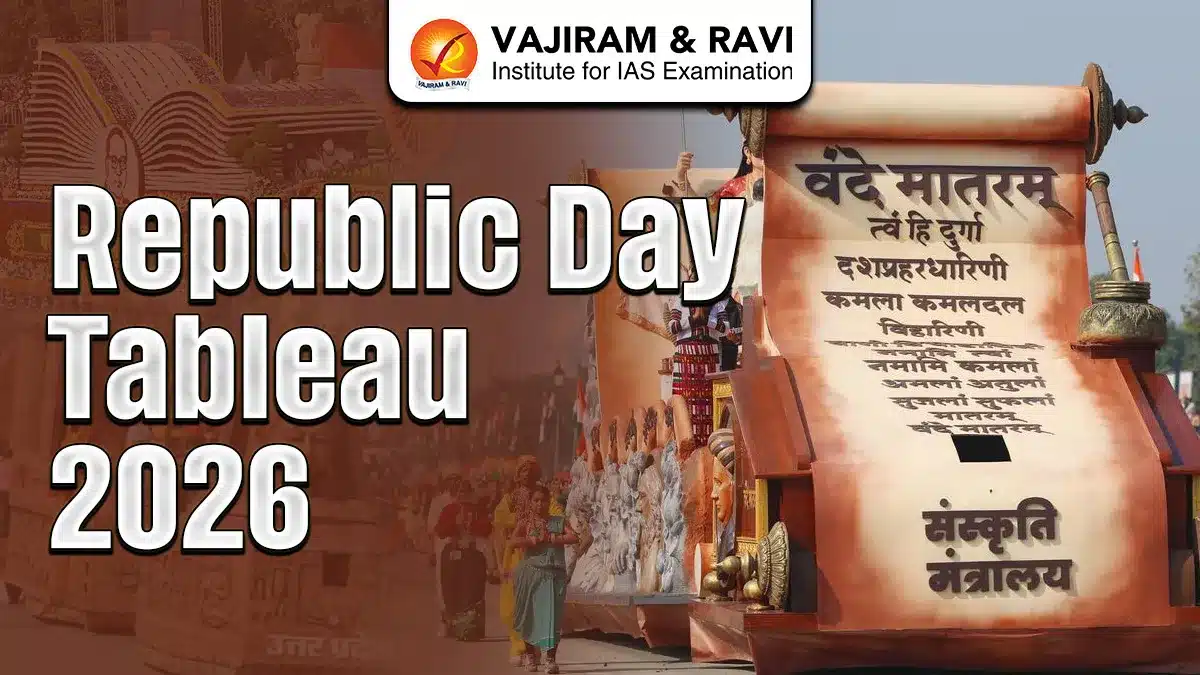
Republic Day tableau is an important cultural feature of the Republic Day Parade showcasing India’s rich Culture, heritage, historical legacy, achievements and vision. On 26 January 2026, India celebrated its 77th Republic Day and the tableaux mainly focused on commemorating 150 years of Vande Mataram and the vision of Atmanirbhar Bharat

What is the Republic Day Tableau? 

Republic Day tableaux are thematic and artistic displays presented by States, Union Territories, and Central Ministries during the Republic Day Parade on 26 January at Kartavya Path, New Delhi. It visually represents India’s cultural heritage, historical legacy, constitutional values, social achievements, or future vision. Through art, models, music, and performers, each tableau communicates a distinct message.

Republic Day Tableau’s History in India

The Republic Day Tableau has developed and evolved in India as highlighted below:

  • Republic Day tableaus have been part of the parade since India became a republic in 1950.
  • Early tableaus highlighted freedom fighters and national unity. 
  • Over the years, the themes of the tableaus broadened to include culture, science, tribal heritage, environmental conservation, and various government initiatives.

Republic Day Tableau 2026 Theme

The theme of the The 77th Republic Day tableaux centred around two main themes : “Svatantrata Ka Mantra – Vande Mataram” and “Samriddhi Ka Mantra – Aatmanirbhar Bharat”.

  • Swatantrata ka Mantra : Vande Mataram : Celebrating 150 years of the national song Vande Mataram (composed by Bankim Chandra Chattopadhyay in 1875).
  • Samriddhi ka Mantra : Aatmanirbhar Bharat : Highlighting India's journey toward self-reliance and economic prosperity.

Who decides the theme of  Republic Day Tableau 2026? 

The theme of the Republic Day Tableau is decided by the Ministry of Defence in consultation with other central agencies.

List of Republic Day Tableaux 2026

This year, 30 tableaux were selected from various States, Union Territories, and Central Ministries-17 tableaux from States / Union Territories and 13 tableaux from Ministries / Departments / Services. Each tableau showcased the culture and progress of its region or sector.

Gujarat and Chhattisgarh focused on the theme of “Vande Mataram,” highlighting its role in strengthening national unity while Assam’s tableau featured Ashirakandi, a village known for its traditional crafts. Maharashtra presented Ganeshotsav, while West Bengal highlighted the state’s contribution to India’s freedom struggle.  The Department of Military Affairs presented the Tri-Services Tableau – showcasing  Victory of Operation Sindoor through Joint coordination of three forces. 

List of Republic Day Tableaux 2026 State and UT Wise and their Themes
States / UTs & Ministry / Department  Theme

Assam 

Asharikandi – Terracotta Craft Village of Assam

Chattisgarh 

The Mantra of Freedom – Vande Mataram

Gujarat 

Mantra of Swadeshi – Self-Reliance – Freedom: Vande Mataram

Himachal Pradesh 

Dev Bhoomi, Veer Bhoomi

Jammu & Kashmir 

Handicrafts and Folk Dances of Jammu & Kashmir

Kerala 

Water Metro and 100% Digital Literacy: Aatmanirbhar Kerala for Aatmanirbhar Bharat

Maharashtra 

Ganeshotsav: A Symbol of Aatmanirbharta

Manipur 

Towards Prosperity: From Agricultural Fields to International Markets

Nagaland 

The Hornbill Festival – Celebrating Culture, Tourism & Self-Reliance

Odisha 

Soil to Silicon: Rooted in Tradition, Rising with Innovation

Puducherry 

Rich Heritage of Craft, Culture and Auroville’s Vision

Rajasthan 

Golden Touch of the Desert: Bikaner Gold Art (Usta Art)

Tamil Nadu

Mantra of Prosperity: Self-Reliant India

Uttar Pradesh 

Culture of Bundelkhand 

West Bengal 

Bengal in the Freedom Movement of India

Madhya Pradesh 

Punyashlok Lokmata Devi Ahilyabai Holkar

Punjab 

350th Year of Martyrdom of Sri Guru Tegh Bahadur Sahib Ji

Air HQs 

Veteran Tableau – Nation Building through War

Naval HQs 

Samudra Se Samriddhi

Department of Military Affairs 

Tri-Services Tableau – Operation Sindoor, Victory through Jointness

Ministry of Culture

Vande Mataram – The Soul Cry of a Nation

Department of School Education and Literacy 

National Education Policy 2020: Rocketing Indian School Education on the Path to Viksit Bharat

Ministry of AAYUSH

AYUSH KA TANTRA, SWASTHYA KA MANTRA

Ministry of Home Affairs 

(NDMA & NDRF)

Bhuj Earthquake: 25 Years of Resilience

Ministry of Home Affairs 

(BPRD) 

Jan Kendrit Nyay Pranali - Enactment of the Three New Criminal Laws – 2023

Ministry of Housing and Urban Affairs 

Vande Mataram – Commemoration of 150 Years

Ministry of Information and Broadcasting 

Bharat Gatha: Shruti, Kriti, Drishti

Ministry of Panchayati Raj

SVAMITVA Scheme – Aatmanirbhar Panchayat se Samriddh evam Aatmanirbhar Bharat

Ministry of Power 

Prakash Ganga: Powering an Aatmanirbhar and Viksit Bharat

Ministry of Skill Development & Entrepreneurship 

Powered by Skills: Building a Self-Reliant, Future-Ready India

Republic Day Tableau 2026 Winners

  • The winners of the Republic Day tableaux are decided by an expert jury constituted by the Ministry of Defence. 
  • This jury includes eminent artists, cultural experts, architects, and senior government officials who evaluate the tableaux on the basis of adherence to the annual theme, creativity and innovation, visual appeal, clarity of message, and overall presentation. 
  • In addition to the jury awards, a Popular Choice Award is also given, which is determined through public voting, usually conducted via the MyGov platform or other online and SMS-based mechanisms.

Republic Day Tableaux Selection Process 

  • Republic Day Tableaux are selected through a two-stage selection by an expert committee under the Ministry of Defence.
  • States, Union Territories, and various departments submit design sketches for their proposed tableaux. An expert committee evaluates these proposals. 
  • This committee comprises experts in fields such as arts, culture, painting, sculpture, music, architecture, and choreography. 
  • The selection involves two main phases : 
  • First, the committee assesses initial sketches, suggesting modifications if needed. 
  • Second, approved designs move to a 3D model stage for final selection. 

States not selected for the main parade can still display their tableaux at Bharat Parv. This alternative event takes place at the Red Fort from January 26-31.

Further, the government has finalized a rotational plan to ensure that every State and Union Territory gets an opportunity to present their tableaux at the Republic Day parade within a three-year cycle (2024-2026).

Republic Day Tableau 2026 Purpose 

  • It highlights unity in diversity by showcasing traditions, languages, and lifestyles of different regions.
  • It highlights progress in defense, technology, and social welfare (e.g., Space missions or Green energy).
  • It brings rare folk arts, crafts, and historical stories into the national spotlight.
  • It promotes awareness of government policies and national missions like Aatmanirbhar Bharat.
Also Check
Republic Day 2026 Independence Day 2026
Gandhi Jayanti Shaheed Diwas

Republic Day Tableau 2026 FAQs

Q1: What is Republic Day Tableau?

Ans: A Republic Day tableau is a thematic float displayed during the Republic Day Parade (26 January) at Kartavya Path, New Delhi, showcasing India’s cultural heritage, Historical events, Developmental achievements and Government initiatives.

Q2: What is the theme of Republic Day Tableau 2026?

Ans: Svatantrata Ka Mantra – Vande Mataram” and “Samriddhi Ka Mantra – Aatmanirbhar Bharat.

Q3: Who composed Vande Mataram?

Ans: Vande Mataram was composed by Bankim Chandra Chattopadhyay in 1875.

Q4: Who participates in the Republic Day Tableau?

Ans: States / Union Territories and Ministries / Departments / Services of Central government and Defence Forces.

Q5: Who selects the Republic Day tableaux?

Ans: Selection is done by an Expert Committee under the Ministry of Defence.

Article 29 and 30 of Indian Constitution, Provisions, Clauses

Article 29 and 30 of Indian Constitution

Article 29 and 30 of Indian Constitution covers Cultural and Educational Rights of the Indian Constitution. Article 29 and Article 30 are fundamental rights that are available to all the citizens of India and provide them a privilege and accessibility to maintain their own respective culture and language. When designing the Constitution of India, the makers of the Constitution emphasised on the fact that diversity provides strength to the society and helps protect and preserve the diversity. In this article, we are going to cover Article 29 & 30 of the Indian Constitution, its interpretation and significance. 

Cultural and Educational Rights in India

The concept of cultural and educational rights in India supports the vision of India to establish a cultural and composite Indian Society. Hence, cultural and Educational Rights in India are given the status of fundamental rights under Article 29 and 30. The status of fundamental rights provides these rights the protection, including rights to preserve a language script and culture. The Constitution of India does not allow states to discriminate against citizens in fulfilling these rights. 

Article 29 and 30 of Indian Constitution Provisions

Article 29 and Article 30 of the Constitution of India can be interpreted in the following manner: 

Article 29 of Indian Constitution Clauses

Protection of Interests of Minorities

  • Article 29(1): Provides any section of Indian citizens with a distinct language, script, or culture the right to conserve it. This applies to both minorities and majorities, as the term used is "section of citizens."
  • Judicial Interpretation: The Supreme Court has explained that this right is not confined to minorities. Advocacy for language preservation is considered part of this constitutional right and does not amount to corrupt practice under the Representation of the People Act 1951.
  • Article 29(2): Prohibits denial of admission to state-run or state-aided educational institutions solely on grounds of religion, race, caste, language, or any of them.

Article 30 of Indian Constitution Clauses

Right of Minorities to Establish and Administer Educational Institutions 

Minorities in India have the right to establish and administer educational institutions of their choice. The state doesn't have any rights to abolish and restrict this right. The rule remains even if the state owns a minority educational institution or provides any financial help.

  • Article 30(1): All religious and linguistic minorities have the right to establish and administer educational institutions of their choice. This right is protected even if the state acquires their property.
  • Article 30(2): The state is not allowed to discriminate in granting aid to minority-managed institutions on grounds of religion or language.

Types of Minority Educational Institutions:

  1. Institutions seeking both recognition and aid
  2. Institutions seeking neither
  3. Institutions seeking only recognition or aid

What are Minorities?

The term “Minorities” is explicitly not mentioned in the Constitution of India. A minority refers to a group of people who are different from the majority of people in terms of religion, language, ethnicity and other characteristics. It consists of a group of people who are marginalized and discriminated against in the society and often face challenges in accessing employment, education and other areas.

Also Read: National Commission for Minorities

Also Check Related Articles
Article 167 of Indian Constitution Article 93 of Indian Constitution
Article 141 of Indian Constitution Article 47 of Indian Constitution
Article 84 of Indian Constitution Article 174 Of Indian Constitution
Article 128 of Indian Constitution Article 114 of Indian Constitution
Article 17 of Indian Constitution Article 32 of Indian Constitution
Article 21 of Indian Constitution Article 19 of indian constitution
Article 14 of indian constitution Article 18 of Indian Constitution
Article 23 of Indian Constitution Article 24 of Indian Constitution
Article 3 of Indian Constitution Article 38 of Indian Constitution
Article 43 of Indian Constitution Article 48 of Indian Constitution
Article 143 of Indian Constitution Article 326 of Indian Constitution
Article 124 of indian constitution Article 45 of Indian Constitution
Article 41 of Indian Constitution Article 160 of Indian Constitution
Article 340 of Indian Constitution Article 43b of Indian Constitution
Article 156 of Indian Constitution Article 144 of Indian Constitution
Article 365 of Indian Constitution
Article 201 of Indian Constitution
Article 140 of Indian Constitution Article 35 of Indian Constitution
Article 166 of Indian Constitution Article 102 of Indian Constitution
Article 83 of Indian Constitution Article 88 of Indian Constitution
Article 28 of Indian Constitution Article 103 of Indian Constitution
Article 36 of Indian Constitution Article 62 of Indian Constitution
Article 82 of Indian Constitution Article 97 of Indian Constitution
Article 224 of Indian Constitution Article 251 of Indian Constitution
Article 13 of Indian Constitution Article 29 & 30 of Indian Constitution
Article 15 of Indian Constitution Article 4 of Indian Constitution
Article 85 of Indian Constitution Article 27 of Indian Constitution
Article 238 of Indian Constitution Article 312 of Indian Constitution
Article 137 of Indian Constitution Article 118 of Indian Constitution
Article 353 of Indian Constitution Article 111 of Indian Constitution
Article 113 of Indian Constitution Article 76 of Indian Constitution
Article 44 of Indian Constitution Article 50 of Indian Constitution
Article 295 of Indian Constitution Article 194 of Indian Constitution
Article 39 of Indian Constitution Article 191 of Indian Constitution
Article 20 of Indian Constitution Article 16 of Indian Constitution
Article 67 of Indian Constitution Article 40 of Indian Constitution
Article 78 of Indian Constitution

Article 29 and 30 of Indian Constitution FAQs

Q1: What is the Article 29 of the Constitution of India?

Ans: Article 29 protects the rights of any section of Indian citizens to conserve their distinct language, script, or culture and prohibits discrimination in educational institutions.

Q2: What is the Article 30 of the Constitution of India?

Ans: Article 30 grants minorities the right to establish and administer educational institutions of their choice without state discrimination.

Q3: What is status of Minorities in the India Constitution?

Ans: The Constitution provides minorities with fundamental cultural and educational rights under Articles 29 and 30.

Q4: Is the term Minorities defined in the Indian Constitution?

Ans: No, the term "minorities" is not explicitly mentioned in the Constitution of India.

Q5: What does one mean by cultural and educational rights?

Ans: Cultural and educational rights ensure communities can preserve their culture and establish institutions to promote it.

International Day of Cooperatives 2026, Theme, History, Significance

International Day of Cooperatives 2026

Why in News?: The International Day of Cooperatives was recently celebrated on 4 July 2026, drawing global attention to the important role of cooperatives in promoting inclusive development, social justice, sustainable livelihoods and peaceful societies.

About International Day of Cooperatives

The International Day of Cooperatives is celebrated every year on the first Saturday of July to recognise the contribution of cooperative enterprises towards economic development, social inclusion and sustainable development.

  • It was first celebrated by the international cooperative movement in 1923.
  • It has been officially recognised by the United Nations since 1995.
  • 2026 marks the 104th International Cooperative Day and the 32nd UN International Day of Cooperatives.
  • The theme of International Day of Cooperatives 2026 is “Cooperatives for a Peaceful World.”
  • The theme recognises that peace is not only the absence of conflict but also the presence of justice, equality, trust and social inclusion. Cooperatives contribute to peace by bringing people together, creating economic opportunities and strengthening community resilience.
  • The annual theme is jointly decided by the International Cooperative Alliance (ICA) and the Committee for the Promotion and Advancement of Cooperatives (COPAC).
  • The day spreads awareness about the contribution of cooperatives to economic growth, social justice, peace and sustainable development.
  • It promotes cooperation between governments, the United Nations and cooperative institutions across the world.

What are Cooperatives?

A cooperative is a voluntary association of people who come together to meet their common economic, social and cultural needs through a jointly owned and democratically managed enterprise.

Unlike private companies that primarily focus on profits, cooperatives place people and communities at the centre of development. 

Cooperative Principles

The cooperative movement follows internationally accepted principles that ensure democratic functioning and sustainable development. Seven Cooperative Principles include: 

  • Voluntary and open membership encourages equal participation.
  • Democratic member control ensures every member has an equal voice.
  • Member economic participation promotes equitable sharing of benefits.
  • Autonomy and independence protect cooperatives from external control.
  • Education and training improve members’ knowledge and leadership.
  • Cooperation among cooperatives strengthens the entire cooperative movement.
  • Concern for the community promotes sustainable and inclusive development.

About International Cooperative Alliance (ICA)

The International Cooperative Alliance (ICA) is the global organisation representing cooperatives across the world. It promotes cooperative values, protects the interests of cooperatives and works closely with international organisations.

  • Established in 1895.
  • Headquarters are located in Brussels, Belgium.
  • It is the apex global organisation representing cooperatives.
  • It represents more than three million cooperatives worldwide.
  • It works closely with the United Nations and other international organisations.
  • It coordinates the global celebration of the International Day of Cooperatives.

Committee for the Promotion and Advancement of Cooperatives (COPAC)

COPAC is a global partnership that promotes cooperatives as an important tool for achieving sustainable development. It brings together major international organisations working on cooperative development.

Members include:

Significance of Cooperatives

Cooperatives play a vital role in promoting inclusive economic growth, social justice, and sustainable development by empowering people through collective ownership, democratic participation, and shared prosperity.

  • Economic Empowerment: Cooperatives improve incomes by providing affordable credit, fair prices, and better market access to farmers, artisans, workers, and small entrepreneurs.
    • Example: Indian Farmers Fertiliser Cooperative Limited provides quality fertilizers and services to millions of farmers.
  • Agricultural Development: Cooperatives strengthen agriculture through collective procurement, storage, processing, value addition, and marketing of agricultural produce.
  • Financial Inclusion: Cooperative banks and credit societies provide affordable financial services to rural households, small businesses, and underserved communities.
  • Employment Generation: Cooperatives create sustainable employment in agriculture, dairy, fisheries, handlooms, handicrafts, and rural industries.
  • Poverty Reduction: Cooperatives reduce poverty by improving access to finance, technology, markets, and income-generating opportunities, particularly for small producers and vulnerable groups.
  • Women Empowerment: Women-led cooperatives enhance financial independence, entrepreneurship, leadership, and decision-making among women.
  • Community Development: Cooperatives reinvest their surplus into education, healthcare, skill development, and local infrastructure, thereby improving the overall quality of life in communities.
  • Environmental Sustainability: Cooperatives promote sustainable farming, organic agriculture, renewable energy, water conservation, and climate-resilient livelihoods.
  • Contribution to Sustainable Development Goals (SDGs): Cooperatives contribute directly to SDG 1 (No Poverty), SDG 2 (Zero Hunger), SDG 5 (Gender Equality), SDG 8 (Decent Work), SDG 10 (Reduced Inequalities), SDG 11 (Sustainable Cities and Communities), and SDG 16 (Peace, Justice and Strong Institutions).
  • Building Peace and Social Cohesion: Cooperatives foster trust, solidarity, dialogue, and mutual support among communities, strengthening social harmony and resilience. 
    • Example: The 2026 International Day of Cooperatives recognises their role in building peaceful and inclusive societies.

Role of Cooperatives in Building Peace

Cooperatives play an important role in building peaceful, inclusive, and resilient societies. 

  • They strengthen local economies, expand access to essential services, and create opportunities for people from all sections of society. 
  • Through democratic participation and shared ownership, cooperatives promote trust, inclusion, and solidarity within communities. 
  • They also act as bridge-builders by bringing people together, encouraging dialogue, and rebuilding social connections in an increasingly fragmented world. 
  • At a time when many societies face conflict, rising inequalities, economic insecurity, and declining trust, cooperatives help strengthen social cohesion and lay the foundations of positive peace based on justice, inclusion, and mutual trust, rather than merely the absence of conflict.

Cooperatives in India

India has one of the largest cooperative movements in the world and cooperatives have played an important role in agriculture, dairy, banking and rural development. They have significantly contributed to financial inclusion, food security and farmers’ welfare. Major examples include: 

  • Amul transformed India’s dairy sector through the White Revolution.
  • IFFCO became one of the world’s largest fertilizer cooperatives.
  • KRIBHCO supports farmers through fertilizer production and distribution.
  • Primary Agricultural Credit Societies (PACS) provide rural credit.
  • Dairy cooperatives generate employment and empower rural women.
  • Cooperative banks strengthen financial inclusion in rural India.
  • Housing and consumer cooperatives provide affordable services.
  • Fisheries and handloom cooperatives support traditional livelihoods.

Constitutional Provisions

Recognising the important role of cooperatives in promoting inclusive growth, rural development and participatory democracy, the 97th Constitutional Amendment Act, 2011 granted constitutional status to cooperative societies. 

  • Article 19(1)(c): Grants citizens the Fundamental Right to form cooperative societies.
  • Article 43B (Directive Principles): Directs the State to promote voluntary formation, autonomous functioning, democratic control and professional management of cooperative societies.
  • Part IXB (Articles 243ZH–243ZT): Lays down provisions relating to the incorporation, election, management and functioning of cooperative societies.

Government Initiatives

The Government of India has introduced several reforms to modernise and strengthen the cooperative sector.

Major Initiatives include: 

  • Establishment of the Ministry of Cooperation in 2021.
  • Vision of “Sahkar Se Samriddhi” to achieve prosperity through cooperation.
  • National Cooperative Policy, 2025 to create a modern, transparent, technology-driven, and globally competitive cooperative sector while promoting inclusive and sustainable growth.
  • Computerisation of Primary Agricultural Credit Societies (PACS).
  • Strengthening Multi-State Cooperative Societies.
  • Digitalisation of cooperative governance.
  • Capacity-building and professional training for cooperative institutions.
  • Promotion of cooperative-led rural development.

Challenges

Despite their success, cooperatives continue to face several institutional and governance challenges.

  • Political interference weakens democratic functioning.
  • Poor professional management affects efficiency.
  • Limited access to finance restricts expansion.
  • Weak governance sometimes leads to corruption.
  • Low adoption of technology reduces competitiveness.
  • Lack of awareness discourages youth participation.
  • Regional imbalance limits cooperative growth.
  • Increasing market competition from private enterprises.

Way Forward

The cooperative movement can become a major pillar of inclusive and sustainable development if governance, professionalism and innovation are strengthened.

  • Strengthen democratic governance within cooperatives.
  • Improve transparency through digital technologies and regular audits.
  • Encourage greater participation of women and youth.
  • Expand access to affordable finance.
  • Promote professional management and leadership training.
  • Encourage innovation and digital transformation.
  • Strengthen partnerships among cooperatives.
  • Integrate cooperatives with national development programmes.
  • Align cooperative activities with the Sustainable Development Goals.
  • Promote awareness about the cooperative model among citizens.

International Day of Cooperatives 2026 FAQs

Q1: When is the International Day of Cooperatives celebrated?

Ans: It is celebrated every year on the first Saturday of July.

Q2: What was the theme of the International Day of Cooperatives 2026?

Ans: The theme was “Cooperatives for a Peaceful World.”

Q3: Which organisations decide the theme for the International Day of Cooperatives?

Ans: The theme is jointly decided by the International Cooperative Alliance (ICA) and the Committee for the Promotion and Advancement of Cooperatives (COPAC).

Q4: What is the significance of the 97th Constitutional Amendment Act, 2011?

Ans: It granted constitutional status to cooperative societies and strengthened their democratic and autonomous functioning.

Q5: Why are cooperatives important?

Ans: Cooperatives promote inclusive growth by creating employment, improving livelihoods, strengthening financial inclusion, empowering communities, and supporting sustainable development.

Sutlej River, Origin, Tributaries, Course, Dam & Importance

Sutlej River

With the Sutlej swelling due to incessant rain in its catchment areas and heavy releases from dams, evacuation in several low-lying villages of Fazilka and Ferozepur districts began late Tuesday afternoon.

About Sutlej River

  • It is an important tributary of the Indus River.
  • It is the longest of the five big rivers that flow through the Punjab region in northern India and Pakistan.
  • It is also known as “Satadree”.
  • It is located north of the Vindhya Range, south of the Hindu Kush segment of the Himalayas, and in Pakistan. 
  • Course:
    • Origin: It rises on the north slope of the Himalayas in Lake Rakshastal in southwestern Tibet at an elevation above 15,000 feet (4,600 metres).
    • It is one of only three Trans-Himalayan rivers originating in the high Tibetan Plateau that cuts across the mighty Himalayan ranges. The other two are the Indus and the Brahmaputra.
    • The Sutlej enters India by flowing west and south-westwards through the Shipki La Pass in Himachal Pradesh at an altitude of 6,608 metres. 
    • The river then flows through Punjab near Nangal before meeting the Beas River. The merger of these two rivers goes on to form 105 Km of the India-Pakistan border. 
    • The river continues to flow for another 350 Km before joining the Chenab River.
    • The combination of the Sutlej and Chenab Rivers forms the Panjnad, which finally flows into the Indus River.
  • Length: It has a total length of 1550 km, out of which 529 km is in Pakistan.
  • The hydrology of the Sutlej is controlled by spring and summer snowmelt in the Himalayas and by the South Asian monsoon. 
  • Tributaries: Spiti River, Baspa River, Soan River, and the Nogli Khad are the major tributaries of the Sutlej River.
  • The waters of the Sutlej are allocated to India under the Indus Waters Treaty between India and Pakistan, and are mostly diverted to irrigation canals in India.
  • There are many hydroelectric and irrigation projects across the river, such as the Bhakra-Nangal Dam, Kol Dam, Nathpa Jhakri Project, and Baspa Hydel Scheme.

Sutlej River FAQs

Q1: The Sutlej River is a major tributary of which river system?

Ans: Indus River

Q2: The Sutlej originates from which lake in Tibet?

Ans: Rakshastal

Q3: The Sutlej enters India through which pass?

Ans: Shipki La Pass

Q4: What is the total length of the Sutlej River?

Ans: It has a total length of 1550 km.

Daily Editorial Analysis 4 July 2026

Daily-Editorial-Analysis

Building Water Security in a Rapidly Drying India 

Context

  • Water is the foundation of life, economic development, agriculture, and ecological sustainability.
  • India is facing an unprecedented water crisis driven by climate change, erratic monsoon patterns, rapid urbanisation, population growth, and unsustainable water use.
  • With only 4% of the world's freshwater resources supporting nearly 18% of the global population, the country faces increasing pressure on its limited water resources.
  • Ensuring water security has become essential for social welfare and long-term economic growth.

The Growing Water Crisis

  • Many Indian cities, including Bengaluru, Delhi, and Mussoorie, are experiencing severe water stress due to declining rainfall and rising demand.
  • A significant monsoon rainfall deficit has reduced water availability, while several major river basins have crossed internationally recognised thresholds of water scarcity.
  • Rivers such as the Krishna, Cauvery, Mahi, and Tapi have witnessed critically low per capita water availability.
  • At the global level, polluted rivers, depleted aquifers, and increasing freshwater demand have left billions of people facing seasonal water shortages, making water insecurity a worldwide challenge.

Water Infrastructure Gaps

  • Although programmes such as the Jal Jeevan Mission and Pradhan Mantri Krishi Sinchayee Yojana have expanded access to water and irrigation, major structural weaknesses persist.
  • Poor maintenance of infrastructure, inadequate wastewater treatment, high conveyance losses, widespread water pollution, and weak financial sustainability continue to undermine efficient water management.
  • Strengthening existing infrastructure and improving governance are as important as creating new facilities.

Steps Towards Sustainable Water Management

  • Climate-Proofing Water Systems

    • Building climate-resilient water systems is essential to address increasing risks from floods, droughts, and changing rainfall patterns.
    • Climate risk assessments help identify vulnerable regions and guide investments in critical infrastructure such as hospitals, schools, drainage systems, and electricity networks.
    • Urban local bodies can utilise mechanisms like the Urban Challenge Fund to finance such assessments and improve long-term water resilience.
  • Water Reuse and Circular Economy

    • Adopting a circular economy approach to water management can significantly reduce pressure on freshwater resources.
    • Treated wastewater can be safely reused for construction, landscaping, industrial cooling, and vehicle washing instead of relying solely on freshwater.
    • Scientific planning for treated wastewater reuse not only conserves water but also creates employment, generates municipal revenue, and promotes sustainable urban development.
  • Sustainable Agricultural Practices

    • Agriculture accounts for the largest share of India's freshwater consumption, making efficient irrigation a national priority.
    • Expanding micro-irrigation systems such as drip irrigation and sprinkler technologies can greatly reduce water wastage compared to conventional flood irrigation.
    • Better-designed subsidies should support small and marginal farmers, while crop diversification towards less water-intensive, higher-value crops can improve incomes and conserve water.
    • Strengthening the Pradhan Mantri Fasal Bima Yojana through affordable insurance and faster claim settlement can further enhance farmers' resilience to climate and crop risks.
  • Closing Water Data Gaps

    • Reliable data is crucial for effective water governance.
    • While information on water availability is relatively strong, data on withdrawals, distribution losses, and actual consumption remains limited at the river basin level.
    • Deploying Artificial Intelligence, smart water meters, and advanced water accounting systems can improve monitoring, detect leakages, and support equitable water allocation.
    • The successful rollout of smart electricity meters provides a useful model for modernising water management systems.

Conclusion

  • Water is not merely a natural resource but a vital economic resource that sustains livelihoods, agriculture, industries, and ecosystems.
  • Achieving long-term water security requires integrated policies that combine climate resilience, efficient infrastructure, wastewater reuse, sustainable agriculture, and data-driven governance.
  • Strong political will, transparent governance, and public participation are essential to reverse growing water scarcity.
  • By embracing sustainable water management, India can safeguard its natural resources, strengthen economic development, and secure a resilient future for generations to come.

Building Water Security in a Rapidly Drying India FAQs 

Q1. What is the main cause of India's growing water crisis?
Ans. India's water crisis is caused by climate change, rapid urbanisation, population growth, and unsustainable water use.

Q2. Why is wastewater reuse important?
Ans. Wastewater reuse reduces pressure on freshwater resources and supports sustainable water management.

Q3. How does micro-irrigation help agriculture?
Ans. Micro-irrigation conserves water by delivering it efficiently to crops.

Q4. Why are climate risk assessments necessary?
Ans. Climate risk assessments help identify vulnerable areas and guide better water infrastructure planning.

Q5. What is essential for achieving long-term water security?
Ans. Long-term water security requires sustainable policies, transparent governance, and public participation.

Source: The Hindu


AI-Powered Transaction Monitoring - Strengthening India's Defence Against Mule Account Frauds

Context

  • India's rapid digitalisation of financial services, led by the widespread adoption of the Unified Payments Interface (UPI), has transformed banking convenience but has also expanded opportunities for sophisticated financial fraud.
  • The growing use of mule accounts—bank accounts used to launder illicit funds—has emerged as the backbone of digital financial crime, necessitating AI-driven transaction monitoring rather than conventional rule-based surveillance.

Digital Banking - Expanding Opportunities and Risks:

  • Banking has shifted from branch-based operations to a largely mobile ecosystem.
  • UPI alone now processes nearly ₹30 trillion in monthly transactions across over 800 million digital users.
  • While digital payment infrastructure promotes financial inclusion and economic efficiency, every new payment channel also creates avenues for cybercriminals to move illicit money.

AI is Transforming Financial Fraud:

  • Artificial Intelligence (AI) has significantly enhanced the sophistication and scale of financial crimes.
  • For example,
    • Deepfake technology enables fraudsters to imitate voices of senior executives and issue fake payment instructions.
    • Synthetic identities, created using stolen personal data, bypass conventional customer onboarding and Know Your Customer (KYC) checks.
    • AI-powered scams have reached unprecedented levels, with deepfake-related fraud reportedly affecting nearly half of Indian adults.

Major Forms of Digital Fraud and Regulatory Response:

  • There are three interconnected dimensions of financial fraud:
    • Identity fraud: Fraudsters create or use fake identities to open bank accounts.
    • Monetary fraud: Victims are manipulated through social engineering into voluntarily authorising payments, rendering multi-factor authentication ineffective.
    • Mule accounts: These accounts serve as the principal channel for laundering stolen money and dispersing criminal proceeds.
  • Mule accounts - The backbone of digital crime:

    • Mule accounts function as the "getaway vehicles" of digital financial crime.
    • In a single year, enforcement agencies froze around 4.5 lakh mule accounts, through which over ₹17,000 crore had already been routed.
    • Their rapid creation and use make them one of the biggest challenges for financial regulators and banks.
  • Regulatory response:

    • The Reserve Bank of India (RBI) has initiated several measures to counter digital fraud.
    • For example,
      • Development of ai for identifying suspicious mule account networks.
      • Collaboration with the National Payments Corporation of India (NPCI) to build an advanced digital payments intelligence platform.
      • A discussion paper proposing deliberate transaction "frictions" or temporary delays for suspicious fund transfers to prevent irreversible losses.
    • However, fraudsters quickly adapt to new regulations, making static rule-based systems increasingly ineffective.

Limitations of Existing Transaction Monitoring Systems:

  • Most banks and NBFCs already deploy transaction monitoring systems, but these suffer from:
    • Excessive false alerts, creating "alertfatigue."
    • Analysts spend substantial time reviewing low-risk cases instead of genuine threats.
    • Reduced trust in the monitoring system, increasing the likelihood that critical suspicious transactions remain unnoticed.
  • A global bank incurred a penalty of nearly $3 billion, partly because genuine alerts remained unattended amid an overwhelming volume of notifications.

Need of the Hour and Way Forward:

  • AI-based intelligence layer:
    • The solution lies not in generating more alerts but in improving their quality through an AI-powered intelligence layer capable of:
      • Prioritising genuinely suspicious transactions.
      • Identifying rules that produce excessive false positives.
      • Detecting interconnected mule account networks in real time.
      • Enabling authorities to freeze funds before they are dispersed.
      • Improving operational efficiency by allowing investigators to focus on high-risk cases.
  • Way forward:

    • Banks and NBFCs should integrate AI strategically rather than adopting it superficially. Suggested measures -
      • Deploy AI to minimise false positives and optimise analyst productivity.
      • Build predictive systems capable of identifying emerging mule networks before transactions are completed.
      • Continuously update fraud detection models to match evolving AI-enabled criminal techniques.
      • Strengthen collaboration among banks, RBI, NPCI, law enforcement agencies, and cybersecurity institutions.
      • Enhance customer awareness regarding deepfakes, phishing, and social engineering attacks.

Conclusion:

  • As AI becomes a tool for both financial innovation and cybercrime, India's financial ecosystem must evolve beyond traditional transaction monitoring.
  • Robust transaction intelligence will remain central to building a secure, resilient, and digitally inclusive Bharat.

AI-Powered Transaction Monitoring FAQs

Q1. Why have mule accounts emerged as the biggest challenge in India's digital financial ecosystem?

Ans. Mule accounts facilitate the rapid laundering and layering of illicit funds, making them the backbone of AI-enabled digital financial fraud.

Q2. Why are conventional transaction monitoring systems increasingly ineffective in combating financial fraud?

Ans. They generate excessive false alerts, leading to alert fatigue that obscures genuine suspicious transactions.

Q3. How can AI strengthen financial fraud detection in the banking sector?

Ans. AI can prioritise high-risk transactions, detect mule account networks in real time, and reduce false positives.

Q4. What measures has the RBI proposed to curb mule account-based digital fraud?

Ans. MuleHunter.ai, an NPCI-supported payments intelligence platform, and transaction frictions for suspicious transfers.

Q5. What is the key policy priority for ensuring a secure digital payment ecosystem in India?

Ans. Building AI-driven transaction intelligence supported by regulatory coordination, robust cybersecurity, and public awareness.

Source: IE

Daily Editorial Analysis 2026 FAQs

Q1: What is editorial analysis?

Ans: Editorial analysis is the critical examination and interpretation of newspaper editorials to extract key insights, arguments, and perspectives relevant to UPSC preparation.

Q2: What is an editorial analyst?

Ans: An editorial analyst is someone who studies and breaks down editorials to highlight their relevance, structure, and usefulness for competitive exams like the UPSC.

Q3: What is an editorial for UPSC?

Ans: For UPSC, an editorial refers to opinion-based articles in reputed newspapers that provide analysis on current affairs, governance, policy, and socio-economic issues.

Q4: What are the sources of UPSC Editorial Analysis?

Ans: Key sources include editorials from The Hindu and Indian Express.

Q5: Can Editorial Analysis help in Mains Answer Writing?

Ans: Yes, editorial analysis enhances content quality, analytical depth, and structure in Mains answer writing.

New Zealand

New Zealand

New Zealand Latest News

The Indian Prime Minister will visit Indonesia, Australia and New Zealand next week.

About New Zealand

  • It is an island country and one of the many islands that make up Oceania.
  • It is located in the South Pacific Ocean to the southeast of Australia, south of New Caledonia, Fiji and Tonga Islands. 
  • It is primarily divided into two main islands, the North Island and the South Island, separated by the Cook Strait.
  • Capital City: Wellington

Geographical Features of New Zealand

  • It is part of the Pacific Ring of Fire—the circum-Pacific seismic belt marked by frequent earthquakes and considerable volcanic activity. 
  • Climate: New Zealand’s climate is complex and varies from warm subtropical in the far north to cool temperate climates in the far south.
  • Highest Peak: Mount Cook at 12,316 feet is the highest peak of New Zealand
  • Active Volcano: Mount Ruapehu
  • Glacier: Tasman Glacier, the largest in New Zealand
  • Lake: Lake Taupō which is the largest natural lake.
  • Natural Resources: It consists of gold, silver, iron sands, phosphate and limestone etc.

Source: Reuters

New Zealand FAQs

Q1: Major active volcano in New Zealand?

Ans: Mount Ruapehu

Q2: New Zealand is located in which ocean?

Ans: Southwestern Pacific Ocean,

Government Bans 16 Fixed-Dose Combination Drugs Over Safety and Efficacy Concerns

Combination Drugs

Combination Drugs Latest News

  • The government has banned 16 fixed-dose combination (FDC) drugs, including certain antibiotic combinations and various dermatological products containing aloe vera and herbal ingredients, over concerns of irrational formulation and lack of scientific justification.

About Fixed-Dose Combination (FDC) Drugs

  • A Fixed-Dose Combination drug is a formulation that contains two or more active pharmaceutical ingredients in a single dosage form, such as a tablet, capsule, or cream. FDCs are widely used across a range of conditions, including:
    • Infections (antibiotic combinations)
    • Pain management
    • Skin ailments
    • Diabetes and cardiovascular diseases
    • Cough, cold, and fever

Rational vs Irrational FDCs

  • A rational FDC is one where each ingredient contributes meaningfully to the therapeutic effect, ingredients have compatible pharmacological properties, and clinical evidence shows the combination is more beneficial than using the drugs separately.
  • An irrational FDC is one where the ingredients have no scientifically established rationale for being combined, or where there is little or no evidence from clinical trials to support the combination.

Regulatory Framework in India

  • The Central Drugs Standard Control Organisation (CDSCO), under the Ministry of Health and Family Welfare, is the apex regulator for pharmaceuticals in India.
  • The Drugs and Cosmetics Act, 1940 and its rules govern the approval, manufacture, and sale of drugs.
  • The government has periodically banned irrational FDCs based on recommendations from expert committees, including a landmark ban in 2016 that affected hundreds of formulations.
  • Public health experts, including scientists at the Indian Council of Medical Research (ICMR), have long warned that irrational combinations expose patients to unnecessary risks and contribute to antimicrobial resistance (AMR).

News Summary: Ban on 16 FDC Drugs

  • The government has banned 16 FDC drugs, citing lack of scientific evidence, potential safety risks, and the threat of fuelling antimicrobial resistance. 
  • The banned products include certain antibiotic combinations and a range of dermatological products containing aloe vera and herbal ingredients.

Key Rationale for the Ban

  • Public health experts explain that:
    • Irrational combinations expose patients to unnecessary drugs.
    • They increase treatment costs.
    • In the case of antibiotics, they contribute to antimicrobial resistance (AMR), a growing global health concern where bacteria, viruses, fungi, and parasites no longer respond to medicines designed to kill them.
  • Combinations often lack robust clinical trial evidence showing that the ingredients work better together than when used separately.

Examples of Problematic Combinations

  • Amoxicillin + Serratiopeptidase
    • One of the banned products combines amoxicillin (an antibiotic) with serratiopeptidase (a proteolytic enzyme).
    • Serratiopeptidase is acid-labile, meaning it can be degraded in the stomach before reaching the bloodstream.
    • No peer-reviewed randomised controlled trial has shown that adding serratiopeptidase improves bacterial clearance or reduces the amount of antibiotic required.
    • Claims of enhanced penetration are largely based on laboratory studies, not human clinical evidence.
    • No major treatment guideline recommends serratiopeptidase as an adjunct to antibiotics.
  • Norfloxacin + Tinidazole
    • Norfloxacin treats bacterial infections, while tinidazole targets protozoal infections.
    • Patients rarely suffer from bacterial and protozoal infections simultaneously.
    • Unnecessary exposure to both drugs promotes bacterial resistance without added benefit.
  • Amoxicillin + Clavulanic Acid (Augmentin)
    • Clavulanic acid blocks enzymes that resistant bacteria use to destroy amoxicillin.
    • However, if the bacteria causing infection are not resistant, clavulanic acid is unnecessary.
    • Widespread and indiscriminate use accelerates AMR.

Antimicrobial Resistance Concern

  • Antimicrobial resistance is one of the most serious public health threats today. When antibiotic combinations are marketed as being more effective without sufficient evidence:
    • They encourage unnecessary or prolonged antibiotic use.
    • They increase antibiotic exposure in the community.
    • They create selective pressure on bacteria, allowing resistant organisms to survive and multiply.
  • The antibiotic pipeline is running dangerously dry, making it critical to preserve the effectiveness of existing drugs.

Aloe Vera-Based Dermatological Products

  • Several banned products are dermatological creams containing aloe vera along with Vitamin E, jojoba oil, olive oil, tea tree oil, and other moisturising or herbal components.
  • Longevity in the market does not automatically establish scientific validity.
  • Robust evidence demonstrating the superior efficacy of these combinations over individual ingredients is often lacking.
  • Steroid-antifungal combinations are particularly concerning, while they provide temporary relief, steroids can suppress the skin's immune response, causing fungal infections to worsen, spread, or develop resistance.

Risks to Patients

  • Using irrational FDCs exposes patients to several risks:
    • Adverse effects and drug interactions
    • Allergic reactions to unnecessary components
    • Inability to adjust individual doses, doctors cannot increase one ingredient without overdosing on the other
    • Masking underlying complications, reducing precision in treatment
    • Higher costs without added benefit

Way Forward

  • For Patients
    • Understand that a medicine containing multiple ingredients is not necessarily more effective than a targeted treatment.
    • Consult doctors about appropriate alternatives if currently using banned products.
    • Stopping an irrational FDC does not mean stopping treatment; safer, evidence-based alternatives are available.
  • For Doctors
    • De-escalate patients to rational therapies.
    • Prescribe medicines supported by strong clinical evidence.
    • Avoid combination products unless the combination has clear scientific support.
  • For Pharmacists
    • Stay aware of the drug regulator's list of banned FDCs.
    • Flag irrational prescriptions where appropriate.
    • Educate patients about available alternatives.
  • For the Health System
    • Strengthen antimicrobial stewardship programmes.
    • Enhance surveillance of AMR and irrational prescribing.
    • Promote rational use of medicines through medical education and public awareness.
    • Continue periodic review of FDCs in the market.

Broader Considerations on Vitamins and Probiotics with Antibiotics

  • Experts also note that automatically combining antibiotics with vitamins or probiotics is not evidence-based:
    • Probiotics may be advised by doctors on a case-specific basis.
    • Vitamins may not be needed for short antibiotic courses, except for vulnerable groups.
    • Patients should follow their doctor's specific advice rather than relying on assumed benefits.

Source: IE | TH

Combination Drugs FAQs

Q1: What is a fixed-dose combination (FDC) drug?

Ans: An FDC is a medicine that contains two or more active pharmaceutical ingredients in a single formulation, such as a tablet, capsule, or cream.

Q2: What makes an FDC "irrational"?

Ans: An FDC is considered irrational when there is no scientifically established rationale for combining the ingredients or when clinical evidence does not show the combination is more beneficial than using the drugs separately.

Q3: Why is the ban on certain antibiotic combinations significant?

Ans: Irrational antibiotic combinations expose patients to unnecessary drugs and contribute to antimicrobial resistance, a major global public health threat.

Q4: Which regulator oversees drug approvals and bans in India?

Ans: The Central Drugs Standard Control Organisation (CDSCO) under the Ministry of Health and Family Welfare is the apex regulator for pharmaceuticals in India.

Q5: What should patients using banned FDC drugs do?

Ans: They should consult their doctor about safer, evidence-based alternatives rather than stopping treatment on their own.

Tiger Conservation Roadmap: Restoring India’s Struggling Tiger Reserves

Tiger Conservation Roadmap

Tiger Conservation Roadmap Latest News

  • Marking the 18th anniversary of tiger reintroductions at Sariska Tiger Reserve (Rajasthan), the Centre released two new assessments: a roadmap for managing tigers in the years ahead, and a document distilling lessons from 12 reintroduction initiatives across the country. 
  • The core message is a shift in focus — conservation must move beyond simply counting tiger numbers to reviving reserves that are struggling. 
  • As India's tiger population reaches 3,682, the Centre has identified 25 priority reserves for habitat recovery, prey restoration, and targeted reintroductions.

Tiger Numbers Are Rising — But Concentrated in Pockets

  • India's tiger population has grown steadily, from 1,411 in 2006 to 3,682 in 2022, across 58 tiger reserves spread over 85,000 sq km. But the headline number hides an uneven reality.
  • Just 10-12 reserves account for about 36% of the total population. 12 reserves have fewer than three tigers each.
  • Three reserves — Kawal, Kamlang, and Dampa — have zero tigers.
  • This creates a two-sided problem. In high-density reserves, tigers disperse to forest edges, farmland, and mixed-use land, leading to human-wildlife conflict, greater dependence on livestock, and higher mortality from railways, roads, and canals. 
  • In low-tiger reserves, forests may be intact but prey is scarce — neither situation is ideal.

The Core Concept: Source vs. Sink Populations

  • This is the analytical heart of the roadmap. Conservation is being reframed around the imbalance between two kinds of populations:
    • Source populations: reserves where habitat, prey, and tiger numbers are all high (e.g., Corbett, Bandipur, Kaziranga).
    • Sink populations: areas with no breeding tigers or poor connectivity to healthy forests.
  • This unevenness threatens long-term conservation. The Centre's plan therefore calls for:
  • Consolidating source populations in 13 tiger reserves.
  • Priority interventions in at least 25 reserves, including reintroductions where fewer than five tigers remain.

Identifying 'Recipient Sites' — And Why It Matters

  • Tiger population growth has held steady at about 6% annually, but the uneven spread means high-density regions bear the burden of managing dispersing tigers, conflict, and poaching — even as vast forests remain empty of tigers.
  • The causes of this imbalance include forest fragmentation, tigers being discouraged from moving long distances, poor prey in sink areas, and human pressure. 
  • The solution lies in creating a well-connected landscape across reserves, territorial forests, and mixed-use areas to establish a metapopulation — enabling genetic exchange and reducing long-term extinction risk.
  • To act on this, the National Tiger Conservation Authority (NTCA) and the Wildlife Institute of India (WII) built an index assessing each of the 58 reserves on habitat, prey, and tiger population. 
  • Based on this, 25 reserves were identified where at least one of these three factors is under stress.
    • The Central Indian and Eastern Ghats landscape has the largest number of reserves flagged for priority intervention.
    • The North Eastern Hills and Brahmaputra floodplains have extensive forests with strong recovery potential — if prey, protection, and connectivity improve.

Lessons from Past Reintroductions

  • The second assessment reviews a decade-plus of reintroduction experience, with mixed results:
    • Sariska (2008): India's first reintroduction; first litter born in 2012.
    • Panna (MP): Reintroduced after a local wipeout; succeeded faster, with the first litter in 2010. Since 2009, ten translocations have been carried out overall.
    • Satkosia (Odisha): An acknowledged failure. The project was rejected by local communities, faced livestock-predation resentment, and one relocated male tiger was killed in a snare trap.
    • Mukundara Hills (Rajasthan): Progress was slow due to limited breeding success.
  • The key takeaway: reintroduction is strictly a last resort, to be attempted only after rigorous scientific assessment of habitat, prey, protection, and — crucially — socio-economic conditions and local community acceptance.

Conclusion

  • The roadmap marks a maturing of India's tiger conservation story. Having succeeded spectacularly in raising numbers — from 1,411 to 3,682 — the challenge has shifted from quantity to distribution. 
  • With a handful of reserves overcrowded and many others empty, the new strategy rightly targets habitat quality, prey recovery, and landscape connectivity to build a healthy metapopulation, rather than chasing headline counts. 
  • The reintroduction experience, from Panna's success to Satkosia's failure, underlines a vital lesson: ecological science alone is not enough — community acceptance and socio-economic realities ultimately decide whether tigers can return. 
  • Reintroduction, as the Centre stresses, must remain a carefully judged last resort.

Source: IE | PIB

Tiger Conservation Roadmap FAQs

Q1: What is the objective of the new Tiger Conservation Roadmap?

Ans: The Tiger Conservation Roadmap aims to restore struggling tiger reserves through habitat improvement, prey recovery, enhanced connectivity and carefully planned reintroduction programmes.

Q2: Why does the Tiger Conservation Roadmap distinguish between source and sink populations?

Ans: The Tiger Conservation Roadmap identifies source and sink populations to improve tiger distribution, promote genetic exchange and reduce long-term extinction risks.

Q3: How does the Tiger Conservation Roadmap address uneven tiger distribution?

Ans: The Tiger Conservation Roadmap prioritises 25 reserves for habitat restoration, prey enhancement, connectivity improvements and targeted interventions where tiger populations remain critically low.

Q4: What lessons from past reintroductions shape the Tiger Conservation Roadmap?

Ans: The Tiger Conservation Roadmap draws on successes such as Panna and challenges like Satkosia, highlighting the importance of scientific planning and community participation.

Q5: Why is the Tiger Conservation Roadmap important for India's biodiversity?

Ans: The Tiger Conservation Roadmap strengthens ecosystem health, conserves genetic diversity, reduces human-wildlife conflict and supports long-term ecological resilience.

Giant African Snail

Giant African Snail

Giant African Snail Latest News

The invasive giant African snail (Lissachatina fulica) is spreading rapidly across Tirunavaya panchayat and has now entered school campuses and is raising health concerns for children in Kerala.

About Giant African Snail

  • It is the common name for several large African land snail species.  The most damaging of these pests is Lissachatina fulica.
  • It is one of the world’s worst invasive species.
  • It is known to eat more than 500 types of crops and ornamental plants.
  • It is native to East Africa but it has been widely introduced to other parts of the world through the pet trade, as a food resource, and by accidental introduction.
  • Habitat: It thrives in warm tropical climates with mild temperatures all year round and high humidity.
  • It is found in agricultural areas, coastal areas and wetlands, natural and planted forests, riparian zones, scrublands and shrublands, and the urban zones.
  • Food: Mature, adult snails generally feed on decaying organic matter, including garbage, fallen fruit and animal manure.
  • Key Features
    • It is a hermaphrodite.
    • Adult snails are very large with a long, narrow, cone-shaped shell.
    • The shell is usually 50 to 100 millimetres long but can reach up to 200 millimetres. 
    • The shell is usually light brown with darker brown vertical stripes.
  • Health Impact: The snails can carry the rat lungworm parasite (Angiostrongylus cantonensis), which can cause eosinophilic meningitis in humans. 

Source: TH

Giant African Snail FAQs

Q1: What habitat does GAS prefer?

Ans: Warm tropical climates with high humidity – agri areas, forests, wetlands, urban zones

Q2: What is the scientific name of Giant African Snail?

Ans: Lissachatina fulica (earlier Achatina fulica)

Dark Patterns in Insurance: IRDAI’s Crackdown to Strengthen Consumer Trust

Dark Patterns in Insurance

Dark Patterns in Insurance Latest News

What Are 'Dark Patterns'?

  • Dark patterns are deliberate, deceptive design mechanisms hidden in websites and apps that manipulate users into sharing data or making choices they otherwise would not — by pressuring or misleading them.
  • Common examples include:
    • Forcing users to provide personal information just to view product offerings
    • Deliberately making it difficult to cancel subscriptions or policies
    • Spam calling to push products
    • Hidden charges
  • The underlying problem is mis-selling — a long-standing issue where agents, brokers, and banks push complex products to unknowing customers to boost sales at the cost of credibility.

Why It Matters: Trust and Financial Inclusion

  • IRDAI Chairman framed the issue around consumer trust. His central concern: 
    • insurers ask for excessive personal information before revealing product details, hiding products behind complex processes. 
    • This limits product discovery and drives away consumers "already on the fence" about buying insurance.
  • If people cannot freely access information on products, price, and performance, they cannot make informed decisions. 
  • The goal is to make financial inclusion "more understandable, more trusted, and more actionable."

IRDAI's Steps

  • The regulator's actions have unfolded in stages:
    • Self-assessment (April 2026): IRDAI directed insurers to assess themselves for dark patterns and submit observations. Tellingly, almost all claimed they had none — a response that prompted the regulator to seek independent verification.
    • Independent monitoring: IRDAI roped in the Institute of Public Auditors of India to study and monitor, over nine months, which insurers actually use dark patterns and which do not.
    • Consultation paper (July 2026): IRDAI plans to release a paper on insurance distribution reforms, expected to include steps to curb mis-selling across channels, improve transparency, and tweak the existing commission-based distribution model.
  • The RBI parallel: These moves follow the Reserve Bank of India's comprehensive framework to curb mis-selling of financial instruments by banks, effective January 1. Since banks are also licensees in the insurance sector, analysts said it was now IRDAI's "turn to bring in suitable guidelines."
  • Industry impact: An analyst noted insurers might face short-term problems if norms tighten, but the effect would be "largely inconsequential," while tighter rules would build long-term consumer trust and benefit the industry.

How Big Is the Problem?

  • Dark patterns have plagued the industry since insurance moved to digital channels, eroding trust and repelling hesitant consumers. 
  • A survey found:
    • Around 80% faced hidden charges, difficulty cancelling policies, and forced data sharing.
    • Around 90% were repeatedly pestered through unsolicited calls and messages to buy or continue policies.
  • The study covered major digital insurance platforms including Policybazaar, Acko, and Tata AIG, highlighting how widespread the problem is.

Conclusion

  • IRDAI's crackdown reflects a growing regulatory recognition that consumer protection in the digital age is not only about product quality but about honest design and transparent choice. 
  • The insurers' near-universal denial of using dark patterns — met by the regulator's decision to bring in independent auditors — captures the trust deficit at the heart of the issue. 
  • By pairing external monitoring with distribution reforms, and following the RBI's lead on mis-selling, IRDAI is signalling a broader shift across India's financial regulators toward embedding transparency and consumer trust as core supervisory goals. 
  • The success of the effort will hinge on how firmly the eventual guidelines are enforced.

Source: IE | TH

Dark Patterns in Insurance FAQ

Q1: What are Dark Patterns in Insurance and why are they harmful?

Ans: Dark Patterns in Insurance are deceptive digital design practices that manipulate users into sharing data or buying unsuitable policies, leading to mis-selling and reduced consumer trust.

Q2: Why has IRDAI launched a crackdown on Dark Patterns in Insurance?

Ans: IRDAI is targeting Dark Patterns in Insurance to improve transparency, curb deceptive sales practices, enhance consumer confidence and support greater financial inclusion.

Q3: What measures has IRDAI proposed to address Dark Patterns in Insurance?

Ans: To tackle Dark Patterns in Insurance, IRDAI has initiated self-assessments, independent audits, distribution reforms and stricter monitoring of insurers and digital marketplaces.

Q4: How do Dark Patterns in Insurance affect policyholders?

Ans: Dark Patterns in Insurance expose consumers to hidden charges, forced data collection, unsolicited marketing and difficulties in cancelling policies or comparing products.

Q5: Why are Dark Patterns in Insurance a regulatory concern in the digital era?

Ans: Dark Patterns in Insurance undermine informed consumer choice, weaken trust in digital financial services and require stronger regulatory oversight to protect policyholders.

Ukraine’s Ballistic Missile Strike on Moscow, Cold Launch Technology, SLBMs

Ballistic Missile

The ongoing Russia-Ukraine conflict witnessed another significant development after reports indicated that Ukraine launched its first reported ballistic missile strike targeting Moscow. According to available reports, Russia's S-400 Triumph air defence system intercepted and destroyed the incoming missile before it reached its target.

What Is a Ballistic Missile?

A ballistic missile is a guided missile that is powered during its initial launch phase and then follows a ballistic trajectory under the influence of gravity until it reaches its target. These missiles can carry either conventional or nuclear warheads and are primarily used for strategic deterrence and long-range military operations.

Key Features of Ballistic Missiles

  • Powered only during the boost phase; after engine burnout, it follows a ballistic path.
  • Travels at very high or hypersonic speeds, making interception difficult.
  • Can carry conventional, nuclear, chemical, or biological warheads (depending on the country's doctrine).
  • Operates in three phases: Boost Phase, Midcourse Phase, and Terminal Phase.
  • Used for strategic deterrence, battlefield operations, and precision strikes.
  • Can be launched from land-based silos, mobile launchers, aircraft (limited), submarines, and naval vessels.
  • Generally have a much longer range than cruise missiles.
  • Advanced ballistic missiles may feature Multiple Independently Targetable Reentry Vehicles (MIRVs) and manoeuvrable re-entry vehicles.

Classification of Ballistic Missiles

Ballistic missiles are classified based on their maximum operational range. Each category serves different military and strategic objectives.

Classification of Ballistic Missiles

Missile Type

Range

Primary Role

Short-Range Ballistic Missile (SRBM)

Up to 1,000 km

Tactical battlefield operations

Medium-Range Ballistic Missile (MRBM)

1,000–3,000 km

Regional strategic strikes

Intermediate-Range Ballistic Missile (IRBM)

3,000–5,500 km

Long-distance strategic missions

Intercontinental Ballistic Missile (ICBM)

Above 5,500 km

Intercontinental nuclear deterrence

Russia's S-400 Air Defence System

The S-400 Triumph is Russia's advanced long-range air defence missile system designed to intercept a wide range of aerial threats, including aircraft, drones, cruise missiles, and certain ballistic missiles. It is regarded as one of the world's most capable integrated air defence systems.

  • Developed by Russia's Almaz-Antey defence company.
  • Maximum engagement range of up to 400 km (depending on missile variant).
  • Can intercept targets at altitudes of up to 30 km.
  • Capable of engaging aircraft, stealth fighters, UAVs, cruise missiles, and ballistic missiles.
  • Tracks hundreds of targets simultaneously and can engage multiple targets at once.
  • Uses multiple interceptor missile types for different threat ranges.
  • Equipped with advanced phased-array radar for long-range detection.
  • Provides layered air defence by integrating with shorter-range missile systems.

Cold Launch Technology

Cold Launch Technology is a missile-launch method in which the missile is first ejected from its launch tube using compressed gas or a gas generator before its main rocket engine ignites. This technique protects the launch platform from the extreme heat and pressure produced by the rocket motor.

  • Missile is expelled from the launch tube before engine ignition.
  • Uses compressed gas or a gas generator instead of immediate rocket ignition.
  • The rocket engine starts only after the missile safely clears the launcher.
  • Significantly reduces the risk of damage to submarines and launch platforms.
  • Improves crew safety during underwater missile launches.
  • Enhances launch reliability and operational efficiency.
  • Allows multiple missile launches with minimal structural stress.
  • Has become the global standard for submarine-launched ballistic missiles.
  • Used by major naval powers, including India, the United States, Russia, France, and China.

Submarine-Launched Ballistic Missiles (SLBMs)

Submarine-Launched Ballistic Missiles (SLBMs) are long-range ballistic missiles launched from specially designed ballistic missile submarines, providing a highly survivable and credible strategic deterrent capability.

  • Form one of the three components of the Nuclear Triad (land, air, and sea-based nuclear forces).
  • Provide a credible second-strike capability, ensuring retaliation even after a first attack.
  • Generally launched using Cold Launch Technology, where the missile is ejected before its rocket engine ignites.
  • Capable of carrying conventional or nuclear warheads, depending on mission requirements.
  • Possess long operational ranges, enabling strikes on distant strategic targets.
  • Submarines can remain hidden underwater for extended periods, making SLBMs difficult to detect and intercept.
  • Enhance a nation's strategic deterrence, maritime security, and nuclear stability.
  • Require advanced navigation, communication, and underwater launch systems for accurate deployment.
  • Operated by major naval powers, including India, the United States, Russia, France, China, and the United Kingdom.

Ballistic Missile FAQs

Q1: What is a ballistic missile?

Ans: A ballistic missile is a guided missile that is powered during its initial launch phase and then follows a ballistic trajectory under the influence of gravity to strike its target.

Q2: What are the main types of ballistic missiles?

Ans: Ballistic missiles are classified into SRBM, MRBM, IRBM, and ICBM based on their operational range.

Q3: How is a ballistic missile different from a cruise missile?

Ans: A ballistic missile follows a high-arching ballistic trajectory after launch, whereas a cruise missile remains powered throughout its flight and flies at relatively lower altitudes using aerodynamic lift.

Q4: What is Cold Launch Technology?

Ans: Cold Launch Technology ejects a missile from its launch tube using compressed gas before the rocket engine ignites, making launches safer, especially from submarines.

Q5: Why are SLBMs important?

Ans: Submarine-Launched Ballistic Missiles (SLBMs) provide a credible second-strike capability, ensuring retaliation even if land-based military assets are damaged.

Death Anniversary of Swami Vivekananda, Contribution, Legacy

Death Anniversary of Swami Vivekananda

The Death Anniversary of Swami Vivekananda is observed every year on July 4 to remember his inspiring life and teachings. He was a great spiritual leader and thinker who played an important role in spreading Indian philosophy and values across the world. On this day, people pay tribute to his wisdom, dedication, and contribution to society. It is a time to reflect on his ideas about youth, strength, and humanity, which continue to guide and inspire people even today. 

About Swami Vivekananda

  • Birth and Early Life: Swami Vivekananda, born as Narendranath Datta on January 12, 1863, in Kolkata, belonged to an educated and progressive family. His father, Vishwanath Datta, was a lawyer with a modern outlook, while his mother, Bhuvaneshwari Devi, was deeply spiritual, shaping his moral and religious values from childhood.
  • Childhood Qualities: From an early age, he showed exceptional intelligence, curiosity, and a strong inclination toward spirituality, often questioning religious beliefs and seeking deeper truths about life and existence.
  • Education and Intellectual Development: He studied at the Metropolitan Institution, Kolkata, where he excelled in philosophy, logic, and reasoning. During this time, he was exposed to both Western philosophy and Indian scriptures, which helped him develop a balanced and analytical worldview.
  • Study of Philosophies: In his youth, he studied the works of John Stuart Mill, David Hume, and Immanuel Kant, while also exploring the Vedas and Upanishads, combining rational thought with spiritual wisdom.
  • Spiritual Quest: Despite his academic success, he remained deeply concerned with questions about God, truth, and the purpose of life, which led him on a continuous search for spiritual enlightenment.
  • Meeting Ramakrishna Paramahamsa (1881): A turning point came when he met Ramakrishna Paramahamsa in 1881, who recognized his potential and guided him toward self-realisation and spiritual awakening.
  • Influence of Ramakrishna: Under his teacher’s guidance, Vivekananda learned the principle of the unity of all religions, understanding that all faiths ultimately lead to the same divine reality.
  • Monastic Life (1886): After the death of Ramakrishna Paramahamsa in 1886, he renounced worldly life, took monastic vows, and began living as a wandering monk dedicated to spiritual practice and service.
  • Travels Across India: During his travels across India, he observed poverty, social inequality, and backwardness, which deeply influenced his thinking and strengthened his resolve to work for social upliftment and national regeneration.
  • Chicago Speech (1893): He achieved worldwide fame after his speech at the Parliament of the World’s Religions in Chicago (1893), where he presented Hindu philosophy as a universal and rational tradition and emphasized religious tolerance and harmony.
  • Global Recognition and Influence: After Chicago, he spent several years in the West spreading Vedanta and Yoga, gaining recognition as a global spiritual ambassador of India.
  • Revival of Hinduism: He played a key role in the revival of Hinduism, presenting it as a modern, scientific, and universal religion, countering misconceptions about Indian culture.
  • Concept of Neo-Vedanta: He developed the idea of Neo-Vedanta, which integrated ancient spiritual teachings with modern scientific thought, making them relevant to contemporary society.
  • Foundation of Ramakrishna Mission (1897): In 1897, he founded the Ramakrishna Mission, an organization dedicated to spiritual growth and social service, working in areas like education, healthcare, and disaster relief.
  • Educational Philosophy: He emphasized an education system that combines knowledge with character-building, aiming to develop confidence, moral strength, and social responsibility.
  • Social Reform Efforts: Vivekananda strongly opposed caste discrimination and advocated for women’s empowerment, stressing that true national progress requires the upliftment of all sections of society.
  • Literary Contributions: His major works, including “Jnana Yoga,” “Bhakti Yoga,” “Karma Yoga,” and “Raja Yoga,” explain different paths to spiritual growth and self-realisation.
  • Vedantic Philosophy: His teachings were based on Vedanta, highlighting the divinity of the soul, unity of existence, and harmony among religions, encouraging individuals to realize their inner potential.
  • Universal Religion: He promoted the idea of a Universal Religion, emphasizing religious pluralism, where all religions are seen as different paths to the same truth.
  • Self-Realisation: According to him, the ultimate goal of life is Self-Realisation, which can be achieved through meditation, discipline, and spiritual practice.
  • Service to Humanity: He stressed the principle of “Service to Humanity” through the idea “Jiva is Shiva,” meaning serving people is equivalent to serving God.
  • Karma Yoga: He popularized Karma Yoga, teaching that one should perform duties selflessly without attachment to results, dedicating actions to a higher purpose.
  • Role in Indian Renaissance: Vivekananda became a key figure in the Indian Renaissance, inspiring cultural revival, intellectual awakening, and national pride.
  • Inspiration to Youth: His famous message, “Arise, awake, and stop not till the goal is reached,” motivated youth to contribute actively to nation-building and social reform.
  • Interfaith Dialogue: His teachings promoted interfaith harmony and dialogue, encouraging respect and understanding among different religions.
  • Death (1902): Swami Vivekananda passed away on July 4, 1902, at Belur Math, leaving behind a powerful legacy of spiritual wisdom and social service.
  • Legacy and Global Influence: His message of universal brotherhood, spiritual strength, and service continues to inspire people across the world.
  • National Youth Day: In honour of his contributions, January 12 is celebrated as National Youth Day in India, promoting his ideals among the youth.
  • Ramakrishna Mission Legacy: The Ramakrishna Mission, headquartered at Belur Math, continues his work through education, healthcare, and humanitarian services based on the principles of Karma Yoga.

Also Read: Important Days in July 2026

Death Anniversary of Swami Vivekananda FAQs

Q1: What is the significance of Swami Vivekananda’s death anniversary?

Ans: Swami Vivekananda’s death anniversary is observed on July 4 to honour his contributions as a spiritual leader and to reflect on his teachings about strength, youth, and humanity.

Q2: When and where was Swami Vivekananda born?

Ans: He was born on January 12, 1863, in Kolkata, into a progressive and spiritually inclined family.

Q3: Who was the spiritual guru of Swami Vivekananda?

Ans: His spiritual mentor was Ramakrishna Paramahamsa, who guided him toward self-realisation and spiritual awakening.

Q4: Why is the Chicago speech of 1893 important?

Ans: His speech at the Parliament of the World’s Religions (1893) made him globally famous and introduced Hindu philosophy and religious tolerance to the Western world.

Q5: What is the Ramakrishna Mission?

Ans: Founded in 1897, the Ramakrishna Mission is an organization focused on spiritual growth and social service, including education, healthcare, and relief work.

Birth Anniversary of Alluri Sitarama Raju 2026, History, Rampa Rebellion

Birth Anniversary of Alluri Sitarama Raju

The Birth Anniversary of Alluri Sitarama Raju is observed every year on 4 July to honor one of India's most courageous freedom fighters. Popularly known as "Manyam Veerudu" (Hero of the Forests), Alluri Sitarama Raju led the famous Rampa Rebellion (1922–1924) against British colonial rule in the tribal regions of present-day Andhra Pradesh. His fearless leadership, dedication to justice, and sacrifice continue to inspire generations of Indians.

In 2026, the nation commemorates the 129th Birth Anniversary of Alluri Sitarama Raju by organizing cultural programs, exhibitions, seminars, floral tributes, and awareness campaigns that highlight his invaluable contribution to India's freedom movement and his leadership during the Rampa Rebellion.

About Alluri Sitarama Raju

Alluri Sitarama Raju was one of India's most celebrated revolutionary freedom fighters who led the tribal resistance against British colonial rule through the historic Rampa Rebellion (1922-1924), becoming a lasting symbol of courage, patriotism, and sacrifice.

  • Popular Title: Popularly known as "Manyam Veerudu" (Hero of the Forests) for his fearless leadership in the forest regions of Andhra Pradesh.
  • Date of Birth: Born on 4 July 1897.
  • Birthplace: Mogallu village, West Godavari district (present-day Andhra Pradesh).
  • Parents: Son of Venkata Rama Raju and Suryanarayanamma.
  • Early Education: Studied in various schools across Andhra Pradesh but did not pursue higher formal education.
  • Spiritual Inclination: Developed a deep interest in Indian philosophy, yoga, astrology, Ayurveda, and spirituality during his youth.
  • Connection with Tribal Communities: Lived among the tribal people of the Eastern Ghats and closely understood their social and economic hardships.
  • Freedom Fighter: Dedicated his life to India's independence by organizing tribal communities against British oppression.
  • Leader of the Rampa Rebellion: Led the famous Rampa Rebellion (1922–1924) against exploitative British forest laws and forced labor practices.
  • Champion of Tribal Rights: Fought to protect the traditional rights, land, forests, and livelihoods of tribal communities.
  • Military Strategy: Successfully adopted guerrilla warfare tactics, using the difficult forest terrain to challenge the better-equipped British forces.
  • Inspirational Leadership: Motivated hundreds of tribal youth to join the freedom struggle through his courage, discipline, and commitment.
  • Resistance Against British Rule: Conducted several raids on British police stations to seize weapons and weaken colonial control.
  • Fearless Personality: Believed that freedom was worth every sacrifice and remained committed to the cause despite overwhelming odds.
  • Martyrdom: Captured by the British and executed on 7 May 1924 at the age of 26, becoming one of India's youngest revolutionary martyrs.
  • Legacy: Remembered as one of the greatest tribal freedom fighters whose life continues to inspire patriotism, courage, leadership, and the fight against injustice.
  • National Recognition: His birth anniversary is observed annually, and numerous statues, memorials, museums, educational institutions, and government initiatives honor his contribution to India's freedom struggle.
  • Historical Importance: His movement highlighted the significant role of tribal communities in India's independence movement and remains an important chapter in Indian history.
  • Enduring Inspiration: His ideals of bravery, selfless service, social justice, and unwavering patriotism continue to inspire generations across the country.

Also Read:- Important Days in July 2026

The Rampa Rebellion (1922-1924)

The Rampa Rebellion, also known as the Manyam Rebellion, remains one of the most remarkable tribal uprisings against British colonial rule.

The British government introduced restrictive forest laws that prevented tribal people from practicing traditional cultivation, collecting forest produce, and accessing natural resources. These policies severely affected their livelihoods.

Recognizing the injustice faced by tribal communities, Alluri Sitarama Raju organized them into a disciplined resistance movement. He led attacks on British police stations, seized weapons, and challenged colonial authority across the Eastern Ghats.

Martyrdom of Alluri Sitarama Raju

After nearly two years of resistance, British authorities intensified military operations to suppress the rebellion. In May 1924, Alluri Sitarama Raju was captured by British forces.

On 7 May 1924, he was executed by firing squad. His sacrifice transformed him into one of India's greatest revolutionary martyrs. Even after his death, his bravery continued to inspire the freedom movement across the country.

Birth Anniversary of Alluri Sitarama Raju 2026 FAQs

Q1: When is the Birth Anniversary of Alluri Sitarama Raju celebrated?

Ans: The Birth Anniversary of Alluri Sitarama Raju is celebrated every year on 4 July. In 2026, India commemorates its 129th birth anniversary with tributes, cultural events, and awareness programs.

Q2: Who was Alluri Sitarama Raju?

Ans: Alluri Sitarama Raju was a renowned Indian revolutionary freedom fighter who led the Rampa Rebellion (1922–1924) against British colonial rule and fought for the rights of tribal communities in present-day Andhra Pradesh.

Q3: Why is Alluri Sitarama Raju known as "Manyam Veerudu"?

Ans: He is popularly called "Manyam Veerudu", meaning "Hero of the Forests," because of his fearless leadership in organizing tribal people and resisting British rule in the forest regions of the Eastern Ghats.

Q4: Why is the Birth Anniversary of Alluri Sitarama Raju celebrated?

Ans: His birth anniversary is celebrated to honor his immense contribution to India's freedom struggle, recognize the role of tribal communities in the independence movement, and inspire future generations with his courage, sacrifice, and patriotism.

Q5: What was the Rampa Rebellion?

Ans: The Rampa Rebellion (1922–1924) was an armed tribal uprising led by Alluri Sitarama Raju against oppressive British forest laws, forced labor, and colonial exploitation in the Eastern Ghats region.

Social Security in India, Status, Schemes & Challenges, Measures

Social Security in India

Social Security in India refers to government measures that protect people from financial difficulties like illness, unemployment, or old age. It ensures a basic standard of living for all citizens. These include schemes related to healthcare, pensions, and welfare support. Overall, it promotes social justice and reduces inequality.

Social Security in India Status

  • India’s social protection coverage increased from 24.4% in 2021 to 48.8% in 2024, as per the International Labour Organization report.
  • Around 920 million people (about 65% of the population) are covered by at least one form of social protection through central schemes.
  • India’s progress contributed to a 5 percentage point rise in global social protection coverage.
  • The expansion is driven by major government initiatives providing healthcare, pensions, employment support, and food security.
  • Key schemes include:
    • Ayushman Bharat (PM-JAY): ~39.94 crore cards issued; ₹5 lakh health cover per family.
    • PMGKAY: ~80.67 crore people receiving free food grains.
    • eShram Portal: ~30.68 crore unorganised workers registered (53.68% women).
    • Atal Pension Yojana (APY): ~7.25 crore subscribers.
  • Social Security measures helped 24.8 crore people escape multidimensional poverty in the last decade.
  • The report notes that actual coverage may be higher, as some benefits (like food and housing) and state schemes are not fully included.
  • India has launched a Social Protection Data Pooling Exercise (2025) to improve accurate assessment of coverage.
  • Over 200 crore records across 34 schemes have been integrated using Aadhaar-based identification.
  • The report highlights India’s growing role in strengthening global welfare systems and inclusive development.

Schemes to Promote Social Security in India

  • Pradhan Mantri Shram Yogi Maandhan Yojana (PM-SYM)
    • Pradhan Mantri Shram Yogi Maandhan Yojana is a pension scheme for workers in the unorganised sector like street vendors, labourers, and small workers.
    • People aged 18-40 years earning less than ₹15,000 per month can join.
    • They contribute a small amount every month (₹55-₹200), and the government contributes an equal amount.
    • After the age of 60 years, the person gets a fixed pension of ₹3000 per month.
    • If the person dies, the spouse gets 50% of the pension.
    • If both husband and wife join, they can get ₹6000 per month together.
  • National Pension Scheme for Traders & Self-Employed (NPS-Traders)
    • This scheme is for small shopkeepers, traders, and self-employed people.
    • Entry age is 18-40 years with annual turnover up to ₹1.5 crore.
    • Monthly contribution is shared equally between the person and the government.
    • After 60 years, the beneficiary gets a monthly pension of ₹3000.
  • Pradhan Mantri Jeevan Jyoti Bima Yojana (PMJJBY)
    • Pradhan Mantri Jeevan Jyoti Bima Yojana provides life insurance coverage.
    • Available to people aged 18-50 years with a bank account.
    • Very low premium of about ₹436 per year.
    • Provides ₹2 lakh to the family in case of death (any reason).
  • Pradhan Mantri Suraksha Bima Yojana (PMSBY)
    • Pradhan Mantri Suraksha Bima Yojana offers accident insurance.
    • Available for people aged 18-70 years.
    • Premium is very low (around ₹20 per year).
    • Provides ₹2 lakh for accidental death or full disability and ₹1 lakh for partial disability.
  • Atal Pension Yojana (APY)
    • Atal Pension Yojana is a pension scheme for long-term financial security.
    • Open to people aged 18-40 years with a bank account.
    • After 60 years, a person can receive a monthly pension between ₹1000 and ₹5000.
    • After death, the pension amount goes to the spouse or nominee.
  • Public Distribution System (PDS)
    • Public Distribution System provides subsidised food grains to poor families.
    • Families below the poverty line get 35 kg of food grains per month.
    • It also supports migrant workers through One Nation One Ration Card (ONORC) so they can get food anywhere in India.
  • Pradhan Mantri Awas Yojana - Gramin (PMAY-G)
    • Pradhan Mantri Awas Yojana Gramin helps poor families build houses.
    • Focuses on families without proper housing or stable income.
    • Provides ₹1.2 lakh in plain areas and ₹1.3 lakh in hilly areas for building homes.
  • National Social Assistance Programme (NSAP)
    • National Social Assistance Programme supports elderly, widows, and poor people.
    • Provides monthly pensions for people with little or no income.
    • Central government gives ₹300-₹500, and states may add more (total around ₹1000–₹3000).
  • Ayushman Bharat - PM Jan Arogya Yojana (AB-PMJAY)
    • Ayushman Bharat Pradhan Mantri Jan Arogya Yojana provides free health insurance to poor families.
    • Covers ₹5 lakh per family per year for hospital treatment.
    • Focuses on vulnerable groups like SC/ST families and poor households.
  • Pradhan Mantri Kisan Maandhan Yojana
    • A pension scheme for small and marginal farmers.
    • Entry age: 18-40 years, with land up to 2 hectares.
    • Provides ₹3000 monthly pension after 60 years.
    • Contribution is shared equally by farmers and the government.
  • Self Employment Scheme for Rehabilitation of Manual Scavengers (SRMS)
    • Helps manual scavengers shift to safer and better jobs.
    • Provides ₹40,000 one-time financial assistance.
    • Offers free skill training with a monthly stipend of ₹3000.
    • Aims to ensure dignity and sustainable livelihood.

Code on Social Security, 2020

  • The Code on Social Security, 2020 brings together 9 different labour laws into one, making the system simpler and easier to understand and follow. It aims to give Social Security to all workers, including organised, unorganised, gig, and platform workers.
  • For the first time, gig and platform workers (like delivery agents and app-based workers) are officially recognised. A Social Security Fund is created to support them with benefits like insurance, healthcare, and pensions, with help from the government and other sources.
  • The law expands coverage of Provident Fund (EPF) and ESIC so that more workers and workplaces are included. Now, establishments with 20 or more workers must provide EPF, and ESIC is extended across the country, even allowing small firms to join voluntarily.
  • A national database and registration system will be created for unorganised workers. Each worker will get a unique ID linked with Aadhaar, making it easier to access benefits anywhere in India, especially for migrant workers.
  • The definition of wages is standardised, which helps in increasing benefits like gratuity, pension, and leave salary. The definition of family is also expanded, so more dependents can receive benefits.
  • Workers are now protected even during accidents while travelling to or from work, which are treated as work-related, allowing them or their families to receive compensation.
  • Fixed-term (contract) employees get better protection, as they are now eligible for gratuity after just one year, and they receive benefits similar to permanent workers.
  • The Code gives strong support to women, including 26 weeks of maternity leave, option for work from home, nursing breaks, and crèche facilities at workplaces. If such facilities are not provided, financial support must be given.
  • It also makes processes easier for businesses by introducing digital systems, reducing paperwork, and allowing online records and filings. Inspections are now more transparent through an Inspector-cum-Facilitator system, which focuses on helping rather than punishing employers.
  • Many minor offences are now treated with fines instead of imprisonment, and employers are given time to correct mistakes. This reduces legal pressure and promotes voluntary compliance.
  • The Code also supports employment by setting up career centres to connect job seekers with employers and expanding benefits to workers who were earlier not covered, especially in the informal sector.

Social Security in India Challenges

  • A key challenge is insufficient funding, as many Social Security schemes do not receive enough budget to meet the needs of poor and vulnerable people.
  • Even when funds are available, poor utilisation and weak management lead to delays and unspent money, reducing the impact of these schemes.
  • Corruption and leakages remain a concern, with benefits sometimes going to wrong or fake beneficiaries due to weak verification systems.
  • Many schemes have limited coverage and low benefits, leaving out deserving people and providing very small financial support.
  • The rise of digital systems has created a digital divide, as many people in rural areas lack access to the internet and technology.
  • A large share of workers in India are in the informal sector, where they do not receive proper job security or social protection.
  • There is also low awareness, complex procedures, and poor coordination between authorities, which make it difficult for people to access benefits.

Measures to Promote Social Security in India

  • India should aim for universal Social Security, ensuring every worker gets basic protection like pension, insurance, and income support.
  • Schemes like the Employees' Provident Fund Organisation should be strengthened, with higher and regular contributions for better future security.
  • Informal workers should be included by allowing small, flexible contributions, while the government supports those who cannot afford to pay.
  • Expanding digital systems like the e-Shram Portal can improve delivery, but support must be given to people with limited digital access.
  • Employers should be made responsible for providing Social Security benefits, which will also encourage formalisation of jobs.
  • A single national labour card can help workers access benefits anywhere in India, especially migrants.
  • The system should be simplified, better funded, and more transparent, with greater awareness so that workers can easily access the benefits meant for them.

Social Security in India FAQs

Q1: What is Social Security in India?

Ans: Social Security in India refers to government programs that provide financial protection during old age, illness, unemployment, or accidents. It ensures a basic standard of living and reduces poverty and inequality.

Q2: What is the current status of Social Security coverage in India?

Ans: As per the International Labour Organization, coverage increased to 48.8% in 2024, with around 920 million people benefiting from at least one scheme, showing significant improvement in welfare reach.

Q3: Which are the major Social Security schemes in India?

Ans: Key schemes include Ayushman Bharat PM-JAY (health insurance), Atal Pension Yojana, PMJJBY, PMSBY, and food security schemes like PDS.

Q4: What is the Code on Social Security, 2020?

Ans: The Code on Social Security, 2020 combines 9 labour laws into one and aims to provide Social Security to all workers, including gig and unorganised workers, while simplifying rules.

Q5: What are the main challenges in Social Security in India?

Ans: Major challenges include low funding, poor implementation, corruption, limited coverage, digital divide, and a large informal workforce, which makes delivery of benefits difficult.

Direct Seeded Rice

Direct Seeded Rice

Direct Seeded Rice Latest News

In a bid to mitigate the rainfall uncertainty due to the potential impact of El Nino, the Chhattisgarh government recently advised farmers to cultivate oilseeds and use Direct Seeded Rice (DSR) method in paddy for the upcoming kharif season.

About Direct Seeded Rice

  • It is a modern farming technique where rice seeds are sown directly into the field, replacing the traditional method of transplanting seedlings from a nursery.

Preferred Soil Types for Direct Seeded Rice

  • DSR can be operationalized on soils ranging from medium texture (loam) to heavy texture (clay). 
  • However, it is recommended not to go for DSR if the soil is light textured and poorly drained. 

Direct Seeded Rice Advantages

  • This method skips the labor-intensive step of transplanting, saving farmers time and effort. 
  • DSR uses less water (up to 50%) because it doesn’t require continuous flooding of the fields. 
  • By conserving water and reducing labor, DSR makes rice farming more efficient and sustainable. 
  • DSR also reduces greenhouse gas emissions, which helps combat climate change.  
  • It also offers a congenial soil environment for better growth and productivity of succeeding crops. 
  • It increases total income by reducing the cost of cultivation.
  • Mechanized DSR also creates avenues for employment through new service provisions and is less labor-intensive and free from drudgery, hence more attractive to youth and women farmers. 

 Challenges in Direct Seeded Rice

  • Higher seed rates
  • Seeds exposed to birds and pests
  • Weed management
  • Higher risk of lodging
  • Risk of poor or non-uniform crop establishment

News: TH

Direct Seeded Rice FAQs

Q1: What is Direct Seeded Rice (DSR)?

Ans: It is a rice cultivation method in which seeds are sown directly into the field instead of transplanting nursery-grown seedlings.

Q2: What type of soil is most suitable for Direct Seeded Rice (DSR)?

Ans: Medium-textured (loam) to heavy-textured (clay) soils.

Q3: Why does Direct Seeded Rice (DSR) require less water than conventional rice cultivation?

Ans: Because it does not require continuous flooding of fields.

Q4: How does Direct Seeded Rice (DSR) reduce labour requirements?

Ans: By eliminating the labour-intensive process of transplanting seedlings.

Q5: How does Direct Seeded Rice (DSR) improve farm profitability?

Ans: By reducing the cost of cultivation and increasing total income.

Enquire Now