Nepal Floods 2026, Causes, Map, Impact, Areas on Alert in India

Nepal Floods 2026

A Flash Flood is a sudden and rapid rise of water that can inundate areas within a short time. The Nepal Floods 2026 disaster occurred after an ice rock avalanche triggered a sudden surge in the Bhotekoshi River. The flood swept away villages, bridges and multi storey concrete buildings along the Nepal-Tibet border. The disaster caused extensive deaths, displacement, missing persons and infrastructure damage across affected areas.

Nepal Flash Floods Latest News October 2026

A Flash Flood struck settlements along Nepal’s Budhi Gandaki river in Gorkha district early on October 11, 2026. The surge carried mud, boulders and debris, damaging infrastructure. The Gorkha flood of October 2026 has renewed concerns about flash floods, landslide blockages and glacial hazards across the Himalayan region. It also highlights the need for effective monitoring and early warning systems.

Gorkha Flood 2026

The Gorkha Flood 2026 of October 11 highlights the risks associated with sudden water releases, unstable slopes and heavy sediment loads in Himalayan river valleys.

  • Location and Affected Areas: The flood affected settlements along the Budhi Gandaki river in Gorkha district, Nepal. Early reports identified Siuribas and the Chekampar area as locations linked to possible blockages and sudden water release.
  • Immediate Cause: Initial reports suggested that a landslide above Siuribas blocked the Chumke Khola stream. Officials also suspected that a temporary blockage near Chekampar may have broken, releasing water and debris downstream. The exact cause remains unconfirmed.
  • Possible Glacial and Landslide Triggers: Glaciologists of the Wadia Institute of Himalayan Geology suggested that the event's initial appearance was consistent with a possible glacial lake outburst flood (GLOF) or an avalanche involving ice and rock. 
  • Role of Mud and Boulders: Himalayan valleys contain loose sediment deposited through glacial activity, weathering and erosion. A sudden water surge can carry this material downstream, forming a dense mixture of water, gravel, vegetation and boulders that increases the destructive force of floods.
  • Impact on Infrastructure: The October 2026 Nepal Floods damaged infrastructure along the Budhi Gandaki river. Heavy sediment and large rocks can increase pressure on houses, bridges and roads, making debris laden floods more destructive than water only flooding.
  • Climate Change and Himalayan Hazards: Rising temperatures contribute to glacier retreat and snowmelt. Retreating glaciers can leave depressions where lakes form, sometimes held back by loose moraine deposits. Intense rainfall, overtopping or a breach of these natural barriers can trigger sudden downstream flooding.
  • Risk to Indian Himalayan States: Similar hazards exist across Uttarakhand, Himachal Pradesh, Ladakh, Sikkim and Arunachal Pradesh. The Gorkha flood reinforces the need to assess vulnerable lakes, unstable slopes and downstream settlements throughout the Himalayan region.
  • Early Warning and Disaster Management: Satellite observations can track glacier retreat, map lakes and identify landscape changes. Ground based sensors can help detect dangerous conditions, while timely alerts can allow authorities to evacuate vulnerable settlements before floodwaters arrive.
  • Way Forward: Himalayan disaster management requires regular monitoring of glacial lakes, landslide prone areas and river channels. Reliable early warning systems, coordination among authorities and clear communication with downstream communities can reduce loss of life and infrastructure damage.

Nepal Floods August 2026

The Nepal Flash Flood 2026 struck on Wednesday, August 26, after a glacial collapse and debris flow triggered catastrophic downstream flooding. The event affected parts of Nepal near the Tibet border. Initial reports linked the event to a 4.4 magnitude earthquake, but the U.S. Geological Survey later determined that no earthquake had occurred. The seismic event was revised to magnitude 5.2.

What is a Flash Flood?

A Flash Flood develops rapidly when a large volume of water reaches a river valley or low lying area within a short period. In the Himalayas, glacial events can intensify this hazard. It involves a sudden and powerful water surge that can destroy settlements, bridges, roads and other infrastructure with little warning.

Glacial Lake Outburst Flood (GLOF)

A Glacial Lake Outburst Flood occurs when water stored in or around a glacial lake is suddenly released, producing destructive downstream flooding. In the Nepal Flash Flood event, USGS identified a glacial collapse and debris flow rather than an earthquake as the trigger of the disaster.

Nepal Flood 2026 Highlights

The Nepal Flash Flood 2026 disaster originated in the Himalayan region near Tibet and rapidly affected downstream locations in Nepal, creating major human and infrastructure losses.

  • Location: The Flash Floods affected the Nepal-Tibet border region. 
  • Districts: Rasuwa and Dhading among the Nepalese districts reporting deaths and destruction. 
  • River: The Bhotekoshi River surged following the ice rock avalanche. Its floodwaters swept through villages and damaged critical infrastructure along the river corridor.
  • Death Toll: At least 165 people were confirmed killed in Nepal and China in the latest reported figures.
  • Missing Persons: Nepal’s disaster agency reported 823 people out of contact. The figure included at least 579 tourists, while China separately reported 558 people missing.
  • Indian Nationals: Nepal’s Foreign Minister Shishir Khanal said nearly 300 Indians were among those reported missing.
  • Foreign Tourists: Nepal reported 468 tourists and travellers out of contact, including 393 foreigners and 75 Nepalis. Australia separately reported limited information about 34 missing citizens.
  • Indian Tourist Groups: A 32 member Kolkata group travelling for the Kailash-Mansarovar Yatra became untraceable. The group included 30 tourists and two tour managers.
  • Infrastructure Damage: Floodwaters destroyed or damaged bridges, roads, hydropower projects, villages and multi storey concrete buildings. Around a dozen hydropower projects were also affected.
  • Humanitarian Impact: The disaster stranded tourists and pilgrims and disrupted communication and transport. Rescue operations faced difficulties because several remote affected areas remained difficult to access.
  • International Response: Chinese President Xi Jinping ordered an all out effort to rescue and evacuate affected people. India offered comprehensive assistance and prepared to send food and relief material.
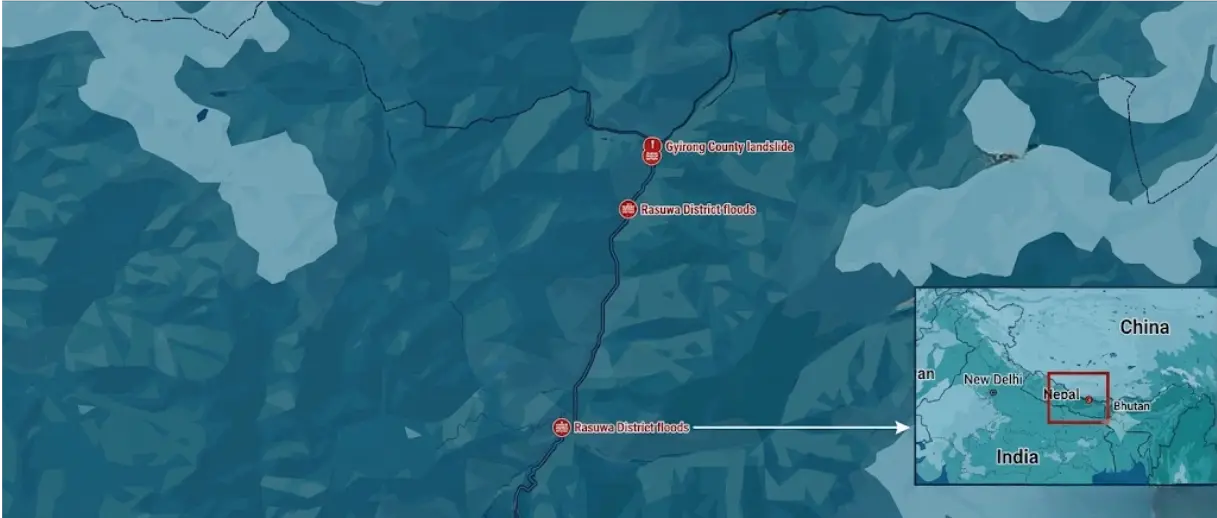
Nepal Floods Map

Nepal Flash Flood Reasons

The main causes of the Nepal Flash Flood disaster was a glacial collapse that generated an ice rock avalanche and powerful downstream debris flow.

  • Glacial Collapse: Scientists initially believed that the lower portion of a Himalayan glacier collapsed and crashed into the valley. This triggered the destructive ice rock avalanche.
  • Seismic Misidentification: The event was initially reported as a 4.4 magnitude earthquake. USGS analysis of seismic waves and satellite imagery later established that the tremors came from glacial collapse and debris flow.
  • Avalanche Trigger: The ice rock avalanche rapidly displaced material and water into the valley. This created a sudden surge in the Bhotekoshi River and intensified downstream flooding.
  • Himalayan Setting: The affected area lies in a high mountain environment where glaciers, steep valleys and rivers can transmit large amounts of water and debris rapidly downstream.

Also Read:- Karnali River

Nepal Floods Implications and Response of India

The Nepal Floods 2026 disaster created cross border flood concerns because rivers originating in Nepal can carry increased flows into Indian territory, especially Bihar and Uttar Pradesh.

  • India’s Assistance: Prime Minister Narendra Modi spoke with Nepal’s Prime Minister Balen Shah and offered all possible assistance. India also planned military transport of food and relief material.
  • Search and Rescue: India indicated that it could join search and rescue operations. The immediate priority remained locating survivors and assisting stranded Indian nationals.
  • India’s Monitoring: India’s Ministry of Home Affairs closely monitored rising water levels because downstream flooding could affect border areas of Bihar and Uttar Pradesh.
  • Uttar Pradesh Alert: Maharajganj and Kushinagar were placed on alert. Local administrations were directed to maintain preparedness because of possible downstream effects from Nepal.
  • Bihar Alert: Bihar authorities anticipated increased Gandak River inflow and opened all 36 gates of the Gandak Barrage at Valmikinagar as a precaution.
  • Bihar Districts: West Champaran, East Champaran, Gopalganj, Saran, Muzaffarpur and Vaishali were identified as potentially affected. Sitamarhi and Sheohar were also treated as sensitive districts.
  • Gandak River: Nepal’s Gandak River is known as the Narayani. Its Devghat water level was 4.77 metres against a warning level of 7.30 metres and danger level of 9 metres.
  • Expected Inflow: Officials projected a possible inflow of around 250,000 cusecs through the Gandak Barrage, compared with the existing discharge of about 80,000 cusecs.
  • Evacuation: Around 5,000 people were moved from riverine areas of West Champaran. National and State Disaster Response Force teams were deployed in potentially affected locations.
  • Border Implications: The flood demonstrated how a high altitude glacial event in the Nepal-Tibet region can create rapid downstream risks across international boundaries.
  • Flood Comparison: Bihar recorded a maximum Gandak discharge of 224,000 cusecs on July 14, 2026. The discharge had reached 562,500 cusecs on September 28, 2024.

Also Read: Kosi River

List of Top 25 Worst Floods in India 2026

The list of Top 25 worst Floods in India as of 2026 has been tabulated below:

List of Top 25 Worst Floods in India 2026
S No Year Flood Region Highlights

1

2025

Uttarakhand

Heavy rainfall triggered flash floods and landslides in Uttarakhand. At least 5 people died and 50+ were reported missing.

2

2024

Wayanad, Kerala

Heavy rainfall triggered devastating floods and landslides in Wayanad, killing at least 123 people and causing extensive damage.

3

2024

Andhra Pradesh & Telangana

Heavy rainfall caused widespread flooding and landslides across parts of Andhra Pradesh and Telangana, resulting in 27 deaths.

4

2023

Chennai, Tamil Nadu

Cyclone Michaung caused heavy rainfall and severe flooding in Chennai in December 2023.

5

2022

Assam

Heavy rainfall caused severe flooding across Assam, affecting large areas of the state.

6

2021

Maharashtra

Exceptionally heavy rainfall caused widespread flooding, particularly around Mahad and Chiplun. More than 250 people were killed and over 100 went missing.

7

2021

Chamoli, Uttarakhand

An avalanche/glacier-related event from Ronti Peak triggered a devastating flood in the Rishi Ganga-Dhauliganga valley. 200+ people died or were reported missing.

8

2020

Hyderabad, Telangana

Intense rainfall triggered severe urban flash floods in Hyderabad in October, causing 98 deaths.

9

2019

Multiple States

Widespread floods affected more than nine states, with Kerala, Madhya Pradesh, Karnataka, Maharashtra and Gujarat among the worst affected.

10

2018

Kerala

Exceptionally heavy monsoon rainfall caused one of Kerala's worst floods. More than 445 people died, while about one million people were displaced.

11

2017

Gujarat

Heavy July rainfall caused severe flooding across Gujarat. Rainfall was around 40% above average, and more than 200 people died.

12

2015

Tamil Nadu & Chennai

Extremely heavy rainfall caused the Adyar and Cooum rivers to overflow, producing severe flooding. About 1.8 million people were affected, around 470 died and 40,000+ were displaced.

13

2014

Jammu & Kashmir

Continuous rainfall for more than a week triggered flash floods and landslides. More than 200 people died, while large parts of the region were submerged.

14

2013

Uttarakhand

Cloudburst, rapid melting of the Chorabari Glacier, Mandakini River flooding, flash floods and landslides combined to cause catastrophic destruction. More than 5,700 people were presumed dead.

15

2007

Bihar

Heavy rainfall and overflowing rivers caused one of Bihar's worst floods, submerging more than 40% of the state and killing over 1,200 people.

16

2006

Surat, Gujarat

Sudden release of a huge volume of water from Ukai Dam into the Tapi River submerged about 80% of Surat, causing 200+ deaths.

17

2005

Maharashtra & Mumbai

Exceptional 24-hour rainfall caused catastrophic flooding across Maharashtra. At least 1,094 people died, while more than 14,000 homes were destroyed; Mumbai came to a standstill.

18

1993

Multiple States

Flash floods affected seven to eight states across India and killed about 530 people.

19

1988

Punjab

All major rivers in Punjab overflowed, causing the state's first major recorded flood event of this type and widespread flooding.

210

1987

Bihar

Overflow of the Kosi River caused one of Bihar's worst floods at the time. 1,399 people died, along with 302 animals, while property losses were estimated at about ₹68 billion.

21

1979

Morbi, Gujarat

The Machchhu-2 Dam on the Machchhu River breached on 11 August, inundating Morbi. The death toll is estimated at 1,800-2,500 people.

22

1971

Lucknow, Uttar Pradesh

Two embankment breaches occurred along the Gomti River after heavy monsoon rainfall. About one-fourth of Lucknow was submerged, while 268 deaths were reported across Uttar Pradesh during the two-month period of rains and flooding.

23

1960

Lucknow, Uttar Pradesh

Heavy rainfall in the Himalayan region caused the Gomti River to overflow, submerging almost half of Lucknow. More than 16 people died, and thousands were left homeless.

24

1943

Madras (Chennai), Tamil Nadu

Excessive rainfall lasting six days caused the Cooum and Adyar rivers to overflow. It was described as the worst flood to hit Madras at the time; the death toll is not known, and thousands were left homeless.

25

1923

Lucknow, Uttar Pradesh

Heavy monsoon rainfall caused the Gomti River to overflow, inundating the old city, civil lines and cantonment areas. Property, crops and infrastructure were extensively damaged; a reliable death toll is not specified.


Nepal Flood 2026 FAQs

Q1: When did the Nepal Flood 2026 occur?

Ans: The flash flood struck at around 9:00 AM on 26 August 2026, surging down the Bhotekoshi river from the Nepal–Tibet border area.

Q2: Which districts were affected by the Nepal Flood 2026?

Ans: Rasuwa was the worst affected district, followed by Nuwakot and Dhading. Alerts were issued along the Bhotekoshi, Trishuli and Narayani rivers.

Q3: What caused the Nepal Floods in 2026?

Ans: The Nepal floods were caused by a glacial collapse and debris flow that triggered an ice-rock avalanche and a sudden surge in the Bhotekoshi River.

Q4: What is a Glacial Lake Outburst Flood?

Ans: A GLOF is the sudden release of water from a glacier-fed lake after the failure of its moraine or ice dam, producing a destructive flood far downstream.

Q5: How did the Nepal Flood 2026 affect Nepal's power supply?

Ans: Nepal's Ministry of Energy reported that around 430 MW of capacity was affected, roughly one-eighth of the country's installed capacity, with the Rasuwagadhi, Sanjen Khola and Upper Trishuli 3A projects among those damaged.

Open Prisons in India, Total Count, Advantages, Disadvantages

Open Prisons in India

Open Prisons in India are an important part of the prison reform system, focusing on the rehabilitation and reintegration of prisoners into society. They provide a more flexible environment with fewer security restrictions, encouraging self-discipline, responsibility and personal development. 

Open Prisons in India Features

Open Prisons in India have minimal security restrictions and provide eligible prisoners with greater freedom and responsibility. Their key features focus on rehabilitation, skill development, self-discipline and social reintegration. 

  • No walls, bars or armed guards: Open prisons are semi-open or open correctional facilities that rely on inmate self-discipline and community involvement. The Rajasthan Open Air Camp Rules, 1972 describe them as “prisons without walls, bars and locks.”
  • Freedom to work outside: Inmates can leave during fixed hours to earn a living and support their families. In Rajasthan there is a 6 a.m. roll call and a 7 p.m. roll call, and inmates must return before the second one.
  • Earnings stay with the family: Inmates spend their wages on their families. Only a small administrative charge goes to the jail.
  • Family life is possible: In open colonies, families can live with the inmate. At Sanganer (Jaipur), convicts build their own houses, pay for water and electricity, and send their children to nearby schools.
  • Based on the reformative theory of justice: The thinking is that a convict can change. It rests on the idea of “trust begets trust” and on Sir Alexander Paterson’s view that a person is sent to prison as punishment, not for punishment.
  • Only for convicts, and only selected ones: Transfer is never automatic. A screening committee checks good conduct, physical and mental fitness and reform potential. Most states also require a minimum time in a closed prison: one-third of the sentence in Rajasthan, two-thirds at Anantapur, and five years in some states.
  • A State subject: Prisons fall under Entry 4, List II (State List) of the Seventh Schedule. They are governed by the Prisons Act, 1894, the Prisoners Act, 1900 and each state’s own rules and manuals.
  • A strong track record: Open prisons have run in India for nearly eight decades with almost no reports of prisoners escaping.
  • Key dates in history:
    • The first open prison was set up in 1905 in the Bombay Presidency, initially using prisoners as unpaid labour for public works.
    • Uttar Pradesh was the first state in independent India to establish an open-air prison camp, attached to the Model Prison in Lucknow in 1949.
    • A full camp followed in 1953, where inmates helped build the Chandraprabha dam near Varanasi.
    • Rajasthan’s first camp opened at Sanganer in 1963. These camps were popularly called Sampurnanand camps, after the reformist leader who promoted them.
  • How many exist: According to the World Prison Brief, based on National Crime Records Bureau (NCRB) data, India had 103 open jails as of 31 December 2024. These were spread across the country, with open prisons operating in 17 states, according to earlier reports.

Open Prisons in India Objectives

Open prisons aim to reform prisoners, develop skills and support their reintegration into society.

  • Reform, not just punishment: The main aim is to turn prisoners into law-abiding citizens through self-discipline, work and community contact.
  • Gradual return to society (re-socialisation): Long years behind bars cut people off from the outside world. Open prisons help inmates reconnect slowly before release. In India, this is the main reason convicts are sent to open jails.
  • Ease prison overcrowding: Moving suitable convicts to open facilities lowers the load on closed, high-security prisons.
  • Protect dignity and human rights: The Supreme Court has held that a person in prison does not become a “non-person” and keeps all human rights within the limits of imprisonment.
  • Build skills and independence: Farming, animal husbandry, factory work and vocational training help inmates earn a living after release.
  • Keep families together: Staying close to relatives reduces the damage long sentences do to families, especially when the inmate was the sole breadwinner.
  • Cut costs: Open prisons need far less security staff and infrastructure than closed ones.
  • Follow global standards: The UN’s Nelson Mandela Rules (2015) support rehabilitation, employment and contact with the outside world. The idea of open penal institutions was discussed at the first UN Congress on crime prevention in Geneva (1955), and the All India Jail Manual Committee (1957-59) recommended them for India.

Types of Open Prisons in India and Their Functioning

Open Prisons in India vary in their security levels and degree of freedom, offering prisoners opportunities for work, skill development and rehabilitation.

  • The Model Prison Manual classifies open institutions into three types, arranged in rising order of freedom.
  • Semi-open training institutions:
    • They are attached to closed prisons, just beyond the enclosed perimeter, with moderate security.
    • Inmates who show reform potential are prepared here for transfer to fuller open facilities.
  • Open training institutions / work camps:
    • They are set up where public work is needed, such as digging canals, building dams, roads and government buildings, land reclamation, afforestation and soil conservation.
    • Inmates learn vocational skills while doing useful work.
  • Open colonies:
    • This is the most liberal type. Family members can live with inmates.
    • Inmates and families work in agriculture or cottage industries, with wages at par with outside rates. Inmates must support themselves and their families from these wages.
  • Common rules across types:
    • Every institution has a clearly marked boundary that inmates cannot cross.
    • Minimum standards for accommodation, sanitation, hygiene, food and medical care must match those of closed prisons.
    • Inmates usually earn higher wages and get extra concessions like remission, leave and review. They can read freely and study through open universities.
  • Selection in Maharashtra (Maharashtra Open Prison Rules, 1971):
    • A committee of the Inspector General, Deputy Inspector General and the Superintendents of the closed and open prisons decides.
    • It looks at good behaviour, mental and physical fitness and period of imprisonment, and can consider special cases even if a prisoner is technically ineligible.
  • Selection in Rajasthan:
    • The Jail Superintendent sends a list to the Open Air Camp Advisory Committee, which decides.
    • Each camp has its own panchayat of 5 to 7 inmates, chosen by the prisoners, who handle daily management. This builds communication and leadership.
  • Himachal Pradesh works much like Rajasthan but also bars rape convicts and those with other heinous offences.
  • Well-known open prisons:
    • Sanganer (Rajasthan): about 25 km from Jaipur, run by very few guards. Convicts live with their families and work within a 10 km radius.
    • Anantapur (Andhra Pradesh): a 1,427-acre campus where inmates grow crops and a medicinal herb supplied to a pharma company.
    • Nettukaltheri (Kerala): around 300 acres, where even murderers work on a rubber plantation for wages. Inmates get regular home leave, and rubber sales cover the running costs.
    • Others: Yerwada, Akola, Kolhapur, Paithan, Sangamner and Bikaner. The Tihar Semi-Open Jail (Delhi) is also seen as a good example.
  • Where open jails fit in the wider system:
    • India has sub-jails, district jails and central jails, plus special jails, women’s jails, Borstal schools (for juveniles) and open jails.
    • Central jails usually hold long-term convicts, often those serving more than two years.

Open Prisons in India Advantages and Disadvantages

Open prisons promote prisoner rehabilitation, reduce overcrowding and help inmates develop skills for successful reintegration into society.

Advantages of Open Prisons in India

  • Much cheaper to run: A Rajasthan State Legal Services Authority (RSLSA) study found a closed prison cost about ₹7,094 per prisoner per month (Jaipur Central), against about ₹500 at Sanganer open prison, roughly 78 times cheaper. Only one staff member was needed per 80 prisoners, and the Supreme Court has also noted a similar gap of over ₹3,000 versus about ₹50 per inmate.
  • Less overcrowding: On 31 December 2018, India's prisons held 4,66,084 inmates against a capacity of 3,96,223, an occupancy rate of 117.6%. Open prisons take some of this load and improve living conditions in closed jails.
  • Lower chance of reoffending (recidivism): Stigma, lack of skills and failure to reintegrate push many ex-prisoners back to crime. Open prisons tackle this through work, training and family contact.
  • Better mental health and real life skills: Gainful work builds self-confidence and self-esteem, while farming, dairy, rubber tapping, factory work and teaching give inmates a livelihood after release.
  • Support for families and vulnerable groups: Visits, family stays and home leave let families share the burden of reform. In Dharmbir v. State of UP (1979), the Supreme Court saw benefits for young offenders, and elderly prisoners can also ease back into normal life.
  • Safe, trusted and useful to society: Studies found inmates did not escape even without a security barricade, and open prisons also lower the health risk of epidemics like COVID-19 in crowded jails. Inmates can work on rural public works and conservation, which benefits the community too.

Disadvantages of Open Prisons in India

  • Under-use despite overcrowding: As of 2015, open prisons had room for 25,776 inmates but held only 3,786, and many states have an open prison with no inmates at all.
  • Uneven spread across states: Rajasthan and Maharashtra hold around 60% of open-prison inmates, while states like Goa, Haryana, Jharkhand, Manipur, Mizoram, Nagaland and Telangana had none. Because prisons are a State subject, standards differ widely.
  • Strict and sometimes arbitrary eligibility rules: Exclusions can cover women, narcotics convicts, people with a history of mental illness and those convicted of sedition or crimes against the army, and Rajasthan adds limits on age and marital status. Such rules shut out many who need rehabilitation.
  • No accountability in selection: Committees are not required to give reasons, which can lead to bias and corruption. Undertrials and fresh convicts are also left out of the system.
  • Land shortage and social stigma: Open prisons need large areas of land, which is hard to find today, and society is slow to accept ex-convicts, making jobs and rehabilitation harder.
  • Weak laws and political will: The Prisons Act, 1894 has colonial roots and puts custody ahead of reform. Without strict screening and supervision, open prisons may also turn into poorly monitored work camps.

Role of Open Prisons in Prison Reforms and Rehabilitation of Prisoners

  • A shift from punishment to reform: Prison thinking has moved from confinement to training, restriction to re-education and retribution to rehabilitation. Open prisons are the clearest form of this change in India.
  • Long-standing support from committees and courts: The All India Prison Reforms Committee (1980) recommended open prisons across states, and the NHRC pushed for them in its reports of 1994-95 and 2000-01. In Ramamurthy v. State of Karnataka (1996/1997), the Supreme Court called them one of the most successful uses of individualisation of penalties for social readjustment.
  • Tied to the Constitution: Article 14 (equality), Article 15 (non-discrimination) and Article 21 (life and dignity) apply inside prison walls too.
  • Latest Supreme Court directions on access and inclusion in Suhas Chakma v. Union of India, WP (C) No. 1082/2020, by Justices Vikram Nath and Sandeep Mehta: States and UTs without OCIs must study feasibility and frame procedures, or arrange transfers to nearby states. Barracks and capacity for women inmates must be created within three months, and broad security concerns cannot justify excluding women.
  • Latest Supreme Court directions on fairness and monitoring: Eligibility criteria must be reviewed using the nature of the offence, reform potential and conduct, so OCIs do not become mere labour camps, and states should learn from Maharashtra and Rajasthan. Transfer back to a closed prison cannot be a routine punishment, every state must set up grievance redressal systems, and monitoring committees headed by the State Legal Services Authority chair will oversee compliance, with High Courts starting suo motu cases as continuing mandamus.
  • A global and Gandhian model: Norway, Finland, the UK (Category D prisons) and Spain run open or semi-open systems with low reoffending, with early examples like Switzerland's Witzwill (1891) and the UK's New Hall Camp (1936). In India, open prisons also resemble Gandhian ashrams, built on shared work and character building.
  • What success needs: Strong screening, supervision and trained staff, along with legal aid, tie-ups with welfare agencies, community support and regular data on reoffending, jobs and costs. With uniform rules, fairer selection and wider coverage, open prisons can make Indian prisons more humane and effective.

Open Prisons in India FAQs

Q1: What are open prisons in India?

Ans: Open prisons are correctional institutions with minimal security restrictions that focus on rehabilitation, self-discipline and reintegration rather than strict confinement.

Q2: What are the main objectives of open prisons in India?

Ans: The main objectives are to reform prisoners, reduce overcrowding, develop vocational skills, maintain family ties and prepare inmates for life after release.

Q3: What are the different types of open prisons in India?

Ans: The three types are semi-open training institutions, open training institutions or work camps, and open colonies. They differ in their level of freedom and rehabilitation opportunities.

Q4: Which state has the largest number of open prisons in India?

Ans: Rajasthan has the largest open-prison network in India, with Maharashtra also having a significant presence.

Q5: What are the major benefits of open prisons?

Ans: Open prisons reduce operational costs and overcrowding while promoting mental well-being, employment skills, family support and social reintegration.

Witness Protection Scheme, Objectives, Benefits, Challenges

Witness Protection Scheme

Witness Protection Scheme was introduced in 2018 to protect witnesses from threats, intimidation and harassment during criminal proceedings. It aims to ensure that witnesses can provide free and fair testimony without fear or pressure. The scheme provides measures such as police protection, identity concealment and relocation, depending on the level of threat. It plays an important role in strengthening the criminal justice system by promoting fair trials and improving the delivery of justice in India.

Who is a Witness?

  • Meaning of a Witness: A witness is a person who provides information or evidence about an incident, crime or other matter before a court. Witnesses help the court understand the facts of a case and determine what actually happened.
  • Who Can Be a Witness? Any person who possesses relevant information about an offence may act as a witness. A man, woman, child or elderly person can be a witness, provided they can understand the questions asked and give rational answers.
  • Role in the Criminal Justice System: Witnesses help the police investigate crimes, assist prosecutors in presenting evidence and enable courts to deliver fair judgments. Their statements can be crucial in establishing the facts and identifying the accused.
  • Legal Importance: In State of Gujarat v. Anirudh Singh (1997), the Supreme Court emphasised the duty of witnesses to assist the State by providing evidence about a crime. Their safety is therefore essential for the effective delivery of justice.

Witness Protection Scheme 2018 Objectives

The Witness Protection Scheme, 2018 aims to protect witnesses from threats and intimidation, enabling them to testify freely and ensuring fair trials and justice. 

  • Ensuring Witness Safety: The scheme aims to protect witnesses and their family members from threats, intimidation, harassment and physical harm during investigations, trials and, where necessary, after the trial.
  • Encouraging Fearless Testimony: It seeks to create a safe environment in which witnesses can share information with investigating agencies and testify before courts without fear of retaliation.
  • Preventing Witnesses from Turning Hostile: Witnesses may change their statements because of threats, pressure or inducements. The scheme aims to reduce such interference and encourage them to provide truthful evidence.
  • Ensuring Fair Trials: A fair trial depends on witnesses being able to present evidence freely. Protecting them from intimidation helps courts assess evidence fairly and reduces the possibility of injustice.
  • Strengthening Law Enforcement: Witness protection is particularly important in cases involving organised crime, terrorism, sexual offences and other serious crimes, where witnesses may possess crucial information.
  • Establishing a Structured Protection System: The scheme introduced a formal process for assessing threats, deciding suitable protection measures and monitoring their implementation instead of relying only on temporary or informal arrangements.
  • Protecting Vulnerable Witnesses: It aims to provide appropriate support to witnesses who face greater risks because of their social or economic circumstances or the influence and power of the accused.

Key Features of the Witness Protection Scheme in India

The Witness Protection Scheme, 2018 provides measures such as police protection, identity concealment, relocation and secure testimony, based on the level of threat faced by witnesses. 

  • Supreme Court Approval: The Witness Protection Scheme 2018 was approved by the Supreme Court in Mahender Chawla v. Union of India. The Court directed its implementation across India to ensure that witnesses could testify without fear.
  • Legal Basis: The Supreme Court directed that the scheme would operate as the law of the land under Articles 141 and 142 of the Constitution until suitable legislation was introduced. Subsequently, Section 398 of the Bharatiya Nagarik Suraksha Sanhita (BNSS), 2023 provided for States to prepare and notify witness protection schemes.
  • Threat Analysis Report: When a witness applies for protection, the police prepare a Threat Analysis Report to assess the seriousness and credibility of the threat. It examines the nature of the threat, the persons involved and the protection measures required.
  • Competent Authority: A District Standing Committee headed by the District and Sessions Judge examines witness protection applications. The district police and prosecution authorities are also represented in the committee, which decides the appropriate protection measures.
  • Application and Decision Process: A witness or an eligible person acting on their behalf can apply for protection before the Competent Authority. Under the scheme, the application is to be decided within five working days of receiving the Threat Analysis Report. Interim protection may also be provided when necessary.
  • Witness Protection Cell: A dedicated Witness Protection Cell of the State or Union Territory police implements protection orders and monitors the arrangements. It submits follow-up reports to help the Competent Authority review the effectiveness of the protection measures.
  • Confidentiality and Identity Protection: The scheme provides for protecting the witness's name, address and other identifying details. In appropriate cases, the witness may be referred to by a different name or given a new identity to reduce the risk of exposure.
  • Physical Security Measures: Depending on the seriousness of the threat, protection may include police escorts, regular patrolling, close security, CCTV cameras, alarms and temporary relocation to a safe place.
  • Protection During Court Proceedings: Witnesses may be allowed to testify through video conferencing or in specially designed courtrooms. In-camera proceedings, screens, separate passages and other arrangements can help prevent direct contact between the witness and the accused.
  • Witness Protection Fund: The scheme provides for a dedicated fund to meet the expenses of protection orders. The fund may receive money through State government budget allocations, court-imposed costs, permitted donations and other authorised contributions.
  • Financial Assistance: Where necessary, witnesses may receive financial assistance for relocation, basic sustenance or starting a new occupation. This support helps reduce the financial burden of cooperating with the criminal justice system.
  • Periodic Review: Protection measures are decided according to the level of threat and are generally ordered for a period of up to three months at a time. The Competent Authority reviews the arrangements periodically and may modify them according to changes in the threat assessment.

Categories of Witnesses Under the Witness Protection Scheme

The Witness Protection Scheme 2018 classifies witnesses into three categories according to the seriousness of the threats they face. This classification helps authorities determine the appropriate level of protection.

  • Category A - Threat to Life: This category covers cases where the witness or their family members face a serious threat to life during the investigation, trial or even after the trial. Such cases may require intensive security arrangements, relocation or identity protection.
  • Category B - Threat to Safety, Reputation or Property: This category includes cases where the witness or their family members face threats to their personal safety, reputation or property during the investigation or trial, or where the threat continues afterwards. Protection is provided according to the level of risk.
  • Category C - Moderate Threat: This category covers moderate threats involving harassment or intimidation of the witness or their family members, or threats affecting their reputation or property. The authorities decide suitable protection measures based on the circumstances.
  • Basis of Classification: The police assess the nature, seriousness and credibility of the threat through the Threat Analysis Report. The Competent Authority uses this assessment to select protection measures proportionate to the risk.
  • Case-Specific Protection: The scheme does not provide identical protection to every witness. The measures are decided on a case-by-case basis, considering the vulnerability of the witness, the nature of the threat and the safety of their family members.

Importance of the Witness Protection Scheme in the Criminal Justice System

The Witness Protection Scheme strengthens the criminal justice system by protecting witnesses from intimidation and ensuring fearless testimony, fair trials and effective delivery of justice. 

  • Promotes Fair Trials: Protecting witnesses from intimidation allows courts to consider their testimony freely and fairly. It also helps prevent powerful or influential accused persons from interfering with judicial proceedings.
  • Reduces Witness Intimidation: The scheme provides a formal mechanism to respond to threats, harassment and pressure. It is particularly relevant in cases involving organised crime, terrorism, sexual offences and influential individuals.
  • Helps Prevent Hostile Testimony: Fear and coercion may cause witnesses to withdraw or change their statements. Appropriate security and confidentiality measures encourage truthful testimony and support effective prosecution.
  • Builds Public Confidence: People are more likely to report crimes and cooperate with the police when they believe their safety will be protected. The scheme can therefore strengthen public trust in law enforcement agencies and courts.
  • Safeguards Vulnerable Witnesses: Women, children and people from socially or economically disadvantaged backgrounds may face additional pressure when reporting crimes. Suitable protection measures help them participate in legal proceedings with greater confidence.
  • Supports Investigation of Serious Crimes: In cases involving terrorism, organised criminal networks and other serious offences, witnesses may possess information that is difficult to obtain from other sources. Their protection helps investigating agencies collect evidence and build stronger cases.
  • Upholds Article 21: Article 21 of the Constitution protects the right to life and personal liberty. Protecting witnesses from threats supports their safety and helps ensure that criminal trials are conducted fairly.
  • Strengthens the Rule of Law: The scheme reinforces the principle that threats and intimidation should not be allowed to obstruct justice. Its effective implementation can improve accountability and strengthen the criminal justice system.

Challenges in Implementing the Witness Protection Scheme

The implementation of the Witness Protection Scheme 2018 faces challenges such as inadequate funding, weak enforcement, limited infrastructure and difficulties in maintaining witness confidentiality. 

  • Inadequate Funding: Witness protection requires financial resources for security personnel, relocation, safe accommodation and identity protection. Limited budgetary allocations in some States can affect the quality and continuity of protection.
  • Short Duration of Protection Orders: Protection measures are generally ordered for up to three months at a time. In cases involving long trials or continuing threats, repeated reviews may create difficulties, and protection must remain adequate for as long as the threat persists.
  • Shortage of Trained Personnel: Police departments may face staff shortages and heavy workloads, making it difficult to conduct detailed threat assessments and provide continuous security to witnesses.
  • Weak Coordination Among Agencies: Poor coordination between the police, prosecution, courts and other authorities can delay protection measures and reduce their effectiveness.
  • Risk of Identity Disclosure: The effectiveness of the scheme depends on maintaining the confidentiality of witnesses' personal information. Unauthorised disclosure of names, addresses or digital information may expose witnesses to further threats.
  • Inadequate Court Infrastructure: Many lower courts, especially in rural areas, may lack separate entrances, video-conferencing facilities, screens and specially designed rooms for vulnerable witnesses.
  • Pressure from Powerful Accused Persons: In cases involving influential individuals or organised criminal groups, witnesses and officials responsible for their protection may face pressure, interference or attempts to obtain confidential information.
  • Practical Difficulties in Relocation: Changing a witness's identity or moving them to another location can disrupt their employment, education, family life and social relationships. These difficulties may make long-term relocation challenging.
  • Financial and Social Burden: Repeated court appearances, adjournments, travel expenses and loss of income can place a heavy burden on witnesses. The pressure may be greater when the witness knows or lives near the accused.
  • Uneven Implementation: Differences in funding, infrastructure, awareness and administrative capacity across States and Union Territories may result in unequal access to protection.

Way Forward

  • Ensure Adequate Funding: State governments should provide sufficient and regular budgetary support for witness protection. Funds should be used effectively for security arrangements, safe accommodation, relocation and financial assistance.
  • Strengthen Police Capacity: Dedicated witness protection units should be provided with trained personnel, modern equipment and adequate resources to conduct credible threat assessments and respond quickly to emergencies.
  • Provide Need-Based, Continuous Protection: Protection should be reviewed regularly and continued for as long as a credible threat exists. Authorities should ensure that the duration and level of protection match the actual risk faced by the witness.
  • Improve Inter-Agency Coordination: Police departments, prosecution authorities, courts and legal services institutions should work together through clear procedures and timely information-sharing to ensure the smooth implementation of protection orders.
  • Strengthen Confidentiality Safeguards: Strict protocols should be introduced for handling witness records and personal information. Unauthorised disclosure should be addressed through appropriate accountability mechanisms and effective safeguards.
  • Modernise Court Infrastructure: Courts should develop vulnerable witness facilities, including separate passages, secure waiting areas, video-conferencing systems and screens, to reduce direct contact between witnesses and the accused.
  • Provide Financial and Rehabilitation Support: Witnesses who need to relocate or change their occupation should receive suitable assistance. Authorities should also consider the impact of protection arrangements on their families, education and employment.
  • Increase Awareness: Witnesses should be informed about the protection measures available to them, the application process and the authorities they can approach when facing threats. Legal services institutions can play an important role in spreading awareness.
  • Ensure Independent Monitoring: Regular reviews and monitoring of protection orders should help identify implementation gaps and ensure that protection remains effective. Clear responsibility should be assigned to the authorities involved.
  • Adopt a Witness-Centred Approach: Protection measures should consider the witness's individual circumstances, family relationships, social environment and personal needs. This can help make protection practical, accessible and sustainable.

Witness Protection Scheme FAQs

Q1: What is the Witness Protection Scheme 2018?

Ans: The Witness Protection Scheme, 2018 is a framework designed to protect witnesses from threats, intimidation and harassment during criminal proceedings.

Q2: What are the main objectives of the Witness Protection Scheme, 2018?

Ans: Its main objectives are to ensure witness safety, encourage fearless testimony, prevent intimidation and promote fair trials.

Q3: What are the key features of the Witness Protection Scheme in India?

Ans: Key features include threat assessment, police protection, identity concealment, relocation, secure testimony and financial assistance.

Q4: What are the three categories of witnesses under the Witness Protection Scheme?

Ans: Witnesses are classified into Category A, Category B and Category C, based on the seriousness and nature of the threat they face.

Q5: Which Supreme Court case approved the Witness Protection Scheme, 2018?

Ans: The Supreme Court approved the scheme in Mahender Chawla v. Union of India (2018) and directed its implementation across India.

Green Revolution in India, Need, Objectives, Impact, Criticism

Green Revolution in india

The Green Revolution in India transformed agriculture by increasing foodgrain production through high-yielding variety (HYV) seeds, irrigation, chemical fertilisers and modern farming practices. Introduced during the 1960s, it helped India reduce its dependence on foodgrain imports and strengthen food security. However, its benefits were concentrated in certain regions and came with economic and environmental challenges.

What Is Green Revolution in India

The Green Revolution in India refers to the significant increase in agricultural production achieved through the adoption of high-yielding variety (HYV) seeds, chemical fertilisers, pesticides, improved irrigation and modern farming practices.

It began in the 1960s to address persistent food shortages, low agricultural productivity and growing food requirements. Dependence on foodgrains imports further highlighted the need to increase domestic production. In response, the government introduced a new agricultural strategy that initially focused on wheat and later expanded significantly to rice.

Objectives of the Green Revolution

The strategy aimed to address India's food shortages and strengthen agricultural production. Its key objectives were:

  • Increase Foodgrain Production: Raise domestic foodgrain output to meet the needs of a growing population.
  • Improve Agricultural Productivity: Increase crop yields through HYV seeds, improved irrigation and modern agricultural inputs.
  • Achieve Food Self-Sufficiency: Reduce dependence on foodgrain imports by increasing domestic production.
  • Strengthen Food Security: Improve the domestic availability of foodgrains and reduce the risk of shortages.
  • Green Revolution In India

Father of the Green Revolution in India

Dr. M. S. Swaminathan is widely known as the Father of the Green Revolution in India for his leading role in introducing and promoting high-yielding wheat varieties and modern agricultural practices in the country during the 1960s. He helped adapt and promote high-yielding crop varieties suited to Indian conditions and supported agricultural research and development.

American agronomist Norman Borlaug, known as the Father of the Green Revolution globally, developed high-yielding wheat varieties in Mexico that contributed to the transformation of wheat production in several countries, including India.

Their contributions, along with government policies, irrigation expansion and farmers' adoption of modern inputs, helped increase India's foodgrain production and strengthen food security.

Green Revolution in India Key Features and Components 

The Green Revolution in India combined improved seeds, modern farming inputs and government support to increase agricultural production.

  • High-Yielding Variety (HYV) Seeds: Mexican wheat varieties developed through international research were introduced in India with a key role played by Dr. M. S. Swaminathan. The government launched the High-Yielding Varieties Programme in 1966. Improved rice varieties, including IR8 developed at the International Rice Research Institute (IRRI), Philippines, also contributed to higher production.
  • Irrigation: Canals and tube wells provided more reliable water supplies, reducing dependence on monsoon rainfall.
  • Chemical Fertilisers and Pesticides: Fertilisers supplied nutrients for crop growth, while pesticides helped protect crops from pests and diseases.
  • Farm Mechanisation: Tractors, threshers and harvesters made ploughing, grain separation and harvesting faster and more efficient.
  • Agricultural Credit: Banks and cooperative institutions helped farmers obtain loans to purchase seeds, fertilisers, pumps and machinery.
  • Minimum Support Price (MSP) and Procurement: Government price support encouraged wheat and rice production, while procurement helped build foodgrain stocks for public distribution.
  • Agricultural Research: Institutions such as the Indian Council of Agricultural Research (ICAR) and Indian Agricultural Research Institute (IARI) helped develop improved crop varieties and farming techniques.

Phases of the Green Revolution in India

The Green Revolution in India evolved in phases, beginning with the adoption of high-yielding varieties in the mid-1960s and gradually expanding to more regions and crops.
 

1. First Phase (Mid-1960s to 1980)

  • Main focus: Increasing wheat production, followed by the expansion of high-yielding rice varieties.
  • Major regions: Punjab, Haryana and western Uttar Pradesh.
  • Key developments: High-Yielding Variety (HYV) seeds, chemical fertilisers, irrigation and farm mechanisation were adopted on a wider scale.
  • Outcome: India recorded a substantial rise in foodgrain production, particularly wheat, helping reduce dependence on foodgrain imports.

2. Expansion Phase (1980s)

  • Main focus: Extending improved agricultural technology beyond the initial wheat-growing regions, with greater emphasis on rice production.
  • Major regions: Several eastern and southern states, alongside the established agricultural regions.
  • Key developments: Wider use of improved seeds, irrigation facilities and other modern farming inputs.
  • Outcome: The benefits of improved agricultural technology spread to more regions, although adoption and productivity gains remained uneven.

3. Diversification and Regional Expansion (1990s onwards)

  • Main focus: Broadening agricultural development beyond the original Green Revolution model.
  • Key developments: Greater attention to regional differences, rain-fed farming, crop diversification and the sustainability of agricultural practices.
  • Outcome: Concerns such as soil degradation, groundwater depletion and the uneven distribution of benefits increased the need for more sustainable and region-specific agricultural strategies.

Impact of the Green Revolution in India

The Green Revolution strengthened India's food security, but its economic and environmental effects were uneven. Its impact can be understood through its contributions to production, rural livelihoods and natural resources.

Economic Impact

  • Higher Agricultural Productivity: Improved crop varieties and modern farming practices raised yields, particularly for wheat and rice.
  • Greater Food Security: Higher production helped India reduce its dependence on foodgrain imports and build public stocks for distribution during shortages.
  • Growth of Agricultural Markets: Increased marketable surpluses strengthened demand for transport, storage, processing and other agricultural services.
  • Regional Inequality: Regions with better irrigation and infrastructure benefited more rapidly than many rainfed and less-developed areas.
  • Unequal Gains Among Farmers: Farmers with larger landholdings, better access to credit and the capacity to purchase inputs were often better positioned to adopt the new technology.

Social Impact

  • Improved Rural Incomes in Some Regions: Higher yields and marketable surpluses increased earnings for many farmers in areas where the new methods succeeded.
  • Unequal Access to Benefits: Small and marginal farmers often faced difficulties financing seeds, fertilisers, irrigation and machinery.
  • Changes in Agricultural Labour: Mechanisation reduced the need for certain manual operations, although its overall effect on employment varied by crop, region and farming practice.
  • Greater Dependence on Purchased Inputs: Farmers increasingly relied on external inputs, making access to affordable credit and stable farm incomes important.

Environmental Impact

  • Groundwater Depletion: Intensive irrigation, particularly through tube wells, increased pressure on groundwater resources in several agricultural regions.
  • Soil Degradation: Imbalanced fertiliser use and inappropriate farming practices contributed to declining soil health in some areas.
  • Water Pollution: Excess fertilisers and pesticides can enter rivers, ponds and groundwater through runoff and leaching.
  • Reduced Crop Diversity: The strong focus on wheat and rice in major production regions reduced incentives to grow some traditional crops.
  • Pest Resistance: Repeated or inappropriate pesticide use can contribute to pesticide resistance and harm beneficial organisms.

These effects were not identical across India. Their severity depended on local water availability, farming practices, crop choices and the management of agricultural inputs.

Advantages of the Green Revolution in India 

The major advantages of the Green Revolution in India were:

  • Foodgrain Self-Sufficiency: Higher production helped India move towards greater self-sufficiency in foodgrains.
  • Higher Crop Yields: Improved seeds and modern agricultural practices increased productivity, particularly for wheat and rice.
  • Reduced Import Dependence: Greater domestic production reduced reliance on foodgrain imports.
  • Stronger Public Food Distribution: Higher production and procurement supported the development of public foodgrain stocks and the Public Distribution System.
  • Agricultural Modernisation: The spread of irrigation, farm machinery, fertilisers and scientific farming changed agricultural practices.
  • Growth of Rural Economic Activity: Increased agricultural output supported demand for storage, transport, machinery and food processing.

Challenges of the Green Revolution in India 

Despite its achievements, the Green Revolution also exposed structural weaknesses in Indian agriculture.

  • Regional Disparities: Areas with better irrigation, infrastructure and market access gained more than many rainfed regions.
  • Small-Farmer Constraints: High initial costs and limited access to credit made modern inputs harder for some farmers to afford.
  • Water Stress: Water-intensive cultivation and excessive groundwater extraction created long-term sustainability concerns.
  • Soil and Environmental Damage: Imbalanced nutrient use, pesticide misuse and poor water management harmed agricultural ecosystems in some regions.
  • Limited Crop Diversification: Concentration on a few major crops affected crop diversity and, in some areas, reduced incentives to cultivate pulses and millets.
  • Dependence on External Inputs: Rising costs of fertilisers, pesticides, seeds and energy can increase financial pressure on farmers.
  • Way Forward: Towards Sustainable Agriculture

Way Forward: Towards Sustainable Agriculture

India needs to retain the productivity gains of the Green Revolution while reducing its social and environmental costs.

  • Promote Crop Diversification: Encourage suitable alternatives such as pulses, millets and oilseeds according to local agro-climatic conditions.
  • Improve Water Management: Expand micro-irrigation where appropriate, promote water-efficient practices and improve groundwater management.
  • Maintain Soil Health: Encourage soil testing, balanced fertiliser use, organic matter restoration and integrated nutrient management.
  • Strengthen Small Farmers: Improve access to institutional credit, agricultural extension services, storage facilities and markets.
  • Support Agricultural Research: Develop climate-resilient, pest-resistant and resource-efficient crop varieties.
  • Encourage Sustainable Farming: Promote integrated pest management and farming practices that conserve soil, water and biodiversity.

Also Read : Blue Revolution in India , Yellow Revolution in India, Golden Revolution in India , Purple Revolution,

Green Revolution in India FAQs

Q1: Who is the Father of the Green Revolution in India?

Ans: Dr. M. S. Swaminathan, supported by Norman Borlaug’s work on wheat HYVs, led the efforts.

Q2: What crops were central to the Green Revolution?

Ans: Primarily wheat and rice; later phases included jowar, bajra, maize, and dryland crops like pulses and oilseeds.

Q3: Why did the Green Revolution succeed only in parts of India?

Ans: Failure to implement irrigation, credit and land reforms limited adoption in rain‑fed and eastern regions.

Q4: What is meant by monoculture in this context?

Ans: Growing the same crop (wheat or rice) repeatedly over large areas leading to biodiversity loss and increased vulnerability to pests.

Q5: Can India feed itself indefinitely with Green Revolution methods?

Ans: Not sustainably. Groundwater depletion, soil degradation, and climate stress mean that India needs a new, eco‑sensitive model often called Green Revolution 2.0 or Evergreen Revolution.

Industrial Disputes Act 1947, Objectives, Features, Industrial Relations Code 2020

Industrial Disputes Act, 1947

The Industrial Disputes Act 1947 was an important labour legislation in India that established a framework for investigating and resolving disputes between employers and workers. It provided mechanisms such as conciliation, arbitration and adjudication to promote industrial peace and address issues relating to strikes, lockouts, layoffs and retrenchment.

The Industrial Disputes Act 1947 was subsumed under the Industrial Relations Code 2020, which came into force on 21 November 2025. The 1947 Act remains important for understanding the evolution of labour laws in India, while the Code provides the current legislative framework.

What Is the Industrial Disputes Act 1947?

The Industrial Disputes Act 1947 was enacted to provide a legal mechanism for the investigation and settlement of industrial disputes. It aimed to maintain harmonious relations between employers and workers while protecting their interests and reducing disruptions to industrial production.

The Act covered matters such as employment conditions, termination of employment, strikes, lockouts, layoffs and retrenchment. It also established authorities to facilitate negotiations and adjudicate disputes when the parties could not reach a settlement.

What Is an Industrial Dispute?

Under Section 2(k) of the Industrial Disputes Act 1947, an industrial dispute meant a dispute or difference between employers and employers, employers and workmen, or workmen and workmen, connected with the employment or non-employment, terms of employment, or conditions of labour of any person.

Example: If workers demand higher wages and negotiations with the employer fail, the disagreement may develop into an industrial dispute.

Industrial Disputes Act 1947 Historical Background 

The Industrial Disputes Act 1947 emerged in response to growing industrialisation and labour unrest during the colonial period.

  • Post-World War I: Rising prices, wage-related grievances and poor working conditions contributed to labour unrest and industrial disputes.
  • Trade Disputes Act, 1929: This legislation introduced mechanisms to address industrial disputes and regulated certain strikes and lockouts, but its framework had limitations.
  • World War II: Rule 81-A of the Defence of India Rules enabled the government to refer industrial disputes for adjudication to help maintain essential production during wartime.
  • Enactment in 1947: The Industrial Disputes Act, 1947 established a broader legal framework for the investigation and settlement of industrial disputes in independent India.

Industrial Disputes Act 1947 Objectives

The major objectives of the Industrial Disputes Act 1947 were:

  • Maintain Industrial Peace: Prevent industrial conflicts from escalating into prolonged strikes and lockouts.
  • Provide Dispute Resolution: Establish procedures for conciliation, voluntary arbitration and adjudication.
  • Protect Workers: Provide legal safeguards in matters such as layoffs, retrenchment and termination of employment.
  • Promote Collective Bargaining: Encourage employers and workers to negotiate employment-related issues.
  • Regulate Strikes and Lockouts: Prescribe conditions and restrictions to prevent unlawful work stoppages.
  • Provide Compensation: Establish rules for compensation in specified cases of layoff and retrenchment.
  • Promote Industrial Harmony: Balance the interests of employers and workers while supporting continuity of industrial activity.

Industrial Disputes Act 1947 Key Features 

The Industrial Disputes Act 1947 established a legal framework for resolving industrial disputes, regulating strikes and lockouts, and protecting workers' interests through the following key provisions.
 

1. Authorities for Industrial Dispute Resolution

The Industrial Disputes Act 1947 established several authorities to prevent and resolve industrial disputes.

  • Works Committees — Section 3: Provided for Works Committees in eligible industrial establishments to promote good relations between employers and workers.
  • Conciliation Officers — Section 4: Helped parties negotiate and reach settlements.
  • Boards of Conciliation — Section 5: Facilitated the settlement of industrial disputes through conciliation.
  • Courts of Inquiry — Section 6: Investigated matters connected with industrial disputes.
  • Labour Courts — Section 7: Adjudicated industrial disputes concerning matters assigned to them under the Act.
  • Industrial Tribunals — Section 7A: Adjudicated specified industrial disputes, including matters relating to wages and employment conditions.
  • National Tribunals — Section 7B: Dealt with disputes of national importance or disputes affecting industrial establishments situated in more than one state.

2. Reference and Settlement of Disputes

The Industrial Disputes Act 1947 provided multiple mechanisms for resolving disputes without relying exclusively on prolonged litigation.

  • Section 10 — Reference of Disputes: Empowered the appropriate government to refer industrial disputes to the relevant authorities for settlement or adjudication, subject to the Act.
  • Section 10A — Voluntary Arbitration: Allowed parties to refer a dispute to arbitration through a written agreement, subject to statutory requirements.
  • Section 9C — Grievance Redressal Machinery: Provided for grievance redressal machinery in industrial establishments meeting the prescribed conditions.

3. Regulation of Strikes and Lockouts

The Industrial Disputes Act 1947 prescribed restrictions on strikes by workers and lockouts by employers.

  • Section 22: Imposed specific restrictions on strikes and lockouts in public utility services.
  • Section 23: Prohibited strikes and lockouts in specified circumstances, including during certain dispute-resolution proceedings.
  • Section 24: Defined the circumstances in which strikes and lockouts were considered illegal.
  • These provisions aimed to encourage dispute settlement and prevent work stoppages that violated statutory requirements.

4. Layoff and Retrenchment

The Industrial Disputes Act 1947 established conditions governing layoffs and retrenchment, including compensation and procedural safeguards in specified circumstances.

  • Section 25B — Continuous Service: Defined continuous service for the purposes of relevant statutory provisions.
  • Section 25C — Compensation for Layoff: Provided for compensation to eligible workmen who were laid off, subject to statutory conditions.
  • Section 25F — Conditions for Retrenchment: Prescribed conditions that an employer had to satisfy before retrenching a workman covered by the provision.
  • Section 25G — Procedure for Retrenchment: Established the general principle of “last come, first go”, subject to the statutory exceptions.
  • Section 25H — Re-employment: Provided for preference to retrenched workmen when the employer proposed to employ persons again, subject to the provision.

Additional conditions applied to certain establishments under Chapter V-B, including Section 25N, which prescribed requirements for retrenchment, and Section 25O, which governed closure in covered establishments.

5. Closure of Industrial Establishments

The Industrial Disputes Act 1947 regulated the closure of certain industrial establishments and prescribed procedures to protect affected workers.

  • Section 25FFA: Required notice of intended closure in specified circumstances.
  • Section 25FFF: Provided for compensation to workmen in cases of closure, subject to statutory conditions.
  • Section 25O: Prescribed the procedure for closing down industrial establishments covered by Chapter V-B.
  • The applicability of these provisions depended on the establishment and the relevant statutory requirements.

6. Settlements and Awards

The Industrial Disputes Act 1947 gave legal effect to settlements reached between parties and awards delivered through adjudication.

  • Section 17: Provided for the publication of awards.
  • Section 17A: Dealt with the commencement of awards.
  • Section 18: Specified the persons on whom settlements and awards were binding.
  • Section 19: Prescribed the period of operation of settlements and awards and related conditions.

The binding effect and duration of an award depended on the applicable statutory provisions and circumstances.

7. Unfair Labour Practices

The Industrial Disputes Act 1947 prohibited specified unfair labour practices by employers, workers and trade unions.

  • Section 25T: Prohibited unfair labour practices.
  • Section 25U: Prescribed penalties for committing unfair labour practices.

These provisions addressed conduct that undermined lawful collective activity or fair industrial relations.

Significance of the Industrial Disputes Act 1947

The Industrial Disputes Act 1947 played an important role in the development of labour relations in India.

  • Institutionalised Dispute Resolution: It provided legal procedures for addressing industrial disputes instead of leaving parties to informal negotiations alone.
  • Worker Protection: It established safeguards relating to employment, retrenchment and compensation in specified situations.
  • Industrial Continuity: Its dispute-resolution mechanisms helped address conflicts that could disrupt production.
  • Collective Bargaining: It provided a framework for negotiations between employers and workers.
  • Labour Justice: It created legal forums through which specified employment-related disputes could be adjudicated.

Limitations of the Industrial Disputes Act 1947

Despite its contribution, the Industrial Disputes Act 1947 formed part of a fragmented labour-law framework.

  • Complex Legal Framework: Multiple laws and procedures created compliance challenges for employers and workers.
  • Delays in Resolution: Conciliation and adjudication proceedings could take considerable time.
  • Changing Nature of Work: The growth of new employment arrangements and changing industrial structures created a need to update labour regulation.
  • Implementation Challenges: The effectiveness of legal protections depended on enforcement, awareness and access to dispute-resolution mechanisms.

Industrial Disputes Act 1947 vs Industrial Relations Code 2020

The Industrial Relations Code 2020 consolidates three major central labour laws: the Industrial Disputes Act 1947; the Trade Unions Act, 1926; and the Industrial Employment (Standing Orders) Act, 1946. It came into force on 21 November 2025.

Basis Industrial Disputes Act 1947 Industrial Relations Code 2020
Scope Focused on investigation and settlement of industrial disputes Consolidates provisions on industrial disputes, trade unions and standing orders
Trade unions Trade union matters were primarily governed by separate legislation Includes provisions on trade unions and negotiating unions or councils
Dispute resolution Provided for conciliation, Labour Courts and Industrial Tribunals, among other mechanisms Establishes an updated framework for industrial dispute resolution, including Industrial Tribunals
Legal status Subsumed under the new labour-code framework Current legislative framework for industrial relations


Industrial Disputes Act FAQs

Q1: What was the main objective of the Industrial Disputes Act, 1947

Ans: Its main objective was to provide mechanisms for investigating and settling industrial disputes and promoting industrial peace.

Q2: What is an industrial dispute under Section 2(k)?

Ans: It is a dispute between employers, employers and workmen, or workmen and workmen, connected with employment, non-employment, terms of employment or conditions of labour.

Q3: Which authorities were established under the Industrial Disputes Act, 1947?

Ans: They included Works Committees, Conciliation Officers, Boards of Conciliation, Labour Courts, Industrial Tribunals and National Tribunals.

Q4: Which sections of the Industrial Disputes Act, 1947 deal with strikes and lockouts?

Ans: Sections 22, 23 and 24 deal with restrictions on strikes and lockouts and the circumstances in which they are considered illegal.

Q5: Which section deals with retrenchment under the Industrial Disputes Act, 1947?

Ans: Section 25F prescribes conditions that must be satisfied before retrenchment of a workman covered by the provision.

Enquire Now