Green India Mission

Green India Mission

Green India Mission Latest News

Recently, the Comptroller and Auditor General (CAG) have flagged major shortcomings in the implementation of the Green India Mission (GIM).  

About Green India Mission

  • It was launched in the year 2014 as a Centrally Sponsored Scheme.
  • It is one of the eight Missions under the National Action Plan on Climate Change (NAPCC).
  • It aims at protecting, restoring and enhancing India’s forest cover and responding to climate change through adaptation and mitigation measures.
  • Objectives: Its objectives include improving ecosystem services such as biodiversity, water and carbon sequestration, as well as increasing means of forest-based livelihood.
  • Targets
    • The mission envisages increasing forest and tree cover over 5 million hectares and improving the quality of forest/tree cover over another 5 million hectares.
    • Enhanced annual CO2 sequestration by 50 to 60 million tonnes.
    • Revised Targets: India has committed to creating an additional carbon sink of 2.5-3 billion tonnes of CO2 equivalent by 2030 through additional forest and tree cover. 
  • Nodal Ministry: Ministry of Environment, Forest and Climate Change

Source: TH

Green India Mission FAQs

Q1: Green India Mission was launched under which initiative?

Ans: National Action Plan on Climate Change

Q2: Which ministry launched Green India Mission?

Ans: Ministry of Environment, Forest and Climate Change

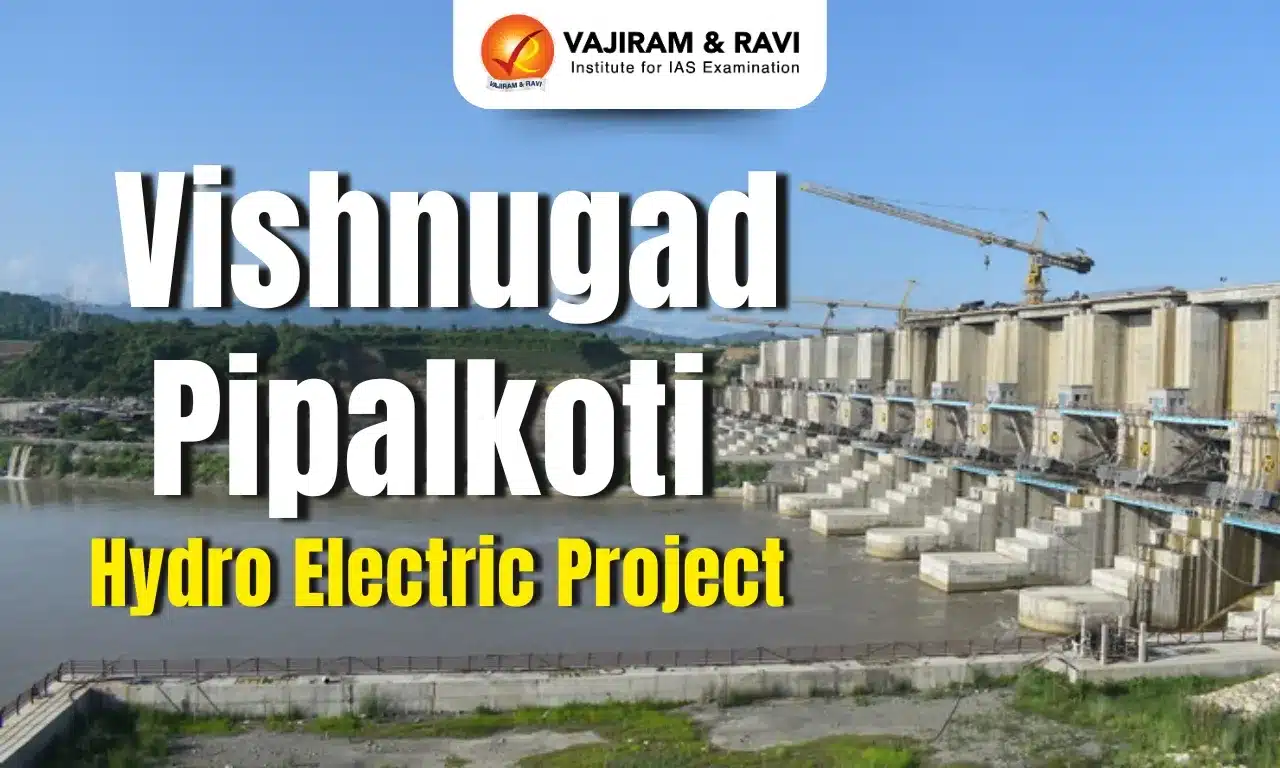
Vishnugad Pipalkoti Hydro Electric Project (VPHEP)

Vishnugad Pipalkoti Hydro Electric Project

Vishnugad Pipalkoti Hydro Electric Project Latest News

Seven workers were killed after a landslide triggered a massive surge of water and debris into an under-construction tunnel of the 444-MW Vishnugad-Pipalkoti Hydroelectric Project in Uttarakhand’s Chamoli district recently.

About Vishnugad Pipalkoti Hydro Electric Project

  • It is a run-of-river hydropower scheme being developed on the Alaknanda River (a major tributary of the Ganga River) in the Chamoli district of Uttarakhand.
  • The project envisages the construction of a 65 m high concrete diversion dam, along with a 13.4 km long Head Race Tunnel (HRT) and a 3.04 km long Tail Race Tunnel (TRT).  
  • With an installed capacity of 444 MW (4 × 111 MW), VPHEP is designed to provide peaking power to India’s Northern Grid.
  • The project, when completed, will generate an estimated 1,665 gigawatt-hours (or million kilowatt-hours) of electricity in a typical year. 
  • All water diverted from the river will be returned to the river approximately 18 km after the point of diversion. 
  • It is being developed by THDC India Ltd, (formerly Tehri Hydro Development Corporation Limited) and financed by a US $648 million loan from the World Bank.
    • THDC is a joint venture between the government of India and the government of Uttar Pradesh.

News: NIE

Vishnugad Pipalkoti Hydro Electric Project FAQs

Q1: What is the Vishnugad Pipalkoti Hydro Electric Project (VPHEP)?

Ans: It is a run-of-river hydropower project being developed on the Alaknanda River in Uttarakhand.

Q2: What is the installed capacity of the Vishnugad Pipalkoti Hydro Electric Project?

Ans: Its installed capacity is 444 MW.

Q3: Which company is developing the Vishnugad Pipalkoti Hydro Electric Project?

Ans: It is being developed by THDC India Ltd, (formerly Tehri Hydro Development Corporation Limited).

Q4: Which international institution is financing Vishnugad Pipalkoti Hydro Electric Project?

Ans: The World Bank is financing the project.

Foreign Assets of Small Taxpayers – Disclosure Scheme

Foreign Assets of Small Taxpayers – Disclosure Scheme

Foreign Assets of Small Taxpayers – Disclosure Scheme Latest News

Recently, the government has notified a one-time voluntary disclosure scheme, Foreign Assets of Small Taxpayers – Disclosure Scheme (FAST-DS).

About Foreign Assets of Small Taxpayers – Disclosure Scheme

  • It is a one-time voluntary disclosure scheme contained in Chapter IV of the Finance Act, 2026.
  • It enables eligible taxpayers to declare certain undisclosed foreign assets, undisclosed foreign income, or undeclared foreign assets on payment of a specified tax or fee.
  • Asset includes immovable property, jewellery, artistic work, shares, securities or any other asset or income,
  • The scheme applies to two broad categories of asset or income
  • Category 1: An undisclosed foreign asset or foreign income that was not previously offered to tax, the aggregate value must not exceed ₹1 crore.
    • Under this, taxpayers need to pay 30% of fair market value of assets or 30% of undisclosed income as tax and 30% as additional income tax in lieu of penalty in order to get immunity from prosecution.
  • Category 2:  It covers foreign assets that were already offered to tax or acquired when the taxpayer was a non-resident but were not reported in the relevant tax-return schedule. The threshold for such declarations is ₹5 crore.
    • For this category, immunity from both penalty and prosecution is available with the fee payment of Rs 1 lakh.
  • Immunity: Taxpayers making valid declarations will receive immunity from any further tax or penalty and from prosecution under the Black Money (Undisclosed Foreign Income and Assets) and Imposition of Tax Act, 2015.

Source: IE

Foreign Assets of Small Taxpayers – Disclosure Scheme FAQs

Q1: What is nodal agency for the Disclosure Scheme ?

Ans: CBDT

Q2: What is Foreign Assets of Small Taxpayers – Disclosure Scheme?

Ans: It is a one-time voluntary disclosure scheme contained in Chapter IV of the Finance Act, 2026.

Mount Ararat

Mount Ararat

Mount Ararat Latest News

A German-Turkish research team conducted the first survey of Mount Ararat’s glacier in eastern Turkey recently.

About Mount Ararat

  • It is a volcanic massif located in extreme eastern Turkey.
  • It overlooks the point at which the frontiers of Turkey, Iran, and Armenia converge. 
  • Mount Ararat (16,940 feet, 5165 m) is the highest mountain among hundreds found in the area, and the highest in the Armenian Highlands. 
  • It is the highest mountain in Turkey.  
  • The dormant volcano is also known as Mount Agri and Mount Masis.  
  • It is actually part of two snow-capped peaks, named Greater Ararat and Lesser Ararat.
    • Both Great and Little Ararat are the product of eruptive volcanic activity. 
    • Neither retains any evidence of a crater, but well-formed cones and fissures exist on their flanks. 
    • The only true glacier is found on the northern side of the Great Ararat, near its summit. 

News: STD

Mount Ararat FAQs

Q1: Where is Mount Ararat located?

Ans: It is located in extreme eastern Turkey.

Q2: What type of mountain is Mount Ararat?

Ans: Mount Ararat is a volcanic massif.

Q3: What are the other names of Mount Ararat?

Ans: It is also known as Mount Agri and Mount Masis.

Q4: Is Mount Ararat an active or dormant volcano?

Ans: It is a dormant volcano.

Subansiri River

Subansiri River

Subansiri River Latest News

The Subansiri River in Arunachal Pradesh's Upper Subansiri district has risen to an unusually high and forceful level despite no rainfall being reported in the area, raising concerns among local residents.

About Subansiri River

  • It is a right-bank tributary of the Brahmaputra River, originating in Tibet and flowing through Arunachal Pradesh and Assam. 
  • It is a trans-Himalayan and antecedent river, meaning it existed before the Himalayas rose and continued its course through the mountains.  
  • It is also called the “Gold River” because of the gold dust found in its waters. 
  • Course
    • It originates in the Tibetan Plateau, where it is formed by the confluence of three small streams: Lokong Chu, Chayal Chu, and Tsari Chu. 
    • It flows eastward in Tibet for about 170 km before turning south and entering India near Taksing in Arunachal Pradesh. 
    • In Arunachal Pradesh, the Subansiri River flows east and southeast through the Miri Hills, carving deep gorges and creating a rugged landscape. 
    • After covering about 250 km in the Eastern Himalayas, it descends into the Assam Valley at Dulangmukh in Dhemaji district. 
    • Here, it slows down and meanders through the plains for about 86 km, passing near Majuli—the world’s largest river island—before merging with the Brahmaputra River at Jamurighat in Lakhimpur district, Assam
    • It is the largest tributary of the Brahmaputra River. 
  • Its total length is approximately 442 kilometres, with the river draining a basin of roughly 32,000 sq.km.
  • The river is fed by a combination of snowmelt from its Tibetan headwaters and the intense southwest monsoon precipitation that falls over the Himalayan foothills between June and September.  
  • Tributaries: Major tributaries of the river are Laro, Nye, Yume, Tsari, Kamla, Jiyadhol, Ranganadi and Dikrong.
  • Lower Subansiri Hydroelectric Project:
    • It is a 2000 MW run-of-the-river hydro project being constructed on the Subansiri River.
    • It is located at Gerukamukh on the Arunachal Pradesh–Assam border.
    • It will be the single largest hydroelectric plant in India when completed.

News: IT

Subansiri River FAQs

Q1: The Subansiri River is a tributary of which major river?

Ans: It is a right-bank tributary of the Brahmaputra River.

Q2: Where does the Subansiri River originate?

Ans: It originates in Tibet, on the Tibetan Plateau.

Q3: Through which Indian states does the Subansiri River flow?

Ans: It flows through Arunachal Pradesh and Assam.

Q4: Why is the Subansiri River called an antecedent river?

Ans: It is considered antecedent because its course predates the rise of the Himalayas and it maintained its course as the mountains rose.

Q5: What is the approximate total length of the Subansiri River?

Ans: Approximately 442 kilometres.

Cauvery Wildlife Sanctuary

Cauvery Wildlife Sanctuary

Cauvery Wildlife Sanctuary Latest News

Three alleged poachers were killed in an exchange of fire with forest personnel at Cauvery Wildlife Sanctuary in Karnataka’s Chamarajanagar district recently.

About Cauvery Wildlife Sanctuary

  • It is located in the Ramanagara, Chamarajanagar, and Mandya districts of Karnataka
  • Established in 1987, it covers an area of approximately 1,027 sq.km.  
  • It is situated on the banks of the River Cauvery, which flows through the major part of this protected area. 
  • To the east and northeast, the sanctuary is bordered by Tamil Nadu state. 
  • Vegetation: It has riverine and dry deciduous forests and some patches of scrub forest. 
  • Flora: Among the unique tree species, you will find teak (Tectona grandis), Sandalwood (Santalum album), Bamboo (Dendrocalamus strictus), Indian gooseberry (Phyllanthus Emblica), and Terminalia (Terminalia arjuna).
  • Fauna
    • Notable mammals include the Bengal tiger, Indian leopard, elephants, gaur (Indian bison), sloth bear, wild boar, and the Sambar deer. 
    • There are more than 250 bird species, including the Crested Hawk Eagle, Indian Roller, White-bellied Drongo, Malabar Pied Hornbill, and the endangered Great Hornbill. 

News: TELE

Cauvery Wildlife Sanctuary FAQs

Q1: Where is the Cauvery Wildlife Sanctuary located?

Ans: It is located in the Ramanagara, Chamarajanagar, and Mandya districts of Karnataka.

Q2: Which major river flows through the Cauvery Wildlife Sanctuary?

Ans: The River Cauvery flows through the sanctuary.

Q3: What are the major types of vegetation found in the Cauvery Wildlife Sanctuary?

Ans: It has riverine forests, dry deciduous forests, and patches of scrub forest.

Chips to Start-up Programme

Chips to Start-up Programme

Chips to Start-up Programme Latest News

According to the Ministry of Electronics and Information Technology more than 68,000 students have been trained in semiconductor chip design under the government’s Chips to Start-ups (C2S) Programme. 

About Chips to Start-up Programme

  • It is an umbrella capacity-building initiative launched by the Ministry of Electronics and Information Technology (MeitY) in 2022.
  • Funding and Tenure: Total outlay of ₹250 crore over five years.
  • Target: It targets the development of 85,000 industry-ready professionals across undergraduate, postgraduate, and doctoral levels.
  • It aims to catalyse the incubation of 25 start-ups and enable 10 technology transfers.

Features of Chips to Start-up Programme

  • It seeks to provide access to SMART lab facilities, train one lakh students, generate 50 patents, and support at least 2,000 focused research publications. 
  • It supports innovation, enhances employability, and enables academic institutions to play a more active role in India’s semiconductor value chain.
  • Programme Approach and Implementation
  • The C2S Programme adopts a comprehensive approach, providing students with hands-on experience in chip design, fabrication, and testing.
    • Training: It is achieved through regular training sessions in collaboration with industry partners, combined with mentorship and practical support.
    • Access: Students gain access to advanced chip design tools, fabrication facilities, and testing resources, including state-of-the-art EDA software and semiconductor foundries.
    • Prototype: These opportunities also include implementing R&D projects under the C2S Programme to develop working prototypes of Application-Specific Integrated Circuit (ASICs), Systems-on-Chip (SoCs), and Intellectual Property (IP) Core designs.

Source: TH

Chips to Start-up Programme FAQs

Q1: Chips to Start-up- C2S Programme was launched by which ministry?

Ans: Ministry of Electronics & Information Technology

Q2: Chips to Start-up (C2S) Programme was launched in which year?

Ans: 2022

Leucas droupadiae

What is Leucas droupadiae

Leucas droupadiae Latest News

Botanists recently discovered a previously unknown plant species named growing along the sandy shores of the Coromandel Coast.

About Leucas droupadiae

  • It is a new species of plant belonging to the mint family (Lamiaceae).
  • It was discovered along the sandy shores of the Coromandel Coast during a survey of the coastal dunes in the Cuddalore district of Tamil Nadu. 
  • It thrives in nutrient-poor, sandy habitats.  
  • What sets Leucas droupadiae apart from its closest relatives is its unique loner growth habit and its striking seeds. 
  • While most similar plants in this family grow as creeping vines or branched bushes with deep taproots, this new species stands upright as a single, unbranched stem, reaching only about 15 centimeters in height. 
  • It anchors itself into the sands using a shallow web of fibrous roots rather than a single thick root. 
  • Most distinctively, the plant produces oblong fruit, known as nutlets, that are a brilliant golden yellow and covered in irregular dark brown spots, a feature not seen in its cousins. 
  • The scientists have named the plant in honour of Smt. Droupadi Murmu, the 15th President of India
  • Because of its limited range, the species has been provisionally labelled as “Data Deficient," .

News: RM

Leucas droupadiae FAQs

Q1: What is Leucas droupadiae?

Ans: It is a newly discovered species of plant belonging to the mint family Lamiaceae.

Q2: Where was Leucas droupadiae discovered?

Ans: It was discovered along the sandy shores of the Coromandel Coast in Cuddalore district, Tamil Nadu.

Q3: Which plant family does Leucas droupadiae belong to?

Ans: It belongs to the Lamiaceae family, commonly known as the mint family.

Q4: What is the distinctive growth habit of Leucas droupadiae?

Ans: It has a single, upright and unbranched stem.

RSVC-AMRIT Platform

RSVC-AMRIT Platform

RSVC-AMRIT Platform Latest News

Recently, the Principal Scientific Adviser to the Government of India launched the RSVC AMRIT platform.

About RSVC-AMRIT Platform

  • It is developed by NABARD in collaboration with the Office of the Principal Scientific Adviser (OPSA) to the Government of India.
  • AMRIT Platform serves as the digital backbone of the RuTAGe Smart Village Centre (RSVC) ecosystem.
  • Focus: It supports rural innovation and technology transfer and enables wider adoption of appropriate technologies in rural areas.
  • It is designed as a comprehensive digital ecosystem supporting the complete RSVC lifecycle, from technology discovery and validation to deployment tracking, collaboration, monitoring and knowledge management.
  • The platform will progressively bring together innovators, technology providers, startups, validators, accelerators, implementation partners, funding agencies, academic institutions and rural communities on a shared platform. 

What is The Rural Technology Action Group (RuTAG)?

  • It is an initiative of the Office of the Principal Scientific Adviser (OPSA) which was launched in 2004.
  • It was conceptualized as a mechanism to provide a higher level of Science &Technology intervention and support for rural areas.
  • Objectives of RuTAG Initiative
    • Connecting Stakeholders: Collaborating with stakeholders Non-Government Organizations, Self Help Groups, Community Organizations, and Start-ups to identify sector-specific technology needs.
    • Demand-driven technologies: Developing technologies based on socio-economic data coherent with national/regional priorities.
    • Prototype Validation: ValidatIng developed prototypes and explored commercialization with scalability aspects.
    • Commercialization: Commercializing the potentially validated technologies for national/global markets.

Source: PIB

RSVC-AMRIT Platform FAQs

Q1: What is the primarily aim of RSVC-AMRIT?

Ans: It supports rural innovation and technology transfer and enables wider adoption of appropriate technologies in rural areas.

Q2: RSVC-AMRIT Platform was developed by whom?

Ans: It is developed by NABARD in collaboration with the Office of the Principal Scientific Adviser (OPSA) to the Government of India.

SraVaani

SraVaani

SraVaani Latest News

Recently, researchers at IISc’s SPIRE Lab, in collaboration with ARTPARK and Google, have released SraVaani.

About SraVaani

  • It is the first multilingual Indian speech recognition model.
  • It extends automatic speech recognition to several regional and non-scheduled Indian languages that remain underserved by existing speech technology.
  • It covers 20 scheduled languages and 45 regional languages and dialects.
  • It can convert spoken words into text across 10 scripts and automatically identify the language being spoken, without users having to select one first.
  • The model supports languages such as Garo, Angika, Chakma, Kokborok, Tulu, Bundeli and Bajjika.
  • The SraVaani model is based on Project Vaani, one of IISc’s major programs, to understand the linguistic diversity of India.
    • The project has gathered around 31,000 hours of speech data obtained from over 156,000 speakers from 165 regions, thus providing the needed information about natural conversational-speech to the researchers.
    • SraVaani uses a FastConformer-based automatic speech recognition architecture.
  • Applications: It could support applications in areas such as education, digital services, banking, healthcare, e-governance and customer support, particularly where users prefer interacting in regional languages.

Source: TH

SraVaani FAQs

Q1: SraVaani was developed by which organisation?

Ans: IISc’s SPIRE Lab, in collaboration with ARTPARK and Google

Q2: What is SraVaani model?

Ans: Multilingual Indian speech recognition model

80th Independence Day Address

80th Independence Day Address

80th Independence Day Latest News

  • In his 13th Independence Day address from the Red Fort, Prime Minister Narendra Modi outlined a comprehensive roadmap towards Viksit Bharat @2047.
  • He emphasised on youth empowerment, economic reforms, technological leadership, self-reliance (Atmanirbhar Bharat), national security and governance reforms. 
  • The speech came against the backdrop of recent youth protests over employment and examination issues.

Youth at the Centre of Development

  • Recognising concerns over employment, technology and competitive examinations, the Prime Minister made youth the central theme of his address.
  • Key announcements:
    • AI Skill Mission: Training 1 crore youth in Artificial Intelligence within one year.
    • Free Online Coaching: A nationwide digital platform using Digital Public Infrastructure (DPI) to provide free coaching for competitive examinations, reducing dependence on costly private coaching.
    • Sports Talent Mission: National talent hunt for children aged 5–16 years to prepare India for the 2036 Olympic Games bid.
    • Youth were encouraged to participate in the Census and assist families in digitising household information for better governance.
  • The government projected AI, startups, drones, electric vehicles, aviation, bio-economy, robotics and space technology as emerging employment generators.

‘Saptadhara’ - Seven Pillars of Economic Transformation

  • The Prime Minister introduced "Shakti ki Saptadhara", seven reform streams aimed at making India a globally competitive manufacturing and export-oriented economy.
  • Manufacturing excellence: Focus on quality manufacturing, complete domestic value chains and globally competitive products. Transition from "Make in India" towards higher-value manufacturing.
  • Agriculture and food processing: Promote food processing industries, enable farmers to access global markets through Free Trade Agreements (FTAs), and shift from farm to export market.
  • Technology and innovation:
    • Strengthen India's capabilities in AI, Quantum Computing, Robotics, Space Technology, Data Centres and Semiconductors.
    • Three semiconductor plants are already operational; 5–8 additional plants expected in the next few years.
    • India aims to become a global innovation hub instead of merely a technology consumer.
  • Logistics and connectivity: Expand PM GatiShakti and multimodal infrastructure, and improve logistics efficiency to boost exports and competitiveness.
  • Defence and national security: Increase indigenous defence production and defence exports. Strengthen advanced defence technologies under Atmanirbhar Bharat.
  • Green and blue economy: Promote renewable energy, green hydrogen, clean technologies and marine resources for sustainable growth.
  • India's soft power: Leverage India's culture, creativity and civilisational heritage to enhance global influence.

Other Highlights of his Address

  • Self-reliance with global integration:
    • The speech clarified that Atmanirbhar Bharat does not imply economic isolation.
    • Major themes:
      • Build domestic capabilities while expanding exports.
      • Utilise FTAs signed or negotiated with nearly 40 countries.
      • Encourage MSMEs to integrate into global value chains.
      • Compete globally through quality, affordability and innovation.
    • The Prime Minister noted that countries increasingly use energy, technology, medicines, semiconductors and strategic resources as geopolitical tools, reinforcing the need for resilient domestic capabilities.
  • National security and civil defence:
    • Changing nature of warfare: Acknowledging evolving security threats, the Prime Minister announced a comprehensive restructuring of civil defence infrastructure.
    • Future conflicts may target: Data centres, banking systems, refineries, critical infrastructure, and industrial facilities.
    • The government will continue implementing Mission Sudarshan Chakra, integrating AI, cybersecurity and multi-layered defence systems.
  • Women’s political representation:
    • The Prime Minister appealed to all political parties to facilitate the implementation of the Nari Shakti Vandan Adhiniyam, 2023.
    • This provides 33% reservation for women in the Lok Sabha and State Legislative Assemblies.
    • Implementation remains linked to the Census and subsequent delimitation exercise.
  • Governance and reform agenda:
    • The Prime Minister reiterated that India has entered a "Reform Express", calling upon government, industry, farmers, producers, and society to reform traditional systems, adopt innovation and enhance competitiveness.
    • He highlighted the speed of governance, digital transformation and policy reforms as defining features of the past decade.

Evolution of Independence Day Speeches (2014-2026)

  • 2014–15: Good governance, Jan Dhan, Swachh Bharat, Make in India, financial inclusion.
  • 2016–18: Administrative reforms, national security, GST, Ayushman Bharat, women's empowerment.
  • 2019: Article 370 abrogation, Jal Jeevan Mission, and announced creation of Chief of Defence Staff.
  • 2020: Atmanirbhar Bharat during COVID-19.
  • 2021: National Hydrogen Mission, PM GatiShakti, semiconductor ecosystem.
  • 2022: Panch Pran and civilisational vision for Viksit Bharat.
  • 2023: Welfare expansion, green energy, defence and anti-corruption narrative.
  • 2024: One Nation One Election, Uniform Civil Code debate, AI, semiconductors and political reforms.
  • 2025: Strategic autonomy, indigenous defence capability and energy security after Operation Sindoor.
  • 2026: Youth-centric reforms, AI skilling, export competitiveness, advanced manufacturing, defence modernisation and the Saptadhara framework.

Conclusion

The 80th Independence Day address reaffirmed the government's long-term vision of Viksit Bharat by 2047, placing youth, technology, manufacturing, self-reliance, exports and strategic autonomy at the heart of India's development strategy. 

Source: TH | IE | IE

80th Independence Day FAQs

Q1: What is the significance of the 'Saptadhara' framework?

Ans: It outlines seven reform pillars—manufacturing, agriculture, technology, logistics, defence, green and blue economy, and soft power.

Q2: How does the government propose to address youth aspirations?

Ans: Through AI skilling for 1 crore youth, free online coaching for competitive examinations, sports talent identification, etc.

Q3: Why is Atmanirbhar Bharat linked with export competitiveness rather than economic isolation?

Ans: It aims to build resilient domestic manufacturing and innovation capacities while leveraging Free Trade Agreements (FTAs).

Q4: Why did the PM call for restructuring India's civil defence infrastructure?

Ans: To prepare for hybrid warfare and cyber threats, where future conflicts may target critical infrastructure.

Q5: How has the focus of Independence Day speeches evolved from 2014 to 2026?

Ans: The narrative has shifted from good governance to youth empowerment and comprehensive economic reforms.

US Shadow Transhipment Network Report Flags India: Trade Ties Under Scrutiny

US Report Flags India in 'Shadow Transhipment Network'

Shadow Transhipment Network Latest News

  • The Trump administration released a report titled "The Great Transhipment Scam: Global Evasion and Economic Costs," naming India among 40+ countries allegedly helping China evade US tariffs by routing goods through third countries. 
  • India has been placed in the highest-risk category, raising concerns ahead of the ongoing India-US trade agreement negotiations.

What Is the Shadow Transhipment Network?

  • A Shadow Transhipment Network refers to an alleged global system where Chinese exporters send goods through intermediate countries before they reach the US, in order to bypass steep American import tariffs
  • In these transit hubs, the goods undergo minor assembly, relabelling, or repackaging, allowing them to be documented as products of the transit country rather than China, thereby evading US customs duties.
  • This practice is believed to have expanded significantly after 2018, when the US administration imposed sweeping tariffs on Chinese imports. 
  • Facing higher duties, Chinese exporters increasingly rerouted shipments through third countries to preserve access to the American market at lower cost.

US Report on Tiers Based Transhipment Risk

  • The White House report, prepared by the Office of Trade and Manufacturing Policy (OTMP), classifies countries into three tiers based on transhipment risk:
    • Tier 1 – India, Mexico, Canada, and the European Union, where illegal transhipment risk is "embedded" within large volumes of legitimate trade.
    • Tier 2 – Vietnam, Malaysia, and Thailand, described as "closely integrated" with China.
    • Tier 3 – Cambodia, Panama, and the UAE, flagged for "weak customs enforcement."
  • The Department of Commerce's Office of Trade and Economic Analysis (OTEA) estimated that around $67 billion in US-bound goods were transhipped from China via Mexico, India, and Vietnam in 2025, causing an estimated $28 billion in lost tariff revenue.

India Specific Allegations: The Pune-Gujarat-Chennai Corridor

  • The report singles out India's Pune-Gujarat-Chennai industrial corridor, calling it one of the "ugly sister" cities of global trade, allegedly used for routing pumps and compressors (HS codes 8413-8414) that pressure US industries in Cincinnati, Dayton, and Columbus.
  • However, the Global Trade Research Initiative (GTRI), a New Delhi-based think tank, countered this claim with trade data:
    • India exported liquid pumps worth $1.61 billion globally in FY2026, including $414.5 million to the US, while importing only $326.4 million from China.
    • India exported air pumps and gas compressors worth $1.48 billion globally, including $335.4 million to the US, against $1.63 billion imported from China.
  • GTRI argued that India's substantial global exports in these categories weaken the presumption that its US-bound shipments are merely rerouted Chinese goods.

Similar Allegations Against Other Countries

  • The report extends similar claims to other Asian manufacturing hubs:
    • Vietnam's Ho Chi Minh City corridor is linked to electrical switching equipment, affecting US industries in Chicago, Milwaukee, and Rockford.
    • Malaysia's Penang-Kulim cluster is tied to plastic articles, impacting plastics production in Akron and Canton.
    • Indonesia's Bekasi-Batam corridor is linked to plastic packaging goods.
    • Thailand's Ayutthaya-Samut Prakan corridor is associated with thermostats.

Why This Matters: Laying Groundwork for New Curbs

  • Trade experts believe the report may pave the way for fresh tariff action through Congress, especially after the US Supreme Court struck down the earlier reciprocal tariffs under the International Emergency Economic Powers Act (IEEPA) in February 2025 for exceeding presidential authority.
  • India's tier-1 categorisation signals that the US will likely seek a clause in the upcoming trade deal committing India to act against transhipment practices, and that transhipment-prone Indian exports may already face greater scrutiny.
  • Other experts criticised the report for failing to distinguish between genuine transhipment and exports based on legitimate domestic value addition, urging India to question the report's basis and conclusions.
  • Experts also linked this report to a broader pattern of pressure, alongside the US Senate's law permitting up to 100% tariffs on major buyers of Russian oil, suggesting the Trump administration is building leverage for future trade actions, possibly including new Section 301 tariffs.
  • The report's timing is significant, coming as India and the US negotiate a bilateral trade agreement. 
  • Being placed in tier 1 could mean India faces pressure to demonstrate reduced dependency on Chinese inputs and to commit to stronger anti-transhipment measures as part of any final deal.

Conclusion

  • The US transhipment report reflects Washington's broader strategy of shifting tariff pressure from China alone to its trading partners, including India. 
  • While India has strong counter-data on genuine manufacturing capacity, the episode underscores the delicate balance India must strike between deepening trade ties with the US and safeguarding its manufacturing credibility on the global stage.

Source: IE | NDTV

Shadow Transhipment Network FAQs

Q1: What is the shadow transhipment network mentioned in the US report?

Ans: It refers to an alleged system where Chinese exporters route goods through third countries for minor processing, disguising their origin to bypass steep US tariffs on Chinese imports.

Q2: Why has India been flagged in the shadow transhipment network report?

Ans: The US report placed India in the highest-risk Tier 1 category, alleging its Pune-Gujarat-Chennai corridor routes Chinese pumps and compressors to the US market to evade duties.

Q3: How has India countered the shadow transhipment network allegations?

Ans: The Global Trade Research Initiative cited India's large genuine global pump and compressor exports, arguing this data weakens claims that US-bound shipments are merely rerouted Chinese goods.

Q4: Which other countries appear in the shadow transhipment network report besides India?

Ans: Mexico and the EU share India's Tier 1 status, while Vietnam, Malaysia, and Thailand fall in Tier 2, and Cambodia, Panama, and the UAE are placed in Tier 3.

Q5: What could the shadow transhipment network report mean for India-US trade talks?

Ans: India may face pressure to commit to anti-transhipment measures and reduce Chinese input dependency, as the report could lay groundwork for fresh tariffs via Congress or Section 301 action.

PM Modi’s 100 GW Nuclear Target: Powering India’s AI and Chip Future by 2047

PM Modi's 100 GW Nuclear Target - Powering India's AI and Chip Future

100 GW Nuclear Target Latest News

  • In his Independence Day address, PM Modi set a target of expanding India's nuclear power capacity to 100 GW by 2047, along with commissioning five new nuclear reactors within the current decade. 
  • This comes as India bets on nuclear power to meet the rapidly rising electricity demand from emerging sectors like semiconductors, artificial intelligence (AI), and data centres

Why India Needs More Nuclear Power

  • PM Modi highlighted that the growing adoption of future technologies would sharply increase electricity demand: "It will be difficult to run this new world without energy... whether it is chips, AI or data centres, we will need very large amounts of electricity." 
  • Nuclear power is being positioned as a carbon-neutral, reliable baseload source to meet this demand alongside the growing renewable energy mix.

Policy Backdrop: The SHANTI Act

  • PM Modi's announcement follows Parliament's passage of the SHANTI Act last year, which:
    • Opens the door to wider private participation in India's tightly regulated civil nuclear power sector.
    • Has drawn interest from global nuclear technology suppliers from Russia, the US, and France.
  • The Department of Atomic Energy (DAE) recently released draft rules under the Act, laying out the regulatory framework for private participation, captive generation, licensing, safety oversight, and nuclear liability.

Two-Pronged Strategy: Large Reactors + SMRs

  • To achieve the 100 GW target by 2047, the government is pursuing a two-pronged approach:
    • Large-capacity reactors — continuing to expand conventional nuclear capacity.
    • Small Modular Reactors (SMRs) — for faster, more flexible deployment.

Why SMRs Matter

  • India's indigenous Pressurised Heavy Water Reactors (PHWRs) will remain the backbone of nuclear expansion, but SMRs are gaining importance for industrial decarbonisation.
  • SMRs offer flexible baseload power, helping grid operators balance the variability of large-scale renewable energy integration.
  • High costs of large Light Water Reactors (LWRs) have raised questions about their large-scale feasibility, making SMRs the focal point of India's international nuclear collaborations. 
  • In May 2026, a high-level American nuclear delegation was briefed on India's plans to enter the SMR manufacturing value chain.

India's Indigenous SMR Programme

  • The Bhabha Atomic Research Centre (BARC) is developing three types of SMRs for demonstration:
    • Bharat Small Modular Reactor (BSMR-200) — 200 MWe
    • A 55 MWe small modular reactor
    • A 5 MWt high-temperature gas-cooled reactor for hydrogen production via thermochemical coupling
  • Target: At least five indigenously designed and operational SMRs by 2033.
  • The Nuclear Energy Mission, with a budgetary outlay of ₹20,000 crore, has been launched for research, design, development, and deployment of SMRs. 
  • The government is also studying the repurposing of old thermal power plant sites for nuclear use, particularly suited for SMRs and smaller nuclear projects.

Current Status of India's Nuclear Sector

  • 25 operational reactors, totalling 8.7 GWe capacity.
  • 10 reactors under construction, adding around 8 GWe.
  • 10 more units in the pre-project stage, with approximately 6.6 GWe capacity.

India's Three-Stage Nuclear Programme

  • India follows a three-stage nuclear power programme aimed at achieving long-term fuel self-reliance, leveraging its abundant thorium reserves:
    • Stage 1: PHWRs using natural uranium as fuel.
    • Stage 2: Fast Breeder Reactors (FBRs) use the plutonium generated from Stage 1's spent fuel, combined with depleted uranium, to convert Thorium-232 (Th-232) into Uranium-233 (U-233).
    • Stage 3: Th-232 is converted into U-233, which becomes fuel for advanced reactors — completing the shift toward thorium-based self-reliance.
  • FBRs serve as the crucial bridge between Stages 1 and 3, enabling India to tap its thorium resources.

Recent Milestone

  • In April 2026, India's first indigenous fast breeder reactor at Kalpakkam attained criticality — a major milestone. 
  • PM Modi noted: "This year, India crossed an important milestone by mastering fast breeder nuclear technology... a major step towards achieving self-reliance in nuclear fuel."

Conclusion

  • India's 100 GW nuclear ambition reflects a broader recognition that the AI-driven digital economy demands massive, reliable, carbon-neutral power. 
  • By combining indigenous thorium-based self-reliance with SMR innovation and private participation, India aims to position nuclear energy as a cornerstone of both its technological future and climate commitments.

Source: IE

100 GW nuclear target FAQs

Q1: What is India's 100 GW nuclear target?

Ans: PM Modi announced that India will expand nuclear power capacity to 100 GW by 2047, alongside commissioning five new reactors within this decade to meet rising electricity demand.

Q2: Why is India pursuing the 100 GW nuclear target now?

Ans: The 100 GW nuclear target responds to surging power demand from AI, semiconductors, and data centres, with nuclear energy seen as a reliable, carbon-neutral baseload source for this growth.

Q3: What role does the SHANTI Act play in the 100 GW nuclear target?

Ans: The SHANTI Act opened India's nuclear sector to private participation, drawing interest from Russian, American, and French suppliers, and laid the regulatory groundwork for licensing and liability.

Q4: How do SMRs support achieving the 100 GW nuclear target?

Ans: Small Modular Reactors offer flexible, faster-to-deploy baseload power that balances renewable energy variability, making them central to India's strategy for reaching the 100 GW nuclear target.

Q5: What is India's three-stage nuclear programme linked to the 100 GW nuclear target?

Ans: It moves from natural uranium reactors to fast breeder reactors and finally thorium-based reactors, ensuring long-term fuel self-reliance while supporting the 100 GW nuclear target's expansion goals.

Green India Mission – Achievements, Challenges and CAG Audit Findings

Green India Mission - Achievements, Challenges and CAG Audit Findings

Green India Mission Latest News

  • A recent Comptroller and Auditor General of India (CAG) audit has flagged major shortcomings in the implementation of the Green India Mission (GIM), including inadequate funding, weak convergence with other schemes, poor monitoring and significant shortfalls in achieving forest-cover targets.

Green India Mission

  • The National Mission for a Green India is one of the eight missions under India's National Action Plan on Climate Change (NAPCC). 
  • It was launched by the Ministry of Environment, Forest and Climate Change (MoEFCC) in 2014, with implementation activities beginning in 2015-16.
  • The Mission adopts a landscape-based approach to protect, restore and enhance forest and tree cover while improving ecosystem services and the livelihoods of forest-dependent communities. 
  • It combines climate-change mitigation with adaptation by focusing on carbon sequestration, biodiversity, water security and livelihood enhancement.  
  • Objectives of GIM
    • Increase forest and tree cover. 
    • Improve the quality of existing forest and tree cover. 
    • Enhance ecosystem services such as biodiversity, water and carbon sequestration. 
    • Increase livelihood incomes of forest-dependent households. 
    • Enhance annual carbon sequestration. 
  • The mission envisages increasing forest and tree cover over 5 million hectares and improving the quality of forest and tree cover over another 5 million hectares.

Achievements of the Green India Mission

  • The Mission has supported afforestation and eco-restoration activities across several States and Union Territories.
  • According to the MoEFCC Annual Report 2024-25, Rs. 944.48 crore had been released to 17 States and one Union Territory since 2015-16 for plantation activities covering 1,55,130 hectares in forest and non-forest areas, along with livelihood-improvement activities for forest-dependent communities. 
  • More recent government information indicates that GIM activities have expanded further. As of March 2026, Rs. 1,019.26 crore had been released under the Mission. 
  • The broader improvement in India's forest and tree cover also provides important context. 
  • According to the India State of Forest Report (ISFR) 2023, forest and tree cover together account for 25.17% of India's geographical area, comprising 21.76% forest cover and 3.41% tree cover. India has recorded a cumulative increase of 4.83% in forest and tree cover since 2013. 
  • The Government has also reported that India ranked third globally in annual net forest gain, according to the FAO Global Forest Resources Assessment 2025. However, these broader national trends should not automatically be attributed solely to GIM, as several programmes contribute to India's overall forest and tree-cover outcomes. 

Green India Mission and India's Climate Commitments

  • GIM is particularly important because forests are a major component of India's climate strategy.
  • Under its Nationally Determined Contribution (NDC), India has committed to creating an additional carbon sink of 2.5-3 billion tonnes of CO₂ equivalent through additional forest and tree cover by 2030.
  • Therefore, the effectiveness of programmes such as GIM has implications beyond afforestation. Healthy forests contribute to:
    • Carbon sequestration
    • Biodiversity conservation
    • Water regulation
    • Soil conservation 
    • Climate resilience
    • Livelihoods of forest-dependent communities

News Summary

  • The CAG conducted a performance audit of the planning, implementation and monitoring of GIM interventions in 16 States and Union Territories for the period 2015-16 to 2024-25.
  • The audit found substantial gaps between the Mission's targets and achievements.

Mission Targets vs Achievements

  • Thus, despite the broader national increase in forest and tree cover, the CAG found that the specific targets assessed under GIM interventions remained significantly underachieved.

Inadequate Funding

  • The audit identified insufficient funding as one of the major constraints affecting implementation.
  • The Mission had proposed Rs. 10,600 crore in funding support. However, during the 10-year period examined, only Rs. 1,149.14 crore was received through budgetary support.
  • The CAG noted that this represented only 47.88% of the Rs. 2,000 crore approved by the Cabinet Committee on Economic Affairs for the initial four years, along with Rs. 400 crore from the 13th Finance Commission grants towards the States' share.
  • The substantial difference between the proposed funding and actual budgetary support limited the Mission's ability to achieve its intended scale.

Weak Convergence with Other Schemes

  • GIM was designed to benefit from convergence with other government programmes, particularly Compensatory Afforestation Fund Management and Planning Authority (CAMPA) and the Mahatma Gandhi National Rural Employment Guarantee Scheme (MGNREGS).
  • However, the CAG found that the planned convergence was not effectively achieved.
  • Other initiatives, including Nagar Van Yojana and School Nursery Yojana, were also found to be operating largely in silos.
  • This limited convergence reduced opportunities to pool financial resources, technical capacity and implementation infrastructure across programmes pursuing related environmental objectives.

Weak Financial Controls

  • The audit also identified shortcomings in financial management.
  • Eight States and Union Territories did not maintain annual accounts, while accounts in other cases were either unaudited or contained discrepancies.
  • Such deficiencies can affect the ability to track expenditure accurately, assess programme efficiency and ensure accountability in the utilisation of public funds.
  • The CAG attributed the Mission's shortcomings to a combination of:
    • Inadequate convergence with other schemes
    • Insufficient funding
    • Deficiencies in planning
    • Weak monitoring mechanisms
  • The findings suggest that expanding financial allocations alone may not be sufficient. Stronger institutional coordination, outcome-based planning and reliable monitoring mechanisms are necessary to translate expenditure into measurable improvements in forest quality and cover.

Significance of the CAG Findings

  • The audit is important because GIM is directly linked to India's climate and environmental objectives. 
  • The Mission's intended outcomes extend beyond increasing the area under plantations to improving forest quality, ecosystem services, carbon sequestration and forest-dependent livelihoods.
  • The findings therefore highlight the need to assess environmental programmes not merely through the amount of money spent or the number of saplings planted, but through measurable ecological outcomes such as survival rates, improvement in forest quality, biodiversity, carbon sequestration and ecosystem restoration.

Source : TH

Green India Mission FAQs

Q1: What is the Green India Mission?

Ans: GIM is one of the eight missions under the National Action Plan on Climate Change and aims to protect, restore and enhance India's forest and tree cover.

Q2: What are the major targets of GIM?

Ans: The Mission aims to increase forest and tree cover over 5 million hectares and improve the quality of forest and tree cover over another 5 million hectares.

Q3: How much area has been covered through GIM activities?

Ans: According to the MoEFCC Annual Report 2024-25, GIM had supported plantation over 1,55,130 hectares since 2015-16.

Q4: What were the major shortcomings identified by the CAG?

Ans: The CAG identified inadequate funding, weak convergence with other government schemes, deficiencies in planning, poor monitoring and weaknesses in financial controls.

Q5: What is India's forest and tree-cover share according to ISFR 2023?

Ans: Forest and tree cover together account for 25.17% of India's geographical area, comprising 21.76% forest cover and 3.41% tree cover.

Enquire Now