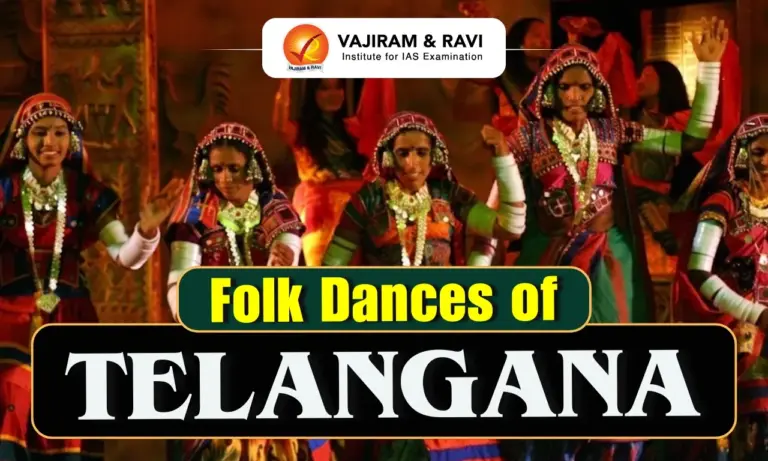
Folk Dances of Telangana are an important part of the state’s cultural heritage. They reflect the traditions, beliefs, festivals, occupations and social life of different communities. Many of these dances are performed during festivals, marriages, religious ceremonies and important community gatherings.
Major Folk Dances of Telangana
Major Folk Dances of Telanganarepresent the cultural diversity of its tribal and rural communities. Some are linked with religious festivals, while others are associated with agriculture, marriages, historical traditions and tribal jatara celebrations.
1. Gussadi Dance
Gussadi Dance is one of the best-known tribal dances of Telangana and is performed by the men of the Gond tribe, particularly in the Adilabad region. It is traditionally performed before Deepavali, from Ashwayuja Shuddha Pournami to Ashwayuja Bahula Chaturdasi.
The dancers travel in groups to neighbouring villages while singing and dancing. A large group generally has 15-20 members and is known as a Dandari troupe. From these groups, smaller Gussadi groups are formed.
The performers wear colourful costumes, ornaments, peacock-feather turbans, artificial moustaches and beards, and deer horns. They also apply ash to their bodies and carry the traditional Gussadi Rokhhari. The dance is prominently associated with the Nagoba Jatara.
2. Dhemsa Dance
Dhemsa is a traditional dance performed by both men and women of the Raj Gond community. It is mainly performed during festivals and marriages.
The dancers perform to the rhythm of traditional instruments such as Pepre, Dhol, Kalikom, and Tamak. The dance encourages community participation and reflects the social and cultural traditions of the Raj Gond people.
3. Koya Dance or Bison-Horn Dance
The Koya Dance, also called the Bison-Horn Dance or Permakoki Play, is a traditional dance of the Koya tribe. It is performed mainly during festivals and marriages.
The male dancers wear colourful clothes and large bison-horn headgears, which give the dance its distinctive appearance. The dance is common in the tribal areas of Warangal and Khammam and is associated with the Sammakka-Sarakka Jatara in the Mulugu region.
Both men and women can participate, and a troupe may have around 30–40 members. The dance is also known as Dorala Sattam.
4. Kurru Dance
Kurru Dance is a traditional dance performed mainly by the men of the Koya tribe. It is associated with the tribal regions of the former Warangal area.
The dance is particularly linked with the Sammakka-Sarakka Jatara, one of the most important tribal festivals of Telangana. It reflects the traditional cultural practices of the Koya community.
5. Lambadi Dance
Lambadi Dance is performed by Banjara women and is closely connected with their everyday life and agricultural activities.
The movements of the dance represent activities such as planting, sowing, and harvesting. It is performed during marriages, Teej, Holi, and Sankranthi.
During Holi, Banjara women form a circle around the Kamudi Manta and dance while holding hands and moving in rhythm with traditional music. Their colourful costumes and jewellery make the performance visually distinctive.
6. Mango Dance of Konda Reddy
The Mango Dance is associated with the Konda Reddy/Bison Reddy community of the Khammam region. It is performed as part of a ceremonial festival before the community begins plucking mangoes.
The dance is dedicated to Mutyalamma and Konda Devatha. Performers dance in groups to the rhythmic beats of the Dappu. The performance shows the close relationship between tribal traditions, nature, agriculture, and religious beliefs.
7. Goravayya Dance
Goravayya Dance is a traditional ritual performance associated with the Golla and Kuruma communities. It is performed at important Mallanna temples, including Inavolu Mallanna Temple in Warangal and Komaravelli Mallanna Temple in Siddipet.
A member of the Kuruma family is selected as the Goravayya. The performer traditionally wears a Kambali or Gongadi, carries a deer-skin bag called Bandaru containing turmeric, and performs with a Dhamarukam.
A distinctive feature of this performance is that the dancers bark like dogs and identify themselves as the “Dogs of Lord Mallanna.” The unusual ritual elements make Goravayya Dance an important part of Telangana’s folk traditions.
8. Siddi Dance or Khadga Nrityam
Siddi Dance, also known as Khadga Nrityam, is associated with the Siddi community of Hyderabad. The Siddis have historical links with people who migrated from Africa to the Indian subcontinent.
The dance involves the use of swords and traditional weapons and resembles a martial performance or sword fight. It is performed during festivals and marriages. The energetic movements and use of swords give the dance a distinctive character.
9. Garaga Dance
Garaga Dance is a ritual folk dance in which performers balance a clay pot or Ghatam on their heads while performing rhythmic movements.
It is particularly associated with the Bonalu festival of Telangana. The dance forms part of the state’s wider tradition of religious and ceremonial performances.
10. Perini Sivatandavam
Perini Sivatandavam, popularly known as the Warrior Dance of Telangana, is an ancient dance form dedicated to Lord Shiva. It has a strong historical connection with Warangal.
Traditionally, warriors performed this dance before going to battle to seek the blessings and strength of Lord Shiva. It is performed before Nataraja images or in Shiva temples.
The dance was revived and popularised by Nataraja Ramakrishna, who played an important role in bringing this historical dance tradition back into public attention.
11. Veera Natyam
Veera Natyam, meaning the heroic dance, is associated with Veerabhadra, a fierce form of Lord Shiva. It is performed at Veerabhadra temples, including those at Korivi and Kothakonda.
The dance is associated with communities such as Veera Mushti, Jangams, Balijas, and Devangas. It is particularly performed during Shivaratri and represents courage, devotion, and the powerful energy associated with Lord Shiva.
Also Read:- Folk Dances of India
12. Dappu Natyam
Dappu Natyam is a high-energy folk dance based on the Dappu drum. The Dappu is a traditional percussion instrument made using animal hide and played with sticks.
A group generally consists of around 15–20 performers, who may wear anklet bells while dancing. Dappu Natyam is commonly performed during processions, festivals, celebrations, and community feasts.
The strong beats of the Dappu make this dance particularly energetic and suitable for large public gatherings.
Folk Dances of Telangana Significance
Folk Dances of Telangana are significant because they preserve the cultural identity and traditional knowledge of different communities. Their importance can be understood through the following points:
- Cultural identity: Folk dances help communities preserve their customs, traditions, costumes, music and cultural identity across generations.
- Connection with festivals: Many dances are closely associated with festivals and jatara celebrations such as Nagoba Jatara, Sammakka-Sarakka Jatara, Bonalu, Holi and Shivaratri.
- Religious importance: Several dances are performed as acts of devotion to deities such as Lord Shiva, Veerabhadra, Mallanna, Mutyalamma and Konda Devatha.
- Reflection of tribal life: Tribal dances such as Gussadi, Dhemsa and Koya Dance reflect the lifestyle, beliefs, social practices and community traditions of Telangana’s tribal groups.
- Connection with agriculture: Dances such as Lambadi Dance and Mango Dance show the importance of agriculture, crops and nature in the lives of traditional communities.
- Community participation: Most folk dances are performed collectively. They bring people together during marriages, festivals, processions and other social occasions.
- Preservation of traditional arts: Folk theatre and dance forms such as Chindu Bhagavatam help preserve traditional storytelling, music, costumes, dialogue and performance techniques.
- Historical heritage: Forms such as Perini Sivatandavam provide a link with Telangana’s historical warrior traditions and the cultural heritage of the Kakatiya period.


 Last updated on Oct, 2026
→ UPSC 2027 Notification will be released on 13 January 2027 at upsconline.nic.in.
→ Check Nobel Prize 2026 Winners List here.
→ Download PIB PRiSM Monthly Magazine 2026 here.
→ Check UPSC Monthly Current Affairs Magazine The Recitals here.
→ Check out the latest UPSC Syllabus here.
→ Download UPSC Model Answers for Mains 2026
→ UPSC Mains Question Paper 2026 is out now for Essay & GS Paper 1, 2, 3 & 4.
→ UPSC Calendar 2027 has been released.
→ Enroll in Vajiram & Ravi’s UPSC Mains Test Series 2027 for structured answer writing practice, expert evaluation, and exam-oriented feedback.
→ Join Vajiram & Ravi’s UPSC Mentorship Program 2027 for personalized guidance, strategy planning, and one-to-one support from experienced mentors.
→ Go through the UPSC Mains Previous Year Papers to enhance your preparation.
→ UPSC has released UPSC Toppers List 2025 with the Civil Services final result on its official website.
→ Also check Best UPSC Coaching in India
Folk Dances of Telangana FAQs
Q1. What are the major folk dances of Telangana?+
Q2. Which is the famous tribal dance of Telangana?+
Q3. Which tribe performs Gussadi Dance?+
Q4. Which dance is known as the Bison-Horn Dance of Telangana?+
Q5. Which community performs Lambadi Dance?+
Q6. Which dance of Telangana is associated with Lord Shiva?+
Tags: folk dances folk dances of telangana