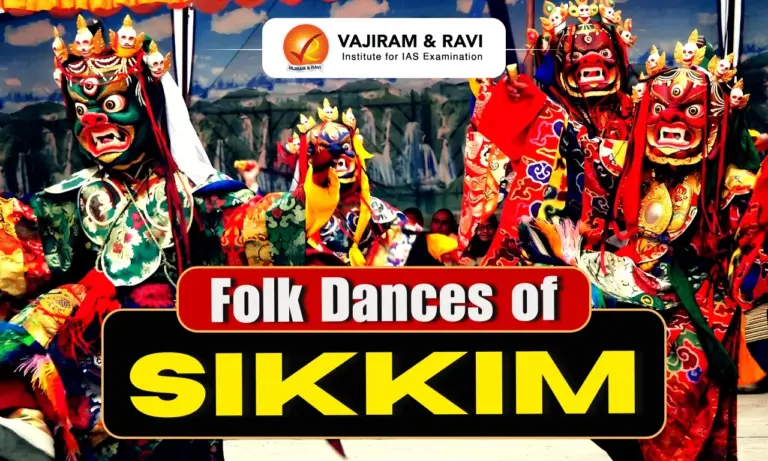
The Folk Dances of Sikkim are an important part of the state’s rich cultural heritage and reflect the traditions of its Nepali, Bhutia and Lepcha communities. These dances are performed during festivals, religious ceremonies, harvest celebrations, weddings and other social occasions. With their traditional music, colourful costumes and distinctive movements, the Folk Dances of Sikkim showcase the state’s diverse culture, beliefs and close connection with nature and community life.
Major Folk Dances of Sikkim
- Tamang Selo: Tamang Selo is a lively group dance of the Tamang community. It is performed on happy occasions and is known for energetic footwork and the use of the Damphu, a traditional instrument. Tamang songs called Hwai often accompany the dance and express different human emotions.
- Chutkay: Chutkay is a cheerful Nepali group dance performed by men and women. It is associated with happiness, social gatherings and the harvesting season, where dancers come together to celebrate the joys of life.
- Chu-Faat: Chu-Faat is a traditional Lepcha dance performed in honour of Mount Khangchendzonga, regarded as a guardian deity by the people of Sikkim. Dancers carry butter lamps and green bamboo leaves while performing devotional movements and singing traditional songs.
- Denong-Neh-Nah: This Bhutia community dance is performed by boys and girls to pay respect to saints such as Guru Rimpoche and seek their blessings. The graceful performance is accompanied by instruments such as the flute, Yangjey, drum and Yarka.
- Kagyed Dance: Kagyed is a ritualistic Buddhist dance performed in Sikkimese monasteries. It is connected with the eight Tantric deities and is traditionally performed around the New Year. The occasion includes prayers, lighting of butter lamps and offerings at monasteries.
- Naumati: Naumati is a traditional Nepali group dance of the Damai community. It is accompanied by Naumati Baja, an ensemble of nine types of traditional instruments, including Shehnai, Turhi, Damaha, Dholki and Jhyamta. It is commonly associated with weddings and other auspicious occasions.
- Ta-Shi-Yang-Ku: This Bhutia dance is performed to seek the blessings of deities for prosperity and good fortune. It is performed during occasions such as housewarming ceremonies, New Year celebrations and weddings, with dancers wearing traditional costumes and ornaments.
- Tendong Lho Rum Faat: This traditional Lepcha dance is based on a folklore connected with the Tendong Hill. According to legend, the hill provided shelter to people during a devastating flood. The dance therefore represents gratitude, faith and the community’s connection with nature.
- Yak Chham: Yak Chham is a Bhutia dance that portrays the movements of the yak and the traditional lifestyle of mountain herders. Dancers wear yak-shaped costumes and masks and perform coordinated movements. Performances at places such as Pemayangtse, Rumtek and Enchey are particularly well known.
- Zo-Mal-Lok: Zo-Mal-Lok is a Lepcha agricultural dance that depicts activities such as sowing, reaping and harvesting paddy. Men and women of different ages participate together, accompanied by traditional instruments such as the drum, flute and cymbal.
- Maruni: Maruni is one of the oldest traditional dances of the Nepali community in Sikkim. It is strongly associated with the Tihar festival and is also performed at weddings and births. Dancers wear colourful costumes and ornaments, while the performance is accompanied by the Naumati Baja and a clown-like character called Dhatu Waray.
- Lu Khangthamo: Lu Khangthamo is a Bhutia folk dance performed to express gratitude to deities associated with heaven, earth and the underworld. It may be performed during New Year celebrations, housewarmings and other happy occasions, with participants wearing traditional Bhutia clothing.
- Dhan Nach: Dhan Nach, meaning “Paddy Dance,” is a harvest dance associated with the Nepali community. It is performed during important agricultural activities, particularly the harvesting of paddy. Men and women wear traditional clothes and ornaments and dance to the sounds of the Madal and Murali.
- Gnela Kipa: Gnela Kipa is a Bhutia community dance performed on festive and happy occasions, including New Year celebrations, marriages and childbirth. Through songs and dance, participants express gratitude to respected saints and sacred places and pray for peace and happiness.
- Kat-gnok-Lok: This Lepcha dance is known as the “Dance of the Swans” and is inspired by the seasonal migration of swans. The movement of these birds traditionally helped the Lepchas understand the timing of sowing and harvesting, and the dance symbolises the struggles and hopes connected with human life.
- Singhi Chham: Singhi Chham, or the Snow Lion Dance, is a famous Bhutia dance connected with the sacred Mount Khangchendzonga. Dancers wear a large snow-lion costume made of cloth and fur, with two performers moving inside it in perfect coordination. The dance is accompanied mainly by a drum.
- Khukuri Naach: This is a traditional warrior dance associated with the Nepali community. Dancers use the Khukuri as a symbolic prop and perform quick, energetic movements representing bravery, courage and victory.
Also Read : Folk Dances of India
Traditional Dances of Sikkim and Their Features
- The traditional dances of Sikkim represent the cultural traditions of its three major communities – Nepali, Bhutia and Lepcha. Each community has developed dances connected with its own history, beliefs, occupations and way of life.
- Many dances are performed as group performances, involving men, women and sometimes people of different age groups. Their coordinated movements, traditional costumes and musical accompaniment give these performances a strong community character.
- Traditional instruments form an important part of Sikkim’s folk dances. Depending on the dance, performers use drums, flutes, cymbals, gongs, string instruments and instruments such as the Damphu, Chyap-Brung and Naumati Baja.
- Several dances are closely connected with agriculture and seasonal activities. Dances such as Dhan Nach and Zo-Mal-Lok represent paddy cultivation, harvesting and other important agricultural practices.
- Religious and ritual dances are also an important part of Sikkimese culture. Kagyed, Chu-Faat, Tendong Lho Rum Faat and Singhi Chham reflect religious beliefs, prayers, legends and respect for sacred mountains and deities.
- Traditional costumes add to the beauty and identity of these dances. Dancers generally wear colourful community-specific clothes, ornaments, masks and headgear, depending on the occasion and type of performance.
- Mask dances or Chhams are particularly associated with the Bhutia Buddhist tradition. They combine elaborate masks, costumes, rhythmic movements and religious themes and are often performed in or around monasteries.


Folk Dances of Sikkim and Their Cultural Significance
- Folk dances are an important part of Sikkim’s cultural identity because they preserve the traditions and collective memories of its diverse communities. They provide a way for younger generations to remain connected with their cultural roots.
- Many dances express gratitude, devotion and respect for nature. Chu-Faat and Singhi Chham, for example, reflect the cultural importance of Mount Khangchendzonga, while Tendong Lho Rum Faat connects the Lepcha community with the Tendong Hill and its traditional flood legend.
- Folk dances also reflect the close relationship between people and agriculture. Dhan Nach and Zo-Mal-Lok portray farming and harvesting activities and highlight the importance of paddy cultivation in traditional community life.
- Several performances are linked with festivals, weddings, New Year celebrations, housewarmings and childbirth, making dance an important part of social and family life in Sikkim.
- These dances also preserve traditional music, instruments, costumes, folklore and religious beliefs. Through regular performances at cultural events and festivals, these traditions continue to be shared with wider audiences.
- The Folk Dances of Sikkim bring together culture, religion, nature, agriculture and community life. They reflect the state’s diverse heritage while strengthening a shared sense of identity and cultural continuity.

 Last updated on Oct, 2026
→ UPSC 2027 Notification will be released on 13 January 2027 at upsconline.nic.in.
→ Check Nobel Prize 2026 Winners List here.
→ Download PIB PRiSM Monthly Magazine 2026 here.
→ Check UPSC Monthly Current Affairs Magazine The Recitals here.
→ Check out the latest UPSC Syllabus here.
→ Download UPSC Model Answers for Mains 2026
→ UPSC Mains Question Paper 2026 is out now for Essay & GS Paper 1, 2, 3 & 4.
→ UPSC Calendar 2027 has been released.
→ Enroll in Vajiram & Ravi’s UPSC Mains Test Series 2027 for structured answer writing practice, expert evaluation, and exam-oriented feedback.
→ Join Vajiram & Ravi’s UPSC Mentorship Program 2027 for personalized guidance, strategy planning, and one-to-one support from experienced mentors.
→ Go through the UPSC Mains Previous Year Papers to enhance your preparation.
→ UPSC has released UPSC Toppers List 2025 with the Civil Services final result on its official website.
→ Also check Best UPSC Coaching in India
Folk Dances of Sikkim FAQs
Q1. What are the major Folk Dances of Sikkim?+
Q2. Which communities perform the Folk Dances of Sikkim?+
Q3. What is Tamang Selo Dance?+
Q4. What is Chu-Faat Dance of Sikkim?+
Q5. What is Kagyed Dance?+
Q6. What is Yak Chham Dance?+
Q7. What is Singhi Chham or Snow Lion Dance?+
Q8. What is Maruni Dance of Sikkim?+
Q9. What is Dhan Nach in Sikkim?+
Q10. What is Naumati Dance?+
Tags: art and culture art and culture notes folk dances folk dances of sikkim